WO2014024952A1 - 糖液の製造方法 - Google Patents
糖液の製造方法 Download PDFInfo
- Publication number
- WO2014024952A1 WO2014024952A1 PCT/JP2013/071451 JP2013071451W WO2014024952A1 WO 2014024952 A1 WO2014024952 A1 WO 2014024952A1 JP 2013071451 W JP2013071451 W JP 2013071451W WO 2014024952 A1 WO2014024952 A1 WO 2014024952A1
- Authority
- WO
- WIPO (PCT)
- Prior art keywords
- membrane
- sugar solution
- washing water
- producing
- cellulose
- Prior art date
- Legal status (The legal status is an assumption and is not a legal conclusion. Google has not performed a legal analysis and makes no representation as to the accuracy of the status listed.)
- Ceased
Links
Images


Classifications
-
- C—CHEMISTRY; METALLURGY
- C13—SUGAR INDUSTRY
- C13K—SACCHARIDES OBTAINED FROM NATURAL SOURCES OR BY HYDROLYSIS OF NATURALLY OCCURRING DISACCHARIDES, OLIGOSACCHARIDES OR POLYSACCHARIDES
- C13K1/00—Glucose; Glucose-containing syrups
- C13K1/02—Glucose; Glucose-containing syrups obtained by saccharification of cellulosic materials
- C13K1/04—Purifying
-
- B—PERFORMING OPERATIONS; TRANSPORTING
- B01—PHYSICAL OR CHEMICAL PROCESSES OR APPARATUS IN GENERAL
- B01D—SEPARATION
- B01D61/00—Processes of separation using semi-permeable membranes, e.g. dialysis, osmosis or ultrafiltration; Apparatus, accessories or auxiliary operations specially adapted therefor
- B01D61/02—Reverse osmosis; Hyperfiltration ; Nanofiltration
- B01D61/025—Reverse osmosis; Hyperfiltration
-
- B—PERFORMING OPERATIONS; TRANSPORTING
- B01—PHYSICAL OR CHEMICAL PROCESSES OR APPARATUS IN GENERAL
- B01D—SEPARATION
- B01D61/00—Processes of separation using semi-permeable membranes, e.g. dialysis, osmosis or ultrafiltration; Apparatus, accessories or auxiliary operations specially adapted therefor
- B01D61/02—Reverse osmosis; Hyperfiltration ; Nanofiltration
- B01D61/027—Nanofiltration
-
- B—PERFORMING OPERATIONS; TRANSPORTING
- B01—PHYSICAL OR CHEMICAL PROCESSES OR APPARATUS IN GENERAL
- B01D—SEPARATION
- B01D61/00—Processes of separation using semi-permeable membranes, e.g. dialysis, osmosis or ultrafiltration; Apparatus, accessories or auxiliary operations specially adapted therefor
- B01D61/02—Reverse osmosis; Hyperfiltration ; Nanofiltration
- B01D61/029—Multistep processes comprising different kinds of membrane processes selected from reverse osmosis, hyperfiltration or nanofiltration
-
- B—PERFORMING OPERATIONS; TRANSPORTING
- B01—PHYSICAL OR CHEMICAL PROCESSES OR APPARATUS IN GENERAL
- B01D—SEPARATION
- B01D61/00—Processes of separation using semi-permeable membranes, e.g. dialysis, osmosis or ultrafiltration; Apparatus, accessories or auxiliary operations specially adapted therefor
- B01D61/14—Ultrafiltration; Microfiltration
- B01D61/145—Ultrafiltration
-
- B—PERFORMING OPERATIONS; TRANSPORTING
- B01—PHYSICAL OR CHEMICAL PROCESSES OR APPARATUS IN GENERAL
- B01D—SEPARATION
- B01D61/00—Processes of separation using semi-permeable membranes, e.g. dialysis, osmosis or ultrafiltration; Apparatus, accessories or auxiliary operations specially adapted therefor
- B01D61/14—Ultrafiltration; Microfiltration
- B01D61/149—Multistep processes comprising different kinds of membrane processes selected from ultrafiltration or microfiltration
-
- B—PERFORMING OPERATIONS; TRANSPORTING
- B01—PHYSICAL OR CHEMICAL PROCESSES OR APPARATUS IN GENERAL
- B01D—SEPARATION
- B01D61/00—Processes of separation using semi-permeable membranes, e.g. dialysis, osmosis or ultrafiltration; Apparatus, accessories or auxiliary operations specially adapted therefor
- B01D61/58—Multistep processes
-
- B—PERFORMING OPERATIONS; TRANSPORTING
- B01—PHYSICAL OR CHEMICAL PROCESSES OR APPARATUS IN GENERAL
- B01D—SEPARATION
- B01D65/00—Accessories or auxiliary operations, in general, for separation processes or apparatus using semi-permeable membranes
- B01D65/02—Membrane cleaning or sterilisation ; Membrane regeneration
-
- C—CHEMISTRY; METALLURGY
- C13—SUGAR INDUSTRY
- C13B—PRODUCTION OF SUCROSE; APPARATUS SPECIALLY ADAPTED THEREFOR
- C13B20/00—Purification of sugar juices
- C13B20/16—Purification of sugar juices by physical means, e.g. osmosis or filtration
- C13B20/165—Purification of sugar juices by physical means, e.g. osmosis or filtration using membranes, e.g. osmosis, ultrafiltration
-
- C—CHEMISTRY; METALLURGY
- C13—SUGAR INDUSTRY
- C13K—SACCHARIDES OBTAINED FROM NATURAL SOURCES OR BY HYDROLYSIS OF NATURALLY OCCURRING DISACCHARIDES, OLIGOSACCHARIDES OR POLYSACCHARIDES
- C13K1/00—Glucose; Glucose-containing syrups
- C13K1/02—Glucose; Glucose-containing syrups obtained by saccharification of cellulosic materials
-
- C—CHEMISTRY; METALLURGY
- C13—SUGAR INDUSTRY
- C13K—SACCHARIDES OBTAINED FROM NATURAL SOURCES OR BY HYDROLYSIS OF NATURALLY OCCURRING DISACCHARIDES, OLIGOSACCHARIDES OR POLYSACCHARIDES
- C13K13/00—Sugars not otherwise provided for in this class
- C13K13/007—Separation of sugars provided for in subclass C13K
-
- B—PERFORMING OPERATIONS; TRANSPORTING
- B01—PHYSICAL OR CHEMICAL PROCESSES OR APPARATUS IN GENERAL
- B01D—SEPARATION
- B01D2321/00—Details relating to membrane cleaning, regeneration, sterilization or to the prevention of fouling
- B01D2321/16—Use of chemical agents
- B01D2321/162—Use of acids
-
- B—PERFORMING OPERATIONS; TRANSPORTING
- B01—PHYSICAL OR CHEMICAL PROCESSES OR APPARATUS IN GENERAL
- B01D—SEPARATION
- B01D2321/00—Details relating to membrane cleaning, regeneration, sterilization or to the prevention of fouling
- B01D2321/16—Use of chemical agents
- B01D2321/168—Use of other chemical agents
-
- Y—GENERAL TAGGING OF NEW TECHNOLOGICAL DEVELOPMENTS; GENERAL TAGGING OF CROSS-SECTIONAL TECHNOLOGIES SPANNING OVER SEVERAL SECTIONS OF THE IPC; TECHNICAL SUBJECTS COVERED BY FORMER USPC CROSS-REFERENCE ART COLLECTIONS [XRACs] AND DIGESTS
- Y02—TECHNOLOGIES OR APPLICATIONS FOR MITIGATION OR ADAPTATION AGAINST CLIMATE CHANGE
- Y02E—REDUCTION OF GREENHOUSE GAS [GHG] EMISSIONS, RELATED TO ENERGY GENERATION, TRANSMISSION OR DISTRIBUTION
- Y02E50/00—Technologies for the production of fuel of non-fossil origin
- Y02E50/10—Biofuels, e.g. bio-diesel
Definitions
- the present invention relates to a method for producing a sugar solution from cellulose.
- Cellulose-derived sugar solutions include sugar, water-insoluble fine particles such as lignin, silica, calcium salts, aggregated proteins and undegraded cellulose, water-soluble polymers such as oligosaccharides, polysaccharides, tannins and proteins, and low molecular weight Fermentation inhibitors, inorganic salts, organic acids, etc.
- water-insoluble fine particles such as lignin, silica, calcium salts, aggregated proteins and undegraded cellulose
- water-soluble polymers such as oligosaccharides, polysaccharides, tannins and proteins
- low molecular weight Fermentation inhibitors inorganic salts, organic acids, etc.
- Patent Document 1 a method for filtering fine particles to the non-permeation side with a microfiltration membrane, a water-soluble polymer with an ultrafiltration membrane.
- the present inventors have found that the separation membrane is clogged with long-term operation in the process of removing impurities from the cellulose-derived sugar solution using the separation membrane. Accordingly, the present invention provides a method for cleaning clogging of a separation membrane caused by impurities in the cellulose-derived sugar solution, particularly water-soluble polymers, in a method for producing a cellulose-derived sugar solution using a separation membrane. It is an object of the present invention to provide a method for efficiently removing impurities from a cellulose-derived sugar solution.
- the present invention has the following configurations (1) to (7).
- a method for producing a sugar solution includes a step of filtering a cellulose-derived sugar solution through one or more separation membranes selected from the group consisting of an ultrafiltration membrane, a nanofiltration membrane, and a reverse osmosis membrane.
- a method for producing a sugar solution comprising washing the separation membrane with washing water containing an acidic substance and an aromatic compound.
- the acidic substance is one or more selected from the group consisting of sulfuric acid, hydrochloric acid, nitric acid, oxalic acid, citric acid and acetic acid.
- the aromatic compound is one or more selected from the group consisting of hydroxymethylfurfural (HMF), furfural, coumaric acid, ferulic acid, coumarinamide, ferulamide and vanillin,
- HMF hydroxymethylfurfural
- furfural furfural
- coumaric acid ferulic acid
- coumarinamide ferulamide
- vanillin The method for producing a sugar liquid according to 1) or (2).
- clogging of the separation membrane due to impurities peculiar to cellulose-derived sugar liquid can be removed at a low cost while suppressing membrane deterioration, so that the clogged separation membrane can be reused in the manufacturing process of cellulose-derived sugar liquid.
- FIG. 1 is a schematic diagram of a basic configuration of a separation membrane cleaning apparatus for carrying out the present invention.
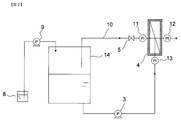
- FIG. 2 is a schematic diagram of a separation membrane cleaning apparatus that combines the function of performing a membrane treatment with a sugar solution and the function of cleaning the separation membrane.
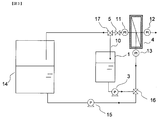
- FIG. 3 is a schematic diagram of a separation membrane cleaning apparatus in which the function of performing a membrane treatment of a sugar solution and the function of cleaning the separation membrane are independent.
- FIG. 4 is a schematic diagram of the entire system for producing a cellulose-derived sugar solution from a pretreated product of cellulose-containing biomass.
- the cellulose-derived sugar solution as used in the present invention refers to a sugar solution obtained by hydrolyzing cellulose-containing biomass.
- the method for hydrolyzing the cellulose-containing biomass is not particularly limited, but it is preferably a technique in which hydrothermal treatment, acid treatment, alkali treatment, enzymatic saccharification and the like are appropriately combined.
- Cellulose-derived sugar solutions contain monosaccharides such as glucose, xylose, and mannose, and water-soluble polysaccharides such as cellobiose, cellooligosaccharides, and xylooligosaccharides. It can be converted into ethanol, lactic acid, and amino acids by microorganisms.
- the cellulose-derived sugar liquid contains, as components other than these sugars, fine particles such as lignin, silica, calcium salts, aggregated proteins and undegraded cellulose, oligosaccharides, polysaccharides, tannins, and the like that were not decomposed during the hydrolysis process. It contains a wide variety of impurities such as water-soluble polymers such as proteins, as well as low-molecular fermentation inhibitors, inorganic salts and organic acids. Such impurities can be classified into two types, a water-soluble component and a water-insoluble component. The water-insoluble component is preferably removed in advance as a solid content by solid-liquid separation of a sugar solution derived from cellulose.
- cellulose-derived sugar solution there are methods for solid-liquid separation of cellulose-derived sugar solution, such as centrifugation and filtration with a microfiltration membrane. Filtration with a microfiltration membrane can remove even water-insoluble components of micron order.
- the cellulose-derived sugar solution in the invention is preferably preliminarily filtered through a microfiltration membrane in addition to filtration through a subsequent separation membrane.
- a microfiltration membrane what is described in WO2010 / 067785 can be used.
- the present invention is characterized by filtering the cellulose-derived sugar solution through one or more separation membranes of ultrafiltration membranes, nanofiltration membranes, and reverse osmosis membranes. Filtration of the cellulose-derived sugar solution through a separation membrane can be performed according to the method described in WO2010 / 067785. In addition, as for the separation membrane used in the present invention, those described in WO2010 / 067785 can be used.
- the separation membrane When the cellulose-derived sugar solution is filtered through the above-described separation membrane, the separation membrane is clogged with long-term use.
- the present invention is characterized in that the clogged separation membrane is washed with an aqueous solution containing both an aromatic compound and an acidic substance (hereinafter also referred to as washing water).
- washing water an aqueous solution containing both an aromatic compound and an acidic substance
- a separation membrane cleaning step (hereinafter also referred to as a membrane cleaning step) using an aqueous solution containing both an aromatic compound and an acidic substance will be described.
- the aromatic compound referred to in the present invention is a cyclic hydrocarbon according to the Hückel rule, that is, a compound having a cyclic hydrocarbon structure in which the number of ⁇ electrons satisfies 4n + 2 (n is a positive integer including 0), Preferred examples include hydroxymethylfurfural (HMF), furfural, coumaric acid, ferulic acid, coumarinamide, ferulamide, vanillin and the like.
- HMF hydroxymethylfurfural
- furfural furfural
- coumaric acid furfural
- coumaric acid coumaric acid
- ferulic acid coumarinamide
- ferulamide vanillin and the like.
- the washing water used in the present invention may contain only one type of aromatic compound or two or more types.
- the acidic substance as used in the present invention is an acid according to the definition of Arrhenius, that is, a substance that generates hydrogen ions in an aqueous solution.
- inorganic acids such as sulfuric acid, nitric acid, hydrochloric acid, and organic acids such as acetic acid, oxalic acid, and citric acid. An acid etc. are mentioned.
- the washing water used in the present invention may contain only one kind of the acidic substance or two or more kinds.
- the separation membrane is washed with washing water containing both an aromatic compound and an acidic substance.
- a special membrane cleaning effect cannot be obtained with an aqueous solution containing only aromatic compounds. Only when both acidic substances are included, components that adhere to the surface and inside of the separation membrane and induce membrane clogging are efficiently removed. This is because the filtration rate of the separation membrane can be remarkably recovered.
- the clogging of the film is solved to some extent by the aqueous solution containing only the acidic substance, the cleaning effect becomes more remarkable only when both contain an aromatic compound.
- the concentration range of acidic substances in the wash water is more preferably 100 to 5000 ppm in total.
- the concentration range of the aromatic compounds in the washing water is preferably 500 to 10,000 ppm in total, more preferably 5000 to 10,000 ppm.
- the temperature range of the cleaning water is not particularly limited, but is preferably 10 to 90 ° C. If the temperature is less than 10 ° C, the viscosity of the washing water may be extremely high, and the effect of membrane cleaning may be impaired. If the temperature exceeds 90 ° C, the separation membrane itself may be damaged by heat, and conversely, the filtration performance of the membrane may be reduced. Because there are things.
- the aqueous solution containing the aromatic compound and the acidic substance may be prepared by adding the aromatic compound and the acidic substance to water, but is adjusted by adding the acidic substance to the aqueous solution containing the aromatic compound in advance. May be.
- a specific example is a filtrate obtained by passing a cellulose-derived sugar solution through a nanofiltration membrane and / or a reverse osmosis membrane (hereinafter referred to as NF filtrate or the like). It is known that the above-mentioned aromatic compound is contained in NF filtrate and the like, and an acidic substance added to this in a concentration range of 0.1 to 5 g / L is used as the washing water in the present invention. Preferably used. In the manufacturing process of cellulose-derived sugar liquid, it is normal to dispose of NF filtrate etc. as waste liquid. However, since this can be reused as washing water for separation membranes, water can be saved. Have.
- Methods for washing the separation membrane with washing water include a method of immersing the separation membrane in washing water, a method of filtering the entire amount of washing water with a separation membrane, and a method of cross-flow filtration of washing water with a separation membrane.
- the method of cross-flow filtration of washing water with a separation membrane is preferable because washing can be performed while washing off clogged components removed by washing water by creating a flow parallel to the membrane surface.
- the membrane surface speed of the washing water is preferably 5 to 50 cm / sec, more preferably 10 to 50 cm / sec. The reason for this is that if it is less than 5 cm / sec, the effect of cleaning the separation membrane surface is insufficient, and if it exceeds 50 cm / sec, the effect on cleaning is almost unchanged even if the film surface linear velocity is further increased. This is because there is not. Note that the film surface speed of the cleaning water can be adjusted by increasing or decreasing the flow rate of the cleaning water feed pump.
- the membrane cleaning method for cross-flow filtration of the cleaning water of the present invention with a separation membrane it is preferable to wash while applying a transmembrane differential pressure in order to clean the inside of the pores of the separation membrane. If the value is too high, the clogging component of the film is strongly pressed against the film surface, so that the detergency on the film surface is deteriorated. From such a point of view, in the membrane cleaning method of the present invention for cross-flow filtration of cleaning water with a separation membrane, a membrane of 5 kPa to 1 MPa for an ultrafiltration membrane, and a membrane of 0.5 to 3 MPa for a nanofiltration membrane or a reverse osmosis membrane. It is preferable to apply a differential pressure.
- the transmembrane pressure difference is a pressure difference generated before and after the membrane across the membrane in membrane treatment, that is, a differential pressure between the stock solution (concentrate) side and the filtrate side.
- a differential pressure between the stock solution (concentrate) side and the filtrate side.
- the transmembrane pressure difference at the time of washing is less than the above range, the amount of washing water passing through the pores of the membrane becomes extremely small, and the washing in the pores may be insufficient.
- cleaning exceeds the said range, since the liquid which passes the pore of a film
- the filtration flux of washing water in the range of the membrane surface linear velocity and the transmembrane pressure difference is usually about 0.05 to 0.5 m / day.
- the effect of membrane cleaning by the membrane cleaning process shall be evaluated based on how much the membrane filtration flux that has been lowered due to clogging is restored by cleaning. That is, the value obtained by dividing the filtration flux of the clogged membrane before washing and the clogged membrane after washing by the filtration flux of the unused membrane is defined as the filtration rate (%), and the difference in filtration rate before and after washing, Or the washing
- the membrane washing step in the present invention relates to a separation membrane having a filtration rate reduced to less than 70%, and can be reused for filtration of a cellulose-derived sugar solution by recovering the filtration rate to 70% or more. Is.
- An apparatus for carrying out the present invention includes at least a washing water holding tank for holding washing water, a circulation pump for circulating the washing water through the membrane, and a circulation line. Moreover, it is preferable to provide the valve
- solid arrows indicate liquid or solid flow and piping.
- FIG. 1 is a schematic diagram of an example of the most basic configuration of an apparatus for carrying out the present invention.
- FIG. 2 is a schematic view of an application example in which the washing water holding tank has the function as the sugar solution supply tank 14 used for the film treatment of the sugar solution in addition to the essential requirements included in FIG.
- FIG. 3 is a schematic diagram of an application example in addition to the essential requirements included in FIG. 1, which has a sugar solution membrane treatment system independently and can switch between these membrane treatment steps and membrane washing steps by operating a valve. It is.
- FIG. 4 is a schematic diagram of the entire system for producing a cellulose-derived sugar solution from a pretreated product of cellulose-containing biomass.
- the washing water holding tank 1 that holds the washing water.
- the washing water held in the washing water holding tank 1 is supplied to the cross flow membrane module 4 by the circulation pump 3 capable of adjusting the liquid flow rate, and returns to the washing water holding tank again via the circulation line 10.
- the transmembrane pressure difference can be adjusted by opening / closing the adjusting valve 5 and the flow rate of the circulation pump.
- the transmembrane pressure difference can be calculated using the pressure gauges 11 to 13. That is, the difference between the average of the measured values of the pressure gauge 11 and the pressure gauge 13 and the measured value of the pressure gauge 12 can be regarded as the transmembrane pressure difference.
- the apparatus shown in FIG. 2 combines the function of performing a membrane treatment with a sugar solution and the function of cleaning the membrane.
- the sugar solution supply tank 14 that holds the sugar solution during the membrane treatment of the sugar solution is also used as a washing water holding tank when the membrane is washed.
- the washing water is adjusted by adding water, aromatic compounds and acidic substances to the washing water adjustment tank 8, and is supplied to the sugar solution supply tank by the washing water introduction pump 9.
- the washing water held in the sugar solution supply tank 14 is supplied to the cross-flow membrane module 4 by the circulation pump 3 capable of adjusting the liquid feeding flow rate, and again passes through the circulation line 10 to the washing water holding tank. Come back.
- the transmembrane pressure difference can be adjusted by opening / closing the adjusting valve 5 and the flow rate of the circulation pump.
- the transmembrane pressure difference can be calculated using the pressure gauges 11 to 13. That is, the difference between the average of the measured values of the pressure gauge 11 and the pressure gauge 13 and the measured value of the pressure gauge 12 can be regarded as the transmembrane pressure difference.
- the apparatus shown in FIG. 3 has a function of performing a membrane treatment of sugar and a function of cleaning the membrane separately, and the functions are switched by operating the three-way valves 16 and 17.
- the sugar solution introduced into the sugar solution supply tank 14 is supplied to the cross flow membrane module 4 by the sugar solution feeding pump 15.
- a cleaning water holding tank 1 for holding cleaning water is provided for the cleaning of the membrane.
- the washing water held in the washing water holding tank 1 is supplied to the cross flow membrane module 4 by the circulation pump 3 capable of adjusting the liquid flow rate, and returns to the washing water holding tank again via the circulation line 10. .
- the transmembrane pressure difference can be adjusted by opening / closing the adjusting valve 5 and the flow rate of the circulation pump.
- the transmembrane pressure difference can be calculated using the pressure gauges 11 to 13. That is, the difference between the average of the measured values of the pressure gauge 11 and the pressure gauge 13 and the measured value of the pressure gauge 12 can be regarded as the transmembrane pressure difference.
- the cellulose-containing biomass is mixed with the saccharification enzyme in the saccharification reaction tank 21 and hydrolyzed.
- the slurry after the saccharification reaction is transferred to the solid-liquid separator 24 by the slurry transfer means 22 and separated into the solid residue 25 and the primary sugar liquid.
- the primary sugar solution is held in the ultrafiltration membrane supply tank 27, it is supplied to the ultrafiltration membrane module 30 by the ultrafiltration membrane supply pump 28, and the polymer concentrate and the secondary sugar solution (filtrate). Separated.
- the polymer concentrate is circulated by the ultrafiltration membrane supply tank 27 and the ultrafiltration membrane supply pump 28 and further concentrated.
- the secondary sugar solution After the secondary sugar solution is held in the nanofiltration membrane supply tank 31, it is supplied to the nanofiltration membrane module 34 by the nanofiltration membrane supply pump 32 and separated into the concentrated sugar solution and the NF filtrate.
- the concentrated sugar solution is circulated by the nanofiltration membrane supply tank 31 and the nanofiltration membrane supply pump 32 and further concentrated.
- the NF filtrate is held in the reverse osmosis membrane supply tank 35 and then supplied to the reverse osmosis membrane module 39 by the reverse osmosis membrane supply pump 36 to be separated into the RO concentrate and the RO filtrate.
- the RO concentrate is circulated by the reverse osmosis membrane supply tank 35 and the reverse osmosis membrane supply pump 36 and further concentrated.
- the RO concentrated liquid retained in the reverse osmosis membrane supply tank is an aqueous solution containing an aromatic compound, and is washed in the reverse osmosis membrane supply tank by adding acid by the acid supply tank 44 and the acid input pump 45. Water is adjusted. The washing water is returned from the reverse osmosis membrane supply tank 35 to the ultrafiltration membrane module 30 and the nanofiltration membrane module 34 by the membrane washing pump 40 and reused for membrane module washing.
- the RO filtrate is retained in the reverse osmosis membrane filtrate tank 41, and returned to the saccharification reaction tank 21, the ultrafiltration membrane module 30, and the nanofiltration membrane module 34 by the reverse osmosis membrane filtrate tank pump 42 as necessary. Reused for saccharification reaction solids concentration adjustment and membrane module cleaning.
- the saccharification reaction tank 21, the solid-liquid separation device 24, the ultrafiltration membrane supply tank 27, the nanofiltration membrane supply tank 31, the reverse osmosis membrane supply tank 35, and the reverse osmosis membrane filtrate tank 41 are all kept warm (each 23 26, 29, 33, 37, 43), and the process of each step can be performed while keeping the temperature of the sugar solution.
- cellulose-containing biomass Rice straw crushed to 2 mm size was used as the cellulose-containing biomass.
- the cellulose-containing biomass was immersed in water and autoclaved (manufactured by Nitto Koatsu Co., Ltd.) at 180 ° C. for 5 minutes while stirring. The pressure at that time was 10 MPa.
- the treated biomass component was subjected to solid-liquid separation using centrifugation (3000G). “Accel lace duet” (Genencor Kyowa Co., Ltd.) was added to this solution component and reacted at 50 ° C. for 24 hours to obtain a sugar solution derived from the solution component.
- a filter press process (MO-4, manufactured by Iwata Sangyo Co., Ltd.) was performed to obtain a biomass-derived sugar solution from which undecomposed cellulose or lignin was separated and removed. Further, the present sugar solution was subjected to a microfiltration membrane having a pore diameter of 0.22 ⁇ m to remove insoluble particles of micron order. About 40 L of the sugar solution thus obtained was subjected to a spiral membrane module comprising an ultrafiltration membrane, a nanofiltration membrane or a reverse osmosis membrane.
- the operating temperature is 50 ° C.
- the membrane surface linear velocity is 20 cm / sec
- the operating pressure is 0.1 MPa for the ultrafiltration membrane, 2 MPa for the nanofiltration membrane, and 4 MPa for the reverse osmosis membrane.
- Each was filtered.
- the operation was stopped when the filtration flux decreased to 0.05 m / day or less. In this way, the spiral membrane module having a reduced filtration flux was disassembled, and the membrane portion was cut into a sheet of 190 mm ⁇ 140 mm.
- a small flat membrane unit “SEPACF-II” manufactured by GE Osmonix: effective membrane area 140 cm 2 that can be used as a small filtration test of a spiral membrane module. ) was used to perform a membrane cleaning test and a permeation test.
- the filtration flux was measured for each of the unused membrane, the clogged membrane before washing, and the clogged membrane after washing by the above operation.
- the value obtained by dividing the filtration flux measurement value of the clogged membrane before washing and the clogged membrane after washing by the filtration flux measurement value of the unused membrane is defined as the filtration rate (%), and before and after membrane washing.
- the membrane cleaning effect was evaluated based on the recovery of the filtration rate or the size of the filtration rate after washing. In addition, it is thought that 100% of filtration rate becomes the maximum value normally.
- Example 1 Washing of Ultrafiltration Membrane with Aqueous Solution Containing Aromatic Compound and Acidic Material
- a heat-resistant ultrafiltration membrane with a reduced filtration flux obtained by the method of Reference Example 1 (“HWS, manufactured by Desal Corporation) For UF ′′ series), when pure water is used as washing water (condition 1), an aqueous solution containing only hydrochloric acid at a concentration of 0.5 g / L is used as washing water (condition 2), only furfural is 0.5 g / liter.
- hydrochloric acid is contained at a concentration of 0.5 g / L and selected from the group consisting of HMF, furfural, coumaric acid, ferulic acid, coumarinamide, ferulamide, and vanillin.
- the membrane was washed for 20 minutes at a washing water temperature of 25 ° C., an operating pressure of 0.1 MPa, and a membrane surface linear velocity of 30 cm / sec, and a cross flow was circulated.
- the membrane separation apparatus used was a small flat membrane unit that assumed the spiral module described in Reference Example 1.
- the filtration flux was measured before and after membrane cleaning according to the method of Reference Example 2. However, the filtration flow rate before membrane washing was regarded as common for all conditions, and the value measured for one condition was defined as the filtration flux before membrane washing common to all conditions.
- Table 1 shows values obtained by converting the filtration flux into filtration rate according to Reference Example 2. The measured value of the filtration flux of the unused membrane was 0.258 m / day.
- Example 2 Cleaning of nanofiltration membrane with aqueous solution containing aromatic compound and acidic substance Heat-resistant nanofiltration membrane with reduced filtration flux obtained by the method of Reference Example 1 ("HWS NF" series manufactured by Desal) ), Membrane cleaning was performed under the same conditions as in Example 1 except that the operating pressure was 2 MPa.
- Table 2 shows values obtained by converting the filtration flux into filtration rate according to Reference Example 2. The measured value of the filtration flux of the unused membrane was 0.246 m / day. As a result, as is clear from Table 2, when the membrane was washed using pure water, the filtration rate was greatly recovered as compared with that before washing, but it was insufficient for reuse of the membrane. .
- Example 3 Washing of reverse osmosis membrane with aqueous solution containing aromatic compound and acidic substance Heat-resistant reverse osmosis membrane with reduced filtration flux obtained by the method of Reference Example 1 ("HWS RO" series manufactured by Desal) ) Was washed under the same conditions as in Example 1 except that the operating pressure was 4 MPa.
- Table 3 shows values obtained by converting the filtration flux into the filtration rate according to Reference Example 2. The measured value of the filtration flux of the unused membrane was 0.245 m / day. As a result, as is apparent from Table 3, when the membrane was washed using pure water, the filtration rate was greatly recovered compared with that before washing, but the membrane was not sufficient for reuse. .
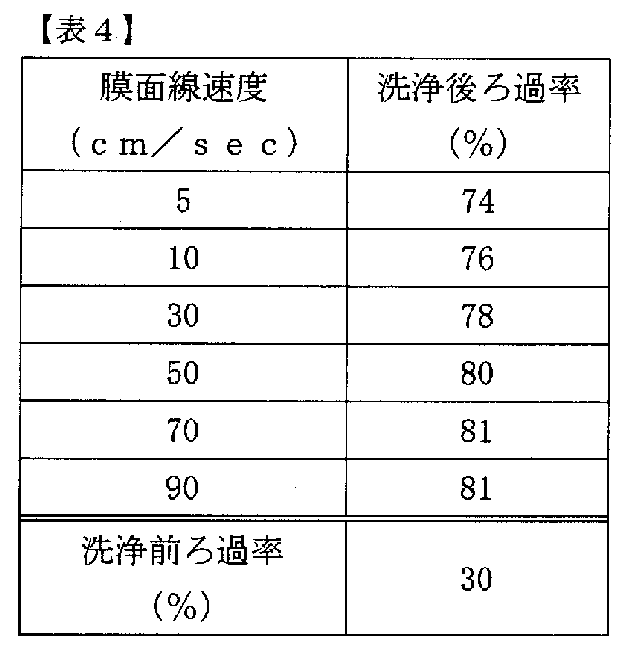
- Example 4 Influence of membrane surface velocity on membrane cleaning effect About heat resistant nanofiltration membranes ("HWSNF" series manufactured by Desal) with reduced filtration flux obtained by the method of Reference Example 1, membrane surface wires A total of 6 speed conditions, 5 cm / sec, 10 cm / sec, 30 cm / sec, 50 cm / sec, 70 cm / sec, and 90 cm / sec, are set, and the other conditions are the same as the condition 5 of Example 2. Membrane cleaning was performed. Table 4 shows values obtained by converting the filtration flux into filtration rate according to Reference Example 2. The measured value of the filtration flux of the unused membrane was 0.246 m / day. As a result, as is clear from Table 4, the higher the membrane surface linear velocity, the better the recovery of the filtration rate, which reached the upper limit at 50 cm / sec or more.
- HWSNF heat resistant nanofiltration membranes
- Example 5 Influence of aromatic compound concentration on cleaning effect
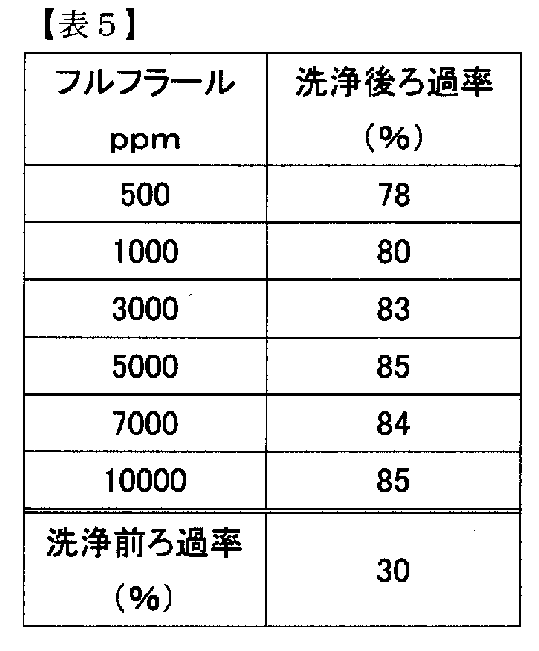
- six types of 500 ppm, 1000 ppm, 3000 ppm, 5000 ppm, 7000 ppm, and 10000 ppm were set for the furfural concentration in the cleaning water.
- Membrane cleaning was performed.
- Table 5 shows values obtained by converting the filtration flow rate into the filtration rate according to Reference Example 2.
- the measured filtration flow rate of the unused membrane was 0.246 m / day.
- the membrane cleaning effect increased as the furfural concentration increased, and the maximum membrane cleaning effect was obtained at a concentration of 5 g / L or more.
- Example 5 Membrane washing with a filtrate obtained by passing a cellulose-derived sugar solution through a nanofiltration membrane
- an NF filtrate in which a cellulose-derived sugar solution was passed through a nanofiltration membrane was obtained. Further, a part of the NF filtrate was filtered with a reverse osmosis membrane (“UTC-80”, manufactured by Toray Industries, Inc.) at an operating pressure of 6 MPa at room temperature.
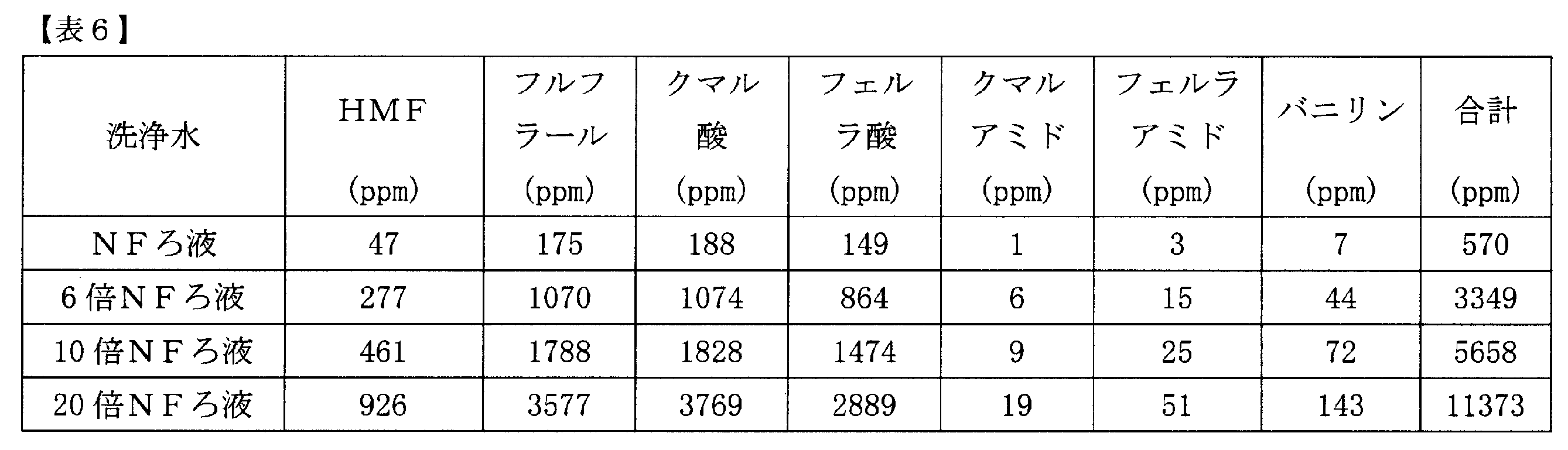
- the 20-fold RO concentrate was prepared (hereinafter referred to as 6-fold NF filtrate, 10-fold NF filtrate, and 20-fold NF filtrate, respectively).
- Table 6 shows the results of analyzing the aromatic compound concentration in these liquids by the method of Reference Example 3.
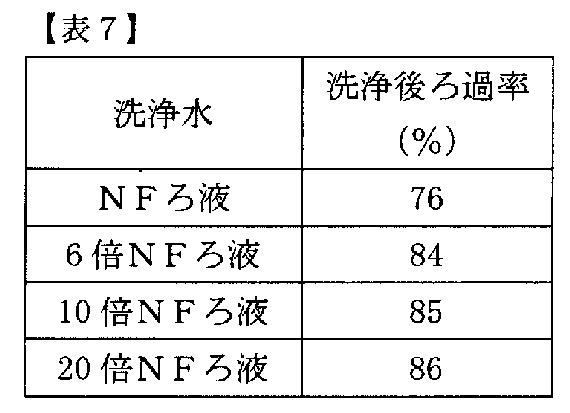
- Example 2 except that washing water was added to the NF filtrate, 6-fold NF filtrate, 10-fold NF filtrate, and 20-fold NF filtrate to a concentration of 0.5 g / L hydrochloric acid.
- Membrane cleaning was performed under the same conditions.
- Table 7 shows values obtained by converting the filtration flux into the filtration rate according to Reference Example 2. The measured value of the filtration flux of the unused membrane was 0.246 m / day. As is clear from Tables 6 and 7, the higher the concentration of the aromatic compound, the higher the membrane cleaning effect.
- the present invention is used as a separation membrane cleaning method in a method for producing a sugar solution including a step of filtering cellulose-derived sugar solution through one or more separation membranes of ultrafiltration membranes, nanofiltration membranes, and reverse osmosis membranes. be able to.
Landscapes
- Chemical & Material Sciences (AREA)
- Engineering & Computer Science (AREA)
- Water Supply & Treatment (AREA)
- Chemical Kinetics & Catalysis (AREA)
- Nanotechnology (AREA)
- Life Sciences & Earth Sciences (AREA)
- Biochemistry (AREA)
- Organic Chemistry (AREA)
- Health & Medical Sciences (AREA)
- Emergency Medicine (AREA)
- General Health & Medical Sciences (AREA)
- Separation Using Semi-Permeable Membranes (AREA)
Abstract
Description
(1)セルロース由来糖液を、限外ろ過膜、ナノろ過膜および逆浸透膜からなる群から選択される1以上の分離膜に通じてろ過する工程を含む糖液の製造方法において、ろ過後の分離膜を酸性物質および芳香族化合物を含む洗浄水を用いて洗浄することを含むことを特徴とする、糖液の製造方法。
(2)酸性物質が硫酸、塩酸、硝酸、シュウ酸、クエン酸および酢酸からなる群から選択される1種類または2種類以上であることを特徴とする、(1)に記載の糖液の製造方法。
(3)芳香族化合物がヒドロキシメチルフルフラール(HMF)、フルフラール、クマル酸、フェルラ酸、クマルアミド、フェルラアミドおよびバニリンからなる群から選択される1種類または2種類以上であることを特徴とする、(1)または(2)に記載の糖液の製造方法。
(4)洗浄水がセルロース由来糖液をナノろ過膜および/または逆浸透膜に通じて得られたろ液由来であることを特徴とする、(1)~(3)のいずれかに記載の糖液の製造方法。
(5)セルロース由来糖液が精密濾過膜で濾過されたものであることを特徴とする、(1)~(4)のいずれかに記載の糖液の製造方法。
(6)洗浄水を分離膜でクロスフロー濾過することにより分離膜を洗浄することを特徴とする、(1)~(5)のいずれかに記載の糖液の製造方法。
(7)洗浄水の膜面線速度が5~50cm/secであることを特徴とする、(6)に記載の糖液の製造方法。
本発明による膜洗浄の効果を正確に評価するためには、汚染状態が同一の膜を多数準備する必要がある。以下にその作製方法を説明する。
ろ過流束測定における、限外ろ過膜、逆浸透膜共通の条件として、操作温度25℃、膜面線速度20cm/secとした。操作圧力は、限外ろ過膜の場合0.1MPa、ナノろ過膜の場合2MPa、逆浸透膜の場合4Mpaとした。本条件にて純水のろ過を1分間行い、その間の平均ろ過流束(m/day)を測定した。なお、この際クロスフロー流の循環は行わず、そのまま排水した。また、膜分離装置は参考例1に記載のスパイラルモジュールを想定した小型の平膜ユニットを使用した。
水溶液中のHMF、フルフラール、クマル酸、フェルラ酸、クマルアミド、フェルラアミド、バニリンの濃度は、下記に示すHPLC条件で、標品との比較により定量した。なお、クマルアミド、フェルラアミドは、市販の標品が流通していないため、委託合成(委託先:VSN社)により標品を取得した。
機器:高速液体クロマトグラフ“Lachrom elite”(株式会社日立製作所製)
カラム:“Synergi 2.5μm Hydro-RP 100A”(Phenomenex社製)
検出方法:Diode Array 検出器
流速:0.6mL/min
温度:40℃。
参考例1の方法により得られた、ろ過流束の低下した耐熱性限外ろ過膜(デサル社製、“HWS UF”シリーズ)について、純水を洗浄水とした場合(条件1)、塩酸のみを0.5g/Lの濃度で含む水溶液を洗浄水とした場合(条件2)、フルフラールのみを0.5g/Lの濃度で含む水溶液を洗浄水とした場合(条件3)、塩酸を0.5g/Lの濃度で含み、かつHMF、フルフラール、クマル酸、フェルラ酸、クマルアミド、フェルラアミド、バニリンの群から選ばれる芳香族化合物のうちいずれか1つを0.5g/Lの濃度で含む水溶液を洗浄水とした各場合(条件4~10)、フルフラールを0.5g/Lの濃度で含み、かつ硝酸、硫酸、クエン酸、シュウ酸、酢酸の群から選ばれる酸性物質のうちいずれか1つを0.5g/Lの濃度で含む水溶液を洗浄水とした各場合(条件11~15)の合計15通りの条件を設定し、膜洗浄を実施した。前記洗浄水2Lを用いて、洗浄水温度25℃、操作圧力0.1MPa、膜面線速度30cm/secで20分間膜洗浄を行い、クロスフロー流を循環させた。膜分離装置は参考例1記載のスパイラルモジュールを想定した小型の平膜ユニットを使用した。ろ過流束は、参考例2の方法に従って、膜洗浄前後に測定した。ただし、膜洗浄前のろ過流速は全条件について共通とみなし、1条件について測定した値を、全条件に共通の膜洗浄前ろ過流束とした。参考例2に従い、ろ過流束をろ過率に換算した値を表1に示す。なお、未使用膜のろ過流束測定値は、0.258m/dayであった。表1から明らかなように、純水を使用して膜の洗浄を行った場合、洗浄前と比較すればろ過率は大きく回復したものの、膜の再使用に当たっては不十分であった。また、フルフラールのみを含む水溶液を使用した場合、ろ過率の回復は純水を使用した場合と同等であり、特別な効果は見られなかった。また、塩酸のみを含む水溶液を使用した場合、純水を使用した場合と比較して、ろ過率はより回復したが、依然として膜の再使用に当たっては不十分であった。一方、芳香族化合物と酸性物質を共に含む水溶液を使用した場合、いずれの組み合わせであってもろ過率は格段に回復し、膜の再使用に当たって十分なろ過率が得られた。

参考例1の方法により得られた、ろ過流束の低下した耐熱性ナノろ過膜(デサル社製“HWS NF”シリーズ)について、操作圧力を2MPaとする以外は実施例1と同様の条件で膜洗浄を実施した。参考例2に従い、ろ過流束をろ過率に換算した値を表2に示す。なお、未使用膜のろ過流束測定値は、0.246m/dayであった。その結果、表2から明らかなように、純水を使用して膜の洗浄を行った場合、洗浄前と比較すればろ過率は大きく回復したものの、膜の再使用に当たっては不十分であった。また、フルフラールのみを含む水溶液を使用した場合、ろ過率の回復は純水を使用した場合と同等であり、特別な効果は見られなかった。また、塩酸のみを含む水溶液を使用した場合、純水を使用した場合と比較して、ろ過率はより回復したが、依然として膜の再使用に当たっては不十分であった。一方、芳香族化合物と酸性物質を共に含む水溶液を使用した場合、いずれの組み合わせであってもろ過率は格段に回復し、膜の再使用に当たって十分なろ過率が得られた。

参考例1の方法により得られた、ろ過流束の低下した耐熱性逆浸透膜(デサル社製“HWS RO”シリーズ)について、操作圧力を4MPaとする以外は実施例1と同様の条件で膜洗浄を実施した。参考例2に従い、ろ過流束をろ過率に換算した値を表3に示す。なお、未使用膜のろ過流束測定値は、0.245m/dayであった。その結果、表3から明らかなように、純水を使用して膜の洗浄を行った場合、洗浄前と比較すればろ過率は大きく回復したものの、膜の再使用に当たっては不十分であった。また、フルフラールのみを含む水溶液を使用した場合、ろ過率の回復は純水を使用した場合と同等であり、特別な効果は見られなかった。また、塩酸のみを含む水溶液を使用した場合、純水を使用した場合と比較して、ろ過率はより回復したが、依然として膜の再使用に当たっては不十分であった。一方、芳香族化合物と酸性物質を共に含む水溶液を使用した場合、いずれの組み合わせであってもろ過率は格段に回復し、膜の再使用に当たって十分なろ過率が得られた。

参考例1の方法により得られた、ろ過流束の低下した耐熱性ナノろ過膜(デサル社製“HWSNF”シリーズ)について、膜面線速度条件を、5cm/sec、10cm/sec、30cm/sec、50cm/sec、70cm/sec、90cm/secの合計6通り設定し、その他の条件については実施例2の条件5と同様の条件で膜洗浄を実施した。参考例2に従い、ろ過流束をろ過率に換算した値を表4に示す。なお、未使用膜のろ過流束測定値は、0.246m/dayであった。その結果、表4からも明らかなように、膜面線速度が高いほどろ過率の回復は良好であり、50cm/sec以上で上限に達した。
実施例2の条件5と同様の方法において、洗浄水中のフルフラール濃度に関し500ppm、1000ppm、3000ppm、5000ppm、7000ppm、10000ppmの6通りを設定して膜洗浄を行った。参考例2に従い、ろ過流速をろ過率に換算した値を表5に示す。なお、未使用膜のろ過流速測定値は、0.246m/dayであった。表5から明らかなように、フルフラール濃度が高くなるにつれて膜洗浄効果が高まっており、5g/L以上の濃度で最大の膜洗浄効果が得られた。
参考例1の方法に従い、セルロース由来糖液をナノろ過膜に通じたNFろ液を得た。更に、NFろ液の一部を、逆浸透膜(“UTC-80”、東レ株式会社製)を用いて、常温にて操作圧力6MPaでろ過を行い、各成分濃度がおよそ6倍、10倍、20倍となったRO濃縮液を調整した(以下、それぞれ6倍NFろ液、10倍NFろ液、20倍NFろ液、という。)。これらの液中の芳香族化合物濃度を、参考例3の方法により分析した結果を表6に示す。
3 循環ポンプ
4 クロスフロー式膜モジュール
5 調節バルブ
8 洗浄水調整タンク
9 洗浄水投入ポンプ
10 循環ライン
11 圧力計
12 圧力計
13 圧力計
14 糖液供給タンク
15 糖液送液ポンプ
16 3方バルブ
17 3方バルブ
21 糖化反応槽
22 スラリー移送手段
23 保温装置
24 固液分離装置
25 固体残渣
26 保温装置
27 限外ろ過膜供給槽
28 限外ろ過膜供給ポンプ
29 保温装置
30 限外ろ過膜モジュール
31 ナノろ過膜供給槽
32 ナノろ過膜供給ポンプ
33 保温装置
34 ナノろ過膜モジュール
35 逆浸透膜供給槽
36 逆浸透膜供給ポンプ
37 保温装置
39 逆浸透膜モジュール
40 膜洗浄ポンプ
41 逆浸透膜ろ液槽
42 逆浸透膜ろ液槽ポンプ
43 保温装置
44 酸供給タンク
45 酸投入ポンプ
Claims (7)
- セルロース由来糖液を、限外ろ過膜、ナノろ過膜および逆浸透膜からなる群から選択される1以上の分離膜に通じてろ過する工程を含む糖液の製造方法において、ろ過後の分離膜を酸性物質および芳香族化合物を含む洗浄水を用いて洗浄することを含むことを特徴とする、糖液の製造方法。
- 酸性物質が硫酸、塩酸、硝酸、シュウ酸、クエン酸および酢酸からなる群から選択される1種類または2種類以上であることを特徴とする、請求項1に記載の糖液の製造方法。
- 芳香族化合物がヒドロキシメチルフルフラール(HMF)、フルフラール、クマル酸、フェルラ酸、クマルアミド、フェルラアミドおよびバニリンからなる群から選択される1種類または2種類以上であることを特徴とする、請求項1または2に記載の糖液の製造方法。
- 洗浄水がセルロース由来糖液をナノろ過膜および/または逆浸透膜に通じて得られたろ液由来であることを特徴とする、請求項1~3のいずれかに記載の糖液の製造方法。
- セルロース由来糖液が精密濾過膜で濾過されたものであることを特徴とする、請求項1~4のいずれかに記載の糖液の製造方法。
- 洗浄水を分離膜でクロスフロー濾過することにより分離膜を洗浄することを特徴とする請求項1~5のいずれかに記載の糖液の製造方法。
- 洗浄水の膜面線速度が5~50cm/secであることを特徴とする請求項6に記載の糖液の製造方法。
Priority Applications (6)
| Application Number | Priority Date | Filing Date | Title |
|---|---|---|---|
| AU2013300498A AU2013300498B2 (en) | 2012-08-10 | 2013-08-08 | Method for producing sugar solution |
| BR112015001901-3A BR112015001901B1 (pt) | 2012-08-10 | 2013-08-08 | Método para produzir um líquido de açúcar |
| JP2013542698A JP6287210B2 (ja) | 2012-08-10 | 2013-08-08 | 糖液の製造方法 |
| CA2879546A CA2879546C (en) | 2012-08-10 | 2013-08-08 | Method for producing sugar solution |
| US14/417,582 US9863011B2 (en) | 2012-08-10 | 2013-08-08 | Method of producing sugar solution |
| CN201380041804.XA CN104520445B (zh) | 2012-08-10 | 2013-08-08 | 糖液的制造方法 |
Applications Claiming Priority (2)
| Application Number | Priority Date | Filing Date | Title |
|---|---|---|---|
| JP2012-178551 | 2012-08-10 | ||
| JP2012178551 | 2012-08-10 |
Publications (1)
| Publication Number | Publication Date |
|---|---|
| WO2014024952A1 true WO2014024952A1 (ja) | 2014-02-13 |
Family
ID=50068173
Family Applications (1)
| Application Number | Title | Priority Date | Filing Date |
|---|---|---|---|
| PCT/JP2013/071451 Ceased WO2014024952A1 (ja) | 2012-08-10 | 2013-08-08 | 糖液の製造方法 |
Country Status (8)
| Country | Link |
|---|---|
| US (1) | US9863011B2 (ja) |
| JP (1) | JP6287210B2 (ja) |
| CN (1) | CN104520445B (ja) |
| AU (1) | AU2013300498B2 (ja) |
| BR (1) | BR112015001901B1 (ja) |
| CA (1) | CA2879546C (ja) |
| MY (1) | MY172925A (ja) |
| WO (1) | WO2014024952A1 (ja) |
Cited By (3)
| Publication number | Priority date | Publication date | Assignee | Title |
|---|---|---|---|---|
| WO2015119038A1 (ja) * | 2014-02-05 | 2015-08-13 | 東レ株式会社 | 糖液の製造方法 |
| CN106092894A (zh) * | 2016-08-23 | 2016-11-09 | 兆光生物工程(邹平)有限公司 | 一种膜过滤分离检测装置 |
| JP2016203081A (ja) * | 2015-04-21 | 2016-12-08 | 三菱重工業株式会社 | 逆浸透膜洗浄方法及び逆浸透膜洗浄装置 |
Citations (3)
| Publication number | Priority date | Publication date | Assignee | Title |
|---|---|---|---|---|
| JP2011223975A (ja) * | 2010-03-30 | 2011-11-10 | Toray Ind Inc | 糖液の製造方法及び製造装置 |
| WO2012077697A1 (ja) * | 2010-12-09 | 2012-06-14 | 東レ株式会社 | 濃縮糖水溶液の製造方法 |
| WO2012077698A1 (ja) * | 2010-12-09 | 2012-06-14 | 東レ株式会社 | 濃縮糖水溶液の製造法 |
Family Cites Families (7)
| Publication number | Priority date | Publication date | Assignee | Title |
|---|---|---|---|---|
| US6709599B1 (en) * | 1999-10-27 | 2004-03-23 | Rwe Nukem Corporation | Waste water treatment system with slip stream |
| US7077953B2 (en) * | 2003-09-11 | 2006-07-18 | Harris Group, Inc. | Nanofilter system and method of use |
| FI120590B (fi) * | 2005-10-28 | 2009-12-15 | Danisco Sweeteners Oy | Erotusmenetelmä |
| BRPI0917617B8 (pt) | 2008-12-09 | 2018-09-25 | Toray Industries | método para produzir açúcar líquido e método para produzir um produto químico |
| EP2464734A4 (en) * | 2009-08-13 | 2014-01-08 | Geosynfuels Llc | DEVICE AND METHOD FOR FERMENTING A BIOMASS HYDROLYZATE |
| WO2012031356A2 (en) * | 2010-09-07 | 2012-03-15 | Lignol Innovations Ltd. | Biomass extraction process |
| AU2012218435B2 (en) | 2011-02-18 | 2016-07-07 | Toray Industries, Inc. | Method for producing sugar solution |
-
2013
- 2013-08-08 WO PCT/JP2013/071451 patent/WO2014024952A1/ja not_active Ceased
- 2013-08-08 JP JP2013542698A patent/JP6287210B2/ja active Active
- 2013-08-08 AU AU2013300498A patent/AU2013300498B2/en active Active
- 2013-08-08 US US14/417,582 patent/US9863011B2/en active Active
- 2013-08-08 CN CN201380041804.XA patent/CN104520445B/zh active Active
- 2013-08-08 BR BR112015001901-3A patent/BR112015001901B1/pt active IP Right Grant
- 2013-08-08 CA CA2879546A patent/CA2879546C/en not_active Expired - Fee Related
- 2013-08-08 MY MYPI2015700377A patent/MY172925A/en unknown
Patent Citations (3)
| Publication number | Priority date | Publication date | Assignee | Title |
|---|---|---|---|---|
| JP2011223975A (ja) * | 2010-03-30 | 2011-11-10 | Toray Ind Inc | 糖液の製造方法及び製造装置 |
| WO2012077697A1 (ja) * | 2010-12-09 | 2012-06-14 | 東レ株式会社 | 濃縮糖水溶液の製造方法 |
| WO2012077698A1 (ja) * | 2010-12-09 | 2012-06-14 | 東レ株式会社 | 濃縮糖水溶液の製造法 |
Cited By (6)
| Publication number | Priority date | Publication date | Assignee | Title |
|---|---|---|---|---|
| WO2015119038A1 (ja) * | 2014-02-05 | 2015-08-13 | 東レ株式会社 | 糖液の製造方法 |
| JPWO2015119038A1 (ja) * | 2014-02-05 | 2017-03-23 | 東レ株式会社 | 糖液の製造方法 |
| US10767236B2 (en) | 2014-02-05 | 2020-09-08 | Toray Industries, Inc. | Method of producing sugar solution |
| JP2016203081A (ja) * | 2015-04-21 | 2016-12-08 | 三菱重工業株式会社 | 逆浸透膜洗浄方法及び逆浸透膜洗浄装置 |
| CN106092894A (zh) * | 2016-08-23 | 2016-11-09 | 兆光生物工程(邹平)有限公司 | 一种膜过滤分离检测装置 |
| CN106092894B (zh) * | 2016-08-23 | 2018-07-13 | 兆光生物工程(邹平)有限公司 | 一种膜过滤分离检测装置 |
Also Published As
| Publication number | Publication date |
|---|---|
| BR112015001901A2 (ja) | 2019-12-31 |
| BR112015001901B1 (pt) | 2021-03-23 |
| JPWO2014024952A1 (ja) | 2016-07-25 |
| MY172925A (en) | 2019-12-14 |
| US9863011B2 (en) | 2018-01-09 |
| AU2013300498A1 (en) | 2015-02-12 |
| CA2879546C (en) | 2019-09-17 |
| US20150191801A1 (en) | 2015-07-09 |
| JP6287210B2 (ja) | 2018-03-07 |
| CN104520445B (zh) | 2017-06-09 |
| CN104520445A (zh) | 2015-04-15 |
| AU2013300498B2 (en) | 2017-03-30 |
| CA2879546A1 (en) | 2014-02-13 |
Similar Documents
| Publication | Publication Date | Title |
|---|---|---|
| JP5201294B2 (ja) | 糖液の製造方法 | |
| JP5716325B2 (ja) | 糖液の製造方法及び製造装置 | |
| JP6303501B2 (ja) | 糖液の製造方法 | |
| JP6287210B2 (ja) | 糖液の製造方法 | |
| JP5935941B2 (ja) | 糖液の製造方法 | |
| JP2014214034A (ja) | アンモニア水溶液の濃縮方法およびアンモニア処理セルロース含有バイオマスからのアンモニアの製造方法 |
Legal Events
| Date | Code | Title | Description |
|---|---|---|---|
| ENP | Entry into the national phase |
Ref document number: 2013542698 Country of ref document: JP Kind code of ref document: A |
|
| 121 | Ep: the epo has been informed by wipo that ep was designated in this application |
Ref document number: 13828728 Country of ref document: EP Kind code of ref document: A1 |
|
| ENP | Entry into the national phase |
Ref document number: 2879546 Country of ref document: CA |
|
| WWE | Wipo information: entry into national phase |
Ref document number: 14417582 Country of ref document: US |
|
| WWE | Wipo information: entry into national phase |
Ref document number: IDP00201500772 Country of ref document: ID |
|
| NENP | Non-entry into the national phase |
Ref country code: DE |
|
| ENP | Entry into the national phase |
Ref document number: 2013300498 Country of ref document: AU Date of ref document: 20130808 Kind code of ref document: A |
|
| 122 | Ep: pct application non-entry in european phase |
Ref document number: 13828728 Country of ref document: EP Kind code of ref document: A1 |
|
| REG | Reference to national code |
Ref country code: BR Ref legal event code: B01A Ref document number: 112015001901 Country of ref document: BR |
|
| ENP | Entry into the national phase |
Ref document number: 112015001901 Country of ref document: BR Kind code of ref document: A2 Effective date: 20150128 |
|
| REG | Reference to national code |
Ref country code: BR Ref legal event code: B01E Ref document number: 112015001901 Country of ref document: BR Kind code of ref document: A2 Free format text: APRESENTE A TRADUCAO SIMPLES DA FOLHA DE ROSTO DA CERTIDAO DE DEPOSITO DA PRIORIDADE JP 2012-178551; OU DECLARACAO DE QUE OS DADOS DO PEDIDO INTERNACIONAL ESTAO FIELMENTE CONTIDOS NA PRIORIDADE REIVINDICADA, CONTENDO TODOS OS DADOS IDENTIFICADORES DESTA (TITULARES, NUMERO DE REGISTRO, DATA E TITULO), CONFORME O PARAGRAFO UNICO DO ART. 25 DA RESOLUCAO 77/2013. CABE SALIENTAR QUE NAO FOI POSSIVEL IDENTIFICAR OS TITULARES DO PEDIDO PRIORITARIO NOS DOCUMENTOS JUNTADOS AO PROCESSO, TAMPOUCO NOS APRESENTADOS NA OMPI, POIS SE ENCONTRAM EM JAPONES. |
|
| ENP | Entry into the national phase |
Ref document number: 112015001901 Country of ref document: BR Kind code of ref document: A2 Effective date: 20150128 |