WO2014014034A1 - レジスト下層膜形成用樹脂組成物、レジスト下層膜及びその形成方法、パターン形成方法、架橋剤並びに化合物 - Google Patents
レジスト下層膜形成用樹脂組成物、レジスト下層膜及びその形成方法、パターン形成方法、架橋剤並びに化合物 Download PDFInfo
- Publication number
- WO2014014034A1 WO2014014034A1 PCT/JP2013/069442 JP2013069442W WO2014014034A1 WO 2014014034 A1 WO2014014034 A1 WO 2014014034A1 JP 2013069442 W JP2013069442 W JP 2013069442W WO 2014014034 A1 WO2014014034 A1 WO 2014014034A1
- Authority
- WO
- WIPO (PCT)
- Prior art keywords
- group
- underlayer film
- carbon atoms
- resist underlayer
- hydrocarbon group
- Prior art date
- Legal status (The legal status is an assumption and is not a legal conclusion. Google has not performed a legal analysis and makes no representation as to the accuracy of the status listed.)
- Ceased
Links
Classifications
-
- C—CHEMISTRY; METALLURGY
- C07—ORGANIC CHEMISTRY
- C07C—ACYCLIC OR CARBOCYCLIC COMPOUNDS
- C07C69/00—Esters of carboxylic acids; Esters of carbonic or haloformic acids
- C07C69/76—Esters of carboxylic acids having a carboxyl group bound to a carbon atom of a six-membered aromatic ring
-
- C—CHEMISTRY; METALLURGY
- C07—ORGANIC CHEMISTRY
- C07C—ACYCLIC OR CARBOCYCLIC COMPOUNDS
- C07C69/00—Esters of carboxylic acids; Esters of carbonic or haloformic acids
- C07C69/76—Esters of carboxylic acids having a carboxyl group bound to a carbon atom of a six-membered aromatic ring
- C07C69/80—Phthalic acid esters
-
- G—PHYSICS
- G03—PHOTOGRAPHY; CINEMATOGRAPHY; ANALOGOUS TECHNIQUES USING WAVES OTHER THAN OPTICAL WAVES; ELECTROGRAPHY; HOLOGRAPHY
- G03F—PHOTOMECHANICAL PRODUCTION OF TEXTURED OR PATTERNED SURFACES, e.g. FOR PRINTING, FOR PROCESSING OF SEMICONDUCTOR DEVICES; MATERIALS THEREFOR; ORIGINALS THEREFOR; APPARATUS SPECIALLY ADAPTED THEREFOR
- G03F7/00—Photomechanical, e.g. photolithographic, production of textured or patterned surfaces, e.g. printing surfaces; Materials therefor, e.g. comprising photoresists; Apparatus specially adapted therefor
- G03F7/004—Photosensitive materials
- G03F7/09—Photosensitive materials characterised by structural details, e.g. supports, auxiliary layers
- G03F7/091—Photosensitive materials characterised by structural details, e.g. supports, auxiliary layers characterised by antireflection means or light filtering or absorbing means, e.g. anti-halation, contrast enhancement
-
- G—PHYSICS
- G03—PHOTOGRAPHY; CINEMATOGRAPHY; ANALOGOUS TECHNIQUES USING WAVES OTHER THAN OPTICAL WAVES; ELECTROGRAPHY; HOLOGRAPHY
- G03F—PHOTOMECHANICAL PRODUCTION OF TEXTURED OR PATTERNED SURFACES, e.g. FOR PRINTING, FOR PROCESSING OF SEMICONDUCTOR DEVICES; MATERIALS THEREFOR; ORIGINALS THEREFOR; APPARATUS SPECIALLY ADAPTED THEREFOR
- G03F7/00—Photomechanical, e.g. photolithographic, production of textured or patterned surfaces, e.g. printing surfaces; Materials therefor, e.g. comprising photoresists; Apparatus specially adapted therefor
- G03F7/004—Photosensitive materials
- G03F7/09—Photosensitive materials characterised by structural details, e.g. supports, auxiliary layers
- G03F7/094—Multilayer resist systems, e.g. planarising layers
-
- H—ELECTRICITY
- H10—SEMICONDUCTOR DEVICES; ELECTRIC SOLID-STATE DEVICES NOT OTHERWISE PROVIDED FOR
- H10P—GENERIC PROCESSES OR APPARATUS FOR THE MANUFACTURE OR TREATMENT OF DEVICES COVERED BY CLASS H10
- H10P76/00—Manufacture or treatment of masks on semiconductor bodies, e.g. by lithography or photolithography
- H10P76/20—Manufacture or treatment of masks on semiconductor bodies, e.g. by lithography or photolithography of masks comprising organic materials
Definitions
- the present invention relates to a resin composition for forming a resist underlayer film, a resist underlayer film and a forming method thereof, a pattern forming method, a crosslinking agent, and a compound.
- a multilayer resist process is used to obtain a high degree of integration.
- a resist underlayer film forming resin composition is applied to the upper surface side of the substrate to form a resist underlayer film, and the resist composition is applied to the upper surface side of the resist underlayer film to form a resist film.
- the resist film is exposed through a mask pattern with a reduction projection exposure apparatus (stepper) or the like, and developed with an appropriate developer to form a resist pattern.
- the resist underlayer film is dry-etched using the resist pattern as a mask, and the substrate is further dry-etched using the obtained resist underlayer film pattern as a mask, whereby a desired pattern can be formed on the substrate.
- the resist underlayer film used in such a multilayer resist process is required to have general characteristics such as etching resistance and optical characteristics.
- a multilayer resist process in which a hard mask is formed on a resist underlayer film by a CVD method has been studied.
- a process of forming a resist underlayer film and producing an inorganic hard mask intermediate layer as a resist intermediate layer thereon by a CVD method has been studied.
- the inorganic hard mask intermediate layer is formed by the CVD method, it is necessary to heat the substrate at a minimum of 300 ° C., usually 400 ° C., particularly in forming a nitride film.
- the resist underlayer film using the above conventional composition has difficulty in heat resistance, and due to the low heat resistance, the resist underlayer film component is heated by the resist underlayer film formation. May sublimate, and the sublimated components may reattach to the substrate and deteriorate the manufacturing yield of semiconductor devices.
- the present invention has been made based on the circumstances as described above, and its purpose is to sufficiently satisfy general characteristics such as etching resistance, and in addition, a resist underlayer film having high heat resistance and high bending resistance can be formed.
- a resist underlayer film forming resin composition, a resist underlayer film using the composition, a method for forming the resist underlayer film, and a pattern forming method using the composition are provided.
- the present inventors have found that the above-described object can be achieved by a resin composition for forming a resist underlayer film using a crosslinking agent having a specific structure, and the present invention has been completed.
- a resin containing an aromatic ring (hereinafter also referred to as “resin (A)”) and a crosslinking agent having a partial structure represented by the following formula (i) (hereinafter also referred to as “crosslinking agent (B)”) And a resin composition for forming a resist underlayer film.
- X is a carbonyl group or a sulfonyl group.
- Q is a monovalent heteroaromatic group or —OR 1 .
- R 1 is a monovalent organic group having 1 to 30 carbon atoms.
- Ar is an aromatic hydrocarbon group or a heteroaromatic group.
- n is an integer of 1 to 8.
- n 2 or more, the plurality of X and Q may be the same or different.
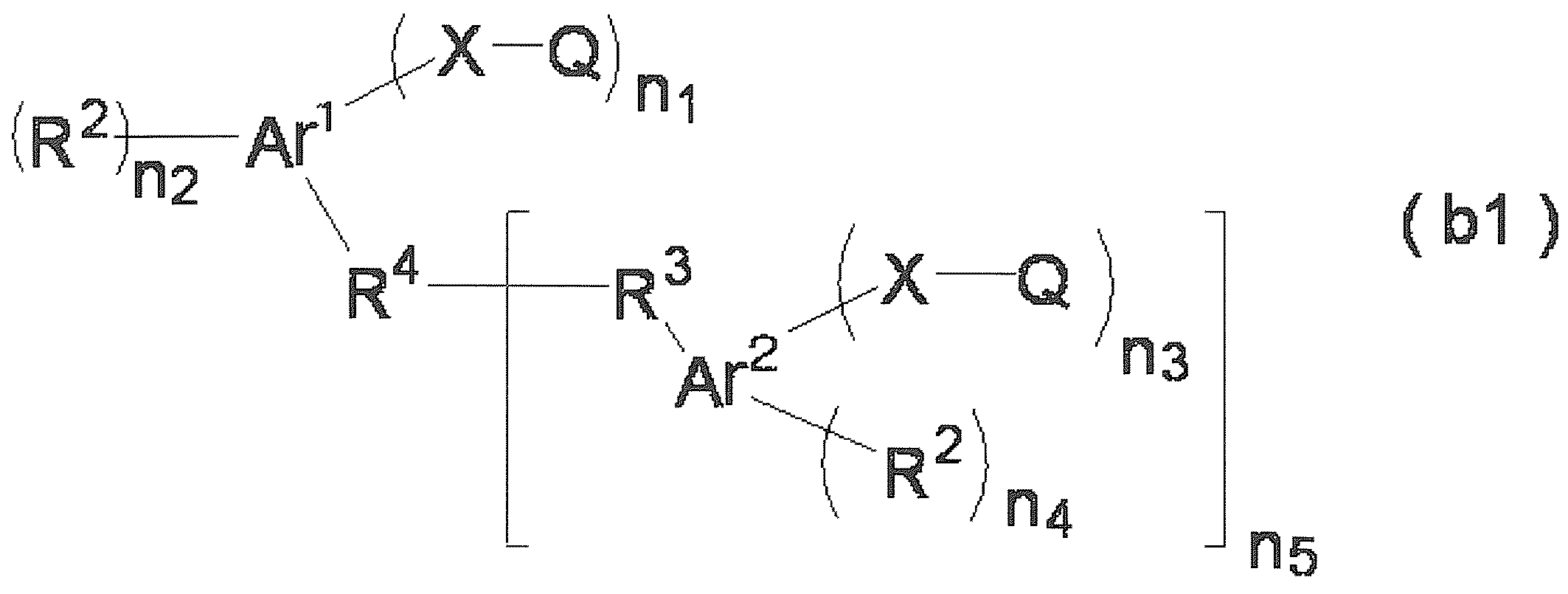
- the crosslinking agent is at least one selected from the group consisting of a compound represented by the following formula (b1) and a compound represented by the following formula (b2).
- Resin composition for forming (In the formula (b1), X and Q are synonymous with the above formula (i).
- Ar 1 is a (n 1 + n 2 +1) -valent aromatic hydrocarbon group or a (n 1 + n 2 +1) -valent heteroaromatic group.
- Ar 2 is an (n 3 + n 4 +1) -valent aromatic hydrocarbon group or a (n 3 + n 4 +1) -valent heteroaromatic group.
- Each R 2 is independently a hydroxy group or a substituted or unsubstituted monovalent hydrocarbon group having 1 to 30 carbon atoms.
- R 3 represents a single bond, a divalent hydrocarbon group having 1 to 30 carbon atoms, —CO—, —COO—, —OCO—, —O—, —CS—, —S—, —SO—, —SO. 2- , -NR- or a divalent group in which these groups are combined.
- R is a hydrogen atom or a hydrocarbon group having 1 to 30 carbon atoms.
- R 4 is a single bond, —CO—, —COO—, —OCO—, —O—, —CS—, —S—, —SO—, —SO 2 —, —NR—, having 1 to 30 carbon atoms. It is a (n 5 +1) valent hydrocarbon group or a (n 5 +1) valent group obtained by combining these groups. R is a hydrogen atom or a hydrocarbon group having 1 to 30 carbon atoms. n 1 is an integer of 1 to 7. n 2 is an integer of 0 to 6. However, n 1 + n 2 is 7 or less. n 3 is an integer of 1 to 7. n 4 is an integer of 0 to 6. However, n 3 + n 4 is 7 or less.
- n 5 is an integer of 1 to 5.
- Ar 2, R 2, R 3 , if X and Q are a plurality each of a plurality of Ar 2, R 2, R 3 , X and Q may each be the same or different.
- Ar 3 is an (n 6 + n 7 ) -valent aromatic hydrocarbon group or a (n 6 + n 7 ) -valent heteroaromatic group.
- R 2 is a hydroxy group or a substituted or unsubstituted monovalent hydrocarbon group having 1 to 30 carbon atoms.
- n 6 is an integer of 1 to 8.
- n 7 is an integer of 0 to 7. However, n 6 + n 7 is 8 or less.
- R 2 if X and Q are a plurality each of the plurality of R 2, X and Q may be the same as or different from each other.
- R 1 of Q in the formula (i) is represented by any one of the following formulas (ii) to (iv).
- R 5 and R 6 are each independently a monovalent organic group having 1 to 20 carbon atoms.
- R 5 and R 6 are bonded to each other, they (A ring structure may be formed with the carbon atom to which it is bonded.)
- R 7 and R 8 are each independently a monovalent organic group having 1 to 20 carbon atoms, provided that R 7 and R 8 are bonded to each other, and (A ring structure may be formed together with the nitrogen atom bonded thereto.
- R 9 is a monovalent organic group having 1 to 20 carbon atoms including an electron withdrawing group.
- a resist underlayer film comprising: a step of forming a coating film on the upper surface side of a substrate with the resin composition for forming a resist underlayer film according to [1] above; and a step of heating the coating film and the substrate.
- a compound represented by the formula (b2) A compound represented by the formula (b2).
- the resin composition for forming a resist underlayer film of the present invention it is possible to form a resist underlayer film that sufficiently satisfies general characteristics such as etching resistance and has high heat resistance and high bending resistance. Accordingly, the resist underlayer film forming resin composition, the resist underlayer film and its forming method, the pattern forming method, the cross-linking agent, and the compound are a pattern forming process using a multilayer resist process in a semiconductor device in which further miniaturization of the pattern proceeds. Can be suitably used.
- the resist underlayer film forming resin composition of the present invention contains a resin (A) and a crosslinking agent (B).
- Resin (A) examples include novolak resins, resol resins, acenaphthylene resins, styrene resins, and polyarylene resins.
- novolak resin examples include phenol, cresol, xylenol, resorcinol, bisphenol A, p-tert-butylphenol, p-octylphenol, 9,9-bis (4-hydroxyphenyl) fluorene, 9,9-bis (4- Phenols such as hydroxyphenyl) fluorene and 9,9-bis (4-hydroxynaphthalene) fluorene; groups consisting of naphthols such as ⁇ -naphthol, ⁇ -naphthol, 1,5-dihydroxynaphthalene and 2,7-dihydroxynaphthalene 1 type or 2 or more types of phenolic compounds selected from more than 1 type or 2 or more types of aldehydes selected from the group which consists of aldehyde sources, such as formaldehyde; paraformaldehyde, trioxane, etc. using an acidic catalyst Obtained resin Etc.
- Examples of such a resin include a polymer having a repeating unit represented by the following formula (a).
- Ar 10 is a (m 11 + m 12 + m 13 +1) -valent aromatic group.
- R 10 represents a monovalent hydrocarbon group having 1 to 10 carbon atoms, or —CO—, —COO—, —OCO—, —O—, —CS—, —S—, —SO—, —SO 2 —.
- R is a hydrogen atom or a hydrocarbon group having 1 to 10 carbon atoms.
- Ar 11 is a single bond or a divalent aromatic group.
- R 11 represents a single bond, a divalent hydrocarbon group having 1 to 10 carbon atoms, —CO—, —COO—, —OCO—, —O—, —CS—, —S—, —SO—, —SO. 2 - it is - NR-, or a divalent group formed by combining these groups.
- R is a hydrogen atom or a hydrocarbon group having 1 to 10 carbon atoms.
- Z 0 represents a single bond, a divalent hydrocarbon group having 1 to 10 carbon atoms, —CO—, —COO—, —OCO—, —O—, —CS—, —S—, —SO—, —SO.
- R is a hydrogen atom or a hydrocarbon group having 1 to 10 carbon atoms.
- m 11 represents the number of bonds in which Z 0 is bonded to Ar 10 and is an integer of 1 to 6.
- m 12 is an integer of 0-6.
- m 13 is an integer of 0 to 6.
- m 14 is an integer of 0-2.
- R 10, Ar 11, R 11 and Z when 0 is plural respective plurality of R 10, Ar 11, R 11 and Z 0 may have respectively the same or different. * Represents a bond.
- the hydrocarbon group in R 10 and R 11 in the above formula (a1) may have a substituent.
- substituents include a halogen atom and a hydroxy group.
- halogen atom a fluorine atom, a chlorine atom, a bromine atom, an iodine atom etc. are mentioned, for example.
- Examples of the monovalent hydrocarbon group having 1 to 10 carbon atoms represented by R 10 in the above formula (a1) include, for example, a monovalent linear or branched hydrocarbon group having 1 to 10 carbon atoms, Examples thereof include a monovalent alicyclic hydrocarbon group having 3 to 10 carbon atoms, a monovalent aromatic hydrocarbon group having 6 to 10 carbon atoms, or a monovalent group obtained by combining these.
- Examples of the monovalent linear or branched hydrocarbon group having 1 to 10 carbon atoms include a methyl group, an ethyl group, an n-propyl group, an i-propyl group, an n-butyl group, and a 2-methylpropyl group.
- Examples of the monovalent alicyclic hydrocarbon group having 3 to 10 carbon atoms include a cyclopropyl group, a cyclobutyl group, a cyclopentyl group, a cyclohexyl group, a cyclooctyl group, and a cyclododecyl group.
- Examples of the monovalent aromatic hydrocarbon group having 6 to 10 carbon atoms include a phenyl group, a tolyl group, and a naphthyl group.
- R 10 in the above formula (a1).
- the monovalent group in which at least one selected from the group and a monovalent hydrocarbon group having 1 to 10 carbon atoms are combined include, for example, an alkoxy group having 1 to 10 carbon atoms and an alkoxycarbonyl group having 2 to 10 carbon atoms.
- Examples of the divalent hydrocarbon group of R 11 and Z 0 in carbon number of 1-10 represented in the above formula (a1) for example, a divalent linear or branched hydrocarbon having 1 to 10 carbon atoms And a divalent alicyclic hydrocarbon group having 3 to 10 carbon atoms, a divalent aromatic hydrocarbon group having 6 to 10 carbon atoms, or a divalent group obtained by combining these groups.
- the divalent linear or branched hydrocarbon group having 1 to 10 carbon atoms is preferably a linear or branched alkylene group having 2 to 8 carbon atoms, such as an ethylene group, a propylene group, a butylene group, A hexylene group and an octylene group are more preferable.
- the divalent alicyclic hydrocarbon group having 3 to 10 carbon atoms is preferably an alicyclic hydrocarbon group having 5 to 10 carbon atoms, and the monocyclic alicyclic hydrocarbon group is a cyclopentylene group.
- the cyclohexylene group is more preferably a norbornanediyl group or an adamantanediyl group as the polycyclic alicyclic hydrocarbon group.
- the divalent aromatic hydrocarbon group having 6 to 10 carbon atoms is preferably a phenylene group, a tolylene group or a naphthylene group.
- Examples of the (m 11 + m 12 + m 13 +1) -valent aromatic group represented by Ar 10 include a benzene aromatic ring such as a benzene ring, a naphthalene ring, an anthracene ring, an indene ring, a fluorenylidene biphenyl ring; a furan ring, A compound having a heteroaromatic ring such as a pyrrole ring, a thiophene ring, a phosphole ring, a pyrazole ring, an oxazole ring, an isoxazole ring, a thiazole ring, a pyridine ring, a pyrazine ring, a pyrimidine ring, a pyridazine ring or a triazine ring on an aromatic ring ( m 11 + m 12 + m 13 +1) groups and the like excluding hydrogen atoms.
- Examples of the divalent aromatic group represented by Ar 11 include benzene aromatic rings such as benzene ring, naphthalene ring, anthracene ring, indene ring, fluorenylidene biphenyl ring; furan ring, pyrrole ring, thiophene ring, phosphorol ring A group in which two hydrogen atoms on an aromatic ring are removed from a compound having a heteroaromatic ring such as a pyrazole ring, an oxazole ring, an isoxazole ring, a thiazole ring, a pyridine ring, a pyrazine ring, a pyrimidine ring, a pyridazine ring or a triazine ring Etc.
- benzene aromatic rings such as benzene ring, naphthalene ring, anthracene ring, indene ring, fluorenylidene bi
- Examples of the resol resin include resins obtained by reacting the above-described phenolic compounds with the above-mentioned aldehydes using an alkaline catalyst.
- acenaphthylene-based resin examples include a polymer having a repeating unit represented by the following formula (a2).
- R 20 and R 21 are each independently a hydrogen atom, a halogen atom, a monovalent hydrocarbon group having 1 to 10 carbon atoms, or -CO -, - COO -, - OCO -, - O -, - CS A monovalent group in which at least one selected from the group consisting of —, —S—, —SO—, —SO 2 — and —NR— is combined with a monovalent hydrocarbon group having 1 to 10 carbon atoms. .
- R is a hydrogen atom or a hydrocarbon group having 1 to 10 carbon atoms.
- R 22 is a hydrogen atom or a monovalent hydrocarbon group having 1 to 12 carbon atoms.
- m 21 is an integer of 0 to 6. If R 22 is plural, plural R 22 may be the same or different.
- R 20 and R 21 in the formula (a2) for example, such as the same groups as those exemplified as R 10 in the formula (a1) can be mentioned.
- Examples of the monovalent hydrocarbon group having 1 to 12 carbon atoms represented by R 22 in the above formula (a2) include a monovalent linear or branched hydrocarbon group having 1 to 12 carbon atoms, carbon number 3 -12 alicyclic hydrocarbon group, monovalent aromatic hydrocarbon group having 6 to 12 carbon atoms, or a combination thereof.
- Examples of the monovalent linear or branched hydrocarbon group having 1 to 12 carbon atoms include a methyl group, an ethyl group, an n-propyl group, an i-propyl group, an n-butyl group, and 2-methylpropyl. Group, 1-methylpropyl group, t-butyl group, pentyl group, hexyl group, octyl group, dodecyl group and the like.
- Examples of the monovalent alicyclic hydrocarbon group having 3 to 12 carbon atoms include a cyclopropyl group, a cyclobutyl group, a cyclopentyl group, a cyclohexyl group, a cyclooctyl group, and a cyclododecyl group.
- Examples of the monovalent aromatic hydrocarbon group having 6 to 12 carbon atoms include a phenyl group, a tolyl group, and a naphthyl group.
- the acenaphthylene-based resin can be obtained by polymerizing a compound having an acenaphthylene skeleton in an appropriate polymerization form such as bulk polymerization or solution polymerization by radical polymerization, anionic polymerization, cationic polymerization, or the like. Further, as described in paragraphs [0008] to [0031] of JP-A No. 2002-296789, it is obtained by reacting a polymer of a compound having an acenaphthylene skeleton with paraformaldehyde under acidic conditions. You can also.
- styrenic resin examples include a polymer containing a repeating unit represented by the following formula (a3).
- R 30 each independently represents a halogen atom, a hydroxy group, a monovalent hydrocarbon group having 1 to 10 carbon atoms, or —CO—, —COO—, —OCO—, —O—, —CS—, — A monovalent group in which at least one selected from the group consisting of S—, —SO—, —SO 2 — and —NR— is combined with a monovalent hydrocarbon group having 1 to 10 carbon atoms.
- R is a hydrogen atom or a hydrocarbon group having 1 to 10 carbon atoms.
- m 31 is an integer of 0 to 5. If R 30 is plural, plural R 30 may be the same or different.
- R 30 in the formula (a3) for example, such as the same groups as those exemplified as R 10 in the formula (a1) can be mentioned.
- the styrenic resin may have other repeating units in addition to the repeating unit represented by the above formula (a3).
- the monomer giving the other repeating unit is not particularly limited, and examples thereof include compounds having various polymerizable unsaturated bonds.
- examples of such a compound having a polymerizable unsaturated bond include styrene monomers such as ⁇ -methylstyrene, (meth) acrylic acid (meth) acrylonitrile, (meth) acrylic acid, methyl (meth) acrylate, and the like.
- Acrylic monomers such as acrylic acid ester and (meth) acrylamide; vinyl ethers such as ethyl vinyl ether, maleic anhydride, vinyl acetate, vinyl pyridine and the like.
- the content of other repeating units in the styrenic resin is preferably less than 50 mol%, more preferably less than 40 mol%, based on all structural units constituting the styrenic resin.
- the polymerization degree of the styrenic resin that is, the total number of the repeating units represented by the formula (a3) and other repeating units is preferably 5 or more and 200 or less, and more preferably 10 or more and 150 or less.
- a commercially available product can be used, for example, “Marcalinker M” (poly-p-vinylphenol) manufactured by Maruzen Petrochemical Co., Ltd. ), “Linker MB” (brominated poly-p-vinylphenol), “Linker CMM” (p-vinylphenol / methyl methacrylate copolymer), “Linker CHM” (p-vinylphenol / 2-hydroxy methacrylate) Ethyl copolymer), “linker CST” (p-vinylphenol / styrene copolymer), and the like.
- polyarylene resin examples include polyarylene ether, polyarylene sulfide, polyarylene ether sulfone, and polyarylene ether ketone.
- the polystyrene-reduced weight average molecular weight (hereinafter also referred to as “Mw”) measured by gel permeation chromatography (GPC) of the resin (A) is preferably 500 to 100,000, more preferably 1,000 to 50, 000, more preferably 1,200 to 40,000.
- the ratio (Mw / Mn) between the Mw of the resin (A) and the polystyrene-equivalent number average molecular weight (hereinafter also referred to as “Mn”) measured by GPC is usually 1 to 5, preferably 1 to 3. .
- the resist underlayer film forming resin composition may contain only one type of resin (A) or two or more types.
- the crosslinking agent (B) has a partial structure represented by the following formula (i). That is, the structural formula of the compound constituting the crosslinking agent (B) includes at least the structure represented by the above formula (i). In addition, this crosslinking agent (B) may be a compound having a structure represented by the above formula (i).
- the crosslinking agent (B) reacts with the resin (A) to cause a carbonyl group or a sulfonyl group sandwiched between aromatic rings.
- a carbonyl group or a sulfonyl group can contribute to high heat resistance.
- the formed resist underlayer film sufficiently satisfies general characteristics such as etching resistance, has high bending resistance, and improves heat resistance.
- X is a carbonyl group or a sulfonyl group.
- Q is a monovalent heteroaromatic group or —OR 1 .
- R 1 is a monovalent organic group having 1 to 30 carbon atoms.
- Ar is an aromatic hydrocarbon group or a heteroaromatic group.
- n is an integer of 1 to 8. When n is 2 or more, X and Q may be the same or different.
- Examples of the monovalent heteroaromatic group represented by Q in the above formula (i) include heteroaromatic groups such as pyrrole ring, imidazole ring, pyrazole ring, pyrazine ring, indole ring, isoindole ring, benzimidazole ring, and purine ring. And a group obtained by removing one hydrogen atom on a heteroaromatic ring from a compound containing a ring.
- heteroaromatic groups a heteroaromatic group having 3 to 30 carbon atoms is preferable, a group containing a heteroaromatic ring having an NH group is more preferable, and a group obtained by removing a hydrogen atom on a nitrogen atom is more preferable.
- the monovalent organic group represented by R 1 in the above formula (i) is not particularly limited, but a group represented by any one of the following formulas (ii) to (iv) is preferable.
- R 5 and R 6 are each independently a monovalent organic group having 1 to 20 carbon atoms. However, R 5 and R 6 may be bonded to each other to form a ring structure together with the carbon atom to which they are bonded.
- R 7 and R 8 are each independently a monovalent organic group having 1 to 20 carbon atoms. However, R 7 and R 8 may be bonded to each other to form a ring structure together with the nitrogen atom to which they are bonded.
- R 9 is a monovalent organic group having 1 to 20 carbon atoms including an electron withdrawing group.
- Examples of the monovalent organic group having 1 to 20 carbon atoms represented by R 5 to R 8 include, for example, a monovalent hydrocarbon group having 1 to 20 carbon atoms, or —CO—, —COO—, and —OCO. At least one group selected from the group consisting of —, —O—, —NR—, —CS—, —S—, —SO— and —SO 2 — and a monovalent hydrocarbon group having 1 to 20 carbon atoms. And a combination of these and the like.
- Some or all of the hydrogen atoms of the monovalent hydrocarbon group may be substituted with a substituent.
- a substituent a fluorine atom, a hydroxy group, a carboxy group, a cyano group etc. are mentioned, for example.
- R is a hydrogen atom or a monovalent organic group having 1 to 20 carbon atoms.
- Examples of the monovalent organic group for R include the same groups as those exemplified for R 5 to R 8 above.
- Examples of the monovalent hydrocarbon group having 1 to 20 carbon atoms include an alkyl group having 1 to 20 carbon atoms and a monovalent alicyclic hydrocarbon group having 3 to 20 carbon atoms.
- alkyl group having 1 to 20 carbon atoms examples include linear alkyl groups such as methyl group, ethyl group, n-propyl group, and n-butyl group; i-propyl group, i-butyl group, sec- Examples thereof include branched alkyl groups such as a butyl group and a t-butyl group.
- Examples of the monovalent alicyclic hydrocarbon group having 3 to 20 carbon atoms include cyclopropyl group, cyclobutyl group, cyclopentyl group, cyclohexyl group, cycloheptyl group, cyclooctyl group, cyclodecyl group, methylcyclohexyl group, ethyl Monocyclic saturated hydrocarbon group such as cyclohexyl group; cyclobutenyl group, cyclopentenyl group, cyclohexenyl group, cycloheptenyl group, cyclooctenyl group, cyclodecenyl group, cyclopentadienyl group, cyclohexadienyl group, cyclooctadienyl group, cyclo Monocyclic unsaturated hydrocarbon group such as decadiene; bicyclo [2.2.1] heptyl group, bicyclo [2.2.2] octyl
- alicyclic hydrocarbon group does not need to be composed only of the structure of the alicyclic hydrocarbon, and a part thereof may include a chain structure.
- R 5 and R 6 a monovalent hydrocarbon group having 1 to 20 carbon atoms, a monovalent fluorinated hydrocarbon group having 1 to 20 carbon atoms preferably.
- R 7 and R 8 are preferably a group in which —CO— and a monovalent fluorinated hydrocarbon group having 1 to 20 carbon atoms are combined.
- Examples of the monovalent organic group having 1 to 20 carbon atoms and containing the electron withdrawing group represented by R 9 include, for example, 1 to 1 carbon atoms in which at least a part of hydrogen atoms are substituted with electron withdrawing groups. And 20 hydrocarbon groups.
- Examples of the electron withdrawing group include a halogen atom such as a fluorine atom and a chlorine atom, a nitro group, and a cyano group, and a fluorine atom, a nitro group, and a cyano group are preferable.
- hydrocarbon group having 1 to 20 carbon atoms examples include the monovalent hydrocarbon group having 1 to 20 carbon atoms exemplified as the monovalent organic group having 1 to 20 carbon atoms represented by R 5 to R 8 above. The same group etc. are mentioned.
- Preferred examples of the groups represented by the above formulas (ii) to (iv) include the following formulas (ii-1) to (ii-4) as the above formula (ii) and the following formulas (iii) as the following formulas (iii):
- the above formula (iv) includes the following formulas (iv-1) to (iv-4).
- the group represented by the formula (ii), the formula (iv) A group represented by formula (iv) is more preferred, a group represented by formula (iv-3), a group represented by formula (iv-4) is more preferred, and a group represented by formula (iv) The group represented by -3) is particularly preferable.
- aromatic hydrocarbon group represented by Ar in the above formula (i) from a compound containing a benzene aromatic ring such as a benzene ring, a naphthalene ring, an anthracene ring, an indene ring, a fluorenylidene biphenyl ring, this benzene type Examples include groups other than hydrogen atoms in the aromatic ring or groups other than the number of hydrogen atoms bonded to the group.
- the aromatic hydrocarbon group is preferably an aromatic hydrocarbon group having 6 to 30 carbon atoms.
- heteroaromatic group represented by Ar in the above formula (i) examples include a furan ring, a pyrrole ring, a thiophene ring, a phosphole ring, a pyrazole ring, an oxazole ring, an isoxazole ring, a thiazole ring, a pyridine ring, a pyrazine ring, and a pyrimidine.
- examples thereof include groups obtained by removing hydrogen atoms corresponding to the number of bonds to atoms or groups other than hydrogen atoms of the heteroaromatic rings from compounds containing heteroaromatic rings such as rings, pyridazine rings, and triazine rings.
- the heteroaromatic group is preferably a heteroaromatic group having 3 to 30 carbon atoms.
- n is preferably an integer of 1 to 7, more preferably an integer of 1 to 5, and further preferably an integer of 1 to 3.
- crosslinking agent (B) having the above-described structure examples include a compound represented by the following formula (b1) and a compound represented by the following formula (b2).
- Ar 1 is a (n 1 + n 2 +1) -valent aromatic hydrocarbon group or a (n 1 + n 2 +1) -valent heteroaromatic group.
- Ar 2 is an (n 3 + n 4 +1) -valent aromatic hydrocarbon group or a (n 3 + n 4 +1) -valent heteroaromatic group.
- Each R 2 is independently a hydroxy group or a substituted or unsubstituted monovalent hydrocarbon group having 1 to 30 carbon atoms.
- R 3 represents a single bond, a divalent hydrocarbon group having 1 to 30 carbon atoms, -CO -, - COO -, - OCO -, - O -, - CS -, - S -, - SO -, - SO 2- , -NR- or a divalent group in which these groups are combined.
- R is a hydrogen atom or a hydrocarbon group having 1 to 30 carbon atoms.
- R 4 is a single bond, —CO—, —COO—, —OCO—, —O—, —CS—, —S—, —SO—, —SO 2 —, —NR—, having 1 to 30 carbon atoms.
- n 5 n 5 +1) valent hydrocarbon group or a (n 5 +1) valent group obtained by combining these groups.
- R is a hydrogen atom or a hydrocarbon group having 1 to 30 carbon atoms.
- n 1 is an integer of 1 to 7.
- n 2 is an integer of 0 to 6. However, n 1 + n 2 is 7 or less.
- n 3 is an integer of 1 to 7.
- n 4 is an integer of 0 to 6. However, n 3 + n 4 is 7 or less.
- n 5 is an integer of 1 to 5.
- Ar 2, R 2, R 3 , if X and Q are a plurality each of a plurality of Ar 2, R 2, R 3 , X and Q may be different from each other also identical.
- Ar 3 is an (n 6 + n 7 ) -valent aromatic hydrocarbon group or a (n 6 + n 7 ) -valent heteroaromatic group.
- R 2 is a hydroxy group or a substituted or unsubstituted monovalent hydrocarbon group having 1 to 30 carbon atoms.
- n 6 is an integer of 1 to 8.
- n 7 is an integer of 0 to 7. However, n 6 + n 7 is 8 or less.
- R 2 if X and Q are a plurality each of the plurality of R 2, X and Q may be the same as or different from each other.
- the monovalent hydrocarbon group having 1 to 30 carbon atoms of R 2 in the above formula (b1) may have a substituent.
- substituents include a halogen atom and a hydroxy group.
- halogen atom a fluorine atom, a chlorine atom, a bromine atom, an iodine atom etc. are mentioned, for example.
- Examples of the divalent hydrocarbon group having 1 to 20 carbon atoms represented by R 3 in the above formula (b1) include a divalent linear or branched hydrocarbon group having 1 to 20 carbon atoms, and a carbon number of 3 And a divalent alicyclic hydrocarbon group having 20 to 20 carbon atoms, a divalent aromatic hydrocarbon group having 6 to 20 carbon atoms, or a combination of these groups.
- the divalent linear or branched hydrocarbon group having 1 to 20 carbon atoms is preferably a linear or branched alkylene group having 2 to 8 carbon atoms, such as an ethylene group, a propylene group, a butylene group, A hexylene group and an octylene group are more preferable.
- the divalent alicyclic hydrocarbon group having 3 to 20 carbon atoms is preferably an alicyclic hydrocarbon group having 5 to 12 carbon atoms, and the monocyclic alicyclic hydrocarbon group may be a cyclopentylene group.
- the cyclohexylene group and the polycyclic alicyclic hydrocarbon group are preferably a norbornanediyl group and an adamantanediyl group.
- the above-mentioned divalent aromatic hydrocarbon group having 6 to 20 carbon atoms is preferably an aromatic hydrocarbon group having 6 to 15 carbon atoms, more preferably a phenylene group, a tolylene group or a naphthylene group.
- Examples of the (n 5 +1) -valent linear or branched hydrocarbon group having 1 to 30 carbon atoms include linear or branched carbon groups such as methane, ethane, propane, butane, ethylene, and acetylene. And groups obtained by removing (n 5 +1) hydrogen atoms from hydrogen.
- the (n 5 +1) -valent alicyclic hydrocarbon groups of 3 to 30 carbon atoms for example, cyclopropane, cyclobutane, cyclopentane, alicyclic hydrocarbons such as cyclohexane (n 5 +1) number of hydrogen Examples include groups other than atoms.
- Examples of the (n 5 +1) -valent aromatic hydrocarbon group having 6 to 30 carbon atoms include (n 5 +1) hydrogen atoms from aromatic hydrocarbons such as benzene, naphthalene, anthracene, pyrene and coronene. Excluded groups and the like.
- -CO represented by R 3 in the formula (b1) -, - COO - , - OCO -, - O -, - CS -, - S -, - SO -, - consisting of and -NR- - SO 2
- divalent group in which at least one selected from the group and a divalent hydrocarbon group having 1 to 30 carbon atoms are combined include those represented by the following formulas (R-1) to (R-4). Examples include a group in which two hydrogen atoms are removed.
- Ar 40 is an n 11 valent aromatic hydrocarbon group having 6 to 20 carbon atoms.
- Ar 41 is each independently an (n 12 +1) -valent aromatic hydrocarbon group having 6 to 20 carbon atoms.
- Ar 42 is an (n 13 +2) -valent aromatic hydrocarbon group having 6 to 20 carbon atoms.
- Ar 43 is an (n 15 + n 16 ) -valent aromatic hydrocarbon group having 6 to 20 carbon atoms.
- R 40 each independently represents a monovalent chain hydrocarbon group having 1 to 12 carbon atoms, a monovalent alicyclic hydrocarbon group having 3 to 12 carbon atoms, or these groups and —CO—, — A monovalent group in combination with at least one group selected from the group consisting of COO—, —OCO—, —O—, —CS—, —S—, —SO—, —SO 2 — and —NR—. It is.
- R is a hydrogen atom or a hydrocarbon group having 1 to 20 carbon atoms.
- R 41 are each independently a single bond, -CO -, - COO -, - OCO -, - O -, - CS -, - S -, - SO -, - SO 2 -, - NR-, carbon
- R is a hydrogen atom or a hydrocarbon group having 1 to 20 carbon atoms.
- R 42 and R 43 are each independently a monovalent chain hydrocarbon group having 1 to 12 carbon atoms or a monovalent alicyclic hydrocarbon group having 3 to 12 carbon atoms.
- R 42 and R 43 may be bonded to each other to form a ring structure together with Y to which they are bonded.
- n 11 is an integer of 1 to 6.
- n 12 is an integer of 0 to 5.
- n 13 is an integer of 0 to 4.
- n 14 is an integer of 0 to 5.
- n 15 is an integer of 1 to 6.
- n 16 is an integer of 0 to 5.
- Y is —CO—, —COO—, —OCO—, —O—, —CS—, —S—, —SO—, —SO 2 — or —NR—.
- R is a hydrogen atom or a hydrocarbon group having 1 to 20 carbon atoms.
- Ar 41, Ar 42, R 40 and when R 41 is plural, respectively, a plurality of Ar 41, Ar 42, R 40 and R 41 may respectively be the same or different.
- Examples of the monovalent chain hydrocarbon group having 1 to 12 carbon atoms represented by R 40 , R 42 and R 43 in the above formulas (R-1) to (R-4) include, for example, methyl group, ethyl group N-propyl group, i-propyl group, n-butyl group, 2-methylpropyl group, 1-methylpropyl group, t-butyl group and the like.
- Examples of the monovalent alicyclic hydrocarbon group having 3 to 12 carbon atoms represented by R 40 , R 42 and R 43 in the above formulas (R-1) to (R-4) include a cyclopropyl group, Examples include a cyclobutyl group, a cyclopentyl group, a cyclohexyl group, a cyclooctyl group, and a cyclododecyl group.
- Examples of the divalent chain hydrocarbon group having 1 to 12 carbon atoms represented by R 41 in the above formulas (R-2) and (R-3) include a methylene group, an ethylene group, and 1,2-propylene. Group, 1,3-propylene group, tetramethylene group, pentamethylene group, hexamethylene group, heptamethylene group, octamethylene group and the like.
- Examples of the divalent alicyclic hydrocarbon group having 3 to 12 carbon atoms represented by R 41 in the above formulas (R-2) and (R-3) include a cyclopentylene group and a cyclohexylene group.
- R 40 to R 43 in the above formulas (R-1) to (R-4) may have a substituent.
- the substituent include a halogen atom and a hydroxy group.
- halogen atom examples include a fluorine atom, a chlorine atom, a bromine atom, and an iodine atom.
- N 1 and n 3 in the formula (b1) are integers of 1 to 7, preferably 1 to 5, and more preferably 1 to 3.
- N 2 and n 4 in the formula (b1) are integers of 0 to 7, preferably integers of 0 to 5, and more preferably integers of 0 to 3.
- N 5 in the above formula (b1) is an integer of 1 to 5, and an integer of 1 to 3 is preferable.
- N 6 in the above formula (b2) is an integer of 1 to 8, preferably an integer of 1 to 5, and more preferably an integer of 1 to 3.
- N 7 in the above formula (b2) is an integer of 0 to 7, preferably an integer of 0 to 5, and more preferably an integer of 0 to 3.
- examples of the specific crosslinking agent (B) include compounds represented by the following formulas (B-1) to (B-4).
- crosslinking agents (B) may be used singly or in combination of two or more.
- a crosslinking agent (B) As content of a crosslinking agent (B), it is 0.1 mass part or more and 100 mass parts or less normally with respect to 100 mass parts of resin (A) of the said resin composition for resist lower layer film formation, Preferably it is 0. 5 parts by mass or more and 50 parts by mass or less, more preferably 1 part by mass or more and 20 parts by mass or less, and further preferably 5 parts by mass or more and 15 parts by mass or less.
- crosslinking agents In the resist underlayer film forming resin composition, a crosslinking agent other than the above-described crosslinking agent (B) may be blended.
- cross-linking agents examples include polynuclear phenols and various commercially available curing agents.
- crosslinking agents for example, those described in paragraphs [0085] to [0086] in JP-A No. 2004-168748 can be used.
- crosslinking agents may be used singly or in combination of two or more, and polynuclear phenols and a curing agent may be used in combination.
- the content of the other crosslinking agent is usually 0.1 parts by mass or more and 100 parts by mass or less, preferably 0.1 parts by mass with respect to 100 parts by mass of the resin (A) of the resin composition for forming a resist underlayer film. 5 parts by mass or more and 50 parts by mass or less, more preferably 1 part by mass or more and 20 parts by mass or less.
- the resist underlayer film forming resin composition contains the above-described resin (A) and cross-linking agent (B), and this composition usually contains a solvent (hereinafter referred to as “solvent (C) ) ”)).
- the solvent (C) is not particularly limited as long as it can dissolve the resin (A).
- those described in paragraphs [0070] to [0073] in JP-A No. 2004-168748 may be used. Can do.
- solvents (C) propylene glycol monomethyl ether, ethylene glycol monoethyl ether acetate, ethyl lactate, n-butyl acetate, ethyl 3-ethoxypropionate, methyl 3-methoxypropionate, 2-heptanone, cyclohexanone, ⁇ -Butyrolactone is preferred.
- a solvent (C) may be used individually by 1 type, and may be used in combination of 2 or more type.
- the solid content concentration of the obtained composition is usually 1% by mass to 80% by mass, preferably 3% by mass to 40% by mass, more preferably 5% by mass to 30% by mass, Particularly preferred is a range of 7% by mass to 20% by mass.
- an acid generator (D), an accelerator (E), and an additive (F) are blended as necessary unless the desired effect in the present invention is impaired. be able to. Among these, it is preferable that the accelerator (E) is blended.
- the acid generator (D) is a component that generates an acid upon exposure or heating. By including the acid generator (D), the resist underlayer film forming resin composition can effectively cause a crosslinking reaction between the molecular chains of the resin at a relatively low temperature including normal temperature.
- photoacid generator examples include those described in paragraphs [0077] to [0081] of JP-A No. 2004-168748. .
- diphenyliodonium trifluoromethanesulfonate diphenyliodonium nonafluoro-n-butanesulfonate, diphenyliodonium pyrenesulfonate, diphenyliodonium n-dodecylbenzenesulfonate, diphenyliodonium 10-camphorsulfonate, diphenyliodonium naphthalenesulfonate, Bis (4-t-butylphenyl) iodonium trifluoromethanesulfonate, bis (4-t-butylphenyl) iodonium nonafluoro-n-butanesulfonate, bis (4-t-butylphenyl) iodonium n-dodecylbenzenesulfonate, bis ( 4-tert-butylphenyl) iodonium 10-camphorsulf
- photoacid generators may be used alone or in combination of two or more.
- thermal acid generator examples include 2,4,4,6-tetrabromocyclohexadienone, benzoin tosylate, and 2-nitrobenzyl tosylate. And alkyl sulfonates.
- thermal acid generators may be used alone or in combination of two or more.
- photo-acid generator and a thermal acid generator as an acid generator (D).
- the content of the acid generator (D) is usually 5,000 parts by mass or less, preferably 0.1 parts by mass to 100 parts by mass of the resin (A) of the resin composition for forming a resist underlayer film.
- the amount is 1,000 parts by mass, more preferably 0.1 part by mass to 100 parts by mass, and particularly preferably 1 part by mass to 10 parts by mass.
- the accelerator (E) is a one-electron oxidizer or the like for sufficiently causing a dehydrogenation reaction necessary for oxidative crosslinking.
- One-electron oxidant means an oxidant that itself undergoes one-electron transfer.
- cerium (IV) ammonium nitrate cerium ion (IV) obtains one electron and changes to cerium ion (III).
- a radical oxidizing agent such as halogen obtains one electron and converts it into an anion.
- the phenomenon of oxidizing the oxide by taking one electron from the oxide (substrate, catalyst, etc.) is called one-electron oxidation, and the component that receives one electron at this time is called a one-electron oxidant.
- one-electron oxidant include (a) metal compound, (b) peroxide, (c) diazo compound, (d) halogen or halogen acid.
- the metal compound (a) examples include metal compounds containing cerium, lead, silver, manganese, osmium, ruthenium, vanadium, thallium, copper, iron, bismuth, and nickel.
- cerium salts such as cerium (IV) ammonium nitrate (CAN; ammonium hexanitratocerium (IV)), cerium (IV) acetate, cerium (IV) nitrate, cerium (IV) sulfate ( For example, tetravalent cerium salt), (a2) lead tetraacetate, lead oxide such as lead (IV) oxide (eg, tetravalent lead compound), (a3) silver (I) oxide, silver (II) oxide, Silver carbonate (Fetizon reagent), silver compounds such as silver nitrate, (a4) manganese compounds such as permanganate, activated manganese dioxide, manganese (III) salts, (a5) osmium compounds such as os
- Examples of the (b) peroxide include peracids such as peracetic acid and m-chloroperbenzoic acid; hydroxyperoxides such as hydrogen peroxide and alkylhydroxyperoxides such as t-butyl hydroperoxide; diacyl peroxide , Peracid ester, peracid ketal, peroxydicarbonate, dialkyl peroxide, peracid ketone and the like.
- Examples of the (c) diazo compound include 2,2'-azobisisobutyronitrile.
- halogen or halogen acid examples include halogen selected from chlorine, bromine and iodine, perhalogen acid, halogen acid, hypohalous acid, hypohalous acid and salts thereof.
- halogen in the halogen acid examples include chlorine, bromine, and iodine.
- sodium perchlorate, sodium bromate, etc. are mentioned.
- (b) peroxides and (c) diazo compounds are preferred, and in particular, m-chloroperbenzoic acid, t-butyl hydroperoxide, 2,2′-azobisisobutyronitrile. Is preferred. When these are used, there is no possibility that metal residues or the like adhere to the substrate, which is preferable.
- a promoter (E) may be used individually by 1 type, and may be used in combination of 2 or more type.
- the content of the accelerator (E) is usually 1,000 parts by mass or less, preferably 0.01 parts by mass to 500 parts per 100 parts by mass of the resin (A) of the resin composition for forming a resist underlayer film. Part by mass, more preferably 0.1 to 100 parts by mass.
- additive (F) As said additive (F), binder resin, a radiation absorber, surfactant, etc. are mentioned.
- thermoplastic resin is a component which has the effect
- the thermosetting resin is a component that is cured by heating and becomes insoluble in a solvent, and has a function of preventing intermixing between the resulting resist underlayer film and the resist film formed thereon. It can be preferably used as a resin. Among these, thermosetting resins are preferable, and urea resins, melamine resins, and aromatic hydrocarbon resins are more preferable.
- binder resins may be used alone or in combination of two or more.
- the content of the binder resin is usually 20 parts by mass or less, preferably 10 parts by mass or less with respect to 100 parts by mass of the resin (A) in the resin composition for forming a resist underlayer film.
- the content of the radiation absorber is usually 100 parts by mass or less, preferably 50 parts by mass or less, with respect to 100 parts by mass of the resin (A) of the resin composition for forming a resist underlayer film.
- the above surfactant is a component having an effect of improving coating properties, striation, wettability, developability and the like.
- surfactants may be used singly or in combination of two or more.
- the content of the surfactant is usually 15 parts by mass or less, preferably 10 parts by mass or less with respect to 100 parts by mass of the resin (A) of the resin composition for forming a resist underlayer film.
- additives such as a storage stabilizer, an antifoaming agent, and an adhesion aid can be blended with the resist underlayer film forming resin composition.
- the resist underlayer film of the present invention is formed from the resist underlayer film forming resin composition.
- the description of the above-mentioned resist underlayer film forming resin composition of this invention is applicable as it is.
- This resist underlayer film is formed by forming a resist underlayer film on the upper surface side of the substrate, forming a resist pattern on the upper surface side of the resist underlayer film, and then transferring the resist pattern to the resist underlayer film to form an underlayer film pattern.
- the lower layer film pattern can be suitably used in a multilayer resist process for transferring to a substrate using an etching mask.
- the hydrogen content of the resist underlayer film is usually 0 to 50 atom%, preferably 0 to 35 atom%.
- the hydrogen content in the resist underlayer film was determined by measuring the mass-converted value (% by mass) of each element of the resist underlayer film using a carbon / hydrogen / nitrogen simultaneous determination apparatus (“JM10” from J Science Laboratories). From this mass conversion value, the number of atoms of each element is calculated by [mass conversion value of each element (mass%) / atomic weight of each element (g / mol)], and from the value of the number of atoms of each element, [ The number of hydrogen atoms in the resist underlayer film / the total number of atoms in the resist underlayer film].
- the method for forming such a resist underlayer film is not particularly limited, and examples thereof include a method for forming a resist underlayer film of the present invention described later.
- the method for forming a resist underlayer film of the present invention includes a step of forming a coating film on the upper surface side of a substrate with the resin composition for forming a resist underlayer film, and a step of heating the coating film and the substrate.
- the resist underlayer film forming resin composition the description of the resist underlayer film forming resin composition of the present invention can be applied as it is.
- the substrate for example, a silicon wafer, a wafer coated with aluminum, or the like can be used.
- the method of applying the resin composition for forming a resist underlayer film to the substrate is not particularly limited, and for example, it can be carried out by an appropriate method such as spin coating, cast coating, roll coating or the like.
- the heating of the coating film is usually performed in the atmosphere (oxygen concentration of about 20% by volume).
- the heating temperature at this time is usually 300 ° C. to 500 ° C., preferably 350 ° C. to 450 ° C. When this heating temperature is less than 300 ° C., the oxidative crosslinking does not proceed sufficiently, and there is a possibility that the characteristics necessary for the resist underlayer film may not be exhibited.
- the heating time at this time is usually 30 seconds to 1,200 seconds, preferably 60 seconds to 600 seconds.
- the oxygen concentration when the coating is cured is preferably 5% by volume or more.
- the oxygen concentration at the time of coating film formation is low, the oxidation cross-linking of the resist underlayer film does not proceed sufficiently, and there is a possibility that the characteristics necessary for the resist underlayer film cannot be expressed.
- the coating film before heating the coating film at a temperature of 300 ° C. to 500 ° C., it may be preheated at a temperature of 60 ° C. to 250 ° C.
- the heating time in the preheating is not particularly limited, but is preferably 10 seconds to 300 seconds, more preferably 30 seconds to 180 seconds.
- the solvent is previously vaporized, and the membrane is made dense, so that the dehydrogenation reaction can proceed efficiently.
- the coating film is usually cured by heating the coating film to form a resist underlayer film.
- a predetermined photocuring agent By containing a photocrosslinking agent, an exposure step for the heated coating film can be provided and photocured to form a resist underlayer film.
- the radiation exposed at this time is visible light, ultraviolet light, far ultraviolet light, X-rays, electron beam, ⁇ -ray, molecular beam, depending on the type of acid generator blended in the resin composition for forming the resist underlayer film.
- the ion beam is appropriately selected.
- the pattern forming method of the present invention comprises a step of forming a resist underlayer film on the upper surface side of the substrate with the resin composition for forming a resist underlayer film (hereinafter also referred to as “resist underlayer film forming step”), and the resist underlayer film.
- a step of forming a resist pattern on the upper surface side of the film hereinafter also referred to as “resist pattern forming step”
- etching step a step of sequentially etching the resist underlayer film and the substrate using the resist pattern as a mask
- resist underlayer film forming step In the resist underlayer film forming step, a resist underlayer film is formed on the upper surface side of the substrate.
- the above description can be applied as it is for the method of forming the resist underlayer film.
- the film thickness of the resist underlayer film formed in this step is usually 0.1 ⁇ m to 5 ⁇ m.
- this pattern forming method may further include a step of forming an intermediate layer (intermediate coating) on the resist lower layer film, if necessary, after the resist lower layer film forming step.
- This intermediate layer is a layer provided with these functions in order to further supplement the functions of the resist underlayer film and / or resist film in forming the resist pattern, or to obtain functions that they do not have. .
- the antireflection film is formed as an intermediate layer, the antireflection function of the resist underlayer film can be further supplemented.
- This intermediate layer can be formed of an organic compound or an inorganic oxide.
- organic compounds include commercially available materials such as “DUV-42”, “DUV-44”, “ARC-28”, and “ARC-29” manufactured by Brewer Science, and “AR-3” manufactured by Rohm and Haas. Commercial materials such as “AR-19” can be used.
- the inorganic oxide include commercially available materials such as “NFC SOG01”, “NFC SOG04”, and “NFC SOG080” manufactured by JSR, and polysiloxane, titanium oxide, alumina oxide, tungsten oxide and the like formed by the CVD method. Can be used.
- the method for forming the intermediate layer is not particularly limited, and for example, a coating method, a CVD method, or the like can be used. Among these, a coating method is preferable. When the coating method is used, the intermediate layer can be formed continuously after forming the resist underlayer film.
- the thickness of the intermediate layer is not particularly limited and is appropriately selected according to the function required for the intermediate layer, but is preferably 10 nm to 3,000 nm, more preferably 20 nm to 300 nm.
- resist pattern formation process In the resist pattern forming step, a resist pattern is formed on the upper surface side of the resist underlayer film. Examples of a method for forming this resist pattern include a method using photolithography.
- a method of forming a resist pattern using photolithography includes a step of forming a resist film with a resist composition on the upper surface side of the resist underlayer film (hereinafter also referred to as “resist film forming step”), and exposing the resist film. And a step of developing the exposed resist film (hereinafter also referred to as “developing step”).
- resist film formation process In the resist film forming step, a resist film is formed on the upper surface side of the resist underlayer film using the resist composition. Specifically, after applying the resist composition so that the resulting resist film has a predetermined thickness, the solvent in the coating film is usually volatilized by pre-baking to form a resist film.
- the resist composition examples include a positive or negative chemically amplified resist composition containing a photoacid generator, a positive resist composition comprising an alkali-soluble resin and a quinonediazide-based photosensitizer, and an alkali-soluble resin and a crosslinking agent. And negative resist compositions composed of an agent.
- the resist composition used when forming the resist film on the resist underlayer film has a solid content concentration of usually about 1% by mass to 50% by mass. Generally, for example, a filter having a pore size of about 0.2 ⁇ m is used. Filtration is performed for forming a resist film. In this step, a commercially available resist composition can be used as it is.
- the coating method of the resist composition is not particularly limited, and can be performed by, for example, a spin coating method.
- the pre-baking temperature is appropriately adjusted according to the type of resist composition used and the like, but is usually about 30 ° C. to 200 ° C., preferably 50 ° C. to 150 ° C.
- Exposure process In the exposure step, radiation is irradiated onto a predetermined region of the obtained resist film, and exposure is selectively performed.
- the radiation used for the exposure is appropriate from visible light, ultraviolet light, far ultraviolet light, X-rays, electron beams, ⁇ rays, molecular beams, ion beams, etc., depending on the type of photoacid generator used in the resist composition.
- far ultraviolet rays are preferable, and in particular, KrF excimer laser (248 nm), ArF excimer laser (193 nm), F 2 excimer laser (wavelength 157 nm), Kr 2 excimer laser (wavelength 147 nm), ArKr excimer laser (wavelength 134 nm) )
- extreme ultraviolet rays wavelength 13 nm, etc.
- post-baking can be performed after the exposure.
- the post-baking temperature is appropriately adjusted according to the type of resist composition to be used, and is usually about 50 ° C. to 200 ° C., preferably 70 ° C. to 150 ° C.
- the development step the resist film exposed in the exposure step is developed with a developer. Thereby, a resist pattern is formed.
- the developer used in this step is appropriately selected according to the type of resist composition used. Specifically, for example, sodium hydroxide, potassium hydroxide, sodium carbonate, sodium silicate, sodium metasilicate, ammonia, ethylamine, n-propylamine, diethylamine, di-n-propylamine, triethylamine, methyldiethylamine, dimethylethanol Amine, triethanolamine, tetramethylammonium hydroxide, tetraethylammonium hydroxide, pyrrole, piperidine, choline, 1,8-diazabicyclo [5.4.0] -7-undecene, 1,5-diazabicyclo [4.3. 0] -5-nonene and the like.
- a water-soluble organic solvent for example, an alcohol such as methanol or ethanol, or a surfactant can be added.
- a liquid containing an organic solvent can be used.
- an organic solvent the solvent similar to what was illustrated as said solvent (C), etc. are mentioned.
- the resist pattern is formed by washing and drying.
- Examples of the method for forming a resist pattern in the resist pattern forming step include a method using nanoimprint lithography, a method using a self-organizing composition, and the like in addition to the method using photolithography.
- the etching step the resist underlayer film and the substrate are sequentially etched using the obtained resist pattern as a mask.
- the etching include dry etching using gas plasma such as oxygen plasma, wet etching using an acid solution, and the like. Among these, dry etching is preferable in that a finer substrate pattern can be obtained. By performing this etching step, a predetermined substrate pattern is obtained.
- the measurement of the weight average molecular weight (Mw) in a present Example uses the Tosoh "GPC column” (G2000HXL: 2 pieces, G3000HXL: 1 piece), flow volume: 1.0 ml / min, elution solvent: tetrahydrofuran, column Temperature: Measured by gel permeation chromatograph (detector: differential refractometer) using monodispersed polystyrene as a standard under analysis conditions of 40 ° C.
- GPC column G2000HXL: 2 pieces, G3000HXL: 1 piece
- flow volume 1.0 ml / min
- elution solvent tetrahydrofuran
- column Temperature Measured by gel permeation chromatograph (detector: differential refractometer) using monodispersed polystyrene as a standard under analysis conditions of 40 ° C.
- Example 1 ⁇ Preparation of Resin Underlayer Film Forming Resin Composition> [Example 1] As shown in Table 1, 10 parts of the above resin (A-1) as the resin (A), 1 part of the following compound (B-1) as the crosslinking agent (B), and the acid generator (D) (heat 0.5 part of diphenyliodonium trifluoromethanesulfonate (D-1) as an acid generator was dissolved in 90 parts of propylene glycol monomethyl ether acetate (C-1) as a solvent (C). This solution was filtered through a membrane filter having a pore size of 0.1 ⁇ m to prepare a resin composition for forming a resist underlayer film of Example 1.
- D acid generator
- Example 2 to 6 Resin compositions for forming resist underlayer films of Examples 2 to 6 were prepared in the same manner as in Example 1 except that the components having the types and contents shown in Table 1 were used.
- the resins (A-1) to (A-3) used in Examples 1 to 6 in Table 1 are the resins obtained in the above Synthesis Examples 1 to 3.
- the crosslinking agents (B-1) to (B-4) in Table 1 are as follows, and each was synthesized by the following method.
- a silicon oxide film of 0.3 ⁇ m was deposited on a 12-inch diameter silicon wafer by CVD.
- each resist underlayer film forming resin composition was spin-coated, heated at 180 ° C. for 60 seconds in a hot plate having an oxygen concentration of 20% by volume, and subsequently heated at 350 ° C. for 120 seconds to obtain a film thickness of 0.
- a resist underlayer film of 25 ⁇ m was formed.
- an intermediate layer forming composition solution for a three-layer resist process (NFC SOG508, manufactured by JSR) is spin-coated on this resist underlayer film, and then heated at 200 ° C. for 60 seconds, and subsequently heated at 300 ° C. for 60 seconds.
- An intermediate layer having a thickness of 0.04 ⁇ m was formed.
- a resist composition was spin-coated on this intermediate layer, and pre-baked at 100 ° C. for 60 seconds to form a resist film having a thickness of 0.1 ⁇ m.
- a commercially available resist composition (ARX3038JN, manufactured by JSR) was used.
- the resist film on which the positive resist pattern was formed was observed with a scanning electron microscope and evaluated according to the following criteria (denoted as “resist shape” in Table 2).
- the case where the observed pattern shape is rectangular is good (denoted as “A” in Table 2), and the shape other than the rectangular shape (eg, T-top, scum, etc.) is defective (“B” in Table 2). ).
- a silicon oxide film of 0.3 ⁇ m was deposited on a 12-inch diameter silicon wafer by CVD.
- each resist underlayer film forming resin composition was spin-coated, heated at 180 ° C. for 60 seconds in a hot plate having an oxygen concentration of 20% by volume, and subsequently heated at 350 ° C. for 120 seconds to obtain a film thickness of 0.
- a resist underlayer film of 25 ⁇ m was formed.
- an intermediate layer forming composition solution for a three-layer resist process (NFC SOG508, manufactured by JSR) is spin-coated on this resist underlayer film, and then heated at 200 ° C. for 60 seconds, and subsequently heated at 300 ° C. for 60 seconds.
- An intermediate layer having a thickness of 0.04 ⁇ m was formed.
- the above resist composition was spin-coated on this intermediate layer and pre-baked at 100 ° C. for 60 seconds to form a resist film having a thickness of 0.1 ⁇ m.
- the intermediate layer is dry-etched with carbon tetrafluoride gas using a reactive ion etching type etching apparatus (Telius SCCM, manufactured by Tokyo Electron), When the intermediate layer located under the opening of the resist film disappeared, the etching process was stopped and the resist pattern was transferred to the intermediate layer.
- a reactive ion etching type etching apparatus Telius SCCM, manufactured by Tokyo Electron
- the shape of a so-called line and space pattern in which linear patterns are arranged at equal intervals was observed with an SEM (scanning electron microscope).
- the repetition interval is fixed at 84 nm and 100 linear patterns are arranged at equal intervals, and this is regarded as one set.
- the pattern width referred to here is the width of one linear pattern arranged at equal intervals formed by the resist underlayer film.
- the pattern of each pattern width was observed with the SEM at five arbitrary locations, and the observation result was regarded as bending resistance.
- the bending resistance is “A”
- the bending resistance is “B”
- the bending resistance is “B”
- the bending resistance is “C” when two or more are bending.
- Each of the resist underlayer film forming resin compositions was spin-coated on a silicon wafer having a diameter of 8 inches, and then heated at 180 ° C. for 60 seconds in a hot plate having an oxygen concentration of 20% by volume.
- a resist underlayer film having a film thickness of 0.25 ⁇ m is formed by heating, and this resist underlayer film is CF 4 / Ar / O 2 (CF 4 : 40 mL / min) using an etching apparatus “EXAM” (manufactured by Shinko Seiki).
- Ar 20 mL / min, O 2 : 5 mL / min; pressure: 20 Pa; RF power: 200 W; treatment time: 40 seconds; temperature: 15 ° C.
- the resist pattern formed on the upper layer has a good pattern shape, and has excellent bending resistance, etching resistance, and heat resistance. It was confirmed that a resist underlayer film can be formed.
- the resin composition for forming a resist underlayer film of the present invention it is possible to form a resist underlayer film having a favorable resist pattern shape formed in an upper layer and having good bending resistance, etching resistance, and heat resistance. . Therefore, it can be used very suitably for fine processing in a lithography process.
- the resist pattern formed on the upper layer has a good pattern shape, and furthermore, has a precise pattern transfer performance and good etching selectivity.
- the resist pattern can be faithfully transferred with good reproducibility.
- the lower layer film pattern is not bent when the substrate is etched, an improvement in yield can be expected in microfabrication in the lithography process, particularly in the manufacture of highly integrated circuit elements.
- the pattern forming method of the present invention using such a resin composition for forming a resist underlayer film is extremely useful as a lithography process, particularly as a process for manufacturing a highly integrated circuit element.
Landscapes
- Chemical & Material Sciences (AREA)
- Organic Chemistry (AREA)
- Engineering & Computer Science (AREA)
- Architecture (AREA)
- Structural Engineering (AREA)
- Physics & Mathematics (AREA)
- General Physics & Mathematics (AREA)
- Materials For Photolithography (AREA)
- Organic Low-Molecular-Weight Compounds And Preparation Thereof (AREA)
- Phenolic Resins Or Amino Resins (AREA)
- Exposure Of Semiconductors, Excluding Electron Or Ion Beam Exposure (AREA)
Abstract
本発明は、芳香環を含む樹脂と、下記式(i)で表される部分構造を有する架橋剤とを含有するレジスト下層膜形成用樹脂組成物である。下記式(i)中、Xは、カルボニル基又はスルホニル基である。Qは、1価の複素芳香族基又は-OR1である。R1は、炭素数1~30の1価の有機基である。Arは、芳香族炭化水素基又は複素芳香族基である。nは、1~8の整数である。nが2以上の場合、複数のX及びQはそれぞれ同一でも異なっていてもよい。
Description
本発明は、レジスト下層膜形成用樹脂組成物、レジスト下層膜及びその形成方法、パターン形成方法、架橋剤並びに化合物に関する。
半導体デバイスの製造にあっては、高い集積度を得るために多層レジストプロセスが用いられている。このプロセスでは、まず基板の上面側にレジスト下層膜形成用樹脂組成物を塗布してレジスト下層膜を形成し、このレジスト下層膜の上面側にレジスト組成物を塗布してレジスト膜を形成する。そして、縮小投影露光装置(ステッパー)等によりマスクパターンを介してレジスト膜を露光し、適当な現像液で現像することによりレジストパターンを形成する。そして、このレジストパターンをマスクとしてレジスト下層膜をドライエッチングし、得られたレジスト下層膜パターンをマスクとして更に基板をドライエッチングすることで、基板に所望のパターンを形成することができる。かかる多層レジストプロセスに用いられるレジスト下層膜には、エッチング耐性、光学特性等の一般特性が要求される。
近年、より集積度を高めるためパターンの微細化がさらに進んでおり、上述の多層レジストプロセスにおいても、レジスト下層膜形成用樹脂組成物に含有される重合体等の構造や含まれる官能基について種々の検討が行われている(特開2004-177668号公報参照)。特に、パターンがさらに微細化しても、レジスト下層膜パターンの形状を良好なものにできることが求められ、そのため、形成されるレジスト下層膜が高い曲がり耐性を有することが要求されている。
また、最近では、レジスト下層膜の上にCVD法でハードマスクを形成する多層レジストプロセスが検討されている。具体的には、レジスト下層膜を形成し、その上のレジスト中間層としての無機ハードマスク中間層をCVD法で作製するプロセスが検討されている。CVD法で無機ハードマスク中間層を作成する場合、特に窒化物系の膜の作成に於いて最低300℃、通常は400℃の基板の加熱が必要とされる。
しかし、有機物を主成分としている関係上、上記従来の組成物を用いたレジスト下層膜では耐熱性に難があり、その低い耐熱性に起因してレジスト下層膜形成時の加熱によりレジスト下層膜成分が昇華し、この昇華した成分が基板へ再付着して半導体デバイスの製造歩留まりを悪化させるおそれがある。
本発明は、以上のような事情に基づいてなされたものであり、その目的は、エッチング耐性等の一般特性を十分満たし、加えて高い耐熱性及び高い曲がり耐性を有するレジスト下層膜を形成可能なレジスト下層膜形成用樹脂組成物、この組成物を用いたレジスト下層膜及びその形成方法、並びに当該組成物を用いたパターン形成方法を提供することにある。
本発明者らは、鋭意検討を重ねた結果、特定の構造を有する架橋剤を用いたレジスト下層膜形成用樹脂組成物により上述の目的を達成できることを見い出し、本発明を完成するに至った。
本発明は以下の通りである。
[1]芳香環を含む樹脂(以下、「樹脂(A)」ともいう)と、下記式(i)で表される部分構造を有する架橋剤(以下、「架橋剤(B)」ともいう)とを含有するレジスト下層膜形成用樹脂組成物。

(式(i)中、
Xは、カルボニル基又はスルホニル基である。
Qは、1価の複素芳香族基又は-OR1である。R1は、炭素数1~30の1価の有機基である。
Arは、芳香族炭化水素基又は複素芳香族基である。
nは、1~8の整数である。nが2以上の場合、複数のX及びQはそれぞれ同一でも異なっていてもよい。)
[2]上記架橋剤が、下記式(b1)で表される化合物及び下記式(b2)で表される化合物からなる群より選ばれる少なくとも1種である上記[1]に記載のレジスト下層膜形成用樹脂組成物。
(式(b1)中、
X及びQは、上記式(i)と同義である。
Ar1は、(n1+n2+1)価の芳香族炭化水素基又は(n1+n2+1)価の複素芳香族基である。
Ar2は、(n3+n4+1)価の芳香族炭化水素基又は(n3+n4+1)価の複素芳香族基である。
R2は、それぞれ独立して、ヒドロキシ基又は置換若しくは非置換の炭素数1~30の1価の炭化水素基である。
R3は、単結合、炭素数1~30の2価の炭化水素基、-CO-、-COO-、-OCO-、-O-、-CS-、-S-、-SO-、-SO2-、-NR-又はこれらの基を組み合わせた2価の基である。Rは、水素原子又は炭素数1~30の炭化水素基である。
R4は、単結合、-CO-、-COO-、-OCO-、-O-、-CS-、-S-、-SO-、-SO2-、-NR-、炭素数1~30の(n5+1)価の炭化水素基又はこれらの基を組み合わせた(n5+1)価の基である。Rは、水素原子又は炭素数1~30の炭化水素基である。
n1は、1~7の整数である。n2は、0~6の整数である。但し、n1+n2は、7以下である。
n3は、1~7の整数である。n4は、0~6の整数である。但し、n3+n4は、7以下である。
n5は、1~5の整数である。
Ar2、R2、R3、X及びQがそれぞれ複数の場合、複数のAr2、R2、R3、X及びQはそれぞれ同一でも異なっていてもよい。)

(式(b2)中、
X及びQは、上記式(i)と同義である。
Ar3は、(n6+n7)価の芳香族炭化水素基又は(n6+n7)価の複素芳香族基である。
R2は、ヒドロキシ基又は置換若しくは非置換の炭素数1~30の1価の炭化水素基である。
n6は、1~8の整数である。n7は、0~7の整数である。但し、n6+n7は、8以下である。
R2、X及びQがそれぞれ複数の場合、複数のR2、X及びQはそれぞれ同一でも異なっていてもよい。)
[3]上記式(i)におけるQのR1が、下記式(ii)~(iv)のいずれかで表される上記[1]に記載のレジスト下層膜形成用樹脂組成物。

(式(ii)中、R5及びR6は、それぞれ独立して、炭素数1~20の1価の有機基である。但し、上記R5とR6とが互いに結合して、それらが結合している炭素原子と共に環構造を形成してもよい。)

(式(iii)中、R7及びR8は、それぞれ独立して、炭素数1~20の1価の有機基である。但し、上記R7とR8とが互いに結合して、それらが結合している窒素原子と共に環構造を形成してもよい。)

(式(iv)中、R9は、電子求引性基を含む炭素数1~20の1価の有機基である。)
[4]上記式(i)におけるQのR1が、上記式(iv)で表される上記[3]に記載のレジスト下層膜形成用樹脂組成物。
[5]上記樹脂が、ノボラック樹脂、レゾール樹脂、アセナフチレン系樹脂、スチレン系樹脂及びポリアリーレン系樹脂から選ばれる少なくとも1種である上記[1]に記載のレジスト下層膜形成用樹脂組成物。
[6]溶媒をさらに含有する上記[1]に記載のレジスト下層膜形成用樹脂組成物。
[7]上記[1]に記載のレジスト下層膜形成用樹脂組成物により形成されたレジスト下層膜。
[8]上記[1]に記載のレジスト下層膜形成用樹脂組成物で基板の上面側に塗膜を形成する工程と、上記塗膜と上記基板とを加熱する工程とを備えるレジスト下層膜の形成方法。
[9]基板の上面側に、上記[1]に記載のレジスト下層膜形成用樹脂組成物でレジスト下層膜を形成する工程と、上記レジスト下層膜の上面側にレジストパターンを形成する工程と、上記レジストパターンをマスクとし、上記レジスト下層膜及び上記基板を順次エッチングする工程とを備えるパターン形成方法。
[10]上記式(i)で表される部分構造を有する架橋剤。
[11]上記式(b1)で表される化合物。
[12]上記式(b2)で表される化合物。
[1]芳香環を含む樹脂(以下、「樹脂(A)」ともいう)と、下記式(i)で表される部分構造を有する架橋剤(以下、「架橋剤(B)」ともいう)とを含有するレジスト下層膜形成用樹脂組成物。
Xは、カルボニル基又はスルホニル基である。
Qは、1価の複素芳香族基又は-OR1である。R1は、炭素数1~30の1価の有機基である。
Arは、芳香族炭化水素基又は複素芳香族基である。
nは、1~8の整数である。nが2以上の場合、複数のX及びQはそれぞれ同一でも異なっていてもよい。)
[2]上記架橋剤が、下記式(b1)で表される化合物及び下記式(b2)で表される化合物からなる群より選ばれる少なくとも1種である上記[1]に記載のレジスト下層膜形成用樹脂組成物。
X及びQは、上記式(i)と同義である。
Ar1は、(n1+n2+1)価の芳香族炭化水素基又は(n1+n2+1)価の複素芳香族基である。
Ar2は、(n3+n4+1)価の芳香族炭化水素基又は(n3+n4+1)価の複素芳香族基である。
R2は、それぞれ独立して、ヒドロキシ基又は置換若しくは非置換の炭素数1~30の1価の炭化水素基である。
R3は、単結合、炭素数1~30の2価の炭化水素基、-CO-、-COO-、-OCO-、-O-、-CS-、-S-、-SO-、-SO2-、-NR-又はこれらの基を組み合わせた2価の基である。Rは、水素原子又は炭素数1~30の炭化水素基である。
R4は、単結合、-CO-、-COO-、-OCO-、-O-、-CS-、-S-、-SO-、-SO2-、-NR-、炭素数1~30の(n5+1)価の炭化水素基又はこれらの基を組み合わせた(n5+1)価の基である。Rは、水素原子又は炭素数1~30の炭化水素基である。
n1は、1~7の整数である。n2は、0~6の整数である。但し、n1+n2は、7以下である。
n3は、1~7の整数である。n4は、0~6の整数である。但し、n3+n4は、7以下である。
n5は、1~5の整数である。
Ar2、R2、R3、X及びQがそれぞれ複数の場合、複数のAr2、R2、R3、X及びQはそれぞれ同一でも異なっていてもよい。)
X及びQは、上記式(i)と同義である。
Ar3は、(n6+n7)価の芳香族炭化水素基又は(n6+n7)価の複素芳香族基である。
R2は、ヒドロキシ基又は置換若しくは非置換の炭素数1~30の1価の炭化水素基である。
n6は、1~8の整数である。n7は、0~7の整数である。但し、n6+n7は、8以下である。
R2、X及びQがそれぞれ複数の場合、複数のR2、X及びQはそれぞれ同一でも異なっていてもよい。)
[3]上記式(i)におけるQのR1が、下記式(ii)~(iv)のいずれかで表される上記[1]に記載のレジスト下層膜形成用樹脂組成物。
[4]上記式(i)におけるQのR1が、上記式(iv)で表される上記[3]に記載のレジスト下層膜形成用樹脂組成物。
[5]上記樹脂が、ノボラック樹脂、レゾール樹脂、アセナフチレン系樹脂、スチレン系樹脂及びポリアリーレン系樹脂から選ばれる少なくとも1種である上記[1]に記載のレジスト下層膜形成用樹脂組成物。
[6]溶媒をさらに含有する上記[1]に記載のレジスト下層膜形成用樹脂組成物。
[7]上記[1]に記載のレジスト下層膜形成用樹脂組成物により形成されたレジスト下層膜。
[8]上記[1]に記載のレジスト下層膜形成用樹脂組成物で基板の上面側に塗膜を形成する工程と、上記塗膜と上記基板とを加熱する工程とを備えるレジスト下層膜の形成方法。
[9]基板の上面側に、上記[1]に記載のレジスト下層膜形成用樹脂組成物でレジスト下層膜を形成する工程と、上記レジスト下層膜の上面側にレジストパターンを形成する工程と、上記レジストパターンをマスクとし、上記レジスト下層膜及び上記基板を順次エッチングする工程とを備えるパターン形成方法。
[10]上記式(i)で表される部分構造を有する架橋剤。
[11]上記式(b1)で表される化合物。
[12]上記式(b2)で表される化合物。
本発明のレジスト下層膜形成用樹脂組成物によれば、エッチング耐性等の一般特性を十分満たし、加えて高い耐熱性及び高い曲がり耐性を有するレジスト下層膜を形成することができる。従って、当該レジスト下層膜形成用樹脂組成物、レジスト下層膜及びその形成方法、パターン形成方法、架橋剤並びに化合物は、パターンのさらなる微細化が進む半導体デバイスでの多層レジストプロセスを用いたパターン形成プロセスに好適に使用することができる。
以下、本発明を詳細に説明する。
<レジスト下層膜形成用樹脂組成物>
本発明のレジスト下層膜形成用樹脂組成物は、樹脂(A)と、架橋剤(B)とを含有する。
本発明のレジスト下層膜形成用樹脂組成物は、樹脂(A)と、架橋剤(B)とを含有する。
[樹脂(A)]
上記樹脂(A)としては、例えば、ノボラック樹脂、レゾール樹脂、アセナフチレン系樹脂、スチレン系樹脂又はポリアリーレン系樹脂等が挙げられる。
上記樹脂(A)としては、例えば、ノボラック樹脂、レゾール樹脂、アセナフチレン系樹脂、スチレン系樹脂又はポリアリーレン系樹脂等が挙げられる。
上記ノボラック樹脂としては、例えば、フェノール、クレゾール、キシレノール、レゾルシノール、ビスフェノールA、p-tert-ブチルフェノール、p-オクチルフェノール、9,9-ビス(4-ヒドロキシフェニル)フルオレン、9,9-ビス(4-ヒドロキシフェニル)フルオレン、9,9-ビス(4-ヒドロキシナフタレン)フルオレン等のフェノール類;α-ナフトール、β-ナフトール、1,5-ジヒドロキシナフタレン、2,7-ジヒドロキシナフタレン等のナフトール類からなる群より選ばれる1種又は2種以上のフェノール性化合物と、ホルムアルデヒド;パラホルムアルデヒド、トリオキサン等のアルデヒド源からなる群より選ばれる1種又は2種以上のアルデヒド類とを酸性触媒を用いて反応させて得られる樹脂等が挙げられる。
このような樹脂としては、例えば、下記式(a)で表される繰り返し単位を有する重合体等が挙げられる。

上記式(a1)中、
Ar10は(m11+m12+m13+1)価の芳香族基である。
R10は、炭素数1~10の1価の炭化水素基、又は-CO-、-COO-、-OCO-、-O-、-CS-、-S-、-SO-、-SO2-及び-NR-からなる群より選ばれる少なくとも1種と炭素数1~10の1価の炭化水素基とを組み合わせた1価の基である。Rは、水素原子又は炭素数1~10の炭化水素基である。
Ar11は、単結合又は2価の芳香族基である。
R11は、単結合、炭素数1~10の2価の炭化水素基、-CO-、-COO-、-OCO-、-O-、-CS-、-S-、-SO-、-SO2-、-NR-又はこれらの基を組み合わせた2価の基である。Rは、水素原子又は炭素数1~10の炭化水素基である。
Z0は、単結合、炭素数1~10の2価の炭化水素基、-CO-、-COO-、-OCO-、-O-、-CS-、-S-、-SO-、-SO2-、-NR-又はこれらの基を組み合わせた2価の基である。Rは、水素原子又は炭素数1~10の炭化水素基である。
m11は、Z0がAr10に結合している結合数を示し、1~6の整数である。m12は、0~6の整数である。m13は、0~6の整数である。m14は、0~2の整数である。R10、Ar11、R11及びZ0がそれぞれ複数の場合、複数のR10、Ar11、R11及びZ0はそれぞれ同一でも異なっていてもよい。*は、結合手を表す。
Ar10は(m11+m12+m13+1)価の芳香族基である。
R10は、炭素数1~10の1価の炭化水素基、又は-CO-、-COO-、-OCO-、-O-、-CS-、-S-、-SO-、-SO2-及び-NR-からなる群より選ばれる少なくとも1種と炭素数1~10の1価の炭化水素基とを組み合わせた1価の基である。Rは、水素原子又は炭素数1~10の炭化水素基である。
Ar11は、単結合又は2価の芳香族基である。
R11は、単結合、炭素数1~10の2価の炭化水素基、-CO-、-COO-、-OCO-、-O-、-CS-、-S-、-SO-、-SO2-、-NR-又はこれらの基を組み合わせた2価の基である。Rは、水素原子又は炭素数1~10の炭化水素基である。
Z0は、単結合、炭素数1~10の2価の炭化水素基、-CO-、-COO-、-OCO-、-O-、-CS-、-S-、-SO-、-SO2-、-NR-又はこれらの基を組み合わせた2価の基である。Rは、水素原子又は炭素数1~10の炭化水素基である。
m11は、Z0がAr10に結合している結合数を示し、1~6の整数である。m12は、0~6の整数である。m13は、0~6の整数である。m14は、0~2の整数である。R10、Ar11、R11及びZ0がそれぞれ複数の場合、複数のR10、Ar11、R11及びZ0はそれぞれ同一でも異なっていてもよい。*は、結合手を表す。
なお、上記式(a1)におけるR10及びR11における炭化水素基は、置換基を有していてもよい。この置換基としては、例えば、ハロゲン原子、ヒドロキシ基等が挙げられる。上記ハロゲン原子としては、例えば、フッ素原子、塩素原子、臭素原子、ヨウ素原子等が挙げられる。
上記式(a1)中のR10で表される炭素数1~10の1価の炭化水素基としては、例えば、炭素数1~10の1価の直鎖状若しくは分岐状の炭化水素基、炭素数3~10の1価の脂環式炭化水素基、炭素数6~10の1価の芳香族炭化水素基又はこれらを組み合わせた1価の基等が挙げられる。
上記炭素数1~10の1価の直鎖状又は分岐状の炭化水素基としては、例えば、メチル基、エチル基、n-プロピル基、i-プロピル基、n-ブチル基、2-メチルプロピル基、1-メチルプロピル基、t-ブチル基、ペンチル基、へキシル基、オクチル基、ドデシル基等が挙げられる。
上記炭素数3~10の1価の脂環式炭化水素基としては、例えば、シクロプロピル基、シクロブチル基、シクロペンチル基、シクロへキシル基、シクロオクチル基、シクロドデシル基等が挙げられる。
上記炭素数6~10の1価の芳香族炭化水素基としては、例えば、フェニル基、トリル基、ナフチル基等が挙げられる。
上記式(a1)のR10で表される-CO-、-COO-、-OCO-、-O-、-CS-、-S-、-SO-、-SO2-及び-NR-からなる群より選ばれる少なくとも1種と炭素数1~10の1価の炭化水素基とを組み合わせた1価の基としては、例えば、炭素数1~10のアルコキシ基、炭素数2~10のアルコキシカルボニル基、グリシジルエーテル基、アルキルグリシジルエーテル基(但し、アルキル部位の炭素数は1~10である。)等が挙げられる。
上記式(a1)のR11及びZ0で表される炭素数1~10の2価の炭化水素基としては、例えば、炭素数1~10の2価の直鎖状若しくは分岐状の炭化水素基、炭素数3~10の2価の脂環式炭化水素基、炭素数6~10の2価の芳香族炭化水素基又はこれらの基を組み合わせた2価の基等が挙げられる。
上記炭素数1~10の2価の直鎖状又は分岐状の炭化水素基としては、炭素数2~8の直鎖状又は分岐状のアルキレン基が好ましく、エチレン基、プロピレン基、ブチレン基、ヘキシレン基、オクチレン基がより好ましい。
上記炭素数3~10の2価の脂環式炭化水素基としては、炭素数5~10の脂環式炭化水素基が好ましく、単環の脂環式炭化水素基としては、シクロペンチレン基、シクロヘキシレン基が、多環の脂環式炭化水素基としてはノルボルナンジイル基、アダマンタンジイル基がより好ましい。
上記炭素数6~10の2価の芳香族炭化水素基としては、フェニレン基、トリレン基、ナフチレン基が好ましい。
Ar10で表される(m11+m12+m13+1)価の芳香族基としては、ベンゼン環、ナフタレン環、アントラセン環、インデン環、フルオレニリデンビフェニル環等のベンゼン系芳香環;フラン環、ピロール環、チオフェン環、ホスホール環、ピラゾール環、オキサゾール環、イソオキサゾール環、チアゾール環、ピリジン環、ピラジン環、ピリミジン環、ピリダジン環、トリアジン環等の複素芳香環を有する化合物から芳香環上の(m11+m12+m13+1)個の水素原子を除いた基等が挙げられる。
Ar11で表される2価の芳香族基としては、ベンゼン環、ナフタレン環、アントラセン環、インデン環、フルオレニリデンビフェニル環等のベンゼン系芳香環;フラン環、ピロール環、チオフェン環、ホスホール環、ピラゾール環、オキサゾール環、イソオキサゾール環、チアゾール環、ピリジン環、ピラジン環、ピリミジン環、ピリダジン環、トリアジン環等の複素芳香環を有する化合物から芳香環上の2個の水素原子を除いた基等が挙げられる。
上記レゾール樹脂としては、上述のフェノール性化合物と、上述のアルデヒド類とをアルカリ性触媒を用いて反応させて得られる樹脂等が挙げられる。
上記アセナフチレン系樹脂としては、例えば、下記式(a2)で表される繰り返し単位を有する重合体等が挙げられる。

上記式(a2)中、
R20及びR21は、それぞれ独立して、水素原子、ハロゲン原子、炭素数1~10の1価の炭化水素基、又は-CO-、-COO-、-OCO-、-O-、-CS-、-S-、-SO-、-SO2-及び-NR-からなる群より選ばれる少なくとも1種と炭素数1~10の1価の炭化水素基とを組み合わせた1価の基である。Rは、水素原子又は炭素数1~10の炭化水素基である。
R22は、水素原子又は炭素数1~12の1価の炭化水素基である。
m21は、0~6の整数である。R22が複数の場合、複数のR22は同一でも異なっていてもよい。
R20及びR21は、それぞれ独立して、水素原子、ハロゲン原子、炭素数1~10の1価の炭化水素基、又は-CO-、-COO-、-OCO-、-O-、-CS-、-S-、-SO-、-SO2-及び-NR-からなる群より選ばれる少なくとも1種と炭素数1~10の1価の炭化水素基とを組み合わせた1価の基である。Rは、水素原子又は炭素数1~10の炭化水素基である。
R22は、水素原子又は炭素数1~12の1価の炭化水素基である。
m21は、0~6の整数である。R22が複数の場合、複数のR22は同一でも異なっていてもよい。
上記式(a2)のR20及びR21で表される基としては、例えば、上記式(a1)のR10として例示したものと同様の基等が挙げられる。
上記式(a2)のR22で表される炭素数1~12の1価の炭化水素基としては、炭素数1~12の1価の直鎖状又は分岐状の炭化水素基、炭素数3~12の脂環式炭化水素基、炭素数6~12の1価の芳香族炭化水素基又はこれらを組み合わせた基等が挙げられる。
上記炭素数1~12の1価の直鎖状又は分岐状の炭化水素基としては、例えば、メチル基、エチル基、n-プロピル基、i-プロピル基、n-ブチル基、2-メチルプロピル基、1-メチルプロピル基、t-ブチル基、ペンチル基、へキシル基、オクチル基、ドデシル基等が挙げられる。
上記炭素数3~12の1価の脂環式炭化水素基としては、例えば、シクロプロピル基、シクロブチル基、シクロペンチル基、シクロへキシル基、シクロオクチル基、シクロドデシル基等が挙げられる。
上記炭素数6~12の1価の芳香族炭化水素基としては、例えば、フェニル基、トリル基、ナフチル基等が挙げられる。
上記アセナフチレン系樹脂は、アセナフチレン骨格を有する化合物をラジカル重合、アニオン重合、カチオン重合等により、塊状重合、溶液重合等の適宜の重合形態で重合することによって得ることができる。また、特開2002-296789号公報の段落[0008]~[0031]に記載されているように、アセナフチレン骨格を有する化合物の重合体に、酸性条件下でパラホルムアルデヒドを反応させる等して得ることもできる。
上記スチレン系樹脂としては、例えば、下記式(a3)で表される繰り返し単位を含む重合体等が挙げられる。
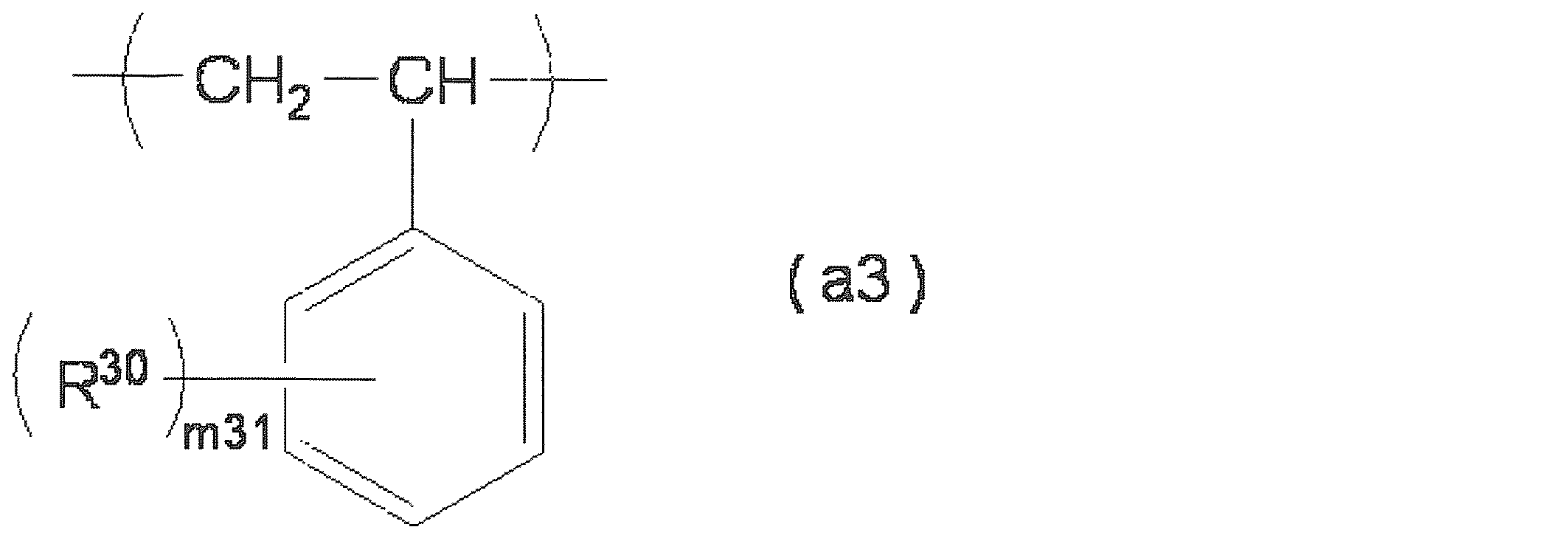
上記式(a3)中、
R30は、それぞれ独立して、ハロゲン原子、ヒドロキシ基、炭素数1~10の1価の炭化水素基、又は-CO-、-COO-、-OCO-、-O-、-CS-、-S-、-SO-、-SO2-及び-NR-からなる群より選ばれる少なくとも1種と炭素数1~10の1価の炭化水素基とを組み合わせた1価の基である。Rは、水素原子又は炭素数1~10の炭化水素基である。
m31は、0~5の整数である。R30が複数の場合、複数のR30は同一でも異なっていてもよい。
R30は、それぞれ独立して、ハロゲン原子、ヒドロキシ基、炭素数1~10の1価の炭化水素基、又は-CO-、-COO-、-OCO-、-O-、-CS-、-S-、-SO-、-SO2-及び-NR-からなる群より選ばれる少なくとも1種と炭素数1~10の1価の炭化水素基とを組み合わせた1価の基である。Rは、水素原子又は炭素数1~10の炭化水素基である。
m31は、0~5の整数である。R30が複数の場合、複数のR30は同一でも異なっていてもよい。
上記式(a3)のR30で表される基としては、例えば、上記式(a1)のR10として例示したものと同様の基等が挙げられる。
上記スチレン系樹脂は、上記式(a3)で表される繰り返し単位以外に、他の繰り返し単位を有していてもよい。
上記他の繰り返し単位を与える単量体としては特に限定されず、種々の重合性不飽和結合を有する化合物が挙げられる。このような重合性不飽和結合を有する化合物としては、例えば、α-メチルスチレン等のスチレン系単量体、(メタ)アクリロニトリル、(メタ)アクリル酸、(メタ)アクリル酸メチル等の(メタ)アクリル酸エステル、(メタ)アクリルアミド等のアクリル系単量体;エチルビニルエーテル等のビニルエーテル類、無水マレイン酸、酢酸ビニル、ビニルピリジン等が挙げられる。
上記スチレン系樹脂中の他の繰り返し単位の含有割合としては、スチレン系樹脂を構成する全構造単位に対して、50モル%未満が好ましく、40モル%未満がさらに好ましい。
上記スチレン系樹脂の重合度、すなわち、上記式(a3)で表される繰り返し単位及び他の繰り返し単位の総数としては、5以上200以下が好ましく、10以上150以下がより好ましい。
上記スチレン系樹脂(特にポリビニルフェノール系の重合体)を形成するための前駆重合体としては、市販品を用いることもでき、例えば丸善石油化学製の「マルカリンカーM」(ポリ-p-ビニルフェノール)、「リンカーMB」(臭素化ポリ-p-ビニルフェノール)、「リンカーCMM」(p-ビニルフェノール/メタクリル酸メチル共重合体)、「リンカーCHM」(p-ビニルフェノール/メタクリル酸2-ヒドロキシエチル共重合体)、「リンカーCST」(p-ビニルフェノール/スチレン共重合体)等が挙げられる。
ポリアリーレン系樹脂としては、例えば、ポリアリーレンエーテル、ポリアリーレンスルフィド、ポリアリーレンエーテルスルホン、ポリアリーレンエーテルケトン等が挙げられる。
樹脂(A)のゲルパーミエーションクロマトグラフィー(GPC)で測定したポリスチレン換算重量平均分子量(以下、「Mw」ともいう)としては、500~100,000が好ましく、より好ましくは1,000~50,000、さらに好ましくは1,200~40,000である。
樹脂(A)のMwと、GPCで測定したポリスチレン換算数平均分子量(以下、「Mn」ともいう)との比(Mw/Mn)は、通常1~5であり、好ましくは1~3である。
当該レジスト下層膜形成用樹脂組成物は、樹脂(A)を1種のみ含有していてもよいし、2種以上含有していてもよい。
[架橋剤(B)]
上記架橋剤(B)は、下記式(i)で表される部分構造を有するものである。即ち、架橋剤(B)を構成する化合物の構造式中には、上記式(i)で表される構造が少なくとも含まれている。なお、この架橋剤(B)は、上記式(i)で表される構造からなる化合物であってもよい。
上記架橋剤(B)は、下記式(i)で表される部分構造を有するものである。即ち、架橋剤(B)を構成する化合物の構造式中には、上記式(i)で表される構造が少なくとも含まれている。なお、この架橋剤(B)は、上記式(i)で表される構造からなる化合物であってもよい。
当該レジスト下層膜形成用樹脂組成物においては、この架橋剤(B)と樹脂(A)とが反応することにより、芳香環に挟まれたカルボニル基又はスルホニル基を生じると推察される。カルボニル基又はスルホニル基は、高い耐熱性に寄与することができる。その結果、形成されたレジスト下層膜は、エッチング耐性等の一般特性を十分満たすと共に、高い曲がり耐性を有し、また耐熱性が向上するものと考えられる。

上記式(i)中、
Xは、カルボニル基又はスルホニル基である。
Qは、1価の複素芳香族基又は-OR1である。R1は、炭素数1~30の1価の有機基である。
Arは、芳香族炭化水素基又は複素芳香族基である。
nは、1~8の整数である。nが2以上の場合、X及びQはそれぞれ同一でも異なっていてもよい。
Xは、カルボニル基又はスルホニル基である。
Qは、1価の複素芳香族基又は-OR1である。R1は、炭素数1~30の1価の有機基である。
Arは、芳香族炭化水素基又は複素芳香族基である。
nは、1~8の整数である。nが2以上の場合、X及びQはそれぞれ同一でも異なっていてもよい。
上記式(i)におけるQで表される1価の複素芳香族基としては、ピロール環、イミダゾール環、ピラゾール環、ピラジン環、インドール環、イソインドール環、ベンゾイミダゾール環、プリン環等の複素芳香環を含む化合物から複素芳香環上の1個の水素原子を除いた基等が挙げられる。これらの複素芳香族基の中でも、炭素数3~30の複素芳香族基が好ましく、NH基を有する複素芳香環を含む基がより好ましく、窒素原子上の水素原子を除いた基がさらに好ましい。
上記式(i)におけるR1で表される1価の有機基としては、特に限定されるものではないが、下記式(ii)~(iv)のいずれかで表される基が好ましい。
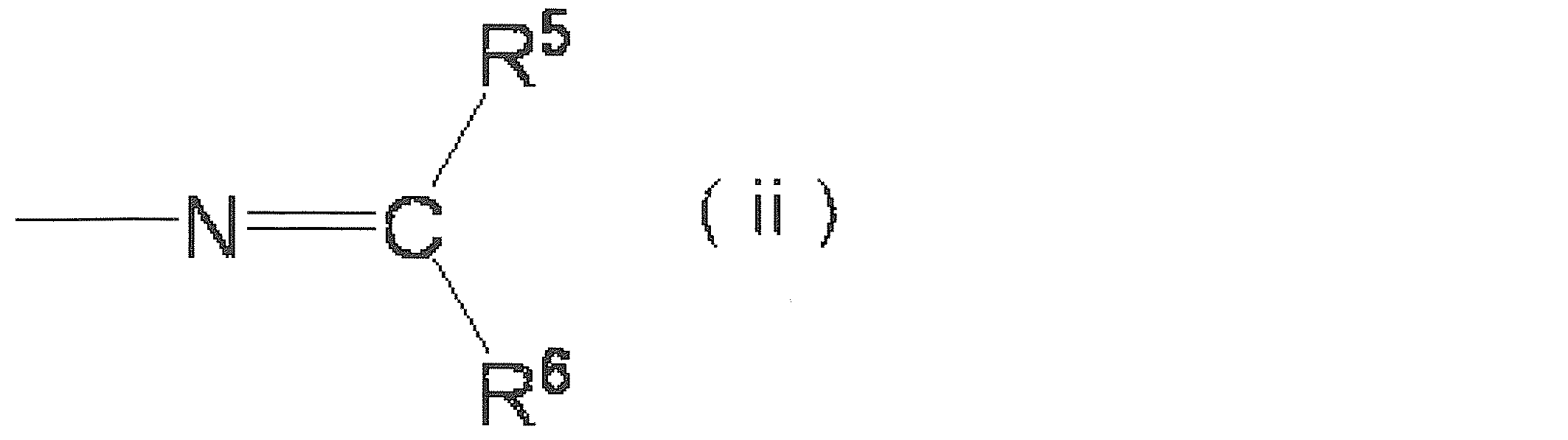
上記式(ii)中、R5及びR6は、それぞれ独立して、炭素数1~20の1価の有機基である。但し、上記R5とR6とが互いに結合して、それらが結合している炭素原子と共に環構造を形成してもよい。
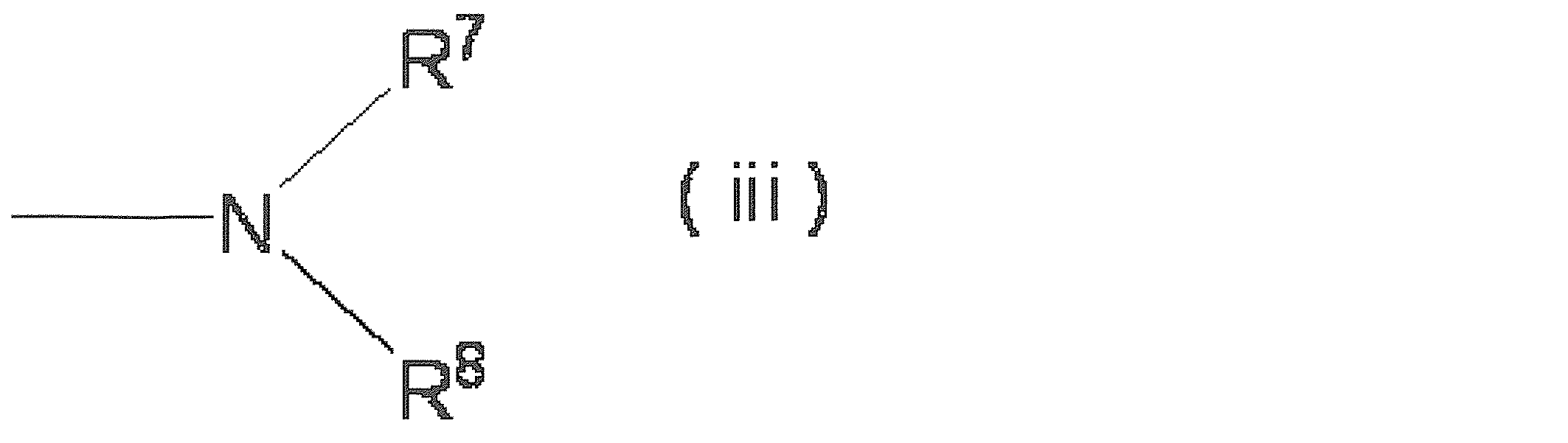
上記式(iii)中、R7及びR8は、それぞれ独立して、炭素数1~20の1価の有機基である。但し、上記R7とR8とが互いに結合して、それらが結合している窒素原子と共に環構造を形成してもよい。

上記式(iv)中、R9は、電子求引性基を含む炭素数1~20の1価の有機基である。
上記R5~R8で表される炭素数1~20の1価の有機基としては、例えば、炭素数1~20の1価の炭化水素基、又は-CO-、-COO-、-OCO-、-O-、-NR-、-CS-、-S-、-SO-及び-SO2-からなる群より選ばれる少なくとも1種の基と炭素数1~20の1価の炭化水素基とを組み合わせた基等が挙げられる。
上記1価の炭化水素基が有する水素原子の一部又は全部は、置換基により置換されていてもよい。上記置換基としては、例えば、フッ素原子、ヒドロキシ基、カルボキシ基、シアノ基等が挙げられる。
上記Rは、水素原子又は炭素数1~20の1価の有機基である。このRの1価の有機基としては、例えば、上記R5~R8で例示したものと同様の基等が挙げられる。
上記炭素数1~20の1価の炭化水素基としては、例えば、炭素数1~20のアルキル基、炭素数3~20の1価の脂環式炭化水素基等が挙げられる。
上記炭素数1~20のアルキル基としては、例えば、メチル基、エチル基、n-プロピル基、n-ブチル基等の直鎖状のアルキル基;i-プロピル基、i-ブチル基、sec-ブチル基、t-ブチル基等の分岐状のアルキル基等が挙げられる。
上記炭素数3~20の1価の脂環式炭化水素基としては、例えば、シクロプロピル基、シクロブチル基、シクロペンチル基、シクロヘキシル基、シクロヘプチル基、シクロオクチル基、シクロデシル基、メチルシクロヘキシル基、エチルシクロヘキシル基等の単環式飽和炭化水素基;シクロブテニル基、シクロペンテニル基、シクロヘキセニル基、シクロヘプテニル基、シクロオクテニル基、シクロデセニル基、シクロペンタジエニル基、シクロヘキサジエニル基、シクロオクタジエニル基、シクロデカジエン等の単環式不飽和炭化水素基;ビシクロ[2.2.1]ヘプチル基、ビシクロ[2.2.2]オクチル基、トリシクロ[5.2.1.02,6]デシル基、トリシクロ[3.3.1.13,7]デシル基、テトラシクロ[6.2.1.13,6.02,7]ドデシル基等の多環式飽和炭化水素基等が挙げられる。なお、「脂環式炭化水素基」は、脂環式炭化水素の構造のみで構成されている必要はなく、その一部に鎖状構造を含んでいてもよい。
上記R5及びR6としては、炭素数1~20の1価の炭化水素基、炭素数1~20の1価のフッ素化炭化水素基が好ましい。
上記R7及びR8としては、-CO-と炭素数1~20の1価のフッ素化炭化水素基とを組み合わせた基が好ましい。
上記R9で表される電子求引性基を含む炭素数1~20の1価の有機基としては、例えば、少なくとも一部の水素原子が電子求引性基で置換された炭素数1~20の炭化水素基等が挙げられる。電子求引性基としては、フッ素原子、塩素原子等のハロゲン原子、ニトロ基、シアノ基等を挙げることができ、フッ素原子、ニトロ基、シアノ基が好ましい。上記炭素数1~20の炭化水素基としては、上記R5~R8で表される炭素数1~20の1価の有機基として例示した炭素数1~20の1価の炭化水素基と同様の基等が挙げられる。
上記式(ii)~(iv)で表される基の好ましいものとしては、上記式(ii)としては下記式(ii-1)~(ii-4)が、上記式(iii)としては下記式(iii-1)が、上記式(iv)としては下記式(iv-1)~(iv-4)がそれぞれ挙げられる。
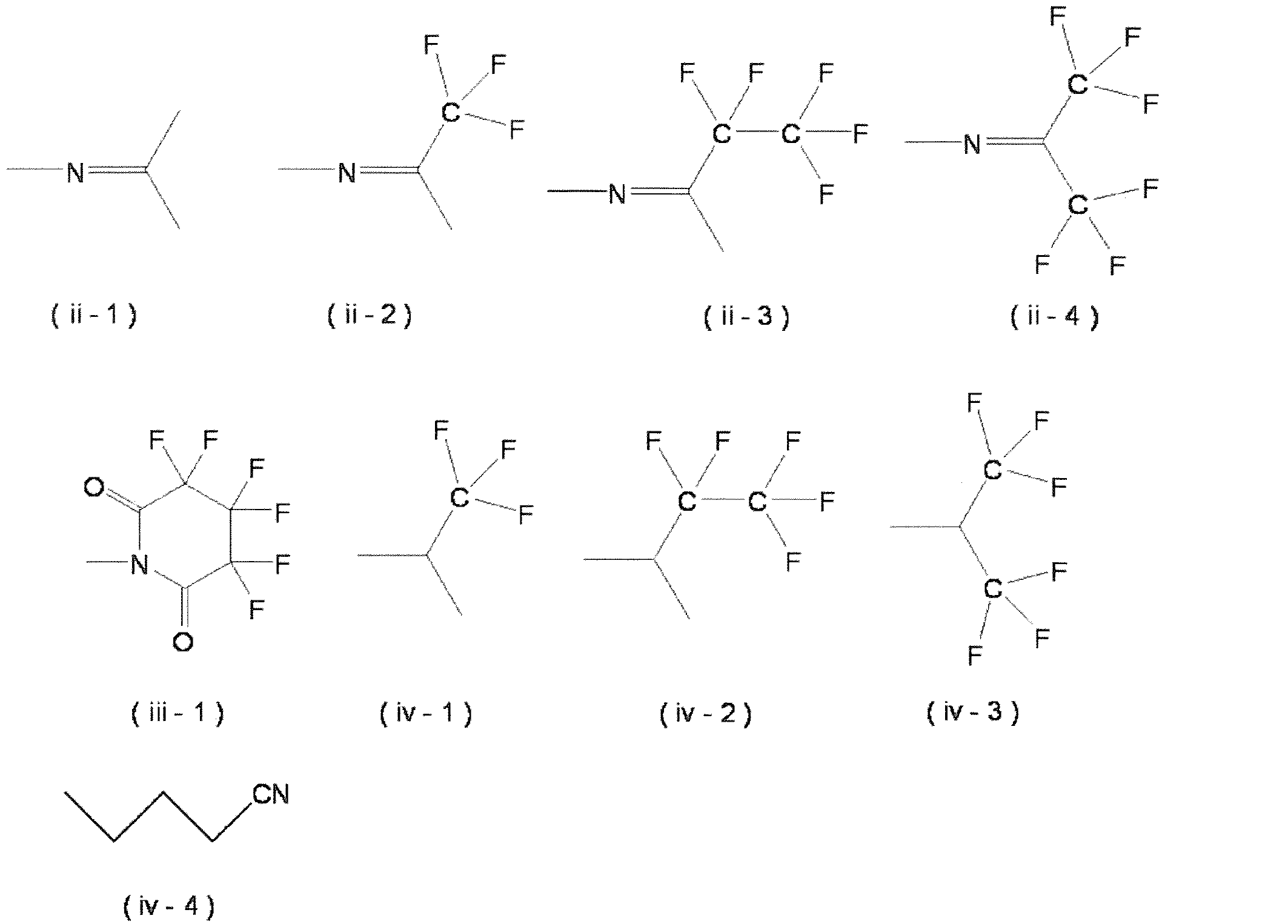
これらの中で、架橋剤(B)の架橋反応性に優れ、形成されるレジスト下層膜の耐熱性及び曲がり耐性が向上する観点から、式(ii)で表される基、式(iv)で表される基が好ましく、式(iv)で表される基がより好ましく、式(iv-3)で表される基、式(iv-4)で表される基がさらに好ましく、式(iv-3)で表される基が特に好ましい。
上記式(i)におけるArで表される芳香族炭化水素基としては、ベンゼン環、ナフタレン環、アントラセン環、インデン環、フルオレニリデンビフェニル環等のベンゼン系芳香環を含む化合物から、このベンゼン系芳香環の有する水素原子以外の原子又は基との結合数分の水素原子を除いた基等が挙げられる。上記芳香族炭化水素基としては、炭素数6~30の芳香族炭化水素基が好ましい。
上記式(i)におけるArで表される複素芳香族基としては、フラン環、ピロール環、チオフェン環、ホスホール環、ピラゾール環、オキサゾール環、イソオキサゾール環、チアゾール環、ピリジン環、ピラジン環、ピリミジン環、ピリダジン環、トリアジン環等の複素芳香環を含む化合物からこの複素芳香環の有する水素原子以外の原子又は基との結合数分の水素原子を除いた基等が挙げられる。上記複素芳香族基としては、炭素数3~30の複素芳香族基が好ましい。
上記式(i)のnとしては1~7の整数が好ましく、1~5の整数がより好ましく、1~3の整数がさらに好ましい。
上述の構造を有する架橋剤(B)としては、例えば、下記式(b1)で表される化合物、下記式(b2)で表される化合物等が挙げられる。

上記式(b1)中、
X及びQは、上記式(i)と同義である。
Ar1は、(n1+n2+1)価の芳香族炭化水素基又は(n1+n2+1)価の複素芳香族基である。
Ar2は、(n3+n4+1)価の芳香族炭化水素基又は(n3+n4+1)価の複素芳香族基である。
R2は、それぞれ独立して、ヒドロキシ基又は置換若しくは非置換の炭素数1~30の1価の炭化水素基である。
R3は、単結合、炭素数1~30の2価の炭化水素基、-CO-、-COO-、-OCO-、-O-、-CS-、-S-、-SO-、-SO2-、-NR-又はこれらの基を組み合わせた2価の基である。Rは、水素原子又は炭素数1~30の炭化水素基である。
R4は、単結合、-CO-、-COO-、-OCO-、-O-、-CS-、-S-、-SO-、-SO2-、-NR-、炭素数1~30の(n5+1)価の炭化水素基又はこれらの基を組み合わせた(n5+1)価の基である。Rは、水素原子又は炭素数1~30の炭化水素基である。
n1は、1~7の整数である。n2は、0~6の整数である。但し、n1+n2は、7以下である。
n3は、1~7の整数である。n4は、0~6の整数である。但し、n3+n4は、7以下である。
n5は、1~5の整数である。
Ar2、R2、R3、X及びQがそれぞれ複数の場合、複数のAr2、R2、R3、X及びQはそれぞれ同一でも異なっていてもよい。
X及びQは、上記式(i)と同義である。
Ar1は、(n1+n2+1)価の芳香族炭化水素基又は(n1+n2+1)価の複素芳香族基である。
Ar2は、(n3+n4+1)価の芳香族炭化水素基又は(n3+n4+1)価の複素芳香族基である。
R2は、それぞれ独立して、ヒドロキシ基又は置換若しくは非置換の炭素数1~30の1価の炭化水素基である。
R3は、単結合、炭素数1~30の2価の炭化水素基、-CO-、-COO-、-OCO-、-O-、-CS-、-S-、-SO-、-SO2-、-NR-又はこれらの基を組み合わせた2価の基である。Rは、水素原子又は炭素数1~30の炭化水素基である。
R4は、単結合、-CO-、-COO-、-OCO-、-O-、-CS-、-S-、-SO-、-SO2-、-NR-、炭素数1~30の(n5+1)価の炭化水素基又はこれらの基を組み合わせた(n5+1)価の基である。Rは、水素原子又は炭素数1~30の炭化水素基である。
n1は、1~7の整数である。n2は、0~6の整数である。但し、n1+n2は、7以下である。
n3は、1~7の整数である。n4は、0~6の整数である。但し、n3+n4は、7以下である。
n5は、1~5の整数である。
Ar2、R2、R3、X及びQがそれぞれ複数の場合、複数のAr2、R2、R3、X及びQはそれぞれ同一でも異なっていてもよい。

上記式(b2)中、
X及びQは、上記式(i)と同義である。
Ar3は、(n6+n7)価の芳香族炭化水素基又は(n6+n7)価の複素芳香族基である。
R2は、ヒドロキシ基又は置換若しくは非置換の炭素数1~30の1価の炭化水素基である。
n6は、1~8の整数である。n7は、0~7の整数である。但し、n6+n7は、8以下である。
R2、X及びQがそれぞれ複数の場合、複数のR2、X及びQはそれぞれ同一でも異なっていてもよい。
X及びQは、上記式(i)と同義である。
Ar3は、(n6+n7)価の芳香族炭化水素基又は(n6+n7)価の複素芳香族基である。
R2は、ヒドロキシ基又は置換若しくは非置換の炭素数1~30の1価の炭化水素基である。
n6は、1~8の整数である。n7は、0~7の整数である。但し、n6+n7は、8以下である。
R2、X及びQがそれぞれ複数の場合、複数のR2、X及びQはそれぞれ同一でも異なっていてもよい。
上記式(b1)におけるR2の炭素数1~30の1価の炭化水素基は、置換基を有していてもよい。この置換基としては、ハロゲン原子、ヒドロキシ基等が挙げられる。上記ハロゲン原子としては、例えば、フッ素原子、塩素原子、臭素原子、ヨウ素原子等が挙げられる。
上記式(b1)のR3で表される炭素数1~20の2価の炭化水素基としては、炭素数1~20の2価の直鎖状又は分岐状の炭化水素基、炭素数3~20の2価の脂環式炭化水素基、炭素数6~20の2価の芳香族炭化水素基又はこれらの基を組み合わせた基等が挙げられる。
上記炭素数1~20の2価の直鎖状又は分岐状の炭化水素基としては、炭素数2~8の直鎖状又は分岐状のアルキレン基が好ましく、エチレン基、プロピレン基、ブチレン基、ヘキシレン基、オクチレン基がより好ましい。
上記炭素数3~20の2価の脂環式炭化水素基としては、炭素数5~12の脂環式炭化水素基が好ましく、単環の脂環式炭化水素基としては、シクロペンチレン基、シクロヘキシレン基が、多環の脂環式炭化水素基としては、ノルボルナンジイル基、アダマンタンジイル基が好ましい。
上記炭素数6~20の2価の芳香族炭化水素基としては、炭素数6~15の芳香族炭化水素基が好ましく、フェニレン基、トリレン基、ナフチレン基がより好ましい。
上記式(b1)のR4で表される炭素数1~20の(n5+1)価の炭化水素基としては、炭素数1~20の(n5+1)価の直鎖状又は分岐状の炭化水素基、炭素数3~20の(n5+1)価の脂環式炭化水素基、炭素数6~20の(n5+1)価の芳香族炭化水素基又はこれらの基を組み合わせた基等が挙げられる。
上記炭素数1~30の(n5+1)価の直鎖状又は分岐状の炭化水素基としては、例えば、メタン、エタン、プロパン、ブタン、エチレン、アセチレン等の直鎖状又は分岐状の炭化水素から(n5+1)個の水素原子を除いた基等が挙げられる。
上記炭素数3~30の(n5+1)価の脂環式炭化水素基としては、例えば、シクロプロパン、シクロブタン、シクロペンタン、シクロヘキサン等の脂環式炭化水素から(n5+1)個の水素原子を除いた基等が挙げられる。
上記炭素数6~30の(n5+1)価の芳香族炭化水素基としては、例えば、ベンゼン、ナフタレン、アントラセン、ピレン、コロネン等の芳香族炭化水素から(n5+1)個の水素原子を除いた基等が挙げられる。
上記式(b1)のR3で表される-CO-、-COO-、-OCO-、-O-、-CS-、-S-、-SO-、-SO2-及び-NR-からなる群より選ばれる少なくとも1種と炭素数1~30の2価の炭化水素基とを組み合わせた2価の基としては、下記式(R-1)~(R-4)で表される構造から2個の水素原子を除いた基等が挙げられる。
上記式(b1)のR4で表される-CO-、-COO-、-OCO-、-O-、-CS-、-S-、-SO-、-SO2-及び-NR-からなる群より選ばれる少なくとも1種と炭素数1~30の(n5+1)価の炭化水素基とを組み合わせた(n5+1)価の基としては、下記式(R-1)~(R-4)で表される構造から(n5+1)個の水素原子を除いた基等が挙げられる。
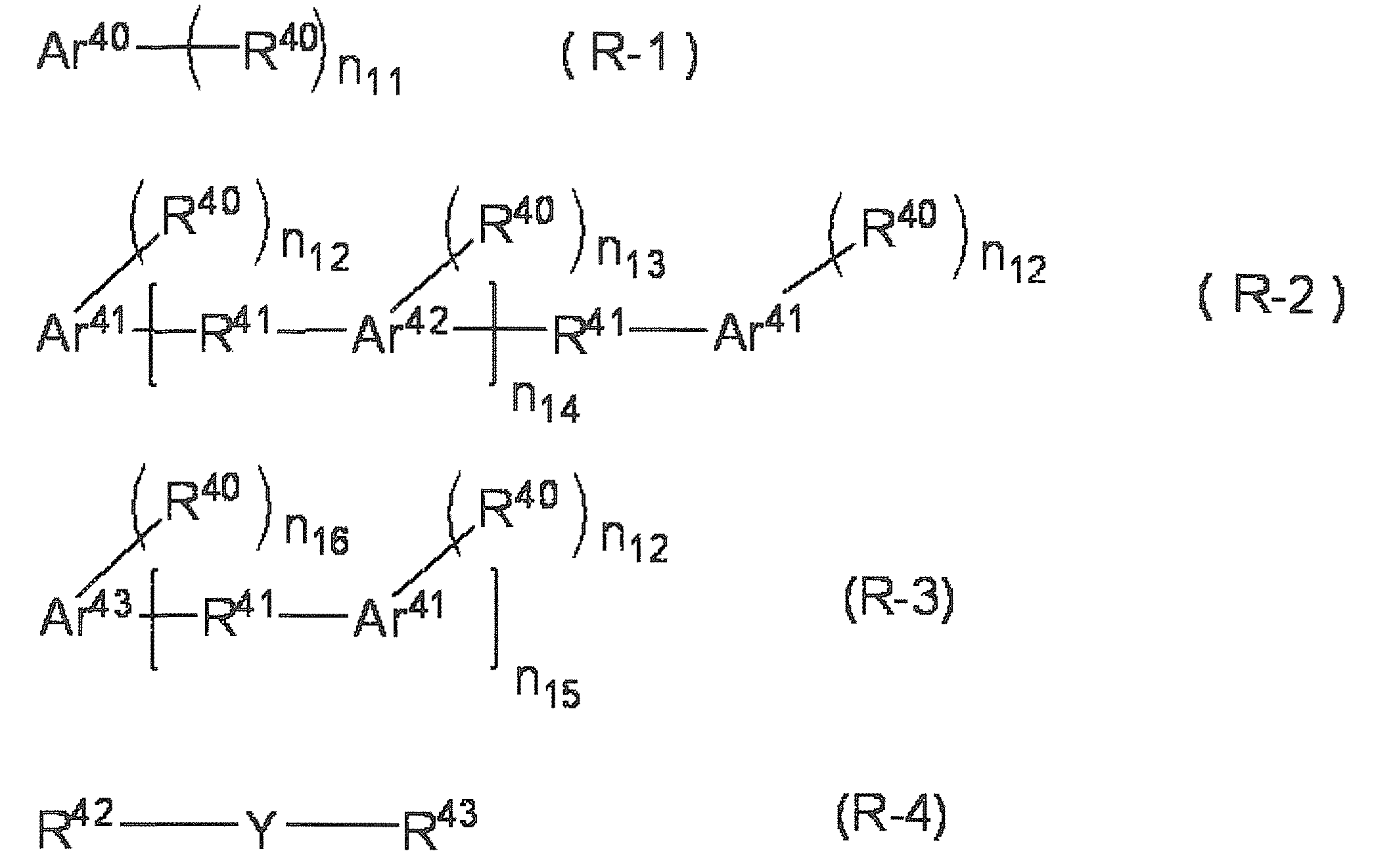
上記式(R-1)~(R-4)中、
Ar40は、炭素数6~20のn11価の芳香族炭化水素基である。Ar41は、それぞれ独立して、炭素数6~20の(n12+1)価の芳香族炭化水素基である。Ar42は、炭素数6~20の(n13+2)価の芳香族炭化水素基である。Ar43は、炭素数6~20の(n15+n16)価の芳香族炭化水素基である。
R40は、それぞれ独立して、炭素数1~12の1価の鎖状炭化水素基、炭素数3~12の1価の脂環式炭化水素基、又はこれらの基と-CO-、-COO-、-OCO-、-O-、-CS-、-S-、-SO-、-SO2-及び-NR-からなる群より選ばれる少なくとも1種の基とを組み合わせた1価の基である。Rは、水素原子又は炭素数1~20の炭化水素基である。
R41は、それぞれ独立して、単結合、-CO-、-COO-、-OCO-、-O-、-CS-、-S-、-SO-、-SO2-、-NR-、炭素数1~12の2価の鎖状炭化水素基、炭素数3~12の2価の脂環式炭化水素基又はこれらの基を組み合わせた2価の基である。Rは、水素原子又は炭素数1~20の炭化水素基である。
R42及びR43は、それぞれ独立して、炭素数1~12の1価の鎖状炭化水素基又は炭素数3~12の1価の脂環式炭化水素基である。R42及びR43は互いに結合してこれらが結合するYと共に環構造を形成してもよい。
n11は、1~6の整数である。n12は、0~5の整数である。n13は、0~4の整数である。n14は、0~5の整数である。n15は、1~6の整数である。n16は、0~5の整数である。Yは、-CO-、-COO-、-OCO-、-O-、-CS-、-S-、-SO-、-SO2-又は-NR-である。Rは、水素原子又は炭素数1~20の炭化水素基である。Ar41、Ar42、R40及びR41がそれぞれ複数の場合、複数のAr41、Ar42、R40及びR41はそれぞれ同一でも異なっていてもよい。
Ar40は、炭素数6~20のn11価の芳香族炭化水素基である。Ar41は、それぞれ独立して、炭素数6~20の(n12+1)価の芳香族炭化水素基である。Ar42は、炭素数6~20の(n13+2)価の芳香族炭化水素基である。Ar43は、炭素数6~20の(n15+n16)価の芳香族炭化水素基である。
R40は、それぞれ独立して、炭素数1~12の1価の鎖状炭化水素基、炭素数3~12の1価の脂環式炭化水素基、又はこれらの基と-CO-、-COO-、-OCO-、-O-、-CS-、-S-、-SO-、-SO2-及び-NR-からなる群より選ばれる少なくとも1種の基とを組み合わせた1価の基である。Rは、水素原子又は炭素数1~20の炭化水素基である。
R41は、それぞれ独立して、単結合、-CO-、-COO-、-OCO-、-O-、-CS-、-S-、-SO-、-SO2-、-NR-、炭素数1~12の2価の鎖状炭化水素基、炭素数3~12の2価の脂環式炭化水素基又はこれらの基を組み合わせた2価の基である。Rは、水素原子又は炭素数1~20の炭化水素基である。
R42及びR43は、それぞれ独立して、炭素数1~12の1価の鎖状炭化水素基又は炭素数3~12の1価の脂環式炭化水素基である。R42及びR43は互いに結合してこれらが結合するYと共に環構造を形成してもよい。
n11は、1~6の整数である。n12は、0~5の整数である。n13は、0~4の整数である。n14は、0~5の整数である。n15は、1~6の整数である。n16は、0~5の整数である。Yは、-CO-、-COO-、-OCO-、-O-、-CS-、-S-、-SO-、-SO2-又は-NR-である。Rは、水素原子又は炭素数1~20の炭化水素基である。Ar41、Ar42、R40及びR41がそれぞれ複数の場合、複数のAr41、Ar42、R40及びR41はそれぞれ同一でも異なっていてもよい。
上記式(R-1)~(R-4)におけるR40、R42及びR43で表される炭素数1~12の1価の鎖状炭化水素基としては、例えば、メチル基、エチル基、n-プロピル基、i-プロピル基、n-ブチル基、2-メチルプロピル基、1-メチルプロピル基、t-ブチル基等が挙げられる。
上記式(R-1)~(R-4)におけるR40、R42及びR43で表される炭素数3~12の1価の脂環式炭化水素基としては、例えば、シクロプロピル基、シクロブチル基、シクロペンチル基、シクロへキシル基、シクロオクチル基、シクロドデシル基等が挙げられる。
上記式(R-2)及び(R-3)におけるR41で表される炭素数1~12の2価の鎖状炭化水素基としては、例えば、メチレン基、エチレン基、1,2-プロピレン基、1,3-プロピレン基、テトラメチレン基、ペンタメチレン基、ヘキサメチレン基、ヘプタメチレン基、オクタメチレン基等が挙げられる。
上記式(R-2)及び(R-3)におけるR41で表される炭素数3~12の2価の脂環式炭化水素基としては、例えば、シクロペンチレン基、シクロヘキシレン基等の単環の脂環式炭化水素基;ノルボルナンジイル基、アダマンタンジイル基等の多環の脂環式炭化水素基等が挙げられる。
上記式(R-1)~(R-4)におけるR40~R43は置換基を有していてもよい。この置換基としては、例えば、ハロゲン原子、ヒドロキシ基等が挙げられる。
上記ハロゲン原子としては、例えば、フッ素原子、塩素原子、臭素原子、ヨウ素原子等が挙げられる。
上記式(b1)のn1及びn3は1~7の整数であり、1~5の整数が好ましく、1~3の整数がより好ましい。
上記式(b1)のn2及びn4は0~7の整数であり、0~5の整数が好ましく、0~3の整数がより好ましい。
上記式(b1)のn5は1~5の整数であり、1~3の整数が好ましい。
上記式(b2)におけるR2で表される炭素数1~30の1価の炭化水素基及びこの基が有してもよい置換基としては、例えば、上記式(b1)におけるR2として例示した同様の基等が挙げられる。
上記式(b2)のn6は1~8の整数であり、1~5の整数が好ましく、1~3の整数がより好ましい。
上記式(b2)のn7は0~7の整数であり、0~5の整数が好ましく、0~3の整数がより好ましい。
ここで、具体的な架橋剤(B)としては、例えば、下記式(B-1)~(B-4)で表される化合物等が挙げられる。
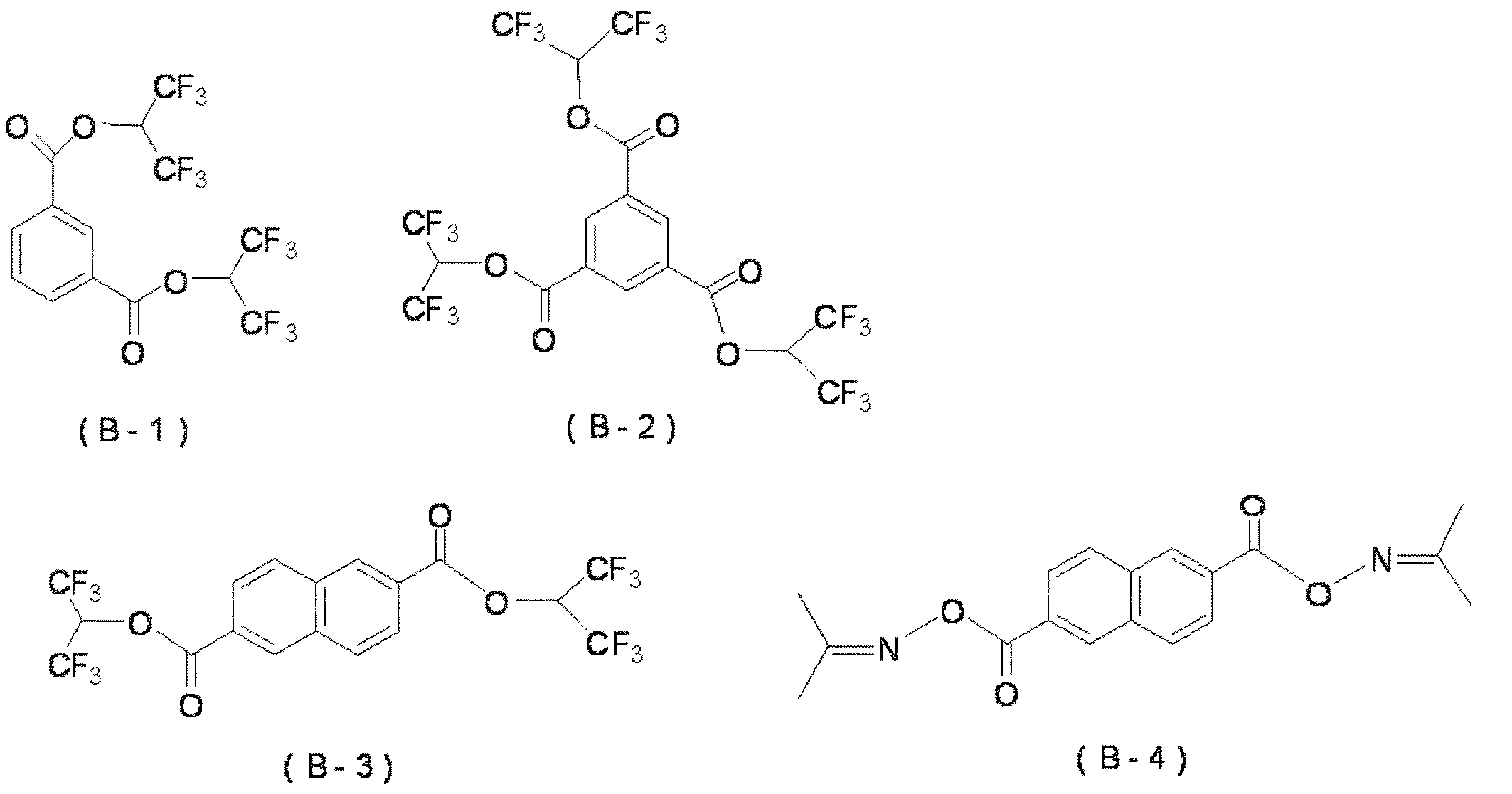
これらの架橋剤(B)は、1種単独で用いてもよいし、2種以上を組み合わせて用いてもよい。
架橋剤(B)の含有量としては、当該レジスト下層膜形成用樹脂組成物の樹脂(A)100質量部に対して、通常、0.1質量部以上100質量部以下であり、好ましくは0.5質量部以上50質量部以下であり、より好ましくは1質量部以上20質量部以下であり、さらに好ましくは5質量部以上15質量部である。
[他の架橋剤]
当該レジスト下層膜形成用樹脂組成物には、上述の架橋剤(B)以外の他の架橋剤が配合されていてもよい。
当該レジスト下層膜形成用樹脂組成物には、上述の架橋剤(B)以外の他の架橋剤が配合されていてもよい。
他の架橋剤としては、例えば、多核フェノール類や、種々の市販の硬化剤等が挙げられる。このような他の架橋剤としては、例えば、特開2004-168748号公報における段落[0085]~[0086]に記載のもの等を用いることができる。
これらの他の架橋剤は、1種単独で用いてもよいし、2種以上を組み合わせて用いてもよく、多核フェノール類と硬化剤とを併用することもできる。
他の架橋剤の含有量としては、当該レジスト下層膜形成用樹脂組成物の樹脂(A)100質量部に対して、通常、0.1質量部以上100質量部以下であり、好ましくは0.5質量部以上50質量部以下であり、より好ましくは1質量部以上20質量部以下である。
[溶媒(C)]
当該レジスト下層膜形成用樹脂組成物は、上述の樹脂(A)及び架橋剤(B)を含むものであるが、この組成物は、通常、樹脂(A)を溶解する溶媒(以下、「溶媒(C)」ともいう)を含む液状の組成物である。
当該レジスト下層膜形成用樹脂組成物は、上述の樹脂(A)及び架橋剤(B)を含むものであるが、この組成物は、通常、樹脂(A)を溶解する溶媒(以下、「溶媒(C)」ともいう)を含む液状の組成物である。
溶媒(C)としては、樹脂(A)を溶解しうるものであれば特に限定されないが、例えば、特開2004-168748号公報における段落[0070]~[0073]に記載のもの等を用いることができる。
これらの溶媒(C)の中でも、プロピレングリコールモノメチルエーテル、エチレングリコールモノエチルエーテルアセテート、乳酸エチル、酢酸n-ブチル、3-エトキシプロピオン酸エチル、3-メトキシプロピオン酸メチル、2-ヘプタノン、シクロヘキサノン、γ-ブチロラクトンが好ましい。
なお、溶媒(C)は、1種単独で用いてもよいし、2種以上を組み合わせて用いてもよい。
溶媒(C)の含有量としては、得られる組成物の固形分濃度が、通常1質量%~80質量%、好ましくは3質量%~40質量%、さらに好ましくは5質量%~30質量%、特に好ましくは7質量%~20質量%となる範囲である。
当該レジスト下層膜形成用樹脂組成物には、本発明における所期の効果を損なわない限り、必要に応じて、酸発生剤(D)、促進剤(E)、添加剤(F)を配合することができる。これらの中でも、促進剤(E)が配合されていることが好ましい。
[酸発生剤(D)]
上記酸発生剤(D)は、露光又は加熱により酸を発生する成分である。当該レジスト下層膜形成用樹脂組成物は、この酸発生剤(D)を含有することにより、常温を含む比較的低温で樹脂の分子鎖間により有効に架橋反応を生起させることが可能となる。
上記酸発生剤(D)は、露光又は加熱により酸を発生する成分である。当該レジスト下層膜形成用樹脂組成物は、この酸発生剤(D)を含有することにより、常温を含む比較的低温で樹脂の分子鎖間により有効に架橋反応を生起させることが可能となる。
露光により酸を発生する酸発生剤(以下、「光酸発生剤」という。)としては、例えば、特開2004-168748号公報における段落[0077]~[0081]に記載のもの等が挙げられる。
これらの光酸発生剤の中でも、ジフェニルヨードニウムトリフルオロメタンスルホネート、ジフェニルヨードニウムノナフルオロ-n-ブタンスルホネート、ジフェニルヨードニウムピレンスルホネート、ジフェニルヨードニウムn-ドデシルベンゼンスルホネート、ジフェニルヨードニウム10-カンファースルホネート、ジフェニルヨードニウムナフタレンスルホネート、ビス(4-t-ブチルフェニル)ヨードニウムトリフルオロメタンスルホネート、ビス(4-t-ブチルフェニル)ヨードニウムノナフルオロ-n-ブタンスルホネート、ビス(4-t-ブチルフェニル)ヨードニウムn-ドデシルベンゼンスルホネート、ビス(4-t-ブチルフェニル)ヨードニウム10-カンファースルホネート、ビス(4-t-ブチルフェニル)ヨードニウムナフタレンスルホネートが好ましい。
なお、これらの光酸発生剤は、1種単独で用いてもよいし、2種以上を組み合わせて用いてもよい。
加熱により酸を発生する酸発生剤(以下、「熱酸発生剤」という。)としては、例えば、2,4,4,6-テトラブロモシクロヘキサジエノン、ベンゾイントシレート、2-ニトロベンジルトシレート、アルキルスルホネート類等が挙げられる。
なお、これらの熱酸発生剤は、1種単独で用いてもよいし、2種以上を組み合わせて用いてもよい。また、酸発生剤(D)として、光酸発生剤と熱酸発生剤とを併用してもよい。
酸発生剤(D)の含有量としては、当該レジスト下層膜形成用樹脂組成物の樹脂(A)100質量部に対して、通常、5,000質量部以下、好ましくは0.1質量部~1,000質量部、さらに好ましくは0.1質量部~100質量部、特に好ましくは1質量部~10質量部である。
[促進剤(E)]
上記促進剤(E)は、酸化架橋に必要な脱水素反応を十分に引き起こすための一電子酸化剤等である。一電子酸化剤とは、それ自身が1電子移動を受ける酸化剤を意味する。例えば、硝酸セリウム(IV)アンモニウムの場合では、セリウムイオン(IV)が一電子を得てセリウムイオン(III)へと変化する。又はハロゲン等のラジカル性の酸化剤は、一電子を得てアニオンへと転化する。このように、一電子を被酸化物(基質や触媒等)から奪うことにより、被酸化物を酸化する現象を一電子酸化と称し、この時一電子を受け取る成分を一電子酸化剤とよぶ。
上記促進剤(E)は、酸化架橋に必要な脱水素反応を十分に引き起こすための一電子酸化剤等である。一電子酸化剤とは、それ自身が1電子移動を受ける酸化剤を意味する。例えば、硝酸セリウム(IV)アンモニウムの場合では、セリウムイオン(IV)が一電子を得てセリウムイオン(III)へと変化する。又はハロゲン等のラジカル性の酸化剤は、一電子を得てアニオンへと転化する。このように、一電子を被酸化物(基質や触媒等)から奪うことにより、被酸化物を酸化する現象を一電子酸化と称し、この時一電子を受け取る成分を一電子酸化剤とよぶ。
一電子酸化剤の代表的な例として、(a)金属化合物、(b)過酸化物、(c)ジアゾ化合物、(d)ハロゲン又はハロゲン酸等が挙げられる。
上記(a)金属化合物としては、例えば、セリウム、鉛、銀、マンガン、オスミウム、ルテニウム、バナジウム、タリウム、銅、鉄、ビスマス、ニッケルを含む金属化合物が挙げられる。具体的には、(a1)硝酸セリウム(IV)アンモニウム(CAN;ヘキサニトラトセリウム(IV)酸アンモニウム)、酢酸セリウム(IV)、硝酸セリウム(IV)、硫酸セリウム(IV)等のセリウム塩(例えば、四価のセリウム塩)、(a2)四酢酸鉛、酸化鉛(IV)等の鉛化合物(例えば、四価の鉛化合物)、(a3)酸化銀(I)、酸化銀(II)、炭酸銀(Fetizon試薬)、硝酸銀等の銀化合物、(a4)過マンガン酸塩、活性二酸化マンガン、マンガン(III)塩等のマンガン化合物、(a5)四酸化オスミウム等のオスミウム化合物、(a6)四酸化ルテニウム等のルテニウム化合物、(a7)VOCl3、VOF3、V2O5、NH4VO3、NaVO3等のバナジウム化合物、(a8)酢酸タリウム(III)、トリフルオロ酢酸タリウム(III)、硝酸タリウム(III)等のタリウム化合物、(a9)酢酸銅(II)、銅(II)トリフルオロメタンスルホネート、銅(II)トリフルオロボレート、塩化銅(II)、酢酸銅(I)等の銅化合物、(a10)塩化鉄(III)、ヘキサシアノ鉄(III)酸カリウム等の鉄化合物、(a11)ビスマス酸ナトリウム等のビスマス化合物、(a12)過酸化ニッケル等のニッケル化合物等が挙げられる。
上記(b)過酸化物としては、例えば、過酢酸、m-クロロ過安息香酸等の過酸;過酸化水素や、t-ブチルヒドロペルオキシド等のアルキルヒドロキシペルオキシド等のヒドロキシペルオキシド類;過酸化ジアシル、過酸エステル、過酸ケタール、ペルオキシ二炭酸塩、過酸化ジアルキル、過酸ケトン等が挙げられる。
上記(c)ジアゾ化合物としては、例えば、2,2’-アゾビスイソブチロニトリル等が挙げられる。
上記(d)ハロゲン又はハロゲン酸としては、例えば、塩素、臭素、ヨウ素から選ばれるハロゲンや、過ハロゲン酸、ハロゲン酸、亜ハロゲン酸、次亜ハロゲン酸及びこれらの塩等が挙げられる。なお、ハロゲン酸におけるハロゲンとしては、塩素、臭素、ヨウ素が挙げられる。又はハロゲン酸若しくはその塩となる具体的な化合物としては、過塩素酸ナトリウム、臭素酸ナトリム等が挙げられる。
これらの一電子酸化剤の中でも、(b)過酸化物、(c)ジアゾ化合物が好ましく、特に、m-クロロ過安息香酸、t-ブチルヒドロペルオキシド、2,2’-アゾビスイソブチロニトリルが好ましい。これらを用いた場合には、基板上に金属残留物等が付着するおそれがないので好ましい。
なお、促進剤(E)は、1種単独で用いてもよいし、2種以上を組み合わせて用いてもよい。
促進剤(E)の含有量としては、当該レジスト下層膜形成用樹脂組成物の樹脂(A)100質量部に対して、通常、1,000質量部以下、好ましくは0.01質量部~500質量部、さらに好ましくは0.1質量部~100質量部である。
[添加剤(F)]
上記添加剤(F)としては、バインダー樹脂、放射線吸収剤、界面活性剤等が挙げられる。
上記添加剤(F)としては、バインダー樹脂、放射線吸収剤、界面活性剤等が挙げられる。
これらの添加剤(F)としては、例えば、特開2004-168748号公報における段落[0088]~[0093]に記載のもの等を用いることができる。
上記バインダー樹脂としては、種々の熱可塑性樹脂や熱硬化性樹脂(上述の樹脂(A)を除く)を使用することができる。熱可塑性樹脂は、添加した熱可塑性樹脂の流動性や機械的特性等をレジスト下層膜に付与する作用を有する成分である。また、熱硬化性樹脂は、加熱により硬化して溶媒に不溶となり、得られるレジスト下層膜と、その上に形成されるレジスト膜との間のインターミキシングを防止する作用を有する成分であり、バインダー樹脂として好ましく使用することができる。これらの中でも、熱硬化性樹脂が好ましく、尿素樹脂類、メラミン樹脂類、芳香族炭化水素樹脂類がより好ましい。
なお、これらのバインダー樹脂は、1種単独で用いてもよいし、2種以上を組み合わせて用いてもよい。
上記バインダー樹脂の含有量としては、当該レジスト下層膜形成用樹脂組成物における樹脂(A)100質量部に対して、通常、20質量部以下、好ましくは10質量部以下である。
上記放射線吸収剤の含有量としては、当該レジスト下層膜形成用樹脂組成物の樹脂(A)100質量部に対して、通常、100質量部以下、好ましくは50質量部以下である。
上記界面活性剤は、塗布性、ストリエーション、ぬれ性、現像性等を改良する作用を有する成分である。
これらの界面活性剤は、1種単独で用いてもよいし、2種以上を組み合わせて用いてもよい。
上記界面活性剤の含有量としては、当該レジスト下層膜形成用樹脂組成物の樹脂(A)100質量部に対して、通常、15質量部以下、好ましくは10質量部以下である。
また、当該レジスト下層膜形成用樹脂組成物には、上述の添加剤以外にも、例えば、保存安定剤、消泡剤、接着助剤等の他の添加剤を配合することができる。
<レジスト下層膜>
本発明のレジスト下層膜は、当該レジスト下層膜形成用樹脂組成物により形成されたものである。なお、このレジスト下層膜形成用樹脂組成物については、上述の本発明のレジスト下層膜形成用樹脂組成物の説明をそのまま適用することができる。
本発明のレジスト下層膜は、当該レジスト下層膜形成用樹脂組成物により形成されたものである。なお、このレジスト下層膜形成用樹脂組成物については、上述の本発明のレジスト下層膜形成用樹脂組成物の説明をそのまま適用することができる。
このレジスト下層膜は、基板の上面側にレジスト下層膜を形成し、レジスト下層膜の上面側にレジストパターンを形成後、レジストパターンを一旦、レジスト下層膜に転写して下層膜パターンを形成した後、この下層膜パターンをエッチングマスクとして用いて基板に転写する多層レジストプロセスに好適に用いることができる。
レジスト下層膜の水素含量としては、通常0~50atom%であり、0~35atom%が好ましい。レジスト下層膜における水素含量は、レジスト下層膜について、炭素・水素・窒素同時定量装置(ジェイ・サイエンス・ラボ社の「JM10」)を用いて、各元素の質量換算値(質量%)を測定し、この質量換算値から、各元素の原子数を[各元素の質量換算値(質量%)/各元素の原子量(g/mol)]により算出し、この各元素の原子数の値から、[レジスト下層膜中の水素原子数/レジスト下層膜中の全原子数]により求めた値(atom%)である。
このようなレジスト下層膜を形成する方法は特に限定されないが、例えば、後述の本発明のレジスト下層膜の形成方法等が挙げられる。
<レジスト下層膜の形成方法>
本発明のレジスト下層膜の形成方法は、当該レジスト下層膜形成用樹脂組成物で基板の上面側に塗膜を形成する工程と、上記塗膜と上記基板とを加熱する工程とを備える。なお、当該レジスト下層膜形成用樹脂組成物については、上述の本発明のレジスト下層膜形成用樹脂組成物の説明をそのまま適用することができる。
本発明のレジスト下層膜の形成方法は、当該レジスト下層膜形成用樹脂組成物で基板の上面側に塗膜を形成する工程と、上記塗膜と上記基板とを加熱する工程とを備える。なお、当該レジスト下層膜形成用樹脂組成物については、上述の本発明のレジスト下層膜形成用樹脂組成物の説明をそのまま適用することができる。
上記基板としては、例えば、シリコンウェハ、アルミニウムで被覆したウェハー等を使用することができる。
また、基板へのレジスト下層膜形成用樹脂組成物の塗布方法は特に限定されず、例えば、回転塗布、流延塗布、ロール塗布等の適宜の方法で実施することができる。
また、上記塗膜の加熱は、通常、大気下(酸素濃度20容量%程度)で行われる。
この際の加熱温度は、通常、300℃~500℃であり、好ましくは350℃~450℃である。この加熱温度が300℃未満である場合、酸化架橋が十分に進行せず、レジスト下層膜として必要な特性が発現しないおそれがある。
この際の加熱時間としては、通常、30秒~1,200秒であり、好ましくは60秒~600秒である。
塗膜硬化時の酸素濃度としては5容量%以上が望ましい。塗膜形成時の酸素濃度が低い場合、レジスト下層膜の酸化架橋が十分に進行せず、レジスト下層膜として必要な特性が発現できないおそれがある。
また、塗膜を300℃~500℃の温度で加熱する前に、60℃~250℃の温度で予備加熱しておいてもよい。
予備加熱における加熱時間としては特に限定されないが、10秒~300秒が好ましく、より好ましくは30秒~180秒である。
この予備加熱を行うことにより、溶媒を予め気化させて、膜を緻密にしておくことで、脱水素反応を効率良く進めることができる。
また、当該レジスト下層膜の形成方法においては、通常、上記塗膜の加熱により塗膜が硬化され、レジスト下層膜が形成されるが、レジスト下層膜形成用樹脂組成物に所定の光硬化剤(光架橋剤)を含有させることにより、加熱された塗膜に対する露光工程を設けて、光硬化させ、レジスト下層膜を形成することもできる。この際に露光される放射線は、レジスト下層膜形成用樹脂組成物に配合されている酸発生剤の種類に応じて、可視光線、紫外線、遠紫外線、X線、電子線、γ線、分子線、イオンビーム等から適切に選択される。
<パターン形成方法>
本発明のパターン形成方法は、基板の上面側に、当該レジスト下層膜形成用樹脂組成物でレジスト下層膜を形成する工程(以下、「レジスト下層膜形成工程」ともいう。)と、上記レジスト下層膜の上面側にレジストパターンを形成する工程(以下、「レジストパターン形成工程」ともいう)と、上記レジストパターンをマスクとし、上記レジスト下層膜及び上記基板を順次エッチングする工程(以下、「エッチング工程」ともいう。)とを備える。
本発明のパターン形成方法は、基板の上面側に、当該レジスト下層膜形成用樹脂組成物でレジスト下層膜を形成する工程(以下、「レジスト下層膜形成工程」ともいう。)と、上記レジスト下層膜の上面側にレジストパターンを形成する工程(以下、「レジストパターン形成工程」ともいう)と、上記レジストパターンをマスクとし、上記レジスト下層膜及び上記基板を順次エッチングする工程(以下、「エッチング工程」ともいう。)とを備える。
[レジスト下層膜形成工程]
上記レジスト下層膜形成工程では、基板の上面側にレジスト下層膜が形成される。なお、このレジスト下層膜の形成方法については、上述の説明をそのまま適用することができる。
上記レジスト下層膜形成工程では、基板の上面側にレジスト下層膜が形成される。なお、このレジスト下層膜の形成方法については、上述の説明をそのまま適用することができる。
この工程で形成されるレジスト下層膜の膜厚は、通常、0.1μm~5μmである。
また、このパターン形成方法においては、上記レジスト下層膜形成工程の後に、必要に応じて、レジスト下層膜上に中間層(中間被膜)を形成する工程をさらに備えていてもよい。
この中間層は、レジストパターン形成において、レジスト下層膜及び/又はレジスト膜が有する機能をさらに補ったり、これらが有していない機能を得るために、これらの機能が付与された層のことである。例えば、反射防止膜を中間層として形成した場合、レジスト下層膜の反射防止機能をさらに補うことができる。
この中間層は、有機化合物や無機酸化物により形成することができる。有機化合物としては、例えば、Brewer Science製の「DUV-42」、「DUV-44」、「ARC-28」、「ARC-29」等の市販材料や、ローム アンド ハース製の「AR-3」、「AR―19」等の市販材料等を用いることができる。また、無機酸化物としては、例えば、JSR製の「NFC SOG01」、「NFC SOG04」、「NFC SOG080」等の市販材料やCVD法により形成されるポリシロキサン、酸化チタン、酸化アルミナ、酸化タングステン等を用いることができる。
中間層を形成するための方法は特に限定されないが、例えば、塗布法やCVD法等を用いることができる。これらの中でも、塗布法が好ましい。塗布法を用いた場合、レジスト下層膜を形成後、中間層を連続して形成することができる。
また、中間層の膜厚は特に限定されず、中間層に求められる機能に応じて適宜選択されるが、10nm~3,000nmが好ましく、さらに好ましくは20nm~300nmである。
[レジストパターン形成工程]
上記レジストパターン形成工程では、上記レジスト下層膜の上面側にレジストパターンを形成する。このレジストパターンを形成する方法としては、例えば、フォトリソグラフィーを用いる方法等が挙げられる。
上記レジストパターン形成工程では、上記レジスト下層膜の上面側にレジストパターンを形成する。このレジストパターンを形成する方法としては、例えば、フォトリソグラフィーを用いる方法等が挙げられる。
フォトリソグラフィーを用いてレジストパターンを形成する方法は、上記レジスト下層膜の上面側にレジスト組成物でレジスト膜を形成する工程(以下、「レジスト膜形成工程」ともいう)と、上記レジスト膜を露光する工程(以下、「露光工程」ともいう)と、上記露光されたレジスト膜を現像する工程(以下、「現像工程」ともいう)とを備える。
(レジスト膜形成工程)
上記レジスト膜形成工程では、レジスト組成物を用いて、レジスト下層膜の上面側にレジスト膜が形成される。具体的には、得られるレジスト膜が所定の膜厚となるようにレジスト組成物を塗布した後、通常、プレベークすることによって塗膜中の溶媒を揮発させ、レジスト膜が形成される。
上記レジスト膜形成工程では、レジスト組成物を用いて、レジスト下層膜の上面側にレジスト膜が形成される。具体的には、得られるレジスト膜が所定の膜厚となるようにレジスト組成物を塗布した後、通常、プレベークすることによって塗膜中の溶媒を揮発させ、レジスト膜が形成される。
レジスト組成物としては、例えば、光酸発生剤を含有するポジ型又はネガ型の化学増幅型レジスト組成物、アルカリ可溶性樹脂とキノンジアジド系感光剤とからなるポジ型レジスト組成物、アルカリ可溶性樹脂と架橋剤とからなるネガ型レジスト組成物等が挙げられる。
レジスト膜をレジスト下層膜上に形成させる際に使用されるレジスト組成物は、固形分濃度が、通常、1質量%~50質量%程度であり、一般に、例えば、孔径0.2μm程度のフィルターでろ過して、レジスト膜の形成に供される。なお、この工程では、市販のレジスト組成物をそのまま使用することもできる。
レジスト組成物の塗布方法は特に限定されず、例えば、スピンコート法等により実施することができる。
また、プレベークの温度は、使用されるレジスト組成物の種類等に応じて適宜調整されるが、通常、30℃~200℃程度、好ましくは50℃~150℃である。
(露光工程)
上記露光工程では、得られたレジスト膜の所定領域に放射線が照射され、選択的に露光が行われる。
上記露光工程では、得られたレジスト膜の所定領域に放射線が照射され、選択的に露光が行われる。
露光に用いられる放射線としては、レジスト組成物に使用される光酸発生剤の種類に応じて、可視光線、紫外線、遠紫外線、X線、電子線、γ線、分子線、イオンビーム等から適切に選択されるが、遠紫外線が好ましく、特にKrFエキシマレーザー(248nm)、ArFエキシマレーザー(193nm)、F2エキシマレーザー(波長157nm)、Kr2エキシマレーザー(波長147nm)、ArKrエキシマレーザー(波長134nm)、極紫外線(波長13nm等)が好ましい。
なお、解像度、パターンプロファイル、現像性等を向上させるため、上記露光の後に、ポストベークを行うことができる。このポストベークの温度としては、使用されるレジスト組成物の種類等に応じて適宜調整されるが、通常、50℃~200℃程度、好ましくは70℃~150℃である。
(現像工程)
現像工程では、露光工程において露光されたレジスト膜を現像液で現像する。これにより、レジストパターンが形成される。
現像工程では、露光工程において露光されたレジスト膜を現像液で現像する。これにより、レジストパターンが形成される。
この工程で用いられる現像液は、使用されるレジスト組成物の種類に応じて適宜選択される。具体的には、例えば、水酸化ナトリウム、水酸化カリウム、炭酸ナトリウム、珪酸ナトリウム、メタ珪酸ナトリウム、アンモニア、エチルアミン、n-プロピルアミン、ジエチルアミン、ジ-n-プロピルアミン、トリエチルアミン、メチルジエチルアミン、ジメチルエタノールアミン、トリエタノールアミン、テトラメチルアンモニウムヒドロキシド、テトラエチルアンモニウムヒドロキシド、ピロール、ピペリジン、コリン、1,8-ジアザビシクロ[5.4.0]-7-ウンデセン、1,5-ジアザビシクロ[4.3.0]-5-ノネン等のアルカリ性水溶液が挙げられる。
これらのアルカリ性水溶液には、水溶性有機溶媒、例えば、メタノール、エタノール等のアルコール類や、界面活性剤を適量添加することもできる。
上記現像液としては、有機溶媒を含有する液を用いることもできる。このような有機溶媒としては、上記溶媒(C)として例示したものと同様の溶媒等が挙げられる。
また、上記現像液での現像後、洗浄し、乾燥することによって、所定のレジストパターンが形成される。
上記レジストパターン形成工程におけるレジストパターンを形成する方法としては、上記フォトリソグラフィーを用いる方法以外にも、ナノインプリントリソグラフィーを用いる方法、自己組織化組成物を用いる方法等が挙げられる。
[エッチング工程]
エッチング工程では、得られたレジストパターンをマスクとし、レジスト下層膜及び基板を順次エッチングする。上記エッチングとしては、例えば、酸素プラズマ等のガスプラズマを用いるドライエッチング、酸溶液等を用いるウェットエッチング等が挙げられる。これらの中で、より微細な基板パターンを得られる点でドライエッチングが好ましい。このエッチング工程を行うことにより、所定の基板のパターンが得られる。
エッチング工程では、得られたレジストパターンをマスクとし、レジスト下層膜及び基板を順次エッチングする。上記エッチングとしては、例えば、酸素プラズマ等のガスプラズマを用いるドライエッチング、酸溶液等を用いるウェットエッチング等が挙げられる。これらの中で、より微細な基板パターンを得られる点でドライエッチングが好ましい。このエッチング工程を行うことにより、所定の基板のパターンが得られる。
以下、実施例を挙げて、本発明の実施の形態を更に具体的に説明する。但し、本発明は、これらの実施例に何ら制約されるものではない。ここで、「部」及び「%」は、特記しない限り質量基準である。
なお、本実施例における重量平均分子量(Mw)の測定は、東ソー製「GPCカラム」(G2000HXL:2本、G3000HXL:1本)を用い、流量:1.0ml/分、溶出溶媒:テトラヒドロフラン、カラム温度:40℃の分析条件で、単分散ポリスチレンを標準とするゲルパーミエーションクロマトグラフ(検出器:示差屈折計)により測定した。
<樹脂(A)の合成>
[合成例1](樹脂(A-1)の合成)
コンデンサー、温度計、攪拌装置を備えた反応装置に2,7-ジヒドロキシナフタレン100部、プロピレングリコールモノメチルエーテルアセテート100部、及びパラホルムアルデヒド50部を仕込み、シュウ酸2部を添加し、脱水しながら120℃に昇温して、5時間反応させることにより、下記式(A-1)で表される繰り返し単位からなる樹脂(A-1)を得た。得られた樹脂(A-1)のMwは、2,000であった。
[合成例1](樹脂(A-1)の合成)
コンデンサー、温度計、攪拌装置を備えた反応装置に2,7-ジヒドロキシナフタレン100部、プロピレングリコールモノメチルエーテルアセテート100部、及びパラホルムアルデヒド50部を仕込み、シュウ酸2部を添加し、脱水しながら120℃に昇温して、5時間反応させることにより、下記式(A-1)で表される繰り返し単位からなる樹脂(A-1)を得た。得られた樹脂(A-1)のMwは、2,000であった。

[合成例2](樹脂(A-2)の合成)
コンデンサー、温度計、攪拌装置を備えた反応装置にフルオレンビスフェノール100部、プロピレングリコールモノメチルエーテルアセテート100部、及びパラホルムアルデヒド50部を仕込み、シュウ酸2部を添加し、脱水しながら120℃に昇温して、5時間反応させることにより、下記式(A-2)で表される繰り返し単位からなる樹脂(A-2)を得た。得られた樹脂(A-2)のMwは、4,000であった。
コンデンサー、温度計、攪拌装置を備えた反応装置にフルオレンビスフェノール100部、プロピレングリコールモノメチルエーテルアセテート100部、及びパラホルムアルデヒド50部を仕込み、シュウ酸2部を添加し、脱水しながら120℃に昇温して、5時間反応させることにより、下記式(A-2)で表される繰り返し単位からなる樹脂(A-2)を得た。得られた樹脂(A-2)のMwは、4,000であった。

[合成例3](樹脂(A-3)の合成)
温度計を備えたセパラブルフラスコに、窒素下で、アセナフチレン100部、トルエン78部、ジオキサン52部、及びアゾビスイソブチロニトリル3部を仕込み、70℃で5時間攪拌した。ここで得られた分子量10,000の樹脂に、p-トルエンスルホン酸1水和物5.2部、及びパラホルムアルデヒド40部を添加して、120℃に昇温し、更に6時間攪拌した。その後、反応溶液を多量のイソプロパノール中に投入し、沈殿した樹脂をろ過して、下記式(A-3)で表される繰り返し単位からなる樹脂(A-3)を得た。得られた樹脂(A-3)のMwは、20,000であった。
温度計を備えたセパラブルフラスコに、窒素下で、アセナフチレン100部、トルエン78部、ジオキサン52部、及びアゾビスイソブチロニトリル3部を仕込み、70℃で5時間攪拌した。ここで得られた分子量10,000の樹脂に、p-トルエンスルホン酸1水和物5.2部、及びパラホルムアルデヒド40部を添加して、120℃に昇温し、更に6時間攪拌した。その後、反応溶液を多量のイソプロパノール中に投入し、沈殿した樹脂をろ過して、下記式(A-3)で表される繰り返し単位からなる樹脂(A-3)を得た。得られた樹脂(A-3)のMwは、20,000であった。
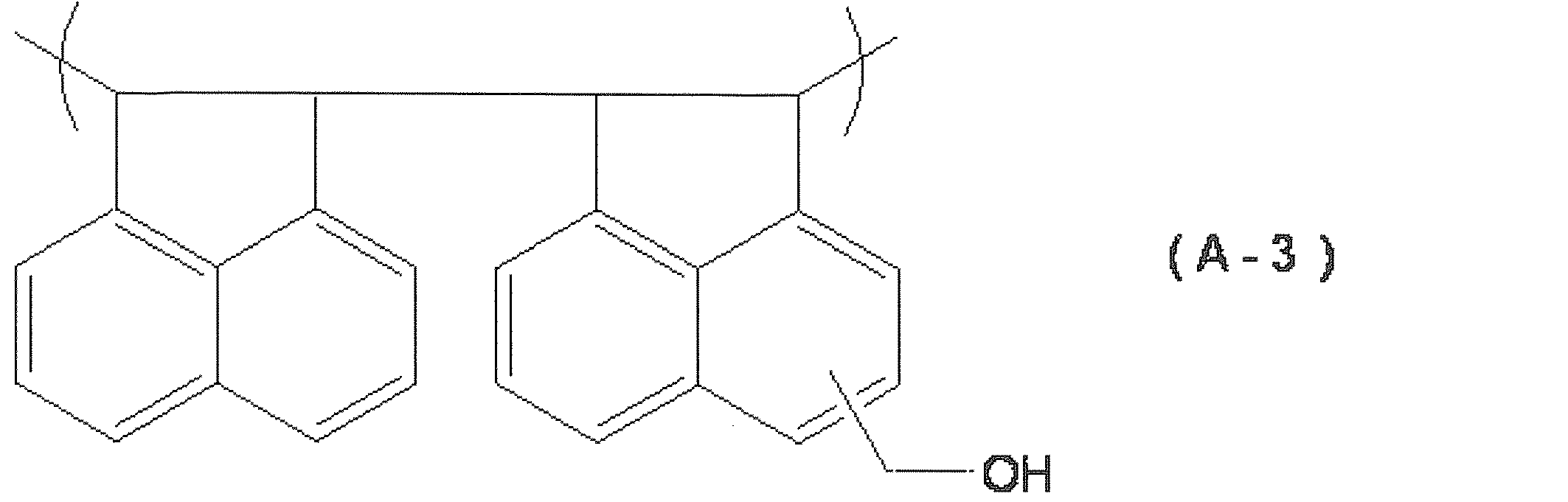
<レジスト下層膜形成用樹脂組成物の調製>
[実施例1]
表1に示すように、樹脂(A)としての上述の樹脂(A-1)10部、架橋剤(B)としての下記化合物(B-1)1部、及び酸発生剤(D)(熱酸発生剤)としてのジフェニルヨードニウムトリフルオロメタンスルホネート(D-1)0.5部を、溶媒(C)としてのプロピレングリコールモノメチルエーテルアセテート(C-1)90部に溶解した。この溶液を孔径0.1μmのメンブランフィルターでろ過して、実施例1のレジスト下層膜形成用樹脂組成物を調製した。
[実施例1]
表1に示すように、樹脂(A)としての上述の樹脂(A-1)10部、架橋剤(B)としての下記化合物(B-1)1部、及び酸発生剤(D)(熱酸発生剤)としてのジフェニルヨードニウムトリフルオロメタンスルホネート(D-1)0.5部を、溶媒(C)としてのプロピレングリコールモノメチルエーテルアセテート(C-1)90部に溶解した。この溶液を孔径0.1μmのメンブランフィルターでろ過して、実施例1のレジスト下層膜形成用樹脂組成物を調製した。
[実施例2~6]
表1に示す種類及び含有量の各成分を用いた以外は、実施例1と同様にして、実施例2~6の各レジスト下層膜形成用樹脂組成物を調製した。
表1に示す種類及び含有量の各成分を用いた以外は、実施例1と同様にして、実施例2~6の各レジスト下層膜形成用樹脂組成物を調製した。
なお、表1における実施例1~6で用いられている樹脂(A-1)~(A-3)は、上述の合成例1~3で得られた樹脂である。また、表1における架橋剤(B-1)~(B-4)は以下の通りであり、それぞれ以下の通りの方法で合成したものである。

[合成例4](架橋剤(B-1)の合成)
温度計を備えたフラスコに60部のジクロロメタンを加え、15部のイソフタロイルクロライドを溶解させて氷浴下、内温が0℃になるよう冷却した。8部の1,1,1,3,3,3-ヘキサフルオロ-2-プロパノールを、このフラスコ内に加え、攪拌下、5部のトリエチルアミンを12部のジクロロメタンに加えた溶液を滴下により添加した。滴下終了後、0℃にて2時間攪拌を行った。薄層クロマトグラフィーにより原料のイソフタロイルクロライドの消失を確認後、100部の1質量%シュウ酸水を反応系に加えた。分液ロートにより水相を取り除き、この操作を更に2回繰り返した後、イオン交換水100部を加え、分液ロートにて水相を取り除く作業を2回行った。得られた有機相から減圧留去により溶媒を除去し、酢酸エチル/n-ヘキサンの展開溶媒を用いてカラムクロマトグラフィーにより精製を行い、架橋剤(B-1)を得た。
温度計を備えたフラスコに60部のジクロロメタンを加え、15部のイソフタロイルクロライドを溶解させて氷浴下、内温が0℃になるよう冷却した。8部の1,1,1,3,3,3-ヘキサフルオロ-2-プロパノールを、このフラスコ内に加え、攪拌下、5部のトリエチルアミンを12部のジクロロメタンに加えた溶液を滴下により添加した。滴下終了後、0℃にて2時間攪拌を行った。薄層クロマトグラフィーにより原料のイソフタロイルクロライドの消失を確認後、100部の1質量%シュウ酸水を反応系に加えた。分液ロートにより水相を取り除き、この操作を更に2回繰り返した後、イオン交換水100部を加え、分液ロートにて水相を取り除く作業を2回行った。得られた有機相から減圧留去により溶媒を除去し、酢酸エチル/n-ヘキサンの展開溶媒を用いてカラムクロマトグラフィーにより精製を行い、架橋剤(B-1)を得た。
[合成例5](架橋剤(B-2)の合成)
温度計を備えたフラスコに13部のジクロロメタンを加え、11部のオキサリルクロリドを溶解させて氷浴下、内温が0℃になるよう冷却した。6部のトリメシン酸を13部のジクロロメタンに溶解させ、それをフラスコ内に滴下した。薄層クロマトグラフィによりトリメシン酸の消失を確認後、27部の1,1,1,3,3,3-ヘキサフルオロ-2-プロパノールを、フラスコ内に加え、攪拌下、16部のトリエチルアミンを13部のジクロロメタンに加えた溶液を滴下により添加した。滴下終了後、0℃にて2時間攪拌を行った。その後、100部の1質量%シュウ酸水を反応系に加えた。分液ロートにより水相を取り除き、この操作を更に2回繰り返した後、イオン交換水100部を加え、分液ロートにて水相を取り除く作業を2回行った。得られた有機相から減圧留去により溶媒を除去し、酢酸エチル/n-ヘキサンの展開溶媒を用いてカラムクロマトグラフィーにより精製を行い、架橋剤(B-2)を得た。
温度計を備えたフラスコに13部のジクロロメタンを加え、11部のオキサリルクロリドを溶解させて氷浴下、内温が0℃になるよう冷却した。6部のトリメシン酸を13部のジクロロメタンに溶解させ、それをフラスコ内に滴下した。薄層クロマトグラフィによりトリメシン酸の消失を確認後、27部の1,1,1,3,3,3-ヘキサフルオロ-2-プロパノールを、フラスコ内に加え、攪拌下、16部のトリエチルアミンを13部のジクロロメタンに加えた溶液を滴下により添加した。滴下終了後、0℃にて2時間攪拌を行った。その後、100部の1質量%シュウ酸水を反応系に加えた。分液ロートにより水相を取り除き、この操作を更に2回繰り返した後、イオン交換水100部を加え、分液ロートにて水相を取り除く作業を2回行った。得られた有機相から減圧留去により溶媒を除去し、酢酸エチル/n-ヘキサンの展開溶媒を用いてカラムクロマトグラフィーにより精製を行い、架橋剤(B-2)を得た。
[合成例6](架橋剤(B-3)の合成)
温度計を備えたフラスコに16部のジクロロメタンを加え、9部のオキサリルクロリドを溶解させて氷浴下、内温が0℃になるよう冷却した。7部の2,6-ナフタレンジカルボン酸を16部のジクロロメタンに溶解させ、それをフラスコ内に滴下した。薄層クロマトグラフィーにより2,6-ナフタレンジカルボン酸の消失を確認後、22部の1,1,1,3,3,3-ヘキサフルオロ-2-プロパノールを、フラスコ内に加え、攪拌下、13部のトリエチルアミンを16部のジクロロメタンに加えた溶液を滴下により添加した。滴下終了後、0℃にて2時間攪拌を行った。その後、100部の1質量%シュウ酸水を反応系に加えた。分液ロートにより水相を取り除き、本操作を更に2回繰り返した後、イオン交換水100部を加え、分液ロートにて水相を取り除く作業を2回行った。得られた有機相を減圧留去により溶媒を除去し、酢酸エチル/n-ヘキサンの展開溶媒を用いてカラムクロマトグラフィーにより精製を行い、架橋剤(B-3)を得た。
温度計を備えたフラスコに16部のジクロロメタンを加え、9部のオキサリルクロリドを溶解させて氷浴下、内温が0℃になるよう冷却した。7部の2,6-ナフタレンジカルボン酸を16部のジクロロメタンに溶解させ、それをフラスコ内に滴下した。薄層クロマトグラフィーにより2,6-ナフタレンジカルボン酸の消失を確認後、22部の1,1,1,3,3,3-ヘキサフルオロ-2-プロパノールを、フラスコ内に加え、攪拌下、13部のトリエチルアミンを16部のジクロロメタンに加えた溶液を滴下により添加した。滴下終了後、0℃にて2時間攪拌を行った。その後、100部の1質量%シュウ酸水を反応系に加えた。分液ロートにより水相を取り除き、本操作を更に2回繰り返した後、イオン交換水100部を加え、分液ロートにて水相を取り除く作業を2回行った。得られた有機相を減圧留去により溶媒を除去し、酢酸エチル/n-ヘキサンの展開溶媒を用いてカラムクロマトグラフィーにより精製を行い、架橋剤(B-3)を得た。
[合成例7](架橋剤(B-4)の合成)
温度計を備えたフラスコに27部のTHFを加え、12部の2,6-ナフタレンジカルボン酸を溶解させて氷浴下、内温が0℃になるよう冷却した。窒素雰囲気下、攪拌しながら15部のオキサリルクロリドをゆっくりと滴下した。0℃にて2時間攪拌後、エバボレータにて低沸点成分を除去した。残渣を27部のTHFに溶解させ、0℃に冷却した。このTHF溶液に対し、8部のアセトキシムを加え、更に12部のトリエチルアミンを添加した。滴下終了後、2時間反応を行い、100部の0.5NのHClを添加し、分液ロートにより水相を取り除き、本操作を更に2回繰り返した後、イオン交換水100部を加え、分液ロートにて水相を取り除く作業を2回行った。得られた有機相から減圧留去により溶媒を除去し、酢酸エチル/n-ヘキサンの展開溶媒を用いてカラムクロマトグラフィーにより精製を行い、架橋剤(B-4)を得た。
温度計を備えたフラスコに27部のTHFを加え、12部の2,6-ナフタレンジカルボン酸を溶解させて氷浴下、内温が0℃になるよう冷却した。窒素雰囲気下、攪拌しながら15部のオキサリルクロリドをゆっくりと滴下した。0℃にて2時間攪拌後、エバボレータにて低沸点成分を除去した。残渣を27部のTHFに溶解させ、0℃に冷却した。このTHF溶液に対し、8部のアセトキシムを加え、更に12部のトリエチルアミンを添加した。滴下終了後、2時間反応を行い、100部の0.5NのHClを添加し、分液ロートにより水相を取り除き、本操作を更に2回繰り返した後、イオン交換水100部を加え、分液ロートにて水相を取り除く作業を2回行った。得られた有機相から減圧留去により溶媒を除去し、酢酸エチル/n-ヘキサンの展開溶媒を用いてカラムクロマトグラフィーにより精製を行い、架橋剤(B-4)を得た。
[比較例1]
表1に示すように、樹脂(A)としての上述の樹脂(A-1)10部、架橋剤としての下記化合物(b-1))1部、及び酸発生剤(D)(熱酸発生剤)としてのジフェニルヨードニウムトリフルオロメタンスルホネート(D-1)0.5部を、溶媒(C)としてのプロピレングリコールモノメチルアセテート(C-1)90部に溶解した。この溶液を孔径0.1μmのメンブランフィルターでろ過して、比較例1のレジスト下層膜形成用樹脂組成物を調製した。
表1に示すように、樹脂(A)としての上述の樹脂(A-1)10部、架橋剤としての下記化合物(b-1))1部、及び酸発生剤(D)(熱酸発生剤)としてのジフェニルヨードニウムトリフルオロメタンスルホネート(D-1)0.5部を、溶媒(C)としてのプロピレングリコールモノメチルアセテート(C-1)90部に溶解した。この溶液を孔径0.1μmのメンブランフィルターでろ過して、比較例1のレジスト下層膜形成用樹脂組成物を調製した。
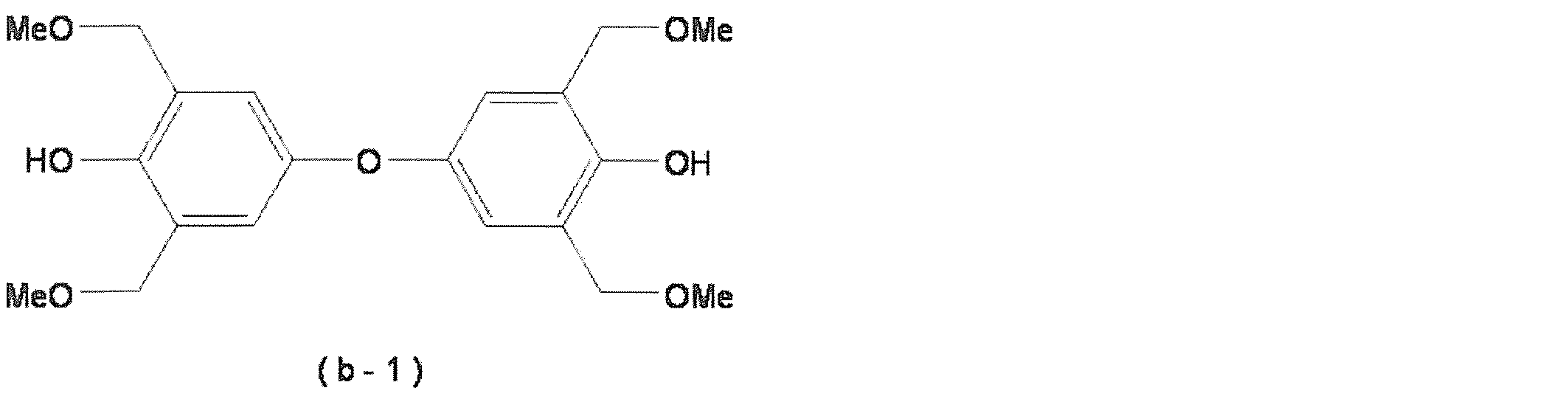
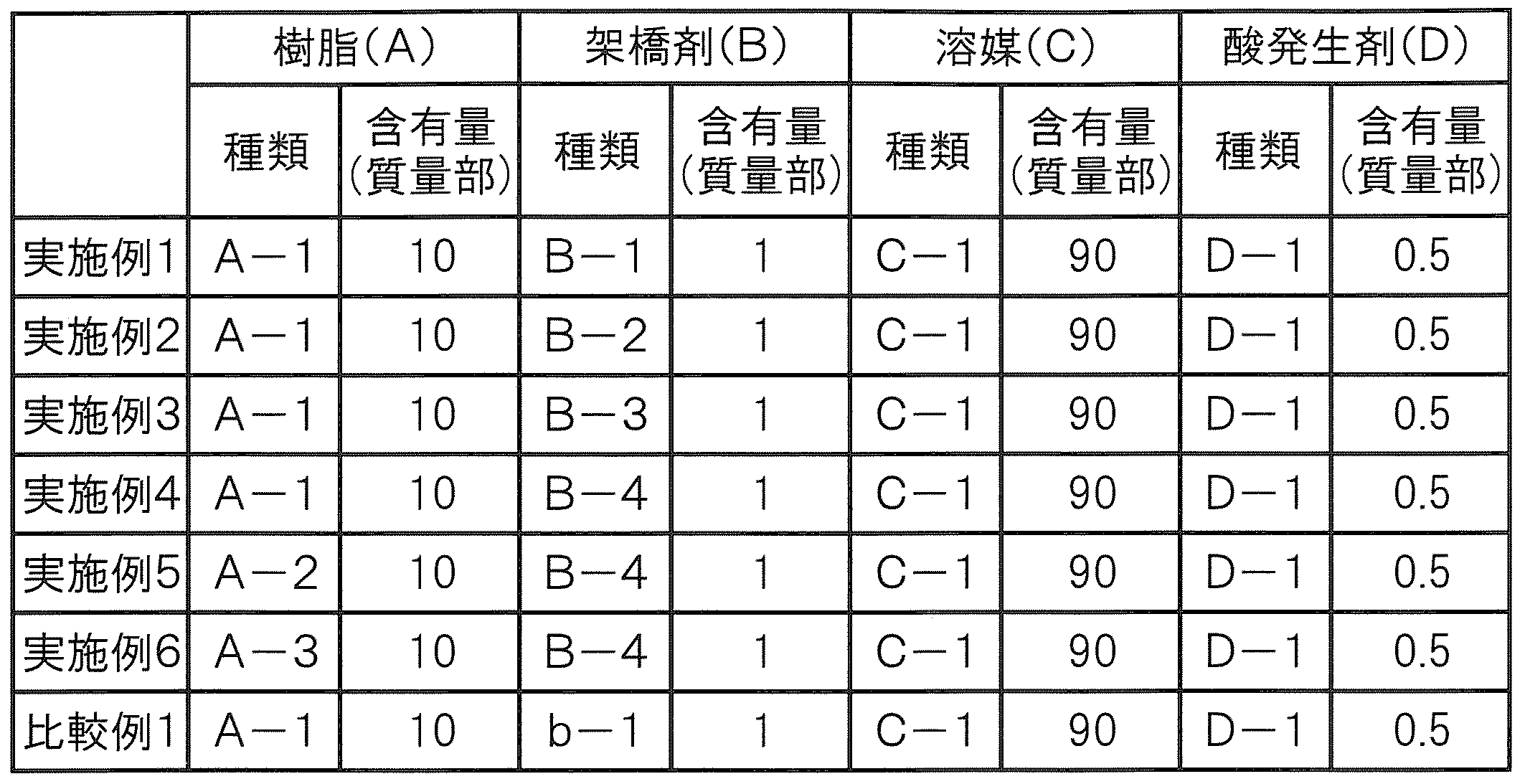
<評価>
実施例1~6及び比較例1の各レジスト下層膜形成用樹脂組成物について、下記の評価を行った。その結果を表2に示す。
実施例1~6及び比較例1の各レジスト下層膜形成用樹脂組成物について、下記の評価を行った。その結果を表2に示す。
[レジスト形状]
直径12インチのシリコンウェハ上にCVD法にてシリコン酸化膜を0.3μm堆積した。次に、各レジスト下層膜形成用樹脂組成物をスピンコートし、酸素濃度20容量%のホットプレート内にて180℃で60秒間加熱し、引き続き、350℃で120秒間加熱して膜厚0.25μmのレジスト下層膜を形成した。次に、このレジスト下層膜上に3層レジストプロセス用中間層形成組成物溶液(NFC SOG508、JSR製)をスピンコートした後、200℃で60秒間加熱し、引き続き300℃で60秒間加熱して膜厚0.04μmの中間層を形成した。次に、この中間層上にレジスト組成物をスピンコートし、100℃で60秒間プレベークして膜厚0.1μmのレジスト膜を形成した。なお、レジスト組成物は、市販品(ARX3038JN、JSR製)を用いた。
直径12インチのシリコンウェハ上にCVD法にてシリコン酸化膜を0.3μm堆積した。次に、各レジスト下層膜形成用樹脂組成物をスピンコートし、酸素濃度20容量%のホットプレート内にて180℃で60秒間加熱し、引き続き、350℃で120秒間加熱して膜厚0.25μmのレジスト下層膜を形成した。次に、このレジスト下層膜上に3層レジストプロセス用中間層形成組成物溶液(NFC SOG508、JSR製)をスピンコートした後、200℃で60秒間加熱し、引き続き300℃で60秒間加熱して膜厚0.04μmの中間層を形成した。次に、この中間層上にレジスト組成物をスピンコートし、100℃で60秒間プレベークして膜厚0.1μmのレジスト膜を形成した。なお、レジスト組成物は、市販品(ARX3038JN、JSR製)を用いた。
次に、ArF液浸露光装置(レンズ開口数1.30、露光波長193nm、NIKON製)を用い、マスクを介して最適露光時間露光した。次に、100℃で60秒間ポストベークした後、2.38質量%のテトラメチルアンモニウムヒドロキシド水溶液を用いてレジスト膜を現像した。その後、水洗し、乾燥し、ポジ型レジストパターンを形成した。
そして、ポジ型レジストパターンが形成されたレジスト膜を、走査型電子顕微鏡により観察して以下の基準で評価した(表2中、「レジスト形状」と記す)。観察されるパターン形状が矩形の場合を良好(表2中、「A」と記す)とし、矩形以外の形状の場合(例えばT-top、スカム等)を不良(表2中、「B」と記す)とした。
[曲がり耐性]
直径12インチのシリコンウェハ上にCVD法にてシリコン酸化膜を0.3μm堆積した。次に、各レジスト下層膜形成用樹脂組成物をスピンコートし、酸素濃度20容量%のホットプレート内にて180℃で60秒間加熱し、引き続き、350℃で120秒間加熱して膜厚0.25μmのレジスト下層膜を形成した。次に、このレジスト下層膜上に3層レジストプロセス用中間層形成組成物溶液(NFC SOG508、JSR製)をスピンコートした後、200℃で60秒間加熱し、引き続き300℃で60秒間加熱して膜厚0.04μmの中間層を形成した。次に、この中間層上に上記レジスト組成物をスピンコートし、100℃で60秒間プレベークして膜厚0.1μmのレジスト膜を形成した。
直径12インチのシリコンウェハ上にCVD法にてシリコン酸化膜を0.3μm堆積した。次に、各レジスト下層膜形成用樹脂組成物をスピンコートし、酸素濃度20容量%のホットプレート内にて180℃で60秒間加熱し、引き続き、350℃で120秒間加熱して膜厚0.25μmのレジスト下層膜を形成した。次に、このレジスト下層膜上に3層レジストプロセス用中間層形成組成物溶液(NFC SOG508、JSR製)をスピンコートした後、200℃で60秒間加熱し、引き続き300℃で60秒間加熱して膜厚0.04μmの中間層を形成した。次に、この中間層上に上記レジスト組成物をスピンコートし、100℃で60秒間プレベークして膜厚0.1μmのレジスト膜を形成した。
次に、ArF液浸露光装置(レンズ開口数1.30、露光波長193nm、NIKON製)を用い、マスクを介して最適露光時間露光した。次に、100℃で60秒間ポストベークした後、2.38質量%のテトラメチルアンモニウムヒドロキシド水溶液を用いてレジスト膜を現像した。その後、水洗し、乾燥し、ポジ型レジストパターンを形成した。次に、このパターンが形成されたレジスト膜をマスクとし、リアクティブ・イオン・エッチング方式のエッチング装置(Telius SCCM、東京エレクトロン製)を用いて中間層を四フッ化炭素ガスによりドライエッチング処理し、レジスト膜開口部の下に位置する中間層が無くなったところでエッチング処理を停止して中間層にレジストパターンを転写した。
次に、上記レジストパターンを転写した中間層をマスクとして用い、上記エッチング装置を用いて酸素と窒素の混合ガスにてドライエッチング処理し、中間層開口部の下に位置するレジスト下層膜が無くなったところでエッチング処理を停止してレジスト下層膜に中間層のパターンを転写した。次に、中間層のパターンが転写されたレジスト下層膜をマスクとして用い、上記エッチング装置を用いて四フッ化炭素とアルゴンの混合ガスにてドライエッチング処理し、レジスト下層膜開口部の下に位置するシリコン酸化膜を0.1μmだけ除去したところでエッチング処理を停止した。
そして、基板上に残ったレジスト下層膜パターンのうち、直線状パターンが等間隔で並ぶいわゆるライン・アンド・スペース・パターンの形状をSEM(走査型電子顕微鏡)により観察した。このライン・アンド・スペース・パターンは繰り返し間隔が84nm固定で直線状パターンが等間隔に100本並んでおり、これを1組と見なす。同一基板上にはパターン幅が異なる21組のパターン群があり、それぞれパターン幅は50nmから30nmまで1nm刻みとなっている。ここで言うパターン幅とは、レジスト下層膜で形成されている等間隔に配置された直線パターンの1本あたりの幅である。基板上の同一設計パターンのうち、任意の5箇所を上記SEMにより各パターン幅のパターンを観察し、この観察結果を曲がり耐性とした。このとき、レジスト下層膜のパターンが全て垂直に立っていれば曲がり耐性は良好「A」、一カ所曲がっていれば「B」、二カ所以上曲がっていれば不良「C」とした。
[エッチング耐性]
直径8インチのシリコンウェハ上に、各レジスト下層膜形成用樹脂組成物をスピンコートした後、酸素濃度20容量%のホットプレート内にて180℃で60秒間加熱し、引き続き、350℃で120秒間加熱して、膜厚0.25μmのレジスト下層膜を形成し、このレジスト下層膜をエッチング装置「EXAM」(神鋼精機製)を用いて、CF4/Ar/O2(CF4:40mL/min、Ar:20mL/min、O2:5mL/min;圧力:20Pa;RFパワー:200W;処理時間:40秒;温度:15℃)でエッチング処理した。
直径8インチのシリコンウェハ上に、各レジスト下層膜形成用樹脂組成物をスピンコートした後、酸素濃度20容量%のホットプレート内にて180℃で60秒間加熱し、引き続き、350℃で120秒間加熱して、膜厚0.25μmのレジスト下層膜を形成し、このレジスト下層膜をエッチング装置「EXAM」(神鋼精機製)を用いて、CF4/Ar/O2(CF4:40mL/min、Ar:20mL/min、O2:5mL/min;圧力:20Pa;RFパワー:200W;処理時間:40秒;温度:15℃)でエッチング処理した。
そして、エッチング処理前後の膜厚を測定して、エッチングレートを算出し、下記の基準でエッチング耐性を評価した。
「A」:エッチングレートが120nm/min以下の場合
「B」:エッチングレートが120nm/minを超える場合
「A」:エッチングレートが120nm/min以下の場合
「B」:エッチングレートが120nm/minを超える場合
[耐熱性]
直径8インチのシリコンウエハ上に、各レジスト下層膜形成用樹脂組成物をスピンコートして塗膜(レジスト下層膜)を形成し、この塗膜の膜厚を上記分光エリプソメータを用いて測定した(この測定値をXとする)。次に、このレジスト下層膜を350℃で120秒間加熱し、加熱後のレジスト下層膜の膜厚を上記分光エリプソメータを用いて測定した(この測定値をYとする)。そして、加熱前後のレジスト下層膜の膜厚減少率△FT(%)(△FT(%)=100×(X-Y)/X)を算出し、この算出値を耐熱性(%)とした。比較例1と比べて、10%以上の耐熱性向上(耐熱性の値が90%以下になることをいう)が見られたものを「A(良好)」と、10%未満の耐熱性能向上であったものを「B(不良)」と評価した。なお、耐熱性(%)の値が小さいほど、レジスト下層膜の加熱時に発生する昇華物や膜分解物が少なく、良好(高い耐熱性)であることを表している。表2中の「-」は、評価の基準であることを示す。
直径8インチのシリコンウエハ上に、各レジスト下層膜形成用樹脂組成物をスピンコートして塗膜(レジスト下層膜)を形成し、この塗膜の膜厚を上記分光エリプソメータを用いて測定した(この測定値をXとする)。次に、このレジスト下層膜を350℃で120秒間加熱し、加熱後のレジスト下層膜の膜厚を上記分光エリプソメータを用いて測定した(この測定値をYとする)。そして、加熱前後のレジスト下層膜の膜厚減少率△FT(%)(△FT(%)=100×(X-Y)/X)を算出し、この算出値を耐熱性(%)とした。比較例1と比べて、10%以上の耐熱性向上(耐熱性の値が90%以下になることをいう)が見られたものを「A(良好)」と、10%未満の耐熱性能向上であったものを「B(不良)」と評価した。なお、耐熱性(%)の値が小さいほど、レジスト下層膜の加熱時に発生する昇華物や膜分解物が少なく、良好(高い耐熱性)であることを表している。表2中の「-」は、評価の基準であることを示す。

表2によれば、実施例1~6の各レジスト下層膜形成用樹脂組成物によれば、上層に形成されるレジストのパターン形状が良好であり、曲がり耐性、エッチング耐性、及び耐熱性が良好なレジスト下層膜を形成することができることが確認できた。
本発明のレジスト下層膜形成用樹脂組成物によれば、上層に形成されるレジストのパターン形状が良好であり、曲がり耐性、エッチング耐性、及び耐熱性が良好なレジスト下層膜を形成することができる。そのため、リソグラフィープロセスにおける微細加工に極めて好適に使用することができる。特に、ドライエッチングプロセスにおいて、上層に形成されるレジストのパターン形状が良好となり、さらには、精密なパターン転写性能及び良好なエッチング選択性を有することになり、レジスト下層膜のオーバーエッチングが少なく、基板にレジストパターンを再現性よく忠実に転写することができる。また、基板をエッチングする際に下層膜パターンが折れ曲がらないため、リソグラフィープロセスにおける微細加工、特に高集積回路素子の製造において歩留りの向上が期待できる。
そして、このようなレジスト下層膜形成用樹脂組成物を用いる本発明のパターン形成方法は、リソグラフィープロセス、特に、高集積回路素子の製造用プロセスとして極めて有用である。
Claims (12)
- 芳香環を含む樹脂と、下記式(i)で表される部分構造を有する架橋剤とを含有するレジスト下層膜形成用樹脂組成物。

Xは、カルボニル基又はスルホニル基である。
Qは、1価の複素芳香族基又は-OR1である。R1は、炭素数1~30の1価の有機基である。
Arは、芳香族炭化水素基又は複素芳香族基である。
nは、1~8の整数である。nが2以上の場合、複数のX及びQはそれぞれ同一でも異なっていてもよい。) - 上記架橋剤が、下記式(b1)で表される化合物及び下記式(b2)で表される化合物からなる群より選ばれる少なくとも1種である請求項1に記載のレジスト下層膜形成用樹脂組成物。
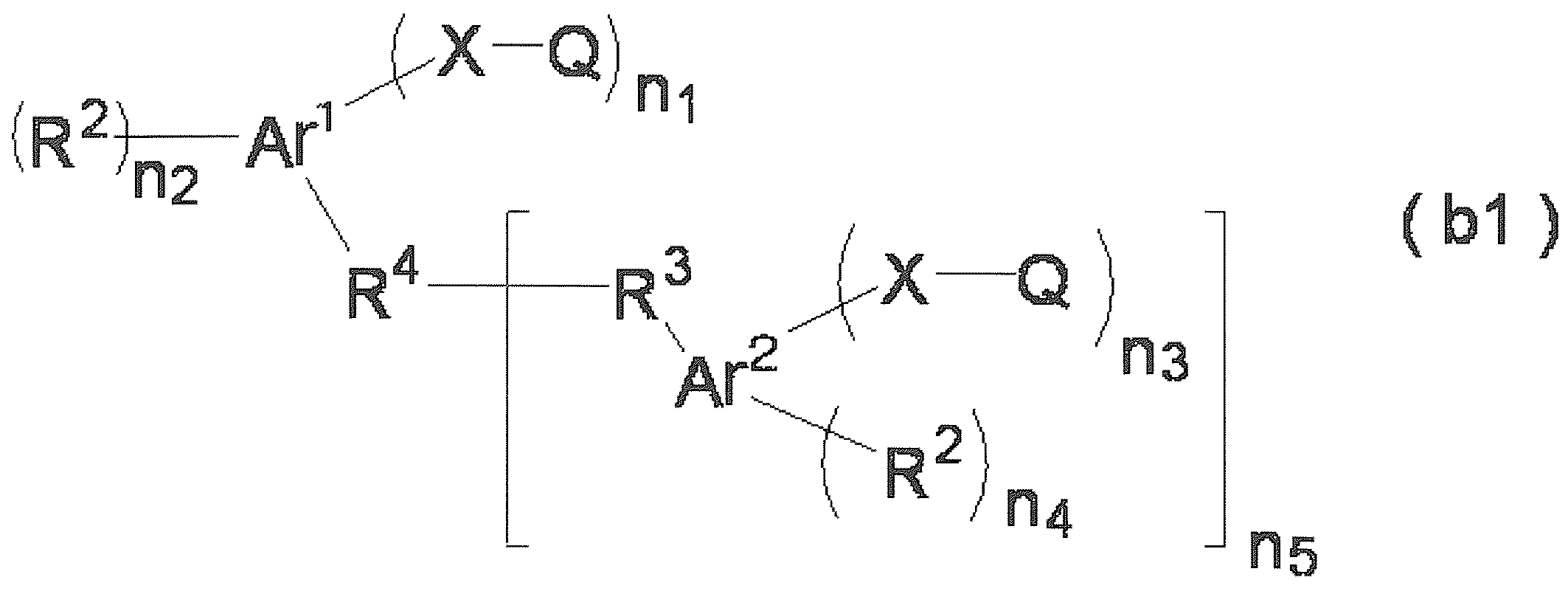
X及びQは、上記式(i)と同義である。
Ar1は、(n1+n2+1)価の芳香族炭化水素基又は(n1+n2+1)価の複素芳香族基である。
Ar2は、(n3+n4+1)価の芳香族炭化水素基又は(n3+n4+1)価の複素芳香族基である。
R2は、それぞれ独立して、ヒドロキシ基又は置換若しくは非置換の炭素数1~30の1価の炭化水素基である。
R3は、単結合、炭素数1~30の2価の炭化水素基、-CO-、-COO-、-OCO-、-O-、-CS-、-S-、-SO-、-SO2-、-NR-又はこれらの基を組み合わせた2価の基である。Rは、水素原子又は炭素数1~30の炭化水素基である。
R4は、単結合、-CO-、-COO-、-OCO-、-O-、-CS-、-S-、-SO-、-SO2-、-NR-、炭素数1~30の(n5+1)価の炭化水素基又はこれらの基を組み合わせた(n5+1)価の基である。Rは、水素原子又は炭素数1~30の炭化水素基である。
n1は、1~7の整数である。n2は、0~6の整数である。但し、n1+n2は、7以下である。
n3は、1~7の整数である。n4は、0~6の整数である。但し、n3+n4は、7以下である。
n5は、1~5の整数である。
Ar2、R2、R3、X及びQがそれぞれ複数の場合、複数のAr2、R2、R3、X及びQはそれぞれ同一でも異なっていてもよい。)

X及びQは、上記式(i)と同義である。
Ar3は、(n6+n7)価の芳香族炭化水素基又は(n6+n7)価の複素芳香族基である。
R2は、ヒドロキシ基又は置換若しくは非置換の炭素数1~30の1価の炭化水素基である。
n6は、1~8の整数である。n7は、0~7の整数である。但し、n6+n7は、8以下である。
R2、X及びQがそれぞれ複数の場合、複数のR2、X及びQはそれぞれ同一でも異なっていてもよい。) - 上記式(i)におけるQのR1が、下記式(ii)~(iv)のいずれかで表される請求項1に記載のレジスト下層膜形成用樹脂組成物。
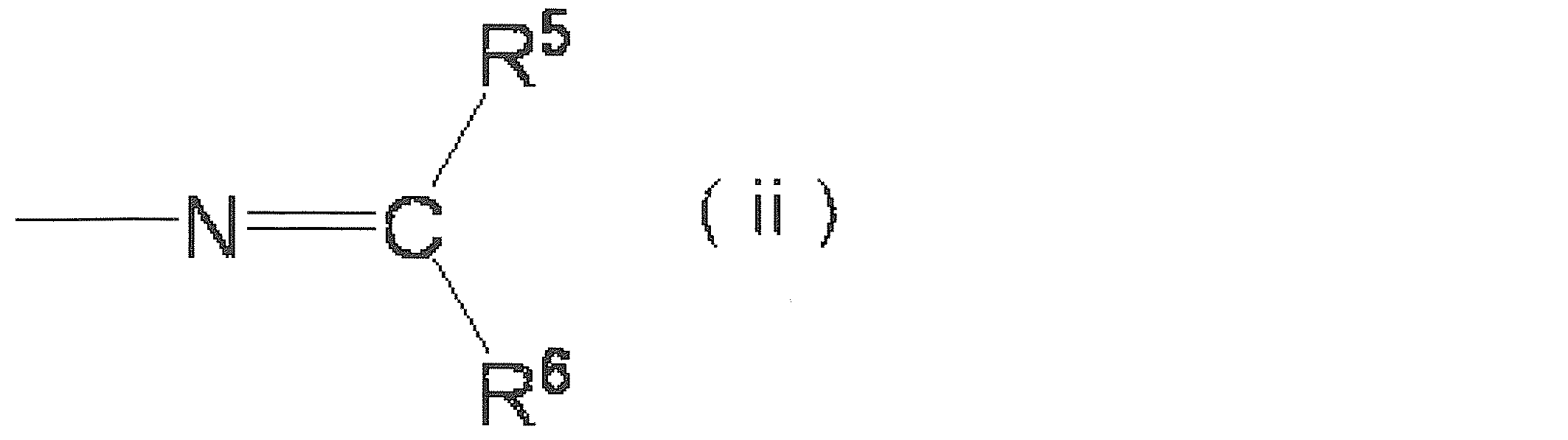


- 上記式(1)におけるQのR1が、上記式(iv)で表される請求項3に記載のレジスト下層膜形成用樹脂組成物。
- 上記樹脂が、ノボラック樹脂、レゾール樹脂、アセナフチレン系樹脂、スチレン系樹脂及びポリアリーレン系樹脂からなる群より選ばれる少なくとも1種である請求項1に記載のレジスト下層膜形成用樹脂組成物。
- 溶媒をさらに含有する請求項1に記載のレジスト下層膜形成用樹脂組成物。
- 請求項1に記載のレジスト下層膜形成用樹脂組成物により形成されたレジスト下層膜。
- 請求項1に記載のレジスト下層膜形成用樹脂組成物で基板の上面側に塗膜を形成する工程と、
上記塗膜と上記基板とを加熱する工程と
を備えるレジスト下層膜の形成方法。 - 基板の上面側に、請求項1に記載のレジスト下層膜形成用樹脂組成物でレジスト下層膜を形成する工程と、
上記レジスト下層膜の上面側にレジストパターンを形成する工程と、
上記レジストパターンをマスクとし、上記レジスト下層膜及び上記基板を順次エッチングする工程と
を備えるパターン形成方法。 - 下記式(i)で表される部分構造を有する架橋剤。

Xは、カルボニル基又はスルホニル基である。
Qは、1価の複素芳香族基又は-OR1である。R1は、炭素数1~30の1価の有機基である。
Arは、芳香族炭化水素基又は複素芳香族基である。
nは、1~8の整数である。nが2以上の場合、複数のX及びQはそれぞれ同一でも異なっていてもよい。) - 下記式(b1)で表される化合物。
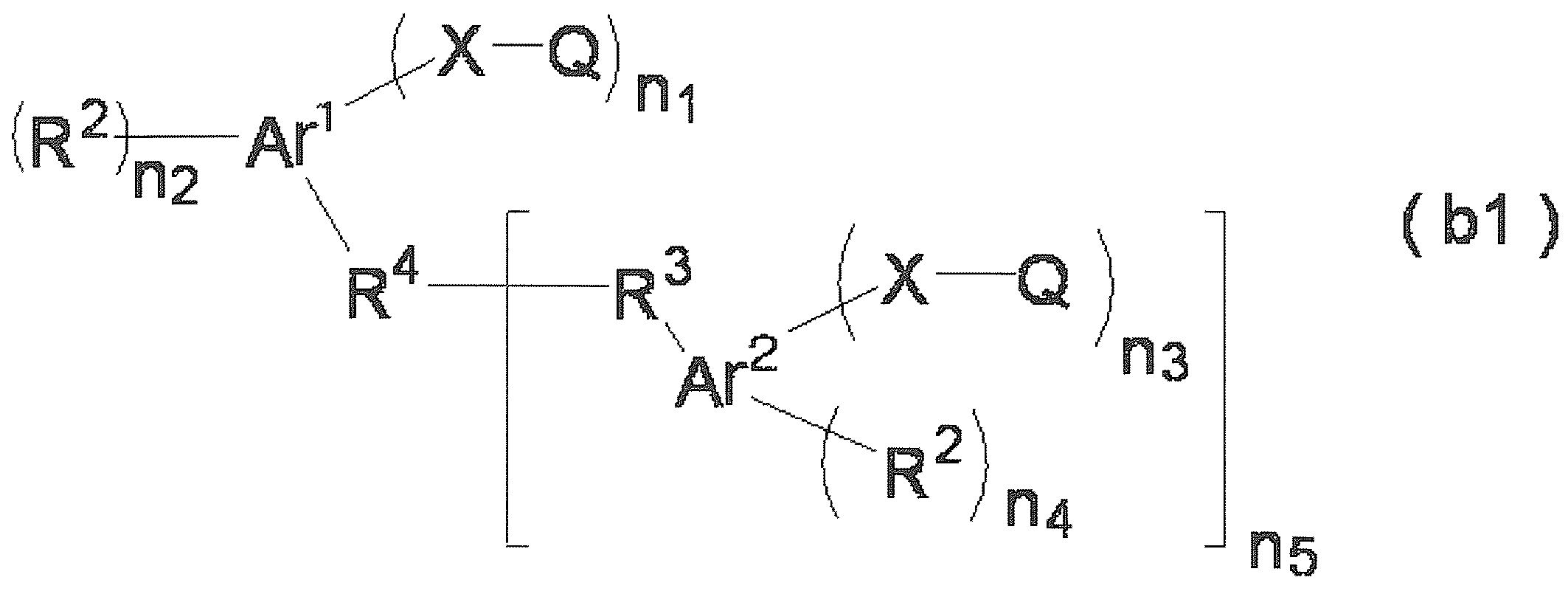
Xは、カルボニル基又はスルホニル基である。
Qは、1価の複素芳香族基又は-OR1である。R1は、炭素数1~30の1価の有機基である。
Ar1は、(n1+n2+1)価の芳香族炭化水素基又は(n1+n2+1)価の複素芳香族基である。
Ar2は、(n3+n4+1)価の芳香族炭化水素基又は(n3+n4+1)価の複素芳香族基である。
R2は、それぞれ独立して、ヒドロキシ基又は置換若しくは非置換の炭素数1~30の1価の炭化水素基である。
R3は、単結合、炭素数1~30の2価の炭化水素基、-CO-、-COO-、-OCO-、-O-、-CS-、-S-、-SO-、-SO2-、-NR-又はこれらの基を組み合わせた2価の基である。Rは、水素原子又は炭素数1~30の炭化水素基である。
R4は、単結合、-CO-、-COO-、-OCO-、-O-、-CS-、-S-、-SO-、-SO2-、-NR-、炭素数1~30の(n5+1)価の炭化水素基又はこれらの基を組み合わせた(n5+1)価の基である。Rは、水素原子又は炭素数1~30の炭化水素基である。
n1は、1~7の整数である。n2は、0~6の整数である。但し、n1+n2は、7以下である。
n3は、1~7の整数である。n4は、0~6の整数である。但し、n3+n4は、7以下である。
n5は、1~5の整数である。
Ar2、R2、R3、X及びQがそれぞれ複数の場合、複数のAr2、R2、R3、X及びQはそれぞれ同一でも異なっていてもよい。) - 下記式(b2)で表される化合物。

Xは、カルボニル基又はスルホニル基である。
Qは、1価の複素芳香族基又は-OR1である。R1は、炭素数1~30の1価の有機基である。
Ar3は、(n6+n7)価の芳香族炭化水素基又は(n6+n7)価の複素芳香族基である。
R2は、ヒドロキシ基又は置換若しくは非置換の炭素数1~30の1価の炭化水素基である。
n6は、1~8の整数である。n7は、0~7の整数である。但し、n6+n7は、8以下である。
R2、X及びQがそれぞれ複数の場合、複数のR2、X及びQはそれぞれ同一でも異なっていてもよい。)
Priority Applications (1)
| Application Number | Priority Date | Filing Date | Title |
|---|---|---|---|
| JP2014525853A JP6281490B2 (ja) | 2012-07-20 | 2013-07-17 | レジスト下層膜形成用樹脂組成物、レジスト下層膜及びその形成方法、並びにパターン形成方法 |
Applications Claiming Priority (2)
| Application Number | Priority Date | Filing Date | Title |
|---|---|---|---|
| JP2012-161091 | 2012-07-20 | ||
| JP2012161091 | 2012-07-20 |
Publications (1)
| Publication Number | Publication Date |
|---|---|
| WO2014014034A1 true WO2014014034A1 (ja) | 2014-01-23 |
Family
ID=49948858
Family Applications (1)
| Application Number | Title | Priority Date | Filing Date |
|---|---|---|---|
| PCT/JP2013/069442 Ceased WO2014014034A1 (ja) | 2012-07-20 | 2013-07-17 | レジスト下層膜形成用樹脂組成物、レジスト下層膜及びその形成方法、パターン形成方法、架橋剤並びに化合物 |
Country Status (3)
| Country | Link |
|---|---|
| JP (1) | JP6281490B2 (ja) |
| TW (1) | TW201413393A (ja) |
| WO (1) | WO2014014034A1 (ja) |
Cited By (4)
| Publication number | Priority date | Publication date | Assignee | Title |
|---|---|---|---|---|
| JP2015183046A (ja) * | 2014-03-20 | 2015-10-22 | Jsr株式会社 | 膜形成用組成物、レジスト下層膜及びその形成方法並びにパターン形成方法 |
| JP2016161886A (ja) * | 2015-03-04 | 2016-09-05 | Jsr株式会社 | 下層膜形成用組成物、下層膜の形成方法及び自己組織化リソグラフィープロセス |
| JP2017125890A (ja) * | 2016-01-12 | 2017-07-20 | 信越化学工業株式会社 | 多層膜形成方法及びパターン形成方法 |
| JP2022130325A (ja) * | 2021-02-25 | 2022-09-06 | 住友化学株式会社 | レジスト組成物及びレジストパターンの製造方法 |
Families Citing this family (1)
| Publication number | Priority date | Publication date | Assignee | Title |
|---|---|---|---|---|
| KR102400603B1 (ko) | 2019-03-29 | 2022-05-19 | 삼성에스디아이 주식회사 | 레지스트 하층막용 조성물 및 이를 이용한 패턴 형성 방법 |
Citations (4)
| Publication number | Priority date | Publication date | Assignee | Title |
|---|---|---|---|---|
| JP2002167435A (ja) * | 2000-03-29 | 2002-06-11 | Sumitomo Bakelite Co Ltd | 耐熱性樹脂前駆体、耐熱性樹脂及び絶縁膜並びに半導体装置 |
| WO2009038126A1 (ja) * | 2007-09-20 | 2009-03-26 | Nissan Chemical Industries, Ltd. | 分岐型ポリヒドロキシスチレンを含むレジスト下層膜形成組成物 |
| JP2010520516A (ja) * | 2007-03-07 | 2010-06-10 | ブルーワー サイエンス アイ エヌ シー. | ビニルエーテル架橋剤を使用した反射防止膜 |
| JP2011170059A (ja) * | 2010-02-18 | 2011-09-01 | Jsr Corp | レジスト下層膜形成方法、パターン形成方法、および組成物、レジスト下層膜形成材料用添加剤、架橋剤並びにレジスト下層膜 |
-
2013
- 2013-07-17 JP JP2014525853A patent/JP6281490B2/ja active Active
- 2013-07-17 WO PCT/JP2013/069442 patent/WO2014014034A1/ja not_active Ceased
- 2013-07-18 TW TW102125731A patent/TW201413393A/zh unknown
Patent Citations (4)
| Publication number | Priority date | Publication date | Assignee | Title |
|---|---|---|---|---|
| JP2002167435A (ja) * | 2000-03-29 | 2002-06-11 | Sumitomo Bakelite Co Ltd | 耐熱性樹脂前駆体、耐熱性樹脂及び絶縁膜並びに半導体装置 |
| JP2010520516A (ja) * | 2007-03-07 | 2010-06-10 | ブルーワー サイエンス アイ エヌ シー. | ビニルエーテル架橋剤を使用した反射防止膜 |
| WO2009038126A1 (ja) * | 2007-09-20 | 2009-03-26 | Nissan Chemical Industries, Ltd. | 分岐型ポリヒドロキシスチレンを含むレジスト下層膜形成組成物 |
| JP2011170059A (ja) * | 2010-02-18 | 2011-09-01 | Jsr Corp | レジスト下層膜形成方法、パターン形成方法、および組成物、レジスト下層膜形成材料用添加剤、架橋剤並びにレジスト下層膜 |
Cited By (4)
| Publication number | Priority date | Publication date | Assignee | Title |
|---|---|---|---|---|
| JP2015183046A (ja) * | 2014-03-20 | 2015-10-22 | Jsr株式会社 | 膜形成用組成物、レジスト下層膜及びその形成方法並びにパターン形成方法 |
| JP2016161886A (ja) * | 2015-03-04 | 2016-09-05 | Jsr株式会社 | 下層膜形成用組成物、下層膜の形成方法及び自己組織化リソグラフィープロセス |
| JP2017125890A (ja) * | 2016-01-12 | 2017-07-20 | 信越化学工業株式会社 | 多層膜形成方法及びパターン形成方法 |
| JP2022130325A (ja) * | 2021-02-25 | 2022-09-06 | 住友化学株式会社 | レジスト組成物及びレジストパターンの製造方法 |
Also Published As
| Publication number | Publication date |
|---|---|
| JPWO2014014034A1 (ja) | 2016-07-07 |
| JP6281490B2 (ja) | 2018-02-21 |
| TW201413393A (zh) | 2014-04-01 |
Similar Documents
| Publication | Publication Date | Title |
|---|---|---|
| KR101411737B1 (ko) | 패턴 형성 방법 및 레지스트 하층막 형성용 조성물 | |
| JP6361657B2 (ja) | 膜形成用組成物、レジスト下層膜及びその形成方法、並びにパターン形成方法 | |
| JP5538941B2 (ja) | レジスト下層膜形成方法、パターン形成方法、および組成物、レジスト下層膜形成材料用添加剤、架橋剤並びにレジスト下層膜 | |
| JP5051133B2 (ja) | レジスト下層膜形成方法及びそれに用いるレジスト下層膜用組成物並びにパターン形成方法 | |
| JP6160068B2 (ja) | レジスト下層膜形成用樹脂組成物、レジスト下層膜、その形成方法及びパターン形成方法 | |
| TWI830827B (zh) | 抗蝕劑底層膜形成用組成物、抗蝕劑底層膜及抗蝕劑圖案形成方法 | |
| JP2025087802A (ja) | リソグラフィー用組成物及びパターン形成方法 | |
| WO2009119201A1 (ja) | レジスト下層膜及びレジスト下層膜形成用組成物並びにレジスト下層膜形成方法 | |
| WO2013054702A1 (ja) | レジスト下層膜形成用組成物、その製造方法、パターン形成方法及びレジスト下層膜 | |
| KR102260111B1 (ko) | 막 형성용 조성물, 레지스트 하층막 및 그의 형성 방법, 및 패턴 형성 방법 | |
| JP6281490B2 (ja) | レジスト下層膜形成用樹脂組成物、レジスト下層膜及びその形成方法、並びにパターン形成方法 | |
| WO2017141612A1 (ja) | レジスト下層膜形成用組成物、レジスト下層膜及びパターニングされた基板の製造方法 | |
| WO2016208518A1 (ja) | レジスト下層膜形成用組成物、レジスト下層膜及びパターニングされた基板の製造方法 | |
| KR101993480B1 (ko) | 레지스트 하층막 형성용 수지 조성물, 레지스트 하층막, 그의 형성 방법 및 패턴 형성 방법 | |
| JP5842503B2 (ja) | レジスト下層膜形成用組成物、レジスト下層膜及びその形成方法 | |
| KR101811064B1 (ko) | 패턴형성 방법, 레지스트 하층막의 형성 방법, 레지스트 하층막 형성용 조성물 및 레지스트 하층막 |
Legal Events
| Date | Code | Title | Description |
|---|---|---|---|
| 121 | Ep: the epo has been informed by wipo that ep was designated in this application |
Ref document number: 13819938 Country of ref document: EP Kind code of ref document: A1 |
|
| ENP | Entry into the national phase |
Ref document number: 2014525853 Country of ref document: JP Kind code of ref document: A |
|
| NENP | Non-entry into the national phase |
Ref country code: DE |
|
| 122 | Ep: pct application non-entry in european phase |
Ref document number: 13819938 Country of ref document: EP Kind code of ref document: A1 |