WO2013168787A1 - 膜形成用組成物及び埋め込み材料 - Google Patents
膜形成用組成物及び埋め込み材料 Download PDFInfo
- Publication number
- WO2013168787A1 WO2013168787A1 PCT/JP2013/063147 JP2013063147W WO2013168787A1 WO 2013168787 A1 WO2013168787 A1 WO 2013168787A1 JP 2013063147 W JP2013063147 W JP 2013063147W WO 2013168787 A1 WO2013168787 A1 WO 2013168787A1
- Authority
- WO
- WIPO (PCT)
- Prior art keywords
- film
- group
- forming composition
- compound
- carbon atoms
- Prior art date
- Legal status (The legal status is an assumption and is not a legal conclusion. Google has not performed a legal analysis and makes no representation as to the accuracy of the status listed.)
- Ceased
Links
Images



Classifications
-
- C—CHEMISTRY; METALLURGY
- C09—DYES; PAINTS; POLISHES; NATURAL RESINS; ADHESIVES; COMPOSITIONS NOT OTHERWISE PROVIDED FOR; APPLICATIONS OF MATERIALS NOT OTHERWISE PROVIDED FOR
- C09D—COATING COMPOSITIONS, e.g. PAINTS, VARNISHES OR LACQUERS; FILLING PASTES; CHEMICAL PAINT OR INK REMOVERS; INKS; CORRECTING FLUIDS; WOODSTAINS; PASTES OR SOLIDS FOR COLOURING OR PRINTING; USE OF MATERIALS THEREFOR
- C09D179/00—Coating compositions based on macromolecular compounds obtained by reactions forming in the main chain of the macromolecule a linkage containing nitrogen, with or without oxygen, or carbon only, not provided for in groups C09D161/00 - C09D177/00
- C09D179/04—Polycondensates having nitrogen-containing heterocyclic rings in the main chain; Polyhydrazides; Polyamide acids or similar polyimide precursors
-
- C—CHEMISTRY; METALLURGY
- C08—ORGANIC MACROMOLECULAR COMPOUNDS; THEIR PREPARATION OR CHEMICAL WORKING-UP; COMPOSITIONS BASED THEREON
- C08G—MACROMOLECULAR COMPOUNDS OBTAINED OTHERWISE THAN BY REACTIONS ONLY INVOLVING UNSATURATED CARBON-TO-CARBON BONDS
- C08G73/00—Macromolecular compounds obtained by reactions forming a linkage containing nitrogen with or without oxygen or carbon in the main chain of the macromolecule, not provided for in groups C08G12/00 - C08G71/00
- C08G73/02—Polyamines
- C08G73/026—Wholly aromatic polyamines
-
- C—CHEMISTRY; METALLURGY
- C08—ORGANIC MACROMOLECULAR COMPOUNDS; THEIR PREPARATION OR CHEMICAL WORKING-UP; COMPOSITIONS BASED THEREON
- C08G—MACROMOLECULAR COMPOUNDS OBTAINED OTHERWISE THAN BY REACTIONS ONLY INVOLVING UNSATURATED CARBON-TO-CARBON BONDS
- C08G73/00—Macromolecular compounds obtained by reactions forming a linkage containing nitrogen with or without oxygen or carbon in the main chain of the macromolecule, not provided for in groups C08G12/00 - C08G71/00
- C08G73/02—Polyamines
- C08G73/0273—Polyamines containing heterocyclic moieties in the main chain
-
- C—CHEMISTRY; METALLURGY
- C08—ORGANIC MACROMOLECULAR COMPOUNDS; THEIR PREPARATION OR CHEMICAL WORKING-UP; COMPOSITIONS BASED THEREON
- C08G—MACROMOLECULAR COMPOUNDS OBTAINED OTHERWISE THAN BY REACTIONS ONLY INVOLVING UNSATURATED CARBON-TO-CARBON BONDS
- C08G73/00—Macromolecular compounds obtained by reactions forming a linkage containing nitrogen with or without oxygen or carbon in the main chain of the macromolecule, not provided for in groups C08G12/00 - C08G71/00
- C08G73/06—Polycondensates having nitrogen-containing heterocyclic rings in the main chain of the macromolecule
- C08G73/0622—Polycondensates containing six-membered rings, not condensed with other rings, with nitrogen atoms as the only ring hetero atoms
- C08G73/0638—Polycondensates containing six-membered rings, not condensed with other rings, with nitrogen atoms as the only ring hetero atoms with at least three nitrogen atoms in the ring
- C08G73/0644—Poly(1,3,5)triazines
-
- C—CHEMISTRY; METALLURGY
- C09—DYES; PAINTS; POLISHES; NATURAL RESINS; ADHESIVES; COMPOSITIONS NOT OTHERWISE PROVIDED FOR; APPLICATIONS OF MATERIALS NOT OTHERWISE PROVIDED FOR
- C09D—COATING COMPOSITIONS, e.g. PAINTS, VARNISHES OR LACQUERS; FILLING PASTES; CHEMICAL PAINT OR INK REMOVERS; INKS; CORRECTING FLUIDS; WOODSTAINS; PASTES OR SOLIDS FOR COLOURING OR PRINTING; USE OF MATERIALS THEREFOR
- C09D133/00—Coating compositions based on homopolymers or copolymers of compounds having one or more unsaturated aliphatic radicals, each having only one carbon-to-carbon double bond, and at least one being terminated by only one carboxyl radical, or of salts, anhydrides, esters, amides, imides, or nitriles thereof; Coating compositions based on derivatives of such polymers
- C09D133/04—Homopolymers or copolymers of esters
- C09D133/14—Homopolymers or copolymers of esters of esters containing halogen, nitrogen, sulfur or oxygen atoms in addition to the carboxy oxygen
-
- C—CHEMISTRY; METALLURGY
- C09—DYES; PAINTS; POLISHES; NATURAL RESINS; ADHESIVES; COMPOSITIONS NOT OTHERWISE PROVIDED FOR; APPLICATIONS OF MATERIALS NOT OTHERWISE PROVIDED FOR
- C09D—COATING COMPOSITIONS, e.g. PAINTS, VARNISHES OR LACQUERS; FILLING PASTES; CHEMICAL PAINT OR INK REMOVERS; INKS; CORRECTING FLUIDS; WOODSTAINS; PASTES OR SOLIDS FOR COLOURING OR PRINTING; USE OF MATERIALS THEREFOR
- C09D4/00—Coating compositions, e.g. paints, varnishes or lacquers, based on organic non-macromolecular compounds having at least one polymerisable carbon-to-carbon unsaturated bond ; Coating compositions, based on monomers of macromolecular compounds of groups C09D183/00 - C09D183/16
-
- H—ELECTRICITY
- H10—SEMICONDUCTOR DEVICES; ELECTRIC SOLID-STATE DEVICES NOT OTHERWISE PROVIDED FOR
- H10K—ORGANIC ELECTRIC SOLID-STATE DEVICES
- H10K50/00—Organic light-emitting devices
- H10K50/80—Constructional details
- H10K50/84—Passivation; Containers; Encapsulations
- H10K50/844—Encapsulations
-
- H—ELECTRICITY
- H10—SEMICONDUCTOR DEVICES; ELECTRIC SOLID-STATE DEVICES NOT OTHERWISE PROVIDED FOR
- H10K—ORGANIC ELECTRIC SOLID-STATE DEVICES
- H10K85/00—Organic materials used in the body or electrodes of devices covered by this subclass
- H10K85/10—Organic polymers or oligomers
- H10K85/111—Organic polymers or oligomers comprising aromatic, heteroaromatic, or aryl chains, e.g. polyaniline, polyphenylene or polyphenylene vinylene
-
- H—ELECTRICITY
- H10—SEMICONDUCTOR DEVICES; ELECTRIC SOLID-STATE DEVICES NOT OTHERWISE PROVIDED FOR
- H10K—ORGANIC ELECTRIC SOLID-STATE DEVICES
- H10K85/00—Organic materials used in the body or electrodes of devices covered by this subclass
- H10K85/10—Organic polymers or oligomers
- H10K85/151—Copolymers
-
- H—ELECTRICITY
- H10—SEMICONDUCTOR DEVICES; ELECTRIC SOLID-STATE DEVICES NOT OTHERWISE PROVIDED FOR
- H10K—ORGANIC ELECTRIC SOLID-STATE DEVICES
- H10K50/00—Organic light-emitting devices
-
- H—ELECTRICITY
- H10—SEMICONDUCTOR DEVICES; ELECTRIC SOLID-STATE DEVICES NOT OTHERWISE PROVIDED FOR
- H10K—ORGANIC ELECTRIC SOLID-STATE DEVICES
- H10K50/00—Organic light-emitting devices
- H10K50/80—Constructional details
- H10K50/85—Arrangements for extracting light from the devices
Definitions
- the present invention relates to a film-forming composition, and more specifically, to a film-forming composition suitable as a film-forming material or an embedded film-forming material that can be applied to a light extraction layer of an organic electroluminescence (EL) element. .
- EL organic electroluminescence
- Patent Document 1 a technique for increasing the refractive index using a hybrid material obtained by mixing a siloxane polymer and a fine particle dispersed material in which zirconia, titania or the like is dispersed has been reported.
- Patent Document 2 a method of introducing a condensed cyclic skeleton having a high refractive index into a part of the siloxane polymer has also been reported.
- melamine resin is well known as a triazine resin, but its decomposition temperature is much lower than that of heat-resistant material such as graphite.
- aromatic polyimides and aromatic polyamides have been mainly used as heat-resistant organic materials composed of carbon and nitrogen, but these materials have a linear structure, so that the heat-resistant temperature is not so high.
- a triazine-based condensation material has been reported as a nitrogen-containing polymer material having heat resistance (Patent Document 4).
- the present inventors have a highly branched polymer (hyperbranched polymer) containing a repeating unit having a triazine ring and an aromatic ring, has a high refractive index, and the polymer alone has high heat resistance, high transparency, It can achieve high refractive index, high solubility, and low volume shrinkage, and is suitable as a film-forming composition for manufacturing electronic devices, and can be used as an embedding material on organic EL devices and photodiodes.
- Patent Document 5 the embedded film produced from the composition has a problem that cracks are likely to occur, and the solution has been desired.
- a top emission type organic EL element that extracts light from the opposite side (upper electrode side) of the substrate generally has a structure in which a sealing layer such as a substrate / metal electrode / organic EL layer / transparent electrode / glass is sequentially formed.
- a sealing layer such as a substrate / metal electrode / organic EL layer / transparent electrode / glass is sequentially formed.
- a high refractive index layer may be formed as a light extraction layer between the transparent electrode and the sealing layer.
- the composition for forming the light extraction layer that has been used so far contains a solvent, it has been a problem that the organic EL layer is deteriorated by the solvent when the light extraction layer is formed. .
- the present invention has been made in order to solve the above problems, and includes a triazine ring-containing polymer that can achieve high heat resistance, high transparency, high refractive index, high solubility, and low volume shrinkage by a polymer alone,
- a composition for forming a film suitable as an embedding material that can suppress the occurrence of cracks when an embedded film is produced, and further does not contain a solvent that leads to deterioration of the organic EL film, and can be cured at a low temperature. It aims at providing the composition for film formation suitable for formation of a top emission type organic EL element.
- the present inventors have obtained a monomer having a predetermined polymerizable carbon-carbon unsaturated double bond capable of giving a triazine ring-containing polymer, a crosslinking agent, and a linear polymer. It has been found that the film-forming composition containing it provides a buried film in which cracks are unlikely to occur and is suitable as a filling material. Furthermore, the present inventors have found that a solvent-free film-forming composition containing a triazine ring-containing polymer, a cross-linking agent, and the above monomer and not containing a solvent can solve the problem of deterioration of the organic EL film, thereby completing the present invention. did.
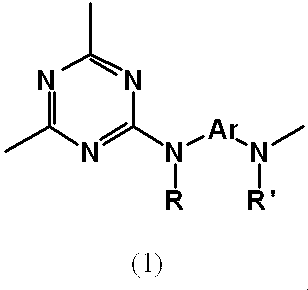
- Claim 1 An organic monomer capable of giving a triazine ring-containing polymer containing a repeating unit structure represented by the following formula (1), a crosslinking agent and a linear polymer;
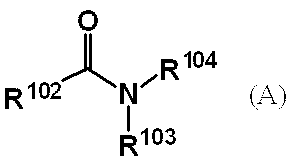
- the film-forming composition wherein the organic monomer is a compound represented by the formula (A).
- R and R ′ each independently represent a hydrogen atom, an alkyl group, an alkoxy group, an aryl group, or an aralkyl group, and Ar is selected from the group represented by formulas (2) to (13) Represents at least one kind.
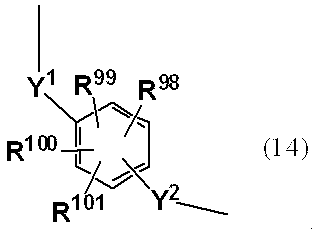
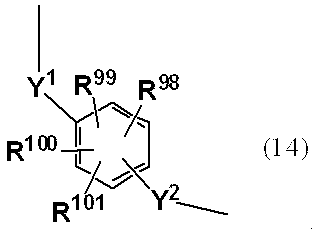
- R 1 to R 92 each independently represent a hydrogen atom, a halogen atom, a carboxyl group, a sulfone group, an alkyl group having 1 to 10 carbon atoms, or an alkoxy group having 1 to 10 carbon atoms; 93 and R 94 each represents a hydrogen atom or an alkyl group having 1 to 10 carbon atoms, W 1 and W 2 are each independently a single bond, CR 95 R 96 (R 95 and R 96 are independently A hydrogen atom or an alkyl group having 1 to 10 carbon atoms (which may be combined together to form a ring), C ⁇ O, O, S, SO, SO 2 , Or NR 97 (R 97 represents a hydrogen atom or an alkyl group having 1 to 10 carbon atoms), and X 1 and X 2 are each independently a single bond, an alkylene group having 1 to 10 carbon atoms, Or formula (14) (Wherein R 98 to R 101 each independently represent a hydrogen atom,
- R 102 and R 104 each independently represent a hydrogen atom, an alkyl group having 1 to 10 carbon atoms, or a polymerizable carbon-carbon double bond-containing group
- R 103 represents a hydrogen atom, a carbon atom
- one of R 102 and R 104 is a polymerizable carbon-carbon double bond-containing group, and both R 102 and R 104 are simultaneously polymerizable carbon-carbon dioxygen.
- Claim 2 The film forming composition according to claim 1, wherein R 102 and R 103 in the formula (A) are both hydrogen atoms, and R 104 is a polymerizable carbon-carbon double bond-containing group.
- Claim 3 The film-forming composition according to claim 1 or 2, wherein the organic monomer is N-vinylformamide.
- Claim 4 Furthermore, the composition for film formation of Claim 1, 2, or 3 containing a solvent.
- Claim 5 The film-forming composition according to claim 1, 2 or 3, which does not contain a solvent.
- Claim 6 The film-forming composition according to any one of claims 1 to 4, wherein the crosslinking agent is a polyfunctional epoxy compound and / or a polyfunctional (meth) acryl compound.
- Claim 7 The film-forming composition according to claim 6, wherein the crosslinking agent is a polyfunctional (meth) acrylic compound.
- Claim 8 The film-forming composition according to claim 6 or 7, wherein the polyfunctional (meth) acrylic compound is a compound that is liquid at 25 ° C and has a viscosity of 5,000 mPa ⁇ s or less.
- Claim 9 6. The film forming composition according to claim 1, wherein the crosslinking agent is a polyfunctional epoxy compound, a polyfunctional vinyl ether compound or a polyfunctional allyl ether compound.
- Claim 10 The film-forming composition according to claim 9, wherein the crosslinking agent is a polyfunctional allyl ether compound.
- Claim 11 An embedding material comprising the film forming composition according to any one of claims 1 to 4 and 6 to 8.
- Claim 12 An embedding film obtained from the embedding material according to claim 11.
- Claim 13 An electronic device comprising the embedded film according to claim 12.
- Claim 14 A cured film obtained by curing the film-forming composition according to any one of claims 1 to 10.
- Claim 15 An electronic device comprising the cured film according to claim 14.
- Claim 16 A top emission type organic electroluminescence device comprising a cured film obtained by curing the film-forming composition according to any one of claims 1 to 3, 5, 9, and 10.
- the film-forming composition of the present invention contains a predetermined organic monomer that can give a predetermined triazine ring-containing polymer, a crosslinking agent, and a linear polymer. By using this, a relatively uniform film thickness is obtained. A cured film in which cracks are unlikely to occur can be produced. Further, when the film forming composition of the present invention does not contain a solvent (hereinafter referred to as “solvent-free film forming composition”), a cured film is formed thereon without deteriorating the organic film such as an organic EL film. Is possible.
- the cured film obtained from the composition of the present invention is used for producing electronic devices such as liquid crystal displays, organic EL displays, LED elements, solid-state imaging elements, organic thin film solar cells, dye-sensitized solar cells, and organic TFTs. It can be suitably used as a member.
- the cured film of the present invention is a film in which cracks are unlikely to occur, it can be suitably used as an embedding material that can be applied to a light extraction layer of an organic electroluminescence (EL) element.
- EL organic electroluminescence
- the composition for forming a solvent-free film does not deteriorate an organic film such as an organic EL film, the cured film obtained therefrom can be suitably used as a light extraction layer of a top emission type organic EL element.
- a buried film and a planarizing film on a photodiode a planarizing film before and after a color filter, a microlens, a planarizing film and a conformal film on a microlens, which are members of a solid-state imaging device.
- FIG. 3 is a 1 H-NMR spectrum diagram of a polymer compound [3] obtained in Synthesis Example 1.
- FIG. FIG. 4 is a diagram showing a TG-DTA measurement result of the polymer compound [3] obtained in Synthesis Example 1. It is a figure which shows the SEM image after cleaving of the board
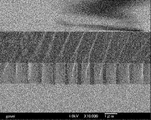
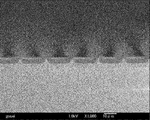
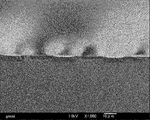
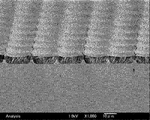
- FIG. It is a figure which shows the SEM image after cleaving of the board
- FIG. It is a figure which shows the SEM image after cleaving of the board
- FIG. 1 It is a figure which shows the SEM image after cleaving of the board
- FIG. It is a figure which shows the SEM image after the cleavage of the board
- FIG. 1 It is a figure which shows the SEM image after the cleavage of the board
- the film-forming composition according to the present invention contains a triazine ring-containing polymer, a crosslinking agent, and an organic monomer that can give a linear polymer.
- Triazine ring-containing polymer includes a repeating unit structure represented by the following formula (1).
- R and R ′ each independently represent a hydrogen atom, an alkyl group, an alkoxy group, an aryl group, or an aralkyl group.
- the number of carbon atoms of the alkyl group is not particularly limited, but is preferably 1 to 20, and more preferably 1 to 10 carbon atoms, and still more preferably 1 to 3 carbon atoms in view of further improving the heat resistance of the polymer.
- the structure may be linear, branched or cyclic.
- alkyl group examples include methyl, ethyl, n-propyl, isopropyl, cyclopropyl, n-butyl, isobutyl, s-butyl, t-butyl, cyclobutyl, 1-methyl-cyclopropyl, 2-methyl-cyclopropyl.
- N-pentyl 1-methyl-n-butyl, 2-methyl-n-butyl, 3-methyl-n-butyl, 1,1-dimethyl-n-propyl, 1,2-dimethyl-n-propyl, 2 , 2-dimethyl-n-propyl, 1-ethyl-n-propyl, cyclopentyl, 1-methyl-cyclobutyl, 2-methyl-cyclobutyl, 3-methyl-cyclobutyl, 1,2-dimethyl-cyclopropyl, 2,3- Dimethyl-cyclopropyl, 1-ethyl-cyclopropyl, 2-ethyl-cyclopropyl, n-hexyl, 1-methyl-n-pe Til, 2-methyl-n-pentyl, 3-methyl-n-pentyl, 4-methyl-n-pentyl, 1,1-dimethyl-n-butyl, 1,2-dimethyl-n-butyl, 1,3- Dimethyl-n-butyl, 2,2-di
- the number of carbon atoms of the alkoxy group is not particularly limited, but preferably 1 to 20, more preferably 1 to 10 and even more preferably 1 to 3 in view of further improving the heat resistance of the polymer.
- the structure of the alkyl moiety may be any of linear, branched or cyclic.
- alkoxy group examples include methoxy, ethoxy, n-propoxy, isopropoxy, n-butoxy, isobutoxy, s-butoxy, t-butoxy, n-pentyloxy, 1-methyl-n-butoxy, 2-methyl- n-butoxy, 3-methyl-n-butoxy, 1,1-dimethyl-n-propoxy, 1,2-dimethyl-n-propoxy, 2,2-dimethyl-n-propoxy, 1-ethyl-n-propoxy, n-hexyloxy, 1-methyl-n-pentyloxy, 2-methyl-n-pentyloxy, 3-methyl-n-pentyloxy, 4-methyl-n-pentyloxy, 1,1-dimethyl-n-butoxy 1,2-dimethyl-n-butoxy, 1,3-dimethyl-n-butoxy, 2,2-dimethyl-n-butoxy, 2,3-dimethyl-n- Toxoxy, 3,3-dimethyl-n-butoxy, 1-
- the number of carbon atoms of the aryl group is not particularly limited, but is preferably 6 to 40, more preferably 6 to 16, and even more preferably 6 to 13 in view of further improving the heat resistance of the polymer.
- aryl group examples include phenyl, o-chlorophenyl, m-chlorophenyl, p-chlorophenyl, o-fluorophenyl, p-fluorophenyl, o-methoxyphenyl, p-methoxyphenyl, p-nitrophenyl, and p-cyano.
- the number of carbon atoms of the aralkyl group is not particularly limited, but is preferably 7 to 20, and the alkyl portion may be linear, branched or cyclic. Specific examples thereof include benzyl, p-methylphenylmethyl, m-methylphenylmethyl, o-ethylphenylmethyl, m-ethylphenylmethyl, p-ethylphenylmethyl, 2-propylphenylmethyl, 4-isopropylphenylmethyl, Examples include 4-isobutylphenylmethyl, ⁇ -naphthylmethyl group and the like.
- Ar represents at least one selected from the group represented by the following formulas (2) to (13).
- R 1 to R 92 each independently represent a hydrogen atom, a halogen atom, a carboxyl group, a sulfone group, an alkyl group having 1 to 10 carbon atoms, or an alkoxy group having 1 to 10 carbon atoms.
- R 93 and R 94 represent a hydrogen atom or an alkyl group having 1 to 10 carbon atoms.
- W 1 and W 2 are each independently a single bond, CR 95 R 96 (R 95 and R 96 are each independently a hydrogen atom or an alkyl group having 1 to 10 carbon atoms (provided that these And may form a ring.), C ⁇ O, O, S, SO, SO 2 , or NR 97 (R 97 represents a hydrogen atom or an alkyl group having 1 to 10 carbon atoms). Represents.)
- halogen atom examples include a fluorine atom, a chlorine atom, a bromine atom, and an iodine atom.
- alkyl group and alkoxy group are the same as those described above.
- X 1 and X 2 each independently represent a single bond, an alkylene group having 1 to 10 carbon atoms, or a group represented by the following formula (14).
- R 98 to R 101 each independently represent a hydrogen atom, a halogen atom, a carboxyl group, a sulfone group, an alkyl group having 1 to 10 carbon atoms, or an alkoxy group having 1 to 10 carbon atoms.
- Y 1 and Y 2 each independently represent a single bond or an alkylene group having 1 to 10 carbon atoms. Examples of these halogen atom, alkyl group and alkoxy group are the same as those described above.
- the alkylene group having 1 to 10 carbon atoms is preferably linear or branched, and specific examples include methylene, ethylene, propylene, trimethylene, tetramethylene, and pentamethylene groups.
- Ar is preferably at least one selected from the groups represented by formulas (2), (5) to (13).
- Formulas (2), (5), (7), (8), ( At least one selected from the groups represented by 11) to (13) is more preferable.
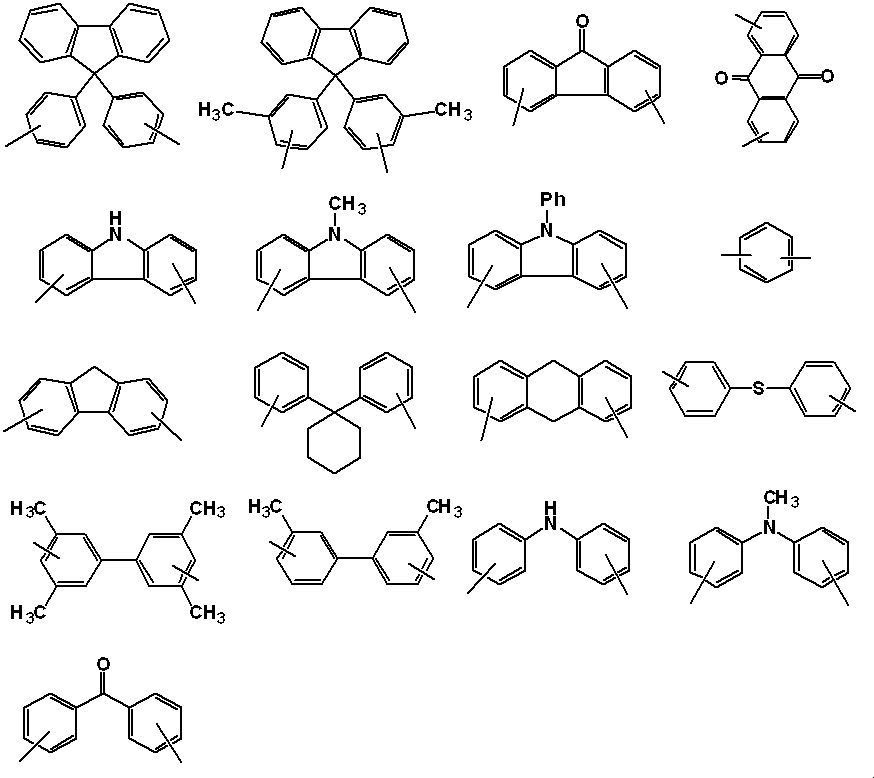
- Specific examples of groups represented by formulas (2) to (13) include, but are not limited to, those represented by the following formulas.
- a group represented by the following formula is more preferable because a polymer having a higher refractive index can be obtained.
- the weight average molecular weight of the triazine ring-containing polymer used in the present invention is not particularly limited, but is preferably 500 to 500,000, more preferably 500 to 100,000, further improving heat resistance and shrinkage. 2,000 or more is preferable from the viewpoint of lowering the rate, 50,000 or less is preferable, 30,000 or less is more preferable, from the viewpoint of further increasing the solubility and decreasing the viscosity of the obtained solution, 10,000 or less is preferable.
- the weight average molecular weight in this invention is an average molecular weight obtained by standard polystyrene conversion by gel permeation chromatography (henceforth GPC) analysis.
- the triazine ring-containing polymer of the present invention can be produced by the technique disclosed in Patent Document 5 described above.
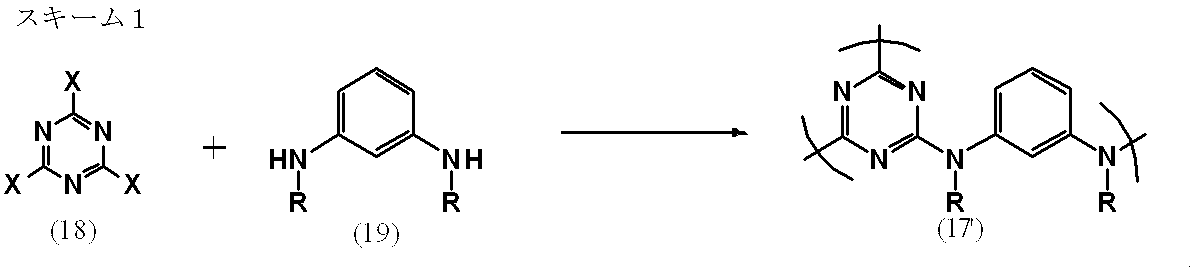
- a hyperbranched polymer having a repeating structure (17 ′) is obtained by reacting cyanuric halide (18) and m-phenylenediamine compound (19) in a suitable organic solvent. Obtainable.
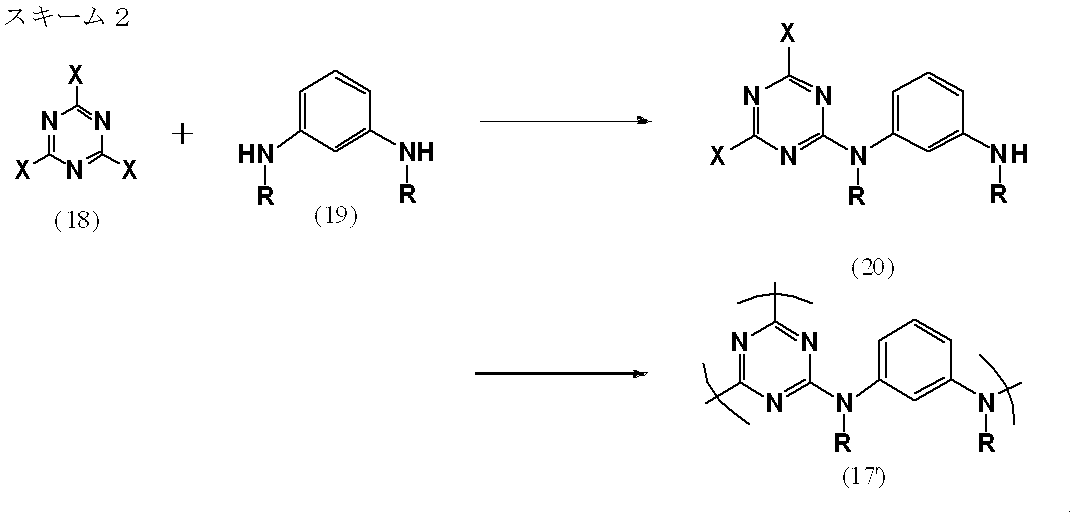
- a hyperbranched polymer having a repeating structure (17 ′) is reacted using an equivalent amount of cyanuric halide (18) and m-phenylenediamine compound (19) in an appropriate organic solvent. It can also synthesize from the compound (20) obtained.
- the amount of each raw material charged is arbitrary as long as the target polymer is obtained, but the diamino compound (19) 0. 01 to 10 equivalents are preferred.
- diamino compound (19) in an amount of less than 3 equivalents relative to 2 equivalents of cyanuric halide (18).
- cyanuric halide (18) in an amount of less than 2 equivalents relative to 3 equivalents of diamino compound (19).
- a highly branched polymer having many triazine ring ends is preferred.
- the molecular weight of the resulting hyperbranched polymer can be easily adjusted by appropriately adjusting the amounts of the diamino compound (19) and the cyanuric halide (18).
- organic solvent various solvents usually used in this kind of reaction can be used, for example, tetrahydrofuran, dioxane, dimethyl sulfoxide; N, N-dimethylformamide, N-methyl-2-pyrrolidone, tetramethylurea.
- N, N-dimethylformamide, dimethyl sulfoxide, N-methyl-2-pyrrolidone, N, N-dimethylacetamide, and mixed solvents thereof are preferred, and in particular, N, N-dimethylacetamide, N-methyl-2- Pyrrolidone is preferred.
- the reaction temperature may be appropriately set in the range from the melting point to the boiling point of the solvent used, but is preferably about 0 to 150 ° C., more preferably 60 to 100 ° C. preferable. Particularly in the reaction of Scheme 1, the reaction temperature is preferably 60 to 150 ° C., preferably 80 to 150 ° C., and preferably 80 to 120 ° C. from the viewpoint of suppressing linearity and increasing the degree of branching.
- the reaction temperature may be appropriately set in the range from the melting point of the solvent to be used to the boiling point of the solvent, but is preferably about ⁇ 50 to 50 ° C., and preferably about ⁇ 20 to 50 ° C. Is more preferably about ⁇ 10 to 50 ° C., and further preferably ⁇ 10 to 10 ° C.
- it is preferable to employ a two-step process comprising a first step of reacting at ⁇ 50 to 50 ° C. and a second step of reacting at 60 to 150 ° C. following this step.
- a solution containing cyanuric halide (18) or diamino compound (19) and an organic solvent is 60 to 150 ° C., preferably 80 ° C.
- the method of heating to ⁇ 150 ° C. and adding the diamino compound (19) or cyanuric halide (18) to the solution at this temperature is optimal.
- the component previously dissolved in the solvent and the component added later may be either, but a method of adding cyanuric halide (18) to the heated solution of the diamino compound (19) is preferable.
- a component previously dissolved in a solvent or a component added later may be used, but a method of adding a diamino compound (19) to a cooling solution of cyanuric halide (18) is preferable.
- Components added later may be added neat or in a solution dissolved in an organic solvent as described above, but the latter method is preferred in consideration of ease of operation and ease of reaction control. It is. The addition may be gradually added by dropping or the like, or may be added all at once.
- various bases usually used at the time of polymerization or after polymerization may be added.
- this base include potassium carbonate, potassium hydroxide, sodium carbonate, sodium hydroxide, sodium hydrogen carbonate, sodium ethoxide, sodium acetate, lithium carbonate, lithium hydroxide, lithium oxide, potassium acetate, magnesium oxide, oxidized Calcium, barium hydroxide, trilithium phosphate, trisodium phosphate, tripotassium phosphate, cesium fluoride, aluminum oxide, ammonia, trimethylamine, triethylamine, diisopropylamine, diisopropylethylamine, N-methylpiperidine, 2,2,6 , 6-tetramethyl-N-methylpiperidine, pyridine, 4-dimethylaminopyridine, N-methylmorpholine and the like.
- the amount of the base added is preferably 1 to 100 equivalents, more preferably 1 to 10 equivalents per 1 equivalent of cyanuric halide (18). These bases may be used as an aqueous solution. In any of the scheme methods, after completion of the reaction, the product can be easily purified by a reprecipitation method or the like.
- a part of halogen atoms of at least one terminal triazine ring is substituted with alkyl, aralkyl, aryl, alkylamino, alkoxysilyl group-containing alkylamino, aralkylamino, arylamino, alkoxy, aralkyloxy, aryloxy.
- alkylamino, alkoxysilyl group-containing alkylamino, aralkylamino, and arylamino groups are preferable, alkylamino and arylamino groups are more preferable, and arylamino groups are still more preferable.
- alkyl group and alkoxy group are the same as those described above.
- Specific examples of the ester group include methoxycarbonyl and ethoxycarbonyl groups.
- aryl group examples include phenyl, o-chlorophenyl, m-chlorophenyl, p-chlorophenyl, o-fluorophenyl, p-fluorophenyl, o-methoxyphenyl, p-methoxyphenyl, p-nitrophenyl, and p-cyano.
- aralkyl group examples include benzyl, p-methylphenylmethyl, m-methylphenylmethyl, o-ethylphenylmethyl, m-ethylphenylmethyl, p-ethylphenylmethyl, 2-propylphenylmethyl, 4-isopropylphenyl.
- examples include methyl, 4-isobutylphenylmethyl, ⁇ -naphthylmethyl group and the like.
- alkylamino group examples include methylamino, ethylamino, n-propylamino, isopropylamino, n-butylamino, isobutylamino, s-butylamino, t-butylamino, n-pentylamino, 1-methyl- n-butylamino, 2-methyl-n-butylamino, 3-methyl-n-butylamino, 1,1-dimethyl-n-propylamino, 1,2-dimethyl-n-propylamino, 2,2-dimethyl -N-propylamino, 1-ethyl-n-propylamino, n-hexylamino, 1-methyl-n-pentylamino, 2-methyl-n-pentylamino, 3-methyl-n-pentylamino, 4-methyl -N-pentylamino, 1,1-dimethyl-n-butylamino, 1,2-
- aralkylamino group examples include benzylamino, methoxycarbonylphenylmethylamino, ethoxycarbonylphenylmethylamino, p-methylphenylmethylamino, m-methylphenylmethylamino, o-ethylphenylmethylamino, m-ethylphenylmethyl.
- arylamino group examples include phenylamino, methoxycarbonylphenylamino, ethoxycarbonylphenylamino, naphthylamino, methoxycarbonylnaphthylamino, ethoxycarbonylnaphthylamino, anthranylamino, pyrenylamino, biphenylamino, terphenylamino, fluorenyl An amino group etc. are mentioned.
- the alkoxysilyl group-containing alkylamino group may be any of monoalkoxysilyl group-containing alkylamino, dialkoxysilyl group-containing alkylamino, trialkoxysilyl group-containing alkylamino group, and specific examples thereof include 3-trimethoxysilyl.
- aryloxy group examples include phenoxy, naphthoxy, anthranyloxy, pyrenyloxy, biphenyloxy, terphenyloxy, fluorenyloxy groups and the like.
- aralkyloxy group examples include benzyloxy, p-methylphenylmethyloxy, m-methylphenylmethyloxy, o-ethylphenylmethyloxy, m-ethylphenylmethyloxy, p-ethylphenylmethyloxy, 2-propyl Examples include phenylmethyloxy, 4-isopropylphenylmethyloxy, 4-isobutylphenylmethyloxy, ⁇ -naphthylmethyloxy groups and the like.
- the organic monoamine is simultaneously charged, that is, by reacting the cyanuric halide compound with the diaminoaryl compound in the presence of the organic monoamine, the rigidity of the highly branched polymer is relaxed. Can be obtained.
- the hyperbranched polymer obtained by this method is excellent in solubility in a solvent (inhibition of aggregation) and crosslinkability with a crosslinking agent, so when used as a composition in combination with a crosslinking agent described later. Particularly advantageous.
- any of alkyl monoamine, aralkyl monoamine, and aryl monoamine can be used.
- Alkyl monoamines include methylamine, ethylamine, n-propylamine, isopropylamine, n-butylamine, isobutylamine, s-butylamine, t-butylamine, n-pentylamine, 1-methyl-n-butylamine, 2-methyl- n-butylamine, 3-methyl-n-butylamine, 1,1-dimethyl-n-propylamine, 1,2-dimethyl-n-propylamine, 2,2-dimethyl-n-propylamine, 1-ethyl-n -Propylamine, n-hexylamine, 1-methyl-n-pentylamine, 2-methyl-n-pentylamine, 3-methyl-n-pentylamine, 4-methyl-n-pentylamine, 1,1-dimethyl -N-butylamine, 1,2-dimethyl-n-butylamine, 1,3-dimethyl-n Butylamine, 2,
- aralkyl monoamine examples include benzylamine, p-methoxycarbonylbenzylamine, p-ethoxycarbonylphenylbenzyl, p-methylbenzylamine, m-methylbenzylamine, o-methoxybenzylamine and the like.
- aryl monoamine examples include aniline, p-methoxycarbonylaniline, p-ethoxycarbonylaniline, p-methoxyaniline, 1-naphthylamine, 2-naphthylamine, anthranylamine, 1-aminopyrene, 4-biphenylylamine, o- And phenylaniline, 4-amino-p-terphenyl, 2-aminofluorene, and the like.
- the amount of the organic monoamine used is preferably 0.05 to 500 equivalents, more preferably 0.05 to 120 equivalents, and even more preferably 0.05 to 50 equivalents based on the halogenated cyanuric compound. .
- the reaction temperature is preferably 60 to 150 ° C., preferably 80 to 150 ° C., and preferably 80 to 120 ° C. from the viewpoint of suppressing linearity and increasing the degree of branching.
- the mixing of the three components of the organic monoamine, the halogenated cyanuric compound and the diaminoaryl compound may be carried out at a low temperature.
- the temperature is preferably about ⁇ 50 to 50 ° C., and about ⁇ 20 to 50 ° C. Is more preferable, and ⁇ 20 to 10 ° C. is more preferable.
- After the low temperature charging it is preferable to carry out the reaction by raising the temperature to the polymerization temperature at once (in one step).
- the two components of the cyanuric halide compound and the diaminoaryl compound may be mixed at a low temperature.
- the temperature is preferably about ⁇ 50 to 50 ° C., more preferably about ⁇ 20 to 50 ° C., More preferably, it is ⁇ 20 to 10 ° C. It is preferable to carry out the reaction by adding an organic monoamine after the low-temperature charging and raising the temperature to a temperature for polymerization (in one step).
- Crosslinking agent used in the film-forming composition of the present invention is not particularly limited as long as it is a compound having a substituent capable of reacting with the polymer of the present invention.
- Such compounds include polyfunctional vinyl ether compounds, polyfunctional allyl ether compounds, melamine compounds having a cross-linking substituent such as methylol groups, methoxymethyl groups, substituted urea compounds, epoxy groups or oxetane groups.
- a compound containing a substituent a compound containing a blocked isocyanate, a compound having an acid anhydride, a compound having a (meth) acryl group, and a phenoplast compound.
- These compounds need to have at least two crosslink-forming substituents.
- the polyfunctional vinyl ether compound and the polyfunctional allyl ether compound are not particularly limited as long as they have two or more vinyl ether groups or allyl ether groups as a curable group in one molecule.
- An ether compound composed of a polyhydric alcohol and an alcohol having a vinyl group or an allyl group is preferred.
- polyfunctional vinyl ether compound examples include ethylene glycol divinyl ether, diethylene glycol divinyl ether, polyethylene glycol divinyl ether, propylene glycol divinyl ether, butylene glycol divinyl ether, hexanediol divinyl ether, bisphenol A alkylene oxide divinyl ether, bisphenol F alkylene oxide.
- polyfunctional allyl ether compound examples include ethylene glycol diallyl ether, diethylene glycol diallyl ether, polyethylene glycol diallyl ether, propylene glycol diallyl ether, butylene glycol diallyl ether, hexanediol diallyl ether, bisphenol A alkylene oxide diallyl ether, and bisphenol F alkylene.
- the polyfunctional epoxy compound is not particularly limited as long as it has two or more epoxy groups in one molecule. Specific examples include tris (2,3-epoxypropyl) isocyanurate, 1,4-butanediol diglycidyl ether, 1,2-epoxy-4- (epoxyethyl) cyclohexane, glycerol triglycidyl ether, diethylene glycol diglycidyl.
- YH434 and YH434L which are epoxy resins having at least two epoxy groups
- Epolide GT-401 and GT-403 which are epoxy resins having a cyclohexene oxide structure
- the polyfunctional (meth) acrylic compound is not particularly limited as long as it has two or more (meth) acrylic groups in one molecule.
- Specific examples include ethylene glycol diacrylate, ethylene glycol dimethacrylate, polyethylene glycol diacrylate, polyethylene glycol dimethacrylate, ethoxylated bisphenol A diacrylate, ethoxylated bisphenol A dimethacrylate, ethoxylated trimethylolpropane triacrylate, and ethoxylated.
- Polyfunctional (meth) acrylic compounds can be obtained as commercial products. Specific examples thereof include NK ester A-200, A-400, A-600, A-1000, and A- 9300 (Tris (2-acryloyloxyethyl) isocyanurate), A-9300-1CL, A-TMPT, UA-53H, 1G, 2G, 3G, 4G, 9G, 14G, 23G, ABE-300, A-BPE-4, A-BPE-6, A-BPE-10, A-BPE-20, A-BPE-30, BPE-80N, BPE- 100N, BPE-200, BPE-500, BPE-900, BPE-1300N, A-GLY-3E, A-GLY-9E, A-GLY-20E, A-TMPT-3EO, Same A- MPT-9EO, ATM-4E, ATM-35E (manufactured by Shin-Nakamura Chemical Co., Ltd.), KAYARAD (registered trademark) DPEA-12, PEG400DA
- the acid anhydride compound is not particularly limited as long as it is a carboxylic acid anhydride obtained by dehydration condensation of two molecules of carboxylic acid.
- Specific examples thereof include phthalic anhydride, tetrahydrophthalic anhydride, hexahydrophthalic anhydride. Acid, methyltetrahydrophthalic anhydride, methylhexahydrophthalic anhydride, nadic anhydride, methyl nadic anhydride, maleic anhydride, succinic anhydride, octyl succinic anhydride, dodecenyl succinic anhydride, etc.
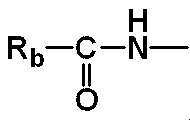
- the isocyanate group (—NCO) when the isocyanate group (—NCO) has two or more blocked isocyanate groups blocked by an appropriate protective group in one molecule, it is exposed to a high temperature during thermosetting.
- the protective group (block part) is not particularly limited as long as it is dissociated by thermal dissociation and the resulting isocyanate group causes a crosslinking reaction with the resin. Examples thereof include compounds having two or more groups represented by the following formula in one molecule (note that these groups may be the same or different from each other).
- R b represents an organic group in the block part.
- Such a compound can be obtained, for example, by reacting an appropriate blocking agent with a compound having two or more isocyanate groups in one molecule.
- Examples of the compound having two or more isocyanate groups in one molecule include, for example, isophorone diisocyanate, 1,6-hexamethylene diisocyanate, methylene bis (4-cyclohexyl isocyanate), polyisocyanate of trimethylhexamethylene diisocyanate, and dimers thereof. , Trimers, and reaction products of these with diols, triols, diamines, or triamines.
- the blocking agent examples include alcohols such as methanol, ethanol, isopropanol, n-butanol, 2-ethoxyhexanol, 2-N, N-dimethylaminoethanol, 2-ethoxyethanol, cyclohexanol; phenol, o-nitrophenol , P-chlorophenol, o-, m- or p-cresol and the like; lactams such as ⁇ -caprolactam; And pyrazoles such as pyrazole, 3,5-dimethylpyrazole and 3-methylpyrazole; thiols such as dodecanethiol and benzenethiol.
- alcohols such as methanol, ethanol, isopropanol, n-butanol, 2-ethoxyhexanol, 2-N, N-dimethylaminoethanol, 2-ethoxyethanol, cyclohexanol
- lactams such as ⁇ -caprolactam
- pyrazoles such
- a compound containing a blocked isocyanate is also available as a commercial product.
- Specific examples thereof include B-830, B-815N, B-842N, B-870N, B-874N, B-882N, B -7005, B-7030, B-7075, B-5010 (Mitsui Chemicals Polyurethane Co., Ltd.), Duranate (registered trademark) 17B-60PX, TPA-B80E, MF-B60X, MF-K60X, E402-B80T (above, manufactured by Asahi Kasei Chemicals Corporation), Karenz MOI-BM (registered trademark) (above, manufactured by Showa Denko Co., Ltd.), and the like.
- the aminoplast compound is not particularly limited as long as it has two or more methoxymethylene groups in one molecule.
- Cymel series such as hexamethoxymethylmelamine, CYMEL (registered trademark) 303, tetrabutoxymethylglycoluril, 1170, tetramethoxymethylbenzoguanamine, 1123 (above, manufactured by Nihon Cytec Industries Co., Ltd.), methylated melamine resin Nicalac (registered trademark) MW-30HM, MW-390, MW-100LM, MX-750LM, MX-270, MX-280, MX-290, which are methylated urea resins.
- Melamine compounds such as Nikarac series such as Sanwa Chemical).
- the oxetane compound is not particularly limited as long as it has two or more oxetanyl groups in one molecule.
- OXT-221, OX-SQ-H, OX-SC containing oxetane groups above, Toagosei ( Etc.).
- the phenoplast compound has two or more hydroxymethylene groups in one molecule, and when exposed to a high temperature during thermosetting, a crosslinking reaction proceeds with the polymer of the present invention by a dehydration condensation reaction. Is.
- phenoplast compound examples include 2,6-dihydroxymethyl-4-methylphenol, 2,4-dihydroxymethyl-6-methylphenol, bis (2-hydroxy-3-hydroxymethyl-5-methylphenyl) methane, Bis (4-hydroxy-3-hydroxymethyl-5-methylphenyl) methane, 2,2-bis (4-hydroxy-3,5-dihydroxymethylphenyl) propane, bis (3-formyl-4-hydroxyphenyl) methane Bis (4-hydroxy-2,5-dimethylphenyl) formylmethane, ⁇ , ⁇ -bis (4-hydroxy-2,5-dimethylphenyl) -4-formyltoluene and the like.
- the phenoplast compound is also available as a commercial product, and specific examples thereof include 26DMPC, 46DMOC, DM-BIPC-F, DM-BIOC-F, TM-BIP-A, BISA-F, BI25X-DF. BI25X-TPA (above, manufactured by Asahi Organic Materials Co., Ltd.).
- a polyfunctional vinyl ether compound and a polyfunctional allyl ether compound are preferable from the viewpoints of suppressing a decrease in the refractive index due to the incorporation of the crosslinking agent, having high solvent resistance, and capable of being thermally cured at a low temperature.
- a compound containing an epoxy group, a blocked isocyanate group, and a (meth) acryl group is preferable, and from the point of giving a photocurable composition without using an initiator.
- Polyfunctional epoxy compounds and / or polyfunctional (meth) acrylic compounds are preferred.
- a polyfunctional (meth) acrylic compound is preferable from the viewpoint that the refractive index lowering due to the crosslinking agent blending can be suppressed and the curing reaction proceeds rapidly, and among them, the phase with the triazine ring-containing polymer is preferable. Since it is excellent in solubility, the polyfunctional (meth) acrylic compound having the following isocyanuric acid skeleton is more preferable. Examples of the polyfunctional (meth) acrylic compound having such a skeleton include NK ester A-9300 and A-9300-1CL (both manufactured by Shin-Nakamura Chemical Co., Ltd.).
- R 105 to R 107 are each independently a monovalent organic group having at least one (meth) acryl group at the end).
- a liquid at 25 ° C. and its viscosity is 5,000 mPa ⁇ s or less, preferably Is a polyfunctional (meth) acrylic compound (hereinafter referred to as a low-viscosity crosslinking agent) having a viscosity of 1 to 3,000 mPa ⁇ s, more preferably 1 to 1,000 mPa ⁇ s, and still more preferably 1 to 500 mPa ⁇ s. It is suitable to use alone or in combination of two or more or in combination with the polyfunctional (meth) acrylic compound having the isocyanuric acid skeleton.
- a polyfunctional (meth) acrylic compound hereinafter referred to as a low-viscosity crosslinking agent
- Such low-viscosity cross-linking agents are also commercially available.
- NK ester A-GLY-3E 85 mPa ⁇ s, 25 ° C.
- A-GLY -9E 95 mPa ⁇ s, 25 ° C
- A-GLY-20E 200 mPa ⁇ s, 25 ° C
- A-TMPT-3EO 60 mPa ⁇ s, 25 ° C
- A-TMPT-9EO ATM
- the chain length between (meth) acrylic groups such as -4E (150 mPa ⁇ s, 25 ° C.), ATM-35E (350 mPa ⁇ s, 25 ° C.) (manufactured by Shin-Nakamura Chemical Co., Ltd.) is relatively Long crosslinking agents.
- NK ester A-GLY-20E manufactured by Shin-Nakamura Chemical Co., Ltd.
- a polyfunctional (meth) acrylic compound having the above isocyanuric acid skeleton It is suitable to use in combination.
- the above-mentioned cross-linking agents may be used alone or in combination of two or more.
- the amount of the crosslinking agent used is preferably 1 to 100 parts by mass with respect to 100 parts by mass of the triazine ring-containing polymer, but considering the solvent resistance, the lower limit is preferably 2 parts by mass, more preferably 5 parts by mass. Furthermore, in consideration of controlling the refractive index, the upper limit is preferably 20 parts by mass, more preferably 15 parts by mass.
- an initiator corresponding to each crosslinking agent can also be blended.
- a polyfunctional epoxy compound and / or polyfunctional (meth) acrylic compound is used as a crosslinking agent, photocuring proceeds without using an initiator to give a cured film. Can be used.
- a photoacid generator or a photobase generator can be used as the initiator.
- a thermal acid generator can also be used and thermosetting becomes possible.
- the photoacid generator may be appropriately selected from known ones, and for example, onium salt derivatives such as diazonium salts, sulfonium salts and iodonium salts can be used. Specific examples thereof include aryldiazonium salts such as phenyldiazonium hexafluorophosphate, 4-methoxyphenyldiazonium hexafluoroantimonate, 4-methylphenyldiazonium hexafluorophosphate; diphenyliodonium hexafluoroantimonate, di (4-methylphenyl) Diaryliodonium salts such as iodonium hexafluorophosphate and di (4-tert-butylphenyl) iodonium hexafluorophosphate; triphenylsulfonium hexafluoroantimonate, tris (4-methoxyphenyl) sulfonium hexafluorophosphat
- onium salts commercially available products may be used. Specific examples thereof include Sun-Aid SI-60, SI-80, SI-100, SI-60L, SI-80L, SI-100L, SI-L145, SI- L150, SI-L160, SI-L110, SI-L147 (Sanshin Chemical Industry Co., Ltd.), UVI-6950, UVI-6970, UVI-6974, UVI-6990, UVI-6990 (above, Union Carbide) Co., Ltd.), CPI-100P, CPI-100A, CPI-200K, CPI-200S (above, manufactured by San Apro Co., Ltd.), Adekaoptomer SP-150, SP-151, SP-170, SP-171 (above, (Made by ADEKA Co., Ltd.), Irgacure 261 (made by BASF), CI-2481, CI-2624, CI-2 39, CI-2064 (above, manufactured by Nippon Soda Co., Ltd.),
- the photobase generator may be appropriately selected from known ones and used, for example, Co-amine complex type, oxime carboxylic acid ester type, carbamic acid ester type, quaternary ammonium salt type photobase generator, etc. Can be used.
- 2-nitrobenzylcyclohexylcarbamate triphenylmethanol, O-carbamoylhydroxylamide, O-carbamoyloxime, [[(2,6-dinitrobenzyl) oxy] carbonyl] cyclohexylamine, bis [[(2 -Nitrobenzyl) oxy] carbonyl] hexane 1,6-diamine, 4- (methylthiobenzoyl) -1-methyl-1-morpholinoethane, (4-morpholinobenzoyl) -1-benzyl-1-dimethylaminopropane, N- (2-nitrobenzyloxycarbonyl) pyrrolidine, hexaamminecobalt (III) tris (triphenylmethylborate), 2-benzyl-2-dimethylamino-1- (4-morpholinophenyl) -butanone, 2,6-dimethyl- 3,5-di Cetyl-4- (2′-nitrophenyl)
- the thermal acid generator may be appropriately selected from known ones, and a cation-based or protonic acid catalyst such as trifluoromethanesulfonate, boron trifluoride etherate compound, boron trifluoride or the like may be used. it can. Specific examples thereof include diethylammonium trifluoromethanesulfonate, triethylammonium trifluoromethanesulfonate, diisopropylammonium trifluoromethanesulfonate, ethyl diisopropylammonium trifluoromethanesulfonate, and the like.
- a cation-based or protonic acid catalyst such as trifluoromethanesulfonate, boron trifluoride etherate compound, boron trifluoride or the like. It can. Specific examples thereof include diethylammonium trifluoromethanesulfonate, triethylammonium trifluoromethanes
- aromatic onium salts that are also used as acid generators
- these can also be used as thermal cationic polymerization initiators.
- Sun Aid SI-45, SI-47, SI-60, SI-60L, SI-80, SI-80L, SI-100, SI-100L, SI-110L, SI-145, I-150, SI-160 SI-180L, SI-B3, SI-B3A manufactured by Sanshin Chemical Industry Co., Ltd.
- CI-2921, CI-2920, CI-2946, CI-3128, CI-2624, CI-2623, CI-2039 (manufactured by Nippon Soda Co., Ltd.), CP-66, CP-77 ((shares) ADEKA), FC-520 (manufactured by 3M) K-PURE TAG-2396, TAG-2713S, TAG-2713, TAG-2172, TAG-2179, TAG-2168E, TAG-2722, TAG-2507, TAG- 2678, TAG-2681, TAG-2690, TAG-2700, TAG-2710, TAG-2100, CDX-3027, CXC-1615, CXC-1616, CXC-1750, CXC-1738, CXC-1614, CXC-1742, CXC-1743, CXC-1613, CXC-1739, C C-1751, CXC-1766, CXC-1763, CXC
- a photoacid generator or a base generator is used for the polyfunctional epoxy compound, it is preferably used in a range of 0.1 to 15 parts by mass, more preferably 1 to 100 parts by mass of the polyfunctional epoxy compound. It is in the range of ⁇ 10 parts by mass. If necessary, an epoxy resin curing agent may be blended in an amount of 1 to 100 parts by mass with respect to 100 parts by mass of the polyfunctional epoxy compound.
- thermal acid generator When a thermal acid generator is used, it is preferably used in the range of 0.1 to 50 parts by mass, more preferably in the range of 0.1 to 20 parts by mass with respect to 100 parts by mass of the crosslinking agent.
- a radical photopolymerization initiator when a polyfunctional (meth) acrylic compound is used, a radical photopolymerization initiator can be used.
- the radical photopolymerization initiator may be appropriately selected from known ones, and examples thereof include acetophenones, benzophenones, Michler's benzoylbenzoate, amyloxime ester, tetramethylthiuram monosulfide, and thioxanthone.
- photocleavable photoradical polymerization initiators are preferred.
- the photocleavable photoradical polymerization initiator is described in the latest UV curing technology (p. 159, publisher: Kazuhiro Takahisa, publisher: Technical Information Association, Inc., published in 1991).
- radical photopolymerization initiators include, for example, BASF Corporation trade names: Irgacure 184, 369, 651, 500, 819, 907, 784, 2959, CGI 1700, CGI 1750, CGI 1850, CG 24-61, Darocur 1116, 1173, Product name: Lucirin TPO, manufactured by UCB Product name: Ubekrill P36, manufactured by Fratteri Lamberti, Inc. Product name: Ezacure KIP150, KIP65LT, KIP100F, KT37, KT55, KTO46, KIP75 / B, and the like.
- radical photopolymerization initiator When a radical photopolymerization initiator is used, it is preferably used in the range of 0.1 to 15 parts by mass, more preferably in the range of 1 to 10 parts by mass with respect to 100 parts by mass of the polyfunctional (meth) acrylate compound. is there.
- the film-forming composition of the present invention further contains an organic monomer that can give the linear polymer represented by the formula (A).
- R 102 and R 104 each independently represent a hydrogen atom, an alkyl group having 1 to 10 carbon atoms, or a polymerizable carbon-carbon double bond-containing group
- R 103 represents a hydrogen atom.
- one of R 102 and R 104 is a polymerizable carbon-carbon double bond-containing group, and both R 102 and R 104 are not simultaneously a polymerizable carbon-carbon double bond-containing group.
- R 102 is preferably a hydrogen atom or a methyl group
- R 103 is preferably a hydrogen atom from the viewpoint of ensuring the ability to form a hydrogen bond with a triazine ring-containing polymer.
- the alkyl group having 1 to 10 carbon atoms is preferably linear or branched, and specifically includes methyl, ethyl, n-propyl, isopropyl, n-butyl, isobutyl, s-butyl, t-butyl.
- N-pentyl 1-methyl-n-butyl, 2-methyl-n-butyl, 3-methyl-n-butyl, 1,1-dimethyl-n-propyl, 1,2-dimethyl-n-propyl, 2 , 2-dimethyl-n-propyl, 1-ethyl-n-propyl, n-hexyl, 1-methyl-n-pentyl, 2-methyl-n-pentyl, 3-methyl-n-pentyl, 4-methyl-n -Pentyl, 1,1-dimethyl-n-butyl, 1,2-dimethyl-n-butyl, 1,3-dimethyl-n-butyl, 2,2-dimethyl-n-butyl, 2,3-dimethyl-n -Butyl, 3,3-dimethyl n-butyl, 1-ethyl-n-butyl, 2-ethyl-n-butyl, 1,1,2-trimethyl-n-propyl, 1,2,2-trimethyl-n-
- the polymerizable carbon-carbon double bond-containing group is not particularly limited, but a carbon-carbon double bond-containing hydrocarbon group (alkenyl group) having 2 to 10 carbon atoms, preferably 2 to 5 carbon atoms.
- ethenyl vinyl
- n-1-propenyl n-2-propenyl
- allyl group 1-methylethenyl, n-1-butenyl, n-2-butenyl, n-3-butenyl
- organic monomer represented by the formula (A) examples include N-vinylformamide, N-vinylacetamide, N-allylformamide, N-allylacetamide, (meth) acrylamide, N-methyl (meth) acrylamide, N -Dimethyl (meth) acrylamide, N-ethyl (meth) acrylamide, N-diisopropyl (meth) acrylamide, N-isopropyl (meth) acrylamide, N-diisopropyl (meth) acrylamide and the like. Of these, N-vinylformamide is particularly preferred.
- the organic monomer has a function of improving crack resistance of the cured film obtained. Moreover, in the composition for solvent-free type
- the usage-amount of the organic monomer shown by Formula (A) is not specifically limited, when considering improving the crack resistance of the cured film obtained further, it is 1 with respect to 100 mass parts of triazine ring containing polymers. -200 parts by mass is preferable, but considering the crack resistance of the cured film, the lower limit is preferably 5 parts by mass, more preferably 10 parts by mass, and the upper limit is preferably 150 parts by mass, more preferably 100 parts by mass.
- the amount used when the organic monomer is used as a reactive diluent in the solvent-free film-forming composition described below is not particularly limited, but is 1 to 1 with respect to 100 parts by mass of the triazine ring-containing polymer.
- the lower limit is preferably 5 parts by mass, more preferably 10 parts by mass, and the upper limit is preferably 500 parts by mass, more preferably 400 parts by mass.
- the film-forming composition of the present invention can be used by adding various solvents and dissolving the triazine ring-containing polymer.
- the solvent may be the same as or different from the solvent used during the polymerization.
- the solvent is not particularly limited as long as the compatibility with the polymer is not impaired, and one kind or a plurality of kinds can be arbitrarily selected and used.
- solvents include water, toluene, p-xylene, o-xylene, m-xylene, ethylbenzene, styrene, ethylene glycol dimethyl ether, propylene glycol monomethyl ether, ethylene glycol monomethyl ether, propylene glycol, propylene glycol mono Ethyl ether, ethylene glycol monoethyl ether, ethylene glycol monoisopropyl ether, ethylene glycol methyl ether acetate, propylene glycol monomethyl ether acetate, ethylene glycol ethyl ether acetate, diethylene glycol dimethyl ether, propylene glycol monobutyl ether, ethylene glycol monobutyl ether, diethylene glycol diethyl ether , Propylene glycol monomethyl ether, diethylene glycol monomethyl ether, dipropylene glycol monoethyl ether, diethylene glycol monoethyl ether, triethylene
- the solid content concentration in the film-forming composition is not particularly limited as long as it does not affect the storage stability, and may be appropriately set according to the target film thickness.
- the solid content concentration is preferably 0.1 to 50% by mass, and more preferably 0.1 to 40% by mass.
- the film-forming composition of the present invention may be a solvent-free type that does not contain a solvent.
- the organic monomer capable of providing the linear polymer represented by the formula (A) functions as a reactive diluent.
- the film-forming composition of the present invention contains other components other than organic monomers that can give a triazine ring-containing polymer, a crosslinking agent, and a linear polymer, such as a leveling agent and a surfactant. Etc. may be included.
- surfactant examples include polyoxyethylene alkyl ethers such as polyoxyethylene lauryl ether, polyoxyethylene stearyl ether, polyoxyethylene cetyl ether, polyoxyethylene oleyl ether; polyoxyethylene octylphenyl ether, polyoxyethylene Polyoxyethylene alkyl aryl ethers such as nonylphenyl ether; polyoxyethylene / polyoxypropylene block copolymers; sorbitan monolaurate, sorbitan monopalmitate, sorbitan monostearate, sorbitan monooleate, sorbitan trioleate, sorbitan trioleate Sorbitan fatty acid esters such as stearate; polyoxyethylene sorbitan monolaurate, polyoxyethylene Nonionic surfactants such as polyoxyethylene sorbitan fatty acid esters such as bitane monopalmitate, polyoxyethylene sorbitan monostearate, polyoxyethylene sorbitan trioleate, polyoxyethylene sorbitan
- surfactants may be used alone or in combination of two or more.
- the amount of the surfactant used is preferably 0.0001 to 5 parts by mass, more preferably 0.001 to 1 part by mass, and 0.01 to 0.5 parts by mass with respect to 100 parts by mass of the triazine ring-containing polymer. Even more preferred.
- the said other component can be added at the arbitrary processes at the time of preparing the composition of this invention.
- the underlying layer is not particularly limited.
- the composition of the present invention is applied to an organic film such as an organic EL film or a substrate, then heated as necessary to evaporate the solvent, and then heated or irradiated with light to form a desired cured film. be able to.
- the coating method of the composition is arbitrary, for example, spin coating method, dip method, flow coating method, ink jet method, spray method, bar coating method, gravure coating method, slit coating method, roll coating method, transfer printing method, brush Methods such as coating, blade coating, and air knife coating can be employed.
- the base material examples include silicon, glass on which indium tin oxide (ITO) is formed, glass on which indium zinc oxide (IZO) is formed, polyethylene terephthalate (PET), plastic, glass, quartz, ceramics, and the like.
- ITO indium tin oxide
- IZO indium zinc oxide
- PET polyethylene terephthalate
- plastic glass, quartz, ceramics, and the like.
- a flexible base material having flexibility can also be used.
- the solvent-containing film forming composition When the solvent-containing film forming composition is used, the solvent is evaporated by heating, but the temperature is not particularly limited, and can be carried out at 40 to 400 ° C., for example.
- the method is not particularly limited, and for example, evaporation may be performed using a hot plate or an oven in an appropriate atmosphere such as air, an inert gas such as nitrogen, or in a vacuum.
- a cured film can be formed by firing.
- the method is not particularly limited, and for example, heating may be performed using a hot plate or an oven in an appropriate atmosphere such as air, an inert gas such as nitrogen, or a vacuum. In this case, curing can be performed even at a low temperature, and the temperature can be 50 to 200 ° C., preferably 70 to 150 ° C., for example.
- the firing time is preferably 5 to 120 minutes, more preferably 5 to 60 minutes.
- the firing temperature and firing time may be selected in accordance with the process steps of the target electronic device, and the firing conditions may be selected so that the physical properties of the obtained film meet the required characteristics of the electronic device.
- the conditions for the light irradiation are not particularly limited, and an appropriate irradiation energy and time may be employed depending on the triazine ring-containing polymer and the crosslinking agent to be used.
- the cured film of the present invention thus obtained can achieve high heat resistance, high transparency, high refractive index, high solubility, and low volume shrinkage, so that it can be used for liquid crystal displays, organic EL displays, LED elements, solids. It can be suitably used as a member for producing electronic devices such as imaging devices, organic thin film solar cells, dye-sensitized solar cells, and organic TFTs. It can be suitably used as an applicable embedding material. In addition, when a solvent-free film-forming composition is used, a cured film can be formed thereon without deteriorating an organic film such as an organic EL film. It can be suitably used as a light extraction layer of an EL element.
- the cured film of the present invention includes a buried film and a planarizing film on a photodiode that is a member of a solid-state imaging device, a planarizing film before and after a color filter, a microlens, a planarizing film and a conformal film on a microlens, etc. Can be suitably used.
- an organic monomer capable of giving a linear polymer is removed from the film forming composition described above, and a composition to which a solvent is added is used as a planarizing material.
- a flattening film may be further laminated on the cured film.
- specific examples of the triazine ring-containing polymer and the crosslinking agent, the blending amount thereof, and the film forming method are as described above.
- DMAc dimethylacetamide
- reaction solution was stirred for 30 minutes, and 621.85 g of DMAc was added to a 2,000 mL four-necked flask and heated to 85 ° C. in an oil bath in advance by a liquid feed pump over 1 hour. Polymerization was conducted with stirring for a period of time.
- aniline 113.95 g, 1.224 mol
- triethylamine 116.36 g, 1.15 mol
- the precipitate was filtered, dried in a vacuum dryer at 150 ° C.
- the measurement result of 1 H-NMR spectrum of HB-TmDA40 is shown in FIG.
- the obtained HB-TmDA40 is a compound having a structural unit represented by the formula (1).
- the weight average molecular weight Mw measured by GPC of HB-TmDA40 in terms of polystyrene was 4,300, and the degree of dispersion Mw / Mn was 3.44.
- Embeddability test 1 Using the HB-TmDA40VF1 prepared in Example 1, an embedding test was conducted by the following method.
- the structure substrate used for the embeddability test is made of silicon, has a depth of 1.6 ⁇ m, and a Via diameter of 400 nm.
- HB-TmDA40VF1 was formed on the structure substrate by a spin coating method aiming at 5 ⁇ m, and baked at 130 ° C. for 5 minutes using a hot plate. Thereafter, it was cured with a low-pressure mercury lamp at an integrated exposure amount of 400 mJ / cm 2 to obtain a cured film.
- the formed structure substrate was scratched at the edge of the substrate using a diamond pen, then the substrate was cleaved, and SEM observation was performed.
- the observed image is shown in FIG.
- the material of HB-TmDA40VF1 reaches the bottom of Via, and the thickness of the upper part is about 3 ⁇ m, suggesting the possibility of being used as an embedded material that can maintain flatness. It was.
- Example 3 Embeddability test 2 An embedding test was performed in the same manner as in Example 2 except that the HB-TmDA40VF1 prepared in Example 1 was used and a silicon structural substrate having a depth of 3.0 ⁇ m and a Via diameter of 15 ⁇ m was used. The formed structure substrate was scratched at the edge of the substrate using a diamond pen, then the substrate was cleaved, and SEM observation was performed. The observed image is shown in FIG.
- Embeddability test 3 Using the HB-TmDA40VF1 prepared in Example 1, an embedding test was conducted by the following method.
- the structure substrate used for the embedding test is made of silicon, has a depth of 3.0 ⁇ m, and a via diameter of 15 ⁇ m.
- HB-TmDA40VF1 was formed on the structure substrate by a spin coating method aiming at 5 ⁇ m, and baked at 130 ° C. for 5 minutes using a hot plate. Further, for the purpose of obtaining flatness, HB-TmDA40VF15 prepared in Production Example 3 was formed by spin coating with the aim of 1 ⁇ m, and baked at 130 ° C. for 3 minutes using a hot plate.
- Embedding test 4 Using the HB-TmDA40VF1 prepared in Example 1, an embedding test was conducted by the following method.
- the structure substrate used for the embedding test is made of silicon, has a depth of 3.0 ⁇ m, and a via diameter of 15 ⁇ m.
- HB-TmDA40VF1 was formed on the structure substrate by a spin coating method aiming at 5 ⁇ m, and baked at 130 ° C. for 5 minutes using a hot plate. On the obtained dried film, the same varnish is formed under the same conditions, and further, for the purpose of obtaining flatness, the HB-TmDA40VF15 prepared in Production Example 3 is produced by spin coating with the aim of 1 ⁇ m. Films were formed and baked at 130 ° C.
- the obtained HB-TmDA40VF3 was spin-coated on a glass substrate using a spin coater at 200 rpm for 5 seconds and 1500 rpm for 30 seconds, heated at 100 ° C. for 1 minute, and 130 ° C. for 3 minutes to remove the solvent, and then A cured film was obtained by curing with a low-pressure mercury lamp at an integrated exposure of 200 mJ / cm 2 .
- the refractive index at 550 nm was 1.7641.
- Example 10 Refractive index measurement 5
- a varnish hereinafter referred to as HB-TmDA40VF7 having a total solid content of 15% by mass (when the NVF was added to the solid content, the total solid content was 34% by mass) was prepared.
- HB-TmDA40VF7 a varnish having a total solid content of 15% by mass (when the NVF was added to the solid content, the total solid content was 34% by mass) was prepared.
- a cured film was produced in the same manner as in Example 6 except that the obtained HB-TmDA40VF7 was used, and the refractive index was measured.
- the refractive index at 550 nm was 1.7441.
- Example 11 Preparation of solvent-free varnish 3.0 g of the solution prepared in Production Example 5, pentaerythritol triallyl ether (manufactured by Daiso Co., Ltd., Neoallyl P-30M), BYK-307 (BIC Chemie Japan ( Co., Ltd.) 5 mass% N-vinylformamide solution 0.075 g, CXC-1802 (KING INDUSTRY Co.) 0.0375 g and N-vinylformamide 0.839 g were added, and it was confirmed that the solution was visually dissolved.
- a varnish having a solid content of 100% by mass hereinafter referred to as HB-TmDA40VF8) was prepared.
- Example 12 Preparation of solvent-free varnish 3.0 g of the solution prepared in Production Example 5, pentaerythritol triallyl ether (manufactured by Daiso Corp., Neoallyl P-30M) 0.375 g, BYK-307 (BIC Chemie Japan ( Co., Ltd.) 5 mass% N-vinylformamide solution 0.075 g, CXC-1802 (KING INDUSTRY Co.) 0.0375 g and N-vinylformamide 0.763 g were added, and it was visually confirmed that the solution was dissolved.
- a varnish having a solid content of 100% by mass hereinafter referred to as HB-TmDA40VF9 was prepared.
- Example 13 Preparation of solvent-free varnish 3.0 g of the solution prepared in Production Example 5, pentaerythritol triallyl ether (manufactured by Daiso Corporation, Neoallyl P-30M) 0.45 g, BYK-307 (Bic Chemie Japan ( Co., Ltd.) 5 mass% N-vinylformamide solution 0.075 g, CXC-1802 (KING INDUSTRY Co.) 0.0375 g and N-vinylformamide 0.687 g were added, and it was confirmed that the solution was visually dissolved.
- a varnish having a solid content of 100% by mass hereinafter referred to as HB-TmDA40VF10) was prepared.
- Example 14 Refractive Index Measurement 1
- the HB-TmDA40VF8 prepared in Example 11 was spin-coated on a soda lime glass substrate at 200 rpm for 5 seconds and 2,000 rpm for 30 seconds using a spin coater, and baked at 100 ° C. for 10 minutes using a hot plate. It was. When the refractive index of the obtained film was measured, the refractive index at 550 nm was 1.699.
- Example 15 Refractive index measurement 2 A cured film was obtained in the same manner as in Example 5 except that HB-TmDA40VF9 prepared in Example 12 was used. When the refractive index of the obtained film was measured, the refractive index at 550 nm was 1.702.
- Example 16 Refractive index measurement 3 A cured film was obtained in the same manner as in Example 5 except that HB-TmDA40VF10 prepared in Example 13 was used. When the refractive index of the obtained film was measured, the refractive index at 550 nm was 1.719.
Landscapes
- Chemical & Material Sciences (AREA)
- Organic Chemistry (AREA)
- Chemical Kinetics & Catalysis (AREA)
- Engineering & Computer Science (AREA)
- Materials Engineering (AREA)
- Wood Science & Technology (AREA)
- Life Sciences & Earth Sciences (AREA)
- Health & Medical Sciences (AREA)
- Medicinal Chemistry (AREA)
- Polymers & Plastics (AREA)
- Physics & Mathematics (AREA)
- Optics & Photonics (AREA)
- Compositions Of Macromolecular Compounds (AREA)
- Paints Or Removers (AREA)
Description
更に、シロキサンポリマーの一部に高屈折率な縮合環状骨格を導入する手法も報告されている(特許文献2)。
これまで炭素及び窒素からなる耐熱性有機材料としては、芳香族ポリイミドや芳香族ポリアミドが主として用いられているが、これらの材料は直鎖構造を有しているため耐熱温度はそれほど高くない。
また、耐熱性を有する含窒素高分子材料として、トリアジン系縮合材料も報告されている(特許文献4)。
求められる具体的な特性としては、1)耐熱性、2)透明性、3)高屈折率、4)高溶解性、5)低体積収縮率等が挙げられる。
請求項1:
下記式(1)で表される繰り返し単位構造を含むトリアジン環含有重合体、架橋剤及びリニアポリマーを与え得る有機モノマーを含み、
前記有機モノマーが、式(A)で示される化合物であることを特徴とする膜形成用組成物。

請求項2:
前記式(A)におけるR102及びR103がともに水素原子であり、R104が重合性炭素-炭素二重結合含有基である請求項1記載の膜形成用組成物。
請求項3:
前記有機モノマーが、N-ビニルホルムアミドである請求項1又は2記載の膜形成用組成物。
請求項4:
更に溶剤を含む請求項1、2又は3記載の膜形成用組成物。
請求項5:
溶剤を含まない請求項1、2又は3記載の膜形成用組成物。
請求項6:
前記架橋剤が、多官能エポキシ化合物及び/又は多官能(メタ)アクリル化合物である請求項1~4のいずれか1項記載の膜形成用組成物。
請求項7:
前記架橋剤が、多官能(メタ)アクリル化合物である請求項6記載の膜形成用組成物。
請求項8:
前記多官能(メタ)アクリル化合物が、25℃で液体であり、かつ、その粘度が5,000mPa・s以下の化合物である請求項6又は7記載の膜形成用組成物。
請求項9:
前記架橋剤が、多官能エポキシ化合物、多官能ビニルエーテル化合物又は多官能アリルエーテル化合物である請求項1、2、3又は5記載の膜形成用組成物。
請求項10:
前記架橋剤が、多官能アリルエーテル化合物である請求項9記載の膜形成用組成物。
請求項11:
請求項1~4及び6~8のいずれか1項記載の膜形成用組成物からなる埋め込み材料。
請求項12:
請求項11記載の埋め込み材料から得られる埋め込み膜。
請求項13:
請求項12記載の埋め込み膜を備える電子デバイス。
請求項14:
請求項1~10のいずれか1項記載の膜形成用組成物を硬化させて得られる硬化膜。
請求項15:
請求項14記載の硬化膜を備える電子デバイス。
請求項16:
請求項1~3、5、9及び10のいずれか1項記載の膜形成用組成物を硬化させて得られる硬化膜を備えるトップエミッション型有機エレクトロルミネッセンス素子。
本発明の組成物から得られた硬化膜は、液晶ディスプレイ、有機ELディスプレイ、LED素子、固体撮像素子、有機薄膜太陽電池、色素増感太陽電池、有機TFT等の電子デバイスを作製する際の一部材として好適に利用できる。
特に、本発明の硬化膜はクラックが発生しにくい膜であるため、有機エレクトロルミネッセンス(EL)素子の光取り出し層に適用できる埋め込み材料として好適に利用できる。更に、無溶剤型膜形成用組成物は有機EL膜等の有機膜を劣化させることがないため、これから得られる硬化膜はトップエミッション型有機EL素子の光取り出し層として好適に利用できる。
また、固体撮像素子の部材である、フォトダイオード上の埋め込み膜及び平坦化膜、カラーフィルター前後の平坦化膜、マイクロレンズ、マイクロレンズ上の平坦化膜及びコンフォーマル膜等として好適に利用できる。
前記トリアジン環含有重合体は、下記式(1)で表される繰り返し単位構造を含む。


なお、アルキル基、アルコキシ基としては前記と同様のものが挙げられる。



なお、本発明における重量平均分子量は、ゲルパーミエーションクロマトグラフィー(以下、GPCという)分析による標準ポリスチレン換算で得られる平均分子量である。
例えば、下記スキーム1に示されるように、繰り返し構造(17’)を有する高分岐重合体は、ハロゲン化シアヌル(18)及びm-フェニレンジアミン化合物(19)を適当な有機溶剤中で反応させて得ることができる。
中でも、N,N-ジメチルホルムアミド、ジメチルスルホキシド、N-メチル-2-ピロリドン、N,N-ジメチルアセトアミド、及びこれらの混合溶剤が好ましく、特に、N,N-ジメチルアセトアミド、N-メチル-2-ピロリドンが好適である。
また、添加は、滴下等によって徐々に加えても、全量一括して加えてもよい。
いずれのスキームの方法においても、反応終了後、生成物は再沈法等によって容易に精製できる。
これらの中でも、アルキルアミノ、アルコキシシリル基含有アルキルアミノ、アラルキルアミノ、アリールアミノ基が好ましく、アルキルアミノ、アリールアミノ基がより好ましく、アリールアミノ基が更に好ましい。
エステル基の具体例としては、メトキシカルボニル、エトキシカルボニル基等が挙げられる。
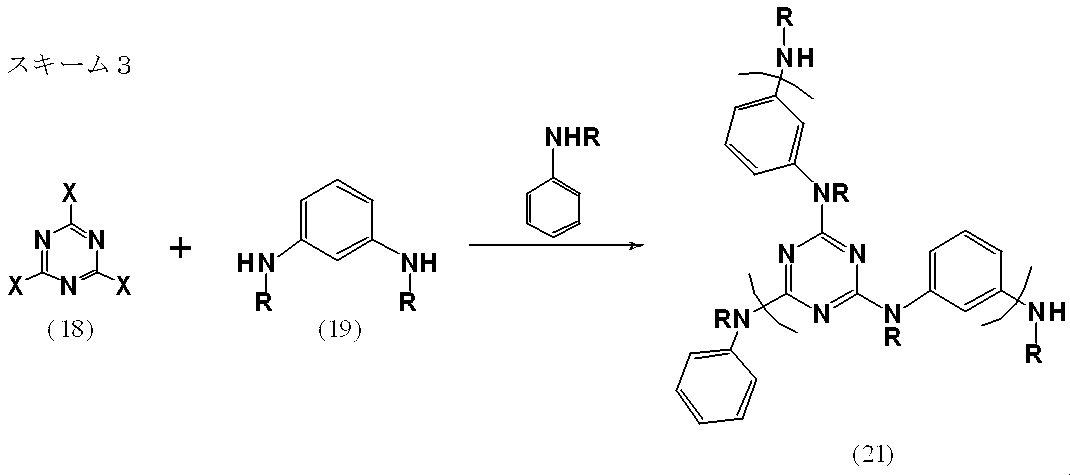
この手法によって得られた高分岐重合体は、溶剤への溶解性(凝集抑制)や、架橋剤との架橋性に優れたものとなるため、後述する架橋剤と組み合わせた組成物として用いる場合に特に有利である。
また、このような有機モノアミンの存在下で、ハロゲン化シアヌル化合物とジアミノアリール化合物とを反応させる反応は、前記と同様の有機溶剤を用いて行ってもよい。
本発明の膜形成用組成物に用いられる架橋剤としては、本発明の重合体と反応し得る置換基を有する化合物であれば特に限定されるものではない。
このような骨格を有する多官能(メタ)アクリル化合物としては、例えば、NKエステルA-9300、同A-9300-1CL(いずれも、新中村化学工業(株)製)が挙げられる。

このような低粘度架橋剤も市販品として入手可能であり、例えば、上述した多官能(メタ)アクリル化合物のうち、NKエステルA-GLY-3E(85mPa・s,25℃)、同A-GLY-9E(95mPa・s,25℃)、同A-GLY-20E(200mPa・s,25℃)、同A-TMPT-3EO(60mPa・s,25℃)、同A-TMPT-9EO、同ATM-4E(150mPa・s,25℃)、同ATM-35E(350mPa・s,25℃)(以上、新中村化学工業(株)製)等の、(メタ)アクリル基間の鎖長が比較的長い架橋剤が挙げられる。
また、光塩基発生剤は市販品を用いてもよく、その具体例としては、TPS-OH、NBC-101、ANC-101(いずれも製品名、みどり化学(株)製)等が挙げられる。
光ラジカル重合開始剤としても、公知のものから適宜選択して用いればよく、例えば、アセトフェノン類、ベンゾフェノン類、ミヒラーのベンゾイルベンゾエート、アミロキシムエステル、テトラメチルチウラムモノサルファイド及びチオキサントン類等が挙げられる。
特に、光開裂型の光ラジカル重合開始剤が好ましい。光開裂型の光ラジカル重合開始剤については、最新UV硬化技術(159頁、発行人:高薄一弘、発行所:(株)技術情報協会、1991年発行)に記載されている。
市販の光ラジカル重合開始剤としては、例えば、BASF社製 商品名:イルガキュア 184、369、651、500、819、907、784、2959、CGI1700、CGI1750、CGI1850、CG24-61、ダロキュア 1116、1173、BASF社製 商品名:ルシリン TPO、UCB社製 商品名:ユベクリル P36、フラテツリ・ランベルティ社製 商品名:エザキュアー KIP150、KIP65LT、KIP100F、KT37、KT55、KTO46、KIP75/B等が挙げられる。
光ラジカル重合開始剤を用いる場合、多官能(メタ)アクリレート化合物100質量部に対して、0.1~15質量部の範囲で使用することが好ましく、より好ましくは1~10質量部の範囲である。
本発明の膜形成用組成物は、更に、式(A)で表されるリニアポリマーを与え得る有機モノマーを含有する。

中でもR102としては、水素原子又はメチル基が好ましく、R103としては、トリアジン環含有重合体との水素結合形成能を確保するという点から、水素原子が好ましい。
これらのうち、好ましくは、炭素数1~5のアルキル基である。
本発明の膜形成用組成物には各種の溶剤を添加し、トリアジン環含有重合体を溶解させて使用することができる。この場合、溶剤は重合時に用いた溶媒と同じものでも別のものでもよい。この溶剤は、重合体との相溶性を損なわなければ特に限定されず、1種でも複数種でも任意に選択して用いることができる。
本発明の膜形成用組成物組成物は、溶剤を含まない無溶剤型とすることもできる。この場合、上述のとおり、式(A)で表されるリニアポリマーを与え得る有機モノマーが反応性希釈剤として機能する。
本発明の膜形成用組成物は、本発明の効果を損なわない限りにおいて、トリアジン環含有重合体、架橋剤、リニアポリマーを与え得る有機モノマー以外のその他の成分、例えば、レベリング剤、界面活性剤等を含んでもよい。
なお、前記その他の成分は、本発明の組成物を調製する際の任意の工程で添加することができる。
本発明の膜形成用組成物を用いて硬化膜を形成する場合、その下地層は特に限定されない。例えば、有機EL膜等の有機膜又は基材に本発明の組成物を塗布し、その後必要に応じて加熱して溶剤を蒸発させた後、加熱又は光照射して所望の硬化膜を形成することができる。
[1H-NMR]
装置:Varian NMR System 400NB(400MHz)
JEOL-ECA700(700MHz)
測定溶剤:DMSO-d6
基準物質:テトラメチルシラン(TMS)(δ0.0ppm)
[GPC]
装置:東ソー(株)製 HLC-8200 GPC
カラム:Shodex KF-804L+KF-805L
カラム温度:40℃
溶剤:テトラヒドロフラン(以下、THF)
検出器:UV(254nm)
検量線:標準ポリスチレン
[エリプソメーター]
装置:ジェー・エー・ウーラム・ジャパン製 多入射角分光エリプソメーターVASE
[示差熱天秤(TG-DTA)]
装置:(株)リガク製 TG-8120
昇温速度:10℃/分
測定温度:25℃-750℃

合成例1で得られたHB-TmDA40について、TG-DTA測定を行ったところ、5%重量減少は419℃であった。その結果を図2に示す。
(2)屈折率測定
合成例1で得られたHB-TmDA40 0.5gを、シクロヘキサノン4.5gに溶解し、薄黄色透明溶液を得た。得られたポリマーワニスをガラス基板上にスピンコーターを用いて200rpmで5秒間、2,000rpmで30秒間スピンコートし、150℃で1分、250℃で5分間加熱して溶剤を除去し、被膜を得た。得られた被膜の屈折率を測定したところ、550nmにおける屈折率は1.790であった。
合成例1で得られたHB-TmDA40 100gをシクロヘキサノン57.6g、プロピレングリコールモノメチルエーテル230.4g、イオン交換水12gの混合溶媒に溶解させ、25質量%の溶液を調製した(以下、HB-TmDA40V1という)。
合成例1で得られたHB-TmDA40 100gをシクロヘキサノン288.0g、イオン交換水12gの混合溶媒に溶解させ、25質量%の溶液を調製した(以下、HB-TmDA40V2という)。
合成例1で得られたHB-TmDA40の20質量%シクロヘキサノン/イオン交換水溶液(96/4=wt/wt)を予め用意し、その溶液5.0g、ATM-35E(新中村化学工業(株)製)0.03g、A-GLY-20E(新中村化学工業(株)製)0.1g、光ラジカル開始剤イルガキュア184(BASF社製)0.05g、メガファックF-554(DIC(株)製)0.0005g、及びシクロヘキサノン2.23gを加え、目視で溶解したことを確認して総固形分濃度15質量%のワニス(以下、HB-TmDA40VF15という)を調製した。
合成例1で得られたHB-TmDA40 100gをシクロヘキサノン384.0g、イオン交換水16gの混合溶媒に溶解させ、20質量%の溶液を調製した(以下、HB-TmDA40V3という)。
製造例1で調製したHB-TmDA40V1 4g、60質量%シクロヘキサノン溶液のエトキシ化グリセリントリアクリレート(A-GLY-20E、200mPa・s、新中村化学工業(株)製)0.17g、60質量%シクロヘキサノン溶液のエトキシ化ペンタエリスリトールテトラアクリレート(ATM-35E、350mPa・s、新中村化学工業(株)製)0.05g、60質量%シクロヘキサノン溶液のN-ビニルホルムアミド1.17g、20質量%シクロヘキサノン溶液の光ラジカル開始剤イルガキュア184(BASF社製)0.4g、1質量%シクロヘキサノン溶液の界面活性剤メガファックR-30-N(DIC(株)製)0.05g、及びシクロヘキサノン/PGME/イオン交換水(19/77/4=wt/wt/wt)0.14gを加え、目視で溶解したことを確認して総固形分濃度32質量%のワニス(以下、HB-TmDA40VF1という)を調製した。
実施例1で調製したHB-TmDA40VF1を用い、下記手法により埋め込み性試験を行った。埋め込み性試験に用いた構造物基板は材質がシリコンであり、深さが1.6μm、Via径が400nmである。
HB-TmDA40VF1を構造物基板に5μm狙いでスピンコート法にて製膜し、ホットプレートを用いて130℃で5分間の焼成を行った。その後、低圧水銀ランプにより、積算露光量400mJ/cm2で硬化させ硬化膜を得た。
製膜された構造物基板は、ダイアモンドペンを用いて基板の端に傷をつけた後、基板をヘキ開し、SEM観察を行った。観察した画像を図3に示す。
図3に示されるように、HB-TmDA40VF1はViaのボトムにまで材料が到達しており、上部の膜厚が3μmほどあることから、平坦性を保持できる埋め込み材料として使用できる可能性が示唆された。
実施例1で調製したHB-TmDA40VF1を用い、深さが3.0μm、Via径が15μmのシリコン製構造基板を用いた以外は、実施例2と同様にして埋め込み性試験を行った。
製膜された構造物基板は、ダイアモンドペンを用いて基板の端に傷をつけた後、基板をヘキ開し、SEM観察を行った。観察した画像を図4に示す。
実施例1で調製したHB-TmDA40VF1を用い、下記手法により埋め込み性試験を行った。埋め込み性試験に用いた構造物基板は材質がシリコンであり、深さが3.0μm、Via径が15μmである。
HB-TmDA40VF1を構造物基板に5μm狙いでスピンコート法にて製膜し、ホットプレートを用いて130℃で5分間の焼成を行った。さらにその上から、平坦性を得る目的で、製造例3で調製したHB-TmDA40VF15を1μm狙いでスピンコート法にて製膜し、ホットプレートを用いて130℃で3分間の焼成を行った。
その後、低圧水銀ランプにより、積算露光量400mJ/cm2で硬化させ硬化膜を得た。
製膜された構造物基板は、ダイアモンドペンを用いて基板の端に傷をつけた後、基板をヘキ開し、SEM観察を行った。観察した画像を図5に示す。
実施例1で調製したHB-TmDA40VF1を用い、下記手法により埋め込み性試験を行った。埋め込み性試験に用いた構造物基板は材質がシリコンであり、深さが3.0μm、Via径が15μmである。
HB-TmDA40VF1を構造物基板に5μm狙いでスピンコート法にて製膜し、ホットプレートを用いて130℃で5分間の焼成を行った。得られた乾燥膜上に、同ワニスを同条件にて製膜し、さらにその上から、平坦性を得る目的で、製造例3で調製したHB-TmDA40VF15を1μm狙いでスピンコート法にて製膜し、ホットプレートを用いて130℃で3分間の焼成を行った。
その後、低圧水銀ランプにより、積算露光量400mJ/cm2で硬化させ硬化膜を得た。
製膜された構造物基板は、ダイアモンドペンを用いて基板の端に傷をつけた後、基板をヘキ開し、SEM観察を行った。観察した画像を図6に示す。
製造例2で調製したHB-TmDA40V2 10g、エトキシ化グリセリントリアクリレート(A-GLY-20E、200mPa・s、新中村化学工業(株)製)0.20g、エトキシ化ペンタエリスリトールテトラアクリレート(ATM-35E、350mPa・s、新中村化学工業(株)製)0.06g、光ラジカル開始剤イルガキュア184(BASF社製)0.10g、1質量%シクロヘキサノン溶液の界面活性剤メガファックF‐554(DIC(株)製)0.10g、及び濃度調整のためのシクロヘキサノン/イオン交換水(96/4=wt/wt)0.27gを加え、目視で溶解したことを確認して総固形分濃度22質量%のワニス(以下、HB-TmDA40VF2という)を調製した。
比較例1で調製したHB-TmDA40VF2を用い、実施例3と同様にして埋め込み性試験を行った。
製膜された構造物基板は、ダイアモンドペンを用いて基板の端に傷をつけた後、基板をヘキ開し、SEM観察を行った。観察した画像を図7に示す。
製造例4で調製したHB-TmDA40V3 5.0g、エトキシ化グリセリントリアクリレート(A-GLY-20E、200mPa・s、新中村化学工業(株)製)0.1g、エトキシ化ペンタエリスリトールテトラアクリレート(ATM-35E、350mPa・s、新中村化学工業(株)製)0.03g、光ラジカル開始剤イルガキュア184(BASF社製)0.05g、5質量%シクロヘキサノン溶液の界面活性剤メガファックF-554(DIC(株)製)0.01g、N-ビニルホルムアミド(東京化成工業(株)製)0.25g、及び濃度調整のためのシクロヘキサノン/イオン交換水(96/4=wt/wt)2.43gを加え、目視で溶解したことを確認して総固形分濃度15質量%(NVFを固形分に加えると総固形分濃度18質量%)のワニス(以下、HB-TmDA40VF3という)を調製した。
N-ビニルホルムアミド(東京化成工業(株)製)を0.50g、濃度調整のためのシクロヘキサノン/イオン交換水(96/4=wt/wt)を2.18gとした以外は、実施例6と同様にして総固形分濃度15質量%(NVFを固形分に加えると総固形分濃度21質量%)のワニス(以下、HB-TmDA40VF4という)を調製した。
続いて、得られたHB-TmDA40VF4を用いた以外は、実施例6と同様にして硬化膜を作製し、屈折率を測定したところ、550nmにおける屈折率は1.7649であった。
N-ビニルホルムアミド(東京化成工業(株)製)を0.75g、濃度調整のためのシクロヘキサノン/イオン交換水(96/4=wt/wt)を1.93gとした以外は、実施例6と同様にして総固形分濃度15質量%(NVFを固形分に加えると総固形分濃度25質量%)のワニス(以下、HB-TmDA40VF5という)を調製した。
続いて、得られたHB-TmDA40VF5を用いた以外は、実施例6と同様にして硬化膜を作製し、屈折率を測定したところ、550nmにおける屈折率は1.7463であった。
N-ビニルホルムアミド(東京化成工業(株)製)を1.00g、濃度調整のためのシクロヘキサノン/イオン交換水(96/4=wt/wt)を1.68gとした以外は、実施例6と同様にして総固形分濃度15質量%(NVFを固形分に加えると総固形分濃度28質量%)のワニス(以下、HB-TmDA40VF6という)を調製した。
続いて、得られたHB-TmDA40VF6を用いた以外は、実施例6と同様にして硬化膜を作製し、屈折率を測定したところ、550nmにおける屈折率は1.7452であった。
N-ビニルホルムアミド(東京化成工業(株)製)を1.50g、濃度調整のためのシクロヘキサノン/イオン交換水(96/4=wt/wt)を1.18gとした以外は、実施例6と同様にして総固形分濃度15質量%(NVFを固形分に加えると総固形分濃度34質量%)のワニス(以下、HB-TmDA40VF7という)を調製した。
続いて、得られたHB-TmDA40VF7を用いた以外は、実施例6と同様にして硬化膜を作製し、屈折率を測定したところ、550nmにおける屈折率は1.7441であった。
合成例1で得られたHB-TmDA40 100gをN-ビニルホルムアミド300.0gに溶解させ、25質量%の溶液を調製した。
製造例5で調製した溶液3.0g、ペンタエリスリトールトリアリルエーテル(ダイソー(株)製、ネオアリルP-30M)0.3g、BYK-307(ビックケミー・ジャパン(株)製)の5質量%N-ビニルホルムアミド溶液0.075g、CXC-1802(KING INDUSTRY社製)0.0375g及びN-ビニルホルムアミド0.839gを加え、目視で溶解したことを確認して総固形分100質量%のワニス(以下、HB-TmDA40VF8という)を調製した。
製造例5で調製した溶液3.0g、ペンタエリスリトールトリアリルエーテル(ダイソー(株)製、ネオアリルP-30M)0.375g、BYK-307(ビックケミー・ジャパン(株)製)の5質量%N-ビニルホルムアミド溶液0.075g、CXC-1802(KING INDUSTRY社製)0.0375g及びN-ビニルホルムアミド0.763gを加え、目視で溶解したことを確認して総固形分100質量%のワニス(以下、HB-TmDA40VF9という)を調製した。
製造例5で調製した溶液3.0g、ペンタエリスリトールトリアリルエーテル(ダイソー(株)製、ネオアリルP-30M)0.45g、BYK-307(ビックケミー・ジャパン(株)製)の5質量%N-ビニルホルムアミド溶液0.075g、CXC-1802(KING INDUSTRY社製)0.0375g及びN-ビニルホルムアミド0.687gを加え、目視で溶解したことを確認して総固形分100質量%のワニス(以下、HB-TmDA40VF10という)を調製した。
実施例11で調製したHB-TmDA40VF8をソーダライムガラス基板上にスピンコーターを用いて200rpmで5秒間、2,000rpmで30秒間スピンコートし、ホットプレートを用いて100℃で10分間の焼成を行った。得られた被膜の屈折率を測定したところ、550nmにおける屈折率は1.699であった。
実施例12で調製したHB-TmDA40VF9を用いた以外は、実施例5と同様にして硬化膜を得た。得られた被膜の屈折率を測定したところ、550nmにおける屈折率は1.702であった。
実施例13で調製したHB-TmDA40VF10を用いた以外は、実施例5と同様にして硬化膜を得た。得られた被膜の屈折率を測定したところ、550nmにおける屈折率は1.719であった。
Claims (16)
- 下記式(1)で表される繰り返し単位構造を含むトリアジン環含有重合体、架橋剤及びリニアポリマーを与え得る有機モノマーを含み、
前記有機モノマーが、式(A)で示される化合物であることを特徴とする膜形成用組成物。


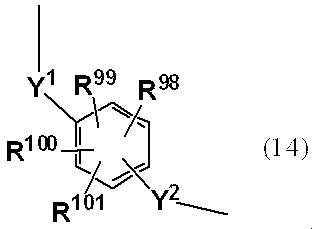

- 前記式(A)におけるR102及びR103がともに水素原子であり、R104が重合性炭素-炭素二重結合含有基である請求項1記載の膜形成用組成物。
- 前記有機モノマーが、N-ビニルホルムアミドである請求項1又は2記載の膜形成用組成物。
- 更に溶剤を含む請求項1、2又は3記載の膜形成用組成物。
- 溶剤を含まない請求項1、2又は3記載の膜形成用組成物。
- 前記架橋剤が、多官能エポキシ化合物及び/又は多官能(メタ)アクリル化合物である請求項1~4のいずれか1項記載の膜形成用組成物。
- 前記架橋剤が、多官能(メタ)アクリル化合物である請求項6記載の膜形成用組成物。
- 前記多官能(メタ)アクリル化合物が、25℃で液体であり、かつ、その粘度が5,000mPa・s以下の化合物である請求項6又は7記載の膜形成用組成物。
- 前記架橋剤が、多官能エポキシ化合物、多官能ビニルエーテル化合物又は多官能アリルエーテル化合物である請求項1、2、3又は5記載の膜形成用組成物。
- 前記架橋剤が、多官能アリルエーテル化合物である請求項9記載の膜形成用組成物。
- 請求項1~4及び6~8のいずれか1項記載の膜形成用組成物からなる埋め込み材料。
- 請求項11記載の埋め込み材料から得られる埋め込み膜。
- 請求項12記載の埋め込み膜を備える電子デバイス。
- 請求項1~10のいずれか1項記載の膜形成用組成物を硬化させて得られる硬化膜。
- 請求項14記載の硬化膜を備える電子デバイス。
- 請求項1~3、5、9及び10のいずれか1項記載の膜形成用組成物を硬化させて得られる硬化膜を備えるトップエミッション型有機エレクトロルミネッセンス素子。
Priority Applications (2)
| Application Number | Priority Date | Filing Date | Title |
|---|---|---|---|
| JP2014514758A JP6094579B2 (ja) | 2012-05-11 | 2013-05-10 | 膜形成用組成物及び埋め込み材料 |
| US14/400,258 US9434856B2 (en) | 2012-05-11 | 2013-05-10 | Film-forming composition and embedding material |
Applications Claiming Priority (4)
| Application Number | Priority Date | Filing Date | Title |
|---|---|---|---|
| JP2012109138 | 2012-05-11 | ||
| JP2012-109138 | 2012-05-11 | ||
| JP2013003176 | 2013-01-11 | ||
| JP2013-003176 | 2013-01-11 |
Publications (1)
| Publication Number | Publication Date |
|---|---|
| WO2013168787A1 true WO2013168787A1 (ja) | 2013-11-14 |
Family
ID=49550819
Family Applications (1)
| Application Number | Title | Priority Date | Filing Date |
|---|---|---|---|
| PCT/JP2013/063147 Ceased WO2013168787A1 (ja) | 2012-05-11 | 2013-05-10 | 膜形成用組成物及び埋め込み材料 |
Country Status (3)
| Country | Link |
|---|---|
| US (1) | US9434856B2 (ja) |
| JP (1) | JP6094579B2 (ja) |
| WO (1) | WO2013168787A1 (ja) |
Cited By (8)
| Publication number | Priority date | Publication date | Assignee | Title |
|---|---|---|---|---|
| WO2015093508A1 (ja) * | 2013-12-17 | 2015-06-25 | 日産化学工業株式会社 | 膜形成用組成物 |
| WO2015093510A1 (ja) * | 2013-12-17 | 2015-06-25 | 日産化学工業株式会社 | 透明導電膜用保護膜形成組成物 |
| WO2016194926A1 (ja) * | 2015-06-03 | 2016-12-08 | 日産化学工業株式会社 | トリアジン環含有重合体およびそれを含む膜形成用組成物 |
| WO2016194920A1 (ja) * | 2015-06-02 | 2016-12-08 | 日産化学工業株式会社 | 無溶剤型光硬化性接着剤用組成物 |
| WO2016199630A1 (ja) * | 2015-06-09 | 2016-12-15 | 日産化学工業株式会社 | インクジェット塗布用膜形成用組成物 |
| WO2017077932A1 (ja) * | 2015-11-04 | 2017-05-11 | 日産化学工業株式会社 | マイクロレンズ用光硬化性樹脂組成物 |
| JPWO2016002026A1 (ja) * | 2014-07-02 | 2017-05-25 | 日立化成株式会社 | 転写形感光性屈折率調整フィルム |
| JPWO2022225017A1 (ja) * | 2021-04-23 | 2022-10-27 |
Families Citing this family (3)
| Publication number | Priority date | Publication date | Assignee | Title |
|---|---|---|---|---|
| US9637596B2 (en) | 2015-03-10 | 2017-05-02 | International Business Machines Corporation | Polyhemiaminal and polyhexahydrotriazine materials from 1,4 conjugate addition reactions |
| CN107709388B (zh) * | 2015-06-26 | 2020-07-07 | 日产化学工业株式会社 | 光固化性树脂组合物 |
| WO2019010001A1 (en) * | 2017-07-06 | 2019-01-10 | Ares Materials Inc. | METHOD FOR FORMING FLEXIBLE RECOVERY LENS FILMS |
Citations (5)
| Publication number | Priority date | Publication date | Assignee | Title |
|---|---|---|---|---|
| JP2001503077A (ja) * | 1996-09-16 | 2001-03-06 | バイエル・アクチエンゲゼルシヤフト | トリアジン重合体そして電界発光装置におけるそれの使用 |
| JP2004156001A (ja) * | 2002-11-07 | 2004-06-03 | Sanei Kagaku Kk | フェノール性水酸基を含有するトリアジンジハライド及び芳香族(ポリ)グアナミン、並びにその組成物 |
| WO2010128661A1 (ja) * | 2009-05-07 | 2010-11-11 | 日産化学工業株式会社 | トリアジン環含有重合体およびそれを含む膜形成用組成物 |
| WO2012029617A1 (ja) * | 2010-08-30 | 2012-03-08 | 国立大学法人岩手大学 | トリアジン環含有重合体 |
| WO2012060286A1 (ja) * | 2010-11-02 | 2012-05-10 | 日産化学工業株式会社 | 膜形成用組成物 |
Family Cites Families (6)
| Publication number | Priority date | Publication date | Assignee | Title |
|---|---|---|---|---|
| US5886130A (en) | 1995-11-02 | 1999-03-23 | Maxdem Incorporated | Polyphenylene co-polymers |
| JP2000053659A (ja) | 1998-08-10 | 2000-02-22 | Asahi Chem Ind Co Ltd | トリアジン系重合物質 |
| US20040096757A1 (en) * | 2001-03-27 | 2004-05-20 | Hiroyuki Tokuda | Photosensitive resin compositon, photosesitive resist for color filter, and process for producing color filter |
| JP4973093B2 (ja) | 2005-10-03 | 2012-07-11 | 東レ株式会社 | シロキサン系樹脂組成物、光学物品およびシロキサン系樹脂組成物の製造方法 |
| JP5586820B2 (ja) | 2006-07-21 | 2014-09-10 | 東京応化工業株式会社 | 高屈折率材料 |
| EP2431423A3 (en) * | 2010-09-21 | 2013-07-10 | Rohm and Haas Company | Anti-reflective coatings |
-
2013
- 2013-05-10 JP JP2014514758A patent/JP6094579B2/ja active Active
- 2013-05-10 WO PCT/JP2013/063147 patent/WO2013168787A1/ja not_active Ceased
- 2013-05-10 US US14/400,258 patent/US9434856B2/en active Active
Patent Citations (5)
| Publication number | Priority date | Publication date | Assignee | Title |
|---|---|---|---|---|
| JP2001503077A (ja) * | 1996-09-16 | 2001-03-06 | バイエル・アクチエンゲゼルシヤフト | トリアジン重合体そして電界発光装置におけるそれの使用 |
| JP2004156001A (ja) * | 2002-11-07 | 2004-06-03 | Sanei Kagaku Kk | フェノール性水酸基を含有するトリアジンジハライド及び芳香族(ポリ)グアナミン、並びにその組成物 |
| WO2010128661A1 (ja) * | 2009-05-07 | 2010-11-11 | 日産化学工業株式会社 | トリアジン環含有重合体およびそれを含む膜形成用組成物 |
| WO2012029617A1 (ja) * | 2010-08-30 | 2012-03-08 | 国立大学法人岩手大学 | トリアジン環含有重合体 |
| WO2012060286A1 (ja) * | 2010-11-02 | 2012-05-10 | 日産化学工業株式会社 | 膜形成用組成物 |
Cited By (29)
| Publication number | Priority date | Publication date | Assignee | Title |
|---|---|---|---|---|
| WO2015093510A1 (ja) * | 2013-12-17 | 2015-06-25 | 日産化学工業株式会社 | 透明導電膜用保護膜形成組成物 |
| CN105980496A (zh) * | 2013-12-17 | 2016-09-28 | 日产化学工业株式会社 | 膜形成用组合物 |
| CN105980497A (zh) * | 2013-12-17 | 2016-09-28 | 日产化学工业株式会社 | 透明导电膜用保护膜形成组合物 |
| US20160312062A1 (en) * | 2013-12-17 | 2016-10-27 | Nissan Chemical Industries, Ltd. | Composition for film formation |
| US20160319132A1 (en) * | 2013-12-17 | 2016-11-03 | Nissan Chemical Industries, Ltd. | Composition for forming protective film for transparent conductive film |
| TWI676653B (zh) * | 2013-12-17 | 2019-11-11 | 日商日產化學工業股份有限公司 | 形成透明導電膜用保護膜之組成物 |
| WO2015093508A1 (ja) * | 2013-12-17 | 2015-06-25 | 日産化学工業株式会社 | 膜形成用組成物 |
| US10266701B2 (en) | 2013-12-17 | 2019-04-23 | Nissan Chemical Industries, Ltd. | Composition for forming protective film for transparent conductive film |
| JPWO2015093508A1 (ja) * | 2013-12-17 | 2017-03-23 | 日産化学工業株式会社 | 膜形成用組成物 |
| JPWO2015093510A1 (ja) * | 2013-12-17 | 2017-03-23 | 日産化学工業株式会社 | 透明導電膜用保護膜形成組成物 |
| US10106701B2 (en) | 2013-12-17 | 2018-10-23 | Nissan Chemical Industries, Ltd. | Composition for film formation |
| JPWO2016002026A1 (ja) * | 2014-07-02 | 2017-05-25 | 日立化成株式会社 | 転写形感光性屈折率調整フィルム |
| WO2016194920A1 (ja) * | 2015-06-02 | 2016-12-08 | 日産化学工業株式会社 | 無溶剤型光硬化性接着剤用組成物 |
| KR20180022702A (ko) | 2015-06-02 | 2018-03-06 | 닛산 가가쿠 고교 가부시키 가이샤 | 무용제형 광경화성 접착제용 조성물 |
| KR102511230B1 (ko) * | 2015-06-02 | 2023-03-17 | 닛산 가가쿠 가부시키가이샤 | 무용제형 광경화성 접착제용 조성물 |
| CN107849425A (zh) * | 2015-06-02 | 2018-03-27 | 日产化学工业株式会社 | 无溶剂型光固化性粘接剂用组合物 |
| JPWO2016194920A1 (ja) * | 2015-06-02 | 2018-04-05 | 日産化学工業株式会社 | 無溶剤型光硬化性接着剤用組成物 |
| CN107849425B (zh) * | 2015-06-02 | 2021-09-21 | 日产化学工业株式会社 | 无溶剂型光固化性粘接剂用组合物 |
| US10604681B2 (en) | 2015-06-02 | 2020-03-31 | Nissan Chemical Industries, Ltd. | Solvent-free light-curable adhesive composition |
| WO2016194926A1 (ja) * | 2015-06-03 | 2016-12-08 | 日産化学工業株式会社 | トリアジン環含有重合体およびそれを含む膜形成用組成物 |
| US10829593B2 (en) | 2015-06-03 | 2020-11-10 | Nissan Chemical Industries, Ltd. | Triazine ring-containing polymer, and composition for film formation use containing same |
| JPWO2016194926A1 (ja) * | 2015-06-03 | 2018-03-22 | 日産化学工業株式会社 | トリアジン環含有重合体およびそれを含む膜形成用組成物 |
| WO2016199630A1 (ja) * | 2015-06-09 | 2016-12-15 | 日産化学工業株式会社 | インクジェット塗布用膜形成用組成物 |
| US10619073B2 (en) | 2015-06-09 | 2020-04-14 | Nissan Chemical Industries, Ltd. | Film-forming composition for ink-jet coating |
| JPWO2016199630A1 (ja) * | 2015-06-09 | 2018-05-31 | 日産化学工業株式会社 | インクジェット塗布用膜形成用組成物 |
| WO2017077932A1 (ja) * | 2015-11-04 | 2017-05-11 | 日産化学工業株式会社 | マイクロレンズ用光硬化性樹脂組成物 |
| JPWO2017077932A1 (ja) * | 2015-11-04 | 2018-08-30 | 日産化学株式会社 | マイクロレンズ用光硬化性樹脂組成物 |
| JPWO2022225017A1 (ja) * | 2021-04-23 | 2022-10-27 | ||
| WO2022225017A1 (ja) * | 2021-04-23 | 2022-10-27 | 日産化学株式会社 | 無溶剤型組成物 |
Also Published As
| Publication number | Publication date |
|---|---|
| JP6094579B2 (ja) | 2017-03-15 |
| US20150094420A1 (en) | 2015-04-02 |
| US9434856B2 (en) | 2016-09-06 |
| JPWO2013168787A1 (ja) | 2016-01-07 |
Similar Documents
| Publication | Publication Date | Title |
|---|---|---|
| JP6061012B2 (ja) | 光硬化型膜形成用組成物および硬化膜の製造方法 | |
| JP6094579B2 (ja) | 膜形成用組成物及び埋め込み材料 | |
| JP6515811B2 (ja) | トリアジン系重合体含有組成物 | |
| JP6292221B2 (ja) | 膜形成用組成物 | |
| JP6672793B2 (ja) | 膜形成用組成物 | |
| JP6468198B2 (ja) | トリアジン環含有重合体およびそれを含む組成物 | |
| JP6191603B2 (ja) | 芳香族ポリアミドおよびそれを含む膜形成用組成物 | |
| JP6645188B2 (ja) | 透明導電膜用保護膜形成組成物 | |
| CN114599704A (zh) | 含三嗪环的聚合物及含有该聚合物的膜形成用组合物 | |
| US11795270B2 (en) | Triazine ring-containing polymer and film forming composition containing same | |
| JP7845355B2 (ja) | トリアジン環含有重合体、及びそれを含む膜形成用組成物 | |
| CN107849392B (zh) | 喷墨涂布用膜形成用组合物 | |
| JP7605132B2 (ja) | パターン形成用組成物 | |
| WO2022225005A1 (ja) | 無溶剤型組成物 | |
| WO2022225002A1 (ja) | トリアジン環含有重合体、及びそれを含む膜形成用組成物 | |
| WO2022225001A1 (ja) | トリアジン環含有重合体、及びパターン形成用組成物 |
Legal Events
| Date | Code | Title | Description |
|---|---|---|---|
| 121 | Ep: the epo has been informed by wipo that ep was designated in this application |
Ref document number: 13787289 Country of ref document: EP Kind code of ref document: A1 |
|
| ENP | Entry into the national phase |
Ref document number: 2014514758 Country of ref document: JP Kind code of ref document: A |
|
| WWE | Wipo information: entry into national phase |
Ref document number: 14400258 Country of ref document: US |
|
| NENP | Non-entry into the national phase |
Ref country code: DE |
|
| 122 | Ep: pct application non-entry in european phase |
Ref document number: 13787289 Country of ref document: EP Kind code of ref document: A1 |