WO2013154016A1 - 眼科組成物 - Google Patents
眼科組成物 Download PDFInfo
- Publication number
- WO2013154016A1 WO2013154016A1 PCT/JP2013/060288 JP2013060288W WO2013154016A1 WO 2013154016 A1 WO2013154016 A1 WO 2013154016A1 JP 2013060288 W JP2013060288 W JP 2013060288W WO 2013154016 A1 WO2013154016 A1 WO 2013154016A1
- Authority
- WO
- WIPO (PCT)
- Prior art keywords
- ophthalmic composition
- acanthamoeba
- contact lens
- acid
- present
- Prior art date
- Legal status (The legal status is an assumption and is not a legal conclusion. Google has not performed a legal analysis and makes no representation as to the accuracy of the status listed.)
- Ceased
Links
Images


Classifications
-
- A—HUMAN NECESSITIES
- A61—MEDICAL OR VETERINARY SCIENCE; HYGIENE
- A61K—PREPARATIONS FOR MEDICAL, DENTAL OR TOILETRY PURPOSES
- A61K31/00—Medicinal preparations containing organic active ingredients
- A61K31/13—Amines
- A61K31/155—Amidines (), e.g. guanidine (H2N—C(=NH)—NH2), isourea (N=C(OH)—NH2), isothiourea (—N=C(SH)—NH2)
-
- A—HUMAN NECESSITIES
- A61—MEDICAL OR VETERINARY SCIENCE; HYGIENE
- A61K—PREPARATIONS FOR MEDICAL, DENTAL OR TOILETRY PURPOSES
- A61K31/00—Medicinal preparations containing organic active ingredients
- A61K31/74—Synthetic polymeric materials
- A61K31/785—Polymers containing nitrogen
-
- A—HUMAN NECESSITIES
- A61—MEDICAL OR VETERINARY SCIENCE; HYGIENE
- A61K—PREPARATIONS FOR MEDICAL, DENTAL OR TOILETRY PURPOSES
- A61K33/00—Medicinal preparations containing inorganic active ingredients
- A61K33/22—Boron compounds
-
- A—HUMAN NECESSITIES
- A61—MEDICAL OR VETERINARY SCIENCE; HYGIENE
- A61K—PREPARATIONS FOR MEDICAL, DENTAL OR TOILETRY PURPOSES
- A61K33/00—Medicinal preparations containing inorganic active ingredients
- A61K33/24—Heavy metals; Compounds thereof
- A61K33/30—Zinc; Compounds thereof
-
- A—HUMAN NECESSITIES
- A61—MEDICAL OR VETERINARY SCIENCE; HYGIENE
- A61L—METHODS OR APPARATUS FOR STERILISING MATERIALS OR OBJECTS IN GENERAL; DISINFECTION, STERILISATION OR DEODORISATION OF AIR; CHEMICAL ASPECTS OF BANDAGES, DRESSINGS, ABSORBENT PADS OR SURGICAL ARTICLES; MATERIALS FOR BANDAGES, DRESSINGS, ABSORBENT PADS OR SURGICAL ARTICLES
- A61L12/00—Methods or apparatus for disinfecting or sterilising contact lenses; Accessories therefor
- A61L12/08—Methods or apparatus for disinfecting or sterilising contact lenses; Accessories therefor using chemical substances
- A61L12/14—Organic compounds not covered by groups A61L12/10 or A61L12/12
- A61L12/141—Biguanides, e.g. chlorhexidine
- A61L12/142—Polymeric biguanides
-
- A—HUMAN NECESSITIES
- A61—MEDICAL OR VETERINARY SCIENCE; HYGIENE
- A61P—SPECIFIC THERAPEUTIC ACTIVITY OF CHEMICAL COMPOUNDS OR MEDICINAL PREPARATIONS
- A61P27/00—Drugs for disorders of the senses
- A61P27/02—Ophthalmic agents
-
- A—HUMAN NECESSITIES
- A61—MEDICAL OR VETERINARY SCIENCE; HYGIENE
- A61P—SPECIFIC THERAPEUTIC ACTIVITY OF CHEMICAL COMPOUNDS OR MEDICINAL PREPARATIONS
- A61P31/00—Antiinfectives, i.e. antibiotics, antiseptics, chemotherapeutics
- A61P31/04—Antibacterial agents
-
- A—HUMAN NECESSITIES
- A61—MEDICAL OR VETERINARY SCIENCE; HYGIENE
- A61P—SPECIFIC THERAPEUTIC ACTIVITY OF CHEMICAL COMPOUNDS OR MEDICINAL PREPARATIONS
- A61P33/00—Antiparasitic agents
- A61P33/02—Antiprotozoals, e.g. for leishmaniasis, trichomoniasis, toxoplasmosis
- A61P33/04—Amoebicides
-
- A—HUMAN NECESSITIES
- A61—MEDICAL OR VETERINARY SCIENCE; HYGIENE
- A61P—SPECIFIC THERAPEUTIC ACTIVITY OF CHEMICAL COMPOUNDS OR MEDICINAL PREPARATIONS
- A61P43/00—Drugs for specific purposes, not provided for in groups A61P1/00-A61P41/00
Definitions
- the present invention relates to an ophthalmic composition capable of exerting a high disinfecting effect against Acanthamoeba .
- the present invention also relates to an ophthalmic composition that is highly safe in terms of improving the corneal barrier function and preventing the invasion of pathogens such as Acanthamoeba.
- the present invention relates to an ophthalmic composition that can be safely used for contact lenses because it does not easily change the size of the lenses even if the contact lenses are immersed for a long time.
- the present invention also relates to an anti-acanthamoeba agent, a method for disinfecting acanthamoeba, a method for improving a corneal barrier function, a method for suppressing a change in the size of a contact lens due to boric acid and / or a salt thereof, and the like.
- Acanthamoeba corneal infection is a corneal infection caused by Acanthamoeba (eg Acanthamoeba castellanii , Acanthamoeba polyphaga, etc.) infecting the cornea, and is an intractable corneal disease that leaves strong opacity in the cornea.
- Acanthamoeba is a kind of protists that are widely present in soil and fresh water, and cannot easily adhere to healthy cornea. However, if the cornea is lost due to the use of contact lenses, it is thought that it adheres to it and infects it. ing. In fact, many of the patients with Acanthamoeba corneal infection are experienced in wearing contact lenses, and the use of contact lenses with Acanthamoeba is said to be the main cause of infection.
- Patent Document 1 discloses a liquid composition for contact lenses containing a predetermined amount of a proteolytic enzyme, an anionic surfactant, a non-reducing polyhydric alcohol, a boric acid buffer, and a water-soluble polymer compound. It has been reported that it has a disinfecting effect on amoeba.
- Patent Document 2 also reports that polylysine is effective for disinfecting Acanthamoeba against contact lenses other than highly hydrous / ionic hydrous soft contact lenses (Group IV lenses).
- Patent Document 3 describes that cationic preservatives such as polyhexamethylene biguanide (also called “PHMB”) are used to suppress Acanthamoeba infection, although with limited effects. ing. PHMB is used as a disinfectant for pools in the United States, and is considered to be relatively safe for the eyes. In recent years, polyhexamethylene biguanide, in combination with a specific contact lens, It has also been pointed out that it may cause corneal epithelial disorder called staining.
- PHMB polyhexamethylene biguanide
- Patent Document 4 a method of inhibiting the growth of Acanthamoeba using a polyvalent cation chelator that chelates a polyvalent cation (such as zinc) that functions as a cofactor for enzymes required for metabolism in protozoa is also known.
- the main object of the present invention is to provide a useful ophthalmic composition having a pronounced Acanthamoeba disinfection effect.
- an ophthalmic composition containing a combination of a biguanide fungicide and zinc chloride can provide a remarkably high Acanthamoeba disinfection effect. It was. Further, the present inventors have further studied, and by using a biguanide fungicide and zinc chloride in combination, the corneal barrier function can be effectively improved and the invasion of acanthamoeba can be prevented. It has also been found that a very safe ophthalmic composition can be obtained even if applied as it is.
- the lens tends to swell.
- the ophthalmic composition containing a predetermined concentration of boric acid and / or a salt thereof is combined with a biguanide fungicide and zinc chloride, so that the contact lens can be used for a long time. It has also been found that contact lenses can be used safely by suppressing size changes caused by immersion in an ophthalmic composition containing a salt thereof. The present invention has been completed by making further improvements based on such findings.
- this invention provides the ophthalmic composition of the aspect hung up below.
- Item 1-1 An ophthalmic composition comprising (A) a biguanide fungicide and (B) zinc chloride.
- Item 1-2. (A) The biguanide fungicide is a compound having at least one biguanide group represented by the formula: —NH—C ( ⁇ NH) —NH—C ( ⁇ NH) —NH—.
- the ophthalmic composition according to Item 1-1 or 1-2 which contains at least one selected from the group consisting of hexamethylene biguanide, a polymer thereof, chlorhexidine, alexidine, and salts thereof as a biguanide fungicide. object.
- Item 1-5 The ophthalmic composition according to any one of claims 1-1 to 1-4, wherein the component (B) is contained in a total content of 0.0001 to 0.05 w / v%.
- Item 1-6 The ophthalmic composition according to Item 1-1 or 1-2, which contains at least one selected from the group consisting of hexamethylene biguanide, a polymer thereof, chlorhexidine, alexidine, and salts thereof as a biguanide fungicide. object.
- the total content of component (B) is 10 to 50000 parts by weight with respect to 100 parts by weight of the total content of component (A), according to any one of claims 1-1 to 1-5.
- Ophthalmic composition. Item 1-7.
- Item 1-13 The ophthalmic composition according to any one of claims 1-1 to 1-12, which is an ophthalmic composition for contact lenses.
- Item 1-14 The ophthalmic composition according to Item 1-13, wherein the contact lens is a soft contact lens.
- Item 1-15 The ophthalmic composition according to Item 1-13 or 1-14, wherein the contact lens is a soft contact lens of group IV, or a silicone hydrogel contact lens.
- Item 1-16. The ophthalmic composition according to any one of claims 1-13 to 1-15, wherein the ophthalmic composition for contact lens is a contact lens care agent.
- Item 1-17 The ophthalmic composition according to any one of claims 1-13 to 1-16, wherein the ophthalmic composition for contact lens is a contact lens disinfecting / cleaning / preserving solution.
- this invention provides the anti-acanthamoeba agent of the aspect hung up below.
- Item 2 An anti-acanthamoeba agent comprising (A) a biguanide fungicide and (B) zinc chloride.
- the present invention also provides a method for disinfecting Acanthamoeba, a method for enhancing the disinfecting action of Acanthamoeba, and a method for imparting the disinfecting action of Acanthamoeba to an ophthalmic composition according to the following aspects.
- Item 3. A method for disinfecting Acanthamoeba, comprising disinfecting Acanthamoeba using an ophthalmic composition containing (A) a biguanide fungicide and (B) zinc chloride.
- Item 4. (A) A method for enhancing the disinfecting action of Acanthamoeba in an ophthalmic composition, wherein (B) zinc chloride is blended in an ophthalmic composition containing a biguanide fungicide.
- Item 5. A method of imparting an antiseptic action of Acanthamoeba to the ophthalmic composition, which comprises blending (A) a biguanide fungicide and (B) zinc chloride in the ophthalmic composition.
- the present invention provides a method for preparing an ophthalmic composition having an improved corneal barrier function according to the following embodiments, and a method for imparting an action to improve the corneal barrier function to the ophthalmic composition.
- Item 6. A method for preparing an ophthalmic composition having an improved corneal barrier function, which comprises blending (A) a biguanide fungicide and (B) zinc chloride in an ophthalmic composition.
- Item 7. (A) A method of imparting an action to improve the corneal barrier function to an ophthalmic composition, which comprises blending zinc chloride in an ophthalmic composition containing a biguanide fungicide.
- the present invention relates to a method for suppressing a change in the size of a contact lens caused by boric acid and / or a salt thereof, and an action for suppressing a change in the size of a contact lens caused by boric acid and / or a salt thereof according to the following aspects.
- a method of applying to a composition is provided.
- Item 8. An ophthalmic composition containing at least one selected from the group consisting of boric acid and its salts, (A) a biguanide fungicide and (B) zinc chloride are blended.
- a method for suppressing a change in size of a contact lens caused by an acid and / or a salt thereof Item 9.
- (C) boric acid characterized in that (A) biguanide fungicide and (B) zinc chloride are blended in an ophthalmic composition containing at least one selected from the group consisting of boric acid and salts thereof. And / or a method of imparting to the ophthalmic composition an effect of suppressing a change in size of a contact lens caused by a salt thereof.
- Item 10 Use of (A) biguanide fungicide and (B) zinc chloride for the production of an ophthalmic composition.
- Item 11 The use according to Item 10, wherein the ophthalmic composition is the composition according to any one of Items 1-1 to 1-17.
- Item 12. Use of a composition containing (A) a biguanide fungicide and (B) zinc chloride as an ophthalmic composition.
- Item 13. The use according to Item 12, wherein the ophthalmic composition is the composition according to any one of Items 1-1 to 1-17.
- this invention also provides the composition of the aspect hung up below.
- Item 14 A composition comprising (A) a biguanide fungicide and (B) zinc chloride for use as an ophthalmic composition.
- Item 15. The composition according to item 14, which is described in any one of items 1-1 to 1-17.
- this invention also provides the manufacturing method of the ophthalmic composition of the aspect hung up below.
- Item 16 A method for producing an ophthalmic composition, comprising adding (A) a biguanide fungicide and (B) zinc chloride to a carrier containing water.
- Item 17. The method according to Item 16, wherein the ophthalmic composition is the composition according to any one of Items 1-1 to 1-17.
- the ophthalmic composition of the present invention can exhibit a remarkably high disinfecting effect on Acanthamoeba. Therefore, according to the ophthalmic composition of the present invention, Acanthamoeba corneal infection can be highly prevented. Furthermore, the ophthalmic composition of the present invention is excellent in the prevention of Acanthamoeba corneal infection from the viewpoint that the corneal barrier function can be effectively improved, and can be used with high safety. Further, the ophthalmic composition of the present invention can effectively suppress the size change of the contact lens that is likely to occur when the contact lens is immersed in an ophthalmic composition containing boric acid and / or a salt thereof. The risk of corneal epithelial damage associated with use can be greatly reduced.
- the ophthalmic composition of the present invention is effective for high-level prevention of Acanthamoeba corneal infection.
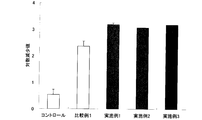
- Test Example 1 it is a figure which shows the result of having evaluated the disinfection effect with respect to Acanthamoeba of a test liquid (Examples 1-3 and Comparative Example 1).
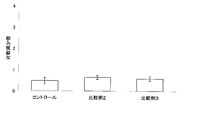
- the reference test example 1 it is a figure which shows the result of having evaluated the disinfection effect with respect to the acanthamoeba of a test liquid (comparative examples 2-3).
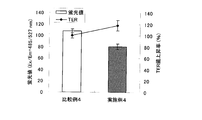
- Test Example 2 it is a figure which shows the result of having evaluated the influence which acts on the barrier function of a corneal epithelial cell about a test liquid (Example 4 and Comparative Example 4).
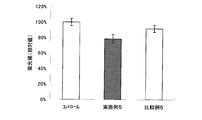
- Test Example 3 it is a figure which shows the result of having evaluated the influence which acts on the barrier function of a corneal epithelial cell about a test liquid (Example 5 and Comparative Example 5).
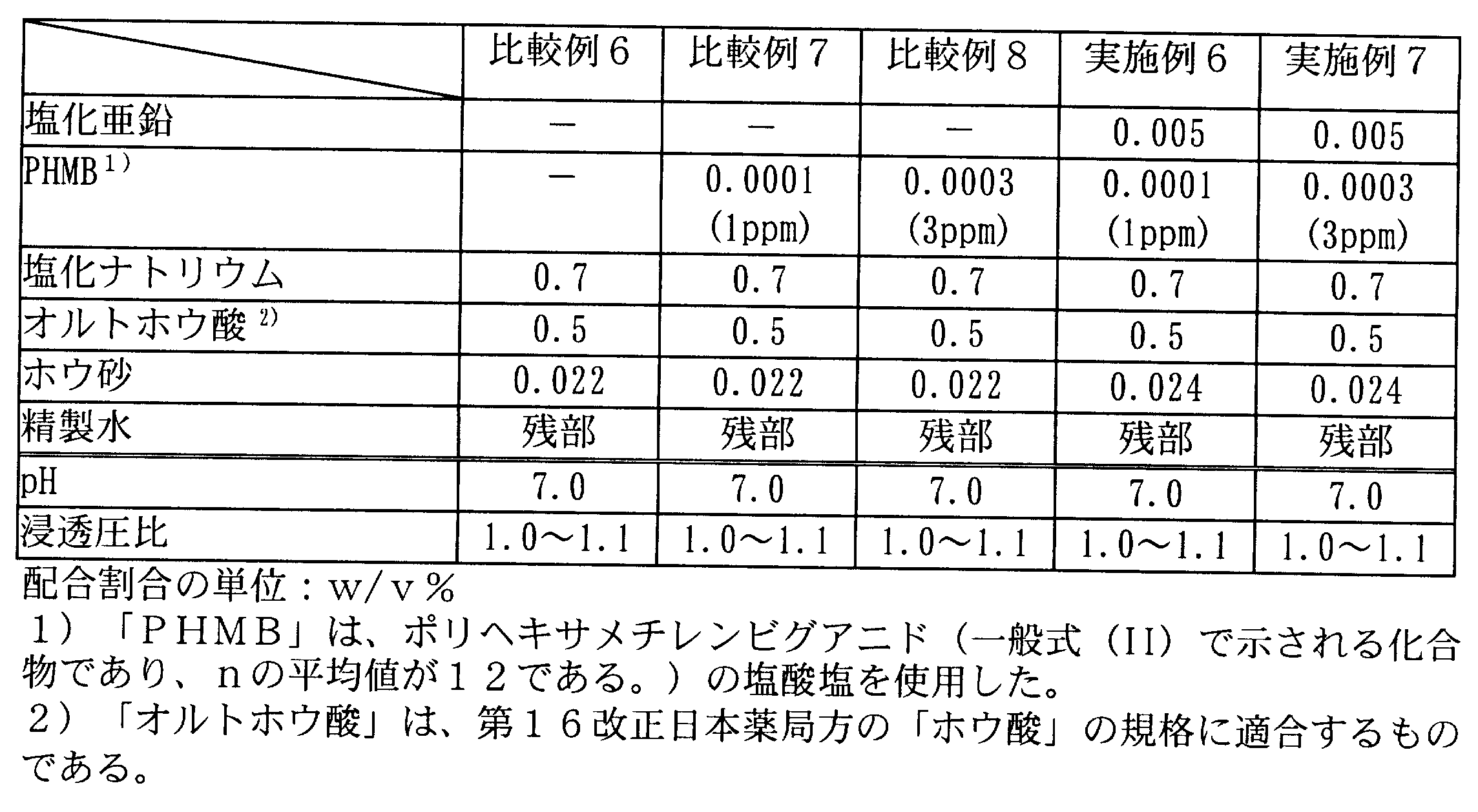
- Test Example 4 it is a figure which shows the result of having evaluated the influence which it has on the size change of a soft contact lens of a test liquid (Examples 6-7 and Comparative Examples 6-8).
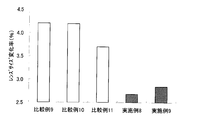
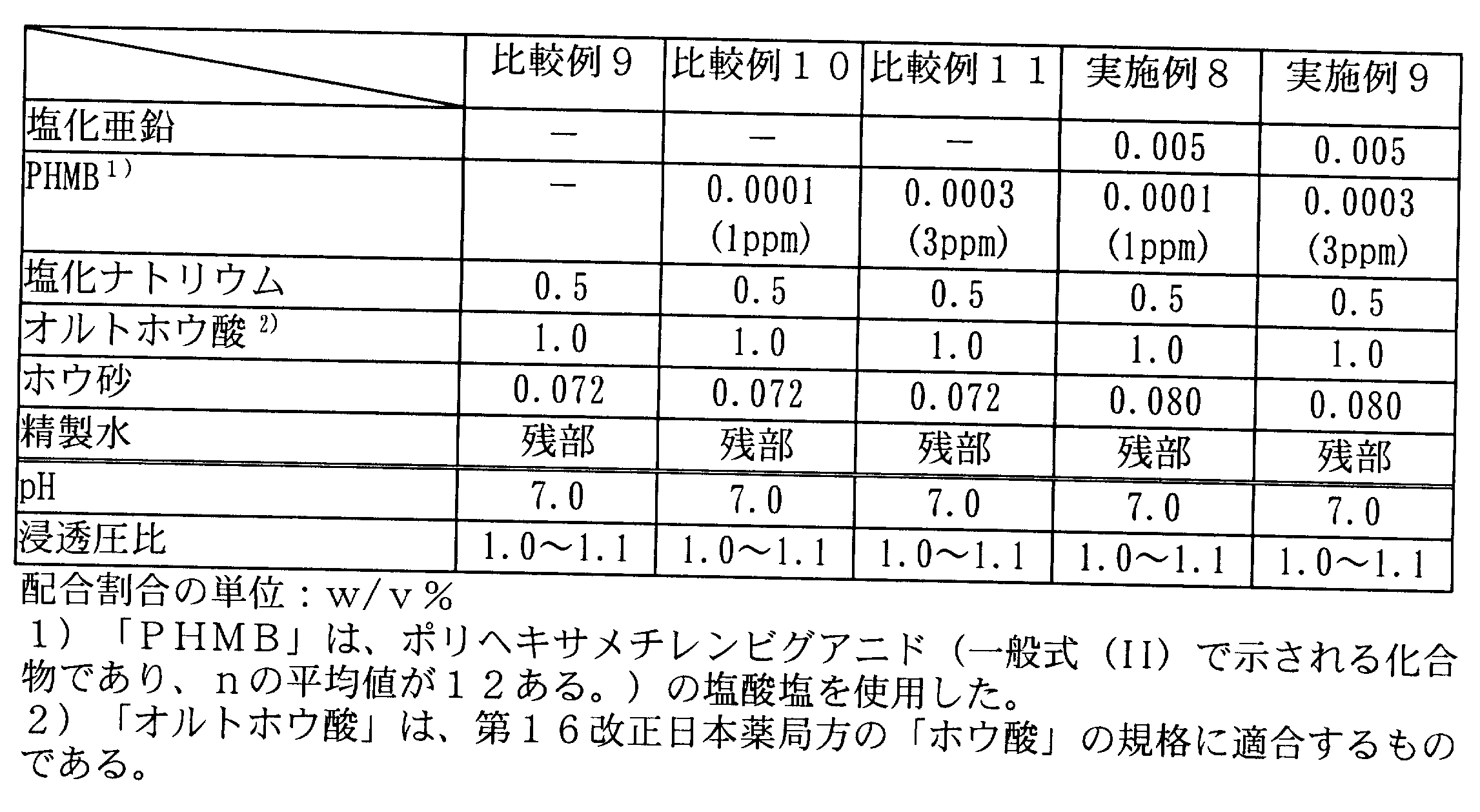
- Test Example 5 it is a figure which shows the result of having evaluated the influence which it has on the size change of a soft contact lens about a test liquid (Examples 8-9 and Comparative Examples 9-11).
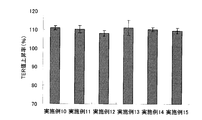
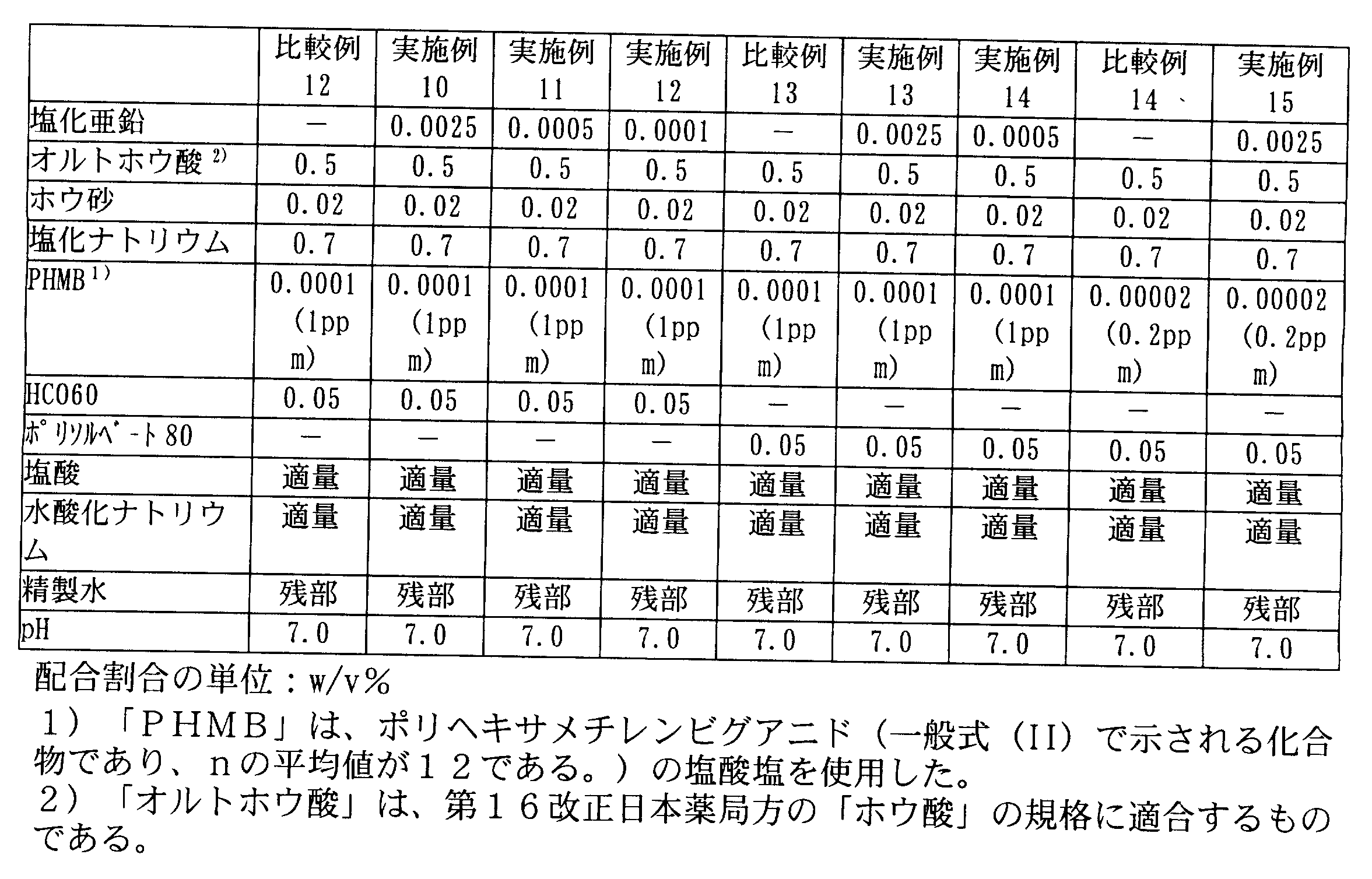
- Test Example 6 it is a figure which shows the result of having evaluated the influence which it has on the barrier function of a corneal epithelial cell about a test liquid (Examples 10-15).
- test example 2 it is a figure which shows the result of having evaluated the influence which acts on the barrier function of a corneal epithelial cell about a test liquid (comparative examples 16 and 18).
- Ophthalmic Composition contains a biguanide fungicide (hereinafter sometimes referred to as component (A)).
- the biguanide fungicide is a compound having at least one biguanide group represented by the formula: —NH—C ( ⁇ NH) —NH—C ( ⁇ NH) —NH—, and having at least one biguanide group. It is a known disinfectant as a monomer, a polymer composed of the monomer, and a compound in a salt form thereof, and may be produced by a known method or obtained as a commercial product.
- the biguanide fungicide used in the present invention is not particularly limited as long as it is pharmaceutically, pharmacologically (pharmaceutically) or physiologically acceptable.
- the following general formulas (II) and (III) ), (IV) and (V) are exemplified.
- the compounds represented by the general formulas (II) and (III) may be in the form of a salt.
- n is an integer of 1 or more, preferably an integer of 1 to 500, more preferably an integer of 1 to 40, and particularly preferably an integer of 10 to 13.
- the biguanide fungicide used in the present invention include hexamethylene biguanide and its polymer (that is, polyhexamethylene biguanide (abbreviation: PHMB)), chlorhexidine, alexidine, hexidine and the like, and has an antiseptic action on acanthamoeba.
- PHMB polyhexamethylene biguanide
- hexamethylene biguanide and its polymer are exemplified.
- the hexamethylene biguanide represented by the general formula (II) and the polymer thereof are suitable also from the viewpoint of suppressing the decrease in the corneal barrier function and suppressing the change in the size of the contact lens when using boric acid and / or a salt thereof. .
- the biguanide fungicide may be a monomer having at least one biguanide group or a mixture of polymers thereof, and a mixture containing such monomers and polymers having various degrees of polymerization, and polymers having various degrees of polymerization.
- the mixture to be used is sometimes collectively called polybiguanide.
- polybiguanide monomers and mixtures containing polymers having various polymerization degrees may be collectively referred to as polyhexamethylene biguanide.
- the average degree of polymerization can be suitably used within the numerical range defined by n.
- the salt of the biguanide fungicide used in the present invention is not particularly limited as long as it is pharmaceutically, pharmacologically (pharmaceutically) or physiologically acceptable.
- Examples of salts of biguanide fungicides used in the present invention include inorganic acid salts such as hydrochloric acid, hydrobromic acid, sulfuric acid, boric acid, phosphoric acid, nitric acid; acetic acid, gluconic acid, maleic acid, ascorbic acid, stearic acid, Organic acid salts such as tartaric acid and citric acid; sulfonic acid salts such as methane sulfonate, isethionate, benzene sulfonate, and p-toluene sulfonate; inorganic acid salts are preferable, and hydrochlorides are more preferable. These salts may be used alone or in any combination of two or more.
- the biguanide fungicide may be used alone or in any combination of two or more.
- the content of the component (A) is appropriately set according to the type of the component (A), the formulation form of the ophthalmic composition, etc., but with respect to the total amount of the ophthalmic composition
- the total content of component (A) is, for example, 0.000001 to 0.01 w / v%, preferably 0.00001 to 0.005 w / v%, more preferably 0.0001 to 0.001 w / v%.
- the content of the component (A) is preferable from the viewpoint of further enhancing the disinfecting action of Acanthamoeba, and further improving the action of improving the corneal barrier function, and a soft contact lens using boric acid and / or a salt thereof. It is also suitable from the viewpoint of further enhancing the effect of suppressing the size change.
- the ophthalmic composition of the present invention contains zinc chloride (hereinafter sometimes referred to as the component (B)) in addition to the component (A).
- the component (B) zinc chloride
- a decrease in corneal barrier function induced by the component (A) is suppressed.
- the ophthalmic composition containing boric acid and / or a salt thereof effectively incorporates the components (A) and (B) to effectively change the size of the contact lens due to boric acid and / or a salt thereof. It becomes possible to suppress.
- the zinc chloride used in the present invention is not particularly limited as long as it can be used in an ophthalmic composition.
- An example is zinc chloride described in the 16th revision Japanese Pharmacopoeia.
- the zinc chloride used in the present invention may be a hydrate.
- the content of the component (B) is appropriately set according to the formulation form of the ophthalmic composition, etc., but the total amount of the component (B) is relative to the total amount of the ophthalmic composition.
- the content is, for example, 0.00005 to 0.05 w / v%, preferably 0.0001 to 0.015 w / v%, more preferably 0.0005 to 0.005 w / v%.
- the content of the component (B) is suitable from the viewpoint of further enhancing the disinfecting action of Acanthamoeba, and from the viewpoint of further enhancing the action of improving the corneal barrier function, and the contact lens with boric acid and / or a salt thereof. It is also preferable from the viewpoint of further enhancing the effect of suppressing the size change.
- the content ratio of the component (B) to the component (A) is not particularly limited, but from the viewpoint of further enhancing the disinfection action of Acanthamoeba, the component (A)
- the total content of the component (B) with respect to the total content of 100 parts by weight is, for example, 10 to 50000 parts by weight, preferably 20 to 15000 parts by weight, more preferably 100 to 5000 parts by weight, and particularly preferably 300 to 5000 parts by weight. 3000 parts by weight.
- the content ratio is also suitable from the viewpoint of further enhancing the action of improving the corneal barrier function and further enhancing the action of suppressing the size change of the soft contact lens by boric acid and / or a salt thereof.
- the ophthalmic composition of the present invention is at least one selected from the group consisting of boric acid and salts thereof in addition to the above components (A) and (B) (hereinafter simply referred to as component (C)). May be included).
- Boric acid is a general term for oxygen acids generated by hydration of diboron trioxide, and includes orthoboric acid, metaboric acid, tetraboric acid, and the like. Boric acid is a known compound, and may be synthesized by a known method or obtained as a commercial product.
- the salt of boric acid used in the present invention is not particularly limited as long as it is pharmaceutically, pharmacologically (pharmaceutically) or physiologically acceptable.
- Examples of salts of boric acid used in the present invention include salts with organic bases (for example, salts with organic amines such as methylamine, triethylamine, triethanolamine, morpholine, piperazine, pyrrolidine, amino acids, tripyridine, picoline, etc.) Salts with inorganic bases [alkali metal salts (eg, sodium salts, potassium salts, etc.); alkaline earth metal salts (eg, calcium salts, magnesium salts, etc.); other metal salts (aluminum salts, etc.)], etc.
- organic bases for example, salts with organic amines such as methylamine, triethylamine, triethanolamine, morpholine, piperazine, pyrrolidine, amino acids, tripyridine, picoline, etc.
- Salts with inorganic bases
- boric acid salts may be used alone or in any combination of two or more. Further, boric acid and / or a salt thereof used in the present invention may be a hydrate.
- the component (C) may be used alone or in any combination of two or more.
- the component (C) used in the present invention for example, orthoboric acid, metaboric acid, tetraboric acid, sodium orthoborate, sodium metaborate, sodium tetraborate, potassium orthoborate, potassium metaborate, potassium tetraborate, ammonium orthoborate, Examples thereof include ammonium metaborate, ammonium tetraborate, and borax, and it is preferable to use a combination of orthoboric acid and borax.
- orthoboric acid and borax the 16th revision Japanese Pharmacopoeia conformity goods are used suitably, and a commercially available thing can also be used.
- the content ratio of orthoboric acid and borax is not particularly limited, but the total content of orthoboric acid
- the total content of borax relative to 100 parts by weight is usually 0.1 to 200 parts by weight, preferably 1 to 100 parts by weight, and more preferably 4 to 50 parts by weight.
- the content of the component (C) is appropriately set according to the formulation form of the ophthalmic composition, but the total amount of the component (C) with respect to the total amount of the ophthalmic composition.
- the content is, for example, 0.001 to 0.045 mol / 100 mL, more preferably 0.004 to 0.04 mol / 100 mL, still more preferably 0.005 to 0.038 mol / 100 mL in terms of boron atom content.
- the content of component (C) in terms of boron atom content is the content in terms of the content of boron atoms contained in boric acid and / or its salt contained in the ophthalmic composition, and the ophthalmic composition It can be easily calculated from the content of component (C). For example, if the ophthalmic composition contains 0.5 w / v% orthoboric acid and 0.02 w / v% borax as component (C), orthoboric acid (molecular weight 61.83) contains one atom of boron.
- borax molecular weight 381.37
- the content of boron atoms derived from orthoboric acid is 0.00809 mol / 100 mL
- the content of boron atoms derived from borax is 0.00021 mol /
- the total amount of component (C) in terms of boron atom content is 0.00830 mol / 100 mL.
- the component (C) tends to cause a change in the size of the contact lens
- the boron atom content of the component (C) is 0.017 mol / 100 mL or less, the contact lens Can be more effectively suppressed.
- the content of the component (C) is 0.0001 to 0.021 mol / 100 mL, more preferably 0.005 to 0.019 mol / 100 mL, more preferably 0.008 to 0.017 mol / 100 mL in terms of boron atom content, relative to the total amount of the product.
- the content ratio of the component (C) to the component (A) is not particularly limited, but the ophthalmic composition containing boric acid and / or a salt thereof is not particularly limited.
- the total content of (C) component is 1 to 150 mol in terms of boron atom content, for example, relative to 1 g of total content of component (A).
- the amount is preferably 10 to 140 mol, more preferably 20 to 130 mol.
- the ophthalmic composition of the present invention may further contain a buffering agent other than boric acid and / or a salt thereof.
- the buffer that can be incorporated into the ophthalmic composition of the present invention is not particularly limited as long as it is pharmaceutically, pharmacologically (pharmaceutically) or physiologically acceptable.
- examples of other buffering agents that can be used in the ophthalmic composition of the present invention include phosphate buffer, carbonate buffer, citrate buffer, acetate buffer, ⁇ -aminocaproic acid, aspartic acid, aspartate, and the like. And a phosphate buffer, a carbonate buffer, or a citrate buffer is preferable, and a phosphate buffer is more preferable.
- Examples of the phosphate buffer include phosphoric acid or phosphates such as alkali metal phosphates and alkaline earth metal phosphates.
- Examples of the carbonate buffer include carbonates or carbonates such as alkali metal carbonates and alkaline earth metal carbonates.
- Examples of the citrate buffer include citric acid, alkali metal citrate, and alkaline earth metal citrate.
- a phosphate buffer phosphoric acid or a salt thereof (disodium hydrogen phosphate, sodium dihydrogen phosphate, potassium dihydrogen phosphate, trisodium phosphate, dipotassium phosphate, monophosphate Calcium hydrogen, calcium dihydrogen phosphate, etc.)
- Carbonic acid or a salt thereof sodium hydrogen carbonate, sodium carbonate, ammonium carbonate, potassium carbonate, calcium carbonate, potassium hydrogen carbonate, magnesium carbonate, etc.
- citrate buffer Citric acid or a salt thereof sodium citrate, potassium citrate, calcium citrate, sodium dihydrogen citrate, disodium citrate, etc.
- acetic acid or a salt thereof ammonium acetate, potassium acetate, acetic acid) Calcium, sodium acetate, etc.
- aspartic acid or a salt thereof asparagine
- the content of the buffering agent is the type of buffering agent used, the type and blending amount of other blending components, Depending on the dosage form of the ophthalmic composition and the like, it cannot be uniformly defined.
- the total amount of the buffering agent relative to the total amount of the ophthalmic composition is, for example, 0.01 to 10 w / It is v%, preferably 0.1-5 w / v%, more preferably 0.2-2 w / v%, particularly preferably 0.2-1 w / v%.
- the ophthalmic composition of the present invention may further contain a surfactant.
- the surfactant that can be contained in the ophthalmic composition of the present invention is not particularly limited as long as it is pharmaceutically, pharmacologically (pharmaceutically) or physiologically acceptable, and is a nonionic surfactant, Any of an amphoteric surfactant, an anionic surfactant, and a cationic surfactant may be used.
- POE alkyl ethers POE-POP alkyl ethers such as POE (20) POP (4) cetyl ether
- POE alkyl phenyl ethers such as POE (10) nonyl phenyl ether.
- POE is polyoxyethylene and POP is polyoxypropylene, and the numbers in parentheses indicate the number of moles added.
- amphoteric surfactant that can be contained in the ophthalmic composition of the present invention include alkyldiaminoethylglycine or a salt thereof (for example, hydrochloride).
- Examples of the cationic surfactant that can be contained in the ophthalmic composition of the present invention include benzalkonium chloride and benzethonium chloride.
- examples of the anionic surfactant that can be contained in the ophthalmic composition of the present invention include alkylbenzene sulfonate, alkyl sulfate, polyoxyethylene alkyl sulfate, aliphatic ⁇ -sulfomethyl ester, and ⁇ -olefin. A sulfonic acid etc. are mentioned.
- the surfactant used in the ophthalmic composition of the present invention is preferably a nonionic surfactant, more preferably POE sorbitan fatty acid esters, POE hydrogenated castor oil, or POE / POP block copolymers, polysorbate 80, poly More preferred is oxyethylene hydrogenated castor oil 60 or poloxamer 407. From the viewpoint of further enhancing the effect of suppressing the decrease in corneal barrier function, POE sorbitan fatty acid esters and POE hydrogenated castor oil are preferable, and POE hydrogenated castor oil is particularly preferable.
- the above surfactants may be used alone or in combination of two or more.
- the content of the surfactant is, for example, the type of the surfactant, the type and amount of other compounding components, the formulation form of the ophthalmic composition, etc. It can be set appropriately according to.
- the content of the surfactant the total amount of the surfactant is, for example, 0.001 to 1.0 w / v%, preferably 0.005 to 0.7 w /% with respect to the total amount of the ophthalmic composition. It is v%, more preferably 0.01 to 0.5 w / v%.
- the ophthalmic composition of the present invention may further contain an isotonic agent.
- the isotonic agent that can be contained in the ophthalmic composition of the present invention is not particularly limited as long as it is pharmaceutically, pharmacologically (pharmaceutically) or physiologically acceptable.
- an isotonic agent used in the ophthalmic composition of the present invention for example, disodium hydrogen phosphate, sodium dihydrogen phosphate, potassium dihydrogen phosphate, sodium hydrogen sulfite, sodium sulfite, potassium chloride, calcium chloride, sodium chloride , Magnesium chloride, potassium acetate, sodium acetate, sodium bicarbonate, sodium carbonate, sodium thiosulfate, magnesium sulfate, glycerin, propylene glycol, etc., glycerin, propylene glycol, sodium chloride, potassium chloride, calcium chloride, or magnesium chloride
- sodium chloride or glycerin is more preferred, and sodium chloride is particularly preferred.
- the tonicity agents may be used alone or in any combination of two or more.
- the content of the tonicity agent varies depending on the type of tonicity agent used, etc., and cannot be defined uniformly. For example, 0.01 to 10 w / v%, preferably 0.05 to 5 w / v%, more preferably 0.1 to 3 w / v in terms of the total content of the tonicity agent relative to the total amount of the ophthalmic composition. v%.
- the pH of the ophthalmic composition of the present invention is not particularly limited as long as it is within a pharmaceutically, pharmacologically (pharmaceutical) or physiologically acceptable range.
- the pH of the ophthalmic composition of the present invention is, for example, 4.0 to 9.5, preferably 5.0 to 9.0, more preferably 6.2 to 8.5, and particularly preferably 6.5 to 8. is there.
- the osmotic pressure of the ophthalmic composition of the present invention is not particularly limited as long as it is within a range acceptable for a living body.
- the osmotic pressure ratio of the ophthalmic composition of the present invention is, for example, 0.3 to 5.0, preferably 0.4 to 3.0, and more preferably 0.5 to 1.5.
- the osmotic pressure can be adjusted by a method known in the art using inorganic salts, polyhydric alcohols, sugar alcohols, saccharides and the like.
- the osmotic pressure ratio is the ratio of the osmotic pressure of the sample to 286 mOsm (the osmotic pressure of 0.9 w / v% sodium chloride aqueous solution) based on the 16th revised Japanese Pharmacopoeia. Measure with reference to the descent method.
- the standard solution for measuring the osmotic pressure ratio (0.9 w / v% sodium chloride aqueous solution) was dried in sodium chloride (Japanese Pharmacopoeia standard reagent) at 500 to 650 ° C for 40 to 50 minutes and then released in a desiccator (silica gel). Cool and accurately measure 0.900 g and dissolve in purified water to make exactly 100 mL, or use a commercially available standard solution for osmotic pressure ratio measurement (0.9 w / v% sodium chloride aqueous solution).
- the ophthalmic composition of the present invention may contain an appropriate amount of a combination of various pharmacologically active ingredients and physiologically active ingredients in addition to the above ingredients, as long as the effects of the present invention are not hindered.
- Such an ingredient is not particularly limited, and examples thereof include an active ingredient in an ophthalmic drug described in the over-the-counter drug manufacturing (import) approval standard 2000 edition (supervised by the Pharmaceutical Affairs Research Committee). Specifically, the following components are listed as components used in ophthalmic drugs.
- Antihistamines for example, iproheptin, diphenhydramine hydrochloride, chlorpheniramine maleate, ketotifen fumarate, etc.
- Decongestant For example, tetrahydrozoline hydrochloride, naphazoline hydrochloride, naphazoline sulfate, epinephrine hydrochloride, ephedrine hydrochloride, methylephedrine hydrochloride, and the like.
- Bactericides for example, cetylpyridinium, benzalkonium chloride, benzethonium chloride, chlorhexidine hydrochloride, chlorhexidine gluconate and the like.
- Vitamins For example, flavin adenine dinucleotide sodium, cyanocobalamin, retinol acetate, retinol palmitate, pyridoxine hydrochloride, panthenol, calcium pantothenate, tocopherol acetate and the like.
- Amino acids for example, potassium aspartate, magnesium aspartate, monoethanolamine, 2-amino-2-methyl-1,3-propanediol, glycine and the like.
- Anti-inflammatory agents for example, dipotassium glycyrrhizinate, pranoprofen, allantoin, azulene, sodium azulenesulfonate, guaiazulene, ⁇ -aminocaproic acid, berberine chloride, berberine sulfate, lysozyme chloride, licorice, etc.
- Other For example, sodium cromoglycate, sodium chondroitin sulfate, sodium hyaluronate, sulfamethoxazole, sodium sulfamethoxazole and the like.
- additives are appropriately selected according to a conventional method according to the use and the form of the preparation, as long as the effects of the invention are not impaired.
- An appropriate amount may be contained in combination.
- these additives include various additives described in Pharmaceutical Additives Encyclopedia 2007 (edited by Japan Pharmaceutical Additives Association).
- Typical additives include the following additives.
- Carrier An aqueous carrier such as water or hydrous ethanol.
- Sugars For example, cyclodextrins and the like.
- Sugar alcohols For example, xylitol, sorbitol, mannitol and the like. These may be d-form, l-form or dl-form.
- Preservatives, bactericides or antibacterials for example, alkyldiaminoethylglycine hydrochloride, sodium benzoate, ethanol, benzalkonium chloride, benzethonium chloride, chlorhexidine gluconate, chlorobutanol, sorbic acid, potassium sorbate, sodium dehydroacetate, paraoxy Methyl benzoate, ethyl paraoxybenzoate, propyl paraoxybenzoate, butyl paraoxybenzoate, oxyquinoline sulfate, phenethyl alcohol, benzyl alcohol, Glow Kill (trade name, manufactured by Rhodia) and the like.
- alkyldiaminoethylglycine hydrochloride for example, alkyldiaminoethylglycine hydrochloride, sodium benzoate, ethanol, benzalkonium chloride, benzethonium chloride, chlorhexidine gluconate, chlorobut
- pH adjuster for example, hydrochloric acid, ⁇ -aminocaproic acid, citric acid, acetic acid, sodium hydroxide, potassium hydroxide, calcium hydroxide, magnesium hydroxide, sodium bicarbonate, sodium carbonate, triethanolamine, monoethanolamine, diethanol Isopropanolamine, sulfuric acid, phosphoric acid, polyphosphoric acid, propionic acid, oxalic acid, gluconic acid, fumaric acid, lactic acid, tartaric acid, malic acid, succinic acid, gluconolactone, ammonium acetate and the like.
- Stabilizer For example, dibutylhydroxytoluene, trometamol, sodium formaldehyde sulfoxylate (Longalite), tocopherol, sodium pyrosulfite, monoethanolamine, aluminum monostearate, glyceryl monostearate and the like.
- Chelating agents for example, ethylenediaminediacetic acid (EDDA), ethylenediaminetriacetic acid, ethylenediaminetetraacetic acid (edetic acid, EDTA), N- (2-hydroxyethyl) ethylenediaminetriacetic acid (HEDTA), diethylenetriaminepentaacetic acid (DTPA), and the like.
- the ophthalmic composition of the present invention is prepared by adding the above components (A) and (B) and, if necessary, other blending components so as to have a desired blending ratio.
- the ophthalmic composition of the present invention is not particularly limited as long as it can be used in the ophthalmic field, and examples thereof include liquids and ointments. Among these, liquid is preferable. Of the liquids, aqueous liquids are preferred.
- pharmaceutically, pharmacologically (pharmaceutically) or physiologically acceptable water may be used as an aqueous carrier. Examples thereof include distilled water, ordinary water, purified water, sterilized purified water, water for injection, and distilled water for injection. These definitions are based on the 16th revised Japanese Pharmacopoeia.
- the aqueous liquid means a liquid form containing water, and usually 1% by weight or more, preferably 5% by weight or more, more preferably 20% by weight or more of water in the ophthalmic composition, Preferably, it means one containing 50% by weight or more.
- the aqueous composition is usually a composition containing 1% by weight or more of water in the composition, preferably 5% by weight or more, more preferably 20% by weight or more, and still more preferably 50% by weight or more. means.
- water used in the aqueous composition include distilled water, normal water, purified water, sterilized purified water, water for injection, and distilled water for injection, as described above.
- the present invention provides, from another viewpoint, a method for producing an ophthalmic composition comprising adding (A) a biguanide fungicide and (B) zinc chloride to a carrier containing water. .
- the formulation form is not limited.
- eye drops including eye drops for contact lenses
- eye wash including eye drops for contact lenses
- contact lens mounting liquid contact lens care liquids (contact lens disinfecting liquid, contact lens preserving liquid, contact lens cleaning liquid)
- contact lens cleaning / preserving solution contact lens disinfecting / cleaning / preserving solution (multipurpose solution), and the like.
- the ophthalmic composition of the present invention can suppress a decrease in corneal barrier function induced when a biguanide fungicide is used, a formulation form directly applied to the corneal surface [including eye drops (including eye drops for contact lenses) ), Eye wash (including eye wash for contact lenses), contact lens mounting solution, contact lens preserving solution, contact lens cleaning / preserving solution, and contact lens disinfecting / cleaning / preserving solution] be able to.
- Acanthamoeba corneal infection is the most affected among contact lens wearers, and contact lens ophthalmic compositions are strongly required to disinfect Acanthamoeba. Therefore, as a suitable formulation form of the ophthalmic composition of the present invention, eye drops for contact lenses (eye drops that can be used while wearing contact lenses), eye wash for contact lenses (eye drops that can be used while wearing contact lenses) Agent), contact lens mounting liquid, contact lens care ophthalmic composition and the like. Among them, the contact lens care agent is very important for disinfecting the contact lens Acanthamoeba, and is a suitable preparation form in the ophthalmic composition of the present invention.
- a contact lens disinfecting / cleaning / preserving solution is a preparation that directly contacts the cornea via a contact lens in order to disinfect, clean and store the contact lens in one solution. Therefore, the type and concentration of the disinfectant to be blended must be limited to a range that does not impair the safety, and in order to obtain a sufficient disinfecting power, it is important to observe the disinfecting time, rubbing and other usage methods. ing. However, in reality, the usage method may not be observed, and as a result, sufficient disinfecting power may not be obtained.
- contact lens disinfection / cleaning / preservation solution is very important to prevent dissatisfaction of Acanthamoeba keratitis by sufficiently disinfecting Acanthamoeba adhering to the contact lens, as a formulation form of the ophthalmic composition of the present invention Particularly preferred.
- the type of contact lens to be applied is not particularly limited, and all contact lenses that are currently commercially available or are commercially available in the future [soft All of contact lenses, hard contact lenses, and oxygen permeable hard contact lenses are included.
- Soft contact lenses can be applied to both silicone hydrogel contact lenses and non-silicone hydrogel contact lenses (that is, soft contact lenses that are not silicone hydrogel lenses).
- Acanthamoeba corneal infection often affects soft contact lens wearers among contact lens wearers, and an ophthalmic composition capable of exhibiting a high Acanthamoeba disinfection effect on soft contact lenses is strongly desired.
- a soft contact lens having a water content of 50% or more and a monomer having an anion of 1 mol% or more among constituent monomers of the raw material polymer that is, the soft contact lens classification is group IV. It is also said that the contamination rate of Acanthamoeba is relatively high in soft contact lenses) and contact lenses in which silicone is blended with hydrogel (that is, silicone hydrogel contact lenses).
- a soft contact lens can be cited as a suitable application target of the ophthalmic composition of the present invention, and a more preferable example is an anion among constituent monomers of the raw material polymer having a water content of 50% or more. Examples thereof include a soft contact lens or a silicone hydrogel contact lens in which a monomer having a content of 1 mol% or more.
- Soft contact lens classification means “Manufacture (import) of soft contact lenses and disinfectants for soft contact lenses” issued by the Pharmaceutical Examination No. 645 of March 31, 1999. This is a classification specified in “About the classification method of soft contact lenses” defined in “Handling of materials to be attached when applying for approval”, and this classification follows the FDA (Food and Drug Administration) soft contact lens classification method. Is.
- the moisture content of the contact lens indicates the ratio of water in the contact lens, and is specifically obtained by the following calculation formula.
- Moisture content (%) (weight of hydrated water / weight of contact lens in hydrated state) x 100 Such moisture content can be measured by a gravimetric method according to the description of ISO18369-4: 2006.
- silicone hydrogel contact lenses are likely to cause corneal epithelial disorder called corneal staining when treated with an ophthalmic composition containing a biguanide fungicide.
- the corneal barrier function is improved by containing zinc chloride together with the biguanide fungicide, and the corneal epithelial disorder can be effectively suppressed.
- a silicone hydrogel contact lens can be cited as an embodiment of a suitable application target of the ophthalmic composition of the present invention.
- soft contact lenses with a soft contact lens classification of Group IV are said to be relatively easy to cause lens expansion when treated for a long time in an ophthalmic composition containing boric acid and / or a salt thereof.
- this tendency is strong in the group IV soft contact lenses made of a material containing a methacrylic acid monomer.
- a material containing such a methacrylic acid monomer for example, EtafilconUSAA, Ocufilcon A, Ocufilcon B, Ocufilcon C, Ocufilcon D, Ocufilcon E, Methafilcon A, as the name of a material based on USAN (United States Adopted Names) Examples include Methafilcon B, Focofilcon A, Perfilcon A, Vifilcon A, Vifilcon B, and the like.
- the ophthalmic composition of the present invention is suitably applied to soft contact lenses using these as materials.
- the soft contact lens to which the present invention is applied is more preferably a group IV soft contact lens made of Etafilcon A, Methafilcon A, and Methafilcon B, and particularly preferably a group made of Etafilcon A IV soft contact lenses. Further, as the soft contact lens to which the present invention is applied, a lens whose surface is negatively charged is preferable.
- the ophthalmic composition of the present invention is used according to a method of use corresponding to the formulation form.
- the contact lens is added to the contact lens for 1 hour or more. It is desirable to immerse for 4 hours or more.
- the ophthalmic composition of the present invention is in the form of eye drops (including eye drops for contact lenses) or eye wash (including eye drops for contact lenses), the naked eye or contact lenses are attached. The eye can be instilled or washed directly, and the eye can be instilled prior to wearing the contact lens.
- the ophthalmic composition of the present invention can exhibit an excellent disinfecting effect of Acanthamoeba, it can be used for the prevention of Acanthamoeba corneal infection.
- the ophthalmic composition of the present invention can suppress a decrease in corneal barrier function induced when a biguanide fungicide is used, and can maintain the cornea in a healthy state, so that it is also useful as a preventive agent for corneal epithelial disorder. It is.
- the ophthalmic composition for contact lens of the present invention can be provided by being accommodated in an arbitrary container.
- the container for storing the ophthalmic composition for contact lenses of the present invention is not particularly limited as long as it is made of a material that can be used for a general container in the field, for example, a glass material and a plastic material.
- a material that can be used for a general container in the field for example, a glass material and a plastic material.
- polyethylene terephthalate resin, polypropylene resin, polyethylene resin, polyethylene naphthalate resin and the like can be appropriately selected and used according to the purpose and application.
- the container which accommodates the ophthalmic composition for contact lenses of this invention may be a transparent container which can visually recognize the inside of a container, and may be an opaque container where the inside of a container is difficult to visually recognize.
- a transparent container is particularly preferred because it is easy to check the amount of the ophthalmic composition for contact lenses and to check for foreign matters in the production process.
- the present invention also provides the use of (A) a biguanide fungicide and (B) zinc chloride for the production of an ophthalmic composition from another viewpoint.
- the present invention also provides the use of a composition containing (A) a biguanide fungicide and (B) zinc chloride as an ophthalmic composition from another viewpoint.
- composition containing (A) a biguanide fungicide and (B) zinc chloride for use as an ophthalmic composition containing (A) a biguanide fungicide and (B) zinc chloride for use as an ophthalmic composition.
- Anti-Acant Amoeba Agent As described above, by containing the biguanide fungicide and zinc chloride, the antiseptic action against acanthamoeba can be enhanced and exhibited.
- the present invention provides an anti-acanthamoeba agent containing (A) a biguanide fungicide and (B) zinc chloride from yet another point of view.
- This anti-acanthamoeba agent is used by adding to various compositions to impart the disinfecting action of acanthamoeba.
- the types, contents, and content ratios of the component (A) and the component (B) are the same as those in “1. Ophthalmic composition”.
- the composition to which the anti-acant amoeba agent is added is not particularly limited, but an ophthalmic composition is preferably exemplified.
- the addition type, content, content ratio, and blending ratio of the anti-acant amoeba agent to various compositions are appropriately set according to the type of the composition. For example, when the anti-acanthamoeba agent is used by adding to the ophthalmic composition, the type and content of addition to the ophthalmic composition, the content ratio, the blending ratio, the formulation form of the ophthalmic composition to be added, etc. This is the same as “1. Ophthalmic composition”.
- the component (A) and the component (B) coexist in the ophthalmic composition for contact lenses, and the order of addition thereof is not particularly limited.
- Disinfection method for Acanthamoeba method for enhancing disinfection action of Acanthamoeba and method for imparting disinfection action of Acanthamoeba to ophthalmic composition
- disinfection against Acanthamoeba by containing a biguanide fungicide and zinc chloride The effect can be enhanced.
- the present invention is characterized by disinfecting Acanthamoeba using an ophthalmic composition containing (A) a biguanide fungicide and (B) zinc chloride.
- the present invention also relates to a method for enhancing the disinfecting action of Acanthamoeba in the ophthalmic composition, wherein (A) zinc chloride is added to the ophthalmic composition containing the (A) biguanide fungicide. provide.
- the present invention provides a method for imparting the antiseptic action of Acanthamoeba to the ophthalmic composition, characterized by comprising (A) a biguanide fungicide and (B) zinc chloride in the ophthalmic composition. provide.
- the type and content of the component (A) and the component (B) to be used, the content ratio, the mixing ratio, the type and content of other components, the content ratio, the mixing ratio, the ophthalmic composition are the same as those in “1. Ophthalmic composition”.
- the component (A) and the component (B) may be present in the ophthalmic composition for contact lenses, and the order of addition thereof is not particularly limited.
- Method for improving corneal barrier function and method for imparting action to improve corneal barrier function to ophthalmic composition As described above, by containing a biguanide fungicide and zinc chloride in the ophthalmic composition, the cornea The barrier function can be improved.
- the present invention is characterized in that (A) a biguanide fungicide and (B) zinc chloride are blended in an ophthalmic composition, and the ophthalmic barrier function is improved.
- a method of preparing the composition is provided.
- the present invention provides (A) an ophthalmic composition containing a biguanide fungicide, and (B) zinc chloride is added to the ophthalmic composition, which has an effect of improving the corneal barrier function. Provide a way to do it.
- the type and content of the component (A) and the component (B) to be used, the content ratio, the mixing ratio, the type and content of other components, the content ratio, the mixing ratio, the ophthalmic composition are the same as those in “1. Ophthalmic composition”.
- the order of addition thereof is not particularly limited.
- Method for suppressing change in size of contact lens by boric acid and / or salt thereof, and method for imparting to ophthalmic composition an effect of suppressing change in size of contact lens by boric acid and / or salt thereof can be suppressed by including a biguanide fungicide and zinc chloride in the ophthalmic composition.
- the present invention comprises (A) a biguanide fungicide and (B) an ophthalmic composition containing at least one selected from the group consisting of (C) boric acid and salts thereof.
- the present invention also includes (A) a biguanide fungicide and (B) zinc chloride in an ophthalmic composition containing at least one selected from the group consisting of (C) boric acid and salts thereof.
- a method for imparting an action to suppress the size change of a contact lens caused by boric acid and / or a salt thereof to the ophthalmic composition is provided.
- the type, content, content ratio, blending ratio, formulation form of the ophthalmic composition, and the like are the same as those in “1. Ophthalmic composition”.
- the (A) component, the (B) component, and the (C) component may coexist in the ophthalmic composition for contact lenses, and the order of addition thereof is not particularly limited.
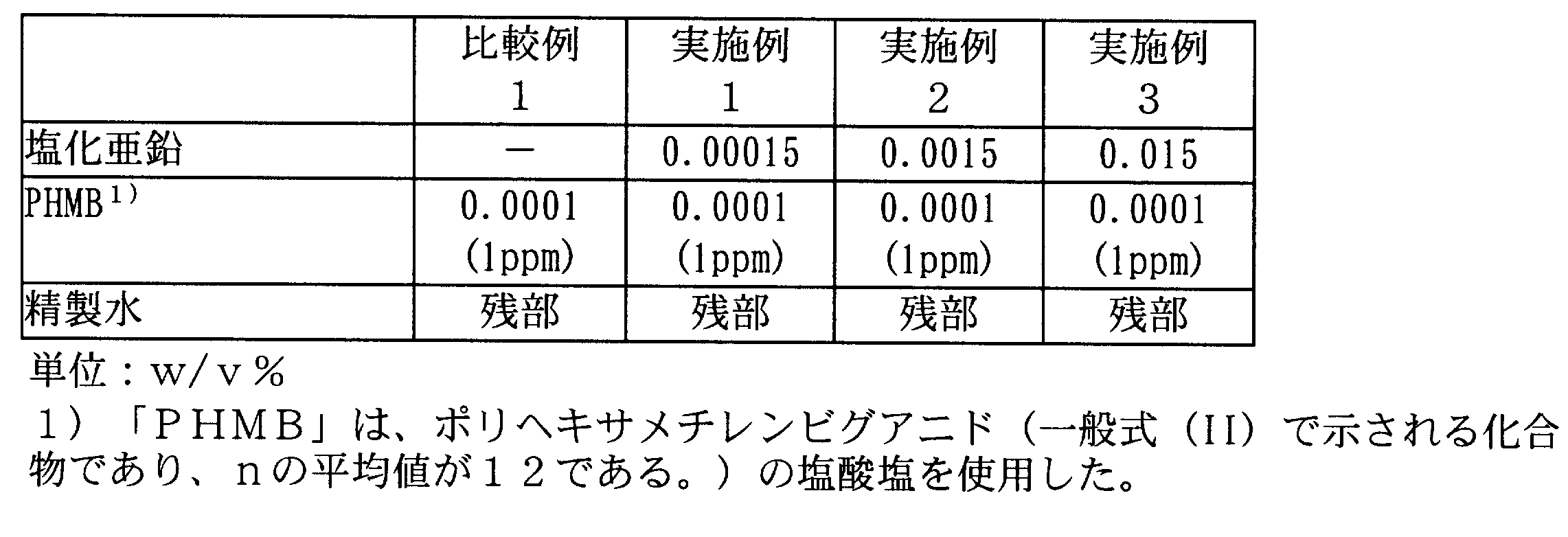
- Test Example 1 Evaluation of disinfection effect on Acanthamoeba (1) Each ophthalmic composition was prepared according to Table 1 below, and the disinfection effect of each ophthalmic composition on Acanthamoeba castellanii (ATCC 30868) was evaluated.
- PBS isotonic phosphate buffered saline
- - powder “Nissui” (Nissui Pharmaceutical Co., Ltd.); 0.8 w / v% sodium chloride, 0.02 w / v% chloride Potassium, 0.115 w / v% sodium monohydrogen phosphate, 0.02 w / v% potassium dihydrogen phosphate]
- PBS solution was washed three times, and then suspended in the above PBS solution to 5.0 ⁇ 10 6 cells / mL. Cloudy and an Acanthamoeba suspension was prepared.
- Reference Test Example 1 Evaluation of disinfection effect on Acanthamoeba (2) In order to confirm whether zinc chloride alone exerts a disinfecting effect on Acanthamoeba, the following experiment was conducted.
- Test Example 2 a test was conducted in the same manner as in Test Example 1 except that the ophthalmic composition shown in Table 2 below was used, and an acanthamoeba disinfection effect was evaluated.
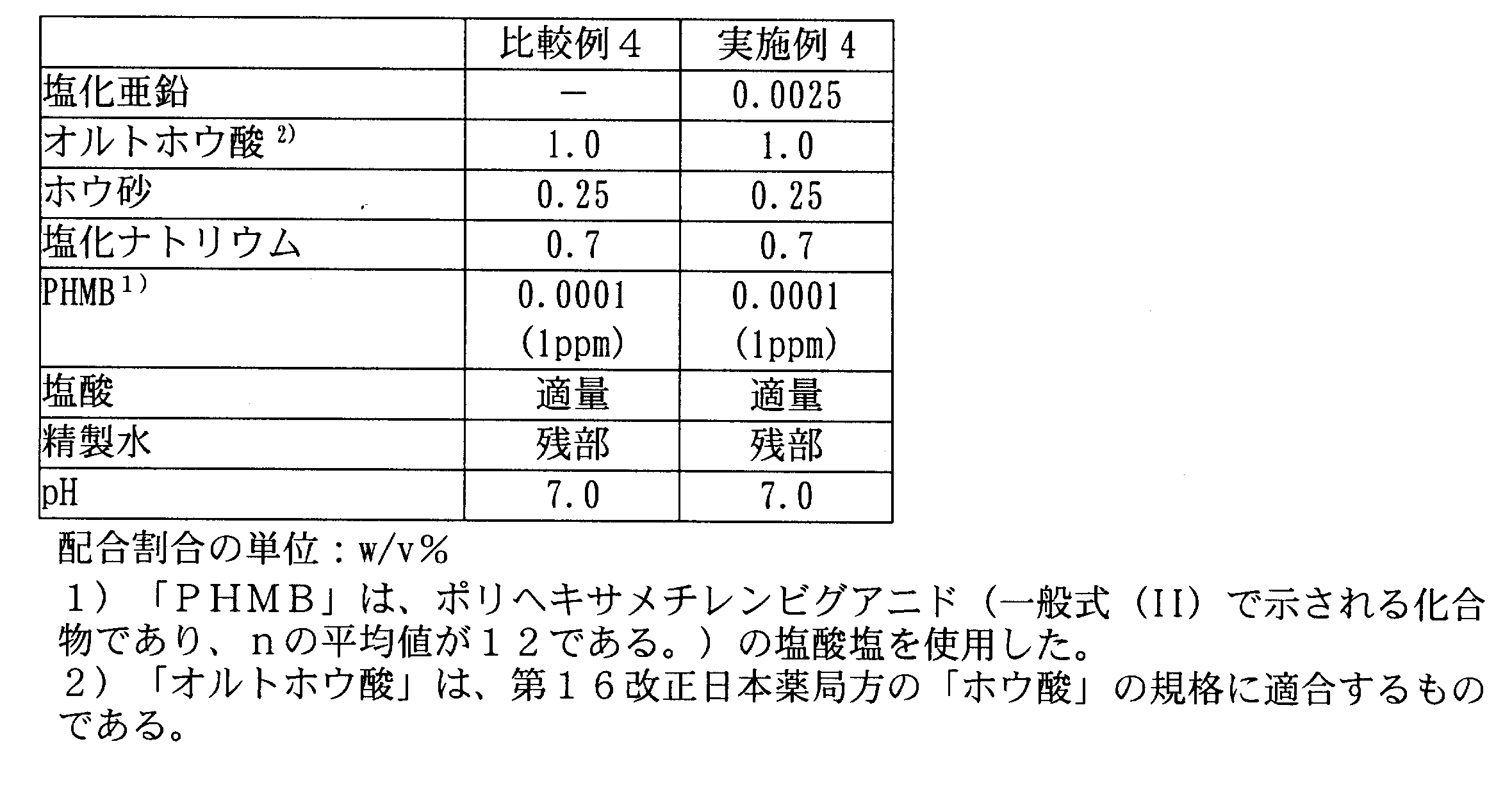
- Test Example 2 Evaluation of corneal barrier function (1) Each ophthalmic composition was prepared according to Table 3 below and evaluated for its effect on the corneal barrier function.
- the human corneal epithelial cell line HCE-T was seeded in an insert of Transwell (24 well, Corning) at a rate of 1.0 ⁇ 10 5 cells / well. 600 ⁇ L of culture medium was placed in the wells and cultured for 6 days at 37 ° C. and 5% CO 2 . After culturing, the culture medium in the insert was removed by suction, the cells were washed once with physiological saline, and 200 ⁇ L of each ophthalmic composition was added to the insert. The insert was transferred to a well containing 600 ⁇ L of each ophthalmic composition and allowed to stand at room temperature for 10 minutes.
- each ophthalmic composition in the insert was removed by suction, washed once with physiological saline, and then 200 ⁇ L of physiological saline was placed in the insert.
- the insert was transferred to a well containing 1 mL of physiological saline and allowed to stand at room temperature for 10 minutes.
- MILLICELL registered trademark
- TER value transepithelial electrical resistance value
- TER value increase rate (%) TER value of each comparative example, example / TER value of corresponding comparative example x 100 ?? Formula (1)
- the physiological saline in the insert was removed by suction, and 100 ⁇ L of 0.01 wt% sodium fluorescein solution prepared with physiological saline was placed in the insert.
- the insert was transferred to a well containing 600 ⁇ L of physiological saline and allowed to stand at room temperature for 20 minutes.
- the fluorescence value reflects the amount of fluorescein that has passed through the corneal epithelial cell layer, and the higher the fluorescence value, the lower the barrier function of the corneal epithelial cells. In addition, the higher the transepithelial electrical resistance value (TER), the stronger the barrier function.
- the ophthalmic composition containing only PHMB Comparative Example 4
- the fluorescence value is significantly lower than that of Comparative Example 4, and at the same time, the TER value is significantly increased, and the corneal barrier function is significantly improved. It became clear that. This tendency to improve the corneal barrier function was particularly remarkable when a boric acid buffer (combination of orthoboric acid and borax) was used as the buffer.
- an ophthalmic composition containing PHMB and zinc chloride has not only a high Acanthamoeba disinfection effect but also a high corneal barrier function improving effect, and a useful ophthalmic composition that has a very high preventive effect on Acanthamoeba corneal infection It became clear that there was a high possibility of obtaining the product.
- Test Example 3 Evaluation of corneal barrier function (2) Each ophthalmic composition was prepared according to the following Table 4, and the effect on the corneal barrier function was evaluated.
- the human corneal epithelial cell line HCE-T was seeded in an insert of Transwell (24 well, Corning) at a rate of 1.0 ⁇ 10 5 cells / well. 600 ⁇ L of culture medium was placed in the wells and cultured for 5 days under conditions of 37 ° C. and 5% CO 2 . After culturing, the culture medium in the insert is removed by aspiration, and the cells are washed once with 200 ⁇ L of 0.2 M phosphate buffer (prepared with monosodium dihydrogen phosphate and disodium hydrogen phosphate), and then each test is performed in the insert. 200 ⁇ L of the solution was added.
- 0.2 M phosphate buffer prepared with monosodium dihydrogen phosphate and disodium hydrogen phosphate
- the insert was transferred to a well containing 600 ⁇ L of each ophthalmic composition and allowed to stand at room temperature for 10 minutes. Next, each ophthalmic composition in the insert was removed by aspiration, washed once with 200 ⁇ L of 0.2 M phosphate buffer, and then 100 ⁇ L of 0.01 wt% sodium fluorescein solution prepared with 0.2 M phosphate buffer was placed in the insert. . The insert was transferred to a well containing 600 ⁇ L of 0.2M phosphate buffer and allowed to stand at room temperature for 20 minutes.
- Test Example 4 Lens size evaluation (1) Each ophthalmic composition was prepared according to Table 5 below, and the size change of the soft contact lens was evaluated.
- New soft contact lenses (trade name: 2 week Accuview (Group IV, USAN: Etafilcon A, main constituent monomers: 2-HEMA [hydroxyethyl methacrylate] and MAA [methacrylic acid]), Johnson End Johnson)) were immersed in 3 mL of physiological saline in a 12-well microplate and allowed to stand for 18 hours. After 18 hours, move each lens to a cell filled with physiological saline, set the cell in a universal projector (product name: PROFILE PROJECTOR V-12B, manufactured by Nikon), and set the diameter (start value) of each lens. It was measured. Next, the soft contact lens was immersed in each ophthalmic composition described in Table 5 and allowed to stand for 18 hours.
- a universal projector product name: PROFILE PROJECTOR V-12B, manufactured by Nikon
- the cells were co-washed with each test solution, and each lens was immersed in the cells filled with each ophthalmic composition.
- Test Example 5 Lens size evaluation (2) Each test solution containing a high concentration borate buffer was prepared according to Table 6 below. A test was performed in the same manner as in Test Example 4 except that the test solution used was changed, and the size change of the soft contact lens was evaluated.
- Test Example 6 Evaluation of corneal barrier function (3) Ophthalmic compositions were prepared according to Table 7 below and evaluated for their effect on corneal barrier function.
- the human corneal epithelial cell line HCE-T was seeded in an insert of Transwell (24 well, Corning) at a rate of 1.0 ⁇ 10 5 cells / well. 600 ⁇ L of culture medium was placed in the well and cultured under conditions of 37 ° C. and 5% CO 2 for 24 hours. After culturing, the insert was transferred to a well containing 600 ⁇ L of each ophthalmic composition and allowed to stand at room temperature for 10 minutes. After treatment, the insert is transferred to a well containing 600 ⁇ L of phosphate buffer, washed once, and measured for transepithelial electrical resistance (TER value) using MILLICELL (registered trademark) -ERS (MILLIPORE). The rate of increase was calculated based on equation (1). Specifically, the comparative example corresponding to Examples 10-12 is compared with Comparative Example 12, the comparative example corresponding to Examples 13-14 is compared with Comparative Example 13, and the comparative example corresponding to Example 15 is compared. Example 14.
- Reference Test Example 2 Evaluation of cornea barrier function (4) Ophthalmic compositions were prepared according to Table 8 below and evaluated for their effect on corneal barrier function.
- the transepithelial electrical resistance value (TER value) was measured, and the rate of increase was calculated based on Equation (1).
- the comparative example corresponding to Comparative Example 16 is Comparative Example 15
- the comparative example corresponding to Comparative Example 18 is Comparative Example 17.
- Formulation Example 1 An ophthalmic composition for contact lenses is prepared by a conventional method with the formulation described in Table 9.
Landscapes
- Health & Medical Sciences (AREA)
- Veterinary Medicine (AREA)
- Life Sciences & Earth Sciences (AREA)
- Chemical & Material Sciences (AREA)
- Public Health (AREA)
- General Health & Medical Sciences (AREA)
- Animal Behavior & Ethology (AREA)
- Medicinal Chemistry (AREA)
- Pharmacology & Pharmacy (AREA)
- Epidemiology (AREA)
- General Chemical & Material Sciences (AREA)
- Chemical Kinetics & Catalysis (AREA)
- Inorganic Chemistry (AREA)
- Nuclear Medicine, Radiotherapy & Molecular Imaging (AREA)
- Organic Chemistry (AREA)
- Engineering & Computer Science (AREA)
- Bioinformatics & Cheminformatics (AREA)
- Ophthalmology & Optometry (AREA)
- Tropical Medicine & Parasitology (AREA)
- Communicable Diseases (AREA)
- Oncology (AREA)
- Medicinal Preparation (AREA)
- Pharmaceuticals Containing Other Organic And Inorganic Compounds (AREA)
- Acyclic And Carbocyclic Compounds In Medicinal Compositions (AREA)
- Eyeglasses (AREA)
- Apparatus For Disinfection Or Sterilisation (AREA)
Description
項1-1. (A)ビグアニド系殺菌剤と、(B)塩化亜鉛とを含有することを特徴とする、眼科組成物。
項1-2. (A)ビグアニド系殺菌剤が、式:-NH-C(=NH)-NH-C(=NH)-NH-で表されるビグアニド基を少なくとも一つ有する化合物である、項1-1に記載の眼科組成物。
項1-3. (A)ビグアニド系殺菌剤として、ヘキサメチレンビグアニド、そのポリマー、クロルヘキシジン、アレキシジン、及びそれらの塩からなる群より選択される少なくとも1種を含む、項1-1又は1-2に記載の眼科組成物。
項1-4. (A)成分を総含有量で0.000001~0.01w/v%含有する、請求項1-1~1-3のいずれかに記載の眼科組成物。
項1-5. (B)成分を総含有量で0.0001~0.05w/v%含有する、請求項1-1~1-4のいずれかに記載の眼科組成物。
項1-6. (A)成分の総含有量100重量部に対する(B)成分の総含有量が、10~50000重量部である、請求項1-1~1-5のいずれかに記載の眼科組成物。
項1-7. 更に、(C)ホウ酸及びその塩からなる群より選択される少なくとも1種を含有する、項1-1~1-6のいずれかに記載の眼科組成物。
項1-8. (C)成分を、ホウ素原子含量換算で0.0001~0.045mol/100mLの割合で含有する、項1-1~1-7のいずれかに記載の眼科組成物。
項1-9. 更に、非イオン性界面活性剤を含有する、項1-1~1-8のいずれかに記載の眼科組成物。
項1-10. 非イオン性界面活性剤がポリオキシエチレンソルビタン脂肪酸エステル類、ポリオキシエチレン硬化ヒマシ油類、ポリオキシエチレン・ポリオキシプロピレンブロックコポリマー類である、項1-9に記載の眼科組成物。
項1-11. アカントアメーバを消毒するために用いられる、請求項1-1~1-10のいずれかに記載の眼科組成物。
項1-12. 角膜表面にそのまま適用可能な製剤形態である、請求項1-1~1-11のいずれかに記載の眼科組成物。
項1-13. コンタクトレンズ用眼科組成物である、請求項1-1~1-12のいずれかに記載の眼科組成物。
項1-14. コンタクトレンズが、ソフトコンタクトレンズである、項1-13に記載の眼科組成物。
項1-15. コンタクトレンズが、ソフトコンタクトレンズ分類がグループIVのソフトコンタクトレンズ、又はシリコーンハイドロゲルコンタクトレンズである、項1-13又は1-14に記載の眼科組成物。
項1-16. コンタクトレンズ用眼科組成物が、コンタクトレンズケア用剤である、請求項1-13~1-15のいずれかに記載の眼科組成物。
項1-17. コンタクトレンズ用眼科組成物が、コンタクトレンズ消毒・洗浄・保存液である、請求項1-13~1-16のいずれかに記載の眼科組成物。
項2. (A)ビグアニド系殺菌剤及び(B)塩化亜鉛を含有する、抗アカントアメーバ剤。
項3. (A)ビグアニド系殺菌剤と(B)塩化亜鉛を含む眼科組成物を用いてアカントアメーバの消毒を行うことを特徴とする、アカントアメーバの消毒方法。
項4. (A)ビグアニド系殺菌剤を含む眼科組成物中に、(B)塩化亜鉛を配合することを特徴とする、該眼科組成物のアカントアメーバの消毒作用を増強する方法。
項5. 眼科組成物に、(A)ビグアニド系殺菌剤と(B)塩化亜鉛とを配合することを特徴とする、アカントアメーバの消毒作用を該眼科組成物に付与する方法。
項6. 眼科組成物中に、(A)ビグアニド系殺菌剤と、(B)塩化亜鉛とを配合することを特徴とする、角膜バリア機能が改善された眼科組成物を調製する方法。
項7. (A)ビグアニド系殺菌剤を含有する眼科組成物中に、(B)塩化亜鉛を配合することを特徴とする、角膜バリア機能を改善する作用を該眼科組成物に付与する方法。
項8. (C)ホウ酸及びその塩からなる群より選択される少なくとも1種を含有する眼科組成物中に、(A)ビグアニド系殺菌剤及び(B)塩化亜鉛 を配合することを特徴とする、ホウ酸及び/又はその塩により引き起こされるコンタクトレンズのサイズ変化を抑制する方法。
項9. (C)ホウ酸及びその塩からなる群より選択される少なくとも1種を含む眼科組成物中に、(A)ビグアニド系殺菌剤及び(B)塩化亜鉛を配合することを特徴とする、ホウ酸及び/又はその塩により引き起こされるコンタクトレンズのサイズ変化を抑制する作用を該眼科組成物に付与する方法。
項10. 眼科組成物の製造のための (A)ビグアニド系殺菌剤と、(B)塩化亜鉛の使用。
項11. 眼科組成物が、上記項1-1乃至1-17のいずれかに記載の組成物である、項10に記載の使用。
項12. 眼科組成物としての、(A)ビグアニド系殺菌剤と、(B)塩化亜鉛を含む組成物の使用。
項13. 眼科組成物が、上記項1-1乃至1-17のいずれかに記載の組成物である、項12に記載の使用。
項14. 眼科組成物としての使用のための、(A)ビグアニド系殺菌剤と、(B)塩化亜鉛を含む組成物。
項15. 上記項1-1乃至1-17のいずれかに記載されたものである、項14に記載の組成物。
項16. 水を含む担体に、(A)ビグアニド系殺菌剤と、(B)塩化亜鉛を添加することを含む、眼科組成物の製造方法。
項17. 眼科組成物が、上記項1-1乃至1-17のいずれかに記載の組成物である、項16に記載の製造方法。
本発明の眼科組成物は、ビグアニド系殺菌剤(以下、(A)成分と表記することもある)を含有する。

抗ヒスタミン剤:例えば、イプロヘプチン、塩酸ジフェンヒドラミン、マレイン酸クロルフェニラミン、フマル酸ケトチフェン等。
充血除去剤:例えば、塩酸テトラヒドロゾリン、塩酸ナファゾリン、硫酸ナファゾリン、塩酸エピネフリン、塩酸エフェドリン、塩酸メチルエフェドリン等。
殺菌剤:例えば、セチルピリジニウム、塩化ベンザルコニウム、塩化ベンゼトニウム、塩酸クロルヘキシジン、グルコン酸クロルヘキシジン等。
ビタミン類:例えば、フラビンアデニンジヌクレオチドナトリウム、シアノコバラミン、酢酸レチノール、パルミチン酸レチノール、塩酸ピリドキシン、パンテノール、パントテン酸カルシウム、酢酸トコフェロール等。
アミノ酸類:例えば、アスパラギン酸カリウム、アスパラギン酸マグネシウム、モノエタノールアミン、2-アミノ-2-メチル-1,3-プロパンジオール、グリシン等。
消炎剤:例えば、グリチルリチン酸二カリウム、プラノプロフェン、アラントイン、アズレン、アズレンスルホン酸ナトリウム、グアイアズレン、ε-アミノカプロン酸、塩化ベルベリン、硫酸ベルベリン、塩化リゾチーム、甘草等。
その他:例えば、クロモグリク酸ナトリウム、コンドロイチン硫酸ナトリウム、ヒアルロン酸ナトリウム、スルファメトキサゾール、スルファメトキサゾールナトリウム等。
担体:例えば、水、含水エタノール等の水性担体。
糖類:例えば、シクロデキストリン等。
糖アルコール類:例えば、キシリトール、ソルビトール、マンニトールなど。これらはd体、l体又はdl体のいずれでもよい。
防腐剤、殺菌剤又は抗菌剤:例えば、塩酸アルキルジアミノエチルグリシン、安息香酸ナトリウム、エタノール、塩化ベンザルコニウム、塩化ベンゼトニウム、グルコン酸クロルヘキシジン、クロロブタノール、ソルビン酸、ソルビン酸カリウム、デヒドロ酢酸ナトリウム、パラオキシ安息香酸メチル、パラオキシ安息香酸エチル、パラオキシ安息香酸プロピル、パラオキシ安息香酸ブチル、硫酸オキシキノリン、フェネチルアルコール、ベンジルアルコール、グローキル(ローディア社製 商品名)等。
pH調節剤:例えば、塩酸、ε-アミノカプロン酸、クエン酸、酢酸、水酸化ナトリウム、水酸化カリウム、水酸化カルシウム、水酸化マグネシウム、炭酸水素ナトリウム、炭酸ナトリウム、トリエタノールアミン、モノエタノールアミン、ジイソプロパノールアミン、硫酸、リン酸、ポリリン酸、プロピオン酸、シュウ酸、グルコン酸、フマル酸、乳酸、酒石酸、リンゴ酸、コハク酸、グルコノラクトン、酢酸アンモニウム等。
安定化剤:例えば、ジブチルヒドロキシトルエン、トロメタモール、ナトリウムホルムアルデヒドスルホキシレート(ロンガリット)、トコフェロール、ピロ亜硫酸ナトリウム、モノエタノールアミン、モノステアリン酸アルミニウム、モノステアリン酸グリセリン等。
キレート剤:例えば、エチレンジアミン二酢酸(EDDA)、エチレンジアミン三酢酸、エチレンジアミン四酢酸(エデト酸、EDTA)、N-(2-ヒドロキシエチル)エチレンジアミン三酢酸(HEDTA)、ジエチレントリアミン五酢酸(DTPA)等。
かかる含水率は、ISO18369-4:2006の記載に従って重量測定方法により測定され得る。
前述したように、ビグアニド系殺菌剤と塩化亜鉛を含有することによって、アカントアメーバに対する消毒作用を増強して発揮することができる。
前述したように、ビグアニド系殺菌剤と塩化亜鉛を含有することによって、アカントアメーバに対する消毒作用を増強して発揮することができる。
前述したように、眼科組成物中に、ビグアニド系殺菌剤と塩化亜鉛とを含有させることによって、角膜バリア機能を改善することができる。
前述したように、眼科組成物中に、ビグアニド系殺菌剤と塩化亜鉛とを含有させることによって、ホウ酸及び/又はその塩との接触で引き起こされるコンタクトレンズのサイズ変化を抑制することができる。
以下の表1に従って各眼科組成物を調製し、各眼科組成物のアカントアメーバ(Acanthamoeba castellanii, ATCC 30868)に対する消毒効果を評価した。
塩化亜鉛が単独でもアカントアメーバに対して消毒効果を発揮するのか否かを確認するために、以下の実験を行った。

以下の表3に従って各眼科組成物を調製し、角膜バリア機能に対する影響について評価を行った。
……式(1)
次いで、インサート内の生理食塩水を吸引除去し、インサート内に生理食塩水で調製した0.01重量%フルオレセインナトリウム溶液100μLを入れた。生理食塩水600μLを入れたウェルにインサートを移し、20分間室温で静置した。ウェル中の生理食塩水100μLを96wellマイクロプレートに移し、蛍光プレートリーダー(Fluoroskan Ascent CF、Labsystems社製)を用いて励起波長485 nm/発光波長527 nmにおける蛍光値を測定した。
以下の表4に従って各眼科組成物を調製し、角膜バリア機能に対する影響について評価を行った。
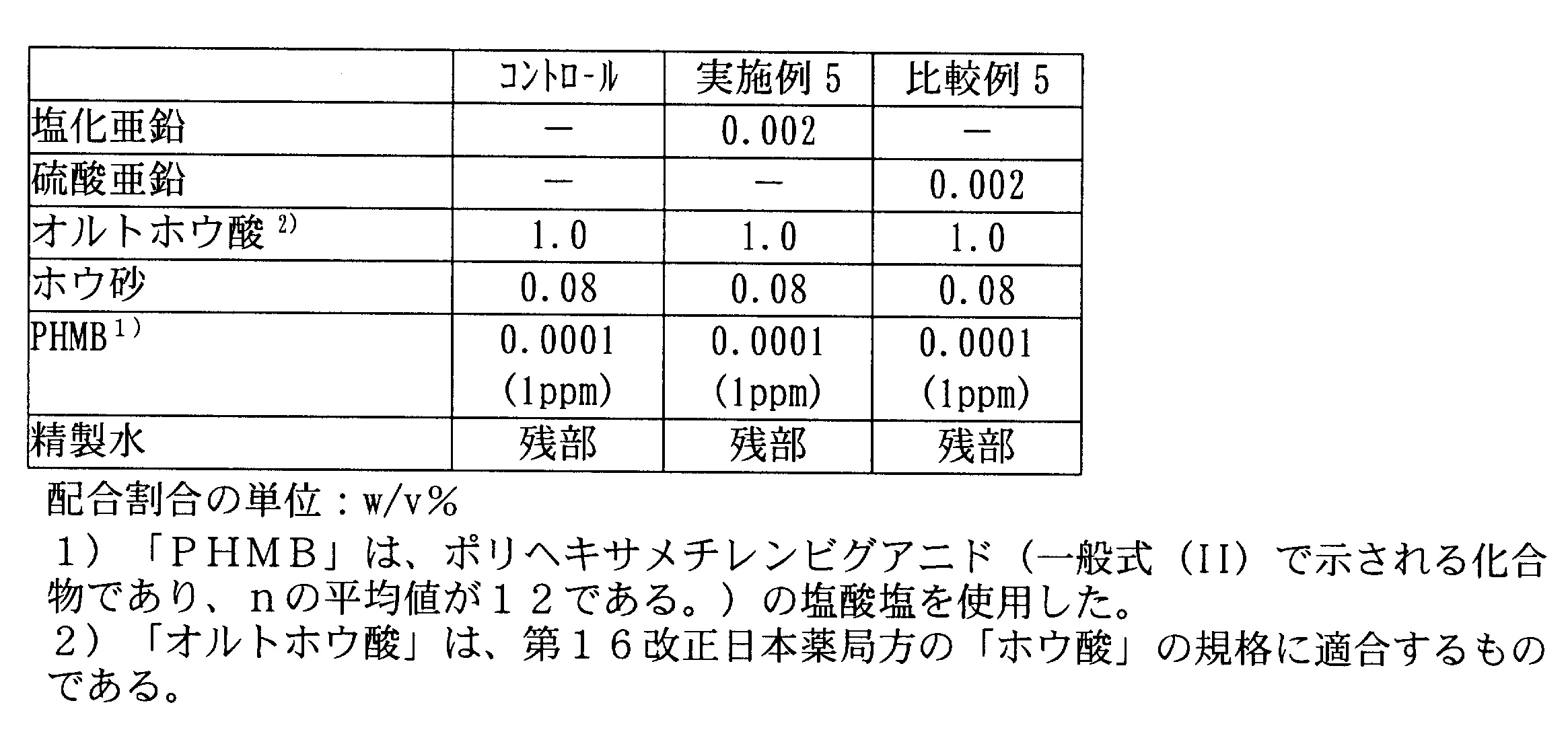
以下の表5に従って各眼科組成物を調製し、ソフトコンタクトレンズのサイズ変化について評価を行った。
……式(2)
以下表6に従って高濃度のホウ酸緩衝剤を含む各試験液を調製した。用いた試験液を変更した以外は、上記試験例4と同様にして試験を行い、ソフトコンタクトレンズのサイズ変化について評価を行った。
以下の表7に従って眼科組成物を調製し、角膜バリア機能に対する影響について評価を行った。
以下の表8に従って眼科組成物を調製し、角膜バリア機能に対する影響について評価を行った。

表9に記載の処方で、常法によりコンタクトレンズ用眼科組成物を調製する。

Claims (10)
- (A)ビグアニド系殺菌剤と、(B)塩化亜鉛とを含有することを特徴とする、眼科組成物。
- (A)ビグアニド系殺菌剤が、式:-NH-C(=NH)-NH-C(=NH)-NH-で表されるビグアニド基を少なくとも一つ有する化合物である、請求項1に記載の眼科組成物。
- 更に、(C)ホウ酸及びその塩からなる群より選択される少なくとも1種を含有する、請求項1又は2のいずれかに記載の眼科組成物。
- (C)成分を、ホウ素原子含量換算で0.0001~0.045mol/100mLの割合で含有する、請求項3に記載の眼科組成物。
- 更に、非イオン性界面活性剤を含有する、請求項1~4のいずれかに記載の眼科組成物。
- (A)成分の総含有量100重量部に対する(B)成分の総含有量が、10~50000重量部である、請求項1~5のいずれかに記載の眼科組成物。
- コンタクトレンズ用眼科組成物である、請求項1~6のいずれかに記載の眼科組成物。
- コンタクトレンズが、ソフトコンタクトレンズである、請求項5に記載の眼科組成物。
- アカントアメーバを消毒するために用いられる、請求項1又は2に記載の眼科組成物。
- 角膜表面にそのまま適用可能な製剤形態である、請求項1~3のいずれかに記載の眼科組成物。
Priority Applications (3)
| Application Number | Priority Date | Filing Date | Title |
|---|---|---|---|
| CA2869716A CA2869716A1 (en) | 2012-04-10 | 2013-04-04 | Ophthalmic composition |
| JP2014510130A JP5993447B2 (ja) | 2012-04-10 | 2013-04-04 | 眼科組成物 |
| US14/391,559 US20150064281A1 (en) | 2012-04-10 | 2013-04-04 | Ophthalmic composition |
Applications Claiming Priority (2)
| Application Number | Priority Date | Filing Date | Title |
|---|---|---|---|
| JP2012-089541 | 2012-04-10 | ||
| JP2012089541 | 2012-04-10 |
Publications (1)
| Publication Number | Publication Date |
|---|---|
| WO2013154016A1 true WO2013154016A1 (ja) | 2013-10-17 |
Family
ID=49327584
Family Applications (1)
| Application Number | Title | Priority Date | Filing Date |
|---|---|---|---|
| PCT/JP2013/060288 Ceased WO2013154016A1 (ja) | 2012-04-10 | 2013-04-04 | 眼科組成物 |
Country Status (4)
| Country | Link |
|---|---|
| US (1) | US20150064281A1 (ja) |
| JP (2) | JP5993447B2 (ja) |
| CA (1) | CA2869716A1 (ja) |
| WO (1) | WO2013154016A1 (ja) |
Cited By (1)
| Publication number | Priority date | Publication date | Assignee | Title |
|---|---|---|---|---|
| JPWO2021132609A1 (ja) * | 2019-12-27 | 2021-07-01 |
Citations (2)
| Publication number | Priority date | Publication date | Assignee | Title |
|---|---|---|---|---|
| JP2007530685A (ja) * | 2004-03-29 | 2007-11-01 | ボーシュ アンド ローム インコーポレイティド | 亜鉛含有保存剤組成物及びその使用方法 |
| JP2011219445A (ja) * | 2010-04-14 | 2011-11-04 | Rohto Pharmaceutical Co Ltd | 眼科組成物 |
Family Cites Families (6)
| Publication number | Priority date | Publication date | Assignee | Title |
|---|---|---|---|---|
| US6143281A (en) * | 1987-03-31 | 2000-11-07 | Smithkline Beecham P.L.C. | Dentifrice compositions |
| BR9701048A (pt) * | 1994-08-12 | 1998-12-15 | Procter & Gamble | Soluções de ciclodextrina não complexa de odor sobre superfícies inanimadas |
| US6369112B1 (en) * | 1998-12-15 | 2002-04-09 | Bausch & Lomb Incorporated | Treatment of contact lenses with aqueous solution comprising a biguanide disinfectant stabilized by tyloxapol |
| US7629386B2 (en) * | 2004-08-26 | 2009-12-08 | Bausch + Lomb Incorporated | Compositions containing trialkanolamine alkoxylate buffer |
| US20080214421A1 (en) * | 2007-02-19 | 2008-09-04 | Fang Zhao | Contact lens care composition |
| US20110293681A1 (en) * | 2010-02-26 | 2011-12-01 | Lectec Corporation | Hand sanitizing patch having an integrally bonded antimicrobial |
-
2013
- 2013-04-04 CA CA2869716A patent/CA2869716A1/en not_active Abandoned
- 2013-04-04 US US14/391,559 patent/US20150064281A1/en not_active Abandoned
- 2013-04-04 JP JP2014510130A patent/JP5993447B2/ja active Active
- 2013-04-04 WO PCT/JP2013/060288 patent/WO2013154016A1/ja not_active Ceased
-
2016
- 2016-06-27 JP JP2016126904A patent/JP2016183186A/ja active Pending
Patent Citations (2)
| Publication number | Priority date | Publication date | Assignee | Title |
|---|---|---|---|---|
| JP2007530685A (ja) * | 2004-03-29 | 2007-11-01 | ボーシュ アンド ローム インコーポレイティド | 亜鉛含有保存剤組成物及びその使用方法 |
| JP2011219445A (ja) * | 2010-04-14 | 2011-11-04 | Rohto Pharmaceutical Co Ltd | 眼科組成物 |
Non-Patent Citations (3)
| Title |
|---|
| "Letters to the Editor", AUST. N. Z. J. OPHTHALMOL., vol. 26, no. 1, 1998, pages 99 - 100 * |
| KHUNKITTI W; LLOYD D; FURR U R; RUSSELL A D: "The lethal effects of biguanides on cysts and trophozoites of Acanthamoeba castellanii", J. APPL. BACTERIOL., vol. 81, no. 1, 1996, pages 73 - 77, XP009117157 * |
| NAKISAH MAT AMIN, ET AL.: "Genotoxic effects of mercury and inc on Acanthamoeba sp., a free-living amoeba from setiu wetlands water: a laboratory study", J. SUST. SCI. MANAG., vol. 4, no. 2, 2009, pages 72 - 77 * |
Cited By (2)
| Publication number | Priority date | Publication date | Assignee | Title |
|---|---|---|---|---|
| JPWO2021132609A1 (ja) * | 2019-12-27 | 2021-07-01 | ||
| JP7722931B2 (ja) | 2019-12-27 | 2025-08-13 | ロート製薬株式会社 | 水性組成物 |
Also Published As
| Publication number | Publication date |
|---|---|
| CA2869716A1 (en) | 2013-10-17 |
| JP2016183186A (ja) | 2016-10-20 |
| JPWO2013154016A1 (ja) | 2015-12-17 |
| US20150064281A1 (en) | 2015-03-05 |
| JP5993447B2 (ja) | 2016-09-14 |
Similar Documents
| Publication | Publication Date | Title |
|---|---|---|
| JP6130741B2 (ja) | ソフトコンタクトレンズ用眼科組成物 | |
| JP2019043970A (ja) | 眼科組成物 | |
| JP2021157197A (ja) | シリコーンハイドロゲルコンタクトレンズ用眼科組成物 | |
| JP5616620B2 (ja) | 非イオン性シリコーンハイドロゲルコンタクトレンズ用眼科組成物 | |
| JP2016188237A (ja) | 眼科用液体組成物 | |
| JP5941524B2 (ja) | シリコーンハイドロゲルコンタクトレンズ用眼科組成物 | |
| JP7304282B2 (ja) | カラーコンタクトレンズ用眼科組成物 | |
| JP5616619B2 (ja) | シリコーンハイドロゲルコンタクトレンズ用眼科組成物 | |
| JP2023090938A (ja) | 非イオン性シリコーンハイドロゲルコンタクトレンズ用点眼剤 | |
| JP5688951B2 (ja) | シリコーンハイドロゲルコンタクトレンズ用眼科組成物 | |
| JP2016166248A (ja) | シリコーンハイドロゲルコンタクトレンズ用眼科組成物 | |
| JP2018135376A (ja) | シリコーンハイドロゲルコンタクトレンズ用眼科組成物 | |
| JP5582768B2 (ja) | 非イオン性シリコーンハイドロゲルコンタクトレンズ用眼科組成物 | |
| JP2011111441A (ja) | 非イオン性シリコーンハイドロゲルコンタクトレンズ用眼科組成物 | |
| JP5993447B2 (ja) | 眼科組成物 | |
| JP5650864B2 (ja) | 非イオン性シリコーンハイドロゲルコンタクトレンズ用眼科組成物 | |
| JP5989365B2 (ja) | コンタクトレンズ用眼科組成物 | |
| JP2011219445A (ja) | 眼科組成物 | |
| JP2023111965A (ja) | シリコーンハイドロゲルコンタクトレンズ用眼科組成物 | |
| JP2015028090A (ja) | 非イオン性シリコーンハイドロゲルコンタクトレンズ用眼科組成物 | |
| JP5689198B2 (ja) | シリコーンハイドロゲルコンタクトレンズ用眼科組成物 | |
| JP2020109121A (ja) | シリコーンハイドロゲルコンタクトレンズ用眼科組成物 | |
| JP2018197272A (ja) | シリコーンハイドロゲルコンタクトレンズ用眼科組成物 | |
| JP2016222728A (ja) | シリコーンハイドロゲルコンタクトレンズ用眼科組成物 | |
| JP2015078236A (ja) | シリコーンハイドロゲルコンタクトレンズ用眼科組成物 |
Legal Events
| Date | Code | Title | Description |
|---|---|---|---|
| 121 | Ep: the epo has been informed by wipo that ep was designated in this application |
Ref document number: 13775686 Country of ref document: EP Kind code of ref document: A1 |
|
| ENP | Entry into the national phase |
Ref document number: 2014510130 Country of ref document: JP Kind code of ref document: A |
|
| ENP | Entry into the national phase |
Ref document number: 2869716 Country of ref document: CA |
|
| WWE | Wipo information: entry into national phase |
Ref document number: 14391559 Country of ref document: US |
|
| NENP | Non-entry into the national phase |
Ref country code: DE |
|
| WWE | Wipo information: entry into national phase |
Ref document number: IDP00201406682 Country of ref document: ID |
|
| 122 | Ep: pct application non-entry in european phase |
Ref document number: 13775686 Country of ref document: EP Kind code of ref document: A1 |