WO2013147135A1 - 放出制御医薬組成物 - Google Patents
放出制御医薬組成物 Download PDFInfo
- Publication number
- WO2013147135A1 WO2013147135A1 PCT/JP2013/059487 JP2013059487W WO2013147135A1 WO 2013147135 A1 WO2013147135 A1 WO 2013147135A1 JP 2013059487 W JP2013059487 W JP 2013059487W WO 2013147135 A1 WO2013147135 A1 WO 2013147135A1
- Authority
- WO
- WIPO (PCT)
- Prior art keywords
- pharmaceutical composition
- controlled
- release pharmaceutical
- acid
- weight
- Prior art date
- Legal status (The legal status is an assumption and is not a legal conclusion. Google has not performed a legal analysis and makes no representation as to the accuracy of the status listed.)
- Ceased
Links
Images


Classifications
-
- A—HUMAN NECESSITIES
- A61—MEDICAL OR VETERINARY SCIENCE; HYGIENE
- A61K—PREPARATIONS FOR MEDICAL, DENTAL OR TOILETRY PURPOSES
- A61K9/00—Medicinal preparations characterised by special physical form
- A61K9/20—Pills, tablets, discs, rods
- A61K9/2004—Excipients; Inactive ingredients
- A61K9/2022—Organic macromolecular compounds
- A61K9/2027—Organic macromolecular compounds obtained by reactions only involving carbon-to-carbon unsaturated bonds, e.g. polyvinyl pyrrolidone, poly(meth)acrylates
-
- A—HUMAN NECESSITIES
- A61—MEDICAL OR VETERINARY SCIENCE; HYGIENE
- A61K—PREPARATIONS FOR MEDICAL, DENTAL OR TOILETRY PURPOSES
- A61K31/00—Medicinal preparations containing organic active ingredients
- A61K31/33—Heterocyclic compounds
- A61K31/395—Heterocyclic compounds having nitrogen as a ring hetero atom, e.g. guanethidine or rifamycins
- A61K31/435—Heterocyclic compounds having nitrogen as a ring hetero atom, e.g. guanethidine or rifamycins having six-membered rings with one nitrogen as the only ring hetero atom
- A61K31/4353—Heterocyclic compounds having nitrogen as a ring hetero atom, e.g. guanethidine or rifamycins having six-membered rings with one nitrogen as the only ring hetero atom ortho- or peri-condensed with heterocyclic ring systems
- A61K31/437—Heterocyclic compounds having nitrogen as a ring hetero atom, e.g. guanethidine or rifamycins having six-membered rings with one nitrogen as the only ring hetero atom ortho- or peri-condensed with heterocyclic ring systems the heterocyclic ring system containing a five-membered ring having nitrogen as a ring hetero atom, e.g. indolizine, beta-carboline
-
- A—HUMAN NECESSITIES
- A61—MEDICAL OR VETERINARY SCIENCE; HYGIENE
- A61K—PREPARATIONS FOR MEDICAL, DENTAL OR TOILETRY PURPOSES
- A61K9/00—Medicinal preparations characterised by special physical form
- A61K9/0012—Galenical forms characterised by the site of application
- A61K9/0019—Injectable compositions; Intramuscular, intravenous, arterial, subcutaneous administration; Compositions to be administered through the skin in an invasive manner
-
- A—HUMAN NECESSITIES
- A61—MEDICAL OR VETERINARY SCIENCE; HYGIENE
- A61K—PREPARATIONS FOR MEDICAL, DENTAL OR TOILETRY PURPOSES
- A61K9/00—Medicinal preparations characterised by special physical form
- A61K9/0012—Galenical forms characterised by the site of application
- A61K9/0053—Mouth and digestive tract, i.e. intraoral and peroral administration
-
- A—HUMAN NECESSITIES
- A61—MEDICAL OR VETERINARY SCIENCE; HYGIENE
- A61K—PREPARATIONS FOR MEDICAL, DENTAL OR TOILETRY PURPOSES
- A61K9/00—Medicinal preparations characterised by special physical form
- A61K9/20—Pills, tablets, discs, rods
- A61K9/2004—Excipients; Inactive ingredients
- A61K9/2022—Organic macromolecular compounds
- A61K9/205—Polysaccharides, e.g. alginate, gums; Cyclodextrin
- A61K9/2054—Cellulose; Cellulose derivatives, e.g. hydroxypropyl methylcellulose
-
- A—HUMAN NECESSITIES
- A61—MEDICAL OR VETERINARY SCIENCE; HYGIENE
- A61P—SPECIFIC THERAPEUTIC ACTIVITY OF CHEMICAL COMPOUNDS OR MEDICINAL PREPARATIONS
- A61P11/00—Drugs for disorders of the respiratory system
- A61P11/06—Antiasthmatics
-
- A—HUMAN NECESSITIES
- A61—MEDICAL OR VETERINARY SCIENCE; HYGIENE
- A61P—SPECIFIC THERAPEUTIC ACTIVITY OF CHEMICAL COMPOUNDS OR MEDICINAL PREPARATIONS
- A61P17/00—Drugs for dermatological disorders
-
- A—HUMAN NECESSITIES
- A61—MEDICAL OR VETERINARY SCIENCE; HYGIENE
- A61P—SPECIFIC THERAPEUTIC ACTIVITY OF CHEMICAL COMPOUNDS OR MEDICINAL PREPARATIONS
- A61P25/00—Drugs for disorders of the nervous system
- A61P25/28—Drugs for disorders of the nervous system for treating neurodegenerative disorders of the central nervous system, e.g. nootropic agents, cognition enhancers, drugs for treating Alzheimer's disease or other forms of dementia
-
- A—HUMAN NECESSITIES
- A61—MEDICAL OR VETERINARY SCIENCE; HYGIENE
- A61P—SPECIFIC THERAPEUTIC ACTIVITY OF CHEMICAL COMPOUNDS OR MEDICINAL PREPARATIONS
- A61P35/00—Antineoplastic agents
-
- A—HUMAN NECESSITIES
- A61—MEDICAL OR VETERINARY SCIENCE; HYGIENE
- A61P—SPECIFIC THERAPEUTIC ACTIVITY OF CHEMICAL COMPOUNDS OR MEDICINAL PREPARATIONS
- A61P35/00—Antineoplastic agents
- A61P35/02—Antineoplastic agents specific for leukemia
-
- A—HUMAN NECESSITIES
- A61—MEDICAL OR VETERINARY SCIENCE; HYGIENE
- A61P—SPECIFIC THERAPEUTIC ACTIVITY OF CHEMICAL COMPOUNDS OR MEDICINAL PREPARATIONS
- A61P37/00—Drugs for immunological or allergic disorders
- A61P37/02—Immunomodulators
- A61P37/06—Immunosuppressants, e.g. drugs for graft rejection
-
- A—HUMAN NECESSITIES
- A61—MEDICAL OR VETERINARY SCIENCE; HYGIENE
- A61P—SPECIFIC THERAPEUTIC ACTIVITY OF CHEMICAL COMPOUNDS OR MEDICINAL PREPARATIONS
- A61P37/00—Drugs for immunological or allergic disorders
- A61P37/08—Antiallergic agents
-
- A—HUMAN NECESSITIES
- A61—MEDICAL OR VETERINARY SCIENCE; HYGIENE
- A61P—SPECIFIC THERAPEUTIC ACTIVITY OF CHEMICAL COMPOUNDS OR MEDICINAL PREPARATIONS
- A61P43/00—Drugs for specific purposes, not provided for in groups A61P1/00-A61P41/00
-
- A—HUMAN NECESSITIES
- A61—MEDICAL OR VETERINARY SCIENCE; HYGIENE
- A61P—SPECIFIC THERAPEUTIC ACTIVITY OF CHEMICAL COMPOUNDS OR MEDICINAL PREPARATIONS
- A61P9/00—Drugs for disorders of the cardiovascular system
- A61P9/10—Drugs for disorders of the cardiovascular system for treating ischaemic or atherosclerotic diseases, e.g. antianginal drugs, coronary vasodilators, drugs for myocardial infarction, retinopathy, cerebrovascula insufficiency, renal arteriosclerosis
-
- C—CHEMISTRY; METALLURGY
- C07—ORGANIC CHEMISTRY
- C07D—HETEROCYCLIC COMPOUNDS
- C07D471/00—Heterocyclic compounds containing nitrogen atoms as the only ring hetero atoms in the condensed system, at least one ring being a six-membered ring with one nitrogen atom, not provided for by groups C07D451/00 - C07D463/00
- C07D471/02—Heterocyclic compounds containing nitrogen atoms as the only ring hetero atoms in the condensed system, at least one ring being a six-membered ring with one nitrogen atom, not provided for by groups C07D451/00 - C07D463/00 in which the condensed system contains two hetero rings
- C07D471/04—Ortho-condensed systems
Definitions
- the present invention relates to 4- ⁇ [(1R, 2s, 3S, 5s, 7s) -5-hydroxy-2-adamantyl] amino ⁇ -1H-pyrrolo [2,3-b] pyridine-5-carboxamide or pharmaceutics thereof
- the present invention relates to a controlled-release pharmaceutical composition comprising a pharmaceutically acceptable salt, an acidic substance, a supersaturation maintaining agent, and a controlled-release base.
- the present invention relates to 4- ⁇ [(1R, 2s, 3S, 5s, 7s) -5-hydroxy-2-adamantyl] amino ⁇ -1H-pyrrolo [2,3-b] pyridine-5-carboxamide.
- the present invention relates to a controlled-release pharmaceutical composition that suppresses the difference.
- Compound A has an excellent JAK3 inhibitory activity and is known to be useful as an active ingredient of a therapeutic and / or prophylactic agent for various immune diseases including autoimmune diseases, inflammatory diseases and allergic diseases.
- Patent Document 1 4- ⁇ [(1R, 2s, 3S, 5s, 7s) -5-hydroxy-2-adamantyl] amino ⁇ -1H-pyrrolo [2,3-b] pyridine-5-carboxamide
- Patent Document 2 A hydrogel sustained-release preparation that enables good drug release in the colon of the lower gastrointestinal tract has been disclosed (Patent Document 2). It is disclosed that when a drug is a poorly soluble drug, a solid dispersion can be formed with a polymer such as hypromellose (HPMC) to improve the solubility.
- HPMC hypromellose
- sustained-release preparations containing basic drugs have the problem that the elution rate increases in gastric juice and the elution rate decreases in intestinal fluid, or acidic drugs Since the dissolution rate of gastric juice decreases in the gastric juice, the sustained-release preparation containing a drug, a buffer, and a hydrophobic substance Matrix tablets containing molecules or gel-forming polymers are disclosed.
- the buffer is retained in the matrix pores for a long time despite being easily soluble, so that the pH in the pores is kept constant. It is known that the elution rate of the drug can be arbitrarily changed by changing the composition of the added buffering agent (Patent Document 3).
- the subject of the present invention is a digestion after excretion from the stomach (such as the small intestine) when orally administered in a pharmaceutical composition containing Compound A having extremely different solubility in acidic pH range and neutral pH range.
- An object of the present invention is to maintain the solubility of Compound A even in the neutral pH range of the tube, to exhibit good oral absorption, or to provide a pharmaceutical composition with high bioavailability.
- the solubility of Compound A is determined in the acidic pH range (approximately 8,600 ⁇ g / mL in the Japanese Pharmacopoeia Dissolution Test Solution No. 1 (JP1 (pH 1.2))) and the neutral pH range (Japanese Pharmacopoeia Dissolution Test Solution No. 2 In the liquid (JP2 (pH 6.8)), there was a 1000-fold difference, and it was found that the solubility was particularly low in a neutral pH environment such as JP2 (about 12, 1 in water). 500 ⁇ g / mL).
- the present invention [1] 4- ⁇ [(1R, 2s, 3S, 5s, 7s) -5-hydroxy-2-adamantyl] amino ⁇ -1H-pyrrolo [2,3-b] pyridine-5-carboxamide or a pharmaceutical thereof
- a controlled release pharmaceutical composition comprising an acceptable salt, an acidic substance, a supersaturation maintaining agent, and a controlled release base
- the controlled-release pharmaceutical composition according to [1] wherein the acidic substance is citric acid, malic acid, tartaric acid, fumaric acid, ascorbic acid, succinic acid, or maleic acid
- the addition amount of the acidic substance is 4- ⁇ [(1R, 2s, 3S, 5s, 7s) -5-hydroxy-2-adamantyl] amino ⁇ -1H-pyrrolo [2,3-b] pyridine-5 -
- the controlled-release pharmaceutical composition according to [1] or [2] which is 10% by weight or more and 200% by weight based on the weight of carboxamide or
- compound A can be recrystallized / precipitated by maintaining the solubility (particularly supersaturation) of compound A even in the neutral pH region in the digestive tract (after gastric emptying). It can be avoided.
- the drug is continuously released (elution while maintaining the dissolved state) regardless of the pH environment in the digestive tract, and the entire digestive tract becomes an absorption site.
- inter-individual variation or intra-individual variation for example, pharmacokinetics (PK) parameter variation due to pH variation in the gastrointestinal tract
- PK pharmacokinetics
- “solubility” or “solubility” means the degree of dissolution of compound A by the method in the 16th revision Japanese Pharmacopoeia and the like. For example, as a certain aspect, within the range of 30 minutes when compound A is powdered and then placed in a solvent and shaken every 5 minutes at 20 ⁇ 5 ° C. for 30 seconds as “solubility” or “solubility” of compound A It is defined as the degree to which it dissolves.
- “Practically insoluble, or insoluble” means that the amount of solvent required to dissolve 1 g or 1 mL of compound A is 10,000 mL or more, and “Very slightly soluble” means 1 g of compound A or The amount of solvent required to dissolve 1 mL refers to properties of 1,000 mL or more and less than 10,000 mL.
- the solubility test tube shaking method after putting the powder of Compound A with a solvent in a test tube and shaking for 10 minutes at 23 ⁇ 5 ° C. (330 strokes / minute, 4 cm / stroke) is also included. .
- the solubility of Compound A in JP1 is about 8,600 ⁇ g / mL, about 8.6 ⁇ g / mL for JP2, and about 12,500 ⁇ g / mL for water. .
- the solubility (test tube shaking method) after the powder of Compound A is placed in a test tube together with a solvent and shaken at 37 ° C. for 14 hours is also included.
- the solubility of Compound A in the United States Pharmacopeia (USP) pH 6.8 phosphate buffer is 10.9 ⁇ g / mL.
- “supersaturated” means that a solute (compound A) having a solubility or higher is contained.
- “supersaturated solution” means a solution containing a solute (compound A) having a solubility or higher.
- “maintaining supersaturation” means, as one embodiment, solubility of Compound A at pH 6.8 (8.6 ⁇ g / mL (23 ° C. in the case of a test tube shaking method), 10.9 ⁇ g / mL (37 ° C)) and maintaining the above solubility.
- “improvement of bioavailability (rate)” or “improvement of bioavailability” means that “relative bioavailability” for a composition not including the composition of the present invention is higher. means. For example, it is defined that “Bioavailability” is high for a pharmaceutical composition not containing an “acidic substance” used in the present invention.
- “reducing PK parameter fluctuation” means the ratio of the same parameter when the gastric pH is administered at neutral to the Cmax and AUC when the gastric pH is administered at acidic, for example, It is defined as 0.5 times or more as one aspect, 0.6 times or more as another aspect, and 0.7 times or more as another aspect.
- release control means, for example, USP pH 6.8 phosphate buffer 900 mL or USP pH 6.8 phosphate buffer as a test solution according to the Japanese Pharmacopoeia Dissolution Test Method 2 (Paddle Method).
- the dissolution test was conducted under the condition of paddle rotation speed of 100 rpm using 900 mL of a test solution in which 1% of sodium lauryl sulfate was added to the solution, the dissolution rate of Compound A for 30 minutes after the start of the test was less than 80%. In another aspect, it means controlling to less than 50%, and in another aspect, controlling to less than 30%.
- the known compound A represented by the formula (I) may form an addition salt with an acid or a base.
- a salt may be a pharmaceutically acceptable salt.
- an inorganic acid for example, hydrochloric acid, hydrobromic acid, sulfuric acid, nitric acid, phosphoric acid
- an organic acid for example, And acid addition salts with succinic acid, fumaric acid, L-malic acid, L-tartaric acid, mesylic acid, and tosylic acid.
- Another embodiment is an acid addition salt with hydrobromic acid.
- various hydrates, solvates and crystal polymorphs of the compound represented by the formula (I) or a salt thereof may be used.
- the known compound A or a pharmaceutically acceptable salt thereof can be used alone or in combination of two or more.
- the known compound A or a pharmaceutically acceptable salt thereof has an inhibitory activity against JAK3 and is caused by unwanted cytokine signaling (for example, rejection in living transplants, autoimmune diseases, asthma, atopic) Dermatitis, Alzheimer's disease, atherosclerosis), or useful as an active ingredient of a therapeutic or prophylactic agent for diseases (for example, cancer, leukemia) caused by abnormal cytokine signaling.
- unwanted cytokine signaling for example, rejection in living transplants, autoimmune diseases, asthma, atopic
- Dermatitis for example, Alzheimer's disease, atherosclerosis
- diseases for example, cancer, leukemia
- the dose of the known compound A or a pharmaceutically acceptable salt thereof is appropriately determined according to individual cases in consideration of the administration route, the symptoms of the disease, the age, race, sex, etc. of the administration subject.
- the daily dose of the known compound A or a pharmaceutically acceptable salt thereof is about 0.001 to about 100 mg / kg in one embodiment, about 0.1 to about 100 mg / kg in another embodiment. From about 30 mg / kg to about 0.1 to about 10 mg / kg is suitable, and this is administered once or divided into multiple doses such as 2 to 4 times.
- the daily dose is suitably about 0.0001 to about 10 mg / kg per body weight, and is administered once to several times a day.
- a transmucosal agent about 0.001 to about 100 mg / kg per body weight is administered once to several times a day.
- the addition amount of the known compound A or a pharmaceutically acceptable salt thereof is 10 mg or more and 200 mg or less as a certain embodiment and 15 mg or more and 150 mg or less as another embodiment per unit preparation.
- the addition amount of the known compound A or a pharmaceutically acceptable salt thereof is 5% by weight or more and 70% by weight or less as a certain embodiment and 7% by weight or more and 50% by weight or less as another embodiment per unit preparation.
- the “acidic substance” used in the present invention is not limited as long as it is pharmaceutically acceptable and maintains the solubility of Compound A in a neutral pH range. Moreover, as another aspect, if the supersaturated state of the compound A is maintained, it will not be restrict
- citric acid, malic acid, tartaric acid, fumaric acid, ascorbic acid, succinic acid, maleic acid and the like can be mentioned.
- Other embodiments include citric acid, tartaric acid, malic acid, and ascorbic acid.
- Yet another embodiment is citric acid or tartaric acid, and another embodiment is tartaric acid.
- acidic substances can be used alone or in combination of two or more.
- the addition amount of the acidic substance is not limited as long as it is an amount that maintains the solubility of Compound A in the neutral pH range.
- it is 10% by weight or more and 200% by weight or less as one aspect, 50% or more and 150% by weight or less as another aspect, and 100 as another aspect.
- % By weight or more and 120% by weight or less.
- it is 5% by weight or more and 50% by weight or less per unit preparation, in another embodiment, it is 10% by weight or more and 40% by weight or less, and in another embodiment, it is 20% by weight or more and 40% by weight or less. .
- the “supersaturation maintaining agent” used in the present invention is a “substance that maintains the solubility of Compound A (dissolution maintenance agent)” as one embodiment, and the “substance that maintains the supersaturation of Compound A (supersaturation maintenance) as another embodiment.
- a substance that is pharmaceutically acceptable and maintains the solubility of Compound A it is not limited.
- the substance is not limited as long as it is pharmaceutically acceptable and maintains the supersaturation of Compound A.
- Another embodiment is a pharmaceutically acceptable water-soluble polymer.
- hypromellose hydroxypropylcellulose, hydroxypropylmethylcellulose acetate succinate, polyvinylpyrrolidone, vinylpyrrolidone-vinylacetate copolymer and the like
- Other embodiments include hypromellose, hydroxypropyl cellulose, hydroxypropyl methylcellulose acetate succinate.
- Another embodiment is hypromellose.
- TC-5E viscosity: 3 mPa ⁇ s (2% aqueous solution 20 ° C.)
- TC-5M viscosity: 4.5 mPa ⁇ s (2% aqueous solution 20 ° C.)
- TC-5R viscosity: 6 mPa ⁇ s (2% aqueous solution 20 ° C.)
- TC-5S viscosity: 15 mPa ⁇ s (2% aqueous solution 20 ° C.)).
- Hydroxypropyl cellulose can be obtained under the trade names HPC-L (Nippon Soda), KLUCEL LF (Hercules), KLUCEL JF (Hercules). Further, hydroxypropylmethylcellulose acetate succinate can be obtained as a trade name AQOAT (Shin-Etsu Chemical Co., Ltd.).
- “solubility maintenance agent” or “supersaturation maintenance agent” can be used alone or in combination of two or more.
- the addition amount of the “solubility maintenance agent” or the “supersaturation maintenance agent” is not limited as long as the solubility of the compound A is maintained. Or it will not restrict
- the weight of the known compound A for example, in one embodiment, it is 10 wt% or more and 200 wt% or less, in another embodiment, 20 wt% or more and 200 wt% or less, and in another embodiment, 40 wt% or more and 150 wt% or less. It is 50 weight% or less and as a further aspect, it is 50 weight% or more and 120 weight% or less.
- Per unit preparation it is 5% by weight or more and 50% by weight or less as one embodiment, 10% by weight or more and 40% by weight or less in another embodiment, and 10% by weight or more and 30% by weight or less in another embodiment. Moreover, as another aspect, it is 20 to 30 weight%.
- the “release control base” used in the present invention is not limited as long as it is a polymer that forms a hydrogel (hydrogel-forming polymer). Moreover, as another aspect, if it is a base which controls the discharge
- the properties of the polymer substance depend on its molecular weight, and higher molecular weight is preferable.
- One embodiment includes a viscosity average molecular weight of 2 million or more, and another embodiment includes a viscosity average molecular weight of 4 million or more.
- polyethylene oxide for example, trade name Polyox WSR-303 (average molecular weight: 7 million, viscosity: 7500-10000 cps (1% aqueous solution 25 ° C.))
- Polyox WSR Coagulant average molecular weight 5 million, viscosity: 5500-7500 cps (same)
- Polyox WSR-301 average molecular weight: 4 million, viscosity: 1650-5500 cps (same)
- Polyox WSR-N-60K Average molecular weight: 2 million, viscosity: 2000-4000 cps (2% aqueous solution at 25 ° C.)
- Polyox WSR-N-12K average molecular weight: 1 million, viscosity: 400-800 cps (2% aqueous solution at 25 ° C.)
- Polyox WSR- 1105 average Amount: 900
- Another embodiment includes PEO having an average molecular weight of 2 million or more.
- a higher molecular weight in one embodiment, an average molecular weight of 4 million or higher or higher viscosity, preferably a viscosity of 1% aqueous solution at 25 ° C. is 3000 cps or higher.
- the polymer which is is preferable.
- These polymer substances forming the hydrogel can be used alone or in combination of two or more. Also, a mixture comprising two or more kinds of polymer substances and having properties suitable for the present invention as a whole can be suitably used as the polymer substance forming the hydrogel of the present invention.
- Another embodiment is a hydrogel-forming polymer having a viscosity average molecular weight of 2 million to 7 million.
- polyethylene oxide, hypromellose, sodium carboxymethyl cellulose, hydroxyethyl cellulose, carboxyvinyl polymer and the like can be mentioned as certain embodiments.
- Other embodiments include polyethylene oxide.
- the addition amount of the hydrogel-forming polymer is 5% by weight or more and 500% by weight or less as an aspect with respect to the weight of the known compound A, and 10% by weight or more and 80% by weight or less as another aspect. As another aspect, it is 10 to 60 weight%. Per unit preparation, it is 3% by weight or more and 60% by weight or less as an aspect, in another aspect, it is 5% by weight or more and 30% by weight or less, and in another aspect, it is 5% by weight or more and 20% by weight or less. .
- a hydrophilic base may be further added to the controlled-release pharmaceutical composition of the present invention.
- the “hydrophilic base” used in the present invention the amount of water necessary for dissolving 1 g of the hydrophilic base in one embodiment is 5 mL or less at 20 ⁇ 5 ° C., and in another embodiment, 4 mL or less. belongs to. The higher the solubility in water, the higher the effect of allowing water to enter the preparation.
- polyethylene glycol PEG; for example, trade names PEG400, PEG1500, PEG4000, PEG6000, PEG20000; manufactured by NOF Corporation
- polyvinylpyrrolidone PVP; for example, trade name PVP K30 manufactured by BASF Corporation
- Water-soluble polymers Sugar alcohols such as D-sorbitol and xylitol, sucrose, anhydrous maltose, D-fructose, dextran (eg, dextran 40), sugars such as glucose and sucrose, polyoxyethylene Surfactants such as polyoxypropylene glycol (for example, Pluronic F68; manufactured by Asahi Denka Co., Ltd.), salts such as sodium chloride and magnesium chloride, organic acids such as citric acid and tartaric acid, glycine, ⁇ -alanine, lysine hydrochloride and the like Ami Examples include amino acids such as noic acids and meglumine.
- PEG6000 PVP
- D-sorbitol Preferably PEG8000, a citric acid, sucrose, etc. are mentioned.
- a hydrophilic base can be used 1 type or in combination of 2 or more types.
- the addition amount of the hydrophilic base is 5% by weight or more and 100% by weight or less as an aspect with respect to the weight of the known compound A, and is 10% by weight or more and 80% by weight or less as another aspect. As another certain aspect, they are 100 weight% or more and 120 weight% or less. In one embodiment, it is 3% by weight or more and 50% by weight or less per unit preparation, and in another embodiment, it is 5% by weight or more and 30% by weight or less. *
- various pharmaceutical additives are appropriately used as necessary, and formulated.
- a pharmaceutical additive is not particularly limited as long as it is pharmaceutically acceptable and pharmacologically acceptable.
- excipients, binders, disintegrants, acidulants, foaming agents, artificial sweeteners, fragrances, lubricants, colorants, buffers, antioxidants, surfactants, fluidizing agents, etc. are used. .
- Examples of the excipient include D-mannitol and lactose hydrate.
- Examples of the binder include gum arabic, hypromellose, hydroxypropyl cellulose, hydroxyethyl cellulose and the like.
- Examples of the disintegrant include corn starch, potato starch, carmellose calcium, carmellose sodium, and low-substituted hydroxypropylcellulose.
- Examples of the sour agent include citric acid, tartaric acid, malic acid and the like.
- Examples of the foaming agent include baking soda.
- Examples of the artificial sweetener include saccharin sodium, dipotassium glycyrrhizin, aspartame, stevia and thaumatin.
- Examples of the fragrances include lemon, lemon lime, orange and menthol.
- Examples of the lubricant include light anhydrous silicic acid, magnesium stearate, calcium stearate, sucrose fatty acid ester, polyethylene glycol, talc, stearic acid, sodium lauryl sulfate and the like.
- Examples of the colorant include yellow ferric oxide, red ferric oxide, black iron oxide, edible yellow No. 4, No. 5, edible red No. 3, No. 102, edible blue No. 3, and the like.
- Buffers include citric acid, succinic acid, fumaric acid, tartaric acid, ascorbic acid or salts thereof, glutamic acid, glutamine, glycine, aspartic acid, alanine, arginine or salts thereof, magnesium oxide, zinc oxide, magnesium hydroxide, phosphoric acid , Boric acid or its salts.
- Examples of the antioxidant include ascorbic acid, dibutylhydroxytoluene, propyl gallate and the like.
- surfactant examples include polysorbate 80, sodium lauryl sulfate, polyoxyethylene hydrogenated castor oil, and the like.
- fluidizing agent examples include light anhydrous silicic acid.
- an appropriate amount can be appropriately added by combining one or more kinds. As for the addition amount, any excipient is used in an amount within the range in which the desired effect of the present invention is achieved.
- a preferable dosage form is an oral solid preparation that can be easily taken by a patient and is convenient for storage and carrying.
- it is a tablet, a capsule, a powder, a granule, a fine granule, a dry syrup, etc., and it is a tablet as another aspect.
- controlled-release pharmaceutical composition of the present invention can be produced by a known method such as pulverization, mixing, granulation, molding (tablet), film coating and the like.
- the method for pulverizing the pulverizing step is not particularly limited as long as it can be pharmaceutically pulverized.
- the pulverizer include a hammer mill, a ball mill, a jet mill, and a pin mill.
- the grinding conditions are not particularly limited as long as they are appropriately selected.
- the apparatus As a method of mixing in the mixing step , there is no particular limitation on the apparatus and means as long as it is a method that can generally mix each component uniformly pharmaceutically.
- the mixing apparatus include a V-type mixer, a ribbon-type mixer, a container mixer, and a high-speed stirring mixer.
- the mixing conditions are not particularly limited as long as they are appropriately selected.
- Examples of the granulating step granulator include a high speed stirring granulator and the like.
- Examples of the granulation method include, for example, a fluidized bed granulation method, a melt granulation method, a high-speed stirring granulation method, a crushing (pulverization) granulation method, an extrusion granulation method, a rolling granulation method, and a spray granulation method. Examples thereof include a granulation method and a dry granulation method.
- Another embodiment is a high-speed stirring granulation method.
- the binder solution is prepared by dissolving or dispersing in a solvent such as water, ethanol or methanol. Further, these solvents can be appropriately mixed and used.
- the conditions for preparing the binder solution are not particularly limited as long as they are appropriately selected.
- the drying method is not particularly limited as long as it is usually a pharmaceutically drying method, and examples thereof include ventilation drying and drying under reduced pressure.
- sizing may be performed to remove coarse particles having a certain size or more.
- a solid dispersion containing Compound A and a supersaturation maintaining agent may be prepared before granulation, and an acidic substance and various additives may be mixed into the solid dispersion for granulation.
- a granulated product or a mixture of granulated products mixed with various pharmaceutical additives is filled into capsules to make capsules, or compressed into tablets using a rotary tableting machine. be able to.
- the compression step is not particularly limited as long as it is a method for molding the controlled-release pharmaceutical composition of the present invention. Examples thereof include a direct tableting method in which a drug and an appropriate pharmaceutical additive are mixed and then compression-molded to obtain a tablet, and a method in which a lubricant is further mixed with the granulated product and then compression-molded to produce a tablet.
- the tableting device include a rotary tableting machine, a single tableting machine, and an oil press. Tableting conditions such as tableting pressure are not particularly limited as long as the tablet can be molded and the tableting pressure does not damage the tablet during the production process.
- Film coating may be applied to the tablet surface after tableting as appropriate.
- the method is not particularly limited as long as it is usually a pharmaceutically film coating method. Examples thereof include pan coating and dip coating.
- the film coating agent include hypromellose, polyvinyl alcohol, polyvinyl alcohol copolymer, polyvinyl pyrrolidone, iron sesquioxide (red, yellow), titanium oxide, polyethylene glycol, triethyl citrate and the like.
- the film coating agent can be appropriately added in an appropriate amount by combining one kind or two or more kinds.
- a film coating rate will not be restrict
- the method is not particularly limited as long as it can be usually pharmaceutically dried.
- the drying conditions are not particularly limited as long as they are appropriately set in consideration of, for example, the stability of the preparation.
- Reference Examples 1-6 Based on the formulation shown in Table 1, Compound A hydrobromide (manufactured by Astellas Pharma, the same applies hereinafter), acidic substance (anhydrous citric acid: manufactured by Komatsuya Co., Ltd., malic acid: manufactured by Kanto Chemical Co., Inc., tartaric acid: manufactured by Komatsuya Co., Ltd.) , Fumaric acid: manufactured by Kanto Chemical Co., Inc., ascorbic acid: manufactured by Kanto Chemical Co., Ltd., succinic acid: manufactured by Wako Pure Chemical Industries, Ltd., hereinafter the same unless otherwise specified, polyethylene oxide (molecular weight: 7 million, Polyox WSR-303, Dow Made by Chemical Co., unless otherwise noted, and magnesium stearate (Parteck (registered trademark) LUB MST, Merck Co., Ltd.) were mixed using a mortar pestle and compression molded using an oil press tableting machine. And tablets (diameter 9 mm) were produced.
- acidic substance
- Comparative Example 1 In order to make the size of the preparations the same without adding the acidic substance in the present invention, polyethylene glycol (PEG 8000 (Polyglycol 8000, manufactured by Clariant Co., Ltd., hereinafter the same unless otherwise specified)) was added for comparison. A pharmaceutical composition (tablet) was prepared.
- PEG 8000 Polyglycol 8000, manufactured by Clariant Co., Ltd., hereinafter the same unless otherwise specified
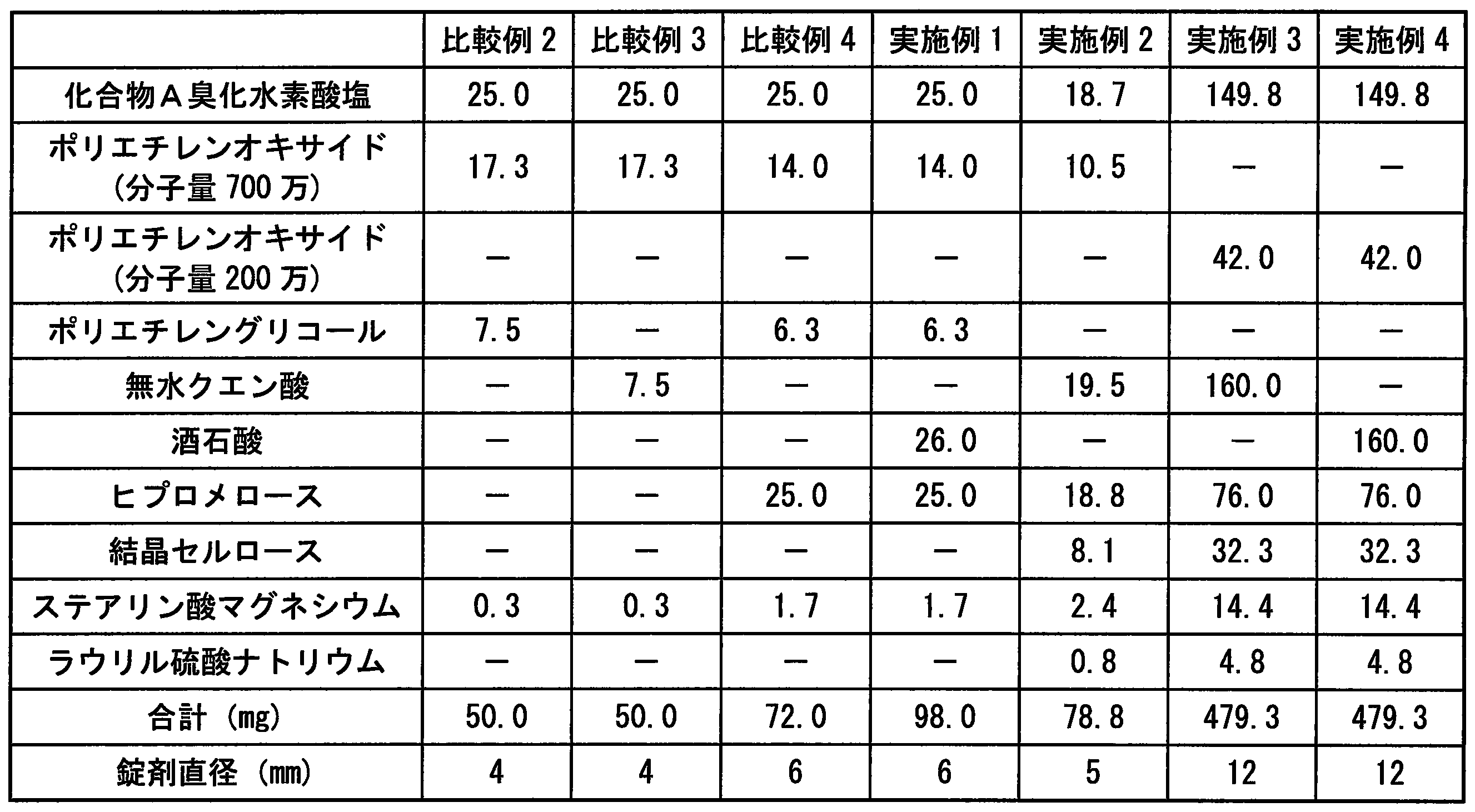
- Examples 1 to 4 and Comparative Examples 2 to 4 Based on the formulation shown in Table 2, various additives were mixed using a mortar pestle. The mixture was compression-molded using an oil press tableting machine to produce a controlled release pharmaceutical composition (tablet) of the present invention and a comparative pharmaceutical composition (tablet).
- the polyethylene oxide having a molecular weight of 2 million is Polyox WSR N-60K manufactured by Dow Chemical Co. (hereinafter, unless otherwise specified), and the hypromellose is manufactured by TC-5E, manufactured by Shin-Etsu Chemical Co., Ltd.
- Ceolus PH101 manufactured by Asahi Kasei (hereinafter, the same unless otherwise specified), as sodium lauryl sulfate, NIKKOL SLS, manufactured by Nikko Chemicals (hereinafter, The same applies hereinafter unless otherwise specified.
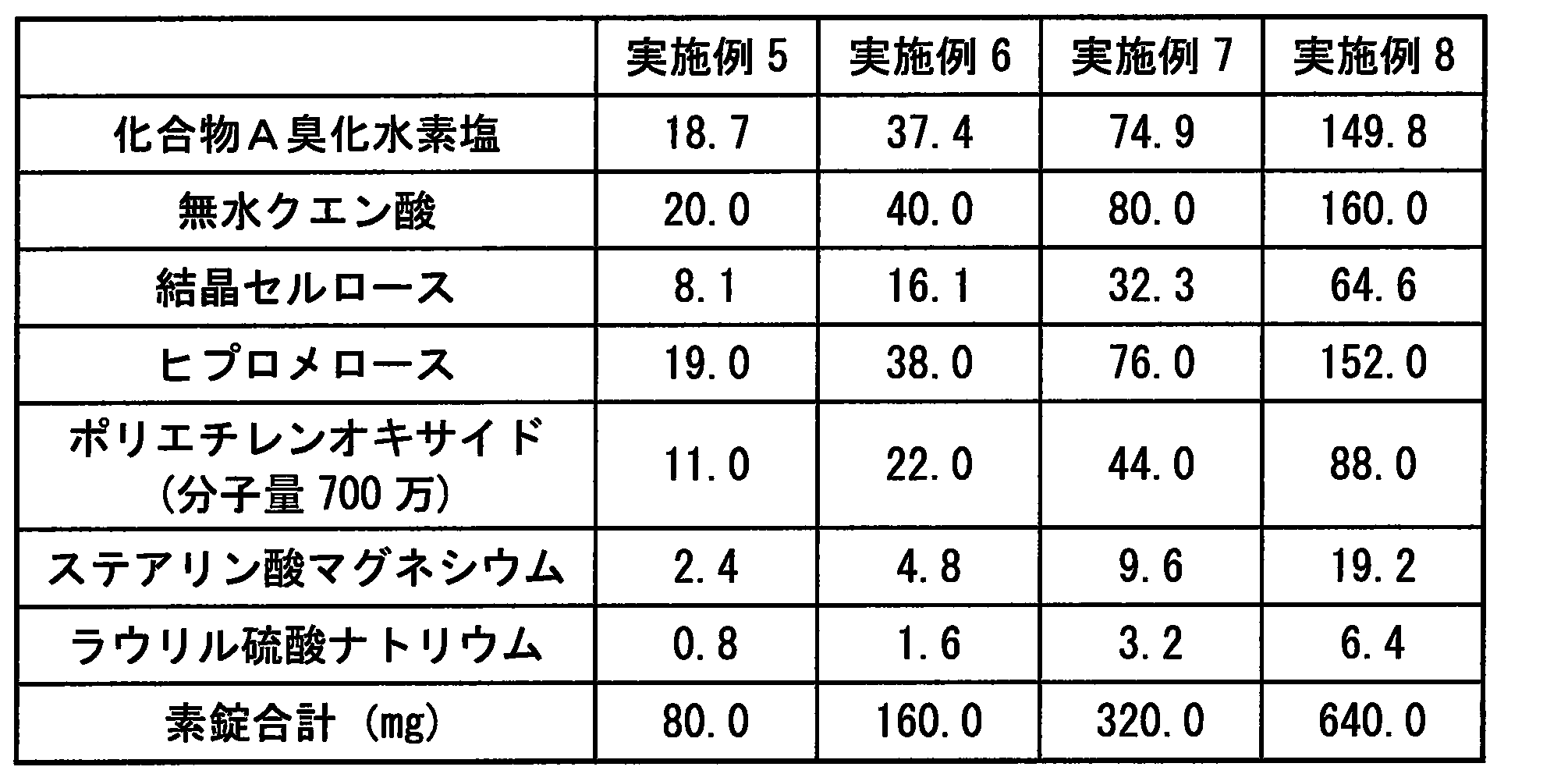
- Examples 5-8 Based on the formulation shown in Table 3, 299.7 g of Compound A hydrobromide, 320.0 g of anhydrous citric acid (manufactured by Mallinckrodt Baker), 129.1 g of crystalline cellulose (Ceolous PH101), 304. hypromellose (TC-5E). After mixing 0 g using a high-speed stirring granulator (PMA 1 High Shear Granulator, manufactured by GEA), purified water was added and wet granulation was performed.
- PMA 1 High Shear Granulator manufactured by GEA
- Examples 15, 19 and 20 In the same manner as in Examples 9 to 14 and 16 to 18, based on Tables 4 and 5, Compound A hydrobromide, anhydrous citric acid, crystalline cellulose (Ceolous PH101), hypromellose (TC-5E) were stirred at high speed. After mixing using a granulator, purified water was added to perform wet granulation. This granulated product was dried using a fluidized bed granulator, and then granulated using a granulator to obtain a granulated product.
- Hypromellose (Methocel K100LV, manufactured by Dow Chemical), polyethylene oxide (molecular weight: 7 million or molecular weight: 2 million), magnesium stearate, sodium lauryl sulfate (manufactured by Stepan), and light anhydrous silicic acid (AEROSIL 200) It mixed and compression-molded using the rotary tableting machine, and manufactured the controlled release pharmaceutical composition (tablet) of this invention.
- Examples 21-25 Based on the formulation shown in Table 6, various additives were mixed using a mortar pestle. The mixture was compression-molded using an oil press tableting machine to produce a controlled release pharmaceutical composition (tablet) of the present invention.
- Test example 1 The drug dissolution properties of the preparations of Reference Examples 1 to 6 and the control preparation (preparation of Comparative Example 1) were evaluated. Using 900 mL (37 ° C.) of a test solution obtained by adding 1% sodium lauryl sulfate to a USP pH 6.8 phosphate buffer as a test solution, an elution test was performed according to the Japanese Pharmacopoeia Dissolution Test Method 2 (paddle rotation speed: 100 rpm) ). After starting the dissolution test, the dissolution rate was calculated by sampling over time and measuring the absorbance using a spectrophotometer. In addition, about the control formulation, 0.1N hydrochloric acid was used as a test solution, and the drug dissolution property was similarly evaluated.
- Test example 2 Regarding the supersaturation maintaining agent, hydroxypropylcellulose (HPC-L, manufactured by Nippon Soda Co., Ltd., unless otherwise specified), hypromellose (TC-5E), and a mixture of hydroxypropylcellulose and hypromellose, Compound A bromide The supersaturation ability of hydrates was evaluated. USP pH 6.8 phosphate buffer 488 mL (37 ° C.) was used as a test solution, and hydroxypropylcellulose and hypromellose in the amounts shown in Table 7 were added to the dissolution tester vessel and completely dissolved.
- Test example 3 Dissolution (supersaturation) was evaluated using a dissolution test method (paddle method).
- the test solution system was subjected to a dissolution test in accordance with the Japanese Pharmacopoeia dissolution test method 2 under the same conditions as in Test Example 2.
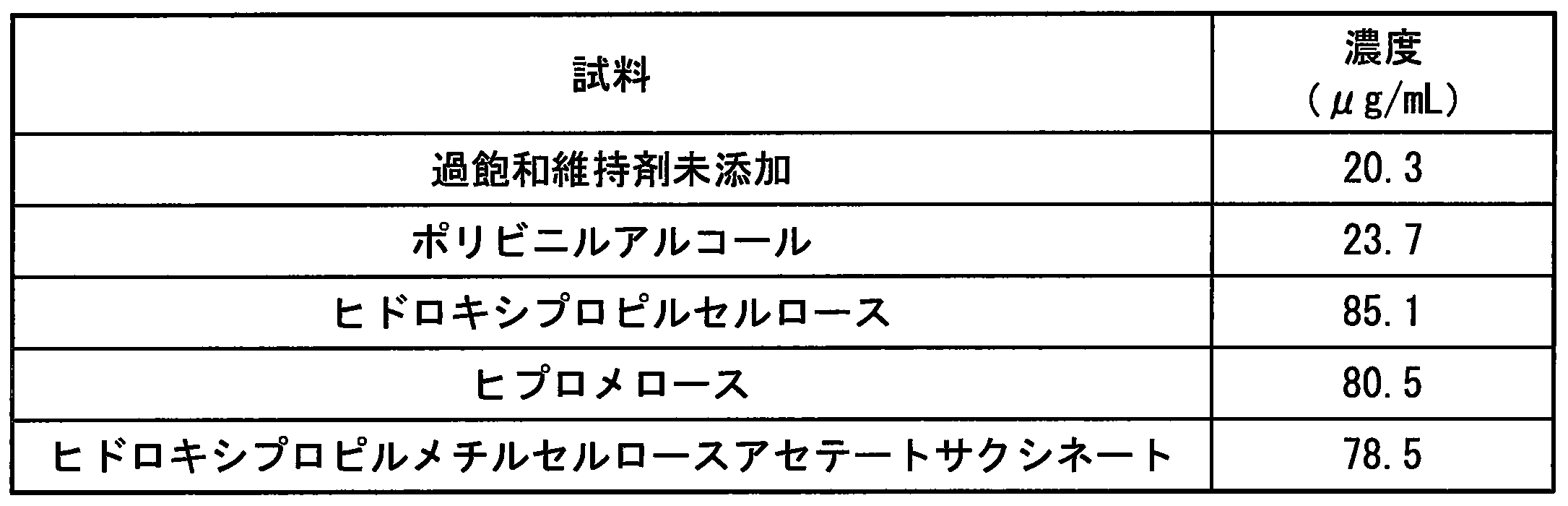
- Various additives shown in Table 8 polyvinyl alcohol: PVA, manufactured by Nippon Synthetic Chemical Co., Ltd., hydroxypropyl cellulose: HPC-L, hypromellose: TC-5E, hydroxypropyl methylcellulose acetate succinate: HPMC-AS, manufactured by Shin-Etsu Chemical Co., Ltd.
- PVA polyvinyl alcohol
- HPC-L hypromellose
- HPMC-AS hydroxypropyl methylcellulose acetate succinate
- the drug concentrations when hydroxypropylcellulose, hypromellose, and hydroxypropylmethylcellulose acetate succinate were added were 85.1 ⁇ g / mL, 80.5 ⁇ g / mL, and 78.5 ⁇ g / mL, respectively, and no supersaturation maintenance agent was added.
- the drug concentration of the product was significantly higher than the drug concentration of 20.3 ⁇ g / mL, and it was revealed that the supersaturation was maintained even after 14 hours (Table 8).
- polyvinyl alcohol was added, the drug concentration was 23.7 ⁇ g / mL, which was similar to that of the product without the addition of the supersaturation maintenance agent.
- Test example 4 The tablets of Comparative Examples 2, 3, 4, and Example 1 were evaluated for drug dissolution.
- a test solution 900 mL (37 ° C.) of 0.1N hydrochloric acid or pH 6.8 phosphate buffer was used, 5 tablets were added per vessel, and a dissolution test was conducted according to the second method of the Japanese Pharmacopoeia Dissolution Test Method.
- shaft 100% in a figure corresponds to 133.3 microgram / mL as a well-known compound A density
- In 0.1N hydrochloric acid solution all tablets showed sustained drug dissolution and released 85-100% of the drug in 5 hours (FIG. 2).
- the drug elution rate is 40% (drug concentration 53.3 ⁇ g / mL) or more even at 5 hours from the start of the test, greatly improves the drug solubility at pH 6.8, and can maintain the supersaturation of the solubility even after 5 hours. It became clear.
- Test Example 5 The oral absorbability of the tablet of Comparative Example 2 was evaluated. As an evaluation system, a dog fasted for 18 hours or more after administration was used. In order to forcibly control the dog's gastric pH to be acidic, treatment with pentagastrin (intra thigh muscle administration; 30 minutes before tablet administration, 30 minutes after tablet administration, 90 minutes after administration) is performed before tablet administration. did. Six tablets of Comparative Example 2 (150 mg as known compound A hydrobromide) were orally administered together with 50 mL of water to dogs whose gastric pH was acidified by treatment with pentagastrin, and the plasma drug concentration was measured. As a result, a continuous plasma drug concentration pattern was shown (FIG. 4). The maximum plasma drug concentration (Cmax) and the area under the plasma drug concentration transition curve (AUC) up to 24 hours after administration were 1346 ng / mL and 11102 ng ⁇ h / mL, respectively.
- Cmax maximum plasma drug concentration
- AUC area under the plasma drug concentration transition curve
- Test Example 6 The oral absorbability of the tablet of Comparative Example 2 was evaluated. As an evaluation system, a dog fasted for 18 hours or more after administration was used. In order to force the canine gastric pH to be neutrally controlled, famotidine (intramuscular thigh administration; 90 minutes before tablet administration, 30 minutes before administration) was administered before tablet administration. Six tablets of Comparative Example 2 (150 mg as known compound A hydrobromide) were orally administered together with 50 mL of water to dogs with neutral gastric pH by famotidine treatment, and the plasma drug concentration was measured. As a result, the plasma drug concentration was remarkably low (FIG.
- Cmax and AUC were 268 ng / mL and 3096 ng ⁇ h / mL, respectively. They were 0.20 times and 0.28 times lower than Cmax and AUC, respectively, when administered to the dogs subjected to the pentagastrin treatment evaluated in Test Example 5.
- Test Example 7 The oral absorbability of the tablet of Comparative Example 3 was evaluated. The same evaluation system as in Test Example 6 was used. Six tablets of Comparative Example 3 (150 mg as known compound A hydrobromide) were orally administered together with 50 mL of water to dogs with neutral gastric pH by famotidine treatment, and the plasma drug concentration was measured. As a result, the plasma drug concentration transition up to 1 hour after administration showed a pattern similar to that during the pentagastrin treatment in Test Example 5, but did not continue thereafter (FIG. 4). Cmax and AUC were 464 ng / mL and 3377 ng ⁇ h / mL, respectively, which were 0.34 times and 0.30 times lower than those of the pentagastrin treatment of Comparative Example 2 evaluated in Test Example 5, respectively.
- Test Example 8 The oral absorbability of the tablet of Example 1 was evaluated. The same evaluation system as in Test Example 5 was used. Six tablets of Example 1 (150 mg as known compound A hydrobromide) were orally administered with 50 mL of water to dogs whose gastric pH was acidified by treatment with pentagastrin, and the drug concentration in plasma was measured. As a result, a sustained plasma drug concentration pattern was shown, and Cmax and AUC were 2326 ng / mL and 15285 ng ⁇ h / mL, respectively.
- Test Example 9 The oral absorbability of the tablet of Example 1 was evaluated. The same evaluation system as in Test Example 6 was used. Six tablets of Example 1 (150 mg as known compound A hydrobromide) were orally administered together with 50 mL of water to dogs with neutral gastric pH by famotidine treatment, and the plasma drug concentration was measured. As a result, a continuous increase in plasma drug concentration was observed (FIG. 4), Cmax and AUC were 1746 ng / mL and 14879 ng ⁇ h / mL, respectively, and during the pentagastrin treatment of Example 1 evaluated in Test Example 8. They were 0.75 times and 0.97 times, respectively.
- Test Example 10 The oral absorbability of the tablet of Example 2 was evaluated. The same evaluation system as in Test Example 5 was used. Eight tablets of Example 2 (150 mg as known compound A hydrobromide) were orally administered with 50 mL of water to dogs whose gastric pH was acidified by treatment with pentagastrin, and the drug concentration in plasma was measured. The results showed a sustained plasma drug concentration profile, with Cmax and AUC being 1942 ng / mL and 12927 ng ⁇ h / mL, respectively.
- Test Example 11 The oral absorbability of the tablet of Example 3 was evaluated. The same evaluation system as in Test Example 5 was used.
- One tablet of Example 3 (150 mg as known compound A hydrobromide) was orally administered with 50 mL of water to a dog whose gastric pH was acidified by treatment with pentagastrin, and the drug concentration in plasma was measured. The results showed a sustained plasma drug concentration profile, with Cmax and AUC being 2232 ng / mL and 16452 ng ⁇ h / mL, respectively.
- Test Example 12 The oral absorbability of the tablet of Example 4 was evaluated. The same evaluation system as in Test Example 5 was used. As a result of oral administration of one tablet of Example 4 (150 mg as known compound A hydrobromide) with 50 mL of water to a dog whose stomach pH was acidified by pentagastrin treatment, a sustained plasma drug concentration profile was obtained. The indicated Cmax and AUC were 2091 ng / mL and 16081 ng ⁇ h / mL, respectively.
- the drug can be continuously maintained even in the neutral pH environment of the digestive tract. It is considered that the PK parameter variation due to the release and the pH variation in the digestive tract was reduced.
- Test Example 13 The oral absorbability of the tablet of Example 5 was evaluated. The same evaluation system as in Test Example 5 was used. As a result of orally administering 8 tablets (150 mg as known compound A hydrobromide) of Example 5 together with 50 mL of water to dogs whose gastric pH was acidified by treatment with pentagastrin, a sustained plasma drug concentration profile was obtained. Cmax and AUC shown were 1942 ng / mL and 12927 ng ⁇ h / mL, respectively (FIG. 5).
- Test Example 14 The oral absorbability of the tablet of Example 22 was evaluated. The same evaluation system as in Test Example 5 was used. One tablet of Example 22 (150 mg as known compound A hydrobromide) was orally administered together with 50 mL of water to a dog whose stomach pH was acidified by treatment with pentagastrin, resulting in a sustained plasma drug concentration profile. Cmax and AUC shown were 2332 ng / mL and 16452 ng ⁇ h / mL, respectively (FIG. 5).
- Test Example 15 The oral absorbability of the tablet of Example 23 was evaluated. The same evaluation system as in Test Example 5 was used.
- One tablet of Example 23 (150 mg as known compound A hydrobromide) was orally administered with 50 mL of water to a dog whose stomach pH was acidified by treatment with pentagastrin, resulting in a sustained plasma drug concentration profile.
- the indicated Cmax and AUC were 2091 ng / mL and 16081 ng ⁇ h / mL, respectively (FIG. 5).
- Test Example 16 The oral absorbability of the tablet of Example 6 was evaluated. The same evaluation system as in Test Example 5 was used. Four tablets of Example 6 (150 mg as known compound A hydrobromide) were orally administered together with 50 mL of water to dogs whose gastric pH was acidified by treatment with pentagastrin, resulting in a sustained plasma drug concentration profile. Cmax and AUC shown were 1329 ng / mL and 9749 ng ⁇ h / mL, respectively.
- Test Example 17 The oral absorbability of the tablet of Example 17 was evaluated. The same evaluation system as in Test Example 5 was used. One tablet of Example 17 (150 mg as known compound A hydrobromide) was orally administered with 50 mL of water to a dog that had been treated with pentagastrin for acidification of the gastric pH. As a result, a sustained plasma drug concentration profile was obtained. Cmax and AUC shown were 1635 ng / mL and 11439 ng ⁇ h / mL, respectively.
- Test Example 18 For the tablets of Example 5, Examples 22 and 23, drug dissolution was evaluated. In addition, about the tablet of Example 5, 8 tablets were injected
- Example 18 both the tablets of Example 5, Examples 22 and 23 showed sustained and stable dissolution up to 6 hours from the start of the dissolution test, and the dissolution rate was 60% (drug concentration 80.0 ⁇ g / The elution rate was 30% (drug concentration 40.0 ⁇ g / mL) or more at 14 hours. Compared with the drug solubility (10.9 ⁇ g / mL) at pH 6.8, it showed a very high value, and it was revealed that supersaturation can be maintained for a long time.
- Compound A has excellent JAK3 inhibitory activity and is useful as an active ingredient of a therapeutic and / or prophylactic agent for various immune diseases including autoimmune diseases, inflammatory diseases, and allergic diseases.
- high bioavailability can be imparted to a controlled-release pharmaceutical composition containing a pharmaceutically acceptable salt thereof.
Landscapes
- Health & Medical Sciences (AREA)
- Chemical & Material Sciences (AREA)
- Veterinary Medicine (AREA)
- Public Health (AREA)
- General Health & Medical Sciences (AREA)
- Animal Behavior & Ethology (AREA)
- Life Sciences & Earth Sciences (AREA)
- Medicinal Chemistry (AREA)
- Pharmacology & Pharmacy (AREA)
- Organic Chemistry (AREA)
- Engineering & Computer Science (AREA)
- Bioinformatics & Cheminformatics (AREA)
- General Chemical & Material Sciences (AREA)
- Nuclear Medicine, Radiotherapy & Molecular Imaging (AREA)
- Chemical Kinetics & Catalysis (AREA)
- Epidemiology (AREA)
- Immunology (AREA)
- Pulmonology (AREA)
- Dermatology (AREA)
- Neurosurgery (AREA)
- Neurology (AREA)
- Biomedical Technology (AREA)
- Oncology (AREA)
- Cardiology (AREA)
- Transplantation (AREA)
- Hospice & Palliative Care (AREA)
- Urology & Nephrology (AREA)
- Vascular Medicine (AREA)
- Psychiatry (AREA)
- Hematology (AREA)
- Heart & Thoracic Surgery (AREA)
- Nutrition Science (AREA)
- Physiology (AREA)
- Pharmaceuticals Containing Other Organic And Inorganic Compounds (AREA)
- Medicinal Preparation (AREA)
- Nitrogen Condensed Heterocyclic Rings (AREA)
Abstract
酸性pH領域と中性pH領域での溶解性が極端に相違する4-{[(1R,2s,3S,5s,7s)-5-ヒドロキシ-2-アダマンチル]アミノ}-1H-ピロロ[2,3-b]ピリジン-5-カルボキサミドを薬物として含有する医薬組成物において、胃排出以降(小腸等)の消化管内中性pH領域でも前記薬物の溶解性を維持し、良好な経口吸収性を示し、生物学的利用能の高い放出制御医薬組成物を提供する。 前記放出制御医薬組成物は、4-{[(1R,2s,3S,5s,7s)-5-ヒドロキシ-2-アダマンチル]アミノ}-1H-ピロロ[2,3-b]ピリジン-5-カルボキサミド又はその製薬学的に許容される塩、酸性物質、過飽和維持剤、及び放出制御基剤を含有してなる。
Description
本発明は、4-{[(1R,2s,3S,5s,7s)-5-ヒドロキシ-2-アダマンチル]アミノ}-1H-ピロロ[2,3-b]ピリジン-5-カルボキサミド又はその製薬学的に許容される塩、酸性物質、過飽和維持剤、及び放出制御基剤を含有してなる放出制御医薬組成物に関する。詳細には、本発明は、4-{[(1R,2s,3S,5s,7s)-5-ヒドロキシ-2-アダマンチル]アミノ}-1H-ピロロ[2,3-b]ピリジン-5-カルボキサミド又はその製薬学的に許容される塩、酸性物質、過飽和維持剤、及び放出制御基剤を含有し、消化管の中性pH領域においても4-{[(1R,2s,3S,5s,7s)-5-ヒドロキシ-2-アダマンチル]アミノ}-1H-ピロロ[2,3-b]ピリジン-5-カルボキサミド又はその製薬学的に許容される塩の溶解性を維持し、薬物動態における個体間差を抑えた放出制御医薬組成物に関するものである。
4-{[(1R,2s,3S,5s,7s)-5-ヒドロキシ-2-アダマンチル]アミノ}-1H-ピロロ[2,3-b]ピリジン-5-カルボキサミド(以下、化合物Aと略すことがある)は、優れたJAK3阻害活性を有し、自己免疫疾患、炎症性疾患、アレルギー性疾患を含む、種々の免疫性疾患の治療及び/又は予防剤の有効成分として有用であることが知られている(特許文献1)。
消化管下部の結腸においても良好な薬物放出を可能とするハイドロゲル徐放性製剤が開示されている(特許文献2)。薬物が難溶性薬物の場合、ヒプロメロース(HPMC)等の高分子と固体分散体を形成させ、溶解性を改善して用いることができることが開示されている。
薬物溶出速度が薬物の消化液に対する溶解度に依存するため、塩基性薬物を含む徐放性製剤は、胃液中で溶出速度が増加し腸液中で溶出速度が減少するという課題を、あるいは、酸性薬物を含む徐放性製剤は、胃液中で溶出速度が減少するため、胃に長時間滞留する場合には、薬効が速やかに発現しないという課題を改善するため、薬物、緩衝剤、及び疎水性高分子又はゲル形成高分子を含有するマトリックス錠が開示されている。
また、緩衝剤が易溶性であるにもかかわらず長時間にわたってマトリックス細孔内に保持されるため細孔内のpHが一定にコントロールされる結果、消化液のpHに影響されずに薬物を持続して溶出することができること、及び添加する緩衝剤の組成を変えることにより、薬物の溶出速度をも任意に変えることができることが知られている(特許文献3)。
安全性が高く、安定な薬物放出性及び吸収性を有するタグランジンI誘導体徐放性製剤を提供するため、プロスタグランジンI誘導体と、放出制御成分としてカルボキシビニルポリマーを除くハイドロゲル基剤及び緩衝剤を含有する徐放性製剤が開示されている(特許文献4)。
しかしながら、何れも化合物Aを含む放出制御製剤については具体的開示がなく、また化合物Aについて消化管内のpH変動によって生じるPKパラメータの変動を抑えた放出制御医薬組成物を提供するためには、今なお技術の改善の余地がある。
本発明の課題は、酸性pH領域と中性pH領域での溶解性が極端に相違する化合物Aを含有する医薬組成物において、経口投与した際、胃から排出された以降(小腸など)の消化管内中性pH領域でも化合物Aの溶解性を維持すること、良好な経口吸収性を示すこと、あるいは生物学的利用能の高い医薬組成物を提供することにある。
かかる状況下、発明者らは上記課題を解決すべく鋭意検討を行った。
化合物Aの溶解性は、酸性pH領域(日本薬局方溶出試験液第1液(JP1(pH1.2))において約8,600μg/mL)と中性pH領域(日本薬局方溶出試験液第2液(JP2(pH6.8))において約8.6μg/mL)で1000倍の差があり、特にJP2のような中性pH環境下における溶解性が低いことが分かった(水において約12,500μg/mL)。
化合物Aの溶解性は、酸性pH領域(日本薬局方溶出試験液第1液(JP1(pH1.2))において約8,600μg/mL)と中性pH領域(日本薬局方溶出試験液第2液(JP2(pH6.8))において約8.6μg/mL)で1000倍の差があり、特にJP2のような中性pH環境下における溶解性が低いことが分かった(水において約12,500μg/mL)。
消化管内pHの相違している消化管全体において持続的な薬物吸収を達成させることを目標として、消化管の中性pH領域においても、化合物Aの溶解性(例えば、過飽和)の維持に着目して検討した結果、化合物A又はその製薬学的に許容される塩、酸性物質、溶解性(例えば、過飽和)を維持する物質、及び放出制御基剤を含有する放出制御医薬組成物が消化管の中性pH領域においても化合物Aの溶解性(例えば、過飽和)を維持し、生物学的利用能が高く、良好かつ持続的な薬物吸収性を有する医薬組成物となり得ることを見出し、本発明を完成するに至った。
すなわち、本発明は、
[1]4-{[(1R,2s,3S,5s,7s)-5-ヒドロキシ-2-アダマンチル]アミノ}-1H-ピロロ[2,3-b]ピリジン-5-カルボキサミド又はその製薬学的に許容される塩、酸性物質、過飽和維持剤、及び放出制御基剤を含有してなる、放出制御医薬組成物、
[2]酸性物質が、クエン酸、リンゴ酸、酒石酸、フマル酸、アスコルビン酸、コハク酸、又はマレイン酸である、[1]の放出制御医薬組成物、
[3]酸性物質の添加量が、4-{[(1R,2s,3S,5s,7s)-5-ヒドロキシ-2-アダマンチル]アミノ}-1H-ピロロ[2,3-b]ピリジン-5-カルボキサミド又はその製薬学的に許容される塩の重量に対して10重量%以上200重量%である、[1]又は[2]の放出制御医薬組成物、
[4]過飽和維持剤が、ヒプロメロース、ヒドロキシプロピルセルロース、ヒドロキシプロピルメチルセルロースアセテートサクシネート、及びビニルピロリドン-ビニルアセテートコポリマーからなる群から選択される、1又は2以上の物質である、[1]~[3]のいずれかの放出制御医薬組成物、
[5]過飽和維持剤の添加量が、4-{[(1R,2s,3S,5s,7s)-5-ヒドロキシ-2-アダマンチル]アミノ}-1H-ピロロ[2,3-b]ピリジン-5-カルボキサミド又はその製薬学的に許容される塩の重量に対して10重量%以上200重量%である、[1]~[4]のいずれかの放出制御医薬組成物、
[6]放出制御基剤が、粘度平均分子量が200万以上又は1%水溶液25℃の粘度が1000cps以上の物質である、[1]~[5]のいずれかの放出制御医薬組成物、
[7]更に親水性基剤を含む、[1]~[6]のいずれかの放出制御医薬組成物、
[8]親水性基剤が、基剤1gが溶解するのに必要な水の量が20±5℃下で5mL以下である、[7]の放出制御医薬組成物、
[9]pH6.8リン酸緩衝液で溶出試験を行ったときの4-{[(1R,2s,3S,5s,7s)-5-ヒドロキシ-2-アダマンチル]アミノ}-1H-ピロロ[2,3-b]ピリジン-5-カルボキサミドの濃度が8.6μg/mL以上である、[1]~[8]のいずれかの放出制御医薬組成物、
に関する。
[1]4-{[(1R,2s,3S,5s,7s)-5-ヒドロキシ-2-アダマンチル]アミノ}-1H-ピロロ[2,3-b]ピリジン-5-カルボキサミド又はその製薬学的に許容される塩、酸性物質、過飽和維持剤、及び放出制御基剤を含有してなる、放出制御医薬組成物、
[2]酸性物質が、クエン酸、リンゴ酸、酒石酸、フマル酸、アスコルビン酸、コハク酸、又はマレイン酸である、[1]の放出制御医薬組成物、
[3]酸性物質の添加量が、4-{[(1R,2s,3S,5s,7s)-5-ヒドロキシ-2-アダマンチル]アミノ}-1H-ピロロ[2,3-b]ピリジン-5-カルボキサミド又はその製薬学的に許容される塩の重量に対して10重量%以上200重量%である、[1]又は[2]の放出制御医薬組成物、
[4]過飽和維持剤が、ヒプロメロース、ヒドロキシプロピルセルロース、ヒドロキシプロピルメチルセルロースアセテートサクシネート、及びビニルピロリドン-ビニルアセテートコポリマーからなる群から選択される、1又は2以上の物質である、[1]~[3]のいずれかの放出制御医薬組成物、
[5]過飽和維持剤の添加量が、4-{[(1R,2s,3S,5s,7s)-5-ヒドロキシ-2-アダマンチル]アミノ}-1H-ピロロ[2,3-b]ピリジン-5-カルボキサミド又はその製薬学的に許容される塩の重量に対して10重量%以上200重量%である、[1]~[4]のいずれかの放出制御医薬組成物、
[6]放出制御基剤が、粘度平均分子量が200万以上又は1%水溶液25℃の粘度が1000cps以上の物質である、[1]~[5]のいずれかの放出制御医薬組成物、
[7]更に親水性基剤を含む、[1]~[6]のいずれかの放出制御医薬組成物、
[8]親水性基剤が、基剤1gが溶解するのに必要な水の量が20±5℃下で5mL以下である、[7]の放出制御医薬組成物、
[9]pH6.8リン酸緩衝液で溶出試験を行ったときの4-{[(1R,2s,3S,5s,7s)-5-ヒドロキシ-2-アダマンチル]アミノ}-1H-ピロロ[2,3-b]ピリジン-5-カルボキサミドの濃度が8.6μg/mL以上である、[1]~[8]のいずれかの放出制御医薬組成物、
に関する。
本発明の放出制御医薬組成物によれば、消化管内(胃排出後)の中性pH領域においても化合物Aの溶解性(特に、過飽和)を維持することにより、化合物Aの再結晶・析出を回避することが可能となる。また、本発明の放出制御医薬組成物によれば、消化管内のpH環境に依らず、持続的に薬物を放出(溶解状態を維持した溶出)し、消化管全体が吸収部位となる。さらに、本発明の放出制御医薬組成物によれば、個体間変動や個体内変動(例えば、消化管内のpH変動による薬物動態学(Pharmacokinetics;PK)パラメータの変動)を抑え、生物学的利用率の高い、医薬組成物を提供することができる。
以下、本発明の実施の形態について、詳細に説明する。
本明細書において、「溶解性」或いは「溶解度」とは、第十六改正日本薬局方等における方法により、化合物Aの溶ける度合いを意味する。例えば、ある態様として、化合物Aの「溶解性」或いは「溶解度」として、化合物Aを粉末とした後、溶媒中に入れ、20±5℃で5分毎に30秒間振り混ぜるときに30分以内に溶ける度合いと規定する。「ほとんど溶けない(Practically insoluble, or insoluble)」とは、化合物A 1g又は1mLを溶かすのに要する溶媒量が10,000mL以上、「極めて溶けにくい(Very slightly soluble)」とは、化合物A 1g又は1mLを溶かすのに要する溶媒量が1,000mL以上、10,000mL未満の性状をいう。他の態様として、化合物Aの粉末を試験管内に溶媒と共に入れ、23±5℃で10分間振とう(330ストローク/分、4cm/ストローク)した後の溶解度(試験管振とう法)も含まれる。本法にて測定した場合、化合部AのJP1に対する溶解度は約8,600μg/mLであり、JP2に対して約8.6μg/mLであり、水に対して約12,500μg/mLである。別の態様として、化合物Aの粉末を試験管内に溶媒と共に入れ、37℃で14時間振とうした後の溶解度(試験管振とう法)も含まれる。本法にて測定した場合、化合部Aの米国薬局方(USP)pH6.8リン酸緩衝液に対する溶解度は、10.9μg/mLである。
本明細書において、「溶解性」或いは「溶解度」とは、第十六改正日本薬局方等における方法により、化合物Aの溶ける度合いを意味する。例えば、ある態様として、化合物Aの「溶解性」或いは「溶解度」として、化合物Aを粉末とした後、溶媒中に入れ、20±5℃で5分毎に30秒間振り混ぜるときに30分以内に溶ける度合いと規定する。「ほとんど溶けない(Practically insoluble, or insoluble)」とは、化合物A 1g又は1mLを溶かすのに要する溶媒量が10,000mL以上、「極めて溶けにくい(Very slightly soluble)」とは、化合物A 1g又は1mLを溶かすのに要する溶媒量が1,000mL以上、10,000mL未満の性状をいう。他の態様として、化合物Aの粉末を試験管内に溶媒と共に入れ、23±5℃で10分間振とう(330ストローク/分、4cm/ストローク)した後の溶解度(試験管振とう法)も含まれる。本法にて測定した場合、化合部AのJP1に対する溶解度は約8,600μg/mLであり、JP2に対して約8.6μg/mLであり、水に対して約12,500μg/mLである。別の態様として、化合物Aの粉末を試験管内に溶媒と共に入れ、37℃で14時間振とうした後の溶解度(試験管振とう法)も含まれる。本法にて測定した場合、化合部Aの米国薬局方(USP)pH6.8リン酸緩衝液に対する溶解度は、10.9μg/mLである。
本明細書において、「過飽和」とは、溶解度以上の溶質(化合物A)を含んでいる状態にあることを意味する。
本明細書において、「過飽和溶液」とは、溶解度以上の溶質(化合物A)を含んでいる状態にある溶液を意味する。
本明細書において、「過飽和を維持」とは、ある態様として、化合物AのpH6.8における溶解度(試験管振とう法の場合8.6μg/mL(23℃)、10.9μg/mL(37℃))以上の溶解度を維持することと規定する。
本明細書において、「過飽和溶液」とは、溶解度以上の溶質(化合物A)を含んでいる状態にある溶液を意味する。
本明細書において、「過飽和を維持」とは、ある態様として、化合物AのpH6.8における溶解度(試験管振とう法の場合8.6μg/mL(23℃)、10.9μg/mL(37℃))以上の溶解度を維持することと規定する。
本明細書において、「生物学的利用能(率)の改善」、或いは「Bioavailabilityの向上」とは、本発明の構成を含まない組成物に対する「相対的Bioavaiability」がより高い状態にあることを意味する。例えば、本発明で用いる「酸性物質」を含まない医薬組成物に対して「Bioavailability」が高い状態と規定する。
本明細書において、「PKパラメータの変動を低減する」とは、胃内pHが酸性時に投与した時のCmax及びAUCに対する、胃内pHが中性時に投与した際の同パラメータの比が、例えばある態様として0.5倍以上、他の態様として0.6倍以上、別の態様として0.7倍以上であると規定する。
本明細書において、「放出制御」とは、例えば、日本薬局方溶出試験法第二法(パドル法)により、試験液としてUSP pH6.8リン酸緩衝液900mL、もしくはUSP pH6.8リン酸緩衝液にラウリル硫酸ナトリウムを1%添加した試験液900mLを用いてパドル回転数100rpmの条件で溶出試験を実施した時の、試験開始後30分の化合物Aの溶出率をある態様として80%未満、他の態様として50%未満、別の態様として30%未満に制御することを意味する。
本明細書において、「PKパラメータの変動を低減する」とは、胃内pHが酸性時に投与した時のCmax及びAUCに対する、胃内pHが中性時に投与した際の同パラメータの比が、例えばある態様として0.5倍以上、他の態様として0.6倍以上、別の態様として0.7倍以上であると規定する。
本明細書において、「放出制御」とは、例えば、日本薬局方溶出試験法第二法(パドル法)により、試験液としてUSP pH6.8リン酸緩衝液900mL、もしくはUSP pH6.8リン酸緩衝液にラウリル硫酸ナトリウムを1%添加した試験液900mLを用いてパドル回転数100rpmの条件で溶出試験を実施した時の、試験開始後30分の化合物Aの溶出率をある態様として80%未満、他の態様として50%未満、別の態様として30%未満に制御することを意味する。
式(I):

で示す、4-{[(1R,2s,3S,5s,7s)-5-ヒドロキシ-2-アダマンチル]アミノ}-1H-ピロロ[2,3-b]ピリジン-5-カルボキサミド又はその製薬学的に許容される塩は、特許文献1に記載された製法により、或いはそれに準じて容易に入手可能である。
式(I)で示される公知化合物Aは、酸又は塩基との付加塩を形成する場合がある。かかる塩は、製薬学的に許容される塩であればよく、具体的には、ある態様として、無機酸(例えば、塩酸、臭化水素酸、硫酸、硝酸、リン酸)又は有機酸(例えば、コハク酸、フマル酸、L-リンゴ酸、L-酒石酸、メシル酸、トシル酸)との酸付加塩を挙げることができる。他の態様として臭化水素酸との酸付加塩である。
さらに、式(I)で示される化合物又はその塩の各種の水和物や溶媒和物及び結晶多形でもよい。
公知化合物A又はその製薬学的に許容される塩は1種又は2種以上組み合わせて使用することができる。
公知化合物A又はその製薬学的に許容される塩は1種又は2種以上組み合わせて使用することができる。
公知化合物A又はその製薬学的に許容される塩は、JAK3に対する阻害活性を有しており、望ましくないサイトカインシグナル伝達によって引き起こされる疾患(例えば、生体移植における拒絶、自己免疫疾患、喘息、アトピー性皮膚炎、アルツハイマー病、アテローム性動脈硬化症)、あるいはサイトカインシグナル伝達異常によって引き起こされる疾患(例えば、癌、白血病)の治療剤若しくは予防剤の有効成分として有用である。
公知化合物A又はその製薬学的に許容される塩の投与量は、投与ルート、疾患の症状、投与対象の年齢、人種、性別等を考慮して個々の場合に応じて適宜決定される。経口投与の場合、公知化合物A又はその製薬学的に許容される塩の1日の投与量は、体重当たり、ある態様として約0.001~約100mg/kg、他の態様として約0.1~約30mg/kg、別の態様として約0.1~約10mg/kgが適当であり、これを1回、あるいは、例えば2回~4回等の複数回に分けて投与する。静脈内投与される場合は、1日の投与量は、体重当たり約0.0001~約10mg/kgが適当で、1日1回~複数回に分けて投与する。また、経粘膜剤としては、体重当たり約0.001~約100mg/kgを1日1回~複数回に分けて投与する。
公知化合物A又はその製薬学的に許容される塩の添加量は、単位製剤あたり、ある態様として10mg以上200mg以下、他の態様として15mg以上150mg以下である。公知化合物A又はその製薬学的に許容される塩の添加量は、単位製剤あたり、ある態様として5重量%以上70重量%以下、他の態様として、7重量%以上50重量%以下である。
本発明に用いられる「酸性物質」としては、製薬学的に許容され、中性pH領域において、化合物Aの溶解性を維持するものであれば制限されない。また他の態様として、化合物Aの過飽和状態を維持するものであれば制限されない。
例えば、ある態様として、クエン酸、リンゴ酸、酒石酸、フマル酸、アスコルビン酸、コハク酸、マレイン酸などが挙げられる。他の態様として、クエン酸、酒石酸、リンゴ酸、アスコルビン酸が挙げられる。さらに別の態様として、クエン酸、又は酒石酸であり、また別の態様としては酒石酸である。
本発明の放出制御医薬組成物においては、酸性物質は1種又は2種以上組み合わせて使用することができる。
例えば、ある態様として、クエン酸、リンゴ酸、酒石酸、フマル酸、アスコルビン酸、コハク酸、マレイン酸などが挙げられる。他の態様として、クエン酸、酒石酸、リンゴ酸、アスコルビン酸が挙げられる。さらに別の態様として、クエン酸、又は酒石酸であり、また別の態様としては酒石酸である。
本発明の放出制御医薬組成物においては、酸性物質は1種又は2種以上組み合わせて使用することができる。
酸性物質の添加量としては、化合物Aを中性pH領域における溶解性を維持する量であれば制限されない。具体的には、例えば、化合物Aの重量に対して、ある態様として10重量%以上200重量%以下であり、他の態様として、50重量%以上150重量%以下であり、別の態様として100重量%以上120重量%以下である。別のある態様として、単位製剤あたり5重量%以上50重量%以下であり、他の態様として、10重量%以上40重量%以下であり、別の態様として20重量%以上40重量%以下である。
本発明に用いられる「過飽和維持剤」は、ある態様として「化合物Aの溶解性を維持する物質(溶解維持剤)」であり、他の態様として「化合物Aの過飽和を維持する物質(過飽和維持剤)」であり、さらに別の態様としては、製薬学的に許容され、かつ化合物Aの溶解性を維持する物質であれば、制限されない。或いは、製薬学的に許容され、かつ化合物Aの過飽和を維持する物質であれば制限されない。他の態様として、製薬学的に許容された水溶性高分子である。
具体的には、例えば、ある態様としてヒプロメロース、ヒドロキシプロピルセルロース、ヒドロキシプロピルメチルセルロースアセテートサクシネート、ポリビニルピロリドン、ビニルピロリドン-ビニルアセテートコポリマーなどが挙げられる。他の態様として、ヒプロメロース、ヒドロキシプロピルセルロース、ヒドロキシプロピルメチルセルロースアセテートサクシネートが挙げられる。別の態様としてヒプロメロースが挙げられる。
具体的には、例えば、ヒプロメロースとしては、商品名TC-5E(粘度:3mPa・s(2%水溶液20℃))、TC-5M(粘度:4.5mPa・s(2%水溶液20℃))、TC-5R(粘度:6mPa・s(2%水溶液20℃))、TC-5S(粘度:15mPa・s(2%水溶液20℃))として入手することができる。(いずれも信越化学工業)
また、ヒドロキシプロピルセルロースとしては、商品名HPC-L(日本曹達)、KLUCEL LF(ハーキュリーズ社)、KLUCEL JF(ハーキュリーズ社)として入手することができる。
さらに、ヒドロキシプロピルメチルセルロースアセテートサクシネートとしては、商品名AQOAT(信越化学工業)として入手することができる。
本発明の放出制御医薬組成物においては、「溶解性維持剤」或いは「過飽和維持剤」は1種又は2種以上組み合わせて使用することができる。
また、ヒドロキシプロピルセルロースとしては、商品名HPC-L(日本曹達)、KLUCEL LF(ハーキュリーズ社)、KLUCEL JF(ハーキュリーズ社)として入手することができる。
さらに、ヒドロキシプロピルメチルセルロースアセテートサクシネートとしては、商品名AQOAT(信越化学工業)として入手することができる。
本発明の放出制御医薬組成物においては、「溶解性維持剤」或いは「過飽和維持剤」は1種又は2種以上組み合わせて使用することができる。
「溶解性維持剤」或いは「過飽和維持剤」の添加量としては、化合物Aの溶解性を維持する量であれば制限されない。又は、化合物Aの過飽和を維持する量であれば制限されない。公知化合物Aの重量に対して、例えば、ある態様として10重量%以上200重量%以下であり、他の態様として20重量%以上200重量%以下であり、別の態様として、40重量%以上150重量%以下であり、さらに別の態様として50重量%以上120重量%以下である。単位製剤あたり、ある態様として5重量%以上50重量%以下であり、他の態様として、10重量%以上40重量%以下であり、さらに別の態様として、10重量%以上30重量%以下であり、また別の態様として、20重量%以上30重量%以下である。
本発明に用いられる「放出制御基剤」としては、ある態様として、ハイドロゲルを形成する高分子(ハイドロゲル形成高分子)であれば制限されない。また他の態様として、化合物Aの放出を制御する基剤であれば制限されない。
他の態様として、「放出制御基剤」としては、ゲル化時の粘度が高いものが挙げられる。例えば、ある態様として、1%水溶液(25℃)の粘度が1000cps以上を有するものである。別の態様として、ハイドロゲルを形成する高分子物質の分子量は、例えば、10万以上、他の態様として10万以上700万以下である。また、高分子物質の性状はその分子量に依存し、より高分子量のものが好ましく、ある態様として粘度平均分子量200万以上、他の態様として粘度平均分子量400万以上のものが挙げられる。
他の態様として、「放出制御基剤」としては、ゲル化時の粘度が高いものが挙げられる。例えば、ある態様として、1%水溶液(25℃)の粘度が1000cps以上を有するものである。別の態様として、ハイドロゲルを形成する高分子物質の分子量は、例えば、10万以上、他の態様として10万以上700万以下である。また、高分子物質の性状はその分子量に依存し、より高分子量のものが好ましく、ある態様として粘度平均分子量200万以上、他の態様として粘度平均分子量400万以上のものが挙げられる。
このような「放出制御基剤」としては、例えば、ある態様として、ポリエチレンオキサイド(PEO)(例えば、商品名Polyox WSR-303(平均分子量:700万、粘度:7500-10000cps(1%水溶液25℃))、Polyox WSR Coagulant(平均分子量500万、粘度:5500-7500cps(同))、Polyox WSR-301(平均分子量:400万、粘度:1650-5500cps(同))、Polyox WSR-N-60K(平均分子量:200万、粘度:2000-4000cps(2%水溶液25℃))、Polyox WSR-N-12K(平均分子量:100万、粘度:400-800cps(2%水溶液25℃))、Polyox WSR-1105(平均分子量:90万、粘度:8800-17600cps(5%水溶液25℃))、Polyox WSR-205(平均分子量:60万、粘度:4500-8800cps(5%水溶液25℃))、Polyox WSR-N-750(平均分子量:30万、粘度:600-1200cps(5%水溶液25℃))、Polyox WSR-N-80(平均分子量:20万、粘度:55-90cps(5%水溶液25℃))、Polyox WSR-N-10(平均分子量:10万、粘度:12-50cps(5%水溶液25℃));ダウケミカル社製)、ヒプロメロース(HPMC)(例えば、商品名メトローズ90SH100000(粘度:4100-5600cps(1%水溶液20℃))、メトローズ90SH50000(粘度:2900-3900cps(同))、メトローズ90SH30000(粘度:25000-35000cps(2%水溶液20℃));信越化学工業社製)、カルボキシメチルセルロースナトリウム(CMC-Na)(例えば、商品名サンローズF-150MC(平均分子量:20万、粘度1200-1800cps(1%水溶液25℃))、サンローズF-1000MC(平均分子量:42万、粘度8000-12000cps(同))、サンローズF-300MC(平均分子量:30万、粘度2500-3000cps(同))日本製紙社製)、ヒドロキシエチルセルロース(HEC)(例えば、商品名HCダイセルSE850(平均分子量:148万、粘度2400-3000cps(1%水溶液25℃))、HECダイセルSE900(平均分子量:156万、粘度4000-5000cps(同))ダイセル化学工業社製)、もしくはカルボキシビニルポリマー(例えば、商品名カーボポール940(平均分子量約250万);B.F.Goodrich Chemical社製)等が含まれる。他の態様として、平均分子量200万以上のPEOが含まれる。長期間、例えば12時間以上の放出の持続を必要とする場合には、より高分子、ある態様として、平均分子量400万以上もしくはより粘度の高い、好ましくは1%水溶液25℃の粘度が3000cps以上である高分子が好適なものとして挙げられる。これらのハイドロゲルを形成する高分子物質は、1種もしくは2種以上を混合して用いることができる。又、2種以上の高分子物質からなり、全体として上記本発明に適する性状を有する混合物も本発明のハイドロゲルを形成する高分子物質として好適に用いることができる。
他の態様として、粘度平均分子量が200万以上700万以下のハイドロゲル形成高分子である。
例えば、ある態様としてポリエチレンオキサイド、ヒプロメロース、カルボキシメチルセルロースナトリウム、ヒドロキシエチルセルロース、カルボキシビニルポリマーなどが挙げられる。他の態様としてポリエチレンオキサイドなどが挙げられる。
例えば、ある態様としてポリエチレンオキサイド、ヒプロメロース、カルボキシメチルセルロースナトリウム、ヒドロキシエチルセルロース、カルボキシビニルポリマーなどが挙げられる。他の態様としてポリエチレンオキサイドなどが挙げられる。
ハイドロゲル形成高分子の添加量としては、公知化合物Aの重量に対して、ある態様として5重量%以上500重量%以下であり、他の態様として、10重量%以上80重量%以下であり、別の態様としては、10重量%以上60重量%以下である。単位製剤あたり、ある態様として3重量%以上60重量%以下であり、他の態様として、5重量%以上30重量%以下であり、別の態様としては、5重量%以上20重量%以下である。
本発明の放出制御医薬組成物には、所望により更に親水性基剤を添加してもよい。
本発明に用いられる「親水性基剤」としては、ある態様として親水性基剤1gが溶解するのに必要な水の量が20±5℃下で5mL以下であり、他の態様として4mL以下のものである。水への溶解性が高い程、製剤中に水を浸入させる効果が高い。具体的には、例えば、ある態様として、ポリエチレングリコール(PEG;例えば、商品名PEG400、PEG1500、PEG4000、PEG6000、PEG20000;日本油脂社製)、ポリビニルピロリドン(PVP;例えば、商品名PVP K30 BASF社製)のような水溶性の高い高分子や、D-ソルビトール、キシリトール等の糖アルコール類、白糖、無水マルトース、D-フルクトース、デキストラン(例えば、デキストラン40)、ブドウ糖、スクロース等の糖類、ポリオキシエチレンポリオキシプロピレングリコール(例えば、プルロニックF68;旭電化社製等)等の界面活性剤や塩化ナトリウム、塩化マグネシウム等の塩類あるいはクエン酸、酒石酸等の有機酸、グリシン、β-アラニン、塩酸リジン等のアミノ酸類、メグルミン等のアミノ糖類が挙げられる。他の態様として、PEG6000、PVP、D-ソルビトール等が挙げられる。
別の態様として、好ましくはPEG8000、クエン酸、スクロースなどが挙げられる。
なお、本発明に用いられる酸性物質のうち、クエン酸、酒石酸の一部を本発明の親水性基剤の一部とみなす態様も取りうる。
親水性基剤は1種又は2種以上組み合わせて使用することができる。
本発明に用いられる「親水性基剤」としては、ある態様として親水性基剤1gが溶解するのに必要な水の量が20±5℃下で5mL以下であり、他の態様として4mL以下のものである。水への溶解性が高い程、製剤中に水を浸入させる効果が高い。具体的には、例えば、ある態様として、ポリエチレングリコール(PEG;例えば、商品名PEG400、PEG1500、PEG4000、PEG6000、PEG20000;日本油脂社製)、ポリビニルピロリドン(PVP;例えば、商品名PVP K30 BASF社製)のような水溶性の高い高分子や、D-ソルビトール、キシリトール等の糖アルコール類、白糖、無水マルトース、D-フルクトース、デキストラン(例えば、デキストラン40)、ブドウ糖、スクロース等の糖類、ポリオキシエチレンポリオキシプロピレングリコール(例えば、プルロニックF68;旭電化社製等)等の界面活性剤や塩化ナトリウム、塩化マグネシウム等の塩類あるいはクエン酸、酒石酸等の有機酸、グリシン、β-アラニン、塩酸リジン等のアミノ酸類、メグルミン等のアミノ糖類が挙げられる。他の態様として、PEG6000、PVP、D-ソルビトール等が挙げられる。
別の態様として、好ましくはPEG8000、クエン酸、スクロースなどが挙げられる。
なお、本発明に用いられる酸性物質のうち、クエン酸、酒石酸の一部を本発明の親水性基剤の一部とみなす態様も取りうる。
親水性基剤は1種又は2種以上組み合わせて使用することができる。
親水性基剤の添加量としては、公知化合物Aの重量に対して、ある態様として5重量%以上100重量%以下であり、他の態様として、10重量%以上80重量%以下であり、さらに別のある態様として、100重量%以上120重量%以下である。単位製剤あたり、ある態様として3重量%以上50重量%以下であり、他の態様として、5重量%以上30重量%以下である。
本発明の放出制御医薬組成物には、所望によりさらに各種医薬添加剤が適宜使用され、製剤化される。かかる医薬添加剤としては、製薬的に許容され、かつ薬理的に許容されるものであれば特に制限されない。例えば、賦形剤、結合剤、崩壊剤、酸味料、発泡剤、人工甘味料、香料、滑沢剤、着色剤、緩衝剤、抗酸化剤、界面活性剤、流動化剤などが使用される。
賦形剤としては、例えば、D-マンニトール、乳糖水和物などが挙げられる。
結合剤としては、例えば、アラビアゴム、ヒプロメロース、ヒドロキシプロピルセルロース、ヒドロキシエチルセルロースなどが挙げられる。
崩壊剤としては、例えばトウモロコシデンプン、バレイショデンプン、カルメロースカルシウム、カルメロースナトリウム、低置換度ヒドロキシプロピルセルロースなどが挙げられる。
酸味料としては、例えばクエン酸、酒石酸、リンゴ酸などが挙げられる。
結合剤としては、例えば、アラビアゴム、ヒプロメロース、ヒドロキシプロピルセルロース、ヒドロキシエチルセルロースなどが挙げられる。
崩壊剤としては、例えばトウモロコシデンプン、バレイショデンプン、カルメロースカルシウム、カルメロースナトリウム、低置換度ヒドロキシプロピルセルロースなどが挙げられる。
酸味料としては、例えばクエン酸、酒石酸、リンゴ酸などが挙げられる。
発泡剤としては、例えば重曹などが挙げられる。
人工甘味料としては、例えばサッカリンナトリウム、グリチルリチン二カリウム、アスパルテーム、ステビア、ソーマチンなどが挙げられる。
香料としては、例えばレモン、レモンライム、オレンジ、メントールなどが挙げられる。
滑沢剤としては、例えば軽質無水ケイ酸、ステアリン酸マグネシウム、ステアリン酸カルシウム、ショ糖脂肪酸エステル、ポリエチレングリコール、タルク、ステアリン酸、ラウリル硫酸ナトリウムなどが挙げられる。
人工甘味料としては、例えばサッカリンナトリウム、グリチルリチン二カリウム、アスパルテーム、ステビア、ソーマチンなどが挙げられる。
香料としては、例えばレモン、レモンライム、オレンジ、メントールなどが挙げられる。
滑沢剤としては、例えば軽質無水ケイ酸、ステアリン酸マグネシウム、ステアリン酸カルシウム、ショ糖脂肪酸エステル、ポリエチレングリコール、タルク、ステアリン酸、ラウリル硫酸ナトリウムなどが挙げられる。
着色剤としては、例えば黄色三二酸化鉄、赤色三二酸化鉄、黒色酸化鉄、食用黄色4号、5号、食用赤色3号、102号、食用青色3号などが挙げられる。
緩衝剤としては、クエン酸、コハク酸、フマル酸、酒石酸、アスコルビン酸又はその塩類、グルタミン酸、グルタミン、グリシン、アスパラギン酸、アラニン、アルギニン又はその塩類、酸化マグネシウム、酸化亜鉛、水酸化マグネシウム、リン酸、ホウ酸又はその塩類などが挙げられる。
抗酸化剤としては、例えばアスコルビン酸、ジブチルヒドロキシトルエン、没食子酸プロピルなどが挙げられる。
界面活性剤としては、例えばポリソルベート80、ラウリル硫酸ナトリウム、ポリオキシエチレン硬化ヒマシ油などが挙げられる。
流動化剤としては軽質無水ケイ酸などが挙げられる。
医薬添加剤としては、1種又は2種以上組合せて適宜適量添加することができる。
また、添加量については、いずれの賦形剤についても、本発明の所望の効果が達成される範囲内の量で使用される。
緩衝剤としては、クエン酸、コハク酸、フマル酸、酒石酸、アスコルビン酸又はその塩類、グルタミン酸、グルタミン、グリシン、アスパラギン酸、アラニン、アルギニン又はその塩類、酸化マグネシウム、酸化亜鉛、水酸化マグネシウム、リン酸、ホウ酸又はその塩類などが挙げられる。
抗酸化剤としては、例えばアスコルビン酸、ジブチルヒドロキシトルエン、没食子酸プロピルなどが挙げられる。
界面活性剤としては、例えばポリソルベート80、ラウリル硫酸ナトリウム、ポリオキシエチレン硬化ヒマシ油などが挙げられる。
流動化剤としては軽質無水ケイ酸などが挙げられる。
医薬添加剤としては、1種又は2種以上組合せて適宜適量添加することができる。
また、添加量については、いずれの賦形剤についても、本発明の所望の効果が達成される範囲内の量で使用される。
本発明の放出制御医薬組成物の剤形としては、好ましい剤形は患者が自ら容易に服用でき且つ保存、持ち運びに便利な経口固形製剤である。例えば、ある態様として、錠剤、カプセル剤、散剤、顆粒剤、細粒剤、ドライシロップ等であり、他の態様として、錠剤である。
以下に本発明の放出制御医薬組成物の製造法を説明するが、これらは本発明を限定するものではない。
本発明の放出制御医薬組成物は、例えば、粉砕、混合、造粒、成形(打錠)、フィルムコーティング等、公知の方法により製造可能である。
本発明の放出制御医薬組成物は、例えば、粉砕、混合、造粒、成形(打錠)、フィルムコーティング等、公知の方法により製造可能である。
粉砕工程
粉砕する方法としては、通常製薬学的に粉砕できる方法であれば、装置・手段とも特に制限されない。粉砕装置としては、例としてハンマーミル、ボールミル、ジェットミル、ピンミルなどが挙げられる。粉砕条件は適宜選択されれば特に制限されない。
粉砕する方法としては、通常製薬学的に粉砕できる方法であれば、装置・手段とも特に制限されない。粉砕装置としては、例としてハンマーミル、ボールミル、ジェットミル、ピンミルなどが挙げられる。粉砕条件は適宜選択されれば特に制限されない。
混合工程
混合する方法としては、通常製薬学的に各成分を均一に混合できる方法であれば、装置・手段とも特に制限されない。混合装置としては、例としてV型混合機、リボン型混合機、コンテナミキサー、高速攪拌混合機などが挙げられる。混合条件は適宜選択されれば特に制限されない。
混合する方法としては、通常製薬学的に各成分を均一に混合できる方法であれば、装置・手段とも特に制限されない。混合装置としては、例としてV型混合機、リボン型混合機、コンテナミキサー、高速攪拌混合機などが挙げられる。混合条件は適宜選択されれば特に制限されない。
造粒工程
造粒機として、例えば高速攪拌造粒機等が挙げられる。造粒方法として、例えば、ある態様として、流動層造粒法、溶融造粒法、高速攪拌造粒法、解砕(粉砕)造粒法、押出造粒法、転動造粒法、噴霧造粒法、乾式造粒法などが挙げられる。他の態様として高速攪拌造粒法である。
結合剤液は、水、エタノール、メタノール等の溶媒に溶解又は分散して調製される。またこれらの溶媒を適宜混合し用いることも可能である。
結合剤液の調製条件は適宜選択されれば特に制限されない。
造粒機として、例えば高速攪拌造粒機等が挙げられる。造粒方法として、例えば、ある態様として、流動層造粒法、溶融造粒法、高速攪拌造粒法、解砕(粉砕)造粒法、押出造粒法、転動造粒法、噴霧造粒法、乾式造粒法などが挙げられる。他の態様として高速攪拌造粒法である。
結合剤液は、水、エタノール、メタノール等の溶媒に溶解又は分散して調製される。またこれらの溶媒を適宜混合し用いることも可能である。
結合剤液の調製条件は適宜選択されれば特に制限されない。
造粒後に乾燥することもできる。乾燥方法は、通常製薬学的に乾燥する方法であれば特に制限されないが、例えば、通風乾燥や減圧乾燥が挙げられる。乾燥後に一定以上の大きさの粗大粒子を取り除く整粒を行ってもよい。
造粒前に化合物Aと過飽和維持剤とを含む固体分散体を調製し、固体分散体に酸性物質、及び各種添加剤を混合し、造粒してもよい。
造粒前に化合物Aと過飽和維持剤とを含む固体分散体を調製し、固体分散体に酸性物質、及び各種添加剤を混合し、造粒してもよい。
成形工程
成形工程では、造粒品、又は造粒品に各種医薬添加剤を混合した混合品をカプセルに充填してカプセル剤としたり、回転式打錠機を用いて圧縮成形し、錠剤とすることができる。
圧縮工程としては、本発明の放出制御医薬組成物を成形する方法であれば装置、手段とも特に制限されない。例えば、薬物と適当な医薬添加剤を混合後に圧縮成形し錠剤を得る直接打錠法、造粒品に更に滑沢剤を混合した後に圧縮成形し錠剤を製する方法が挙げられる。
打錠装置としては、例えば回転式打錠機、単発打錠機、オイルプレスなどが挙げられる。打錠圧などの打錠条件としては、錠剤を成形でき、製造工程中に錠剤が破損しない打錠圧であれば特に制限されない。
成形工程では、造粒品、又は造粒品に各種医薬添加剤を混合した混合品をカプセルに充填してカプセル剤としたり、回転式打錠機を用いて圧縮成形し、錠剤とすることができる。
圧縮工程としては、本発明の放出制御医薬組成物を成形する方法であれば装置、手段とも特に制限されない。例えば、薬物と適当な医薬添加剤を混合後に圧縮成形し錠剤を得る直接打錠法、造粒品に更に滑沢剤を混合した後に圧縮成形し錠剤を製する方法が挙げられる。
打錠装置としては、例えば回転式打錠機、単発打錠機、オイルプレスなどが挙げられる。打錠圧などの打錠条件としては、錠剤を成形でき、製造工程中に錠剤が破損しない打錠圧であれば特に制限されない。
フィルムコーティング工程
適宜打錠後に錠剤表面にフィルムコーティングを施してもよい。
方法としては、通常製薬学的にフィルムコーティングする方法であれば特に制限されない。例えば、パンコーティング、ディップコーティングなどが挙げられる。
フィルムコーティング剤としては、ヒプロメロース、ポリビニルアルコール、ポリビニルアルコールコポリマー、ポリビニルピロリドン、三二酸化鉄(赤色、黄色)、酸化チタン、ポリエチレングリコール、クエン酸トリエチルなどが挙げられる。フィルムコーティング剤は、1種又は2種以上組合せて適宜適量添加することができる。
フィルムコーティング率は、錠剤にフィルムコートを形成する率であれば特に制限されない。
フィルムコーティング後に乾燥してもよい。方法としては、通常製薬学的に乾燥できる方法であれば特に制限されない。乾燥条件としては、例えば製剤の安定性を考慮して適宜設定されれば特に制限されない。
適宜打錠後に錠剤表面にフィルムコーティングを施してもよい。
方法としては、通常製薬学的にフィルムコーティングする方法であれば特に制限されない。例えば、パンコーティング、ディップコーティングなどが挙げられる。
フィルムコーティング剤としては、ヒプロメロース、ポリビニルアルコール、ポリビニルアルコールコポリマー、ポリビニルピロリドン、三二酸化鉄(赤色、黄色)、酸化チタン、ポリエチレングリコール、クエン酸トリエチルなどが挙げられる。フィルムコーティング剤は、1種又は2種以上組合せて適宜適量添加することができる。
フィルムコーティング率は、錠剤にフィルムコートを形成する率であれば特に制限されない。
フィルムコーティング後に乾燥してもよい。方法としては、通常製薬学的に乾燥できる方法であれば特に制限されない。乾燥条件としては、例えば製剤の安定性を考慮して適宜設定されれば特に制限されない。
以下、実施例、比較例、参考例及び試験例をあげて、本発明を更に詳細に説明するが、本発明はこれらにより限定解釈されるものではない。
化合物A臭化水素酸塩は、特許文献1(WO2007/077949)に記載の方法により製造したものを使用した。
化合物A臭化水素酸塩は、特許文献1(WO2007/077949)に記載の方法により製造したものを使用した。
参考例1~6
表1に示す処方に基づき、化合物A臭化水素酸塩(アステラス製薬製、以下同じ)、酸性物質(無水クエン酸:小松屋社製、リンゴ酸:関東化学社製、酒石酸:小松屋社製、フマル酸:関東化学社製、アスコルビン酸:関東化学社製、コハク酸:和光純薬社製、以下、特に断りがない場合は同様)、ポリエチレンオキサイド(分子量700万、Polyox WSR-303、ダウケミカル社製、以下特に断りがない場合は同様)、及びステアリン酸マグネシウム(Parteck(登録商標)LUB MST、メルク社製)を乳鉢乳棒を用いて混合し、オイルプレス打錠機を用いて圧縮成形し、錠剤(直径9mm)を製した。
表1に示す処方に基づき、化合物A臭化水素酸塩(アステラス製薬製、以下同じ)、酸性物質(無水クエン酸:小松屋社製、リンゴ酸:関東化学社製、酒石酸:小松屋社製、フマル酸:関東化学社製、アスコルビン酸:関東化学社製、コハク酸:和光純薬社製、以下、特に断りがない場合は同様)、ポリエチレンオキサイド(分子量700万、Polyox WSR-303、ダウケミカル社製、以下特に断りがない場合は同様)、及びステアリン酸マグネシウム(Parteck(登録商標)LUB MST、メルク社製)を乳鉢乳棒を用いて混合し、オイルプレス打錠機を用いて圧縮成形し、錠剤(直径9mm)を製した。
比較例1
本発明における酸性物質を添加しないで、製剤の大きさを同一とするため、ポリエチレングリコール(PEG8000(Polyglykol 8000、クラリアント社製、以下特に断りがない場合は同様))を配合して、比較用の医薬組成物(錠剤)を製した。
本発明における酸性物質を添加しないで、製剤の大きさを同一とするため、ポリエチレングリコール(PEG8000(Polyglykol 8000、クラリアント社製、以下特に断りがない場合は同様))を配合して、比較用の医薬組成物(錠剤)を製した。

実施例1~4、比較例2~4
表2に示す処方に基づき、各種添加剤を乳鉢乳棒を用いて混合した。混合物をオイルプレス打錠機を用いて圧縮成形し、本発明の放出制御医薬組成物(錠剤)と比較用の医薬組成物(錠剤)を製した。なお、分子量200万のポリエチレンオキサイドとしては、Polyox WSR N-60K、ダウケミカル社製(以下、以下特に断りがない場合は同様)を、ヒプロメロースとしては、TC-5E、信越化学工業製(以下、以下特に断りがない場合は同様)を、結晶セルロースとしては、Ceolous PH101、旭化成製(以下、以下特に断りがない場合は同様)を、ラウリル硫酸ナトリウムとしては、NIKKOL SLS、ニッコーケミカルズ製(以下、以下特に断りがない場合は同様)をそれぞれ用いた。
表2に示す処方に基づき、各種添加剤を乳鉢乳棒を用いて混合した。混合物をオイルプレス打錠機を用いて圧縮成形し、本発明の放出制御医薬組成物(錠剤)と比較用の医薬組成物(錠剤)を製した。なお、分子量200万のポリエチレンオキサイドとしては、Polyox WSR N-60K、ダウケミカル社製(以下、以下特に断りがない場合は同様)を、ヒプロメロースとしては、TC-5E、信越化学工業製(以下、以下特に断りがない場合は同様)を、結晶セルロースとしては、Ceolous PH101、旭化成製(以下、以下特に断りがない場合は同様)を、ラウリル硫酸ナトリウムとしては、NIKKOL SLS、ニッコーケミカルズ製(以下、以下特に断りがない場合は同様)をそれぞれ用いた。
実施例5~8
表3に示す処方に基づき、化合物A臭化水素酸塩299.7g、無水クエン酸(Mallinckrodt Baker社製)320.0g、結晶セルロース(Ceolous PH101)129.1g、ヒプロメロース(TC-5E)304.0gを、高速攪拌造粒機(PMA 1 High Shear Granulator、GEA社製)を用いて混合後、精製水を添加し湿式造粒を行った。流動層造粒機(Niro Aeromatic Fluid bed dryer S-2、Niro社製)を用いて乾燥し、整粒機(Quadro mill 197S、Quadro Engineering社製)を用いて整粒した後、必要量のポリエチレンオキサイド(Polyox WSR-303)、ステアリン酸マグネシウム、ラウリル硫酸ナトリウム(Stepan社製)を混合機(4-QT. V-shell blender、O’Hara technologies社製)を用いて混合し、ロータリー打錠機(PICCOLA、RIVA社製)を用いて圧縮成形し、本発明の放出制御医薬組成物(素錠)を製した(錠剤直径6、7、9、12mm)。フィルムコーティング機(Labcoat、O’Hara technologies社製)を用いて、錠剤重量に対して3重量%フィルムコーティング(オパドライ03F42192、カラコン社製)することにより、本発明の放出制御医薬組成物(フィルムコーティング錠)を製した。
表3に示す処方に基づき、化合物A臭化水素酸塩299.7g、無水クエン酸(Mallinckrodt Baker社製)320.0g、結晶セルロース(Ceolous PH101)129.1g、ヒプロメロース(TC-5E)304.0gを、高速攪拌造粒機(PMA 1 High Shear Granulator、GEA社製)を用いて混合後、精製水を添加し湿式造粒を行った。流動層造粒機(Niro Aeromatic Fluid bed dryer S-2、Niro社製)を用いて乾燥し、整粒機(Quadro mill 197S、Quadro Engineering社製)を用いて整粒した後、必要量のポリエチレンオキサイド(Polyox WSR-303)、ステアリン酸マグネシウム、ラウリル硫酸ナトリウム(Stepan社製)を混合機(4-QT. V-shell blender、O’Hara technologies社製)を用いて混合し、ロータリー打錠機(PICCOLA、RIVA社製)を用いて圧縮成形し、本発明の放出制御医薬組成物(素錠)を製した(錠剤直径6、7、9、12mm)。フィルムコーティング機(Labcoat、O’Hara technologies社製)を用いて、錠剤重量に対して3重量%フィルムコーティング(オパドライ03F42192、カラコン社製)することにより、本発明の放出制御医薬組成物(フィルムコーティング錠)を製した。
実施例9~14及び16~18
表4及び表5に基づき、造粒物として990gのスケールで、化合物A臭化水素酸塩、無水クエン酸、結晶セルロース(Ceolous PH101)、ヒプロメロース(TC-5E)を高速攪拌造粒機(VG-05、パウレック社製)を用いて混合後、精製水を添加し湿式造粒を行った。本造粒品を流動層造粒機(マルチプレックスMP-01、パウレック社製)を用いて乾燥した後、整粒機(パワーミルP-04S、ダルトン社製)で整粒することにより造粒物を得た。造粒物にポリエチレンオキサイド(分子量700万又は分子量200万)、ステアリン酸マグネシウム、及びラウリル硫酸ナトリウム(Stepan社製)、軽質無水ケイ酸(AEROSIL 200、Evonik社製、以下特に断りがない場合は同様)を混合し、ロータリー打錠機(HT-X18SS-IIW、畑鉄工所社製)を用いて圧縮成形し、本発明の放出制御医薬組成物(錠剤)を製した。
表4及び表5に基づき、造粒物として990gのスケールで、化合物A臭化水素酸塩、無水クエン酸、結晶セルロース(Ceolous PH101)、ヒプロメロース(TC-5E)を高速攪拌造粒機(VG-05、パウレック社製)を用いて混合後、精製水を添加し湿式造粒を行った。本造粒品を流動層造粒機(マルチプレックスMP-01、パウレック社製)を用いて乾燥した後、整粒機(パワーミルP-04S、ダルトン社製)で整粒することにより造粒物を得た。造粒物にポリエチレンオキサイド(分子量700万又は分子量200万)、ステアリン酸マグネシウム、及びラウリル硫酸ナトリウム(Stepan社製)、軽質無水ケイ酸(AEROSIL 200、Evonik社製、以下特に断りがない場合は同様)を混合し、ロータリー打錠機(HT-X18SS-IIW、畑鉄工所社製)を用いて圧縮成形し、本発明の放出制御医薬組成物(錠剤)を製した。
実施例15、19及び20
実施例9~14及び16~18と同様にして、表4及び表5に基づき、化合物A臭化水素酸塩、無水クエン酸、結晶セルロース(Ceolous PH101)、ヒプロメロース(TC-5E)を高速攪拌造粒機を用いて混合後、精製水を添加し湿式造粒を行った。本造粒品を流動層造粒機を用いて乾燥した後、整粒機を用いて整粒することにより造粒物を得た。造粒物にヒプロメロース(Methocel K100LV、ダウケミカル社製)、ポリエチレンオキサイド(分子量700万又は分子量200万)、ステアリン酸マグネシウム、及びラウリル硫酸ナトリウム(Stepan社製)、軽質無水ケイ酸(AEROSIL 200)を混合し、ロータリー打錠機を用いて圧縮成形し、本発明の放出制御医薬組成物(錠剤)を製した。
実施例9~14及び16~18と同様にして、表4及び表5に基づき、化合物A臭化水素酸塩、無水クエン酸、結晶セルロース(Ceolous PH101)、ヒプロメロース(TC-5E)を高速攪拌造粒機を用いて混合後、精製水を添加し湿式造粒を行った。本造粒品を流動層造粒機を用いて乾燥した後、整粒機を用いて整粒することにより造粒物を得た。造粒物にヒプロメロース(Methocel K100LV、ダウケミカル社製)、ポリエチレンオキサイド(分子量700万又は分子量200万)、ステアリン酸マグネシウム、及びラウリル硫酸ナトリウム(Stepan社製)、軽質無水ケイ酸(AEROSIL 200)を混合し、ロータリー打錠機を用いて圧縮成形し、本発明の放出制御医薬組成物(錠剤)を製した。


実施例21~25
表6に示す処方に基づき、各種添加剤を乳鉢乳棒を用いて混合した。混合物をオイルプレス打錠機を用いて圧縮成形し、本発明の放出制御医薬組成物(錠剤)を製した。
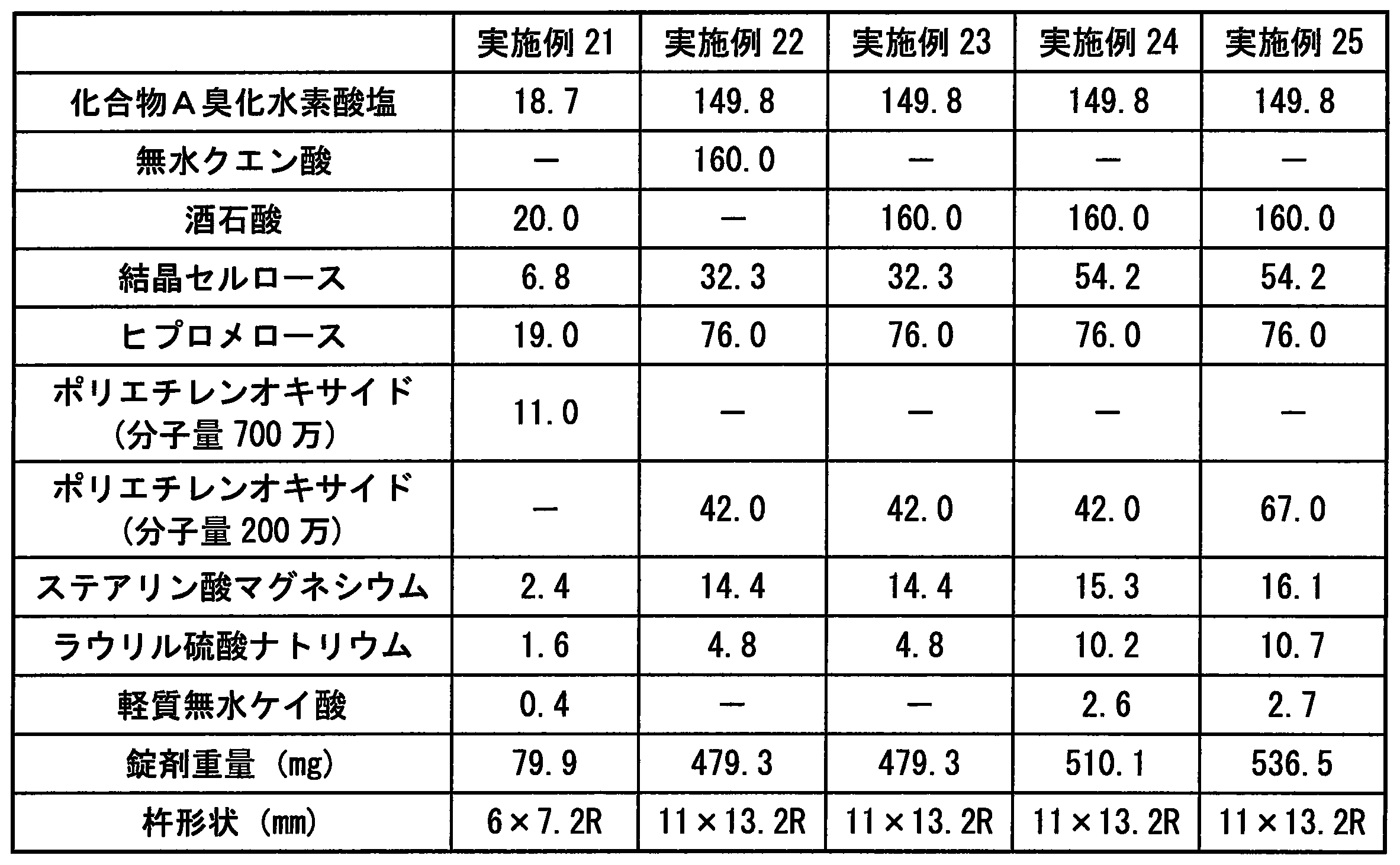
表6に示す処方に基づき、各種添加剤を乳鉢乳棒を用いて混合した。混合物をオイルプレス打錠機を用いて圧縮成形し、本発明の放出制御医薬組成物(錠剤)を製した。
試験例1
参考例1~6の製剤、及び対照製剤(比較例1の製剤)について、薬物溶出性を評価した。USP pH6.8リン酸緩衝液にラウリル硫酸ナトリウムを1%添加した試験液900mL(37℃)を試験液として用い、日本薬局方溶出試験法第二法に従い溶出試験を行った(パドル回転数100rpm)。溶出試験開始後、経時的にサンプリングしその吸光度を分光光度計を用いて測定することにより溶出率を算出した。なお、対照製剤については、0.1N塩酸を試験液として用いて、同様に薬物溶出性を評価した。
参考例1~6の製剤、及び対照製剤(比較例1の製剤)について、薬物溶出性を評価した。USP pH6.8リン酸緩衝液にラウリル硫酸ナトリウムを1%添加した試験液900mL(37℃)を試験液として用い、日本薬局方溶出試験法第二法に従い溶出試験を行った(パドル回転数100rpm)。溶出試験開始後、経時的にサンプリングしその吸光度を分光光度計を用いて測定することにより溶出率を算出した。なお、対照製剤については、0.1N塩酸を試験液として用いて、同様に薬物溶出性を評価した。
対照製剤のpH6.8リン酸緩衝液にラウリル硫酸ナトリウムを1%添加した試験液中における溶出率は、0.1N塩酸と比して顕著に遅延した(図1)。これは、公知化合物A臭化水素酸塩の溶解度が酸性では高いのに対し、pH6.8リン酸緩衝液にラウリル硫酸ナトリウムを1%添加した試験液では薬物溶解度が低いために製剤(錠剤)内部における薬物の溶解速度が低下したためと考えられた。これに対し、酸性物質を添加した参考例1~6の製剤は対照製剤と比してpH6.8における溶出速度が改善した。その中でも特に、無水クエン酸、アスコルビン酸、リンゴ酸、酒石酸を添加した際に大きく溶出性を改善した。
試験例2
過飽和維持剤である、ヒドロキシプロピルセルロース(HPC-L、日本曹達社製、以下特に断りがない場合は同様)、ヒプロメロース(TC-5E)、及びヒドロキシプロピルセルロースとヒプロメロースの混合物について、化合物A臭化水素酸塩の過飽和維持能を評価した。試験液としてUSP pH6.8リン酸緩衝液488mL(37℃)を用い、表7に示す量のヒドロキシプロピルセルロース、ヒプロメロースを溶出試験機ベッセルに添加し完全に溶解させた。化合物A臭化水素酸塩水溶液(フリー体の濃度として10mg/mL)12mLをベッセルに滴下し、パドルを100rpmにて回転させた。1時間後まで経時的にサンプリングし、溶液の吸光度を分光光度計を用いて測定し化合物Aの薬物濃度を算出した(表7)。
過飽和維持剤である、ヒドロキシプロピルセルロース(HPC-L、日本曹達社製、以下特に断りがない場合は同様)、ヒプロメロース(TC-5E)、及びヒドロキシプロピルセルロースとヒプロメロースの混合物について、化合物A臭化水素酸塩の過飽和維持能を評価した。試験液としてUSP pH6.8リン酸緩衝液488mL(37℃)を用い、表7に示す量のヒドロキシプロピルセルロース、ヒプロメロースを溶出試験機ベッセルに添加し完全に溶解させた。化合物A臭化水素酸塩水溶液(フリー体の濃度として10mg/mL)12mLをベッセルに滴下し、パドルを100rpmにて回転させた。1時間後まで経時的にサンプリングし、溶液の吸光度を分光光度計を用いて測定し化合物Aの薬物濃度を算出した(表7)。
その結果、過飽和維持剤未添加(公知化合物A臭化水素酸塩単独)では、薬物溶液添加10分後の薬物濃度は169.7μg/mLであったのに対し、60分後では36.4μg/mLまで低下し、公知化合物A臭化水素酸塩の再結晶を認めた。これに対し、ヒドロキシプロピルセルロース、及びヒプロメロース、さらには両者の混合物は、10分及び60分後いずれも高い薬物濃度を示した。

試験例3
溶出試験法(パドル法)を用いて溶出性(過飽和)評価を行った。試験液系は試験例2と同様の条件で日本薬局方溶出試験法第二法に従い溶出試験を行った。表8に示す各種添加剤(ポリビニルアルコール:PVA、日本合成化学社製,ヒドロキシプロピルセルロース:HPC-L,ヒプロメロース:TC-5E,ヒドロキシプロピルメチルセルロースアセテートサクシネート:HPMC-AS、信越化学工業社製)120mgを溶出試験機ベッセルに添加し完全に溶解させた。化合物A臭化水素酸塩水溶液(フリー体濃度として、10mg/mL)12mLをベッセルに滴下し、パドルを100rpmにて回転させた。14時間後にサンプリングし、溶液の吸光度を分光光度計を用いて測定し化合物Aの薬物濃度を算出した。
溶出試験法(パドル法)を用いて溶出性(過飽和)評価を行った。試験液系は試験例2と同様の条件で日本薬局方溶出試験法第二法に従い溶出試験を行った。表8に示す各種添加剤(ポリビニルアルコール:PVA、日本合成化学社製,ヒドロキシプロピルセルロース:HPC-L,ヒプロメロース:TC-5E,ヒドロキシプロピルメチルセルロースアセテートサクシネート:HPMC-AS、信越化学工業社製)120mgを溶出試験機ベッセルに添加し完全に溶解させた。化合物A臭化水素酸塩水溶液(フリー体濃度として、10mg/mL)12mLをベッセルに滴下し、パドルを100rpmにて回転させた。14時間後にサンプリングし、溶液の吸光度を分光光度計を用いて測定し化合物Aの薬物濃度を算出した。
その結果、ヒドロキシプロピルセルロース、ヒプロメロース、ヒドロキシプロピルメチルセルロースアセテートサクシネートを添加した際の薬物濃度は、それぞれ、85.1μg/mL、80.5μg/mL、78.5μg/mLとなり、過飽和維持剤未添加品の薬物濃度20.3μg/mLと比して顕著に高く、かつ14時間経過後も過飽和を維持していることが明らかとなった(表8)。一方、ポリビニルアルコールを添加した場合の薬物濃度は23.7μg/mLであり過飽和維持剤未添加品と同程度であった。
試験例4
比較例2、3、4、実施例1の錠剤について薬物溶出性を評価した。試験液として、0.1N塩酸又はpH6.8リン酸緩衝液900mL(37℃)を用い、1ベッセルあたり5錠投入し、日本薬局方溶出試験法第二法に従い溶出試験を行った。なお図中の縦軸100%は、公知化合物A濃度として133.3μg/mLに該当する。
0.1N塩酸液中においてはいずれの錠剤も持続安定的な薬物溶出性を示し、5時間で85~100%の薬物を放出した(図2)。一方、pH6.8中においては、比較例2の錠剤は5時間後においても溶出率7%(薬物濃度9.3μg/mL)未満にとどまった(図3)。酸性物質として無水クエン酸を添加した比較例3の錠剤では溶出試験開始直後では溶出率の改善を認めたものの、その後持続的な溶出は認められず5時間後において10%(薬物濃度13.3μg/mL)未満の溶出率であった。これはpH6.8では、公知化合物A臭化水素酸塩の薬物溶解度が低いためと考えられた。ヒプロメロースを添加した比較例4の錠剤では溶出試験開始2時間後では比較例3と比して溶出率の改善が認められたものの、5時間後においては22%(薬物濃度29.3μg/mL)の溶出率であった。これに対し、酒石酸及びヒプロメロースを配合した実施例1の錠剤は溶出試験開始3時間まで持続安定的な溶出性を示し、比較例2、比較例3及び比較例4と比して溶解度が低いpH6.8における薬物溶出性を大きく改善した。試験開始5時間においても薬物溶出率は40%(薬物濃度53.3μg/mL)以上であり、pH6.8における薬物溶解度を大きく改善し、かつ5時間経過後も溶解度の過飽和を維持することが明らかとなった。
比較例2、3、4、実施例1の錠剤について薬物溶出性を評価した。試験液として、0.1N塩酸又はpH6.8リン酸緩衝液900mL(37℃)を用い、1ベッセルあたり5錠投入し、日本薬局方溶出試験法第二法に従い溶出試験を行った。なお図中の縦軸100%は、公知化合物A濃度として133.3μg/mLに該当する。
0.1N塩酸液中においてはいずれの錠剤も持続安定的な薬物溶出性を示し、5時間で85~100%の薬物を放出した(図2)。一方、pH6.8中においては、比較例2の錠剤は5時間後においても溶出率7%(薬物濃度9.3μg/mL)未満にとどまった(図3)。酸性物質として無水クエン酸を添加した比較例3の錠剤では溶出試験開始直後では溶出率の改善を認めたものの、その後持続的な溶出は認められず5時間後において10%(薬物濃度13.3μg/mL)未満の溶出率であった。これはpH6.8では、公知化合物A臭化水素酸塩の薬物溶解度が低いためと考えられた。ヒプロメロースを添加した比較例4の錠剤では溶出試験開始2時間後では比較例3と比して溶出率の改善が認められたものの、5時間後においては22%(薬物濃度29.3μg/mL)の溶出率であった。これに対し、酒石酸及びヒプロメロースを配合した実施例1の錠剤は溶出試験開始3時間まで持続安定的な溶出性を示し、比較例2、比較例3及び比較例4と比して溶解度が低いpH6.8における薬物溶出性を大きく改善した。試験開始5時間においても薬物溶出率は40%(薬物濃度53.3μg/mL)以上であり、pH6.8における薬物溶解度を大きく改善し、かつ5時間経過後も溶解度の過飽和を維持することが明らかとなった。
試験例5
比較例2の錠剤の経口吸収性を評価した。評価系として投与18時間以上絶食させたイヌを用いた。イヌの胃内pHを強制的に酸性にコントロールするために、錠剤投与前にペンタガストリン(大腿部筋肉内投与;錠剤投与30分前、錠剤投与30分後、90分後投与)処置を施した。
比較例2の錠剤6錠(公知化合物A臭化水素酸塩として150mg)をペンタガストリン処置によりその胃内pHを酸性にしたイヌに水50mLとともに経口投与し血漿中薬物濃度を測定した。
その結果、持続的な血漿中薬物濃度パターンを示した(図4)。最高血漿中薬物濃度(Cmax)及び投与後24時間までの血漿中薬物濃度推移曲線下面積(AUC)はそれぞれ1346ng/mL及び11102ng・h/mLであった。
比較例2の錠剤の経口吸収性を評価した。評価系として投与18時間以上絶食させたイヌを用いた。イヌの胃内pHを強制的に酸性にコントロールするために、錠剤投与前にペンタガストリン(大腿部筋肉内投与;錠剤投与30分前、錠剤投与30分後、90分後投与)処置を施した。
比較例2の錠剤6錠(公知化合物A臭化水素酸塩として150mg)をペンタガストリン処置によりその胃内pHを酸性にしたイヌに水50mLとともに経口投与し血漿中薬物濃度を測定した。
その結果、持続的な血漿中薬物濃度パターンを示した(図4)。最高血漿中薬物濃度(Cmax)及び投与後24時間までの血漿中薬物濃度推移曲線下面積(AUC)はそれぞれ1346ng/mL及び11102ng・h/mLであった。
試験例6
比較例2の錠剤の経口吸収性を評価した。評価系として投与18時間以上絶食させたイヌを用いた。イヌの胃内pHを強制的に中性にコントロールするために、錠剤投与前にファモチジン(大腿部筋肉内投与;錠剤投与90分前、30分前投与)投与処置を施した。
比較例2の錠剤6錠(公知化合物A臭化水素酸塩として150mg)をファモチジン処理により胃内pHを中性にしたイヌに水50mLとともに経口投与し血漿中薬物濃度を測定した。
その結果、血漿中薬物濃度は顕著に低く(図4)、Cmax及びAUCはそれぞれ268ng/mL及び3096ng・h/mLであった。試験例5で評価したペンタガストリン処理を施したイヌに投与した際のCmax及びAUCと比してそれぞれ0.20倍及び0.28倍と低かった。
比較例2の錠剤の経口吸収性を評価した。評価系として投与18時間以上絶食させたイヌを用いた。イヌの胃内pHを強制的に中性にコントロールするために、錠剤投与前にファモチジン(大腿部筋肉内投与;錠剤投与90分前、30分前投与)投与処置を施した。
比較例2の錠剤6錠(公知化合物A臭化水素酸塩として150mg)をファモチジン処理により胃内pHを中性にしたイヌに水50mLとともに経口投与し血漿中薬物濃度を測定した。
その結果、血漿中薬物濃度は顕著に低く(図4)、Cmax及びAUCはそれぞれ268ng/mL及び3096ng・h/mLであった。試験例5で評価したペンタガストリン処理を施したイヌに投与した際のCmax及びAUCと比してそれぞれ0.20倍及び0.28倍と低かった。
試験例7
比較例3の錠剤の経口吸収性を評価した。試験例6と同じ評価系を用いた。比較例3の錠剤6錠(公知化合物A臭化水素酸塩として150mg)をファモチジン処理により胃内pHを中性にしたイヌに水50mLとともに経口投与し血漿中薬物濃度を測定した。
その結果、投与後1時間までの血漿中薬物濃度推移は試験例5のペンタガストリン処理時と同様のパターンを示したが、その後持続を認めなかった(図4)。Cmax及びAUCはそれぞれ464ng/mL及び3377ng・h/mLと、試験例5で評価した比較例2のペンタガストリン処理時と比してそれぞれ0.34倍及び0.30倍と低かった。
比較例3の錠剤の経口吸収性を評価した。試験例6と同じ評価系を用いた。比較例3の錠剤6錠(公知化合物A臭化水素酸塩として150mg)をファモチジン処理により胃内pHを中性にしたイヌに水50mLとともに経口投与し血漿中薬物濃度を測定した。
その結果、投与後1時間までの血漿中薬物濃度推移は試験例5のペンタガストリン処理時と同様のパターンを示したが、その後持続を認めなかった(図4)。Cmax及びAUCはそれぞれ464ng/mL及び3377ng・h/mLと、試験例5で評価した比較例2のペンタガストリン処理時と比してそれぞれ0.34倍及び0.30倍と低かった。
試験例8
実施例1の錠剤の経口吸収性を評価した。試験例5と同じ評価系を用いた。実施例1の錠剤6錠(公知化合物A臭化水素酸塩として150mg)をペンタガストリン処理により胃内pHを酸性にしたイヌに水50mLとともに経口投与し血漿中薬物濃度を測定した。
その結果、持続的な血漿中薬物濃度パターンを示し、Cmax及びAUCはそれぞれ2326ng/mL及び15285ng・h/mLであった。
実施例1の錠剤の経口吸収性を評価した。試験例5と同じ評価系を用いた。実施例1の錠剤6錠(公知化合物A臭化水素酸塩として150mg)をペンタガストリン処理により胃内pHを酸性にしたイヌに水50mLとともに経口投与し血漿中薬物濃度を測定した。
その結果、持続的な血漿中薬物濃度パターンを示し、Cmax及びAUCはそれぞれ2326ng/mL及び15285ng・h/mLであった。
試験例9
実施例1の錠剤の経口吸収性を評価した。試験例6と同じ評価系を用いた。実施例1の錠剤6錠(公知化合物A臭化水素酸塩として150mg)をファモチジン処理により胃内pHを中性にしたイヌに水50mLとともに経口投与し血漿中薬物濃度を測定した。
その結果、持続的な血漿中薬物濃度の上昇を認め(図4)、Cmax及びAUCはそれぞれ1746ng/mL及び14879ng・h/mLと、試験例8で評価した実施例1のペンタガストリン処理時と比してそれぞれ0.75倍及び0.97倍であった。
実施例1の錠剤の経口吸収性を評価した。試験例6と同じ評価系を用いた。実施例1の錠剤6錠(公知化合物A臭化水素酸塩として150mg)をファモチジン処理により胃内pHを中性にしたイヌに水50mLとともに経口投与し血漿中薬物濃度を測定した。
その結果、持続的な血漿中薬物濃度の上昇を認め(図4)、Cmax及びAUCはそれぞれ1746ng/mL及び14879ng・h/mLと、試験例8で評価した実施例1のペンタガストリン処理時と比してそれぞれ0.75倍及び0.97倍であった。
試験例10
実施例2の錠剤の経口吸収性を評価した。試験例5と同じ評価系を用いた。実施例2の錠剤8錠(公知化合物A臭化水素酸塩として150mg)をペンタガストリン処理により胃内pHを酸性にしたイヌに水50mLとともに経口投与し血漿中薬物濃度を測定した。
その結果、持続的な血漿中薬物濃度プロファイルを示し、Cmax及びAUCはそれぞれ1942ng/mL及び12927ng・h/mLであった。
実施例2の錠剤の経口吸収性を評価した。試験例5と同じ評価系を用いた。実施例2の錠剤8錠(公知化合物A臭化水素酸塩として150mg)をペンタガストリン処理により胃内pHを酸性にしたイヌに水50mLとともに経口投与し血漿中薬物濃度を測定した。
その結果、持続的な血漿中薬物濃度プロファイルを示し、Cmax及びAUCはそれぞれ1942ng/mL及び12927ng・h/mLであった。
試験例11
実施例3の錠剤の経口吸収性を評価した。試験例5と同じ評価系を用いた。実施例3の錠剤1錠(公知化合物A臭化水素酸塩として150mg)をペンタガストリン処理により胃内pHを酸性にしたイヌに水50mLとともに経口投与し血漿中薬物濃度を測定した。
その結果、持続的な血漿中薬物濃度プロファイルを示し、Cmax及びAUCはそれぞれ2232ng/mL及び16452ng・h/mLであった。
実施例3の錠剤の経口吸収性を評価した。試験例5と同じ評価系を用いた。実施例3の錠剤1錠(公知化合物A臭化水素酸塩として150mg)をペンタガストリン処理により胃内pHを酸性にしたイヌに水50mLとともに経口投与し血漿中薬物濃度を測定した。
その結果、持続的な血漿中薬物濃度プロファイルを示し、Cmax及びAUCはそれぞれ2232ng/mL及び16452ng・h/mLであった。
試験例12
実施例4の錠剤の経口吸収性を評価した。試験例5と同じ評価系を用いた。実施例4の錠剤1錠(公知化合物A臭化水素酸塩として150mg)をペンタガストリン処理により胃内pHを酸性にしたイヌに水50mLとともに経口投与した結果、持続的な血漿中薬物濃度プロファイルを示しCmax及びAUCはそれぞれ2091ng/mL及び16081ng・h/mLであった。
実施例4の錠剤の経口吸収性を評価した。試験例5と同じ評価系を用いた。実施例4の錠剤1錠(公知化合物A臭化水素酸塩として150mg)をペンタガストリン処理により胃内pHを酸性にしたイヌに水50mLとともに経口投与した結果、持続的な血漿中薬物濃度プロファイルを示しCmax及びAUCはそれぞれ2091ng/mL及び16081ng・h/mLであった。
試験例5、6の結果より、酸性物資及び過飽和維持剤を含有しない比較例2の錠剤では、胃内pHが酸性時と中性時のPKパラメータの変動が大きい(Cmax及びAUCで0.20及び0.28倍)ことが明らかとなった。また試験例7より酸性物質を配合した比較例3の処方では、投与直後の経口吸収性は改善したものの、その効果は短時間であった。
これに対し、酸性物質及び過飽和維持剤(高分子)を含有する処方では、試験例8、9の結果より、胃内pHが酸性時と中性時のPKパラメータ変動幅が小さい(Cmax及びAUCで0.75倍及び0.97倍)ことが判明した。以上より、酸性物質及び過飽和維持剤を配合することにより、放出制御製剤中における公知化合物A臭化水素酸塩の過飽和を維持することで、消化管の中性pH環境においても持続的に薬物を放出し、消化管内のpH変動によるPKパラメータ変動を低下させたものと考察する。
これに対し、酸性物質及び過飽和維持剤(高分子)を含有する処方では、試験例8、9の結果より、胃内pHが酸性時と中性時のPKパラメータ変動幅が小さい(Cmax及びAUCで0.75倍及び0.97倍)ことが判明した。以上より、酸性物質及び過飽和維持剤を配合することにより、放出制御製剤中における公知化合物A臭化水素酸塩の過飽和を維持することで、消化管の中性pH環境においても持続的に薬物を放出し、消化管内のpH変動によるPKパラメータ変動を低下させたものと考察する。
試験例13
実施例5の錠剤の経口吸収性を評価した。試験例5と同じ評価系を用いた。実施例5の錠剤8錠(公知化合物A臭化水素酸塩として150mg)をペンタガストリン処理により胃内pHを酸性にしたイヌに水50mLとともに経口投与した結果、持続的な血漿中薬物濃度プロファイルを示しCmax及びAUCはそれぞれ1942ng/mL及び12927ng・h/mLであった(図5)。
実施例5の錠剤の経口吸収性を評価した。試験例5と同じ評価系を用いた。実施例5の錠剤8錠(公知化合物A臭化水素酸塩として150mg)をペンタガストリン処理により胃内pHを酸性にしたイヌに水50mLとともに経口投与した結果、持続的な血漿中薬物濃度プロファイルを示しCmax及びAUCはそれぞれ1942ng/mL及び12927ng・h/mLであった(図5)。
試験例14
実施例22の錠剤の経口吸収性を評価した。試験例5と同じ評価系を用いた。実施例22の錠剤1錠(公知化合物A臭化水素酸塩として150mg)をペンタガストリン処理により胃内pHを酸性にしたイヌに水50mLとともに経口投与した結果、持続的な血漿中薬物濃度プロファイルを示しCmax及びAUCはそれぞれ2332ng/mL及び16452ng・h/mLであった(図5)。
実施例22の錠剤の経口吸収性を評価した。試験例5と同じ評価系を用いた。実施例22の錠剤1錠(公知化合物A臭化水素酸塩として150mg)をペンタガストリン処理により胃内pHを酸性にしたイヌに水50mLとともに経口投与した結果、持続的な血漿中薬物濃度プロファイルを示しCmax及びAUCはそれぞれ2332ng/mL及び16452ng・h/mLであった(図5)。
試験例15
実施例23の錠剤の経口吸収性を評価した。試験例5と同じ評価系を用いた。実施例23の錠剤1錠(公知化合物A臭化水素酸塩として150mg)をペンタガストリン処理により胃内pHを酸性にしたイヌに水50mLとともに経口投与した結果、持続的な血漿中薬物濃度プロファイルを示しCmax及びAUCはそれぞれ2091ng/mL及び16081ng・h/mLであった(図5)。
実施例23の錠剤の経口吸収性を評価した。試験例5と同じ評価系を用いた。実施例23の錠剤1錠(公知化合物A臭化水素酸塩として150mg)をペンタガストリン処理により胃内pHを酸性にしたイヌに水50mLとともに経口投与した結果、持続的な血漿中薬物濃度プロファイルを示しCmax及びAUCはそれぞれ2091ng/mL及び16081ng・h/mLであった(図5)。
試験例16
実施例6の錠剤の経口吸収性を評価した。試験例5と同じ評価系を用いた。実施例6の錠剤4錠(公知化合物A臭化水素酸塩として150mg)をペンタガストリン処理により胃内pHを酸性にしたイヌに水50mLとともに経口投与した結果、持続的な血漿中薬物濃度プロファイルを示しCmax及びAUCはそれぞれ1329ng/mL及び9749ng・h/mLであった。
実施例6の錠剤の経口吸収性を評価した。試験例5と同じ評価系を用いた。実施例6の錠剤4錠(公知化合物A臭化水素酸塩として150mg)をペンタガストリン処理により胃内pHを酸性にしたイヌに水50mLとともに経口投与した結果、持続的な血漿中薬物濃度プロファイルを示しCmax及びAUCはそれぞれ1329ng/mL及び9749ng・h/mLであった。
試験例17
実施例17の錠剤の経口吸収性を評価した。試験例5と同じ評価系を用いた。実施例17の錠剤1錠(公知化合物A臭化水素酸塩として150mg)をペンタガストリン処理により胃内pHを酸性にしたイヌに水50mLとともに経口投与した結果、持続的な血漿中薬物濃度プロファイルを示しCmax及びAUCはそれぞれ1635ng/mL及び11439ng・h/mLであった。
実施例17の錠剤の経口吸収性を評価した。試験例5と同じ評価系を用いた。実施例17の錠剤1錠(公知化合物A臭化水素酸塩として150mg)をペンタガストリン処理により胃内pHを酸性にしたイヌに水50mLとともに経口投与した結果、持続的な血漿中薬物濃度プロファイルを示しCmax及びAUCはそれぞれ1635ng/mL及び11439ng・h/mLであった。
試験例18
実施例5、実施例22及び23の錠剤について、薬物溶出性を評価した。なお、実施例5の錠剤については1ベッセルあたり8錠投入した。USP pH6.8リン酸緩衝液900mL(37℃)を試験液として用い、日本薬局方溶出試験法第二法に従い溶出試験を行った(パドル回転数100rpm)。溶出試験開始後、経時的にサンプリングしその吸光度を分光光度計を用いて測定することにより溶出率を算出した。なお図中の縦軸100%は、公知化合物A濃度として、133.3μg/mLに該当する(図6)。
実施例5、実施例22及び23の錠剤について、薬物溶出性を評価した。なお、実施例5の錠剤については1ベッセルあたり8錠投入した。USP pH6.8リン酸緩衝液900mL(37℃)を試験液として用い、日本薬局方溶出試験法第二法に従い溶出試験を行った(パドル回転数100rpm)。溶出試験開始後、経時的にサンプリングしその吸光度を分光光度計を用いて測定することにより溶出率を算出した。なお図中の縦軸100%は、公知化合物A濃度として、133.3μg/mLに該当する(図6)。
試験例18において、実施例5、実施例22及び23の錠剤共に、溶出試験開始6時間まで持続安定的な溶出を示し、試験開始6時間においては溶出率は60%(薬物濃度80.0μg/mL)以上であり、14時間においては溶出率は30%(薬物濃度40.0μg/mL)以上を示した。pH 6.8での薬物溶解度(10.9μg/mL)と比して、非常に高い値を示し、長時間過飽和を維持できることが明らかとなった。
本発明によれば、優れたJAK3阻害活性を有し、自己免疫疾患、炎症性疾患、アレルギー性疾患を含む、種々の免疫性疾患の治療及び/又は予防剤の有効成分として有用である化合物A又はその製薬学的に許容される塩を含有する放出制御医薬組成物に対して、高い生物学的利用能を付与することができる。
Claims (9)
- 4-{[(1R,2s,3S,5s,7s)-5-ヒドロキシ-2-アダマンチル]アミノ}-1H-ピロロ[2,3-b]ピリジン-5-カルボキサミド又はその製薬学的に許容される塩、酸性物質、過飽和維持剤、及び放出制御基剤を含有してなる、放出制御医薬組成物。
- 酸性物質が、クエン酸、リンゴ酸、酒石酸、フマル酸、アスコルビン酸、コハク酸、又はマレイン酸である、請求項1に記載の放出制御医薬組成物。
- 酸性物質の添加量が、4-{[(1R,2s,3S,5s,7s)-5-ヒドロキシ-2-アダマンチル]アミノ}-1H-ピロロ[2,3-b]ピリジン-5-カルボキサミド又はその製薬学的に許容される塩の重量に対して10重量%以上200重量%である、請求項1又は2に記載の放出制御医薬組成物。
- 過飽和維持剤が、ヒプロメロース、ヒドロキシプロピルセルロース、ヒドロキシプロピルメチルセルロースアセテートサクシネート、及びビニルピロリドン-ビニルアセテートコポリマーからなる群から選択される、1又は2以上の物質である、請求項1~3のいずれか一項に記載の放出制御医薬組成物。
- 過飽和維持剤の添加量が、4-{[(1R,2s,3S,5s,7s)-5-ヒドロキシ-2-アダマンチル]アミノ}-1H-ピロロ[2,3-b]ピリジン-5-カルボキサミド又はその製薬学的に許容される塩の重量に対して10重量%以上200重量%である、請求項1から4のいずれか一項に記載の放出制御医薬組成物。
- 放出制御基剤が、粘度平均分子量が200万以上又は1%水溶液25℃の粘度が1000cps以上の物質である、請求項1~5のいずれか一項に記載の放出制御医薬組成物。
- 更に親水性基剤を含む、請求項1~6のいずれか一項に記載の放出制御医薬組成物。
- 親水性基剤が、基剤1gが溶解するのに必要な水の量が20±5℃下で5mL以下である、請求項7に記載の放出制御医薬組成物。
- pH6.8リン酸緩衝液で溶出試験を行ったときの4-{[(1R,2s,3S,5s,7s)-5-ヒドロキシ-2-アダマンチル]アミノ}-1H-ピロロ[2,3-b]ピリジン-5-カルボキサミドの濃度が8.6μg/mL以上である、請求項1~8のいずれか一項に記載の放出制御医薬組成物。
Priority Applications (1)
| Application Number | Priority Date | Filing Date | Title |
|---|---|---|---|
| JP2014508081A JP6123795B2 (ja) | 2012-03-30 | 2013-03-29 | 放出制御医薬組成物 |
Applications Claiming Priority (2)
| Application Number | Priority Date | Filing Date | Title |
|---|---|---|---|
| JP2012078624 | 2012-03-30 | ||
| JP2012-078624 | 2012-03-30 |
Publications (1)
| Publication Number | Publication Date |
|---|---|
| WO2013147135A1 true WO2013147135A1 (ja) | 2013-10-03 |
Family
ID=49260377
Family Applications (1)
| Application Number | Title | Priority Date | Filing Date |
|---|---|---|---|
| PCT/JP2013/059487 Ceased WO2013147135A1 (ja) | 2012-03-30 | 2013-03-29 | 放出制御医薬組成物 |
Country Status (2)
| Country | Link |
|---|---|
| JP (1) | JP6123795B2 (ja) |
| WO (1) | WO2013147135A1 (ja) |
Cited By (2)
| Publication number | Priority date | Publication date | Assignee | Title |
|---|---|---|---|---|
| EP2979698A4 (en) * | 2013-03-29 | 2016-11-16 | Astellas Pharma Inc | PHARMACEUTICAL COMPOSITION FOR ORAL ADMINISTRATION |
| JP2020007295A (ja) * | 2018-06-28 | 2020-01-16 | ライオン株式会社 | 内服組成物及びその製造方法 |
Citations (6)
| Publication number | Priority date | Publication date | Assignee | Title |
|---|---|---|---|---|
| JPS62242615A (ja) * | 1986-04-16 | 1987-10-23 | Fujisawa Pharmaceut Co Ltd | マトリツクス錠 |
| WO1994006414A1 (fr) * | 1992-09-18 | 1994-03-31 | Yamanouchi Pharmaceutical Co., Ltd. | Preparation d'hydrogel a liberation prolongee |
| JP2004518676A (ja) * | 2000-12-20 | 2004-06-24 | シャイア ラボラトリーズ,インコーポレイテッド | 最小化pH依存性溶解プロフィールを有する徐放性薬学的剤形 |
| JP2009504796A (ja) * | 2005-08-22 | 2009-02-05 | ノバルティス アクチエンゲゼルシャフト | pH依存性薬剤化合物、pH調整剤および遅延剤を含む医薬組成物 |
| JP2009522206A (ja) * | 2005-12-28 | 2009-06-11 | アステラス製薬株式会社 | へテロ環ヤヌスキナーゼ3阻害剤 |
| WO2010038690A1 (ja) * | 2008-09-30 | 2010-04-08 | アステラス製薬株式会社 | 放出制御医薬組成物 |
Family Cites Families (1)
| Publication number | Priority date | Publication date | Assignee | Title |
|---|---|---|---|---|
| JP5888612B2 (ja) * | 2010-06-23 | 2016-03-22 | アステラス製薬株式会社 | 縮合ピリジン化合物塩の結晶 |
-
2013
- 2013-03-29 JP JP2014508081A patent/JP6123795B2/ja active Active
- 2013-03-29 WO PCT/JP2013/059487 patent/WO2013147135A1/ja not_active Ceased
Patent Citations (6)
| Publication number | Priority date | Publication date | Assignee | Title |
|---|---|---|---|---|
| JPS62242615A (ja) * | 1986-04-16 | 1987-10-23 | Fujisawa Pharmaceut Co Ltd | マトリツクス錠 |
| WO1994006414A1 (fr) * | 1992-09-18 | 1994-03-31 | Yamanouchi Pharmaceutical Co., Ltd. | Preparation d'hydrogel a liberation prolongee |
| JP2004518676A (ja) * | 2000-12-20 | 2004-06-24 | シャイア ラボラトリーズ,インコーポレイテッド | 最小化pH依存性溶解プロフィールを有する徐放性薬学的剤形 |
| JP2009504796A (ja) * | 2005-08-22 | 2009-02-05 | ノバルティス アクチエンゲゼルシャフト | pH依存性薬剤化合物、pH調整剤および遅延剤を含む医薬組成物 |
| JP2009522206A (ja) * | 2005-12-28 | 2009-06-11 | アステラス製薬株式会社 | へテロ環ヤヌスキナーゼ3阻害剤 |
| WO2010038690A1 (ja) * | 2008-09-30 | 2010-04-08 | アステラス製薬株式会社 | 放出制御医薬組成物 |
Cited By (3)
| Publication number | Priority date | Publication date | Assignee | Title |
|---|---|---|---|---|
| EP2979698A4 (en) * | 2013-03-29 | 2016-11-16 | Astellas Pharma Inc | PHARMACEUTICAL COMPOSITION FOR ORAL ADMINISTRATION |
| JP2020007295A (ja) * | 2018-06-28 | 2020-01-16 | ライオン株式会社 | 内服組成物及びその製造方法 |
| JP7459458B2 (ja) | 2018-06-28 | 2024-04-02 | ライオン株式会社 | 内服組成物及びその製造方法 |
Also Published As
| Publication number | Publication date |
|---|---|
| JPWO2013147135A1 (ja) | 2015-12-14 |
| JP6123795B2 (ja) | 2017-05-10 |
Similar Documents
| Publication | Publication Date | Title |
|---|---|---|
| JP5625855B2 (ja) | 放出制御医薬組成物 | |
| US20220395502A1 (en) | Pharmaceutical compositions comprising azd9291 | |
| CA2740146C (en) | Immediate release dosage forms of sodium oxybate | |
| KR101840182B1 (ko) | 4-아미노-5-플루오로-3-[6-(4-메틸피페라진-1-일)-1h-벤즈이미다졸-2-일]-1h-퀴놀린-2-온 락테이트 일수화물을 포함한 제약 조성물 | |
| US20180042855A1 (en) | Immediate release formulations and dosage forms of gamma-hydroxybutyrate | |
| ZA200703866B (en) | Pharmaceutical formulation containing a release rate controlling compositions | |
| JP5775085B2 (ja) | c−METキナーゼ阻害剤の製剤 | |
| US20140377349A1 (en) | Controlled release oral dosage form comprising oxycodone | |
| EP1849830B1 (en) | Finely divided composition containing poorly water soluble substance | |
| CA2588465C (en) | Pharmaceutical composition containing an anti-nucleating agent | |
| US7943585B2 (en) | Extended release antibiotic composition | |
| EP2722036A1 (en) | Solid oral formulations of prasugrel | |
| CA2833115C (en) | Pharmaceutical compositions of raltegravir, methods of preparation and use thereof | |
| JP2013028594A (ja) | 経口投与用医薬組成物 | |
| JP6123795B2 (ja) | 放出制御医薬組成物 | |
| US20100272794A1 (en) | Pharmaceutical composition of memantine | |
| JP5900702B2 (ja) | 経口投与用医薬組成物 | |
| US9675549B2 (en) | Tablet containing composite with cyclodextrin | |
| WO2022153330A1 (en) | Pharmaceutical compositions comprising acalabrutinib | |
| JP4582263B2 (ja) | 経口投与用医薬組成物 | |
| US20080182908A1 (en) | Pharmaceutical compositions comprising memantine | |
| US20140363508A1 (en) | Pharmaceutical formulations of flurbiprofen and glucosamin | |
| WO2024214120A1 (en) | Pharmaceutical compositions of nilotinib |
Legal Events
| Date | Code | Title | Description |
|---|---|---|---|
| 121 | Ep: the epo has been informed by wipo that ep was designated in this application |
Ref document number: 13769579 Country of ref document: EP Kind code of ref document: A1 |
|
| ENP | Entry into the national phase |
Ref document number: 2014508081 Country of ref document: JP Kind code of ref document: A |
|
| 122 | Ep: pct application non-entry in european phase |
Ref document number: 13769579 Country of ref document: EP Kind code of ref document: A1 |
|
| NENP | Non-entry into the national phase |
Ref country code: DE |