WO2013147134A1 - ミラベグロン含有医薬組成物 - Google Patents
ミラベグロン含有医薬組成物 Download PDFInfo
- Publication number
- WO2013147134A1 WO2013147134A1 PCT/JP2013/059486 JP2013059486W WO2013147134A1 WO 2013147134 A1 WO2013147134 A1 WO 2013147134A1 JP 2013059486 W JP2013059486 W JP 2013059486W WO 2013147134 A1 WO2013147134 A1 WO 2013147134A1
- Authority
- WO
- WIPO (PCT)
- Prior art keywords
- mirabegron
- pharmaceutical composition
- acid
- addition salt
- acid addition
- Prior art date
- Legal status (The legal status is an assumption and is not a legal conclusion. Google has not performed a legal analysis and makes no representation as to the accuracy of the status listed.)
- Ceased
Links
Images







Classifications
-
- C—CHEMISTRY; METALLURGY
- C07—ORGANIC CHEMISTRY
- C07D—HETEROCYCLIC COMPOUNDS
- C07D277/00—Heterocyclic compounds containing 1,3-thiazole or hydrogenated 1,3-thiazole rings
- C07D277/02—Heterocyclic compounds containing 1,3-thiazole or hydrogenated 1,3-thiazole rings not condensed with other rings
- C07D277/20—Heterocyclic compounds containing 1,3-thiazole or hydrogenated 1,3-thiazole rings not condensed with other rings having two or three double bonds between ring members or between ring members and non-ring members
- C07D277/32—Heterocyclic compounds containing 1,3-thiazole or hydrogenated 1,3-thiazole rings not condensed with other rings having two or three double bonds between ring members or between ring members and non-ring members with hetero atoms or with carbon atoms having three bonds to hetero atoms with at the most one bond to halogen, e.g. ester or nitrile radicals, directly attached to ring carbon atoms
- C07D277/38—Nitrogen atoms
- C07D277/42—Amino or imino radicals substituted by hydrocarbon or substituted hydrocarbon radicals
-
- A—HUMAN NECESSITIES
- A61—MEDICAL OR VETERINARY SCIENCE; HYGIENE
- A61K—PREPARATIONS FOR MEDICAL, DENTAL OR TOILETRY PURPOSES
- A61K31/00—Medicinal preparations containing organic active ingredients
- A61K31/33—Heterocyclic compounds
- A61K31/395—Heterocyclic compounds having nitrogen as a ring hetero atom, e.g. guanethidine or rifamycins
- A61K31/41—Heterocyclic compounds having nitrogen as a ring hetero atom, e.g. guanethidine or rifamycins having five-membered rings with two or more ring hetero atoms, at least one of which being nitrogen, e.g. tetrazole
- A61K31/425—Thiazoles
- A61K31/426—1,3-Thiazoles
-
- A—HUMAN NECESSITIES
- A61—MEDICAL OR VETERINARY SCIENCE; HYGIENE
- A61K—PREPARATIONS FOR MEDICAL, DENTAL OR TOILETRY PURPOSES
- A61K9/00—Medicinal preparations characterised by special physical form
- A61K9/14—Particulate form, e.g. powders, Processes for size reducing of pure drugs or the resulting products, Pure drug nanoparticles
- A61K9/141—Intimate drug-carrier mixtures characterised by the carrier, e.g. ordered mixtures, adsorbates, solid solutions, eutectica, co-dried, co-solubilised, co-kneaded, co-milled, co-ground products, co-precipitates, co-evaporates, co-extrudates, co-melts; Drug nanoparticles with adsorbed surface modifiers
- A61K9/146—Intimate drug-carrier mixtures characterised by the carrier, e.g. ordered mixtures, adsorbates, solid solutions, eutectica, co-dried, co-solubilised, co-kneaded, co-milled, co-ground products, co-precipitates, co-evaporates, co-extrudates, co-melts; Drug nanoparticles with adsorbed surface modifiers with organic macromolecular compounds
-
- A—HUMAN NECESSITIES
- A61—MEDICAL OR VETERINARY SCIENCE; HYGIENE
- A61K—PREPARATIONS FOR MEDICAL, DENTAL OR TOILETRY PURPOSES
- A61K9/00—Medicinal preparations characterised by special physical form
- A61K9/14—Particulate form, e.g. powders, Processes for size reducing of pure drugs or the resulting products, Pure drug nanoparticles
- A61K9/16—Agglomerates; Granulates; Microbeadlets ; Microspheres; Pellets; Solid products obtained by spray drying, spray freeze drying, spray congealing,(multiple) emulsion solvent evaporation or extraction
- A61K9/1605—Excipients; Inactive ingredients
- A61K9/1617—Organic compounds, e.g. phospholipids, fats
-
- A—HUMAN NECESSITIES
- A61—MEDICAL OR VETERINARY SCIENCE; HYGIENE
- A61K—PREPARATIONS FOR MEDICAL, DENTAL OR TOILETRY PURPOSES
- A61K9/00—Medicinal preparations characterised by special physical form
- A61K9/14—Particulate form, e.g. powders, Processes for size reducing of pure drugs or the resulting products, Pure drug nanoparticles
- A61K9/16—Agglomerates; Granulates; Microbeadlets ; Microspheres; Pellets; Solid products obtained by spray drying, spray freeze drying, spray congealing,(multiple) emulsion solvent evaporation or extraction
- A61K9/1605—Excipients; Inactive ingredients
- A61K9/1629—Organic macromolecular compounds
- A61K9/1635—Organic macromolecular compounds obtained by reactions only involving carbon-to-carbon unsaturated bonds, e.g. polyvinyl pyrrolidone, poly(meth)acrylates
-
- A—HUMAN NECESSITIES
- A61—MEDICAL OR VETERINARY SCIENCE; HYGIENE
- A61K—PREPARATIONS FOR MEDICAL, DENTAL OR TOILETRY PURPOSES
- A61K9/00—Medicinal preparations characterised by special physical form
- A61K9/14—Particulate form, e.g. powders, Processes for size reducing of pure drugs or the resulting products, Pure drug nanoparticles
- A61K9/16—Agglomerates; Granulates; Microbeadlets ; Microspheres; Pellets; Solid products obtained by spray drying, spray freeze drying, spray congealing,(multiple) emulsion solvent evaporation or extraction
- A61K9/1605—Excipients; Inactive ingredients
- A61K9/1629—Organic macromolecular compounds
- A61K9/1652—Polysaccharides, e.g. alginate, cellulose derivatives; Cyclodextrin
-
- A—HUMAN NECESSITIES
- A61—MEDICAL OR VETERINARY SCIENCE; HYGIENE
- A61P—SPECIFIC THERAPEUTIC ACTIVITY OF CHEMICAL COMPOUNDS OR MEDICINAL PREPARATIONS
- A61P13/00—Drugs for disorders of the urinary system
- A61P13/10—Drugs for disorders of the urinary system of the bladder
-
- C—CHEMISTRY; METALLURGY
- C07—ORGANIC CHEMISTRY
- C07C—ACYCLIC OR CARBOCYCLIC COMPOUNDS
- C07C305/00—Esters of sulfuric acids
- C07C305/02—Esters of sulfuric acids having oxygen atoms of sulfate groups bound to acyclic carbon atoms of a carbon skeleton
- C07C305/04—Esters of sulfuric acids having oxygen atoms of sulfate groups bound to acyclic carbon atoms of a carbon skeleton being acyclic and saturated
-
- C—CHEMISTRY; METALLURGY
- C07—ORGANIC CHEMISTRY
- C07D—HETEROCYCLIC COMPOUNDS
- C07D277/00—Heterocyclic compounds containing 1,3-thiazole or hydrogenated 1,3-thiazole rings
- C07D277/02—Heterocyclic compounds containing 1,3-thiazole or hydrogenated 1,3-thiazole rings not condensed with other rings
- C07D277/20—Heterocyclic compounds containing 1,3-thiazole or hydrogenated 1,3-thiazole rings not condensed with other rings having two or three double bonds between ring members or between ring members and non-ring members
- C07D277/32—Heterocyclic compounds containing 1,3-thiazole or hydrogenated 1,3-thiazole rings not condensed with other rings having two or three double bonds between ring members or between ring members and non-ring members with hetero atoms or with carbon atoms having three bonds to hetero atoms with at the most one bond to halogen, e.g. ester or nitrile radicals, directly attached to ring carbon atoms
- C07D277/38—Nitrogen atoms
- C07D277/40—Unsubstituted amino or imino radicals
-
- A—HUMAN NECESSITIES
- A61—MEDICAL OR VETERINARY SCIENCE; HYGIENE
- A61K—PREPARATIONS FOR MEDICAL, DENTAL OR TOILETRY PURPOSES
- A61K47/00—Medicinal preparations characterised by the non-active ingredients used, e.g. carriers or inert additives; Targeting or modifying agents chemically bound to the active ingredient
- A61K47/30—Macromolecular organic or inorganic compounds, e.g. inorganic polyphosphates
- A61K47/36—Polysaccharides; Derivatives thereof, e.g. gums, starch, alginate, dextrin, hyaluronic acid, chitosan, inulin, agar or pectin
-
- A—HUMAN NECESSITIES
- A61—MEDICAL OR VETERINARY SCIENCE; HYGIENE
- A61K—PREPARATIONS FOR MEDICAL, DENTAL OR TOILETRY PURPOSES
- A61K9/00—Medicinal preparations characterised by special physical form
- A61K9/0087—Galenical forms not covered by A61K9/02 - A61K9/7023
- A61K9/0095—Drinks; Beverages; Syrups; Compositions for reconstitution thereof, e.g. powders or tablets to be dispersed in a glass of water; Veterinary drenches
-
- A—HUMAN NECESSITIES
- A61—MEDICAL OR VETERINARY SCIENCE; HYGIENE
- A61K—PREPARATIONS FOR MEDICAL, DENTAL OR TOILETRY PURPOSES
- A61K9/00—Medicinal preparations characterised by special physical form
- A61K9/10—Dispersions; Emulsions
Definitions
- the present invention relates to a pharmaceutical composition comprising an acid addition salt of alkylsulfuric acid and mirabegron and a release controlling base.
- the present invention also relates to a pharmaceutical composition comprising an acid addition salt of alkyl sulfate and mirabegron.
- the present invention relates to an acid addition salt of alkyl sulfuric acid and mirabegron.
- Mirabegron is a compound also known as YM178, whose chemical name is (R) -2- (2-aminothiazol-4-yl) -4 ′- ⁇ 2-[(2-hydroxy-2-phenylethyl) Amino] ethyl ⁇ acetanilide having the following chemical structure: Moreover, mirabegron or a salt thereof has a ⁇ 3 adrenergic receptor agonistic action and is known to be useful as a therapeutic agent for overactive bladder (Patent Document 1, Patent Document 2, and Patent Document 3).
- Mirabegron has already been marketed in Japan and the United States as an overactive bladder treatment agent, and is marketed in Japan as “Betanis (registered trademark) tablets” and in the United States as “MYRBETRIQ (registered trademark) tablets”. .
- mirabegron dihydrochloride is specifically disclosed in Patent Document 2.
- Patent Document 4 the pharmaceutical package insert of Betanis (registered trademark) with drug release control is currently provided to the medical field, as it describes the usage of "oral administration once a day after meals”.
- Betanis (registered trademark) tablet is a formulation with limited usage (Non-patent Document 1).
- Non-patent Document 4 In the Act on the Mandatory Data submission (PREA) (Non-Patent Document 5), there is a demand for a dosage form that can be easily taken and can be adjusted for children, such as a liquid, suspension, or emulsion.
- mirabegron has a very strong bitter taste, and it is necessary to suppress the bitter taste in order to provide liquid preparations for children.
- sustained release was achieved while maintaining the solution state by adding equimolar or more of an ionic compound having an opposite charge to the ionic pharmaceutical active substance and increasing the hydrophobicity of the substance.
- an ionic compound having an opposite charge to the ionic pharmaceutical active substance and increasing the hydrophobicity of the substance.
- alkyl sulfates such as sodium lauryl sulfate and sodium myristyl sulfate can be used as the ionic compound.
- Patent Documents 5 and 6 there is no specific disclosure regarding applicability to mirabegron or a salt thereof.
- the object of the present invention is to reduce or suppress the dissolution or leakage of mirabegron even when the pharmaceutical composition is stored as a solution, suspension or emulsion, and further, when mirabegron is suspended or stored.
- An object of the present invention is to provide a pharmaceutical composition containing mirabegron or a salt thereof that suppresses or reduces bitterness as a result of reducing or suppressing elution or leakage.
- the subject of this invention is providing the pharmaceutical composition which reduced the fluctuation
- an object of the present invention is to provide a pharmaceutical composition comprising an acid addition salt of alkyl sulfate and mirabegron.
- an object of the present invention is to provide a pharmaceutical composition containing an alkyl sulfate and an acid addition salt of mirabegron useful as an active ingredient for treating overactive bladder. Furthermore, as another aspect, an object of the present invention is to provide an acid addition salt of alkyl sulfate and mirabegron with reduced pharmacokinetic fluctuation due to the presence or absence of food intake.
- the pharmaceutical composition containing mirabegron when stored as a solution, a suspension or an emulsion, the present inventors reduced or suppressed mirabegron elution or leakage, and further suspended in a solvent.
- the study was conducted focusing on reducing or suppressing mirabegron elution or leakage when stored.
- the form of mirabegron with reduced solubility contains acid addition salts of alkyl sulfate and mirabegron, including mirabegron didodecyl sulfate, mirabegron ditetradecyl sulfate, mirabegron dihexadecyl sulfate, mirabegron monododecyl sulfate. Focusing on the fact that the pharmaceutical composition has the desired effect of the present invention in the in vitro ⁇ and in vivo tests, and that the drug release control can reduce the fluctuation of pharmacokinetics due to the presence or absence of food intake in mirabegron.
- a pharmaceutical composition containing an acid addition salt of alkylsulfuric acid and mirabegron such as mirabegron didodecyl sulfate, mirabegron ditetradecyl sulfate, mirabegron dihexadecyl sulfate, mirabegron monododecyl sulfate, etc. in vitro In tests in vivo, and found to have the desired effect of the present invention, thereby completing the present invention.
- a pharmaceutical composition comprising an acid addition salt of alkylsulfuric acid and mirabegron, and a release controlling base
- the pharmaceutical composition according to [1] wherein the alkyl sulfate is one acid selected from the group consisting of dodecyl sulfate, tetradecyl sulfate, and hexadecyl sulfate
- the acid addition salt of alkyl sulfate and mirabegron is mirabegrondodecyl sulfate.
- [4] The pharmaceutical composition of any one of [1] to [3], wherein the molar ratio of mirabegron to alkylsulfuric acid is 1: 1 to 1: 2.
- [5] The pharmaceutical composition according to [1], wherein the release controlling base is a water-soluble polymer or a water-insoluble substance
- [6] The pharmaceutical composition of [5], wherein the controlled release base is a water-insoluble substance
- [7] The pharmaceutical composition according to [1] or [6], wherein the release controlling base is a water-insoluble cellulose ether and / or a water-insoluble acrylic acid copolymer
- [8] The pharmaceutical composition according to [7], wherein the water-insoluble cellulose ether is ethyl cellulose.
- the water-insoluble acrylic copolymer is selected from the group consisting of ethyl acrylate / methyl methacrylate / methacrylated trimethylammonium ethyl copolymer, and ethyl acrylate / methyl methacrylate copolymer.
- the amount of the water-insoluble substance is 0.1 W / W% or more and 1000 W / W% or less based on the weight of the acid addition salt of alkylsulfuric acid and mirabegron, any one of [5] to [9]
- Pharmaceutical composition, [11] The pharmaceutical composition of any one of [1] to [10], wherein the dissolution rate of mirabegron 30 minutes after the start of the dissolution test is less than about 85%
- the pharmaceutical composition of [11], wherein the dissolution rate of mirabegron 1.5 hours after the start of the dissolution test is about 70% or less
- Any of [1] to [12], wherein the pharmaceutical composition has a Cmax reduction rate of about 30% or less when administered after food intake compared to the maximum blood drug concentration (Cmax) upon fasting administration
- a pharmaceutical composition, [14] The pharmaceutical composition has an AUC reduction rate of about 30% or less when administered after food intake, compared to the area under the blood drug
- the pharmaceutical composition of the present invention comprises an acid addition salt of alkyl sulfate and mirabegron, and a release controlling base.
- the pharmaceutical composition of the present invention provides a pharmaceutical composition in which the solubility or dissolution rate is reduced or reduced compared to mirabegron, and the elution or leakage of mirabegron is reduced or suppressed when stored in a solvent or suspended or dispersed. can do.
- this invention can provide the pharmaceutical composition containing mirabegron which reduced the fluctuation
- the present invention can suppress or reduce bitterness when used as an orally disintegrating tablet, granule, powder, liquid, suspension or emulsion, compared to mirabegron.
- the acid addition salt of alkylsulfuric acid and mirabegron of the present invention has reduced or reduced solubility or dissolution rate compared to mirabegron, and reduced or suppressed mirabegron elution or leakage when stored in a solvent.
- the pharmaceutical composition can be provided.
- the present invention can provide a mirabegron-containing pharmaceutical composition in which the pharmacokinetic fluctuation due to the presence or absence of food intake is smaller than that of mirabegron.
- the present invention can suppress or reduce bitterness when used as an orally disintegrating tablet, granule, powder, liquid, suspension or emulsion, compared to mirabegron.
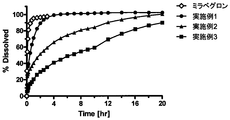
- FIG. 6 is a graph showing the results of the dissolution test (mirabegron as a control) of the acid addition salt of the present invention prepared in Examples 1 to 3 performed in Test Example 2.
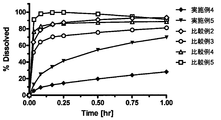
- FIG. 6 is a graph showing the results of dissolution tests (Comparative Examples 2 to 5 for comparison) of the acid addition salts of the present invention prepared in Examples 4 and 5 performed in Test Example 3.
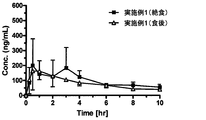
- FIG. 6 is a graph showing the time course of plasma mirabegron concentration during fasting administration and post-meal administration in a pharmacokinetic study (dog) of the acid addition salt of the present invention prepared in Example 1 conducted in Test Example 4.
- 6 is a graph showing the results of dissolution tests of the pharmaceutical compositions of the present invention prepared in Examples 7 to 11 carried out in Test Example 6.
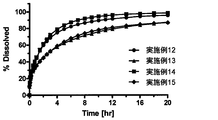
- 6 is a graph showing the results of dissolution tests of the pharmaceutical compositions of the present invention prepared in Examples 12 to 15 carried out in Test Example 6. It is a graph which shows the time-dependent change of the plasma mirabegron density
- the alkyl sulfate is dodecyl sulfate (lauryl sulfate), tridecyl sulfate, tetradecyl sulfate (myristin sulfate), pentadecyl sulfate, hexadecyl sulfate (palmitine sulfate), or dioctyl sodium sulfate.
- Mirabegron can be easily obtained by, for example, the method described in International Publication No. WO99 / 20607, the method obvious to those skilled in the art, or a modification thereof.
- the acid addition salt of mirabegron can be produced by applying the method described in the examples below, or a modification thereof, or a normal salt formation reaction.
- alkylsulfuric acid and mirabegron of the present invention are shown below.
- One acid selected from the group consisting of alkylsulfuric acid and mirabegron is selected from the group consisting of dodecylsulfuric acid, tridecylsulfuric acid, tetradecylsulfuric acid, pentadecylsulfuric acid, hexadecylsulfuric acid, and dioctylsodiumsulfuric acid, and an acid of mirabegron Acid addition salt which is an addition salt.
- the acid addition salt of alkylsulfuric acid and mirabegron is an acid addition salt of one acid selected from the group consisting of dodecylsulfuric acid, tetradecylsulfuric acid, and hexadecylsulfuric acid, and mirabegron.
- the acid addition salt wherein the acid addition salt of alkyl sulfate and mirabegron is an acid addition salt selected from the group consisting of mirabegron didodecyl sulfate, mirabegron ditetradecyl sulfate, and mirabegron dihexadecyl sulfate.
- the acid addition salt of alkylsulfuric acid and mirabegron is mirabegron didodecylsulfuric acid.
- the acid addition salt wherein the acid addition salt of alkyl sulfate and mirabegron is mirabegron ditetradecyl sulfate.
- the acid addition salt of alkylsulfuric acid and mirabegron is mirabegron dihexadecylsulfuric acid.
- the acid addition salt of an alkyl sulfate and mirabegron is an acid addition salt selected from the group consisting of mirabegron monododecyl sulfate, mirabegron monotetradecyl sulfate, and mirabegron monohexadecyl sulfate.
- the acid addition salt of alkylsulfuric acid and mirabegron is mirabegron monododecylsulfuric acid.
- the acid addition salt of alkylsulfuric acid and mirabegron is mirabegron monotetradecylsulfuric acid.
- the acid addition salt of alkylsulfuric acid and mirabegron is mirabegron monohexadecylsulfuric acid.
- a pharmaceutical composition wherein the pharmaceutical composition is a pharmaceutical composition for treating overactive bladder.
- the pharmaceutical composition is a pharmaceutical composition for treating urgency associated with overactive bladder.
- the pharmaceutical composition is a pharmaceutical composition for treating frequent urination associated with overactive bladder.
- the pharmaceutical composition is a pharmaceutical composition for treating urinary incontinence associated with overactive bladder.
- a pharmaceutical composition comprising an acid addition salt of alkylsulfuric acid and mirabegron, and a water-soluble polymer.
- the pharmaceutical composition comprises an alkyl sulfate and mirabegron acid addition salt, and a water-insoluble substance.
- the pharmaceutical composition comprises an alkyl sulfate and mirabegron acid addition salt, and a water-insoluble polymer.
- the above aspect also includes various hydrates and solvates of acid addition salts of alkylsulfuric acid and mirabegron, and polymorphic substances or pharmaceutical compositions containing them.
- the embodiment also includes compounds labeled with various radioactive or non-radioactive isotopes or pharmaceutical compositions containing the same.
- the molar ratio of mirabegron and alkylsulfuric acid is about 1: 1 to 1: 2, and in other embodiments, 1: 1, 1: 2, or a mixture thereof. .
- “stored suspended or dispersed in a solvent” means stored in a pharmaceutically acceptable solvent in a state of being suspended or dispersed homogeneously.
- it means storing the pharmaceutical composition of the present invention under various temperature conditions (room temperature, 25 ° C., or cold place (5 ° C.)) for a period of 2 weeks or longer.
- room temperature 25 ° C., or cold place (5 ° C.)
- it means storing at room temperature, 25 ° C., or cold place (5 ° C.) for 2 weeks or 1 month.
- the suspending medium or dispersing medium include water, xanthan gum solution, polyvinyl alcohol solution, glycerin, propylene glycol, and a commercially available swallowing aid.
- the xanthan gum solution can be prepared, for example, by adding xanthan gum (manufactured by Nitta Gelatin Co., product name VS-900, the same shall apply hereinafter) to water to a xanthan gum concentration of 1 W / W%.
- xanthan gum manufactured by Nitta Gelatin Co., product name VS-900, the same shall apply hereinafter
- reducing or suppressing the dissolution or leakage of mirabegron means that after the pharmaceutical composition of the present invention is dispersed in a solvent and stored, the Japanese Pharmacopoeia Dissolution Test Method Second Method (Paddle Method) ), Using an appropriate test solution 900 mL (for example, the Japanese Pharmacopoeia Dissolution Test Second Solution (JP2)), for example, when conducting a dissolution test at a paddle speed of 50 to 200 rpm, compared to before storage , which means that the maximum change in elution rate is 15% or less. In another embodiment, it is 10% or less, in another embodiment, 5% or less, and in another embodiment, 3% or less.
- JP2 Japanese Pharmacopoeia Dissolution Test Second Solution
- reducing pharmacokinetic fluctuation due to the presence or absence of food intake means the maximum blood drug concentration (Cmax) or the area under the blood drug concentration vs. time curve at the time of postprandial administration compared to the time of fasting administration ( AUC) variation is about 30% or less, in another embodiment about 20% or less, and in another embodiment about 10% or less.
- an in vitro test method as a “pharmaceutical composition with reduced fluctuations in pharmacokinetics due to the presence or absence of food intake”.
- an in-vitro test method as one embodiment, according to the Japanese Pharmacopoeia Dissolution Test Method 2 (Paddle Method), using 900 mL of Japanese Pharmacopoeia Dissolution Test Solution 2 (JP2) as a test solution, the paddle rotation speed is 50 to 200 rpm.
- JP2 Japanese Pharmacopoeia Dissolution Test Solution 2
- the dissolution rate of mirabegron 1.5 hours after the start of the test is about 70% or less, and in another embodiment, the dissolution rate of mirabegron after 1.5 hours is about 70% or less.
- the elution rate of mirabegron after 10 hours is about 60% or more and about 100% or less.
- the dissolution rate of mirabegron after 1.5 hours is about 70% or less, and the dissolution rate of mirabegron after 10 hours is about 70% or more and about 100% or less.
- “inhibition or reduction of bitterness” means a state in which the bitterness of a drug can be suppressed or reduced below a specific drug concentration.
- the pharmaceutical composition of the present invention is added to 10 ⁇ 1 mol / L hydrochloric acid, 10 ⁇ 3 mol / L hydrochloric acid, or purified water, shaken or stirred, and the drug in the supernatant after 1 day at room temperature.
- concentration is measured, it is an indicator that the drug concentration is 0.1 mg / mL or less as one aspect, 0.05 mg / mL or less as another aspect, and 0.03 mg / mL as another aspect.
- the pharmaceutical composition of the present invention is added to 10 ⁇ 1 mol / L hydrochloric acid, 10 ⁇ 3 mol / L hydrochloric acid, or purified water, shaken or stirred, and the drug in the supernatant after 1 day at room temperature.
- concentration is measured, it is an indicator that the drug concentration is 0.1 mg / mL
- controlled release bases used in the present invention include those that reduce pharmacokinetic fluctuations regardless of whether or not mirabegron is ingested, elution or leakage of mirabegron when suspended or dispersed in a solvent, or even during storage Especially when it is used as a liquid, suspension, or emulsion, it does not feel bitter, or it is a base that can suppress the mirabegron concentration below the concentration assumed as the above index. Not. Specific examples include water-soluble polymers and water-insoluble substances. In other embodiments, the controlled release base is a water insoluble polymer.
- water-soluble polymer examples include polyethylene oxide, hypromellose having a molecular weight of 1,000 to 4,000,000, hydroxymethyl cellulose, hydroxyethyl cellulose, hydroxypropyl cellulose having a molecular weight of 2000 to 2,000,000, and carboxyvinyl polymers.
- Another embodiment is hypromellose having a molecular weight of 1,000 to 2,000,000, or a carboxyvinyl polymer having a viscosity of 3,000 to 45,000 cps (0.5% aqueous solution at 25 ° C.).
- Hypromellose having a molecular weight of 10,000 to 1,000,000, or a carboxyvinyl polymer having a viscosity of 4,000 to 40,000 cps (0.5% aqueous solution at 25 ° C.).
- the amount of the water-soluble polymer is 5 W / W% to 95 W / W% per formulation unit, 10 W / W% to 90 W / W% as another embodiment, and 30 W / W% to 85 W as another embodiment. / W%.
- Examples of the polyethylene oxide include, for example, trade name Polyox WSR-308 [average molecular weight: 8 million, viscosity: 10,000-15000 mPa ⁇ s (1% aqueous solution 25 ° C.)], Polyox WSR- 303 [average molecular weight: 7 million, viscosity: 7500-10000 mPa ⁇ s (1% aqueous solution 25 ° C.)], Polyox WSR Coagulant [average molecular weight: 5 million, viscosity: 5500-7500 mPa ⁇ s (1% aqueous solution 25 ° C.)], Polyox WSR-301 [average molecular weight: 4 million, viscosity: 1650-5500 mPa ⁇ s (1% aqueous solution 25 ° C.)], Polyox WSR-N-60K [average molecular weight: 2 million, viscosity: 2000-4000 mPa ⁇ s
- HPMC hypromellose
- HPMC hypromellose
- trade names Metroze 90SH50000 viscosity of 2% aqueous solution at 20 ° C .: 2900-3900 mPa ⁇ s
- Metrose SB-4 2% aqueous solution at 20 ° C.
- Viscosity about 4 mPa ⁇ s
- TC-5RW viscosity of 2% aqueous solution at 20 ° C .: about 6 mPa ⁇ s
- TC-5S viscosity of 2% aqueous solution at 20 ° C .: about 15 mPa ⁇ s
- TC-5R Viscosity of 2% aqueous solution at 20 ° C .: about 6 mPa ⁇ s
- TC-5M Viscosity of 2% aqueous solution at 20 ° C .: about 4.5 mPa ⁇ s
- TC-5E viscosity of 2% aqueous solution at 20 ° C .: about 3 mPa ⁇ s
- Metrows 60SH-50 viscosity of 2% aqueous solution at 20 ° C .: about 50 mPa ⁇ s
- Metrows 65SH-50 2 Viscosity of 2% aqueous
- HPC hydroxypropylcellulose
- HPC-SSL viscosity of 2% aqueous solution at 20 ° C .: 2.0-2.9 mPa ⁇ s
- HPC-SL Viscosity of 2% aqueous solution at 3.0 ° C .: 3.0-5.9 mPa ⁇ s
- HPC-L viscosity of 2% aqueous solution at 20 ° C .: 6.0-10.0 mPa ⁇ s
- HPC-M at 20 ° C.
- HPC Hydroxypropyl cellulose
- HPC-H 2% aqueous solution viscosity at 20 ° C .: 1000-4000 mPa ⁇ s
- Nippon Soda Co., Ltd. Is included.
- methylcellulose examples include, for example, trade names Metroze SM15 (viscosity of 2% aqueous solution at 20 ° C .: about 15 mPa ⁇ s), Metroze SM25 (viscosity of 2% aqueous solution at 20 ° C .: about 25 mPa ⁇ s), Metrows SM100 (viscosity of 2% aqueous solution at 20 ° C .: about 100 mPa ⁇ s), Metrows SM400 (viscosity of 2% aqueous solution at 20 ° C .: about 400 mPa ⁇ s), Metrows SM1500 (2% aqueous solution at 20 ° C.) Viscosity: approx.
- Metroze SM15 viscosity of 2% aqueous solution at 20 ° C .: about 15 mPa ⁇ s
- Metroze SM25 viscosity of 2% aqueous solution at 20 ° C .:
- CMCNa sodium carboxymethylcellulose
- examples of sodium carboxymethylcellulose include, for example, trade name Sunrose F-30MC [viscosity: 250-350 mPa ⁇ s (1% aqueous solution 25 ° C.)], Sunrose F-150MC [average Molecular weight: 200,000, viscosity: 1200-1800 mPa ⁇ s (1% aqueous solution 25 ° C)], Sunrose F-600MC [viscosity: 6000-8000 mPa ⁇ s (1% aqueous solution 25 ° C)], Sunrose F-1000MC [average Molecular weight: 420,000, viscosity: 8000-12000 mPa ⁇ s (same)], Sunrose F-1400MC [viscosity: 12000-15000 mPa ⁇ s (1% aqueous solution 25 ° C.)], Sunrose F-300MC [average molecular weight: 300,000 Viscosity: 2500-3000 mPa ⁇
- HEC hydroxyethyl cellulose
- HEC Daicel SE850 average molecular weight: 1,480,000, viscosity: 2400-3000 mPa ⁇ s (1% aqueous solution 25 ° C.)
- HEC Daicel SE900 Average molecular weight: 1,560,000, viscosity: 4000-5000 mPa ⁇ s (1% aqueous solution 25 ° C.)] (manufactured by Daicel Chemical Industries, Ltd.).
- carboxyvinyl polymer examples include Carbopol 71G (viscosity: 4000-11000 mPa ⁇ s), Carbopol 971P (viscosity: 4000-11000 mPa ⁇ s), Carbopol 981 (viscosity: 4000-10000 mPa ⁇ s), Carbopol. Paul 941 (viscosity: 4000-10000 mPa ⁇ s), Carbopol 934 (viscosity: 30500-39400 mPa ⁇ s), Carbopol 934P (viscosity: 29400-39400 mPa ⁇ s) (above, manufactured by BF Goodrich Chemical Co.) included.
- Carbopol 71G viscosity: 4000-11000 mPa ⁇ s
- Carbopol 971P viscosity: 4000-11000 mPa ⁇ s
- Carbopol 981 viscosity: 4000-10000 mP
- water-soluble polymers can be used alone or in combination of two or more. Further, different lots may be used in combination.
- the amount of the water-soluble polymer is, for example, when the blood concentration profile of the drug does not affect the pharmacokinetic fluctuation depending on the presence or absence of food intake, when the pharmaceutical composition is solid and suspended or dispersed in a solvent, or Elution or leakage of mirabegron can be reduced or suppressed even when stored suspended or dispersed in a solvent, or when used as a solution, suspension, or emulsion, it does not feel bitter or is assumed to be the index.
- it is 1 W / W% or more and 70 W / W% or less, and 3 W / W% or more and 70 W / W% or less as another aspect with respect to the weight of the whole preparation.
- it is 5 W / W% or more and 70 W / W% or less, 10 W / W% or more and 60 W / W% or less as another aspect, and 10 W / W% or more and 40 W / W% or less as a further aspect with respect to the weight of the whole preparation. .
- the blending amount of the water-soluble polymer is 0.1 W / W% or more and 1000 W / W% or less with respect to the weight of the drug, as another embodiment, 1 W / W% or more and 500 W / W% or less, and as a further embodiment 5W / W% or more and 300 W / W% or less. Even if the viscosity of the water-soluble polymer before mixing is out of the predetermined viscosity range in the present invention, the viscosity is measured before use by mixing a plurality of water-soluble polymers in combination. When exhibiting a viscosity within the viscosity range, they may be used in appropriate combination.
- an additive (hydrophilic base) for allowing water to penetrate into the preparation may be contained.
- the amount of water required to dissolve 1 g of the hydrophilic base is 20 ⁇ 5 ° C. 10 mL or less, another embodiment is 6 mL or less, a further embodiment is 5 mL or less, and yet another embodiment is 4 mL or less. The higher the solubility in water, the higher the effect of entering water into the preparation.
- hydrophilic base examples include polyethylene glycol [PEG; for example, trade names PEG400, PEG1500, PEG4000, PEG6000, PEG20000 (manufactured by NOF Corporation)], polyvinylpyrrolidone [PVP; for example, trade name PVP K30 ( A water-soluble polymer such as D-mannitol, D-sorbitol, xylitol; sugars such as lactose, sucrose, anhydrous maltose, D-fructose, dextran (for example, dextran 40), glucose; Polyoxyethylene hydrogenated castor oil [HCO; for example, Cremophor RH40 (manufactured by BASF), HCO-40, HCO-60 (manufactured by Nikko Chemicals)], polyoxyethylene polyoxypropylene glycol [for example, Pluronic F68 ( Asahi Denka Co., Ltd.)], polyoxyethylene sorbitan higher fatty acid ester [Tween;
- PEG, PVP, D-mannitol, D-sorbitol, xylitol, lactose, sucrose, anhydrous maltose, D-fructose, dextran, glucose, polyoxyethylene polyoxypropylene glycol, sodium chloride, magnesium chloride, citric acid Tartaric acid, glycine, ⁇ -alanine, lysine hydrochloride, and meglumine can be used.
- Further embodiments include PEG, PVP, D-mannitol, lactose, sucrose, sodium chloride, polyoxyethylene polyoxypropylene glycol and the like.
- hydrophilic bases can be used alone or in combination of two or more.
- the release of the drug can be controlled to such an extent that the release of the drug is not affected by fluctuations in pharmacokinetics due to the presence or absence of food intake.
- elution or leakage of mirabegron can be reduced or suppressed, or even when used as a solution, suspension, or emulsion, it does not feel bitter or is assumed to be the above indicator
- the drug concentration is not particularly limited as long as the drug concentration can be suppressed to a level not perceiving bitterness below the concentration of mirabegron.
- it is 5 W / W% or more and 75 W / W% or less with respect to the whole preparation, 5 W / W% or more and 70 W / W% or less as another aspect, and 20 W / W% or more and 60 W / W% or less as a further aspect.
- water-insoluble substances include water-insoluble polymers and wax-like substances.
- water-insoluble polymer examples include water-insoluble cellulose ethers such as ethyl cellulose (for example, trade name Etcel STD10, manufactured by Dow Chemical Company, ethyl cellulose aqueous dispersion (for example, trade name Aquacoat ECD, manufactured by FMC)), acrylic acid, and the like.
- Ethyl / methyl methacrylate / methacrylated trimethylammonium ethyl copolymer for example, trade names: Eudragit RS100, Eudragit RS30D, manufactured by EVONIK Roehm
- ethyl acrylate / methyl methacrylate copolymer for example, commodity Name: water-insoluble acrylic copolymers such as Eudragit NE30D and EVONIK Roehm).
- wax-like substance examples include solid fats such as hardened castor oil, hardened coconut oil, and beef tallow; higher fatty acids such as stearic acid, lauric acid, myristic acid, and palmitic acid; higher alcohols such as cetyl alcohol and stearyl alcohol.
- Preferred water-insoluble substances include ethyl cellulose, ethyl acrylate / methyl methacrylate / methacrylated trimethylammonium ethyl copolymer and ethyl acrylate / methyl methacrylate copolymer, and other embodiments include ethyl cellulose and ethyl acrylate.
- -A methyl methacrylate and a methacrylic acid-ized trimethylammonium ethyl copolymer are mentioned, and ethyl cellulose is mentioned as another aspect.
- a plasticizer may be contained.
- the plasticizer is not particularly limited as long as it improves the plasticity of the water-insoluble polymer.
- triethyl citrate, PEG400, PEG600, PEG1500, PEG4000, PEG6000, triacetin, glycerin, glyceryl monostearate, acetylated monoglyceride, or the like can be given.
- the amount of water-insoluble substance can be, for example, reduced pharmacokinetic fluctuations regardless of whether mirabegron is ingested, reduced mirabegron elution or leakage when suspended or dispersed in a solvent, or even during storage.
- the amount should not cause a bitter taste, or can be suppressed to a level at which the drug concentration is below the level of mirabegron that is assumed to be the above indicator, so that the bitterness is not perceived.
- the amount should not cause a bitter taste, or can be suppressed to a level at which the drug concentration is below the level of mirabegron that is assumed to be the above indicator, so that the bitterness is not perceived.
- it is 0.1 W / W% or more and 300 W / W% or less with respect to the weight of this salt, and as another aspect, it is 50 W / W% or more and 300 W / W% or less with respect to the weight of this salt, another aspect As an example, an embodiment having a weight of 50 W / W% or more and 150 W / W% or less based on the weight of the salt can be given.
- the structure of the acid addition salt of alkylsulfuric acid and mirabegron and the release-controlling base is, for example, mirabegron food intake in any of the uniform aspect and the non-uniform aspect.
- an aspect in which an acid addition salt of alkylsulfuric acid and mirabegron is coated and / or granulated with a release control base an aspect in which an acid addition salt of alkylsulfuric acid and mirabegron is mixed with a release control base
- a capsule is filled with a pharmaceutical composition comprising an acid addition salt of alkylsulfuric acid and mirabegron, a release control base, and an acid addition salt of alkylsulfuric acid and mirabegron and a release control base are suspended or dissolved in a solvent.
- Examples include an aspect in which a tablet containing an acid addition salt of alkylsulfuric acid and mirabegron is coated with a release controlling base.
- the aspect of a pharmaceutical composition can be used combining 1 type (s) or 2 or more types as appropriate.
- a pharmaceutical additive is not particularly limited as long as it is pharmaceutically acceptable and pharmacologically acceptable.
- binders, stabilizers, disintegrants, acidulants, foaming agents, artificial sweeteners, lubricants, colorants, buffers, antioxidants, solubilizers, preservatives, flavoring / flavoring agents, flavors, Suspending agents, dispersing agents, thickeners, wetting agents, antifoaming agents, solvents and the like are used.
- binder examples include gum arabic, hypromellose, hydroxypropyl cellulose, hydroxyethyl cellulose and the like.
- stabilizer examples include yellow iron sesquioxide, red iron sesquioxide, and black iron oxide.
- disintegrant examples include corn starch, potato starch, carmellose calcium, carmellose sodium, and low-substituted hydroxy. And propyl cellulose.
- acidulant examples include citric acid, tartaric acid, malic acid and the like.
- foaming agent examples include sodium bicarbonate.
- the artificial sweetener include saccharin sodium, dipotassium glycyrrhizin, aspartame, stevia, thaumatin and the like.
- lubricant examples include magnesium stearate, calcium stearate, sucrose fatty acid ester, polyethylene glycol, talc, stearic acid and the like.
- Examples of the colorant include food yellow No. 4, No. 5, food red No. 3, No. 102, food blue No. 3, and the like.
- Examples of the buffer include citric acid, succinic acid, fumaric acid, tartaric acid, ascorbic acid or a salt thereof, glutamic acid, glutamine, glycine, aspartic acid, alanine, arginine or a salt thereof, magnesium oxide or a salt thereof, zinc oxide, water Examples thereof include magnesium oxide, phosphoric acid, boric acid, and salts thereof.
- Examples of the antioxidant include ascorbic acid, dibutylhydroxytoluene, propyl gallate and the like.
- solubilizer examples include polysorbate 80, sodium lauryl sulfate, polyoxyethylene hydrogenated castor oil, and the like.
- preservative examples include methyl paraoxybenzoate, ethyl paraoxybenzoate, propyl paraoxybenzoate, butyl paraoxybenzoate, benzoic acid, benzyl alcohol, sorbic acid, acetic acid and salts thereof.
- flavoring / flavoring agent include sugars such as sucrose, fructose, lactose, sorbitol, mannitol, and xylitol, sugar alcohols, and sweeteners such as aspartame, acesulfame potassium, and sucralose.
- fragrances include lemon, lemon lime, orange, menthol, strawberry, banana, raspberry, bubble gum flavor and the like.
- suspending agent examples include locust bin gum, guar gum, pullulan, xanthan gum, carrageenan, tragacanth gum, degistrin, pectin, and gelatin.
- nonionic substances can be blended as necessary.
- wetting agent examples include polyoxyethylene sorbitan fatty acid esters such as polysorbate 80 and aracer 83, polyoxyethylene hydrogenated castor oil such as HCO-50, and surfactants such as sugar ester.
- antifoaming agent examples include simethicone and dimethicone.
- solvent examples include water, xanthan gum solution, polyvinyl alcohol solution, glycerin, propylene glycol, and a commercially available swallowing aid.
- a pharmaceutical additive one or a combination of two or more can be appropriately added.
- any pharmaceutical additive is used in an amount within the range in which the desired effect of the present invention is achieved.
- Administration is orally by tablets, orally disintegrating tablets, pills, capsules, granules, powders, liquids, etc., or injections such as intra-articular, intravenous, intramuscular, suppositories, eye drops, eye ointments, Any form of parenteral administration such as transdermal liquid, ointment, transdermal patch, transmucosal liquid, transmucosal patch, inhalant and the like may be used.
- One embodiment is oral administration by orally disintegrating tablet, granule, powder, solution, suspension, or emulsion
- another embodiment is oral administration by orally disintegrating tablet, solution, suspension, or emulsion. is there.
- Another embodiment is oral administration in a solution, suspension, or emulsion.
- Yet another embodiment is oral administration using an orally disintegrating tablet.
- the daily dose is about 0.001 to 100 mg / kg per body weight, preferably 0.1 to 30 mg / kg, more preferably 0.1 to 10 mg / kg as mirabegron. This is administered once or divided into 2 to 4 times.
- the daily dose is mirabegron, and about 0.0001 to 10 mg / kg per body weight is appropriate, and it is administered once to several times a day.
- a transmucosal agent about 0.001 to 100 mg / kg of mirabegron per body weight is administered once to several times a day. The dose is appropriately determined according to individual cases in consideration of symptoms, age, sex, and the like.
- the acid addition salt of alkylsulfuric acid and mirabegron of the present invention can be used in combination with various therapeutic agents or preventive agents for diseases for which the above-mentioned acid addition salt of alkylsulfuric acid and mirabegron is considered effective.
- the combination may be administered simultaneously, separately separately, or at desired time intervals.
- the simultaneous administration preparation may be a compounding agent or may be separately formulated.
- Mirabegron and alkyl sulfuric acid are each dissolved in a solvent.
- the solvent to be dissolved is not particularly limited as long as it dissolves mirabegron and alkylsulfuric acid, and examples thereof include organic solvents such as water, hydrochloric acid, phosphoric acid, ethanol, and methanol, or a mixed solution thereof. Mirabegron and alkylsulfuric acid need not be completely dissolved.
- the mixing conditions are not particularly limited.
- the mixing is performed by feeding the alkylsulfuric acid solution to the mirabegron solution or feeding the mirabegron solution to the alkylsulfuric acid solution.
- mirabegron such as water and hydrochloric acid and a solvent in which alkyl sulfuric acid is dissolved may be added to and mixed with the mixture obtained by mixing mirabegron powder and alkyl sulfuric acid powder.
- a step of collecting by filtration to obtain a precipitate may be added.
- the drying method is not particularly limited as long as the precipitate or the mixed solution can be dried, and examples thereof include drying with a ventilation dryer, a vacuum dryer, a fluidized bed granulator, and a spray dryer. Drying temperature is 40 degreeC or more and 60 degrees C or less, for example.
- the release control base is previously dispersed or dissolved in water or an organic solvent and added to the dried product.
- the addition method is not particularly limited, and examples thereof include a fluidized bed granulator, a spray dryer, a stirring granulator, a small stirring mill, and the like. Moreover, you may put the process dried after adding a release control base. Furthermore, you may put the process of temperature-control humidity.
- an acid addition salt of alkylsulfuric acid and mirabegron of the present invention and a method for producing a pharmaceutical composition containing the acid addition salt will be described.
- this invention is not limited to the acid addition salt and pharmaceutical composition as described in the following Example.
- the acid addition salt of alkylsulfuric acid and mirabegron, the method for producing the pharmaceutical composition is not limited to the production method of the specific examples shown below, the acid addition salt of alkylsulfuric acid and mirabegron,
- the pharmaceutical composition can also be produced by a combination of these production methods or by methods obvious to those skilled in the art.
- Example 1 A solution A was prepared by dissolving 122 g of mirabegron (manufactured by Astellas Pharma Inc., hereinafter the same) in 6100 g of 0.1 mol / L hydrochloric acid. 178 g of sodium lauryl sulfate (manufactured by Cognis, product name Texapon K12, hereinafter the same) was dissolved in 6100 g of purified water to prepare solution B. The obtained B liquid was fed to A liquid at 160 g / min, and stirred and mixed at room temperature with a paddle of 170 to 200 rpm to obtain a precipitate.
- the resulting precipitate was collected by filtration using a 0.45 ⁇ m HA filter (manufactured by MILLIPORE, the same applies hereinafter), shelf-dried at 40 ° C. for 24 hours, and further dried under reduced pressure at 60 ° C. for 12 hours to obtain mirabegron and lauryl sulfate.
- a powder of the acid addition salt of the present invention (hereinafter sometimes abbreviated as mirabegron lauryl sulfate) having a molar ratio of 1: 2 was obtained.
- the obtained powder was identified for its constituents by 1 H-NMR measurement (DMSO-d 6 solvent). Signals derived from sodium lauryl sulfate and mirabegron were observed, confirming that they were composed of both compounds. The amino group of mirabegron was protonated and salt formation was observed. The ratio of mirabegron and sodium lauryl sulfate was calculated from the integral ratio of 1 H-NMR as follows.
- Example 2 Liquid A was prepared by dissolving 1 g of mirabegron in 0.1 mol / L hydrochloric acid at room temperature.
- B liquid was prepared by dissolving 1.60 g of sodium myristyl sulfate (manufactured by Nikko Chemical Co., Ltd., product name NIKKOL SMS) in purified water heated to 50 ° C.
- B liquid was added to A liquid under 50 degreeC heating, and the deposit was obtained.
- the obtained precipitate was collected by filtration using a 0.45 ⁇ m HA filter and shelf-dried at 40 ° C. for 12 hours to obtain the acid addition salt of the present invention having a molar ratio of mirabegron to myristic sulfate of 1: 2. It was.
- Example 3 Liquid A was prepared by dissolving 1 g of mirabegron in 0.1 mol / L hydrochloric acid at room temperature.
- B liquid was prepared by dissolving 1.74 g of sodium cetyl sulfate (manufactured by Nikko Chemical Co., Ltd., product name NIKKOL SCS) in purified water heated to 70 ° C.
- B liquid was added to A liquid under 70 degreeC heating, and the deposit was obtained.
- the obtained precipitate was collected by filtration using a 0.45 ⁇ m HA filter and shelf-dried at 40 ° C. for 12 hours to obtain the acid addition salt of the present invention in which the molar ratio of mirabegron to cetylsulfuric acid was 1: 2. It was.
- Example 4 Add 472.8 mL of 0.1 mol / L hydrochloric acid to 94.6 g of mirabegron, dissolve it, gradually add 138 g of sodium lauryl sulfate, and use a universal mixing stirrer (manufactured by Shinagawa Kogyo, Model 5DMR) at 62 rpm at room temperature. And stirred for 0.5 hours. The obtained mixture was shelf-dried at 40 ° C. for 42.5 hours to obtain an acid addition salt of the present invention in which the molar ratio of mirabegron to lauryl sulfate was 1: 2.
- Example 5 25 g of mirabegron was dissolved in 500 mL of methanol (manufactured by Kanto Chemical Co., Inc., hereinafter the same), and 65 mL of 0.1 mol / L hydrochloric acid was further added to prepare solution A. The pH of the obtained liquid A was 5.62. On the other hand, 18.25 g of sodium lauryl sulfate was dissolved in 500 mL of purified water to prepare solution B. The pH of the obtained B liquid was 9.69. The obtained B liquid was sent to A liquid, and it stirred and mixed with the paddle at room temperature. The obtained precipitate was collected by filtration using a 0.45 ⁇ m HA filter and dried under reduced pressure at 60 ° C. for 12 hours to obtain a powder of the acid addition salt of the present invention having a molar ratio of mirabegron to lauryl sulfate of 1: 1. It was.
- the constituents of the obtained powder were identified by 1 H-NMR measurement (DMSO-d 6 solvent). Signals derived from sodium lauryl sulfate and mirabegron were observed, confirming that they were composed of both compounds. The amino group of mirabegron was protonated and salt formation was observed. The ratio of mirabegron and sodium lauryl sulfate was calculated from the integral ratio of 1 H-NMR as follows.
- Example 6 Mirabegron (205.5 g) was dissolved in methanol (4110 mL), and 0.1 mol / L hydrochloric acid (529.4 mL) was further added to prepare solution A. On the other hand, 150 g of sodium lauryl sulfate was dissolved in 4110 mL of purified water to prepare solution B. The obtained B liquid is fed into A liquid, stirred and mixed in a paddle at room temperature, and then dried under reduced pressure at 60 ° C. for 7 days, whereby the molar ratio of mirabegron to lauryl sulfate is 1: 1. The acid addition salt of was obtained.
- Comparative Example 1 500 mg of mirabegron was dissolved in 200 mL of a 50 mmol / L phosphoric acid solution to obtain a drug aqueous solution of a comparative example.
- Comparative Example 2 Mirabegron 1.5 g and sodium lauryl sulfate 2.19 g were mixed with a pestle in a mortar to obtain a comparative mixture containing mirabegron and lauryl sulfate (molar ratio 1: 2).
- Comparative Example 3 A solution A was prepared by dissolving 1.5 g of mirabegron in 75 mL of 0.1 mol / L hydrochloric acid at room temperature.
- liquid B was prepared by dissolving 3.29 g of sodium lauryl sulfate in 75 mL of purified water. B liquid was added to A liquid at room temperature, and it dried at 60 degreeC, and obtained the mixture of the comparative example containing mirabegron and lauryl sulfuric acid (molar ratio 1: 3).
- Comparative Example 4 A solution A was prepared by dissolving 1.5 g of mirabegron in 75 mL of 0.1 mol / L hydrochloric acid at room temperature. On the other hand, 5.48 g of sodium lauryl sulfate was dissolved in 75 mL of purified water to prepare solution B. B liquid was added to A liquid at room temperature, and it dried at 60 degreeC, and obtained the mixture of the comparative example containing mirabegron and lauryl sulfuric acid (molar ratio 1: 5).
- Comparative Example 5 Liquid A was prepared by dissolving 1 g of mirabegron in 50 mL of 0.1 mol / L hydrochloric acid at room temperature.
- liquid B was prepared by dissolving 10.95 g of sodium lauryl sulfate in 150 mL of purified water. B liquid was added to A liquid at room temperature, and it dried at 60 degreeC, and obtained the mixture of the comparative example containing mirabegron and lauryl sulfuric acid (molar ratio is 1:15).
- Test example 1 The drug concentration (solubility) of the test compound was measured according to the following method.
- the acid addition salt of the present invention prepared in Examples 1 to 3 150 mg in terms of mirabegron was added to 10 ⁇ 1 mol / L hydrochloric acid, 10 ⁇ 3 mol / L hydrochloric acid, and purified water, respectively. Shake at room temperature for 24 hours at a rate of 10 times / minute. After shaking, the mixture was centrifuged at 3000 rpm for 15 minutes, and then the drug concentration in the supernatant was measured.
- Table 1 shows the drug concentration measurement results for mirabegron and the acid addition salts of the present invention prepared in Examples 1 to 3. While mirabegron had a high drug concentration in each solution, Examples 1 to 3 were able to suppress the drug concentration in any of the solutions.
- Test example 2 The acid addition salt of the present invention prepared in Examples 1 to 3 (25 mg in terms of mirabegron) was subjected to a dissolution test according to the Japanese Pharmacopoeia Dissolution Test Method 2 (Paddle Method). As the test solution, 900 mL of Japanese Pharmacopoeia Disintegration Test Second Solution (JP2) was used. The paddle rotation speed was 150 rpm.
- JP2 Japanese Pharmacopoeia Disintegration Test Second Solution
- FIG. 1 shows the dissolution test measurement results for the acid addition salts of the present invention prepared in Examples 1 to 3.
- the elution rates of Examples 1 to 3 were unexpectedly reduced as compared with mirabegron.
- Test example 3 The acid addition salt of the present invention prepared in Examples 4 and 5 (25 mg in terms of mirabegron) was subjected to a dissolution test according to the Japanese Pharmacopoeia Dissolution Test Method 2 (Paddle Method). As the test solution, 900 mL of Japanese Pharmacopoeia Disintegration Test Second Solution (JP2) was used. The paddle rotation speed was 50 rpm. On the other hand, the same elution test was performed on the mixtures prepared in Comparative Examples 2 to 5.
- JP2 Japanese Pharmacopoeia Disintegration Test Second Solution
- Test example 4 Xanthan gum was added to a 50 mmol / L phosphate buffer solution under stirring with a stirrer so as to be 0.5 W / W%, and the acid addition salt of the present invention prepared in Example 1 (50 mg in terms of mirabegron) was stirred with stirring.
- the suspension uniformly dispersed below is orally administered to male beagle dogs under fasting conditions (fast) or 30 minutes after feeding (fed) with a sonde, and the drug concentration contained in plasma is determined after a certain period of time. It was measured.
- As a diet 50 g of meat feed was used.
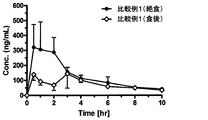
- the aqueous drug solution of Comparative Example 1 (50 mg in terms of mirabegron) was orally administered to male beagle dogs with fasting conditions or with a sonde 30 minutes after the meal, and the drug concentration contained in plasma after a certain time was measured.
- Example 1 The results for the acid addition salt of mirabegron of the present invention prepared in Example 1 are shown in Table 3 and FIG. 3, and the results in Comparative Example 1 are shown in Table 4 and FIG.
- Comparative Example 1 the decrease rate of Cmax under satiety was 58% and the decrease rate of AUC was 43% compared to the fasting rate, whereas the pharmaceutical composition of the present invention (Example 1) was fasted. Compared with, the decrease rate of Cmax under satiety was 22%, and the decrease rate of AUC was 19%, which significantly reduced the pharmacokinetic fluctuation due to the presence or absence of food intake.
- Test Example 5 A suspension obtained by dispersing the acid addition salt of the present invention prepared in Example 1 (25 mg in terms of mirabegron) in 5 mL of a xanthan gum solution was filled in a glass bottle, sealed, and then placed in a cool place (5 ° C.) and at room temperature. Each for 1 month.
- the xanthan gum solution was prepared by adding 1 W / W% xanthan gum to water under stirring with a stirrer. After storage, a dissolution test of the suspension (containing 25 mg of mirabegron) was carried out according to the Japanese Pharmacopoeia Dissolution Test Method 2 (Paddle Method). As the test solution, 900 mL of Japanese Pharmacopoeia Disintegration Test Second Solution (JP2) was used. The paddle rotation speed was 150 rpm.
- JP2 Japanese Pharmacopoeia Disintegration Test Second Solution
- Example 7 Obtained in Example 1 was obtained by dissolving 400 mg of ethyl acrylate / methyl methacrylate / methacrylated trimethylammonium ethyl copolymer (product of EVONIK Roehm, product name Eudragit RS100) in methanol, and then transferring to an agate mortar. 468 mg of acid addition salt and 64 mg of polyethylene glycol (manufactured by Sanyo Chemical Co., Ltd., product name PEG6000, the same applies hereinafter) were added, mixed with a pestle, the agate mortar was transferred to a thermostat, and dried at 40 ° C. overnight. The film-like substance was peeled off from the agate mortar wall and pulverized with a pestle to obtain the pharmaceutical composition of the present invention.
- ethyl acrylate / methyl methacrylate / methacrylated trimethylammonium ethyl copolymer product of EVONIK Roehm, product name
- Example 8 A mixture of 5.85 g of the acid addition salt obtained in Example 1 and 5 g of ethyl cellulose (manufactured by Dow Chemical Co., Ltd., product name Etcelle STD10, the same shall apply hereinafter) was used using a small stirring mill (manufactured by Oriental Motor, the same applies hereinafter). The mixture was granulated with 3.5 mL of methanol, dried at 40 ° C. overnight, and then pulverized to obtain the pharmaceutical composition of the present invention.
- ethyl cellulose manufactured by Dow Chemical Co., Ltd., product name Etcelle STD10, the same shall apply hereinafter
- the mixture was granulated with 3.5 mL of methanol, dried at 40 ° C. overnight, and then pulverized to obtain the pharmaceutical composition of the present invention.
- Example 9 A mixture of 5.85 g of the acid addition salt obtained in Example 1 and 15 g of ethyl cellulose was granulated with 7.5 mL of methanol using a small stirring mill, dried at 40 ° C. overnight, pulverized, and the present invention. A pharmaceutical composition was obtained.
- Example 10 13.75 g of ethyl acrylate / methyl methacrylate / methacrylic acid trimethylammonium ethyl copolymer (product name: Eudragit RS30D, manufactured by EVONIK Roehm) with respect to 8.775 g of the acid addition salt obtained in Example 1 Then, the mixture was granulated using a small stirring mill, dried at 40 ° C. overnight, and pulverized to obtain the pharmaceutical composition of the present invention.
- Eudragit RS30D manufactured by EVONIK Roehm
- Example 11 7.5 g of ethyl acrylate / methyl methacrylate / methacrylic acid trimethylammonium ethyl copolymer (product name: Eudragit RS30D, manufactured by EVONIK Roehm) with respect to 8.775 g of the acid addition salt obtained in Example 1 Then, the mixture was granulated using a small stirring mill, dried at 40 ° C. overnight, and pulverized to obtain the pharmaceutical composition of the present invention.
- Eudragit RS30D manufactured by EVONIK Roehm
- Example 12 0.9 g of triethyl citrate (manufactured by Tokyo Chemical Industry Co., Ltd., the same applies below) is added to 20 g of an aqueous dispersion of ethyl cellulose (product name: Aquacoat ECD-30 manufactured by FMC, the same applies hereinafter), followed by ultrasonic irradiation for 5 minutes. Was prepared.
- ethyl cellulose product name: Aquacoat ECD-30 manufactured by FMC, the same applies hereinafter
- Example 13 Triethyl citrate (13.57 g) was added to an ethyl cellulose aqueous dispersion (300 g), ultrasonic irradiation was performed for 5 minutes, and the mixture was passed through a 250 ⁇ m sieve to prepare a spray solution.
- the acid addition salt obtained in Example 1 was pulverized with a power mill (Dalton Co., hereinafter the same) and then finely pulverized with a fine impact mill (Hosokawa Micron Co., the same).
- the total amount of the spray solution prepared is added to 142.7 g of the pulverized acid addition salt using a stirring granulator (product name VG-01, manufactured by POWREC), dried at 40 ° C. overnight, and then pulverized.
- a stirring granulator product name VG-01, manufactured by POWREC
- Example 14 The acid addition salt obtained in Example 1 was pulverized with a power mill and then finely pulverized with a fine impact mill. 71.3 g of the pulverized acid addition salt and 18.3 g of triethyl citrate were added to 406.5 g of an aqueous dispersion of ethyl cellulose, and passed through a 250 ⁇ m sieve to prepare a spray solution. The spray solution was sprayed using a spray dryer (Okawara Chemical Co., Ltd., the same applies hereinafter). Particles were collected from the cyclone portion and subjected to heat treatment (70 ° C., 4 hours) to obtain a pharmaceutical composition of the present invention.
- a spray dryer Okawara Chemical Co., Ltd., the same applies hereinafter
- Example 15 The acid addition salt obtained in Example 1 was pulverized with a power mill and then finely pulverized with a fine impact mill.
- the pulverized acid addition salt (142.7 g) and triethyl citrate (36.6 g) were added to an ethylcellulose aqueous dispersion (813.0 g) and passed through a 250 ⁇ m sieve to prepare a spray solution.
- the prepared spray solution was sprayed using a spray dryer. Particles were collected from the cyclone portion and subjected to heat treatment (70 ° C., 4 hours) to obtain a pharmaceutical composition of the present invention.
- Comparative Example 6 A spray solution was prepared by adding 125 g of mirabegron and 18.25 g of triethyl citrate to 406.8 g of an aqueous dispersion of ethyl cellulose and passing through a 250 ⁇ m sieve. The prepared spray solution was sprayed using a spray dryer. Particles were collected from the cyclone portion and subjected to heat treatment (70 ° C., 4 hours) to obtain a pharmaceutical composition of a comparative example.
- Comparative Example 7 A spray solution was prepared by adding 250 g of mirabegron and 32.61 g of triethyl citrate to 543.48 g of an aqueous dispersion of ethyl cellulose, and further adding and mixing 202.9 g of purified water. Using a fluidized bed granulator (Glatt, product name GPCG-1, the same shall apply hereinafter), the total amount of the prepared spray liquid is sprayed onto 250 g of crystalline cellulose (Asahi Kasei Chemicals, product name CP-102Y, the same shall apply hereinafter). Then, heat treatment (50 ° C., 13 hours) was performed to obtain a pharmaceutical composition of a comparative example.
- Glatt product name GPCG-1
- Comparative Example 8 (1) Preparation of the first layer 240 g of mirabegron and 60 g of hypromellose (manufactured by Shin-Etsu Chemical Co., Ltd., product name TC-5E) were added to 1200 g of purified water to prepare a spray solution. The prepared spray solution was sprayed to 300 g of crystalline cellulose using a fluidized bed granulator to prepare particles covering the first layer.
- Test Example 6 The pharmaceutical composition of the present invention prepared in Examples 7 to 15 (containing 25 mg of mirabegron) was subjected to a dissolution test according to the Japanese Pharmacopoeia Dissolution Test Method 2 (Paddle Method). As the test solution, 900 mL of Japanese Pharmacopoeia Disintegration Test Second Solution (JP2) was used. The paddle rotation speed was 150 rpm. The dissolution test results for the pharmaceutical compositions of the present invention prepared in Examples 7 to 15 are shown in FIGS.
- JP2 Japanese Pharmacopoeia Disintegration Test Second Solution
- Example 7 The dissolution rate of mirabegron 30 minutes after the start of the test was 31% in Example 7, 26% in Example 8, 17% in Example 9, 24% in Example 10, 17% in Example 11, and Example 12 was 32%, Example 13 was 29%, Example 14 was 36%, and Example 15 was 29%.
- the dissolution rate of mirabegron from each of the pharmaceutical compositions prepared in Examples 7 to 15 was less than 85% 30 minutes after the start of the test.
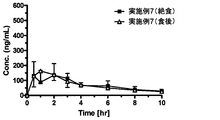
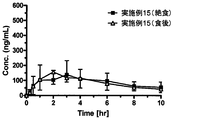
- Test Example 7 The pharmaceutical composition of the present invention prepared in Example 7 (containing 50 mg of mirabegron) in a xanthan gum solution, and the pharmaceutical composition of the present invention prepared in Example 15 (containing 50 mg of mirabegron) in water. Each of the dispersed suspensions was orally administered to a beagle dog under fasting conditions or 30 minutes after the meal with a sonde, and the drug concentration contained in plasma was measured. As a diet, a 50 g meat sample was used.
- Example 7 and Example 15 The pharmacokinetic results of the pharmaceutical compositions of the present invention prepared in Example 7 and Example 15 are shown in Table 5 and FIGS.
- the pharmaceutical compositions of the present invention (Examples 7 and 15) had a Cmax decrease rate of 4% and 8% under satiety, and an AUC decrease rate of -1% and 2%, respectively, compared with fasting.
- Comparative Example 1 Table 4
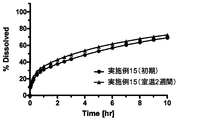
- Test Example 8 A glass bottle was filled with a suspension in which the pharmaceutical composition of the present invention prepared in Example 7 was dispersed in xanthan gum solution, and the pharmaceutical composition of the present invention prepared in Example 15 was dispersed in water. (5 ° C) and room temperature conditions were stored for 2 weeks or 1 month, respectively. After storage, a dissolution test of the suspension (containing 25 mg of mirabegron) was carried out according to the Japanese Pharmacopoeia Dissolution Test Method 2 (Paddle Method). As the test solution, 900 mL of Japanese Pharmacopoeia Disintegration Test Second Solution (JP2) was used. The paddle rotation speed was 150 rpm. On the other hand, suspensions obtained by dispersing the pharmaceutical compositions prepared in Comparative Examples 6 to 8 in water were stored under the same conditions, and a dissolution test was performed after storage.
- JP2 Japanese Pharmacopoeia Disintegration Test Second Solution
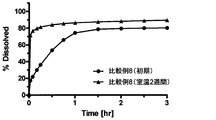
- FIGS. 12 to 14 show the dissolution test results for the pharmaceutical compositions prepared in Comparative Examples 6-8.
- Comparative Examples 6, 7, and 8 had a change in elution rate of 20% (room temperature), 16% (room temperature), and 55% (room temperature) at maximum, respectively, before storage, whereas Example 7 0.8% (cold place), 10% (room temperature), and Example 15 was 5.3% (room temperature). In all cases, the change in elution was suppressed to 15% or less, and the leakage of the drug during liquid storage was prevented. I was able to suppress it.
- Test Example 9 The pharmaceutical composition of the present invention prepared in Example 15 (150 mg in terms of mirabegron) was added to 10 ⁇ 1 mol / L hydrochloric acid, 10 ⁇ 3 mol / L hydrochloric acid, and purified water, respectively, and stirred with a stirrer. . After 1 day, the mixture was centrifuged at 3000 rpm for 15 minutes, and then the drug concentration in the supernatant was measured. On the other hand, Comparative Examples 7 and 8 were similarly added to 10 ⁇ 1 mol / L hydrochloric acid, 10 ⁇ 3 mol / L hydrochloric acid, and purified water, and the drug concentration in the supernatant was measured after 1 day.
- Table 6 shows the drug concentration measurement results for the pharmaceutical compositions prepared in Example 15 and Comparative Examples 7 and 8.
- the pharmaceutical composition of the present invention prepared in Example 15 was able to suppress the solubility (drug concentration) in any solution. From this, it is expected that bitterness is suppressed.
- Example 16 The acid addition salt obtained in Example 4 was pulverized with a power mill and then finely pulverized with a fine impact mill. A dispersion was prepared from 504.4 g of ethylcellulose aqueous dispersion and 22.7 g of triethyl citrate. The total amount of the dispersion prepared in 200 g of the pulverized acid addition salt was sprayed (intake air temperature 65 ° C., spray liquid speed 6 g / min) using a fluidized bed granulator. The powder was collected and subjected to heat treatment (70 ° C., 4 hours) to obtain a pharmaceutical composition of the present invention.
- Example 17 The acid addition salt obtained in Example 6 was pulverized with a fine impact mill. A dispersion was prepared from 642.3 g of ethylcellulose aqueous dispersion and 28.9 g of triethyl citrate. The total amount of the dispersion prepared in 175.8 g of pulverized acid addition salt was sprayed using a fluidized bed granulator (intake air temperature 65 ° C., spray liquid speed 6 g / min). The powder was collected and subjected to heat treatment (70 ° C., 4 hours) to obtain a pharmaceutical composition of the present invention.
- a dispersion was prepared from 642.3 g of ethylcellulose aqueous dispersion and 28.9 g of triethyl citrate. The total amount of the dispersion prepared in 175.8 g of pulverized acid addition salt was sprayed using a fluidized bed granulator (intake air temperature 65 ° C., spray liquid speed 6 g / min). The powder
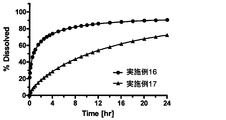
- Test Example 10 The pharmaceutical composition of the present invention prepared in Examples 16 and 17 (containing 25 mg equivalent of mirabegron) was subjected to a dissolution test according to the Japanese Pharmacopoeia Dissolution Test Method 2 (Paddle Method). As the test solution, 900 mL of USP phosphate buffer (pH 6.8) was used. The paddle rotation speed was 200 rpm.
- FIG. 15 shows the dissolution test results for the pharmaceutical compositions of the present invention prepared in Examples 16 and 17.
- the dissolution rate of mirabegron 30 minutes after the start of the test was 46% in Example 16 and 8% in Example 17.
- the dissolution rate of mirabegron from each pharmaceutical composition prepared in Examples 16 and 17 was less than 85% 30 minutes after the start of the test.
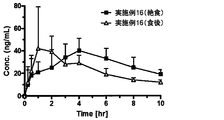
- Test Example 11 The pharmaceutical composition of the present invention prepared in Example 16 (containing 25 mg of mirabegron) was dispersed in 12.5 mL of water and orally administered to a beagle dog by a sonde after fasting conditions and 30 minutes after the meal, and contained in plasma The drug concentration was measured.
- the food used was a 50 g meat sample.
- Example 16 The pharmacokinetic test results of the pharmaceutical composition of the present invention prepared in Example 16 are shown in Table 7 and FIG.
- the pharmaceutical composition of the present invention (Example 16) had a decrease rate of Cmax under satiety of -13% and a decrease rate of AUC of 18% as compared with fasting, and the results of Comparative Example 1 (Table 4) and In comparison, there was a tendency to reduce pharmacokinetic changes with and without food intake.
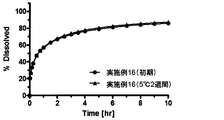
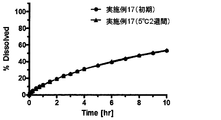
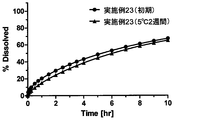
- Test Example 12 A suspension in which the pharmaceutical composition of the present invention prepared in Examples 16 and 17 was dispersed in water was filled in a glass bottle, sealed, and then stored in a cold place (5 ° C.) for 2 weeks. After storage, a dissolution test of the suspension (containing 25 mg of mirabegron) was carried out according to the Japanese Pharmacopoeia Dissolution Test Method 2 (Paddle Method). As the test solution, 900 mL of USP phosphate buffer (pH 6.8) was used. The paddle rotation speed was 200 rpm.
- Example 16 or 17 The dissolution test results for the pharmaceutical composition of the present invention prepared in Example 16 or 17 are shown in FIG. 17 and FIG.
- the maximum change in elution rate of Example 16 is 1.4% (5 ° C.), and Example 17 is 2.3% (5 ° C.).
- the leakage of the drug during storage could be suppressed.
- Example 18 4260 mL of water was added to a mixture of 600 g of mirabegron and 438 g of sodium lauryl sulfate, and the mixture was stirred and mixed at 65 rpm for 5 minutes using a universal mixing stirrer (model 25 AM-02-QR, manufactured by Shinagawa Kogyo) at room temperature. While continuing stirring and mixing, 1545.6 mL of 1 mol / L hydrochloric acid was added at 25 mL / min, and the mixture was further stirred for 4 hours. The obtained mixture was shelf-dried at 60 ° C. for 15 hours to obtain an acid addition salt of the present invention having a molar ratio of mirabegron to lauryl sulfate of 1: 1.
- the obtained acid addition salt was pulverized with a fine impact mill.
- a dispersion of 800 g of ethylcellulose aqueous dispersion and 36 g of triethyl citrate was sprayed on 400 g of the pulverized acid addition salt using a fluidized bed granulator.
- the particles were collected, passed through a 710 ⁇ m sieve, and subjected to heat treatment (70 ° C., 4 hours) to obtain the pharmaceutical composition of the present invention.
- Example 19 The dispersion of 113.6 g of ethylcellulose aqueous dispersion and 5.1 g of triethyl citrate was further sprayed onto 576 g of the particles before heat treatment obtained in Example 18. The particles were collected, passed through a 710 ⁇ m sieve, and subjected to heat treatment (70 ° C., 4 hours) to obtain the pharmaceutical composition of the present invention.
- Example 20 A dispersion of 95.1 g of ethylcellulose aqueous dispersion and 4.3 g of triethyl citrate was further sprayed on 515.2 g of the particles before heat treatment obtained in Example 19. The particles were collected, passed through a 710 ⁇ m sieve, and subjected to heat treatment (70 ° C., 4 hours) to obtain the pharmaceutical composition of the present invention.
- Example 21 A dispersion of 139 g of ethylcellulose aqueous dispersion and 6.3 g of triethyl citrate was sprayed onto 400.1 g of the particles before heat treatment obtained in Example 20 using a fluidized bed granulator. The particles were collected, passed through a 710 ⁇ m sieve, and subjected to heat treatment (70 ° C., 4 hours) to obtain the pharmaceutical composition of the present invention.
- Example 22 A dispersion of 54 g of ethylcellulose aqueous dispersion and 2.4 g of triethyl citrate was further sprayed onto 348.1 g of the particles before heat treatment obtained in Example 21. The particles were collected, passed through a 710 ⁇ m sieve, and subjected to heat treatment (70 ° C., 4 hours) to obtain the pharmaceutical composition of the present invention.
- Example 23 A dispersion of 39.3 g of ethylcellulose aqueous dispersion and 1.8 g of triethyl citrate was further sprayed onto 266.7 g of the particles before heat treatment obtained in Example 22. The particles were collected, passed through a 710 ⁇ m sieve, and subjected to heat treatment (70 ° C., 4 hours) to obtain a pharmaceutical composition of the present invention.
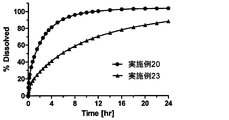
- Test Example 13 The pharmaceutical composition of the present invention prepared in Examples 20 and 23 (containing 25 mg of mirabegron) was subjected to a dissolution test according to the Japanese Pharmacopoeia Dissolution Test Method 2 (Paddle Method). As the test solution, 900 mL of USP phosphate buffer (pH 6.8) was used. The paddle rotation speed was 200 rpm.
- FIG. 19 shows the dissolution test results for the pharmaceutical compositions of the present invention prepared in Examples 20 and 23.
- the dissolution rate of mirabegron 30 minutes after the start of the test was 34% in Example 20 and 15% in Example 23.
- the dissolution rate of mirabegron from each pharmaceutical composition prepared in Examples 20 and 23 was less than 85% 30 minutes after the start of the test.
- Test Example 14 The pharmaceutical composition of the present invention prepared in Example 23 (containing 50 mg of mirabegron) was dispersed in 50 mL of water, and orally administered to 6 beagle dogs with a sonde after fasting conditions and 30 minutes after meal, and contained in plasma. The drug concentration was measured. The food used was a 50 g meat sample.
- Example 23 The pharmacokinetic test results of the pharmaceutical composition of the present invention prepared in Example 23 are shown in Table 8 and FIG.
- the pharmaceutical composition of the present invention (Example 23) had a Cmax decrease rate of ⁇ 9% and an AUC decrease rate of 15% under satiety compared with fasting, and the results of Comparative Example 1 (Table 4) and In comparison, there was a tendency to reduce pharmacokinetic changes with and without food intake.
- Test Example 15 A suspension in which the pharmaceutical composition of the present invention prepared in Examples 20 and 23 was dispersed in water was filled in a glass bottle, sealed, and then stored in a cold place (5 ° C.) for 2 weeks. After storage, a dissolution test of the suspension (containing 25 mg of mirabegron) was carried out according to the Japanese Pharmacopoeia Dissolution Test Method 2 (Paddle Method). As the test solution, 900 mL of USP phosphate buffer (pH 6.8) was used. The paddle rotation speed was 200 rpm.
- FIG. 21 and FIG. 22 show the dissolution test results of the pharmaceutical composition of the present invention prepared in Examples 20 and 23.
- the maximum change in dissolution rate of Example 20 was 3.8%, and Example 23 was 5.3%. In both cases, the change in dissolution rate was suppressed to 15% or less, and the leakage of drugs during liquid storage was suppressed. did it.
- a pharmaceutical composition containing an acid addition salt of alkylsulfuric acid and mirabegron, and a controlled release base dissolves or leaks mirabegron when the pharmaceutical composition is suspended in a solvent, compared to a pharmaceutical preparation containing mirabegron. It is possible to provide a pharmaceutical composition that is reduced or suppressed and has a smaller pharmacokinetic fluctuation due to the presence or absence of food intake, thereby improving compliance.
Landscapes
- Health & Medical Sciences (AREA)
- Chemical & Material Sciences (AREA)
- Engineering & Computer Science (AREA)
- Bioinformatics & Cheminformatics (AREA)
- Organic Chemistry (AREA)
- Life Sciences & Earth Sciences (AREA)
- Animal Behavior & Ethology (AREA)
- Veterinary Medicine (AREA)
- Pharmacology & Pharmacy (AREA)
- Medicinal Chemistry (AREA)
- General Health & Medical Sciences (AREA)
- Public Health (AREA)
- Epidemiology (AREA)
- Molecular Biology (AREA)
- Biophysics (AREA)
- Urology & Nephrology (AREA)
- Chemical Kinetics & Catalysis (AREA)
- General Chemical & Material Sciences (AREA)
- Nuclear Medicine, Radiotherapy & Molecular Imaging (AREA)
- Medicinal Preparation (AREA)
- Pharmaceuticals Containing Other Organic And Inorganic Compounds (AREA)
- Thiazole And Isothizaole Compounds (AREA)
Abstract
Description

また、ミラベグロンの苦味を抑え、かつミラベグロンを溶媒に分散するとき、あるいは、液剤、または懸濁剤もしくは乳剤として保存したときも、薬物の溶出が制御されて苦味が抑制もしくは低減された製剤を提供するためには、更なる技術開発が望まれている。
更に、ミラベグロンを液剤、または懸濁剤もしくは乳剤として保存することによって服用前に薬物が溶出もしくは漏出しないための技術開発が望まれる。
[1]アルキル硫酸とミラベグロンとの酸付加塩、および放出制御基剤を含有してなる医薬組成物、
[2]アルキル硫酸が、ドデシル硫酸、テトラデシル硫酸、およびヘキサデシル硫酸からなる群より選択される1種の酸である、[1]の医薬組成物、
[3]アルキル硫酸とミラベグロンとの酸付加塩が、ミラベグロンドデシル硫酸塩である、[2]の医薬組成物、
[4]ミラベグロンとアルキル硫酸のモル比が1:1~1:2である、[1]~[3]のいずれかの医薬組成物、
[5]放出制御基剤が、水溶性高分子、または水不溶性物質である、[1]の医薬組成物、
[6]放出制御基剤が、水不溶性物質である、[5]の医薬組成物、
[7]放出制御基剤が、水不溶性セルロースエーテル、および/または水不溶性アクリル酸系共重合体である、[1]又は[6]に記載の医薬組成物、
[8]水不溶性セルロースエーテルが、エチルセルロースである、[7]の医薬組成物、
[9]水不溶性アクリル酸系共重合体が、アクリル酸エチル・メタアクリル酸メチル・メタアクリル酸塩化トリメチルアンモニウムエチル共重合体、およびアクリル酸エチル・メタアクリル酸メチル共重合体からなる群より選択される1または2以上の物質である、[7]の医薬組成物、
[10]水不溶性物質の量が、アルキル硫酸とミラベグロンとの酸付加塩の重量に対して0.1W/W%以上1000W/W%以下である、[5]~[9]のいずれかの医薬組成物、
[11]溶出試験開始30分後のミラベグロン溶出率が約85%未満である、[1]~[10]のいずれかの医薬組成物、
[12]溶出試験開始1.5時間後のミラベグロン溶出率が約70%以下である、[11]の医薬組成物、
[13]医薬組成物が、絶食投与時における最大血中薬物濃度(Cmax)と比べ、食物摂取後投与時におけるCmaxの低下率が約30%以下である、[1]~[12]のいずれかの医薬組成物、
[14]医薬組成物が、絶食投与時における血中薬物濃度対時間曲線下面積(AUC)と比べ、食物摂取後投与時におけるAUCの低下率が約30%以下である、[1]~[13]のいずれかの医薬組成物、
[15]医薬組成物が、顆粒剤、散剤、液剤、懸濁剤、および乳剤からなる群から選択される1種の製剤である、[1]~[14]のいずれかの医薬組成物、
[16]医薬組成物が、液剤、懸濁剤、または乳剤である、[15]の医薬組成物、
[17]過活動膀胱治療用である、[1]~[16]のいずれかの医薬組成物、
[18]アルキル硫酸とミラベグロンとの酸付加塩に放出制御基剤を配合してなる医薬組成物の製造方法、
[19](1)ミラベグロンを溶媒に溶解し、(2)(1)にアルキル硫酸を配合し、(3)(2)に放出制御基剤を配合する、医薬組成物の製造方法、
[20]アルキル硫酸とミラベグロンとの酸付加塩、
[21]アルキル硫酸が、ドデシル硫酸、テトラデシル硫酸、およびヘキサデシル硫酸からなる群より選択される1種の酸である、[20]の酸付加塩、
[22]アルキル硫酸とミラベグロンとの酸付加塩が、ミラベグロンドデシル硫酸塩である、[21]の酸付加塩、
[23]ミラベグロンとアルキル硫酸のモル比が1:1~1:2である、[20]~[22]のいずれかの酸付加塩、
[24]過活動膀胱治療のための、[20]~[23]のいずれかの酸付加塩の使用、
[25][20]~[23]のいずれかの酸付加塩の有効量を患者に投与することからなる、過活動膀胱治療方法、
[26]水またはキサンタンガム溶液に分散し保存中もミラベグロンの漏出を抑制するための[20]~[23]のいずれかの酸付加塩の使用、
[27]食物摂取の有無によらず薬物動態の変動を低減する医薬組成物の製造のための、[20]~[23]のいずれかの酸付加塩の使用、
[28]苦味抑制のための[20]~[23]のいずれかの酸付加塩の使用、
[29]過活動膀胱治療用医薬組成物の製造のための、[20]~[23]のいずれかの酸付加塩の使用、
に関する。
また、本発明のアルキル硫酸とミラベグロンとの酸付加塩は、ミラベグロンと比べてその溶解性もしくは溶解速度が低下もしくは低減し、溶媒に懸濁して保存したときのミラベグロンの溶出もしくは漏出を低減もしくは抑制する医薬組成物を提供することができる。また、本発明は、ミラベグロンと比べてより食物摂取の有無による薬物動態の変動の小さいミラベグロン含有医薬組成物を提供することができる。更に、本発明は、口腔内崩壊錠、顆粒剤、散剤、液剤、または懸濁剤もしくは乳剤として使用するときミラベグロンと比べて、苦味を抑制もしくは低減することができる。
本明細書において、アルキル硫酸とは、ドデシル硫酸(ラウリル硫酸)、トリデシル硫酸、テトラデシル硫酸(ミリスチン硫酸)、ペンタデシル硫酸、ヘキサデシル硫酸(パルミチン硫酸)、ジオクチルソジウム硫酸であり、ある態様としては、ドデシル硫酸(ラウリル硫酸)、テトラデシル硫酸(ミリスチン硫酸)、ヘキサデシル硫酸(パルミチン硫酸)であり、別の態様としては、ドデシル硫酸(ラウリル硫酸)である。
(1)アルキル硫酸とミラベグロンとの酸付加塩が、ドデシル硫酸、トリデシル硫酸、テトラデシル硫酸、ペンタデシル硫酸、ヘキサデシル硫酸、およびジオクチルソジウム硫酸からなる群より選択される1種の酸とミラベグロンとの酸付加塩である酸付加塩。別の態様として、アルキル硫酸とミラベグロンとの酸付加塩が、ドデシル硫酸、テトラデシル硫酸、およびヘキサデシル硫酸からなる群より選択される1種の酸とミラベグロンとの酸付加塩である酸付加塩。さらに別の態様として、アルキル硫酸とミラベグロンとの酸付加塩が、ミラベグロン二ドデシル硫酸、ミラベグロン二テトラデシル硫酸、およびミラベグロン二ヘキサデシル硫酸からなる群より選択される酸付加塩である酸付加塩。さらに別の態様として、アルキル硫酸とミラベグロンとの酸付加塩が、ミラベグロン二ドデシル硫酸である酸付加塩。さらに別の態様として、アルキル硫酸とミラベグロンとの酸付加塩が、ミラベグロン二テトラデシル硫酸である酸付加塩。さらに別の態様として、アルキル硫酸とミラベグロンとの酸付加塩が、ミラベグロン二ヘキサデシル硫酸である酸付加塩。さらに別の態様として、アルキル硫酸とミラベグロンとの酸付加塩が、ミラベグロン一ドデシル硫酸、ミラベグロン一テトラデシル硫酸、およびミラベグロン一ヘキサデシル硫酸からなる群より選択される酸付加塩である酸付加塩。さらに別の態様として、アルキル硫酸とミラベグロンとの酸付加塩が、ミラベグロン一ドデシル硫酸である酸付加塩。さらに別の態様として、アルキル硫酸とミラベグロンとの酸付加塩が、ミラベグロン一テトラデシル硫酸である酸付加塩。さらに別の態様として、アルキル硫酸とミラベグロンとの酸付加塩が、ミラベグロン一ヘキサデシル硫酸である酸付加塩。(2)医薬組成物が、過活動膀胱治療用医薬組成物である医薬組成物。別の態様として、医薬組成物が過活動膀胱に伴う尿意切迫感治療用医薬組成物である医薬組成物。さらに別の態様として、医薬組成物が過活動膀胱に伴う頻尿治療用医薬組成物である医薬組成物。さらに別の態様として、医薬組成物が過活動膀胱に伴う尿失禁治療用医薬組成物である医薬組成物。
(3)医薬組成物がアルキル硫酸とミラベグロンの酸付加塩、および水溶性高分子を含有する医薬組成物。別の態様として、医薬組成物がアルキル硫酸とミラベグロンの酸付加塩、および水不溶性物質を含有する医薬組成物。さらに別の態様として、医薬組成物がアルキル硫酸とミラベグロンの酸付加塩、および水不溶性高分子を含有する医薬組成物。
(4)上記(1)~(3)に記載された態様のうち、二以上の組み合わせである化合物または医薬組成物。
懸濁用媒体もしくは分散用媒体としては、例えば、水、キサンタンガム溶液、ポリビニルアルコール溶液、グリセリン、プロピレングリコール、市販の嚥下補助剤等を含む。キサンタンガム溶液は、例えば、水にキサンタンガム(新田ゼラチン社製、製品名VS-900、以下同じ)をキサンタンガム濃度1W/W%になるよう添加して調製できる。
本明細書において、「食物摂取の有無による薬物動態の変動を低減」とは、絶食投与時と比べ、食後投与時における最大血中薬物濃度(Cmax)あるいは血中薬物濃度対時間曲線下面積(AUC)の変動が、約30%以下、他の態様として約20%以下、さらに別の態様として約10%以下であることを意味する。CmaxおよびAUCの低下率は、以下の各式で表わされる。
Cmaxの低下率(%)=(1-食後投与時のCmax/絶食投与時Cmax)×100
AUCの低下率(%)=(1-食後投与時のAUC/絶食投与時AUC)×100
水溶性高分子の量としては製剤単位当たり5W/W%~95W/W%であり、別の態様として10W/W%~90W/W%であり、さらに別の態様として30W/W%~85W/W%である。
水溶性高分子の配合量は、例えば、薬物の血中濃度プロファイルが食物摂取の有無により薬物動態の変動に影響を及ぼさない、医薬組成物が固体であり溶媒に懸濁もしくは分散したとき、または溶媒に懸濁もしくは分散して保存してもミラベグロンの溶出もしくは漏出を低減もしくは抑制できる、または液剤、懸濁剤もしくは乳剤として使用した場合においても、苦味を感じさせない、あるいは、前記指標と想定されるミラベグロンの濃度以下に薬物濃度を抑制できる程度の量であれば特に制限されない。例えば、製剤全体の重量に対して1W/W%以上70W/W%以下、他の態様として3W/W%以上70W/W%以下である。または製剤全体の重量に対して5W/W%以上70W/W%以下、他の態様として10W/W%以上60W/W%以下、更なる態様として10W/W%以上40W/W%以下である。また、水溶性高分子の配合量は、薬物の重量に対して0.1W/W%以上1000W/W%以下、他の態様として1W/W%以上500W/W%以下、更なる態様として5W/W%以上300W/W%以下である。
なお、混合前の水溶性高分子の粘度が本発明における所定の粘度範囲から外れるものであっても、複数の水溶性高分子を組み合わせて混合することにより、使用前に粘性を測定して当該粘度範囲内の粘度を示す場合には、適宜組み合わせて使用してもよい。
本発明の医薬組成物の製剤内部まで水を浸入させるための添加剤(親水性基剤)としては、この親水性基剤1gが溶解するのに必要な水の量が20±5℃下で10mL以下、別の態様として6mL以下、更なる態様として5mL以下、更に他の態様として4mL以下のものであり、水への溶解性が高い程、製剤中に水を浸入させる効果が高い。
他の態様として、PEG、PVP、D-マンニトール、D-ソルビトール、キシリトール、乳糖、白糖、無水マルトース、D-フルクトース、デキストラン、ブドウ糖、ポリオキシエチレンポリオキシプロピレングリコール、塩化ナトリウム、塩化マグネシウム、クエン酸、酒石酸、グリシン、β-アラニン、塩酸リジン、メグルミンを用いることができる。更なる態様として、PEG、PVP、D-マンニトール、乳糖、白糖、塩化ナトリウム、ポリオキシエチレンポリオキシプロピレングリコール等が挙げられる。
親水性基剤の配合量は、例えば、薬物の放出を食物摂取の有無による薬物動態の変動に影響を与えない程度にコントロールし得る、医薬組成物が固体であり溶媒に懸濁もしくは分散したとき、または溶媒に懸濁もしくは分散し保存してもミラベグロンの溶出もしくは漏出を低減もしくは抑制できる、または液剤、懸濁剤もしくは乳剤として使用した場合においても、苦味を感じさせない、あるいは、前記指標と想定されるミラベグロンの濃度以下に薬物濃度を苦味を感知しない程度に抑制できる割合であれば特に制限されない。例えば、製剤全体に対して5W/W%以上75W/W%以下、他の態様として5W/W%以上70W/W%以下、更なる態様として20W/W%以上60W/W%以下である。
水不溶性高分子としては、例えば、エチルセルロース(例えば、商品名エトセルSTD10、ダウケミカル社製、エチルセルロース水分散液(例えば、商品名アクアコート ECD、FMC社製))などの水不溶性セルロースエーテル、アクリル酸エチル・メタアクリル酸メチル・メタアクリル酸塩化トリメチルアンモニウムエチル共重合体(例えば、商品名:オイドラギットRS100、オイドラギットRS30D、EVONIK Roehm社製)、アクリル酸エチル・メタアクリル酸メチル共重合体(例えば、商品名:オイドラギットNE30D、EVONIK Roehm社製)などの水不溶性アクリル酸系共重合体などが挙げられる。
好ましい水不溶性物質として、エチルセルロース、アクリル酸エチル・メタアクリル酸メチル・メタアクリル酸塩化トリメチルアンモニウムエチル共重合体およびアクリル酸エチル・メタアクリル酸メチル共重合体、他の態様として、エチルセルロース、アクリル酸エチル・メタアクリル酸メチル・メタアクリル酸塩化トリメチルアンモニウムエチル共重合体が挙げられ、更に別の態様としてエチルセルロースが挙げられる。
水不溶性物質の配合量としては、例えば、ミラベグロンの食物摂取の有無によらず薬物動態の変動を低減させる、溶媒に懸濁もしくは分散したとき、または保存中においてもミラベグロンの溶出もしくは漏出を低減もしくは抑制できる、または液剤、懸濁剤もしくは乳剤として使用した場合においても、苦味を感じさせない、あるいは、前記指標と想定されるミラベグロンの濃度以下に薬物濃度を苦味を感知しない程度に抑制できる量であれば特に制限されない。具体的には、例えば、アルキル硫酸とミラベグロンとの酸付加塩の重量に対して0.1W/W%以上1000W/W%以下の態様が挙げられる。また、ある態様として該塩の重量に対して0.1W/W%以上300W/W%以下、別の態様として該塩の重量に対して50W/W%以上300W/W%以下、他の態様として該塩の重量に対して50W/W%以上150W/W%以下の態様が挙げられる。
医薬組成物の態様は、1種または2種以上を適宜組み合わせて使用することができる。
安定化剤としては、例えば、黄色三二酸化鉄、赤色三二酸化鉄、黒色酸化鉄などが挙げられる
崩壊剤としては、例えば、トウモロコシデンプン、バレイショデンプン、カルメロースカルシウム、カルメロースナトリウム、低置換度ヒドロキシプロピルセルロースなどが挙げられる。
酸味料としては、例えば、クエン酸、酒石酸、リンゴ酸などが挙げられる。
発泡剤としては、例えば、重曹などが挙げられる。
人工甘味料としては、例えば、サッカリンナトリウム、グリチルリチン二カリウム、アスパルテーム、ステビア、ソーマチンなどが挙げられる。
滑沢剤としては、例えば、ステアリン酸マグネシウム、ステアリン酸カルシウム、ショ糖脂肪酸エステル、ポリエチレングリコール、タルク、ステアリン酸などが挙げられる。
緩衝剤としては、例えば、クエン酸、コハク酸、フマル酸、酒石酸、アスコルビン酸またはその塩類、グルタミン酸、グルタミン、グリシン、アスパラギン酸、アラニン、アルギニンまたはその塩類、酸化マグネシウムまたはその塩類、酸化亜鉛、水酸化マグネシウム、リン酸、ホウ酸またはその塩類などが挙げられる。
抗酸化剤としては、例えば、アスコルビン酸、ジブチルヒドロキシトルエン、没食子酸プロピルなどが挙げられる。
溶解補助剤としては、例えば、ポリソルベート80、ラウリル硫酸ナトリウム、ポリオキシエチレン硬化ヒマシ油などが挙げられる。
防腐剤として、例えば、パラオキシ安息香酸メチル、パラオキシ安息香酸エチル、パラオキシ安息香酸プロピル、パラオキシ安息香酸ブチル、安息香酸、ベンジルアルコール、ソルビン酸、酢酸やそれらの塩類などが挙げられる。
矯味・矯臭剤として、例えば、しょ糖、果糖、乳糖、ソルビトール、マンニトール、キシリトール等の糖や糖アルコール、またはアスパルテーム、アセスルファムカリウム、スクラロース等の甘味料などが挙げられる。
香料としては、例えば、レモン、レモンライム、オレンジ、メントール、ストロベリー、バナナ、ラズベリー、バブルガムフレーバーなどが挙げられる。
湿潤剤として、例えば、ポリソルベート80、アラセル83のようなポリオキシエチレンソルビタン脂肪酸エステル、HCO-50等のポリオキシエチレン硬化ヒマシ油、シュガーエステル等の界面活性剤などが挙げられる。
消泡剤としては、例えば、シメチコン、ジメチコンなどが挙げられる。
溶剤としては、例えば、水、キサンタンガム溶液、ポリビニルアルコール溶液、グリセリン、プロピレングリコール、市販の嚥下補助剤などが挙げられる。
配合量については、いずれの医薬添加剤についても、本発明の所望の効果が達成される範囲内の量で使用される。
ミラベグロン、およびアルキル硫酸をそれぞれ溶媒に溶解する。溶解する溶媒としては、ミラベグロン、およびアルキル硫酸が溶解する溶媒であれば特に制限されないが、例えば、水、塩酸、リン酸、エタノール、メタノールなどの有機溶媒、またはその混合液等が挙げられる。ミラベグロン、およびアルキル硫酸をそれぞれ完全に溶解しなくてもよい。
また、ミラベグロン粉末とアルキル硫酸粉末を混合した混合物に、水や塩酸などミラベグロン、およびアルキル硫酸が溶解する溶媒を添加して混合してもよい。
混合液を調製後、ろ過回収し析出物を得る工程を入れてもよい。
ミラベグロン(アステラス製薬株式会社製、以下同じ)122gを0.1mol/L塩酸6100gに溶解させてA液を調製した。ラウリル硫酸ナトリウム(Cognis社製,製品名Texapon K12、以下同じ)178gを精製水6100gに溶解させてB液を調製した。得られたB液を160g/分にてA液に送液し、室温にてパドル170~200rpmで撹拌混合することにより、析出物を得た。得られた析出物を、0.45μm HAフィルター(MILLIPORE社製、以下同じ)を用いてろ過回収し、40℃にて24時間棚乾燥し、さらに60℃12時間減圧乾燥により、ミラベグロンとラウリル硫酸のモル比が1:2である本発明の酸付加塩(以下、ミラベグロンラウリル硫酸塩と略記することもある)の粉末を得た。
ミラベグロン1gを0.1mol/L塩酸に室温下で溶解させてA液を調製した。一方、ミリスチル硫酸ナトリウム(日光ケミカル社製、製品名NIKKOL SMS)1.60gを50℃に加温した精製水に溶解させてB液を調製した。A液にB液を50℃加温下で添加し、析出物を得た。得られた析出物を、0.45μm HAフィルターを用いてろ過回収し、40℃にて12時間棚乾燥し、ミラベグロンとミリスチン硫酸のモル比が1:2である本発明の酸付加塩を得た。
ミラベグロン1gを0.1mol/L塩酸に室温下で溶解させてA液を調製した。一方、セチル硫酸ナトリウム(日光ケミカル社製、製品名NIKKOL SCS)1.74gを70℃に加温した精製水に溶解させてB液を調製した。A液にB液を70℃加温下で添加し、析出物を得た。得られた析出物を、0.45μm HAフィルターを用いてろ過回収し、40℃にて12時間棚乾燥し、ミラベグロンとセチル硫酸のモル比が1:2である本発明の酸付加塩を得た。
ミラベグロン94.6gに0.1mol/L塩酸472.8mLを加えて溶解させ、ラウリル硫酸ナトリウム138gを徐々に添加し、室温にて万能混合撹拌機(品川工業所製、型式5DMR)を用い62rpmにて0.5時間撹拌混合した。得られた混合物を40℃にて42.5時間棚乾燥し、ミラベグロンとラウリル硫酸のモル比が1:2である本発明の酸付加塩を得た。
ミラベグロン25gをメタノール(関東化学社製、以下同じ)500mLに溶解させ、さらに0.1mol/L塩酸65mLを加えてA液を調製した。得られたA液のpHは5.62であった。一方、ラウリル硫酸ナトリウム18.25gを精製水500mLに溶解させてB液を調製した。得られたB液のpHは9.69であった。得られたB液をA液に送液し、室温にてパドルにて撹拌混合した。得られた析出物を、0.45μm HAフィルターを用いてろ過回収し、60℃12時間減圧乾燥により、ミラベグロンとラウリル硫酸のモル比が1:1である本発明の酸付加塩の粉末を得た。
ミラベグロン205.5gをメタノール4110mLに溶解させ、さらに0.1mol/L塩酸529.4mLを加えてA液を調製した。一方、ラウリル硫酸ナトリウム150gを精製水4110mLに溶解させてB液を調製した。得られたB液をA液に送液し、室温にてパドルにて撹拌混合後に、60℃にて7日間減圧乾燥することにより、ミラベグロンとラウリル硫酸のモル比が1:1である本発明の酸付加塩を得た。
ミラベグロン500mgを50mmol/Lのリン酸溶液200mLに溶解させ、比較例の薬物水溶液を得た。
ミラベグロン1.5gとラウリル硫酸ナトリウム2.19gを乳鉢中で乳棒で混合し、ミラベグロンとラウリル硫酸(モル比が1:2)を含有する比較例の混合物を得た。
ミラベグロン1.5gを0.1mol/L塩酸75mLに室温下で溶解させてA液を調製した。一方、ラウリル硫酸ナトリウム3.29gを精製水75mLに溶解させてB液を調製した。A液にB液を室温下で添加し、60℃にて乾燥し、ミラベグロンとラウリル硫酸(モル比が1:3)を含有する比較例の混合物を得た。
ミラベグロン1.5gを0.1mol/L塩酸75mLに室温下で溶解させてA液を調製した。一方、ラウリル硫酸ナトリウム5.48gを精製水75mLに溶解させてB液を調製した。A液にB液を室温下で添加し、60℃にて乾燥し、ミラベグロンとラウリル硫酸(モル比が1:5)を含有する比較例の混合物を得た。
ミラベグロン1gを0.1mol/L塩酸50mLに室温下で溶解させてA液を調製した。一方、ラウリル硫酸ナトリウム10.95gを精製水150mLに溶解させてB液を調製した。A液にB液を室温下で添加し、60℃にて乾燥し、ミラベグロンとラウリル硫酸(モル比が1:15)を含有する比較例の混合物を得た。
以下の方法に従って、被験化合物の薬物濃度(溶解度)を測定した。
実施例1~3で調製した本発明の酸付加塩(ミラベグロンに換算して150mg)を、10-1mol/L塩酸、10-3mol/L塩酸、および精製水にそれぞれ添加し、200±10回/分の速度で24時間、室温にて振盪した。振盪後、3000rpmで15分間、遠心分離した後、上清中の薬物濃度を測定した。一方、ミラベグロン150mgを同じように10-1mol/L塩酸、10-3mol/L塩酸、および精製水にそれぞれ添加し、24時間後に上清中の薬物濃度を測定した。
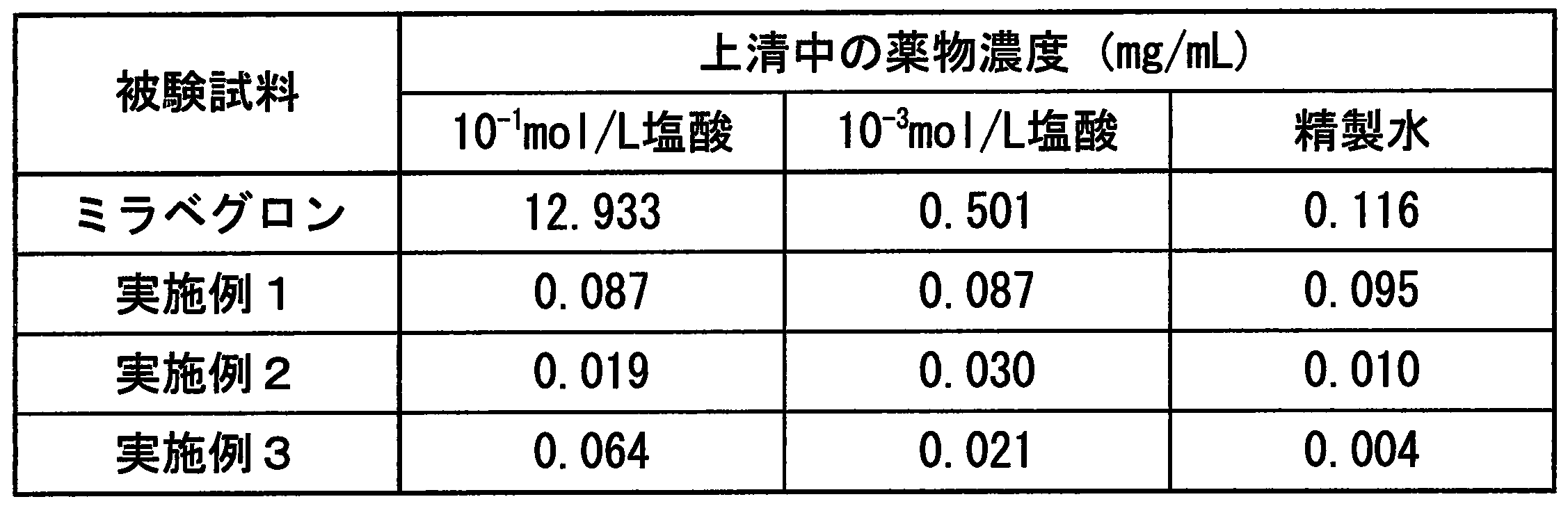
実施例1~3で調製した本発明の酸付加塩(ミラベグロンに換算して25mg)を日本薬局方溶出試験法第二法(パドル法)に従って、溶出試験を行った。試験液は日本薬局方崩壊試験第2液(JP2)900mLを用いた。パドル回転数は150rpmで行った。
実施例4および5で調製した本発明の酸付加塩(ミラベグロンに換算して25mg)を日本薬局方溶出試験法第二法(パドル法)に従って、溶出試験を行った。試験液は日本薬局方崩壊試験第2液(JP2)900mLを用いた。パドル回転数は50rpmで行った。一方、比較例2~5で調製した混合物についても同じように溶出試験を行った。
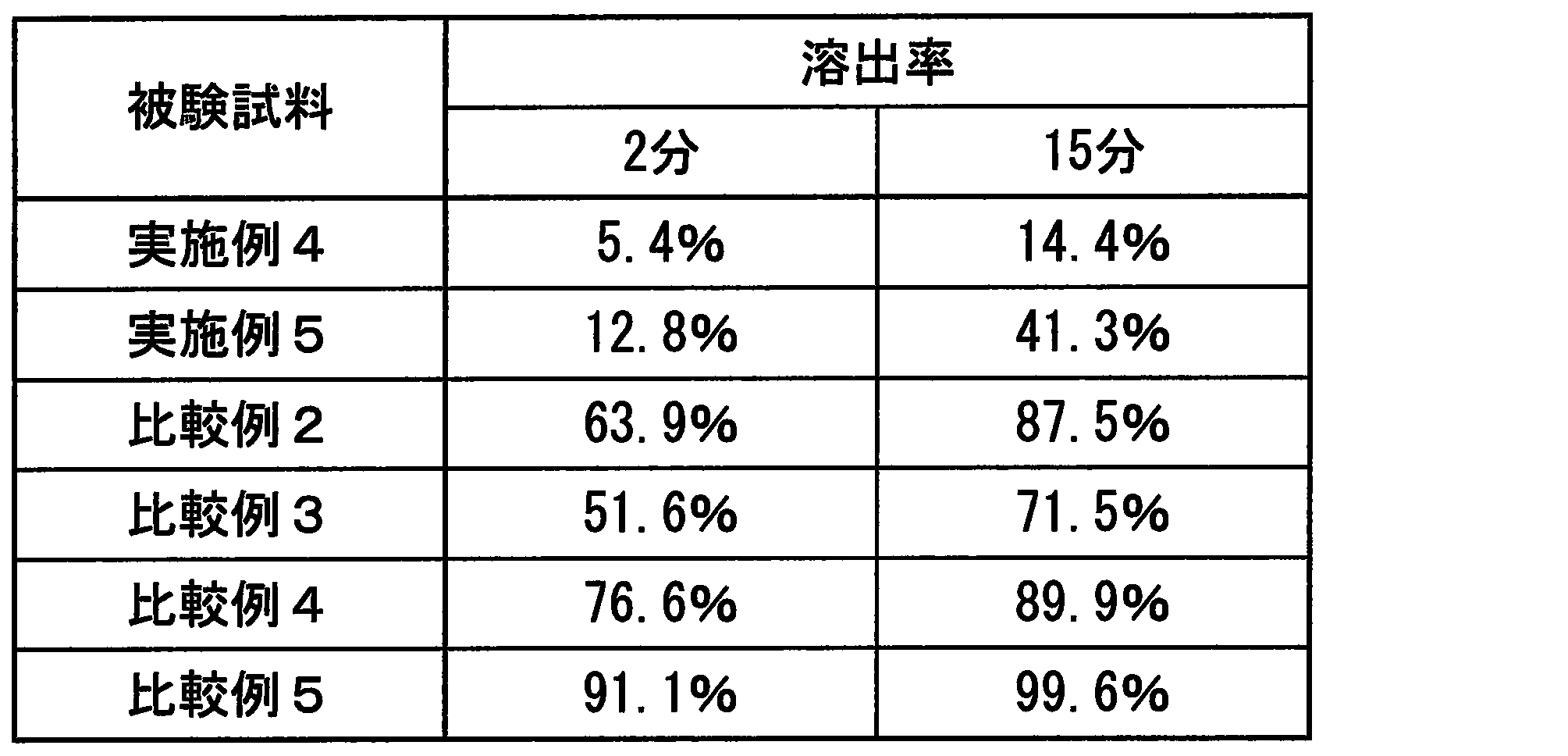
50mmol/Lリン酸緩衝溶液にスターラー撹拌下にてキサンタンガムを0.5W/W%となるよう添加し、実施例1で調製した本発明の酸付加塩(ミラベグロンに換算して50mg)をスターラー撹拌下にて均一に分散させた懸濁液を、雄性ビーグル犬に絶食条件(fast)、又は食後30分後(fed)に、ゾンデにより経口投与し、一定時間後に血漿中に含まれる薬物濃度を測定した。食餌としては、肉飼料50gを用いた。一方、比較例1の薬物水溶液(ミラベグロンに換算して50mg)を雄性ビーグル犬に絶食条件または食後30分後にゾンデにより経口投与し、一定時間後の血漿中に含まれる薬物濃度を測定した。

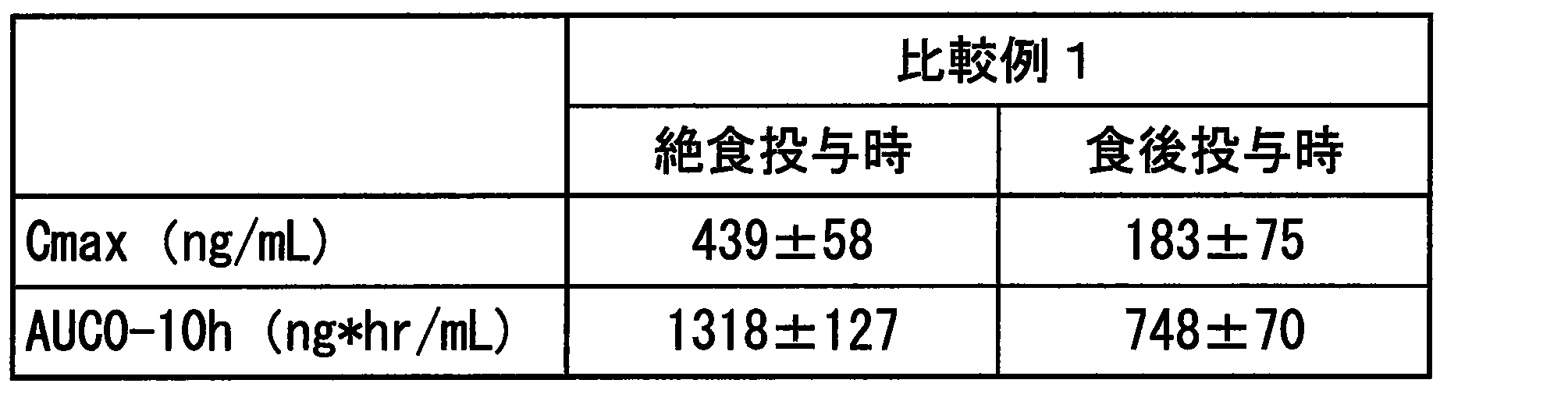
実施例1で調製した本発明の酸付加塩(ミラベグロンに換算して25mg)をキサンタンガム溶液5mLに分散させた懸濁液をガラス瓶に充填し、密栓後、冷所(5℃)および室温条件下でそれぞれ1箇月保存した。キサンタンガム溶液はスターラー撹拌下でキサンタンガムを水に1W/W%添加して調製した。保存後、懸濁液(ミラベグロンを25mg相当量含有する)の溶出試験を日本薬局方溶出試験法第二法(パドル法)に従い行った。試験液は日本薬局方崩壊試験第2液(JP2)900mLを用いた。パドル回転数は150rpmで行った。
アクリル酸エチル・メタアクリル酸メチル・メタアクリル酸塩化トリメチルアンモニウムエチル共重合体(EVONIK Roehm社製、製品名オイドラギットRS100)400mgをメタノールに溶解後、メノウ乳鉢に移し変え、実施例1で得られた酸付加塩468mgとポリエチレングリコール(三洋化成社製、製品名PEG6000、以下同じ)64mgを添加し、乳棒で混合後、恒温機にメノウ乳鉢を移し、40℃で一晩乾燥させた。フィルム状物質をメノウ乳鉢壁より剥し、乳棒で粉砕し、本発明の医薬組成物を得た。
実施例1で得られた酸付加塩5.85gとエチルセルロース(ダウケミカル社製、製品名エトセルSTD10、以下同じ)5gとの混合物を、小型撹拌ミル(オリエンタルモーター社製、以下同じ)を用いて、メタノール3.5mLで造粒し、40℃で一晩乾燥後、粉砕して、本発明の医薬組成物を得た。
実施例1で得られた酸付加塩5.85gとエチルセルロース15gとの混合物を小型撹拌ミルを用いて、メタノール7.5mLで造粒し、40℃で一晩乾燥後、粉砕して、本発明の医薬組成物を得た。
実施例1で得られた酸付加塩8.775gに対して、アクリル酸エチル・メタアクリル酸メチル・メタアクリル酸塩化トリメチルアンモニウムエチル共重合体(EVONIK Roehm社製、製品名オイドラギットRS30D)13.75gを加えた後、小型撹拌ミルを用いて造粒し、40℃で一晩乾燥後、粉砕して、本発明の医薬組成物を得た。
実施例1で得られた酸付加塩8.775gに対して、アクリル酸エチル・メタアクリル酸メチル・メタアクリル酸塩化トリメチルアンモニウムエチル共重合体(EVONIK Roehm社製、製品名オイドラギットRS30D) 7.5gを加えた後、小型撹拌ミルを用いて造粒し、40℃で一晩乾燥後、粉砕して、本発明の医薬組成物を得た。
エチルセルロース水分散液(FMC社製、製品名アクアコートECD-30、以下同じ)20gにクエン酸トリエチル(東京化成製、以下同じ)0.9gを添加し、超音波照射を5分間行い、噴霧液を調製した。実施例1で得られた酸付加塩5.85gに対して、噴霧液8.5gを、小型撹拌ミルを用いて添加し、造粒した。40℃で一晩乾燥後、粉砕して、本発明の医薬組成物を得た。
エチルセルロース水分散液300gにクエン酸トリエチル13.57gを添加し、超音波照射を5分間行い、250μmの篩を通過させ、噴霧液を調製した。実施例1で得られた酸付加塩をパワーミル(ダルトン社製、以下同じ)で粉砕後、ファインインパクトミル(ホソカワミクロン社製、以下同じ)でさらに細かく粉砕した。粉砕した酸付加塩142.7gに対して、調製した噴霧液全量を、撹拌造粒機(パウレック社製、製品名VG-01)を用いて添加し、40℃で一晩乾燥後、粉砕して、本発明の医薬組成物を得た。
実施例1で得られた酸付加塩をパワーミルで粉砕後、ファインインパクトミルでさらに細かく粉砕した。粉砕した酸付加塩71.3gとクエン酸トリエチル18.3gとをエチルセルロース水分散液406.5gに添加し、250μmの篩を通過させ、噴霧液を調製した。この噴霧液をスプレードライヤー(大川原化工機社製、以下同じ)を用いて、噴霧した。サイクロン部分より粒子を回収し、加熱処理(70℃、4時間)を行って、本発明の医薬組成物を得た。
実施例1で得られた酸付加塩をパワーミルで粉砕後、ファインインパクトミルでさらに細かく粉砕した。粉砕した酸付加塩142.7gとクエン酸トリエチル36.6gとをエチルセルロース水分散液813.0gに添加し、250μmの篩を通過させ、噴霧液を調製した。調製した噴霧液を、スプレードライヤーを用いて、噴霧した。サイクロン部分より粒子を回収し、加熱処理(70℃、4時間)を行って、本発明の医薬組成物を得た。
ミラベグロン125gとクエン酸トリエチル18.25gをエチルセルロース水分散液406.8gに添加し、250μmの篩を通過させ、噴霧液を調製した。調製した噴霧液を、スプレードライヤーを用いて、噴霧した。サイクロン部分より粒子を回収し、加熱処理(70℃、4時間)を行って、比較例の医薬組成物を得た。
ミラベグロン250gおよびクエン酸トリエチル32.61gをエチルセルロース水分散液543.48gに添加し、さらに精製水202.9gを添加・混合し、噴霧液を調製した。調製した噴霧液を流動層造粒装置(Glatt社製、製品名GPCG-1、以下同じ)を用いて、結晶セルロース(旭化成ケミカルズ社製、製品名CP-102Y、以下同じ)250gに全量噴霧し、加熱処理(50℃、13時間)を行って、比較例の医薬組成物を得た。
(1)第1層の調製
ミラベグロン240gおよびヒプロメロース(信越化学工業社製、製品名TC-5E)60gを精製水1200gに添加し、噴霧液を調製した。調製した噴霧液を流動層造粒装置を用いて、結晶セルロース300gに全量噴霧し、第1層を被覆した粒子を調製した。
クエン酸トリエチル59gをエチルセルロース水分散液983.26gに添加し、さらに精製水983.26gを添加・混合し、噴霧液を調製した。調製した噴霧液を流動層造粒装置を用いて、第1層を被覆した粒子295gに全量噴霧し、加熱処理(50℃、13時間)を行って、比較例の医薬組成物を得た。
実施例7~15で調製した本発明の医薬組成物(ミラベグロンを25mg相当量含有する)を日本薬局方溶出試験法第二法(パドル法)に従い溶出試験を行った。試験液は日本薬局方崩壊試験第2液(JP2)900mLを用いた。パドル回転数は150rpmで行った。
実施例7~15で調製した本発明の医薬組成物における溶出試験結果を図6、7に示す。試験開始30分後のミラベグロンの溶出率は、実施例7は31%、実施例8は26%、実施例9は17%、実施例10は24%、実施例11は17%、実施例12は32%、実施例13は29%、実施例14は36%、実施例15は29%であった。実施例7~15で調製した各医薬組成物からのミラベグロンの溶出率はいずれも試験開始30分後で85%未満であった。
実施例7で調製した本発明の医薬組成物(ミラベグロンを50mg相当量含有する)をキサンタンガム溶液に、実施例15で調製した本発明の医薬組成物(ミラベグロンを50mg相当量含有する)を水にそれぞれ分散させた懸濁液をビーグル犬に絶食条件または食後30分後にゾンデにより経口投与し、血漿中に含まれる薬物濃度を測定した。食餌としては、肉試料50gを用いた。
本発明の医薬組成物(実施例7および実施例15)は、絶食下に比べ、飽食下でのCmaxの低下率がそれぞれ4%および8%、AUCの低下率がそれぞれ-1%および2%となり、比較例1の結果(表4)と比較して食物摂取の有無による薬物動態の変動を低減できた。

実施例7で調製した本発明の医薬組成物をキサンタンガム溶液に、実施例15で調製した本発明の医薬組成物を水にそれぞれ分散させた懸濁液をガラス瓶に充填し、密栓後、冷所(5℃)および室温条件下でそれぞれ2週間或いは1箇月保存した。保存後、懸濁液(ミラベグロンを25mg相当量含有する)の溶出試験を日本薬局方溶出試験法第二法(パドル法)に従い行った。試験液は日本薬局方崩壊試験第2液(JP2)900mLを用いた。パドル回転数は150rpmで行った。一方、比較例6~8で調製した医薬組成物を水に分散させた懸濁液を同じ条件で保存し、保存後に溶出試験を行った。
実施例15で調製した本発明の医薬組成物(ミラベグロンに換算して150mg)を、10-1mol/L塩酸、10-3mol/L塩酸、および精製水にそれぞれ添加し、スターラーで撹拌した。1日経過後、3000rpmで15分間、遠心分離した後、上清中の薬物濃度を測定した。一方、比較例7、8を同じように10-1mol/L塩酸、10-3mol/L塩酸、および精製水にそれぞれ添加し、1日経過後に上清中の薬物濃度を測定した。

実施例4で得られた酸付加塩をパワーミルで粉砕後、ファインインパクトミルでさらに細かく粉砕した。エチルセルロース水分散液504.4gおよびクエン酸トリエチル22.7gにより分散液を調製した。粉砕した酸付加塩200gに調製した分散液全量を流動層造粒機を用いて噴霧(吸気温度65℃、噴霧液速6g/分)した。粉末を回収し、加熱処理(70℃、4時間)を行って、本発明の医薬組成物を得た。
実施例6で得られた酸付加塩をファインインパクトミルで粉砕した。エチルセルロース水分散液642.3gおよびクエン酸トリエチル28.9gにより分散液を調製した。粉砕した酸付加塩175.8gに調製した分散液全量を流動層造粒機を用いて噴霧(吸気温度65℃、噴霧液速6g/分)した。粉末を回収し、加熱処理(70℃、4時間)を行って、本発明の医薬組成物を得た。
実施例16および17で調製した本発明の医薬組成物(ミラベグロンを25mg相当量含有する)を日本薬局方溶出試験法第二法(パドル法)に従い溶出試験を行った。試験液はUSPリン酸緩衝液(pH6.8)900mLを用いた。パドル回転数は200rpmで行った。
実施例16で調製した本発明の医薬組成物(ミラベグロンを25mg相当量含有する)を水12.5mLに分散させ、ビーグル犬に絶食条件および食後30分後にゾンデにより経口投与し、血漿中に含まれる薬物濃度を測定した。食餌は肉試料50gを用いた。
本発明の医薬組成物(実施例16)は、絶食下に比べ、飽食下でのCmaxの低下率が-13%、AUCの低下率が18%となり、比較例1の結果(表4)と比較して食物摂取の有無による薬物動態の変動を低減する傾向がみられた。
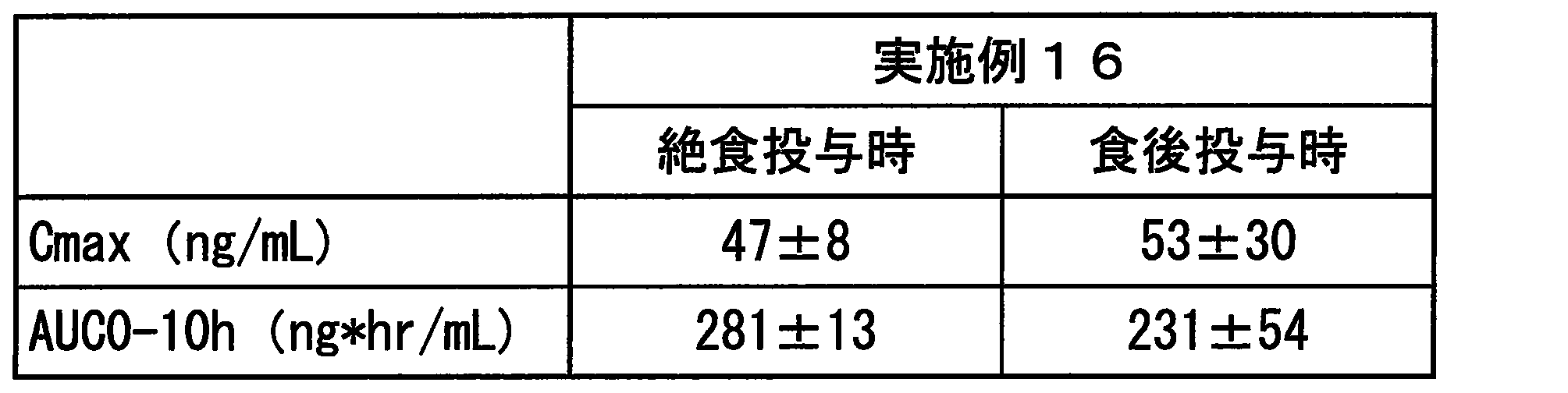
実施例16および17で調製した本発明の医薬組成物を水に分散させた懸濁液をガラス瓶に充填し、密栓後、冷所(5℃)にてそれぞれ2週間保存した。保存後、懸濁液(ミラベグロンを25mg相当量含有する)の溶出試験を日本薬局方溶出試験法第二法(パドル法)に従い行った。試験液はUSPリン酸緩衝液(pH6.8)900mLを用いた。パドル回転数は200rpmで行った。
ミラベグロン600gとラウリル硫酸ナトリウム438gを混合した混合物に水4260mLを加え、室温にて万能混合撹拌機(品川工業所製、型式25AM-02-QR)を用い65rpmにて5分間撹拌混合した。続けて撹拌混合を行いながら1mol/L塩酸1545.6mLを25mL/分で添加し、さらに4時間撹拌混合した。得られた混合物を60℃にて15時間棚乾燥し、ミラベグロンとラウリル硫酸のモル比が1:1である本発明の酸付加塩を得た。さらに得られた酸付加塩をファインインパクトミルで粉砕した。エチルセルロース水分散液800gおよびクエン酸トリエチル36gによる分散液を、粉砕した酸付加塩400gに流動層造粒機を用いて噴霧した。粒子を回収し、710μmの篩を通過させ、加熱処理(70℃、4時間)を行い、本発明の医薬組成物を得た。
実施例18で得られた加熱処理前の粒子576gに、エチルセルロース水分散液113.6gおよびクエン酸トリエチル5.1gによる分散液をさらに噴霧した。粒子を回収し、710μmの篩を通過させ、加熱処理(70℃、4時間)を行い、本発明の医薬組成物を得た。
実施例19で得られた加熱処理前の粒子515.2gに、エチルセルロース水分散液95.1gおよびクエン酸トリエチル4.3gによる分散液をさらに噴霧した。粒子を回収し、710μmの篩を通過させ、加熱処理(70℃、4時間)を行い、本発明の医薬組成物を得た。
実施例20で得られた加熱処理前の粒子400.1gに、エチルセルロース水分散液139gおよびクエン酸トリエチル6.3gによる分散液を、流動層造粒機を用いて噴霧した。粒子を回収し、710μmの篩を通過させ、加熱処理(70℃、4時間)を行い、本発明の医薬組成物を得た。
実施例21で得られた加熱処理前の粒子348.1gに、エチルセルロース水分散液54gおよびクエン酸トリエチル2.4gによる分散液をさらに噴霧した。粒子を回収し、710μmの篩を通過させ、加熱処理(70℃、4時間)を行い、本発明の医薬組成物を得た。
実施例22で得られた加熱処理前の粒子266.7gに、エチルセルロース水分散液39.3gおよびクエン酸トリエチル1.8gによる分散液をさらに噴霧した。粒子を回収し、710μmの篩を通過させ、加熱処理(70℃、4時間)を行って、本発明の医薬組成物を得た。
実施例20および23で調製した本発明の医薬組成物(ミラベグロンを25mg相当量含有する)を日本薬局方溶出試験法第二法(パドル法)に従い溶出試験を行った。試験液はUSPリン酸緩衝液(pH6.8)900mLを用いた。パドル回転数は200rpmで行った。
実施例23で調製した本発明の医薬組成物(ミラベグロンを50mg相当量含有する)を水50mLに分散させ、ビーグル犬6例に絶食条件および食後30分後にゾンデにより経口投与し、血漿中に含まれる薬物濃度を測定した。食餌は肉試料50gを用いた。
本発明の医薬組成物(実施例23)は、絶食下に比べ、飽食下でのCmaxの低下率が-9%、AUCの低下率が15%となり、比較例1の結果(表4)と比較して食物摂取の有無による薬物動態の変動を低減する傾向がみられた。
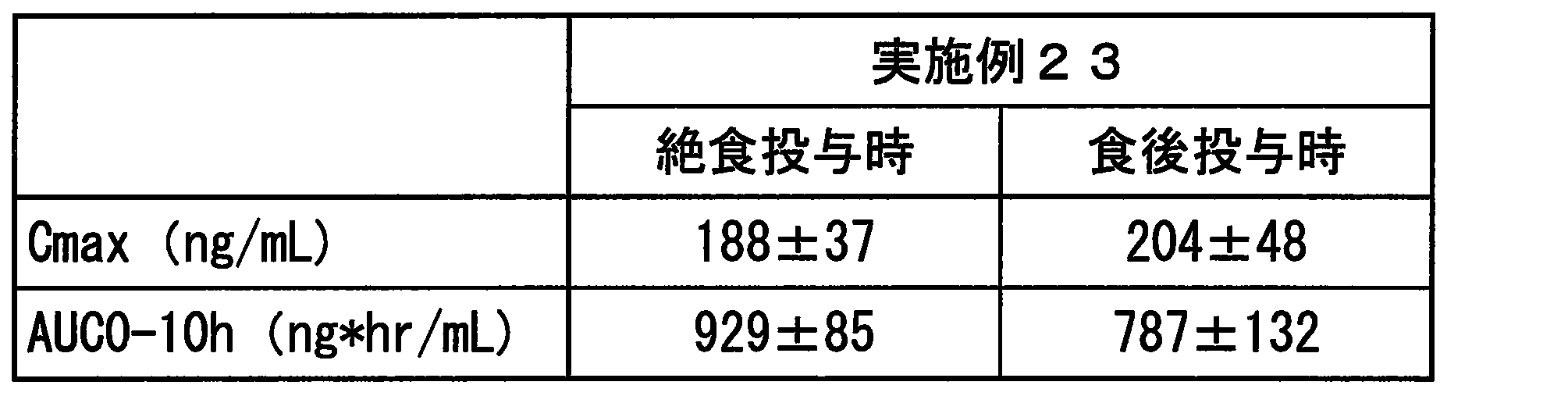
実施例20および23で調製した本発明の医薬組成物を水に分散させた懸濁液をガラス瓶に充填し、密栓後、冷所(5℃)にてそれぞれ2週間保存した。保存後、懸濁液(ミラベグロンを25mg相当量含有する)の溶出試験を日本薬局方溶出試験法第二法(パドル法)に従い行った。試験液はUSPリン酸緩衝液(pH6.8)900mLを用いた。パドル回転数は200rpmで行った。
Claims (29)
- アルキル硫酸とミラベグロンとの酸付加塩、および放出制御基剤を含有してなる医薬組成物。
- アルキル硫酸が、ドデシル硫酸、テトラデシル硫酸、およびヘキサデシル硫酸からなる群より選択される1種の酸である、請求項1に記載の医薬組成物。
- アルキル硫酸とミラベグロンとの酸付加塩が、ミラベグロンドデシル硫酸塩である、請求項2に記載の医薬組成物。
- ミラベグロンとアルキル硫酸のモル比が1:1~1:2である、請求項1~3のいずれか一項に記載の医薬組成物。
- 放出制御基剤が、水溶性高分子、または水不溶性物質である、請求項1に記載の医薬組成物。
- 放出制御基剤が、水不溶性物質である、請求項5に記載の医薬組成物。
- 放出制御基剤が、水不溶性セルロースエーテル、および/または水不溶性アクリル酸系共重合体である、請求項1又は6に記載の医薬組成物。
- 水不溶性セルロースエーテルが、エチルセルロースである、請求項7に記載の医薬組成物。
- 水不溶性アクリル酸系共重合体が、アクリル酸エチル・メタアクリル酸メチル・メタアクリル酸塩化トリメチルアンモニウムエチル共重合体、およびアクリル酸エチル・メタアクリル酸メチル共重合体からなる群より選択される1または2以上の物質である、請求項7に記載の医薬組成物。
- 水不溶性物質の量が、アルキル硫酸とミラベグロンとの酸付加塩の重量に対して0.1W/W%以上1000W/W%以下である、請求項5~9のいずれか一項に記載の医薬組成物。
- 溶出試験開始30分後のミラベグロン溶出率が約85%未満である、請求項1~10のいずれか一項に記載の医薬組成物。
- 溶出試験開始1.5時間後のミラベグロン溶出率が約70%以下である、請求項11に記載の医薬組成物。
- 医薬組成物が、絶食投与時における最大血中薬物濃度(Cmax)と比べ、食物摂取後投与時におけるCmaxの低下率が約30%以下である、請求項1~12のいずれか一項に記載の医薬組成物。
- 医薬組成物が、絶食投与時における血中薬物濃度対時間曲線下面積(AUC)と比べ、食物摂取後投与時におけるAUCの低下率が約30%以下である、請求項1~13のいずれか一項に記載の医薬組成物。
- 医薬組成物が、顆粒剤、散剤、液剤、懸濁剤、および乳剤からなる群から選択される1種の製剤である、請求項1~14のいずれか一項に記載の医薬組成物。
- 医薬組成物が、液剤、懸濁剤、または乳剤である、請求項15に記載の医薬組成物。
- 過活動膀胱治療用である、請求項1~16のいずれか一項に記載の医薬組成物。
- アルキル硫酸とミラベグロンとの酸付加塩に放出制御基剤を配合してなる医薬組成物の製造方法。
- (1)ミラベグロンを溶媒に溶解し、(2)(1)にアルキル硫酸を配合し、(3)(2)に放出制御基剤を配合する、医薬組成物の製造方法。
- アルキル硫酸とミラベグロンとの酸付加塩。
- アルキル硫酸が、ドデシル硫酸、テトラデシル硫酸、およびヘキサデシル硫酸からなる群より選択される1種の酸である、請求項20に記載の酸付加塩。
- アルキル硫酸とミラベグロンとの酸付加塩が、ミラベグロンドデシル硫酸塩である、請求項21に記載の酸付加塩。
- ミラベグロンとアルキル硫酸のモル比が1:1~1:2である、請求項20~22のいずれか一項に記載の酸付加塩。
- 過活動膀胱治療のための、請求項20~23のいずれか一項に記載の酸付加塩の使用。
- 請求項20~23のいずれか一項に記載の酸付加塩の有効量を患者に投与することからなる、過活動膀胱治療方法。
- 水またはキサンタンガム溶液に分散し保存中もミラベグロンの漏出を抑制するための請求項20~23のいずれか一項に記載の酸付加塩の使用。
- 食物摂取の有無によらず薬物動態の変動を低減する医薬組成物の製造のための、請求項20~23のいずれか一項に記載の酸付加塩の使用。
- 苦味抑制のための請求項20~23のいずれか一項に記載の酸付加塩の使用。
- 過活動膀胱治療用医薬組成物の製造のための、請求項20~23のいずれか一項に記載の酸付加塩の使用。
Priority Applications (2)
| Application Number | Priority Date | Filing Date | Title |
|---|---|---|---|
| EP13770182.7A EP2832730A4 (en) | 2012-03-30 | 2013-03-29 | MIRABEGRAPHIC PHARMACEUTICAL COMPOSITION |
| US14/388,099 US20150031734A1 (en) | 2012-03-30 | 2013-03-29 | Pharmaceutical composition containing mirabegron |
Applications Claiming Priority (4)
| Application Number | Priority Date | Filing Date | Title |
|---|---|---|---|
| US201261618076P | 2012-03-30 | 2012-03-30 | |
| US61/618,076 | 2012-03-30 | ||
| JP2013-053462 | 2013-03-15 | ||
| JP2013053462 | 2013-03-15 |
Publications (1)
| Publication Number | Publication Date |
|---|---|
| WO2013147134A1 true WO2013147134A1 (ja) | 2013-10-03 |
Family
ID=49260376
Family Applications (1)
| Application Number | Title | Priority Date | Filing Date |
|---|---|---|---|
| PCT/JP2013/059486 Ceased WO2013147134A1 (ja) | 2012-03-30 | 2013-03-29 | ミラベグロン含有医薬組成物 |
Country Status (4)
| Country | Link |
|---|---|
| US (1) | US20150031734A1 (ja) |
| EP (1) | EP2832730A4 (ja) |
| JP (1) | JPWO2013147134A1 (ja) |
| WO (1) | WO2013147134A1 (ja) |
Cited By (3)
| Publication number | Priority date | Publication date | Assignee | Title |
|---|---|---|---|---|
| CN103641792A (zh) * | 2013-12-27 | 2014-03-19 | 上海医药工业研究院 | 一种米拉贝隆有关物质或其盐、其制备方法和用途 |
| WO2016159267A1 (ja) * | 2015-03-31 | 2016-10-06 | アステラス製薬株式会社 | ミラベグロン含有医薬組成物 |
| KR101877834B1 (ko) * | 2017-04-27 | 2018-07-12 | 주식회사 다산제약 | 미라베그론의 신규한 염 및 이의 제조방법 |
Families Citing this family (11)
| Publication number | Priority date | Publication date | Assignee | Title |
|---|---|---|---|---|
| JP6618736B2 (ja) * | 2015-09-01 | 2019-12-11 | 沢井製薬株式会社 | ミラベグロン含有錠剤、ミラベグロン含有製剤の製造方法及びミラベグロン含有造粒物の製造方法 |
| HUP1600051A2 (en) * | 2016-02-01 | 2017-08-28 | Egyt Gyogyszervegyeszeti Gyar | Mirabegron cocrystals |
| US10543174B2 (en) | 2016-04-25 | 2020-01-28 | Synthon B.V. | Modified release tablet composition comprising mirabegron |
| KR102051132B1 (ko) * | 2017-03-17 | 2019-12-02 | 주식회사 종근당 | 미라베그론 또는 이의 염을 포함하는 방출조절용 약제학적 조성물 |
| KR20170088783A (ko) * | 2017-07-07 | 2017-08-02 | 지엘팜텍주식회사 | 미라베그론의 습식과립 조성물 |
| EP3694492A1 (en) * | 2017-10-12 | 2020-08-19 | Synthon B.V. | Modified release tablet composition comprising mirabegron |
| EP3292864A1 (en) * | 2017-10-12 | 2018-03-14 | Synthon B.V. | Modified release tablet composition comprising mirabegron |
| US10478399B2 (en) | 2017-10-12 | 2019-11-19 | Synthon B.V. | Modified release tablet composition comprising mirabegron |
| WO2022006336A1 (en) * | 2020-07-01 | 2022-01-06 | Jubilant Pharma Holdings Inc. | Long-acting injection dosage form of beta 3 adrenoreceptor agonists |
| WO2022125007A1 (en) * | 2020-12-08 | 2022-06-16 | Santa Farma Ilac Sanayii A. S. | Prolonged release mirabegron formulations |
| US20230000837A1 (en) * | 2021-06-29 | 2023-01-05 | Jubilant Pharma Holdings Inc. | Parenteral dosage form of beta 3 adrenoreceptor agonists |
Citations (8)
| Publication number | Priority date | Publication date | Assignee | Title |
|---|---|---|---|---|
| JPH05213740A (ja) * | 1992-02-04 | 1993-08-24 | Dainippon Pharmaceut Co Ltd | 粒子製剤 |
| JPH05279247A (ja) * | 1992-04-03 | 1993-10-26 | Rohto Pharmaceut Co Ltd | 徐放性液剤 |
| WO1999020607A1 (en) | 1997-10-17 | 1999-04-29 | Yamanouchi Pharmaceutical Co., Ltd. | Amide derivatives or salts thereof |
| WO1999033489A1 (fr) | 1997-12-26 | 1999-07-08 | Yamanouchi Pharmaceutical Co., Ltd. | Compositions medicinales a liberation prolongee |
| WO2003037881A1 (en) | 2001-10-30 | 2003-05-08 | Yamanouchi Pharmaceutical Co., Ltd. | α-FORM OR ß-FORM CRYSTAL OF ACETANILIDE DERIVATIVE |
| WO2004041276A1 (ja) | 2002-11-07 | 2004-05-21 | Yamanouchi Pharmaceutical Co., Ltd. | 酢酸アニリド誘導体を有効成分とする過活動膀胱治療剤 |
| WO2010038690A1 (ja) | 2008-09-30 | 2010-04-08 | アステラス製薬株式会社 | 放出制御医薬組成物 |
| WO2010053068A1 (ja) * | 2008-11-07 | 2010-05-14 | 大日本住友製薬株式会社 | 新規で有用な下部尿路症状治療剤 |
-
2013
- 2013-03-29 EP EP13770182.7A patent/EP2832730A4/en not_active Withdrawn
- 2013-03-29 JP JP2014508080A patent/JPWO2013147134A1/ja active Pending
- 2013-03-29 US US14/388,099 patent/US20150031734A1/en not_active Abandoned
- 2013-03-29 WO PCT/JP2013/059486 patent/WO2013147134A1/ja not_active Ceased
Patent Citations (9)
| Publication number | Priority date | Publication date | Assignee | Title |
|---|---|---|---|---|
| JPH05213740A (ja) * | 1992-02-04 | 1993-08-24 | Dainippon Pharmaceut Co Ltd | 粒子製剤 |
| JPH05279247A (ja) * | 1992-04-03 | 1993-10-26 | Rohto Pharmaceut Co Ltd | 徐放性液剤 |
| WO1999020607A1 (en) | 1997-10-17 | 1999-04-29 | Yamanouchi Pharmaceutical Co., Ltd. | Amide derivatives or salts thereof |
| WO1999033489A1 (fr) | 1997-12-26 | 1999-07-08 | Yamanouchi Pharmaceutical Co., Ltd. | Compositions medicinales a liberation prolongee |
| WO1999033491A1 (fr) | 1997-12-26 | 1999-07-08 | Yamanouchi Pharmaceutical Co., Ltd. | Compositions medicinales a liberation prolongee |
| WO2003037881A1 (en) | 2001-10-30 | 2003-05-08 | Yamanouchi Pharmaceutical Co., Ltd. | α-FORM OR ß-FORM CRYSTAL OF ACETANILIDE DERIVATIVE |
| WO2004041276A1 (ja) | 2002-11-07 | 2004-05-21 | Yamanouchi Pharmaceutical Co., Ltd. | 酢酸アニリド誘導体を有効成分とする過活動膀胱治療剤 |
| WO2010038690A1 (ja) | 2008-09-30 | 2010-04-08 | アステラス製薬株式会社 | 放出制御医薬組成物 |
| WO2010053068A1 (ja) * | 2008-11-07 | 2010-05-14 | 大日本住友製薬株式会社 | 新規で有用な下部尿路症状治療剤 |
Non-Patent Citations (4)
| Title |
|---|
| FDA: GUIDANCE FOR INDUSTRY: GENERAL CONSIDERATION FOR PEDIATRIC PHARMACOKINETIC STUDIES FOR DRUGS AND BIOLOGICAL PRODUCTS, November 1998 (1998-11-01) |
| ICH GUIDANCE: ICH, GUIDANCE FOR INDUSTRY: ELL CLINICAL INVESTIGATION OF MEDICAL PRODUCTS IN THE PEDIATRIC POPULATION, December 2000 (2000-12-01) |
| PREA: GUIDANCE FOR INDUSTRY: HOW TO COMPLY WITH THE PEDIATRIC RESEARCH EQUITY ACT, September 2005 (2005-09-01) |
| See also references of EP2832730A4 |
Cited By (5)
| Publication number | Priority date | Publication date | Assignee | Title |
|---|---|---|---|---|
| CN103641792A (zh) * | 2013-12-27 | 2014-03-19 | 上海医药工业研究院 | 一种米拉贝隆有关物质或其盐、其制备方法和用途 |
| WO2015096604A1 (zh) * | 2013-12-27 | 2015-07-02 | 国药集团国瑞药业有限公司 | 一种米拉贝隆有关物质或其盐、其制备方法和用途 |
| WO2016159267A1 (ja) * | 2015-03-31 | 2016-10-06 | アステラス製薬株式会社 | ミラベグロン含有医薬組成物 |
| US10058536B2 (en) | 2015-03-31 | 2018-08-28 | Astellas Pharma Inc. | Pharmaceutical composition containing mirabegron |
| KR101877834B1 (ko) * | 2017-04-27 | 2018-07-12 | 주식회사 다산제약 | 미라베그론의 신규한 염 및 이의 제조방법 |
Also Published As
| Publication number | Publication date |
|---|---|
| EP2832730A4 (en) | 2015-09-09 |
| US20150031734A1 (en) | 2015-01-29 |
| JPWO2013147134A1 (ja) | 2015-12-14 |
| EP2832730A1 (en) | 2015-02-04 |
Similar Documents
| Publication | Publication Date | Title |
|---|---|---|
| JPWO2013147134A1 (ja) | ミラベグロン含有医薬組成物 | |
| US20250144112A1 (en) | Suspension for oral administration comprising amorphous tolvaptan | |
| JP6588915B2 (ja) | Azd9291を含む医薬組成物 | |
| JP5625855B2 (ja) | 放出制御医薬組成物 | |
| EP4093379B1 (en) | Amorphous solid dispersions of dasatinib and uses thereof | |
| US20240350416A1 (en) | Pharmaceutical composition comprising enzalutamide | |
| KR102197465B1 (ko) | 디메틸푸마르산염을 함유한 장용성 정제 | |
| EP3769765B1 (en) | Pharmaceutical composition including sodium alkyl sulfate | |
| US20210386674A1 (en) | Modified release tablet formulations containing phosphodiesterase inhibitor | |
| EP3389633B1 (en) | Pharmaceutical compositions comprising phenylaminopyrimidine derivative | |
| EP3437645B1 (en) | Film-coated tablet having high chemical stability of active ingredient | |
| US10709699B2 (en) | Pyridone derivative pharmaceutical composition and preparation method thereof | |
| TW202341973A (zh) | 治療性化合物、調配物、及其用途 | |
| EP3331502B1 (en) | Controlled release propiverine formulations | |
| US12097204B2 (en) | Solid pharmaceutical composition containing 1,3,5-triazine derivative or salt thereof | |
| US20230105701A1 (en) | Dissolution-enhanced olaparib composition | |
| TWI661828B (zh) | 低劑量藥物組合物及其用途 | |
| US20250025441A1 (en) | Pharmaceutical composition and a process to prepare the same | |
| CN104174022A (zh) | 一种吡格列酮的苦味抑制剂和包含吡格列酮的口服制剂 |
Legal Events
| Date | Code | Title | Description |
|---|---|---|---|
| 121 | Ep: the epo has been informed by wipo that ep was designated in this application |
Ref document number: 13770182 Country of ref document: EP Kind code of ref document: A1 |
|
| WWE | Wipo information: entry into national phase |
Ref document number: 14388099 Country of ref document: US |
|
| ENP | Entry into the national phase |
Ref document number: 2014508080 Country of ref document: JP Kind code of ref document: A |
|
| NENP | Non-entry into the national phase |
Ref country code: DE |
|
| REEP | Request for entry into the european phase |
Ref document number: 2013770182 Country of ref document: EP |
|
| WWE | Wipo information: entry into national phase |
Ref document number: 2013770182 Country of ref document: EP |