WO2013099180A1 - Photovoltaic conversion device and method of manufacturing photovoltaic conversion material - Google Patents
Photovoltaic conversion device and method of manufacturing photovoltaic conversion material Download PDFInfo
- Publication number
- WO2013099180A1 WO2013099180A1 PCT/JP2012/008183 JP2012008183W WO2013099180A1 WO 2013099180 A1 WO2013099180 A1 WO 2013099180A1 JP 2012008183 W JP2012008183 W JP 2012008183W WO 2013099180 A1 WO2013099180 A1 WO 2013099180A1
- Authority
- WO
- WIPO (PCT)
- Prior art keywords
- photovoltaic conversion
- precursor
- light absorbing
- based compound
- source
- Prior art date
- Legal status (The legal status is an assumption and is not a legal conclusion. Google has not performed a legal analysis and makes no representation as to the accuracy of the status listed.)
- Ceased
Links
Images


Classifications
-
- H—ELECTRICITY
- H10—SEMICONDUCTOR DEVICES; ELECTRIC SOLID-STATE DEVICES NOT OTHERWISE PROVIDED FOR
- H10F—INORGANIC SEMICONDUCTOR DEVICES SENSITIVE TO INFRARED RADIATION, LIGHT, ELECTROMAGNETIC RADIATION OF SHORTER WAVELENGTH OR CORPUSCULAR RADIATION
- H10F77/00—Constructional details of devices covered by this subclass
- H10F77/10—Semiconductor bodies
- H10F77/12—Active materials
-
- Y—GENERAL TAGGING OF NEW TECHNOLOGICAL DEVELOPMENTS; GENERAL TAGGING OF CROSS-SECTIONAL TECHNOLOGIES SPANNING OVER SEVERAL SECTIONS OF THE IPC; TECHNICAL SUBJECTS COVERED BY FORMER USPC CROSS-REFERENCE ART COLLECTIONS [XRACs] AND DIGESTS
- Y02—TECHNOLOGIES OR APPLICATIONS FOR MITIGATION OR ADAPTATION AGAINST CLIMATE CHANGE
- Y02E—REDUCTION OF GREENHOUSE GAS [GHG] EMISSIONS, RELATED TO ENERGY GENERATION, TRANSMISSION OR DISTRIBUTION
- Y02E10/00—Energy generation through renewable energy sources
- Y02E10/50—Photovoltaic [PV] energy
- Y02E10/547—Monocrystalline silicon PV cells
Definitions
- the present invention relates to a photovoltaic conversion device and a method of manufacturing a photovoltaic conversion material.
- the photovoltaic conversion device refers to a device that can convert photon energy to electric energy through a certain physical phenomenon (photovoltaic conversion).
- Solar cells which are a type of the photovoltaic conversion device, can efficiently convert the energy of the solar illumination to electric energy.
- Single-crystal Si, polycrystalline Si, amorphous Si, GaAs, InP, CdTe, CuIn 1-x Ga x Se 2 (CIGS), and Cu 2 ZnSnS 4 (CZTS) are known as the semiconductors used for the solar cells.
- the chalcogenide compounds typified by CIGS and CZTS can each be formed into a cost-advantageous thin film due to the large light absorbing coefficient thereof.
- a solar cell with CIGS as a light absorbing layer has a relatively high conversion efficiency among thin-film solar cells, and has exhibited a conversion efficiency higher than that of a polycrystalline-Si solar cell (see Non Patent Literature 1).
- the spectrum of the sunlight is widely distributed from ultraviolet rays to infrared rays.
- a light absorbing layer can absorb only photons each having energy larger than the bandgap of a material forming the light absorbing layer.
- the energy in excess of the bandgap dissipates as heat; hence, the output voltage necessarily has a value corresponding to the bandgap.
- the bandgap of the light absorbing layer increases, the output voltage of the solar cell increases, but the current decreases due to a decrease in number of absorbed photons.
- the bandgap of the light absorbing layer decreases, the current increases due to an increase in number of absorbed photons, but the output voltage decreases.
- a solar cell single-junction solar cell having a light absorbing layer formed of one material has a trade-off relationship between current and voltage.
- a nano-crystalline silicon single-junction solar cell and an amorphous-silicon single-junction solar cell have made no significant progress for over a decade (see Non Patent Literature 2).
- the CIGS single-junction solar cells are expensive due to In, which is a rare metal, included therein.
- the bandgap of CIGS can be adjusted through adjustment of the elemental ratio between In and Ga.
- the CIGS single-junction solar cell disadvantageously exhibits a low conversion efficiency for a Ga-rich state giving a wide bandgap while exhibiting a high conversion efficiency for an In-rich state giving a narrow bandgap.
- a multi-junction solar cell including stacked light absorbing layers having different bandgaps.
- the multi-junction solar cell for example, the following solar cells are currently commercially available: (a) nanocrystalline silicon/amorphous silicon double-junction solar cells, and (b) amorphous silicon-germanium/amorphous silicon double-junction solar cells.
- the bandgaps of the light absorbing layers must be adjusted in order to achieve a high conversion efficiency of the multi-junction solar cell.
- a material that can be appropriately controlled from a high-current/low-voltage material to a low-current/high-voltage material is preferred as the material forming the light absorbing layers of the multi-junction solar cell.
- a light absorbing layer has a pinhole, a conversion efficiency of the photovoltaic conversion device is reduced.
- a problem that the invention is to solve is to provide a novel method of manufacturing a photovoltaic conversion material that can be appropriately controlled from a high-current/low-voltage material to a low-current/high-voltage material, and a photovoltaic conversion device using the photovoltaic conversion material as a light absorbing layer.
- Another problem that the invention is to solve is to provide a method of manufacturing a thin film with few pinholes formed in a novel photovoltaic conversion material, and a photovoltaic conversion device using the photovoltaic conversion material as a light absorbing layer.
- a photovoltaic conversion device is summarized by including a light absorbing layer all or part of which includes a Cu 2 Ge 1-x Sn x S 3 -based compound (0 ⁇ x ⁇ 1).
- a method of manufacturing a photovoltaic conversion material according to the invention is summarized by including: preparing a Cu-based precursor; generating a vapor containing S and Ge from an S source and a Ge source; and reacting the vapor with the Cu-based precursor to synthesize a photovoltaic conversion material including Cu-Ge-S based compound.
- a Cu-Ge based precursor, a Cu-Sn based precursor or a Cu-Ge-Sn based precursor is used as the Cu-based precursor.
- the Cu 2 Ge 1-x Sn x S 3 -based compound has a narrower bandgap with an increase in x.
- any of materials from a high-current/low-voltage material to a low-current/high-voltage material can be appropriately produced through control of the Sn content (x).
- the vapor containing S and Ge is reacted with the Cu-based precursor for synthesis of the Cu 2 Ge 1-x Sn x S 3 -based compound, thus allowing synthesis of a light absorbing layer with few pinholes formed in the Cu 2 Ge 1-x Sn x S 3 -based compound.
- Fig. 1 is a schematic sectional view illustrating an exemplary structure of a photovoltaic conversion device.
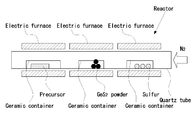
- Fig. 2 is a schematic sectional view of a reactor for manufacturing a photovoltaic conversion material according to the present invention.
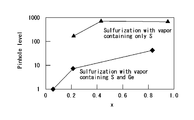
- Fig. 5 is a graph illustrating a result of pinhole test which compares light absorbing layers (Samples No. 2 to No. 4) sulfurized with vapor containing sulfur and Ge with light absorbing layers (Samples No. 6 to No. 8) sulfurized with vapor containing only sulfur.
- a photovoltaic conversion device includes a light absorbing layer all or part of which includes a Cu 2 Ge 1-x Sn x S 3 -based compound (0 ⁇ x ⁇ 1).
- the light absorbing layer includes a Cu 2 Ge 1-x Sn x S 3 -based compound (0 ⁇ x ⁇ 1).
- the ⁇ Cu 2 Ge 1-x Sn x S 3 -based compound> refers to a sulfide-based compound semiconductor containing Cu, Ge, Sn, and S as essential components.
- the ⁇ Cu 2 Ge 1-x Sn x S 3 -based compound> in the invention includes not only the stoichiometric compound but also compounds with a slight deviation from the stoichiometric composition as long as the compounds can be regarded to be substantially identical to Cu 2 Ge 1-x Sn x S 3 .
- the ⁇ substantially identical> means that the deviation of Cu/(Sn+Ge) ratio from the stoichiometric composition is within a range of plus or minus 20%.
- the deviation from the stoichiometric composition is within a range of plus or minus 10%.
- ⁇ x> represents Sn/(Ge+Sn) ratio.
- the bandgap of Cu 2 GeS 3 is about 1.55 eV, while the bandgap of Cu 2 SnS 3 is about 0.90 eV.
- the Cu 2 Ge 1-x Sn x S 3 -based compound has a smaller bandgap with an increase in x.
- the bandgap of the Cu 2 Ge 1-x Sn x S 3 -based compound can be appropriately controlled from about 0.90 eV to about 1.55 eV through control of x.
- x is 0.7 ⁇ x ⁇ 1.
- the Cu 2 Ge 1-x Sn x S 3 -based compound may include Li, Na, K, Mg, Ca, Ag, Zn, Cd, Al, Ga, In, Si, Pb, Sb, Bi, Se, Te or the like for the purpose of suppression of lattice defects, control of the bandgap, control of carrier concentration or the like.
- the Cu 2 Ge 1-x Sn x S 3 -based compound may either entirely or partially form the light absorbing layer.
- the light absorbing layer may include any one of (1) only a Cu 2 Ge 1-x Sn x S 3 -based compound having one composition (single-junction photovoltaic conversion device), (2) a stack of two or more Cu 2 Ge 1-x Sn x S 3 -based compound layers having different compositions (multi-junction photovoltaic conversion device), and (3) a stack of one or more Cu 2 Ge 1-x Sn x S 3 -based compound layers having different compositions and another compound layer (multi-junction photovoltaic conversion device).
- a double-junction solar cell which includes two materials having different bandgaps of about 1.8 eV and 1.1 eV as first and second layers from an incident side of the sunlight, exhibits the maximum conversion efficiency among double-junction solar cells.
- the Cu 2 Ge 1-x Sn x S 3 -based compound according to the invention is preferred as the second-layer material.
- a triple-junction solar cell which includes three materials having different bandgaps of about 2.2 eV, 1.4 eV, and 0.9 eV as first, second, and third layers from an incident side of the sunlight, exhibits the maximum conversion efficiency among triple-junction solar cells.
- the Cu 2 Ge 1-x Sn x S 3 -based compound according to the invention is preferred as a material for the second and third layers.
- the light absorbing layer configuring the photovoltaic conversion device according to the invention is synthesized by a process described later, leading to few pinholes and excellent peeling resistance of the light absorbing layer compared with a light absorbing layer synthesized by another process.
- the photovoltaic conversion device commonly includes layers other than the light absorbing layer.
- the stacked structure of the device and a material forming each layer is not limited and may be optimally selected depending on a type of the photovoltaic conversion device.
- a solar cell commonly has a structure where a bottom electrode, a light absorbing layer, a buffer layer, a window layer, and a grid electrode are provided in this order on a substrate.
- materials for the layers other than the light absorbing layer include the following.
- the material for the substrate include glass (for example, SLG, low-alkali glass, non-alkali glass, quartz glass, Na-ion implanted quartz glass, and sapphire glass), ceramics (for example, oxides such as silica, alumina, yttria, and zirconia, and various ceramics containing Na), and metal (for example, stainless steel, stainless steel containing Na, Au, Mo, and Ti).
- Examples of the material for the bottom electrode include Mo, MoSi 2 , stainless steel, In-Sn-O, In-Zn-O, ZnO: Al, ZnO: B, SnO 2 : F, SnO 2 : Sb, ZnO: Ga, and TiO 2 : Nb.
- Examples of the material for the buffer layer include CdS, Zn(O, S), and (Zn, Mg)O.
- Examples of the material for the window layer include ZnO: Al, ZnO: Ga, ZnO: B, In-Sn-O, In-Zn-O, SnO 2 : Sb, and TiO 2 : Nb.
- Examples of the material for the grid electrode include Al, Cu, Ag, and Au, and alloy including one or more of them.
- Such alloy specifically includes Al-Ti alloy, Al-Mg alloy, Al-Ni alloy, Cu-Ti alloy, Cu-Sn alloy, Cu-Zn alloy, Cu-Au alloy, Ag-Ti alloy, Ag-Sn alloy, Ag-Zn alloy, and Ag-Au alloy.
- Fig. 1 illustrates a schematic sectional view of a solar cell as a type of the photovoltaic conversion device.
- the solar cell includes Mo, a light absorbing layer, CdS, ZnO: Ga, and an Al grid electrode in this order on a glass substrate. All or part of the light absorbing layer includes the Cu 2 Ge 1-x Sn x S 3 -based compound.
- an additional layer for example, an adhesive layer for improving adhesion between the substrate and the bottom electrode, a light scattering layer, and an anti-reflection layer may be provided between the layers.
- a method of manufacturing the photovoltaic conversion material according to the invention includes a precursor preparation step, a vapor generation step, and a reaction step.
- a Cu-based precursor is prepared in the precursor preparation step.
- the Cu-based precursor is used as a precursor to synthesize a Cu-Ge-S based compound.
- the ⁇ Cu-Ge-S based compound> refers to a compound containing at least Cu, Ge, and S.
- the ⁇ Cu-based precursor> refers to a precursor containing at least Cu.
- the Cu-based precursor containing two or more elements may be an alloy with a single composition or a mixture containing two or more elements or alloys.
- Examples of the Cu-based precursor include: (a) Cu, (b) a Cu-Ge based precursor which includes at least Cu and Ge (for example, a Cu-Ge compound such as Cu 3 Ge, or a Cu-Ge alloy), (c) a Cu-Sn based precursor which includes at least Cu and Sn (for example, a Cu-Sn compound such as Cu 6 Sn 5 , Cu 3 Sn, or Cu 10 Sn 3 , or a Cu-Sn alloy), (d) a Cu-Ge-Sn based precursor which includes at least Cu, Ge, and Sn (for example, a mixture of a Cu-Ge compound such as Cu 3 Ge and a Cu-Sn compound such as Cu 6 Sn 5 , Cu 3 Sn, or Cu 10 Sn 3
- a precursor having a Cu 2 Sn composition is heated under an S-containing atmosphere, thus allowing Cu 2 SnS 3 to be relatively readily synthesized.
- a precursor having a Cu 2 Ge composition is heated under an S-containing atmosphere, which, however, does not allow preparation of Cu 2 GeS 3 with few pinholes. The reason for this is speculated as follows. That is, the Cu-Ge binary system has no Cu 2 Ge phase. Therefore, Cu 2 Ge is decomposed into a Cu 3 Ge phase and a Ge phase, and the Ge phase readily vaporizes during the heating process.
- a Cu-based precursor is used as the precursor, and the precursor is sulfurized while Ge is externally added, in order to prevent Ge from vaporizing in the case where Ge is included in the precursor, and to compensate the insufficiency to predetermined Ge composition of the Cu-Ge-S based compound to be synthesized.
- the method of the invention is different from typical methods in this point.
- the elemental ratio of Cu, Ge and Sn in the Cu-based precursor must meet the following formulas in general. Cu/(Ge+Sn)>2, and Sn/(Ge+Sn)>x.
- the Cu 2 Ge 1-x Sn x S 3 -based compound to be synthesized includes not only the stoichiometric compound but also compounds with a slight deviation from the stoichiometric composition. Specifically, it includes compounds which have Cu/(Sn+Ge) ratio deviated from the stoichiometric composition within a range of plus or minus 20%. That is, it includes compounds which have a composition of 1.6 ⁇ Cu/(Sn+Ge) ⁇ 2.4. Therefore, the Cu-based precursor used for synthesis of the compound may be accompanied by the deviation from the stoichiometric composition similar to the compound.
- the Cu-based precursor used for synthesis of the compound includes a precursor having a composition of 1.6 ⁇ Cu/(Ge+Sn).
- the configuration of the precursor is not limited and may be any one of a mass, powder, and a thin film.
- the Cu-Sn based precursor having a composition of 1.6 ⁇ Cu/Sn is preferred as the Cu-based precursor.
- Cu 2 Ge 1-x SnS 3 -based compound (0.7 ⁇ x ⁇ 1) may be obtained.
- the Cu-Ge-Sn based precursor having a composition of 1.6 ⁇ Cu/(Ge+Sn) and 0.7 ⁇ Sn/(Ge+Sn) is preferred as the Cu-based precursor.
- Cu 2 Ge 1-x SnS 3 -based compound (0.7 ⁇ x ⁇ 1) may be obtained.
- the Cu-based precursor may include Li, Na, K, Mg, Ca, Ag, Zn, Cd, Al, Ga, In, Si, Pb, Sb, Bi, Se, Te or the like for the purpose of suppression of lattice defects, control of the bandgap, control of carrier concentration or the like.
- the Cu-based precursor for synthesis of the Cu 2 Ge 1-x SnS 3 -based compound should have an overall composition equal or equivalent to Cu/(Ge+Sn)>2 and Sn/(Ge+Sn)>x, but may have any internal structure.
- the Cu-based precursor may be formed of a Cu-Ge-Sn thin film deposited by a co-sputter process, or may be formed of stacked films deposited by sputter in a plurality of steps with multiple targets. If the Cu-based precursor having free Ge is directly heated to a sulfurization temperature, the free Ge may vaporize. In such a case, the Cu-based precursor is preferably preheated before sulfurization of the Cu-based precursor to induce generation of Cu 3 Ge from the free Ge.
- a vapor containing S and Ge is generated from an S source and a Ge source.
- the S and Ge sources for generation of the vapor should be sources that allow generation of a vapor containing sufficient amounts of S and Ge to synthesize a Cu 2 Ge 1-x Sn x S 3 -based compound with few defects.
- the S source include S powder, GeS, and GeS 2 . Among them, S powder is preferred as the S source since it allows generation of a large amount of an S vapor through low-temperature heating.
- the Ge source include Ge, GeS, and GeS 2 .
- Each of the S and Ge sources may be used alone, or two or more sources may be used in combination.
- the configuration of each of S and Ge sources is not limited and may be any one of a mass, powder, and a thin film.
- S powder is preferred as the S source since it readily vaporizes.
- Powder and a thin film of each of Ge, GeS, and GeS 2 are preferred as the Ge source for a similar reason.
- Any method of vapor generation may be used as long as the method allows generation of the vapor containing predetermined amounts of S and Ge.
- the vapor containing predetermined amounts of S and Ge can be generated by heating the S source and the Ge source at the same temperature, the S and Ge sources should be heated at the same temperature.
- the S source and the Ge source may be placed away from each other, or may be placed adjacent to each other.
- the S source and the Ge source which have significantly different vaporization temperatures, are heated at the same temperature, the content of each of S and Ge in the vapor is difficult to be controlled.
- the S source and the Ge source are preferably placed away from each other to heat each source at the optimum temperature.
- the vaporization temperature of the S powder is lower than that of GeS 2 .
- the S powder and GeS 2 are preferably independently heated at different temperatures.
- Each concentration of S and Ge in the vapor should be equal to or higher than the minimum concentration to convert the precursor to the Cu 2 Ge 1-x Sn x S 3 -based compound.
- Cu 2 GeS 3 is the sulfide having the maximum Ge content in the Cu-Ge-S system. Hence, even if the precursor is reacted with the vapor containing excessive S and Ge, no heterogeneous phase is generated.
- each vaporization temperature of the S and Ge sources is similar to the reaction temperature between the precursor and the vapor
- the S source, the Ge source, and the precursor should be heated at the same temperature.
- the S source, the Ge source, and the precursor may be placed away from one another, or may be placed adjacent to one another.
- one or more of the vaporization temperatures and the reaction temperature is significantly different from others, the corresponding one or more of the S source, the Ge source, and the precursor are preferably placed away from the others so as to be heated at a different temperature.
- Fig. 2 illustrates an exemplary reactor for manufacturing the photovoltaic conversion material according to the invention.
- the reactor three-zone reactor
- the quartz tube holds the S source, the Ge source, and the precursor, and supplies the vapors generated from the S and Ge sources to the precursor.
- the quartz tube is designed to allow flow of a carrier gas (N 2 ) from one end to the other end thereof.
- the first ceramic container in which the S source (sulfur) is put, the second ceramic container in which the Ge source (GeS 2 ) is put, and the third ceramic container in which the precursor is put, are located in this order from the upstream side of the quarts tube to the downstream side.
- GeS 2 and the precursor may be put in the same ceramic container. That is, the heating of the low materials may be done by using a reactor (two-zone reactor) having two electric furnaces. This is because the vaporization temperature of GeS 2 is close to the reaction temperature between the precursor and the vapor.
- sulfur is preferably placed away from the others, because the vaporization temperature of sulfur is lower than the vaporization temperature of GeS 2 and the reaction temperature.
- An electric furnace is placed around each ceramic container so that temperature of each ceramic container can be independently controlled.
- the electric furnaces are heated while the carrier gas is flowed into the quartz tube.
- an S vapor is first generated from the sulfur in the electric furnace on the upstream side and is carried to the downstream side.
- GeS 2 vaporizes in the middle point, so that the vapor containing S and Ge is formed.
- the vapor reacts with the precursor to synthesize the Cu 2 Ge 1-x Sn x S 3 -based compound at the downstream side.
- the Cu 2 Ge 1-x Sn x S 3 -based compound has a narrower bandgap with an increase in x.
- any material from a high-current/low-voltage material to a low-current/high-voltage material can be arbitrarily produced through control of the Sn content (x).
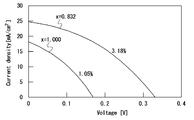
- composition x of the obtained thin film including Cu 2 Ge 1-x Sn x S 3 -based compound was 0.000 for Sample No. 1, 0.059 for Sample No. 2, 0.214 for Sample No. 3, 0.832 for Sample No. 4, and 1.000 for Sample No. 5.
- the rising positions of the absorption edges reveal that the bandgap can be adjusted.
- Fig. 3 shows that the bandgap can be adjusted within a range of 1.55 to 0.90 eV through adjustment of x of Cu 2 Ge 1-x Sn x S 3 .
- Current matching which is essential for an increase in efficiency of two-terminal multi-junction solar cells, can be readily achieved through use of the Cu 2 Ge 1-x Sn x S 3 -based compound as the light absorbing layer.
- Fig. 5 illustrates a result of pinhole test which compares light absorbing layers (Samples No. 2 to No. 4) sulfurized with vapor containing sulfur and Ge with light absorbing layers (Samples No. 6 to No. 8) sulfurized with vapor containing only sulfur.
- the thin film as Sample No. 9 had five or fewer pinholes per square centimeter.
- the thin film as Sample No. 10 had six to nine pinholes per square centimeter.
- Fig. 5 and the results of sample No. 9 and No. 10 reveals that the sulfurization with the vapor containing only sulfur leads to a significant increase in pinhole level. This is most likely due to sublimation of Ge during the sulfurization, causing formation of pinholes.
- a high-quality film with few pinholes is achieved due to suppression of sublimation of Ge through the sulfurization with the vapor containing sulfur and Ge.
- the photovoltaic conversion device and the method of manufacturing the photovoltaic conversion material can be used for thin-film solar cells, photoconductive cells, photodiodes, and phototransistors, for example.
Landscapes
- Photovoltaic Devices (AREA)
- Physical Deposition Of Substances That Are Components Of Semiconductor Devices (AREA)
Priority Applications (1)
| Application Number | Priority Date | Filing Date | Title |
|---|---|---|---|
| EP12826634.3A EP2798676B1 (en) | 2011-12-26 | 2012-12-21 | Photovoltaic conversion device and method of manufacturing photovoltaic conversion material |
Applications Claiming Priority (4)
| Application Number | Priority Date | Filing Date | Title |
|---|---|---|---|
| JP2011-282665 | 2011-12-26 | ||
| JP2011282665 | 2011-12-26 | ||
| JP2012-259139 | 2012-11-27 | ||
| JP2012259139A JP5751243B2 (ja) | 2011-12-26 | 2012-11-27 | 光電変換素子及び光電変換材料の製造方法 |
Publications (1)
| Publication Number | Publication Date |
|---|---|
| WO2013099180A1 true WO2013099180A1 (en) | 2013-07-04 |
Family
ID=47749995
Family Applications (1)
| Application Number | Title | Priority Date | Filing Date |
|---|---|---|---|
| PCT/JP2012/008183 Ceased WO2013099180A1 (en) | 2011-12-26 | 2012-12-21 | Photovoltaic conversion device and method of manufacturing photovoltaic conversion material |
Country Status (3)
| Country | Link |
|---|---|
| EP (1) | EP2798676B1 (https=) |
| JP (1) | JP5751243B2 (https=) |
| WO (1) | WO2013099180A1 (https=) |
Cited By (2)
| Publication number | Priority date | Publication date | Assignee | Title |
|---|---|---|---|---|
| CN104803410A (zh) * | 2015-04-27 | 2015-07-29 | 武汉理工大学 | 水溶性铜锗硫量子点及其制备方法 |
| WO2023050628A1 (zh) * | 2021-09-30 | 2023-04-06 | 华南理工大学 | 一种在SiO 2衬底上生长硫化锗单晶薄膜的制备方法 |
Families Citing this family (1)
| Publication number | Priority date | Publication date | Assignee | Title |
|---|---|---|---|---|
| JP2017034186A (ja) * | 2015-08-05 | 2017-02-09 | 株式会社豊田中央研究所 | 光吸収層及びその製造方法、並びに、光電変換素子 |
Citations (2)
| Publication number | Priority date | Publication date | Assignee | Title |
|---|---|---|---|---|
| CN101330110A (zh) * | 2008-08-01 | 2008-12-24 | 中南大学 | 一种薄膜太阳电池的光吸收层材料及其制备方法 |
| US20110303879A1 (en) * | 2009-02-20 | 2011-12-15 | Kabushiki Kaisha Toyota Chuo Kenkyusho | Sulfide and photoelectric element |
Family Cites Families (2)
| Publication number | Priority date | Publication date | Assignee | Title |
|---|---|---|---|---|
| JP5641284B2 (ja) * | 2010-02-03 | 2014-12-17 | 独立行政法人国立高等専門学校機構 | 化合物半導体、光電素子及びその製造方法 |
| JP2012182340A (ja) * | 2011-03-02 | 2012-09-20 | Sanyo Electric Co Ltd | 化合物半導体及び太陽電池 |
-
2012
- 2012-11-27 JP JP2012259139A patent/JP5751243B2/ja not_active Expired - Fee Related
- 2012-12-21 EP EP12826634.3A patent/EP2798676B1/en not_active Not-in-force
- 2012-12-21 WO PCT/JP2012/008183 patent/WO2013099180A1/en not_active Ceased
Patent Citations (2)
| Publication number | Priority date | Publication date | Assignee | Title |
|---|---|---|---|---|
| CN101330110A (zh) * | 2008-08-01 | 2008-12-24 | 中南大学 | 一种薄膜太阳电池的光吸收层材料及其制备方法 |
| US20110303879A1 (en) * | 2009-02-20 | 2011-12-15 | Kabushiki Kaisha Toyota Chuo Kenkyusho | Sulfide and photoelectric element |
Non-Patent Citations (4)
| Title |
|---|
| A/LUQUE, J.APPL.PHYS., vol. 110, 2011, pages 031301 |
| DATABASE WPI Week 200920, Derwent World Patents Index; AN 2009-F87503, XP002695295 * |
| MARUSHKO L P ET AL: "Quasi-ternary system Cu2GeS3-Cu2SnS3-CdS", JOURNAL OF ALLOYS AND COMPOUNDS, ELSEVIER SEQUOIA, LAUSANNE, CH, vol. 484, no. 1-2, 18 September 2009 (2009-09-18), pages 147 - 153, XP026586414, ISSN: 0925-8388, [retrieved on 20090503], DOI: 10.1016/J.JALLCOM.2009.04.128 * |
| T. EISENBARTH ET AL., THIN SOLID FILMS, vol. 517, 2009, pages 2244 |
Cited By (3)
| Publication number | Priority date | Publication date | Assignee | Title |
|---|---|---|---|---|
| CN104803410A (zh) * | 2015-04-27 | 2015-07-29 | 武汉理工大学 | 水溶性铜锗硫量子点及其制备方法 |
| WO2023050628A1 (zh) * | 2021-09-30 | 2023-04-06 | 华南理工大学 | 一种在SiO 2衬底上生长硫化锗单晶薄膜的制备方法 |
| US12490542B2 (en) | 2021-09-30 | 2025-12-02 | South China University Of Technology | Preparation method for growing germanium sulfide (GeS2) single-crystal thin film on SiO2 substrate |
Also Published As
| Publication number | Publication date |
|---|---|
| EP2798676B1 (en) | 2017-03-15 |
| JP2013153139A (ja) | 2013-08-08 |
| EP2798676A1 (en) | 2014-11-05 |
| JP5751243B2 (ja) | 2015-07-22 |
Similar Documents
| Publication | Publication Date | Title |
|---|---|---|
| Shah et al. | A deep dive into Cu2ZnSnS4 (CZTS) solar cells: a review of exploring roadblocks, breakthroughs, and shaping the future | |
| US9881774B2 (en) | Copper indium gallium selenide (CIGS) thin films with composition controlled by co-sputtering | |
| Reddy et al. | α-SnSe thin film solar cells produced by selenization of magnetron sputtered tin precursors | |
| Chantana et al. | Aluminum‐doped Zn1− xMgxO as transparent conductive oxide of Cu (In, Ga)(S, Se) 2‐based solar cell for minimizing surface carrier recombination | |
| US20110083743A1 (en) | Photoelectric conversion device, method for producing the same, and solar battery | |
| WO2006075811A1 (en) | Optical absorber layers for solar cell and method of manufacturing the same | |
| US20120180870A1 (en) | Photoelectric conversion device, method for producing the same, and solar battery | |
| Sheu et al. | The effect of Cu concentration in the photovoltaic efficiency of CIGS solar cells prepared by co-evaporation technique | |
| CN101632154B (zh) | 利用一步金属有机化学气相沉积工艺制备ⅰ-ⅲ-ⅵ2化合物薄膜的方法 | |
| Zhang et al. | The effects of annealing temperature on CIGS solar cells by sputtering from quaternary target with Se-free post annealing | |
| Mitzi et al. | Spiers Memorial Lecture: Next generation chalcogenide-based absorbers for thin-film solar cells | |
| CN112703610A (zh) | 用于对吸收剂层进行后处理的方法 | |
| Bosio et al. | Why CuInGaSe2 and CdTe polycrystalline thin film solar cells are more efficient than the corresponding single crystal? | |
| JP2014209586A (ja) | 薄膜太陽電池及びその製造方法 | |
| Nishimura et al. | Silver-alloyed wide-gap CuGaSe2 solar cells | |
| JP5278418B2 (ja) | p型半導体及び光電素子 | |
| EP2798676B1 (en) | Photovoltaic conversion device and method of manufacturing photovoltaic conversion material | |
| Liu et al. | A non-vacuum solution route to prepare amorphous metal oxides thin films for Cu2ZnSn (S, Se) 4 solar cells | |
| Sood et al. | Low temperature (Zn, Sn) O deposition for reducing interface open-circuit voltage deficit to achieve highly efficient Se-free Cu (In, Ga) S 2 solar cells | |
| JP5278778B2 (ja) | カルコゲナイト系化合物半導体及びその製造方法 | |
| WO2013172253A1 (ja) | n型光吸収層用合金とその製造方法及び太陽電池 | |
| US20130247994A1 (en) | Photovoltaic device | |
| JP2017034186A (ja) | 光吸収層及びその製造方法、並びに、光電変換素子 | |
| JP2015002269A (ja) | 光吸収体及び光電変換素子 | |
| JP5835265B2 (ja) | 光電変換材料及びその製造方法 |
Legal Events
| Date | Code | Title | Description |
|---|---|---|---|
| 121 | Ep: the epo has been informed by wipo that ep was designated in this application |
Ref document number: 12826634 Country of ref document: EP Kind code of ref document: A1 |
|
| DPE2 | Request for preliminary examination filed before expiration of 19th month from priority date (pct application filed from 20040101) | ||
| REEP | Request for entry into the european phase |
Ref document number: 2012826634 Country of ref document: EP |
|
| WWE | Wipo information: entry into national phase |
Ref document number: 2012826634 Country of ref document: EP |
|
| NENP | Non-entry into the national phase |
Ref country code: DE |