WO2013031561A1 - 着色剤含有粒子、着色剤含有粒子分散液、及び高分子化合物 - Google Patents
着色剤含有粒子、着色剤含有粒子分散液、及び高分子化合物 Download PDFInfo
- Publication number
- WO2013031561A1 WO2013031561A1 PCT/JP2012/070955 JP2012070955W WO2013031561A1 WO 2013031561 A1 WO2013031561 A1 WO 2013031561A1 JP 2012070955 W JP2012070955 W JP 2012070955W WO 2013031561 A1 WO2013031561 A1 WO 2013031561A1
- Authority
- WO
- WIPO (PCT)
- Prior art keywords
- group
- polymer
- colorant
- meth
- silicone
- Prior art date
- Legal status (The legal status is an assumption and is not a legal conclusion. Google has not performed a legal analysis and makes no representation as to the accuracy of the status listed.)
- Ceased
Links
Classifications
-
- G—PHYSICS
- G02—OPTICS
- G02F—OPTICAL DEVICES OR ARRANGEMENTS FOR THE CONTROL OF LIGHT BY MODIFICATION OF THE OPTICAL PROPERTIES OF THE MEDIA OF THE ELEMENTS INVOLVED THEREIN; NON-LINEAR OPTICS; FREQUENCY-CHANGING OF LIGHT; OPTICAL LOGIC ELEMENTS; OPTICAL ANALOGUE/DIGITAL CONVERTERS
- G02F1/00—Devices or arrangements for the control of the intensity, colour, phase, polarisation or direction of light arriving from an independent light source, e.g. switching, gating or modulating; Non-linear optics
- G02F1/01—Devices or arrangements for the control of the intensity, colour, phase, polarisation or direction of light arriving from an independent light source, e.g. switching, gating or modulating; Non-linear optics for the control of the intensity, phase, polarisation or colour
- G02F1/165—Devices or arrangements for the control of the intensity, colour, phase, polarisation or direction of light arriving from an independent light source, e.g. switching, gating or modulating; Non-linear optics for the control of the intensity, phase, polarisation or colour based on translational movement of particles in a fluid under the influence of an applied field
- G02F1/166—Devices or arrangements for the control of the intensity, colour, phase, polarisation or direction of light arriving from an independent light source, e.g. switching, gating or modulating; Non-linear optics for the control of the intensity, phase, polarisation or colour based on translational movement of particles in a fluid under the influence of an applied field characterised by the electro-optical or magneto-optical effect
- G02F1/167—Devices or arrangements for the control of the intensity, colour, phase, polarisation or direction of light arriving from an independent light source, e.g. switching, gating or modulating; Non-linear optics for the control of the intensity, phase, polarisation or colour based on translational movement of particles in a fluid under the influence of an applied field characterised by the electro-optical or magneto-optical effect by electrophoresis
-
- C—CHEMISTRY; METALLURGY
- C08—ORGANIC MACROMOLECULAR COMPOUNDS; THEIR PREPARATION OR CHEMICAL WORKING-UP; COMPOSITIONS BASED THEREON
- C08F—MACROMOLECULAR COMPOUNDS OBTAINED BY REACTIONS ONLY INVOLVING CARBON-TO-CARBON UNSATURATED BONDS
- C08F290/00—Macromolecular compounds obtained by polymerising monomers on to polymers modified by introduction of aliphatic unsaturated end or side groups
- C08F290/02—Macromolecular compounds obtained by polymerising monomers on to polymers modified by introduction of aliphatic unsaturated end or side groups on to polymers modified by introduction of unsaturated end groups
- C08F290/06—Polymers provided for in subclass C08G
- C08F290/068—Polysiloxanes
-
- C—CHEMISTRY; METALLURGY
- C08—ORGANIC MACROMOLECULAR COMPOUNDS; THEIR PREPARATION OR CHEMICAL WORKING-UP; COMPOSITIONS BASED THEREON
- C08K—Use of inorganic or non-macromolecular organic substances as compounding ingredients
- C08K5/00—Use of organic ingredients
- C08K5/54—Silicon-containing compounds
- C08K5/541—Silicon-containing compounds containing oxygen
- C08K5/5415—Silicon-containing compounds containing oxygen containing at least one Si—O bond
- C08K5/5419—Silicon-containing compounds containing oxygen containing at least one Si—O bond containing at least one Si—C bond
-
- C—CHEMISTRY; METALLURGY
- C08—ORGANIC MACROMOLECULAR COMPOUNDS; THEIR PREPARATION OR CHEMICAL WORKING-UP; COMPOSITIONS BASED THEREON
- C08K—Use of inorganic or non-macromolecular organic substances as compounding ingredients
- C08K9/00—Use of pretreated ingredients
- C08K9/04—Ingredients treated with organic substances
-
- C—CHEMISTRY; METALLURGY
- C08—ORGANIC MACROMOLECULAR COMPOUNDS; THEIR PREPARATION OR CHEMICAL WORKING-UP; COMPOSITIONS BASED THEREON
- C08L—COMPOSITIONS OF MACROMOLECULAR COMPOUNDS
- C08L33/00—Compositions of homopolymers or copolymers of compounds having one or more unsaturated aliphatic radicals, each having only one carbon-to-carbon double bond, and only one being terminated by only one carboxyl radical, or of salts, anhydrides, esters, amides, imides or nitriles thereof; Compositions of derivatives of such polymers
- C08L33/04—Homopolymers or copolymers of esters
-
- C—CHEMISTRY; METALLURGY
- C09—DYES; PAINTS; POLISHES; NATURAL RESINS; ADHESIVES; COMPOSITIONS NOT OTHERWISE PROVIDED FOR; APPLICATIONS OF MATERIALS NOT OTHERWISE PROVIDED FOR
- C09B—ORGANIC DYES OR CLOSELY-RELATED COMPOUNDS FOR PRODUCING DYES, e.g. PIGMENTS; MORDANTS; LAKES
- C09B69/00—Dyes not provided for by a single group of this subclass
- C09B69/10—Polymeric dyes; Reaction products of dyes with monomers or with macromolecular compounds
-
- C—CHEMISTRY; METALLURGY
- C09—DYES; PAINTS; POLISHES; NATURAL RESINS; ADHESIVES; COMPOSITIONS NOT OTHERWISE PROVIDED FOR; APPLICATIONS OF MATERIALS NOT OTHERWISE PROVIDED FOR
- C09B—ORGANIC DYES OR CLOSELY-RELATED COMPOUNDS FOR PRODUCING DYES, e.g. PIGMENTS; MORDANTS; LAKES
- C09B69/00—Dyes not provided for by a single group of this subclass
- C09B69/10—Polymeric dyes; Reaction products of dyes with monomers or with macromolecular compounds
- C09B69/109—Polymeric dyes; Reaction products of dyes with monomers or with macromolecular compounds containing other specific dyes
Definitions
- the present invention relates to a colorant-containing particle useful for various applications, and a dispersion containing the same.
- the present invention also relates to a polymer compound useful for various applications such as a dispersant.
- Electrophoretic display media are being actively researched as displays with memory characteristics.
- charged particles electrophoretic particles
- an electric field is applied to a cell in which the electrophoretic particles are enclosed with a dispersion medium between two electrode substrates, and the electrophoretic particles are applied to the field plane and the electrophoretic particles. Display is performed by alternately moving to the back.
- the particles are an important factor, and various technological developments have been made.
- various additives such as dispersants have been proposed for the purpose of suppressing aggregation of electrophoretic particles.
- a dispersing agent having a charging polarity different from the charging polarity of the particles has been proposed (for example, Patent Documents 1 and 2).
- Patent Documents 1 and 2 disclose a polymer obtained by copolymerizing a monomer having an acidic group or a basic group and a monomer containing silicon, and the polymer is, for example, a display particle containing silicone oil. Addition into a dispersion is disclosed.
- An object of the present invention is to solve the above-described problems. Specifically, the colorant-containing particles and the color-containing particle dispersion excellent in dispersibility and dispersion stability, and the improvement of the dispersibility and dispersion stability of the particles. It is an object to provide a polymer compound useful as a dispersant or the like that contributes to the above.
- a polymer having a structure having a adsorptive capacity for particles or a plurality of functional groups at the terminal has a high effect of improving the dispersibility when used as a particle dispersant and the dispersion stability after dispersion.
- the knowledge that the use of a polyfunctional mercaptan compound to introduce the structure or functional group to the polymer terminal is easy to synthesize and gives a polymer with a high degree of structural freedom without steric repulsion.
- the present invention was completed by further study based on such findings.
- R 1 represents an (m + n) -valent organic linking group
- R 2 represents a single bond or a divalent linking group
- a 1 represents an organic dye residue, a heterocyclic residue, or an acidic group, respectively.
- a group having a basic nitrogen atom, a urea group, a urethane group, a group having a coordinating oxygen atom, a hydrocarbon group having 4 or more carbon atoms, an alkoxysilyl group, an epoxy group, an isocyanate group, and a hydroxyl group Represents a monovalent organic group containing at least one group; n A 1 and R 2 may be independently the same or different from each other; m is 1 to 8 and n is 2 to Each represents a number of 9, provided that m + n satisfies 3 to 10; R 3 each represents a single bond or a divalent linking group; P 1 represents a polymer skeleton containing an Si atom, and a plurality of structural units may also comprise, and m-number of R 3 and P 1 it Independently be the same as each other or may be different.
- P 1 in the general formula (1) is a polymer skeleton represented by the following general formula (2): -(P 2 ) x- (P 3 ) y- (P 4 ) z (2)
- P 2 represents a structural unit derived from a silicone-based macromer
- P 3 represents a structural unit that does not contain silicone and does not have an ion dissociable group
- P 4 does not contain silicone.
- R 1 represents an (m + n) -valent organic linking group
- R 4 represents a single bond or a divalent linking group
- S represents a sulfur atom
- a 1 represents an organic dye residue
- each of n A 1 and R 4 may be independently the same or different
- 8 and n each represent a number from 2 to 9, provided that m + n satisfies 3 to 10
- R 3 each represents a single bond or a divalent linking group
- P 1
- R 3 and P 1 may each independently be the same or different from each other; -(P 2 ) x- (P 3 ) y- (P 4 ) z (2)
- P 2 represents a structural unit derived from a silicone-based macromer
- P 3 represents a structural unit that does not contain silicone and does not have an ion dissociable group
- P 4 does not contain silicone.
- a colorant-containing particle and a color-containing particle dispersion excellent in dispersibility and dispersion stability, and a polymer compound useful as a dispersant that contributes to improving the dispersibility and dispersion stability of the particles are obtained.
- the present invention relates to a colorant-containing particle containing at least a colorant and a first polymer represented by the following general formula (1).
- the colorant-containing particles of the present invention include a colorant and a first polymer, and include other compounding materials (for example, a second polymer described later) as necessary.
- compounding materials for example, a second polymer described later
- the first polymer represented by the following general formula (1) has A 1 at the end of the polymer, that is, an organic dye residue, a heterocyclic residue. , An acidic group, a group having a basic nitrogen atom, a urea group, a urethane group, a group having a coordinating oxygen atom, a hydrocarbon group having 4 or more carbon atoms, an alkoxysilyl group, an epoxy group, an isocyanate group, and a hydroxyl group Since it has a plurality of monovalent organic groups including at least one selected group, it has various characteristics such as high adsorption performance to a solid surface, excellent micelle formation ability, or high surface activity ability. For example, it contributes to the improvement of the dispersibility and dispersion stability of particles such as pigments and the like. In particular, the effect on the dispersion medium of silicone oil or paraffinic hydrocarbon is excellent.
- the 1st polymer should just be contained in the colorant containing particle
- adsorbing on the outermost surface of the colorant-containing particles is preferable from the viewpoint of dispersibility and dispersion stability.
- R 1 represents an (m + n) -valent organic linking group
- R 2 represents a single bond or a divalent organic linking group
- a 1 represents an organic dye residue, a heterocyclic residue, or an acidic group, respectively.
- n A 1 and R 2 may be the same or different from each other; m is 1 to 8 and n is 2 Each represents a number of ⁇ 9, wherein m + n satisfies 3 to 10; R 3 represents a single bond or a divalent linking group; P 1 represents a polymer skeleton containing an Si atom, and a plurality of structural units may include, and m-number of R 3 and P 1 Waso To respectively independently, be the same as each other, it may be different.
- a 1 represents an organic dye residue, a heterocyclic residue, an acidic group, a group having a basic nitrogen atom, a urea group, a urethane group, a group having a coordinating oxygen atom, and carbon.
- the n A 1 s may be the same as or different from each other.
- the organic group A 1 represents, when adsorption capacity for colorant or material surrounding the colorant (e.g., a second polymer to be described later) is present, preferably have adsorption ability for the material.
- a site having the ability to adsorb to a colorant or the like (which is A 1 itself or a functional group contained in A 1 ) may be appropriately referred to as an “adsorption site”.
- a 1 is, may have a single adsorption sites, may have a plurality of adsorption sites. In the case of having a plurality of adsorption sites, they may be the same as or different from each other.
- a 1 represents, for example, the adsorption site, 1 to 200 carbon atoms, 0 to 20 nitrogen atoms, 0 to 20 nitrogen atoms, 0 to 100 oxygen atoms, 1 to It is a monovalent organic group formed by bonding 400 hydrogen atoms and an organic linking group composed of 0 to 40 sulfur atoms.
- the adsorption sites itself can constitute a monovalent organic group, of course it may be a monovalent organic group adsorption sites itself is represented by A 1.
- Examples of the organic dye residue A 1 represents the phthalocyanine, insoluble azo, azo lake, anthraquinone, quinacridone, dioxazine, diketopyrrolopyrrole, anthrapyridine-based, anthanthrone, indanthrone , Flavanthrone, perinone, perylene, and thioindigo dye residues.
- Phthalocyanine, azo lake, anthraquinone, dioxazine and diketopyrrolopyrrole pigment residues are more preferred, and phthalocyanine, anthraquinone and diketopyrrolopyrrole pigment residues are particularly preferred.
- heterocyclic residue represented by A 1 examples include thiophene, furan, xanthene, pyrrole, pyrroline, pyrrolidine, dioxolane, pyrazole, pyrazoline, pyrazolidine, imidazole, oxazole, thiazole, oxadiazole, triazole, thiadiazole, pyran, pyridine.
- the organic dye residue or heterocyclic residue may have one or more substituents, and examples of the substituent include those having 1 to 20 carbon atoms such as a methyl group and an ethyl group.
- Acyloxy having 1 to 6 carbon atoms such as aryl group having 6 to 16 carbon atoms such as alkyl group, phenyl group and naphthyl group, hydroxyl group, amino group, carboxyl group, sulfonamido group, N-sulfonylamido group and acetoxy group
- Examples of the acidic group represented by A 1 include a carboxylic acid group, a sulfonic acid group, a monosulfate group, a phosphoric acid group, a monophosphate ester group, and a boric acid group, and a carboxylic acid group, a sulfonic acid group, and a monosulfuric acid group.
- An ester group, a phosphate group, and a monophosphate ester group are more preferable, and a carboxylic acid group, a sulfonic acid group, and a phosphate group are particularly preferable.
- Examples of the group having a basic nitrogen atom represented by A 1 include an amino group (—NH 2 ), a substituted imino group (—NHR 8 , —NR 9 R 10 , wherein R 8 , R 9 , and R 10 Each independently represents an alkyl group having 1 to 20 carbon atoms, an aryl group having 6 or more carbon atoms, an aralkyl group having 7 or more carbon atoms), a guanidyl group represented by the following formula (a1), The amidinyl group represented by the formula (a2) is included.
- R 11 and R 12 each independently represents an alkyl group having 1 to 20 carbon atoms, an aryl group having 6 or more carbon atoms, or an aralkyl group having 7 or more carbon atoms.
- R 13 and R 14 each independently represents an alkyl group having 1 to 20 carbon atoms, an aryl group having 6 or more carbon atoms, or an aralkyl group having 7 or more carbon atoms.
- an amino group (—NH 2 ), a substituted imino group (—NHR 8 , —NR 9 R 10 , wherein R 8 , R 9 , and R 10 are each independently of 1 to 10 carbon atoms.
- Amidinyl group represented by the formula (a2) [in the formula (a2), R 13 and R 14 each independently represents an alkyl group having 1 to 10 carbon atoms, a phenyl group, or a benzyl group. ] Is more preferable.
- an amino group (—NH 2 )
- a substituted imino group (—NHR 8 , —NR 9 R 10 , wherein R 8 , R 9 , and R 10 are each independently an alkyl group having 1 to 5 carbon atoms.
- Examples of the urea group represented by A 1 include —NR 15 CONR 16 R 17 (wherein R 15 , R 16 and R 17 are each independently a hydrogen atom or an alkyl group having 1 to 20 carbon atoms, An aryl group having 6 or more carbon atoms and an aralkyl group having 7 or more carbon atoms.) —NR 15 CONHR 17 (wherein R 15 and R 17 are each independently a hydrogen atom or a carbon atom) An alkyl group having 1 to 10 carbon atoms, an aryl group having 6 or more carbon atoms, and an aralkyl group having 7 or more carbon atoms are more preferable, and —NHCONHR 17 (where R 17 represents a hydrogen atom or a carbon atom number) An alkyl group having 1 to 10 carbon atoms, an aryl group having 6 or more carbon atoms, and an aralkyl group having 7 or more carbon atoms are particularly preferable.
- Examples of the urethane group represented by A 1 include —NHCOOR 18 , —NR 19 COOR 20 , —OCONHR 21 , —OCONR 22 R 23 (where R 18 , R 19 , R 20 , R 21 , R 22 and R 23 each independently represents an alkyl group having 1 to 20 carbon atoms, an aryl group having 6 or more carbon atoms, an aralkyl group having 7 or more carbon atoms, and the like, -NHCOOR 18 , -OCONHR 21 (
- R 18 and R 21 each independently represents an alkyl group having 1 to 20 carbon atoms, an aryl group having 6 or more carbon atoms, or an aralkyl group having 7 or more carbon atoms.
- NHCOOR 18 —OCONHR 21 (wherein R 18 and R 21 are each independently an alkyl group having 1 to 10 carbon atoms, an aryl group having 6 or more carbon atoms, Represents an aralkyl group having 7 or more carbon atoms, and the like.
- Examples of the group having a coordinating oxygen atom represented by A 1 include an acetylacetonato group and a crown ether.
- Examples of the hydrocarbon group having 4 or more carbon atoms represented by A 1 include an alkyl group having 4 or more carbon atoms, an aryl group having 6 or more carbon atoms, an aralkyl group having 7 or more carbon atoms, and the like.
- An alkyl group having 4 to 20 atoms, an aryl group having 6 to 20 carbon atoms, an aralkyl group having 7 to 20 carbon atoms and the like are more preferable, and an alkyl group having 4 to 15 carbon atoms (for example, octyl group, dodecyl group, etc.) Particularly preferred are aryl groups having 6 to 15 carbon atoms (for example, phenyl group, naphthyl group and the like), aralkyl groups having 7 to 15 carbon atoms (for example, benzyl group and the like), and the like.
- Examples of the alkoxysilyl group represented by A 1 include a trimethoxysilyl group and a triethoxysilyl group.
- the organic linking group bonded to the adsorption site may be a single bond or 1 to 100 carbon atoms, 0 to 10 nitrogen atoms, 0 to 50 oxygen atoms, 1 to 200 hydrogen atoms. And an organic linking group consisting of 0 to 20 sulfur atoms is preferred, and this organic linking group may be unsubstituted or may further have a substituent. Specific examples of the organic linking group include the following structural units or groups formed by combining the structural units.
- examples of the substituent include an alkyl group having 1 to 20 carbon atoms such as a methyl group and an ethyl group, and a carbon group having 6 to 16 carbon atoms such as a phenyl group and a naphthyl group.
- Alkyl groups having 1 to 6 carbon atoms such as aryl groups, hydroxyl groups, amino groups, carboxyl groups, sulfonamido groups, N-sulfonylamido groups, and acetoxy groups, alkoxy groups having 1 to 6 carbon atoms such as methoxy groups and ethoxy groups Groups, halogen atoms such as chlorine and bromine, alkoxycarbonyl groups having 2 to 7 carbon atoms such as methoxycarbonyl group, ethoxycarbonyl group and cyclohexyloxycarbonyl group, carbonate groups such as cyano group and t-butyl carbonate, etc. Can be mentioned.
- a 1 represents a site selected from an organic dye residue, a heterocyclic residue, an acidic group, a group having a basic nitrogen atom, a urea group, and a hydrocarbon group having 4 or more carbon atoms. It is preferably a monovalent organic group containing at least one kind.
- the A 1 is more preferably a monovalent organic group represented by the following general formula (3).
- B 1 represents the adsorption site (that is, an organic dye residue, a heterocyclic residue, an acidic group, a group having a basic nitrogen atom, a urea group, a urethane group, or a coordinating oxygen atom). And a group selected from a hydrocarbon group having 4 or more carbon atoms, an alkoxysilyl group, an epoxy group, an isocyanate group, and a hydroxyl group), and R 24 represents a single bond or an (a + 1) -valent organic linking group. . a represents an integer of 1 to 10, and a number of B 1 may be the same or different.
- Examples of the adsorption site represented by B 1 include the same functional groups as those of the adsorption site constituting A 1 in the general formula (1), and preferred examples are also the same. Among these, a site selected from an organic dye residue, a heterocyclic residue, an acidic group, a group having a basic nitrogen atom, a urea group, and a hydrocarbon group having 4 or more carbon atoms is preferable.
- R 24 represents a single bond or an (a + 1) -valent organic linking group, and a represents 1 to 10.
- a is 1 to 7, more preferably a is 1 to 5, and particularly preferably a is 1 to 3.
- Examples of the (a + 1) -valent organic linking group include 1 to 100 carbon atoms, 0 to 10 nitrogen atoms, 0 to 50 oxygen atoms, 1 to 200 hydrogen atoms, and 0 to A group consisting of 20 sulfur atoms is included, which may be unsubstituted or may further have a substituent.
- (a + 1) -valent organic linking group include the following structural units or groups formed by combining the structural units (which may form a ring structure).
- R 24 is a single bond or 1 to 50 carbon atoms, 0 to 8 nitrogen atoms, 0 to 25 oxygen atoms, 1 to 100 hydrogen atoms, and 0 to 10
- a + 1) valent organic linking group consisting of 1 sulfur atom is preferred, a single bond, or 1 to 30 carbon atoms, 0 to 6 nitrogen atoms, 0 to 15 oxygen atoms, 1 (A + 1) -valent organic linking group consisting of ⁇ 50 hydrogen atoms and 0 to 7 sulfur atoms is more preferred, a single bond or 1 to 10 carbon atoms, 0 to 5 nitrogens
- Particularly preferred are (a + 1) valent organic linking groups consisting of atoms, 0 to 10 oxygen atoms, 1 to 30 hydrogen atoms, and 0 to 5 sulfur atoms.
- examples of the substituent include an alkyl group having 1 to 20 carbon atoms such as a methyl group and an ethyl group, a phenyl group, a naphthyl group, and the like.
- an aryl group having 6 to 16 carbon atoms a hydroxyl group, an amino group, a carboxyl group, a sulfonamide group, an N-sulfonylamide group, an acetoxy group and the like, an acyloxy group having 1 to 6 carbon atoms, a methoxy group, an ethoxy group, etc.
- a 1 in the first polymer represented by the general formula (1) is an acidic group, and the chargeable group of the second polymer described later is a combination of basic groups, or the general formula (1) A 1 in the represented first polymer is a basic group, and a combination of an acidic group and a chargeable group of the second polymer described later is particularly preferable.
- each R 2 represents a single bond or a divalent organic linking group.
- the n R 2 s may be the same as or different from each other.
- the divalent organic linking group include 1 to 100 carbon atoms, 0 to 10 nitrogen atoms, 0 to 50 oxygen atoms, 1 to 200 hydrogen atoms, and 0 to 20 atoms.
- Group consisting of the above sulfur atom is included, and may be unsubstituted or may further have a substituent.
- divalent organic linking group examples include a structural unit selected from the following structural unit group G or a group formed by combining the structural units.
- R 2 is a single bond or 1 to 50 carbon atoms, 0 to 8 nitrogen atoms, 0 to 25 oxygen atoms, 1 to 100 hydrogen atoms, and 0 to 10
- a divalent organic linking group comprising 1 sulfur atom, a single bond, or 1 to 30 carbon atoms, 0 to 6 nitrogen atoms, 0 to 15 oxygen atoms, 1 to 50
- More preferable is a divalent organic linking group consisting of 1 hydrogen atom and 0 to 7 sulfur atoms, a single bond, 1 to 10 carbon atoms, 0 to 5 nitrogen atoms, 0
- Particularly preferred are divalent organic linking groups consisting of ⁇ 10 oxygen atoms, 1-30 hydrogen atoms, and 0-5 sulfur atoms.
- a preferred example of the first polymer represented by the formula (1) includes a polymer compound represented by the following general formula (1 ′).
- a 1 , R 1 , R 3 , P 1 , n and m have the same meanings as those in the general formula (1), respectively, and preferred ranges thereof are also the same.
- S represents a sulfur atom
- R 4 represents a single bond or a divalent organic linking group.
- the n R 4 s may be the same or different.
- the divalent organic linking group represented by R 4 the same groups as those mentioned as the divalent organic linking group represented by R 2 in the general formula (1) are used, and a preferred embodiment Is the same.
- R 4 represents a single bond, a structural unit selected from the structural unit group G or a combination of the structural units, “1 to 10 carbon atoms, 0 to 5 nitrogen atoms, 0 A divalent organic linking group (which may have a substituent, which is composed of 10 to 10 oxygen atoms, 1 to 30 hydrogen atoms, and 0 to 5 sulfur atoms).
- Is for example, an alkyl group having 1 to 20 carbon atoms such as a methyl group or an ethyl group, an aryl group having 6 to 16 carbon atoms such as a phenyl group or a naphthyl group, a hydroxyl group, an amino group, a carboxyl group, a sulfonamide group, C1-C6 acyloxy groups such as N-sulfonylamido and acetoxy groups, C1-C6 alkoxy groups such as methoxy and ethoxy groups, halogen atoms such as chlorine and bromine, methoxycarbonyl groups, ethoxy Carbo And an alkoxycarbonyl group having 2 to 7 carbon atoms such as a nyl group and a cyclohexyloxycarbonyl group, a carbonate group such as a cyano group and t-butyl carbonate, and the like are preferred.
- R 1 represents an (m + n) -valent organic linking group.
- m + n satisfies 3 to 10.
- the (m + n) -valent organic linking group represented by R 1 includes 1 to 100 carbon atoms, 0 to 10 nitrogen atoms, 0 to 50 oxygen atoms, and 1 to 200 carbon atoms.
- a group consisting of a hydrogen atom and 0 to 20 sulfur atoms is included, which may be unsubstituted or may further have a substituent.
- (m + n) -valent organic linking group include the following structural units or groups formed by combining the structural units (which may form a ring structure).
- Examples of the (m + n) -valent organic linking group include 1 to 60 carbon atoms, 0 to 10 nitrogen atoms, 0 to 40 oxygen atoms, 1 to 120 hydrogen atoms, and 0 to Preferred are groups consisting of 10 sulfur atoms, 1 to 50 carbon atoms, 0 to 10 nitrogen atoms, 0 to 30 oxygen atoms, 1 to 100 hydrogen atoms, and 0 to More preferred are groups consisting of 7 sulfur atoms, 1 to 40 carbon atoms, 0 to 8 nitrogen atoms, 0 to 20 oxygen atoms, 1 to 80 hydrogen atoms, and 0. Particularly preferred are groups consisting of ⁇ 5 sulfur atoms.
- examples of the substituent include an alkyl group having 1 to 20 carbon atoms such as a methyl group and an ethyl group, a phenyl group, and a naphthyl group.
- an aryl group having 6 to 16 carbon atoms a hydroxyl group, an amino group, a carboxyl group, a sulfonamide group, an N-sulfonylamide group, an acetoxy group and the like, an acyloxy group having 1 to 6 carbon atoms, a methoxy group, an ethoxy group, etc.
- the most preferred (m + n) -valent organic linking group is the following group from the viewpoint of availability of raw materials, ease of synthesis, and solubility in various solvents.
- n represents 2 to 9. n is preferably 2 to 8, more preferably 2 to 7, and particularly preferably 3 to 6.
- R 3 represents a single bond or a divalent linking group
- m R 3 s may be the same as or different from each other.
- Examples of the divalent linking group represented by R 3 include examples of the divalent linking group represented by R 2 .
- R 3 is preferably a single bond or —S—.
- P 1 represents a polymer skeleton containing Si atoms, and can be selected from various polymer skeletons according to the purpose and the like.
- the m P 1 s may be the same as or different from each other.
- P 1 includes at least one structural unit. Two or more structural units may be included, in which case at least one is a structural unit having a Si atom.
- the structural unit has at least one structural unit having a Si atom.
- the structural unit is preferably a structural unit derived from a silicone monomer, and the silicone monomer may be a silicone macromer.
- “macromer (also referred to as macromonomer)” is a general term for an oligomer having a polymerizable functional group (degree of polymerization of about 2 or more and about 300 or less) or a polymer. ) And both properties.
- the structural unit is derived from a silicone macromer having a weight average molecular weight of 1,000 to 50,000 (more preferably 1,000 to 10,000, and still more preferably 1,000 to 5,000). It is preferably a structural unit.
- P 1 is a polymer or copolymer of a vinyl monomer, an ester polymer, an ether polymer, a urethane polymer, an amide polymer, an epoxy polymer, a silicone polymer, and a modified product or copolymer thereof (for example, , Polyether / polyurethane copolymers, copolymers of polyether / vinyl monomers, etc. (any of random copolymers, block copolymers, and graft copolymers may be used).
- At least one polymer skeleton selected from the group consisting of: a vinyl monomer polymer or copolymer, an ester polymer, an ether polymer, a urethane polymer, and a modified or copolymer of these. It is more preferable to have at least one polymer skeleton selected from the group consisting of a polymer, and it is particularly preferable that the polymer skeleton be a polymer or copolymer of a vinyl monomer.
- the polymer is preferably soluble in an organic solvent. If the affinity with the organic solvent is low, for example, when used as a dispersant, the affinity with the dispersion medium is weakened, and it may be impossible to secure an adsorption layer sufficient for dispersion stabilization.
- P 1 is preferably a polymer skeleton represented by the following general formula (2). -(P 2 ) x- (P 3 ) y- (P 4 ) z (2)
- P 2 represents a structural unit derived from a silicone-based macromer
- P 3 represents a structural unit that does not contain silicone and does not have an ion dissociable group
- silicone-based macromer that derives P 2 examples include a silicone compound having an epoxy group at one end, specifically, a silicone compound represented by the following structural formula 1. Silicone compounds having an epoxy group at one end are included. More specifically, commercially available products such as X-22-173DX manufactured by Shin-Etsu Silicone Co., Ltd. may be mentioned.
- R 1 ′ represents a hydrogen atom or an alkyl group having 1 to 4 carbon atoms
- n represents a natural number (for example, 1 to 1000, preferably 3 to 100)
- x is 1 to 3 The following integers are shown.
- silicone-based macromer that induces P 2 examples include a dimethyl silicone monomer having a (meth) acrylate group at one end, and specifically includes a silicone compound represented by the following structural formula 2. More specifically, manufactured by Chisso: Silaplane: FM-0711, FM-0721, FM-0725, etc., Shin-Etsu Silicone Co., Ltd .: X-22-174DX, X-22-2426, X-22-2475, etc. ) And other commercial products.
- R 1 represents a hydrogen atom or a methyl group
- R 1 ′ represents a hydrogen atom or an alkyl group having 1 to 4 carbon atoms
- n is a natural number (for example, 1 to 1000, preferably 3 X represents an integer of 1 or more and 3 or less.
- silicone-based macromer that derives P 2 also include monomers represented by the following general formulas (I) and (II).
- R 1 , R 2 , R 3 , R 4 , R 5 , R 6 , R 7 , R 9 and R 10 are each independently a hydrogen atom, 1 to Represents an alkyl group of 4 or a fluoroalkyl group having 1 to 4 carbon atoms.
- R 8 represents a hydrogen atom or a methyl group.
- n, l, and m each independently represent an integer of 1 or more and 1000 or less.
- x represents an integer of 1 to 3.
- R 1 and R 5 preferably represent a butyl group
- R 2 , R 3 , R 4 , R 6 , and R 7 represent a methyl group
- R 8 represents a methyl group.
- N and m each independently represent an integer of 1 to 5
- x represents an integer of 1 to 3.
- R 1 , R 2 , R 3 , R 4 , R 5 , R 6 , R 7 , R 9 and R 10 represent a methyl group
- R 8 represents methyl
- n, l and m each independently represents an integer of 1 to 3
- x represents an integer of 1 to 3.
- the silicone chain component accounts for 3% or more and 60% or less, preferably 5% or more and 40% or less in terms of the mass ratio of the entire polymer. It is desirable.
- the weight average molecular weight of the silicone polymer constituting the polymer skeleton represented by P 1 is preferably 500 or more and 1,000,000 or less, more preferably 500 or more and 100,000 or less, and particularly preferably 500 or more and 10,000 or less. .
- P 3 does not contain silicone, and represent a constituent unit having no ionic dissociative group.
- the term of an ion dissociable group is used with respect to an acidic group and a basic group, and these salts.
- Examples of monomers that induce P 3 include vinyl monomers. Although it does not restrict
- Examples of (meth) acrylates include methyl (meth) acrylate, ethyl (meth) acrylate, n-propyl (meth) acrylate, isopropyl (meth) acrylate, n-butyl (meth) acrylate , Isobutyl (meth) acrylate, t-butyl (meth) acrylate, amyl (meth) acrylate, n-hexyl (meth) acrylate, cyclohexyl (meth) acrylate, t-butylcyclohexyl (meth) acrylate, 2-Methylhexyl acrylate, t-octyl (meth) acrylate, dodecyl (meth) acrylate, octadecyl (meth) acrylate, acetoxyethyl (meth) acrylate, phenyl (meth) acrylate, (meth
- R 2 represents a hydrogen atom or a methyl group
- R 3 represents a hydrogen atom or an alkyl group having 1 to 4 carbon atoms, preferably a methyl group.
- a preferred combination of substituents is when R 2 and R 3 are methyl groups.
- x represents an integer of 1 to 3, preferably 2, and y represents a natural number of 25 or less, preferably 1 to 20, more preferably 2 to 10.
- Examples of crotonic acid esters include butyl crotonate and hexyl crotonate.
- Examples of vinyl esters include vinyl acetate, vinyl chloroacetate, vinyl propionate, vinyl butyrate, vinyl methoxyacetate, vinyl benzoate, and the like.
- Examples of maleic acid diesters include dimethyl maleate, diethyl maleate, and dibutyl maleate.
- Examples of the fumaric acid diesters include dimethyl fumarate, diethyl fumarate, and dibutyl fumarate.
- Examples of itaconic acid diesters include dimethyl itaconate, diethyl itaconate, and dibutyl itaconate.
- (Meth) acrylamides include (meth) acrylamide, N-methyl (meth) acrylamide, N-ethyl (meth) acrylamide, N-propyl (meth) acrylamide, N-isopropyl (meth) acrylamide, Nn-butyl Acrylic (meth) amide, Nt-butyl (meth) acrylamide, N-cyclohexyl (meth) acrylamide, N- (2-methoxyethyl) (meth) acrylamide, N, N-dimethyl (meth) acrylamide, N, N -Diethyl (meth) acrylamide, N-phenyl (meth) acrylamide, N-nitrophenyl acrylamide, N-ethyl-N-phenyl acrylamide, N-benzyl (meth) acrylamide, (meth) acryloylmorpholine, diacetone acrylamide, N- Methylo Le acrylamide, N- hydroxy
- styrenes examples include styrene, methyl styrene, dimethyl styrene, trimethyl styrene, ethyl styrene, isopropyl styrene, butyl styrene, hydroxy styrene, methoxy styrene, butoxy styrene, acetoxy styrene, chloro styrene, dichloro styrene, bromo styrene, chloromethyl
- examples thereof include styrene, hydroxystyrene protected with a group that can be deprotected by an acidic substance (for example, t-Boc and the like), methyl vinylbenzoate, and ⁇ -methylstyrene.
- vinyl ethers include methyl vinyl ether, ethyl vinyl ether, 2-chloroethyl vinyl ether, hydroxyethyl vinyl ether, propyl vinyl ether, butyl vinyl ether, hexyl vinyl ether, octyl vinyl ether, methoxyethyl vinyl ether and phenyl vinyl ether.
- vinyl ketones include methyl vinyl ketone, ethyl vinyl ketone, propyl vinyl ketone, and phenyl vinyl ketone.
- olefins include ethylene, propylene, isobutylene, butadiene, isoprene and the like.
- maleimides include maleimide, butyl maleimide, cyclohexyl maleimide, and phenyl maleimide.
- (meth) acrylonitrile heterocyclic groups substituted with vinyl groups (eg, vinylpyridine, N-vinylpyrrolidone, vinylcarbazole, etc.), N-vinylformamide, N-vinylacetamide, N-vinylimidazole, vinylcaprolactone, etc. it can.
- vinyl groups eg, vinylpyridine, N-vinylpyrrolidone, vinylcarbazole, etc.
- N-vinylformamide N-vinylacetamide
- N-vinylimidazole N-vinylimidazole
- vinylcaprolactone etc. it can.
- vinyl monomers having a functional group such as a urethane group, a urea group, a sulfonamide group, a phenol group, and an imide group can also be used.
- a monomer having a urethane group or a urea group can be appropriately synthesized using, for example, an addition reaction between an isocyanate group and a hydroxyl group or an amino group.
- an addition reaction between an isocyanate group-containing monomer and a compound containing one hydroxyl group or a compound containing one primary or secondary amino group, or a hydroxyl group-containing monomer or primary or secondary amino group containing It can be appropriately synthesized by an addition reaction between a monomer and monoisocyanate.
- P 4 represents a structural unit that does not contain silicone and has an ion dissociable group.
- Examples of monomers that induce P 4 includes vinyl monomers.
- the vinyl monomer is preferably a vinyl monomer having an acidic group or a salt thereof as an ion dissociable group.
- preferable examples of these vinyl monomers will be described.
- Examples of the vinyl monomer having an acidic group include a vinyl monomer having a carboxyl group and a vinyl monomer having a sulfonic acid group.
- Examples of the vinyl monomer having a carboxyl group include (meth) acrylic acid, vinyl benzoic acid, maleic acid, maleic acid monoalkyl ester, fumaric acid, itaconic acid, crotonic acid, cinnamic acid, and acrylic acid dimer.
- an addition reaction product of a monomer having a hydroxyl group such as 2-hydroxyethyl (meth) acrylate and a cyclic anhydride such as maleic anhydride, phthalic anhydride, or cyclohexanedicarboxylic anhydride, ⁇ -carboxy-polycaprolactone Mono (meth) acrylates can also be used.
- a cyclic anhydride such as maleic anhydride, phthalic anhydride, or cyclohexanedicarboxylic anhydride, ⁇ -carboxy-polycaprolactone Mono (meth) acrylates
- anhydride containing monomers such as maleic anhydride, itaconic anhydride, and citraconic anhydride, as a precursor of a carboxyl group.
- (meth) acrylic acid is particularly preferred from the viewpoints of copolymerizability, cost, solubility, and the like.
- Examples of the vinyl monomer having a sulfonic acid group include 2-acrylamido-2-methylpropanesulfonic acid, and examples of the vinyl monomer having a phosphoric acid group include phosphoric acid mono (2-acryloyloxyethyl ester) and phosphoric acid mono (1-methyl-2-acryloyloxyethyl ester) and the like.
- vinyl monomer having an acidic group a vinyl monomer containing a phenolic hydroxyl group, a vinyl monomer containing a sulfonamide group, or the like can be used.
- x is preferably greater than 0 and less than or equal to 30; y is preferably 0 to 30; and z is preferably 0 to 80.
- x is in the range of 10 to 30, y is 10 to 30, and z is in the range of 40 to 80. Particularly preferred.
- the weight average molecular weight of the first polymer is preferably, for example, from 10,000 to 1,000,000, more preferably from 50,000 to 300,000.
- Preferred examples of the first polymer include a polymer compound represented by the following general formula (4).
- a 1 , R 1 , P 1 , m and n in the general formula (4) have the same meanings as those in the general formula (1), and preferred ranges thereof are also the same.
- R 4 represents a single bond or a divalent organic linking group.
- the n R 4 s may be the same or different.
- the divalent organic linking group represented by R 4 the same ones as those mentioned as the divalent organic linking group represented by R 2 in the general formula (1) are used, and preferred embodiments are also included. It is the same.
- the compound of the above formula (4) can be easily prepared by copolymerizing two or more monomers constituting P 1 using (A 1 -R 4 -S) n -R 1- (SH) m as a chain transfer agent. It can be manufactured. Details of the synthesis method will be described later.
- R 1 Specific examples (1), (2), (10), (11), (16), or (17)
- R 4 a single bond, a structural unit selected from the structural unit group G or a combination of the structural units, “1 to 10 carbon atoms, 0 to 5 nitrogen atoms, 0
- an alkyl group having 1 to 20 carbon atoms such as a methyl group or an ethyl group
- an aryl group having 6 to 16 carbon atoms such as a phenyl group or a naphthyl group, a hydroxyl group, an amino group, a carboxyl group, a sulfonamide group, N
- P 1 -(P 2 ) x- (P 3 ) y- (P 4 ) z
- P 2 represents a structural unit derived from a silicone-based macromer
- P 3 does not contain silicone and does not have an ion dissociable group, (meth) acrylic acid esters, crotonic acid esters , Vinyl esters, maleic diesters, fumaric diesters, itaconic diesters, (meth) acrylamides, styrenes, vinyl ethers, vinyl ketones, olefins, maleimides
- the acid value of the first polymer is not particularly limited, but in an embodiment that acts as a dispersant, the acid value is preferably 300 (mgKOH / g) or less, more preferably 250 (mgKOH / g) or less, 200 (mgKOH / g) or less is particularly preferable. When the acid value exceeds 200 (mgKOH / g), the dispersibility and dispersion stability of the colorant-containing particles may be deteriorated.
- the molecular weight of the first polymer is preferably 3000 to 80000, more preferably 5000 to 50000, and particularly preferably 7000 to 30000 in terms of weight average molecular weight.
- weight average molecular weight is within the above range, the effects of the plurality of adsorption sites introduced at the ends of the polymer are sufficiently exerted, and the performance with excellent adsorptivity to the solid surface, micelle formation ability, and surface activity is achieved. Demonstrate.
- the first polymer acts as a dispersant, good dispersibility and dispersion stability can be achieved.
- the method for synthesizing the first polymer compound represented by the general formula (1) is not particularly limited, but can be synthesized by the following method.
- First method A polymer in which a functional group selected from a carboxyl group, a hydroxyl group, an amino group or the like is introduced at the terminal, an acid halide having a plurality of the adsorption sites, an alkyl halide having a plurality of the adsorption sites, or a plurality of the adsorption sites.
- Second method A method in which a polymer having a carbon-carbon double bond introduced at a terminal and a mercaptan having a plurality of adsorption sites are subjected to a Michael addition reaction.
- Third method A method in which a polymer in which a carbon-carbon double bond is introduced at a terminal and a mercaptan having the adsorption site are reacted in the presence of a radical generator.
- Fourth method A method of reacting a polymer having a plurality of mercaptans introduced at its terminal with a compound having a carbon-carbon double bond and the adsorption site in the presence of a radical generator.
- Fifth method A method of radical polymerizing a vinyl monomer in the presence of a mercaptan compound having a plurality of the adsorption sites.
- the second, third, fourth, and fifth synthesis methods are preferable for the polymer compound of the present invention because of ease of synthesis, and the third, fourth, and fifth synthesis methods are preferred. More preferred.
- the polymer compound of the present invention has a structure represented by the general formula (4), it is most preferable to synthesize by the fifth synthesis method because of ease of synthesis.
- the fifth synthesis method is preferably a method in which a vinyl monomer is radically polymerized in the presence of a compound represented by the following general formula (5).
- symbol in the said General formula (5) is synonymous with each in the said General formula (1), and its preferable range is also the same.
- SH means a thiol group.
- the compound represented by the general formula (5) can be synthesized by the following sixth and seventh methods, but the following seventh method is more preferable because of ease of synthesis.
- Sixth method A method of converting a halide compound having a plurality of adsorption sites into a mercaptan compound (a method of reacting with thiourea and hydrolyzing, a method of reacting directly with NaSH, a method of reacting with CH 3 COSNa and hydrolyzing, etc.) ).
- Seventh method A method in which a compound having 3 to 10 mercapto groups in one molecule is added to a compound having the adsorption site and having a functional group capable of reacting with a mercapto group.
- Preferred examples of the “functional group capable of reacting with a mercapto group” in the seventh method include acid halides, alkyl halides, isocyanates, and carbon-carbon double bonds. It is particularly preferred that the “functional group capable of reacting with a mercapto group” is a carbon-carbon double bond and the addition reaction is a radical addition reaction.
- the carbon-carbon double bond is more preferably a mono- or di-substituted vinyl group from the viewpoint of reactivity with a mercapto group.
- Specific examples of the compound having 3 to 10 mercapto groups in one molecule include the following compounds, but are limited to the following specific examples. is not.
- the following compounds are particularly preferable from the viewpoints of availability of raw materials, ease of synthesis, and solubility in various solvents.
- a compound having the adsorption site and having a carbon-carbon double bond (specifically, an organic dye residue, a heterocyclic residue, an acidic group, a group having a basic nitrogen atom, a urea group, a urethane group, A group having a coordinating oxygen atom, a hydrocarbon group having 4 or more carbon atoms, an alkoxysilyl group, an epoxy group, an isocyanate group, and a hydroxyl group; and a carbon-carbon double
- bonding The following are mentioned.
- the radical addition reaction product of the “compound having 3 to 10 mercapto groups in one molecule” and the “compound having the adsorption site and having a carbon-carbon double bond” is, for example, The above-mentioned “compound having 3 to 10 mercapto groups in one molecule” and “compound having the adsorption site and having a carbon-carbon double bond” are dissolved in a suitable solvent, It is obtained using a method (thiol-ene reaction method) in which a radical generator is added and added at about 50 ° C. to 100 ° C.
- suitable solvents used in the thiol-ene reaction method include “compound having 3 to 10 mercapto groups in one molecule”, “having the adsorption site, and carbon-carbon double It can be arbitrarily selected according to the solubility of the “compound having a bond” and the “radical addition reaction product to be produced”.
- Examples include formamide, chloroform, and toluene. These solvents may be used as a mixture of two or more.
- radical generators 2,2′-azobis (isobutyronitrile) (AIBN), 2,2′-azobis- (2,4′-dimethylvaleronitrile), dimethyl 2,2′-azobisisobutyrate
- AIBN 2,2′-azobis (isobutyronitrile)
- dimethyl 2,2′-azobisisobutyrate An azo compound such as benzoyl peroxide, a peroxide such as benzoyl peroxide, and a persulfate such as potassium persulfate and ammonium persulfate can be used.
- the monomer used in the fifth synthesis method forms a polymer skeleton represented by P 1 in the formula (1) by a polymerization reaction. Therefore, for example, at least one selected from the above-described silicone-based macromers, (meth) acrylic acid esters, vinyl monomers having a carboxyl group, and the like can be used.
- the above vinyl monomers may be polymerized alone or in combination of two or more.
- the compound represented by the general formula (5) in the present invention functions as a chain transfer agent, and may be simply referred to as “chain transfer agent” hereinafter.
- chain transfer agent a method in which these vinyl monomers and the chain transfer agent are dissolved in a suitable solvent, a radical polymerization initiator is added thereto, and polymerized in a solution at about 50 ° C. to 220 ° C. (solution polymerization method) ) To obtain.
- suitable solvents used in the solution polymerization method can be arbitrarily selected depending on the monomers used and the solubility of the resulting copolymer.
- Examples include formamide, chloroform, and toluene. These solvents may be used as a mixture of two or more.
- radical polymerization initiators examples include 2,2′-azobis (isobutyronitrile) (AIBN), 2,2′-azobis- (2,4′-dimethylvaleronitrile), and 2,2′-azobisisobutyric acid.
- An azo compound such as dimethyl, a peroxide such as benzoyl peroxide, and a persulfate such as potassium persulfate and ammonium persulfate can be used.
- the ratio of the first polymer to the colorant is not particularly limited, but is preferably 1 to 60% by mass, and preferably 3 to 50% by mass from the viewpoint of improving the dispersibility and dispersion stability. More preferred is 5 to 40% by mass.
- the first polymer is added to the dispersion medium as a dispersant, the first polymer is preferably 0.0001% by mass to 5% by mass, and more preferably 0.01% by mass with respect to the dispersion medium. % By mass to 3% by mass.
- Colorant there is no restriction
- examples thereof include organic or inorganic pigments and oil-soluble dyes.
- Magnetic powder such as magnetite, ferrite, carbon black, titanium oxide, magnesium oxide, zinc oxide, phthalocyanine copper-based cyan color material, azo-based yellow color material, azo-based magenta color material, quinacridone-based magenta color material, red color material, green Any known colorant such as a colorant and a blue colorant can be used.
- examples of the colorant include aniline blue, calcoyl blue, chrome yellow, ultramarine blue, dupont oil red, quinoline yellow, methylene blue chloride, phthalocyanine blue, malachite green oxalate, lamp black, rose bengal, C.I. I. Pigment red 48: 1, C.I. I. Pigment red 122, C.I. I. Pigment red 57: 1, C.I. I. Pigment yellow 97, C.I. I. Pigment blue 15: 1, C.I. I. Pigment Blue 15: 3, etc. are exemplified as typical examples.
- the amount of the colorant in the colorant-containing particle of the present invention is not particularly limited. A preferred range can be determined depending on the application.
- the content is preferably 10% by mass to 99% by mass, and more preferably 30% by mass to 99% by mass with respect to the second polymer.
- the colorant-containing particles of the present invention may further contain a second polymer having a charging group.
- the colorant-containing particles containing the second polymer having a chargeable group exhibit electrophoretic properties, and can be used as electrophoretic particles and display particles such as electronic paper.
- the second polymer having a chargeable group is preferably present so as to surround the colorant. However, it is not limited to this aspect.
- the second polymer preferably has a base or an acid group as a functional group.
- the functional group may be a group that functions as a charging group, or may be a group that functions as a charging group, but is preferably a group that functions as a charging group.
- the chargeable group includes not only an anionic or cationic ionic group but also a highly polar group. An example of the latter is a fluorine group.
- the positively chargeable group described later may be obtained by homopolymerizing a monomer having a tertiary amine or copolymerizing it with another monomer and then quaternizing the tertiary amine.
- the negatively chargeable group was obtained by homopolymerizing a monomer having a carboxyl group or copolymerizing it with other monomers, and then adding a base such as an amine to form a salt with the carboxyl group. May be.
- the charging process may be performed after mixing with a colorant, for example.
- the chargeable group possessed by the second polymer is preferably a base (hereinafter referred to as a cationic group) or an acid group (hereinafter referred to as an anionic group).
- a cationic group include an amino group and a quaternary ammonium group (including salts of these groups).
- a positively charged polarity is imparted to the colorant-containing particles by the cationic group.
- examples of the anionic group include a phenol group, a carboxyl group, a carboxylate group, a sulfonate group, a sulfonate group, a phosphate group, a phosphate group, and a tetraphenylboron group (including salts of these groups). ),
- the negative charge polarity is imparted to the colorant-containing particles by the anionic group.
- Examples of the second polymer include a homopolymer of a monomer having a charging group, and a monomer having a charging group and another monomer (a monomer having no charging group). Copolymers are included.
- the description such as “(meth) acrylate” is an expression including both “acrylate” and “methacrylate”. The same applies hereinafter.
- Examples of the monomer having a charging group include a monomer having a cationic group (hereinafter referred to as a cationic monomer) and a monomer having an anionic group (hereinafter referred to as an anionic monomer).
- Examples of cationic monomers include N, N-dimethylaminoethyl (meth) acrylate, N, N-diethylaminoethyl (meth) acrylate, N, N-dibutylaminoethyl (meth) acrylate, N, N-hydroxy Aliphatic amino groups such as ethylaminoethyl (meth) acrylate, N-ethylaminoethyl (meth) acrylate, N-octyl-N-ethylaminoethyl (meth) acrylate, N, N-dihexylaminoethyl (meth) acrylate, etc.
- Rubazoles such as 2-vinylpyridine, 4-vinylpyridine, 2-methyl-5-vinylpyridine; piperidines such as (meth) acrylic piperidine, N-vinylpiperidone, N-vinylpiperazine; 2-vinylquinoline, Quinolines such as 4-vinylquinoline; pyrazoles such as N-vinylpyrazole and N-vinylpyrazoline; oxazoles such as 2-vinyloxazole; oxazines such as 4-vinyloxazine and morpholinoethyl (meth) acrylate; It is.
- (meth) acrylates having an aliphatic amino group such as N, N-dimethylaminoethyl (meth) acrylate and N, N-diethylaminoethyl (meth) acrylate
- a quaternary ammonium salt structure before or after polymerization.
- Quaternary ammonium chloride can be obtained, for example, by reacting the compound with alkyl halides or tosylate esters.
- anionic monomer examples include the following. Specifically, as the carboxylic acid monomer, (meth) acrylic acid, crotonic acid, itaconic acid, maleic acid, fumaric acid, citraconic acid, or their anhydrides and their monoalkyl esters, carboxyethyl vinyl ether, carboxypropyl vinyl ether Examples thereof include vinyl ethers having a carboxyl group.
- sulfonic acid monomers include styrene sulfonic acid, 2-acrylamido-2-methylpropane sulfonic acid, 3-sulfopropyl (meth) acyclic acid ester, bis- (3-sulfopropyl) -itaconic acid ester, and salts thereof.
- Other examples include sulfuric acid monoesters of 2-hydroxyethyl (meth) acrylic acid and salts thereof.
- phosphoric acid monomers vinylphosphonic acid, vinyl phosphate, acid phosphoxyethyl (meth) acrylate, acid phosphoxypropyl (meth) acrylate, bis (methacryloxyethyl) phosphate, diphenyl-2-methacryloyloxyethyl phosphate, diphenyl- Examples include 2-acryloyloxyethyl phosphate, dibutyl-2-methacryloyloxyethyl phosphate, dibutyl-2-acryloyloxyethyl phosphate, dioctyl-2- (meth) acryloyloxyethyl phosphate, and the like.
- the anionic monomer has (meth) acrylic acid or sulfonic acid, and more desirably has an ammonium salt structure before or after polymerization.
- Ammonium salts are produced, for example, by reacting with tertiary amines or quaternary ammonium hydroxides.
- Examples of the monomer having a fluorine group that functions as a chargeable group include a (meth) acrylate monomer having a fluorine group, specifically, trifluoroethyl (meth) acrylate, pentafluoropropyl (meth) acrylate, Perfluoroethyl (meth) acrylate, perfluorobutylethyl (meth) acrylate, perfluorooctylethyl (meth) acrylate, perfluorodecylethyl (meth) acrylate, trifluoromethyltrifluoroethyl (meth) acrylate, hexafluorobutyl ( And (meth) acrylate.
- a (meth) acrylate monomer having a fluorine group specifically, trifluoroethyl (meth) acrylate, pentafluoropropyl (meth) acrylate, Perfluoroethyl (me
- examples of other monomers include nonionic monomers (nonionic monomers).
- nonionic monomers include nonionic monomers (nonionic monomers).
- the copolymerization ratio between the monomer having a chargeable group and another monomer is changed according to the charge amount of the desired particles.
- the copolymerization ratio between the monomer having a charged group and another monomer is selected in the range from 1: 100 to 100: 0 in terms of the molar ratio.
- the weight average molecular weight of the second polymer is preferably 1,000 to 1,000,000, more preferably 10,000 to 200,000.
- First polymer in embodiments having an acidic group as A 1, is preferably charged groups of the second polymer is a basic group; first polymer, in the embodiment having a basic group as A 1
- the chargeable group of the second polymer is preferably an acidic group.
- the negatively charged particles having a base will be described in detail as one embodiment of the colorant-containing particles of the present invention. It can be prepared by using a polymer having a base as the second polymer. However, since the base does not function as a negatively chargeable charging group, the second polymer has an additional group that functions as a charging group. It is preferable to have it.
- the chargeable group include a fluorine group, a carboxyl group, a carboxylate group, a sulfonate group, a sulfonate group, a phosphate group, and a phosphate group, and a fluorine group is preferable.
- a polymer which is a polymer having a fluorine group as a chargeable group together with a base As the polymer having a base and a fluorine group, a monomer having a base, a monomer having a fluorine group, and other monomers (nonionic monomers) as necessary may be used. A polymer is mentioned. About these monomers, it is the same as that of what was illustrated by the monomer which comprises the said polymer
- the second polymer may have a structural unit composed of a silicone monomer together with a structural unit derived from the monomer.
- the silicone monomer may be a silicone macromer.
- silicone monomer or macromer examples include a dimethyl silicone monomer having a (meth) acrylate group at one end (for example, manufactured by Chisso: Silaplane: FM-0711, FM-0721, FM-0725, etc., Shin-Etsu Silicone Co., Ltd.) ): X-22-174DX, X-22-2426, X-22-2475, etc.). Furthermore, silicone-based macromer for deriving the structural unit of the P 1 of the first polymer are also exemplified similarly.
- the colorant-containing particles may be particles having a silicone polymer adhered (for example, bonded or coated) to the surface thereof.
- the silicone polymer is, for example, a polymer compound having a silicone chain, and more specifically, a compound having a silicone chain (silicone graft chain) as a side chain with respect to the main chain of the main polymer compound. Is good.
- the weight average molecular weight of the silicone polymer is desirably 500 or more and 1,000,000 or less, and more desirably 1,000 or more and 1,000,000 or less.
- the silicone polymer may have a structural unit derived from a non-silicone monomer together with a structural unit derived from the silicone monomer or macromer.
- the colorant-containing particles of the present invention may contain other materials together with the first polymer, the colorant, and the second polymer added as required.
- Examples of other compounding materials include a charge control material and a magnetic material.
- the charge control material known materials used for electrophotographic toner materials can be used.
- cetylpyridyl chloride, BONTRON P-51, BONTRON P-53, BONTRON E-84, BONTRON E-81 above, Quaternary ammonium salts such as Orient Chemical Industry Co., Ltd., salicylic acid metal complexes, phenol condensates, tetraphenyl compounds, metal oxide particles, and metal oxide particles surface-treated with various coupling agents.
- a color-coated inorganic magnetic material or organic magnetic material can be used as necessary.
- a transparent magnetic material in particular, a transparent organic magnetic material is more preferable because it hardly inhibits the coloring of the colored pigment and has a smaller specific gravity than the inorganic magnetic material.
- the colored magnetic material include small-diameter colored magnetic powder described in JP-A-2003-131420.
- a material provided with magnetic particles serving as nuclei and a colored layer laminated on the surface of the magnetic particles is used.
- the colored layer may be selected such that the magnetic powder is opaquely colored with a pigment or the like, but it is preferable to use, for example, a light interference thin film.
- This optical interference thin film is a thin film having a thickness equivalent to the wavelength of light made of an achromatic material such as SiO 2 or TiO 2 and selectively reflects the wavelength of light by optical interference in the thin film. It is.
- Manufacturing method of coloring agent containing particle There is no restriction
- An example is as follows. The following example is a manufacturing method of the aspect containing a 2nd polymer with a 1st polymer. Further, by the following method, a colorant is contained in the central part, and the second polymer surrounding the colorant, and further, the colorant-containing particles having the first polymer adsorbed on the outside thereof can be produced. First, the second polymer, the colorant, the first solvent (a poor solvent capable of forming a continuous phase) and the first solvent are incompatible with each other, have a lower boiling point than the first solvent, and dissolve the second polymer.
- the first solvent a poor solvent capable of forming a continuous phase
- a step of stirring and emulsifying a mixed solution containing a second solvent (a good solvent capable of forming a dispersed phase), removing the second solvent from the emulsified mixed solution The manufacturing method which has the process of producing
- This manufacturing method is a so-called submerged drying method. Furthermore, particle washing (removal of ionic impurities), substitution of the dispersion medium, concentration of the dispersion medium, dilution of the dispersion medium, and the like may be performed.
- a dispersion in which the first solvent is used as a dispersion medium and the colorant-containing particles of the present invention are dispersed therein is obtained.
- a dispersion medium for example, silicone oil, paraffin hydrocarbon solvent
- the method for producing the colorant-containing particles of the present invention is not limited to the above production method, and other methods such as a pulverization method, a coacervation method, a dispersion polymerization method, a suspension polymerization method, etc. may be employed. it can.
- the particles produced by the respective methods or dispersions thereof may be used for various purposes as they are after production, for example, display media. For example, the particles are washed (removal of ionic impurities), the dispersion medium is replaced, the dispersion medium is used. You may use it after performing concentration, dilution of a dispersion medium, etc.
- the size of the colorant-containing particles of the present invention is not particularly limited, and a preferred range can be determined according to the application.
- the average particle size is preferably 0.05 to 10 ⁇ m, more preferably 0.1 to 1 ⁇ m.
- the average particle size is a known method such as a method using measurement with a transmission electron microscope, a method of measuring a pigment dispersion with an appropriate concentration using a commercially available ultracentrifugal automatic particle size distribution measuring device, or a light scattering particle size distribution measuring device. It can be measured by the method.
- One embodiment of the colorant-containing particle of the present invention is an electrophoretic particle exhibiting electrophoretic properties. It is preferable that the particle
- the particles of this embodiment can be used in various technical fields that use the principle of electrophoresis.
- One example is electrophoretic display paper for electronic paper.
- the present invention relates to a colorant-containing particle dispersion containing the colorant-containing particles of the present invention and a dispersion medium.
- the preferred range of the concentration of the colorant-containing particles in the dispersion varies depending on the application, but from the viewpoint of dispersibility and dispersion stability, it is preferably 30% by mass or less, and 0.1 to 30% by mass. It is more preferable that Further, when the density is in the above range, display characteristics and response characteristics are also improved when used for a display medium.
- the total amount of the plurality of colorant-containing particles is preferably in the above range.
- the concentration of the particles in the particle dispersion according to this embodiment is variously selected depending on display characteristics, response characteristics, or use thereof, but is preferably selected in a range of 0.1% by mass to 30% by mass. When mixing multi-particles having different colors, the total amount of the particles is preferably within this range.
- the dispersion of the present invention may contain a plurality of types of colorant-containing particles.
- a plurality of types of particles having different hues, charging polarities, and electric field strengths that start moving due to an electric field may be included, and the dispersion liquid in this mode is suitable for a color display medium.
- the combination of two or more kinds of particles include a combination of particles having different hues and charging polarities, and a combination of particles having different electric field strengths that start moving due to the hue and electric field.
- Dispersion medium There is no restriction
- the dispersion medium include silicone oil, paraffinic hydrocarbon solvent, fluorine-based liquid, and petroleum-derived high boiling point solvent, particularly preferably silicone oil and paraffinic hydrocarbon solvent, and more preferably silicone oil.
- the dispersion medium is also preferably a mixed solvent of silicone oil and a solvent other than silicone oil.
- silicone oil examples include silicone oils in which a hydrocarbon group is bonded to a siloxane bond (for example, dimethyl silicone oil, diethyl silicone oil, methyl ethyl silicone oil, methyl phenyl silicone oil, diphenyl silicone oil, etc.). Of these, dimethyl silicone is particularly desirable.
- the dispersion of the present invention may be added with an acid, alkali, salt, dispersant, dispersion stabilizer, stabilizer for the purpose of antioxidation or ultraviolet absorption, antibacterial agent, preservative and the like. Good.
- a charge control agent may be added to the particle dispersion of the present invention.
- a part of the first polymer contained in the colorant-containing particles may be dissociated from the particles and exist in the dispersion medium.
- the book is a non-cane particle dispersion that can be used for various purposes. It is suitable for use in the technical field that uses the principle of electrophoresis, and can be used for electrophoretic display media, electrophoretic light control media (light control elements), and liquid toners in liquid development electrophotographic systems. it can.
- electrophoretic display medium and an electrophoretic light control medium a known method of moving a particle group in a direction opposite to an electrode (substrate) surface, unlike the electrode (substrate), There is a method of moving in a direction along a plane (so-called in-plane type element), or a hybrid element combining these.
- One embodiment of the colorant-containing particle dispersion of the present invention includes one or more kinds of the colorant-containing particles of the present invention as electrophoretic particles that move in response to an electric field, a dispersion medium that includes silicone oil, Containing.
- the first polymer is adsorbed on the surface of the colorant-containing particle.
- the specific first polymer represented by the general formula (1) is used as a polymer dispersant for controlling the cohesive force between particles.
- the functional group of the second polymer and the functional group of the first polymer interact with each other. It is preferable that it is the form which exerts. That is, 1) A combination of a colorant having a base or a second polymer having a base surrounding the colorant and a first polymer having an acid group, 2) It is preferable that the colorant having an acid group or the second polymer having an acid group surrounding the colorant and the first polymer having a base be combined.
- the particle dispersion according to this embodiment when the above-described form is adopted, for example, when applied to an electrophoretic display medium, fluctuations in the charging polarity of particles that move according to the electric field are suppressed.
- a second colorant having a base or a colorant having a base surrounding the colorant and a first polymer having an acid group in combination the particles are stabilized with a negative charge.
- the particle dispersion according to the present embodiment is applied to a display medium or a display device, fluctuations in the charge polarity of the display particles are suppressed, that is, among the particles (group) having the same charge polarity, the reverse polarity As a result, the mixed color display is suppressed.
- Polymer Compound The present invention also relates to a polymer compound represented by the following general formula (1 ′).
- R 1 represents an (m + n) -valent organic linking group
- R 4 represents a single bond or a divalent linking group
- S represents a sulfur atom
- a 1 represents an organic dye residue
- Heterocyclic residue acidic group, group having basic nitrogen atom, urea group, urethane group, group having coordinating oxygen atom, hydrocarbon group having 4 or more carbon atoms, alkoxysilyl group, epoxy group, isocyanate group
- each of n A 1 and R 2 may be independently the same or different
- m is 1 8 and n each represent a number from 2 to 9, provided that m + n satisfies 3 to 10
- R 3 each represents a single
- R 3 and P 1 may each independently be the same or different from each other; -(P 2 ) x- (P 3 ) y- (P 4 ) z (2)
- P 2 represents a structural unit derived from a silicone-based macromer
- P 3 represents a structural unit that does not contain silicone and does not have an ion dissociable group
- P 4 does not contain silicone.
- the weight average molecular weight of the polymer compound of the present invention is preferably, for example, from 10,000 to 1,000,000, more preferably from 50,000 to 300,000.
- the weight average molecular weight can be measured by GPC (Gel Permeation Chromatography).
- the polymer compound of the present invention can be synthesized by the above first to fifth methods, and is preferably synthesized by the fifth method.
- the polymer compound of the present invention is useful for various uses such as a dispersant and a charge control agent.
- Synthesis Example (1) Synthesis Examples C-1 to C-31 Polymer compounds C-1 to C-31 (first polymer) represented by the formula (1) were respectively synthesized by the following method.
- Synthesis Example B-2 In Synthesis Example B-1, 15.57 parts of compound (A-1) having an adsorption site and having a carbon-carbon double bond and 93.60 parts of dimethylformamide were adsorbed to carbon- A mercaptan compound (chain transfer agent B) shown below was prepared in the same manner as in Synthesis Example B-1, except that the compound (A-2) having carbon double bond (4.47 parts) and dimethylformamide (78.38 parts) were used. A 2% solution of -2) was obtained.
- Synthesis Example B-3 In Synthesis Example B-1, 15.57 parts of compound (A-1) having an adsorption site and having a carbon-carbon double bond and 93.60 parts of dimethylformamide were adsorbed to carbon- A mercaptan compound (chain transfer agent B) shown below was prepared in the same manner as in Synthesis Example B-1, except that 6.18 parts of the compound having a carbon double bond (A-3) and 89.78 parts of dimethylformamide were changed. A 20% solution of -3) was obtained.
- Synthesis Example B-4 In Synthesis Example B-1, 15.57 parts of compound (A-1) having an adsorption site and having a carbon-carbon double bond and 93.60 parts of dimethylformamide were adsorbed to carbon- The following mercaptan compound (chain transfer agent B) was prepared in the same manner as in Synthesis Example B-1, except that the compound (A-4) having a carbon double bond (9.94 parts) and dimethylformamide (101.4 parts) were changed. A 20% solution of -4) was obtained.
- Synthesis Example B-5 In Synthesis Example B-1, 15.57 parts of compound (A-1) having an adsorption site and having a carbon-carbon double bond and 93.60 parts of dimethylformamide were adsorbed to carbon- A mercaptan compound (chain transfer agent B) shown below was prepared in the same manner as in Synthesis Example B-1, except that 6.8 parts of the compound having a carbon double bond (A-5) and 89.99 parts of dimethylformamide were changed. A 20% solution of -5) was obtained.
- Synthesis Example B-6 In Synthesis Example B-1, 15.57 parts of compound (A-1) having an adsorption site and having a carbon-carbon double bond and 93.60 parts of dimethylformamide were adsorbed to carbon- A mercaptan compound (chain transfer agent B) shown below was prepared in the same manner as in Synthesis Example B-1, except that 12.61 parts of compound (A-6) having a carbon double bond and 40.82 parts of dimethylformamide were used. A 30% solution of -6) was obtained.
- Synthesis Example B-7 In Synthesis Example B-1, 15.57 parts of compound (A-1) having an adsorption site and having a carbon-carbon double bond and 93.60 parts of dimethylformamide were adsorbed to carbon- A mercaptan compound according to the present invention shown below (similar to Synthesis Example B-1) except that 14.7 parts of the compound having a carbon double bond (A-7) and 41.75 parts of dimethylformamide were used. A 30% solution of chain transfer agent B-7) was obtained.
- the structure of each polymer compound synthesized is shown below.
- the display such as C-4 indicates the number of the synthesis example in Table 1.
- Example A-1 Preparation of Colorant-Containing Particles and Colorant-Containing Particle Dispersion
- Example A-1 Preparation of cyan particles (positively charged particles) and their dispersions- (Production of second polymer having amino group)
- the product was purified and dried using cyclohexane as a reprecipitation solvent to obtain a polymer.
- the obtained polymer was soluble in distilled water, was soluble even at a concentration of 30% by mass, did not cause precipitation, and was found to be a water-soluble polymer.
- the aqueous solution was mixed with 10 parts by mass of a 3% by weight silicone solution of KP545 and then dispersed with an ultrasonic crusher.
- the aqueous solution containing the polymer and the pigment was dispersed in silicone oil (viscosity 2 cs).
- a suspension was prepared.
- the suspension was depressurized (2 KPa) and heated (70 ° C.) to remove moisture, thereby obtaining a particle dispersion in which particles containing the polymer and the pigment were dispersed in silicone oil.
- 0.1 part by mass of ethyl bromide was added, and the dispersion was heated at 80 ° C. for 2 hours to quaternize the amino group of diethylaminoethyl methacrylate, which is a monomer component of the polymer. And then unreacted ethyl bromide was removed under reduced pressure. It was 8.2 mass% when solid content concentration of the obtained particle dispersion liquid was computed from the mass measurement before and behind drying of silicone oil. Further, the volume average particle size of the particles in the dispersion was measured (Holiba LA-300: laser light scattering / diffraction particle size measuring device), and as a result, it was 260 nm.
- the charged polarity of the cyan particles in the dispersion was positively charged as a result of encapsulating the dispersion between two electrode substrates and applying a DC voltage to evaluate the migration direction.
- Examples A-2 to A-31 Comparative Examples A-1 to A-4)
- particle dispersions were prepared in the same manner as in Example A1, except that the polymer compound species (first polymer) and the concentration thereof were changed.
- Example B Example B-1 -Preparation of magenta particles B (particles having acid groups: negatively charged particles) and dispersions thereof- (Production of second polymer having carboxyl group)
- First 85 parts by mass of 2-hydroxyethyl acrylate, 10 parts by mass of Silaplane “FM-0721” as a monomer to form a silicone chain, and 5 parts by mass of methacrylic acid as a monomer having a charging group, isopropyl alcohol
- the mixture was mixed with 100 parts by mass, and 0.2 parts by mass of AIBN (2,2′-azobis (isobutyronitrile)) as a polymerization initiator was dissolved, and polymerization was performed at 70 ° C. for 6 hours under nitrogen.
- AIBN 2,2′-azobis (isobutyronitrile)
- the product was purified using cyclohexane as a reprecipitation solvent and dried to obtain a polymer.
- the obtained polymer was soluble in distilled water, was soluble even at a concentration of 30% by mass, did not cause precipitation, and was found to be a water-soluble polymer.
- Ciba's water-dispersed pigment solution (Unisperse magenta color: pigment concentration 16% by mass) is mixed with 3 parts by mass of a 10% by mass aqueous solution of the above polymer in 1 part by mass to obtain an aqueous solution containing the polymer and pigment.
- a 3% by mass silicone solution of KP545 was prepared by adding silicone-modified acrylic polymer KP545 (manufactured by Shin-Etsu Chemical Co., Ltd.) as an emulsifier to dimethyl silicone oil (KF-96-2CS manufactured by Shin-Etsu Silicone Co., Ltd.).
- the aqueous solution was mixed with 10 parts by mass of a 3% by weight silicone solution of KP545 and then dispersed with an ultrasonic crusher.
- the aqueous solution containing the polymer and the pigment was dispersed in silicone oil (viscosity 2 cs).
- a suspension was prepared.
- the suspension was decompressed (2 KPa) and heated (70 ° C.) for 2 hours to remove moisture, and a particle dispersion in which particles containing a polymer and a pigment were dispersed in silicone oil was obtained.
- a chemical equimolar amount of trihexylamine was added to the obtained particle dispersion to form a salt with methacrylic acid, which is a polymer monomer component. It was 7.2 mass% when solid content concentration of the produced particle dispersion liquid was measured from the mass measurement before and behind drying of silicone oil. Further, the volume average particle size of the migrating particles in the dispersion was measured (Holiba LA-300: laser light scattering / diffraction particle size measuring device), and as a result, it was 280 nm.
- the charging polarity of the magenta particles in this dispersion was negatively charged as a result of encapsulating the dispersion between two electrode substrates and applying a DC voltage to evaluate the migration direction.
- Examples B-2 to B-31 Comparative Examples B-1 to B-4)
- particle dispersions were prepared in the same manner as in Example B1, except that the polymer compound species (first polymer) and the concentration thereof were changed.
Landscapes
- Chemical & Material Sciences (AREA)
- Organic Chemistry (AREA)
- Health & Medical Sciences (AREA)
- Chemical Kinetics & Catalysis (AREA)
- Polymers & Plastics (AREA)
- Medicinal Chemistry (AREA)
- Physics & Mathematics (AREA)
- Nonlinear Science (AREA)
- General Physics & Mathematics (AREA)
- Optics & Photonics (AREA)
- Molecular Biology (AREA)
- Electrochemistry (AREA)
- Life Sciences & Earth Sciences (AREA)
- Compositions Of Macromolecular Compounds (AREA)
- Macromonomer-Based Addition Polymer (AREA)
Abstract
着色剤と下記一般式(1)で表される第1高分子とを少なくとも含む着色剤含有粒子は、分散性及び分散安定性が良好である。R1は(m+n)価の有機連結基;R2は単結合又は2価の連結基;A1は有機色素残基、複素環残基、酸性基、塩基性窒素原子を有する基、ウレア基、ウレタン基、配位性酸素原子を有する基、炭素原子数4以上の炭化水素基、アルコキシシリル基、エポキシ基、イソシアネート基、及び水酸基から選択される基を少なくとも1種含む1価の有機基;mは1~8及びnは2~9を表し、m+nは3~10を満たし;R3は単結合又は2価の連結基;P1はSi原子を含む高分子骨格を表す。 (A1-R2)n-R1-(R3-P1)m (1)
Description
本発明は、種々の用途に有用な着色剤含有粒子、及びそれを含む分散液に関する。また、本発明は、分散剤等、種々の用途に有用な高分子化合物にも関する。
メモリー性を有するディスプレイとして電気泳動表示媒体が盛んに研究されている。本表示方式では、帯電した粒子(電気泳動粒子)が利用され、例えば二枚の電極基板の間に、電気泳動粒子を分散媒と共に封入したセルに電場を付与し、電気泳動粒子を視野面及び背面へ交互に移動させることによって表示が行なわれる。
本技術では、前記粒子(電気泳動粒子)が重要な要素になっており、様々な技術開発がなされている。例えば、電気泳動粒子の凝集を抑えることを目的として、種々の分散剤等の添加剤が提案されている。さらに、電気泳動粒子の帯電安定性の改善を目的として、分散剤に、粒子の帯電極性とは異なる帯電極性を有する分散剤等についても提案されている(例えば、特許文献1及び2)。
特許文献1及び2には、酸性基または塩基性基を有する単量体と、ケイ素を含む単量体とを共重合したポリマーが開示され、該ポリマーを、例えば、シリコーンオイルを含む表示用粒子分散液中に添加することが開示されている。
しかしながら、上記の特許文献1及び2に記載のポリマーでは、十分な分散性が得られず初期においても分散液の粘度が高くなる傾向があり、また分散安定性も十分ではなく、分散液の粘度が経時で顕著に上昇してしまうという問題がある。
本発明は、上記問題を解決することを課題とし、具体的には、分散性及び分散安定性に優れた着色剤含有粒子及び着色含有粒子分散液、並びに粒子の分散性及び分散安定性の改善に寄与する分散剤等として有用な高分子化合物を提供することを課題とする。
本発明者が、特許文献1及び2に記載のポリマーでは十分な分散性能が得られないことの理由について鋭意検討した結果、ポリマー中に酸性基又は塩基性基がランダムに存在するため、当該ポリマーと分散媒との親和性が弱められ、ケイ素を含む所定の構成単位の立体効果により、着色剤含有粒子とポリマーとの親和性も弱まるためであることがわかった。
さらに検討した結果、粒子に対する吸着能を有する構造もしくは官能基を末端に複数有するポリマーは、粒子分散剤として用いたときの分散性、及び分散後の分散安定性の改善効果が高いこと、更にはポリマー末端へ前記構造もしくは官能基を導入するのに、多官能メルカプタン化合物を利用すると、合成が容易であるとともに、立体反発のない構造上の自由度の大きいポリマーが得られること、についての知見を得、かかる知見に基づいてさらに検討し、本発明を完成した。
前記課題を達成するための具体的手段は以下の通りである。
[1] 着色剤と、下記一般式(1)で表される第1高分子とを少なくとも含む着色剤含有粒子:
(A1-R2)n-R1-(R3-P1)m (1)
式中、R1は(m+n)価の有機連結基を表し;R2はそれぞれ、単結合又は2価の連結基を表し;A1はそれぞれ、有機色素残基、複素環残基、酸性基、塩基性窒素原子を有する基、ウレア基、ウレタン基、配位性酸素原子を有する基、炭素原子数4以上の炭化水素基、アルコキシシリル基、エポキシ基、イソシアネート基、及び水酸基から選択される基を少なくとも1種含む1価の有機基を表し;n個のA1及びR2はそれぞれ独立に、互いに同一であっても、異なっていてもよく;mは1~8及びnは2~9の数をそれぞれ表し、但しm+nは3~10を満たし;R3はそれぞれ、単結合又は2価の連結基を表し;P1はSi原子を含む高分子骨格を表し、複数の構成単位を含んでいてもよく、またm個のR3及びP1はそれぞれ独立に、互いに同一であっても、異なっていてもよい。
[2] 帯電性基を有する第2高分子をさらに含む[1]の着色剤含有粒子。
[3] 前記一般式(1)中、A1が酸性基であり、及び前記第2高分子の帯電性基が塩基性基である[1]又は[2]の着色剤含有粒子。
[4] 前記一般式(1)中、A1が塩基性基であり、及び前記第2高分子の帯電性基が酸性基である[1]又は[2]の着色剤含有粒子。
[5] 前記第1高分子が、重量平均分子量が1,000~10,000の範囲であるシリコーン系マクロマーから誘導される構成単位を有する[1]~[4]のいずれかの着色剤含有粒子。
[6] 前記一般式(1)中、P1が下記一般式(2)で表される高分子骨格である[1]~[5]のいずれかの着色剤含有粒子:
-(P2)x-(P3)y-(P4)z (2)
式(2)中、P2はシリコーン系マクロマーから誘導される構成単位を表し;P3はシリコーンを含まず、且つイオン解離性基を有さない構成単位を表し;P4はシリコーンを含まず、且つイオン解離性基を有する構成単位を表し;x、y及びzは各々の構成単位のモル分率をそれぞれ表し、x+y+z=100であり、但し、y及びzはそれぞれ0であってもよいが、同時に0になることはない。
[7] 前記一般式(2)中、xが10~30、yが10~30、zが40~80である[1]~[6]のいずれかの着色剤含有粒子。
[8] 電気泳動粒子である[1]~[7]のいずれかの着色剤含有粒子。
[9] [1]~[8]のいずれかの着色剤含有粒子と、分散媒とを含む着色剤含有粒子分散液。
[10] 前記分散媒が、シリコーンオイル及びパラフィン系炭化水素から選択される少なくとも1種を含有する[9]の着色剤含有粒子分散液。
[11] 下記一般式(1’)で表わされる高分子化合物:
(A1-R4-S)n-R1-(R3-P1)m (1’)
式中、R1は(m+n)価の有機連結基を表し;R4はそれぞれ、単結合又は2価の連結基を表し;Sは硫黄原子を表し;A1はそれぞれ、有機色素残基、複素環残基、酸性基、塩基性窒素原子を有する基、ウレア基、ウレタン基、配位性酸素原子を有する基、炭素原子数4以上の炭化水素基、アルコキシシリル基、エポキシ基、イソシアネート基、及び水酸基から選択される基を少なくとも1種含む1価の有機基を表し;n個のA1及びR4はそれぞれ独立に、互いに同一であっても、異なっていてもよく;mは1~8及びnは2~9の数をそれぞれ表し、但しm+nは3~10を満たし;R3はそれぞれ、単結合又は2価の連結基を表し;P1はSi原子を含む高分子骨格を表し、複数の構成単位を含んでいてもよく、またm個のR3及びP1はそれぞれ独立に、互いに同一であっても、異なっていてもよく;
-(P2)x-(P3)y-(P4)z (2)
式(2)中、P2はシリコーン系マクロマーから誘導される構成単位を表し;P3はシリコーンを含まず、且つイオン解離性基を有さない構成単位を表し;P4はシリコーンを含まず、且つイオン解離性基を有する構成単位を表し;x、y及びzは各々の構成単位のモル分率をそれぞれ表し、x+y+z=100であり、但し、y及びzはそれぞれ0であってもよいが、同時に0になることはない。
[1] 着色剤と、下記一般式(1)で表される第1高分子とを少なくとも含む着色剤含有粒子:
(A1-R2)n-R1-(R3-P1)m (1)
式中、R1は(m+n)価の有機連結基を表し;R2はそれぞれ、単結合又は2価の連結基を表し;A1はそれぞれ、有機色素残基、複素環残基、酸性基、塩基性窒素原子を有する基、ウレア基、ウレタン基、配位性酸素原子を有する基、炭素原子数4以上の炭化水素基、アルコキシシリル基、エポキシ基、イソシアネート基、及び水酸基から選択される基を少なくとも1種含む1価の有機基を表し;n個のA1及びR2はそれぞれ独立に、互いに同一であっても、異なっていてもよく;mは1~8及びnは2~9の数をそれぞれ表し、但しm+nは3~10を満たし;R3はそれぞれ、単結合又は2価の連結基を表し;P1はSi原子を含む高分子骨格を表し、複数の構成単位を含んでいてもよく、またm個のR3及びP1はそれぞれ独立に、互いに同一であっても、異なっていてもよい。
[2] 帯電性基を有する第2高分子をさらに含む[1]の着色剤含有粒子。
[3] 前記一般式(1)中、A1が酸性基であり、及び前記第2高分子の帯電性基が塩基性基である[1]又は[2]の着色剤含有粒子。
[4] 前記一般式(1)中、A1が塩基性基であり、及び前記第2高分子の帯電性基が酸性基である[1]又は[2]の着色剤含有粒子。
[5] 前記第1高分子が、重量平均分子量が1,000~10,000の範囲であるシリコーン系マクロマーから誘導される構成単位を有する[1]~[4]のいずれかの着色剤含有粒子。
[6] 前記一般式(1)中、P1が下記一般式(2)で表される高分子骨格である[1]~[5]のいずれかの着色剤含有粒子:
-(P2)x-(P3)y-(P4)z (2)
式(2)中、P2はシリコーン系マクロマーから誘導される構成単位を表し;P3はシリコーンを含まず、且つイオン解離性基を有さない構成単位を表し;P4はシリコーンを含まず、且つイオン解離性基を有する構成単位を表し;x、y及びzは各々の構成単位のモル分率をそれぞれ表し、x+y+z=100であり、但し、y及びzはそれぞれ0であってもよいが、同時に0になることはない。
[7] 前記一般式(2)中、xが10~30、yが10~30、zが40~80である[1]~[6]のいずれかの着色剤含有粒子。
[8] 電気泳動粒子である[1]~[7]のいずれかの着色剤含有粒子。
[9] [1]~[8]のいずれかの着色剤含有粒子と、分散媒とを含む着色剤含有粒子分散液。
[10] 前記分散媒が、シリコーンオイル及びパラフィン系炭化水素から選択される少なくとも1種を含有する[9]の着色剤含有粒子分散液。
[11] 下記一般式(1’)で表わされる高分子化合物:
(A1-R4-S)n-R1-(R3-P1)m (1’)
式中、R1は(m+n)価の有機連結基を表し;R4はそれぞれ、単結合又は2価の連結基を表し;Sは硫黄原子を表し;A1はそれぞれ、有機色素残基、複素環残基、酸性基、塩基性窒素原子を有する基、ウレア基、ウレタン基、配位性酸素原子を有する基、炭素原子数4以上の炭化水素基、アルコキシシリル基、エポキシ基、イソシアネート基、及び水酸基から選択される基を少なくとも1種含む1価の有機基を表し;n個のA1及びR4はそれぞれ独立に、互いに同一であっても、異なっていてもよく;mは1~8及びnは2~9の数をそれぞれ表し、但しm+nは3~10を満たし;R3はそれぞれ、単結合又は2価の連結基を表し;P1はSi原子を含む高分子骨格を表し、複数の構成単位を含んでいてもよく、またm個のR3及びP1はそれぞれ独立に、互いに同一であっても、異なっていてもよく;
-(P2)x-(P3)y-(P4)z (2)
式(2)中、P2はシリコーン系マクロマーから誘導される構成単位を表し;P3はシリコーンを含まず、且つイオン解離性基を有さない構成単位を表し;P4はシリコーンを含まず、且つイオン解離性基を有する構成単位を表し;x、y及びzは各々の構成単位のモル分率をそれぞれ表し、x+y+z=100であり、但し、y及びzはそれぞれ0であってもよいが、同時に0になることはない。
本発明によれば、分散性及び分散安定性に優れた着色剤含有粒子及び着色含有粒子分散液、並びに粒子の分散性及び分散安定性の改善に寄与する分散剤等として有用な高分子化合物を提供することができる。
以下、本発明について詳細に説明する。
1.着色剤含有粒子
本発明は、着色剤と、下記一般式(1)で表される第1高分子とを少なくとも含む着色剤含有粒子に関する。本発明の着色剤含有粒子は、着色剤と第1高分子とを含み、必要に応じて、その他の配合材料(例えば、後述の第2高分子)とを含んで構成される。該粒子中の着色剤及び第1高分子それぞれの状態については特に制限はない。第1高分子中に着色剤が分散・配合された粒子であってもよいし、着色剤の粒子表面を第1高分子で被覆した粒子、又は着色剤を取り囲む他の材料(例えば後述する第2高分子)が存在し、さらにその表面に第1高分子が吸着していてもよい。
1.着色剤含有粒子
本発明は、着色剤と、下記一般式(1)で表される第1高分子とを少なくとも含む着色剤含有粒子に関する。本発明の着色剤含有粒子は、着色剤と第1高分子とを含み、必要に応じて、その他の配合材料(例えば、後述の第2高分子)とを含んで構成される。該粒子中の着色剤及び第1高分子それぞれの状態については特に制限はない。第1高分子中に着色剤が分散・配合された粒子であってもよいし、着色剤の粒子表面を第1高分子で被覆した粒子、又は着色剤を取り囲む他の材料(例えば後述する第2高分子)が存在し、さらにその表面に第1高分子が吸着していてもよい。
(1) 一般式(1)で表される第1高分子
下記一般式(1)で表される第1高分子は、ポリマーの末端にA1、即ち、有機色素残基、複素環残基、酸性基、塩基性窒素原子を有する基、ウレア基、ウレタン基、配位性酸素原子を有する基、炭素原子数4以上の炭化水素基、アルコキシシリル基、エポキシ基、イソシアネート基、及び水酸基から選択される基を少なくとも1種含む1価の有機基を複数有するので、固体表面に対する高い吸着性能、優れたミセル形成能、又は高い界面活性能を有するなど、様々な特徴を有する。例えば、顔料等の粒子の分散剤として、粒子の分散性及び分散安定性の改善に寄与する。特に、シリコーンオイル又はパラフィン系炭化水素の分散媒に対する効果に優れる。
下記一般式(1)で表される第1高分子は、ポリマーの末端にA1、即ち、有機色素残基、複素環残基、酸性基、塩基性窒素原子を有する基、ウレア基、ウレタン基、配位性酸素原子を有する基、炭素原子数4以上の炭化水素基、アルコキシシリル基、エポキシ基、イソシアネート基、及び水酸基から選択される基を少なくとも1種含む1価の有機基を複数有するので、固体表面に対する高い吸着性能、優れたミセル形成能、又は高い界面活性能を有するなど、様々な特徴を有する。例えば、顔料等の粒子の分散剤として、粒子の分散性及び分散安定性の改善に寄与する。特に、シリコーンオイル又はパラフィン系炭化水素の分散媒に対する効果に優れる。
なお、第1高分子は、着色剤含有粒子に含まれていればよく、その粒子中に一様に均一に含まれていても、局所的に偏在していてもよい。特に、着色剤含有粒子の最表面に吸着しているのが、分散性及び分散安定性の観点で好ましい。
(A1-R2)n-R1-(R3-P1)m (1)
式中、R1は(m+n)価の有機連結基を表し;R2はそれぞれ、単結合又は2価の有機連結基を表し;A1はそれぞれ、有機色素残基、複素環残基、酸性基、塩基性窒素原子を有する基、ウレア基、ウレタン基、配位性酸素原子を有する基、炭素原子数4以上の炭化水素基、アルコキシシリル基、エポキシ基、イソシアネート基、及び水酸基から選択される基を少なくとも1種含む1価の有機基を表し;n個のA1及びR2はそれぞれ独立に、互いに同一であっても、異なっていてもよく;mは1~8及びnは2~9の数をそれぞれ表し、但しm+nは3~10を満たし;R3はそれぞれ、単結合又は2価の連結基を表し;P1はSi原子を含む高分子骨格を表し、複数の構成単位を含んでいてもよく、またm個のR3及びP1はそれぞれ独立に、互いに同一であっても、異なっていてもよい。
式中、R1は(m+n)価の有機連結基を表し;R2はそれぞれ、単結合又は2価の有機連結基を表し;A1はそれぞれ、有機色素残基、複素環残基、酸性基、塩基性窒素原子を有する基、ウレア基、ウレタン基、配位性酸素原子を有する基、炭素原子数4以上の炭化水素基、アルコキシシリル基、エポキシ基、イソシアネート基、及び水酸基から選択される基を少なくとも1種含む1価の有機基を表し;n個のA1及びR2はそれぞれ独立に、互いに同一であっても、異なっていてもよく;mは1~8及びnは2~9の数をそれぞれ表し、但しm+nは3~10を満たし;R3はそれぞれ、単結合又は2価の連結基を表し;P1はSi原子を含む高分子骨格を表し、複数の構成単位を含んでいてもよく、またm個のR3及びP1はそれぞれ独立に、互いに同一であっても、異なっていてもよい。
前記一般式(1)中、A1はそれぞれ、有機色素残基、複素環残基、酸性基、塩基性窒素原子を有する基、ウレア基、ウレタン基、配位性酸素原子を有する基、炭素原子数4以上の炭化水素基、アルコキシシリル基、エポキシ基、イソシアネート基、及び水酸基から選択される基を少なくとも1種含む1価の有機基を表す。n個のA1は互いに同一であっても、異なっていてもよい。
A1が表す前記有機基は、着色剤に対する吸着能、又は着色剤を取り囲む材料(例えば後述する第2高分子等)が存在する場合は、該材料に対する吸着能があるのが好ましい。なお、以下、着色剤等に対する吸着能を有する部位(A1そのものであるか又はA1に含まれる官能基を意味する)を、適宜、「吸着部位」と言う場合がある。
A1は、1つの吸着部位を有していてもよいし、複数の吸着部位を有していてもよい。複数の吸着部位を有する場合は、それらは互いに同一であっても異なっていてもよい。
A1は、例えば、前記吸着部位と、1個~200個の炭素原子、0個~20個の窒素原子、0個~20個の窒素原子、0個~100個の酸素原子、1個~400個の水素原子、及び0個~40個の硫黄原子から構成される有機連結基と、が結合してなる1価の有機基である。吸着部位自体が1価の有機基を構成し得る場合には、吸着部位そのものがA1で表される一価の有機基であっても勿論よい。
A1が表す有機色素残基の例には、フタロシアニン系、不溶性アゾ系、アゾレーキ系、アントラキノン系、キナクリドン系、ジオキサジン系、ジケトピロロピロール系、アントラピリジン系、アンサンスロン系、インダンスロン系、フラバンスロン系、ペリノン系、ペリレン系、チオインジゴ系の色素残基が含まれる。フタロシアニン系、アゾレーキ系、アントラキノン系、ジオキサジン系、ジケトピロロピロール系の色素残基がより好ましく、フタロシアニン系、アントラキノン系、ジケトピロロピロール系の色素残基が特に好ましい。
A1が表す複素環残基の例には、チオフェン、フラン、キサンテン、ピロール、ピロリン、ピロリジン、ジオキソラン、ピラゾール、ピラゾリン、ピラゾリジン、イミダゾール、オキサゾール、チアゾール、オキサジアゾール、トリアゾール、チアジアゾール、ピラン、ピリジン、ピペリジン、ジオキサン、モルホリン、ピリダジン、ピリミジン、ピペラジン、トリアジン、トリチアン、イソインドリン、イソインドリノン、ベンズイミダゾロン、ベンゾチアゾール、コハクイミド、フタルイミド、ナフタルイミド、ヒダントイン、インドール、キノリン、カルバゾール、アクリジン、アクリドン、アントラキノンの残基が含まれ、ピロリン、ピロリジン、ピラゾール、ピラゾリン、ピラゾリジン、イミダゾール、トリアゾール、ピリジン、ピペリジン、モルホリン、ピリダジン、ピリミジン、ピペラジン、トリアジン、イソインドリン、イソインドリノン、ベンズイミダゾロン、ベンゾチアゾール、コハクイミド、フタルイミド、ナフタルイミド、ヒダントイン、カルバゾール、アクリジン、アクリドン、アントラキノンの残基がより好ましい。
なお、前記有機色素残基又は複素環残基は、それぞれ1以上の置換基を有していてもよく、該置換基としては、例えば、メチル基、エチル基等の炭素原子数1~20のアルキル基、フェニル基、ナフチル基等の炭素原子数6~16のアリール基、水酸基、アミノ基、カルボキシル基、スルホンアミド基、N-スルホニルアミド基、アセトキシ基等の炭素原子数1~6のアシルオキシ基、メトキシ基、エトキシ基等の炭素原子数1~20のアルコキシ基、塩素、臭素等のハロゲン原子、メトキシカルボニル基、エトキシカルボニル基、シクロヘキシルオキシカルボニル基等の炭素原子数2~7のアルコキシカルボニル基、シアノ基、t-ブチルカーボネート等の炭酸エステル基、等が挙げられる。ここで、これらの置換基は、下記の構造単位または該構造単位が組み合わさって構成される連結基を介して有機色素残基または複素環残基に結合していてもよい。
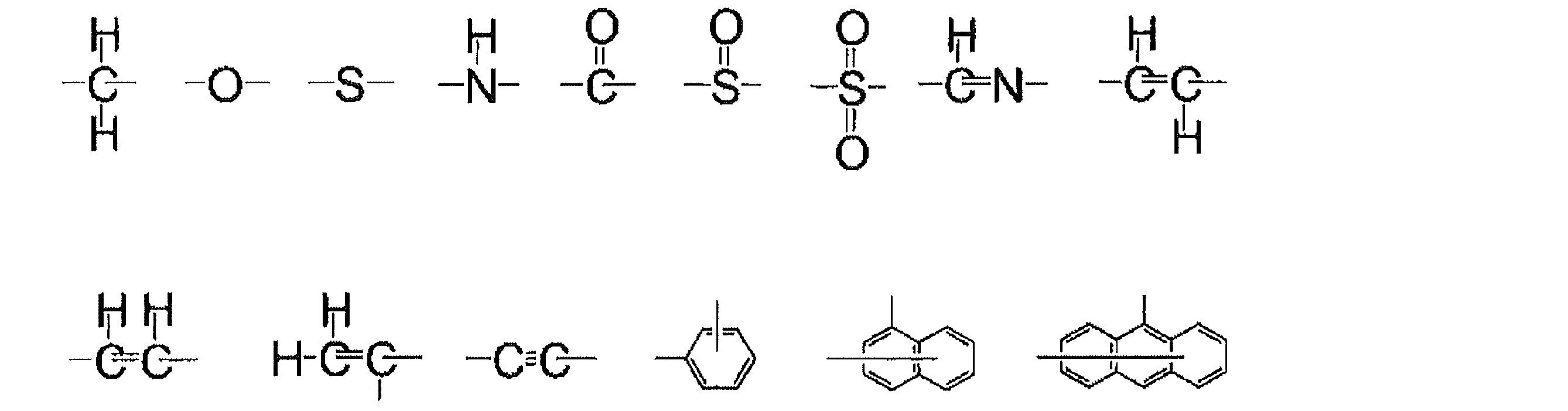
A1が表す酸性基の例には、カルボン酸基、スルホン酸基、モノ硫酸エステル基、リン酸基、モノリン酸エステル基、ホウ酸基が含まれ、カルボン酸基、スルホン酸基、モノ硫酸エステル基、リン酸基、モノリン酸エステル基がより好ましく、カルボン酸基、スルホン酸基、リン酸基が特に好ましい。
A1が表す塩基性窒素原子を有する基の例には、アミノ基(-NH2)、置換イミノ基(-NHR8、-NR9R10、ここで、R8、R9、およびR10は各々独立に、炭素原子数1~20のアルキル基、炭素原子数6以上のアリール基、炭素原子数7以上のアラルキル基を表す。)、下記式(a1)で表されるグアニジル基、下記式(a2)で表されるアミジニル基などが含まれる。

式(a1)中、R11およびR12は各々独立に、炭素原子数1~20のアルキル基、炭素原子数6以上のアリール基、炭素原子数7以上のアラルキル基を表す。
式(a2)中、R13およびR14は各々独立に、炭素原子数1~20のアルキル基、炭素原子数6以上のアリール基、炭素原子数7以上のアラルキル基を表す。
式(a2)中、R13およびR14は各々独立に、炭素原子数1~20のアルキル基、炭素原子数6以上のアリール基、炭素原子数7以上のアラルキル基を表す。
これらの中でも、アミノ基(-NH2)、置換イミノ基(-NHR8、-NR9R10、ここで、R8、R9、およびR10は各々独立に、炭素原子数1~10のアルキル基、フェニル基、ベンジル基を表す。)、前記式(a1)で表されるグアニジル基〔式(a1)中、R11およびR12は各々独立に、炭素原子数1~10のアルキル基、フェニル基、ベンジル基を表す。〕、前記式(a2)で表されるアミジニル基〔式(a2)中、R13およびR14は各々独立に、炭素原子数1~10のアルキル基、フェニル基、ベンジル基を表す。〕などがより好ましい。
特に、アミノ基(-NH2)、置換イミノ基(-NHR8、-NR9R10、ここで、R8、R9、およびR10は各々独立に、炭素原子数1~5のアルキル基、フェニル基、ベンジル基を表す。)、前記式(a1)で表されるグアニジル基〔式(a1)中、R11およびR12は各々独立に、炭素原子数1~5のアルキル基、フェニル基、ベンジル基を表す。〕、前記式(a2)で表されるアミジニル基〔式(a2)中、R13およびR14は各々独立に、炭素原子数1~5のアルキル基、フェニル基、ベンジル基を表す。〕などが好ましく用いられる。
特に、アミノ基(-NH2)、置換イミノ基(-NHR8、-NR9R10、ここで、R8、R9、およびR10は各々独立に、炭素原子数1~5のアルキル基、フェニル基、ベンジル基を表す。)、前記式(a1)で表されるグアニジル基〔式(a1)中、R11およびR12は各々独立に、炭素原子数1~5のアルキル基、フェニル基、ベンジル基を表す。〕、前記式(a2)で表されるアミジニル基〔式(a2)中、R13およびR14は各々独立に、炭素原子数1~5のアルキル基、フェニル基、ベンジル基を表す。〕などが好ましく用いられる。
A1が表すウレア基の例には、-NR15CONR16R17(ここで、R15、R16、およびR17は各々独立に、水素原子あるいは、炭素原子数1~20のアルキル基、炭素原子数6以上のアリール基、炭素原子数7以上のアラルキル基を表す。)が含まれ、-NR15CONHR17(ここで、R15およびR17は各々独立に、水素原子あるいは、炭素原子数1~10のアルキル基、炭素原子数6以上のアリール基、炭素原子数7以上のアラルキル基を表す。)がより好ましく、-NHCONHR17(ここで、R17は水素原子あるいは、炭素原子数1~10のアルキル基、炭素原子数6以上のアリール基、炭素原子数7以上のアラルキル基を表す。)が特に好ましい。
A1が表すウレタン基の例には、-NHCOOR18、-NR19COOR20、-OCONHR21、-OCONR22R23(ここで、R18、R19、R20、R21、R22およびR23は各々独立に、炭素原子数1~20のアルキル基、炭素原子数6以上のアリール基、炭素原子数7以上のアラルキル基を表す。)などが含まれ、-NHCOOR18、-OCONHR21(ここで、R18、R21は各々独立に、炭素原子数1~20のアルキル基、炭素原子数6以上のアリール基、炭素原子数7以上のアラルキル基を表す。)などがより好ましく、-NHCOOR18、-OCONHR21(ここで、R18、R21は各々独立に、炭素原子数1~10のアルキル基、炭素原子数6以上のアリール基、炭素原子数7以上のアラルキル基を表す。)などが特に好ましい。
A1が表す配位性酸素原子を有する基の例には、アセチルアセトナト基、クラウンエーテルなどが含まれる。
A1が表す炭素原子数4以上の炭化水素基の例には、炭素原子数4以上のアルキル基、炭素原子数6以上のアリール基、炭素原子数7以上のアラルキル基などが含まれ、炭素原子数4~20アルキル基、炭素原子数6~20のアリール基、炭素原子数7~20のアラルキル基などがより好ましく、炭素原子数4~15アルキル基(例えば、オクチル基、ドデシル基など)、炭素原子数6~15のアリール基(例えば、フェニル基、ナフチル基など)、炭素原子数7~15のアラルキル基(例えばベンジル基など)などが特に好ましい。
A1が表すアルコキシシリル基の例には、トリメトキシシリル基、トリエトキシシリル基などが含まれる。
前記吸着部位と結合する有機連結基としては、単結合あるいは、1~100個の炭素原子、0個~10個の窒素原子、0個~50個の酸素原子、1個~200個の水素原子、および0個~20個の硫黄原子から成り立つ有機連結基が好ましく、この有機連結基は、無置換でも置換基を更に有していてもよい。
この有機連結基の具体的な例として、下記の構造単位または該構造単位が組み合わさって構成される基を挙げることができる。
この有機連結基の具体的な例として、下記の構造単位または該構造単位が組み合わさって構成される基を挙げることができる。

前記有機連結基が置換基を有する場合、該置換基としては、例えば、メチル基、エチル基等の炭素原子数1~20のアルキル基、フェニル基、ナフチル基等の炭素原子数6~16のアリール基、水酸基、アミノ基、カルボキシル基、スルホンアミド基、N-スルホニルアミド基、アセトキシ基等の炭素原子数1~6のアシルオキシ基、メトキシ基、エトキシ基等の炭素原子数1~6のアルコキシ基、塩素、臭素等のハロゲン原子、メトキシカルボニル基、エトキシカルボニル基、シクロヘキシルオキシカルボニル基等の炭素原子数2~7のアルコキシカルボニル基、シアノ基、t-ブチルカーボネート等の炭酸エステル基、等が挙げられる。
上記の中では、前記A1は、有機色素残基、複素環残基、酸性基、塩基性窒素原子を有する基、ウレア基、及び炭素原子数4以上の炭化水素基から選択される部位を少なくとも1種含む1価の有機基であることが好ましい。
前記A1としては、下記一般式(3)で表される1価の有機基であることがより好ましい。

前記一般式(3)中、B1は前記吸着部位(即ち、有機色素残基、複素環残基、酸性基、塩基性窒素原子を有する基、ウレア基、ウレタン基、配位性酸素原子を有する基、炭素原子数4以上の炭化水素基、アルコキシシリル基、エポキシ基、イソシアネート基、および水酸基から選択される部位)を表し、R24は単結合あるいは(a+1)価の有機連結基を表す。aは、1~10の整数を表し、a個のB1は同一であっても、異なっていてもよい。
前記B1で表される吸着部位としては、前述の一般式(1)のA1を構成する吸着部位と同様の官能基が挙げられ、好ましい例も同様である。
中でも、有機色素残基、複素環残基、酸性基、塩基性窒素原子を有する基、ウレア基、および炭素原子数4以上の炭化水素基から選択される部位が好ましい。
中でも、有機色素残基、複素環残基、酸性基、塩基性窒素原子を有する基、ウレア基、および炭素原子数4以上の炭化水素基から選択される部位が好ましい。
R24は、単結合または(a+1)価の有機連結基を表し、aは1~10を表す。好ましくは、aは1~7であり、より好ましくは、aは1~5であり、特に好ましくは、aは1~3である。
(a+1)価の有機連結基としては、1~100個の炭素原子、0個~10個の窒素原子、0個~50個の酸素原子、1個~200個の水素原子、および0個~20個の硫黄原子から成り立つ基が含まれ、無置換でも置換基を更に有していてもよい。
(a+1)価の有機連結基としては、1~100個の炭素原子、0個~10個の窒素原子、0個~50個の酸素原子、1個~200個の水素原子、および0個~20個の硫黄原子から成り立つ基が含まれ、無置換でも置換基を更に有していてもよい。
前記(a+1)価の有機連結基は、具体的な例として、下記の構造単位または該構造単位が組み合わさって構成される基(環構造を形成していてもよい)を挙げることができる。

R24としては、単結合、または、1~50個の炭素原子、0個~8個の窒素原子、0個~25個の酸素原子、1個~100個の水素原子、および0個~10個の硫黄原子から成り立つ(a+1)価の有機連結基が好ましく、単結合、または、1~30個の炭素原子、0個~6個の窒素原子、0個~15個の酸素原子、1個~50個の水素原子、および0個~7個の硫黄原子から成り立つ(a+1)価の有機連結基がより好ましく、単結合、または、1~10個の炭素原子、0個~5個の窒素原子、0個~10個の酸素原子、1個~30個の水素原子、および0個~5個の硫黄原子から成り立つ(a+1)価の有機連結基が特に好ましい。
上記のうち、(a+1)価の有機連結基が置換基を有する場合、該置換基としては、例えば、メチル基、エチル基等の炭素原子数1~20のアルキル基、フェニル基、ナフチル基等の炭素原子数6~16のアリール基、水酸基、アミノ基、カルボキシル基、スルホンアミド基、N-スルホニルアミド基、アセトキシ基等の炭素原子数1~6のアシルオキシ基、メトキシ基、エトキシ基等の炭素原子数1~6のアルコキシ基、塩素、臭素等のハロゲン原子、メトキシカルボニル基、エトキシカルボニル基、シクロヘキシルオキシカルボニル基等の炭素原子数2~7のアルコキシカルボニル基、シアノ基、t-ブチルカーボネート等の炭酸エステル基、等が挙げられる。
前記一般式(1)で表される第1高分子中のA1が酸性基であり、後述する第2高分子の帯電性基が塩基性基の組み合わせ、又は、前記一般式(1)で表される第1高分子中のA1が塩基性基であり、後述する第2高分子の帯電性基が酸性基の組み合わせが特に好ましい。
前記一般式(1)中、R2はそれぞれ、単結合又は2価の有機連結基を表す。n個のR2は、互いに同一であっても、異なっていてもよい。
2価の有機連結基としては、1~100個の炭素原子、0個~10個の窒素原子、0個~50個の酸素原子、1個~200個の水素原子、および0個~20個の硫黄原子から成り立つ基が含まれ、無置換でも置換基を更に有していてもよい。
2価の有機連結基としては、1~100個の炭素原子、0個~10個の窒素原子、0個~50個の酸素原子、1個~200個の水素原子、および0個~20個の硫黄原子から成り立つ基が含まれ、無置換でも置換基を更に有していてもよい。
前記2価の有機連結基は、具体的な例として、下記の構造単位群Gから選ばれる構造単位または該構造単位が組み合わさって構成される基を挙げることができる。
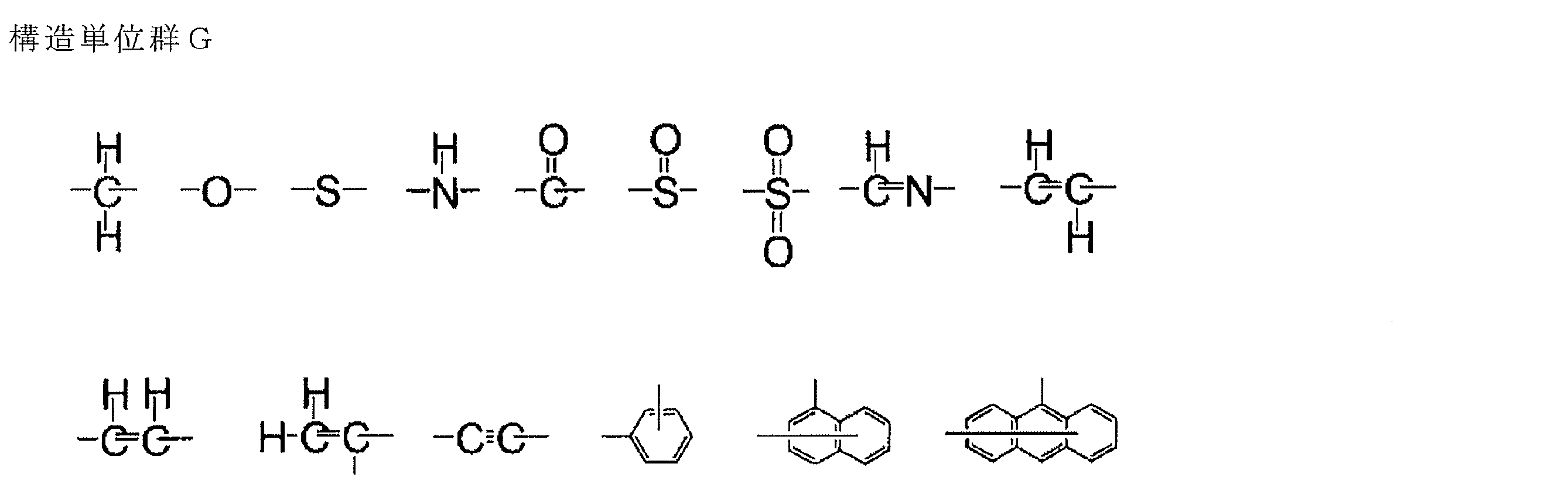
R2としては、単結合、あるいは、1~50個の炭素原子、0個~8個の窒素原子、0個~25個の酸素原子、1個~100個の水素原子、および0個~10個の硫黄原子から成り立つ2価の有機連結基が好ましく、単結合、あるいは、1~30個の炭素原子、0個~6個の窒素原子、0個~15個の酸素原子、1個~50個の水素原子、および0個~7個の硫黄原子から成り立つ2価の有機連結基がより好ましく、単結合、あるいは、1~10個の炭素原子、0個~5個の窒素原子、0個~10個の酸素原子、1個~30個の水素原子、および0個~5個の硫黄原子から成り立つ2価の有機連結基が特に好ましい。
即ち、前記式(1)で表される第1高分子の好ましい例には、下記一般式(1’)で表される高分子化合物が含まれる。
(A1-R4-S)n-R1-(R3-P1)m (1’)
式中、A1、R1、R3、P1、n及びmはそれぞれ一般式(1)中のそれぞれと同義であり、好ましい範囲も同様である。Sは硫黄原子を表わし、R4は単結合あるいは2価の有機連結基を表す。n個のR4は同一であっても、異なっていてもよい。R4で表される2価の有機連結基としては、前記一般式(1)中のR2で表される2価の有機連結基として挙げられたものと同一のものが用いられ、好ましい態様も同様である。
(A1-R4-S)n-R1-(R3-P1)m (1’)
式中、A1、R1、R3、P1、n及びmはそれぞれ一般式(1)中のそれぞれと同義であり、好ましい範囲も同様である。Sは硫黄原子を表わし、R4は単結合あるいは2価の有機連結基を表す。n個のR4は同一であっても、異なっていてもよい。R4で表される2価の有機連結基としては、前記一般式(1)中のR2で表される2価の有機連結基として挙げられたものと同一のものが用いられ、好ましい態様も同様である。
R4は、単結合、又は、上記構造単位群Gから選ばれる構造単位または該構造単位が組み合わさって構成される、「1~10個の炭素原子、0個~5個の窒素原子、0個~10個の酸素原子、1個~30個の水素原子、および0個~5個の硫黄原子」から成り立つ2価の有機連結基(置換基を有していてもよく、該置換基としては、例えば、メチル基、エチル基等の炭素原子数1~20のアルキル基、フェニル基、ナフチル基等の炭素原子数6~16のアリール基、水酸基、アミノ基、カルボキシル基、スルホンアミド基、N-スルホニルアミド基、アセトキシ基等の炭素原子数1~6のアシルオキシ基、メトキシ基、エトキシ基等の炭素原子数1~6のアルコキシ基、塩素、臭素等のハロゲン原子、メトキシカルボニル基、エトキシカルボニル基、シクロヘキシルオキシカルボニル基等の炭素原子数2~7のアルコキシカルボニル基、シアノ基、t-ブチルカーボネート等の炭酸エステル基、等が挙げられる。)であるのが好ましい。
前記一般式(1)及び(1’)中、R1は、(m+n)価の有機連結基を表す。m+nは3~10を満たす。
前記R1で表される(m+n)価の有機連結基としては、1~100個の炭素原子、0個~10個の窒素原子、0個~50個の酸素原子、1個~200個の水素原子、および0個~20個の硫黄原子から成り立つ基が含まれ、無置換でも置換基を更に有していてもよい。
前記R1で表される(m+n)価の有機連結基としては、1~100個の炭素原子、0個~10個の窒素原子、0個~50個の酸素原子、1個~200個の水素原子、および0個~20個の硫黄原子から成り立つ基が含まれ、無置換でも置換基を更に有していてもよい。
前記(m+n)価の有機連結基は、具体的な例として、下記の構造単位または該構造単位が組み合わさって構成される基(環構造を形成していてもよい)を挙げることができる。
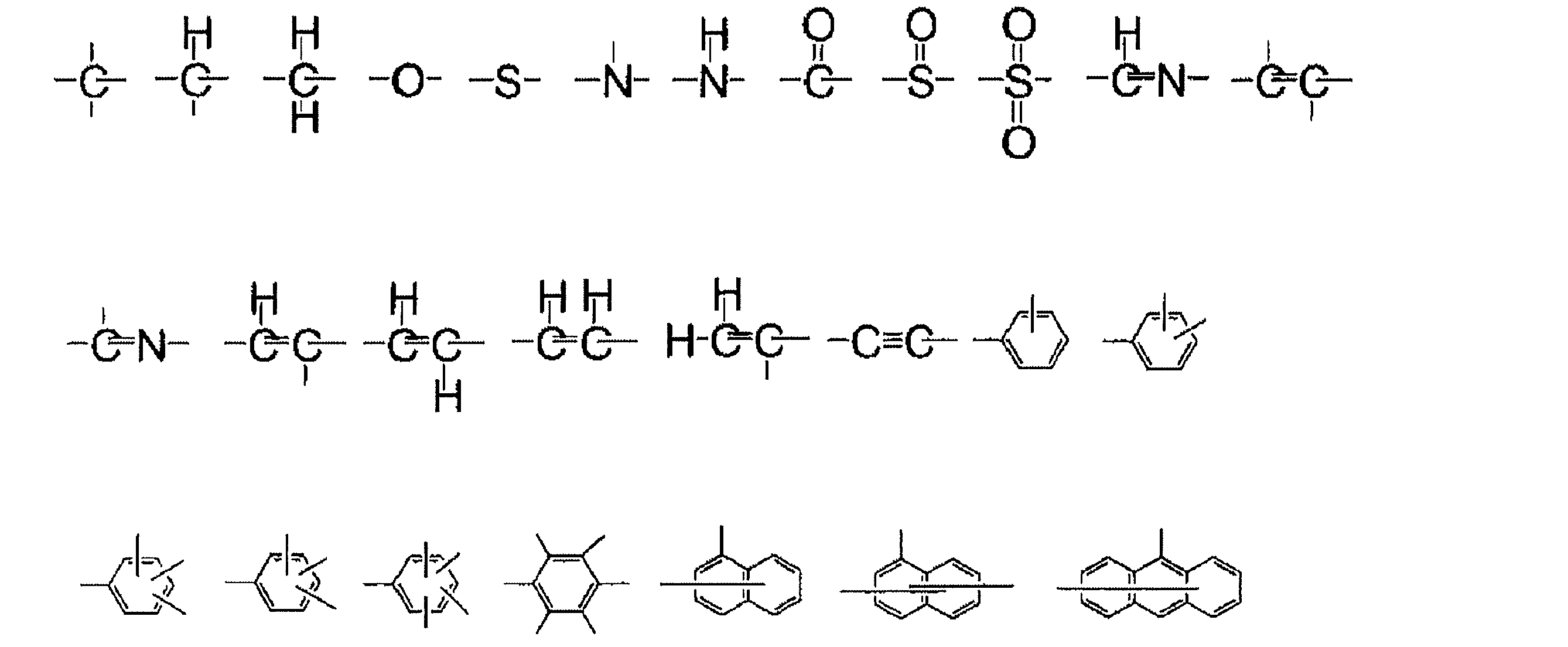
(m+n)価の有機連結基としては、1~60個の炭素原子、0個~10個の窒素原子、0個~40個の酸素原子、1個~120個の水素原子、および0個~10個の硫黄原子から成り立つ基が好ましく、1~50個の炭素原子、0個~10個の窒素原子、0個~30個の酸素原子、1個~100個の水素原子、および0個~7個の硫黄原子から成り立つ基がより好ましく、1~40個の炭素原子、0個~8個の窒素原子、0個~20個の酸素原子、1個~80個の水素原子、および0個~5個の硫黄原子から成り立つ基が特に好ましい。
上記のうち、(m+n)価の有機連結基が置換基を有する場合、該置換基としては、例えば、メチル基、エチル基等の炭素原子数1~20のアルキル基、フェニル基、ナフチル基等の炭素原子数6~16のアリール基、水酸基、アミノ基、カルボキシル基、スルホンアミド基、N-スルホニルアミド基、アセトキシ基等の炭素原子数1~6のアシルオキシ基、メトキシ基、エトキシ基等の炭素原子数1~6のアルコキシ基、塩素、臭素等のハロゲン原子、メトキシカルボニル基、エトキシカルボニル基、シクロヘキシルオキシカルボニル基等の炭素原子数2~7のアルコキシカルボニル基、シアノ基、t-ブチルカーボネート等の炭酸エステル基、等が挙げられる。
前記R1で表される(m+n)価の有機連結基の具体的な例〔具体例(1)~(17)〕を以下に示す。但し、本発明においては、これらに制限されるものではない。

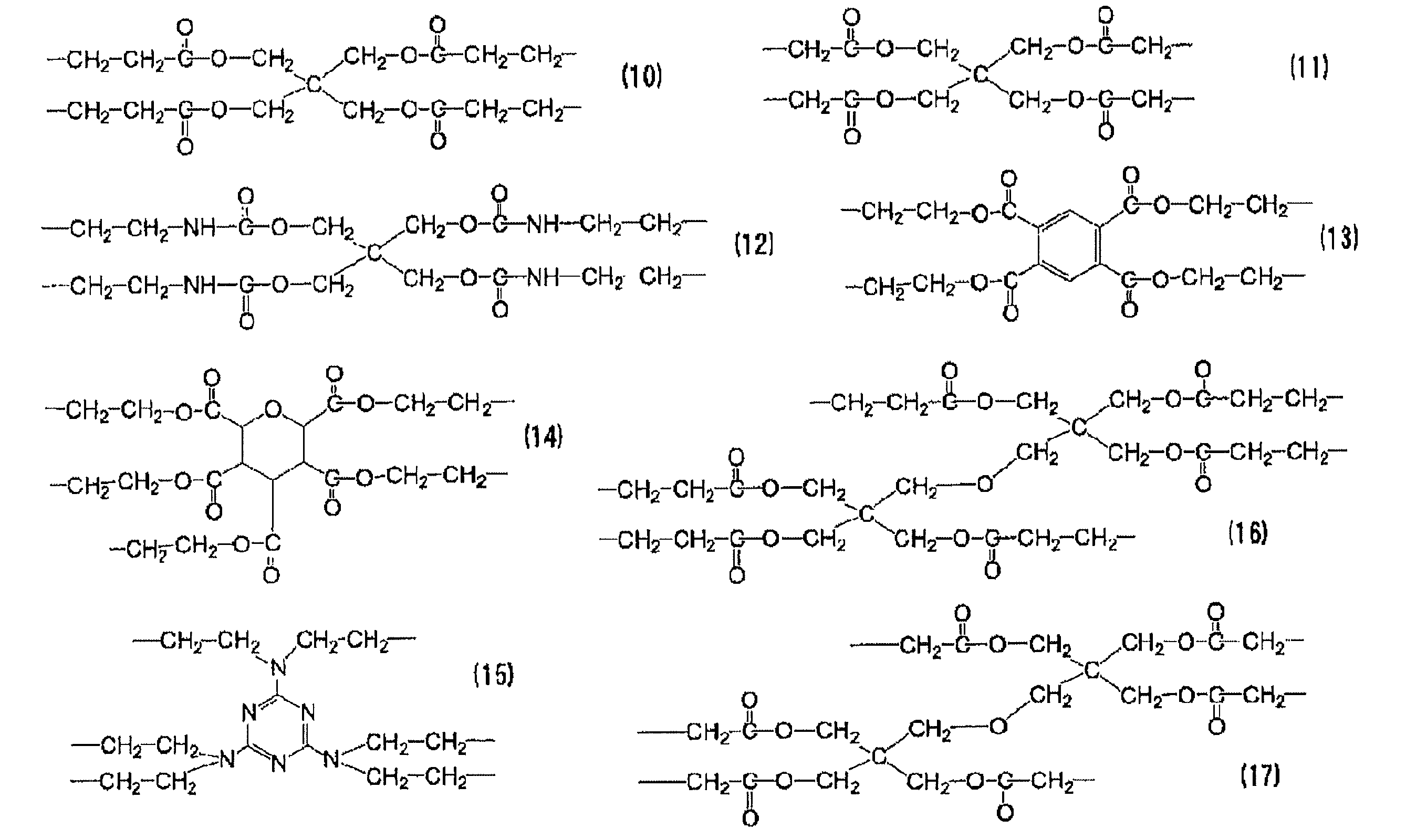
上記の具体例の中でも、原料の入手性、合成の容易さ、各種溶媒への溶解性の観点から、最も好ましい(m+n)価の有機連結基は下記の基である。
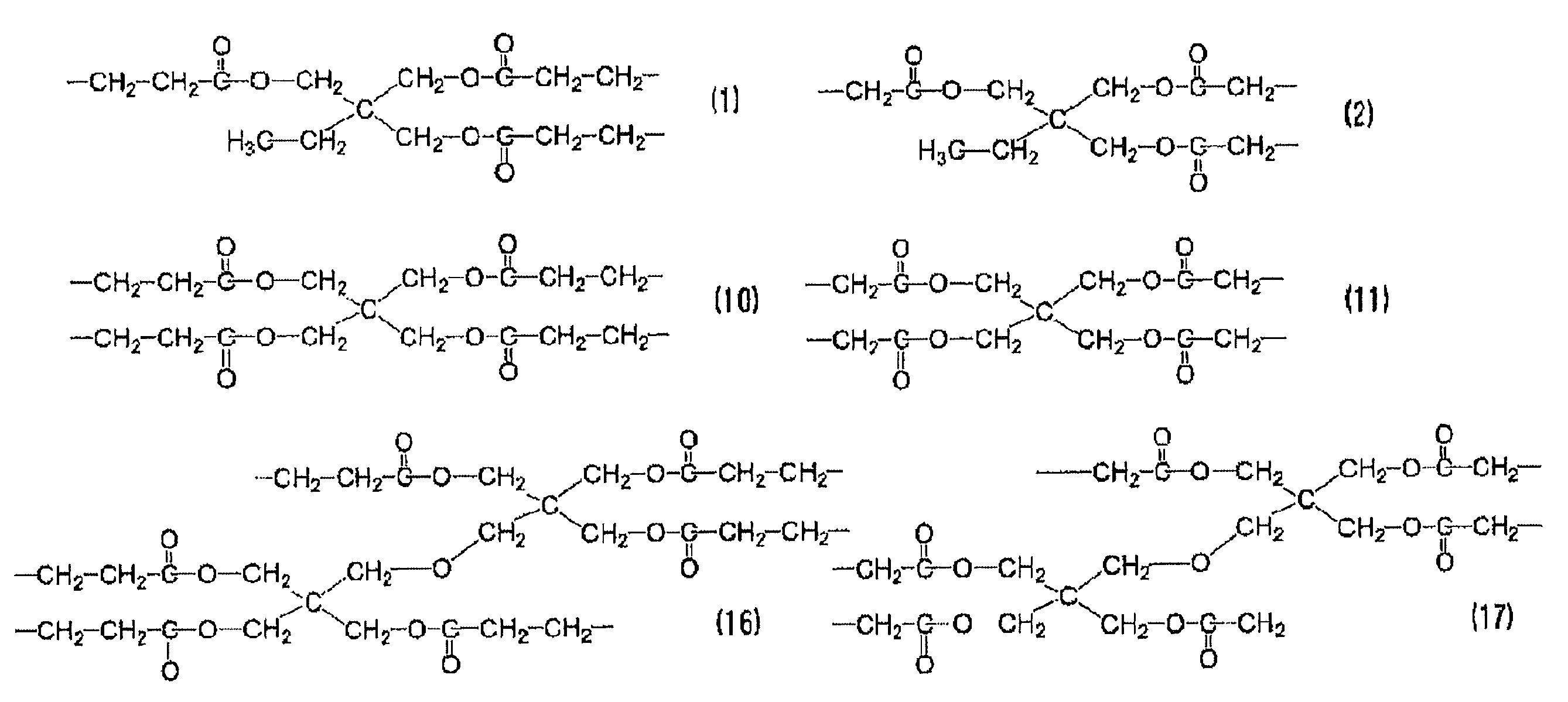
前記一般式(1)及び(1’)中、mは1~8を表す。mとしては、1~5が好ましく、1~4がより好ましく、1~3が特に好ましい。
また、前記一般式(1)及び(1’)中、nは2~9を表す。nとしては、2~8が好ましく、2~7がより好ましく、3~6が特に好ましい。
また、前記一般式(1)及び(1’)中、nは2~9を表す。nとしては、2~8が好ましく、2~7がより好ましく、3~6が特に好ましい。
前記一般式(1)及び(1’)中、R3はそれぞれ、単結合又は2価の連結基を表し、m個のR3はそれぞれ、互いに同一であっても、異なっていてもよい。R3が表す2価の連結基の例には、R2が表す2価の連結基の例が含まれる。R3は単結合又は-S-であるのが好ましい。
前記一般式(1)及び(1’)中、P1はSi原子を含む高分子骨格を表し、目的等に応じて種々の高分子骨格から選択することができる。m個のP1は、互いに同一であっても、異なっていてもよい。P1は少なくとも1つの構成単位を含む。2以上の構成単位を含んでいてもよく、その場合は、少なくとも一つは、Si原子を有する構成単位である。
P1は、Si原子を有する構成単位を少なくとも1つ有する。該構成単位は、シリコーン系モノマーから誘導される構成単位であるのが好ましく、前記シリコーン系モノマーは、シリコーン系マクロマーであってもよい。なお、本明細書中、「マクロマー(マクロモノマーともいう)」は、重合性官能基を持ったオリゴマー(重合度2以上300以下程度)あるいはポリマーの総称であり、高分子と単量体(モノマー)との両方の性質を有するものである。前記構成単位は、重量平均分子量が1,000~50,000(より好ましくは1,000~10,000であり、さらに好ましくは1,000~5,000)であるシリコーン系マクロマーから誘導される構成単位であるのが好ましい。
P1は、ビニルモノマーの重合体もしくは共重合体、エステル系ポリマー、エーテル系ポリマー、ウレタン系ポリマー、アミド系ポリマー、エポキシ系ポリマー、シリコーン系ポリマー、およびこれらの変性物、または共重合体〔例えば、ポリエーテル/ポリウレタン共重合体、ポリエーテル/ビニルモノマーの重合体の共重合体など(ランダム共重合体、ブロック共重合体、グラフト共重合体のいずれであってもよい。)を含む。〕からなる群より選択される少なくとも一種の高分子骨格を有するのが好ましく、ビニルモノマーの重合体もしくは共重合体、エステル系ポリマー、エーテル系ポリマー、ウレタン系ポリマー、およびこれらの変性物または共重合体からなる群より選択される少なくとも一種の高分子骨格を有するのがより好ましく、ビニルモノマーの重合体もしくは共重合体の高分子骨格であるのが特に好ましい。
更には、前記ポリマーは有機溶媒に可溶であることが好ましい。有機溶媒との親和性が低いと、例えば、分散剤として使用した場合、分散媒との親和性が弱まり、分散安定化に十分な吸着層を確保できなくなることがある。
P1は、下記一般式(2)で表される高分子骨格であるのが好ましい。
-(P2)x-(P3)y-(P4)z (2)
式中、P2はシリコーン系マクロマーから誘導される構成単位を表わし;P3はシリコーンを含まず、且つイオン解離性基を有しない構成単位を表わし;P4はシリコーンを含まず、且つイオン解離性基を有する構成単位を表し;x、y及びzは各々の成分のモル分率をそれぞれ表し、x+y+z=100であり、但し、y及びzはそれぞれ0であってもよいが、同時に0になることはない。
-(P2)x-(P3)y-(P4)z (2)
式中、P2はシリコーン系マクロマーから誘導される構成単位を表わし;P3はシリコーンを含まず、且つイオン解離性基を有しない構成単位を表わし;P4はシリコーンを含まず、且つイオン解離性基を有する構成単位を表し;x、y及びzは各々の成分のモル分率をそれぞれ表し、x+y+z=100であり、但し、y及びzはそれぞれ0であってもよいが、同時に0になることはない。
P2を誘導するシリコーン系マクロマーの例には、片末端にエポキシ基を持つシリコーン化合物が含まれ、具体的には、下記構造式1で示されるシリコーン化合物が含まれる。当該片末端にエポキシ基を持つシリコーン化合物が含まれる。より具体的には、信越シリコーン社製:X-22-173DX等の市販品が挙げられる。

構造式1中、R1’は、水素原子又は炭素原子数1~4のアルキル基を表わし、nは自然数(例えば1以上1000以下、望ましくは3以上100以下)を示し、xは1以上3以下の整数を示す。
P2を誘導するシリコーン系マクロマーの例には、片末端に(メタ)アクリレート基を持ったジメチルシリコーンモノマーが含まれ、具体的には、下記構造式2で示されるシリコーン化合物が含まれる。より具体的には、チッソ社製:サイラプレーン:FM-0711、FM-0721、FM-0725等、信越シリコーン(株):X-22-174DX、X-22-2426、X-22-2475等)等の市販品が挙げられる。

構造式2中、R1は、水素原子又はメチル基を表わし;R1’は、水素原子又は炭素原子数1~4のアルキル基を表わし;nは自然数(例えば1以上1000以下、望ましくは3以上100以下)を示し;xは1以上3以下の整数を示す。
また、P2を誘導するシリコーン系マクロマーの例には、下記一般式(I)及び(II)で示される単量体も含まれる。
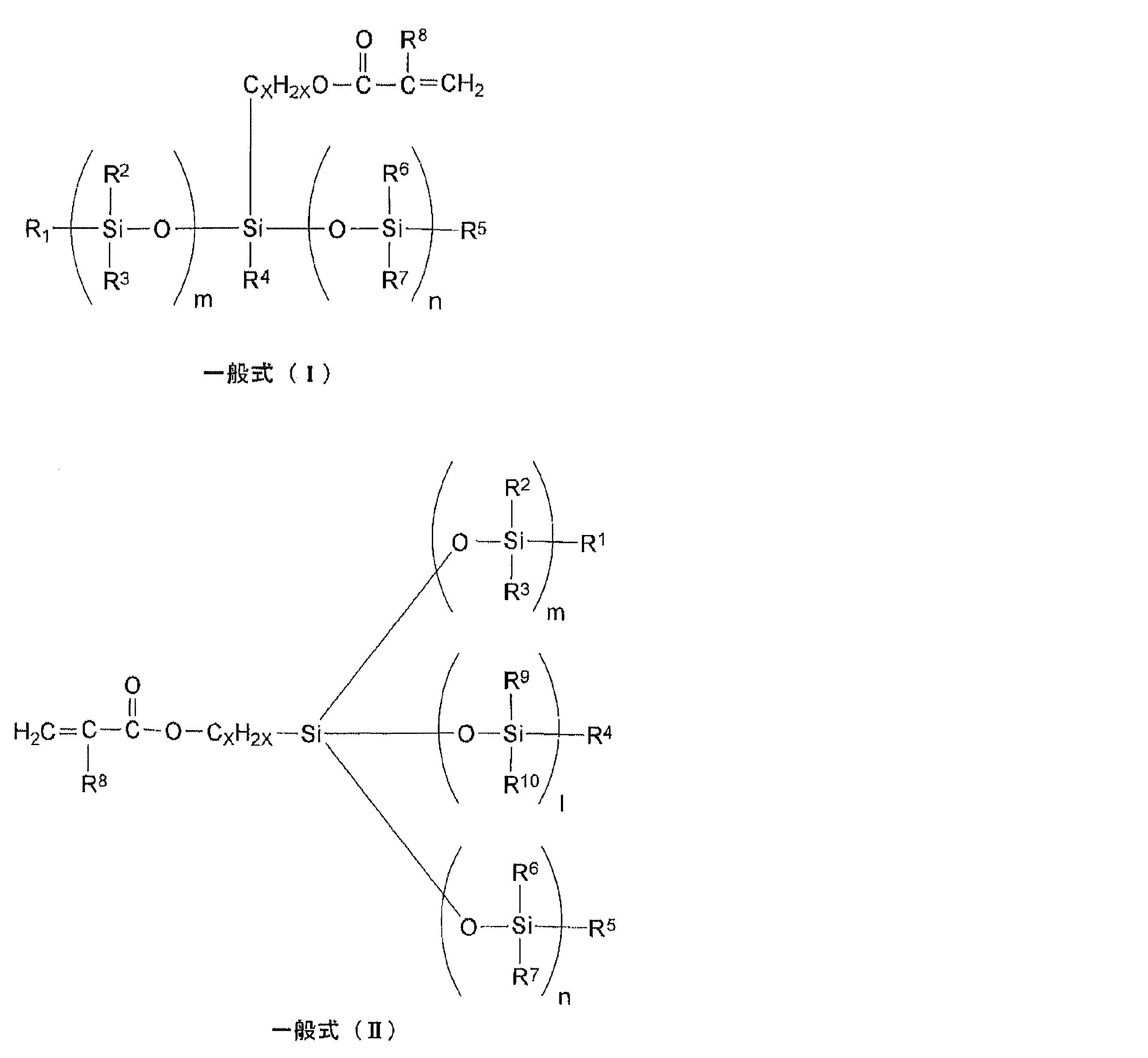
一般式(I)及び(II)中、R1、R2、R3、R4、R5、R6、R7、R9及びR10は、各々独立に水素原子、炭素原子数1~4のアルキル基、又は炭素原子数1~4のフルオロアルキル基を表す。
R8は、水素原子又はメチル基を表す。
n、l、及びmは、各々独立に1以上1000以下の整数を示す。
xは、1以上3以下の整数を表す。
R8は、水素原子又はメチル基を表す。
n、l、及びmは、各々独立に1以上1000以下の整数を示す。
xは、1以上3以下の整数を表す。
一般式(I)中、望ましくは、R1及びR5は、ブチル基を表し、R2、R3、R4、R6、及びR7はメチル基を表し、R8はメチル基を表し、n及びmは、各々独立に1以上5以下の整数を表し、xは1以上3以下の整数を表す。
一方、一般式(II)中、望ましくは、R1、R2、R3、R4、R5、R6、R7、R9及びR10は、メチル基を表し、R8は、メチル基を表し、n、l、及びmは各々独立に1以上3以下の整数を表し、xは1以上3以下の整数を表す。
以下、一般式(I)及び(II)で示される単量体の具体例を示すが、これに限られるものではない。

P1で表される高分子骨格を構成するシリコーン系高分子中、シリコーン鎖成分が、高分子全体に対して占める質量比で3%以上60%以下、望ましくは5%以上40%以下であることが望ましい。
P1で表される高分子骨格を構成するシリコーン系高分子の重量平均分子量としては、500以上100万以下が望ましく、より望ましくは500以上10万以下、特に好ましくは500以上1万以下である。
一般式(2)中、P3はシリコーンを含まず、且つイオン解離性基を有しない構成単位を表す。なお、本明細書では、イオン解離性基の用語は、酸性基及び塩基性基、並びにこれらの塩に対して用いられる。
P3を誘導するモノマーの例には、ビニルモノマーが含まれる。前記ビニルモノマーとしては、特に制限されないが、例えば、(メタ)アクリル酸エステル類、クロトン酸エステル類、ビニルエステル類、マレイン酸ジエステル類、フマル酸ジエステル類、イタコン酸ジエステル類、(メタ)アクリルアミド類、スチレン類、ビニルエーテル類、ビニルケトン類、オレフィン類、マレイミド類、(メタ)アクリロニトリル、などが好ましい。以下、これらのビニルモノマーの好ましい例について説明する。
(メタ)アクリル酸エステル類の例としては、(メタ)アクリル酸メチル、(メタ)アクリル酸エチル、(メタ)アクリル酸n-プロピル、(メタ)アクリル酸イソプロピル、(メタ)アクリル酸n-ブチル、(メタ)アクリル酸イソブチル、(メタ)アクリル酸t-ブチル、(メタ)アクリル酸アミル、(メタ)アクリル酸n-ヘキシル、(メタ)アクリル酸シクロヘキシル、(メタ)アクリル酸t-ブチルシクロヘキシル、(メタ)アクリル酸2-エチルヘキシル、(メタ)アクリル酸t-オクチル、(メタ)アクリル酸ドデシル、(メタ)アクリル酸オクタデシル、(メタ)アクリル酸アセトキシエチル、(メタ)アクリル酸フェニル、(メタ)アクリル酸2-ヒドロキシエチル、(メタ)アクリル酸―2-ヒドロキシプロピル、(メタ)アクリル酸―3-ヒドロキシプロピル、(メタ)アクリル酸―4-ヒドロキシブチル、(メタ)アクリル酸2-メトキシエチル、(メタ)アクリル酸2-エトキシエチル、(メタ)アクリル酸2-(2-メトキシエトキシ)エチル、(メタ)アクリル酸3-フェノキシ-2-ヒドロキシプロピル、(メタ)アクリル酸-2-クロロエチル、(メタ)アクリル酸グリシジル、(メタ)アクリル酸-3,4-エポキシシクロヘキシルメチル、(メタ)アクリル酸ビニル、(メタ)アクリル酸―2-フェニルビニル、(メタ)アクリル酸―1-プロペニル、(メタ)アクリル酸アリル、(メタ)アクリル酸―2-アリロキシエチル、(メタ)アクリル酸プロパルギル、(メタ)アクリル酸ベンジル、(メタ)アクリル酸ジエチレングリコールモノメチルエーテル、(メタ)アクリル酸ジエチレングリコールモノエチルエーテル、(メタ)アクリル酸トリエチレングリコールモノメチルエーテル、(メタ)アクリル酸トリエチレングリコールモノエチルエーテル、(メタ)アクリル酸ポリエチレングリコールモノメチルエーテル、(メタ)アクリル酸ポリエチレングリコールモノエチルエーテル、(メタ)アクリル酸β-フェノキシエトキシエチル、(メタ)アクリル酸ノニルフェノキシポリエチレングリコール、(メタ)アクリル酸ジシクロペンテニル、(メタ)アクリル酸ジシクロペンテニルオキシエチル、(メタ)アクリル酸トリフロロエチル、(メタ)アクリル酸オクタフロロペンチル、(メタ)アクリル酸パーフロロオクチルエチル、(メタ)アクリル酸ジシクロペンタニル、(メタ)アクリル酸トリブロモフェニル、(メタ)アクリル酸トリブロモフェニルオキシエチル、(メタ)アクリル酸-γ-ブチロラクトンなどが挙げられる。
特に下記一般式(III)で表わされる単量体、

[式中、R2は水素原子またはメチル基を表わし、R3は水素原子または炭素原子数1~4のアルキル基を表わし、好ましくはメチル基である。好ましい置換基の組み合わせはR2、R3がメチル基の場合である。xは1~3の整数を表わし、好ましくは2であり、yは25以下の自然数を表わし、好ましくは1~20、より好ましくは2~10である。]は、オキシアルキレン基の繰り返し単位が25以下の(ポリ)アルキレングリコール鎖を有し、該単量体を構成要素に有する共重合体は、溶媒に不溶な粒子に吸着し、(ポリ)アルキレングリコール鎖により発現する立体効果により、粒子の分散が安定するため、特に好ましい。
クロトン酸エステル類の例としては、クロトン酸ブチル、およびクロトン酸ヘキシル等が挙げられる。
ビニルエステル類の例としては、ビニルアセテート、ビニルクロロアセテート、ビニルプロピオネート、ビニルブチレート、ビニルメトキシアセテート、および安息香酸ビニルなどが挙げられる。
マレイン酸ジエステル類の例としては、マレイン酸ジメチル、マレイン酸ジエチル、およびマレイン酸ジブチルなどが挙げられる。
フマル酸ジエステル類の例としては、フマル酸ジメチル、フマル酸ジエチル、およびフマル酸ジブチルなどが挙げられる。
イタコン酸ジエステル類の例としては、イタコン酸ジメチル、イタコン酸ジエチル、およびイタコン酸ジブチルなどが挙げられる。
ビニルエステル類の例としては、ビニルアセテート、ビニルクロロアセテート、ビニルプロピオネート、ビニルブチレート、ビニルメトキシアセテート、および安息香酸ビニルなどが挙げられる。
マレイン酸ジエステル類の例としては、マレイン酸ジメチル、マレイン酸ジエチル、およびマレイン酸ジブチルなどが挙げられる。
フマル酸ジエステル類の例としては、フマル酸ジメチル、フマル酸ジエチル、およびフマル酸ジブチルなどが挙げられる。
イタコン酸ジエステル類の例としては、イタコン酸ジメチル、イタコン酸ジエチル、およびイタコン酸ジブチルなどが挙げられる。
(メタ)アクリルアミド類としては、(メタ)アクリルアミド、N-メチル(メタ)アクリルアミド、N-エチル(メタ)アクリルアミド、N-プロピル(メタ)アクリルアミド、N-イソプロピル(メタ)アクリルアミド、N-n-ブチルアクリル(メタ)アミド、N-t-ブチル(メタ)アクリルアミド、N-シクロヘキシル(メタ)アクリルアミド、N-(2-メトキシエチル)(メタ)アクリルアミド、N,N-ジメチル(メタ)アクリルアミド、N,N-ジエチル(メタ)アクリルアミド、N-フェニル(メタ)アクリルアミド、N-ニトロフェニルアクリルアミド、N-エチル-N-フェニルアクリルアミド、N-ベンジル(メタ)アクリルアミド、(メタ)アクリロイルモルホリン、ジアセトンアクリルアミド、N-メチロールアクリルアミド、N-ヒドロキシエチルアクリルアミド、ビニル(メタ)アクリルアミド、N,N-ジアリル(メタ)アクリルアミド、N-アリル(メタ)アクリルアミドなどが挙げられる。
スチレン類の例としては、スチレン、メチルスチレン、ジメチルスチレン、トリメチルスチレン、エチルスチレン、イソプロピルスチレン、ブチルスチレン、ヒドロキシスチレン、メトキシスチレン、ブトキシスチレン、アセトキシスチレン、クロロスチレン、ジクロロスチレン、ブロモスチレン、クロロメチルスチレン、酸性物質により脱保護可能な基(例えばt-Bocなど)で保護されたヒドロキシスチレン、ビニル安息香酸メチル、およびα-メチルスチレンなどが挙げられる。
ビニルエーテル類の例としては、メチルビニルエーテル、エチルビニルエーテル、2-クロロエチルビニルエーテル、ヒドロキシエチルビニルエーテル、プロピルビニルエーテル、ブチルビニルエーテル、ヘキシルビニルエーテル、オクチルビニルエーテル、メトキシエチルビニルエーテルおよびフェニルビニルエーテルなどが挙げられる。
ビニルケトン類の例としては、メチルビニルケトン、エチルビニルケトン、プロピルビニルケトン、フェニルビニルケトンなどが挙げられる。
オレフィン類の例としては、エチレン、プロピレン、イソブチレン、ブタジエン、イソプレンなどが挙げられる。
マレイミド類の例としては、マレイミド、ブチルマレイミド、シクロヘキシルマレイミド、フェニルマレイミドなどが挙げられる。
ビニルケトン類の例としては、メチルビニルケトン、エチルビニルケトン、プロピルビニルケトン、フェニルビニルケトンなどが挙げられる。
オレフィン類の例としては、エチレン、プロピレン、イソブチレン、ブタジエン、イソプレンなどが挙げられる。
マレイミド類の例としては、マレイミド、ブチルマレイミド、シクロヘキシルマレイミド、フェニルマレイミドなどが挙げられる。
(メタ)アクリロニトリル、ビニル基が置換した複素環式基(例えば、ビニルピリジン、N-ビニルピロリドン、ビニルカルバゾールなど)、N-ビニルホルムアミド、N-ビニルアセトアミド、N-ビニルイミダゾール、ビニルカプロラクトン等も使用できる。
上記の化合物以外にも、例えば、ウレタン基、ウレア基、スルホンアミド基、フェノール基、イミド基などの官能基を有するビニルモノマーも用いることができる。このようなウレタン基、またはウレア基を有する単量体としては、例えば、イソシアナート基と水酸基、またはアミノ基の付加反応を利用して、適宜合成することが可能である。具体的には、イソシアナート基含有モノマーと水酸基を1個含有する化合物または1級あるいは2級アミノ基を1個含有する化合物との付加反応、または水酸基含有モノマーまたは1級あるいは2級アミノ基含有モノマーとモノイソシアネートとの付加反応等により適宜合成することができる。
一般式(2)中、P4はシリコーンを含まず、且つイオン解離性基を有する構成単位を表す。
P4を誘導するモノマーの例には、ビニルモノマーが含まれる。前記ビニルモノマーとしては、イオン解離性基として、酸性基又はその塩を有するビニルモノマーが好ましい。以下、これらのビニルモノマーの好ましい例について説明する。
前記酸性基を有するビニルモノマーの例としては、カルボキシル基を有するビニルモノマーやスルホン酸基を有するビニルモノマーが挙げられる。
カルボキシル基を有するビニルモノマーとして、(メタ)アクリル酸、ビニル安息香酸、マレイン酸、マレイン酸モノアルキルエステル、フマル酸、イタコン酸、クロトン酸、桂皮酸、アクリル酸ダイマーなどが挙げられる。また、2-ヒドロキシエチル(メタ)アクリレートなどの水酸基を有する単量体と無水マレイン酸や無水フタル酸、シクロヘキサンジカルボン酸無水物のような環状無水物との付加反応物、ω-カルボキシ-ポリカプロラクトンモノ(メタ)アクリレートなども利用できる。また、カルボキシル基の前駆体として無水マレイン酸、無水イタコン酸、無水シトラコン酸などの無水物含有モノマーを用いてもよい。なおこれらの内では、共重合性やコスト、溶解性などの観点から(メタ)アクリル酸が特に好ましい。
カルボキシル基を有するビニルモノマーとして、(メタ)アクリル酸、ビニル安息香酸、マレイン酸、マレイン酸モノアルキルエステル、フマル酸、イタコン酸、クロトン酸、桂皮酸、アクリル酸ダイマーなどが挙げられる。また、2-ヒドロキシエチル(メタ)アクリレートなどの水酸基を有する単量体と無水マレイン酸や無水フタル酸、シクロヘキサンジカルボン酸無水物のような環状無水物との付加反応物、ω-カルボキシ-ポリカプロラクトンモノ(メタ)アクリレートなども利用できる。また、カルボキシル基の前駆体として無水マレイン酸、無水イタコン酸、無水シトラコン酸などの無水物含有モノマーを用いてもよい。なおこれらの内では、共重合性やコスト、溶解性などの観点から(メタ)アクリル酸が特に好ましい。
また、スルホン酸基を有するビニルモノマーとして、2-アクリルアミド-2-メチルプロパンスルホン酸などが挙げられ、リン酸基を有するビニルモノマーとして、リン酸モノ(2-アクリロイルオキシエチルエステル)、リン酸モノ(1-メチル-2-アクリロイルオキシエチルエステル)などが挙げられる。
更に、酸性基を有するビニルモノマーとして、フェノール性ヒドロキシル基を含有するビニルモノマーやスルホンアミド基を含有するビニルモノマーなども利用することができる。
前記一般式(2)において、x、y及びzは各々の成分のモル分率をそれぞれ表し、x+y+z=100であり、但し、y及びzはそれぞれ0であってもよいが、同時に0になることはない。xは0を超えて30以下、yは0~30、及びzは0~80であるのが好ましく、xは10~30、yは10~30、zは40~80の範囲であることが特に好ましい.
前記第1高分子の重量平均分子量は、例えば1万以上100万以下が望ましく、より望ましくは5万以上30万以下である。
第1高分子の好ましい例には、下記一般式(4)で表される高分子化合物が含まれる。
(A1-R4-S)n-R1-(S-P1)m (4)
前記一般式(4)中のA1、R1、P1、m及びnは、一般式(1)中のそれぞれと同義であり、好ましい範囲も同様である。R4は単結合あるいは2価の有機連結基を表す。n個のR4は同一であっても、異なっていてもよい。R4で表される2価の有機連結基としては、前記一般式(1)のR2で表される2価の有機連結基として挙げられたものと同一のものが用いられ、好ましい態様も同様である。上記式(4)の化合物は、(A1-R4-S)n-R1-(SH)mを連鎖移動剤として、P1を構成する2以上のモノマーを共重合することで容易に製造可能である。合成方法の詳細は後述する。
(A1-R4-S)n-R1-(S-P1)m (4)
前記一般式(4)中のA1、R1、P1、m及びnは、一般式(1)中のそれぞれと同義であり、好ましい範囲も同様である。R4は単結合あるいは2価の有機連結基を表す。n個のR4は同一であっても、異なっていてもよい。R4で表される2価の有機連結基としては、前記一般式(1)のR2で表される2価の有機連結基として挙げられたものと同一のものが用いられ、好ましい態様も同様である。上記式(4)の化合物は、(A1-R4-S)n-R1-(SH)mを連鎖移動剤として、P1を構成する2以上のモノマーを共重合することで容易に製造可能である。合成方法の詳細は後述する。
一般式(4)で表される高分子化合物のうち、以下に示すR1、R4、P1、m、及びnが、それぞれ以下の全てを満足する化合物が好ましい。
R1:前記具体例(1)、(2)、(10)、(11)、(16)、または(17)
R4:単結合、又は、上記構造単位群Gから選ばれる構造単位または該構造単位が組み合わさって構成される、「1~10個の炭素原子、0個~5個の窒素原子、0個~10個の酸素原子、1個~30個の水素原子、および0個~5個の硫黄原子」から成り立つ2価の有機連結基(置換基を有していてもよく、該置換基としては、例えば、メチル基、エチル基等の炭素原子数1~20のアルキル基、フェニル基、ナフチル基等の炭素原子数6~16のアリール基、水酸基、アミノ基、カルボキシル基、スルホンアミド基、N-スルホニルアミド基、アセトキシ基等の炭素原子数1~6のアシルオキシ基、メトキシ基、エトキシ基等の炭素原子数1~6のアルコキシ基、塩素、臭素等のハロゲン原子、メトキシカルボニル基、エトキシカルボニル基、シクロヘキシルオキシカルボニル基等の炭素原子数2~7のアルコキシカルボニル基、シアノ基、t-ブチルカーボネート等の炭酸エステル基、等が挙げられる。)
R1:前記具体例(1)、(2)、(10)、(11)、(16)、または(17)
R4:単結合、又は、上記構造単位群Gから選ばれる構造単位または該構造単位が組み合わさって構成される、「1~10個の炭素原子、0個~5個の窒素原子、0個~10個の酸素原子、1個~30個の水素原子、および0個~5個の硫黄原子」から成り立つ2価の有機連結基(置換基を有していてもよく、該置換基としては、例えば、メチル基、エチル基等の炭素原子数1~20のアルキル基、フェニル基、ナフチル基等の炭素原子数6~16のアリール基、水酸基、アミノ基、カルボキシル基、スルホンアミド基、N-スルホニルアミド基、アセトキシ基等の炭素原子数1~6のアシルオキシ基、メトキシ基、エトキシ基等の炭素原子数1~6のアルコキシ基、塩素、臭素等のハロゲン原子、メトキシカルボニル基、エトキシカルボニル基、シクロヘキシルオキシカルボニル基等の炭素原子数2~7のアルコキシカルボニル基、シアノ基、t-ブチルカーボネート等の炭酸エステル基、等が挙げられる。)
P1: -(P2)x-(P3)y-(P4)z (2)
式(2)中、P2はシリコーン系マクロマーから誘導される構成単位を表わし;P3はシリコーンを含まず、且つイオン解離性基を有しない、(メタ)アクリル酸エステル類、クロトン酸エステル類、ビニルエステル類、マレイン酸ジエステル類、フマル酸ジエステル類、イタコン酸ジエステル類、(メタ)アクリルアミド類、スチレン類、ビニルエーテル類、ビニルケトン類、オレフィン類、マレイミド類、(メタ)アクリロニトリルから誘導される構成単位を表わし;P4はシリコーンを含まず、且つイオン解離性基を有する、カルボキシル基を有するビニルモノマー又はスルホン酸基を有するビニルモノマーから誘導される構成単位を表わし;x、y及びzは各々の成分のモル分率をそれぞれ表し、x+y+z=100であり、xは0を超えて30以下、yは0~30、及びzは0~80である。
m:1~3
n:3~6
式(2)中、P2はシリコーン系マクロマーから誘導される構成単位を表わし;P3はシリコーンを含まず、且つイオン解離性基を有しない、(メタ)アクリル酸エステル類、クロトン酸エステル類、ビニルエステル類、マレイン酸ジエステル類、フマル酸ジエステル類、イタコン酸ジエステル類、(メタ)アクリルアミド類、スチレン類、ビニルエーテル類、ビニルケトン類、オレフィン類、マレイミド類、(メタ)アクリロニトリルから誘導される構成単位を表わし;P4はシリコーンを含まず、且つイオン解離性基を有する、カルボキシル基を有するビニルモノマー又はスルホン酸基を有するビニルモノマーから誘導される構成単位を表わし;x、y及びzは各々の成分のモル分率をそれぞれ表し、x+y+z=100であり、xは0を超えて30以下、yは0~30、及びzは0~80である。
m:1~3
n:3~6
前記第1高分子の酸価は特に限定されないが、分散剤として作用される態様では、酸価が300(mgKOH/g)以下であることが好ましく、250(mgKOH/g)以下がより好ましく、200(mgKOH/g)以下が特に好ましい。酸価が200(mgKOH/g)を超えると、着色剤含有粒子の分散性、分散安定性が悪化する場合がある。
前記第1高分子の分子量としては、重量平均分子量で、3000~80000が好ましく、5000~50000がより好ましく、7000~30000が特に好ましい。重量平均分子量が前記範囲内であると、ポリマーの末端に導入された複数の前記吸着部位の効果が十分に発揮され、固体表面への吸着性、ミセル形成能、界面活性性に優れた性能を発揮する。特に第1高分子を分散剤として作用させる場合に、良好な分散性と分散安定性を達成することができる。
(合成方法)
前記一般式(1)で表される第1高分子化合物の合成方法については、特に制限されないが、下記方法などにより合成することができる。
第1の方法:
カルボキシル基、ヒドロキシル基、アミノ基等から選択される官能基を末端に導入したポリマーと、複数の前記吸着部位を有する酸ハライド、複数の前記吸着部位を有するアルキルハライド、あるいは複数の前記吸着部位を有するイソシアネート等と、を高分子反応させる方法。
第2の方法:
末端に炭素-炭素二重結合を導入したポリマーと、複数の前記吸着部位を有するメルカプタンと、をマイケル付加反応させる方法。
第3の方法:
末端に炭素-炭素二重結合を導入したポリマーと、前記吸着部位を有するメルカプタンと、をラジカル発生剤存在下で反応させる方法。
第4の方法:
末端に複数のメルカプタンを導入したポリマーと、炭素-炭素二重結合と前記吸着部位を有する化合物と、をラジカル発生剤存在下で反応させる方法。
第5の方法:
複数の前記吸着部位を有するメルカプタン化合物存在下で、ビニルモノマーをラジカル重合する方法。
前記一般式(1)で表される第1高分子化合物の合成方法については、特に制限されないが、下記方法などにより合成することができる。
第1の方法:
カルボキシル基、ヒドロキシル基、アミノ基等から選択される官能基を末端に導入したポリマーと、複数の前記吸着部位を有する酸ハライド、複数の前記吸着部位を有するアルキルハライド、あるいは複数の前記吸着部位を有するイソシアネート等と、を高分子反応させる方法。
第2の方法:
末端に炭素-炭素二重結合を導入したポリマーと、複数の前記吸着部位を有するメルカプタンと、をマイケル付加反応させる方法。
第3の方法:
末端に炭素-炭素二重結合を導入したポリマーと、前記吸着部位を有するメルカプタンと、をラジカル発生剤存在下で反応させる方法。
第4の方法:
末端に複数のメルカプタンを導入したポリマーと、炭素-炭素二重結合と前記吸着部位を有する化合物と、をラジカル発生剤存在下で反応させる方法。
第5の方法:
複数の前記吸着部位を有するメルカプタン化合物存在下で、ビニルモノマーをラジカル重合する方法。
上記のうち、本発明の高分子化合物は、合成上の容易さから、第2、第3、第4、及び第5の合成方法が好ましく、第3、第4、及び第5の合成方法がより好ましい。特に、本発明の高分子化合物が、上記一般式(4)で表される構造を有する場合、合成上の容易さから、第5の合成方法で合成することが最も好ましい。
前記第5の合成方法として、より具体的には、下記一般式(5)で表される化合物存在下で、ビニルモノマーをラジカル重合させる方法が好ましい。
(A1-R4-S)n-R1-(SH)m (5)
前記一般式(5)中のそれぞれの符号は、前記一般式(1)中のそれぞれと同義であり、好ましい範囲も同様である。SHはチオール基を意味する。
(A1-R4-S)n-R1-(SH)m (5)
前記一般式(5)中のそれぞれの符号は、前記一般式(1)中のそれぞれと同義であり、好ましい範囲も同様である。SHはチオール基を意味する。
前記一般式(5)で表される化合物は、以下の第6及び第7の方法等で合成することができるが、合成上の容易さから、下記第7の方法がより好ましい。
第6の方法:
複数の前記吸着部位を有するハライド化合物からメルカプタン化合物に変換する方法(チオ尿素と反応させ、加水分解する方法、NaSHと直接反応させる方法、CH3COSNaと反応させ、加水分解させる方法などが挙げられる)。
第7の方法:
一分子中に3~10個のメルカプト基を有する化合物と、前記吸着部位を有し、かつメルカプト基と反応可能な官能基を有する化合物、とを付加反応させる方法。
第6の方法:
複数の前記吸着部位を有するハライド化合物からメルカプタン化合物に変換する方法(チオ尿素と反応させ、加水分解する方法、NaSHと直接反応させる方法、CH3COSNaと反応させ、加水分解させる方法などが挙げられる)。
第7の方法:
一分子中に3~10個のメルカプト基を有する化合物と、前記吸着部位を有し、かつメルカプト基と反応可能な官能基を有する化合物、とを付加反応させる方法。
前記第7の方法における「メルカプト基と反応可能な官能基」としては、酸ハライド、アルキルハライド、イソシアネート、炭素-炭素二重結合などが好適に挙げられる。「メルカプト基と反応可能な官能基」が炭素-炭素二重結合であり、付加反応がラジカル付加反応であることが特に好ましい。なお、炭素-炭素二重結合としては、メルカプト基との反応性の点で、1置換もしくは2置換のビニル基がより好ましい。
一分子中に3~10個のメルカプト基を有する化合物の具体的な例〔具体例(18)~(34)〕としては、以下の化合物が挙げられるが、以下の具体例に限定されるものではない。

上記の中でも、原料の入手性、合成の容易さ、各種溶媒への溶解性の観点から、特に好ましい化合物は、以下の化合物である。
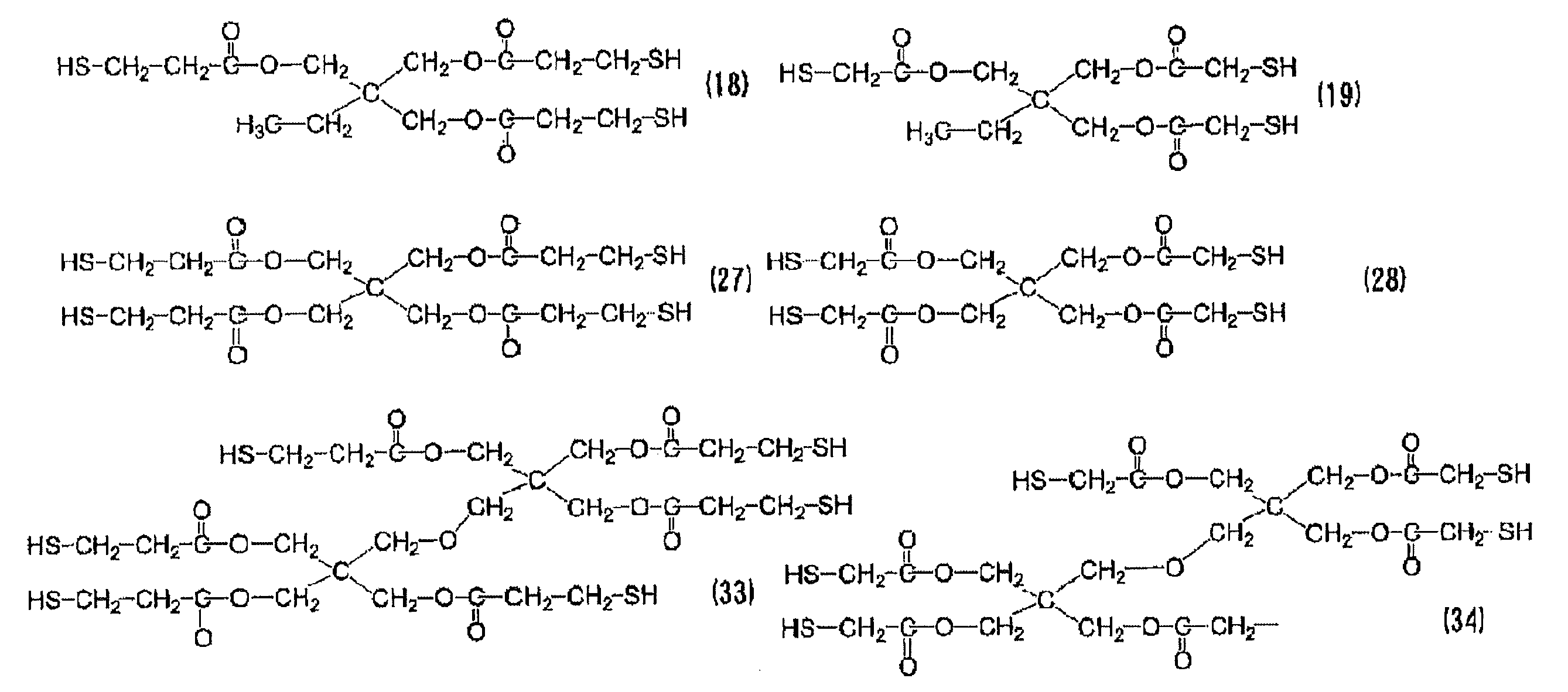
前記吸着部位を有し、且つ炭素-炭素二重結合を有する化合物(具体的には、有機色素残基、複素環残基、酸性基、塩基性窒素原子を有する基、ウレア基、ウレタン基、配位性酸素原子を有する基、炭素原子数4以上の炭化水素基、アルコキシシリル基、エポキシ基、イソシアネート基、および水酸基から選択される部位を少なくとも1種有し、かつ、炭素-炭素二重結合を有する化合物)としては、特に制限されないが、以下のようなものが挙げられる。
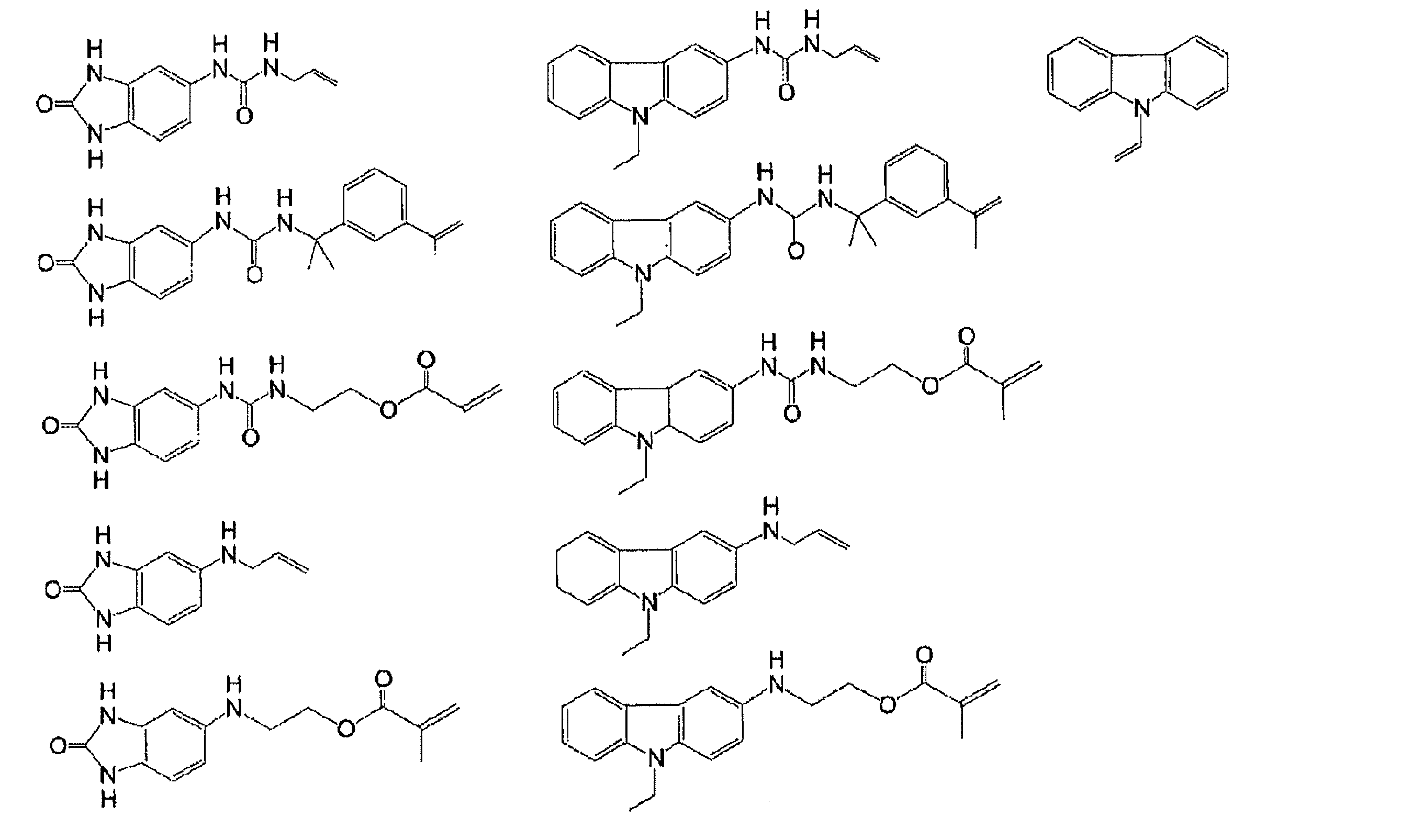

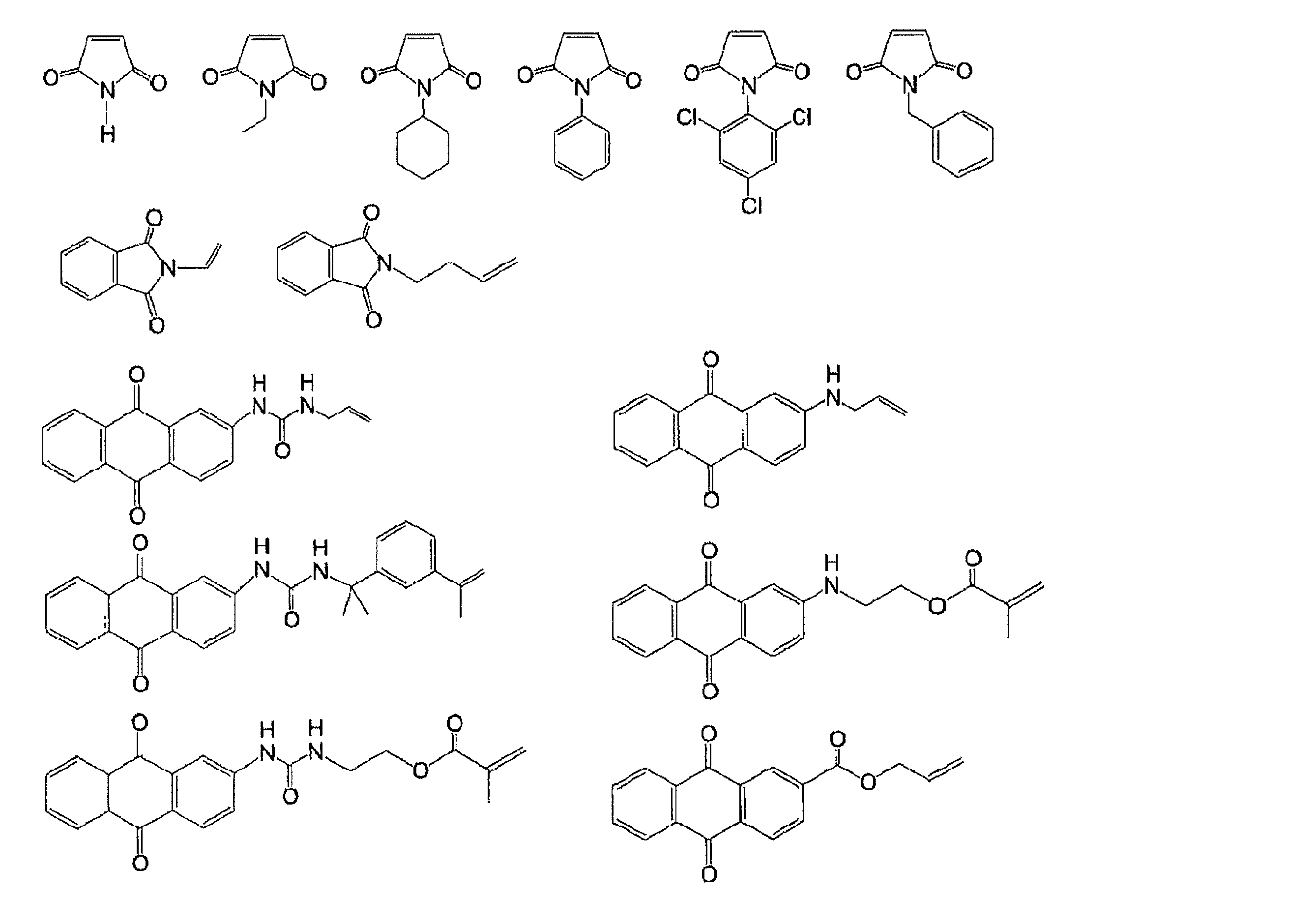
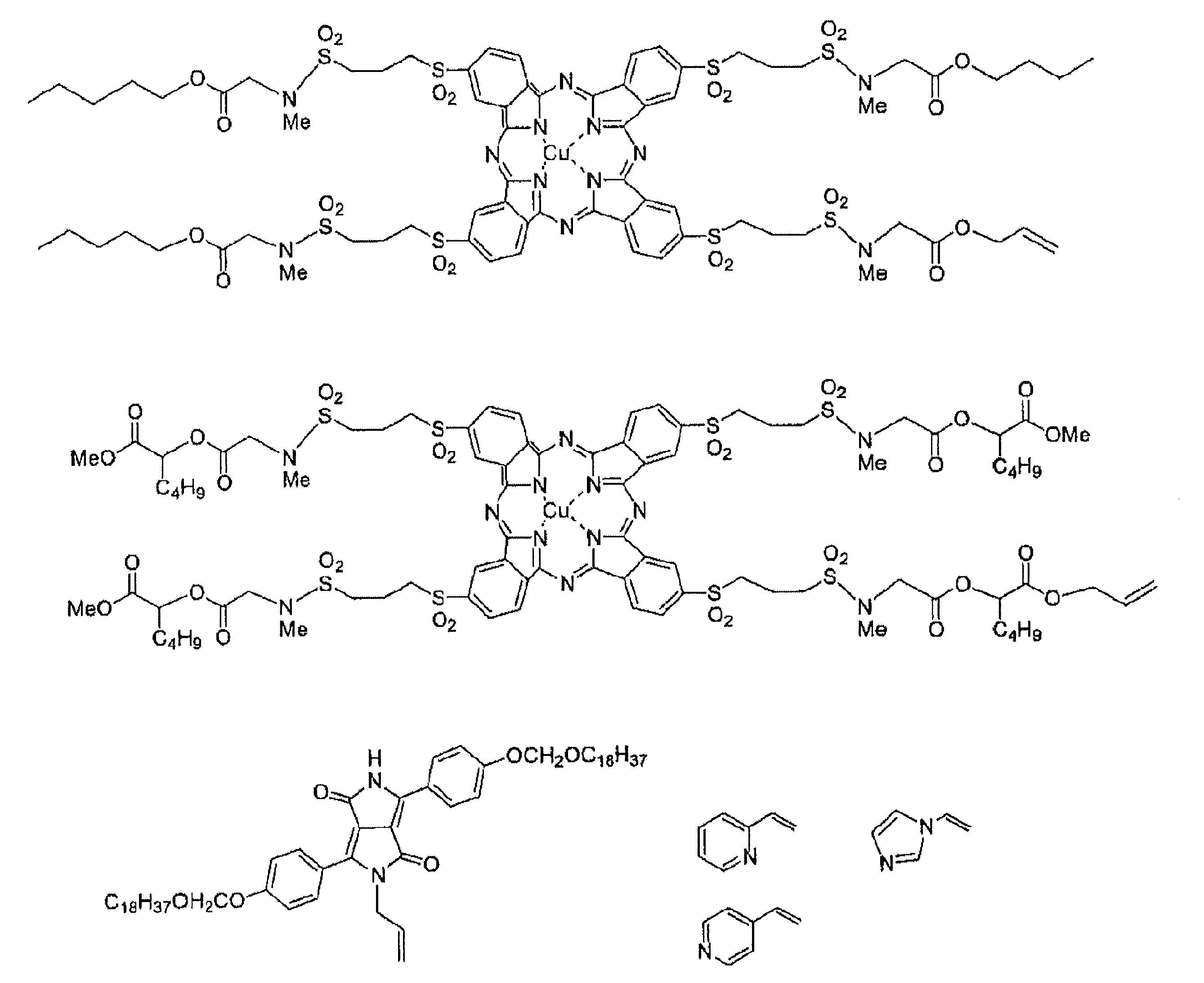
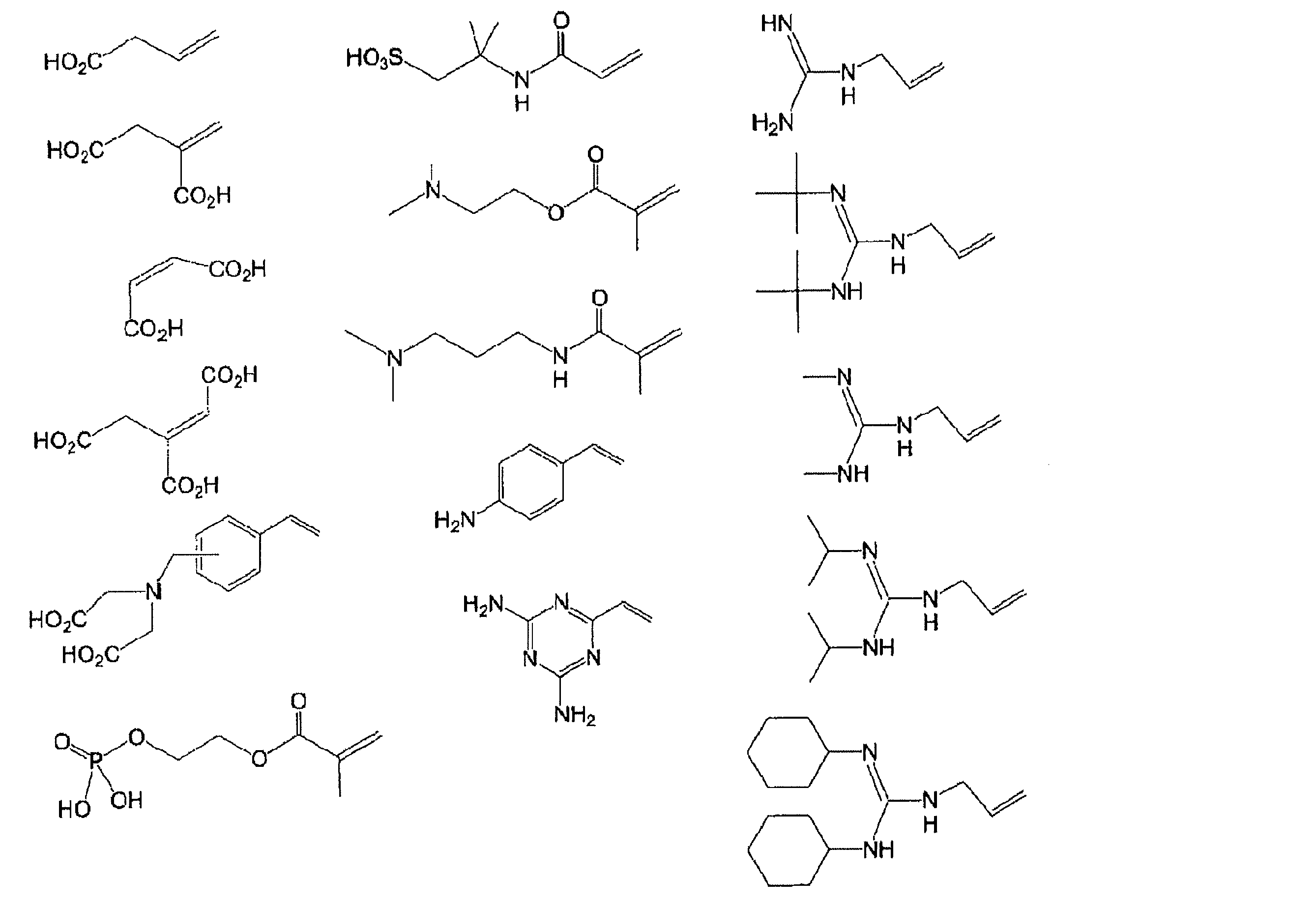
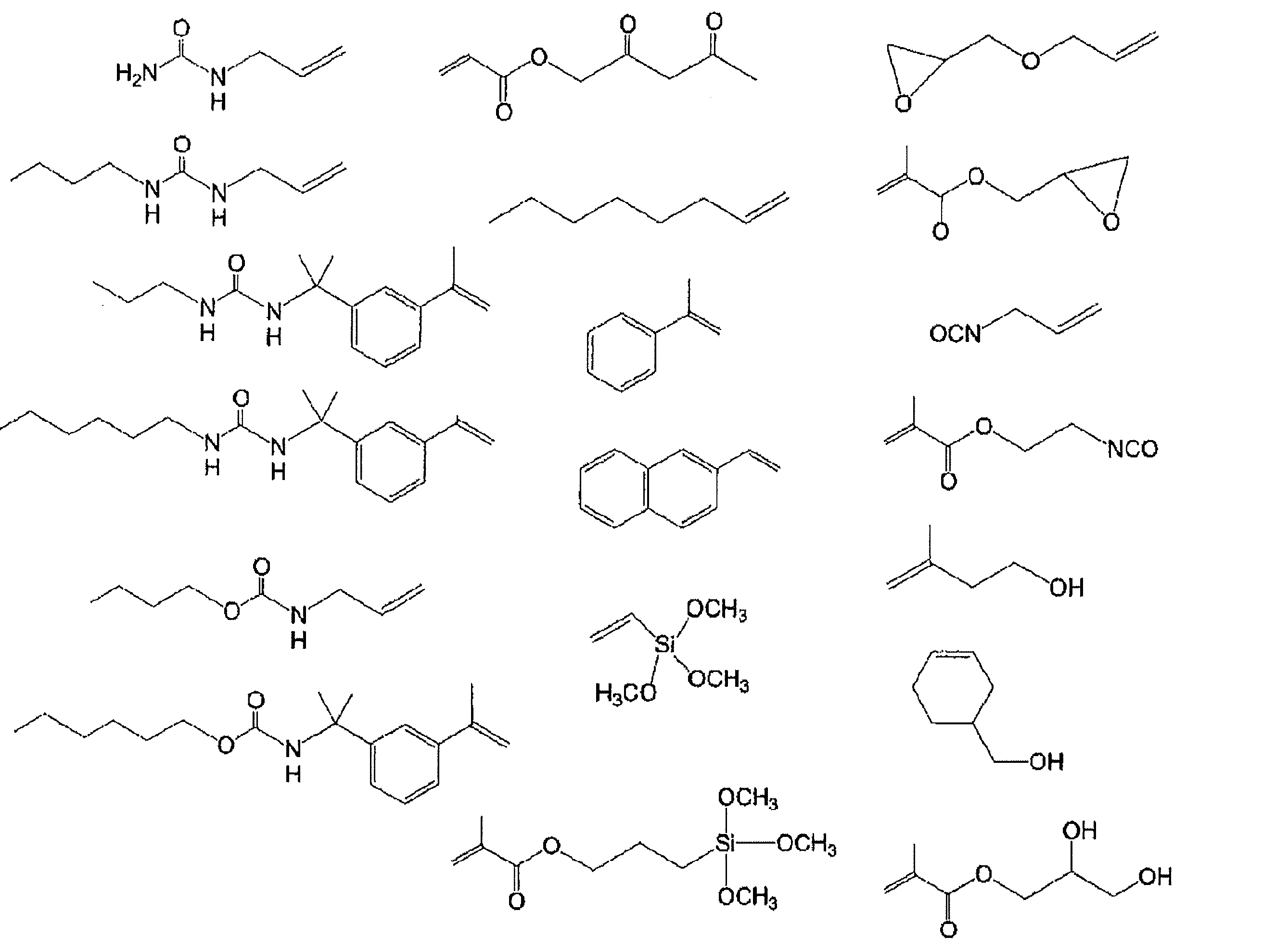
前記「一分子中に3~10個のメルカプト基を有する化合物」と、「前記吸着部位を有し、かつ、炭素-炭素二重結合を有する化合物」とのラジカル付加反応生成物は、例えば、上記の「一分子中に3~10個のメルカプト基を有する化合物」および「前記吸着部位を有し、かつ、炭素-炭素二重結合を有する化合物」を適当な溶媒中に溶解し、ここにラジカル発生剤を添加して、約50℃~100℃で、付加させる方法(チオール-エン反応法)を利用して得られる。
前記チオール-エン反応法で用いられる適当な溶媒の例としては、用いる「一分子中に3~10個のメルカプト基を有する化合物」、「前記吸着部位を有し、かつ、炭素-炭素二重結合を有する化合物」、および「生成するラジカル付加反応生成物」の溶解性に応じて任意に選択できる。
例えば、メタノール、エタノール、プロパノール、イソプロパノール、1-メトキシ-2-プロパノール、1-メトキシ-2-プロピルアセテート、アセトン、メチルエチルケトン、メチルイソブチルケトン、メトキシプロピルアセテート、乳酸エチル、酢酸エチル、アセトニトリル、テトラヒドロフラン、ジメチルホルムアミド、クロロホルム、トルエンが挙げられる。これらの溶媒は、二種以上を混合して使用してもよい。
例えば、メタノール、エタノール、プロパノール、イソプロパノール、1-メトキシ-2-プロパノール、1-メトキシ-2-プロピルアセテート、アセトン、メチルエチルケトン、メチルイソブチルケトン、メトキシプロピルアセテート、乳酸エチル、酢酸エチル、アセトニトリル、テトラヒドロフラン、ジメチルホルムアミド、クロロホルム、トルエンが挙げられる。これらの溶媒は、二種以上を混合して使用してもよい。
また、ラジカル発生剤としては、2,2’-アゾビス(イソブチロニトリル)(AIBN)、2,2’-アゾビス-(2,4’-ジメチルバレロニトリル)、2,2’-アゾビスイソ酪酸ジメチルのようなアゾ化合物、ベンゾイルパーオキシドのような過酸化物、および過硫酸カリウム、過硫酸アンモニウムのような過硫酸塩などなどが利用できる。
前記第5の合成方法で用いられるモノマーは、重合反応により、式(1)中のP1で表される高分子骨格を形成するものである。従って、例えば、上記したシリコーン系マクロマー、並びに(メタ)アクリル酸エステル類及びカルボキシル基を有するビニルモノマー等から選択される少なくとも1種を用いることができる。上記のビニルモノマーは一種のみで重合させてもよいし、二種以上を併用して共重合させてもよい。
第1高分子としては、これらのビニルモノマーと、前記一般式(5)で表される化合物とを用いて、公知の方法で常法に従って重合させることで得られるものが好ましい。なお、本発明における前記一般式(5)で表される化合物は、連鎖移動剤として機能するものであり、以下、単に「連鎖移動剤」と称することがある。
例えば、これらのビニルモノマー、および前記連鎖移動剤を適当な溶媒中に溶解し、ここにラジカル重合開始剤を添加して、約50℃~220℃で、溶液中で重合させる方法(溶液重合法)を利用して得られる。
例えば、これらのビニルモノマー、および前記連鎖移動剤を適当な溶媒中に溶解し、ここにラジカル重合開始剤を添加して、約50℃~220℃で、溶液中で重合させる方法(溶液重合法)を利用して得られる。
溶液重合法で用いられる適当な溶媒の例としては、用いる単量体、および生成する共重合体の溶解性に応じて任意に選択できる。例えば、メタノール、エタノール、プロパノール、イソプロパノール、1-メトキシ-2-プロパノール、1-メトキシ-2-プロピルアセテート、アセトン、メチルエチルケトン、メチルイソブチルケトン、メトキシプロピルアセテート、乳酸エチル、酢酸エチル、アセトニトリル、テトラヒドロフラン、ジメチルホルムアミド、クロロホルム、トルエンが挙げられる。これらの溶媒は、二種以上を混合して使用してもよい。
また、ラジカル重合開始剤としては、2,2’-アゾビス(イソブチロニトリル)(AIBN)、2,2’-アゾビス-(2,4’-ジメチルバレロニトリル)、2,2’-アゾビスイソ酪酸ジメチルのようなアゾ化合物、ベンゾイルパーオキシドのような過酸化物、および過硫酸カリウム、過硫酸アンモニウムのような過硫酸塩などが利用できる。
第1高分子の着色剤に対する割合については特に制限はないが、分散性及び分散安定性の改善効果の観点では、1~60質量%であるのが好ましく、3~50質量%であるのがより好ましく、5~40質量%であるのがさらに好ましい。
また、第1高分子を分散剤として分散媒中に添加する態様では、第1高分子は、分散媒に対して、例えば0.0001質量%~5質量%が望ましく、より望ましくは0.01質量%~3質量%である。
(2)着色剤
本発明の着色剤含有粒子が含有する着色剤については特に制限はない。有機もしくは無機の顔料や、油溶性染料等が挙げられる。マグネタイト、フェライト等の磁性紛、カーボンブラック、酸化チタン、酸化マグネシウム、酸化亜鉛、フタロシアニン銅系シアン色材、アゾ系イエロー色材、アゾ系マゼンタ色材、キナクリドン系マゼンタ色材、レッド色材、グリーン色材、ブルー色材等の公知の着色剤をいずれも用いることができる。具体的には、着色剤としては、アニリンブルー、カルコイルブルー、クロムイエロー、ウルトラマリンブルー、デュポンオイルレッド、キノリンイエロー、メチレンブルークロリド、フタロシアニンブルー、マラカイトグリーンオキサレート、ランプブラック、ローズベンガル、C.I.ピグメント・レッド48:1、C.I.ピグメント・レッド122、C.I.ピグメント・レッド57:1、C.I.ピグメント・イエロー97、C.I.ピグメント・ブルー15:1、C.I.ピグメント・ブルー15:3、等が代表的なものとして例示される。
本発明の着色剤含有粒子が含有する着色剤については特に制限はない。有機もしくは無機の顔料や、油溶性染料等が挙げられる。マグネタイト、フェライト等の磁性紛、カーボンブラック、酸化チタン、酸化マグネシウム、酸化亜鉛、フタロシアニン銅系シアン色材、アゾ系イエロー色材、アゾ系マゼンタ色材、キナクリドン系マゼンタ色材、レッド色材、グリーン色材、ブルー色材等の公知の着色剤をいずれも用いることができる。具体的には、着色剤としては、アニリンブルー、カルコイルブルー、クロムイエロー、ウルトラマリンブルー、デュポンオイルレッド、キノリンイエロー、メチレンブルークロリド、フタロシアニンブルー、マラカイトグリーンオキサレート、ランプブラック、ローズベンガル、C.I.ピグメント・レッド48:1、C.I.ピグメント・レッド122、C.I.ピグメント・レッド57:1、C.I.ピグメント・イエロー97、C.I.ピグメント・ブルー15:1、C.I.ピグメント・ブルー15:3、等が代表的なものとして例示される。
本発明の着色剤含有粒子中の着色剤の配合量については特に制限はない。用途に応じて、好ましい範囲を決定することができる。例えば、後述する帯電性基を有する第2高分子をさらに含む態様では、第2高分子に対し10質量%~99質量%が望ましく、望ましくは30質量%~99質量%である。
(3)帯電性基を有する第2高分子
本発明の着色剤含有粒子は、帯電性基を有する第2高分子をさらに含有していてもよい。帯電性基を有する第2高分子を含有する着色剤含有粒子は、電気泳動性を示し、電気泳動粒子として、電子ペーパー等の表示粒子として利用可能である。帯電性基を有する第2高分子は、着色剤の周りを取り囲んで存在しているのが好ましい。但し、この態様に限定されるものではない。
本発明の着色剤含有粒子は、帯電性基を有する第2高分子をさらに含有していてもよい。帯電性基を有する第2高分子を含有する着色剤含有粒子は、電気泳動性を示し、電気泳動粒子として、電子ペーパー等の表示粒子として利用可能である。帯電性基を有する第2高分子は、着色剤の周りを取り囲んで存在しているのが好ましい。但し、この態様に限定されるものではない。
第2高分子は、官能基として、塩基又は酸基を有しているのが好ましい。当該官能基は、帯電性基として機能する基であってもよいし、帯電性基として機能する基とは別に有してもよいが、帯電性基として機能する基であることが好ましい。なお、本明細書では、帯電性基とは、アニオン性又はカチオン性のイオン性基のみならず、高極性基も含むものとする。後者の例としては、フッ素基が挙げられる。
なお、重合後に帯電化のための処理を行ってもよい。例えば、後述の正帯電性基は、3級アミンを有するモノマーを単独重合又は他のモノマーとともに共重合させた後、3級アミンを4級化によって得られたものであってもよい。また負帯電性基は、カルボキシル基を有するモノマーを単独重合又は他のモノマーとともに共重合させた後、アミン等の塩基を添加して、カルボキシル基と塩を形成させることによって得られたものであってもよい。帯電化処理は、例えば、着色剤と混合した後に行ってもよい。
なお、重合後に帯電化のための処理を行ってもよい。例えば、後述の正帯電性基は、3級アミンを有するモノマーを単独重合又は他のモノマーとともに共重合させた後、3級アミンを4級化によって得られたものであってもよい。また負帯電性基は、カルボキシル基を有するモノマーを単独重合又は他のモノマーとともに共重合させた後、アミン等の塩基を添加して、カルボキシル基と塩を形成させることによって得られたものであってもよい。帯電化処理は、例えば、着色剤と混合した後に行ってもよい。
第2高分子が有する帯電性基は、塩基(以下、カチオン性基)又は酸基(以下、アニオン性基)であるのが好ましい。カチオン性基としては、例えば、アミノ基、4級アンモニウム基が挙げられ(これら基の塩も含む)、このカチオン性基により、例えば、着色剤含有粒子に正帯電極性が付与される。一方、アニオン性基としては、例えば、フェノール基、カルボキシル基、カルボン酸塩基、スルホン酸基、スルホン酸塩基、リン酸基、リン酸塩基及びテトラフェニルボロン基が挙げられ(これら基の塩も含む)、このアニオン性基により、例えば、着色剤含有粒子に負帯電極性が付与される。
第2高分子の例には、帯電性基を有する単量体の単独重合体、及び帯電性基を有する単量体と他の単量体(帯電性基を持たない単量体)との共重合体が含まれる。なお、「(メタ)アクリレート」等の記述は、「アクリレート」及び「メタクリレート」等のいずれをも含む表現である。以下、同様である。
帯電性基を有する単量体としては、カチオン性基を有する単量体(以下、カチオン性単量体)、アニオン性基を有する単量体(以下、アニオン性単量体)が挙げられる。
カチオン性単量体の例には、N,N-ジメチルアミノエチル(メタ)アクリレート、N,N-ジエチルアミノエチル(メタ)アクリレート、N,N-ジブチルアミノエチル(メタ)アクリレート、N,N-ヒドロキシエチルアミノエチル(メタ)アクリレート、N-エチルアミノエチル(メタ)アクリレート、N-オクチル-N-エチルアミノエチル(メタ)アクリレート、N,N-ジヘキシルアミノエチル(メタ)アクリレート等の脂肪族アミノ基を有する(メタ)アクリレート類;ジメチルアミノスチレン、ジエチルアミノスチレン、ジメチルアミノメチルスチレン、ジオクチルアミノスチレン等の含窒素基を有する芳香族置換エチレン系単量体類;ビニル-N-エチル-N-フェニルアミノエチルエーテル、ビニル-N-ブチル-N-フェニルアミノエチルエーテル、トリエタノールアミンジビニルエーテル、ビニルジフェニルアミノエチルエーテル、N-ビニルヒドロキシエチルベンズアミド、m-アミノフェニルビニルエーテル等の含窒素ビニルエーテル単量体類;ビニルアミン、N-ビニルピロール等のピロール類;N-ビニル-2-ピロリン、N-ビニル-3-ピロリン等のピロリン類;N-ビニルピロリジン、ビニルピロリジンアミノエーテル、N-ビニル-2-ピロリドン等のピロリジン類;N-ビニル-2-メチルイミダゾール等のイミダゾール類;N-ビニルイミダゾリン等のイミダゾリン類;N-ビニルインドール等のインドール類;N-ビニルインドリン等のインドリン類;N-ビニルカルバゾール、3,6-ジブロム-N-ビニルカルバゾール等のカルバゾール類;2-ビニルピリジン、4-ビニルピリジン、2-メチル-5-ビニルピリジン等のピリジン類;(メタ)アクリルピペリジン、N-ビニルピペリドン、N-ビニルピペラジン等のピペリジン類;2-ビニルキノリン、4-ビニルキノリン等のキノリン類;N-ビニルピラゾール、N-ビニルピラゾリン等のピラゾール類;2-ビニルオキサゾール等のオキサゾール類;4-ビニルオキサジン、モルホリノエチル(メタ)アクリレート等のオキサジン類;などが含まれる。また、汎用性から特に好ましいカチオン性単量体としては、N,N-ジメチルアミノエチル(メタ)アクリレート、N,N-ジエチルアミノエチル(メタ)アクリレートなどの脂肪族アミノ基を有する(メタ)アクリレート類が好ましく、特に重合前あるいは重合後に4級アンモニウム塩とした構造で使用されることが好ましい。4級アンモニウム塩化は、例えば、前記化合物をアルキルハライド類やトシル酸エステル類と反応することで得られる。
アニオン性単量体としては、例えば、以下のものが挙げられる。具体的には、カルボン酸モノマーとして、(メタ)アクリル酸、クロトン酸、イタコン酸、マレイン酸、フマール酸、シトラコン酸、又はそれらの無水物及びそのモノアルキルエステルやカルボキシエチルビニルエーテル、カルボキシプロピルビニルエーテルの如きカルボキシル基を有するビニルエーテル類等が挙げられる。スルホン酸モノマーとして、スチレンスルホン酸、2-アクリルアミド-2-メチルプロパンスルホン酸、3-スルホプロピル(メタ)アクリックアシッドエステル、ビス-(3-スルホプロピル)-イタコニックアシッドエステル等及びその塩が挙げられる。また、その他2-ヒドロキシエチル(メタ)アクリル酸の硫酸モノエステル及びその塩が挙げられる。リン酸モノマーとして、ビニルホスホン酸、ビニルホスフェート、アシッドホスホキシエチル(メタ)アクリレート、アシッドホスホキシプロピル(メタ)アクリレート、ビス(メタクリロキシエチル)ホスフェート、ジフェニル-2-メタクリロイロキシエチルホスフェート、ジフェニル-2-アクリロイロキシエチルホスフェート、ジブチル-2-メタクリロイロキシエチルホスフェート、ジブチル-2-アクリロイロキシエチルホスフェート、ジオクチル-2-(メタ)アクリロイロキシエチルホスフェート等が挙げられる。望ましくはアニオン性単量体としては、(メタ)アクリル酸やスルホン酸を持ったものであり、より望ましくは重合前もしくは重合後にアンモニウム塩となった構造のものである。アンモニウム塩は、例えば、3級アミン類もしくは4級アンモニウムハイドロオキサイド類と反応させることで生成する。
帯電性基として機能するフッ素基を持つ単量体としては、例えばフッ素基を持つ(メタ)アクリレートモノマーがあり、具体的には、トリフルオロエチル(メタ)アクリレート、ペンタフルオロプロピル(メタ)アクリレート、パーフルオロエチル(メタ)アクリレート、パーフルオロブチルエチル(メタ)アクリレート、パーフルオロオクチルエチル(メタ)アクリレート、パーフルオロデシルエチル(メタ)アクリレート、トリフルオロメチルトリフルオロエチル(メタ)アクリレート、ヘキサフルオロブチル(メタ)アクリレートなどが挙げられる。
一方、他の単量体としては、非イオン性単量体(ノニオン性単量体)が挙げられ、例えば、(メタ)アクリロニトリル、(メタ)アクリル酸アルキルエステル、(メタ)アクリルアミド、エチレン、プロピレン、ブタジエン、イソプレン、イソブチレン、N-ジアルキル置換(メタ)アクリルアミド、スチレン、ビニルカルバゾール、スチレン、スチレン誘導体、ポリエチレングリコールモノ(メタ)アクリレート、塩化ビニル、塩化ビニリデン、イソプレン、ブタジエン、ビニルピロリドン、ヒドロキシエチル(メタ)アクリレート、ヒドロキシブチル(メタ)アクリレートなどが挙げられる。
ここで、帯電性基を有する単量体と他の単量体との共重合比は、所望の粒子の帯電量に応じて変更させる。通常は帯電基を有する単量体と他の単量体との共重合比がそのモル比で1:100~100:0からの範囲で選択される。
第2高分子の重量平均分子量は、1000以上100万以下が望ましく、より望ましくは1万以上20万以下である。
第1高分子が、A1として酸性基を有する態様では、第2高分子の帯電性基は塩基性基であるのが好ましく;第1高分子が、A1として塩基性基を有する態様では、第2高分子の帯電性基が酸性基であるのが好ましい。
ここで、本発明の着色剤含有粒子の一態様として、塩基を持つ、負帯電粒子について詳細に説明する。第2高分子として塩基を有する高分子を用いることで作製可能であるが、塩基は負に帯電可能な帯電性基として機能しないので、第2高分子は、別途帯電性基として機能する基を有しているのが好ましい。当該帯電性基としては、フッ素基、カルボキシル基、カルボン酸塩基、スルホン酸基、スルホン酸塩基、リン酸基、リン酸塩基等が挙げられるが、望ましくはフッ素基である。
つまり、塩基を持つ負帯電粒子は、第2高分子として塩基と共に、帯電性基としてフッ素基を持つ高分子である高分子を用いるのが好ましい。この塩基及びフッ素基を持つ高分子としては、塩基を持つ単量体と、フッ素基を持つ単量体と、必要に応じて、他の単量体(ノニオン性単量体)と、の共重合体が挙げられる。これら単量体については、上記高分子を構成する単量体で例示されたものと同様である。
また、第2高分子は、上記単量体から誘導される構成単位とともに、シリコーン系モノマーから構成される構成単位を有していてもよい。シリコーン系モノマーは、シリコーン系マクロマーであってもよい。
前記シリコーン系モノマー又はマクロマーとしては、片末端に(メタ)アクリレート基を持ったジメチルシリコーンモノマー(例えば、チッソ社製:サイラプレーン:FM-0711、FM-0721、FM-0725等、信越シリコーン(株):X-22-174DX、X-22-2426、X-22-2475等)が挙げられる。また、上記第1高分子のP1の構成単位を誘導するシリコーン系マクロマーも同様に例示される。
また、第1及び第2高分子とは別に、前記着色剤含有粒子は、その表面に、シリコーン系高分子を付着(例えば結合又は被覆)させた粒子であってもよい。シリコーン系高分子は、例えば、シリコーン鎖を持つ高分子化合物であり、より具体的には主高分子化合物の主鎖に対して、シリコーン鎖(シリコーングラフト鎖)が側鎖として有する化合物であることがよい。シリコーン系高分子の重量平均分子量としては、500以上100万以下が望ましく、より望ましくは1000以上100万以下である。シリコーン系高分子は、上記シリコーン系モノマー又はマクロマーから誘導される構成単位とともに、非シリコーン系モノマーから誘導される構成単位を有していてもよい。
(4)その他の成分
本発明の着色剤含有粒子は、第1高分子、着色剤、及び所望により添加される第2高分子とともに、他の材料を含んでいてもよい。その他の配合材料としては、例えば、帯電制御材料、磁性材料が挙げられる。帯電制御材料としては、電子写真用トナー材料に使用される公知のものが使用でき、例えば、セチルピリジルクロライド、BONTRON P-51、BONTRON P-53、BONTRON E-84、BONTRON E-81(以上、オリエント化学工業社製)等の第4級アンモニウム塩、サリチル酸系金属錯体、フェノール系縮合物、テトラフェニル系化合物、酸化金属粒子、各種カップリング剤により表面処理された酸化金属粒子を挙げられる。
本発明の着色剤含有粒子は、第1高分子、着色剤、及び所望により添加される第2高分子とともに、他の材料を含んでいてもよい。その他の配合材料としては、例えば、帯電制御材料、磁性材料が挙げられる。帯電制御材料としては、電子写真用トナー材料に使用される公知のものが使用でき、例えば、セチルピリジルクロライド、BONTRON P-51、BONTRON P-53、BONTRON E-84、BONTRON E-81(以上、オリエント化学工業社製)等の第4級アンモニウム塩、サリチル酸系金属錯体、フェノール系縮合物、テトラフェニル系化合物、酸化金属粒子、各種カップリング剤により表面処理された酸化金属粒子を挙げられる。
磁性材料としては、必要に応じてカラーコートした無機磁性材料や有機磁性材料を使用することができる。また、透明な磁性材料、特に、透明有機磁性材料は着色顔料の発色を阻害し難く、比重も無機磁性材料に比べて小さく、より望ましい。着色した磁性材料(カラーコートした材料)として、例えば、特開2003-131420公報記載の小径着色磁性粉が挙げられる。核となる磁性粒子と該磁性粒子表面上に積層された着色層とを備えたものが用いられる。そして、着色層としては、顔料等により磁性粉を不透過に着色する等選定して差し支えないが、例えば光干渉薄膜を用いるのが好ましい。この光干渉薄膜とは、SiO2やTiO2等の無彩色材料を光の波長と同等な厚みを有する薄膜にしたものであり、薄膜内の光干渉により光の波長を選択的に反射するものである。
(5)着色剤含有粒子の製造方法
本発明の着色剤含有粒子の製造方法については特に制限はない。一例は、以下の通りである。以下の例は、第1高分子とともに第2高分子を含有する態様の製造方法である。また、以下の方法により、着色剤を中心部に含有し、それを取り囲む第2高分子、及びさらにその外側に第1高分子が吸着した着色剤含有粒子を製造できる。
まず、第2高分子と着色剤と第1溶媒(連続相を形成し得る貧溶媒)と前記第1溶媒に対して非相溶で前記第1溶媒より沸点が低く且つ第2高分子を溶解する第2溶媒(分散相を形成し得る良溶媒)とを含む混合溶液を攪拌し、乳化させる工程と、前記乳化させた混合溶液から前記第2溶媒を除去して、前記第2高分子及び前記着色剤を含有する着色粒子(粒子)を生成する工程と、その後、第1高分子を混合する工程と、を有する製法が挙げられる。この製法は、所謂、液中乾燥法と呼ばれる製法である。さらに、粒子の洗浄(イオン性不純物の除去)、分散媒の置換、分散媒の濃縮、分散媒の希釈等を行ってもよい。
本発明の着色剤含有粒子の製造方法については特に制限はない。一例は、以下の通りである。以下の例は、第1高分子とともに第2高分子を含有する態様の製造方法である。また、以下の方法により、着色剤を中心部に含有し、それを取り囲む第2高分子、及びさらにその外側に第1高分子が吸着した着色剤含有粒子を製造できる。
まず、第2高分子と着色剤と第1溶媒(連続相を形成し得る貧溶媒)と前記第1溶媒に対して非相溶で前記第1溶媒より沸点が低く且つ第2高分子を溶解する第2溶媒(分散相を形成し得る良溶媒)とを含む混合溶液を攪拌し、乳化させる工程と、前記乳化させた混合溶液から前記第2溶媒を除去して、前記第2高分子及び前記着色剤を含有する着色粒子(粒子)を生成する工程と、その後、第1高分子を混合する工程と、を有する製法が挙げられる。この製法は、所謂、液中乾燥法と呼ばれる製法である。さらに、粒子の洗浄(イオン性不純物の除去)、分散媒の置換、分散媒の濃縮、分散媒の希釈等を行ってもよい。
本製法によれば、第1溶媒を分散媒とし、その中に、本発明の着色剤含有粒子が分散した分散液が得られる。第1溶媒としては、後述する、本発明の分散液に利用する分散媒(例えば、シリコーンオイル、パラフィン系炭化水素溶媒)を用いることができる。当該分散液をそのまま種々の用途、例えば表示媒体に用いてもよい。
なお、本発明の着色剤含有粒子の製造方法は、上記製造方法に限られず、他の方法、例えば、粉砕法、コアセルベーション法、分散重合法、懸濁重合法等などを採用することができる。各方法で製造された粒子又はその分散液は、製造後そのまま種々の用途、例えば表示媒体に用いてもよいし、例えば粒子の洗浄(イオン性不純物の除去)、分散媒の置換、分散媒の濃縮、分散媒の希釈等を行ってから用いてもよい。
(6)着色剤含有粒子の性質
本発明の着色剤含有粒子の大きさについては特に制限はなく、用途に応じて、好ましい範囲を決定することができる。表示媒体に用いられる粒子として利用する場合は、平均粒径は0.05~10μmであるのが好ましく、0.1~1μmであるのがより好ましい。なお、平均粒径は、透過型電子顕微鏡での測定を用いる方法、市販の超遠心式自動粒度分布測定装置、光散乱粒度分布測定装置により適当な濃度の顔料分散液を測定する方法等の公知の方法で測定することができる。
本発明の着色剤含有粒子の大きさについては特に制限はなく、用途に応じて、好ましい範囲を決定することができる。表示媒体に用いられる粒子として利用する場合は、平均粒径は0.05~10μmであるのが好ましく、0.1~1μmであるのがより好ましい。なお、平均粒径は、透過型電子顕微鏡での測定を用いる方法、市販の超遠心式自動粒度分布測定装置、光散乱粒度分布測定装置により適当な濃度の顔料分散液を測定する方法等の公知の方法で測定することができる。
本発明の着色剤含有粒子の一態様は、電気泳動性を示す電気泳動粒子である。この態様の粒子は、第2高分子を含有しているのが好ましい。この態様の粒子は、電気泳動の原理を利用する種々の技術分野において利用することができる。一例は、電気泳動方式の電子ペーパー用表示粒子である。
2.着色剤含有粒子分散液
本発明は、本発明の着色剤含有粒子と、分散媒とを含む着色剤含有粒子分散液に関する。
分散液中における前記着色剤含有粒子の濃度の好ましい範囲は、用途に応じて異なるが、分散性及び分散安定性の観点では、30質量%以下であるのが好ましく、0.1~30質量%であるのがより好ましい。また、濃度が前記範囲であると、表示媒体に利用した場合には、表示特性や応答特性も良好になる。なお、複数の着色剤含有粒子を含有する態様では、複数の着色剤含有粒子の総量が、前記範囲であるのが好ましい。
本発明は、本発明の着色剤含有粒子と、分散媒とを含む着色剤含有粒子分散液に関する。
分散液中における前記着色剤含有粒子の濃度の好ましい範囲は、用途に応じて異なるが、分散性及び分散安定性の観点では、30質量%以下であるのが好ましく、0.1~30質量%であるのがより好ましい。また、濃度が前記範囲であると、表示媒体に利用した場合には、表示特性や応答特性も良好になる。なお、複数の着色剤含有粒子を含有する態様では、複数の着色剤含有粒子の総量が、前記範囲であるのが好ましい。
本実施形態に係る粒子分散液中の粒子の濃度は、表示特性や応答特性あるいはその用途によって種々選択されるが0.1質量%以上30質量%以下の範囲で選択されることが望ましい。色の異なった多粒子を混合する場合にはその粒子総量がこの範囲であると望ましい。
本発明の分散液は、複数種類の着色剤含有粒子を含んでいてもよい。例えば、色相、帯電極性、電界により移動を開始する電界強度等が互いに異なる複数種の粒子を含んでいてもよく、当該態様の分散液は、カラー表示用媒体に適する。2種以上の粒子の組み合わせ例としては、例えば、色相及び帯電極性が互いに異なる粒子の組み合わせ、及び色相及び電界により移動を開始する電界強度が異なる粒子の組み合わせが挙げられる。
分散媒:
分散媒については特に制限はなく、用途に応じて適切な溶媒を1種又は2種以上用いることができる。分散媒の例には、シリコーンオイル、パラフィン系炭化水素溶媒、フッ素系液体、石油由来高沸点溶媒が含まれ、特に好ましくはシリコーンオイル及びパラフィン系炭化水素溶媒であり、さらに好ましくはシリコーンオイルである。分散媒は、シリコーンオイルと、シリコーンオイル以外の溶媒と、の混合溶媒でるのも好ましい。
分散媒については特に制限はなく、用途に応じて適切な溶媒を1種又は2種以上用いることができる。分散媒の例には、シリコーンオイル、パラフィン系炭化水素溶媒、フッ素系液体、石油由来高沸点溶媒が含まれ、特に好ましくはシリコーンオイル及びパラフィン系炭化水素溶媒であり、さらに好ましくはシリコーンオイルである。分散媒は、シリコーンオイルと、シリコーンオイル以外の溶媒と、の混合溶媒でるのも好ましい。
シリコーンオイルとして具体的には、シロキサン結合に炭化水素基が結合したシリコーンオイル(例えば、ジメチルシリコーンオイル、ジエチルシリコーンオイル、メチルエチルシリコーンオイル、メチルフェニルシリコーンオイル、ジフェニルシリコーンオイル等)が挙げられる。これらの中も、ジメチルシリコーンが特に望ましい。
他の添加剤:
本発明の分散液には、必要に応じて、酸、アルカリ、塩、分散剤、分散安定剤、酸化防止や紫外線吸収などを目的とした安定剤、抗菌剤、防腐剤などを添加してもよい。また、本発明の粒子分散液には、帯電制御剤を添加してもよい。
本発明の分散液には、必要に応じて、酸、アルカリ、塩、分散剤、分散安定剤、酸化防止や紫外線吸収などを目的とした安定剤、抗菌剤、防腐剤などを添加してもよい。また、本発明の粒子分散液には、帯電制御剤を添加してもよい。
なお、本発明の分散液中、前記着色剤含有粒子に含まれる第1高分子の一部が粒子から解離して、分散媒中に存在していてもよい。
本は杖未の粒子分散液は、種々の用途に利用することができる。電気泳動の原理を利用する技術分野への利用に適し、電気泳動方式の表示媒体、電気泳動方式の調光媒体(調光素子)、液体現像方式電子写真システムの液体トナーなどに利用することができる。なお、電気泳動方式の表示媒体、電気泳動方式の調光媒体(調光素子)としては、公知である電極(基板)面の対向方向に粒子群を移動させる方式、それとは異なり電極(基板)面に沿った方向に移動させる方式(いわゆるインプレーン型素子)、又はこれらを組み合わせたハイブリッド素子がある。
本発明の着色剤含有粒子分散液の一実施形態は、電界に応じて移動する電気泳動粒子として本発明の着色剤含有粒子を1種以上と、シリコーンオイルを含んで構成される分散媒と、を含有する。本実施形態では、前記着色剤含有粒子の表面に、第1高分子が吸着しているのが好ましい。
一般的には、高分子分散剤を介して粒子間に凝集力を付与した場合、経時的に粒子間の凝集が進むことがあり、この凝集が進むと、粒子の可逆的な凝集・再分散特性の変動が大きくなり、結果、電界応答性(閾値特性)の変化が生じ、表示ムラが生じることがある。これに対し、本実施形態に係る粒子分散液では、粒子間の凝集力を制御するための高分子分散剤として、上記一般式(1)で表される特定の第1高分子を用いているので、粒子の可逆的な凝集・再分散を繰り返しても、経時的な当該粒子間の凝集の進行が抑えられると考えられることから、粒子の可逆的な凝集・再分散特性の変動が抑制される。そして、本実施形態に係る粒子分散液を、表示媒体や表示装置に適用すると、経時的な当該粒子間の凝集の進行が抑えられると考えられることから、安定した繰り返し表示が実現される。
本実施形態に係る粒子分散液は、着色剤又は着色剤を取り囲む第2高分子が存在する場合は第2高分子が持つ官能基と、第1高分子が持つ官能基とが酸塩基相互作用を及ぼし合う形態であることが好ましい。即ち、
1)塩基を持つ着色剤又は着色剤を取り囲む塩基を持つ第2高分子と、酸基を持つ第1高分子とを組み合わせた形態、
2)酸基を持つ着色剤又は着色剤を取り囲む酸基を持つ第2高分子と、塩基を持つ第1高分子とを組み合わせた形態
であるのが好ましい。
1)塩基を持つ着色剤又は着色剤を取り囲む塩基を持つ第2高分子と、酸基を持つ第1高分子とを組み合わせた形態、
2)酸基を持つ着色剤又は着色剤を取り囲む酸基を持つ第2高分子と、塩基を持つ第1高分子とを組み合わせた形態
であるのが好ましい。
本実施形態に係る粒子分散液では、上記形態を採用すると、例えば電気泳動表示媒体に適応した場合、電界に応じて移動する粒子の帯電極性の変動が抑制される。特に、塩基を持つ着色剤又は着色剤を取り囲む塩基を持つ第2高分子と、酸基を有する第1高分子とを併用することで、当該粒子が負帯電で安定する。
そして、本実施形態に係る粒子分散液を、表示媒体や表示装置に適用すると、表示粒子の帯電極性の変動が抑制される、即ち、同じ帯電極性を持つ粒子(その群)のうち、逆極性となる粒子の存在が少なくなることから、混色表示が抑制される。
そして、本実施形態に係る粒子分散液を、表示媒体や表示装置に適用すると、表示粒子の帯電極性の変動が抑制される、即ち、同じ帯電極性を持つ粒子(その群)のうち、逆極性となる粒子の存在が少なくなることから、混色表示が抑制される。
3.高分子化合物
本発明は、下記一般式(1’)で表わされる高分子化合物にも関する。
(A1-R4-S)n-R1-(R3-P1)m (1’)
式中、R1は(m+n)価の有機連結基を表し;R4はそれぞれ、単結合又は2価の連結基を表し;Sは硫黄原子を表し;A1はそれぞれ、有機色素残基、複素環残基、酸性基、塩基性窒素原子を有する基、ウレア基、ウレタン基、配位性酸素原子を有する基、炭素原子数4以上の炭化水素基、アルコキシシリル基、エポキシ基、イソシアネート基、及び水酸基から選択される基を少なくとも1種含む1価の有機基を表し;n個のA1及びR2はそれぞれ独立に、互いに同一であっても、異なっていてもよく;mは1~8及びnは2~9の数をそれぞれ表し、但しm+nは3~10を満たし;R3はそれぞれ、単結合又は2価の連結基を表し;P1はSi原子を含む高分子骨格を表し、複数の構成単位を含んでいてもよく、またm個のR3及びP1はそれぞれ独立に、互いに同一であっても、異なっていてもよく;
-(P2)x-(P3)y-(P4)z (2)
式(2)中、P2はシリコーン系マクロマーから誘導される構成単位を表し;P3はシリコーンを含まず、且つイオン解離性基を有さない構成単位を表し;P4はシリコーンを含まず、且つイオン解離性基を有する構成単位を表し;x、y及びzは各々の構成単位のモル分率をそれぞれ表し、x+y+z=100であり、但し、y及びzはそれぞれ0であってもよいが、同時に0になることはない。
本発明は、下記一般式(1’)で表わされる高分子化合物にも関する。
(A1-R4-S)n-R1-(R3-P1)m (1’)
式中、R1は(m+n)価の有機連結基を表し;R4はそれぞれ、単結合又は2価の連結基を表し;Sは硫黄原子を表し;A1はそれぞれ、有機色素残基、複素環残基、酸性基、塩基性窒素原子を有する基、ウレア基、ウレタン基、配位性酸素原子を有する基、炭素原子数4以上の炭化水素基、アルコキシシリル基、エポキシ基、イソシアネート基、及び水酸基から選択される基を少なくとも1種含む1価の有機基を表し;n個のA1及びR2はそれぞれ独立に、互いに同一であっても、異なっていてもよく;mは1~8及びnは2~9の数をそれぞれ表し、但しm+nは3~10を満たし;R3はそれぞれ、単結合又は2価の連結基を表し;P1はSi原子を含む高分子骨格を表し、複数の構成単位を含んでいてもよく、またm個のR3及びP1はそれぞれ独立に、互いに同一であっても、異なっていてもよく;
-(P2)x-(P3)y-(P4)z (2)
式(2)中、P2はシリコーン系マクロマーから誘導される構成単位を表し;P3はシリコーンを含まず、且つイオン解離性基を有さない構成単位を表し;P4はシリコーンを含まず、且つイオン解離性基を有する構成単位を表し;x、y及びzは各々の構成単位のモル分率をそれぞれ表し、x+y+z=100であり、但し、y及びzはそれぞれ0であってもよいが、同時に0になることはない。
前記式中の各基の定義については、上記の通りであり、好ましい範囲も同様である。
本発明の高分子化合物の重量平均分子量は、例えば1万以上100万以下が望ましく、より望ましくは5万以上30万以下である。重量平均分子量はGPC(Gel Permeation Chromatography:ゲル浸透クロマトグラフィー)によって測定することができる。
本発明の高分子化合物は、上記第1~第5の方法で合成でき、第5の方法により合成するのが好ましい。
本発明の高分子化合物は、分散剤、荷電調整剤等種々の用途に有用である。
以下に実施例を挙げて本発明をさらに具体的に説明する。以下の実施例に示す材料、試薬、物質量とその割合、操作等は本発明の趣旨から逸脱しない限り適宜変更することができる。従って、本発明の範囲は以下の具体例に制限されるものではない。
なお、以下、「部」及び「%」については、特に断り無い場合は、「質量部」及び「質量%」をそれぞれ示すものとする。
なお、以下、「部」及び「%」については、特に断り無い場合は、「質量部」及び「質量%」をそれぞれ示すものとする。
1.合成例
(1)合成例C-1~C-31
以下に示す方法で、式(1)で表される高分子化合物C-1~C-31(第1高分子)をそれぞれ合成した。
(1)合成例C-1~C-31
以下に示す方法で、式(1)で表される高分子化合物C-1~C-31(第1高分子)をそれぞれ合成した。
一般式(5)で表されるメルカプタン化合物の合成:
まず、以下の方法で、連鎖移動剤B-1~B-7(既述の一般式(5)で表されるメルカプタン化合物)を合成した。
まず、以下の方法で、連鎖移動剤B-1~B-7(既述の一般式(5)で表されるメルカプタン化合物)を合成した。
[合成例B-1]
ジペンタエリスリトールヘキサキス(3-メルカプトプロピオネート)〔DPMP;堺化学工業(株)製〕7.83部、及び下記の吸着部位を有し、かつ炭素-炭素二重結合を有する化合物(A-1)15.57部を、ジメチルホルムアミド 93.60部に溶解させ、窒素気流下、70℃に加熱した。これに2,2’-アゾビス(2,4-ジメチルバレロニトリル)〔V-65、和光純薬工業(株)製〕0.06部を加えて3時間加熱した。更に、V-65を0.06部加え、窒素気流下、70℃で3時間反応させた。室温まで冷却することで、以下に示すメルカプタン化合物(連鎖移動剤B-1)の20%溶液を得た。
ジペンタエリスリトールヘキサキス(3-メルカプトプロピオネート)〔DPMP;堺化学工業(株)製〕7.83部、及び下記の吸着部位を有し、かつ炭素-炭素二重結合を有する化合物(A-1)15.57部を、ジメチルホルムアミド 93.60部に溶解させ、窒素気流下、70℃に加熱した。これに2,2’-アゾビス(2,4-ジメチルバレロニトリル)〔V-65、和光純薬工業(株)製〕0.06部を加えて3時間加熱した。更に、V-65を0.06部加え、窒素気流下、70℃で3時間反応させた。室温まで冷却することで、以下に示すメルカプタン化合物(連鎖移動剤B-1)の20%溶液を得た。

[合成例B-2]
前記合成例B-1における、吸着部位を有し、かつ炭素-炭素二重結合を有する化合物(A-1)15.57部、ジメチルホルムアミド 93.60部を、吸着部位を有し、炭素-炭素二重結合を有する化合物(A-2)4.47部、ジメチルホルムアミド 78.38部に変更した以外は、前記合成例B-1と同様にして、以下に示すメルカプタン化合物(連鎖移動剤B-2)の20%溶液を得た。
前記合成例B-1における、吸着部位を有し、かつ炭素-炭素二重結合を有する化合物(A-1)15.57部、ジメチルホルムアミド 93.60部を、吸着部位を有し、炭素-炭素二重結合を有する化合物(A-2)4.47部、ジメチルホルムアミド 78.38部に変更した以外は、前記合成例B-1と同様にして、以下に示すメルカプタン化合物(連鎖移動剤B-2)の20%溶液を得た。
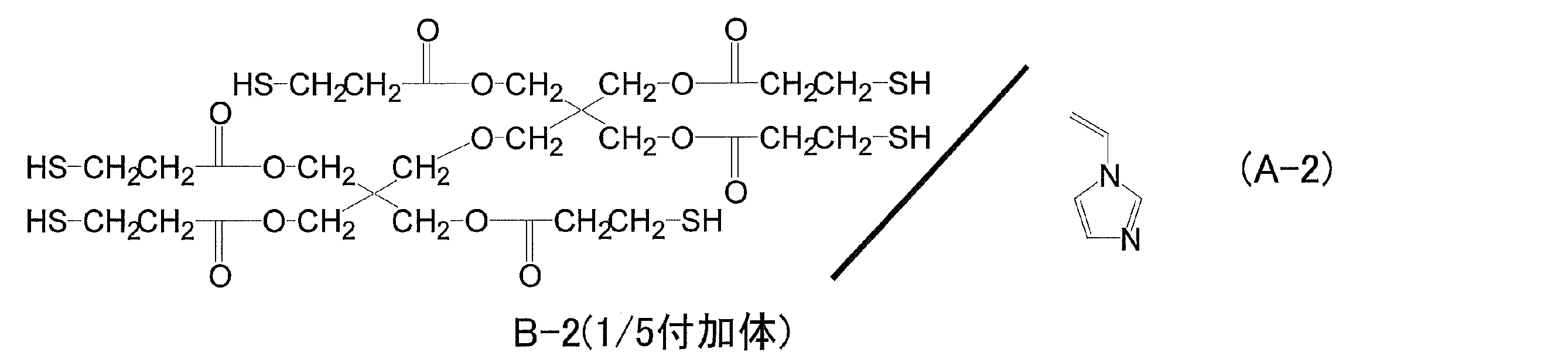
[合成例B-3]
前記合成例B-1における、吸着部位を有し、かつ炭素-炭素二重結合を有する化合物(A-1)15.57部、ジメチルホルムアミド 93.60部を、吸着部位を有し、炭素-炭素二重結合を有する化合物(A-3)6.18部、ジメチルホルムアミド 89.78部に変更した以外は、前記合成例B-1と同様にして、以下に示すメルカプタン化合物(連鎖移動剤B-3)の20%溶液を得た。
前記合成例B-1における、吸着部位を有し、かつ炭素-炭素二重結合を有する化合物(A-1)15.57部、ジメチルホルムアミド 93.60部を、吸着部位を有し、炭素-炭素二重結合を有する化合物(A-3)6.18部、ジメチルホルムアミド 89.78部に変更した以外は、前記合成例B-1と同様にして、以下に示すメルカプタン化合物(連鎖移動剤B-3)の20%溶液を得た。

[合成例B-4]
前記合成例B-1における、吸着部位を有し、かつ炭素-炭素二重結合を有する化合物(A-1)15.57部、ジメチルホルムアミド 93.60部を、吸着部位を有し、炭素-炭素二重結合を有する化合物(A-4)9.99部、ジメチルホルムアミド 101.4部に変更した以外は、前記合成例B-1と同様にして、以下に示すメルカプタン化合物(連鎖移動剤B-4)の20%溶液を得た。
前記合成例B-1における、吸着部位を有し、かつ炭素-炭素二重結合を有する化合物(A-1)15.57部、ジメチルホルムアミド 93.60部を、吸着部位を有し、炭素-炭素二重結合を有する化合物(A-4)9.99部、ジメチルホルムアミド 101.4部に変更した以外は、前記合成例B-1と同様にして、以下に示すメルカプタン化合物(連鎖移動剤B-4)の20%溶液を得た。

[合成例B-5]
前記合成例B-1における、吸着部位を有し、かつ炭素-炭素二重結合を有する化合物(A-1)15.57部、ジメチルホルムアミド 93.60部を、吸着部位を有し、炭素-炭素二重結合を有する化合物(A-5)6.8部、ジメチルホルムアミド 89.99部に変更した以外は、前記合成例B-1と同様にして、以下に示すメルカプタン化合物(連鎖移動剤B-5)の20%溶液を得た。
前記合成例B-1における、吸着部位を有し、かつ炭素-炭素二重結合を有する化合物(A-1)15.57部、ジメチルホルムアミド 93.60部を、吸着部位を有し、炭素-炭素二重結合を有する化合物(A-5)6.8部、ジメチルホルムアミド 89.99部に変更した以外は、前記合成例B-1と同様にして、以下に示すメルカプタン化合物(連鎖移動剤B-5)の20%溶液を得た。

[合成例B-6]
前記合成例B-1における、吸着部位を有し、かつ炭素-炭素二重結合を有する化合物(A-1)15.57部、ジメチルホルムアミド 93.60部を、吸着部位を有し、炭素-炭素二重結合を有する化合物(A-6)12.61部、ジメチルホルムアミド 40.82部に変更した以外は、前記合成例B-1と同様にして、以下に示すメルカプタン化合物(連鎖移動剤B-6)の30%溶液を得た。
前記合成例B-1における、吸着部位を有し、かつ炭素-炭素二重結合を有する化合物(A-1)15.57部、ジメチルホルムアミド 93.60部を、吸着部位を有し、炭素-炭素二重結合を有する化合物(A-6)12.61部、ジメチルホルムアミド 40.82部に変更した以外は、前記合成例B-1と同様にして、以下に示すメルカプタン化合物(連鎖移動剤B-6)の30%溶液を得た。

[合成例B-7]
前記合成例B-1における、吸着部位を有し、かつ炭素-炭素二重結合を有する化合物(A-1)15.57部、ジメチルホルムアミド 93.60部を、吸着部位を有し、炭素-炭素二重結合を有する化合物(A-7)14.7部、ジメチルホルムアミド 41.75部に変更した以外は、前記合成例B-1と同様にして、以下に示す本発明に係るメルカプタン化合物(連鎖移動剤B-7)の30%溶液を得た。
前記合成例B-1における、吸着部位を有し、かつ炭素-炭素二重結合を有する化合物(A-1)15.57部、ジメチルホルムアミド 93.60部を、吸着部位を有し、炭素-炭素二重結合を有する化合物(A-7)14.7部、ジメチルホルムアミド 41.75部に変更した以外は、前記合成例B-1と同様にして、以下に示す本発明に係るメルカプタン化合物(連鎖移動剤B-7)の30%溶液を得た。
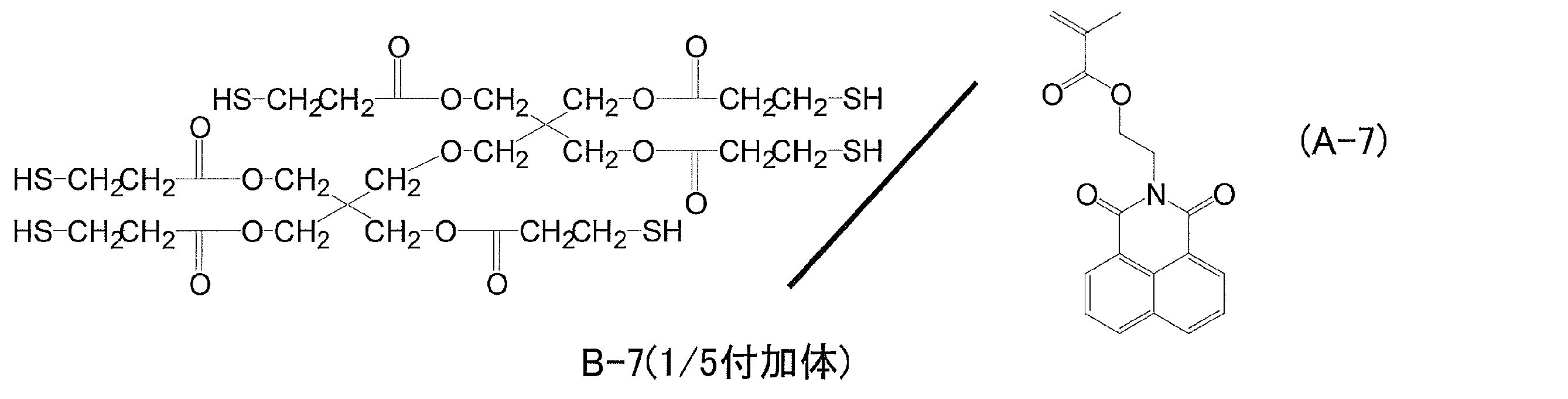
式(1)で表される高分子化合物C-1~C-31(第1高分子)の合成:
続いて、以下の方法で、第1高分子である高分子化合物C-1~C-31を合成した。
続いて、以下の方法で、第1高分子である高分子化合物C-1~C-31を合成した。
[合成例C-1]
前記合成例B-1で得た連鎖移動剤B-1の20%溶液46.80部、FM-0711(Si含有モノマー)14.65部、メタクリル酸メチル(MMA;モノマー)2.20部、及びメタクリル酸(MAA;モノマー)3.15部の混合溶液を、窒素気流下、80℃に加熱した。これに2,2’-アゾビス(イソブチロニトリル)〔AIBN、和光純薬工業(株)製〕0.005部を加えて3時間加熱後、再度AIBN0.005部を加えて、窒素気流下、80℃で3時間反応させた。その後、室温まで冷却し、アセトンで希釈した。多量のメタノールを用いて再沈殿させた後、真空乾燥させることにより、以下に示す高分子化合物(C-1:ポリスチレン換算の重量平均分子量32000;第1高分子)の固体19部を得た。
前記合成例B-1で得た連鎖移動剤B-1の20%溶液46.80部、FM-0711(Si含有モノマー)14.65部、メタクリル酸メチル(MMA;モノマー)2.20部、及びメタクリル酸(MAA;モノマー)3.15部の混合溶液を、窒素気流下、80℃に加熱した。これに2,2’-アゾビス(イソブチロニトリル)〔AIBN、和光純薬工業(株)製〕0.005部を加えて3時間加熱後、再度AIBN0.005部を加えて、窒素気流下、80℃で3時間反応させた。その後、室温まで冷却し、アセトンで希釈した。多量のメタノールを用いて再沈殿させた後、真空乾燥させることにより、以下に示す高分子化合物(C-1:ポリスチレン換算の重量平均分子量32000;第1高分子)の固体19部を得た。

[合成例C-2]
前記合成例C-1において、AIBN0.005部を0.010部に変更した以外は、前記合成例C-1と同様にして、以下に示す高分子化合物(C-2:ポリスチレン換算の重量平均分子量15000;第1高分子)の固体19部を得た。
前記合成例C-1において、AIBN0.005部を0.010部に変更した以外は、前記合成例C-1と同様にして、以下に示す高分子化合物(C-2:ポリスチレン換算の重量平均分子量15000;第1高分子)の固体19部を得た。

[合成例C-3]
前記合成例C-1において、AIBN0.005部を0.020部に変更した以外は、前記合成例C-1と同様にして、以下に示す高分子化合物(C-3:ポリスチレン換算の重量平均分子量6000;第1高分子)の固体19部を得た。
前記合成例C-1において、AIBN0.005部を0.020部に変更した以外は、前記合成例C-1と同様にして、以下に示す高分子化合物(C-3:ポリスチレン換算の重量平均分子量6000;第1高分子)の固体19部を得た。

[合成例C-4~C-31]
さらに、連鎖移動剤種、モノマーの種類と量、AIBNの量、及び再沈殿方法を、下記表1及び表2に示すようにそれぞれ変更した以外は、前記合成例C-1と同様にして、高分子化合物C-4~C-31(第1高分子)をそれぞれ製造した。
さらに、連鎖移動剤種、モノマーの種類と量、AIBNの量、及び再沈殿方法を、下記表1及び表2に示すようにそれぞれ変更した以外は、前記合成例C-1と同様にして、高分子化合物C-4~C-31(第1高分子)をそれぞれ製造した。

以下、合成した各高分子化合物の構造を示す。なお、C-4等の表示は、前記表1中の合成例の番号を示すものである。
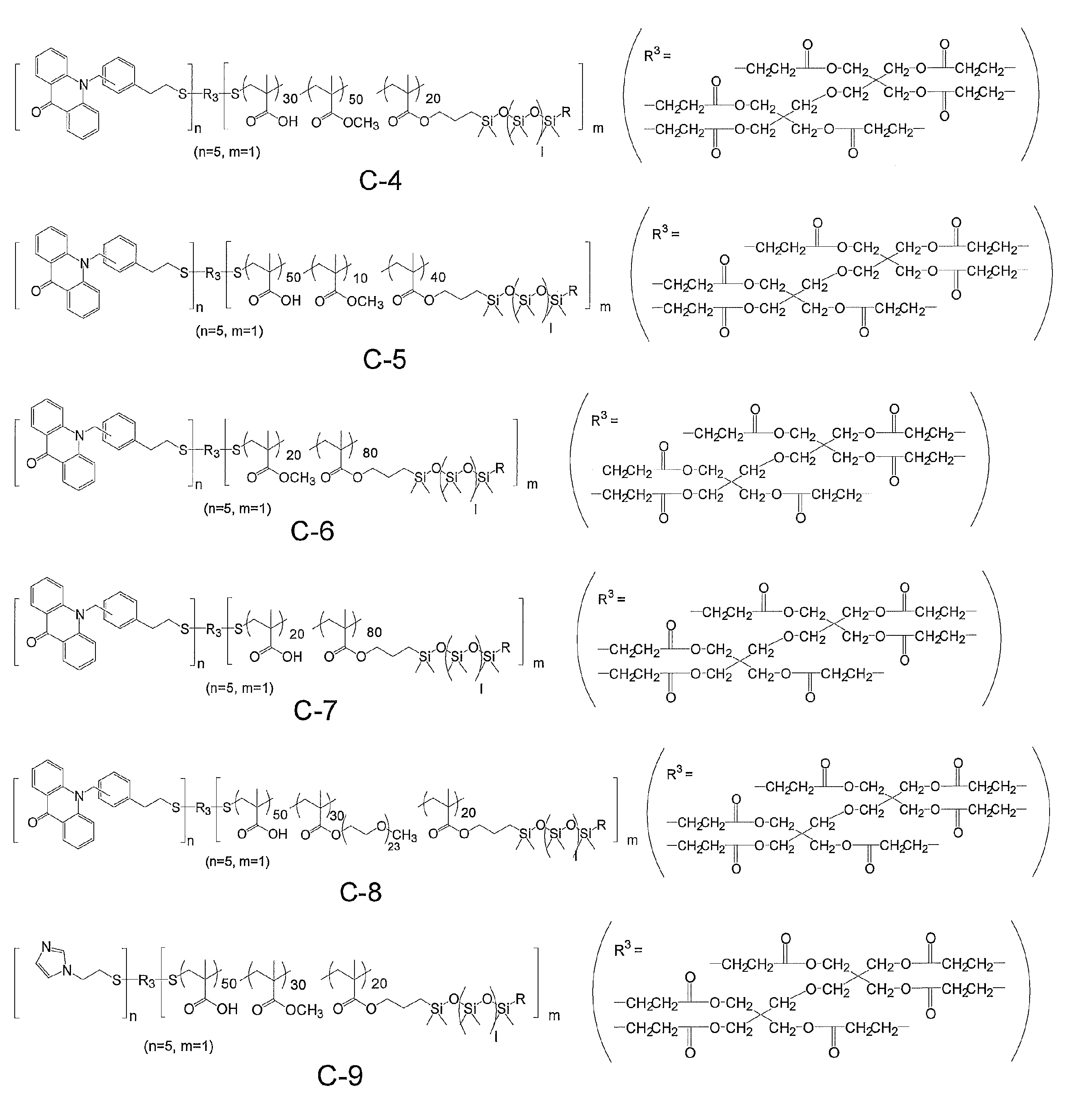


2.着色剤含有粒子及び着色剤含有粒子分散液の調製
(1)実施例A
(実施例A-1)
-シアン粒子(正帯電粒子)及びその分散液の調製-
(アミノ基を持つ第2高分子の製造)
まず、N-ビニルピロリドン:85質量部、シリコーン鎖となる単量体としてサイラプレーン「FM-0721」:10質量部、帯電基を持つ単量体としてジエチルアミノエチルメタクリレート:5質量部を、イソプロピルアルコール100質量部に混合し、重合開始剤としてAIBN:0.2質量部を溶解し、窒素下で70℃、6時間重合を行なった。生成物を、シクロヘキサンを再沈殿溶媒として精製、乾燥し、高分子を得た。
得られた高分子は蒸留水に可溶であり、濃度30質量%でも可溶であり、沈殿は生じず、水溶性高分子であることがわかった。
(1)実施例A
(実施例A-1)
-シアン粒子(正帯電粒子)及びその分散液の調製-
(アミノ基を持つ第2高分子の製造)
まず、N-ビニルピロリドン:85質量部、シリコーン鎖となる単量体としてサイラプレーン「FM-0721」:10質量部、帯電基を持つ単量体としてジエチルアミノエチルメタクリレート:5質量部を、イソプロピルアルコール100質量部に混合し、重合開始剤としてAIBN:0.2質量部を溶解し、窒素下で70℃、6時間重合を行なった。生成物を、シクロヘキサンを再沈殿溶媒として精製、乾燥し、高分子を得た。
得られた高分子は蒸留水に可溶であり、濃度30質量%でも可溶であり、沈殿は生じず、水溶性高分子であることがわかった。
(着色剤含有粒子及びその分散液の調製)
次に、Ciba製水分散顔料溶液(ユニスパース・シアン色:顔料濃度26質量%)1質量部に、上記高分子の10質量%水溶液3質量部を混合して、高分子及び顔料を含む水溶液を調製した。次に、ジメチルシリコーンオイル(信越シリコーン社製KF-96-2CS)に乳化剤としてシリコーン変性アクリルポリマーKP545(信越化学社製)を添加した、KP545の3質量%シリコーン溶液を調製した。そして、当該水溶液をKP545の3質量%シリコーン溶液10質量部に混合した後、これを超音波破砕機で分散し、高分子及び顔料が含まれる水溶液をシリコーンオイル(粘度2cs)中に分散した懸濁液を調製した。
次に、Ciba製水分散顔料溶液(ユニスパース・シアン色:顔料濃度26質量%)1質量部に、上記高分子の10質量%水溶液3質量部を混合して、高分子及び顔料を含む水溶液を調製した。次に、ジメチルシリコーンオイル(信越シリコーン社製KF-96-2CS)に乳化剤としてシリコーン変性アクリルポリマーKP545(信越化学社製)を添加した、KP545の3質量%シリコーン溶液を調製した。そして、当該水溶液をKP545の3質量%シリコーン溶液10質量部に混合した後、これを超音波破砕機で分散し、高分子及び顔料が含まれる水溶液をシリコーンオイル(粘度2cs)中に分散した懸濁液を調製した。
次に、この懸濁液を減圧(2KPa)、加熱(70℃)して水分を除去し、シリコーンオイル中に上記高分子及び顔料を含んだ粒子が分散した粒子分散液を得た。得られた粒子分散液に、臭化エチル0.1質量部を添加し、分散液を80℃で2時間加熱し、上記高分子の単量体成分であるジエチルアミノエチルメタクリレートのアミノ基を4級化し、その後、未反応な臭化エチルを減圧下で除去した。得られた粒子分散液の固形分濃度をシリコーンオイルの乾燥前後の質量測定から算出したところ8.2質量%であった。また、分散液中の粒子の体積平均粒子径を測定(ホリバLA-300:レーザー光散乱・回折式粒度測定装置)した結果、260nmであった。
この得られたシアン粒子分散液A(固形分濃度1.5%)100質量部に対して、上記で製造した高分子化合物C-1を0.5質量部添加し、着色剤含有粒子、及びその分散液を得た。
本分散液中のシアン粒子群の帯電極性を、2枚の電極基板間に該分散液を封入し、直流電圧を印加して泳動方向を評価した結果、正帯電であった。
(実施例A-2~A-31、比較例A-1~A-4)
下記表に示す通り、高分子化合物種(第1高分子)及びその濃度を変更した以外は、実施例A1と同様にして粒子分散液をそれぞれ調製した。
下記表に示す通り、高分子化合物種(第1高分子)及びその濃度を変更した以外は、実施例A1と同様にして粒子分散液をそれぞれ調製した。
[比較例用高分子分散剤C-32の合成]
サイラプレーンFM0711(チッソ社製) 4.5質量部、メタクリル酸(和光純薬(株)製) 0.5質量部、イソプロピルアルコール(溶媒)10質量部、V-65(アゾビスジメチルバレロニトリル)(和光純薬(株)製:重合開始剤)0.02質量部を混合し、十分な窒素置換後に55℃で24時間反応させた。重合終了後に減圧乾燥させて溶媒、未反応モノマーを除去・精製して、比較用高分子分散剤C-32を得た。収率は98%であった。分子量をGPCで測定した結果、ポリスチレンスタンダード換算で重量平均分子量12万であった。
サイラプレーンFM0711(チッソ社製) 4.5質量部、メタクリル酸(和光純薬(株)製) 0.5質量部、イソプロピルアルコール(溶媒)10質量部、V-65(アゾビスジメチルバレロニトリル)(和光純薬(株)製:重合開始剤)0.02質量部を混合し、十分な窒素置換後に55℃で24時間反応させた。重合終了後に減圧乾燥させて溶媒、未反応モノマーを除去・精製して、比較用高分子分散剤C-32を得た。収率は98%であった。分子量をGPCで測定した結果、ポリスチレンスタンダード換算で重量平均分子量12万であった。
[比較例用高分子分散剤C-33の合成]
前記合成例B-1で得た連鎖移動剤B-1の20%溶液46.80部、メタクリル酸メチル(MMA;モノマー)20部を、窒素気流下、80℃に加熱した。これに2,2’-アゾビス(イソブチロニトリル)〔AIBN、和光純薬工業(株)製〕0.013部を加えて3時間加熱後、再度AIBN0.013部を加えて、窒素気流下、80℃で3時間反応させた。その後、室温まで冷却し、アセトンで希釈した。多量のメタノールを用いて再沈殿させた後、真空乾燥させることにより、比較例用高分子分散剤(C-33:ポリスチレン換算の重量平均分子量14000)の固体19部を得た。
前記合成例B-1で得た連鎖移動剤B-1の20%溶液46.80部、メタクリル酸メチル(MMA;モノマー)20部を、窒素気流下、80℃に加熱した。これに2,2’-アゾビス(イソブチロニトリル)〔AIBN、和光純薬工業(株)製〕0.013部を加えて3時間加熱後、再度AIBN0.013部を加えて、窒素気流下、80℃で3時間反応させた。その後、室温まで冷却し、アセトンで希釈した。多量のメタノールを用いて再沈殿させた後、真空乾燥させることにより、比較例用高分子分散剤(C-33:ポリスチレン換算の重量平均分子量14000)の固体19部を得た。
[比較例用高分子分散剤C-34の合成]
前記合成例B-3で得た連鎖移動剤B-1の20%溶液46.80部、メタクリル酸メチル(MMA;モノマー)20部を、窒素気流下、80℃に加熱した。これに2,2’-アゾビス(イソブチロニトリル)〔AIBN、和光純薬工業(株)製〕0.013部を加えて3時間加熱後、再度AIBN0.013部を加えて、窒素気流下、80℃で3時間反応させた。その後、室温まで冷却し、アセトンで希釈した。多量のメタノールを用いて再沈殿させた後、真空乾燥させることにより、比較例用高分子分散剤(C-44:ポリスチレン換算の重量平均分子量14000)の固体19部を得た。
前記合成例B-3で得た連鎖移動剤B-1の20%溶液46.80部、メタクリル酸メチル(MMA;モノマー)20部を、窒素気流下、80℃に加熱した。これに2,2’-アゾビス(イソブチロニトリル)〔AIBN、和光純薬工業(株)製〕0.013部を加えて3時間加熱後、再度AIBN0.013部を加えて、窒素気流下、80℃で3時間反応させた。その後、室温まで冷却し、アセトンで希釈した。多量のメタノールを用いて再沈殿させた後、真空乾燥させることにより、比較例用高分子分散剤(C-44:ポリスチレン換算の重量平均分子量14000)の固体19部を得た。
[評価]
得られた各粒子分散物について下記の評価を行なった。
(粘度の測定、評価)
得られた各粒子分散物について、E型粘度計を用いて、分散直後の粒子分散物の粘度η1および分散後(室温にて)1週間経過した後の粒子分散物の粘度η2を測定し、増粘の程度を評価した。評価結果は下記表に示す。ここで、粘度が低いことは、分散性、分散安定性が良好であることを示す。
得られた各粒子分散物について下記の評価を行なった。
(粘度の測定、評価)
得られた各粒子分散物について、E型粘度計を用いて、分散直後の粒子分散物の粘度η1および分散後(室温にて)1週間経過した後の粒子分散物の粘度η2を測定し、増粘の程度を評価した。評価結果は下記表に示す。ここで、粘度が低いことは、分散性、分散安定性が良好であることを示す。
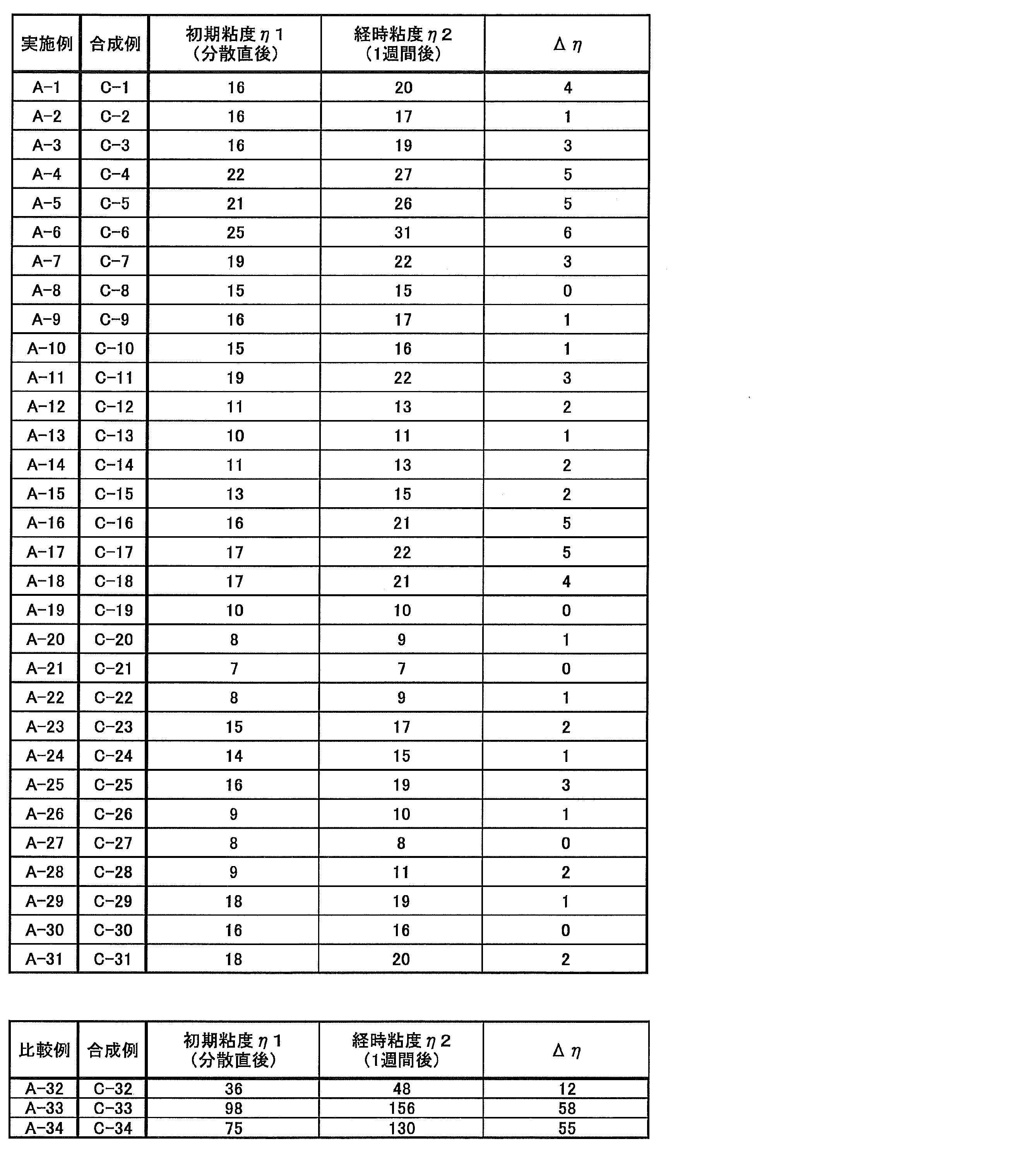
(2)実施例B
(実施例B-1)
-マゼンタ粒子B(酸基を持つ粒子:負帯電粒子)及びその分散液の調製-
(カルボキシル基を持つ第2高分子の製造)
まず、2-ヒドロキシエチルアクリレート:85質量部、シリコーン鎖となる単量体としてサイラプレーン「FM-0721」:10質量部、帯電基を持つ単量体としてメタクリル酸:5質量部を、イソプロピルアルコール100質量部に混合し、重合開始剤としてAIBN(2,2’-アゾビス(イソブチロニトリル)):0.2質量部を溶解し、窒素下で70℃、6時間重合を行なった。生成物を、シクロヘキサンを再沈殿溶媒として精製、乾燥し高分子を得た。
得られた高分子は蒸留水に可溶であり、30質量%の濃度においても可溶であり、沈殿は生じず、水溶性高分子であることがわかった。
(実施例B-1)
-マゼンタ粒子B(酸基を持つ粒子:負帯電粒子)及びその分散液の調製-
(カルボキシル基を持つ第2高分子の製造)
まず、2-ヒドロキシエチルアクリレート:85質量部、シリコーン鎖となる単量体としてサイラプレーン「FM-0721」:10質量部、帯電基を持つ単量体としてメタクリル酸:5質量部を、イソプロピルアルコール100質量部に混合し、重合開始剤としてAIBN(2,2’-アゾビス(イソブチロニトリル)):0.2質量部を溶解し、窒素下で70℃、6時間重合を行なった。生成物を、シクロヘキサンを再沈殿溶媒として精製、乾燥し高分子を得た。
得られた高分子は蒸留水に可溶であり、30質量%の濃度においても可溶であり、沈殿は生じず、水溶性高分子であることがわかった。
(着色剤含有粒子及びその分散液の調製)
次に、Ciba製水分散顔料溶液(ユニスパース・マゼンタ色:顔料濃度16質量%)、1質量部に上記高分子の10質量%水溶液3質量部を混合して、高分子及び顔料を含む水溶液を調製した。次に、ジメチルシリコーンオイル(信越シリコーン社製KF-96-2CS)に乳化剤としてシリコーン変性アクリルポリマーKP545(信越化学社製)を添加した、KP545の3質量%シリコーン溶液を調製した。そして、当該水溶液をKP545の3質量%シリコーン溶液10質量部に混合した後、これを超音波破砕機で分散し、高分子及び顔料が含まれる水溶液をシリコーンオイル(粘度2cs)中に分散した懸濁液を調製した。
次に、Ciba製水分散顔料溶液(ユニスパース・マゼンタ色:顔料濃度16質量%)、1質量部に上記高分子の10質量%水溶液3質量部を混合して、高分子及び顔料を含む水溶液を調製した。次に、ジメチルシリコーンオイル(信越シリコーン社製KF-96-2CS)に乳化剤としてシリコーン変性アクリルポリマーKP545(信越化学社製)を添加した、KP545の3質量%シリコーン溶液を調製した。そして、当該水溶液をKP545の3質量%シリコーン溶液10質量部に混合した後、これを超音波破砕機で分散し、高分子及び顔料が含まれる水溶液をシリコーンオイル(粘度2cs)中に分散した懸濁液を調製した。
次に、この懸濁液を減圧(2KPa)、加熱(70℃)を2時間実施して水分を除去し、シリコーンオイル中に高分子及び顔料を含んだ粒子が分散した粒子分散液を得た。得られた粒子分散液に化学的に等モル量のトリヘキシルアミンを添加し、高分子の単量体成分であるメタクリル酸と塩を形成させた。
作製した粒子分散液の固形分濃度をシリコーンオイルの乾燥前後の質量測定から測定したところ7.2質量%であった。また、分散液中の泳動粒子の体積平均粒子径を測定(ホリバLA-300:レーザー光散乱・回折式粒度測定装置)した結果、280nmであった。
作製した粒子分散液の固形分濃度をシリコーンオイルの乾燥前後の質量測定から測定したところ7.2質量%であった。また、分散液中の泳動粒子の体積平均粒子径を測定(ホリバLA-300:レーザー光散乱・回折式粒度測定装置)した結果、280nmであった。
得られたマゼンタ粒子分散液B(固形分濃度1.5%)100質量部に対して、高分子分散剤C-1を0.5質量部添加し、粒子分散液を得た。
本分散液中のマゼンタ粒子群の帯電極性を、2枚の電極基板間に該分散液を封入し、直流電圧を印加して泳動方向を評価した結果、負帯電であった。
(実施例B-2~B-31、比較例B-1~B-4)
下記表に示す通り、高分子化合物種(第1高分子)及びその濃度を変更した以外は、実施例B1と同様にして粒子分散液をそれぞれ調製した。
下記表に示す通り、高分子化合物種(第1高分子)及びその濃度を変更した以外は、実施例B1と同様にして粒子分散液をそれぞれ調製した。
[評価]
得られた粒子分散物について下記の評価を行なった。
(粘度の測定、評価)
得られた粒子分散物について、E型粘度計を用いて、分散直後の粒子分散物の粘度η1および分散後(室温にて)1週間経過した後の粒子分散物の粘度η2を測定し、増粘の程度を評価した。評価結果は下記表に示す。ここで、粘度が低いことは、分散性、分散安定性が良好であることを示す。
得られた粒子分散物について下記の評価を行なった。
(粘度の測定、評価)
得られた粒子分散物について、E型粘度計を用いて、分散直後の粒子分散物の粘度η1および分散後(室温にて)1週間経過した後の粒子分散物の粘度η2を測定し、増粘の程度を評価した。評価結果は下記表に示す。ここで、粘度が低いことは、分散性、分散安定性が良好であることを示す。

Claims (11)
- 着色剤と、下記一般式(1)で表される第1高分子とを少なくとも含む着色剤含有粒子:
(A1-R2)n-R1-(R3-P1)m (1)
式中、R1は(m+n)価の有機連結基を表し;R2はそれぞれ、単結合又は2価の連結基を表し;A1はそれぞれ、有機色素残基、複素環残基、酸性基、塩基性窒素原子を有する基、ウレア基、ウレタン基、配位性酸素原子を有する基、炭素原子数4以上の炭化水素基、アルコキシシリル基、エポキシ基、イソシアネート基、及び水酸基から選択される基を少なくとも1種含む1価の有機基を表し;n個のA1及びR2はそれぞれ独立に、互いに同一であっても、異なっていてもよく;mは1~8及びnは2~9の数をそれぞれ表し、但しm+nは3~10を満たし;R3はそれぞれ、単結合又は2価の連結基を表し;P1はSi原子を含む高分子骨格を表し、複数の構成単位を含んでいてもよく、またm個のR3及びP1はそれぞれ独立に、互いに同一であっても、異なっていてもよい。 - 帯電性基を有する第2高分子をさらに含む請求項1に記載の着色剤含有粒子。
- 前記一般式(1)中、A1が酸性基であり、及び前記第2高分子の帯電性基が塩基性基である請求項1又は2に記載の着色剤含有粒子。
- 前記一般式(1)中、A1が塩基性基であり、及び前記第2高分子の帯電性基が酸性基である請求項1又は2に記載の着色剤含有粒子。
- 前記第1高分子が、重量平均分子量が1,000~10,000の範囲であるシリコーン系マクロマーから誘導される構成単位を有する請求項1~4のいずれか1項に記載の着色剤含有粒子。
- 前記一般式(1)中、P1が下記一般式(2)で表される高分子骨格である請求項1~5のいずれか1項に記載の着色剤含有粒子:
-(P2)x-(P3)y-(P4)z (2)
式(2)中、P2はシリコーン系マクロマーから誘導される構成単位を表し;P3はシリコーンを含まず、且つイオン解離性基を有さない構成単位を表し;P4はシリコーンを含まず、且つイオン解離性基を有する構成単位を表し;x、y及びzは各々の構成単位のモル分率をそれぞれ表し、x+y+z=100であり、但し、y及びzはそれぞれ0であってもよいが、同時に0になることはない。 - 前記一般式(2)中、xが10~30、yが10~30、zが40~80である請求項1~6のいずれか1項に記載の着色剤含有粒子。
- 電気泳動粒子である請求項1~7のいずれか1項に記載の着色剤含有粒子。
- 請求項1~8のいずれか1項に記載の着色剤含有粒子と、分散媒とを含む着色剤含有粒子分散液。
- 前記分散媒が、シリコーンオイル及びパラフィン系炭化水素から選択される少なくとも1種を含有する請求項9に記載の着色剤含有粒子分散液。
- 下記一般式(1’)で表わされる高分子化合物:
(A1-R4-S)n-R1-(R3-P1)m (1’)
式中、R1は(m+n)価の有機連結基を表し;R4はそれぞれ、単結合又は2価の連結基を表し;Sは硫黄原子を表し;A1はそれぞれ、有機色素残基、複素環残基、酸性基、塩基性窒素原子を有する基、ウレア基、ウレタン基、配位性酸素原子を有する基、炭素原子数4以上の炭化水素基、アルコキシシリル基、エポキシ基、イソシアネート基、及び水酸基から選択される基を少なくとも1種含む1価の有機基を表し;n個のA1及びR4はそれぞれ独立に、互いに同一であっても、異なっていてもよく;mは1~8及びnは2~9の数をそれぞれ表し、但しm+nは3~10を満たし;R3はそれぞれ、単結合又は2価の連結基を表し;P1はSi原子を含む高分子骨格を表し、複数の構成単位を含んでいてもよく、またm個のR3及びP1はそれぞれ独立に、互いに同一であっても、異なっていてもよく;
-(P2)x-(P3)y-(P4)z (2)
式(2)中、P2はシリコーン系マクロマーから誘導される構成単位を表し;P3はシリコーンを含まず、且つイオン解離性基を有さない構成単位を表し;P4はシリコーンを含まず、且つイオン解離性基を有する構成単位を表し;x、y及びzは各々の構成単位のモル分率をそれぞれ表し、x+y+z=100であり、但し、y及びzはそれぞれ0であってもよいが、同時に0になることはない。
Priority Applications (2)
| Application Number | Priority Date | Filing Date | Title |
|---|---|---|---|
| CN201280041516.XA CN103764770A (zh) | 2011-08-26 | 2012-08-20 | 含着色剂的粒子、含着色剂的粒子分散液以及聚合物化合物 |
| US14/175,173 US9145497B2 (en) | 2011-08-26 | 2014-02-07 | Colorant-containing particles, colorant-containing particle dispersion, and polymer compound |
Applications Claiming Priority (2)
| Application Number | Priority Date | Filing Date | Title |
|---|---|---|---|
| JP2011184367A JP2013043962A (ja) | 2011-08-26 | 2011-08-26 | 着色剤含有粒子、着色剤含有粒子分散液、及び高分子化合物 |
| JP2011-184367 | 2011-08-26 |
Related Child Applications (1)
| Application Number | Title | Priority Date | Filing Date |
|---|---|---|---|
| US14/175,173 Continuation US9145497B2 (en) | 2011-08-26 | 2014-02-07 | Colorant-containing particles, colorant-containing particle dispersion, and polymer compound |
Publications (1)
| Publication Number | Publication Date |
|---|---|
| WO2013031561A1 true WO2013031561A1 (ja) | 2013-03-07 |
Family
ID=47756055
Family Applications (1)
| Application Number | Title | Priority Date | Filing Date |
|---|---|---|---|
| PCT/JP2012/070955 Ceased WO2013031561A1 (ja) | 2011-08-26 | 2012-08-20 | 着色剤含有粒子、着色剤含有粒子分散液、及び高分子化合物 |
Country Status (4)
| Country | Link |
|---|---|
| US (1) | US9145497B2 (ja) |
| JP (1) | JP2013043962A (ja) |
| CN (1) | CN103764770A (ja) |
| WO (1) | WO2013031561A1 (ja) |
Cited By (2)
| Publication number | Priority date | Publication date | Assignee | Title |
|---|---|---|---|---|
| CN105579899A (zh) * | 2013-07-26 | 2016-05-11 | 电子墨水加利福尼亚有限责任公司 | 电泳流体 |
| JP2016155977A (ja) * | 2015-02-26 | 2016-09-01 | 富士フイルム株式会社 | 顔料分散液、樹脂組成物、転写材料、基材、タッチパネル、及び、情報表示装置 |
Families Citing this family (13)
| Publication number | Priority date | Publication date | Assignee | Title |
|---|---|---|---|---|
| JP6282499B2 (ja) * | 2014-03-20 | 2018-02-21 | 富士フイルム株式会社 | 顔料分散液、白色加飾材、白色加飾材形成用の転写材料、タッチパネル及びこれらの応用 |
| JP7016891B2 (ja) | 2017-12-27 | 2022-02-07 | 富士フイルム株式会社 | 組成物、膜、カラーフィルタ、固体撮像素子、画像表示装置および化合物の製造方法 |
| KR102652548B1 (ko) | 2019-06-27 | 2024-03-29 | 후지필름 가부시키가이샤 | 조성물, 막 및 광 센서 |
| EP4130147A4 (en) | 2020-03-30 | 2023-08-09 | FUJIFILM Corporation | COMPOSITION, FILM AND OPTICAL SENSOR |
| EP4266094A4 (en) | 2020-12-16 | 2024-08-28 | FUJIFILM Corporation | Composition, membrane, optical filter, solid image pickup element, image display apparatus, and infrared ray sensor |
| WO2022130773A1 (ja) | 2020-12-17 | 2022-06-23 | 富士フイルム株式会社 | 組成物、膜、光学フィルタ、固体撮像素子、画像表示装置および赤外線センサ |
| WO2022196599A1 (ja) | 2021-03-19 | 2022-09-22 | 富士フイルム株式会社 | 膜および光センサ |
| WO2022210175A1 (ja) | 2021-03-29 | 2022-10-06 | 富士フイルム株式会社 | 黒色感光性組成物、黒色感光性組成物の製造方法、硬化膜、カラーフィルタ、遮光膜、光学素子、固体撮像素子、ヘッドライトユニット |
| WO2023054142A1 (ja) | 2021-09-29 | 2023-04-06 | 富士フイルム株式会社 | 組成物、樹脂、膜および光センサ |
| WO2023234096A1 (ja) | 2022-06-01 | 2023-12-07 | 富士フイルム株式会社 | 光検出素子、イメージセンサおよび光検出素子の製造方法 |
| JPWO2023234094A1 (ja) | 2022-06-01 | 2023-12-07 | ||
| WO2023234095A1 (ja) | 2022-06-01 | 2023-12-07 | 富士フイルム株式会社 | 光検出素子、イメージセンサおよび光検出素子の製造方法 |
| JPWO2024043110A1 (ja) | 2022-08-22 | 2024-02-29 |
Citations (5)
| Publication number | Priority date | Publication date | Assignee | Title |
|---|---|---|---|---|
| JP2002338642A (ja) * | 2001-01-26 | 2002-11-27 | Ricoh Co Ltd | シリコーンオイル相溶性重合体を用いた画像表示媒体 |
| JP2008222843A (ja) * | 2007-03-12 | 2008-09-25 | Fujifilm Corp | 高分子化合物及びその製造方法、水系用顔料分散剤、水系顔料分散組成物、並びに水性インク |
| JP2009138172A (ja) * | 2007-03-30 | 2009-06-25 | Fujifilm Corp | インク組成物、並びに、それを用いた画像記録方法及び画像記録物 |
| JP2009215381A (ja) * | 2008-03-07 | 2009-09-24 | Fujifilm Corp | 有機顔料分散物 |
| JP2011027781A (ja) * | 2009-07-21 | 2011-02-10 | Fuji Xerox Co Ltd | 表示用粒子分散液、表示媒体、及び表示装置 |
Family Cites Families (7)
| Publication number | Priority date | Publication date | Assignee | Title |
|---|---|---|---|---|
| US6858164B2 (en) | 2001-01-26 | 2005-02-22 | Ricoh Company Limited | Silicone-oil soluble polymer, image display medium using the silicone-oil soluble polymer and image display device using the image display medium |
| EP1493783A1 (en) * | 2003-06-30 | 2005-01-05 | Fuji Photo Film Co., Ltd. | Pigment dispersant for non-aqueous solvent, ink composition for ink-jet system, and electrophotographic liquid developer |
| JP4516481B2 (ja) * | 2004-06-02 | 2010-08-04 | セイコーエプソン株式会社 | 電気泳動粒子、その製造方法およびその用途 |
| JP2008292903A (ja) * | 2007-05-28 | 2008-12-04 | Fujifilm Corp | カラーフィルタ用インクジェットインク |
| JP5218959B2 (ja) * | 2007-06-01 | 2013-06-26 | 株式会社リコー | 電気泳動表示装置、表示方法、電気泳動表示素子の製造方法、及び電気泳動表示装置の製造方法 |
| JP2010018739A (ja) * | 2008-07-11 | 2010-01-28 | Fujifilm Corp | 顔料分散物、及び、それを用いたインク組成物 |
| CN101852989A (zh) * | 2009-03-31 | 2010-10-06 | 富士胶片株式会社 | 感光性着色组合物、滤色片及其制造法以及液晶显示装置 |
-
2011
- 2011-08-26 JP JP2011184367A patent/JP2013043962A/ja active Pending
-
2012
- 2012-08-20 CN CN201280041516.XA patent/CN103764770A/zh active Pending
- 2012-08-20 WO PCT/JP2012/070955 patent/WO2013031561A1/ja not_active Ceased
-
2014
- 2014-02-07 US US14/175,173 patent/US9145497B2/en not_active Expired - Fee Related
Patent Citations (5)
| Publication number | Priority date | Publication date | Assignee | Title |
|---|---|---|---|---|
| JP2002338642A (ja) * | 2001-01-26 | 2002-11-27 | Ricoh Co Ltd | シリコーンオイル相溶性重合体を用いた画像表示媒体 |
| JP2008222843A (ja) * | 2007-03-12 | 2008-09-25 | Fujifilm Corp | 高分子化合物及びその製造方法、水系用顔料分散剤、水系顔料分散組成物、並びに水性インク |
| JP2009138172A (ja) * | 2007-03-30 | 2009-06-25 | Fujifilm Corp | インク組成物、並びに、それを用いた画像記録方法及び画像記録物 |
| JP2009215381A (ja) * | 2008-03-07 | 2009-09-24 | Fujifilm Corp | 有機顔料分散物 |
| JP2011027781A (ja) * | 2009-07-21 | 2011-02-10 | Fuji Xerox Co Ltd | 表示用粒子分散液、表示媒体、及び表示装置 |
Cited By (2)
| Publication number | Priority date | Publication date | Assignee | Title |
|---|---|---|---|---|
| CN105579899A (zh) * | 2013-07-26 | 2016-05-11 | 电子墨水加利福尼亚有限责任公司 | 电泳流体 |
| JP2016155977A (ja) * | 2015-02-26 | 2016-09-01 | 富士フイルム株式会社 | 顔料分散液、樹脂組成物、転写材料、基材、タッチパネル、及び、情報表示装置 |
Also Published As
| Publication number | Publication date |
|---|---|
| US9145497B2 (en) | 2015-09-29 |
| CN103764770A (zh) | 2014-04-30 |
| JP2013043962A (ja) | 2013-03-04 |
| US20140163148A1 (en) | 2014-06-12 |
Similar Documents
| Publication | Publication Date | Title |
|---|---|---|
| WO2013031561A1 (ja) | 着色剤含有粒子、着色剤含有粒子分散液、及び高分子化合物 | |
| CN107533269B (zh) | 电泳显示流体 | |
| US20150185509A1 (en) | Method for improving image stability of electrophoretic fluid | |
| US20170137632A1 (en) | Methods for modifying zeta potential of electrophoretic particles | |
| KR101252371B1 (ko) | 안료 분산액, 블록 폴리머 및 그 제조방법 | |
| EP1237966B1 (en) | Graft copolymer with an amide functional group as a pigment dispersant | |
| US20140011913A1 (en) | Electrophoretic fluid | |
| TW201037018A (en) | Particles for electrophoretic displays | |
| CN105579899A (zh) | 电泳流体 | |
| US10126627B2 (en) | Composite color particles | |
| JP2008280484A (ja) | 微小な顔料粒子の製造方法、および顔料分散組成物 | |
| JP5972813B2 (ja) | 画像表示粒子用高分子分散剤、画像表示粒子、画像表示粒子分散液、表示媒体、及び表示装置 | |
| JP2022158618A (ja) | ブロック共重合体、分散剤、および、着色組成物 | |
| HK40039087B (zh) | 电泳流体 | |
| JP2012042497A (ja) | 表示用粒子分散液、表示媒体、及び表示装置 | |
| HK1244545B (zh) | 电泳显示流体 |
Legal Events
| Date | Code | Title | Description |
|---|---|---|---|
| 121 | Ep: the epo has been informed by wipo that ep was designated in this application |
Ref document number: 12827281 Country of ref document: EP Kind code of ref document: A1 |
|
| NENP | Non-entry into the national phase |
Ref country code: DE |
|
| 122 | Ep: pct application non-entry in european phase |
Ref document number: 12827281 Country of ref document: EP Kind code of ref document: A1 |