WO2012176690A1 - 省エネコントローラ、省エネ制御システム - Google Patents
省エネコントローラ、省エネ制御システム Download PDFInfo
- Publication number
- WO2012176690A1 WO2012176690A1 PCT/JP2012/065300 JP2012065300W WO2012176690A1 WO 2012176690 A1 WO2012176690 A1 WO 2012176690A1 JP 2012065300 W JP2012065300 W JP 2012065300W WO 2012176690 A1 WO2012176690 A1 WO 2012176690A1
- Authority
- WO
- WIPO (PCT)
- Prior art keywords
- energy
- control
- unit
- energy saving
- level
- Prior art date
- Legal status (The legal status is an assumption and is not a legal conclusion. Google has not performed a legal analysis and makes no representation as to the accuracy of the status listed.)
- Ceased
Links
Images




Classifications
-
- F—MECHANICAL ENGINEERING; LIGHTING; HEATING; WEAPONS; BLASTING
- F24—HEATING; RANGES; VENTILATING
- F24F—AIR-CONDITIONING; AIR-HUMIDIFICATION; VENTILATION; USE OF AIR CURRENTS FOR SCREENING
- F24F11/00—Control or safety arrangements
- F24F11/30—Control or safety arrangements for purposes related to the operation of the system, e.g. for safety or monitoring
-
- F—MECHANICAL ENGINEERING; LIGHTING; HEATING; WEAPONS; BLASTING
- F24—HEATING; RANGES; VENTILATING
- F24F—AIR-CONDITIONING; AIR-HUMIDIFICATION; VENTILATION; USE OF AIR CURRENTS FOR SCREENING
- F24F11/00—Control or safety arrangements
- F24F11/30—Control or safety arrangements for purposes related to the operation of the system, e.g. for safety or monitoring
- F24F11/46—Improving electric energy efficiency or saving
-
- F—MECHANICAL ENGINEERING; LIGHTING; HEATING; WEAPONS; BLASTING
- F24—HEATING; RANGES; VENTILATING
- F24F—AIR-CONDITIONING; AIR-HUMIDIFICATION; VENTILATION; USE OF AIR CURRENTS FOR SCREENING
- F24F11/00—Control or safety arrangements
- F24F11/50—Control or safety arrangements characterised by user interfaces or communication
- F24F11/56—Remote control
- F24F11/57—Remote control using telephone networks
-
- F—MECHANICAL ENGINEERING; LIGHTING; HEATING; WEAPONS; BLASTING
- F24—HEATING; RANGES; VENTILATING
- F24F—AIR-CONDITIONING; AIR-HUMIDIFICATION; VENTILATION; USE OF AIR CURRENTS FOR SCREENING
- F24F11/00—Control or safety arrangements
- F24F11/62—Control or safety arrangements characterised by the type of control or by internal processing, e.g. using fuzzy logic, adaptive control or estimation of values
-
- F—MECHANICAL ENGINEERING; LIGHTING; HEATING; WEAPONS; BLASTING
- F24—HEATING; RANGES; VENTILATING
- F24F—AIR-CONDITIONING; AIR-HUMIDIFICATION; VENTILATION; USE OF AIR CURRENTS FOR SCREENING
- F24F11/00—Control or safety arrangements
- F24F11/62—Control or safety arrangements characterised by the type of control or by internal processing, e.g. using fuzzy logic, adaptive control or estimation of values
- F24F11/63—Electronic processing
- F24F11/64—Electronic processing using pre-stored data
-
- F—MECHANICAL ENGINEERING; LIGHTING; HEATING; WEAPONS; BLASTING
- F24—HEATING; RANGES; VENTILATING
- F24F—AIR-CONDITIONING; AIR-HUMIDIFICATION; VENTILATION; USE OF AIR CURRENTS FOR SCREENING
- F24F11/00—Control or safety arrangements
- F24F11/70—Control systems characterised by their outputs; Constructional details thereof
- F24F11/80—Control systems characterised by their outputs; Constructional details thereof for controlling the temperature of the supplied air
- F24F11/83—Control systems characterised by their outputs; Constructional details thereof for controlling the temperature of the supplied air by controlling the supply of heat-exchange fluids to heat-exchangers
- F24F11/84—Control systems characterised by their outputs; Constructional details thereof for controlling the temperature of the supplied air by controlling the supply of heat-exchange fluids to heat-exchangers using valves
-
- H—ELECTRICITY
- H05—ELECTRIC TECHNIQUES NOT OTHERWISE PROVIDED FOR
- H05B—ELECTRIC HEATING; ELECTRIC LIGHT SOURCES NOT OTHERWISE PROVIDED FOR; CIRCUIT ARRANGEMENTS FOR ELECTRIC LIGHT SOURCES, IN GENERAL
- H05B47/00—Circuit arrangements for operating light sources in general, i.e. where the type of light source is not relevant
- H05B47/10—Controlling the light source
- H05B47/175—Controlling the light source by remote control
- H05B47/19—Controlling the light source by remote control via wireless transmission
-
- F—MECHANICAL ENGINEERING; LIGHTING; HEATING; WEAPONS; BLASTING
- F24—HEATING; RANGES; VENTILATING
- F24F—AIR-CONDITIONING; AIR-HUMIDIFICATION; VENTILATION; USE OF AIR CURRENTS FOR SCREENING
- F24F11/00—Control or safety arrangements
- F24F11/50—Control or safety arrangements characterised by user interfaces or communication
- F24F11/56—Remote control
-
- F—MECHANICAL ENGINEERING; LIGHTING; HEATING; WEAPONS; BLASTING
- F24—HEATING; RANGES; VENTILATING
- F24F—AIR-CONDITIONING; AIR-HUMIDIFICATION; VENTILATION; USE OF AIR CURRENTS FOR SCREENING
- F24F2120/00—Control inputs relating to users or occupants
- F24F2120/20—Feedback from users
Definitions
- the present invention relates to an energy saving controller and an energy saving control system for controlling energy to be controlled so that energy consumption in the controlled device is suppressed.
- energy saving automatic control a system for automatically controlling the operation of a controlled device (hereinafter referred to as “energy saving automatic control”) so as to reduce energy consumption of the controlled device such as an air conditioner.
- the server device acquires the user's request from the input device, and compares the request information for increasing the energy consumption with the first reference value to reduce the energy consumption. Change the target temperature in the increasing direction. Further, the server device changes the target temperature in the direction of reducing the energy consumption by comparing the request information for reducing the energy consumption with the second reference value. Further, the server device changes the first and second reference values based on the energy saving target achievement level.
- energy saving level a level indicating the degree of energy saving during automatic energy saving control
- energy saving level is reflected by reflecting the user's request regarding the increase or decrease of energy consumption in the target temperature of the air conditioning equipment. Can be designated (requested) by the user.
- the user can change how much energy saving effect is realized by the energy saving automatic control by freely setting the energy saving level.
- an object of the present invention is to provide an energy saving controller and an energy saving control system capable of appropriate energy saving automatic control so as to obtain the highest energy saving effect within a range that can be reasonably accepted by a user.
- the energy-saving controller of the present invention refers to a storage unit that stores in advance control contents of a controlled device in association with an energy-saving level that represents the degree of energy saving, a setting unit that sets the energy-saving level, and the storage unit A control unit for controlling the controlled device according to the control content corresponding to the energy saving level set by the setting unit, and a time when the control unit controls the controlled device according to the control content as a reference time, Based on the request acquisition unit that acquires the operation content performed by the user regarding the control of the controlled device within the predetermined time before and after the reference time, and the operation content acquired by the request acquisition unit A receptivity evaluation unit that evaluates the degree of acceptability of the user with respect to control by the control unit at the reference time as a receptivity, and the setting unit includes the setting unit, The higher capacity of the than the first threshold value, the consumption energy in the controlled device changes the Ministry Enereberu to be smaller than the reference time.
- the energy saving level is changed so that the energy consumption in the controlled device becomes smaller than that at the reference time, so that it is as high as possible within the range that can be reasonably accepted by the user.
- Appropriate energy-saving automatic control is possible to obtain energy-saving effects.
- the setting unit changes the energy saving level so that the energy consumption in the controlled device is larger than the reference time when the acceptance is lower than a second threshold. .
- the energy-saving controller includes a receptivity storage unit that stores a cumulative value obtained by accumulating a plurality of receptivities evaluated by the receptivity evaluation unit within a predetermined period, and the receptivity evaluation unit includes the receptivity evaluation unit.
- a positive value is added as the acceptance level
- the usage When the user's operation content evaluates that there is resistance to the control content of the control unit, a negative value is added as the acceptability, and the setting unit uses the cumulative value as the first threshold value or the second threshold value. It is desirable to change the energy saving level in comparison with.
- the acceptability evaluation unit when the user's operation content includes a direction of energy saving, is configured to execute the operation content within a predetermined time before the reference time from within a predetermined time after the reference time.
- the operation content is within a predetermined time after the reference time and before the reference time. It is desirable to perform the evaluation within a predetermined time as a low evaluation as the acceptability.
- the setting unit changes the energy-saving level so that the energy consumption in the controlled device increases, and after a predetermined return time has elapsed from the time of the change, before the energy-saving level is changed. It is more desirable to return to the level.
- the setting unit determines the length of the return time according to the acceptance level such that the lower the acceptance level, the longer the return time.
- the setting unit determines the level of the energy saving level according to the acceptance level so that the lower the acceptance level, the greater the energy consumption of the controlled device.
- the energy-saving control system of the present invention includes a controlled device, a storage unit that stores in advance the control contents of the controlled device in association with an energy-saving level that represents the degree of energy saving, and a setting unit that sets the energy-saving level.
- the control unit that controls the controlled device according to the control content corresponding to the energy saving level set by the setting unit with reference to the storage unit, and receives an operation from a user related to the control of the controlled device
- the operation unit and the operation point received by the operation unit within a predetermined time before and after the reference time are acquired with the reference time as the reference point when the control unit controls the controlled device according to the control content.
- a degree of acceptability of the user with respect to control by the control unit at the reference time based on the operation content acquired by the request acquisition unit.
- an acceptability evaluation unit that evaluates as a degree, and the setting unit saves energy when the acceptability is higher than a first threshold so that energy consumption in the controlled device is smaller than that at the reference time. Change the level.
- the energy saving level is changed so that the energy consumption in the controlled device becomes smaller than that at the reference time, so that it is as high as possible within the range that can be reasonably accepted by the user.
- Appropriate energy-saving automatic control is possible to obtain energy-saving effects.
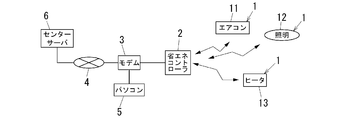
- FIG. 1 is a system configuration diagram illustrating a schematic configuration of an energy saving control system according to Embodiment 1.
- FIG. It is explanatory drawing which shows operation
- FIG. It is explanatory drawing which shows the operation example of the energy-saving control system which concerns on Embodiment 1.
- FIG. It is explanatory drawing which shows the operation example of the energy-saving control system which concerns on Embodiment 1.
- FIG. It is explanatory drawing which shows the operation example of the energy-saving control system which concerns on Embodiment 1.
- FIG. It is explanatory drawing which shows the operation example of the energy-saving control system which concerns on Embodiment 1.
- FIG. 1 is a system configuration diagram illustrating a schematic configuration of an energy saving control system according to Embodiment 1.
- FIG. It is explanatory drawing which shows operation
- FIG. It is explanatory drawing which shows the operation example of the energy-saving
- FIG. 1 It is explanatory drawing which shows the operation example of the energy-saving control system which concerns on Embodiment 1.
- FIG. It is explanatory drawing which shows the operation example of the energy-saving control system which concerns on Embodiment 1.
- FIG. It is explanatory drawing of the cumulative value of the acceptability used with the energy-saving controller which concerns on Embodiment 1.
- the energy-saving control system includes a plurality of controlled devices 11, 12, 13 (simply referred to as “controlled device 1” when not particularly distinguished from each other) and controlled device 1. And an energy-saving controller 2 that can communicate with each other.
- the energy saving controller 2 is connected to the Internet 4 via a modem 3, and a personal computer (personal computer) 5 is also connected to the modem 3.
- a center server 6 is connected to the Internet 4.
- the controlled device 1, the energy-saving controller 2, the modem 3, and the personal computer 5 are all installed in the house, and the controlled device 1 includes a lighting device, an air conditioner (air conditioner), a heater, a refrigerator, and a washing machine. Consists of home appliances for residential use.
- the energy saving controller 2 controls the controlled device 1 based on a manual operation by the user or an algorithm for energy saving automatic control.
- the controlled device 1 is not limited to a device that consumes electrical energy, and may be a device that consumes water, gas, or heat.
- a water pipe and a gas pipe for supplying water and gas are provided for each area in the building. Therefore, a valve for opening and closing the water and gas flow paths is installed in the water pipe and the gas pipe, and the energy saving controller 2 can control the consumption of water and gas by controlling the open / closed state of the valve.
- the energy-saving controller 2 includes a wireless communication unit 21, a wired communication unit 22, a storage unit 23, a setting unit 24, a control unit 25, a request acquisition unit 26, and a receptivity evaluation unit 27. And a monitoring unit 28 and a state determination unit 29.
- the energy-saving controller 2 has a microcomputer (microcomputer) as a main component, and realizes the functions of the above-described units by executing a program in a memory (not shown).
- the wireless communication unit 21 is configured to be capable of wireless communication with an operation unit (not shown) that receives an operation from a user related to control of the controlled device 1 while performing bidirectional wireless communication with the controlled device 1. Has been.
- the wireless communication unit 21 transmits a control signal for controlling the controlled device 1 to the controlled device 1, receives device state information indicating the operation state of the controlled device 1 from the controlled device 1, The control request by the user is received from the operation unit.
- the operation unit may be, for example, a remote control device provided with a cursor key for setting a set temperature of an air conditioner, a touch panel display, or the like in addition to a wall switch that can be simply turned on / off.
- the wired communication unit 22 is connected to the operation unit, and receives a control request from the user by communication from the operation unit.
- the controlled device 1 may be connected to the wired communication unit 22, and in this case, the controlled device 1 and the energy saving controller 2 can exchange control signals and device state information by wired communication. .
- the storage unit 23 stores the control content of the controlled device 1 in advance in association with the energy saving level indicating the degree of energy saving (energy saving).
- the energy saving level here is a natural number, and the greater the value, the higher the energy saving effect, that is, the lower the energy consumed in the controlled device 1.
- the storage unit 23 stores the control content in association with each of a plurality of energy saving levels for each control target.
- the control target here is a combination of the controlled device 1 to be controlled and the execution time at which the control is started, and when a plurality of execution times are set even in one controlled device 1, There are multiple control targets.
- the control content includes parameters such as dimming level in addition to on / off if the controlled device 1 is a lighting device, and other than on / off if the controlled device 1 is an air conditioner or a heater. Includes parameters such as set temperature. Further, the control content includes an execution time for performing the control as a parameter. Furthermore, in the case of intermittent control in which the controlled device 1 is repeatedly turned on and off at regular time intervals, the control content includes a time ratio between the off time and the on time as a parameter. Similarly, when energy-saving operation (in the case of air-conditioner cooling operation, the set temperature is increased) and non-energy-saving operation (in the case of air-conditioner cooling operation, the set temperature is decreased) are repeated alternately, the control content is energy-saving. The time ratio between operation and non-energy-saving operation is also included as a parameter.
- the control content may be scene control for a plurality of controlled devices 1, and in this case, the storage unit 23 stores the control content for each scene.
- the correspondence between the energy saving level and the control content is such that the greater the energy saving level, the higher the energy saving effect (the smaller the energy consumption in the controlled device 1) the more the control content corresponds.
- the control content when the control content is simply on / off, the level of the energy saving effect varies depending on the length of the on-time, and therefore the control content is set so that the execution time as a parameter varies depending on the energy saving level.
- the control content includes parameters that can be set in a stepwise manner such as a dimming level or a set temperature
- the control content is set so that the parameters differ in a stepwise manner depending on the energy saving level.
- the control content includes intermittent control or repetition of energy-saving operation and non-energy-saving operation, the control content is set so that the time ratio as a parameter varies depending on the energy-saving level.
- the setting unit 24 sets the energy saving level applied by the control unit 25.
- the setting unit 24 changes the energy saving level applied by the control unit 25 in accordance with the evaluation result of the acceptance level evaluation unit 27, which will be described later.
- the setting unit 24 sets an energy saving level for each control target, and as described above, in the case of scene control in which the control content targets a plurality of controlled devices 1, the setting unit 24 sets each scene. Set the energy saving level.
- the control unit 25 refers to the storage unit 23, reads the control content corresponding to the energy saving level set by the setting unit 24 from the storage unit 23, and controls the controlled device 1 according to the control content. That is, the control unit 25 generates a control signal by specifying the target controlled device 1 and the control content, and transmits the control signal from the wireless communication unit 21 to the controlled device 1, thereby controlling the controlled device. 1 is controlled.
- the controlled device 1 in the control of the controlled device 1 performed by the control unit 25, the controlled device 1 is automatically controlled based on the control content so as to reduce the energy consumption (power consumption) of the controlled device 1.
- the control unit 25 performs the energy saving automatic control so as to reduce the energy consumption of the controlled device 1 based on the control content.
- the control unit 25 reduces the energy consumption by turning off the controlled device 1 by energy-saving automatic control or lowering the dimming level (dimming by dimming). .
- the control unit 25 reduces energy consumption by turning off the controlled device 1 or increasing the set temperature by energy-saving automatic control.
- the control unit 25 reduces energy consumption by turning off the controlled device 1 or lowering the set temperature by energy-saving automatic control.
- the magnitude of the energy saving effect by the energy saving automatic control varies depending on the energy saving level set by the setting unit 24, and the energy saving effect increases as the energy saving level increases.
- the control part 25 will perform the manual control which controls the to-be-controlled device 1 according to operation content (control request
- the request acquisition unit 26 uses the time when the controlled device 1 is controlled according to the control content by the control unit 25 as a reference time, and determines the user with respect to the operation unit during a determination period set over a predetermined time before and after the reference time. Get the details of the operation performed by. That is, the request acquisition unit 26 uses wireless communication to indicate the operation content when the user operates the operation unit within a predetermined time before and after the time when the control unit 25 performs the energy saving automatic control of the controlled device 1. Obtained from the operation unit via the unit 21 or the wired communication unit 22.
- the request acquisition unit 26 acquires the operation content performed by the user on the operation unit even outside the determination period.
- the period of the predetermined time before and after the reference time when the energy saving automatic control is performed is a determination period for the request acquisition unit 26 to acquire the operation content
- the determination period is before the reference time and after the reference time. It may be set to only one of these.
- the acceptance evaluation unit 27 Based on the operation content acquired by the request acquisition unit 26 during the determination period and the control content of the energy saving automatic control performed by the control unit 25, the acceptance evaluation unit 27 performs the energy saving automatic control by the control unit 25 at the reference time.
- the degree of acceptability of users is evaluated as acceptability.
- the degree of acceptance is a scale indicating how much the user accepts (accepts) the energy-saving automatic control automatically performed by the control unit 25 according to the control content. In other words, if the acceptance level is high, the user has no resistance to energy saving automatic control (accepts energy saving automatic control). If the acceptance level is low, the user has resistance to energy saving automatic control (energy saving automatic control). Will not accept control).
- the acceptance evaluation unit 27 basically compares the control content of the energy saving automatic control with the operation content of the manual control performed within a predetermined time before and after the time of the energy saving automatic control. Acceptability is evaluated based on whether energy saving or non-energy saving is the same. That is, when both the energy saving automatic control and the manual control are more energy saving, the acceptance degree evaluation unit 27 determines that the user has accepted the energy saving automatic control, and determines the acceptance degree as an evaluation result. Enlarge. On the other hand, if the energy-saving automatic control is more energy-saving while the manual control is non-energy-saving (energy increase), the acceptance degree evaluation unit 27 determines that the user does not accept this energy-saving automatic control. And reduce the acceptance as an evaluation result. A specific evaluation method for acceptability will be described in detail later.
- the acceptance level evaluation unit 27 evaluates the acceptance level for each control target. However, as described above, in the case of scene control in which the control content is for a plurality of controlled devices 1, the acceptance level evaluation is performed. The unit 27 evaluates the acceptability for each scene.
- the monitoring unit 28 acquires device state information from the controlled device 1 via the wireless communication unit 21 every time the operation state of the controlled device 1 changes.
- the device status information here includes the energy consumption of the controlled device 1 in addition to whether the controlled device 1 is turned on / off, the dimming level (in the case of a lighting device) and the set temperature (in the case of an air conditioner or heater). Etc. are also included.
- the state determination unit 29 determines the current state of each controlled device 1 using the device state information acquired by the monitoring unit 28. For example, if the controlled device 1 is an air conditioner or the like, the energy consumption in the controlled device 1 varies depending on the room temperature or the like even if the set temperature is the same, but the state determination unit 29 is based on the actual energy consumption in the controlled device 1. The energy saving effect for the control by the control unit 25 is determined. The determination result of the state determination unit 29 is output to the acceptance level evaluation unit 27.
- the energy saving controller 2 of the present embodiment includes an operation history storage unit 30 that stores the operation content acquired by the request acquisition unit 26 and a receptivity evaluation unit 27 as illustrated in FIG. And an acceptance storage unit 31 for storing the evaluated acceptance.
- the operation history storage unit 30 stores the time when the request acquisition unit 26 acquires the operation content, the controlled device 1 to be controlled, and the operation content as an operation history. For example, assuming that “lighting 1”, “lighting 2”, and “switch 1” connected to the home appliance are controlled devices 1, the user performs an operation for controlling these controlled devices 1 on the operation unit. As a result, a table as shown in Table 1 below is stored in the operation history storage unit 30.
- the acceptance evaluation unit 27 evaluates the acceptance based on the operation history stored in the operation history storage unit 30 and the control content of the energy saving automatic control performed by the control unit 25 in this way. Do.
- the acceptance storage unit 31 stores the cumulative value of the acceptance evaluated by the acceptance evaluation unit 27 for each control target, that is, for each energy saving automatic control. As described above, the acceptance degree storage unit 31 stores the acceptance degree for each control target, thereby clarifying how much energy saving automatic control the user accepts (or whether there is resistance). In addition, the acceptance level storage unit 31 obtains a cumulative value of acceptance in units of a certain period (for example, one week), and when the certain period has elapsed, the cumulative value of acceptance becomes the cumulative value of acceptance in the next certain period. Overwritten with.
- the setting unit 24 of the present embodiment saves the control content applied by the control unit 25 during the subsequent automatic energy saving control according to the level of acceptance evaluated by the acceptance evaluation unit 27 as described above. Change the level. That is, the setting unit 24 increases the energy saving level so that the energy consumption in the controlled device 1 is smaller than that at the reference time when the acceptance is higher than the predetermined first threshold. Further, the setting unit 24 reduces the energy saving level so that the energy consumption in the controlled device 1 is higher than that at the reference time when the acceptance is lower than a predetermined second threshold.
- the second threshold value is smaller than the first threshold value here, the first threshold value and the second threshold value may be the same value.
- the energy-saving controller 2 increases the energy-saving level when the user's acceptability for energy-saving automatic control is high, that is, when the user is regarded as accepting (accepting) energy-saving automatic control. If the energy saving level increases, the parameters are changed so that the energy saving effect of the control content increases (the energy consumption in the controlled device 1 decreases), so that the energy saving effect by the energy saving automatic control after the next time improves. become. At this time, the energy-saving controller 2 changes the parameter to advance the start time of energy-saving automatic control, lengthen the off time of the controlled device 1 or the time of energy-saving operation, lower the dimming level, The energy saving effect is improved by raising the set temperature.
- the energy-saving controller 2 reduces the energy-saving level when it is considered that the user's acceptability for the energy-saving automatic control is low, that is, the user does not accept the energy-saving automatic control (there is resistance). . If the energy saving level is decreased, the parameters are changed so that the energy saving effect of the control content is reduced (the energy consumption of the controlled device 1 is increased), so the energy saving effect by the energy saving automatic control after the next time is reduced. become. At this time, the energy-saving controller 2 changes the parameter to delay the start time of the energy-saving automatic control, shorten the off time of the controlled device 1 or the energy-saving operation time, increase the dimming level, The energy saving effect is reduced by lowering the preset temperature.
- the setting unit 24 changes the energy saving level according to the cumulative value of the acceptance level stored in the acceptance level storage unit 31.
- the cumulative value of acceptability accurately reflects the user's acceptability for energy-saving automatic control compared to the acceptability itself evaluated from a single operation.
- the setting unit 24 is highly reliable.
- the energy saving level can be changed according to the acceptance level.
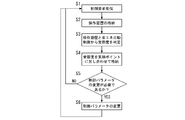
- the energy saving controller 2 receives an operation content (control request) by the user from the operation unit at the request acquisition unit 26 (S1 in FIG. 3), and stores the received operation content as an operation history in the operation history storage unit 30 ( S2). Then, the energy-saving controller 2 determines (evaluates) the user's degree of acceptance for the energy-saving automatic control based on the operation history and the content of the energy-saving automatic control in the degree-of-acceptance evaluation unit 27 (S3). The cumulative value (cumulative point) is added and stored in the acceptance level storage unit 31 (S4).
- the energy-saving controller 2 refers to the cumulative value of the acceptance stored in the acceptance storage 31 in the setting unit 24, and controls the content of the control according to the comparison result between the cumulative value and the first and second threshold values. It is determined whether or not it is necessary to change the parameters, that is, to change the energy saving level (S5). At this time, if it is determined that the parameter needs to be changed (S5: YES), the energy-saving controller 2 changes the parameter by changing the energy-saving level in the setting unit 24 (S6), and the process of “S1” is performed. Return. On the other hand, if it is determined that no parameter change is necessary (S5: NO), the energy saving controller 2 returns to the processing of “S1” without changing the energy saving level in the setting unit 24.
- the acceptability evaluation unit 27 derives acceptability represented by integer points (scores) between “ ⁇ 5” and “5” according to the conditions in Table 2 below.
- the acceptability is a positive number, it indicates that the user is accepting the energy saving automatic control. Conversely, if the acceptability is a negative number, the user is resistant to the energy saving automatic control.
- the acceptance level evaluation unit 27 compares the operation history and the control content of the energy saving automatic control, and in addition to the control direction (more energy saving or non-energy saving), the timing of the energy saving automatic control (reference time) and the manual operation Acceptability is evaluated from the relative relationship with the timing of control.
- the acceptability varies depending on whether the timing of manual control is before (“preliminary”) or after (“post-event”) the reference time, and also depends on whether an operation for manual control is performed.
- when manual control is performed whether the result of manual control is more energy-saving than energy-saving automatic control or whether the result of manual control is more energy-saving than before is acceptable. The degree is different.
- the acceptability may vary depending on the time difference between the energy-saving automatic control and the manual control.
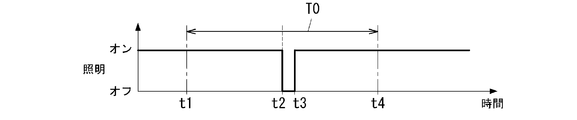
- the control content is that the controlled device 12 is turned off at the execution time. Will be described with reference to FIGS. 4A and 4B.
- FIG. 4A shows a case where control for turning off the controlled device 12 is performed by manual control at time t2 before time t3 that is the execution time of energy saving automatic control.
- time t3 is the reference time
- periods t1 to t4 within a predetermined time before and after that are the determination period T0.
- the acceptance level evaluation unit 27 performs the control that becomes “same as or more energy-saving than the automatic control” in “advance”. Judging that it was done, the acceptability is evaluated as “5” from Table 2.
- FIG. 4B shows a case where the control to turn on the controlled device 12 is performed by manual control at time t3 after time t2 which is the execution time of energy saving automatic control.
- time t2 is the reference time
- periods t1 to t4 within a predetermined time before and after that are the determination period T0.
- manual control is performed in the direction opposite to the energy-saving automatic control, that is, energy increase. That is, since the control is manually controlled to be in the same state as the ON state at the start of the determination period T0, the acceptance level evaluation unit 27 performs “control” that is “same as the setting at the start of the determination period or less energy saving”. From Table 2, the acceptance is evaluated as “ ⁇ 4”.
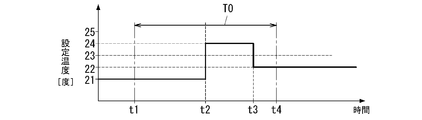
- the set temperature of the controlled device 11 is changed from 21 degrees to 24 degrees at the execution time for the controlled apparatus 11 including an air conditioner (during cooling operation).
- the energy saving automatic control is executed will be described with reference to FIGS. 5A and 5B.
- FIG. 5A shows a case where the control to set the set temperature of the controlled device 11 to 25 degrees is performed by manual control at time t3 after time t2 that is the execution time of energy saving automatic control.
- the time t2 becomes the reference time, and the periods t1 to t4 within a predetermined time before and after that become the determination period T0.
- the acceptance evaluation unit 27 sets “same as the automatic control” in the “post-event”. It is judged that the control of “more energy saving” has been performed, and the acceptability is evaluated as “4” from Table 2.
- FIG. 5B shows a case where control is performed to set the set temperature of the controlled device 11 to 22 degrees by manual control at time t3 after time t2 that is the execution time of energy saving automatic control.
- the time t2 becomes the reference time, and the periods t1 to t4 within a predetermined time before and after that become the determination period T0.
- manual control is performed, which saves more energy than the energy-saving automatic control, although it saves more energy than when the set temperature is 21 degrees at the start of the determination period T0. Therefore, the acceptance level evaluation unit 27 determines that “after the fact” has been controlled to be “energy saving from the setting at the start of the determination period, but non-energy saving than the automatic control”, and the acceptance level is evaluated as “1” from Table 2. To do.
- the acceptance level evaluation unit 27 determines that the user has accepted the energy saving automatic control to some extent. From Table 2, the acceptability is evaluated as “2”.
- the acceptance evaluation unit 27 adds the acceptance evaluated as described above to the cumulative value (cumulative point) of the acceptance in the acceptance storage unit 31.
- the accumulated points stored in the acceptance level storage unit 31 increase if the acceptance level evaluated by the acceptance level evaluation unit 27 is positive, and decrease if the acceptance level is negative.
- the accumulated points of acceptability fluctuate on a one-dimensional axis as shown in FIG. 6 according to the evaluation result of the acceptability evaluation unit 27.
- the setting unit 24 compares the accumulated point with the first and second threshold values. If the accumulated point exceeds the first threshold value (for example, “+10”), the energy saving level is increased, and the second threshold value (for example, “ ⁇ ” If it falls below 10 "), the energy saving level is reduced. Since the acceptance level (cumulative value) changes from time to time, even if the energy saving level once increases or decreases, it may return to the original level depending on subsequent changes in the acceptance level.
- the energy saving level of the energy saving automatic control is automatically changed according to the degree of acceptance indicating the degree of acceptability of the user for the energy saving automatic control. That is, the energy saving controller 2 can improve the energy saving effect by automatically increasing the energy saving level when the degree of acceptance increases, even if the user himself cannot change the energy saving level. Therefore, even if the user initially has resistance to the energy saving automatic control, the energy saving controller 2 gradually becomes the energy saving level when the user gets used to the energy saving automatic control and accepts the energy saving automatic control. By improving the energy saving effect can be improved.
- this energy-saving controller 2 since the energy saving controller 2 automatically reduces the energy saving level when the acceptability is lowered, the energy saving effect can be suppressed within a range that can be accepted without difficulty by the user. Therefore, this energy-saving controller 2 has an advantage that appropriate energy-saving automatic control can be performed so that the energy-saving effect as high as possible can be obtained as long as it is reasonably accepted by the user.
- the setting unit 24 responds to the level of acceptance so that the energy saving level decreases as the acceptance (accumulated value) decreases, and conversely, the energy saving level increases as the acceptance (accumulated value) increases.
- the size of the energy saving level may be determined.
- the energy saving controller 2 can set the energy saving effect of the subsequent energy saving automatic control in detail depending on how much the user accepts the energy saving automatic control. Become.
- the contents of manual control include non-energy-saving direction (that is, “same as the setting at the start of the judgment period or less energy-saving” in Table 2)
- the contents of the manual control are after the reference time (after the fact)
- the degree of acceptance is set to a lower value when it is performed within a predetermined time (preliminary) before the reference time than within the predetermined time. That is, even in the same manual control, the acceptability varies depending on whether the operation timing is before or after the reference time. Therefore, it is possible to more accurately evaluate whether the content of the user's manual control is eager for energy saving, and more appropriate energy saving automatic control becomes possible.
- the setting unit 24 is not limited to the configuration that changes the energy saving level according to the cumulative value of the acceptance level stored in the acceptance level storage unit 31, but every time the acceptance level is evaluated by the acceptance level evaluation unit 27, The structure which changes an energy saving level according to this acceptance degree may be sufficient.
- the energy saving controller 2 of the present embodiment has a function of returning the energy saving level to the state before the change when a predetermined return time has elapsed from the time of change after the setting unit 24 has changed the energy saving level to a small value. This is different from the energy saving controller 2 in FIG.
- the setting unit 24 changes the energy saving level from the first level to the second level (however, the first level> the second level) so that the energy consumption in the controlled device 1 increases.
- the energy saving level is returned to the first level.
- the energy-saving controller 2 reduces the energy-saving level once when the user's acceptance for energy-saving automatic control is low (that is, there is resistance), but increases the energy-saving level again when the recovery time elapses. Become.
- the energy-saving controller 2 does not leave the energy-saving level low even when energy-saving automatic control is not accepted by the user, but returns it to the original energy-saving level after the return time has elapsed. There is an advantage that the effect can be improved. Therefore, the energy saving controller 2 can accept the energy saving automatic control without difficulty because the energy saving level is once lowered for the user while realizing a high energy saving effect.
- the setting unit 24 does not set the return time to a fixed length, but determines the length of the return time according to the level of acceptability so that the return time becomes longer as the acceptability is lower. Also good. That is, the setting unit 24 sets the return time as a variable length, and lengthens the return time as the acceptability decreases.
- the energy saving controller 2 becomes longer in time until the energy saving level is reduced after the energy saving level is reduced, and the time in which the energy saving level is reduced becomes longer. Therefore, the resistance to the energy saving automatic control is reduced for the user, and the energy saving automatic control is easily accepted.
Landscapes
- Engineering & Computer Science (AREA)
- Chemical & Material Sciences (AREA)
- Combustion & Propulsion (AREA)
- Mechanical Engineering (AREA)
- General Engineering & Computer Science (AREA)
- Signal Processing (AREA)
- Fuzzy Systems (AREA)
- Mathematical Physics (AREA)
- Physics & Mathematics (AREA)
- Human Computer Interaction (AREA)
- Computer Networks & Wireless Communication (AREA)
- Air Conditioning Control Device (AREA)
- Selective Calling Equipment (AREA)
Abstract
記憶部は、省エネの程度を表す省エネレベルに対応付けて制御内容を記憶している。制御部は、設定部で設定された省エネレベルに対応する制御内容を記憶部から読み出し、被制御機器を制御する。要求取得部は、被制御機器が制御内容に従って制御された時点を基準時として、基準時の前後所定時間内に利用者が行った操作内容を取得する。受容度評価部は、要求取得部が取得した操作内容に基づいて、基準時での制御部による省エネ自動制御に対する利用者の受容性の程度を受容度として評価する。設定部は、受容度が第1の閾値より高ければ、基準時よりも被制御機器での消費エネルギーが小さくなるように省エネレベルを大きくする。
Description
本発明は、被制御機器でのエネルギー消費が抑制されるように被制御機器を制御して省エネルギー化を図る省エネコントローラ、省エネ制御システムに関する。
近年、省エネ(省エネルギー)に対する関心が高まってきており、一般家庭においても、低消費電力の機器を選んで購入するなど省エネに対する意識が高まっている。省エネを実現するシステムとしては、たとえば空調設備などの被制御機器の消費エネルギーを低減するように被制御機器の動作を自動的に制御(以下、「省エネ自動制御」という)するシステムが提案されている(たとえば日本国特許公開2008-241161号公報参照)。
この文献に記載のシステム(空調制御システム)では、サーバ装置が、入力装置から利用者の要望を取得し、消費エネルギーを増加させる要望情報と第1の基準値とを比較することで消費エネルギーを増加させる方向へ目標温度を変化させる。また、サーバ装置は、消費エネルギーを低減させる要望情報と第2の基準値とを比較することで消費エネルギーを低減させる方向へ目標温度を変化させる。さらにサーバ装置は、第1、第2の基準値を省エネルギーの目標達成度に基づいて変化させる。
このように、従来のシステムにおいては、消費エネルギーの増減に関する利用者の要望を空調設備装置の目標温度などに反映することにより、省エネ自動制御時の省エネの程度を表すレベル(以下、「省エネレベル」という)を利用者が指定(要望)することができる。要するに、利用者は、省エネレベルを自由に設定することにより、省エネ自動制御によってどの程度の省エネの効果を実現するのかを変更することができる。
しかし、省エネに対する意識が高まってはいるものの、被制御機器が省エネ自動制御されていない状態の快適性・利便性に慣れた利用者に、より高い省エネ効果が得られる(つまり、消費エネルギーを低減する)ような省エネレベルの変更を期待することは難しい。そのため、省エネレベルを利用者が変更できる省エネ制御システムであっても、利用者が一旦設定した省エネレベルをより省エネ効果が高まるように自ら変更することは少なく、省エネ効果が低い状態で省エネ自動制御が実施されてしまう可能性がある。すなわち、従来の省エネ制御システムでは、利用者に無理なく受け入れられる範囲で極力高い省エネ効果が得られるような、適切な省エネ自動制御を行うことは難しかった。
そこで、本発明の目的は、利用者に無理なく受け入れられる範囲で極力高い省エネ効果が得られるような、適切な省エネ自動制御が可能な省エネコントローラ、省エネ制御システムを提供することにある。
本発明の省エネコントローラは、省エネルギーの程度を表す省エネレベルに対応付けて被制御機器の制御内容を予め記憶している記憶部と、前記省エネレベルを設定する設定部と、前記記憶部を参照し、前記設定部で設定された前記省エネレベルに対応する前記制御内容に従って前記被制御機器を制御する制御部と、前記制御部が前記被制御機器を前記制御内容に従って制御した時点を基準時として、当該基準時の前および後の少なくとも一方の所定時間内に、前記被制御機器の制御に関して利用者が行った操作内容を取得する要求取得部と、前記要求取得部が取得した前記操作内容に基づいて、前記基準時での前記制御部による制御に対する前記利用者の受容性の程度を受容度として評価する受容度評価部とを備え、前記設定部は、前記受容度が第1の閾値よりも高ければ、前記基準時よりも前記被制御機器での消費エネルギーが小さくなるように前記省エネレベルを変更する。
この構成では、受容度が第1の閾値よりも高ければ、基準時よりも被制御機器での消費エネルギーが小さくなるように省エネレベルを変更するので、利用者に無理なく受け入れられる範囲で極力高い省エネ効果が得られるような、適切な省エネ自動制御が可能である。
この省エネコントローラにおいて、前記設定部は、前記受容度が第2の閾値よりも低ければ、前記基準時よりも前記被制御機器での消費エネルギーが大きくなるように前記省エネレベルを変更することが望ましい。
この省エネコントローラにおいて、一定期間内に前記受容度評価部で評価された複数の受容度を累積して得られる累積値を格納する受容度格納部を備え、前記受容度評価部は、前記受容度格納部に格納されている前記累積値に対して、前記利用者の操作内容が前記制御部の制御内容を受容していると評価するときには前記受容度として正数の値を加算し、前記利用者の操作内容が前記制御部の制御内容に抵抗があると評価するときには前記受容度として負数の値を加算し、前記設定部は、前記累積値を前記第1の閾値または前記第2の閾値と比較して前記省エネレベルを変更することが望ましい。
この省エネコントローラにおいて、前記受容度評価部は、前記利用者の操作内容が省エネルギーの方向性を含むとき、当該操作内容が前記基準時の後の所定時間内より前記基準時の前の所定時間内に行われた方が前記受容度として高く評価し、前記利用者の操作内容が非省エネルギーの方向性を含むとき、当該操作内容が前記基準時の後の所定時間内より前記基準時の前の所定時間内に行われた方が前記受容度として低く評価することが望ましい。
この省エネコントローラにおいて、前記設定部は、前記被制御機器での消費エネルギーが大きくなるように前記省エネレベルを変更した後、当該変更時点から所定の復帰時間が経過すると、前記省エネレベルを変更する前のレベルに戻すことがより望ましい。
この省エネコントローラにおいて、前記設定部は、前記受容度が低いほど前記復帰時間が長くなるように、前記受容度に応じて前記復帰時間の長さを決定することがより望ましい。
この省エネコントローラにおいて、前記設定部は、前記受容度が低いほど前記被制御機器での消費エネルギーが大きくなるように、前記受容度に応じて前記省エネレベルの大きさを決定することがより望ましい。
本発明の省エネ制御システムは、被制御機器と、省エネルギーの程度を表す省エネレベルに対応付けて前記被制御機器の制御内容を予め記憶している記憶部と、前記省エネレベルを設定する設定部と、前記記憶部を参照し、前記設定部で設定された前記省エネレベルに対応する前記制御内容に従って前記被制御機器を制御する制御部と、前記被制御機器の制御に関する利用者からの操作を受け付ける操作部と、前記制御部が前記被制御機器を前記制御内容に従って制御した時点を基準時として、当該基準時の前および後の少なくとも一方の所定時間内に前記操作部が受けた操作内容を取得する要求取得部と、前記要求取得部が取得した前記操作内容に基づいて、前記基準時での前記制御部による制御に対する前記利用者の受容性の程度を受容度として評価する受容度評価部とを備え、前記設定部は、前記受容度が第1の閾値よりも高ければ、前記基準時よりも前記被制御機器での消費エネルギーが小さくなるように前記省エネレベルを変更する。
この構成では、受容度が第1の閾値よりも高ければ、基準時よりも被制御機器での消費エネルギーが小さくなるように省エネレベルを変更するので、利用者に無理なく受け入れられる範囲で極力高い省エネ効果が得られるような、適切な省エネ自動制御が可能である。
本発明の好ましい実施形態をさらに詳細に記述する。本発明の他の特徴および利点は、以下の詳細な記述および添付図面に関連して一層良く理解されるものである。
実施形態1に係る省エネコントローラの概略構成を示すブロック図である。
実施形態1に係る省エネ制御システムの概略構成を示すシステム構成図である。
実施形態1に係る省エネコントローラの動作を示す説明図である。
実施形態1に係る省エネ制御システムの動作例を示す説明図である。
実施形態1に係る省エネ制御システムの動作例を示す説明図である。
実施形態1に係る省エネ制御システムの動作例を示す説明図である。
実施形態1に係る省エネ制御システムの動作例を示す説明図である。
実施形態1に係る省エネコントローラで用いる受容度の累積値の説明図である。
(実施形態1)
本実施形態に係る省エネ制御システムは、図2に示すように、複数の被制御機器11,12,13(各々を特に区別しないときには単に「被制御機器1」とする)と、被制御機器1との間で通信可能な省エネコントローラ2とを備えている。省エネコントローラ2は、モデム3を介してインターネット4に接続されており、モデム3にはパーソナルコンピュータ(パソコン)5も接続されている。インターネット4にはセンターサーバ6が接続されている。本実施形態では、被制御機器1、省エネコントローラ2、モデム3、パソコン5はいずれも宅内に設置されており、被制御機器1は、照明機器やエアコン(空調装置)、ヒータ、冷蔵庫、洗濯機などの住宅用の家電機器からなる。
本実施形態に係る省エネ制御システムは、図2に示すように、複数の被制御機器11,12,13(各々を特に区別しないときには単に「被制御機器1」とする)と、被制御機器1との間で通信可能な省エネコントローラ2とを備えている。省エネコントローラ2は、モデム3を介してインターネット4に接続されており、モデム3にはパーソナルコンピュータ(パソコン)5も接続されている。インターネット4にはセンターサーバ6が接続されている。本実施形態では、被制御機器1、省エネコントローラ2、モデム3、パソコン5はいずれも宅内に設置されており、被制御機器1は、照明機器やエアコン(空調装置)、ヒータ、冷蔵庫、洗濯機などの住宅用の家電機器からなる。
省エネコントローラ2は、利用者による手動操作や省エネ自動制御のアルゴリズムに基づいて、被制御機器1の制御を行う。ただし、被制御機器1は、電気エネルギーを消費する機器に限らず、水やガス、熱を消費する機器であってもよい。たとえば、水、ガスを消費する機器の場合、建物内のエリア毎に水、ガスを供給する水道管、ガス管が配設されている。そのため、この水道管、ガス管に水、ガスの流路を開閉するバルブを設置し、省エネコントローラ2は、このバルブの開閉状態を制御することによって、水、ガスの消費を制御できる。
省エネコントローラ2は、図1に示すように、無線通信部21と、有線通信部22と、記憶部23と、設定部24と、制御部25と、要求取得部26と、受容度評価部27と、監視部28と、状態判断部29とを備えている。ここでは、省エネコントローラ2は、マイコン(マイクロコンピュータ)を主構成とし、メモリ(図示せず)内のプログラムを実行することによって上記各部の機能を実現する。
無線通信部21は、被制御機器1との間で双方向に無線通信であるとともに、被制御機器1の制御に関する利用者からの操作を受け付ける操作部(図示せず)とも無線通信可能に構成されている。無線通信部21は、被制御機器1を制御するための制御信号を被制御機器1に送信したり、被制御機器1の動作状態を表す機器状態情報を被制御機器1から受信したり、利用者による制御要求を操作部から受信したりする。操作部は、単にオン・オフ操作のみが可能な壁スイッチ等の他、たとえばエアコンの設定温度を設定するためのカーソルキー等を備えたリモコン装置や、タッチパネルディスプレイなどであってもよい。
有線通信部22は、操作部に接続されており、利用者による制御要求を操作部から通信により受信する。ここで、被制御機器1は有線通信部22に接続されていてもよく、この場合、被制御機器1と省エネコントローラ2とは、制御信号や機器状態情報のやり取りを有線通信によって行うことができる。
記憶部23は、省エネ(省エネルギー)の程度を表す省エネレベルに対応付けて、被制御機器1の制御内容を予め記憶している。ここでいう省エネレベルは、自然数であって、値が大きくなるほど省エネの効果が高くなる、つまり被制御機器1での消費エネルギーが小さくなることを示している。本実施形態では、記憶部23は、制御対象ごとに、複数の省エネレベルの各々に対応付けて制御内容を記憶している。ここでいう制御対象は、制御の対象となる被制御機器1と制御を開始する実行時刻との組み合わせであって、1つの被制御機器1でも複数の実行時刻が設定されている場合には、制御対象は複数になる。
制御内容は、被制御機器1が照明機器であれば、オン・オフの他に調光レベルなどのパラメータを含んでおり、被制御機器1がエアコンやヒータであれば、オン・オフの他に設定温度などのパラメータを含んでいる。また、制御内容には、制御を行う実行時刻もパラメータとして含まれている。さらに、被制御機器1のオン・オフを一定時間間隔で繰り返す間欠制御の場合、制御内容には、オフ時間とオン時間との時間比率もパラメータとして含まれる。同様に、省エネ運転(エアコンの冷房運転であれば設定温度を高くする)と非省エネ運転(エアコンの冷房運転であれば設定温度を低くする)とを交互に繰り返す場合、制御内容には、省エネ運転と非省エネ運転との時間比率もパラメータとして含まれる。なお、制御内容は、複数の被制御機器1を対象とするシーン制御であってもよく、この場合、記憶部23は、シーンごとに制御内容を記憶する。
ここで、省エネレベルおよび制御内容の対応付けは、大きな省エネレベルほど、省エネ効果の高い(被制御機器1での消費エネルギーが小さい)制御内容が対応するように為されている。具体的には、制御内容が単なるオン・オフの場合、省エネ効果の高低はオン時間の長さによって異なるので、制御内容は、省エネレベルによってパラメータとしての実行時刻が異なるように設定される。また、制御内容が調光レベルや設定温度のように段階的に設定可能なパラメータを含む場合、制御内容は、省エネレベルによってパラメータが段階的に異なるように設定される。制御内容が、間欠制御や省エネ運転と非省エネ運転との繰り返しを含んでいる場合、制御内容は、省エネレベルによってパラメータとしての時間比率が異なるように設定される。
設定部24は、制御部25で適用される省エネレベルを設定する。本実施形態においては、設定部24は、受容度評価部27の評価結果に応じて制御部25で適用される省エネレベルを変更するが、この点については後述する。なお、本実施形態では設定部24は、制御対象ごとに省エネレベルを設定し、上述のように制御内容が複数の被制御機器1を対象とするシーン制御の場合、設定部24はシーンごとに省エネレベルを設定する。
制御部25は、記憶部23を参照し、設定部24で設定された省エネレベルに対応する制御内容を記憶部23から読み出し、その制御内容に従って被制御機器1を制御する。つまり、制御部25は、対象となる被制御機器1と制御内容とを特定して制御信号を生成し、この制御信号を無線通信部21から被制御機器1に送信することによって、被制御機器1の制御を行う。
本実施形態においては、制御部25が行う被制御機器1の制御には、被制御機器1の消費エネルギー(消費電力)を小さくするように制御内容に基づいて被制御機器1を自動的に制御する省エネ自動制御と、利用者の手動操作による手動制御との2種類がある。すなわち、制御部25は、現在時刻が実行時刻になると、制御内容に基づいて被制御機器1の消費エネルギーを小さくするように省エネ自動制御を行う。
たとえば被制御機器1が照明機器であれば、制御部25は、省エネ自動制御にて被制御機器1をオフあるいは調光レベルを下げる(調光にて減光する)ことにより消費エネルギーを小さくする。被制御機器1がエアコン(冷房運転)であれば、制御部25は、省エネ自動制御にて被制御機器1をオフあるいは設定温度を上げることにより消費エネルギーを小さくする。また、被制御機器1がヒータであれば、制御部25は、省エネ自動制御にて被制御機器1をオフあるいは設定温度を下げることにより消費エネルギーを小さくする。省エネ自動制御による省エネ効果の大きさは、設定部24で設定されている省エネレベルによって変化し、省エネレベルが大きい場合ほど省エネ効果も大きくなる。また、制御部25は、操作部が利用者からの操作を受け付けると、操作内容(制御要求)に応じて被制御機器1を制御する手動制御を行う。
要求取得部26は、制御部25により被制御機器1が制御内容に従って制御された時点を基準時として、基準時の前後所定時間に亘って設定される判定期間に、操作部に対して利用者が行った操作内容を取得する。つまり、要求取得部26は、制御部25が被制御機器1を省エネ自動制御した時点を基準時として、その前後の所定時間内に利用者が操作部を操作した場合の操作内容を、無線通信部21あるいは有線通信部22を介して操作部から取得する。
ただし、本実施形態では要求取得部26は、判定期間以外でも操作部に対して利用者が行った操作内容を取得している。なお、ここでは省エネ自動制御が行われた基準時の前後所定時間の期間を、要求取得部26が操作内容を取得するための判定期間としているが、判定期間は、基準時前および基準時後の一方にのみ設定されていてもよい。
受容度評価部27は、要求取得部26が判定期間に取得した操作内容と、制御部25が行った省エネ自動制御の制御内容とに基づいて、基準時での制御部25による省エネ自動制御に対する利用者の受容性の程度を受容度として評価する。受容度は、制御部25が制御内容に従って自動的に行った省エネ自動制御を、利用者がどの程度受容している(受け入れている)かを示す尺度となる。言い換えれば、受容度が高ければ、利用者は省エネ自動制御に抵抗がない(省エネ自動制御を受容している)、受容度が低ければ、利用者は省エネ性自動制御に抵抗がある(省エネ自動制御を受容していない)ことになる。
受容度評価部27は、基本的には、省エネ自動制御の制御内容と、この省エネ自動制御の時点前後の所定時間内に行われた手動制御の操作内容とを比較し、制御の方向性(より省エネか非省エネか)が同じか否かによって受容度を評価する。つまり、受容度評価部27は、省エネ自動制御と手動制御とがいずれもより省エネとなる場合には、利用者がこの省エネ自動制御を受容していると判断し、評価結果としての受容度を大きくする。一方、受容度評価部27は、省エネ自動制御がより省エネであるのに対して手動制御が非省エネ(増エネ)となる場合には、利用者がこの省エネ自動制御を受容していないと判断し、評価結果としての受容度を小さくする。受容度の具体的な評価方法については、後に詳しく説明する。なお、本実施形態では、受容度評価部27は、制御対象ごとに受容度を評価するが、上述のように制御内容が複数の被制御機器1を対象とするシーン制御の場合、受容度評価部27はシーンごとに受容度を評価する。
監視部28は、被制御機器1の動作状態が変化する度に、無線通信部21を介して被制御機器1から機器状態情報を取得する。ここでいう機器状態情報は、被制御機器1のオン・オフの別や調光レベル(照明機器の場合)や設定温度(エアコン、ヒータの場合)の他に、被制御機器1での消費エネルギー等の情報も含んでいる。
状態判断部29は、監視部28で取得された機器状態情報を用いて、被制御機器1ごとに現在どのような状態にあるかを判断する。たとえば被制御機器1がエアコンなどであれば、設定温度が同じでも室温などによって被制御機器1での消費エネルギーは異なるが、状態判断部29では被制御機器1での実際の消費エネルギーに基づいて、制御部25による制御に対する省エネ効果を判断する。状態判断部29の判断結果は、受容度評価部27に出力される。
さらに、本実施形態の省エネコントローラ2は、上述した構成に加えて、図1に示すように、要求取得部26が取得した操作内容を記憶する操作履歴格納部30と、受容度評価部27が評価した受容度を記憶する受容度格納部31とを備えている。
操作履歴格納部30は、要求取得部26が操作内容を取得した時刻、および対象となる被制御機器1とその操作内容を、操作履歴として記憶する。たとえば、「照明1」、「照明2」、家電機器に接続された「スイッチ1」を被制御機器1として、利用者が操作部に対してこれらの被制御機器1を制御するための操作を行うと、下記表1のようなテーブルが操作履歴格納部30に格納される。

本実施形態では、受容度評価部27は、このように操作履歴格納部30に格納されている操作履歴と、制御部25が行った省エネ自動制御の制御内容とに基づいて受容度の評価を行う。
受容度格納部31は、受容度評価部27が評価した受容度について、制御対象ごと、つまり省エネ自動制御ごとにその累積値を記憶する。このように受容度格納部31は、制御対象ごとに受容度を格納することにより、利用者がどの省エネ自動制御についてどの程度受容しているのか(あるいは抵抗があるのか)が明確になる。また、受容度格納部31は、一定期間(たとえば1週間)単位で受容度の累積値を求めており、一定期間が経過すると、受容度の累積値が次の一定期間における受容度の累積値で上書きされる。
ところで、本実施形態の設定部24は、上述のようにして受容度評価部27で評価される受容度の高低に応じて、以降の省エネ自動制御時に制御部25で適用される制御内容の省エネレベルを変更する。すなわち、設定部24は、予め定められた第1の閾値よりも受容度が高ければ、基準時よりも被制御機器1での消費エネルギーが小さくなるように、省エネレベルを大きくする。また、設定部24は、予め定められた第2の閾値よりも受容度が低ければ、基準時よりも被制御機器1での消費エネルギーが大きくなるように、省エネレベルを小さくする。なお、ここでは第2の閾値は第1の閾値よりも小さな値とするが、第1の閾値と第2の閾値とは同値であってもよい。
要するに、省エネコントローラ2は、省エネ自動制御に対する利用者の受容性が高い、つまり省エネ自動制御を利用者が受容している(受け入れている)とみなされた場合には、省エネレベルを大きくする。省エネレベルが大きくなれば、制御内容は省エネ効果が高くなる(被制御機器1での消費エネルギーが小さくなる)ようにパラメータが変更されるので、次回以降の省エネ自動制御による省エネ効果が向上することになる。このとき、省エネコントローラ2は、パラメータの変更により、省エネ自動制御の開始時刻を早めたり、被制御機器1のオフ時間や省エネ運転の時間を長くしたり、調光レベルを下げたり、冷房運転時の設定温度を上げたりすることで、省エネ効果を向上させる。
一方で、省エネコントローラ2は、省エネ自動制御に対する利用者の受容性が低い、つまり省エネ自動制御を利用者が受容していない(抵抗がある)と見なされた場合には、省エネレベルを小さくする。省エネレベルが小さくなれば、制御内容は省エネ効果が低くなる(被制御機器1での消費エネルギーが大きくなる)ようにパラメータが変更されるので、次回以降の省エネ自動制御による省エネ効果が低下することになる。このとき、省エネコントローラ2は、パラメータの変更により、省エネ自動制御の開始時刻を遅くしたり、被制御機器1のオフ時間や省エネ運転の時間を短くしたり、調光レベルを上げたり、冷房運転時の設定温度を下げたりすることで、省エネ効果を低下させる。
本実施形態においては、設定部24は、受容度格納部31に格納されている受容度の累積値に応じて省エネレベルを変更する。受容度の累積値は、1回の操作から評価される受容度そのものに比べて、省エネ自動制御に対する利用者の受容性を正確に反映し、結果的に、設定部24は、信頼性の高い受容度に応じて省エネレベルを変更することができる。
制御内容のパラメータの変更に関連する省エネコントローラ2の動作について、図3を参照して説明する。
省エネコントローラ2は、利用者による操作内容(制御要求)を要求取得部26にて操作部から受信し(図3のS1)、受信した操作内容を操作履歴格納部30に操作履歴として格納する(S2)。それから、省エネコントローラ2は、受容度評価部27にて、操作履歴と省エネ自動制御の内容とに基づいて、省エネ自動制御に対する利用者の受容度を判定(評価)し(S3)、受容度を累積値(累積ポイント)に足し合わせて受容度格納部31に格納する(S4)。
その後、省エネコントローラ2は、設定部24にて受容度格納部31に格納されている受容度の累積値を参照し、この累積値と第1および第2の閾値との比較結果によって、制御内容のパラメータの変更、つまり省エネレベルの変更が必要か否かを判断する(S5)。このとき、パラメータの変更が必要と判断すると(S5:YES)、省エネコントローラ2は、設定部24にて省エネレベルを変更することによりパラメータの変更を実施し(S6)、「S1」の処理に戻る。一方、パラメータの変更が必要ないと判断すると(S5:NO)、省エネコントローラ2は、設定部24にて省エネレベルを変更することなく、「S1」の処理に戻る。
次に、省エネコントローラ2における受容度の評価方法並びに省エネレベルの変更方法について、具体例を挙げて説明する。以下では、受容度評価部27が「-5」~「5」までの間の整数のポイント(得点)で表される受容度を、下記表2の条件に従って導出する場合を例とする。ここで、受容度は、正数であれば利用者が省エネ自動制御を受容していることを表し、逆に、負数であれば利用者が省エネ自動制御に対して抵抗があることを表す。
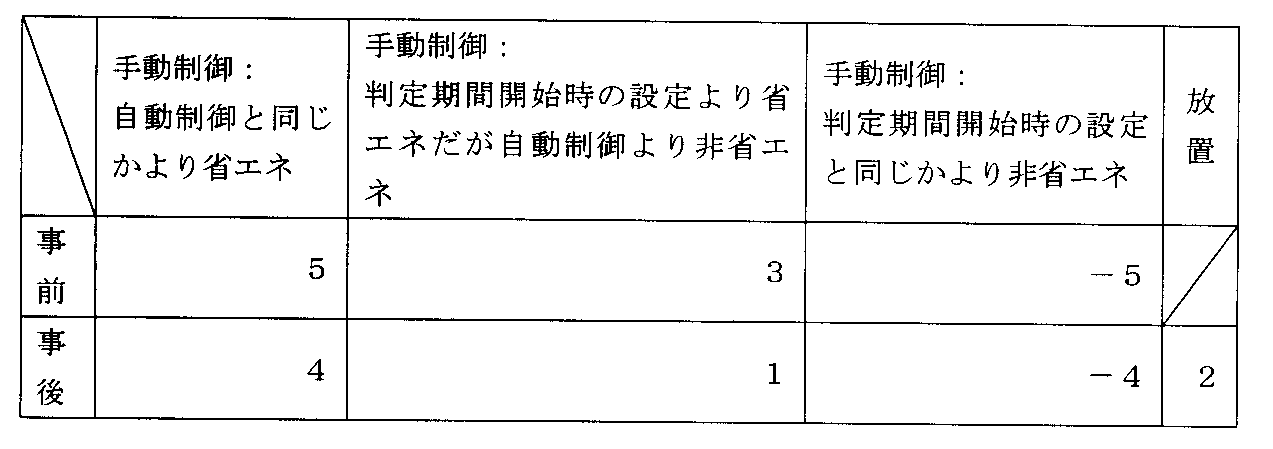
すなわち、受容度評価部27は、操作履歴と省エネ自動制御の制御内容とを比較して、制御の方向性(より省エネか非省エネか)の他、省エネ自動制御のタイミング(基準時)と手動制御のタイミングとの相対的な関係から、受容度を評価する。表2の例では、受容度は、手動制御のタイミングが基準時の前(「事前」)か後(「事後」)かで異なり、手動制御のための操作が為されたか否かでも異なる。さらに、表2の例では、手動制御が為された場合において、手動制御の結果が省エネ自動制御よりも省エネか否か、また、手動制御の結果がそれまでよりも省エネか否かでも、受容度は異なる。なお、表2には含まれていないが、受容度は、省エネ自動制御と手動制御との時間差によって異なってもよい。
表2の条件を適用した受容度の導出の一例として、照明機器からなる被制御機器12に関して、実行時刻になると被制御機器12をオフすることを制御内容とする省エネ自動制御が実行される場合について図4Aおよび図4Bを参照して説明する。
図4Aは、省エネ自動制御の実行時刻となる時刻t3よりも前の時刻t2において、手動制御により、被制御機器12をオフする制御が行われた場合を表している。図4Aでは、時刻t3が基準時となりその前後所定時間内の期間t1~t4が判定期間T0となる。この場合、判定期間T0内の基準時前に省エネ自動制御と同じ手動制御が為されているので、受容度評価部27は、「事前」に「自動制御と同じかより省エネ」となる制御が為されたと判断し、表2より受容度を「5」と評価する。
一方、図4Bは、省エネ自動制御の実行時刻となる時刻t2よりも後の時刻t3において、手動制御により、被制御機器12をオンする制御が行われた場合を表している。図4Bでは、時刻t2が基準時となりその前後所定時間内の期間t1~t4が判定期間T0となる。この場合、判定期間T0内の基準時後に省エネ自動制御とは逆の方向性、つまり増エネとなる手動制御が為されている。つまり、判定期間T0の開始時のオン状態と同じ状態に手動制御されているので、受容度評価部27は、「事後」に「判定期間開始時の設定と同じかより非省エネ」となる制御が為されたと判断し、表2より受容度を「-4」と評価する。
表2の条件を適用した受容度の導出の他の例として、エアコン(冷房運転時)からなる被制御機器11に関して、実行時刻になると被制御機器11の設定温度を21度から24度に変更する省エネ自動制御が実行される場合について図5Aおよび5Bを参照して説明する。
図5Aは、省エネ自動制御の実行時刻となる時刻t2よりも後の時刻t3において、手動制御により、被制御機器11の設定温度を25度とする制御が行われた場合を表している。図5Aでは、時刻t2が基準時となりその前後所定時間内の期間t1~t4が判定期間T0となる。この場合、判定期間T0内の基準時後に省エネ自動制御と同じ方向性であってより省エネとなる手動制御が為されているので、受容度評価部27は、「事後」に「自動制御と同じかより省エネ」となる制御が為されたと判断し、表2より受容度を「4」と評価する。
一方、図5Bは、省エネ自動制御の実行時刻となる時刻t2よりも後の時刻t3において、手動制御により、被制御機器11の設定温度を22度とする制御が行われた場合を表している。図5Bでは、時刻t2が基準時となりその前後所定時間内の期間t1~t4が判定期間T0となる。この場合、判定期間T0内の基準時後に、設定温度が判定期間T0の開始時の設定温度21度のときより省エネにはなるものの省エネ自動制御より増エネとなる手動制御が為されている。したがって、受容度評価部27は、「事後」に「判定期間開始時の設定より省エネだが自動制御より非省エネ」となる制御が為されたと判断し、表2より受容度を「1」と評価する。
また、判定期間に手動制御のための操作が為されていない場合(表2の「放置」)には、受容度評価部27は、利用者が省エネ自動制御をある程度受容していると判断し、表2より受容度を「2」と評価する。
受容度評価部27は、上述のようにして評価した受容度を、受容度格納部31内の受容度の累積値(累積ポイント)に加算する。つまり、受容度格納部31に格納されている累積ポイントは、受容度評価部27で評価された受容度が正数であれば増加し、負数であれば減少する。
結果的に、受容度の累積ポイントは、受容度評価部27の評価結果に応じて、図6に示すような一次元の軸上で変動することになる。設定部24は、この累積ポイントを第1および第2の閾値と比較し、累積ポイントが第1の閾値(たとえば「+10」)を超えれば省エネレベルを大きくし、第2の閾値(たとえば「-10」)を下回れば省エネレベルを小さくする。なお、受容度(の累積値)は随時変動するので、省エネレベルは、一旦大きくあるいは小さくなっても、その後の受容度の変動によっては元に戻ることがある。
以上説明した本実施形態の省エネコントローラ2によれば、省エネ自動制御の省エネレベルが、省エネ自動制御に対する利用者の受容性の程度を表す受容度に応じて自動的に変化する。すなわち、省エネコントローラ2は、利用者自らが省エネレベルを変更することは望めなくても、受容度が高くなると自動的に省エネレベルを大きくすることにより、省エネ効果を向上させることができる。よって、この省エネコントローラ2は、利用者が最初は省エネ自動制御に抵抗がある場合でも、利用者が省エネ自動制御に慣れてきて省エネ自動制御を受容するようになってくると、徐々に省エネレベルを上げることにより、省エネ効果を向上させることができる。
しかも、省エネコントローラ2は、受容度が低くなると自動的に省エネレベルを小さくするので、利用者に無理なく受け入れられる範囲で省エネ効果を抑えることができる。したがって、この省エネコントローラ2は、利用者に無理なく受け入れられる範囲で極力高い省エネ効果が得られるような、適切な省エネ自動制御を行うことができるという利点がある。
また、設定部24は、受容度(の累積値)が低いほど省エネレベルが小さくなり、逆に受容度(の累積値)が高いほど省エネレベルが大きくなるように、受容度の高低に応じて省エネレベルの大きさを決定してもよい。これにより、省エネコントローラ2は、利用者が省エネ自動制御をどの程度受容しているかによって、以降の省エネ自動制御の省エネ効果が細かく設定されることになるので、より適切な省エネ自動制御が可能になる。
また、本実施形態の表2では、手動制御の内容が省エネルギーの方向性を含むとき(つまり、表2の「自動制御と同じかより省エネ」と「判定期間開始時の設定より省エネだが自動制御より非省エネ」)、当該手動制御の内容が基準時の後(事後)の所定時間内より基準時の前(事前)の所定時間内に行われた方が受容度として高い値に設定されている。また、手動制御の内容が非省エネルギーの方向性を含むとき(つまり、表2の「判定期間開始時の設定と同じかより非省エネ」)、当該手動制御の内容が基準時の後(事後)の所定時間内より基準時の前(事前)の所定時間内に行われた方が受容度として低い値に設定されている。つまり、同じ手動制御であっても、その操作タイミングが基準時の事前か事後かによって受容度が異なる。したがって、利用者の手動制御の内容が省エネに対して意欲的か否かをより的確に評価することができ、より適切な省エネ自動制御が可能になる。
なお、設定部24は、受容度格納部31に格納されている受容度の累積値に応じて省エネレベルを変更する構成に限らず、受容度評価部27で受容度が評価される度に、この受容度に応じて省エネレベルを変更する構成であってもよい。
(実施形態2)
本実施形態の省エネコントローラ2は、設定部24が省エネレベルを小さく変更した後、変更時点から所定の復帰時間が経過すると、省エネレベルを変更前の状態に戻す機能を有する点で、実施形態1の省エネコントローラ2と相違する。
本実施形態の省エネコントローラ2は、設定部24が省エネレベルを小さく変更した後、変更時点から所定の復帰時間が経過すると、省エネレベルを変更前の状態に戻す機能を有する点で、実施形態1の省エネコントローラ2と相違する。
すなわち、設定部24は、被制御機器1での消費エネルギーが大きくなるように、省エネレベルを第1のレベルから第2のレベル(ただし、第1のレベル>第2のレベル)へと変更してから復帰時間経過すると、省エネレベルを第1のレベルに戻す。言い換えれば、省エネコントローラ2は、省エネ自動制御に対する利用者の受容度が低い(つまり抵抗がある)場合に、一旦は省エネレベルを小さくするものの、復帰時間が経過すると再度省エネレベルを高くすることになる。
この構成によれば、省エネコントローラ2は、省エネ自動制御が利用者に受容されない場合でも、省エネレベルを小さくしたままの状態にするのではなく、復帰時間経過後に元の省エネレベルに戻すので、省エネ効果の向上を図ることができるという利点がある。したがって、省エネコントローラ2は、高い省エネ効果を実現しながらも、利用者にとっては、省エネレベルが一旦は下がるため省エネ自動制御を無理なく受け入れることができる。
また、設定部24は、復帰時間を固定長とするのではなく、受容度が低いほど復帰時間が長くなるように、受容度の高低に応じて復帰時間の長さを決定する構成であってもよい。つまり、設定部24は、復帰時間を可変長として、受容度が低いほど復帰時間を長くする。
これにより、省エネコントローラ2は、省エネ自動制御に対する利用者の受容度が低いほど、省エネレベルを小さくしてから元に戻すまでの時間が長くなり、省エネレベルが小さくなっている時間が長くなる。したがって、利用者にとっては、省エネ自動制御に対する抵抗が小さくなり、省エネ自動制御を受け入れやすくなる。
その他の構成および機能は実施形態1と同様である。
本発明を幾つかの好ましい実施形態について記述したが、この発明の本来の精神および範囲、即ち請求の範囲を逸脱することなく、当業者によって様々な修正および変形が可能である。
Claims (8)
- 省エネルギーの程度を表す省エネレベルに対応付けて被制御機器の制御内容を予め記憶している記憶部と、
前記省エネレベルを設定する設定部と、
前記記憶部を参照し、前記設定部で設定された前記省エネレベルに対応する前記制御内容に従って前記被制御機器を制御する制御部と、
前記制御部が前記被制御機器を前記制御内容に従って制御した時点を基準時として、当該基準時の前および後の少なくとも一方の所定時間内に、前記被制御機器の制御に関して利用者が行った操作内容を取得する要求取得部と、
前記要求取得部が取得した前記操作内容に基づいて、前記基準時での前記制御部による制御に対する前記利用者の受容性の程度を受容度として評価する受容度評価部とを備え、
前記設定部は、前記受容度が第1の閾値よりも高ければ、前記基準時よりも前記被制御機器での消費エネルギーが小さくなるように前記省エネレベルを変更することを特徴とする省エネコントローラ。 - 前記設定部は、前記受容度が第2の閾値よりも低ければ、前記基準時よりも前記被制御機器での消費エネルギーが大きくなるように前記省エネレベルを変更することを特徴とする請求項1に記載の省エネコントローラ。
- 一定期間内に前記受容度評価部で評価された複数の受容度を累積して得られる累積値を格納する受容度格納部を備え、
前記受容度評価部は、前記受容度格納部に格納されている前記累積値に対して、前記利用者の操作内容が前記制御部の制御内容を受容していると評価するときには前記受容度として正数の値を加算し、前記利用者の操作内容が前記制御部の制御内容に抵抗があると評価するときには前記受容度として負数の値を加算し、
前記設定部は、前記累積値を前記第1の閾値または前記第2の閾値と比較して前記省エネレベルを変更することを特徴とする請求項2に記載の省エネコントローラ。 - 前記受容度評価部は、前記利用者の操作内容が省エネルギーの方向性を含むとき、当該操作内容が前記基準時の後の所定時間内より前記基準時の前の所定時間内に行われた方が前記受容度として高く評価し、前記利用者の操作内容が非省エネルギーの方向性を含むとき、当該操作内容が前記基準時の後の所定時間内より前記基準時の前の所定時間内に行われた方が前記受容度として低く評価することを特徴とする請求項1に記載の省エネコントローラ。
- 前記設定部は、前記被制御機器での消費エネルギーが大きくなるように前記省エネレベルを変更した後、当該変更時点から所定の復帰時間が経過すると、前記省エネレベルを変更する前のレベルに戻すことを特徴とする請求項2に記載の省エネコントローラ。
- 前記設定部は、前記受容度が低いほど前記復帰時間が長くなるように、前記受容度に応じて前記復帰時間の長さを決定することを特徴とする請求項5に記載の省エネコントローラ。
- 前記設定部は、前記受容度が低いほど前記被制御機器での消費エネルギーが大きくなるように、前記受容度に応じて前記省エネレベルの大きさを決定することを特徴とする請求項2ないし請求項6のいずれか1項に記載の省エネコントローラ。
- 被制御機器と、
省エネルギーの程度を表す省エネレベルに対応付けて前記被制御機器の制御内容を予め記憶している記憶部と、
前記省エネレベルを設定する設定部と、
前記記憶部を参照し、前記設定部で設定された前記省エネレベルに対応する前記制御内容に従って前記被制御機器を制御する制御部と、
前記被制御機器の制御に関する利用者からの操作を受け付ける操作部と、
前記制御部が前記被制御機器を前記制御内容に従って制御した時点を基準時として、当該基準時の前および後の少なくとも一方の所定時間内に前記操作部が受けた操作内容を取得する要求取得部と、
前記要求取得部が取得した前記操作内容に基づいて、前記基準時での前記制御部による制御に対する前記利用者の受容性の程度を受容度として評価する受容度評価部とを備え、
前記設定部は、前記受容度が第1の閾値よりも高ければ、前記基準時よりも前記被制御機器での消費エネルギーが小さくなるように前記省エネレベルを変更することを特徴とする省エネ制御システム。
Priority Applications (3)
| Application Number | Priority Date | Filing Date | Title |
|---|---|---|---|
| CN201280030267.4A CN103621107B (zh) | 2011-06-22 | 2012-06-15 | 节能控制器和节能控制系统 |
| EP12802195.3A EP2725817B1 (en) | 2011-06-22 | 2012-06-15 | Energy conservation controller and energy conservation control system |
| JP2013521549A JP5632971B2 (ja) | 2011-06-22 | 2012-06-15 | 省エネコントローラ、省エネ制御システム |
Applications Claiming Priority (2)
| Application Number | Priority Date | Filing Date | Title |
|---|---|---|---|
| JP2011-138075 | 2011-06-22 | ||
| JP2011138075 | 2011-06-22 |
Publications (1)
| Publication Number | Publication Date |
|---|---|
| WO2012176690A1 true WO2012176690A1 (ja) | 2012-12-27 |
Family
ID=47422528
Family Applications (1)
| Application Number | Title | Priority Date | Filing Date |
|---|---|---|---|
| PCT/JP2012/065300 Ceased WO2012176690A1 (ja) | 2011-06-22 | 2012-06-15 | 省エネコントローラ、省エネ制御システム |
Country Status (4)
| Country | Link |
|---|---|
| EP (1) | EP2725817B1 (ja) |
| JP (1) | JP5632971B2 (ja) |
| CN (1) | CN103621107B (ja) |
| WO (1) | WO2012176690A1 (ja) |
Cited By (3)
| Publication number | Priority date | Publication date | Assignee | Title |
|---|---|---|---|---|
| JP2015159663A (ja) * | 2014-02-24 | 2015-09-03 | シャープ株式会社 | コントローラ、ネットワークシステムおよび方法 |
| WO2019013316A1 (ja) | 2017-07-14 | 2019-01-17 | ダイキン工業株式会社 | 機器制御システム |
| WO2019176546A1 (ja) * | 2018-03-14 | 2019-09-19 | 株式会社 東芝 | 空調制御装置、空調システム、空調制御方法及びプログラム |
Families Citing this family (3)
| Publication number | Priority date | Publication date | Assignee | Title |
|---|---|---|---|---|
| CN105987363B (zh) * | 2015-03-05 | 2019-03-12 | 西门子(中国)有限公司 | 开关 |
| TWI631530B (zh) | 2015-07-09 | 2018-08-01 | 關隆股份有限公司 | Energy management method |
| CN106354103A (zh) * | 2015-07-20 | 2017-01-25 | 关隆股份有限公司 | 耗能管理方法 |
Citations (5)
| Publication number | Priority date | Publication date | Assignee | Title |
|---|---|---|---|---|
| JP2000121126A (ja) * | 1998-10-21 | 2000-04-28 | Toshiba Corp | ビル監視制御装置 |
| JP2008241161A (ja) | 2007-03-27 | 2008-10-09 | Matsushita Electric Works Ltd | 空調制御システム |
| JP2009041856A (ja) * | 2007-08-09 | 2009-02-26 | Hitachi Ltd | 空調制御システム |
| JP2010281466A (ja) * | 2009-06-02 | 2010-12-16 | Daikin Ind Ltd | 設備機器およびその管理ユニット |
| WO2011019011A1 (ja) * | 2009-08-12 | 2011-02-17 | Magori Bumpei | 外部操作を受け入れ可能な建築物省エネルギーシステム |
Family Cites Families (2)
| Publication number | Priority date | Publication date | Assignee | Title |
|---|---|---|---|---|
| FR2764400B1 (fr) * | 1997-06-04 | 1999-07-16 | Electricite De France | Procede et systeme de gestion d'energie autoconfigurable pour l'habitat |
| JP4175814B2 (ja) * | 2002-02-27 | 2008-11-05 | 大阪瓦斯株式会社 | 空調設備及びその制御装置 |
-
2012
- 2012-06-15 JP JP2013521549A patent/JP5632971B2/ja active Active
- 2012-06-15 CN CN201280030267.4A patent/CN103621107B/zh active Active
- 2012-06-15 EP EP12802195.3A patent/EP2725817B1/en active Active
- 2012-06-15 WO PCT/JP2012/065300 patent/WO2012176690A1/ja not_active Ceased
Patent Citations (5)
| Publication number | Priority date | Publication date | Assignee | Title |
|---|---|---|---|---|
| JP2000121126A (ja) * | 1998-10-21 | 2000-04-28 | Toshiba Corp | ビル監視制御装置 |
| JP2008241161A (ja) | 2007-03-27 | 2008-10-09 | Matsushita Electric Works Ltd | 空調制御システム |
| JP2009041856A (ja) * | 2007-08-09 | 2009-02-26 | Hitachi Ltd | 空調制御システム |
| JP2010281466A (ja) * | 2009-06-02 | 2010-12-16 | Daikin Ind Ltd | 設備機器およびその管理ユニット |
| WO2011019011A1 (ja) * | 2009-08-12 | 2011-02-17 | Magori Bumpei | 外部操作を受け入れ可能な建築物省エネルギーシステム |
Non-Patent Citations (1)
| Title |
|---|
| See also references of EP2725817A4 |
Cited By (12)
| Publication number | Priority date | Publication date | Assignee | Title |
|---|---|---|---|---|
| JP2015159663A (ja) * | 2014-02-24 | 2015-09-03 | シャープ株式会社 | コントローラ、ネットワークシステムおよび方法 |
| WO2019013316A1 (ja) | 2017-07-14 | 2019-01-17 | ダイキン工業株式会社 | 機器制御システム |
| EP4036709A1 (en) | 2017-07-14 | 2022-08-03 | Daikin Industries, Ltd. | Environment control system |
| EP4036710A1 (en) | 2017-07-14 | 2022-08-03 | Daikin Industries, Ltd. | Air conditioning management system |
| EP4040288A1 (en) | 2017-07-14 | 2022-08-10 | Daikin Industries, Ltd. | Home system |
| EP4040289A1 (en) | 2017-07-14 | 2022-08-10 | Daikin Industries, Ltd. | Device control system |
| EP4040287A1 (en) | 2017-07-14 | 2022-08-10 | Daikin Industries, Ltd. | Indoor environment control system |
| US11680722B2 (en) | 2017-07-14 | 2023-06-20 | Daikin Industries, Ltd. | Device control system |
| WO2019176546A1 (ja) * | 2018-03-14 | 2019-09-19 | 株式会社 東芝 | 空調制御装置、空調システム、空調制御方法及びプログラム |
| JP2019158257A (ja) * | 2018-03-14 | 2019-09-19 | 株式会社東芝 | 空調制御装置、空調システム、空調制御方法及びプログラム |
| JP7062475B2 (ja) | 2018-03-14 | 2022-05-06 | 株式会社東芝 | 空調制御装置、空調システム、空調制御方法及びプログラム |
| US11466885B2 (en) | 2018-03-14 | 2022-10-11 | Kabushiki Kaisha Toshiba | Air-conditioning control device, air-conditioning system, and air-conditioning control method |
Also Published As
| Publication number | Publication date |
|---|---|
| JP5632971B2 (ja) | 2014-11-26 |
| EP2725817A1 (en) | 2014-04-30 |
| EP2725817B1 (en) | 2018-11-07 |
| JPWO2012176690A1 (ja) | 2015-02-23 |
| CN103621107B (zh) | 2017-05-24 |
| CN103621107A (zh) | 2014-03-05 |
| EP2725817A4 (en) | 2014-07-09 |
Similar Documents
| Publication | Publication Date | Title |
|---|---|---|
| CN109405162B (zh) | 机组的温控方法和装置、空调机组 | |
| JP5632971B2 (ja) | 省エネコントローラ、省エネ制御システム | |
| CN103162375B (zh) | 空调器及其控制方法和装置 | |
| CN103388880B (zh) | 一种空调器的控制方法 | |
| CN105091241B (zh) | 一种控制变频空调器的方法 | |
| CN105042795B (zh) | 壁挂式变频空调器控制方法 | |
| CN110500743A (zh) | 一种厨房空调的控制方法、空调器及计算机可读存储介质 | |
| US20120298348A1 (en) | Air-conditioning control device, air-conditioning system, and air-conditioning control method | |
| CN108548242B (zh) | 一种空调系统的控制方法及装置 | |
| CN106919056A (zh) | 智能家居自动控制方法及装置 | |
| CN108548252B (zh) | 一种空调系统的控制方法及装置 | |
| CN110553347A (zh) | 一种延缓结霜的控制方法、系统、存储介质及空调器 | |
| CN109340998B (zh) | 空调器及其控制方法和装置 | |
| CN114738958B (zh) | 变频空调负荷优化调控方法和系统 | |
| CN105157169A (zh) | 空调器及其控制方法和控制装置 | |
| CN108561980B (zh) | 一种空调系统的控制方法及装置 | |
| CN105042797A (zh) | 一种壁挂式变频空调器控制方法 | |
| CN111442482A (zh) | 空气调节设备及其控制方法、装置、电子设备 | |
| CN110243049B (zh) | 一种空调制热控制方法、装置以及空调器 | |
| CN105042799A (zh) | 空调器控制方法、控制装置及空调器 | |
| CN107621046B (zh) | 空调器的控制方法、控制装置和空调器 | |
| CN110986327A (zh) | 空调器的睡眠模式控制方法与空调器 | |
| CN107084490A (zh) | 空调器的控制方法和空调器 | |
| US10437219B2 (en) | Method of managing energy consumption | |
| JP7196355B1 (ja) | 遠隔制御装置、遠隔制御プログラム、及び遠隔制御方法 |
Legal Events
| Date | Code | Title | Description |
|---|---|---|---|
| 121 | Ep: the epo has been informed by wipo that ep was designated in this application |
Ref document number: 12802195 Country of ref document: EP Kind code of ref document: A1 |
|
| ENP | Entry into the national phase |
Ref document number: 2013521549 Country of ref document: JP Kind code of ref document: A |
|
| NENP | Non-entry into the national phase |
Ref country code: DE |