WO2012173237A1 - 香料組成物 - Google Patents
香料組成物 Download PDFInfo
- Publication number
- WO2012173237A1 WO2012173237A1 PCT/JP2012/065397 JP2012065397W WO2012173237A1 WO 2012173237 A1 WO2012173237 A1 WO 2012173237A1 JP 2012065397 W JP2012065397 W JP 2012065397W WO 2012173237 A1 WO2012173237 A1 WO 2012173237A1
- Authority
- WO
- WIPO (PCT)
- Prior art keywords
- fragrance
- group
- carbon atoms
- hydroxy
- phenol
- Prior art date
- Legal status (The legal status is an assumption and is not a legal conclusion. Google has not performed a legal analysis and makes no representation as to the accuracy of the status listed.)
- Ceased
Links
- 0 CC(*)(CCc(cc1)ccc1O)O Chemical compound CC(*)(CCc(cc1)ccc1O)O 0.000 description 2
Classifications
-
- C—CHEMISTRY; METALLURGY
- C11—ANIMAL OR VEGETABLE OILS, FATS, FATTY SUBSTANCES OR WAXES; FATTY ACIDS THEREFROM; DETERGENTS; CANDLES
- C11B—PRODUCING, e.g. BY PRESSING RAW MATERIALS OR BY EXTRACTION FROM WASTE MATERIALS, REFINING OR PRESERVING FATS, FATTY SUBSTANCES, e.g. LANOLIN, FATTY OILS OR WAXES; ESSENTIAL OILS; PERFUMES
- C11B9/00—Essential oils; Perfumes
- C11B9/0061—Essential oils; Perfumes compounds containing a six-membered aromatic ring not condensed with another ring
-
- A—HUMAN NECESSITIES
- A23—FOODS OR FOODSTUFFS; TREATMENT THEREOF, NOT COVERED BY OTHER CLASSES
- A23L—FOODS, FOODSTUFFS OR NON-ALCOHOLIC BEVERAGES, NOT OTHERWISE PROVIDED FOR; PREPARATION OR TREATMENT THEREOF
- A23L27/00—Spices; Flavouring agents or condiments; Artificial sweetening agents; Table salts; Dietetic salt substitutes; Preparation or treatment thereof
- A23L27/20—Synthetic spices, flavouring agents or condiments
- A23L27/204—Aromatic compounds
-
- A—HUMAN NECESSITIES
- A61—MEDICAL OR VETERINARY SCIENCE; HYGIENE
- A61K—PREPARATIONS FOR MEDICAL, DENTAL OR TOILETRY PURPOSES
- A61K8/00—Cosmetics or similar toiletry preparations
- A61K8/18—Cosmetics or similar toiletry preparations characterised by the composition
- A61K8/30—Cosmetics or similar toiletry preparations characterised by the composition containing organic compounds
- A61K8/33—Cosmetics or similar toiletry preparations characterised by the composition containing organic compounds containing oxygen
- A61K8/34—Alcohols
-
- A—HUMAN NECESSITIES
- A61—MEDICAL OR VETERINARY SCIENCE; HYGIENE
- A61Q—SPECIFIC USE OF COSMETICS OR SIMILAR TOILETRY PREPARATIONS
- A61Q13/00—Formulations or additives for perfume preparations
Definitions
- the present invention relates to a fragrance composition, and more specifically, a fragrance composition excellent in fragrance characteristics such as fragrance and residual fragrance and retention effect, and a cosmetic, toiletry product, bathing agent, quasi-drug containing the same. Or it relates to various products such as pharmaceuticals.
- fragrances are fragrances. It is blended. Specifically, dipropylene glycol, triethyl citrate, benzyl benzoate, benzyl salicylate, diethyl phthalate, isopropyl myristate, and the like have been proposed and used as such retention agents or fragrance improving agents. Of these, benzyl salicylate has been reported to induce delayed contact dermatitis (Non-patent Document 1), which is not preferable in terms of safety.
- diethyl phthalate is not preferable because its use as an endocrine disrupting substance has been restrained.
- Other retention agents may also have a low residual fragrance imparting effect, or the fragrance of the retention agent itself may modulate the fragrance of the fragrance composition in an undesirable direction, thus imparting excellent fragrance persistence. Therefore, it is desired to develop an odorless fragrance improving agent that can control the fragrance of a fragrance composition.
- Patent Document 1 p-menthane-3,8-diol
- Patent Document 2 2-hydroxymethyl-cycloalkanol derivative
- Patent Document 3 specific biphenyl compound
- Patent Document 4 glyceryl ether derivative
- Patent Document 5 Diacetyl rhododendrol
- the present invention aims to improve the fragrance properties and residual fragrance properties of a fragrance composition and to provide products that reflect the improvement effect. That is, more specifically, without changing the fragrance of the fragrance composition as a base, a fragrance improving agent having high fragrance characteristics and retention characteristics such as fragrance and sustainability, and a fragrance composition containing the same Furthermore, it is an object of the present invention to provide various products that are blended with the fragrance composition and have good fragrance characteristics, fragrance characteristics such as sustainability, and retention characteristics.
- the present invention relates to the following ⁇ 1> to ⁇ 9>.
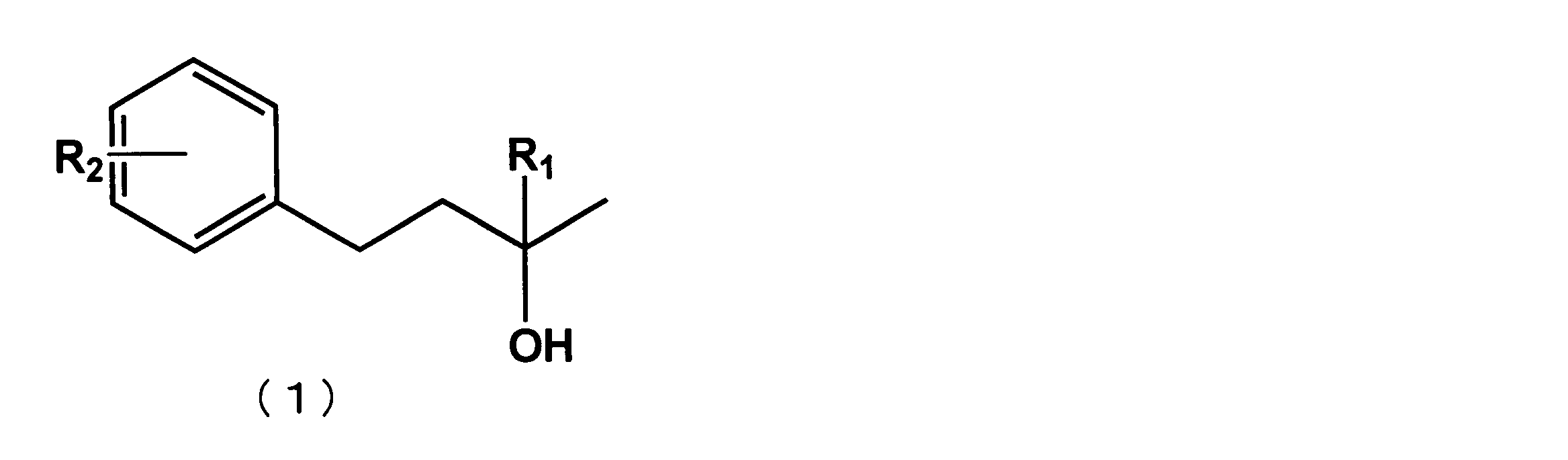
- ⁇ 1> A fragrance composition containing an alcohol derivative represented by the following general formula (1).
- R 1 is a hydrocarbon group having 1 to 6 carbon atoms
- R 2 is a hydrocarbon group having 1 to 4 carbon atoms, a hydroxyl group, or an alkoxy group having 1 to 4 carbon atoms.
- R 1 in the general formula (1) is a hydrocarbon group having 2 to 4 carbon atoms
- R 2 is a hydroxyl group or an alkoxy group having 1 to 4 carbon atoms.
- R 1 is a hydrocarbon group having 2 to 4 carbon atoms.
- the alcohol derivative is selected from 4- (3-hydroxy-3-methylpentyl) phenol, 4- (3-hydroxy-3-methyl-4-pentenyl) phenol and 4- (3-hydroxy-3-methylhexyl) phenol.
- ⁇ 6> ⁇ 1> to at least one selected from the group consisting of cosmetics, toiletries, bathing agents, beverages, foods, quasi drugs and pharmaceuticals, containing the fragrance composition according to any one of ⁇ 5>.
- Product. ⁇ 7> A method for enhancing the fragrance persistence of a fragrance by adding an alcohol derivative represented by the following general formula (1) to the fragrance composition.
- R 1 is a hydrocarbon group having 1 to 6 carbon atoms
- R 2 is a hydrocarbon group having 1 to 4 carbon atoms, a hydroxyl group, or an alkoxy group having 1 to 4 carbon atoms.
- R 1 is a hydrocarbon group having 2 to 4 carbon atoms, except when R 1 is a 1-propenyl group.
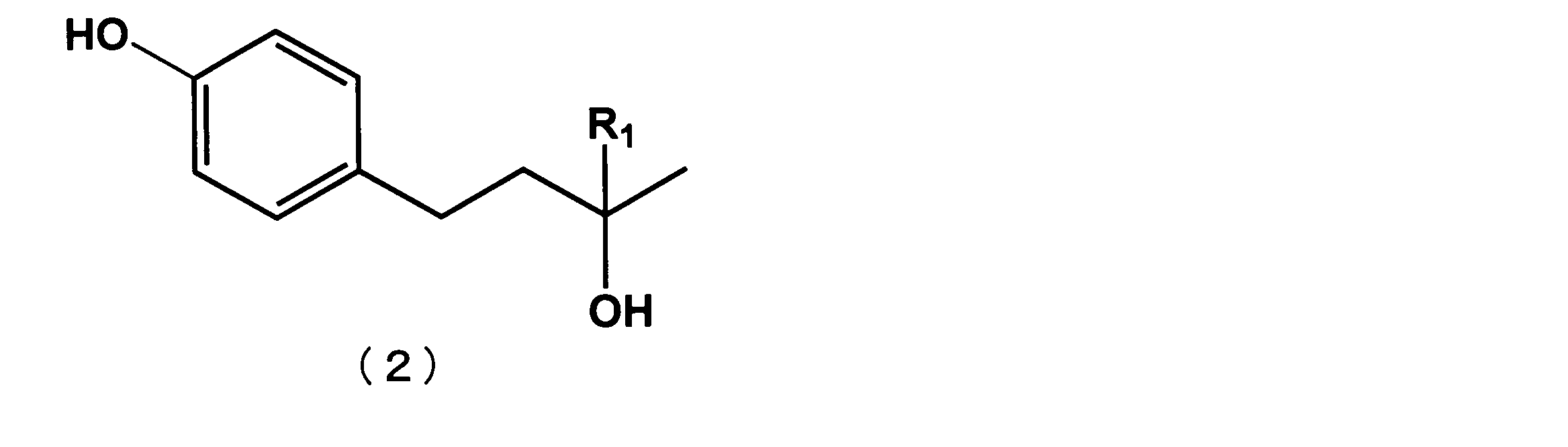
- the alcohol derivatives represented by the general formula (2) are 4- (3-hydroxy-3-methylpentyl) phenol, 4- (3-hydroxy-3-methyl-4-pentenyl) phenol and 4- (3- The alcohol derivative according to ⁇ 8>, which is any one of (hydroxy-3-methylhexyl) phenol.
- a conventionally known retention agent and fragrance can be used without changing the fragrance of a known or known fragrance.
- the improving agent it is possible to remarkably enhance the fragrance and the residual fragrance, and it is possible to obtain a fragrance composition having desired fragrance characteristics and remarkably high retention.
- the effect is the same in the product form containing the fragrance composition of the present invention, and has desired fragrance characteristics, fragrance, high residual fragrance cosmetics, toiletry products, bath agents, pharmaceuticals, etc. Products can be provided.
- R 1 is a hydrocarbon group having 1 to 6 carbon atoms
- R 2 is a hydrocarbon group having 1 to 4 carbon atoms, a hydroxyl group or a carbon number of 1 4 to 4 alkoxy groups.
- Examples of the hydrocarbon group of 1 to 6 carbon atoms for R 1 include, for example: Methyl group, ethyl group, propyl group, isopropyl group, butyl group, 2-methylpropyl group, 1-methylpropyl group, 1,1-dimethylethyl group, pentyl group, 3-methylbutyl group, 2-methylbutyl group, 1- Methylbutyl group, 1,2-dimethylpropyl group, 1,1-dimethylpropyl group, 2,2-dimethylpropyl group, 1-ethylpropyl group, 2-ethylpropyl group, hexyl group, 4-methylpentyl group, 3- Methylpentyl group, 2-methylpentyl group, 1-methylpentyl group, 1,1-dimethylbutyl group, 1,2-dimethylbutyl group, 1,3-dimethylbutyl group, 2,3-dimethylbutyl group, 2, An alkyl group having 1 to 6
- R 2 is the hydrocarbon group having 1 to 4 carbon atoms, such as methyl group, ethyl group, propyl group, isopropyl group, butyl group, 2-methylpropyl group, 1-methylpropyl group, 1,1-dimethyl
- An alkyl group having 1 to 4 carbon atoms such as an ethyl group
- Alkenyl groups having 2 to 4 carbon atoms such as vinyl group, 1-propenyl group, allyl group, isopropenyl group, 1-butenyl group, 2-butenyl group, 3-butenyl group, 1-methyl-1-propenyl group, etc. Can be mentioned.
- R 2 is the alkoxy group having 1 to 4 carbon atoms, e.g., methoxy, ethoxy, n- propoxy, isopropoxy, n- butoxy, isobutoxy, sec- butoxy, tert- butoxy group Is mentioned.
- alcohol derivative represented by the general formula (1) of the present invention include the following compounds. 4- (3-hydroxy-3-methylpentyl) phenol, 3- (3-hydroxy-3-methylpentyl) phenol, 2- (3-hydroxy-3-methylpentyl) phenol, 4- (3-hydroxy-3 -Methylhexyl) phenol, 3- (3-hydroxy-3-methylhexyl) phenol, 2- (3-hydroxy-3-methylhexyl) phenol, 4- (3-hydroxy-3-methylpentyl) phenol 3- (3-hydroxy-3-methylpentyl) phenol, 2- (3-hydroxy-3-methylpentyl) phenol, 4- (3-hydroxy-3,4-dimethylpentyl) phenol, 3- (3- Hydroxy-3,4-dimethylpentyl) phenol, 2- (3-hydroxy-3,4-dimethylpentyl) phenol, -(3-hydroxy-3,5-dimethylhexyl) phenol, 3- (3-hydroxy-3,5-dimethylhexyl)
- R 2 is a para-hydroxyl group
- R 1 is a hydrocarbon group having 2 to 4 carbon atoms (except when R 1 is a 1-propenyl group).
- 4- (3-Hydroxy-3-substituted) butylphenol represented by the general formula (2) is a novel compound not conventionally known.
- R 1 in the general formula (2) is a hydrocarbon group having 2 to 4 carbon atoms (except when R 1 is a 1-propenyl group) and 4- (3-hydroxy- Specific examples of the compound name of (3-substituted) butylphenol include those similar to those given for the above general formula (1).
- the alcohol derivative represented by the general formula (1) since the carbon atom to which the hydroxyl group of the alkyl chain is bonded is an asymmetric carbon atom except when R 1 is a methyl group, the alcohol derivative represented by the general formula (1) is optical. An active form or a racemate can be formed. In the present invention, the alcohol derivative represented by the general formula (1) may be an optically active substance or a racemic substance, and includes any case.
- the alcohol derivative represented by the general formula (1) including the general formula (2) can be synthesized, for example, according to the following reaction formula.
- R 1 and R 2 are as defined above, and X represents a halogen atom.
- the alcohol derivative of the general formula (1) can be easily produced by reacting the ketone derivative represented by the general formula (3) with the Grineer reagent (4).
- R 2 is a hydroxyl group
- the hydrogen of the hydroxyl group may be anionized with a base in advance.
- the halogen atom in the Grineer reagent of the general formula (4) used in the above synthesis method include a fluorine atom, a chlorine atom, a bromine atom, and an iodine atom.
- the above reaction can be carried out in an organic solvent.
- the organic solvent include aromatic hydrocarbons such as toluene, benzene and xylene, aliphatic hydrocarbons such as hexane, heptane and octane, alicyclic hydrocarbons such as cyclohexane, methylcyclohexane and decalin, diethyl And ethers such as ether, diisopropyl ether, tetrahydrofuran and dioxolane. These may be used singly or as a mixed solution of two or more.
- ethers are preferable, and among them, diethyl ether, diisopropyl ether, tetrahydrofuran and the like are more preferable because of their versatility and high reaction selectivity and yield.
- the amount of these solvents to be used is not particularly limited, but is about 0.1 to 30 times, preferably about 0.5 to 5 times the volume of the raw material compound (substrate).
- the amount of the acidic substance used in this reaction is preferably in the range of about 0.1 to 10 parts by mass, more preferably about 0.5 to 5 parts by mass with respect to 1 part by mass of the raw material compound (substrate). Although used, it is not limited to this range.
- the reaction temperature is in the range of about ⁇ 20 to 200 ° C., preferably about ⁇ 5 ° C. to the boiling point of the solvent used, and the reaction is carried out for about 1 to 50 hours, preferably 1 to 10 hours while maintaining the above temperature. Thus, the reaction can be performed smoothly. From the reaction solution obtained by the reaction, after completion of the reaction, the solvent is distilled off under reduced pressure.
- the alcohol derivative of the present invention can be produced by subjecting the obtained residue to distillation under reduced pressure.
- the alcohol derivative of the present invention represented by the general formula (1) thus obtained has a fruity, anisic, sweet, slightly sugary, slightly cresolic, jasmine-like floral fragrance, and is blended with this.
- the perfume composition with high palatability can be provided.
- the desired fragrance persistence and residual fragrance use effect that is, the fragrance persistence of the fragrance is enhanced.
- the fragrance composition of the present invention contains an alcohol derivative represented by the general formula (1) as an essential component, but is also known or well known as a fragrance component, such as ketones, aldehydes, esters, alcohols, ethers. Terpenes, natural essential oils, synthetic musks and the like are blended alone or in appropriate combination to form a fragrance composition.
- a fragrance component such as ketones, aldehydes, esters, alcohols, ethers.
- Terpenes, natural essential oils, synthetic musks and the like are blended alone or in appropriate combination to form a fragrance composition.
- fragrance compositions to which the alcohol derivative represented by the general formula (1) is blended include, for example, cosmetics, cosmetics, quasi-drugs, and external preparations such as pharmaceuticals, body and clothing cleaning agents, and bleaching agents. Fragrances ordinarily used in various products such as softeners, toiletry products, bathing agents, beverages and foods.
- the blending amount of the alcohol derivative represented by the general formula (1) into the fragrance composition is an appropriate amount depending on the fragrance composition to be applied, or depending on the form of the product to which the fragrance composition is further applied, the usage mode, and the like.
- the content is preferably 1.0 to 90% by mass, more preferably 5.0 to 30% by mass, based on the total amount of the fragrance composition including the applied alcohol derivative.
- flavor composition obtained by this invention can be suitably changed with the kind of product, a use purpose, etc.
- the blending amount of the fragrance composition in the product is 0.01 to 50% by mass, preferably 0.05 to 30% by mass in the final product composition.
- Products to which the fragrance composition of the present invention is applied include, for example, skin cosmetics, shampoos, rinses, conditioners, hair cosmetics such as hair arts, hair creams, perfumes, colons, soaps, indoor fragrances, Examples include cosmetics such as toothpaste, toiletries such as detergents and softeners, quasi-drugs such as bath preparations, poultices, and ointments, and pharmaceuticals.
- cosmetics such as toothpaste, toiletries such as detergents and softeners, quasi-drugs such as bath preparations, poultices, and ointments, and pharmaceuticals.
- products to which the fragrance composition of the present invention can be applied are not limited to those described above.
- the blending amount of the fragrance composition into the product is shown for each product as the amount of the alcohol derivative represented by the general formula (1), skin cosmetics, shampoos, rinses, conditioners, hair arts, hair creams, etc.
- cosmetics such as hair cosmetics, perfumes, colons, soaps, bathing agents, etc.
- the blending amount of the alcohol derivative in toiletries such as detergents and softeners is usually 0.01 to 1% by mass, particularly 0.05 to 0.3% by mass, based on the total composition of the product.
- the concentration is preferably used.
- the products to be applied are appropriately blended with optional ingredients according to the intended use of each product, such as cosmetics, toiletries, bathing agents, insurance hygiene materials, quasi drugs, pharmaceuticals, etc. Provided as final product.
- the alcohol derivative represented by the general formula (1) is blended in a state of being contained in a fragrance composition when blended in a product, the alcohol derivative and the fragrance composition are separately blended. Compared with the case where it is blended as a component, it is possible to obtain a product that is remarkably superior in fragrance characteristics, fragrance characteristics such as residual fragrance properties, and residual characteristics. For this reason, the fragrance
- Example 3 Evaluation of aroma quality>
- the alcohol derivative obtained in Example 1 or Example 2 was attached to a bottle mouth and a filter paper, and sensory evaluation was performed by a perfumer having experience of 5 years or more.
- the alcohol derivative obtained in Example 1 had a floral fragrance such as fruity, anisic, sweet, slightly sugary, slightly cresolic, and jasmine.
- the alcohol derivative obtained in Example 2 had fruity, anisic, sweet, slightly sugary, slightly cresolic, jasmine-like floral, and slightly waxy fragrance.
- Example 4 Test Example 1: ⁇ Perfume Composition Fragrance and Residual Fragrance Test>
- a fragrance composition was prepared, and a fragrance standing and a residual fragrance property test were performed.
- about 10.0 mg was weighed on a filter paper laid on the bottom of a wide-mouth bottle having a diameter of 40 mm and a height of 50 mm, and the lid was closed and left for 30 minutes to prepare an evaluation sample.
- the fragrance immediately after opening the lid and the residual fragrance after about 5 hours in an open system were evaluated.
- the evaluation was repeated 3 times by 11 panelists specializing in incense for 5 years or more (total of 33), and the strength against the comparative prescription (Comparative Example 3) was evaluated.
- Results of scenting test Table 2 shows the results of the number of people who felt that the scenting was the highest for the comparative formulation (Comparative Example 3).
- Example 1 the alcohol derivative of the present invention (Example 1) gave a fragrance to the above prepared fragrance and showed excellent results in both the remaining fragrance properties.
- Test Example 2 Effect test with bathing agent 100 g of each of the bathing agents in Table 4 to which 1.0% of the blended fragrances of Example 2 and Comparative Example 2 was added were prepared, and 20 g was added to 180 liters of hot water at 40 to 42 ° C. It melt
- the bathing agent containing the blended fragrance of the present invention is more fragrant and has a longer scent than the bathing agent of Comparative Example 4 containing triethyl citrate. Excellent results were shown.
- Example 6 Effect test with eau de cologne A fragrance composition was prepared according to the formulation of Table 7.
- the eau de cologne containing the blended fragrance of the present invention showed a particularly superior residual fragrance property than the eau de cologne containing p-menthane-3,8-diol.
- Example 7 Effect test with shampoo and conditioner According to the formulation of Table 10, the fragrance compositions shown in Example 7 and Comparative Example 6 were prepared.
- Results of shampoo scenting test Table 13 shows the results of the number of people who felt that scenting was high.
- Residual fragrance test results of shampoo Table 14 shows the results of the number of people who felt that the residual fragrance was strong.
- Conditioner scenting test results Table 15 shows the results of the number of people who felt that scenting was high.
- Result of conditioner residual scent test results Table 16 shows the results of the number of persons who felt that the residual scent was strong.
- the shampoo and conditioner containing the blended fragrance of the present invention showed excellent results in both fragrance and residual fragrance, and particularly had a remarkable effect on the residual fragrance.
- the alcohol derivative represented by the general formula (1) blended in the fragrance composition of the present invention has aroma characteristics such as fragrance and sustainability and retention characteristics without changing the fragrance of the fragrance composition as a base. Since it is a high-quality fragrance improving agent, cosmetics such as skin cosmetics, shampoos, rinses, conditioners, hair cosmetics such as hair arts and hair creams, perfumes, colons, soaps, indoor air fresheners, toothpastes, etc. Improvement of the quality of fragrance compositions for toiletries such as detergents, softeners, quasi-drugs such as bath preparations, poultices, ointments, or various products that require blending of fragrances such as pharmaceuticals, beverages, foods, etc. It contributes to.
Landscapes
- Life Sciences & Earth Sciences (AREA)
- Health & Medical Sciences (AREA)
- Chemical & Material Sciences (AREA)
- Animal Behavior & Ethology (AREA)
- Veterinary Medicine (AREA)
- Engineering & Computer Science (AREA)
- Public Health (AREA)
- General Health & Medical Sciences (AREA)
- Food Science & Technology (AREA)
- Wood Science & Technology (AREA)
- Organic Chemistry (AREA)
- Emergency Medicine (AREA)
- Birds (AREA)
- Epidemiology (AREA)
- Oil, Petroleum & Natural Gas (AREA)
- Chemical Kinetics & Catalysis (AREA)
- Polymers & Plastics (AREA)
- Nutrition Science (AREA)
- Fats And Perfumes (AREA)
- Cosmetics (AREA)
- Organic Low-Molecular-Weight Compounds And Preparation Thereof (AREA)
Abstract
本発明は、香料組成物の芳香特性及び残香性を改善させると共に、その改善効果を反映した製品類を提供することを目的とする。本発明は、下記一般式(1)で表されるアルコール誘導体を含有する香料組成物、該香料組成物を含む製品及び下記一般式(1)に包含される新規化合物に関する。(式中、R1は炭素数1~6の炭化水素基であり、R2は炭素数1~4の炭化水素基、水酸基又は炭素数1~4のアルコキシ基である。)
Description
本発明は、香料組成物、更に詳細には、香り立ち、残香性などの芳香特性及び保留効果に優れた香料組成物、及びそれを含有する香粧品、トイレタリー製品、入浴剤、医薬部外品または医薬品等の各種製品類に関する。
従来、有香物質を調香し、優れた香料組成物を調製する際、所望の香気を持続させるため、有香物質の芳香特性及び保留性を調整する各種保留剤又は香質改善剤が香料に配合されている。このような保留剤又は香質改善剤として、具体的にはジプロピレングリコール、トリエチルシトレート、ベンジルベンゾエート、ベンジルサリシレート、ジエチルフタレート、イソプロピルミリステート等が提案され、利用されている。これらの内、ベンジルサリシレートには遅延型接触皮膚炎を誘起することが報告されており(非特許文献1)、安全性上好ましくない。また、ジエチルフタレートは、内分泌撹乱物質としてその使用が自粛されており好ましくない。その他の保留剤も残香性付与効果が低くかったり、保留剤自体の香気が香料組成物の香質を望ましくない方向に変調させたりする場合があり、このため、優れた香気持続性を付与することが可能で、かつ香料組成物の香質の変調をきたさない無臭性の香質改善剤の開発が望まれている。
かかる状況下、こうような要求を満たすべく、種々の保留剤、香質改善剤が提案されている。例えば、p-メンタン-3,8-ジオール(特許文献1)、2-ヒドロキシメチル-シクロアルカノール誘導体(特許文献2)、特定のビフェニル化合物等(特許文献3)、グリセリルエーテル誘導体(特許文献4)、ジアセチルロドデンドロール(特許文献5)が保留剤として提示されている。しかしこれらの化合物も、保留剤として汎用性、保留効果等の条件を満足させるものとはいい難いものであった。
また、上述のような保留剤、香質改善剤については、調合香料としての匂い紙上での官能評価による効果について述べられているものの、該調合香料を賦香してなる製品類での効果には全く触れられておらず、製品形態において優れた香質改善効果を反映した調合香料、及び該香質改善剤の開発が望まれる。
「皮膚」、第23巻、第4号、421-441頁
本発明は、香料組成物の芳香特性及び残香性を改善させると共に、その改善効果を反映した製品類を提供することを目的とする。すなわち、より具体的には、ベースとなる香料組成物の香調を変えることなく、香り立ち、持続性等の、芳香特性、保留特性の高い香質改善剤、及びそれを含有する香料組成物、更に該香料組成物が配合されていて、香り立ち、持続性等の芳香特性、保留特性の良好な各種製品類を提供することを目的とする。
本発明者らは前記課題を解消すべく鋭意検討を行った結果、下記一般式(1)で表されるアルコール誘導体が香料組成物の香り立ち、残香性を著しく高めることを見出し、本発明を完成するに至った。本発明は、以下の<1>~<9>に関するものである。
<1>
下記一般式(1)で表されるアルコール誘導体を含有する香料組成物。
<1>
下記一般式(1)で表されるアルコール誘導体を含有する香料組成物。
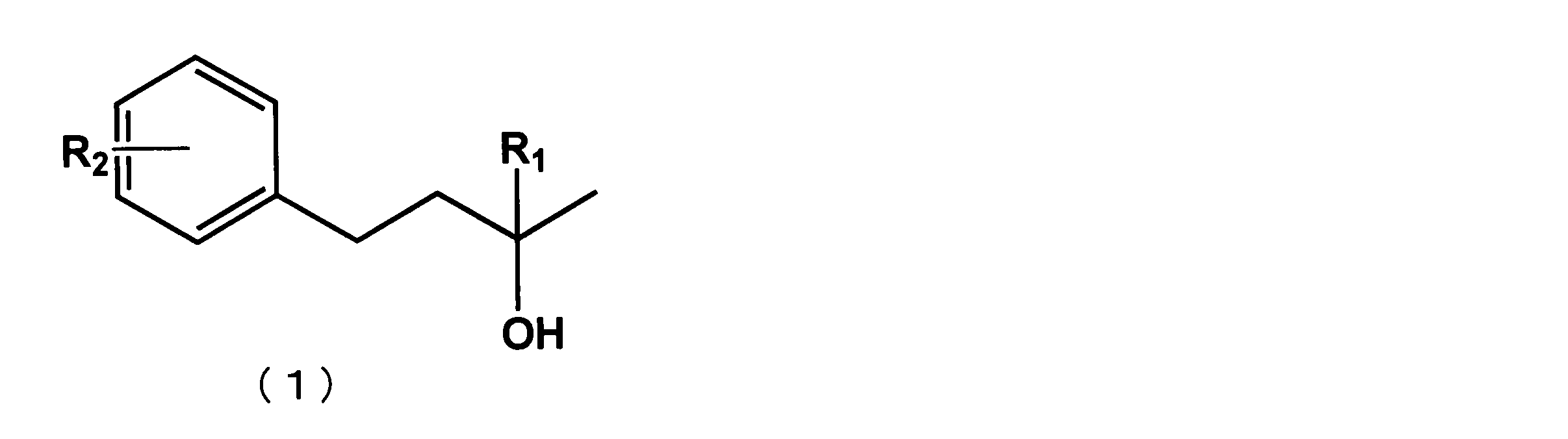
(式中、R1は炭素数1~6の炭化水素基であり、R2は炭素数1~4の炭化水素基、水酸基又は炭素数1~4のアルコキシ基である。)
<2>
前記一般式(1)におけるR1が炭素数2~4の炭化水素基であり、R2が水酸基又は炭素数1~4のアルコキシ基である<1>に記載の香料組成物。
<3>
前記アルコール誘導体が、下記一般式(2)で表される<1>又は<2>に記載の香料組成物。
<2>
前記一般式(1)におけるR1が炭素数2~4の炭化水素基であり、R2が水酸基又は炭素数1~4のアルコキシ基である<1>に記載の香料組成物。
<3>
前記アルコール誘導体が、下記一般式(2)で表される<1>又は<2>に記載の香料組成物。

(式中、R1は炭素数2~4の炭化水素基である。)
<4>
前記アルコール誘導体が、4-(3-ヒドロキシ-3-メチルペンチル)フェノール、4-(3-ヒドロキシ-3-メチル-4-ペンテニル)フェノール及び4-(3-ヒドロキシ-3-メチルヘキシル)フェノールからなる群より選ばれる少なくとも1種である<1>~<3>のいずれか1に記載の香料組成物。
<5>
前記アルコール誘導体を1~90質量%含有する<1>~<4>のいずれか1に記載の香料組成物。
<6>
<1>~<5>のいずれか1に記載の香料組成物を含有する、香粧品、トイレタリー製品、入浴剤、飲料、食品、医薬部外品及び医薬品からなる群より選ばれる少なくとも1種の製品。
<7>
下記一般式(1)で表されるアルコール誘導体を香料組成物に添加することにより香料の香気持続性を強化する方法。
<4>
前記アルコール誘導体が、4-(3-ヒドロキシ-3-メチルペンチル)フェノール、4-(3-ヒドロキシ-3-メチル-4-ペンテニル)フェノール及び4-(3-ヒドロキシ-3-メチルヘキシル)フェノールからなる群より選ばれる少なくとも1種である<1>~<3>のいずれか1に記載の香料組成物。
<5>
前記アルコール誘導体を1~90質量%含有する<1>~<4>のいずれか1に記載の香料組成物。
<6>
<1>~<5>のいずれか1に記載の香料組成物を含有する、香粧品、トイレタリー製品、入浴剤、飲料、食品、医薬部外品及び医薬品からなる群より選ばれる少なくとも1種の製品。
<7>
下記一般式(1)で表されるアルコール誘導体を香料組成物に添加することにより香料の香気持続性を強化する方法。
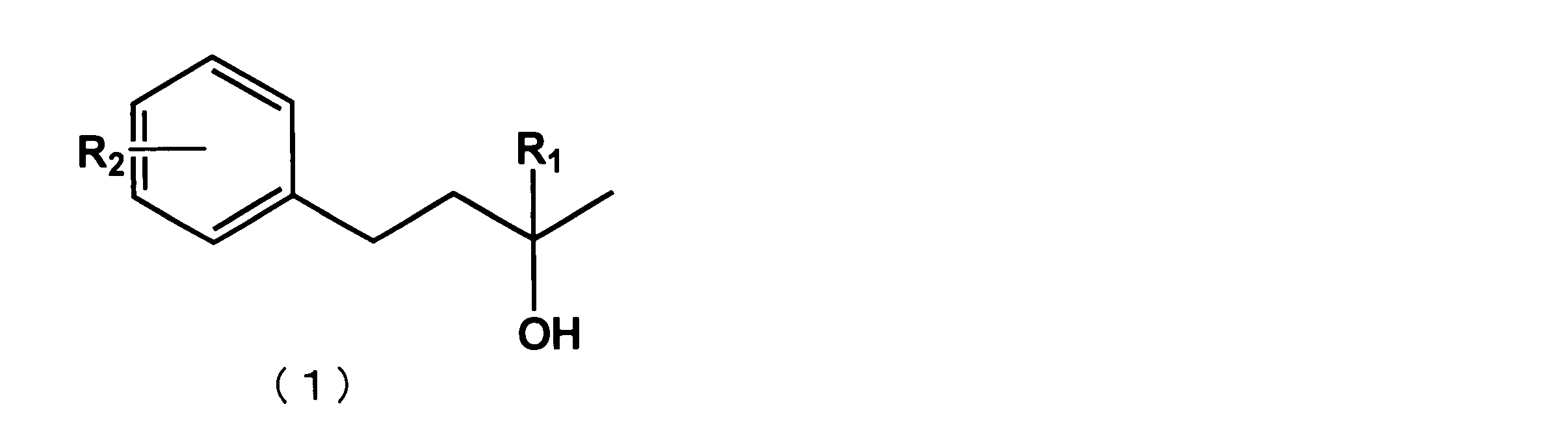
(式中、R1は炭素数1~6の炭化水素基であり、R2は炭素数1~4の炭化水素基、水酸基又は炭素数1~4のアルコキシ基である。)
<8>
下記一般式(2)で表されるアルコール誘導体。
<8>
下記一般式(2)で表されるアルコール誘導体。
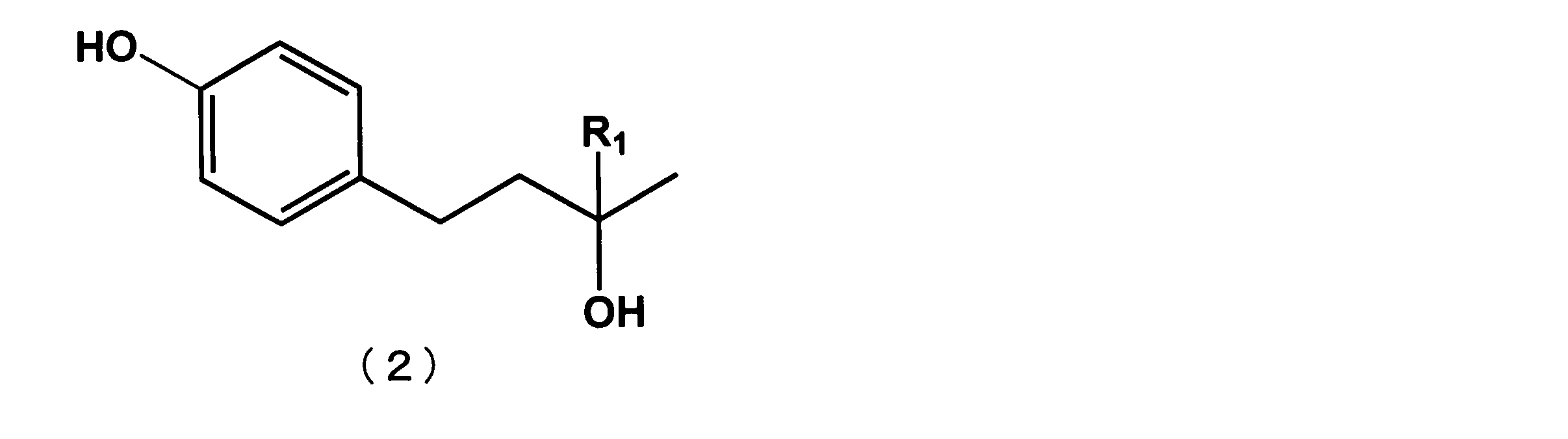
(式中、R1は炭素数2~4の炭化水素基である。但し、R1が1-プロペニル基である場合を除く。)
<9>
前記一般式(2)で表されるアルコール誘導体が、4-(3-ヒドロキシ-3-メチルペンチル)フェノール、4-(3-ヒドロキシ-3-メチル-4-ペンテニル)フェノール及び4-(3-ヒドロキシ-3-メチルヘキシル)フェノールのいずれかである<8>に記載のアルコール誘導体。
<9>
前記一般式(2)で表されるアルコール誘導体が、4-(3-ヒドロキシ-3-メチルペンチル)フェノール、4-(3-ヒドロキシ-3-メチル-4-ペンテニル)フェノール及び4-(3-ヒドロキシ-3-メチルヘキシル)フェノールのいずれかである<8>に記載のアルコール誘導体。
一般式(1)で表されるアルコール誘導体を香料組成物に配合することよりなる本発明によれば、公知あるいは周知の香料の香調を変えることなく、かつ従来知られた保留剤、香質改善剤に比べ香り立ち、及び残香性を著しく高めることが可能となり、所望の芳香特性、及び保留性の著しく高い香料組成物を得ることが可能となる。また、その効果は本発明の香料組成物を含有してなる製品形態においても同様であり、所望の芳香特性を有し、香り立ち、残香性の高い香粧品、トイレタリー製品、入浴剤、医薬品などの製品を提供することができる。
以下に本発明について、さらに詳細に説明する。
本明細書において“質量%”と“重量%”及び“質量部”と“重量部”とは、それぞれ同義である。
本明細書において“質量%”と“重量%”及び“質量部”と“重量部”とは、それぞれ同義である。
本発明の前記一般式(1)で表されるアルコール誘導体において、R1は炭素数1~6の炭化水素基であり、R2は炭素数1~4の炭化水素基、水酸基又は炭素数1~4のアルコキシ基である。
R1の炭素数1~6の炭化水素基としては、例えば、
メチル基、エチル基、プロピル基、イソプロピル基、ブチル基、2-メチルプロピル基、1-メチルプロピル基、1,1-ジメチルエチル基、ペンチル基、3-メチルブチル基、2-メチルブチル基、1-メチルブチル基、1,2-ジメチルプロピル基、1,1-ジメチルプロピル基、2,2-ジメチルプロピル基、1-エチルプロピル基、2-エチルプロピル基、ヘキシル基、4-メチルペンチル基、3-メチルペンチル基、2-メチルペンチル基、1-メチルペンチル基、1,1-ジメチルブチル基、1,2-ジメチルブチル基、1,3-ジメチルブチル基、2,3-ジメチルブチル基、2,4-ジメチルブチル基、1-エチルブチル基、2-エチルブチル基などの炭素数1~6のアルキル基;
ビニル基、1-プロペニル基、アリル基、イソプロペニル基、1-ブテニル基、2-ブテニル基、3-ブテニル基、1-メチル-1-プロペニル基、1-ペンテニル基、2-ペンテニル基、3-ペンテニル基、4-ペンテニル基、2-ペンテン-2-イル基、1-ヘキセニル基、2-ヘキセニル基、3-ヘキセニル基、4-ヘキセニル基、5-ヘキセニル基、2-ヘキセン-2-イル基などの炭素数2~6のアルケニル基等が挙げられる。
R1としては、炭素数2~4の炭化水素基が好ましく、炭素数2~4のアルキル基又は炭素数2~4のアルケニル基がより好ましい。
メチル基、エチル基、プロピル基、イソプロピル基、ブチル基、2-メチルプロピル基、1-メチルプロピル基、1,1-ジメチルエチル基、ペンチル基、3-メチルブチル基、2-メチルブチル基、1-メチルブチル基、1,2-ジメチルプロピル基、1,1-ジメチルプロピル基、2,2-ジメチルプロピル基、1-エチルプロピル基、2-エチルプロピル基、ヘキシル基、4-メチルペンチル基、3-メチルペンチル基、2-メチルペンチル基、1-メチルペンチル基、1,1-ジメチルブチル基、1,2-ジメチルブチル基、1,3-ジメチルブチル基、2,3-ジメチルブチル基、2,4-ジメチルブチル基、1-エチルブチル基、2-エチルブチル基などの炭素数1~6のアルキル基;
ビニル基、1-プロペニル基、アリル基、イソプロペニル基、1-ブテニル基、2-ブテニル基、3-ブテニル基、1-メチル-1-プロペニル基、1-ペンテニル基、2-ペンテニル基、3-ペンテニル基、4-ペンテニル基、2-ペンテン-2-イル基、1-ヘキセニル基、2-ヘキセニル基、3-ヘキセニル基、4-ヘキセニル基、5-ヘキセニル基、2-ヘキセン-2-イル基などの炭素数2~6のアルケニル基等が挙げられる。
R1としては、炭素数2~4の炭化水素基が好ましく、炭素数2~4のアルキル基又は炭素数2~4のアルケニル基がより好ましい。
R2が、炭素数1~4の炭化水素基としては、例えば、メチル基、エチル基、プロピル基、イソプロピル基、ブチル基、2-メチルプロピル基、1-メチルプロピル基、1,1-ジメチルエチル基などの炭素数1~4のアルキル基;
ビニル基、1-プロペニル基、アリル基、イソプロペニル基、1-ブテニル基、2-ブテニル基、3-ブテニル基、1-メチル-1-プロペニル基などの炭素数2~4のアルケニル基等が挙げられる。
ビニル基、1-プロペニル基、アリル基、イソプロペニル基、1-ブテニル基、2-ブテニル基、3-ブテニル基、1-メチル-1-プロペニル基などの炭素数2~4のアルケニル基等が挙げられる。
R2が、炭素数1~4のアルコキシ基としては、例えば、メトキシ基、エトキシ基、n-プロポキシ基、イソプロポキシ基、n-ブトキシ基、イソブトキシ基、sec-ブトキシ基、tert-ブトキシ基等が挙げられる。
本発明の一般式(1)で表されるアルコール誘導体を具体的に例示すれば、例えば、下記化合物等が挙げられる。
4-(3-ヒドロキシ-3-メチルペンチル)フェノール、3-(3-ヒドロキシ-3-メチルペンチル)フェノール、2-(3-ヒドロキシ-3-メチルペンチル)フェノール、4-(3-ヒドロキシ-3-メチルへキシル)フェノール、3-(3-ヒドロキシ-3-メチルへキシル)フェノール、2-(3-ヒドロキシ-3-メチルへキシル)フェノール、4-(3-ヒドロキシ-3-メチルペンチル)フェノール、3-(3-ヒドロキシ-3-メチルペンチル)フェノール、2-(3-ヒドロキシ-3-メチルペンチル)フェノール、4-(3-ヒドロキシ-3,4-ジメチルペンチル)フェノール、3-(3-ヒドロキシ-3,4-ジメチルペンチル)フェノール、2-(3-ヒドロキシ-3,4-ジメチルペンチル)フェノール、4-(3-ヒドロキシ-3,5-ジメチルヘキシル)フェノール、3-(3-ヒドロキシ-3,5-ジメチルヘキシル)フェノール、2-(3-ヒドロキシ-3,5-ジメチルヘキシル)フェノール、4―(3-ヒドロキシ-3-メチル-4-ペンテニル)フェノール、3―(3-ヒドロキシ-3-メチル-4-ペンテニル)フェノール、2-(3-ヒドロキシ-3-メチル-4-ペンテニル)フェノール、4-(3-ヒドロキシ-3,4-ジメチル-4-ペンテニル)フェノール、3-(3-ヒドロキシ-3,4-ジメチル-4-ペンテニル)フェノール、2-(3-ヒドロキシ-3,4-ジメチル-4-ペンテニル)フェノール、4-(3-ヒドロキシ-3-メチル-5-ヘキセニル)フェノール、3-(3-ヒドロキシ-3-メチル-5-ヘキセニル)フェノール、2-(3-ヒドロキシ-3-メチル-5-ヘキセニル)フェノール。
4-(3-ヒドロキシ-3-メチルペンチル)フェノール、3-(3-ヒドロキシ-3-メチルペンチル)フェノール、2-(3-ヒドロキシ-3-メチルペンチル)フェノール、4-(3-ヒドロキシ-3-メチルへキシル)フェノール、3-(3-ヒドロキシ-3-メチルへキシル)フェノール、2-(3-ヒドロキシ-3-メチルへキシル)フェノール、4-(3-ヒドロキシ-3-メチルペンチル)フェノール、3-(3-ヒドロキシ-3-メチルペンチル)フェノール、2-(3-ヒドロキシ-3-メチルペンチル)フェノール、4-(3-ヒドロキシ-3,4-ジメチルペンチル)フェノール、3-(3-ヒドロキシ-3,4-ジメチルペンチル)フェノール、2-(3-ヒドロキシ-3,4-ジメチルペンチル)フェノール、4-(3-ヒドロキシ-3,5-ジメチルヘキシル)フェノール、3-(3-ヒドロキシ-3,5-ジメチルヘキシル)フェノール、2-(3-ヒドロキシ-3,5-ジメチルヘキシル)フェノール、4―(3-ヒドロキシ-3-メチル-4-ペンテニル)フェノール、3―(3-ヒドロキシ-3-メチル-4-ペンテニル)フェノール、2-(3-ヒドロキシ-3-メチル-4-ペンテニル)フェノール、4-(3-ヒドロキシ-3,4-ジメチル-4-ペンテニル)フェノール、3-(3-ヒドロキシ-3,4-ジメチル-4-ペンテニル)フェノール、2-(3-ヒドロキシ-3,4-ジメチル-4-ペンテニル)フェノール、4-(3-ヒドロキシ-3-メチル-5-ヘキセニル)フェノール、3-(3-ヒドロキシ-3-メチル-5-ヘキセニル)フェノール、2-(3-ヒドロキシ-3-メチル-5-ヘキセニル)フェノール。
1-(4-メトキシフェニル)-3-メチル-3-ペンタノール、1-(3-メトキシフェニル)-3-メチル-3-ペンタノール、1-(2-メトキシフェニル)-3-メチル-3-ペンタノール、1-(4-メトキシフェニル)-3-メチル-3-ヘキサノール、1-(3-メトキシフェニル)-3-メチル-3-ヘキサノール、1-(2-メトキシフェニル)-3-メチル-3-ヘキサノール、1-(4-メトキシフェニル)-3-メチル-3-ヘプタノール、1-(3-メトキシフェニル)-3-メチル-3-ヘプタノール、1-(2-メトキシフェニル)-3-メチル-3-ヘプタノール、1-(4-メトキシフェニル)-3,4-ジメチル-3-ペンタノール、1-(3-メトキシフェニル)-3,4-ジメチル-3-ペンタノール、1-(2-メトキシフェニル)-3,4-ジメチル-3-ペンタノール、1-(4-メトキシフェニル)-3,5-ジメチル-3-ヘキサノール、1-(3-メトキシフェニル)-3,5-ジメチル-3-ヘキサノール、1-(2-メトキシフェニル)-3,5-ジメチル-3-ヘキサノール。
5-(4-メトキシフェニル)-3-メチル-1-ペンテン-3-オール、5-(3-メトキシフェニル)-3-メチル-1-ペンテン-3-オール、5-(2-メトキシフェニル)-3-メチル-1-ペンテン-3-オール、5-(4-メトキシフェニル)-3,4-ジメチル-1-ペンテン-3-オール、5-(3-メトキシフェニル)-3,4-ジメチル-1-ペンテン-3-オール、5-(2-メトキシフェニル)-3,4-ジメチル-1-ペンテン-3-オール、1-(4-メトキシフェニル)-3-ジメチル-5-ヘキセン-3-オール、1-(3-メトキシフェニル)-3-ジメチル-5-ヘキセンー3-オール、1-(2-メトキシフェニル)-3-ジメチル-5-ヘキセン-3-オール、1-(4-エトキシフェニル)-3-メチル-3-ペンタノール、1-(3-エトキシフェニル)-3-メチル-3-ペンタノール、1-(2-エトキシフェニル)-3-メチル-3-ペンタノール、1-(4-エトキシフェニル)-3-メチル-3-ヘキサノール、1-(3-エトキシフェニル)-3-メチル-3-ヘキサノール、1-(2-エトキシフェニル)-3-メチル-3-ヘキサノール、1-(4-エトキシフェニル)-3-メチル-3-ヘプタノール、1-(3-エトキシフェニル)-3-メチル-3-ヘプタノール、1-(2-エトキシフェニル)-3-メチル-3-ヘプタノール、1-(4-エトキシフェニル)-3,4-ジメチル-3-ペンタノール、1-(3-エトキシフェニル)-3,4-ジメチル-3-ペンタノール、1-(2-エトキシフェニル)-3,4-ジメチル-3-ペンタノール、1-(4-エトキシフェニル)-3,5-ジメチル-3-ヘキサノール、1-(3-エトキシフェニル)-3,5-ジメチル-3-ヘキサノール、1-(2-エトキシフェニル)-3,5-ジメチル-3-ヘキサノール。
5-(4-エトキシフェニル)-3-メチル-1-ペンテン-3-オール、5-(3-エトキシフェニル)-3-メチル-1-ペンテン-3-オール、5-(2-エトキシフェニル)-3-メチル-1-ペンテン-3-オール、5-(4-エトキシフェニル)-3,4-ジメチル-1-ペンテン-3-オール、5-(3-エトキシフェニル)-3,4-ジメチル-1-ペンテン-3-オール、5-(2-エトキシフェニル)-3,4-ジメチル-1-ペンテン-3-オール、1-(4-エトキシフェニル)-3-ジメチル-5-ヘキセン-3-オール、1-(3-エトキシフェニル)-3-ジメチル-5-ヘキセン-3-オール、1-(2-エトキシフェニル)-3-ジメチル-5-ヘキセン-3-オール。
1-(4-イソプロポキシフェニル)-3-メチル-3-ペンタノール、1-(3-イソプロポキシフェニル)-3-メチル-3-ペンタノール、1-(2-イソプロポキシフェニル)-3-メチル-3-ペンタノール、1-(4-イソプロポキシフェニル)-3-メチル-3-ヘキサノール、1-(3-イソプロポキシフェニル)-3-メチル-3-ヘキサノール、1-(2-イソプロポキシフェニル)-3-メチル-3-ヘキサノール、1-(4-イソプロポキシフェニル)-3-メチル-3-ヘプタノール、1-(3-イソプロポキシフェニル)-3-メチル-3-ヘプタノール、1-(2-イソプロポキシフェニル)-3-メチル-3-ヘプタノール、1-(4-イソプロポキシフェニル)-3,4-ジメチル-3-ペンタノール、1-(3-イソプロポキシフェニル)-3,4-ジメチル-3-ペンタノール、1-(2-イソプロポキシフェニル)-3,4-ジメチル-3-ペンタノール、1-(4-イソプロポキシフェニル)-3,5-ジメチル-3-ヘキサノール、1-(3-イソプロポキシフェニル)-3,5-ジメチル-3-ヘキサノール、1-(2-イソプロポキシフェニル)-3,5-ジメチル-3-ヘキサノール。
5-(4-イソプロポキシフェニル)-3-メチル-1-ペンテン-3-オール、5-(3-イソプロポキシフェニル)-3-メチル-1-ペンテン-3-オール、5-(2-イソプロポキシフェニル)-3-メチル-1-ペンテン-3-オール、5-(4-イソプロポキシフェニル)-3,4-ジメチル-1-ペンテン-3-オール、5-(3-イソプロポキシフェニル)-3,4-ジメチル-1-ペンテン-3-オール、5-(2-イソプロポキシフェニル)-3,4-ジメチル-1-ペンテン-3-オール、1-(4-イソプロポキシフェニル)-3-ジメチル-5-ヘキセン-3-オール、1-(3-イソプロポキシフェニル)-3-ジメチル-5-ヘキセン-3-オール、1-(2-イソプロポキシフェニル)-3-ジメチル-5-ヘキセン-3-オール。
前記一般式(1)において、R2がパラ位の水酸基であって、R1が炭素数2~4の炭化水素基(但し、R1が1-プロペニル基である場合を除く。)である一般式(2)で表される4-(3-ヒドロキシ-3-置換)ブチルフェノールは、従来知られていない新規な化合物である。
一般式(2)中のR1が炭素数2~4の炭化水素基(但し、R1が1-プロペニル基である場合を除く。)である場合の具体例及び4-(3-ヒドロキシ-3-置換)ブチルフェノールの具体的な化合物名としては、上記一般式(1)について挙げたものと同様なものが挙げられる。なかでも、4-(3-ヒドロキシ-3-メチルペンチル)フェノール(R1がエチル基、R2がパラ位の水酸基)、4-(3-ヒドロキシ-3-メチル-4-ペンテニル)フェノール(R1がビニル基、R2がパラ位の水酸基)及び4-(3-ヒドロキシ-3-メチルヘキシル)フェノール(R1がプロピル基、R2がパラ位の水酸基)が好ましい。
なお、一般式(1)において、アルキル鎖の水酸基が結合する炭素原子はR1がメチル基の場合を除いて不斉炭素原子であるため、一般式(1)で表されるアルコール誘導体は光学活性体あるいはラセミ体が形成可能である。本発明においては、一般式(1)で表されるアルコール誘導体は、これら光学活性体であってもラセミ体であってもよく、いずれの場合をも含むものである。
一般式(2)を包含する一般式(1)で示されるアルコール誘導体は、例えば次の反応式に従って合成することができる。
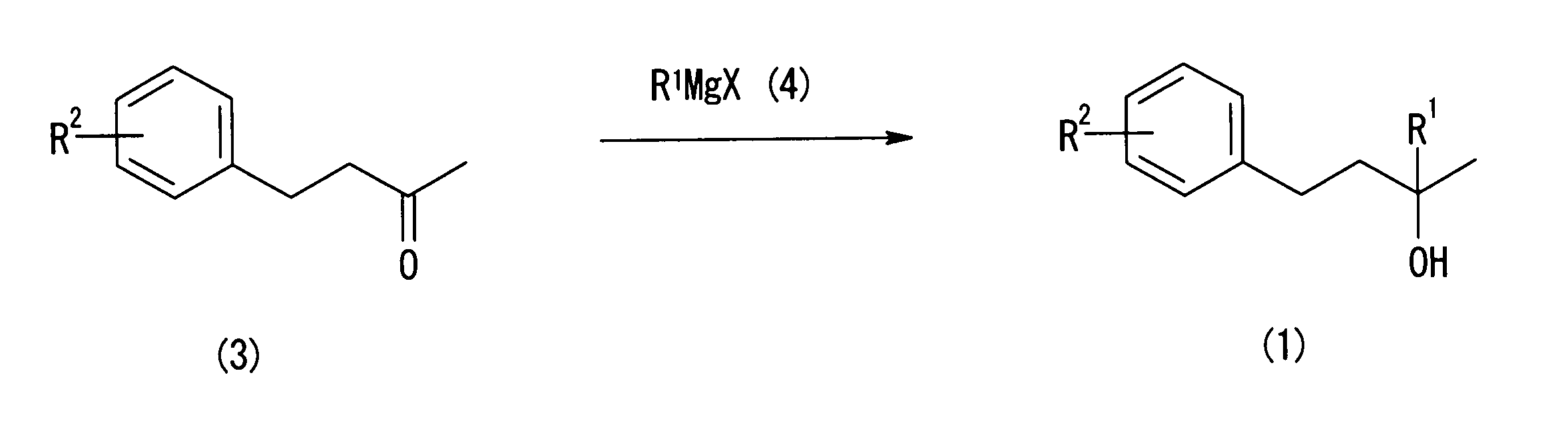
(式中、R1及びR2の定義は前記と同様であり、Xはハロゲン原子を表す。)
一般式(1)のアルコール誘導体は、一般式(3)で示されるケトン誘導体とグリニア試薬(4)とを反応させることにより容易に製造することができる。なお、R2が水酸基の場合、予め、塩基にて水酸基の水素をアニオン化処理しておいてもよい。
上記合成法において使用される一般式(4)のグリニア試薬におけるハロゲン原子としては、フッ素原子、塩素原子、臭素原子、ヨウ素原子等が挙げられる。
上記合成法において使用される一般式(4)のグリニア試薬におけるハロゲン原子としては、フッ素原子、塩素原子、臭素原子、ヨウ素原子等が挙げられる。
上記反応は、有機溶媒中で行うことができる。有機溶媒としては、例えば、トルエン、ベンゼン、キシレン等の芳香族炭化水素類、へキサン、ヘプタン、オクタン等の脂肪族炭化水素類、シクロヘキサン、メチルシクロヘキサン、デカリン等の脂環式炭化水素類、ジエチルエーテル、ジイソプロピルエーテル、テトラヒドロフラン、ジオキソラン等のエーテル類などが挙げられる。これらは単独で用いても、また二種以上の混合溶液として用いてもよい。溶媒として好ましくはエーテル類、そのうちでも、ジエチルエーテル、ジイソプロピルエーテル、テトラヒドロフランなどが汎用性があり、反応の選択性及び収率が高いことからより好ましい。
また、これらの溶媒の使用量は、特に制限はないが、原料化合物(基質)に対して、約0.1~30倍容量、好ましくは約0.5~5倍容量の範囲である。また、本反応に用いられる酸性物質の量は、原料化合物(基質)1質量部に対して、好ましくは0.1~10質量部程度、より好ましくは0.5~5質量部程度の範囲で使用されるが、この範囲に限定されるものではない。反応温度は、-20~200℃程度、好ましくは-5℃~使用する溶媒の沸点程度の範囲が採用され、前記の温度を保ちながら約1~50時間、好ましくは1~10時間で反応させることによって、反応を円滑に行うことができる。反応によって得られた反応液から、反応終了後、溶媒を減圧下留去する。得られた残留物を減圧蒸留することにより、本発明のアルコール誘導体を製造することが出来る。
このようにして得ることができる一般式(1)で示される本発明のアルコール誘導体は、フルーティー、アニジック、スイート、ややシュガーリー、ややクレゾリック、ジャスミン様のフローラルな香気を有し、これを配合することにより嗜好性の高い香料組成物を提供することができる。
さらに、本発明の一般式(1)のアルコール誘導体を配合することにより、所望の芳香持続、残香性の使用効果、すなわち、香料の香気持続性が強化される。
さらに、本発明の一般式(1)のアルコール誘導体を配合することにより、所望の芳香持続、残香性の使用効果、すなわち、香料の香気持続性が強化される。
本発明の香料組成物は、一般式(1)で表されるアルコール誘導体を必須成分とするが、他に調香成分として公知あるいは周知のケトン類、アルデヒド類、エステル類、アルコール類、エーテル類、テルペン類、天然精油、合成ムスク等が単独であるいは適宜組み合わせて配合され、香料組成物とされる。
一般式(1)で表されるアルコール誘導体が配合される香料組成物としては、例えば、香粧品、化粧料、医薬部外品及び医薬品などの外用剤、身体・衣料などの洗浄剤、漂白剤、柔軟剤、トイレタリー製品、入浴剤、飲料、食品などの各種製品に通常使用される香料などが挙げられる。
一般式(1)で表されるアルコール誘導体の香料組成物への配合量は、適用される香料組成物により、あるいは香料組成物が更に適用される製品の形態、使用態様などにより適宜の量とされるが、一般的には、適用されるアルコール誘導体をも含む香料組成物全量に対し1.0~90質量%が好ましく、更に好ましくは5.0~30質量%である。また、本発明により得られる香料組成物は、製品の種類、使用目的などにより、製品への配合量や適用方法を適宜変えることができる。通常、製品への香料組成物の配合量は最終製品組成物中0.01~50質量%であり、好ましくは0.05~30質量%である。
本発明の香料組成物が適用される製品としては、例えば、皮膚化粧料、シャンプー、リンス、コンディショナー類、ヘアートニック、ヘアークリーム類等の頭髪化粧料、香水、コロン類、石鹸、室内芳香剤、歯磨、等の香粧品、洗剤、ソフトナー類、等のトイレタリー製品、入浴剤、パップ剤、軟膏等の医薬部外品または医薬品等を挙げることができる。しかし、本発明の香料組成物が適用できる製品が上記記載のものに限定されるものではない。
香料組成物の製品への配合量を一般式(1)で表されるアルコール誘導体の量として各製品毎に示すと、皮膚化粧料、シャンプー、リンス、コンディショナー類、ヘアートニック、ヘアークリーム類等の頭髪化粧料、香水、コロン類、石鹸、等の香粧品類、入浴剤等に対しては、通常、製品の全組成に対して0.01~30質量%、特に0.05~10質量%の濃度で用いるのが好ましい。また、洗剤、ソフトナー類、等のトイレタリー製品においての同アルコール誘導体の配合量は、通常、製品の全組成に対して0.01~1質量%、特に0.05~0.3質量%の濃度で用いるのが好ましい。
更に、その適用対象となる製品には、それぞれの製品の使用目的に応じた任意の成分が適宜配合され、香粧品類、トイレタリー製品、入浴剤、保険衛生材料、医薬部外品、医薬品などの最終製品として提供される。
また、前記一般式(1)で表されるアルコール誘導体は、製品に配合される際に香料組成物中に含有された状態で配合されると、前記アルコール誘導体と香料組成物とを別々の配合成分として配合する場合に比べて、製品の香り立ち、残香性などの芳香特性、残留特性などが格段に優れた製品を得ることができる。このため、本発明の香料組成物は、最終製品へ配合される香料組成物として特に好ましいものである。
また、前記一般式(1)で表されるアルコール誘導体は、製品に配合される際に香料組成物中に含有された状態で配合されると、前記アルコール誘導体と香料組成物とを別々の配合成分として配合する場合に比べて、製品の香り立ち、残香性などの芳香特性、残留特性などが格段に優れた製品を得ることができる。このため、本発明の香料組成物は、最終製品へ配合される香料組成物として特に好ましいものである。
以下、実施例として前記一般式(1)のアルコール誘導体の合成例とその使用試験例を挙げて本発明を具体的に説明するが、本発明はこれらによって何ら限定されるものではない。
なお、合成例中での生成物の測定は、次の機器装置類を用いて行った。
核磁気共鳴スペクトル:1H-NMR:AVANCE III 500(500MHz)(ブルッカー社製))
外部標準物質:テトラメチルシラン
なお、合成例中での生成物の測定は、次の機器装置類を用いて行った。
核磁気共鳴スペクトル:1H-NMR:AVANCE III 500(500MHz)(ブルッカー社製))
外部標準物質:テトラメチルシラン
実施例1
<4-(3-ヒドロキシ-3-メチルペンチル)フェノールの合成>
<4-(3-ヒドロキシ-3-メチルペンチル)フェノールの合成>
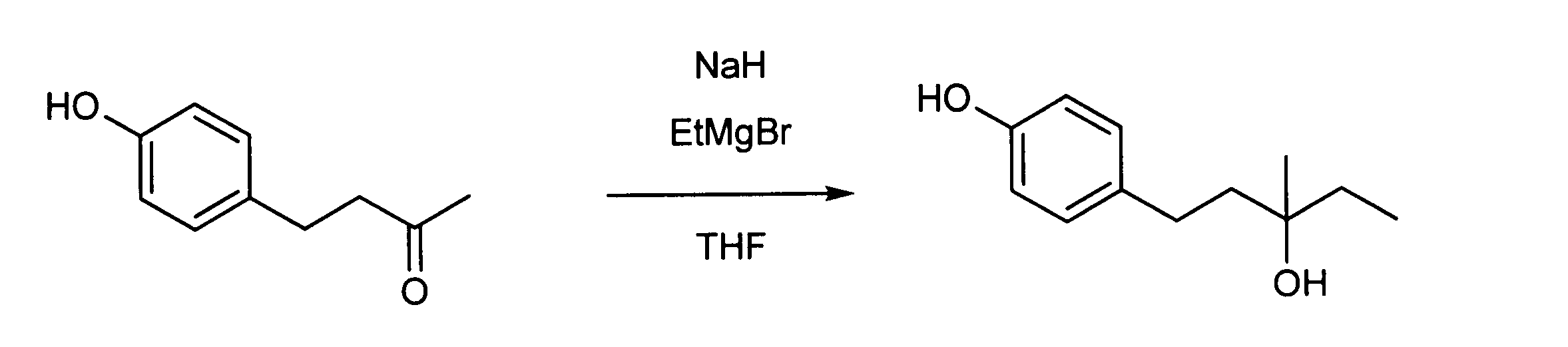
窒素雰囲気下にて、4-(4-ヒドロキシフェニル)ブタン-2-オン16.42g(0.100mol)を脱水THF(50m)に溶解し、2℃まで冷却し、水素化ナトリウム4.20g(0.105mol)を10分かけて加え、30分攪拌した。同温にてエチルマグネシウムブロミド39%エチルエーテル溶液を35mL(0.105mol)を30分かけて滴下し、室温にて1時間攪拌した。反応液を2℃まで冷却し、1N塩酸水200mLを滴下した。エバポレーターにて有機溶剤を回収したのち、水層をトルエンにて抽出し、有機層を水洗後、濃縮して粗生成物14.97gを得た。
得られた粗生成物をシリカゲルクロマトグラフィー(展開溶媒;トルエン:酢酸エチル=5:1)にて精製し、4-(3-ヒドロキシ-3-メチルペンチル)フェノール9.74g(0.050mol,50.0%yield)を得た。
得られた粗生成物をシリカゲルクロマトグラフィー(展開溶媒;トルエン:酢酸エチル=5:1)にて精製し、4-(3-ヒドロキシ-3-メチルペンチル)フェノール9.74g(0.050mol,50.0%yield)を得た。
1H-NMR(500MHz,CDCl3):σ0.93(t,3H,J=7.5),1.20(s,3H),1.56(q,2H,J=7.5),1.73(t,2H,J=7.0),2.60(q,2H,J=6.4),5.06(s,1H),6.75(d,2H,J=4.3),7.06(d,2H,J=4.4)
実施例2
<4-(3-ヒドロキシ-3-メチル-4-ペンテニル)フェノールの合成>
<4-(3-ヒドロキシ-3-メチル-4-ペンテニル)フェノールの合成>
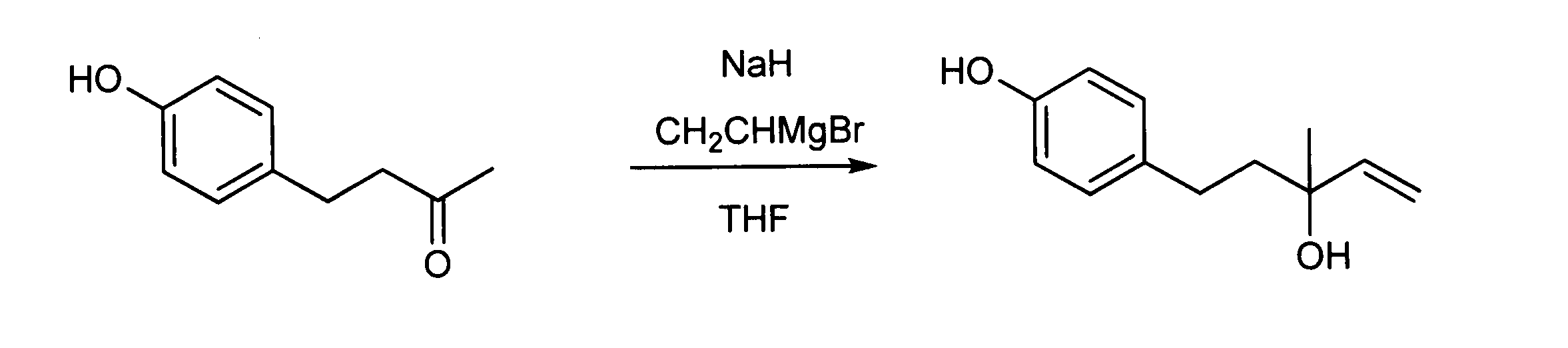
窒素雰囲気下にて、4-(4-ヒドロキシフェニル)ブタン-2-オン16.42g(0.100mol)を脱水THF50mLに溶解し、2℃まで冷却し、水素化ナトリウム4.20g(0.105mol)を10分かけて加え、30分攪拌した。同温にてビニルマグネシウムブロミド28%THF溶液53mL(0.105mol)を30分かけて滴下し、室温にて1時間攪拌した。反応液を2℃迄冷却し、1N塩酸水200mLを滴下した。エバポレーターにて有機溶剤を回収したのち、水層をトルエンにて抽出し、有機層を水洗後、濃縮して粗生成物15.37gを得た。
得られた粗生成物をシリカゲルクロマトグラフィー(展開溶媒;ヘキサン:酢酸エチル=5:1)にて精製し、4-(3-ヒドロキシ-3-メチルペンチル)フェノール9.04g(0.047mol,47.0%yield)を得た。
得られた粗生成物をシリカゲルクロマトグラフィー(展開溶媒;ヘキサン:酢酸エチル=5:1)にて精製し、4-(3-ヒドロキシ-3-メチルペンチル)フェノール9.04g(0.047mol,47.0%yield)を得た。
1H-NMR(500MHz,CDCl3):σ1.38(s,3H),1.81(t,2H,J=7.0),2.58(t,2H,J=7.0),4.82(s,1H),5.10(d,1H,J=10.8),5.23(d,1H,J=17.1),5.97(q,1H,J=10.8,17.4),6.75(d,2H,J=4.3),7.06(d,2H,J=4.4)
実施例3
<香気質の評価>
実施例1または実施例2で得たアルコール誘導体を瓶口および濾紙につけ、5年以上の経験を有する調香師により官能評価を行った。その結果、実施例1で得たアルコール誘導体は、フルーティー、アニジック、スイート、ややシュガーリー、ややクレゾリック、ジャスミン様のフローラルな香気を有していた。
一方、実施例2で得たアルコール誘導体は、フルーティー、アニジック、スイート、ややシュガーリー、ややクレゾリック、ジャスミン様のフローラル、ややワキシーな香気を有していた。
<香気質の評価>
実施例1または実施例2で得たアルコール誘導体を瓶口および濾紙につけ、5年以上の経験を有する調香師により官能評価を行った。その結果、実施例1で得たアルコール誘導体は、フルーティー、アニジック、スイート、ややシュガーリー、ややクレゾリック、ジャスミン様のフローラルな香気を有していた。
一方、実施例2で得たアルコール誘導体は、フルーティー、アニジック、スイート、ややシュガーリー、ややクレゾリック、ジャスミン様のフローラル、ややワキシーな香気を有していた。
実施例4
試験例1:<香料組成物の香り立ち、残香性試験>
表1の処方に従い、香料組成物を調製し、香り立ち、残香性試験を行った。方法は直径40mm、高さ50mmの広口瓶底に敷いた濾紙上に約10.0mgを量り込み、蓋を締めて30分放置して評価サンプルとした。蓋を開けた直後の香り立ち、及び開放系で約5時間経過時点での残香性を評価した。
評価は5年以上経験した調香専門パネル11人で3回繰り返して判定し(合計33人)、比較処方(比較例3)に対する強度を評価した。
試験例1:<香料組成物の香り立ち、残香性試験>
表1の処方に従い、香料組成物を調製し、香り立ち、残香性試験を行った。方法は直径40mm、高さ50mmの広口瓶底に敷いた濾紙上に約10.0mgを量り込み、蓋を締めて30分放置して評価サンプルとした。蓋を開けた直後の香り立ち、及び開放系で約5時間経過時点での残香性を評価した。
評価は5年以上経験した調香専門パネル11人で3回繰り返して判定し(合計33人)、比較処方(比較例3)に対する強度を評価した。
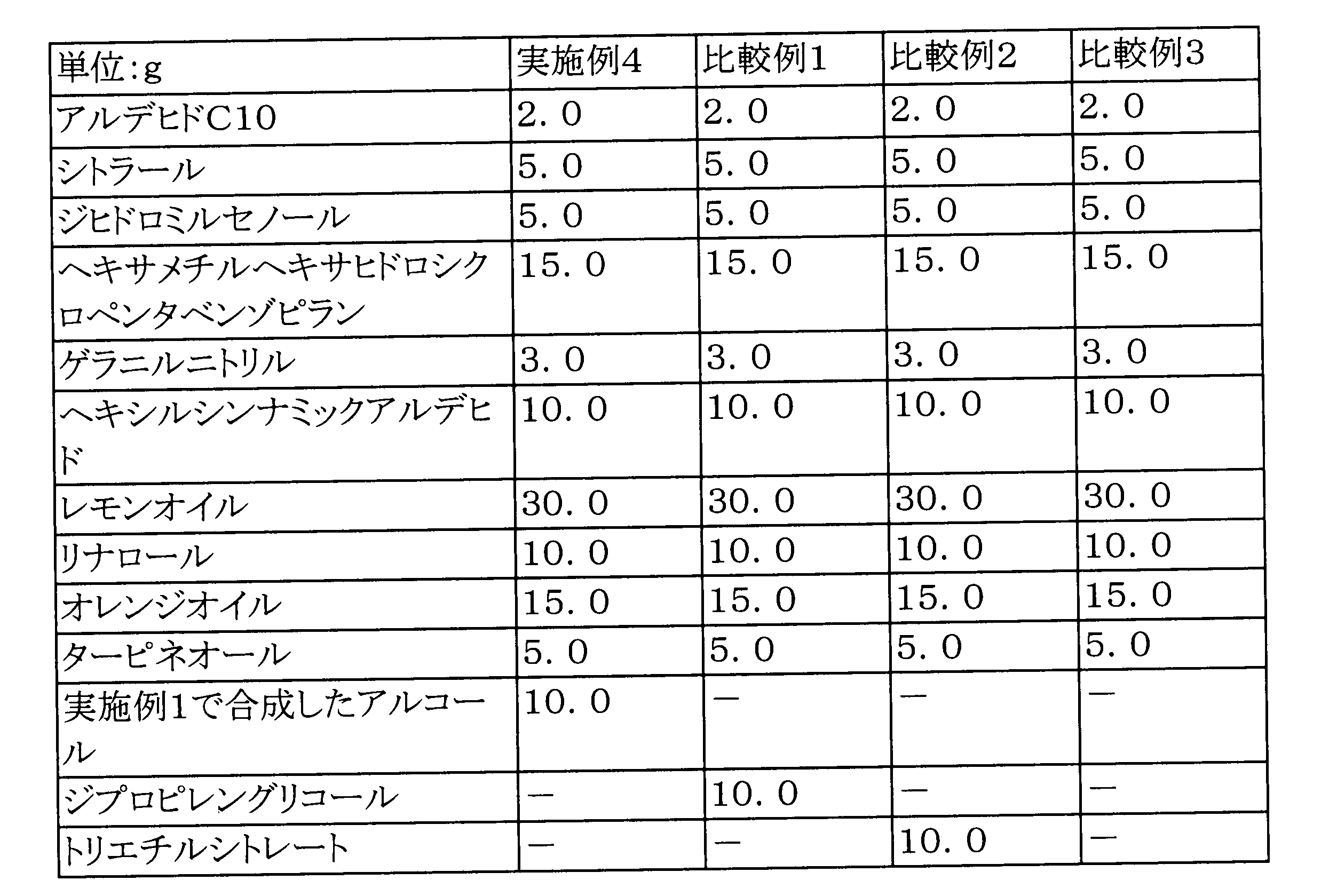
(1)香り立ち試験結果
比較処方(比較例3)に対して、最も香り立ちが高いと感じた人数の結果を表2に示す。
比較処方(比較例3)に対して、最も香り立ちが高いと感じた人数の結果を表2に示す。

(2)残香性試験結果
比較処方(比較例3)に対して、最も残香性が強いと感じた人数の結果を表3に示す。
比較処方(比較例3)に対して、最も残香性が強いと感じた人数の結果を表3に示す。

試験例1における実施例4の香料組成物の評価から明らかなように、本発明のアルコール誘導体(実施例1)は上記調合香料に対して香り立ち、残香性共に優れた結果を示した。
実施例5
試験例2:入浴剤での効果試験
実施例2及び比較例2の調合香料を1.0%附香した表4の入浴剤をそれぞれ100g調製し、20gを40~42℃のさら湯180リットルに溶解し、直後の香気強度、及び30分後の香気強度を専門パネルにより比較評価した。
試験例2:入浴剤での効果試験
実施例2及び比較例2の調合香料を1.0%附香した表4の入浴剤をそれぞれ100g調製し、20gを40~42℃のさら湯180リットルに溶解し、直後の香気強度、及び30分後の香気強度を専門パネルにより比較評価した。

(1)香り立ち試験結果
香り立ちが高いと感じた人数の結果を表5に示す。
(2)残香性試験結果
残香性が強いと感じた人数の結果を表6に示す。
香り立ちが高いと感じた人数の結果を表5に示す。
(2)残香性試験結果
残香性が強いと感じた人数の結果を表6に示す。


試験例2における実施例5の入浴剤に対する評価から明らかなように、本発明の調合香料を含有する入浴剤はトリエチルシトレートを含有する比較例4の入浴剤よりも香り立ち、残香性、共に優れた結果を示した。
<実施例6>
試験例3:オーデコロンでの効果試験
表7の処方に従い、香料組成物を調製した。
試験例3:オーデコロンでの効果試験
表7の処方に従い、香料組成物を調製した。

上記実施例6、比較例5の香料組成物を5%賦香したオーデコロン(95%エタノール溶液)を100gずつ調製し、それぞれ適量を左右前腕部内側にアトマイザー噴霧して直後の香り立ち、及び約4時間経過時点での残香性を評価した。
評価は5年以上経験した調香専門パネル13人で判定し評価した。
評価は5年以上経験した調香専門パネル13人で判定し評価した。
(1)香り立ち試験結果
香り立ちが高いと感じた人数の結果を表8に示す。
(2)残香性試験結果
残香性が強いと感じた人数の結果を表9に示す。
香り立ちが高いと感じた人数の結果を表8に示す。
(2)残香性試験結果
残香性が強いと感じた人数の結果を表9に示す。


試験例3から明らかなように、本発明の調合香料を含有するオーデコロンはp-メンタン-3,8-ジオールを含有するオーデコロンよりも特に残香性に優れた結果を示した。
<実施例7>
試験例4:シャンプー、コンディショナーでの効果試験
表10の処方に従い、実施例7、比較例6に示す香料組成物を調製した。
試験例4:シャンプー、コンディショナーでの効果試験
表10の処方に従い、実施例7、比較例6に示す香料組成物を調製した。
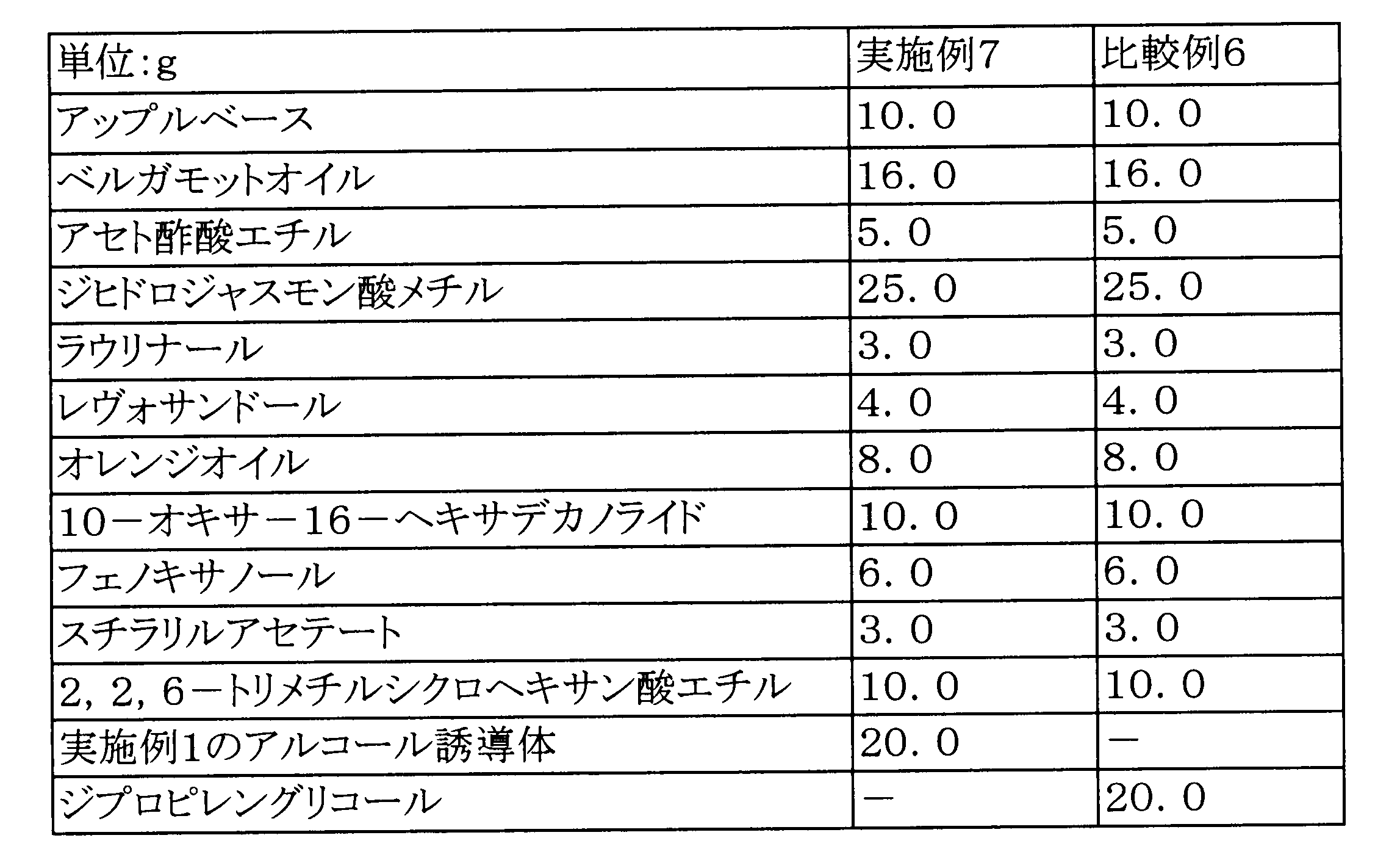
続いて実施例7、比較例6の香料組成物を0.5%賦香したシャンプー100gずつを表11の処方に従い製造した。また同様にコンディショナー100gずつを表12の処方に従い製造した。

(評価方法)
かもじ(人毛)5gをシャンプー2.5g、及び温水(40℃)5mLにて1分間処理後、温水(40℃)1000mLにてすすぎ、タオルドライしたものをアルミホイル上に固定放置し評価サンプルとした。固定直後の香り立ち、及び室温で約5時間経過時点での残香性を評価した。
コンディショナーについては、かもじ5gに対してコンディショナー5.0gを使用し、シャンプーと同様の方法にて評価した。
評価は5年以上経験した調香専門パネル10人で3回繰り返して判定した(合計30人)。
かもじ(人毛)5gをシャンプー2.5g、及び温水(40℃)5mLにて1分間処理後、温水(40℃)1000mLにてすすぎ、タオルドライしたものをアルミホイル上に固定放置し評価サンプルとした。固定直後の香り立ち、及び室温で約5時間経過時点での残香性を評価した。
コンディショナーについては、かもじ5gに対してコンディショナー5.0gを使用し、シャンプーと同様の方法にて評価した。
評価は5年以上経験した調香専門パネル10人で3回繰り返して判定した(合計30人)。
(1)シャンプーの香り立ち試験結果
香り立ちが高いと感じた人数の結果を表13に示す。
(2)シャンプーの残香性試験結果
残香性が強いと感じた人数の結果を表14に示す。
(1)コンディショナーの香り立ち試験結果
香り立ちが高いと感じた人数の結果を表15に示す。
(2)コンディショナーの残香性試験結果
残香性が強いと感じた人数の結果を表16に示す。
香り立ちが高いと感じた人数の結果を表13に示す。
(2)シャンプーの残香性試験結果
残香性が強いと感じた人数の結果を表14に示す。
(1)コンディショナーの香り立ち試験結果
香り立ちが高いと感じた人数の結果を表15に示す。
(2)コンディショナーの残香性試験結果
残香性が強いと感じた人数の結果を表16に示す。




試験例4から明らかなように、本発明の調合香料を含有するシャンプー、コンディショナーは香り立ち、残香性共に優れた結果を示し、特に残香性に顕著な効果を与えた。
本発明を詳細にまた特定の実施態様を参照して説明したが、本発明の精神と範囲を逸脱することなく様々な変更や修正を加えることができることは当業者にとって明らかである。本出願は2011年6月17日出願の日本特許出願(特願2011-134928)に基づくものであり、その内容はここに参照として取り込まれる。
本発明の香料組成物に配合される前記一般式(1)で表されるアルコール誘導体は、ベースとなる香料組成物の香調を変えることなく、香り立ち、持続性等の芳香特性、保留特性の高い香質改善剤であるので、皮膚化粧料、シャンプー、リンス、コンディショナー類、ヘアートニック、ヘアークリーム類等の頭髪化粧料、香水、コロン類、石鹸、室内芳香剤、歯磨、等の香粧品、洗剤、ソフトナー類、等のトイレタリー製品、入浴剤、パップ剤、軟膏等の医薬部外品または医薬品、飲料、食品等、香料の配合を必要とする各種製品に対する香料組成物の質の向上に寄与するものである。
Claims (9)
- 下記一般式(1)で表されるアルコール誘導体を含有する香料組成物。
- 前記一般式(1)におけるR1が炭素数2~4の炭化水素基であり、R2が水酸基又は炭素数1~4のアルコキシ基である請求項1に記載の香料組成物。
- 前記アルコール誘導体が、下記一般式(2)で表される請求項1又は2に記載の香料組成物。

- 前記アルコール誘導体が、4-(3-ヒドロキシ-3-メチルペンチル)フェノール、4-(3-ヒドロキシ-3-メチル-4-ペンテニル)フェノール及び4-(3-ヒドロキシ-3-メチルヘキシル)フェノールからなる群より選ばれる少なくとも1種である請求項1~3のいずれか1項に記載の香料組成物。
- 前記アルコール誘導体を1~90質量%含有する請求項1~4のいずれか1項に記載の香料組成物。
- 請求項1~5のいずれか1項に記載の香料組成物を含有する、香粧品、トイレタリー製品、入浴剤、飲料、食品、医薬部外品及び医薬品からなる群より選ばれる少なくとも1種の製品。
- 下記一般式(1)で表されるアルコール誘導体を香料組成物に添加することにより香料の香気持続性を強化する方法。

- 下記一般式(2)で表されるアルコール誘導体。
- 前記一般式(2)で表されるアルコール誘導体が、4-(3-ヒドロキシ-3-メチルペンチル)フェノール、4-(3-ヒドロキシ-3-メチル-4-ペンテニル)フェノール及び4-(3-ヒドロキシ-3-メチルヘキシル)フェノールのいずれかである請求項8に記載のアルコール誘導体。
Applications Claiming Priority (2)
| Application Number | Priority Date | Filing Date | Title |
|---|---|---|---|
| JP2011-134928 | 2011-06-17 | ||
| JP2011134928A JP5829438B2 (ja) | 2011-06-17 | 2011-06-17 | 香料組成物 |
Publications (1)
| Publication Number | Publication Date |
|---|---|
| WO2012173237A1 true WO2012173237A1 (ja) | 2012-12-20 |
Family
ID=47357214
Family Applications (1)
| Application Number | Title | Priority Date | Filing Date |
|---|---|---|---|
| PCT/JP2012/065397 Ceased WO2012173237A1 (ja) | 2011-06-17 | 2012-06-15 | 香料組成物 |
Country Status (2)
| Country | Link |
|---|---|
| JP (1) | JP5829438B2 (ja) |
| WO (1) | WO2012173237A1 (ja) |
Families Citing this family (3)
| Publication number | Priority date | Publication date | Assignee | Title |
|---|---|---|---|---|
| JP5886121B2 (ja) * | 2011-07-01 | 2016-03-16 | 花王株式会社 | メラニン生成抑制剤 |
| WO2014151171A1 (en) * | 2013-03-15 | 2014-09-25 | The Procter & Gamble Company | Personal care compositions |
| WO2021125418A1 (ko) * | 2019-12-20 | 2021-06-24 | (주)셀인바이오 | 페놀계 화합물, 이를 포함하는 피부미백용 화장품 조성물 및 피부미백 화장품 |
Citations (2)
| Publication number | Priority date | Publication date | Assignee | Title |
|---|---|---|---|---|
| JPH09111281A (ja) * | 1995-10-19 | 1997-04-28 | Kao Corp | 香料組成物 |
| JP2000103754A (ja) * | 1998-09-29 | 2000-04-11 | Kuraray Co Ltd | 芳香族系カルビノール類の製造方法 |
-
2011
- 2011-06-17 JP JP2011134928A patent/JP5829438B2/ja active Active
-
2012
- 2012-06-15 WO PCT/JP2012/065397 patent/WO2012173237A1/ja not_active Ceased
Patent Citations (2)
| Publication number | Priority date | Publication date | Assignee | Title |
|---|---|---|---|---|
| JPH09111281A (ja) * | 1995-10-19 | 1997-04-28 | Kao Corp | 香料組成物 |
| JP2000103754A (ja) * | 1998-09-29 | 2000-04-11 | Kuraray Co Ltd | 芳香族系カルビノール類の製造方法 |
Non-Patent Citations (1)
| Title |
|---|
| JOURNAL OF CHEMICAL EDUCATION, vol. 69, no. 5, 1992, pages 420 - 1 * |
Also Published As
| Publication number | Publication date |
|---|---|
| JP5829438B2 (ja) | 2015-12-09 |
| JP2013001820A (ja) | 2013-01-07 |
Similar Documents
| Publication | Publication Date | Title |
|---|---|---|
| JP4177002B2 (ja) | 香料組成物 | |
| JP4799921B2 (ja) | 香料組成物 | |
| JP4563079B2 (ja) | メントール誘導体及びそれを含有する冷感剤組成物 | |
| CN1172656C (zh) | 香味扩散率和持久性的提高剂及其提高方法 | |
| US8227401B2 (en) | Optically active muscone composition and fragrances or cosmetics containing the same | |
| JP4996834B2 (ja) | バニリンアセタール類およびそれを含有する感覚刺激剤組成物 | |
| JP5829438B2 (ja) | 香料組成物 | |
| JP5156272B2 (ja) | 新規香料成分及び香料組成物 | |
| WO2015163023A1 (ja) | 新規化合物及び該化合物を含有する香料組成物 | |
| JP5065608B2 (ja) | ミント組成物 | |
| JP6484877B2 (ja) | 香料組成物 | |
| US20080026979A1 (en) | Cyclopropancarboxaldehydes and their use in perfume compositions | |
| JP2013256470A (ja) | カンフォレン誘導体及びそれを含有する香料組成物 | |
| US7531696B2 (en) | Substituted cyclopentenone derivatives and their use in perfume compositions | |
| JP2007537211A (ja) | p−メンタン−3−オールのアルキル化誘導体及びそれらの清涼剤としての使用 | |
| JP2014148614A (ja) | 香料組成物 | |
| US7141699B1 (en) | Substituted cyclopentenone derivatives and their use in perfume compositions | |
| JP2010083831A (ja) | 低感作性香気化合物およびそれを含有する香料組成物 | |
| EP4613833A1 (en) | Fragrance composition and consumer product | |
| US6930083B2 (en) | Isomer composition excellent in chemical resistance containing optically active trans-1-(2,2,6-trimethylcyclohexyl)-2-buten-1-one and fragrance compositions containing the isomer composition | |
| JP2011105941A (ja) | 香料の香り立ち及び持続性の強化方法及び強化剤 | |
| KR20070039070A (ko) | 4-헵텐-2-일 살리실레이트 및 그의 방향 성분으로서의 용도 | |
| CA2753315A1 (en) | Optically active muscone composition and fragrances or cosmetics containing the same | |
| JPS63313719A (ja) | 香料組成物 | |
| JP2002038186A (ja) | 香料組成物 |
Legal Events
| Date | Code | Title | Description |
|---|---|---|---|
| 121 | Ep: the epo has been informed by wipo that ep was designated in this application |
Ref document number: 12800697 Country of ref document: EP Kind code of ref document: A1 |
|
| NENP | Non-entry into the national phase |
Ref country code: DE |
|
| 122 | Ep: pct application non-entry in european phase |
Ref document number: 12800697 Country of ref document: EP Kind code of ref document: A1 |