WO2012172912A1 - 熱伝導性感圧接着性シート状成形体、その製造方法、及び電子機器 - Google Patents
熱伝導性感圧接着性シート状成形体、その製造方法、及び電子機器 Download PDFInfo
- Publication number
- WO2012172912A1 WO2012172912A1 PCT/JP2012/062546 JP2012062546W WO2012172912A1 WO 2012172912 A1 WO2012172912 A1 WO 2012172912A1 JP 2012062546 W JP2012062546 W JP 2012062546W WO 2012172912 A1 WO2012172912 A1 WO 2012172912A1
- Authority
- WO
- WIPO (PCT)
- Prior art keywords
- meth
- adhesive sheet
- mass
- conductive pressure
- parts
- Prior art date
- Legal status (The legal status is an assumption and is not a legal conclusion. Google has not performed a legal analysis and makes no representation as to the accuracy of the status listed.)
- Ceased
Links
Classifications
-
- C—CHEMISTRY; METALLURGY
- C09—DYES; PAINTS; POLISHES; NATURAL RESINS; ADHESIVES; COMPOSITIONS NOT OTHERWISE PROVIDED FOR; APPLICATIONS OF MATERIALS NOT OTHERWISE PROVIDED FOR
- C09J—ADHESIVES; NON-MECHANICAL ASPECTS OF ADHESIVE PROCESSES IN GENERAL; ADHESIVE PROCESSES NOT PROVIDED FOR ELSEWHERE; USE OF MATERIALS AS ADHESIVES
- C09J4/00—Adhesives based on organic non-macromolecular compounds having at least one polymerisable carbon-to-carbon unsaturated bond ; adhesives, based on monomers of macromolecular compounds of groups C09J183/00 - C09J183/16
- C09J4/06—Organic non-macromolecular compounds having at least one polymerisable carbon-to-carbon unsaturated bond in combination with a macromolecular compound other than an unsaturated polymer of groups C09J159/00 - C09J187/00
-
- C—CHEMISTRY; METALLURGY
- C08—ORGANIC MACROMOLECULAR COMPOUNDS; THEIR PREPARATION OR CHEMICAL WORKING-UP; COMPOSITIONS BASED THEREON
- C08F—MACROMOLECULAR COMPOUNDS OBTAINED BY REACTIONS ONLY INVOLVING CARBON-TO-CARBON UNSATURATED BONDS
- C08F2/00—Processes of polymerisation
- C08F2/44—Polymerisation in the presence of compounding ingredients, e.g. plasticisers, dyestuffs, fillers
-
- C—CHEMISTRY; METALLURGY
- C09—DYES; PAINTS; POLISHES; NATURAL RESINS; ADHESIVES; COMPOSITIONS NOT OTHERWISE PROVIDED FOR; APPLICATIONS OF MATERIALS NOT OTHERWISE PROVIDED FOR
- C09J—ADHESIVES; NON-MECHANICAL ASPECTS OF ADHESIVE PROCESSES IN GENERAL; ADHESIVE PROCESSES NOT PROVIDED FOR ELSEWHERE; USE OF MATERIALS AS ADHESIVES
- C09J11/00—Features of adhesives not provided for in group C09J9/00, e.g. additives
- C09J11/02—Non-macromolecular additives
- C09J11/04—Non-macromolecular additives inorganic
-
- C—CHEMISTRY; METALLURGY
- C09—DYES; PAINTS; POLISHES; NATURAL RESINS; ADHESIVES; COMPOSITIONS NOT OTHERWISE PROVIDED FOR; APPLICATIONS OF MATERIALS NOT OTHERWISE PROVIDED FOR
- C09J—ADHESIVES; NON-MECHANICAL ASPECTS OF ADHESIVE PROCESSES IN GENERAL; ADHESIVE PROCESSES NOT PROVIDED FOR ELSEWHERE; USE OF MATERIALS AS ADHESIVES
- C09J133/00—Adhesives based on homopolymers or copolymers of compounds having one or more unsaturated aliphatic radicals, each having only one carbon-to-carbon double bond, and at least one being terminated by only one carboxyl radical, or of salts, anhydrides, esters, amides, imides, or nitriles thereof; Adhesives based on derivatives of such polymers
- C09J133/04—Homopolymers or copolymers of esters
- C09J133/06—Homopolymers or copolymers of esters of esters containing only carbon, hydrogen and oxygen, the oxygen atom being present only as part of the carboxyl radical
- C09J133/08—Homopolymers or copolymers of acrylic acid esters
-
- C—CHEMISTRY; METALLURGY
- C09—DYES; PAINTS; POLISHES; NATURAL RESINS; ADHESIVES; COMPOSITIONS NOT OTHERWISE PROVIDED FOR; APPLICATIONS OF MATERIALS NOT OTHERWISE PROVIDED FOR
- C09J—ADHESIVES; NON-MECHANICAL ASPECTS OF ADHESIVE PROCESSES IN GENERAL; ADHESIVE PROCESSES NOT PROVIDED FOR ELSEWHERE; USE OF MATERIALS AS ADHESIVES
- C09J7/00—Adhesives in the form of films or foils
-
- C—CHEMISTRY; METALLURGY
- C09—DYES; PAINTS; POLISHES; NATURAL RESINS; ADHESIVES; COMPOSITIONS NOT OTHERWISE PROVIDED FOR; APPLICATIONS OF MATERIALS NOT OTHERWISE PROVIDED FOR
- C09J—ADHESIVES; NON-MECHANICAL ASPECTS OF ADHESIVE PROCESSES IN GENERAL; ADHESIVE PROCESSES NOT PROVIDED FOR ELSEWHERE; USE OF MATERIALS AS ADHESIVES
- C09J7/00—Adhesives in the form of films or foils
- C09J7/10—Adhesives in the form of films or foils without carriers
-
- C—CHEMISTRY; METALLURGY
- C09—DYES; PAINTS; POLISHES; NATURAL RESINS; ADHESIVES; COMPOSITIONS NOT OTHERWISE PROVIDED FOR; APPLICATIONS OF MATERIALS NOT OTHERWISE PROVIDED FOR
- C09J—ADHESIVES; NON-MECHANICAL ASPECTS OF ADHESIVE PROCESSES IN GENERAL; ADHESIVE PROCESSES NOT PROVIDED FOR ELSEWHERE; USE OF MATERIALS AS ADHESIVES
- C09J9/00—Adhesives characterised by their physical nature or the effects produced, e.g. glue sticks
-
- C—CHEMISTRY; METALLURGY
- C08—ORGANIC MACROMOLECULAR COMPOUNDS; THEIR PREPARATION OR CHEMICAL WORKING-UP; COMPOSITIONS BASED THEREON
- C08K—Use of inorganic or non-macromolecular organic substances as compounding ingredients
- C08K3/00—Use of inorganic substances as compounding ingredients
- C08K3/18—Oxygen-containing compounds, e.g. metal carbonyls
- C08K3/20—Oxides; Hydroxides
- C08K3/22—Oxides; Hydroxides of metals
- C08K2003/2227—Oxides; Hydroxides of metals of aluminium
-
- C—CHEMISTRY; METALLURGY
- C08—ORGANIC MACROMOLECULAR COMPOUNDS; THEIR PREPARATION OR CHEMICAL WORKING-UP; COMPOSITIONS BASED THEREON
- C08K—Use of inorganic or non-macromolecular organic substances as compounding ingredients
- C08K3/00—Use of inorganic substances as compounding ingredients
- C08K3/02—Elements
- C08K3/04—Carbon
-
- C—CHEMISTRY; METALLURGY
- C08—ORGANIC MACROMOLECULAR COMPOUNDS; THEIR PREPARATION OR CHEMICAL WORKING-UP; COMPOSITIONS BASED THEREON
- C08K—Use of inorganic or non-macromolecular organic substances as compounding ingredients
- C08K3/00—Use of inorganic substances as compounding ingredients
- C08K3/18—Oxygen-containing compounds, e.g. metal carbonyls
- C08K3/20—Oxides; Hydroxides
- C08K3/22—Oxides; Hydroxides of metals
-
- C—CHEMISTRY; METALLURGY
- C08—ORGANIC MACROMOLECULAR COMPOUNDS; THEIR PREPARATION OR CHEMICAL WORKING-UP; COMPOSITIONS BASED THEREON
- C08K—Use of inorganic or non-macromolecular organic substances as compounding ingredients
- C08K7/00—Use of ingredients characterised by shape
-
- C—CHEMISTRY; METALLURGY
- C09—DYES; PAINTS; POLISHES; NATURAL RESINS; ADHESIVES; COMPOSITIONS NOT OTHERWISE PROVIDED FOR; APPLICATIONS OF MATERIALS NOT OTHERWISE PROVIDED FOR
- C09J—ADHESIVES; NON-MECHANICAL ASPECTS OF ADHESIVE PROCESSES IN GENERAL; ADHESIVE PROCESSES NOT PROVIDED FOR ELSEWHERE; USE OF MATERIALS AS ADHESIVES
- C09J2203/00—Applications of adhesives in processes or use of adhesives in the form of films or foils
- C09J2203/326—Applications of adhesives in processes or use of adhesives in the form of films or foils for bonding electronic components such as wafers, chips or semiconductors
-
- C—CHEMISTRY; METALLURGY
- C09—DYES; PAINTS; POLISHES; NATURAL RESINS; ADHESIVES; COMPOSITIONS NOT OTHERWISE PROVIDED FOR; APPLICATIONS OF MATERIALS NOT OTHERWISE PROVIDED FOR
- C09J—ADHESIVES; NON-MECHANICAL ASPECTS OF ADHESIVE PROCESSES IN GENERAL; ADHESIVE PROCESSES NOT PROVIDED FOR ELSEWHERE; USE OF MATERIALS AS ADHESIVES
- C09J2301/00—Additional features of adhesives in the form of films or foils
- C09J2301/40—Additional features of adhesives in the form of films or foils characterized by the presence of essential components
- C09J2301/408—Additional features of adhesives in the form of films or foils characterized by the presence of essential components additives as essential feature of the adhesive layer
-
- C—CHEMISTRY; METALLURGY
- C09—DYES; PAINTS; POLISHES; NATURAL RESINS; ADHESIVES; COMPOSITIONS NOT OTHERWISE PROVIDED FOR; APPLICATIONS OF MATERIALS NOT OTHERWISE PROVIDED FOR
- C09J—ADHESIVES; NON-MECHANICAL ASPECTS OF ADHESIVE PROCESSES IN GENERAL; ADHESIVE PROCESSES NOT PROVIDED FOR ELSEWHERE; USE OF MATERIALS AS ADHESIVES
- C09J2433/00—Presence of (meth)acrylic polymer
Definitions
- the present invention relates to a heat conductive pressure-sensitive adhesive sheet-like molded article, a method for producing the heat conductive pressure-sensitive adhesive sheet-like molded article, and an electronic device including the heat conductive pressure-sensitive adhesive sheet-like molded article.
- thermoelectric pressure-sensitive adhesive sheet-like molded body a sheet having pressure-sensitive adhesiveness in addition to thermal conductivity.
- the above-mentioned heat conductive pressure-sensitive adhesive sheet-like molded body is mainly intended to transmit heat from the heat generating body to the heat radiating body, and therefore it is preferable to increase the heat conductivity.
- a thermally conductive filler such as graphite is used. May be added.
- Patent Document 1 discloses a rubber composition containing artificial graphite having a particle size of 1 to 20 ⁇ m.
- Patent Document 2 discloses a heat conductive rubber composition containing graphite having an average particle size of 10 to 150 ⁇ m.
- Graphite has high thermal conductivity, and as described above, the thermal conductivity of the resin composition can be increased by adding it to the resin composition.
- the thermal conductivity of the resin composition can be increased by adding it to the resin composition.
- the viscosity of the resin composition increases and it becomes difficult to form the resin composition into a sheet. That is, with the conventional technology, it has been difficult to improve the moldability while improving the thermal conductivity of the thermally conductive pressure-sensitive adhesive sheet-like molded body.
- an object of the present invention is to provide a heat conductive pressure-sensitive adhesive sheet-like molded body having high heat conductivity and good moldability. It is another object of the present invention to provide a method for producing the heat conductive pressure-sensitive adhesive sheet-like molded article and an electronic device including the heat conductive pressure-sensitive adhesive sheet-like molded article.
- the present inventors have found that the above problems can be solved by using predetermined graphite and a predetermined filler other than graphite in combination at a predetermined ratio, and have completed the present invention.
- the polymerization reaction of the (meth) acrylic acid ester monomer ( ⁇ 1) is carried out after forming a mixed composition containing at least 500 parts by weight and not more than 500 parts by mass into a sheet or while forming the mixed composition into a sheet. It is a thermally conductive pressure-sensitive adhesive sheet-like molded body (G) having a thickness of 0.5 mm to 4.5 mm, which is at least performed.
- (Meth) acryl means “acryl and / or methacryl”.
- Average particle diameter means that measured by the method described below. That is, it means that measured by a laser type particle size measuring machine (manufactured by Seishin Enterprise Co., Ltd.) by a micro-sorting control method (a method in which measurement target particles are allowed to pass only in the measurement region and the measurement reliability is improved). .
- the measurement target particles flowing into the measurement region are irradiated with semiconductor laser light having a wavelength of 670 nm, and the laser at that time
- the average particle size and particle size distribution can be calculated from the Franhofer diffraction principle.
- the “thermally conductive filler” means a filler that can be added to improve the thermal conductivity of the thermally conductive pressure-sensitive adhesive sheet-like molded body (G).
- the “polymerization reaction of (meth) acrylate monomer ( ⁇ 1)” means a polymerization reaction for obtaining a polymer that generates a structural unit derived from the (meth) acrylate monomer ( ⁇ 1).
- the “crosslinking reaction of a polymer containing a structural unit derived from the (meth) acrylic acid ester polymer (A1) and / or the (meth) acrylic acid ester monomer ( ⁇ 1)”, which will be described later as a preferred embodiment Cross-linking reaction between (meth) acrylic acid ester polymers (A1), cross-linking reaction between polymers containing structural units derived from (meth) acrylic acid ester monomer ( ⁇ 1), and (meth) acrylic acid ester weight
- the crosslinking reactions of the polymer (A1) and the polymer containing a structural unit derived from the (meth) acrylic acid ester monomer ( ⁇ 1) it means one or a plurality of crosslinking reactions.
- artificial graphite (B) is kneaded by adding pitch or tar to coke made from petroleum or coal, and then kneading at 800 ° C. It is preferable that after baking at 1500 ° C. or lower and further graphitizing by heating to 2000 ° C. or higher and 3000 ° C. or lower.
- the heat conductive filler (C) other than graphite is a metal belonging to group 2, 3, or 12 of the long periodic table. It is preferable that an oxide or a hydroxide is included.
- the heat conductive filler (C) other than graphite contains an aluminum oxide or hydroxide.
- the mixed composition further contains 50 parts by mass or more and 200 parts by mass or less of the phosphate ester (D).
- artificial graphite (B) having an average particle size of 160 ⁇ m or more and 700 ⁇ m or less
- thermally conductive filler (C) other than graphite having an average particle size of 1 ⁇ m or more and 100 ⁇ m or less.
- the (meth) acrylic acid ester monomer ( ⁇ 1) in the method for producing the heat conductive pressure-sensitive adhesive sheet-like molded product (G) of the second aspect of the present invention, the (meth) acrylic It is preferable to heat the acid ester monomer ( ⁇ 1) to a temperature of 100 ° C. or higher and 200 ° C. or lower.
- the heat conductive filler (C) other than graphite is in groups 2, 3, or 12 of the long periodic table. It preferably contains an oxide or hydroxide of the metal to which it belongs.
- heat conductive fillers (C) other than graphite may contain the oxide or hydroxide of aluminum. preferable.
- a third aspect of the present invention is an electronic device including the heat radiating body and the heat conductive pressure-sensitive adhesive sheet-like molded body (G) of the first aspect of the present invention bonded to the heat radiating body.
- the heat conductive pressure-sensitive adhesive sheet-like molded product (G) of the present invention includes a (meth) acrylic polymer containing a (meth) acrylic acid ester polymer (A1) and a (meth) acrylic acid ester monomer ( ⁇ 1).
- a mixed composition containing a thermally conductive filler (C) other than graphite hereinafter sometimes simply referred to as “thermally conductive filler (C)”
- At least a polymerization reaction for obtaining a polymer that produces a structural unit derived from the (meth) acrylic acid ester monomer ( ⁇ 1) while being formed into a sheet shape is performed.
- the main substances constituting such a heat conductive pressure-sensitive adhesive sheet-like molded body (G) will be described below.
- the (meth) acrylic resin composition (A) used in the present invention contains a (meth) acrylic acid ester polymer (A1) and a (meth) acrylic acid ester monomer ( ⁇ 1).
- a heat conductive pressure-sensitive-adhesive sheet-like molded object (G) in addition to the polymerization reaction which obtains the polymer which produces the structural unit derived from the (meth) acrylic acid ester monomer ( ⁇ 1), It is preferable that a crosslinking reaction of a polymer containing a structural unit derived from the acrylate polymer (A1) and / or the (meth) acrylate monomer ( ⁇ 1) is performed.
- the polymer containing the structural unit derived from the (meth) acrylate monomer ( ⁇ 1) by performing the polymerization reaction and preferably the crosslinking reaction is a component of the (meth) acrylate polymer (A1). Mixed and / or partially combined.
- the usage-amount of an acrylic ester polymer (A1) and the (meth) acrylic ester monomer ((alpha) 1) is (meth) with respect to 100 mass% of (meth) acrylic resin compositions (A).
- the acrylate polymer (A1) is preferably 5% by mass or more and 40% by mass or less
- the (meth) acrylic acid ester monomer ( ⁇ 1) is preferably 60% by mass or more and 95% by mass or less. It becomes easy to shape
- the (meth) acrylic acid ester polymer (A1) that can be used in the present invention is not particularly limited, but the (meth) acrylic acid ester monomer that forms a homopolymer having a glass transition temperature of ⁇ 20 ° C. or lower. It is preferable to contain the unit (a1) and the monomer unit (a2) having an organic acid group.
- the (meth) acrylic acid ester monomer (a1m) which gives the unit (a1) of the (meth) acrylic acid ester monomer is not particularly limited.
- ethyl acrylate the glass transition temperature of the homopolymer is -24 ° C
- n-propyl acrylate (-37 ° C)
- n-butyl acrylate (-54 ° C)
- sec-butyl acrylate 22 ° C
- n-heptyl acrylate - 60 ° C
- n-octyl acrylate -65 ° C
- 2-ethylhexyl acrylate -50 ° C
- 2-methoxyethyl acrylate (-50) ° C)
- 3-methoxypropyl acrylate (-75 ° C)
- 3-methoxybutyl acrylate (-56 ° C)
- n-butyl acrylate, 2-ethylhexyl acrylate, and 2-methoxyethyl acrylate are preferable, n-butyl acrylate and 2-ethylhexyl acrylate are more preferable, and 2-ethylhexyl acrylate is more preferable.
- These (meth) acrylic acid ester monomers (a1m) may be used individually by 1 type, and may use 2 or more types together.
- the monomer unit (a1) derived therefrom is preferably 80% by mass or more and 99.9% by mass in the (meth) acrylic acid ester polymer (A1).
- it is used for the polymerization in such an amount that it is more preferably 85 mass% or more and 99.5 mass% or less.
- the monomer (a2m) that gives the monomer unit (a2) having an organic acid group is not particularly limited, but representative examples thereof include organic acid groups such as a carboxyl group, an acid anhydride group, and a sulfonic acid group.
- monomers containing sulfenic acid groups, sulfinic acid groups, phosphoric acid groups, and the like can also be used.
- the monomer having a carboxyl group include, for example, ⁇ , ⁇ -ethylenically unsaturated monocarboxylic acids such as acrylic acid, methacrylic acid, and crotonic acid, and ⁇ , ⁇ such as itaconic acid, maleic acid, and fumaric acid.
- ⁇ , ⁇ -ethylenically unsaturated polyvalent carboxylic acid partial esters such as monomethyl itaconate, monobutyl maleate and monopropyl fumarate can be exemplified.
- the monomer having a sulfonic acid group examples include allyl sulfonic acid, methallyl sulfonic acid, vinyl sulfonic acid, styrene sulfonic acid, ⁇ , ⁇ -unsaturated sulfonic acid such as acrylamide-2-methylpropane sulfonic acid, And salts thereof.
- the monomer (a2m) among the monomers having an organic acid group exemplified above, a monomer having a carboxyl group is more preferable, and a monomer having acrylic acid or methacrylic acid is particularly preferable. . These monomers are industrially inexpensive and can be easily obtained, have good copolymerizability with other monomer components, and are preferable in terms of productivity. In addition, a monomer (a2m) may be used individually by 1 type, and may use 2 or more types together.
- the monomer unit (a2) derived from the monomer unit (a2) is preferably 0.1% by mass or more and 20% by mass or less in the (meth) acrylic acid ester polymer (A1). More preferably, it is used for the polymerization in such an amount that it is 0.5 mass% or more and 15 mass% or less.
- the usage-amount of the monomer (a2m) which has an organic acid group exists in the said range, it will become easy to maintain the viscosity of the polymerization system at the time of superposition
- the monomer unit (a2) having an organic acid group is introduced into the (meth) acrylic acid ester polymer (A1) by polymerization of the monomer (a2m) having an organic acid group as described above.
- an organic acid group may be introduced by a known polymer reaction after the (meth) acrylic acid ester polymer (A1) is produced.
- the (meth) acrylic acid ester polymer (A1) may contain a monomer unit (a3) derived from a monomer (a3m) having a functional group other than an organic acid group.
- Examples of the functional group other than the organic acid group include a hydroxyl group, an amino group, an amide group, an epoxy group, and a mercapto group.
- Examples of the monomer having a hydroxyl group include (meth) acrylic acid hydroxyalkyl esters such as (meth) acrylic acid 2-hydroxyethyl and (meth) acrylic acid 3-hydroxypropyl.
- Examples of the monomer having an amino group include N, N-dimethylaminomethyl (meth) acrylate, N, N-dimethylaminoethyl (meth) acrylate, and aminostyrene.
- Examples of monomers having an amide group include ⁇ , ⁇ -ethylenically unsaturated carboxylic acid amide monomers such as acrylamide, methacrylamide, N-methylol acrylamide, N-methylol methacrylamide, and N, N-dimethylacrylamide. Can be mentioned.
- Examples of the monomer having an epoxy group include glycidyl (meth) acrylate and allyl glycidyl ether.
- the monomer (a3m) having a functional group other than the organic acid group one type may be used alone, or two or more types may be used in combination.
- the monomer unit (a3) derived therefrom is 10% by mass or less in the (meth) acrylate polymer (A1). It is preferable to use it for polymerization in such an amount.
- the monomer (a3m) of 10% by mass or less it becomes easy to keep the viscosity of the polymerization system during polymerization in an appropriate range.
- the (meth) acrylic acid ester polymer (A1) has a (meth) acrylic acid ester monomer unit (a1) that forms a homopolymer having a glass transition temperature of ⁇ 20 ° C. or lower, and an organic acid group.
- a monomer derived from the monomer (a4m) copolymerizable with the above-described monomer may be contained.
- a monomer (a4m) may be used individually by 1 type, and may use 2 or more types together.
- the amount of the monomer unit (a4) derived from the monomer (a4m) is preferably 10% by mass or less and more preferably 5% by mass or less in the (meth) acrylic acid ester polymer (A1).
- the monomer (a4m) is not particularly limited, and specific examples thereof include (meth) acrylate monomers other than the (meth) acrylate monomer (a1m), ⁇ , ⁇ -ethylenic monomers. Saturated polycarboxylic acid complete ester, alkenyl aromatic monomer, conjugated diene monomer, non-conjugated diene monomer, vinyl cyanide monomer, carboxylic acid unsaturated alcohol ester, olefin monomer, etc. Can be mentioned.
- the (meth) acrylate monomer other than the (meth) acrylate monomer (a1m) include methyl acrylate (homopolymer having a glass transition temperature of 10 ° C.), methyl methacrylate. (105 ° C.), ethyl methacrylate (63 ° C.), n-propyl methacrylate (25 ° C.), n-butyl methacrylate (20 ° C.), and the like.
- ⁇ , ⁇ -ethylenically unsaturated polyvalent carboxylic acid complete ester examples include dimethyl fumarate, diethyl fumarate, dimethyl maleate, diethyl maleate, dimethyl itaconate and the like.
- alkenyl aromatic monomer examples include styrene, ⁇ -methylstyrene, methyl ⁇ -methylstyrene, vinyltoluene and the like.
- conjugated diene monomer examples include 1,3-butadiene, 2-methyl-1,3-butadiene (synonymous with isoprene), 1,3-pentadiene, and 2,3-dimethyl-1,3-butadiene. 2-chloro-1,3-butadiene, cyclopentadiene and the like.
- vinyl cyanide monomer examples include acrylonitrile, methacrylonitrile, ⁇ -chloroacrylonitrile, ⁇ -ethylacrylonitrile and the like.
- carboxylic acid unsaturated alcohol ester monomer examples include vinyl acetate.
- olefin monomer examples include ethylene, propylene, butene, pentene and the like.
- the weight average molecular weight (Mw) of the (meth) acrylic acid ester polymer (A1) is measured by gel permeation chromatography (GPC method) and is in the range of 100,000 to 1,000,000 in terms of standard polystyrene. It is more preferable that it is in the range of 200,000 or more and 500,000 or less.
- the polymerization method is not particularly limited, and any of solution polymerization, emulsion polymerization, suspension polymerization, bulk polymerization, and the like may be used. However, solution polymerization is preferable. Among these, solution polymerization using a carboxylic acid ester such as ethyl acetate or ethyl lactate or an aromatic solvent such as benzene, toluene or xylene is more preferable as the polymerization solvent. In the polymerization, the monomer may be added in portions to the polymerization reaction vessel, but it is preferable to add the whole amount at once.
- the method for initiating the polymerization is not particularly limited, but it is preferable to use a thermal polymerization initiator as the polymerization initiator.
- the thermal polymerization initiator is not particularly limited, and may be either a peroxide or an azo compound.
- Peroxide polymerization initiators include hydroperoxides such as t-butyl hydroperoxide, peroxides such as benzoyl peroxide and cyclohexanone peroxide, and persulfates such as potassium persulfate, sodium persulfate and ammonium persulfate. Can be mentioned. These peroxides can also be used as a redox catalyst in appropriate combination with a reducing agent.
- the usage-amount of a polymerization initiator is not specifically limited, It is preferable that it is the range of 0.01 to 50 mass parts with respect to 100 mass parts of monomers.
- polymerization conditions (polymerization temperature, pressure, stirring conditions, etc.) of these monomers are not particularly limited.
- the obtained polymer is separated from the polymerization medium if necessary.
- the separation method is not particularly limited.
- the (meth) acrylic acid ester polymer (A1) can be obtained by placing the polymerization solution under reduced pressure and distilling off the polymerization solvent.
- the weight average molecular weight of the (meth) acrylic acid ester polymer (A1) can be controlled by appropriately adjusting the amount of the polymerization initiator used in the polymerization and the amount of the chain transfer agent.
- the (meth) acrylate monomer ( ⁇ 1) is not particularly limited as long as it contains the (meth) acrylate monomer, but forms a homopolymer having a glass transition temperature of ⁇ 20 ° C. or lower. It is preferable to contain the (meth) acrylic acid ester monomer (a5m).
- a (meth) acrylate monomer (a5m) that forms a homopolymer having a glass transition temperature of ⁇ 20 ° C. or lower, it is used for the synthesis of a (meth) acrylate polymer (A1) (meth) )
- a (meth) acrylic acid ester monomer (a5m) may be used individually by 1 type, and may use 2 or more types together.
- the ratio of the (meth) acrylate monomer (a5m) in the (meth) acrylate monomer ( ⁇ 1) is preferably 50% by mass to 100% by mass, more preferably 75% by mass to 100% by mass. It is as follows. By making the ratio of the (meth) acrylic acid ester monomer (a5m) in the (meth) acrylic acid ester monomer ( ⁇ 1) in the above range, the heat conductive pressure-sensitive adhesive having excellent pressure-sensitive adhesiveness and flexibility. It becomes easy to obtain a sheet-like molded article (G).
- the (meth) acrylic acid ester monomer ( ⁇ 1) may be a mixture of a (meth) acrylic acid ester monomer (a5m) and a monomer copolymerizable therewith.
- the (meth) acrylate monomer ( ⁇ 1) is a (meth) acrylate monomer (a5m) that forms a homopolymer having a glass transition temperature of ⁇ 20 ° C. or less, and can be copolymerized with these monomers. It is good also as a thing containing the monomer (a6m) which has an organic acid group.
- Examples of the monomer (a6m) include monomers having an organic acid group similar to those exemplified as the monomer (a2m) used for the synthesis of the (meth) acrylic acid ester polymer (A1). be able to.
- a monomer (a6m) may be used individually by 1 type, and may use 2 or more types together.
- the ratio of the monomer (a6m) in the (meth) acrylic acid ester monomer ( ⁇ 1) is preferably 30% by mass or less, and more preferably 10% by mass or less.
- the (meth) acrylic acid ester monomer ( ⁇ 1) in addition to the (meth) acrylic acid ester monomer (a5m) and the monomer (a6m) having an organic acid group that can be optionally copolymerized, It is good also as a mixture with the monomer (a7m) which can be copolymerized with these.
- the ratio of the monomer (a7m) in the (meth) acrylic acid ester monomer ( ⁇ 1) is preferably 20% by mass or less, and more preferably 15% by mass or less.
- Examples of the monomer (a7m) include the monomer (a3m) used for the synthesis of the (meth) acrylic acid ester polymer (A1) and the same amount as those exemplified as the monomer (a4m).
- the body can be mentioned.
- a monomer (a7m) may be used individually by 1 type, and may use 2 or more types together.
- Examples of the polymerization initiator that can be used in the present invention include a photopolymerization initiator, an azo thermal polymerization initiator, and an organic peroxide thermal polymerization initiator. From the viewpoint of imparting excellent adhesiveness to the obtained heat conductive pressure-sensitive adhesive sheet-like molded product (G), it is preferable to use an organic peroxide thermal polymerization initiator.
- acylphosphine oxide compounds are preferred.
- Preferred examples of the acylphosphine oxide compound that is a photopolymerization initiator include bis (2,4,6-trimethylbenzoyl) phenylphosphine oxide and 2,4,6-trimethylbenzoyldiphenylphosphine oxide.
- azo-based thermal polymerization initiator 2,2′-azobisisobutyronitrile, 2,2′-azobis (2,4-dimethylvaleronitrile), 2,2′-azobis (2-methylbutyronitrile) ) And the like.
- Organic peroxide thermal polymerization initiators include hydroperoxides such as t-butyl hydroperoxide, benzoyl peroxide, cyclohexanone peroxide, 1,6-bis (t-butylperoxycarbonyloxy) hexane, 1,1-bis ( and a peroxide such as t-butylperoxy) -3,3,5-trimethylcyclohexanone.
- hydroperoxides such as t-butyl hydroperoxide, benzoyl peroxide, cyclohexanone peroxide, 1,6-bis (t-butylperoxycarbonyloxy) hexane, 1,1-bis ( and a peroxide such as t-butylperoxy) -3,3,5-trimethylcyclohexanone.
- organic peroxide thermal polymerization initiators those having a 1-minute half-life temperature of 100 ° C. or more and 170 ° C. or less are preferable.
- the amount of the polymerization initiator used is preferably 0.01 parts by mass or more and 10 parts by mass or less, and 0.1 parts by mass or more and 5 parts by mass or less with respect to 100 parts by mass of the (meth) acrylic resin composition (A). It is more preferable that it is 0.3 mass part or more and 1 mass part or less.
- the polymerization conversion rate of the (meth) acrylic acid ester monomer ( ⁇ 1) is preferably 95% by mass or more. If the polymerization conversion rate of the (meth) acrylic acid ester monomer ( ⁇ 1) is 95% by mass or more, it becomes easy to prevent the monomer odor from remaining in the heat conductive pressure-sensitive adhesive sheet-like molded product (G). . Moreover, by making the usage-amount of a polymerization initiator into the said range, the progress of polymerization reaction is induced excessively by adding a polymerization initiator, As a result, a heat conductive pressure-sensitive-adhesive sheet-like molded object (G) However, it does not become a smooth sheet, and it is easy to prevent a situation in which material destruction occurs.
- ⁇ Multifunctional monomer> When manufacturing the heat conductive pressure-sensitive-adhesive sheet-like molded object (G) of this invention, it is preferable to use a polyfunctional monomer.
- the polyfunctional monomer one that can be copolymerized with the monomer contained in the (meth) acrylic acid ester monomer ( ⁇ 1) is used.
- the polyfunctional monomer has a plurality of polymerizable unsaturated bonds, and has the unsaturated bond at the terminal.
- intramolecular and / or intermolecular crosslinking is introduced into the copolymer, and as a pressure-sensitive adhesive for the thermally conductive pressure-sensitive adhesive sheet-like molded product (G). The cohesive force of can be increased.
- polyfunctional monomer examples include 1,6-hexanediol di (meth) acrylate, 1,2-ethylene glycol di (meth) acrylate, 1,12-dodecanediol di (meth) acrylate, polyethylene glycol di (Meth) acrylate, polypropylene glycol di (meth) acrylate, neopentyl glycol di (meth) acrylate, pentaerythritol di (meth) acrylate, trimethylolpropane tri (meth) acrylate, pentaerythritol tri (meth) acrylate, ditrimethylolpropane Multifunctional (meth) acrylates such as tri (meth) acrylate, pentaerythritol tetra (meth) acrylate, dipentaerythritol hexa (meth) acrylate, and 2,4-bis (trichloro) Other substituted triazines, such as methyl)
- monoethylenically unsaturated aromatic ketones such as 4-acryloxy benzophenone can be used.
- pentaerythritol di (meth) acrylate, pentaerythritol tri (meth) acrylate, and pentaerythritol tetra (meth) acrylate are preferable.
- a polyfunctional monomer may be used individually by 1 type, and may use 2 or more types together.
- the amount of the polyfunctional monomer used in the production of the heat conductive pressure-sensitive adhesive sheet-like molded product (G) is 0.1 parts by mass or more and 15 parts by mass with respect to 100 parts by mass of the (meth) acrylic resin composition (A). It is preferably no greater than part by mass, more preferably no less than 0.2 parts by mass and no greater than 8 parts by mass, and even more preferably no less than 0.5 parts by mass and no greater than 2 parts by mass.
- the artificial graphite (B) is preferably obtained by adding a pitch or tar to coke made from petroleum or coal, kneading, firing, and further heating and graphitizing. . By passing through these steps and then pulverizing, artificial graphite (B) having a predetermined size can be obtained.
- artificial graphite (B) after kneading as described above, it is molded into a cylindrical shape for use in an electrode or the like by extrusion molding, mold molding or rubber press (hydrostatic pressure molding: CIP). It is preferable to do.
- the firing temperature is preferably 800 ° C. or higher and 1500 ° C. or lower, more preferably 800 ° C.
- the temperature when heating after firing is preferably 2000 ° C. or higher and 3000 ° C. or lower, more preferably 2500 ° C. or higher and 3000 ° C. or lower, and particularly preferably 2700 ° C. or higher and 3000 ° C. or lower.
- the average particle diameter of the artificial graphite (B) used in the present invention is 160 ⁇ m or more and 700 ⁇ m or less.
- the preferred range of the average particle size of the artificial graphite (B) is presumed to depend on the thickness of the heat conductive pressure-sensitive adhesive sheet-like molded product (G) and the particle size of the heat conductive filler (C) described later. For example, they are 250 micrometers or more and 500 micrometers or less.
- the heat conductive pressure-sensitive adhesive sheet-like molded body (G) is combined with the heat conductive filler (C) described later. It becomes easy to impart high thermal conductivity.
- the combination of the artificial graphite (B) and the heat conductive filler (C) described later makes it easy to impart high thermal conductivity to the heat conductive pressure-sensitive adhesive sheet-shaped molded body (G).
- the fluidity of the mixed composition that is the basis of the thermally conductive pressure-sensitive adhesive sheet-like molded product tends to be low.
- the fluidity of the mixed composition is lowered, it becomes difficult to form the mixed composition into a sheet, and even if the mixed composition can be formed into a sheet, the shape following property of the sheet is lowered.
- the sheet having low shape following property is bonded to the heat generating body and the heat radiating body, the adhesiveness between the heat generating body and the heat radiating body becomes poor, and it becomes difficult to transfer heat from the heat generating body to the heat radiating body.
- the heat conductive filler (C) having a particle size smaller than that of the artificial graphite (B) is used, the fluidity of the mixed composition is hardly lowered. It can be inferred that this is different.
- the amount of the artificial graphite (B) contained in the thermally conductive pressure-sensitive adhesive sheet-like molded body (G) is 100 parts by mass or more and 500 parts by mass or less with respect to 100 parts by mass of the (meth) acrylic resin composition (A). Preferably, they are 250 to 400 mass parts.
- the content of the artificial graphite (B) exceeds 500 parts by mass, the fluidity of the mixed composition that becomes the basis of the thermally conductive pressure-sensitive adhesive sheet-like molded body (G) is lowered, and as described above, It becomes difficult to form the mixed composition into a sheet, and even if it can be formed into a sheet, the shape following property of the sheet is lowered.
- a heat conductive filler (C) is used for the heat conductive pressure-sensitive-adhesive sheet-like molded object (G) of this invention.
- a heat conductive filler (C) is a filler which can improve the heat conductivity of a heat conductive pressure-sensitive-adhesive sheet-like molded object (G) by adding.
- thermally conductive filler (C) for example, an oxide or hydroxide of a metal belonging to Group 2, 3, or 12 of the long periodic table can be used. More specifically, calcium carbonate, aluminum hydroxide, magnesium hydroxide, aluminum oxide (alumina), magnesium oxide, silica, glass fiber, boron nitride, aluminum nitride, and the like can be given. Among these, aluminum hydroxide and aluminum oxide are preferable because they are easily available, are chemically stable, and a large amount can be blended. Such a heat conductive filler (C) may be used individually by 1 type, and may use 2 or more types together.
- the average particle size of the heat conductive filler (C) used in the present invention is 1 ⁇ m or more and 100 ⁇ m or less.
- the preferable range of the average particle size of the heat conductive filler (C) is presumed to depend on the thickness of the heat conductive pressure-sensitive adhesive sheet-like molded product (G) and the particle size of the artificial graphite (B). 2 ⁇ m or more and 50 ⁇ m or less.
- the average particle size of the heat conductive filler (C) is less than 1 ⁇ m, the viscosity of the mixed composition which is the basis of the heat conductive pressure-sensitive adhesive sheet-like molded body (G) tends to be high, and the heat conductive feeling There exists a possibility that the moldability of a pressure-adhesive sheet-like molded object (G) may fall.
- the amount of the thermally conductive filler (C) contained in the thermally conductive pressure-sensitive adhesive sheet-like molded body (G) is 50 parts by mass or more and 500 parts by mass with respect to 100 parts by mass of the (meth) acrylic resin composition (A). Part or less, preferably 250 parts by weight or more and 400 parts by weight or less.
- the content of the heat conductive filler (C) exceeds 500 parts by mass, the viscosity of the mixed composition that becomes the basis of the heat conductive pressure-sensitive adhesive sheet-like molded body (G) increases, and the heat conductive pressure-sensitive adhesive is obtained. There is a possibility that the moldability of the sheet-like molded article (G) is lowered.
- Phosphate ester (D) can also be used for the heat conductive pressure-sensitive-adhesive sheet-like molded object (G) of this invention.
- the phosphoric ester (D) it becomes easy to impart flame retardancy to the thermally conductive pressure-sensitive adhesive sheet-like molded body (G).
- the phosphate ester (D) used in the present invention preferably has a viscosity at 25 ° C. of from 3000 mPa ⁇ s to 300,000 mPa ⁇ s. It becomes easy to prevent that the moldability of a heat conductive pressure-sensitive-adhesive sheet-like molded object (G) deteriorates by making the viscosity of phosphate ester into the said range.
- the “viscosity” of the phosphate ester means the viscosity measured by the method described below.
- the viscosity of the phosphate ester is measured by the procedure shown below using a B-type viscometer (manufactured by Tokyo Keiki Co., Ltd.).
- a B-type viscometer manufactured by Tokyo Keiki Co., Ltd.
- (1) Weigh 300 ml of phosphate ester in a normal temperature environment and place it in a 500 ml container.
- (2) Stirring rotor No. Select one from 1, 2, 3, 4, 5, 6, and 7 and attach to the viscometer.
- the container containing the phosphate ester is placed on the viscometer, and the rotor is submerged in the condensed phosphate ester in the container.
- the rotation speed is selected from 20, 10, 4, and 2.
- the rotation speed is selected from 20, 10, 4, and 2.
- the value obtained by multiplying the read numerical value by the coefficient A is the viscosity [mPa ⁇ s].
- the coefficient A is the selected rotor No. as shown in Table 1 below. And the number of revolutions.
- the phosphate ester (D) used in the present invention is always a liquid in a temperature range of 15 ° C. or more and 100 ° C. or less under atmospheric pressure. If the phosphate ester (D) is a liquid when mixed, the workability is good, and it becomes easy to form the heat conductive pressure-sensitive adhesive sheet-like molded body (G). When forming the heat conductive pressure-sensitive adhesive sheet-like molded article (G) containing the phosphate ester (D), the heat conductive pressure-sensitive adhesive sheet-like molded article (G) in an environment of 15 ° C. or higher and 100 ° C. or lower. It is preferable to mix each substance which comprises.
- the glass transition temperature of the (meth) acrylic resin composition (A) is set to be equal to or higher than the volatilization or polymerization of monomers contained in the (meth) acrylic resin composition (A). Since it becomes easy to prevent the reaction from starting, the environmental performance and workability can be improved.
- a condensed phosphate ester or a non-condensed phosphate ester can be used as the phosphate ester (D).
- condensed phosphate ester means one having a plurality of phosphate ester moieties in one molecule
- non-condensed phosphate ester means one phosphate ester moiety in one molecule. It means something that exists only. Specific examples of phosphate esters that satisfy the conditions described so far are listed below.
- condensed phosphate ester examples include aromatic condensed phosphate esters such as 1,3-phenylene bis (diphenyl phosphate), bisphenol A bis (diphenyl phosphate), resorcinol bis (diphenyl phosphate); polyoxyalkylene bisdichloroalkyl And halogen-containing condensed phosphates such as phosphates; non-aromatic non-halogen-based condensed phosphates; Among these, aromatic condensed phosphates are preferred because of their relatively low specific gravity, no danger of releasing harmful substances (such as halogens), and availability, and 1,3-phenylenebis (diphenyl phosphate). ), Bisphenol A bis (diphenyl phosphate) is more preferred.
- non-condensed phosphate ester examples include aromatics such as triphenyl phosphate, tricresyl phosphate, trixylenyl phosphate, cresyl diphenyl phosphate, cresyl-2,6-xylenyl phosphate, 2-ethylhexyl diphenyl phosphate And phosphoric acid esters; halogen-containing phosphoric acid esters such as tris ( ⁇ -chloropropyl) phosphate, trisdichloropropylphosphate, tris (tribromoneopentyl) phosphate; Of these, aromatic phosphates are preferred because no harmful substances (such as halogen) are generated.
- Such phosphate ester (D) may be used alone or in combination of two or more.
- the amount of the phosphoric acid ester (D) used in the heat conductive pressure-sensitive adhesive sheet-like molded product (G) of the present invention is 50 parts by mass or more and 200 parts by mass with the (meth) acrylic resin composition (A) being 100 parts by mass. It is preferable that it is below mass parts.
- ⁇ Other additives> various known additives may be added to the heat conductive pressure-sensitive adhesive sheet-like molded body (G) of the present invention as long as the effects of the present invention are not hindered.
- Known additives include: foaming agents (including foaming aids); glass fibers; external cross-linking agents; antioxidants such as polyphenols, hydroquinones and hindered amines; thickeners such as acrylic polymer particles; etc. Can be mentioned.
- the thickness of the heat conductive pressure-sensitive adhesive sheet-like molded body (G) is 0.5 mm or more and 4.5 mm or less.
- the lower limit of the thickness of the heat conductive pressure-sensitive adhesive sheet-like molded body (G) is preferably 1 mm, and more preferably 1.5 mm.
- the upper limit of the thickness of the heat conductive pressure-sensitive adhesive sheet-like molded body (G) is preferably 4 mm, and more preferably 3 mm.
- the thermally conductive pressure-sensitive adhesive sheet-like molded product (G) of the present invention is obtained by mixing the substances described above into a sheet shape, or while forming into a sheet shape, while (meth) acrylic acid It can be obtained by performing at least a polymerization reaction of the ester monomer ( ⁇ 1).
- the manufacturing method of the heat conductive pressure-sensitive-adhesive sheet-like molded product (G) of the present invention comprises (meth) acrylic acid ester polymer (A1) and (meth) acrylic acid ester monomer ( ⁇ 1).
- the (meth) acrylic acid ester monomer ( ⁇ 1) after forming the mixed composition containing the resin, and after forming the mixed composition into a sheet or while forming the mixed composition into a sheet A step of performing a reaction is included.
- other usable substances, preferable content ratios of the respective substances, preferable average particle diameters of the respective substances, and the like are as described above, and the description thereof is omitted.
- the manufacturing method of the heat conductive pressure-sensitive-adhesive sheet-like molded article (G) of the present invention it is preferable to carry out the polymerization reaction of the (meth) acrylate monomer ( ⁇ 1), and the (meth) acrylate weight
- the heating for example, hot air, an electric heater, infrared rays, or the like can be used.
- the heating temperature at this time is preferably a temperature at which the polymerization initiator is efficiently decomposed and the polymerization of the (meth) acrylic acid ester monomer ( ⁇ 1) and the polyfunctional monomer proceeds.
- a temperature range changes with kinds of polymerization initiator to be used 100 to 200 degreeC is preferable and 130 to 180 degreeC is more preferable.
- the method for forming the mixed composition into a sheet is not particularly limited. Suitable methods include, for example, a casting method in which the mixed composition is applied onto a process paper such as a release-treated polyester film, and the mixed composition is sandwiched between two roll-processed process papers and passed between rolls. Examples thereof include a method and a method of controlling the thickness through a die when extruding the mixed composition using an extruder.
- the heat conductive pressure-sensitive adhesive sheet-like molded body (G) can be molded on one side or both sides of the substrate.
- the material which comprises the said base material is not specifically limited.
- Specific examples of the substrate include metals having excellent thermal conductivity such as aluminum, copper, stainless steel, and beryllium copper, and polymers having excellent thermal conductivity such as foils of alloys and thermally conductive silicone.
- Plastic films include polyimide, polyethylene terephthalate, polyethylene naphthalate, polytetrafluoroethylene, polyether ketone, polyethersulfone, polymethylpentene, polyetherimide, polysulfone, polyphenylene sulfide, polyamideimide, polyesterimide, aromatic polyamide, etc.
- a heat-resistant polymer film can be used.
- the heat conductive pressure-sensitive-adhesive sheet-like molded object (G) of this invention can be used as some electronic components etc. with which an electronic device etc. are equipped. At that time, it can be directly molded on a base material such as a heat radiator and provided as a part of a component provided in the electronic device.
- a base material such as a heat radiator
- Specific examples of the electronic device and electronic component include electroluminescence (EL), a component around a heat generating part in a device having a light emitting diode (LED) light source, a component around a power device such as an automobile, a fuel cell, a solar cell, and a battery.
- EL electroluminescence
- LED light emitting diode
- Devices and parts having heat generating parts such as mobile phones, personal digital assistants (PDAs), notebook computers, liquid crystals, surface conduction electron-emitting device displays (SED), plasma display panels (PDP), or integrated circuits (ICs). be able to.
- PDAs personal digital assistants
- SED surface conduction electron-emitting device displays
- PDP plasma display panels
- ICs integrated circuits
- a method for using the heat conductive pressure-sensitive adhesive sheet-like molded body (G) of the present invention for an electronic device a method for using the LED light source as described below can be given. Attaching directly to the LED light source; sandwiching between the LED light source and heat dissipation material (heat sink, fan, Peltier element, heat pipe, graphite sheet, etc.); Heat dissipation material connected to the LED light source (heat sink, fan, Peltier element) , Heat pipe, graphite sheet, etc.); used as a casing surrounding the LED light source; affixed to the casing surrounding the LED light source; and filling a gap between the LED light source and the casing.
- LED light sources include backlight devices for display devices having a transmissive liquid crystal panel (TVs, mobile phones, PCs, notebook PCs, PDAs, etc.); vehicle lamps; industrial lighting; commercial lighting; Lighting; and the like.
- LED light source examples include the following. That is, PDP panel; IC heating part; Cold cathode tube (CCFL); Organic EL light source; Inorganic EL light source; High luminance light emitting LED light source; High luminance light emitting organic EL light source; And so on.
- the heat conductive pressure-sensitive adhesive sheet-like molded product (G) of the present invention can be applied to the housing of the apparatus.
- a heat generating part car navigation / A fuel cell / heat exchanger
- the casing a heat sink connected to a heat generating part (car navigation / fuel cell / heat exchanger) in the casing of the automobile; Can be mentioned.
- the heat conductive pressure-sensitive-adhesive sheet-like molded object (G) of this invention can be used with the same method other than a motor vehicle.
- a motor vehicle for example, personal computers; homes; TVs; mobile phones; vending machines; refrigerators; solar cells; surface-conduction electron-emitting device displays (SEDs); organic EL displays; inorganic EL displays; Organic EL display; laptop computer; PDA; fuel cell; semiconductor device; rice cooker; washing machine; washing dryer; optical semiconductor device combining optical semiconductor elements and phosphors; various power devices; Is mentioned.
- the heat conductive pressure-sensitive adhesive sheet-like molded product (G) of the present invention is not limited to the above usage method, and can be used in other methods depending on the application.
- used for heat equalization of carpets and warm mats, etc . used as LED light source / heat source sealant; used as solar cell sealant; used as solar cell backsheet Used between the backsheet of the solar cell and the roof; used inside the heat insulating layer inside the vending machine; used inside the housing of the organic EL lighting with a desiccant or a hygroscopic agent; organic EL lighting Use with desiccant and hygroscopic agent on the heat conductive layer inside the housing of the LED; Use with desiccant and hygroscopic agent on the heat conductive layer and heat dissipation layer inside the housing of the organic EL lighting Used for heat conduction layer inside the housing of organic EL lighting, epoxy heat dissipation layer, and on top of it with desiccant and hygroscopic agent;
- the member Used for a pressure member of a fixing device mounted on an image forming apparatus such as an electrophotographic copying machine or an electrophotographic printer; Pressurizing a fixing device mounted on an image forming apparatus such as an electrophotographic copying machine or an electrophotographic printer Used as a member itself; used as a heat flow control heat transfer section for placing a process target of a film forming apparatus; used for a heat flow control heat transfer section for placing a process target of a film forming apparatus; outer layer of a radioactive substance storage container It is used between the interior and interior; it is used in a box body provided with a solar panel that absorbs sunlight; it is used between a reflective sheet of a CCFL backlight and an aluminum chassis.
- a test piece was prepared by cutting a thermally conductive pressure-sensitive adhesive sheet-like molded body produced by the method described later into a size of 25 mm ⁇ 25 mm.
- the test piece was affixed to an aluminum plate of 150 mm ⁇ 150 mm ⁇ thickness 3 mm, and a micro ceramic heater (manufactured by Sakaguchi Electric Heat Co., Ltd., trade name: MS) ⁇ 5, 25 mm ⁇ 25 mm) was fixed with double-sided tape, and the aluminum plate was suspended. Thereafter, a micro ceramic heater was connected to the slidac, heated at 60 W for 60 minutes, and photographed by thermography. This evaluation was performed in an atmosphere at 23 ° C.
- “Thermal resistance [° C./W]” shown in Tables 2 and 3 is “ ⁇ (maximum temperature of the surface of the micro ceramic heater) ⁇ (aluminum sheet heat-sensitive pressure-sensitive adhesive sheet-like molded product is attached. The maximum temperature of the surface on the side opposite to the coated side) ⁇ [° C.] / Calorific value [W] ”.
- “1 mm equivalent value [° C./W]” shown in Tables 2 and 3 is the thickness of the thermally conductive pressure-sensitive adhesive sheet-like molded body subjected to the above “thermal resistance [° C./W]”. The value divided by [mm] is shown.
- Example 1 A reactor was charged with 100 parts of a monomer mixture composed of 94% 2-ethylhexyl acrylate and 6% acrylic acid, 0.03 parts 2,2′-azobisisobutyronitrile and 700 parts ethyl acetate. Then, after substitution with nitrogen, a polymerization reaction was carried out at 80 ° C. for 6 hours. The polymerization conversion rate was 97%. The obtained polymer was dried under reduced pressure to evaporate ethyl acetate to obtain a viscous solid (meth) acrylic acid ester polymer (A1-1).
- the weight average molecular weight (Mw) of the (meth) acrylic acid ester polymer (A1-1) was 270,000, and the weight average molecular weight (Mw) / number average molecular weight (Mn) was 3.1.
- the weight average molecular weight (Mw) and the number average molecular weight (Mn) were determined in terms of standard polystyrene by gel permeation chromatography using tetrahydrofuran as an eluent.
- a thermostatic bath manufactured by Toki Sangyo Co., Ltd., trade name “Biscomate Meat 150III”
- a Hobart mixer manufactured by Kodaira Seisakusho, trade name “ACM-5LVT type”, capacity: 5 L
- the temperature control of the Hobart container was set to 60 ° C.
- the rotation speed scale was set to 3
- the mixture was stirred for 10 minutes. This process is referred to as a first mixing process.
- the mixed composition obtained through the first and second mixing steps was hung on the release PET film, and the release PET film was further covered on the mixture composition.
- This laminate in which the mixed composition was sandwiched between the release PET films was passed through a roll having a distance of 2 mm between them to form a sheet. Thereafter, the laminate was put into an oven and heated at 150 ° C. for 15 minutes. Through this heating step, the acrylate monomer was polymerized and subjected to a crosslinking reaction to obtain a heat conductive pressure-sensitive adhesive sheet-like molded body (hereinafter simply referred to as “sheet”) (G1). In addition, it was 99.9% when the polymerization conversion rate of the (meth) acrylic acid ester monomer was computed from the amount of residual monomers in a sheet
- Examples 2 to 6 and Comparative Examples 1 to 6 Sheets (G2 to 6, GC1 to 6) were obtained in the same manner as in Example 1 except that the composition of each substance and the sheet thickness were changed as shown in Tables 2 and 3.
- the additives which have not been described so far and used in Examples 2 to 6 and Comparative Examples 1 to 6 are as follows.
- the sheets (G1) to (G6) according to the examples all had good fluidity of the mixed composition before being formed into a sheet shape, and it was easy to form into a sheet shape. . Further, the sheets (G1) to (G6) had a low thermal resistance value and excellent thermal conductivity. On the other hand, as shown in Table 3, the sheets (GC1) to (GC6) according to the comparative examples are difficult to be formed into a sheet shape or have a high thermal resistance value even if they can be formed into a sheet shape. The conductivity was poor. Specifically, it was as follows. -Comparative example 1: The sheet
- Comparative Example 4 In Comparative Example 4, natural graphite (phosphorus-like graphite) having the same particle size and specific gravity as the artificial graphite used in the examples was used. As a result, the cause was not clear, but the fluidity of the mixed composition was inferior, and it was difficult to form into a sheet.
- -Comparative example 5 The sheet
Landscapes
- Chemical & Material Sciences (AREA)
- Organic Chemistry (AREA)
- Health & Medical Sciences (AREA)
- Chemical Kinetics & Catalysis (AREA)
- Medicinal Chemistry (AREA)
- Polymers & Plastics (AREA)
- Inorganic Chemistry (AREA)
- Adhesive Tapes (AREA)
- Adhesives Or Adhesive Processes (AREA)
- Manufacture Of Macromolecular Shaped Articles (AREA)
- Carbon And Carbon Compounds (AREA)
- Polymerisation Methods In General (AREA)
- Graft Or Block Polymers (AREA)
Abstract
Description
本発明の熱伝導性感圧接着性シート状成形体(G)は、(メタ)アクリル酸エステル重合体(A1)、及び、(メタ)アクリル酸エステル単量体(α1)を含む(メタ)アクリル樹脂組成物(A)と、平均粒径が160μm以上700μm以下の人造黒鉛(B)(以下、単に「人造黒鉛(B)」という場合がある。)と、平均粒径が1μm以上100μm以下の黒鉛以外の熱伝導性フィラー(C)(以下、単に「熱伝導性フィラー(C)」という場合がある。)と、を含む混合組成物をシート状に成形した後、又は該混合組成物をシート状に成形しながら、(メタ)アクリル酸エステル単量体(α1)由来の構造単位を生じる重合体を得る重合反応が少なくとも行われてなるものである。このような熱伝導性感圧接着性シート状成形体(G)を構成する主な物質について以下に説明する。
本発明に用いる(メタ)アクリル樹脂組成物(A)は、(メタ)アクリル酸エステル重合体(A1)、及び、(メタ)アクリル酸エステル単量体(α1)を含んでいる。なお、熱伝導性感圧接着性シート状成形体(G)を得る際には、(メタ)アクリル酸エステル単量体(α1)由来の構造単位を生じる重合体を得る重合反応の他、(メタ)アクリル酸エステル重合体(A1)及び/又は(メタ)アクリル酸エステル単量体(α1)由来の構造単位を含む重合体の架橋反応が行われることが好ましい。当該重合反応と、好ましくは当該架橋反応とを行うことによって(メタ)アクリル酸エステル単量体(α1)由来の構造単位を含む重合体は、(メタ)アクリル酸エステル重合体(A1)の成分と混合及び/又は一部結合する。
本発明に用いることができる(メタ)アクリル酸エステル重合体(A1)は特に限定されないが、ガラス転移温度が-20℃以下となる単独重合体を形成する(メタ)アクリル酸エステル単量体の単位(a1)、及び、有機酸基を有する単量体単位(a2)を含有することが好ましい。
(メタ)アクリル酸エステル単量体(α1)は、(メタ)アクリル酸エステル単量体を含有するものであれば特に限定されないが、ガラス転移温度が-20℃以下となる単独重合体を形成する(メタ)アクリル酸エステル単量体(a5m)を含有するものであることが好ましい。
熱伝導性感圧接着性シート状成形体(G)を得る際に、(メタ)アクリル酸エステル単量体(α1)及び後述する多官能性単量体は重合する。その重合を促進するため、重合開始剤を用いることが好ましい。
本発明の熱伝導性感圧接着性シート状成形体(G)を製造する際には、多官能性単量体を用いることが好ましい。多官能性単量体としては、(メタ)アクリル酸エステル単量体(α1)に含まれる単量体と共重合可能なものを用いる。また、多官能性単量体は重合性不飽和結合を複数有しており、該不飽和結合を末端に有することが好ましい。このような多官能性単量体を用いることによって、共重合体に分子内及び/又は分子間架橋を導入して、熱伝導性感圧接着性シート状成形体(G)の感圧接着剤としての凝集力を高めることができる。
本発明の熱伝導性感圧接着性シート状成形体(G)を製造する際には、平均粒径が160μm以上700μm以下の人造黒鉛(B)を用いる。当該人造黒鉛(B)と後述する熱伝導性フィラー(C)とを所定量で併用することによって、熱伝導性感圧接着性シート状成形体(G)の熱伝導性を向上させつつ、熱伝導性感圧接着性シート状成形体(G)の成形性を良好に保つことができる。
本発明の熱伝導性感圧接着性シート状成形体(G)には、熱伝導性フィラー(C)を用いる。熱伝導性フィラー(C)は、添加することによって熱伝導性感圧接着性シート状成形体(G)の熱伝導性を向上させることができるフィラーである。
本発明の熱伝導性感圧接着性シート状成形体(G)には、リン酸エステル(D)を用いることもできる。リン酸エステル(D)を用いることによって、熱伝導性感圧接着性シート状成形体(G)に難燃性を付与させ易くなる。
リン酸エステルの粘度測定には、B型粘度計(東京計器株式会社製)を用いて、以下に示す手順で行う。
(1)常温の環境でリン酸エステルを300ml計量し、500mlの容器に入れる。
(2)攪拌用ロータNo.1、2、3、4、5、6、7から、いずれかを選択し、粘度計に取り付ける。
(3)リン酸エステルが入った容器を粘度計の上に置き、ロータを該容器内の縮合リン酸エステルに沈める。このとき、ロータの目印となる凹みが丁度、リン酸エステルの液状界面にくるように沈める。
(4)回転数を20、10、4、2の中から選択する。
(5)攪拌スイッチを入れ、1分後の数値を読み取る。
(6)読み取った数値に、係数Aを掛け算した値が粘度[mPa・s]となる。
なお、係数Aは、下記表1に示すように、選択したロータNo.と回転数とから決まる。

本発明の熱伝導性感圧接着性シート状成形体(G)には、上述した成分以外にも、本発明の効果を妨げない範囲でさらに公知の各種添加剤を添加することもできる。公知の添加剤としては、発泡剤(発泡助剤を含む。);ガラス繊維;外部架橋剤;ポリフェノール系、ハイドロキノン系、ヒンダードアミン系などの酸化防止剤;アクリル系ポリマー粒子などの増粘剤;等を挙げることができる。
熱伝導性感圧接着性シート状成形体(G)の厚さは、0.5mm以上4.5mm以下である。熱伝導性感圧接着性シート状成形体(G)を0.5mm以上とすることによって、当該熱伝導性感圧接着性シート状成形体(G)を発熱体及び放熱体に貼付する際に空気を巻き込むことを防止し易く、結果として熱抵抗の増加を防止し、被着体への貼り付け工程における作業性を良好にし易くなる。また、熱伝導性感圧接着性シート状成形体(G)は、ある程度の厚さを有する方が製造し易い。かかる観点から、熱伝導性感圧接着性シート状成形体(G)の厚さの下限は、好ましくは1mmであり、より好ましくは1.5mmである。一方、熱伝導性感圧接着性シート状成形体(G)が厚過ぎると厚さ方向の熱抵抗が高くなるため、実用性がなくなる虞がある。かかる観点から、熱伝導性感圧接着性シート状成形体(G)の厚さの上限は、好ましくは4mmであり、より好ましくは3mmである。厚さが0.5mm未満であると熱伝導性感圧接着性シート状成形体(G)の外観が悪化し、一方、厚さが4.5mmを超えると熱伝導性感圧接着性シート状成形体(G)の熱抵抗が大きくなる虞がある。
本発明の熱伝導性感圧接着性シート状成形体(G)は、これまでに説明した物質を混合してシート状に成形した後、又はシート状に成形しながら、(メタ)アクリル酸エステル単量体(α1)の重合反応を少なくとも行うことにより得ることができる。
本発明の熱伝導性感圧接着性シート状成形体(G)は、電子機器等に備えられる電子部品等の一部として用いることができる。その際、放熱体のような基材上に直接的に成形して、電子機器に備えられる部品の一部として提供することもできる。当該電子機器及び電子部品の具体例としては、エレクトロルミネッセンス(EL)、発光ダイオード(LED)光源を有する機器における発熱部周囲の部品、自動車等のパワーデバイス周囲の部品、燃料電池、太陽電池、バッテリー、携帯電話、携帯情報端末(PDA)、ノートパソコン、液晶、表面伝導型電子放出素子ディスプレイ(SED)、プラズマディスプレイパネル(PDP)、又は集積回路(IC)など発熱部を有する機器や部品を挙げることができる。
後述する第1及び第2混合工程を経て得られた混合組成物の流動性を評価した。具体的には、混合組成物が入れられたホバート容器を水平面に対して30°傾け、1分後の該混合組成物の状態で評価した。その結果を表2及び表3に示した。混合組成物が傾斜に沿って流れた場合を「○」、動かなかった場合を「×」とした。混合組成物に流動性がある方が、該混合組成物をシート化し易くなる。すなわち、熱伝導性感圧接着性シート状成形体を製造し易くなる。
後述する方法で作製した熱伝導性感圧接着性シート状成形体を25mm×25mmの大きさに裁断した試験片を用意した。試験片を150mm×150mm×厚さ3mmのアルミニウム板に貼り付け、試験片の、アルミニウム板に貼り付けた側とは反対側の面に、マイクロセラミックヒーター(坂口電熱株式会社製、商品名:MS-5、25mm×25mm)を両面テープで固定し、該アルミニウム板を宙吊りにした。その後、マイクロセラミックヒーターをスライダックに接続し、60Wで60分間加熱してサーモグラフィーで撮影した。なお、本評価は23℃雰囲気下で行った。
反応器に、アクリル酸2-エチルヘキシル94%とアクリル酸6%とからなる単量体混合物100部、2,2’-アゾビスイソブチロニトリル0.03部及び酢酸エチル700部を入れて均一に溶解し、窒素置換後、80℃で6時間重合反応を行った。重合転化率は97%であった。得られた重合体を減圧乾燥して酢酸エチルを蒸発させ、粘性のある固体状の(メタ)アクリル酸エステル重合体(A1-1)を得た。(メタ)アクリル酸エステル重合体(A1-1)の重量平均分子量(Mw)は270,000、重量平均分子量(Mw)/数平均分子量(Mn)は3.1であった。重量平均分子量(Mw)及び数平均分子量(Mn)は、テトラヒドロフランを溶離液とするゲルパーミエーションクロマトグラフィーにより、標準ポリスチレン換算で求めた。
各物質の配合、及びシート厚さを表2及び表3に示すように変更した以外は実施例1と同様にして、シート(G2~6、GC1~6)を得た。
実施例2乃至6、及び比較例1乃至6で使用した、これまでに説明していない添加剤は、下記の通りである。
・球状アルミナ(電気化学工業株式会社製、商品名「DAM-45」、比重:3.9、平均粒径:45μm)
・人造黒鉛(2)(伊藤黒鉛工業株式会社製、商品名「AGB-32」、比重:2.4、平均粒径:250μm)
・人造黒鉛(3)(伊藤黒鉛工業株式会社製、商品名「AGB-130」、比重:2.4、平均粒径:80μm)
・りんぺん状黒鉛(伊藤黒鉛工業株式会社製、商品名「Z+80」、比重:2.4、平均粒径:250μm)

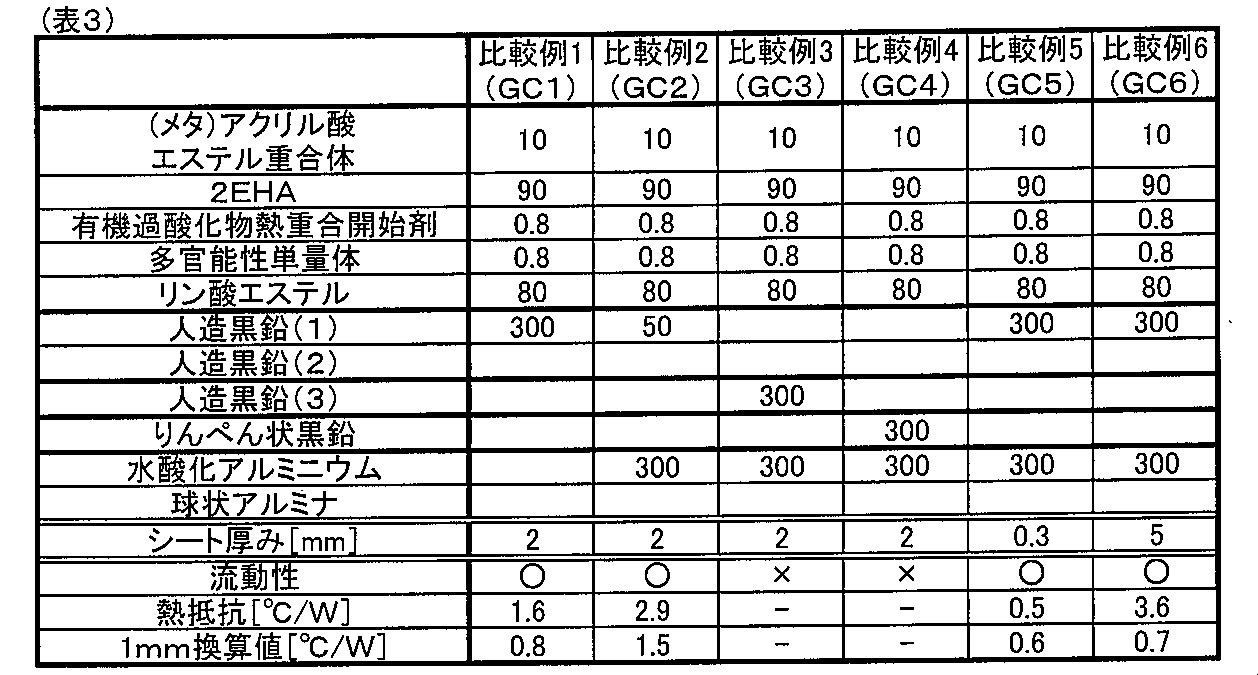
・比較例1:黒鉛以外の所定の熱伝導性フィラーを含まない比較例1のシート(GC1)は、熱伝導性が劣っていた。粒径が比較的大きな人造黒鉛だけでは、シートの厚さ方向において熱が通る道を形成し難かったためであると推察できる。
・比較例2:所定の人造黒鉛の含有量が本発明で規定する範囲に満たない比較例2のシート(GC2)も、熱伝導性が劣っていた。人造黒鉛の含有量が少なかったことで、シートの厚さ方向において熱が通る道を形成し難かったためであると推察できる。
・比較例3:比較例3では従来よく使用されている程度の粒径の人造黒鉛を、実施例で用いた人造黒鉛と同量用いた。その結果、原因は定かでないが、混合組成物の流動性が劣り、シート状に成形し難かった。
・比較例4:比較例4では、実施例で用いた人造黒鉛と同程度の粒径及び比重である天然黒鉛(りんぺん状黒鉛)を使用した。その結果、原因は定かでないが、混合組成物の流動性が劣り、シート状に成形し難かった。
・比較例5:シート厚が本発明で規定する範囲未満である比較例5のシート(GC5)は、熱伝導性が劣っていた。これは、使用した人造黒鉛の粒径がシート厚に対して大きかったため、シート状に成形することができはしたものの表面状態が悪くなり、アルミニウム板とヒーターとに密着できていなかったためであると推察できる。
・比較例6:シート厚が本発明で規定する範囲を超えた比較例6のシート(GC6)も、熱伝導性が劣っていた。
Claims (12)
- (メタ)アクリル酸エステル重合体(A1)、及び、(メタ)アクリル酸エステル単量体(α1)を含む(メタ)アクリル樹脂組成物(A)を100質量部と、
平均粒径が160μm以上700μm以下の人造黒鉛(B)を100質量部以上500質量部以下と、
平均粒径が1μm以上100μm以下の黒鉛以外の熱伝導性フィラー(C)を50質量部以上500質量部以下と、
を含む混合組成物をシート状に成形した後、又は前記混合組成物をシート状に成形しながら、前記(メタ)アクリル酸エステル単量体(α1)の重合反応が少なくとも行われてなる、
厚さが0.5mm以上4.5mm以下の熱伝導性感圧接着性シート状成形体(G)。 - 前記人造黒鉛が、石油又は石炭から作られるコークスにピッチ又はタールを加えて混練した後、800℃以上1500℃以下で焼成した上で、さらに2000℃以上3000℃以下に加熱して黒鉛化する工程を経たものである、請求項1に記載の熱伝導性感圧接着性シート状成形体(G)。
- 前記黒鉛以外の熱伝導性フィラー(C)が、長周期表の2、3、又は12族に属する金属の酸化物又は水酸化物を含む、請求項1又は2に記載の熱伝導性感圧接着性シート状成形体(G)。
- 前記黒鉛以外の熱伝導性フィラー(C)が、アルミニウムの酸化物又は水酸化物を含む、請求項1~3のいずれか一項に記載の熱伝導性感圧接着性シート状成形体(G)。
- 前記混合組成物がさらにリン酸エステル(D)を50質量部以上200質量部以下含む、請求項1~4のいずれか一項に記載の熱伝導性感圧接着性シート状成形体(G)。
- (メタ)アクリル酸エステル重合体(A1)、及び、(メタ)アクリル酸エステル単量体(α1)を含む(メタ)アクリル樹脂組成物(A)を100質量部と、
平均粒径が160μm以上700μm以下の人造黒鉛(B)を100質量部以上500質量部以下と、
平均粒径が1μm以上100μm以下の黒鉛以外の熱伝導性フィラー(C)を50質量部以上500質量部以下と、
を含む混合組成物を作製する工程、並びに、
前記混合組成物をシート状に成形した後、又は、前記混合組成物をシート状に成形しながら、前記(メタ)アクリル酸エステル単量体(α1)の重合反応を行う工程、
を含む、熱伝導性感圧接着性シート状成形体(G)の製造方法。 - 前記(メタ)アクリル酸エステル単量体(α1)の重合反応を行う工程において、該(メタ)アクリル酸エステル単量体(α1)を100℃以上200℃以下の温度に加熱することを特徴とする、請求項6に記載の熱伝導性感圧接着性シート状成形体(G)の製造方法。
- 前記人造黒鉛として、石油又は石炭から作られるコークスにピッチ又はタールを加えて混練した後、800℃以上1500℃以下で焼成した上で、さらに2000℃以上3000℃以下に加熱して黒鉛化する工程を経たものを用いる、請求項6又は7に記載の熱伝導性感圧接着性シート状成形体(G)の製造方法。
- 前記黒鉛以外の熱伝導性フィラー(C)が、長周期表の2、3、又は12族に属する金属の酸化物又は水酸化物を含む、請求項6~8のいずれか一項に記載の熱伝導性感圧接着性シート状成形体(G)の製造方法。
- 前記黒鉛以外の熱伝導性フィラー(C)が、アルミニウムの酸化物又は水酸化物を含む、請求項6~9のいずれか一項に記載の熱伝導性感圧接着性シート状成形体(G)の製造方法。
- 前記混合組成物にさらにリン酸エステル(D)を50質量部以上200質量部以下を混合させる、請求項6~10のいずれか一項に記載の熱伝導性感圧接着性シート状成形体(G)の製造方法。
- 放熱体及び該放熱体に貼合された請求項1~5のいずれか一項に記載の熱伝導性感圧接着性シート状成形体(G)を備えた電子機器。
Priority Applications (3)
| Application Number | Priority Date | Filing Date | Title |
|---|---|---|---|
| CN201280023446.5A CN103547644B (zh) | 2011-06-17 | 2012-05-16 | 导热性压敏粘接性片状成型体、其制造方法及电子设备 |
| KR1020137027485A KR20140035352A (ko) | 2011-06-17 | 2012-05-16 | 열전도성 감압 접착성 시트상 성형체, 그 제조 방법, 및 전자 기기 |
| JP2013520480A JP5975028B2 (ja) | 2011-06-17 | 2012-05-16 | 熱伝導性感圧接着性シート状成形体、その製造方法、及び電子機器 |
Applications Claiming Priority (2)
| Application Number | Priority Date | Filing Date | Title |
|---|---|---|---|
| JP2011-135492 | 2011-06-17 | ||
| JP2011135492 | 2011-06-17 |
Publications (1)
| Publication Number | Publication Date |
|---|---|
| WO2012172912A1 true WO2012172912A1 (ja) | 2012-12-20 |
Family
ID=47356907
Family Applications (1)
| Application Number | Title | Priority Date | Filing Date |
|---|---|---|---|
| PCT/JP2012/062546 Ceased WO2012172912A1 (ja) | 2011-06-17 | 2012-05-16 | 熱伝導性感圧接着性シート状成形体、その製造方法、及び電子機器 |
Country Status (4)
| Country | Link |
|---|---|
| JP (1) | JP5975028B2 (ja) |
| KR (1) | KR20140035352A (ja) |
| CN (1) | CN103547644B (ja) |
| WO (1) | WO2012172912A1 (ja) |
Cited By (3)
| Publication number | Priority date | Publication date | Assignee | Title |
|---|---|---|---|---|
| JP2015157935A (ja) * | 2014-01-22 | 2015-09-03 | Jnc株式会社 | 熱硬化性樹脂組成物及びその硬化膜 |
| JP2016098366A (ja) * | 2014-11-26 | 2016-05-30 | 日立マクセル株式会社 | 粘着組成物前駆体、粘着組成物及びその製造方法、粘着シート及びその製造方法、並びに粘着シートを含む電子機器 |
| CN115427505A (zh) * | 2020-03-30 | 2022-12-02 | 东洋纺株式会社 | 导热性树脂组合物及由其形成的成形品 |
Families Citing this family (17)
| Publication number | Priority date | Publication date | Assignee | Title |
|---|---|---|---|---|
| CN104829979A (zh) * | 2015-04-07 | 2015-08-12 | 安徽博昌电子科技股份有限公司 | 一种led光源用聚四氟乙烯基掺杂钨钼氧化物散热材料及其制备方法 |
| CN104829985A (zh) * | 2015-04-07 | 2015-08-12 | 安徽博昌电子科技股份有限公司 | 一种led光源用聚四氟乙烯基掺杂聚苯胺散热材料及其制备方法 |
| CN104829981A (zh) * | 2015-04-07 | 2015-08-12 | 安徽博昌电子科技股份有限公司 | 一种led光源用聚四氟乙烯基致密散热材料及其制备方法 |
| CN104829982A (zh) * | 2015-04-07 | 2015-08-12 | 安徽博昌电子科技股份有限公司 | 一种led光源用聚四氟乙烯基轻质高效散热材料及其制备方法 |
| CN104829978A (zh) * | 2015-04-07 | 2015-08-12 | 安徽博昌电子科技股份有限公司 | 一种led光源用聚四氟乙烯基高热辐射散热材料及其制备方法 |
| CN104829984A (zh) * | 2015-04-07 | 2015-08-12 | 安徽博昌电子科技股份有限公司 | 一种led光源用聚四氟乙烯基低热阻散热材料及其制备方法 |
| CN104829986A (zh) * | 2015-04-07 | 2015-08-12 | 安徽博昌电子科技股份有限公司 | 一种led光源用聚四氟乙烯基高热稳定散热材料及其制备方法 |
| CN104829977A (zh) * | 2015-04-07 | 2015-08-12 | 安徽博昌电子科技股份有限公司 | 一种led光源用聚四氟乙烯基掺杂聚苯硫醚散热材料及其制备方法 |
| CN104829983A (zh) * | 2015-04-07 | 2015-08-12 | 安徽博昌电子科技股份有限公司 | 一种led光源用聚四氟乙烯基掺杂铌酸钙散热材料及其制备方法 |
| CN104844994A (zh) * | 2015-04-11 | 2015-08-19 | 安徽中威光电材料有限公司 | 一种led光源用聚四氟乙烯基掺杂二硅化钼的散热材料及其制备方法 |
| CN104829990A (zh) * | 2015-04-11 | 2015-08-12 | 安徽中威光电材料有限公司 | 一种led光源用聚四氟乙烯基掺杂铁磷粉的散热材料及其制备方法 |
| CN104829991A (zh) * | 2015-04-11 | 2015-08-12 | 安徽中威光电材料有限公司 | 一种led光源用聚四氟乙烯基掺杂高热稳定的散热材料及其制备方法 |
| KR101916896B1 (ko) * | 2015-11-13 | 2018-11-09 | 주식회사 지티에스 | 방열 테이프 |
| CN106459685A (zh) * | 2015-12-29 | 2017-02-22 | 苏州斯迪克新材料科技股份有限公司 | 基于合成石墨改性的高导热超薄胶带 |
| CN106190053A (zh) * | 2016-07-15 | 2016-12-07 | 刘振德 | 一种导热材料及其制备方法和应用 |
| CN106047238A (zh) * | 2016-08-19 | 2016-10-26 | 陈苹 | 一种手机专用防静电导热粘结材料 |
| JPWO2018123012A1 (ja) * | 2016-12-28 | 2019-10-31 | 日立化成株式会社 | 熱伝導シート、熱伝導シートの製造方法及び放熱装置 |
Citations (3)
| Publication number | Priority date | Publication date | Assignee | Title |
|---|---|---|---|---|
| JP2006510761A (ja) * | 2002-12-19 | 2006-03-30 | テサ・アクチエンゲゼルシヤフト | 熱伝導性接着材料から製造される少なくとも1つの層を持つ感圧接着剤物品およびこれらの製造方法 |
| WO2007116686A1 (ja) * | 2006-03-28 | 2007-10-18 | Zeon Corporation | 熱伝導性感圧接着剤組成物および熱伝導性感圧接着性シート状成形体 |
| JP2008291220A (ja) * | 2007-04-24 | 2008-12-04 | Hitachi Chem Co Ltd | 熱伝導性フィルム |
Family Cites Families (5)
| Publication number | Priority date | Publication date | Assignee | Title |
|---|---|---|---|---|
| US20040041291A1 (en) * | 2002-08-27 | 2004-03-04 | Ucar Carbon Company Inc. | Process of making carbon electrodes |
| WO2007148729A1 (ja) * | 2006-06-21 | 2007-12-27 | Hitachi Kasei Polymer Co., Ltd. | 熱伝導性熱可塑性粘着剤組成物 |
| KR20090043633A (ko) * | 2007-10-30 | 2009-05-07 | 쓰리엠 이노베이티브 프로퍼티즈 캄파니 | 열전도성 점착제 및 이를 이용하는 점착테이프 |
| JP5271879B2 (ja) * | 2008-11-28 | 2013-08-21 | 富士高分子工業株式会社 | 熱拡散シート及びその実装方法 |
| JP5402460B2 (ja) * | 2009-09-24 | 2014-01-29 | 日本ゼオン株式会社 | 熱伝導性感圧接着性積層シート、及び電子部品 |
-
2012
- 2012-05-16 CN CN201280023446.5A patent/CN103547644B/zh not_active Expired - Fee Related
- 2012-05-16 JP JP2013520480A patent/JP5975028B2/ja active Active
- 2012-05-16 KR KR1020137027485A patent/KR20140035352A/ko not_active Ceased
- 2012-05-16 WO PCT/JP2012/062546 patent/WO2012172912A1/ja not_active Ceased
Patent Citations (3)
| Publication number | Priority date | Publication date | Assignee | Title |
|---|---|---|---|---|
| JP2006510761A (ja) * | 2002-12-19 | 2006-03-30 | テサ・アクチエンゲゼルシヤフト | 熱伝導性接着材料から製造される少なくとも1つの層を持つ感圧接着剤物品およびこれらの製造方法 |
| WO2007116686A1 (ja) * | 2006-03-28 | 2007-10-18 | Zeon Corporation | 熱伝導性感圧接着剤組成物および熱伝導性感圧接着性シート状成形体 |
| JP2008291220A (ja) * | 2007-04-24 | 2008-12-04 | Hitachi Chem Co Ltd | 熱伝導性フィルム |
Cited By (3)
| Publication number | Priority date | Publication date | Assignee | Title |
|---|---|---|---|---|
| JP2015157935A (ja) * | 2014-01-22 | 2015-09-03 | Jnc株式会社 | 熱硬化性樹脂組成物及びその硬化膜 |
| JP2016098366A (ja) * | 2014-11-26 | 2016-05-30 | 日立マクセル株式会社 | 粘着組成物前駆体、粘着組成物及びその製造方法、粘着シート及びその製造方法、並びに粘着シートを含む電子機器 |
| CN115427505A (zh) * | 2020-03-30 | 2022-12-02 | 东洋纺株式会社 | 导热性树脂组合物及由其形成的成形品 |
Also Published As
| Publication number | Publication date |
|---|---|
| KR20140035352A (ko) | 2014-03-21 |
| CN103547644A (zh) | 2014-01-29 |
| JP5975028B2 (ja) | 2016-08-23 |
| CN103547644B (zh) | 2016-05-04 |
| JPWO2012172912A1 (ja) | 2015-02-23 |
Similar Documents
| Publication | Publication Date | Title |
|---|---|---|
| JP5975028B2 (ja) | 熱伝導性感圧接着性シート状成形体、その製造方法、及び電子機器 | |
| WO2012132656A1 (ja) | 熱伝導性感圧接着剤組成物、熱伝導性感圧接着性シート状成形体、これらの製造方法、及び電子部品 | |
| WO2013047145A1 (ja) | 熱伝導性感圧接着剤組成物、熱伝導性感圧接着性シート状成形体、これらの製造方法、及び電子部品 | |
| WO2013183389A1 (ja) | 熱伝導性感圧接着剤組成物、熱伝導性感圧接着性シート状成形体、これらの製造方法、及び電子機器 | |
| WO2013084750A1 (ja) | 熱伝導性感圧接着剤組成物、熱伝導性感圧接着性シート状成形体、これらの製造方法、及び電子機器 | |
| JP2013129814A (ja) | 熱伝導性感圧接着剤組成物、熱伝導性感圧接着性シート状成形体、これらの製造方法、及び電子機器 | |
| JP2013124289A (ja) | 熱伝導性感圧接着剤組成物、熱伝導性感圧接着性シート状成形体、これらの製造方法、及び電子機器 | |
| JP2014028903A (ja) | 熱伝導性積層シート、熱伝導性積層シートの製造方法、及び電子機器 | |
| WO2013061830A1 (ja) | 熱伝導性感圧接着剤組成物、熱伝導性感圧接着性シート状成形体、これらの製造方法、及び電子部品 | |
| JPWO2013175950A1 (ja) | 熱伝導性感圧接着剤組成物、熱伝導性感圧接着性シート状成形体、これらの製造方法、及び電子機器 | |
| WO2015060092A1 (ja) | 熱伝導性感圧接着剤組成物、熱伝導性感圧接着性シート状成形体、これらの製造方法、及び電子機器 | |
| JP2015067638A (ja) | 熱伝導性感圧接着剤組成物、熱伝導性感圧接着性シート状成形体、これらの製造方法、及び電子機器 | |
| JP2015067640A (ja) | 熱伝導性感圧接着剤組成物、熱伝導性感圧接着性シート状成形体、これらの製造方法、及び電子機器 | |
| JP2014005336A (ja) | 熱伝導性感圧接着剤組成物、熱伝導性感圧接着性シート状成形体、これらの製造方法、及び電子機器 | |
| JP2014009287A (ja) | 熱伝導性感圧接着剤組成物、熱伝導性感圧接着性シート状成形体、これらの製造方法、及び電子機器 | |
| JP5696599B2 (ja) | 熱伝導性感圧接着剤組成物、熱伝導性感圧接着性シート状成形体、これらの製造方法、及び電子機器 | |
| WO2015056577A1 (ja) | 熱伝導性感圧接着性積層シート、熱伝導性感圧接着性積層シートの製造方法、及び電子機器 | |
| JP6048220B2 (ja) | 熱伝導性感圧接着剤組成物、熱伝導性感圧接着性シート状成形体、これらの製造方法、及び電子機器 | |
| JP5652365B2 (ja) | 熱伝導性感圧接着剤組成物、熱伝導性感圧接着性シート状成形体、これらの製造方法、及び電子部品 | |
| JP2013095779A (ja) | 熱伝導性感圧接着剤組成物、熱伝導性感圧接着性シート状成形体、これらの製造方法、及び電子機器 | |
| JP2015067637A (ja) | 熱伝導性感圧接着剤組成物、熱伝導性感圧接着性シート状成形体、これらの製造方法、及び電子機器 | |
| JP6048219B2 (ja) | 熱伝導性感圧接着剤組成物、熱伝導性感圧接着性シート状成形体、これらの製造方法、及び電子機器 | |
| JP2016188287A (ja) | 熱伝導性感圧接着剤組成物および熱伝導性感圧接着性シート | |
| CN103221501B (zh) | 导热性压敏粘接剂组合物、导热性压敏粘接性片状成型体、它们的制造方法、以及电子部件 | |
| JP2015040262A (ja) | 熱伝導性感圧接着剤組成物、熱伝導性感圧接着性シート状成形体、これらの製造方法、及び電子機器 |
Legal Events
| Date | Code | Title | Description |
|---|---|---|---|
| WWE | Wipo information: entry into national phase |
Ref document number: 201280023446.5 Country of ref document: CN |
|
| 121 | Ep: the epo has been informed by wipo that ep was designated in this application |
Ref document number: 12800923 Country of ref document: EP Kind code of ref document: A1 |
|
| ENP | Entry into the national phase |
Ref document number: 2013520480 Country of ref document: JP Kind code of ref document: A |
|
| ENP | Entry into the national phase |
Ref document number: 20137027485 Country of ref document: KR Kind code of ref document: A |
|
| NENP | Non-entry into the national phase |
Ref country code: DE |
|
| 122 | Ep: pct application non-entry in european phase |
Ref document number: 12800923 Country of ref document: EP Kind code of ref document: A1 |