WO2012169233A1 - 物品の表面構造 - Google Patents
物品の表面構造 Download PDFInfo
- Publication number
- WO2012169233A1 WO2012169233A1 PCT/JP2012/054452 JP2012054452W WO2012169233A1 WO 2012169233 A1 WO2012169233 A1 WO 2012169233A1 JP 2012054452 W JP2012054452 W JP 2012054452W WO 2012169233 A1 WO2012169233 A1 WO 2012169233A1
- Authority
- WO
- WIPO (PCT)
- Prior art keywords
- article
- recesses
- recess
- less
- finger
- Prior art date
- Legal status (The legal status is an assumption and is not a legal conclusion. Google has not performed a legal analysis and makes no representation as to the accuracy of the status listed.)
- Ceased
Links
Images


Classifications
-
- B—PERFORMING OPERATIONS; TRANSPORTING
- B29—WORKING OF PLASTICS; WORKING OF SUBSTANCES IN A PLASTIC STATE IN GENERAL
- B29C—SHAPING OR JOINING OF PLASTICS; SHAPING OF MATERIAL IN A PLASTIC STATE, NOT OTHERWISE PROVIDED FOR; AFTER-TREATMENT OF THE SHAPED PRODUCTS, e.g. REPAIRING
- B29C33/00—Moulds or cores; Details thereof or accessories therefor
- B29C33/42—Moulds or cores; Details thereof or accessories therefor characterised by the shape of the moulding surface, e.g. ribs or grooves
- B29C33/424—Moulding surfaces provided with means for marking or patterning
Definitions
- the present invention relates to a surface structure of an article having a recess formed on the surface.
- an article touched by a person such as an interior part of an automobile as described in Japanese Patent Application Laid-Open No. 2010-12948 is required to have a comfortable touch.
- resin molded products are often used as articles that are touched by humans, such as automobile interior parts.
- the surface of resin molded products is uneven by embossing or the like from the viewpoint of design and scratch resistance. Often in shape.
- the feel on the surface of the article can be made more comfortable.
- the present invention is a surface structure having the following features in the arrangement positions of a plurality of recesses provided on the surface of an article and the shape of each recess. That is, (1) the center-to-center distance between the plurality of recesses is 4 mm or more and 6 mm or less, (2) the opening width of each recess is 0.5 mm or more and 2.0 mm or less, and (3) each recess is The depth is not less than 60 ⁇ m and not more than 350 ⁇ m.
- (A) is a plan view showing the surface of the article
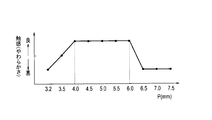
- (b) is an enlarged AA cross-sectional view of (a). It is a graph which shows evaluation of the touch feeling (softness) when a person touches the article
- each of the recesses 5 is defined in a circular shape in plan view, and as shown in FIG. 1 (b), the cross-sectional shape is formed at the peripheral cylindrical portion 5a and the lower end of the cylindrical portion 5a. It is prescribed
- the shape in plan view of FIG. 1A is not limited to a circle, and may be a polygon close to a circle, for example.
- the cross-sectional shape of FIG.1 (b) is not restricted to what has the cylindrical part 5a and the circular arc surface 5b,
- regulated by the circular arc surface without providing the cylindrical part 5a may be sufficient.
- the distances P and Q between the centers 5c of the recesses 5 are set to 4 mm or more and 6 mm or less. That is, in this embodiment, the center-to-center distance between the recesses 5 is set to 4 mm or more and 6 mm or less.
- a plurality of recesses 5 are linearly arranged in the first direction X along the surface 3 of the article 1 at equal intervals, and the first direction X along the surface 3 of the article 1. Are arranged at equal intervals in a straight line in a second direction Y perpendicular to the line. That is, a square is defined by connecting the centers of the four recesses 5.
- a square is formed by connecting the centers of the four recesses 5, but the distance Q between the centers 5c of the recesses 5 corresponding to the diagonal of the square is also 4 mm. More than 6 mm. For this reason, the distance Q of the diagonal line is necessarily (4 ⁇ ⁇ 2) mm or more because the distance P corresponding to one side of the square is also 4 mm or more. Further, since the maximum value of the diagonal distance Q longer than the distance P is 6 mm, the maximum value of the distance P is necessarily (6 ⁇ ⁇ 2) mm.
- Such center-to-center distances P and Q are 4 mm or more and 6 mm or less with respect to all of the plurality of recesses 5. At this time, the diameter of the recess 5 is 4 to 6 mm between the center distances P and Q. It can be set as long as it can be secured.
- FIG. 2 shows evaluation of tactile sensation (softness) when a person touches an article with a finger, for example, corresponding to the change in the center-to-center distances P and Q described above.
- the material in this embodiment uses, for example, polypropylene as the resin, and the recess 5 has a diameter of 1.7 mm and a depth of 165 ⁇ m in plan view.
- the tactile sensation of the finger is a sense based on sensory information such as pressure, pain, and temperature.
- the surface shape of the finger including fingerprints), the types and distribution of finger sensory receptors, the contact state between the article and the finger (pressure (Including spatial and temporal changes).
- center-to-center distances P and Q are less than 4.0 mm and more than 6.0 mm, it is less likely to feel “softness” than “4.0 mm or more and 6.0 mm”, and “hard” ”,“ Bulkyness ”,“ roughness ”,“ goat ”, etc.
- the plurality of recesses 5 are linearly arranged at equal intervals in the first direction X along the surface 3 of the article 1, and the first direction X along the surface 3 of the article 1. Are arranged at equal intervals in a straight line in a second direction Y that intersects and intersects perpendicularly.
- a virtual two-dimensional square lattice having a predetermined interval P is defined on the surface, and a plurality of concave portions 5 are arranged at the virtual lattice points. Therefore, the spatial frequency [mm ⁇ 1 ] corresponding to 1 / P and 1 / Q is within a predetermined range for the spatial spectral distribution of the surface roughness of the article 1 related to the arrangement of the plurality of recesses 5.
- the arrangement method of the plurality of concave portions 5 is not limited to the arrangement in which a square is formed by connecting the centers of the four concave portions 5 as shown in FIG.
- an array in which a rhombus is formed by connecting the centers of four recesses 5 may be used, or a random array may be used.
- the distances P and Q between the centers 5c of the recesses 5 may be 4 mm or more and 6 mm or less.
- the spatial frequency related to the surface roughness of the article has a significant spatial spectral density [ ⁇ m 2 ⁇ mm] distributed in the range of 1/6 [mm ⁇ 1 ] to 1/4 [mm ⁇ 1 ]. That's fine.
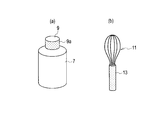
- FIG. 3 shows a specific application example of such an article 1.
- FIG. 3A is applied to the outer peripheral surface 9a of the cap 9 in the container 7 made of resin or glass, in particular, a portion to be grasped by a person.
- FIG.3 (b) is applied to the grip 13 of the whisk 11 which is a cooking appliance.
- the shape of the recess The tactile sensation of the finger is considered to be related to the pressure distribution, temperature distribution, etc. on the finger surface due to contact between the finger surface and the article surface.
- the pressure on the finger surface fluctuates and heat conduction to the finger decreases.
- the pressure and the heat conduction state vary depending on the roughness of the finger surface and the contact state between the recesses (5). Therefore, the relationship between the shape of the recess (5) and the tactile sensation of the finger will be evaluated. That is, the shape of the recess (5) was characterized by the size (opening width) and depth of the opening, and the relationship with the tactile sensation was evaluated.
- a substantially circular concave portion whose opening diameter (diameter) is a representative value of the opening width is used.
- the spatial frequency related to the shape of the opening is higher than the spatial frequency related to the arrangement position of the plurality of recesses (5).
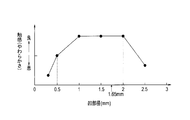
- FIG. 4 shows the evaluation of tactile sensation (softness) when a person touches the article (1) with a finger, for example, in relation to the opening diameter (mm) of the recess (5). It can be seen that when the opening diameter of the recess (5) is 1 mm or more and 2 mm or less, the touch feeling (tactile feeling) is felt as “soft” and a good tactile feeling like a skin material is obtained.
- the tactile sensation of the finger cannot detect the concave portion (5), and if the opening diameter is larger than the predetermined value (2 mm), the stimulus such as pressure change is strong and there is a sense of foreign matter and friction. This is considered to be a tactile sensation.
- FIG. 5 shows the evaluation of tactile sensation when a person touches the article (1) with a finger, for example, in relation to the depth (mm) of the recess (5). It can be seen that when the depth of the recess (5) is 60 ⁇ m or more and 350 ⁇ m or less, a good tactile sensation like a skin material is obtained.
- the depth of the recess (5) is less than 60 ⁇ m and is shallow, the tactile sensation of the finger cannot sufficiently detect the recess (5), and if the depth of the recess (5) is greater than 350 ⁇ m, the surface is clearly rougher than the roughness of the finger surface This is thought to be due to a sense of discomfort and friction.
- the center-to-center distance between the plurality of recesses is 4 mm or more and 6 mm or less
- the opening width of each recess is 0.5 mm or more and 2.0 mm or less.
Landscapes
- Engineering & Computer Science (AREA)
- Mechanical Engineering (AREA)
- Moulds For Moulding Plastics Or The Like (AREA)
Abstract
物品の表面には凹部を複数形成してあり、この複数の凹部の中心相互間の距離P,Qを、4mm以上6mm以下とする。凹部は直径を1.7mm、深さを165μmとした場合に、中心間距離P,Qを4.0mm以上でかつ6.0mm以下としたときが、触り心地(触感)として「やわらかさ」を感じやすく、表皮材のようなやわらかくて心地よい触感を得ることができる。
Description
本発明は、表面に凹部が形成された物品の表面構造に関する。
例えば日本国特許公開公報特開2010-12948号に記載されているような自動車の内装部品など、人が触れる物品に対しては、心地よい触感とすることが要求される。
ところで、自動車の内装部品など人が触れる物品としては樹脂成形品を用いる場合が多く見られるが、樹脂成形品の表面は、意匠性、耐傷付き性の観点から、シボ加工(engraving)などによる凹凸形状としていることが多い。
ところが、このような樹脂成形品は、一般的に硬い素材とシボ加工による凹凸が要因で、人が触れたときに「硬い」、「かさかさ」、「ざらざら」、「ごつごつ」等の不快な触感を受けやすい。このため、樹脂成形品であっても、例えば表皮材のようなやわらかく心地よい触感とすることが望まれている。
本発明によれば、物品の表面に対する触感をより心地よいものとすることができる。
本発明は、物品の表面に設けた複数の凹部の配置位置と各凹部の形状に以下の特徴を有する表面構造である。すなわち、(1)前記複数の凹部相互間の中心間距離が4mm以上6mm以下であり、(2)各凹部の開口幅が0.5mm以上2.0mm以下であり、(3)前記各凹部の深さが60μm以上350μm以下である。
以下、本発明の実施の形態を図面に基づき説明する。
図1に示すように、本発明の一実施形態に係わる樹脂成形品からなる物品1の表面3には、複数の凹部5を形成してある。この各凹部5は、図1(a)に示すように平面視では円形に規定され、図1(b)に示すように断面形状は、周縁部の円筒部5aと、円筒部5aの下端に連続する底面を構成する円弧面5bに規定される。
なお、図1(a)の平面視での形状は円形に限ることはなく、例えば円形に近い多角形でもよい。また、図1(b)の断面形状は、円筒部5aと円弧面5bとを有するものに限ることはなく、例えば円筒部5aを設けずに全体が円弧面に規定される形状でもよい。
本実施形態では、各凹部5の中心5c相互間の距離P,Qを、4mm以上6mm以下としている。すなわち、本実施形態では、各凹部5相互間の中心間距離を4mm以上6mm以下としている。
図1(a)では、複数の凹部5を、物品1の表面3に沿って第1の方向Xに直線状に等間隔に配置するとともに、物品1の表面3に沿って第1の方向Xと直交する第2の方向Yに直線状に等間隔に配置している。つまり、4つの凹部5の中心を結ぶことで正方形が規定される。
このように、図1(a)では、4つの凹部5の中心を結ぶことで正方形が形成されるが、この正方形の対角線に相当する、凹部5の中心5c相互間の距離Qについても、4mm以上6mm以下とする。このため、対角線の距離Qは、正方形の一辺に対応する距離Pも4mm以上であることから、必然的に(4×√2)mm以上となる。また、距離Pより長い対角線の距離Qの最大値が6mmであるから、距離Pの最大値は必然的に(6÷√2)mmとなる。
このような中心間距離P,Qは、複数の凹部5相互間のすべてに対し、4mm以上6mm以下としてあり、この際、凹部5の直径は、4mm以上6mm以下の中心間距離P,Qを確保できる範囲で設定することができる。
図2は、物品を人が例えば指で触れたときの触感(やわらかさ)の評価を、前記した中心間距離P,Qの変化に対応して示している。本実施形態での材料は樹脂は例えばポリプロピレンを使用し、凹部5は平面視で直径が1.7mm、深さが165μmとしている。なお、指の触感は圧覚、痛覚、温覚などの感覚情報に基づく感覚で、指の表面形状(指紋を含む)、指の感覚受容器の種類や分布、物品と指の接触状態(圧力の空間的、時間的な変化を含む)などに関連していると考えられる。
評価の結果は、中心間距離P,Qを4.0mm以上でかつ6.0mm以下としたときが、触り心地(触感)として、「やわらかさ」を感じ、表皮材のような、やわらかく心地よい触感を得ることができる。これにより、元々やわらかい材質の高価な材料など使用することなく心地よい触感を得ることができ、原価低減に寄与することが可能となる。
中心間距離P,Qが4.0mm未満の場合及び6.0mmを超える場合には、4.0mm以上でかつ6.0mmとした場合に比較して、「やわらかさ」を感じにくく、「硬い」、「かさかさ」、「ざらざら」、「ごつごつ」等の不快な触感となる。
また、本実施形態では、複数の凹部5を、物品1の表面3に沿って第1の方向Xに直線状に等間隔に配置するとともに、物品1の表面3に沿って第1の方向Xと交差して直交する第2の方向Yに直線状に等間隔に配置している。換言すれば、所定の間隔Pを有する仮想的な二次元正方格子を表面に規定し、複数の凹部5をその仮想格子点に配置した。したがって、複数の凹部5の配置に関連する物品1の表面粗さの空間スペクトル分布について、1/Pおよび1/Qに相当する空間周波数[mm-1]が所定範囲内にある。
このように複数の凹部5を規則正しい配列とすることで、やわらかく心地よい触感をより確実に得ることができるとともに、物品1を樹脂成形する際の成形型の製造も容易となり、コスト低下に寄与することができる。
なお、複数の凹部5の配列方法としては、図1(a)のような、4つの凹部5の中心を結ぶことで正方形が形成される配列に限定されるものではない。例えば、4つの凹部5の中心を結ぶことでひし形が形成される配列でもよく、またランダムな配列でもよい。要するに、凹部5の中心5c相互間の距離P,Qが4mm以上6mm以下であればよい。換言すれば、物品の表面粗さに関する空間周波数は1/6[mm-1]以上1/4[mm-1]以下の範囲に有意な空間スペクトル密度[μm2・mm]が分布していればよい。
このような物品1の具体的な適用例を図3に示す。図3(a)は、樹脂やガラス製の容器7におけるキャップ9の、特に人が掴む部分となる外周面9aに適用している。図3(b)は、調理器具である泡だて器11のグリップ13に適用している。
その他、人が触れるものであれば、様々な物品に適用することができ、自動車の内装部品であれば、例えばコンソールボックスやドア内装品、インストルメントパネル、アシストグリップなどの樹脂製品に適用することができる。
また、自動車以外の物品であれば、鍋、フライパン、筆記具、化粧品ケース、バッグ、メガネ、歯ブラシ、パソコン、携帯電話、ドライヤー、掃除機、髭剃り器、その他の家電等のグリップやフレーム部分などの樹脂製品に適用することができる。
凹部の形状
指の触感は指の表面と物品表面との接触による指表面の圧力分布、温度分布等に関連していると考えられる。凹部(5)では指表面の圧力が変動しまた指への熱伝導が減少する。さらに、指表面の粗さと凹部(5)との接触状態により前記圧力や熱伝導状態(温度勾配等)が変化する。したがって、凹部(5)の形状と指の触感との関連を評価してみる。すなわち、凹部(5)の形状を開口の大きさ(開口幅)と深さで特徴付けて触感との関連を評価した。また、凹部は指の大きさに比べて十分に小さく、凹部の形状を特に区別する必要がないため、評価に於いては開口径(直径)を開口幅の代表値とする略円形の凹部を用いた。なお開口部の形状に関連する空間周波数は複数の凹部(5)の配列位置に関連する空間周波数より高い。
指の触感は指の表面と物品表面との接触による指表面の圧力分布、温度分布等に関連していると考えられる。凹部(5)では指表面の圧力が変動しまた指への熱伝導が減少する。さらに、指表面の粗さと凹部(5)との接触状態により前記圧力や熱伝導状態(温度勾配等)が変化する。したがって、凹部(5)の形状と指の触感との関連を評価してみる。すなわち、凹部(5)の形状を開口の大きさ(開口幅)と深さで特徴付けて触感との関連を評価した。また、凹部は指の大きさに比べて十分に小さく、凹部の形状を特に区別する必要がないため、評価に於いては開口径(直径)を開口幅の代表値とする略円形の凹部を用いた。なお開口部の形状に関連する空間周波数は複数の凹部(5)の配列位置に関連する空間周波数より高い。
図4は、物品(1)を人が例えば指で触れたときの触感(やわらかさ)の評価を、凹部(5)の開口径(mm)に関連して示す。凹部(5)の開口径が1mm以上2mm以下の場合には、触り心地(触感)として、「やわらかさ」を感じ、表皮材のような良い触感が得られることがわかる。
開口径が所定値(1mm)より小さいと指の触覚が凹部(5)を検出できず、また開口径が所定値(2mm)より大きいと圧力変化等の刺激が強く異物感、摩擦感のある触感になるからであると考えられる。
また、図5は、物品(1)を人が例えば指で触れたときの触感の評価を、凹部(5)の深さ(mm)に関連して示したものである。凹部(5)の深さ60μm以上350μm以下の場合には表皮材のような良い触感が得られることがわかる。
凹部(5)の深さが60μm未満で浅いと指の触覚が凹部(5)を十分に検出できず、また凹部(5)の深さが350μmより大きいと指表面の粗さより明らかに粗い表面と認識されて違和感、摩擦感のある感触になるからであると考えられる。
本発明によれば、物品の表面において(1)前記複数の凹部相互間の中心間距離が4mm以上6mm以下であり、(2)各凹部の開口幅が0.5mm以上2.0mm以下であり、(3)前記各開口部の深さが60μm以上350μm以下である表面構造を人が触れたときに、表皮材のようなやわらかく心地よい触感を得ることができる。すなわち、所定範囲の幅と深さを有する凹部を所定の間隔で配置することにより触感が著しく改善される。
(米国指定)
本国際特許出願は米国指定に関し、2011年6月7日に出願された日本国特許出願第2011-127099号について米国特許法第119条(a)に基づく優先権の利益を援用し、当該開示内容を引用する。
本国際特許出願は米国指定に関し、2011年6月7日に出願された日本国特許出願第2011-127099号について米国特許法第119条(a)に基づく優先権の利益を援用し、当該開示内容を引用する。
Claims (2)
- 物品の表面に複数の凹部を備え、
(i)前記複数の凹部相互間の中心間距離が4mm以上6mm以下であり、
(ii)各凹部の開口幅が0.5mm以上2.0mm以下であり、
(iii)前記各凹部の深さが60μm以上350μm以下である
ことを特徴とする物品の表面構造。 - 前記複数の凹部を、前記物品の表面に沿って第1の方向に直線上に等間隔に配置するとともに、前記物品の表面に沿って前記第1の方向と交差する第2の方向に直線上に等間隔に配置することを特徴とする請求項1に記載の物品の表面構造。
Applications Claiming Priority (2)
| Application Number | Priority Date | Filing Date | Title |
|---|---|---|---|
| JP2011-127099 | 2011-06-07 | ||
| JP2011127099 | 2011-06-07 |
Publications (1)
| Publication Number | Publication Date |
|---|---|
| WO2012169233A1 true WO2012169233A1 (ja) | 2012-12-13 |
Family
ID=47295807
Family Applications (1)
| Application Number | Title | Priority Date | Filing Date |
|---|---|---|---|
| PCT/JP2012/054452 Ceased WO2012169233A1 (ja) | 2011-06-07 | 2012-02-23 | 物品の表面構造 |
Country Status (1)
| Country | Link |
|---|---|
| WO (1) | WO2012169233A1 (ja) |
Citations (3)
| Publication number | Priority date | Publication date | Assignee | Title |
|---|---|---|---|---|
| JP2000229356A (ja) * | 1999-02-09 | 2000-08-22 | Toyota Motor Corp | 樹脂成型品のシボの決定方法 |
| JP2010030288A (ja) * | 2008-06-25 | 2010-02-12 | Toyota Boshoku Corp | 自動車用内装材 |
| JP2010120399A (ja) * | 2008-11-17 | 2010-06-03 | Nissan Motor Co Ltd | 車両用内装部品 |
-
2012
- 2012-02-23 WO PCT/JP2012/054452 patent/WO2012169233A1/ja not_active Ceased
Patent Citations (3)
| Publication number | Priority date | Publication date | Assignee | Title |
|---|---|---|---|---|
| JP2000229356A (ja) * | 1999-02-09 | 2000-08-22 | Toyota Motor Corp | 樹脂成型品のシボの決定方法 |
| JP2010030288A (ja) * | 2008-06-25 | 2010-02-12 | Toyota Boshoku Corp | 自動車用内装材 |
| JP2010120399A (ja) * | 2008-11-17 | 2010-06-03 | Nissan Motor Co Ltd | 車両用内装部品 |
Similar Documents
| Publication | Publication Date | Title |
|---|---|---|
| US20190062155A1 (en) | Microstructured surface having discrete touch aesthetics | |
| RU2492996C2 (ru) | Конструктивный компонент поверхности для технического устройства | |
| WO2012176502A1 (ja) | 物品の表面構造 | |
| US20100275416A1 (en) | Handle with soft gel cushioning member | |
| JP2014090934A (ja) | 剃刀 | |
| WO2010055948A1 (ja) | 物品の表面構造 | |
| JP5458337B2 (ja) | 用具の柄 | |
| JP5081911B2 (ja) | 歯ブラシ | |
| US6305047B1 (en) | Sponge with gripping slots | |
| CN101160085A (zh) | 清洁工具 | |
| WO2016063598A1 (ja) | 重ね合わせ複合内装部品 | |
| US9224276B2 (en) | Writing underlay that generates awakening effect | |
| WO2025028123A1 (ja) | クッションブラシ | |
| KR200465913Y1 (ko) | 터치스크린 패널을 위한 터치 펜 | |
| JP4926491B2 (ja) | 瞼にアイラインを描くための補助具 | |
| JP3157670U (ja) | 薬剤塗布用器具 | |
| EP2245976B1 (en) | Dual-surface base element for disposable and recyclable cleaning articles | |
| KR101308847B1 (ko) | 휴대용 머리받침 쿠션 | |
| Lee et al. | Ergonomic Design of Necklace Type Wearable Device | |
| CN101163785A (zh) | 用于处理皮肤的塑化制品 | |
| TW202430760A (zh) | 浴室用之扶手 | |
| JP3204121U (ja) | 疑似舌乳頭接触型ゴム手袋 | |
| TWM253852U (en) | Mouse with soft handle mask | |
| JP3208037U (ja) | 衣服用ハンガー | |
| WO2015047891A1 (en) | Sponge scrubber |
Legal Events
| Date | Code | Title | Description |
|---|---|---|---|
| 121 | Ep: the epo has been informed by wipo that ep was designated in this application |
Ref document number: 12797624 Country of ref document: EP Kind code of ref document: A1 |
|
| NENP | Non-entry into the national phase |
Ref country code: DE |
|
| 122 | Ep: pct application non-entry in european phase |
Ref document number: 12797624 Country of ref document: EP Kind code of ref document: A1 |
|
| NENP | Non-entry into the national phase |
Ref country code: JP |