WO2012165345A1 - がんに伴う不可逆性の代謝障害の予防及び/又は改善のための組成物 - Google Patents
がんに伴う不可逆性の代謝障害の予防及び/又は改善のための組成物 Download PDFInfo
- Publication number
- WO2012165345A1 WO2012165345A1 PCT/JP2012/063522 JP2012063522W WO2012165345A1 WO 2012165345 A1 WO2012165345 A1 WO 2012165345A1 JP 2012063522 W JP2012063522 W JP 2012063522W WO 2012165345 A1 WO2012165345 A1 WO 2012165345A1
- Authority
- WO
- WIPO (PCT)
- Prior art keywords
- composition
- cancer
- metabolic disorders
- disorders associated
- irreversible
- Prior art date
- Legal status (The legal status is an assumption and is not a legal conclusion. Google has not performed a legal analysis and makes no representation as to the accuracy of the status listed.)
- Ceased
Links
Images



Classifications
-
- A—HUMAN NECESSITIES
- A61—MEDICAL OR VETERINARY SCIENCE; HYGIENE
- A61K—PREPARATIONS FOR MEDICAL, DENTAL OR TOILETRY PURPOSES
- A61K38/00—Medicinal preparations containing peptides
- A61K38/16—Peptides having more than 20 amino acids; Gastrins; Somatostatins; Melanotropins; Derivatives thereof
- A61K38/17—Peptides having more than 20 amino acids; Gastrins; Somatostatins; Melanotropins; Derivatives thereof from animals; from humans
- A61K38/40—Transferrins, e.g. lactoferrins, ovotransferrins
-
- A—HUMAN NECESSITIES
- A23—FOODS OR FOODSTUFFS; TREATMENT THEREOF, NOT COVERED BY OTHER CLASSES
- A23L—FOODS, FOODSTUFFS OR NON-ALCOHOLIC BEVERAGES, NOT OTHERWISE PROVIDED FOR; PREPARATION OR TREATMENT THEREOF
- A23L27/00—Spices; Flavouring agents or condiments; Artificial sweetening agents; Table salts; Dietetic salt substitutes; Preparation or treatment thereof
- A23L27/30—Artificial sweetening agents
- A23L27/33—Artificial sweetening agents containing sugars or derivatives
-
- A—HUMAN NECESSITIES
- A23—FOODS OR FOODSTUFFS; TREATMENT THEREOF, NOT COVERED BY OTHER CLASSES
- A23L—FOODS, FOODSTUFFS OR NON-ALCOHOLIC BEVERAGES, NOT OTHERWISE PROVIDED FOR; PREPARATION OR TREATMENT THEREOF
- A23L33/00—Modifying nutritive qualities of foods; Dietetic products; Preparation or treatment thereof
- A23L33/10—Modifying nutritive qualities of foods; Dietetic products; Preparation or treatment thereof using additives
- A23L33/115—Fatty acids or derivatives thereof; Fats or oils
- A23L33/12—Fatty acids or derivatives thereof
-
- A—HUMAN NECESSITIES
- A23—FOODS OR FOODSTUFFS; TREATMENT THEREOF, NOT COVERED BY OTHER CLASSES
- A23L—FOODS, FOODSTUFFS OR NON-ALCOHOLIC BEVERAGES, NOT OTHERWISE PROVIDED FOR; PREPARATION OR TREATMENT THEREOF
- A23L33/00—Modifying nutritive qualities of foods; Dietetic products; Preparation or treatment thereof
- A23L33/10—Modifying nutritive qualities of foods; Dietetic products; Preparation or treatment thereof using additives
- A23L33/17—Amino acids, peptides or proteins
- A23L33/18—Peptides; Protein hydrolysates
-
- A—HUMAN NECESSITIES
- A61—MEDICAL OR VETERINARY SCIENCE; HYGIENE
- A61K—PREPARATIONS FOR MEDICAL, DENTAL OR TOILETRY PURPOSES
- A61K31/00—Medicinal preparations containing organic active ingredients
- A61K31/185—Acids; Anhydrides, halides or salts thereof, e.g. sulfur acids, imidic, hydrazonic or hydroximic acids
- A61K31/19—Carboxylic acids, e.g. valproic acid
- A61K31/20—Carboxylic acids, e.g. valproic acid having a carboxyl group bound to a chain of seven or more carbon atoms, e.g. stearic, palmitic, arachidic acids
- A61K31/201—Carboxylic acids, e.g. valproic acid having a carboxyl group bound to a chain of seven or more carbon atoms, e.g. stearic, palmitic, arachidic acids having one or two double bonds, e.g. oleic, linoleic acids
-
- A—HUMAN NECESSITIES
- A61—MEDICAL OR VETERINARY SCIENCE; HYGIENE
- A61K—PREPARATIONS FOR MEDICAL, DENTAL OR TOILETRY PURPOSES
- A61K31/00—Medicinal preparations containing organic active ingredients
- A61K31/66—Phosphorus compounds
- A61K31/683—Diesters of a phosphorus acid with two hydroxy compounds, e.g. phosphatidylinositols
- A61K31/685—Diesters of a phosphorus acid with two hydroxy compounds, e.g. phosphatidylinositols one of the hydroxy compounds having nitrogen atoms, e.g. phosphatidylserine, lecithin
-
- A—HUMAN NECESSITIES
- A61—MEDICAL OR VETERINARY SCIENCE; HYGIENE
- A61K—PREPARATIONS FOR MEDICAL, DENTAL OR TOILETRY PURPOSES
- A61K31/00—Medicinal preparations containing organic active ingredients
- A61K31/70—Carbohydrates; Sugars; Derivatives thereof
- A61K31/7016—Disaccharides, e.g. lactose, lactulose
-
- A—HUMAN NECESSITIES
- A61—MEDICAL OR VETERINARY SCIENCE; HYGIENE
- A61K—PREPARATIONS FOR MEDICAL, DENTAL OR TOILETRY PURPOSES
- A61K38/00—Medicinal preparations containing peptides
- A61K38/01—Hydrolysed proteins; Derivatives thereof
- A61K38/012—Hydrolysed proteins; Derivatives thereof from animals
- A61K38/018—Hydrolysed proteins; Derivatives thereof from animals from milk
-
- A—HUMAN NECESSITIES
- A61—MEDICAL OR VETERINARY SCIENCE; HYGIENE
- A61K—PREPARATIONS FOR MEDICAL, DENTAL OR TOILETRY PURPOSES
- A61K38/00—Medicinal preparations containing peptides
- A61K38/16—Peptides having more than 20 amino acids; Gastrins; Somatostatins; Melanotropins; Derivatives thereof
- A61K38/17—Peptides having more than 20 amino acids; Gastrins; Somatostatins; Melanotropins; Derivatives thereof from animals; from humans
- A61K38/1703—Peptides having more than 20 amino acids; Gastrins; Somatostatins; Melanotropins; Derivatives thereof from animals; from humans from vertebrates
- A61K38/1709—Peptides having more than 20 amino acids; Gastrins; Somatostatins; Melanotropins; Derivatives thereof from animals; from humans from vertebrates from mammals
-
- A—HUMAN NECESSITIES
- A61—MEDICAL OR VETERINARY SCIENCE; HYGIENE
- A61K—PREPARATIONS FOR MEDICAL, DENTAL OR TOILETRY PURPOSES
- A61K38/00—Medicinal preparations containing peptides
- A61K38/16—Peptides having more than 20 amino acids; Gastrins; Somatostatins; Melanotropins; Derivatives thereof
- A61K38/17—Peptides having more than 20 amino acids; Gastrins; Somatostatins; Melanotropins; Derivatives thereof from animals; from humans
- A61K38/38—Albumins
-
- A—HUMAN NECESSITIES
- A61—MEDICAL OR VETERINARY SCIENCE; HYGIENE
- A61P—SPECIFIC THERAPEUTIC ACTIVITY OF CHEMICAL COMPOUNDS OR MEDICINAL PREPARATIONS
- A61P3/00—Drugs for disorders of the metabolism
-
- A—HUMAN NECESSITIES
- A61—MEDICAL OR VETERINARY SCIENCE; HYGIENE
- A61P—SPECIFIC THERAPEUTIC ACTIVITY OF CHEMICAL COMPOUNDS OR MEDICINAL PREPARATIONS
- A61P35/00—Antineoplastic agents
-
- C—CHEMISTRY; METALLURGY
- C12—BIOCHEMISTRY; BEER; SPIRITS; WINE; VINEGAR; MICROBIOLOGY; ENZYMOLOGY; MUTATION OR GENETIC ENGINEERING
- C12Y—ENZYMES
- C12Y304/00—Hydrolases acting on peptide bonds, i.e. peptidases (3.4)
- C12Y304/21—Serine endopeptidases (3.4.21)
- C12Y304/21062—Subtilisin (3.4.21.62)
-
- A—HUMAN NECESSITIES
- A23—FOODS OR FOODSTUFFS; TREATMENT THEREOF, NOT COVERED BY OTHER CLASSES
- A23V—INDEXING SCHEME RELATING TO FOODS, FOODSTUFFS OR NON-ALCOHOLIC BEVERAGES AND LACTIC OR PROPIONIC ACID BACTERIA USED IN FOODSTUFFS OR FOOD PREPARATION
- A23V2002/00—Food compositions, function of food ingredients or processes for food or foodstuffs
Definitions
- the present invention relates to a composition for preventing and / or improving irreversible metabolic disorders associated with cancer.
- Cancer is the number one cause of Japanese death, and approximately 330,000 people died of cancer in FY2006.
- the risk of being diagnosed with cancer during the lifetime is said to be one in two to three, and about 590,000 people were newly diagnosed with cancer in 2002.
- Many cancer patients are prone to malnutrition, and 60-80% of cancer patients have lost weight due to malnutrition.
- the causes are known to be poor oral intake due to cancer lesions, mental / neurological changes, surgery / chemotherapy / radiotherapy, inappropriate nutritional management, irreversible metabolic disorders, etc. (Non-patent Document 1) ).
- an irreversible metabolic disorder is caused by cancer, a marked increase in metabolism is caused as the cancer progresses.
- Non-patent Document 2 Korean Patent Application Laidation Factor 1
- PPF proteolysis-inducing factors
- Improvement in metabolism is essential for weight loss caused by cancer and the like, and it is said that it is difficult to improve and maintain weight and the like with conventional nutritional management. Therefore, in recent years, nutrition management for patients with metabolic disorders and malnutrition caused by cancer has been regarded as important.
- steroidal anti-inflammatory drugs and hormone preparations such as progesterone are conventionally known, but they do not prevent significant weight gain and muscle mass loss.
- irreversible metabolic disorders due to cancer cannot be improved by forcibly ingesting heat according to energy consumption.
- Liquid foods and nutritional supplements known to be useful for nutritional management of cancer patients include compositions containing branched chain amino acids, coenzyme Q10, L-carnitine, citric acid, and zinc (Patent Document 1), A composition containing casein protein, whey protein, TGF- ⁇ and free glutamine (Patent Document 2), a composition containing eicosapentaenoic acid and phytochemical (Patent Document 3), and leucine at least with respect to the weight of all amino acids
- Patent Document 4 A composition containing about 10 to about 35% by weight
- Patent Document 5 containing milk protein, soy protein, and lipid, and having a milk protein / soy protein ratio of 1/2 to 4/1
- Patent Document 5 etc.
- An object of the present invention is to provide a composition for preventing and / or improving irreversible metabolic disorders associated with cancer.
- compositions containing as essential ingredients whey protein hydrolyzate, fat and oil containing lecithin and oleic acid having an action to improve lipid metabolism, and palatinose having an insulin-saving effect as an essential ingredient.
- the effect of preventing and / or improving the accompanying irreversible metabolic disorders was found and the present invention was completed.
- the composition of the present invention is a symptom of irreversible metabolic disorders associated with cancer without inhibiting the action of anticancer agents.
- the present inventors have found that prevention and / or improvement of weight loss, muscle mass decrease, and the like are achieved. From these results, it was found that the composition of the present invention is useful for nutritional management and metabolic management of cancer patients.
- the present invention [1] Milk protein hydrolyzate and fermented milk protein, fat and oil containing oleic acid as lipid and milk phospholipid and / or soybean lecithin, and irreversible metabolism associated with cancer containing palatinose as carbohydrate A composition for preventing and / or ameliorating disorders, [2]
- the milk protein is selected from the group consisting of casein, milk protein concentrate (MPC), whey protein concentrate (WPC), whey protein isolate (WPI), ⁇ -lactalbumin, ⁇ -lactoglobulin and lactoferrin.
- the milk protein hydrolyzate may be obtained by hydrolyzing whey protein isolate (WPI) with an alcalase derived from Bacillus licheniformus and hydrolyzed with trypsin derived from porcine pancreas.
- WPI whey protein isolate
- a composition for preventing and / or improving metabolic disorders [10] The composition for preventing and / or improving irreversible metabolic disorders associated with cancer according to [1], wherein 4 to 15 g of palatinose is contained per 100 mL of the composition, [11] The composition for preventing and / or improving irreversible metabolic disorders associated with cancer according to [1], wherein oleic acid is contained in the lipid in an amount of 30% or more of the total fatty acid composition.
- the composition of the present invention can prevent and / or improve irreversible metabolic disorders associated with cancer. For example, it is possible to prevent and / or ameliorate a decrease in muscle mass of a cancer patient and increase the quality of life of the cancer patient. Moreover, since the composition of this invention can be ingested safely, it is suitable for the nutrition management in long-term medical treatment.
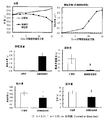
- Test Example 1 the body weight during the test period, the transition of the tumor volume, and the tumor weight, fat mass, muscle mass, and empty body mass at the time of dissection (21 days after colon 26 cell transplantation) are shown.
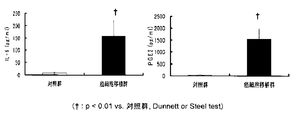
- the PGE2 and IL-6 concentrations in plasma in Test Example 1 are shown.
- the white blood cell count and white blood cell fraction in whole blood in Test Example 1 are shown.
- the body weight, tumor weight, tumor removal weight, fat mass, muscle mass (long finger extensor), and empty body mass at the time of dissection (21 days after transplantation of Colon26 cells) are shown.
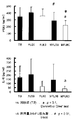
- the PGE2 and IL-6 concentrations in plasma in Example 1 are shown.
- the change in body weight and tumor volume during the test period in Example 1 is shown.
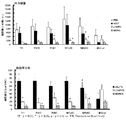
- the white blood cell count and white blood cell fraction in whole blood in Example 1 are shown.
- WBC means leukocytes
- NEUT means neutrophils
- LYMPH means lymphocytes
- MONO means monocytes.
- the enzymes used to hydrolyze the protein are usually pepsin, trypsin and chymotrypsin, but research reports using plant-derived papains, proteases from bacteria and fungi (Food Technol., 48: 7168-71, 1994; Trends Food Sci. Technol., 7: 120-125, 1996; Food Proteins and Their Applications, pp. 443-472, 1997).
- Enzymatic activity to hydrolyze whey protein varies greatly. Pepsin degrades ⁇ -La and denatured ⁇ -La, but does not degrade native ⁇ -Lg (Neth. Milk dairy J., 47: 15-22,) 1993).
- a preparation method comprising the following steps (1) to (5) can be mentioned.
- a whey protein isolate (WPI, Davisco) having a protein content of about 90% as a dry product was dissolved in distilled water at a protein content of 8% (w / v).
- the solution was heat treated at 85 ° C. for 2 minutes to denature the protein.
- the pH of the solution after heating was about 7.5.
- Alcalase 2.4L Enzyme, Novozymes
- the five parameters for optimization include, for example, preheating, enzyme to substrate ratio (E / S), pH, hydrolysis temperature, and hydrolysis time.
- E / S enzyme to substrate ratio
- pH hydrolysis temperature
- hydrolysis time hydrolysis time: less than 3-20 hours
- enzymes used include the following from Novo Nordisk. 1) End-type protease derived from Bacillus licheniformus: Alcalase B. lentus origin: Esperase Bacillus subtilis origin: Neutrase Bacterial origin: Protamex Porcine pancreas origin: PTN (trypsin) 2) Exo-type protease Aspergillus oryzae origin: flavorzyme Pig or bovine viscera origin: carboxypeptidase
- microorganism-derived for example, lactic acid bacteria, yeast, mold, actinomycetes, etc.
- endoprotease and exoprotease crudely purified products thereof
- bacteria Examples include crushed body and the like.
- a combination of Alcalase derived from Bacillus licheniformus and PTN (trypsin) derived from porcine pancreas is often used.
- the protein hydrolyzate of the present invention is a protein hydrolyzate itself, a retentate after ultrafiltration membrane treatment, or a permeate, and a commercially available milk protein hydrolyzate having the same activity. Is included.
- an ultrafiltration membrane retentate having a fractional molecular weight of 10,000 can be used as the protein hydrolyzate of the invention.
- Milk protein hydrolyzate content is the content of other ingredients (fermented milk protein, oils and fats containing oleic acid, milk phospholipids, soy lecithin, palatinose, etc.), pathology, symptoms, age, body weight of cancer patients, It can be appropriately adjusted depending on the application.
- the amount of milk protein hydrolyzate may be 0.9 to 3.0 g, preferably 1.0 to 2.5 g, more preferably 1.2 to 2.0 g per 100 mL of the composition, but is not limited to this example. .
- fermented milk such as yogurt, cheese (natural cheese, fresh cheese), cheese-like food, milk lactic acid bacteria, and / or bifidobacteria fermented product may be used as a raw material for fermented milk protein. it can.
- Yogurt has an amino acid score of 100, and digestibility of the protein is enhanced by fermentation, resulting in high nutritional value.
- the fermented milk protein used in the present invention one obtained by reducing water (whey) from yogurt (for example, Japanese Patent No. 3,179,555) can be mentioned.
- the blended amount of fermented milk protein is the content of other ingredients (milk protein hydrolyzate, oil containing fat containing oleic acid, milk phospholipid, soybean lecithin, palatinose, etc.), pathology, symptoms, age of cancer patients, It can be adjusted as appropriate according to weight, use, and the like.
- the amount of fermented milk protein may be 2 to 6 g, preferably 2.5 to 4.5 g per 100 mL of the composition in terms of protein, but is not limited to this example.
- Lipid 2-1 Phospholipids A combination of milk phospholipid and soybean-derived lecithin or egg yolk lecithin is used as the phospholipid. Milk phospholipid alone may be used.
- lecithin is only used for phosphatidylcholine in fields such as biochemistry, medicine and pharmacy, but commercially or industrially, it is a mixture of phosphatidylcholine, phosphatidylethanolamine, phosphatidylinositol, phosphatidic acid and other phospholipids. It is used as a general term. The 7th edition of the Food Additives (1999) defines that lecithin is "obtained from oil seeds or animal raw materials, the main component of which is phospholipid".
- Milk phospholipid consists of sphingomyelin (SM), phosphatidylcholine (PC), phosphatidylethanolamine (PE), phosphatidylinositol (PI), phosphatidylserine (PS), lysophosphatidylcholine (LPC), and milk fat globule membrane (MFGM) is localized only.
- SM sphingomyelin
- PC phosphatidylcholine
- PE phosphatidylethanolamine
- PI phosphatidylinositol
- PS phosphatidylserine
- LPC milk fat globule membrane
- MFGM milk fat globule membrane
- milk phospholipid contains a large amount of SM that is not contained in soybean lecithin.
- Milk phospholipids when administered to rats, increase DHA content in the brain and liver compared to soy lecithin, and are effective in improving hyperlipidemia and fatty liver compared to soy lecithin or egg yolk lecithin. It is known that there is.
- SM is involved in cholesterol metabolism, including regulation of HMG-CoA reductase activity, which is involved in cholesterol biosynthesis, and regulation of cholesterol absorption in the intestinal tract. Are known. From these, it is thought that SM has further enhanced the lipid metabolism improving effect of PC and PE (Kazu Sasaki, Milk Science 51 (2): 93-94, 2002)
- Soy lecithin is widely used in the food field as a natural food additive, while polyenephosphatidylcholine is also used as a pharmaceutical (indication: improvement of liver function in chronic liver disease, fatty liver, hyperlipidemia) .
- Physiological effects of soy lecithin include (1) adjustment of morphology and function of biological membranes, (2) improvement of lung function, (3) improvement of arteriosclerosis, (4) improvement of lipid metabolism, (5) liver lipid metabolism Improvement and (6) improvement / improvement of nerve function are mentioned (Food and Development, Vol. 29 (3): 18-21, 1994).
- so-called “natural” series of phospholipid products are usually ordered by the PC content in the product.
- Various types of phospholipids that have been improved according to the use of phospholipids have been produced.
- soy lecithin products are classified as shown in Table 2 due to differences in the main PC content due to the purification and fractionation of soy lecithin (Fujikawa Kurama, Yuka Kagaku 40 (10), pp.951- p58, 1991).
- Milk phospholipid and soybean lecithin may be used alone or in combination.
- the amount of milk phospholipid and / or soy lecithin is the content of other components (milk protein hydrolyzate, fermented milk protein, oil and fat containing oleic acid, palatinose, etc.), pathology, symptoms, age of cancer patients, It can be adjusted as appropriate according to weight, use, and the like.
- the amount of milk phospholipid and / or soy lecithin may be 0.01-0.5 g, 0.05-0.5 g, 0.1-0.5 g, 0.2-0.3 g per 100 mL of the composition. It is not limited to examples.
- fats and oils containing oleic acid can be used as lipids.
- the Ministry of Health and Welfare recommends saturated fatty acids (SFA: palmitic acid, stearic acid, etc.): monounsaturated fatty acids (MUFA: oleic acid, etc.): polyunsaturated fatty acids (PUFA: linoleic acid, linolenic acid, etc.) It is recommended that the intake ratio be changed from 1: 1.5: 1 to 3: 4: 3, and that the ratio of n-6 fatty acids: n-3 fatty acids will be 4: 1.
- oleic acid which is a monounsaturated fatty acid
- lipid sources rich in oleic acid include high oleic sunflower oil, rapeseed oil, olive oil, high oleic safflower oil, soybean oil, corn oil and palm oil.
- nutritionally prepared fats and oils are mentioned as a lipid source containing oleic acid. Sunflower oil, rapeseed oil, olive oil, and mixtures with olive oil can also be used.
- the amount of oleic acid to be added depends on the content of other ingredients (milk protein hydrolyzate, fermented milk protein, milk phospholipids, soybean lecithin, palatinose, etc.), the pathology, symptoms, age, weight, and usage of cancer patients. Can be adjusted.
- the amount of oleic acid may be 25% or more, preferably 30% or more, more preferably 30 to 60% in the fatty acid composition of the composition of the present invention, but is not limited to this example. .
- polyunsaturated fatty acids such as DHA, EPA and arachidonic acid
- medium chain fatty acids such as caprylic acid, capric acid and lauric acid
- the ratio of saturated fatty acid: monounsaturated fatty acid: polyunsaturated fatty acid is increased. It can be adjusted to be close to 3: 4: 3.
- saccharide palatinose can be mainly used.
- saccharides include sugar alcohols (such as sorbitol, xylitol, maltitol), honey, granulated sugar, glucose, fructose, and invert sugar.
- Palatinose is a disaccharide in which glucose and fructose molecules are ⁇ -1,6-linked, and is a structural isomer of sucrose. 6-O- ( ⁇ -D-Glucopyranosyl) -D-fructose or isomaltulose, Also called isomaltulose. It has a molecular weight of 342.297 and Cas. No. 13718-94-0, and is used as a sweetener. Very small amounts of honey and sugar cane. It can also be produced by allowing ⁇ -glucosyltransferase derived from Protaminobacter rubrum to act on sucrose to transfer ⁇ -1,2 bonds to ⁇ -1,6 bonds.
- palatinose The sweetness of palatinose is similar to that of sucrose, but the sweetness is about half that of sucrose.
- Orally ingested palatinose is decomposed by isomaltase in the digestive tract and is digested and absorbed into glucose and fructose in the same way as sucrose (Toshinao Aida, Journal of Japanese Society of Nutrition and Food, Vol. 36 ( 3): 169-173, 1983)
- isomaltose, panose, isomaltotriose, etc. that are digested with isomaltase compete with palatinose digestion, and it is said that digestion and absorption are suppressed by ingestion of palatinose.
- palatinose includes palatinose syrup, reduced palatinose or palatinose syrup.
- the palatinose starch syrup is a syrup-like liquid substance mainly composed of oligosaccharides such as tetrasaccharide, hexasaccharide and octasaccharide produced by dehydration condensation of palatinose.
- the amount of palatinose blended is the content of other ingredients (milk protein hydrolyzate, fermented milk protein, oil and fat containing oleic acid, milk phospholipid, soy lecithin, etc.), pathology, symptoms, age, weight of cancer patients, It can be appropriately adjusted depending on the application.
- the amount of palatinose may be 4 to 15 g, preferably 5 to 10 g, more preferably 5 to 8 g, more preferably 5 to 7 g, more preferably 5 to 6 g per 100 mL of the composition.
- the present invention is not limited to this example.
- the amount of heat of the composition of the present invention can be adjusted by appropriately adding proteins, lipids and carbohydrates.
- the amount of heat of the composition of the present invention is 50 to 150 kcal, preferably 80 to 120 kcal per 100 mL of the composition.
- the energy ratio of the protein, lipid and carbohydrate composition in the composition of the present invention substantially conforms to the nutritional requirements of the sixth revised Japanese, but protein 15-25%, lipid 20-30% Examples include carbohydrates of 45 to 65%, but are not limited to this range.
- composition of the present invention can also contain dietary fiber.
- Dietary fiber is divided into water-soluble dietary fiber and insoluble dietary fiber.
- the indigestible oligosaccharides lactulose, lactitol, or raffinose can be used as water-soluble dietary fiber.
- Physiological functions of indigestible oligosaccharides are known to reach the large intestine as undigested substances, contribute to the activation and proliferation of intestinal bifidobacteria, and have an improved intestinal environment, ie, an intestinal regulating effect. Yes.
- water-soluble dietary fiber candidates include pectin (protopectin, pectinic acid, pectinic acid) with improved lipid metabolism (reduced cholesterol and neutral fat), guar gum / enzymatic degradation products, tamarind seed gum, etc. .
- Degraded guar gum also has an inhibitory effect on blood glucose level and insulin saving (Kazuhiko Yamatoya et al., Journal of Japanese Society of Nutrition and Food, 46: 199, 1993).
- water-soluble dietary fiber candidates konjac glucomannan, alginic acid, low-molecular alginic acid, psyllium, gum arabic, seaweed polysaccharides (cellulose, lignin-like substance, agar, carrageenan, alginic acid, fucodyne) , Laminarin), microbial gum (welan gum, curdlan, xanthan gum, gellan gum, dextran, pullulan, lambzan gum) and other gums (locus bean gum derived from seeds, tamarind gum, tara gum, caraya gum derived from sap, tragacanth gum)
- examples include water-soluble dietary fiber polydextrose, indigestible dextrin, and maltitol.
- Insoluble dietary fiber increases the mass of indigestibles in the large intestine and shortens the transit time. As a result, the number of defecations increases, resulting in an increase in stool volume.
- insoluble dietary fiber candidates include cellulose, hemicellulose, lignin, chitin, chitosan, soybean dietary fiber, wheat bran, pine fiber, corn fiber, and beet fiber.
- composition of the present invention includes water, protein, carbohydrate, lipid, vitamins, minerals, organic acid, organic base, fruit juice, flavors, emulsifier, in addition to the protein, lipid, carbohydrate, and dietary fiber. Thickeners, stabilizers and the like can be used.
- the protein examples include whole milk powder, skim milk powder, partially skim milk powder, casein, whey powder, whey protein, whey protein concentrate, whey protein isolate, whey protein hydrolysate, ⁇ -casein, ⁇ -casein, ⁇ - Casein, ⁇ -lactoglobulin, ⁇ -lactalbumin, lactoferrin, soy protein, chicken egg protein, meat protein and other animal and vegetable proteins and their degradation products; butter, whey minerals, cream, whey, non-protein nitrogen, sialic acid And various milk-derived components such as phospholipids and lactose. It may contain peptides such as casein phosphopeptides and lysines and amino acids.
- saccharide examples include saccharides, processed starch (in addition to text phosphorus, soluble starch, British starch, oxidized starch, starch ester, starch ether, etc.), dietary fiber, and the like.
- lipid examples include animal oils such as lard, fish oil, etc., fractionated oils, hydrogenated oil, transesterified oil, etc .; palm oil, safflower oil, corn oil, rapeseed oil, coconut oil, fractionated oils thereof, Examples include vegetable oils such as hydrogenated oils and transesterified oils.
- vitamins include vitamin A, carotene, vitamin B group, vitamin C, vitamin D group, vitamin E, vitamin K group, vitamin P, vitamin Q, niacin, nicotinic acid, pantothenic acid, biotin, inositol, choline.
- minerals include calcium, potassium, magnesium, sodium, copper, iron, manganese, zinc, and selenium.
- organic acid include malic acid, citric acid, lactic acid, tartaric acid, erythorbic acid, and the like.
- materials with a fecal odor reduction effect for example, champignon extract 5 mg to 500 mg (0.005% to 0.5%)
- carotenoid preparations for example, preparations containing ⁇ -carotene, ⁇ -carotene, lycopene, lutein, etc. 10 ⁇ g to 200 ⁇ g (0.00001% to 0.0002%)
- antioxidants catechin, polyphenol, etc.
- the form of food may be solid or liquid. It may be in the form of a gel.
- composition of the present invention can be carried out by methods known in the art. After some or all of the raw materials have been prepared, homogenization is performed as necessary. Homogenization means homogenization by thoroughly mixing each of the prepared ingredients, and mechanically refining fat globules and coarse particles of other components to prevent the fat from floating and agglomerating and making the composition uniform It means to make a proper emulsified state.
- heat treatment or heat sterilization is performed.
- heat sterilization conditions general food sterilization conditions can be used, and heat sterilization can be performed using a conventional apparatus. For example, sterilization of 62-65 ° C x 30 minutes, 72 ° C or more x 15 seconds or more, 72 ° C or more x 15 minutes or more, or 120-150 ° C x 1-5 seconds, or 121-124 ° C x 5-20 minutes, 105
- sterilization at ⁇ 140 ° C. retort (pressure heating) sterilization, high-pressure steam sterilization, etc. can be used, it is not limited to these examples.
- the heat sterilization can be preferably performed under pressure.
- the liquid composition is preliminarily heat sterilized and then aseptically filled into a container (for example, a method using a combination of the UHT sterilization method and the aseptic packaging method), and after filling the liquid composition into the container,
- Heat sterilization methods for example, autoclave method
- can containers, liquid foods, various containers used for oral and tube feeding can containers, liquid foods Illustrated method of filling in various containers (so-called soft bags, nutrition bags, etc.) for oral and tube feeding, sterilizing by retort, heat sterilizing at about 140-145 ° C for about 5-8 seconds, cooling, and aseptic filling can do.
- the composition of the present invention can be used for nutritional management of cancer patients as a food type. In particular, it is useful for nutritional management of irreversible metabolic disorders associated with cancer.
- the composition of the present invention can be used for nutritional management of cancer patients, for example, as liquid food, oral and tube feeding, beverages, gel foods, and the like.
- the osmotic pressure of the composition of the present invention is about 300 to 1000 mOsm / L, for example, about 300 to 750 mOsm / L.
- a marked increase in metabolism is caused as the cancer progresses.
- glucose uptake in tumors insulin resistance in liver and peripheral tissues, gluconeogenesis and TCA cycle in liver, sugar production and decomposition, lipolysis in adipose tissue, fatty acid and glycerin generation and decomposition, in muscle tissue
- protein degradation, body protein production and degradation, energy consumption, etc. are enhanced, fatty acid uptake in adipose tissue is decreased. For this reason, even if a sufficient amount of heat is ingested, protein breakdown proceeds and skeletal muscle and visceral protein decrease, edema and the like occur.
- Non-patent Document 2 Korean Patent Application Laid Generation 2
- PEFs proteolysis-inducing factors
- TNF tumor-inducing factor
- IL-6 monocytes of peripheral blood
- LIF leukemia inhibitory factor
- Improvement in metabolism is essential for weight loss caused by cancer and the like, and it is said that it is difficult to improve and maintain weight and the like with conventional nutritional management. Therefore, in recent years, nutrition management for patients with metabolic disorders and malnutrition caused by cancer has been regarded as important.
- steroidal anti-inflammatory drugs and hormone preparations such as progesterone are conventionally known, but they do not prevent significant weight gain and muscle mass loss.
- irreversible metabolic disorders due to cancer cannot be improved by forcibly ingesting heat according to energy consumption.
- composition for preventing and / or improving irreversible metabolic disorders associated with cancer of the present invention does not inhibit the action of an anticancer agent in an in vivo test using a tumor cell transplantation model mouse. In addition, it was confirmed to prevent and / or improve weight loss and muscle mass loss, which are symptoms of irreversible metabolic disorders associated with cancer. Therefore, the composition of the present invention is useful for nutritional management and metabolic management of cancer patients.
- the daily intake of the composition of the present invention in pharmaceuticals or foods and drinks is particularly limited because it varies depending on the pathology, age, symptoms, weight, use of the cancer patient, and whether the composition is the only nutritional component, etc. Not. For example, 600 to 1600 mL, preferably 800 to 1200 mL can be exemplified. The intake can also be determined by the patient's doctor. Moreover, you may use together with the pharmaceutical and foodstuff which have the prevention and / or improvement effect of the irreversible metabolic disorder accompanying the conventionally known cancer. Specific examples include omega-3 fatty acids, but are not limited to these examples.
- the composition of the present invention can be used in the form of any medicine or food and drink.
- irreversible metabolic disorders associated with cancer can be obtained by direct administration as pharmaceuticals or by direct intake as special-purpose foods such as foods for specified health use, functional nutritional foods, dietary supplements, liquid foods or supplements. Prevention and / or improvement is expected.
- various foods milk, soft drinks, fermented milk, yoghurt, cheese, bread, biscuits, crackers, pizza crusts, prepared milk powder, liquid foods, for the sick, regardless of the form of liquid, paste, solid, powder, etc. Foods, nutritional foods, frozen foods, processed foods, and other commercially available foods).
- the usage form of the composition is a powder
- the homogenized product can be produced by using means such as spray drying or freeze drying.
- composition of the present invention When used as a pharmaceutical or a supplement, it can be administered in various forms. Examples of the form include oral administration using tablets, capsules, granules, powders, syrups and the like.
- these various preparations can be generally used in the pharmaceutical preparation technical field such as excipients, binders, disintegrants, lubricants, flavoring agents, solubilizers, suspension agents, coating agents, etc. as main ingredients according to conventional methods. It can be formulated using known adjuvants for formulation. Further, it may contain an appropriate amount of calcium. Further, an appropriate amount of vitamins, minerals, organic acids, sugars, amino acids, peptides, etc. may be added.
- AIN-93M is a standard purified feed composition for nutritional research for mice and rats published in 1993 by the American Institute of Nutrition.
- -Tumor weight After slaughtering the mouse, the tumor was removed and the weight of the tumor was measured. -Tumor removal weight: The body weight after the tumor was excised after the mouse was sacrificed was measured. Fat mass (peritesticular fat): Peritesticular fat was extracted and weighed. -Muscle mass (long finger extensor): The long finger extensor was removed and weighed. -Empty body weight: After sacrificed mice, body weights after various organs (liver, spleen, pancreas, kidney, small intestine, large intestine, cecum, visceral fat, testis, lung) were measured. - Tumor volume: measured tumor major axis (a) and minor axis (b), to calculate the a ⁇ b 2/2 as the volume (cm 3).
- FIG. 1 shows the body weight during the test period, the transition of the tumor volume, and the tumor weight, fat mass, muscle mass, and empty body mass at the time of dissection (21 days after transplantation of Colon26 cells).
- Table 3 shows the tumor weight and tumor removal weight at the time of dissection (21 days after transplantation of Colon26 cells).
- FIG. 2 shows IL-6 and PGE2 concentrations in plasma.
- FIG. 3 shows the white blood cell count and white blood cell fraction in whole blood.
- the body weight decreased significantly compared to the control group.
- the tumor removal weight significantly decreased as well as the decrease in body weight.
- the amount of fat was significantly decreased in the cancer cell transplant group compared to the control group.
- a significant decrease in muscle mass was observed.
- empty bodies a marked decrease was observed in the cancer cell transplant group.
- the IL-6 and PGE2 concentrations in plasma significant increases in IL-6 and PGE2 levels were observed in the cancer cell transplant group.
- the neutrophil count increased significantly in the cancer cell transplant group, and the lymphocyte count decreased conversely.
- the ratio of neutrophils in leukocytes was significantly increased and the ratio of lymphocytes and monocytes was significantly decreased in the leukocyte ratio.
- transplanting the Colon26 cell line induces irreversible metabolic disorders associated with cancer, resulting in weight loss, muscle and fat loss, and increased blood inflammatory markers (IL-6, PGE2) It has been suggested.
- IL-6 blood inflammatory markers
- PGE2 blood inflammatory markers
- Colon26 cell line (mouse colon cancer cell line, Foundation for Cancer Research) was transplanted 1 ⁇ 10 6 cells under the skin of each individual. After being colonized for 21 days after colon 26 cell transplantation, dissection and blood collection were performed, and body weight, tumor weight, tumor removal weight, fat mass (peritesticular fat), muscle mass (long finger extensor muscle), hollow mass, various types of plasma The marker (PGE2, IL-6), the white blood cell count in whole blood, and the white blood cell fraction were measured. From colon 26 cell transplantation to autopsy, lyophilized compositions shown in Tables 5 and 6 (general liquid food or composition of the present invention (denoted as nutritional composition)) were freely ingested.
- Tables 5 and 6 general liquid food or composition of the present invention (denoted as nutritional composition)
- 5-fluorouracil 5-FU was suspended in 0.5% carboxymethylcellulose aqueous solution, and after transplantation of Colon26 cells at a dose of 5 mL / kg, 60 mg / kg, or 30 mg / kg Orally administered three times a week from day 1 to day 13 (days 1, 4, 6, 8, 11, 13 after colon 26 cell transplantation).
- 5 mL / kg of 0.5% carboxymethylcellulose aqueous solution was administered on the same schedule as the anticancer drug administration.
- body weight and tumor volume during the period from Colon 26 cell transplantation to dissection were measured.
- -Tumor weight After slaughtering the mouse, the tumor was removed and the weight of the tumor was measured.
- -Tumor removal weight The body weight after tumor removal after measuring the mice was measured (also called tumor removal body weight).
- Fat mass peritesticular fat
- -Muscle mass Long finger extensor
- -Empty body weight After sacrificed mice, body weights after various organs (liver, spleen, pancreas, kidney, small intestine, large intestine, cecum, visceral fat, testis, lung) were measured.
- - Tumor volume measured tumor major axis (a) and minor axis (b), to calculate the a ⁇ b 2/2 as the volume (cm 3).
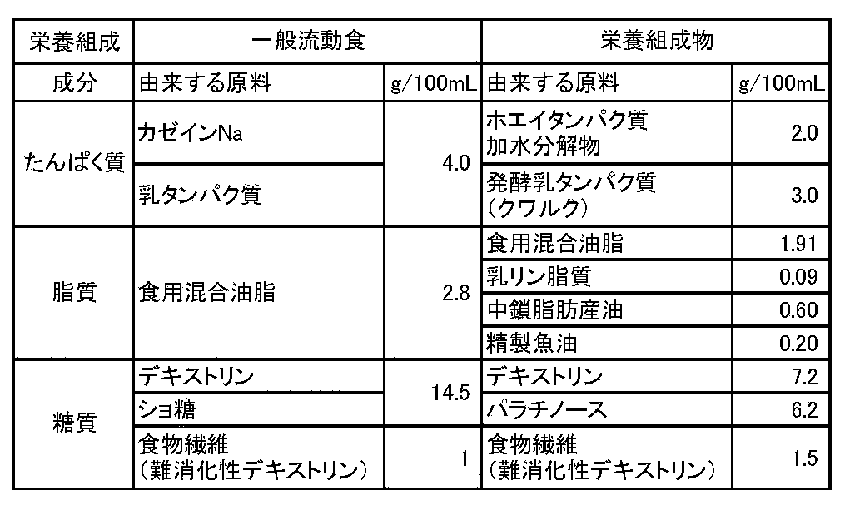
- the content of oleic acid contained in the nutritional compositions in the table was 39% in the fatty acid composition.
- FIG. 4 shows body weight, tumor weight, tumor removal weight, fat mass (peritesticular fat), muscle mass (long finger extensor muscle), and empty body mass at the time of dissection (21 days after Colon26 cell transplantation).
- FIG. 5 shows PGE2 and IL-6 concentrations in plasma.
- FIG. 6 shows changes in body weight and tumor volume during the test period.
- FIG. 7 shows the white blood cell count and white blood cell fraction in whole blood. There was no difference in tumor weight among the TB, FU30, and MFU30 groups. In addition, there was no difference between the FU60 group and the MFU60 group having a high 5-FU dose.
- the nutritional management with the composition of the present invention during the treatment of 5-FU with anticancer drugs suppresses the increase of inflammatory markers (PGE2 and IL-6) in the blood accompanying the progression of cancer, thereby reducing muscle loss Furthermore, it was suggested that weight and tumor removal were also prevented from being reduced.
- PGE2 and IL-6 inflammatory markers
- By performing nutritional management with the composition of the present invention at the time of 5-FU anticancer drug treatment the decrease in monocytes accompanying the progression of cancer was suppressed. At the same time, the increase in neutrophils tended to be suppressed.
- the composition of the present invention can prevent and / or improve irreversible metabolic disorders associated with cancer. For example, it is possible to prevent and / or ameliorate a decrease in muscle mass of a cancer patient and increase the quality of life of the cancer patient. Moreover, since the composition of this invention can be ingested safely, it is suitable for the nutrition management in long-term medical treatment.
Landscapes
- Health & Medical Sciences (AREA)
- Life Sciences & Earth Sciences (AREA)
- Chemical & Material Sciences (AREA)
- General Health & Medical Sciences (AREA)
- Public Health (AREA)
- Medicinal Chemistry (AREA)
- Engineering & Computer Science (AREA)
- Veterinary Medicine (AREA)
- Pharmacology & Pharmacy (AREA)
- Animal Behavior & Ethology (AREA)
- Epidemiology (AREA)
- Proteomics, Peptides & Aminoacids (AREA)
- Bioinformatics & Cheminformatics (AREA)
- Zoology (AREA)
- Immunology (AREA)
- Organic Chemistry (AREA)
- Nutrition Science (AREA)
- Gastroenterology & Hepatology (AREA)
- Polymers & Plastics (AREA)
- Food Science & Technology (AREA)
- General Chemical & Material Sciences (AREA)
- Molecular Biology (AREA)
- Mycology (AREA)
- Chemical Kinetics & Catalysis (AREA)
- Nuclear Medicine, Radiotherapy & Molecular Imaging (AREA)
- Biochemistry (AREA)
- Wood Science & Technology (AREA)
- Obesity (AREA)
- Diabetes (AREA)
- Oil, Petroleum & Natural Gas (AREA)
- General Engineering & Computer Science (AREA)
- Genetics & Genomics (AREA)
- Hematology (AREA)
- Marine Sciences & Fisheries (AREA)
- Medicines That Contain Protein Lipid Enzymes And Other Medicines (AREA)
- Medicines Containing Material From Animals Or Micro-Organisms (AREA)
- Coloring Foods And Improving Nutritive Qualities (AREA)
- Pharmaceuticals Containing Other Organic And Inorganic Compounds (AREA)
- Acyclic And Carbocyclic Compounds In Medicinal Compositions (AREA)
Abstract
【課題】 本発明の課題は、がんに伴う不可逆性の代謝障害の予防及び/又は改善のための組成物を提供する事である。 【解決手段】 本発明者らは鋭意検討した結果、ホエイタンパク質加水分解物、脂質代謝改善作用を有するレシチンおよびオレイン酸を含有する油脂、ならびにインスリン節約効果を有するパラチノースを必須成分として含む組成物に、がんに伴う不可逆性の代謝障害の予防及び/又は改善効果を見出し、本発明を完成させた。 具体的には、腫瘍細胞移植モデルを用いたin vivo試験において、本発明の組成物が抗がん剤の作用を阻害することなく、がんに伴う不可逆性の代謝障害の症状である筋肉量の減少等を予防及び/又は改善する効果を見出した。
Description
本発明は、がんに伴う不可逆性の代謝障害の予防及び/又は改善のための組成物に関する。
がんは、日本人の死亡原因の第1位であり2006年度には約33万人が、がんで亡くなっている。現在、一生の内にがんと診断されるリスク(罹患リスク)は、2~3人に1人と言われており、2002年には約59万人が新たにがんと診断されている。
がん患者の多くは、栄養不良を引き起こしやすく、がん患者の60~80%に栄養不良による体重減少が認められている。その原因として、がん病変による経口摂取不良、精神・神経的変化、外科的手術・化学療法・放射線治療、不適切な栄養管理、不可逆性の代謝障害等が知られている(非特許文献1)。がんによる不可逆性の代謝障害に陥ると、がんの進展に伴って、著しい代謝亢進が惹起される。そのため、十分な熱量を摂取しても、たんぱく崩壊等が進み、骨格筋・内臓たんぱくの減少や浮腫等が発生する。結果として、体重減少、制御不能の全身浮腫・腹水・胸水等がおこる(非特許文献2)。これらの原因として近年有力視されているのは、腫瘍が産生する蛋白質分解誘導因子(PIF)、腫瘍組織をとりまくマクロファージや末梢血の単球等が分泌する各種サイトカインである。がんに起因する体重減少等には、代謝の改善が必須であり、従来の栄養管理では体重等の改善および維持は困難と言われている。そこで近年、がんに起因する代謝障害、栄養不良状態の患者に対する栄養管理が重要視されている。
がん患者の多くは、栄養不良を引き起こしやすく、がん患者の60~80%に栄養不良による体重減少が認められている。その原因として、がん病変による経口摂取不良、精神・神経的変化、外科的手術・化学療法・放射線治療、不適切な栄養管理、不可逆性の代謝障害等が知られている(非特許文献1)。がんによる不可逆性の代謝障害に陥ると、がんの進展に伴って、著しい代謝亢進が惹起される。そのため、十分な熱量を摂取しても、たんぱく崩壊等が進み、骨格筋・内臓たんぱくの減少や浮腫等が発生する。結果として、体重減少、制御不能の全身浮腫・腹水・胸水等がおこる(非特許文献2)。これらの原因として近年有力視されているのは、腫瘍が産生する蛋白質分解誘導因子(PIF)、腫瘍組織をとりまくマクロファージや末梢血の単球等が分泌する各種サイトカインである。がんに起因する体重減少等には、代謝の改善が必須であり、従来の栄養管理では体重等の改善および維持は困難と言われている。そこで近年、がんに起因する代謝障害、栄養不良状態の患者に対する栄養管理が重要視されている。
また、がん患者に抗がん剤を投与して化学療法や放射線療法を施すと、がん細胞と共に正常細胞もダメージを受ける。特に、細胞周期の回転が速い細胞(消化器粘膜等)に与える影響が甚大である。消化器粘膜の損傷や、抗がん剤による消化管運動の異常・化学受容体への刺激が脳に伝達される等の要因により、悪心・嘔吐・食欲不振等の副作用が発生する(非特許文献3)。がんに起因する代謝障害、栄養不良状態に陥ると、これらの副作用に耐えられず、治療を予定通りに完遂できないこともある。そのため、治療を奏功させるために栄養管理を行い、栄養状態を維持することが重要視されている。
がんによる不可逆性の代謝障害の改善法として、従来、ステロイド系抗炎症薬やプロゲステロン等のホルモン製剤が知られているが、有意な体重増加や筋肉量低下を防止には至らない。また、単にエネルギー消費量に即した熱量を強制的に摂取したとしても、がんによる不可逆性の代謝障害は改善されないことがわかっている。
がん患者の栄養管理に対する有用性が知られている流動食や栄養補助食品としては、分岐鎖アミノ酸、コエンザイムQ10、L-カルニチン、クエン酸、及び亜鉛を含有する組成物(特許文献1)、カゼイン蛋白、ホエー蛋白、TGF-β及び遊離グルタミンを含有する組成物(特許文献2)、エイコサペンタエン酸およびフィトケミカルを含有する組成物(特許文献3)、ロイシンを全アミノ酸の重量に対して少なくとも約10から約35重量%含む組成物(特許文献4)、乳たん白質、大豆たん白質、及び脂質を含有し、乳たん白質/大豆たん白質の比率が1/2~4/1である組成物(特許文献5)等が知られている。
浅桐公男ら、「がんの代謝異常と栄養障害」、Nutrition Care、2(4)、pp350-353(2009)
東口高志ら、「終末期がん患者の栄養管理」、Nutrition Care、2(4)、pp394-401(2009)
稲野利美ら、「がん治療の副作用と栄養管理」、Nutrition Care、2(4)、pp355-359(2009)
本発明の課題は、がんに伴う不可逆性の代謝障害の予防及び/又は改善のための組成物を提供する事である。
本発明者らは鋭意検討した結果、ホエイタンパク質加水分解物、脂質代謝改善作用を有するレシチンおよびオレイン酸を含有する油脂、ならびにインスリン節約効果を有するパラチノースを必須成分として含む組成物に、がんに伴う不可逆性の代謝障害の予防及び/又は改善効果を見出し、本発明を完成させた。
具体的には、腫瘍細胞移植モデルマウスを用いたin vivo試験において、本発明の組成物が、抗がん剤の作用を阻害することなく、がんに伴う不可逆性の代謝障害の症状である体重低下や筋肉量の低下等を予防及び/又は改善することを見出した。この結果から、本発明の組成物は、がん患者の栄養管理および代謝管理に有用であることを見出した。
すなわち、本発明は、
[1] タンパク質として乳タンパク質の加水分解物および発酵乳タンパク質、脂質としてオレイン酸を含有する油脂ならびに乳リン脂質及び/又は大豆レシチン、および糖質としてパラチノースを含む、がんに伴う不可逆性の代謝障害の予防及び/又は改善のための組成物、
[2] 前記乳タンパク質が、カゼイン、乳タンパク質濃縮物(MPC)、ホエイタンパク質濃縮物(WPC)、ホエイタンパク質分離物(WPI)、α-ラクトアルブミン、β-ラクトグロブリンおよびラクトフェリンからなる群より選択される、前記[1]記載のがんに伴う不可逆性の代謝障害の予防及び/又は改善のための組成物、
[3] 前記乳タンパク質が、組成物100mLあたり0.9~3.0g含まれる、前記[1]記載のがんに伴う不可逆性の代謝障害の予防及び/又は改善のための組成物、
[4] 前記発酵乳タンパク質が、発酵乳よりホエイを減少させた組成物に由来する、前記[1]記載のがんに伴う不可逆性の代謝障害の予防及び/又は改善のための組成物、
[5] 発酵乳タンパク質がフレッシュチーズに由来する、前記[1]記載のがんに伴う不可逆性の代謝障害の予防及び/又は改善のための組成物、
[6] フレッシュチーズがクワルクである、請求項5記載のがんに伴う不可逆性の代謝障害の予防及び/又は改善のための組成物、
[7] 前記発酵乳タンパク質が、組成物100mLあたり2~6g含まれる、前記[1]記載のがんに伴う不可逆性の代謝障害の予防及び/又は改善のための組成物、
[8] 前記乳タンパク質の加水分解物が、ホエイタンパク質分離物(WPI)をバシラス・リシェニフォルムス(Bacillus licheniformus)由来のアルカラーゼで加水分解およびブタ膵臓由来のトリプシンで加水分解して得られうる、前記[1]記載のがんに伴う不可逆性の代謝障害の予防及び/又は改善のための組成物、
[9] 前記乳タンパク質の加水分解物が、分画分子量10,000の限外濾過膜でさらに処理して得られる透過画分(パーミエイト)である、前記[8]記載のがんに伴う不可逆性の代謝障害の予防及び/又は改善のための組成物、
[10] 前記パラチノースが、組成物100mLあたり4~15g含まれる、前記[1]記載のがんに伴う不可逆性の代謝障害の予防及び/又は改善のための組成物、
[11] 前記脂質中、オレイン酸が全脂肪酸組成の30%以上含まれる、前記[1]記載のがんに伴う不可逆性の代謝障害の予防及び/又は改善のための組成物、からなる。
[1] タンパク質として乳タンパク質の加水分解物および発酵乳タンパク質、脂質としてオレイン酸を含有する油脂ならびに乳リン脂質及び/又は大豆レシチン、および糖質としてパラチノースを含む、がんに伴う不可逆性の代謝障害の予防及び/又は改善のための組成物、
[2] 前記乳タンパク質が、カゼイン、乳タンパク質濃縮物(MPC)、ホエイタンパク質濃縮物(WPC)、ホエイタンパク質分離物(WPI)、α-ラクトアルブミン、β-ラクトグロブリンおよびラクトフェリンからなる群より選択される、前記[1]記載のがんに伴う不可逆性の代謝障害の予防及び/又は改善のための組成物、
[3] 前記乳タンパク質が、組成物100mLあたり0.9~3.0g含まれる、前記[1]記載のがんに伴う不可逆性の代謝障害の予防及び/又は改善のための組成物、
[4] 前記発酵乳タンパク質が、発酵乳よりホエイを減少させた組成物に由来する、前記[1]記載のがんに伴う不可逆性の代謝障害の予防及び/又は改善のための組成物、
[5] 発酵乳タンパク質がフレッシュチーズに由来する、前記[1]記載のがんに伴う不可逆性の代謝障害の予防及び/又は改善のための組成物、
[6] フレッシュチーズがクワルクである、請求項5記載のがんに伴う不可逆性の代謝障害の予防及び/又は改善のための組成物、
[7] 前記発酵乳タンパク質が、組成物100mLあたり2~6g含まれる、前記[1]記載のがんに伴う不可逆性の代謝障害の予防及び/又は改善のための組成物、
[8] 前記乳タンパク質の加水分解物が、ホエイタンパク質分離物(WPI)をバシラス・リシェニフォルムス(Bacillus licheniformus)由来のアルカラーゼで加水分解およびブタ膵臓由来のトリプシンで加水分解して得られうる、前記[1]記載のがんに伴う不可逆性の代謝障害の予防及び/又は改善のための組成物、
[9] 前記乳タンパク質の加水分解物が、分画分子量10,000の限外濾過膜でさらに処理して得られる透過画分(パーミエイト)である、前記[8]記載のがんに伴う不可逆性の代謝障害の予防及び/又は改善のための組成物、
[10] 前記パラチノースが、組成物100mLあたり4~15g含まれる、前記[1]記載のがんに伴う不可逆性の代謝障害の予防及び/又は改善のための組成物、
[11] 前記脂質中、オレイン酸が全脂肪酸組成の30%以上含まれる、前記[1]記載のがんに伴う不可逆性の代謝障害の予防及び/又は改善のための組成物、からなる。
本発明の組成物は、がんに伴う不可逆性の代謝障害を予防及び/又は改善することができる。例えば、がん患者の筋肉量低下を予防及び/又は改善して、がん患者のQOLを高めることができる。また、本発明の組成物は安全に摂取できるので、長期療養における栄養管理に適している。
以下、本発明を詳細に説明する。ただし、本発明は以下の好ましい実施態様に限定されず、本発明の範囲内で自由に変更できるものである。
1.タンパク質
1-1 乳タンパク質加水分解物
原料タンパク質として、カゼイン、ホエイタンパク質(ホエイタンパク質濃縮物(WPC)、ホエイタンパク質分離物(WPI)、α-ラクトアルブミン(α-La)、β-ラクトグロブリン(β-Lg))、乳タンパク質濃縮物(MPC、総乳タンパク質=TMPともいう)等を用いることができる。
1-1 乳タンパク質加水分解物
原料タンパク質として、カゼイン、ホエイタンパク質(ホエイタンパク質濃縮物(WPC)、ホエイタンパク質分離物(WPI)、α-ラクトアルブミン(α-La)、β-ラクトグロブリン(β-Lg))、乳タンパク質濃縮物(MPC、総乳タンパク質=TMPともいう)等を用いることができる。
ホエイタンパク質の加水分解を例にとると、通常、該タンパク質の加水分解に用いる酵素は、ペプシン、トリプシンおよびキモトリプシンであるが、植物起源のパパイン、バクテリアや菌類由来のプロテアーゼを用いた研究報告(Food Technol., 48: 68-71, 1994;Trends Food Sci. Technol., 7: 120-125, 1996;Food Proteins and Their Applications, pp. 443-472, 1997)もある。ホエイタンパク質を加水分解する酵素活性は大きく変動する。ペプシンはα-Laおよび変性したα-Laを分解するが、未変性の(native)β-Lgを分解しない(Neth. Milk dairy J., 47: 15-22, 1993)。トリプシンはα-Laをゆっくり加水分解するがβ-Lgはほとんど未分解のままである(Neth. Milk dairy J., 45: 225-240, 1991)。キモトリプシンはα-Laを速く分解するが、β-Lgはゆっくり分解される。パパインはウシ血清アルブミン(BSA)およびβ-Lgを加水分解したが、α-Laは抵抗性があった(Int. Dairy Journal 6: 13-31, 1996a)。しかしながら、Caを結合していないα-Laは酸性のpHでパパインにより完全に分解された(J. Dairy Sci., 76: 311-320, 1993)。
乳タンパク質の酵素分解をコントロールして該タンパク質を修飾することにより、広範囲のpHおよびプロセッシング条件にわたって、該タンパク質の機能的特性を変更することができる(Enzyme and Chemical Modification of proteins in Food proteins and their Applications, pp. 393-423, 1997, Marcel Dekker, Inc., New York, 1997;Food Technol., 48: 68-71, 1994)。
ペプチド結合の加水分解は、荷電基の数および疎水性の増加、低分子量化、および分子の立体配置の修飾をもたらす(J. Dairy Sci., 76: 311-320, 1993)。機能的特性の変化は大きく加水分解度に依存する。ホエイタンパク質の機能性に共通してみられる最も大きな変化は溶解性の増加と粘度の低下である。加水分解度が高い場合、しばしば、加水分解物は加熱しても沈澱せず、pH 3.5~4.0で溶解性が高い。加水分解物は、また、無処置の(intact)タンパク質よりもはるかに粘度が低い。この差異はとくにタンパク質濃度が高い場合に顕著である。その他の影響は、ゲル特性の変化、熱安定性を高める、乳化および起泡性の増強、乳化および泡の安定性の低下である(Int. Dairy journal, 6: 13-31, 1996a;Dairy Chemistry 4, pp. 347-376, 1989;J. Dairy Sci., 79: 782-790, 1996)。
乳タンパク質から派生するさまざまな生理活性オリゴペプチドが知られている(吉川正明「ミルクの先端機能」吉川正明ら編, p 188-195, 弘学出版, 1998;大谷元「ミルクの先端機能」吉川正明ら編, p 97-99, 弘学出版, 1998;大谷元、Milk Science 47: 183, 1998;Trends in Food Science and Technology, 9: 307-319, 1998)。
例えば、乳タンパク質加水分解物は、in vivoにおけるLPS誘導性TNF-αおよびIL-6産生を抑制する作用を有することが見出されている(WO2004/047566公報)。乳タンパク質から派生するペプチドのサイトカイン産生に対する影響に関しては、ウシカゼイン由来のペプチドが、ネズミ骨髄マクロファージからのLPS誘導性TNF-αおよびIL-6産生を増加させるという報告(J. Sci. Food Agric., 81: 300-304, 2000)やプロバイオティック(probiotic)乳酸菌による発酵乳の上清中に、LPS刺激によるIL-6産生を誘導するペプチドが存在するという報告(Milchwissenschaft, 57(2): 66-70, 2002)がある。
例えば、乳タンパク質加水分解物は、in vivoにおけるLPS誘導性TNF-αおよびIL-6産生を抑制する作用を有することが見出されている(WO2004/047566公報)。乳タンパク質から派生するペプチドのサイトカイン産生に対する影響に関しては、ウシカゼイン由来のペプチドが、ネズミ骨髄マクロファージからのLPS誘導性TNF-αおよびIL-6産生を増加させるという報告(J. Sci. Food Agric., 81: 300-304, 2000)やプロバイオティック(probiotic)乳酸菌による発酵乳の上清中に、LPS刺激によるIL-6産生を誘導するペプチドが存在するという報告(Milchwissenschaft, 57(2): 66-70, 2002)がある。
一方、乳タンパク質加水分解物については、上記に例示した文献に加えて数多くの特許(公開特許および特許)が存在する。例えば、カゼインとホエイタンパク質を別々に加水分解し、疎水性部分を吸着・除去した後、両者を所定割合で混合する特許(日本特許第2,986,764号)、ホエイタンパク質をバチルス属由来のプロテアーゼと放線菌由来のプロテアーゼによって加水分解した後、酵素と不溶性の加水分解物を除去する特許(日本特許第3,222,638号)、β-ラクトグロブリンを酵素で分解して得られる分岐鎖アミノ酸/芳香族アミノ酸のモル比が10重量%以上、芳香族アミノ酸が2.0重量%未満、平均分子量が数百~数千のペプチド混合物の特許(日本特許第3,183,945号)、ホエイタンパク質中のβ-ラクトグロブリンを選択的に酵素分解する特許(日本特許第2,794,305号)、あるいはホエイタンパク質をバシラス・リシェニフォルムス(B. licheniformis)由来のプロテアーゼ及び/又は枯草菌(B. subtilis)由来のプロテアーゼにより、非-pH-スタット法により、15~30%の加水分解度(DE)まで加水分解し、カットオフ値10,000を超える限外濾過膜の透過液を得る特許(日本特許第3,167,723号)等をあげることができ、本発明の乳タンパク質加水分解物はこれらの特許以外の特許や公開特許を包含する。
ホエイタンパク質加水分解物の調製方法の例としては、下記(1)~(5)の工程からなる調製方法を挙げることができる。
(1)乾燥物として約90%のタンパク質含量のホエイタンパク質分離物(WPI、ダビスコ社)を、8%(w/v)のタンパク質含有量で蒸留水に溶解した。(2)溶液は85℃2分間の加熱処理しタンパク質を変性させた。この加熱後の溶液のpHは約7.5であった。(3)加水分解は、アルカラーゼ2.4L(酵素、ノボザイムス社)を基質に対して2.0%の濃度で添加し3時間55℃で反応させた。(4)次に、豚由来のトリプシンである PTN 6.0S(ノボザイムズジャパン)を基質に対して3.0%の濃度で添加し3時間55℃で反応させた。全加水分解時間は6時間であった。反応終了時のpHは約7.0であった。(5)ホエイタンパク質加水分解物は、遠心処理(20,000×g、10分)後、分画分子量10,000のUF膜処理(ミリポア社ウルトラフリー-MC)を行った。
(1)乾燥物として約90%のタンパク質含量のホエイタンパク質分離物(WPI、ダビスコ社)を、8%(w/v)のタンパク質含有量で蒸留水に溶解した。(2)溶液は85℃2分間の加熱処理しタンパク質を変性させた。この加熱後の溶液のpHは約7.5であった。(3)加水分解は、アルカラーゼ2.4L(酵素、ノボザイムス社)を基質に対して2.0%の濃度で添加し3時間55℃で反応させた。(4)次に、豚由来のトリプシンである PTN 6.0S(ノボザイムズジャパン)を基質に対して3.0%の濃度で添加し3時間55℃で反応させた。全加水分解時間は6時間であった。反応終了時のpHは約7.0であった。(5)ホエイタンパク質加水分解物は、遠心処理(20,000×g、10分)後、分画分子量10,000のUF膜処理(ミリポア社ウルトラフリー-MC)を行った。
最適化のための5つのパラメーターとして、例えば、予備加熱、酵素と基質の比(E/S)、pH、加水分解温度、および加水分解時間をとる。
予備加熱:65~90℃
E/S:0.01~0.2
pH:2~10
加水分解温度:30~65℃
加水分解時間:3~20時間未満
予備加熱:65~90℃
E/S:0.01~0.2
pH:2~10
加水分解温度:30~65℃
加水分解時間:3~20時間未満
使用酵素としては、例えば、ノボノルディスク社の以下のものがあげられる。
1)エンド型プロテアーゼ
バシラス・リシェニフォルムス由来:アルカラーゼ(Alcalase)
B. レントゥス(B. lentus)由来:エスペラーゼ
枯草菌由来:ニュートラーゼ(Neutrase)
バクテリア由来:プロタメックス
豚膵臓由来:PTN(トリプシン)
2)エキソ型プロテアーゼ
アスペルギルス・オリゼ(Aspergillus oryzae)由来:フレーバーザイム
豚あるいはウシ内臓由来:カルボキシペプチダーゼ
1)エンド型プロテアーゼ
バシラス・リシェニフォルムス由来:アルカラーゼ(Alcalase)
B. レントゥス(B. lentus)由来:エスペラーゼ
枯草菌由来:ニュートラーゼ(Neutrase)
バクテリア由来:プロタメックス
豚膵臓由来:PTN(トリプシン)
2)エキソ型プロテアーゼ
アスペルギルス・オリゼ(Aspergillus oryzae)由来:フレーバーザイム
豚あるいはウシ内臓由来:カルボキシペプチダーゼ
上記酵素の他に、動物由来のパンクレアチン、ペプシン、植物由来のパパイン、ブロメライン、微生物由来(例えば、乳酸菌、酵母、カビ、放線菌等)のエンドプロテアーゼおよびエキソプロテアーゼ、これらの粗精製物、菌体破砕物等を例示することができる。また、酵素の組み合わせとしては、バシラス・リシェニフォルムス由来のアルカラーゼと豚膵臓由来のPTN(トリプシン)の組み合わせがよく用いられる。
本発明のタンパク質加水分解物は、タンパク質の酵素加水分解物そのもの、さらに限外濾過膜処理した後の保持液、あるいは透過液(パーミエイト)、さらに同様の活性を有する市販の乳タンパク質の加水分解物を包含する。例えば、分画分子量10,000の限外濾過膜の保持液を発明のタンパク質加水分解物として用いることができる。
乳タンパク質加水分解物の配合量は、他の成分(発酵乳タンパク質、オレイン酸を含有する油脂、乳リン脂質、大豆レシチン、パラチノース等)の含量、がん患者の病態、症状、年齢、体重、用途等によって適宜調整することができる。あえて挙げるなら、乳タンパク質加水分解物の配合量として、組成物100mL当たり0.9~3.0g、好ましくは1.0~2.5g、より好ましくは1.2~2.0gを例示することができるが、この例に限定されない。
1-2 発酵乳タンパク質
本発明において、発酵乳タンパク質の原料に、ヨーグルト、チーズ(ナチュラルチーズ、フレッシュチーズ)、チーズ様食品、乳の乳酸菌及び/又はビフィズス菌発酵物等の発酵乳を用いることができる。
ヨーグルトは、アミノ酸スコアが100で、発酵によりタンパク質の消化吸収性が高められており栄養価が高い。本発明で使用する発酵乳タンパク質の例として、ヨーグルトから水分(ホエイ)を減少させたもの(例えば、日本特許第3,179,555号)をあげることができる。
一方、フレッシュチーズはカッテージ、クワルク、ストリング、ヌーシャテル、クリームチーズ、モツァレラ、リコッタ、マスカルポーネなど多くの種類があるが、原料としてクワルクを好適に使用することができる。クワルクの製造方法は公知(例えば、特開平6-228013)である。
本発明において、発酵乳タンパク質の原料に、ヨーグルト、チーズ(ナチュラルチーズ、フレッシュチーズ)、チーズ様食品、乳の乳酸菌及び/又はビフィズス菌発酵物等の発酵乳を用いることができる。
ヨーグルトは、アミノ酸スコアが100で、発酵によりタンパク質の消化吸収性が高められており栄養価が高い。本発明で使用する発酵乳タンパク質の例として、ヨーグルトから水分(ホエイ)を減少させたもの(例えば、日本特許第3,179,555号)をあげることができる。
一方、フレッシュチーズはカッテージ、クワルク、ストリング、ヌーシャテル、クリームチーズ、モツァレラ、リコッタ、マスカルポーネなど多くの種類があるが、原料としてクワルクを好適に使用することができる。クワルクの製造方法は公知(例えば、特開平6-228013)である。
発酵乳タンパク質の配合量は、他の成分(乳タンパク質加水分解物、オレイン酸を含有する油脂含有油脂、乳リン脂質、大豆レシチン、パラチノース等)の含量、がん患者の病態、症状、年齢、体重、用途等によって適宜調整することができる。あえて挙げるなら、発酵乳タンパク質の配合量として、タンパク質に換算して組成物100mL当たり2~6g好ましくは2.5~4.5gを例示することができるが、この例に限定されない。
2.脂質
2-1 リン脂質
リン脂質として乳リン脂質と大豆由来レシチンあるいは卵黄レシチンの組み合わせを用いる。乳リン脂質単独でもよい。レシチンという用語は、生化学、医学、薬学などの分野ではホスファチジルコリンだけに使用しているが、商業的あるいは工業的には、ホスファチジルコリン、ホスファチジルエタノールアミン、ホスファチジルイノシトール、ホスファチジン酸および他のリン脂質の混合物の総称として使われている。食品添加物公定書第7版(1999)では、レシチンは、「油糧種子又は動物原料から得られたもので、その主成分は、リン脂質である」、と定義されている。
2-1 リン脂質
リン脂質として乳リン脂質と大豆由来レシチンあるいは卵黄レシチンの組み合わせを用いる。乳リン脂質単独でもよい。レシチンという用語は、生化学、医学、薬学などの分野ではホスファチジルコリンだけに使用しているが、商業的あるいは工業的には、ホスファチジルコリン、ホスファチジルエタノールアミン、ホスファチジルイノシトール、ホスファチジン酸および他のリン脂質の混合物の総称として使われている。食品添加物公定書第7版(1999)では、レシチンは、「油糧種子又は動物原料から得られたもので、その主成分は、リン脂質である」、と定義されている。
乳リン脂質
乳リン脂質は、スフィンゴミエリン(SM)、ホスファチジルコリン(PC)、ホスファチジルエタノールアミン(PE)、ホスファチジルイノシトール(PI)、ホスファチジルセリン(PS)、リゾホスファチジルコリン(LPC)からなり、乳脂肪球皮膜(MFGM)のみに局在している。
乳リン脂質は、スフィンゴミエリン(SM)、ホスファチジルコリン(PC)、ホスファチジルエタノールアミン(PE)、ホスファチジルイノシトール(PI)、ホスファチジルセリン(PS)、リゾホスファチジルコリン(LPC)からなり、乳脂肪球皮膜(MFGM)のみに局在している。
乳リン脂質の特徴は、表1に示すように、大豆レシチンには含まれないSMを多量に含むことである。乳リン脂質はラットに投与した場合、大豆レシチンに比較して脳および肝臓内のDHA含量を高めること、また、大豆レシチンあるいは卵黄レシチンに比較して高脂血症や脂肪肝の改善に有効であること、が知られている。また、SMがコレステロールの生合成に関与しているHMG-CoAリダクターゼ活性を調節すること、コレステロールの腸管での吸収の調節に関与していることなど、SMがコレステロール代謝に関与していることが知られている。これらのことから、SMがPCやPEの脂質代謝改善効果をさらに高めていると考えられる(佐々木一、Milk Science 51(2): 93-94, 2002)

大豆レシチン
大豆レシチンは天然の食品添加物として、食品分野で広く使われる一方、ポリエンホスファチジルコリンは医薬品(適応:慢性肝疾患における肝機能の改善、脂肪肝、高脂質血症)としても使われている。大豆レシチンの生理作用として、(1)生体膜の形態と機能の調整、(2)肺機能改善、(3)動脈硬化症の改善、(4)脂質代謝の改善、(5)肝臓脂質代謝の改善および(6)神経機能の改善・向上、があげられている(食品と開発, Vol. 29(3):18-21, 1994)。
大豆レシチンは天然の食品添加物として、食品分野で広く使われる一方、ポリエンホスファチジルコリンは医薬品(適応:慢性肝疾患における肝機能の改善、脂肪肝、高脂質血症)としても使われている。大豆レシチンの生理作用として、(1)生体膜の形態と機能の調整、(2)肺機能改善、(3)動脈硬化症の改善、(4)脂質代謝の改善、(5)肝臓脂質代謝の改善および(6)神経機能の改善・向上、があげられている(食品と開発, Vol. 29(3):18-21, 1994)。
いわゆる「天然系」の一連のリン脂質製品に関しては、通常、製品中のPC含量によって序列されている。リン脂質の用途に応じてグレートアップした各種のリン脂質が製造されている。大豆レシチンの精製、分画による主なPC含量の違いにより、大豆レシチン製品は便宜的に表2のように分類されている(藤川琢馬、油化学第40巻(10), pp.951-p58, 1991)。
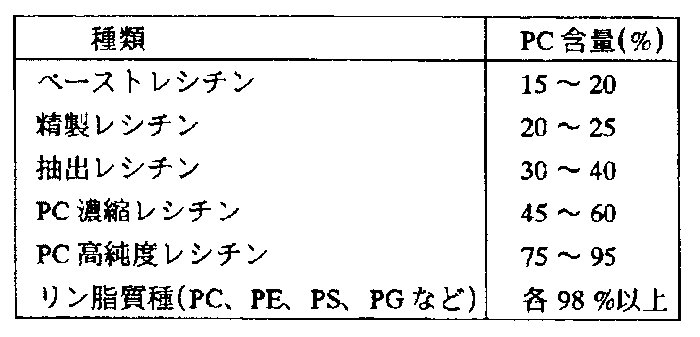
乳リン脂質と大豆レシチンはそれぞれ単独でもよく、また組み合わせてもよい。乳リン脂質及び/又は大豆レシチンの配合量は、他の成分(乳タンパク質加水分解物、発酵乳タンパク質、オレイン酸を含有する油脂、パラチノース等)の含量、がん患者の病態、症状、年齢、体重、用途等によって適宜調整することができる。あえて挙げるなら、乳リン脂質及び/又は大豆レシチンの配合量として、組成物100mL当たり合計0.01~0.5g、0.05~0.5 g、0.1~0.5 g、0.2~0.3 gを例示することができるが、この例に限定されない。
2-2 その他の脂質
本発明において、脂質としてオレイン酸を含有する油脂を使用することができる。厚生省(厚生労働省)は、飽和脂肪酸(SFA:パルミチン酸、ステアリン酸等):一価不飽和脂肪酸(MUFA:オレイン酸等):多価不飽和脂肪酸(PUFA:リノール酸、リノレン酸等)の望ましい摂取比率を従来の1:1.5:1から3:4:3となるよう、また、n-6系脂肪酸:n-3系脂肪酸の比率が4:1となるよう勧告している。わが国において、MUFAの摂取比を1.5倍まで高めた食生活の実施は難しいということが理由の一つである。そこで、脂質の脂肪酸組成中一価不飽和脂肪酸(MUFA)の含量を高めることが考えられる。そのために一価不飽和脂肪酸であるオレイン酸を本発明の組成物に含有せしめることができる。オレイン酸を多く含む脂質源としては、例えば、高オレイン酸のハイオレイックヒマワリ油、ナタネ油、オリーブ油、高オレイン酸ベニバナ油、大豆油、コーン油、パーム油などが挙げられる。またオレイン酸を含む脂質源として栄養調製油脂(日本油脂(株))が挙げられる。ヒマワリ油、ナタネ油、オリーブ油、およびオリーブ油との混合物も用いることができる。
本発明において、脂質としてオレイン酸を含有する油脂を使用することができる。厚生省(厚生労働省)は、飽和脂肪酸(SFA:パルミチン酸、ステアリン酸等):一価不飽和脂肪酸(MUFA:オレイン酸等):多価不飽和脂肪酸(PUFA:リノール酸、リノレン酸等)の望ましい摂取比率を従来の1:1.5:1から3:4:3となるよう、また、n-6系脂肪酸:n-3系脂肪酸の比率が4:1となるよう勧告している。わが国において、MUFAの摂取比を1.5倍まで高めた食生活の実施は難しいということが理由の一つである。そこで、脂質の脂肪酸組成中一価不飽和脂肪酸(MUFA)の含量を高めることが考えられる。そのために一価不飽和脂肪酸であるオレイン酸を本発明の組成物に含有せしめることができる。オレイン酸を多く含む脂質源としては、例えば、高オレイン酸のハイオレイックヒマワリ油、ナタネ油、オリーブ油、高オレイン酸ベニバナ油、大豆油、コーン油、パーム油などが挙げられる。またオレイン酸を含む脂質源として栄養調製油脂(日本油脂(株))が挙げられる。ヒマワリ油、ナタネ油、オリーブ油、およびオリーブ油との混合物も用いることができる。
オレイン酸の配合量は、他の成分(乳タンパク質加水分解物、発酵乳タンパク質、乳リン脂質、大豆レシチン、パラチノース等)の含量、がん患者の病態、症状、年齢、体重、用途等によって適宜調整することができる。あえて挙げるなら、オレイン酸の配合量として、本発明の組成物の脂肪酸組成中25%以上、好ましくは30%以上、より好ましくは30~60%を例示することができるが、この例に限定されない。さらに、DHA、EPA、アラキドン酸等の多価不飽和脂肪酸、カプリル酸、カプリン酸、ラウリン酸等の中鎖脂肪酸を加えて、飽和脂肪酸:一価不飽和脂肪酸:多価不飽和脂肪酸の比率を3:4:3に近くなるように調整することができる。
3.糖質および食物繊維
糖質としては、主にパラチノースを使用することができる。その他の糖質としては、糖アルコール(ソルビトール、キシリトール、マルチトールなど)、ハチミツ、グラニュー糖、ブドウ糖、果糖、転化糖などがあげられる。
糖質としては、主にパラチノースを使用することができる。その他の糖質としては、糖アルコール(ソルビトール、キシリトール、マルチトールなど)、ハチミツ、グラニュー糖、ブドウ糖、果糖、転化糖などがあげられる。
パラチノースは、ブドウ糖と果糖が1分子ずつα-1,6結合した二糖類で、ショ糖の構造異性体であり、6‐O‐(α‐D‐Glucopyranosyl)‐D‐fructoseあるいはイソマルツロース、イソマルチュロース、ともいう。分子量342.297、Cas. No.13718-94-0で、甘味料などに用いられている。蜂蜜やサトウキビなどに非常に少量含まれている。また、スクロースにプロタミノバクター・ルブラム(Protaminobacter rubrum)起源のα-グルコシルトランスフェラーゼなどを作用させて、α-1,2結合をα-1,6結合に転移させて製造することもできる。パラチノースの甘味はスクロースに似ているが、甘味度はスクロースの約半分である。経口的に摂取されたパラチノースは、消化管内でイソマルターゼによって分解を受け、ショ糖と同様にグルコースとフルクトースに消化されて吸収される(合田敏尚ら、日本栄養・食糧学会誌, Vol. 36(3): 169-173, 1983)他にイソマルターゼで消化を受けるイソマルトース、パノース、イソマルトトリオース等はパラチノースの消化と競合するため、パラチノースの摂取によって消化吸収が抑制されると言われている(日本栄養・食糧学会誌、36(3)、pp.169-173(1983))。カロリーは4kcal/gである。パラチノースの分解速度はショ糖の約1/5であり、そのために血糖値および血中インスリン濃度の急激な上昇が抑えられる。本発明において、パラチノースは、パラチノースシロップ、還元パラチノースあるいはパラチノース水飴などを含む。パラチノース水飴は、パラチノースの脱水縮合によって生じる四糖、六糖、八糖等のオリゴ糖を主成分とする水飴状の液状物である。
パラチノースの配合量は、他の成分(乳タンパク質加水分解物、発酵乳タンパク質、オレイン酸を含有する油脂、乳リン脂質、大豆レシチン等)の含量、がん患者の病態、症状、年齢、体重、用途等によって適宜調整することができる。あえて挙げるなら、パラチノースの配合量として、組成物100mL当たり4~15g好ましくは5~10g、さらに好ましくは5~8g、さらに好ましくは5~7g、さらに好ましくは5~6gを例示することができるが、この例に限定されない。
本発明の組成物は、適当にタンパク質、脂質、糖質を加えることにより、その熱量を調節することができる。本発明の組成物の熱量は、組成物100mLあたり50~150 kcal、好ましくは、80~120 kcalである。
また、本発明の組成物における、タンパク質、脂質および糖質の組成物全体に対するエネルギー比率は、第六次改定日本人の栄養所要量にほぼ準ずるが、タンパク質15~25%、脂質20~30%、糖質45~65 %を例示することができるが、この範囲に限定されない。
また、本発明の組成物における、タンパク質、脂質および糖質の組成物全体に対するエネルギー比率は、第六次改定日本人の栄養所要量にほぼ準ずるが、タンパク質15~25%、脂質20~30%、糖質45~65 %を例示することができるが、この範囲に限定されない。
本発明の組成物は、食物繊維を含むこともできる。食物繊維は水溶性食物繊維および不溶性食物繊維に分けられる。水溶性食物繊維として、難消化性オリゴ糖のラクツロース、ラクチトール、あるいはラフィノースを用いることができる。難消化性オリゴ糖の生理機能としては、未消化物のまま大腸に到達し、腸内ビフィズス菌の活性化および増殖に寄与し、腸内環境の改善すなわち整腸効果を有することが知られている。その他の水溶性食物繊維の候補として、脂質代謝改善作用(コレステロールや中性脂肪の低下)を有するペクチン(プロトペクチン、ペクチニン酸、ペクチン酸)、グアーガム・酵素分解物、タマリンドシードガムなどがあげられる。グアーガム分解物には血糖値上昇抑制作用およびインスリン節約効果もみられる(大和谷一彦ら、日本栄養・食糧学会誌, 46: 199, 1993)。さらに、水溶性食物繊維の候補として、高分子水溶性食物繊維では、こんにゃくグルコマンナン、アルギン酸、低分子アルギン酸、サイリウム、アラビアガム、海藻多糖類(セルロース、リグニン様物質、寒天、カラギーナン、アルギン酸、フコダイン、ラミナリン)、微生物ガム(ウエランガム、カードラン、キサンタンガム、ジェランガム、デキストラン、プルラン、ラムザンガム)、その他のガム(種子由来のローカストビーンガム、タマリンドガム、タラガム、樹液由来のカラヤガム、トラガントガム)など、低分子水溶性食物繊維のポリデキストロース、難消化性デキストリン、マルチトールなどがあげられる。
不溶性食物繊維は、大腸での不消化物のカサを増やし、通過時間を短縮する。その結果排便回数が増し、便量の増加をもたらす。不溶性食物繊維の候補として、セルロース、ヘミセルロース、リグニン、キチン、キトサン、大豆食物繊維、小麦ふすま、パインファイバー、コーンファイバー、ビートファイバーなどがあげられる。
本発明の組成物は、前記のタンパク質、脂質、糖質、食物繊維の他に、水、タンパク質、糖質、脂質、ビタミン類、ミネラル類、有機酸、有機塩基、果汁、フレーバー類、乳化剤、増粘剤、安定化剤等を使用することができる。タンパク質としては、例えば全脂粉乳、脱脂粉乳、部分脱脂粉乳、カゼイン、ホエイ粉、ホエイタンパク質、ホエイタンパク質濃縮物、ホエイタンパク質分離物、ホエイタンパク質加水分解物、α―カゼイン、β―カゼイン、κ-カゼイン、β―ラクトグロブリン、α―ラクトアルブミン、ラクトフェリン、大豆タンパク質、鶏卵タンパク質、肉タンパク質等の動植物性タンパク質、これらの分解物;バター、乳清ミネラル、クリーム、ホエイ、非タンパク態窒素、シアル酸、リン脂質、乳糖等の各種乳由来成分などが挙げられる。カゼインホスホペプチド、リジン等のペプチドやアミノ酸を含んでいてもよい。糖質としては、例えば、糖類、加工澱粉(テキストリンのほか、可溶性澱粉、ブリティッシュスターチ、酸化澱粉、澱粉エステル、澱粉エーテル等)、食物繊維などが挙げられる。脂質としては、例えば、ラード、魚油等、これらの分別油、水素添加油、エステル交換油等の動物性油脂;パーム油、サフラワー油、コーン油、ナタネ油、ヤシ油、これらの分別油、水素添加油、エステル交換油等の植物性油脂などが挙げられる。ビタミン類としては、例えば、ビタミンA、カロチン類、ビタミンB群、ビタミンC、ビタミンD群、ビタミンE、ビタミンK群、ビタミンP、ビタミンQ、ナイアシン、ニコチン酸、パントテン酸、ビオチン、イノシトール、コリン、葉酸などが挙げられ、ミネラル類としては、例えば、カルシウム、カリウム、マグネシウム、ナトリウム、銅、鉄、マンガン、亜鉛、セレンなどが挙げられる。有機酸としては、例えば、リンゴ酸、クエン酸、乳酸、酒石酸、エリソルビン酸などが挙げられる。また、便臭低減効果のある素材(例えば、シャンピニオンエキスを5mg~500mg(0.005%~0.5%))、カロチノイド製剤(例えば、α-カロチン、β-カロチン、リコピン、ルテインなどを含む製剤を10μg~200μg (0.00001%~0.0002%))、抗酸化剤(カテキン、ポリフェノールなど)を含ませることもできる。これらの成分は、2種以上を組み合わせて使用することができ、合成品及び/又はこれらを多く含む食品を用いてもよい。食品の形態としては、固体でも液体でもかまわない。またゲル状などであってもよい。
本発明の組成物の製造は、当業界公知の方法で実施できる。前記原材料を一部または全てを調合した後に、必要に応じて均質化を行う。均質化とは、調合した各成分を十分混合することにより均質にし、また、脂肪球や他成分の粗大粒子を機械的に微細化して脂肪等の浮上・凝集を防止するとともに、組成物を均一な乳化状態にすることをいう。
本発明の組成物の製造においては加熱処理又は加熱殺菌を行う。加熱殺菌条件は、一般的な食品の殺菌条件を用いることができ、慣用の装置を用いて加熱殺菌を行うことができる。例えば、62~65℃×30分、72℃以上×15秒以上、72℃以上×15分以上若しくは120~150℃×1~5秒の殺菌、または121~124℃×5~20分、105~140℃の滅菌、レトルト(加圧加熱)殺菌、高圧蒸気滅菌等を使用することができるが、これらの例に限定されない。加熱殺菌は、好ましくは加圧下で行うことができる。
また、液状の組成物を予め加熱滅菌した後、無菌的に容器に充填する方法(例えば、UHT滅菌法とアセプティック包装法を併用した方法)、液状の組成物を容器に充填した後、容器とともに加熱滅菌する方法(例えば、オートクレーブ法)、缶容器や流動食や経口・経管栄養に用いる各種容器(いわゆるソフトバッグ、栄養バック等)に充填しレトルト殺菌を行う方法、缶容器や流動食や経口・経管栄養に用いる各種容器(いわゆるソフトバッグ、栄養バック等)に充填しレトルト殺菌した後に約140~145℃で約5~8秒間加熱殺菌後、冷却し、無菌充填を行う方法を例示することができる。
また、液状の組成物を予め加熱滅菌した後、無菌的に容器に充填する方法(例えば、UHT滅菌法とアセプティック包装法を併用した方法)、液状の組成物を容器に充填した後、容器とともに加熱滅菌する方法(例えば、オートクレーブ法)、缶容器や流動食や経口・経管栄養に用いる各種容器(いわゆるソフトバッグ、栄養バック等)に充填しレトルト殺菌を行う方法、缶容器や流動食や経口・経管栄養に用いる各種容器(いわゆるソフトバッグ、栄養バック等)に充填しレトルト殺菌した後に約140~145℃で約5~8秒間加熱殺菌後、冷却し、無菌充填を行う方法を例示することができる。
本発明の組成物は、食品タイプとして、がん患者の栄養管理に用いることができる。とくに、がんに伴う不可逆性の代謝障害の栄養管理に有用である。本発明の組成物は、例えば流動食や経口・経管栄養、飲料、ゲル状食品等として、がん患者の栄養管理に用いることができる。
本発明の組成物の浸透圧は約300~1000mOsm/L、例えば約300~750mOsm/Lの浸透圧を例示することができる。室温で測定する場合、組成物の粘度は、約5~40 cp(1cp = 0.001Pa・s)、好ましくは20 cp未満を例示することができる。
がんによる不可逆性の代謝障害に陥ると、がんの進展に伴って、著しい代謝亢進が惹起される。例えば、腫瘍での糖の取り込み、肝臓・末梢組織でのインスリン抵抗性、肝臓での糖新生・TCAサイクル、糖の生成分解、脂肪組織での脂肪分解、脂肪酸・グリセリンの生成分解、筋肉組織でのたんぱく分解、体たんぱくの生成分解、エネルギー消費等が亢進する一方で、脂肪組織での脂肪酸取り込み等が減少する。そのため、十分な熱量を摂取しても、たんぱく崩壊等が進み、骨格筋・内臓たんぱくの減少や浮腫等が発生する。結果として、体重減少、制御不能の全身浮腫・腹水・胸水等がおこる(非特許文献2)。これらの原因として近年有力視されているのは、腫瘍が産生する蛋白質分解誘導因子(PIF)、腫瘍組織をとりまくマクロファージや末梢血の単球等が分泌する各種サイトカイン(TNF、IFN-γ、IL-1、IL-6、白血病阻害因子(LIF))である。がんに起因する体重減少等には、代謝の改善が必須であり、従来の栄養管理では体重等の改善および維持は困難と言われている。そこで近年、がんに起因する代謝障害、栄養不良状態の患者に対する栄養管理が重要視されている。
また、がん患者に抗がん剤を投与して化学療法や放射線療法を施すと、がん細胞と共に正常細胞もダメージを受ける。特に、細胞周期の回転が速い細胞(白血球、血小板、消化器粘膜、毛根等)に与える影響が甚大である。消化器粘膜の損傷や、抗がん剤による消化管運動の異常・化学受容体への刺激が脳に伝達される等の要因により、悪心・嘔吐・食欲不振等の副作用が発生する(非特許文献3)。がんに起因する代謝障害、栄養不良状態に陥ると、これらの副作用に耐えられず、治療を予定通りに完遂できないこともある。そのため、治療を奏功させるために栄養管理を行い、栄養状態を維持することが重要視されている。
がんによる不可逆性の代謝障害の改善法として、従来、ステロイド系抗炎症薬やプロゲステロン等のホルモン製剤が知られているが、有意な体重増加や筋肉量低下を防止には至らない。また、単にエネルギー消費量に即した熱量を強制的に摂取したとしても、がんによる不可逆性の代謝障害は改善されないことがわかっている。
本発明のがんに伴う不可逆性の代謝障害の予防及び/又は改善効果のための組成物は、腫瘍細胞移植モデルマウスを用いたin vivo試験において、抗がん剤の作用を阻害することなく、がんに伴う不可逆性の代謝障害の症状である体重低下や筋肉量の低下等を予防及び/又は改善することが確認された。
従って、本発明の組成物は、がん患者の栄養管理および代謝管理に有用である。
従って、本発明の組成物は、がん患者の栄養管理および代謝管理に有用である。
本発明の組成物の医薬品または飲食品における一日当たりの摂取量はがん患者の病態、年齢、症状、体重、用途、および組成物が栄養の唯一のものであるかなどによって異なるため、特に限定されない。あえて挙げるなら、600~1600mL、好ましくは800~1200mLを例示することができる。また、摂取量は、患者の担当医により決定することもできる。
また、従来知られるがんに伴う不可逆性の代謝障害の予防及び/又は改善効果を有する医薬品や食品と併用して用いてもよい。具体的には、ω-3脂肪酸等を挙げることができるが、これらの例に限定されない。
また、従来知られるがんに伴う不可逆性の代謝障害の予防及び/又は改善効果を有する医薬品や食品と併用して用いてもよい。具体的には、ω-3脂肪酸等を挙げることができるが、これらの例に限定されない。
本発明の組成物は医薬品又は飲食品いずれの形態でも利用することができる。例えば、医薬品として直接投与することにより、又は特定保健用食品等の特別用途食品、栄養機能食品、栄養補助食品、流動食やサプリメントとして直接摂取することにより、がんに伴う不可逆性の代謝障害の予防及び/又は改善することが期待される。また、液状、ペースト状、固形、粉末等の形態を問わず、各種食品(牛乳、清涼飲料、発酵乳、ヨーグルト、チーズ、パン、ビスケット、クラッカー、ピッツァクラスト、調製粉乳、流動食、病者用食品、栄養食品、冷凍食品、加工食品その他の市販食品等)に添加し、これを摂取してもよい。また、組成物の使用形態が粉末の場合、均質化物は例えば噴霧乾燥、凍結乾燥等の手段を用いることにより製造することができる。
本発明の組成物を医薬品又はサプリメントとして使用する場合には、種々の形態で投与することができる。その形態として、例えば、錠剤、カプセル剤、顆粒剤、散剤、シロップ剤等による経口投与を挙げることができる。これらの各種製剤は、常法に従って主剤に賦形剤、結合剤、崩壊剤、滑沢剤、矯臭剤、溶解補助剤、懸濁剤、コーティング剤などの医薬の製剤技術分野において通常使用しうる、既知の製剤化のための補助剤を用いて製剤化することができる。また、適当量のカルシウムを含んでいてもよい。さらに適当量のビタミン、ミネラル、有機酸、糖類、アミノ酸、ペプチド類などを添加してもよい。
以下、本発明に関して実施例を挙げて説明するが、本発明は、これにより限定されるものではない。
[試験例1]
[癌細胞移植モデル動物を用いた予備検討]
(動物実験)
6週齢雄性CDF1マウスを、1週間馴化の後に、体重を指標に対照群、および癌細胞移植群に群分けした(N=8)。癌細胞移植群は、Colon26細胞株(マウスの結腸癌細胞株、財団法人癌研究会)を1×10⁶cell、各個体の脇の皮下に移植した。Colon26細胞移植後から21日間飼育後、解剖および採血を行い、体重、腫瘍重量、除腫瘍重量、脂肪量(精巣周囲脂肪)、筋肉量(長指伸筋)、空体量、血漿中の各種マーカー(プロスタグランジンE2(PGE2)、インターロイキン-6(IL-6))、白血球数、白血球分画を測定した。
Colon26細胞移植後から剖検までは、動物用精製飼料AIN-93M自由摂取させた。また、Colon26細胞移植後から剖検の期間中の体重を測定した。
なお、AIN-93Mは、米国国立栄養研究所(American Institute of Nutrition)から1993年に発表されたマウス・ラット用の栄養研究のための標準精製飼料組成である。
(動物実験)
6週齢雄性CDF1マウスを、1週間馴化の後に、体重を指標に対照群、および癌細胞移植群に群分けした(N=8)。癌細胞移植群は、Colon26細胞株(マウスの結腸癌細胞株、財団法人癌研究会)を1×10⁶cell、各個体の脇の皮下に移植した。Colon26細胞移植後から21日間飼育後、解剖および採血を行い、体重、腫瘍重量、除腫瘍重量、脂肪量(精巣周囲脂肪)、筋肉量(長指伸筋)、空体量、血漿中の各種マーカー(プロスタグランジンE2(PGE2)、インターロイキン-6(IL-6))、白血球数、白血球分画を測定した。
Colon26細胞移植後から剖検までは、動物用精製飼料AIN-93M自由摂取させた。また、Colon26細胞移植後から剖検の期間中の体重を測定した。
なお、AIN-93Mは、米国国立栄養研究所(American Institute of Nutrition)から1993年に発表されたマウス・ラット用の栄養研究のための標準精製飼料組成である。
(測定)
・腫瘍重量:マウスを屠殺後、腫瘍を摘出し、腫瘍の重量を測定した。
・除腫瘍重量:マウスを屠殺後、腫瘍を摘出した後の体重を測定した。
・脂肪量(精巣周囲脂肪):精巣周囲脂肪を摘出し、重量を測定した。
・筋肉量(長指伸筋):長指伸筋を摘出し、重量を測定した。
・空体量:マウスを屠殺後、各種臓器(肝臓、脾臓、膵臓、腎臓、小腸、大腸、盲腸、内臓脂肪、精巣、肺)を摘出した後の体重を測定した。
・腫瘍体積:腫瘍の長径(a)と短径(b)を測定し、a×b2/2を体積(cm3)として算出した。
・腫瘍重量:マウスを屠殺後、腫瘍を摘出し、腫瘍の重量を測定した。
・除腫瘍重量:マウスを屠殺後、腫瘍を摘出した後の体重を測定した。
・脂肪量(精巣周囲脂肪):精巣周囲脂肪を摘出し、重量を測定した。
・筋肉量(長指伸筋):長指伸筋を摘出し、重量を測定した。
・空体量:マウスを屠殺後、各種臓器(肝臓、脾臓、膵臓、腎臓、小腸、大腸、盲腸、内臓脂肪、精巣、肺)を摘出した後の体重を測定した。
・腫瘍体積:腫瘍の長径(a)と短径(b)を測定し、a×b2/2を体積(cm3)として算出した。
(結果)
図1に、試験期間中の体重、および腫瘍容積の推移および解剖時(Colon26細胞移植後21日目)の腫瘍重量、脂肪量、筋肉量、空体量を示す。表3に、解剖時(Colon26細胞移植後21日目)の腫瘍重量、除腫瘍重量を示す。図2に、血漿中のIL-6、PGE2濃度を示す。図3に、全血中の白血球数、白血球分画を示す。
図1に、試験期間中の体重、および腫瘍容積の推移および解剖時(Colon26細胞移植後21日目)の腫瘍重量、脂肪量、筋肉量、空体量を示す。表3に、解剖時(Colon26細胞移植後21日目)の腫瘍重量、除腫瘍重量を示す。図2に、血漿中のIL-6、PGE2濃度を示す。図3に、全血中の白血球数、白血球分画を示す。
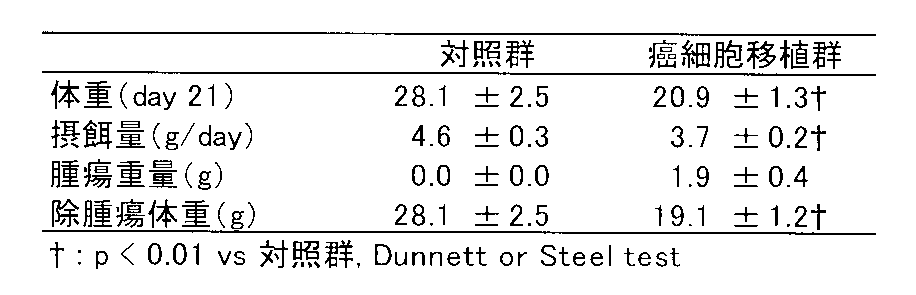
癌細胞移植群では、試験途中より体重の減少が観察され、解剖時には対照群よりも有意に体重が減少した。また、癌細胞移植群では、体重の減少と同様、除腫瘍重量も有意に減少した。
脂肪量については、癌細胞移植群で対照群に対し有意に減少した。また、癌細胞移植群では、筋肉量の有意な減少が見られた。空体についても、癌細胞移植群で顕著な減少が観察された。
血漿中のIL-6濃度およびPGE2濃度については、癌細胞移植群では、有意なIL-6値およびPGE2値の上昇が認められた。
好中球数は癌細胞移植群で有意に増加し、リンパ球数は逆に減少した。また、白血球の割合に関しても同様に、癌細胞移植群で、白血球中の好中球の割合が有意に増加し、リンパ球、単球の割合が有意に減少した。
以上より、Colon26細胞株を移植することで、がんに伴う不可逆性の代謝障害を誘導し、体重減少や筋肉、脂肪の減少、血中の炎症マーカー(IL-6、PGE2)の上昇をもたらすことが示唆された。また、血中の白血球、および白血球分画の数や割合にも異常をきたした。
脂肪量については、癌細胞移植群で対照群に対し有意に減少した。また、癌細胞移植群では、筋肉量の有意な減少が見られた。空体についても、癌細胞移植群で顕著な減少が観察された。
血漿中のIL-6濃度およびPGE2濃度については、癌細胞移植群では、有意なIL-6値およびPGE2値の上昇が認められた。
好中球数は癌細胞移植群で有意に増加し、リンパ球数は逆に減少した。また、白血球の割合に関しても同様に、癌細胞移植群で、白血球中の好中球の割合が有意に増加し、リンパ球、単球の割合が有意に減少した。
以上より、Colon26細胞株を移植することで、がんに伴う不可逆性の代謝障害を誘導し、体重減少や筋肉、脂肪の減少、血中の炎症マーカー(IL-6、PGE2)の上昇をもたらすことが示唆された。また、血中の白血球、および白血球分画の数や割合にも異常をきたした。
[癌細胞移植モデル動物を用いた有効性試験]
前記試験例1で作成した癌細胞移植モデル動物を用いて、本発明の組成物の有効性試験を行った。
(動物実験)
6週齢雄性BALB/cマウスを、1週間馴化の後に、体重を指標に表4記載の群構成で群分けした(N=8)。
前記試験例1で作成した癌細胞移植モデル動物を用いて、本発明の組成物の有効性試験を行った。
(動物実験)
6週齢雄性BALB/cマウスを、1週間馴化の後に、体重を指標に表4記載の群構成で群分けした(N=8)。
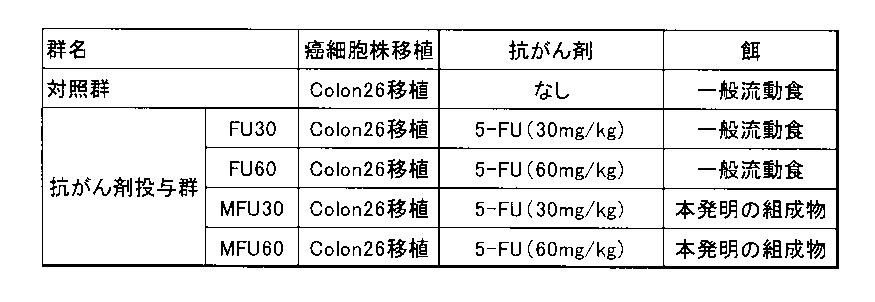
Colon26細胞株(マウスの結腸癌細胞株、財団法人癌研究会)を1×10⁶cell、各個体の脇の皮下に移植した。Colon26細胞移植後から21日間飼育後、解剖および採血を行い、体重、腫瘍重量、除腫瘍重量、脂肪量(精巣周囲脂肪)、筋肉量(長指伸筋)、空体量、血漿中の各種マーカー(PGE2、IL-6)、全血中の白血球数、白血球分画を測定した。
Colon26細胞移植後から剖検までは、凍結乾燥した表5および表6に記載の組成物(一般流動食、または本発明の組成物(栄養組成物と表記))を自由摂取させた。抗がん剤投与群には、5-フルオロウラシル(5-FU)を0.5%カルボキシメチルセルロース水溶液に懸濁し、5mL/kgの容量、60mg/kg、または30mg/kgの用量にて、Colon26細胞移植後1日目から13日目まで週に3回経口投与した(Colon26細胞移植後1、4、6、8、11、13日目)。対照群には、0.5%カルボキシメチルセルロース水溶液5mL/kgを抗がん剤投与と同じスケジュールで投与した。さらに、Colon26細胞移植後から解剖までの期間中の体重、および腫瘍体積を測定した。
Colon26細胞移植後から剖検までは、凍結乾燥した表5および表6に記載の組成物(一般流動食、または本発明の組成物(栄養組成物と表記))を自由摂取させた。抗がん剤投与群には、5-フルオロウラシル(5-FU)を0.5%カルボキシメチルセルロース水溶液に懸濁し、5mL/kgの容量、60mg/kg、または30mg/kgの用量にて、Colon26細胞移植後1日目から13日目まで週に3回経口投与した(Colon26細胞移植後1、4、6、8、11、13日目)。対照群には、0.5%カルボキシメチルセルロース水溶液5mL/kgを抗がん剤投与と同じスケジュールで投与した。さらに、Colon26細胞移植後から解剖までの期間中の体重、および腫瘍体積を測定した。
(測定)
・腫瘍重量:マウスを屠殺後、腫瘍を摘出し、腫瘍の重量を測定した。
・除腫瘍重量:マウスを屠殺後、腫瘍を摘出した後の体重を測定した(除腫瘍体重ともいう)。
・脂肪量(精巣周囲脂肪):精巣周囲脂肪を摘出し、重量を測定した。
・筋肉量(長指伸筋):長指伸筋を摘出し、重量を測定した。
・空体量:マウスを屠殺後、各種臓器(肝臓、脾臓、膵臓、腎臓、小腸、大腸、盲腸、内臓脂肪、精巣、肺)を摘出した後の体重を測定した。
・腫瘍体積:腫瘍の長径(a)と短径(b)を測定し、a×b2/2を体積(cm3)として算出した。
・腫瘍重量:マウスを屠殺後、腫瘍を摘出し、腫瘍の重量を測定した。
・除腫瘍重量:マウスを屠殺後、腫瘍を摘出した後の体重を測定した(除腫瘍体重ともいう)。
・脂肪量(精巣周囲脂肪):精巣周囲脂肪を摘出し、重量を測定した。
・筋肉量(長指伸筋):長指伸筋を摘出し、重量を測定した。
・空体量:マウスを屠殺後、各種臓器(肝臓、脾臓、膵臓、腎臓、小腸、大腸、盲腸、内臓脂肪、精巣、肺)を摘出した後の体重を測定した。
・腫瘍体積:腫瘍の長径(a)と短径(b)を測定し、a×b2/2を体積(cm3)として算出した。

(結果)
図4に、解剖時(Colon26細胞移植後21日目)の体重、腫瘍重量、除腫瘍重量、脂肪量(精巣周囲脂肪)、筋肉量(長指伸筋)、空体量を示す。図5に、血漿中のPGE2、IL-6濃度を示す。図6に、試験期間中の体重、および腫瘍容積の推移を示す。図7に、全血中の白血球数、白血球分画を示す。
腫瘍重量は、TB群、FU30群、MFU30群の間に差を認めなかった。また、5-FU投与量の高いFU60群、MFU60群の間にも差を認めなかった。MFU群(MFU30およびMFU60)で腫瘍重量が増加していないことから、5-FUの抗がん剤治療時に本発明の組成物による栄養管理によって、5-FUのがん治療効果が阻害されることはないことが確認された。
筋肉量は、MFU群(MFU30およびMFU60)で対照と比較して有意に高い値を示した。MFU群はFU群(FU30およびFU60)と比較しても有意に高い筋肉量であった。5-FUの抗がん剤治療 時に本発明の組成物を用いた栄養管理によって、がんの進展に伴う筋肉の減少が抑制されたことから、体重、除腫瘍体重の減少を防止できる可能性が示唆された。
PGE2、IL-6濃度は、MFU群はFU群と比較して有意に低い値を示した。5-FUの抗がん剤治療時に本発明の組成物による栄養管理によって、がんの進展に伴う血中の炎症マーカー(PGE2やIL-6)の亢進が抑制され、それによって、筋肉の減少、さらには体重、除腫瘍体重の減少も防止されることが示唆された。
5-FUの抗がん剤治療時に本発明の組成物による栄養管理を行うことで、がんの進展に伴う単球の減少が抑制された。同時に好中球の増加も抑制する傾向にあった。
図4に、解剖時(Colon26細胞移植後21日目)の体重、腫瘍重量、除腫瘍重量、脂肪量(精巣周囲脂肪)、筋肉量(長指伸筋)、空体量を示す。図5に、血漿中のPGE2、IL-6濃度を示す。図6に、試験期間中の体重、および腫瘍容積の推移を示す。図7に、全血中の白血球数、白血球分画を示す。
腫瘍重量は、TB群、FU30群、MFU30群の間に差を認めなかった。また、5-FU投与量の高いFU60群、MFU60群の間にも差を認めなかった。MFU群(MFU30およびMFU60)で腫瘍重量が増加していないことから、5-FUの抗がん剤治療時に本発明の組成物による栄養管理によって、5-FUのがん治療効果が阻害されることはないことが確認された。
筋肉量は、MFU群(MFU30およびMFU60)で対照と比較して有意に高い値を示した。MFU群はFU群(FU30およびFU60)と比較しても有意に高い筋肉量であった。5-FUの抗がん剤治療 時に本発明の組成物を用いた栄養管理によって、がんの進展に伴う筋肉の減少が抑制されたことから、体重、除腫瘍体重の減少を防止できる可能性が示唆された。
PGE2、IL-6濃度は、MFU群はFU群と比較して有意に低い値を示した。5-FUの抗がん剤治療時に本発明の組成物による栄養管理によって、がんの進展に伴う血中の炎症マーカー(PGE2やIL-6)の亢進が抑制され、それによって、筋肉の減少、さらには体重、除腫瘍体重の減少も防止されることが示唆された。
5-FUの抗がん剤治療時に本発明の組成物による栄養管理を行うことで、がんの進展に伴う単球の減少が抑制された。同時に好中球の増加も抑制する傾向にあった。
本発明の組成物は、がんに伴う不可逆性の代謝障害を予防及び/又は改善することができる。例えば、がん患者の筋肉量低下を予防及び/又は改善して、がん患者のQOLを高めることができる。また、本発明の組成物は安全に摂取できるので、長期療養における栄養管理に適している。
Claims (13)
- タンパク質として乳タンパク質の加水分解物および発酵乳タンパク質、脂質としてオレイン酸を含有する油脂ならびに乳リン脂質及び/又は大豆レシチン、および糖質としてパラチノースを含む、がんに伴う不可逆性の代謝障害の予防及び/又は改善のための組成物。
- 前記乳タンパク質が、カゼイン、乳タンパク質濃縮物(MPC)、ホエイタンパク質濃縮物(WPC)、ホエイタンパク質分離物(WPI)、α-ラクトアルブミン、β-ラクトグロブリンおよびラクトフェリンからなる群より選択される、請求項1記載のがんに伴う不可逆性の代謝障害の予防及び/又は改善のための組成物。
- 前記乳タンパク質が、組成物100mLあたり0.9~3.0g含まれる、請求項1記載のがんに伴う不可逆性の代謝障害の予防及び/又は改善のための組成物。
- 前記発酵乳タンパク質が、発酵乳よりホエイを減少させた組成物に由来する、請求項1記載のがんに伴う不可逆性の代謝障害の予防及び/又は改善のための組成物。
- 発酵乳タンパク質がフレッシュチーズに由来する、請求項1記載のがんに伴う不可逆性の代謝障害の予防及び/又は改善のための組成物。
- フレッシュチーズがクワルクである、請求項5記載のがんに伴う不可逆性の代謝障害の予防及び/又は改善のための組成物。
- 前記発酵乳タンパク質が、組成物100mLあたり2~6g含まれる、請求項1記載のがんに伴う不可逆性の代謝障害の予防及び/又は改善のための組成物。
- 前記乳タンパク質の加水分解物が、ホエイタンパク質分離物(WPI)をバシラス・リシェニフォルムス(Bacillus licheniformus)由来のアルカラーゼで加水分解およびブタ膵臓由来のトリプシンで加水分解して得られうる、請求項1記載のがんに伴う不可逆性の代謝障害の予防及び/又は改善のための組成物。
- 前記乳タンパク質の加水分解物が、分画分子量10,000の限外濾過膜でさらに処理して得られる透過画分(パーミエイト)である、請求項8記載のがんに伴う不可逆性の代謝障害の予防及び/又は改善のための組成物。
- 前記パラチノースが、組成物100mLあたり4~15g含まれる、請求項1記載のがんに伴う不可逆性の代謝障害の予防及び/又は改善のための組成物。
- 前記脂質中、オレイン酸が全脂肪酸組成の30%以上含まれる、請求項1記載のがんに伴う不可逆性の代謝障害の予防及び/又は改善のための組成物。
- 抗がん剤の作用を損なわないことを特徴とする、請求項1記載のがんに伴う不可逆性の代謝障害の予防及び/又は改善のための組成物。
- 抗がん剤の代謝障害作用を促進することを特徴とする、請求項1記載のがんに伴う不可逆性の代謝障害の予防及び/又は改善のための組成物。
Priority Applications (2)
| Application Number | Priority Date | Filing Date | Title |
|---|---|---|---|
| CN201280025937.3A CN103561756A (zh) | 2011-05-27 | 2012-05-25 | 用于预防以及/或者改善癌症引起的非可逆性的代谢紊乱的组合物 |
| JP2013518060A JP6093300B2 (ja) | 2011-05-27 | 2012-05-25 | がんに伴う不可逆性の代謝障害の予防及び/又は改善のための組成物 |
Applications Claiming Priority (2)
| Application Number | Priority Date | Filing Date | Title |
|---|---|---|---|
| JP2011-119095 | 2011-05-27 | ||
| JP2011119095 | 2011-05-27 |
Publications (1)
| Publication Number | Publication Date |
|---|---|
| WO2012165345A1 true WO2012165345A1 (ja) | 2012-12-06 |
Family
ID=47259201
Family Applications (1)
| Application Number | Title | Priority Date | Filing Date |
|---|---|---|---|
| PCT/JP2012/063522 Ceased WO2012165345A1 (ja) | 2011-05-27 | 2012-05-25 | がんに伴う不可逆性の代謝障害の予防及び/又は改善のための組成物 |
Country Status (4)
| Country | Link |
|---|---|
| JP (1) | JP6093300B2 (ja) |
| CN (1) | CN103561756A (ja) |
| TW (1) | TWI629992B (ja) |
| WO (1) | WO2012165345A1 (ja) |
Cited By (6)
| Publication number | Priority date | Publication date | Assignee | Title |
|---|---|---|---|---|
| JP2014201572A (ja) * | 2013-04-09 | 2014-10-27 | 花王株式会社 | 筋タンパク質合成シグナル増強剤 |
| CN105705037A (zh) * | 2013-07-31 | 2016-06-22 | 株式会社明治 | 用于抑制肿瘤生长的营养组合物 |
| JP2016521286A (ja) * | 2013-05-10 | 2016-07-21 | メモリアル スローン−ケタリング キャンサー センター | Rasがんにおける脂質捕捉 |
| JP2017081862A (ja) * | 2015-10-29 | 2017-05-18 | 学校法人慶應義塾 | 摘出手術後の体重減少を軽減するための医薬組成物 |
| JP2018027925A (ja) * | 2016-08-19 | 2018-02-22 | 株式会社明治 | 抗がん剤に起因する末梢神経障害を改善するための組成物 |
| JP2020103244A (ja) * | 2018-12-28 | 2020-07-09 | 株式会社東洋新薬 | 飲食用組成物 |
Families Citing this family (1)
| Publication number | Priority date | Publication date | Assignee | Title |
|---|---|---|---|---|
| SG11201804602SA (en) * | 2015-12-03 | 2018-06-28 | Meiji Co Ltd | Nutritional composition |
Citations (1)
| Publication number | Priority date | Publication date | Assignee | Title |
|---|---|---|---|---|
| JP2004099563A (ja) * | 2002-09-11 | 2004-04-02 | Meiji Milk Prod Co Ltd | 栄養組成物 |
-
2012
- 2012-05-25 TW TW101118671A patent/TWI629992B/zh active
- 2012-05-25 JP JP2013518060A patent/JP6093300B2/ja active Active
- 2012-05-25 CN CN201280025937.3A patent/CN103561756A/zh active Pending
- 2012-05-25 WO PCT/JP2012/063522 patent/WO2012165345A1/ja not_active Ceased
Patent Citations (1)
| Publication number | Priority date | Publication date | Assignee | Title |
|---|---|---|---|---|
| JP2004099563A (ja) * | 2002-09-11 | 2004-04-02 | Meiji Milk Prod Co Ltd | 栄養組成物 |
Non-Patent Citations (6)
| Title |
|---|
| DEBOER MD ET AL.: "Cachexia: lessons from melanocortin antagonism.", TRENDS ENDOCRINOL METAB., vol. 17, no. 5, July 2006 (2006-07-01), pages 199 - 204 * |
| KIMIO ASAGIRI ET AL.: "Gan no Taisha Ijo to Eiyo Shogai", NUTRITION CARE, vol. 2, no. 4, 2009, pages 350 - 354 * |
| NAI YJ ET AL.: "Prevention of cancer cachexia by pyrrolidine dithiocarbamate (PDTC) in colon 26 tumor-bearing mice.", JPEN J PARENTER ENTERAL NUTR., vol. 31, no. 1, February 2007 (2007-02-01), pages 18 - 25 * |
| STRASSMANN G ET AL.: "Evidence for the involvement of interleukin 6 in experimental cancer cachexia.", J CLIN INVEST., vol. 89, no. 5, May 1992 (1992-05-01), pages 1681 - 1684 * |
| STRASSMANN G ET AL.: "Suramin interferes with interleukin-6 receptor binding in vitro and inhibits colon-26-mediated experimental cancer cachexia in vivo.", J CLIN INVEST., vol. 92, no. 5, November 1993 (1993-11-01), pages 2152 - 2159 * |
| ZHANG Y ET AL.: "Sophocarpine and matrine inhibit the production of TNF-alpha and IL-6 in murine macrophages and prevent cachexia-related symptoms induced by colon26 adenocarcinoma in mice.", INT IMMUNOPHARMACOL., vol. 8, no. 13-14, 20 December 2008 (2008-12-20), pages 1767 - 1772 * |
Cited By (12)
| Publication number | Priority date | Publication date | Assignee | Title |
|---|---|---|---|---|
| JP2014201572A (ja) * | 2013-04-09 | 2014-10-27 | 花王株式会社 | 筋タンパク質合成シグナル増強剤 |
| JP2016521286A (ja) * | 2013-05-10 | 2016-07-21 | メモリアル スローン−ケタリング キャンサー センター | Rasがんにおける脂質捕捉 |
| US10130600B2 (en) | 2013-05-10 | 2018-11-20 | Memorial Sloan Kettering Cancer Center | Lipid scavenging in Ras cancers |
| JP2019147836A (ja) * | 2013-05-10 | 2019-09-05 | メモリアル スローン ケタリング キャンサー センター | Rasがんにおける脂質捕捉 |
| US10772862B2 (en) | 2013-05-10 | 2020-09-15 | The Trustees Of Princeton University | Lipid scavenging in Ras cancers |
| CN105705037A (zh) * | 2013-07-31 | 2016-06-22 | 株式会社明治 | 用于抑制肿瘤生长的营养组合物 |
| JP2016531114A (ja) * | 2013-07-31 | 2016-10-06 | 株式会社明治 | 腫瘍の成長を阻止する栄養組成物 |
| JP2017081862A (ja) * | 2015-10-29 | 2017-05-18 | 学校法人慶應義塾 | 摘出手術後の体重減少を軽減するための医薬組成物 |
| JP2018027925A (ja) * | 2016-08-19 | 2018-02-22 | 株式会社明治 | 抗がん剤に起因する末梢神経障害を改善するための組成物 |
| WO2018034345A1 (ja) * | 2016-08-19 | 2018-02-22 | 株式会社明治 | 抗がん剤に起因する末梢神経障害を改善するための組成物 |
| JP2020103244A (ja) * | 2018-12-28 | 2020-07-09 | 株式会社東洋新薬 | 飲食用組成物 |
| JP2025023330A (ja) * | 2018-12-28 | 2025-02-14 | 株式会社東洋新薬 | 飲食用組成物 |
Also Published As
| Publication number | Publication date |
|---|---|
| TW201311265A (zh) | 2013-03-16 |
| JP6093300B2 (ja) | 2017-03-08 |
| JPWO2012165345A1 (ja) | 2015-02-23 |
| TWI629992B (zh) | 2018-07-21 |
| CN103561756A (zh) | 2014-02-05 |
Similar Documents
| Publication | Publication Date | Title |
|---|---|---|
| KR101038354B1 (ko) | 영양 조성물 | |
| JP6234227B2 (ja) | 腸内菌叢改善用栄養組成物 | |
| TWI612902B (zh) | 一種組成物用於製造改善腸道功能組成物的用途及其製備方法 | |
| JP6093300B2 (ja) | がんに伴う不可逆性の代謝障害の予防及び/又は改善のための組成物 | |
| JP2016531114A (ja) | 腫瘍の成長を阻止する栄養組成物 | |
| TWI754662B (zh) | 改善抗癌劑所引起之末梢神經損害用之組成物 | |
| AU2003283831B2 (en) | Nutritional compositions | |
| HK1194664A (en) | Composition for preventing and/or ameliorating cancer-related irreversible metabolism disorders | |
| TW201735942A (zh) | 內毒素之血中移行抑制用組成物 | |
| HK1083174B (en) | Nutritional compositions | |
| HK1224524A1 (en) | Nutritional composition for inhibiting growth of tumor | |
| HK40006523A (en) | Composition for improving peripheral neuropathy caused by anticancer agents | |
| HK1197795B (en) | Nutritional composition for improving intestinal flora |
Legal Events
| Date | Code | Title | Description |
|---|---|---|---|
| 121 | Ep: the epo has been informed by wipo that ep was designated in this application |
Ref document number: 12792054 Country of ref document: EP Kind code of ref document: A1 |
|
| ENP | Entry into the national phase |
Ref document number: 2013518060 Country of ref document: JP Kind code of ref document: A |
|
| NENP | Non-entry into the national phase |
Ref country code: DE |
|
| 122 | Ep: pct application non-entry in european phase |
Ref document number: 12792054 Country of ref document: EP Kind code of ref document: A1 |