WO2012160997A1 - 粘着フィルム - Google Patents
粘着フィルム Download PDFInfo
- Publication number
- WO2012160997A1 WO2012160997A1 PCT/JP2012/062197 JP2012062197W WO2012160997A1 WO 2012160997 A1 WO2012160997 A1 WO 2012160997A1 JP 2012062197 W JP2012062197 W JP 2012062197W WO 2012160997 A1 WO2012160997 A1 WO 2012160997A1
- Authority
- WO
- WIPO (PCT)
- Prior art keywords
- cation
- bis
- imide
- meth
- pressure
- Prior art date
- Legal status (The legal status is an assumption and is not a legal conclusion. Google has not performed a legal analysis and makes no representation as to the accuracy of the status listed.)
- Ceased
Links
Classifications
-
- C—CHEMISTRY; METALLURGY
- C09—DYES; PAINTS; POLISHES; NATURAL RESINS; ADHESIVES; COMPOSITIONS NOT OTHERWISE PROVIDED FOR; APPLICATIONS OF MATERIALS NOT OTHERWISE PROVIDED FOR
- C09J—ADHESIVES; NON-MECHANICAL ASPECTS OF ADHESIVE PROCESSES IN GENERAL; ADHESIVE PROCESSES NOT PROVIDED FOR ELSEWHERE; USE OF MATERIALS AS ADHESIVES
- C09J7/00—Adhesives in the form of films or foils
- C09J7/30—Adhesives in the form of films or foils characterised by the adhesive composition
- C09J7/38—Pressure-sensitive adhesives [PSA]
- C09J7/381—Pressure-sensitive adhesives [PSA] based on macromolecular compounds obtained by reactions involving only carbon-to-carbon unsaturated bonds
- C09J7/385—Acrylic polymers
-
- B—PERFORMING OPERATIONS; TRANSPORTING
- B32—LAYERED PRODUCTS
- B32B—LAYERED PRODUCTS, i.e. PRODUCTS BUILT-UP OF STRATA OF FLAT OR NON-FLAT, e.g. CELLULAR OR HONEYCOMB, FORM
- B32B27/00—Layered products comprising a layer of synthetic resin
- B32B27/30—Layered products comprising a layer of synthetic resin comprising vinyl (co)polymers; comprising acrylic (co)polymers
-
- C—CHEMISTRY; METALLURGY
- C09—DYES; PAINTS; POLISHES; NATURAL RESINS; ADHESIVES; COMPOSITIONS NOT OTHERWISE PROVIDED FOR; APPLICATIONS OF MATERIALS NOT OTHERWISE PROVIDED FOR
- C09J—ADHESIVES; NON-MECHANICAL ASPECTS OF ADHESIVE PROCESSES IN GENERAL; ADHESIVE PROCESSES NOT PROVIDED FOR ELSEWHERE; USE OF MATERIALS AS ADHESIVES
- C09J133/00—Adhesives based on homopolymers or copolymers of compounds having one or more unsaturated aliphatic radicals, each having only one carbon-to-carbon double bond, and at least one being terminated by only one carboxyl radical, or of salts, anhydrides, esters, amides, imides, or nitriles thereof; Adhesives based on derivatives of such polymers
- C09J133/04—Homopolymers or copolymers of esters
- C09J133/14—Homopolymers or copolymers of esters of esters containing halogen, nitrogen, sulfur or oxygen atoms in addition to the carboxy oxygen
-
- C—CHEMISTRY; METALLURGY
- C09—DYES; PAINTS; POLISHES; NATURAL RESINS; ADHESIVES; COMPOSITIONS NOT OTHERWISE PROVIDED FOR; APPLICATIONS OF MATERIALS NOT OTHERWISE PROVIDED FOR
- C09J—ADHESIVES; NON-MECHANICAL ASPECTS OF ADHESIVE PROCESSES IN GENERAL; ADHESIVE PROCESSES NOT PROVIDED FOR ELSEWHERE; USE OF MATERIALS AS ADHESIVES
- C09J9/00—Adhesives characterised by their physical nature or the effects produced, e.g. glue sticks
- C09J9/02—Electrically-conducting adhesives
-
- C—CHEMISTRY; METALLURGY
- C08—ORGANIC MACROMOLECULAR COMPOUNDS; THEIR PREPARATION OR CHEMICAL WORKING-UP; COMPOSITIONS BASED THEREON
- C08L—COMPOSITIONS OF MACROMOLECULAR COMPOUNDS
- C08L2312/00—Crosslinking
-
- Y—GENERAL TAGGING OF NEW TECHNOLOGICAL DEVELOPMENTS; GENERAL TAGGING OF CROSS-SECTIONAL TECHNOLOGIES SPANNING OVER SEVERAL SECTIONS OF THE IPC; TECHNICAL SUBJECTS COVERED BY FORMER USPC CROSS-REFERENCE ART COLLECTIONS [XRACs] AND DIGESTS
- Y10—TECHNICAL SUBJECTS COVERED BY FORMER USPC
- Y10T—TECHNICAL SUBJECTS COVERED BY FORMER US CLASSIFICATION
- Y10T428/00—Stock material or miscellaneous articles
- Y10T428/28—Web or sheet containing structurally defined element or component and having an adhesive outermost layer
- Y10T428/2852—Adhesive compositions
- Y10T428/2878—Adhesive compositions including addition polymer from unsaturated monomer
- Y10T428/2891—Adhesive compositions including addition polymer from unsaturated monomer including addition polymer from alpha-beta unsaturated carboxylic acid [e.g., acrylic acid, methacrylic acid, etc.] Or derivative thereof
Definitions
- the present invention relates to an adhesive film.
- the pressure-sensitive adhesive film of the present invention is used for plastic products and the like that easily generate static electricity.
- adherends such as polarizing plates, wave plates, retardation plates, optical compensation films, reflection sheets, brightness enhancement films, and diffusion sheets having irregularities on the surface (the surface is not smooth) used in liquid crystal displays and the like.
- the present invention relates to a pressure-sensitive adhesive film that is excellent in adhesive properties (adhesiveness), further suppresses peeling voltage at the time of peeling, and has excellent removability.
- the surface protective film is used for the purpose of sticking to an object to be protected (adhered body) via an adhesive layer and preventing scratches and dirt generated during processing and transportation of the object to be protected.
- surface protective films used for optical members such as diffusion sheets are used for the purpose of protecting shipments, processing adherends, and preventing scratches and dirt that occur during transportation after sticking. The protective film becomes unnecessary and is finally peeled off and removed.
- the base material, pressure-sensitive adhesive, and separator constituting the surface protective film are often made of plastic materials, they have high electrical insulation, and static electricity is generated during friction and peeling. Due to the static electricity generated at the time of peeling, dust or dirt adheres to the surface protection film, contaminates the diffusion sheet and other optical members, causes a defect in the pasted state such as foreign matter mixing, The encapsulated liquid crystal or electronic circuit may be damaged.
- the object of the present invention is to solve the problems in the adhesive (surface protection) film used for the surface protection of an adherend having an uneven surface (the surface is not smooth), such as a conventional diffusion sheet. Therefore, when sticking an adhesive film to a diffusion sheet, etc., it exhibits excellent adhesive properties (sufficient adhesion), suppresses the stripping voltage generated when peeling the adhesive film from the diffusion sheet, etc. It is in providing the adhesive film excellent in.
- the present inventors have intensively studied the pressure-sensitive adhesive film, and as a result, have a pressure-sensitive adhesive layer containing a (meth) acrylic polymer, an ionic liquid, and a cross-linking agent, under specific conditions.
- a pressure-sensitive adhesive layer containing a (meth) acrylic polymer, an ionic liquid, and a cross-linking agent, under specific conditions.
- an adhesive film having a specific range of adhesive strength it exhibits sufficient adhesion (adhesiveness) to an adherend having irregularities, and can be prevented from being charged when peeled off. It has been found that an adhesive film excellent in peelability can be obtained, and the present invention has been completed.
- the pressure-sensitive adhesive film of the present invention is a pressure-sensitive adhesive film having a base material layer and a pressure-sensitive adhesive layer on at least one side of the base material layer, and the pressure-sensitive adhesive layer comprises a (meth) acrylic polymer, an ionic liquid, and , Containing a crosslinking agent, 2 parts by weight or less of the crosslinking agent with respect to 100 parts by weight of the (meth) acrylic polymer, and the adhesive strength of the adhesive film (adherent: acrylic panel, 23 ° C. ⁇ 50 After 30 minutes under the% RH condition) is 0.5 N / 25 mm or more at a tensile speed of 1.0 m / min.
- the pressure-sensitive adhesive film of the present invention preferably has an absolute value of 0.5 kV or less at a peeling speed of 10 m / min at a peeling voltage (adhered body: acrylic panel, 23 ° C. ⁇ 50% RH condition).
- the (meth) acrylic polymer preferably contains a (meth) acrylic monomer having an alkyl group having 1 to 14 carbon atoms as a constituent component.
- the amount of the ionic liquid is preferably 0.01 to 2.5 parts by weight with respect to 100 parts by weight of the (meth) acrylic polymer.
- the pressure-sensitive adhesive film of the present invention is preferably used for surface protection of a diffusion sheet.
- the (meth) acrylic polymer refers to an acrylic polymer and / or a methacrylic polymer
- the (meth) acrylic monomer refers to an acrylic monomer and / or a methacrylic monomer
- Acrylate refers to acrylate and / or methacrylate.
- the pressure-sensitive adhesive properties from the adherend to peeling off the pressure-sensitive adhesive film are excellent.
- the antistatic property when the pressure-sensitive adhesive film is peeled off from the adherend It has excellent peelability and is useful. In particular, it has irregularities on the surface, and general adhesive films exhibit excellent adhesive properties for adherends such as diffusion sheets that cannot exhibit sufficient adhesive properties, and are excellent in antistatic properties and removability. Therefore, it is very useful in the technical field related to electronic equipment.
- the pressure-sensitive adhesive layer in the present invention contains a (meth) acrylic polymer.
- the (meth) acrylic polymer preferably contains a (meth) acrylic monomer having an alkyl group having 1 to 14 carbon atoms as a constituent component.
- Use of a (meth) acrylic polymer is preferable from the viewpoints of ease of handling, adhesive strength and peelability.
- a (meth) acrylic monomer having an alkyl group having 1 to 14 carbon atoms can be used, but a (meth) acrylic monomer having an alkyl group having 4 to 14 carbon atoms is more preferable.
- examples thereof include methyl (meth) acrylate and ethyl (meth) acrylate.
- These acrylic monomers may be used alone or in combination of two or more.
- the amount of the (meth) acrylic monomer having an alkyl group having 1 to 14 carbon atoms is preferably 50% by weight or more, more preferably 60 to 100% by weight, and even more preferably 70 to 98% by weight in the monomer component. preferable. Within the above range, good interaction with the ionic liquid and good tackiness (adhesiveness) will be appropriately adjusted, which is preferable.
- polymerizable monomers other than the (meth) acrylic monomer having an alkyl group having 1 to 14 carbon atoms include a polymerizable monomer for adjusting the glass transition point and peelability of the (meth) acrylic polymer, etc. Can be used as long as the effects of the present invention are not impaired. These monomers may be used alone or in combination, but the amount of other polymerizable monomers in the monomer component (whole) is preferably less than 50% by weight.
- Examples of the other polymerizable monomers include cohesive force / heat resistance improving components such as sulfonic acid group-containing monomers, phosphoric acid group-containing monomers, cyano group-containing monomers, vinyl ester monomers, aromatic vinyl monomers, and carboxyl group-containing monomers.
- cohesive force / heat resistance improving components such as sulfonic acid group-containing monomers, phosphoric acid group-containing monomers, cyano group-containing monomers, vinyl ester monomers, aromatic vinyl monomers, and carboxyl group-containing monomers.
- the acid value of the (meth) acrylic polymer is preferably adjusted to 40 or less, more preferably 29 or less, still more preferably 16 or less, particularly preferably 8 or less, and most preferably 1 or less.
- the acid value of the (meth) acrylic polymer exceeds 40, the charging characteristics are deteriorated, which is not preferable.
- the acid value of the (meth) acrylic polymer in the present invention means the number of mg of potassium hydroxide necessary to neutralize free fatty acid, resin acid, etc. contained in 1 g of a sample.
- the (meth) acrylic polymer skeleton having a large acid value there are a large number of carboxyl groups and sulfonate groups having a large interaction with the ionic liquid, and as a result, ion conduction by the ionic liquid is hindered, It is presumed that excellent antistatic ability cannot be obtained.
- Examples of the acid value of the (meth) acrylic polymer being 40 or less include, for example, an acrylic polymer obtained by copolymerizing 2-ethylhexyl acrylate and acrylic acid as a (meth) acrylic polymer having a carboxyl group.
- acrylic acid is 5.1 parts by weight or less with respect to 100 parts by weight of the total amount of 2-ethylhexyl acrylate and acrylic acid.
- the said acid value can be made into 29 or less by adjusting acrylic acid to 3.7 parts weight or less.
- sulfonic acid group-containing monomer examples include styrene sulfonic acid, allyl sulfonic acid, 2- (meth) acrylamide-2-methylpropane sulfonic acid, (meth) acrylamide propane sulfonic acid, sulfopropyl (meth) acrylate, (meth) And acryloyloxynaphthalene sulfonic acid.
- Examples of the phosphate group-containing monomer include 2-hydroxyethylacryloyl phosphate.
- Examples of the cyano group-containing monomer include acrylonitrile.
- Examples of the vinyl ester monomer include vinyl acetate, vinyl propionate, and vinyl laurate.
- aromatic vinyl monomer examples include styrene, chlorostyrene, chloromethylstyrene, ⁇ -methylstyrene, and the like.
- carboxyl group-containing monomer examples include (meth) acrylic acid, carboxyethyl (meth) acrylate, carboxypentyl (meth) acrylate, itaconic acid, maleic acid, fumaric acid, and crotonic acid.
- Examples of the acid anhydride group-containing monomer include maleic anhydride and itaconic anhydride.
- hydroxyl group-containing monomer examples include 2-hydroxyethyl (meth) acrylate, 2-hydroxypropyl (meth) acrylate, 4-hydroxybutyl (meth) acrylate, 6-hydroxyhexyl (meth) acrylate, and 8-hydroxyoctyl.
- amide group-containing monomer examples include acrylamide and diethyl acrylamide.
- amino group-containing monomer examples include N, N-dimethylaminoethyl (meth) acrylate, N, N-dimethylaminopropyl (meth) acrylate, and the like.
- epoxy group-containing monomer examples include glycidyl (meth) acrylate and allyl glycidyl ether.
- vinyl ether monomer examples include methyl vinyl ether, ethyl vinyl ether, isobutyl vinyl ether, and the like.
- the (meth) acrylic polymer used in the present invention preferably has a weight average molecular weight of 100,000 to 5,000,000, more preferably 200,000 to 4,000,000, more preferably 300,000 to 3,000,000.
- the weight average molecular weight is smaller than 100,000, the adhesive force (adhesive force) at the time of peeling increases due to the improvement of the wettability to the adherend, causing damage to the adherend during the peeling process (re-peeling).
- the adhesive force tends to be generated due to a decrease in the cohesive force of the pressure-sensitive adhesive layer.
- a weight average molecular weight means what was obtained by measuring by GPC (gel permeation chromatography).
- the glass transition temperature (Tg) of the (meth) acrylic polymer is preferably 0 ° C. or lower (usually ⁇ 100 ° C. or higher), more preferably ⁇ 10 ° C. or lower. More preferably, it is ⁇ 20 ° C. or lower.
- the glass transition temperature (Tg) of a (meth) acrylic-type polymer can be adjusted in the said range by changing the monomer component and composition ratio to be used suitably.
- the polymerization method of the (meth) acrylic polymer used in the present invention is not particularly limited, and can be polymerized by a known method such as solution polymerization, emulsion polymerization, bulk polymerization, suspension polymerization, etc. Therefore, solution polymerization is more preferable. Moreover, any of a random copolymer, a block copolymer, etc. may be sufficient as the obtained copolymer.
- the pressure-sensitive adhesive layer in the present invention contains an ionic liquid.
- the ionic liquid as an antistatic agent, a pressure-sensitive adhesive layer having a high antistatic effect can be obtained without impairing the adhesive properties.
- the details of the reason why excellent antistatic properties can be obtained by using an ionic liquid are not clear, the ionic liquid is in a liquid state, so that molecular movement is easy, and molecular rearrangement is likely to occur due to generation of electric charge. Therefore, it is considered that even when an ionic liquid is contained in the adhesive, a charge neutralization mechanism by molecular rearrangement works, so that an excellent antistatic ability can be obtained.
- the ionic liquid is liquid at room temperature, it can be easily added to the adhesive and dispersed or dissolved as compared with the solid salt. Further, since the ionic liquid has no vapor pressure (nonvolatile), it has a characteristic that the antistatic property is continuously obtained without disappearing with time.
- the ionic liquid refers to a molten salt (ionic compound) that is liquid at room temperature (25 ° C.).
- ionic liquid those composed of an organic cation component represented by the following general formulas (A) to (E) and an anion component are preferably used.
- An ionic liquid having these cations provides a further excellent antistatic ability.
- R a in the formula (A) represents a hydrocarbon group having 4 to 20 carbon atoms, and may be a functional group in which a part of the hydrocarbon group is substituted with a hetero atom
- R b and R c May be the same or different and each represents hydrogen or a hydrocarbon group having 1 to 16 carbon atoms, and a part of the hydrocarbon group may be a functional group substituted with a hetero atom.
- the nitrogen atom contains a double bond, there is no R c .
- R d in the formula (B) represents a hydrocarbon group having 2 to 20 carbon atoms, and may be a functional group in which a part of the hydrocarbon group is substituted with a hetero atom
- R e , R f And R g may be the same or different and each represents hydrogen or a hydrocarbon group having 1 to 16 carbon atoms, and a part of the hydrocarbon group may be a functional group substituted with a hetero atom.
- R h in the formula (C) represents a hydrocarbon group having 2 to 20 carbon atoms, and may be a functional group in which a part of the hydrocarbon group is substituted with a hetero atom
- R i , R j , And R k may be the same or different and each represents hydrogen or a hydrocarbon group having 1 to 16 carbon atoms, and a part of the hydrocarbon group may be a functional group substituted with a hetero atom.
- Z in the formula (D) represents a nitrogen, sulfur, or phosphorus atom
- R 1 , R m , R n , and R o are the same or different and represent a hydrocarbon group having 1 to 20 carbon atoms.
- a functional group in which a part of the hydrocarbon group is substituted with a hetero atom may be used.
- Z is a sulfur atom, there is no Ro .
- R P in the formula (E) represents a hydrocarbon group having 1 to 18 carbon atoms, a part of the hydrocarbon group may be substituted by a functional group with a heteroatom.
- Examples of the cation represented by the formula (A) include a pyridinium cation, a piperidinium cation, a pyrrolidinium cation, a cation having a pyrroline skeleton, a cation having a pyrrole skeleton, and a morpholinium cation.
- Specific examples include, for example, 1-ethylpyridinium cation, 1-butylpyridinium cation, 1-hexylpyridinium cation, 1-butyl-3-methylpyridinium cation, 1-butyl-4-methylpyridinium cation, 1-hexyl.
- Examples of the cation represented by the formula (B) include an imidazolium cation, a tetrahydropyrimidinium cation, and a dihydropyrimidinium cation.
- Specific examples include, for example, 1,3-dimethylimidazolium cation, 1,3-diethylimidazolium cation, 1-ethyl-3-methylimidazolium cation, 1-butyl-3-methylimidazolium cation, 1-helium Xyl-3-methylimidazolium cation, 1-octyl-3-methylimidazolium cation, 1-decyl-3-methylimidazolium cation, 1-dodecyl-3-methylimidazolium cation, 1-tetradecyl-3-methylimidazole Rium cation, 1,2-dimethyl-3-propylimidazolium cation, 1-ethyl-2,3-dimethylimidazolium cation, 1-butyl-2,3-dimethylimidazolium cation, 1-hexyl-2,3 -Dimethylimidazolium cation, 1,3-dimethyl 1,4,5
- Examples of the cation represented by the formula (C) include a pyrazolium cation and a pyrazolinium cation.
- Specific examples include, for example, 1-methylpyrazolium cation, 3-methylpyrazolium cation, 1-ethyl-2-methylpyrazolinium cation, 1-ethyl-2,3,5-trimethylpyrazolium cation 1-propyl-2,3,5-trimethylpyrazolium cation, 1-butyl-2,3,5-trimethylpyrazolium cation, 1-ethyl-2,3,5-trimethylpyrazolinium cation, 1 -Propyl-2,3,5-trimethylpyrazolinium cation, 1-butyl-2,3,5-trimethylpyrazolinium cation and the like.
- Examples of the cation represented by the formula (D) include a tetraalkylammonium cation, a trialkylsulfonium cation, a tetraalkylphosphonium cation, and a part of the alkyl group is substituted with an alkenyl group, an alkoxyl group, or an epoxy group. And so on.
- Specific examples include, for example, tetramethylammonium cation, tetraethylammonium cation, tetrabutylammonium cation, tetrapentylammonium cation, tetrahexylammonium cation, tetraheptylammonium cation, triethylmethylammonium cation, tributylethylammonium cation, trimethyldecylammonium cation N, N-diethyl-N-methyl-N- (2-methoxyethyl) ammonium cation, glycidyltrimethylammonium cation, trimethylsulfonium cation, triethylsulfonium cation, tributylsulfonium cation, trihexylsulfonium cation, diethylmethylsulfonium cation, dibutyl Ethyl
- asymmetric such as triethylmethylammonium cation, tributylethylammonium cation, trimethyldecylammonium cation, diethylmethylsulfonium cation, dibutylethylsulfonium cation, dimethyldecylsulfonium cation, triethylmethylphosphonium cation, tributylethylphosphonium cation, trimethyldecylphosphonium cation, etc.
- Examples of the cation represented by the formula (E) include a sulfonium cation. Further, the formula Specific examples of R P in (E) is a methyl group, an ethyl group, a propyl group, a butyl group, a hexyl group, an octyl group, nonyl group, decyl group, dodecyl group, tridecyl group, tetradecyl group, An octadecyl group etc. are mentioned.
- the anion component is not particularly limited as long as it satisfies that it becomes an ionic liquid, for example, Cl ⁇ , Br ⁇ , I ⁇ , AlCl 4 ⁇ , Al 2 Cl 7 ⁇ , BF 4 ⁇ , PF 6.
- anion component an anion represented by the following formula (F) can also be used.
- an anion component an anion component containing a fluorine atom is particularly preferably used since an ionic liquid having a low melting point can be obtained.
- ionic liquid used in the present invention are appropriately selected from a combination of the cation component and the anion component.
- the ionic liquid used in the present invention are appropriately selected from a combination of the cation component and the anion component.
- the ionic liquid as described above may be a commercially available one, but can also be synthesized as follows.
- the method of synthesizing the ionic liquid is not particularly limited as long as the desired ionic liquid can be obtained, but in general, it is referred to the document “Ionic liquids—the forefront and future of development” [issued by CMC Publishing Co., Ltd.].
- a halide method, a hydroxide method, an acid ester method, a complex formation method, a neutralization method, and the like are used.
- the halide method is a method carried out by reactions as shown in the following formulas (1) to (3).
- a tertiary amine and an alkyl halide are reacted to obtain a halide.
- Acid (HA) or salt (MA, M is the ionic liquid anion structure (A ⁇ ) for the obtained halide.
- a target ionic liquid (R 4 NA) is obtained by reacting with a target anion such as ammonium, lithium, sodium, potassium and the like to form a salt.
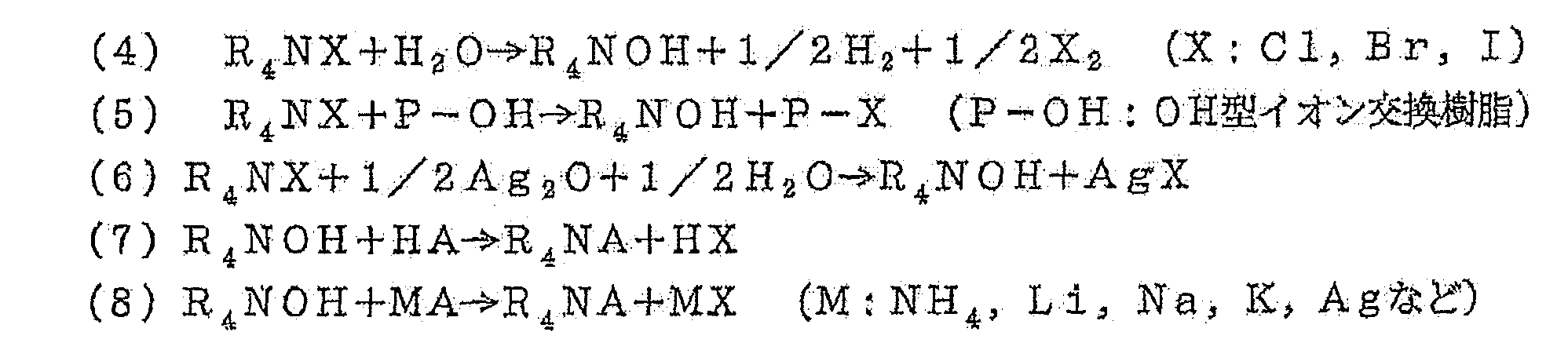
- the hydroxide method is a method carried out by reactions as shown in (4) to (8).
- reaction formula (4) ion exchange membrane electrolysis
- reaction formula (5) OH type ion exchange resin method
- Ag 2 O reaction formula (reaction formula ( 6))
- the obtained hydroxide is converted into the target ionic liquid (R 4 NA) using the reactions of the reaction formulas (7) to (8) in the same manner as the halogenation method. ) Is obtained.
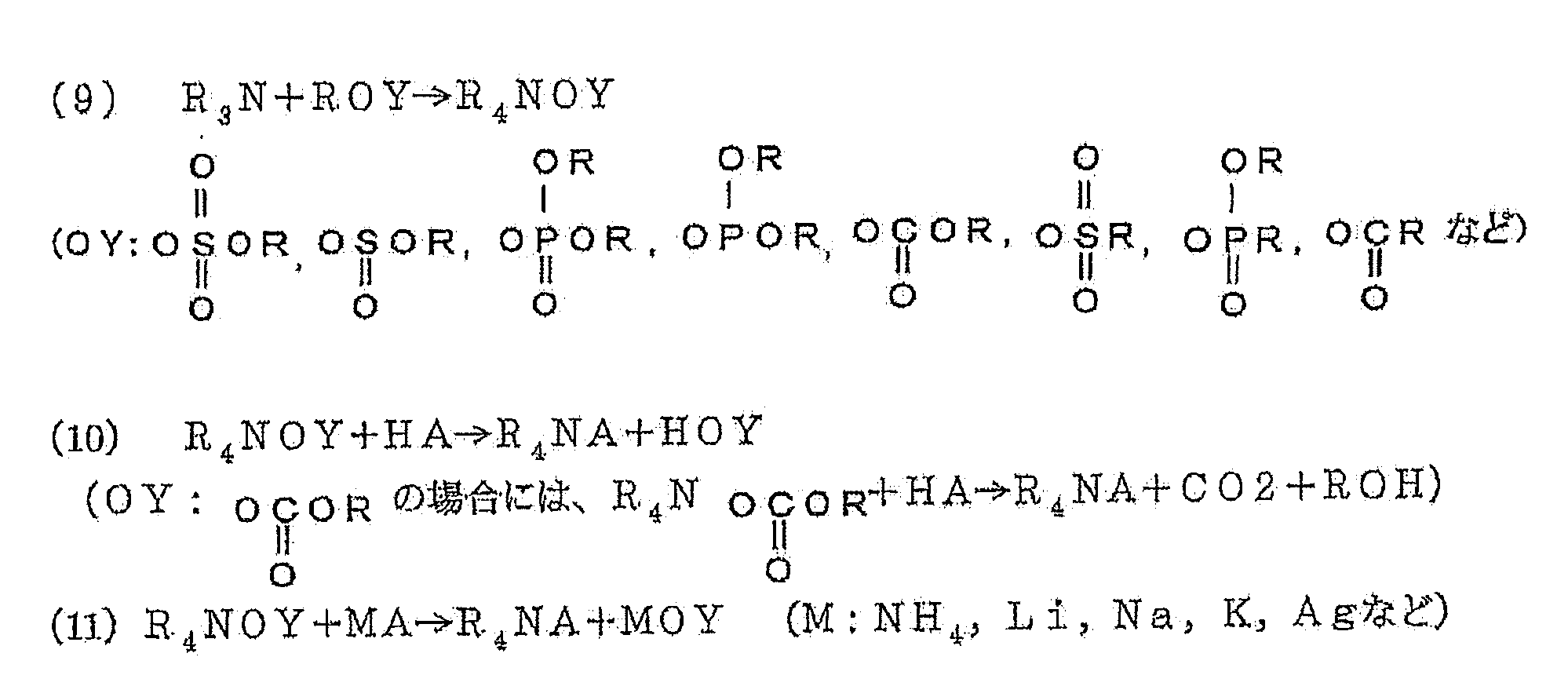
- the acid ester method is a method carried out by reactions as shown in (9) to (11).
- a tertiary amine (R 3 N) is reacted with an acid ester to obtain an acid ester product.
- reaction formula (9) as the acid ester, an ester of an inorganic acid such as sulfuric acid, sulfurous acid, phosphoric acid, phosphorous acid or carbonic acid, or an organic acid such as methanesulfonic acid, methylphosphonic acid or formic acid
- the obtained acid ester is used in the reactions of reaction formulas (10) to (11) in the same manner as in the halogenation method to obtain the target ionic liquid (R 4 NA).
- the target ionic liquid R 4 NA
- an ionic liquid can be obtained directly.
- the complex formation method is a method performed by the reactions shown in (12) to (15).
- a quaternary ammonium halide R 4 NX
- a quaternary ammonium hydroxide R 4 NOH
- a quaternary ammonium carbonate ester R 4 NOCO 2 CH 3
- HF hydrogen fluoride
- NH 4 F Reaction with ammonium fluoride
- reaction formulas (12) to (14) The obtained quaternary ammonium fluoride salt is complexed with a fluoride such as BF 3 , AlF 3 , PF 5 , ASF 5 , SbF 5 , NbF 5 , TaF 5. An ionic liquid can be obtained. (Reaction Formula (15))
- the neutralization method is a method performed by a reaction as shown in (16).
- Tertiary amine and HBF 4 , HPF 6 , CH 3 COOH, CF 3 COOH, CF 3 SO 3 H, (CF 3 SO 2 ) 2 NH, (CF 3 SO 2 ) 3 CH, (C 2 F 5 SO 2 ) 2 It can be obtained by reacting with an organic acid such as NH.
- R in the above formulas (1) to (16) represents hydrogen or a hydrocarbon group having 1 to 20 carbon atoms, and a part of the hydrocarbon group may be substituted with a hetero atom or a functional group. good.
- the blending amount of the ionic liquid is preferably 0.01 to 2.5 parts by weight, more preferably 0.05 to 2.4 parts by weight, and more preferably 0.1 to 2.5 parts by weight with respect to 100 parts by weight of the (meth) acrylic polymer. More preferred is 2.2 parts by weight.
- the amount is less than 0.01 part by weight, it is difficult to obtain sufficient charging characteristics, and when the amount exceeds 2.5 parts by weight, the contamination of the adherend increases or the adhesive strength decreases and the surface has irregularities (surface Is not preferable, because it may not be able to exhibit sufficient adhesive properties (adhesiveness) to an adherend (for example, a diffusion sheet).
- the pressure-sensitive adhesive layer used in the present invention contains a crosslinking agent.
- a crosslinking agent By containing a crosslinking agent, the said (meth) acrylic-type polymer can be bridge
- an isocyanate compound As the crosslinking agent used in the present invention, an isocyanate compound, an epoxy compound, a melamine resin, an aziridine derivative, a metal chelate compound, or the like is used.
- isocyanate compounds and epoxy compounds are particularly preferably used mainly from the viewpoint of obtaining an appropriate cohesive force. These compounds may be used alone or in combination of two or more.
- isocyanate compound examples include lower aliphatic polyisocyanates such as butylene diisocyanate and hexamethylene diisocyanate, alicyclic isocyanates such as cyclopentylene diisocyanate, cyclohexylene diisocyanate, and isophorone diisocyanate, 2,4-tolylene diisocyanate, Aromatic isocyanates such as 4,4'-diphenylmethane diisocyanate and xylylene diisocyanate, trimethylolpropane / tolylene diisocyanate trimer adduct (trade name Coronate L, manufactured by Nippon Polyurethane Industry Co., Ltd.), trimethylolpropane / hexamethylene Diisocyanate trimer adduct (trade name Coronate HL, manufactured by Nippon Polyurethane Industry Co., Ltd.), isocyanurate of hexamethylene diisocyanate Door body (trade name: Coronat
- Examples of the epoxy compound include N, N, N ′, N′-tetraglycidyl-m-xylenediamine (trade name: TETRAD-X, manufactured by Mitsubishi Gas Chemical Company) and 1,3-bis (N, N-diglycidyl). Aminomethyl) cyclohexane (trade name: TETRAD-C, manufactured by Mitsubishi Gas Chemical Company, Inc.). These compounds may be used alone or in combination of two or more.
- Examples of the melamine resin include hexamethylol melamine.
- Examples of the aziridine derivative include a commercially available product name HDU (manufactured by Mutual Pharmaceutical Company), a product name TAZM (manufactured by Mutual Pharmaceutical Company), and a product name TAZO (manufactured by Mutual Pharmaceutical Company). These compounds may be used alone or in combination of two or more.
- metal chelate compound examples include aluminum, iron, tin, titanium and nickel as metal components, and acetylene, methyl acetoacetate, ethyl lactate and acetylacetone as chelate components. These compounds may be used alone or in combination of two or more.
- a polyfunctional monomer having two or more radiation-reactive unsaturated bonds can be blended as a crosslinking agent.
- the (meth) acrylic polymer is crosslinked by irradiating with radiation or the like.
- a polyfunctional monomer having two or more radiation-reactive unsaturated bonds in one molecule for example, it can be crosslinked (cured) by irradiation with radiation such as vinyl group, acryloyl group, methacryloyl group, vinylbenzyl group. Examples thereof include polyfunctional monomers having two or more radiation reactivity of one kind or two or more kinds.
- the polyfunctional monomer generally, those having 10 or less radiation-reactive unsaturated bonds are preferably used. These compounds may be used alone or in combination of two or more.
- polyfunctional monomer examples include, for example, ethylene glycol di (meth) acrylate, diethylene glycol di (meth) acrylate, tetraethylene glycol di (meth) acrylate, neopentyl glycol di (meth) acrylate, and 1,6 hexane.
- examples include diol di (meth) acrylate, trimethylolpropane tri (meth) acrylate, pentaerythritol tri (meth) acrylate, dipentaerythritol hexa (meth) acrylate, divinylbenzene, and N, N′-methylenebisacrylamide.
- the amount of the crosslinking agent used in the present invention is 2 parts by weight or less, preferably 0.05 to 1.5 parts by weight, based on 100 parts by weight of the (meth) acrylic polymer. More preferably, the content is 1 to 1 part by weight. If it is in the said range, the adhesive layer excellent in heat resistance and removability can be obtained, and it is useful. In addition, when the blending amount of the crosslinking agent is less than 0.05 parts by weight, there is a fear that the crosslinking formation by the crosslinking agent may be insufficient, and the cohesive force of the pressure-sensitive adhesive layer becomes small, and sufficient heat resistance May not be obtained, and tends to cause glue residue.
- crosslinking agents may be used alone or in combination of two or more.
- Examples of the radiation include ultraviolet rays, laser beams, ⁇ rays, ⁇ rays, ⁇ rays, X rays, and electron beams, and ultraviolet rays are preferably used from the viewpoints of controllability, ease of handling, and cost. More preferably, ultraviolet rays having a wavelength of 200 to 400 nm are used. Ultraviolet rays can be irradiated using an appropriate light source such as a high-pressure mercury lamp, a microwave excitation lamp, or a chemical lamp. In addition, when using an ultraviolet-ray as a radiation, a photoinitiator is mix
- the photopolymerization initiator may be any substance that generates radicals or cations by irradiating ultraviolet rays having an appropriate wavelength that can trigger the polymerization reaction according to the type of the radiation-reactive component.
- radical photopolymerization initiators for example, benzoin such as benzoin, benzoin methyl ether, benzoin ethyl ether, methyl o-benzoylbenzoate-p-benzoin ethyl ether, benzoin isopropyl ether, ⁇ -methylbenzoin, benzyldimethyl ketal, trichloro Acetophenones such as acetophenone, 2,2-diethoxyacetophenone, 1-hydroxycyclohexyl phenyl ketone, 2-hydroxy-2-methylpropiophenone, 2-hydroxy-4'-isopropyl-2-methylpropiophenone, etc.
- benzoin such as benzoin, benzoin methyl ether, benzoin ethyl ether, methyl o-benzoylbenzoate-p-benzoin ethyl ether, benzoin isopropyl ether, ⁇ -methylbenzoin, benzyldimethyl
- Benzophenones such as propiophenones, benzophenone, methylbenzophenone, p-chlorobenzophenone, p-dimethylaminobenzophenone, 2-chlorothioxanthone, 2-ethy Thioxanthones such as thioxanthone and 2-isopropylthioxanthone, bis (2,4,6-trimethylbenzoyl) -phenylphosphine oxide, 2,4,6-trimethylbenzoyldiphenylphosphine oxide, (2,4,6-trimethylbenzoyl)- And acylphosphine oxides such as (ethoxy) -phenylphosphine oxide, benzyl, dibenzosuberone, ⁇ -acyl oxime ester and the like. These compounds may be used alone or in combination of two or more.
- Examples of the cationic photopolymerization initiator include onium salts such as aromatic diazonium salts, aromatic iodonium salts, and aromatic sulfonium salts, organometallic complexes such as iron-allene complexes, titanocene complexes, and arylsilanol-aluminum complexes, nitro Examples thereof include benzyl ester, sulfonic acid derivative, phosphoric acid ester, phosphoric acid ester, phenol sulfonic acid ester, diazonaphthoquinone, and N-hydroxyimide sulfonate. These compounds may be used alone or in combination of two or more.
- the photopolymerization initiator is usually added in an amount of 0.1 to 10 parts by weight and preferably 0.2 to 7 parts by weight with respect to 100 parts by weight of the acrylic polymer.
- a photoinitiated polymerization aid such as amines can be used in combination.
- the photoinitiator aid include 2-dimethylaminoethyl benzoate, dimethylaminoacetophenone, p-dimethylaminobenzoic acid ethyl ester, p-dimethylaminobenzoic acid isoamyl ester, and the like. These compounds may be used alone or in combination of two or more.
- the polymerization initiation assistant is preferably added in an amount of 0.05 to 10 parts by weight, more preferably 0.1 to 7 parts by weight, based on 100 parts by weight of the (meth) acrylic polymer.
- polyether polyol may be appropriately blended as an optional component for the purpose of further improving the antistatic effect on the adherend.
- the polyether polyol is not particularly limited as long as it is a polymer polyol having an ether group.
- polyethylene glycol, polypropylene glycol (diol type), polypropylene glycol (triol type), polytetramethylene ether glycol, and the above derivatives And a copolymer are particularly preferably used.
- polyethylene glycol, polypropylene glycol (diol type), polypropylene glycol (triol type), and polyethylene glycol-polypropylene glycol copolymers are particularly preferably used.
- These polyether polyols may be used alone or in combination of two or more.
- the molecular weight of the polyether polyol those having a number average molecular weight of 10,000 or less, preferably 200 to 5,000 are suitably used. When the molecular weight is 10,000 or more, the contamination of the adherend tends to increase.
- the blending amount of the polyether polyol is 50 parts by weight or less, more preferably 1 to 50 parts by weight, and further preferably 3 to 20 parts by weight with respect to 100 parts by weight of the acrylic polymer. If it exceeds 50 parts by weight, contamination of the adherend increases.
- the raw material (adhesive composition) of the pressure-sensitive adhesive (layer) used in the present invention may contain other known additives such as a crosslinking catalyst, a crosslinking retarder, a colorant, and a pigment.
- a crosslinking catalyst such as powder, surfactant, plasticizer, tackifier, low molecular weight polymer, surface lubricant, leveling agent, antioxidant, corrosion inhibitor, light stabilizer, UV absorber, polymerization inhibitor, silane cup
- a crosslinking catalyst such as powder, surfactant, plasticizer, tackifier, low molecular weight polymer, surface lubricant, leveling agent, antioxidant, corrosion inhibitor, light stabilizer, UV absorber, polymerization inhibitor, silane cup
- the ring agent, inorganic or organic filler, metal powder, particles, foil, etc. can be appropriately blended depending on the use.
- the pressure-sensitive adhesive layer used in the present invention is obtained by crosslinking the above-mentioned pressure-sensitive adhesive (layer) raw material (pressure-sensitive adhesive composition).
- the pressure-sensitive adhesive film (surface protective film) of the present invention is formed by forming such a pressure-sensitive adhesive layer on a base material layer (support film).
- the pressure-sensitive adhesive composition is generally crosslinked after application of the pressure-sensitive adhesive composition, but the pressure-sensitive adhesive layer comprising the crosslinked pressure-sensitive adhesive composition is transferred to a base material layer (support film) or the like. It is also possible to do.
- the pressure-sensitive adhesive composition is applied directly on an object to be protected (adhered body) or on one side or both sides of a supporting substrate. After coating, the pressure-sensitive adhesive layer can be obtained by light irradiation. Usually, the pressure-sensitive adhesive layer is obtained by photopolymerization by irradiating an ultraviolet ray having an illuminance of 1 to 200 mW / cm 2 at a wavelength of 300 to 400 nm with a light amount of about 400 to 4000 mJ / cm 2 .
- the method for forming the pressure-sensitive adhesive layer on the base material layer (supporting film) is not particularly limited.
- the pressure-sensitive adhesive composition is applied to the base material layer (supporting film), and the polymerization solvent is removed by drying. It is produced by forming an agent layer on a base material layer. Thereafter, curing may be performed for the purpose of adjusting the component transfer of the pressure-sensitive adhesive layer or adjusting the crosslinking reaction.
- the composition is a kind other than a polymerization solvent so that it can be uniformly applied on the base material layer. The above solvent may be newly added.
- a known method used for manufacturing pressure-sensitive adhesive tapes is used as a method for forming the pressure-sensitive adhesive layer of the present invention. Specific examples include roll coating, gravure coating, reverse coating, roll brushing, spray coating, air knife coating, and the like.
- the pressure-sensitive adhesive film of the present invention is usually produced so that the thickness of the pressure-sensitive adhesive layer is usually 3 to 100 ⁇ m, preferably about 5 to 50 ⁇ m.
- the pressure-sensitive adhesive film is formed by applying the pressure-sensitive adhesive layer on one side or both sides of various base material layers (supporting films) made of a plastic film such as a polyester film, or a porous material such as paper or nonwoven fabric. It is in the form of a tape or the like.
- a plastic substrate is used as the substrate layer.
- the base material layer (support film) constituting the surface protective film is preferably a resin film having heat resistance and solvent resistance and having flexibility.
- the pressure-sensitive adhesive composition can be applied by a roll coater or the like, and can be wound into a roll.
- the plastic substrate is not particularly limited as long as it can be formed into a sheet or film.
- the thickness of the film is usually about 5 to 200 ⁇ m, preferably about 10 to 100 ⁇ m.
- the adhesive layer bonding surface of the film may be appropriately treated with a release agent such as a silicone-based, fluorine-based, long-chain alkyl-based or fatty acid amide-based release agent, silica powder, or the like.
- silicone, fluorine, long chain alkyl or fatty acid amide release agents release with silica powder, antifouling treatment, acid treatment, alkali treatment, primer, etc.
- Anti-adhesive treatment such as treatment, corona treatment, plasma treatment, and ultraviolet treatment, coating type, kneading type, and vapor deposition type can also be performed.
- the base material layer (plastic base material) used in the present invention is more preferably one subjected to antistatic treatment.
- the antistatic treatment applied to the plastic substrate is not particularly limited, but there are a method of providing an antistatic layer on at least one side of a commonly used substrate and a method of kneading a type antistatic agent into a plastic substrate. Used.
- a method of providing an antistatic layer on at least one surface of a substrate a method of applying an antistatic resin or conductive polymer comprising an antistatic agent and a resin component described later, a conductive resin containing a conductive substance, or a conductive property A method for depositing or plating a substance is mentioned.
- a separator can be bonded to the pressure-sensitive adhesive surface for the purpose of protecting the pressure-sensitive adhesive surface as necessary.
- a base material constituting the separator there are paper and plastic film, but a plastic film is preferably used from the viewpoint of excellent surface smoothness.
- the film is not particularly limited as long as it can protect the pressure-sensitive adhesive layer.
- polyethylene film, polypropylene film, polybutene film, polybutadiene film, polymethylpentene film, polyvinyl chloride film, vinyl chloride copolymer examples thereof include a coalesced film, a polyethylene terephthalate film, a polybutylene terephthalate film, a polyurethane film, and an ethylene-vinyl acetate copolymer film.
- the separator (plastic base material) used in the present invention may be subjected to antistatic treatment.
- the antistatic treatment applied to the plastic substrate is not particularly limited, but the same method as described for the substrate layer is used.
- Antistatic agents contained in the antistatic resin used in the base material layer and separator include cationic functional groups such as quaternary ammonium salts, pyridinium salts, primary, secondary, and tertiary amino groups.
- Cationic antistatic agents, anionic antistatic agents having anionic functional groups such as sulfonates, sulfates, phosphonates, phosphates, alkylbetaines and their derivatives, imidazolines and their derivatives, alanine and Amphoteric antistatic agents such as derivatives thereof, aminoalcohol and derivatives thereof, glycerin and derivatives thereof, nonionic antistatic agents such as polyethylene glycol and derivatives thereof, and the above cation type, anion type and zwitterionic type ionic conductivity Ions obtained by polymerizing or copolymerizing monomers having a functional group Conductive polymers, and the like. These compounds may be used alone or in combination of two or more.
- the cationic antistatic agent examples include a quaternary ammonium group such as alkyltrimethylammonium salt, acyloylamidopropyltrimethylammonium methosulfate, alkylbenzylmethylammonium salt, acylcholine chloride, polydimethylaminoethyl methacrylate (meta ) Acrylate copolymer, styrene copolymer having quaternary ammonium group such as polyvinylbenzyltrimethylammonium chloride, diallylamine copolymer having quaternary ammonium group such as polydiallyldimethylammonium chloride. These compounds may be used alone or in combination of two or more.
- a quaternary ammonium group such as alkyltrimethylammonium salt, acyloylamidopropyltrimethylammonium methosulfate, alkylbenzylmethylammonium salt, acylcholine chloride, polydi
- anionic antistatic agent examples include alkyl sulfonate, alkyl benzene sulfonate, alkyl sulfate ester salt, alkyl ethoxy sulfate ester salt, alkyl phosphate ester salt, and sulfonate group-containing styrene copolymer. These compounds may be used alone or in combination of two or more.
- zwitterionic antistatic agent examples include alkylbetaines, alkylimidazolium betaines, and carbobetaine graft copolymers. These compounds may be used alone or in combination of two or more.
- nonionic antistatic agent examples include fatty acid alkylolamide, di (2-hydroxyethyl) alkylamine, polyoxyethylene alkylamine, fatty acid glycerin ester, polyoxyethylene glycol fatty acid ester, sorbitan fatty acid ester, and polyoxysorbitan.
- examples thereof include fatty acid esters, polyoxyethylene alkylphenyl ethers, polyoxyethylene alkyl ethers, polyethylene glycols, polyoxyethylene diamines, copolymers composed of polyethers, polyesters and polyamides, and methoxypolyethylene glycol (meth) acrylates. These compounds may be used alone or in combination of two or more.
- Examples of the conductive polymer include polyaniline, polypyrrole, polythiophene and the like. These conductive polymers may be used alone or in combination of two or more.
- Examples of the conductive material include tin oxide, antimony oxide, indium oxide, cadmium oxide, titanium oxide, zinc oxide, indium, tin, antimony, gold, silver, copper, aluminum, nickel, chromium, titanium, iron, and cobalt. , Copper iodide, and alloys or mixtures thereof.
- General-purpose resins such as polyester, acrylic, polyvinyl, urethane, melamine, and epoxy are used as the resin component used for the antistatic resin and the conductive resin.
- the antistatic resin component may contain a methylol- or alkylol-containing melamine-based, urea-based, glyoxal-based, acrylamide-based compound, epoxy compound, or isocyanate compound as a crosslinking agent.
- the antistatic layer can be formed by, for example, diluting the antistatic resin, conductive polymer, or conductive resin with a solvent such as an organic solvent or water, and applying and drying the coating liquid on a plastic substrate. Formed with.
- organic solvent used for forming the antistatic layer examples include methyl ethyl ketone, acetone, ethyl acetate, tetrahydrofuran, dioxane, cyclohexanone, n-hexane, toluene, xylene, methanol, ethanol, n-propanol, and isopropanol. can give. These solvents may be used alone or in combination of two or more.
- a coating method in forming the antistatic layer a known coating method is appropriately used. Specific examples include roll coating, gravure coating, reverse coating, roll brushing, spray coating, air knife coating, impregnation and curtain coating methods.
- the thickness of the antistatic resin layer, the conductive polymer, and the conductive resin is usually about 0.01 to 5 ⁇ m, preferably about 0.03 to 1 ⁇ m.
- Examples of the method for depositing or plating the conductive material include vacuum deposition, sputtering, ion plating, chemical vapor deposition, spray pyrolysis, chemical plating, and electroplating.
- the thickness of the conductive material layer is usually 20 to 10000 mm (2 to 1000 nm), preferably 50 to 5000 mm (5 to 500 nm).
- the above antistatic agent is appropriately used.
- the mixing amount of the kneading type antistatic agent is 20% by weight or less, preferably 0.05 to 10% by weight, based on the total weight of the plastic substrate.
- the kneading method is not particularly limited as long as the antistatic agent can be uniformly mixed with the resin used for the plastic substrate. For example, a heating roll, a Banbury mixer, a pressure kneader, a biaxial kneader, etc. Used.
- the adhesive film of the present invention is used for plastic products that are particularly prone to generate static electricity, and in particular, a polarizing plate, a wave plate, a display device such as a liquid crystal display and an organic EL display, and a touch panel using the same. It can be used as a surface protective film used for the purpose of protecting the surface of an optical member such as a retardation plate, an optical compensation film, a reflection sheet, a brightness enhancement film, and a diffusion sheet.
- an optical member such as a retardation plate, an optical compensation film, a reflection sheet, a brightness enhancement film, and a diffusion sheet.
- the glass transition temperature Tg (° C.) was determined by the following formula using the following literature values as the glass transition temperature Tg n (° C.) of the homopolymer of each monomer.
- Tg + 273 ⁇ [W n / (Tg n +273)] (Wherein, Tg (° C.) is the glass transition temperature of the copolymer, W n ( ⁇ ) is the weight fraction of each monomer, T g n (° C.) is the glass transition temperature of the homopolymer of each monomer, and n is each monomer.
- the acid value was measured using an automatic titration apparatus (COM-550, manufactured by Hiranuma Sangyo Co., Ltd.), and obtained from the following formula.
- Titration solution 2-propanol potassium hydroxide solution (0.1N, manufactured by Wako Pure Chemical Industries, Ltd., for petroleum product neutralization value test)
- Electrode Glass electrode; GE-101, Comparative electrode; RE-201 Measurement mode: Petroleum product neutralization number test 1
- One end protruding 30 mm was fixed to an automatic winder and peeled so that the peeling angle was 150 ° and the peeling speed was 10 m / min.
- the peeled adhesive film (surface protective film) was placed on a sample fixing base, and the potential of the adhesive surface was measured with a potential measuring device (KSD-0103, manufactured by Kasuga Denki Co., Ltd.) fixed at a predetermined position. The measurement was performed in an environment of 23 ° C. ⁇ 50% RH.
- the absolute value is preferably 0.5 kV or less at a peeling speed of 10 m / min. More preferably, it is 0.4 kV or less, and particularly preferably 0.3 kV or less. Within the above range, the antistatic property is excellent.
- the adhesive strength of the adhesive film of the present invention is 0.5 N / 25 mm or more (strong) at a tensile speed of 1.0 m / min. Adhesive strength), preferably 0.6 to 6 N / 25 mm, and more preferably 0.6 to 4 N / 25 mm. Within the above range, sufficient adhesive properties can be exhibited even for adherends having surface irregularities (not smooth) such as diffusion sheets.
- the obtained liquid product was washed three times with 100 parts by weight of distilled water and dried at a temperature of 110 ° C. for 2 hours to obtain 20 parts by weight of a liquid ionic liquid at room temperature.
- the obtained ionic liquid was subjected to NMR, FT-IR and XRF measurements, and confirmed to be 1-butyl-3-methylpyridinium bis (trifluoromethanesulfone) imide.
- Antistatic agent by diluting 10 parts by weight of antistatic agent (manufactured by Solvex, Microsolver RMd-142, mainly composed of tin oxide and polyester resin) with a mixed solvent of 30 parts by weight of water and 70 parts by weight of methanol An agent solution was prepared.
- the obtained antistatic agent solution was applied onto a polyethylene terephthalate (PET) film (thickness: 38 ⁇ m, base material layer) using a Meyer bar and dried at 130 ° C. for 1 minute to remove the solvent and charge An antistatic layer (thickness: 0.2 ⁇ m) was formed to produce an antistatic treatment film.
- PET polyethylene terephthalate
- the said acrylic adhesive solution (1) was apply
- a silicone-treated surface of a polyethylene terephthalate (PET) film (thickness 25 ⁇ m) having a silicone treatment on one side was bonded to the surface of the pressure-sensitive adhesive layer to produce an adhesive film.
- PET polyethylene terephthalate
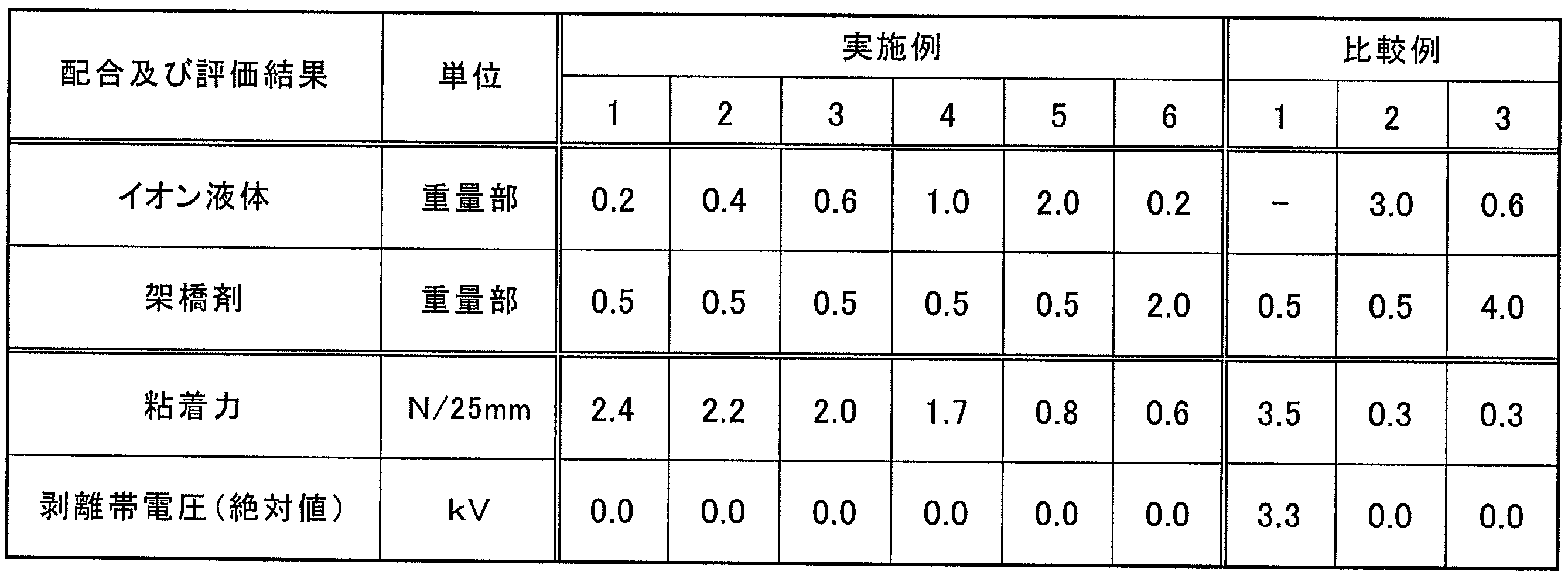
- Example 2 A pressure-sensitive adhesive film was produced in the same manner as in Example 1 except that the adjustment of the pressure-sensitive adhesive in Example 1 made the blending number of the ionic liquid 0.4 parts by weight.
- Example 3 A pressure-sensitive adhesive film was produced in the same manner as in Example 1 except that the amount of the ionic liquid blended was 0.6 parts by adjusting the pressure-sensitive adhesive in Example 1.
- Example 4 A pressure-sensitive adhesive film was produced in the same manner as in Example 1 except that the adjustment of the pressure-sensitive adhesive in Example 1 made 1.0 parts by weight of the ionic liquid.
- Example 5 A pressure-sensitive adhesive film was produced in the same manner as in Example 1 except that the amount of the ionic liquid blended was 2.0 parts by weight by adjusting the pressure-sensitive adhesive in Example 1.
- Example 6> A pressure-sensitive adhesive film was produced in the same manner as in Example 1 except that the amount of the crosslinking agent was 2.0 parts by weight (in terms of solid content, the same applies hereinafter) by adjusting the pressure-sensitive adhesive in Example 1.
- Example 1 A pressure-sensitive adhesive film was produced in the same manner as in Example 1 except that the ionic liquid was not blended in the adjustment of the pressure-sensitive adhesive in Example 1.
- Example 2 A pressure-sensitive adhesive film was produced in the same manner as in Example 1 except that the amount of the ionic liquid was changed to 3.0 parts by weight by adjusting the pressure-sensitive adhesive in Example 1.
- Example 3 A pressure-sensitive adhesive film was prepared in the same manner as in Example 1 except that the amount of the crosslinking agent was 4.0 parts by weight and the amount of the ionic liquid was 0.6 parts by adjusting the pressure-sensitive adhesive in Example 1. did.
Landscapes
- Chemical & Material Sciences (AREA)
- Organic Chemistry (AREA)
- Chemical Kinetics & Catalysis (AREA)
- Adhesives Or Adhesive Processes (AREA)
- Adhesive Tapes (AREA)
- Laminated Bodies (AREA)
Abstract
Description
本発明における粘着剤層は、(メタ)アクリル系ポリマーを含有する。また、前記(メタ)アクリル系ポリマーとしては、炭素数1~14であるアルキル基を有する(メタ)アクリル系モノマーを構成成分として含有することが好ましい。(メタ)アクリル系ポリマーを使用することは、取り扱いの容易性、粘着力と剥離性の点から、好ましい。
本発明における粘着剤層は、イオン液体を含有する。イオン液体を帯電防止剤として用いることで、粘着特性を損なうことなく、帯電防止効果の高い粘着剤層が得られる。イオン液体を用いることで優れた帯電防止特性が得られる理由の詳細は明らかでないが、イオン液体は液状であるため分子運動が容易であり、電荷の発生により分子の再配列が起き易い。したがって、イオン液体を粘着剤中に含有させても分子再配列による電荷中和機構が働くため、優れた帯電防止能が得られるものと考えられる。


ニル)イミド、N,N-ジエチル-N-メチル-N-(2-メトキシエチル)アンモニウムテトラフルオロボレート、N,N-ジエチル-N-メチル-N-(2-メトキシエチル)アンモニウムトリフルオロメタンスルホネート、N,N-ジエチル-N-メチル-N-(2-メトキシエチル)アンモニウムビス(トリフルオロメタンスルホニル)イミド、N,N-ジエチル-Nメチル-N-(2-メトキシエチル)アンモニウムビス(ペンタフルオロエタンスルホニル)イミド、グリシジルトリメチルアンモニウムトリフルオロメタンスルホネート、グリシジルトリメチルアンモニウムビス(トリフルオロメタンスルホニル)イミド、グリシジルトリメチルアンモニウムビス(ペンタフルオロエタンスルホニル)イミド、テトラオクチルホスホニウムトリフルオロメタンスルホネート、テトラオクチルホスホニウムビス(トリフルオロメタンスルホニル)イミド、N,N-ジメチル-N-エチル-N-プロピルアンモニウムビス(トリフルオロメタンスルホニル)イミド、N,N-ジメチル-N-エチル-N-ブチルアンモニウムビス(トリフルオロメタンスルホニル)イミド、N,N-ジメチル-N-エチル-N-ペンチルアンモニウムビス(トリフルオロメタンスルホニル)イミド、N,N-ジメチル-N-エチル-N-へキシルアンモニウムビス(トリフルオロメタンスルホニル)イミド、N,N-ジメチル-N-エチル-N-ヘプチルアンモニウムビス(トリフルオロメタンスルホニル)イミド、N,N-ジメチル-N-エチル-N-ノニルアンモニウムビス(トリフルオロメタンスルホニル)イミド、N,N-ジメチル-N,N-ジプロピルアンモニウムビス(トリフルオロメタンスルホニル)イミド、N,N-ジメチル-N-プロピル-N-ブチルアンモニウムビス(トリフルオロメタンスルホニル)イミド、N,N-ジメチル-N-プロピル-N-ペンチルアンモニウムビス(トリフルオロメタンスルホニル)イミド、N,N-ジメチル-N-プロピル-N-ヘキシルアンモニウムビス(トリフルオロメタンスルホニル)イミド、N,N-ジメチル-N-プロピル-N-ヘプチルアンモニウムビス(トリフルオロメタンスルホニル)イミド、N,N-ジメチル-N-ブチル-N-ヘキシルアンモニウムビス(トリフルオロメタンスルホニル)イミド、N,N-ジメチル-N-ブチル-N-ヘプチルアンモニウムビス(トリフルオロメタンスルホニル)イミド、N,N-ジメチル-N-ペンチル-N-ヘキシルアンモニウムビス(トリフルオロメタンスルホニル)イミド、N,N-ジメチル-N,N-ジヘキシルアンモニウムビス(トリフルオロメタンスルホニル)イミド、トリメチルヘプチルアンモニウムビス(トリフルオロメタンスルホニル)イミド、N,N-ジエチル-N-メチル-N-プロピルアンモニウムビス(トリフルオロメタンスルホニル)イミド、N,N-ジエチル-N-メチル-N-ペンチルアンモニウムビス(トリフルオロメタンスルホニル)イミド、N,N-ジエチル-N-メチル-N-ヘプチルアンモニウムビス(トリフルオロメタンスルホニル)イミド、N,N-ジエチル-N-プロピル-N-ペンチルアンモニウムビス(トリフルオロメタンスルホニル)イミド、トリエチルプロピルアンモニウムビス(トリフルオロメタンスルホニル)イミド、トリエチルペンチルアンモニウムビス(トリフルオロメタンスルホニル)イミド、トリエチルヘプチルアンモニウムビス(トリフルオロメタンスルホニル)イミド、N,N-ジプロピル-N-メチル-N-エチルアンモニウムビス(トリフルオロメダンスルホニル)イミド、N,N-ジプロピル-N-メチル-N-ペンチルアンモニウムビス(トリフルオロメタンスルホニル)イミド、N,N-ジプロピル-N-ブチル-N-へキシルアンモニウムビス(トリフルオロメタンスルホニル)イミド、N,N-ジプロピル-N,N-ジヘキシルアンモニウムビス(トリフルオロメタンスルホニル)イミド、N,N-ジブチル-N-メチル-N-ペンチルアンモニウムビス(トリフルオロメタンスルホニル)イミド、N,N-ジブチル-N-メチル-N-ヘキシルアンモニウムビス(トリフルオロメタンスルホニル)イミド、トリオクチルメチルアンモニウムビス(トリフルオロメタンスルホニル)イミド、N-メチル-N-エチル-N-プロピル-N-ペンチルアンモニウムビス(トリフルオロメタンスルホニル)イミド、1-ブチルピリジニウム(トリフルオロメタンスルホニル)トリフルオロアセトアミド、1-ブチル-3-メチルピリジニウム(トリフルオロメタンスルホニル)トリフルオロアセトアミド、1-エチル-3-メチルイミダゾリウム(トリフルオロメタンスルホニル)トリフルオロアセトアミド、N-エチル-N-メチルモルフォリニウムチオシアネート、4-エチル-4-メチルモルフォリニウムメチルカーボネートなどがあげられる。



本発明で用いられる粘着剤層は、架橋剤を含有する。架橋剤を含有することにより、前記(メタ)アクリル系ポリマーを架橋することができ、耐熱性や、再剥離性にすぐれた粘着剤層を得ることができる。
作製したポリマーの重量平均分子量は、GPC(ゲル・パーミエーション・クロマトグラフィー)により測定した。
装置:東ソー社製、HLC-8220GPC
カラム:
サンプルカラム;東ソー社製、TSKguardcolumn Super HZ-H(1本)+TSKgel Super HZM-H(2本)
リファレンスカラム;東ソー社製、TSKgel Super H-RC(1本)
流量:0.6ml/分
注入量:10μl
カラム温度:40℃
溶離液:THF
注入試料濃度:0.2重量%
検出器:示差屈折計
なお、重量平均分子量はポリスチレン換算により算出した。
ガラス転移温度Tg(℃)は、各モノマーによるホモポリマーのガラス転移温度Tgn(℃)として下記の文献値を用い、下記の式により求めた。
(式中、Tg(℃)は共重合体のガラス転移温度、Wn(-)は各モノマーの重量分率、Tgn(℃)は各モノマーによるホモポリマーのガラス転移温度、nは各モノマーの種類を表す。)
2-エチルヘキシルアクリレート:-70℃
2-ヒドロキシエチルアクリレート:-15℃
ブチルアクリレート:-55℃
アクリル酸:106℃
なお、文献値として「アクリル樹脂の合成・設計と新用途開発」(中央経営開発センター出版部発行)を参照した。
酸価は、自動滴定装置(平沼産業社製、COM-550)を用いて測定を行い、下記式より求めた。
A;酸価
Y;サンプル溶液の滴定量(ml)
X;混合溶媒50gのみの溶液の滴定量(ml)
f;滴定溶液のファクター
M;ポリマーサンプルの重量(g)
なお、測定条件は下記の通りである。
電極:ガラス電極;GE-101、比較電極;RE-201
測定モード:石油製品中和価試験1
粘着フィルム(表面保護フィルム)を幅70mm、長さ130mmのサイズにカットし、セパレーターを剥離した後、あらかじめ除電しておいた厚み1mm、幅70mm、長さ100mmのアクリルパネル(三菱レーヨン社製、アクリライト)表面に片方の端部が30mmはみ出すようにハンドローラーにて圧着した。23℃×50%RHの環境下に1日放置した後、所定の位置にサンプルをセットした。30mmはみ出した片方の端部を自動巻取り機に固定し、剥離角度150°、剥離速度10m/分となるように剥離した。剥離した粘着フィルム(表面保護フィルム)をサンプル固定台に設置し、粘着剤表面の電位を、所定の位置に固定してある電位測定機(春日電機社製、KSD-0103)にて測定した。測定は、23℃×50%RHの環境下で行った。
アクリルパネル(三菱レーヨン社製、アクリライト)に、幅25mm、長さ100mmのサイズにカットした粘着フィルム(表面保護フィルム)を0.25MPa、速度0.3m/分の圧着条件でラミネートし、評価サンプルを作製した。ラミネート後30分間放置した後、万能引張試験機にて、引張(剥離)速度1.0m/分、剥離角度180°で剥離したときの粘着力を測定した。測定は23℃×50%RHの環境下で行った。
〔アクリル系ポリマー(A)〕
攪拌羽根、温度計、窒素ガス導入管、冷却器を備えた四つロフラスコに2-エチルヘキシルアクリレート200重量部、2-ヒドロキシエチルアクリレート8重量部、重合開始剤として2,2’-アゾビスイソブチロニトリル0.4重量部、酢酸エチル312重量部を仕込み、緩やかに攪拌しながら窒素ガスを導入し、フラスコ内の液温を65℃付近に保って約6時間重合反応を行い、アクリル系ポリマー(A)溶液(40重量%)を調製した。前記アクリル系ポリマー(A)の重量平均分子量は50万、ガラス転移温度(Tg)は-68℃、酸価は0.0であった。
撹拌羽根、温度計、冷却器を備えた四つ口フラスコに1-ブチル-3-メチルピリジニウムクロライド[和光純薬工業(株)社製]10重量部の20重量%水溶液を添加した後、攪拌羽根を回しながらリチウムビス(トリフルオロメタンスルホン)イミド[キシダ化学(株)社製]19重量部の20重量%水溶液を徐々に添加した。添加後、常温下(23℃)で2時間攪拌を続けたのち、12時間静置した。上澄み液を除去し、液状の生成物を得た。得られた液状生成物を100重量部の蒸留水にて3回洗浄し、110℃の温度で2時間乾燥させて常温下液状のイオン液体を20重量部得た。得られたイオン液体のNMR、FT-IR、XRF測定を行い、1-ブチル-3-メチルピリジニウムビス(トリフルオロメタンスルホン)イミドであることを確認した。
帯電防止剤(ソルベックス社製、マイクロソルバーRMd-142、酸化スズとポリエステル樹脂を主成分とする)10重量部を、水30重量部とメタノール70重量部からなる混合溶媒で希釈することにより帯電防止剤溶液を調製した。
[粘着剤溶液の調整]
上記アクリル系ポリマー(A)100重量部(固形分換算)に上記イオン液体0.2重量部、架橋剤としてトリメチロールプロパン/トリレンジイソシアネート3量体付加物(日本ポリウレタン工業社製、コロネートL)0.5重量部(固形分換算)、架橋触媒としてジラウリン酸ジブチルスズ0.02重量部を加えて25℃付近に保って約1分間混合撹拌を行い、これを酢酸エチルで20重量%に希釈して、アクリル系粘着剤溶液(1)を調製した。
上記アクリル系粘着剤溶液(1)を、上記帯電防止処理フィルムの帯電防止処理面とは反対の面に塗布し、110℃で3分間加熱して、厚さ20μmの粘着剤層を形成した。次いで、前記粘着剤層の表面に、片面にシリコーン処理を施したポリエチレンテレフタレート(PET)フィルム(厚さ25μm)のシリコーン処理面を貼合せ、粘着フィルムを作製した。なお、前記粘着フィルムの使用時には、前記シリコーン処理を施したPETフィルムを剥離して、使用した。
実施例1の粘着剤の調整でイオン液体の配合部数を0.4重量部にしたこと以外は、実施例1と同様の方法で粘着フィルムを作製した。
実施例1の粘着剤の調整でイオン液体の配合部数を0.6重量部にしたこと以外は、実施例1と同様の方法で粘着フィルムを作製した。
実施例1の粘着剤の調整でイオン液体の配合部数を1.0重量部にしたこと以外は、実施例1と同様の方法で粘着フィルムを作製した。
実施例1の粘着剤の調整でイオン液体の配合部数を2.0重量部にしたこと以外は、実施例1と同様の方法で粘着フィルムを作製した。
実施例1の粘着剤の調整で架橋剤の配合部数を2.0重量部(固形分換算。以下同様。)にしたこと以外は、実施例1と同様の方法で粘着フィルムを作製した。
実施例1の粘着剤の調整でイオン液体を配合しなかったこと以外は、実施例1と同様の方法で粘着フィルムを作製した。
実施例1の粘着剤の調整でイオン液体の配合部数を3.0重量部にしたこと以外は、実施例1と同様の方法で粘着フィルムを作製した。
実施例1の粘着剤の調整で架橋剤の配合部数を4.0重量部、イオン液体の配合部数を0.6重量部にしたこと以外は、実施例1と同様の方法で粘着フィルムを作製した。
Claims (5)
- 基材層と、前記基材層の少なくとも片面に粘着剤層を有する粘着フィルムであって、
前記粘着剤層が、(メタ)アクリル系ポリマー、イオン液体、及び、架橋剤を含有し、
前記(メタ)アクリル系ポリマー100重量部に対して、前記架橋剤を2重量部以下含有し、
前記粘着フィルムの粘着力(被着体:アクリルパネル、23℃×50%RH条件下で30分経過後)が、引張速度1.0m/分において、0.5N/25mm以上であることを特徴とする粘着フィルム。 - 剥離帯電圧(被着体:アクリルパネル、23℃×50%RH条件下)が、剥離速度10m/分において、絶対値が0.5kV以下であることを特徴とする請求項1に記載の粘着フィルム。
- 前記(メタ)アクリル系ポリマーが、炭素数1~14であるアルキル基を有する(メタ)アクリル系モノマーを構成成分として含むことを特徴とする請求項1又は2に記載の粘着フィルム。
- 前記イオン液体の配合量が、前記(メタ)アクリル系ポリマー100重量部に対して、0.01~2.5重量部であることを特徴とする請求項1~3のいずれかに記載の粘着フィルム。
- 拡散シートの表面保護用途に用いることを特徴とする請求項1~4のいずれかに記載の粘着フィルム。
Priority Applications (3)
| Application Number | Priority Date | Filing Date | Title |
|---|---|---|---|
| CN201280021945.0A CN103502374A (zh) | 2011-05-23 | 2012-05-11 | 粘合薄膜 |
| KR1020137034004A KR20140035423A (ko) | 2011-05-23 | 2012-05-11 | 점착 필름 |
| US14/119,315 US20140079949A1 (en) | 2011-05-23 | 2012-05-11 | Pressure-sensitive adhesive film |
Applications Claiming Priority (2)
| Application Number | Priority Date | Filing Date | Title |
|---|---|---|---|
| JP2011-114808 | 2011-05-23 | ||
| JP2011114808A JP2012241152A (ja) | 2011-05-23 | 2011-05-23 | 粘着フィルム |
Publications (1)
| Publication Number | Publication Date |
|---|---|
| WO2012160997A1 true WO2012160997A1 (ja) | 2012-11-29 |
Family
ID=47217077
Family Applications (1)
| Application Number | Title | Priority Date | Filing Date |
|---|---|---|---|
| PCT/JP2012/062197 Ceased WO2012160997A1 (ja) | 2011-05-23 | 2012-05-11 | 粘着フィルム |
Country Status (6)
| Country | Link |
|---|---|
| US (1) | US20140079949A1 (ja) |
| JP (1) | JP2012241152A (ja) |
| KR (1) | KR20140035423A (ja) |
| CN (1) | CN103502374A (ja) |
| TW (1) | TW201305307A (ja) |
| WO (1) | WO2012160997A1 (ja) |
Families Citing this family (12)
| Publication number | Priority date | Publication date | Assignee | Title |
|---|---|---|---|---|
| JP6166152B2 (ja) * | 2013-11-06 | 2017-07-19 | 株式会社有沢製作所 | 保護フィルム用組成物、保護フィルム、積層体及び積層体の製造方法 |
| JP6327704B2 (ja) * | 2014-05-20 | 2018-05-23 | 日東電工株式会社 | 表面保護フィルムの製造方法 |
| JP6327703B2 (ja) * | 2014-05-20 | 2018-05-23 | 日東電工株式会社 | 表面保護フィルム |
| US10883020B2 (en) * | 2015-07-10 | 2021-01-05 | Lg Chem, Ltd. | Pressure-sensitive adhesive polarizing plate |
| JP6208728B2 (ja) * | 2015-09-30 | 2017-10-04 | 日東電工株式会社 | セパレータ付き粘着剤層、セパレータ付き粘着剤層付きの光学フィルム、画像表示装置及びその製造方法 |
| JP6633923B2 (ja) * | 2016-01-26 | 2020-01-22 | 日本カーバイド工業株式会社 | 保護フィルム用粘着剤組成物及び保護フィルム |
| WO2017154226A1 (ja) * | 2016-03-09 | 2017-09-14 | 三菱樹脂株式会社 | 粘着フィルム及びその製造方法 |
| JP6366200B2 (ja) * | 2016-06-30 | 2018-08-01 | 日東電工株式会社 | セパレーター付補強用フィルム |
| CN106010352A (zh) * | 2016-08-02 | 2016-10-12 | 东莞新能源科技有限公司 | 一种易拉伸移除胶带及其制造方法 |
| JP2018135438A (ja) * | 2017-02-21 | 2018-08-30 | 日東電工株式会社 | 粘着剤組成物、粘着剤層、及び、粘着剤層付光学フィルム |
| JP6636590B2 (ja) * | 2018-10-10 | 2020-01-29 | 日東電工株式会社 | 表面保護フィルム、表面保護フィルムの製造方法、及び、光学部材 |
| WO2024080145A1 (ja) * | 2022-10-14 | 2024-04-18 | 日東電工株式会社 | 補強フィルム、補強フィルム付きデバイスおよびその製造方法 |
Citations (11)
| Publication number | Priority date | Publication date | Assignee | Title |
|---|---|---|---|---|
| JP2004536940A (ja) * | 2001-08-02 | 2004-12-09 | スリーエム イノベイティブ プロパティズ カンパニー | 光学的に透明な帯電防止性感圧粘着剤 |
| WO2007034533A1 (ja) * | 2005-09-20 | 2007-03-29 | Soken Chemical & Engineering Co., Ltd. | 偏光板用粘着剤組成物および粘着剤層付き偏光板 |
| JP2007092057A (ja) * | 2005-09-05 | 2007-04-12 | Nitto Denko Corp | 粘着剤組成物、粘着シート、および表面保護フィルム |
| JP2007217441A (ja) * | 2005-01-19 | 2007-08-30 | Nitto Denko Corp | 粘着剤組成物、粘着シートおよび表面保護フィルム |
| JP2009058859A (ja) * | 2007-09-03 | 2009-03-19 | Sumitomo Chemical Co Ltd | 粘着剤付き光学フィルム及び光学積層体 |
| JP2009155586A (ja) * | 2007-12-27 | 2009-07-16 | Saiden Chemical Industry Co Ltd | 粘着剤組成物、粘着剤物品、光学用粘着剤組成物及び粘着方法 |
| JP2010037355A (ja) * | 2008-07-31 | 2010-02-18 | Big Technos Kk | 電気剥離性粘着剤組成物、電気剥離性粘着製品及びその剥離方法 |
| WO2010064551A1 (ja) * | 2008-12-05 | 2010-06-10 | 株式会社クラレ | 光学フィルム用粘着剤組成物 |
| JP2010180378A (ja) * | 2009-02-09 | 2010-08-19 | Soken Chem & Eng Co Ltd | 帯電防止性粘着剤組成物および帯電防止フィルム |
| JP2011037929A (ja) * | 2009-08-07 | 2011-02-24 | Toyo Ink Mfg Co Ltd | 粘着剤および表面保護フィルム |
| JP2011225764A (ja) * | 2010-04-22 | 2011-11-10 | Sumitomo Chemical Co Ltd | 粘着剤付き樹脂フィルム及びそれを用いた光学積層体 |
Family Cites Families (2)
| Publication number | Priority date | Publication date | Assignee | Title |
|---|---|---|---|---|
| JP5308611B2 (ja) * | 2005-06-07 | 2013-10-09 | 日東電工株式会社 | 粘着剤組成物および粘着シート類 |
| JP2010189545A (ja) * | 2009-02-18 | 2010-09-02 | Nitto Denko Corp | 両面粘着シートおよび粘着型光学部材 |
-
2011
- 2011-05-23 JP JP2011114808A patent/JP2012241152A/ja active Pending
-
2012
- 2012-05-11 CN CN201280021945.0A patent/CN103502374A/zh active Pending
- 2012-05-11 WO PCT/JP2012/062197 patent/WO2012160997A1/ja not_active Ceased
- 2012-05-11 US US14/119,315 patent/US20140079949A1/en not_active Abandoned
- 2012-05-11 KR KR1020137034004A patent/KR20140035423A/ko not_active Withdrawn
- 2012-05-18 TW TW101117750A patent/TW201305307A/zh unknown
Patent Citations (11)
| Publication number | Priority date | Publication date | Assignee | Title |
|---|---|---|---|---|
| JP2004536940A (ja) * | 2001-08-02 | 2004-12-09 | スリーエム イノベイティブ プロパティズ カンパニー | 光学的に透明な帯電防止性感圧粘着剤 |
| JP2007217441A (ja) * | 2005-01-19 | 2007-08-30 | Nitto Denko Corp | 粘着剤組成物、粘着シートおよび表面保護フィルム |
| JP2007092057A (ja) * | 2005-09-05 | 2007-04-12 | Nitto Denko Corp | 粘着剤組成物、粘着シート、および表面保護フィルム |
| WO2007034533A1 (ja) * | 2005-09-20 | 2007-03-29 | Soken Chemical & Engineering Co., Ltd. | 偏光板用粘着剤組成物および粘着剤層付き偏光板 |
| JP2009058859A (ja) * | 2007-09-03 | 2009-03-19 | Sumitomo Chemical Co Ltd | 粘着剤付き光学フィルム及び光学積層体 |
| JP2009155586A (ja) * | 2007-12-27 | 2009-07-16 | Saiden Chemical Industry Co Ltd | 粘着剤組成物、粘着剤物品、光学用粘着剤組成物及び粘着方法 |
| JP2010037355A (ja) * | 2008-07-31 | 2010-02-18 | Big Technos Kk | 電気剥離性粘着剤組成物、電気剥離性粘着製品及びその剥離方法 |
| WO2010064551A1 (ja) * | 2008-12-05 | 2010-06-10 | 株式会社クラレ | 光学フィルム用粘着剤組成物 |
| JP2010180378A (ja) * | 2009-02-09 | 2010-08-19 | Soken Chem & Eng Co Ltd | 帯電防止性粘着剤組成物および帯電防止フィルム |
| JP2011037929A (ja) * | 2009-08-07 | 2011-02-24 | Toyo Ink Mfg Co Ltd | 粘着剤および表面保護フィルム |
| JP2011225764A (ja) * | 2010-04-22 | 2011-11-10 | Sumitomo Chemical Co Ltd | 粘着剤付き樹脂フィルム及びそれを用いた光学積層体 |
Also Published As
| Publication number | Publication date |
|---|---|
| TW201305307A (zh) | 2013-02-01 |
| US20140079949A1 (en) | 2014-03-20 |
| KR20140035423A (ko) | 2014-03-21 |
| CN103502374A (zh) | 2014-01-08 |
| JP2012241152A (ja) | 2012-12-10 |
Similar Documents
| Publication | Publication Date | Title |
|---|---|---|
| JP4799900B2 (ja) | 粘着剤組成物、粘着シート類および表面保護フィルム | |
| JP3912686B2 (ja) | 粘着剤組成物、粘着剤層、および表面保護フィルム | |
| JP4358190B2 (ja) | 粘着剤組成物、粘着シート類および表面保護フィルム | |
| JP5030307B2 (ja) | 粘着剤組成物、粘着シートおよび表面保護フィルム | |
| WO2012160997A1 (ja) | 粘着フィルム | |
| JP4627163B2 (ja) | 粘着剤組成物、粘着シート類および表面保護フィルム | |
| JP2013036046A (ja) | 粘着剤組成物、粘着シート、および表面保護フィルム | |
| JP5088806B2 (ja) | 粘着剤組成物、粘着シート類及び表面保護フィルム | |
| JP5220292B2 (ja) | 粘着剤組成物、粘着シート、および表面保護フィルム | |
| JP5164188B2 (ja) | 粘着剤組成物、粘着シート類および表面保護フィルム | |
| JP4453977B2 (ja) | 粘着剤組成物、粘着シート類及び表面保護フィルム | |
| JP5733867B2 (ja) | 粘着剤組成物、粘着シート類及び表面保護フィルム | |
| JP4800018B2 (ja) | 粘着剤組成物、粘着シート類および表面保護フィルム | |
| JP5523365B2 (ja) | 粘着剤組成物、粘着シート類および表面保護フィルム | |
| JP5008847B2 (ja) | 帯電防止性粘着剤組成物、粘着シート類、および表面保護フィルム | |
| JP5384279B2 (ja) | 粘着剤組成物、粘着シート類及び表面保護フィルム | |
| JP5008830B2 (ja) | 粘着剤組成物、粘着シート類および表面保護フィルム | |
| JP5863252B2 (ja) | 粘着剤組成物、粘着シート類および表面保護フィルム | |
| JP4799962B2 (ja) | 粘着剤組成物、粘着シート類、および表面保護フィルム | |
| JP5382883B2 (ja) | 粘着剤組成物、粘着シート類、および表面保護フィルム |
Legal Events
| Date | Code | Title | Description |
|---|---|---|---|
| 121 | Ep: the epo has been informed by wipo that ep was designated in this application |
Ref document number: 12789691 Country of ref document: EP Kind code of ref document: A1 |
|
| WWE | Wipo information: entry into national phase |
Ref document number: 14119315 Country of ref document: US |
|
| NENP | Non-entry into the national phase |
Ref country code: DE |
|
| ENP | Entry into the national phase |
Ref document number: 20137034004 Country of ref document: KR Kind code of ref document: A |
|
| 122 | Ep: pct application non-entry in european phase |
Ref document number: 12789691 Country of ref document: EP Kind code of ref document: A1 |