WO2012157665A1 - 半導体モジュール部品及び液状封止用樹脂組成物 - Google Patents
半導体モジュール部品及び液状封止用樹脂組成物 Download PDFInfo
- Publication number
- WO2012157665A1 WO2012157665A1 PCT/JP2012/062486 JP2012062486W WO2012157665A1 WO 2012157665 A1 WO2012157665 A1 WO 2012157665A1 JP 2012062486 W JP2012062486 W JP 2012062486W WO 2012157665 A1 WO2012157665 A1 WO 2012157665A1
- Authority
- WO
- WIPO (PCT)
- Prior art keywords
- resin composition
- semiconductor module
- module component
- liquid resin
- liquid
- Prior art date
- Legal status (The legal status is an assumption and is not a legal conclusion. Google has not performed a legal analysis and makes no representation as to the accuracy of the status listed.)
- Ceased
Links
Images

Classifications
-
- H—ELECTRICITY
- H10—SEMICONDUCTOR DEVICES; ELECTRIC SOLID-STATE DEVICES NOT OTHERWISE PROVIDED FOR
- H10W—GENERIC PACKAGES, INTERCONNECTIONS, CONNECTORS OR OTHER CONSTRUCTIONAL DETAILS OF DEVICES COVERED BY CLASS H10
- H10W74/00—Encapsulations, e.g. protective coatings
- H10W74/40—Encapsulations, e.g. protective coatings characterised by their materials
- H10W74/47—Encapsulations, e.g. protective coatings characterised by their materials comprising organic materials, e.g. plastics or resins
- H10W74/476—Organic materials comprising silicon
-
- C—CHEMISTRY; METALLURGY
- C08—ORGANIC MACROMOLECULAR COMPOUNDS; THEIR PREPARATION OR CHEMICAL WORKING-UP; COMPOSITIONS BASED THEREON
- C08G—MACROMOLECULAR COMPOUNDS OBTAINED OTHERWISE THAN BY REACTIONS ONLY INVOLVING UNSATURATED CARBON-TO-CARBON BONDS
- C08G59/00—Polycondensates containing more than one epoxy group per molecule; Macromolecules obtained by polymerising compounds containing more than one epoxy group per molecule using curing agents or catalysts which react with the epoxy groups
- C08G59/18—Macromolecules obtained by polymerising compounds containing more than one epoxy group per molecule using curing agents or catalysts which react with the epoxy groups ; e.g. general methods of curing
- C08G59/20—Macromolecules obtained by polymerising compounds containing more than one epoxy group per molecule using curing agents or catalysts which react with the epoxy groups ; e.g. general methods of curing characterised by the epoxy compounds used
- C08G59/22—Di-epoxy compounds
- C08G59/226—Mixtures of di-epoxy compounds
-
- C—CHEMISTRY; METALLURGY
- C08—ORGANIC MACROMOLECULAR COMPOUNDS; THEIR PREPARATION OR CHEMICAL WORKING-UP; COMPOSITIONS BASED THEREON
- C08G—MACROMOLECULAR COMPOUNDS OBTAINED OTHERWISE THAN BY REACTIONS ONLY INVOLVING UNSATURATED CARBON-TO-CARBON BONDS
- C08G59/00—Polycondensates containing more than one epoxy group per molecule; Macromolecules obtained by polymerising compounds containing more than one epoxy group per molecule using curing agents or catalysts which react with the epoxy groups
- C08G59/18—Macromolecules obtained by polymerising compounds containing more than one epoxy group per molecule using curing agents or catalysts which react with the epoxy groups ; e.g. general methods of curing
- C08G59/68—Macromolecules obtained by polymerising compounds containing more than one epoxy group per molecule using curing agents or catalysts which react with the epoxy groups ; e.g. general methods of curing characterised by the catalysts used
- C08G59/686—Macromolecules obtained by polymerising compounds containing more than one epoxy group per molecule using curing agents or catalysts which react with the epoxy groups ; e.g. general methods of curing characterised by the catalysts used containing nitrogen
-
- C—CHEMISTRY; METALLURGY
- C08—ORGANIC MACROMOLECULAR COMPOUNDS; THEIR PREPARATION OR CHEMICAL WORKING-UP; COMPOSITIONS BASED THEREON
- C08L—COMPOSITIONS OF MACROMOLECULAR COMPOUNDS
- C08L63/00—Compositions of epoxy resins; Compositions of derivatives of epoxy resins
-
- H—ELECTRICITY
- H10—SEMICONDUCTOR DEVICES; ELECTRIC SOLID-STATE DEVICES NOT OTHERWISE PROVIDED FOR
- H10W—GENERIC PACKAGES, INTERCONNECTIONS, CONNECTORS OR OTHER CONSTRUCTIONAL DETAILS OF DEVICES COVERED BY CLASS H10
- H10W74/00—Encapsulations, e.g. protective coatings
- H10W74/10—Encapsulations, e.g. protective coatings characterised by their shape or disposition
- H10W74/111—Encapsulations, e.g. protective coatings characterised by their shape or disposition the semiconductor body being completely enclosed
- H10W74/114—Encapsulations, e.g. protective coatings characterised by their shape or disposition the semiconductor body being completely enclosed by a substrate and the encapsulations
- H10W74/117—Encapsulations, e.g. protective coatings characterised by their shape or disposition the semiconductor body being completely enclosed by a substrate and the encapsulations the substrate having spherical bumps for external connection
-
- H—ELECTRICITY
- H10—SEMICONDUCTOR DEVICES; ELECTRIC SOLID-STATE DEVICES NOT OTHERWISE PROVIDED FOR
- H10W—GENERIC PACKAGES, INTERCONNECTIONS, CONNECTORS OR OTHER CONSTRUCTIONAL DETAILS OF DEVICES COVERED BY CLASS H10
- H10W90/00—Package configurations
- H10W90/701—Package configurations characterised by the relative positions of pads or connectors relative to package parts
- H10W90/721—Package configurations characterised by the relative positions of pads or connectors relative to package parts of bump connectors
- H10W90/724—Package configurations characterised by the relative positions of pads or connectors relative to package parts of bump connectors between a chip and a stacked insulating package substrate, interposer or RDL
Definitions
- the present invention relates to a semiconductor module component produced using a liquid sealing resin composition.
- This module component provides a one-segment digital TV broadcast reception function of a cellular phone, a wireless network communication function of a portable terminal, and the like.
- a circuit board of such a module component has used a board using a core material having a thermal expansion coefficient of about 15 ppm / ° C., a room temperature elastic modulus of 20 GPa, and a thermal elastic modulus of about 10 GPa. Since warpage occurs, it is difficult to make the substrate thickness 500 ⁇ m or less. However, along with the trend toward miniaturization and thinning of portable terminals, it is indispensable to make module parts thinner, and efforts are being made to reduce the thickness of module substrates.
- the substrate warps after the components are mounted.
- sealing form of the module there are two kinds of sealing, that is, metal can sealing and resin sealing.
- resin sealing is more preferable because of reverse engineering and easy thinning.
- the height of the electronic component to be mounted is limited, and the thickness limit on the sealing side is considered to be about 0.8 mm at present. Therefore, when trying to make the module component thinner, the thickness on the substrate side must be further reduced from the conventional 500 ⁇ m.
- the objective of this invention is providing the thinner semiconductor module component which suppressed the curvature at the time of a semiconductor module component sealed with the liquid sealing resin composition.
- the present invention is as follows. [1] In a semiconductor module component in which a semiconductor chip and / or a passive element is mounted on a module circuit board composed of a core substrate including a core material and sealed with a resin composition, the resin composition contains (A A liquid resin composition comprising as essential components :) an epoxy resin; (B) an inorganic filler; (C) a curing accelerator; and (D) a silane compound having a secondary amino group or a tertiary amino group. A cured product of which the elastic modulus at 250 ° C. is 1 to 15 GPa, the thermal expansion coefficient from 25 ° C. to 260 ° C.
- the semiconductor module component according to any one of [1] to [4], wherein the liquid resin composition further contains 0.1 to 1.0% by weight of a low stress additive.
- the semiconductor module component in any one of. [7] The semiconductor module component according to any one of [1] to [6], wherein the thickness of the module circuit board is 500 ⁇ m or less. [8] A liquid sealing resin composition used for sealing the semiconductor module component according to any one of [1] to [7].
- a thinner semiconductor module component can be manufactured with less warping during mounting.
- the present invention relates to a semiconductor module component in which a semiconductor chip and / or a passive element is mounted on a module circuit board composed of a core substrate including a core material and sealed with a resin composition.
- a liquid resin composition comprising, as essential components, a) an epoxy resin, (B) an inorganic filler, (C) a curing accelerator, and (D) a silane compound having a secondary amino group or a tertiary amino group.
- Semiconductor module component having an elastic modulus of 1 to 15 GPa at 250 ° C., a thermal expansion coefficient of 2500 to 4500 ppm from 25 ° C. to 260 ° C., and a height of the semiconductor module component of 1.6 mm or less It is.
- the present invention will be described in detail.
- the liquid resin composition used in the present invention is designed to match the characteristics of the module circuit board, and the cured product must have an elastic modulus at 250 ° C. of 1 to 15 GPa. Preferably, it is 1 to 10 GPa. If the elastic modulus at 250 ° C. is less than the lower limit value, the rigidity of the resin is insufficient and the warpage may increase. Further, when the elastic modulus at 250 ° C. exceeds the upper limit value, there is a possibility that the sealed internal components are adversely affected by the thermal stress at the time of component mounting. Furthermore, by setting the coefficient of thermal expansion from 25 ° C. to 260 ° C.
- the warpage as a module component may increase.
- the semiconductor module component of the present invention has a height of 1.6 mm or less. When the thickness exceeds 1.6 mm, a component having no warpage problem may be obtained without using the liquid resin composition, but it is not a thin semiconductor module component. On the other hand, the minimum height is estimated to be about 0.5 mm even when a thin substrate and a thin mounting component are combined, due to restrictions on the height of component mounting inside the module.
- the liquid resin composition is composed of the following components. That is, the molecular weight and structure are not particularly limited as long as (A) the epoxy resin has two or more epoxy groups in one molecule and is liquid at normal temperature.
- novolak type epoxy resins such as phenol novolac type epoxy resin and cresol novolak type epoxy resin, bisphenol F type epoxy resin, N, N-diglycidylaniline, N, N-diglycidyltoluidine, diaminodiphenylmethane type glycidylamine, aminophenol Aromatic glycidylamine type epoxy resin such as glycidylamine type, hydroquinone type epoxy resin, biphenyl type epoxy resin, stilbene type epoxy resin, triphenolmethane type epoxy resin, triphenolpropane type epoxy resin, alkyl-modified triphenolmethane type epoxy Resin, triazine nucleus-containing epoxy resin, dicyclopentadiene-modified phenol type epoxy resin, naphthol type epoxy resin, naphthal
- the amount of the aliphatic or alicyclic epoxy resin is preferably limited from the viewpoint of reliability, particularly adhesiveness, but is not limited as long as it has low viscosity and low curing shrinkage. These may be used alone or in combination of two or more.
- the epoxy resin is finally liquid at room temperature (25 ° C.), but even an epoxy resin that is solid at room temperature is dissolved in the liquid epoxy resin at room temperature, and as a result, in a liquid state I just need it.
- room temperature refers to 25 ° C.
- liquid refers to a resin or resin composition having fluidity.
- the liquid resin composition has fluidity at room temperature (25 ° C.).
- an inorganic filler what is generally used for the sealing material can be used.
- examples thereof include fused silica, crystalline silica, talc, alumina, silicon nitride and the like, and these may be used alone or in combination of two or more.
- fused silica, crystalline silica, and synthetic silica powder are preferable because the heat resistance, moisture resistance, strength, and the like of the resin composition can be improved.
- the shape of the inorganic filler is not particularly limited, but the shape is preferably spherical from the viewpoint of viscosity characteristics and flow characteristics.
- the content of the inorganic filler is preferably 70 to 90% by volume, more preferably 74 to 84% by volume, based on the balance between moldability and solder crack resistance, in the total liquid resin composition.
- the content of the inorganic filler is less than the lower limit value, the coefficient of thermal expansion is not sufficiently reduced, the effect of suppressing the warpage of the module component is reduced, and the solder crack resistance accompanying the increase in water absorption is reduced. There is a risk of malfunction. If the upper limit is exceeded, the viscosity becomes too high, which may cause a problem in the dispensing performance of the liquid sealing resin composition.
- the curing accelerator is not particularly limited as long as it accelerates the reaction between epoxy groups or between an epoxy group and a curing agent.
- Organic phosphines such as triphenylphosphine and methyldiphenylphosphine, tetraphenylphosphonium / tetraphenylborate, tetraphenylphosphonium / tetrabenzoic acid borate, tetraphenylphosphonium / tetranaphthoic acid borate, tetraphenylphosphonium / tetranaphthoyloxyborate Phosphorus compounds such as tetraphenylphosphonium and tetranaphthyloxyborate, etc., phosphorus compounds such as tetrasubstituted phosphonium and tetrasubstituted borates, diazabicycloalkenes such as 1,8-diazabicyclo (5,4,0) undecene-7 and derivatives thereof, Amine compounds such as butylamine and benzyldimethylamine can also be used.
- curing agent for the liquid resin composition used for this invention as needed.
- the curing agent include phthalic anhydride, maleic anhydride, trimellitic anhydride, pyromellitic anhydride, hexahydrophthalic anhydride, 3-methyl-hexahydrophthalic anhydride, 4-methyl-hexahydrophthalic anhydride, 3-methyl -Mixtures of hexahydrophthalic anhydride and 4-methyl-hexahydrophthalic anhydride, acid anhydrides such as tetrahydrophthalic anhydride, nadic anhydride, or methyl nadic anhydride, aliphatic amines, aromatic amines, phenol resins, etc.
- the curing agent is preferably liquid and has a viscosity as low as possible.
- tetrahydrophthalic anhydride or the like is preferably used as such a curing agent.
- silane compound having a secondary amino group or a tertiary amino group N-phenyl-3-aminopropyltrimethoxysilane, 3-triethoxysilyl-N- (1,3-dimethyl-butylidene) propylamine Bis (dimethylamino) dimethylsilane, 1,1′-ethylenebis (N, N, 1,1-tetramethylsilaneamine), dimethylaminotrimethylsilane, etc., which are effective in improving fluidity If it is, it will not specifically limit to these.
- the silane compound having a secondary amino group or a tertiary amino group is preferably used in the range of 0.05 to 1.0% by weight in the liquid resin composition.
- the fluidity mentioned here is preferably 300 Pa ⁇ s or less in viscosity measured at 0.5 rpm at 25 ° C. with a CP-51 type cone attached to an E type viscometer. More preferably, it is 200 Pa ⁇ s or less.
- the thixotropy is preferably 1.6 or less, more preferably 1.4 or less. The thixotropy is a ratio of the viscosities measured with the E-type viscometer, and is obtained by [viscosity at 0.5 rpm] / [viscosity at 5.0 rpm].
- a low stress additive can be used for the liquid resin composition used in the present invention.
- the low stress additive include, but are not limited to, liquid epoxidized polybutadiene rubber, silicone oil, core shell type silicone, solid silicone rubber, and the like.
- a liquid low-stress agent is preferable in order to maintain fluidity
- a liquid epoxidized polybutadiene rubber is more preferable in order to maintain adhesion.
- the addition amount is preferably 0.1 to 1.0% by weight, more preferably 0.3 to 1.0% by weight in the liquid resin composition. If the addition amount is less than the lower limit value, the effect of reducing the stress cannot be sufficiently obtained, and further reduction in warpage cannot be expected.
- the upper limit is exceeded, the glass transition temperature of the cured product is lowered, and on the contrary, the warpage as a module component may be deteriorated, or the adhesion to the components in the module may be lowered.
- components that can be used in addition to the above include silicone compounds as antifoaming agents, mold release agents such as waxes, and the like, which can be added according to required properties.
- the glass transition temperature of the cured product of the liquid resin composition used in the present invention is a peak temperature of a tan ⁇ curve obtained by measuring a liquid resin composition sample cured under predetermined conditions with DMA.
- the glass transition temperature is preferably 200 ° C. or higher, more preferably 220 ° C. or higher. If the glass transition temperature is less than the lower limit value, warpage may increase at a high temperature during the solder reflow process when the module component is mounted on the mother board.
- each component is dispersed and kneaded using an apparatus such as a planetary mixer, three rolls, two heat rolls, or a laika machine, and then as necessary. Produced by defoaming under vacuum.
- the module circuit board used in the present invention is composed of a core board.
- the core substrate may be formed by forming circuits and / or through holes on both sides of the core material.
- the core material of the core substrate used in the present invention preferably has an elastic modulus at 250 ° C. of 15 GPa or more, a linear expansion coefficient in the in-plane direction of 3 to 14 ppm, and a glass transition temperature of 240 ° C. or more. More preferably, the elastic modulus at 250 ° C. is 20 GPa or more, the linear expansion coefficient in the in-plane direction is 5 to 12 ppm, and the glass transition temperature is 260 ° C. or more. If the elastic modulus at 250 ° C. of the core material is less than the lower limit value, it is difficult to suppress warpage during component mounting.
- the thermal expansion coefficient mismatch with the semiconductor silicon to be flip-chip connected will increase, and the warpage may be worsened. There is a possibility that the mismatch of the expansion coefficient becomes large and the warpage is worsened.
- the glass transition temperature is less than the lower limit value, the coefficient of thermal expansion near the soldering temperature when the module component is mounted increases, and the mismatch of the coefficient of thermal expansion with the mounted component also increases. For this reason, there is a risk of poor connection of components.
- a laminate formed of a core material and a metal foil and / or a through hole formed thereon, or a substrate formed with a circuit on the core material surface by a method such as electroless plating can be used.
- the laminated plate can be obtained by laminating a metal foil on at least one of upper and lower surfaces of one or a plurality of laminated prepregs, and heating and pressing.
- the prepreg is formed by impregnating a base material with a resin composition described later. Thereby, it is possible to obtain a prepreg suitable for manufacturing a printed wiring board excellent in various characteristics such as dielectric characteristics, mechanical and electrical connection reliability under high temperature and high humidity.
- the metal foil is not particularly limited, for example, copper and copper alloys, aluminum and aluminum alloys, silver and silver alloys, gold and gold alloys, zinc and zinc alloys, nickel and nickel alloys, tin and tin And metal foils such as iron alloys, iron and iron alloys.
- the substrate is not particularly limited, but glass fiber substrates such as glass woven fabric and glass nonwoven fabric, polyamide resin fibers, aromatic polyamide resin fibers, polyamide resin fibers such as wholly aromatic polyamide resin fibers, polyester resin fibers, Synthetic fiber substrate, kraft paper, cotton linter composed of woven or non-woven fabric mainly composed of aromatic polyester resin fiber, polyester resin fiber such as wholly aromatic polyester resin fiber, polyimide resin fiber, fluororesin fiber, etc.
- Examples thereof include organic fiber base materials such as paper base materials mainly composed of paper, mixed paper of linter and kraft pulp, and the like.
- a glass fiber base material is preferable. Thereby, the intensity
- thermosetting resin examples include novolac type phenol resins such as phenol novolac resin, cresol novolac resin, bisphenol A novolac resin, unmodified resol phenol resin, oil-modified resole phenol modified with tung oil, linseed oil, walnut oil, and the like.
- Phenol resin such as resol type phenol resin such as resin, bisphenol A type epoxy resin, bisphenol F type epoxy resin, bisphenol S type epoxy resin, bisphenol E type epoxy resin, bisphenol M type epoxy resin, bisphenol P type epoxy resin, bisphenol Z Type epoxy resin, bisphenol type epoxy resin, phenol novolac type epoxy resin, cresol novolac epoxy resin, etc.
- novolac type epoxy resin novolac type epoxy resin, biphenyl Epoxy resin, biphenyl aralkyl type epoxy resin, aryl alkylene type epoxy resin, naphthalene type epoxy resin, anthracene type epoxy resin, phenoxy type epoxy resin, dicyclopentadiene type epoxy resin, norbornene type epoxy resin, adamantane type epoxy resin, fluorene type epoxy resin Epoxy resin such as resin, triazine ring resin such as urea (urea) resin, melamine resin, unsaturated polyester resin, bismaleimide resin, polyurethane resin, diallyl phthalate resin, silicone resin, resin having benzoxazine ring, norbornene series Examples thereof include resins, cyanate resins, benzocyclobutene resins, and bismaleimide triazine resins.
- thermosetting resin among epoxy resins, cyanate resins (including prepolymers of cyanate resins), phenol resins, benzocyclobutene resins, and bismaleimide triazine resins is particularly preferable. Of these, cyanate resins are most preferred.
- LL ⁇ Z4785GS (trade name, manufactured by Sumitomo Bakelite Co., Ltd.) or the like is available as a core substrate constituting such a module circuit board.
- the module circuit board used in the present invention may be obtained by further laminating a resin layer on a core board.
- a via hole may be formed in the resin layer so as to be electrically connected to the core substrate, and a conductor circuit may be formed on the surface of the resin layer.
- a solder resist generally used for a printed wiring board may be formed on the conductor circuit.
- the resin layer a base material impregnated with the above resin composition, that is, a prepreg can be used. Thereby, the thermal expansion coefficient of a resin layer can be made small, and curvature can be reduced by it.
- the substrate is preferably an organic fiber substrate or a glass fiber substrate. Thereby, it is excellent in the balance of a low thermal expansion coefficient and workability. Moreover, you may use what laminated
- FIG. 1 A schematic cross-sectional view of an example of the semiconductor module component of the present invention is shown in FIG.
- Copper foil circuits are formed on both surfaces of the core material, and a resin layer 2 made of prepreg is formed on both surfaces of the core substrate 1 on which through holes (internal conduction circuits) 6 are formed. Further, a solder resist 7 is formed to obtain a module circuit board.
- a mounting part 4 such as a semiconductor chip or a passive element is mounted on the module circuit board and sealed with the liquid resin composition 3 to obtain a semiconductor module part.
- the semiconductor module component is mounted on another circuit board or the like via the solder ball 5.
- a method for manufacturing a semiconductor module component of the present invention for example, there is the following method, but the method is not limited thereto. That is, after mounting a passive element such as a chip resistor or a chip capacitor and a semiconductor chip on a module circuit board that is a support, it is passed through a reflow soldering apparatus and electrically and physically bonded to the board. As for the electrical connection of the semiconductor chip, the bonding pad is provided around the mounting position of the substrate in the wire bonding method. Next, a liquid sealing resin composition is applied and cured. The application of the liquid resin composition may be performed at room temperature or at a room temperature according to the viscosity characteristics.
- the curing temperature of the liquid resin composition may vary depending on the combination of the curing accelerator and the curing agent used in the composition. However, if the temperature is too low, the productivity decreases, and if it is too high, the liquid resin cured product and the module circuit are used. Due to the difference in thermal expansion coefficient between the substrate and the mounted component, the warpage of the module becomes large, so that it is at most about 180 ° C, preferably around 150 ° C. Moreover, it is preferable that a plurality of modules are arranged on one module circuit board. In this case, after the liquid resin composition is cured, it is cut by a dicing apparatus and separated into individual pieces to obtain one semiconductor module component.
- Example 1 (1) As epoxy resin 1 (A), N, N-bis (oxiranylmethyl) -4- (oxiranylmethoxy) aniline) (JER-630, manufactured by Mitsubishi Chemical Corporation) 100 parts by weight (2) 1,4 cyclohexanedimethanol diglycidyl ether ZX-1658GS as epoxy resin 2 (A) 68 parts by weight (3) As inorganic filler 1 (B) Fused silica: HS-202 Micron 1150 parts by weight (4) As inorganic filler 2 (B) Fused silica: SO-C3 240 parts by weight manufactured by Admatechs (5) As curing accelerator 1 (C), 2-phenyl-4-methylimidazole 0.5 parts by weight manufactured by Shikoku Kasei Co., Ltd.
- Curing accelerator 2 ( C): 11 parts by weight of dicyandiamide (7) N-phenyl-3-aminopropyltrimethoxysilane KBM-573 as a silane compound (D) having a tertiary amino group 3 parts by weight of Shin-Etsu Chemical Co., Ltd. (8) Coupling ⁇ -glycidyl / propyl / triethoxysilane KBE-403E Shin-Etsu Chemical Co., Ltd.
- the produced liquid resin composition A was evaluated as follows.
- Viscosity measurement CP-51 type cone was attached to an E type viscometer, and measurement was carried out under the conditions of 0.5 rpm at 25 ° C. and 5 rpm at 25 ° C.
- B Thixotropic: In the above viscosity measurement, the following calculation was made from the viscosity results measured at 5 rpm and 0.5 rpm. [Viscosity at 0.5 rpm] ⁇ [Viscosity at 5 rpm].
- (C) Viscosity stability during heating Using a rheometer RS150 manufactured by Haake, measurement was performed for 2 hours with a plate-type rotor having a measurement gap of 250 mm, a measurement mode CS of 500 Pa, 1 Hz, and 20 mm ⁇ , and a temperature fixed at 80 ° C. [Viscosity after 2 hours] ⁇ [Viscosity at the start of measurement] was defined as the viscosity stability during heating.
- the peak temperature of the tan ⁇ curve measured at the same time was defined as the glass transition temperature.
- the viscosity of the prepared liquid resin composition at 25 ° C. is 143 Pa ⁇ s at 0.5 rpm, 100 Pa ⁇ s at 5.0 rpm, thixotropy 1.4, thermal expansion coefficient from 25 ° C. to 260 ° C. is 3400 ppm, 250 ° C.
- the elastic modulus was 7.7 GPa and the glass transition temperature was 232 ° C.
- the liquid resin composition A was applied to the following simulated circuit board a for modules.
- a core substrate (L ⁇ Z4785GS: manufactured by Sumitomo Bakelite Co., Ltd.) made of a core material having an elastic modulus at 250 ° C. of 20 GPa, an in-plane linear expansion coefficient of 10 ppm, and a glass transition temperature of 260 ° C. was used. .
- the characteristics of the core material were evaluated by the following methods.
- Glass transition temperature of core material The copper foil of the core substrate is etched all over to create a 10 mm x 20 mm test piece, and the elastic modulus is measured at a measuring temperature range of 0 ° C to 300 ° C and a heating rate of 5 ° C per minute using a DMA measuring device (manufactured by Seiko Instruments Inc.) The temperature at which tan ⁇ is maximized was taken as the glass transition temperature.
- the core substrate has a core material layer thickness of 200 ⁇ m, and has a copper foil circuit of 10 ⁇ m thickness above and below the core material layer, and a module coated with a 15 ⁇ m thick solder resist (PSR4000-AUS308) on the copper foil circuit.
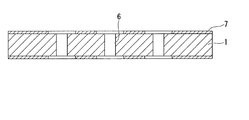
- a simulated circuit board was created. A schematic cross-sectional view of the module simulation circuit board is shown in FIG.
- the module simulation circuit board has a size of 90 ⁇ 100 mm and a total thickness of 250 ⁇ m.
- Liquid resin composition A was applied to the center of the substrate using an application robot (three-axis robot dispenser: manufactured by Musashi Engineering Co., Ltd.) so that the thickness of the resin portion was 1.0 ⁇ 0.2 mm.
- the application size is 80x90 mm.
- the coating pressure was adjusted so that the inner diameter of the needle used for coating was 2.27 mm, the coating pitch was 1.8 mm, and the coating speed was 21 mm / s.
- the blank portion on the outer periphery of the substrate after application was attached to a flat aluminum plate having a thickness of about 1 cm using a clip (file binder) and cured in an oven at 150 ° C. for 3 hours. After sufficiently cooling, the clip was removed to obtain a resin-sealed substrate (module before division). The warpage of this resin-sealed substrate was measured with a shadow moire measuring device (manufactured by AcroMetrix). Warpage was measured on the resin-coated portion of the substrate at room temperature.
- the substrate warpage amount at room temperature after curing by the combination of the liquid composition A and the module simulated circuit board a thus obtained was 411 ⁇ m, and the substrate warpage amount at 260 ° C. was 731 ⁇ m.
- the amount of warpage at this substrate size at room temperature is preferably 1 mm or less. If the amount of warpage is 1 mm or more, there is a possibility that a problem may occur in resin adsorption when the wafer is separated into pieces by dicing. Moreover, it is preferable that the amount of warpage of the substrate at 260 ° C.
- One module component can be obtained by dividing the pre-division module with a dicing machine and dividing it into individual pieces.
- Epoxy resin Bisphenol F Type diglycidyl ether YDF870GS (manufactured by Nippon Steel Chemical Co., Ltd.)
- Curing agent Methyltetrahydrophthalic anhydride HN-2200-R manufactured by Hitachi Chemical Co., Ltd.
- the present invention in a semiconductor module component using a liquid resin sealing material, warpage during mounting is small, and a thinner semiconductor module component can be produced. Therefore, the present invention is extremely useful industrially.
- Core board (module circuit board core) 2. Resin layer (module circuit board prepreg) 3. 3. Sealing material 4. Mounted parts 5. Solder balls Through hole (module circuit board internal conduction circuit) 7. Solder resist (circuit board for modules, solder resist)
Landscapes
- Chemical & Material Sciences (AREA)
- Health & Medical Sciences (AREA)
- Chemical Kinetics & Catalysis (AREA)
- Medicinal Chemistry (AREA)
- Polymers & Plastics (AREA)
- Organic Chemistry (AREA)
- Compositions Of Macromolecular Compounds (AREA)
- Structures Or Materials For Encapsulating Or Coating Semiconductor Devices Or Solid State Devices (AREA)
- Epoxy Resins (AREA)
Abstract
本発明により、液状封止樹脂組成物で封止した、熱時反りを抑制した、より薄い半導体モジュール部品が提供される。本発明の半導体モジュール部品は、コア材を含むコア基板から構成されるモジュール用回路基板に半導体チップ及び/又は受動素子を搭載し、樹脂組成物で封止してなり、前記樹脂組成物が(A)エポキシ樹脂、(B)無機充填材、(C)硬化促進剤および(D)二級アミノ基または三級アミノ基を有するシラン化合物を必須成分とする液状樹脂組成物であり、前記液状樹脂組成物の硬化物の250℃での弾性率が1~15GPaであり、25℃から260℃までの熱膨張率が2500~4500ppmであり、前記半導体モジュール部品の高さが1.6mm以下である。
Description
本発明は、液状封止用樹脂組成物を用いて作製した半導体モジュール部品に関する。
本願は、2011年5月19日に、日本に出願された特願2011-112202号に基づき優先権を主張し、その内容をここに援用する。
本願は、2011年5月19日に、日本に出願された特願2011-112202号に基づき優先権を主張し、その内容をここに援用する。
近年の電子機器産業においては、小型化、軽量化、高集積化、高速動作化という従来からの技術的方向に加え、生産コストの削減のため、人件費の安い海外への最終生産拠点の移動という経済的な方向も加わってきている。海外シフトに伴い、最終製品に搭載する電子部品には、より高度な機能化と知的財産保護という二つの観点が求められる。この様な要求から、半導体及び受動部品を一つの回路基板の上に搭載後、金属やプラスチック樹脂で覆うことで、従来の半導体パッケージとほぼ同等な使い方が出来、しかも中身が見えにくい、モジュールと言われる部品が広く使われ始めている。 このモジュール部品は、携帯電話のワンセグメントデジタルTV放送受信機能や携帯端末の無線ネットワーク通信機能などを、部品一つで提供している。
従来、このようなモジュール部品の回路基板には、熱膨張係数約15ppm/℃、常温弾性率20GPa、熱時弾性率10GPa程度のコア材を使用した基板が用いられてきたが、基板のうねりや反りが生ずるため、基板厚みで500μm以下にすることは難しかった。しかし、携帯端末の小型、薄型化の流れで、モジュール部品の薄型化も必須であり、モジュール用基板の薄型化も取り組まれている。従来のモジュール用基板を薄くすると、部品搭載後に基板の反りが発生してしまう。モジュールの封止形態については、金属缶封止と樹脂封止の二通りがあるが、対リバースエンジニアリング、より薄型しやすい事などから、樹脂封止がより好ましいと考えられている。この様なモジュール部品の場合、搭載する電子部品の高さが制限になり、封止側の厚みの限界は現状0.8mm前後と考えられる。従って、モジュール部品を薄くしようとすると、基板側の厚みを従来の500μmから更に薄くしなければならない。ところで、樹脂による基板の片面封止という形態をとる場合、基板側にしろ封止樹脂側にしろ、薄型化しようとすればするほど各部との熱膨張率の違いと剛性の低下により、大きな反りが発生する。この反りは、モジュールをマザーボードに実装した時に接続不良を発生させる為、ある程度の範囲に収めなければならない。モジュールの反り対策としては、従来はモジュールの構造で抑え込む方法が考えられている(例えば特許文献1、2参照)。
従来、このようなモジュール部品の回路基板には、熱膨張係数約15ppm/℃、常温弾性率20GPa、熱時弾性率10GPa程度のコア材を使用した基板が用いられてきたが、基板のうねりや反りが生ずるため、基板厚みで500μm以下にすることは難しかった。しかし、携帯端末の小型、薄型化の流れで、モジュール部品の薄型化も必須であり、モジュール用基板の薄型化も取り組まれている。従来のモジュール用基板を薄くすると、部品搭載後に基板の反りが発生してしまう。モジュールの封止形態については、金属缶封止と樹脂封止の二通りがあるが、対リバースエンジニアリング、より薄型しやすい事などから、樹脂封止がより好ましいと考えられている。この様なモジュール部品の場合、搭載する電子部品の高さが制限になり、封止側の厚みの限界は現状0.8mm前後と考えられる。従って、モジュール部品を薄くしようとすると、基板側の厚みを従来の500μmから更に薄くしなければならない。ところで、樹脂による基板の片面封止という形態をとる場合、基板側にしろ封止樹脂側にしろ、薄型化しようとすればするほど各部との熱膨張率の違いと剛性の低下により、大きな反りが発生する。この反りは、モジュールをマザーボードに実装した時に接続不良を発生させる為、ある程度の範囲に収めなければならない。モジュールの反り対策としては、従来はモジュールの構造で抑え込む方法が考えられている(例えば特許文献1、2参照)。
最近、モジュール部品の薄型化の為に、剛性が高くて薄い回路基板を用い、基板としての反りを抑制できるようになってきた。しかし、この様な薄型基板を従来の樹脂組成物で封止を行うと、熱膨張率のミスマッチのために、より大きな反りが生じる。特にリフロー半田付けプロセスにおける加熱時の反りが顕著になるため、接続不良が問題となってしまう。
本発明の目的は、液状封止樹脂組成物で封止した半導体モジュール部品において、熱時反りを抑制した、より薄い半導体モジュール部品を提供することである。
本発明の目的は、液状封止樹脂組成物で封止した半導体モジュール部品において、熱時反りを抑制した、より薄い半導体モジュール部品を提供することである。
本発明は以下の通りである。
〔1〕コア材を含むコア基板から構成されるモジュール用回路基板に半導体チップ及び/又は受動素子を搭載し、樹脂組成物で封止してなる半導体モジュール部品において、前記樹脂組成物が(A)エポキシ樹脂、(B)無機充填材、(C)硬化促進剤および(D)二級アミノ基または三級アミノ基を有するシラン化合物を必須成分とする液状樹脂組成物であり、前記液状樹脂組成物の硬化物の250℃での弾性率が1~15GPaであり、25℃から260℃までの熱膨張率が2500~4500ppmであり、前記半導体モジュール部品の高さが1.6mm以下である半導体モジュール部品。
[2]前記液状樹脂組成物の(B)無機充填材の配合量が70~90体積%である[1]に記載の半導体モジュール部品。
[3]前記液状樹脂組成物硬化物のガラス転移温度が200℃以上である、〔1〕又は〔2〕に記載の半導体モジュール部品。
[4]前記液状樹脂組成物は、溶剤を含まないものである〔1〕~〔3〕のいずれかに記載の半導体モジュール部品。
[5]前記液状樹脂組成物は、更に低応力添加剤を0.1~1.0重量%含むものである〔1〕~〔4〕のいずれかに記載の半導体モジュール部品。
[6]前記コア材の250℃での弾性率が15GPa以上であり、面内方向における線膨張係数が3~14ppm/℃であり、ガラス転移温度が240℃以上である〔1〕~〔5〕のいずれかに記載の半導体モジュール部品。
[7]前記モジュール用回路基板の厚さが500μm以下である[1]~[6]のいずれかに記載の半導体モジュール部品。
[8][1]~[7]のいずれかに記載の半導体モジュール部品の封止に使用される液状封止樹脂組成物。
〔1〕コア材を含むコア基板から構成されるモジュール用回路基板に半導体チップ及び/又は受動素子を搭載し、樹脂組成物で封止してなる半導体モジュール部品において、前記樹脂組成物が(A)エポキシ樹脂、(B)無機充填材、(C)硬化促進剤および(D)二級アミノ基または三級アミノ基を有するシラン化合物を必須成分とする液状樹脂組成物であり、前記液状樹脂組成物の硬化物の250℃での弾性率が1~15GPaであり、25℃から260℃までの熱膨張率が2500~4500ppmであり、前記半導体モジュール部品の高さが1.6mm以下である半導体モジュール部品。
[2]前記液状樹脂組成物の(B)無機充填材の配合量が70~90体積%である[1]に記載の半導体モジュール部品。
[3]前記液状樹脂組成物硬化物のガラス転移温度が200℃以上である、〔1〕又は〔2〕に記載の半導体モジュール部品。
[4]前記液状樹脂組成物は、溶剤を含まないものである〔1〕~〔3〕のいずれかに記載の半導体モジュール部品。
[5]前記液状樹脂組成物は、更に低応力添加剤を0.1~1.0重量%含むものである〔1〕~〔4〕のいずれかに記載の半導体モジュール部品。
[6]前記コア材の250℃での弾性率が15GPa以上であり、面内方向における線膨張係数が3~14ppm/℃であり、ガラス転移温度が240℃以上である〔1〕~〔5〕のいずれかに記載の半導体モジュール部品。
[7]前記モジュール用回路基板の厚さが500μm以下である[1]~[6]のいずれかに記載の半導体モジュール部品。
[8][1]~[7]のいずれかに記載の半導体モジュール部品の封止に使用される液状封止樹脂組成物。
本発明により、液状樹脂封止材を用いた半導体モジュール部品において、実装時の反りが少なく、より薄い半導体モジュール部品を作製する事が出来る。
本発明は、コア材を含むコア基板から構成されるモジュール用回路基板に半導体チップ及び/又は受動素子を搭載し、樹脂組成物で封止してなる半導体モジュール部品において、樹脂組成物が(A)エポキシ樹脂、(B)無機充填材、(C)硬化促進剤および(D)二級アミノ基または三級アミノ基を有するシラン化合物を必須成分とする液状樹脂組成物であり、液状樹脂組成物の硬化物の250℃での弾性率が1~15GPaであり、25℃から260℃までの熱膨張率が2500~4500ppmであり、半導体モジュール部品の高さが1.6mm以下である半導体モジュール部品である。
以下、本発明を詳細に説明する。
以下、本発明を詳細に説明する。
本発明に用いる液状樹脂組成物は、モジュール用回路基板の特性に合うように設計され、硬化物の250℃での弾性率は1~15GPaであることが必要である。好ましくは、1~10GPaである。250℃での弾性率が下限値未満では、樹脂の剛性が足りないため反りが大きくなる恐れがある。また250℃での弾性率が上限値を超えると、部品実装時の熱応力によって、封止された内部の部品に悪影響を与えてしまう可能性がある。
更に、液状樹脂組成物の硬化物の25℃から260℃までの熱膨張率が2500~4500ppmの範囲にする事で、常温から部品実装温度までの反りを抑制できる。好ましくは、2500~4000ppmである。熱膨張率が下限値未満の場合、または上限値を超える場合のいずれにおいても、モジュール部品としての反りが大きくなる恐れがある。
本発明の半導体モジュール部品は、高さ1.6mm以下である。1.6mmを超える場合は、上記液状樹脂組成物を用いなくても反りの問題がない部品が得られる場合があるが、薄型の半導体モジュール部品ではなくなる。一方、モジュール内部の部品実装の高さの制約等から、高さの最小値は薄型の基板と薄型の搭載部品を組み合わせても0.5mm程度と見積もられる。
更に、液状樹脂組成物の硬化物の25℃から260℃までの熱膨張率が2500~4500ppmの範囲にする事で、常温から部品実装温度までの反りを抑制できる。好ましくは、2500~4000ppmである。熱膨張率が下限値未満の場合、または上限値を超える場合のいずれにおいても、モジュール部品としての反りが大きくなる恐れがある。
本発明の半導体モジュール部品は、高さ1.6mm以下である。1.6mmを超える場合は、上記液状樹脂組成物を用いなくても反りの問題がない部品が得られる場合があるが、薄型の半導体モジュール部品ではなくなる。一方、モジュール内部の部品実装の高さの制約等から、高さの最小値は薄型の基板と薄型の搭載部品を組み合わせても0.5mm程度と見積もられる。
上記液状樹脂組成物は、以下のような成分からなるものである。
すなわち、(A)エポキシ樹脂は、一分子中にエポキシ基を2個以上有するもので、かつ常温において液状であれば、特に分子量や構造は限定されるものではない。
例えば、フェノールノボラック型エポキシ樹脂、クレゾールノボラック型エポキシ樹脂などのノボラック型エポキシ樹脂、ビスフェノールF型エポキシ樹脂、N,N-ジグリシジルアニリン、N,N-ジグリシジルトルイジン、ジアミノジフェニルメタン型グリシジルアミン、アミノフェノール型グリシジルアミンのような芳香族グリシジルアミン型エポキシ樹脂、ハイドロキノン型エポキシ樹脂、ビフェニル型エポキシ樹脂、スチルベン型エポキシ樹脂、トリフェノールメタン型エポキシ樹脂、トリフェノールプロパン型エポキシ樹脂、アルキル変性トリフェノールメタン型エポキシ樹脂、トリアジン核含有エポキシ樹脂、ジシクロペンタジエン変性フェノール型エポキシ樹脂、ナフトール型エポキシ樹脂、ナフタレン型エポキシ樹脂、フェニレンおよび/またはビフェニレン骨格を有するフェノールアラルキル型エポキシ樹脂、フェニレンおよび/またはビフェニレン骨格を有するナフトールアラルキル型エポキシ樹脂などのアラルキル型エポキシ樹脂などのエポキシ樹脂、ビニルシクロヘキセンジオキシド、ジシクロペンタジエンオキシド、アリサイクリックジエポキシ-アジペイドなどの脂環式エポキシなどの脂肪族エポキシ樹脂が挙げられる。
本発明では、芳香族環にグリシジルエーテル構造またはグリシジルアミン構造が結合した構造を含むものが耐熱性、機械特性、耐湿性という観点から好ましい。脂肪族または脂環式エポキシ樹脂は信頼性、特に接着性という観点から使用する量を限定するほうが好ましいが、低粘度かつ低硬化収縮なものであれば、この限りではない。これらは単独でも2種以上混合して使用しても良い。本発明ではエポキシ樹脂として最終的に常温(25℃)で液状であることが好ましいが、常温で固体のエポキシ樹脂であっても常温で液状のエポキシ樹脂に溶解させ、結果的に液状の状態であればよい。
本発明において、室温とは25℃を指し、また、液状とは樹脂又は樹脂組成物が流動性を有していることを指す。
本発明において、上記液状樹脂組成物は、室温(25℃)において、流動性を有している。
すなわち、(A)エポキシ樹脂は、一分子中にエポキシ基を2個以上有するもので、かつ常温において液状であれば、特に分子量や構造は限定されるものではない。
例えば、フェノールノボラック型エポキシ樹脂、クレゾールノボラック型エポキシ樹脂などのノボラック型エポキシ樹脂、ビスフェノールF型エポキシ樹脂、N,N-ジグリシジルアニリン、N,N-ジグリシジルトルイジン、ジアミノジフェニルメタン型グリシジルアミン、アミノフェノール型グリシジルアミンのような芳香族グリシジルアミン型エポキシ樹脂、ハイドロキノン型エポキシ樹脂、ビフェニル型エポキシ樹脂、スチルベン型エポキシ樹脂、トリフェノールメタン型エポキシ樹脂、トリフェノールプロパン型エポキシ樹脂、アルキル変性トリフェノールメタン型エポキシ樹脂、トリアジン核含有エポキシ樹脂、ジシクロペンタジエン変性フェノール型エポキシ樹脂、ナフトール型エポキシ樹脂、ナフタレン型エポキシ樹脂、フェニレンおよび/またはビフェニレン骨格を有するフェノールアラルキル型エポキシ樹脂、フェニレンおよび/またはビフェニレン骨格を有するナフトールアラルキル型エポキシ樹脂などのアラルキル型エポキシ樹脂などのエポキシ樹脂、ビニルシクロヘキセンジオキシド、ジシクロペンタジエンオキシド、アリサイクリックジエポキシ-アジペイドなどの脂環式エポキシなどの脂肪族エポキシ樹脂が挙げられる。
本発明では、芳香族環にグリシジルエーテル構造またはグリシジルアミン構造が結合した構造を含むものが耐熱性、機械特性、耐湿性という観点から好ましい。脂肪族または脂環式エポキシ樹脂は信頼性、特に接着性という観点から使用する量を限定するほうが好ましいが、低粘度かつ低硬化収縮なものであれば、この限りではない。これらは単独でも2種以上混合して使用しても良い。本発明ではエポキシ樹脂として最終的に常温(25℃)で液状であることが好ましいが、常温で固体のエポキシ樹脂であっても常温で液状のエポキシ樹脂に溶解させ、結果的に液状の状態であればよい。
本発明において、室温とは25℃を指し、また、液状とは樹脂又は樹脂組成物が流動性を有していることを指す。
本発明において、上記液状樹脂組成物は、室温(25℃)において、流動性を有している。
(B)無機充填材としては、一般に封止材料に使用されているものを使用することができる。
例えば、溶融シリカ、結晶シリカ、タルク、アルミナ、窒化珪素などが挙げられ、これらは単独でも2種類以上併用して用いても差し支えない。これらの中でも樹脂組成物の耐熱性、耐湿性、強度などを向上できることから溶融シリカ、結晶シリカ、合成シリカ粉末が好ましい。
上記無機充填材の形状は、特に限定されないが、粘度特性や流動特性の観点から形状は球状であることが好ましい。
無機充填材の含有量としては、成形性と耐半田クラック性のバランスから、全液状樹脂組成物中に70~90体積%使用することが好ましく、更に好ましくは74~84体積%である。
無機充填材の含有量が下限値未満の場合には、熱膨張率が十分小さくならずモジュール部品の反り抑制効果が小さくなり、また、吸水率の上昇に伴う耐半田クラック性が低下するなどの不具合が生ずる恐れがある。上限値を越えると粘度が高くなりすぎて、液状封止用樹脂組成物のディスペンス性能に問題が生じる可能性がある。
例えば、溶融シリカ、結晶シリカ、タルク、アルミナ、窒化珪素などが挙げられ、これらは単独でも2種類以上併用して用いても差し支えない。これらの中でも樹脂組成物の耐熱性、耐湿性、強度などを向上できることから溶融シリカ、結晶シリカ、合成シリカ粉末が好ましい。
上記無機充填材の形状は、特に限定されないが、粘度特性や流動特性の観点から形状は球状であることが好ましい。
無機充填材の含有量としては、成形性と耐半田クラック性のバランスから、全液状樹脂組成物中に70~90体積%使用することが好ましく、更に好ましくは74~84体積%である。
無機充填材の含有量が下限値未満の場合には、熱膨張率が十分小さくならずモジュール部品の反り抑制効果が小さくなり、また、吸水率の上昇に伴う耐半田クラック性が低下するなどの不具合が生ずる恐れがある。上限値を越えると粘度が高くなりすぎて、液状封止用樹脂組成物のディスペンス性能に問題が生じる可能性がある。
(C)硬化促進剤は、エポキシ基同士、またはエポキシ基と硬化剤との反応を促進させるものであれば特に制限はなく、例えば2-メチルイミダゾール、2 - フェニルイミダゾール、2 - フェニル - 4 - メチルイミダゾール、2-メチルイミダゾールと2,4-ジアミノ-6-ビニルトリアジンとの付加物、1 - シアノエチル - 2 - フェニルイミダゾール、2-フェニル-4-メチル-5-ヒドロキシメチルイミダゾール等のイミダゾール類、ジシアンジアミド、有機過酸化物等が挙げられる。またトリフェニルホスフィン、メチルジフェニルホスフィン等の有機ホスフィン類、テトラフェニルホスホニウム・テトラフェニルボレート、テトラフェニルホスホニウム・テトラ安息香酸ボレート、テトラフェニルホスホニウム・テトラナフトイックアシッドボレート、テトラフェニルホスホニウム・テトラナフトイルオキシボレート、テトラフェニルホスホニウム・テトラナフチルオキシボレート等のテトラ置換ホスホニウム・テトラ置換ボレート等のリン系化合物、1,8-ジアザビシクロ(5,4,0)ウンデセン-7等のジアザビシクロアルケンおよびその誘導体、トリブチルアミン、ベンジルジメチルアミン等のアミン系化合物等を使用することも可能である。
本発明に用いる液状樹脂組成物には、必要に応じて硬化剤を使用してもよい。硬化剤としては、例えば無水フタル酸、無水マレイン酸、無水トリメリット酸、無水ピロメリット酸、ヘキサヒドロ無水フタル酸、3-メチル-ヘキサヒドロ無水フタル酸、4-メチル-ヘキサヒドロ無水フタル酸、3-メチル-ヘキサヒドロ無水フタル酸と4-メチル-ヘキサヒドロ無水フタル酸との混合物、テトラヒドロ無水フタル酸、無水ナジック酸、または無水メチルナジック酸などの酸無水物、脂肪族アミン、芳香族アミン、フェノール樹脂等が挙げられ、これらは1種類あるいは複数種を併用して使用してもよい。フィラー配合量の多い液状樹脂組成物において硬化剤を配合する場合は、硬化剤は液状で粘度のなるべく低いものが好ましい。この様な硬化剤としては、テトラヒドロ無水フタル酸などが好ましく用いられる。
(D)二級アミノ基または三級アミノ基を有するシラン化合物としては、N-フェニル-3-アミノプロピルトリメトキシシラン、3-トリエトキシシリル-N-(1、3‐ジメチル-ブチリデン)プロピルアミン、ビス(ジメチルアミノ)ジメチルシラン、1、1’―エチレンビス(N,N,1,1-テトラメチルシランアミン)、ジメチルアミノトリメチルシラン等が挙げられるが、流動性向上作用に効果のあるものであれば、特にこれらに限定するものではない。
二級アミノ基または三級アミノ基を有するシラン化合物は、液状樹脂組成物中に0.05~1.0重量%の範囲で用いる事が好ましい。更に好ましくは、0.05~0.5重量%の範囲である。下限値未満では流動性向上作用が十分得られず、上限値を超えると揮発による目減り量増加により、モジュール部品としての反りが悪化する恐れがある。
また、ここでいう流動性は、E型粘度計にCP-51型コーンを装着し25℃で0.5rpmで測定した粘度にて300Pa・s以下が好ましい。更に好ましくは200Pa・s以下である。またチキソ性として、好ましくは1.6以下、より好ましくは1.4以下である。チキソ性は、上記のE型粘度計にて測定した粘度の比であり、[0.5rpm時の粘度]/[5.0rpm時の粘度]で求める。
二級アミノ基または三級アミノ基を有するシラン化合物は、液状樹脂組成物中に0.05~1.0重量%の範囲で用いる事が好ましい。更に好ましくは、0.05~0.5重量%の範囲である。下限値未満では流動性向上作用が十分得られず、上限値を超えると揮発による目減り量増加により、モジュール部品としての反りが悪化する恐れがある。
また、ここでいう流動性は、E型粘度計にCP-51型コーンを装着し25℃で0.5rpmで測定した粘度にて300Pa・s以下が好ましい。更に好ましくは200Pa・s以下である。またチキソ性として、好ましくは1.6以下、より好ましくは1.4以下である。チキソ性は、上記のE型粘度計にて測定した粘度の比であり、[0.5rpm時の粘度]/[5.0rpm時の粘度]で求める。
本発明に用いる液状樹脂組成物には、溶剤は使用しない事が望ましい。溶剤を配合した場合、硬化物のガラス転移温度が低下したり、硬化収縮が増えたりする為、モジュール部品としての反りが悪化してしまう恐れがある。
本発明に用いる液状樹脂組成物には、低応力添加剤を使用する事が出来る。低応力添加剤としては、液状のエポキシ化ポリブタジエンゴム, シリコーンオイル, コアシェル型シリコーン、固形のシリコーンゴム等が挙げられ、またこれらに限定されるものでもない。ここに挙げたものでは、流動性を維持するために液状の低応力剤が好ましく、更に密着性を保持する為に液状のエポキシ化ポリブタジエンゴムがより好ましい。また、その添加量としては、液状樹脂組成物中に0.1~1.0重量%が好ましく、より好ましくは、0.3~1.0重量%である。添加量が下限値未満では、低応力化の効果が十分得られず、更なる低反り化を期待できない。また上限値を超えると、硬化物のガラス転移温度が低下して、逆にモジュール部品としての反りが悪化したり、モジュール内部品への密着性が低下したりする恐れがある。
上記以外に用いることができる成分としては、消泡剤としてのシリコーン化合物やワックスなどの離型剤等が挙げられ、要求される特性に応じて添加する事ができる。
本発明に用いる液状樹脂組成物の硬化物のガラス転移温度とは、所定の条件で硬化した液状樹脂組成物試料をDMAにて測定して得られるtanδカーブのピーク温度である。
ガラス転移温度は200℃以上が望ましく、220℃以上がより望ましい。ガラス転移温度が下限値未満では、モジュール部品をマザー基板に搭載する際の半田リフロー処理時の高温において、反りが大きくなってしまう恐れがある。
ガラス転移温度は200℃以上が望ましく、220℃以上がより望ましい。ガラス転移温度が下限値未満では、モジュール部品をマザー基板に搭載する際の半田リフロー処理時の高温において、反りが大きくなってしまう恐れがある。
本発明に用いる液状封止樹脂組成物の製造方法としては、例えば各成分をプラネタリーミキサー、三本ロール、二本熱ロール、ライカイ機などの装置を用いて分散混練したのち、必要に応じて真空下で脱泡処理して製造する。
本発明に用いるモジュール用回路基板はコア基板から構成される。コア基板はコア材の両面に回路形成、及び/またはスルーホール形成されたものを用いてもよい。
本発明に用いるコア基板のコア材は、250℃での弾性率が15GPa以上、面内方向の線膨張係数3~14ppm、ガラス転移温度が240℃以上であることが好ましい。
更に好ましくは、250℃での弾性率が20GPa以上、面内方向の線膨張係数5~12ppm、ガラス転移温度が260℃以上である。
コア材の250℃での弾性率が下限値未満では部品搭載時の反りが抑制されにくい。また面内方向の線膨張係数が上限値を超えるとフリップチップ接続される半導体シリコンとの熱膨張係数のミスマッチが大きくなり、反りが悪化する恐れがあり、下限値未満では封止樹脂との熱膨張係数のミスマッチが大きくなり、やはり反りが悪化してしまう恐れがある。更にガラス転移温度が下限値未満では、モジュール部品搭載時の半田付温度付近での熱膨張率が大きくなり、搭載部品との熱膨張係数のミスマッチも大きくなる。この為、部品の接続不良が発生する恐れがある。
更に好ましくは、250℃での弾性率が20GPa以上、面内方向の線膨張係数5~12ppm、ガラス転移温度が260℃以上である。
コア材の250℃での弾性率が下限値未満では部品搭載時の反りが抑制されにくい。また面内方向の線膨張係数が上限値を超えるとフリップチップ接続される半導体シリコンとの熱膨張係数のミスマッチが大きくなり、反りが悪化する恐れがあり、下限値未満では封止樹脂との熱膨張係数のミスマッチが大きくなり、やはり反りが悪化してしまう恐れがある。更にガラス転移温度が下限値未満では、モジュール部品搭載時の半田付温度付近での熱膨張率が大きくなり、搭載部品との熱膨張係数のミスマッチも大きくなる。この為、部品の接続不良が発生する恐れがある。
上記コア基板は、コア材と金属箔からなる積層板に回路形成、及び/またはスルーホール形成したもの、または、無電解メッキ等の方法によりコア材表面に回路を形成したものを用いることができる。
上記積層板は、プリプレグを1枚もしくは複数枚積層したものの上下両面のうち少なくとも一方に、金属箔を重ね、加熱、加圧することで得ることができる。
上記プリプレグは、後述する樹脂組成物を基材に含浸させてなるものである。これにより、誘電特性、高温多湿下での機械的、電気的接続信頼性等の各種特性に優れたプリント配線板を製造するのに好適なプリプレグを得ることができる。
上記積層板は、プリプレグを1枚もしくは複数枚積層したものの上下両面のうち少なくとも一方に、金属箔を重ね、加熱、加圧することで得ることができる。
上記プリプレグは、後述する樹脂組成物を基材に含浸させてなるものである。これにより、誘電特性、高温多湿下での機械的、電気的接続信頼性等の各種特性に優れたプリント配線板を製造するのに好適なプリプレグを得ることができる。
上記金属箔は、特に限定されないが、例えば銅及び銅系合金、アルミ及びアルミ系合金、銀及び銀系合金、金及び金系合金、亜鉛及び亜鉛系合金、ニッケル及びニッケル系合金、錫及び錫系合金、鉄および鉄系合金等の金属箔が挙げられる。
上記基材は、特に限定されないが、ガラス織布、ガラス不織布等のガラス繊維基材、ポリアミド樹脂繊維、芳香族ポリアミド樹脂繊維、全芳香族ポリアミド樹脂繊維等のポリアミド系樹脂繊維、ポリエステル樹脂繊維、芳香族ポリエステル樹脂繊維、全芳香族ポリエステル樹脂繊維等のポリエステル系樹脂繊維、ポリイミド樹脂繊維、フッ素樹脂繊維等を主成分とする織布または不織布で構成される合成繊維基材、クラフト紙、コットンリンター紙、リンターとクラフトパルプの混抄紙等を主成分とする紙基材等の有機繊維基材等が挙げられる。これらの中でもガラス繊維基材が好ましい。これにより、プリプレグの強度が向上し、吸水率を下げることができ、また熱膨張係数を小さくすることができる。
上記樹脂組成物は特に限定されないが、例えば熱硬化性樹脂と充填材などで構成される。
上記熱硬化性樹脂としては、例えばフェノールノボラック樹脂、クレゾールノボラック樹脂、ビスフェノールAノボラック樹脂などのノボラック型フェノール樹脂、未変性のレゾールフェノール樹脂、桐油、アマニ油、クルミ油などで変性した油変性レゾールフェノール樹脂などのレゾール型フェノール樹脂などのフェノール樹脂、ビスフェノールA型エポキシ樹脂、ビスフェノールF型エポキシ樹脂、ビスフェノールS型エポキシ樹脂、ビスフェノールE型エポキシ樹脂、ビスフェノールM型エポキシ樹脂、ビスフェノールP型エポキシ樹脂、ビスフェノールZ型エポキシ樹脂などのビスフェノール型エポキシ樹脂、フェノールノボラック型エポキシ樹脂、クレゾールノボラックエポキシ樹脂などのノボラック型エポキシ樹脂、ビフェニル型エポキシ樹脂、ビフェニルアラルキル型エポキシ樹脂、アリールアルキレン型エポキシ樹脂、ナフタレン型エポキシ樹脂、アントラセン型エポキシ樹脂、フェノキシ型エポキシ樹脂、ジシクロペンタジエン型エポキシ樹脂、ノルボルネン型エポキシ樹脂、アダマンタン型エポキシ樹脂、フルオレン型エポキシ樹脂などのエポキシ樹脂、ユリア(尿素)樹脂、メラミン樹脂などのトリアジン環を有する樹脂、不飽和ポリエステル樹脂、ビスマレイミド樹脂、ポリウレタン樹脂、ジアリルフタレート樹脂、シリコーン樹脂、ベンゾオキサジン環を有する樹脂、ノルボルネン系樹脂、シアネート樹脂、ベンゾシクロブテン樹脂、ビスマレイミドトリアジン樹脂などが挙げられる。
これらの中の1種類を単独で用いることもできるし、異なる重量平均分子量を有する2種類以上を併用したり、1種類または2種類以上と、それらのプレポリマーを併用したりすることもできる。
またこれらの中でも、特に、エポキシ樹脂、シアネート樹脂(シアネート樹脂のプレポリマーを含む)、フェノール樹脂、ベンゾシクロブテン樹脂およびビスマレイミドトリアジン樹脂の中の少なくとも1種の熱硬化性樹脂が好ましい。これらの中でもシアネート樹脂が最も好ましい。
上記熱硬化性樹脂としては、例えばフェノールノボラック樹脂、クレゾールノボラック樹脂、ビスフェノールAノボラック樹脂などのノボラック型フェノール樹脂、未変性のレゾールフェノール樹脂、桐油、アマニ油、クルミ油などで変性した油変性レゾールフェノール樹脂などのレゾール型フェノール樹脂などのフェノール樹脂、ビスフェノールA型エポキシ樹脂、ビスフェノールF型エポキシ樹脂、ビスフェノールS型エポキシ樹脂、ビスフェノールE型エポキシ樹脂、ビスフェノールM型エポキシ樹脂、ビスフェノールP型エポキシ樹脂、ビスフェノールZ型エポキシ樹脂などのビスフェノール型エポキシ樹脂、フェノールノボラック型エポキシ樹脂、クレゾールノボラックエポキシ樹脂などのノボラック型エポキシ樹脂、ビフェニル型エポキシ樹脂、ビフェニルアラルキル型エポキシ樹脂、アリールアルキレン型エポキシ樹脂、ナフタレン型エポキシ樹脂、アントラセン型エポキシ樹脂、フェノキシ型エポキシ樹脂、ジシクロペンタジエン型エポキシ樹脂、ノルボルネン型エポキシ樹脂、アダマンタン型エポキシ樹脂、フルオレン型エポキシ樹脂などのエポキシ樹脂、ユリア(尿素)樹脂、メラミン樹脂などのトリアジン環を有する樹脂、不飽和ポリエステル樹脂、ビスマレイミド樹脂、ポリウレタン樹脂、ジアリルフタレート樹脂、シリコーン樹脂、ベンゾオキサジン環を有する樹脂、ノルボルネン系樹脂、シアネート樹脂、ベンゾシクロブテン樹脂、ビスマレイミドトリアジン樹脂などが挙げられる。
これらの中の1種類を単独で用いることもできるし、異なる重量平均分子量を有する2種類以上を併用したり、1種類または2種類以上と、それらのプレポリマーを併用したりすることもできる。
またこれらの中でも、特に、エポキシ樹脂、シアネート樹脂(シアネート樹脂のプレポリマーを含む)、フェノール樹脂、ベンゾシクロブテン樹脂およびビスマレイミドトリアジン樹脂の中の少なくとも1種の熱硬化性樹脂が好ましい。これらの中でもシアネート樹脂が最も好ましい。
この様なモジュール用回路基板用を構成するコア基板としては、LαZ4785GS(商品名、住友ベークライト株式会社製)等が入手可能である。
本発明に用いるモジュール用回路基板は、コア基板にさらに樹脂層を積層したものを用いてもよい。樹脂層には、コア基板と電気的接続を図るべくビアホールが形成されていてもよく、また樹脂層表面に導体回路が形成されていてもよい。さらに導体回路には、一般にプリント配線板に用いられるソルダーレジストが形成されていてもよい。
上記樹脂層は、基材に上述の樹脂組成物が含浸されたもの、すなわちプリプレグを用いることもできる。これにより、樹脂層の熱膨張係数を小さくすることができ、それにより反りを低減することができる。この場合、基材としては、有機繊維基材やガラス繊維基材などが好ましい。これにより、低い熱膨張係数と加工性とのバランスに優れる。
また、樹脂層としては、樹脂シートを積層したものを用いてもよい。
上記樹脂層は、基材に上述の樹脂組成物が含浸されたもの、すなわちプリプレグを用いることもできる。これにより、樹脂層の熱膨張係数を小さくすることができ、それにより反りを低減することができる。この場合、基材としては、有機繊維基材やガラス繊維基材などが好ましい。これにより、低い熱膨張係数と加工性とのバランスに優れる。
また、樹脂層としては、樹脂シートを積層したものを用いてもよい。
本発明の半導体モジュール部品の一例の概略断面図を図1に示した。コア材の両面に銅箔の回路を形成し、スルーホール(内部導通回路)6を形成したコア基板1にプリプレグによる樹脂層2を両面に形成する。更にソルダーレジスト7を形成して、モジュール用回路基板が得られる。モジュール用回路基板に半導体チップ、受動素子等の搭載部品4を搭載し、液状樹脂組成物3で封止して半導体モジュール部品が得られる。半導体モジュール部品は、はんだボール5を介して、他の回路基板等に搭載される。
本発明の半導体モジュール部品の製造方法としては、例えば次の様な方法があるが、これに限るものではない。
即ち、支持体であるモジュール用回路基板の上に、チップ抵抗やチップキャパシタなどの受動素子と半導体チップを搭載後、リフロー半田付け装置に通し、基板との間に電気的物理的接合を行う。半導体チップの電気的接続はワイヤーボンディング法ではボンディングパッドを基板の搭載位置周辺に設けるため、より小型化がしやすいフリップチップ接続が望ましい。次に、液状封止樹脂組成物を塗布・硬化する。液状樹脂組成物の塗布は、その粘度特性に合わせ、60℃程度に加温しても常温でも構わない。液状樹脂組成物の硬化温度は、組成物に使用する硬化促進剤や硬化剤の組み合わせにより変わりうるが、温度が低すぎると生産性が低下し、高すぎると液状樹脂の硬化物とモジュール用回路基板と搭載部品の熱膨張係数の違いにより、モジュールとしての反りが大きくなってしまうため、高くとも180℃程度、好ましくは150℃前後である。
また、一枚のモジュール用回路基板上には複数のモジュールが配置されていることが好ましい。この場合は、液状樹脂組成物を硬化させた後に、ダイシング装置により切り分け、個片化する事で一つの半導体モジュール部品が得られる。
即ち、支持体であるモジュール用回路基板の上に、チップ抵抗やチップキャパシタなどの受動素子と半導体チップを搭載後、リフロー半田付け装置に通し、基板との間に電気的物理的接合を行う。半導体チップの電気的接続はワイヤーボンディング法ではボンディングパッドを基板の搭載位置周辺に設けるため、より小型化がしやすいフリップチップ接続が望ましい。次に、液状封止樹脂組成物を塗布・硬化する。液状樹脂組成物の塗布は、その粘度特性に合わせ、60℃程度に加温しても常温でも構わない。液状樹脂組成物の硬化温度は、組成物に使用する硬化促進剤や硬化剤の組み合わせにより変わりうるが、温度が低すぎると生産性が低下し、高すぎると液状樹脂の硬化物とモジュール用回路基板と搭載部品の熱膨張係数の違いにより、モジュールとしての反りが大きくなってしまうため、高くとも180℃程度、好ましくは150℃前後である。
また、一枚のモジュール用回路基板上には複数のモジュールが配置されていることが好ましい。この場合は、液状樹脂組成物を硬化させた後に、ダイシング装置により切り分け、個片化する事で一つの半導体モジュール部品が得られる。
以下、実施例を用いて、本発明を具体的に説明するが、本発明はこれらに限定されるものではない。
[実施例1]
(1)エポキシ樹脂1(A)として、
N,N-ビス(オキシラニルメチル)-4-(オキシラニルメトキシ)アニリン)
(JER-630、三菱化学株式会社製)
100重量部
(2)エポキシ樹脂2(A)として
1,4シクロヘキサンジメタノールジグリシジルエーテル
ZX-1658GS 東都化成社製 68重量部
(3)無機充填材1(B)として、
溶融シリカ:HS-202 マイクロン社製 1150重量部
(4)無機充填材2(B)として、
溶融シリカ:SO-C3 アドマテックス社製 240重量部
(5)硬化促進剤1(C)として、2 - フェニル - 4 - メチルイミダゾール
四国化成社製 0.5重量部
(6)硬化促進剤2(C)として、ジシアンジアミド 11重量部
(7)三級アミノ基を有するシラン化合物(D)として
N-フェニル-3-アミノプロピルトリメトキシシラン
KBM-573 信越化学工業社製 3重量部
(8)カップリング剤として
γグリシジル・プロピル・トリエトキシシラン
KBE-403E 信越化学工業社製 3重量部
(9)着色剤として、カーボンブラック 2重量部
(10)低応力剤として、エポキシ化液状ポリブタジエンゴム
BF-1000 株式会社アデカ社製 11重量部
をビーカーに取りスパチュラで混ぜ合わせた後、三本ロールにて3回混錬したのち常温で12時間養生後、ビーカーに入れて真空オーブン(常温、5mmHg)で10分間脱泡処理を行い、液状樹脂組成物Aを得た。
[実施例1]
(1)エポキシ樹脂1(A)として、
N,N-ビス(オキシラニルメチル)-4-(オキシラニルメトキシ)アニリン)
(JER-630、三菱化学株式会社製)
100重量部
(2)エポキシ樹脂2(A)として
1,4シクロヘキサンジメタノールジグリシジルエーテル
ZX-1658GS 東都化成社製 68重量部
(3)無機充填材1(B)として、
溶融シリカ:HS-202 マイクロン社製 1150重量部
(4)無機充填材2(B)として、
溶融シリカ:SO-C3 アドマテックス社製 240重量部
(5)硬化促進剤1(C)として、2 - フェニル - 4 - メチルイミダゾール
四国化成社製 0.5重量部
(6)硬化促進剤2(C)として、ジシアンジアミド 11重量部
(7)三級アミノ基を有するシラン化合物(D)として
N-フェニル-3-アミノプロピルトリメトキシシラン
KBM-573 信越化学工業社製 3重量部
(8)カップリング剤として
γグリシジル・プロピル・トリエトキシシラン
KBE-403E 信越化学工業社製 3重量部
(9)着色剤として、カーボンブラック 2重量部
(10)低応力剤として、エポキシ化液状ポリブタジエンゴム
BF-1000 株式会社アデカ社製 11重量部
をビーカーに取りスパチュラで混ぜ合わせた後、三本ロールにて3回混錬したのち常温で12時間養生後、ビーカーに入れて真空オーブン(常温、5mmHg)で10分間脱泡処理を行い、液状樹脂組成物Aを得た。
作製した液状樹脂組成物Aについて、以下の評価を行った。
(a)粘度測定:E型粘度計にCP-51型コーンを装着し、25℃で0.5rpm、25℃で5rpmの条件で測定を実施した。
(b)チキソ性:上記粘度測定において、5rpmおよび0.5rpmで測定した粘度結果から次のように計算した。[0.5rpmの粘度]÷[5rpmの粘度]である。
(c)熱時粘度安定性:Haake社製レオメータRS150を用いて、測定ギャップ 250mm、測定モード CS 500Pa, 1Hz、20mmΦのプレート型のローター、温度80℃固定にて二時間測定した。 [二時間後の粘度]÷[測定開始時の粘度]を熱時粘度安定性とした。
(d)熱膨張率:作製した液状樹脂組成物を所定の型に入れ、150℃で3時間硬化し、長さ約10mmの試験片を作製した。これをTMA測定装置(セイコーインスツルメンツ社製)で、測定温度範囲0℃~330℃、昇温速度10℃毎分にて熱膨張を計測し、25℃から260℃までの熱膨張率を得た。
(e)弾性率、ガラス転移温度:作製した液状樹脂組成物を、所定の型に入れ150℃で3時間硬化し試験片とした。これをDMA測定装置(セイコーインスツルメンツ社製)で、測定温度範囲0℃~300℃,昇温速度5℃毎分で弾性率を測定し、各温度における貯蔵弾性率を用いた。また、同時に測定したtanδカーブのピーク温度を、ガラス転移温度とした。
作製した液状樹脂組成物の25℃での粘度は、0.5rpmで143Pa・s、5.0rpmで100Pa・s、チキソ性1.4、25℃から260℃まで熱膨張率は3400ppm、250℃での弾性率は7.7GPa、ガラス転移温度232℃であった。
(a)粘度測定:E型粘度計にCP-51型コーンを装着し、25℃で0.5rpm、25℃で5rpmの条件で測定を実施した。
(b)チキソ性:上記粘度測定において、5rpmおよび0.5rpmで測定した粘度結果から次のように計算した。[0.5rpmの粘度]÷[5rpmの粘度]である。
(c)熱時粘度安定性:Haake社製レオメータRS150を用いて、測定ギャップ 250mm、測定モード CS 500Pa, 1Hz、20mmΦのプレート型のローター、温度80℃固定にて二時間測定した。 [二時間後の粘度]÷[測定開始時の粘度]を熱時粘度安定性とした。
(d)熱膨張率:作製した液状樹脂組成物を所定の型に入れ、150℃で3時間硬化し、長さ約10mmの試験片を作製した。これをTMA測定装置(セイコーインスツルメンツ社製)で、測定温度範囲0℃~330℃、昇温速度10℃毎分にて熱膨張を計測し、25℃から260℃までの熱膨張率を得た。
(e)弾性率、ガラス転移温度:作製した液状樹脂組成物を、所定の型に入れ150℃で3時間硬化し試験片とした。これをDMA測定装置(セイコーインスツルメンツ社製)で、測定温度範囲0℃~300℃,昇温速度5℃毎分で弾性率を測定し、各温度における貯蔵弾性率を用いた。また、同時に測定したtanδカーブのピーク温度を、ガラス転移温度とした。
作製した液状樹脂組成物の25℃での粘度は、0.5rpmで143Pa・s、5.0rpmで100Pa・s、チキソ性1.4、25℃から260℃まで熱膨張率は3400ppm、250℃での弾性率は7.7GPa、ガラス転移温度232℃であった。
[反り評価]
液状樹脂組成物Aを次のモジュール用模擬回路基板aに塗布した。モジュール用模擬回路基板aは、250℃の弾性率が20GPa、面内方向線膨張係数が10ppm、ガラス転移温度が260℃のコア材からなるコア基板(LαZ4785GS:住友ベークライト株式会社製)を使用した。コア材の特性は以下の方法で評価した。
[コア材の弾性率]
コア基板の銅箔を全面エッチングし、15mm×20mmの試験片を作製し、島津製作所社製オートグラフAG-ISを用い3点曲げ試験により弾性率を求めた。
測定条件は、ヘッドスピード0.5mm/min、支点距離2mmとし、5℃/分で20℃~300℃まで昇温させ、250℃の弾性率を測定した。
[コア材の線熱膨張率] コア基板の銅箔を全面エッチングし、5mm×20mmの試験片を作製し、TMA装置(TAインスツルメント社製)を用いて5℃/分の条件で、50℃~100℃における面内方向(XY方向)の線膨張係数、およびガラス転移温度測定した。
[コア材のガラス転移温度]
コア基板の銅箔を全面エッチングし、10mmx20mmの試験片を作成し、DMA測定装置(セイコーインスツルメンツ社製)で、測定温度範囲0℃~300℃,昇温速度5℃毎分で弾性率を測定し、tanδが最大となる温度をガラス転移温度とした。
液状樹脂組成物Aを次のモジュール用模擬回路基板aに塗布した。モジュール用模擬回路基板aは、250℃の弾性率が20GPa、面内方向線膨張係数が10ppm、ガラス転移温度が260℃のコア材からなるコア基板(LαZ4785GS:住友ベークライト株式会社製)を使用した。コア材の特性は以下の方法で評価した。
[コア材の弾性率]
コア基板の銅箔を全面エッチングし、15mm×20mmの試験片を作製し、島津製作所社製オートグラフAG-ISを用い3点曲げ試験により弾性率を求めた。
測定条件は、ヘッドスピード0.5mm/min、支点距離2mmとし、5℃/分で20℃~300℃まで昇温させ、250℃の弾性率を測定した。
[コア材の線熱膨張率] コア基板の銅箔を全面エッチングし、5mm×20mmの試験片を作製し、TMA装置(TAインスツルメント社製)を用いて5℃/分の条件で、50℃~100℃における面内方向(XY方向)の線膨張係数、およびガラス転移温度測定した。
[コア材のガラス転移温度]
コア基板の銅箔を全面エッチングし、10mmx20mmの試験片を作成し、DMA測定装置(セイコーインスツルメンツ社製)で、測定温度範囲0℃~300℃,昇温速度5℃毎分で弾性率を測定し、tanδが最大となる温度をガラス転移温度とした。
コア基板はコア材層の厚さは200μmで、コア材層の上下にそれぞれ10μm厚の銅箔回路を持つもので、更に銅箔回路に15μm厚のソルダーレジスト(PSR4000-AUS308)でコートしたモジュール用模擬回路基板を作成した。モジュール用模擬回路基板の概略断面図を図2に示した。モジュール用模擬回路基板の大きさは90x100mm、総厚さ250μmである。樹脂部の厚みが1.0±0.2mmとなるように、塗布ロボット(三軸ロボットディスペンサー:武蔵エンジニアリング社製)を用いて基板の中央に液状樹脂組成物Aを塗布した。塗布サイズは80x90mmである。 塗布に用いたニードルの内径は2.27mm、塗布ピッチ1.8mm、塗布速度21mm/sとなるように塗布圧力を調整した。
塗布後の基板外周の余白部を、クリップ(ファイル用バインダー)を用いて、厚み約1cmの平らなアルミ板に張りつけ、オーブンにて150℃ 3時間硬化させた。 十分冷却した後、クリップを外して、樹脂封止済み基板(分割前モジュール)を得た。
この樹脂封止済み基板を、シャドーモアレ測定装置(AcroMetrix社製)により反りを測定した。反りは常温で基板の樹脂塗布部を計測した。測定した平面にて、高さ(最大値-最小値=反り量)が最小になるように角度調整した時の反り量を値として採用した。
この様にして得られた液状組成物Aとモジュール用模擬回路基板aの組み合わせによる硬化後の常温での基板反り量は411μm、260℃での基板反り量は731μmであった。常温におけるこの基板サイズでの反り量としては1mm以下が好ましい。反り量が1mm以上では、ダイシングによる個片化時に樹脂吸着に問題が生じる恐れがある。また、260℃での基板の反り量においても1mm以下に抑えられている事が好ましい。1mm以上に反ってしまうと、内部部品の破壊や剥離が生じてしまう恐れがある。
なお、この構成での分割前モジュール全体の厚みは約1.25mmであった。
分割前モジュールをダイシング装置により切り分け、個片化する事で一つのモジュール部品が得られる。
塗布後の基板外周の余白部を、クリップ(ファイル用バインダー)を用いて、厚み約1cmの平らなアルミ板に張りつけ、オーブンにて150℃ 3時間硬化させた。 十分冷却した後、クリップを外して、樹脂封止済み基板(分割前モジュール)を得た。
この樹脂封止済み基板を、シャドーモアレ測定装置(AcroMetrix社製)により反りを測定した。反りは常温で基板の樹脂塗布部を計測した。測定した平面にて、高さ(最大値-最小値=反り量)が最小になるように角度調整した時の反り量を値として採用した。
この様にして得られた液状組成物Aとモジュール用模擬回路基板aの組み合わせによる硬化後の常温での基板反り量は411μm、260℃での基板反り量は731μmであった。常温におけるこの基板サイズでの反り量としては1mm以下が好ましい。反り量が1mm以上では、ダイシングによる個片化時に樹脂吸着に問題が生じる恐れがある。また、260℃での基板の反り量においても1mm以下に抑えられている事が好ましい。1mm以上に反ってしまうと、内部部品の破壊や剥離が生じてしまう恐れがある。
なお、この構成での分割前モジュール全体の厚みは約1.25mmであった。
分割前モジュールをダイシング装置により切り分け、個片化する事で一つのモジュール部品が得られる。
[実施例2]~[実施例4]、[比較例1]~[比較例4]
表1の配合に従い、実施例1と同様にして液状樹脂組成物を得て、実施例1と同様にして評価した。 結果を表1に示す。
実施例1以外で使用した原料を以下に示す。
・溶剤:エチレングリコールモノブチルアセテート
・硬化促進剤:2,4 - ジアミノ - 6 - [2' - メチルイミダゾリル - (1')] - エチル - s - トリアジン 2MZA 四国化成社製
・エポキシ樹脂:ビスフェノールF型ジグリシジルエーテル
YDF870GS(新日鉄化学社製)
・硬化剤:メチルテトラヒドロフタル酸無水物
HN-2200-R 日立化成工業社製
表1の配合に従い、実施例1と同様にして液状樹脂組成物を得て、実施例1と同様にして評価した。 結果を表1に示す。
実施例1以外で使用した原料を以下に示す。
・溶剤:エチレングリコールモノブチルアセテート
・硬化促進剤:2,4 - ジアミノ - 6 - [2' - メチルイミダゾリル - (1')] - エチル - s - トリアジン 2MZA 四国化成社製
・エポキシ樹脂:ビスフェノールF型ジグリシジルエーテル
YDF870GS(新日鉄化学社製)
・硬化剤:メチルテトラヒドロフタル酸無水物
HN-2200-R 日立化成工業社製
[比較例5]
コア基板として日立化成工業社製のCL-E-679FG(コア材の250℃における弾性率9GPa、面内方向線膨張係数15ppm、ガラス転移温度190℃)に変えた以外はモジュール用模擬回路基板aと同じデザインのモジュール用模擬回路基板bを使用し、液状樹脂組成物Aを塗布しようとした。しかし塗布ロボットにセットした際の基板自体の反りが大きく、塗布が実施できなかった。
コア基板として日立化成工業社製のCL-E-679FG(コア材の250℃における弾性率9GPa、面内方向線膨張係数15ppm、ガラス転移温度190℃)に変えた以外はモジュール用模擬回路基板aと同じデザインのモジュール用模擬回路基板bを使用し、液状樹脂組成物Aを塗布しようとした。しかし塗布ロボットにセットした際の基板自体の反りが大きく、塗布が実施できなかった。
[比較例6]
モジュール用模擬回路基板bのコア材層の厚さを600μmとし、総厚さを650μmに変更したモジュール用模擬回路基板cを使用し、液状樹脂組成物Aを塗布、硬化したのち実施例1と同様に反りを測定した。常温での反り量は315μm、260℃では556μmであった。この分割前モジュール全体の厚みは約1.65mmであった。
モジュール用模擬回路基板bのコア材層の厚さを600μmとし、総厚さを650μmに変更したモジュール用模擬回路基板cを使用し、液状樹脂組成物Aを塗布、硬化したのち実施例1と同様に反りを測定した。常温での反り量は315μm、260℃では556μmであった。この分割前モジュール全体の厚みは約1.65mmであった。

本発明により、液状樹脂封止材を用いた半導体モジュール部品において、実装時の反りが少なく、より薄い半導体モジュール部品を作製する事が出来るため、本発明は産業上極めて有用である。
1.コア基板(モジュール用回路基板 コア)
2.樹脂層(モジュール用回路基板 プリプレグ)
3.封止材
4.搭載部品
5.はんだボール
6.スルホール(モジュール用回路基板 内部導通回路)
7.ソルダーレジスト(モジュール用回路基板 ソルダーレジスト)
2.樹脂層(モジュール用回路基板 プリプレグ)
3.封止材
4.搭載部品
5.はんだボール
6.スルホール(モジュール用回路基板 内部導通回路)
7.ソルダーレジスト(モジュール用回路基板 ソルダーレジスト)
Claims (8)
- コア材を含むコア基板から構成されるモジュール用回路基板に半導体チップ及び/又は受動素子を搭載し、樹脂組成物で封止してなる半導体モジュール部品において、前記樹脂組成物が(A)エポキシ樹脂、(B)無機充填材、(C)硬化促進剤および(D)二級アミノ基または三級アミノ基を有するシラン化合物を必須成分とする液状樹脂組成物であり、前記液状樹脂組成物の硬化物の250℃での弾性率が1~15GPaであり、25℃から260℃までの熱膨張率が2500~4500ppmであり、前記半導体モジュール部品の高さが1.6mm以下である半導体モジュール部品。
- 前記液状樹脂組成物の(B)無機充填材の配合量が70~90体積%である請求項1に記載の半導体モジュール部品。
- 前記液状樹脂組成物硬化物のガラス転移温度が200℃以上である、請求項1又は2に記載の半導体モジュール部品。
- 前記液状樹脂組成物は、溶剤を含まないものである請求項1~3のいずれか一項に記載の半導体モジュール部品。
- 前記液状樹脂組成物は、更に低応力添加剤を0.1~1.0重量%含むものである請求項1~4のいずれか一項に記載の半導体モジュール部品。
- 前記コア材の250℃での弾性率が15GPa以上であり、面内方向における線膨張係数が3~14ppm/℃であり、ガラス転移温度が240℃以上である請求項1~5のいずれか一項に記載の半導体モジュール部品。
- 前記モジュール用回路基板の厚さが500μm以下である請求項1~6のいずれか一項に記載の半導体モジュール部品。
- 請求項1~7のいずれか一項に記載の半導体モジュール部品の封止に使用される液状封止樹脂組成物。
Applications Claiming Priority (2)
| Application Number | Priority Date | Filing Date | Title |
|---|---|---|---|
| JP2011-112202 | 2011-05-19 | ||
| JP2011112202 | 2011-05-19 |
Publications (1)
| Publication Number | Publication Date |
|---|---|
| WO2012157665A1 true WO2012157665A1 (ja) | 2012-11-22 |
Family
ID=47176982
Family Applications (1)
| Application Number | Title | Priority Date | Filing Date |
|---|---|---|---|
| PCT/JP2012/062486 Ceased WO2012157665A1 (ja) | 2011-05-19 | 2012-05-16 | 半導体モジュール部品及び液状封止用樹脂組成物 |
Country Status (3)
| Country | Link |
|---|---|
| JP (1) | JP2012255147A (ja) |
| TW (1) | TW201250950A (ja) |
| WO (1) | WO2012157665A1 (ja) |
Cited By (2)
| Publication number | Priority date | Publication date | Assignee | Title |
|---|---|---|---|---|
| WO2014196296A1 (ja) * | 2013-06-07 | 2014-12-11 | 日東電工株式会社 | 半導体装置の製造方法 |
| CN109233212A (zh) * | 2017-07-10 | 2019-01-18 | 味之素株式会社 | 树脂组合物 |
Families Citing this family (3)
| Publication number | Priority date | Publication date | Assignee | Title |
|---|---|---|---|---|
| JP6424570B2 (ja) * | 2014-11-04 | 2018-11-21 | 株式会社村田製作所 | 電子部品内蔵基板およびその製造方法 |
| US10615093B2 (en) | 2017-04-21 | 2020-04-07 | Mitsubishi Electric Corporation | Semiconductor device |
| JP7060068B2 (ja) * | 2020-12-09 | 2022-04-26 | 味の素株式会社 | 樹脂組成物 |
Citations (3)
| Publication number | Priority date | Publication date | Assignee | Title |
|---|---|---|---|---|
| JPH10270610A (ja) * | 1997-01-23 | 1998-10-09 | Toray Ind Inc | 樹脂封止型半導体装置 |
| JP2008007692A (ja) * | 2006-06-30 | 2008-01-17 | Sumitomo Bakelite Co Ltd | 封止用エポキシ樹脂組成物及び電子部品装置 |
| JP2011058090A (ja) * | 2009-08-10 | 2011-03-24 | Sumitomo Bakelite Co Ltd | 無電解ニッケル−パラジウム−金めっき方法、めっき処理物、プリント配線板、インターポーザ、および半導体装置 |
-
2012
- 2012-05-04 TW TW101116033A patent/TW201250950A/zh unknown
- 2012-05-16 WO PCT/JP2012/062486 patent/WO2012157665A1/ja not_active Ceased
- 2012-05-17 JP JP2012113099A patent/JP2012255147A/ja not_active Withdrawn
Patent Citations (3)
| Publication number | Priority date | Publication date | Assignee | Title |
|---|---|---|---|---|
| JPH10270610A (ja) * | 1997-01-23 | 1998-10-09 | Toray Ind Inc | 樹脂封止型半導体装置 |
| JP2008007692A (ja) * | 2006-06-30 | 2008-01-17 | Sumitomo Bakelite Co Ltd | 封止用エポキシ樹脂組成物及び電子部品装置 |
| JP2011058090A (ja) * | 2009-08-10 | 2011-03-24 | Sumitomo Bakelite Co Ltd | 無電解ニッケル−パラジウム−金めっき方法、めっき処理物、プリント配線板、インターポーザ、および半導体装置 |
Cited By (2)
| Publication number | Priority date | Publication date | Assignee | Title |
|---|---|---|---|---|
| WO2014196296A1 (ja) * | 2013-06-07 | 2014-12-11 | 日東電工株式会社 | 半導体装置の製造方法 |
| CN109233212A (zh) * | 2017-07-10 | 2019-01-18 | 味之素株式会社 | 树脂组合物 |
Also Published As
| Publication number | Publication date |
|---|---|
| TW201250950A (en) | 2012-12-16 |
| JP2012255147A (ja) | 2012-12-27 |
Similar Documents
| Publication | Publication Date | Title |
|---|---|---|
| KR101195408B1 (ko) | 반도체 장치 | |
| KR101439565B1 (ko) | 플립 칩 반도체 패키지용 접속 구조, 빌드업층 재료, 봉지 수지 조성물 및 회로 기판 | |
| JP5608977B2 (ja) | 半導体パッケージ、コア層材料、ビルドアップ層材料および封止樹脂組成物 | |
| CN101983425B (zh) | 多层电路板、绝缘片和使用多层电路板的半导体封装件 | |
| TWI775880B (zh) | 樹脂組成物 | |
| KR20210147945A (ko) | 수지 조성물 | |
| JP3785047B2 (ja) | 半導体装置用接着剤組成物および接着シート | |
| JP2012255147A (ja) | 半導体モジュール部品及び液状封止用樹脂組成物 | |
| KR20150093730A (ko) | 수지층이 형성된 금속층, 적층체, 회로 기판 및 반도체 장치 | |
| JP6428638B2 (ja) | 金属張積層板、回路基板、および電子装置 | |
| JP5696302B2 (ja) | インターポーザ用の金属張積層板とそれを用いた半導体パッケージ | |
| JP6217870B2 (ja) | 構造体、配線基板および配線基板の製造方法 | |
| JP2012151214A (ja) | 半導体モジュール部品及び液状封止用樹脂組成物 | |
| JP2023505277A (ja) | 半導体パッケージ用アンダーフィルフィルム及びこれを用いた半導体パッケージの製造方法 | |
| KR102545377B1 (ko) | 가압 실장용 ncf, 그 경화물 및 이를 사용한 반도체 장치 | |
| JPH11260865A (ja) | Tab用接着剤付きテープおよび半導体集積回路接続用基板ならびに半導体装置 | |
| CN119894957A (zh) | 环氧树脂组合物、树脂糊剂、薄膜型粘接剂、印刷电路板、半导体芯片封装体和电子装置 | |
| JP2007266394A (ja) | 半導体用接着剤シート、これを用いた半導体接続用基板および半導体装置 | |
| JPH11279373A (ja) | プリント回路用樹脂組成物、並びにこれを用いたプリント回路用積層板、多層プリント回路用積層板およびボールグリッドアレイ型半導体装置 |
Legal Events
| Date | Code | Title | Description |
|---|---|---|---|
| 121 | Ep: the epo has been informed by wipo that ep was designated in this application |
Ref document number: 12785436 Country of ref document: EP Kind code of ref document: A1 |
|
| NENP | Non-entry into the national phase |
Ref country code: DE |
|
| 122 | Ep: pct application non-entry in european phase |
Ref document number: 12785436 Country of ref document: EP Kind code of ref document: A1 |