WO2012153864A1 - 家禽類用飼料および当該飼料を用いた脂肪肝の製造方法 - Google Patents
家禽類用飼料および当該飼料を用いた脂肪肝の製造方法 Download PDFInfo
- Publication number
- WO2012153864A1 WO2012153864A1 PCT/JP2012/062565 JP2012062565W WO2012153864A1 WO 2012153864 A1 WO2012153864 A1 WO 2012153864A1 JP 2012062565 W JP2012062565 W JP 2012062565W WO 2012153864 A1 WO2012153864 A1 WO 2012153864A1
- Authority
- WO
- WIPO (PCT)
- Prior art keywords
- feed
- poultry
- liver
- fatty liver
- weight
- Prior art date
- Legal status (The legal status is an assumption and is not a legal conclusion. Google has not performed a legal analysis and makes no representation as to the accuracy of the status listed.)
- Ceased
Links
Images


Classifications
-
- A—HUMAN NECESSITIES
- A23—FOODS OR FOODSTUFFS; TREATMENT THEREOF, NOT COVERED BY OTHER CLASSES
- A23K—FODDER
- A23K50/00—Feeding-stuffs specially adapted for particular animals
- A23K50/70—Feeding-stuffs specially adapted for particular animals for birds
- A23K50/75—Feeding-stuffs specially adapted for particular animals for birds for poultry
Definitions
- the present invention relates to a poultry feed that can make the liver of poultry such as chicken into a fatty liver without forced feeding, and a method for producing the fatty liver of poultry using the feed.
- fatty liver of geese, ducks and ducks is carried out by continuing a forced feeding for which a feed is forcibly administered to the stomach for a certain period of time.
- This forced feeding takes time and effort because it is performed manually by hand.
- the demand for chicken fatty liver has been increasing with the diversification and upgrading of food in Japan.
- this chicken's fatty liver (white liver, white liver) is produced by chance as food, so its production is small and cannot be stably supplied. Therefore, development of the production technique which can supply stably the fatty liver of the above poultry without performing forced feeding is desired.
- Patent Literature 1-3
- the improvement of meat quality is mainly aimed at reducing fat and suppressing fatty liver, and there have been no reports of attempts to develop fatty liver.
- the subject of this invention is providing the means which can supply the fatty liver of poultry simply and stably without applying an effort.
- the present inventors have increased fat accumulation in chicken liver by reducing the crude protein content in the feed to a certain amount or less, and chicken fatty liver (white Lever) can be efficiently produced, and the present invention has been completed. That is, the present invention includes the following inventions.
- a method for producing fatty liver of poultry characterized in that poultry feed having a crude protein content of 11% by weight or less is fed to poultry.
- the period of feeding is 2-7 days immediately before the poultry reaches the shipping age, or 2-7 days immediately after the poultry reaches the shipping age (3) or (4) The method described in 1.
- the feed of the present invention has a function of increasing the accumulation of fat in the liver, which is not found in conventional feeds, and by simply supplying it to poultry for a short period of time, the fatty liver of poultry is easily and easily produced. I can. Therefore, according to the present invention, it is not necessary to perform forced feeding, which has been conventionally used as a means for producing fatty liver in poultry, and labor and labor for the production are reduced, and the production of fatty liver is greatly increased. To improve. In addition, by accidental occurrence and priority of meat and egg supply, it becomes possible to stably supply the fatty liver of poultry that has been difficult to mass-produce and stably supply to the market.
- the feed of the present invention is excellent in economic efficiency and safety because only the crude protein content is adjusted and no specific components other than the components used in the conventional blended feed are blended.
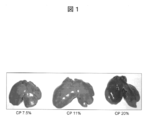
- FIG. 1 shows the degree of fatty liver formation in the livers of chickens fed diets with different crude protein content (CP 7.5%, CP 11%, CP 20%) for 7 days.
- FIG. 2 shows the total fat content in the liver of chickens fed diets with different crude protein contents (CP 7.5%, CP 11%, CP 20%) for 7 days.
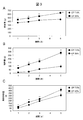
- FIG. 3 shows the final weight (FIG. 3A), weight gain (FIG. 3B), and feed intake of chickens fed for 1, 2, 3, and 5 days with a feed having a different crude protein content (CP 7.5%, CP 20%). (FIG. 3C) is shown.
- FIG. 4 shows the liver weight (FIG. 4A), superficial pectoral muscle weight (FIG.
- FIG. 4B shows intraperitoneal cavity of chickens fed for 1, 2, 3, and 5 days with diets with different crude protein contents (CP 7.5%, CP 20%).
- Fat weight FIG. 4C
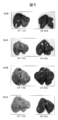
- FIG. 5 shows the degree of fatty liver formation in the livers of chickens fed diets with different crude protein contents (CP 7.5%, CP 20%) for 1, 2, 3, and 5 days.
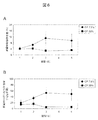
- FIG. 6 shows liver total fat content (FIG. 6A) and liver triglyceride content (FIG. 6B) of chickens fed for 1, 2, 3, and 5 days with diets having different crude protein contents (CP 7.5%, CP 20%). Indicates.
- the poultry feed of the present invention is characterized in that the content of crude protein (CP) is 11% by weight or less.
- the content of crude protein may be 11% by weight or less, preferably 5 to 11% by weight, more preferably 7 to 7%. It is 10% by weight, more preferably 7 to 8% by weight. If the content of crude protein is more than 11% by weight, the desired fatty liver is not formed, and if it is less than 5% by weight, the formation of fatty liver is achieved in a short period of time, but weight loss and meat quality are reduced. This is undesirable for growth.
- cereals such as low protein corn, rice, wheat, and barley are used as the feed main ingredient containing the crude protein, and their composition This can be achieved by increasing the ratio.
- the feed for poultry according to the present invention is the same as the feed raw material used for normal chicken (chicken) mixed feed, except that the raw protein content is adjusted and the blending amount is adjusted so that the crude protein content falls within the above range. And can be prepared according to conventional methods.
- feed materials include cereals or processed cereals (corn, rice, milo, barley, wheat, rye, buckwheat, millet, wheat flour, wheat germ flour, etc.), potatoes (brown, rice bran, corn gluten feed, etc.) , Vegetable oil meal (soybean oil meal, sesame oil meal, cottonseed oil meal, peanut meal, sunflower meal, safflower meal, etc.), animal ingredients (fat dry milk, fish meal, meat and bone meal, etc.), minerals (calcium carbonate, calcium phosphate, salt) ), Vitamins (vitamin A, vitamin D, vitamin E, vitamin K, vitamin B1, vitamin B2, vitamin B6, vitamin B12, calcium pantothenate, nicotinamide, folic acid, etc.), amino acids (glycine, Methionine), yeasts such as brewer's yeast, fine powders of inorganic substances (crystalline cellulose, talc, silica, muscovite, Zeolite, etc.) and the like.
- the feed raw material may be appropriately changed according to the breeding environment such as the kind of poultry to be provided, the development stage, and the region.
- the poultry feed of the present invention includes the above-mentioned feed raw materials, excipients, extenders, binders, thickeners, emulsifiers, coloring agents, flavoring agents, food additives, seasonings, etc. that are usually used in blended feeds. Feed additives and other ingredients (antibiotics, fungicides, anthelmintics, preservatives, etc.) may be blended if desired.
- the total metabolic energy of the poultry feed of the present invention is a level required for normal poultry use, and is 3000 to 5000 kcal / kg, preferably 3000 to 4000 kcal / kg.
- the form of the poultry feed of the present invention is not particularly limited, and examples thereof include powder, granules, pastes, pellets, capsules (hard capsules, soft capsules), tablets and the like.
- poultry for which the feed of the present invention is fed include chickens (broilers, egg-laying chickens, chickens, preferably broilers), geese, mallards, ducks, ducks, quails, turkeys, pheasants and the like.
- the feed method of the feed may be performed in accordance with a general feeding method, except that the feed is fed for a certain period at a certain time. There is no limitation.
- the feeding period is appropriately changed depending on the crude protein content in the feed, but is usually 2 to 7 days. This period can be shortened as the crude protein content in the feed decreases. For example, if the feed has a crude protein content of 5 to 7%, fatty liver can be prepared in 2 days.
- the feeding time is preferably 2 to 7 days immediately before the poultry reaches the shipping age, or 2 to 7 days immediately after the poultry reaches the shipping age. You may change suitably said salary period and salary according to the kind of poultry, the grade of growth, etc.
- the initial purpose can be achieved even if the usual mixed feed (including the early-stage feed and the late-stage feed) conventionally used according to the growth stage is given during the period other than the above-mentioned feeding period.
- the feed time, the number of times of feed, the amount of feed once per day, or the amount of feed per day of the present invention may be the same as in the case of giving normal feed.
- Shipping age refers to the age at which body weight reaches the end of skeletal growth, and differs depending on the type of poultry. For example, in the case of chickens (broilers), skeleton growth end weight (about 3 kg for males, about 2k for females). ) About 42-56 days to grow.
- the commercial early feed CP 20-23%, ME 3000-3200 kcal / kg
- CP 16-20%, ME 3000-3200 kcal / kg CP 16-20%, ME 3000-3200 kcal / kg
- a commercially available late-stage feed may be given until the age of 50 days, and then the feed of the present invention may be fed as a finished feed.
- fatty liver in which fat is accumulated can be produced. Further, according to the method for producing fatty liver of the present invention, fatty liver can be formed in a short period of 2 to 7 days, preferably 2 to 3 days before and after the shipping date, so that weight loss and muscle mass can be reduced. As a result, the meat of other parts of poultry after collecting fatty liver can be supplied as normal meat.
- EXAMPLES Hereinafter, the present invention will be described more specifically with reference to examples, but these examples do not limit the present invention.
- the statistical processing of each measurement result in Example 1 below was performed by the Tukey method, and the statistical processing of each measurement result in Example 2 was performed by Student's t test.
- the amount of metabolic energy of the feed was the same for all feeds (3150 kcal / kg).
- (2) Measurement of body weight and organ weight For broilers in each feed feeding group, body weight was measured at the end of the test, and liver, superficial pectoral muscle, and intraperitoneal fat were collected. Each organ was weighed and stored at -80 ° C. For the liver, photographs were taken and the degree of fatty liver was examined visually. In addition, the feed intake and feed efficiency (feed intake / weight gain) of each feed supply section were also determined. The results are shown in Table 4 below and FIG.
- the cholesterol content was measured by replacing 0.05 ml or 0.1 ml of the liver lipid extract with 0.3 ml of 10% (v / v) Triton X-100-isopropanol, and using cholesterol E-Test Wako (Wako Pure Chemical Industries). Performed by enzymatic method. Fats other than triglyceride and cholesterol in liver fat were expressed as other lipids. The test results are shown in FIG. The total fat content in the liver and the triglyceride content in the liver in CP 7.5% were significantly increased as compared with CP 20%.
- the total fat content in liver and triglyceride content in liver also increased in CP11% group compared with CP20% group, but were lower than CP7.5% group.
- Cholesterol content and other lipids increased in CP 7.5% compared with CP 20%, but not in CP 11%.
- the degree of fatty liver in the liver was not different on the first day in CP 7.5% compared to 20% in CP, but fatty liver was observed from the second day. It was observed that the degree of liver increased (FIG. 5).
- (3) Measurement of total fat content and triglyceride content in liver 0.5 g of liver was collected, a liver fat extract was prepared using the Folch method, and the total fat content was determined by a gravimetric method.
- the triglyceride content was measured by replacing 0.01 ml or 0.1 ml of liver lipid extract with 0.3 ml or 0.5 ml of 10% (v / v) Triton X-100-isopropanol, respectively, and triglyceride E-Test Wako (Wako Pure) It was carried out by an enzymatic method using a medicine. The test results are shown in FIG. Total liver fat content and hepatic triglyceride content in CP 7.5% were not different on day 1 compared to CP 20%, but increased on days 2, 3, and 5 A trend was observed (FIGS. 6A and B).
Landscapes
- Life Sciences & Earth Sciences (AREA)
- Birds (AREA)
- Chemical & Material Sciences (AREA)
- Polymers & Plastics (AREA)
- Animal Husbandry (AREA)
- Zoology (AREA)
- Engineering & Computer Science (AREA)
- Food Science & Technology (AREA)
- Feed For Specific Animals (AREA)
- Fodder In General (AREA)
Abstract
本発明は、家禽類の脂肪肝を、労力をかけず、簡便かつ安定的に供給できる手段を提供することを課題とする。 本発明によれば、粗タンパク質含量が11重量%以下である家禽類用飼料、および当該飼料を家禽類に給与することを特徴とする家禽類の脂肪肝の製造方法が提供される。
Description
本発明は、強制給餌を行わずに鶏肉などの家禽類の肝臓を脂肪肝にすることのできる家禽類用飼料、および当該飼料を用いる家禽類の脂肪肝の製造方法に関する。
ガチョウ、カモ、アヒルの脂肪肝(フォアグラ)の生産は、飼料を強制的に胃に投与する強制給餌を一定期間続けることにより行われている。この強制給餌は、一羽ずつ人の手で行うことから手間と労力がかかる。また、近年、わが国において食の多様化・高級化に伴い、鶏の脂肪肝(白肝、白レバー)の需要が増加してきている。しかし、この鶏の脂肪肝(白肝、白レバー)は、偶然発生したものを食品として供給しているため、生産量が少なく、安定的な供給できない。よって、上記のような家禽類の脂肪肝を、強制給餌を行わず、安定的に供給できる生産技術の開発が望まれている。
従来より、鶏の肉質や肉の色調の改善のために飼料中のタンパク質含量や油脂含量を調整することや、配合飼料に種々の成分を添加することが行われた例はあるが(特許文献1~3)、肉質の改善は主には低脂肪化や脂肪肝抑制を目的としており、脂肪肝発生を試みた例は今まで報告はない。
従来より、鶏の肉質や肉の色調の改善のために飼料中のタンパク質含量や油脂含量を調整することや、配合飼料に種々の成分を添加することが行われた例はあるが(特許文献1~3)、肉質の改善は主には低脂肪化や脂肪肝抑制を目的としており、脂肪肝発生を試みた例は今まで報告はない。
本発明の課題は、家禽類の脂肪肝を、労力をかけず、簡便かつ安定的に供給できる手段を提供することにある。
本発明者らは上記課題を解決すべく鋭意研究を重ねた結果、飼料中の粗タンパク質含量を一定量以下に減少させることにより、鶏の肝臓に脂肪の蓄積を増加させ、鶏脂肪肝(白レバー)を効率的に作成することができることを見出し、本発明を完成させるに至った。
即ち、本発明は以下の発明を包含する。
(1)粗タンパク質含量が11重量%以下である家禽類用飼料。
(2)家禽類が、ニワトリ、ガチョウ、カモ、アヒル、ウズラ、七面鳥、ダチョウ、またはキジである、(1)に記載の家禽類用飼料。
(3)粗タンパク質含量が11重量%以下である家禽類用飼料を家禽類に給与することを特徴とする、家禽類の脂肪肝の製造方法。
(4)給与する期間が2~7日間である、(3)に記載の方法。
(5)給与する時期が、家禽類が出荷日齢に達する直前の2~7日間、または、家禽類が出荷日齢に達した直後の2~7日間である、(3)または(4)に記載の方法。
(6)家禽類が、ニワトリ、ガチョウ、カモ、アヒル、ウズラ、七面鳥、ダチョウ、またはキジである、(3)~(5)のいずれかに記載の方法。
本発明の飼料は、従来の飼料にはない肝臓への脂肪の蓄積増加機能を有するものであり、これを家禽類に短期間給与するだけで、家禽類の脂肪肝を簡便かつ容易に製造することできる。従って、本発明によれば、家禽類の脂肪肝作成手段として従来用いられていた強制給餌を行う必要がなく、その作成のための労力や手間が軽減されるとともに、脂肪肝の生産量が大幅に向上する。また、偶然的な発生や肉や卵の供給の優先によって、大量生産や安定的な供給が困難であった家禽類の脂肪肝を、市場に安定的に供給することが可能となる。また、本発明の飼料は、粗タンパク質含量を調整するだけで、従来の配合飼料に用いられている成分以外の特定の成分は配合されていないので、経済性や安全性に優れている。
本願は、2011年5月10日に出願された日本国特許出願2011−105252号の優先権を主張するものであり、該特許出願の明細書に記載される内容を包含する。
本発明者らは上記課題を解決すべく鋭意研究を重ねた結果、飼料中の粗タンパク質含量を一定量以下に減少させることにより、鶏の肝臓に脂肪の蓄積を増加させ、鶏脂肪肝(白レバー)を効率的に作成することができることを見出し、本発明を完成させるに至った。
即ち、本発明は以下の発明を包含する。
(1)粗タンパク質含量が11重量%以下である家禽類用飼料。
(2)家禽類が、ニワトリ、ガチョウ、カモ、アヒル、ウズラ、七面鳥、ダチョウ、またはキジである、(1)に記載の家禽類用飼料。
(3)粗タンパク質含量が11重量%以下である家禽類用飼料を家禽類に給与することを特徴とする、家禽類の脂肪肝の製造方法。
(4)給与する期間が2~7日間である、(3)に記載の方法。
(5)給与する時期が、家禽類が出荷日齢に達する直前の2~7日間、または、家禽類が出荷日齢に達した直後の2~7日間である、(3)または(4)に記載の方法。
(6)家禽類が、ニワトリ、ガチョウ、カモ、アヒル、ウズラ、七面鳥、ダチョウ、またはキジである、(3)~(5)のいずれかに記載の方法。
本発明の飼料は、従来の飼料にはない肝臓への脂肪の蓄積増加機能を有するものであり、これを家禽類に短期間給与するだけで、家禽類の脂肪肝を簡便かつ容易に製造することできる。従って、本発明によれば、家禽類の脂肪肝作成手段として従来用いられていた強制給餌を行う必要がなく、その作成のための労力や手間が軽減されるとともに、脂肪肝の生産量が大幅に向上する。また、偶然的な発生や肉や卵の供給の優先によって、大量生産や安定的な供給が困難であった家禽類の脂肪肝を、市場に安定的に供給することが可能となる。また、本発明の飼料は、粗タンパク質含量を調整するだけで、従来の配合飼料に用いられている成分以外の特定の成分は配合されていないので、経済性や安全性に優れている。
本願は、2011年5月10日に出願された日本国特許出願2011−105252号の優先権を主張するものであり、該特許出願の明細書に記載される内容を包含する。
図1は、粗タンパク質含量の異なる飼料(CP7.5%、CP11%、CP20%)を7日間給与した鶏の肝臓における脂肪肝形成の度合いを示す。
図2は、粗タンパク質含量の異なる飼料(CP7.5%、CP11%、CP20%)を7日間給与した鶏の肝臓中総脂肪含量を示す。
図3は、粗タンパク質含量の異なる飼料(CP7.5%、CP20%)を1、2、3、5日間給与した鶏の終重量(図3A)、増体量(図3B)、飼料摂取量(図3C)を示す。
図4は、粗タンパク質含量の異なる飼料(CP7.5%、CP20%)を1、2、3、5日間給与した鶏の肝臓重量(図4A)、浅胸筋重量(図4B)、腹腔内脂肪重量(図4C)を示す。
図5は、粗タンパク質含量の異なる飼料(CP7.5%、CP20%)を1、2、3、5日間給与した鶏の肝臓における脂肪肝形成の度合いを示す。
図6は、粗タンパク質含量の異なる飼料(CP7.5%、CP20%)を1、2、3、5日間給与した鶏の肝臓中総脂肪含量(図6A)、肝臓中トリグリセライド含量(図6B)を示す。
図2は、粗タンパク質含量の異なる飼料(CP7.5%、CP11%、CP20%)を7日間給与した鶏の肝臓中総脂肪含量を示す。
図3は、粗タンパク質含量の異なる飼料(CP7.5%、CP20%)を1、2、3、5日間給与した鶏の終重量(図3A)、増体量(図3B)、飼料摂取量(図3C)を示す。
図4は、粗タンパク質含量の異なる飼料(CP7.5%、CP20%)を1、2、3、5日間給与した鶏の肝臓重量(図4A)、浅胸筋重量(図4B)、腹腔内脂肪重量(図4C)を示す。
図5は、粗タンパク質含量の異なる飼料(CP7.5%、CP20%)を1、2、3、5日間給与した鶏の肝臓における脂肪肝形成の度合いを示す。
図6は、粗タンパク質含量の異なる飼料(CP7.5%、CP20%)を1、2、3、5日間給与した鶏の肝臓中総脂肪含量(図6A)、肝臓中トリグリセライド含量(図6B)を示す。
本発明の家禽類用飼料は粗タンパク質(CP)の含量が11重量%以下であることを特徴とする。本発明の家禽類用飼料(以下、「本発明の飼料」ということもある)において粗タンパク質の含量は11重量%以下であればよいが、好ましくは5~11重量%、より好ましくは7~10重量%、さらに好ましくは7~8重量%である。粗タンパク質の含量が11重量%よりも多いと所望する脂肪肝が形成されず、また、5重量%よりも少ないと脂肪肝の形成は短期間で達成されるものの、体重の減少や肉質の低下をもたらし生育上好ましくない。
飼料中の粗タンパク質の含量を11重量%以下にするには、粗タンパク質分を含有する飼料主原料として、例えば低タンパク質のトウモロコシ、コメ、小麦、大麦などの穀類を用い、かつ、それらの配合比を増加させることにより達成できる。
本発明の家禽類用飼料は、粗タンパク質含量を上記のような範囲となるように飼料原料の採択と配合量を調整する以外は、通常の鶏(ニワトリ)用配合飼料に用いられる飼料原料を用い、通常の方法に従って製造することができる。飼料原料としては、例えば、穀物類または加工穀物類(トウモロコシ、コメ、マイロ、大麦、小麦、ライ麦、燕麦、キビ、小麦粉、小麦胚芽粉等)、糟糠類(ふすま、米糠、コーングルテンフィード等)、植物性油粕類(大豆油粕、ごま油粕、綿実油粕、落花生粕、ヒマワリ粕、サフラワー粕等)、動物性原料(脱脂粉乳、魚粉、肉骨粉等)、ミネラル類(炭酸カルシウム、リン酸カルシウム、食塩、無水ケイ酸等)、ビタミン類(ビタミンA、ビタミンD、ビタミンE、ビタミンK、ビタミンB1、ビタミンB2、ビタミンB6、ビタミンB12、パントテン酸カルシウム、ニコチン酸アミド、葉酸等)、アミノ酸(グリシン、メチオニン等)、ビール酵母などの酵母類、無機物質の微粉末(結晶性セルロース、タルク、シリカ、白雲母、ゼオライト等)などが挙げられる。上記の飼料原料は、供与対象となる家禽類の種類、発育ステージ、地域などの飼育環境に応じて適宜変更すればよい。
本発明の家禽類用飼料は、上記の飼料原料に、配合飼料に通常使用される賦形剤、増量剤、結合剤、増粘剤、乳化剤、着色料、香料、食品添加物、調味料等の飼料用添加剤、所望によりその他の成分(抗生物質や殺菌剤、駆虫剤、防腐剤等)を配合してもよい。
本発明の家禽類用飼料の総代謝エネルギーとしては、通常の家禽類使用に要求される程度であり、3000~5000kcal/kg、好ましくは3000~4000kcal/kgである。
本発明の家禽類用飼料の形態は特に限定されるものではなく、例えば、粉末状、顆粒状、ペースト状、ペレット状、カプセル剤(ハードカプセル,ソフトカプセル)、錠剤等が挙げられる。
本発明の飼料の給与対象となる家禽類としては、例えば、ニワトリ(ブロイラー、採卵鶏、地鶏、好ましくはブロイラー)、ガチョウ、マガモ、合鴨、アヒル、ウズラ、七面鳥、キジなどが挙げられる。
本発明の飼料を家禽類に給与することにより脂肪肝を作成する場合、当該飼料の給与方法は、一定の時期に一定の期間給与する以外は、一般の給与方法に準じて行えばよく、特に限定はされない。給与期間は飼料中の粗タンパク含量によって適宜変更されるが、通常2~7日間である。飼料中の粗タンパク含量が少ないほどこの期間を短縮でき、例えば、粗タンパク含量が5~7%の飼料であれば、2日間で脂肪肝を作成できる。また、給与時期は、家禽類が出荷日齢に達する直前の2~7日間、または、家禽類が出荷日齢に達した直後の2~7日間が好ましい。上記の給与期間と給与時期は、家禽類の種類、生育の程度等に応じて適宜変更してもよい。また、上記の給与期間以外の期間は発育ステージに応じた従来から用いられている通常の配合飼料(前期飼料、後期飼料を含む)を与えても、初期の目的は達成できる。さらに、本発明の飼料の給与時刻、給与回数、一回または一日あたりの給与量も通常の飼料を与える場合と同じでよい。
出荷日齢とは、骨格成長が終了する体重に達する日齢をいい、家禽類の種類により異なるが、例えば鶏(ブロイラー)の場合は、骨格成長終了体重(雄で約3kg、雌で約2k)に成長する約42~56日をいう。よって、出荷日齢を50日齢と定めて本発明の飼料を鶏(ブロイラー)に給与する場合、市販の前期飼料(CP20~23%、ME3000~3200kcal/kg)を21日齢まで給与し、市販の後期飼料(CP16~20%、ME3000~3200kcal/kg)に切り替えて43~48日齢まで給与し、その後、後期飼料給与期間の最終段階を本発明の飼料に切り替える方法でもよく、あるいは、市販の後期飼料を50日齢まで与え、その後、本発明の飼料を仕上げ飼料として給与する方法でもよい。
上記のような給与方法より飼育した家禽類から常法により肝臓を得ることにより、脂肪が蓄積された脂肪肝を製造できる。また、本発明の脂肪肝の製造方法によれば、出荷日齢前後の2~7日間、好ましくは2~3日間という短期間により脂肪肝を形成できるため、体重の減少、筋肉量の減少を最低限に抑えることができ、その結果、脂肪肝採取後の家禽類の他の部位の肉は通常の食肉としても供給できる。
以下、実施例によって本発明を更に具体的に説明するが、これらの実施例は本発明を限定するものでない。なお、下記実施例1の各測定結果の統計処理は、Tukey法によって行い、実施例2の各測定結果の統計処理はスチューデントのt検定によって行った。
飼料中の粗タンパク質の含量を11重量%以下にするには、粗タンパク質分を含有する飼料主原料として、例えば低タンパク質のトウモロコシ、コメ、小麦、大麦などの穀類を用い、かつ、それらの配合比を増加させることにより達成できる。
本発明の家禽類用飼料は、粗タンパク質含量を上記のような範囲となるように飼料原料の採択と配合量を調整する以外は、通常の鶏(ニワトリ)用配合飼料に用いられる飼料原料を用い、通常の方法に従って製造することができる。飼料原料としては、例えば、穀物類または加工穀物類(トウモロコシ、コメ、マイロ、大麦、小麦、ライ麦、燕麦、キビ、小麦粉、小麦胚芽粉等)、糟糠類(ふすま、米糠、コーングルテンフィード等)、植物性油粕類(大豆油粕、ごま油粕、綿実油粕、落花生粕、ヒマワリ粕、サフラワー粕等)、動物性原料(脱脂粉乳、魚粉、肉骨粉等)、ミネラル類(炭酸カルシウム、リン酸カルシウム、食塩、無水ケイ酸等)、ビタミン類(ビタミンA、ビタミンD、ビタミンE、ビタミンK、ビタミンB1、ビタミンB2、ビタミンB6、ビタミンB12、パントテン酸カルシウム、ニコチン酸アミド、葉酸等)、アミノ酸(グリシン、メチオニン等)、ビール酵母などの酵母類、無機物質の微粉末(結晶性セルロース、タルク、シリカ、白雲母、ゼオライト等)などが挙げられる。上記の飼料原料は、供与対象となる家禽類の種類、発育ステージ、地域などの飼育環境に応じて適宜変更すればよい。
本発明の家禽類用飼料は、上記の飼料原料に、配合飼料に通常使用される賦形剤、増量剤、結合剤、増粘剤、乳化剤、着色料、香料、食品添加物、調味料等の飼料用添加剤、所望によりその他の成分(抗生物質や殺菌剤、駆虫剤、防腐剤等)を配合してもよい。
本発明の家禽類用飼料の総代謝エネルギーとしては、通常の家禽類使用に要求される程度であり、3000~5000kcal/kg、好ましくは3000~4000kcal/kgである。
本発明の家禽類用飼料の形態は特に限定されるものではなく、例えば、粉末状、顆粒状、ペースト状、ペレット状、カプセル剤(ハードカプセル,ソフトカプセル)、錠剤等が挙げられる。
本発明の飼料の給与対象となる家禽類としては、例えば、ニワトリ(ブロイラー、採卵鶏、地鶏、好ましくはブロイラー)、ガチョウ、マガモ、合鴨、アヒル、ウズラ、七面鳥、キジなどが挙げられる。
本発明の飼料を家禽類に給与することにより脂肪肝を作成する場合、当該飼料の給与方法は、一定の時期に一定の期間給与する以外は、一般の給与方法に準じて行えばよく、特に限定はされない。給与期間は飼料中の粗タンパク含量によって適宜変更されるが、通常2~7日間である。飼料中の粗タンパク含量が少ないほどこの期間を短縮でき、例えば、粗タンパク含量が5~7%の飼料であれば、2日間で脂肪肝を作成できる。また、給与時期は、家禽類が出荷日齢に達する直前の2~7日間、または、家禽類が出荷日齢に達した直後の2~7日間が好ましい。上記の給与期間と給与時期は、家禽類の種類、生育の程度等に応じて適宜変更してもよい。また、上記の給与期間以外の期間は発育ステージに応じた従来から用いられている通常の配合飼料(前期飼料、後期飼料を含む)を与えても、初期の目的は達成できる。さらに、本発明の飼料の給与時刻、給与回数、一回または一日あたりの給与量も通常の飼料を与える場合と同じでよい。
出荷日齢とは、骨格成長が終了する体重に達する日齢をいい、家禽類の種類により異なるが、例えば鶏(ブロイラー)の場合は、骨格成長終了体重(雄で約3kg、雌で約2k)に成長する約42~56日をいう。よって、出荷日齢を50日齢と定めて本発明の飼料を鶏(ブロイラー)に給与する場合、市販の前期飼料(CP20~23%、ME3000~3200kcal/kg)を21日齢まで給与し、市販の後期飼料(CP16~20%、ME3000~3200kcal/kg)に切り替えて43~48日齢まで給与し、その後、後期飼料給与期間の最終段階を本発明の飼料に切り替える方法でもよく、あるいは、市販の後期飼料を50日齢まで与え、その後、本発明の飼料を仕上げ飼料として給与する方法でもよい。
上記のような給与方法より飼育した家禽類から常法により肝臓を得ることにより、脂肪が蓄積された脂肪肝を製造できる。また、本発明の脂肪肝の製造方法によれば、出荷日齢前後の2~7日間、好ましくは2~3日間という短期間により脂肪肝を形成できるため、体重の減少、筋肉量の減少を最低限に抑えることができ、その結果、脂肪肝採取後の家禽類の他の部位の肉は通常の食肉としても供給できる。
以下、実施例によって本発明を更に具体的に説明するが、これらの実施例は本発明を限定するものでない。なお、下記実施例1の各測定結果の統計処理は、Tukey法によって行い、実施例2の各測定結果の統計処理はスチューデントのt検定によって行った。
(1)供試鶏および飼料の給与
1日齢のブロイラーチャンキー種を導入し、市販のブロイラー前期飼料(粗タンパク質(CP)含量22%、代謝エネルギー(ME)3000kcal/kg、鹿島飼料株式会社製)で10日齢まで飼育した。低タンパク質飼料として下記表1に示す組成のCP7.5%飼料および下記表2に示す組成のCP11%飼料、対照飼料として下記表3に示す組成のCP20%飼料をそれぞれ調製した。

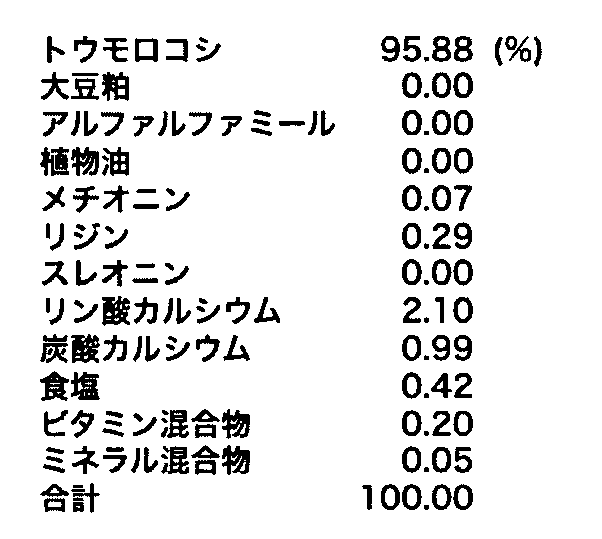
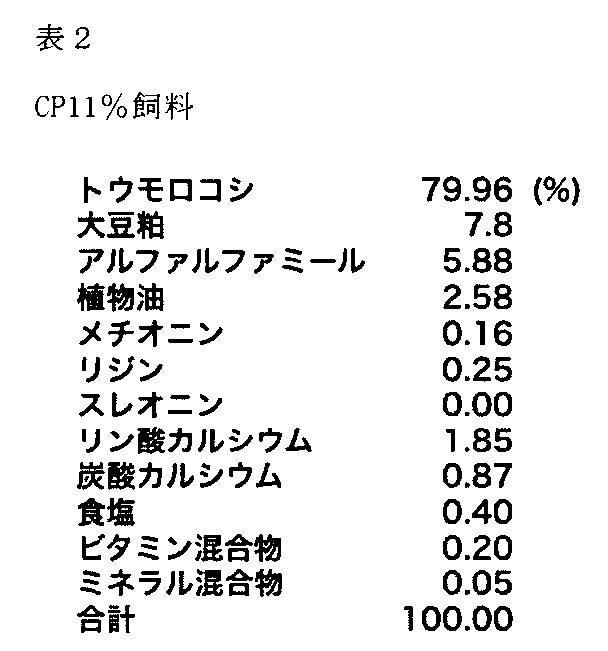
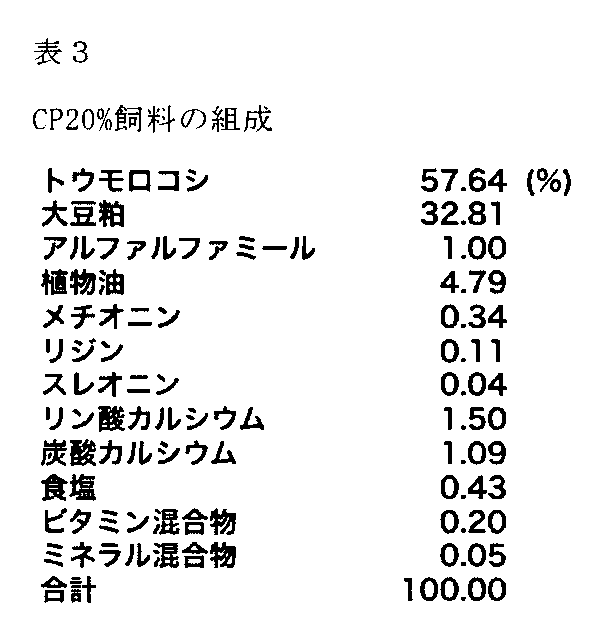
これらの粗タンパク質(CP)含量が異なる3種類の飼料を試験区(CP7.5%区、CP11%区、CP20%区)に分けて、各試験区5羽ずつ7日間給与した。飼料の代謝エネルギー量は全ての飼料で同量とした(3150kcal/kg)。
(2)体重および臓器重量の測定
各飼料給与区のブロイラーについて、試験終了時に体重を測定し、肝臓、浅胸筋、および腹腔内脂肪を採取した。それぞれの臓器は重量を測定後、−80℃で保存した。肝臓については、写真を撮影し、脂肪肝の度合いを目視により調べた。また、各飼料給与区の飼料摂取量および飼料効率(飼料摂取量/増体量)も求めた。結果を下記表4および図1に示す。
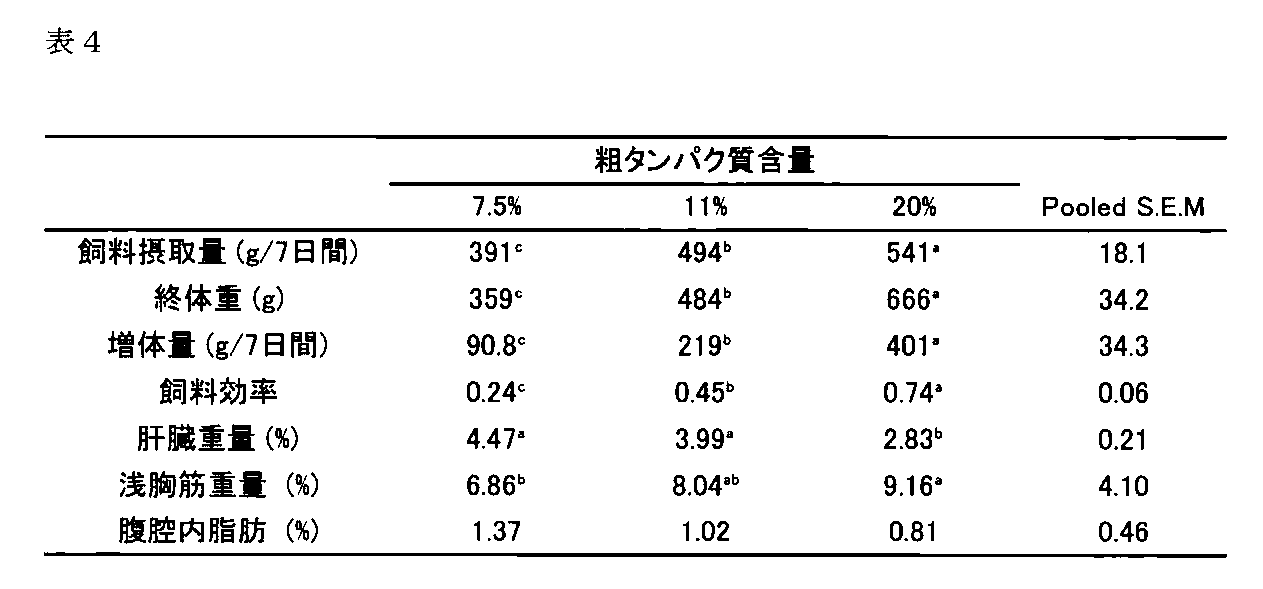
a,b,cの異なるアルファベット間には有意差あり(p<0.05)
表4に示されるように、終体重および増体量は、CP7.5%区およびCP11%区ではCP20%区と比較して有意に減少した(p<0.05)。
また、飼料摂取量および飼料効率も、CP20%区に比べてCP7.5%区およびCP11%区で低下した(p<0.05)。
また、体重当たりの肝臓重量は、CP20%区と比べてP7.5%区およびCP11%区で有意に増加した(p<0.05)。体重当たりの浅胸筋重量は、CP20%区と比べてP7.5%区で有意に減少したが(p<0.05)、CP11%区では差はみられなかった。体重当たりの腹腔内脂肪には差はみられなかった。
図1に示されるように、肝臓における脂肪肝の度合いは、CP7.5%区およびCP11%区の肝臓はCP20%区と比べて白く明るくなることが観察された。これらの結果からCP7.5%区およびCP11%区の肝臓は脂肪肝であると判断された。
(3)肝臓中総脂肪含量、トリグリセライド含量、およびコレステロール含量の測定
肝臓0.5gを採取し、Folch法を用いて肝臓脂肪抽出液を作成し、重量法により総脂肪含量(トリグリセライド、コレステロール、その他の脂質の総量)を求めた。トリグリセライド含量の測定は、肝臓脂質抽出液0.01mlまたは0.1mlをそれぞれ0.3mlまたは0.5mlの10%(v/v)TritonX−100−イソプロパノールで置換し、トリグリセライドE−テストワコー(和光純薬)を用いた酵素法により行った。コレステロール含量の測定は肝臓脂質抽出液0.05mlまたは0.1mlを0.3mlの10%(v/v)TritonX−100−イソプロパノールで置換し、コレステロールE−テストワコー(和光純薬)を用いた酵素法により行った。肝臓脂肪中のトリグリセライドならびにコレステロール以外の脂肪はその他の脂質として表した。
上記試験結果を図2に示す。CP7.5%区の肝臓中総脂肪含量および肝臓中トリグリセライド含量はCP20%区と比較して顕著に増加した。また、CP11%区もCP20%区と比較して肝臓中総脂肪含量および肝臓中トリグリセライド含量は増加したが、CP7.5%区より低かった。コレステロール含量およびその他の脂質はCP20%区と比較し、CP7.5%区で増加したが、CP11%区では増加しなかった。
1日齢のブロイラーチャンキー種を導入し、市販のブロイラー前期飼料(粗タンパク質(CP)含量22%、代謝エネルギー(ME)3000kcal/kg、鹿島飼料株式会社製)で10日齢まで飼育した。低タンパク質飼料として下記表1に示す組成のCP7.5%飼料および下記表2に示す組成のCP11%飼料、対照飼料として下記表3に示す組成のCP20%飼料をそれぞれ調製した。
(2)体重および臓器重量の測定
各飼料給与区のブロイラーについて、試験終了時に体重を測定し、肝臓、浅胸筋、および腹腔内脂肪を採取した。それぞれの臓器は重量を測定後、−80℃で保存した。肝臓については、写真を撮影し、脂肪肝の度合いを目視により調べた。また、各飼料給与区の飼料摂取量および飼料効率(飼料摂取量/増体量)も求めた。結果を下記表4および図1に示す。
表4に示されるように、終体重および増体量は、CP7.5%区およびCP11%区ではCP20%区と比較して有意に減少した(p<0.05)。
また、飼料摂取量および飼料効率も、CP20%区に比べてCP7.5%区およびCP11%区で低下した(p<0.05)。
また、体重当たりの肝臓重量は、CP20%区と比べてP7.5%区およびCP11%区で有意に増加した(p<0.05)。体重当たりの浅胸筋重量は、CP20%区と比べてP7.5%区で有意に減少したが(p<0.05)、CP11%区では差はみられなかった。体重当たりの腹腔内脂肪には差はみられなかった。
図1に示されるように、肝臓における脂肪肝の度合いは、CP7.5%区およびCP11%区の肝臓はCP20%区と比べて白く明るくなることが観察された。これらの結果からCP7.5%区およびCP11%区の肝臓は脂肪肝であると判断された。
(3)肝臓中総脂肪含量、トリグリセライド含量、およびコレステロール含量の測定
肝臓0.5gを採取し、Folch法を用いて肝臓脂肪抽出液を作成し、重量法により総脂肪含量(トリグリセライド、コレステロール、その他の脂質の総量)を求めた。トリグリセライド含量の測定は、肝臓脂質抽出液0.01mlまたは0.1mlをそれぞれ0.3mlまたは0.5mlの10%(v/v)TritonX−100−イソプロパノールで置換し、トリグリセライドE−テストワコー(和光純薬)を用いた酵素法により行った。コレステロール含量の測定は肝臓脂質抽出液0.05mlまたは0.1mlを0.3mlの10%(v/v)TritonX−100−イソプロパノールで置換し、コレステロールE−テストワコー(和光純薬)を用いた酵素法により行った。肝臓脂肪中のトリグリセライドならびにコレステロール以外の脂肪はその他の脂質として表した。
上記試験結果を図2に示す。CP7.5%区の肝臓中総脂肪含量および肝臓中トリグリセライド含量はCP20%区と比較して顕著に増加した。また、CP11%区もCP20%区と比較して肝臓中総脂肪含量および肝臓中トリグリセライド含量は増加したが、CP7.5%区より低かった。コレステロール含量およびその他の脂質はCP20%区と比較し、CP7.5%区で増加したが、CP11%区では増加しなかった。
(1)供試鶏および飼料の給与
1日齢のブロイラーチャンキー種を導入し、市販のブロイラー前期飼料(粗タンパク質(CP)含量22%、代謝エネルギー(ME)3000kcal/kg、鹿島飼料株式会社製)で14日齢まで飼育した。低タンパク質飼料として前記表1に示す組成のCP7.5%飼料、対照飼料として前記表3に示す組成のCP20%飼料を調製した。
これらの粗タンパク質含量(CP)が異なる2種類の飼料を試験区(CP7.5%区、CP20%区)に分けて、各試験区5羽ずつ1、2、3および5日間給与した。飼料の代謝エネルギー量は全ての飼料で同量とした(3150kcal/kg)。
(2)体重および臓器重量の測定、
各飼料給与区のブロイラーについて、試験終了時に体重を測定し、肝臓、浅胸筋、および腹腔内脂肪を採取した。それぞれの臓器は重量を測定後、−80℃で保存した。肝臓については、写真を撮影し、脂肪肝の度合いを目視により調べた。試験結果を図3~6に示す。
終体重および増体量はCP7.5%区ではCP20%区と比較して1日目から5日目まで有意に減少した(**p<0.01,図3Aおよび図3B)。また、飼料摂取量もCP20%区と比べてCP7.5%区では1日目から3日まで有意に減少したが、5日目には差はみられなかった。(**p<0.01,図3C)。
体重当たりの肝臓重量は、CP20%区と比べてCP7.5%区で3日目および5日目に有意に増加した(*p<0.05,図4A)。体重当たりの浅胸筋重量は、CP20%区とCP7.5%区で、1日目から5日目まで差はみられなかった(図4B)。体重当たりの腹腔内脂肪重量はCP20%区とCP7.5%区の間には1日目から3日目まで差はみられなかったが、5日目はCP20%区と比べてCP7.5%区で有意に増加した(**p<0.01,図4C)。
肝臓における脂肪肝の度合いは、CP20%区と比べてCP7.5%区において、1日目には差はみられなかったが、2日目から脂肪肝が観察され、日を追う毎に脂肪肝の度合いが増すことが観察された(図5)。
(3)肝臓中総脂肪含量およびトリグリセライド含量の測定
肝臓0.5gを採取し、Folch法を用いて肝臓脂肪抽出液を作成し、重量法により総脂肪含量を求めた。トリグリセライド含量測定は、肝臓脂質抽出液0.01mlまたは0.1mlをそれぞれ0.3mlまたは0.5mlの10%(v/v)TritonX−100−イソプロパノールで置換し、トリグリセライドE−テストワコー(和光純薬)を用いた酵素法により行った。
上記の試験結果を図6に示す。肝臓中総脂肪含量および肝臓中トリグリセライド含量はいずれもCP7.5%区でCP20%区と比較して1日目には差はみられなかったが、2、3、および5日目に増加する傾向がみられた(図6A、B)。
1日齢のブロイラーチャンキー種を導入し、市販のブロイラー前期飼料(粗タンパク質(CP)含量22%、代謝エネルギー(ME)3000kcal/kg、鹿島飼料株式会社製)で14日齢まで飼育した。低タンパク質飼料として前記表1に示す組成のCP7.5%飼料、対照飼料として前記表3に示す組成のCP20%飼料を調製した。
これらの粗タンパク質含量(CP)が異なる2種類の飼料を試験区(CP7.5%区、CP20%区)に分けて、各試験区5羽ずつ1、2、3および5日間給与した。飼料の代謝エネルギー量は全ての飼料で同量とした(3150kcal/kg)。
(2)体重および臓器重量の測定、
各飼料給与区のブロイラーについて、試験終了時に体重を測定し、肝臓、浅胸筋、および腹腔内脂肪を採取した。それぞれの臓器は重量を測定後、−80℃で保存した。肝臓については、写真を撮影し、脂肪肝の度合いを目視により調べた。試験結果を図3~6に示す。
終体重および増体量はCP7.5%区ではCP20%区と比較して1日目から5日目まで有意に減少した(**p<0.01,図3Aおよび図3B)。また、飼料摂取量もCP20%区と比べてCP7.5%区では1日目から3日まで有意に減少したが、5日目には差はみられなかった。(**p<0.01,図3C)。
体重当たりの肝臓重量は、CP20%区と比べてCP7.5%区で3日目および5日目に有意に増加した(*p<0.05,図4A)。体重当たりの浅胸筋重量は、CP20%区とCP7.5%区で、1日目から5日目まで差はみられなかった(図4B)。体重当たりの腹腔内脂肪重量はCP20%区とCP7.5%区の間には1日目から3日目まで差はみられなかったが、5日目はCP20%区と比べてCP7.5%区で有意に増加した(**p<0.01,図4C)。
肝臓における脂肪肝の度合いは、CP20%区と比べてCP7.5%区において、1日目には差はみられなかったが、2日目から脂肪肝が観察され、日を追う毎に脂肪肝の度合いが増すことが観察された(図5)。
(3)肝臓中総脂肪含量およびトリグリセライド含量の測定
肝臓0.5gを採取し、Folch法を用いて肝臓脂肪抽出液を作成し、重量法により総脂肪含量を求めた。トリグリセライド含量測定は、肝臓脂質抽出液0.01mlまたは0.1mlをそれぞれ0.3mlまたは0.5mlの10%(v/v)TritonX−100−イソプロパノールで置換し、トリグリセライドE−テストワコー(和光純薬)を用いた酵素法により行った。
上記の試験結果を図6に示す。肝臓中総脂肪含量および肝臓中トリグリセライド含量はいずれもCP7.5%区でCP20%区と比較して1日目には差はみられなかったが、2、3、および5日目に増加する傾向がみられた(図6A、B)。
本発明は家禽類の飼料の製造分野において利用できる。
本明細書で引用した全ての刊行物、特許及び特許出願をそのまま参考として本明細書に組み入れるものとする。
本明細書で引用した全ての刊行物、特許及び特許出願をそのまま参考として本明細書に組み入れるものとする。
Claims (6)
- 粗タンパク質含量が11重量%以下である家禽類用飼料。
- 家禽類が、ニワトリ、ガチョウ、カモ、アヒル、ウズラ、七面鳥、ダチョウ、またはキジである、請求項1に記載の家禽類用飼料。
- 粗タンパク質含量が11重量%以下である家禽類用飼料を家禽類に給与することを特徴とする、家禽類の脂肪肝の製造方法。
- 給与する期間が2~7日間である、請求項3に記載の方法。
- 給与する時期が、家禽類が出荷日齢に達する直前の2~7日間、または、家禽類が出荷日齢に達した直後の2~7日間である、請求項3または4に記載の方法。
- 家禽類が、ニワトリ、ガチョウ、カモ、アヒル、ウズラ、七面鳥、ダチョウ、またはキジである、請求項3~5のいずれかに記載の方法。
Applications Claiming Priority (2)
| Application Number | Priority Date | Filing Date | Title |
|---|---|---|---|
| JP2011-105252 | 2011-05-10 | ||
| JP2011105252A JP5926894B2 (ja) | 2011-05-10 | 2011-05-10 | 家禽類用飼料および当該飼料を用いた脂肪肝の製造方法 |
Publications (1)
| Publication Number | Publication Date |
|---|---|
| WO2012153864A1 true WO2012153864A1 (ja) | 2012-11-15 |
Family
ID=47139335
Family Applications (1)
| Application Number | Title | Priority Date | Filing Date |
|---|---|---|---|
| PCT/JP2012/062565 Ceased WO2012153864A1 (ja) | 2011-05-10 | 2012-05-10 | 家禽類用飼料および当該飼料を用いた脂肪肝の製造方法 |
Country Status (2)
| Country | Link |
|---|---|
| JP (1) | JP5926894B2 (ja) |
| WO (1) | WO2012153864A1 (ja) |
Cited By (3)
| Publication number | Priority date | Publication date | Assignee | Title |
|---|---|---|---|---|
| CN104351581A (zh) * | 2014-12-03 | 2015-02-18 | 遵义市汇川区南林养殖场 | 一种山鸡饲料 |
| CN107912639A (zh) * | 2017-12-13 | 2018-04-17 | 李羲銮 | 一种蛋鸭饲料 |
| CN108056310A (zh) * | 2017-12-13 | 2018-05-22 | 李羲銮 | 一种鸭饲料及其制备方法 |
Families Citing this family (2)
| Publication number | Priority date | Publication date | Assignee | Title |
|---|---|---|---|---|
| CN107156043A (zh) * | 2017-06-03 | 2017-09-15 | 贵州省三穗县兴绿洲农业发展有限公司 | 一种三穗雏鸭育肥的方法 |
| CN108575891A (zh) * | 2018-04-09 | 2018-09-28 | 金寨县创富农业科技开发有限公司 | 无抗绿色皖西白鹅养殖方法 |
Citations (1)
| Publication number | Priority date | Publication date | Assignee | Title |
|---|---|---|---|---|
| US20060286151A1 (en) * | 2005-04-27 | 2006-12-21 | Robert Bender | Production of foie gras |
Family Cites Families (4)
| Publication number | Priority date | Publication date | Assignee | Title |
|---|---|---|---|---|
| JPH01247046A (ja) * | 1988-03-28 | 1989-10-02 | Nippon Synthetic Chem Ind Co Ltd:The | ニワトリ用飼料 |
| JPH02231041A (ja) * | 1989-03-06 | 1990-09-13 | Itochu Shiryo Kk | 育雛用低蛋白飼料 |
| JP3124409B2 (ja) * | 1993-03-24 | 2001-01-15 | 松谷化学工業株式会社 | 鶏飼料 |
| US20060182785A1 (en) * | 2005-02-17 | 2006-08-17 | Peterson Daniel G | System and method for producing foie gras in poultry |
-
2011
- 2011-05-10 JP JP2011105252A patent/JP5926894B2/ja active Active
-
2012
- 2012-05-10 WO PCT/JP2012/062565 patent/WO2012153864A1/ja not_active Ceased
Patent Citations (1)
| Publication number | Priority date | Publication date | Assignee | Title |
|---|---|---|---|---|
| US20060286151A1 (en) * | 2005-04-27 | 2006-12-21 | Robert Bender | Production of foie gras |
Non-Patent Citations (4)
| Title |
|---|
| "Lysine supplementation of low-protein diets for broiler breeder males.", POULT SCI, vol. 71, no. 2, 1992, pages 323 - 30 * |
| "Response of broiler breeders to low-protein diets. 1. Adult breeder performance.", POULT SCI, vol. 74, no. 4, 1995, pages 685 - 95 * |
| "Response of broiler breeders to low-protein diets. 2. Offspring performance.", POULT SCI, vol. 74, no. 4, 1995, pages 696 - 701 * |
| BUWJOOM T ET AL.: "Histological intestinal alterations in chickens fed low protein diet.", J ANIM PHYSIOL ANIM NUTR, vol. 94, no. 3, 2010, pages 354 - 361 * |
Cited By (3)
| Publication number | Priority date | Publication date | Assignee | Title |
|---|---|---|---|---|
| CN104351581A (zh) * | 2014-12-03 | 2015-02-18 | 遵义市汇川区南林养殖场 | 一种山鸡饲料 |
| CN107912639A (zh) * | 2017-12-13 | 2018-04-17 | 李羲銮 | 一种蛋鸭饲料 |
| CN108056310A (zh) * | 2017-12-13 | 2018-05-22 | 李羲銮 | 一种鸭饲料及其制备方法 |
Also Published As
| Publication number | Publication date |
|---|---|
| JP2012235710A (ja) | 2012-12-06 |
| JP5926894B2 (ja) | 2016-05-25 |
Similar Documents
| Publication | Publication Date | Title |
|---|---|---|
| Martínez et al. | Growth performance, organ weights and some blood parameters of replacement laying pullets fed with increasing levels of wheat bran | |
| Rao et al. | Effect of supplementing non-starch polysaccharide hydrolyzing enzymes in guar meal based diets on performance, carcass variables and bone mineralization in Vanaraja chicken | |
| CN103918948A (zh) | 一种高效绿色肉鸡配合饲料 | |
| JP5926894B2 (ja) | 家禽類用飼料および当該飼料を用いた脂肪肝の製造方法 | |
| Mandalawi et al. | Influence of source and level of glycerin in the diet on growth performance, liver characteristics, and nutrient digestibility in broilers from hatching to 21 days of age | |
| Ahmad et al. | Comparative bioefficacy of lysine from L-lysine hydrochloride or L-lysine sulfate in basal diets containing graded levels of canola meal for female broiler chickens | |
| Shirzadegan et al. | INSOLUBLE FIBERS AFFECTED THE PERFORMANCE, CARCASS CHARACTERISTICS AND SERUM LIPID OF BROILER CHICKENS FED WHEAT? BASED DIET | |
| Wijtten et al. | Effects of different dietary ideal protein levels on male and female broiler performance during different phases of life: single phase effects, carryover effects, and interactions between phases | |
| Kokoszyński et al. | Effects of feeding whole-grain triticale and sex on carcass and meat characteristics of common pheasants | |
| Mehri et al. | Estimation of lysine requirements of growing Japanese quail during the fourth and fifth weeks of age | |
| CN102524589B (zh) | 一种断奶仔猪饲料及其制备方法与应用 | |
| Yildiz et al. | Effects of dietary boric acid addition on growth performance, cholesterolemia, some carcass and tibia characteristics in different rearing periods in broiler chickens | |
| Aami-Azghadi et al. | Comparison of dietary supplementation with cumin essential oil and prebiotic fermacto on humoral immune response, blood metabolites and performance of broiler chickens | |
| CN107647158A (zh) | 一种降低鸡蛋胆固醇含量的蛋鸡饲料及其制备方法 | |
| Patel et al. | Effect of dietary supplementation of garlic (Allium sativum) and fenugreek (Trigonella foenum-graecum L.) seed powder on growth performance and blood biochemical parameters in broilers | |
| CN102640890B (zh) | 一种用于畜禽饲料的复合脂肪乳化剂 | |
| Abadi et al. | Effects of using coriander (Coriandrum sativum L.), savory (Satureja hortensis L.) and dill (Anethum graveolens L.) herb powder in diet on performance and some blood parameters of broilers. | |
| Ondrej et al. | The effect of hempseed cakes on broiler chickens peroformance parameters | |
| Abeyrathna et al. | Effects of the level of dietary rice bran with or without phytase, on performance and egg parameters of laying Japanese quail | |
| Karayagız et al. | Effects of Combined Use of Canola and Sunflower Meals in Quail Diet on Performance and Some Carcass Quality Traits. | |
| Ganna et al. | Effect of dietary supplementation of some emulsifiers on growth performance, carcass traits, lipid peroxidation and some nutrients digestibility in broiler chickens | |
| Elamin et al. | Effect of supplementation of fenugreek seeds to the broiler chicks diet on the growth performance and carcass characteristics | |
| Huang et al. | Effects of dynamic segmentation of nutrient supply on growth performance and intestinal development of broilers | |
| Jalil et al. | Effects of Octacosanol, Wheat Germ Oil and Rice Oil Supplementation on Egg Quality Traits of Laying Quail | |
| Muhi et al. | Response the productive performance and economic cost of broiler chickens exposed to feed restriction regimes with feed additives |
Legal Events
| Date | Code | Title | Description |
|---|---|---|---|
| 121 | Ep: the epo has been informed by wipo that ep was designated in this application |
Ref document number: 12782368 Country of ref document: EP Kind code of ref document: A1 |
|
| NENP | Non-entry into the national phase |
Ref country code: DE |
|
| 122 | Ep: pct application non-entry in european phase |
Ref document number: 12782368 Country of ref document: EP Kind code of ref document: A1 |