WO2012144596A1 - 舌清掃具 - Google Patents
舌清掃具 Download PDFInfo
- Publication number
- WO2012144596A1 WO2012144596A1 PCT/JP2012/060715 JP2012060715W WO2012144596A1 WO 2012144596 A1 WO2012144596 A1 WO 2012144596A1 JP 2012060715 W JP2012060715 W JP 2012060715W WO 2012144596 A1 WO2012144596 A1 WO 2012144596A1
- Authority
- WO
- WIPO (PCT)
- Prior art keywords
- tongue
- cleaning tool
- tongue coating
- coating removing
- base
- Prior art date
- Legal status (The legal status is an assumption and is not a legal conclusion. Google has not performed a legal analysis and makes no representation as to the accuracy of the status listed.)
- Ceased
Links
Images


Classifications
-
- A—HUMAN NECESSITIES
- A61—MEDICAL OR VETERINARY SCIENCE; HYGIENE
- A61B—DIAGNOSIS; SURGERY; IDENTIFICATION
- A61B17/00—Surgical instruments, devices or methods
- A61B17/24—Surgical instruments, devices or methods for use in the oral cavity, larynx, bronchial passages or nose; Tongue scrapers
- A61B17/244—Surgical instruments, devices or methods for use in the oral cavity, larynx, bronchial passages or nose; Tongue scrapers for cleaning of the tongue
Definitions
- the present invention relates to a tongue cleaning tool for removing tongue coating adhering to the tongue surface.
- tongue cleaning tools for removing the tongue moss have been proposed.
- the tongue cleaning tool proposed in Patent Document 1 two plates are provided on the front end side of the gripping hand, and the tongue cleaning tool is moved so as to rub the surface of the tongue with the plates pressed against the tongue. Gather tongue coating on the surface of the tongue to remove tongue coating.
- this invention makes it a subject to provide the tongue cleaning tool which can fully remove tongue coating, without making a user feel pain.
- the tongue cleaning tool includes a gripping part, a connecting part extending from the gripping part, and a head part provided at a tip of the connecting part, and the head part is a base extending from the connecting part. And a tongue coating removing portion formed on one surface of the base portion, the tongue coating removing portion has a Shore A hardness of 10 to 35, and the connecting portion fixes the gripping portion.
- the tongue coating removal part has elasticity so that the movable range of the tongue coating removal part is 5 to 10 mm.
- the tongue coating removing portion that rubs the tongue to remove tongue coating has a Shore A hardness of 10 to 35, so that even if the tongue surface is rubbed with a strong force, the user does not hurt.
- the tongue surface can be rubbed with a sufficiently strong force without feeling, and the tongue coating can be sufficiently removed.
- the connecting portion that connects the gripping portion and the head portion has elasticity as described above, the tongue coating removal unit can be pressed firmly against the tongue, and the tongue coating can be sufficiently removed. It is also possible to prevent the tongue coating removal part from being pressed too much against the tongue.
- the tongue coating removal part may not be sufficiently fused to the base part when the tongue coating removal part is formed on the base part by injection molding or the like.
- the tongue coating removal part covers the one surface of the base part and has a structure in which the periphery is folded back and extends to the other surface, whereby the tongue coating removal part can be firmly attached to the base part. it can.
- the tongue coating removal part since the tongue coating removal part has covered the periphery of the base part, it can prevent peeling from the peripheral part which is easy to occur.
- a groove, a through hole, and an engaging protrusion can be formed on the tongue coating side of the base portion, and this structure increases the adhesion area between the base portion and the tongue coating removal portion.
- the tongue coating removal part can be firmly attached to the base part.
- channel may extend in the length direction of a tongue cleaning tool, ie, the direction which cross
- the tongue coating removal part has a linear protrusion extending in the width direction, and a rod-like protrusion that is formed closer to the connecting part than the linear protrusion and formed higher than the linear protrusion. You can also. According to this configuration, after the tongue moss is loosened and scraped off with the rod-like protrusions, the scraped tongue moss can be scraped up by the linear protrusions, and the rod-like protrusions are formed higher. At this time, the rod-like protrusion can be reliably applied to the tongue prior to the linear protrusion, and the tongue coating can be sufficiently removed.
- the rod-shaped protrusions can be, for example, conical protrusions or triangular pyramidal protrusions.
- connecting portion and the base portion it is preferable to integrally form the connecting portion and the base portion.
- the tongue coating removal part can be formed so as to be heat-sealed to the base part by injection molding.
- the tongue coating removal part can be formed from at least one selected from the group consisting of a thermoplastic elastomer, a silicone resin, a thermoplastic polyurethane elastomer, and rubber, and is preferably formed of a thermoplastic elastomer.
- rubber include natural rubber (NR), isoprene rubber (IR), butadiene rubber (BR), styrene butadiene rubber (SBR), nitrile rubber (NBR), and ethylene propylene rubber (EPDM).
- the tongue cleaning tool includes a gripping part, a connecting part extending from the gripping part, and a head part provided at a tip of the connecting part.
- the head part has a base part extending from the connecting part, and a tongue coating removing part formed of a thermoplastic elastomer on one surface of the base part, the tongue coating removing part, While covering the one surface of a base part, it can be set as the structure by which the periphery is turned up and it extended to the other surface.
- a tongue cleaning tool that can sufficiently remove tongue coating without causing the user to feel pain can be provided.
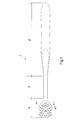
- FIG. 1 is a plan view of a tongue cleaning tool according to the present embodiment.
- FIG. 2 is a side view of the tongue cleaning tool according to the present embodiment.
- FIG. 3 is a bottom view of the tongue cleaning tool according to the present embodiment.
- FIG. 4 is a plan view of the tongue cleaning tool in which the description of the tongue coating removing unit according to this embodiment is omitted.
- FIG. 5 is a side view of the tongue cleaning tool according to the present embodiment, and shows the direction of the load applied to the connecting portion.
- FIG. 1 the left side of FIG. 1 is “front end”, the right side is “rear end”, the front side of the page is “up”, the back side of the page is “down”, the left and right direction is “length direction”, The direction is referred to as the “width direction”.
- the tongue cleaning tool 1 includes a grip portion 2, a connecting portion 3 extending from the tip of the grip portion 2, and a head portion 4 provided at the tip of the connecting portion 3. Yes.
- the grip portion 2 is a portion that is gripped by the user when using the tongue cleaning tool 1, such that the central portion in the longitudinal direction of both side portions is curved in a concave shape or becomes thinner as it goes to the rear end. As a shape, it is easy for the user to grip.
- the gripping part 2 is a plastic such as polyethylene, polypropylene, polystyrene, AS resin, ABS resin, methacrylic resin, polytetrafluoroethylene, polyvinyl chloride, polyacetal, polyamide, nylon, polycarbonate, modified polyphenylene ether, polybutylene terephthalate, polyethylene terephthalate, etc. Can be formed. In addition, it is preferable to form the holding
- the connecting portion 3 extends integrally from the tip of the grip portion 2 and is thinner than the grip portion 2. As shown by the arrow in FIG. 5, the connecting portion 3 is located 8 mm (center in the width direction) from the tip of the tongue coating removing portion 42 in a state where the grip portion 2 is fixed from the width direction by a fixing means such as a vise.
- a fixing means such as a vise.
- the measurement mentioned above can be measured with the precision universal testing machine AGS-500D (Shimadzu Corporation).
- the head part 4 is composed of a base part 41 extending integrally from the connecting part 3 and a tongue coating removing part 42 formed on the upper surface of the base part 41.
- the size of the head portion 4 is preferably such that the width and length are 20 to 30 mm and the thickness is 3 to 10 mm in order to prevent vomiting reflection when the head portion 4 is inserted into the oral cavity.
- the base portion 41 has an annular groove 411 formed on the upper surface along the periphery thereof, a plurality of through holes 412 formed in the center portion, and a plurality of engagement protrusions. 413 is also formed.
- the tongue coating removing portion 42 is formed on the upper surface of the base portion 41, and its peripheral edge is folded back to extend to the lower surface of the base portion 41 to cover the peripheral edge of the base portion 41.
- the groove 411 and the through hole 412 of the base part 41 are also filled.
- the tongue coating removal portion 42 is formed of, for example, a thermoplastic elastomer, and specifically, a thermoplastic elastomer such as styrene, olefin, vinyl chloride, polyamide, polyester, polyurethane, nylon, or the like. Can be formed.
- the Shore A hardness of the tongue coating removal part 42 is preferably about 10 to 35, more preferably 15 to 30.
- the tongue coating removal part 42 can be formed by heat-sealing to the base part 41 by injection molding.
- the Shore A hardness of the tongue coating removal part 42 can be measured according to JIS K6253.
- the tongue coating removal part 42 has a plurality of conical protrusions 421 formed in the rear end region of the head part 4 and a plurality of rows of linear protrusions 422 formed in the front end side area of the head part 4. Yes.
- the conical protrusion 421 is used to loosen and scrape tongue moss adhering to the tongue, and since it is formed in the rear end region of the head portion 4, the tongue protrudes before the linear protrusion 422 in use. It hits. Further, the height of the conical protrusion 421 is preferably about 1.5 to 5 mm so that the tongue comes into contact with the tongue before the linear protrusion 422 more reliably, and 0.5 mm higher than the linear protrusion 422 described later. It is preferable that the height is about 2.0 mm higher.
- the linear protrusion 422 is for scraping the tongue coating scraped out by the conical protrusion 421 described above, and is formed in a circular arc shape in plan view extending in the width direction of the head portion 4.
- the height of each linear protrusion 422 is designed so as to increase toward the center.
- the height of the central portion of the linear protrusion 422, that is, the maximum height is preferably about 1.0 to 3.0 mm.
- the user holds the grip portion 2, inserts the head portion 4 into the oral cavity, and presses the tongue coating removal portion 42 against the tongue. Then, when the tongue cleaning tool 1 is pulled to the rear end side with the tongue coating removing portion 42 pressed against the tongue, the conical protrusion 421 of the tongue coating removing portion 42 scrapes the tongue coating attached to the surface of the tongue, and this scraped out. The tongue coating is scraped off by the linear protrusion 422 and removed.
- the grip portion 2 is wider and thicker than the connecting portion 3, but the width and thickness can be the same as the connecting portion 3.
- channel 411 is formed in the peripheral part in the base part 41, the shape and position of this groove
- the base part 41 It is also possible to provide a groove 411 or a plurality of linear grooves 411 over the whole.
- the tongue coating removal part 42 is formed of a thermoplastic elastomer, but other materials can be used as long as the Shore A hardness is 10 to 35, for example, silicone resin, thermoplastic polyurethane elastomer. , And at least one selected from the group consisting of rubbers.
- a total of 30 types of tongue cleaning tools 1 having the same shape as those shown in FIGS. 1 to 4 and having different shore A hardness of the tongue coating removing portion 42 and elasticity of the connecting portion 3 were produced.
- the tongue coating removal part 42 was formed using SEBS, and the height of the conical protrusion 421 was 3 mm, and the height of the linear protrusion 422 was 1.8 mm.
- the holding part 2, the connection part 3, and the base part 41 were integrally formed with the polypropylene.
- the Shore A hardness has 6 types of 6, 10, 15, 30, 35, and 40, and the elasticity of the connecting portion 3 has 5 types of displacements of 1 mm, 3 mm, 5 mm, 10 mm, and 15 mm. It was.
- this displacement that is also in each table is 8 mm (center in the width direction) from the tip of the tongue coating removing portion 42 as shown by the arrow in FIG.
- Table 1 shows the results of the sensory test conducted on the removal of tongue coating
- Table 2 shows the results of the sensory test conducted on the tongue pain using the 30 kinds of tongue cleaning tools thus prepared.
- the number of people who did not feel pain in the tongue was “ ⁇ ” for 7 or more people, “ ⁇ ” for 5-6 people, and “ ⁇ ” for 4 or less people.
Landscapes
- Health & Medical Sciences (AREA)
- Surgery (AREA)
- Life Sciences & Earth Sciences (AREA)
- Heart & Thoracic Surgery (AREA)
- Molecular Biology (AREA)
- Nuclear Medicine, Radiotherapy & Molecular Imaging (AREA)
- Otolaryngology (AREA)
- Oral & Maxillofacial Surgery (AREA)
- Engineering & Computer Science (AREA)
- Biomedical Technology (AREA)
- Dentistry (AREA)
- Medical Informatics (AREA)
- Pulmonology (AREA)
- Animal Behavior & Ethology (AREA)
- General Health & Medical Sciences (AREA)
- Public Health (AREA)
- Veterinary Medicine (AREA)
- Body Washing Hand Wipes And Brushes (AREA)
- Surgical Instruments (AREA)
- Brushes (AREA)
Abstract
【課題】使用者に痛みを感じさせることなく舌苔を十分に除去することのできる舌清掃具を提供することを課題とする。 【解決手段】この舌清掃具1は、把持部2と、把持部2から延びる連結部3と、連結部3の先端に設けられたヘッド部4と、を備えている。ヘッド部4は、連結部3から延びる基台部41と、基台部41の上面に形成された舌苔除去部42とを有しており、舌苔除去部42は、ショアA硬度が10~35であり、連結部3は、把持部2を固定した状態で舌苔除去部42に対して垂直方向に1Nの荷重を掛けたときに舌苔除去部42の可動範囲が5~10mmとなるような弾性を有する。
Description
本発明は、舌表面に付着した舌苔を除去するための舌清掃具に関するものである。
食べ物の残渣物や口腔内の細菌などが舌の表面に付着したもの(舌苔)は口臭の原因となるため、この舌苔を除去するための舌清掃具が種々提案されている。例えば特許文献1において提案されている舌清掃具は、握り手の先端側に二つのプレートを設けており、このプレートを舌に押し当てた状態で舌表面を擦るように舌清掃具を動かすことで舌表面に付着した舌苔を掻き集めて舌苔を除去する。
しかしながら、上述した舌清掃具において舌を擦るプレートはプラスチック製となっているために、舌を擦ったときに使用者は痛みを感じてしまう。このため使用者は十分な力で舌表面を擦ることができず、舌苔が十分に除去することができないという問題があった。そこで、本発明は、使用者に痛みを感じさせることなく舌苔を十分に除去することのできる舌清掃具を提供することを課題とする。
本発明に係る舌清掃具は、把持部と、前記把持部から延びる連結部と、前記連結部の先端に設けられたヘッド部と、を備え、前記ヘッド部は、前記連結部から延びる基台部と、前記基台部の一方面に形成された舌苔除去部とを有しており、前記舌苔除去部は、ショアA硬度が10~35であり、前記連結部は、前記把持部を固定した状態で前記舌苔除去部に対して垂直方向に1Nの荷重を掛けたときに前記舌苔除去部の可動範囲が5~10mmとなるような弾性を有する。
本発明に係る舌清掃具によれば、舌苔を除去するために舌を擦る舌苔除去部はショアA硬度が10~35であるために、強い力で舌表面を擦っても使用者は痛みを感じることがなく、十分に強い力で舌表面を擦ることができ、舌苔を十分に除去することができる。また、把持部とヘッド部とを連結する連結部が上述したような弾性を有するために、舌苔除去部を舌に対してしっかりと押圧させることができ舌苔を十分に除去することができると同時に、舌苔除去部を舌に対して押さえつけ過ぎることを防止することもできる。
舌苔除去部を上述したような硬度で形成すると、射出成形などで基台部上に舌苔除去部を形成する場合に、基台部に対して舌苔除去部が十分に融着しない可能性がある。しかしながら、舌苔除去部は、基台部の一方面を覆うとともに周縁が折り返されて他方面まで延びているような構成とすることによって、舌苔除去部を基台部に対して強固に取り付けることができる。また、舌苔除去部は基台部の周縁を覆っているために、起こりやすい周縁部からの剥離を防止することができる。
また、上記基台部の舌苔除去部側に、溝、貫通孔、及び係合突起の少なくともいずれかを形成することができ、この構成によって基台部と舌苔除去部との接着面積を大きくして舌苔除去部を基台部に対して強固に取り付けることができる。なお、舌清掃具の長さ方向、すなわち、舌清掃具の動作方向に対して交差する方向に溝が延びるように形成することが好ましい。
また、上記舌苔除去部は、幅方向に延びる線状突起と、前記線状突起よりも連結部側に形成され前記線状突起よりも高く形成された棒状突起とを有するような構成とすることもできる。この構成によれば、棒状突起で舌苔をほぐして掻き出した後に、この掻き出された舌苔を線状突起によって掻き集めることができ、また、棒状突起の方が高く形成されているため、使用の際に棒状突起を線状突起に先行して確実に舌に当てることができ、十分に舌苔を除去することができる。なお、棒状突起は、例えば円錐状突起や三角錐状突起などとすることができる。
また、連結部と基台部とを一体的に形成することが好ましい。
また、上記舌苔除去部は、射出成形によって基台部に熱融着されるよう形成することができる。
また、舌苔除去部は、熱可塑性エラストマー、シリコーン樹脂、熱可塑性ポリウレタンエラストマー、及びゴムからなる群から選ばれる少なくとも1種から形成することができ、熱可塑性エラストマーにより形成することが好ましい。なお、ゴムとしては、天然ゴム(NR)や、イソプレンゴム(IR)、ブタジエンゴム(BR)、スチレンブタジエンゴム(SBR)、ニトリルゴム(NBR)、エチレンプロピレンゴム(EPDM)などを挙げることができる。
なお、舌苔除去部を基台部に対して強固に取り付けるという観点からは、舌清掃具を、把持部と、前記把持部から延びる連結部と、前記連結部の先端に設けられたヘッド部と、を備え、前記ヘッド部は、前記連結部から延びる基台部と、前記基台部の一方面に熱可塑性エラストマーにより形成された舌苔除去部とを有しており、前記舌苔除去部は、基台部の一方面を覆うとともに、周縁が折り返されて他方面まで延びている構成とすることができる。
本発明によれば、使用者に痛みを感じさせることなく舌苔を十分に除去することのできる舌清掃具を提供することができる。
以下、本発明に係る舌清掃具の実施形態について図面を参照しつつ説明する。なお、本明細書においては、図1の左側を「先端」、右側を「後端」、紙面手前側を「上」、紙面奥側を「下」、左右方向を「長さ方向」、上下方向を「幅方向」と称している。
図1から図3に示すように、舌清掃具1は、把持部2と、把持部2の先端から延びる連結部3と、連結部3の先端に設けられたヘッド部4と、を備えている。
把持部2は、使用者が舌清掃具1を使用する際に握る部分であり、両側部の長さ方向中央部が凹状に湾曲したり、後端に行くにしたがって厚さが薄くなるような形状として使用者が握りやすいようにしている。把持部2は、ポリエチレンやポリプロピレン、ポリスチレン、AS樹脂、ABS樹脂、メタクリル樹脂、ポリテトラフルオロエチレン、ポリ塩化ビニル、ポリアセタール、ポリアミド、ナイロン、ポリカーボネート、変性ポリフェニレンエーテル、ポリブチレンテレフタレート、ポリエチレンテレフタレート等のプラスチックによって形成することができる。なお、把持部2は、射出成形によって、後述する連結部3及び基台部41と一体的に形成することが好ましい。
連結部3は、把持部2の先端から一体的に延び、把持部2よりもその厚さが薄くなっている。この連結部3は、把持部2を幅方向からバイスなどの固定手段で固定した状態で、図5の矢印で示すように、舌苔除去部42の先端から8mm(幅方向中央)の箇所に対して垂直方向下方に1Nの荷重を掛けたときにその荷重が掛けられた箇所が5~10mm程度垂直方向下方に変位するような弾性を有している。このように連結部3の先端における変位が10mm以下となるような弾性とすることで、後述する舌苔除去部42を舌に対してしっかりと押圧することができ舌苔を十分に除去することができる。また、連結部3の先端における変位が5mm以上となるような弾性とすることによって、使用の際に舌苔除去部42を舌に対して強く押圧し過ぎないようにすることができる。なお、上述した測定は、精密万能試験機AGS-500D(島津製作所)によって測定することができる。
ヘッド部4は、連結部3から一体的に延びる基台部41と、この基台部41の上面に形成された舌苔除去部42とから構成されている。このヘッド部4の大きさは、ヘッド部4を口腔内に挿入したときの嘔吐反射を防止するために、その寸法を幅および長さ20~30mm、厚み3~10mmとすることが好ましい。
基台部41は、図4に示すように、その周縁に沿って環状の溝411が上面に形成され、中央部には複数の貫通孔412が形成されており、また、複数の係合突起413も形成されている。
舌苔除去部42は、図1から図3に示すように、基台部41の上面に形成されるとともにその周縁が折り返されて基台部41の下面まで延びて基台部41の周縁を覆った状態となっており、また、基台部41の溝411や貫通孔412内にも充填されている。この舌苔除去部42は、例えば、熱可塑性エラストマーによって形成されており、具体的には、スチレン系、オレフィン系、塩化ビニル系、ポリアミド系、ポリエステル系、ポリウレタン系、ナイロン系等の熱可塑性エラストマーによって形成することができる。この舌苔除去部42のショアA硬度は硬度10~35程度とすることが好ましく、15~30とすることがさらに好ましい。この範囲にすることによって、強い力で舌表面を擦っても使用者は痛みを感じることがなく、舌表面をしっかり擦って舌苔を十分に除去することができる。なお、この舌苔除去部42は、射出成形によって基台部41に熱融着させることで形成することができる。また、舌苔除去部42のショアA硬度は、JIS K6253によって測定することができる。
また、舌苔除去部42は、ヘッド部4の後端領域に形成された複数本の円錐状突起421と、ヘッド部4の先端側領域に形成された複数列の線状突起422を有している。
円錐状突起421は、舌に付着した舌苔をほぐして掻き出すためのものであり、ヘッド部4の後端側領域に形成されているために、使用の際に線状突起422よりも先に舌に当たる。また、より確実に線状突起422よりも先に舌に当たるように、円錐状突起421の高さは、1.5~5mm程度とすることが好ましく、後述する線状突起422よりも0.5~2.0mm程度高く形成することが好ましい。
線状突起422は、上述した円錐状突起421によって掻き出された舌苔を掻き集めるためのものであり、ヘッド部4の幅方向に亘って延びた平面視円弧状に形成されている。各線状突起422の高さは、中央に行くにしたがって高くなるように設計されている。この線状突起422の中央部の高さ、すなわち最大高さは、1.0~3.0mm程度とすることが好ましい。
以上のように構成された舌清掃具1の使用方法について説明すると、まず、使用者は把持部2を把持しヘッド部4を口腔内に挿入して舌苔除去部42を舌に押し当てる。そして、舌苔除去部42を舌に押し当てた状態で舌清掃具1を後端側に引っ張ると、舌苔除去部42の円錐状突起421が舌の表面に付着した舌苔を掻き出し、この掻き出された舌苔を線状突起422によって掻き集めて除去する。
以上、本発明の実施形態について説明したが、本発明はこれらに限定されるものではなく、本発明の趣旨を逸脱しない限りにおいて種々の変更が可能である。
例えば、把持部2は連結部3よりも幅が大きくまた厚くなっているが、幅及び厚さを連結部3と同一とすることができる。
また、上記実施形態では、基台部41には周縁部に環状の溝411が形成されているが、この溝411の形状や位置は特にこれに限定されるものではなく、例えば基台部41の全体に亘って溝411を設けたり、直線状の溝411を複数設けたりすることもできる。
また、上記実施形態では、舌苔除去部42を熱可塑性エラストマーにより形成しているが、ショアA硬度が10~35であれば他の材料を用いることもでき、例えば、シリコーン樹脂、熱可塑性ポリウレタンエラストマー、及びゴムからなる群から選ばれる少なくとも1種から形成してもよい。
図1~4に示したものと同じ形状であり、舌苔除去部42のショアA硬度と連結部3の弾性を変えた計30種類の舌清掃具1を作製した。なお、舌苔除去部42は、SEBSを用いて形成し、円錐状突起421の高さを3mm、線状突起422の高さを1.8mmとした。また、把持部2,連結部3,及び基台部41は、ポリプロピレンによって一体的に形成した。
表1及び2に示すよう、ショアA硬度は、6,10,15,30,35,40の6種類とし、連結部3の弾性は、変位が1mm,3mm,5mm,10mm,15mmの5種類とした。なお、各表中にもあるこの変位とは、把持部2を幅方向からバイスで固定した状態で、図5の矢印で示すように、舌苔除去部42の先端から8mm(幅方向中央)の箇所に対して垂直方向下方に1Nの荷重を掛けたときにその荷重が掛けられた箇所が下方に移動したときの変位のことを示している。このように作製した30種類の舌清掃具を用いて、舌苔の除去に関して行った官能試験の結果を表1に、舌の痛みに関して行った官能試験の結果を表2に示した。なお、各官能試験は20~50代の男女10名によって行った。以下の表1及び表2の結果から、ショアA硬度を10~35、変位を5~10mmとすることで、舌に痛みを感じさせずに、舌苔を十分に除去できることが分かった。

表1について、舌苔の除去が出来たと感じた人数が7名以上のものは「○」とし、5~6名のものは「△」とし、4名以下のものは「×」とした。

表2については、舌の痛みを感じなかった人数が7名以上のものは「○」、5~6名のものは「△」、4名以下のものは「×」とした。
1 舌清掃具
2 把持部
3 連結部
4 ヘッド部
41 基台部
42 舌苔除去部
2 把持部
3 連結部
4 ヘッド部
41 基台部
42 舌苔除去部
Claims (7)
- 把持部と、
前記把持部から延びる連結部と、
前記連結部の先端に設けられたヘッド部と、を備え、
前記ヘッド部は、前記連結部から延びる基台部と、前記基台部の一方面に形成された舌苔除去部とを有しており、
前記舌苔除去部は、ショアA硬度が10~35であり、
前記連結部は、前記把持部を固定した状態で前記舌苔除去部に対して垂直方向に1Nの荷重を掛けたときに前記舌苔除去部の可動範囲が5~10mmとなるような弾性を有する、舌清掃具。 - 前記舌苔除去部は、前記基台部の一方面を覆うとともに、周縁が折り返されて他方面まで延びている、請求項1に記載の舌清掃具。
- 前記基台部は、前記舌苔除去部側の面に溝、貫通孔、及び係合突起の少なくともいずれかが形成されている、請求項1又は2に記載の舌清掃具。
- 前記舌苔除去部は、幅方向に延びる線状突起と、前記線状突起よりも連結部側に形成され前記線状突起よりも高く形成された棒状突起とを有する、請求項1から3のいずれかに記載の舌清掃具。
- 前記連結部と前記基台部とは、一体的に形成されている、請求項1から4のいずれかに記載の舌清掃具。
- 前記舌苔除去部は、射出成形によって前記基台部に熱融着されている、請求項1から5のいずれかに記載の舌清掃具。
- 前記舌苔除去部は、熱可塑性エラストマー、シリコーン樹脂、熱可塑性ポリウレタンエラストマー、及びゴムからなる群から選ばれる少なくとも1種から形成される、請求項1から6のいずれかに記載の舌清掃具。
Applications Claiming Priority (2)
| Application Number | Priority Date | Filing Date | Title |
|---|---|---|---|
| JP2011096595A JP5812664B2 (ja) | 2011-04-22 | 2011-04-22 | 舌清掃具 |
| JP2011-096595 | 2011-04-22 |
Publications (1)
| Publication Number | Publication Date |
|---|---|
| WO2012144596A1 true WO2012144596A1 (ja) | 2012-10-26 |
Family
ID=47041700
Family Applications (1)
| Application Number | Title | Priority Date | Filing Date |
|---|---|---|---|
| PCT/JP2012/060715 Ceased WO2012144596A1 (ja) | 2011-04-22 | 2012-04-20 | 舌清掃具 |
Country Status (2)
| Country | Link |
|---|---|
| JP (1) | JP5812664B2 (ja) |
| WO (1) | WO2012144596A1 (ja) |
Families Citing this family (1)
| Publication number | Priority date | Publication date | Assignee | Title |
|---|---|---|---|---|
| JP2024005430A (ja) * | 2022-06-30 | 2024-01-17 | ニッコー株式会社 | 舌用クリーナ |
Citations (7)
| Publication number | Priority date | Publication date | Assignee | Title |
|---|---|---|---|---|
| US5967152A (en) * | 1997-12-31 | 1999-10-19 | Amtec Products, Inc. | Oral cleaning apparatus |
| JP2001000457A (ja) * | 1999-06-24 | 2001-01-09 | Koeisha:Kk | 口内清掃具 |
| JP2001145524A (ja) * | 1999-11-22 | 2001-05-29 | Ichiro Jin | 舌磨きブラシ |
| US6440149B1 (en) * | 2001-04-23 | 2002-08-27 | Dasan Potti | Tongue and tooth cleaning device |
| JP3121294U (ja) * | 2006-01-30 | 2006-05-18 | 寿弘 池谷 | 舌苔除去具 |
| JP3146526U (ja) * | 2008-09-08 | 2008-11-20 | ライオン株式会社 | 舌クリーナー |
| JP3147869U (ja) * | 2008-11-06 | 2009-01-22 | 株式会社レーベン販売 | 舌クリーナー |
-
2011
- 2011-04-22 JP JP2011096595A patent/JP5812664B2/ja active Active
-
2012
- 2012-04-20 WO PCT/JP2012/060715 patent/WO2012144596A1/ja not_active Ceased
Patent Citations (7)
| Publication number | Priority date | Publication date | Assignee | Title |
|---|---|---|---|---|
| US5967152A (en) * | 1997-12-31 | 1999-10-19 | Amtec Products, Inc. | Oral cleaning apparatus |
| JP2001000457A (ja) * | 1999-06-24 | 2001-01-09 | Koeisha:Kk | 口内清掃具 |
| JP2001145524A (ja) * | 1999-11-22 | 2001-05-29 | Ichiro Jin | 舌磨きブラシ |
| US6440149B1 (en) * | 2001-04-23 | 2002-08-27 | Dasan Potti | Tongue and tooth cleaning device |
| JP3121294U (ja) * | 2006-01-30 | 2006-05-18 | 寿弘 池谷 | 舌苔除去具 |
| JP3146526U (ja) * | 2008-09-08 | 2008-11-20 | ライオン株式会社 | 舌クリーナー |
| JP3147869U (ja) * | 2008-11-06 | 2009-01-22 | 株式会社レーベン販売 | 舌クリーナー |
Also Published As
| Publication number | Publication date |
|---|---|
| JP5812664B2 (ja) | 2015-11-17 |
| JP2012228281A (ja) | 2012-11-22 |
Similar Documents
| Publication | Publication Date | Title |
|---|---|---|
| CN1856263B (zh) | 挠性牙刷头板以及其形成方法 | |
| RU2726658C1 (ru) | Приспособление для личной гигиены со сменной головкой | |
| CN103987293B (zh) | 组织清洁器和口腔护理器具 | |
| CN101213053B (zh) | 具有改进的抓握结构的剃刀手柄 | |
| CA2577109A1 (en) | Toothbrush and methods of making and using same | |
| WO2011099561A1 (ja) | 清掃具 | |
| BRPI0520352B1 (pt) | Cabo de barbeador ergonômico dotado de punho aperfeiçoado | |
| WO2006031832A2 (en) | Tongue scraper | |
| US9622638B2 (en) | Handheld cleaning device with elongated handle for use with disposable cleaning towel | |
| US8590095B2 (en) | Toothbrush with movable head portion | |
| EP3223653B1 (en) | Oral care implement having multi-component handle | |
| KR20180036692A (ko) | 의치들로부터 의치 접착제를 제거하기 위해 적응된 툴을 갖는 구강 세정 기구 | |
| JP5812664B2 (ja) | 舌清掃具 | |
| AU2011360948B2 (en) | Oral care implement | |
| JP5314711B2 (ja) | 清掃具用エンドキャップ付き柄 | |
| TWI527536B (zh) | 牙刷 | |
| JP3240992U (ja) | 清掃具 | |
| JP6150549B2 (ja) | 清掃具 | |
| KR101420217B1 (ko) | 칫솔의 헤드 구조 및 이를 포함하는 칫솔 | |
| KR20140113969A (ko) | 조직 클리너 및 구강 관리 기구 | |
| JP6526742B2 (ja) | 掃除具用柄及び掃除具 | |
| JP4270715B2 (ja) | 人工乳首用洗浄具 | |
| KR102124540B1 (ko) | 칫솔의 헤드 구조 및 이를 포함하는 칫솔 | |
| WO2016048621A1 (en) | Cleaning implement with improved sheet gripping mechanisms | |
| JP2003325644A (ja) | 人工乳首用洗浄具 |
Legal Events
| Date | Code | Title | Description |
|---|---|---|---|
| 121 | Ep: the epo has been informed by wipo that ep was designated in this application |
Ref document number: 12773956 Country of ref document: EP Kind code of ref document: A1 |
|
| NENP | Non-entry into the national phase |
Ref country code: DE |
|
| 122 | Ep: pct application non-entry in european phase |
Ref document number: 12773956 Country of ref document: EP Kind code of ref document: A1 |