WO2012137314A1 - 食品中のカドミウム測定方法及び測定装置 - Google Patents
食品中のカドミウム測定方法及び測定装置 Download PDFInfo
- Publication number
- WO2012137314A1 WO2012137314A1 PCT/JP2011/058682 JP2011058682W WO2012137314A1 WO 2012137314 A1 WO2012137314 A1 WO 2012137314A1 JP 2011058682 W JP2011058682 W JP 2011058682W WO 2012137314 A1 WO2012137314 A1 WO 2012137314A1
- Authority
- WO
- WIPO (PCT)
- Prior art keywords
- cadmium
- solution
- measurement
- food
- electrode
- Prior art date
- Legal status (The legal status is an assumption and is not a legal conclusion. Google has not performed a legal analysis and makes no representation as to the accuracy of the status listed.)
- Ceased
Links
Images








Classifications
-
- G—PHYSICS
- G01—MEASURING; TESTING
- G01N—INVESTIGATING OR ANALYSING MATERIALS BY DETERMINING THEIR CHEMICAL OR PHYSICAL PROPERTIES
- G01N31/00—Investigating or analysing non-biological materials by the use of the chemical methods specified in the subgroup; Apparatus specially adapted for such methods
- G01N31/12—Investigating or analysing non-biological materials by the use of the chemical methods specified in the subgroup; Apparatus specially adapted for such methods using combustion
-
- G—PHYSICS
- G01—MEASURING; TESTING
- G01N—INVESTIGATING OR ANALYSING MATERIALS BY DETERMINING THEIR CHEMICAL OR PHYSICAL PROPERTIES
- G01N27/00—Investigating or analysing materials by the use of electric, electrochemical, or magnetic means
- G01N27/26—Investigating or analysing materials by the use of electric, electrochemical, or magnetic means by investigating electrochemical variables; by using electrolysis or electrophoresis
- G01N27/416—Systems
- G01N27/48—Systems using polarography, i.e. measuring changes in current under a slowly-varying voltage
-
- G—PHYSICS
- G01—MEASURING; TESTING
- G01N—INVESTIGATING OR ANALYSING MATERIALS BY DETERMINING THEIR CHEMICAL OR PHYSICAL PROPERTIES
- G01N33/00—Investigating or analysing materials by specific methods not covered by groups G01N1/00 - G01N31/00
- G01N33/02—Food
-
- G—PHYSICS
- G01—MEASURING; TESTING
- G01N—INVESTIGATING OR ANALYSING MATERIALS BY DETERMINING THEIR CHEMICAL OR PHYSICAL PROPERTIES
- G01N27/00—Investigating or analysing materials by the use of electric, electrochemical, or magnetic means
- G01N27/26—Investigating or analysing materials by the use of electric, electrochemical, or magnetic means by investigating electrochemical variables; by using electrolysis or electrophoresis
- G01N27/416—Systems
- G01N27/42—Measuring deposition or liberation of materials from an electrolyte; Coulometry, i.e. measuring coulomb-equivalent of material in an electrolyte
Definitions
- the present invention relates to a method and apparatus for measuring cadmium concentration in foods by electrochemical measurement.
- cadmium concentration in rice in Japan tends to be higher than in other countries. As shown in FIG. 19, according to the total diet survey (2005), cadmium intake from rice in Japan is about half of the total food. Accounted for.
- the cadmium content of brown rice was determined to be less than 1.0 ppm (less than 0.9 ppm for polished rice) in October 1970, and the sale of cadmium rice with a brown rice content of 1.0 ppm or more is prohibited. Further, rice of 0.4 ppm or more and less than 1.0 ppm has been treated as non-edible by government purchase.
- the official analysis method for cadmium concentration in foods such as agricultural crops is stipulated in “Ministerial Ordinance for Establishing Cadmium Content Testing Method for Specified Requirements in Agricultural Land Soil Contamination Countermeasure Area”.
- This ministerial ordinance stipulates that the cadmium content in rice and brown rice is determined by heat digesting the sample with nitric acid / sulfuric acid, extracting the solvent, and measuring the heavy metal content in the crop using an atomic absorption photometer.
- FIG. 20 shows a measurement flow chart according to the official analysis method.
- ICP inductively coupled plasma optical emission spectrometer
- isotope dilution mass spectrometry surface ionization
- isotope methods for measuring cadmium content in general rice and brown rice Cadmium in foods can also be measured with an instrumental analyzer such as dilution mass spectrometry (ICP-MS).
- Electrochemical measurement method is a method in which changes in chemical substances are regarded as electrochemical reactions, and potential, current, quantity of electricity, etc. are examined as measurement parameters.
- the feature of the electrochemical measurement method is simplicity, and it is possible to directly convert a difficult-to-measure chemical quantity into an easy-to-measure electric quantity and to enable highly sensitive measurement. Furthermore, the measuring instrument can be very inexpensive.
- instrumental analyzers such as atomic absorption photometers used in official analysis methods are expensive and cumbersome to operate, and can only be accurately measured by a specialized engineer. That is, since the official analysis method uses various inorganic acids and organic compounds as shown in FIG. 20, the sample preparation operation is also complicated. There is also concern about the health hazards of analytical engineers due to volatilization of acid gases and organic solvents.
- instrument analyzers such as atomic absorption spectrometers, inductively coupled plasma emission analyzers, and isotope dilution mass spectrometers are large and stationary so that a large number of specimens can be quickly collected in food production and distribution. It is not suitable for measuring applications. Furthermore, the official analysis method takes about 5 days until the measurement result is obtained, and during that time, the food must be stored in a warehouse or the like, so that the production efficiency is low.
- the fluorescent X-ray analyzer cannot measure the solution because the solution cannot be measured. It is necessary to calculate the concentration rate by mass measurement before and after carbonization. Have problems such as using.
- the types of electrodes used in the electrochemical measurement method are a working electrode, a reference electrode, and a counter electrode. Normally, the potential changes due to contamination of the working electrode as the electrochemical reaction proceeds. Therefore, when measuring heavy metal ions in an aqueous solution, a method is employed in which the potential of the working electrode with respect to the reference electrode is always controlled to be constant, and the change in the current value flowing between the working electrode and the counter electrode is measured. .
- mercury is often used as an electrode, and although it is a very small amount, mercury is eluted in the sample solution, which causes a problem in disposal of the sample water.
- the method using a biosensor using an immunochromatography method has a problem that it requires a pretreatment for concentrating cadmium and is affected by metals such as zinc, manganese and copper.
- an object of the present invention is to provide a simple cadmium concentration measuring method and a cadmium concentration measuring apparatus capable of measuring a cadmium concentration in food with high accuracy.
- the cadmium measurement method of the present invention that achieves the above object is a method for measuring cadmium in food, wherein the food is ignited with high heat, the ashed food is mixed with an acid, and the mixed liquid is mixed. The solution is separated from the solution, and the solution is subjected to an electrochemical measurement method.
- This electrochemical measurement method uses a mercury-free anodic stripping voltammetry method that uses a copper electrode instead of a mercury electrode.
- the cadmium measuring device of the present invention that achieves the above object is a device for measuring cadmium in foods, an ashing means for ashing the food, and an ash by means of the ashing means.
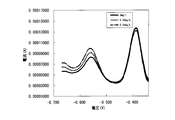
- 5 is a potential-current characteristic curve obtained by a standard addition method using a cadmium measurement method according to an embodiment of the present invention.
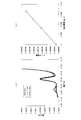
- An absolute calibration curve based on a potential-current characteristic curve obtained by the cadmium measurement method according to the embodiment of the present invention.
- the potential-current characteristic curve of the cadmium standard solution obtained by the standard addition method using the cadmium measurement method according to the embodiment of the present invention (a) cadmium standard solution (0.01 mg / L), (b) cadmium standard solution (0. 03 mg / L), (c) cadmium standard solution (0.05 mg / L).
- Comparison of the cadmium standard solution concentration and the measured value by the cadmium measuring method according to the present invention Comparison of measured values of a standard rice sample by an official method and a simplified analysis method (a measurement method according to the measurement method of the present invention using an inductively coupled plasma emission spectrometer (ICP), excluding the heat ashing treatment).
- ICP inductively coupled plasma emission spectrometer
- a potential-current characteristic curve of a cadmium standard solution containing starch obtained by a standard addition method. Measurement results of cadmium concentration in clams, (a) potential-current characteristic curve, (b) absolute calibration curve based on (a). Measurement results of cadmium concentration in scallops, (a) potential-current characteristic curve, (b) absolute calibration curve based on (a). Measurement result of cadmium concentration in walnut, (a) potential-current characteristic curve, (b) absolute calibration curve based on (a). Measurement result of cadmium concentration in cashew nut, (a) potential-current characteristic curve, (b) absolute calibration curve based on (a).
- the present invention relates to a method for quickly and accurately measuring a cadmium concentration in a food and a cadmium concentration measuring apparatus, and a food for measuring a cadmium concentration was subjected to a heat ashing treatment after a heat ashing treatment. It is characterized by dissolving food in acid and subjecting the solution to electrochemical measurement.
- impurities such as iron, calcium, magnesium, zinc, and cadmium are present in the form of phytate in combination with phytic acid.
- Phytic acid is a kind of biological substance, the composition formula is C 6 H 18 O 24 P 6 , the molecular weight is 660.08, and is a major phosphorus storage form present in many plant tissues such as seeds, and has a strong chelating action, Binds strongly to many metal ions, Therefore, when the impurities are present in the form of phytate in combination with phytic acid in food, and the cadmium which is the measurement object in the present invention is measured by an electrochemical method, the form of phytate It is necessary to separate cadmium, which is assumed to exist in cadmium, by decomposing phytate and separating cadmium alone.
- phytic acid Since phytic acid is an organic substance, it can be easily decomposed by heating. However, the remaining impurities are bonded to each other, and cadmium cannot be separated. Therefore, it is necessary to separate the cadmium by unbonding the impurities.
- the lower heating limit temperature is set above the melting point (419.6 ° C.) of zinc, which shows the maximum melting point among impurities that may be combined with cadmium after phytate decomposition, It is necessary to melt and separate before the zinc and cadmium are combined. On the other hand, loss due to vaporization can be prevented if the heating upper limit temperature is not higher than the boiling point of cadmium (756.0 ° C.).
- the food for measuring the cadmium concentration is not particularly limited.
- the food classification is “rice / rice products”, “cereals / rice cakes”, “beans, processed beans”, “green-yellow vegetables” ”,“ Vegetables / Seaweed ”,“ Seafood ”, and“ Other ”, but all foods in this category are covered.
- the cadmium concentration measuring method according to the present invention, if only the measurement time is shortened, it is expensive, and by a large-sized stationary instrumental analyzer (for example, inductively coupled plasma emission spectrometer), According to the official method, it has been confirmed that the measurement time required for about 5 days can be shortened to about 2 hours.
- stationary instrumental analyzer for example, inductively coupled plasma emission spectrometer
- the electrochemical measurement method is an extremely simple method for measuring current and voltage changes associated with oxidation-reduction reactions on the electrode. There is.
- the coulometric method exemplified in the embodiment of the present invention is a technique with excellent reproducibility for detecting the total amount of the target component in the sample, and therefore can be used universally in Japan and overseas, improving the environment and socioeconomic virtuous cycle. A great contribution is expected.
- the electrochemical measurement apparatus includes an ignition ashing means for ashing a sample, a cell (means for storing a solution) into which the sample is introduced, a working electrode, a reference electrode, a counter electrode, and a working electrode. And a means for measuring a current flowing between the working electrode and the counter electrode.
- the ignition ashing means may be anything that can heat the sample by air (or oxygen) airflow, and examples thereof include an electric furnace.
- This potential control means makes it possible to always keep the potential of the working electrode constant with respect to the reference electrode so that the potential of the working electrode does not change even if the potential changes due to contamination of the working electrode as the electrochemical reaction proceeds. . Therefore, the current flowing between the working electrode and the counter electrode can be measured with the potential of the working electrode kept constant.
- the working electrode, the reference electrode, the counter electrode, the cell for measuring the sample, and the electrolyte may be optimized.
- a copper electrode As the working electrode, a copper electrode, a platinum electrode, a gold electrode, or a carbon-based electrode may be used.
- the reference electrode may be selected from a known reference electrode (for example, a standard hydrogen electrode) in consideration of the type, stability, and ease of use.
- a known reference electrode for example, a standard hydrogen electrode
- an example using a silver / silver chloride electrode as a reference electrode is shown.
- the type and size (surface area) of the counter electrode should be optimized.
- a platinum electrode is often used as the counter electrode, but the counter electrode is not limited to the platinum electrode.
- the electrolyte solution should be optimized for type, removal of dissolved oxygen, and concentration. For example, a certain amount of sample water is weighed and mixed with a dedicated reagent consisting of an electrolyte and a buffer solution to obtain a measurement test solution. The size and shape of the cell that is optimal for measurement may be selected.
- Examples of the electrochemical measurement method performed by the electrochemical measurement apparatus according to the present invention include an anodic stripping and portammetry method.
- the anodic stripping portammetry method is a method of reducing and concentrating heavy metal ions in an aqueous solution on an electrode, and calculating the concentration of heavy metal substances based on the current value when the concentrated heavy metal substances are oxidized and eluted. Has the advantage of high.
- a food hereinafter referred to as a sample
- a sample whose cadmium concentration is to be measured
- the pulverizing means may be appropriately selected depending on the sample, a coffee mill or the like may be used for pulverizing cereals and seeds, and a knife or the like may be used when pulverizing clams and scallops.
- step S2 the crushed sample is weighed by an amount necessary for measuring the cadmium concentration.
- the pulverized sample is powder, it may be sieved. The size of the sieve mesh can be selected as appropriate.
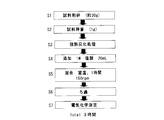
- step S3 the heat ashing process is performed on the crushed sample weighed in step S2.
- the ignition ashing process in the present invention is a method in which a sample is baked for a certain period of time in an electric furnace at a temperature of about 600 ° C. in a stream of air or oxygen, so This refers to a treatment that decomposes or removes low-boiling inorganic substances.
- organic substances can not only be ashed and removed, but by heating at a temperature above the melting point of zinc and below the boiling point of cadmium, binding of impurities that interfere with cadmium measurement Can be separated.
- step S4 the sample subjected to the high-temperature ashing treatment in step S3 is allowed to cool and then mixed with an acid.
- the kind of acid mixed with the sample is not particularly limited, and an acid that does not react with the electrode used for measurement, such as hydrochloric acid or dilute sulfuric acid, may be used.
- step S5 the liquid mixture obtained in step S4 is shaken, and in step S6, the liquid mixture is filtered.
- the type of filter such as filter paper used for filtration is not particularly limited as long as it can remove the residue of the mixed solution, and may be appropriately selected.
- step S7 the filtrate obtained in step S6 is subjected to electrochemical measurement.
- the standard addition method should be used. For example, in addition to the measurement with the test solution alone, the standard solution is added twice, three potential-current characteristic curves are obtained, the peak area in each waveform is calculated, and a calibration curve is created for the addition concentration of the standard solution By doing so, the concentration in the test solution can be calculated. Specifically, the peak area varies depending on the substance to be measured, the concentration of the substance to be measured, and the electrode material. In the present invention, the minimum current value between -0.62 V and -0.58 V, -0.5 V, and -0. Points indicating the minimum current value between 4 V were connected by a straight line, and an area surrounded by this straight line and the potential-current characteristic curve was calculated.
- Example 1 As brown rice standard samples, three types of known cadmium brown rice standard samples were obtained from the National Institute for Environmental Studies. The respective cadmium concentrations were 0.023 mg / kg, 0.32 mg / kg, and 1.82 mg / kg.
- the brown rice powder standard sample is an environmental standard sample prepared for the purpose of evaluating the accuracy of measured values and measurement analysis methods using this sample when quantifying trace elements in rice.
- This standard sample is a set of three types of samples (Cd low, medium and high levels) with different cadmium concentrations.
- the brown rice powder standard sample is a standard sample relating to the element content. A certified value is set for 13 elements and a reference value is set for 9 elements.
- Example 1 the cadmium concentration in brown rice was measured using the measurement method according to the present invention. This will be described in detail with reference to FIG.
- Standard brown rice samples were obtained from the National Institute for Environmental Studies. This standard brown rice sample is a powdery sample in which step 1 in the measurement flow diagram of FIG. 1 has already been completed. 1 g of this sample was weighed (step S2).
- step S2 the ground brown rice weighed in step S2 was put into an evaporating dish or a crucible, and subjected to an intense ashing process in an electric furnace (step S3).
- step S3 the evaporating dish or crucible subjected to ashing in step S3 was transferred into a desiccator, allowed to cool, then the contents were transferred to a 50 mL lidded glass container, and 20 mL of 1 mol / L hydrochloric acid was added (step S4). ).
- step S5 The glass container was shaken with a shaker at a speed of 150 rpm for 1 hour (step S5), then filtered with 5C filter paper (step S6), and the filtrate was put into a required volume 50 mL volumetric flask to obtain 2.5 mL.
- step S6 The glass container was shaken with a shaker at a speed of 150 rpm for 1 hour (step S5), then filtered with 5C filter paper (step S6), and the filtrate was put into a required volume 50 mL volumetric flask to obtain 2.5 mL.
- the current value was measured with an electrochemical measuring device FIELDER (model: HOE-100) manufactured by Hokuto Denko Corporation (step S7).
- the electrochemical measurement apparatus used a copper electrode as the working electrode, a platinum electrode as the counter electrode, and a silver / silver chloride electrode as the reference electrode.
- FIG. 2 shows a potential-current characteristic curve
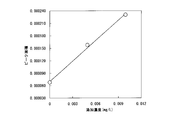
- FIG. 3 shows an absolute calibration curve obtained by the standard addition method.
- the peak at ⁇ 0.53 V is the cadmium peak.
- FIG. 2 shows three types of potential-current characteristic curves (0 mg / L, 0.02 mg / L, and 0.04 mg / L). This displays the potential-current characteristic curve of the sample solution when 100 ⁇ L of a standard solution is added in the standard addition method (the same applies to FIGS. 4, 7, and 13-18).
- Fig. 4 is a potential-current characteristic curve obtained by measuring three types of cadmium standard solutions (0.01, 0.03, 0.05 mg / L). The peak of -0.53 V cadmium increases with increasing cadmium concentration. It can be seen that the value increases.
- FIG. 5 shows the relationship between the cadmium standard solution concentration and the measured value of FIELDER.
- R 2 is 0.9933, and the slope of the regression line is 0.9783, which is close to 1, indicating that the cadmium concentration can be measured with high accuracy by the electrochemical measurement method.
- FIG. 6 is a measurement method in which the ignition ashing process (step S3) is omitted in the cadmium measurement method shown in FIG. 1, and three types of brown rice standard samples obtained from the National Institute for Environmental Studies are inductively coupled. It is the result measured by the plasma emission analyzer (ICP).
- ICP plasma emission analyzer
- R 2 is 0.9978, slope of the regression line indicates a value close to 1 at 0.9675, if considering the short time of the measurement time, and expensive, large stationary instrumental analysis
- the apparatus shows that the official method can reduce the measurement time, which takes about 5 days, to about 2 hours.
- the brown rice standard samples distributed from the National Institute for Environmental Studies are samples with low cadmium content (L: concentration 0.023 mg / kg), medium concentration samples (M: concentration 0.32 mg / kg), There are three types of high-concentration samples (H: concentration 1.82 mg / kg).
- brown rice standard samples contain zinc, chlorine, potassium, bromine, mercury, selenium, sodium, rubidium, etc. as impurities, and any one of these impurities or a combination of these impurities results in a cadmium concentration. This is considered to be an obstacle to the measurement.
- Table 1 shows the content, melting point and boiling point of each element contained in the brown rice standard sample.
- FIG. 8 shows that the cadmium concentration can be measured with high accuracy when the ignition temperature is higher than the melting point of zinc and lower than the boiling point of cadmium.
- the cadmium concentration can be measured with higher accuracy by setting the ignition temperature to 530 to 630 ° C.
- the same sample was also measured by ICP of the instrument analyzer, it was a result supporting the measurement result by the cadmium measurement method according to the present invention.
- the 2.5 mg / L cadmium solution was prepared by measuring the cadmium standard solution 1000 mg / L, 0.25 mL and concentrated hydrochloric acid 0.6 mL to 100 mL with 1 mol / L hydrochloric acid.
- test solution As a test solution, about 25 mL of distilled water was placed in a 50 mL volumetric flask, and 600 ⁇ L of a 2.5 mg / L cadmium solution was added thereto. Prepare the required amount of this.
- the cadmium concentration is 0.03 mg / L.
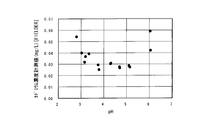
- the measurement results in FIG. 10 indicate that the pH value deviates from the true value when the pH value is 3.5 or lower or 5.5 or higher. Therefore, it is understood that when the cadmium concentration is measured by the electrochemical measurement method according to the present invention, the cadmium concentration can be accurately measured when the pH is measured between 3.5 and 5.5. It can be seen that the pH can be measured more accurately when the pH is 4.0 to 5.0.
- R 2 is 0.9999, and the slope of the regression line is 1.0459, indicating a value close to 1, indicating that the measurement accuracy is sufficient.
- the peak voltage of cadmium is ⁇ 0.53 V when a copper electrode is used as the working electrode, and the peak at this voltage is clearly measured as shown in FIG.
- step S1 used the method which changes with each foodstuff. That is, clams were peeled off and finely chopped with a knife on a cutting board, and steamed scallops were finely chopped with a knife on a cutting board.
- walnuts, cashew nuts, and macadamian nuts were selected from commercially available mixed nuts and then ground for about 10 seconds in a coffee mill.
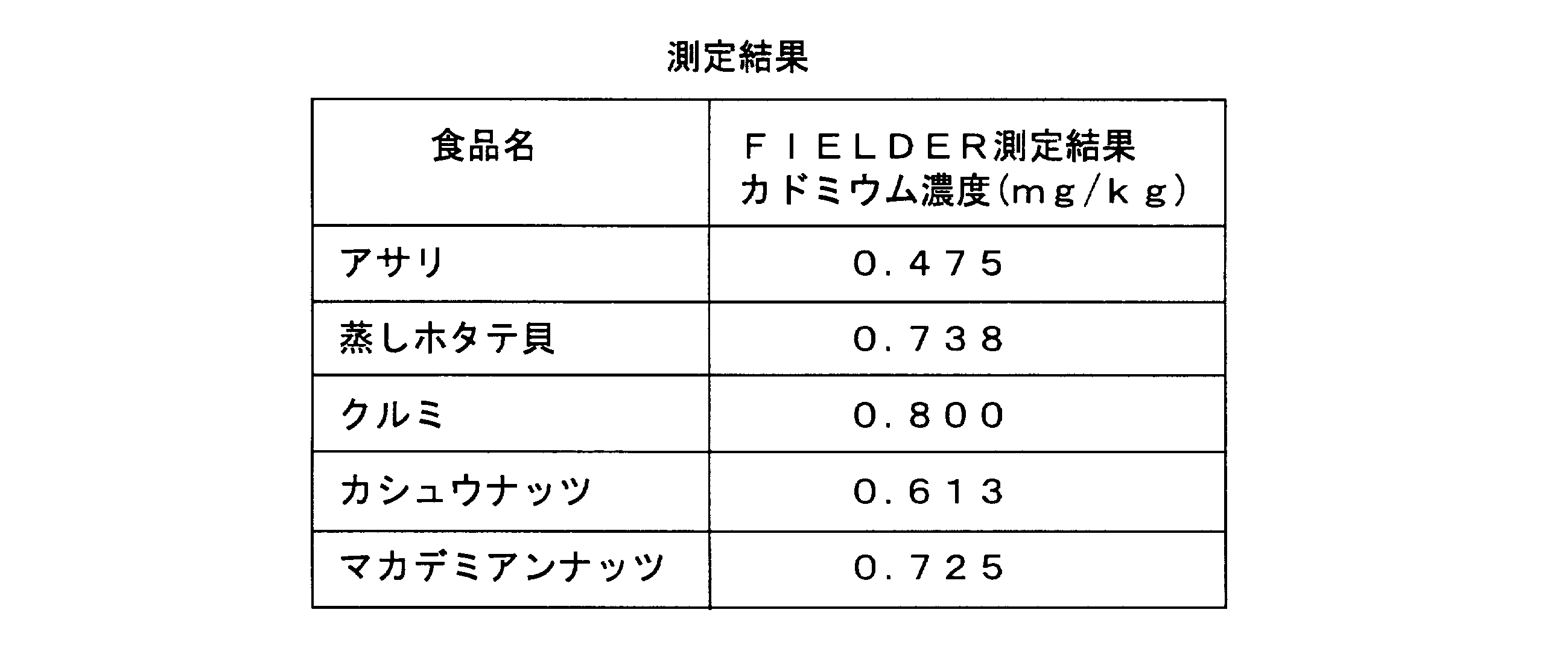
- Table 3 shows the results of measuring the cadmium concentration in each food.
- the result of measuring the same sample by ICP was a result supporting the measurement result by the cadmium measurement method according to the present invention.
- cadmium in food is used without complicated operations requiring specialized knowledge and skill and using a plurality of eight or more types of reagents. It can be measured easily.
- the cadmium concentration in food can be accurately measured in a short time of about 3 hours.
Landscapes
- Chemical & Material Sciences (AREA)
- Life Sciences & Earth Sciences (AREA)
- Health & Medical Sciences (AREA)
- Pathology (AREA)
- General Physics & Mathematics (AREA)
- Engineering & Computer Science (AREA)
- Physics & Mathematics (AREA)
- Analytical Chemistry (AREA)
- Biochemistry (AREA)
- General Health & Medical Sciences (AREA)
- Immunology (AREA)
- Molecular Biology (AREA)
- Food Science & Technology (AREA)
- Chemical Kinetics & Catalysis (AREA)
- Electrochemistry (AREA)
- Combustion & Propulsion (AREA)
- Medicinal Chemistry (AREA)
- Investigating Or Analyzing Non-Biological Materials By The Use Of Chemical Means (AREA)
Abstract
Description
したがって、食品中に上記不純物がフィチン酸と結合してフィチン酸塩の形態で存在しており、本発明における測定対象物であるカドミウムを電気化学方法で測定する場合には、フィチン酸塩の形態で存在していると想定されるカドミウムを、フィチン酸塩を分解しカドミウム単独で分離する必要がある。
(実施例1)
玄米標準試料として、独立行政法人国立環境研究所から3種類の既知カドミウム濃度の玄米標準試料を入手した。それぞれのカドミウム濃度は、0.023mg/kg、0.32mg/kg、1.82mg/kgであった。
・酸薬液の調製法
濃塩酸120mLを蒸留水で1Lにメスアップして酸薬液を調製した。
・試薬液の調製法
塩化カリウム:223.65g
水酸化ナトリウム:57.14g
酢酸:8.6mL
酢酸ナトリウム:28.7g
以上を1Lのメスフラスコに入れて蒸留水で1Lにメスアップして試薬液を調製した。

そこで、玄米標準試料(カドミウム濃度:1.82mg/kgを用いて、強熱灰化時間を60分として、強熱灰化温度を0、120、200、400、450、500、550、600、650、700、750、800、1000℃に変化してカドミウム濃度を計測した。計測結果を図8に示す。
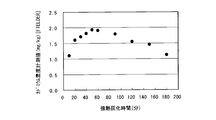
玄米標準試料(カドミウム濃度:1.82mg/kg)を用い、強熱灰化温度を600℃として、強熱灰化時間を0、10、20、30、40、50、60、90、120、150、180分に変化してカドミウム濃度を計測した。結果を図9に示す。
電気化学測定法では、試験液のpHが測定精度に大きく影響するので、カドミウムの溶出量試験に及ぼすpHの影響について試験した。試験方法を以下に示す。
図1の測定フローで、独立行政法人国立環境研究所から入手した3種類の玄米標準試料を電気化学測定法で測定した結果を図11に示す。
図1の測定フローで、独立行政法人国立環境研究所から入手した玄米標準試料(カドミウム濃度:1.82mg/kg)を電気化学測定法で繰り返し測定した。

カドミウム濃度測定における有機物の影響を調べるために、図12に示す測定フロー図に従って、澱粉を混合したカドミウム標準液を調製し、カドミウム濃度測定を行った。カドミウム濃度測定結果を図13に示す。
本発明に係るカドミウム濃度測定装置により、各食品のカドミウム濃度を測定した結果を図14~18に示す。
Claims (7)
- 食品中のカドミウム測定方法であって、
前記食品を強熱灰化し、
前記強熱灰化した食品を酸と混合し、前記混合された混合液から溶液を分離し、
前記溶液を電気化学測定法に供する
ことを特徴とするカドミウム測定方法。 - 前記電気化学測定法は、アノーディック・ストリッピング・ボルタンメトリーである
ことを特徴とする請求項1に記載のカドミウム測定方法。 - 前記電気化学測定法に用いられる作用電極は、銅電極である
ことを特徴とする請求項1または請求項2に記載のカドミウム測定方法。 - 前記強熱灰化時間は、45分から90分である
ことを特徴とする請求項1または請求項2に記載のカドミウム測定方法。 - 前記強熱灰化温度は、亜鉛の融点以上、カドミウムの沸点以下である
ことを特徴とする請求項1または請求項2に記載のカドミウム測定方法。 - 前記溶液のpHを3.5から5.5に調整した
ことを特徴とする請求項1または請求項2に記載のカドミウム測定方法。 - 食品中のカドミウムを測定する装置であって、
前記食品を強熱灰化する強熱灰化手段と、
前記強熱灰化手段により灰化された食品と酸を混合し、前記混合された混合から分離された溶液を収納する手段と、
前記溶液に、作用電極としての銅電極と、対電極を浸漬する手段と、
前記作用電極と前記対電極との間に前記溶液中のカドミウムが前記作用電極上に析出する電圧を印加する手段と、
前記作用電極と前記対電極との間に前記作用電極上に析出したカドミウムが溶出する電圧を印加する手段と、
前記作用電極と前記対電極との間に流れる電流を検出する手段と、を備えた
ことを特徴とするカドミウム測定装置。
Priority Applications (3)
| Application Number | Priority Date | Filing Date | Title |
|---|---|---|---|
| PCT/JP2011/058682 WO2012137314A1 (ja) | 2011-04-06 | 2011-04-06 | 食品中のカドミウム測定方法及び測定装置 |
| CN201180069948.7A CN103534587B (zh) | 2011-04-06 | 2011-04-06 | 用于测定食品中的镉的方法和装置 |
| KR1020137026201A KR20130133029A (ko) | 2011-04-06 | 2011-04-06 | 식품 중의 카드뮴 측정방법 및 측정장치 |
Applications Claiming Priority (1)
| Application Number | Priority Date | Filing Date | Title |
|---|---|---|---|
| PCT/JP2011/058682 WO2012137314A1 (ja) | 2011-04-06 | 2011-04-06 | 食品中のカドミウム測定方法及び測定装置 |
Publications (1)
| Publication Number | Publication Date |
|---|---|
| WO2012137314A1 true WO2012137314A1 (ja) | 2012-10-11 |
Family
ID=46968752
Family Applications (1)
| Application Number | Title | Priority Date | Filing Date |
|---|---|---|---|
| PCT/JP2011/058682 Ceased WO2012137314A1 (ja) | 2011-04-06 | 2011-04-06 | 食品中のカドミウム測定方法及び測定装置 |
Country Status (3)
| Country | Link |
|---|---|
| KR (1) | KR20130133029A (ja) |
| CN (1) | CN103534587B (ja) |
| WO (1) | WO2012137314A1 (ja) |
Cited By (3)
| Publication number | Priority date | Publication date | Assignee | Title |
|---|---|---|---|---|
| CN103645201A (zh) * | 2013-12-13 | 2014-03-19 | 彭新凯 | 基于x射线荧光快速检测大米中重金属镉的方法 |
| CN103913490A (zh) * | 2012-12-28 | 2014-07-09 | 株式会社堀场制作所 | 电化学分析方法、电化学分析装置以及试剂组 |
| WO2015115980A1 (en) * | 2014-01-29 | 2015-08-06 | Lantmännen Ek För | Electrochemical methods and system for detecting cadmium |
Families Citing this family (4)
| Publication number | Priority date | Publication date | Assignee | Title |
|---|---|---|---|---|
| US10073019B2 (en) | 2014-11-06 | 2018-09-11 | Cem Corporation | Rapid quantitative element testing |
| KR20200069723A (ko) | 2018-12-07 | 2020-06-17 | 엘지전자 주식회사 | 냉장고의 제어방법 |
| CN111307549B (zh) * | 2020-03-18 | 2023-03-14 | 国家粮食和物资储备局科学研究院 | 一种快速提取谷物中多种元素的方法 |
| CN112098482B (zh) * | 2020-09-09 | 2023-01-10 | 南京腾森分析仪器有限公司 | 一种食品中铅的检测方法 |
Citations (3)
| Publication number | Priority date | Publication date | Assignee | Title |
|---|---|---|---|---|
| JP2005049275A (ja) * | 2003-07-30 | 2005-02-24 | Japan Science & Technology Agency | 食品中のカドミウムの検出方法およびそのための装置 |
| JP2006284378A (ja) * | 2005-03-31 | 2006-10-19 | National Institute Of Advanced Industrial & Technology | 農作物中重金属の簡易分析方法 |
| JP2011085531A (ja) * | 2009-10-16 | 2011-04-28 | Hokuto Denko Kk | 食品中のカドミウム測定方法及び測定装置 |
-
2011
- 2011-04-06 WO PCT/JP2011/058682 patent/WO2012137314A1/ja not_active Ceased
- 2011-04-06 CN CN201180069948.7A patent/CN103534587B/zh not_active Expired - Fee Related
- 2011-04-06 KR KR1020137026201A patent/KR20130133029A/ko not_active Ceased
Patent Citations (3)
| Publication number | Priority date | Publication date | Assignee | Title |
|---|---|---|---|---|
| JP2005049275A (ja) * | 2003-07-30 | 2005-02-24 | Japan Science & Technology Agency | 食品中のカドミウムの検出方法およびそのための装置 |
| JP2006284378A (ja) * | 2005-03-31 | 2006-10-19 | National Institute Of Advanced Industrial & Technology | 農作物中重金属の簡易分析方法 |
| JP2011085531A (ja) * | 2009-10-16 | 2011-04-28 | Hokuto Denko Kk | 食品中のカドミウム測定方法及び測定装置 |
Non-Patent Citations (1)
| Title |
|---|
| KUNIHIKO SAKAYAMA: "Denki Kagaku Bunsekiho ni yoru Nosakubutsuchu no Cadmium Bunsekiho no Kenkyu", INDUSTRIAL RESEARCH CENTER OF SHIGA PREFECTURE 2009 KENKYU HOKOKU, August 2010 (2010-08-01), pages 60 - 62 * |
Cited By (4)
| Publication number | Priority date | Publication date | Assignee | Title |
|---|---|---|---|---|
| CN103913490A (zh) * | 2012-12-28 | 2014-07-09 | 株式会社堀场制作所 | 电化学分析方法、电化学分析装置以及试剂组 |
| CN103913490B (zh) * | 2012-12-28 | 2018-10-16 | 株式会社堀场制作所 | 电化学分析方法、电化学分析装置以及试剂组 |
| CN103645201A (zh) * | 2013-12-13 | 2014-03-19 | 彭新凯 | 基于x射线荧光快速检测大米中重金属镉的方法 |
| WO2015115980A1 (en) * | 2014-01-29 | 2015-08-06 | Lantmännen Ek För | Electrochemical methods and system for detecting cadmium |
Also Published As
| Publication number | Publication date |
|---|---|
| KR20130133029A (ko) | 2013-12-05 |
| CN103534587A (zh) | 2014-01-22 |
| CN103534587B (zh) | 2015-11-25 |
Similar Documents
| Publication | Publication Date | Title |
|---|---|---|
| Yang et al. | High-sensitivity determination of cadmium and lead in rice using laser-induced breakdown spectroscopy | |
| Carter et al. | Traditional calibration methods in atomic spectrometry and new calibration strategies for inductively coupled plasma mass spectrometry | |
| Panichev et al. | Distribution of vanadium (V) species between soil and plants in the vicinity of vanadium mine | |
| WO2012137314A1 (ja) | 食品中のカドミウム測定方法及び測定装置 | |
| Boevski et al. | Determination of barium, chromium, cadmium, manganese, lead and zinc in atmospheric particulate matter by inductively coupled plasma atomic emission spectrometry (ICP-AES) | |
| de Oliveira et al. | Evaluation of sample preparation methods for the determination of As, Cd, Pb, and Se in rice samples by GF AAS | |
| Perring et al. | ED-XRF as a tool for rapid minerals control in milk-based products | |
| Mahesar et al. | Simultaneous assessment of zinc, cadmium, lead and copper in poultry feeds by differential pulse anodic stripping voltammetry | |
| Babos et al. | Calibration strategies to overcome matrix effects in laser-induced breakdown spectroscopy: direct calcium and phosphorus determination in solid mineral supplements | |
| JP5319485B2 (ja) | 食品中のカドミウム測定方法及び測定装置 | |
| Wei et al. | Simultaneous determination of Se, trace elements and major elements in Se-rich rice by dynamic reaction cell inductively coupled plasma mass spectrometry (DRC-ICP-MS) after microwave digestion | |
| Jastrzȩbska et al. | Determination of phosphorus in food samples by X-ray fluorescence spectrometry and standard spectrophotometric method | |
| de Almeida et al. | Use of fiberglass support in the application of dried-spot technique with dispersion liquid-liquid microextraction for the determination of Co, Cr, Cu, Ni and Pb by Energy Dispersive X-Ray Fluorescence Spectrometry | |
| Locatelli et al. | Voltammetric determination of ultra-trace total mercury and toxic metals in meals | |
| JP5666070B1 (ja) | 農作物試料中の有害元素量を測定するための試料の前処理方法 | |
| CN114136726B (zh) | 一种同时检测贝类中铅、镉和砷的方法 | |
| Lv et al. | Portable and miniature mercury analyzer using direct sampling inbuilt-metal ceramic electrothermal vaporization | |
| Güler et al. | Speciation of selenium in vitamin tablets using spectrofluorometry following cloud point extraction | |
| Siriangkhawut et al. | Stripping voltammetric determination of trace cadmium and lead in Thai organic unpolished rice after ultrasound-assisted digestion | |
| Huang et al. | Quantitative Detection of Toxic Elements in Food Samples by Inductively Coupled Plasma Mass Spectrometry (ICP-MS). | |
| JP2006284378A (ja) | 農作物中重金属の簡易分析方法 | |
| Pomeranz et al. | Ash and minerals | |
| Somer et al. | A new and direct method for the trace element determination in cauliflower by differential pulse polarography | |
| Xue et al. | Evaluation of iron speciation reference materials by wavelength-dispersive X-ray fluorescence, inductively coupled plasma optical emission spectroscopy, and flame/graphite furnace atomic absorption spectrometry for palaeoredox analysis | |
| Patočka et al. | Thallium in spruce needles: a comparison of the analytical capabilities of spectrochemical methods |
Legal Events
| Date | Code | Title | Description |
|---|---|---|---|
| 121 | Ep: the epo has been informed by wipo that ep was designated in this application |
Ref document number: 11863012 Country of ref document: EP Kind code of ref document: A1 |
|
| ENP | Entry into the national phase |
Ref document number: 20137026201 Country of ref document: KR Kind code of ref document: A |
|
| NENP | Non-entry into the national phase |
Ref country code: DE |
|
| 122 | Ep: pct application non-entry in european phase |
Ref document number: 11863012 Country of ref document: EP Kind code of ref document: A1 |
|
| NENP | Non-entry into the national phase |
Ref country code: JP |