WO2012133543A1 - 硬化性樹脂組成物及び硬化物 - Google Patents
硬化性樹脂組成物及び硬化物 Download PDFInfo
- Publication number
- WO2012133543A1 WO2012133543A1 PCT/JP2012/058166 JP2012058166W WO2012133543A1 WO 2012133543 A1 WO2012133543 A1 WO 2012133543A1 JP 2012058166 W JP2012058166 W JP 2012058166W WO 2012133543 A1 WO2012133543 A1 WO 2012133543A1
- Authority
- WO
- WIPO (PCT)
- Prior art keywords
- fluorine
- structural unit
- group
- bond
- carbon atoms
- Prior art date
- Legal status (The legal status is an assumption and is not a legal conclusion. Google has not performed a legal analysis and makes no representation as to the accuracy of the status listed.)
- Ceased
Links
Images



Classifications
-
- C—CHEMISTRY; METALLURGY
- C08—ORGANIC MACROMOLECULAR COMPOUNDS; THEIR PREPARATION OR CHEMICAL WORKING-UP; COMPOSITIONS BASED THEREON
- C08F—MACROMOLECULAR COMPOUNDS OBTAINED BY REACTIONS ONLY INVOLVING CARBON-TO-CARBON UNSATURATED BONDS
- C08F214/00—Copolymers of compounds having one or more unsaturated aliphatic radicals, each having only one carbon-to-carbon double bond, and at least one being terminated by a halogen
- C08F214/18—Monomers containing fluorine
-
- C—CHEMISTRY; METALLURGY
- C09—DYES; PAINTS; POLISHES; NATURAL RESINS; ADHESIVES; COMPOSITIONS NOT OTHERWISE PROVIDED FOR; APPLICATIONS OF MATERIALS NOT OTHERWISE PROVIDED FOR
- C09D—COATING COMPOSITIONS, e.g. PAINTS, VARNISHES OR LACQUERS; FILLING PASTES; CHEMICAL PAINT OR INK REMOVERS; INKS; CORRECTING FLUIDS; WOODSTAINS; PASTES OR SOLIDS FOR COLOURING OR PRINTING; USE OF MATERIALS THEREFOR
- C09D127/00—Coating compositions based on homopolymers or copolymers of compounds having one or more unsaturated aliphatic radicals, each having only one carbon-to-carbon double bond, and at least one being terminated by a halogen; Coating compositions based on derivatives of such polymers
- C09D127/02—Coating compositions based on homopolymers or copolymers of compounds having one or more unsaturated aliphatic radicals, each having only one carbon-to-carbon double bond, and at least one being terminated by a halogen; Coating compositions based on derivatives of such polymers not modified by chemical after-treatment
- C09D127/12—Coating compositions based on homopolymers or copolymers of compounds having one or more unsaturated aliphatic radicals, each having only one carbon-to-carbon double bond, and at least one being terminated by a halogen; Coating compositions based on derivatives of such polymers not modified by chemical after-treatment containing fluorine atoms
-
- C—CHEMISTRY; METALLURGY
- C09—DYES; PAINTS; POLISHES; NATURAL RESINS; ADHESIVES; COMPOSITIONS NOT OTHERWISE PROVIDED FOR; APPLICATIONS OF MATERIALS NOT OTHERWISE PROVIDED FOR
- C09D—COATING COMPOSITIONS, e.g. PAINTS, VARNISHES OR LACQUERS; FILLING PASTES; CHEMICAL PAINT OR INK REMOVERS; INKS; CORRECTING FLUIDS; WOODSTAINS; PASTES OR SOLIDS FOR COLOURING OR PRINTING; USE OF MATERIALS THEREFOR
- C09D127/00—Coating compositions based on homopolymers or copolymers of compounds having one or more unsaturated aliphatic radicals, each having only one carbon-to-carbon double bond, and at least one being terminated by a halogen; Coating compositions based on derivatives of such polymers
- C09D127/02—Coating compositions based on homopolymers or copolymers of compounds having one or more unsaturated aliphatic radicals, each having only one carbon-to-carbon double bond, and at least one being terminated by a halogen; Coating compositions based on derivatives of such polymers not modified by chemical after-treatment
- C09D127/12—Coating compositions based on homopolymers or copolymers of compounds having one or more unsaturated aliphatic radicals, each having only one carbon-to-carbon double bond, and at least one being terminated by a halogen; Coating compositions based on derivatives of such polymers not modified by chemical after-treatment containing fluorine atoms
- C09D127/14—Homopolymers or copolymers of vinyl fluoride
Definitions
- the present invention relates to a curable resin composition suitable for forming a sealing material for sealing an optical element, and a cured product obtained by curing the curable resin composition.
- an image sensor such as a CCD used in a camera module of a mobile phone
- electrical connection is made by wire bonding, and then covered with a transparent lid such as glass and sealed.
- a transparent lid such as glass and sealed.
- the way to stop was taken.
- the connection by wire bonding has a drawback that the overall size of the image sensor is significantly larger than that of the sensor element.
- Patent Document 1 describes a curable fluorine-containing polymer having a specific structure having a hydrolyzable metal alkoxide moiety.
- the curable resin composition described in Patent Document 1 has a high refractive index, and a low refractive index is required for use as a sealing member for a CCD element.
- Patent Document 2 discloses a structural unit having a fluorine-containing alkyl group having an ethylenic carbon-carbon double bond at the terminal as a curable composition for forming an antireflection film having a low refractive index and excellent antifouling property.
- a curable composition containing a curable fluorine-containing polymer (A), a fluorine-containing surface modifier (B), and hollow silica fine particles (C) is disclosed.
- the curable resin composition described in Patent Document 2 has no problem with transparency as long as it is a thin film of about 100 nm.
- the thickness is about 1 to 10 ⁇ m, which is a necessary thickness for a sealing member, hollow silica is used. The haze was increased by the aggregation of the fine particles, which was not sufficient from the viewpoint of transparency.
- the present invention provides a curable resin composition that can form a thin film having a low refractive index, high transparency, and excellent heat resistance.
- the present invention includes a curable fluorine-containing polymer (A) and hollow fine particles (B),
- the curable fluorine-containing polymer (A) has the formula (2):
- X 1 and X 2 are the same or different and H or F;
- X 3 is H, F, CH 3 or CF 3 ;
- X 4 and X 5 are the same or different and H, F or CF 3 ;
- Rf 1 is a fluorine-containing hydrocarbon group having 1 to 40 carbon atoms which may have an amide bond or a urea bond, or a carbon number which may have an amide bond, a carbonate bond, a urethane bond or a urea bond.
- the structural unit N is represented by the formula (N):
- X 1 and X 2 are the same or different and H or F;
- X 3 is H, F, CH 3 or CF 3 ;
- X 4 and X 5 are the same or different and H, F or CF 3 ;
- Rf 2 is a fluorine-containing hydrocarbon group having 1 to 40 carbon atoms or a fluorine-containing hydrocarbon group having an ether bond having 2 to 100 carbon atoms, wherein 1 to 3 hydrogen atoms are represented by Y 2 (Y 2 Is a monovalent organic group having 1 to 10 carbon atoms having at least one OH group or an —OH group);
- a is an integer of 0 to 3; and
- b and c are the same or Different, 0 or 1) structural units;
- the structural unit A is a structural unit derived from a monomer copolymerizable with a fluorine-containing ethylenic monomer giving the structural units represented by the formulas (M) and (N)], and the structural unit M 0.1
- the hollow fine particles (B) are preferably hollow silica fine particles.
- the hollow fine particles (B) preferably have a refractive index of 1.45 or less.
- the structural unit M is represented by the formula (2-2):
- R is a divalent fluorinated alkylene group having 1 to 5 carbon atoms in which at least one hydrogen atom is substituted with a fluorine atom, and n is 2 or more for is the unit of fluoroether represented by may) be the same or different
- Ry may have an amide bond or a urea bond, a part of the hydrogen atoms or all substituted by fluorine atoms It may have a hydrocarbon group having 1 to 39 carbon atoms, or an amide bond, carbonate bond, urethane bond or urea bond, and a part or all of the hydrogen atoms are substituted with fluorine atoms.
- Rukoto is preferable.
- the hollow silica fine particles (B) are preferably 1 to 150 parts by mass with respect to 100 parts by mass of the curable fluorine-containing polymer (A).
- the present invention is also a cured product obtained by curing the curable resin composition.
- the cured product preferably has a refractive index of 1.32 or less.
- the cured product is preferably a sealing member for an optical element.
- the optical element is preferably a light receiving element.
- the optical element is preferably a light emitting element.
- the curable resin composition of the present invention has the above-described configuration, it can form a thin film having a low refractive index, high transparency, and excellent heat resistance.
- FIG. 1 is a schematic cross-sectional view showing an example of the structure of a CCD module.
- FIGS. 2A to 2F are flowcharts schematically showing the manufacturing flow of the CCD module.
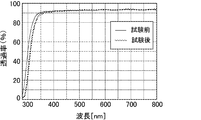
- FIG. 3 is a graph showing absorption spectra before and after a solder heat test at 265 ° C. for 10 minutes.
- FIG. 4 is a graph showing an absorption spectrum before and after the initial value and 85 ° C., 85% high temperature and high humidity durability test (initial and after 624 hours).
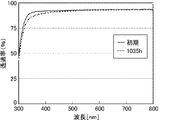
- FIG. 5 is a graph showing an initial value and an absorption spectrum before and after the dry heat durability test at 125 ° C. (initial and after 1035 hours).
- the curable resin composition of the present invention includes a curable fluorine-containing polymer (A) and hollow fine particles (B).
- the resin composition contains hollow fine particles (B) having a low refractive index
- the refractive index can be lowered.
- the hollow microparticles (B) are simply included, if the film thickness exceeds a certain thickness, whitening occurs and haze increases, and the desired transparency cannot be obtained. This is considered to be caused by the aggregation of the hollow fine particles in the composition.
- the curable resin composition of the present invention is composed of the curable fluorine-containing polymer (A) having the structural unit M having a hydrolyzable metal alkoxide moiety at the terminal, the hollow fine particles (B) are uniformly formed. A thin film that is dispersed, has a low refractive index, and is excellent in transparency can be formed.
- the curable resin composition of this invention consists of a curable fluorine-containing polymer (A), the thin film obtained is excellent also in heat resistance.
- the hollow fine particles (B) are components to be blended in order to reduce the refractive index.
- the upper limit of the refractive index of the hollow fine particles (B) is, for example, 1.48.
- the hollow fine particles (B) preferably have a refractive index of 1.45 or less, and more preferably 1.40 or less. If the refractive index is too high, it may be difficult to use depending on the application, such as a sealing agent for a CCD module. By being the said range, the refractive index of the thin film obtained from the curable resin composition of this invention can be made low.
- the lower limit of the refractive index is, for example, 1.15.
- the refractive index of the hollow fine particles (B) can be measured by the methods described in Japanese Patent Nos. 3761189 and 4046921.
- the hollow fine particles (B) preferably have a porosity of 1 to 60%, more preferably 2 to 40%.
- the porosity of the hollow fine particles (B) is determined from the difference from the refractive index of pure SiO 2 (1.45), for example, in the case of silica hollow fine particles, using the refractive index obtained by the above method. It can be obtained by calculating the voids contained in terms of air.
- the hollow fine particles (B) have an average particle diameter of 1 to 150 nm, more particularly from the viewpoint of particularly good optical properties of the sealing member (protective layer) and the antireflection film obtained from the curable resin composition of the present invention. It is preferably 10 to 80 nm.
- the average particle diameter of the hollow fine particles (B) can be measured by, for example, an electron microscope or an optical microscope. When the particle size is small, it is preferable to measure with an electron microscope.
- the hollow fine particles (B) are preferably hollow silica fine particles (B1).
- the hollow silica fine particle (B1) is a known material used in JP 2002-277604 A, JP 2002-265866 A, and the like.
- hollow silica fine particles described in JP 2004-203683 A, JP 2006-021938 A, and the like can be used.
- Preferable examples include through rears manufactured by JGC Catalysts & Chemicals.
- the hollow silica fine particles (B1) are preferably 1 to 1000 parts by weight, more preferably 3 to 250 parts by weight, and particularly preferably 5 to 150 parts by weight with respect to 100 parts by weight of the curable fluoropolymer (A). Is preferred. When blended in this range, the refractive index of the thin film obtained from the curable resin composition of the present invention can be lowered, which is suitable for a sealant for a CCD module. In addition, characteristics such as heat resistance and chemical resistance are particularly excellent.
- the curable fluorine-containing polymer (A) is Formula (2):
- X 1 and X 2 are the same or different and H or F;
- X 3 is H, F, CH 3 or CF 3 ;
- X 4 and X 5 are the same or different and H, F or CF 3 ;
- Rf 1 is a fluorine-containing hydrocarbon group having 1 to 40 carbon atoms which may have an amide bond or a urea bond, or a carbon number which may have an amide bond, a carbonate bond, a urethane bond or a urea bond.
- the ether bond is a divalent group represented by —O—.
- the amide bond is a divalent group represented by —CONH—.
- the carbonate bond is a divalent group represented by —O—COO—.
- the urethane bond is a divalent group represented by —O—CONH—.
- the urea bond is a divalent group represented by —NH—CONH—.
- the “hydrocarbon group” described later is an organic group composed of carbon and hydrogen, and the “fluorinated hydrocarbon group” means that some or all of the hydrogen atoms of the hydrocarbon group are fluorine. It is substituted with an atom.
- the “hydrocarbon group” include an alkyl group, an allyl group, a cyclic alkyl group, and an unsaturated alkyl group.
- fluorinated hydrocarbon group examples include a fluorine-containing alkyl group, a fluorine-containing allyl group, a fluorine-containing cyclic alkyl group, and a fluorine-containing unsaturated alkyl group.
- the structural unit M is, among others, the formula (M1):
- the structural unit M1 shown by the formula (wherein X 1 , X 2 , X 3 , X 4 , X 5 , Rf 1 , a and c are the same as described above) is preferable.
- the fluorine-containing polymer containing the structural unit M1 has a particularly low refractive index, can increase the transparency of a thin film obtained from the curable resin composition of the present invention, and further has adhesion to various substrates. Is preferable because durability can be improved. Moreover, it is also preferable in that the curing reactivity due to contact with heat, radicals and cations can be increased.
- the structural unit M is represented by the formula (M2):
- the structural unit M2 is represented by the formula (wherein Rf 1 is the same as above).
- the structural unit M2 has a low refractive index, can increase the transparency of the thin film obtained from the curable resin composition of the present invention, has good adhesion to various substrates, and improves durability. It is preferable because it can be used. Moreover, since the copolymerizability with another fluorine-containing ethylene-type monomer is favorable, it is preferable. Moreover, it is preferable not only because the near-infrared transparency can be increased but also the refractive index can be lowered.
- Rf 1 is, for example, —Ry 1 —Si (OR 20 ) (OR 21 ) (OR 22 ), (Ry 1 is the same as described later.
- R 20 , R 21 and R 22 is the same or different and is an alkyl group having 1 to 5 carbon atoms).
- the structural unit M is represented by the formula (M3):
- the structural unit M3 has a low refractive index, can increase the transparency of a thin film obtained from the curable resin composition, has good adhesion to various substrates, and can improve durability. This is preferable because it is possible. Moreover, it is also preferable in terms of good copolymerizability with other fluorine-containing ethylene monomers.
- the upper limit of the number of carbon atoms of the organic group is preferably 30, more preferably 20, and particularly preferably 10.
- the upper limit of the carbon number may be 5.
- the hydrolyzable metal alkoxide in Y 1 plays a role of causing hydrolysis / polycondensation reaction, and has the effect of improving the adhesion durability with the substrate, particularly the adhesion durability with the substrate having a hydroxyl group. Is done.
- Rf 1 formula (Rf 1): -D-Ry (Rf 1 ) [Wherein -D- represents the formula (D):
- R is a divalent fluorinated alkylene group having 1 to 5 carbon atoms in which at least one hydrogen atom is substituted with a fluorine atom, and n is 2 or more for is the unit of fluoroether represented by may) be the same or different
- Ry may have an amide bond or a urea bond, a part of the hydrogen atoms or all substituted by fluorine atoms It may have a hydrocarbon group having 1 to 39 carbon atoms, or an amide bond, carbonate bond, urethane bond or urea bond, and a part or all of the hydrogen atoms are substituted with fluorine atoms.
- Ry may have an amide bond, a carbonate bond, a urethane bond, a urea bond, or an ether bond, and part or all of the hydrogen atoms may be substituted with a fluorine atom.
- R is a divalent fluorine-containing alkylene group having 1 to 5 carbon atoms and having at least one fluorine atom, whereby a conventional fluorine-free alkoxyl group or alkylene ether unit can be used.
- the viscosity of the compound can be further reduced as compared with those having it, and it can contribute to an improvement in heat resistance, a decrease in refractive index, an improvement in solubility in a general-purpose solvent, and the like.
- — (O—R) — or — (R—O) — in —D— specifically, — (OCF 2 CF 2 CF 2 ) —, — (CF 2 CF 2 CF 2 O) —, -(OCFQ 1 CF 2 )-,-(CFQ 1 CH 2 O)-,-(CFQ 1 CF 2 O)-,-(OCF 2 CFQ 1 )-,-(OCFQ 2 )-,-(CFQ 2 O )-,-(OCH 2 CF 2 CF 2 )-, (OCF 2 CF 2 CH 2 )-,-(OCH 2 CH 2 CF 2 )-,-(OCF 2 CH 2 CH 2 )-,-(CH 2 CF 2 CF 2 O)-,-(OCF 2 CF 2 CF 2 CF 2 )-,-(CF 2 CF 2 CF 2 O)-,-(OCFQ 2 CH 2 )-,-(CH 2 CFQ 2 )-,
- -D- is-(OCFQ 1 CF 2 )-,-(OCF 2 CF 2 CF 2 )-,-(OCH 2 CF 2 CF 2 )-,-(OCFQ 2 )-,-(OCQ 3 2 )-,-(CFQ 1 CF 2 O)-,-(CFQ 1 CH 2 O)-,-(CF 2 CF 2 CF 2 O)-,-(CH 2 CF 2 CF 2 O)-,-(CFQ One or more repeating units selected from 2 O) — and — (CQ 3 2 O) — are preferred, and in particular, — (OCFQ 1 CF 2 ) —, — (OCF 2 CF 2 CF 2 )-,-(OCH 2 CF 2 CF 2 )-,-(CFQ 1 CF 2 O)-,-(CFQ 1 CH 2 O)-,-(CF 2 CF 2 CF 2 O)-and-(CH 2 One or more repeating units selected from
- R is-(CFQ 1 CF 2 O)-,-(CFQ 1 CH 2 O)-,-(CF 2 CF 2 CF 2 ) as -D-.
- O) — and — (CH 2 CF 2 CF 2 O) — are preferably at least one selected from the group consisting of — (CFQ 1 CF 2 O) —, — (CFQ 1 CH 2 O) — And at least one selected from the group consisting of — (CF 2 CF 2 CF 2 O) —.
- Q 1 is H, F or CF 3 .
- Q 1 is preferably CF 3 .
- Ry 1 represents the formula (Ry 1 ): -R 11 - (A) p -R 12 - (Y 1a) m (Ry 1) (In the formula, p is 0 or 1, m is an integer of 1 to 3, and R 11 is a divalent valence of 1 to 5 carbon atoms in which part or all of the hydrogen atoms may be substituted with fluorine atoms.
- A is —O—, —CONH—, —O—COO—, —O—CONH— or —NH—CONH—
- R 12 is a hydrogen atom partially or entirely substituted with a fluorine atom 2 to 4 having a C1-C38 divalent hydrocarbon group having 1 to 38 carbon atoms, or an ether bond having 1 to 98 carbon atoms in which some or all of the hydrogen atoms may be substituted with fluorine atoms Is a valent hydrocarbon group (provided that when R 12 is a divalent to tetravalent hydrocarbon group having 1 to 38 carbon atoms in which part or all of the hydrogen atoms may be substituted with fluorine atoms, A is , —CONH— or —NH—CONH—)
- Y 1a is represented by the formula: -[M 1 O (R 29 ) a (R 30 ) b (R 31 ) c (R 32 ) d ] n -M 2 (
- R 29 , R 30 , R 31 , R 32 , R 33 , R 34 , R 35 , R 36 and R 37 is OR 38 .
- N 0 ⁇ It is preferably a group represented by inorganic composite groups - organic represented by functional group) represented by the integer 1).
- the structural unit M is the structural unit M2
- the Ry is preferably —Ry 1 and R 11 is a divalent valence having 1 to 5 carbon atoms in which part or all of the hydrogen atoms are substituted with fluorine atoms.
- the hydrocarbon group is preferably.
- R 12 for example, at least one selected from the group consisting of — (CH 2 ) 3 — and — (CH 2 ) 2 — is preferable.
- Metals M 1 and M 2 in Y 1a include: Cu as group IB; Ca, Sr, Ba as group IIA; Zn as group IIB; B as group IIIA, B, Al, Ga; Y as group IIIB; Si as group IVA , Ge; Pb as the IVB group; P as the VA group, Sb; V as the VB group, Ta; W as the VIB group; La and Nd as the lanthanides.
- Y 1a is preferably a group IVA, of which Si is preferable, and in particular, —Si (OCH 3 ) 3 , —Si (OC 2 H 5 ) 3 , or —SiCH 3 (OC 2 H 5 ) 2 is preferably exemplified.
- Si is preferable
- —Si (OCH 3 ) 3 , —Si (OC 2 H 5 ) 3 , or —SiCH 3 (OC 2 H 5 ) 2 is preferably exemplified.
- the hollow fine particles (B) can be more uniformly dispersed, and the transparency of the thin film obtained from the curable resin composition of the present invention can be further increased.
- — [SiO (OCH 3 ) 2 ] n —Si (OCH 3 ) 3 , — [SiO (OC 2 H 5 ) 2 ] n- Si (OC 2 H 5 ) 3 (n is an integer of 1 to 11) is also preferable.
- These groups are good adhesion to the base material after hydrolysis and polycondensation, in particular, good adhesion to the base material having a hydroxyl group, its durability, and other points such as improvement of surface hardness. preferable.
- Y 1a —Si (OCH 3 ) 3 , —Si (OC 2 H 5 ) 3 , or —SiCH 3 (OC 2 H 5 ) 2 is particularly preferable.
- Group IIA is Ca: -Ca (OR 39), as a preferred embodiment is -Ca (OCH 3); IIB group is Zn: -Zn ( OR 39 ), preferred examples are —Zn (OC 2 H 5 );
- Group IIIA is B: —B (OR 39 ) 2 , and preferred examples are —B (OCH 3 ) 2 ;
- Group IIIB is Y : -Y (OR 39 ) 2 , a preferred specific example is -Y (OC 4 H 9 ) 2 ;
- Group IVB is Pb: -Pb (OR 39 ) 3 , and a preferred specific example is -Pb (OC 4 H 9 ) 3 ;
- Group VB is Ta: -Ta (OR 39 ) 4 , and preferred specific examples are -Ta (OC 3 H 7 ) 4 ;
- Group VIB is W: -W (OR 39 ) 5 , Preferred examples the -W (OC 2 H
- the structural unit M is preferably the structural unit M1, and the structural unit M1 is more preferably the structural unit M2 or the structural unit M3. Therefore, when —Rf 1 is represented as —D—Ry, the structural unit M is represented by the formula (2-2):
- the curable resin composition of the present invention a low refractive index of the thin film obtained from an object, also, it is possible to increase the transparency of the thin film, further, the adhesion durability of the substrate, adhesion to a substrate, in particular having a hydroxyl group, Ya further lower the viscosity It is preferable at the point which is excellent in heat resistance.
- the structural unit of the formula (2-2) is preferably the formula (2-3):
- the curable resin composition of the present invention A thin film obtained from a product is preferable because it has a low refractive index, can increase the transparency of the thin film, has good adhesion to various substrates, and can improve durability. Moreover, it is preferable also in the point which is excellent in heat resistance and chemical resistance.
- Etc. can be preferably exemplified, among them,
- Rf 1 is — (CF (CF 3 ) CF 2 —O) n —T
- T is —Ry 1 —Si (OR 20 ) (OR 21 ) (OR 22 ) and (Ry 1 ) are the same as those described above
- R 20 , R 21 and R 22 are the same or different and are alkyl groups having 1 to 5 carbon atoms, n is 0 1 or 2).
- the structural unit N is an arbitrary structural unit, and the formula (N):
- X 1 and X 2 are the same or different and H or F;
- X 3 is H, F, CH 3 or CF 3 ;
- X 4 and X 5 are the same or different and H, F or CF 3 ;
- Rf 2 is a fluorine-containing hydrocarbon group having 1 to 40 carbon atoms or a fluorine-containing hydrocarbon group having an ether bond having 2 to 100 carbon atoms, wherein 1 to 3 hydrogen atoms are represented by Y 2 (Y 2 is an OH group)
- the fluorine-containing polymer containing the structural unit N1 is preferable in that the curing reactivity due to contact with radicals or cations can be increased.
- the structural unit N1 has the formula (N2):
- the structural unit is N2 (wherein Rf 2 is the same as above).
- the structural unit N2 is a structural unit derived from a fluorinated allyl ether having at least one OH group, which not only has high transparency, but also has a low refractive index and good polymerizability. This is preferable because of good copolymerizability with an ethylene monomer.
- a structural unit N3 represented by the formula (wherein Rf 2 is the same as described above) is also one of preferred embodiments.
- the structural unit N3 is a structural unit derived from a fluorine-containing vinyl ether having at least one OH group, and can not only have high transparency but also a low refractive index, and can be copolymerized with other fluorine-containing ethylene monomers. Is preferable in that it is good.
- Y 2 contained in the structural units N, N1, N2, and N3 is a monovalent organic group having 1 to 10 carbon atoms having at least one OH group, or —OH.
- the OH group in Y 2 contributes to improvement of the solubility of the polymer, improvement of compatibility with other materials, and improvement of adhesion to the substrate, and it can be easily used as another useful substituent by using a known chemical reaction. It can be converted by polymer reaction. For example, an acrylic group or the like can be introduced by an esterification reaction with acrylic acid chloride, methacrylic acid chloride, 2-fluoroacrylic acid chloride or the like.
- Examples of Y 2 include —OH, —CH 2 OH, —CH 2 CH 2 OH, — (CH 2 ) n OH (where n is an integer of 3 to 10), —CH (OH) CH 2 OH Or —CH (OH) CH 2 OCOCH 3 is preferred.
- an OH group bonded to a so-called primary carbon is preferable in terms of particularly high reactivity.
- organic group Y 2 having an OH group in the side chain described above it may be introduced into the polymer main chain terminal.
- -Rf 2a included in the structural unit N, N1, N2 and N3 - group is a fluorine-containing alkylene of 1 to 40 carbon atoms Or a fluorine-containing alkylene group having an ether bond having 2 to 100 carbon atoms.
- the -Rf 2a - groups may if bonded fluorine atoms to carbon atoms contained, generally, fluorine atom and hydrogen atom or a fluorine-containing alkylene group chlorine atom is bonded to a carbon atom, a fluorine-containing alkylene having an ether bond
- the group is preferably a group containing more fluorine atoms (high fluorine content), and more preferably a perfluoroalkylene group or a perfluoroalkylene group having an ether bond.
- the fluorine content in the fluoropolymer is 25% by mass or more, preferably 40% by mass or more.
- the fluorine-containing alkylene group preferably has 1 to 20 carbon atoms, more preferably 1 to 10 carbon atoms.
- the fluorine-containing alkylene group having an ether bond preferably has 2 to 30 carbon atoms, more preferably 2 to 20 carbon atoms.
- the structural unit N constituting the fluoropolymer used in the present invention is preferably the structural unit N1, and the structural unit N1 is more preferably the structural unit N2 or the structural unit N3. Therefore, specific examples of the structural unit N2 and the structural unit N3 will be described below.
- Rf 7 and Rf 8 are perfluoroalkyl groups having 1 to 5 carbon atoms, and n is an integer of 0 to 30).
- Rf 2 includes —CF (CF 3 ) CF 2 O—CF (CF 3 ) CH 2 —OH, —CF (CF 3 ) CH 2 —OH, —CF (CF 3 ) CF 2 O—CF (CF 3 ) CF 2 O—CF (CF 3 ) CH 2 —OH and —CF (CF 3 ) CF 2 O—CF (CF 3 ) CH 2 —O—CH 2 CH (OH) CH At least one group selected from the group consisting of 2 OH is preferred.
- n is an integer of 1 to 30.
- Rf 9 and Rf 10 are perfluoroalkyl groups having 1 to 5 carbon atoms; m is an integer of 0 to 30; n is an integer of 1 to 3).
- the structural unit A is a structural unit derived from a monomer copolymerizable with the fluorine-containing ethylenic monomer that gives the structural units represented by the formulas (M) and (N).
- the structural unit A is a structural unit other than the structural units M and N.
- the structural unit A is an optional component and is not particularly limited as long as it is a monomer that can be copolymerized with the structural units M and N.
- the target fluorinated polymer and its cured product What is necessary is just to select suitably according to the use of this, a required characteristic, etc.
- Examples of the structural unit A include the following structural units.
- a structural unit derived from a fluorine-containing ethylenic monomer having a functional group A1 has adhesion to a substrate of a fluorine-containing polymer and its cured product, and solubility in a solvent, particularly a general-purpose solvent. It is preferable at the point which can provide, and it is preferable at the point which can provide functions, such as a crosslinking property besides that.
- the functional group that the structural unit A1 has is preferably a functional group other than Y 1 and Y 2 .
- the structural unit A1 of a preferred fluorine-containing ethylenic monomer having a functional group has the formula (A1):
- X 11 , X 12 and X 13 are the same or different H or F;
- X 14 is H, F, CF 3 ;
- h is an integer from 0 to 2;
- i is 0 or 1;
- Rf 4 is carbon number A divalent fluorine-containing alkylene group having 1 to 40 carbon atoms or a divalent fluorine-containing alkylene group having an ether bond having 2 to 100 carbon atoms;
- a structural unit represented by the formula (wherein Rf 4 and Z 1 are the same as those in the formula (A1)) is preferable.
- a structural unit derived from a fluorine-containing ethylenic monomer such as (Z 1 is the same as above) is preferred.
- CF 2 CFORf 4 -Z 1
- Rf 4 and Z 1 are as defined above (A1-2):
- a structural unit represented by the formula (wherein Rf 4 and Z 1 are the same as those in formula (A1)) can also be preferably exemplified.
- CF 2 CFCF 2 —O—Rf 4 —Z 1
- CF 2 CF—Rf 4 —Z 1
- CH 2 CH-Rf 4 -Z 1
- CH 2 CHO-Rf 4 -Z 1
- (A2) A structural unit derived from a fluorine-containing ethylenic monomer that does not contain a functional group.
- This structural unit A2 has a lower refractive index in that the refractive index of the fluorine-containing polymer or its cured product can be kept low. It is preferable at the point which can do.
- the mechanical properties and glass transition temperature of the polymer can be adjusted, and in particular, the glass transition point can be increased by copolymerizing with the structural units M and N, which is preferable.
- X 15, X 16 and X 18 are the same or different and each is H or F; X 17 is H, F or CF 3; h1, i1 and j are the same or different 0 or 1; Z 2 is H, F, Cl or a linear or branched perfluoroalkyl group having 1 to 16 carbon atoms; Rf 5 is a divalent fluorine-containing alkylene group having 1 to 20 carbon atoms or an ether bond having 2 to 100 carbon atoms. (A valent fluorine-containing alkylene group) is preferable.
- these are at least one unit selected from the group consisting of tetrafluoroethylene, vinylidene fluoride, chlorotrifluoroethylene, and hexafluoropropylene because the refractive index of the curable fluorine-containing polymer or its cured product can be kept low.
- a structural unit derived from a monomer is preferable.
- (A3) Aliphatic cyclic structural unit having fluorine When this structural unit A3 is introduced, transparency can be increased, a fluorine-containing polymer having a high glass transition temperature can be obtained, and further hardness can be expected in the cured product. This is preferable.
- the fluorine-containing aliphatic cyclic structural unit A3 is represented by the formula (A3):
- X 19 , X 20 , X 23 , X 24 , X 25 and X 26 are the same or different H or F;
- X 21 and X 22 are the same or different H, F, Cl or CF 3 ;
- Rf 6 is a fluorine-containing alkylene group having 1 to 10 carbon atoms or a fluorine-containing alkylene group having an ether bond having 2 to 10 carbon atoms;
- n2 is an integer of 0 to 3; n1, n3, n4 and n5 are the same or different and 0 or An integer of 1 is preferable.
- Acrylic or methacrylic monomers In addition to acrylic acid, methacrylic acid, acrylic esters, methacrylic esters, Maleic anhydride, maleic acid, maleic esters, etc.
- structural units M and N are more preferably combined with the aforementioned fluorine-containing ethylenic monomer or non-fluorine ethylenic monomer.
- M is an integer of 0 to 3; A, B, C and D are the same or different, H, F, Cl, COOH , CH , etc. 2 OH or a perfluoroalkyl group having 1 to 5 carbon atoms) norbornene represented by Derivatives,
- the curable fluorinated polymer (A) may be a homopolymer of the structural unit M, or a copolymer composed of the structural unit M and the structural unit N and / or the structural unit A. .
- a homopolymer In the case of a homopolymer, it is advantageous in that it can maintain a low refractive index, impart a near-infrared transparency and adhesion durability with a substrate having a hydroxyl group, and can provide a coating with high hardness. .
- the content of the structural unit M may be 0.1 mol% or more with respect to all the structural units constituting the curable fluorinated polymer (A), but has a low refractive index, and In order to obtain a cured product having high transparency, it is preferably 2.0 mol% or more, more preferably 10 mol% or more, and further preferably 20 mol% or more. Moreover, if it is the said range, it will be high hardness by hardening (bridge
- the molecular weight of the fluorine-containing polymer can be selected, for example, from the range of 500 to 1,000,000 in the number average molecular weight, but is preferably selected from the range of 1,000 to 500,000, particularly 2,000 to 200,000. Is preferred.
- the number average molecular weight is selected from the range of 5,000 to 100,000.
- the curable fluorine-containing polymer (A) has the formula (2-1): -(M)-(N)-(A1)-(A2)-(2-1) (Wherein the structural unit M and the structural unit N are the same as above; the structural units A1 and A2 are the same as above), the structural unit M is 0.1 to 90 mol%, and the structural unit N is 0 to 99. 9 mol%, structural unit A1 is 0 to 99.9 mol%, structural unit A2 is 0 to 99.9 mol%, and N + A1 + A2 is contained in 10 to 99.9 mol%, and the number average molecular weight is 500 to 1,000 It may have a hydrolyzable metal alkoxide moiety that is 1,000.
- a curable fluorine-containing polymer (A-2) is also a preferred embodiment.
- the content of the structural unit M in the curable fluorinated polymer (A-2) may be 0.1 mol% or more with respect to all the structural units constituting the fluorinated polymer, but has a low refractive index and is transparent.
- it is preferably 2.0 mol% or more, more preferably 10 mol% or more, and still more preferably 20 mol% or more.
- cured material which was excellent in chemical resistance and solvent resistance with high hardness and abrasion resistance and scratch resistance by hardening (crosslinking) can be obtained.
- the upper limit is less than 100 mol%.
- the contents of the structural units N, A1, and A2 are all 99.9 mol% or less.
- the total mol% of N + A1 + A2 is 10 to 99.9 mol%. If it is less than 10 mol%, the refractive index cannot be kept low, and the film hardness after curing tends to be low, which is not preferable. More preferably, the total mol% of N + A1 + A2 is 20 mol% or more, further 30 mol% or more, and 80 mol% or less, further 60 mol% or less.
- the ratio of the structural unit N to the total of the structural units N, A1, and A2 in the curable fluorinated polymer (A-2) (N / (N + A1 + A2 )) Is preferably 1/100 to 100/100 molar ratio, more preferably 30/100 to 100/100 molar ratio, and even more preferably 50/100 to 100/100 molar ratio. 70/100 to 100/100 molar ratio is particularly preferable.
- the ratio of the structural unit A1 to the total of the structural units N, A1, and A2 in the curable fluorinated polymer (A-2) is preferably 1/100 to 50/100 molar ratio, more preferably 1/100 to 40/100 molar ratio, and 1/100 to 30/100 molar ratio. More preferably.
- the molecular weight of the curable fluorinated polymer (A-2) can be selected, for example, from the range of 500 to 1,000,000 in terms of number average molecular weight, preferably 1,000 to 500,000, particularly 2,000 to 200,000. Those selected from the range of 000 are preferred.
- the number average molecular weight is selected from the range of 5,000 to 100,000.
- the curable fluorine-containing polymer (A-2) includes the optional structural unit N and / or structural unit A as an essential structural unit in the curable fluorine-containing polymer (A), and specifically It can be said that it has been identified.
- the combination of the structural unit M (M1, M2, M3) and the structural unit N (N1, N2, N3), and further the structural unit A (A1, A2) and the composition ratio can be variously selected from the above examples depending on the intended use, physical properties (particularly glass transition temperature, hardness, etc.), function (transparency), and the like.
- the curable fluorine-containing polymer (A) is preferably soluble in a general-purpose solvent, for example, soluble or general-purpose in at least one of a ketone solvent, an acetate ester solvent, an alcohol solvent, and an aromatic solvent. It is preferably soluble in a mixed solvent containing at least one solvent.
- the method (2) can introduce the hydrolyzable metal alkoxide moiety of the curable fluorine-containing polymer (A) after the synthesis of the polymer, so that problems such as gelation during polymerization hardly occur.
- the method (2) is preferable from the viewpoint of obtaining a curable fluoropolymer having a hydrolyzable metal alkoxide moiety.
- Examples of the polymerization method include a radical polymerization method, an anionic polymerization method, and a cationic polymerization method, and the monomers exemplified for obtaining a polymer having a hydrolyzable metal alkoxide moiety can control quality such as composition and molecular weight.
- the radical polymerization method is particularly preferred from the viewpoint of easy production and industrialization.
- the fluorine-containing ethylenic monomer giving the structural unit M is represented by the formula (1):
- X 1 and X 2 are the same or different and H or F;
- X 3 is H, F, CH 3 or CF 3 ;
- X 4 and X 5 are the same or different and H, F or CF 3 ;
- Rf 1 is a fluorine-containing hydrocarbon group having 1 to 40 carbon atoms which may have an amide bond or a urea bond, or a carbon number which may have an amide bond, a carbonate bond, a urethane bond or a urea bond.
- the means for the fluorine-containing ethylenic monomer giving the structural unit M is not limited as long as it proceeds radically, for example, but is initiated by, for example, an organic or inorganic radical polymerization initiator, heat, light or ionizing radiation.
- the form of polymerization can also be produced by methods such as solution polymerization, bulk polymerization, suspension polymerization, emulsion polymerization and the like.
- the curable resin composition of the present invention may further contain a hydrolyzable metal alkoxide (D).
- a hydrolyzable metal alkoxide examples include silicon (Si), titanium (Ti), aluminum (Al), zirconium (Zr), tin (Sn), iron (Fe), sodium (Na).
- hydrolyzable metal alkoxide examples include tetraethoxysilane [Si (OCH 2 CH 3 ) 4 ] (tetrafunctional) (TEOS), methyltriethoxysilane [CH 3 Si (OCH 2 CH 3 ) 3 ] (trifunctional).
- hydrolyzable metal alkoxide examples include isocyanate propyl triethoxysilane [OCNC 3 H 6 Si (OCH 2 CH 3 ) 3 ], glycidyl propyl triethoxysilane [CH 2 OCHC 3 H 6 Si (OCH 2 CH 3). 3 ] and aminopropyltriethoxysilane [NH 3 C 3 H 6 Si (OCH 2 CH 3 ) 3 ] are also preferred.
- additives examples include silane coupling agents, plasticizers, discoloration inhibitors, antioxidants, inorganic fillers, leveling agents, viscosity modifiers, light stabilizers, moisture absorbers, pigments, dyes, and reinforcing agents. can give.
- the curable resin composition of the present invention may contain fine particles or ultrafine particles of an inorganic compound other than the hollow fine particles (B) for the purpose of increasing the hardness of the cured product or controlling the refractive index.
- the inorganic compound fine particles are not particularly limited, but compounds having a refractive index of 1.5 or less are preferable. Specifically, magnesium fluoride (refractive index 1.38), silicon oxide (refractive index 1.46), aluminum fluoride (refractive index 1.33-1.39), calcium fluoride (refractive index 1.44) , Lithium fluoride (refractive index 1.36 to 1.37), sodium fluoride (refractive index 1.32 to 1.34), and thorium fluoride (refractive index 1.45 to 1.50) At least one kind of oxide fine particles selected (except for the above hollow silica fine particles) is preferable.
- the particle diameter of the fine particles is desirably sufficiently smaller than the wavelength of visible light in order to ensure the transparency of the low refractive index material. Specifically, it is preferably 100 nm or less, particularly 50 nm or less.
- voids can be formed by fine particles or ultrafine particles of an inorganic compound.
- a film obtained by blending fine particles or ultrafine particles of an inorganic compound with the composition of the present invention can have a refractive index lower than the refractive index of a single film by utilizing this void.
- the surface of the inorganic fine particle compound may be modified in advance using various coupling agents.
- various coupling agents include organically substituted silicon compounds; metal alkoxides such as aluminum, titanium, zirconium, antimony or mixtures thereof; salts of organic acids; coordination compounds bonded to coordination compounds, and the like.
- the curable resin composition of the present invention preferably contains a solvent (Y).
- the curable fluorinated polymer (A) or additive may be in the form of a dispersion or solution, but is uniform in order to form a uniform thin film and at a relatively low temperature. It is preferably in the form of a solution.
- the solvent (Y) is a solvent in which a curable fluorine-containing polymer (A), a hydrolyzable metal alkoxide (D), and additives such as a leveling agent and a light stabilizer that are added as necessary are uniformly dissolved or dispersed. If it is, there will be no restriction
- Examples of the solvent (Y) include cellosolv solvents such as methyl cellosolve, ethyl cellosolve, methyl cellosolve acetate, ethyl cellosolve acetate; diethyl oxalate, ethyl pyruvate, ethyl-2-hydroxybutyrate, ethyl acetoacetate, butyl acetate, Ester solvents such as amyl acetate, ethyl butyrate, butyl butyrate, methyl lactate, ethyl lactate, methyl 3-methoxypropionate, ethyl 3-methoxypropionate, methyl 2-hydroxyisobutyrate, ethyl 2-hydroxyisobutyrate; propylene glycol Monomethyl ether, propylene glycol monoethyl ether, propylene glycol monobutyl ether, propylene glycol monomethyl ether acetate, propylene glycol monoethyl ether
- a fluorine-based solvent may be used as necessary.
- fluorine-based solvent examples include CH 3 CCl 2 F (HCFC-141b), CF 3 CF 2 CHCl 2 / CClF 2 CF 2 CHClF mixture (HCFC-225), perfluorohexane, perfluoro (2-butyltetrahydrofuran). , Methoxy-nonafluorobutane, 1,3-bistrifluoromethylbenzene, etc.
- Fluorinated alcohols such as Examples thereof include benzotrifluoride, perfluorobenzene, perfluoro (tributylamine), ClCF 2 CFClCF 2 CFCl 2 and the like.
- fluorinated solvents may be used singly or as a mixed solvent of fluorinated solvents or one or more of non-fluorinated and fluorinated solvents.
- ketone solvents acetate solvents, alcohol solvents, aromatic solvents, and the like are preferable in terms of paintability and coating productivity.
- the solid content concentration of the curable resin composition of the present invention is such that the coatability is good, the low molecular weight monomer component or the like hardly remains in the cured film, and there is no surface tackiness.
- it may be selected from the range of about 0.5 to 10% by mass.
- the curable resin composition of the present invention becomes a cured product (for example, a cured film) by curing, for example, thermosetting or photocuring, and can be applied to various substrates and can be used for various applications.
- the present invention is also a cured product obtained by curing the curable resin composition.
- the cured product preferably has a refractive index of 1.32 or less.
- a thin film having a film thickness of 1 to 10 ⁇ m, a refractive index of 1.32 or less, and a haze value of 5% or less can be produced.
- such a low refractive index and haze value are obtained after a heat resistance test at 125 ° C. for 1000 hours, a heat resistance test at 85 ° C. and a humidity of 85% for 500 hours, and a heat resistance test at 265 ° C. for 10 minutes. But it does not fluctuate. Furthermore, it does not fluctuate even after the light resistance test exposed to 1000 lux for 1 hour.
- the curable resin composition of the present invention is preferably a sealant.
- a sealant used for a light receiving element such as a phototransistor, a photodiode, or a CCD
- a light emitting element such as an LED or an organic EL
- a semiconductor element such as an EPROM
- the sealing agent can be cured to obtain a sealing member (cured product).
- the cured product of the present invention is preferably a sealing member for an optical element, and particularly preferably a sealing member for a light receiving element or a light emitting element.
- FIG. 1 is a schematic cross-sectional view showing an example of the structure of a CCD module.
- the sealing agent layer 13 since the light reaching the CCD element portion 12 passes through the sealing agent layer 13, the sealing agent layer 13 has a low refractive index and transparency. High is required. Since the curable resin composition of the present invention can form a thin film having a low refractive index and high transparency, it is suitable as a sealing material for forming a sealing agent applied to the CCD module.
- FIGS. 2A to 2F are flowcharts schematically showing the manufacturing flow of the CCD module.
- a method for manufacturing a CCD module will be described with reference to FIGS.
- a silicon wafer 21 is prepared, and a CCD element portion 22 is formed thereon (FIG. 2B).
- the curable resin composition of the present invention is applied on the CCD element portion 22 by using a coating method such as spin coating to form the sealant layer 23 (FIG. 2C).
- a glass 24 is laminated on the sealant layer 23 (FIG. 2 (d)), and then, as shown in FIG. 2 (e), dicing is performed to manufacture a CCD element.
- holes are formed in the silicon wafer 21 by anisotropic etching using RIE or the like, and the through electrodes 25 are formed on the back surface of the silicon wafer 21.
- the semiconductor chip thus manufactured can be bonded to the electrode 26 connected to the outside, and the CCD module shown in FIG. 2F can be manufactured.
- a sealing member for a light emitting element such as an LED or an organic EL
- it may be one that is directly sealed.
- the curable resin composition of the present invention is laminated on the outermost surface, so that the light emitting device can be turned into the air layer.
- a structure in which the refractive index decreases gradually may be employed. For example, when sealing with an epoxy sealing resin having a refractive index of 1.57, the loss based on Fresnel reflection at the air interface is calculated to be 4.92%.
- the curable resin composition of the present invention is also suitably used for a coated article having a thin film imparting low reflectivity on a substrate.
- the substrate include inorganic materials such as glass, stone, concrete, and tile; metals such as iron, aluminum, and copper; wood, paper, printed matter, photographic paper, and painting.
- the base material examples include cellulose resins such as vinyl chloride resin, polyethylene terephthalate, and triacetyl cellulose, polycarbonate resins, polyolefin resins, acrylic resins, phenol resins, xylene resins, urea resins, melamine resins, diallyl phthalate resins, furans.
- cellulose resins such as vinyl chloride resin, polyethylene terephthalate, and triacetyl cellulose
- polycarbonate resins examples include polyolefin resins, acrylic resins, phenol resins, xylene resins, urea resins, melamine resins, diallyl phthalate resins, furans.
- synthetic resin base materials such as resins, amino resins, alkyd resins, urethane resins, vinyl ester resins, polyimide resins, and polyamide resins.
- an antiglare substrate for liquid crystal display (LCD) display is preferably used because its surface is coated with fine inorganic fine particles, and can effectively exhibit antiglare and low reflection effects.
- the curable resin composition of the present invention is also effective when applied to articles having the following forms.
- the curable resin composition of the present invention is also suitable as an adhesive when applied to an article having the following form.
- a thin film is formed on a portion other than a specific portion of the article, and the shape of the specific portion is raised by reflected light, thereby improving the decorativeness of the article. Is possible.
- Fluorine content (% by mass) By burning 10 mg of sample by the oxygen flask combustion method, absorbing the decomposition gas in 20 ml of deionized water, and measuring the fluorine ion concentration in the absorption liquid by the fluorine selective electrode method (fluorine ion meter, model 901 manufactured by Orion) Ask.
- Refractive index (n D ) Measurement is performed using an Abbe refractometer manufactured by Atago Optical Instruments Co., Ltd. at 25 ° C. using sodium D line (589 nm) as a light source.
- Tg Glass transition temperature
- the polymer was analyzed by 19 F-NMR, 1 H-NMR analysis, and IR analysis.
- the fluorine-containing polymer (PAEH-1) was composed of only the structural unit of the fluorine-containing allyl ether and had a hydroxyl group at the end of the side chain. Met.
- the number average molecular weight measured by GPC analysis using tetrahydrofuran (THF) as a solvent was 88,000, and the weight average molecular weight was 110,000.
- Synthesis Examples 2-1 to 2-6 Synthesis of hydrolyzable metal alkoxide-containing polymer (triethoxysilyl modification of PAEH-1))
- 80 g of methyl isobutyl ketone (MIBK) previously dehydrated with molecular sieves 4A 80 g
- 2 g of dibutyltin dilaurate After adding 3 mg, it was dissolved at 45 ° C. in a nitrogen atmosphere. Thereafter, 0.745 g of 3-triethoxysilylpropyl isocyanate was added dropwise over 2 minutes.
- MIBK methyl isobutyl ketone
- polymers with different modification rates were synthesized by changing the amount of 3-triethoxysilylpropyl isocyanate added to 20 g of PAEH-1 as shown in Table 1.
- the polymer was analyzed by 19 F-NMR, 1 H-NMR analysis, and IR analysis.
- the fluorine-containing polymer (PAEH-2) comprising only the structural unit of the fluorine-containing allyl ether and having a hydroxyl group at the end of the side chain.
- Met The number average molecular weight (MW) measured by GPC analysis using tetrahydrofuran (THF) as a solvent was 15000, and the weight average molecular weight was 23000.
- Synthesis Example 4 Synthesis of hydrolyzable metal alkoxide-containing polymer (PAEH-2 modified with triethoxysilyl)
- PAEH-2 modified with triethoxysilyl
- MIBK methyl isobutyl ketone
- MIBK methyl isobutyl ketone
- Synthesis Example 6 Synthesis of hydrolyzable metal alkoxide-containing polymer (modified with triethoxysilyl of Synthesis Example 5)
- 40 g of methyl isobutyl ketone (MIBK) dehydrated with Molecular Sieves 4A and 2.3 mg of dibutyltin dilaurate were added and dissolved in a nitrogen atmosphere at 45 ° C.
- MIBK methyl isobutyl ketone
- dibutyltin dilaurate 2.3 mg of dibutyltin dilaurate
- 0.89 g of 3-triethoxysilylpropyl isocyanate was added. was added dropwise over 2 minutes. after the addition, the mixture was stirred at 45 ° C. 72 h, modification ratio determined from completion of the reaction was confirmed.
- Synthesis Example 7 (Synthesis of OH-containing fluorinated allyl ether and vinylidene fluoride copolymer (d)) A 300 ml stainless steel autoclave equipped with a valve, pressure gauge, and thermometer, 34.2 g of AEH1, 200 g of CH 3 CCl 2 F (HCFC-141b), 50 weight of dinormal propyl peroxycarbonate (NPP) A 0.16 g% methanol solution was added, and the inside of the system was sufficiently replaced with nitrogen gas while cooling with a dry ice / methanol solution. Next, 5.8 g of vinylidene fluoride (VdF) was charged from the bulb, and the reaction was performed while shaking at 40 ° C. As the reaction progressed, the gauge pressure in the system decreased from 4.4 MPaG before the reaction to 0.98 MPaG after 12 hours.
- VdF vinylidene fluoride
- the composition ratio of the copolymer was analyzed by 1 H-MNR analysis and 19 F-NMR analysis.
- the OH group-containing fluorine-containing allyl ether / VdF was 45/55 (mol%).
- the number average molecular weight measured by GPC analysis using THF as a solvent was 12000, and the weight average molecular weight was 18000.
- the resulting polymer has the following formula:
- Synthesis Example 8 (Synthesis of hydrolyzable metal alkoxide-containing polymer (modified with triethoxysilyl of Synthesis Example 7))
- 40 g of methyl isobutyl ketone (MIBK) dehydrated in advance with Molecular Sieves 4A
- 2.3 mg of dibutyltin dilaurate After the addition, it was dissolved at 45 ° C. in a nitrogen atmosphere. Thereafter, 0.89 g of 3-triethoxysilylpropyl isocyanate was added dropwise over 2 minutes. After dropping, the mixture was stirred at 45 ° C.
- Example 1 (Curing conditions and appearance evaluation of cured product) 5 g of hydrolyzable metal alkoxide-containing polymer solution obtained in Synthesis Example 2-1 (modified amount 5 mol%, 20 wt% MIBK solution) and hollow fine particles through rear (20.5 wt% MIBK solution average particle size 70 to 70% manufactured by JGC Catalysts & Chemicals) After mixing 5 g of 80 nm particle refractive index 1.25) at room temperature, it was coated on a silicon wafer using a spin coater under conditions of 500 rpm for 5 seconds and then 3000 rpm for 25 seconds. When heat curing was performed at 120 ° C. for 1 hour using a hot stage, absorption of Si—OH could be confirmed by IR. Further heating at 200 ° C. for 10 minutes resulted in the addition of Si—OH. Absorption disappeared and a transparent cured film was obtained.
- Example 2 (Appearance evaluation of cured product) Hollow fine particles through rear (20.%) manufactured by JGC Catalysts & Chemicals Co., Ltd. with respect to 5 g of the hydrolyzable metal alkoxide-containing polymer solution obtained in Synthesis Examples 2-1 to 2-5 (modified amount: 5 mol% to 98 mol%, 20 wt% MIBK solution). 5 wt% MIBK solution with an average particle size of 70-80 nm and a particle refractive index of 1.25) so that the weight ratio of polymer: hollow fine particles is 90:10, 80:20, 70:30, 60:40, 50:50.
- Comparative Example 1 The OH group-containing polymer obtained in Synthesis Example 1 was dissolved in MIBK to prepare a 20 wt% solution. Except using this polymer solution, it apply
- Example 3 (Appearance evaluation of cured product) Hollow fine particles through rear (20.5 wt% MIBK solution average particle size 70 to 70%) manufactured by JGC Catalysts & Chemicals Co., Ltd. with respect to 5 g of hydrolyzable metal alkoxide-containing polymer solution obtained in Synthesis Example 4 (modified amount 8 mol%, 20 wt% MIBK solution) 80 nm particle refractive index 1.25) was mixed at room temperature so that the weight ratio of polymer: hollow fine particles was 60:40, and then applied on a slide glass using a spin coater under conditions of 500 rpm and 30 seconds. . Using a hot stage, it was heated and cured under conditions of 120 ° C., 1 hour, 200 ° C., and 10 minutes, and the appearance was visually confirmed. The results are shown in Table 3.
- Example 4 (Appearance evaluation of cured product) Hollow fine particles through rear (20.5 wt% MIBK solution average particle size 70 to 70%) manufactured by JGC Catalysts & Chemicals Co., Ltd. with respect to 5 g of hydrolyzable metal alkoxide-containing polymer solution obtained in Synthesis Example 6 (modified amount 20 mol%, 20 wt% MIBK solution) 80 nm particle refractive index 1.25) was mixed at room temperature so that the weight ratio of polymer: hollow fine particles was 60:40, and then applied on a slide glass using a spin coater under conditions of 500 rpm and 30 seconds. . Using a hot stage, it was heated and cured under conditions of 120 ° C., 1 hour, 200 ° C., and 10 minutes, and the appearance was visually confirmed. The results are shown in Table 3.
- Example 5 (Appearance evaluation of cured product) Hollow fine particles through rear (20.5 wt% MIBK solution average particle size 70 to 70%) manufactured by JGC Catalysts & Chemicals Co., Ltd. with respect to 5 g of the hydrolyzable metal alkoxide-containing polymer solution obtained in Synthesis Example 8 (modified amount 23 mol%, 20 wt% MIBK solution) 80 nm particle refractive index 1.25) was mixed at room temperature so that the weight ratio of polymer: hollow fine particles was 60:40, and then applied on a slide glass using a spin coater under conditions of 500 rpm and 30 seconds. . Using a hot stage, it was heated and cured under conditions of 120 ° C., 1 hour, 200 ° C., and 10 minutes, and the appearance was visually confirmed. The results are shown in Table 3.
- Comparative Example 2 instead of the hydrolyzable metal alkoxide-containing polymer solutions used in Examples 3 to 5, the same polymers as those of Synthesis Examples 3, 5, and 7 that were the respective polymers before modification were used. The appearance was visually observed. The results are shown in Table 3.
- Example 6 Measurement of refractive index
- Hollow fine particles through rear (20.5 wt% MIBK solution average particle diameter) manufactured by JGC Catalysts & Chemicals Co., Ltd. with respect to 5 g of the hydrolyzable metal alkoxide-containing polymer solution obtained in Synthesis Example 2-1 (modified amount 5 mol%, 20 wt% MIBK solution) 70-80 nm particle refractive index 1.25) was mixed at room temperature so that the weight ratio of polymer: hollow fine particles was 60:40, 55:45, 50:50, 45:55, 40:60, and then spin. It apply
- Heat curing was performed using a hot stage at 120 ° C. for 1 hour, 200 ° C. for 10 minutes, and the film thickness and refractive index were measured using a spectroscopic ellipsoscope.
- the film thickness was about 2.6 ⁇ m in all cases.
- the results of the refractive index are shown in Table 4. All the appearances were transparent.
- Example 7 Measurement of refractive index
- Hollow fine particles through rear (20.5 wt% MIBK solution average particle diameter) manufactured by JGC Catalysts & Chemicals Co., Ltd. with respect to 5 g of the hydrolyzable metal alkoxide-containing polymer solution obtained in Synthesis Example 2-2 (modified amount: 10 mol%, 20 wt% MIBK solution) 70-80 nm particle refractive index 1.25) was mixed at room temperature so that the weight ratio of polymer: hollow fine particles would be 60:40, 55:45, 50:50, and then 500 rpm for 30 seconds using a spin coater. It apply
- the film thickness was about 3.5 ⁇ m.
- the results of the refractive index are shown in Table 4. All the appearances were transparent.
- Example 8 Measurement of haze value and total light transmittance
- Example 9 Measurement of haze value and total light transmittance
- Hollow fine particles through rear (20.5 wt% MIBK solution average particle diameter) manufactured by JGC Catalysts & Chemicals Co., Ltd. with respect to 5 g of the hydrolyzable metal alkoxide-containing polymer solution obtained in Synthesis Example 2-2 (modified amount: 10 mol%, 20 wt% MIBK solution) 70-80 nm particle refractive index 1.25) was mixed at room temperature so that the weight ratio of polymer: hollow fine particles would be 60:40, 55:45, 50:50, and then 500 rpm for 30 seconds using a spin coater. It apply
- Comparative Example 3 The polymer obtained in Synthesis Example 1 was dissolved in MIBK to make 20 wt%. A coating film was produced on a slide glass in the same manner as in Example 8 except that this polymer solution was used in place of the hydrolyzable metal alkoxide-containing polymer solution obtained in Synthesis Example 2-1. Since it became cloudy, only the haze value was measured. The results are shown in Table 5.
- Example 10 (durability evaluation) Hollow fine particles through rear (20.5 wt% MIBK solution average particle diameter) manufactured by JGC Catalysts & Chemicals Co., Ltd. with respect to 5 g of the hydrolyzable metal alkoxide-containing polymer solution obtained in Synthesis Example 2-2 (modified amount: 10 mol%, 20 wt% MIBK solution) 70 g to 80 nm (particle refractive index: 1.25) was mixed at 5 g (polymer: hollow microparticle weight ratio: 50:50) at room temperature, and then applied onto a slide glass using a spin coater at 500 rpm for 30 seconds. .
- Table 6 shows presence / absence, change in refractive index, and change in transmittance at 450 nm and 550 nm. Almost the initial value was maintained, and high durability could be confirmed.
- FIG. 3 is a graph showing absorption spectra before and after the high temperature heat resistance test at 265 ° C. for 10 minutes.
- FIG. 4 is a graph showing absorption spectra before and after the high temperature and high humidity durability test at 85 ° C. and 85% (initial value and after 624 hours).
- FIG. 5 is a graph showing an initial value and an absorption spectrum before and after the dry heat durability test at 125 ° C. (initial value and after 1035 hours). Even when viewed from the spectrum, as shown in FIGS. 3 to 5, the durability was very high regardless of the initial absorption spectrum. Also, no peeling or the like was observed in the appearance.
- the curable resin composition of the present invention can form a thin film having a low refractive index, high transparency, and excellent heat resistance, it is used as a raw material for a sealing material used in a light receiving element such as a CCD module. Particularly preferred.
Landscapes
- Chemical & Material Sciences (AREA)
- Organic Chemistry (AREA)
- Life Sciences & Earth Sciences (AREA)
- Medicinal Chemistry (AREA)
- Polymers & Plastics (AREA)
- Chemical Kinetics & Catalysis (AREA)
- Health & Medical Sciences (AREA)
- Engineering & Computer Science (AREA)
- Materials Engineering (AREA)
- Wood Science & Technology (AREA)
- Surface Treatment Of Optical Elements (AREA)
- Compositions Of Macromolecular Compounds (AREA)
- Addition Polymer Or Copolymer, Post-Treatments, Or Chemical Modifications (AREA)
Abstract
本発明は、屈折率が低く、かつ透明性が高く、更には、耐熱性にも優れる薄膜を形成できる硬化性樹脂組成物を提供する。 本発明は、硬化性含フッ素ポリマー(A)、および、中空微粒子(B)を含み、 該硬化性含フッ素ポリマー(A)は、下記式(M):式中、X1およびX2は同じかまたは異なり、HまたはF;X3はH、F、CH3またはCF3;X4およびX5は同じかまたは異なり、H、FまたはCF3;Rf1は、アミド結合もしくはウレア結合を有していてもよい炭素数1~40の含フッ素炭化水素基、または、アミド結合、カーボネート結合、ウレタン結合もしくはウレア結合を有していてもよい炭素数2~100のエーテル結合を有する含フッ素炭化水素基であって、水素原子の1~3個がY1(Y1は末端に炭素数1~30の加水分解性金属アルコキシド部位を少なくとも1個含む官能基)で置換されている有機基;aは0~3の整数;bおよびcは同じかまたは異なり、0または1)で示される構造単位Mを有する特定の含フッ素ポリマーであることを特徴とする硬化性樹脂組成物である。
Description
本発明は、光学素子を封止するための封止材の形成に好適な硬化性樹脂組成物、及び、該硬化性樹脂組成物を硬化して得られる硬化物に関する。
近年、CCD素子、CMOS素子、液晶、MEMS等の各種デバイスが広く利用されているが、このようなデバイスは、構造上外部環境に影響されやすく、これを避けるために気密パッケージして使用されている。
例えば、携帯電話のカメラモジュール内に採用されているCCD等のイメージセンサでは、セラミックパッケージにセンサを収納後、ワイヤボンディングで電気的接続を行い、その上からガラスなどの透明な蓋で覆って封止する方法がとられていた。しかしながら、ワイヤボンディングによる接続は、イメージセンサ全体の寸法がセンサ素子に比べて格段に大きくなってしまうという欠点があった。
そこで、イメージセンサ全体を小型化する方法として、CCDやCMOS素子が形成されたシリコンウェハーの裏面から表面に貫通する孔や溝を設け、ウェハーの表側と裏側を電気的に接続し、外部回路への接続をウェハーの裏面に配置したボールバンプにより行う方法が提案されている。このような手法を用いることにより、イメージセンサ全体を小型化することができる。
しかしながら、この手法を用いた場合であっても、封止方法としては、ガラス等の透明な蓋でセンサ素子を覆うことで封止を行っており、このような方法はセンサ素子部をシール剤で囲むため、イメージセンサの小型化に限界がある上、工程数が増加する。また、センサ素子と蓋との間に空間が存在し、界面の反射により、視認性が劣るため、上記方法に代わる封止方法が求められるところである。
しかしながら、この手法を用いた場合であっても、封止方法としては、ガラス等の透明な蓋でセンサ素子を覆うことで封止を行っており、このような方法はセンサ素子部をシール剤で囲むため、イメージセンサの小型化に限界がある上、工程数が増加する。また、センサ素子と蓋との間に空間が存在し、界面の反射により、視認性が劣るため、上記方法に代わる封止方法が求められるところである。
これに対して、例えば、センサ素子の表面を、直接封止部材を介してガラス等の透明な蓋で封止することが考えられる。この方法はウェハーレベルで封止部材を介してガラスと積層後、ダイシング等によりデバイスが作製可能となるため、工程数も大幅に削減できる。しかしながら、このような構造のCCD素子を製造する場合、封止部材としては、低屈折率であり、かつ透明性が高いものが必要となるが、従来、充分な特性の封止部材はなかった。
例えば、特許文献1には、加水分解性金属アルコキシド部位を有する特定構造の硬化性含フッ素ポリマーが記載されている。しかしながら、特許文献1に記載された硬化性樹脂組成物は屈折率が高く、CCD素子用の封止部材に用いるには低屈折率化が必要であった。
特許文献2には、低屈折率でかつ防汚性に優れた反射防止膜形成用の硬化性組成物として、末端にエチレン性炭素-炭素二重結合を有する含フッ素アルキル基を有する構造単位を含む硬化性含フッ素ポリマー(A)と、含フッ素表面改質剤(B)、及び、中空シリカ微粒子(C)を含む硬化性組成物が開示されている。しかしながら、特許文献2に記載された硬化性樹脂組成物は、100nm程度の薄膜であれば透明性は問題なかったが、封止部材として必要な厚みである1~十数μm程度になると中空シリカ微粒子の凝集によってヘイズが高くなり、透明性の観点から充分なものではなかった。
本発明は、屈折率が低く、かつ透明性が高く、更には、耐熱性にも優れる薄膜を形成できる硬化性樹脂組成物を提供する。
本発明は、硬化性含フッ素ポリマー(A)、および中空微粒子(B)を含み、
該硬化性含フッ素ポリマー(A)は、式(2):
該硬化性含フッ素ポリマー(A)は、式(2):

構造単位Mは、式(M):

構造単位Nは式(N):

構造単位Aは該式(M)および(N)で示される構造単位を与える含フッ素エチレン性単量体と共重合可能な単量体に由来する構造単位である]で示され、構造単位Mを0.1~100モル%、構造単位Nを0~99.9モル%および構造単位Aを0~99.9モル%含み、数平均分子量が500~1,000,000である、ことを特徴とする硬化性樹脂組成物である。
中空微粒子(B)は、中空シリカ微粒子であることが好ましい。
中空微粒子(B)は、屈折率が1.45以下であることが好ましい。
構造単位Mは、式(2-2):

式(D):

中空シリカ微粒子(B)は、硬化性含フッ素ポリマー(A)100質量部に対し、1~150質量部であることが好ましい。
本発明はまた、上記硬化性樹脂組成物を硬化して得られることを特徴とする硬化物でもある。
上記硬化物は、屈折率が1.32以下であることが好ましい。
上記硬化物は、光学素子用の封止部材であることが好ましい。
上記光学素子は、受光素子であることが好ましい。
上記光学素子は、発光素子であることが好ましい。
本発明の硬化性樹脂組成物は、上述の構成であるため、屈折率が低く、かつ透明性が高く、更には、耐熱性にも優れる薄膜を形成することができる。
本発明の硬化性樹脂組成物は、硬化性含フッ素ポリマー(A)、および中空微粒子(B)を含む。
樹脂組成物が屈折率の低い中空微粒子(B)を含むことによって、屈折率を低下させることができる。しかしながら、単に中空微粒子(B)を含むだけでは、膜厚が一定の厚み以上になると白化してヘイズが大きくなり、所望の透明性が得られない。これは、中空微粒子が組成物中で凝集することに起因すると考えられる。
本発明の硬化性樹脂組成物は、末端に加水分解性金属アルコキシド部位を有する構造単位Mを必須とする硬化性含フッ素ポリマー(A)からなるものであるため、中空微粒子(B)が均一に分散し、低屈折率であり、かつ透明性に優れる薄膜を形成することができる。また、本発明の硬化性樹脂組成物が硬化性含フッ素ポリマー(A)からなるものであるため、得られる薄膜は耐熱性にも優れる。
本発明の硬化性樹脂組成物は、末端に加水分解性金属アルコキシド部位を有する構造単位Mを必須とする硬化性含フッ素ポリマー(A)からなるものであるため、中空微粒子(B)が均一に分散し、低屈折率であり、かつ透明性に優れる薄膜を形成することができる。また、本発明の硬化性樹脂組成物が硬化性含フッ素ポリマー(A)からなるものであるため、得られる薄膜は耐熱性にも優れる。
中空微粒子(B)
中空微粒子(B)は、屈折率を低下させるために配合される成分である。上記中空微粒子(B)の屈折率の上限は、例えば、1.48である。中空微粒子(B)は、屈折率が1.45以下であることが好ましく、1.40以下であることがより好ましい。屈折率が高すぎると、CCDモジュールの封止剤等、用途によっては使用が困難となる場合がある。上記範囲であることにより、本発明の硬化性樹脂組成物から得られる薄膜の屈折率を低くすることができる。屈折率の下限は、例えば、1.15である。
中空微粒子(B)の屈折率は、特許第3761189号や特許第4046921号記載の方法で測定することができる。
中空微粒子(B)は、屈折率を低下させるために配合される成分である。上記中空微粒子(B)の屈折率の上限は、例えば、1.48である。中空微粒子(B)は、屈折率が1.45以下であることが好ましく、1.40以下であることがより好ましい。屈折率が高すぎると、CCDモジュールの封止剤等、用途によっては使用が困難となる場合がある。上記範囲であることにより、本発明の硬化性樹脂組成物から得られる薄膜の屈折率を低くすることができる。屈折率の下限は、例えば、1.15である。
中空微粒子(B)の屈折率は、特許第3761189号や特許第4046921号記載の方法で測定することができる。
中空微粒子(B)は、気孔率が1~60%であることが好ましく、2~40%であることがより好ましい。
中空微粒子(B)の気孔率は、上記の方法で求めた屈折率を用いて、例えばシリカの中空微粒子の場合であれば、純粋なSiO2の屈折率(1.45)との差から、空気に換算して含まれている空隙を算出して求めることができる。
中空微粒子(B)の気孔率は、上記の方法で求めた屈折率を用いて、例えばシリカの中空微粒子の場合であれば、純粋なSiO2の屈折率(1.45)との差から、空気に換算して含まれている空隙を算出して求めることができる。
中空微粒子(B)は、本発明の硬化性樹脂組成物から得られる封止部材(保護層)や反射防止膜の光学特性が特に良好な点から、平均粒子径が、1~150nm、さらには10~80nmであることが好ましい。中空微粒子(B)の平均粒子径は、例えば、電子顕微鏡あるいは光学顕微鏡により測定できる。粒子径が小さいときは電子顕微鏡で測定することが好ましい。
中空微粒子(B)としては、中空シリカ微粒子(B1)であることが好ましい。中空シリカ微粒子(B1)は、特開2002-277604号公報、特開2002-265866号公報などで使用されている公知の材料である。
具体的には、特開2004-203683号公報、特開2006-021938号公報などに記載されている中空シリカ微粒子が使用できる。好ましいものとして、日揮触媒化成工業(株)製のスルーリアが例示できる。
中空シリカ微粒子(B1)は、硬化性含フッ素ポリマー(A)100質量部に対し、1~1000質量部、さらには3~250質量部であることが好ましく、特に5~150質量部であることが好ましい。この範囲で配合するとき、本発明の硬化性樹脂組成物から得られる薄膜の屈折率を低くすることができ、CCDモジュールの封止剤に好適である。また、耐熱性および耐薬品性などの特性が特に優れたものになる。
硬化性含フッ素ポリマー(A)は、
式(2):
式(2):

上記式(2)中、構造単位Mは、式(M):

上記エーテル結合は、-O-で表される2価の基である。上記アミド結合は、-CONH-で表される2価の基である。上記カーボネート結合は、-O-COO-で表される2価の基である。上記ウレタン結合は、-O-CONH-で表される2価の基である。上記ウレア結合は、-NH-CONH-で表される2価の基である。
なお、本明細書中で、後述する「炭化水素基」は、炭素及び水素からなる有機基であり、「含フッ素炭化水素基」は、炭化水素基が有する一部又は全部の水素原子がフッ素原子で置換されたものである。「炭化水素基」としては、例えば、アルキル基、アリル基、環状アルキル基、不飽和アルキル基等が挙げられる。「含フッ素炭化水素基」としては、含フッ素アルキル基、含フッ素アリル基、含フッ素環状アルキル基、含フッ素不飽和アルキル基等が挙げられる。
構造単位Mは、なかでも式(M1):

構造単位M1を含む含フッ素ポリマーは、特に屈折率が低く、また、本発明の硬化性樹脂組成物から得られる薄膜の透明性を高くすることができ、更に、種々の基材との密着性がよく、耐久性を向上させることができるため好ましい。また、熱、ラジカルやカチオンの接触による硬化反応性を高くすることができる点でも好ましい。
構造単位Mは、式(M2):

構造単位M2は屈折率が低く、また、本発明の硬化性樹脂組成物から得られる薄膜の透明性を高くすることができ、更に、種々の基材との密着性がよく、耐久性を向上させることができるため好ましい。また、他の含フッ素エチレン系単量体との共重合性が良好であるため好ましい。また、近赤外透明性を高くできるだけでなく屈折率を低くできる点でも好ましい。
上記構造単位M2において、Rf1は、例えば、-Ry1-Si(OR20)(OR21)(OR22)、(Ry1は、後述するものと同じである。R20、R21及びR22は、同一又は異なって、炭素数1~5のアルキル基である。)であることも好ましい形態の一つである。
また、構造単位Mは、式(M3):

構造単位M3は屈折率が低く、また、硬化性樹脂組成物から得られる薄膜の透明性を高くすることができ、更に、種々の基材との密着性がよく、耐久性を向上させることができるため好ましい。また、他の含フッ素エチレン系単量体との共重合性が良好である点でも好ましい。
本発明で構造単位M、M1、M2およびM3に含まれるRf1は、前記のとおり、末端に炭素数1~30の加水分解性金属アルコキシド部位を少なくとも1個含む官能基Y1を1~3個有する有機基であるが、その炭素数の上限は、好ましくは30、より好ましくは20、特に好ましくは10である。炭素数の上限は、5であってもよい。
このY1中の加水分解性金属アルコキシドは加水分解・重縮合反応を起こす役割を果たし、基材との良好な密着耐久性、特に水酸基を有する基材との密着耐久性の向上という効果が奏される。
Rf1としては、式(Rf1):
-D-Ry (Rf1)
[式中、-D-は、式(D):
-D-Ry (Rf1)
[式中、-D-は、式(D):

上記Ryは、アミド結合、カーボネート結合、ウレタン結合、ウレア結合又はエーテル結合を有していてもよく、水素原子の一部若しくは全部がフッ素原子で置換されていてもよい、炭素数1~39の炭化水素基であって、水素原子の1~3個がY1(Y1は前記と同じ)で置換されている有機基が好ましい。
Rは炭素数1~5の2価の含フッ素アルキレン基であって、少なくとも1個のフッ素原子を有するものであり、それによって、従来のフッ素を含まないアルコキシル基を有するものやアルキレンエーテル単位を有するものに比べて、化合物の粘性をさらに低粘性化できる他、耐熱性向上、屈折率の低下、汎用溶剤への溶解性向上などに寄与することができる。
-D-中の-(O-R)-または-(R-O)-として、具体的には、-(OCF2CF2CF2)-、-(CF2CF2CF2O)-、-(OCFQ1CF2)-、-(CFQ1CH2O)-、-(CFQ1CF2O)-、-(OCF2CFQ1)-、-(OCFQ2)-、-(CFQ2O)-、-(OCH2CF2CF2)-、(OCF2CF2CH2)-、-(OCH2CH2CF2)-、-(OCF2CH2CH2)-、-(CH2CF2CF2O)-、-(OCF2CF2CF2CF2)-、-(CF2CF2CF2CF2O)-、-(OCFQ2CH2)-、-(CH2CFQ2O)-、-(OCH(CH3)CF2CF2)-、-(OCF2CF2CH(CH3))-、-(OCQ3
2)-および-(CQ3
2O)-(Q1、Q2は同じかまたは異なり、H、FまたはCF3;Q3はCF3)などがあげられ、-D-はこれらの1種または2種以上の繰り返し単位であることが好ましい。
なかでも、-D-は-(OCFQ1CF2)-、-(OCF2CF2CF2)-、-(OCH2CF2CF2)-、-(OCFQ2)-、-(OCQ3
2)-、-(CFQ1CF2O)-、-(CFQ1CH2O)-、-(CF2CF2CF2O)-、-(CH2CF2CF2O)-、-(CFQ2O)-および-(CQ3
2O)-から選ばれる1種または2種以上の繰り返し単位であることが好ましく、特には-(OCFQ1CF2)-、-(OCF2CF2CF2)-、-(OCH2CF2CF2)-、-(CFQ1CF2O)-、-(CFQ1CH2O)-、-(CF2CF2CF2O)-および-(CH2CF2CF2O)-から選ばれる1種または2種以上の繰り返し単位、さらには-(OCFQ1CF2)-、-(OCF2CF2CF2)-、-(CFQ1CF2O)-、-(CFQ1CH2O)-および-(CF2CF2CF2O)-から選ばれる1種または2種以上の繰り返し単位であることが好ましい。また、構造単位Mが上記構造単位M2である場合、-D-としては、Rが-(CFQ1CF2O)-、-(CFQ1CH2O)-、-(CF2CF2CF2O)-および-(CH2CF2CF2O)-からなる群より選択される少なくとも1種であることが好ましく、-(CFQ1CF2O)-、-(CFQ1CH2O)-および-(CF2CF2CF2O)-からなる群より選択される少なくとも1種であることがより好ましい。上記式中、Q1は、H、FまたはCF3である。Q1としては、CF3が好ましい。
ただし、上記の含フッ素エーテルの単位-D-中および前記Rf1中において、-OO-(具体的には、-R-O-O-R-、-O-O-R-および-R-O-O-など)構造単位を含まないものとする。
式(Rf1)におけるRyとして、より具体的には、式(Ry):
-Ry1 (Ry)
[式中、Ry1は式(Ry1):
-R11-(A)p-R12-(Y1a)m (Ry1)
(式中、pは0または1であり、mは1~3の整数であり、R11は水素原子の一部もしくは全部がフッ素原子で置換されていてもよい炭素数1~5の2価の炭化水素基、Aは-O-、-CONH-、-O-COO-、-O-CONH-又は-NH-CONH-であり、R12は水素原子の一部もしくは全部がフッ素原子で置換されていてもよい炭素数1~38の2~4価の炭化水素基または水素原子の一部もしくは全部がフッ素原子で置換されていてもよい炭素数1~98のエーテル結合を有する2~4価の炭化水素基である(但し、R12が水素原子の一部もしくは全部がフッ素原子で置換されていてもよい炭素数1~38の2~4価の炭化水素基である場合、Aは、-CONH-又は-NH-CONH-である)。Y1aは式:
-[M1O(R29)a(R30)b(R31)c(R32)d]n-M2(R33)e(R34)f(R35)g(R36)h(R37)i
(式中、M1およびM2は同じかまたは異なり、2~6価の金属原子;a、b、cおよびdは0または1であって、かつa+b+c+d+2が金属原子M1の価数に等しい;e、f、g、hおよびiは0または1であって、e+f+g+h+i+1が金属原子M2の価数に等しい;R29、R30、R31、R32、R33、R34、R35、R36およびR37は同じかまたは異なり、式OR38またはR38(式中、R38は水素原子、もしくは水素原子の一部または全部がフッ素原子で置換されていてもよい炭素数1~10の炭化水素基)で示される有機基であって、かつR29、R30、R31、R32、R33、R34、R35、R36およびR37の少なくともひとつがOR38である;n=0~11の整数)で示される官能基)で示される有機-無機複合基]で示される基であることが好ましい。構造単位Mが構造単位M2である場合、上記Ryは、-Ry1であることが好ましく、R11は水素原子の一部もしくは全部がフッ素原子で置換されている炭素数1~5の2価の炭化水素基であることが好ましい。
-Ry1 (Ry)
[式中、Ry1は式(Ry1):
-R11-(A)p-R12-(Y1a)m (Ry1)
(式中、pは0または1であり、mは1~3の整数であり、R11は水素原子の一部もしくは全部がフッ素原子で置換されていてもよい炭素数1~5の2価の炭化水素基、Aは-O-、-CONH-、-O-COO-、-O-CONH-又は-NH-CONH-であり、R12は水素原子の一部もしくは全部がフッ素原子で置換されていてもよい炭素数1~38の2~4価の炭化水素基または水素原子の一部もしくは全部がフッ素原子で置換されていてもよい炭素数1~98のエーテル結合を有する2~4価の炭化水素基である(但し、R12が水素原子の一部もしくは全部がフッ素原子で置換されていてもよい炭素数1~38の2~4価の炭化水素基である場合、Aは、-CONH-又は-NH-CONH-である)。Y1aは式:
-[M1O(R29)a(R30)b(R31)c(R32)d]n-M2(R33)e(R34)f(R35)g(R36)h(R37)i
(式中、M1およびM2は同じかまたは異なり、2~6価の金属原子;a、b、cおよびdは0または1であって、かつa+b+c+d+2が金属原子M1の価数に等しい;e、f、g、hおよびiは0または1であって、e+f+g+h+i+1が金属原子M2の価数に等しい;R29、R30、R31、R32、R33、R34、R35、R36およびR37は同じかまたは異なり、式OR38またはR38(式中、R38は水素原子、もしくは水素原子の一部または全部がフッ素原子で置換されていてもよい炭素数1~10の炭化水素基)で示される有機基であって、かつR29、R30、R31、R32、R33、R34、R35、R36およびR37の少なくともひとつがOR38である;n=0~11の整数)で示される官能基)で示される有機-無機複合基]で示される基であることが好ましい。構造単位Mが構造単位M2である場合、上記Ryは、-Ry1であることが好ましく、R11は水素原子の一部もしくは全部がフッ素原子で置換されている炭素数1~5の2価の炭化水素基であることが好ましい。
式(Ry1)における-R12-の具体例としては、たとえばつぎのものがあげられる。

-R12-としては、例えば、-(CH2)3-、及び、-(CH2)2-からなる群より選択される少なくとも1種が好ましい。
Y1a中の金属M1およびM2としては、IB族としてCu;IIA族としてCa、Sr、Ba;IIB族としてZn;IIIA族としてB、Al、Ga;IIIB族としてY;IVA族としてSi、Ge;IVB族としてPb;VA族としてP、Sb;VB族としてV、Ta;VIB族としてW;ランタニドとしてLa、Ndがあげられる。
特にY1aとしては、IVA族、そのうちでもSiが好ましく、特に-Si(OCH3)3、-Si(OC2H5)3、又は-SiCH3(OC2H5)2等が好ましく例示される。これによれば、中空微粒子(B)をより均一に分散させることができ、本発明の硬化性樹脂組成物から得られる薄膜の透明性をより高くすることができる。また、基材との良好な密着性およびその耐久性の点で好ましく、また、-[SiO(OCH3)2]n-Si(OCH3)3、-[SiO(OC2H5)2]n-Si(OC2H5)3(nは1~11の整数)なども好ましい。これらの基であることは、加水分解・重縮合後に基材との良好な密着性、特に水酸基を有する基材との良好な密着性やその耐久性、その他、表面硬度の向上の点等で好ましい。
Y1aとしては、中でも、-Si(OCH3)3、-Si(OC2H5)3、又は-SiCH3(OC2H5)2が特に好ましい。
IVA族以外の金属の具体例としては、例えばY1aとしては、IIA族がCa:-Ca(OR39)、好適な具体例としては-Ca(OCH3);IIB族がZn:-Zn(OR39)、好適な具体例としては-Zn(OC2H5);IIIA族がB:-B(OR39)2、好適な具体例としては-B(OCH3)2;IIIB族がY:-Y(OR39)2、好適な具体例としては-Y(OC4H9)2;IVB族がPb:-Pb(OR39)3、好適な具体例としては-Pb(OC4H9)3;VB族がTa:-Ta(OR39)4、好適な具体例としては-Ta(OC3H7)4;VIB族がW:-W(OR39)5、好適な具体例としては-W(OC2H5)5;ランタニドがLa:-La(OR39)2、好適な具体例としては-La(OC3H7)2(式中、R39は水素原子の一部または全部がフッ素原子で置換されていてもよい炭素数1~10の炭化水素基)などが例示できる。
これら各種金属は、同一のものに限らず、異種のものを組みあわせてもよい。
構造単位Mは構造単位M1が好ましく、構造単位M1としてはさらに構造単位M2または構造単位M3が好ましい。そこで、-Rf1を-D-Ryと表した場合、構造単位Mは、式(2-2):

式(2-2)で表される構造単位として具体的には、
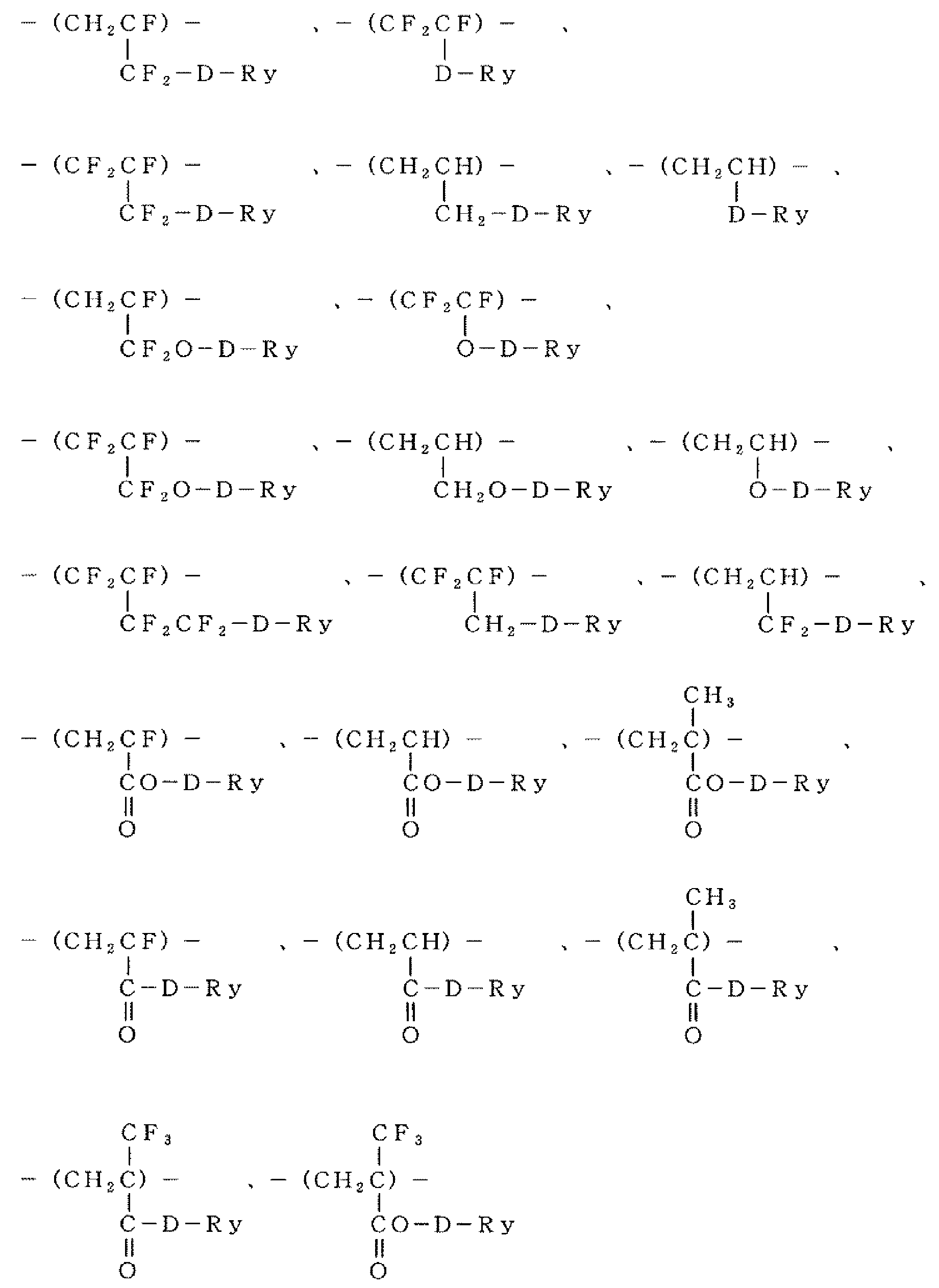

(式中、X1、X2、X3、X4、X5、D、Ry、a、bおよびcは前記と同じ)で示される構造単位であることが、本発明の硬化性樹脂組成物から得られる薄膜の屈折率が低く、また、薄膜の透明性を高くすることができ、更に、種々の基材との密着性がよく、耐久性を向上させることができるため好ましい。また、耐熱性および耐薬品性が優れる点でも好ましい。
式(2-3)の構造単位としては、


構造単位Mの好ましい形態としてはまた、上記構造単位M2において、Rf1が、-(CF(CF3)CF2-O)n-T(Tは、-Ry1-Si(OR20)(OR21)(OR22)、(Ry1は、上述したものと同じである。R20、R21及びR22は、同一又は異なって、炭素数1~5のアルキル基である。nは、0、1又は2である。)であるものが挙げられる。
上記硬化性含フッ素ポリマー(A)において、上記構造単位Nは任意の構造単位であり、式(N):

構造単位Nとしては、なかでも式(N1):

この構造単位N1を含む含フッ素ポリマーは、ラジカルやカチオンの接触による硬化反応性を高くすることができる点で好ましい。
構造単位N1は、式(N2):

構造単位N2は、OH基を少なくとも1つ有する含フッ素アリルエーテルに由来する構造単位であり、透明性を高くできるだけでなく屈折率を低くでき、また重合性が良好であり、特に他の含フッ素エチレン系単量体との共重合性が良好であるため好ましい。
また、構造単位N1としては、式(N3):

構造単位N3はOH基を少なくとも1つ有する含フッ素ビニルエーテルに由来する構造単位であり、透明性を高くできるだけでなく屈折率を低くでき、また他の含フッ素エチレン系単量体との共重合性が良好である点で好ましい。
構造単位N、N1、N2およびN3に含まれるY2は、前記のとおり、OH基を少なくとも1つ有する炭素数1~10の1価の有機基、もしくは-OHである。
このY2中のOH基はポリマーの溶解性向上や、他材との相溶性向上、基板に対する密着性向上に寄与し、既知の化学反応を用いることで容易に他の有用な置換基に適宜、高分子反応によって変換可能である。例えばアクリル酸クロライドやメタクリル酸クロライドや2-フルオロアクリル酸クロライド等とのエステル化反応によりアクリル基等の導入ができる。
Y2としては、例えば、-OH、-CH2OH、-CH2CH2OH、-(CH2)nOH(ここで、nは3~10の整数)、-CH(OH)CH2OH、又は、-CH(OH)CH2OCOCH3が好ましい。
Y2としては、例えば、-OH、-CH2OH、-CH2CH2OH、-(CH2)nOH(ここで、nは3~10の整数)、-CH(OH)CH2OH、又は、-CH(OH)CH2OCOCH3が好ましい。
Y2のなかでも、いわゆる一級炭素に結合したOH基は反応性が特に高い点で好ましい。
なお、前述の側鎖中にOH基を有する有機基Y2は、ポリマー主鎖末端に導入してもよい。
本発明で用いる含フッ素ポリマーにおいて、構造単位N、N1、N2およびN3に含まれる-Rf2a-基(前記-Rf2からY2を除いた基)は、炭素数1~40の含フッ素アルキレン基または炭素数2~100のエーテル結合を有する含フッ素アルキレン基である。この-Rf2a-基は含まれる炭素原子にフッ素原子が結合していればよく、一般に、炭素原子にフッ素原子と水素原子または塩素原子が結合した含フッ素アルキレン基、エーテル結合を有する含フッ素アルキレン基であるが、フッ素原子をより多く含有する(フッ素含有率が高い)ものが好ましく、より好ましくはパーフルオロアルキレン基またはエーテル結合を有するパーフルオロアルキレン基である。含フッ素ポリマー中のフッ素含有率は25質量%以上、好ましくは40質量%以上である。これらによって、含フッ素ポリマーの透明性を高くできるだけでなく屈折率を低くできることが可能となり、特に硬化物の耐熱性や弾性率を高くする目的で硬化度(架橋密度)を高くしても近赤外透明性を高く、もしくは低屈折率性を維持できるため好ましい。
-Rf2a-基の炭素数は大きすぎると、含フッ素アルキレン基の場合は溶剤への溶解性を低下させたり透明性が低下することがあり、またエーテル結合を有する含フッ素アルキレン基の場合はポリマー自身やその硬化物の硬度や機械特性を低下させることがあるため好ましくない。含フッ素アルキレン基の炭素数は、好ましくは1~20、より好ましくは1~10である。エーテル結合を有する含フッ素アルキレン基の炭素数は好ましくは2~30、より好ましくは2~20である。
-Rf2a-基の好ましい具体例としては、

前述のとおり、本発明で用いる含フッ素ポリマーを構成する構造単位Nは構造単位N1が好ましく、構造単位N1としてはさらに構造単位N2または構造単位N3が好ましい。そこで、つぎに構造単位N2および構造単位N3の具体例について述べる。
構造単位N2を構成する単量体として好ましい具体例としては、
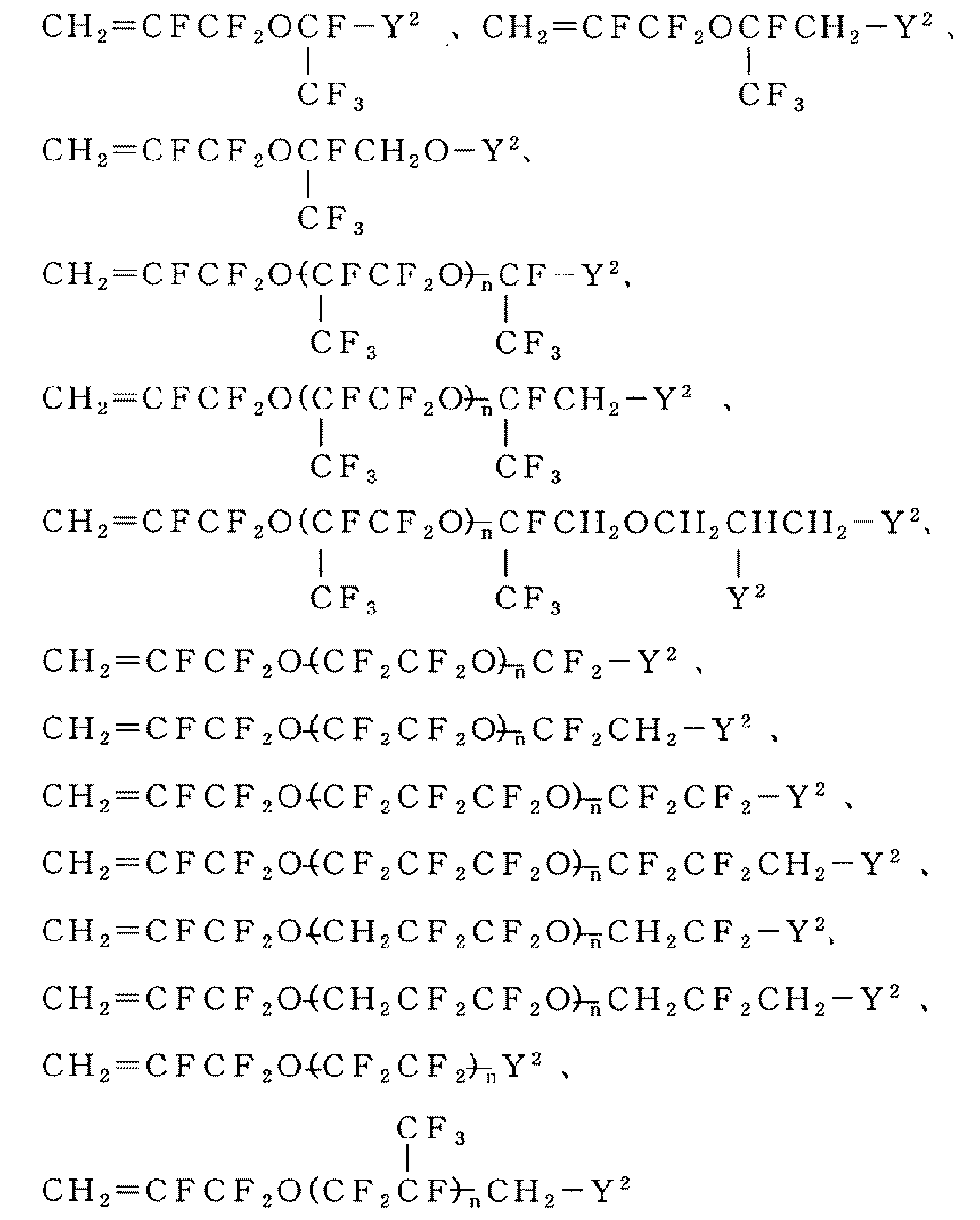
より詳しくは、
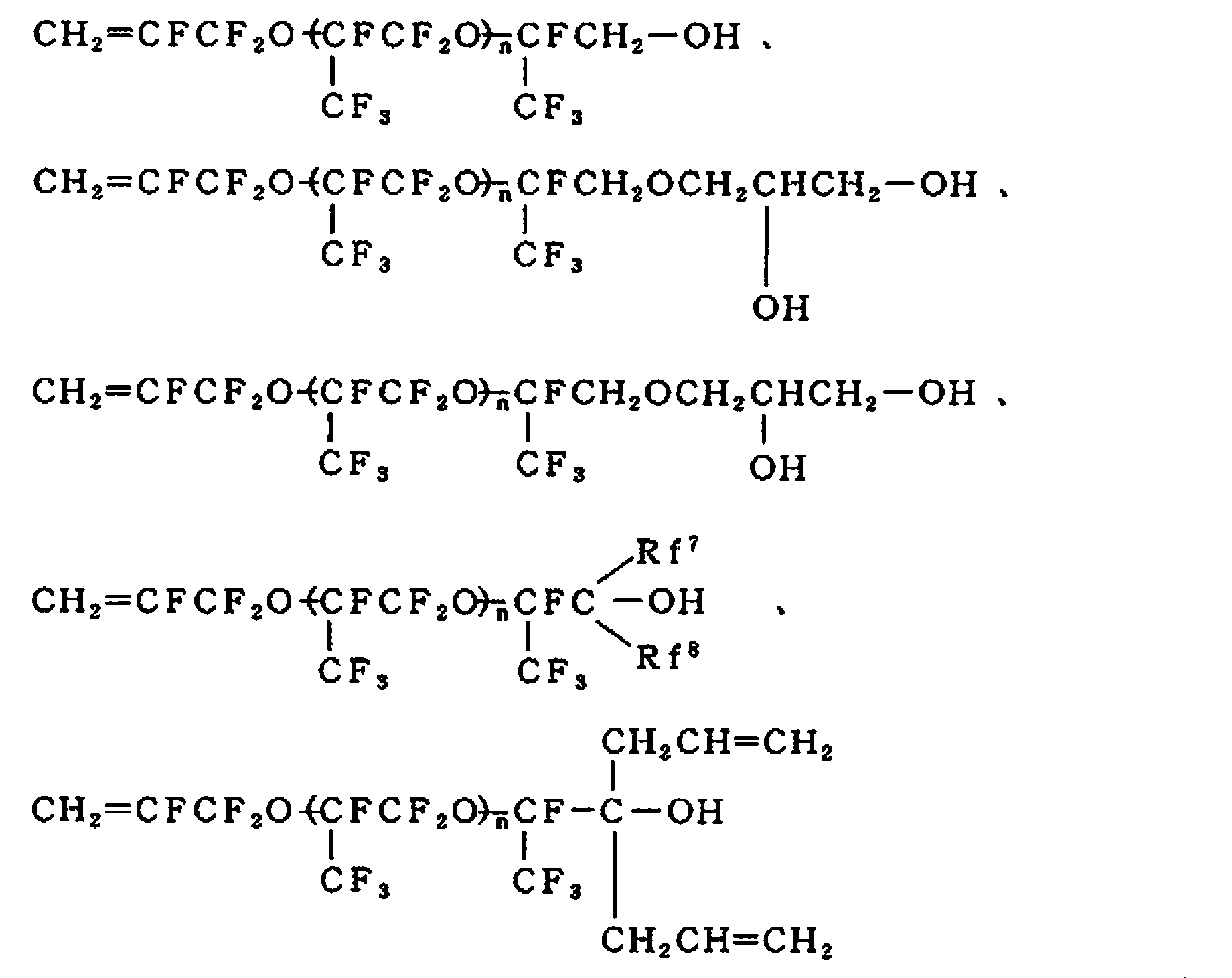
例えば、構造単位N2において、好ましいRf2としては、-CF(CF3)CF2O-CF(CF3)CH2-OH、-CF(CF3)CH2-OH、-CF(CF3)CF2O-CF(CF3)CF2O-CF(CF3)CH2-OH及び-CF(CF3)CF2O-CF(CF3)CH2-O-CH2CH(OH)CH2OHからなる群より選択される少なくとも1種の基が好ましい。
構造単位N3を構成する単量体として好ましい具体例としては、
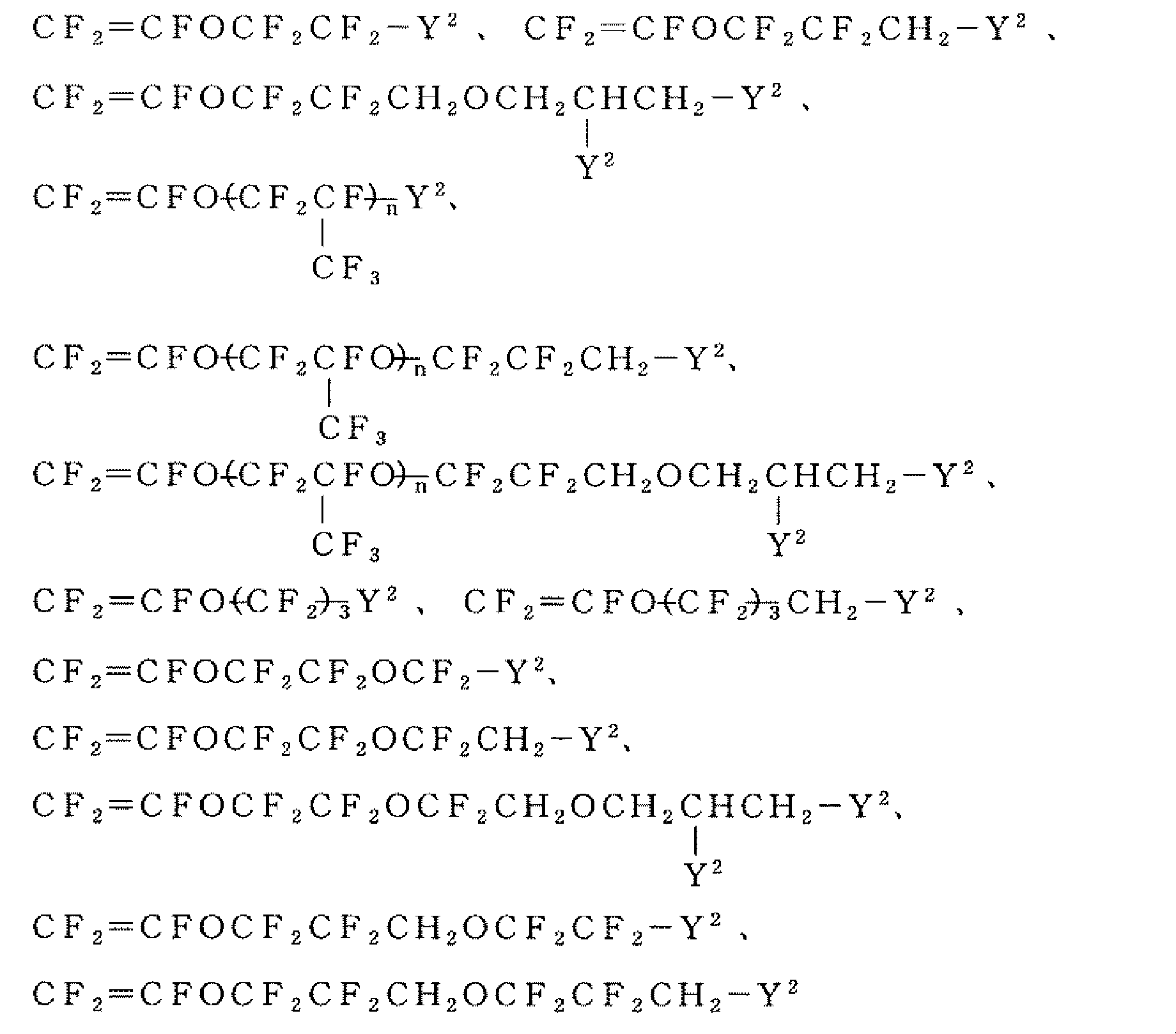
さらに詳しくは、

これらの構造単位N2およびN3以外に、含フッ素ポリマーの構造単位Nを構成する単量体の好ましい具体例としては、たとえば、

より具体的には、

構造単位Aは式(M)および(N)で示される構造単位を与える含フッ素エチレン性単量体と共重合可能な単量体に由来する構造単位である。また、構造単位Aは、構造単位M及びN以外の構造単位である。硬化性含フッ素ポリマー(A)において、構造単位Aは任意成分であり、構造単位M、Nと共重合し得る単量体であれば特に限定されず、目的とする含フッ素ポリマーやその硬化物の用途、要求特性などに応じて適宜選択すればよい。
構造単位Aとしては、たとえばつぎの構造単位が例示できる。
(A1)官能基を有する含フッ素エチレン性単量体から誘導される構造単位
構造単位A1は、含フッ素ポリマーおよびその硬化物の基材への密着性や溶剤、特に汎用溶剤への溶解性を付与できる点で好ましく、そのほか架橋性などの機能を付与できる点で好ましい。構造単位A1が有する官能基は、Y1及びY2以外の官能基であることが好ましい。
構造単位A1は、含フッ素ポリマーおよびその硬化物の基材への密着性や溶剤、特に汎用溶剤への溶解性を付与できる点で好ましく、そのほか架橋性などの機能を付与できる点で好ましい。構造単位A1が有する官能基は、Y1及びY2以外の官能基であることが好ましい。
官能基を有する好ましい含フッ素エチレン性単量体の構造単位A1は、式(A1):

CH2=CFCF2ORf4-Z1
(式中、Rf4およびZ1は前記と同じ)から誘導される式(A1-1):

より具体的には、
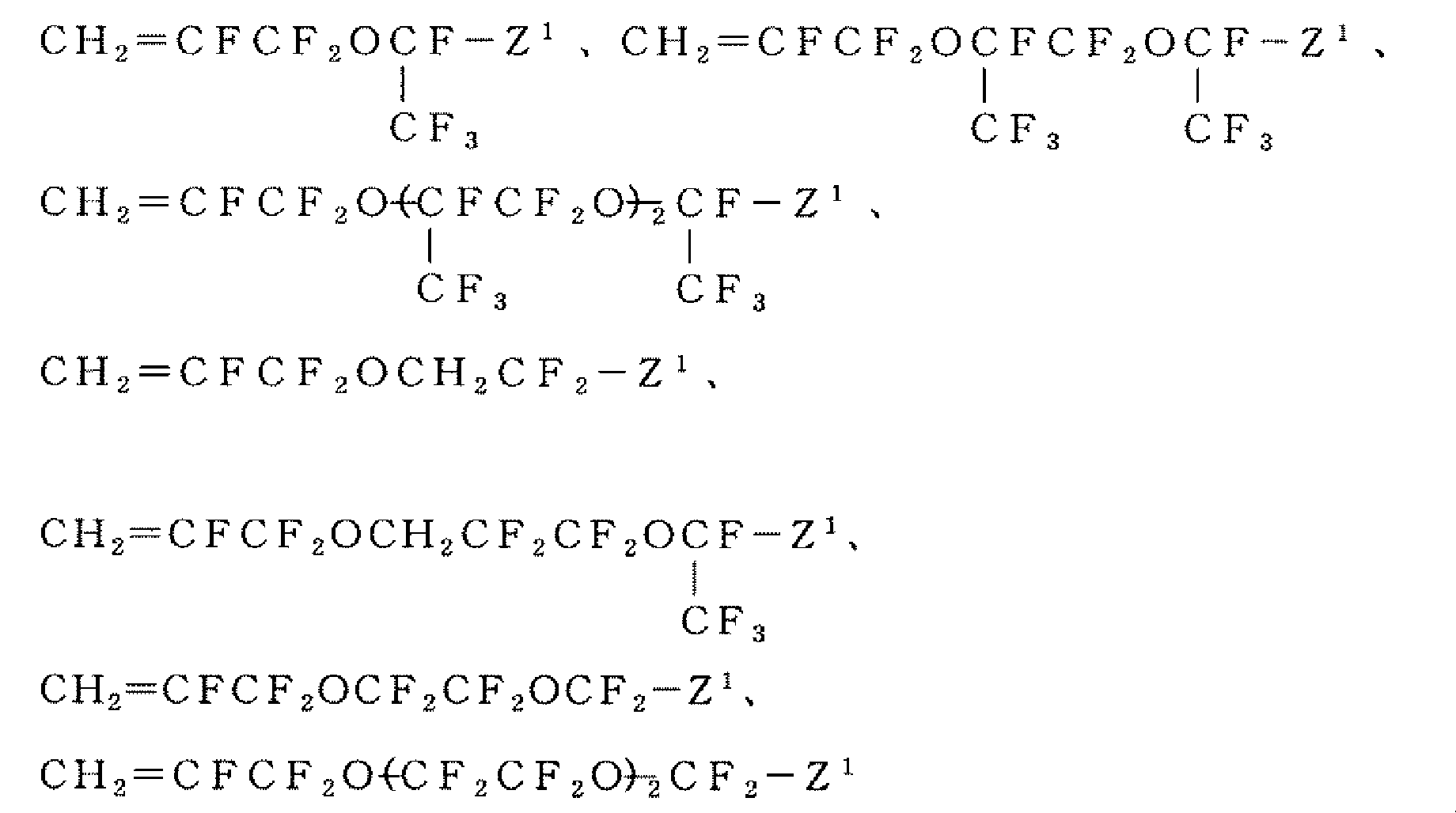
また、
CF2=CFORf4-Z1
(式中、Rf4およびZ1は前記と同じ)から誘導される式(A1-2):
CF2=CFORf4-Z1
(式中、Rf4およびZ1は前記と同じ)から誘導される式(A1-2):

より具体的には、

その他、官能基含有含フッ素エチレン性単量体としては、
CF2=CFCF2-O-Rf4-Z1、CF2=CF-Rf4-Z1、
CH2=CH-Rf4-Z1、CH2=CHO-Rf4-Z1
(以上、-Rf4-は前記の-Rf4-と同じ;Z1は前記と同じ)
などがあげられ、より具体的には、
CF2=CFCF2-O-Rf4-Z1、CF2=CF-Rf4-Z1、
CH2=CH-Rf4-Z1、CH2=CHO-Rf4-Z1
(以上、-Rf4-は前記の-Rf4-と同じ;Z1は前記と同じ)
などがあげられ、より具体的には、
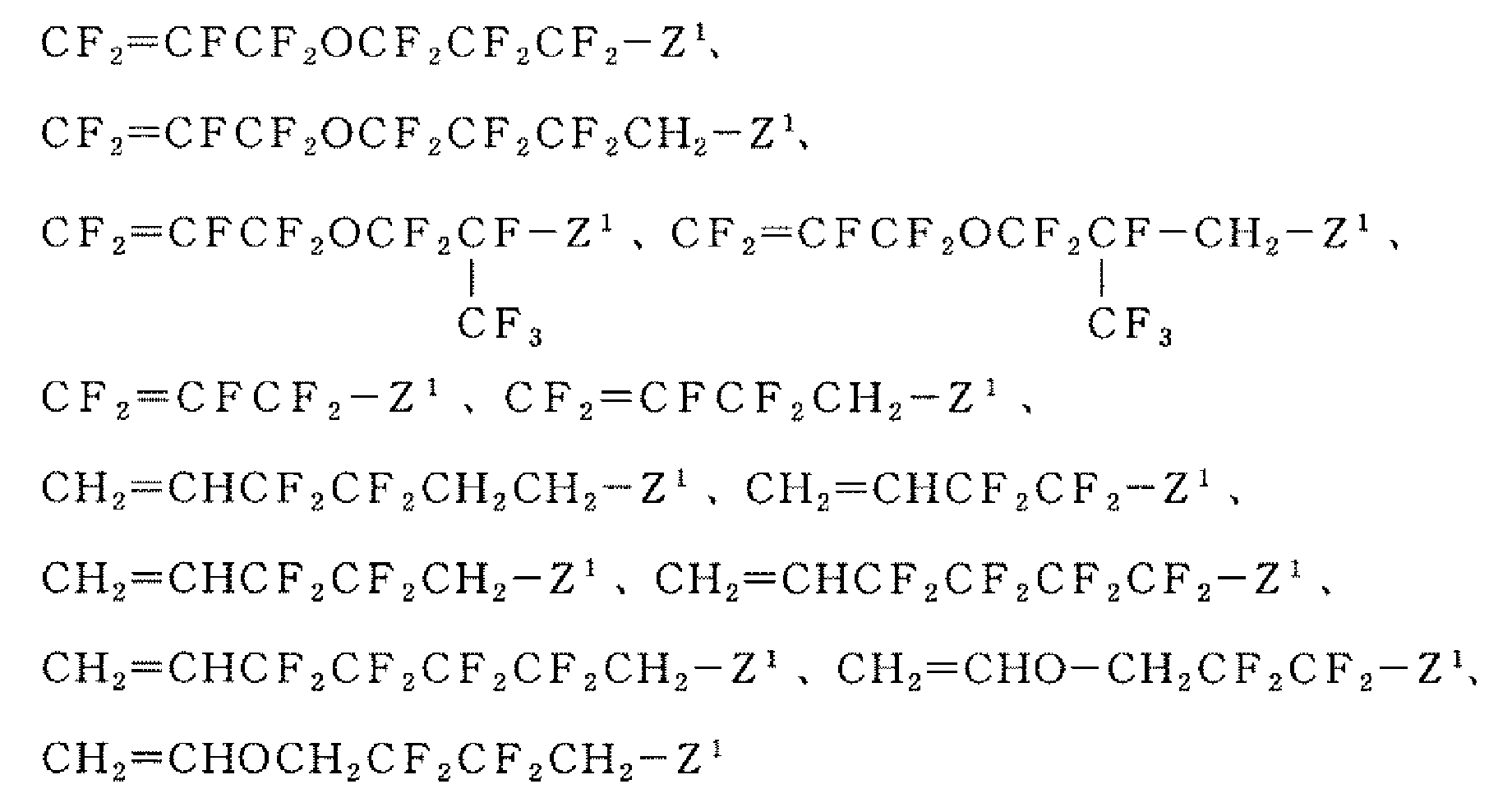
(A2)官能基を含まない含フッ素エチレン性単量体から誘導される構造単位
この構造単位A2は含フッ素ポリマーまたはその硬化物の屈折率を低く維持できる点で、さらに低屈折率化することができる点で好ましい。また単量体を選択することでポリマーの機械的特性やガラス転移温度などを調整でき、特に構造単位M、Nと共重合してガラス転移点を高くすることができ、好ましいものである。
この構造単位A2は含フッ素ポリマーまたはその硬化物の屈折率を低く維持できる点で、さらに低屈折率化することができる点で好ましい。また単量体を選択することでポリマーの機械的特性やガラス転移温度などを調整でき、特に構造単位M、Nと共重合してガラス転移点を高くすることができ、好ましいものである。
この含フッ素エチレン性単量体の構造単位(A2)としては、式(A2):

具体例としては、
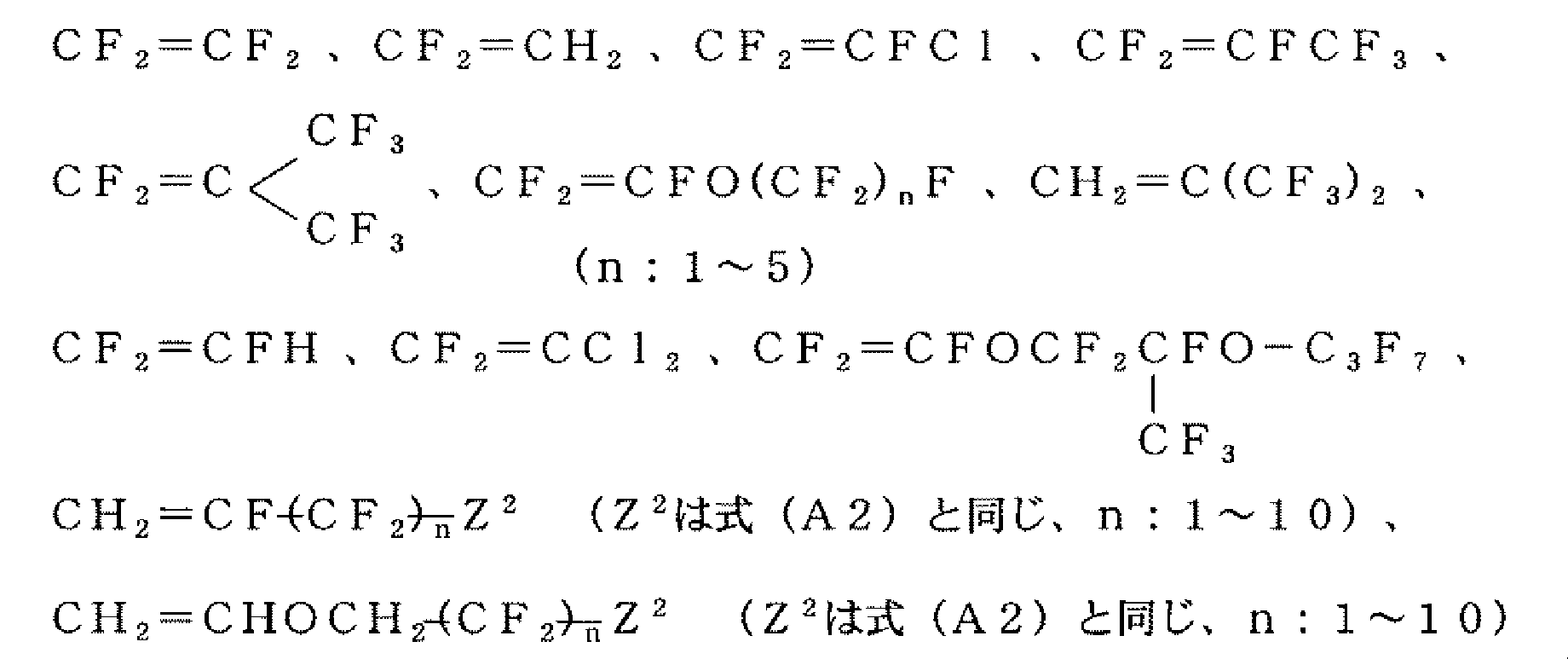
特に、これらは硬化性含フッ素ポリマーまたはその硬化物の屈折率を低く維持できる点から、テトラフルオロエチレン、フッ化ビニリデン、クロロトリフルオロエチレンおよびヘキサフルオロプロピレンよりなる群から選ばれる少なくとも1種の単量体に由来する構造単位であることが好ましい。
(A3)フッ素を有する脂肪族環状の構造単位
この構造単位A3を導入すると、透明性を高くでき、また、高ガラス転移温度の含フッ素ポリマーが得られ、硬化物にさらなる高硬度化が期待できる点で好ましい。
この構造単位A3を導入すると、透明性を高くでき、また、高ガラス転移温度の含フッ素ポリマーが得られ、硬化物にさらなる高硬度化が期待できる点で好ましい。
含フッ素脂肪族環状の構造単位A3としては式(A3):

たとえば、
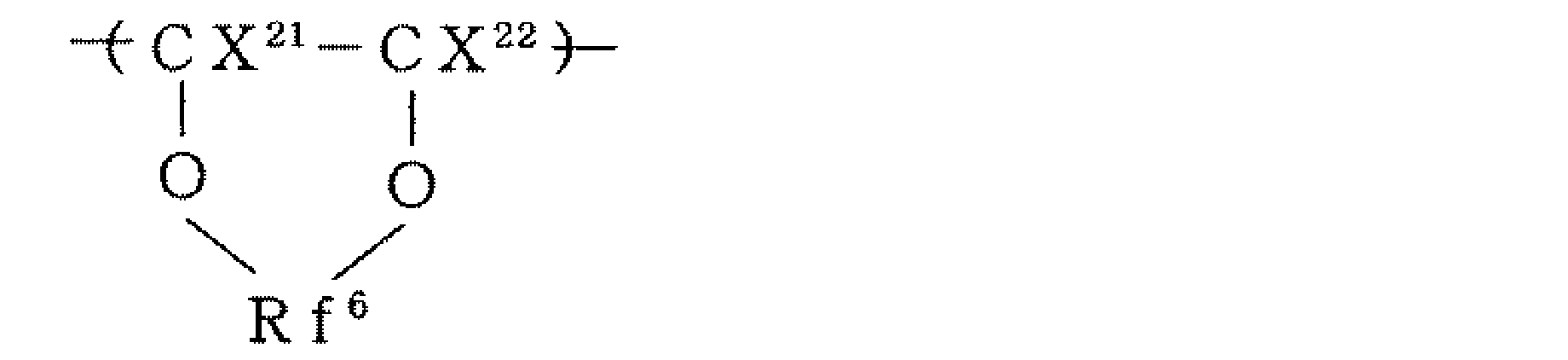
具体的には、
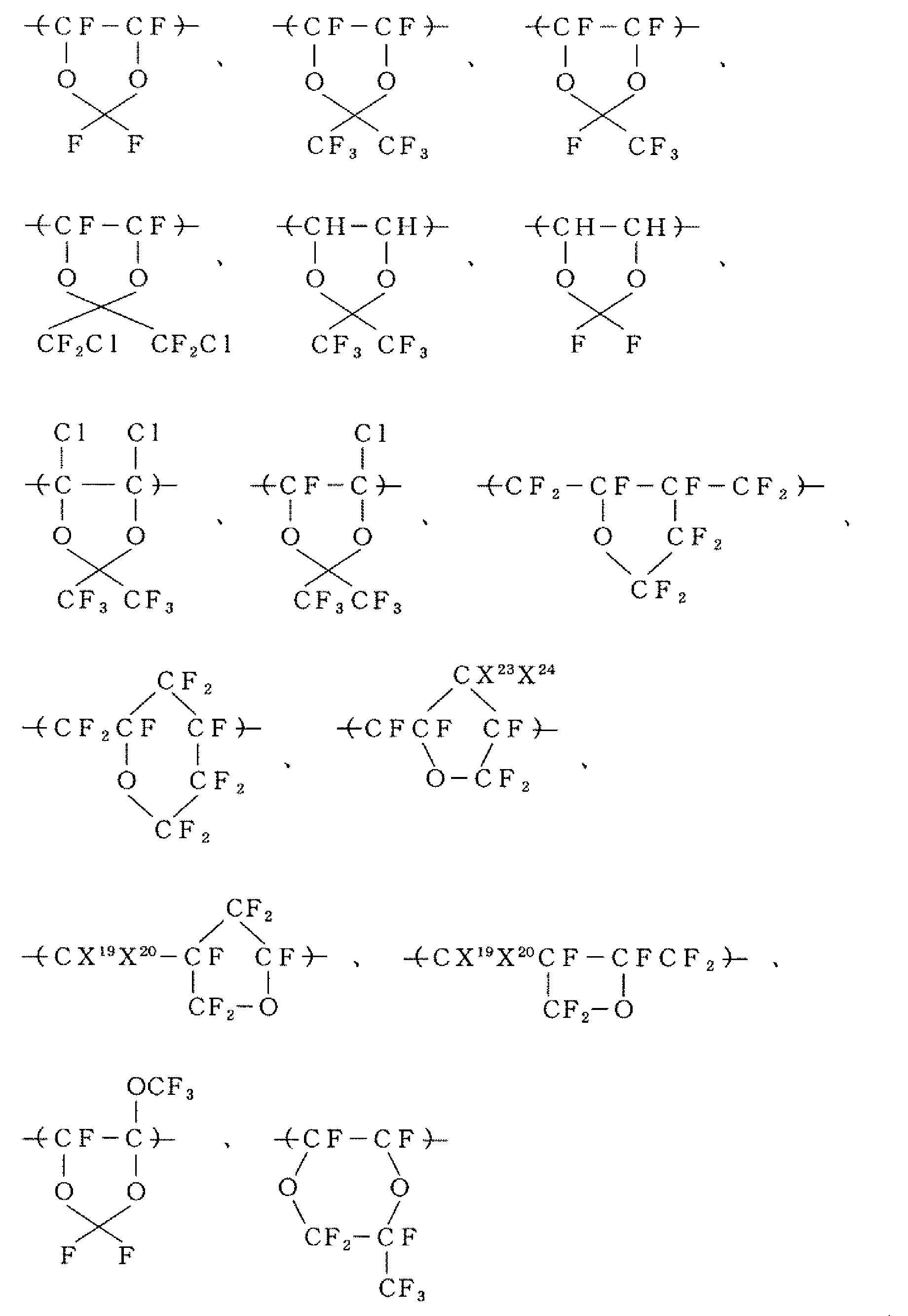
そのほかの含フッ素脂肪族環状構造単位としては、たとえば

(A4)フッ素を含まないエチレン性単量体から誘導される構造単位
構造単位A4を導入することによって、汎用溶剤への溶解性が向上したり、添加剤、たとえば光触媒や必要に応じて添加する硬化剤との相溶性を改善できる。
構造単位A4を導入することによって、汎用溶剤への溶解性が向上したり、添加剤、たとえば光触媒や必要に応じて添加する硬化剤との相溶性を改善できる。
非フッ素系エチレン性単量体の具体例としては、
αオレフィン類:
エチレン、プロピレン、ブテン、塩化ビニル、塩化ビニリデンなど
ビニルエーテル系またはビニルエステル系単量体:
CH2=CHOR、CH2=CHOCOR(R:炭素数1~20の炭化水素基)など
アリル系単量体:
CH2=CHCH2Cl、CH2=CHCH2OH、CH2=CHCH2COOH、CH2=CHCH2Brなど
アリルエーテル系単量体:
CH2=CHCH2OR(R:炭素数1~20の炭化水素基)、
CH2=CHCH2OCH2CH2COOH 、
αオレフィン類:
エチレン、プロピレン、ブテン、塩化ビニル、塩化ビニリデンなど
ビニルエーテル系またはビニルエステル系単量体:
CH2=CHOR、CH2=CHOCOR(R:炭素数1~20の炭化水素基)など
アリル系単量体:
CH2=CHCH2Cl、CH2=CHCH2OH、CH2=CHCH2COOH、CH2=CHCH2Brなど
アリルエーテル系単量体:
CH2=CHCH2OR(R:炭素数1~20の炭化水素基)、
CH2=CHCH2OCH2CH2COOH 、

アクリル酸、メタクリル酸、アクリル酸エステル類、メタクリル酸エステル類のほか、
無水マレイン酸、マレイン酸、マレイン酸エステル類など
これらの非フッ素系エチレン性単量体の水素原子を重水素原子に一部または全部置換したものは透明性の点でより好ましい。
(A5)脂環式単量体から誘導される構造単位
構造単位M、Nの共重合成分として、より好ましくは構造単位M、Nと前述の含フッ素エチレン性単量体または非フッ素エチレン性単量体(前述のA3、A4)の構造単位に加えて、第3成分として脂環式単量体構造単位A5を導入してもよく、それによって高ガラス転移温度化や高硬度化が図られる。
構造単位M、Nの共重合成分として、より好ましくは構造単位M、Nと前述の含フッ素エチレン性単量体または非フッ素エチレン性単量体(前述のA3、A4)の構造単位に加えて、第3成分として脂環式単量体構造単位A5を導入してもよく、それによって高ガラス転移温度化や高硬度化が図られる。
脂環式単量体A5の具体例としては、


上記硬化性含フッ素ポリマー(A)は、構造単位Mの単独重合体であってもよいし、構造単位Mと、構造単位N及び/又は構造単位Aとからなる共重合体であってもよい。
単独重合体の場合、屈折率を低く維持し、近赤外透明性や水酸基を有する基材との密着耐久性を付与する機能、さらには被膜の高硬度化を付与できるといった点で有利である。
また共重合体の場合、構造単位Mの含有量は、硬化性含フッ素ポリマー(A)を構成する全構造単位に対し0.1モル%以上であればよいが、低屈折率であり、かつ透明性が高い硬化物を得るためには好ましくは2.0モル%以上、より好ましくは10モル%以上、さらに好ましくは20モル%以上である。また、上記範囲であれば、硬化(架橋)により高硬度で耐摩耗性、耐擦傷性に優れ、耐薬品性、耐溶剤性にも優れる。構造単位Mの含有量は、硬化性含フッ素ポリマー(A)を構成する全構造単位に対し100モル%未満である。
含フッ素ポリマーの分子量は、たとえば数平均分子量において500~1,000,000の範囲から選択できるが、好ましくは1,000~500,000、特に2,000~200,000の範囲から選ばれるものが好ましい。
分子量が低すぎると、硬化後であっても機械的物性が不充分となりやすく、特に硬化物や硬化膜が脆く強度不足となりやすい。分子量が高すぎると、溶剤溶解性が悪くなったり、特に薄膜形成時に成膜性やレベリング性が悪くなりやすく、また含フッ素ポリマーの貯蔵安定性も不安定になりやすい。最も好ましくは数平均分子量が5,000から100,000の範囲から選ばれるものである。
硬化性含フッ素ポリマー(A)は、式(2-1):
-(M)-(N)-(A1)-(A2)- (2-1)
(式中、構造単位Mおよび構造単位Nは上記と同じ;構造単位A1およびA2は上記と同じ)で示され、構造単位Mが0.1~90モル%、構造単位Nが0~99.9モル%、構造単位A1が0~99.9モル%および構造単位A2が0~99.9モル%でありかつN+A1+A2を10~99.9モル%含む、数平均分子量が500~1,000,000である加水分解性金属アルコキシド部位を有するものであってもよい。硬化性含フッ素ポリマー(A-2)であることも好ましい形態の一つである。
-(M)-(N)-(A1)-(A2)- (2-1)
(式中、構造単位Mおよび構造単位Nは上記と同じ;構造単位A1およびA2は上記と同じ)で示され、構造単位Mが0.1~90モル%、構造単位Nが0~99.9モル%、構造単位A1が0~99.9モル%および構造単位A2が0~99.9モル%でありかつN+A1+A2を10~99.9モル%含む、数平均分子量が500~1,000,000である加水分解性金属アルコキシド部位を有するものであってもよい。硬化性含フッ素ポリマー(A-2)であることも好ましい形態の一つである。
硬化性含フッ素ポリマー(A-2)における構造単位Mの含有量は、含フッ素ポリマーを構成する全構造単位に対し0.1モル%以上であればよいが、低屈折率であり、かつ透明性が高い硬化物を得るためには好ましくは2.0モル%以上、より好ましくは10モル%以上、さらに好ましくは20モル%以上である。また、上記範囲であれば、硬化(架橋)により高硬度で耐摩耗性、耐擦傷性に優れ、耐薬品性、耐溶剤性に優れた硬化物を得ることができる。上限は100モル%未満である。
構造単位N、A1およびA2の含有量はいずれも99.9モル%以下である。また、N+A1+A2の合計モル%は10~99.9モル%とする。10モル%未満の場合は屈折率が低く維持できず、さらに硬化後の被膜硬度が低くなる傾向となり、好ましくない。より好ましいN+A1+A2の合計モル%は20モル%以上、さらには30モル%以上であり、80モル%以下、さらには60モル%以下である。
また、硬化後の被膜の強度や耐磨耗性を向上できる点から、硬化性含フッ素ポリマー(A-2)における構造単位N、A1およびA2の合計に対する構造単位Nの比(N/(N+A1+A2))は、1/100~100/100モル比であることが好ましく、30/100~100/100モル比であることがより好ましく、50/100~100/100モル比であることがさらに好ましく、70/100~100/100モル比であることが特に好ましい。
さらに、硬化後の被膜の基材との密着性およびその耐久性を向上できる点から、硬化性含フッ素ポリマー(A-2)における構造単位N、A1およびA2の合計に対する構造単位A1の比(A1/(N+A1+A2))は、1/100~50/100モル比であることが好ましく、1/100~40/100モル比であることがより好ましく、1/100~30/100モル比であることがさらに好ましい。
硬化性含フッ素ポリマー(A-2)の分子量は、たとえば数平均分子量において500~1,000,000の範囲から選択できるが、好ましくは1,000~500,000、特に2,000~200,000の範囲から選ばれるものが好ましい。
分子量が低すぎると、硬化後であっても機械的物性が不充分となりやすく、特に硬化物や硬化膜が脆く強度不足となりやすい。分子量が高すぎると、溶剤溶解性が悪くなったり、特に薄膜形成時に成膜性やレベリング性が悪くなりやすく、また含フッ素ポリマーの貯蔵安定性も不安定となりやすい。最も好ましくは数平均分子量が5,000~100,000の範囲から選ばれるものである。
このように硬化性含フッ素ポリマー(A-2)は、硬化性含フッ素ポリマー(A)においては、任意である構造単位Nおよび/または構造単位Aを必須の構造単位として含み、かつ具体的に特定したものともいえる。
硬化性含フッ素ポリマー(A-2)において、構造単位M(M1、M2、M3)と構造単位N(N1、N2、N3)、さらには構造単位A(A1、A2)との組合せや組成比率は、構造単位Mと構造単位Nと構造単位Aの組合せが、上記の例示から、目的とする用途、物性(特にガラス転移温度、硬度など)、機能(透明性)などによって種々選択できる。
またさらに硬化性含フッ素ポリマー(A)は、汎用溶剤に可溶であることが好ましく、たとえばケトン系溶剤、酢酸エステル系溶剤、アルコール系溶剤、芳香族系溶剤の少なくとも1種に可溶または汎用溶剤を少なくとも1種含む混合溶剤に可溶であることが好ましい。
汎用溶剤に可溶であることは、特に、被膜を形成するプロセスにおいて3μm以下、例えば約0.1μm程度の薄膜形成が必要な際、成膜性、均質性に優れるため好ましく、生産性の面でも有利である。
硬化性含フッ素ポリマー(A)を得るためには、一般には、
(1)Rf1を有する単量体を予め合成し、重合して得る方法
(2)一旦、他の官能基を有する重合体を合成し、その重合体に高分子反応により官能基変換し、官能基Rf1を導入する方法
(3)(1)と(2)の方法を用いて導入する方法
のいずれの方法も採用できる。
(1)Rf1を有する単量体を予め合成し、重合して得る方法
(2)一旦、他の官能基を有する重合体を合成し、その重合体に高分子反応により官能基変換し、官能基Rf1を導入する方法
(3)(1)と(2)の方法を用いて導入する方法
のいずれの方法も採用できる。
これらの方法のうち、(2)の方法は硬化性含フッ素ポリマー(A)の加水分解性金属アルコキシド部位をポリマー合成後に導入できるため、重合時のゲル化等の問題が生じにくく、本発明の加水分解性金属アルコキシド部位を有する硬化性フッ素ポリマーを得る点から(2)の方法が好ましい。
重合方法としては、ラジカル重合法、アニオン重合法、カチオン重合法などが例示でき、加水分解性金属アルコキシド部位を有する重合体を得るために例示した単量体は組成や分子量などの品質のコントロールがしやすい点や工業化しやすい点からラジカル重合法が特に好ましい。
構造単位Mを与える含フッ素エチレン性単量体は、式(1):

構造単位Mを与える含フッ素エチレン性単量体は、たとえばラジカル的に進行するものであれば手段は何ら制限されないが、例えば有機または無機ラジカル重合開始剤、熱、光あるいは電離放射線などによって開始される。重合の形態も溶液重合、バルク重合、懸濁重合、乳化重合などといった方法により製造できる。
なお、上記の構造単位M1、M2およびM3で説明した好ましい例示、およびRf1について具体的に説明したRyやY1に関する事項も適用できる。
本発明の硬化性樹脂組成物は、さらに、加水分解性金属アルコキシド(D)を含むものであってもよい。
加水分解性金属アルコキシド(D)において、金属の例としては、ケイ素(Si)、チタン(Ti)、アルミニウム(Al)、ジルコニウム(Zr)、スズ(Sn)、鉄(Fe)、ナトリウム(Na)、マグネシウム(Mg)、リン(P)、硫黄(S)、カリウム(K)、カルシウム(Ca)、スカンジウム(Sc)、バナジウム(V)、クロム(Cr)、マンガン(Mn)、コバルト(Co)、ニッケル(Ni)、銅(Cu)、亜鉛(Zn)、ガリウム(Ga)、ゲルマニウム(Ge)、ひ素(As)、セレン(Se)、ルビジウム(Rb)、ストロンチウム(Sr)、イットリウム(Y)、ニオブ(Nb)、モリブデン(Mo)、カドミウム(Cd)、インジウム(In)、アンチモン(Sb)、テルル(Te)、セシウム(Cs)、バリウム(Ba)、ランタン(La)、ハフニウム(Hf)、タンタル(Ta)、タングステン(W)、水銀(Hg)、タリウム(Tl)、鉛(Pb)、ビスマス(Bi)、リチウム(Li)、ベリリウム(Be)、ホウ素(B)、セリウム(Ce)、プラセオジム(Pr)、ネオジム(Nd)、プロメチウム(Pm)、サマリウム(Sm)、ユウロピウム(Eu)、ガドリニウム(Gd)、テルビウム(Tb)、ジスプロシウム(Dy)、ホルミウム(Ho)、エルビウム(Er)、ツリウム(Tm)、イッテルビウム(Yb)、およびルテチウム(Lu)が挙げられる。
なかでも、反応性、溶解性、安定性の観点から、ケイ素(Si)が特に好ましい。
加水分解性金属アルコキシド(D)において、金属の例としては、ケイ素(Si)、チタン(Ti)、アルミニウム(Al)、ジルコニウム(Zr)、スズ(Sn)、鉄(Fe)、ナトリウム(Na)、マグネシウム(Mg)、リン(P)、硫黄(S)、カリウム(K)、カルシウム(Ca)、スカンジウム(Sc)、バナジウム(V)、クロム(Cr)、マンガン(Mn)、コバルト(Co)、ニッケル(Ni)、銅(Cu)、亜鉛(Zn)、ガリウム(Ga)、ゲルマニウム(Ge)、ひ素(As)、セレン(Se)、ルビジウム(Rb)、ストロンチウム(Sr)、イットリウム(Y)、ニオブ(Nb)、モリブデン(Mo)、カドミウム(Cd)、インジウム(In)、アンチモン(Sb)、テルル(Te)、セシウム(Cs)、バリウム(Ba)、ランタン(La)、ハフニウム(Hf)、タンタル(Ta)、タングステン(W)、水銀(Hg)、タリウム(Tl)、鉛(Pb)、ビスマス(Bi)、リチウム(Li)、ベリリウム(Be)、ホウ素(B)、セリウム(Ce)、プラセオジム(Pr)、ネオジム(Nd)、プロメチウム(Pm)、サマリウム(Sm)、ユウロピウム(Eu)、ガドリニウム(Gd)、テルビウム(Tb)、ジスプロシウム(Dy)、ホルミウム(Ho)、エルビウム(Er)、ツリウム(Tm)、イッテルビウム(Yb)、およびルテチウム(Lu)が挙げられる。
なかでも、反応性、溶解性、安定性の観点から、ケイ素(Si)が特に好ましい。
加水分解性金属アルコキシドとしては、例えば、テトラエトキシシラン[Si(OCH2CH3)4](4官能)(TEOS)、メチルトリエトキシシラン[CH3Si(OCH2CH3)3](3官能)(MTES)、ジメチルジエトキシシラン[(CH3)2Si(OCH2CH3)2](2官能)、トリメチルエトキシシラン[(CH3)3SiOCH2CH3](1官能)、及び、エトキシシロキサンオリゴマー[(CH3CH2O)3Si-{O-Si(OCH2CH3)2}n-(OCH2CH3)](n=1~4)(6~12官能)からなる群より選択される少なくとも1種であることが好ましい。
また、加水分解性金属アルコキシドとしては、例えば、イソシアネートプロピルトリエトキシシラン[OCNC3H6Si(OCH2CH3)3]、グリシジルプロピルトリエトキシシラン[CH2OCHC3H6Si(OCH2CH3)3]、及び、アミノプロピルトリエトキシシラン[NH3C3H6Si(OCH2CH3)3]からなる群より選択される少なくとも1種であることも好ましい。
本発明の硬化性樹脂組成物には前述の化合物のほかに、必要に応じて種々の添加剤を配合してもよい。
そうした添加剤としては、たとえばシランカップリング剤、可塑剤、変色防止剤、酸化防止剤、無機充填剤、レベリング剤、粘度調整剤、光安定剤、水分吸収剤、顔料、染料、補強剤などがあげられる。
また、本発明の硬化性樹脂組成物は、硬化物の硬度を高めたり、屈折率の制御を行う目的で、中空微粒子(B)以外の無機化合物の微粒子または超微粒子を配合することもできる。
無機化合物微粒子としては特に限定されないが、屈折率が1.5以下の化合物が好ましい。具体的にはフッ化マグネシウム(屈折率1.38)、酸化珪素(屈折率1.46)、フッ化アルミニウム(屈折率1.33~1.39)、フッ化カルシウム(屈折率1.44)、フッ化リチウム(屈折率1.36~1.37)、フッ化ナトリウム(屈折率1.32~1.34)、及びフッ化トリウム(屈折率1.45~1.50)からなる群より選択される少なくとも1種の酸化物微粒子(但し、上記中空シリカ微粒子は除く)が好ましい。微粒子の粒径については、低屈折率材料の透明性を確保するために可視光の波長に比べて充分に小さいことが望ましい。具体的には100nm以下、特に50nm以下が好ましい。
屈折率制御では無機化合物の微粒子または超微粒子によって、空隙を形成することが可能である。すなわち、本発明の組成物に無機化合物の微粒子または超微粒子を配合させた被膜は、この空隙を利用して被膜単体の屈折率よりもさらに低屈折率にすることが可能である。
無機化合物微粒子を使用する際は、組成物中での分散安定性、低屈折率材料中での密着性などを低下させないために、予め有機分散媒中に分散した有機ゾルの形態で使用するのが望ましい。さらに、組成物中において、無機化合物微粒子の分散安定性、低屈折率材料中での密着性などを向上させるために、予め無機微粒子化合物の表面を各種カップリング剤などを用いて修飾することができる。各種カップリング剤としては、たとえば有機置換された珪素化合物;アルミニウム、チタニウム、ジルコニウム、アンチモンまたはこれらの混合物などの金属アルコキシド;有機酸の塩;配位性化合物と結合した配位化合物などがあげられる。
本発明の硬化性樹脂組成物は、溶剤(Y)を含むものであることが好ましい。硬化性含フッ素ポリマー(A)または添加物がディスパージョン状のものでも、溶液状のものでもよいが、均一な薄膜を形成するため、また比較的低温で成膜が可能となる点で、均一な溶液状であることが好ましい。
上記溶剤(Y)は、硬化性含フッ素ポリマー(A)、加水分解性金属アルコキシド(D)、および必要に応じて添加するレベリング剤、光安定剤などの添加剤が均一に溶解または分散するものであれば特に制限はないが、特に硬化性含フッ素ポリマー(A)を均一に溶解するものが好ましい。
溶剤(Y)としては、たとえばメチルセロソルブ、エチルセロソルブ、メチルセロソルブアセテート、エチルセロソルブアセテートなどのセロソルブ系溶剤;ジエチルオキサレート、ピルビン酸エチル、エチル-2-ヒドロキシブチレート、エチルアセトアセテート、酢酸ブチル、酢酸アミル、酪酸エチル、酪酸ブチル、乳酸メチル、乳酸エチル、3-メトキシプロピオン酸メチル、3-メトキシプロピオン酸エチル、2-ヒドロキシイソ酪酸メチル、2-ヒドロキシイソ酪酸エチルなどのエステル系溶剤;プロピレングリコールモノメチルエーテル、プロピレングリコールモノエチルエーテル、プロピレングリコールモノブチルエーテル、プロピレングリコールモノメチルエーテルアセテート、プロピレングリコールモノエチルエーテルアセテート、プロピレングリコールモノブチルエーテルアセテート、ジプロピレングリコールジメチルエーテルなどのプロピレングリコール系溶剤;2-ヘキサノン、シクロヘキサノン、メチルアミノケトン、2-ヘプタノンなどのケトン系溶剤;メタノール、エタノール、プロパノール、イソプロパノール、ブタノールなどのアルコール系溶剤;トルエン、キシレンなどの芳香族炭化水素類あるいはこれらの2種以上の混合溶剤などがあげられる。
またさらに、硬化性含フッ素ポリマー(A)の溶解性を向上させるために、必要に応じてフッ素系の溶剤を用いてもよい。
フッ素系の溶剤としては、たとえばCH3CCl2F(HCFC-141b)、CF3CF2CHCl2/CClF2CF2CHClF混合物(HCFC-225)、パーフルオロヘキサン、パーフルオロ(2-ブチルテトラヒドロフラン)、メトキシ-ノナフルオロブタン、1,3-ビストリフルオロメチルベンゼンなどのほか、

ベンゾトリフルオライド、パーフルオロベンゼン、パーフルオロ(トリブチルアミン)、ClCF2CFClCF2CFCl2などがあげられる。
これらフッ素系溶剤は単独でも、またフッ素系溶剤同士、非フッ素系とフッ素系の1種以上との混合溶剤として用いてもよい。
これらのなかでもケトン系溶剤、酢酸エステル系溶剤、アルコール系溶剤、芳香族系溶剤などが、塗装性、塗布の生産性などの面で好ましいものである。
本発明の硬化性樹脂組成物の固形分濃度は、塗工性が良好で、かつ硬化後の被膜に低分子量の単量体成分なども残留しにくく、表面のタック感もないものであればよく、たとえば0.5~10質量%程度の範囲から選択すればよい。
本発明の硬化性樹脂組成物は、硬化、たとえば熱硬化又は光硬化させることによって硬化物(例えば、硬化膜)となり、種々の基材へ適用でき、種々の用途に使用できる。本発明は、上記硬化性樹脂組成物を硬化して得られる硬化物でもある。
上記硬化物は、屈折率が1.32以下であることが好ましい。たとえば、本発明の硬化性樹脂組成物からは、膜厚が1~10μmであり、屈折率が1.32以下であり、ヘイズ値が5%以下である薄膜を製造することできる。しかも、このような低い屈折率及びヘイズ値は、125℃で1000時間の耐熱性試験、85℃かつ湿度85%で500時間の耐熱性試験、265℃で10分間の耐熱性試験を実施した後でも変動することがない。更に、1000ルックスに一時間暴露する耐光性試験後でも変動しない。
本発明の硬化性樹脂組成物は、封止剤であることが好ましい。例えば、フォトトランジスター、フォトダイオード、CCDなどの受光素子、LED、有機ELなどの発光素子、EPROM等の半導体素子(光半導体素子)などに用いられる封止剤であることが好ましい。上記封止剤を硬化させて封止部材(硬化物)を得ることができる。本発明の硬化物は、光学素子用の封止部材であることが好ましく、特に、受光素子用又は発光素子用の封止部材であることが好ましい。
図1は、CCDモジュールの構造の一例を示す断面模式図である。図1に示す構造のCCDモジュールは、CCD素子部12に到達する光が封止剤層13を通過することになるため、該封止剤層13には、低屈折率であり、透明性が高いことが要求される。本発明の硬化性樹脂組成物は、低屈折率であり、かつ透明性が高い薄膜を形成することができるため、上記CCDモジュールに適用する封止剤形成用の封止材料として好適である。
図2(a)~(f)は、CCDモジュールの製造フローを簡略的に示したフロー図である。以下に、CCDモジュールの製造方法について、図2(a)~(f)を用いて説明する。まず、図2(a)のように、シリコンウェハー21を準備し、その上に、CCD素子部22を作成する(図2(b))。次に、CCD素子部22上に、スピンコート等の塗布方法を用いて本発明の硬化性樹脂組成物を塗布して封止剤層23を作成する(図2(c))。その後、封止剤層23上にガラス24を積層し(図2(d))、その後、図2(e)に示すように、ダイシングを行い、CCD素子を製造する。
その後、RIE等を用いた異方性エッチングによりシリコンウェハー21に穴を形成し、シリコンウェハー21裏面に貫通電極25を形成する。このようにして製造された半導体チップを外部に接続する電極26に接着して、図2(f)に示すCCDモジュールを製造することができる。
LED、有機ELなどの発光素子の封止部材としては、直接封止するものであってもよい。また、たとえば、従来用いられているエポキシ系やシリコーン系の封止部材を用いて素子を封止後、本発明の硬化性樹脂組成物を最表面に積層することで、発光デバイスから空気層に向けて屈折率が段階的に減少していく構造にしてもよい。例えば屈折率1.57のエポキシ封止樹脂で封止した場合、空気界面でのフレネル反射に基づくロスは4.92%と計算される。このエポキシ封止樹脂の最表面に本発明の硬化性樹脂組成物を用いて屈折率1.32の層を形成させたとすると、界面の数は増えるが、トータルのフレネル反射は2.65%と計算され、反射ロスを大きく減少させることが可能になり、その結果、発光素子からの光の取り出し効率を向上させることが可能となる。
本発明の硬化性樹脂組成物はまた、基材上に低反射性を付与する薄膜を有する被覆物品に好適に用いられる。基材としては、たとえばガラス、石材、コンクリート、タイルなどの無機材料;鉄、アルミ、銅などの金属;木、紙、印刷物、印画紙、絵画などをあげることができる。
また上記基材としては、塩化ビニル樹脂、ポリエチレンテレフタレート、トリアセチルセルロースなどのセルロース系樹脂、ポリカーボネート樹脂、ポリオレフィン樹脂、アクリル系樹脂、フェノール樹脂、キシレン樹脂、ユリア樹脂、メラミン樹脂、ジアリルフタレート樹脂、フラン樹脂、アミノ樹脂、アルキド樹脂、ウレタン樹脂、ビニルエステル樹脂、ポリイミド樹脂、ポリアミド樹脂などの合成樹脂基材などもあげることができる。
基材の中でも液晶ディスプレイ(LCD)表示用のアンチグレア基材は表面が微細な無機微粒子でコーティングされており好ましく用いられ、効果的に防眩性かつ低反射効果を発揮できる。
本発明の硬化性樹脂組成物は、以下のような形態の物品に適用した場合にも効果的である。
プリズム、レンズシート、偏光板、光学フィルター、レンチキュラーレンズ、フレネルレンズ、背面投写型ディスプレイのスクリーン、縮小投影型露光機レンズ、光ファイバーや光カプラーなどの光学部品;ショーウインドーのガラス、ショーケースのガラス、広告用カバー、フォトスタンド用のカバーなどに代表される透明な保護版;CRT、液晶ディスプレイ、プラズマディスプレイ、背面投写型ディスプレイなどの保護板;光磁気ディスク、CD・LD・DVDなどのリードオンリー型光ディスク、PDなどの相転移型光ディスク、ホログラム記録などに代表される光記録媒体;フォトレジスト、フォトマスク、ペリクル、レチクルなどの半導体製造時のフォトリソグラフィー関連部材;ハロゲンランプ、蛍光灯、白熱電灯などの発光体の保護カバー;上記物品に貼り付けるためのシートまたはフィルム。
プリズム、レンズシート、偏光板、光学フィルター、レンチキュラーレンズ、フレネルレンズ、背面投写型ディスプレイのスクリーン、縮小投影型露光機レンズ、光ファイバーや光カプラーなどの光学部品;ショーウインドーのガラス、ショーケースのガラス、広告用カバー、フォトスタンド用のカバーなどに代表される透明な保護版;CRT、液晶ディスプレイ、プラズマディスプレイ、背面投写型ディスプレイなどの保護板;光磁気ディスク、CD・LD・DVDなどのリードオンリー型光ディスク、PDなどの相転移型光ディスク、ホログラム記録などに代表される光記録媒体;フォトレジスト、フォトマスク、ペリクル、レチクルなどの半導体製造時のフォトリソグラフィー関連部材;ハロゲンランプ、蛍光灯、白熱電灯などの発光体の保護カバー;上記物品に貼り付けるためのシートまたはフィルム。
本発明の硬化性樹脂組成物は、下記のような形態の物品に適用した場合には接着剤としても好適である。
半導体装置のキャリア用テープ・基板、リードフレーム、プリント基板,モジュール基板などの配線基板や配線シート、さらにパッケージ用基板の表面層あるいは層間絶縁層表面。
半導体装置のキャリア用テープ・基板、リードフレーム、プリント基板,モジュール基板などの配線基板や配線シート、さらにパッケージ用基板の表面層あるいは層間絶縁層表面。
また、本発明の硬化性樹脂組成物を用いて、物品の特定部分以外の部分に薄膜を形成し、その特定部分の形状を反射光によって浮かび上がらせることにより、物品の装飾性を向上させることも可能である。
つぎに本発明を実施例をあげて説明するが、本発明はかかる実施例のみに限定されるものではない。
以下に、本発明を実施例により更に詳細に説明するが、本発明はこれに限定されるものではない。
本明細書で採用している測定法について、以下にまとめる。
(1)平均分子量の測定
ゲルパーミエーションクロマトグラフィー(GPC)により、東ソー(株)製のGPC HLC-8020を用い、Shodex社製のカラム(GPC KF-801を1本、GPC KF-802を1本、GPC KF-806Mを2本直列に接続)を使用し、溶媒としてテトラハイドロフラン(THF)を流速1ml/分で流して測定したデータより、重量平均分子量、数平均分子量を算出する。
ゲルパーミエーションクロマトグラフィー(GPC)により、東ソー(株)製のGPC HLC-8020を用い、Shodex社製のカラム(GPC KF-801を1本、GPC KF-802を1本、GPC KF-806Mを2本直列に接続)を使用し、溶媒としてテトラハイドロフラン(THF)を流速1ml/分で流して測定したデータより、重量平均分子量、数平均分子量を算出する。
(2)フッ素含有量(質量%)
酸素フラスコ燃焼法により試料10mgを燃焼し、分解ガスを脱イオン水20mlに吸収させ、吸収液中のフッ素イオン濃度をフッ素選択電極法(フッ素イオンメーター、オリオン社製 901型)で測定することにより求める。
酸素フラスコ燃焼法により試料10mgを燃焼し、分解ガスを脱イオン水20mlに吸収させ、吸収液中のフッ素イオン濃度をフッ素選択電極法(フッ素イオンメーター、オリオン社製 901型)で測定することにより求める。
(3)屈折率(nD)
ナトリウムD線(589nm)を光源として25℃において(株)アタゴ光学機器製作所製のアッベ屈折率計を用いて測定する。
ナトリウムD線(589nm)を光源として25℃において(株)アタゴ光学機器製作所製のアッベ屈折率計を用いて測定する。
(4)ガラス転移温度(Tg)
DSC(示差走査熱量計:SEIKO社製、RTG220)を用いて、-50℃から200℃までの温度範囲を10℃/分の条件で昇温(ファーストラン)-降温-昇温(セカンドラン)させ、セカンドランにおける吸熱曲線の中間点をTg(℃)とした。
DSC(示差走査熱量計:SEIKO社製、RTG220)を用いて、-50℃から200℃までの温度範囲を10℃/分の条件で昇温(ファーストラン)-降温-昇温(セカンドラン)させ、セカンドランにおける吸熱曲線の中間点をTg(℃)とした。
(5)IR分析
Perkin Elmer社製フーリエ変換赤外分光光度計1760Xで室温にて測定する。
Perkin Elmer社製フーリエ変換赤外分光光度計1760Xで室温にて測定する。
(6)膜厚
ジェー・エー・ウーラム・ジャパン(株)製分光エリプソメーターEC400にて測定した。解析ソフトウェアにはWVASE32を用いた。
ジェー・エー・ウーラム・ジャパン(株)製分光エリプソメーターEC400にて測定した。解析ソフトウェアにはWVASE32を用いた。
以下に示すOH基含有含フッ素ポリマー(a)~(d)を合成し、対応する金属アルコキシド変性ポリマーを合成した。
合成例1(水酸基を有する含フッ素アリルエーテルポリマー(a)(PAEH-1)の合成)
攪拌装置、温度計を備えた1Lのガラス製四ツ口フラスコに、下記式:
攪拌装置、温度計を備えた1Lのガラス製四ツ口フラスコに、下記式:


得られた固体をジエチルエーテルに溶解させたものをパーフルオロヘキサンに注ぎ、分離、真空乾燥させ、無色透明な重合体141gを得た。
この重合体を19F-NMR、1H-NMR分析、IR分析により分析したところ、上記含フッ素アリルエーテルの構造単位のみからなり側鎖末端にヒドロキシル基を有する含フッ素重合体(PAEH-1)であった。また、テトラヒドロフラン(THF)を溶媒に用いるGPC分析により測定した数平均分子量は88000、重量平均分子量は110000であった。
合成例2-1~2-6(加水分解性金属アルコキシド含有ポリマー(PAEH-1のトリエトキシシリル変性)の合成)
300mlの四つ口ガラス製フラスコに、合成例1で得られたPAEH-1を20g(MW=110000)、あらかじめモレキュラーシーブス4Aで脱水したメチルイソブチルケトン(MIBK)を80g、ジブチルスズジラウリレートを2.3mg加えた後、窒素雰囲気下45℃で溶解させた。その後、3-トリエトキシシリルプロピルイソシアネート 0.745gを2分かけて滴下した。滴下後、45℃で36時間攪拌し、IRスペクトルにおけるイソシアネート由来のピーク(2274cm-1)の消失をもって反応の終了を確認した。生成物の同定と変性率の計算には19F-NMRを用いた。-138.7ppmのピークを変性前のCF、-137.6ppmのピークを変性後のCFと帰属した。その結果、変性率は5%だった。すなわち、PAEH-1の側鎖末端OH基の5mol%がトリエトキシシリル基に置換されたポリマーである。得られたポリマーは、下記式:
300mlの四つ口ガラス製フラスコに、合成例1で得られたPAEH-1を20g(MW=110000)、あらかじめモレキュラーシーブス4Aで脱水したメチルイソブチルケトン(MIBK)を80g、ジブチルスズジラウリレートを2.3mg加えた後、窒素雰囲気下45℃で溶解させた。その後、3-トリエトキシシリルプロピルイソシアネート 0.745gを2分かけて滴下した。滴下後、45℃で36時間攪拌し、IRスペクトルにおけるイソシアネート由来のピーク(2274cm-1)の消失をもって反応の終了を確認した。生成物の同定と変性率の計算には19F-NMRを用いた。-138.7ppmのピークを変性前のCF、-137.6ppmのピークを変性後のCFと帰属した。その結果、変性率は5%だった。すなわち、PAEH-1の側鎖末端OH基の5mol%がトリエトキシシリル基に置換されたポリマーである。得られたポリマーは、下記式:

同様に、PAEH-1を20gに対して3-トリエトキシシリルプロピルイソシアネートの添加量を表1のように変えて、変性率の異なるポリマーを合成した。

合成例3(OH基を有する含フッ素アリルエーテルのホモポリマー(b)(PAEH-2)の合成)
攪拌装置、温度計を備えた300mlのガラス製四ツ口フラスコに、下記式:
攪拌装置、温度計を備えた300mlのガラス製四ツ口フラスコに、下記式:

この重合体を19F-NMR、1H-NMR分析、IR分析により分析したところ、上記含フッ素アリルエーテルの構造単位のみからなり側鎖末端にヒドロキシル基を有する含フッ素重合体(PAEH-2)であった。また、テトラヒドロフラン(THF)を溶媒に用いるGPC分析により測定した数平均分子量(MW)は15000、重量平均分子量は23000であった。
合成例4(加水分解性金属アルコキシド含有ポリマー(PAEH-2のトリエトキシシリル変性)の合成
100mlの四つ口ガラス製フラスコに、合成例3で得られたPAEH-2を10g(MW=15000)、あらかじめモレキュラーシーブス4Aで脱水したメチルイソブチルケトン(MIBK)を40g、ジブチルスズジラウリレートを2.3mg加えた後、窒素雰囲気下45℃で溶解させた。その後、3-トリエトキシシリルプロピルイソシアネート0.89gを2分かけて滴下した。滴下後、45℃で72時間攪拌し、IRスペクトルにおけるイソシアネート由来のピーク(2274cm-1)の消失をもって反応の終了を確認した。19F-NMRより求めた変性率は8%だった。すなわち、PAEH-2の側鎖末端OH基の8mol%がトリエトキシシリル基に置換されたポリマーである。得られたポリマーは、下記式:
100mlの四つ口ガラス製フラスコに、合成例3で得られたPAEH-2を10g(MW=15000)、あらかじめモレキュラーシーブス4Aで脱水したメチルイソブチルケトン(MIBK)を40g、ジブチルスズジラウリレートを2.3mg加えた後、窒素雰囲気下45℃で溶解させた。その後、3-トリエトキシシリルプロピルイソシアネート0.89gを2分かけて滴下した。滴下後、45℃で72時間攪拌し、IRスペクトルにおけるイソシアネート由来のピーク(2274cm-1)の消失をもって反応の終了を確認した。19F-NMRより求めた変性率は8%だった。すなわち、PAEH-2の側鎖末端OH基の8mol%がトリエトキシシリル基に置換されたポリマーである。得られたポリマーは、下記式:
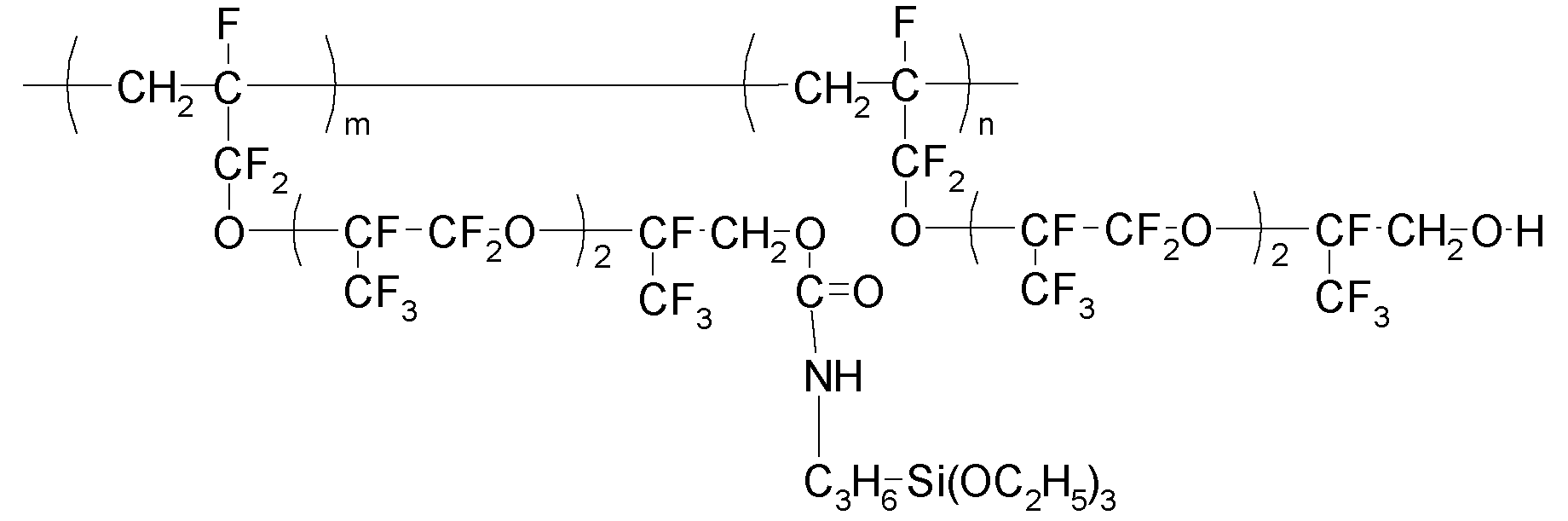
合成例5(OH基を有する含フッ素アリルエーテルの共重合体の合成(c))
攪拌装置、温度計を備えた100mlのガラス製四つ口フラスコに、AEH1を9.6gと、下記式:
攪拌装置、温度計を備えた100mlのガラス製四つ口フラスコに、AEH1を9.6gと、下記式:


得られた固体をアセトンに溶解させたものをHCFC225/n-ヘキサン=1/1溶液に注ぎ、分離、真空乾燥させ、無色透明な重合体15.5gを得た。
この重合体を19F-NMR、1H-NMR分析、IR分析により分析したところ、上記のヒドロキシル基含有含フッ素アリルエーテルと、メチルエステル構造を有する含フッ素アリルエーテルの構造単位からなる含フッ素共重合体であった。その組成比はNMRより、42:58(モル比)と求められた。また、テトラヒドロフラン(THF)を溶媒に用いるGPC分析により測定した数平均分子量は7200、重量平均分子量は11000であった。得られたポリマーは、下記式:
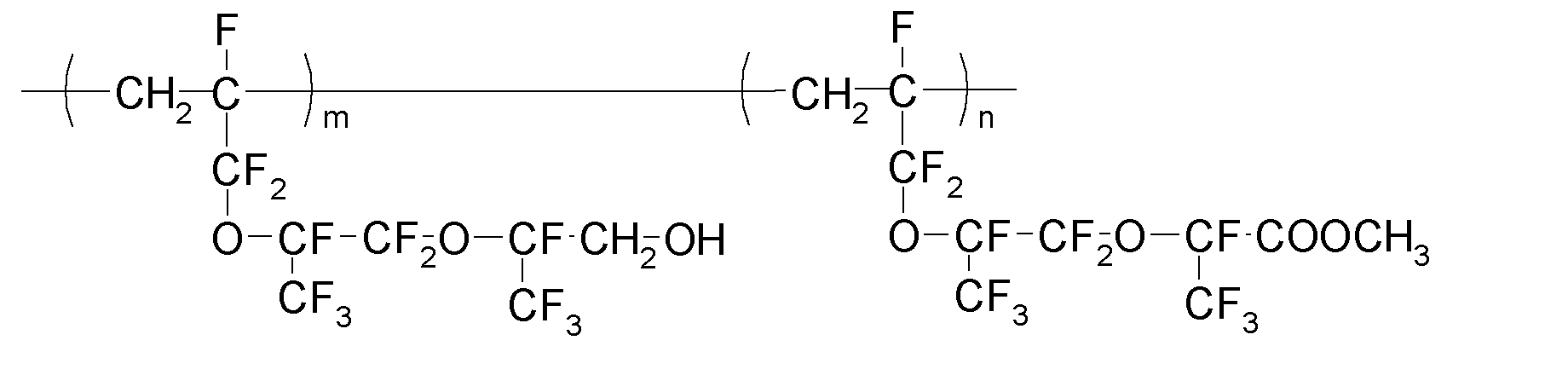
合成例6(加水分解性金属アルコキシド含有ポリマー(合成例5のトリエトキシシリル変性)の合成
100mlの四つ口ガラス製フラスコに、合成例5で得られたポリマーを10g(MW=11000)、あらかじめモレキュラーシーブス4Aで脱水したメチルイソブチルケトン(MIBK)を40g、ジブチルスズジラウリレートを2.3mg加えた後、窒素雰囲気下45℃で溶解させた。その後、3-トリエトキシシリルプロピルイソシアネート0.89gを2分かけて滴下した。滴下後、45℃で72時間攪拌し、IRスペクトルにおけるイソシアネート由来のピーク(2274cm-1)の消失をもって反応の終了を確認した。19F-NMRより求めた変性率は20%だった。得られたポリマーは、下記式:
100mlの四つ口ガラス製フラスコに、合成例5で得られたポリマーを10g(MW=11000)、あらかじめモレキュラーシーブス4Aで脱水したメチルイソブチルケトン(MIBK)を40g、ジブチルスズジラウリレートを2.3mg加えた後、窒素雰囲気下45℃で溶解させた。その後、3-トリエトキシシリルプロピルイソシアネート0.89gを2分かけて滴下した。滴下後、45℃で72時間攪拌し、IRスペクトルにおけるイソシアネート由来のピーク(2274cm-1)の消失をもって反応の終了を確認した。19F-NMRより求めた変性率は20%だった。得られたポリマーは、下記式:
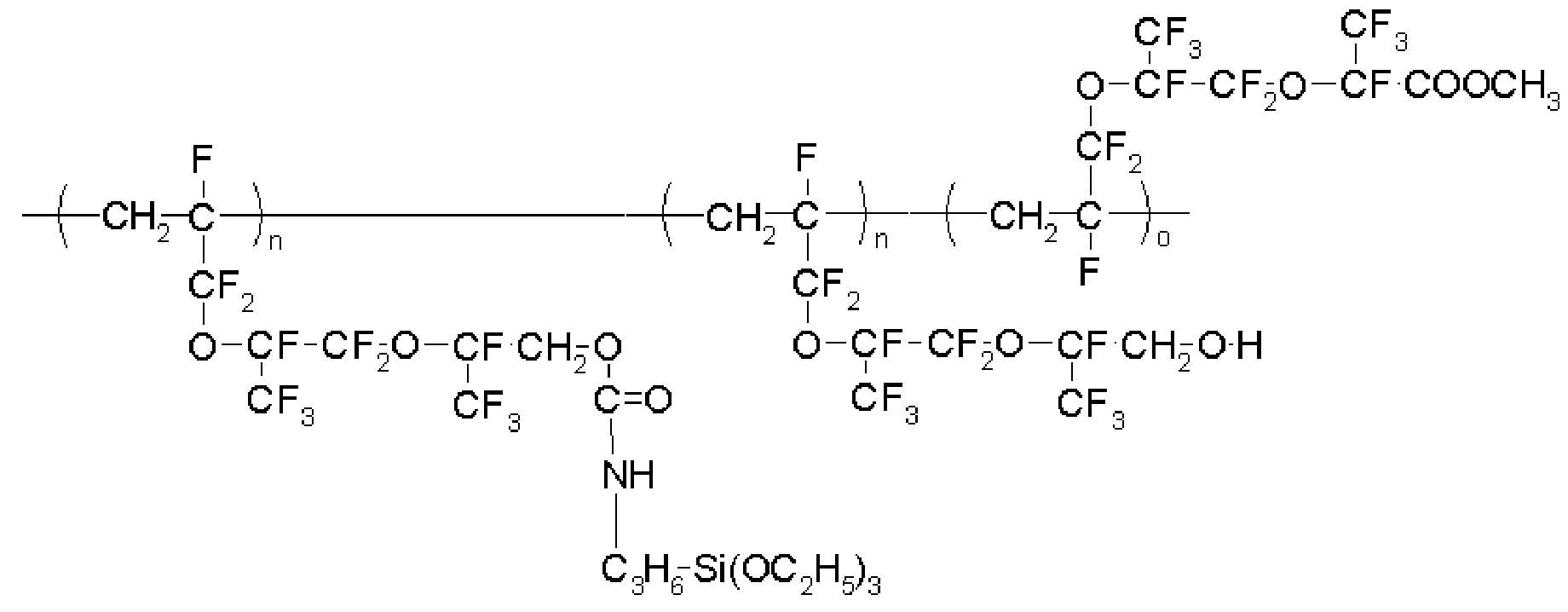
合成例7(OH基を有する含フッ素アリルエーテルとフッ化ビニリデンの共重合体の合成(d))
バルブ、圧力ゲージ、温度計を備えた300ml容のステンレススチール製オートクレーブに、AEH1を34.2gとCH3CCl2F(HCFC-141b)を200g、ジノルマルプロピルパーオキシカーボネート(NPP)の50重量%メタノール溶液を0.16g入れ、ドライアイス/メタノール溶液で冷却しながら系内をチッ素ガスで充分置換した。ついでバルブからフッ化ビニリデン(VdF)を5.8g仕込み、40℃にて振とうさせながら反応を行った。反応の進行とともに、系内のゲージ圧が反応前の4.4MPaGから12時間後に0.98MPaGまで低下した。
バルブ、圧力ゲージ、温度計を備えた300ml容のステンレススチール製オートクレーブに、AEH1を34.2gとCH3CCl2F(HCFC-141b)を200g、ジノルマルプロピルパーオキシカーボネート(NPP)の50重量%メタノール溶液を0.16g入れ、ドライアイス/メタノール溶液で冷却しながら系内をチッ素ガスで充分置換した。ついでバルブからフッ化ビニリデン(VdF)を5.8g仕込み、40℃にて振とうさせながら反応を行った。反応の進行とともに、系内のゲージ圧が反応前の4.4MPaGから12時間後に0.98MPaGまで低下した。
この時点で未反応モノマーを放出し、析出した固形物を取り出し、アセトンに溶解させ、ついでヘキサンとトルエンの混合溶剤(50/50)で再沈殿させることにより共重合体を分離した。この共重合体を恒量になるまで真空乾燥し、共重合体31.2gを得た。
この共重合体の組成比は、1H-MNR分析および19F-NMR分析により分析したところ、OH基含有含フッ素アリルエーテル/VdFが45/55(モル%)であった。また、THFを溶媒として用いるGPC分析により測定した数平均分子量は12000、重量平均分子量は18000であった。得られたポリマーは、下記式:

合成例8(加水分解性金属アルコキシド含有ポリマー(合成例7のトリエトキシシリル変性)の合成)
100mlの四つ口ガラス製フラスコに、合成例5で得られたポリマーを10g(MW=11000)、あらかじめモレキュラーシーブス4Aで脱水したメチルイソブチルケトン(MIBK)を40g、ジブチルスズジラウリレートを2.3mg加えた後、窒素雰囲気下45℃で溶解させた。その後、3-トリエトキシシリルプロピルイソシアネート0.89gを2分かけて滴下した。滴下後、45℃で72時間攪拌し、IRスペクトルにおけるイソシアネート由来のピーク(2274cm-1)の消失をもって反応の終了を確認した。19F-NMRより求めた変性率は23%だった。得られたポリマーは、下記式:
100mlの四つ口ガラス製フラスコに、合成例5で得られたポリマーを10g(MW=11000)、あらかじめモレキュラーシーブス4Aで脱水したメチルイソブチルケトン(MIBK)を40g、ジブチルスズジラウリレートを2.3mg加えた後、窒素雰囲気下45℃で溶解させた。その後、3-トリエトキシシリルプロピルイソシアネート0.89gを2分かけて滴下した。滴下後、45℃で72時間攪拌し、IRスペクトルにおけるイソシアネート由来のピーク(2274cm-1)の消失をもって反応の終了を確認した。19F-NMRより求めた変性率は23%だった。得られたポリマーは、下記式:

実施例1(硬化条件および硬化物の外観評価)
合成例2-1で得られた加水分解性金属アルコキシド含有ポリマー溶液 5g(変性量5mol%、20wt% MIBK溶液)と日揮触媒化成社製 中空微粒子 スルーリア(20.5wt% MIBK溶液 平均粒径70~80nm 粒子屈折率1.25)5gを室温で混合した後、スピンコーターを用いて500rpmで5秒、引き続き3000rpmで25秒の条件で、シリコンウェハー上に塗布した。ホットステージを用いて120℃で1時間の条件で熱硬化させたところ、IRでSi-OHの吸収が確認できたので、さらに、200℃、10分の条件で加熱した結果、Si-OHの吸収が消え、透明な硬化膜が得られた。
合成例2-1で得られた加水分解性金属アルコキシド含有ポリマー溶液 5g(変性量5mol%、20wt% MIBK溶液)と日揮触媒化成社製 中空微粒子 スルーリア(20.5wt% MIBK溶液 平均粒径70~80nm 粒子屈折率1.25)5gを室温で混合した後、スピンコーターを用いて500rpmで5秒、引き続き3000rpmで25秒の条件で、シリコンウェハー上に塗布した。ホットステージを用いて120℃で1時間の条件で熱硬化させたところ、IRでSi-OHの吸収が確認できたので、さらに、200℃、10分の条件で加熱した結果、Si-OHの吸収が消え、透明な硬化膜が得られた。
実施例2(硬化物の外観評価)
合成例2-1~2-5で得られた加水分解性金属アルコキシド含有ポリマー溶液 5g(変性量5mol%~98mol%、20wt% MIBK溶液)に対して日揮触媒化成社製 中空微粒子 スルーリア(20.5wt% MIBK溶液 平均粒径70~80nm 粒子屈折率1.25)を、ポリマー:中空微粒子の重量比が90:10、80:20、70:30、60:40、50:50になるように室温で混合した後、スピンコーターを用いて500rpm、30秒の条件で、スライドガラス上に塗布した。ホットステージを用いて120℃、1時間、200℃、10分の条件で加熱硬化させ、外観を目視で確認した。結果を表2に示す。
目視確認による判定基準を以下に示す。
○:透明
△:一部白濁
×:全体白濁
合成例2-1~2-5で得られた加水分解性金属アルコキシド含有ポリマー溶液 5g(変性量5mol%~98mol%、20wt% MIBK溶液)に対して日揮触媒化成社製 中空微粒子 スルーリア(20.5wt% MIBK溶液 平均粒径70~80nm 粒子屈折率1.25)を、ポリマー:中空微粒子の重量比が90:10、80:20、70:30、60:40、50:50になるように室温で混合した後、スピンコーターを用いて500rpm、30秒の条件で、スライドガラス上に塗布した。ホットステージを用いて120℃、1時間、200℃、10分の条件で加熱硬化させ、外観を目視で確認した。結果を表2に示す。
目視確認による判定基準を以下に示す。
○:透明
△:一部白濁
×:全体白濁
比較例1
合成例1で得られたOH基含有ポリマーをMIBKに溶解させて20wt%溶液を作製した。このポリマー溶液を用いる以外は実施例2と同様にしてスライドガラス上に塗布し、加熱後の外観を目視で観察した。結果を表2に示す。
合成例1で得られたOH基含有ポリマーをMIBKに溶解させて20wt%溶液を作製した。このポリマー溶液を用いる以外は実施例2と同様にしてスライドガラス上に塗布し、加熱後の外観を目視で観察した。結果を表2に示す。

実施例3(硬化物の外観評価)
合成例4で得られた加水分解性金属アルコキシド含有ポリマー溶液 5g(変性量8mol%、20wt% MIBK溶液)に対して日揮触媒化成社製 中空微粒子 スルーリア(20.5wt% MIBK溶液 平均粒径70~80nm 粒子屈折率1.25)を、ポリマー:中空微粒子の重量比が60:40になるように室温で混合した後、スピンコーターを用いて500rpm、30秒の条件で、スライドガラス上に塗布した。ホットステージを用いて120℃、1時間、200℃、10分の条件で加熱硬化させ、外観を目視で確認した。結果を表3に示す。
合成例4で得られた加水分解性金属アルコキシド含有ポリマー溶液 5g(変性量8mol%、20wt% MIBK溶液)に対して日揮触媒化成社製 中空微粒子 スルーリア(20.5wt% MIBK溶液 平均粒径70~80nm 粒子屈折率1.25)を、ポリマー:中空微粒子の重量比が60:40になるように室温で混合した後、スピンコーターを用いて500rpm、30秒の条件で、スライドガラス上に塗布した。ホットステージを用いて120℃、1時間、200℃、10分の条件で加熱硬化させ、外観を目視で確認した。結果を表3に示す。
実施例4(硬化物の外観評価)
合成例6で得られた加水分解性金属アルコキシド含有ポリマー溶液 5g(変性量20mol%、20wt% MIBK溶液)に対して日揮触媒化成社製中空微粒子 スルーリア(20.5wt% MIBK溶液 平均粒径70~80nm 粒子屈折率1.25)を、ポリマー:中空微粒子の重量比が60:40になるように室温で混合した後、スピンコーターを用いて500rpm、30秒の条件で、スライドガラス上に塗布した。ホットステージを用いて120℃、1時間、200℃、10分の条件で加熱硬化させ、外観を目視で確認した。結果を表3に示す。
合成例6で得られた加水分解性金属アルコキシド含有ポリマー溶液 5g(変性量20mol%、20wt% MIBK溶液)に対して日揮触媒化成社製中空微粒子 スルーリア(20.5wt% MIBK溶液 平均粒径70~80nm 粒子屈折率1.25)を、ポリマー:中空微粒子の重量比が60:40になるように室温で混合した後、スピンコーターを用いて500rpm、30秒の条件で、スライドガラス上に塗布した。ホットステージを用いて120℃、1時間、200℃、10分の条件で加熱硬化させ、外観を目視で確認した。結果を表3に示す。
実施例5(硬化物の外観評価)
合成例8で得られた加水分解性金属アルコキシド含有ポリマー溶液 5g(変性量23mol%、20wt% MIBK溶液)に対して日揮触媒化成社製 中空微粒子 スルーリア(20.5wt% MIBK溶液 平均粒径70~80nm 粒子屈折率1.25)を、ポリマー:中空微粒子の重量比が60:40になるように室温で混合した後、スピンコーターを用いて500rpm、30秒の条件で、スライドガラス上に塗布した。ホットステージを用いて120℃、1時間、200℃、10分の条件で加熱硬化させ、外観を目視で確認した。結果を表3に示す。
合成例8で得られた加水分解性金属アルコキシド含有ポリマー溶液 5g(変性量23mol%、20wt% MIBK溶液)に対して日揮触媒化成社製 中空微粒子 スルーリア(20.5wt% MIBK溶液 平均粒径70~80nm 粒子屈折率1.25)を、ポリマー:中空微粒子の重量比が60:40になるように室温で混合した後、スピンコーターを用いて500rpm、30秒の条件で、スライドガラス上に塗布した。ホットステージを用いて120℃、1時間、200℃、10分の条件で加熱硬化させ、外観を目視で確認した。結果を表3に示す。
比較例2
実施例3~5で用いた加水分解性金属アルコキシド含有ポリマー溶液のかわりに、それぞれの変性前のポリマーである合成例3,5,7のポリマーを用いた以外は実施例3~5と同様にして外観を目視で観察した。結果を表3に示す。
実施例3~5で用いた加水分解性金属アルコキシド含有ポリマー溶液のかわりに、それぞれの変性前のポリマーである合成例3,5,7のポリマーを用いた以外は実施例3~5と同様にして外観を目視で観察した。結果を表3に示す。
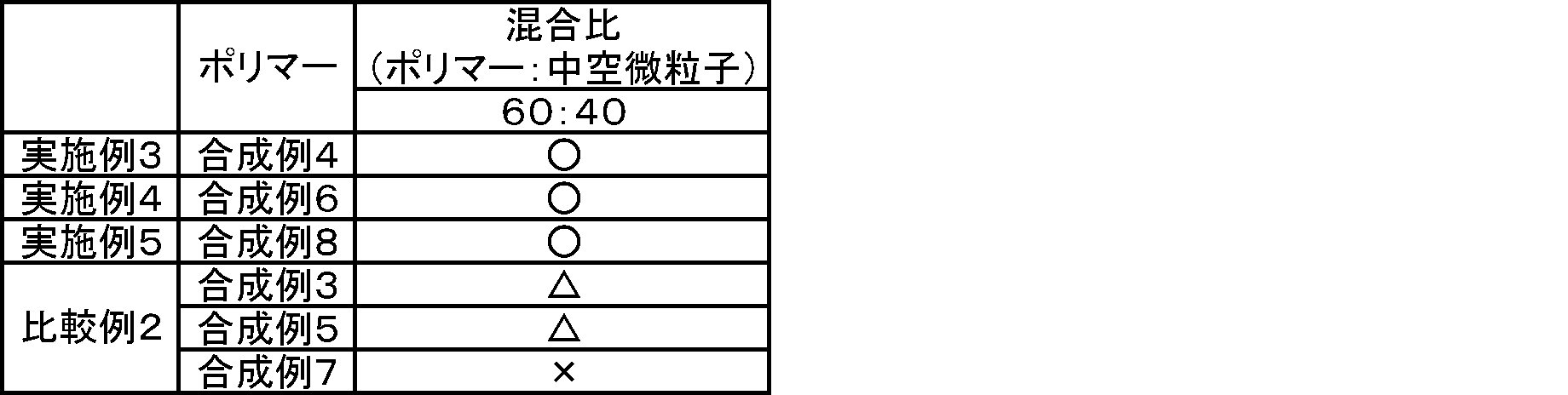
実施例6(屈折率の測定)
合成例2-1で得られた加水分解性金属アルコキシド含有ポリマー溶液 5g(変性量5mol%、20wt% MIBK溶液)に対して日揮触媒化成社製 中空微粒子 スルーリア(20.5wt% MIBK溶液 平均粒径70~80nm 粒子屈折率1.25)を、ポリマー:中空微粒子の重量比が60:40、55:45、50:50、45:55、40:60になるように室温で混合した後、スピンコーターを用いて500rpm、30秒の条件で、シリコンウェハー上に塗布した。ホットステージを用いて120℃、1時間、200℃、10分の条件で加熱硬化させ、膜厚、および屈折率を、分光エリプソを用いて測定した。膜厚はいずれも2.6μm程度であった。屈折率の結果を表4に示す。なお、外観はいずれも透明であった。
合成例2-1で得られた加水分解性金属アルコキシド含有ポリマー溶液 5g(変性量5mol%、20wt% MIBK溶液)に対して日揮触媒化成社製 中空微粒子 スルーリア(20.5wt% MIBK溶液 平均粒径70~80nm 粒子屈折率1.25)を、ポリマー:中空微粒子の重量比が60:40、55:45、50:50、45:55、40:60になるように室温で混合した後、スピンコーターを用いて500rpm、30秒の条件で、シリコンウェハー上に塗布した。ホットステージを用いて120℃、1時間、200℃、10分の条件で加熱硬化させ、膜厚、および屈折率を、分光エリプソを用いて測定した。膜厚はいずれも2.6μm程度であった。屈折率の結果を表4に示す。なお、外観はいずれも透明であった。
実施例7(屈折率の測定)
合成例2-2で得られた加水分解性金属アルコキシド含有ポリマー溶液 5g(変性量10mol%、20wt% MIBK溶液)に対して日揮触媒化成社製 中空微粒子 スルーリア(20.5wt% MIBK溶液 平均粒径70~80nm 粒子屈折率1.25)を、ポリマー:中空微粒子の重量比が60:40、55:45、50:50になるように室温で混合した後、スピンコーターを用いて500rpm、30秒の条件で、シリコンウェハー上に塗布した。ホットステージを用いて120℃、1時間、200℃、10分の条件で加熱硬化させ、膜厚、および屈折率を分光エリプソを用いて測定した。膜厚はいずれも3.5μm程度であった。屈折率の結果を表4に示す。なお、外観はいずれも透明であった。
合成例2-2で得られた加水分解性金属アルコキシド含有ポリマー溶液 5g(変性量10mol%、20wt% MIBK溶液)に対して日揮触媒化成社製 中空微粒子 スルーリア(20.5wt% MIBK溶液 平均粒径70~80nm 粒子屈折率1.25)を、ポリマー:中空微粒子の重量比が60:40、55:45、50:50になるように室温で混合した後、スピンコーターを用いて500rpm、30秒の条件で、シリコンウェハー上に塗布した。ホットステージを用いて120℃、1時間、200℃、10分の条件で加熱硬化させ、膜厚、および屈折率を分光エリプソを用いて測定した。膜厚はいずれも3.5μm程度であった。屈折率の結果を表4に示す。なお、外観はいずれも透明であった。

実施例8(ヘイズ値および全光線透過率の測定)
合成例2-1で得られた加水分解性金属アルコキシド含有ポリマー溶液 5g(変性量5mol%、20wt% MIBK溶液)に対して日揮触媒化成社製 中空微粒子 スルーリア(20.5wt% MIBK溶液 平均粒径70~80nm 粒子屈折率1.25)を、ポリマー:中空微粒子の重量比が60:40、55:45、50:50になるように室温で混合した後、スピンコーターを用いて500rpm、30秒の条件で、スライドガラス上に塗布した。ホットステージを用いて120℃、1時間、200℃、10分の条件で加熱硬化させ、ヘイズ値、および全光線透過率を測定した。結果を表5に示す。
合成例2-1で得られた加水分解性金属アルコキシド含有ポリマー溶液 5g(変性量5mol%、20wt% MIBK溶液)に対して日揮触媒化成社製 中空微粒子 スルーリア(20.5wt% MIBK溶液 平均粒径70~80nm 粒子屈折率1.25)を、ポリマー:中空微粒子の重量比が60:40、55:45、50:50になるように室温で混合した後、スピンコーターを用いて500rpm、30秒の条件で、スライドガラス上に塗布した。ホットステージを用いて120℃、1時間、200℃、10分の条件で加熱硬化させ、ヘイズ値、および全光線透過率を測定した。結果を表5に示す。
実施例9(ヘイズ値および全光線透過率の測定)
合成例2-2で得られた加水分解性金属アルコキシド含有ポリマー溶液 5g(変性量10mol%、20wt% MIBK溶液)に対して日揮触媒化成社製 中空微粒子 スルーリア(20.5wt% MIBK溶液 平均粒径70~80nm 粒子屈折率1.25)を、ポリマー:中空微粒子の重量比が60:40、55:45、50:50になるように室温で混合した後、スピンコーターを用いて500rpm、30秒の条件で、スライドガラス上に塗布した。ホットステージを用いて120℃、1時間、200℃、10分の条件で加熱硬化させ、ヘイズ値、および全光線透過率を測定した。結果を表5に示す。
合成例2-2で得られた加水分解性金属アルコキシド含有ポリマー溶液 5g(変性量10mol%、20wt% MIBK溶液)に対して日揮触媒化成社製 中空微粒子 スルーリア(20.5wt% MIBK溶液 平均粒径70~80nm 粒子屈折率1.25)を、ポリマー:中空微粒子の重量比が60:40、55:45、50:50になるように室温で混合した後、スピンコーターを用いて500rpm、30秒の条件で、スライドガラス上に塗布した。ホットステージを用いて120℃、1時間、200℃、10分の条件で加熱硬化させ、ヘイズ値、および全光線透過率を測定した。結果を表5に示す。
比較例3
合成例1で得られたポリマーをMIBKに溶解させ20wt%とした。このポリマー溶液を、合成例2-1で得られた加水分解性金属アルコキシド含有ポリマー溶液の代わりに用いる以外は実施例8と同様にしてスライドガラス上に塗膜を作製したが、いずれの組成も白濁したため、ヘイズ値のみ測定した。結果を表5に示す。
合成例1で得られたポリマーをMIBKに溶解させ20wt%とした。このポリマー溶液を、合成例2-1で得られた加水分解性金属アルコキシド含有ポリマー溶液の代わりに用いる以外は実施例8と同様にしてスライドガラス上に塗膜を作製したが、いずれの組成も白濁したため、ヘイズ値のみ測定した。結果を表5に示す。
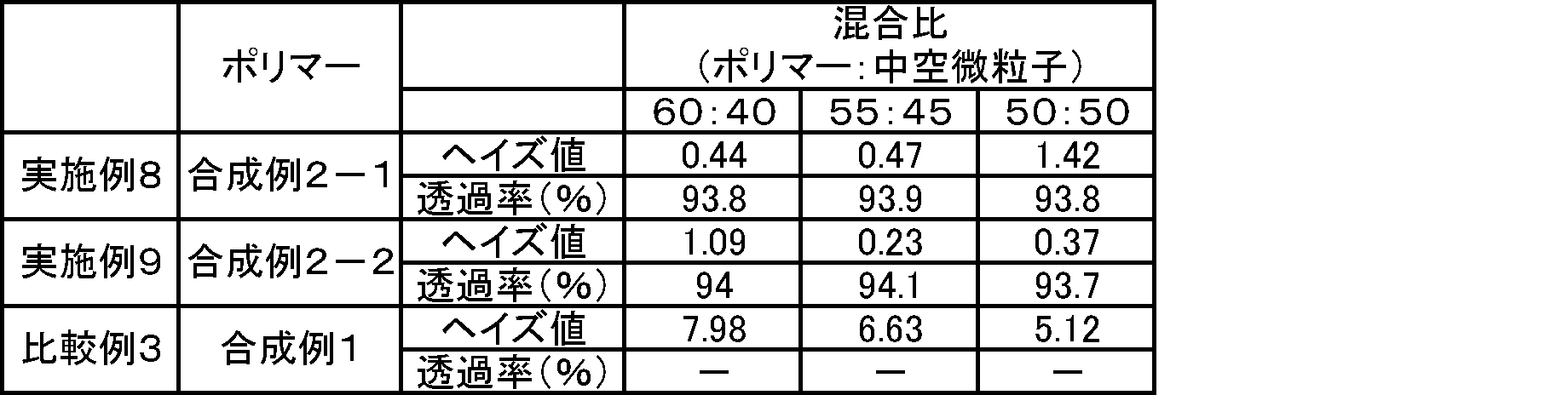
実施例10(耐久性評価)
合成例2-2で得られた加水分解性金属アルコキシド含有ポリマー溶液 5g(変性量10mol%、20wt% MIBK溶液)に対して日揮触媒化成社製 中空微粒子 スルーリア(20.5wt% MIBK溶液 平均粒径70~80nm 粒子屈折率1.25)を5g(ポリマー:中空微粒子の重量比が50:50)室温で混合した後、スピンコーターを用いて500rpm、30秒の条件で、スライドガラス上に塗布した。ホットステージを用いて120℃、1時間、200℃、10分の条件で加熱硬化させた。膜厚及び屈折率を分光エリプソで測定した結果、膜厚3.2μm、屈折率1.301であった。引き続き、日立分光光度計 U-4100を用いて吸収スペクトルを測定した(初期値)。加熱硬化させて得られた塗膜は、可視帯域(400~650nm)において非常に高い透明性を示した。
合成例2-2で得られた加水分解性金属アルコキシド含有ポリマー溶液 5g(変性量10mol%、20wt% MIBK溶液)に対して日揮触媒化成社製 中空微粒子 スルーリア(20.5wt% MIBK溶液 平均粒径70~80nm 粒子屈折率1.25)を5g(ポリマー:中空微粒子の重量比が50:50)室温で混合した後、スピンコーターを用いて500rpm、30秒の条件で、スライドガラス上に塗布した。ホットステージを用いて120℃、1時間、200℃、10分の条件で加熱硬化させた。膜厚及び屈折率を分光エリプソで測定した結果、膜厚3.2μm、屈折率1.301であった。引き続き、日立分光光度計 U-4100を用いて吸収スペクトルを測定した(初期値)。加熱硬化させて得られた塗膜は、可視帯域(400~650nm)において非常に高い透明性を示した。
次に、以下の3種類の条件で塗膜の耐久性を評価した。
〔1〕265℃10分間の高温耐熱試験
〔2〕85℃、85%の高温高湿耐久試験(15時間、58時間、89時間、187時間、303時間、463時間、624時間経過後の吸収スペクトルを測定)
〔3〕125℃における乾熱耐久試験(15時間、58時間、89時間、275時間、391時間、553時間、714時間、899時間、1035時間経過後の吸収スペクトルを測定)
〔1〕265℃10分間の高温耐熱試験
〔2〕85℃、85%の高温高湿耐久試験(15時間、58時間、89時間、187時間、303時間、463時間、624時間経過後の吸収スペクトルを測定)
〔3〕125℃における乾熱耐久試験(15時間、58時間、89時間、275時間、391時間、553時間、714時間、899時間、1035時間経過後の吸収スペクトルを測定)
265℃、10分間経過後(高温耐熱試験)、85℃、85%、624時間経過後(高温高湿耐久試験)、および、125℃、1035時間経過後(乾熱耐久試験)、の着色の有無、屈折率の変化、および、450nmおよび550nmにおける透過率の変化を表6に示す。ほぼ、初期値を維持しており、高い耐久性が確認できた。

また、上記試験後の吸収スペクトルを測定した結果を、初期値と重ねて図3~5に示す。図3は、265℃10分間の高温耐熱試験前後の吸収スペクトルを示すグラフである。図4は、85℃、85%の高温高湿耐久試験前後(初期値と624時間後)の吸収スペクトルを示すグラフである。図5は、初期値と125℃における乾熱耐久試験前後(初期値と1035時間後)の吸収スペクトルを示すグラフである。スペクトルで見ても、図3~5に示すように、初期の吸収スペクトルとほとんどかわらず、非常に高い耐久性を示した。また、外観においても、剥離等もまったく見られなかった。
本発明の硬化性樹脂組成物は、屈折率が低く、かつ透明性が高く、更には耐熱性に優れる薄膜を形成することができるため、CCDモジュール等の受光素子に用いる封止材の原料として特に好適である。
11、21:シリコンウェハー
12、22:CCD素子部
13、23:封止剤層
14、24:ガラス
15、25:貫通電極
16、26:外部に接続する電極
12、22:CCD素子部
13、23:封止剤層
14、24:ガラス
15、25:貫通電極
16、26:外部に接続する電極
Claims (10)
- 硬化性含フッ素ポリマー(A)、および、中空微粒子(B)を含み、
該硬化性含フッ素ポリマー(A)は、
式(2):

構造単位Mは、式(M):

構造単位Nは式(N):

構造単位Aは該式(M)および(N)で示される構造単位を与える単量体と共重合可能な単量体に由来する構造単位である]で示され、構造単位Mを0.1~100モル%、構造単位Nを0~99.9モル%および構造単位Aを0~99.9モル%含み、数平均分子量が500~1,000,000である
ことを特徴とする硬化性樹脂組成物。 - 中空微粒子(B)は、中空シリカ微粒子である
請求項1記載の硬化性樹脂組成物。 - 中空微粒子(B)は、屈折率が1.45以下である請求項1又は2記載の硬化性樹脂組成物。
- 構造単位Mは、式(2-2):

式(D):

請求項1、2又は3記載の硬化性樹脂組成物。 - 中空シリカ微粒子(B)は、硬化性含フッ素ポリマー(A)100質量部に対し、1~150質量部である請求項1、2、3又は4記載の硬化性樹脂組成物。
- 請求項1、2、3、4又は5記載の硬化性樹脂組成物を硬化して得られることを特徴とする硬化物。
- 屈折率が1.32以下である請求項6記載の硬化物。
- 光学素子用の封止部材である請求項6または7記載の硬化物。
- 光学素子が受光素子である請求項8記載の硬化物。
- 光学素子が発光素子である請求項8記載の硬化物。
Applications Claiming Priority (2)
| Application Number | Priority Date | Filing Date | Title |
|---|---|---|---|
| JP2011-076470 | 2011-03-30 | ||
| JP2011076470 | 2011-03-30 |
Publications (1)
| Publication Number | Publication Date |
|---|---|
| WO2012133543A1 true WO2012133543A1 (ja) | 2012-10-04 |
Family
ID=46931251
Family Applications (1)
| Application Number | Title | Priority Date | Filing Date |
|---|---|---|---|
| PCT/JP2012/058166 Ceased WO2012133543A1 (ja) | 2011-03-30 | 2012-03-28 | 硬化性樹脂組成物及び硬化物 |
Country Status (2)
| Country | Link |
|---|---|
| JP (1) | JP5223977B2 (ja) |
| WO (1) | WO2012133543A1 (ja) |
Families Citing this family (1)
| Publication number | Priority date | Publication date | Assignee | Title |
|---|---|---|---|---|
| EP4089447A4 (en) * | 2020-01-08 | 2024-01-24 | Daikin Industries, Ltd. | PROTECTIVE FILM FOR DISPLAY |
Citations (2)
| Publication number | Priority date | Publication date | Assignee | Title |
|---|---|---|---|---|
| JP2007099828A (ja) * | 2005-09-30 | 2007-04-19 | Matsushita Electric Works Ltd | コーティング材組成物及び塗装品 |
| JP2008085172A (ja) * | 2006-09-28 | 2008-04-10 | Shinetsu Astec Kk | 発光装置 |
-
2012
- 2012-03-28 WO PCT/JP2012/058166 patent/WO2012133543A1/ja not_active Ceased
- 2012-03-28 JP JP2012073521A patent/JP5223977B2/ja active Active
Patent Citations (2)
| Publication number | Priority date | Publication date | Assignee | Title |
|---|---|---|---|---|
| JP2007099828A (ja) * | 2005-09-30 | 2007-04-19 | Matsushita Electric Works Ltd | コーティング材組成物及び塗装品 |
| JP2008085172A (ja) * | 2006-09-28 | 2008-04-10 | Shinetsu Astec Kk | 発光装置 |
Also Published As
| Publication number | Publication date |
|---|---|
| JP2012214752A (ja) | 2012-11-08 |
| JP5223977B2 (ja) | 2013-06-26 |
Similar Documents
| Publication | Publication Date | Title |
|---|---|---|
| JP5293588B2 (ja) | 光硬化性含フッ素ポリマーを含む光学材料および光硬化性含フッ素樹脂組成物 | |
| EP1389634B1 (en) | Surface-treating agent comprising inorganic/organic composite material | |
| KR20150143573A (ko) | 실록산 올리고머 및 무기미립자를 포함하는 경화성 조성물 | |
| JP5223978B2 (ja) | 光学素子封止用含フッ素樹脂組成物、及び、硬化物 | |
| US20110230584A1 (en) | Siloxane resin composition and protective film for touch panel using the same | |
| JP2016027400A (ja) | 積層用樹脂組成物及びその用途 | |
| WO2013175962A1 (ja) | 含フッ素重合体及びその製造方法 | |
| JP5288018B2 (ja) | 硬化性樹脂組成物、及び、硬化物 | |
| JP2012109542A (ja) | 塗布型絶縁膜形成用含フッ素組成物、絶縁膜、及び薄膜トランジスタ | |
| JP2013087162A (ja) | 含フッ素ポリマー、硬化性樹脂組成物、及び、硬化物 | |
| JP5772891B2 (ja) | 含フッ素重合体及びその製造方法 | |
| USRE44096E1 (en) | Fluorine-containing compound having hydrolyzable metal alkoxide moiety, curable fluorine-containing polymer prepared from the same compound, and curable fluorine-containing resin composition comprising the same polymer | |
| JP5223977B2 (ja) | 硬化性樹脂組成物及び硬化物 | |
| KR101317159B1 (ko) | 반사 방지막 형성용 조성물 및 반사 방지막 | |
| JP2022053373A (ja) | 樹脂組成物 | |
| JP5392426B2 (ja) | 含フッ素重合体及びその製造方法 | |
| KR20180012104A (ko) | 저굴절층 형성용 광경화성 코팅 조성물 | |
| JP4661687B2 (ja) | フッ素含有率の高いエチレン性不飽和基含有含フッ素共重合体、及びその製造方法 | |
| KR20200095249A (ko) | 경화형 수지 조성물, 그로부터 형성된 경화막, 및 상기 경화막을 갖는 전자 장치 | |
| JP2017149895A (ja) | 樹脂組成物 |
Legal Events
| Date | Code | Title | Description |
|---|---|---|---|
| 121 | Ep: the epo has been informed by wipo that ep was designated in this application |
Ref document number: 12765162 Country of ref document: EP Kind code of ref document: A1 |
|
| NENP | Non-entry into the national phase |
Ref country code: DE |
|
| 122 | Ep: pct application non-entry in european phase |
Ref document number: 12765162 Country of ref document: EP Kind code of ref document: A1 |