WO2012133275A1 - Kluyveromyces属の変異体酵母及びこれを用いたエタノールの製造方法 - Google Patents
Kluyveromyces属の変異体酵母及びこれを用いたエタノールの製造方法 Download PDFInfo
- Publication number
- WO2012133275A1 WO2012133275A1 PCT/JP2012/057704 JP2012057704W WO2012133275A1 WO 2012133275 A1 WO2012133275 A1 WO 2012133275A1 JP 2012057704 W JP2012057704 W JP 2012057704W WO 2012133275 A1 WO2012133275 A1 WO 2012133275A1
- Authority
- WO
- WIPO (PCT)
- Prior art keywords
- gene
- yeast
- derived
- kluyveromyces
- amino acid
- Prior art date
- Legal status (The legal status is an assumption and is not a legal conclusion. Google has not performed a legal analysis and makes no representation as to the accuracy of the status listed.)
- Ceased
Links
Images



Classifications
-
- C—CHEMISTRY; METALLURGY
- C12—BIOCHEMISTRY; BEER; SPIRITS; WINE; VINEGAR; MICROBIOLOGY; ENZYMOLOGY; MUTATION OR GENETIC ENGINEERING
- C12P—FERMENTATION OR ENZYME-USING PROCESSES TO SYNTHESISE A DESIRED CHEMICAL COMPOUND OR COMPOSITION OR TO SEPARATE OPTICAL ISOMERS FROM A RACEMIC MIXTURE
- C12P7/00—Preparation of oxygen-containing organic compounds
- C12P7/02—Preparation of oxygen-containing organic compounds containing a hydroxy group
- C12P7/04—Preparation of oxygen-containing organic compounds containing a hydroxy group acyclic
- C12P7/06—Ethanol, i.e. non-beverage
-
- C—CHEMISTRY; METALLURGY
- C12—BIOCHEMISTRY; BEER; SPIRITS; WINE; VINEGAR; MICROBIOLOGY; ENZYMOLOGY; MUTATION OR GENETIC ENGINEERING
- C12N—MICROORGANISMS OR ENZYMES; COMPOSITIONS THEREOF; PROPAGATING, PRESERVING, OR MAINTAINING MICROORGANISMS; MUTATION OR GENETIC ENGINEERING; CULTURE MEDIA
- C12N9/00—Enzymes; Proenzymes; Compositions thereof; Processes for preparing, activating, inhibiting, separating or purifying enzymes
- C12N9/0004—Oxidoreductases (1.)
- C12N9/0006—Oxidoreductases (1.) acting on CH-OH groups as donors (1.1)
-
- C—CHEMISTRY; METALLURGY
- C12—BIOCHEMISTRY; BEER; SPIRITS; WINE; VINEGAR; MICROBIOLOGY; ENZYMOLOGY; MUTATION OR GENETIC ENGINEERING
- C12N—MICROORGANISMS OR ENZYMES; COMPOSITIONS THEREOF; PROPAGATING, PRESERVING, OR MAINTAINING MICROORGANISMS; MUTATION OR GENETIC ENGINEERING; CULTURE MEDIA
- C12N15/00—Mutation or genetic engineering; DNA or RNA concerning genetic engineering, vectors, e.g. plasmids, or their isolation, preparation or purification; Use of hosts therefor
- C12N15/09—Recombinant DNA-technology
- C12N15/63—Introduction of foreign genetic material using vectors; Vectors; Use of hosts therefor; Regulation of expression
- C12N15/79—Vectors or expression systems specially adapted for eukaryotic hosts
- C12N15/80—Vectors or expression systems specially adapted for eukaryotic hosts for fungi
- C12N15/81—Vectors or expression systems specially adapted for eukaryotic hosts for fungi for yeasts
- C12N15/815—Vectors or expression systems specially adapted for eukaryotic hosts for fungi for yeasts for yeasts other than Saccharomyces
-
- C—CHEMISTRY; METALLURGY
- C12—BIOCHEMISTRY; BEER; SPIRITS; WINE; VINEGAR; MICROBIOLOGY; ENZYMOLOGY; MUTATION OR GENETIC ENGINEERING
- C12P—FERMENTATION OR ENZYME-USING PROCESSES TO SYNTHESISE A DESIRED CHEMICAL COMPOUND OR COMPOSITION OR TO SEPARATE OPTICAL ISOMERS FROM A RACEMIC MIXTURE
- C12P7/00—Preparation of oxygen-containing organic compounds
- C12P7/02—Preparation of oxygen-containing organic compounds containing a hydroxy group
- C12P7/04—Preparation of oxygen-containing organic compounds containing a hydroxy group acyclic
- C12P7/06—Ethanol, i.e. non-beverage
- C12P7/08—Ethanol, i.e. non-beverage produced as by-product or from waste or cellulosic material substrate
- C12P7/10—Ethanol, i.e. non-beverage produced as by-product or from waste or cellulosic material substrate substrate containing cellulosic material
-
- Y—GENERAL TAGGING OF NEW TECHNOLOGICAL DEVELOPMENTS; GENERAL TAGGING OF CROSS-SECTIONAL TECHNOLOGIES SPANNING OVER SEVERAL SECTIONS OF THE IPC; TECHNICAL SUBJECTS COVERED BY FORMER USPC CROSS-REFERENCE ART COLLECTIONS [XRACs] AND DIGESTS
- Y02—TECHNOLOGIES OR APPLICATIONS FOR MITIGATION OR ADAPTATION AGAINST CLIMATE CHANGE
- Y02E—REDUCTION OF GREENHOUSE GAS [GHG] EMISSIONS, RELATED TO ENERGY GENERATION, TRANSMISSION OR DISTRIBUTION
- Y02E50/00—Technologies for the production of fuel of non-fossil origin
- Y02E50/10—Biofuels, e.g. bio-diesel
Definitions
- the present invention relates to a mutant yeast using Kluyveromyces genus yeast and a method for producing ethanol using the same.
- Biomass containing lignocellulose is effectively used as a raw material for useful alcohols such as ethanol and organic acids.
- the biomass containing lignocellulose includes woody biomass and herbaceous biomass.
- Biomass containing lignocellulose such as woody biomass is mainly composed of cellulose, hemicellulose and lignin.
- cellulose or hemicellulose is hydrolyzed (saccharified) into constituent monosaccharides, and the monosaccharides are converted to ethanol by fermentation.
- Cellulose is composed of glucose
- hemicellulose is mainly composed of arabinose and xylose. Therefore, when ethanol is produced using biomass containing lignocellulose, it is desirable that not only glucose but also xylose is effectively used as a fermentation substrate.
- simultaneous saccharification and fermentation requires a microorganism that has heat resistance capable of fermentation in the reaction temperature range of saccharification enzyme (about 40 ° C. or higher) and can use not only glucose but also 5-monosaccharide xylose as a substrate.
- Non-Patent Documents 1 and 2 report functional analysis of an alcohol dehydrogenase gene (including a plurality of isomers) in Saccharomyces cerevisiae.
- Patent Document 1 discloses a recombinant yeast imparted with the ability to isomerize xylose into xylulose, and also describes reducing alcohol dehydrogenase activity.
- Kluyveromyces yeasts are highly expected as microorganisms useful for the above-described simultaneous saccharification and fermentation methods and the like because they have xylose utilization and heat resistance.
- Kluyveromyces yeast has a very poor ethanol yield from xylose, and no means for improving this is known. Therefore, in view of such circumstances, the present invention provides a mutant yeast belonging to the genus Kluyveromyces modified so as to improve the ethanol yield from xylose, and a method for producing ethanol using the mutant yeast. For the purpose.
- the present invention includes the following.
- yeast belonging to the genus Kluyveromyces at least selected from the group consisting of the ADH1 gene derived from Kluyveromyces marxianus ⁇ , the gene functionally equivalent to the ADH1 gene, the ADH4 gene derived from Kluyveromyces marxianus ⁇ ⁇ , and the gene functionally equivalent to the ADH4 gene Mutant yeast in which one gene is attenuated.
- the gene functionally equivalent to the ADH1 gene is derived from a yeast of the genus Kluyveromyces other than Kluyveromyces marxianus, and encodes any one of the following proteins (a) to (c): Mutant yeast.
- the mutant yeast according to the present invention can produce ethanol in a high yield in a medium containing xylose derived from biomass containing lignocellulose such as woody biomass.
- the method for producing ethanol according to the present invention can greatly improve ethanol production efficiency by utilizing a mutant yeast having a significantly improved ethanol yield from xylose.
- the mutant yeast according to the present invention is obtained by attenuating a specific alcohol dehydrogenase gene in Kluyveromyces genus yeast, and has a feature that the ethanol yield from xylose is improved.
- the Kluyveromyces genus yeast is K.estaestuarii, K. africanus, K. bacillisporus, K. blattae, K. dobzhanskii, K. hubeiensis, K. lactis, K. lodderae, K. marxianus, K. nonfermentans, K. It is meant to include yeasts such as. Piceae, K. sinensis, K. thermotolerans, K. waltii, K. wickerhamii and K. yarrowii. That is, the mutant yeast according to the present invention can be prepared by attenuating a specific alcohol dehydrogenase gene with respect to these specific Kluyveromyces yeasts and mutants thereof.
- Kluyveromyces marxianus which is known as a heat-resistant yeast.
- the Kluyveromyces x marxianus is not particularly limited, and a known strain stored so as to be distributable in a depository can be used, and a mutant derived from a known strain can also be used.
- a known strain of Kluyveromyces marxianus Kluyveromyces marxianus
- Kluyveromyces marxianus DMKU3-1042 can be mentioned.
- mutant strains derived from known strains include strains in which the ura3 gene or leu2 gene is disrupted in order to impart auxotrophy to the Kluyveromyces marxianus DMKU3-1042 strain.
- the mutant yeast according to the present invention is an attenuated specific alcohol dehydrogenase gene.
- “attenuation of the gene” means to reduce both the expression level of the gene and the activity of the enzyme encoded by the gene.
- expression of the gene by a method of destroying or deleting a specific alcohol dehydrogenase gene, a method of destroying or deleting an expression control region (promoter, etc.) of the gene, a method of expressing antisense RNA for the gene, etc. The amount can be reduced.
- transposon method transgene method
- post-transcriptional gene silencing method RNAi method
- NPM nonsense-mediated decay
- ribozyme method antisense method
- miRNA miRNA
- miRNA miRNA
- miRNA miRNA
- siRNA siRNA
- the expression level of the gene can be reduced by applying a small (interfering RNA) method or the like.
- the activity of the enzyme encoded by the gene can be reduced by a technique of acting an inhibitor of alcohol dehydrogenase.
- a specific alcohol dehydrogenase gene may be attenuated by combining these methods.
- the mutant yeast according to the present invention has a feature that the ethanol yield from xylose is improved.
- the mutant yeast according to the present invention has a feature that the xylose metabolic ability is improved.
- xylose metabolizing ability means the efficiency in the fermentation reaction that metabolizes xylose contained in the medium to produce alcohol. Therefore, the improvement of the xylose metabolic capacity is synonymous with the improvement of the reaction efficiency in the fermentation reaction.
- the ability to metabolize xylose in yeast can be evaluated by culturing in a xylose-containing medium and quantifying the alcohol produced.
- the xylose metabolic capacity in yeast can also be evaluated using, for example, the uptake rate (consumption rate) of xylose contained in the medium as an index.
- the xylose uptake rate can be calculated by measuring the decrease in xylose at a known concentration at the start of culture over time.
- the attenuated alcohol dehydrogenase gene is a specific alcohol dehydrogenase gene among a plurality of alcohol dehydrogenase genes present in Kluyveromyces yeasts. Specifically, four types (KmADH1 to KmADH4) of alcohol dehydrogenase genes are known in Kluyveromyces marxianus. Alcohol dehydrogenase genes that are attenuated in Kluyveromyces marxianus are the KmADH1 gene and / or the KmADH4 gene.
- the alcohol dehydrogenase gene attenuated in Kluyveromyces genus yeast other than Kluyveromyces marxianus is an ADH gene functionally equivalent to the KmADH1 gene and / or an ADH gene functionally equivalent to the KmADH4 gene.
- the ADH gene functionally equivalent to the KmADH1 gene and the ADH gene functionally equivalent to the KmADH4 gene can be identified by a conventionally known method. For example, first, a plurality of alcohol dehydrogenase genes are specified in Kluyveromyces yeasts other than Kluyveromyces marxianus. Then, among the alcohol dehydrogenases encoded by these genes, those having the amino acid sequence having the highest sequence similarity to the amino acid sequence of the alcohol dehydrogenase encoded by the KmADH1 gene are identified.
- the alcohol dehydrogenase gene thus identified can be identified as a gene functionally equivalent to the KmADH1 gene in Kluyveromyces marxianus. The same applies when specifying a functionally equivalent gene to the KmADH4 gene.
- the value of sequence similarity means a value obtained by default setting using a computer in which a BLAST (Basic Local Alignment Search Tool) program is installed.
- nucleotide sequence of the coding region of the KmADH1 gene and the amino acid sequence of the alcohol dehydrogenase encoded by the KmADH1 gene are shown in SEQ ID NOs: 1 and 2, respectively.
- nucleotide sequence of the coding region of the KmADH4 gene and the amino acid sequence of alcohol dehydrogenase encoded by the KmADH4 gene are shown in SEQ ID NOs: 3 and 4, respectively.
- the KmADH1 gene and KmADH4 gene present in Kluyveromyces marxianus are not limited to the above specific base sequence and amino acid sequence. That is, as long as the KmADH1 gene and the KmADH4 gene encode a protein having alcohol dehydrogenase activity, they are 80% or more, preferably 85% or more, more preferably 90% or more, relative to the amino acid sequences shown in SEQ ID NOs: 2 and 4, respectively. More preferably, a protein encoding an amino acid sequence having a sequence similarity of 95% or more, most preferably 98% or more is included.
- the value of sequence similarity means a value obtained by default setting using a computer in which a BLAST (Basic Local Alignment Search Tool) program is installed.
- the KmADH1 gene and the KmADH4 gene code for a protein having alcohol dehydrogenase activity, one or a plurality (for example, 2 to 35, preferably 2 to 30) of the amino acid sequences shown in SEQ ID NOs: 2 and 4, respectively. More preferably, it encodes a protein consisting of an amino acid sequence in which 2 to 20, more preferably 2 to 10 amino acids are deleted, substituted, added or inserted.
- the KmADH1 gene and the KmADH4 gene are stringent with respect to a part or all of a polynucleotide having a base sequence complementary to the base sequences shown in SEQ ID NOs: 1 and 3, respectively, as long as it encodes a protein having alcohol dehydrogenase activity.
- a polynucleotide that hybridizes under various conditions is also included.
- stringent conditions are conditions under which a pair of polynucleotides having the identity of about 90%, preferably 95%, more preferably 98%, form a specific hybrid (temperature condition, salt concentration condition). ).
- the mutant yeast according to the present invention described above is suitable for ethanol fermentation using a xylose-containing medium because it has an excellent ability to metabolize xylose, that is, an ethanol yield from xylose.
- the xylose-containing medium means a medium in which Kluyveromyces genus yeast can grow and contains at least xylose as a sugar component serving as a substrate for ethanol synthesis.
- the xylose-containing medium may contain a sugar component other than xylose, such as glucose.
- the xylose-containing medium is not particularly limited, but xylose is added to various synthetic media including SD medium, YPD medium, YPAD medium, YM medium and Yeast Nitrogen Base, or the sugar components contained in these known media are replaced with xylose. You can adjust it.
- the xylose-containing medium may be prepared from biomass containing lignocellulose such as woody biomass and herbaceous biomass. That is, cellulose or hemicellulose contained in biomass containing lignocellulose can be saccharified, and the resulting processed product can be used as a xylose-containing medium.
- the saccharification treatment is not particularly limited, and any conventionally known technique can be used without any limitation. Examples of the saccharification method include a sulfuric acid method using dilute sulfuric acid or concentrated sulfuric acid, and an enzymatic method using cellulase or hemicellulase.
- woody biomass or herbaceous biomass Prior to the saccharification treatment, woody biomass or herbaceous biomass may be subjected to conventionally known pretreatment. The pretreatment is not particularly limited.
- a treatment for decomposing lignin by microorganisms for example, a pulverization treatment for woody biomass or herbaceous biomass, a treatment for relaxing the structure by immersion in an ionic liquid or an alkaline solution, high-temperature water Hydrothermal treatment of steaming, treatment with ammonia and the like.
- mutant yeast prepared from Kluyveromyces marxianus is particularly excellent in heat resistance, so that ethanol fermentation is performed at a relatively high temperature such as 40 ° C or higher, preferably 35 to 48 ° C, more preferably 40 to 42 ° C. Can do.
- a temperature range is a temperature range in which saccharifying enzymes such as cellulase and hemicellulase are also active. Therefore, the mutant yeast is suitable for so-called simultaneous saccharification and fermentation using a saccharification enzyme.
- the simultaneous saccharification and fermentation means a process in which saccharification treatment of woody biomass by saccharification enzyme and ethanol fermentation treatment from xylose are carried out in the same reaction system.
- a solution containing woody biomass, saccharifying enzyme, and mutant yeast is incubated at a temperature condition of 40 ° C., for example. Thereby, saccharification of woody biomass and ethanol fermentation from xylose and glucose obtained by saccharification proceed to produce ethanol. At this time, the solution may be stirred or shaken.
- any conventionally known method can be applied without any particular limitation.
- a liquid layer containing ethanol and a solid layer containing mutant yeast and solid components are separated by a solid-liquid separation operation.
- ethanol contained in the liquid layer is separated and purified by a distillation method, whereby high purity ethanol can be recovered.
- the purity of ethanol can be adjusted as appropriate according to the intended use of ethanol.
- Example 1 In this example, Kluyveromyces marxianus was used as a yeast belonging to the genus Kluyveromyces, a strain in which the alcohol dehydrogenase gene was disrupted was prepared, and the ethanol yield from xylose was compared and examined.
- RAK3605 strain was irradiated with ultraviolet rays to obtain lys- strain (RAK3896 strain: ura3- lys2-), ade- strain (RAK3919 strain: ura3- ade2-) and leu- strain (RAK3966 strain: ura3- leu2-).
- Saccharomyces cerevisiae URA3 strains were randomly transformed into chromosomes, RAK4088 strain (ura3- leu2- ScURA3), RAK4152 strain (ura3- ade2- ScURA3), RAK4153 strain (ura3- lys2- ScURA3) .
- Streak RAK4152 and RAK4153 strain on YPD medium (1% w / v Yeast extract, 2% w / v peptone, 2% glucose, 2% w / v agar) and MM medium (0.17% w / v yeast nitrogen base w / o amino acids and ammonium sulfate, 0.5% w / v ammonium sulfate, 2% w / v glucose, 2% w / v agar).
- the strain grown in MM medium, RAK4154 strain (ura3- / ura3- ade2- / ADE2, lys2- / LYS2 ScURA3 / ScURA3) is used in S. cerevisiae SPO medium (1% w / v potassium acetate, 0.1% w / v yeast extract, 0.05% w / v glucose) and sporulated.
- -A medium (MM + uracil, tryptophan, histidine HCl, methionine, leucine, lysine HCl), -K medium to isolate the prepared spores and obtain triple auxotrophic strains of ura- lys- ade- (MM + uracil, tryptophan, histidine HCl, methionine, leucine, adenine hemisulfate), -U medium (MM + tryptophan, histidine HCl, methionine, leucine, lysine HCl, adenine hemisulfate) Succeeded in acquiring 3 strains from the spores of the strain.
- the strain was named RAK4155 strain (ura3- lys2- ade2-).
- the RAK4088 strain and the RAK4155 strain were joined to produce the RAK4156 strain (ura3- / ura3- lys2- / LYS2 ade2- / ADE2 leu2- / LEU2 ScURA3 / ScURA3).
- This strain was sporulated to produce the strain RAK4174 (leu2- ura3-).
- the RAK4736 strain (leu2-ura3-Kmku70 ⁇ :: ScLEU2) in which KU70 was disrupted from the RAK4174 strain was prepared (Abdel-Banat, BM et al., Yeast 27, 29-39 (2010)).
- ADH1-disrupted strain The estimated open reading frame in the ADH1 gene of K. marxianus DMKU3-1042 strain was predicted by Genetyx ver.10 (Genetics Co., Ltd.).
- the ADH1 gene of K. marxianus DMKU3-1042 strain encoded a protein consisting of 348 amino acids. The following pair of primers were designed using this base sequence information.
- KmADH1-167-ASC 5'-GGGGGCACTTCGAACGCTGAAGTATCTTCATCTGGAGTATACCTTTTTTTCGCCACTGGAggcgcgcccggg-3 '(SEQ ID NO: 5)
- KmADH1 + 1070c-TDHu 5'-TACCATATCAAAAGGGTCCTTGCTTATTTGGAAGTGTCAACGACAATTCTACCAATGATTtggcagtattgataatgag-3 '(SEQ ID NO: 6)
- the capital letter in the base sequence of the primer indicates a homologous region with ADH1.
- ScURA3 was synthesized from pST106 vector (Ano, A.
- ADH4 disruption strain The estimated open reading frame in the ADH4 gene of K. marxianus DMKU3-1042 strain was predicted by Genetyx ver.10 (Genetics Co., Ltd.).
- the ADH4 gene of K. marxianus DMKU3-1042 strain encoded a protein consisting of 379 amino acids. The following pair of primers were designed using this base sequence information.
- KmADH4-60-ASC 5'-CGTACACCCTCAAGCTCATCGCCCGTACACCCACATTATACTATTAATAAACCACAAACAggcgcgcccggg-3 '(SEQ ID NO: 7)
- KmADH4 + 1206c 5'-GAAGGATCATCCAAATGAAAAGAAAGGGACGTTAAGTTAGCATAGCTTAGTTGGACTGAGtggcagtattgataatgag-3 '(SEQ ID NO: 8)
- the capital letter in the base sequence of the primer indicates a homologous region with ADH4.
- ADH2 disruption strain The estimated open reading frame in the ADH2 gene of K. marxianus DMKU3-1042 was predicted by Genetyx ver.10 (Genetics Co., Ltd.).
- the ADH2 gene of K. marxianus DMKU3-1042 strain encoded a protein consisting of 348 amino acids, similar to the ADH1 gene. Using this base sequence, the following pair of primers was designed.
- KmADH2-764 5'-CCCACCCACCCACTGCTACA-3 '(SEQ ID NO: 9)
- KmADH2-1c 5'-catttctagttgttggttgttgttt-3 '(SEQ ID NO: 10)
- the upstream part of the ADH2 open reading frame was synthesized with these pairs of primers using the K. marxianus DMKU3-1042 genome as a template.
- the pair of primers was used to synthesize the downstream portion of the ADH2 open reading frame using the K. marxianus DMKU3-1042 genome as a template.
- ScURA3 gene was synthesized from S. cerevisiae BY4704 (MATaade2 ⁇ :: hisGhis3 ⁇ 200 ⁇ leu2 ⁇ 0 ⁇ met15 ⁇ 0 trp1 ⁇ 63) according to a conventional method.
- the ScURA3 gene obtained as described above was fused so as to be located between the ADH2 upstream region and the ADH2 downstream region, and transformed into the RAK3605 strain. As a result, RAK6396 strain (ura3- adh2 ⁇ :: ScURA3) was produced.
- ADH3 disruption strain The estimated open reading frame in the ADH3 gene of K. marxianus DMKU3-1042 strain was predicted by Genetyx ver.10 (Genetics Co., Ltd.).
- the ADH3 gene of K. marxianus DMKU3-1042 encoded a protein consisting of 375 amino acids. Using this base sequence, the following pair of primers was designed.
- KmADH3-842 5'-GGCCTGGGTTACCACTGGTCCCCTG-3 '(SEQ ID NO: 13)
- KmADH3-1c 5'-tgttgcgtgatattttctgtgcctg-3 '(SEQ ID NO: 14)
- the upstream part of the ADH3 open reading frame was synthesized with these pairs of primers using the K. marxianus DMKU3-1042 genome as a template.
- KmADH3 + 1076 5'-TGGAACAAGGTAAGATCTTGGG-3 '(SEQ ID NO: 15)
- KmADH3 + 2069c 5'-TTGCAGGATCCAGAATGGGTCAGTG-3 '(SEQ ID NO: 16)
- the downstream part of the ADH3 open reading frame was synthesized using K. marxianus DMKU3-1042 genome as a template.
- ⁇ Ethanol fermentation test> The ADH1-disrupted strain, ADH2-disrupted strain, ADH3-disrupted strain, and ADH4-disrupted strain prepared as described above were subjected to an ethanol fermentation test using glucose and an ethanol fermentation test using xylose.
- the sugar and ethanol concentrations in the medium were measured using HPLC (detector: RI) manufactured by Shimadzu Corporation.
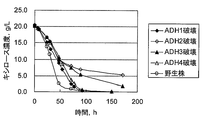
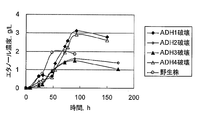
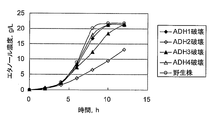
- the ADH1-disrupted strain and the ADH4-disrupted strain had significantly improved ethanol yield from xylose compared to the wild strain.
- no improvement in ethanol yield was observed in the ADH2-disrupted strain and the ADH3-disrupted strain.
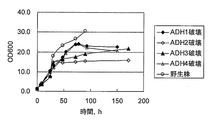
- FIG. 3 it was found that the ADH1-disrupted strain and the ADH4-disrupted strain have the same cell growth ability as the wild strain.
- the ADH2-disrupted strain and the ADH3-disrupted strain were found to have poor cell growth compared to the wild strain.
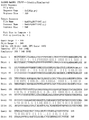
- FIGS. 7 is an alignment between ADH1 from S. cerevisiae and ADH1 from K. marxianus.
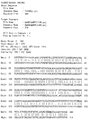
- FIG. 8 is an alignment between S.1cerevisiae-derived ADH1 and K. marxianus-derived ADH2.
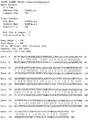
- FIG. 9 is an alignment between S. cerevisiae-derived ADH1 and K. marxianus-derived ADH3.
- FIG. 10 is an alignment between S. cerevisiae-derived ADH1 and K. marxianus-derived ADH4.
- FIG. 7 is an alignment between ADH1 from S. cerevisiae and ADH1 from K. marxianus.
- FIG. 8 is an alignment between S.1cerevisiae-derived ADH1 and K. marxianus-derived ADH2.
- FIG. 9 is an alignment between S. cerevisiae-derived ADH1 and K. marxianus-derived ADH3.
- FIG. 10 is an alignment between S. cerevisiae-derived ADH1 and
- FIG. 11 is an alignment between S.2cerevisiae-derived ADH2 and K. marxianus-derived ADH1.
- FIG. 12 is an alignment between ADH2 from S. cerevisiae and ADH2 from K. marxianus.
- FIG. 13 is an alignment between S. ⁇ cerevisiae-derived ADH2 and K. marxianus-derived ADH3.
- FIG. 14 is an alignment between S. cerevisiae-derived ADH2 and K. marxianus-derived ADH4.
- the identity and similarity between S. cerevisiae-derived ADH1 and K. marxianus-derived ADH1 was 79% and 97%, respectively.
- the identity and similarity between S. cerevisiae-derived ADH1 and K. marxianus-derived ADH2 was 86% and 96%, respectively.
- the identity and similarity between S. cerevisiae-derived ADH1 and K. marxianus-derived ADH3 was 79% and 96%, respectively.
- the identity and similarity between S. cerevisiae-derived ADH1 and K. marxianus-derived ADH4 was 80% and 94%, respectively.
- the identity and similarity between S. cerevisiae-derived ADH2 and K. marxianus-derived ADH1 was 79% and 97%, respectively.
- the identity and similarity between S. ⁇ cerevisiae-derived ADH2 and K. marxianus-derived ADH2 was 84% and 96%, respectively.
- the identity and similarity between S. cerevisiae-derived ADH2 and K. marxianus-derived ADH3 was 78% and 96%, respectively.
- the identity and similarity between S. Scerevisiae-derived ADH2 and K. marxianus-derived ADH4 was 80% and 95%, respectively.
- FIG. 15 The alignment between S. ⁇ ⁇ ⁇ ⁇ ⁇ ⁇ ⁇ cerevisiae-derived ADH1 and S. cerevisiae-derived ADH2 is shown in FIG. As shown in FIG. 15, the identity and similarity between S. Hcerevisiae-derived ADH1 and S. cerevisiae-derived ADH2 was 93% and 99%, respectively.
- ADH1 to ADH4 derived from K. marxianus show very high identity and similarity with ADH1 and ADH2 derived from S. cerevisiae, and are similar to ADH1 and ADH2 derived from S. cerevisiae. It is difficult to estimate the function from the comparison. Therefore, it can be said that it is a surprising result that when the ADH1 gene of Kluyveromyces genus yeast is attenuated or the ADH4 gene is attenuated, the ethanol yield from xylose is specifically improved.
Landscapes
- Life Sciences & Earth Sciences (AREA)
- Chemical & Material Sciences (AREA)
- Organic Chemistry (AREA)
- Engineering & Computer Science (AREA)
- Health & Medical Sciences (AREA)
- Zoology (AREA)
- Wood Science & Technology (AREA)
- Genetics & Genomics (AREA)
- Bioinformatics & Cheminformatics (AREA)
- Biotechnology (AREA)
- General Engineering & Computer Science (AREA)
- General Health & Medical Sciences (AREA)
- Microbiology (AREA)
- Biochemistry (AREA)
- Biomedical Technology (AREA)
- Chemical Kinetics & Catalysis (AREA)
- Molecular Biology (AREA)
- General Chemical & Material Sciences (AREA)
- Mycology (AREA)
- Medicinal Chemistry (AREA)
- Physics & Mathematics (AREA)
- Biophysics (AREA)
- Plant Pathology (AREA)
- Preparation Of Compounds By Using Micro-Organisms (AREA)
- Micro-Organisms Or Cultivation Processes Thereof (AREA)
Abstract
Kluyveromyces属に属する酵母を、キシロースからのエタノール収率を向上するように改変する。 Kluyveromyces属に属する酵母における、Kluyveromyces marxianus 由来ADH1遺伝子、当該ADH1遺伝子に機能的に等価な遺伝子、Kluyveromyces marxianus 由来ADH4遺伝子及び当該ADH4遺伝子に機能的に等価な遺伝子からなる群から選ばれる少なくとも1つの遺伝子を減弱化する。
Description
本発明は、Kluyveromyces属酵母を利用した変異体酵母及びこれを用いたエタノールの製造方法に関する。
リグノセルロースを含むバイオマスは、エタノール等の有用なアルコールや有機酸の原料として有効に利用されている。リグノセルロースを含むバイオマスには、木質系バイオマス及び草本系バイオマスが含まれる。木質系バイオマスなどのリグノセルロースを含むバイオマスは、主としてセルロース、ヘミセルロース及びリグニンから構成されている。リグノセルロースを含むバイオマスからエタノール等液体燃料を製造するためには、セルロースやヘミセルロースを構成単糖にまで加水分解(糖化)し、発酵によって単糖をエタノールに変換する。セルロースはグルコースから構成され、ヘミセルロースは主としてアラビノースとキシロースから構成されている。したがって、リグノセルロースを含むバイオマスを利用してエタノールを製造する際には、グルコースのみではなくキシロースも発酵の基質として有効に利用されることが望ましい。
また、リグノセルロースを含むバイオマスからエタノールを製造する場合、上述した糖化反応と発酵反応とを同時に(各反応工程を区別することなく)行うことができれば製造コストの低減に繋がる。これを同時糖化発酵方法と称する。同時糖化発酵には、糖化酵素の反応温度領域(約40℃以上)で発酵が可能な耐熱性を有し、基質としてグルコースのみでなく5単糖のキシロースを利用できる微生物が必要となる。
耐熱性を有する酵母としては、Kluyveromyces marxianus等のKluyveromyces属酵母が知られている。このKluyveromyces属酵母は、キシロースを利用してエタノール発酵を行うことができるが、その収率は不十分であった。例えば、非特許文献1及び2には、Saccharomyces cerevisiaeにおけるアルコールデヒドロゲナーゼ遺伝子(複数のアイソマーを含む)について機能解析が報告されている。また、特許文献1には、キシロースをキシルロースに異性化する能力を付与された組換え酵母が開示されており、アルコールデヒドロゲナーゼ活性を減少させることについても記載されている。しかしながら、これらの知見からは、アルコールデヒドロゲナーゼ遺伝子の欠損や破壊により、エタノール発酵能に対していかなる影響があるか判断することはできない。さらに、分類学的に異なる種であるKluyveromyces marxianus等のKluyveromyces属酵母におけるアルコールデヒドロゲナーゼ遺伝子の機能を判断することはできない。
FEMS Yeast Research 2, (2002) p. 481-494
FEMS Yeast Research 8, (2008) p. 967-978
上述したように、Kluyveromyces属酵母は、キシロース資化性を有し、且つ耐熱性を有するため、上述した同時糖化発酵法等に有用な微生物として大きく期待されている。しかしながら、Kluyveromyces属酵母についてはキシロースからのエタノール収率が非常に悪く、またこれを改善する手段も知られていない。そこで、本発明は、このような実情に鑑み、キシロースからのエタノール収率を向上するように改変されたKluyveromyces属に属する変異体酵母、及び当該変異体酵母を用いたエタノールの製造方法を提供することを目的とする。
上述した目的を達成するため、本発明者らが鋭意検討した結果、Kluyveromyces属酵母における複数のアルコールデヒドロゲナーゼ遺伝子のうち、特定の遺伝子を減弱化することで当該酵母におけるキシロースからのエタノール収率が大幅に向上することを見いだし、本発明を完成するに至った。すなわち、本発明は以下を包含する。
(1)Kluyveromyces属に属する酵母における、Kluyveromyces marxianus 由来ADH1遺伝子、当該ADH1遺伝子に機能的に等価な遺伝子、Kluyveromyces marxianus 由来ADH4遺伝子及び当該ADH4遺伝子に機能的に等価な遺伝子からなる群から選ばれる少なくとも1つの遺伝子を減弱化した変異体酵母。
(2)上記Kluyveromyces属に属する酵母は、Kluyveromyces marxianusであることを特徴とする(1)記載の変異体酵母。
(3)上記ADH1遺伝子に機能的に等価な遺伝子は、Kluyveromyces marxianus以外のKluyveromyces属酵母に由来し、以下(a)~(c)いずれかのタンパク質をコードすることを特徴とする(1)記載の変異体酵母。
(a) 配列番号2のアミノ酸配列を含むタンパク質
(b) 配列番号2のアミノ酸配列に対して90%以上の配列類似性を有するアミノ酸配列を含み、アルコールデヒドロゲナーゼ活性を有するタンパク質
(c) 配列番号2のアミノ酸配列に対して1~複数個のアミノ酸が欠失、置換、付加又は挿入したアミノ酸配列を含み、アルコールデヒドロゲナーゼ活性を有するタンパク質
(4)上記ADH4遺伝子に機能的に等価な遺伝子は、Kluyveromyces marxianus以外のKluyveromyces属酵母に由来し、以下(a)~(c)いずれかのタンパク質をコードすることを特徴とする(1)記載の変異体酵母。
(b) 配列番号2のアミノ酸配列に対して90%以上の配列類似性を有するアミノ酸配列を含み、アルコールデヒドロゲナーゼ活性を有するタンパク質
(c) 配列番号2のアミノ酸配列に対して1~複数個のアミノ酸が欠失、置換、付加又は挿入したアミノ酸配列を含み、アルコールデヒドロゲナーゼ活性を有するタンパク質
(4)上記ADH4遺伝子に機能的に等価な遺伝子は、Kluyveromyces marxianus以外のKluyveromyces属酵母に由来し、以下(a)~(c)いずれかのタンパク質をコードすることを特徴とする(1)記載の変異体酵母。
(a) 配列番号4のアミノ酸配列を含むタンパク質
(b) 配列番号4のアミノ酸配列に対して90%以上の配列類似性を有するアミノ酸配列を含み、アルコールデヒドロゲナーゼ活性を有するタンパク質
(c) 配列番号4のアミノ酸配列に対して1~複数個のアミノ酸が欠失、置換、付加又は挿入したアミノ酸配列を含み、アルコールデヒドロゲナーゼ活性を有するタンパク質
(5)(1)乃至(4)いずれか記載の変異体酵母をキシロース含有培地にて培養する工程と、その後、培地よりエタノールを回収する工程とを含む、エタノールの製造方法。
(b) 配列番号4のアミノ酸配列に対して90%以上の配列類似性を有するアミノ酸配列を含み、アルコールデヒドロゲナーゼ活性を有するタンパク質
(c) 配列番号4のアミノ酸配列に対して1~複数個のアミノ酸が欠失、置換、付加又は挿入したアミノ酸配列を含み、アルコールデヒドロゲナーゼ活性を有するタンパク質
(5)(1)乃至(4)いずれか記載の変異体酵母をキシロース含有培地にて培養する工程と、その後、培地よりエタノールを回収する工程とを含む、エタノールの製造方法。
(6)上記培養する工程を、上記変異体酵母とリグノセルロースを含むバイオマスと糖化酵素とを含む反応系で実施されることを特徴とする(5)記載のエタノールの製造方法。
本明細書は本願の優先権の基礎である日本国特許出願2011-076715号の明細書および/または図面に記載される内容を包含する。
本発明に係る変異体酵母は、グルコースからのエタノール収率は殆ど変わらず、キシロースからのエタノール収率が大幅に向上している。したがって、本発明に係る変異体酵母は、例えば、木質系バイオマス等のリグノセルロースを含むバイオマスに由来するキシロースを含む培地において、高収率にエタノールを製造することができる。
本発明に係るエタノールの製造方法は、キシロースからのエタノール収率が大幅に向上した変異体酵母を利用することで、エタノール製造効率を大幅に向上させることができる。
本発明に係る変異体酵母は、Kluyveromyces属酵母における特定のアルコールデヒドロゲナーゼ遺伝子を減弱化したものであり、キシロースからのエタノール収率が向上した特徴を有している。
ここで、Kluyveromyces属酵母とは、K. aestuarii、K. africanus、K. bacillisporus、K. blattae、K. dobzhanskii、K. hubeiensis、K. lactis、K. lodderae、K. marxianus、K. nonfermentans、K. piceae、K. sinensis、K. thermotolerans、K. waltii、K. wickerhamii及びK. yarrowii等の酵母を含む意味である。すなわち、本発明に係る変異体酵母は、これらの具体的なKluyveromyces属酵母及びその変異体に対して、特定のアルコールデヒドロゲナーゼ遺伝子を減弱化することで作製することができる。Kluyveromyces属酵母としては、特に、耐熱性酵母として知られているKluyveromyces marxianusを使用することが好ましい。Kluyveromyces marxianusとしては、特に限定されず、寄託機関に分譲可能に保存された公知の株を使用することができるし、また公知の株から派生した変異株を使用することもできる。Kluyveromyces marxianusの公知株としては、Kluyveromyces marxianus DMKU3-1042株を挙げることができる。公知の株から派生した変異株とは、例えば、Kluyveromyces marxianus DMKU3-1042株に対して栄養要求性を付与するためにura3遺伝子やleu2遺伝子を破壊した株を例示することができる。
本発明に係る変異体酵母は、特定のアルコールデヒドロゲナーゼ遺伝子を減弱化したものである。ここで「遺伝子の減弱化」とは、当該遺伝子の発現量を低減すること、当該遺伝子がコードする酵素の活性を低減することの両者を含む意味である。例えば、特定のアルコールデヒドロゲナーゼ遺伝子を破壊又は欠失させる方法、当該遺伝子の発現制御領域(プロモーター等)を破壊又は欠失させる方法、当該遺伝子に対するアンチセンスRNAを発現する方法等により、当該遺伝子の発現量を低減することができる。また、所謂、トランスポゾン法、トランスジーン法、転写後遺伝子サイレンシング法、RNAi法、ナンセンス仲介減衰(Nonsense mediated decay, NMD)法、リボザイム法、アンチセンス法、miRNA(micro-RNA)法、siRNA(small interfering RNA)法等を適用し、当該遺伝子の発現量を低減することができる。さらに、アルコールデヒドロゲナーゼの阻害剤を作用させる手法等により、当該遺伝子がコードする酵素の活性を低減することができる。なお、これらの方法を組み合わせて、特定のアルコールデヒドロゲナーゼ遺伝子を減弱化しても良い。
また、本発明に係る変異体酵母は、キシロースからのエタノール収率が向上した特徴を有している。言い換えると、本発明に係る変異体酵母は、キシロース代謝能が向上した特徴を有している。ここで、キシロース代謝能とは、培地に含まれるキシロースを代謝してアルコールとする発酵反応における効率を意味する。したがって、キシロース代謝能の向上とは、当該発酵反応における反応効率を向上させることと同義となる。酵母におけるキシロース代謝能は、キシロース含有培地にて培養し、産生されたアルコールを定量することによって評価できる。また、酵母におけるキシロース代謝能は、例えば、培地に含まれるキシロースの取り込み速度(消費速度)を指標にして評価することもできる。キシロースの取り込み速度は、培養開始時における既知濃度のキシロースの減少量を経時的に測定することで算出することができる。
減弱化するアルコールデヒドロゲナーゼ遺伝子は、Kluyveromyces属酵母に存在する複数のアルコールデヒドロゲナーゼ遺伝子のうち特定のアルコールデヒドロゲナーゼ遺伝子である。具体的に、アルコールデヒドロゲナーゼ遺伝子は、Kluyveromyces marxianusにおいて4種類(KmADH1~KmADH4)が知られている。Kluyveromyces marxianusにおいて減弱化するアルコールデヒドロゲナーゼ遺伝子は、これらのうちKmADH1遺伝子及び/又はKmADH4遺伝子である。Kluyveromyces marxianus以外のKluyveromyces属酵母において減弱化するアルコールデヒドロゲナーゼ遺伝子は、KmADH1遺伝子に機能的に等価なADH遺伝子及び/又はKmADH4遺伝子に機能的に等価なADH遺伝子である。
Kluyveromyces marxianus以外のKluyveromyces属酵母において、KmADH1遺伝子に機能的に等価なADH遺伝子及びKmADH4遺伝子に機能的に等価なADH遺伝子は、従来公知の方法により同定することができる。例えば、先ず、Kluyveromyces marxianus以外のKluyveromyces属酵母において複数のアルコールデヒドロゲナーゼ遺伝子を特定する。そして、これら遺伝子がコードするアルコールデヒドロゲナーゼのなかから、KmADH1遺伝子がコードするアルコールデヒドロゲナーゼのアミノ酸配列に対して最も配列類似性が高いアミノ酸配列を有するものを特定する。このように特定したアルコールデヒドロゲナーゼ遺伝子は、Kluyveromyces marxianusにおけるKmADH1遺伝子と機能的に等価な遺伝子であると特定できる。なお、KmADH4遺伝子と機能的に等価な遺伝子を特定する場合も同様である。ここで、配列類似性の値は、BLAST(Basic Local Alignment Search Tool)プログラムを実装したコンピュータを用いてデフォルトの設定で求められる値を意味する。
ここで、KmADH1遺伝子のコーディング領域の塩基配列及びKmADH1遺伝子がコードするアルコールデヒドロゲナーゼのアミノ酸配列をそれぞれ配列番号1及び2に示す。また、KmADH4遺伝子のコーディング領域の塩基配列及びKmADH4遺伝子がコードするアルコールデヒドロゲナーゼのアミノ酸配列をそれぞれ配列番号3及び4に示す。
なお、Kluyveromyces marxianusに存在する、これらKmADH1遺伝子及びKmADH4遺伝子は、以上の具体的な塩基配列及びアミノ酸配列に限定されるものではない。すなわち、KmADH1遺伝子及びKmADH4遺伝子は、アルコールデヒドロゲナーゼ活性を有するタンパク質をコードする限り、それぞれ配列番号2及び4に示すアミノ酸配列に対して80%以上、好ましくは85%以上、より好ましくは90%以上、更に好ましくは95%以上、最も好ましくは98%以上の配列類似性を有するアミノ酸配列からなるタンパク質をコードするものも含まれる。ここで、配列類似性の値は、BLAST(Basic Local Alignment Search Tool)プログラムを実装したコンピュータを用いてデフォルトの設定で求められる値を意味する。
また、KmADH1遺伝子及びKmADH4遺伝子は、アルコールデヒドロゲナーゼ活性を有するタンパク質をコードする限り、それぞれ配列番号2及び4に示すアミノ酸配列に対して1又は複数個(例えば2~35個、好ましくは2~30個、より好ましくは2~20個、更に好ましくは2~10個)のアミノ酸が欠失、置換、付加又は挿入されたアミノ酸配列からなるタンパク質をコードするものも含まれる。
さらに、KmADH1遺伝子及びKmADH4遺伝子は、アルコールデヒドロゲナーゼ活性を有するタンパク質をコードする限り、それぞれ配列番号1及び3に示す塩基配列に相補的な塩基配列からなるポリヌクレオチドの一部又は全部に対してストリンジェントな条件でハイブリダイズするポリヌクレオチドも含まれる。ここで、ストリンジェントな条件とは、90%程度、好ましくは95%、更に好ましくは98%の同一性を有する一対のポリヌクレオチドが特異的なハイブリダイズを形成する条件(温度条件、塩濃度条件)を意味する。
<エタノール製造>
以上で説明した変異体酵母を利用することで、キシロース等の糖を基質としたエタノール発酵を行うことができる。特に、上述した本発明に係る変異体酵母は、優れたキシロース代謝能、すなわちキシロースからのエタノール収率が優れているため、キシロース含有培地を利用したエタノール発酵に好適である。キシロース含有培地とは、Kluyveromyces属酵母が生育しうる培地であってエタノール合成の基質となる糖成分として少なくともキシロースを含有する培地を意味する。なお、キシロース含有培地は、キシロース以外の糖成分、例えばグルコースを含有していても良い。
以上で説明した変異体酵母を利用することで、キシロース等の糖を基質としたエタノール発酵を行うことができる。特に、上述した本発明に係る変異体酵母は、優れたキシロース代謝能、すなわちキシロースからのエタノール収率が優れているため、キシロース含有培地を利用したエタノール発酵に好適である。キシロース含有培地とは、Kluyveromyces属酵母が生育しうる培地であってエタノール合成の基質となる糖成分として少なくともキシロースを含有する培地を意味する。なお、キシロース含有培地は、キシロース以外の糖成分、例えばグルコースを含有していても良い。
キシロース含有培地は、特に限定されないが、SD培地、YPD培地、YPAD培地、YM培地及びYeast Nitrogen Baseを含む各種合成培地にキシロースを添加するか、これら公知の培地に含まれる糖成分をキシロースに代替することで調整することができる。
また、木質系バイオマスや草本系バイオマスといったリグノセルロースを含むバイオマスからキシロース含有培地を調整しても良い。すなわち、リグノセルロースを含むバイオマスに含まれるセルロースやヘミセルロースを糖化処理し、得られた処理物をキシロース含有培地として使用することもできる。糖化処理としては、特に限定されず従来公知の手法をなんら限定されることなく利用することができる。糖化方法としては、例えば、希硫酸又は濃硫酸を利用する硫酸法、セルラーゼやヘミセルラーゼを利用する酵素法等を挙げることができる。また、糖化処理に先立って、木質系バイオマスや草本系バイオマスに対して従来公知の前処理を施しても良い。前処理としては、特に限定されないが、例えば、リグニンを微生物によって分解する処理や、木質系バイオマスや草本系バイオマスの粉砕処理、イオン液体やアルカリ溶液に浸漬して構造を緩和する処理、高温の水で蒸煮する水熱処理、アンモニアによる処理等を挙げることができる。
特に、Kluyveromyces marxianusから作製した変異体酵母では、特に耐熱性に優れるため、例えば40℃以上、好ましくは35~48℃、より好ましくは40~42℃といった比較的に高温度でエタノール発酵を行うことができる。このような温度領域は、セルラーゼやヘミセルラーゼといった糖化酵素も活性を示す温度領域である。したがって、当該変異体酵母は、糖化酵素を利用した所謂、同時糖化発酵に好適である。ここで同時糖化発酵とは、糖化酵素による木質系バイオマスの糖化処理と、キシロースからのエタノール発酵処理とを同一反応系で実施する処理を意味する。より具体的には、木質系バイオマスと糖化酵素と変異体酵母とを含む溶液を例えば40℃といった温度条件にてインキュベートする。これにより、木質系バイオマスの糖化と、糖化によって得られたキシロースやグルコースからのエタノール発酵が進行し、エタノールを製造することができる。また、このとき溶液を攪拌しても良いし、振とうしてもよい。
また、培地に含まれるキシロース等の炭素源から発酵生産されたエタノールを回収する際には、特に限定されず、従来公知のいかなる方法も適用することができる。例えば、上述したエタノール発酵が終了した後、固液分離操作によってエタノールを含む液層と、変異体酵母や固形成分を含有する固層とを分離する。その後、液層に含まれるエタノールを蒸留法によって分離・精製することで、純度の高いエタノールを回収することができる。なお、エタノールの精製度は、エタノールの使用目的にあわせて適宜調整することができる。
以下、実施例により本発明をより詳細に説明するが、本発明の技術的範囲は以下の実施例に限定されるものではない。
〔実施例1〕
本実施例では、Kluyveromyces属酵母としてKluyveromyces marxianusを使用し、アルコールデヒドロゲナーゼ遺伝子の破壊株を作製し、キシロースからのエタノール収率を比較検討した。
本実施例では、Kluyveromyces属酵母としてKluyveromyces marxianusを使用し、アルコールデヒドロゲナーゼ遺伝子の破壊株を作製し、キシロースからのエタノール収率を比較検討した。
<株の作製>
<接合、胞子形成によるura3- leu2-変異株の作製>
Kluyveromyces marxianus DMKU3-1042株のura3-株であるRAK3605株(Nonklang, S. et al., Appl. Environ. Microbiol. 74, p. 7514-7521 (2008))を基準株として使用した。K. marxianus DMKU3-1042株由来の栄養要求性変異株は、低頻度で2倍体になることを明らかにしている。紫外線変異により、多重栄養要求性変異株を取得することは可能であるが、その結果、染色体DNAに変異が入る確率が上昇する。より安定な株を作製するために、接合と胞子形成により、2倍体から簡単に多重栄養要求性株を作製するために以下の株を作製した。
<接合、胞子形成によるura3- leu2-変異株の作製>
Kluyveromyces marxianus DMKU3-1042株のura3-株であるRAK3605株(Nonklang, S. et al., Appl. Environ. Microbiol. 74, p. 7514-7521 (2008))を基準株として使用した。K. marxianus DMKU3-1042株由来の栄養要求性変異株は、低頻度で2倍体になることを明らかにしている。紫外線変異により、多重栄養要求性変異株を取得することは可能であるが、その結果、染色体DNAに変異が入る確率が上昇する。より安定な株を作製するために、接合と胞子形成により、2倍体から簡単に多重栄養要求性株を作製するために以下の株を作製した。
先ず、RAK3605株に紫外線照射し、lys-株(RAK3896株:ura3- lys2-)、ade-株(RAK3919株:ura3- ade2-)及びleu-株(RAK3966株:ura3- leu2-)を取得した。これらの株にSaccharomyces cerevisiaeのURA3をランダムに染色体へ形質転換した株、RAK4088株(ura3- leu2- ScURA3)、RAK4152株(ura3- ade2- ScURA3)、RAK4153株(ura3- lys2- ScURA3)を作製した。RAK4152とRAK4153株をYPD培地(1% w/v Yeast extract, 2% w/v peptone, 2% glucose, 2% w/v agar)上で混ざるようにストリークし、MM培地(0.17% w/v yeast nitrogen base w/o amino acids and ammonium sulfate, 0.5% w/v ammonium sulfate, 2% w/v glucose, 2% w/v agar)へレプリカした。MM培地で生えた株、RAK4154株(ura3-/ura3- ade2-/ADE2, lys2-/LYS2 ScURA3/ScURA3)をS. cerevisiaeで使用されるSPO培地(1% w/v potassium acetate, 0.1% w/v yeast extract, 0.05% w/v glucose)に植菌し、胞子形成させた。
作製した胞子を分離し、ura- lys- ade-の3重栄養要求性株を取得するために、-A培地(MM+uracil, tryptophan, histidine HCl, methionine, leucine, lysine HCl), -K培地(MM+ uracil, tryptophan, histidine HCl, methionine, leucine, adenine hemisulfate), -U培地(MM+ tryptophan, histidine HCl, methionine, leucine, lysine HCl, adenine hemisulfate)へレプリカし、3つの培地で増殖できない株をRAK4154株の胞子から3株取得することに成功した。その株をRAK4155株(ura3- lys2- ade2-)と命名した。同様の方法でRAK4088株とRAK4155株を接合させ、RAK4156株(ura3-/ura3- lys2-/LYS2 ade2-/ADE2 leu2-/LEU2 ScURA3/ScURA3)を作製した。この株を胞子形成させ、RAK4174株(leu2- ura3-)株を作製した。
<Ku70破壊株の作製>
K. marxianusは非相同末端結合修復が高頻度で起こることから、S. cerevisiaeのように相同組換え修復を利用して遺伝子破壊を容易に行うことができない(Nonklang, S. et al., Appl. Environ. Microbiol. 74, p. 7514-7521 (2008))。そこで、非相同末端結合修復に必須のKU70遺伝子を破壊することで相同組換えを高頻度に起こさせる株の作製を行った。RAK4174株からKU70を破壊したRAK4736株(leu2- ura3- Kmku70Δ::ScLEU2)を作製した(Abdel-Banat, B.M. et al., Yeast 27, 29-39(2010))。
K. marxianusは非相同末端結合修復が高頻度で起こることから、S. cerevisiaeのように相同組換え修復を利用して遺伝子破壊を容易に行うことができない(Nonklang, S. et al., Appl. Environ. Microbiol. 74, p. 7514-7521 (2008))。そこで、非相同末端結合修復に必須のKU70遺伝子を破壊することで相同組換えを高頻度に起こさせる株の作製を行った。RAK4174株からKU70を破壊したRAK4736株(leu2- ura3- Kmku70Δ::ScLEU2)を作製した(Abdel-Banat, B.M. et al., Yeast 27, 29-39(2010))。
<ADH1破壊株の作製>
K. marxianus DMKU3-1042株のADH1遺伝子における推定open reading frameはGenetyx ver.10 (株式会社ゼネティクス)で予測した。K. marxianus DMKU3-1042株のADH1遺伝子は348アミノ酸からなるタンパク質をコードしていた。この塩基配列情報を利用して以下の一対のプライマーを設計した。
K. marxianus DMKU3-1042株のADH1遺伝子における推定open reading frameはGenetyx ver.10 (株式会社ゼネティクス)で予測した。K. marxianus DMKU3-1042株のADH1遺伝子は348アミノ酸からなるタンパク質をコードしていた。この塩基配列情報を利用して以下の一対のプライマーを設計した。
KmADH1-167-ASC:5’-GGGGGCACTTCGAACGCTGAAGTATCTTCATCTGGAGTATACCTTTTTTTCGCCACTGGAggcgcgcccggg-3’(配列番号5)
KmADH1+1070c-TDHu:5’-TACCATATCAAAAGGGTCCTTGCTTATTTGGAAGTGTCAACGACAATTCTACCAATGATTtggcagtattgataatgag-3’ (配列番号6)
なお、上記プライマーの塩基配列において大文字はADH1との相同領域を示す。このプライマーでpST106 vector (Ano, A. et al., Biosci. Biotechnol. Biochem. 73, p. 633-640 (2009))からScURA3を合成し、RAK4736株へ形質転換した。その結果RAK6148株(ura3- leu2- ku70Δ::ScLEU2 adh1Δ::ScURA3)を作製した。
KmADH1+1070c-TDHu:5’-TACCATATCAAAAGGGTCCTTGCTTATTTGGAAGTGTCAACGACAATTCTACCAATGATTtggcagtattgataatgag-3’ (配列番号6)
なお、上記プライマーの塩基配列において大文字はADH1との相同領域を示す。このプライマーでpST106 vector (Ano, A. et al., Biosci. Biotechnol. Biochem. 73, p. 633-640 (2009))からScURA3を合成し、RAK4736株へ形質転換した。その結果RAK6148株(ura3- leu2- ku70Δ::ScLEU2 adh1Δ::ScURA3)を作製した。
<ADH4破壊株の作製>
K. marxianus DMKU3-1042株のADH4遺伝子における推定open reading frameはGenetyx ver.10 (株式会社ゼネティクス)で予測した。K. marxianus DMKU3-1042株のADH4遺伝子は379アミノ酸からなるタンパク質をコードしていた。この塩基配列情報を利用して以下の一対のプライマーを設計した。
K. marxianus DMKU3-1042株のADH4遺伝子における推定open reading frameはGenetyx ver.10 (株式会社ゼネティクス)で予測した。K. marxianus DMKU3-1042株のADH4遺伝子は379アミノ酸からなるタンパク質をコードしていた。この塩基配列情報を利用して以下の一対のプライマーを設計した。
KmADH4-60-ASC:5’-CGTACACCCTCAAGCTCATCGCCCGTACACCCACATTATACTATTAATAAACCACAAACAggcgcgcccggg-3’ (配列番号7)
KmADH4+1206c:5’-GAAGGATCATCCAAATGAAAAGAAAGGGACGTTAAGTTAGCATAGCTTAGTTGGACTGAGtggcagtattgataatgag-3’ (配列番号8)
なお、上記プライマーの塩基配列において大文字はADH4との相同領域を示す。このプライマーでpST106 vectorからScURA3を合成し、RAK4736株へ形質転換した。その結果RAK6150株(ura3- leu2- ku70Δ::ScLEU2 adh4Δ::ScURA3)を作製した。
KmADH4+1206c:5’-GAAGGATCATCCAAATGAAAAGAAAGGGACGTTAAGTTAGCATAGCTTAGTTGGACTGAGtggcagtattgataatgag-3’ (配列番号8)
なお、上記プライマーの塩基配列において大文字はADH4との相同領域を示す。このプライマーでpST106 vectorからScURA3を合成し、RAK4736株へ形質転換した。その結果RAK6150株(ura3- leu2- ku70Δ::ScLEU2 adh4Δ::ScURA3)を作製した。
<ADH2破壊株の作製>
K. marxianus DMKU3-1042株のADH2遺伝子における推定open reading frameはGenetyx ver.10 (株式会社ゼネティクス)で予測した。K. marxianus DMKU3-1042株のADH2遺伝子はADH1遺伝子と同じく348アミノ酸からなるタンパク質をコードしていた。この塩基配列を利用して以下の一対のプライマーを設計した。
K. marxianus DMKU3-1042株のADH2遺伝子における推定open reading frameはGenetyx ver.10 (株式会社ゼネティクス)で予測した。K. marxianus DMKU3-1042株のADH2遺伝子はADH1遺伝子と同じく348アミノ酸からなるタンパク質をコードしていた。この塩基配列を利用して以下の一対のプライマーを設計した。
KmADH2-764:5’-CCCACCCACCCACTGCTACA-3’ (配列番号9)
KmADH2-1c:5’-catttctagttgttggttgttgttt-3’ (配列番号10)
これら一対のプライマーでADH2 open reading frameの上流部分をK. marxianus DMKU3-1042ゲノムを鋳型として合成した。
KmADH2-1c:5’-catttctagttgttggttgttgttt-3’ (配列番号10)
これら一対のプライマーでADH2 open reading frameの上流部分をK. marxianus DMKU3-1042ゲノムを鋳型として合成した。
また、ADH2遺伝子の塩基配列を利用して以下の一対のプライマーを設計した。
KmADH2+1045:5’-GCGGACTAACTAGCCCATTAGT-3’ (配列番号11)
KmADH2-2141c:5’-CCCCACGCACAACGTAAACCTT-3’ (配列番号12)
これら一対のプライマーでADH2 open reading frameの下流部分をK. marxianus DMKU3-1042ゲノムを鋳型として合成した。
KmADH2-2141c:5’-CCCCACGCACAACGTAAACCTT-3’ (配列番号12)
これら一対のプライマーでADH2 open reading frameの下流部分をK. marxianus DMKU3-1042ゲノムを鋳型として合成した。
一方、S. cerevisiae BY4704 (MATa ade2Δ::hisG his3Δ200 leu2Δ0 met15Δ0 trp1Δ63)から定法に従ってScURA3遺伝子を合成した。
以上のようにして得られたScURA3遺伝子をADH2上流領域とADH2下流領域の間に位置するように融合させ、RAK3605株へ形質転換した。その結果RAK6396株(ura3- adh2Δ::ScURA3)を作製した。
<ADH3破壊株の作製>
K. marxianus DMKU3-1042株のADH3遺伝子における推定open reading frameはGenetyx ver.10 (株式会社ゼネティクス)で予測した。K. marxianus DMKU3-1042株のADH3遺伝子は375アミノ酸からなるタンパク質をコードしていた。この塩基配列を利用して以下の一対のプライマーを設計した。
K. marxianus DMKU3-1042株のADH3遺伝子における推定open reading frameはGenetyx ver.10 (株式会社ゼネティクス)で予測した。K. marxianus DMKU3-1042株のADH3遺伝子は375アミノ酸からなるタンパク質をコードしていた。この塩基配列を利用して以下の一対のプライマーを設計した。
KmADH3-842:5’-GGCCTGGGTTACCACTGGTCCCCTG-3’ (配列番号13)
KmADH3-1c:5’-tgttgcgtgatattttctgtgcctg-3’ (配列番号14)
これら一対のプライマーでADH3 open reading frameの上流部分をK. marxianus DMKU3-1042ゲノムを鋳型として合成した。
KmADH3-1c:5’-tgttgcgtgatattttctgtgcctg-3’ (配列番号14)
これら一対のプライマーでADH3 open reading frameの上流部分をK. marxianus DMKU3-1042ゲノムを鋳型として合成した。
また、ADH3遺伝子の塩基配列を利用して以下の一対のプライマーを設計した。
KmADH3+1076:5’-TGGAACAAGGTAAGATCTTGGG-3’ (配列番号15)
KmADH3+2069c:5’-TTGCAGGATCCAGAATGGGTCAGTG-3’ (配列番号16)
これら一対のプライマーでADH3 open reading frameの下流部分をK. marxianus DMKU3-1042ゲノムを鋳型として合成した。
KmADH3+2069c:5’-TTGCAGGATCCAGAATGGGTCAGTG-3’ (配列番号16)
これら一対のプライマーでADH3 open reading frameの下流部分をK. marxianus DMKU3-1042ゲノムを鋳型として合成した。
そして、上述したADH2破壊株の作製手順と同様に、ScURA3をADH3上流領域とADH3下流領域の間に位置するように融合させ、RAK3605株へ形質転換した。その結果RAK6398株(ura3- adh3Δ::ScURA3)を作製した。
<エタノール発酵試験>
以上のように作製されたADH1破壊株、ADH2破壊株、ADH3破壊株及びADH4破壊株についてグルコースを利用したエタノール発酵試験、及びキシロースを利用したエタノール発酵試験を行った。
以上のように作製されたADH1破壊株、ADH2破壊株、ADH3破壊株及びADH4破壊株についてグルコースを利用したエタノール発酵試験、及びキシロースを利用したエタノール発酵試験を行った。
<前培養>
YPX(キシロース20g/L)培地20mlを加えた50mlアシストチューブに上記破壊株を一白金耳植菌し、30℃、140rpmで6~8時間振とう培養した。次に、その菌液2.5%を、YPX培地(キシロース:20g/L)200mlが入った500ml三角フラスコで、30℃、140rpm、一晩振とう培養した。培養後の酵母を遠心回収、滅菌水で3回洗浄し、OD600=30の酵母懸濁液を調製した。
YPX(キシロース20g/L)培地20mlを加えた50mlアシストチューブに上記破壊株を一白金耳植菌し、30℃、140rpmで6~8時間振とう培養した。次に、その菌液2.5%を、YPX培地(キシロース:20g/L)200mlが入った500ml三角フラスコで、30℃、140rpm、一晩振とう培養した。培養後の酵母を遠心回収、滅菌水で3回洗浄し、OD600=30の酵母懸濁液を調製した。
<本培養>
表1に示す条件で培養し、糖の利用、菌体増殖およびエタノール生産を確認した。初発の糖濃度は、グルコース培養は50g/L、キシロース培養は20g/Lとした。

表1に示す条件で培養し、糖の利用、菌体増殖およびエタノール生産を確認した。初発の糖濃度は、グルコース培養は50g/L、キシロース培養は20g/Lとした。
また、菌体増殖は、島津製作所社製の分光光度計UV-1800(λ=600)を用いて菌体濃度を測定することで評価した。また、培地中の糖やエタノール濃度は島津製作所社製のHPLC(検出器:RI)を用いて測定した。
<結果>
糖成分としてキシロースを含有する培地にて上記破壊株を培養した際の「培地中のキシロース濃度変化」、「培地中のエタノール濃度変化」、「培地中のキシリトール濃度変化」及び「菌体濃度変化」を図1~3に示す。図1に示すように、いずれのADH破壊株でも野生株と比較して、キシロースの利用が遅れている。特にADH2破壊株及びADH3破壊株でキシロース利用の遅れが顕著であった。また、図2に示すように、ADH1破壊株及びADH4破壊株では、野生株と比較し、キシロースからのエタノール収率が大幅に向上していた。しかし、ADH2破壊株及びADH3破壊株ではエタノール収率の向上は認められなかった。また、図3に示すように、ADH1破壊株及びADH4破壊株では、野生株と同等の菌体増殖能を有することが判った。一方、ADH2破壊株及びADH3破壊株は野生株と比較して、菌体増殖が悪いことが判った。
糖成分としてキシロースを含有する培地にて上記破壊株を培養した際の「培地中のキシロース濃度変化」、「培地中のエタノール濃度変化」、「培地中のキシリトール濃度変化」及び「菌体濃度変化」を図1~3に示す。図1に示すように、いずれのADH破壊株でも野生株と比較して、キシロースの利用が遅れている。特にADH2破壊株及びADH3破壊株でキシロース利用の遅れが顕著であった。また、図2に示すように、ADH1破壊株及びADH4破壊株では、野生株と比較し、キシロースからのエタノール収率が大幅に向上していた。しかし、ADH2破壊株及びADH3破壊株ではエタノール収率の向上は認められなかった。また、図3に示すように、ADH1破壊株及びADH4破壊株では、野生株と同等の菌体増殖能を有することが判った。一方、ADH2破壊株及びADH3破壊株は野生株と比較して、菌体増殖が悪いことが判った。
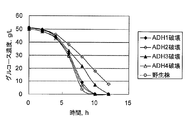
一方、糖成分としてグルコースを含有する培地にて上記破壊株を培養した際の「培地中のグルコース濃度変化」、「培地中のエタノール濃度変化」、「培地中のグリセロール濃度変化」及び「菌体濃度変化」を図4~6に示す。図4~6に示すように、上記破壊株をグルコースで培養しても、野生型と同程度或いは下回るエタノール収率しか達成できなかった。すなわち、グルコースの取り込みやグルコースからのエタノール発酵に対して、いずれのADH遺伝子を破壊しても、グルコースを利用したエタノール発酵においてエタノール生産性等になんら影響がないことが明らかとなった。換言すれば、Kluyveromyces 属酵母においては、ADH1遺伝子及びADH4遺伝子を減弱化すると、キシロースからのエタノール収率が特異的に向上することが示された。
なお、参考のため、S. cerevisiae由来ADH1及びADH2と、K. marxianus由来ADH1~ADH4とのアミノ酸レベルでの相同性を検討した結果を図7~14に示す。図7はS. cerevisiae由来ADH1とK. marxianus由来ADH1との間のアライメントである。図8はS. cerevisiae由来ADH1とK. marxianus由来ADH2との間のアライメントである。図9はS. cerevisiae由来ADH1とK. marxianus由来ADH3との間のアライメントである。図10はS. cerevisiae由来ADH1とK. marxianus由来ADH4との間のアライメントである。図11はS. cerevisiae由来ADH2とK. marxianus由来ADH1との間のアライメントである。図12はS. cerevisiae由来ADH2とK. marxianus由来ADH2との間のアライメントである。図13はS. cerevisiae由来ADH2とK. marxianus由来ADH3との間のアライメントである。図14はS. cerevisiae由来ADH2とK. marxianus由来ADH4との間のアライメントである。
図7に示すように、S. cerevisiae由来ADH1とK. marxianus由来ADH1との間の同一性及び類似性はそれぞれ79%及び97%であった。図8に示すように、S. cerevisiae由来ADH1とK. marxianus由来ADH2との間の同一性及び類似性はそれぞれ86%及び96%であった。図9に示すように、S. cerevisiae由来ADH1とK. marxianus由来ADH3との間の同一性及び類似性はそれぞれ79%及び96%であった。図10に示すように、S. cerevisiae由来ADH1とK. marxianus由来ADH4との間の同一性及び類似性はそれぞれ80%及び94%であった。図11に示すように、S. cerevisiae由来ADH2とK. marxianus由来ADH1との間の同一性及び類似性はそれぞれ79%及び97%であった。図12に示すように、S. cerevisiae由来ADH2とK. marxianus由来ADH2との間の同一性及び類似性はそれぞれ84%及び96%であった。図13に示すように、S. cerevisiae由来ADH2とK. marxianus由来ADH3との間の同一性及び類似性はそれぞれ78%及び96%であった。図14に示すように、S. cerevisiae由来ADH2とK. marxianus由来ADH4との間の同一性及び類似性はそれぞれ80%及び95%であった。
なお、S. cerevisiae由来ADH1とS. cerevisiae由来ADH2との間のアライメントを図15に示した。図15に示すように、S. cerevisiae由来ADH1とS. cerevisiae由来ADH2との間の同一性及び類似性はそれぞれ93%及び99%であった。
以上の図7~14に示すように、K. marxianus由来ADH1~ADH4は、S. cerevisiae由来ADH1及びADH2と非常に高い同一性及び類似性を示しており、S. cerevisiae由来ADH1及びADH2との比較から機能を推定することは困難である。したがって、Kluyveromyces 属酵母のADH1遺伝子を減弱化する、又はADH4遺伝子を減弱化すると、キシロースからのエタノール収率が特異的に向上することは驚くべき結果と言える。
本明細書で引用した全ての刊行物、特許および特許出願をそのまま参考として本明細書にとり入れるものとする。
Claims (6)
- Kluyveromyces属に属する酵母における、Kluyveromyces marxianus 由来ADH1遺伝子、当該ADH1遺伝子に機能的に等価な遺伝子、Kluyveromyces marxianus 由来ADH4遺伝子及び当該ADH4遺伝子に機能的に等価な遺伝子からなる群から選ばれる少なくとも1つの遺伝子を減弱化した変異体酵母。
- 上記Kluyveromyces属に属する酵母は、Kluyveromyces marxianusであることを特徴とする請求項1記載の変異体酵母。
- 上記ADH1遺伝子に機能的に等価な遺伝子は、Kluyveromyces marxianus以外のKluyveromyces属酵母に由来し、以下(a)~(c)いずれかのタンパク質をコードすることを特徴とする請求項1記載の変異体酵母。
(a) 配列番号2のアミノ酸配列を含むタンパク質
(b) 配列番号2のアミノ酸配列に対して90%以上の配列類似性を有するアミノ酸配列を含み、アルコールデヒドロゲナーゼ活性を有するタンパク質
(c) 配列番号2のアミノ酸配列に対して1~複数個のアミノ酸が欠失、置換、付加又は挿入したアミノ酸配列を含み、アルコールデヒドロゲナーゼ活性を有するタンパク質 - 上記ADH4遺伝子に機能的に等価な遺伝子は、Kluyveromyces marxianus以外のKluyveromyces属酵母に由来し、以下(a)~(c)いずれかのタンパク質をコードすることを特徴とする請求項1記載の変異体酵母。
(a) 配列番号4のアミノ酸配列を含むタンパク質
(b) 配列番号4のアミノ酸配列に対して90%以上の配列類似性を有するアミノ酸配列を含み、アルコールデヒドロゲナーゼ活性を有するタンパク質
(c) 配列番号4のアミノ酸配列に対して1~複数個のアミノ酸が欠失、置換、付加又は挿入したアミノ酸配列を含み、アルコールデヒドロゲナーゼ活性を有するタンパク質 - 請求項1乃至4いずれか一項記載の変異体酵母をキシロース含有培地にて培養する工程と、
その後、培地よりエタノールを回収する工程とを含む、エタノールの製造方法。 - 上記培養する工程を、上記変異体酵母とリグノセルロースを含むバイオマスと糖化酵素とを含む反応系で実施することを特徴とする請求項5記載のエタノールの製造方法。
Priority Applications (2)
| Application Number | Priority Date | Filing Date | Title |
|---|---|---|---|
| CN201280015362.7A CN103459588B (zh) | 2011-03-30 | 2012-03-26 | 克鲁维酵母属的突变体酵母和使用了该突变体酵母的乙醇的制造方法 |
| US14/008,446 US9273328B2 (en) | 2011-03-30 | 2012-03-26 | Yeast mutant of kluyveromyces and method for ethanol production using the same |
Applications Claiming Priority (2)
| Application Number | Priority Date | Filing Date | Title |
|---|---|---|---|
| JP2011-076715 | 2011-03-30 | ||
| JP2011076715A JP5813977B2 (ja) | 2011-03-30 | 2011-03-30 | Kluyveromyces属の変異体酵母及びこれを用いたエタノールの製造方法 |
Publications (1)
| Publication Number | Publication Date |
|---|---|
| WO2012133275A1 true WO2012133275A1 (ja) | 2012-10-04 |
Family
ID=46930993
Family Applications (1)
| Application Number | Title | Priority Date | Filing Date |
|---|---|---|---|
| PCT/JP2012/057704 Ceased WO2012133275A1 (ja) | 2011-03-30 | 2012-03-26 | Kluyveromyces属の変異体酵母及びこれを用いたエタノールの製造方法 |
Country Status (4)
| Country | Link |
|---|---|
| US (1) | US9273328B2 (ja) |
| JP (1) | JP5813977B2 (ja) |
| CN (1) | CN103459588B (ja) |
| WO (1) | WO2012133275A1 (ja) |
Families Citing this family (6)
| Publication number | Priority date | Publication date | Assignee | Title |
|---|---|---|---|---|
| JP6049015B2 (ja) * | 2013-01-30 | 2016-12-21 | ヤマサ醤油株式会社 | Hemf高含有発酵食品の製造法 |
| JP6210487B2 (ja) * | 2013-10-11 | 2017-10-11 | 国立大学法人山口大学 | キシロース資化能を有するエタノール生産酵母を生産する方法 |
| JP6338900B2 (ja) * | 2014-03-19 | 2018-06-06 | トヨタ自動車株式会社 | Kluyveromyces属の変異体酵母及びこれを用いたエタノールの製造方法 |
| JP6253465B2 (ja) * | 2014-03-19 | 2017-12-27 | トヨタ自動車株式会社 | Kluyveromyces属の変異体酵母及びこれを用いたエタノールの製造方法 |
| WO2015166645A1 (ja) * | 2014-04-28 | 2015-11-05 | 国立大学法人山口大学 | キシロース資化能及びエタノール生産能を有する酵母 |
| AU2015331353B2 (en) * | 2014-10-15 | 2021-11-25 | Jx Nippon Oil & Energy Corporation | Yeast capable of producing ethanol from xylose |
Citations (3)
| Publication number | Priority date | Publication date | Assignee | Title |
|---|---|---|---|---|
| WO2008098227A2 (en) * | 2007-02-09 | 2008-08-14 | The Regents Of The University Of California | Biofuel production by recombinant microorganisms |
| WO2009116286A1 (ja) * | 2008-03-18 | 2009-09-24 | 国立大学法人山口大学 | 凝集性酵母、及びその作製法 |
| JP2011024500A (ja) * | 2009-07-27 | 2011-02-10 | Toyota Central R&D Labs Inc | 発酵能力が向上された酵母及びその利用 |
Family Cites Families (1)
| Publication number | Priority date | Publication date | Assignee | Title |
|---|---|---|---|---|
| DE60325457D1 (de) | 2002-01-23 | 2009-02-05 | Royal Nedalco B V | Fermentation von pentosezuckern |
-
2011
- 2011-03-30 JP JP2011076715A patent/JP5813977B2/ja not_active Expired - Fee Related
-
2012
- 2012-03-26 US US14/008,446 patent/US9273328B2/en not_active Expired - Fee Related
- 2012-03-26 CN CN201280015362.7A patent/CN103459588B/zh not_active Expired - Fee Related
- 2012-03-26 WO PCT/JP2012/057704 patent/WO2012133275A1/ja not_active Ceased
Patent Citations (3)
| Publication number | Priority date | Publication date | Assignee | Title |
|---|---|---|---|---|
| WO2008098227A2 (en) * | 2007-02-09 | 2008-08-14 | The Regents Of The University Of California | Biofuel production by recombinant microorganisms |
| WO2009116286A1 (ja) * | 2008-03-18 | 2009-09-24 | 国立大学法人山口大学 | 凝集性酵母、及びその作製法 |
| JP2011024500A (ja) * | 2009-07-27 | 2011-02-10 | Toyota Central R&D Labs Inc | 発酵能力が向上された酵母及びその利用 |
Non-Patent Citations (5)
| Title |
|---|
| BERA A.K. ET AL.: "A genetic overhaul of Saccharomyces cerevisiae 424A(LNH-ST) to improve xylose fermentation.", JOURNAL OF INDUSTRIAL MICROBIOLOGY & BIOTECHNOLOGY, vol. 38, 2011, pages 617 - 626, XP055013743, DOI: doi:10.1007/s10295-010-0806-6 * |
| CHO JY. ET AL.: "Pichia stipitis Genes for Alcohol Dehydrogenase with Fermentative and Respiratory Functions.", APPLIED AND ENVIRONMENTAL MICROBIOLOGY, vol. 64, no. 4, 1998, pages 1350 - 1358 * |
| HEIPIEPER H.J. ET AL.: "Ethanol tolerance and membrane fatty acid adaptation in adh multiple and null mutants of Kluyveromyces lactis.", RESEARCH IN MICROBIOLOGY, vol. 151, 2000, pages 777 - 784 * |
| LERTWATTANASAKUL N. ET AL.: "Comparison of the Gene Expression Patterns of Alcohol Dehydrogenase Isozymes in the Thermotolerant Yeast Kluyveromyces marxianus and Their Physiological Functions.", BIOSCIENCE BIOTECHNOLOGY AND BIOCHEMISTRY, vol. 71, no. 5, 2007, pages 1170 - 1182, XP003022594, DOI: doi:10.1271/bbb.60622 * |
| NONKLANG S. ET AL.: "High-Temperature Ethanol Fermentation and Transformation with Linear DNA in the Thermotolerant Yeast Kluyveromyces marxianus DMKU3-1042.", APPLIED AND ENVIRONMENTAL MICROBIOLOGY, vol. 74, no. 24, 2008, pages 7514 - 7521, XP008161732, DOI: doi:10.1128/AEM.01854-08 * |
Also Published As
| Publication number | Publication date |
|---|---|
| CN103459588A (zh) | 2013-12-18 |
| JP5813977B2 (ja) | 2015-11-17 |
| US20140024097A1 (en) | 2014-01-23 |
| CN103459588B (zh) | 2016-02-10 |
| US9273328B2 (en) | 2016-03-01 |
| JP2012210169A (ja) | 2012-11-01 |
Similar Documents
| Publication | Publication Date | Title |
|---|---|---|
| CN102791858B (zh) | 木糖异构酶及其利用 | |
| JP6087854B2 (ja) | 組換え酵母を用いたエタノールの製造方法 | |
| JP5813977B2 (ja) | Kluyveromyces属の変異体酵母及びこれを用いたエタノールの製造方法 | |
| CN102016024A (zh) | 突变体酵母及使用其的物质生产方法 | |
| CN110325640A (zh) | 用于化合物生物合成的梅奇酵母种 | |
| JP5827055B2 (ja) | Kluyveromyces属の変異体酵母及びこれを用いたエタノールの製造方法 | |
| CN104024419A (zh) | 使用了重组酵母的乙醇的制造方法 | |
| JP5845210B2 (ja) | 組換え酵母、及びそれを用いたエタノールの製造方法 | |
| JP6253465B2 (ja) | Kluyveromyces属の変異体酵母及びこれを用いたエタノールの製造方法 | |
| US20210363552A1 (en) | Mutant gene associated with improvement in ethanol productivity via ethanol fermentation and method for producing ethanol using the same | |
| JP6879111B2 (ja) | 組換え酵母及びこれを用いたエタノールの製造方法 | |
| CA3028926C (en) | A recombinant yeast and a method for producing ethanol using the same | |
| JP6338900B2 (ja) | Kluyveromyces属の変異体酵母及びこれを用いたエタノールの製造方法 | |
| WO2020032233A1 (ja) | 組換え酵母、及びそれを用いたエタノールの製造方法 | |
| JP7298673B2 (ja) | エタノール発酵によるエタノール生産性の向上に関与する変異遺伝子及びこれを用いたエタノールの製造方法 | |
| JP7298674B2 (ja) | エタノール発酵によるエタノール生産性の向上に関与する変異遺伝子及びこれを用いたエタノールの製造方法 | |
| CN105802990B (zh) | 重组型酵母菌细胞及其制备方法与用途 | |
| 이예지 | Metabolic engineering of polyploid Saccharomyces cerevisiae for production of ethanol and 2, 3-butanediol | |
| TWI526536B (zh) | 重組型酵母菌細胞及其製備方法與用途 |
Legal Events
| Date | Code | Title | Description |
|---|---|---|---|
| 121 | Ep: the epo has been informed by wipo that ep was designated in this application |
Ref document number: 12765369 Country of ref document: EP Kind code of ref document: A1 |
|
| DPE1 | Request for preliminary examination filed after expiration of 19th month from priority date (pct application filed from 20040101) | ||
| WWE | Wipo information: entry into national phase |
Ref document number: 14008446 Country of ref document: US |
|
| NENP | Non-entry into the national phase |
Ref country code: DE |
|
| 122 | Ep: pct application non-entry in european phase |
Ref document number: 12765369 Country of ref document: EP Kind code of ref document: A1 |