WO2012133012A1 - 澱粉加工食品用改良剤 - Google Patents
澱粉加工食品用改良剤 Download PDFInfo
- Publication number
- WO2012133012A1 WO2012133012A1 PCT/JP2012/057100 JP2012057100W WO2012133012A1 WO 2012133012 A1 WO2012133012 A1 WO 2012133012A1 JP 2012057100 W JP2012057100 W JP 2012057100W WO 2012133012 A1 WO2012133012 A1 WO 2012133012A1
- Authority
- WO
- WIPO (PCT)
- Prior art keywords
- starch
- protein composition
- soy protein
- processed food
- improving
- Prior art date
- Legal status (The legal status is an assumption and is not a legal conclusion. Google has not performed a legal analysis and makes no representation as to the accuracy of the status listed.)
- Ceased
Links
Classifications
-
- A—HUMAN NECESSITIES
- A23—FOODS OR FOODSTUFFS; TREATMENT THEREOF, NOT COVERED BY OTHER CLASSES
- A23J—PROTEIN COMPOSITIONS FOR FOODSTUFFS; WORKING-UP PROTEINS FOR FOODSTUFFS; PHOSPHATIDE COMPOSITIONS FOR FOODSTUFFS
- A23J3/00—Working-up of proteins for foodstuffs
- A23J3/14—Vegetable proteins
- A23J3/16—Vegetable proteins from soybean
-
- A—HUMAN NECESSITIES
- A21—BAKING; EDIBLE DOUGHS
- A21D—TREATMENT OF FLOUR OR DOUGH FOR BAKING, e.g. BY ADDITION OF MATERIALS; BAKING; BAKERY PRODUCTS
- A21D2/00—Treatment of flour or dough by adding materials thereto before or during baking
- A21D2/08—Treatment of flour or dough by adding materials thereto before or during baking by adding organic substances
- A21D2/24—Organic nitrogen compounds
- A21D2/26—Proteins
- A21D2/264—Vegetable proteins
- A21D2/266—Vegetable proteins from leguminous or other vegetable seeds; from press-cake or oil bearing seeds
-
- A—HUMAN NECESSITIES
- A23—FOODS OR FOODSTUFFS; TREATMENT THEREOF, NOT COVERED BY OTHER CLASSES
- A23J—PROTEIN COMPOSITIONS FOR FOODSTUFFS; WORKING-UP PROTEINS FOR FOODSTUFFS; PHOSPHATIDE COMPOSITIONS FOR FOODSTUFFS
- A23J1/00—Obtaining protein compositions for foodstuffs; Bulk opening of eggs and separation of yolks from whites
- A23J1/14—Obtaining protein compositions for foodstuffs; Bulk opening of eggs and separation of yolks from whites from leguminous or other vegetable seeds; from press-cake or oil-bearing seeds
-
- A—HUMAN NECESSITIES
- A23—FOODS OR FOODSTUFFS; TREATMENT THEREOF, NOT COVERED BY OTHER CLASSES
- A23L—FOODS, FOODSTUFFS OR NON-ALCOHOLIC BEVERAGES, NOT OTHERWISE PROVIDED FOR; PREPARATION OR TREATMENT THEREOF
- A23L33/00—Modifying nutritive qualities of foods; Dietetic products; Preparation or treatment thereof
- A23L33/10—Modifying nutritive qualities of foods; Dietetic products; Preparation or treatment thereof using additives
- A23L33/17—Amino acids, peptides or proteins
- A23L33/185—Vegetable proteins
-
- A—HUMAN NECESSITIES
- A23—FOODS OR FOODSTUFFS; TREATMENT THEREOF, NOT COVERED BY OTHER CLASSES
- A23L—FOODS, FOODSTUFFS OR NON-ALCOHOLIC BEVERAGES, NOT OTHERWISE PROVIDED FOR; PREPARATION OR TREATMENT THEREOF
- A23L7/00—Cereal-derived products; Malt products; Preparation or treatment thereof
- A23L7/10—Cereal-derived products
- A23L7/101—Addition of antibiotics, vitamins, amino-acids, or minerals
-
- A—HUMAN NECESSITIES
- A23—FOODS OR FOODSTUFFS; TREATMENT THEREOF, NOT COVERED BY OTHER CLASSES
- A23L—FOODS, FOODSTUFFS OR NON-ALCOHOLIC BEVERAGES, NOT OTHERWISE PROVIDED FOR; PREPARATION OR TREATMENT THEREOF
- A23L7/00—Cereal-derived products; Malt products; Preparation or treatment thereof
- A23L7/10—Cereal-derived products
- A23L7/109—Types of pasta, e.g. macaroni or noodles
Definitions
- the present invention relates to an isolated soybean protein composition suitable for use in improving the physical properties of processed starch foods.
- Starch processed foods are eaten all over the world in various forms such as breads, noodles, rice cakes, confectionery, etc. regardless of staple foods.
- Various improved technologies have been devised to further improve the palatability of processed starch foods, including softening of breads, prevention of dryness due to aging, imparting firmness of noodles, improvement of stickiness, Improvements in chewability have been reported.
- Patent Document 1 discloses improvements to bread, sponge cakes, steamed cakes, and rusks
- Patent Document 2 describes methods for improving frying clothing. It is shown. However, these effects are limited and further improvement has been demanded.
- soybean protein is used as soybean powder obtained by pulverizing soybean raw materials such as soybeans and defatted soybeans, or as a water extract from which fibers are extracted by extraction with water or warm water.
- the protein is separated and recovered by isoelectric point precipitation at a pH of about 4-5. After adding water to the precipitate, neutralize to about pH 7-8 with an alkali agent such as sodium hydroxide and redissolve it.
- an alkali agent such as sodium hydroxide and redissolve it.
- it is used as a separated soy protein in which the protein component is concentrated.
- the higher the protein content the higher the function as soy protein, and the less the inhibitory action by other components.
- separation and purification requires a large number of complicated steps, and there are problems in terms of environmental burden and production cost, such as the use of a large amount of water, and separation and purification techniques with as few steps as possible have been demanded. .
- An object of the present invention is to provide an isolated soybean protein composition that is suitable for improving the physical properties of processed starch foods and is inexpensive and has a low environmental impact.
- the present inventors conducted extensive research to solve the above-mentioned problems.
- the soy protein extracted with water from the defatted soybean was isoelectrically precipitated, and the dried soy protein dried without neutralizing the soy protein was processed into starch. It has been found that by kneading into the above, more preferable physical properties and texture can be obtained than when the separated soybean protein dried after neutralization is added.
- the inventors have found that the above-mentioned problems can be achieved and completed the present invention.
- the present invention (1) A physical property improver for starch-processed foods, comprising as an active ingredient a separated soy protein composition dried in an acid-precipitated state. (2) A starch processed food containing the physical property improver of (1). It is about.
- a processed starch food having improved physical properties can be obtained. More specifically, it has the effect of improving the texture such as improving the physical strength such as crunchiness and stiffness, and improving the physical properties such as improvement of the crispness and stickiness, and the effect of sustaining these.
- the present invention relates to a physical property improving agent for starch processed foods, which comprises a separated soybean protein composition dried in an acid precipitated state as an active ingredient.
- the isolated soybean protein composition of the present invention is a composition containing soybean protein as a main component, and after removing fiber (okara) by extracting with water or warm water from soybean raw materials such as defatted soybean, A protein obtained by acid precipitation at a pH near the isoelectric point of soybean protein having a pH of about 4 to 5 is separated and recovered.
- fiber okara
- Soy protein extraction conditions such as pH, temperature, amount of extracted water, stirring strength, separation method, and processing conditions for concentration, sterilization, drying, improvement of physical properties, etc. can be obtained if the required amount of soy protein can be obtained.
- it can be appropriately adjusted to obtain a soybean protein composition having a high protein purity.
- it can also be partially hydrolyzed by an enzyme after extraction.
- known fractionation treatment can be performed using soybean as a raw material, and the obtained ⁇ -conglycinin or glycinin can be used as a separated soybean protein composition.
- separation soybean protein composition of an acid precipitation state will add water and an alkaline agent here, and will neutralize to neutrality or weak alkalinity, and will dry after dissolving protein.
- the solution is suspended in an acid-precipitated state or by adding a small amount of water, and then dried near the isoelectric point of soybean protein, for example, at pH 4 to 5, and is preferably powdered.
- Spray drying is most preferable for cost and physical properties, but freeze drying, drum drying, reduced pressure drying, hot air drying, superheated steam drying, and the like can also be used. It is advantageous in terms of hygiene to perform sterilization treatment by heating or the like before or after drying. When the pulverization treatment is performed before or after drying, a higher improvement effect may be obtained.
- the composition of the separated soy protein powder obtained by such a method is such that the protein content by the Kjeldahl method with a conversion factor of 6.25 is preferably 60% by weight or more, and 80% by weight or more in the solid content of the separated soy protein composition Is more preferable. If it is less than 60% by weight, the improvement effect is low and the object may not be achieved.
- the dietary fiber content by the modified Prosky method is preferably 15% by weight or less, more preferably 10% by weight or less, based on the solid content of the isolated soy protein composition. If it is higher than 15% by weight, the inhibitory action due to the fiber becomes large and the object may not be achieved.
- the separated soy protein composition dried in the acid precipitation state of the present invention exhibits a weak acidity of pH 4 to 5 with almost no dissolution when water is added as it is. Further, since it is a soy protein isolate, it has water-soluble properties when adjusted to neutral to alkaline pH 7 or higher.
- the solubility can be measured according to the NSI measurement method (AOCS official method Ba 11-65) by adjusting to a predetermined pH with HCl or NaOH.
- NSI is 30% or less, preferably 15% or less at a weakly acidic pH of 4.5
- NSI is 60% or more, preferably 80% or more at a neutral pH of 7.0.
- the processed starch food refers to all products mainly composed of starch, such as bakery products such as breads, cakes and baked goods, noodles such as noodles and gyoza skin, clothes such as batters and bread crumbs. Especially, what used wheat flour as the main starch source is preferable, and what used only wheat flour as the starch source is the most preferable.
- the effect of improving the physical properties of processed starch foods includes the effect of enhancing physical strength such as crunchiness and stiffness, and the effect of improving the texture such as improvement of physical properties such as improvement of crispness and stickiness. Furthermore, the effect of sustaining these effects is also included.
- the method for adding the separated soy protein composition to the processed starch food is not particularly specified as long as it can be uniformly mixed after the addition.
- the separated soy protein composition is used as a powder, and then the powdered state with the raw material of the processed starch food Is most convenient, but it may be dispersed in water, molasses or oils in advance.
- the effective amount of the isolated soybean protein composition is preferably 0.2% by weight or more, more preferably 0.5% by weight or more, and most preferably 1.5% by weight or more of the flour when preparing the dough. If it is less than 0.2% by weight, the effect may not be obtained. Further, the upper limit is preferably less than 35% by weight, more preferably less than 20% by weight. When added over 20% by weight, starch food tends to become hard, and when added over 35% by weight, the starch food becomes hard, and the texture may change significantly from the original food, resulting in higher costs. Case is also considered. In addition, counter flour represents the mass ratio with respect to the sum total of wheat flour and starch.
- the measurement was performed at a speed of 0.05 mm / sec using a wedge type plunger with an Instron universal material testing machine.
- the taste evaluation was performed by 6 panelists based on a 10-point evaluation based on the control group.
- the evaluation items were (1) hardness, (2) crispness, (3) low slime after mastication, and (4) overall evaluation, which is the same as the control, 5 points, the best Was assigned 10 points and the worst was assigned 0 points.
- Example 1 and 2 the noodles to which the separated soy protein composition A (Examples 1 and 2) and B (Comparative Examples 1 and 2) were added both had a higher hardness value than the non-added, and the noodles were stiff.
- 15% by weight Comparative Example 2 had a higher hardness value than that of 2% by weight (Example 1, Comparative Example 1), and the effect was more significant.
- Example 1 and Comparative Example 1 having an addition amount of 2% by weight
- Example 2 and Comparative Example 2 having an addition amount of 15% by weight
- Example 3 Comparative Example 3, Control
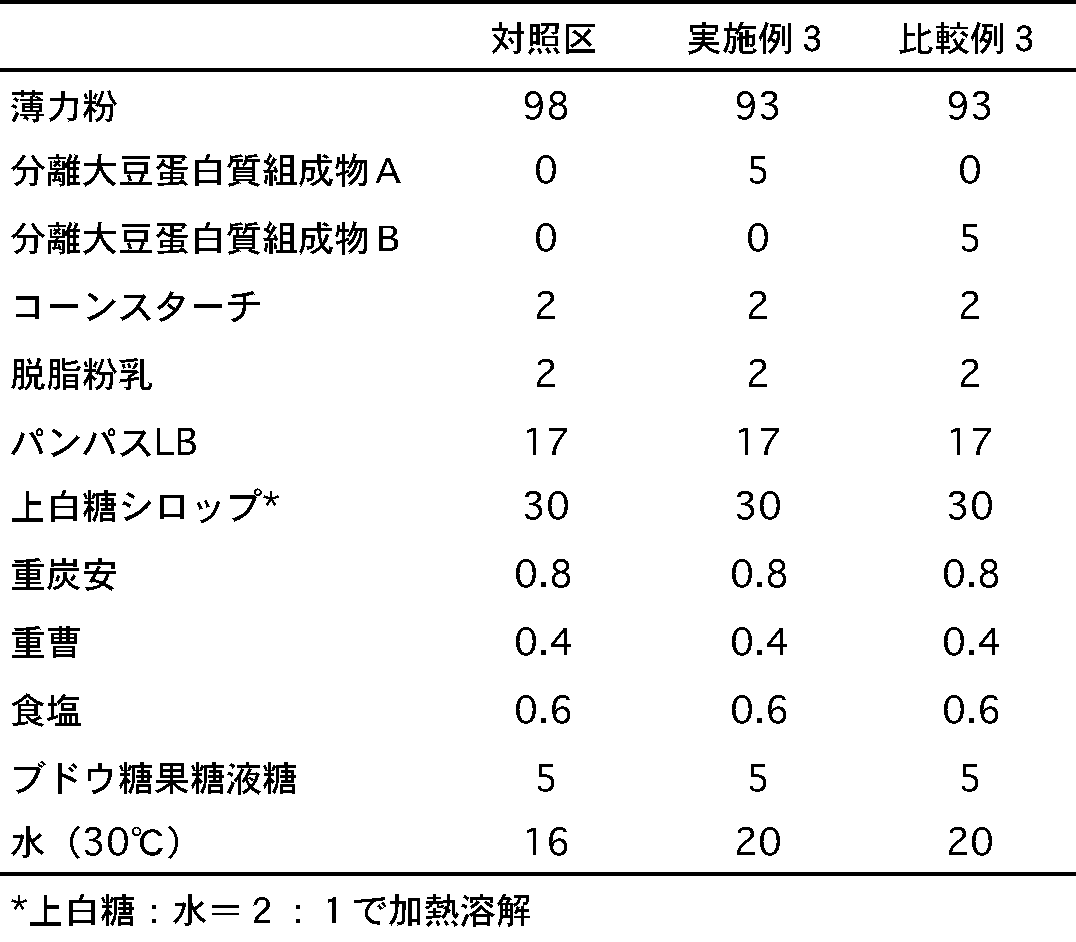
- Heated confectionery having the composition shown in Table 3 was prepared.
- the sucrose was dissolved by heating with half the weight of water and used. Further, in consideration of the amount contained in the isolated soybean protein A or B, sodium chloride was added so as to have the same amount in Example 3, Comparative Example 3, and the control group.
- the sheeter was folded twice in a sheeter (gauge thickness 4 mm) and molded to a final thickness of 2.8 mm ⁇ 6 mm ⁇ 90 mm.
- Firing was carried out for 3 minutes at an upper fire of 220 ° C and a lower fire of 210 ° C. After baking, the mixture was allowed to cool to room temperature, packed in a bag and left for one day, and a taste evaluation and a physical property test were performed.
- a taste evaluation and a physical property test were performed.
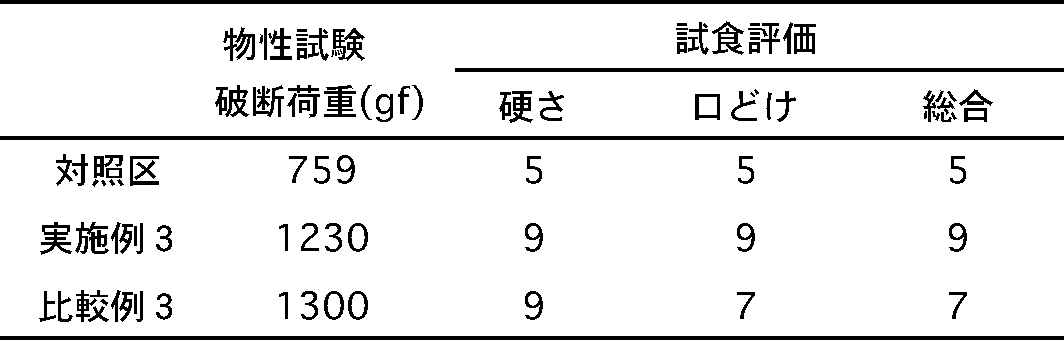
- For physical property tests use an Instron universal material testing machine, place the sample on a sample table with a hole with a diameter of 2 cm, push from the top until the sample breaks with a wedge-shaped plunger and a measurement speed of 6 mm / min. The load value was taken as the breaking load.
- the taste evaluation was performed in a 10-step evaluation based on the control panel by 5 panelists. The evaluation items were (1) Hardness, (2) Mouth, (3) Comprehensive evaluation, with 5 points for the control group equivalent, 10 points for the best and 0 points for the worst.
- Example 3 and Comparative Example 3 had a large breaking load and hard physical properties as compared with the control group.
- both Example 3 and Comparative Example 3 were evaluated as being harder than the control group.
- mouth opening when the chewing area was chewed, it became dango-like in the mouth, which was not preferable, but in Example 3, the mouth was good and the mouthfeel was good.
- Comparative Example 3 was superior in mouthfeel compared to the control group, but did not reach Example 3. Overall, Example 3 had the best texture.
Landscapes
- Life Sciences & Earth Sciences (AREA)
- Chemical & Material Sciences (AREA)
- Food Science & Technology (AREA)
- Engineering & Computer Science (AREA)
- Polymers & Plastics (AREA)
- Health & Medical Sciences (AREA)
- Nutrition Science (AREA)
- Biochemistry (AREA)
- Oil, Petroleum & Natural Gas (AREA)
- Proteomics, Peptides & Aminoacids (AREA)
- Mycology (AREA)
- Noodles (AREA)
- Bakery Products And Manufacturing Methods Therefor (AREA)
- Confectionery (AREA)
Abstract
Description
(1)酸沈殿の状態で乾燥された分離大豆蛋白質組成物を有効成分とする、澱粉加工食品用物性改良剤。
(2)(1)の物性改良剤を含有する、澱粉加工食品。
に関するものである。
本発明の分離大豆蛋白質組成物とは、大豆蛋白質を主成分とする組成物のことで、脱脂大豆等の大豆原料から、水または温水にて抽出して繊維質(オカラ)を除去した後、pH4~5程度の大豆蛋白質の等電点付近のpHで酸沈殿させた蛋白質を分離回収したものである。
酸沈殿状態の分離大豆蛋白質組成物は、定法であればここに水およびアルカリ剤を加えて中性乃至弱アルカリ性に中和し、蛋白質を溶解せしめた後に乾燥する。しかし本発明では、酸沈殿状態のまま,もしくは少量の水を加えて懸濁分散したのち、大豆蛋白質の等電点付近、例えばpH4~5において乾燥し、好ましくは粉末化される。酸沈殿の状態で乾燥されることで、より高い澱粉加工食品の物性改良効果が得られる。乾燥はコストや物性の点で噴霧乾燥が最も好ましいが、凍結乾燥,ドラム乾燥,減圧乾燥,熱風乾燥,過熱水蒸気乾燥なども使用できる。乾燥前もしくは乾燥後に加熱等による殺菌処理を施すと衛生上有利である。乾燥前もしくは乾燥後に粉砕処理を施すと、より高い改良効果が得られることがある。
澱粉加工食品とは、パン類,ケーキ類,焼き菓子類などのベーカリー製品や、麺やギョウザ皮などの麺類、バッター,パン粉などの衣類など、澱粉が主体となる製品全般を指す。中でも、小麦粉を主たる澱粉源にしたものが好ましく、小麦粉のみを澱粉源としたものが最も好ましい。
脱脂大豆に7倍量の水を加え、水酸化ナトリウムにてpH7に調整して混合・抽出し、遠心分離にて沈殿物を除去したのち、残渣にさらに脱脂大豆の5倍量の水を加えて同様に処理し、抽出液を得た。塩酸でpH4.5に調整して蛋白質を沈殿させ、遠心分離にて回収した。水を加えたのちホモミキサーで分散し、熱風温度180℃,排風温度70℃にて噴霧乾燥して粉末状の分離大豆蛋白質組成物Aを得た。
脱脂大豆に7倍量の水を加え、水酸化ナトリウムにてpH7に調整して混合・抽出し、遠心分離にて沈殿物を除去したのち、残渣にさらに脱脂大豆の5倍量の水を加えて同様に処理し、抽出液を得た。塩酸でpH4.5に調整して蛋白質を沈殿させ、遠心分離にて回収した。水を加えたのち水酸化ナトリウムで中和し、熱風温度180℃,排風温度70℃にて噴霧乾燥して粉末状の分離大豆蛋白質組成物Bを得た。
分離大豆蛋白質組成物Aを麺類に使用した際の効果を、分離大豆蛋白質組成物Bとの比較において確認した。麺の調製は、表1の配合で行った。材料を混合後まとめ、製麺機(せとTS-1、さぬき麺機)にて複合・圧延し、最終1.0mmまで延ばし、幅1mmで麺線切りを行った。蒸し機にて98℃,5分間蒸したのち、85℃で60分間熱風乾燥した。測定は沸騰水中で4分茹でて水冷し、15分後に測定した。測定はインストロン万能材料試験機にてクサビ型プランジャーを用いて速度0.05mm/secで測定した。また、試食評価は6人のパネラーにより、対照区を基準とした10段階評価で行った。評価項目は、(1)硬さ、(2)歯切れ、(3)咀嚼後のヌメリ感の低さ、および(4)総合評価とし、対照区と同等であるものを5点、それぞれ最も良いものを10点、最も悪いものを0点とした。

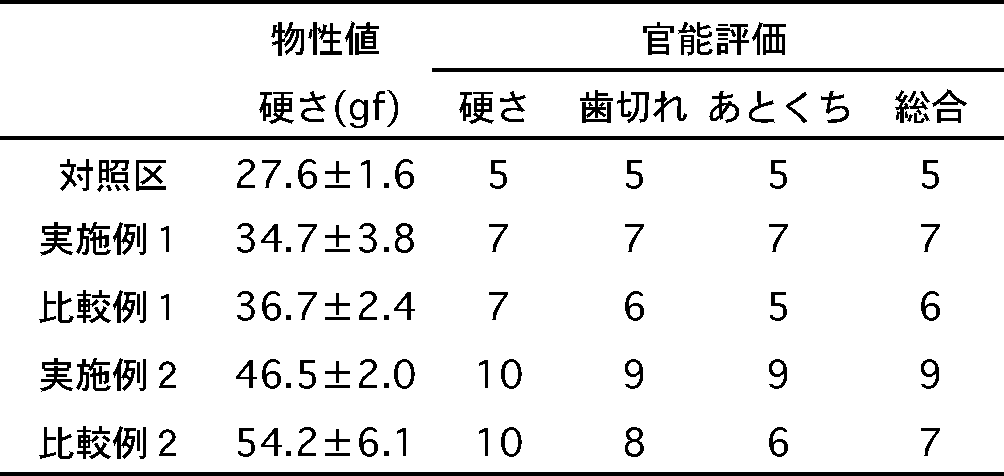
表3の配合の加熱菓子を調製した。上白糖は半分の重量の水で加熱溶解し用いた。また食塩は、分離大豆蛋白質AまたはBに含まれる分を考慮し、実施例3,比較例3,対照区で同じ量になるよう添加した。コートミキサーにて35℃保温しながら低速30分間ミキシングし、生地温度36℃で捏ね上げた。常温5~10分間放置後、シーターで3つ折り2回(ゲージ厚4mm)シーティングし、最終厚2.8mm×6mm×90mmに成型した。上火220℃、下火210℃で3分間焼成した。
焼成後室温になるまで放冷し、袋詰めして1日放置し、試食評価および物性試験を行った。物性試験は、インストロン万能材料試験機を用い、直径2cmの穴の開いた試料台の上に試料を置き、クサビ型プランジャー、測定速度6mm/minで試料が割れるまで上から押し、最大の荷重値を破断荷重とした。試食評価は5人のパネラーによる対照区を基準とした10段階評価で行った。評価項目は、(1)硬さ、(2)口どけ、(3)総合評価とし、対照区同等を5点、それぞれ最も良いものを10点、最も悪いものを0点とした。
Claims (11)
- 酸沈殿の状態で乾燥された分離大豆蛋白質組成物を有効成分とする、澱粉加工食品用物性改良剤。
- 物理強度の増強用、または歯切れ良さ若しくはネチャつきの改善用である、請求項1記載の澱粉加工食品用物性改良剤。
- 該分離大豆蛋白組成物を水に溶解したときのpHは4~5であり、該分離大豆蛋白組成物のNSIはpH4.5において30%以下であってpH7.0において60%である、請求項1記載の澱粉加工食品用物性改良剤。
- 該分離大豆蛋白組成物を水に溶解したときのpHは4~5であり、該分離大豆蛋白組成物のNSIはpH4.5において15%以下であってpH7.0において80%である、請求項1記載の澱粉加工食品用物性改良剤。
- 澱粉加工食品が麺類である、請求項1記載の澱粉加工食品用物性改良剤。
- 澱粉加工食品が焼き菓子である、請求項1記載の澱粉加工食品用物性改良剤。
- 酸沈殿の状態で乾燥された分離大豆蛋白質組成物を含有する、澱粉加工食品。
- 麺類である、請求項7記載の澱粉加工食品。
- 焼き菓子である、請求項7記載の澱粉加工食品。
- 酸沈殿の状態で乾燥された分離大豆蛋白質組成物を有効成分として用いる、澱粉加工食品の物性改良方法。
- 物性改良効果が、物理強度を増強する効果、または歯切れ良さ若しくはネチャつきの改善効果である、請求項10記載の物性改良方法。
Priority Applications (3)
| Application Number | Priority Date | Filing Date | Title |
|---|---|---|---|
| US14/004,719 US9119406B2 (en) | 2011-03-29 | 2012-03-21 | Texture-improving agent for a starch processed food |
| JP2013507413A JP5999086B2 (ja) | 2011-03-29 | 2012-03-21 | 澱粉加工食品用改良剤 |
| CN201280015919.7A CN103476269B (zh) | 2011-03-29 | 2012-03-21 | 用于淀粉加工食品的改良剂 |
Applications Claiming Priority (2)
| Application Number | Priority Date | Filing Date | Title |
|---|---|---|---|
| JP2011-072341 | 2011-03-29 | ||
| JP2011072341 | 2011-03-29 |
Publications (1)
| Publication Number | Publication Date |
|---|---|
| WO2012133012A1 true WO2012133012A1 (ja) | 2012-10-04 |
Family
ID=46930744
Family Applications (1)
| Application Number | Title | Priority Date | Filing Date |
|---|---|---|---|
| PCT/JP2012/057100 Ceased WO2012133012A1 (ja) | 2011-03-29 | 2012-03-21 | 澱粉加工食品用改良剤 |
Country Status (4)
| Country | Link |
|---|---|
| US (1) | US9119406B2 (ja) |
| JP (1) | JP5999086B2 (ja) |
| CN (1) | CN103476269B (ja) |
| WO (1) | WO2012133012A1 (ja) |
Families Citing this family (1)
| Publication number | Priority date | Publication date | Assignee | Title |
|---|---|---|---|---|
| CN104872236A (zh) * | 2015-04-13 | 2015-09-02 | 许昌学院 | 一种具有延缓老化功能的营养蛋糕及其制作方法 |
Citations (2)
| Publication number | Priority date | Publication date | Assignee | Title |
|---|---|---|---|---|
| JPH10108616A (ja) * | 1996-10-01 | 1998-04-28 | Miyoshi Oil & Fat Co Ltd | 焼成食品用艶出剤 |
| JP2002165552A (ja) * | 2000-11-30 | 2002-06-11 | Miyoshi Oil & Fat Co Ltd | フライ食品改質剤及びフライ食品 |
Family Cites Families (7)
| Publication number | Priority date | Publication date | Assignee | Title |
|---|---|---|---|---|
| JP4284845B2 (ja) | 2000-08-31 | 2009-06-24 | 不二製油株式会社 | フライ用衣材 |
| JP3669303B2 (ja) | 2001-07-26 | 2005-07-06 | 不二製油株式会社 | ベーカリー製品の製造方法 |
| US20080008815A1 (en) * | 2006-06-21 | 2008-01-10 | Cho Myong J | Bland tasting soy protein isolate and processes for making same |
| WO2008072656A1 (ja) * | 2006-12-14 | 2008-06-19 | Fuji Oil Company, Limited | 大豆蛋白質組成物を配合する麺類および麺皮類 |
| CN101129176B (zh) * | 2007-09-29 | 2010-06-23 | 山西省农业科学院农产品综合利用研究所 | 杂粮保鲜湿面的制造方法 |
| CN101416651A (zh) * | 2007-10-24 | 2009-04-29 | 国庆堂 | 大豆蛋白复合营养面粉 |
| US20100196575A1 (en) * | 2009-01-30 | 2010-08-05 | Solae, Llc | Melting Vegetable Protein Based Substitute Cheese |
-
2012
- 2012-03-21 WO PCT/JP2012/057100 patent/WO2012133012A1/ja not_active Ceased
- 2012-03-21 JP JP2013507413A patent/JP5999086B2/ja not_active Expired - Fee Related
- 2012-03-21 CN CN201280015919.7A patent/CN103476269B/zh not_active Expired - Fee Related
- 2012-03-21 US US14/004,719 patent/US9119406B2/en not_active Expired - Fee Related
Patent Citations (2)
| Publication number | Priority date | Publication date | Assignee | Title |
|---|---|---|---|---|
| JPH10108616A (ja) * | 1996-10-01 | 1998-04-28 | Miyoshi Oil & Fat Co Ltd | 焼成食品用艶出剤 |
| JP2002165552A (ja) * | 2000-11-30 | 2002-06-11 | Miyoshi Oil & Fat Co Ltd | フライ食品改質剤及びフライ食品 |
Also Published As
| Publication number | Publication date |
|---|---|
| JPWO2012133012A1 (ja) | 2014-07-28 |
| CN103476269A (zh) | 2013-12-25 |
| JP5999086B2 (ja) | 2016-09-28 |
| US9119406B2 (en) | 2015-09-01 |
| CN103476269B (zh) | 2015-11-25 |
| US20140004247A1 (en) | 2014-01-02 |
Similar Documents
| Publication | Publication Date | Title |
|---|---|---|
| JP5257074B2 (ja) | 大豆蛋白質組成物を配合する麺類および麺皮類 | |
| López et al. | Influence of storage time for the acceptability of bread formulated with lupine protein isolate and added brea gum | |
| Otegbayo et al. | Effect of soy enrichment on bread quality | |
| US20100227040A1 (en) | Powdery Soy Protein And Soy Protein-Containing Food Using The Same | |
| WO2014103833A1 (ja) | 水溶性エンドウ多糖類からなる小麦主体食品の物性改良剤 | |
| CN1853501B (zh) | 快餐面类及其制造方法 | |
| WO2016038184A1 (en) | Healthy biscuit | |
| JP6078800B2 (ja) | 食品改質剤 | |
| TW201919496A (zh) | 低糖質麵類及其製造方法 | |
| WO2014156552A1 (ja) | ソフトクッキー | |
| JP5999086B2 (ja) | 澱粉加工食品用改良剤 | |
| KR102406970B1 (ko) | 밀 불내성용 식품 중 밀 기반 제품 | |
| JP5762147B2 (ja) | パスタ用熱処理デュラム小麦粉及びその製造方法並びにこれを使用したパスタ | |
| WO2003005827A1 (fr) | Produits cuits au four contenant une proteine de soja et procede de fabrication de celle-ci | |
| JP6390039B2 (ja) | 蕎麦様食品、及びその製造方法 | |
| CN103997911A (zh) | 春卷皮的制造方法 | |
| JP5532603B2 (ja) | 低変性大豆蛋白質組成物の殺菌法 | |
| WO2007026674A1 (ja) | 大豆蛋白質組成物を配合する麺類および麺皮類 | |
| JPWO2009022616A1 (ja) | 加熱菓子用食感改良剤及び食感の改良された加熱菓子 | |
| JP6130215B2 (ja) | 春巻皮の製造方法 | |
| Calle et al. | Hydrolyzed Pisum sativum as a protein source for baked products | |
| JP2016131504A (ja) | 緑豆蛋白質配合ベーカリー製品の製造方法 | |
| JP7518991B1 (ja) | ベーカリー食品用ミックスおよびベーカリー食品の製造方法 | |
| CN101522047B (zh) | 淀粉食品用泡胀抑制剂 | |
| WO2024212007A1 (en) | Improved preparation of sunflower protein products ('sf871nds') |
Legal Events
| Date | Code | Title | Description |
|---|---|---|---|
| 121 | Ep: the epo has been informed by wipo that ep was designated in this application |
Ref document number: 12765008 Country of ref document: EP Kind code of ref document: A1 |
|
| ENP | Entry into the national phase |
Ref document number: 2013507413 Country of ref document: JP Kind code of ref document: A |
|
| WWE | Wipo information: entry into national phase |
Ref document number: 14004719 Country of ref document: US |
|
| NENP | Non-entry into the national phase |
Ref country code: DE |
|
| 122 | Ep: pct application non-entry in european phase |
Ref document number: 12765008 Country of ref document: EP Kind code of ref document: A1 |