WO2012128334A1 - 有機el素子 - Google Patents
有機el素子 Download PDFInfo
- Publication number
- WO2012128334A1 WO2012128334A1 PCT/JP2012/057400 JP2012057400W WO2012128334A1 WO 2012128334 A1 WO2012128334 A1 WO 2012128334A1 JP 2012057400 W JP2012057400 W JP 2012057400W WO 2012128334 A1 WO2012128334 A1 WO 2012128334A1
- Authority
- WO
- WIPO (PCT)
- Prior art keywords
- group
- substituent
- formula
- light emitting
- electrode
- Prior art date
- Legal status (The legal status is an assumption and is not a legal conclusion. Google has not performed a legal analysis and makes no representation as to the accuracy of the status listed.)
- Ceased
Links
- 0 *CCC1CCCCC1 Chemical compound *CCC1CCCCC1 0.000 description 5
Images

Classifications
-
- C—CHEMISTRY; METALLURGY
- C09—DYES; PAINTS; POLISHES; NATURAL RESINS; ADHESIVES; COMPOSITIONS NOT OTHERWISE PROVIDED FOR; APPLICATIONS OF MATERIALS NOT OTHERWISE PROVIDED FOR
- C09K—MATERIALS FOR MISCELLANEOUS APPLICATIONS, NOT PROVIDED FOR ELSEWHERE
- C09K11/00—Luminescent materials, e.g. electroluminescent or chemiluminescent
- C09K11/06—Luminescent materials, e.g. electroluminescent or chemiluminescent containing organic luminescent materials
-
- H—ELECTRICITY
- H05—ELECTRIC TECHNIQUES NOT OTHERWISE PROVIDED FOR
- H05B—ELECTRIC HEATING; ELECTRIC LIGHT SOURCES NOT OTHERWISE PROVIDED FOR; CIRCUIT ARRANGEMENTS FOR ELECTRIC LIGHT SOURCES, IN GENERAL
- H05B33/00—Electroluminescent light sources
- H05B33/10—Apparatus or processes specially adapted to the manufacture of electroluminescent light sources
-
- H—ELECTRICITY
- H10—SEMICONDUCTOR DEVICES; ELECTRIC SOLID-STATE DEVICES NOT OTHERWISE PROVIDED FOR
- H10K—ORGANIC ELECTRIC SOLID-STATE DEVICES
- H10K50/00—Organic light-emitting devices
- H10K50/10—OLEDs or polymer light-emitting diodes [PLED]
- H10K50/14—Carrier transporting layers
- H10K50/16—Electron transporting layers
-
- H—ELECTRICITY
- H10—SEMICONDUCTOR DEVICES; ELECTRIC SOLID-STATE DEVICES NOT OTHERWISE PROVIDED FOR
- H10K—ORGANIC ELECTRIC SOLID-STATE DEVICES
- H10K59/00—Integrated devices, or assemblies of multiple devices, comprising at least one organic light-emitting element covered by group H10K50/00
- H10K59/30—Devices specially adapted for multicolour light emission
- H10K59/32—Stacked devices having two or more layers, each emitting at different wavelengths
-
- C—CHEMISTRY; METALLURGY
- C09—DYES; PAINTS; POLISHES; NATURAL RESINS; ADHESIVES; COMPOSITIONS NOT OTHERWISE PROVIDED FOR; APPLICATIONS OF MATERIALS NOT OTHERWISE PROVIDED FOR
- C09K—MATERIALS FOR MISCELLANEOUS APPLICATIONS, NOT PROVIDED FOR ELSEWHERE
- C09K2211/00—Chemical nature of organic luminescent or tenebrescent compounds
- C09K2211/14—Macromolecular compounds
- C09K2211/1408—Carbocyclic compounds
- C09K2211/1416—Condensed systems
-
- C—CHEMISTRY; METALLURGY
- C09—DYES; PAINTS; POLISHES; NATURAL RESINS; ADHESIVES; COMPOSITIONS NOT OTHERWISE PROVIDED FOR; APPLICATIONS OF MATERIALS NOT OTHERWISE PROVIDED FOR
- C09K—MATERIALS FOR MISCELLANEOUS APPLICATIONS, NOT PROVIDED FOR ELSEWHERE
- C09K2211/00—Chemical nature of organic luminescent or tenebrescent compounds
- C09K2211/14—Macromolecular compounds
- C09K2211/1408—Carbocyclic compounds
- C09K2211/1425—Non-condensed systems
Definitions
- the present invention relates to an organic EL element, a display device and an illumination device including the organic EL element, and a method for manufacturing the organic EL element.
- An organic EL (Electro Luminescence) element includes a pair of electrodes including an anode and a cathode, and a light emitting layer provided between the electrodes. When a voltage is applied to the organic EL element, holes are injected from the anode and electrons are injected from the cathode, and light is emitted by combining these holes and electrons in the light emitting layer.
- the number of light emitting layers provided between the electrodes is not limited to one, and a so-called multiphoton organic EL element has a plurality of light emitting layers provided between the electrodes.
- a so-called multiphoton organic EL element has a plurality of light emitting layers provided between the electrodes.
- light is emitted from each light emitting layer, and therefore, the amount of light emission per unit current is increased as compared with an organic EL element having only one light emitting layer.
- an organic EL element in which an extraction electrode is provided between the light emitting layers has been proposed. Since the extraction electrode is electrically connected to an external power source, a predetermined voltage can be applied to the extraction electrode. Therefore, a predetermined voltage can be independently applied to each light emitting layer, and the intensity of light emitted from each light emitting layer can be controlled independently (see, for example, Patent Document 1).
- a predetermined layer may be further provided between the electrodes in addition to the light emitting layer and the extraction electrode described above.
- the electron injection layer is provided in the above-described conventional technique.
- the material of an electron injection layer and its formation method are not described in detail in Patent Document 1, the electron injection layer is generally composed of an unstable material in the atmosphere, such as Ba, BaO, NaF, and LiF. Has been.
- the organic EL element is manufactured by sequentially laminating each layer constituting the element. Therefore, after the electron injection layer is formed, predetermined layers such as a light emitting layer and an extraction electrode are formed. After forming the electron injection layer, if a light emitting layer or the like to be laminated on the electron injection layer is formed in the atmosphere, for example, the unstable electron injection layer is modified in the atmosphere, and as a result, the produced organic EL There exists a problem that the light emission characteristic of an element falls.
- an object of the present invention is to provide an organic EL device including an electron injection layer that can suppress deterioration in the manufacturing process of the organic EL device.
- the present invention includes a first electrode, a second electrode, one or a plurality of extraction electrodes 3 disposed between the first electrode 1 and the second electrode 2, and the first electrode.
- the present invention relates to an organic EL element containing an ionic polymer.
- a pair of the light emitting units adjacent to each other through the extraction electrode has an order of stacking the light emitting layer and the electron injecting layer with respect to the first electrode in one of the light emitting units.
- the present invention relates to an organic EL element having a different order of lamination of a light emitting layer and an electron injection layer in the light emitting unit.
- the present invention also relates to an organic EL element in which a pair of light emitting layers provided in different light emitting units emit light of different colors.
- the present invention also relates to an organic EL element in which a pair of light emitting layers provided in different light emitting units emit light of the same color.
- the present invention also relates to a lighting device including the organic EL element.
- the present invention also relates to a display device including the organic EL element.
- the present invention also provides a first electrode, a second electrode, one or more extraction electrodes disposed between the first electrode and the second electrode, the first electrode, A method for manufacturing an organic EL element, comprising: a plurality of light emitting units each having an electron injection layer and a light emitting layer, each disposed between adjacent electrodes of the extraction electrode and the second electrode. Forming a coating solution containing a polymer to form the electron injection layer; forming the light emitting layer before forming the electron injection layer or after forming the electron injection layer; and organic EL
- the present invention relates to a method for manufacturing an element.
- a coating solution containing an ionic polymer can be applied in an atmosphere where the volume ratio of nitrogen is 90% or less and the volume ratio of oxygen is 10% or more and 30% or less.
- an organic EL element including an electron injection layer that can suppress deterioration in the manufacturing process of the organic EL element.
- the first electrode, one or more extraction electrodes, and the second electrode are arranged at intervals in this order, and the first electrode,
- a light emitting unit including an electron injection layer and a light emitting layer is disposed between the one or a plurality of the extraction electrodes and the second electrode adjacent to each other, and the electron injection layer is an ion.
- a functional polymer is a functional polymer.
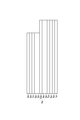
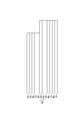
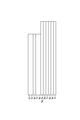
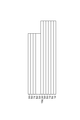
- an organic EL element including three extraction electrodes 3 and four light emitting units 4 is shown as an example.
- the number of extraction electrodes 3 and the number of light emitting units 4 are as follows.
- the configuration is not limited to that shown in FIG.
- 1st electrode 1 and 2nd electrode 2 function as an anode or a cathode according to the composition of light emitting unit 4 mentioned below. Since light emitted from the light emitting layer is emitted to the outside from at least one of the first electrode 1 and the second electrode 2, at least one of the first electrode 1 and the second electrode 2 One is constituted by an electrode (light extraction electrode) exhibiting optical transparency.
- the extraction electrode 3 includes a single-layer electrode or an electrode in which a plurality of layers are stacked.
- the extraction electrode 3 is composed of a conductive thin film made of the same material as the anode or a conductive thin film made of the same material as the cathode.
- the extraction electrode 3 is constituted by a laminate of a conductive thin film made of the same material as the anode and a conductive thin film made of the same material as the cathode.
- the extraction electrode 3 Since the extraction electrode 3 needs to transmit light emitted from the light emitting layer, the extraction electrode 3 is composed of an electrode exhibiting light transmittance.
- the extraction electrode 3 is connected to a drive circuit 11 for driving the organic EL element via a predetermined electrical wiring.
- the extraction electrode 3 is connected not only to a positive voltage but also to a DC power source of the drive circuit 11 that can apply a negative voltage.
- the extraction electrode 3 has a configuration different from that of FIG. 1, but extends from a region where light emission occurs when viewed from one side in the thickness direction of the first electrode 1 (hereinafter sometimes referred to as “plan view”). And is connected to the electrical wiring at the end.
- the first electrode 1, the second electrode 2, and the extraction electrodes 3 are formed so as not to overlap each other in a region extending from a region where light emission occurs in a plan view.
- Each light emitting unit 4 includes at least an electron injection layer and a light emitting layer.
- the light emitting unit 4 is not limited to the electron injection layer and the light emitting layer, and a predetermined layer may be provided as necessary.
- the predetermined layer includes, for example, a layer made of an organic material, a layer made of an inorganic material, a layer made of an organic material and an inorganic material, and the like. Examples of such a predetermined layer include a hole injection layer, a hole transport layer, an electron block layer, an electron transport layer, and a hole block layer.
- Examples of the layer structure of the light emitting unit 4 include the following a) to f). a) Light emitting layer / electron injection layer b) Light emitting layer / electron transport layer / electron injection layer c) Hole injection layer / light emitting layer / electron injection layer d) Hole injection layer / light emitting layer / electron transport layer / electron injection layer e) hole injection layer / hole transport layer / light emitting layer / electron injection layer f) hole injection layer / hole transport layer / light emitting layer / electron transport layer / electron injection layer (where the symbol “/” indicates the (Indicates that two layers separated by the symbol “/” are stacked adjacent to each other. The same applies hereinafter.)
- the plurality of light emitting units 4 may have the same or different layer structure.
- the first electrode 1 When the first electrode 1 is used as a reference, there are two stacking orders of the layer configuration of the light emitting units 4 of the respective configurations a) to f). That is, a first stacking order in which the light emitting layer is disposed closer to the first electrode 1 with respect to the electron injection layer, and a second stacking order in which the electron injection layer is disposed closer to the first electrode 1 with respect to the light emitting layer.
- the layers are sequentially stacked from the left in the description of the above a) to f) in the first stacking order, and the layers are stacked in the second stacking order from the above a) to f).
- the layers In the description of f), the layers are sequentially laminated from the right side.
- the layer configuration of the light emitting unit 4 may be any stacking order.
- the configurations of the first electrode 1, the second electrode 2, and the extraction electrode 3 are specified by the stacking order of the layer configuration of the light emitting unit 4 disposed in contact with each electrode.
- the polarities of the first electrode 1 and the second electrode 2 depend on the stacking order of the layer configuration of the light emitting unit 4 provided in contact with the electrodes.
- the first electrode 1 that functions as an anode is provided. That is, in consideration of only the laminated body composed of the first electrode 1 and the light emitting unit 4 provided in contact with the first electrode, the first electrode functioning as the anode, the light emitting layer, and the electron injection layer are arranged in this order. Are stacked. Conversely, when the stacking order of the layer configuration of the light emitting unit 4 provided in contact with the first electrode 1 is the second stacking order, the first electrode 1 that functions as a cathode is provided. In other words, considering only the laminate composed of the first electrode and the light emitting unit provided in contact with the first electrode, the layers are laminated in the order of the first electrode functioning as the cathode, the electron injection layer, and the light emitting layer.
- the second electrode 2 that functions as a cathode is provided. That is, when considering only the laminate composed of the light emitting unit 4 and the second electrode 2 provided in contact with the second electrode 2, the layers are laminated in the order of the light emitting layer, the electron injection layer, and the second electrode functioning as the cathode. Is done. Conversely, when the stacking order of the layer configuration of the light emitting unit 4 provided in contact with the second electrode 2 is the second stacking order, the second electrode 2 that functions as an anode is provided.
- the layers are laminated in the order of the electron injection layer, the light emitting layer, and the second electrode functioning as the anode. Is done.
- the configuration of the extraction electrode 3 differs depending on the stacking order of the layer configuration of the pair of light emitting units 4 that sandwich the extraction electrode 3.
- the extraction electrode 3 sandwiched between the light emitting units 4 having different layer structures in the stacking order is composed of one layer of electrodes.
- it can be configured by any one of a conductive thin film made of the same material as the cathode and a conductive thin film made of the same material as the anode.
- the light-emitting unit 4 in the first stacking order and the extraction electrode 3 sandwiched between the light-emitting units 4 in the second stacking order can be composed of a conductive thin film made of the same material as the cathode. That is, considering only the laminated body composed of the light emitting unit 4 in the first stacking order, the light emitting unit 4 in the second stacking order, and the extraction electrode 3 sandwiched between them, the light emitting layer, the electron injection layer, the cathode, Each layer may be laminated in the order of a conductive thin film, an electron injection layer, and a light emitting layer of the same material.
- the extraction electrode 3 sandwiched between the light emitting units 4 having the same stacking order of layer configuration can be composed of a laminate of a conductive thin film made of the same material as the cathode and a conductive thin film made of the same material as the anode.
- the light emitting unit 4 in the first stacking order and the extraction electrode 3 sandwiched between the light emitting units 4 in the first stacking order are made of the same material as the cathode in order from the first electrode 1.
- a conductive thin film made of the same material as the thin film and the anode can be formed from a laminated body in this order.
- Each layer may be laminated in the order of a conductive thin film made of the same material, a conductive thin film made of the same material as the anode, a light emitting layer, and an electron injection layer.
- the light emitting unit 4 in the second stacking order and the extraction electrode 3 sandwiched between the light emitting units 4 in the second stacking order are composed of a conductive thin film and a cathode made of the same material as the anode in order from the first electrode 1. It is possible to form a laminated body in which conductive thin films made of the same material as above are laminated in this order.
- each layer may be laminated in the order of a conductive thin film of the same material, a conductive thin film of the same material as the cathode, an electron injection layer, and a light emitting layer.
- the light-emitting units may be stacked via the extraction electrode so that the stacking order of the layer configurations of the respective light-emitting units is alternately changed.
- a plurality of light emitting units may be stacked through extraction electrodes so that the order is alternately changed, and one or a plurality of light emitting units may be stacked so as to be in the same stacking order. That is, when three or more light emitting units are provided, the stacking order is the same as the portion where the light emitting units are stacked via the extraction electrodes so that the stacking order of the layer configuration of each light emitting unit is alternately different. And a portion laminated on each other may be mixed.
- the extraction electrode can be constituted by a single-layer electrode (either one of a conductive thin film made of the same material as the cathode and a conductive thin film made of the same material as the anode). Therefore, the number of extraction electrodes 3 can be reduced and the process of forming the extraction electrodes can be simplified as compared with the extraction electrodes 3 sandwiched between the light emitting units 4 having the same stacking order of layer configurations.
- the number of the light emitting units 4 and the thickness of each layer are appropriately set in consideration of the light emission efficiency and the element life.
- each light-emitting unit 4 has a predetermined value independently. Can be applied. Thereby, the intensity of light emitted from each light emitting unit 4 can be controlled independently.
- the organic EL element includes a plurality of light emitting units 4, the organic EL element includes a plurality of light emitting layers.
- a pair of light emitting layers provided in different light emitting units is configured by a light emitting layer that emits light of different colors or a light emitting layer that emits light of the same color.
- the light-emitting layers that emit light of the same color may be formed using the same light-emitting material.
- light emitting layers that emit light of different colors may be formed using different light emitting materials.
- a part of the materials may be common to the light emitting layers that emit light of different colors.
- three or more light emitting layers are provided. For example, two of them are light emitting layers that emit light of the same color, and the remaining light emitting layers are light of different colors. It is good also as a light emitting layer which radiates.
- the above organic EL elements are used in, for example, a backlight of a display device, a light source of a pixel, or a lighting device. That is, a display device or a lighting device can be manufactured by forming one or a plurality of organic EL elements on a predetermined substrate.
- the first electrode, one or a plurality of extraction electrodes, and the second electrode are arranged at intervals in this order, and the first electrode,
- An electron injection layer is formed by coating a liquid and solidifying the liquid. Further, a light emitting layer is formed before or after the electron injection layer is formed, and the electron injection layer and the light emitting layer are formed.
- Light emitting unit including To form the door.
- the organic EL element of this embodiment can be formed by, for example, (1) a method of sequentially laminating each component in order from the first electrode, or (2) a laminating method.
- the first electrode 1, the light emitting unit 4, the extraction electrode 3, the light emitting unit 4, and the second electrode 2 are provided on a support substrate or the like. By laminating in this order, an organic EL element can be formed.
- the step of sequentially laminating the first electrode 1 and the light emitting unit 4 on the support substrate or the like and further laminating the extraction electrode 3 and the light emitting unit 4 one or more times is performed one or more times.
- the organic EL element can be formed by repeatedly and finally laminating the second electrode 2.
- the first electrode 1 and the second electrode 2 are provided as electrodes corresponding to an anode or a cathode. A method for forming the anode and the cathode and the material thereof will be described later.
- the extraction electrode 3 can be formed in the same manner as the anode or cathode described later.
- the extraction electrode 3 is formed by the same material and the same formation method as the anode or the cathode.
- one layer is formed by the same material and the same formation method as one of the anode and cathode
- the other layer is formed by the same material and the same formation method as the other of the anode and cathode. And it forms by laminating
- the extraction electrode 3 may be formed of the same material as an anode or a cathode to be described later, but may be formed of a material different from the first electrode 1 or the second electrode 2.
- the thickness is appropriately set in consideration of the light transmittance, electrical resistance, and the like.
- a coating solution containing an ionic polymer is applied and formed, and this is solidified to form an electron injection layer, and further, before the electron injection layer is formed or the electron injection layer is formed.
- a light emitting layer is formed, and a light emitting unit including an electron injection layer and a light emitting layer can be formed.
- the light emitting unit for example, sequentially stacks the layers having the above-described configurations a) to f) in the first stacking order or the second stacking order, or in the first stacking order or the second stacking order by the laminating method. It is formed.
- the light emitting layer in the first stacking order in which the light emitting layer is disposed closer to the first electrode 1 with respect to the electron injection layer, the light emitting layer is first formed before the electron injection layer is formed. After that, an electron injection layer is formed. In the case of the second stacking order in which the electron injection layer is disposed closer to the first electrode 1 with respect to the light emitting layer, the light emitting layer is formed after the electron injection layer is formed.
- the electron injection layer is formed by coating a coating solution containing an ionic polymer and solidifying it.
- a coating solution containing an ionic polymer As will be described later, since the ionic polymer is relatively stable even in the air, it can be formed by a coating method using a coating solution containing the ionic polymer.
- the coating solution containing the ionic polymer may be performed in an atmosphere of an inert gas such as nitrogen gas or argon gas, but from the viewpoint of simplifying the manufacturing process, the volume ratio of nitrogen is 90% or less. And in an atmosphere with an oxygen volume ratio of 10% to 30%, a nitrogen volume ratio of 60% to 90%, an oxygen volume ratio of 10% to 30%, and a water vapor volume ratio of 0.1%. More preferably, it is carried out in an atmosphere of 0001% to 0.01%, pressure of 10 kPa to 1000 kPa, temperature of 5 ° C.
- an inert gas such as nitrogen gas or argon gas
- a coating solution containing an ionic polymer can be carried out by selecting an optimal coating method from known coating methods in consideration of the shape of the organic EL element and the simplicity of the process.
- coating methods include spin coating, casting, micro gravure coating, gravure coating, bar coating, roll coating, wire bar coating, dip coating, spray coating, screen printing, and flexographic printing. And offset printing method and inkjet printing method.
- the solidification of the thin film formed by coating a coating solution containing an ionic polymer is performed by natural drying, heat drying, vacuum drying, or the like.
- a coating solution containing a material that is polymerized by heating or light irradiation is used, the thin film can be solidified by heating or light irradiation.
- the thin film may be solidified in a vacuum atmosphere or in an inert gas atmosphere such as nitrogen gas or argon gas.
- the volume ratio of nitrogen is 90% or less and oxygen Is preferably performed in an atmosphere with a volume ratio of 10% to 30%, a volume ratio of nitrogen of 60% to 90%, a volume ratio of oxygen of 10% to 30%, and a volume ratio of water vapor of 0.0001% to More preferably, it is performed in an atmosphere of 0.01%, 10 kPa to 1000 kPa, and a temperature of 60 ° C.
- the volume ratio of nitrogen is 70% to 90%
- the volume ratio of oxygen is 10% to 30%
- the volume of water vapor It is more preferable to carry out in an atmosphere having a ratio of 0.002% to 0.005%, a pressure of 80 kPa to 120 kPa, and a temperature of 50 ° C. to 250 ° C., and even more preferably in the atmosphere at a temperature of 20 ° C. to 30 ° C. preferable.
- the light emitting layer and a hole injection layer, a hole transport layer, an electron block layer, a hole block layer, an electron transport layer, and the like provided as necessary are formed by a known method such as the above-described coating method or a vapor deposition method described later. Can be formed. These may be formed in a vacuum atmosphere or in an atmosphere of an inert gas such as nitrogen gas or argon gas. From the viewpoint of simplifying the manufacturing process, at least one layer includes the above-described ionic polymer. It is preferable to form in the atmosphere mentioned as a preferable atmosphere when applying the coating liquid or solidifying the thin film.
- the manufacturing process can be simplified by forming the light emitting layer or the like in a vacuum atmosphere or without introducing an atmosphere of an inert gas such as nitrogen gas or argon gas.
- the light emitting unit includes not only the light emitting layer and the electron injection layer, but also a predetermined layer different from the light emitting layer and the electron injection layer, such as a hole injection layer, a hole transport layer, an electron block layer, and an electron transport layer. , A hole blocking layer and the like are provided.
- the electron injection layer has a function of improving the electron injection efficiency from the cathode.
- the electron transport layer has a function of improving the electron injection efficiency from the layer in contact with the surface on the cathode side.
- the hole blocking layer has a function of blocking hole transport. In the case where the electron injection layer and / or the electron transport layer have a function of blocking hole transport, these layers may also serve as the hole blocking layer.
- the hole injection layer has a function of improving the hole injection efficiency from the anode.
- the hole transport layer has a function of improving the hole injection efficiency from the layer in contact with the surface on the anode side.
- the electron blocking layer has a function of blocking electron transport. When the hole injection layer and / or the hole transport layer has a function of blocking electron transport, these layers may also serve as an electron blocking layer.
- the electron injection layer and the hole injection layer may be collectively referred to as a charge injection layer, and the electron transport layer and the hole transport layer may be collectively referred to as a charge transport layer.
- Organic EL elements include (1) a bottom emission type, (2) a top emission type, and (3) a dual emission type.
- the organic EL element is usually provided on a support substrate, the bottom emission type organic EL element emits light to the outside through the support substrate, and the top emission type organic EL element emits light to the outside from the side opposite to the support substrate.
- the double-sided light emitting organic EL element emits light to the outside from both the support substrate side and the opposite side of the support substrate.
- the present invention can be applied to any of bottom emission type, top emission type, and double-sided emission type organic EL elements.
- the first electrode In the bottom emission type organic EL element, light is emitted to the outside through the first electrode. Therefore, the first electrode can be constituted by an electrode having optical transparency, and conversely, it is separated from the support substrate.
- the arranged second electrode is constituted by an electrode that reflects normal light.
- the first electrode disposed closer to the support substrate is composed of an electrode that normally reflects light.
- both the first and second electrodes are constituted by electrodes that exhibit light transmittance.
- the organic EL element is usually formed on a support substrate.
- a substrate that does not change chemically in the process of manufacturing the organic EL element is suitably used as the support substrate.
- glass, plastic, a polymer film, a silicon plate, and a laminate of these are used.
- a drive substrate in which a drive circuit for driving the organic EL element is formed in advance may be used as the support substrate.
- a substrate exhibiting light transmittance is used as the support substrate.
- an electrode exhibiting optical transparency is used for the anode.
- the electrode exhibiting light transmittance a thin film of metal oxide, metal sulfide, metal or the like can be used, and an electrode having high electrical conductivity and light transmittance is preferably used.
- a thin film made of indium oxide, zinc oxide, tin oxide, ITO, indium zinc oxide (abbreviated as IZO), gold, platinum, silver, copper, or the like is used as an electrode.
- a thin film made of ITO, IZO or tin oxide is preferably used.
- Examples of a method for producing the anode include a vacuum deposition method, a sputtering method, an ion plating method, and a plating method.
- an organic transparent conductive film such as polyaniline or a derivative thereof, polythiophene or a derivative thereof may be used as the anode.
- the organic transparent conductive film can be produced by a coating method using an organic conductive material such as polythiophene.
- the film thickness of the anode is appropriately set in consideration of required characteristics and process simplicity, and is, for example, 10 nm to 10 ⁇ m, preferably 20 nm to 1 ⁇ m, and more preferably 50 nm to 500 nm.
- hole injection material constituting the hole injection layer
- metal oxides such as vanadium oxide, molybdenum oxide, ruthenium oxide and aluminum oxide, phenylamine compounds, starburst amine compounds, phthalocyanine compounds, amorphous Mention may be made of carbon, polyaniline and polythiophene derivatives.
- Examples of the method for forming the hole injection layer include film formation from a solution containing a hole injection material.
- a hole injection layer can be formed by coating a film containing a hole injection material by a predetermined coating method and solidifying the solution.
- the coating film can be solidified by natural drying, heat drying, vacuum drying, or the like, or can be performed by irradiating predetermined light.
- Examples of the solvent used for film formation from a solution include chlorine solvents such as chloroform, methylene chloride, and dichloroethane, ether solvents such as tetrahydrofuran, aromatic hydrocarbon solvents such as toluene and xylene, acetone, and methyl ethyl ketone.
- Examples include ketone solvents, ester solvents such as ethyl acetate, butyl acetate, and ethyl cellosolve acetate, and water.
- the film thickness of the hole injection layer is appropriately set in consideration of required characteristics and process simplicity, and is, for example, 1 nm to 1 ⁇ m, preferably 2 nm to 500 nm, and more preferably 5 nm to 200 nm.
- Hole transport layer examples of the hole transport material constituting the hole transport layer include polyvinyl carbazole or derivatives thereof, polysilane or derivatives thereof, polysiloxane derivatives having aromatic amines in the side chain or main chain, pyrazoline derivatives, arylamine derivatives, stilbene. Derivatives, triphenyldiamine derivatives, polyaniline or derivatives thereof, polythiophene or derivatives thereof, polyarylamines or derivatives thereof, polypyrrole or derivatives thereof, poly (p-phenylene vinylene) or derivatives thereof, and poly (2,5-thienylene vinylene) ) Or derivatives thereof.
- hole transport materials include polyvinyl carbazole or a derivative thereof, polysilane or a derivative thereof, a polysiloxane derivative having an aromatic amine compound group in a side chain or a main chain, polyaniline or a derivative thereof, polythiophene or a derivative thereof, poly Polymeric hole transport materials such as arylamine or derivatives thereof, poly (p-phenylene vinylene) or derivatives thereof, or poly (2,5-thienylene vinylene) or derivatives thereof are preferred, and polyvinylcarbazole or derivatives thereof are more preferred. , Polysilane or a derivative thereof, and a polysiloxane derivative having an aromatic amine in the side chain or main chain. In the case of a low-molecular hole transport material, it is preferably used by being dispersed in a polymer binder.
- Examples of the method for forming the hole transport layer include film formation from a solution containing a hole transport material.
- a hole transport layer can be formed by coating a film containing a hole transport material by a predetermined coating method and solidifying the solution.
- a film may be formed using a solution in which a polymer binder is further mixed.
- Examples of the solvent used for film formation from a solution include chlorine solvents such as chloroform, methylene chloride, and dichloroethane, ether solvents such as tetrahydrofuran, aromatic hydrocarbon solvents such as toluene and xylene, acetone, and methyl ethyl ketone.
- Examples include ketone solvents, ester solvents such as ethyl acetate, butyl acetate, and ethyl cellosolve acetate.
- polystyrene polystyrene
- polyvinyl chloride polysiloxane
- the film thickness of the hole transport layer is appropriately set in consideration of required characteristics and process simplicity, and is, for example, 1 nm to 1 ⁇ m, preferably 2 nm to 500 nm, and more preferably 5 nm to 200 nm. .
- the light emitting layer is usually formed of an organic substance that mainly emits fluorescence and / or phosphorescence, or an organic substance and a dopant that assists the organic substance. For example, a dopant is added in order to improve luminous efficiency and change the emission wavelength.
- the organic substance contained in the light emitting layer may be a low molecular compound or a high molecular compound. Since a high molecular compound having a generally higher solubility in a solvent than a low molecular compound is preferably used in the coating method, the light emitting layer preferably contains a high molecular compound, and the number average molecular weight in terms of polystyrene as the high molecular compound More preferably includes 10 3 to 10 8 compounds. Examples of the light emitting material constituting the light emitting layer include the following dye materials, metal complex materials, polymer materials, and dopant materials.
- dye-based materials include cyclopentamine derivatives, tetraphenylbutadiene derivative compounds, triphenylamine derivatives, oxadiazole derivatives, pyrazoloquinoline derivatives, distyrylbenzene derivatives, distyrylarylene derivatives, pyrrole derivatives, thiophene ring compounds. Pyridine ring compounds, perinone derivatives, perylene derivatives, oligothiophene derivatives, oxadiazole dimers, pyrazoline dimers, quinacridone derivatives and coumarin derivatives.
- Metal complex materials include rare earth metals such as Tb, Eu, and Dy, or Al, Zn, Be, Ir, Pt, etc. as the central metal, oxadiazole, thiadiazole, phenylpyridine, phenylbenzimidazole, quinoline structure And the like.
- metal complexes that emit light from triplet excited states such as iridium complexes and platinum complexes, aluminum quinolinol complexes, benzoquinolinol beryllium complexes, benzoxazolyl zinc complexes, benzothiazole zinc complexes, azomethyl zinc complexes, porphyrins A zinc complex, a phenanthroline europium complex, etc. can be mentioned.
- Polymer material As polymer materials, polyparaphenylene vinylene derivatives, polythiophene derivatives, polyparaphenylene derivatives, polysilane derivatives, polyacetylene derivatives, polyfluorene derivatives, polyvinylcarbazole derivatives, the above dye materials and metal complex light emitting materials are polymerized. The thing etc. can be mentioned.
- examples of materials that emit blue light include distyrylarylene derivatives, oxadiazole derivatives, and polymers thereof, polyvinylcarbazole derivatives, polyparaphenylene derivatives, and polyfluorene derivatives. Of these, polymer materials such as polyvinyl carbazole derivatives, polyparaphenylene derivatives, and polyfluorene derivatives are preferred.
- materials that emit green light include quinacridone derivatives, coumarin derivatives, and polymers thereof, polyparaphenylene vinylene derivatives, polyfluorene derivatives, and the like. Of these, polymer materials such as polyparaphenylene vinylene derivatives and polyfluorene derivatives are preferred.
- examples of materials that emit red light include coumarin derivatives, thiophene ring compounds, and polymers thereof, polyparaphenylene vinylene derivatives, polythiophene derivatives, polyfluorene derivatives, and the like.
- polymer materials such as polyparaphenylene vinylene derivatives, polythiophene derivatives, polyfluorene derivatives and the like are preferable.
- Dopant material examples include perylene derivatives, coumarin derivatives, rubrene derivatives, quinacridone derivatives, squalium derivatives, porphyrin derivatives, styryl dyes, tetracene derivatives, pyrazolone derivatives, decacyclene, and phenoxazone.
- the thickness of the light emitting layer is usually about 2 nm to 200 nm.
- Examples of the electron transport material constituting the electron transport layer include oxadiazole derivatives, anthraquinodimethane or derivatives thereof, benzoquinone or derivatives thereof, naphthoquinone or derivatives thereof, anthraquinones or derivatives thereof, tetracyanoanthraquinodimethane or derivatives thereof.
- Derivatives, fluorenone derivatives, diphenyldicyanoethylene or derivatives thereof, diphenoquinone derivatives, or metal complexes of 8-hydroxyquinoline or derivatives thereof, polyquinoline or derivatives thereof, polyquinoxaline or derivatives thereof, polyfluorene or derivatives thereof, and the like can be given.
- Examples of the film formation method for the electron transport layer include a vapor deposition method and a film formation method from a solution.
- a vapor deposition method and a film formation method from a solution.
- the film thickness of the electron transport layer is appropriately set in consideration of required characteristics and process simplicity, and is, for example, 1 nm to 1 ⁇ m, preferably 2 nm to 500 nm, more preferably 5 nm to 200 nm.
- the electron injection layer includes an ionic polymer.
- an ionic polymer constituting the electron injection layer for example, a structural unit containing one or more groups selected from the group consisting of a group represented by the following formula (1) and a group represented by the following formula (2) The polymer which has is mentioned.
- Q 1 represents a divalent organic group
- Y 1 represents —CO 2 ⁇ , —SO 3 ⁇ , —SO 2 ⁇ , —PO 3 — or —B (R a ) 3 —
- M 1 represents a metal cation or an ammonium cation with or without a substituent
- Z 1 represents F ⁇ , Cl ⁇ , Br ⁇ , I ⁇ , OH ⁇ , R a SO 3 ⁇ , R a COO ⁇ .
- n1 represents an integer of 0 or more
- a1 represents an integer of 1 or more
- b1 represents an integer of 0 or more.
- a1 and b1 are selected so that the electric charge of the group represented by the formula (1) is 0, and R a is an alkyl group having 1 to 30 carbon atoms with or without a substituent or a substituted group.
- An aryl group having 6 to 50 carbon atoms with or without a group is represented.
- Q 2 represents a divalent organic group
- Y 2 represents a carbocation, an ammonium cation, a phosphonyl cation, a sulfonyl cation, or an iodonium cation
- M 2 represents F ⁇ , Cl ⁇ , Br ⁇ , I ⁇ , OH ⁇ , R b SO 3 ⁇ , R b COO ⁇ , ClO ⁇ , ClO 2 ⁇ , ClO 3 ⁇ , ClO 4 ⁇ , SCN ⁇ , CN ⁇ , NO 3 ⁇ , SO 4 2 ⁇ , HSO 4 ⁇ , PO 4 3 ⁇ , HPO 4 2 ⁇ , H 2 PO 4 ⁇ , BF 4 ⁇ or PF 6 ⁇
- Z 2 represents a metal cation or an ammonium cation
- n2 represents an integer of 0 or more
- a2 represents an integer of 1 or more
- b2 represents an integer of 0 or more.
- Rb is an alkyl group having 1 to 30 carbon atoms with or without a substituent or a substituted group.
- An aryl group having 6 to 50 carbon atoms with or without a group is represented.
- a polymer having a group represented by the following formula (3) can be mentioned.
- the group represented by the formula (3) may be contained in the structural unit of the ionic polymer, and is represented by the formula (1). And may be contained in the same structural unit as the structural unit containing one or more groups selected from the group consisting of the group represented by formula (2), and may be contained in other different structural units. May be.
- Q 3 represents a divalent organic group
- Y 3 represents —CN or a group represented by any one of formulas (4) to (12)
- n3 represents an integer of 0 or more.
- R ′ represents a divalent hydrocarbon group with or without a substituent
- R ′′ represents a monovalent hydrocarbon with or without a substituent
- R ′ ′′ has a substituent, or It represents a trivalent hydrocarbon group that does not have.
- a3 represents an integer of 1 or more
- a4 represents an integer of 0 or more.
- R c represents an alkyl group having 1 to 30 carbon atoms with or without a substituent or an aryl group having 6 to 50 carbon atoms with or without a substituent.
- R ′, R ′′ and R ′′ ′ may be the same or different.
- the ionic polymer is composed of a structural unit represented by formula (13), a structural unit represented by formula (15), a structural unit represented by formula (17), and a structural unit represented by formula (20). It is preferable that 15 to 100 mol% of one or more structural units selected from the group is contained in all the structural units.
- R 1 is a monovalent group including a group represented by Formula (14), and Ar 1 has a (2 + n4) -valent aromatic group with or without a substituent other than R 1.
- n4 represents an integer of 1 or more. When there are a plurality of R 1 s , they may be the same or different.
- R 2 represents a (1 + m1 + m2) -valent organic group
- Q 1 , Q 3 , Y 1 , M 1 , Z 1 , Y 3 , n1, a1, b1, and n3 have the same meaning as described above.
- M1 and m2 each independently represents an integer of 1 or more.
- Q 1 , Q 3 , Y 1 , M 1 , Z 1 , Y 3 , n1, a1, b1 and n3 they may be the same or different.
- R 3 is a monovalent group including a group represented by the formula (16), and Ar 2 has a (2 + n5) -valent aromatic group with or without a substituent other than R 3. Represents a group. n5 represents an integer of 1 or more. When there are a plurality of R 3 s , they may be the same or different.
- R 4 represents a (1 + m3 + m4) -valent organic group
- Q 2 , Q 3 , Y 2 , M 2 , Z 2 , Y 3 , n 2, a 2, b 2 and n 3 have the same meaning as described above.
- M3 and m4 each independently represents an integer of 1 or more.
- Q 2 , Q 3 , Y 2 , M 2 , Z 2 , Y 3 , n 2, a 2, b 2 and n 3 they may be the same or different.
- R 5 is a monovalent group including a group represented by Formula (18)
- R 6 is a monovalent group including a group represented by Formula (19)
- Ar 3 Represents a (2 + n6 + n7) -valent aromatic group having or not having a substituent other than R 5 and R 6 .
- n6 and n7 each independently represents an integer of 1 or more. When there are a plurality of each of R 5 and R 6 , they may be the same or different.
- R 7 represents a direct bond or a (1 + m5) -valent organic group
- Q 1 , Y 1 , M 1 , Z 1 , n1, a1 and b1 represent the same meaning as described above
- m5 represents 1 It represents the above integer.
- R 8 represents a single bond or a (1 + m6) -valent organic group
- Y 3 and n3 represent the same meaning as described above
- m6 represents an integer of 1 or more. Provided that when R 8 is a single bond m6 represents 1.
- Q 3 , Y 3 and n3 they may be the same or different.
- R 11 represents a single bond or a (1 + m7) valent organic group
- Q 2 , Y 2 , M 2 , Z 2 , n 2 , a 2 and b 2 represent the same meaning as described above
- m 7 represents 1 It represents the above integer.
- R 11 is a single bond m7 represents 1.
- R 12 represents a single bond or a (1 + m8) -valent organic group
- Y 3 and n3 represent the same meaning as described above
- m8 represents an integer of 1 or more. Provided that when R 12 is a single bond m8 represents 1. When there are a plurality of each of Q 3 , Y 3 and n 3, they may be the same or different.
- the structural unit in the ionic polymer may contain two or more groups represented by the formula (1), may contain two or more groups represented by the formula (2), Two or more groups represented by 3) may be included.
- Divalent cyclic saturated hydrocarbon group 1,3-phenylene group, 1,4-phenylene group, 1,4-naphthylene group, 1,5-naphthylene group, 2,6-naphthylene group, biphenyl-4,4 An arylene group having 6 to 50 carbon atoms, which may or may not have a substituent, such as a '-diyl group, a group in which at least one hydrogen atom of these groups is substituted with a substituent; Echi Have a substituent such as a lenoxy group, a propyleneoxy group, a butyleneoxy group, a pentyleneoxy group, a hexyleneoxy group, or a group in which at least one hydrogen atom in these groups is substituted with a substituent.
- a substituent such as a lenoxy group, a propyleneoxy group, a butyleneoxy group, a pentyleneoxy group, a hexyleneoxy group, or
- raw material monomer a divalent saturated hydrocarbon group, an arylene group, and an alkyleneoxy group are preferable.
- substituents examples include an alkyl group, an alkoxy group, an alkylthio group, an aryl group, an aryloxy group, an arylthio group, an arylalkyl group, an arylalkoxy group, an arylalkylthio group, an arylalkenyl group, an arylalkynyl group, an amino group, and a substituted amino group.
- C m -C n (m, n is a positive integer satisfying m ⁇ n) indicates that the organic group described together with this term has m to n carbon atoms.
- a C m -C n alkyl group indicates that the alkyl group has m to n carbon atoms
- a C m -C n alkyl aryl group indicates that the alkyl group has m carbon atoms of m to n.
- n represents an aryl-C m -C n alkyl group, the alkyl group has m to n carbon atoms.
- the alkyl group may be linear or branched, and may be a cycloalkyl group.
- the alkyl group usually has 1 to 20 carbon atoms, and preferably 1 to 10 carbon atoms.
- Examples of the alkyl group include methyl group, ethyl group, propyl group, isopropyl group, butyl group, isobutyl group, s-butyl group, t-butyl group, pentyl group, hexyl group, cyclohexyl group, heptyl group, octyl group, and nonyl group. Decyl group, lauryl group and the like.
- the hydrogen atom in the alkyl group may be substituted with a fluorine atom.
- Examples of the fluorine atom-substituted alkyl group include a trifluoromethyl group, a pentafluoroethyl group, a perfluorobutyl group, a perfluorohexyl group, and a perfluorooctyl group.
- Examples of the C 1 to C 12 alkyl group include a methyl group, an ethyl group, a propyl group, an isopropyl group, a butyl group, an isobutyl group, a s-butyl group, a t-butyl group, a pentyl group, an isoamyl group, and a hexyl group. Cyclohexyl group, heptyl group, octyl group, nonyl group, decyl group and lauryl group.
- a hydrogen atom in the alkoxy group may be substituted with a fluorine atom.
- the fluorine atom-substituted alkoxy group include a trifluoromethoxy group, a pentafluoroethoxy group, a perfluorobutoxy group, a perfluorohexyloxy group, and a perfluorooctyloxy group.
- the alkoxy group also includes a methoxymethyloxy group and a 2-methoxyethyloxy group.
- Examples of the C 1 -C 12 alkoxy group include a methoxy group, an ethoxy group, a propyloxy group, an isopropyloxy group, a butoxy group, an isobutoxy group, an s-butoxy group, a t-butoxy group, a pentyloxy group, and a hexyloxy group.
- the alkylthio group may be linear or branched, may be a cycloalkylthio group, and may have a substituent.
- the alkylthio group usually has 1 to 20 carbon atoms, and preferably 1 to 10 carbon atoms.
- An aryl group is an atomic group obtained by removing one hydrogen atom bonded to a carbon atom constituting an aromatic ring from an aromatic hydrocarbon, and is a group having a benzene ring, a group having a condensed ring, an independent benzene ring or A group in which two or more condensed rings are bonded via a single bond or a divalent organic group, for example, an alkenylene group of a vinylene group is also included.
- the aryl group usually has 6 to 60 carbon atoms, and preferably 7 to 48 carbon atoms.
- the aryl group includes a phenyl group, a C 1 -C 12 alkoxyphenyl group, a C 1 -C 12 alkylphenyl group, a 1-naphthyl group, a 2-naphthyl group, a 1-anthracenyl group, a 2-anthracenyl group, and a 9-anthracenyl group.
- Etc. A hydrogen atom in the aryl group may be substituted with a fluorine atom. Examples of the fluorine atom-substituted aryl group include a pentafluorophenyl group.
- a C 1 to C 12 alkoxyphenyl group and a C 1 to C 12 alkylphenyl group are preferable.
- C 1 -C 12 alkoxyphenyl groups include methoxyphenyl group, ethoxyphenyl group, propyloxyphenyl group, isopropyloxyphenyl group, butoxyphenyl group, isobutoxyphenyl group, s-butoxyphenyl group, t-butoxyphenyl group, pentyloxyphenyl group, hexyloxyphenyl group, cyclohexyloxyphenyl group, heptyloxyphenyl group, octyloxyphenyl group, 2-ethylhexyloxyphenyl group, nonyloxyphenyl group, decyloxyphenyl group, 3, Examples include 7-dimethyloctyloxyphenyl group, lauryloxyphenyl group, and the like.
- the C 1 -C 12 alkylphenyl group includes methylphenyl group, ethylphenyl group, dimethylphenyl group, propylphenyl group, mesityl group, methylethylphenyl group, isopropylphenyl group, butylphenyl group, isobutyl group.
- Examples include phenyl group, t-butylphenyl group, pentylphenyl group, isoamylphenyl group, hexylphenyl group, heptylphenyl group, octylphenyl group, nonylphenyl group, decylphenyl group, dodecylphenyl group and the like.
- the C 1 -C 12 alkoxyphenoxy group includes a methoxyphenoxy group, an ethoxyphenoxy group, a propyloxyphenoxy group, an isopropyloxyphenoxy group, a butoxyphenoxy group, an isobutoxyphenoxy group, and an s-butoxyphenoxy group.
- T-butoxyphenoxy group pentyloxyphenoxy group, hexyloxyphenoxy group, cyclohexyloxyphenoxy group, heptyloxyphenoxy group, octyloxyphenoxy group, 2-ethylhexyloxyphenoxy group, nonyloxyphenoxy group, decyloxyphenoxy group, 3 , 7-dimethyloctyloxyphenoxy group, lauryloxyphenoxy group and the like.
- the C 1 -C 12 alkylphenoxy group includes methylphenoxy group, ethylphenoxy group, dimethylphenoxy group, propylphenoxy group, 1,3,5-trimethylphenoxy group, methylethylphenoxy group, isopropyl Phenoxy group, butylphenoxy group, isobutylphenoxy group, s-butylphenoxy group, t-butylphenoxy group, pentylphenoxy group, isoamylphenoxy group, hexylphenoxy group, heptylphenoxy group, octylphenoxy group, nonylphenoxy group, decylphenoxy group And dodecylphenoxy group.
- the arylthio group is, for example, a group in which a sulfur element is bonded to the aforementioned aryl group.
- the arylthio group may have a substituent on the aromatic ring of the aryl group.
- the arylthio group usually has 6 to 60 carbon atoms, preferably 6 to 30 carbon atoms.
- Examples of the arylthio group include a phenylthio group, a C 1 to C 12 alkoxyphenylthio group, a C 1 to C 12 alkylphenylthio group, a 1-naphthylthio group, a 2-naphthylthio group, and a pentafluorophenylthio group.
- the arylalkyl group is, for example, a group in which the above alkyl group is bonded to the above aryl group.
- the arylalkyl group may have a substituent.
- the arylalkyl group usually has 7 to 60 carbon atoms, preferably 7 to 30 carbon atoms.
- the arylalkyl group includes a phenyl-C 1 -C 12 alkyl group, a C 1 -C 12 alkoxyphenyl-C 1 -C 12 alkyl group, a C 1 -C 12 alkylphenyl-C 1 -C 12 alkyl group, 1- naphthyl -C 1 ⁇ C 12 alkyl group, 2-naphthyl -C 1 ⁇ C 12 alkyl group and the like.
- the arylalkoxy group is, for example, a group in which the above alkoxy group is bonded to the above aryl group.
- the arylalkoxy group may have a substituent.
- the arylalkoxy group usually has 7 to 60 carbon atoms, and preferably 7 to 30 carbon atoms.
- the arylalkoxy group includes a phenyl-C 1 -C 12 alkoxy group, a C 1 -C 12 alkoxyphenyl-C 1 -C 12 alkoxy group, a C 1 -C 12 alkylphenyl-C 1 -C 12 alkoxy group, 1- naphthyl -C 1 ⁇ C 12 alkoxy groups, 2-naphthyl -C 1 ⁇ C 12 alkoxy groups and the like.
- the arylalkylthio group is, for example, a group in which the aforementioned alkylthio group is bonded to the aforementioned aryl group.
- the arylalkylthio group may have a substituent.
- the arylalkylthio group usually has 7 to 60 carbon atoms, preferably 7 to 30 carbon atoms.
- the arylalkylthio group includes phenyl-C 1 -C 12 alkylthio group, C 1 -C 12 alkoxyphenyl-C 1 -C 12 alkylthio group, C 1 -C 12 alkylphenyl-C 1 -C 12 alkylthio group, 1- naphthyl -C 1 ⁇ C 12 alkylthio groups, 2-naphthyl -C 1 ⁇ C 12 alkylthio groups and the like.
- the arylalkenyl group is, for example, a group in which an alkenyl group is bonded to the aforementioned aryl group.
- the arylalkenyl group usually has 8 to 60 carbon atoms, preferably 8 to 30 carbon atoms.
- the arylalkenyl group includes a phenyl-C 2 -C 12 alkenyl group, a C 1 -C 12 alkoxyphenyl-C 2 -C 12 alkenyl group, a C 1 -C 12 alkylphenyl-C 2 -C 12 alkenyl group, 1- And naphthyl-C 2 -C 12 alkenyl group, 2-naphthyl-C 2 -C 12 alkenyl group, and the like.
- C 1 -C 12 alkoxyphenyl-C 2 -C 12 alkenyl group, C 2 -C 12 alkylphenyl- C 2 -C 12 alkenyl groups are preferred.
- Examples of the C 2 -C 12 alkenyl group include a vinyl group, 1-propenyl group, 2-propenyl group, 1-butenyl group, 2-butenyl group, 1-pentenyl group, 2-pentenyl group, and 1-hexenyl. Group, 2-hexenyl group and 1-octenyl group.
- the arylalkynyl group is, for example, a group in which an alkynyl group is bonded to the aforementioned aryl group.
- the arylalkynyl group usually has 8 to 60 carbon atoms, preferably 8 to 30 carbon atoms.
- the arylalkynyl group includes phenyl-C 2 -C 12 alkynyl group, C 1 -C 12 alkoxyphenyl-C 2 -C 12 alkynyl group, C 1 -C 12 alkylphenyl-C 2 -C 12 alkynyl group, 1- And naphthyl-C 2 -C 12 alkynyl group, 2-naphthyl-C 2 -C 12 alkynyl group, and the like.
- C 1 -C 12 alkoxyphenyl-C 2 -C 12 alkynyl group, C 1 -C 12 alkylphenyl- C 2 -C 12 alkynyl groups are preferred.
- the C 2 -C 12 alkynyl group includes, for example, ethynyl group, 1-propynyl group, 2-propynyl group, 1-butynyl group, 2-butynyl group, 1-pentynyl group, 2-pentynyl group, 1-hexynyl group. Group, 2-hexynyl group and 1-octynyl group.
- the substituted amino group at least one hydrogen atom in the amino group is substituted with one or two groups selected from the group consisting of an alkyl group, an aryl group, an arylalkyl group, and a monovalent heterocyclic group.
- the amino group formed is preferred.
- the alkyl group, aryl group, arylalkyl group or monovalent heterocyclic group may have a substituent.
- the number of carbon atoms of the substituted amino group is usually 1 to 60 excluding the number of carbon atoms of the substituent that the alkyl group, aryl group, arylalkyl group or monovalent heterocyclic group may have, 2 to 48 are preferred.
- substituted amino groups include methylamino group, dimethylamino group, ethylamino group, diethylamino group, propylamino group, dipropylamino group, isopropylamino group, diisopropylamino group, butylamino group, isobutylamino group, and s-butylamino group.
- the substituted silyl group at least one hydrogen atom in the silyl group is substituted with 1 to 3 groups selected from the group consisting of an alkyl group, an aryl group, an arylalkyl group and a monovalent heterocyclic group Silyl group formed.
- the alkyl group, aryl group, arylalkyl group or monovalent heterocyclic group may have a substituent.
- the number of carbon atoms of the substituted silyl group is usually 1 to 60 without including the number of carbon atoms of the substituent that the alkyl group, aryl group, arylalkyl group or monovalent heterocyclic group may have, 3 to 48 are preferred.
- the substituted silyl group includes trimethylsilyl group, triethylsilyl group, tripropylsilyl group, triisopropylsilyl group, isopropyldimethylsilyl group, isopropyldiethylsilyl group, t-butyldimethylsilyl group, pentyldimethylsilyl group, hexyldimethylsilyl group.
- halogen atom examples include a fluorine atom, a chlorine atom, a bromine atom and an iodine atom.
- the acyl group usually has 2 to 20 carbon atoms, and preferably 2 to 18 carbon atoms.
- Examples of the acyl group include an acetyl group, a propionyl group, a butyryl group, an isobutyryl group, a pivaloyl group, a benzoyl group, a trifluoroacetyl group, and a pentafluorobenzoyl group.
- the acyloxy group usually has 2 to 20 carbon atoms, and preferably 2 to 18 carbon atoms.
- Examples of the acyloxy group include an acetoxy group, a propionyloxy group, a butyryloxy group, an isobutyryloxy group, a pivaloyloxy group, a benzoyloxy group, a trifluoroacetyloxy group, and a pentafluorobenzoyloxy group.
- the imine residue means a residue obtained by removing one hydrogen atom in this structure from an imine compound having a structure represented by at least one of the formula: HN ⁇ C ⁇ and the formula: —N ⁇ CH—.
- imine compounds include compounds in which a hydrogen atom bonded to a nitrogen atom in aldimine, ketimine, and aldimine is substituted with an alkyl group, aryl group, arylalkyl group, arylalkenyl group, arylalkynyl group, or the like. It is done.
- the number of carbon atoms in the imine residue is usually 2-20, and preferably 2-18.
- Examples of the imine residue include, for example, a general formula: —CR ⁇ ⁇ N—R ⁇ or a general formula: —N ⁇ C (R ⁇ ) 2 (where R ⁇ is a hydrogen atom, an alkyl group, an aryl group, an arylalkyl) Group, an arylalkenyl group, or an arylalkynyl group, and R ⁇ independently represents an alkyl group, an aryl group, an arylalkyl group, an arylalkenyl group, or an arylalkynyl group, provided that two R ⁇ are present.
- Two R ⁇ are bonded together to form a divalent group, for example, an alkylene group having 2 to 18 carbon atoms of an ethylene group, trimethylene group, tetramethylene group, pentamethylene group, or hexamethylene group.
- a ring may be formed.
- the imine residue include the following groups.
- Me represents a methyl group, and the same applies hereinafter.
- the amide group usually has 1 to 20 carbon atoms and preferably 2 to 18 carbon atoms.
- As the amide group formamide group, acetamide group, propioamide group, butyroamide group, benzamide group, trifluoroacetamide group, pentafluorobenzamide group, diformamide group, diacetamide group, dipropioamide group, dibutyroamide group, dibenzamide group, ditrifluoro Examples include an acetamide group and a dipentafluorobenzamide group.
- the acid imide group is a residue obtained by removing a hydrogen atom bonded to the nitrogen atom from an acid imide, and usually has 4 to 20 carbon atoms and preferably 4 to 18 carbon atoms.
- Examples of the acid imide group include the following groups.
- the monovalent heterocyclic group refers to the remaining atomic group obtained by removing one hydrogen atom from a heterocyclic compound.
- the heterocyclic compound is not only a carbon atom but also an oxygen atom, a sulfur atom, a nitrogen atom, a phosphorus atom, a boron atom, a silicon atom as an element constituting a ring among organic compounds having a cyclic structure.
- An organic compound containing a heteroatom such as a selenium atom, a tellurium atom or an arsenic atom.
- the monovalent heterocyclic group may have a substituent.
- the monovalent heterocyclic group usually has 3 to 60 carbon atoms, and preferably 3 to 20 carbon atoms.
- the number of carbon atoms of the monovalent heterocyclic group does not include the number of carbon atoms of the substituent.
- Examples of such a monovalent heterocyclic group include a thienyl group, a C 1 to C 12 alkyl thienyl group, a pyrrolyl group, a furyl group, a pyridyl group, a C 1 to C 12 alkyl pyridyl group, a pyridazinyl group, a pyrimidyl group, Examples include a pyrazinyl group, a triazinyl group, a pyrrolidyl group, a piperidyl group, a quinolyl group, and an isoquinolyl group, and among them, a thienyl group, a C 1 to C 12 alkylthienyl group, a pyridyl group, and a C 1 to C 12 alkylpyridyl group are preferable.
- the substituted carboxyl group is a group in which a hydrogen atom in a carboxyl group is substituted with an alkyl group, an aryl group, an arylalkyl group or a monovalent heterocyclic group, that is, a formula: —C ( ⁇ O) OR * (formula R * is a group represented by an alkyl group, an aryl group, an arylalkyl group or a monovalent heterocyclic group.
- the substituted carboxyl group usually has 2 to 60 carbon atoms, and preferably 2 to 48 carbon atoms.
- the alkyl group, aryl group, arylalkyl group or monovalent heterocyclic group may have a substituent.
- the number of carbon atoms does not include the number of carbon atoms of the substituent that the alkyl group, aryl group, arylalkyl group, or monovalent heterocyclic group may have.
- the substituted carboxyl group include methoxycarbonyl group, ethoxycarbonyl group, propoxycarbonyl group, isopropoxycarbonyl group, butoxycarbonyl group, isobutoxycarbonyl group, s-butoxycarbonyl group, t-butoxycarbonyl group, pentyloxycarbonyl group, hexyl group.
- Y 1 represents a monovalent group such as —CO 2 ⁇ , —SO 3 ⁇ , —SO 2 ⁇ , —PO 3 ⁇ , or —B (R a ) 3 — .
- Y 1 is preferably —CO 2 ⁇ , —SO 2 — or —PO 3 — from the viewpoint of the acidity of the ionic polymer, more preferably —CO 2 — , and from the viewpoint of the stability of the ionic polymer.
- —CO 2 ⁇ , —SO 3 ⁇ , —SO 2 — or —PO 3 — is preferred.
- M 1 represents a metal cation or an ammonium cation with or without a substituent.
- the metal cation monovalent, divalent or trivalent ions are preferable.
- Li, Na, K, Cs, Be, Mg, Ca, Ba, Ag, Al, Bi, Cu, Fe, Ga, Mn examples include ions such as Pb, Sn, Ti, V, W, Y, Yb, Zn, and Zr.
- examples of the substituent that the ammonium ion may have include 1 to 10 carbon atoms such as methyl group, ethyl group, propyl group, isopropyl group, n-butyl group, i-butyl group, and t-butyl group. Of the alkyl group.
- Z 1 represents F ⁇ , Cl ⁇ , Br ⁇ , I ⁇ , OH ⁇ , R a SO 3 ⁇ , R a COO ⁇ , ClO ⁇ , ClO 2 ⁇ , ClO 3 ⁇ , ClO 4 ⁇ , SCN ⁇ , CN ⁇ , NO 3 ⁇ , SO 4 2 ⁇ , HSO 4 ⁇ , PO 4 3 ⁇ , HPO 4 2 ⁇ , H 2 PO 4 ⁇ , BF 4 ⁇ or PF 6 ⁇ are represented.
- n1 represents an integer of 0 or more, and is preferably an integer of 0 to 8, more preferably an integer of 0 to 2, from the viewpoint of synthesis of raw material monomers.
- a1 represents an integer of 1 or more
- b1 represents an integer of 0 or more.
- a1 and b1 are selected such that the charge of the group represented by the formula (1) is zero.
- Y 1 is —CO 2 ⁇ , —SO 3 ⁇ , —SO 2 ⁇ , —PO 3 ⁇ , or —B (R a ) 3 —
- M 1 has a monovalent metal cation or substituent.
- Y 1 is —CO 2 ⁇ , —SO 3 ⁇ , —SO 2 ⁇ , —PO 3 ⁇ , or —B (R a ) 3 —
- M 1 is a divalent metal cation
- Z 1 is F ⁇ , Cl ⁇ , Br ⁇ , I ⁇ , OH ⁇ , R a SO 3 ⁇ , R a COO ⁇ , ClO ⁇ , ClO 2 ⁇ , ClO 3 ⁇ , ClO 4 ⁇ , SCN ⁇ , CN ⁇ , NO 3 ⁇
- Y 1 is —CO 2 ⁇ , —SO 3 ⁇ , —SO 2 ⁇ , —PO 3 ⁇ , or —B (R a ) 3 —
- M 1 is a trivalent metal cation
- Z 1 is F ⁇ , Cl ⁇ , Br ⁇ , I ⁇ , OH ⁇ , R a SO 3 ⁇ , R a COO ⁇ , ClO ⁇ , ClO 2 ⁇ , ClO 3 ⁇ , ClO 4 ⁇ , SCN ⁇ , CN ⁇ , NO 3 ⁇
- Y 1 is —CO 2 ⁇ , —SO 3 ⁇ , —SO 2 ⁇ , —PO 3 ⁇ , or —B (R a ) 3 —
- a1 is preferably an integer of 1 to 5, more preferably 1 or 2.
- R a represents an alkyl group having 1 to 30 carbon atoms with or without a substituent or an aryl group having 6 to 50 carbon atoms with or without a substituent.
- substituents may have include the same substituents as those exemplified in the description of Q 1 described above. When a plurality of substituents are present, they may be the same or different.
- R a methyl group, ethyl group, propyl group, isopropyl group, butyl group, isobutyl group, s-butyl group, t-butyl group, pentyl group, hexyl group, cyclohexyl group, heptyl group, octyl group, nonyl group Carbon number such as alkyl group having 1 to 20 carbon atoms such as decyl group, lauryl group, phenyl group, 1-naphthyl group, 2-naphthyl group, 1-anthracenyl group, 2-anthracenyl group, 9-anthracenyl group, etc. Examples thereof include 6 to 30 aryl groups.
- Examples of the group represented by the formula (1) include the following groups.
- the divalent organic group represented by Q 2 include the same groups as those exemplified for the divalent organic group represented by Q 1 described above, the raw material monomers for synthesis From the viewpoint of ease, a divalent saturated hydrocarbon group, an arylene group, and an alkyleneoxy group are preferable.
- the group exemplified as an example of the divalent organic group represented by Q 2 may have a substituent, and the substituent is the same as the substituent exemplified in the description of Q 1 described above.
- a substituent is mentioned. When a plurality of substituents are present, they may be the same or different.
- Y 2 represents a carbocation, an ammonium cation, a phosphonyl cation, a sulfonyl cation, or an iodonium cation.
- Examples of the carbocation include a group represented by —C + R 2 (wherein R is the same or different and each represents an alkyl group or an aryl group).
- Examples of the ammonium cation include groups represented by —N + R 3 (wherein R is the same or different and each represents a hydrogen atom, an alkyl group, or an aryl group).
- Examples of the phosphonyl cation include a group represented by -P + R 3 (wherein R is the same or different and each represents a hydrogen atom, an alkyl group, or an aryl group).
- Examples of the sulfonyl cation include a group represented by —S + R 2 (wherein R is the same or different and each represents a hydrogen atom, an alkyl group, or an aryl group).
- Examples of the iodonium cation include a group represented by —I + R 2 (wherein R is the same or different and each represents a hydrogen atom, an alkyl group, or an aryl group).
- Y 2 represents a carbocation, an ammonium cation, a phosphonyl cation, a sulfonyl cation from the viewpoint of ease of synthesis of the raw material monomer and stability of the raw material monomer and the ionic polymer against air, moisture or heat.
- ammonium cations are more preferred.
- Z 2 represents a metal cation or an ammonium cation with or without a substituent.
- the metal cation monovalent, divalent or trivalent ions are preferable, and Li, Na, K, Cs, Be, Mg, Ca, Ba, Ag, Al, Bi, Cu, Fe, Ga, Mn, Pb, Examples thereof include ions such as Sn, Ti, V, W, Y, Yb, Zn, and Zr.
- Examples of the substituent that the ammonium cation may have include alkyl groups having 1 to 10 carbon atoms such as methyl group, ethyl group, propyl group, isopropyl group, n-butyl group, isobutyl group, and t-butyl group. Groups.
- M 2 represents F ⁇ , Cl ⁇ , Br ⁇ , I ⁇ , OH ⁇ , R b SO 3 ⁇ , R b COO ⁇ , ClO ⁇ , ClO 2 ⁇ , ClO 3 ⁇ , ClO 4 ⁇ , SCN ⁇ , CN ⁇ , NO 3 ⁇ , SO 4 2 ⁇ , HSO 4 ⁇ , PO 4 3 ⁇ , HPO 4 2 ⁇ , H 2 PO 4 ⁇ , BF 4 ⁇ , PF 6 ⁇ or BPh 4 ⁇ are represented.
- n2 represents an integer of 0 or more, preferably an integer of 0 to 6, and more preferably an integer of 0 to 2.
- a2 represents an integer of 1 or more
- b2 represents an integer of 0 or more.
- a2 and b2 are selected such that the charge of the group represented by the formula (2) is zero.
- a2 is preferably an integer from 1 to 3, more preferably 1 or 2.
- R b represents an alkyl group having 1 to 30 carbon atoms with or without a substituent or an aryl group having 6 to 50 carbon atoms with or without a substituent, and these groups have Examples of the substituent which may be included include the same substituents as those exemplified in the description regarding Q 1 described above. When a plurality of substituents are present, they may be the same or different.
- R b is methyl, ethyl, propyl, isopropyl, butyl, isobutyl, s-butyl, t-butyl, pentyl, hexyl, cyclohexyl, heptyl, octyl, nonyl Carbon number such as alkyl group having 1 to 20 carbon atoms such as decyl group, lauryl group, phenyl group, 1-naphthyl group, 2-naphthyl group, 1-anthracenyl group, 2-anthracenyl group, 9-anthracenyl group, etc. Examples thereof include 6 to 30 aryl groups.
- Examples of the group represented by the formula (2) include the following groups.
- examples of the divalent organic group represented by Q 3 include the same groups as those exemplified for the divalent organic group represented by Q 1 described above. From the viewpoint of ease, a divalent saturated hydrocarbon group, an arylene group, and an alkyleneoxy group are preferable.
- the group mentioned as an example of the divalent organic group represented by Q 3 may have a substituent, and the substituent is the same as the substituent exemplified in the description of Q 1 described above.
- a substituent is mentioned. When a plurality of substituents are present, they may be the same or different.
- the divalent organic group represented by Q 3 is preferably a group represented by — (CH 2 ) —.
- N3 represents an integer of 0 or more, preferably an integer of 0 to 20, and more preferably an integer of 0 to 8.
- Y 3 represents —CN or a group represented by any one of Formulas (4) to (12).
- the divalent hydrocarbon group represented by R ′ includes a methylene group, an ethylene group, a 1,2-propylene group, a 1,3-propylene group, and a 1,2-butylene.
- Group, 1,3-butylene group, 1,4-butylene group, 1,5-pentylene group, 1,6-hexylene group, 1,9-nonylene group, 1,12-dodecylene group, among these groups A divalent saturated hydrocarbon group having 1 to 50 carbon atoms, with or without a substituent, such as a group in which at least one hydrogen atom is substituted with a substituent; an ethenylene group, a propenylene group, a 3-butenylene group; Substituents such as 2-butenylene group, 2-pentenylene group, 2-hexenylene group, 2-nonenylene group, 2-dodecenylene group, a group in which at least one hydrogen atom in these groups is substitute
- substituents examples include the same substituents as those exemplified in the description of Q 1 described above. When a plurality of substituents are present, they may be the same or different.
- a methyl group, an ethyl group, a phenyl group, a 1-naphthyl group, and a 2-naphthyl group are preferable.
- substituents include the same substituents as those exemplified in the description of Q 1 described above. When a plurality of substituents are present, they may be the same or different.
- the trivalent hydrocarbon group represented by R ′ ′′ includes a methanetriyl group, an ethanetriyl group, a 1,2,3-propanetriyl group, a 1,2,4-butanetriyl group, 1 , 2,5-pentanetriyl group, 1,3,5-pentanetriyl group, 1,2,6-hexanetriyl group, 1,3,6-hexanetriyl group, at least of these groups
- Examples thereof include aryl groups having 6 to 30 carbon atoms. From the viewpoint of solubility of the ionic polymer, a methanetriyl group, an ethanetriyl group, a 1,2,4-benzenetriyl group, and a 1,3,5-benzenetriyl group are preferable.
- Examples of the substituent include the same substituents as those exemplified in the description of Q 1 described above. When a plurality of substituents are present, they may be the same or different.
- R c is preferably a methyl group, an ethyl group, a phenyl group, a 1-naphthyl group or a 2-naphthyl group from the viewpoint of solubility of the ionic polymer.
- a3 represents an integer of 1 or more, and an integer of 3 to 10 is preferable.
- a4 represents an integer of 0 or more.
- a4 is preferably an integer of 0 to 30, and more preferably an integer of 3 to 20.
- a4 is preferably an integer of 0 to 10, and more preferably an integer of 0 to 5.
- a4 is preferably an integer of 0 to 20, and more preferably an integer of 3 to 20.
- a4 is preferably an integer of 0 to 20, and more preferably an integer of 0 to 10.
- Y 3 represents —CN, a group represented by the formula (4), a group represented by the formula (6), a group represented by the formula (10), from the viewpoint of ease of synthesis of the raw material monomer.
- a group represented by the formula (11) is preferable, a group represented by the formula (4), a group represented by the formula (6), a group represented by the formula (11) are more preferable, and the following groups are particularly preferable: preferable.
- the ionic polymer used in the present invention includes a structural unit represented by the formula (13), a structural unit represented by the formula (15), a structural unit represented by the formula (17), and the formula (20). ), And more preferably an ionic polymer having 15 to 100 mol% of the structural units in all the structural units.
- R 1 is a monovalent group including a group represented by Formula (14), and Ar 1 has a (2 + n4) -valent aromatic group with or without a substituent other than R 1. Represents a group, and n4 represents an integer of 1 or more.
- the group represented by the formula (14) may be directly bonded to Ar 1, and includes a methylene group, an ethylene group, a propylene group, a butylene group, a pentylene group, a hexylene group, a nonylene group, a dodecylene group, a cyclopropylene group, Substitution, such as a cyclobutylene group, a cyclopentylene group, a cyclohexylene group, a cyclononylene group, a cyclododecylene group, a norbornylene group, an adamantylene group, or a group in which at least one hydrogen atom in these groups is substituted with a substituent Alkylene group having 1 to 50 carbon atoms with or without a group; oxymethylene group, oxyethylene group, oxypropylene group, oxybutylene group, oxypentylene group, oxyhexylene group, oxynonylene group,
- Ar 1 may have a substituent other than R 1 .
- substituents include the same substituents as those exemplified in the description of Q 1 described above. When a plurality of the substituents are present, they may be the same or different.
- n4 represents an integer of 1 or more, preferably an integer of 1 to 4, more preferably an integer of 1 to 3.
- Examples of the (2 + n4) -valent aromatic group represented by Ar 1 in the formula (13) include a (2 + n4) -valent aromatic hydrocarbon group and a (2 + n4) -valent aromatic heterocyclic group. Or a (2 + n4) -valent aromatic group consisting of carbon atoms and one or more atoms selected from the group consisting of hydrogen atoms, nitrogen atoms and oxygen atoms.
- Examples of the (2 + n4) -valent aromatic group include a benzene ring, a pyridine ring, a 1,2-diazine ring, a 1,3-diazine ring, a 1,4-diazine ring, a 1,3,5-triazine ring, and a furan ring.
- Examples of the condensed polycyclic aromatic ring include rings represented by the following structures 13 to 27.
- Examples of the aromatic ring assembly include rings represented by the following structures 28 to 36.
- Examples of the Aribashi polycyclic aromatic ring include rings represented by the following structures 37 to 44.
- the (2 + n4) -valent aromatic group includes (2 + n4) hydrogen atoms from the ring represented by structures 1 to 14, 26 to 29, 37 to 39, or 41 from the viewpoint of ease of synthesis of the raw material monomer.
- a group in which (2 + n4) hydrogen atoms have been removed from the ring represented by structures 1 to 6, 8, 13, 26, 27, 37, or 41 is more preferable, and a group represented by structure 1, 37, or 41 is preferable. More preferred is a group in which (2 + n4) hydrogen atoms have been removed from the ring formed.
- examples of the (1 + m1 + m2) -valent organic group represented by R 2 include a methyl group, an ethyl group, a propyl group, an isopropyl group, a butyl group, an isobutyl group, an s-butyl group, and a t-butyl group.
- a substituent such as a group, a pentyl group, a hexyl group, a cyclohexyl group, a heptyl group, an octyl group, a nonyl group, a decyl group, a lauryl group, or a group in which at least one hydrogen atom in these groups is substituted with a substituent.
- substituents examples include the same substituents as those exemplified in the description of Q 1 described above. When a plurality of the substituents are present, they may be the same or different.
- R 3 is a monovalent group including a group represented by Formula (16), and Ar 2 has a (2 + n5) -valent aromatic group with or without a substituent other than R 3. Represents a group, and n5 represents an integer of 1 or more.
- the group represented by the formula (16) may be directly bonded to Ar 2, and includes a methylene group, an ethylene group, a propylene group, a butylene group, a pentylene group, a hexylene group, a nonylene group, a dodecylene group, a cyclopropylene group, Substitution, such as a cyclobutylene group, a cyclopentylene group, a cyclohexylene group, a cyclononylene group, a cyclododecylene group, a norbornylene group, an adamantylene group, or a group in which at least one hydrogen atom in these groups is substituted with a substituent Alkylene group having 1 to 50 carbon atoms with or without a group; oxymethylene group, oxyethylene group, oxypropylene group, oxybutylene group, oxypentylene group, oxyhexylene group, oxynonylene group,
- Ar 2 may have a substituent other than R 3 .
- substituents include the same substituents as those exemplified in the description of Q 1 described above. When a plurality of the substituents are present, they may be the same or different.
- the substituent other than R 3 possessed by Ar 2 is preferably an alkyl group, an alkoxy group, an aryl group, an aryloxy group, a carboxyl group or a substituted carboxyl group from the viewpoint of ease of synthesis of the raw material monomer.
- n5 represents an integer of 1 or more, preferably an integer of 1 to 4, and more preferably an integer of 1 to 3.
- Examples of the (2 + n5) -valent aromatic group represented by Ar 2 in the formula (15) include a (2 + n5) -valent aromatic hydrocarbon group and a (2 + n5) -valent aromatic heterocyclic group. Or a (2 + n5) -valent aromatic group consisting of carbon atoms and one or more atoms selected from the group consisting of hydrogen atoms, nitrogen atoms and oxygen atoms.
- Examples of the (2 + n5) -valent aromatic group include a benzene ring, a pyridine ring, a 1,2-diazine ring, a 1,3-diazine ring, a 1,4-diazine ring, a 1,3,5-triazine ring, and a furan ring.
- Examples of the monocyclic aromatic ring include rings represented by structures 1 to 12 exemplified in the description of the structural unit represented by formula (13).
- Examples of the condensed polycyclic aromatic ring include rings represented by structures 13 to 27 exemplified in the description of the structural unit represented by formula (13).
- Examples of the aromatic ring assembly include rings represented by structures 28 to 36 exemplified in the description of the structural unit represented by formula (13).
- bridged polycyclic aromatic ring examples include rings represented by structures 37 to 44 exemplified in the description of the structural unit represented by formula (13).
- the (2 + n5) -valent aromatic group includes (2 + n5) hydrogen atoms from the ring represented by the structures 1 to 14, 26 to 29, 37 to 39, or 41 from the viewpoint of easy synthesis of the raw material monomer.
- a group in which (2 + n5) hydrogen atoms have been removed from the ring represented by structures 1 to 6, 8, 13, 26, 27, 37, or 41 is more preferable, and a group represented by structure 1, 37, or 41 is preferable. And more preferably a group in which (2 + n5) hydrogen atoms have been removed from the ring.
- n3 and m4 each independently represent an integer of 1 or more.
- examples of the (1 + m3 + m4) -valent organic group represented by R 4 include a methyl group, an ethyl group, a propyl group, an isopropyl group, a butyl group, an isobutyl group, an s-butyl group, and a t-butyl group.
- a substituent such as a group, a pentyl group, a hexyl group, a cyclohexyl group, a heptyl group, an octyl group, a nonyl group, a decyl group, a lauryl group, or a group in which at least one hydrogen atom in these groups is substituted with a substituent.
- substituents examples include the same substituents as those exemplified in the description of Q 1 described above. When a plurality of the substituents are present, they may be the same or different.
- R 5 is a monovalent group including a group represented by Formula (18)
- R 6 is a monovalent group including a group represented by Formula (19)
- Ar 3 Represents a (2 + n6 + n7) -valent aromatic group having or not having a substituent other than R 5 and R 6 , and n6 and n7 each independently represents an integer of 1 or more.
- the group represented by the formula (18) and the group represented by the formula (19) may be directly bonded to Ar 3, and include a methylene group, an ethylene group, a propylene group, a butylene group, a pentylene group, a hexylene group, Nonylene group, dodecylene group, cyclopropylene group, cyclobutylene group, cyclopentylene group, cyclohexylene group, cyclononylene group, cyclododecylene group, norbornylene group, adamantylene group, and at least one hydrogen atom in these groups
- Ar 3 may have a substituent other than R 5 and R 6 .
- substituents include the same substituents as those exemplified in the description of Q 1 described above. When a plurality of the substituents are present, they may be the same or different.
- the substituent other than R 5 and R 6 possessed by Ar 3 is an alkyl group, an alkoxy group, an aryl group, an aryloxy group, a carboxyl group, or a substituted carboxyl group from the viewpoint of ease of synthesis of the raw material monomer. Is preferred.
- n6 represents an integer of 1 or more, preferably an integer of 1 to 4, and more preferably an integer of 1 to 3.
- n7 represents an integer of 1 or more, preferably an integer of 1 to 4, and more preferably an integer of 1 to 3.
- Examples of the (2 + n6 + n7) -valent aromatic group represented by Ar 3 in the formula (17) include a (2 + n6 + n7) -valent aromatic hydrocarbon group and a (2 + n6 + n7) -valent aromatic heterocyclic group, and a carbon atom. Or a (2 + n6 + n7) -valent aromatic group consisting of carbon atoms and one or more atoms selected from the group consisting of hydrogen atoms, nitrogen atoms and oxygen atoms.
- Examples of the (2 + n6 + n7) -valent aromatic group include a benzene ring, a pyridine ring, a 1,2-diazine ring, a 1,3-diazine ring, a 1,4-diazine ring, a furan ring, a pyrrole ring, a pyrazole ring, and an imidazole ring.
- Examples of the monocyclic aromatic ring include rings represented by structures 1 to 5 and structures 7 to 10 exemplified in the description of the structural unit represented by the formula (13).
- Examples of the condensed polycyclic aromatic ring include rings represented by structures 13 to 27 exemplified in the description of the structural unit represented by formula (13).
- Examples of the aromatic ring assembly include rings represented by structures 28 to 36 exemplified in the description of the structural unit represented by formula (13).
- bridged polycyclic aromatic ring examples include rings represented by structures 37 to 44 exemplified in the description of the structural unit represented by formula (13).
- the (2 + n6 + n7) -valent aromatic group is represented by structures 1 to 5, 7 to 10, 13, 14, 26 to 29, 37 to 39, 41, or 42 from the viewpoint of ease of synthesis of the raw material monomer. And a group obtained by removing (2 + n6 + n7) hydrogen atoms from the ring represented by the structure 1, 37, 38, 41 or 42 is more preferred. Or a group obtained by removing (2 + n6 + n7) hydrogen atoms from the ring represented by 42 is more preferable.
- examples of the (1 + m5) -valent organic group represented by R 7 include a methyl group, an ethyl group, a propyl group, an isopropyl group, a butyl group, an isobutyl group, an s-butyl group, and a t-butyl group.
- a substituent such as a group, a pentyl group, a hexyl group, a cyclohexyl group, a heptyl group, an octyl group, a nonyl group, a decyl group, a lauryl group, or a group in which at least one hydrogen atom in these groups is substituted with a substituent.
- substituents examples include the same substituents as those exemplified in the description of Q 1 described above. When a plurality of the substituents are present, they may be the same or different.
- m5 represents an integer of 1 or more, provided that m5 represents 1 when R 7 is a single bond.
- R 8 represents a single bond or a (1 + m6) -valent organic group, and is preferably a (1 + m6) -valent organic group.
- examples of the (1 + m6) -valent organic group represented by R 8 include a methyl group, an ethyl group, a propyl group, an isopropyl group, a butyl group, an isobutyl group, an s-butyl group, and a t-butyl group.
- a substituent such as a group, a pentyl group, a hexyl group, a cyclohexyl group, a heptyl group, an octyl group, a nonyl group, a decyl group, a lauryl group, or a group in which at least one hydrogen atom in these groups is substituted with a substituent.
- substituents examples include the same substituents as those exemplified in the description of Q 1 described above. When a plurality of the substituents are present, they may be the same or different.
- m6 represents an integer of 1 or more, provided that m6 represents 1 when R 8 is a single bond.
- R 9 is a monovalent group including a group represented by Formula (21)
- R 10 is a monovalent group including a group represented by Formula (22)
- Ar 4 Represents a (2 + n8 + n9) -valent aromatic group having or not having a substituent other than R 9 and R 10 , and n8 and n9 each independently represents an integer of 1 or more.
- the group represented by the formula (21) and the group represented by the formula (22) may be directly bonded to Ar 4, and include a methylene group, an ethylene group, a propylene group, a butylene group, a pentylene group, a hexylene group, Nonylene group, dodecylene group, cyclopropylene group, cyclobutylene group, cyclopentylene group, cyclohexylene group, cyclononylene group, cyclododecylene group, norbornylene group, adamantylene group, and at least one hydrogen atom in these groups
- Ar 4 may have a substituent other than R 9 and R 10 .
- substituents include the same substituents as those exemplified in the description of Q 1 described above. When a plurality of the substituents are present, they may be the same or different.
- the substituent other than R 9 and R 10 of Ar 4 is an alkyl group, an alkoxy group, an aryl group, an aryloxy group, a carboxyl group, or a substituted carboxyl group from the viewpoint of ease of synthesis of the raw material monomer. Is preferred.
- n8 represents an integer of 1 or more, preferably an integer of 1 to 4, more preferably an integer of 1 to 3.
- n9 represents an integer of 1 or more, preferably an integer of 1 to 4, and more preferably an integer of 1 to 3.
- Examples of the (2 + n8 + n9) -valent aromatic group represented by Ar 4 in the formula (20) include a (2 + n8 + n9) -valent aromatic hydrocarbon group and a (2 + n8 + n9) -valent aromatic heterocyclic group. Or a (2 + n8 + n9) -valent aromatic group consisting of carbon atoms and one or more atoms selected from the group consisting of hydrogen atoms, nitrogen atoms and oxygen atoms.
- Examples of the (2 + n8 + n9) -valent aromatic group include a benzene ring, a pyridine ring, a 1,2-diazine ring, a 1,3-diazine ring, a 1,4-diazine ring, a furan ring, a pyrrole ring, a pyrazole ring, and an imidazole ring.
- Examples of the monocyclic aromatic ring include rings represented by structures 1 to 5 and structures 7 to 10 exemplified in the description of the structural unit represented by the formula (13).
- Examples of the condensed polycyclic aromatic ring include rings represented by structures 13 to 27 exemplified in the description of the structural unit represented by formula (13).
- Examples of the aromatic ring assembly include rings represented by structures 28 to 36 exemplified in the description of the structural unit represented by formula (13).
- bridged polycyclic aromatic ring examples include rings represented by structures 37 to 44 exemplified in the description of the structural unit represented by formula (13).
- R 11 represents a single bond or a (1 + m7) -valent organic group, and is preferably a (1 + m7) -valent organic group.
- examples of the (1 + m7) -valent organic group represented by R 11 include a methyl group, an ethyl group, a propyl group, an isopropyl group, a butyl group, an isobutyl group, a s-butyl group, and a t-butyl group.
- a substituent such as a group, a pentyl group, a hexyl group, a cyclohexyl group, a heptyl group, an octyl group, a nonyl group, a decyl group, a lauryl group, or a group in which at least one hydrogen atom in these groups is substituted with a substituent.
- substituents examples include the same substituents as those exemplified in the description of Q 1 described above. When a plurality of the substituents are present, they may be the same or different.
- m7 represents an integer of 1 or more, provided that when R 11 is a single bond, m7 represents 1.
- R 12 represents a single bond or a (1 + m8) valent organic group, and is preferably a (1 + m8) valent organic group.
- examples of the (1 + m8) -valent organic group represented by R 12 include a methyl group, an ethyl group, a propyl group, an isopropyl group, a butyl group, an isobutyl group, a s-butyl group, and a t-butyl group.
- a substituent such as a group, a pentyl group, a hexyl group, a cyclohexyl group, a heptyl group, an octyl group, a nonyl group, a decyl group, a lauryl group, or a group in which at least one hydrogen atom in these groups is substituted with a substituent.
- alkyl A group remaining after removing m8 hydrogen atoms from a group remaining after removing m8 hydrogen atoms from an aryl group, a group obtained by removing m8 hydrogen atoms from an amino group.
- substituents examples include the same substituents as those exemplified in the description of Q 1 described above. When a plurality of the substituents are present, they may be the same or different.
- m8 represents an integer of 1 or more, provided that m8 represents 1 when R 12 is a single bond.
- R 13 represents a (1 + m9 + m10) -valent organic group
- R 14 represents a monovalent organic group
- Q 1 , Q 3 , Y 1 , M 1 , Z 1 , Y 3 , n1, a1, b1 and n3 represent the same meaning as described above
- m9 and m10 each independently represent an integer of 1 or more.
- Q 1 , Q 3 , Y 1 , M 1 , Z 1 , Y 3 , n1, a1, b1 and n3 may be the same or different.
- examples of the (1 + m9 + m10) -valent organic group represented by R 13 include methyl group, ethyl group, propyl group, isopropyl group, butyl group, isobutyl group, s-butyl group, and t-butyl.
- a substituent such as a group, a pentyl group, a hexyl group, a cyclohexyl group, a heptyl group, an octyl group, a nonyl group, a decyl group, a lauryl group, or a group in which at least one hydrogen atom in these groups is substituted with a substituent.
- examples of the monovalent organic group represented by R 14 include a methyl group, an ethyl group, a propyl group, an isopropyl group, a butyl group, an isobutyl group, a s-butyl group, a t-butyl group, It has a substituent such as a pentyl group, hexyl group, cyclohexyl group, heptyl group, octyl group, nonyl group, decyl group, lauryl group, or a group obtained by substituting at least one hydrogen atom of these groups with a substituent.
- Examples of the structural unit represented by the formula (23) include the following structural units.
- R 13 represents a (1 + m11 + m12) -valent organic group
- Q 1 , Q 3 , Y 1 , M 1 , Z 1 , Y 3 , n1, a1, b1, and n3 have the same meaning as described above.
- M11 and m12 each independently represents an integer of 1 or more.
- R 13 When there are a plurality of R 13 , m 11, m 12, Q 1 , Q 3 , Y 1 , M 1 , Z 1 , Y 3 , n1, a1, b1, and n3, they may be the same or different.
- examples of the (1 + m11 + m12) -valent organic group represented by R 13 include a methyl group, an ethyl group, a propyl group, an isopropyl group, a butyl group, an isobutyl group, an s-butyl group, and a t-butyl group.
- a substituent such as a group, a pentyl group, a hexyl group, a cyclohexyl group, a heptyl group, an octyl group, a nonyl group, a decyl group, a lauryl group, or a group in which at least one hydrogen atom in these groups is substituted with a substituent.
- a group obtained by removing (m11 + m12) hydrogen atoms from a reel group methoxy group, ethoxy group, propoxy group, butoxy group, pentyloxy group, hexyloxy group, nonyloxy group, dodecyloxy group, cyclopropyloxy group, cyclobutyloxy Groups, cyclopentyloxy groups, cyclohexyloxy groups, cyclononyloxy groups, cyclododecyloxy groups, norbornyloxy groups, adamantyloxy groups, groups in which at least one hydrogen atom in these groups is substituted with a substituent, etc.
- Examples of the structural unit represented by the formula (24) include the following structural units.
- R 15 represents a (1 + m13 + m14) -valent organic group
- Q 1 , Q 3 , Y 1 , M 1 , Z 1 , Y 3 , n1, a1, b1, and n3 have the same meaning as described above.
- M13, m14 and m15 each independently represents an integer of 1 or more.
- Examples of the structural unit represented by the formula (25) include the following structural units.
- R 16 represents a (1 + m16 + m17) -valent organic group
- R 17 represents a monovalent organic group
- Q 2 , Q 3 , Y 2 , M 2 , Z 2 , Y 3 , n 2, a2, b2 and n3 represent the same meaning as described above
- m16 and m17 each independently represent an integer of 1 or more.
- Q 2 , Q 3 , Y 2 , M 2 , Z 2 , Y 3 , n 2, a 2, b 2 and n 3 they may be the same or different.
- examples of the (1 + m16 + m17) -valent organic group represented by R 16 include a methyl group, an ethyl group, a propyl group, an isopropyl group, a butyl group, an isobutyl group, an s-butyl group, and a t-butyl group.
- a substituent such as a group, a pentyl group, a hexyl group, a cyclohexyl group, a heptyl group, an octyl group, a nonyl group, a decyl group, a lauryl group, or a group in which at least one hydrogen atom in these groups is substituted with a substituent.
- a group obtained by removing (m16 + m17) hydrogen atoms from a reel group methoxy group, ethoxy group, propoxy group, butoxy group, pentyloxy group, hexyloxy group, nonyloxy group, dodecyloxy group, cyclopropyloxy group, cyclobutyloxy Groups, cyclopentyloxy groups, cyclohexyloxy groups, cyclononyloxy groups, cyclododecyloxy groups, norbornyloxy groups, adamantyloxy groups, groups in which at least one hydrogen atom in these groups is substituted with a substituent, etc.
- examples of the monovalent organic group represented by R 17 include a methyl group, an ethyl group, a propyl group, an isopropyl group, a butyl group, an isobutyl group, a s-butyl group, a t-butyl group, It has a substituent such as a pentyl group, hexyl group, cyclohexyl group, heptyl group, octyl group, nonyl group, decyl group, lauryl group, or a group obtained by substituting at least one hydrogen atom of these groups with a substituent.
- Examples of the structural unit represented by the formula (26) include the following structural units.
- R 16 represents a (1 + m18 + m19) -valent organic group
- Q 2 , Q 3 , Y 2 , M 2 , Z 2 , Y 3 , n 2, a 2, b 2 and n 3 have the same meaning as described above.
- M18 and m19 each independently represents an integer of 1 or more.
- Q 2 , Q 3 , Y 2 , M 2 , Z 2 , Y 3 , n 2, a 2, b 2 and n 3 they may be the same or different.
- examples of the (1 + m18 + m19) -valent organic group represented by R 16 include a methyl group, an ethyl group, a propyl group, an isopropyl group, a butyl group, an isobutyl group, an s-butyl group, and a t-butyl group.
- a substituent such as a group, a pentyl group, a hexyl group, a cyclohexyl group, a heptyl group, an octyl group, a nonyl group, a decyl group, a lauryl group, or a group in which at least one hydrogen atom in these groups is substituted with a substituent.
- a group obtained by removing (m18 + m19) hydrogen atoms from a reel group methoxy group, ethoxy group, propoxy group, butoxy group, pentyloxy group, hexyloxy group, nonyloxy group, dodecyloxy group, cyclopropyloxy group, cyclobutyloxy Groups, cyclopentyloxy groups, cyclohexyloxy groups, cyclononyloxy groups, cyclododecyloxy groups, norbornyloxy groups, adamantyloxy groups, groups in which at least one hydrogen atom in these groups is substituted with a substituent, etc.
- Examples of the structural unit represented by the formula (27) include the following structural units.
- a substituent such as a group, a pentyl group, a hexyl group, a cyclohexyl group, a heptyl group, an octyl group, a nonyl group, a decyl group, a lauryl group, or a group in which at least one hydrogen atom in these groups is substituted with a substituent.
- a group obtained by removing (m20 + m21) hydrogen atoms from a reel group methoxy group, ethoxy group, propoxy group, butoxy group, pentyloxy group, hexyloxy group, nonyloxy group, dodecyloxy group, cyclopropyloxy group, cyclobutyloxy Groups, cyclopentyloxy groups, cyclohexyloxy groups, cyclononyloxy groups, cyclododecyloxy groups, norbornyloxy groups, adamantyloxy groups, groups in which at least one hydrogen atom in these groups is substituted with a substituent, etc.
- Examples of the structural unit represented by the formula (28) include the following structural units.
- the structural unit represented by the formula (17) is preferably the structural unit represented by the formula (29) from the viewpoint of the electron transport property of the obtained ionic polymer.
- R 19 represents a single bond or a (1 + m23) -valent organic group
- R 20 represents a single bond or a (1 + m24) -valent organic group
- Q 1 , Q 3 , Y 1 , M 1 , Z 1 , Y 3 , n1, a1, b1 and n3 represent the same meaning as described above
- m23 and m24 each independently represent an integer of 1 or more.
- m23 when R 19 is a single bond represents 1 when R 20 is a single bond m24 represents 1.
- Q 1 , Q 3 , Y 1 , M 1 , Z 1 , Y 3 , n1, a1, b1 and n3 they may be the same or different.
- examples of the (1 + m23) -valent organic group represented by R 19 include a methyl group, an ethyl group, a propyl group, an isopropyl group, a butyl group, an isobutyl group, an s-butyl group, and a t-butyl group.
- a substituent such as a group, a pentyl group, a hexyl group, a cyclohexyl group, a heptyl group, an octyl group, a nonyl group, a decyl group, a lauryl group, or a group in which at least one hydrogen atom in these groups is substituted with a substituent.
- examples of the (1 + m24) -valent organic group represented by R 20 include a methyl group, an ethyl group, a propyl group, an isopropyl group, a butyl group, an isobutyl group, an s-butyl group, and a t-butyl group.
- a substituent such as a group, a pentyl group, a hexyl group, a cyclohexyl group, a heptyl group, an octyl group, a nonyl group, a decyl group, a lauryl group, or a group in which at least one hydrogen atom in these groups is substituted with a substituent.
- (m24) hydrogen atoms are removed from the alkyl group, (m24) hydrogen atoms are removed from the aryl group, and (m24) hydrogen atoms are removed from the alkoxy group.
- the groups are preferred.
- Examples of the structural unit represented by the formula (29) include the following structural units.
- the structural unit represented by the formula (17) is preferable from the viewpoint of durability of the obtained ionic polymer.
- R 21 represents a single bond or a (1 + m25) valent organic group
- R 22 represents a single bond or a (1 + m26) valent organic group
- Q 1 , Q 3 , Y 1 , M 1 , Z 1 , Y 3 , n1, a1, b1 and n3 represent the same meaning as described above.
- m25 and m26 each independently represent an integer of 1 or more.
- m27 and m28 each independently represents an integer of 1 or more.
- n1, a1, b1 and n3 may be the same or different when there are a plurality of each. .
- examples of the (1 + m25) -valent organic group represented by R 21 include a methyl group, an ethyl group, a propyl group, an isopropyl group, a butyl group, an isobutyl group, a s-butyl group, and a t-butyl group.
- a substituent such as a group, a pentyl group, a hexyl group, a cyclohexyl group, a heptyl group, an octyl group, a nonyl group, a decyl group, a lauryl group, or a group in which at least one hydrogen atom in these groups is substituted with a substituent.
- (m25) hydrogen atoms are removed from the alkyl group, (m25) hydrogen atoms are removed from the aryl group, and (m25) hydrogen atoms are removed from the alkoxy group.
- (m25) hydrogen atoms are removed from the alkyl group, (m25) hydrogen atoms are removed from the aryl group, and (m25) hydrogen atoms are removed from the alkoxy group.
- examples of the (1 + m26) -valent organic group represented by R 22 include a methyl group, an ethyl group, a propyl group, an isopropyl group, a butyl group, an isobutyl group, an s-butyl group, and a t-butyl group.
- a substituent such as a group, a pentyl group, a hexyl group, a cyclohexyl group, a heptyl group, an octyl group, a nonyl group, a decyl group, a lauryl group, or a group in which at least one hydrogen atom in these groups is substituted with a substituent.
- (m26) hydrogen atoms are removed from the alkyl group, (m26) hydrogen atoms are removed from the aryl group, and (m26) hydrogen atoms are removed from the alkoxy group.
- the groups are preferred.
- Examples of the structural unit represented by the formula (30) include the following structural units.
- R 23 represents a single bond or a (1 + m29) valent organic group
- R 24 represents a single bond or a (1 + m30) valent organic group
- Q 2 , Q 3 , Y 2 , M 2 , Z 2 , Y 3 , n2, a2, b2, and n3 represent the same meaning as described above.
- m29 and m30 each independently represents an integer of 1 or more. Provided that when R 23 is a single bond m29 represents 1 when R 24 is a single bond m30 represents 1.
- Q 2 , Q 3 , Y 2 , M 2 , Z 2 , Y 3 , n 2, a 2, b 2 and n 3 they may be the same or different.
- examples of the (1 + m29) -valent organic group represented by R 23 include a methyl group, an ethyl group, a propyl group, an isopropyl group, a butyl group, an isobutyl group, an s-butyl group, and a t-butyl group.
- a substituent such as a group, a pentyl group, a hexyl group, a cyclohexyl group, a heptyl group, an octyl group, a nonyl group, a decyl group, a lauryl group, or a group in which at least one hydrogen atom in these groups is substituted with a substituent.
- a group in which (m29) hydrogen atoms are removed from an alkyl group, a group in which (m29) hydrogen atoms are removed from an aryl group, and (m29) hydrogen atoms are removed from an alkoxy group are preferred.
- examples of the (1 + m30) -valent organic group represented by R 24 include a methyl group, an ethyl group, a propyl group, an isopropyl group, a butyl group, an isobutyl group, an s-butyl group, and a t-butyl group.
- a substituent such as a group, a pentyl group, a hexyl group, a cyclohexyl group, a heptyl group, an octyl group, a nonyl group, a decyl group, a lauryl group, or a group in which at least one hydrogen atom in these groups is substituted with a substituent.
- a group in which (m30) hydrogen atoms are removed from an alkyl group, a group in which (m30) hydrogen atoms are removed from an aryl group, and (m30) hydrogen atoms are removed from an alkoxy group are preferred.
- the structural unit represented by the formula (20) is preferable from the viewpoint of durability of the obtained ionic polymer.
- R 25 represents a single bond or a (1 + m31) valent organic group
- R 26 represents a single bond or a (1 + m32) valent organic group
- Q 2 , Q 3 , Y 2 , M 2 , Z 2 , Y 3 , n2, a2, b2, and n3 represent the same meaning as described above.
- m31 and m32 each independently represents an integer of 1 or more.
- m31 when R 25 is a single bond represents 1 when R 26 is a single bond
- m32 represents 1.
- m33 and m34 each independently represent an integer of 1 or more.
- examples of the (1 + m31) -valent organic group represented by R 25 include a methyl group, an ethyl group, a propyl group, an isopropyl group, a butyl group, an isobutyl group, an s-butyl group, and a t-butyl group.
- a substituent such as a group, a pentyl group, a hexyl group, a cyclohexyl group, a heptyl group, an octyl group, a nonyl group, a decyl group, a lauryl group, or a group in which at least one hydrogen atom in these groups is substituted with a substituent.
- a group obtained by removing (m31) hydrogen atoms from an alkyl group a group obtained by removing (m31) hydrogen atoms from an aryl group, and (m31) hydrogen atoms removed from an alkoxy group
- the groups are preferred.
- examples of the (1 + m32) -valent organic group represented by R 26 include methyl, ethyl, propyl, isopropyl, butyl, isobutyl, s-butyl, and t-butyl.
- a substituent such as a group, a pentyl group, a hexyl group, a cyclohexyl group, a heptyl group, an octyl group, a nonyl group, a decyl group, a lauryl group, or a group in which at least one hydrogen atom in these groups is substituted with a substituent.
- a group in which (m32) hydrogen atoms are removed from an alkyl group, a group in which (m32) hydrogen atoms are removed from an aryl group, and (m32) hydrogen atoms are removed from an alkoxy group. are preferred.
- Examples of the structural unit represented by the formula (32) include the following structural units.
- the ionic polymer used in the present invention may further have one or more structural units represented by the formula (33).
- Ar 5 represents a divalent aromatic group with or without a substituent or a divalent aromatic amine residue with or without a substituent
- X ′ represents a substituent.
- m35 and m36 each independently represent 0 or 1, and at least one of m35 and m36 is 1.
- a divalent group obtained by removing two hydrogen atoms from a monocyclic aromatic ring such as a ring, thiophene ring, pyrazole ring, imidazole ring, oxazole ring, oxadiazole ring, azadiazole ring; the group consisting of the monocyclic aromatic ring
- Two aromatic rings are methylene, ethylene and cal Group, and a divalent group in which two hydrogen atoms
- the number of monocyclic aromatic rings to be condensed is preferably 2 to 4, more preferably 2 to 3, and further preferably 2 from the viewpoint of solubility of the ionic polymer.
- the number of aromatic rings to be connected is preferably 2 to 4, more preferably 2 to 3, and even more preferably 2 from the viewpoint of solubility.
- the number of aromatic rings to be bridged is preferably 2 to 4, more preferably 2 to 3, and further preferably 2 from the viewpoint of solubility of the ionic polymer.
- Examples of the monocyclic aromatic ring include rings represented by the following structures 45 to 60.
- Examples of the condensed polycyclic aromatic ring include rings represented by the following structures 61 to 80.
- Examples of the aromatic ring assembly include rings represented by the following structures 81 to 91.
- bridged polycyclic aromatic ring examples include rings represented by the following structures 92 to 100.
- the divalent aromatic group represented by Ar 5 has a structure of 45 to 60, 61 to 71, 77 to 80, A divalent group obtained by removing two hydrogen atoms from the ring represented by 91, 92, 93 or 96 is preferred, and the ring represented by the structure 45 to 50, 59, 60, 77, 80, 91, 92 or 96 A divalent group obtained by removing two hydrogen atoms from is more preferable.
- the above divalent aromatic group may have a substituent.
- substituents include the same substituents as those exemplified in the description of Q 1 described above ((group represented by formula (1))).
- Examples of the divalent aromatic amine residue represented by Ar 5 in Formula (33) include a group represented by Formula (34).
- Ar 6 , Ar 7 , Ar 8 and Ar 9 each independently represent an arylene group having or not having a substituent, or a divalent heterocyclic group having or not having a substituent.
- Ar 10 , Ar 11 and Ar 12 each independently represent an aryl group with or without a substituent or a monovalent heterocyclic group with or without a substituent.
- n10 and m37 each independently represents 0 or 1.
- Examples of the substituent that the arylene group, aryl group, divalent heterocyclic group, and monovalent heterocyclic group may have include a halogen atom, an alkyl group, an alkyloxy group, an alkylthio group, an aryl group, and an aryloxy group.
- arylthio group arylalkyl group, arylalkyloxy group, arylalkylthio group, alkenyl group, alkynyl group, arylalkenyl group, arylalkynyl group, acyl group, acyloxy group, amide group, acid imide group, imine residue, substitution Amino group, substituted silyl group, substituted silyloxy group, substituted silylthio group, substituted silylamino group, cyano group, nitro group, monovalent heterocyclic group, heteroaryloxy group, heteroarylthio group, alkyloxycarbonyl group, aryloxycarbonyl Group, arylalkyloxycarbonyl group, Lower aryloxy carbonyl group and a carboxyl group and the like.
- the substituent is vinyl group, acetylene group, butenyl group, acrylic group, acrylate group, acrylamide group, methacryl group, methacrylate group, methacrylamide group, vinyl ether group, vinylamino group, silanol group, small ring (cyclopropyl group) , A group having a cyclobutyl group, an epoxy group, an oxetane group, a diketene group, an episulfide group, etc.), a lactone group, a lactam group, or a group containing a structure of a siloxane derivative.
- the carbon atom in Ar 6 and the carbon atom in Ar 8 may be directly bonded, or may be bonded through a divalent group such as —O— or —S—. .
- the aryl group and monovalent heterocyclic group represented by Ar 10 , Ar 11 , and Ar 12 are the same as the aryl group and monovalent heterocyclic group described and exemplified above as the substituent.
- Examples of the arylene group represented by Ar 6 , Ar 7 , Ar 8 , Ar 9 include the remaining atomic groups obtained by removing two hydrogen atoms bonded to a carbon atom constituting an aromatic ring from an aromatic hydrocarbon, Examples thereof include a group having a benzene ring, a group having a condensed ring, a group in which two or more independent benzene rings or condensed rings are bonded through a single bond or a divalent organic group, for example, an alkenylene group such as a vinylene group. .
- the arylene group usually has 6 to 60 carbon atoms, and preferably 7 to 48 carbon atoms.
- the arylene group include a phenylene group, a biphenylene group, a C 1 to C 17 alkoxyphenylene group, a C 1 to C 17 alkylphenylene group, a 1-naphthylene group, a 2-naphthylene group, a 1-anthracenylene group, and a 2-anthracenylene group. Group, 9-anthracenylene group.
- a hydrogen atom in the aryl group may be substituted with a fluorine atom.
- the fluorine atom-substituted aryl group include a tetrafluorophenylene group.
- a phenylene group, a biphenylene group, a C 1 to C 12 alkoxyphenylene group, and a C 1 to C 12 alkylphenylene group are preferable.
- Examples of the divalent heterocyclic group represented by Ar 6 , Ar 7 , Ar 8 , Ar 9 include the remaining atomic groups obtained by removing two hydrogen atoms from a heterocyclic compound.
- the heterocyclic compound is not only a carbon atom but also an oxygen atom, a sulfur atom, a nitrogen atom, a phosphorus atom, a boron atom, a silicon atom as an element constituting a ring among organic compounds having a cyclic structure.
- An organic compound containing a heteroatom such as a selenium atom, a tellurium atom or an arsenic atom.
- the divalent heterocyclic group may have a substituent.
- the divalent heterocyclic group usually has 4 to 60 carbon atoms, and preferably 4 to 20 carbon atoms.
- the number of carbon atoms of the divalent heterocyclic group does not include the number of carbon atoms of the substituent.
- Examples of such a divalent heterocyclic group include a thiophene diyl group, a C 1 -C 12 alkylthiophene diyl group, a pyrrole diyl group, a furandiyl group, a pyridinediyl group, a C 1 -C 12 alkylpyridine diyl group, and a pyridazine.
- diyl group a pyrimidine-diyl group, a pyrazinediyl group, a triazine-diyl group, pyrrolidinediyl group, piperidine-diyl group, quinolinediyl group, and isoquinoline-diyl group, among others, a thiophene-diyl group, C 1 ⁇ C 12 alkyl thiophenediyl group, pyridinediyl More preferred are groups and C 1 -C 12 alkylpyridinediyl groups.
- the ionic polymer containing a divalent aromatic amine residue as a structural unit may further have another structural unit.
- other structural units include arylene groups such as a phenylene group and a fluorenediyl group. Of these ionic polymers, those containing a crosslinking group are preferred.
- examples of the divalent aromatic amine residue represented by the formula (34) include groups obtained by removing two hydrogen atoms from aromatic amines represented by the following structures 101 to 110.
- Aromatic amines represented by the structural 101-110 may have a substituent in a range capable of generating a divalent aromatic amine residue, as the substituent, in the description with respect to Q 1
- the same substituents as the exemplified substituents are exemplified, and when a plurality of substituents are present, they may be the same or different.
- X ′ represents an imino group with or without a substituent, a silylene group with or without a substituent, an ethenylene group with or without a substituent, or an ethynylene group.
- substituents that the imino group, silyl group or ethenylene group may have include a methyl group, an ethyl group, a propyl group, an isopropyl group, a butyl group, an isobutyl group, a s-butyl group, a t-butyl group, and a pentyl group.
- Alkyl groups having 1 to 20 carbon atoms such as hexyl group, cyclohexyl group, heptyl group, octyl group, 2-ethylhexyl group, nonyl group, decyl group, 3,7-dimethyloctyl group, lauryl group; phenyl group, 1 An aryl group having 6 to 30 carbon atoms such as -naphthyl group, 2-naphthyl group, 1-anthracenyl group, 2-anthracenyl group, 9-anthracenyl group, etc., and when there are a plurality of substituents, They may be the same or different.
- X ′ is preferably an imino group, an ethenylene group or an ethynylene group.
- m35 is preferably 1 and m36 is preferably 0.
- the structural unit represented by the formula (33) is preferable from the viewpoint of electron acceptability of the ionic polymer.
- Ar 13 represents a pyridinediyl group having or not having a substituent, a pyrazinediyl group having or not having a substituent, a pyrimidinediyl group having or without a substituent, and a substituent.
- Examples of the substituent that the pyridinediyl group may have include the same substituents as the substituents exemplified in the description regarding Q 1 described above. When a plurality of substituents are present, they may be the same or different. Examples of the substituent that the pyrazinediyl group may have include the same substituents as those exemplified in the description of Q 1 described above. When a plurality of substituents are present, they may be the same or different. Examples of the substituent that the pyrimidinediyl group may have include the same substituents as the substituents exemplified in the description regarding Q 1 described above. When a plurality of substituents are present, they may be the same or different.
- Examples of the substituent that the pyridazinediyl group may have include the same substituents as those exemplified in the description of Q 1 described above. When a plurality of substituents are present, they may be the same or different. Examples of the substituent that the triazinediyl group may have include the same substituents as those exemplified in the description of Q 1 described above. When a plurality of substituents are present, they may be the same or different.
- the total proportion of the structural units represented by the formula (1) is 30 to 100 mol% in all the structural units contained in the ionic polymer excluding the terminal structural unit. More preferred.
- Terminal structural unit As the terminal structural unit (terminal group) of the ionic polymer used in the present invention, a hydrogen atom, methyl group, ethyl group, propyl group, isopropyl group, butyl group, isobutyl group, s-butyl group, t- Butyl, pentyl, isoamyl, hexyl, cyclohexyl, heptyl, octyl, nonyl, decyl, lauryl, methoxy, ethoxy, propyloxy, isopropyloxy, butoxy, isobutoxy, s-butoxy group, t-butoxy group, pentyloxy group, hexyloxy group, cyclohexyloxy group, heptyloxy group, octyloxy group, 2-ethylhexyloxy group, nonyloxy group, decyloxy group, 3,7-dimethyloct
- the ionic polymer used in this embodiment is preferably a conjugated compound.
- the ionic polymer used in the present invention is a conjugated compound when the ionic polymer has a multiple bond (for example, double bond, triple bond) or a nitrogen atom, oxygen atom, etc. in the main chain. It means that the pair includes a region that is continuous with one single bond.
- the ionic polymer is a conjugated compound, from the viewpoint of electron transport properties of the conjugated compound, ⁇ (unshared electron pairs possessed by multiple bonds or nitrogen atoms, oxygen atoms, etc. are connected with one single bond interposed therebetween.
- the ratio calculated by the number of atoms on the main chain in the region / (the number of all atoms on the main chain) ⁇ ⁇ 100% is preferably 50% or more, more preferably 60% or more. Preferably, it is 70% or more, more preferably 80% or more, and further preferably 90% or more.
- the ionic polymer used in the present embodiment is preferably a polymer compound, more preferably a conjugated polymer compound.
- the polymer compound means a compound having a polystyrene-equivalent number average molecular weight of 1 ⁇ 10 3 or more.
- the ionic polymer used in the present invention being a conjugated polymer compound means that the ionic polymer is a conjugated compound and a polymer compound.
- the ionic polymer preferably has a polystyrene-equivalent number average molecular weight of 1 ⁇ 10 3 to 1 ⁇ 10 8 , and 2 ⁇ 10 3. ⁇ more preferably 1 ⁇ 10 7, more preferably from 3 ⁇ 10 3 ⁇ 1 ⁇ 10 7, and even more preferably from 5 ⁇ 10 3 ⁇ 1 ⁇ 10 7.
- the weight average molecular weight in terms of polystyrene is preferably 1 ⁇ 10 3 to 5 ⁇ 10 7 , more preferably 1 ⁇ 10 3 to 1 ⁇ 10 7. More preferably, it is ⁇ 10 3 to 5 ⁇ 10 6 .
- the number average molecular weight in terms of polystyrene is 1 ⁇ 10 3 ⁇ 5 ⁇ 10 5, more preferably 1 ⁇ 10 3 ⁇ 5 ⁇ 10 4, More preferably, it is 1 ⁇ 10 3 to 3 ⁇ 10 3 .
- the polystyrene-equivalent number average molecular weight and weight average molecular weight of the ionic polymer used in the present invention can be determined using, for example, gel permeation chromatography (GPC).
- the number of all structural units contained in the ionic polymer excluding the terminal structural unit is preferably 1 or more and 20 or less, It is more preferably 1 or more and 10 or less, and further preferably 1 or more and 5 or less.
- the orbital energy of the lowest unoccupied molecular orbital (LUMO) of the ionic polymer is ⁇ 5.0 eV or more and ⁇ 2.0 eV. Or less, more preferably ⁇ 4.5 eV or more and ⁇ 2.0 eV or less.
- the orbital energy of the highest occupied molecular orbital (HOMO) of the ionic polymer is preferably from -6.0 eV to -3.0 eV, more preferably from -5.5 eV to -3.0 eV. Is more preferable.
- the orbital energy of HOMO is lower than that of LUMO.
- the orbital energy of the highest occupied molecular orbital (HOMO) of the ionic polymer is obtained by measuring the ionization potential of the ionic polymer and using the obtained ionization potential as the orbital energy.
- the orbital energy of the lowest unoccupied molecular orbital (LUMO) of the ionic polymer is obtained by calculating the energy difference between HOMO and LUMO and using the sum of the value and the ionization potential measured above as the orbital energy. .
- a photoelectron spectrometer is used to measure the ionization potential.
- the energy difference between HOMO and LUMO is obtained from the absorption terminal by measuring the absorption spectrum of the ionic polymer using an ultraviolet / visible / near infrared spectrophotometer.
- the wavelength ⁇ that gives the maximum peak in the emission spectrum obtained for the electroluminescent element 2 is obtained.
- the emission spectrum at the wavelength ⁇ is set to 1, the emission spectrum obtained for the electroluminescent element 2 is normalized, and the normalized emission amount S 0 is calculated by integrating with respect to the wavelength.
- the emission intensity at the wavelength ⁇ is 1, the emission spectrum obtained for the electroluminescent element A is also normalized, and the normalized emission amount S is calculated by integrating the wavelength.
- the polymer When the value calculated by (S ⁇ S 0 ) / S 0 ⁇ 100% is 30% or less, that is, compared with the normalized luminescence amount of the electroluminescent device 2 having no polymer-containing layer, the polymer When the increase in the normalized luminescence amount of the electroluminescent element A having a layer containing is 30% or less, the polymer used is substantially non-luminescent.
- the value calculated by (S ⁇ S 0 ) / S 0 ⁇ 100 is preferably 15% or less, and more preferably 10% or less.
- Examples of the ionic polymer containing the group represented by the formula (1) and the group represented by the formula (3) include an ionic polymer composed only of the structural unit represented by the formula (23), and the formula (23). 1 selected from the group consisting of a group represented by the following formula and a group obtained by removing two hydrogen atoms from groups represented by structures 45 to 50, 59, 60, 77, 80, 91, 92, 96, 101 to 110.
- An ionic polymer composed of a group of at least species an ionic polymer composed solely of a structural unit represented by formula (24), a structural unit represented by formula (24), and structures 45 to 50, 59, 60, 77, 80 91, 92, 96, an ionic polymer comprising one or more groups selected from the group consisting of groups obtained by removing two hydrogen atoms from the groups represented by 101 to 110, a structure represented by the formula (25) Ionic polymer consisting only of units, formula 25) selected from the group consisting of the structural unit represented by 25) and the group represented by structures 45 to 50, 59, 60, 77, 80, 91, 92, 96, and 101 to 110, in which two hydrogen atoms are removed.
- An ionic polymer comprising one or more groups, an ionic polymer comprising only a structural unit represented by formula (29), a structural unit represented by formula (29), and structures 45 to 50, 59, 60, 77 80, 91, 92, 96, an ionic polymer comprising one or more groups selected from the group consisting of groups obtained by removing two hydrogen atoms from the groups represented by 101 to 110, represented by the formula (30)
- Examples of the ionic polymer containing the group represented by the formula (1) and the group represented by the formula (3) include the following polymer compounds. Among these, in the polymer compound represented by the formula in which two types of structural units are separated by a slash “/”, the proportion of the structural unit on the left is p mol% and the proportion of the structural unit on the right is (100 ⁇ p) mol%, and these structural units are randomly arranged. In the following formula, n represents the degree of polymerization.
- Examples of the ionic polymer containing the group represented by the formula (2) and the group represented by the formula (3) include an ionic polymer composed only of the structural unit represented by the formula (26), and the formula (26). 1 selected from the group consisting of a group represented by the following formula and a group obtained by removing two hydrogen atoms from groups represented by structures 45 to 50, 59, 60, 77, 80, 91, 92, 96, 101 to 110.
- An ionic polymer composed of a group of at least species an ionic polymer composed only of a structural unit represented by formula (27), a structural unit represented by formula (27) and structures 45 to 50, 59, 60, 77, 80 91, 92, 96, an ionic polymer comprising one or more groups selected from the group consisting of groups obtained by removing two hydrogen atoms from the groups represented by 101 to 110, a structure represented by formula (28) Ionic polymer consisting only of units, formula 28) selected from the group consisting of the structural unit represented by 28) and the group represented by structures 45 to 50, 59, 60, 77, 80, 91, 92, 96, and 101 to 110, in which two hydrogen atoms are removed.
- An ionic polymer comprising one or more groups, an ionic polymer comprising only a structural unit represented by formula (31), a structural unit represented by formula (31), and structures 45 to 50, 59, 60, 77 80, 91, 92, 96, an ionic polymer comprising one or more groups selected from the group consisting of groups obtained by removing two hydrogen atoms from the groups represented by 101 to 110, represented by the formula (32)
- Examples of the ionic polymer containing the group represented by the formula (2) and the group represented by the formula (3) include the following polymer compounds. Among these, in the polymer compound represented by the formula in which two types of structural units are separated by a slash “/”, the proportion of the structural unit on the left is p mol% and the proportion of the structural unit on the right is (100 ⁇ p) mol%, and these structural units are randomly arranged. In the following formula, n represents the degree of polymerization.
- a method for producing the ionic polymer used in this embodiment will be described.
- a compound represented by the following formula (36) is selected and used as one of the raw materials, and among them, in the formula (36)
- -A a- is represented by formula (17)
- a method in which at least one of a compound that is a structural unit and a compound in which —A a — is a structural unit represented by formula (20) is contained as an essential raw material, and this is subjected to condensation polymerization. .
- the ionic polymer used in the present embodiment contains a structural unit represented by -A a- in the above formula (36) and another structural unit other than -A a- . If a compound having two substituents involved in condensation polymerization, which is another structural unit other than the above-mentioned -A a- , is used together with the compound represented by the formula (36), the condensation polymerization is performed. Good.
- the compound represented by the formula (37) is exemplified as the compound having two substituents capable of condensation polymerization used to contain such other structural units.
- the structural unit represented by -A b- is obtained by condensation polymerization of the compound represented by Formula (37).
- the ionic polymer used in the present invention can be produced.
- Examples of groups (Y 4 , Y 5 , Y 6 and Y 7 ) involved in such condensation polymerization include a hydrogen atom, a halogen atom, an alkyl sulfonate group, an aryl sulfonate group, an arylalkyl sulfonate group, a borate ester residue, Examples thereof include a sulfonium methyl group, a phosphonium methyl group, a phosphonate methyl group, a monohalogenated methyl group, —B (OH) 2 , a formyl group, a cyano group, and a vinyl group.
- halogen atom examples include a fluorine atom, a chlorine atom, a bromine atom, and an iodine atom.
- aryl sulfonate group include a benzene sulfonate group and a p-toluene sulfonate group. Is exemplified.
- examples of the boric acid ester residue that can be selected as a group involved in the condensation polymerization include groups represented by the following formulae.
- Examples of the phosphonium methyl group that can be selected as the group involved in the condensation polymerization include the following formula: -CH 2 P + Ph 3 E - (Wherein E represents a halogen atom).
- the phosphonate methyl group that can be selected as the group involved in the condensation polymerization is represented by the following formula: —CH 2 PO (OR d ) 2 (Wherein, R d represents an alkyl group, an aryl group, or an arylalkyl group).
- examples of the monohalogenated methyl group that can be selected as the group involved in the condensation polymerization include a methyl fluoride group, a methyl chloride group, a methyl bromide group, and a methyl iodide group.
- the compound (monomer) represented by the general formula (36) or (37) having a plurality of groups involved in condensation polymerization may be used.
- a polymerization method of dissolving in an organic solvent and reacting at a temperature not lower than the melting point of the organic solvent and not higher than the boiling point using an alkali or an appropriate catalyst may be employed.
- Such polymerization methods include, for example, “Organic Reactions”, Vol. 14, pages 270-490, John Wiley & Sons, Inc., 1965, “Organic Synthesis”.
- a known condensation polymerization reaction according to the group which participates in condensation polymerization.
- examples of such a polymerization method include a method of polymerizing a corresponding monomer by a Suzuki coupling reaction, a method of polymerizing by a Grignard reaction, a method of polymerizing by a zero-valent nickel complex, a method of polymerizing by an oxidizing agent such as FeCl 3 , electric Examples thereof include a method of chemical oxidative polymerization and a method of decomposing an intermediate polymer having an appropriate leaving group.
- One aspect of a preferred method for producing the ionic polymer used in the present embodiment is a group selected from the group consisting of a halogen atom, an alkyl sulfonate group, an aryl sulfonate group, and an arylalkyl sulfonate group as a group involved in condensation polymerization.
- This is a method for producing an ionic polymer by condensation polymerization in the presence of a zerovalent nickel complex using a raw material monomer having a hydrogen atom.
- a group involved in condensation polymerization includes a halogen atom, an alkyl sulfonate group, an aryl sulfonate group, an aryl alkyl sulfonate group, —B (OH) 2 , and a boric acid ester residue.
- the organic solvent although it varies depending on the compound and reaction used, it is generally preferable to use an organic solvent that has been sufficiently deoxygenated to suppress side reactions.
- an organic solvent that has been sufficiently deoxygenated to suppress side reactions.
- organic solvents examples include saturated hydrocarbons such as pentane, hexane, heptane, octane, and cyclohexane; unsaturated hydrocarbons such as benzene, toluene, ethylbenzene, and xylene, carbon tetrachloride, chloroform, dichloromethane, chlorobutane, bromobutane, and chloro.
- organic solvents may be used alone or in combination of two or more.
- ethers are more preferable from the viewpoint of reactivity, and tetrahydrofuran and diethyl ether are more preferable. From the viewpoint of reaction rate, toluene and xylene are preferable.
- an alkali or a suitable catalyst in order to react the raw material monomers. What is necessary is just to select such an alkali or a catalyst according to the superposition
- Such an alkali or catalyst is preferably one that is sufficiently dissolved in the solvent used in the reaction.
- the alkali or catalyst solution is slowly added while stirring the reaction liquid under an inert atmosphere such as argon or nitrogen, or the reaction liquid is added to the alkali or catalyst solution. The method of adding slowly is illustrated.
- the terminal group is a stable group. It may be protected.
- the terminal group is a conjugated bond continuous with the conjugated structure of the main chain of the ionic polymer. It is preferable to have.
- the structure of the terminal group include a structure in which the terminal group is bonded to an aryl group or a heterocyclic group via a carbon-carbon bond.
- Examples of such a stable group for protecting the end group include substituents such as a monovalent aromatic compound group represented by the structural formula of Chemical Formula 10 in JP-A-9-45478.
- an ionic polymer having no cation is polymerized in the first step, and the ion is then used in the second step.
- a method for producing an ionic polymer containing a cation from an ionic polymer As the method for polymerizing the ionic polymer having no cation in the first step, the above-mentioned condensation polymerization reaction may be mentioned. Examples of the reaction in the second step include a hydrolysis reaction with a metal hydroxide, an alkyl ammonium hydroxide, or the like.
- an ionic polymer having no ions is polymerized in a first step, and the ions are then produced in a second step And a method for producing an ionic polymer containing ions from the ionic polymer.
- a method for polymerizing an ionic polymer having no ions in the first step the above-mentioned condensation polymerization reaction may be mentioned.
- the reaction in the second step include quaternary ammonium chlorination reaction of amine using alkyl halide, halogen abstraction reaction with SbF 5 and the like.
- the ionic polymer used in the present embodiment is excellent in charge injection and transportability, an element that emits light with high brightness can be obtained.
- Examples of a method for forming a layer containing an ionic polymer include a method of forming a film using a solution containing an ionic polymer.
- Solvents used for film formation from such solutions include alcohols, ethers, esters, nitrile compounds, nitro compounds, alkyl halides, aryl halides, thiols, sulfides, sulfoxides.
- solvents such as thioketones, amides and carboxylic acids (excluding water)
- a solvent having a solubility parameter of 9.3 or more is preferable.
- Examples of the solvent include methanol (12.9), ethanol (11.2), 2-propanol (11.5), 1- Butanol (9.9), t-butyl alcohol (10.5), acetonitrile (11.8), 1,2-ethanediol (14.7), N, N-dimethylformamide (11.5), dimethyl sulfoxide (12.8), acetic acid (12.4), nitrobenzene (11.1), nitromethane (11.0), 1,2-dichloroethane (9.7), dichloromethane (9.6), chlorobenzene (9.6) ), Bromobenzene (9.9), dioxane (9.8), propylene carbonate (13.3), pyridine (10.4), carbon disulfide (10.0), and a mixed solvent thereof.
- a mixed solvent formed by mixing two kinds of solvents (referred to as solvent 1 and solvent 2) will be described.
- the film thickness of the electron injection layer the optimum value varies depending on the ionic polymer to be used, so that the drive voltage and the light emission efficiency may be selected to be appropriate values, and a thickness that does not cause pinholes is required.
- the film thickness is preferably 1 nm to 1 ⁇ m, more preferably 2 nm to 500 nm, and even more preferably 2 nm to 200 nm.
- the film thickness is preferably 5 nm to 1 ⁇ m.
- a material for the cathode As a material for the cathode, a material having high electrical conductivity is preferable. Moreover, in the organic EL element of the structure which takes out light from an anode side, in order to reflect the light from a light emitting layer to an anode side with a cathode, the material with a high visible light reflectance is preferable as a material of a cathode.
- gold, silver, platinum, copper, aluminum, manganese, titanium, cobalt, nickel, tungsten, tin alone or an alloy containing one or more, graphite, or a graphite intercalation compound can be used.
- a conductive resin can be used as the resin.
- the conductive filler metal fine particles, conductive wires, or the like can be used.
- Au, Ag, Al, or the like can be used.
- the cathode may be composed of a laminate in which two or more layers are laminated.
- the film thickness of the cathode is appropriately designed in consideration of the required characteristics and process simplicity, and is, for example, 10 nm to 10 ⁇ m, preferably 20 nm to 1 ⁇ m, and more preferably 50 nm to 500 nm.
- Examples of the method for producing the cathode include a vacuum deposition method, a sputtering method, and a laminating method in which a metal thin film is thermocompression bonded.
- a method for manufacturing the cathode when an ink in which a conductive filler and a resin are dispersed in a dispersion medium is used, a coating method can be used.
- An organic EL element having a laminated structure shown in FIG. 4 was produced on a glass substrate.
- a glass substrate on which an ITO thin film was formed was prepared.
- the ITO thin film corresponds to a first electrode that functions as an anode.
- the ITO thin film is formed by sputtering and has a thickness of 50 nm.
- a suspension of the polymer compound A was applied and formed on the ITO thin film by spin coating in the atmosphere to form a coating film for a hole injection layer having a thickness of 60 nm. This thin film was dried on a hot plate at 170 ° C. for 15 minutes to form a hole injection layer.
- the polymer compound B is dissolved in xylene at a concentration of 0.8% by weight, and this xylene solution is applied on the hole injection layer by spin coating in the atmosphere to form a hole transport layer having a film thickness of 15 nm.
- a coating film was prepared.
- the coating film is dried at 180 ° C. for 60 minutes in a nitrogen atmosphere in which the oxygen concentration and the water concentration are each controlled to 10 ppm or less at a volume ratio at a pressure of about normal pressure, and the hole transport layer is formed. Obtained.
- the polymer light-emitting material C that emits red light is dissolved in xylene at a concentration of 1.6% by weight, and this xylene solution is applied on the hole transport layer by spin coating in the atmosphere.
- a coating film for a light emitting layer having a thickness of 70 nm was formed.
- the coating film is dried at 130 ° C. for 10 minutes in a nitrogen atmosphere in which the oxygen concentration and the water concentration are each controlled to 10 ppm or less by volume at a pressure of about normal pressure, and red light is emitted.
- a light emitting layer was obtained.
- the conjugated polymer compound 1 obtained in Experimental Example 1 described later is dissolved in methanol at a concentration of 0.2% by weight, and this methanol solution is applied on the light emitting layer by spin coating in the atmosphere.
- a coating film for an electron injection layer having a thickness of 10 nm was formed.
- the coating film was dried by holding at 130 ° C. for 10 minutes in an air atmosphere to obtain an electron injection layer.
- aluminum was evaporated on the electron injection layer by about 8 nm to form an extraction electrode made of an aluminum thin film.
- This aluminum is generally used as a cathode material.
- the substrate on which the extraction electrode is formed is taken out into the atmosphere, the conjugated polymer compound 1 is dissolved in methanol at a concentration of 0.2% by weight, and this methanol solution is applied onto the extraction electrode in the atmosphere by a spin coating method.
- a coating film for an electron injection layer having a thickness of 10 nm was formed. Subsequently, the coating film was dried by holding at 130 ° C. for 10 minutes in an air atmosphere to obtain an electron injection layer.
- the polymer light-emitting material D that emits white light is dissolved in xylene at a concentration of 1.3% by weight, and this xylene solution is applied on the electron injection layer by spin coating in the atmosphere.
- a coating film for a light emitting layer having a thickness of 70 nm was formed.
- the coating film is dried at 190 ° C. for 60 minutes in a nitrogen atmosphere in which the oxygen concentration and the water concentration are controlled to 10 ppm or less by volume at normal pressure, and white light is emitted.
- a light emitting layer was obtained.
- the polymer compound B was dissolved in xylene at a concentration of 0.8% by weight, and this xylene solution was applied on the light emitting layer by spin coating in the atmosphere, and used for a hole transport layer having a film thickness of 15 nm. A coating film was formed. Subsequently, the coating film was dried by holding at 180 ° C. for 60 minutes in a nitrogen atmosphere in which the oxygen concentration and the water concentration were each controlled to 10 ppm or less by volume to obtain a hole transport layer.
- molybdenum oxide was deposited on the hole transport layer by about 30 nm to obtain a hole injection layer made of molybdenum oxide.
- a second electrode made of gold was deposited on the hole injection layer by about 60 nm to obtain a second electrode made of gold.
- This second electrode corresponds to the anode.
- a glass substrate for sealing was bonded through an adhesive material to seal the organic EL element.
- Nitrogen substitution was sometimes simply abbreviated as nitrogen substitution.) Thereto was added methanesulfonic acid (630 mL) and the mixture was stirred at 75 ° C. overnight. The mixture was allowed to cool, added to ice water and stirred for 1 hour. The resulting solid was filtered off and washed with heated acetonitrile. The washed solid was dissolved in acetone, and the solid was recrystallized from the obtained acetone solution and filtered.
- the obtained solution was dropped into a mixed solvent of 120 mL of methanol and 50 mL of 3% by weight acetic acid aqueous solution and stirred for 1 hour, and then the deposited precipitate was filtered and dissolved in 20 mL of tetrahydrofuran.
- the solution thus obtained was dropped into 200 mL of methanol and stirred for 30 minutes, and then the deposited precipitate was filtered to obtain a solid.
- the obtained solid was dissolved in tetrahydrofuran and purified by passing through an alumina column and a silica gel column. The tetrahydrofuran solution collected from the column was concentrated and then added dropwise to methanol (200 mL), and the precipitated solid was filtered and dried.
- the number average molecular weight in terms of polystyrene of the polymer A was 5.2 ⁇ 10 4 .
- the polymer A consists of a repeating unit represented by the formula (A).
- Conjugated polymer compound 1 is composed of a repeating unit represented by formula (B) ("selected from the group consisting of a group represented by formula (1) and a group represented by formula (2) in all repeating units).
- the ratio of the repeating unit containing one or more groups and one or more groups represented by formula (3) "and" the formulas (13), (15), (17), ( The ratio of the repeating unit represented by 20) ” is 100 mol%.
- the conjugated polymer compound 1 had an orbital energy of HOMO of ⁇ 5.5 eV and an orbital energy of LUMO of ⁇ 2.7 eV.
- Conjugated polymer compound 2 is composed of a repeating unit represented by formula (C) ("selected from the group consisting of a group represented by formula (1) and a group represented by formula (2) in all repeating units).
- the ratio of the repeating unit containing one or more groups and one or more groups represented by formula (3) "and" the formulas (13), (15), (17), ( The ratio of the repeating unit represented by 20) is 100 mol%.)
- the conjugated polymer compound 2 had an orbital energy of HOMO of ⁇ 5.5 eV and an orbital energy of LUMO of ⁇ 2.7 eV.
- Conjugated polymer compound 3 is composed of a repeating unit represented by formula (D) ("selected from the group consisting of a group represented by formula (1) and a group represented by formula (2) in all repeating units).
- the ratio of the repeating unit containing one or more groups and one or more groups represented by formula (3) "and" the formulas (13), (15), (17), ( The ratio of the repeating unit represented by 20) is 100 mol%.)
- the conjugated polymer compound 3 had a HOMO orbital energy of ⁇ 5.6 eV and a LUMO orbital energy of ⁇ 2.8 eV.
- the conjugated polymer compound 4 is composed of a repeating unit represented by the formula (E) (“selected from the group consisting of a group represented by the formula (1) and a group represented by the formula (2) in all repeating units).
- the ratio of the repeating unit containing one or more groups and one or more groups represented by formula (3) "and" the formulas (13), (15), (17), ( The ratio of the repeating unit represented by 20) is 90 mol%.)
- the conjugated polymer compound 4 had a HOMO orbital energy of ⁇ 5.6 eV and a LUMO orbital energy of ⁇ 2.8 eV.
- reaction was allowed to react for 3.5 hours. Thereafter, parabromotoluene (0.68 g) was added thereto, and the mixture was further reacted for 2.5 hours. After the reaction, the reaction solution was cooled to room temperature, 50 mL of ethyl acetate / 50 mL of distilled water was added, and the aqueous layer was removed. Distilled water (50 mL) was added again to remove the aqueous layer, magnesium sulfate was added as a desiccant, and the insoluble matter was filtered to remove the organic solvent.
- the number average molecular weight in terms of polystyrene of the polymer B was 2.0 ⁇ 10 3 .
- the polymer B is represented by the formula (F).
- the obtained polymer B cesium salt is referred to as a conjugated polymer compound 5.
- the conjugated polymer compound 5 is represented by the formula (G) (“one type selected from the group consisting of the group represented by the formula (1) and the group represented by the formula (2) in all repeating units).
- the conjugated polymer compound 5 had a HOMO orbital energy of ⁇ 5.6 eV and a LUMO orbital energy of ⁇ 2.6 eV.
- the obtained solution was dropped into a mixed solvent of 120 mL of methanol and 50 mL of 3% by weight acetic acid aqueous solution and stirred for 1 hour, and then the deposited precipitate was filtered and dissolved in 20 mL of tetrahydrofuran.
- the solution thus obtained was dropped into 200 mL of methanol and stirred for 30 minutes, and then the deposited precipitate was filtered to obtain a solid.
- the obtained solid was dissolved in tetrahydrofuran and purified by passing through an alumina column and a silica gel column. The tetrahydrofuran solution collected from the column was concentrated and then added dropwise to methanol (200 mL), and the precipitated solid was filtered and dried.
- the yield of the obtained polymer C was 526 mg.
- the number average molecular weight in terms of polystyrene of the polymer C was 3.6 ⁇ 10 4 .
- the polymer C consists of a repeating unit represented by the formula (H).
- N, N′-bis (4-bromophenyl) -N, N′-bis (4-t-butyl-2,6-dimethylphenyl) 1,4-phenylenediamine is disclosed in, for example, JP-A-2008-74017. It can be synthesized by the method described in the publication.
- the resulting solid was washed with water and dried under reduced pressure to obtain a pale yellow solid (150 mg). From the NMR spectrum, it was confirmed that the signal derived from the ethyl group at the ethyl ester site in the polymer C had completely disappeared.
- the obtained cesium salt of polymer C is referred to as conjugated polymer compound 6.
- the conjugated polymer compound 6 is composed of a repeating unit represented by the formula (I) (“selected from the group consisting of a group represented by the formula (1) and a group represented by the formula (2) in all repeating units).
- the ratio of the repeating unit containing one or more groups and one or more groups represented by formula (3) "and" the formulas (13), (15), (17), ( The ratio of the repeating unit represented by 20) is 95 mol%.).
- the conjugated polymer compound 6 had a HOMO orbital energy of ⁇ 5.3 eV and a LUMO orbital energy of ⁇ 2.6 eV.
- the mixed solution was dropped into 300 mL of methanol and stirred for 1 hour, and then the deposited precipitate was filtered, dried under reduced pressure for 2 hours, and dissolved in 20 mL of tetrahydrofuran.
- the obtained solution was dropped into a mixed solvent of 120 mL of methanol and 50 mL of 3% by weight acetic acid aqueous solution and stirred for 1 hour, and then the deposited precipitate was filtered and dissolved in 20 mL of tetrahydrofuran.
- the solution thus obtained was dropped into 200 mL of methanol and stirred for 30 minutes, and then the deposited precipitate was filtered to obtain a solid.
- the obtained solid was dissolved in tetrahydrofuran and purified by passing through an alumina column and a silica gel column.
- the tetrahydrofuran solution collected from the column was concentrated and then added dropwise to methanol (200 mL), and the precipitated solid was filtered and dried.
- the yield of the obtained polymer D was 590 mg.
- the number average molecular weight in terms of polystyrene of the polymer D was 2.7 ⁇ 10 4 .
- the polymer D consists of a repeating unit represented by the formula (J). 3,7-Dibromo-N- (4-n-butylphenyl) phenoxazine was synthesized by the method described in JP-A No. 2004-137456.
- conjugated polymer compound 7 is composed of a repeating unit represented by the formula (K) (“selected from the group consisting of a group represented by the formula (1) and a group represented by the formula (2) in all repeating units).
- the ratio of the repeating unit containing one or more groups and one or more groups represented by the formula (3) "and" the formulas (13), (15), (17), ( The ratio of the repeating unit represented by 20) is 95 mol%.).
- the conjugated polymer compound 7 had a HOMO orbital energy of ⁇ 5.3 eV and a LUMO orbital energy of ⁇ 2.4 eV.
- Phenylboronic acid (0.002 g) was added to the reaction solution and refluxed for 10 hours. Next, an aqueous sodium diethyldithiacarbamate solution (10 mL, concentration: 0.05 g / mL) was added and stirred for 1 hour. The mixed solution was dropped into 300 mL of methanol and stirred for 1 hour, and then the deposited precipitate was filtered, dried under reduced pressure for 2 hours, and dissolved in 20 mL of tetrahydrofuran.
- the obtained solution was dropped into a mixed solvent of 120 mL of methanol and 50 mL of 3% by weight acetic acid aqueous solution and stirred for 1 hour, and then the deposited precipitate was filtered and dissolved in 20 mL of tetrahydrofuran.
- the solution thus obtained was dropped into 200 mL of methanol and stirred for 30 minutes, and then the deposited precipitate was filtered to obtain a solid.
- the obtained solid was dissolved in tetrahydrofuran and purified by passing through an alumina column and a silica gel column. The tetrahydrofuran solution collected from the column was concentrated and then added dropwise to methanol (200 mL), and the precipitated solid was filtered and dried.
- the yield of the obtained polymer E was 293 mg.
- the number average molecular weight in terms of polystyrene of the polymer E was 1.8 ⁇ 10 4 .
- the polymer E consists of a repeating unit represented by the formula (L).
- Conjugated polymer compound 8 is composed of a repeating unit represented by formula (M) ("selected from the group consisting of a group represented by formula (1) and a group represented by formula (2) in all repeating units).
- the ratio of the repeating unit containing one or more groups and one or more groups represented by formula (3) "and" the formulas (13), (15), (17), ( The ratio of the repeating unit represented by 20) is 75 mol%.)
- the conjugated polymer compound 8 had a HOMO orbital energy of ⁇ 5.6 eV and a LUMO orbital energy of ⁇ 2.6 eV.
- Phenylboronic acid (0.002 g) was added to the reaction solution and refluxed for 4 hours. Next, an aqueous sodium diethyldithiacarbamate solution (10 mL, concentration: 0.05 g / mL) was added and stirred for 1 hour. The mixed solution was dropped into 300 mL of methanol and stirred for 1 hour, and then the deposited precipitate was filtered, dried under reduced pressure for 2 hours, and dissolved in 20 mL of tetrahydrofuran.
- the obtained solution was dropped into a mixed solvent of 120 mL of methanol and 50 mL of 3% by weight acetic acid aqueous solution and stirred for 1 hour, and then the deposited precipitate was filtered and dissolved in 20 mL of tetrahydrofuran.
- the solution thus obtained was dropped into 200 mL of methanol and stirred for 30 minutes, and then the deposited precipitate was filtered to obtain a solid.
- the obtained solid was dissolved in a mixed solvent of tetrahydrofuran / ethyl acetate (1/1 (volume ratio)) and purified by passing through an alumina column and a silica gel column.
- the tetrahydrofuran solution collected from the column was concentrated and then added dropwise to methanol (200 mL), and the precipitated solid was filtered and dried.
- the yield of the obtained polymer E was 343 mg.
- the polystyrene equivalent number average molecular weight of the polymer F was 6.0 ⁇ 10 4 .
- the polymer F consists of a repeating unit represented by the formula (N).
- the resulting solid was washed with water and dried under reduced pressure to obtain a pale yellow solid (130 mg). From the NMR spectrum, it was confirmed that the signal derived from the ethyl group at the ethyl ester site in the polymer E completely disappeared.
- the resulting cesium salt of polymer F is referred to as conjugated polymer compound 9.
- the conjugated polymer compound 9 is composed of a repeating unit represented by the formula (O) (“selected from the group consisting of a group represented by the formula (1) and a group represented by the formula (2) in all repeating units).
- the ratio of the repeating unit containing one or more groups and one or more groups represented by the formula (3) "and" the formulas (13), (15), (17), ( The ratio of the repeating unit represented by 20) is 75 mol%.)
- the conjugated polymer compound 9 had a HOMO orbital energy of ⁇ 5.9 eV and a LUMO orbital energy of ⁇ 2.8 eV.
- the resulting precipitate was collected by filtration and redissolved in tetrahydrofuran.
- the solution was added dropwise to a mixture of methanol (200 mL) and 15% aqueous ammonia (100 mL), and the resulting precipitate was collected by filtration.
- the precipitate was redissolved in tetrahydrofuran, added dropwise to a mixture of methanol (200 mL) and water (100 mL), and the resulting precipitate was collected by filtration.
- the collected precipitate was dried under reduced pressure to obtain a polymer G (360 mg).
- the number average molecular weight in terms of polystyrene of the polymer G was 6.0 ⁇ 10 4 .
- the polymer G consists of a repeating unit represented by the formula (P).
- the conjugated polymer compound 10 is composed of a repeating unit represented by the formula (Q) (“selected from the group consisting of a group represented by the formula (1) and a group represented by the formula (2) in all repeating units).
- the ratio of the repeating unit containing one or more groups and one or more groups represented by the formula (3) "and" the formulas (13), (15), (17), ( The ratio of the repeating unit represented by 20) is 100 mol%.)
- the conjugated polymer compound 10 had a HOMO orbital energy of ⁇ 5.7 eV and a LUMO orbital energy of ⁇ 2.9 eV.
- the obtained precipitate was filtered off to obtain a solid (18 g). Under an inert atmosphere, the obtained solid (1 g), 2- [2- (2-methoxyethoxy) ethoxy] -p-toluenesulfonate (1.5 g), potassium carbonate (0.7 g), DMF (15 mL) were added. The mixture was mixed and stirred at 100 ° C. for 4 hours. After allowing to cool, chloroform was added to perform liquid separation and extraction, and the solution was concentrated. The concentrate was dissolved in chloroform and purified by passing through a silica gel column. The solution was concentrated to give 1,3-dibromo-5-ethoxycarbonyl-6- [2- [2- (2-methoxyethoxy) ethoxy] ethoxy] benzene (1.0 g).
- Phenylboronic acid (6 mg) was added to the reaction solution and refluxed for 14 hours. Then, a sodium diethyldithiacarbamate aqueous solution (10 mL, concentration: 0.05 g / mL) was added, and the mixture was stirred for 2 hours. The aqueous layer was removed, the organic layer was washed with distilled water, and the solid obtained by concentration was dissolved in chloroform and purified by passing through an alumina column and a silica gel column. The eluate from the column was concentrated and dried. The yield of the obtained polymer H was 0.44 g.
- the number average molecular weight in terms of polystyrene of the polymer H was 3.6 ⁇ 10 4 .
- the polymer H consists of a repeating unit represented by the formula (R).
- conjugated polymer compound 11 is composed of a repeating unit represented by the formula (S) ("selected from the group consisting of a group represented by the formula (1) and a group represented by the formula (2) in all repeating units).
- the ratio of the repeating unit containing one or more groups and one or more groups represented by the formula (3) "and" the formulas (13), (15), (17), ( The ratio of the repeating unit represented by 20) is 100 mol%.)
- the conjugated polymer compound 11 had a HOMO orbital energy of ⁇ 5.6 eV and a LUMO orbital energy of ⁇ 2.8 eV.
- the resulting solid was filtered off and washed with heated acetonitrile. The washed solid was dissolved in acetone, and the solid was recrystallized from the obtained acetone solution and filtered.
- the resulting solid (16.3 g), 2- [2- (2-methoxyethoxy) ethoxy] -p-toluenesulfonate (60.3 g), potassium carbonate (48.6 g), and 18-crown-6 (2 4 g) was dissolved in N, N-dimethylformamide (DMF) (500 mL) and the solution was transferred to a flask and stirred at 110 ° C. for 15 hours. The obtained mixture was allowed to cool to room temperature, added to ice water, and stirred for 1 hour.
- DMF N, N-dimethylformamide
- the number average molecular weight in terms of polystyrene of the polymer I was 2.0 ⁇ 10 3 .
- the polymer I is represented by the formula (T).
- 2- (4,4,5,5-tetramethyl-1,2,3-dioxaboran-2-yl) -9,9-dioctylfluorene is described in, for example, JP-A-2008-74017. It can be synthesized by the method.
- the obtained polymer I cesium salt is referred to as a conjugated polymer compound 12.
- the conjugated polymer compound 12 is represented by the formula (U) (“one type selected from the group consisting of a group represented by the formula (1) and a group represented by the formula (2) in all repeating units).
- the conjugated polymer compound 12 had a HOMO orbital energy of ⁇ 5.6 eV and a LUMO orbital energy of ⁇ 2.8 eV.
Landscapes
- Engineering & Computer Science (AREA)
- Chemical & Material Sciences (AREA)
- Manufacturing & Machinery (AREA)
- Materials Engineering (AREA)
- Organic Chemistry (AREA)
- Physics & Mathematics (AREA)
- Optics & Photonics (AREA)
- Electroluminescent Light Sources (AREA)
Abstract
本発明は、第1の電極と、第2の電極と、前記第1の電極と前記第2の電極との間に配置された1又は複数の取出し電極と、前記第1の電極、前記取出し電極及び前記第2の電極のうちの互いに隣り合う電極間にそれぞれ配置され、電子注入層と発光層とを有する複数の発光ユニットと、を備え、前記電子注入層はイオン性ポリマーを含む、有機EL素子に関する。
Description
本発明は有機EL素子、この有機EL素子を備える表示装置及び照明装置、並びに有機EL素子の製造方法に関する。
有機EL(Electro Luminescence)素子は、陽極及び陰極からなる一対の電極と、電極間に設けられる発光層とを含んで構成される。有機EL素子に電圧を印加すると、陽極からは正孔が注入されるとともに陰極からは電子が注入され、これら正孔と電子とが発光層で結合することにより発光が生じる。
電極間に設けられる発光層の層数は1層に限られるわけではなく、いわゆるマルチフォトン型の有機EL素子では電極間に複数の発光層が設けられる。複数の発光層を備える有機EL素子では、各発光層からそれぞれ光が放射されるため、発光層の層数が1層のみの有機EL素子に比べると、単位電流あたりの発光量が増加する。
しかしながら、上記構成の有機EL素子では、各発光層に独立して特定の電圧を印加することができないため、各発光層から放射される光の強度を独立して制御することができない。
このような構成の有機EL素子に対して、発光層間に取出し電極を設けた有機EL素子が提案されている。取出し電極は外部の電源に電気的に接続されるために、取出し電極にも所定の電圧を印加することができる。そのため、各発光層に独立して所定の電圧を印加することができ、各発光層から放射される光の強度を独立して制御することができる(例えば特許文献1参照)。
電極間には上述の発光層や取出し電極に限らず、所定の層がさらに設けられることがある。このような層として、上記従来の技術では電子注入層が設けられている。なお、特許文献1には電子注入層の材料及びその形成方法が詳しく記載されているわけではないが、電子注入層は一般にBa、BaO、NaF、LiF等の大気中で不安定な材料によって構成されている。
有機EL素子は、当該素子を構成する各層を順次積層することによって作製される。そのため、電子注入層を形成したのちに、発光層や取出し電極等の所定の層を形成することになる。電子注入層を形成したのちに、この電子注入層上に積層する発光層等を例えば大気中で形成すると、大気中で不安定な電子注入層が変性し、その結果として、作製された有機EL素子の発光特性が低下するという問題がある。
したがって本発明の目的は、有機EL素子の製造工程における劣化を抑制することのできる電子注入層を備える有機EL素子を提供することにある。
本発明は、第1の電極と、第2の電極と、前記第1の電極1と前記第2の電極2との間に配置された1又は複数の取出し電極3と、前記第1の電極、前記取出し電極及び前記第2の電極のうちの互いに隣り合う電極間にそれぞれ配置された発光ユニットと、を備え、前記発光ユニットは電子注入層と発光層とを有し、前記電子注入層はイオン性ポリマーを含む、有機EL素子に関する。
また本発明は、前記取出し電極を介して隣り合う一対の前記発光ユニットは、一方の前記発光ユニットにおける前記第1の電極を基準とする発光層と電子注入層との積層の順序が、他方の前記発光ユニットにおける発光層と電子注入層との積層の順序と異なる、有機EL素子に関する。
また本発明は、互いに異なる発光ユニットに設けられる一対の発光層が、互いに異なる色の光を放射する有機EL素子に関する。
また本発明は、互いに異なる発光ユニットに設けられる一対の発光層が、同じ色の光を放射する有機EL素子に関する。
また本発明は、前記有機EL素子を備える照明装置に関する。
また本発明は、前記有機EL素子を備える表示装置に関する。
また本発明は、第1の電極と、第2の電極と、前記第1の電極と前記第2の電極との間に配置された1又は複数の取出し電極と、前記第1の電極、前記取出し電極及び前記第2の電極のうちの互いに隣り合う電極間にそれぞれ配置され、電子注入層と発光層とを有する複数の発光ユニットと、を備える有機EL素子の製造方法であって、イオン性ポリマーを含む塗布液を成膜して前記電子注入層を形成する工程と、前記電子注入層を形成する前又は前記電子注入層を形成した後に、前記発光層を形成する工程と、備える有機EL素子の製造方法に関する。
前記電子注入層を形成する工程では、イオン性ポリマーを含む塗布液を、窒素の体積比が90%以下、かつ酸素の体積比が10%以上30%以下の雰囲気下で塗布することができる。
本発明によれば、有機EL素子の製造工程における劣化を抑制することのできる電子注入層を備える有機EL素子を実現することができる。
本発明の有機EL素子は、第1の電極と、第2の電極と、第1の電極1と第2の電極2との間に間隔をあけて配置された1又は複数の取出し電極3と、第1の電極、取出し電極及び第2の電極のうちの互いに隣り合う電極間にそれぞれ配置された電子注入層と発光層とを備える発光ユニットと、を備える。また、発光ユニットは、電子注入層と発光層とを有し、電子注入層はイオン性ポリマーを含む。
すなわち、本実施形態の有機EL素子では、第1の電極と、1又は複数の取出し電極と、第2の電極とがこの順でそれぞれ間隔をあけて配置され、かつ、前記第1の電極、1又は複数の前記取出し電極、及び前記第2の電極のうちの互いに隣り合う電極間には、それぞれ、電子注入層と発光層とを備える発光ユニットが配置されており、前記電子注入層はイオン性ポリマーを含む。
以下、図1を参照して有機EL素子の構成について説明する。図1では、一例として、3個の取出し電極3及び4個の発光ユニット4を備える有機EL素子を示しているが、取出し電極3の個数及び発光ユニット4の個数(取出し電極の個数+1)は図1に示す形態のものに限られない。
第1の電極1及び第2の電極2は、後述する発光ユニット4の構成に応じて陽極又は陰極として機能する。発光層から放射される光は、第1の電極1及び第2の電極2のうちの少なくともいずれか一方から外界に出射されるため、第1の電極1及び第2の電極2のうちの少なくとも一方は、光透過性を示す電極(光取出し電極)によって構成される。
第1の電極1と第2の電極2との間には、1又は複数の取出し電極3が設けられる。以下に説明するように取出し電極3は、一層構成の電極又は複数の層が積層された電極からなる。例えば一層構成の場合、取出し電極3は、陽極と同じ材料の導電性薄膜又は陰極と同じ材料の導電性薄膜から構成される。また複数の層が積層された構成の場合、取出し電極3は、陽極と同じ材料の導電性薄膜と陰極と同じ材料の導電性薄膜との積層体によって構成される。
取出し電極3は、発光層から放射される光を透過する必要があるため、光透過性を示す電極によって構成される。
取出し電極3は、有機EL素子を駆動する駆動回路11と所定の電気配線を介して接続される。本実施形態では取出し電極3は、正の電圧に限らず、負の電圧を印加することも可能な駆動回路11の直流電源に接続される。例えば取出し電極3は、図1とは構成が異なるが、第1の電極1の厚み方向の一方から見て(以下、「平面視」ということがある)、発光の生じる領域から延在するように突出して形成され、その端部で前記電気配線と接続される。なおこの場合、平面視において発光の生じる領域から延在する領域では、第1の電極1、第2の電極2、各取出し電極3は、互いに重ならないように形成される。
発光ユニット4は、第1の電極1、1又は複数の前記取出し電極3、及び前記第2の電極2のうちの互いに隣り合う電極間にそれぞれ設けられる。すなわち発光ユニット4は、(1)第1の電極1と、当該第1の電極1に最も近くに配置される取出し電極3との間、(2)互いに隣り合う取出し電極3間、及び(3)第2の電極2と、当該第2の電極2に最も近くに配置される取出し電極3との間に設けられる。したがって発光ユニット4は、有機EL素子に設けられる取出し電極3の数に1を加えた個数だけ設けられる。なお、1つのみの取出し電極3が設けられる形態(図2~5参照)では、互いに隣り合う取出し電極3が存在しないため、上記の互いに隣り合う取出し電極3間には発光ユニットが設けられない。
各発光ユニット4は、少なくとも電子注入層と発光層とを備える。なお発光ユニット4には、これら電子注入層及び発光層に限らず、必要に応じて所定の層が設けられることがある。所定の層は、例えば有機物からなる層、無機物からなる層、有機物と無機物とからなる層等によって構成される。このような所定の層としては、正孔注入層、正孔輸送層、電子ブロック層、電子輸送層、正孔ブロック層等が挙げられる。
発光ユニット4の層構成としては例えば以下のa)~f)のものが挙げられる。
a)発光層/電子注入層
b)発光層/電子輸送層/電子注入層
c)正孔注入層/発光層/電子注入層
d)正孔注入層/発光層/電子輸送層/電子注入層
e)正孔注入層/正孔輸送層/発光層/電子注入層
f)正孔注入層/正孔輸送層/発光層/電子輸送層/電子注入層
(ここで、記号「/」は当該記号「/」で区切られる2つの層が隣接して積層されていることを示す。以下、同じ。)
複数設けられる発光ユニット4は、互いにその層構成が同じであっても、異なっていてもよい。
a)発光層/電子注入層
b)発光層/電子輸送層/電子注入層
c)正孔注入層/発光層/電子注入層
d)正孔注入層/発光層/電子輸送層/電子注入層
e)正孔注入層/正孔輸送層/発光層/電子注入層
f)正孔注入層/正孔輸送層/発光層/電子輸送層/電子注入層
(ここで、記号「/」は当該記号「/」で区切られる2つの層が隣接して積層されていることを示す。以下、同じ。)
複数設けられる発光ユニット4は、互いにその層構成が同じであっても、異なっていてもよい。
第1の電極1を基準にすると、上記a)~f)の各構成の発光ユニット4の層構成の積層順は、それぞれ2通り存在する。すなわち、電子注入層に対して発光層を第1の電極1寄りに配置する第1の積層順と、発光層に対して電子注入層を第1の電極1寄りに配置する第2の積層順が存在する。上記a)~f)の各層構成の発光ユニット4において、第1の積層順では各層を上記a)~f)の記載において左側から順次積層し、第2の積層順では各層を上記a)~f)の記載において右側から順次積層する。本発明では発光ユニット4の層構成はいずれの積層順であってもよい。
なお第1の電極1、第2の電極2、及び取出し電極3の構成は、各電極に接して配置される発光ユニット4の層構成の積層順によって特定される。
第1の電極1及び第2の電極2の極性は、当該電極に接して設けられる発光ユニット4の層構成の積層順に依存する。
第1の電極1に接して設けられる発光ユニット4の層構成の積層順が第1の積層順の場合、陽極として機能する第1の電極1が設けられる。すなわち、第1の電極1とこの第1の電極に接して設けられる発光ユニット4とからなる積層体のみを考慮すると、陽極として機能する第1の電極、発光層、電子注入層の順に、各層が積層される。逆に、第1の電極1に接して設けられる発光ユニット4の層構成の積層順が第2の積層順の場合、陰極として機能する第1の電極1が設けられる。すなわち第1の電極とこの第1の電極に接して設けられる発光ユニットとからなる積層体のみを考慮すると、陰極として機能する第1の電極、電子注入層、発光層の順に、各層が積層される。
第2の電極2に接して設けられる発光ユニット4の層構成の積層順が第1の積層順の場合、陰極として機能する第2の電極2が設けられる。すなわち、第2の電極2に接して設けられる発光ユニット4と第2の電極2とからなる積層体のみを考慮すると、発光層、電子注入層、陰極として機能する第2電極の順に各層が積層される。逆に、第2の電極2に接して設けられる発光ユニット4の層構成の積層順が第2の積層順の場合、陽極として機能する第2の電極2が設けられる。すなわち、第2の電極2に接して設けられる発光ユニット4と第2の電極2とからなる積層体のみを考慮すると、電子注入層、発光層、陽極として機能する第2電極の順に各層が積層される。
取出し電極3は、当該取出し電極3を挟持する一対の発光ユニット4の層構成の積層順によってその構成が異なる。
層構成の積層順が異なる発光ユニット4に挟持される取出し電極3は、一層の電極から構成される。例えば、陰極と同じ材料の導電性薄膜、及び陽極と同じ材料の導電性薄膜のうちのいずれか一方によって構成することができる。
具体的には、第1の積層順の発光ユニット4と、第2の積層順の発光ユニット4に挟持される取出し電極3は、陰極と同じ材料の導電性薄膜によって構成することができる。すなわち第1の積層順の発光ユニット4と、第2の積層順の発光ユニット4と、これらに挟持される取出し電極3とからなる積層体のみを考慮すると、発光層、電子注入層、陰極と同じ材料の導電性薄膜、電子注入層、発光層の順に各層が積層されてもよい。
また第2の積層順の発光ユニット4と、第1の積層順の発光ユニット4に挟持される取出し電極3は、陽極と同じ材料の導電性薄膜によって構成することができる。すなわち第2の積層順の発光ユニット4と、第1の積層順の発光ユニット4と、これらに挟持される取出し電極3とからなる積層体のみを考慮すると、電子注入層、発光層、陽極と同じ材料の導電性薄膜、発光層、電子注入層の順に各層が積層されてもよい。
他方、層構成の積層順が同じ発光ユニット4に挟持される取出し電極3は、陰極と同じ材料の導電性薄膜と、陽極と同じ材料の導電性薄膜との積層体から構成することができる。
具体的には、第1の積層順の発光ユニット4と、第1の積層順の発光ユニット4に挟持される取出し電極3は、第1の電極1から近い順に、陰極と同じ材料の導電性薄膜、陽極と同じ材料の導電性薄膜をこの順で積層した積層体から構成することができる。すなわち第1の積層順の発光ユニット4と、第1の積層順の発光ユニット4と、これらに挟持される取出し電極3とからなる積層体のみを考慮すると、発光層、電子注入層、陰極と同じ材料の導電性薄膜、陽極と同じ材料の導電性薄膜、発光層、電子注入層の順に、各層が積層されてもよい。
また第2の積層順の発光ユニット4と、第2の積層順の発光ユニット4に挟持される取出し電極3は、第1の電極1から近い順に、陽極と同じ材料の導電性薄膜、及び陰極と同じ材料の導電性薄膜をこの順で積層した積層体によって構成することができる。すなわち第2の積層順の発光ユニット4と、第2の積層順の発光ユニット4と、これらに挟持される取出し電極3とからなる積層体のみを考慮すると、電子注入層、発光層、陽極と同じ材料の導電性薄膜、陰極と同じ材料の導電性薄膜、電子注入層、発光層の順に、各層が積層されてもよい。
なお3個以上の発光ユニットを設ける場合、各発光ユニットの層構成の積層順が交互に異なるように、取出し電極を介して発光ユニットを積層してもよく、また各発光ユニットの層構成の積層順が交互に異なるように、取出し電極を介して発光ユニットを複数積層したうえに、さらに同じ積層順になるように、1又は複数の発光ユニットを積層してもよい。すなわち、3個以上の発光ユニットを設ける場合には、各発光ユニットの層構成の積層順が交互に異なるように発光ユニットが取出し電極を介して積層された部分と、積層順が同じになるように積層された部分とが混在していてもよい。
以上のように、取出し電極を介して隣り合う一対の前記発光ユニットにおいて、前記第1の電極を基準にして、発光層と電子注入層との積層順が逆順である場合、すなわち、取出し電極を介して隣り合う一対の発光ユニットは、一方の発光ユニットにおける第1の電極を基準とする発光層と電子注入層との積層の順序が、他方の発光ユニットにおける発光層と電子注入層との積層の順序と異なる場合、取出し電極を、一層構成の電極(陰極と同じ材料の導電性薄膜及び陽極と同じ材料の導電性薄膜のうちのいずれか一方)によって構成することができる。そのため、層構成の積層順が同じ発光ユニット4に挟持される取出し電極3に比べると、取出し電極3の個数を削減することができ、取出し電極を形成する工程を簡略化することができる。
発光ユニット4の個数、各層の厚さについては、発光効率や素子寿命を勘案して適宜設定される。
以下に、発光ユニット4の個数が2個の場合において、層構成の積層順が同じ発光ユニット4に挟持される取出し電極3が設けられる形態の具体的な一例を(1-1)及び(1-2)に、層構成の積層順が異なる発光ユニット4に挟持される取出し電極3が設けられる形態の具体的な一例を(2-1)及び(2-2)に、それぞれ示す。なお図2~図5では駆動回路については図示していない。
(1-1)層構成の積層順が同じ発光ユニット4に挟持される取出し電極3が設けられる形態(図2参照)
第1の電極1a(陽極)/正孔注入層5a/正孔輸送層6a/発光層7a/電子注入層8a/取出し電極3a(陰極と同じ材料の導電性薄膜9a/陽極と同じ材料の導電性薄膜10a)/正孔注入層5a/正孔輸送層6a/発光層7a/電子注入層8a/第2の電極2a(陰極)
第1の電極1a(陽極)/正孔注入層5a/正孔輸送層6a/発光層7a/電子注入層8a/取出し電極3a(陰極と同じ材料の導電性薄膜9a/陽極と同じ材料の導電性薄膜10a)/正孔注入層5a/正孔輸送層6a/発光層7a/電子注入層8a/第2の電極2a(陰極)
(1-2)層構成の積層順が同じ発光ユニット4に挟持される取出し電極3が設けられる形態(図3参照)
第1の電極1b(陰極)/電子注入層8b/発光層7b/正孔輸送層6b/正孔注入層5b/取出し電極3b(陽極と同じ材料の導電性薄膜10b/陰極と同じ材料の導電性薄膜9b)電子注入層8b/発光層7b/正孔輸送層6b/正孔注入層5b/第2の電極2b(陽極)
第1の電極1b(陰極)/電子注入層8b/発光層7b/正孔輸送層6b/正孔注入層5b/取出し電極3b(陽極と同じ材料の導電性薄膜10b/陰極と同じ材料の導電性薄膜9b)電子注入層8b/発光層7b/正孔輸送層6b/正孔注入層5b/第2の電極2b(陽極)
(2-1)層構成の積層順が異なる発光ユニット4に挟持される取出し電極3が設けられる形態(図4参照)
第1の電極1c(陽極)/正孔注入層5c/正孔輸送層6c/発光層7c/電子注入層8c/取出し電極3c(陰極と同じ材料の導電性薄膜9c)/電子注入層8c/発光層7c/正孔輸送層6c/正孔注入層5c/第2の電極2c(陽極)
第1の電極1c(陽極)/正孔注入層5c/正孔輸送層6c/発光層7c/電子注入層8c/取出し電極3c(陰極と同じ材料の導電性薄膜9c)/電子注入層8c/発光層7c/正孔輸送層6c/正孔注入層5c/第2の電極2c(陽極)
(2-2)層構成の積層順が異なる発光ユニット4に挟持される取出し電極3が設けられる形態(図5参照)
第1の電極1d(陰極)/電子注入層8d/発光層7d/正孔輸送層6d/正孔注入層5d/取出し電極3d(陽極と同じ材料の導電性薄膜10d)/正孔注入層5d/正孔輸送層6d/発光層7d/電子注入層8d/第2の電極2d(陰極)
第1の電極1d(陰極)/電子注入層8d/発光層7d/正孔輸送層6d/正孔注入層5d/取出し電極3d(陽極と同じ材料の導電性薄膜10d)/正孔注入層5d/正孔輸送層6d/発光層7d/電子注入層8d/第2の電極2d(陰極)
以上説明した構成の有機EL素子において、第1の電極1、第2の電極2、及び1又は複数の取出し電極3にそれぞれ所定の電圧を印加することにより、各発光ユニット4に独立して所定の電圧を印加することができる。これによって、各発光ユニット4から放射される光の強度を独立して制御することができる。
なお有機EL素子は複数の発光ユニット4を備えるため、複数の発光層を備える。互いに異なる発光ユニットに設けられる一対の発光層は、互いに異なる色の光を放射する発光層、又は同じ色の光を放射する発光層によって構成される。
(i)同じ色の光を放射する発光層を複数層設けた場合
各発光ユニットから放射される光の強度を独立して制御することにより、有機EL素子から出射される光の色をほぼ同じにしたまま、その光強度を変化させることができる。
各発光ユニットから放射される光の強度を独立して制御することにより、有機EL素子から出射される光の色をほぼ同じにしたまま、その光強度を変化させることができる。
(ii)互いに異なる色の光を放射する発光層を設けた場合
有機EL素子からは、各発光ユニットから放射される種々の色の光が重ね合わされた光が出射するため、各発光ユニットから放射される光の強度を独立して制御することにより、有機EL素子から出射される光の色、及びその光強度を制御することができる。
有機EL素子からは、各発光ユニットから放射される種々の色の光が重ね合わされた光が出射するため、各発光ユニットから放射される光の強度を独立して制御することにより、有機EL素子から出射される光の色、及びその光強度を制御することができる。
互いに同じ色の光を放射する発光層は、互いに同じ発光材料を用いて各層を形成すればよい。また互いに異なる色の光を放射する発光層は、互いに異なる発光材料を用いて各層を形成すればよい。複数の種類の材料を混合して発光層を形成する場合には、互いに異なる色の光を放射する発光層は、その材料が一部共通していてもよい。
なお3個以上の発光ユニットを設ける場合、発光層は3層以上設けられるが、例えばそのうちの2つの層を、同じ色の光を放射する発光層とし、残りの発光層を互いに異なる色の光を放射する発光層としてもよい。
以上の有機EL素子は、例えば表示装置のバックライトや画素の光源、又は照明装置に用いられる。すなわち1又は複数の有機EL素子を所定の基板上に形成することにより、表示装置や照明装置を作製することができる。
次に、有機EL素子の製造方法について説明する。
本実施形態の有機EL素子の製造方法は、第1の電極と、1又は複数の取出し電極と、第2の電極とがこの順でそれぞれ間隔をあけて配置され、かつ前記第1の電極、前記1又は複数の取出し電極、及び前記第2の電極のうちの互いに隣り合う電極間に、それぞれ発光ユニットが設けられた構成の有機EL素子の製造方法であって、第1の電極を形成する工程と、第2の電極を形成する工程と、1又は複数の取出し電極を形成する工程と、発光ユニットを形成する工程とを含み、前記発光ユニットを形成する工程では、イオン性ポリマーを含む塗布液を塗布成膜し、これを固化することによって電子注入層を形成し、さらに、電子注入層を形成する前又は電子注入層を形成した後に、発光層を形成し、電子注入層と発光層とを含む発光ユニットを形成する。
本実施形態の有機EL素子は、例えば、(1)各構成要素を第1の電極から順に、順次積層する方法、又は、(2)ラミネート法によって形成することができる。
(1)各構成要素を順次積層する場合
発光ユニット4を2個備える場合は、支持基板等に、第1の電極1、発光ユニット4、取出し電極3、発光ユニット4、第2の電極2をこの順に積層することによって、有機EL素子を形成することができる。
発光ユニット4を2個備える場合は、支持基板等に、第1の電極1、発光ユニット4、取出し電極3、発光ユニット4、第2の電極2をこの順に積層することによって、有機EL素子を形成することができる。
発光ユニット4を3個以上備える場合は、支持基板等に、第1の電極1、発光ユニット4を順次積層し、さらに、取出し電極3、発光ユニット4を順次積層する工程を、1又は複数回繰り返し、最後に第2の電極2を積層することによって、有機EL素子を形成することができる。
(2)ラミネート法の場合
有機EL素子を厚み方向に垂直な仮想平面で切断したときに、第1の電極から切断面までの層を予め形成した第1の部材を用意するとともに、第2の電極から切断面までの層を予め形成した第2の部材を用意し、これら第1の部材と第2の部材とを切断面で貼り合わせることによって有機EL素子を形成することができる。
有機EL素子を厚み方向に垂直な仮想平面で切断したときに、第1の電極から切断面までの層を予め形成した第1の部材を用意するとともに、第2の電極から切断面までの層を予め形成した第2の部材を用意し、これら第1の部材と第2の部材とを切断面で貼り合わせることによって有機EL素子を形成することができる。
第1の電極1及び第2の電極2は陽極又は陰極に相当する電極として設けられる。陽極と陰極の形成方法及びその材料については後述する。
取出し電極3は、後述する陽極又は陰極と同様に形成することができる。取出し電極3は、1層の場合には、陽極又は陰極と同じ材料、同じ形成方法によって形成される。2層の場合には、陽極及び陰極のうちの一方と同じ材料、同じ形成方法によって一方の層を形成し、さらに陽極及び陰極のうちの他方と同じ材料、同じ形成方法によって他方の層を形成し、これらの層を積層することにより形成される。なお取出し電極3は、後述する陽極又は陰極と同じ材料で形成されてもよいが、第1の電極1又は第2の電極2とは異なる材料で形成されてもよい。
取出し電極3は厚すぎると不透明になる一方で、薄すぎると電気抵抗が高くなるため、その厚みは、光の透過率及び電気抵抗等を勘案して適宜設定される。
発光ユニットを形成する工程では、イオン性ポリマーを含む塗布液を塗布成膜し、これを固化することによって電子注入層を形成し、さらに、電子注入層を形成する前又は電子注入層を形成した後に、発光層を形成し、電子注入層と発光層とを含む発光ユニットを形成することができる。発光ユニットは、例えば上述したa)~f)の構成の各層を第1の積層順、又は第2の積層順で順次積層する、又はラミネート法によって第1の積層順、又は第2の積層順に形成される。
各層を順次積層する形態では、電子注入層に対して、発光層を第1の電極1寄りに配置する第1の積層順の場合には、電子注入層を形成する前に、まず発光層を形成し、その後、電子注入層を形成する。また発光層に対して電子注入層を第1の電極1寄りに配置する第2の積層順の場合には、電子注入層を形成した後に、発光層を形成する。
電子注入層は、イオン性ポリマーを含む塗布液を塗布成膜し、これを固化することによって形成される。後述するようにイオン性ポリマーは大気中においても比較的安定であるため、このイオン性ポリマーを含む塗布液を使用する塗布法によって形成することができる。
イオン性ポリマーを含む塗布液の塗布は、例えば窒素ガスやアルゴンガス等の不活性ガスの雰囲気中において行ってもよいが、製造工程の簡易化の観点からは、窒素の体積比が90%以下、かつ酸素の体積比が10%~30%の雰囲気中で行うことが好ましく、窒素の体積比が60%~90%、酸素の体積比が10%~30%、水蒸気の体積比が0.0001%~0.01%、圧力が10kPa~1000kPa、温度が5℃~100℃の雰囲気中で行うことがより好ましく、窒素の体積比が70%~90%、酸素の体積比が10%~30%、水蒸気の体積比が0.002%~0.005%、圧力が80kPa~120kPa、温度が20℃~30℃の雰囲気中で行うことがさらに好ましく、大気中で温度20℃~30℃で行うことがより一層好ましい。
イオン性ポリマーを含む塗布液の塗布は、有機EL素子の形状や工程の簡易さ等を勘案して適宜公知の塗布法のなかから最適な塗布法を選択し、これを用い行うことができる。塗布法としては、例えばスピンコート法、キャスティング法、マイクログラビアコート法、グラビアコート法、バーコート法、ロールコート法、ワイヤーバーコート法、ディップコート法、スプレーコート法、スクリーン印刷法、フレキソ印刷法、オフセット印刷法及びインクジェットプリント法を挙げることができる。
イオン性ポリマーを含む塗布液を塗布成膜した薄膜の固化は、自然乾燥、加熱乾燥及び真空乾燥等によって行われる。なお加熱又は光照射によって重合する材料を含む塗布液を使用した場合には、加熱又は光照射によって薄膜を固化することができる。
薄膜の固化は、真空雰囲気中又は窒素ガスやアルゴンガス等の不活性ガスの雰囲気中において行ってもよいが、製造工程の簡易化の観点からは、窒素の体積比が90%以下、かつ酸素の体積比が10%~30%の雰囲気中で行うことが好ましく、窒素の体積比が60%~90%、酸素の体積比が10%~30%、水蒸気の体積比が0.0001%~0.01%、10kPa~1000kPa、温度が60℃~200℃雰囲気中で行うことがより好ましく、窒素の体積比が70%~90%、酸素の体積比が10%~30%、水蒸気の体積比が0.002%~0.005%、圧力が80kPa~120kPa、温度が50℃~250℃の雰囲気中で行うことがさらに好ましく、大気中で温度20℃~30℃で行うことがより一層好ましい。
発光層並びに必要に応じて設けられる正孔注入層、正孔輸送層、電子ブロック層、正孔ブロック層、及び電子輸送層等は、前述した塗布法や後述する蒸着法等の公知の方法によって形成することができる。これらは、真空雰囲気中又は窒素ガスやアルゴンガス等の不活性ガスの雰囲気中において形成してもよいが、製造工程の簡易化の観点からは、少なくとも1層を、上述したイオン性ポリマーを含む塗布液の塗布する際、又は薄膜を固化する際の好ましい雰囲気として挙げた雰囲気で形成することが好ましい。
上述したように、後述するイオン性ポリマーは、大気中においても比較的安定であるため、たとえ上記のような雰囲気中で発光層等を形成したとしても、電子注入層の劣化を抑制することができる。このように、真空雰囲気中又は窒素ガスやアルゴンガス等の不活性ガスの雰囲気を導入することなく発光層等を形成することにより、製造工程の簡易化を実現することができる。
以下、有機EL素子の各構成要素について、その材料及び形成方法について説明する。
前述したように発光ユニットには、発光層及び電子注入層のみならず、発光層及び電子注入層とは異なる所定の層として、正孔注入層、正孔輸送層、電子ブロック層、電子輸送層、正孔ブロック層等が設けられる。
電子注入層は、陰極からの電子注入効率を改善する機能を有する。電子輸送層は陰極側の表面に接する層からの電子注入効率を改善する機能を有する。正孔ブロック層は、正孔の輸送を堰き止める機能を有する。なお電子注入層、及び/又は電子輸送層が正孔の輸送を堰き止める機能を有する場合には、これらの層が正孔ブロック層を兼ねることがある。
正孔注入層は陽極からの正孔注入効率を改善する機能を有する。正孔輸送層は陽極側の表面に接する層からの正孔注入効率を改善する機能を有する。電子ブロック層は電子の輸送を堰き止める機能を有する。なお正孔注入層及び/又は正孔輸送層が電子の輸送を堰き止める機能を有する場合には、これらの層が電子ブロック層を兼ねることがある。
なお、電子注入層及び正孔注入層を総称して電荷注入層ということがあり、電子輸送層及び正孔輸送層を総称して電荷輸送層ということがある。
有機EL素子には、(1)ボトムエミッション型の構成のものと、(2)トップエミッション型の構成のものと、(3)両面発光型の構成のものとがある。有機EL素子は通常支持基板に設けられ、ボトムエミッション型の有機EL素子は支持基板を通して光を外界に出射し、トップエミッション型の有機EL素子は、支持基板とは反対側から光を外界に出射し、両面発光型の有機EL素子は、支持基板側及び支持基板とは反対側の両方から光を外界に出射する。本発明はボトムエミッション型、トップエミッション型、及び両面発光型の有機EL素子のいずれであっても適用することができる。
ボトムエミッション型の有機EL素子では、第1の電極を通って光が外界に出射するため、第1の電極は光透過性を示す電極によって構成することができ、逆に支持基板から離間して配置される第2の電極は通常光を反射する電極によって構成される。またトップエミッション型の有機EL素子では第1の電極に対して、支持基板から離間して配置される第2の電極を通って光が外界に出射するため、第2の電極が光透過性を示す電極によって構成することができ、逆に支持基板寄りに配置される第1の電極は通常光を反射する電極によって構成される。また両面発光型の有機EL素子では、第1及び第2の電極の両方の電極が、光透過性を示す電極によって構成される。
<支持基板>
前述したように有機EL素子は通常支持基板上に形成される。支持基板は有機EL素子を製造する工程において化学的に変化しないものが好適に用いられ、例えばガラス、プラスチック、高分子フィルム、及びシリコン板、並びにこれらを積層したものが用いられる。なお有機EL素子を駆動する駆動回路が予め形成されている駆動用基板を支持基板として用いてもよい。支持基板を通して光が出射する構成のボトムエミッション型又は両面発光型の有機EL素子を支持基板に搭載する場合、支持基板には光透過性を示す基板が用いられる。
前述したように有機EL素子は通常支持基板上に形成される。支持基板は有機EL素子を製造する工程において化学的に変化しないものが好適に用いられ、例えばガラス、プラスチック、高分子フィルム、及びシリコン板、並びにこれらを積層したものが用いられる。なお有機EL素子を駆動する駆動回路が予め形成されている駆動用基板を支持基板として用いてもよい。支持基板を通して光が出射する構成のボトムエミッション型又は両面発光型の有機EL素子を支持基板に搭載する場合、支持基板には光透過性を示す基板が用いられる。
<陽極>
発光層から放射される光が陽極を通って外に出射する構成の有機EL素子の場合、陽極には光透過性を示す電極が用いられる。光透過性を示す電極としては、金属酸化物、金属硫化物及び金属等の薄膜を用いることができ、電気伝導度及び光透過率の高いものが好適に用いられる。電極として、具体的には酸化インジウム、酸化亜鉛、酸化スズ、ITO、インジウム亜鉛酸化物(Indium Zinc Oxide:略称IZO)、金、白金、銀、及び銅等から成る薄膜が用いられ、これらの中でもITO、IZO、又は酸化スズから成る薄膜が好適に用いられる。陽極の作製方法としては、真空蒸着法、スパッタリング法、イオンプレーティング法、メッキ法等を挙げることができる。また、該陽極として、ポリアニリン又はその誘導体、ポリチオフェン又はその誘導体等の有機の透明導電膜を用いてもよい。有機の透明導電膜は、ポリチオフェン等の有機導電材料を用いた塗布法により作製することができる。
発光層から放射される光が陽極を通って外に出射する構成の有機EL素子の場合、陽極には光透過性を示す電極が用いられる。光透過性を示す電極としては、金属酸化物、金属硫化物及び金属等の薄膜を用いることができ、電気伝導度及び光透過率の高いものが好適に用いられる。電極として、具体的には酸化インジウム、酸化亜鉛、酸化スズ、ITO、インジウム亜鉛酸化物(Indium Zinc Oxide:略称IZO)、金、白金、銀、及び銅等から成る薄膜が用いられ、これらの中でもITO、IZO、又は酸化スズから成る薄膜が好適に用いられる。陽極の作製方法としては、真空蒸着法、スパッタリング法、イオンプレーティング法、メッキ法等を挙げることができる。また、該陽極として、ポリアニリン又はその誘導体、ポリチオフェン又はその誘導体等の有機の透明導電膜を用いてもよい。有機の透明導電膜は、ポリチオフェン等の有機導電材料を用いた塗布法により作製することができる。
陽極の膜厚は、要求される特性及び工程の簡易さ等を考慮して適宜設定され、例えば10nm~10μmであり、好ましくは20nm~1μmであり、さらに好ましくは50nm~500nmである。
<正孔注入層>
正孔注入層を構成する正孔注入材料としては、例えば、酸化バナジウム、酸化モリブデン、酸化ルテニウム及び酸化アルミニウム等の金属酸化物、フェニルアミン系化合物、スターバースト型アミン系化合物、フタロシアニン系化合物、アモルファスカーボン、ポリアニリン及びポリチオフェン誘導体を挙げることができる。
正孔注入層を構成する正孔注入材料としては、例えば、酸化バナジウム、酸化モリブデン、酸化ルテニウム及び酸化アルミニウム等の金属酸化物、フェニルアミン系化合物、スターバースト型アミン系化合物、フタロシアニン系化合物、アモルファスカーボン、ポリアニリン及びポリチオフェン誘導体を挙げることができる。
正孔注入層の成膜方法としては、例えば正孔注入材料を含む溶液からの成膜を挙げることができる。例えば所定の塗布法によって正孔注入材料を含む溶液を塗布成膜し、さらにこれを固化することによって正孔注入層を形成することができる。塗布膜の固化は、自然乾燥、加熱乾燥、真空乾燥等によって行うことができ、さらには所定の光を照射することによっても行うことができる。
溶液からの成膜に用いられる溶媒としては、例えば、クロロホルム、塩化メチレン、ジクロロエタン等の塩素系溶媒、テトラヒドロフラン等のエーテル系溶媒、トルエン、キシレン等の芳香族炭化水素系溶媒、アセトン、メチルエチルケトン等のケトン系溶媒、酢酸エチル、酢酸ブチル、エチルセルソルブアセテート等のエステル系溶媒、及び水を挙げることができる。
正孔注入層の膜厚は、求められる特性及び工程の簡易さ等を考慮して適宜設定され、例えば1nm~1μmであり、好ましくは2nm~500nmであり、さらに好ましくは5nm~200nmである。
<正孔輸送層>
正孔輸送層を構成する正孔輸送材料としては、例えば、ポリビニルカルバゾール若しくはその誘導体、ポリシラン若しくはその誘導体、側鎖若しくは主鎖に芳香族アミンを有するポリシロキサン誘導体、ピラゾリン誘導体、アリールアミン誘導体、スチルベン誘導体、トリフェニルジアミン誘導体、ポリアニリン若しくはその誘導体、ポリチオフェン若しくはその誘導体、ポリアリールアミン若しくはその誘導体、ポリピロール若しくはその誘導体、ポリ(p-フェニレンビニレン)若しくはその誘導体、及びポリ(2,5-チエニレンビニレン)若しくはその誘導体を挙げることができる。
正孔輸送層を構成する正孔輸送材料としては、例えば、ポリビニルカルバゾール若しくはその誘導体、ポリシラン若しくはその誘導体、側鎖若しくは主鎖に芳香族アミンを有するポリシロキサン誘導体、ピラゾリン誘導体、アリールアミン誘導体、スチルベン誘導体、トリフェニルジアミン誘導体、ポリアニリン若しくはその誘導体、ポリチオフェン若しくはその誘導体、ポリアリールアミン若しくはその誘導体、ポリピロール若しくはその誘導体、ポリ(p-フェニレンビニレン)若しくはその誘導体、及びポリ(2,5-チエニレンビニレン)若しくはその誘導体を挙げることができる。
これらのなかで正孔輸送材料としては、ポリビニルカルバゾール若しくはその誘導体、ポリシラン若しくはその誘導体、側鎖若しくは主鎖に芳香族アミン化合物基を有するポリシロキサン誘導体、ポリアニリン若しくはその誘導体、ポリチオフェン若しくはその誘導体、ポリアリールアミン若しくはその誘導体、ポリ(p-フェニレンビニレン)若しくはその誘導体、又はポリ(2,5-チエニレンビニレン)若しくはその誘導体等の高分子正孔輸送材料が好ましく、さらに好ましくはポリビニルカルバゾール若しくはその誘導体、ポリシラン若しくはその誘導体、側鎖若しくは主鎖に芳香族アミンを有するポリシロキサン誘導体である。低分子の正孔輸送材料の場合には、高分子バインダーに分散させて用いることが好ましい。
正孔輸送層の成膜方法としては、例えば正孔輸送材料を含む溶液からの成膜を挙げることができる。例えば所定の塗布法によって正孔輸送材料を含む溶液を塗布成膜し、さらにこれを固化することによって正孔輸送層を形成することができる。低分子の正孔輸送材料では、高分子バインダーをさらに混合した溶液を用いて成膜してもよい。
溶液からの成膜に用いられる溶媒としては、例えば、クロロホルム、塩化メチレン、ジクロロエタン等の塩素系溶媒、テトラヒドロフラン等のエーテル系溶媒、トルエン、キシレン等の芳香族炭化水素系溶媒、アセトン、メチルエチルケトン等のケトン系溶媒、酢酸エチル、酢酸ブチル、エチルセルソルブアセテート等のエステル系溶媒を挙げることができる。
低分子の正孔輸送材料に混合する高分子バインダーとしては、電荷輸送を極度に阻害しないものが好ましく、また可視光に対する吸収の弱いものが好適に用いられ、例えば、ポリカーボネート、ポリアクリレート、ポリメチルアクリレート、ポリメチルメタクリレート、ポリスチレン、ポリ塩化ビニル及びポリシロキサンを挙げることができる。
正孔輸送層の膜厚は、要求される特性及び工程の簡易さ等を考慮して適宜設定され、例えば1nm~1μmであり、好ましくは2nm~500nmであり、さらに好ましくは5nm~200nmである。
<発光層>
発光層は、通常、主として蛍光及び/又はりん光を発光する有機物、または該有機物とこれを補助するドーパントとから形成される。例えば発光効率の向上や、発光波長を変化させるためにドーパントは加えられる。なお発光層に含まれる有機物は、低分子化合物でも高分子化合物でもよい。低分子化合物よりも溶媒への溶解性が一般的に高い高分子化合物は塗布法に好適に用いられるため、発光層は高分子化合物を含むことが好ましく、高分子化合物としてポリスチレン換算の数平均分子量が103~108の化合物を含むことがより好ましい。発光層を構成する発光材料としては、例えば以下の色素系材料、金属錯体系材料、高分子系材料、ドーパント材料を挙げることができる。
発光層は、通常、主として蛍光及び/又はりん光を発光する有機物、または該有機物とこれを補助するドーパントとから形成される。例えば発光効率の向上や、発光波長を変化させるためにドーパントは加えられる。なお発光層に含まれる有機物は、低分子化合物でも高分子化合物でもよい。低分子化合物よりも溶媒への溶解性が一般的に高い高分子化合物は塗布法に好適に用いられるため、発光層は高分子化合物を含むことが好ましく、高分子化合物としてポリスチレン換算の数平均分子量が103~108の化合物を含むことがより好ましい。発光層を構成する発光材料としては、例えば以下の色素系材料、金属錯体系材料、高分子系材料、ドーパント材料を挙げることができる。
(色素系材料)
色素系材料としては、例えば、シクロペンダミン誘導体、テトラフェニルブタジエン誘導体化合物、トリフェニルアミン誘導体、オキサジアゾール誘導体、ピラゾロキノリン誘導体、ジスチリルベンゼン誘導体、ジスチリルアリーレン誘導体、ピロール誘導体、チオフェン環化合物、ピリジン環化合物、ペリノン誘導体、ペリレン誘導体、オリゴチオフェン誘導体、オキサジアゾールダイマー、ピラゾリンダイマー、キナクリドン誘導体及びクマリン誘導体を挙げることができる。
色素系材料としては、例えば、シクロペンダミン誘導体、テトラフェニルブタジエン誘導体化合物、トリフェニルアミン誘導体、オキサジアゾール誘導体、ピラゾロキノリン誘導体、ジスチリルベンゼン誘導体、ジスチリルアリーレン誘導体、ピロール誘導体、チオフェン環化合物、ピリジン環化合物、ペリノン誘導体、ペリレン誘導体、オリゴチオフェン誘導体、オキサジアゾールダイマー、ピラゾリンダイマー、キナクリドン誘導体及びクマリン誘導体を挙げることができる。
(金属錯体系材料)
金属錯体系材料としては、Tb、Eu、Dy等の希土類金属、又はAl、Zn、Be、Ir、Pt等を中心金属に有し、オキサジアゾール、チアジアゾール、フェニルピリジン、フェニルベンゾイミダゾール、キノリン構造等を配位子に有する金属錯体を挙げることができる。具体的には、イリジウム錯体、白金錯体等の三重項励起状態からの発光を有する金属錯体、アルミニウムキノリノール錯体、ベンゾキノリノールベリリウム錯体、ベンゾオキサゾリル亜鉛錯体、ベンゾチアゾール亜鉛錯体、アゾメチル亜鉛錯体、ポルフィリン亜鉛錯体、フェナントロリンユーロピウム錯体等を挙げることができる。
金属錯体系材料としては、Tb、Eu、Dy等の希土類金属、又はAl、Zn、Be、Ir、Pt等を中心金属に有し、オキサジアゾール、チアジアゾール、フェニルピリジン、フェニルベンゾイミダゾール、キノリン構造等を配位子に有する金属錯体を挙げることができる。具体的には、イリジウム錯体、白金錯体等の三重項励起状態からの発光を有する金属錯体、アルミニウムキノリノール錯体、ベンゾキノリノールベリリウム錯体、ベンゾオキサゾリル亜鉛錯体、ベンゾチアゾール亜鉛錯体、アゾメチル亜鉛錯体、ポルフィリン亜鉛錯体、フェナントロリンユーロピウム錯体等を挙げることができる。
(高分子系材料)
高分子系材料としては、ポリパラフェニレンビニレン誘導体、ポリチオフェン誘導体、ポリパラフェニレン誘導体、ポリシラン誘導体、ポリアセチレン誘導体、ポリフルオレン誘導体、ポリビニルカルバゾール誘導体、上記色素系材料や金属錯体系発光材料を高分子化したもの等を挙げることができる。
高分子系材料としては、ポリパラフェニレンビニレン誘導体、ポリチオフェン誘導体、ポリパラフェニレン誘導体、ポリシラン誘導体、ポリアセチレン誘導体、ポリフルオレン誘導体、ポリビニルカルバゾール誘導体、上記色素系材料や金属錯体系発光材料を高分子化したもの等を挙げることができる。
上記発光材料のうち、青色に発光する材料としては、ジスチリルアリーレン誘導体、オキサジアゾール誘導体、及びそれらの重合体、ポリビニルカルバゾール誘導体、ポリパラフェニレン誘導体、ポリフルオレン誘導体等を挙げることができる。なかでも高分子材料のポリビニルカルバゾール誘導体、ポリパラフェニレン誘導体やポリフルオレン誘導体等が好ましい。
また、上記発光材料のうち、緑色に発光する材料としては、キナクリドン誘導体、クマリン誘導体、及びそれらの重合体、ポリパラフェニレンビニレン誘導体、ポリフルオレン誘導体等を挙げることができる。なかでも高分子材料のポリパラフェニレンビニレン誘導体、ポリフルオレン誘導体等が好ましい。
また、上記発光材料のうち、赤色に発光する材料としては、クマリン誘導体、チオフェン環化合物、及びそれらの重合体、ポリパラフェニレンビニレン誘導体、ポリチオフェン誘導体、ポリフルオレン誘導体等を挙げることができる。なかでも高分子材料のポリパラフェニレンビニレン誘導体、ポリチオフェン誘導体、ポリフルオレン誘導体等が好ましい。
(ドーパント材料)
ドーパント材料としては、例えば、ペリレン誘導体、クマリン誘導体、ルブレン誘導体、キナクリドン誘導体、スクアリウム誘導体、ポルフィリン誘導体、スチリル系色素、テトラセン誘導体、ピラゾロン誘導体、デカシクレン、フェノキサゾンを挙げることができる。
ドーパント材料としては、例えば、ペリレン誘導体、クマリン誘導体、ルブレン誘導体、キナクリドン誘導体、スクアリウム誘導体、ポルフィリン誘導体、スチリル系色素、テトラセン誘導体、ピラゾロン誘導体、デカシクレン、フェノキサゾンを挙げることができる。
発光層の厚さは、通常約2nm~200nmである。
発光層は、例えば溶液からの成膜によって形成することができる。発光層は、例えば発光材料を含む溶液を所定の塗布法によって塗布し、さらにこれを固化することによって形成することができる。溶液からの成膜に用いる溶媒としては、前述の溶液から正孔注入層を成膜する際に用いられる溶媒と同様の溶媒を挙げることができる。
<電子輸送層>
電子輸送層を構成する電子輸送材料としては、例えば、オキサジアゾール誘導体、アントラキノジメタン若しくはその誘導体、ベンゾキノン若しくはその誘導体、ナフトキノン若しくはその誘導体、アントラキノン若しくはその誘導体、テトラシアノアンスラキノジメタン若しくはその誘導体、フルオレノン誘導体、ジフェニルジシアノエチレン若しくはその誘導体、ジフェノキノン誘導体、又は8-ヒドロキシキノリン若しくはその誘導体の金属錯体、ポリキノリン若しくはその誘導体、ポリキノキサリン若しくはその誘導体、ポリフルオレン若しくはその誘導体等を挙げることができる。
電子輸送層を構成する電子輸送材料としては、例えば、オキサジアゾール誘導体、アントラキノジメタン若しくはその誘導体、ベンゾキノン若しくはその誘導体、ナフトキノン若しくはその誘導体、アントラキノン若しくはその誘導体、テトラシアノアンスラキノジメタン若しくはその誘導体、フルオレノン誘導体、ジフェニルジシアノエチレン若しくはその誘導体、ジフェノキノン誘導体、又は8-ヒドロキシキノリン若しくはその誘導体の金属錯体、ポリキノリン若しくはその誘導体、ポリキノキサリン若しくはその誘導体、ポリフルオレン若しくはその誘導体等を挙げることができる。
電子輸送層の成膜法としては、例えば蒸着法及び溶液からの成膜法を挙げることができる。なお、溶液から成膜する場合には高分子バインダーを併用してもよい。
電子輸送層の膜厚は、要求される特性及び工程の簡易さ等を考慮して適宜設定され、例えば1nm~1μmであり、好ましくは2nm~500nmであり、さらに好ましくは5nm~200nmである。
<電子注入層>
電子注入層はイオン性ポリマーを含んで構成される。電子注入層を構成するイオン性ポリマーとしては、例えば、下記式(1)で表される基及び下記式(2)で表される基からなる群から選ばれる1種以上の基を含む構造単位を有する重合体が挙げられる。イオン性ポリマーの一形態としては、式(1)で表される基及び式(2)で表される基からなる群から選ばれる1種以上の基を含む構造単位を、全構造単位中、15~100モル%有する重合体が挙げられる。
電子注入層はイオン性ポリマーを含んで構成される。電子注入層を構成するイオン性ポリマーとしては、例えば、下記式(1)で表される基及び下記式(2)で表される基からなる群から選ばれる1種以上の基を含む構造単位を有する重合体が挙げられる。イオン性ポリマーの一形態としては、式(1)で表される基及び式(2)で表される基からなる群から選ばれる1種以上の基を含む構造単位を、全構造単位中、15~100モル%有する重合体が挙げられる。
-(Q1)n1-Y1(M1)a1(Z1)b1 (1)
式(1)中、Q1は2価の有機基を表し、Y1は、-CO2 -、-SO3 -、-SO2 -、-PO3 -又は-B(Ra)3 -を表し、M1は金属カチオン又は置換基を有し若しくは有さないアンモニウムカチオンを表し、Z1はF-、Cl-、Br-、I-、OH-、RaSO3 -、RaCOO-、ClO-、ClO2 -、ClO3 -、ClO4 -、SCN-、CN-、NO3 -、SO4 2-、HSO4 -、PO4 3-、HPO4 2-、H2PO4 -、BF4 -又はPF6 -を表す。n1は0以上の整数を表し、a1は1以上の整数を表し、b1は0以上の整数を表す。ただし、a1及びb1は、式(1)で表される基の電荷が0となるように選択され、Raは置換基を有し若しくは有さない炭素原子数1~30のアルキル基又は置換基を有し若しくは有さない炭素原子数6~50のアリール基を表す。Q1、M1及びZ1の各々は複数個ある場合、同一でも異なっていてもよい。
式(1)中、Q1は2価の有機基を表し、Y1は、-CO2 -、-SO3 -、-SO2 -、-PO3 -又は-B(Ra)3 -を表し、M1は金属カチオン又は置換基を有し若しくは有さないアンモニウムカチオンを表し、Z1はF-、Cl-、Br-、I-、OH-、RaSO3 -、RaCOO-、ClO-、ClO2 -、ClO3 -、ClO4 -、SCN-、CN-、NO3 -、SO4 2-、HSO4 -、PO4 3-、HPO4 2-、H2PO4 -、BF4 -又はPF6 -を表す。n1は0以上の整数を表し、a1は1以上の整数を表し、b1は0以上の整数を表す。ただし、a1及びb1は、式(1)で表される基の電荷が0となるように選択され、Raは置換基を有し若しくは有さない炭素原子数1~30のアルキル基又は置換基を有し若しくは有さない炭素原子数6~50のアリール基を表す。Q1、M1及びZ1の各々は複数個ある場合、同一でも異なっていてもよい。
-(Q2)n2-Y2(M2)a2(Z2)b2 (2)
式(2)中、Q2は2価の有機基を表し、Y2はカルボカチオン、アンモニウムカチオン、ホスホニルカチオン又はスルホニルカチオン又はヨードニウムカチオンを表し、M2はF-、Cl-、Br-、I-、OH-、RbSO3 -、RbCOO-、ClO-、ClO2 -、ClO3 -、ClO4 -、SCN-、CN-、NO3 -、SO4 2-、HSO4 -、PO4 3-、HPO4 2-、H2PO4 -、BF4 -又はPF6 -を表し、Z2は金属カチオン又は置換基を有し若しくは有さないアンモニウムカチオンを表す。n2は0以上の整数を表し、a2は1以上の整数を表し、b2は0以上の整数を表す。ただし、a2及びb2は、式(2)で表される基の電荷が0となるように選択され、Rbは置換基を有し若しくは有さない炭素原子数1~30のアルキル基又は置換基を有し若しくは有さない炭素原子数6~50のアリール基を表す。Q2、M2及びZ2の各々は複数個ある場合、同一でも異なっていてもよい。
式(2)中、Q2は2価の有機基を表し、Y2はカルボカチオン、アンモニウムカチオン、ホスホニルカチオン又はスルホニルカチオン又はヨードニウムカチオンを表し、M2はF-、Cl-、Br-、I-、OH-、RbSO3 -、RbCOO-、ClO-、ClO2 -、ClO3 -、ClO4 -、SCN-、CN-、NO3 -、SO4 2-、HSO4 -、PO4 3-、HPO4 2-、H2PO4 -、BF4 -又はPF6 -を表し、Z2は金属カチオン又は置換基を有し若しくは有さないアンモニウムカチオンを表す。n2は0以上の整数を表し、a2は1以上の整数を表し、b2は0以上の整数を表す。ただし、a2及びb2は、式(2)で表される基の電荷が0となるように選択され、Rbは置換基を有し若しくは有さない炭素原子数1~30のアルキル基又は置換基を有し若しくは有さない炭素原子数6~50のアリール基を表す。Q2、M2及びZ2の各々は複数個ある場合、同一でも異なっていてもよい。
本実施形態で用いられるイオン性ポリマーの一形態としては、さらに下記式(3)で表される基を有する重合体が挙げられる。イオン性ポリマーが式(3)で表される基を有する場合、式(3)で表される基は、イオン性ポリマーの構造単位中に含まれていてもよく、式(1)で表される基及び式(2)で表される基からなる群から選ばれる一種以上の基を含む構造単位と同一の構造単位内に含まれていてもよく、異なる他の構造単位内に含まれていてもよい。さらに、イオン性ポリマーの一形態としては、式(1)で表される基、式(2)で表される基、及び式(3)で表される基のうち少なくとも1種を含む構造単位を、全構造単位中、15~100モル%有する重合体が挙げられる。
-(Q3)n3-Y3 (3)
式(3)中、Q3は2価の有機基を表し、Y3は-CN又は式(4)~(12)のいずれかで表される基を表し、n3は0以上の整数を表す。
-O-(R’O)a3-R’’ (4)

-S-(R’S)a4-R’’ (6)
-C(=O)-(R’-C(=O))a4-R’’ (7)
-C(=S)-(R’-C(=S))a4-R’’ (8)
-N{(R’)a4R’’}2 (9)
-C(=O)O-(R’-C(=O)O)a4-R’’ (10)
-C(=O)O-(R’O)a4-R’’ (11)
-NHC(=O)-(R’NHC(=O))a4-R’’ (12)
式(3)中、Q3は2価の有機基を表し、Y3は-CN又は式(4)~(12)のいずれかで表される基を表し、n3は0以上の整数を表す。
-O-(R’O)a3-R’’ (4)
-C(=O)-(R’-C(=O))a4-R’’ (7)
-C(=S)-(R’-C(=S))a4-R’’ (8)
-N{(R’)a4R’’}2 (9)
-C(=O)O-(R’-C(=O)O)a4-R’’ (10)
-C(=O)O-(R’O)a4-R’’ (11)
-NHC(=O)-(R’NHC(=O))a4-R’’ (12)
式(4)~(12)中、R’は置換基を有し又は有さない2価の炭化水素基を表し、R’’は、置換基を有し若しくは有さない1価の炭化水素基、-COOH、-SO3H、-OH、-SH、-NRc
2、-CN、-C(=O)NRc
2又は水素原子を表し、R’’’は置換基を有し若しくは有さない3価の炭化水素基を表す。a3は1以上の整数を表し、a4は0以上の整数を表す。Rcは置換基を有し若しくは有さない炭素原子数1~30のアルキル基又は置換基を有し若しくは有さない炭素原子数6~50のアリール基を表す。R’、R’’及びR’’’の各々は複数個ある場合、同一でも異なっていてもよい。
イオン性ポリマーは、式(13)で表される構造単位、式(15)で表される構造単位、式(17)で表される構造単位及び式(20)で表される構造単位からなる群から選ばれる1種以上の構造単位を、全構造単位中、15~100モル%含むことが好ましい。




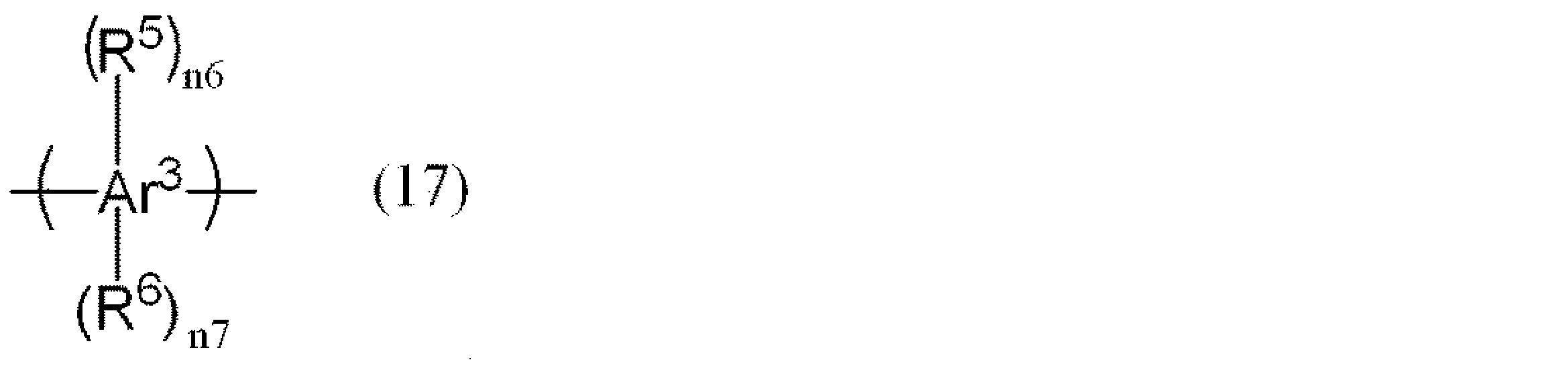
-R7-{(Q1)n1-Y1(M1)a1(Z1)b1}m5 (18)
式(18)中、R7は直接結合又は(1+m5)価の有機基を表し、Q1、Y1、M1、Z1、n1、a1及びb1は前述と同じ意味を表し、m5は1以上の整数を表す。Q1、Y1、M1、Z1、n1、a1及びb1の各々は複数個ある場合、同一でも異なっていてもよい。
式(18)中、R7は直接結合又は(1+m5)価の有機基を表し、Q1、Y1、M1、Z1、n1、a1及びb1は前述と同じ意味を表し、m5は1以上の整数を表す。Q1、Y1、M1、Z1、n1、a1及びb1の各々は複数個ある場合、同一でも異なっていてもよい。
-R8-{(Q3)n3-Y3}m6 (19)
式(19)中、R8は単結合又は(1+m6)価の有機基を表し、Y3及びn3は前述と同じ意味を表し、m6は1以上の整数を表す。ただし、R8が単結合のときm6は1を表す。Q3、Y3及びn3の各々は複数個ある場合、同一でも異なっていてもよい。
式(19)中、R8は単結合又は(1+m6)価の有機基を表し、Y3及びn3は前述と同じ意味を表し、m6は1以上の整数を表す。ただし、R8が単結合のときm6は1を表す。Q3、Y3及びn3の各々は複数個ある場合、同一でも異なっていてもよい。
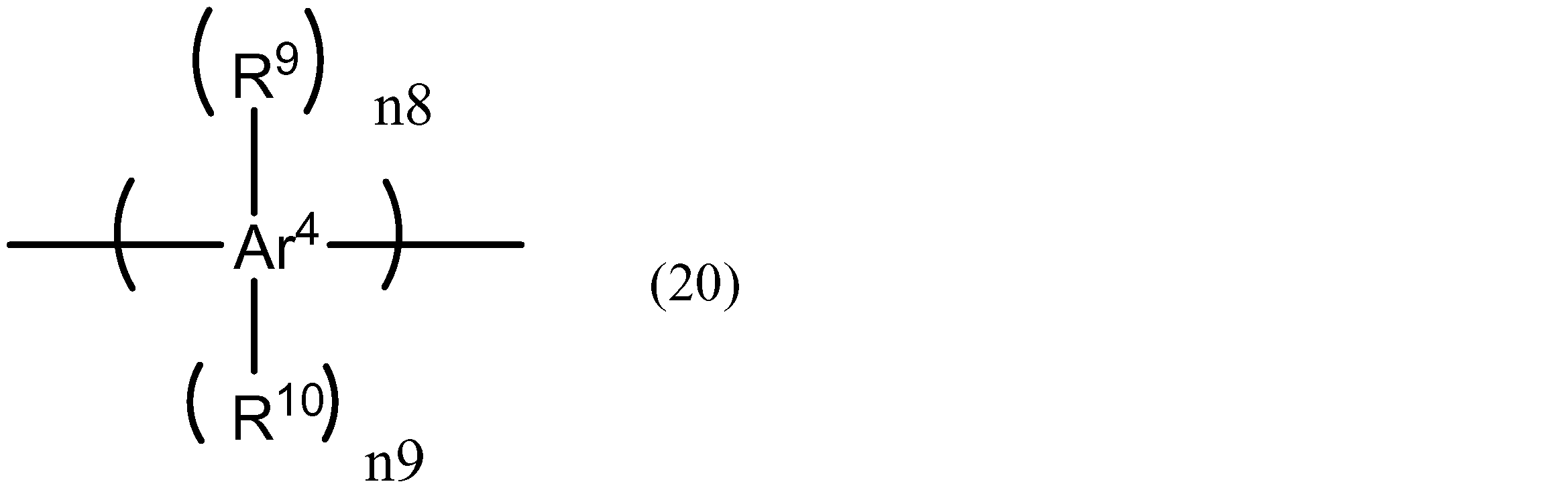
-R11-{(Q2)n2-Y2(M2)a2(Z2)b2}m7 (21)
式(21)中、R11は単結合又は(1+m7)価の有機基を表し、Q2、Y2、M2、Z2、n2、a2及びb2は前述と同じ意味を表し、m7は1以上の整数を表す。ただし、R11が単結合のときm7は1を表す。Q2、Y2、M2、Z2、n2、a2及びb2の各々は複数個ある場合、同一でも異なっていてもよい。
式(21)中、R11は単結合又は(1+m7)価の有機基を表し、Q2、Y2、M2、Z2、n2、a2及びb2は前述と同じ意味を表し、m7は1以上の整数を表す。ただし、R11が単結合のときm7は1を表す。Q2、Y2、M2、Z2、n2、a2及びb2の各々は複数個ある場合、同一でも異なっていてもよい。
-R12-{(Q3)n3-Y3}m8 (22)
式(22)中、R12は単結合又は(1+m8)価の有機基を表し、Y3及びn3は前述と同じ意味を表し、m8は1以上の整数を表す。ただし、R12が単結合のときm8は1を表す。Q3、Y3及びn3、の各々は複数個ある場合、同一でも異なっていてもよい。
式(22)中、R12は単結合又は(1+m8)価の有機基を表し、Y3及びn3は前述と同じ意味を表し、m8は1以上の整数を表す。ただし、R12が単結合のときm8は1を表す。Q3、Y3及びn3、の各々は複数個ある場合、同一でも異なっていてもよい。
前記イオン性ポリマー中の構造単位は、式(1)で表される基を2種類以上含んでいてもよく、式(2)で表される基を2種類以上含んでいてもよく、式(3)で表される基を2種類以上含んでいてもよい。
(式(1)で表される基)
式(1)中、Q1で表される2価の有機基としては、メチレン基、エチレン基、1,2-プロピレン基、1,3-プロピレン基、1,2-ブチレン基、1,3-ブチレン基、1,4-ブチレン基、1,5-ペンチレン基、1,6-ヘキシレン基、1,9-ノニレン基、1,12-ドデシレン基、これらの基の中の少なくとも1個の水素原子を置換基で置換した基等の、置換基を有し又は有さない炭素原子数1~50の2価の飽和炭化水素基;エテニレン基、プロペニレン基、3-ブテニレン基、2-ブテニレン基、2-ペンテニレン基、2-ヘキセニレン基、2-ノネニレン基、2-ドデセニレン基、これらの基の中の少なくとも1個の水素原子を置換基で置換した基等の、置換基を有し又は有さない炭素原子数2~50のアルケニレン基、及び、エチニレン基を含む、置換基を有し又は有さない炭素原子数2~50の2価の不飽和炭化水素基;シクロプロピレン基、シクロブチレン基、シクロペンチレン基、シクロへキシレン基、シクロノニレン基、シクロドデシレン基、ノルボニレン基、アダマンチレン基、これらの基の中の少なくとも1個の水素原子を置換基で置換した基等の、置換基を有し又は有さない炭素原子数3~50の2価の環状飽和炭化水素基;1,3-フェニレン基、1,4-フェニレン基、1,4-ナフチレン基、1,5-ナフチレン基、2,6-ナフチレン基、ビフェニル-4,4’-ジイル基、これらの基の中の少なくとも1個の水素原子を置換基で置換した基等の、置換基を有し又は有さない炭素原子数6~50のアリーレン基;メチレンオキシ基、エチレンオキシ基、プロピレンオキシ基、ブチレンオキシ基、ペンチレンオキシ基、ヘキシレンオキシ基、これらの基の中の少なくとも1個の水素原子を置換基で置換した基等の、置換基を有し又は有さない炭素原子数1~50のアルキレンオキシ基;炭素原子を含む置換基を有するイミノ基;炭素原子を含む置換基を有するシリレン基が挙げられる。イオン性ポリマーの原料となるモノマー(以下、「原料モノマー」と言う。)の合成の容易さの観点からは、2価の飽和炭化水素基、アリーレン基、アルキレンオキシ基が好ましい。
式(1)中、Q1で表される2価の有機基としては、メチレン基、エチレン基、1,2-プロピレン基、1,3-プロピレン基、1,2-ブチレン基、1,3-ブチレン基、1,4-ブチレン基、1,5-ペンチレン基、1,6-ヘキシレン基、1,9-ノニレン基、1,12-ドデシレン基、これらの基の中の少なくとも1個の水素原子を置換基で置換した基等の、置換基を有し又は有さない炭素原子数1~50の2価の飽和炭化水素基;エテニレン基、プロペニレン基、3-ブテニレン基、2-ブテニレン基、2-ペンテニレン基、2-ヘキセニレン基、2-ノネニレン基、2-ドデセニレン基、これらの基の中の少なくとも1個の水素原子を置換基で置換した基等の、置換基を有し又は有さない炭素原子数2~50のアルケニレン基、及び、エチニレン基を含む、置換基を有し又は有さない炭素原子数2~50の2価の不飽和炭化水素基;シクロプロピレン基、シクロブチレン基、シクロペンチレン基、シクロへキシレン基、シクロノニレン基、シクロドデシレン基、ノルボニレン基、アダマンチレン基、これらの基の中の少なくとも1個の水素原子を置換基で置換した基等の、置換基を有し又は有さない炭素原子数3~50の2価の環状飽和炭化水素基;1,3-フェニレン基、1,4-フェニレン基、1,4-ナフチレン基、1,5-ナフチレン基、2,6-ナフチレン基、ビフェニル-4,4’-ジイル基、これらの基の中の少なくとも1個の水素原子を置換基で置換した基等の、置換基を有し又は有さない炭素原子数6~50のアリーレン基;メチレンオキシ基、エチレンオキシ基、プロピレンオキシ基、ブチレンオキシ基、ペンチレンオキシ基、ヘキシレンオキシ基、これらの基の中の少なくとも1個の水素原子を置換基で置換した基等の、置換基を有し又は有さない炭素原子数1~50のアルキレンオキシ基;炭素原子を含む置換基を有するイミノ基;炭素原子を含む置換基を有するシリレン基が挙げられる。イオン性ポリマーの原料となるモノマー(以下、「原料モノマー」と言う。)の合成の容易さの観点からは、2価の飽和炭化水素基、アリーレン基、アルキレンオキシ基が好ましい。
前記置換基としては、アルキル基、アルコキシ基、アルキルチオ基、アリール基、アリールオキシ基、アリールチオ基、アリールアルキル基、アリールアルコキシ基、アリールアルキルチオ基、アリールアルケニル基、アリールアルキニル基、アミノ基、置換アミノ基、シリル基、置換シリル基、ハロゲン原子、アシル基、アシルオキシ基、イミン残基、アミド基、酸イミド基、1価の複素環基、ヒドロキシ基、カルボキシル基、置換カルボキシル基、シアノ基及びニトロ基が挙げられる。前記置換基が複数個存在する場合には、それらは同一でも異なっていてもよい。これらのうち、アミノ基、シリル基、ハロゲン原子、ヒドロキシ基及びニトロ基以外の置換基は炭素原子を含む。
以下、置換基について説明する。なお、「Cm~Cn」(m、nはm<nを満たす正の整数である)という用語は、この用語とともに記載された有機基の炭素原子数がm~nであることを表す。例えば、Cm~Cnアルキル基であれば、アルキル基の炭素原子数がm~nであることを表し、Cm~Cnアルキルアリール基であれば、アルキル基の炭素原子数がm~nであることを表し、アリール-Cm~Cnアルキル基であれば、アルキル基の炭素原子数がm~nであることを表す。
アルキル基は、直鎖状でも分岐状でもよく、シクロアルキル基でもよい。アルキル基の炭素原子数は通常1~20であり、1~10が好ましい。アルキル基としては、メチル基、エチル基、プロピル基、イソプロピル基、ブチル基、イソブチル基、s-ブチル基、t-ブチル基、ペンチル基、ヘキシル基、シクロヘキシル基、ヘプチル基、オクチル基、ノニル基、デシル基、ラウリル基等が挙げられる。前記アルキル基中の水素原子はフッ素原子で置換されていてもよい。該当するフッ素原子置換アルキル基としては、トリフルオロメチル基、ペンタフルオロエチル基、パーフルオロブチル基、パーフルオロヘキシル基、パーフルオロオクチル基等が挙げられる。なお、C1~C12アルキル基としては、例えば、メチル基、エチル基、プロピル基、イソプロピル基、ブチル基、イソブチル基、s-ブチル基、t-ブチル基、ペンチル基、イソアミル基、ヘキシル基、シクロヘキシル基、ヘプチル基、オクチル基、ノニル基、デシル基、ラウリル基が挙げられる。
アルコキシ基は、直鎖状でも分岐状でもよく、シクロアルキルオキシ基であってもよく、置換基を有していてもよい。アルコキシ基の炭素原子数は通常1~20であり、1~10が好ましい。アルコキシ基としては、メトキシ基、エトキシ基、プロピルオキシ基、イソプロピルオキシ基、ブトキシ基、イソブトキシ基、s-ブトキシ基、t-ブトキシ基、ペンチルオキシ基、ヘキシルオキシ基、シクロヘキシルオキシ基、ヘプチルオキシ基、オクチルオキシ基、ノニルオキシ基、デシルオキシ基、ラウリルオキシ基等が挙げられる。
前記アルコキシ基中の水素原子はフッ素原子で置換されていてもよい。該当するフッ素原子置換アルコキシ基としては、トリフルオロメトキシ基、ペンタフルオロエトキシ基、パーフルオロブトキシ基、パーフルオロヘキシルオキシ基、パーフルオロオクチルオキシ基等が挙げられる。また、該アルコキシ基には、メトキシメチルオキシ基、2-メトキシエチルオキシ基も含まれる。なお、C1~C12アルコキシ基としては、例えば、メトキシ基、エトキシ基、プロピルオキシ基、イソプロピルオキシ基、ブトキシ基、イソブトキシ基、s-ブトキシ基、t-ブトキシ基、ペンチルオキシ基、ヘキシルオキシ基、シクロヘキシルオキシ基、ヘプチルオキシ基、オクチルオキシ基、2-エチルヘキシルオキシ基、ノニルオキシ基、デシルオキシ基、3,7-ジメチルオクチルオキシ基、ラウリルオキシ基が挙げられる。
アルキルチオ基としては、直鎖状でも分岐状でもよく、シクロアルキルチオ基であってもよく、置換基を有していてもよい。アルキルチオ基の炭素原子数は通常1~20であり、1~10が好ましい。アルキルチオ基としては、メチルチオ基、エチルチオ基、プロピルチオ基、イソプロピルチオ基、ブチルチオ基、イソブチルチオ基、s-ブチルチオ基、t-ブチルチオ基、ペンチルチオ基、ヘキシルチオ基、シクロヘキシルチオ基、ヘプチルチオ基、オクチルチオ基、ノニルチオ基、デシルチオ基、ラウリルチオ基等が挙げられる。前記アルキルチオ基中の水素原子はフッ素原子で置換されていてもよい。該当するフッ素原子置換アルキルチオ基としては、トリフルオロメチルチオ基等が挙げられる。
アリール基は、芳香族炭化水素から芳香環を構成する炭素原子に結合した水素原子1個を除いた残りの原子団であり、ベンゼン環を持つ基、縮合環を持つ基、独立したベンゼン環又は縮合環2個以上が単結合又は2価の有機基、例えば、ビニレン基のアルケニレン基を介して結合した基も含まれる。アリール基は、炭素原子数が通常6~60であり、7~48であることが好ましい。アリール基としては、フェニル基、C1~C12アルコキシフェニル基、C1~C12アルキルフェニル基、1-ナフチル基、2-ナフチル基、1-アントラセニル基、2-アントラセニル基、9-アントラセニル基等が挙げられる。前記アリール基中の水素原子はフッ素原子で置換されていてもよい。該当するフッ素原子置換アリール基としては、ペンタフルオロフェニル基等が挙げられる。アリール基の中では、C1~C12アルコキシフェニル基、C1~C12アルキルフェニル基が好ましい。
前記アリール基のうち、C1~C12アルコキシフェニル基としては、メトキシフェニル基、エトキシフェニル基、プロピルオキシフェニル基、イソプロピルオキシフェニル基、ブトキシフェニル基、イソブトキシフェニル基、s-ブトキシフェニル基、t-ブトキシフェニル基、ペンチルオキシフェニル基、ヘキシルオキシフェニル基、シクロヘキシルオキシフェニル基、ヘプチルオキシフェニル基、オクチルオキシフェニル基、2-エチルヘキシルオキシフェニル基、ノニルオキシフェニル基、デシルオキシフェニル基、3,7-ジメチルオクチルオキシフェニル基、ラウリルオキシフェニル基等が挙げられる。
前記アリール基のうち、C1~C12アルキルフェニル基としては、メチルフェニル基、エチルフェニル基、ジメチルフェニル基、プロピルフェニル基、メシチル基、メチルエチルフェニル基、イソプロピルフェニル基、ブチルフェニル基、イソブチルフェニル基、t-ブチルフェニル基、ペンチルフェニル基、イソアミルフェニル基、ヘキシルフェニル基、ヘプチルフェニル基、オクチルフェニル基、ノニルフェニル基、デシルフェニル基、ドデシルフェニル基等が挙げられる。
アリールオキシ基は、炭素原子数が通常6~60であり、7~48であることが好ましい。アリールオキシ基としては、フェノキシ基、C1~C12アルコキシフェノキシ基、C1~C12アルキルフェノキシ基、1-ナフチルオキシ基、2-ナフチルオキシ基、ペンタフルオロフェニルオキシ基等が挙げられる。アリールオキシ基の中では、C1~C12アルコキシフェノキシ基及びC1~C12アルキルフェノキシ基が好ましい。
前記アリールオキシ基のうち、C1~C12アルコキシフェノキシ基としては、メトキシフェノキシ基、エトキシフェノキシ基、プロピルオキシフェノキシ基、イソプロピルオキシフェノキシ基、ブトキシフェノキシ基、イソブトキシフェノキシ基、s-ブトキシフェノキシ基、t-ブトキシフェノキシ基、ペンチルオキシフェノキシ基、ヘキシルオキシフェノキシ基、シクロヘキシルオキシフェノキシ基、ヘプチルオキシフェノキシ基、オクチルオキシフェノキシ基、2-エチルヘキシルオキシフェノキシ基、ノニルオキシフェノキシ基、デシルオキシフェノキシ基、3,7-ジメチルオクチルオキシフェノキシ基、ラウリルオキシフェノキシ基等が挙げられる。
前記アリールオキシ基のうち、C1~C12アルキルフェノキシ基としては、メチルフェノキシ基、エチルフェノキシ基、ジメチルフェノキシ基、プロピルフェノキシ基、1,3,5-トリメチルフェノキシ基、メチルエチルフェノキシ基、イソプロピルフェノキシ基、ブチルフェノキシ基、イソブチルフェノキシ基、s-ブチルフェノキシ基、t-ブチルフェノキシ基、ペンチルフェノキシ基、イソアミルフェノキシ基、ヘキシルフェノキシ基、ヘプチルフェノキシ基、オクチルフェノキシ基、ノニルフェノキシ基、デシルフェノキシ基、ドデシルフェノキシ基等が挙げられる。
アリールチオ基は、例えば、前述のアリール基に硫黄元素が結合した基である。アリールチオ基は、前記アリール基の芳香環上に置換基を有していてもよい。アリールチオ基は、炭素原子数が通常6~60であり、6~30であることが好ましい。アリールチオ基としては、フェニルチオ基、C1~C12アルコキシフェニルチオ基、C1~C12アルキルフェニルチオ基、1-ナフチルチオ基、2-ナフチルチオ基、ペンタフルオロフェニルチオ基等が挙げられる。
アリールアルキル基は、例えば、前述のアリール基に前述のアルキル基が結合した基である。アリールアルキル基は、置換基を有していてもよい。アリールアルキル基は、炭素原子数が通常7~60であり、7~30であることが好ましい。アリールアルキル基としては、フェニル-C1~C12アルキル基、C1~C12アルコキシフェニル-C1~C12アルキル基、C1~C12アルキルフェニル-C1~C12アルキル基、1-ナフチル-C1~C12アルキル基、2-ナフチル-C1~C12アルキル基等が挙げられる。
アリールアルコキシ基は、例えば、前述のアリール基に前述のアルコキシ基が結合した基である。アリールアルコキシ基は、置換基を有していてもよい。アリールアルコキシ基は、炭素原子数が通常7~60であり、7~30であることが好ましい。アリールアルコキシ基としては、フェニル-C1~C12アルコキシ基、C1~C12アルコキシフェニル-C1~C12アルコキシ基、C1~C12アルキルフェニル-C1~C12アルコキシ基、1-ナフチル-C1~C12アルコキシ基、2-ナフチル-C1~C12アルコキシ基等が挙げられる。
アリールアルキルチオ基は、例えば、前述のアリール基に前述のアルキルチオ基が結合した基である。アリールアルキルチオ基は、置換基を有していてもよい。アリールアルキルチオ基は、炭素原子数が通常7~60であり、7~30であることが好ましい。アリールアルキルチオ基としては、フェニル-C1~C12アルキルチオ基、C1~C12アルコキシフェニル-C1~C12アルキルチオ基、C1~C12アルキルフェニル-C1~C12アルキルチオ基、1-ナフチル-C1~C12アルキルチオ基、2-ナフチル-C1~C12アルキルチオ基等が挙げられる。
アリールアルケニル基は、例えば、前述のアリール基にアルケニル基が結合した基である。アリールアルケニル基は、炭素原子数が通常8~60であり、8~30であることが好ましい。アリールアルケニル基としては、フェニル-C2~C12アルケニル基、C1~C12アルコキシフェニル-C2~C12アルケニル基、C1~C12アルキルフェニル-C2~C12アルケニル基、1-ナフチル-C2~C12アルケニル基、2-ナフチル-C2~C12アルケニル基等が挙げられ、C1~C12アルコキシフェニル-C2~C12アルケニル基、C2~C12アルキルフェニル-C2~C12アルケニル基が好ましい。なお、C2~C12アルケニル基としては、例えば、ビニル基、1-プロペニル基、2-プロペニル基、1-ブテニル基、2-ブテニル基、1-ペンテニル基、2-ペンテニル基、1-ヘキセニル基、2-ヘキセニル基、1-オクテニル基が挙げられる。
アリールアルキニル基は、例えば、前述のアリール基にアルキニル基が結合した基である。アリールアルキニル基は、炭素原子数が通常8~60であり、8~30であることが好ましい。アリールアルキニル基としては、フェニル-C2~C12アルキニル基、C1~C12アルコキシフェニル-C2~C12アルキニル基、C1~C12アルキルフェニル-C2~C12アルキニル基、1-ナフチル-C2~C12アルキニル基、2-ナフチル-C2~C12アルキニル基等が挙げられ、C1~C12アルコキシフェニル-C2~C12アルキニル基、C1~C12アルキルフェニル-C2~C12アルキニル基が好ましい。なお、C2~C12アルキニル基としては、例えば、エチニル基、1-プロピニル基、2-プロピニル基、1-ブチニル基、2-ブチニル基、1-ペンチニル基、2-ペンチニル基、1-ヘキシニル基、2-ヘキシニル基、1-オクチニル基が挙げられる。
置換アミノ基としては、アミノ基の中の少なくとも1個の水素原子が、アルキル基、アリール基、アリールアルキル基及び1価の複素環基からなる群から選択される1又は2個の基によって置換されたアミノ基が好ましい。該アルキル基、アリール基、アリールアルキル基又は1価の複素環基は置換基を有していてもよい。置換アミノ基の炭素原子数は、該アルキル基、アリール基、アリールアルキル基又は1価の複素環基が有していてもよい置換基の炭素原子数を含めないで通常1~60であり、2~48が好ましい。置換アミノ基としては、メチルアミノ基、ジメチルアミノ基、エチルアミノ基、ジエチルアミノ基、プロピルアミノ基、ジプロピルアミノ基、イソプロピルアミノ基、ジイソプロピルアミノ基、ブチルアミノ基、イソブチルアミノ基、s-ブチルアミノ基、t-ブチルアミノ基、ペンチルアミノ基、ヘキシルアミノ基、シクロヘキシルアミノ基、ヘプチルアミノ基、オクチルアミノ基、2-エチルヘキシルアミノ基、ノニルアミノ基、デシルアミノ基、3,7-ジメチルオクチルアミノ基、ラウリルアミノ基、シクロペンチルアミノ基、ジシクロペンチルアミノ基、シクロヘキシルアミノ基、ジシクロヘキシルアミノ基、ジトリフルオロメチルアミノ基、フェニルアミノ基、ジフェニルアミノ基、(C1~C12アルコキシフェニル)アミノ基、ジ(C1~C12アルコキシフェニル)アミノ基、ジ(C1~C12アルキルフェニル)アミノ基、1-ナフチルアミノ基、2-ナフチルアミノ基、ペンタフルオロフェニルアミノ基、ピリジルアミノ基、ピリダジニルアミノ基、ピリミジルアミノ基、ピラジニルアミノ基、トリアジニルアミノ基、(フェニル-C1~C12アルキル)アミノ基、(C1~C12アルコキシフェニル-C1~C12アルキル)アミノ基、(C1~C12アルキルフェニル-C1~C12アルキル)アミノ基、ジ(C1~C12アルコキシフェニル-C1~C12アルキル)アミノ基、ジ(C1~C12アルキルフェニル-C1~C12アルキル)アミノ基、1-ナフチル-C1~C12アルキルアミノ基、2-ナフチル-C1~C12アルキルアミノ基等が挙げられる。
置換シリル基としては、シリル基の中の少なくとも1個の水素原子が、アルキル基、アリール基、アリールアルキル基及び1価の複素環基からなる群から選択される1~3個の基によって置換されたシリル基が挙げられる。該アルキル基、アリール基、アリールアルキル基又は1価の複素環基は置換基を有していてもよい。置換シリル基の炭素原子数は、該アルキル基、アリール基、アリールアルキル基又は1価の複素環基が有していてもよい置換基の炭素原子数を含めないで通常1~60であり、3~48が好ましい。なお、置換シリル基としては、トリメチルシリル基、トリエチルシリル基、トリプロピルシリル基、トリイソプロピルシリル基、イソプロピルジメチルシリル基、イソプロピルジエチルシリル基、t-ブチルジメチルシリル基、ペンチルジメチルシリル基、ヘキシルジメチルシリル基、ヘプチルジメチルシリル基、オクチルジメチルシリル基、2-エチルヘキシルジメチルシリル基、ノニルジメチルシリル基、デシルジメチルシリル基、3,7-ジメチルオクチルジメチルシリル基、ラウリルジメチルシリル基、(フェニル-C1~C12アルキル)シリル基、(C1~C12アルコキシフェニル-C1~C12アルキル)シリル基、(C1~C12アルキルフェニル-C1~C12アルキル)シリル基、(1-ナフチル-C1~C12アルキル)シリル基、(2-ナフチル-C1~C12アルキル)シリル基、(フェニル-C1~C12アルキル)ジメチルシリル基、トリフェニルシリル基、トリ(p-キシリル)シリル基、トリベンジルシリル基、ジフェニルメチルシリル基、t-ブチルジフェニルシリル基、ジメチルフェニルシリル基等が挙げられる。
ハロゲン原子としては、フッ素原子、塩素原子、臭素原子及びヨウ素原子が挙げられる。
アシル基は、炭素原子数が通常2~20であり、2~18であることが好ましい。アシル基としては、アセチル基、プロピオニル基、ブチリル基、イソブチリル基、ピバロイル基、ベンゾイル基、トリフルオロアセチル基、ペンタフルオロベンゾイル基等が挙げられる。
アシルオキシ基は、炭素原子数が通常2~20であり、2~18であることが好ましい。アシルオキシ基としては、アセトキシ基、プロピオニルオキシ基、ブチリルオキシ基、イソブチリルオキシ基、ピバロイルオキシ基、ベンゾイルオキシ基、トリフルオロアセチルオキシ基、ペンタフルオロベンゾイルオキシ基等が挙げられる。
イミン残基は、式:H-N=C<及び式:-N=CH-の少なくとも一方で表される構造を有するイミン化合物から、この構造中の水素原子1個を除いた残基を意味する。このようなイミン化合物としては、例えば、アルジミン、ケチミン及びアルジミン中の窒素原子に結合した水素原子がアルキル基、アリール基、アリールアルキル基、アリールアルケニル基、アリールアルキニル基等で置換された化合物が挙げられる。イミン残基の炭素原子数は、通常2~20であり、2~18が好ましい。イミン残基としては、例えば、一般式:-CRβ=N-Rγ又は一般式:-N=C(Rγ)2(式中、Rβは水素原子、アルキル基、アリール基、アリールアルキル基、アリールアルケニル基、又はアリールアルキニル基を表し、Rγは独立に、アルキル基、アリール基、アリールアルキル基、アリールアルケニル基、又はアリールアルキニル基を表し、ただし、Rγが2個存在する場合、2個のRγは相互に結合し一体となって2価の基、例えば、エチレン基、トリメチレン基、テトラメチレン基、ペンタメチレン基、ヘキサメチレン基の炭素原子数2~18のアルキレン基として環を形成してもよい。)で表される基が挙げられる。イミン残基としては、以下の基が挙げられる。
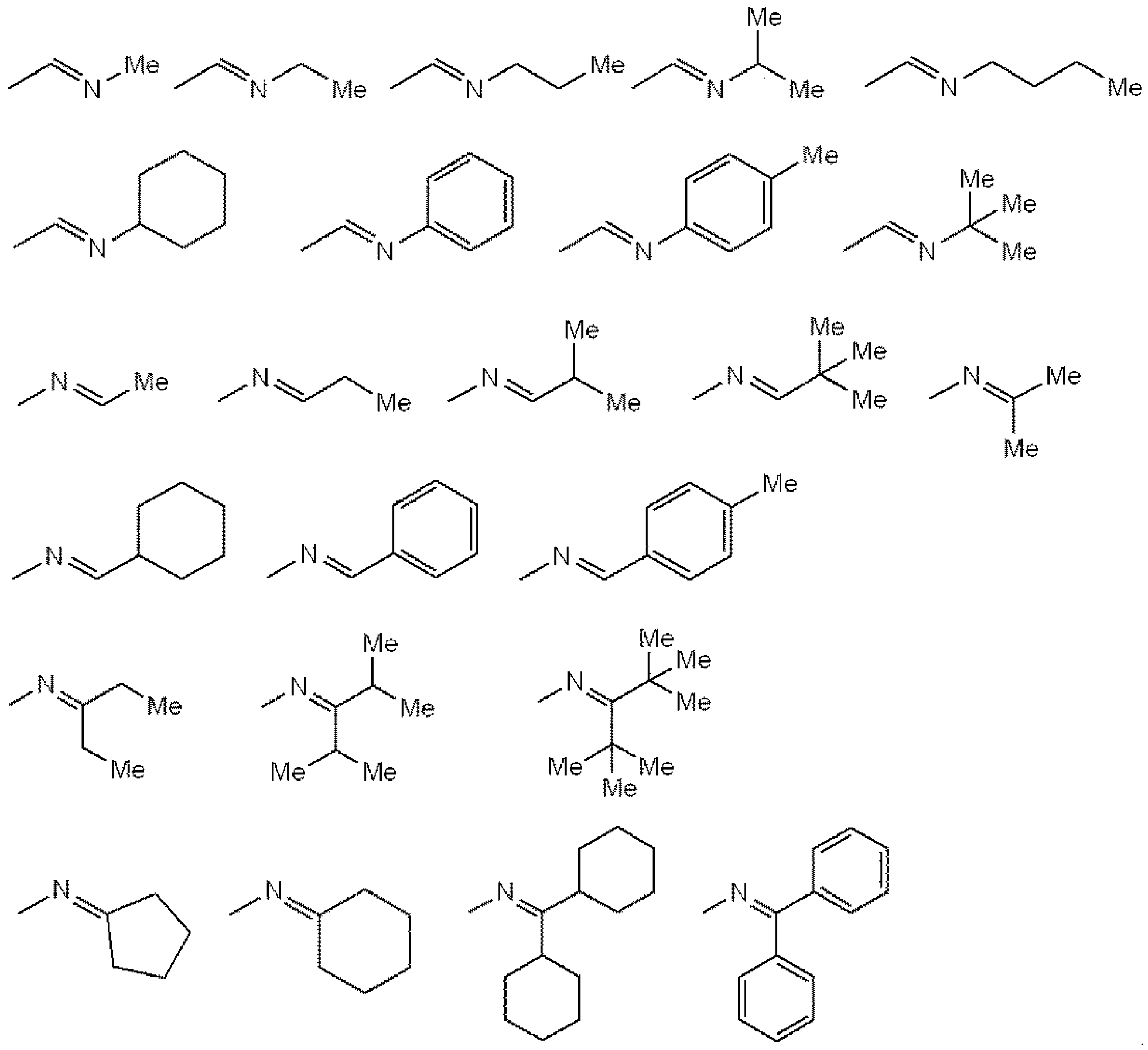
アミド基は、炭素原子数が通常1~20であり、2~18であることが好ましい。アミド基としては、ホルムアミド基、アセトアミド基、プロピオアミド基、ブチロアミド基、ベンズアミド基、トリフルオロアセトアミド基、ペンタフルオロベンズアミド基、ジホルムアミド基、ジアセトアミド基、ジプロピオアミド基、ジブチロアミド基、ジベンズアミド基、ジトリフルオロアセトアミド基、ジペンタフルオロベンズアミド基等が挙げられる。
酸イミド基は、酸イミドからその窒素原子に結合した水素原子を除いて得られる残基であり、炭素原子数が通常4~20であり、4~18であることが好ましい。酸イミド基としては、以下の基が挙げられる。
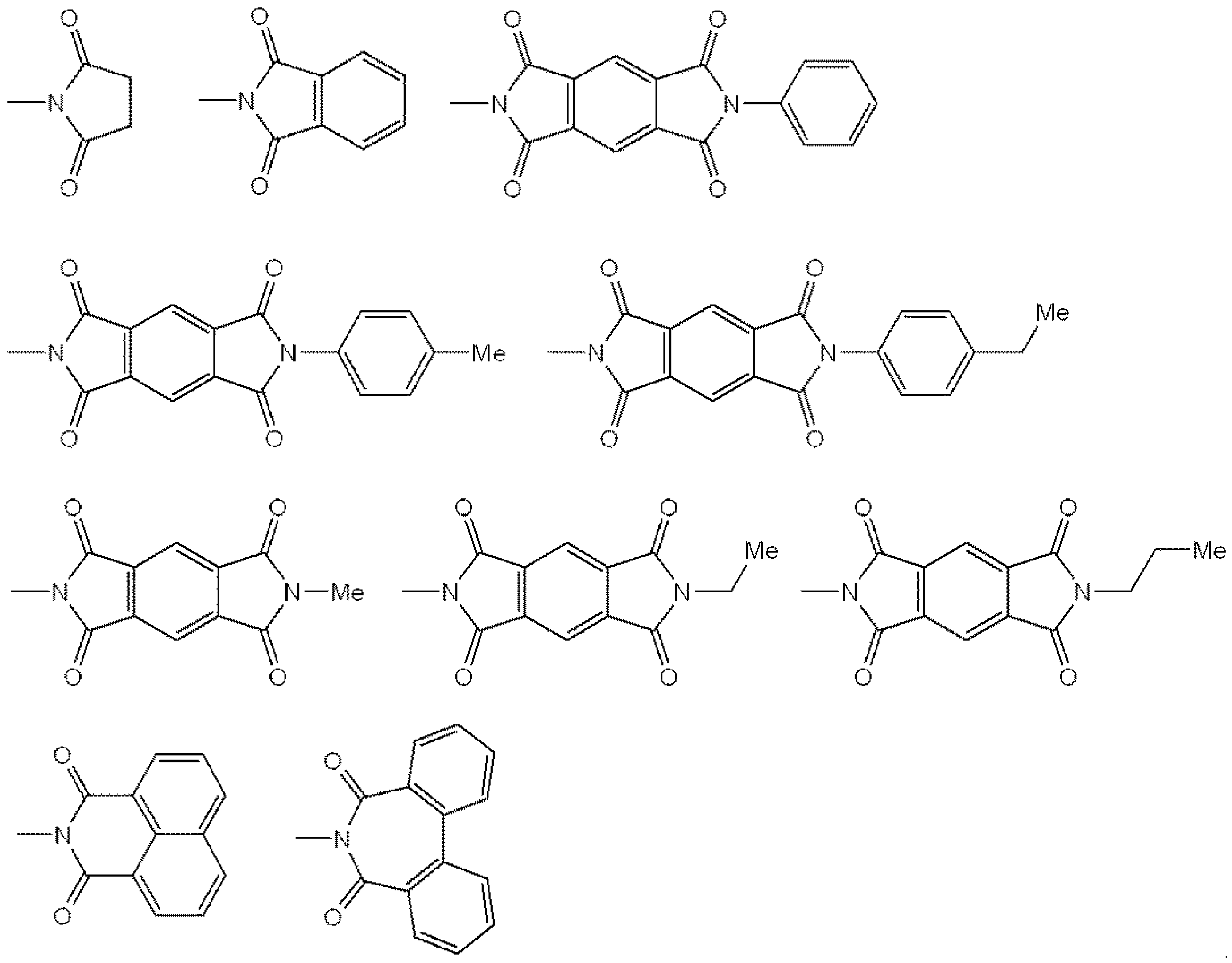
1価の複素環基とは、複素環式化合物から水素原子1個を除いた残りの原子団をいう。ここで、複素環式化合物とは、環式構造をもつ有機化合物のうち、環を構成する元素として、炭素原子だけでなく、酸素原子、硫黄原子、窒素原子、リン原子、ホウ素原子、ケイ素原子、セレン原子、テルル原子、ヒ素原子等のヘテロ原子を含む有機化合物をいう。1価の複素環基は置換基を有していてもよい。1価の複素環基は、炭素原子数が通常3~60であり、3~20が好ましい。なお、1価の複素環基の炭素原子数には、置換基の炭素原子数は含まないものとする。このような1価の複素環基としては、例えば、チエニル基、C1~C12アルキルチエニル基、ピロリル基、フリル基、ピリジル基、C1~C12アルキルピリジル基、ピリダジニル基、ピリミジル基、ピラジニル基、トリアジニル基、ピロリジル基、ピペリジル基、キノリル基、イソキノリル基が挙げられ、中でも、チエニル基、C1~C12アルキルチエニル基、ピリジル基及びC1~C12アルキルピリジル基が好ましい。なお、1価の複素環基としては、1価の芳香族複素環基が好ましい。
置換カルボキシル基とは、カルボキシル基中の水素原子が、アルキル基、アリール基、アリールアルキル基又は1価の複素環基で置換された基、すなわち、式:-C(=O)OR*(式中、R*はアルキル基、アリール基、アリールアルキル基又は1価の複素環基)で表される基である。置換カルボキシル基は、炭素原子数が通常2~60であり、2~48であることが好ましい。前記アルキル基、アリール基、アリールアルキル基又は1価の複素環基は、置換基を有していてもよい。なお、上記炭素原子数には、前記アルキル基、アリール基、アリールアルキル基又は1価の複素環基が有していてもよい置換基の炭素原子数は含まないものとする。置換カルボキシル基としては、メトキシカルボニル基、エトキシカルボニル基、プロポキシカルボニル基、イソプロポキシカルボニル基、ブトキシカルボニル基、イソブトキシカルボニル基、s-ブトキシカルボニル基、t-ブトキシカルボニル基、ペンチルオキシカルボニル基、ヘキシロキシカルボニル基、シクロヘキシロキシカルボニル基、ヘプチルオキシカルボニル基、オクチルオキシカルボニル基、2-エチルヘキシロキシカルボニル基、ノニルオキシカルボニル基、デシロキシカルボニル基、3,7-ジメチルオクチルオキシカルボニル基、ドデシルオキシカルボニル基、トリフルオロメトキシカルボニル基、ペンタフルオロエトキシカルボニル基、パーフルオロブトキシカルボニル基、パーフルオロヘキシルオキシカルボニル基、パーフルオロオクチルオキシカルボニル基、フェノキシカルボニル基、ナフトキシカルボニル基、ピリジルオキシカルボニル基等が挙げられる。
式(1)中、Y1は、-CO2
-、-SO3
-、-SO2
-、-PO3
-、又は-B(Ra)3
-等の1価の基を表す。Y1としては、イオン性ポリマーの酸性度の観点からは-CO2
-、-SO2
-、-PO3
-が好ましく、-CO2
-がより好ましく、イオン性ポリマーの安定性の観点からは、-CO2
-、-SO3
-、-SO2
-又は-PO3
-が好ましい。
式(1)中、M1は金属カチオン又は置換基を有し若しくは有さないアンモニウムカチオンを表す。金属カチオンとしては、1価、2価又は3価のイオンが好ましく、例えば、Li、Na、K、Cs、Be、Mg、Ca、Ba、Ag、Al、Bi、Cu、Fe、Ga、Mn、Pb、Sn、Ti、V、W、Y、Yb、Zn、Zr等のイオンが挙げられる。この中でもLi+、Na+、K+、Cs+、Ag+、Mg2+、Ca2+がより好ましい。また、アンモニウムイオンが有していてもよい置換基としては、メチル基、エチル基、プロピル基、イソプロピル基、n-ブチル基、i-ブチル基、t-ブチル基等の炭素原子数1~10のアルキル基が挙げられる。
式(1)中、Z1はF-、Cl-、Br-、I-、OH-、RaSO3
-、RaCOO-、ClO-、ClO2
-、ClO3
-、ClO4
-、SCN-、CN-、NO3
-、SO4
2-、HSO4
-、PO4
3-、HPO4
2-、H2PO4
-、BF4
-又はPF6
-を表す。
式(1)中、n1は0以上の整数を表し、原料モノマーの合成の観点から、好ましくは0から8の整数であり、より好ましくは0から2の整数である。
式(1)中、a1は1以上の整数を表し、b1は0以上の整数を表す。
a1及びb1は、式(1)で表される基の電荷が0となるように選択される。例えば、Y1が-CO2
-、-SO3
-、-SO2
-、-PO3
-、又は-B(Ra)3
-であり、M1が1価の金属カチオン又は置換基を有し若しくは有さないアンモニウムカチオンであり、Z1がF-、Cl-、Br-、I-、OH-、RaSO3
-、RaCOO-、ClO-、ClO2
-、ClO3
-、ClO4
-、SCN-、CN-、NO3
-、HSO4
-、H2PO4
-、BF4
-又はPF6
-である場合は、a1=b1+1を満たすように選択される。Y1が-CO2
-、-SO3
-、-SO2
-、-PO3
-、又は-B(Ra)3
-であり、M1が2価の金属カチオンであり、Z1がF-、Cl-、Br-、I-、OH-、RaSO3
-、RaCOO-、ClO-、ClO2
-、ClO3
-、ClO4
-、SCN-、CN-、NO3
-、HSO4
-、H2PO4
-、BF4
-又はPF6
-である場合は、b1=2×a1-1を満たすように選択される。Y1が-CO2
-、-SO3
-、-SO2
-、-PO3
-、又は-B(Ra)3
-であり、M1が3価の金属カチオンであり、Z1がF-、Cl-、Br-、I-、OH-、RaSO3
-、RaCOO-、ClO-、ClO2
-、ClO3
-、ClO4
-、SCN-、CN-、NO3
-、HSO4
-、H2PO4
-、BF4
-又はPF6
-である場合は、b1=3×a1-1を満たすように選択される。Y1が-CO2
-、-SO3
-、-SO2
-、-PO3
-、又は-B(Ra)3
-であり、M1が1価の金属カチオン又は置換基を有し若しくは有さないアンモニウムカチオンであり、Z1がSO4
2-又はHPO4
2-である場合には、a1=2×b1+1を満たすように選択される。a1とb1との関係を表す上記のいずれの数式においても、a1は好ましくは1から5の整数であり、より好ましくは1又は2である。
Raは置換基を有し若しくは有さない炭素原子数1~30のアルキル基又は置換基を有し若しくは有さない炭素原子数6~50のアリール基を表す。これらの基が有していてもよい置換基としては、前述のQ1に関する説明中で例示した置換基と同様の置換基が挙げられる。置換基が複数個存在する場合には、それらは同一でも異なっていてもよい。Raとしては、メチル基、エチル基、プロピル基、イソプロピル基、ブチル基、イソブチル基、s-ブチル基、t-ブチル基、ペンチル基、ヘキシル基、シクロヘキシル基、ヘプチル基、オクチル基、ノニル基、デシル基、ラウリル基等の炭素原子数1~20のアルキル基、フェニル基、1-ナフチル基、2-ナフチル基、1-アントラセニル基、2-アントラセニル基、9-アントラセニル基等の炭素原子数6~30のアリール基等が挙げられる。
前記式(1)で表される基としては、例えば、以下の基が挙げられる。

(式(2)で表される基)
式(2)中、Q2で表される2価の有機基としては、前述のQ1で表される2価の有機基について例示したものと同様の基が挙げられ、原料モノマーの合成の容易さの観点からは、2価の飽和炭化水素基、アリーレン基、アルキレンオキシ基が好ましい。
式(2)中、Q2で表される2価の有機基としては、前述のQ1で表される2価の有機基について例示したものと同様の基が挙げられ、原料モノマーの合成の容易さの観点からは、2価の飽和炭化水素基、アリーレン基、アルキレンオキシ基が好ましい。
前記Q2で表される2価の有機基の例として挙げた基は置換基を有していてもよく、当該置換基としては、前述のQ1に関する説明中で例示した置換基と同様の置換基が挙げられる。置換基が複数個存在する場合には、それらは同一でも異なっていてもよい。
式(2)中、Y2はカルボカチオン、アンモニウムカチオン、ホスホニルカチオン、スルホニルカチオン、又はヨードニウムカチオンを表す。
カルボカチオンとしては、例えば、-C+R2(式中、Rは、同一又は相異なり、アルキル基又はアリール基を表す。)で表される基が挙げられる。
アンモニウムカチオンとしては、例えば、-N+R3(式中、Rは、同一又は相異なり、水素原子、アルキル基又はアリール基を表す。)で表される基が挙げられる。
ホスホニルカチオンとしては、例えば、-P+R3(式中、Rは、同一又は相異なり、水素原子、アルキル基又はアリール基を表す。)で表される基が挙げられる。
スルホニルカチオンとしては、例えば、-S+R2(式中、Rは、同一又は相異なり、水素原子、アルキル基又はアリール基を表す。)で表される基が挙げられる。
ヨードニウムカチオンとしては、例えば、-I+R2(式中、Rは、同一又は相異なり、水素原子、アルキル基又はアリール基を表す。)で表される基が挙げられる。
アンモニウムカチオンとしては、例えば、-N+R3(式中、Rは、同一又は相異なり、水素原子、アルキル基又はアリール基を表す。)で表される基が挙げられる。
ホスホニルカチオンとしては、例えば、-P+R3(式中、Rは、同一又は相異なり、水素原子、アルキル基又はアリール基を表す。)で表される基が挙げられる。
スルホニルカチオンとしては、例えば、-S+R2(式中、Rは、同一又は相異なり、水素原子、アルキル基又はアリール基を表す。)で表される基が挙げられる。
ヨードニウムカチオンとしては、例えば、-I+R2(式中、Rは、同一又は相異なり、水素原子、アルキル基又はアリール基を表す。)で表される基が挙げられる。
式(2)中、Y2は、原料モノマーの合成の容易さ並びに原料モノマー及びイオン性ポリマーの空気、湿気又は熱に対する安定性の観点からは、カルボカチオン、アンモニウムカチオン、ホスホニルカチオン、スルホニルカチオンが好ましく、アンモニウムカチオンがより好ましい。
式(2)中、Z2は金属カチオン又は置換基を有し若しくは有さないアンモニウムカチオンを表す。金属カチオンとしては、1価、2価又は3価のイオンが好ましく、Li、Na、K、Cs、Be、Mg、Ca、Ba、Ag、Al、Bi、Cu、Fe、Ga、Mn、Pb、Sn、Ti、V、W、Y、Yb、Zn、Zr等のイオンが挙げられる。また、アンモニウムカチオンが有していてもよい置換基としては、メチル基、エチル基、プロピル基、イソプロピル基、n-ブチル基、イソブチル基、t-ブチル基等の炭素原子数1~10のアルキル基が挙げられる。
式(2)中、M2はF-、Cl-、Br-、I-、OH-、RbSO3
-、RbCOO-、ClO-、ClO2
-、ClO3
-、ClO4
-、SCN-、CN-、NO3
-、SO4
2-、HSO4
-、PO4
3-、HPO4
2-、H2PO4
-、BF4
-、PF6
-又はBPh4
-を表す。
式(2)中、n2は0以上の整数を表し、好ましくは0から6の整数であり、より好ましくは0から2の整数である。
式(2)中、a2は1以上の整数を表し、b2は、0以上の整数を表す。
a2及びb2は、式(2)で表される基の電荷が0となるように選択される。例えば、M2がF-、Cl-、Br-、I-、OH-、RbSO3
-、RbCOO-、ClO-、ClO2
-、ClO3
-、ClO4
-、SCN-、CN-、NO3
-、HSO4
-、H2PO4
-、BF4
-又はPF6
-である場合、Z2が1価の金属イオン又は置換基を有し若しくは有さないアンモニウムイオンであれば、a2=b2+1を満たすように選択され、Z2が2価の金属イオンであれば、a2=2×b2+1を満たすように選択され、Z2が3価の金属イオンであれば、a2=3×b2+1を満たすように選択される。M2がSO4
2-、HPO4
2-である場合、Z2が1価の金属イオン又は置換基を有し若しくは有さないアンモニウムイオンであれば、b2=2×a2-1を満たすように選択され、Z2が3価の金属イオンであれば、2×a2=3×b2+1の関係を満たすように選択される。a2とb2との関係を表す上記のいずれの数式においても、a2は好ましくは1から3の整数であり、より好ましくは1又は2である。
Rbは置換基を有し若しくは有さない炭素原子数1~30のアルキル基又は置換基を有し若しくは有さない炭素原子数6~50のアリール基を表すが、これらの基が有していてもよい置換基としては、前述のQ1に関する説明中で例示した置換基と同様の置換基が挙げられる。置換基が複数個存在する場合には、それらは同一でも異なっていてもよい。Rbとしては、メチル基、エチル基、プロピル基、イソプロピル基、ブチル基、イソブチル基、s-ブチル基、t-ブチル基、ペンチル基、ヘキシル基、シクロヘキシル基、ヘプチル基、オクチル基、ノニル基、デシル基、ラウリル基等の炭素原子数1~20のアルキル基、フェニル基、1-ナフチル基、2-ナフチル基、1-アントラセニル基、2-アントラセニル基、9-アントラセニル基等の炭素原子数6~30のアリール基等が挙げられる。
前記式(2)で表される基としては、例えば、以下の基が挙げられる。


(式(3)で表される基)
式(3)中、Q3で表される2価の有機基としては、前述のQ1で表される2価の有機基について例示したものと同様の基が挙げられ、原料モノマーの合成の容易さの観点からは、2価の飽和炭化水素基、アリーレン基、アルキレンオキシ基が好ましい。
式(3)中、Q3で表される2価の有機基としては、前述のQ1で表される2価の有機基について例示したものと同様の基が挙げられ、原料モノマーの合成の容易さの観点からは、2価の飽和炭化水素基、アリーレン基、アルキレンオキシ基が好ましい。
前記Q3で表される2価の有機基の例として挙げた基は置換基を有していてもよく、当該置換基としては、前述のQ1に関する説明中で例示した置換基と同様の置換基が挙げられる。置換基が複数個存在する場合には、それらは同一でも異なっていてもよい。
前記Q3で表される2価の有機基としては、-(CH2)-で表される基であることが好ましい。
n3は0以上の整数を表し、好ましくは0から20の整数であり、より好ましくは0から8の整数である。
式(3)中、Y3は-CN又は式(4)~(12)のいずれかで表される基を表す。
式(4)~(12)中、R’で表される2価の炭化水素基としては、メチレン基、エチレン基、1,2-プロピレン基、1,3-プロピレン基、1,2-ブチレン基、1,3-ブチレン基、1,4-ブチレン基、1,5-ペンチレン基、1,6-ヘキシレン基、1,9-ノニレン基、1,12-ドデシレン基、これらの基の中の少なくとも1個の水素原子を置換基で置換した基等の、置換基を有し又は有さない炭素原子数1~50の2価の飽和炭化水素基;エテニレン基、プロペニレン基、3-ブテニレン基、2-ブテニレン基、2-ペンテニレン基、2-ヘキセニレン基、2-ノネニレン基、2-ドデセニレン基、これらの基の中の少なくとも1個の水素原子を置換基で置換した基等の、置換基を有し又は有さない炭素原子数2~50のアルケニレン基、及び、エチニレン基を含む、置換基を有し又は有さない炭素原子数2~50の2価の不飽和炭化水素基;シクロプロピレン基、シクロブチレン基、シクロペンチレン基、シクロへキシレン基、シクロノニレン基、シクロドデシレン基、ノルボニレン基、アダマンチレン基、これらの基の中の少なくとも1個の水素原子を置換基で置換した基等の、置換基を有し又は有さない炭素原子数3~50の2価の環状飽和炭化水素基;1,3-フェニレン基、1,4-フェニレン基、1,4-ナフチレン基、1,5-ナフチレン基、2,6-ナフチレン基、ビフェニル-4,4’-ジイル基、これらの基の中の少なくとも1個の水素原子を置換基で置換した基等の、置換基を有し又は有さない炭素原子数6~50のアリーレン基;メチレンオキシ基、エチレンオキシ基、プロピレンオキシ基、ブチレンオキシ基、ペンチレンオキシ基、ヘキシレンオキシ基、これらの基の中の少なくとも1個の水素原子を置換基で置換した基等の、置換基を有し又は有さない炭素原子数1~50のアルキレンオキシ基等が挙げられる。
前記置換基としては、前述のQ1に関する説明中で例示した置換基と同様の置換基が挙げられる。置換基が複数個存在する場合には、それらは同一でも異なっていてもよい。
式(4)~(12)中、R’’で表される1価の炭化水素基としては、メチル基、エチル基、プロピル基、イソプロピル基、ブチル基、イソブチル基、s-ブチル基、t-ブチル基、ペンチル基、ヘキシル基、シクロヘキシル基、ヘプチル基、オクチル基、ノニル基、デシル基、ラウリル基、これらの基の中の少なくとも1個の水素原子を置換基で置換した基等の、置換基を有し又は有さない炭素原子数1~20のアルキル基;フェニル基、1-ナフチル基、2-ナフチル基、1-アントラセニル基、2-アントラセニル基、9-アントラセニル基、これらの基の中の少なくとも1個の水素原子を置換基で置換した基等の、置換基を有し又は有さない炭素原子数6~30のアリール基等が挙げられる。イオン性ポリマーの溶解性の観点からは、メチル基、エチル基、フェニル基、1-ナフチル基、2-ナフチル基が好ましい。前記置換基としては、前述のQ1に関する説明中で例示した置換基と同様の置換基が挙げられる。置換基が複数個存在する場合には、それらは同一でも異なっていてもよい。
式(5)中、R’’’で表される3価の炭化水素基としては、メタントリイル基、エタントリイル基、1,2,3-プロパントリイル基、1,2,4-ブタントリイル基、1,2,5-ペンタントリイル基、1,3,5-ペンタントリイル基、1,2,6-ヘキサントリイル基、1,3,6-ヘキサントリイル基、これらの基の中の少なくとも1個の水素原子を置換基で置換した基等の、置換基を有し又は有さない炭素原子数1~20のアルキルトリイル基;1,2,3-ベンゼントリイル基、1,2,4-ベンゼントリイル基、1,3,5-ベンゼントリイル基、これらの基の中の少なくとも1個の水素原子を置換基で置換した基等の、置換基を有し又は有さない炭素原子数6~30のアリール基等が挙げられる。イオン性ポリマーの溶解性の観点からは、メタントリイル基、エタントリイル基、1,2,4-ベンゼントリイル基、1,3,5-ベンゼントリイル基が好ましい。前記置換基としては、前述のQ1に関する説明中で例示した置換基と同様の置換基が挙げられる。置換基が複数個存在する場合には、それらは同一でも異なっていてもよい。
式(4)~(12)中、Rcとしては、イオン性ポリマーの溶解性の観点からは、メチル基、エチル基、フェニル基、1-ナフチル基、2-ナフチル基が好ましい。
式(4)及び式(5)中、a3は1以上の整数を表し、3~10の整数が好ましい。式(6)~(12)中、a4は0以上の整数を表す。式(6)においては、a4は、0~30の整数が好ましく、3~20の整数がより好ましい。式(7)~(10)においては、a4は、0~10の整数が好ましく、0~5の整数がより好ましい。式(11)においては、a4は、0~20の整数が好ましく、3~20の整数がより好ましい。式(12)においては、a4は、0~20の整数が好ましく、0~10の整数がより好ましい。
Y3としては、原料モノマーの合成の容易さの観点からは、-CN、式(4)で表される基、式(6)で表される基、式(10)で表される基、式(11)で表される基が好ましく、式(4)で表される基、式(6)で表される基、式(11)で表される基がより好ましく、以下の基が特に好ましい。

(イオン性ポリマー中の構造単位)
本発明に用いられるイオン性ポリマーは、前記式(13)で表される構造単位、前記式(15)で表される構造単位、前記式(17)で表される構造単位、前記式(20)で表される構造単位を有することが好ましく、前記構造単位を全構造単位中、15~100モル%有するイオン性ポリマーであることがより好ましい。
本発明に用いられるイオン性ポリマーは、前記式(13)で表される構造単位、前記式(15)で表される構造単位、前記式(17)で表される構造単位、前記式(20)で表される構造単位を有することが好ましく、前記構造単位を全構造単位中、15~100モル%有するイオン性ポリマーであることがより好ましい。
(式(13)で表される構造単位)
式(13)中、R1は式(14)で表される基を含む1価の基であり、Ar1はR1以外の置換基を有し又は有さない(2+n4)価の芳香族基を表し、n4は1以上の整数を表す。
式(13)中、R1は式(14)で表される基を含む1価の基であり、Ar1はR1以外の置換基を有し又は有さない(2+n4)価の芳香族基を表し、n4は1以上の整数を表す。
式(14)で表される基は、Ar1に直接結合していてもよく、メチレン基、エチレン基、プロピレン基、ブチレン基、ペンチレン基、ヘキシレン基、ノニレン基、ドデシレン基、シクロプロピレン基、シクロブチレン基、シクロペンチレン基、シクロへキシレン基、シクロノニレン基、シクロドデシレン基、ノルボニレン基、アダマンチレン基、これらの基の中の少なくとも1個の水素原子を置換基で置換した基等の、置換基を有し又は有さない炭素原子数1~50のアルキレン基;オキシメチレン基、オキシエチレン基、オキシプロピレン基、オキシブチレン基、オキシペンチレン基、オキシヘキシレン基、オキシノニレン基、オキシドデシレン基、シクロプロピレンオキシ基、シクロブチレンオキシ基、シクロペンチレンオキシ基、シクロへキシレンオキシ基、シクロノニレンオキシ基、シクロドデシレンオキシ基、ノルボニレンオキシ基、アダマンチレンオキシ基、これらの基の中の少なくとも1個の水素原子を置換基で置換した基等の、置換基を有し又は有さない炭素原子数1~50のオキシアルキレン基;置換基を有し又は有さないイミノ基;置換基を有し又は有さないシリレン基;置換基を有し又は有さないエテニレン基;エチニレン基;置換基を有し又は有さないメタントリイル基;酸素原子、窒素原子、硫黄原子等のヘテロ原子を介してAr1に結合していてもよい。
前記Ar1はR1以外の置換基を有していてもよい。当該置換基としては、前述のQ1に関する説明中で例示した置換基と同様の置換基が挙げられる。前記置換基が複数個存在する場合には、それらは同一でも異なっていてもよい。
前記Ar1が有するR1以外の置換基としては、原料モノマーの合成の容易さの観点から、アルキル基、アルコキシ基、アリール基、アリールオキシ基、カルボキシル基又は置換カルボキシル基であることが好ましい。
式(13)中、n4は1以上の整数を表し、好ましくは1から4の整数であり、より好ましくは1から3の整数である。
式(13)中のAr1で表される(2+n4)価の芳香族基としては、(2+n4)価の芳香族炭化水素基、(2+n4)価の芳香族複素環基が挙げられ、炭素原子のみ、又は、炭素原子と、水素原子、窒素原子及び酸素原子からなる群から選ばれる1つ以上の原子とからなる(2+n4)価の芳香族基が好ましい。該(2+n4)価の芳香族基としては、ベンゼン環、ピリジン環、1,2-ジアジン環、1,3-ジアジン環、1,4-ジアジン環、1,3,5-トリアジン環、フラン環、ピロール環、ピラゾール環、イミダゾール環、オキサゾール環、アザジアゾール環等の単環式芳香環から水素原子を(2+n4)個除いた(2+n4)価の基;該単環式芳香環からなる群から選ばれる二つ以上の環が縮合した縮合多環式芳香環から水素原子を(2+n4)個除いた(2+n4)価の基;該単環式芳香環及び該縮合多環式芳香環からなる群より選ばれる二つ以上の芳香環を、単結合、エテニレン基又はエチニレン基で連結してなる芳香環集合から水素原子を(2+n4)個除いた(2+n4)価の基;該縮合多環式芳香環又は該芳香環集合の隣り合う2つの芳香環をメチレン基、エチレン基、カルボニル基等の2価の基で橋かけした架橋を有する有橋多環式芳香環から水素原子を(2+n4)個除いた(2+n4)価の基等が挙げられる。
単環式芳香環としては、例えば、以下の構造1~12で表される環が挙げられる。
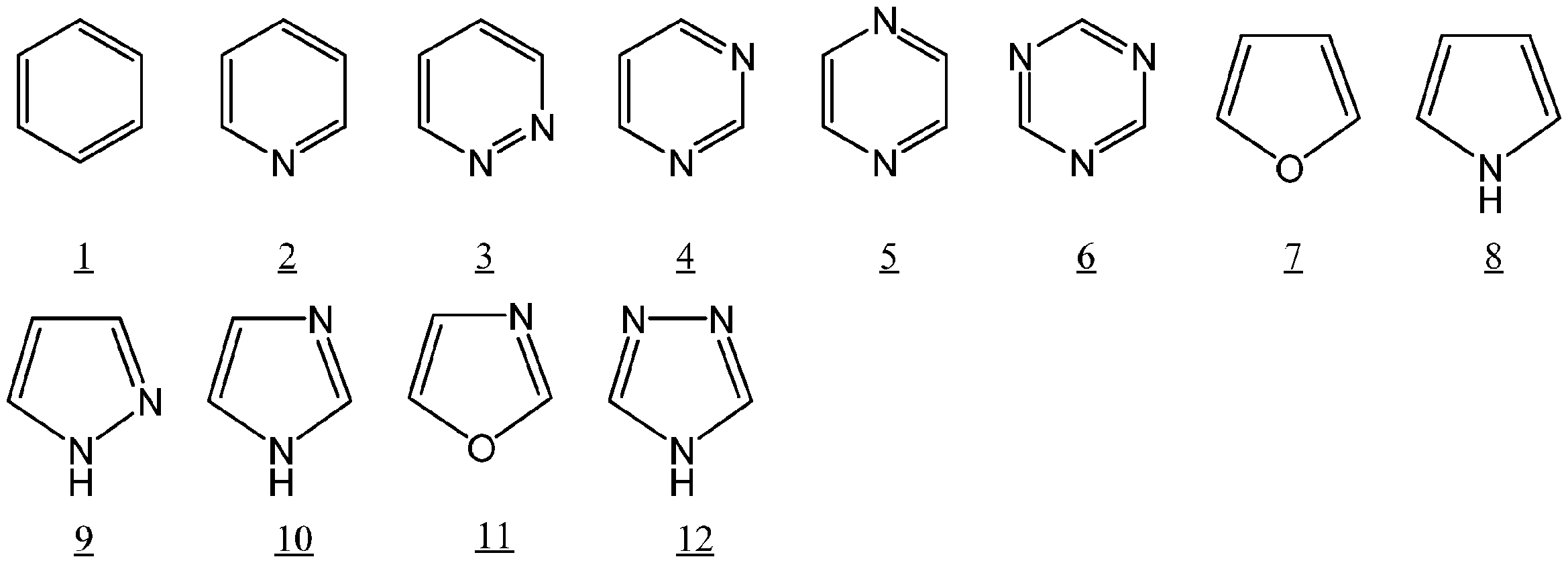
縮合多環式芳香環としては、例えば、以下の構造13~27で表される環が挙げられる。

芳香環集合としては、例えば、以下の構造28~36で表される環が挙げられる。
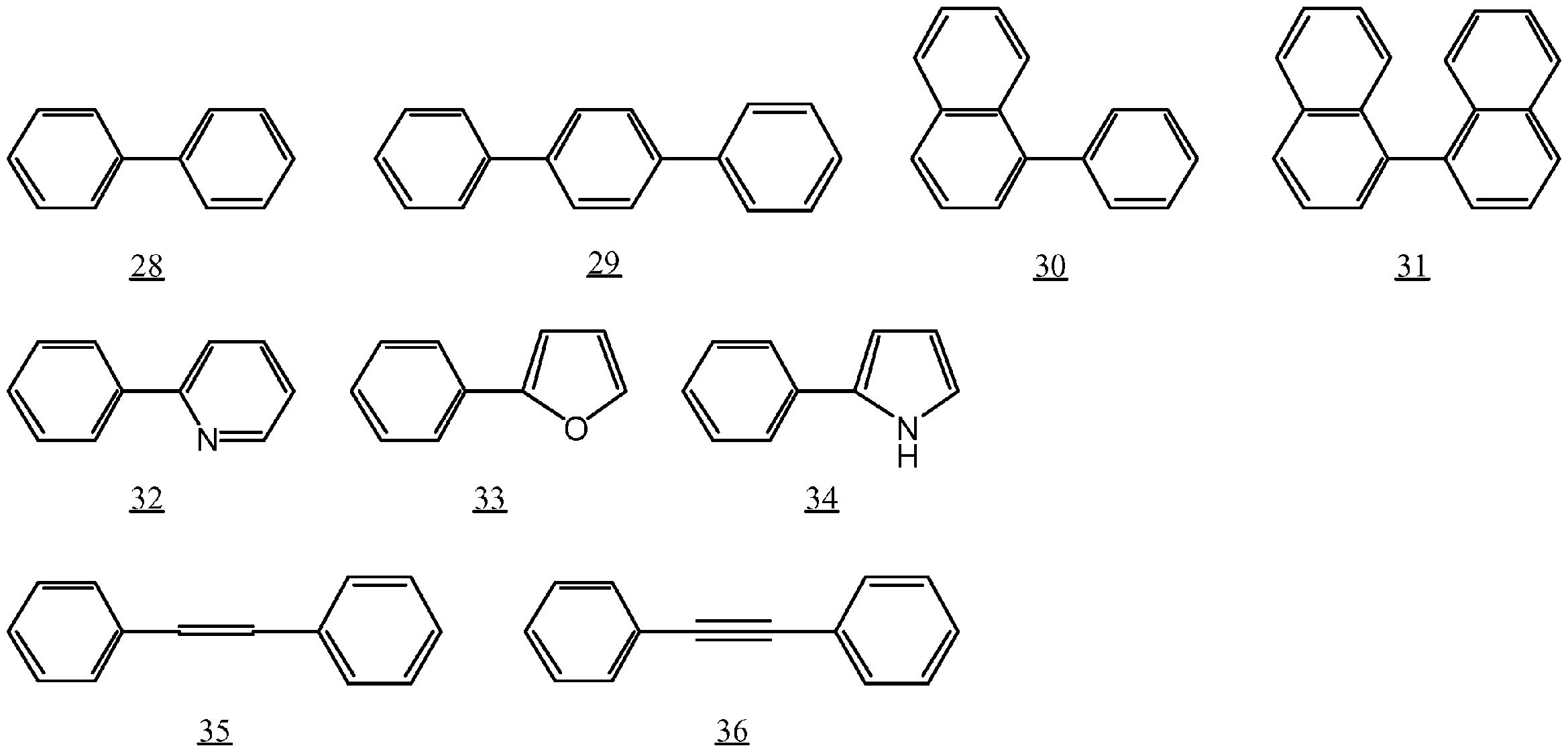
有橋多環式芳香環としては、例えば、以下の構造37~44で表される環が挙げられる。

前記(2+n4)価の芳香族基としては、原料モノマーの合成の容易さの観点から、構造1~14、26~29、37~39又は41で表される環から水素原子を(2+n4)個除いた基が好ましく、構造1~6、8、13、26、27、37又は41で表される環から水素原子を(2+n4)個除いた基がより好ましく、構造1、37又は41で表される環から水素原子を(2+n4)個除いた基がさらに好ましい。
式(14)中、R2で表される(1+m1+m2)価の有機基としては、例えば、メチル基、エチル基、プロピル基、イソプロピル基、ブチル基、イソブチル基、s-ブチル基、t-ブチル基、ペンチル基、ヘキシル基、シクロヘキシル基、ヘプチル基、オクチル基、ノニル基、デシル基、ラウリル基、これらの基の中の少なくとも1個の水素原子を置換基で置換した基等の、置換基を有し又は有さない炭素原子数1~20のアルキル基から(m1+m2)個の水素原子を除いた基;フェニル基、1-ナフチル基、2-ナフチル基、1-アントラセニル基、2-アントラセニル基、9-アントラセニル基、これらの基の中の少なくとも1個の水素原子を置換基で置換した基等の、置換基を有し又は有さない炭素原子数6~30のアリール基から(m1+m2)個の水素原子を除いた基;メトキシ基、エトキシ基、プロポキシ基、ブトキシ基、ペンチルオキシ基、ヘキシルオキシ基、ノニルオキシ基、ドデシルオキシ基、シクロプロピルオキシ基、シクロブチルオキシ基、シクロペンチルオキシ基、シクロへキシルオキシ基、シクロノニルオキシ基、シクロドデシルオキシ基、ノルボニルオキシ基、アダマンチルオキシ基、これらの基の中の少なくとも1個の水素原子を置換基で置換した基等の、置換基を有し又は有さない炭素原子数1~50のアルコキシ基から(m1+m2)個の水素原子を除いた基;炭素原子を含む置換基を有するアミノ基から(m1+m2)個の水素原子を除いた基;炭素原子を含む置換基を有するシリル基から(m1+m2)個の水素原子を除いた基が挙げられ、原料モノマーの合成の容易さの観点からは、アルキル基から(m1+m2)個の水素原子を除いた基、アリール基から(m1+m2)個の水素原子を除いた基、アルコキシ基から(m1+m2)個の水素原子を除いた基が好ましい。
前記置換基としては、前述のQ1に関する説明中で例示した置換基と同様の置換基が挙げられる。前記置換基が複数個存在する場合には、それらは同一でも異なっていてもよい。
(式(15)で表される構造単位)
式(15)中、R3は式(16)で表される基を含む1価の基であり、Ar2はR3以外の置換基を有し又は有さない(2+n5)価の芳香族基を表し、n5は1以上の整数を表す。
式(15)中、R3は式(16)で表される基を含む1価の基であり、Ar2はR3以外の置換基を有し又は有さない(2+n5)価の芳香族基を表し、n5は1以上の整数を表す。
式(16)で表される基は、Ar2に直接結合していてもよく、メチレン基、エチレン基、プロピレン基、ブチレン基、ペンチレン基、ヘキシレン基、ノニレン基、ドデシレン基、シクロプロピレン基、シクロブチレン基、シクロペンチレン基、シクロへキシレン基、シクロノニレン基、シクロドデシレン基、ノルボニレン基、アダマンチレン基、これらの基の中の少なくとも1個の水素原子を置換基で置換した基等の、置換基を有し又は有さない炭素原子数1~50のアルキレン基;オキシメチレン基、オキシエチレン基、オキシプロピレン基、オキシブチレン基、オキシペンチレン基、オキシヘキシレン基、オキシノニレン基、オキシドデシレン基、シクロプロピレンオキシ基、シクロブチレンオキシ基、シクロペンチレンオキシ基、シクロへキシレンオキシ基、シクロノニレンオキシ基、シクロドデシレンオキシ基、ノルボニレンオキシ基、アダマンチレンオキシ基、これらの基の中の少なくとも1個の水素原子を置換基で置換した基等の、置換基を有し又は有さない炭素原子数1~50のオキシアルキレン基;置換基を有し又は有さないイミノ基;置換基を有し又は有さないシリレン基;置換基を有し又は有さないエテニレン基;エチニレン基;置換基を有し又は有さないメタントリイル基;酸素原子、窒素原子、硫黄原子等のヘテロ原子を介してAr2に結合していてもよい。
前記Ar2はR3以外の置換基を有していてもよい。当該置換基としては、前述のQ1に関する説明中で例示した置換基と同様の置換基が挙げられる。前記置換基が複数個存在する場合には、それらは同一でも異なっていてもよい。
前記Ar2が有するR3以外の置換基としては、原料モノマーの合成の容易さの観点から、アルキル基、アルコキシ基、アリール基、アリールオキシ基、カルボキシル基又は置換カルボキシル基であることが好ましい。
式(15)中、n5は1以上の整数を表し、好ましくは1から4の整数であり、より好ましくは1から3の整数である。
式(15)中のAr2で表される(2+n5)価の芳香族基としては、(2+n5)価の芳香族炭化水素基、(2+n5)価の芳香族複素環基が挙げられ、炭素原子のみ、又は、炭素原子と、水素原子、窒素原子及び酸素原子からなる群から選ばれる1つ以上の原子とからなる(2+n5)価の芳香族基が好ましい。該(2+n5)価の芳香族基としては、ベンゼン環、ピリジン環、1,2-ジアジン環、1,3-ジアジン環、1,4-ジアジン環、1,3,5-トリアジン環、フラン環、ピロール環、ピラゾール環、イミダゾール環、オキサゾール環、アザジアゾール環等の単環式芳香環から水素原子を(2+n5)個除いた(2+n5)価の基;該単環式芳香環からなる群から選ばれる二つ以上の環が縮合した縮合多環式芳香環から水素原子を(2+n5)個除いた(2+n5)価の基;該単環式芳香環及び該縮合多環式芳香環からなる群より選ばれる二つ以上の芳香環を、単結合、エテニレン基又はエチニレン基で連結してなる芳香環集合から水素原子を(2+n5)個除いた(2+n5)価の基;該縮合多環式芳香環又は該芳香環集合の隣り合う2つの芳香環をメチレン基、エチレン基、カルボニル基等の2価の基で橋かけした架橋を有する有橋多環式芳香環から水素原子を(2+n5)個除いた(2+n5)価の基等が挙げられる。
単環式芳香環としては、例えば、式(13)で表される構造単位に関する説明中で例示した構造1~12で表される環が挙げられる。
縮合多環式芳香環としては、例えば、式(13)で表される構造単位に関する説明中で例示した構造13~27で表される環が挙げられる。
芳香環集合としては、例えば、式(13)で表される構造単位に関する説明中で例示した構造28~36で表される環が挙げられる。
有橋多環式芳香環としては、例えば、式(13)で表される構造単位に関する説明中で例示した構造37~44で表される環が挙げられる。
前記(2+n5)価の芳香族基としては、原料モノマーの合成の容易さの観点から、構造1~14、26~29、37~39又は41で表される環から水素原子を(2+n5)個除いた基が好ましく、構造1~6、8、13、26、27、37又は41で表される環から水素原子を(2+n5)個除いた基がより好ましく、構造1、37又は41で表される環から水素原子を(2+n5)個除いた基がさらに好ましい。
式(16)中、m3及びm4はそれぞれ独立に1以上の整数を表す。
式(16)中、R4で表される(1+m3+m4)価の有機基としては、例えば、メチル基、エチル基、プロピル基、イソプロピル基、ブチル基、イソブチル基、s-ブチル基、t-ブチル基、ペンチル基、ヘキシル基、シクロヘキシル基、ヘプチル基、オクチル基、ノニル基、デシル基、ラウリル基、これらの基の中の少なくとも1個の水素原子を置換基で置換した基等の、置換基を有し又は有さない炭素原子数1~20のアルキル基から(m3+m4)個の水素原子を除いた基;フェニル基、1-ナフチル基、2-ナフチル基、1-アントラセニル基、2-アントラセニル基、9-アントラセニル基、これらの基の中の少なくとも1個の水素原子を置換基で置換した基等の、置換基を有し又は有さない炭素原子数6~30のアリール基から(m3+m4)個の水素原子を除いた基;メトキシ基、エトキシ基、プロポキシ基、ブトキシ基、ペンチルオキシ基、ヘキシルオキシ基、ノニルオキシ基、ドデシルオキシ基、シクロプロピルオキシ基、シクロブチルオキシ基、シクロペンチルオキシ基、シクロへキシルオキシ基、シクロノニルオキシ基、シクロドデシルオキシ基、ノルボニルオキシ基、アダマンチルオキシ基、これらの基の中の少なくとも1個の水素原子を置換基で置換した基等の、置換基を有し又は有さない炭素原子数1~50のアルコキシ基から(m3+m4)個の水素原子を除いた基;炭素原子を含む置換基を有するアミノ基から(m3+m4)個の水素原子を除いた基;炭素原子を含む置換基を有するシリル基から(m3+m4)個の水素原子を除いた基が挙げられ、原料モノマーの合成の容易さの観点からは、アルキル基から(m3+m4)個の水素原子を除いた基、アリール基から(m3+m4)個の水素原子を除いた基、アルコキシ基から(m3+m4)個の水素原子を除いた基が好ましい。
前記置換基としては、前述のQ1に関する説明中で例示した置換基と同様の置換基が挙げられる。前記置換基が複数個存在する場合には、それらは同一でも異なっていてもよい。
(式(17)で表される構造単位)
式(17)中、R5は式(18)で表される基を含む1価の基であり、R6は式(19)で表される基を含む1価の基であり、Ar3はR5及びR6以外の置換基を有し又は有さない(2+n6+n7)価の芳香族基を表し、n6及びn7はそれぞれ独立に1以上の整数を表す。
式(17)中、R5は式(18)で表される基を含む1価の基であり、R6は式(19)で表される基を含む1価の基であり、Ar3はR5及びR6以外の置換基を有し又は有さない(2+n6+n7)価の芳香族基を表し、n6及びn7はそれぞれ独立に1以上の整数を表す。
式(18)で表される基及び式(19)で表される基は、Ar3に直接結合していてもよく、メチレン基、エチレン基、プロピレン基、ブチレン基、ペンチレン基、ヘキシレン基、ノニレン基、ドデシレン基、シクロプロピレン基、シクロブチレン基、シクロペンチレン基、シクロへキシレン基、シクロノニレン基、シクロドデシレン基、ノルボニレン基、アダマンチレン基、これらの基の中の少なくとも1個の水素原子を置換基で置換した基等の、置換基を有し又は有さない炭素原子数1~50のアルキレン基;オキシメチレン基、オキシエチレン基、オキシプロピレン基、オキシブチレン基、オキシペンチレン基、オキシヘキシレン基、オキシノニレン基、オキシドデシレン基、シクロプロピレンオキシ基、シクロブチレンオキシ基、シクロペンチレンオキシ基、シクロへキシレンオキシ基、シクロノニレンオキシ基、シクロドデシレンオキシ基、ノルボニレンオキシ基、アダマンチレンオキシ基、これらの基の中の少なくとも1個の水素原子を置換基で置換した基等の、置換基を有し又は有さない炭素原子数1~50のオキシアルキレン基;置換基を有し又は有さないイミノ基;置換基を有し又は有さないシリレン基;置換基を有し又は有さないエテニレン基;エチニレン基;置換基を有し又は有さないメタントリイル基;酸素原子、窒素原子、硫黄原子等のヘテロ原子を介してAr3に結合していてもよい。
前記Ar3はR5及びR6以外の置換基を有していてもよい。当該置換基としては、前述のQ1に関する説明中で例示した置換基と同様の置換基が挙げられる。前記置換基が複数個存在する場合には、それらは同一でも異なっていてもよい。
前記Ar3が有するR5及びR6以外の置換基としては、原料モノマーの合成の容易さの観点から、アルキル基、アルコキシ基、アリール基、アリールオキシ基、カルボキシル基又は置換カルボキシル基であることが好ましい。
式(17)中、n6は1以上の整数を表し、好ましくは1から4の整数であり、より好ましくは1から3の整数である。
式(17)中、n7は1以上の整数を表し、好ましくは1から4の整数であり、より好ましくは1から3の整数である。
式(17)中のAr3で表される(2+n6+n7)価の芳香族基としては、(2+n6+n7)価の芳香族炭化水素基、(2+n6+n7)価の芳香族複素環基が挙げられ、炭素原子のみ、又は、炭素原子と、水素原子、窒素原子及び酸素原子からなる群から選ばれる1つ以上の原子とからなる(2+n6+n7)価の芳香族基が好ましい。該(2+n6+n7)価の芳香族基としては、ベンゼン環、ピリジン環、1,2-ジアジン環、1,3-ジアジン環、1,4-ジアジン環、フラン環、ピロール環、ピラゾール環、イミダゾール環、オキサゾール環等の単環式芳香環から水素原子を(2+n6+n7)個除いた(2+n6+n7)価の基;該単環式芳香環からなる群から選ばれる二つ以上の環が縮合した縮合多環式芳香環から水素原子を(2+n6+n7)個除いた(2+n6+n7)価の基;該単環式芳香環及び該縮合多環式芳香環からなる群より選ばれる二つ以上の芳香環を、単結合、エテニレン基又はエチニレン基で連結してなる芳香環集合から水素原子を(2+n6+n7)個除いた(2+n6+n7)価の基;該縮合多環式芳香環又は該芳香環集合の隣り合う2つの芳香環をメチレン基、エチレン基、カルボニル基等の2価の基で橋かけした架橋を有する有橋多環式芳香環から水素原子を(2+n6+n7)個除いた(2+n6+n7)価の基等が挙げられる。
単環式芳香環としては、例えば、式(13)で表される構造単位に関する説明中で例示した構造1~5、構造7~10で表される環が挙げられる。
縮合多環式芳香環としては、例えば、式(13)で表される構造単位に関する説明中で例示した構造13~27で表される環が挙げられる。
芳香環集合としては、例えば、式(13)で表される構造単位に関する説明中で例示した構造28~36で表される環が挙げられる。
有橋多環式芳香環としては、例えば、式(13)で表される構造単位に関する説明中で例示した構造37~44で表される環が挙げられる。
前記(2+n6+n7)価の芳香族基としては、原料モノマーの合成の容易さの観点から、構造1~5、7~10、13、14、26~29、37~39、41又は42で表される環から水素原子を(2+n6+n7)個除いた基が好ましく、構造1、37、38、41又は42で表される環から水素原子を(2+n6+n7)個除いた基がより好ましく、構造1、38又は42で表される環から水素原子を(2+n6+n7)個除いた基がさらに好ましい。
式(18)中、R7は単結合又は(1+m5)価の有機基を表し、(1+m5)価の有機基であることが好ましい。
式(18)中、R7で表される(1+m5)価の有機基としては、例えば、メチル基、エチル基、プロピル基、イソプロピル基、ブチル基、イソブチル基、s-ブチル基、t-ブチル基、ペンチル基、ヘキシル基、シクロヘキシル基、ヘプチル基、オクチル基、ノニル基、デシル基、ラウリル基、これらの基の中の少なくとも1個の水素原子を置換基で置換した基等の、置換基を有し又は有さない炭素原子数1~20のアルキル基からm5個の水素原子を除いた基;フェニル基、1-ナフチル基、2-ナフチル基、1-アントラセニル基、2-アントラセニル基、9-アントラセニル基、これらの基の中の少なくとも1個の水素原子を置換基で置換した基等の、置換基を有し又は有さない炭素原子数6~30のアリール基からm5個の水素原子を除いた基;メトキシ基、エトキシ基、プロポキシ基、ブトキシ基、ペンチルオキシ基、ヘキシルオキシ基、ノニルオキシ基、ドデシルオキシ基、シクロプロピルオキシ基、シクロブチルオキシ基、シクロペンチルオキシ基、シクロへキシルオキシ基、シクロノニルオキシ基、シクロドデシルオキシ基、ノルボニルオキシ基、アダマンチルオキシ基、これらの基の中の少なくとも1個の水素原子を置換基で置換した基等の、置換基を有し又は有さない炭素原子数1~50のアルコキシ基からm5個の水素原子を除いた基;炭素原子を含む置換基を有するアミノ基からm5個の水素原子を除いた基;炭素原子を含む置換基を有するシリル基からm5個の水素原子を除いた基が挙げられ、原料モノマーの合成の容易さの観点からは、アルキル基からm5個の水素原子を除いた基、アリール基からm5個の水素原子を除いた基、アルコキシ基からm5個の水素原子を除いた基が好ましい。
前記置換基としては、前述のQ1に関する説明中で例示した置換基と同様の置換基が挙げられる。前記置換基が複数個存在する場合には、それらは同一でも異なっていてもよい。
式(18)中、m5は1以上の整数を表し、ただし、R7が単結合のときm5は1を表す。
式(19)中、R8は単結合又は(1+m6)価の有機基を表し、(1+m6)価の有機基であることが好ましい。
式(19)中、R8で表される(1+m6)価の有機基としては、例えば、メチル基、エチル基、プロピル基、イソプロピル基、ブチル基、イソブチル基、s-ブチル基、t-ブチル基、ペンチル基、ヘキシル基、シクロヘキシル基、ヘプチル基、オクチル基、ノニル基、デシル基、ラウリル基、これらの基の中の少なくとも1個の水素原子を置換基で置換した基等の、置換基を有し又は有さない炭素原子数1~20のアルキル基からm6個の水素原子を除いた基;フェニル基、1-ナフチル基、2-ナフチル基、1-アントラセニル基、2-アントラセニル基、9-アントラセニル基、これらの基の中の少なくとも1個の水素原子を置換基で置換した基等の、置換基を有し又は有さない炭素原子数6~30のアリール基からm6個の水素原子を除いた基;メトキシ基、エトキシ基、プロポキシ基、ブトキシ基、ペンチルオキシ基、ヘキシルオキシ基、ノニルオキシ基、ドデシルオキシ基、シクロプロピルオキシ基、シクロブチルオキシ基、シクロペンチルオキシ基、シクロへキシルオキシ基、シクロノニルオキシ基、シクロドデシルオキシ基、ノルボニルオキシ基、アダマンチルオキシ基、これらの基の中の少なくとも1個の水素原子を置換基で置換した基等の、置換基を有し又は有さない炭素原子数1~50のアルコキシ基からm6個の水素原子を除いた基;炭素原子を含む置換基を有するアミノ基からm6個の水素原子を除いた基;炭素原子を含む置換基を有するシリル基からm6個の水素原子を除いた基が挙げられ、原料モノマーの合成の容易さの観点からは、アルキル基からm6個の水素原子を除いた基、アリール基からm6個の水素原子を除いた基、アルコキシ基からm6個の水素原子を除いた基が好ましい。
前記置換基としては、前述のQ1に関する説明中で例示した置換基と同様の置換基が挙げられる。前記置換基が複数個存在する場合には、それらは同一でも異なっていてもよい。
式(19)中、m6は1以上の整数を表し、ただし、R8が単結合のときm6は1を表す。
(式(20)で表される構造単位)
式(20)中、R9は式(21)で表される基を含む1価の基であり、R10は式(22)で表される基を含む1価の基であり、Ar4はR9及びR10以外の置換基を有し又は有さない(2+n8+n9)価の芳香族基を表し、n8及びn9はそれぞれ独立に1以上の整数を表す。
式(20)中、R9は式(21)で表される基を含む1価の基であり、R10は式(22)で表される基を含む1価の基であり、Ar4はR9及びR10以外の置換基を有し又は有さない(2+n8+n9)価の芳香族基を表し、n8及びn9はそれぞれ独立に1以上の整数を表す。
式(21)で表される基及び式(22)で表される基は、Ar4に直接結合していてもよく、メチレン基、エチレン基、プロピレン基、ブチレン基、ペンチレン基、ヘキシレン基、ノニレン基、ドデシレン基、シクロプロピレン基、シクロブチレン基、シクロペンチレン基、シクロへキシレン基、シクロノニレン基、シクロドデシレン基、ノルボニレン基、アダマンチレン基、これらの基の中の少なくとも1個の水素原子を置換基で置換した基等の、置換基を有し又は有さない炭素原子数1~50のアルキレン基;オキシメチレン基、オキシエチレン基、オキシプロピレン基、オキシブチレン基、オキシペンチレン基、オキシヘキシレン基、オキシノニレン基、オキシドデシレン基、シクロプロピレンオキシ基、シクロブチレンオキシ基、シクロペンチレンオキシ基、シクロへキシレンオキシ基、シクロノニレンオキシ基、シクロドデシレンオキシ基、ノルボニレンオキシ基、アダマンチレンオキシ基、これらの基の中の少なくとも1個の水素原子を置換基で置換した基等の、置換基を有し又は有さない炭素原子数1~50のオキシアルキレン基;置換基を有し又は有さないイミノ基;置換基を有し又は有さないシリレン基;置換基を有し又は有さないエテニレン基;エチニレン基;置換基を有し又は有さないメタントリイル基;酸素原子、窒素原子、硫黄原子等のヘテロ原子を介してAr4に結合していてもよい。
前記Ar4はR9及びR10以外の置換基を有していてもよい。当該置換基としては、前述のQ1に関する説明中で例示した置換基と同様の置換基が挙げられる。前記置換基が複数個存在する場合には、それらは同一でも異なっていてもよい。
前記Ar4が有するR9及びR10以外の置換基としては、原料モノマーの合成の容易さの観点から、アルキル基、アルコキシ基、アリール基、アリールオキシ基、カルボキシル基又は置換カルボキシル基であることが好ましい。
式(20)中、n8は1以上の整数を表し、好ましくは1から4の整数であり、より好ましくは1から3の整数である。
式(20)中、n9は1以上の整数を表し、好ましくは1から4の整数であり、より好ましくは1から3の整数である。
式(20)中のAr4で表される(2+n8+n9)価の芳香族基としては、(2+n8+n9)価の芳香族炭化水素基、(2+n8+n9)価の芳香族複素環基が挙げられ、炭素原子のみ、又は、炭素原子と、水素原子、窒素原子及び酸素原子からなる群から選ばれる1つ以上の原子とからなる(2+n8+n9)価の芳香族基が好ましい。該(2+n8+n9)価の芳香族基としては、ベンゼン環、ピリジン環、1,2-ジアジン環、1,3-ジアジン環、1,4-ジアジン環、フラン環、ピロール環、ピラゾール環、イミダゾール環等の単環式芳香環から水素原子を(2+n8+n9)個除いた(2+n8+n9)価の基;該単環式芳香環からなる群から選ばれる二つ以上の環が縮合した縮合多環式芳香環から水素原子を(2+n8+n9)個除いた(2+n8+n9)価の基;該単環式芳香環及び該縮合多環式芳香環からなる群より選ばれる二つ以上の芳香環を、単結合、エテニレン基又はエチニレン基で連結してなる芳香環集合から水素原子を(2+n8+n9)個除いた(2+n8+n9)価の基;該縮合多環式芳香環又は該芳香環集合の隣り合う2つの芳香環をメチレン基、エチレン基、カルボニル基等の2価の基で橋かけした架橋を有する有橋多環式芳香環から水素原子を(2+n8+n9)個除いた(2+n8+n9)価の基等が挙げられる。
単環式芳香環としては、例えば、式(13)で表される構造単位に関する説明中で例示した構造1~5、構造7~10で表される環が挙げられる。
縮合多環式芳香環としては、例えば、式(13)で表される構造単位に関する説明中で例示した構造13~27で表される環が挙げられる。
芳香環集合としては、例えば、式(13)で表される構造単位に関する説明中で例示した構造28~36で表される環が挙げられる。
有橋多環式芳香環としては、例えば、式(13)で表される構造単位に関する説明中で例示した構造37~44で表される環が挙げられる。
前記(2+n8+n9)価の芳香族基としては、原料モノマーの合成の容易さの観点から、構造1~5、7~10、13、14、26~29、37~39、41又は42で表される環から水素原子を(2+n8+n9)個除いた基が好ましく、構造1~5、8、14、27、28、37、38、41又は42で表される環から水素原子を(2+n8+n9)個除いた基がより好ましく、構造1、37又は41で表される環から水素原子を(2+n8+n9)個除いた基がさらに好ましい。
式(21)中、R11は単結合又は(1+m7)価の有機基を表し、(1+m7)価の有機基であることが好ましい。
式(21)中、R11で表される(1+m7)価の有機基としては、例えば、メチル基、エチル基、プロピル基、イソプロピル基、ブチル基、イソブチル基、s-ブチル基、t-ブチル基、ペンチル基、ヘキシル基、シクロヘキシル基、ヘプチル基、オクチル基、ノニル基、デシル基、ラウリル基、これらの基の中の少なくとも1個の水素原子を置換基で置換した基等の、置換基を有し又は有さない炭素原子数1~20のアルキル基からm7個の水素原子を除いた基;フェニル基、1-ナフチル基、2-ナフチル基、1-アントラセニル基、2-アントラセニル基、9-アントラセニル基、これらの基の中の少なくとも1個の水素原子を置換基で置換した基等の、置換基を有し又は有さない炭素原子数6~30のアリール基からm7個の水素原子を除いた基;メトキシ基、エトキシ基、プロポキシ基、ブトキシ基、ペンチルオキシ基、ヘキシルオキシ基、ノニルオキシ基、ドデシルオキシ基、シクロプロピルオキシ基、シクロブチルオキシ基、シクロペンチルオキシ基、シクロへキシルオキシ基、シクロノニルオキシ基、シクロドデシルオキシ基、ノルボニルオキシ基、アダマンチルオキシ基、これらの基の中の少なくとも1個の水素原子を置換基で置換した基等の、置換基を有し又は有さない炭素原子数1~50のアルコキシ基からm7個の水素原子を除いた基;炭素原子を含む置換基を有するアミノ基からm7個の水素原子を除いた基;炭素原子を含む置換基を有するシリル基からm7個の水素原子を除いた基が挙げられ、原料モノマーの合成の容易さの観点からは、アルキル基からm7個の水素原子を除いた基、アリール基からm7個の水素原子を除いた基、アルコキシ基からm7個の水素原子を除いた基が好ましい。
前記置換基としては、前述のQ1に関する説明中で例示した置換基と同様の置換基が挙げられる。前記置換基が複数個存在する場合には、それらは同一でも異なっていてもよい。
式(21)中、m7は1以上の整数を表し、ただし、R11が単結合のときm7は1を表す。
式(22)中、R12は単結合又は(1+m8)価の有機基を表し、(1+m8)価の有機基であることが好ましい。
式(22)中、R12で表される(1+m8)価の有機基としては、例えば、メチル基、エチル基、プロピル基、イソプロピル基、ブチル基、イソブチル基、s-ブチル基、t-ブチル基、ペンチル基、ヘキシル基、シクロヘキシル基、ヘプチル基、オクチル基、ノニル基、デシル基、ラウリル基、これらの基の中の少なくとも1個の水素原子を置換基で置換した基等の、置換基を有し又は有さない炭素原子数1~20のアルキル基からm8個の水素原子を除いた基;フェニル基、1-ナフチル基、2-ナフチル基、1-アントラセニル基、2-アントラセニル基、9-アントラセニル基、これらの基の中の少なくとも1個の水素原子を置換基で置換した基等の、置換基を有し又は有さない炭素原子数6~30のアリール基からm8個の水素原子を除いた基;メトキシ基、エトキシ基、プロポキシ基、ブトキシ基、ペンチルオキシ基、ヘキシルオキシ基、ノニルオキシ基、ドデシルオキシ基、シクロプロピルオキシ基、シクロブチルオキシ基、シクロペンチルオキシ基、シクロへキシルオキシ基、シクロノニルオキシ基、シクロドデシルオキシ基、ノルボニルオキシ基、アダマンチルオキシ基、これらの基の中の少なくとも1個の水素原子を置換基で置換した基等の、置換基を有し又は有さない炭素原子数1~50のアルコキシ基からm8個の水素原子を除いた基;炭素原子を含む置換基を有するアミノ基からm8個の水素原子を除いた基;炭素原子を含む置換基を有するシリル基からm8個の水素原子を除いた基が挙げられ、原料モノマーの合成の容易さの観点からは、アルキル基からm8個の水素原子を除いた基、アリール基からm8個の水素原子を除いた基、アルコキシ基からm8個の水素原子を除いた基が好ましい。
前記置換基としては、前述のQ1に関する説明中で例示した置換基と同様の置換基が挙げられる。前記置換基が複数個存在する場合には、それらは同一でも異なっていてもよい。
式(22)中、m8は1以上の整数を表し、ただし、R12が単結合のときm8は1を表す。
(式(13)で表される構造単位の例)
式(13)で表される構造単位としては、得られるイオン性ポリマーの電子輸送性の観点からは、式(23)で表される構造単位、式(24)で表される構造単位が好ましく、式(24)で表される構造単位がより好ましい。
式(13)で表される構造単位としては、得られるイオン性ポリマーの電子輸送性の観点からは、式(23)で表される構造単位、式(24)で表される構造単位が好ましく、式(24)で表される構造単位がより好ましい。

式(23)中、R13で表される(1+m9+m10)価の有機基としては、例えば、メチル基、エチル基、プロピル基、イソプロピル基、ブチル基、イソブチル基、s-ブチル基、t-ブチル基、ペンチル基、ヘキシル基、シクロヘキシル基、ヘプチル基、オクチル基、ノニル基、デシル基、ラウリル基、これらの基の中の少なくとも1個の水素原子を置換基で置換した基等の、置換基を有し又は有さない炭素原子数1~20のアルキル基から(m9+m10)個の水素原子を除いた基;フェニル基、1-ナフチル基、2-ナフチル基、1-アントラセニル基、2-アントラセニル基、9-アントラセニル基、これらの基の中の少なくとも1個の水素原子を置換基で置換した基等の、置換基を有し又は有さない炭素原子数6~30のアリール基から(m9+m10)個の水素原子を除いた基;メトキシ基、エトキシ基、プロポキシ基、ブトキシ基、ペンチルオキシ基、ヘキシルオキシ基、ノニルオキシ基、ドデシルオキシ基、シクロプロピルオキシ基、シクロブチルオキシ基、シクロペンチルオキシ基、シクロへキシルオキシ基、シクロノニルオキシ基、シクロドデシルオキシ基、ノルボニルオキシ基、アダマンチルオキシ基、これらの基の中の少なくとも1個の水素原子を置換基で置換した基等の、置換基を有し又は有さない炭素原子数1~50のアルコキシ基から(m9+m10)個の水素原子を除いた基;炭素原子を含む置換基を有するアミノ基から(m9+m10)個の水素原子を除いた基;炭素原子を含む置換基を有するシリル基から(m9+m10)個の水素原子を除いた基が挙げられ、原料モノマーの合成の容易さの観点からは、アルキル基から(m9+m10)個の水素原子を除いた基、アリール基から(m9+m10)個の水素原子を除いた基、アルコキシ基から(m9+m10)個の水素原子を除いた基が好ましい。
式(23)中、R14で表される1価の有機基としては、例えば、メチル基、エチル基、プロピル基、イソプロピル基、ブチル基、イソブチル基、s-ブチル基、t-ブチル基、ペンチル基、ヘキシル基、シクロヘキシル基、ヘプチル基、オクチル基、ノニル基、デシル基、ラウリル基、これらの基の中の少なくとも1個の水素原子を置換基で置換した基等の、置換基を有し又は有さない炭素原子数1~20のアルキル基;フェニル基、1-ナフチル基、2-ナフチル基、1-アントラセニル基、2-アントラセニル基、9-アントラセニル基、これらの基の中の少なくとも1個の水素原子を置換基で置換した基等の、置換基を有し又は有さない炭素原子数6~30のアリール基;メトキシ基、エトキシ基、プロポキシ基、ブトキシ基、ペンチルオキシ基、ヘキシルオキシ基、ノニルオキシ基、ドデシルオキシ基、シクロプロピルオキシ基、シクロブチルオキシ基、シクロペンチルオキシ基、シクロへキシルオキシ基、シクロノニルオキシ基、シクロドデシルオキシ基、ノルボニルオキシ基、アダマンチルオキシ基、これらの基の中の少なくとも1個の水素原子を置換基で置換した基等の、置換基を有し又は有さない炭素原子数1~50のアルコキシ基;炭素原子を含む置換基を有するアミノ基から1個の水素原子を除いた基;炭素原子を含む置換基を有するシリル基が挙げられ、原料モノマーの合成の容易さの観点からは、アルキル基、アリール基、アルコキシ基が好ましい。
式(23)で表される構造単位としては、以下の構造単位が挙げられる。

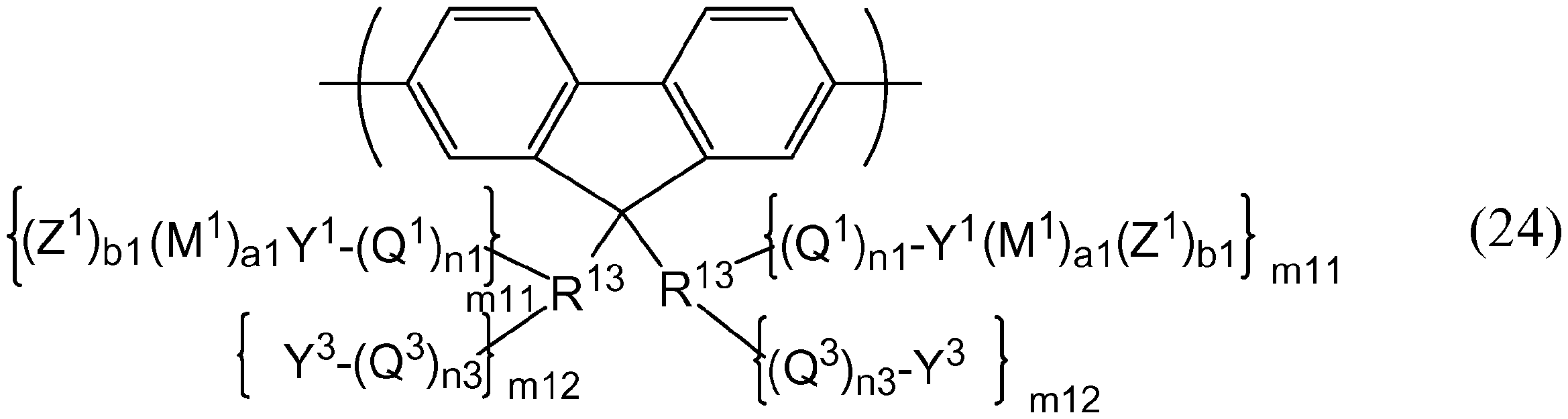
式(24)中、R13で表される(1+m11+m12)価の有機基としては、例えば、メチル基、エチル基、プロピル基、イソプロピル基、ブチル基、イソブチル基、s-ブチル基、t-ブチル基、ペンチル基、ヘキシル基、シクロヘキシル基、ヘプチル基、オクチル基、ノニル基、デシル基、ラウリル基、これらの基の中の少なくとも1個の水素原子を置換基で置換した基等の、置換基を有し又は有さない炭素原子数1~20のアルキル基から(m11+m12)個の水素原子を除いた基;フェニル基、1-ナフチル基、2-ナフチル基、1-アントラセニル基、2-アントラセニル基、9-アントラセニル基、これらの基の中の少なくとも1個の水素原子を置換基で置換した基等の、置換基を有し又は有さない炭素原子数6~30のアリール基から(m11+m12)個の水素原子を除いた基;メトキシ基、エトキシ基、プロポキシ基、ブトキシ基、ペンチルオキシ基、ヘキシルオキシ基、ノニルオキシ基、ドデシルオキシ基、シクロプロピルオキシ基、シクロブチルオキシ基、シクロペンチルオキシ基、シクロへキシルオキシ基、シクロノニルオキシ基、シクロドデシルオキシ基、ノルボニルオキシ基、アダマンチルオキシ基、これらの基の中の少なくとも1個の水素原子を置換基で置換した基等の、置換基を有し又は有さない炭素原子数1~50のアルコキシ基から(m11+m12)個の水素原子を除いた基;炭素原子を含む置換基を有するアミノ基から(m11+m12)個の水素原子を除いた基;炭素原子を含む置換基を有するシリル基から(m11+m12)個の水素原子を除いた基が挙げられ、原料モノマーの合成の容易さの観点からは、アルキル基から(m11+m12)個の水素原子を除いた基、アリール基から(m11+m12)個の水素原子を除いた基、アルコキシ基から(m11+m12)個の水素原子を除いた基が好ましい。
式(24)で表される構造単位としては、以下の構造単位が挙げられる。


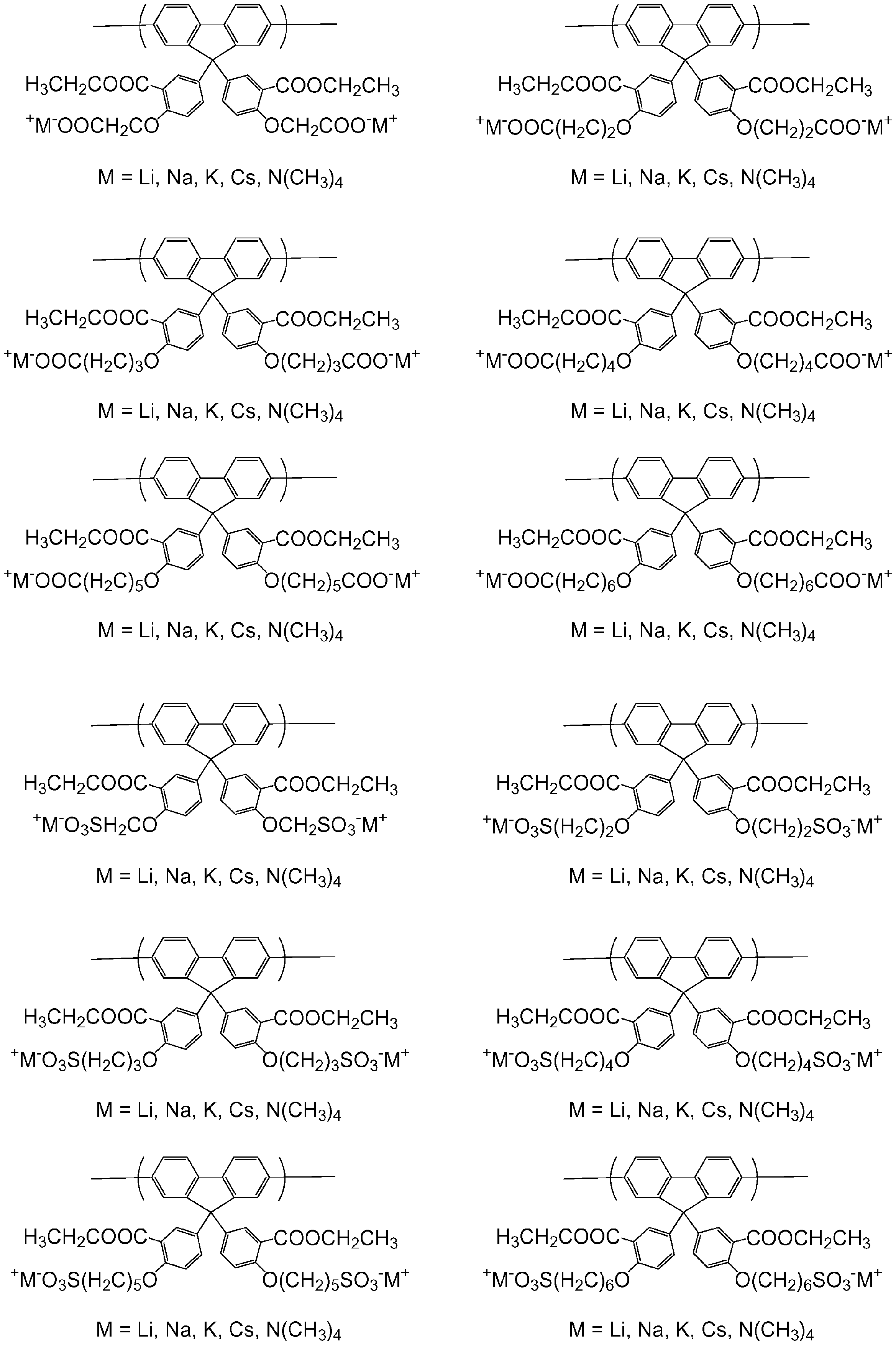
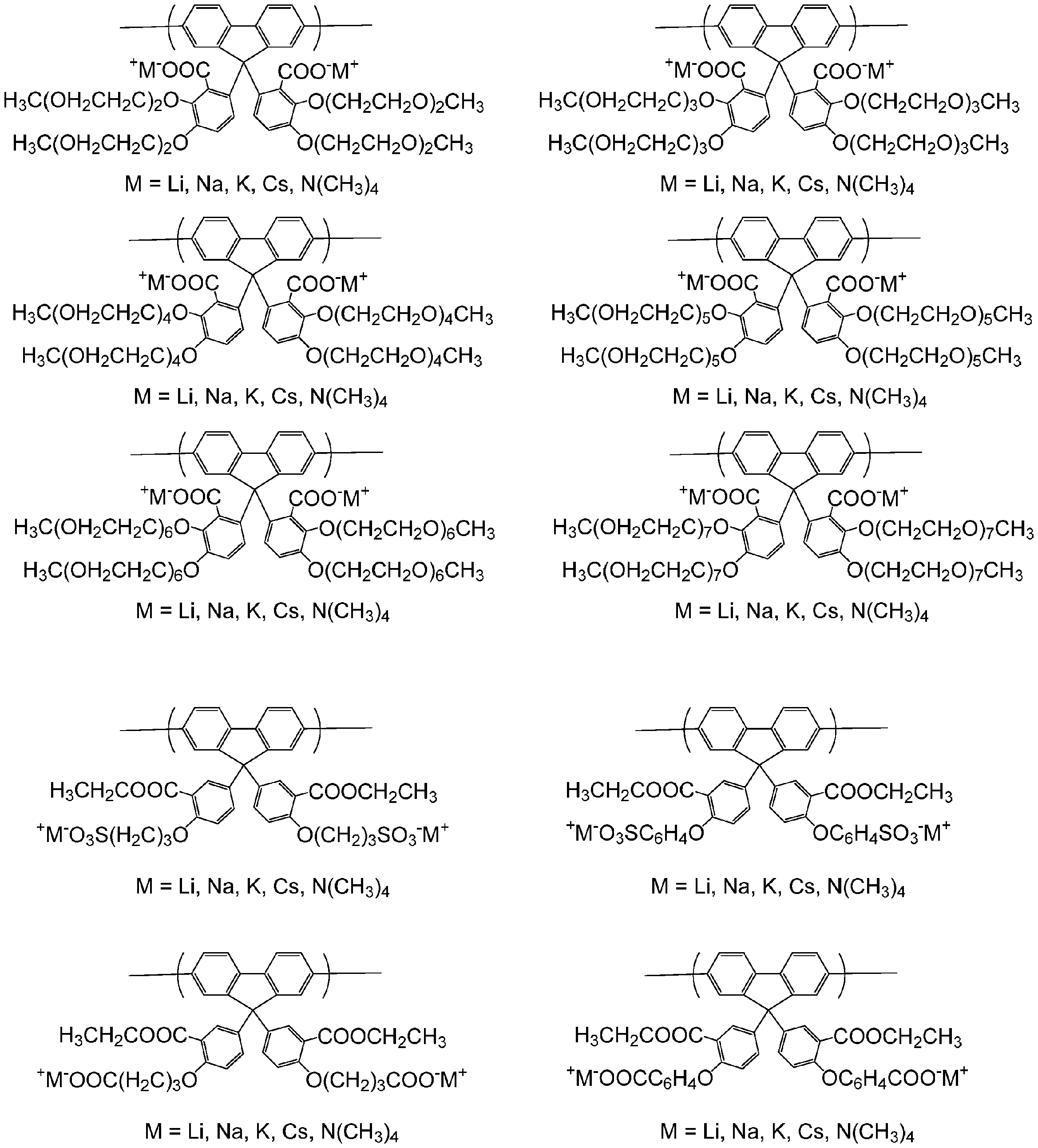
式(13)で表される構造単位としては、得られるイオン性ポリマーの耐久性の観点からは、式(25)で表される構造単位が好ましい。

式(25)中、R15で表される(1+m13+m14)価の有機基としては、例えば、メチル基、エチル基、プロピル基、イソプロピル基、ブチル基、イソブチル基、s-ブチル基、t-ブチル基、ペンチル基、ヘキシル基、シクロヘキシル基、ヘプチル基、オクチル基、ノニル基、デシル基、ラウリル基、これらの基の中の少なくとも1個の水素原子を置換基で置換した基等の、置換基を有し又は有さない炭素原子数1~20のアルキル基から(m13+m14)個の水素原子を除いた基;フェニル基、1-ナフチル基、2-ナフチル基、1-アントラセニル基、2-アントラセニル基、9-アントラセニル基、これらの基の中の少なくとも1個の水素原子を置換基で置換した基等の、置換基を有し又は有さない炭素原子数6~30のアリール基から(m13+m14)個の水素原子を除いた基;メトキシ基、エトキシ基、プロポキシ基、ブトキシ基、ペンチルオキシ基、ヘキシルオキシ基、ノニルオキシ基、ドデシルオキシ基、シクロプロピルオキシ基、シクロブチルオキシ基、シクロペンチルオキシ基、シクロへキシルオキシ基、シクロノニルオキシ基、シクロドデシルオキシ基、ノルボニルオキシ基、アダマンチルオキシ基、これらの基の中の少なくとも1個の水素原子を置換基で置換した基等の、置換基を有し又は有さない炭素原子数1~50のアルコキシ基から(m13+m14)個の水素原子を除いた基;炭素原子を含む置換基を有するアミノ基から(m13+m14)個の水素原子を除いた基;炭素原子を含む置換基を有するシリル基から(m13+m14)個の水素原子を除いた基が挙げられ、原料モノマーの合成の容易さの観点からは、アルキル基から(m13+m14)個の水素原子を除いた基、アリール基から(m13+m14)個の水素原子を除いた基、アルコキシ基から(m13+m14)個の水素原子を除いた基が好ましい。
式(25)で表される構造単位としては、以下の構造単位が挙げられる。

(式(15)で表される構造単位の例)
式(15)で表される構造単位としては、得られるイオン性ポリマーの電子輸送性の観点からは、式(26)で表される構造単位、式(27)で表される構造単位が好ましく、式(27)で表される構造単位がより好ましい。
式(15)で表される構造単位としては、得られるイオン性ポリマーの電子輸送性の観点からは、式(26)で表される構造単位、式(27)で表される構造単位が好ましく、式(27)で表される構造単位がより好ましい。

式(26)中、R16で表される(1+m16+m17)価の有機基としては、例えば、メチル基、エチル基、プロピル基、イソプロピル基、ブチル基、イソブチル基、s-ブチル基、t-ブチル基、ペンチル基、ヘキシル基、シクロヘキシル基、ヘプチル基、オクチル基、ノニル基、デシル基、ラウリル基、これらの基の中の少なくとも1個の水素原子を置換基で置換した基等の、置換基を有し又は有さない炭素原子数1~20のアルキル基から(m16+m17)個の水素原子を除いた基;フェニル基、1-ナフチル基、2-ナフチル基、1-アントラセニル基、2-アントラセニル基、9-アントラセニル基、これらの基の中の少なくとも1個の水素原子を置換基で置換した基等の、置換基を有し又は有さない炭素原子数6~30のアリール基から(m16+m17)個の水素原子を除いた基;メトキシ基、エトキシ基、プロポキシ基、ブトキシ基、ペンチルオキシ基、ヘキシルオキシ基、ノニルオキシ基、ドデシルオキシ基、シクロプロピルオキシ基、シクロブチルオキシ基、シクロペンチルオキシ基、シクロへキシルオキシ基、シクロノニルオキシ基、シクロドデシルオキシ基、ノルボニルオキシ基、アダマンチルオキシ基、これらの基の中の少なくとも1個の水素原子を置換基で置換した基等の、置換基を有し又は有さない炭素原子数1~50のアルコキシ基から(m16+m17)個の水素原子を除いた基;炭素原子を含む置換基を有するアミノ基から(m16+m17)個の水素原子を除いた基;炭素原子を含む置換基を有するシリル基から(m16+m17)個の水素原子を除いた基が挙げられ、原料モノマーの合成の容易さの観点からは、アルキル基から(m16+m17)個の水素原子を除いた基、アリール基から(m16+m17)個の水素原子を除いた基、アルコキシ基から(m16+m17)個の水素原子を除いた基が好ましい。
式(26)中、R17で表される1価の有機基としては、例えば、メチル基、エチル基、プロピル基、イソプロピル基、ブチル基、イソブチル基、s-ブチル基、t-ブチル基、ペンチル基、ヘキシル基、シクロヘキシル基、ヘプチル基、オクチル基、ノニル基、デシル基、ラウリル基、これらの基の中の少なくとも1個の水素原子を置換基で置換した基等の、置換基を有し又は有さない炭素原子数1~20のアルキル基;フェニル基、1-ナフチル基、2-ナフチル基、1-アントラセニル基、2-アントラセニル基、9-アントラセニル基、これらの基の中の少なくとも1個の水素原子を置換基で置換した基等の、置換基を有し又は有さない炭素原子数6~30のアリール基;メトキシ基、エトキシ基、プロポキシ基、ブトキシ基、ペンチルオキシ基、ヘキシルオキシ基、ノニルオキシ基、ドデシルオキシ基、シクロプロピルオキシ基、シクロブチルオキシ基、シクロペンチルオキシ基、シクロへキシルオキシ基、シクロノニルオキシ基、シクロドデシルオキシ基、ノルボニルオキシ基、アダマンチルオキシ基、これらの基の中の少なくとも1個の水素原子を置換基で置換した基等の、置換基を有し又は有さない炭素原子数1~50のアルコキシ基;炭素原子を含む置換基を有するアミノ基;炭素原子を含む置換基を有するシリル基が挙げられ、原料モノマーの合成の容易さの観点からは、アルキル基、アリール基、アルコキシ基が好ましい。
式(26)で表される構造単位としては、以下の構造単位が挙げられる。
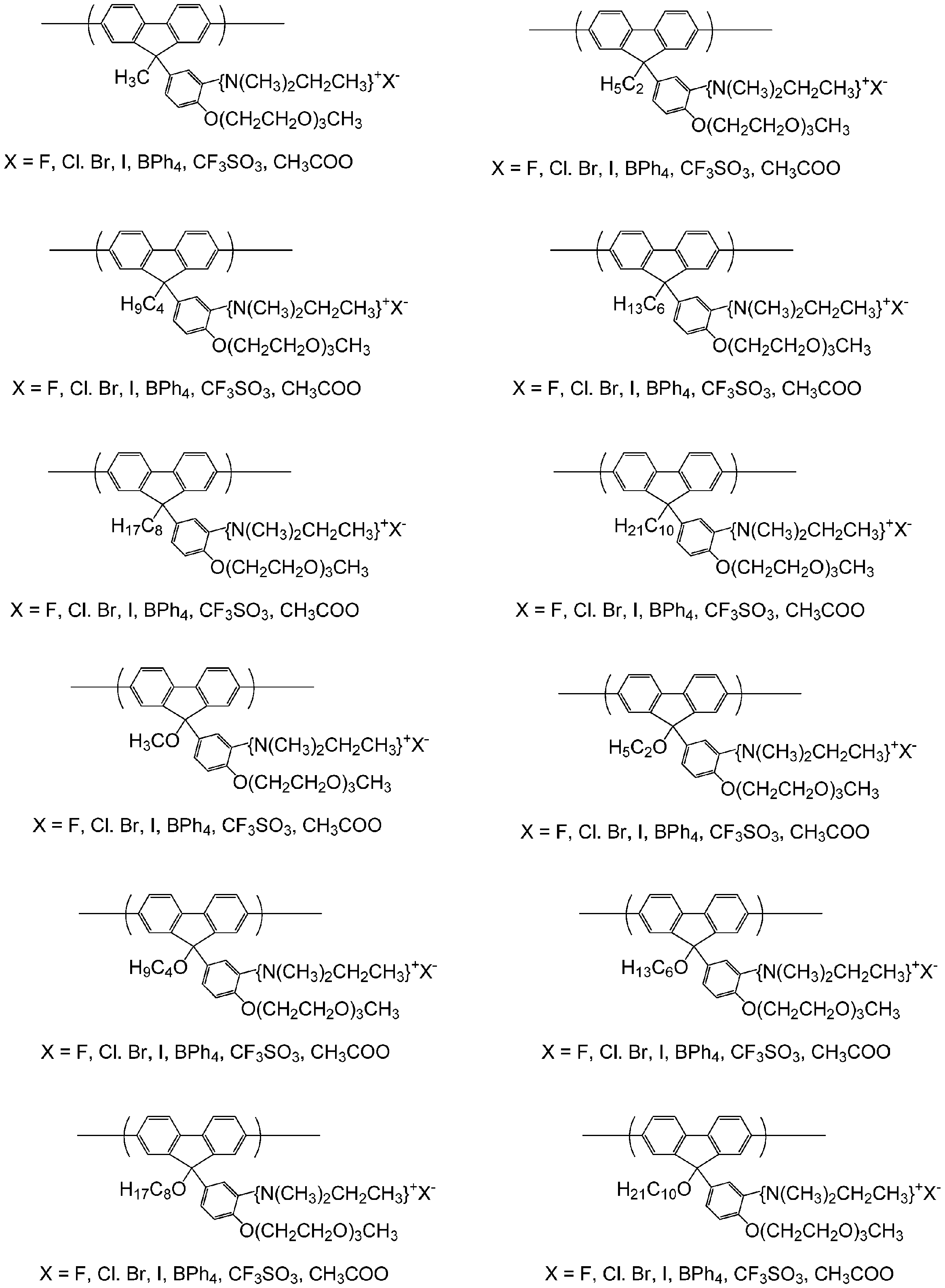

式(27)中、R16で表される(1+m18+m19)価の有機基としては、例えば、メチル基、エチル基、プロピル基、イソプロピル基、ブチル基、イソブチル基、s-ブチル基、t-ブチル基、ペンチル基、ヘキシル基、シクロヘキシル基、ヘプチル基、オクチル基、ノニル基、デシル基、ラウリル基、これらの基の中の少なくとも1個の水素原子を置換基で置換した基等の、置換基を有し又は有さない炭素原子数1~20のアルキル基から(m18+m19)個の水素原子を除いた基;フェニル基、1-ナフチル基、2-ナフチル基、1-アントラセニル基、2-アントラセニル基、9-アントラセニル基、これらの基の中の少なくとも1個の水素原子を置換基で置換した基等の、置換基を有し又は有さない炭素原子数6~30のアリール基から(m18+m19)個の水素原子を除いた基;メトキシ基、エトキシ基、プロポキシ基、ブトキシ基、ペンチルオキシ基、ヘキシルオキシ基、ノニルオキシ基、ドデシルオキシ基、シクロプロピルオキシ基、シクロブチルオキシ基、シクロペンチルオキシ基、シクロへキシルオキシ基、シクロノニルオキシ基、シクロドデシルオキシ基、ノルボニルオキシ基、アダマンチルオキシ基、これらの基の中の少なくとも1個の水素原子を置換基で置換した基等の、置換基を有し又は有さない炭素原子数1~50のアルコキシ基から(m18+m19)個の水素原子を除いた基;炭素原子を含む置換基を有するアミノ基から(m18+m19)個の水素原子を除いた基;炭素原子を含む置換基を有するシリル基から(m18+m19)個の水素原子を除いた基が挙げられ、原料モノマーの合成の容易さの観点からは、アルキル基から(m18+m19)個の水素原子を除いた基、アリール基から(m18+m19)個の水素原子を除いた基、アルコキシ基から(m18+m19)個の水素原子を除いた基が好ましい。
式(27)で表される構造単位としては、以下の構造単位が挙げられる。
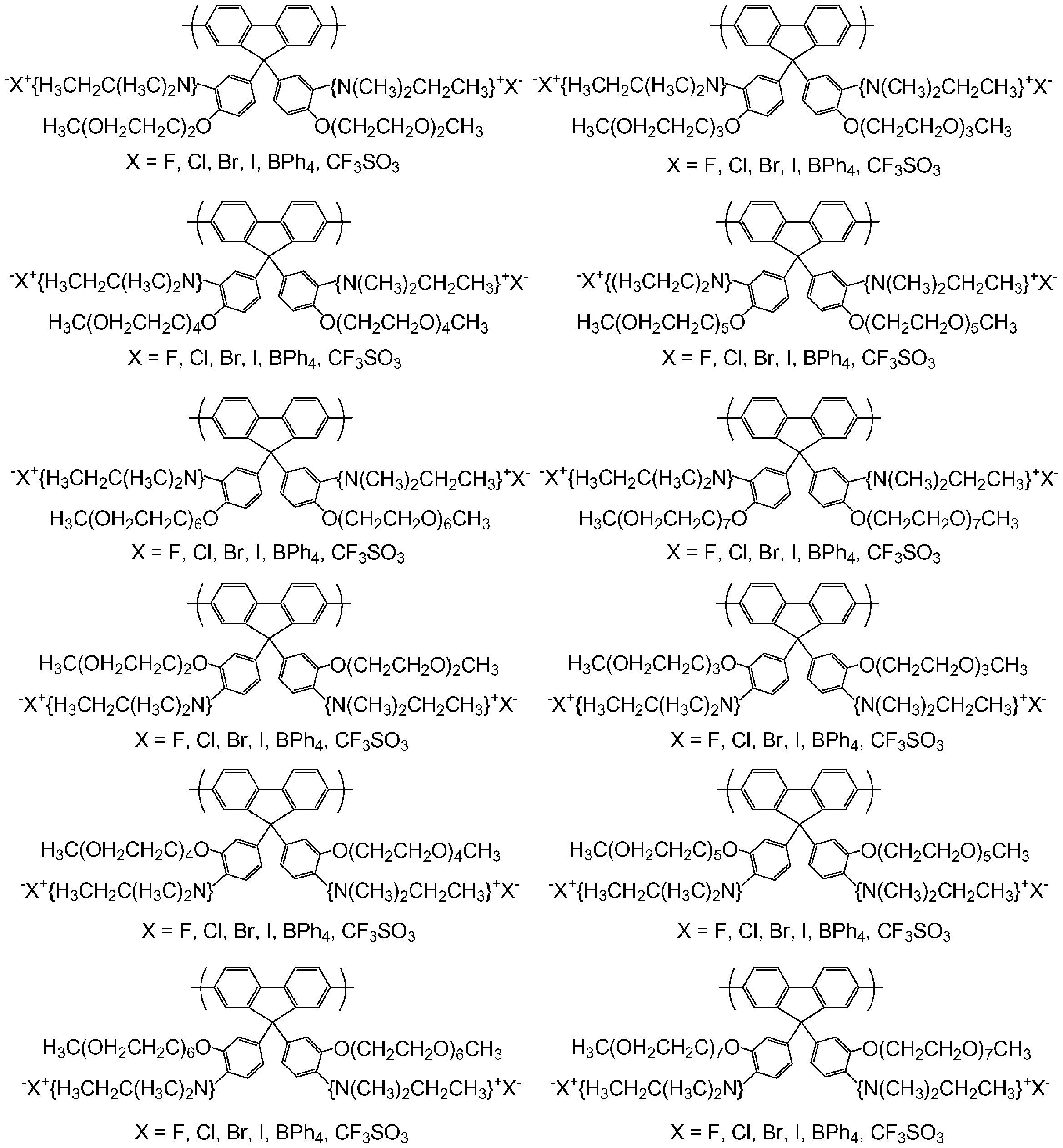
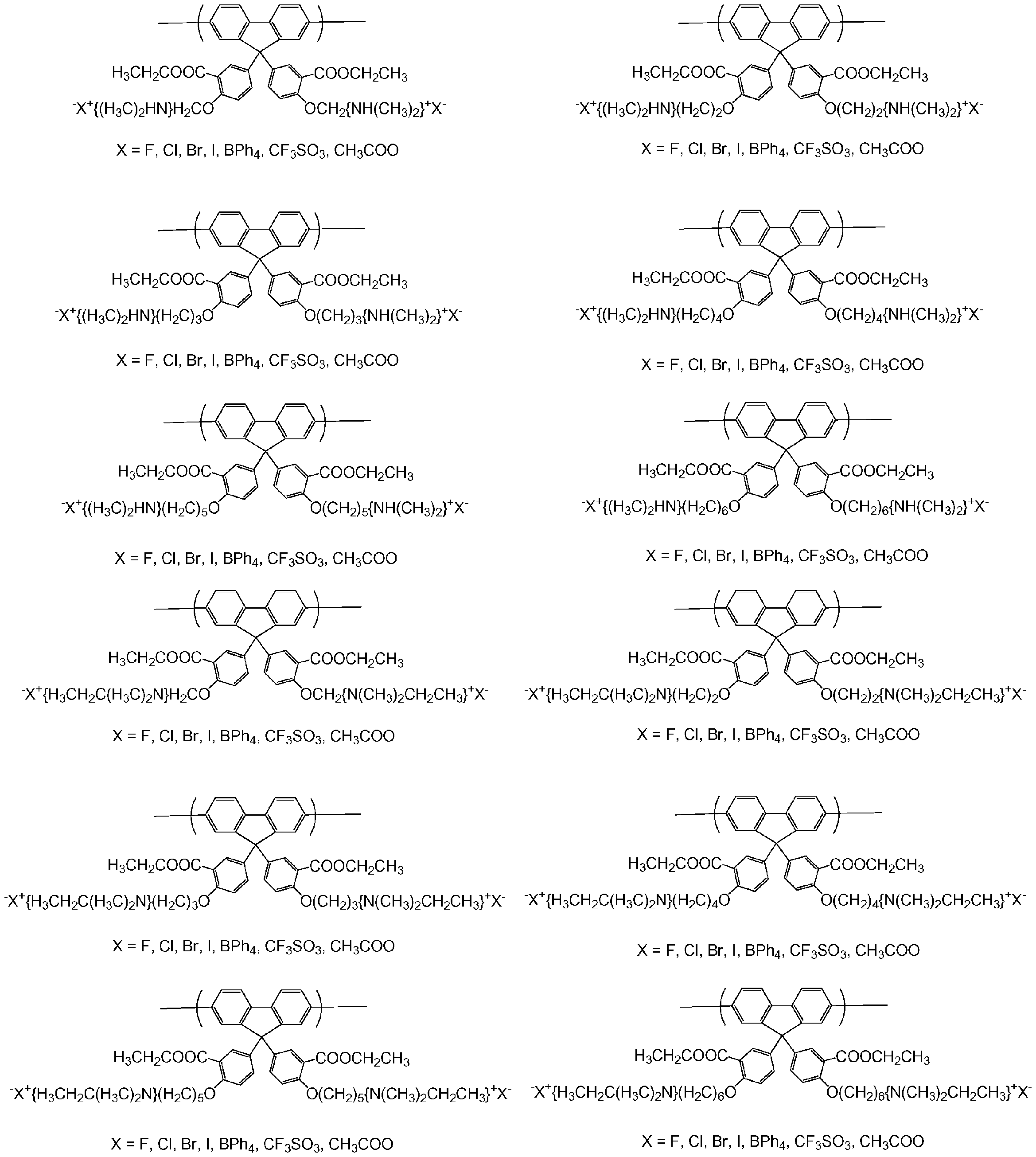

式(15)で表される構造単位としては、得られるイオン性ポリマーの耐久性の観点からは、式(28)で表される構造単位が好ましい。

式(28)中、R18で表される(1+m20+m21)価の有機基としては、例えば、メチル基、エチル基、プロピル基、イソプロピル基、ブチル基、イソブチル基、s-ブチル基、t-ブチル基、ペンチル基、ヘキシル基、シクロヘキシル基、ヘプチル基、オクチル基、ノニル基、デシル基、ラウリル基、これらの基の中の少なくとも1個の水素原子を置換基で置換した基等の、置換基を有し又は有さない炭素原子数1~20のアルキル基から(m20+m21)個の水素原子を除いた基;フェニル基、1-ナフチル基、2-ナフチル基、1-アントラセニル基、2-アントラセニル基、9-アントラセニル基、これらの基の中の少なくとも1個の水素原子を置換基で置換した基等の、置換基を有し又は有さない炭素原子数6~30のアリール基から(m20+m21)個の水素原子を除いた基;メトキシ基、エトキシ基、プロポキシ基、ブトキシ基、ペンチルオキシ基、ヘキシルオキシ基、ノニルオキシ基、ドデシルオキシ基、シクロプロピルオキシ基、シクロブチルオキシ基、シクロペンチルオキシ基、シクロへキシルオキシ基、シクロノニルオキシ基、シクロドデシルオキシ基、ノルボニルオキシ基、アダマンチルオキシ基、これらの基の中の少なくとも1個の水素原子を置換基で置換した基等の、置換基を有し又は有さない炭素原子数1~50のアルコキシ基から(m20+m21)個の水素原子を除いた基;炭素原子を含む置換基を有するアミノ基から(m20+m21)個の水素原子を除いた基;炭素原子を含む置換基を有するシリル基から(m20+m21)個の水素原子を除いた基が挙げられ、原料モノマーの合成の容易さの観点からは、アルキル基から(m20+m21)個の水素原子を除いた基、アリール基から(m20+m21)個の水素原子を除いた基、アルコキシ基から(m20+m21)個の水素原子を除いた基が好ましい。
式(28)で表される構造単位としては、以下の構造単位が挙げられる。

(式(17)で表される構造単位の例)
式(17)で表される構造単位としては、得られるイオン性ポリマーの電子輸送性の観点からは、式(29)で表される構造単位が好ましい。
式(17)で表される構造単位としては、得られるイオン性ポリマーの電子輸送性の観点からは、式(29)で表される構造単位が好ましい。
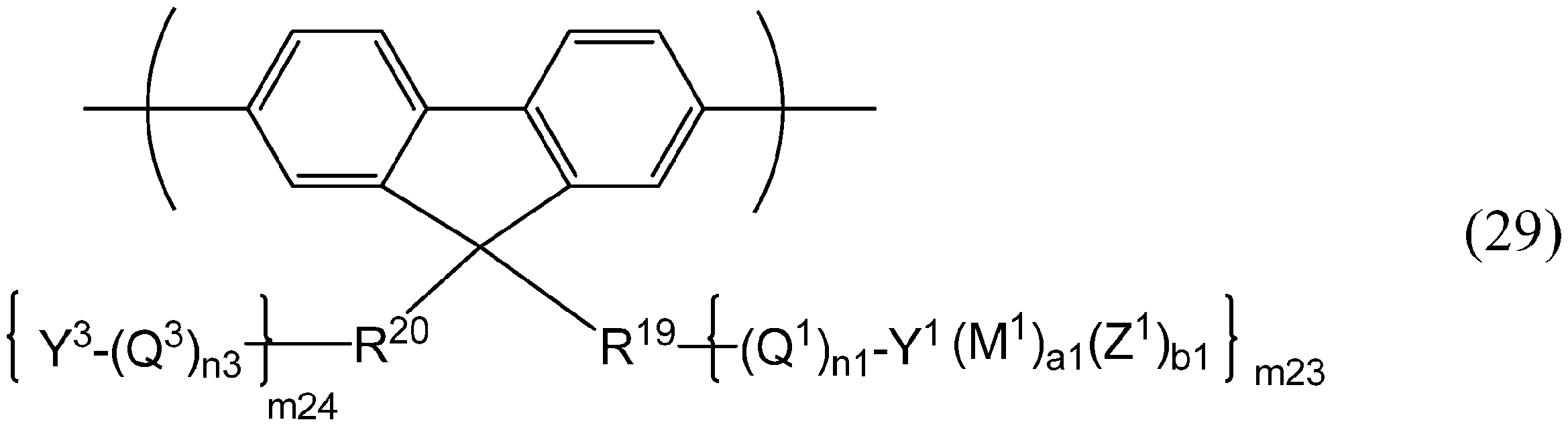
式(29)中、R19で表される(1+m23)価の有機基としては、例えば、メチル基、エチル基、プロピル基、イソプロピル基、ブチル基、イソブチル基、s-ブチル基、t-ブチル基、ペンチル基、ヘキシル基、シクロヘキシル基、ヘプチル基、オクチル基、ノニル基、デシル基、ラウリル基、これらの基の中の少なくとも1個の水素原子を置換基で置換した基等の、置換基を有し又は有さない炭素原子数1~20のアルキル基から(m23)個の水素原子を除いた基;フェニル基、1-ナフチル基、2-ナフチル基、1-アントラセニル基、2-アントラセニル基、9-アントラセニル基、これらの基の中の少なくとも1個の水素原子を置換基で置換した基等の、置換基を有し又は有さない炭素原子数6~30のアリール基から(m23)個の水素原子を除いた基;メトキシ基、エトキシ基、プロポキシ基、ブトキシ基、ペンチルオキシ基、ヘキシルオキシ基、ノニルオキシ基、ドデシルオキシ基、シクロプロピルオキシ基、シクロブチルオキシ基、シクロペンチルオキシ基、シクロへキシルオキシ基、シクロノニルオキシ基、シクロドデシルオキシ基、ノルボニルオキシ基、アダマンチルオキシ基、これらの基の中の少なくとも1個の水素原子を置換基で置換した基等の、置換基を有し又は有さない炭素原子数1~50のアルコキシ基から(m23)個の水素原子を除いた基;炭素原子を含む置換基を有するアミノ基から(m23)個の水素原子を除いた基;炭素原子を含む置換基を有するシリル基から(m23)個の水素原子を除いた基が挙げられ、原料モノマーの合成の容易さの観点からは、アルキル基から(m23)個の水素原子を除いた基、アリール基から(m23)個の水素原子を除いた基、アルコキシ基から(m23)個の水素原子を除いた基が好ましい。
式(29)中、R20で表される(1+m24)価の有機基としては、例えば、メチル基、エチル基、プロピル基、イソプロピル基、ブチル基、イソブチル基、s-ブチル基、t-ブチル基、ペンチル基、ヘキシル基、シクロヘキシル基、ヘプチル基、オクチル基、ノニル基、デシル基、ラウリル基、これらの基の中の少なくとも1個の水素原子を置換基で置換した基等の、置換基を有し又は有さない炭素原子数1~20のアルキル基から(m24)個の水素原子を除いた基;フェニル基、1-ナフチル基、2-ナフチル基、1-アントラセニル基、2-アントラセニル基、9-アントラセニル基、これらの基の中の少なくとも1個の水素原子を置換基で置換した基等の、置換基を有し又は有さない炭素原子数6~30のアリール基から(m24)個の水素原子を除いた基;メトキシ基、エトキシ基、プロポキシ基、ブトキシ基、ペンチルオキシ基、ヘキシルオキシ基、ノニルオキシ基、ドデシルオキシ基、シクロプロピルオキシ基、シクロブチルオキシ基、シクロペンチルオキシ基、シクロへキシルオキシ基、シクロノニルオキシ基、シクロドデシルオキシ基、ノルボニルオキシ基、アダマンチルオキシ基、これらの基の中の少なくとも1個の水素原子を置換基で置換した基等の、置換基を有し又は有さない炭素原子数1~50のアルコキシ基から(m24)個の水素原子を除いた基;炭素原子を含む置換基を有するアミノ基から(m24)個の水素原子を除いた基;炭素原子を含む置換基を有するシリル基から(m24)個の水素原子を除いた基が挙げられ、原料モノマーの合成の容易さの観点からは、アルキル基から(m24)個の水素原子を除いた基、アリール基から(m24)個の水素原子を除いた基、アルコキシ基から(m24)個の水素原子を除いた基が好ましい。
式(29)で表される構造単位としては、以下の構造単位が挙げられる。

式(17)で表される構造単位としては、得られるイオン性ポリマーの耐久性の観点からは、式(30)で表される構造単位が好ましい。

式(30)中、R21で表される(1+m25)価の有機基としては、例えば、メチル基、エチル基、プロピル基、イソプロピル基、ブチル基、イソブチル基、s-ブチル基、t-ブチル基、ペンチル基、ヘキシル基、シクロヘキシル基、ヘプチル基、オクチル基、ノニル基、デシル基、ラウリル基、これらの基の中の少なくとも1個の水素原子を置換基で置換した基等の、置換基を有し又は有さない炭素原子数1~20のアルキル基から(m25)個の水素原子を除いた基;フェニル基、1-ナフチル基、2-ナフチル基、1-アントラセニル基、2-アントラセニル基、9-アントラセニル基、これらの基の中の少なくとも1個の水素原子を置換基で置換した基等の、置換基を有し又は有さない炭素原子数6~30のアリール基から(m25)個の水素原子を除いた基;メトキシ基、エトキシ基、プロポキシ基、ブトキシ基、ペンチルオキシ基、ヘキシルオキシ基、ノニルオキシ基、ドデシルオキシ基、シクロプロピルオキシ基、シクロブチルオキシ基、シクロペンチルオキシ基、シクロへキシルオキシ基、シクロノニルオキシ基、シクロドデシルオキシ基、ノルボニルオキシ基、アダマンチルオキシ基、これらの基の中の少なくとも1個の水素原子を置換基で置換した基等の、置換基を有し又は有さない炭素原子数1~50のアルコキシ基から(m25)個の水素原子を除いた基;炭素原子を含む置換基を有するアミノ基から(m25)個の水素原子を除いた基;炭素原子を含む置換基を有するシリル基から(m25)個の水素原子を除いた基が挙げられ、原料モノマーの合成の容易さの観点からは、アルキル基から(m25)個の水素原子を除いた基、アリール基から(m25)個の水素原子を除いた基、アルコキシ基から(m25)個の水素原子を除いた基が好ましい。
式(30)中、R22で表される(1+m26)価の有機基としては、例えば、メチル基、エチル基、プロピル基、イソプロピル基、ブチル基、イソブチル基、s-ブチル基、t-ブチル基、ペンチル基、ヘキシル基、シクロヘキシル基、ヘプチル基、オクチル基、ノニル基、デシル基、ラウリル基、これらの基の中の少なくとも1個の水素原子を置換基で置換した基等の、置換基を有し又は有さない炭素原子数1~20のアルキル基から(m26)個の水素原子を除いた基;フェニル基、1-ナフチル基、2-ナフチル基、1-アントラセニル基、2-アントラセニル基、9-アントラセニル基、これらの基の中の少なくとも1個の水素原子を置換基で置換した基等の、置換基を有し又は有さない炭素原子数6~30のアリール基から(m26)個の水素原子を除いた基;メトキシ基、エトキシ基、プロポキシ基、ブトキシ基、ペンチルオキシ基、ヘキシルオキシ基、ノニルオキシ基、ドデシルオキシ基、シクロプロピルオキシ基、シクロブチルオキシ基、シクロペンチルオキシ基、シクロへキシルオキシ基、シクロノニルオキシ基、シクロドデシルオキシ基、ノルボニルオキシ基、アダマンチルオキシ基、これらの基の中の少なくとも1個の水素原子を置換基で置換した基等の、置換基を有し又は有さない炭素原子数1~50のアルコキシ基から(m26)個の水素原子を除いた基;炭素原子を含む置換基を有するアミノ基から(m26)個の水素原子を除いた基;炭素原子を含む置換基を有するシリル基から(m26)個の水素原子を除いた基が挙げられ、原料モノマーの合成の容易さの観点からは、アルキル基から(m26)個の水素原子を除いた基、アリール基から(m26)個の水素原子を除いた基、アルコキシ基から(m26)個の水素原子を除いた基が好ましい。
式(30)で表される構造単位としては、以下の構造単位が挙げられる。
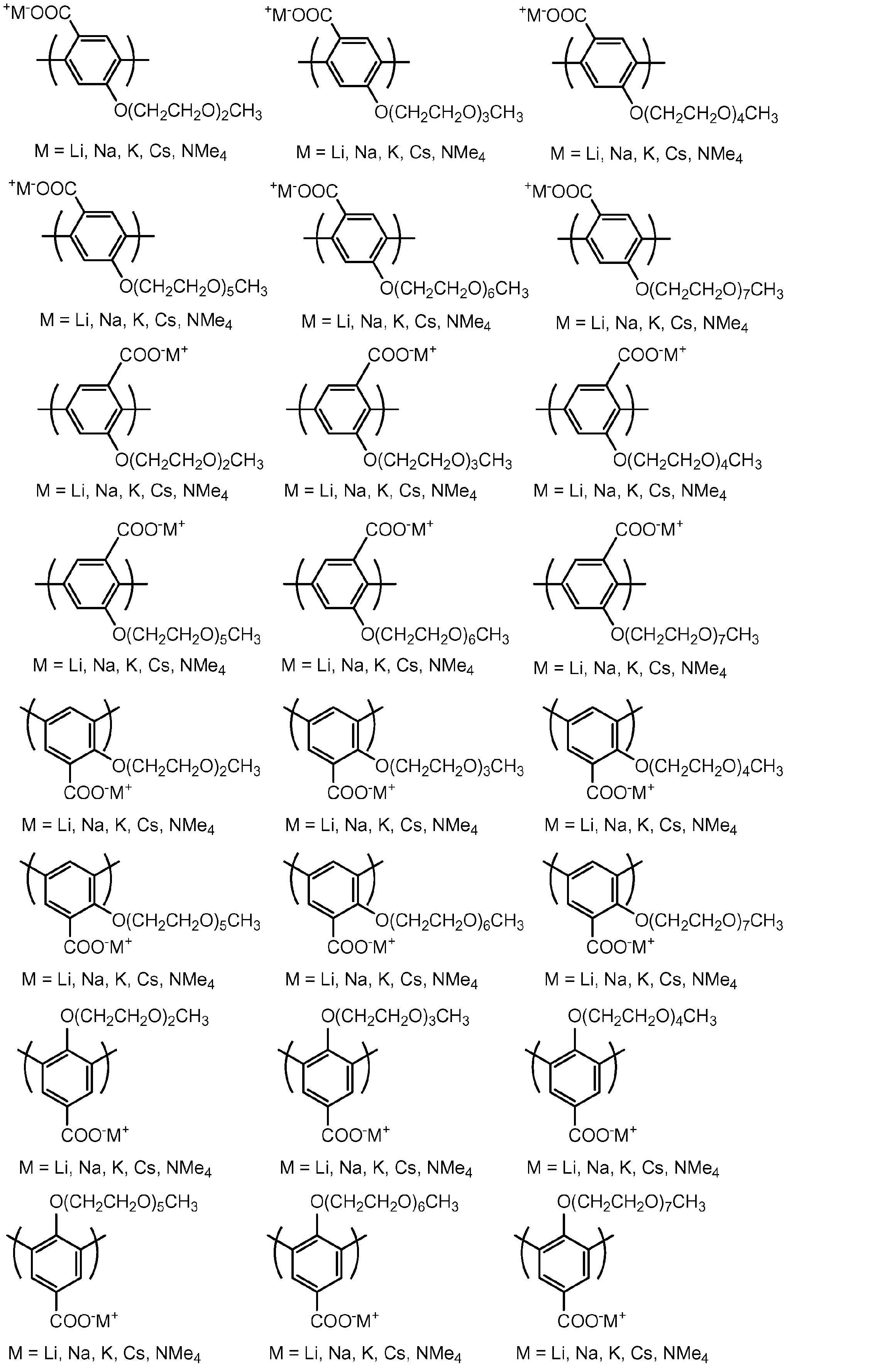
(式(20)で表される構造単位の例)
式(20)で表される構造単位としては、得られる電子輸送性の観点からは、式(31)で表される構造単位が好ましい。
式(20)で表される構造単位としては、得られる電子輸送性の観点からは、式(31)で表される構造単位が好ましい。
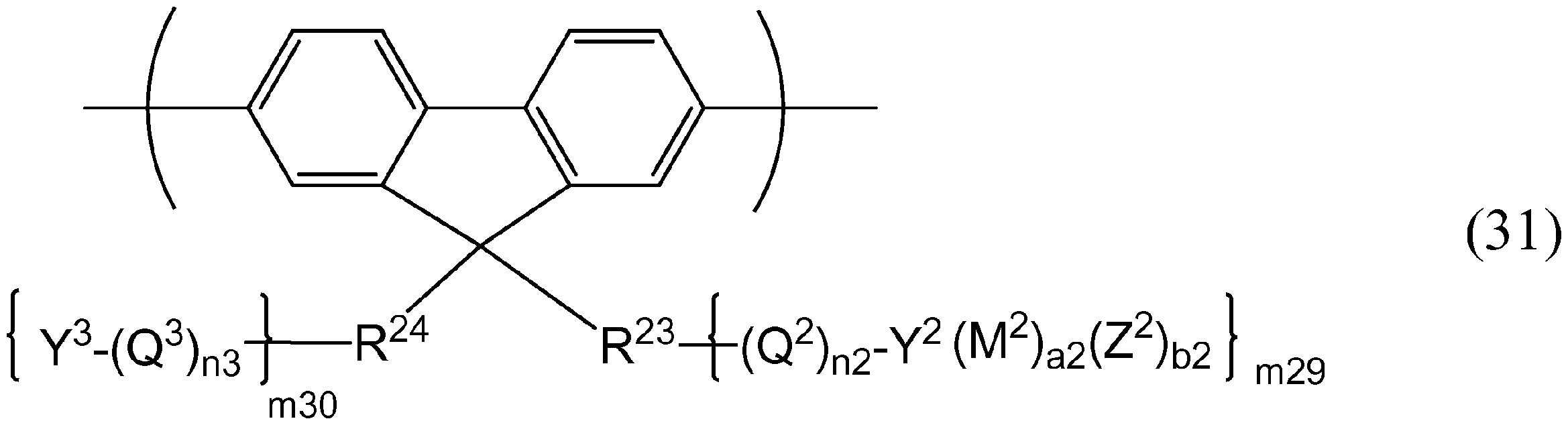
式(31)中、R23で表される(1+m29)価の有機基としては、例えば、メチル基、エチル基、プロピル基、イソプロピル基、ブチル基、イソブチル基、s-ブチル基、t-ブチル基、ペンチル基、ヘキシル基、シクロヘキシル基、ヘプチル基、オクチル基、ノニル基、デシル基、ラウリル基、これらの基の中の少なくとも1個の水素原子を置換基で置換した基等の、置換基を有し又は有さない炭素原子数1~20のアルキル基から(m29)個の水素原子を除いた基;フェニル基、1-ナフチル基、2-ナフチル基、1-アントラセニル基、2-アントラセニル基、9-アントラセニル基、これらの基の中の少なくとも1個の水素原子を置換基で置換した基等の、置換基を有し又は有さない炭素原子数6~30のアリール基から(m29)個の水素原子を除いた基;メトキシ基、エトキシ基、プロポキシ基、ブトキシ基、ペンチルオキシ基、ヘキシルオキシ基、ノニルオキシ基、ドデシルオキシ基、シクロプロピルオキシ基、シクロブチルオキシ基、シクロペンチルオキシ基、シクロへキシルオキシ基、シクロノニルオキシ基、シクロドデシルオキシ基、ノルボニルオキシ基、アダマンチルオキシ基、これらの基の中の少なくとも1個の水素原子を置換基で置換した基等の、置換基を有し又は有さない炭素原子数1~50のアルコキシ基から(m29)個の水素原子を除いた基;炭素原子を含む置換基を有するアミノ基から(m29)個の水素原子を除いた基;炭素原子を含む置換基を有するシリル基から(m29)個の水素原子を除いた基が挙げられ、原料モノマーの合成の容易さの観点からは、アルキル基から(m29)個の水素原子を除いた基、アリール基から(m29)個の水素原子を除いた基、アルコキシ基から(m29)個の水素原子を除いた基が好ましい。
式(31)中、R24で表される(1+m30)価の有機基としては、例えば、メチル基、エチル基、プロピル基、イソプロピル基、ブチル基、イソブチル基、s-ブチル基、t-ブチル基、ペンチル基、ヘキシル基、シクロヘキシル基、ヘプチル基、オクチル基、ノニル基、デシル基、ラウリル基、これらの基の中の少なくとも1個の水素原子を置換基で置換した基等の、置換基を有し又は有さない炭素原子数1~20のアルキル基から(m30)個の水素原子を除いた基;フェニル基、1-ナフチル基、2-ナフチル基、1-アントラセニル基、2-アントラセニル基、9-アントラセニル基、これらの基の中の少なくとも1個の水素原子を置換基で置換した基等の、置換基を有し又は有さない炭素原子数6~30のアリール基から(m30)個の水素原子を除いた基;メトキシ基、エトキシ基、プロポキシ基、ブトキシ基、ペンチルオキシ基、ヘキシルオキシ基、ノニルオキシ基、ドデシルオキシ基、シクロプロピルオキシ基、シクロブチルオキシ基、シクロペンチルオキシ基、シクロへキシルオキシ基、シクロノニルオキシ基、シクロドデシルオキシ基、ノルボニルオキシ基、アダマンチルオキシ基、これらの基の中の少なくとも1個の水素原子を置換基で置換した基等の、置換基を有し又は有さない炭素原子数1~50のアルコキシ基から(m30)個の水素原子を除いた基;炭素原子を含む置換基を有するアミノ基から(m30)個の水素原子を除いた基;炭素原子を含む置換基を有するシリル基から(m30)個の水素原子を除いた基が挙げられ、原料モノマーの合成の容易さの観点からは、アルキル基から(m30)個の水素原子を除いた基、アリール基から(m30)個の水素原子を除いた基、アルコキシ基から(m30)個の水素原子を除いた基が好ましい。
式(31)で表される構造単位としては、以下の構造単位が挙げられる。

式(20)で表される構造単位としては、得られるイオン性ポリマーの耐久性の観点からは、式(32)で表される構造単位が好ましい。
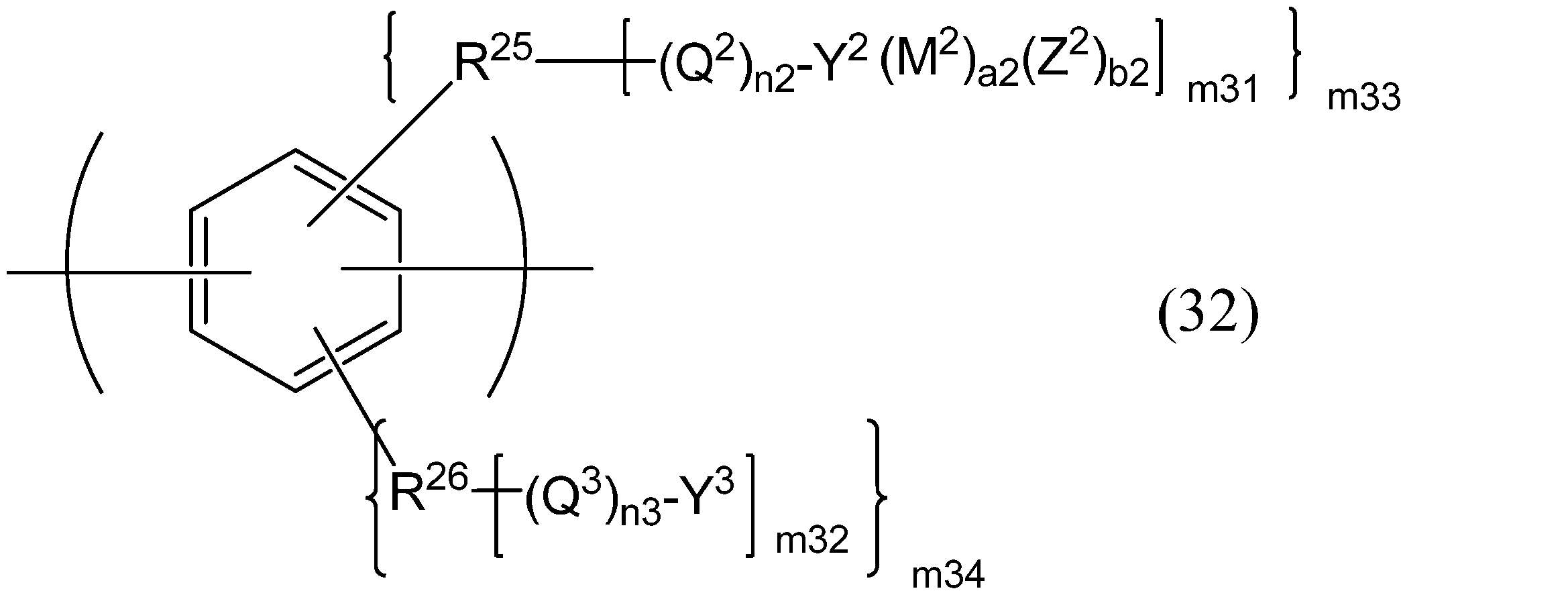
式(32)中、R25で表される(1+m31)価の有機基としては、例えば、メチル基、エチル基、プロピル基、イソプロピル基、ブチル基、イソブチル基、s-ブチル基、t-ブチル基、ペンチル基、ヘキシル基、シクロヘキシル基、ヘプチル基、オクチル基、ノニル基、デシル基、ラウリル基、これらの基の中の少なくとも1個の水素原子を置換基で置換した基等の、置換基を有し又は有さない炭素原子数1~20のアルキル基から(m31)個の水素原子を除いた基;フェニル基、1-ナフチル基、2-ナフチル基、1-アントラセニル基、2-アントラセニル基、9-アントラセニル基、これらの基の中の少なくとも1個の水素原子を置換基で置換した基等の、置換基を有し又は有さない炭素原子数6~30のアリール基から(m31)個の水素原子を除いた基;メトキシ基、エトキシ基、プロポキシ基、ブトキシ基、ペンチルオキシ基、ヘキシルオキシ基、ノニルオキシ基、ドデシルオキシ基、シクロプロピルオキシ基、シクロブチルオキシ基、シクロペンチルオキシ基、シクロへキシルオキシ基、シクロノニルオキシ基、シクロドデシルオキシ基、ノルボニルオキシ基、アダマンチルオキシ基、これらの基の中の少なくとも1個の水素原子を置換基で置換した基等の、置換基を有し又は有さない炭素原子数1~50のアルコキシ基から(m31)個の水素原子を除いた基;炭素原子を含む置換基を有するアミノ基から(m31)個の水素原子を除いた基;炭素原子を含む置換基を有するシリル基から(m31)個の水素原子を除いた基が挙げられ、原料モノマーの合成の容易さの観点からは、アルキル基から(m31)個の水素原子を除いた基、アリール基から(m31)個の水素原子を除いた基、アルコキシ基から(m31)個の水素原子を除いた基が好ましい。
式(32)中、R26で表される(1+m32)価の有機基としては、例えば、メチル基、エチル基、プロピル基、イソプロピル基、ブチル基、イソブチル基、s-ブチル基、t-ブチル基、ペンチル基、ヘキシル基、シクロヘキシル基、ヘプチル基、オクチル基、ノニル基、デシル基、ラウリル基、これらの基の中の少なくとも1個の水素原子を置換基で置換した基等の、置換基を有し又は有さない炭素原子数1~20のアルキル基から(m32)個の水素原子を除いた基;フェニル基、1-ナフチル基、2-ナフチル基、1-アントラセニル基、2-アントラセニル基、9-アントラセニル基、これらの基の中の少なくとも1個の水素原子を置換基で置換した基等の、置換基を有し又は有さない炭素原子数6~30のアリール基から(m32)個の水素原子を除いた基;メトキシ基、エトキシ基、プロポキシ基、ブトキシ基、ペンチルオキシ基、ヘキシルオキシ基、ノニルオキシ基、ドデシルオキシ基、シクロプロピルオキシ基、シクロブチルオキシ基、シクロペンチルオキシ基、シクロへキシルオキシ基、シクロノニルオキシ基、シクロドデシルオキシ基、ノルボニルオキシ基、アダマンチルオキシ基、これらの基の中の少なくとも1個の水素原子を置換基で置換した基等の、置換基を有し又は有さない炭素原子数1~50のアルコキシ基から(m32)個の水素原子を除いた基;炭素原子を含む置換基を有するアミノ基から(m32)個の水素原子を除いた基;炭素原子を含む置換基を有するシリル基から(m32)個の水素原子を除いた基が挙げられ、原料モノマーの合成の容易さの観点からは、アルキル基から(m32)個の水素原子を除いた基、アリール基から(m32)個の水素原子を除いた基、アルコキシ基から(m32)個の水素原子を除いた基が好ましい。
式(32)で表される構造単位としては、以下の構造単位が挙げられる。
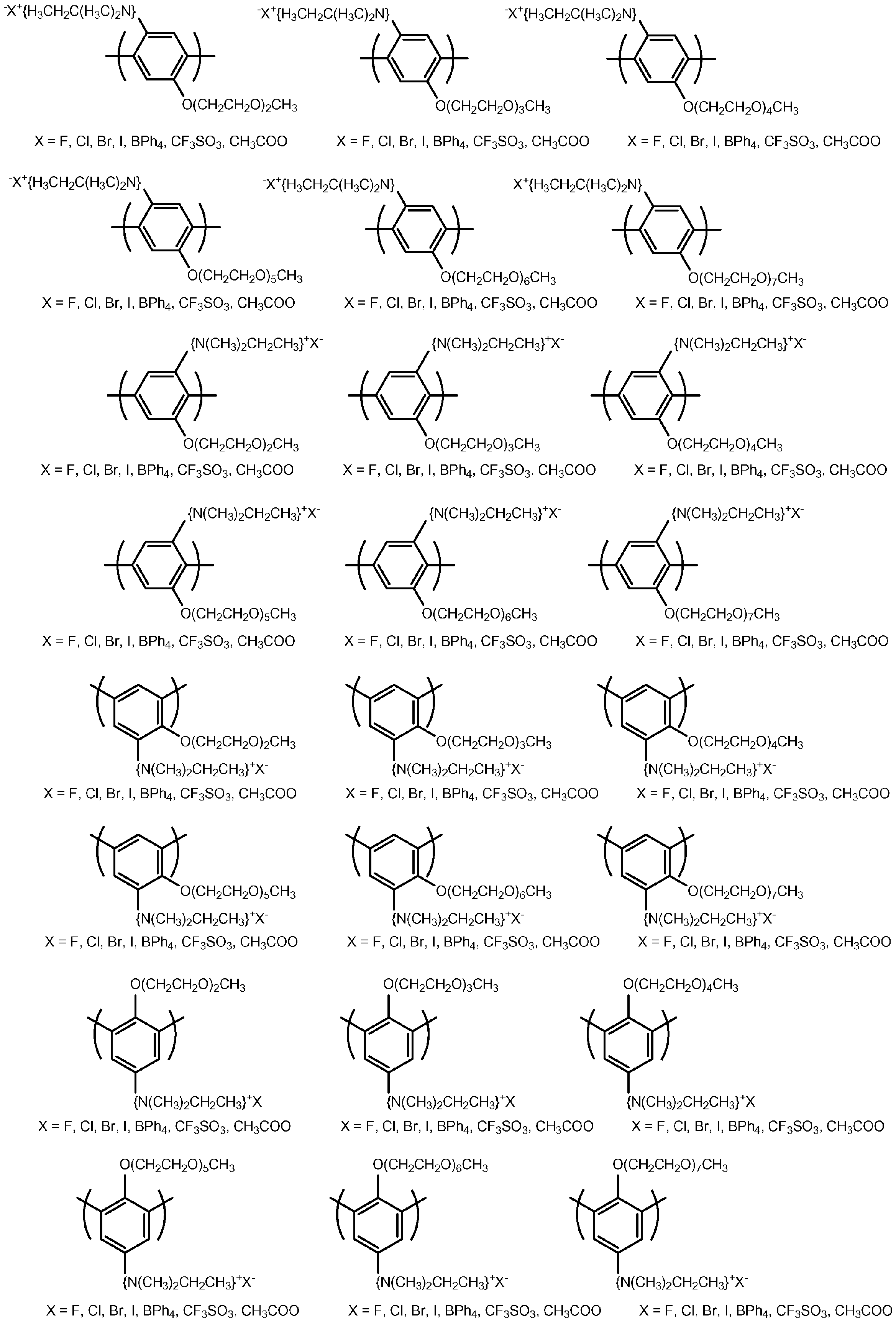
(その他の構造単位)
本発明に用いられるイオン性ポリマーは、さらに式(33)で表される1種以上の構造単位を有していてもよい。
本発明に用いられるイオン性ポリマーは、さらに式(33)で表される1種以上の構造単位を有していてもよい。

式(33)中のAr5で表される2価の芳香族基としては、2価の芳香族炭化水素基、2価の芳香族複素環基が挙げられる。該2価の芳香族基としては、ベンゼン環、ピリジン環、1,2-ジアジン環、1,3-ジアジン環、1,4-ジアジン環、1,3,5-トリアジン環、フラン環、ピロール環、チオフェン環、ピラゾール環、イミダゾール環、オキサゾール環、オキサジアゾール環、アザジアゾール環等の単環式芳香環から水素原子を2個除いた2価の基;該単環式芳香環からなる群から選ばれる二つ以上が縮合した縮合多環式芳香環から水素原子を2個除いた2価の基;該単環式芳香環及び該縮合多環式芳香環からなる群より選ばれる2つ以上の芳香環を、単結合、エテニレン基又はエチニレン基で連結してなる芳香環集合から水素原子を2個除いた2価の基;該縮合多環式芳香環又は該芳香環集合の隣り合う2つの芳香環をメチレン基、エチレン基、カルボニル基、イミノ基等の2価の基で橋かけした架橋を有する有橋多環式芳香環から水素原子を2個除いた2価の基等が挙げられる。
前記縮合多環式芳香環において、縮合する単環式芳香環の数は、イオン性ポリマーの溶解性の観点からは、2~4が好ましく、2~3がより好ましく、2がさらに好ましい。前記芳香環集合において、連結される芳香環の数は、溶解性の観点からは、2~4が好ましく、2~3がより好ましく、2がさらに好ましい。前記有橋多環式芳香環において、橋かけされる芳香環の数は、イオン性ポリマーの溶解性の観点からは、2~4が好ましく、2~3がより好ましく、2がさらに好ましい。
前記単環式芳香環としては、例えば、以下の構造45~60で表される環が挙げられる。
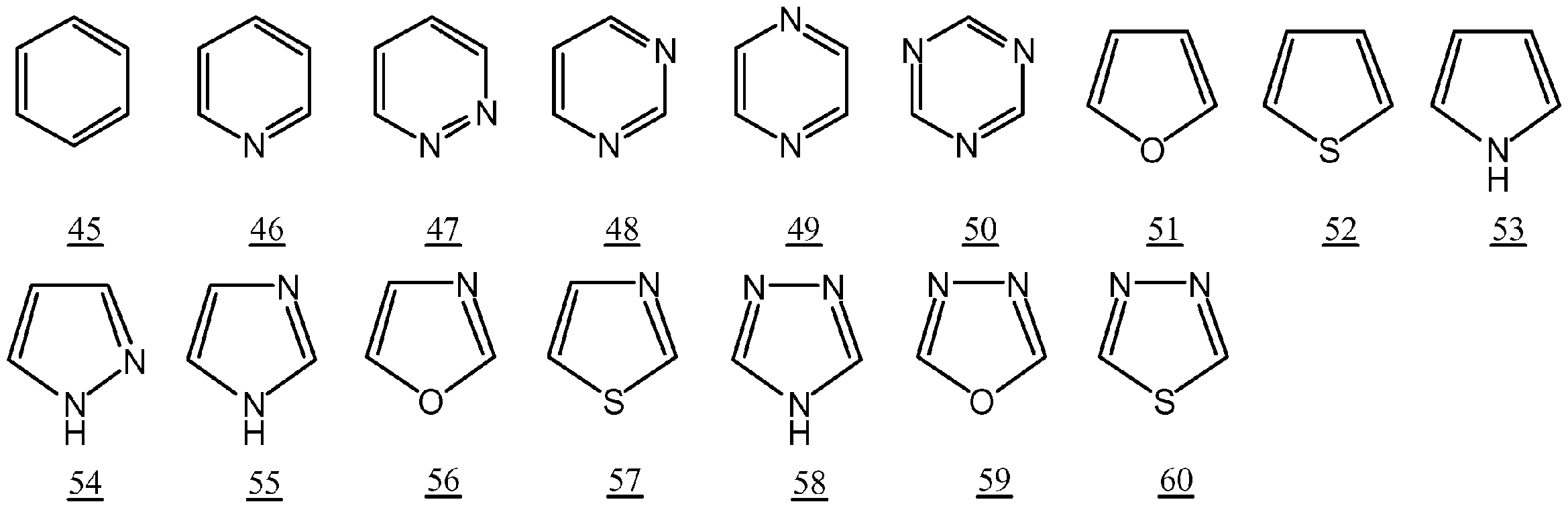
前記縮合多環式芳香環としては、例えば、以下の構造61~80で表される環が挙げられる。
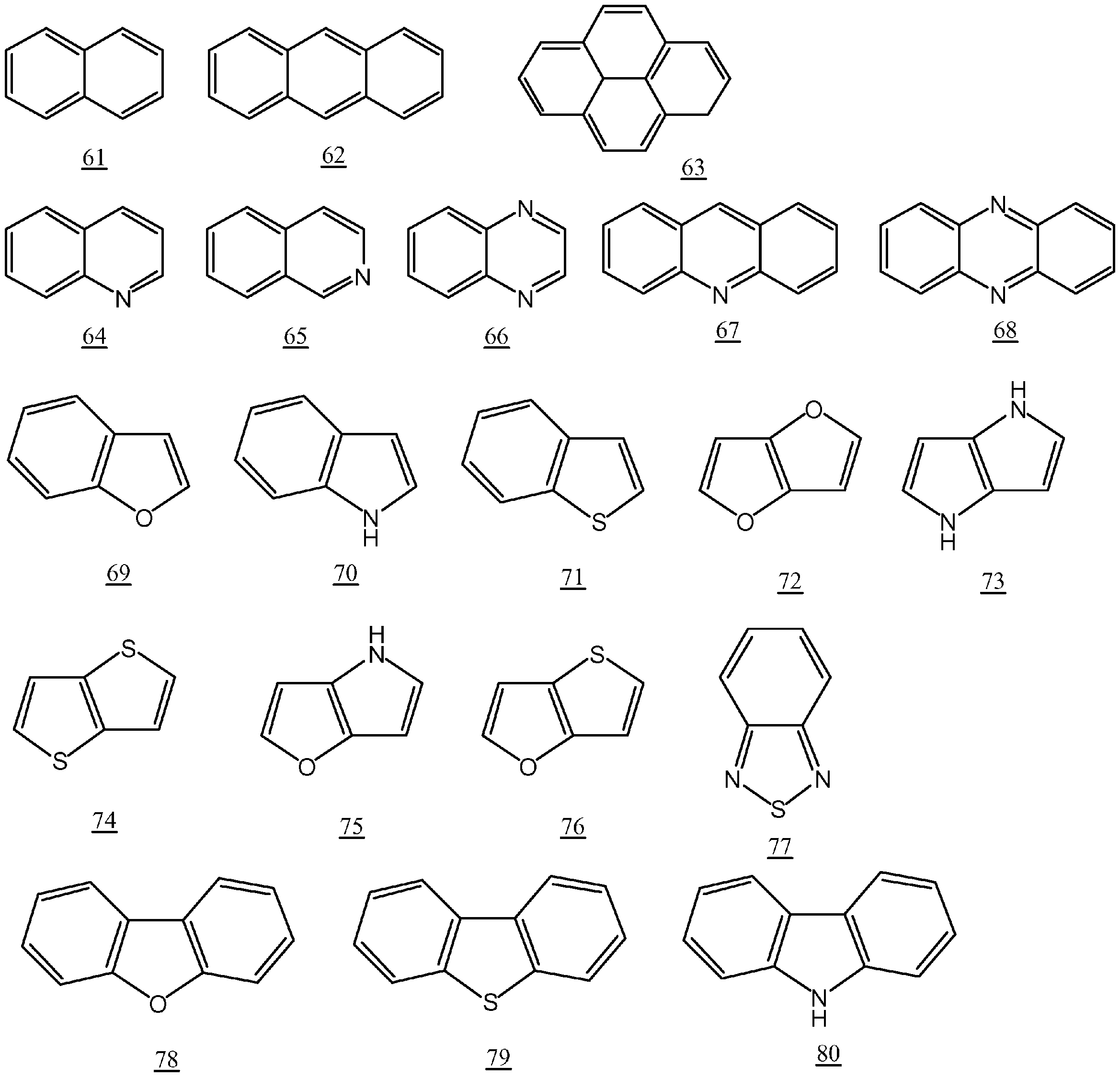
前記芳香環集合としては、例えば、以下の構造81~91で表される環が挙げられる。

前記有橋多環式芳香環としては、例えば、以下の構造92~100で表される環が挙げられる。

前記イオン性ポリマーの電子受容性及び正孔受容性のいずれか一方又は両方の観点からは、Ar5で表される2価の芳香族基は構造45~60、61~71、77~80、91、92、93又は96で表される環から水素原子を2個除いた2価の基が好ましく、構造45~50、59、60、77、80、91、92又は96で表される環から水素原子を2個除いた2価の基がより好ましい。
上記の2価の芳香族基は、置換基を有していてもよい。当該置換基としては、前述のQ1に関する説明((式(1)で表される基)の項)中で例示した置換基と同様の置換基が挙げられる。
式(33)中のAr5で表される2価の芳香族アミン残基としては、式(34)で表される基が挙げられる。

前記アリーレン基、アリール基、2価の複素環基、1価の複素環基が有していてもよい置換基としては、ハロゲン原子、アルキル基、アルキルオキシ基、アルキルチオ基、アリール基、アリールオキシ基、アリールチオ基、アリールアルキル基、アリールアルキルオキシ基、アリールアルキルチオ基、アルケニル基、アルキニル基、アリールアルケニル基、アリールアルキニル基、アシル基、アシルオキシ基、アミド基、酸イミド基、イミン残基、置換アミノ基、置換シリル基、置換シリルオキシ基、置換シリルチオ基、置換シリルアミノ基、シアノ基、ニトロ基、1価の複素環基、ヘテロアリールオキシ基、ヘテロアリールチオ基、アルキルオキシカルボニル基、アリールオキシカルボニル基、アリールアルキルオキシカルボニル基、ヘテロアリールオキシカルボニル基及びカルボキシル基等が挙げられる。該置換基は、ビニル基、アセチレン基、ブテニル基、アクリル基、アクリレート基、アクリルアミド基、メタクリル基、メタクリレート基、メタクリルアミド基、ビニルエーテル基、ビニルアミノ基、シラノール基、小員環(シクロプロピル基、シクロブチル基、エポキシ基、オキセタン基、ジケテン基、エピスルフィド基等)を有する基、ラクトン基、ラクタム基、又はシロキサン誘導体の構造を含有する基等の架橋基であってもよい。
n10が0の場合、Ar6中の炭素原子とAr8中の炭素原子とが直接結合してもよく、-O-、-S-等の2価の基を介して結合していてもよい。
Ar10、Ar11、Ar12で表されるアリール基、1価の複素環基としては、前記で置換基として説明し例示したアリール基、1価の複素環基と同様である。
Ar6、Ar7、Ar8、Ar9で表されるアリーレン基としては、芳香族炭化水素から芳香環を構成する炭素原子に結合した水素原子2個を除いた残りの原子団が挙げられ、ベンゼン環を持つ基、縮合環を持つ基、独立したベンゼン環又は縮合環2個以上が単結合又は2価の有機基、例えば、ビニレン基等のアルケニレン基を介して結合した基等が挙げられる。アリーレン基は、炭素原子数が通常6~60であり、7~48であることが好ましい。アリーレン基の具体例としては、フェニレン基、ビフェニレン基、C1~C17アルコキシフェニレン基、C1~C17アルキルフェニレン基、1-ナフチレン基、2-ナフチレン基、1-アントラセニレン基、2-アントラセニレン基、9-アントラセニレン基が挙げられる。前記アリール基中の水素原子はフッ素原子で置換されていてもよい。該当するフッ素原子置換アリール基としては、テトラフルオロフェニレン基等が挙げられる。アリール基の中では、フェニレン基、ビフェニレン基、C1~C12アルコキシフェニレン基、C1~C12アルキルフェニレン基が好ましい。
Ar6、Ar7、Ar8、Ar9で表される2価の複素環基としては、複素環式化合物から水素原子2個を除いた残りの原子団が挙げられる。ここで、複素環式化合物とは、環式構造をもつ有機化合物のうち、環を構成する元素として、炭素原子だけでなく、酸素原子、硫黄原子、窒素原子、リン原子、ホウ素原子、ケイ素原子、セレン原子、テルル原子、ヒ素原子等のヘテロ原子を含む有機化合物をいう。2価の複素環基は置換基を有していてもよい。2価の複素環基は、炭素原子数が通常4~60であり、4~20が好ましい。なお、2価の複素環基の炭素原子数には、置換基の炭素原子数は含まないものとする。このような2価の複素環基としては、例えば、チオフェンジイル基、C1~C12アルキルチオフェンジイル基、ピロールジイル基、フランジイル基、ピリジンジイル基、C1~C12アルキルピリジンジイル基、ピリダジンジイル基、ピリミジンジイル基、ピラジンジイル基、トリアジンジイル基、ピロリジンジイル基、ピペリジンジイル基、キノリンジイル基、イソキノリンジイル基が挙げられ、中でも、チオフェンジイル基、C1~C12アルキルチオフェンジイル基、ピリジンジイル基及びC1~C12アルキルピリジンジイル基がより好ましい。
構造単位として2価の芳香族アミン残基を含むイオン性ポリマーは、さらに他の構造単位を有していてもよい。他の構造単位としては、フェニレン基、フルオレンジイル基等のアリーレン基等が挙げられる。なお、これらのイオン性ポリマーの中では、架橋基を含んでいるものが好ましい。
また、式(34)で表される2価の芳香族アミン残基としては、下記構造101~110で表される芳香族アミンから水素原子を2個除いた基が例示される。
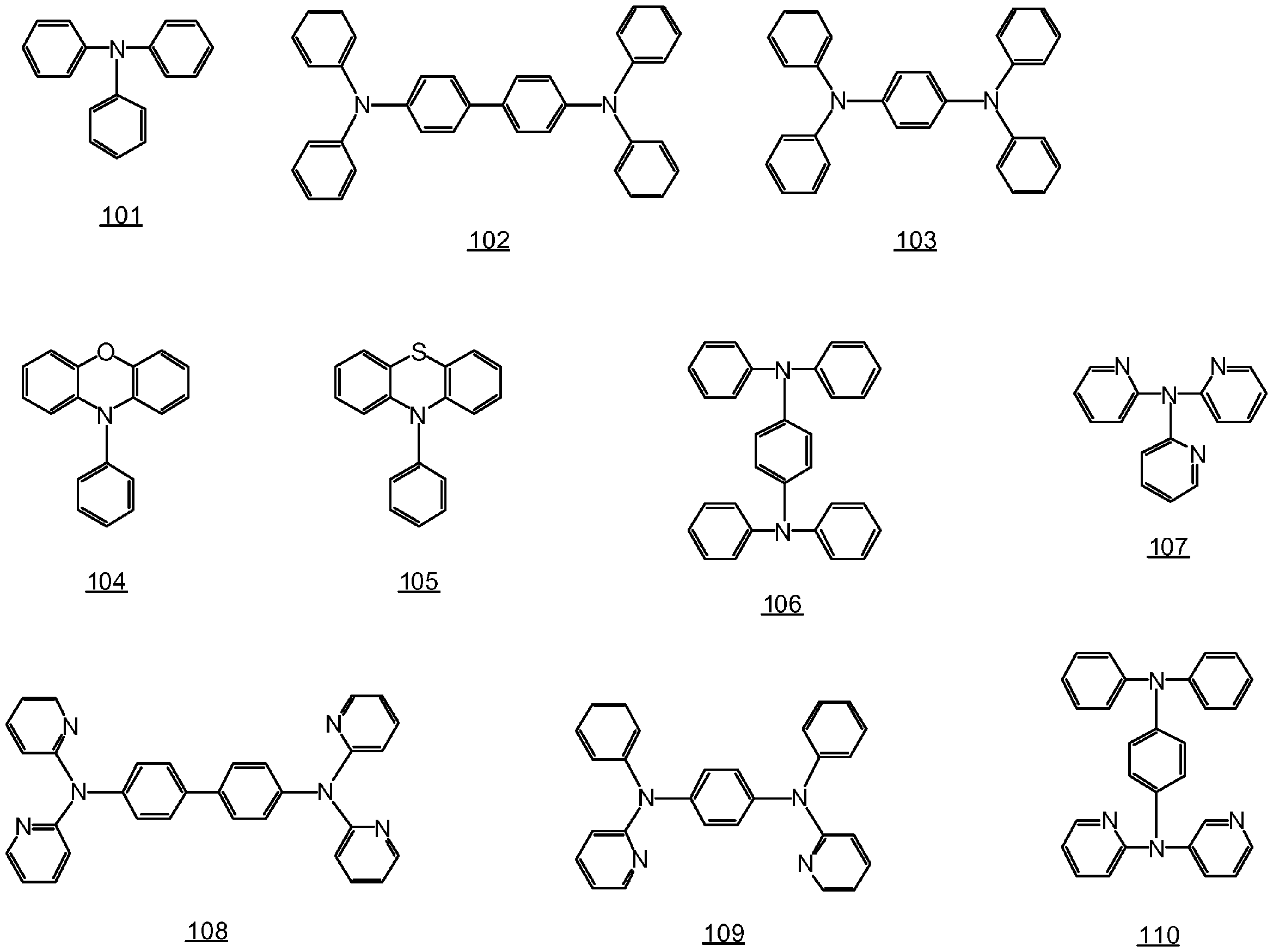
構造101~110で表される芳香族アミンは2価の芳香族アミン残基を生成しうる範囲で置換基を有していてもよく、該置換基としては、前述のQ1に関する説明中で例示した置換基と同様の置換基が挙げられ、置換基が複数個存在する場合には、それらは同一でも異なっていてもよい。
式(33)中、X’は置換基を有し若しくは有さないイミノ基、置換基を有し若しくは有さないシリレン基、置換基を有し若しくは有さないエテニレン基又はエチニレン基を表す。イミノ基、シリル基若しくはエテニレン基が有していてもよい置換基としては、メチル基、エチル基、プロピル基、イソプロピル基、ブチル基、イソブチル基、s-ブチル基、t-ブチル基、ペンチル基、ヘキシル基、シクロヘキシル基、ヘプチル基、オクチル基、2-エチルヘキシル基、ノニル基、デシル基、3,7-ジメチルオクチル基、ラウリル基等の炭素原子数1~20のアルキル基;フェニル基、1-ナフチル基、2-ナフチル基、1-アントラセニル基、2-アントラセニル基、9-アントラセニル基等の炭素原子数6~30のアリール基等が挙げられ、置換基が複数個存在する場合には、それらは同一でも異なっていてもよい。
前記イオン性ポリマーの空気、湿気又は熱に対する安定性の観点からは、X’はイミノ基、エテニレン基、エチニレン基が好ましい。
前記イオン性ポリマーの電子受容性、正孔受容性の観点からは、m35が1であり、m36が0であることが好ましい。
式(33)で表される構造単位としては、前記イオン性ポリマーの電子受容性の観点からは、式(35)で表される構造単位が好ましい。

ピリジンジイル基が有していてもよい置換基としては、前述のQ1に関する説明中で例示した置換基と同様の置換基が挙げられる。置換基が複数個存在する場合には、それらは同一でも異なっていてもよい。
ピラジンジイル基が有していてもよい置換基としては、前述のQ1に関する説明中で例示した置換基と同様の置換基が挙げられる。置換基が複数個存在する場合には、それらは同一でも異なっていてもよい。
ピリミジンジイル基が有していてもよい置換基としては、前述のQ1に関する説明中で例示した置換基と同様の置換基が挙げられる。置換基が複数個存在する場合には、それらは同一でも異なっていてもよい。
ピリダジンジイル基が有していてもよい置換基としては、前述のQ1に関する説明中で例示した置換基と同様の置換基が挙げられる。置換基が複数個存在する場合には、それらは同一でも異なっていてもよい。
トリアジンジイル基が有していてもよい置換基としては、前述のQ1に関する説明中で例示した置換基と同様の置換基が挙げられる。置換基が複数個存在する場合には、それらは同一でも異なっていてもよい。
ピラジンジイル基が有していてもよい置換基としては、前述のQ1に関する説明中で例示した置換基と同様の置換基が挙げられる。置換基が複数個存在する場合には、それらは同一でも異なっていてもよい。
ピリミジンジイル基が有していてもよい置換基としては、前述のQ1に関する説明中で例示した置換基と同様の置換基が挙げられる。置換基が複数個存在する場合には、それらは同一でも異なっていてもよい。
ピリダジンジイル基が有していてもよい置換基としては、前述のQ1に関する説明中で例示した置換基と同様の置換基が挙げられる。置換基が複数個存在する場合には、それらは同一でも異なっていてもよい。
トリアジンジイル基が有していてもよい置換基としては、前述のQ1に関する説明中で例示した置換基と同様の置換基が挙げられる。置換基が複数個存在する場合には、それらは同一でも異なっていてもよい。
(構造単位の割合)
本実施形態で用いられるイオン性ポリマーに含まれる式(13)で表される構造単位、式(15)で表される構造単位、式(17)で表される構造単位、及び式(20)で表される構造単位の合計の割合は、有機EL素子の発光効率の観点からは、末端の構造単位を除く該イオン性ポリマーに含まれる全構造単位中、30~100モル%であることがより好ましい。
本実施形態で用いられるイオン性ポリマーに含まれる式(13)で表される構造単位、式(15)で表される構造単位、式(17)で表される構造単位、及び式(20)で表される構造単位の合計の割合は、有機EL素子の発光効率の観点からは、末端の構造単位を除く該イオン性ポリマーに含まれる全構造単位中、30~100モル%であることがより好ましい。
(末端の構造単位)
なお、本発明に用いられるイオン性ポリマーの末端の構造単位(末端基)としては、水素原子、メチル基、エチル基、プロピル基、イソプロピル基、ブチル基、イソブチル基、s-ブチル基、t-ブチル基、ペンチル基、イソアミル基、ヘキシル基、シクロヘキシル基、ヘプチル基、オクチル基、ノニル基、デシル基、ラウリル基、メトキシ基、エトキシ基、プロピルオキシ基、イソプロピルオキシ基、ブトキシ基、イソブトキシ基、s-ブトキシ基、t-ブトキシ基、ペンチルオキシ基、ヘキシルオキシ基、シクロヘキシルオキシ基、ヘプチルオキシ基、オクチルオキシ基、2-エチルヘキシルオキシ基、ノニルオキシ基、デシルオキシ基、3,7-ジメチルオクチルオキシ基、ラウリルオキシ基、メチルチオ基、エチルチオ基、プロピルチオ基、イソプロピルチオ基、ブチルチオ基、イソブチルチオ基、s-ブチルチオ基、t-ブチルチオ基、ペンチルチオ基、ヘキシルチオ基、シクロヘキシルチオ基、ヘプチルチオ基、オクチルチオ基、ノニルチオ基、デシルチオ基、ラウリルチオ基、メトキシフェニル基、エトキシフェニル基、プロピルオキシフェニル基、イソプロピルオキシフェニル基、ブトキシフェニル基、イソブトキシフェニル基、s-ブトキシフェニル基、t-ブトキシフェニル基、ペンチルオキシフェニル基、ヘキシルオキシフェニル基、シクロヘキシルオキシフェニル基、ヘプチルオキシフェニル基、オクチルオキシフェニル基、2-エチルヘキシルオキシフェニル基、ノニルオキシフェニル基、デシルオキシフェニル基、3,7-ジメチルオクチルオキシフェニル基、ラウリルオキシフェニル基、メチルフェニル基、エチルフェニル基、ジメチルフェニル基、プロピルフェニル基、メシチル基、メチルエチルフェニル基、イソプロピルフェニル基、ブチルフェニル基、イソブチルフェニル基、t-ブチルフェニル基、ペンチルフェニル基、イソアミルフェニル基、ヘキシルフェニル基、ヘプチルフェニル基、オクチルフェニル基、ノニルフェニル基、デシルフェニル基、ドデシルフェニル基、メチルアミノ基、ジメチルアミノ基、エチルアミノ基、ジエチルアミノ基、プロピルアミノ基、ジプロピルアミノ基、イソプロピルアミノ基、ジイソプロピルアミノ基、ブチルアミノ基、イソブチルアミノ基、s-ブチルアミノ基、t-ブチルアミノ基、ペンチルアミノ基、ヘキシルアミノ基、シクロヘキシルアミノ基、ヘプチルアミノ基、オクチルアミノ基、2-エチルヘキシルアミノ基、ノニルアミノ基、デシルアミノ基、3,7-ジメチルオクチルアミノ基、ラウリルアミノ基、シクロペンチルアミノ基、ジシクロペンチルアミノ基、シクロヘキシルアミノ基、ジシクロヘキシルアミノ基、ジトリフルオロメチルアミノ基、フェニルアミノ基、ジフェニルアミノ基、(C1~C12アルコキシフェニル)アミノ基、ジ(C1~C12アルコキシフェニル)アミノ基、ジ(C1~C12アルキルフェニル)アミノ基、1-ナフチルアミノ基、2-ナフチルアミノ基、ペンタフルオロフェニルアミノ基、ピリジルアミノ基、ピリダジニルアミノ基、ピリミジルアミノ基、ピラジニルアミノ基、トリアジニルアミノ基、(フェニル-C1~C12アルキル)アミノ基、(C1~C12アルコキシフェニル-C1~C12アルキル)アミノ基、(C1~C12アルキルフェニル-C1~C12アルキル)アミノ基、ジ(C1~C12アルコキシフェニル-C1~C12アルキル)アミノ基、ジ(C1~C12アルキルフェニル-C1~C12アルキル)アミノ基、1-ナフチル-C1~C12アルキルアミノ基、2-ナフチル-C1~C12アルキルアミノ基、トリメチルシリル基、トリエチルシリル基、トリプロピルシリル基、トリイソプロピルシリル基、イソプロピルジメチルシリル基、イソプロピルジエチルシリル基、t-ブチルジメチルシリル基、ペンチルジメチルシリル基、ヘキシルジメチルシリル基、ヘプチルジメチルシリル基、オクチルジメチルシリル基、2-エチルヘキシルジメチルシリル基、ノニルジメチルシリル基、デシルジメチルシリル基、3,7-ジメチルオクチルジメチルシリル基、ラウリルジメチルシリル基、(フェニル-C1~C12アルキル)シリル基、(C1~C12アルコキシフェニル-C1~C12アルキル)シリル基、(C1~C12アルキルフェニル-C1~C12アルキル)シリル基、(1-ナフチル-C1~C12アルキル)シリル基、(2-ナフチル-C1~C12アルキル)シリル基、(フェニル-C1~C12アルキル)ジメチルシリル基、トリフェニルシリル基、トリ(p-キシリル)シリル基、トリベンジルシリル基、ジフェニルメチルシリル基、t-ブチルジフェニルシリル基、ジメチルフェニルシリル基、チエニル基、C1~C12アルキルチエニル基、ピロリル基、フリル基、ピリジル基、C1~C12アルキルピリジル基、ピリダジニル基、ピリミジル基、ピラジニル基、トリアジニル基、ピロリジル基、ピペリジル基、キノリル基、イソキノリル基、ヒドロキシ基、メルカプト基、フッ素原子、塩素原子、臭素原子及びヨウ素原子等が挙げられる。前記末端の構造単位が複数個存在する場合には、それらは同一でも異なっていてもよい。
なお、本発明に用いられるイオン性ポリマーの末端の構造単位(末端基)としては、水素原子、メチル基、エチル基、プロピル基、イソプロピル基、ブチル基、イソブチル基、s-ブチル基、t-ブチル基、ペンチル基、イソアミル基、ヘキシル基、シクロヘキシル基、ヘプチル基、オクチル基、ノニル基、デシル基、ラウリル基、メトキシ基、エトキシ基、プロピルオキシ基、イソプロピルオキシ基、ブトキシ基、イソブトキシ基、s-ブトキシ基、t-ブトキシ基、ペンチルオキシ基、ヘキシルオキシ基、シクロヘキシルオキシ基、ヘプチルオキシ基、オクチルオキシ基、2-エチルヘキシルオキシ基、ノニルオキシ基、デシルオキシ基、3,7-ジメチルオクチルオキシ基、ラウリルオキシ基、メチルチオ基、エチルチオ基、プロピルチオ基、イソプロピルチオ基、ブチルチオ基、イソブチルチオ基、s-ブチルチオ基、t-ブチルチオ基、ペンチルチオ基、ヘキシルチオ基、シクロヘキシルチオ基、ヘプチルチオ基、オクチルチオ基、ノニルチオ基、デシルチオ基、ラウリルチオ基、メトキシフェニル基、エトキシフェニル基、プロピルオキシフェニル基、イソプロピルオキシフェニル基、ブトキシフェニル基、イソブトキシフェニル基、s-ブトキシフェニル基、t-ブトキシフェニル基、ペンチルオキシフェニル基、ヘキシルオキシフェニル基、シクロヘキシルオキシフェニル基、ヘプチルオキシフェニル基、オクチルオキシフェニル基、2-エチルヘキシルオキシフェニル基、ノニルオキシフェニル基、デシルオキシフェニル基、3,7-ジメチルオクチルオキシフェニル基、ラウリルオキシフェニル基、メチルフェニル基、エチルフェニル基、ジメチルフェニル基、プロピルフェニル基、メシチル基、メチルエチルフェニル基、イソプロピルフェニル基、ブチルフェニル基、イソブチルフェニル基、t-ブチルフェニル基、ペンチルフェニル基、イソアミルフェニル基、ヘキシルフェニル基、ヘプチルフェニル基、オクチルフェニル基、ノニルフェニル基、デシルフェニル基、ドデシルフェニル基、メチルアミノ基、ジメチルアミノ基、エチルアミノ基、ジエチルアミノ基、プロピルアミノ基、ジプロピルアミノ基、イソプロピルアミノ基、ジイソプロピルアミノ基、ブチルアミノ基、イソブチルアミノ基、s-ブチルアミノ基、t-ブチルアミノ基、ペンチルアミノ基、ヘキシルアミノ基、シクロヘキシルアミノ基、ヘプチルアミノ基、オクチルアミノ基、2-エチルヘキシルアミノ基、ノニルアミノ基、デシルアミノ基、3,7-ジメチルオクチルアミノ基、ラウリルアミノ基、シクロペンチルアミノ基、ジシクロペンチルアミノ基、シクロヘキシルアミノ基、ジシクロヘキシルアミノ基、ジトリフルオロメチルアミノ基、フェニルアミノ基、ジフェニルアミノ基、(C1~C12アルコキシフェニル)アミノ基、ジ(C1~C12アルコキシフェニル)アミノ基、ジ(C1~C12アルキルフェニル)アミノ基、1-ナフチルアミノ基、2-ナフチルアミノ基、ペンタフルオロフェニルアミノ基、ピリジルアミノ基、ピリダジニルアミノ基、ピリミジルアミノ基、ピラジニルアミノ基、トリアジニルアミノ基、(フェニル-C1~C12アルキル)アミノ基、(C1~C12アルコキシフェニル-C1~C12アルキル)アミノ基、(C1~C12アルキルフェニル-C1~C12アルキル)アミノ基、ジ(C1~C12アルコキシフェニル-C1~C12アルキル)アミノ基、ジ(C1~C12アルキルフェニル-C1~C12アルキル)アミノ基、1-ナフチル-C1~C12アルキルアミノ基、2-ナフチル-C1~C12アルキルアミノ基、トリメチルシリル基、トリエチルシリル基、トリプロピルシリル基、トリイソプロピルシリル基、イソプロピルジメチルシリル基、イソプロピルジエチルシリル基、t-ブチルジメチルシリル基、ペンチルジメチルシリル基、ヘキシルジメチルシリル基、ヘプチルジメチルシリル基、オクチルジメチルシリル基、2-エチルヘキシルジメチルシリル基、ノニルジメチルシリル基、デシルジメチルシリル基、3,7-ジメチルオクチルジメチルシリル基、ラウリルジメチルシリル基、(フェニル-C1~C12アルキル)シリル基、(C1~C12アルコキシフェニル-C1~C12アルキル)シリル基、(C1~C12アルキルフェニル-C1~C12アルキル)シリル基、(1-ナフチル-C1~C12アルキル)シリル基、(2-ナフチル-C1~C12アルキル)シリル基、(フェニル-C1~C12アルキル)ジメチルシリル基、トリフェニルシリル基、トリ(p-キシリル)シリル基、トリベンジルシリル基、ジフェニルメチルシリル基、t-ブチルジフェニルシリル基、ジメチルフェニルシリル基、チエニル基、C1~C12アルキルチエニル基、ピロリル基、フリル基、ピリジル基、C1~C12アルキルピリジル基、ピリダジニル基、ピリミジル基、ピラジニル基、トリアジニル基、ピロリジル基、ピペリジル基、キノリル基、イソキノリル基、ヒドロキシ基、メルカプト基、フッ素原子、塩素原子、臭素原子及びヨウ素原子等が挙げられる。前記末端の構造単位が複数個存在する場合には、それらは同一でも異なっていてもよい。
(イオン性ポリマーの特性)
本実施形態で用いられるイオン性ポリマーは、好ましくは共役化合物である。本発明で用いられるイオン性ポリマーが共役化合物であるとは、該イオン性ポリマーが主鎖中に、多重結合(例えば、二重結合、三重結合)又は窒素原子、酸素原子等が有する非共有電子対が1つの単結合を挟んで連なっている領域を含むことを意味する。該イオン性ポリマーは、共役化合物である場合、共役化合物の電子輸送性の観点から、{(多重結合又は窒素原子、酸素原子等が有する非共有電子対が1つの単結合を挟んで連なっている領域に含まれる主鎖上の原子の数)/(主鎖上の全原子の数)}×100%で計算される比が50%以上であることが好ましく、60%以上であることがより好ましく、70%以上であることがより好ましく、80%以上であることがより好ましく、90%以上であることがさらに好ましい。
本実施形態で用いられるイオン性ポリマーは、好ましくは共役化合物である。本発明で用いられるイオン性ポリマーが共役化合物であるとは、該イオン性ポリマーが主鎖中に、多重結合(例えば、二重結合、三重結合)又は窒素原子、酸素原子等が有する非共有電子対が1つの単結合を挟んで連なっている領域を含むことを意味する。該イオン性ポリマーは、共役化合物である場合、共役化合物の電子輸送性の観点から、{(多重結合又は窒素原子、酸素原子等が有する非共有電子対が1つの単結合を挟んで連なっている領域に含まれる主鎖上の原子の数)/(主鎖上の全原子の数)}×100%で計算される比が50%以上であることが好ましく、60%以上であることがより好ましく、70%以上であることがより好ましく、80%以上であることがより好ましく、90%以上であることがさらに好ましい。
また、本実施形態で用いられるイオン性ポリマーは、好ましくは高分子化合物であり、より好ましくは共役高分子化合物である。ここで、高分子化合物とは、ポリスチレン換算の数平均分子量が1×10³以上である化合物をいう。また、本発明で用いられるイオン性ポリマーが共役高分子化合物であるとは、該イオン性ポリマーが共役化合物かつ高分子化合物であることを意味する。
本実施形態で用いられるイオン性ポリマーの塗布による成膜性の観点から、該イオン性ポリマーのポリスチレン換算の数平均分子量が1×10³~1×10⁸であることが好ましく、2×10³~1×10⁷であることがより好ましく、3×10³~1×10⁷であることがさらに好ましく、5×10³~1×10⁷であることがより一層好ましい。また、イオン性ポリマーの純度の観点から、ポリスチレン換算の重量平均分子量が1×10³~5×10⁷であることが好ましく、1×10³~1×10⁷であることがより好ましく、1×10³~5×10⁶であることがさらに好ましい。また、イオン性ポリマーの溶解性の観点から、ポリスチレン換算の数平均分子量は1×10³~5×10⁵であることが好ましく、1×10³~5×10⁴であることがより好ましく、1×10³~3×10³であることがさらに好ましい。本発明に用いられるイオン性ポリマーのポリスチレン換算の数平均分子量及び重量平均分子量は、例えば、ゲルパーミエーションクロマトグラフィー(GPC)を用いて、求めることができる。
本実施形態で用いられるイオン性ポリマーの純度の観点から、末端構造単位を除く該イオン性ポリマー中に含まれる全構造単位の数(即ち、重合度)は1以上20以下であることが好ましく、1以上10以下であることがより好ましく、1以上5以下であることがさらに好ましい。
本実施形態で用いられるイオン性ポリマーの電子受容性、正孔受容性の観点からは、該イオン性ポリマーの最低非占有分子軌道(LUMO)の軌道エネルギーが、-5.0eV以上-2.0eV以下であることが好ましく、-4.5eV以上-2.0eV以下がより好ましい。また、同様の観点から、該イオン性ポリマーの最高占有分子軌道(HOMO)の軌道エネルギーが、-6.0eV以上-3.0eV以下であることが好ましく、-5.5eV以上-3.0eV以下がより好ましい。ただし、HOMOの軌道エネルギーはLUMOの軌道エネルギーよりも低い。なお、イオン性ポリマーの最高占有分子軌道(HOMO)の軌道エネルギーは、イオン性ポリマーのイオン化ポテンシャルを測定し、得られたイオン化ポテンシャルを該軌道エネルギーとすることにより求める。一方、イオン性ポリマーの最低非占有分子軌道(LUMO)の軌道エネルギーは、HOMOとLUMOとのエネルギー差を求め、その値と前記で測定したイオン化ポテンシャルとの和を該軌道エネルギーとすることにより求める。イオン化ポテンシャルの測定には光電子分光装置を用いる。また、HOMOとLUMOのエネルギー差は紫外・可視・近赤外分光光度計を用いてイオン性ポリマーの吸収スペクトルを測定し、その吸収末端より求める。
なお、本実施形態で用いられる重合体は、電界発光素子で用いられた場合、実質的に非発光性であることが好ましい。ここで、ある重合体が実質的に非発光性であるとは、以下のとおりの意味である。まず、ある重合体を含む層を有する電界発光素子Aを作製する。一方、重合体を含む層を有さない電界発光素子2を作製する。電界発光素子Aは重合体を含む層を有するが、電界発光素子2は重合体を含む層を有さない点でのみ、電界発光素子Aと電界発光素子2とは異なる。次に、電界発光素子A及び電界発光素子2に10Vの順方向電圧を印加して発光スペクトルを測定する。電界発光素子2について得られた発光スペクトルにおいて最大ピークを与える波長λを求める。波長λにおける発光強度を1として、電界発光素子2について得られた発光スペクトルを規格化し、波長について積分して規格化発光量S0を計算する。一方、波長λにおける発光強度を1として、電界発光素子Aについて得られた発光スペクトルも規格化し、波長について積分して規格化発光量Sを計算する。(S-S0)/S0×100%で計算される値が30%以下である場合、即ち、重合体を含む層を有さない電界発光素子2の規格化発光量に比べ、重合体を含む層を有する電界発光素子Aの規格化発光量の増加分が30%以下である場合に、用いた重合体は実質的に非発光性であるものとする。(S-S0)/S0×100で計算される値が15%以下であることが好ましく、10%以下であることがより好ましい。
前記式(1)で表される基及び前記式(3)で表される基を含むイオン性ポリマーとしては、式(23)で表される構造単位のみからなるイオン性ポリマー、式(23)で表される構造単位及び構造45~50、59、60、77、80、91、92、96、101~110で表される基から水素原子を2個除いた基からなる群から選ばれる1種以上の基からなるイオン性ポリマー、式(24)で表される構造単位のみからなるイオン性ポリマー、式(24)で表される構造単位及び構造45~50、59、60、77、80、91、92、96、101~110で表される基から水素原子を2個除いた基からなる群から選ばれる1種以上の基からなるイオン性ポリマー、式(25)で表される構造単位のみからなるイオン性ポリマー、式(25)で表される構造単位及び構造45~50、59、60、77、80、91、92、96、101~110で表される基から水素原子を2個除いた基からなる群から選ばれる1種以上の基からなるイオン性ポリマー、式(29)で表される構造単位のみからなるイオン性ポリマー、式(29)で表される構造単位及び構造45~50、59、60、77、80、91、92、96、101~110で表される基から水素原子を2個除いた基からなる群から選ばれる1種以上の基からなるイオン性ポリマー、式(30)で表される構造単位のみからなるイオン性ポリマー、式(30)で表される構造単位及び構造45~50、59、60、77、80、91、92、96、101~110で表される基から水素原子を2個除いた基からなる群から選ばれる1種以上の基からなるイオン性ポリマーが挙げられる。
前記式(1)で表される基及び前記式(3)で表される基を含むイオン性ポリマーとしては、以下の高分子化合物が挙げられる。これらのうち、2種の構造単位がスラッシュ「/」で区切られている式で表される高分子化合物では、左側の構造単位の割合がpモル%、右側の構造単位の割合が(100-p)モル%であり、これらの構造単位はランダムに配列している。なお、以下の式中、nは重合度を表す。


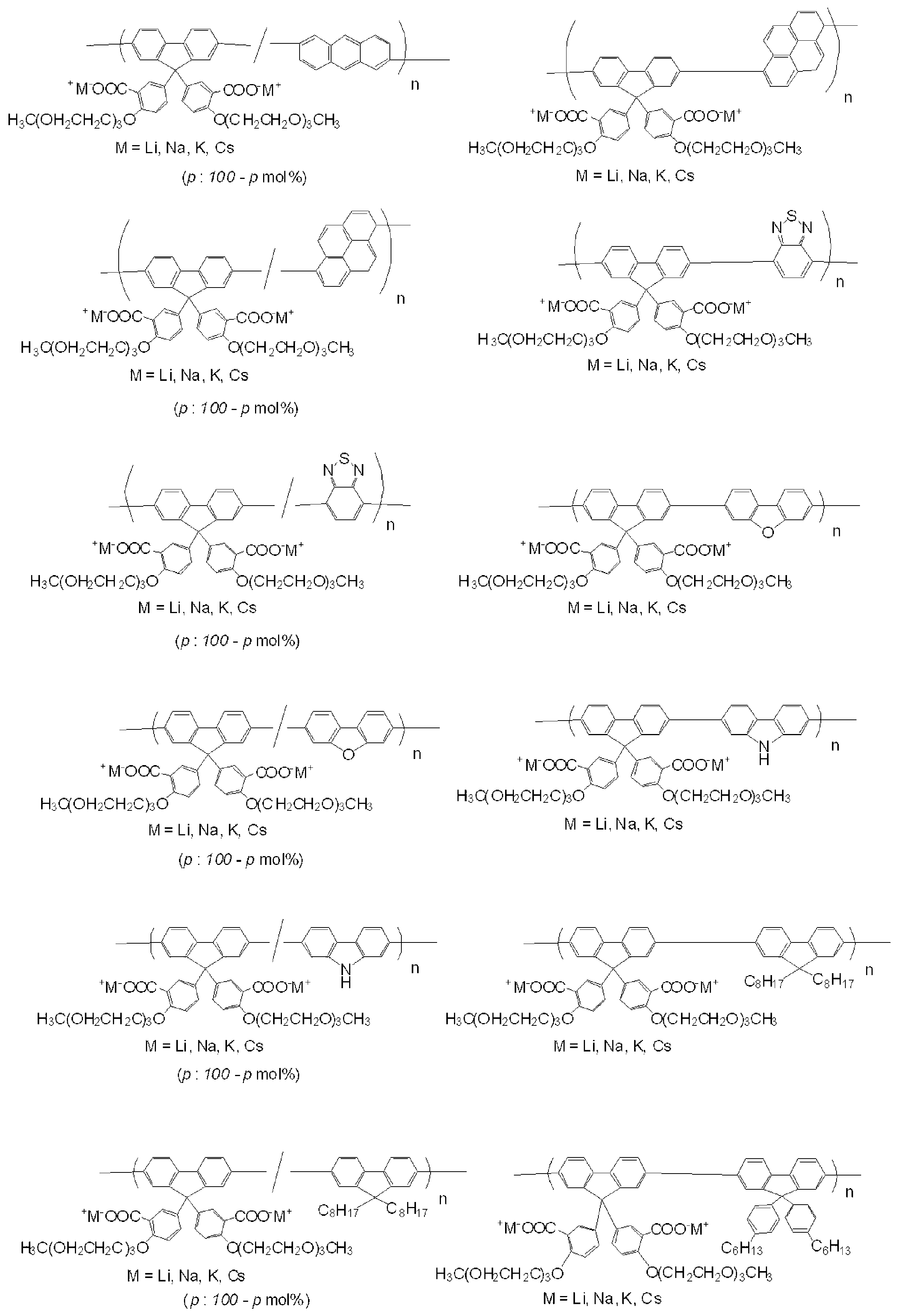
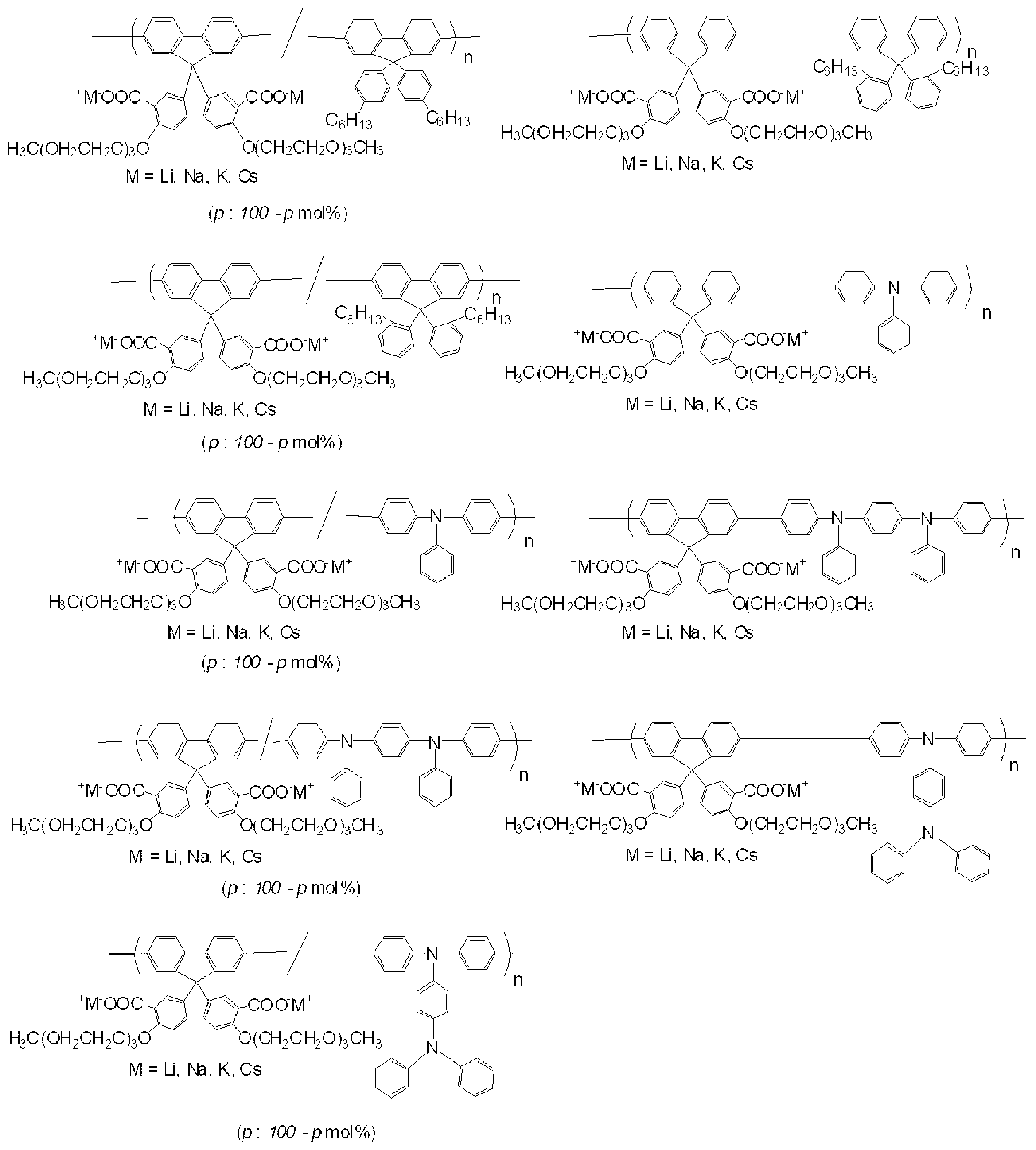
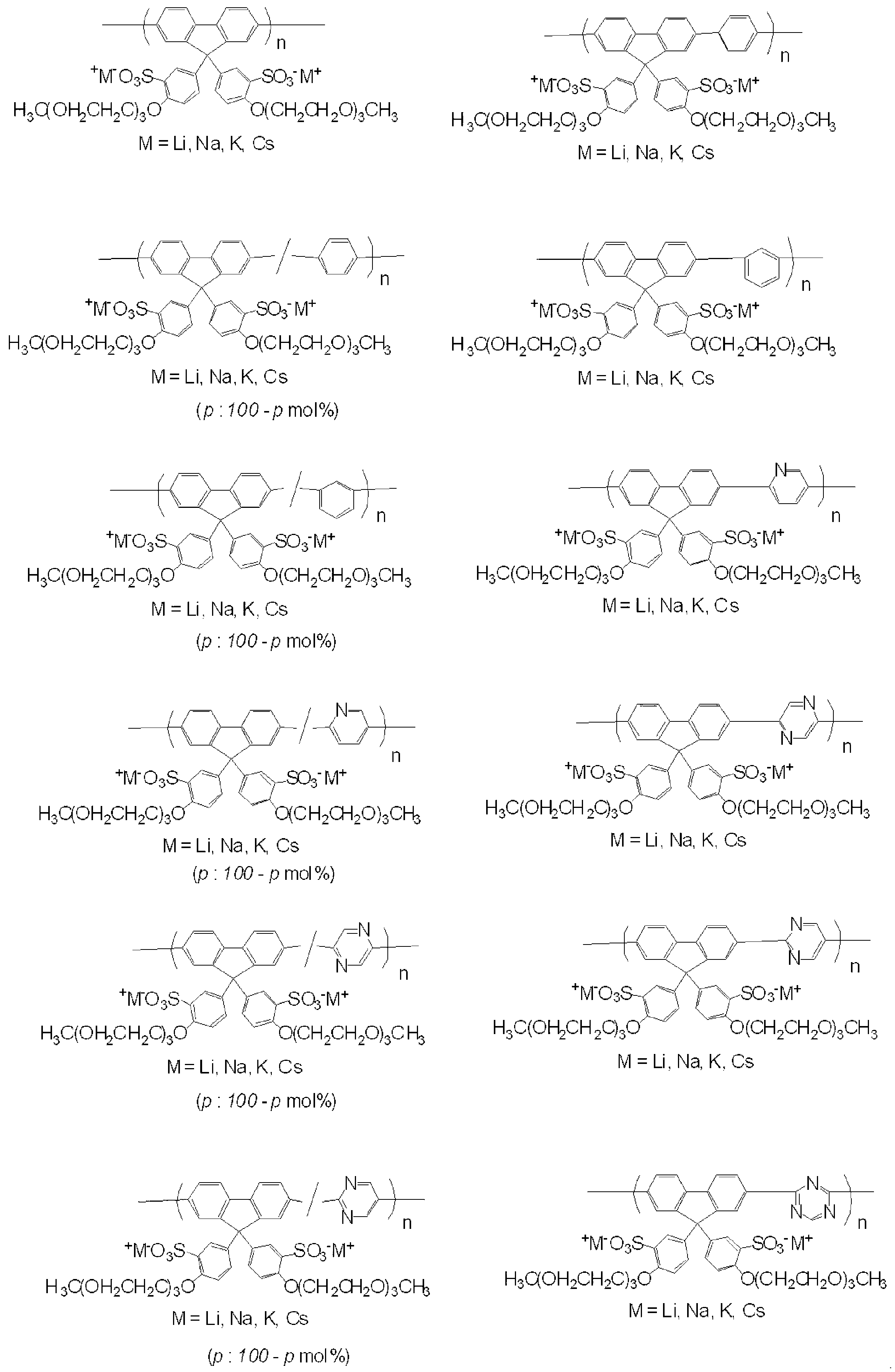

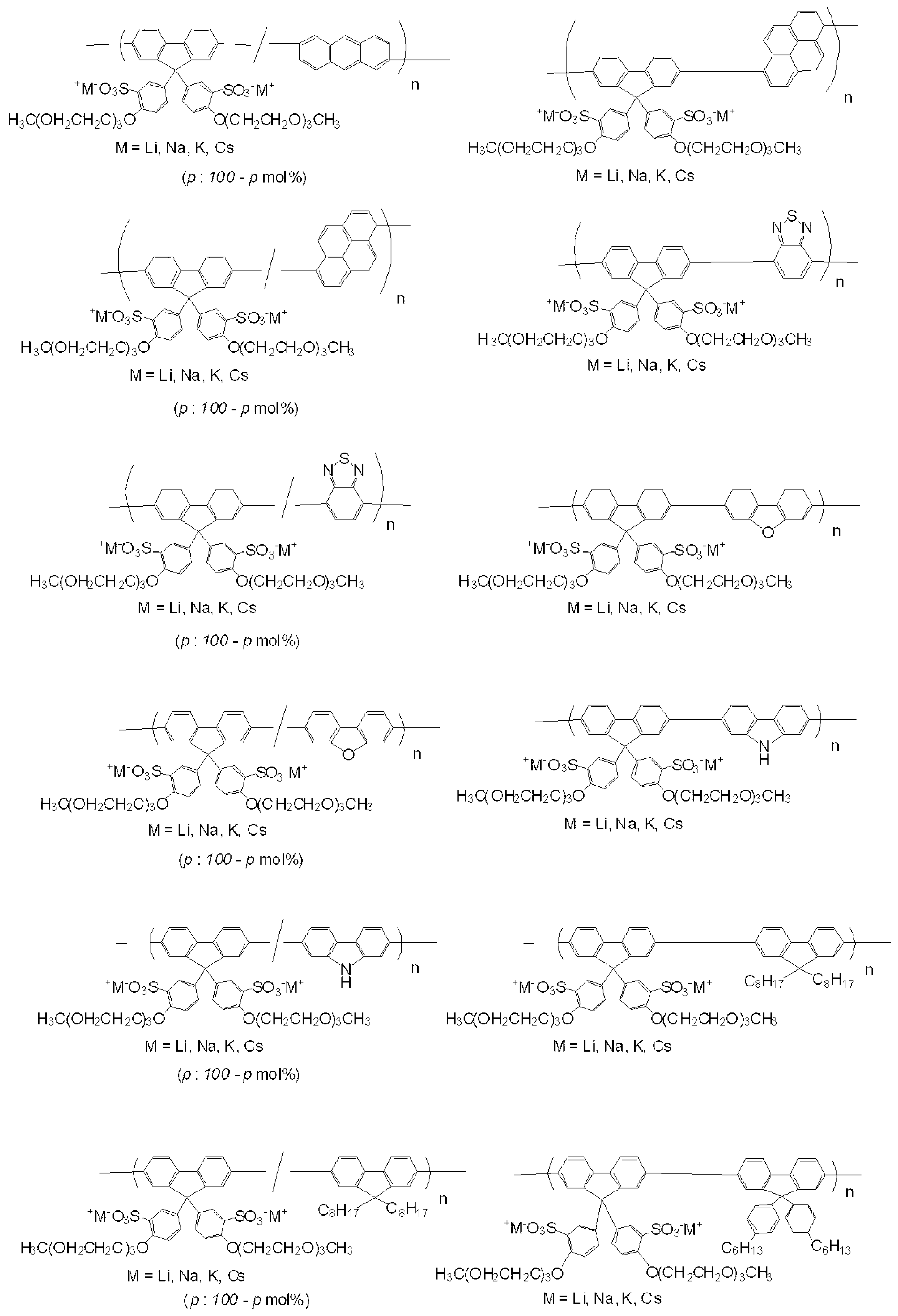
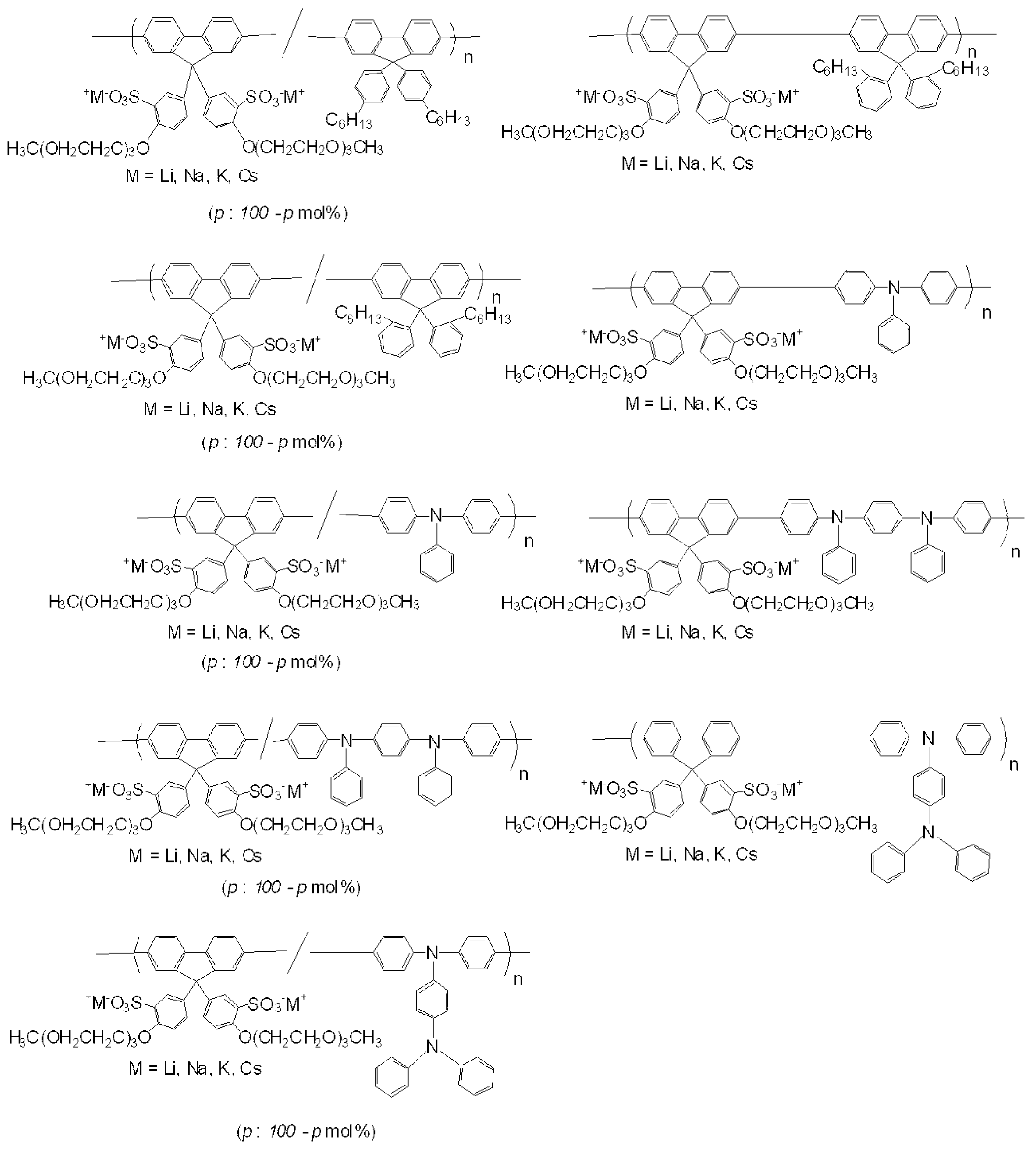
前記式(2)で表される基及び前記式(3)で表される基を含むイオン性ポリマーとしては、式(26)で表される構造単位のみからなるイオン性ポリマー、式(26)で表される構造単位及び構造45~50、59、60、77、80、91、92、96、101~110で表される基から水素原子を2個除いた基からなる群から選ばれる1種以上の基からなるイオン性ポリマー、式(27)で表される構造単位のみからなるイオン性ポリマー、式(27)で表される構造単位及び構造45~50、59、60、77、80、91、92、96、101~110で表される基から水素原子を2個除いた基からなる群から選ばれる1種以上の基からなるイオン性ポリマー、式(28)で表される構造単位のみからなるイオン性ポリマー、式(28)で表される構造単位及び構造45~50、59、60、77、80、91、92、96、101~110で表される基から水素原子を2個除いた基からなる群から選ばれる1種以上の基からなるイオン性ポリマー、式(31)で表される構造単位のみからなるイオン性ポリマー、式(31)で表される構造単位及び構造45~50、59、60、77、80、91、92、96、101~110で表される基から水素原子を2個除いた基からなる群から選ばれる1種以上の基からなるイオン性ポリマー、式(32)で表される構造単位のみからなるイオン性ポリマー、式(32)で表される構造単位及び構造45~50、59、60、77、80、91、92、96、101~110で表される基から水素原子を2個除いた基からなる群から選ばれる1種以上の基からなるイオン性ポリマーが挙げられる。
前記式(2)で表される基及び前記式(3)で表される基を含むイオン性ポリマーとしては、以下の高分子化合物が挙げられる。これらのうち、2種の構造単位がスラッシュ「/」で区切られている式で表される高分子化合物では、左側の構造単位の割合がpモル%、右側の構造単位の割合が(100-p)モル%であり、これらの構造単位はランダムに配列している。なお、以下の式中、nは重合度を表す。
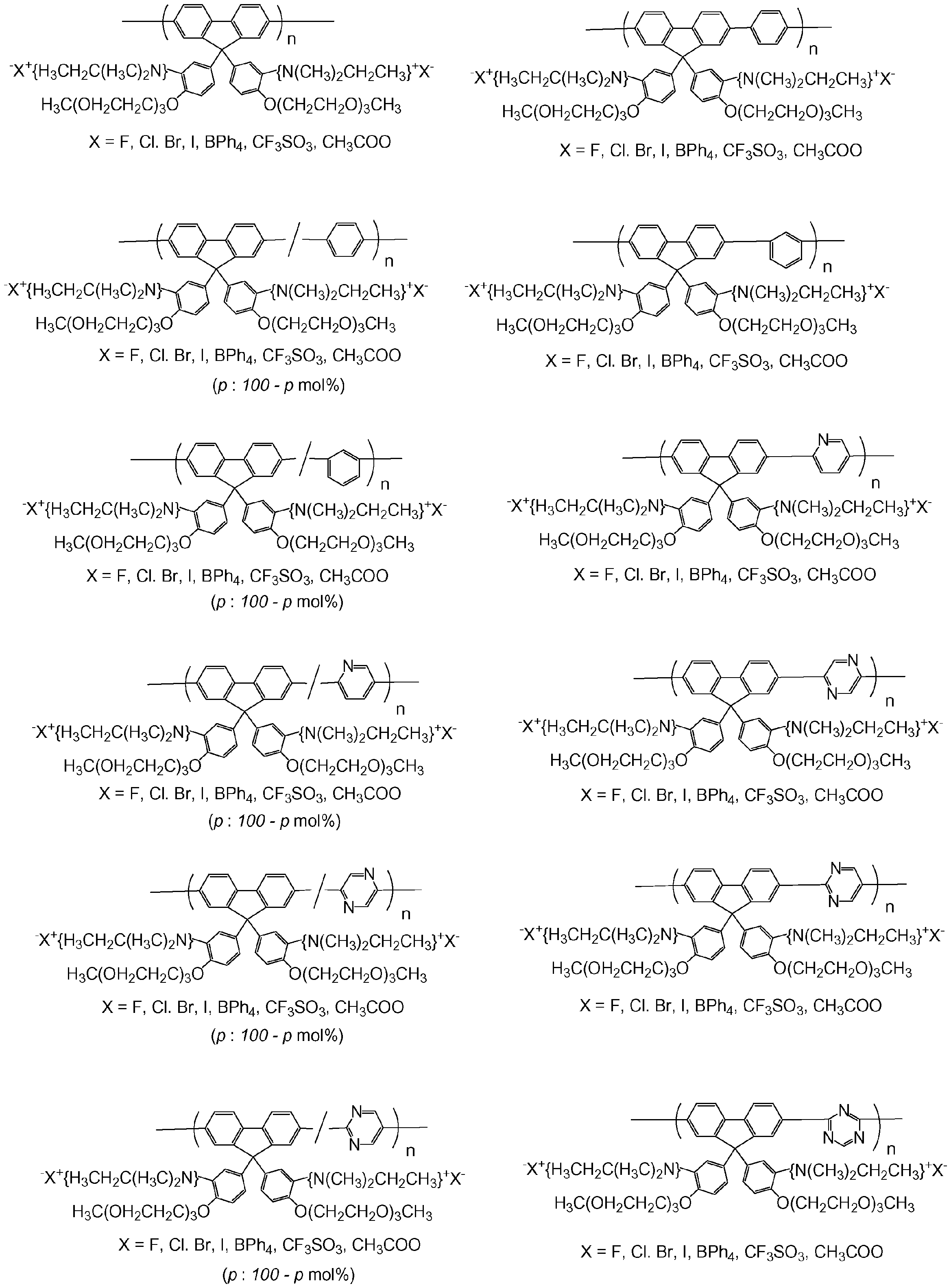
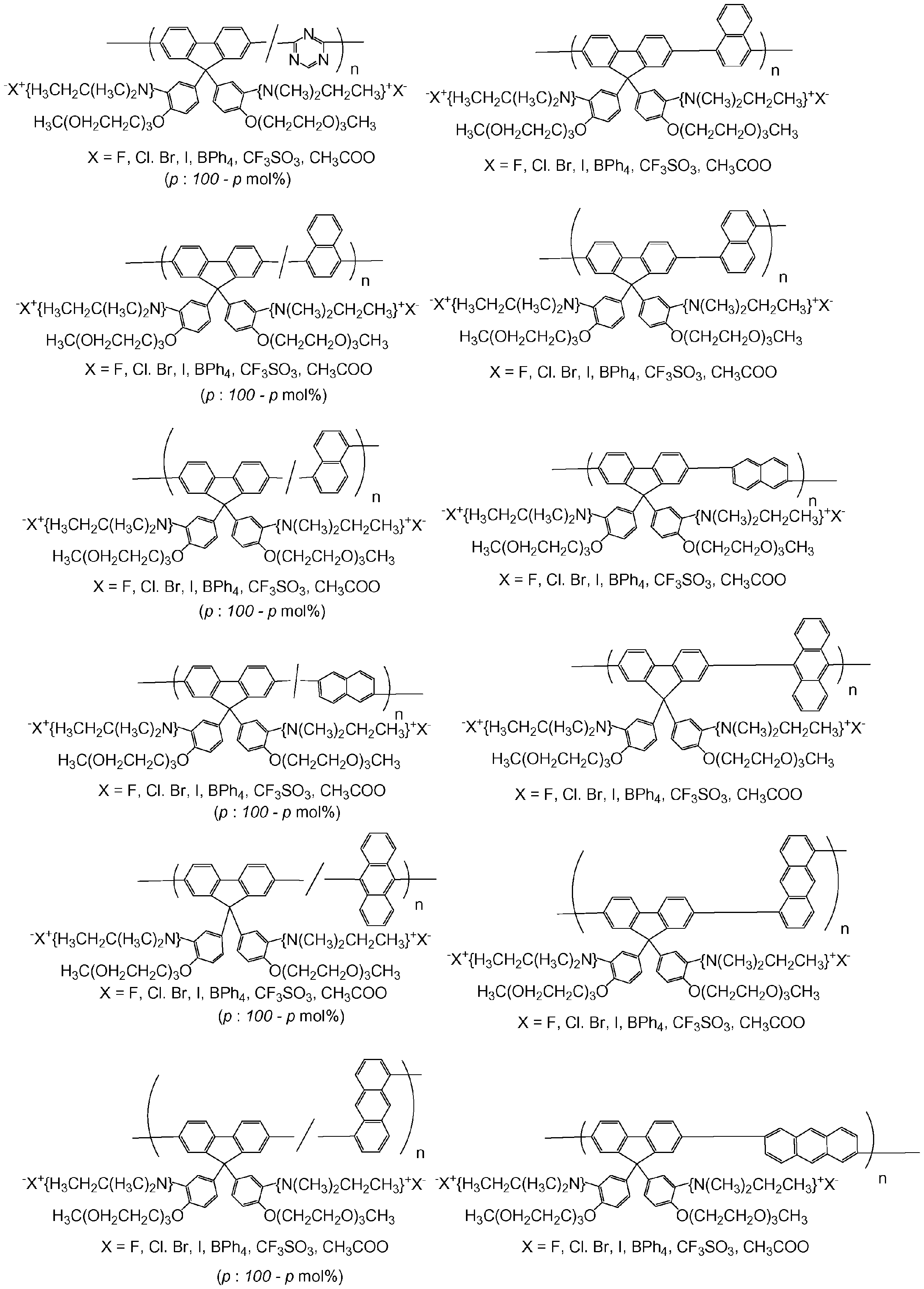
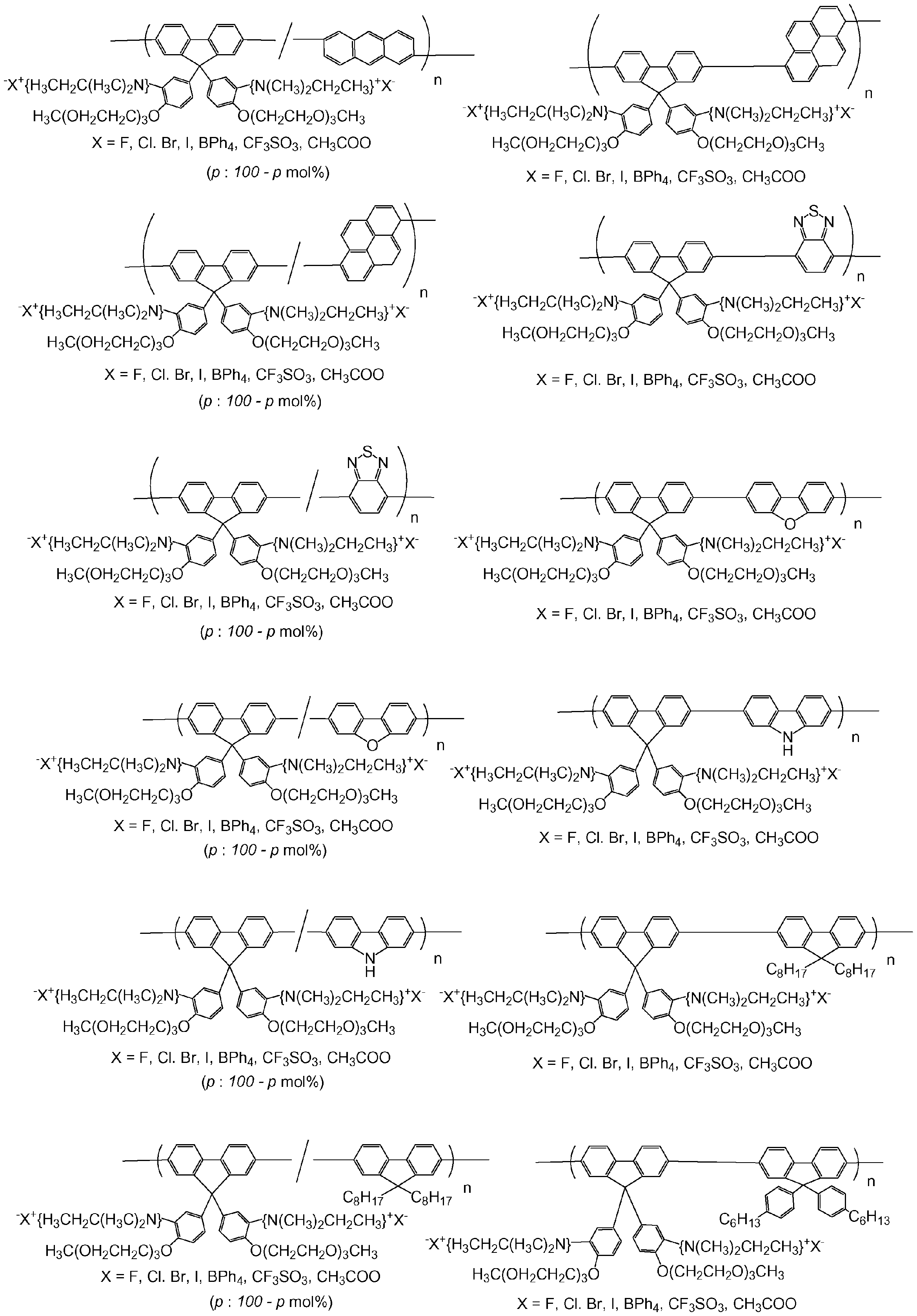

(イオン性ポリマーの製造方法)
次に、本実施形態で用いられるイオン性ポリマーを製造する方法について説明する。本実施形態で用いられるイオン性ポリマーを製造するための好適な方法としては、例えば、下記式(36)で表される化合物を原料の1つとして選択して用い、中でも、式(36)中の-Aa-が式(13)で表される構造単位である化合物、-Aa-が式(15)で表される構造単位である化合物、-Aa-が式(17)で表される構造単位である化合物及び-Aa-が式(20)で表される構造単位である化合物の少なくとも1種を必須の原料として含有させて、これを縮合重合させる方法を挙げることができる。
次に、本実施形態で用いられるイオン性ポリマーを製造する方法について説明する。本実施形態で用いられるイオン性ポリマーを製造するための好適な方法としては、例えば、下記式(36)で表される化合物を原料の1つとして選択して用い、中でも、式(36)中の-Aa-が式(13)で表される構造単位である化合物、-Aa-が式(15)で表される構造単位である化合物、-Aa-が式(17)で表される構造単位である化合物及び-Aa-が式(20)で表される構造単位である化合物の少なくとも1種を必須の原料として含有させて、これを縮合重合させる方法を挙げることができる。
Y4-Aa-Y5 (36)
式(36)中、Aaは式(1)で表される基及び式(2)で表される基からなる群から選ばれる1種以上の基と、式(3)で表される1種以上の基とを含む構造単位(繰り返し単位)を表す。Y4及びY5は、それぞれ独立に、縮合重合に関与する基を示す。
式(36)中、Aaは式(1)で表される基及び式(2)で表される基からなる群から選ばれる1種以上の基と、式(3)で表される1種以上の基とを含む構造単位(繰り返し単位)を表す。Y4及びY5は、それぞれ独立に、縮合重合に関与する基を示す。
また、本実施形態で用いられるイオン性ポリマー中に上記式(36)中の-Aa-で表される構造単位とともに、前記-Aa-以外の他の構造単位を含有させる場合には、前記-Aa-以外の他の構造単位となる、縮合重合に関与する置換基を2個有する化合物を用い、これを前記式(36)で表される化合物とともに共存させて縮合重合させればよい。
このような他の構造単位を含有させるために用いられ、縮合重合可能な置換基を2個有する化合物としては、式(37)で表される化合物が例示される。このようにして、前記Y4-Aa-Y5で表される化合物に加えて、式(37)で表される化合物を縮合重合させることで、-Ab-で表される構造単位を更に有する本発明に用いられるイオン性ポリマーを製造することができる。
Y6-Ab-Y7 (37)
式(37)中、Abは前記一般式(33)で表される構造単位又は一般式(35)で表される構造単位であり、Y6及びY7は、それぞれ独立に、縮合重合に関与する基を示す。
式(37)中、Abは前記一般式(33)で表される構造単位又は一般式(35)で表される構造単位であり、Y6及びY7は、それぞれ独立に、縮合重合に関与する基を示す。
このような縮合重合に関与する基(Y4、Y5、Y6及びY7)としては、水素原子、ハロゲン原子、アルキルスルホネート基、アリールスルホネート基、アリールアルキルスルホネート基、ホウ酸エステル残基、スルホニウムメチル基、ホスホニウムメチル基、ホスホネートメチル基、モノハロゲン化メチル基、-B(OH)2、ホルミル基、シアノ基、ビニル基等が挙げられる。
このような縮合重合に関与する基として選択され得るハロゲン原子としては、フッ素原子、塩素原子、臭素原子及びヨウ素原子が挙げられる。
また、前記縮合重合に関与する基として選択され得るアルキルスルホネート基としては、メタンスルホネート基、エタンスルホネート基、トリフルオロメタンスルホネート基が例示され、アリールスルホネート基としては、ベンゼンスルホネート基、p-トルエンスルホネート基が例示される。
前記縮合重合に関与する基として選択され得るアリールアルキルスルホネート基としては、ベンジルスルホネート基が例示される。
また、前記縮合重合に関与する基として選択され得るホウ酸エステル残基としては、下記式で表される基が例示される。

さらに、前記縮合重合に関与する基として選択され得るスルホニウムメチル基としては、下記式:
-CH2S+Me2E-、又は、-CH2S+Ph2E-
(式中、Eはハロゲン原子を示す。Phはフェニル基を示し、以下、同じである。)で表される基が例示される。
-CH2S+Me2E-、又は、-CH2S+Ph2E-
(式中、Eはハロゲン原子を示す。Phはフェニル基を示し、以下、同じである。)で表される基が例示される。
また、前記縮合重合に関与する基として選択され得るホスホニウムメチル基としては、下記式:
-CH2P+Ph3E-
(式中、Eはハロゲン原子を示す。)で表される基が例示される。
-CH2P+Ph3E-
(式中、Eはハロゲン原子を示す。)で表される基が例示される。
また、前記縮合重合に関与する基として選択され得るホスホネートメチル基としては、下記式:
-CH2PO(ORd)2
(式中、Rdはアルキル基、アリール基、又はアリールアルキル基を示す。)で表される基が例示される。
-CH2PO(ORd)2
(式中、Rdはアルキル基、アリール基、又はアリールアルキル基を示す。)で表される基が例示される。
さらに、前記縮合重合に関与する基として選択され得るモノハロゲン化メチル基としては、フッ化メチル基、塩化メチル基、臭化メチル基、ヨウ化メチル基が例示される。
さらに、縮合重合に関与する基として好適な基は、重合反応の種類によって異なるが、例えば、Yamamotoカップリング反応等の0価ニッケル錯体を用いる場合には、ハロゲン原子、アルキルスルホネート基、アリールスルホネート基、アリールアルキルスルホネート基が挙げられる。また、Suzukiカップリング反応等のニッケル触媒又はパラジウム触媒を用いる場合には、アルキルスルホネート基、ハロゲン原子、ホウ酸エステル残基、-B(OH)2等が挙げられる。酸化剤を用いて酸化重合する場合、又は電気化学的に酸化重合する場合には、水素原子が挙げられる。
本実施形態で用いられるイオン性ポリマーを製造する際には、例えば、縮合重合に関与する基を複数有する前記一般式(36)又は(37)で表される化合物(モノマー)を、必要に応じて有機溶媒に溶解し、アルカリや適当な触媒を用いて、有機溶媒の融点以上沸点以下の温度で反応させる重合方法を採用してもよい。このような重合方法としては、例えば、”オルガニック リアクションズ(Organic Reactions)”,第14巻,270-490頁,ジョンワイリー アンド サンズ(John Wiley&Sons,Inc.),1965年、”オルガニック シンセシス(Organic Syntheses)”,コレクティブ第6巻(Collective Volume VI),407-411頁,ジョンワイリー アンド サンズ(John Wiley&Sons,Inc.),1988年、ケミカル レビュー(Chem.Rev.),第95巻,2457頁(1995年)、ジャーナル オブ オルガノメタリック ケミストリー(J.Organomet.Chem.),第576巻,147頁(1999年)、マクロモレキュラー ケミストリー マクロモレキュラー シンポジウム(Macromol.Chem.,Macromol.Symp.),第12巻,229頁(1987年)に記載の公知の方法を採用することができる。
また、本実施形態で用いられるイオン性ポリマーを製造する際には、縮合重合に関与する基に応じて、既知の縮合重合反応を採用してもよい。このような重合方法としては、該当するモノマーを、Suzukiカップリング反応により重合する方法、Grignard反応により重合する方法、0価ニッケル錯体により重合する方法、FeCl3等の酸化剤により重合する方法、電気化学的に酸化重合する方法、適当な脱離基を有する中間体高分子の分解による方法等が挙げられる。このような重合反応の中でも、Suzukiカップリング反応により重合する方法、Grignard反応により重合する方法、及びニッケルゼロ価錯体により重合する方法が、得られるイオン性ポリマーの構造制御がし易いので好ましい。
本実施形態で用いられるイオン性ポリマーの好ましい製造方法の1つの態様は、縮合重合に関与する基として、ハロゲン原子、アルキルスルホネート基、アリールスルホネート基及びアリールアルキルスルホネート基からなる群から選択される基を有する原料モノマーを用いて、0価ニッケル錯体の存在下で縮合重合して、イオン性ポリマーを製造する方法である。このような方法に使用する原料モノマーとしては、例えば、ジハロゲン化化合物、ビス(アルキルスルホネート)化合物、ビス(アリールスルホネート)化合物、ビス(アリールアルキルスルホネート)化合物、ハロゲン-アルキルスルホネート化合物、ハロゲン-アリールスルホネート化合物、ハロゲン-アリールアルキルスルホネート化合物、アルキルスルホネート-アリールスルホネート化合物、アルキルスルホネート-アリールアルキルスルホネート化合物及びアリールスルホネート-アリールアルキルスルホネート化合物が挙げられる。
前記イオン性ポリマーの好ましい製造方法の他の態様は、縮合重合に関与する基として、ハロゲン原子、アルキルスルホネート基、アリールスルホネート基、アリールアルキルスルホネート基、-B(OH)2、及びホウ酸エステル残基からなる群から選ばれる基を有し、全原料モノマーが有する、ハロゲン原子、アルキルスルホネート基、アリールスルホネート基及びアリールアルキルスルホネート基のモル数の合計(J)と、-B(OH)2及びホウ酸エステル残基のモル数の合計(K)の比(K/J)が実質的に1(通常 K/J は0.7~1.2の範囲)である原料モノマーを用いて、ニッケル触媒又はパラジウム触媒の存在下で縮合重合して、イオン性ポリマーを製造する方法である。
前記有機溶媒としては、用いる化合物や反応によっても異なるが、一般に副反応を抑制するために十分に脱酸素処理を施した有機溶媒を用いることが好ましい。イオン性ポリマーを製造する際には、このような有機溶媒を用いて不活性雰囲気下で反応を進行させることが好ましい。また、前記有機溶媒においては、前記脱酸素処理と同様に脱水処理を行うことが好ましい。但し、Suzukiカップリング反応等の水との2相系での反応の場合にはその限りではない。
このような有機溶媒としては、ペンタン、ヘキサン、ヘプタン、オクタン、シクロヘキサン等の飽和炭化水素;ベンゼン、トルエン、エチルベンゼン、キシレン等の不飽和炭化水素、四塩化炭素、クロロホルム、ジクロロメタン、クロロブタン、ブロモブタン、クロロペンタン、ブロモペンタン、クロロヘキサン、ブロモヘキサン、クロロシクロヘキサン、ブロモシクロヘキサン等のハロゲン化飽和炭化水素;クロロベンゼン、ジクロロベンゼン、トリクロロベンゼン等のハロゲン化不飽和炭化水素;メタノール、エタノール、プロパノール、イソプロパノール、ブタノール、t-ブチルアルコール等のアルコール類;蟻酸、酢酸、プロピオン酸等のカルボン酸類;ジメチルエーテル、ジエチルエーテル、メチル-t-ブチルエーテル、テトラヒドロフラン、テトラヒドロピラン、ジオキサン等のエーテル類;トリメチルアミン、トリエチルアミン、N,N,N’,N’-テトラメチルエチレンジアミン、ピリジン等のアミン類;N,N-ジメチルホルムアミド、N,N-ジメチルアセトアミド、N,N-ジエチルアセトアミド、N-メチルモルホリンオキシド等のアミド類が例示される。これらの有機溶媒は1種を単独で、又は2種以上を混合して用いてもよい。また、このような有機溶媒の中でも、反応性の観点からはエーテル類がより好ましく、テトラヒドロフラン、ジエチルエーテルがさらに好ましい。反応速度の観点からはトルエン、キシレンが好ましい。
前記イオン性ポリマーを製造する際においては、原料モノマーを反応させるために、アルカリや適当な触媒を添加することが好ましい。このようなアルカリ又は触媒は、採用する重合方法等に応じて選択すればよい。このようなアルカリ又は触媒としては、反応に用いる溶媒に十分に溶解するものが好ましい。また、前記アルカリ又は触媒を混合する方法としては、反応液をアルゴンや窒素等の不活性雰囲気下で攪拌しながらゆっくりとアルカリ又は触媒の溶液を添加するか、アルカリ又は触媒の溶液に反応液をゆっくりと添加する方法が例示される。
本実施形態で用いられるイオン性ポリマーにおいては、末端基に重合活性基がそのまま残っていると得られる発光素子の発光特性や寿命特性が低下する可能性があるため、末端基が安定な基で保護されていてもよい。このように安定な基で末端基が保護されている場合、本発明に用いられるイオン性ポリマーが共役化合物であるときには、末端基は、該イオン性ポリマーの主鎖の共役構造と連続した共役結合を有していることが好ましい。末端基の構造としては、例えば、炭素-炭素結合を介してアリール基又は複素環基と結合している構造が挙げられる。このような末端基を保護する安定な基としては、特開平9-45478号公報において化10の構造式で示される1価の芳香族化合物基等の置換基が挙げられる。
式(1)で表される基を含む構造単位を有するイオン性ポリマーを製造する他の好ましい方法としては、第1工程でカチオンを有さないイオン性ポリマーを重合し、第2工程で該イオン性ポリマーからカチオンを含有するイオン性ポリマーを製造する方法が挙げられる。第1工程のカチオンを有さないイオン性ポリマーを重合する方法としては、前述の縮合重合反応が挙げられる。第2工程の反応としては、金属水酸化物、アルキルアンモニウムヒドロキシド等による加水分解反応等が挙げられる。
式(2)で表される基を含む構造単位を有するイオン性ポリマーを製造する他の好ましい方法としては、第1工程でイオンを有さないイオン性ポリマーを重合し、第2工程で該イオン性ポリマーからイオンを含有するイオン性ポリマーを製造する方法が挙げられる。第1工程のイオンを有さないイオン性ポリマーを重合する方法としては、前述の縮合重合反応が挙げられる。第2工程の反応としては、ハロゲン化アルキルを用いたアミンの4級アンモニウム塩化反応、SbF5によるハロゲン引き抜き反応等が挙げられる。
本実施形態で用いられるイオン性ポリマーは電荷の注入性や輸送性に優れるため、高輝度で発光する素子が得られる。
イオン性ポリマーを含む層を形成する方法としては、例えば、イオン性ポリマーを含有する溶液を用いて成膜する方法が挙げられる。
このような溶液からの成膜に用いる溶媒としては、アルコール類、エーテル類、エステル類、二トリル化合物類、ニトロ化合物類、ハロゲン化アルキル類、ハロゲン化アリール類、チオール類、スルフィド類、スルホキシド類、チオケトン類、アミド類、カルボン酸類等の溶媒(ただし水を除く)のうち、溶解度パラメーターが9.3以上の溶媒が好ましい。該溶媒の例(各括弧内の値は、各溶媒の溶解度パラメーターの値を表す)としては、メタノール(12.9)、エタノール(11.2)、2-プロパノール(11.5)、1-ブタノール(9.9)、t-ブチルアルコール(10.5)、アセトニトリル(11.8)、1,2-エタンジオール(14.7)、N,N-ジメチルホルムアミド(11.5)、ジメチルスルホキシド(12.8)、酢酸(12.4)、ニトロベンゼン(11.1)、ニトロメタン(11.0)、1,2-ジクロロエタン(9.7)、ジクロロメタン(9.6)、クロロベンゼン(9.6)、ブロモベンゼン(9.9)、ジオキサン(9.8)、炭酸プロピレン(13.3)、ピリジン(10.4)、二硫化炭素(10.0)、及びこれらの溶媒の混合溶媒が挙げられる。ここで、2種の溶媒(溶媒1、溶媒2とする)を混合してなる混合溶媒について説明すると、該混合溶媒の溶解度パラメーター(δm)は、δm=δ1×φ1+δ2×φ2により求めることとする(δ1は溶媒1の溶解度パラメーター、φ1は溶媒1の体積分率、δ2は溶媒2の溶解度パラメーター、φ2は溶媒2の体積分率である。)
電子注入層の膜厚としては、用いるイオン性ポリマーによって最適値が異なるため、駆動電圧と発光効率が適度な値となるように選択すればよく、ピンホールが発生しない厚さが必要である。素子の駆動電圧を低くする観点からは、該膜厚は、1nm~1μmであることが好ましく、2nm~500nmであることがより好ましく、2nm~200nmであることがさらに好ましい。発光層を保護する観点からは、該膜厚は、5nm~1μmであることが好ましい。
<陰極>
陰極の材料としては、電気伝導度の高い材料が好ましい。また陽極側から光を取出す構成の有機EL素子では、発光層からの光を陰極で陽極側に反射するために、陰極の材料としては可視光反射率の高い材料が好ましい。陰極には、金、銀、白金、銅、アルミニウム、マンガン、チタン、コバルト、ニッケル、タングステン、錫の単体もしくは1種以上を含む合金、又はグラファイト若しくはグラファイト層間化合物等を用いることができる。また、陰極としては導電性金属酸化物、導電性樹脂、及び樹脂と導電性フィラーの混合物等を用いることができる。具体的には、導電性金属酸化物として酸化インジウム、酸化亜鉛、酸化スズ、ITO、及びIZOを挙げることができ、導電性樹脂として3,4-ポリエチレンジオキシチオフェン/ポリスチレンスルフォン酸等を挙げることができる。
陰極の材料としては、電気伝導度の高い材料が好ましい。また陽極側から光を取出す構成の有機EL素子では、発光層からの光を陰極で陽極側に反射するために、陰極の材料としては可視光反射率の高い材料が好ましい。陰極には、金、銀、白金、銅、アルミニウム、マンガン、チタン、コバルト、ニッケル、タングステン、錫の単体もしくは1種以上を含む合金、又はグラファイト若しくはグラファイト層間化合物等を用いることができる。また、陰極としては導電性金属酸化物、導電性樹脂、及び樹脂と導電性フィラーの混合物等を用いることができる。具体的には、導電性金属酸化物として酸化インジウム、酸化亜鉛、酸化スズ、ITO、及びIZOを挙げることができ、導電性樹脂として3,4-ポリエチレンジオキシチオフェン/ポリスチレンスルフォン酸等を挙げることができる。
樹脂と導電性フィラーとからなる薄膜の場合、樹脂には導電性樹脂を使用することができる。また導電性フィラーとしては、金属微粒子や導電性ワイヤー等を使用することができる。導電性フィラーとしてはAuやAg、Al等を使用することができる。なお陰極は、2層以上を積層した積層体で構成されていてもよい。
陰極の膜厚は、求められる特性及び工程の簡易さ等を考慮して適宜設計され、例えば10nm~10μmであり、好ましくは20nm~1μmであり、さらに好ましくは50nm~500nmである。
陰極の作製方法としては、真空蒸着法、スパッタリング法、また金属薄膜を熱圧着するラミネート法等を挙げることができる。また陰極の作製方法として、導電性フィラー及び樹脂を分散媒に分散させたインキを用いる場合、塗布法を用いることができる。
<有機EL素子の作製>
図4に示す積層構造の有機EL素子をガラス基板上に作製した。
ITO薄膜が形成されたガラス基板を用意した。ITO薄膜は陽極として機能する第1の電極に相当する。ITO薄膜は、スパッタ法によって形成されており、その厚みは50nmである。
つぎに、大気中において、スピンコート法によってITO薄膜上に高分子化合物Aの懸濁液を塗布成膜し、厚みが60nmの正孔注入層用の塗布膜を形成した。この薄膜をホットプレート上で170℃、15分間乾燥することによって正孔注入層を形成した。
図4に示す積層構造の有機EL素子をガラス基板上に作製した。
ITO薄膜が形成されたガラス基板を用意した。ITO薄膜は陽極として機能する第1の電極に相当する。ITO薄膜は、スパッタ法によって形成されており、その厚みは50nmである。
つぎに、大気中において、スピンコート法によってITO薄膜上に高分子化合物Aの懸濁液を塗布成膜し、厚みが60nmの正孔注入層用の塗布膜を形成した。この薄膜をホットプレート上で170℃、15分間乾燥することによって正孔注入層を形成した。
つぎに、高分子化合物Bを0.8重量%の濃度でキシレンに溶解し、このキシレン溶液を大気中においてスピンコート法によって正孔注入層上に塗布し、膜厚が15nmの正孔輸送層用の塗布膜を成膜した。つづいて、常圧程度の圧力において、酸素濃度及び水分濃度がそれぞれ体積比で10ppm以下に制御された窒素雰囲気中において180℃、60分間保持することによって塗布膜を乾燥し、正孔輸送層を得た。
つぎに赤色の光を放射する高分子発光材料Cを1.6重量%の濃度でキシレンに溶解し、このキシレン溶液を大気中においてスピンコート法によって正孔輸送層上に塗布し、膜厚が70nmの発光層用の塗布膜を成膜した。つづいて、常圧程度の圧力において、酸素濃度及び水分濃度がそれぞれ体積比で10ppm以下に制御された窒素雰囲気中において130℃、10分間保持することによって塗布膜を乾燥し、赤色の光を放射する発光層を得た。
つぎに後述の実験例1で得られた共役高分子化合物1を0.2重量%の濃度でメタノールに溶解し、このメタノール溶液を大気中においてスピンコート法により発光層上に塗布し、膜厚が10nmの電子注入層用の塗布膜を成膜した。つづいて、大気雰囲気中において130℃で10分間保持することによって塗布膜を乾燥し、電子注入層を得た。
つぎに、1.0×10⁻⁴Pa以下にまで減圧した状態において、アルミニウムを電子注入層の上に約8nm蒸着し、アルミニウム薄膜からなる取出し電極を形成した。なおこのアルミニウムは一般に陰極の材料として使用されるものである。
取出し電極が形成された基板を大気中に取り出し、共役高分子化合物1を0.2重量%の濃度でメタノールに溶解し、このメタノール溶液を大気中においてスピンコート法により取出し電極上に塗布し、膜厚が10nmの電子注入層用の塗布膜を成膜した。つづいて、大気雰囲気中において130℃で10分間保持することによって塗布膜を乾燥し、電子注入層を得た。
つぎに、白色の光を放射する高分子発光材料Dを1.3重量%の濃度でキシレンに溶解し、このキシレン溶液を大気中においてスピンコート法によって電子注入層上に塗布し、膜厚が70nmの発光層用の塗布膜を成膜した。つづいて、常圧程度の圧力において、酸素濃度及び水分濃度がそれぞれ体積比で10ppm以下に制御された窒素雰囲気中において190℃、60分間保持することによって塗布膜を乾燥し、白色の光を放射する発光層を得た。
つぎに、高分子化合物Bを0.8重量%の濃度でキシレンに溶解し、このキシレン溶液を大気中においてスピンコート法によって発光層上に塗布し、膜厚が15nmの正孔輸送層用の塗布膜を成膜した。つづいて、酸素濃度及び水分濃度がそれぞれ体積比で10ppm以下に制御された窒素雰囲気中において180℃、60分間保持することによって塗布膜を乾燥し、正孔輸送層を得た。
つぎに、1.0×10⁻⁴Pa以下にまで減圧した状態において、酸化モリブデンを正孔輸送層の上に約30nm蒸着し、酸化モリブデンからなる正孔注入層を得た。
つぎに、1.0×10⁻⁴Pa以下にまで減圧した状態において、金を正孔注入層の上に約60nm蒸着し、金からなる第2の電極を得た。この第2の電極は陽極に相当する。
第2の電極を形成した後、接着材料を介して封止用ガラス基板を貼り合せ、有機EL素子の封止を行った。
第2の電極を形成した後、接着材料を介して封止用ガラス基板を貼り合せ、有機EL素子の封止を行った。
[発光状態の確認]
実施例で作製した有機EL素子の発光確認を行った。第1の電極、第2の電極、及び取出し電極と、駆動回路とをそれぞれ接続し、第1の電極と取出し電極との間に電圧V1、取出し電極と第2の電極との間に電圧V2をそれぞれ独立して印加した。なお有機EL素子から放射される光(赤色の光と白色の光を重ね合わせた光)の輝度が1,000cd/m2となるように、V1,V2を種々設定し、各印加電圧における色度を測定した。
測定結果を図6のCIE色度座標に示す。図6に示すように、V1,V2を種々調整することにより、輝度を一定にしたまま、発光色を調整することができることを確認した。すなわち白色の光を放射する発光層、赤色の光を放射する発光層から放射される光の強度をそれぞれ独立して制御することが可能であることを確認した。
実施例で作製した有機EL素子の発光確認を行った。第1の電極、第2の電極、及び取出し電極と、駆動回路とをそれぞれ接続し、第1の電極と取出し電極との間に電圧V1、取出し電極と第2の電極との間に電圧V2をそれぞれ独立して印加した。なお有機EL素子から放射される光(赤色の光と白色の光を重ね合わせた光)の輝度が1,000cd/m2となるように、V1,V2を種々設定し、各印加電圧における色度を測定した。
測定結果を図6のCIE色度座標に示す。図6に示すように、V1,V2を種々調整することにより、輝度を一定にしたまま、発光色を調整することができることを確認した。すなわち白色の光を放射する発光層、赤色の光を放射する発光層から放射される光の強度をそれぞれ独立して制御することが可能であることを確認した。
つぎに、上記実施例で使用されたイオン性ポリマー等、作製した各種イオン性ポリマーについて記載する。
[参考例1]
2,7-ジブロモ-9,9-ビス[3-エトキシカルボニル-4-[2-[2-(2-メトキシエトキシ)エトキシ]エトキシ]フェニル]-フルオレン(化合物A)の合成
2,7-ジブロモ-9-フルオレノン(52.5g)、サリチル酸エチル(154.8g)、及びメルカプト酢酸(1.4g)を300mLフラスコに入れ、フラスコ中の雰囲気を窒素置換(以下、フラスコに関して、フラスコ中の雰囲気を窒素置換することを単に窒素置換と省略して記載することがある。)した。そこに、メタンスルホン酸(630mL)を添加し、混合物を75℃で終夜撹拌した。混合物を放冷し、氷水に添加して1時間撹拌した。生じた固体をろ別し、加熱したアセトニトリルで洗浄した。洗浄済みの該固体をアセトンに溶解させ、得られたアセトン溶液から固体を再結晶させ、ろ別した。得られた固体(62.7g)、2-[2-(2-メトキシエトキシ)エトキシ]-p-トルエンスルホネート(86.3g)、炭酸カリウム(62.6g)、及び18-クラウン-6(7.2g)をN、N-ジメチルホルムアミド(DMF)(670mL)に溶解させ、溶液をフラスコへ移して105℃で終夜撹拌した。得られた混合物を室温まで放冷し、氷水へ加え、1時間撹拌した。反応液にクロロホルム(300mL)を加えて分液抽出を行い、溶液を濃縮することで、2,7-ジブロモ-9,9-ビス[3-エトキシカルボニル-4-[2-[2-(2-メトキシエトキシ)エトキシ]エトキシ]フェニル]-フルオレン(化合物A)(51.2g)を得た。
2,7-ジブロモ-9,9-ビス[3-エトキシカルボニル-4-[2-[2-(2-メトキシエトキシ)エトキシ]エトキシ]フェニル]-フルオレン(化合物A)の合成
2,7-ジブロモ-9-フルオレノン(52.5g)、サリチル酸エチル(154.8g)、及びメルカプト酢酸(1.4g)を300mLフラスコに入れ、フラスコ中の雰囲気を窒素置換(以下、フラスコに関して、フラスコ中の雰囲気を窒素置換することを単に窒素置換と省略して記載することがある。)した。そこに、メタンスルホン酸(630mL)を添加し、混合物を75℃で終夜撹拌した。混合物を放冷し、氷水に添加して1時間撹拌した。生じた固体をろ別し、加熱したアセトニトリルで洗浄した。洗浄済みの該固体をアセトンに溶解させ、得られたアセトン溶液から固体を再結晶させ、ろ別した。得られた固体(62.7g)、2-[2-(2-メトキシエトキシ)エトキシ]-p-トルエンスルホネート(86.3g)、炭酸カリウム(62.6g)、及び18-クラウン-6(7.2g)をN、N-ジメチルホルムアミド(DMF)(670mL)に溶解させ、溶液をフラスコへ移して105℃で終夜撹拌した。得られた混合物を室温まで放冷し、氷水へ加え、1時間撹拌した。反応液にクロロホルム(300mL)を加えて分液抽出を行い、溶液を濃縮することで、2,7-ジブロモ-9,9-ビス[3-エトキシカルボニル-4-[2-[2-(2-メトキシエトキシ)エトキシ]エトキシ]フェニル]-フルオレン(化合物A)(51.2g)を得た。
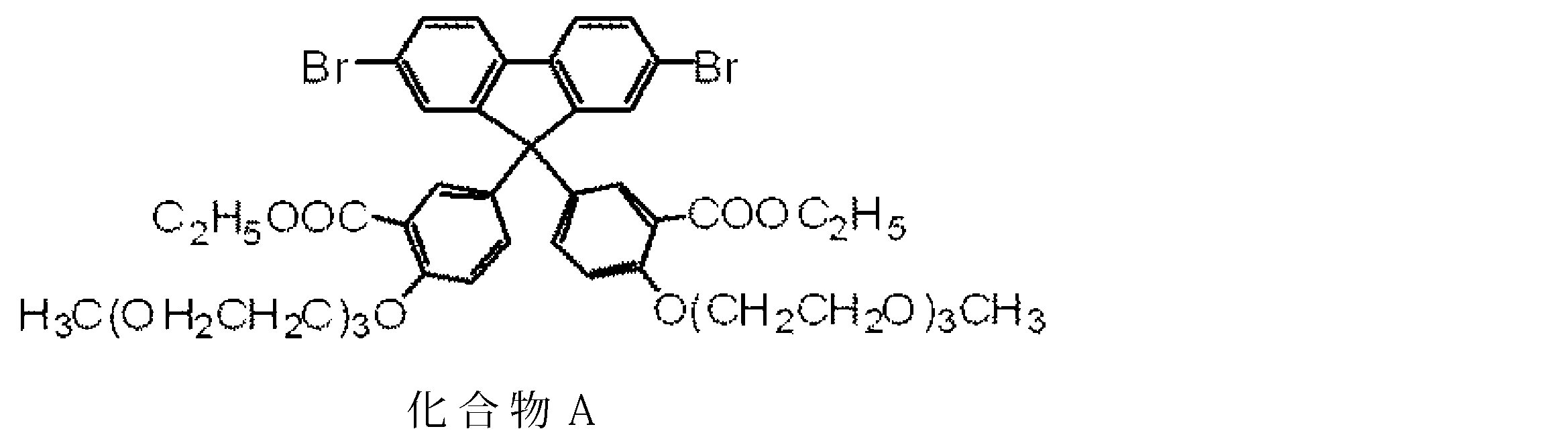
[参考例2]
2,7-ビス(4,4,5,5-テトラメチル-1,3,2-ジオキサボロラン-2-イル)-9,9-ビス[3-エトキシカルボニル-4-[2-[2-(2-メトキシエトキシ)エトキシ]エトキシ]フェニル]-フルオレン(化合物B)の合成
窒素雰囲気下、化合物A(15g)、ビス(ピナコラート)ジボロン(8.9g)、[1,1’-ビス(ジフェニルホスフィノ)フェロセン]ジクロロパラジウム(II)ジクロロメタン錯体(0.8g)、1,1’-ビス(ジフェニルホスフィノ)フェロセン(0.5g)、酢酸カリウム(9.4g)、ジオキサン(400mL)を混合し、110℃に加熱し、10時間加熱還流させた。放冷後、反応液をろ過し、ろ液を減圧濃縮した。反応混合物をメタノールで3回洗浄した。沈殿物をトルエンに溶解させ、溶液に活性炭を加えて攪拌した。その後、ろ過を行い、ろ液を減圧濃縮することで、2,7-ビス(4,4,5,5-テトラメチル-1,3,2-ジオキサボロラン-2-イル)-9,9-ビス[3-エトキシカルボニル-4-[2-[2-(2-メトキシエトキシ)エトキシ]エトキシ]フェニル]-フルオレン(化合物B)(11.7g)を得た。
2,7-ビス(4,4,5,5-テトラメチル-1,3,2-ジオキサボロラン-2-イル)-9,9-ビス[3-エトキシカルボニル-4-[2-[2-(2-メトキシエトキシ)エトキシ]エトキシ]フェニル]-フルオレン(化合物B)の合成
窒素雰囲気下、化合物A(15g)、ビス(ピナコラート)ジボロン(8.9g)、[1,1’-ビス(ジフェニルホスフィノ)フェロセン]ジクロロパラジウム(II)ジクロロメタン錯体(0.8g)、1,1’-ビス(ジフェニルホスフィノ)フェロセン(0.5g)、酢酸カリウム(9.4g)、ジオキサン(400mL)を混合し、110℃に加熱し、10時間加熱還流させた。放冷後、反応液をろ過し、ろ液を減圧濃縮した。反応混合物をメタノールで3回洗浄した。沈殿物をトルエンに溶解させ、溶液に活性炭を加えて攪拌した。その後、ろ過を行い、ろ液を減圧濃縮することで、2,7-ビス(4,4,5,5-テトラメチル-1,3,2-ジオキサボロラン-2-イル)-9,9-ビス[3-エトキシカルボニル-4-[2-[2-(2-メトキシエトキシ)エトキシ]エトキシ]フェニル]-フルオレン(化合物B)(11.7g)を得た。

[参考例3]
ポリ[9,9-ビス[3-エトキシカルボニル-4-[2-[2-(2-メトキシエトキシ)エトキシ]エトキシ]フェニル]-フルオレン](重合体A)の合成
不活性雰囲気下、化合物A(0.55g)、化合物B(0.61g)、トリフェニルホスフィンパラジウム(0.01g)、メチルトリオクチルアンモニウムクロライド(アルドリッチ製、商品名Aliquat336(登録商標))(0.20g)、及びトルエン(10mL)を混合し、105℃に加熱した。この反応液に2M 炭酸ナトリウム水溶液(6mL)を滴下し、8時間還流させた。反応液に4-t-ブチルフェニルボロン酸(0.01g)を加え、6時間還流させた。次いで、ジエチルジチアカルバミン酸ナトリウム水溶液(10mL、濃度:0.05g/mL)を加え、2時間撹拌した。混合溶液をメタノール300mL中に滴下して1時間攪拌した後、析出した沈殿をろ過して2時間減圧乾燥させ、テトラヒドロフラン20mLに溶解させた。得られた溶液をメタノール120mL、3重量%酢酸水溶液50mLの混合溶媒中に滴下して1時間攪拌した後、析出した沈殿をろ過し、テトラヒドロフラン20mLに溶解させた。こうして得られた溶液をメタノール200mLに滴下して30分攪拌した後、析出した沈殿をろ過して固体を得た。得られた固体をテトラヒドロフランに溶解させ、アルミナカラム、シリカゲルカラムを通すことにより精製した。カラムから回収したテトラヒドロフラン溶液を濃縮した後、メタノール(200mL)に滴下し、析出した固体をろ過し、乾燥させた。得られたポリ[9,9-ビス[3-エトキシカルボニル-4-ビス[2-[2-(2-メトキシエトキシ)エトキシ]エトキシ]フェニル]-フルオレン](重合体A(BSAFEGP))の収量は520mgであった。
ポリ[9,9-ビス[3-エトキシカルボニル-4-[2-[2-(2-メトキシエトキシ)エトキシ]エトキシ]フェニル]-フルオレン](重合体A)の合成
不活性雰囲気下、化合物A(0.55g)、化合物B(0.61g)、トリフェニルホスフィンパラジウム(0.01g)、メチルトリオクチルアンモニウムクロライド(アルドリッチ製、商品名Aliquat336(登録商標))(0.20g)、及びトルエン(10mL)を混合し、105℃に加熱した。この反応液に2M 炭酸ナトリウム水溶液(6mL)を滴下し、8時間還流させた。反応液に4-t-ブチルフェニルボロン酸(0.01g)を加え、6時間還流させた。次いで、ジエチルジチアカルバミン酸ナトリウム水溶液(10mL、濃度:0.05g/mL)を加え、2時間撹拌した。混合溶液をメタノール300mL中に滴下して1時間攪拌した後、析出した沈殿をろ過して2時間減圧乾燥させ、テトラヒドロフラン20mLに溶解させた。得られた溶液をメタノール120mL、3重量%酢酸水溶液50mLの混合溶媒中に滴下して1時間攪拌した後、析出した沈殿をろ過し、テトラヒドロフラン20mLに溶解させた。こうして得られた溶液をメタノール200mLに滴下して30分攪拌した後、析出した沈殿をろ過して固体を得た。得られた固体をテトラヒドロフランに溶解させ、アルミナカラム、シリカゲルカラムを通すことにより精製した。カラムから回収したテトラヒドロフラン溶液を濃縮した後、メタノール(200mL)に滴下し、析出した固体をろ過し、乾燥させた。得られたポリ[9,9-ビス[3-エトキシカルボニル-4-ビス[2-[2-(2-メトキシエトキシ)エトキシ]エトキシ]フェニル]-フルオレン](重合体A(BSAFEGP))の収量は520mgであった。
重合体Aのポリスチレン換算の数平均分子量は5.2×10⁴であった。重合体Aは、式(A)で表される繰り返し単位からなる。

[実験例1]
重合体Aセシウム塩の合成
重合体A(200mg)を100mLフラスコに入れ、窒素置換した。テトラヒドロフラン(20mL)、及びエタノール(20mL)を添加し、混合物を55℃に昇温した。そこに、水酸化セシウム(200mg)を水(2mL)に溶解させた水溶液を添加し、55℃で6時間撹拌した。混合物を室温まで冷却した後、反応溶媒を減圧留去した。生じた固体を水で洗浄し、減圧乾燥させることで薄黄色の固体(150mg)を得た。NMRスペクトルにより、重合体A内のエチルエステル部位のエチル基由来のシグナルが完全に消失していることを確認した。得られた重合体Aのセシウム塩を共役高分子化合物1と呼ぶ。共役高分子化合物1は式(B)で表される繰り返し単位からなる(「全繰り返し単位中の、式(1)で表される基及び式(2)で表される基からなる群から選ばれる1種以上の基と式(3)で表される1種以上の基とを含む繰り返し単位の割合」及び「全繰り返し単位中の、式(13)、(15)、(17)、(20)で表される繰り返し単位の割合」は、100モル%である。)。共役高分子化合物1のHOMOの軌道エネルギーは-5.5eV、LUMOの軌道エネルギーは-2.7eVであった。
重合体Aセシウム塩の合成
重合体A(200mg)を100mLフラスコに入れ、窒素置換した。テトラヒドロフラン(20mL)、及びエタノール(20mL)を添加し、混合物を55℃に昇温した。そこに、水酸化セシウム(200mg)を水(2mL)に溶解させた水溶液を添加し、55℃で6時間撹拌した。混合物を室温まで冷却した後、反応溶媒を減圧留去した。生じた固体を水で洗浄し、減圧乾燥させることで薄黄色の固体(150mg)を得た。NMRスペクトルにより、重合体A内のエチルエステル部位のエチル基由来のシグナルが完全に消失していることを確認した。得られた重合体Aのセシウム塩を共役高分子化合物1と呼ぶ。共役高分子化合物1は式(B)で表される繰り返し単位からなる(「全繰り返し単位中の、式(1)で表される基及び式(2)で表される基からなる群から選ばれる1種以上の基と式(3)で表される1種以上の基とを含む繰り返し単位の割合」及び「全繰り返し単位中の、式(13)、(15)、(17)、(20)で表される繰り返し単位の割合」は、100モル%である。)。共役高分子化合物1のHOMOの軌道エネルギーは-5.5eV、LUMOの軌道エネルギーは-2.7eVであった。
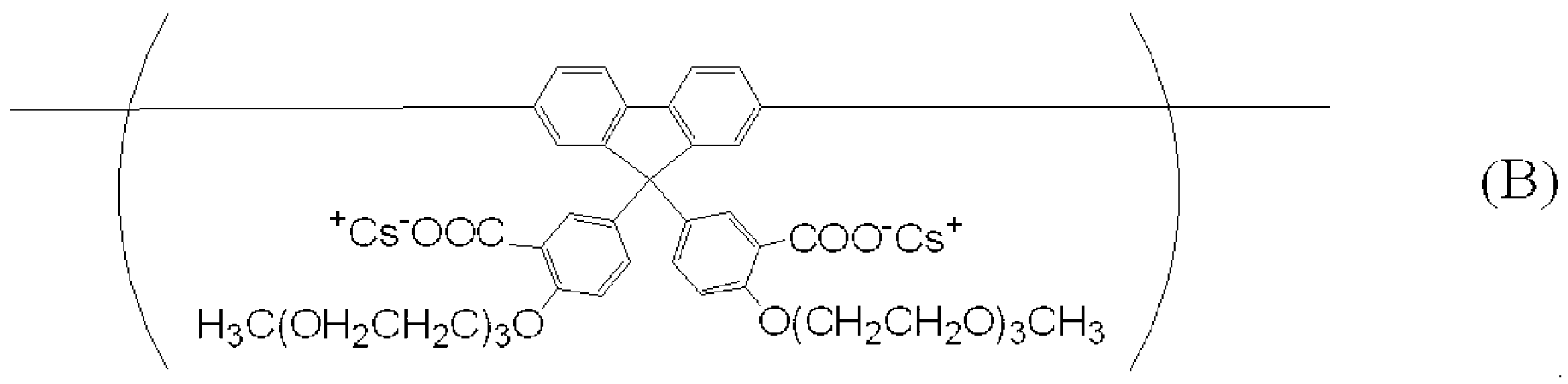
[実験例2]
重合体Aカリウム塩の合成
重合体A(200mg)を100mLフラスコに入れ、窒素置換した。テトラヒドロフラン(20mL)、及びメタノール(10mL)を混合し、混合溶液に、水酸化カリウム(400mg)を水(2mL)に溶解させた水溶液を添加し、65℃で1時間撹拌した。反応溶液にメタノール50mLを加え、さらに65℃で4時間攪拌した。混合物を室温まで冷却した後、反応溶媒を減圧留去した。生じた固体を水で洗浄し、減圧乾燥させることで薄黄色の固体(131mg)を得た。NMRスペクトルにより、重合体A内のエチルエステル部位のエチル基由来のシグナルが完全に消失していることを確認した。得られた重合体Aのカリウム塩を共役高分子化合物2と呼ぶ。共役高分子化合物2は式(C)で表される繰り返し単位からなる(「全繰り返し単位中の、式(1)で表される基及び式(2)で表される基からなる群から選ばれる1種以上の基と式(3)で表される1種以上の基とを含む繰り返し単位の割合」及び「全繰り返し単位中の、式(13)、(15)、(17)、(20)で表される繰り返し単位の割合」は、100モル%である。)。共役高分子化合物2のHOMOの軌道エネルギーは-5.5eV、LUMOの軌道エネルギーは-2.7eVであった。
重合体Aカリウム塩の合成
重合体A(200mg)を100mLフラスコに入れ、窒素置換した。テトラヒドロフラン(20mL)、及びメタノール(10mL)を混合し、混合溶液に、水酸化カリウム(400mg)を水(2mL)に溶解させた水溶液を添加し、65℃で1時間撹拌した。反応溶液にメタノール50mLを加え、さらに65℃で4時間攪拌した。混合物を室温まで冷却した後、反応溶媒を減圧留去した。生じた固体を水で洗浄し、減圧乾燥させることで薄黄色の固体(131mg)を得た。NMRスペクトルにより、重合体A内のエチルエステル部位のエチル基由来のシグナルが完全に消失していることを確認した。得られた重合体Aのカリウム塩を共役高分子化合物2と呼ぶ。共役高分子化合物2は式(C)で表される繰り返し単位からなる(「全繰り返し単位中の、式(1)で表される基及び式(2)で表される基からなる群から選ばれる1種以上の基と式(3)で表される1種以上の基とを含む繰り返し単位の割合」及び「全繰り返し単位中の、式(13)、(15)、(17)、(20)で表される繰り返し単位の割合」は、100モル%である。)。共役高分子化合物2のHOMOの軌道エネルギーは-5.5eV、LUMOの軌道エネルギーは-2.7eVであった。

[実験例3]
重合体Aナトリウム塩の合成
重合体A(200mg)を100mLフラスコに入れ、窒素置換した。テトラヒドロフラン(20mL)、及びメタノール(10mL)を混合し、混合溶液に、水酸化ナトリウム(260mg)を水(2mL)に溶解させた水溶液を添加し、65℃で1時間撹拌した。反応溶液にメタノール30mLを加え、さらに65℃で4時間攪拌した。混合物を室温まで冷却した後、反応溶媒を減圧留去した。生じた固体を水で洗浄し、減圧乾燥させることで薄黄色の固体(123mg)を得た。NMRスペクトルにより、重合体A内のエチルエステル部位のエチル基由来のシグナルが完全に消失していることを確認した。得られた重合体Aのナトリウム塩を共役高分子化合物3と呼ぶ。共役高分子化合物3は式(D)で表される繰り返し単位からなる(「全繰り返し単位中の、式(1)で表される基及び式(2)で表される基からなる群から選ばれる1種以上の基と式(3)で表される1種以上の基とを含む繰り返し単位の割合」及び「全繰り返し単位中の、式(13)、(15)、(17)、(20)で表される繰り返し単位の割合」は、100モル%である。)。共役高分子化合物3のHOMOの軌道エネルギーは-5.6eV、LUMOの軌道エネルギーは-2.8eVであった。
重合体Aナトリウム塩の合成
重合体A(200mg)を100mLフラスコに入れ、窒素置換した。テトラヒドロフラン(20mL)、及びメタノール(10mL)を混合し、混合溶液に、水酸化ナトリウム(260mg)を水(2mL)に溶解させた水溶液を添加し、65℃で1時間撹拌した。反応溶液にメタノール30mLを加え、さらに65℃で4時間攪拌した。混合物を室温まで冷却した後、反応溶媒を減圧留去した。生じた固体を水で洗浄し、減圧乾燥させることで薄黄色の固体(123mg)を得た。NMRスペクトルにより、重合体A内のエチルエステル部位のエチル基由来のシグナルが完全に消失していることを確認した。得られた重合体Aのナトリウム塩を共役高分子化合物3と呼ぶ。共役高分子化合物3は式(D)で表される繰り返し単位からなる(「全繰り返し単位中の、式(1)で表される基及び式(2)で表される基からなる群から選ばれる1種以上の基と式(3)で表される1種以上の基とを含む繰り返し単位の割合」及び「全繰り返し単位中の、式(13)、(15)、(17)、(20)で表される繰り返し単位の割合」は、100モル%である。)。共役高分子化合物3のHOMOの軌道エネルギーは-5.6eV、LUMOの軌道エネルギーは-2.8eVであった。
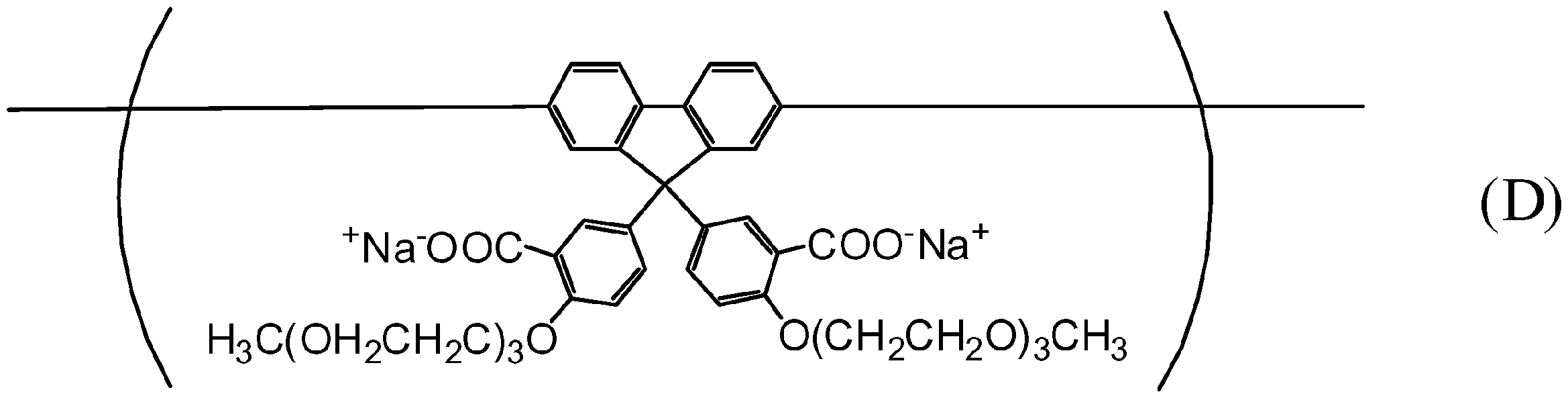
[実験例4]
重合体Aアンモニウム塩の合成
重合体A(200mg)を100mLフラスコに入れ、窒素置換した。テトラヒドロフラン(20mL)、及びメタノール(15mL)を混合し、混合溶液にテトラメチルアンモニウムヒドロキシド(50mg)を水(1mL)に溶解させた水溶液を添加し、65℃で6時間撹拌した。反応溶液にテトラメチルアンモニウムヒドロキシド(50mg)を水(1mL)に溶解させた水溶液を加え、さらに65℃で4時間攪拌した。混合物を室温まで冷却した後、反応溶媒を減圧留去した。生じた固体を水で洗浄し、減圧乾燥させることで薄黄色の固体(150mg)を得た。NMRスペクトルにより、重合体A内のエチルエステル部位のエチル基由来のシグナルが90%消失していることを確認した。得られた重合体Aのアンモニウム塩を共役高分子化合物4と呼ぶ。共役高分子化合物4は式(E)で表される繰り返し単位からなる(「全繰り返し単位中の、式(1)で表される基及び式(2)で表される基からなる群から選ばれる1種以上の基と式(3)で表される1種以上の基とを含む繰り返し単位の割合」及び「全繰り返し単位中の、式(13)、(15)、(17)、(20)で表される繰り返し単位の割合」は、90モル%である。)。共役高分子化合物4のHOMOの軌道エネルギーは-5.6eV、LUMOの軌道エネルギーは-2.8eVであった。
重合体Aアンモニウム塩の合成
重合体A(200mg)を100mLフラスコに入れ、窒素置換した。テトラヒドロフラン(20mL)、及びメタノール(15mL)を混合し、混合溶液にテトラメチルアンモニウムヒドロキシド(50mg)を水(1mL)に溶解させた水溶液を添加し、65℃で6時間撹拌した。反応溶液にテトラメチルアンモニウムヒドロキシド(50mg)を水(1mL)に溶解させた水溶液を加え、さらに65℃で4時間攪拌した。混合物を室温まで冷却した後、反応溶媒を減圧留去した。生じた固体を水で洗浄し、減圧乾燥させることで薄黄色の固体(150mg)を得た。NMRスペクトルにより、重合体A内のエチルエステル部位のエチル基由来のシグナルが90%消失していることを確認した。得られた重合体Aのアンモニウム塩を共役高分子化合物4と呼ぶ。共役高分子化合物4は式(E)で表される繰り返し単位からなる(「全繰り返し単位中の、式(1)で表される基及び式(2)で表される基からなる群から選ばれる1種以上の基と式(3)で表される1種以上の基とを含む繰り返し単位の割合」及び「全繰り返し単位中の、式(13)、(15)、(17)、(20)で表される繰り返し単位の割合」は、90モル%である。)。共役高分子化合物4のHOMOの軌道エネルギーは-5.6eV、LUMOの軌道エネルギーは-2.8eVであった。
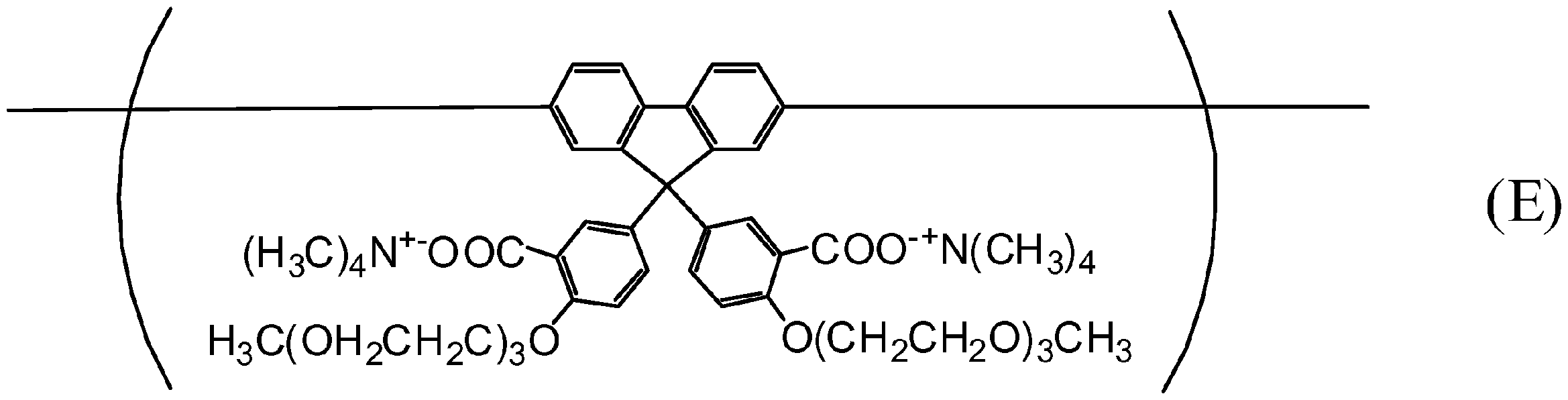
[参考例4]
2,7-ビス[7-(4-メチルフェニル)-9,9-ジオクチルフルオレン-2-イル]-9,9-ビス[3-エトキシカルボニル-4-[2-[2-(2-メトキシエトキシ)エトキシ]エトキシ]フェニル]-フルオレン(重合体B)の合成
不活性雰囲気下、化合物A(0.52g)、2,7-ビス(1,3,2-ジオキサボロラン-2-イル)-9,9-ジオクチルフルオレン(1.29g)、トリフェニルホスフィンパラジウム(0.0087g)、メチルトリオクチルアンモニウムクロライド(アルドリッチ製、商品名Aliquat336(登録商標))(0.20g)、トルエン(10mL)、及び2M炭酸ナトリウム水溶液(10mL)を混合し、80℃に加熱した。反応液を3.5時間反応させた。その後、そこに、パラブロモトルエン(0.68g)を加えて、更に2.5時間反応させた。反応後、反応液を室温まで冷却し、酢酸エチル50mL/蒸留水50mLを加えて水層を除去した。再び蒸留水50mLを加えて水層を除去した後、乾燥剤として硫酸マグネシウムを加えて、不溶物をろ過して、有機溶媒を除去した。その後、得られた残渣を再びTHF10mLに溶かして、飽和ジエチルジチオカルバミン酸ナトリウム水2mLを添加して、30分間撹拌した後、有機溶媒を除去した。アルミナカラム(展開溶媒 ヘキサン:酢酸エチル=1:1、v/v)を通して精製を行い、析出した沈殿をろ過して12時間減圧乾燥させたところ、2,7-ビス[7-(4-メチルフェニル)-9,9-ジオクチルフルオレン-2-イル]-9,9-ビス[3-エトキシカルボニル-4-[2-[2-(2-メトキシエトキシ)エトキシ]エトキシ]フェニル]-フルオレン(重合体B)が524mg得られた。
2,7-ビス[7-(4-メチルフェニル)-9,9-ジオクチルフルオレン-2-イル]-9,9-ビス[3-エトキシカルボニル-4-[2-[2-(2-メトキシエトキシ)エトキシ]エトキシ]フェニル]-フルオレン(重合体B)の合成
不活性雰囲気下、化合物A(0.52g)、2,7-ビス(1,3,2-ジオキサボロラン-2-イル)-9,9-ジオクチルフルオレン(1.29g)、トリフェニルホスフィンパラジウム(0.0087g)、メチルトリオクチルアンモニウムクロライド(アルドリッチ製、商品名Aliquat336(登録商標))(0.20g)、トルエン(10mL)、及び2M炭酸ナトリウム水溶液(10mL)を混合し、80℃に加熱した。反応液を3.5時間反応させた。その後、そこに、パラブロモトルエン(0.68g)を加えて、更に2.5時間反応させた。反応後、反応液を室温まで冷却し、酢酸エチル50mL/蒸留水50mLを加えて水層を除去した。再び蒸留水50mLを加えて水層を除去した後、乾燥剤として硫酸マグネシウムを加えて、不溶物をろ過して、有機溶媒を除去した。その後、得られた残渣を再びTHF10mLに溶かして、飽和ジエチルジチオカルバミン酸ナトリウム水2mLを添加して、30分間撹拌した後、有機溶媒を除去した。アルミナカラム(展開溶媒 ヘキサン:酢酸エチル=1:1、v/v)を通して精製を行い、析出した沈殿をろ過して12時間減圧乾燥させたところ、2,7-ビス[7-(4-メチルフェニル)-9,9-ジオクチルフルオレン-2-イル]-9,9-ビス[3-エトキシカルボニル-4-[2-[2-(2-メトキシエトキシ)エトキシ]エトキシ]フェニル]-フルオレン(重合体B)が524mg得られた。
重合体Bのポリスチレン換算の数平均分子量は、2.0×10³であった。なお、重合体Bは、式(F)で表される。

[実験例5]
重合体Bセシウム塩の合成
重合体B(262mg)を100mLフラスコに入れ、アルゴン置換した。そこに、テトラヒドロフラン(10mL)、及びメタノール(15mL)を添加し、混合物を55℃に昇温した。そこに、水酸化セシウム(341mg)を水(1mL)に溶かした水溶液を添加し、55℃で5時間撹拌した。得られた混合物を室温まで冷却した後、反応溶媒を減圧留去した。生じた固体を水で洗浄し、減圧乾燥させることで薄黄色の固体(250mg)を得た。NMRスペクトルにより、エチルエステル部位のエチル基由来のシグナルが完全に消失していることを確認した。得られた重合体Bセシウム塩を共役高分子化合物5と呼ぶ。共役高分子化合物5は、式(G)で表される(「全繰り返し単位中の、式(1)で表される基及び式(2)で表される基からなる群から選ばれる1種以上の基と式(3)で表される1種以上の基とを含む繰り返し単位の割合」及び「全繰り返し単位中の、式(13)、(15)、(17)、(20)で表される繰り返し単位の割合」は、小数第二位で四捨五入して、33.3モル%である。)。共役高分子化合物5のHOMOの軌道エネルギーは-5.6eVであり、LUMOの軌道エネルギーは-2.6eVであった。
重合体Bセシウム塩の合成
重合体B(262mg)を100mLフラスコに入れ、アルゴン置換した。そこに、テトラヒドロフラン(10mL)、及びメタノール(15mL)を添加し、混合物を55℃に昇温した。そこに、水酸化セシウム(341mg)を水(1mL)に溶かした水溶液を添加し、55℃で5時間撹拌した。得られた混合物を室温まで冷却した後、反応溶媒を減圧留去した。生じた固体を水で洗浄し、減圧乾燥させることで薄黄色の固体(250mg)を得た。NMRスペクトルにより、エチルエステル部位のエチル基由来のシグナルが完全に消失していることを確認した。得られた重合体Bセシウム塩を共役高分子化合物5と呼ぶ。共役高分子化合物5は、式(G)で表される(「全繰り返し単位中の、式(1)で表される基及び式(2)で表される基からなる群から選ばれる1種以上の基と式(3)で表される1種以上の基とを含む繰り返し単位の割合」及び「全繰り返し単位中の、式(13)、(15)、(17)、(20)で表される繰り返し単位の割合」は、小数第二位で四捨五入して、33.3モル%である。)。共役高分子化合物5のHOMOの軌道エネルギーは-5.6eVであり、LUMOの軌道エネルギーは-2.6eVであった。

[参考例5]
重合体Cの合成
不活性雰囲気下、化合物A(0.40g)、化合物B(0.49g)、N,N’-ビス(4-ブロモフェニル)-N,N’-ビス(4-t-ブチル-2,6-ジメチルフェニル)1,4-フェニレンジアミン(35mg)、トリフェニルホスフィンパラジウム(8mg)、メチルトリオクチルアンモニウムクロライド(アルドリッチ製、商品名Aliquat336(登録商標))(0.20g)、及びトルエン(10mL)を混合し、105℃に加熱した。この反応液に2M 炭酸ナトリウム水溶液(6mL)を滴下し、8時間還流させた。反応液にフェニルボロン酸(0.01g)を加え、6時間還流させた。次いで、ジエチルジチアカルバミン酸ナトリウム水溶液(10mL、濃度:0.05g/mL)を加え、2時間撹拌した。混合溶液をメタノール300mL中に滴下して1時間攪拌した後、析出した沈殿をろ過して2時間減圧乾燥させ、テトラヒドロフラン20mLに溶解させた。得られた溶液をメタノール120mL、3重量%酢酸水溶液50mLの混合溶媒中に滴下して1時間攪拌した後、析出した沈殿をろ過し、テトラヒドロフラン20mLに溶解させた。こうして得られた溶液をメタノール200mLに滴下して30分攪拌した後、析出した沈殿をろ過して固体を得た。得られた固体をテトラヒドロフランに溶解させ、アルミナカラム、シリカゲルカラムを通すことにより精製した。カラムから回収したテトラヒドロフラン溶液を濃縮した後、メタノール(200mL)に滴下し、析出した固体をろ過し、乾燥させた。得られた重合体Cの収量は526mgであった。
重合体Cの合成
不活性雰囲気下、化合物A(0.40g)、化合物B(0.49g)、N,N’-ビス(4-ブロモフェニル)-N,N’-ビス(4-t-ブチル-2,6-ジメチルフェニル)1,4-フェニレンジアミン(35mg)、トリフェニルホスフィンパラジウム(8mg)、メチルトリオクチルアンモニウムクロライド(アルドリッチ製、商品名Aliquat336(登録商標))(0.20g)、及びトルエン(10mL)を混合し、105℃に加熱した。この反応液に2M 炭酸ナトリウム水溶液(6mL)を滴下し、8時間還流させた。反応液にフェニルボロン酸(0.01g)を加え、6時間還流させた。次いで、ジエチルジチアカルバミン酸ナトリウム水溶液(10mL、濃度:0.05g/mL)を加え、2時間撹拌した。混合溶液をメタノール300mL中に滴下して1時間攪拌した後、析出した沈殿をろ過して2時間減圧乾燥させ、テトラヒドロフラン20mLに溶解させた。得られた溶液をメタノール120mL、3重量%酢酸水溶液50mLの混合溶媒中に滴下して1時間攪拌した後、析出した沈殿をろ過し、テトラヒドロフラン20mLに溶解させた。こうして得られた溶液をメタノール200mLに滴下して30分攪拌した後、析出した沈殿をろ過して固体を得た。得られた固体をテトラヒドロフランに溶解させ、アルミナカラム、シリカゲルカラムを通すことにより精製した。カラムから回収したテトラヒドロフラン溶液を濃縮した後、メタノール(200mL)に滴下し、析出した固体をろ過し、乾燥させた。得られた重合体Cの収量は526mgであった。
重合体Cのポリスチレン換算の数平均分子量は3.6×10⁴であった。重合体Cは、式(H)で表される繰り返し単位からなる。
なお、N,N’-ビス(4-ブロモフェニル)-N,N’-ビス(4-t-ブチル-2,6-ジメチルフェニル)1,4-フェニレンジアミンは、例えば特開2008-74017号公報に記載されている方法で合成することができる。

[実験例6]
重合体Cセシウム塩の合成
重合体C(200mg)を100mLフラスコに入れ、窒素置換した。テトラヒドロフラン(20mL)、及びメタノール(20mL)を添加し混合した。混合溶液に、水酸化セシウム(200mg)を水(2mL)に溶解させた水溶液を添加し、65℃で1時間撹拌した。反応溶液にメタノール30mLを加え、さらに65℃で4時間攪拌した。混合物を室温まで冷却した後、反応溶媒を減圧留去した。生じた固体を水で洗浄し、減圧乾燥させることで薄黄色の固体(150mg)を得た。NMRスペクトルにより、重合体C内のエチルエステル部位のエチル基由来のシグナルが完全に消失していることを確認した。得られた重合体Cのセシウム塩を共役高分子化合物6と呼ぶ。共役高分子化合物6は式(I)で表される繰り返し単位からなる(「全繰り返し単位中の、式(1)で表される基及び式(2)で表される基からなる群から選ばれる1種以上の基と式(3)で表される1種以上の基とを含む繰り返し単位の割合」及び「全繰り返し単位中の、式(13)、(15)、(17)、(20)で表される繰り返し単位の割合」は、95モル%である。)。共役高分子化合物6のHOMOの軌道エネルギーは-5.3eV、LUMOの軌道エネルギーは-2.6eVであった。
重合体Cセシウム塩の合成
重合体C(200mg)を100mLフラスコに入れ、窒素置換した。テトラヒドロフラン(20mL)、及びメタノール(20mL)を添加し混合した。混合溶液に、水酸化セシウム(200mg)を水(2mL)に溶解させた水溶液を添加し、65℃で1時間撹拌した。反応溶液にメタノール30mLを加え、さらに65℃で4時間攪拌した。混合物を室温まで冷却した後、反応溶媒を減圧留去した。生じた固体を水で洗浄し、減圧乾燥させることで薄黄色の固体(150mg)を得た。NMRスペクトルにより、重合体C内のエチルエステル部位のエチル基由来のシグナルが完全に消失していることを確認した。得られた重合体Cのセシウム塩を共役高分子化合物6と呼ぶ。共役高分子化合物6は式(I)で表される繰り返し単位からなる(「全繰り返し単位中の、式(1)で表される基及び式(2)で表される基からなる群から選ばれる1種以上の基と式(3)で表される1種以上の基とを含む繰り返し単位の割合」及び「全繰り返し単位中の、式(13)、(15)、(17)、(20)で表される繰り返し単位の割合」は、95モル%である。)。共役高分子化合物6のHOMOの軌道エネルギーは-5.3eV、LUMOの軌道エネルギーは-2.6eVであった。

[参考例6]
重合体Dの合成
不活性雰囲気下、化合物A(0.55g)、化合物B(0.67g)、N,N’-ビス(4-ブロモフェニル)-N,N’-ビス(4-t-ブチル-2,6-ジメチルフェニル)1,4-フェニレンジアミン(0.038g)、3,7-ジブロモ-N-(4-n-ブチルフェニル)フェノキサジン 0.009g、トリフェニルホスフィンパラジウム(0.01g)、メチルトリオクチルアンモニウムクロライド(アルドリッチ製、商品名Aliquat336(登録商標))(0.20g)、及びトルエン(10mL)を混合し、105℃に加熱した。この反応液に2M 炭酸ナトリウム水溶液(6mL)を滴下し、2時間還流させた。反応液にフェニルボロン酸(0.004g)を加え、6時間還流させた。次いで、ジエチルジチアカルバミン酸ナトリウム水溶液(10mL、濃度:0.05g/mL)を加え、2時間撹拌した。混合溶液をメタノール300mL中に滴下して1時間攪拌した後、析出した沈殿をろ過して2時間減圧乾燥させ、テトラヒドロフラン20mLに溶解させた。得られた溶液をメタノール120mL、3重量%酢酸水溶液50mLの混合溶媒中に滴下して1時間攪拌した後、析出した沈殿をろ過し、テトラヒドロフラン20mLに溶解させた。こうして得られた溶液をメタノール200mLに滴下して30分攪拌した後、析出した沈殿をろ過して固体を得た。得られた固体をテトラヒドロフランに溶解させ、アルミナカラム、シリカゲルカラムを通すことにより精製した。カラムから回収したテトラヒドロフラン溶液を濃縮した後、メタノール(200mL)に滴下し、析出した固体をろ過し、乾燥させた。得られた重合体Dの収量は590mgであった。
重合体Dの合成
不活性雰囲気下、化合物A(0.55g)、化合物B(0.67g)、N,N’-ビス(4-ブロモフェニル)-N,N’-ビス(4-t-ブチル-2,6-ジメチルフェニル)1,4-フェニレンジアミン(0.038g)、3,7-ジブロモ-N-(4-n-ブチルフェニル)フェノキサジン 0.009g、トリフェニルホスフィンパラジウム(0.01g)、メチルトリオクチルアンモニウムクロライド(アルドリッチ製、商品名Aliquat336(登録商標))(0.20g)、及びトルエン(10mL)を混合し、105℃に加熱した。この反応液に2M 炭酸ナトリウム水溶液(6mL)を滴下し、2時間還流させた。反応液にフェニルボロン酸(0.004g)を加え、6時間還流させた。次いで、ジエチルジチアカルバミン酸ナトリウム水溶液(10mL、濃度:0.05g/mL)を加え、2時間撹拌した。混合溶液をメタノール300mL中に滴下して1時間攪拌した後、析出した沈殿をろ過して2時間減圧乾燥させ、テトラヒドロフラン20mLに溶解させた。得られた溶液をメタノール120mL、3重量%酢酸水溶液50mLの混合溶媒中に滴下して1時間攪拌した後、析出した沈殿をろ過し、テトラヒドロフラン20mLに溶解させた。こうして得られた溶液をメタノール200mLに滴下して30分攪拌した後、析出した沈殿をろ過して固体を得た。得られた固体をテトラヒドロフランに溶解させ、アルミナカラム、シリカゲルカラムを通すことにより精製した。カラムから回収したテトラヒドロフラン溶液を濃縮した後、メタノール(200mL)に滴下し、析出した固体をろ過し、乾燥させた。得られた重合体Dの収量は590mgであった。
重合体Dのポリスチレン換算の数平均分子量は2.7×10⁴であった。重合体Dは、式(J)で表される繰り返し単位からなる。
なお、3,7-ジブロモ-N-(4-n-ブチルフェニル)フェノキサジンは、特開2004-137456号公報に記載の方法で合成した。
なお、3,7-ジブロモ-N-(4-n-ブチルフェニル)フェノキサジンは、特開2004-137456号公報に記載の方法で合成した。

[実験例7]
重合体Dセシウム塩の合成
重合体D(200mg)を100mLフラスコに入れ、窒素置換した。テトラヒドロフラン(15mL)、及びメタノール(10mL)を混合した。混合溶液に、水酸化セシウム(360mg)を水(2mL)に溶解させた水溶液を添加し、65℃で3時間撹拌した。反応溶液にメタノール10mLを加え、さらに65℃で4時間攪拌した。混合物を室温まで冷却した後、反応溶媒を減圧留去した。生じた固体を水で洗浄し、減圧乾燥させることで薄黄色の固体(210mg)を得た。NMRスペクトルにより、重合体D内のエチルエステル部位のエチル基由来のシグナルが完全に消失していることを確認した。得られた重合体Dのセシウム塩を共役高分子化合物7と呼ぶ。共役高分子化合物7は式(K)で表される繰り返し単位からなる(「全繰り返し単位中の、式(1)で表される基及び式(2)で表される基からなる群から選ばれる1種以上の基と式(3)で表される1種以上の基とを含む繰り返し単位の割合」及び「全繰り返し単位中の、式(13)、(15)、(17)、(20)で表される繰り返し単位の割合」は、95モル%である。)。共役高分子化合物7のHOMOの軌道エネルギーは-5.3eV、LUMOの軌道エネルギーは-2.4eVであった。
重合体Dセシウム塩の合成
重合体D(200mg)を100mLフラスコに入れ、窒素置換した。テトラヒドロフラン(15mL)、及びメタノール(10mL)を混合した。混合溶液に、水酸化セシウム(360mg)を水(2mL)に溶解させた水溶液を添加し、65℃で3時間撹拌した。反応溶液にメタノール10mLを加え、さらに65℃で4時間攪拌した。混合物を室温まで冷却した後、反応溶媒を減圧留去した。生じた固体を水で洗浄し、減圧乾燥させることで薄黄色の固体(210mg)を得た。NMRスペクトルにより、重合体D内のエチルエステル部位のエチル基由来のシグナルが完全に消失していることを確認した。得られた重合体Dのセシウム塩を共役高分子化合物7と呼ぶ。共役高分子化合物7は式(K)で表される繰り返し単位からなる(「全繰り返し単位中の、式(1)で表される基及び式(2)で表される基からなる群から選ばれる1種以上の基と式(3)で表される1種以上の基とを含む繰り返し単位の割合」及び「全繰り返し単位中の、式(13)、(15)、(17)、(20)で表される繰り返し単位の割合」は、95モル%である。)。共役高分子化合物7のHOMOの軌道エネルギーは-5.3eV、LUMOの軌道エネルギーは-2.4eVであった。

[参考例7]
重合体Eの合成
不活性雰囲気下、化合物A(0.37g)、化合物B(0.82g)、1,3-ジブロモベンゼン(0.09g)、トリフェニルホスフィンパラジウム(0.01g)、メチルトリオクチルアンモニウムクロライド(アルドリッチ製、商品名Aliquat336(登録商標))(0.20g)、及びトルエン(10mL)を混合し、105℃に加熱した。この反応液に2M 炭酸ナトリウム水溶液(6mL)を滴下し、7時間還流させた。反応液にフェニルボロン酸(0.002g)を加え、10時間還流させた。次いで、ジエチルジチアカルバミン酸ナトリウム水溶液(10mL、濃度:0.05g/mL)を加え、1時間撹拌した。混合溶液をメタノール300mL中に滴下して1時間攪拌した後、析出した沈殿をろ過して2時間減圧乾燥させ、テトラヒドロフラン20mLに溶解させた。得られた溶液をメタノール120mL、3重量%酢酸水溶液50mLの混合溶媒中に滴下して1時間攪拌した後、析出した沈殿をろ過し、テトラヒドロフラン20mLに溶解させた。こうして得られた溶液をメタノール200mLに滴下して30分攪拌した後、析出した沈殿をろ過して固体を得た。得られた固体をテトラヒドロフランに溶解させ、アルミナカラム、シリカゲルカラムを通すことにより精製した。カラムから回収したテトラヒドロフラン溶液を濃縮した後、メタノール(200mL)に滴下し、析出した固体をろ過し、乾燥させた。得られた重合体Eの収量は293mgであった。
重合体Eの合成
不活性雰囲気下、化合物A(0.37g)、化合物B(0.82g)、1,3-ジブロモベンゼン(0.09g)、トリフェニルホスフィンパラジウム(0.01g)、メチルトリオクチルアンモニウムクロライド(アルドリッチ製、商品名Aliquat336(登録商標))(0.20g)、及びトルエン(10mL)を混合し、105℃に加熱した。この反応液に2M 炭酸ナトリウム水溶液(6mL)を滴下し、7時間還流させた。反応液にフェニルボロン酸(0.002g)を加え、10時間還流させた。次いで、ジエチルジチアカルバミン酸ナトリウム水溶液(10mL、濃度:0.05g/mL)を加え、1時間撹拌した。混合溶液をメタノール300mL中に滴下して1時間攪拌した後、析出した沈殿をろ過して2時間減圧乾燥させ、テトラヒドロフラン20mLに溶解させた。得られた溶液をメタノール120mL、3重量%酢酸水溶液50mLの混合溶媒中に滴下して1時間攪拌した後、析出した沈殿をろ過し、テトラヒドロフラン20mLに溶解させた。こうして得られた溶液をメタノール200mLに滴下して30分攪拌した後、析出した沈殿をろ過して固体を得た。得られた固体をテトラヒドロフランに溶解させ、アルミナカラム、シリカゲルカラムを通すことにより精製した。カラムから回収したテトラヒドロフラン溶液を濃縮した後、メタノール(200mL)に滴下し、析出した固体をろ過し、乾燥させた。得られた重合体Eの収量は293mgであった。
重合体Eのポリスチレン換算の数平均分子量は1.8×10⁴であった。重合体Eは、式(L)で表される繰り返し単位からなる。
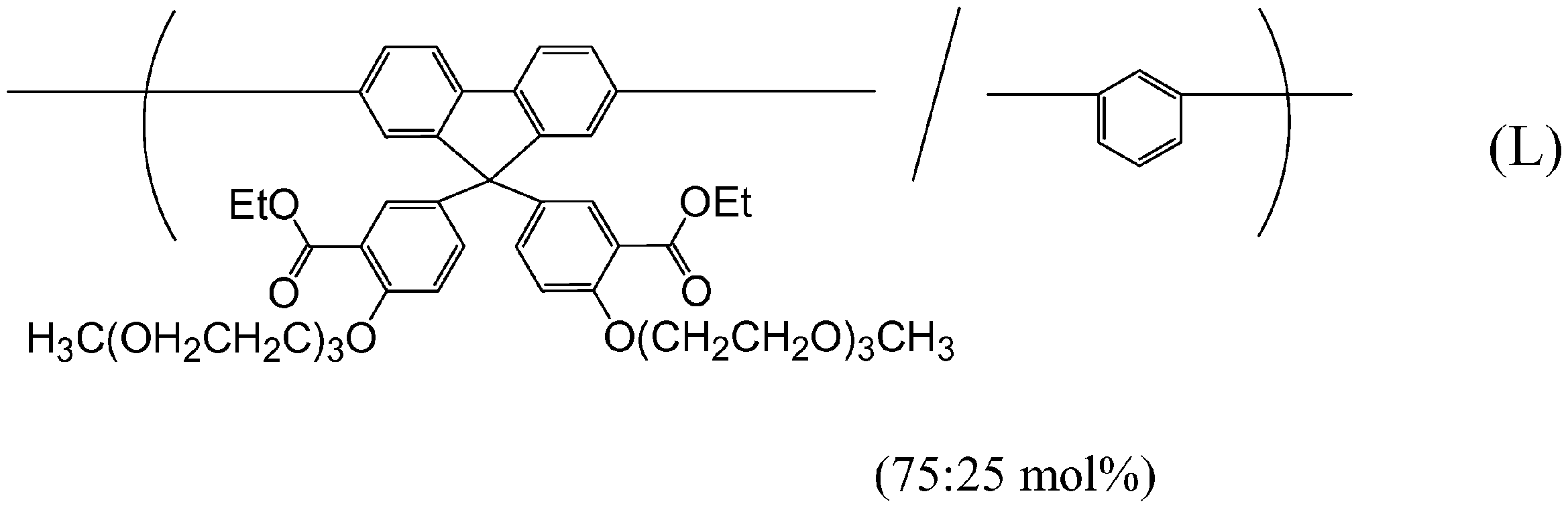
[実験例8]
重合体Eセシウム塩の合成
重合体E(200mg)を100mLフラスコに入れ、窒素置換した。テトラヒドロフラン(10mL)、及びメタノール(5mL)を混合した。混合溶液に、水酸化セシウム(200mg)を水(2mL)に溶解させた水溶液を添加し、65℃で2時間撹拌した。反応溶液にメタノール10mLを加え、さらに65℃で5時間攪拌した。混合物を室温まで冷却した後、反応溶媒を減圧留去した。生じた固体を水で洗浄し、減圧乾燥させることで薄黄色の固体(170mg)を得た。NMRスペクトルにより、重合体E内のエチルエステル部位のエチル基由来のシグナルが完全に消失していることを確認した。得られた重合体Eのセシウム塩を共役高分子化合物8と呼ぶ。共役高分子化合物8は式(M)で表される繰り返し単位からなる(「全繰り返し単位中の、式(1)で表される基及び式(2)で表される基からなる群から選ばれる1種以上の基と式(3)で表される1種以上の基とを含む繰り返し単位の割合」及び「全繰り返し単位中の、式(13)、(15)、(17)、(20)で表される繰り返し単位の割合」は、75モル%である。)。共役高分子化合物8のHOMOの軌道エネルギーは-5.6eV、LUMOの軌道エネルギーは-2.6eVであった。
重合体Eセシウム塩の合成
重合体E(200mg)を100mLフラスコに入れ、窒素置換した。テトラヒドロフラン(10mL)、及びメタノール(5mL)を混合した。混合溶液に、水酸化セシウム(200mg)を水(2mL)に溶解させた水溶液を添加し、65℃で2時間撹拌した。反応溶液にメタノール10mLを加え、さらに65℃で5時間攪拌した。混合物を室温まで冷却した後、反応溶媒を減圧留去した。生じた固体を水で洗浄し、減圧乾燥させることで薄黄色の固体(170mg)を得た。NMRスペクトルにより、重合体E内のエチルエステル部位のエチル基由来のシグナルが完全に消失していることを確認した。得られた重合体Eのセシウム塩を共役高分子化合物8と呼ぶ。共役高分子化合物8は式(M)で表される繰り返し単位からなる(「全繰り返し単位中の、式(1)で表される基及び式(2)で表される基からなる群から選ばれる1種以上の基と式(3)で表される1種以上の基とを含む繰り返し単位の割合」及び「全繰り返し単位中の、式(13)、(15)、(17)、(20)で表される繰り返し単位の割合」は、75モル%である。)。共役高分子化合物8のHOMOの軌道エネルギーは-5.6eV、LUMOの軌道エネルギーは-2.6eVであった。
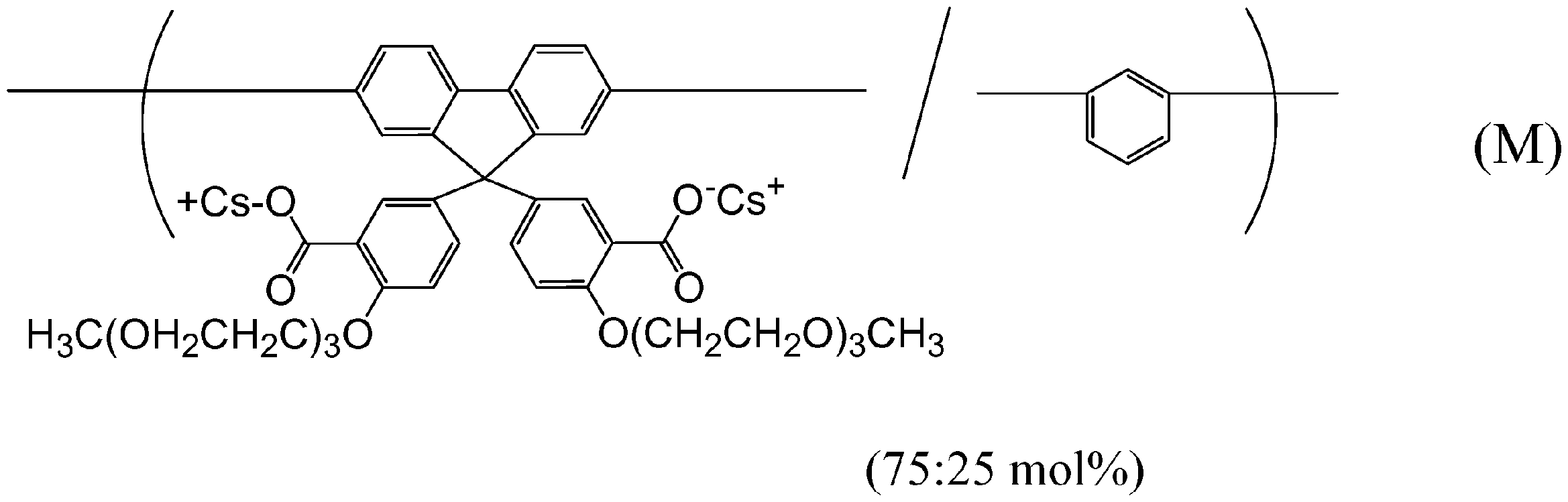
[参考例8]
重合体Fの合成
不活性雰囲気下、化合物B(1.01g)、1,4-ジブロモ-2,3,5,6-テトラフルオロベンゼン(0.30g)、トリフェニルホスフィンパラジウム(0.02g)、メチルトリオクチルアンモニウムクロライド(アルドリッチ製、商品名Aliquat336(登録商標))(0.20g)、及びトルエン(10mL)を混合し、105℃に加熱した。この反応液に2M 炭酸ナトリウム水溶液(6mL)を滴下し、4時間還流させた。反応液にフェニルボロン酸(0.002g)を加え、4時間還流させた。次いで、ジエチルジチアカルバミン酸ナトリウム水溶液(10mL、濃度:0.05g/mL)を加え、1時間撹拌した。混合溶液をメタノール300mL中に滴下して1時間攪拌した後、析出した沈殿をろ過して2時間減圧乾燥させ、テトラヒドロフラン20mLに溶解させた。得られた溶液をメタノール120mL、3重量%酢酸水溶液50mLの混合溶媒中に滴下して1時間攪拌した後、析出した沈殿をろ過し、テトラヒドロフラン20mLに溶解させた。こうして得られた溶液をメタノール200mLに滴下して30分攪拌した後、析出した沈殿をろ過して固体を得た。得られた固体をテトラヒドロフラン/酢酸エチル(1/1(体積比))の混合溶媒に溶解させ、アルミナカラム、シリカゲルカラムを通すことにより精製した。カラムから回収したテトラヒドロフラン溶液を濃縮した後、メタノール(200mL)に滴下し、析出した固体をろ過し、乾燥させた。得られた重合体Eの収量は343mgであった。
重合体Fの合成
不活性雰囲気下、化合物B(1.01g)、1,4-ジブロモ-2,3,5,6-テトラフルオロベンゼン(0.30g)、トリフェニルホスフィンパラジウム(0.02g)、メチルトリオクチルアンモニウムクロライド(アルドリッチ製、商品名Aliquat336(登録商標))(0.20g)、及びトルエン(10mL)を混合し、105℃に加熱した。この反応液に2M 炭酸ナトリウム水溶液(6mL)を滴下し、4時間還流させた。反応液にフェニルボロン酸(0.002g)を加え、4時間還流させた。次いで、ジエチルジチアカルバミン酸ナトリウム水溶液(10mL、濃度:0.05g/mL)を加え、1時間撹拌した。混合溶液をメタノール300mL中に滴下して1時間攪拌した後、析出した沈殿をろ過して2時間減圧乾燥させ、テトラヒドロフラン20mLに溶解させた。得られた溶液をメタノール120mL、3重量%酢酸水溶液50mLの混合溶媒中に滴下して1時間攪拌した後、析出した沈殿をろ過し、テトラヒドロフラン20mLに溶解させた。こうして得られた溶液をメタノール200mLに滴下して30分攪拌した後、析出した沈殿をろ過して固体を得た。得られた固体をテトラヒドロフラン/酢酸エチル(1/1(体積比))の混合溶媒に溶解させ、アルミナカラム、シリカゲルカラムを通すことにより精製した。カラムから回収したテトラヒドロフラン溶液を濃縮した後、メタノール(200mL)に滴下し、析出した固体をろ過し、乾燥させた。得られた重合体Eの収量は343mgであった。
重合体Fのポリスチレン換算の数平均分子量は6.0×10⁴であった。重合体Fは、式(N)で表される繰り返し単位からなる。
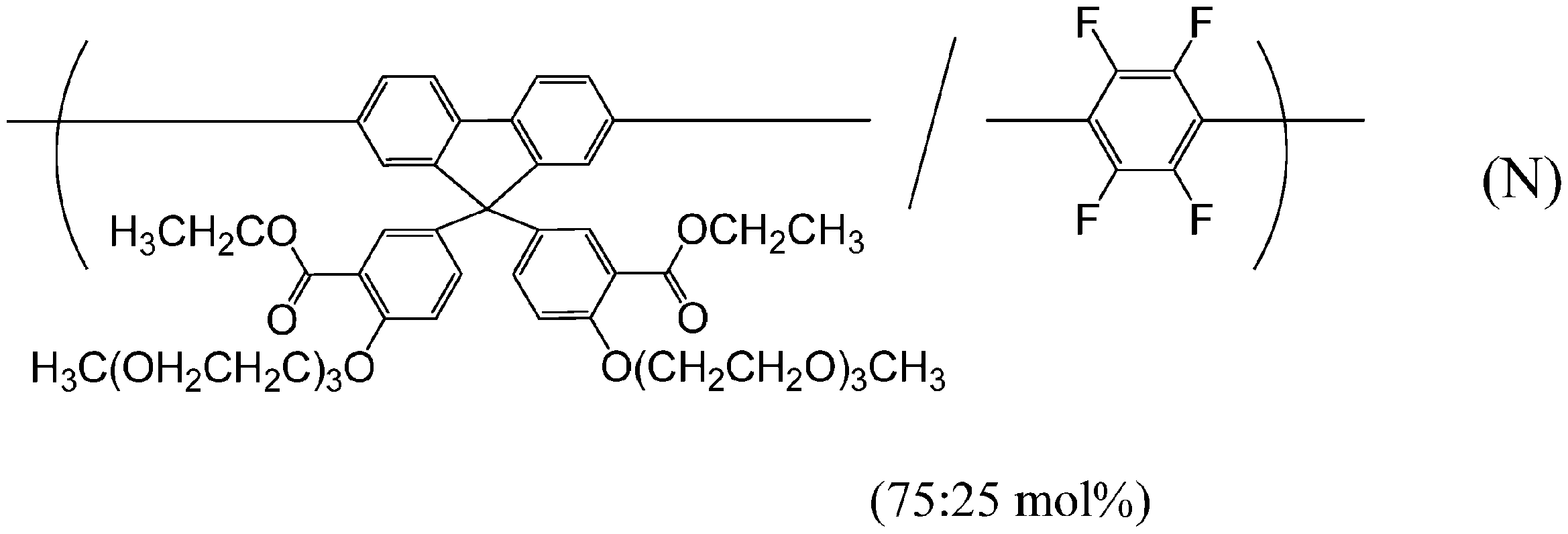
[実験例9]
重合体Fセシウム塩の合成
重合体F(150mg)を100mLフラスコに入れ、窒素置換した。テトラヒドロフラン(10mL)、及びメタノール(5mL)を混合した。混合溶液に、水酸化セシウム(260mg)を水(2mL)に溶解させた水溶液を添加し、65℃で2時間撹拌した。反応溶液にメタノール10mLを加え、さらに65℃で5時間攪拌した。混合物を室温まで冷却した後、反応溶媒を減圧留去した。生じた固体を水で洗浄し、減圧乾燥させることで薄黄色の固体(130mg)を得た。NMRスペクトルにより、重合体E内のエチルエステル部位のエチル基由来のシグナルが完全に消失していることを確認した。得られた重合体Fのセシウム塩を共役高分子化合物9と呼ぶ。共役高分子化合物9は式(O)で表される繰り返し単位からなる(「全繰り返し単位中の、式(1)で表される基及び式(2)で表される基からなる群から選ばれる1種以上の基と式(3)で表される1種以上の基とを含む繰り返し単位の割合」及び「全繰り返し単位中の、式(13)、(15)、(17)、(20)で表される繰り返し単位の割合」は、75モル%である。)。共役高分子化合物9のHOMOの軌道エネルギーは-5.9eV、LUMOの軌道エネルギーは-2.8eVであった。
重合体Fセシウム塩の合成
重合体F(150mg)を100mLフラスコに入れ、窒素置換した。テトラヒドロフラン(10mL)、及びメタノール(5mL)を混合した。混合溶液に、水酸化セシウム(260mg)を水(2mL)に溶解させた水溶液を添加し、65℃で2時間撹拌した。反応溶液にメタノール10mLを加え、さらに65℃で5時間攪拌した。混合物を室温まで冷却した後、反応溶媒を減圧留去した。生じた固体を水で洗浄し、減圧乾燥させることで薄黄色の固体(130mg)を得た。NMRスペクトルにより、重合体E内のエチルエステル部位のエチル基由来のシグナルが完全に消失していることを確認した。得られた重合体Fのセシウム塩を共役高分子化合物9と呼ぶ。共役高分子化合物9は式(O)で表される繰り返し単位からなる(「全繰り返し単位中の、式(1)で表される基及び式(2)で表される基からなる群から選ばれる1種以上の基と式(3)で表される1種以上の基とを含む繰り返し単位の割合」及び「全繰り返し単位中の、式(13)、(15)、(17)、(20)で表される繰り返し単位の割合」は、75モル%である。)。共役高分子化合物9のHOMOの軌道エネルギーは-5.9eV、LUMOの軌道エネルギーは-2.8eVであった。

[参考例9]
不活性雰囲気下、2-[2-(2-メトキシエトキシ)エトキシ]-p-トルエンスルホネート(11.0g)、トリエチレングリコール(30.0g)、水酸化カリウム(3.3g)を混合し、100℃で18時間加熱攪拌した。放冷後、反応溶液を水(100mL)に加え、クロロホルムで分液抽出を行い、溶液を濃縮した。濃縮した溶液を、クーゲルロワー蒸留(10mmTorr、180℃)することで、2-(2-(2-(2-(2-(2-メトキシエトキシ)-エトキシ)-エトキシ)-エトキシ)-エトキシ)エタノール(6.1g)を得た。
不活性雰囲気下、2-[2-(2-メトキシエトキシ)エトキシ]-p-トルエンスルホネート(11.0g)、トリエチレングリコール(30.0g)、水酸化カリウム(3.3g)を混合し、100℃で18時間加熱攪拌した。放冷後、反応溶液を水(100mL)に加え、クロロホルムで分液抽出を行い、溶液を濃縮した。濃縮した溶液を、クーゲルロワー蒸留(10mmTorr、180℃)することで、2-(2-(2-(2-(2-(2-メトキシエトキシ)-エトキシ)-エトキシ)-エトキシ)-エトキシ)エタノール(6.1g)を得た。
[参考例10]
不活性雰囲気下、2-(2-(2-(2-(2-(2-メトキシエトキシ)-エトキシ)-エトキシ)-エトキシ)-エトキシ)エタノール(8.0g)、水酸化ナトリウム(1.4g)、蒸留水(2mL)、テトラヒドロフラン(2mL)を混合し、氷冷した。混合溶液に、p-トシルクロリド(5.5g)のテトラヒドロフラン(6.4mL)溶液を30分かけて滴下し、滴下後反応溶液を室温に上げて15時間攪拌した。反応溶液に蒸留水(50mL)を加え、6M硫酸で反応溶液を中和した後、クロロホルムで分液抽出を行った。溶液を濃縮することで、2-(2-(2-(2-(2-(2-メトキシエトキシ)-エトキシ)-エトキシ)-エトキシ)-エトキシ)p-トルエンスルホネート(11.8g)を得た。
不活性雰囲気下、2-(2-(2-(2-(2-(2-メトキシエトキシ)-エトキシ)-エトキシ)-エトキシ)-エトキシ)エタノール(8.0g)、水酸化ナトリウム(1.4g)、蒸留水(2mL)、テトラヒドロフラン(2mL)を混合し、氷冷した。混合溶液に、p-トシルクロリド(5.5g)のテトラヒドロフラン(6.4mL)溶液を30分かけて滴下し、滴下後反応溶液を室温に上げて15時間攪拌した。反応溶液に蒸留水(50mL)を加え、6M硫酸で反応溶液を中和した後、クロロホルムで分液抽出を行った。溶液を濃縮することで、2-(2-(2-(2-(2-(2-メトキシエトキシ)-エトキシ)-エトキシ)-エトキシ)-エトキシ)p-トルエンスルホネート(11.8g)を得た。
[参考例11]
2,7-ジブロモ-9,9-ビス[3-エトキシカルボニル-4-[2-(2-(2-(2-(2-(2-メトキシエトキシ)-エトキシ)-エトキシ)-エトキシ)-エトキシ)エトキシ]フェニル]-フルオレン(化合物C)の合成
2,7-ジブロモ-9-フルオレノン(127.2g)、サリチル酸エチル(375.2g)、及びメルカプト酢酸(3.5g)を300mLフラスコに入れ、窒素置換した。そこに、メタンスルホン酸(1420mL)を添加し、混合物を75℃で終夜撹拌した。混合物を放冷し、氷水に添加して1時間撹拌した。生じた固体をろ別し、加熱したアセトニトリルで洗浄した。洗浄済みの該固体をアセトンに溶解させ、得られたアセトン溶液から固体を再結晶させ、ろ別し固体(167.8g)を得た。得られた固体(5g)、2-(2-(2-(2-(2-(2-メトキシエトキシ)-エトキシ)-エトキシ)-エトキシ)-エトキシ)p-トルエンスルホネート(10.4g)、炭酸カリウム(5.3g)、及び18-クラウン-6(0.6g)をN、N-ジメチルホルムアミド(DMF)(100mL)に溶解させ、溶液をフラスコへ移して105℃で4時間撹拌した。得られた混合物を室温まで放冷し、氷水へ加え、1時間撹拌した。反応液にクロロホルム(300mL)を加えて分液抽出を行い、溶液を濃縮した。濃縮物を酢酸エチルに溶解させ、アルミナのカラムに通液し、溶液を濃縮することで、2,7-ジブロモ-9,9-ビス[3-エトキシカルボニル-4-[2-(2-(2-(2-(2-(2-メトキシエトキシ)-エトキシ)-エトキシ)-エトキシ)-エトキシ)エトキシ]フェニル]-フルオレン(化合物C)(4.5g)を得た。
2,7-ジブロモ-9,9-ビス[3-エトキシカルボニル-4-[2-(2-(2-(2-(2-(2-メトキシエトキシ)-エトキシ)-エトキシ)-エトキシ)-エトキシ)エトキシ]フェニル]-フルオレン(化合物C)の合成
2,7-ジブロモ-9-フルオレノン(127.2g)、サリチル酸エチル(375.2g)、及びメルカプト酢酸(3.5g)を300mLフラスコに入れ、窒素置換した。そこに、メタンスルホン酸(1420mL)を添加し、混合物を75℃で終夜撹拌した。混合物を放冷し、氷水に添加して1時間撹拌した。生じた固体をろ別し、加熱したアセトニトリルで洗浄した。洗浄済みの該固体をアセトンに溶解させ、得られたアセトン溶液から固体を再結晶させ、ろ別し固体(167.8g)を得た。得られた固体(5g)、2-(2-(2-(2-(2-(2-メトキシエトキシ)-エトキシ)-エトキシ)-エトキシ)-エトキシ)p-トルエンスルホネート(10.4g)、炭酸カリウム(5.3g)、及び18-クラウン-6(0.6g)をN、N-ジメチルホルムアミド(DMF)(100mL)に溶解させ、溶液をフラスコへ移して105℃で4時間撹拌した。得られた混合物を室温まで放冷し、氷水へ加え、1時間撹拌した。反応液にクロロホルム(300mL)を加えて分液抽出を行い、溶液を濃縮した。濃縮物を酢酸エチルに溶解させ、アルミナのカラムに通液し、溶液を濃縮することで、2,7-ジブロモ-9,9-ビス[3-エトキシカルボニル-4-[2-(2-(2-(2-(2-(2-メトキシエトキシ)-エトキシ)-エトキシ)-エトキシ)-エトキシ)エトキシ]フェニル]-フルオレン(化合物C)(4.5g)を得た。
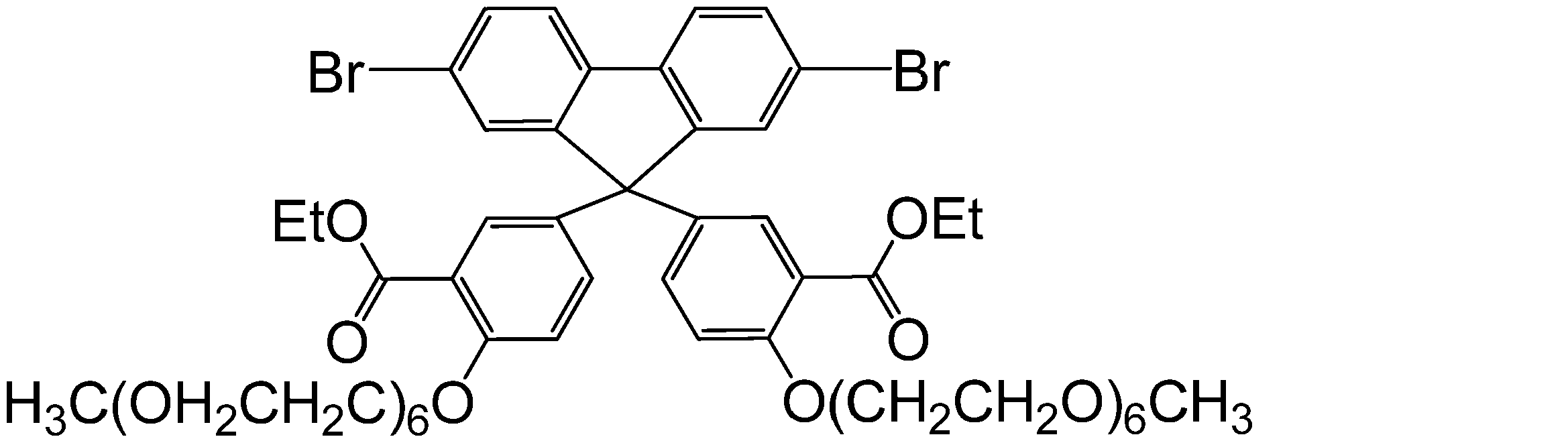
[参考例12]
重合体Gの合成
不活性雰囲気下、化合物C(1.0g)、4-t-ブチルフェニルブロミド(0.9mg)、2,2‘-ビピリジン(0.3g)、脱水テトラヒドロフラン(50mL)を200mLフラスコに入れ混合した。混合物を55℃に昇温した後、ビス(1,5-シクロオクタジエン)ニッケル(0.6g)を添加し、55℃で5時間撹拌した。混合物を室温まで冷却した後、反応溶液をメタノール(200mL)、1N希塩酸(200mL)の混合液に滴下した。生じた沈殿物をろ過により収集した後、テトラヒドロフランに再溶解させた。メタノール(200mL)、15%アンモニア水(100mL)の混合液に滴下し、生じた沈殿物をろ過により収集した。沈殿物をテトラヒドロフランに再溶解させ、メタノール(200mL)、水(100mL)の混合液に滴下し、生じた沈殿物をろ過により収集した。収集した沈殿物を減圧乾燥することで重合体G(360mg)を得た。
重合体Gのポリスチレン換算の数平均分子量は6.0×10⁴であった。重合体Gは、式(P)で表される繰り返し単位からなる。
重合体Gの合成
不活性雰囲気下、化合物C(1.0g)、4-t-ブチルフェニルブロミド(0.9mg)、2,2‘-ビピリジン(0.3g)、脱水テトラヒドロフラン(50mL)を200mLフラスコに入れ混合した。混合物を55℃に昇温した後、ビス(1,5-シクロオクタジエン)ニッケル(0.6g)を添加し、55℃で5時間撹拌した。混合物を室温まで冷却した後、反応溶液をメタノール(200mL)、1N希塩酸(200mL)の混合液に滴下した。生じた沈殿物をろ過により収集した後、テトラヒドロフランに再溶解させた。メタノール(200mL)、15%アンモニア水(100mL)の混合液に滴下し、生じた沈殿物をろ過により収集した。沈殿物をテトラヒドロフランに再溶解させ、メタノール(200mL)、水(100mL)の混合液に滴下し、生じた沈殿物をろ過により収集した。収集した沈殿物を減圧乾燥することで重合体G(360mg)を得た。
重合体Gのポリスチレン換算の数平均分子量は6.0×10⁴であった。重合体Gは、式(P)で表される繰り返し単位からなる。
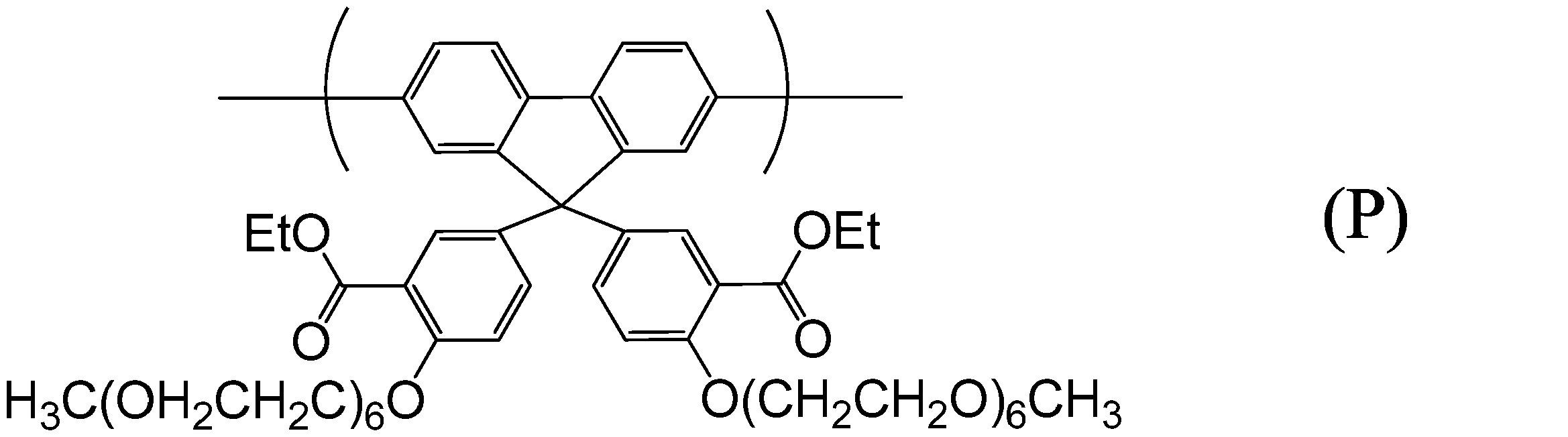
[実験例10]
重合体Gセシウム塩の合成
重合体G(150mg)を100mLフラスコに入れ、窒素置換した。テトラヒドロフラン(15mL)、及びメタノール(5mL)を混合した。混合溶液に、水酸化セシウム(170mg)を水(2mL)に溶解させた水溶液を添加し、65℃で6時間撹拌した。混合物を室温まで冷却した後、反応溶媒を減圧留去した。生じた固体を水で洗浄し、減圧乾燥させることで薄黄色の固体(95)mg)を得た。NMRスペクトルにより、重合体G内のエチルエステル部位のエチル基由来のシグナルが完全に消失していることを確認した。得られた重合体Gのセシウム塩を共役高分子化合物10と呼ぶ。共役高分子化合物10は式(Q)で表される繰り返し単位からなる(「全繰り返し単位中の、式(1)で表される基及び式(2)で表される基からなる群から選ばれる1種以上の基と式(3)で表される1種以上の基とを含む繰り返し単位の割合」及び「全繰り返し単位中の、式(13)、(15)、(17)、(20)で表される繰り返し単位の割合」は、100モル%である。)。共役高分子化合物10のHOMOの軌道エネルギーは-5.7eV、LUMOの軌道エネルギーは-2.9eVであった。
重合体Gセシウム塩の合成
重合体G(150mg)を100mLフラスコに入れ、窒素置換した。テトラヒドロフラン(15mL)、及びメタノール(5mL)を混合した。混合溶液に、水酸化セシウム(170mg)を水(2mL)に溶解させた水溶液を添加し、65℃で6時間撹拌した。混合物を室温まで冷却した後、反応溶媒を減圧留去した。生じた固体を水で洗浄し、減圧乾燥させることで薄黄色の固体(95)mg)を得た。NMRスペクトルにより、重合体G内のエチルエステル部位のエチル基由来のシグナルが完全に消失していることを確認した。得られた重合体Gのセシウム塩を共役高分子化合物10と呼ぶ。共役高分子化合物10は式(Q)で表される繰り返し単位からなる(「全繰り返し単位中の、式(1)で表される基及び式(2)で表される基からなる群から選ばれる1種以上の基と式(3)で表される1種以上の基とを含む繰り返し単位の割合」及び「全繰り返し単位中の、式(13)、(15)、(17)、(20)で表される繰り返し単位の割合」は、100モル%である。)。共役高分子化合物10のHOMOの軌道エネルギーは-5.7eV、LUMOの軌道エネルギーは-2.9eVであった。

[参考例13]
1,3-ジブロモ-5-エトキシカルボニル-6-[2-[2-(2-メトキシエトキシ)エトキシ]エトキシ]ベンゼンの合成
不活性雰囲気下、3,5-ジブロモサリチル酸(20g)、エタノール(17mL)、濃硫酸(1.5mL)、トルエン(7mL)を混合し、130℃で20時間加熱攪拌した。放冷後、反応溶液を氷水(100mL)に加え、クロロホルムで分液抽出を行い、溶液を濃縮した。得られた固体を、イソプロパノールに溶解し、溶液を蒸留水に滴下した。得られた析出物をろ別することにより、固体(18g)を得た。不活性雰囲気下、得られた固体(1g)、2-[2-(2-メトキシエトキシ)エトキシ]-p-トルエンスルホネート(1.5g)、炭酸カリウム(0.7g)、DMF(15mL)を混合し、100℃で4時間加熱攪拌した。放冷後、クロロホルムを加えて分液抽出し、溶液を濃縮した。濃縮物をクロロホルムに溶解させ、シリカゲルカラムに通液することにより精製した。溶液を濃縮することにより、1,3-ジブロモ-5-エトキシカルボニル-6-[2-[2-(2-メトキシエトキシ)エトキシ]エトキシ]ベンゼン(1.0g)を得た。
1,3-ジブロモ-5-エトキシカルボニル-6-[2-[2-(2-メトキシエトキシ)エトキシ]エトキシ]ベンゼンの合成
不活性雰囲気下、3,5-ジブロモサリチル酸(20g)、エタノール(17mL)、濃硫酸(1.5mL)、トルエン(7mL)を混合し、130℃で20時間加熱攪拌した。放冷後、反応溶液を氷水(100mL)に加え、クロロホルムで分液抽出を行い、溶液を濃縮した。得られた固体を、イソプロパノールに溶解し、溶液を蒸留水に滴下した。得られた析出物をろ別することにより、固体(18g)を得た。不活性雰囲気下、得られた固体(1g)、2-[2-(2-メトキシエトキシ)エトキシ]-p-トルエンスルホネート(1.5g)、炭酸カリウム(0.7g)、DMF(15mL)を混合し、100℃で4時間加熱攪拌した。放冷後、クロロホルムを加えて分液抽出し、溶液を濃縮した。濃縮物をクロロホルムに溶解させ、シリカゲルカラムに通液することにより精製した。溶液を濃縮することにより、1,3-ジブロモ-5-エトキシカルボニル-6-[2-[2-(2-メトキシエトキシ)エトキシ]エトキシ]ベンゼン(1.0g)を得た。
[参考例14]
重合体Hの合成
不活性雰囲気下、化合物A(0.2g)、化合物B(0.5g)、1,3-ジブロモ-5-エトキシカルボニル-6-[2-[2-(2-メトキシエトキシ)エトキシ]エトキシ]ベンゼン(0.1g)、トリフェニルホスフィンパラジウム(30mg)、テトラブチルアンモニウムブロミド(4mg)、及びトルエン(19mL)を混合し、105℃に加熱した。この反応液に2M 炭酸ナトリウム水溶液(5mL)を滴下し、5時間還流させた。反応液にフェニルボロン酸(6mg)を加え、14時間還流させた。次いで、ジエチルジチアカルバミン酸ナトリウム水溶液(10mL、濃度:0.05g/mL)を加え、2時間撹拌した。水層を除去して有機層を蒸留水で洗浄し、濃縮して得られた固体をクロロホルムに溶解させ、アルミナカラム、シリカゲルカラムを通すことにより精製した。カラムからの溶出液を濃縮して乾燥させた。得られた重合体Hの収量は0.44gであった。
重合体Hの合成
不活性雰囲気下、化合物A(0.2g)、化合物B(0.5g)、1,3-ジブロモ-5-エトキシカルボニル-6-[2-[2-(2-メトキシエトキシ)エトキシ]エトキシ]ベンゼン(0.1g)、トリフェニルホスフィンパラジウム(30mg)、テトラブチルアンモニウムブロミド(4mg)、及びトルエン(19mL)を混合し、105℃に加熱した。この反応液に2M 炭酸ナトリウム水溶液(5mL)を滴下し、5時間還流させた。反応液にフェニルボロン酸(6mg)を加え、14時間還流させた。次いで、ジエチルジチアカルバミン酸ナトリウム水溶液(10mL、濃度:0.05g/mL)を加え、2時間撹拌した。水層を除去して有機層を蒸留水で洗浄し、濃縮して得られた固体をクロロホルムに溶解させ、アルミナカラム、シリカゲルカラムを通すことにより精製した。カラムからの溶出液を濃縮して乾燥させた。得られた重合体Hの収量は0.44gであった。
重合体Hのポリスチレン換算の数平均分子量は3.6×10⁴であった。重合体Hは、式(R)で表される繰り返し単位からなる。
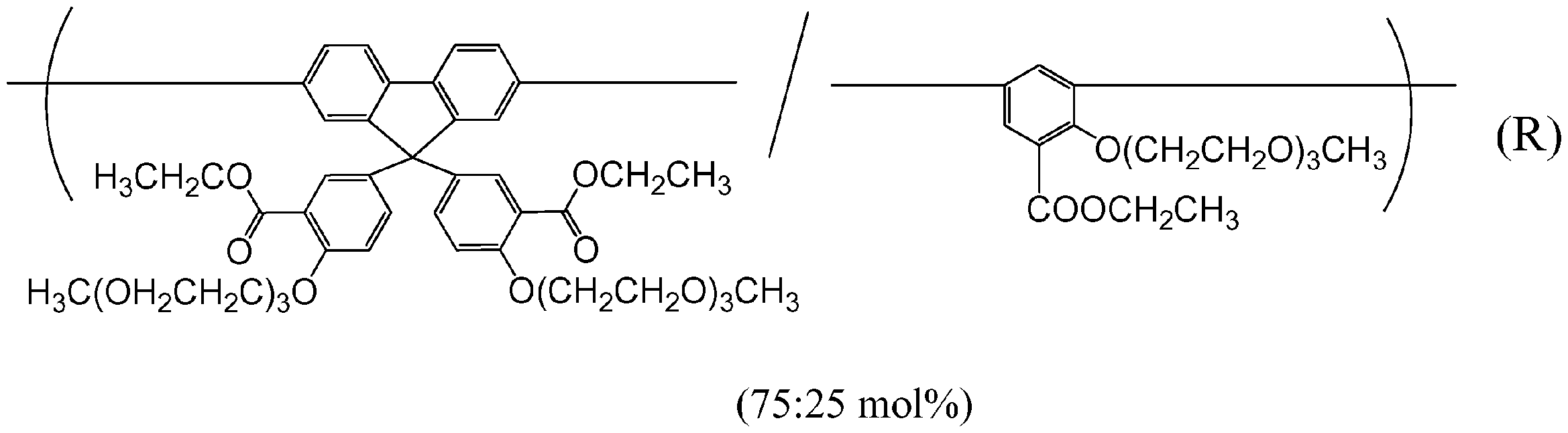
[実験例11]
重合体Hセシウム塩の合成
重合体H(200mg)を100mLフラスコに入れ、窒素置換した。テトラヒドロフラン(14mL)、及びメタノール(7mL)を添加し混合した。混合溶液に、水酸化セシウム(90mg)を水(1mL)に溶解させた水溶液を添加し、65℃で1時間撹拌した。反応溶液にメタノール5mLを加え、さらに65℃で4時間攪拌した。混合物を室温まで冷却した後、反応溶媒を減圧留去した。生じた固体を水で洗浄し、減圧乾燥させることで薄黄色の固体(190mg)を得た。NMRスペクトルにより、重合体H内のエチルエステル部位のエチル基由来のシグナルが完全に消失していることを確認した。得られた重合体Hのセシウム塩を共役高分子化合物11と呼ぶ。共役高分子化合物11は式(S)で表される繰り返し単位からなる(「全繰り返し単位中の、式(1)で表される基及び式(2)で表される基からなる群から選ばれる1種以上の基と式(3)で表される1種以上の基とを含む繰り返し単位の割合」及び「全繰り返し単位中の、式(13)、(15)、(17)、(20)で表される繰り返し単位の割合」は、100モル%である。)。共役高分子化合物11のHOMOの軌道エネルギーは-5.6eV、LUMOの軌道エネルギーは-2.8eVであった。
重合体Hセシウム塩の合成
重合体H(200mg)を100mLフラスコに入れ、窒素置換した。テトラヒドロフラン(14mL)、及びメタノール(7mL)を添加し混合した。混合溶液に、水酸化セシウム(90mg)を水(1mL)に溶解させた水溶液を添加し、65℃で1時間撹拌した。反応溶液にメタノール5mLを加え、さらに65℃で4時間攪拌した。混合物を室温まで冷却した後、反応溶媒を減圧留去した。生じた固体を水で洗浄し、減圧乾燥させることで薄黄色の固体(190mg)を得た。NMRスペクトルにより、重合体H内のエチルエステル部位のエチル基由来のシグナルが完全に消失していることを確認した。得られた重合体Hのセシウム塩を共役高分子化合物11と呼ぶ。共役高分子化合物11は式(S)で表される繰り返し単位からなる(「全繰り返し単位中の、式(1)で表される基及び式(2)で表される基からなる群から選ばれる1種以上の基と式(3)で表される1種以上の基とを含む繰り返し単位の割合」及び「全繰り返し単位中の、式(13)、(15)、(17)、(20)で表される繰り返し単位の割合」は、100モル%である。)。共役高分子化合物11のHOMOの軌道エネルギーは-5.6eV、LUMOの軌道エネルギーは-2.8eVであった。
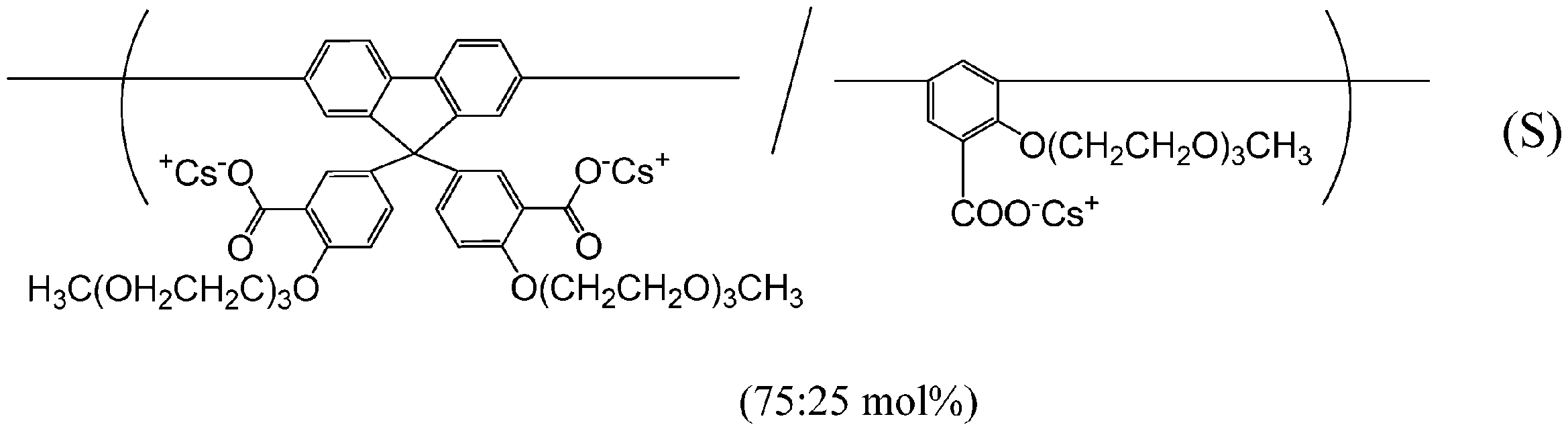
[参考例15]
2,7-ジブロモ-9,9-ビス[3,4-ビス[2-[2-(2-メトキシエトキシ)エトキシ]エトキシ]-5-メトキシカルボニルフェニル]フルオレン(化合物D)の合成
2,7-ジブロモ-9-フルオレノン(34.1g)、2,3-ジヒドロキシ安息香酸メチル(101.3g)、及びメルカプト酢酸(1.4g)を500mLフラスコに入れ、窒素置換した。そこに、メタンスルホン酸(350mL)を添加し、混合物を90℃で19時間撹拌した。混合物を放冷し、氷水に添加して1時間撹拌した。生じた固体をろ別し、加熱したアセトニトリルで洗浄した。洗浄済みの該固体をアセトンに溶解させ、得られたアセトン溶液から固体を再結晶させ、ろ別した。得られた固体(16.3g)、2-[2-(2-メトキシエトキシ)エトキシ]-p-トルエンスルホネート(60.3g)、炭酸カリウム(48.6g)、及び18-クラウン-6(2.4g)をN、N-ジメチルホルムアミド(DMF)(500mL)に溶解させ、溶液をフラスコへ移して110℃で15時間撹拌した。得られた混合物を室温まで放冷し、氷水へ加え、1時間撹拌した。反応液に酢酸エチル(300mL)を加えて分液抽出を行い、溶液を濃縮し、クロロホルム/メタノール(50/1(体積比))の混合溶媒に溶解させ、シリカゲルカラムを通すことにより精製した。カラムに通液した溶液を濃縮することで、2,7-ジブロモ-9,9-ビス[3,4-ビス[2-[2-(2-メトキシエトキシ)エトキシ]エトキシ]-5-メトキシカルボニルフェニル]フルオレン(化合物D)(20.5g)を得た。
2,7-ジブロモ-9,9-ビス[3,4-ビス[2-[2-(2-メトキシエトキシ)エトキシ]エトキシ]-5-メトキシカルボニルフェニル]フルオレン(化合物D)の合成
2,7-ジブロモ-9-フルオレノン(34.1g)、2,3-ジヒドロキシ安息香酸メチル(101.3g)、及びメルカプト酢酸(1.4g)を500mLフラスコに入れ、窒素置換した。そこに、メタンスルホン酸(350mL)を添加し、混合物を90℃で19時間撹拌した。混合物を放冷し、氷水に添加して1時間撹拌した。生じた固体をろ別し、加熱したアセトニトリルで洗浄した。洗浄済みの該固体をアセトンに溶解させ、得られたアセトン溶液から固体を再結晶させ、ろ別した。得られた固体(16.3g)、2-[2-(2-メトキシエトキシ)エトキシ]-p-トルエンスルホネート(60.3g)、炭酸カリウム(48.6g)、及び18-クラウン-6(2.4g)をN、N-ジメチルホルムアミド(DMF)(500mL)に溶解させ、溶液をフラスコへ移して110℃で15時間撹拌した。得られた混合物を室温まで放冷し、氷水へ加え、1時間撹拌した。反応液に酢酸エチル(300mL)を加えて分液抽出を行い、溶液を濃縮し、クロロホルム/メタノール(50/1(体積比))の混合溶媒に溶解させ、シリカゲルカラムを通すことにより精製した。カラムに通液した溶液を濃縮することで、2,7-ジブロモ-9,9-ビス[3,4-ビス[2-[2-(2-メトキシエトキシ)エトキシ]エトキシ]-5-メトキシカルボニルフェニル]フルオレン(化合物D)(20.5g)を得た。
[参考例16]
2,7-ビス[7-(4-メチルフェニル)-9,9-ジオクチルフルオレン-2-イル]-9,9-ビス[5-メトキシカルボニル-3,4-ビス[2-[2-(2-メトキシエトキシ)エトキシ]エトキシ]フェニル]-フルオレン(重合体I)の合成
不活性雰囲気下、化合物D(0.70g)、2-(4,4,5,5-テトラメチル-1,2,3-ジオキサボラン-2-イル)-9,9-ジオクチルフルオレン(0.62g)、トリフェニルホスフィンパラジウム(0.019g)、ジオキサン(40mL)、水(6mL)及び炭酸カリウム水溶液(1.38g)を混合し、80℃に加熱した。反応液を1時間反応させた。反応後、飽和ジエチルジチオカルバミン酸ナトリウム水5mLを添加して、30分間撹拌した後、有機溶媒を除去した。得られた固体をアルミナカラム(展開溶媒 ヘキサン:酢酸エチル=1:1(体積比))を通して精製を行い、溶液を濃縮することで、2,7-ビス[7-(4-メチルフェニル)-9,9-ジオクチルフルオレン-2-イル]-9,9-ビス[3-エトキシカルボニル-4-[2-[2-(2-メトキシエトキシ)エトキシ]エトキシ]フェニル]-フルオレン(重合体I)を660mg得た。
2,7-ビス[7-(4-メチルフェニル)-9,9-ジオクチルフルオレン-2-イル]-9,9-ビス[5-メトキシカルボニル-3,4-ビス[2-[2-(2-メトキシエトキシ)エトキシ]エトキシ]フェニル]-フルオレン(重合体I)の合成
不活性雰囲気下、化合物D(0.70g)、2-(4,4,5,5-テトラメチル-1,2,3-ジオキサボラン-2-イル)-9,9-ジオクチルフルオレン(0.62g)、トリフェニルホスフィンパラジウム(0.019g)、ジオキサン(40mL)、水(6mL)及び炭酸カリウム水溶液(1.38g)を混合し、80℃に加熱した。反応液を1時間反応させた。反応後、飽和ジエチルジチオカルバミン酸ナトリウム水5mLを添加して、30分間撹拌した後、有機溶媒を除去した。得られた固体をアルミナカラム(展開溶媒 ヘキサン:酢酸エチル=1:1(体積比))を通して精製を行い、溶液を濃縮することで、2,7-ビス[7-(4-メチルフェニル)-9,9-ジオクチルフルオレン-2-イル]-9,9-ビス[3-エトキシカルボニル-4-[2-[2-(2-メトキシエトキシ)エトキシ]エトキシ]フェニル]-フルオレン(重合体I)を660mg得た。
重合体Iのポリスチレン換算の数平均分子量は、2.0×10³であった。重合体Iは、式(T)で表される。なお、2-(4,4,5,5-テトラメチル-1,2,3-ジオキサボラン-2-イル)-9,9-ジオクチルフルオレンは、例えば特開2008-74017号公報に記載されている方法で合成することができる。
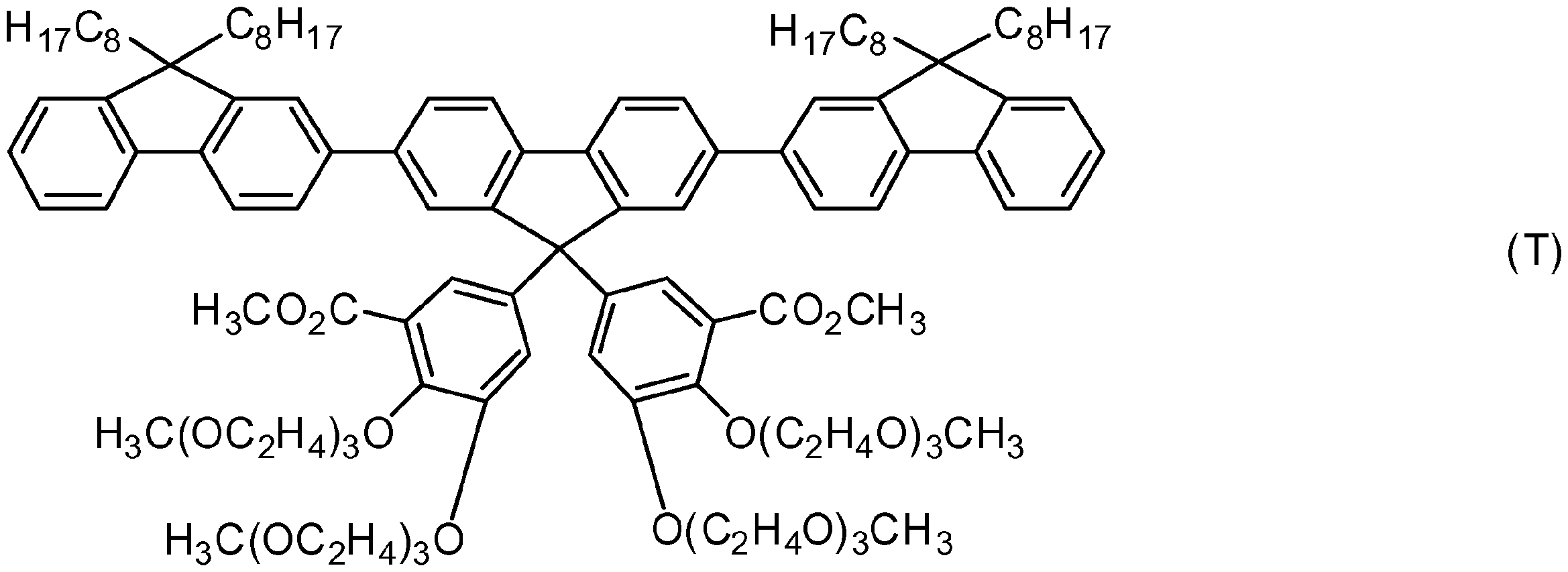
[実験例12]
重合体Iセシウム塩の合成
重合体I(236mg)を100mLフラスコに入れ、アルゴン置換した。そこに、テトラヒドロフラン(20mL)、及びメタノール(10mL)を添加し、混合物を65℃に昇温した。そこに、水酸化セシウム(240mg)を水(2mL)に溶かした水溶液を添加し、65℃で7時間撹拌した。得られた混合物を室温まで冷却した後、反応溶媒を減圧留去した。生じた固体を水で洗浄し、減圧乾燥させることで薄黄色の固体(190mg)を得た。NMRスペクトルにより、メチルエステル部位のメチル基由来のシグナルが完全に消失していることを確認した。得られた重合体Iセシウム塩を共役高分子化合物12と呼ぶ。共役高分子化合物12は、式(U)で表される(「全繰り返し単位中の、式(1)で表される基及び式(2)で表される基からなる群から選ばれる1種以上の基と式(3)で表される1種以上の基とを含む繰り返し単位の割合」及び「全繰り返し単位中の、式(13)、(15)、(17)、(20)で表される繰り返し単位の割合」は、小数第二位で四捨五入して、33.3モル%である。)。共役高分子化合物12のHOMOの軌道エネルギーは-5.6eVであり、LUMOの軌道エネルギーは-2.8eVであった。
重合体Iセシウム塩の合成
重合体I(236mg)を100mLフラスコに入れ、アルゴン置換した。そこに、テトラヒドロフラン(20mL)、及びメタノール(10mL)を添加し、混合物を65℃に昇温した。そこに、水酸化セシウム(240mg)を水(2mL)に溶かした水溶液を添加し、65℃で7時間撹拌した。得られた混合物を室温まで冷却した後、反応溶媒を減圧留去した。生じた固体を水で洗浄し、減圧乾燥させることで薄黄色の固体(190mg)を得た。NMRスペクトルにより、メチルエステル部位のメチル基由来のシグナルが完全に消失していることを確認した。得られた重合体Iセシウム塩を共役高分子化合物12と呼ぶ。共役高分子化合物12は、式(U)で表される(「全繰り返し単位中の、式(1)で表される基及び式(2)で表される基からなる群から選ばれる1種以上の基と式(3)で表される1種以上の基とを含む繰り返し単位の割合」及び「全繰り返し単位中の、式(13)、(15)、(17)、(20)で表される繰り返し単位の割合」は、小数第二位で四捨五入して、33.3モル%である。)。共役高分子化合物12のHOMOの軌道エネルギーは-5.6eVであり、LUMOの軌道エネルギーは-2.8eVであった。

1,1a,1b,1c,1d…第1の電極、2,2a,2b,2c,2d…第2の電極、3,3a,3b,3c,3d…取出し電極、4…発光ユニット、5a,5b,5c,5d…正孔注入層、6a,6b,6c,6d…正孔輸送層、7a,7b,7c,7d…発光層、8a,8b,8c,8d…電子注入層、9a,9b,9c…陰極と同じ材料の導電性薄膜、10a,10b,10d…陽極と同じ材料の導電性薄膜、11…駆動回路。
Claims (8)
- 第1の電極と、
第2の電極と、
前記第1の電極と前記第2の電極との間に配置された1又は複数の取出し電極と、
前記第1の電極、前記取出し電極及び前記第2の電極のうちの互いに隣り合う電極間にそれぞれ配置され、電子注入層と発光層とを有する複数の発光ユニットと、を備え、
前記電子注入層はイオン性ポリマーを含む、有機EL素子。 - 前記取出し電極を介して隣り合う一対の前記発光ユニットは、一方の前記発光ユニットにおける前記第1の電極を基準とする発光層と電子注入層との積層の順序が、他方の前記発光ユニットにおける発光層と電子注入層との積層の順序と異なる、請求項1記載の有機EL素子。
- 互いに異なる発光ユニットに設けられる一対の発光層が、互いに異なる色の光を放射する、請求項1又は2記載の有機EL素子。
- 互いに異なる発光ユニットに設けられる一対の発光層が、同じ色の光を放射する、請求項1又は2記載の有機EL素子。
- 請求項1~4のいずれか一項に記載の有機EL素子を備える照明装置。
- 請求項1~4のいずれか一項に記載の有機EL素子を備える表示装置。
- 第1の電極と、第2の電極と、前記第1の電極と前記第2の電極との間に配置された1又は複数の取出し電極と、前記第1の電極、前記取出し電極及び前記第2の電極のうちの互いに隣り合う電極間にそれぞれ配置され、電子注入層と発光層とを有する複数の発光ユニットと、を備える有機EL素子の製造方法であって、
イオン性ポリマーを含む塗布液を成膜して前記電子注入層を形成する工程と、
前記電子注入層を形成する前又は前記電子注入層を形成した後に、前記発光層を形成する工程と、備える有機EL素子の製造方法。 - 前記イオン性ポリマーを含む塗布液を、窒素の体積比が90%以下、かつ酸素の体積比が10%以上30%以下の雰囲気で塗布する、請求項7記載の有機EL素子の製造方法。
Applications Claiming Priority (2)
| Application Number | Priority Date | Filing Date | Title |
|---|---|---|---|
| JP2011063712A JP5899635B2 (ja) | 2011-03-23 | 2011-03-23 | 有機el素子 |
| JP2011-063712 | 2011-03-23 |
Publications (1)
| Publication Number | Publication Date |
|---|---|
| WO2012128334A1 true WO2012128334A1 (ja) | 2012-09-27 |
Family
ID=46879474
Family Applications (1)
| Application Number | Title | Priority Date | Filing Date |
|---|---|---|---|
| PCT/JP2012/057400 Ceased WO2012128334A1 (ja) | 2011-03-23 | 2012-03-22 | 有機el素子 |
Country Status (3)
| Country | Link |
|---|---|
| JP (1) | JP5899635B2 (ja) |
| TW (1) | TW201302838A (ja) |
| WO (1) | WO2012128334A1 (ja) |
Families Citing this family (3)
| Publication number | Priority date | Publication date | Assignee | Title |
|---|---|---|---|---|
| US9899598B2 (en) * | 2013-05-01 | 2018-02-20 | Konica Minolta, Inc. | Organic electroluminescent element |
| JP2015103735A (ja) * | 2013-11-27 | 2015-06-04 | ソニー株式会社 | 固体撮像素子および電子機器 |
| JP7011583B2 (ja) * | 2016-05-31 | 2022-01-26 | メルク パテント ゲーエムベーハー | 外科用手術器具 |
Citations (5)
| Publication number | Priority date | Publication date | Assignee | Title |
|---|---|---|---|---|
| JP2005531106A (ja) * | 2002-05-29 | 2005-10-13 | オーストリア ヴィルトシャフツサービス ゲゼルシャフト エム ベー ハー | 発行部品 |
| JP2006332049A (ja) * | 2005-05-20 | 2006-12-07 | Lg Phillips Lcd Co Ltd | 積層型oled構造 |
| JP2007123257A (ja) * | 2005-09-27 | 2007-05-17 | Mitsubishi Chemicals Corp | 有機電界発光素子の製造方法 |
| JP2009239279A (ja) * | 2008-03-07 | 2009-10-15 | Sumitomo Chemical Co Ltd | 積層構造体 |
| JP2010033984A (ja) * | 2008-07-31 | 2010-02-12 | Canon Inc | 有機発光装置 |
-
2011
- 2011-03-23 JP JP2011063712A patent/JP5899635B2/ja not_active Expired - Fee Related
-
2012
- 2012-03-22 WO PCT/JP2012/057400 patent/WO2012128334A1/ja not_active Ceased
- 2012-03-23 TW TW101110060A patent/TW201302838A/zh unknown
Patent Citations (5)
| Publication number | Priority date | Publication date | Assignee | Title |
|---|---|---|---|---|
| JP2005531106A (ja) * | 2002-05-29 | 2005-10-13 | オーストリア ヴィルトシャフツサービス ゲゼルシャフト エム ベー ハー | 発行部品 |
| JP2006332049A (ja) * | 2005-05-20 | 2006-12-07 | Lg Phillips Lcd Co Ltd | 積層型oled構造 |
| JP2007123257A (ja) * | 2005-09-27 | 2007-05-17 | Mitsubishi Chemicals Corp | 有機電界発光素子の製造方法 |
| JP2009239279A (ja) * | 2008-03-07 | 2009-10-15 | Sumitomo Chemical Co Ltd | 積層構造体 |
| JP2010033984A (ja) * | 2008-07-31 | 2010-02-12 | Canon Inc | 有機発光装置 |
Also Published As
| Publication number | Publication date |
|---|---|
| JP5899635B2 (ja) | 2016-04-06 |
| JP2012199177A (ja) | 2012-10-18 |
| TW201302838A (zh) | 2013-01-16 |
Similar Documents
| Publication | Publication Date | Title |
|---|---|---|
| JP5653122B2 (ja) | 有機エレクトロルミネッセンス素子およびその製造方法 | |
| JP5752381B2 (ja) | 積層構造体、重合体、電界発光素子及び光電変換素子 | |
| JP5514458B2 (ja) | 積層構造体 | |
| JP5862086B2 (ja) | 有機el素子の製造方法 | |
| JP5982747B2 (ja) | 有機el素子 | |
| WO2012133465A1 (ja) | 電子デバイス、高分子化合物、有機化合物及び高分子化合物の製造方法 | |
| JP2012216811A (ja) | 電子デバイス及び高分子化合物 | |
| WO2012133381A1 (ja) | 電子デバイス、高分子化合物 | |
| WO2012011418A1 (ja) | 有機発光装置の製造方法及び有機発光装置 | |
| WO2012133462A1 (ja) | 電子デバイス、高分子化合物 | |
| JP5863307B2 (ja) | 有機エレクトロルミネッセンス素子の製造方法 | |
| JP2012084306A (ja) | 有機el装置 | |
| CN103385036B (zh) | 有机电致发光元件的制造方法 | |
| JP5899635B2 (ja) | 有機el素子 | |
| JP2012044160A (ja) | 有機エレクトロルミネッセンスディスプレイ装置の製造方法及び有機エレクトロルミネッセンスディスプレイ装置 | |
| JP2012043782A (ja) | 有機エレクトロルミネッセンスディスプレイ装置の製造方法及び有機エレクトロルミネッセンスディスプレイ装置 | |
| WO2012070575A1 (ja) | 発光装置及び発光装置の製造方法 |
Legal Events
| Date | Code | Title | Description |
|---|---|---|---|
| 121 | Ep: the epo has been informed by wipo that ep was designated in this application |
Ref document number: 12760876 Country of ref document: EP Kind code of ref document: A1 |
|
| NENP | Non-entry into the national phase |
Ref country code: DE |
|
| 122 | Ep: pct application non-entry in european phase |
Ref document number: 12760876 Country of ref document: EP Kind code of ref document: A1 |