WO2012115238A1 - 尿臭発生部の視覚的判定方法 - Google Patents
尿臭発生部の視覚的判定方法 Download PDFInfo
- Publication number
- WO2012115238A1 WO2012115238A1 PCT/JP2012/054609 JP2012054609W WO2012115238A1 WO 2012115238 A1 WO2012115238 A1 WO 2012115238A1 JP 2012054609 W JP2012054609 W JP 2012054609W WO 2012115238 A1 WO2012115238 A1 WO 2012115238A1
- Authority
- WO
- WIPO (PCT)
- Prior art keywords
- urine
- urine odor
- liquid agent
- color
- detection reagent
- Prior art date
- Legal status (The legal status is an assumption and is not a legal conclusion. Google has not performed a legal analysis and makes no representation as to the accuracy of the status listed.)
- Ceased
Links
Images



Classifications
-
- G—PHYSICS
- G01—MEASURING; TESTING
- G01N—INVESTIGATING OR ANALYSING MATERIALS BY DETERMINING THEIR CHEMICAL OR PHYSICAL PROPERTIES
- G01N21/00—Investigating or analysing materials by the use of optical means, i.e. using sub-millimetre waves, infrared, visible or ultraviolet light
- G01N21/75—Systems in which material is subjected to a chemical reaction, the progress or the result of the reaction being investigated
- G01N21/77—Systems in which material is subjected to a chemical reaction, the progress or the result of the reaction being investigated by observing the effect on a chemical indicator
- G01N21/78—Systems in which material is subjected to a chemical reaction, the progress or the result of the reaction being investigated by observing the effect on a chemical indicator producing a change of colour
-
- C—CHEMISTRY; METALLURGY
- C12—BIOCHEMISTRY; BEER; SPIRITS; WINE; VINEGAR; MICROBIOLOGY; ENZYMOLOGY; MUTATION OR GENETIC ENGINEERING
- C12Q—MEASURING OR TESTING PROCESSES INVOLVING ENZYMES, NUCLEIC ACIDS OR MICROORGANISMS; COMPOSITIONS OR TEST PAPERS THEREFOR; PROCESSES OF PREPARING SUCH COMPOSITIONS; CONDITION-RESPONSIVE CONTROL IN MICROBIOLOGICAL OR ENZYMOLOGICAL PROCESSES
- C12Q1/00—Measuring or testing processes involving enzymes, nucleic acids or microorganisms; Compositions therefor; Processes of preparing such compositions
- C12Q1/34—Measuring or testing processes involving enzymes, nucleic acids or microorganisms; Compositions therefor; Processes of preparing such compositions involving hydrolase
-
- C—CHEMISTRY; METALLURGY
- C12—BIOCHEMISTRY; BEER; SPIRITS; WINE; VINEGAR; MICROBIOLOGY; ENZYMOLOGY; MUTATION OR GENETIC ENGINEERING
- C12Q—MEASURING OR TESTING PROCESSES INVOLVING ENZYMES, NUCLEIC ACIDS OR MICROORGANISMS; COMPOSITIONS OR TEST PAPERS THEREFOR; PROCESSES OF PREPARING SUCH COMPOSITIONS; CONDITION-RESPONSIVE CONTROL IN MICROBIOLOGICAL OR ENZYMOLOGICAL PROCESSES
- C12Q1/00—Measuring or testing processes involving enzymes, nucleic acids or microorganisms; Compositions therefor; Processes of preparing such compositions
- C12Q1/34—Measuring or testing processes involving enzymes, nucleic acids or microorganisms; Compositions therefor; Processes of preparing such compositions involving hydrolase
- C12Q1/44—Measuring or testing processes involving enzymes, nucleic acids or microorganisms; Compositions therefor; Processes of preparing such compositions involving hydrolase involving esterase
-
- G—PHYSICS
- G01—MEASURING; TESTING
- G01N—INVESTIGATING OR ANALYSING MATERIALS BY DETERMINING THEIR CHEMICAL OR PHYSICAL PROPERTIES
- G01N21/00—Investigating or analysing materials by the use of optical means, i.e. using sub-millimetre waves, infrared, visible or ultraviolet light
- G01N21/62—Systems in which the material investigated is excited whereby it emits light or causes a change in wavelength of the incident light
- G01N21/63—Systems in which the material investigated is excited whereby it emits light or causes a change in wavelength of the incident light optically excited
- G01N21/64—Fluorescence; Phosphorescence
- G01N21/6428—Measuring fluorescence of fluorescent products of reactions or of fluorochrome labelled reactive substances, e.g. measuring quenching effects, using measuring "optrodes"
Definitions
- the present invention relates to a simple method for determining the urine odor generating part and the urine odor intensity, and further to an absorbent article excellent in urine odor production suppressing effect, a water-absorbing polymer, and a urine odor production inhibitor screening method to which this method is applied.
- the odor derived from urine has a particularly great discomfort given to humans among the bad odors of living environment.
- urine that remains on the outside of the toilet as a droplet may remain on the spot for a long time because it is difficult to visually confirm the presence of the urine, which may be a source of malodor.
- sanitary products such as underwear, diapers, and sanitary products may exist in the living environment for a certain period of time with urine attached, and can be a source of malodor originating from urine.
- the odor of urine immediately after urination is usually very weak, and most of the malodorous components derived from urine are generated with the passage of time due to decomposition of organic matter in urine by microbial enzymes. It is believed that. Deodorization and deodorization technology against such microorganism-derived malodors includes not only deodorants that physically or chemically remove malodorous components or perfumes that mask malodors, but also the generation of malodors from the beginning. It is proposed to use antibacterial agents against odor-causing microorganisms and enzyme inhibitors against causative enzymes (urease, ⁇ -glucuronidase, arylsulfatase, etc.).
- Patent Document 1 discloses sanitary products such as diapers containing an indicator sensitive to odors such as acid-base indicators. .
- Patent Document 2 discloses a technique for detecting the presence of microorganisms by detecting volatile components derived from bacteria by GC analysis or an indicator. According to this, for example, the presence of E. coli is confirmed by exposing cotton dyed with dimethylaminocinnamic aldehyde to a suspension of E. coli and discoloring the indicator by the indole produced by the cells.
- Patent Document 3 proposes a method for detecting bacteria associated with urinary tract infections including Escherichia coli using a medium containing a reagent for detecting substrate-type enzyme activity of ⁇ -glucuronidase or arylsulfatase.
- the specimen is added to the above-mentioned medium and cultured, and microorganisms are detected by visually observing the colony derived from the bacterial cell enzyme and / or the color of the medium.
- the present invention is a first step of applying a liquid agent containing component A to articles, equipment or materials that are subject to urine odor determination; A second step in which an enzymatic reaction is allowed to proceed with an article, facility or material to which the liquid is applied; Having a third step of observing a color change of the article, equipment or material to which the liquid is applied;
- the present invention provides a urine odor generating part that determines a color-changed area as a urine odor generating part, and associates the color change amount with the urine odor intensity, and a visual determination method of the urine odor intensity.
- Component A Enzyme substrate type enzyme activity detection reagent that produces a dye compound or a fluorescent dye compound that is hardly soluble in water by an enzyme reaction
- the present invention provides a urine for selecting an evaluation object with a small change in the color of the evaluation object due to an enzyme reaction by bringing a liquid agent containing component A into contact with a material, member or agent as an evaluation object of the urine odor production inhibitory effect.
- the present invention provides a material, a member, a urine odor generation inhibitor, or a member screening method that is excellent in the effect of suppressing odor generation.
- Component A Enzyme substrate type enzyme activity detection reagent that produces a dye compound or a fluorescent dye compound that is hardly soluble in water by an enzyme reaction
- FIG. 1 is a schematic diagram showing a micro test tube used in Example 1.
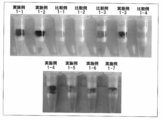
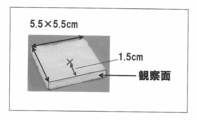
- FIG. 3 is a diagram illustrating a coloring state after a test in Example 1. It is a figure which shows the slice of the urine collection pad used in Example 2.
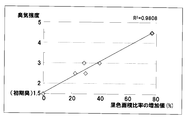
- FIG. It is a graph which shows the correlation of the odor intensity
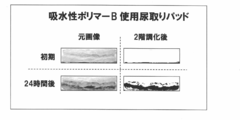
- 3 is an image of a urine absorption pad section using the water absorbent polymer B in Example 2.
- FIG. It is a figure which shows the image of each sample in Example 3, and an odor intensity
- FIG. 3 is a diagram illustrating a coloring state after a test in Example 1. It is a figure which shows the slice of the urine collection pad used
- the use of various agents such as deodorants, masking agents, antibacterial agents, enzyme inhibitors, etc. can be considered as deodorizing / deodorizing technology for urine odor.
- the position information of the urine odor generating part is very important.
- deodorizers such as antibacterial agents and enzyme inhibitors may be significantly less effective when the application site of the agent is removed from the odor generating part, and it can be said that application to the odor generating part is essential.
- the method for determining the urine odor generation part and the urine odor intensity is a technique that is strongly desired for optimizing the mixing part and the mixing amount of the deodorant / deodorant.
- the method of detecting the odor component itself with an indicator or GC analysis as in Patent Documents 1 and 2 specifies the odor generation part with high spatial resolution. Is very difficult.
- the method based on the culture in the medium as in Patent Document 3 can specify the odor generating part as the growth site of the microorganism, but it is necessary to finely divide the sample according to the required spatial resolution. Therefore, the operation becomes complicated, and it is difficult to specify the urine odor generating part in the same system as the product. Furthermore, since the observed enzyme activity is also expressed in the medium, there is no speculation about the relationship between the obtained results and the odor intensity.
- the present invention relates to a method for easily specifying the position of a urine odor generating portion that occurs with the passage of time from a subject to which urine has adhered, and has conducted extensive research on a method for visualizing positional information of the urine odor generating portion. As a result, the present invention has been completed.
- the determination method of the present invention is suitably used for visually determining the position of the urine odor generating portion and the urine odor intensity in an article (including its constituent members), equipment, or material that generates urine odor.
- the “article, facility or material generating urine odor” may be an article, facility or material in which urine odor is actually generated, and urine may be absorbed or adhered. A certain article, equipment, or material may be used.
- Such products include urine-absorbing pads, light incontinence products, diapers, sanitary products such as sanitary products, clothing such as underwear, skin, bedding, etc., and pet excrement-related products such as dogs and cats (for pets)
- Facilities include toilet environments such as toilets and toilet floors.
- materials constituting the article or equipment for example, water-absorbing polymer, pulp, nonwoven fabric, paper, cloth and other article materials, ceramics, hard resin, wood, pipes and other metals, or various wall materials, Equipment materials such as flooring are listed.
- the method of the present invention is an absorbent article such as a urine collection pad, a light incontinence article, a diaper, a sanitary article, and a pet urine absorbent sheet that is supposed to absorb and hold urine, and these It can be suitably used for the water-absorbing polymer, pulp, non-woven fabric and paper used in the present invention. More preferably, it can be used for urine absorbing pads, light incontinence products, diapers, urine absorbing sheets for pets, and water-absorbing polymers used in these.
- the water-absorbing polymer that is the subject of the present invention may be any hydrophilic polymer that is blended in the above-described product and plays a role of directly or secondaryly absorbing and retaining urine.
- the composition is not limited.
- a solution containing an enzyme activity detection reagent (component A) is used for the purpose of identifying / visualizing the urine odor generating part and the urine odor intensity.
- the enzyme activity detection reagent (component A) is not a detection indicator for a volatile component with high diffusion, but an enzyme substrate that can directly detect enzyme activity from the viewpoint of specifying a urine odor generating part with good spatial resolution.
- a type of enzyme activity detection reagent is used.
- the enzyme activity detection reagent (component A) used in the present invention generates a dye compound or a fluorescent dye compound by an enzymatic reaction.
- This dye compound or fluorescent dye compound is It is necessary that the diffusibility of the resin is low, that is, it is hardly soluble in water.
- the dye compound or fluorescent dye compound has a solubility in water at 20 ° C. of preferably less than 10 g / L, more preferably less than 6 g / L, even more preferably less than 0.5 g / L, and even more preferably 0.05 g. It is preferably less than / L.
- the enzyme activity detection reagent (component A) used in the present invention is uniformly distributed over the target article. For this reason, the enzyme activity detection reagent (component A) is used in the form of a solution. Therefore, it is preferable that the enzyme activity detection reagent (component A) has a high diffusibility in water before the enzyme reaction, that is, a higher solubility in water than a dye compound produced after the enzyme reaction.
- the compound produced by the enzyme reaction needs to be a compound having absorption in the visible region or a compound emitting fluorescence in the visible region, that is, a dye compound or a fluorescent dye compound.
- a dye compound having absorption in the visible region is more preferable from the viewpoint of easy detection.
- a dye compound having an absorption spectrum at 500 to 800 nm is preferable, and a color compound which exhibits a blue color is more preferable.
- the enzyme to be detected may be an enzyme produced by a microorganism causing urine odor, and examples thereof include glycosidase and sulfatase. From the viewpoint of approximating the intensity and quality of the urine odor actually felt and the time until the urine odor is generated, it is preferable to be able to identify the generation part of the phenolic compound and indole. Therefore, ⁇ -glucuronidase or arylsal Those capable of detecting phatase activity are preferred, and those capable of detecting ⁇ -glucuronidase activity are more preferred.
- the content of the enzyme activity detection reagent (component A) with respect to the total liquid agent is preferably 0.002 to 0.2 w / v% as a converted weight excluding the base, and more Preferably it is 0.005 to 0.05 w / v%, more preferably 0.01 to 0.025 w / v%.
- the glycosidase activity detection reagent used as component A in the present invention is an enzyme substrate-type glycosidase activity detection reagent that generates a dye compound or a fluorescent dye compound that is hardly soluble in water after the enzyme reaction, and can detect the glycosidase activity visually. If it is a thing, it will not specifically limit.
- phenolic acid-base indicators such as phenolphthalein, 5-bromo-4-chloro-3-hydroxyindole, 5 Hydroxylindole analogues such as bromo-6-chloro-3-hydroxyindole, 6-chloro-3-hydroxyindole, 3-hydroxyindole
- umbelliferone analogues such as 4-methylumbelliferone And a glycoside compound as (part
- the glycosidase activity detection reagent used in the present invention is more preferably a glycoside compound in which the above-mentioned aglycone and sugar are bound by a ⁇ -D-glycoside bond.
- hydroxyindole analog glycoside compounds and umbelliferone analog glycoside compounds are preferred, and among these compounds, compounds generated by enzymatic reactions are dye compounds that absorb in the visible region. In view of the fact that it is particularly hardly soluble in water, a hydroxyindole analog glycoside compound is preferred.
- glycosidase activity detection reagents detect various glycosidase activities depending on the sugar moiety, such as glucose, glucuronic acid, mannose, galactose, fructose, fucose, rhamnose, arabinose, and xylose as sugar moieties.
- sugar moiety such as glucose, glucuronic acid, mannose, galactose, fructose, fucose, rhamnose, arabinose, and xylose as sugar moieties.
- glucose, glucuronic acid, and galactose combined with the above-mentioned aglycone are preferable from the viewpoint of detectability of urine odor-related microbial enzymes, and among these, ⁇ - A compound comprising a D-glycoside bond, that is, a ⁇ -glucuronidase activity detection reagent is preferred.
- Such compounds include 5-bromo-4-chloro-3-indolyl- ⁇ -D-glucuronide, 5-bromo-6-chloro-3-indolyl- ⁇ as the hydroxyindole analog glucuronidated compounds.
- -D-glucuronide, 6-chloro-3-indolyl- ⁇ -D-glucuronide, indoxyl- ⁇ -D-glucuronide, and 4-methylumbelliferyl- ⁇ -D as the umbelliferone analog glucuronidation compound -Glucuronide can be mentioned.
- the compound produced by the enzyme reaction is a dye compound having absorption in the visible region, and from the viewpoint that it is particularly hardly soluble in water, a hydroxyindole analog glucuronidated compound, that is, 5-bromo-4 -Chloro-3-indolyl- ⁇ -D-glucuronide, 5-bromo-6-chloro-3-indolyl- ⁇ -D-glucuronide, 6-chloro-3-indolyl- ⁇ -D-glucuronide, indoxyl- ⁇ - D-glucuronide is more preferable, and among these, 5-bromo-4-chloro-3-indolyl- ⁇ -D-glucuronide is preferable from the viewpoint of contrast with the urine color of the coloring compound, stability of color development, and cost.
- a hydroxyindole analog glucuronidated compound that is, 5-bromo-4 -Chloro-3-indolyl- ⁇ -D-glucuronide, 5-bromo-6-ch
- the content of the above-mentioned glycosidase activity detection reagent and ⁇ -glucuronidase activity detection reagent in the total liquid agent is 0.002 to 0.2 w / v% in terms of converted weight excluding the base. More preferably, it is 0.005 to 0.05 w / v%, and still more preferably 0.01 to 0.025 w / v%.
- the sulfatase activity detection reagent used as component A in the present invention is an enzyme substrate type sulfatase activity detection reagent that produces a dye compound or a fluorescent dye compound that is hardly soluble in water after the enzyme reaction, and the sulfatase activity is visually detected. There is no particular limitation as long as it can be detected. In addition, an arylsulfatase activity detection reagent is more preferable in relation to generation of urine odor.
- the arylsulfatase activity detection reagent used in the present invention will be described in detail, but the arylsulfatase activity detection reagent used in the present invention is not particularly limited as long as it has the above-described properties.
- Examples of the arylsulfatase activity detection reagent used in the present invention include a sulfated compound of a hydroxyindole analog and a sulfated compound of an umbelliferone analog.
- 5-bromo-4-chloro-3-indolyl sulfate and indoxyl sulfate are used as sulfated compounds for hydroxyindole analogs
- 4-methylumbellite is used as a sulfated compound for umbelliferone analogs.
- Ferryl sulfate can be suitably used for each.
- the compound produced by the enzymatic reaction is a dye compound having absorption in the visible region, and from the viewpoint that it is particularly hardly soluble in water, a sulfated compound of a hydroxyindole analog, that is, 5-bromo- 4-Chloro-3-indolylsulfate and indoxylsulfate are more preferable, and 5-bromo-4-chloro-3-indolylsulfate from the viewpoint of contrast with the urine color of the coloring compound, stability of color development and price Fate is preferred.
- the content of the above sulfatase activity detection reagent and arylsulfatase activity detection reagent with respect to the whole solution is preferably 0.002 to 0.2 w / v% as a converted weight excluding the base, and more preferably It is 0.005 to 0.05 w / v%, more preferably 0.01 to 0.025 w / v%.
- the liquid used in the first step of the present invention can use water and / or urine as a solvent for the purpose of dissolving or dispersing the above enzyme activity detection reagent (component A). Further, as will be described later, when a method of once drying an article, equipment, or material to which the liquid agent is applied, a volatile organic solvent may be used as a solvent or a dispersion medium.
- the volatile organic solvent used at this time is preferably a water-soluble one such as methanol, ethanol, 1-propanol, 2-propanol, acetonitrile.
- the liquid agent used in the first step of the present invention includes various surfactants, antioxidants, pH adjusters, oil agents, organic solvents, metal salts, metal ions, etc. as additives as necessary. You may contain in the range which does not inhibit the effect of invention.
- the visual determination method and screening method of the present invention are also characterized in that the urine odor generation part and the urine odor intensity can be simulated by coloration of the reagent regardless of whether or not urine is contained.
- the liquid agent containing component A (the liquid agent used in the first step of the present invention) may further contain urine in that it can reproduce a chemical and biological environment close to the actual state of urine odor generation. preferable.
- the content is not limited, but it is preferable that the urine odor is actually generated from the target article, facility, or material from the above viewpoint.
- the target is intended to absorb urine as it is, such as an absorbent article or a water-absorbing polymer
- the urine content is 50 to 100 v / v%, more preferably 80 to 100 v / v, based on the entire liquid. It is good to set it to v%, more preferably 90-100v / v%.
- a solution is prepared using concentrated urine, and converted to 100% v / v% in urine before concentration. A higher concentration may be used.
- the urine used in the liquid preparation containing component A is not limited to those derived from humans, and pet excrement-related products such as dogs and cats (pet toilets, urine absorbing sheets, etc.) and absorbent materials used therefor In the case of targeting a water-absorbing polymer, it is preferable to use urine of these animals.
- the collected urine can be used as it is, but when the liquid containing component A contains both the microorganisms and / or enzymes described in detail below, the viewpoint of stabilizing the detection conditions Therefore, it is preferable to use urine from which microorganisms have been removed by a sterilization operation using a filter or the like.
- ⁇ Microorganism> When applying a solution containing component A to an absorbent article with a history of wear or a toilet environment with a history of use, or when the solution containing component A contains urine that has not been sterilized It is possible to carry out the method of the present invention with resident microorganisms, but when the enzyme reaction is desired to be performed with higher reproducibility, or when the target is a new product, material, etc., aseptic or most microorganisms have been removed. In this case, it is more preferable to use the solution by further containing microorganisms.
- the microorganism used at this time may be a strain having an enzyme activity corresponding to the enzyme activity detection reagent used in the solution containing component A. Specifically, from a strain having either glycosidase activity or sulfatase activity. It is preferable to use one or more selected.
- ⁇ -glucuronidase active strain corresponding to the enzyme activity detection reagent (component A) used in the first step of the present invention
- component A ⁇ -glucuronidase active strain
- arylsulfatase activity It is preferable to use a strain, and it is more preferable to use a ⁇ -glucuronidase active strain.
- the microorganisms that are highly related to urine odor.
- the microorganisms are separated from the environment derived from urine such as absorbent articles and the back of the toilet bowl after urine absorption. It is preferable to use different strains.
- the content is not limited, but from the viewpoint of reproducibility, the concentration of the microorganisms contained in the liquid is 10 0 to 10 8 CFU / It is preferably mL, more preferably 10 1 to 10 6 CFU / mL, and still more preferably 10 2 to 10 4 CFU / mL.
- the enzyme used at this time may be an enzyme corresponding to the enzyme activity detection reagent (component A) used in the liquid agent, and specifically, at least one selected from glycosidase and sulfatase is preferably used.
- ⁇ -glucuronidase and arylsulfatase are used corresponding to the enzyme activity detection reagent (component A) contained in the liquid used in the first step because of the relationship between the enzyme and urine odor among these enzymes. It is preferable to use ⁇ -glucuronidase.
- the content varies depending on the target and the assumed situation.
- the range of use of the product is assumed and the range of disposal is assumed.
- disposal it is preferable to adjust so that a sufficient color reaction is observed in a sample (control) that does not contain any urine odor production inhibitor in the range of 30 ° C. and 8 to 120 hours.
- the concentration in the solution is preferably selected within the range of 0.1 to 30000 units / mL according to the target and assumed situation.
- the liquid preparation containing component A may be used with the addition of a nutrient medium for the purpose of promoting the growth of microorganisms and promoting the enzymatic reaction smoothly.
- a nutrient medium for the purpose of promoting the growth of microorganisms and promoting the enzymatic reaction smoothly.
- Any nutrient medium can be used as long as it can contribute to the growth of microorganisms, but it is a component selected from meat extracts, yeast extracts, casein degradation products, amino acids, sugars, polysaccharides, various inorganic salts, pH adjusters, and the like.
- a general-purpose nutrient medium such as SCD medium, Mueller Hinton medium, and LB medium.
- Applying a liquid agent containing component A means contacting, applying, impregnating, spraying, dripping, etc. the liquid agent to an article, facility or material that generates urine odor. From the viewpoint of specifying the urine odor generating part in the actual use environment, when applying to an article, facility or material that generates urine odor, it is preferable to apply it to actual urine, and component A is applied to the absorbent article. In the case of applying a liquid preparation containing urine, it is preferably absorbed so as to be poured from a site where urine is absorbed in an actual use mode.
- the target article to which the liquid preparation containing component A is applied between the first step and the second step is dried and urine is newly added to the dried target article, the urine odor
- the liquid agent containing component A is uniformly absorbed in the absorbent article from the viewpoint of improving the accuracy of generating part specification.
- an absorbent article may be used as it is or a prototype imitating this may be used. Further, if necessary, a section obtained by cutting them into an appropriate size may be used.
- the amount of the liquid agent to be applied is not particularly limited, but from the viewpoint of more clearly determining the urine odor generating part in the actual use environment, when visualizing the urine odor generating part of the water absorbing polymer,
- the weight is preferably 4 to 240 times by weight, more preferably 6 to 120 times by weight, and still more preferably 10 to 60 times by weight.
- a suitable amount of the liquid agent containing component A varies depending on the urine absorption capacity guaranteed by the product, and specifically, 1/4 of the urine absorption capacity.
- the amount is preferably equal to the equivalent amount, more preferably 1/2 amount to the equivalent amount.
- the preferred amount of liquid is the ratio of the urine absorption between the original product and the target prototype or slice. Is preferably calculated to be equal to the ratio of the absorption surface area between the original product and the target prototype or section.
- an enzyme reaction is allowed to proceed with an article, facility or material to which the liquid preparation containing component A is applied.
- the target after application of the liquid agent is preferably maintained at the same temperature as the situation where odor is actually generated, for example, when the odor generated at the time of disposal after the use of the absorbent article is assumed.
- the enzyme reaction may be started immediately, but the reaction may be started after a time.
- another step may be included between the first step and the second step.
- the enzyme reaction is started after a certain period of time, it is preferable that the solution does not contain urine.
- the target article to which the solution containing component A is applied is dried and dried between the first step and the second step.
- the method further includes the step of newly adding urine to the target article.
- a liquid agent containing component A may be applied to the absorbent article itself, or individual members constituting this, that is, a water-absorbing polymer, a non-woven fabric.
- an absorbent article may be produced using the member to which the liquid agent is applied.
- the time for performing the enzyme reaction varies depending on the target and the assumed situation, it is not particularly limited.
- the range of use of the product is assumed and the use is assumed.
- it is preferably 1 to 24 hours, more preferably 2 to 16 hours, and further preferably 4 to 8 hours.
- the disposal is assumed, it is preferably 8 to 120 hours, more preferably 16 to 96 hours, and further preferably 24 to 72 hours.
- the color change caused by the enzyme reaction is observed, and the part with the large change is specified as the urine odor generating part.
- the thing with a large area of the part in which the color changed can be specified as an article, equipment, or material with strong urine odor intensity.
- the color change may be observed directly on the entire article, equipment or material to which the liquid agent is applied, in the evaluation of the absorbent article, the position where it becomes the odor generating part of the absorbent article having a complicated structure is determined. It is preferable to observe the color change occurring on the cut surface from the point that can be made clearer.
- it may be cut at any time before the third step, but before the first step from the viewpoint of accurately identifying the position where it becomes an odor generating part. It is preferred to cut, i.e. to use absorber sections.
- the color change needs to be determined in the dark under ultraviolet irradiation when using an enzyme activity detection reagent that generates a fluorescent dye compound, but the dye has an absorption wavelength in the visible region.
- an enzyme activity detection reagent that generates a fluorescent dye compound when used, no special environmental setting is required, and it can be visually observed.
- it further includes a step of calculating the area where the color change appears after the enzymatic reaction from the image data of the article, equipment or material to be observed and judging the urine odor intensity.
- a method using a digital camera can be used to acquire an image.
- any method can be adopted as long as it is a method that can clarify the colored portion and calculate the increase in the area thereof.
- a liquid agent containing 5-bromo-4-chloro-3-indolyl- ⁇ -D-glucuronide as component A will be described as follows. First, the image data before and after the enzyme reaction is taken into the image editing software. Next, since 5-bromo-4-chloro-3-indolyl- ⁇ -D-glucuronide is a reagent that develops a dark blue color by enzymatic reaction, in order to maximize the contrast of the color change after the enzymatic reaction It is preferable to use an image obtained by selecting only the red channel for analysis. This is converted into two gradations after gray scale conversion, whereby a clear image of the urine odor generation site can be obtained.
- the threshold value used for the two gradations may be the same value in a series of evaluation objects, and more preferably determined so that an image as close as possible to the colored region determined by visual observation is obtained.
- a liquid agent containing component A is brought into contact with a material, member, or agent as an evaluation target of the urine odor generation inhibitory effect, and an evaluation target with a small color change of the evaluation target due to an enzyme reaction is selected. That's fine.
- the color change is observed visually or by image processing, and the color change is more suitable.
- the material, the member, the agent, or the arrangement of the member with a small increase in the colored area can be selected as having excellent urine odor generation suppressing effect.
- Examples of materials to be screened include water-absorbing polymers used in absorbent articles, but the water-absorbing polymers are not limited to polymers that are not specially treated, such as deodorizing, deodorizing, and antibacterial. It may be subjected to chemical or physical treatment for the purpose.
- a first step of applying a liquid agent containing component A to a plurality of types of water-absorbing polymers A second step of performing an enzymatic reaction with a water-absorbing polymer to which the liquid agent is applied; A third step of observing a color change of the water-absorbing polymer to which the liquid agent is applied;
- the fourth step of selecting a water-absorbing polymer with less color change in the third step it is possible to select a water-absorbing polymer having an excellent urine odor production suppressing effect.
- screening can be carried out with the water-absorbing polymer alone, but water absorption with an excellent urine odor generation suppressing effect under the circumstances where the water-absorbing polymer is actually used.
- an adhesive polymer it is preferable to perform screening by allowing the absorbent article to contain a water-absorbing polymer, performing an enzyme reaction, and observing the color of the section of the section.
- a polymer having a smaller color change a polymer having a smaller color density change may be selected, or a polymer having a smaller area of the color change may be selected. It is preferable to select a water-absorbing polymer that does not change in color.
- examples of members to be screened include water-absorbing polymers, non-woven fabrics, pulps, and mounts used as constituent members of absorbent articles.
- the urine odor can also be affected by the types of these constituent members and their arrangement. There may be a case where the site to be generated and the degree of suppression of urine odor generation change. Therefore, by using the method of the present invention, it is also possible to select a component member for obtaining a water-absorbing article having an excellent urine odor production suppressing effect and its optimal arrangement.
- the first step of applying the liquid agent containing the component A to a plurality of absorbent articles having different constituent members A second step of performing an enzyme reaction with the absorbent article to which the liquid agent is applied; A third step of observing a color change of the cut surface of the absorbent article to which the liquid agent is applied;
- the fourth step of selecting the constituent member in the absorbent article with less color change in the third step the constituent member of the absorbent article having an excellent urine odor production suppressing effect can be selected.
- the explanations relating to the respective steps from the first step to the third step of the visual determination method described above are appropriately applied to points that are not particularly described.
- the fourth step of selecting the arrangement of the constituent members in the absorbent article with less color change in the third step the arrangement of the constituent members of the absorbent article excellent in the urine odor generation suppressing effect can be selected.
- the explanations relating to the respective steps from the first step to the third step of the visual determination method described above are appropriately applied to points that are not particularly described.
- the target absorbent article may be cut by using a section for the same reason as described above, and observing the color of the cross section. preferable.
- a suitable urine odor production inhibitor can be selected.
- the urine odor production inhibitor that is the subject of the present invention include inorganic and organic antibacterial agents that suppress or kill the growth and growth of microorganisms related to the generation of urine odor, and the generation of urine odor.
- examples include enzyme inhibitors such as ⁇ -glucuronidase inhibitors and arylsulfatase inhibitors that inhibit the enzymes involved.
- plant extracts, fragrances, oils, surfactants, deodorizers, and the like that have these actions directly or secondaryly can also be targets of the selection method of the present invention.
- the urine odor production inhibitor is not limited thereto, and any urine odor generation inhibitor may be used as long as it is applied to a target and suppresses the generation of urine odor derived from the action of microorganisms.
- the explanations relating to the respective steps from the first step to the third step of the visual determination method described above are appropriately applied to points that are not particularly described.
- the urine odor production inhibitor is a water-absorbing polymer. It is preferable to perform screening after performing operations such as coating, impregnation, and immobilization on absorbent articles.
- Example 1 Selection of Enzyme Activity Detection Reagent (Component A) As shown in FIG. 1, 300 ⁇ L of each solution containing the enzyme activity detection reagent or odor color indicator having the composition shown in Table 1 was absorbed in 0.03 g of the water-absorbing polymer. This was further laminated in three layers with a pulp layer sandwiched in a 1.5 mL micro test tube. Only this central layer was added with an enzyme or bacteria as an initiator of odor generation, and the odor was generated in a 37 ° C. constant temperature bath for 72 hours, and the color change was observed. The results are shown in Table 2 and FIG. Table 2 shows the results of discussion by four panels based on the following criteria for color development, contrast to urine color, and specific accuracy of the urine odor generating part.
- Example 2 Visualization of urine odor generation part and urine odor intensity and screening of water-absorbing polymer (1) Collection of ⁇ -glucuronidase active strain 5-bromo-4-chloro-3 from used (urine only) infant paper diaper A ⁇ -glucuronidase active strain was collected and separated by a conventional method using SCDLP agar plate medium (manufactured by Nippon Pharmaceutical Co., Ltd.) supplemented with -indolyl- ⁇ -D-glucuronide. Occurrence of odor was confirmed when these strains were cultured in sterilized urine. Among them, the strain that generated particularly strong odor was used as the ⁇ -glucuronidase active strain in this example. This strain was confirmed to be attributed to E. coli by 16S rDNA partial nucleotide sequence analysis.
- Odor intensity evaluation About each sample of said (5), the odor intensity evaluation of the initial stage, after 8 hours, and 24 hours after was performed.
- the evaluation of odor intensity was carried out in accordance with a 6-step odor intensity display method with an evaluation score of 0 to 5, involving two specialist panels with qualifications for odor judgment.
- the evaluation score is “0” odorless, “1” finally perceived odor, “2” urine odor, but weak odor, “3” odor easily felt urine odor, “4” strong urine odor "5" shows intense urine odor.
- FIG. 5 shows an image (initial and 24 hours later) of a urine absorption pad section using the water-absorbing polymer B as an example of the image.
- the increase in the color area ratio reflects the increase in the odor intensity very well, and it is possible to clearly identify the urine odor generating part with this color site, and further visually. From this information, it was shown that the objective evaluation of odor intensity is possible. Further, it can be visually determined that the urine removing pad using the water-absorbing polymer B has the most excellent deodorizing effect, and the water-absorbing polymer excellent in the urine odor generation suppressing effect suitable for the absorbent article by the method of the present invention. It was shown that it becomes possible to select easily.
- Example 3 Screening of antibacterial agent for suppressing urine odor production
- Organic antibacterial agent P, Q or inorganic antibacterial agent R was added as a urine odor generation inhibitor at various concentrations (w / w%) to the water-absorbing polymer.
- the organic antibacterial agent P was a quaternary ammonium salt antibacterial agent
- the organic antibacterial agent Q was a phenolic antibacterial agent
- the inorganic antibacterial agent R was zinc sulfate.
- 0.45 g of each antibacterial agent-added water-absorbing polymer obtained was uniformly placed on the bottom of a container having a bottom of about 5.5 cm square, and 6.5 mL of the liquid prepared in Example 2 (3) was added thereto, and the temperature was kept constant at 30 ° C.
- FIG. 6 shows the image of each sample, and the odor intensity evaluation value obtained by the method (6) of Example 2 is shown below the image.
- Table 4 shows the minimum coloration suppression concentration of each antibacterial agent. From the above results, it was shown that an antibacterial agent for suppressing urine odor generation suitable for a water-absorbing polymer can be easily screened by the method of the present invention.
- Example 4 Screening of enzyme inhibitor for suppressing urine odor production Immediately after collection, 5-bromo-4-chloro-3-indolyl- ⁇ -D- was added to human sterilized urine sterilized by a filter unit manufactured by Nalgen. A solution was prepared by dissolving 1 g / v% of an aqueous solution of ⁇ -glucuronidase Type VII-A (purchased from Sigma) derived from Escherichia coli after dissolving glucuronide at 200 ppm (w / v) and adjusting to 160 units / mL. .
- a water-absorbing polymer to which 1.5 w / w% of ⁇ -glucuronidase inhibitors S and T were added as urine odor production inhibitors was prepared.
- 0.5 g each of the obtained water-absorbing polymer with enzyme inhibitor added and water-absorbing polymer without additive are uniformly arranged on the bottom of a container having a bottom of about 5.5 cm square, and 7.5 mL of the above liquid is added thereto, 30
- the enzymatic reaction was carried out in a constant temperature bath for 48 hours.
- FIG. 7 shows an image of each sample, and an odor intensity evaluation value obtained by the method (6) of Example 2 is shown below the image. From the above results, it was shown that the enzyme inhibitor for suppressing urine odor generation suitable for the water-absorbing polymer can be easily screened by the method of the present invention.
- Preparation Example 1 Preparation of an Absorbent Product whose Urinary Odor Generation Part is Visually Determined 200 ppm (w / v) of 5-bromo-4-chloro-3-indolyl- ⁇ -D-glucuronide is dissolved in ethanol. A solution was prepared by A 5.5 cm square was cut out from a position near the center from a urine collection pad prepared by imitating the structure of a commercially available urine collection pad (for daytime, urine absorption capacity 450 mL). The obtained absorbent slice was uniformly impregnated with 12.5 mL of the present liquid agent and dried in an electric dryer until the weight did not change.
- Example 5 Visualization of urine odor generating part by absorbent article whose urine odor generating part is visually determined
- (1) Preparation of urine added urine ⁇ -glucuronidase active strain described in (2) of Example 2 is SCD agar
- the plate was cultured overnight on a plate medium, and a portion of the obtained colony was scraped off by a sterilization loop, diluted in sterilized physiological saline, and a bacterial solution was prepared so as to be on the order of 10 4 in CFU / mL.
- 1 v / v% of the prepared bacterial solution was added to and mixed with human sterilized urine sterilized using a filter unit manufactured by Nalgen to prepare urine added urine.
- FIG. 8 shows the image of the sample at the initial stage and 24 hours later, and the evaluation value of the odor intensity obtained by the method (6) of Example 2 below the image. From this result, it was shown that the urine odor generating part can be easily visualized in the absorbent article by the method of the present invention.
- Preparation Example 2 Preparation of a hard surface where the urine odor generating part is visually judged By dissolving 2000 ppm (w / v) of 5-bromo-4-chloro-3-indolyl- ⁇ -D-glucuronide in ethanol A solution was prepared. This solution was placed in a spray container, and 3.3 g of the solution was sprayed uniformly several times on the central part (within a radius of 6.5 cm) of a ceramic plate, and dried at room temperature.
- Example 6 Visualization of urine odor generating part by hard surface from which urine odor generating part is visually determined Human sterilized urine sterilized by a filter unit made by Nalgen immediately after collection, and 25400 units for this sterilized urine 1-v / v% of E. coli-derived ⁇ -glucuronidase Type VII-A aqueous solution adjusted to 1 mL / mL was added and mixed to prepare enzyme-added urine so that urine odor was generated continuously. Subsequently, 300 ⁇ L of sterilized urine was dropped on the left side and 300 ⁇ L of enzyme-added urine was dropped on the right side of the ceramic plate described in Preparation Example 4, and the upper surface of the plate was covered with a wrap and allowed to stand at room temperature for 24 hours. FIG. 9 shows images of samples at the initial stage and after 24 hours. From this result, it was shown that the urine odor generating part can be easily visualized on the hard surface by the method of the present invention.
Landscapes
- Chemical & Material Sciences (AREA)
- Life Sciences & Earth Sciences (AREA)
- Health & Medical Sciences (AREA)
- Physics & Mathematics (AREA)
- Organic Chemistry (AREA)
- Engineering & Computer Science (AREA)
- Immunology (AREA)
- Zoology (AREA)
- General Health & Medical Sciences (AREA)
- Proteomics, Peptides & Aminoacids (AREA)
- Biochemistry (AREA)
- Analytical Chemistry (AREA)
- Wood Science & Technology (AREA)
- Pathology (AREA)
- Molecular Biology (AREA)
- Microbiology (AREA)
- Bioinformatics & Cheminformatics (AREA)
- General Engineering & Computer Science (AREA)
- Biotechnology (AREA)
- Genetics & Genomics (AREA)
- Chemical Kinetics & Catalysis (AREA)
- Biophysics (AREA)
- General Physics & Mathematics (AREA)
- Plasma & Fusion (AREA)
- Optics & Photonics (AREA)
- Nuclear Medicine, Radiotherapy & Molecular Imaging (AREA)
- Investigating Or Analysing Biological Materials (AREA)
- Measuring Or Testing Involving Enzymes Or Micro-Organisms (AREA)
- Absorbent Articles And Supports Therefor (AREA)
Abstract
尿臭判定の対象となる物品、設備又は素材に対し、成分Aを含有する液剤を適用する第一ステップと、 前記液剤を適用した物品、設備又は素材で酵素反応を進行させる第二ステップと、 前記液剤を適用した物品、設備又は素材の色の変化を観察する第三ステップを有し、 色の変化した領域を尿臭発生部と判定し、色の変化量を尿臭強度と対応させる尿臭発生部及び尿臭強度の視覚的判定方法。並びに、尿臭生成抑制効果の評価対象としての素材、部材又は剤に、成分Aを含有する液剤を接触させ、酵素反応による評価対象の色の変化が少ない評価対象を選択する、尿臭生成抑制効果に優れた素材、部材、尿臭生成抑制剤、又は部材の配置のスクリーニング方法。 成分A:酵素反応によって水に難溶の色素化合物又は蛍光色素化合物を生じる酵素基質型の酵素活性検出試薬
Description
本発明は尿臭発生部及び尿臭強度の簡便な判定方法、更にはこの方法を応用した尿臭生成抑制効果に優れた吸収性物品、吸水性ポリマー、尿臭生成抑制剤のスクリーニング方法に関する。
近年、消費者の衛生志向の高まりから、見た目の汚ればかりでなく汚れの存在を想起させる臭気についても、これを除去することが強く望まれている。特に尿に由来する臭気は、生活環境悪臭の中でもヒトに与える不快感がとりわけ大きい。例えばトイレ内においては、飛沫として便器の外側に残った尿が、その存在が目視で確認しづらいことから長期に渡ってその場に残り、悪臭の発生源となる場合がある。また、下着やオムツ、生理用品などのサニタリー製品も、尿が付着した状態で生活環境中に一定期間存在する場面があり、尿を由来とした悪臭の発生源となりうる。
一方、通常、排尿直後の尿の臭気は非常に弱く、尿に由来する悪臭成分の大部分は、尿中の有機物が微生物の酵素によって分解されることにより時間の経過に伴い発生してくるものと考えられている。このような微生物由来悪臭に対する消臭・防臭技術としては、悪臭成分を物理的又は化学的に除去する消臭剤や、悪臭を感覚的にマスキングする香料だけでなく、悪臭の発生を元から持続的に抑制できるとして、臭気原因微生物に対する抗菌剤や原因酵素(ウレアーゼ、β-グルクロニダーゼ、アリールサルファターゼ等)に対する酵素阻害剤の使用が提案されている。
一方、このような臭気やこれに関わる微生物を簡便に検出する手法としては、例えば特許文献1では酸塩基指示薬等の臭気に感色性のある指示薬を含むオムツ等のサニタリー製品が開示されている。
また、特許文献2では細菌に由来する揮発性成分をGC分析あるいは指示薬で検出することによって微生物の存在を検出する手法が開示されている。これによれば、例えば大腸菌の存在は、ジメチルアミノシンナミックアルデヒドで染色された綿を大腸菌の懸濁液に露出させ、菌体の産するインドールによる指示薬の変色によって確認される。
また、特許文献3ではβ-グルクロニダーゼ又はアリールサルファターゼの基質型酵素活性検出試薬を含有する培地によって、大腸菌を含む尿路感染症関連細菌を検出する方法が提案されている。この手法では前述の培地に検体を加えて培養し、菌体酵素に由来するコロニー及び/又は培地の着色を目視観察することによって微生物の検出を行う。
本発明は、尿臭判定の対象となる物品、設備又は素材に対し、成分Aを含有する液剤を適用する第一ステップと、
前記液剤を適用した物品、設備又は素材で酵素反応を進行させる第二ステップと、
前記液剤を適用した物品、設備又は素材の色の変化を観察する第三ステップを有し、
色の変化した領域を尿臭発生部と判定し、色の変化量を尿臭強度と対応させる尿臭発生部及び尿臭強度の視覚的判定方法を提供するものである。
成分A:酵素反応によって水に難溶の色素化合物又は蛍光色素化合物を生じる酵素基質型の酵素活性検出試薬
前記液剤を適用した物品、設備又は素材で酵素反応を進行させる第二ステップと、
前記液剤を適用した物品、設備又は素材の色の変化を観察する第三ステップを有し、
色の変化した領域を尿臭発生部と判定し、色の変化量を尿臭強度と対応させる尿臭発生部及び尿臭強度の視覚的判定方法を提供するものである。
成分A:酵素反応によって水に難溶の色素化合物又は蛍光色素化合物を生じる酵素基質型の酵素活性検出試薬
更に本発明は、尿臭生成抑制効果の評価対象としての素材、部材又は剤に、成分Aを含有する液剤を接触させ、酵素反応による評価対象の色の変化が少ない評価対象を選択する、尿臭生成抑制効果に優れた素材、部材、尿臭生成抑制剤、又は部材の配置のスクリーニング方法を提供するものである。
成分A:酵素反応によって水に難溶の色素化合物又は蛍光色素化合物を生じる酵素基質型の酵素活性検出試薬
成分A:酵素反応によって水に難溶の色素化合物又は蛍光色素化合物を生じる酵素基質型の酵素活性検出試薬
前述のように、尿臭気の消臭・防臭技術としては、消臭剤、マスキング剤、抗菌剤、酵素阻害剤等、様々な剤の使用が考えられるが、これら剤の適用部位を決定する際、尿臭発生部の位置情報は非常に重要である。とりわけ抗菌剤、酵素阻害剤のような防臭剤は、剤の適用部位が臭気発生部から外れると著しく効果が落ちる場合があり、臭気発生部への適用は必須と言える。また、特に吸収性物品のように尿が様々な素材と接触しながら移動していく製品について、消臭・防臭剤の配合部位を決定するためには、尿臭発生部を的確に特定する必要がある。
このように、尿臭発生部及び尿臭強度の判定方法、とりわけ簡便な臭気発生部の可視化手法は、消臭・防臭剤の配合部位や配合量の最適化のため強く望まれる技術であるが、一方で、臭気成分には強い拡散性があるため、例えば特許文献1及び2のように臭気成分自体を指示薬あるいはGC分析等によって検出する手法では、高い空間分解能で臭気発生部を特定することは非常に困難である。
また、特許文献3のように培地での培養を前提とする方法は、微生物の増殖部位として臭気発生部の特定は可能であるが、求める空間分解能に応じてサンプルを細かく分割等する必要があることから操作は煩雑となり、製品と同様の系における尿臭発生部の特定は困難である。更に、観察される酵素活性についても培地中で発現するものであるため、得られた結果と臭気強度の関連性については推測の域を出ない。
本発明は尿の付着した対象から時間の経過に伴い発生する尿臭発生部の位置を簡便に特定する方法に関するものであり、尿臭発生部の位置情報を視覚化する方法について鋭意研究を重ねた結果、本発明を完成するに至った。
<<尿臭の視覚的判定方法の対象となる物品、素材又は設備>>
本発明の判定方法は、尿臭の発生する物品(その構成部材を含む)、設備又は素材において尿臭発生部の位置及び尿臭強度を視覚的に判定する際に好適に用いられる。ここで、本願において「尿臭の発生する物品、設備又は素材」とは、実際に尿臭が発生している物品、設備又は素材であっても良いし、尿が吸収又は付着する可能性のある物品、設備又は素材であっても良い。
本発明の判定方法は、尿臭の発生する物品(その構成部材を含む)、設備又は素材において尿臭発生部の位置及び尿臭強度を視覚的に判定する際に好適に用いられる。ここで、本願において「尿臭の発生する物品、設備又は素材」とは、実際に尿臭が発生している物品、設備又は素材であっても良いし、尿が吸収又は付着する可能性のある物品、設備又は素材であっても良い。
このような物品としては、尿取りパッド、軽失禁用品、オムツ、生理用品等のサニタリー製品、下着等の衣類、肌、寝具等のほか、犬、猫等のペット用排泄物関連製品(ペット用トイレ、尿吸収シート等)等のヒト以外の動物尿に由来する臭気の発生する物品を挙げることができ、更にはこれら物品の構成部材も挙げることができる。設備としては、便器、トイレ床等のトイレ環境が挙げられる。また、素材としては、上記物品又は設備を構成する材料、例えば吸水性ポリマー、パルプ、不織布、紙、布等の物品材料、陶器、硬質樹脂、木材、配管等の金属、あるいは種々の壁材、床材等の設備材料が挙げられる。
本発明の方法は、これら物品、設備又は素材の中でも、尿を吸収保持することを想定した尿取りパッド、軽失禁用品、オムツ、生理用品、ペット用尿吸収シート等の吸収性物品、及びこれらに用いられる吸水性ポリマー、パルプ、不織布、紙に対し、好適に用いることができる。また、より好ましくは尿取りパッド、軽失禁用品、オムツ、ペット用尿吸収シート及びこれらに用いられる吸水性ポリマーに用いることができる。
なお、本発明の対象となる吸水性ポリマーは上述の製品等に配合され、直接的あるいは副次的に尿を吸収保持する役割を担う親水性高分子であれば良く、その吸収性能や化学的組成については制限されない。
<<液剤について>>
<成分A:酵素活性検出試薬>
本発明では後述するように第一ステップにおいて、尿臭発生部及び尿臭強度を特定/視覚化する目的で、酵素活性検出試薬(成分A)を含有する液剤を使用する。
<成分A:酵素活性検出試薬>
本発明では後述するように第一ステップにおいて、尿臭発生部及び尿臭強度を特定/視覚化する目的で、酵素活性検出試薬(成分A)を含有する液剤を使用する。
本発明において酵素活性検出試薬(成分A)は、尿臭発生部を良好な空間分解能で特定する観点から、拡散の激しい揮発性成分の検出指示薬ではなく、酵素活性を直接的に検出できる酵素基質型の酵素活性検出試薬が用いられる。
更に本発明において使用する酵素活性検出試薬(成分A)は、酵素反応により色素化合物又は蛍光色素化合物を生成するものであるが、この色素化合物又は蛍光色素化合物は、上記と同様の観点から、水中での拡散性が低いこと、すなわち水に難溶であることを要する。具体的には、上記色素化合物又は蛍光色素化合物は20℃の水に対する溶解度が10g/L未満が好ましく、更には6g/L未満が好ましく、更には0.5g/L未満が好ましく、更には0.05g/L未満であることが好ましい。
また、本発明において使用する酵素活性検出試薬(成分A)は、対象となる物品に対して均一に分布することが好ましい。このため、酵素活性検出試薬(成分A)は液剤の形で使用する。従って、酵素活性検出試薬(成分A)は酵素反応前の時点では水中での拡散性が高いこと、即ち、酵素反応後に生じる色素化合物よりも水に対する溶解度が高いことが好ましい。
また、酵素反応により生成される上記化合物は、可視領域に吸収を持つ化合物又は可視領域に蛍光を発する化合物、すなわち色素化合物又は蛍光色素化合物であることを要する。なかでも、検出の容易性から、可視領域に吸収を持つ色素化合物であるものがより好ましい。更に尿の色とのコントラストが明確になることから、500~800nmに吸収スペクトルを有する色素化合物が好ましく、青色に呈色するものがより好ましい。
検出の対象となる酵素は、尿臭発生の原因となる微生物によって産生される酵素であればよく、例えばグリコシダーゼ及びサルファターゼが挙げられる。また、実際に感じる尿臭気の強度、質、尿臭気発生までの時間等を近似的に再現できる観点からフェノール化合物及びインドール類の発生部を特定できるものが好ましく、このためβ-グルクロニダーゼあるいはアリールサルファターゼ活性を検出できるものが好ましく、更にはβ-グルクロニダーゼ活性を検出できるものが好ましい。
本発明の第一ステップで使用する液剤において、酵素活性検出試薬(成分A)の液剤全体に対する含有量は、対塩基を除いた換算重量として0.002~0.2w/v%とするのが良く、より好ましくは0.005~0.05w/v%であり、更に好ましくは0.01~0.025w/v%である。
<グリコシダーゼ活性検出試薬>
本発明において成分Aとして用いられるグリコシダーゼ活性検出試薬は、酵素反応後に水に難溶の色素化合物又は蛍光色素化合物を生じる酵素基質型のグリコシダーゼ活性検出試薬であって、グリコシダーゼ活性を視覚的に検出できるものであれば特に限定されない。
本発明において成分Aとして用いられるグリコシダーゼ活性検出試薬は、酵素反応後に水に難溶の色素化合物又は蛍光色素化合物を生じる酵素基質型のグリコシダーゼ活性検出試薬であって、グリコシダーゼ活性を視覚的に検出できるものであれば特に限定されない。
酵素反応後に水に難溶の色素化合物又は蛍光色素化合物を生じるグリコシダーゼ活性検出試薬としては、例えば、フェノールフタレイン等のフェノール系酸塩基指示薬、5-ブロモ-4-クロロ-3-ヒドロキシインドール、5-ブロモ-6-クロロ-3-ヒドロキシインドール、6-クロロ-3-ヒドロキシインドール、3-ヒドロキシインドール等のヒドロキシインドール類縁体、4-メチルウンベリフェロン等のウンベリフェロン類縁体をアグリコン(非糖部分)とするグリコシド化合物を挙げることができる。
本発明で使用するグリコシダーゼ活性検出試薬は、上述のアグリコンと糖とがβ-D-グリコシド結合により結合したグリコシド化合物がより好ましい。
更に、発色のpH安定性の観点からヒドロキシインドール類縁体のグリコシド化合物、ウンベリフェロン類縁体のグリコシド化合物が好ましく、また、これらのうち、酵素反応により生じる化合物が可視領域に吸収を持つ色素化合物であり、これが水に特に難溶でもある観点から、ヒドロキシインドール類縁体のグリコシド化合物が好ましい。
これらのグリコシダーゼ活性検出試薬は糖部位の違いにより、種々のグリコシダーゼ活性を検出するものであり、例えば、グルコース、グルクロン酸、マンノース、ガラクトース、フルクトース、フコース、ラムノース、アラビノース、キシロースを糖部位として有するものを挙げることができる。この中でも尿臭関連微生物酵素の検出性の観点からグルコース、グルクロン酸、ガラクトースが前述のアグリコンと結合したものが好ましく、更にこれらの中でも尿臭気発生との関わりからグルクロン酸と前述のアグリコンのβ-D-グリコシド結合により成る化合物、即ちβ-グルクロニダーゼ活性検出試薬が好ましい。
このようなものとして具体的には、ヒドロキシインドール類縁体のグルクロン酸化化合物として5-ブロモ-4-クロロ-3-インドリル-β-D-グルクロニド、5-ブロモ-6-クロロ-3-インドリル-β-D-グルクロニド、6-クロロ-3-インドリル-β-D-グルクロニド、インドキシル-β-D-グルクロニドを、ウンベリフェロン類縁体のグルクロン酸化化合物としては4-メチルウンベリフェリル-β-D-グルクロニドを挙げることができる。
また、これらのうち、酵素反応により生じる化合物が可視領域に吸収を持つ色素化合物であり、これが水に特に難溶でもある観点から、ヒドロキシインドール類縁体のグルクロン酸化化合物、即ち、5-ブロモ-4-クロロ-3-インドリル-β-D-グルクロニド、5-ブロモ-6-クロロ-3-インドリル-β-D-グルクロニド、6-クロロ-3-インドリル-β-D-グルクロニド、インドキシル-β-D-グルクロニドがより好ましく、以上の中でも色素化合物の尿色とのコントラスト、発色の安定性及び価格の観点から5-ブロモ-4-クロロ-3-インドリル-β-D-グルクロニドが好ましい。
本発明の第一ステップで使用する液剤において、以上のグリコシダーゼ活性検出試薬、β-グルクロニダーゼ活性検出試薬の液剤全体に対する含有量は対塩基を除いた換算重量として0.002~0.2w/v%とするのが良く、より好ましくは0.005~0.05w/v%であり、更に好ましくは0.01~0.025w/v%である。
<サルファターゼ活性検出試薬>
本発明において成分Aとして用いられるサルファターゼ活性検出試薬は、酵素反応後に水に難溶の色素化合物又は蛍光色素化合物を生じる酵素基質型のサルファターゼ活性検出試薬であって、サルファターゼ活性を視覚的に検出できるものであれば特に限定されない。また、尿臭気発生との関わりからアリールサルファターゼ活性検出試薬がより好ましい。
本発明において成分Aとして用いられるサルファターゼ活性検出試薬は、酵素反応後に水に難溶の色素化合物又は蛍光色素化合物を生じる酵素基質型のサルファターゼ活性検出試薬であって、サルファターゼ活性を視覚的に検出できるものであれば特に限定されない。また、尿臭気発生との関わりからアリールサルファターゼ活性検出試薬がより好ましい。
以下、本発明において用いられるアリールサルファターゼ活性検出試薬について詳述するが、本発明において用いられるアリールサルファターゼ活性検出試薬は上述のような性状を有するものであれば特に限定されない。
本発明において用いられるアリールサルファターゼ活性検出試薬としてはヒドロキシインドール類縁体の硫酸化化合物、ウンベリフェロン類縁体の硫酸化化合物を挙げることができる。
この中でも、ヒドロキシインドール類縁体の硫酸化化合物としては5-ブロモ-4-クロロ-3-インドリルサルフェイト、インドキシルサルフェイトを、ウンベリフェロン類縁体の硫酸化化合物としては4-メチルウンベリフェリルサルフェイトを、それぞれ好適に用いることができる。
また、これらのうち、酵素反応により生じる化合物が可視領域に吸収を持つ色素化合物であって、これが水に特に難溶でもある観点から、ヒドロキシインドール類縁体の硫酸化化合物、即ち、5-ブロモ-4-クロロ-3-インドリルサルフェイト、インドキシルサルフェイトがより好ましく、色素化合物の尿色とのコントラスト、発色の安定性及び価格の観点から5-ブロモ-4-クロロ-3-インドリルサルフェイトが好ましい。
本発明において、以上のサルファターゼ活性検出試薬、アリールサルファターゼ活性検出試薬の液剤全体に対する含有量は、対塩基を除いた換算重量として0.002~0.2w/v%とするのが良く、より好ましくは0.005~0.05w/v%であり、更に好ましくは0.01~0.025w/v%である。
本発明の第一ステップで使用する液剤は、以上の酵素活性検出試薬(成分A)を溶解あるいは分散させる目的で、水及び/又は尿を溶媒として用いることができる。また、後述のように、液剤を適用した物品、設備又は素材を一度乾燥させる手法を採る場合は、溶媒又は分散媒として揮発性の有機溶剤を用いても良い。このとき用いられる揮発性の有機溶剤としてはメタノール、エタノール、1-プロパノール、2-プロパノール、アセトニトリル等の水溶性を有するものが好ましい。また、本発明の第一ステップで使用する液剤は、添加剤として必要に応じて種々の界面活性剤、酸化防止剤、pH調整剤、油剤、有機溶剤、金属塩、金属イオン類等を、本発明の効果を阻害しない範囲で含有しても良い。
<尿>
本発明の視覚的判定方法及びスクリーニング方法は、尿の含有の有無に関わらず試薬の呈色によって尿臭発生部及び尿臭強度を模擬的に示すことができる点にも特徴を有するものであるが、実際の尿臭気発生の状態に近い化学的、生物学的環境を再現できる点で、成分Aを含有する液剤(本発明の第一ステップで使用する液剤)が更に尿を含有することが好ましい。
本発明の視覚的判定方法及びスクリーニング方法は、尿の含有の有無に関わらず試薬の呈色によって尿臭発生部及び尿臭強度を模擬的に示すことができる点にも特徴を有するものであるが、実際の尿臭気発生の状態に近い化学的、生物学的環境を再現できる点で、成分Aを含有する液剤(本発明の第一ステップで使用する液剤)が更に尿を含有することが好ましい。
成分Aを含有する液剤が尿を含有する場合、その含有量に制約は無いが、上述の観点から対象となる物品、設備又は素材から実際に尿臭気が発生している状態に近づけることが好ましく、例えば対象が吸収性物品、吸水性ポリマー等、尿をそのまま吸収することを想定したものである場合、尿含有量は液剤全体に対して50~100v/v%、より好ましくは80~100v/v%、更に好ましくは90~100v/v%とするのが良い。また、便器表面やトイレ床のような、ある程度乾燥した尿汚れから発生する臭気を想定した場合には、濃縮した尿を用いて液剤を調製し、濃縮前の尿で換算して100v/v%より高い濃度としても良い。
更に、成分Aを含有する液剤において用いられる尿はヒト由来のものに限定されず、犬、猫等のペット用排泄物関連製品(ペット用トイレ、尿吸収シート等)やこれに用いられる吸収材、吸水性ポリマーを対象とする場合には、これら動物の尿を用いることが好ましい。
これらの尿は、採取したものをそのまま用いることができるが、成分Aを含有する液剤が以下に詳述する微生物及び/又は酵素を共に含有して成る場合には、検出条件を安定にする観点から、フィルタ等を用いた除菌操作によって微生物を除いた尿を用いる方が好ましい。
<微生物>
成分Aを含有する液剤を着用履歴のある吸収性物品や使用履歴のあるトイレ環境に適用する場合、あるいは成分Aを含有する液剤が除菌操作の無い尿を含有して成る場合には、これらに常在の微生物によって本発明の方法を行うことが可能であるが、より再現性良く酵素反応を行いたい場合や、対象が新品の製品、素材等、無菌あるいはほとんどの微生物が除去された状態となっている場合には、液剤に更に微生物を含有させて用いることがより好ましい。
成分Aを含有する液剤を着用履歴のある吸収性物品や使用履歴のあるトイレ環境に適用する場合、あるいは成分Aを含有する液剤が除菌操作の無い尿を含有して成る場合には、これらに常在の微生物によって本発明の方法を行うことが可能であるが、より再現性良く酵素反応を行いたい場合や、対象が新品の製品、素材等、無菌あるいはほとんどの微生物が除去された状態となっている場合には、液剤に更に微生物を含有させて用いることがより好ましい。
このとき用いられる微生物は、成分Aを含有する液剤に用いられる酵素活性検出試薬に対応した酵素活性を有する株であれば良く、具体的にはグリコシダーゼ活性、サルファターゼ活性のいずれかを有する株より選ばれる一つ以上を用いることが好ましい。
本発明においては、これら微生物株の中でも酵素と尿臭気の関わりから、本発明の第一ステップに用いられる酵素活性検出試薬(成分A)に対応して、β-グルクロニダーゼ活性株、アリールサルファターゼ活性株を用いることが好ましく、β-グルクロニダーゼ活性株を用いることがより好ましい。
また、以上の微生物は、尿臭気との関連性の高いものを用いることが好ましく、例えば尿を吸収させて時間の経過した吸収性物品や便器フチ裏のような尿に由来する環境より分離された株を用いることが好ましい。また、これら環境からの検出性、及び尿臭気との関わりから細菌を用いることがより好ましく、とりわけ、β-グルクロニダーゼ活性を有する大腸菌を用いることが好ましい。
本発明の第一ステップに用いられる液剤がこれら微生物を含有して成る場合、その含有量に制約は無いが、再現性の観点から、液剤に含有させる微生物の濃度は100~108 CFU/mLとするのが好ましく、より好ましくは101~106 CFU/mLであり、更に好ましくは102~104 CFU/mLである。
<酵素>
成分Aを含有する液剤により再現性良く酵素反応を行いたい場合や、あるいは対象となる物品、設備又は素材に用いられる尿臭生成抑制効果を有する剤の主要な作用が抗菌ではなく、主に酵素阻害である場合には、成分Aを含有する液剤に酵素を含有させて用いることが好ましい。
成分Aを含有する液剤により再現性良く酵素反応を行いたい場合や、あるいは対象となる物品、設備又は素材に用いられる尿臭生成抑制効果を有する剤の主要な作用が抗菌ではなく、主に酵素阻害である場合には、成分Aを含有する液剤に酵素を含有させて用いることが好ましい。
このとき用いられる酵素は液剤に用いられる酵素活性検出試薬(成分A)に対応した酵素であれば良く、具体的にはグリコシダーゼ、サルファターゼのいずれかより選ばれる一つ以上を用いることが好ましい。
本発明においては、これら酵素の中でも酵素と尿臭気の関わりから、第一ステップに用いられる液剤に含有させる酵素活性検出試薬(成分A)に対応して、β-グルクロニダーゼ、アリールサルファターゼを用いることが好ましく、β-グルクロニダーゼを用いることがより好ましい。
第一ステップに用いられる液剤がこれら酵素を含有して成る場合、その含有量は、対象及び想定する状況により異なる。例えば、吸収性物品及びこれに用いられる吸水性ポリマーの評価においては、製品の使用から廃棄の範囲を想定し、使用を想定した場合には、液剤適用後、37℃、1~24時間で、廃棄を想定した場合には30℃、8~120時間の範囲で、何らかの尿臭生成抑制剤を含まないサンプル(コントロール)に十分な呈色反応が観察されるように調整するのが好ましい。このため、例えば酵素として大腸菌由来β-グルクロニダーゼType VII-Aを用いる場合、その液剤中での濃度は0.1~30000units/mLの範囲で対象及び想定する状況に合わせ適宜選択して用いるのが良い。
<栄養培地>
成分Aを含有する液剤は微生物の増殖を促し、酵素反応を円滑に進ませる目的で栄養培地を添加して用いても良い。栄養培地は微生物の増殖に寄与できるものであればどのようなものでも良いが、肉エキス、酵母エキス、カゼイン分解物、アミノ酸、糖、多糖、種々の無機塩及びpH調整剤等より選ばれる成分を含む栄養培地が好ましく、例えばSCD培地、ミュラーヒントン培地、LB培地等の汎用の栄養培地を挙げることができる。
成分Aを含有する液剤は微生物の増殖を促し、酵素反応を円滑に進ませる目的で栄養培地を添加して用いても良い。栄養培地は微生物の増殖に寄与できるものであればどのようなものでも良いが、肉エキス、酵母エキス、カゼイン分解物、アミノ酸、糖、多糖、種々の無機塩及びpH調整剤等より選ばれる成分を含む栄養培地が好ましく、例えばSCD培地、ミュラーヒントン培地、LB培地等の汎用の栄養培地を挙げることができる。
<<視覚化方法>>
以下、本発明の手順について説明する。
本発明の方法を行う場合、まず、第一ステップとして尿臭の発生する物品、設備又は素材に前述の成分Aを含有する液剤を適用する。
以下、本発明の手順について説明する。
本発明の方法を行う場合、まず、第一ステップとして尿臭の発生する物品、設備又は素材に前述の成分Aを含有する液剤を適用する。
成分Aを含有する液剤を適用するとは、液剤を尿臭が発生する物品、設備又は素材に接触、塗布、含浸、散布、滴下等することをいう。実際の使用環境における尿臭発生部を特定する観点から、尿臭が発生する物品、設備又は素材に適用する際には、実際の尿に見立てて適用することが好ましく、吸収性物品に成分Aを含有する液剤を適用する場合であれば、実際の使用態様において尿が吸収される部位より流し込むように吸収させるのが好ましい。一方、後述のように、第一ステップと第二ステップの間に成分Aを含有する液剤を適用した対象物品を乾燥させ、乾燥させた対象物品に新たに尿を添加する場合には、尿臭発生部特定の精度向上の点から成分Aを含む液剤は吸収性物品内に均一に吸収させるのが好ましい。
また、トイレ環境内に成分Aを含有する液剤を適用する場合であれば、液剤を塗布、あるいはスプレー容器等からスプレー散布するのが好ましい。
また、成分Aを含有する液剤を吸収性物品に適用する場合は、吸収性物品をそのまま使用しても良いし、これを模した試作品を使用しても良い。また、必要に応じて、これらを適当なサイズに切断した切片を使用しても良い。
また、トイレ環境内に成分Aを含有する液剤を適用する場合であれば、液剤を塗布、あるいはスプレー容器等からスプレー散布するのが好ましい。
また、成分Aを含有する液剤を吸収性物品に適用する場合は、吸収性物品をそのまま使用しても良いし、これを模した試作品を使用しても良い。また、必要に応じて、これらを適当なサイズに切断した切片を使用しても良い。
適用する液剤の量は特に限定されないが、実際の使用環境における尿臭発生部をより明確に判定する観点から、吸水性ポリマーの尿臭発生部を視覚化する場合には、吸水性ポリマー重量の4~240重量倍とするのが良く、より好ましくは6~120重量倍とするのが良く、更に好ましくは10~60重量倍とするのが良い。
また、吸収性物品の尿臭発生部を視覚化する場合には、成分Aを含有する液剤の好適な量は製品が保証する尿吸収容量によって異なり、具体的には尿吸収容量の1/4量~等量とするのが良く、より好ましくは1/2量~等量とするのが良い。また、対象が吸収性物品を模した試作品、又は製品もしくは試作品の切片である場合、好適な液剤の量は、元となる製品と対象となる試作品又は切片との尿吸収量の比が、元となる製品と対象となる試作品又は切片との吸収面面積の比と等しいものとして算出されたものであることが好ましい。
次いで第二ステップとして、成分Aを含有する液剤を適用した物品、設備又は素材で酵素反応を進行させる。
第二ステップにおいては、液剤適用後の対象は実際に臭気が発生する状況と同様の温度下に保持されることが好ましく、例えば吸収性物品の使用後から廃棄時に発生する臭気を想定した場合には室温から体温、即ち、15℃前後~37℃前後に保持することが好ましく、より好ましくは臭気発生の顕著な夏場を想定し、30℃前後に保持することが好ましい。
なお、成分Aを含有する液剤適用後の物品、設備又は素材において、酵素反応は直ちに開始してもよいが、時間をおいて反応を開始させることもできる。時間を置いて反応を開始させる場合には、第一ステップと第二ステップの間に他のステップが含まれていても良い。時間を置いて酵素反応を開始させる場合、液剤には尿を含有しないことが好ましく、例えば第一ステップと第二ステップの間に成分Aを含有する液剤を適用した対象物品を乾燥させ、乾燥させた対象物品に新たに尿を添加するステップを含むことが好ましい。
上述の手法を、複雑な構成より成る吸収性物品に用いる場合、吸収性物品そのものに成分Aを含有する液剤を適用しても良いし、これを構成する個々の部材、即ち吸水性ポリマー、不織布、パルプ、台紙等の特定の部材に液剤を適用し、乾燥させた後、これら液剤が適用された部材を用いて吸収性物品を作製しても良い。
上述の手法を、複雑な構成より成る吸収性物品に用いる場合、吸収性物品そのものに成分Aを含有する液剤を適用しても良いし、これを構成する個々の部材、即ち吸水性ポリマー、不織布、パルプ、台紙等の特定の部材に液剤を適用し、乾燥させた後、これら液剤が適用された部材を用いて吸収性物品を作製しても良い。
酵素反応を行う時間は対象及び想定する状況により異なるため、特に限定されないが、例えば吸収性物品及びこれに用いられる吸水性ポリマーの評価においては、製品の使用から廃棄の範囲を想定し、使用を想定した場合には1~24時間とするのが好ましく、より好ましくは2~16時間であり、更に好ましくは4~8時間である。また、廃棄を想定した場合には8~120時間とするのが好ましく、より好ましくは16~96時間であり、更に好ましくは24~72時間である。
次いで第三のステップにおいて酵素反応によって生じる色の変化を観察し、変化の大きい部分を尿臭発生部として特定する。また、色が変化した部分の面積の大きいものを尿臭強度の強い物品、設備又は素材として特定することができる。
色の変化の観察は液剤を適用した物品、設備又は素材の全体を直接観察しても良いが、吸収性物品の評価においては、複雑な構成により成る吸収性物品の臭気発生部となる位置をより明瞭とできる点から切断面に生じる色の変化を観察することが好ましい。観察のために吸収性物品を切断する必要がある場合、第三ステップの前であればいつ切断しても良いが、正確に臭気発生部となる位置を特定する観点から第一ステップの前に切断すること、即ち吸収体切片を使用することが好ましい。
また、本発明の方法において、色の変化は、蛍光色素化合物を生じる酵素活性検出試薬を用いる場合には暗所、紫外線照射下において判定を行う必要があるが、可視領域に吸収波長を持つ色素化合物を生じる試薬を用いた場合には特別な環境設定は必要なく、目視で観察することもできる。
判断をより客観的なものとする場合には、観察対象たる物品、設備又は素材の画像データから酵素反応後に色の変化の現れた面積を算出し、尿臭強度を判定するステップを更に含むことが好ましい。画像の取得は、例えばデジタルカメラの利用による方法が挙げられる。
画像データから色の変化を算出する方法としては、呈色部位を明瞭とし、その面積の増加を算出できる手法であれば、特に制約なくこれを採用できるが、酵素反応後の物品、設備又は素材において画像編集ソフト上で色の変化のコントラストが最も強くなるフィルタを選択し、画像をフィルタリング処理した後、反応前後での呈色面積の変化を算出するのが好ましい。
例えば成分Aとして5-ブロモ-4-クロロ-3-インドリル-β-D-グルクロニドを含有する液剤を用いた場合について説明すると、以下のようになる。
まず酵素反応前後の画像データを画像編集ソフトに取り込む。
次いで、5-ブロモ-4-クロロ-3-インドリル-β-D-グルクロニドが酵素反応により濃い青色に呈色する試薬であることから、酵素反応後の色の変化のコントラストを最も強くするためにはレッドチャンネルのみを選択して得られる画像を解析に用いることが好ましい。これをグレースケール変換の後、2階調化することによって尿臭発生部位の明瞭な画像を得ることができる。
更に全ピクセル数に占める呈色ピクセル数の割合(%)を算出し、液剤添加直後の画像における値を減算することによって、呈色面積比率の増加値(%)を得、これを尿臭強度の指標として好適に用いることができる。なお、2階調化に用いる閾値は一連の評価対象において同一の値とすれば良く、更には目視によって判定される呈色領域にできる限り近似した画像が得られるように定めるのがより好ましい。
まず酵素反応前後の画像データを画像編集ソフトに取り込む。
次いで、5-ブロモ-4-クロロ-3-インドリル-β-D-グルクロニドが酵素反応により濃い青色に呈色する試薬であることから、酵素反応後の色の変化のコントラストを最も強くするためにはレッドチャンネルのみを選択して得られる画像を解析に用いることが好ましい。これをグレースケール変換の後、2階調化することによって尿臭発生部位の明瞭な画像を得ることができる。
更に全ピクセル数に占める呈色ピクセル数の割合(%)を算出し、液剤添加直後の画像における値を減算することによって、呈色面積比率の増加値(%)を得、これを尿臭強度の指標として好適に用いることができる。なお、2階調化に用いる閾値は一連の評価対象において同一の値とすれば良く、更には目視によって判定される呈色領域にできる限り近似した画像が得られるように定めるのがより好ましい。
<<スクリーニング方法>>
本発明の視覚的判定方法を利用することにより、尿臭生成抑制効果に優れた素材、部材、剤、更には部材の配置のスクリーニングが可能となる。
本発明の視覚的判定方法を利用することにより、尿臭生成抑制効果に優れた素材、部材、剤、更には部材の配置のスクリーニングが可能となる。
スクリーニングを行う場合には、尿臭生成抑制効果の評価対象としての素材、部材又は剤に、成分Aを含有する液剤を接触させ、酵素反応による評価対象の色の変化が少ない評価対象を選択すればよい。その際には、前述した視覚的判定方法と同様の手順で尿臭の発生する部位及び尿臭強度を視覚化した後、目視又は画像処理により色の変化を観察し、より色の変化、好適には呈色面積の増加の少ない素材、部材、剤、又は部材の配置を、尿臭生成抑制効果に優れたものとして選択することができる。
<素材のスクリーニング>
スクリーニングの対象となる素材としては、吸収性物品に用いられる吸水性ポリマーが挙げられるが、吸水性ポリマーは、特別な処理がされていないポリマーそのものに限定されず、防臭、消臭、抗菌等の目的で化学的又は物理的処理がされているものであってもよい。
スクリーニングの対象となる素材としては、吸収性物品に用いられる吸水性ポリマーが挙げられるが、吸水性ポリマーは、特別な処理がされていないポリマーそのものに限定されず、防臭、消臭、抗菌等の目的で化学的又は物理的処理がされているものであってもよい。
吸水性ポリマーをスクリーニング対象とする場合は、複数種の吸水性ポリマーに対し、成分Aを含有する液剤を適用する第一ステップと、
前記液剤を適用した吸水性ポリマーで酵素反応を行う第二ステップと、
前記液剤を適用した吸水性ポリマーの色の変化を観察する第三ステップと、
第三ステップにおいて色の変化がより少ない吸水性ポリマーを選択する第四のステップによって、尿臭生成抑制効果に優れた吸水性ポリマーを選択することができる。
上記第一ステップから第三ステップまでの各工程において、特に説明しない点については、先に述べた視覚的判定方法の第一ステップから第三ステップまでの各工程に関する説明が適宜適用される。
前記液剤を適用した吸水性ポリマーで酵素反応を行う第二ステップと、
前記液剤を適用した吸水性ポリマーの色の変化を観察する第三ステップと、
第三ステップにおいて色の変化がより少ない吸水性ポリマーを選択する第四のステップによって、尿臭生成抑制効果に優れた吸水性ポリマーを選択することができる。
上記第一ステップから第三ステップまでの各工程において、特に説明しない点については、先に述べた視覚的判定方法の第一ステップから第三ステップまでの各工程に関する説明が適宜適用される。
尿臭生成抑制効果に優れた吸水性ポリマーを選択するに際しては、吸水性ポリマー単独でスクリーニングを行うこともできるが、実際に吸水性ポリマーを使用する状況下において尿臭生成抑制効果に優れた吸水性ポリマーを選択する観点から、吸収性物品に吸水性ポリマーを含有させて酵素反応を行い、切片断面の呈色を観察してスクリーニングを行うことが好ましい。色の変化がより少ない吸水性ポリマーを選択する際には、色の濃度変化がより少ないものを選んでも良いし、色が変化した部分の面積の少ないものを選んでも良い。色の変化が無い吸水性ポリマーを選択することが好ましい。
<部材のスクリーニング>
<部材のスクリーニング>
また、スクリーニングの対象となる部材としては、吸収性物品の構成部材に用いられる吸水性ポリマー、不織布、パルプ、台紙等を挙げることができ、これら構成部材の種類や、その配置によっても尿臭の生成する部位や尿臭生成の抑制度が変化する場合がありうる。そこで、本発明の方法を用いることにより、尿臭生成抑制効果に優れた吸水性物品を得るための構成部材、及びその最適な配置を選択することも可能となる。
吸収性物品の構成部材をスクリーニング対象とする場合は、構成部材を異にする複数の吸収性物品に対し、成分Aを含有する液剤を適用する第一ステップと、
前記液剤を適用した吸収性物品で酵素反応を行う第二ステップと、
前記液剤を適用した吸収性物品の切断面の色の変化を観察する第三ステップと、
第三ステップにおいて色の変化がより少ない吸収性物品における構成部材を選択する第四ステップによって、尿臭生成抑制効果に優れた吸収性物品の構成部材を選択することができる。
上記第一ステップから第三ステップまでの各工程において、特に説明しない点については、先に述べた視覚的判定方法の第一ステップから第三ステップまでの各工程に関する説明が適宜適用される。
前記液剤を適用した吸収性物品で酵素反応を行う第二ステップと、
前記液剤を適用した吸収性物品の切断面の色の変化を観察する第三ステップと、
第三ステップにおいて色の変化がより少ない吸収性物品における構成部材を選択する第四ステップによって、尿臭生成抑制効果に優れた吸収性物品の構成部材を選択することができる。
上記第一ステップから第三ステップまでの各工程において、特に説明しない点については、先に述べた視覚的判定方法の第一ステップから第三ステップまでの各工程に関する説明が適宜適用される。
また、吸収性物品の構成部材の配置をスクリーニング対象とする場合は、構成部材の配置を異にする複数の吸収性物品に対し、成分Aを含有する液剤を適用する第一ステップと、
前記液剤を適用した吸収性物品で酵素反応を行う第二ステップと、
前記液剤を適用した吸収性物品の切断面の色の変化を観察する第三ステップと、
第三ステップにおいて色の変化がより少ない吸収性物品における構成部材の配置を選択する第四ステップによって、尿臭生成抑制効果に優れた吸収性物品の構成部材の配置を選択することができる。
上記第一ステップから第三ステップまでの各工程において、特に説明しない点については、先に述べた視覚的判定方法の第一ステップから第三ステップまでの各工程に関する説明が適宜適用される。
前記液剤を適用した吸収性物品で酵素反応を行う第二ステップと、
前記液剤を適用した吸収性物品の切断面の色の変化を観察する第三ステップと、
第三ステップにおいて色の変化がより少ない吸収性物品における構成部材の配置を選択する第四ステップによって、尿臭生成抑制効果に優れた吸収性物品の構成部材の配置を選択することができる。
上記第一ステップから第三ステップまでの各工程において、特に説明しない点については、先に述べた視覚的判定方法の第一ステップから第三ステップまでの各工程に関する説明が適宜適用される。
尿臭生成抑制効果に優れた吸収性物品における構成部材又はその配置の選択に際しては、対象となる吸収性物品は前述と同様の理由で切片を用い、断面の呈色を観察して行うことが好ましい。
<剤のスクリーニング>
更に、本発明の方法を用いることにより、尿臭生成抑制剤についても、好適なものを選択することが可能となる。このような本発明の対象となる尿臭生成抑制剤としては、尿臭の発生に関わる微生物の増殖、生育を抑制し、あるいは死滅させる無機系あるいは有機系の抗菌剤や、尿臭の発生に関わる酵素を阻害するβ-グルクロニダーゼ阻害剤、アリールサルファターゼ阻害剤等の酵素阻害剤を挙げることができる。また、これらの作用を直接的あるいは副次的に有する植物エキス、香料、油剤、界面活性剤、消臭剤等も本発明の選択方法の対象となり得る。但し、本発明において尿臭生成抑制剤とはこれらに限定されず、対象に適用することによって微生物の働きに由来する尿臭気の発生を抑制するものであれば良い。
更に、本発明の方法を用いることにより、尿臭生成抑制剤についても、好適なものを選択することが可能となる。このような本発明の対象となる尿臭生成抑制剤としては、尿臭の発生に関わる微生物の増殖、生育を抑制し、あるいは死滅させる無機系あるいは有機系の抗菌剤や、尿臭の発生に関わる酵素を阻害するβ-グルクロニダーゼ阻害剤、アリールサルファターゼ阻害剤等の酵素阻害剤を挙げることができる。また、これらの作用を直接的あるいは副次的に有する植物エキス、香料、油剤、界面活性剤、消臭剤等も本発明の選択方法の対象となり得る。但し、本発明において尿臭生成抑制剤とはこれらに限定されず、対象に適用することによって微生物の働きに由来する尿臭気の発生を抑制するものであれば良い。
尿臭生成抑制剤をスクリーニング対象とする場合は、異なる尿臭生成抑制剤を適用した複数の物品、設備又は素材に対し、成分Aを含有する液剤を適用する第一ステップと、
前記液剤を適用した物品、設備又は素材で酵素反応を行う第二ステップと、
前記液剤を適用した物品、設備又は素材の色の変化を観察する第三ステップと、
第三ステップにおいて色の変化がより少ない尿臭生成抑制剤を選択する第四ステップによって、尿臭生成抑制効果に優れた尿臭生成抑制剤を選択することができる。
上記第一ステップから第三ステップまでの各工程において、特に説明しない点については、先に述べた視覚的判定方法の第一ステップから第三ステップまでの各工程に関する説明が適宜適用される。
前記液剤を適用した物品、設備又は素材で酵素反応を行う第二ステップと、
前記液剤を適用した物品、設備又は素材の色の変化を観察する第三ステップと、
第三ステップにおいて色の変化がより少ない尿臭生成抑制剤を選択する第四ステップによって、尿臭生成抑制効果に優れた尿臭生成抑制剤を選択することができる。
上記第一ステップから第三ステップまでの各工程において、特に説明しない点については、先に述べた視覚的判定方法の第一ステップから第三ステップまでの各工程に関する説明が適宜適用される。
尿臭生成抑制効果に優れた尿臭生成抑制剤を選択するに際しても、実際に尿臭生成抑制剤を使用する状況下において好適なものを選択する観点から、尿臭生成抑制剤を吸水性ポリマーや吸収性物品に塗布、含浸、固定化等の操作を行った上でスクリーニングすることが好ましい。
実施例1 酵素活性検出試薬(成分A)の選択
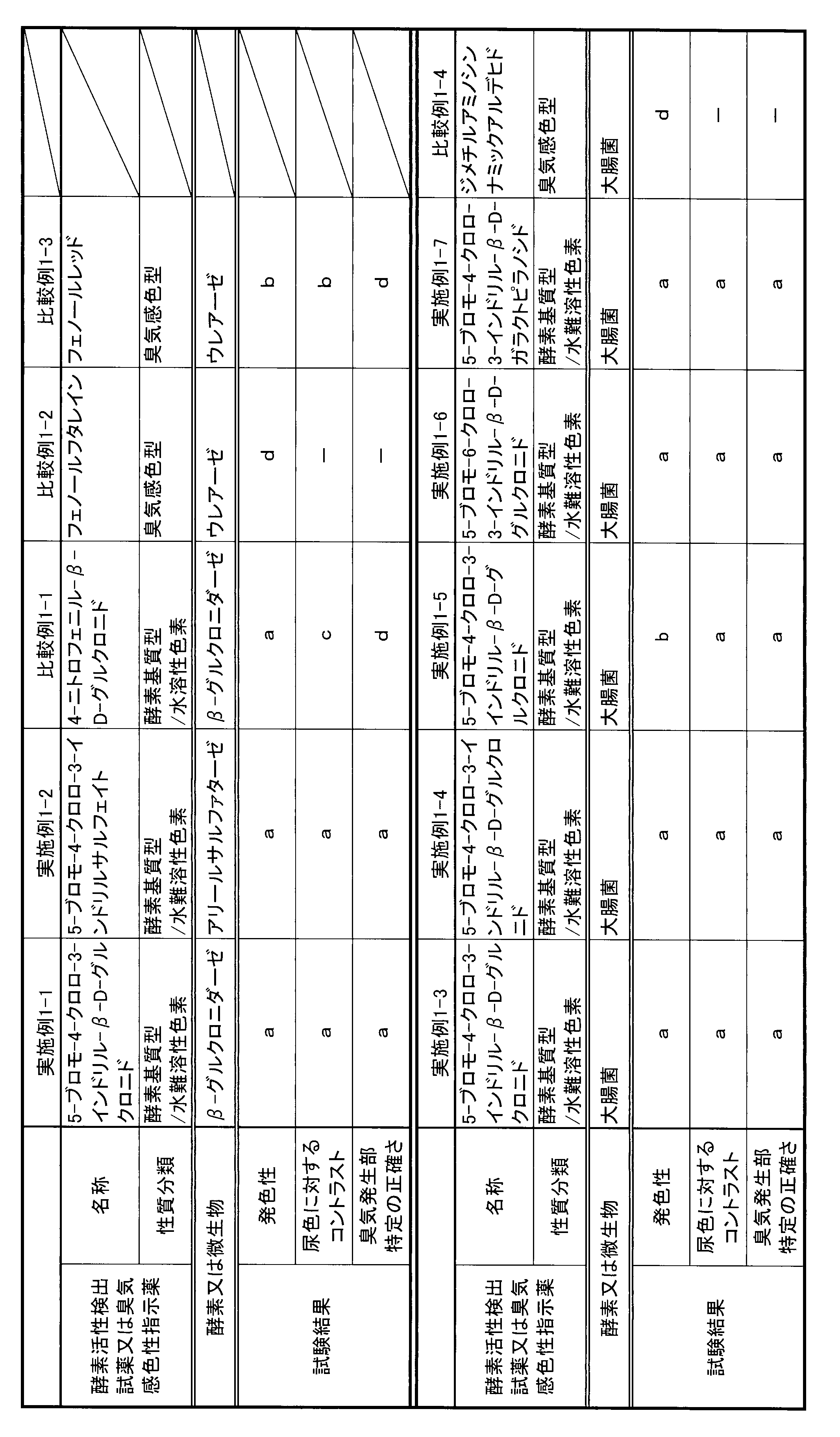
図1に示すように、吸水性ポリマー0.03gに表1に示す組成の酵素活性検出試薬又は臭気感色性指示薬を含有する各液剤300μLを吸収させ、これを更に、1.5mL容マイクロテストチューブ内において間にパルプ層を挟み3層に積層させた。この中央の層にのみ、臭気発生のイニシエーターとなる酵素、あるいは細菌を添加し、37℃恒温槽中で72時間臭気発生を行い、色の変化を観察した。この結果を表2及び図2に示す。表2には、発色性、尿色に対するコントラスト、尿臭発生部の特定の正確さについて、4名のパネルが以下の基準に基づき、協議によって判定した結果を示す。
図1に示すように、吸水性ポリマー0.03gに表1に示す組成の酵素活性検出試薬又は臭気感色性指示薬を含有する各液剤300μLを吸収させ、これを更に、1.5mL容マイクロテストチューブ内において間にパルプ層を挟み3層に積層させた。この中央の層にのみ、臭気発生のイニシエーターとなる酵素、あるいは細菌を添加し、37℃恒温槽中で72時間臭気発生を行い、色の変化を観察した。この結果を表2及び図2に示す。表2には、発色性、尿色に対するコントラスト、尿臭発生部の特定の正確さについて、4名のパネルが以下の基準に基づき、協議によって判定した結果を示す。
<発色性>
a:強く発色する。
b:やや強く発色する。
c:発色が弱い。
d:発色しない。
a:強く発色する。
b:やや強く発色する。
c:発色が弱い。
d:発色しない。
<尿色に対するコントラスト>
a:尿と色素化合物の色のコントラストが強い。
b:尿と色素化合物の色のコントラストがやや強い。
c:尿と色素化合物の色のコントラストが弱い。
d:尿と色素化合物の色の区別がつかない。
-:発色不良(発色性:d)のため、評価不能。
a:尿と色素化合物の色のコントラストが強い。
b:尿と色素化合物の色のコントラストがやや強い。
c:尿と色素化合物の色のコントラストが弱い。
d:尿と色素化合物の色の区別がつかない。
-:発色不良(発色性:d)のため、評価不能。
<臭気発生部の特定の正確さ>
a:尿臭の発生した位置が明確にわかる。
b:尿臭が発生した位置がわかる。
c:尿臭が発生した位置がやや不明確である。
d:尿臭が発生した位置が不明確である。
-:発色不良(発色性:d)のため、評価不能。
a:尿臭の発生した位置が明確にわかる。
b:尿臭が発生した位置がわかる。
c:尿臭が発生した位置がやや不明確である。
d:尿臭が発生した位置が不明確である。
-:発色不良(発色性:d)のため、評価不能。
この結果から明らかなように、本発明で用いる水に難溶の色素化合物を生じる酵素基質型の酵素活性検出試薬(成分A)を含有する液剤を吸収させたサンプル(実施例1-1~1-7)は酵素、細菌のどちらをイニシエーターとして用いた場合にも中央の層のみで明瞭な色の変化が観察され、臭気発生部の明確な特定に成功した。これに対し臭気感色性指示薬を含有した比較例1-3及び酵素反応後の色素化合物が水溶性(4-ニトロフェノール水溶解度 11.6g/L(20℃))である比較例1-1では色の変化は見られたが、発色部位が拡散してしまい臭気発生部の特定には至らなかった。また比較例1-2、1-4のように、いくつかの臭気感色性指示薬は吸水性ポリマー中では指示薬として機能しなかった。

実施例2 尿臭発生部及び尿臭強度の可視化並びに吸水性ポリマーのスクリーニング
(1)β-グルクロニダーゼ活性菌株の採取
使用済み(排尿のみ)の幼児用紙オムツから、5-ブロモ-4-クロロ-3-インドリル-β-D-グルクロニドを添加したSCDLP寒天平板培地(日本製薬株式会社製)を用いて常法によりβ-グルクロニダーゼ活性菌株の採取、分離を行った。これら菌株を除菌尿中で培養したところ臭気の発生が確認され、この中でも特に強い臭気を発生させた菌株を本実施例におけるβ-グルクロニダーゼ活性菌株として用いた。また本菌株は16S rDNA部分塩基配列解析によって大腸菌に帰属されるものであることを確認した。
(1)β-グルクロニダーゼ活性菌株の採取
使用済み(排尿のみ)の幼児用紙オムツから、5-ブロモ-4-クロロ-3-インドリル-β-D-グルクロニドを添加したSCDLP寒天平板培地(日本製薬株式会社製)を用いて常法によりβ-グルクロニダーゼ活性菌株の採取、分離を行った。これら菌株を除菌尿中で培養したところ臭気の発生が確認され、この中でも特に強い臭気を発生させた菌株を本実施例におけるβ-グルクロニダーゼ活性菌株として用いた。また本菌株は16S rDNA部分塩基配列解析によって大腸菌に帰属されるものであることを確認した。
(2)菌液の調製
上記のβ-グルクロニダーゼ活性菌株をSCD寒天平板培地上で一晩培養し、得られたコロニーから一部を滅菌ループによってかき取り、除菌済み生理食塩水中に希釈してCFU/mLで105オーダーとなるように菌液を調製した。
上記のβ-グルクロニダーゼ活性菌株をSCD寒天平板培地上で一晩培養し、得られたコロニーから一部を滅菌ループによってかき取り、除菌済み生理食塩水中に希釈してCFU/mLで105オーダーとなるように菌液を調製した。
(3)液剤の調製
実施例1において尿臭発生部の明確な特定に成功した酵素活性検出試薬のうち、5-ブロモ-4-クロロ-3-インドリル-β-D-グルクロニドを選択し、これを含有する液剤を調製した。即ち、採取後すぐにナルゲン社製フィルターユニットにより除菌を行ったヒト除菌尿(2名分等量混合)に、5-ブロモ-4-クロロ-3-インドリル-β-D-グルクロニドを200ppm(w/v)溶解させ、更に前記(2)で調製した菌液を0.1v/v%添加混合し、液剤を調製した。
実施例1において尿臭発生部の明確な特定に成功した酵素活性検出試薬のうち、5-ブロモ-4-クロロ-3-インドリル-β-D-グルクロニドを選択し、これを含有する液剤を調製した。即ち、採取後すぐにナルゲン社製フィルターユニットにより除菌を行ったヒト除菌尿(2名分等量混合)に、5-ブロモ-4-クロロ-3-インドリル-β-D-グルクロニドを200ppm(w/v)溶解させ、更に前記(2)で調製した菌液を0.1v/v%添加混合し、液剤を調製した。
(4)吸収体切片の調製
市販尿取りパッド(就寝時用)の構成を模倣し、吸水性ポリマーの種類のみが異なる4種の尿取りパッドを作製した。更に各尿取りパッドの中央部に近い位置から5.5cm四方を切り出し、この吸収体切片を以下の評価に供した(図3)。なお、このとき参照した市販尿取りパッドの尿吸収容量より比例的に算出された切片の尿吸収容量は16.7mLである。
市販尿取りパッド(就寝時用)の構成を模倣し、吸水性ポリマーの種類のみが異なる4種の尿取りパッドを作製した。更に各尿取りパッドの中央部に近い位置から5.5cm四方を切り出し、この吸収体切片を以下の評価に供した(図3)。なお、このとき参照した市販尿取りパッドの尿吸収容量より比例的に算出された切片の尿吸収容量は16.7mLである。
(5)酵素反応
前記(4)で調製した吸収体切片に図3に示した観察面より1.5cm内側の上面から、前記(3)で調製した液剤を12.5mL滴下し、37℃恒温槽中において8時間及び24時間静置した。
前記(4)で調製した吸収体切片に図3に示した観察面より1.5cm内側の上面から、前記(3)で調製した液剤を12.5mL滴下し、37℃恒温槽中において8時間及び24時間静置した。
(6)臭気強度評価
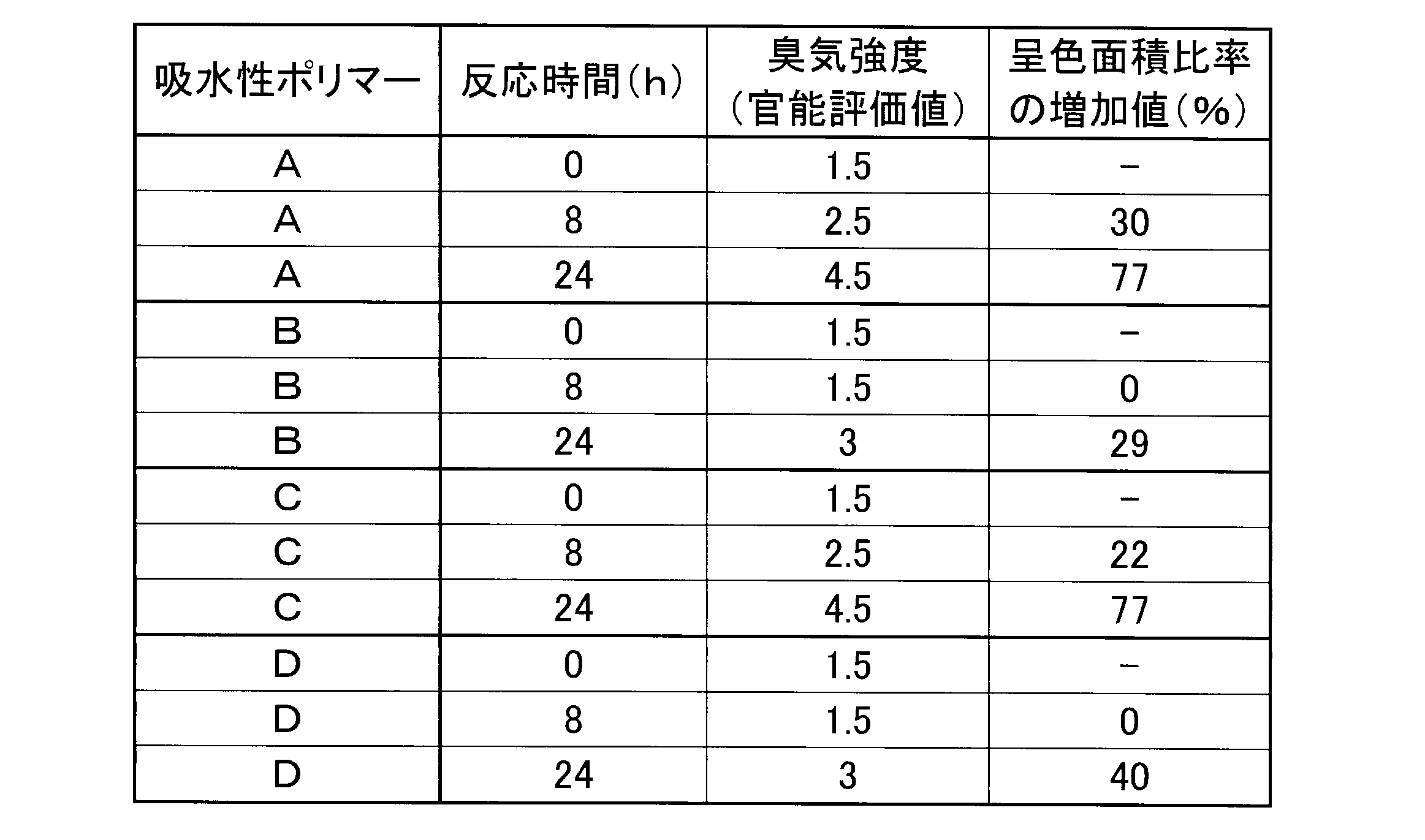
前記(5)の各サンプルについて、初期、8時間後、24時間後の臭気強度評価を行った。臭気強度評価には臭気判定士の資格を有する2名の専門パネルが携わり、0~5の評価スコアによる6段階臭気強度表示法に準じて行った。即ち評価スコアは、「0」無臭、「1」やっと感知できるニオイ、「2」尿臭であることわかるが弱いニオイ、「3」楽に尿臭であると感じられるニオイ、「4」強い尿臭、「5」強烈な尿臭を示す。臭気強度の判定は0.5刻みで行い、2名の評価の平均値について、小数点以下の数値が、0.25である場合は0.5とし、0.75である場合は整数に切り上げた。得られた結果を表3に示した。
前記(5)の各サンプルについて、初期、8時間後、24時間後の臭気強度評価を行った。臭気強度評価には臭気判定士の資格を有する2名の専門パネルが携わり、0~5の評価スコアによる6段階臭気強度表示法に準じて行った。即ち評価スコアは、「0」無臭、「1」やっと感知できるニオイ、「2」尿臭であることわかるが弱いニオイ、「3」楽に尿臭であると感じられるニオイ、「4」強い尿臭、「5」強烈な尿臭を示す。臭気強度の判定は0.5刻みで行い、2名の評価の平均値について、小数点以下の数値が、0.25である場合は0.5とし、0.75である場合は整数に切り上げた。得られた結果を表3に示した。
(7)画像解析
前記(5)の各サンプルについて、初期、8時間後、24時間後にデジタルカメラによる写真撮影を行った。得られた画像は画像編集ソフトPhotoshop6.0(Adobe社製)に読み込み、青色の呈色部位を検出するためレッドチャンネルのみを選択してグレースケール変換を行った。これを更に2階調化することによって呈色部位の明確な位置情報を得た。2階調化に用いる閾値は状況により選択できるが、今回は128を採用した。更に全ピクセル数に占める呈色ピクセル数の割合(%)を算出し、初期の値を減算することによって8時間後、24時間後の呈色面積比率の増加値(%)(値が0未満となる場合には0とした)を得た。この結果を表3に示した。
前記(5)の各サンプルについて、初期、8時間後、24時間後にデジタルカメラによる写真撮影を行った。得られた画像は画像編集ソフトPhotoshop6.0(Adobe社製)に読み込み、青色の呈色部位を検出するためレッドチャンネルのみを選択してグレースケール変換を行った。これを更に2階調化することによって呈色部位の明確な位置情報を得た。2階調化に用いる閾値は状況により選択できるが、今回は128を採用した。更に全ピクセル数に占める呈色ピクセル数の割合(%)を算出し、初期の値を減算することによって8時間後、24時間後の呈色面積比率の増加値(%)(値が0未満となる場合には0とした)を得た。この結果を表3に示した。
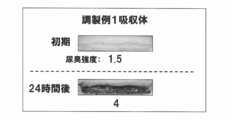
更に前記(6)の臭気強度評価値(官能評価値)と呈色面積比率の増加値(%)の相関を示すグラフを図4に示した。また、図5には画像の一例として吸水性ポリマーBを用いた尿取りパッド切片の画像(初期及び24時間後)を示した。
これらの結果から、本発明の方法により、呈色面積比率の増加が臭気強度の増加を非常に良く反映し、この呈色部位を以って尿臭発生部を明瞭に特定できること、更に視覚的な情報から臭気強度の客観的な評価が可能となることが示された。更に吸水性ポリマーBを使用した尿取りパッドが最も防臭効果に優れることも視覚的に判断することができ、本発明の方法によって吸収性物品において好適な尿臭生成抑制効果に優れた吸水性ポリマーを簡便に選択することが可能となることが示された。
実施例3 尿臭生成抑制用抗菌剤のスクリーニング
尿臭生成抑制剤として有機系抗菌剤P、Q又は無機系抗菌剤Rを吸水性ポリマーに対して様々な濃度(w/w%)で添加した。なお、有機系抗菌剤Pとしては四級アンモニウム塩系抗菌剤を、有機系抗菌剤Qとしてはフェノール系抗菌剤を、無機系抗菌剤Rとしては硫酸亜鉛をそれぞれ用いた。得られた抗菌剤添加吸水性ポリマー各0.45gを底面がおよそ5.5cm四方の容器底面に均一に配置し、ここへ実施例2の(3)で調製した液剤6.5mLを添加し、30℃恒温槽中で48時間酵素反応を行った。図6には各サンプルの画像及び画像下には実施例2の(6)の手法で行った臭気強度評価値を示し、表4には各抗菌剤の最小呈色抑制濃度を示した。
以上の結果より、本発明の方法により、吸水性ポリマーに好適な尿臭生成抑制用抗菌剤を簡便にスクリーニングできることが示された。
尿臭生成抑制剤として有機系抗菌剤P、Q又は無機系抗菌剤Rを吸水性ポリマーに対して様々な濃度(w/w%)で添加した。なお、有機系抗菌剤Pとしては四級アンモニウム塩系抗菌剤を、有機系抗菌剤Qとしてはフェノール系抗菌剤を、無機系抗菌剤Rとしては硫酸亜鉛をそれぞれ用いた。得られた抗菌剤添加吸水性ポリマー各0.45gを底面がおよそ5.5cm四方の容器底面に均一に配置し、ここへ実施例2の(3)で調製した液剤6.5mLを添加し、30℃恒温槽中で48時間酵素反応を行った。図6には各サンプルの画像及び画像下には実施例2の(6)の手法で行った臭気強度評価値を示し、表4には各抗菌剤の最小呈色抑制濃度を示した。
以上の結果より、本発明の方法により、吸水性ポリマーに好適な尿臭生成抑制用抗菌剤を簡便にスクリーニングできることが示された。

実施例4 尿臭生成抑制用酵素阻害剤のスクリーニング
採取後すぐにナルゲン社製フィルターユニットにより除菌を行ったヒト除菌尿に、5-ブロモ-4-クロロ-3-インドリル-β-D-グルクロニドを200ppm(w/v)溶解させ、続いて160units/mLに調整した大腸菌由来β-グルクロニダーゼType VII-A(シグマ社より購入)水溶液を1v/v%添加混合することにより、液剤を調製した。
次いで、尿臭生成抑制剤としてβ-グルクロニダーゼ阻害剤S、Tを1.5w/w%添加した吸水性ポリマーを調製した。得られた酵素阻害剤添加吸水性ポリマー、及び添加剤の無い吸水性ポリマー各0.5gを底面がおよそ5.5cm四方の容器底面に均一に配置し、ここへ上述の液剤7.5mLを添加し、30℃恒温槽中で48時間酵素反応を行った。図7には各サンプルの画像及び画像下には実施例2の(6)の手法で行った臭気強度評価値を示した。
以上の結果より、本発明の方法により、吸水性ポリマーに好適な尿臭生成抑制用酵素阻害剤を簡便にスクリーニングできることが示された。
採取後すぐにナルゲン社製フィルターユニットにより除菌を行ったヒト除菌尿に、5-ブロモ-4-クロロ-3-インドリル-β-D-グルクロニドを200ppm(w/v)溶解させ、続いて160units/mLに調整した大腸菌由来β-グルクロニダーゼType VII-A(シグマ社より購入)水溶液を1v/v%添加混合することにより、液剤を調製した。
次いで、尿臭生成抑制剤としてβ-グルクロニダーゼ阻害剤S、Tを1.5w/w%添加した吸水性ポリマーを調製した。得られた酵素阻害剤添加吸水性ポリマー、及び添加剤の無い吸水性ポリマー各0.5gを底面がおよそ5.5cm四方の容器底面に均一に配置し、ここへ上述の液剤7.5mLを添加し、30℃恒温槽中で48時間酵素反応を行った。図7には各サンプルの画像及び画像下には実施例2の(6)の手法で行った臭気強度評価値を示した。
以上の結果より、本発明の方法により、吸水性ポリマーに好適な尿臭生成抑制用酵素阻害剤を簡便にスクリーニングできることが示された。
調製例1 尿臭発生部が視覚的に判定される吸収性物品の調製
エタノールに対し、5-ブロモ-4-クロロ-3-インドリル-β-D-グルクロニドを200ppm(w/v)溶解させることにより液剤を調製した。市販尿取りパッド(昼用、尿吸収容量450mL)の構成を模倣して作製した尿取りパッドより、中央部に近い位置から5.5cm四方を切り出した。得られた吸収体切片に本液剤12.5mLを均一に含浸させ、電気乾燥機中で重量が変化しなくなるまで乾燥させた。
エタノールに対し、5-ブロモ-4-クロロ-3-インドリル-β-D-グルクロニドを200ppm(w/v)溶解させることにより液剤を調製した。市販尿取りパッド(昼用、尿吸収容量450mL)の構成を模倣して作製した尿取りパッドより、中央部に近い位置から5.5cm四方を切り出した。得られた吸収体切片に本液剤12.5mLを均一に含浸させ、電気乾燥機中で重量が変化しなくなるまで乾燥させた。
実施例5 尿臭発生部が視覚的に判定される吸収性物品による尿臭発生部の可視化
(1)菌添加尿の調製
実施例2の(1)に記載のβ-グルクロニダーゼ活性菌株をSCD寒天平板培地上で一晩培養し、得られたコロニーから一部を滅菌ループによってかき取り、除菌済み生理食塩水中に希釈してCFU/mLで104オーダーとなるように菌液を調製した。採取後すぐにナルゲン社製フィルターユニットにより除菌を行ったヒト除菌尿に、調製した菌液を1v/v%添加混合し、菌添加尿を調製した。
(1)菌添加尿の調製
実施例2の(1)に記載のβ-グルクロニダーゼ活性菌株をSCD寒天平板培地上で一晩培養し、得られたコロニーから一部を滅菌ループによってかき取り、除菌済み生理食塩水中に希釈してCFU/mLで104オーダーとなるように菌液を調製した。採取後すぐにナルゲン社製フィルターユニットにより除菌を行ったヒト除菌尿に、調製した菌液を1v/v%添加混合し、菌添加尿を調製した。
(2)酵素反応及び尿臭発生部の可視化
調製例1に記載の吸収体切片に図3に示した観察面より1.5cm内側の上面から、前記(1)で調製した菌添加尿を12.5mL滴下し、30℃恒温槽中において24時間静置した。
図8には初期及び24時間後のサンプルの画像及び画像下には実施例2の(6)の手法で行った臭気強度評価値を示した。
本結果により、本発明の方法により、吸収性物品において尿臭発生部を簡便に可視化できることが示された。
調製例1に記載の吸収体切片に図3に示した観察面より1.5cm内側の上面から、前記(1)で調製した菌添加尿を12.5mL滴下し、30℃恒温槽中において24時間静置した。
図8には初期及び24時間後のサンプルの画像及び画像下には実施例2の(6)の手法で行った臭気強度評価値を示した。
本結果により、本発明の方法により、吸収性物品において尿臭発生部を簡便に可視化できることが示された。
調製例2 尿臭発生部が視覚的に判定される硬質表面の調製
エタノールに対し、5-ブロモ-4-クロロ-3-インドリル-β-D-グルクロニドを2000ppm(w/v)溶解させることにより液剤を調製した。本液剤をスプレー容器に入れ、液剤3.3gを陶器製プレートの中央部(半径6.5cm内)に数回に分けて均一にスプレーし、室温下で乾燥させた。
エタノールに対し、5-ブロモ-4-クロロ-3-インドリル-β-D-グルクロニドを2000ppm(w/v)溶解させることにより液剤を調製した。本液剤をスプレー容器に入れ、液剤3.3gを陶器製プレートの中央部(半径6.5cm内)に数回に分けて均一にスプレーし、室温下で乾燥させた。
実施例6 尿臭発生部が視覚的に判定される硬質表面による尿臭発生部の可視化
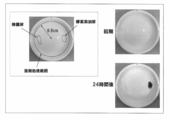
採取後すぐにナルゲン社製フィルターユニットにより除菌を行ったヒト除菌尿、及びこの除菌尿に25400units/mLに調整した大腸菌由来β-グルクロニダーゼType VII-A水溶液を1v/v%添加混合し、尿臭気が持続的に発生するようにした酵素添加尿を調製した。続いて、調製例4に記載の陶器製プレートに対して、左側に除菌尿、右側に酵素添加尿をそれぞれ300μL滴下し、プレート上面をラップで覆って室温下で24時間静置した。
図9には初期及び24時間後のサンプルの画像を示した。
本結果により、本発明の方法により、硬質表面上において尿臭発生部を簡便に可視化できることが示された。
採取後すぐにナルゲン社製フィルターユニットにより除菌を行ったヒト除菌尿、及びこの除菌尿に25400units/mLに調整した大腸菌由来β-グルクロニダーゼType VII-A水溶液を1v/v%添加混合し、尿臭気が持続的に発生するようにした酵素添加尿を調製した。続いて、調製例4に記載の陶器製プレートに対して、左側に除菌尿、右側に酵素添加尿をそれぞれ300μL滴下し、プレート上面をラップで覆って室温下で24時間静置した。
図9には初期及び24時間後のサンプルの画像を示した。
本結果により、本発明の方法により、硬質表面上において尿臭発生部を簡便に可視化できることが示された。
Claims (16)
- 尿臭判定の対象となる物品、設備又は素材に対し、成分Aを含有する液剤を適用する第一ステップと、
前記液剤を適用した物品、設備又は素材で酵素反応を進行させる第二ステップと、
前記液剤を適用した物品、設備又は素材の色の変化を観察する第三ステップを有し、
色の変化した領域を尿臭発生部と判定し、色の変化量を尿臭強度と対応させる尿臭発生部及び尿臭強度の視覚的判定方法。
成分A:酵素反応によって水に難溶の色素化合物又は蛍光色素化合物を生じる酵素基質型の酵素活性検出試薬 - 尿臭が発生する物品が、吸収性物品であり、尿臭が発生する素材が、吸収性物品用吸水性ポリマーである請求項1に記載の方法。
- 第三ステップにおいて、吸収性物品の切断面の色の変化を観察する請求項2に記載の方法。
- 第一ステップと第二ステップの間に、成分Aを含有する液剤を適用した物品を乾燥させる工程を含む請求項1~3のいずれかに記載の方法。
- 更に、画像データから酵素反応前後での色の変化の現れた面積を算出し、算出した面積に基づいて尿臭強度を判定するステップを有する請求項1~4のいずれかに記載の方法。
- 尿臭生成抑制効果の評価対象としての素材、部材又は剤に、成分Aを含有する液剤を接触させ、酵素反応による評価対象の色の変化が少ない評価対象を選択する、尿臭生成抑制効果に優れた素材、部材、尿臭生成抑制剤、又は部材の配置のスクリーニング方法。
成分A:酵素反応によって水に難溶の色素化合物又は蛍光色素化合物を生じる酵素基質型の酵素活性検出試薬 - 複数種の吸水性ポリマーに対し、成分Aを含有する液剤を適用する第一ステップと、
前記液剤を適用した吸水性ポリマーで酵素反応を進行させる第二ステップと、
前記液剤を適用した吸水性ポリマーの色の変化を観察する第三ステップと、
第三ステップにおいて色の変化がより少ない吸水性ポリマーを選択する第四のステップを有する請求項6に記載のスクリーニング方法。 - 構成部材を異にする複数の吸収性物品に対し、成分Aを含有する液剤を適用する第一ステップと、
前記液剤を適用した吸収性物品で酵素反応を進行させる第二ステップと、
前記液剤を適用した吸収性物品の切断面の色の変化を観察する第三ステップと、
第三ステップにおいて色の変化がより少ない吸収性物品における構成部材を選択する第四ステップを有する請求項6に記載のスクリーニング方法。 - 構成部材の配置を異にする複数の吸収性物品に対し、成分Aを含有する液剤を適用する第一ステップと、
前記液剤を適用した吸収性物品で酵素反応を進行させる第二ステップと、
前記液剤を適用した吸収性物品の切断面の色の変化を観察する第三ステップと、
第三ステップにおいて色の変化がより少ない吸収性物品における構成部材の配置を選択する第四ステップを有する請求項6に記載のスクリーニング方法。 - 異なる尿臭生成抑制剤を適用した複数の物品、設備又は素材に対し、成分Aを含有する液剤を適用する第一ステップと、
前記液剤を適用した物品、設備又は素材で酵素反応を進行させる第二ステップと、
前記液剤を適用した物品、設備又は素材の色の変化を観察する第三ステップと、
第三ステップにおいて色の変化がより少ない尿臭生成抑制剤を選択する第四ステップを有する請求項6に記載のスクリーニング方法。 - 成分Aが、グリコシダーゼ活性検出試薬及びサルファターゼ活性検出試薬より選ばれる1以上である請求項1~10のいずれかに記載の方法。
- グリコシダーゼ活性検出試薬がβ-グルクロニダーゼ活性検出試薬であり、サルファターゼ活性検出試薬がアリールサルファターゼ活性検出試薬である請求項11に記載の方法。
- β-グルクロニダーゼ活性検出試薬が5-ブロモ-4-クロロ-3-インドリル-β-D-グルクロニド、5-ブロモ-6-クロロ-3-インドリル-β-D-グルクロニド、6-クロロ-3-インドリル-β-D-グルクロニド、インドキシル-β-D-グルクロニド、4-メチルウンベリフェリル-β-D-グルクロニドより選ばれるものであり、アリールサルファターゼ活性検出試薬が5-ブロモ-4-クロロ-3-インドリルサルフェイト、インドキシルサルフェイト、4-メチルウンベリフェリルサルフェイトより選ばれるものである請求項12に記載の方法。
- 液剤が、更に尿を含む請求項1~13のいずれかに記載の方法。
- 液剤が、更に微生物又は酵素より選ばれる1以上を含んで成る、請求項1~14のいずれかに記載の方法。
- 微生物が、β-グルクロニダーゼ活性又はアリールサルファターゼ活性を有する株より選ばれる1以上であり、酵素がβ-グルクロニダーゼ又はアリールサルファターゼから選ばれる1以上である請求項15に記載の方法。
Priority Applications (2)
| Application Number | Priority Date | Filing Date | Title |
|---|---|---|---|
| CN201280010498.9A CN103392007B (zh) | 2011-02-25 | 2012-02-24 | 尿臭产生部的视觉的判定方法 |
| RU2013143302/10A RU2598718C2 (ru) | 2011-02-25 | 2012-02-24 | Способ визуального определения местонахождения источника образования запаха мочи и скрининг ингибиторов образования запаха мочи |
Applications Claiming Priority (2)
| Application Number | Priority Date | Filing Date | Title |
|---|---|---|---|
| JP2011-039250 | 2011-02-25 | ||
| JP2011039250 | 2011-02-25 |
Publications (1)
| Publication Number | Publication Date |
|---|---|
| WO2012115238A1 true WO2012115238A1 (ja) | 2012-08-30 |
Family
ID=46721010
Family Applications (1)
| Application Number | Title | Priority Date | Filing Date |
|---|---|---|---|
| PCT/JP2012/054609 Ceased WO2012115238A1 (ja) | 2011-02-25 | 2012-02-24 | 尿臭発生部の視覚的判定方法 |
Country Status (4)
| Country | Link |
|---|---|
| JP (1) | JP5398857B2 (ja) |
| CN (1) | CN103392007B (ja) |
| RU (1) | RU2598718C2 (ja) |
| WO (1) | WO2012115238A1 (ja) |
Cited By (2)
| Publication number | Priority date | Publication date | Assignee | Title |
|---|---|---|---|---|
| JP2014153127A (ja) * | 2013-02-06 | 2014-08-25 | Railway Technical Research Institute | トイレの尿汚れ判定用の採取器具、トイレの尿汚れ判定キット及びトイレの尿汚れの判定方法 |
| CN105264087A (zh) * | 2013-02-19 | 2016-01-20 | 尼普洛株式会社 | 羟基吲哚硫酸的测定方法 |
Families Citing this family (8)
| Publication number | Priority date | Publication date | Assignee | Title |
|---|---|---|---|---|
| JP6026822B2 (ja) * | 2012-08-28 | 2016-11-16 | 花王株式会社 | 吸収性構造体及び吸収材 |
| CN108432642A (zh) * | 2018-06-28 | 2018-08-24 | 南京凯创协同纳米技术有限公司 | 抗菌除臭宠物尿垫及其制造方法 |
| EP3813753A2 (en) * | 2018-06-29 | 2021-05-05 | International Paper Company | Chemiluminescent wetness indicator for absorbent products |
| JP7557181B2 (ja) * | 2020-06-25 | 2024-09-27 | シヤチハタ株式会社 | 尿成分可視化剤及び尿成分可視化方法 |
| CN112816467B (zh) * | 2021-02-08 | 2023-08-29 | 杭州可靠护理用品股份有限公司 | 一种用于尿液检测的显色剂及其在纸尿裤上的应用 |
| CN116997794A (zh) * | 2021-03-05 | 2023-11-03 | 沙奇哈塔株式会社 | 供电子体可视化试剂盒及供电子体可视化方法 |
| JP7802274B2 (ja) * | 2021-09-30 | 2026-01-20 | シヤチハタ株式会社 | 電子供与物可視化キット及び電子供与物の可視化方法 |
| JPWO2024024648A1 (ja) * | 2022-07-29 | 2024-02-01 |
Citations (4)
| Publication number | Priority date | Publication date | Assignee | Title |
|---|---|---|---|---|
| WO2009037861A1 (ja) * | 2007-09-20 | 2009-03-26 | Kao Corporation | β-グルクロニダーゼ阻害剤 |
| JP2010220641A (ja) * | 2009-03-19 | 2010-10-07 | Kao Corp | β−グルクロニダーゼ阻害剤 |
| JP2010227130A (ja) * | 2009-03-25 | 2010-10-14 | Kao Corp | β−グルクロニダーゼ阻害剤 |
| JP2010246905A (ja) * | 2009-03-25 | 2010-11-04 | Kao Corp | 尿臭生成抑制用組成物 |
Family Cites Families (3)
| Publication number | Priority date | Publication date | Assignee | Title |
|---|---|---|---|---|
| JPH10257832A (ja) * | 1997-03-18 | 1998-09-29 | Nea Corp:Kk | 健康チェック用発色型トイレ材及び健康チェック用複合トイレ材 |
| RU2385738C2 (ru) * | 2005-10-05 | 2010-04-10 | Ска Хайджин Продактс Аб | Впитывающее изделие, содержащее тонкую пленку, включающую активное вещество |
| JP2009148326A (ja) * | 2007-12-19 | 2009-07-09 | Kao Corp | 尿臭生成抑制剤 |
-
2012
- 2012-02-24 CN CN201280010498.9A patent/CN103392007B/zh not_active Expired - Fee Related
- 2012-02-24 WO PCT/JP2012/054609 patent/WO2012115238A1/ja not_active Ceased
- 2012-02-24 RU RU2013143302/10A patent/RU2598718C2/ru active
- 2012-02-24 JP JP2012038675A patent/JP5398857B2/ja active Active
Patent Citations (4)
| Publication number | Priority date | Publication date | Assignee | Title |
|---|---|---|---|---|
| WO2009037861A1 (ja) * | 2007-09-20 | 2009-03-26 | Kao Corporation | β-グルクロニダーゼ阻害剤 |
| JP2010220641A (ja) * | 2009-03-19 | 2010-10-07 | Kao Corp | β−グルクロニダーゼ阻害剤 |
| JP2010227130A (ja) * | 2009-03-25 | 2010-10-14 | Kao Corp | β−グルクロニダーゼ阻害剤 |
| JP2010246905A (ja) * | 2009-03-25 | 2010-11-04 | Kao Corp | 尿臭生成抑制用組成物 |
Non-Patent Citations (1)
| Title |
|---|
| MERCK: "X-Gluc Solution", NOVAGEN BUNSHI SEIBUTSUGAKU CATALOG 2005/2006, 10 February 2006 (2006-02-10), pages 8 - 67 * |
Cited By (2)
| Publication number | Priority date | Publication date | Assignee | Title |
|---|---|---|---|---|
| JP2014153127A (ja) * | 2013-02-06 | 2014-08-25 | Railway Technical Research Institute | トイレの尿汚れ判定用の採取器具、トイレの尿汚れ判定キット及びトイレの尿汚れの判定方法 |
| CN105264087A (zh) * | 2013-02-19 | 2016-01-20 | 尼普洛株式会社 | 羟基吲哚硫酸的测定方法 |
Also Published As
| Publication number | Publication date |
|---|---|
| JP2012187101A (ja) | 2012-10-04 |
| RU2598718C2 (ru) | 2016-09-27 |
| CN103392007A (zh) | 2013-11-13 |
| RU2013143302A (ru) | 2015-03-27 |
| CN103392007B (zh) | 2015-08-19 |
| JP5398857B2 (ja) | 2014-01-29 |
Similar Documents
| Publication | Publication Date | Title |
|---|---|---|
| JP5398857B2 (ja) | 尿臭発生部の視覚的判定方法 | |
| FI118201B (fi) | Kissojen kasvoferomonien ominaisuudet | |
| US6501002B1 (en) | Disposable surface wipe article having a waste contamination sensor | |
| CN1325266A (zh) | 含有抗菌蛋白酶抑制剂的一次性的预润湿的擦拭物 | |
| CN104704162A (zh) | 生物类黄酮浸渍的材料 | |
| Garland et al. | Response of graywater recycling systems based on hydroponic plant growth to three classes of surfactants | |
| Binukumari et al. | Applications in environmental risk assessment of biochemical analysis on the Indian fresh water fish, Labeo rohita exposed to monocrotophos pesticide | |
| RU2378363C1 (ru) | Способ определения чувствительности микроорганизмов к дезинфицирующему средству (варианты) | |
| DE69806781T2 (de) | Reduzierung des körpergeruchs | |
| JP6026822B2 (ja) | 吸収性構造体及び吸収材 | |
| JPH11295306A (ja) | 尿検査用試験材並びにこれを用いた健康チェック材及び健康チェック方法 | |
| JP2022024298A (ja) | 猫用猫尿臭抑制剤の探索方法 | |
| JP6307110B2 (ja) | 吸水性ポリマー及び尿臭発生部の可視化方法 | |
| Yangaza et al. | Prevalence of urogenital Schistosomiasis and risk factors for transmission among primary school children in an endemic urban area of Kinondoni municipality in Dar es Salaam, Tanzania | |
| McClay | Rotenone use in North America (1988–2002) | |
| Lake et al. | Use of precision-cut liver slices to evaluate species differences in 2-acetylaminofluorene-induced unscheduled DNA synthesis | |
| Jacobs et al. | An in vitro model for detecting skin irritants: methyl green-pyronine staining of human skin explant cultures | |
| CN108289973B (zh) | 尿臭抑制剂 | |
| JP2010220641A (ja) | β−グルクロニダーゼ阻害剤 | |
| Hakkinen | Seveso disaster, and the Seveso and Seveso II directives | |
| Jacobs et al. | Methyl green-pyronine staining of porcine organotypic skin explant cultures: An alternative model for screening for skin irritants | |
| JP2022018279A (ja) | 猫用猫尿臭抑制剤 | |
| Oliver | Seasonal and within‐herd variability of E. coli concentrations in fresh dairy faeces | |
| Dixit et al. | Biofilm formation on different fabrics in the presence of sweat | |
| Garcia et al. | The Susceptibility of Swine Abortion-Associated Leptospira hyos to Disinfectants |
Legal Events
| Date | Code | Title | Description |
|---|---|---|---|
| 121 | Ep: the epo has been informed by wipo that ep was designated in this application |
Ref document number: 12750086 Country of ref document: EP Kind code of ref document: A1 |
|
| NENP | Non-entry into the national phase |
Ref country code: DE |
|
| ENP | Entry into the national phase |
Ref document number: 2013143302 Country of ref document: RU Kind code of ref document: A |
|
| 122 | Ep: pct application non-entry in european phase |
Ref document number: 12750086 Country of ref document: EP Kind code of ref document: A1 |