WO2012115142A1 - 加工用潤滑剤、加工用添加剤および加工方法 - Google Patents
加工用潤滑剤、加工用添加剤および加工方法 Download PDFInfo
- Publication number
- WO2012115142A1 WO2012115142A1 PCT/JP2012/054257 JP2012054257W WO2012115142A1 WO 2012115142 A1 WO2012115142 A1 WO 2012115142A1 JP 2012054257 W JP2012054257 W JP 2012054257W WO 2012115142 A1 WO2012115142 A1 WO 2012115142A1
- Authority
- WO
- WIPO (PCT)
- Prior art keywords
- processing
- polymer compound
- film
- lubricant
- molecular weight
- Prior art date
- Legal status (The legal status is an assumption and is not a legal conclusion. Google has not performed a legal analysis and makes no representation as to the accuracy of the status listed.)
- Ceased
Links
Images



Classifications
-
- C—CHEMISTRY; METALLURGY
- C10—PETROLEUM, GAS OR COKE INDUSTRIES; TECHNICAL GASES CONTAINING CARBON MONOXIDE; FUELS; LUBRICANTS; PEAT
- C10M—LUBRICATING COMPOSITIONS; USE OF CHEMICAL SUBSTANCES EITHER ALONE OR AS LUBRICATING INGREDIENTS IN A LUBRICATING COMPOSITION
- C10M169/00—Lubricating compositions characterised by containing as components a mixture of at least two types of ingredient selected from base-materials, thickeners or additives, covered by the preceding groups, each of these compounds being essential
- C10M169/04—Mixtures of base-materials and additives
-
- C—CHEMISTRY; METALLURGY
- C10—PETROLEUM, GAS OR COKE INDUSTRIES; TECHNICAL GASES CONTAINING CARBON MONOXIDE; FUELS; LUBRICANTS; PEAT
- C10M—LUBRICATING COMPOSITIONS; USE OF CHEMICAL SUBSTANCES EITHER ALONE OR AS LUBRICATING INGREDIENTS IN A LUBRICATING COMPOSITION
- C10M2205/00—Organic macromolecular hydrocarbon compounds or fractions, whether or not modified by oxidation as ingredients in lubricant compositions
- C10M2205/02—Organic macromolecular hydrocarbon compounds or fractions, whether or not modified by oxidation as ingredients in lubricant compositions containing acyclic monomers
- C10M2205/028—Organic macromolecular hydrocarbon compounds or fractions, whether or not modified by oxidation as ingredients in lubricant compositions containing acyclic monomers containing aliphatic monomers having more than four carbon atoms
-
- C—CHEMISTRY; METALLURGY
- C10—PETROLEUM, GAS OR COKE INDUSTRIES; TECHNICAL GASES CONTAINING CARBON MONOXIDE; FUELS; LUBRICANTS; PEAT
- C10M—LUBRICATING COMPOSITIONS; USE OF CHEMICAL SUBSTANCES EITHER ALONE OR AS LUBRICATING INGREDIENTS IN A LUBRICATING COMPOSITION
- C10M2209/00—Organic macromolecular compounds containing oxygen as ingredients in lubricant compositions
- C10M2209/02—Macromolecular compounds obtained by reactions only involving carbon-to-carbon unsaturated bonds
- C10M2209/04—Macromolecular compounds obtained by reactions only involving carbon-to-carbon unsaturated bonds containing monomers having an unsaturated radical bound to an alcohol or ester thereof; bound to an aldehyde, ketonic, ether, ketal or acetal radical
-
- C—CHEMISTRY; METALLURGY
- C10—PETROLEUM, GAS OR COKE INDUSTRIES; TECHNICAL GASES CONTAINING CARBON MONOXIDE; FUELS; LUBRICANTS; PEAT
- C10M—LUBRICATING COMPOSITIONS; USE OF CHEMICAL SUBSTANCES EITHER ALONE OR AS LUBRICATING INGREDIENTS IN A LUBRICATING COMPOSITION
- C10M2209/00—Organic macromolecular compounds containing oxygen as ingredients in lubricant compositions
- C10M2209/02—Macromolecular compounds obtained by reactions only involving carbon-to-carbon unsaturated bonds
- C10M2209/08—Macromolecular compounds obtained by reactions only involving carbon-to-carbon unsaturated bonds containing monomers having an unsaturated radical bound to a carboxyl radical, e.g. acrylate type
- C10M2209/084—Acrylate; Methacrylate
-
- C—CHEMISTRY; METALLURGY
- C10—PETROLEUM, GAS OR COKE INDUSTRIES; TECHNICAL GASES CONTAINING CARBON MONOXIDE; FUELS; LUBRICANTS; PEAT
- C10M—LUBRICATING COMPOSITIONS; USE OF CHEMICAL SUBSTANCES EITHER ALONE OR AS LUBRICATING INGREDIENTS IN A LUBRICATING COMPOSITION
- C10M2217/00—Organic macromolecular compounds containing nitrogen as ingredients in lubricant compositions
- C10M2217/04—Macromolecular compounds from nitrogen-containing monomers obtained otherwise than by reactions only involving carbon-to-carbon unsaturated bonds
- C10M2217/046—Polyamines, i.e. macromoleculars obtained by condensation of more than eleven amine monomers
-
- C—CHEMISTRY; METALLURGY
- C10—PETROLEUM, GAS OR COKE INDUSTRIES; TECHNICAL GASES CONTAINING CARBON MONOXIDE; FUELS; LUBRICANTS; PEAT
- C10N—INDEXING SCHEME ASSOCIATED WITH SUBCLASS C10M RELATING TO LUBRICATING COMPOSITIONS
- C10N2020/00—Specified physical or chemical properties or characteristics, i.e. function, of component of lubricating compositions
- C10N2020/01—Physico-chemical properties
- C10N2020/04—Molecular weight; Molecular weight distribution
-
- C—CHEMISTRY; METALLURGY
- C10—PETROLEUM, GAS OR COKE INDUSTRIES; TECHNICAL GASES CONTAINING CARBON MONOXIDE; FUELS; LUBRICANTS; PEAT
- C10N—INDEXING SCHEME ASSOCIATED WITH SUBCLASS C10M RELATING TO LUBRICATING COMPOSITIONS
- C10N2040/00—Specified use or application for which the lubricating composition is intended
- C10N2040/20—Metal working
- C10N2040/244—Metal working of specific metals
- C10N2040/245—Soft metals, e.g. aluminum
Definitions
- the present invention relates to a processing lubricant that enables strong processing of an aluminum-based metal without causing seizure or the like, a processing additive used therefor, and a processing method using them.
- High workability is required to produce high-quality parts at low cost.
- cold plastic processing such as forging, ironing, drawing, etc.
- the quality of the processed surface is maintained while increasing productivity by increasing the amount of deformation per operation, etc. It is required to extend the life.
- aluminum alloy including aluminum as appropriate
- a lubrication method tends to cause seizure, and it has been difficult to ensure the processing quality and the tool life. This is presumably because aluminum alloys have lower strength and lower ductility than steel materials and the like.
- a solid lubricant film (bonded film) has been often formed in advance on the surface of an aluminum alloy.
- formation of a solid lubricating film requires a chemical conversion treatment (see Patent Document 1 below), a heat drying step of metal soap, and the like, and is expensive.
- the solid lubricating coating often contains environmentally hazardous elements such as P and Zn, and its use is desired to be suppressed due to recent environmental problems.
- Patent Documents 2 to 5 below describe these.
- Patent Document 2 proposes a lubricant for cold forging of an aluminum alloy obtained by adding a fatty acid to mineral oil.
- a lubricant to which a fatty acid having a molecular weight of at most several hundreds is added can cause seizure when the aluminum alloy is strongly processed cold.
- Patent Document 3 provides a lubricating oil suitable for plastic working of an aluminum alloy DI can. Similar to the lubricant disclosed in Patent Document 2, this lubricant also has insufficient seizure resistance. Further, this lubricating oil uses an extreme pressure agent containing sulfur (S) and phosphorus (P), which are environmentally harmful elements, and is not environmentally preferable.
- S sulfur
- P phosphorus
- Patent Document 4 also provides a lubricating oil suitable for plastic working of an aluminum alloy DI can, but uses a water-soluble fatty acid having a molecular weight of 900 to 1300 as an additive. However, the seizure resistance is insufficient as in the case of Patent Document 3.
- Patent Document 5 proposes to form a DLC film on the drawn portion of the jig and to apply lubricating oil to the drawn portion during cold drawing of the aluminum alloy.
- the lubricating oil used here is obtained by adding a low molecular weight fatty acid ester, zinc phosphate or the like to mineral oil. This lubricating oil also contains environmentally hazardous elements P and Zn, which is not environmentally preferable.
- Patent Document 6 is not a lubricant specialized for processing aluminum alloys, but is combined with a lubricant containing a fatty acid having a relatively low molecular weight and a die coated with a Si-containing amorphous carbon film. It is proposed to process.
- the present invention has been made in view of the circumstances as described above. In other words, processing without causing seizure or the like even when performing cold plastic processing with a high degree of processing on a workpiece made of an aluminum alloy without using an extreme pressure agent or the like that is an environmentally hazardous substance. It is an object to provide a lubricant. Moreover, it aims at providing the processing additive used for preparation of the processing lubricant, and the processing method using them.
- the processing lubricant of the present invention includes a coated surface of a processing tool coated with an amorphous carbon film and a processed surface of a workpiece made of aluminum or an aluminum alloy and processed in contact with the coated surface.
- the processing lubricant of the present invention By using the processing lubricant of the present invention, even when the workpiece is made of an aluminum alloy (including aluminum), between the workpiece and the processing tool coated with the amorphous carbon film Thus, high-quality strong processing can be performed with low processing force without causing seizure. Moreover, such an excellent effect is obtained between the coated surface of the processing tool coated with the amorphous carbon film and the processed surface of the workpiece processed by the same (hereinafter, simply “between processed surfaces”). Is obtained by simply interposing the processing lubricant of the present invention, and unlike the case of the solid lubricant film, no chemical conversion treatment, heat drying treatment or the like is required.
- the processing lubricant of the present invention even when an aluminum alloy is strongly processed, an extreme pressure agent containing an environmental load element that has been used so far is not required.
- strong processing refers to a ball-through test using processing oil containing extreme pressure agent. This refers to processing with a surface area reduction rate of 8% (details are shown in the examples) that allow ironing of steel materials without seizure. Therefore, the processing lubricant of the present invention is excellent in environmental properties.
- the mechanism by which the processing lubricant of the present invention exhibits such excellent characteristics is not necessarily clear, but at present, it is considered as follows.
- the polymer compound contained in the processing lubricant of the present invention has a molecular weight far greater than that of the base oil and additives constituting the conventional processing lubricant.
- the polymer compound according to the present invention has a large physical adsorption force per molecule adsorbed on the coated surface of the processing tool (specifically, on the amorphous carbon film) or the processed surface of the workpiece.
- the viscosity is high. For this reason, it is considered that an oil film breakage hardly occurs between the processed surfaces even when the aluminum alloy is strongly processed.
- the conventional solid lubricating film and the like required a film thickness of about several ⁇ m.
- the polymer compound of the present invention has a large molecular weight, another polymer compound is entangled with the polymer compound adsorbed on the surface. The solid contact between the processed surfaces can be suppressed.
- the polymer compound is an adsorption film (liquid film) to the last unlike the solid lubricating film, it is easy to follow plastic deformation during processing, and it is considered that solid contact between the processed surfaces is also easily suppressed in this respect.
- the adsorption film (liquid film) by the polymer compound according to the present invention causes local micro-breakage, there is a non-excellence in seizure resistance, abrasion resistance, sliding resistance, etc. between the processed surfaces.
- the polymer compound is not only physically adsorbed mainly on the coated surface of the processing tool or the work surface of the work material, but also by being chemically adsorbed on the amorphous carbon film. It is thought that it exhibits a large adsorptivity. Thereby, it is considered that the oil film breakage hardly occurs between the processed surfaces.
- the chemical adsorption occurs because the polymer compound according to the present invention has a surface functional group composed of at least one of a carbonyl group, an amino group, a carboxyl group, and a hydroxyl group.
- the amorphous carbon film is a Si-containing amorphous carbon film (DLC-Si film)
- the chemical adsorption is caused by the Si-OH (silanol) and polymer surface of Si on the DLC-Si film. It is thought to occur between functional groups.
- the processing lubricant of the present invention even when a large shearing force is applied between the processed surfaces due to the strong processing of the aluminum alloy, the lubricating film (boundary) composed of a stable polymer compound between the processed surfaces. Film) is maintained, and seizure is prevented and processing force is reduced.
- the present invention can be grasped not only as a processing lubricant but also as a processing additive comprising the above-described polymer compound used for the preparation thereof.
- the present invention can be grasped not only as a processing lubricant and processing additive but also as a processing method using them. That is, the present invention relates to the processing of a workpiece made of the above-described processing lubricant, which is made of a coating surface of a processing tool coated with an amorphous carbon film and made of aluminum or an aluminum alloy in contact with the coating surface. There may be a processing method characterized in that the workpiece is processed by the processing tool with the processing tool interposed between the processing surface and the surface.
- x to y in the present specification includes the lower limit value x and the upper limit value y.
- a numerical range such as “a to b” can be set as a new lower limit value or upper limit value for the numerical values described in the present specification or any numerical value within the numerical range described in the present specification.
- the polymer compound according to the present invention has a molecular weight of 8,000 to 1,000,000. If the molecular weight is too small, the above-described effect of the present invention is poor. On the other hand, the molecular weight may be large, but it is not easy to obtain a polymer compound having an excessive molecular weight. Therefore, the molecular weight of the polymer compound is preferably about 10,000 to 900,000, more preferably about 30,000 to 850,000.
- Such a polymer compound can be obtained by a known method.
- a polymer is synthesized by a chemical reaction starting from a so-called monomer.
- the synthesis is generally carried out by polymerization by chain reaction or polycondensation by sequential reaction, polyaddition or addition condensation.
- the molecular weight of the polymer compound can be arbitrarily adjusted by, for example, selection or control of monomer selection, polymerization temperature, amount of catalyst, amount of chain transfer agent, number of chains, and the like. By such a method, a polymer compound having an arbitrary molecular weight can be obtained.
- the polymer compound according to the present invention is commercially available as an industrial product for other uses such as a structural material (solid) and a viscosity modifier (liquid). Therefore, it is easy to procure a high molecular weight compound according to the present invention.
- the polymer compound according to the present invention has a surface functional group composed of at least one of a carbonyl group, an amino group, a carboxyl group and a hydroxyl group.
- the polymer compound can be oil-soluble or water-soluble. Therefore, the polymer compound according to the present invention may be an oil-soluble polymer compound having a carbonyl group and / or an amino group, or a water-soluble polymer compound having a carboxyl group and / or a hydroxyl group.
- Typical examples of the oil-soluble polymer compound include polymethacrylate (PMA), olefin copolymer (OCP), polyisobutylene (PIB) and the like as shown in FIG.
- PMA polymethacrylate
- OCP olefin copolymer
- PIB polyisobutylene
- SDC styrene / isoprene block polymer hydride
- the polymer is a polymer of a monomer, and the hydrocarbon constituting the monomer may be any of alkane, alkene, alkyne, cycloalkane, aromatic hydrocarbon and the like.
- the alkyl group bonded to the terminal may be linear (normal), branched (iso), or cyclic.
- Such a polymer has not been used for processing lubricants until now, but is known as a high viscosity viscosity index improver, and various types are commercially available.
- a polymer not commercially available or a polymer originally developed may be used as the polymer compound of the present invention.
- the oil-soluble polymer compound has such a polymer as a main part, and a carbonyl group (—C ( ⁇ O) —), an amino group (—NH 2 , —NHR, —NRR ′: R and R ′ are hydrocarbons. ), A carboxyl group (—C ( ⁇ O) —OH), or a hydroxyl group (—OH).
- a carbonyl group (—C ( ⁇ O) —), an amino group (—NH 2 , —NHR, —NRR ′: R and R ′ are hydrocarbons. ), A carboxyl group (—C ( ⁇ O) —OH), or a hydroxyl group (—OH).
- the carbonyl group may be in any form such as aldehyde, ketone, carboxylic acid, ester and amide. As described above, such a surface functional group is considered to enhance the
- the molecular weight is preferably 60,000 to 1,000,000, 80,000 to 800,000, or 100,000 to 600,000.
- the molecular weight is preferably 30,000 to 1,000,000, 50,000 to 500,000, or even 80,000 to 350,000. is there.
- polyacrylic acid PA
- sodium polyacrylate sodium polyacrylate
- polyvinyl alcohol (PVA) and the like as shown in FIG. 2 are representative. These polymers may be used alone or as a mixture of plural kinds.
- the monomer constituting the polymer may be any of alkane, alkene, alkyne, cycloalkane, aromatic hydrocarbon and the like.
- the alkyl group bonded to the terminal may be linear (normal), branched (iso), or cyclic.
- water-soluble polymer compounds are commercially available, and desired water-soluble polymer compounds having various molecular weights can be obtained at a relatively low cost.
- a polymer not commercially available or a polymer originally developed may be used as the water-soluble polymer compound of the present invention.
- the water-soluble polymer compound also has a surface functional group such as a carboxyl group, a hydroxyl group, a carbonyl group or an amino group as described above, with such a polymer as a main part.
- a surface functional group such as a carboxyl group, a hydroxyl group, a carbonyl group or an amino group as described above, with such a polymer as a main part.
- the molecular compound according to the present invention is a water-soluble polymer compound having a carboxyl group and / or a hydroxyl group
- the molecular weight is preferably 8,000 to 1,000,000, 20,000 to 900,000, or even 100,000 to 850,000.
- the polymer compound according to the present invention does not contain an environmental load element (Cl, P, S, etc.). That is, the polymer compound according to the present invention is composed of only elements such as carbon (C), hydrogen (H), oxygen (O), nitrogen (N), and preferably does not include other elements. Any of the polymer compounds (polymers) according to the present invention already exemplified are composed of C, H, O, N, etc. and do not contain an environmental load element.
- an environmental load element Cl, P, S, etc.
- the processing lubricant of the present invention may be composed of only the above-described polymer compound.
- a polymer compound having a large molecular weight usually has high viscosity and is difficult to handle as it is as a processing lubricant. . Therefore, it is preferable to use a base oil or water having an appropriate viscosity to which a polymer compound is added as a processing lubricant.
- base oil should be used as a solvent
- water-soluble polymer compounds water should be used as a solvent.
- the amount of polymer compound added to the solvent includes the processing lubricant supply method between processing surfaces, the type and characteristics of the solvent and polymer compound, as well as the processing conditions (deformation amount, processing force, temperature). Depending on the processing atmosphere, the type and characteristics of the processing tool or workpiece, the properties of the amorphous carbon film and the surface to be processed, etc.).
- the polymer compound is contained in an amount of 8 to 50% by mass, 15 to 45% by mass, or 25 to 40% by mass when the entire processing lubricant is 100% by mass.
- the amount of the polymer compound is too small, the effect is poor.
- the amount is too large, the viscosity of the processing lubricant is increased and the handling property is lowered.
- the processing lubricant may be supplied between the processing surfaces by spraying or pouring the processing lubricant, immersing the processing tool or workpiece in the processing lubricant, or the like.
- the base oil in the oil-soluble polymer compound processing lubricant added so that the kinematic viscosity at 40 ° C. is a 5 ⁇ 300mm 2 / s, 10 ⁇ 250mm 2 / s and even more about 15 ⁇ 200mm 2 / s It is preferable to adjust to.
- the base oil used for the processing lubricant is not particularly limited, and mineral oils, synthetic oils, fats and the like can be used alone or in combination.
- Mineral oil includes, for example, paraffinic and naphthenic.
- Synthetic oils include, for example, poly- ⁇ -olefin, poly- ⁇ -olefin hydride, isobutene oligomer, hydride of isobutene oligomer, isoparaffin, alkylbenzene, alkylnaphthalene, diester, polyol ester, polyoxyalkylene glycol, dialkyldiphenyl ether And polyphenyl ether.
- a base oil obtained by appropriately mixing different kinds of mineral oil or synthetic oil may be used.
- the base oil itself is so preferable that it does not contain an environmental load element. That is, it is preferable that the base oil is composed of C and H in the main part and only O or N in the remaining part.
- the processing lubricant of the present invention is composed of only a solvent and a polymer compound, since the cost can be reduced.
- additives other than the polymer compound may optionally be included for the purpose of further improving the workability and the specific function.
- Such additives include, for example, an extreme pressure agent and an antiwear agent, and any of them does not contain an environmental load element such as Cl, S, P, and Mo.
- the processing tool is formed by forming an amorphous carbon film on the surface of a base material.
- the base material of a processing tool selects the material, shape, etc. suitable for the kind of process.
- the material may be made of metal such as carbon steel, alloy steel, cast iron, aluminum alloy, or ceramics such as alumina, silicon nitride, silicon carbide, cemented carbide. But you can.
- the amorphous carbon film formed on the substrate of the processing tool is a so-called diamond-like carbon film (hereinafter referred to as “DLC film”).
- DLC film diamond-like carbon film
- the composition, film formation method, and characteristics (hardness, Young's modulus, peel resistance, etc.) of the DLC film formed on the surface of the processing tool are not questioned. It is preferable to provide.
- the characteristics of the DLC film are affected by the composition and manufacturing method.
- the content of C, H and Si, and the C atom hereinafter referred to as “Csp 2 ”) whose electron orbit takes a sp 2 hybrid orbital and the C atom whose electron orbit takes a sp 3 hybrid orbit (hereinafter “Csp 3 ”).
- the characteristics of the DLC film can change depending on the abundance ratio.
- the DLC film is preferably a Si-containing amorphous carbon film containing Si (hereinafter referred to as “DLC-Si film”).
- the DLC-Si film is a hard film and has excellent frictional sliding characteristics. Therefore, it is preferable that the surface of the processing tool is covered with the DLC-Si film because it can improve seizure resistance, reduce the processing force, extend the life of the processing tool, and the like.
- composition of a DLC film (hereinafter, including a DLC-Si film) is as follows.
- H 0 to 40 atomic%, 5 to 35 atomic%, or 10 to 30 It is preferable that it contains atomic% and the balance is C.
- Si 2 to 30 atomic%, further 4 to 20 atomic%.
- H can increase the toughness of the DLC film and improve the adhesion to the substrate. However, if H is too small, the effect is poor, and if H is excessive, the DLC film softens on the contrary, and the life and frictional sliding characteristics of the processing tool may be reduced.
- Si is effective for hardening a DLC film and for forming silanol (—Si—OH) which enhances the adsorptivity of a polymer compound. If the amount of Si is too small, the effect is poor. If the amount of Si is excessive, the DLC film is hardened too much, and conversely, the frictional sliding characteristics can be lowered.
- the ratio of Csp 2 to Csp 3 in C is preferably 20 to 90%, more preferably 60 to 75% when Csp 2 is 100% of the total number of C atoms in the DLC film.
- the presence of Csp 2 can increase the toughness of the DLC film and improve the frictional sliding characteristics. However, if Csp 2 is too small, the effect is poor, and if it is excessive, the DLC film softens, which is not preferable.
- the amount of C and Si in the DLC film can be quantified by electron beam microanalyzer (EPMA), X-ray photoelectron spectroscopy (XPS), Rutherford backscattering method (RBS) or the like.
- the amount of H can be quantified by elastic recoil detection method (ERDA).
- ERDA is a method of measuring the hydrogen concentration in the film by irradiating the surface of the film with a 2 MeV helium ion beam, detecting hydrogen ions ejected from the film with a semiconductor detector.
- the amount of Csp 2 and the amount of Csp 3 can be quantified by a high-power decoupling method (HD-MAS) in which magic angle spinning with quantitativeness in solid-state NMR is performed.
- HD-MAS high-power decoupling method
- a method for forming the DLC film for example, a CVD method or a PVD method such as a plasma CVD method, an ion plating method, or a sputtering method can be used.
- a reaction gas and a carrier gas are introduced into a vacuum furnace in which a processing tool (base material) is arranged.
- plasma is generated by discharging in the vacuum furnace.
- plasma ionized C, CH, Si, etc. are made to adhere to the covering surface of a processing tool. Thereby, a hard DLC film is formed.
- reaction gas used at this time examples include hydrocarbon gases such as methane (CH 4 ), acetylene (C 2 H 2 ), and benzene (C 6 H 6 ).
- hydrocarbon gases such as methane (CH 4 ), acetylene (C 2 H 2 ), and benzene (C 6 H 6 ).
- a silicon compound gas such as Si (CH 3 ) 4 [TMS], SiH 4 , SiCl 4 , SiH 2 F 4 and hydrogen gas may be used.
- An inert gas such as argon gas may be used as the carrier gas.
- the amorphous carbon film is a Si-containing amorphous carbon film
- a silanol layer is formed on the surface of the amorphous carbon film, so that the polymer compound having the above-described polar surface functional group becomes a Si-containing amorphous film.
- the surface of the carbonaceous film becomes more strongly bonded or adsorbed.
- the polymer compound is not limited to a water-soluble polymer compound but may be an oil-soluble polymer compound. In the case of the oil-soluble polymer compound having a surface functional group described above, if a slight amount of moisture is contained in the processing lubricant, a silanol layer is easily formed on the Si-containing amorphous carbon film.
- moisture content in a process lubricant is 10 ppm or more when the whole is 100 mass%.
- the film thickness of the DLC film (including the DLC-Si film) is preferably 0.1 to 6 ⁇ m, more preferably 0.3 to 3 ⁇ m. If the film thickness is too small, the durability of the DLC film is lowered, and if the film thickness is too large, the adhesion to the substrate and the peel resistance are lowered.
- the hardness of the DLC film is preferably 10 GPa or more, 15 GPa or more, and further 20 GPa or more. If the hardness is too small, the durability of the DLC film is lowered, which is not preferable.
- the processing referred to in the present invention is preferably plastic processing such as forging, ironing, drawing, pressing, rolling, extrusion, drawing, and rolling.
- plastic processing such as forging, ironing, drawing, forging, etc.
- the processing referred to in the present invention may be processing such as cutting, shearing or drilling.
- the processing tool should just respond
- the processing referred to in the present invention may be cold or warm.
- the processing temperature is not limited as long as the DLC film and the processing lubricant do not change so much (for example, room temperature to 200 ° C.).
- the material to be processed may be a raw material, an intermediate material, or a final product regardless of its form.
- additive-free mineral oil (Thamper 110 / manufactured by Nippon Sun Oil Co., Ltd.) was used.
- the kinematic viscosity of this base oil was 20.2 mm 2 / sec at 40 ° C.
- the structure (main part and functional group) and molecular weight (Mw) of the oil-soluble polymer compound of each sample are shown together in Table 1.
- the chemical structure of the polymethacrylate or olefin copolymer which is the main part of the oil-soluble polymer compound is as shown in FIG.
- the amount of oil-soluble polymer compound added to the base oil is also shown in Table 1 with the processing lubricant as a whole being 100% by mass.
- sample No. A00 and sample no. A01 is the same processing lubricant.
- A60 and sample no. A61 is the same processing lubricant.
- the type, number and molecular weight of the functional group of the oil-soluble polymer compound were adjusted and specified as follows. First, the molecular weight of the oil-soluble polymer compound was measured by the weight average molecular weight by gel permeation chromatography (GPC). The equipment used and measurement conditions at this time are as follows.
- processing lubricants 00 to A111 contains an environmental load substance. That is, these processing lubricants are substantially composed only of C, H, O, or N, and do not include metals (such as Zn), heavy metals (such as Mo), S, P, and Cl that are environmentally hazardous elements.
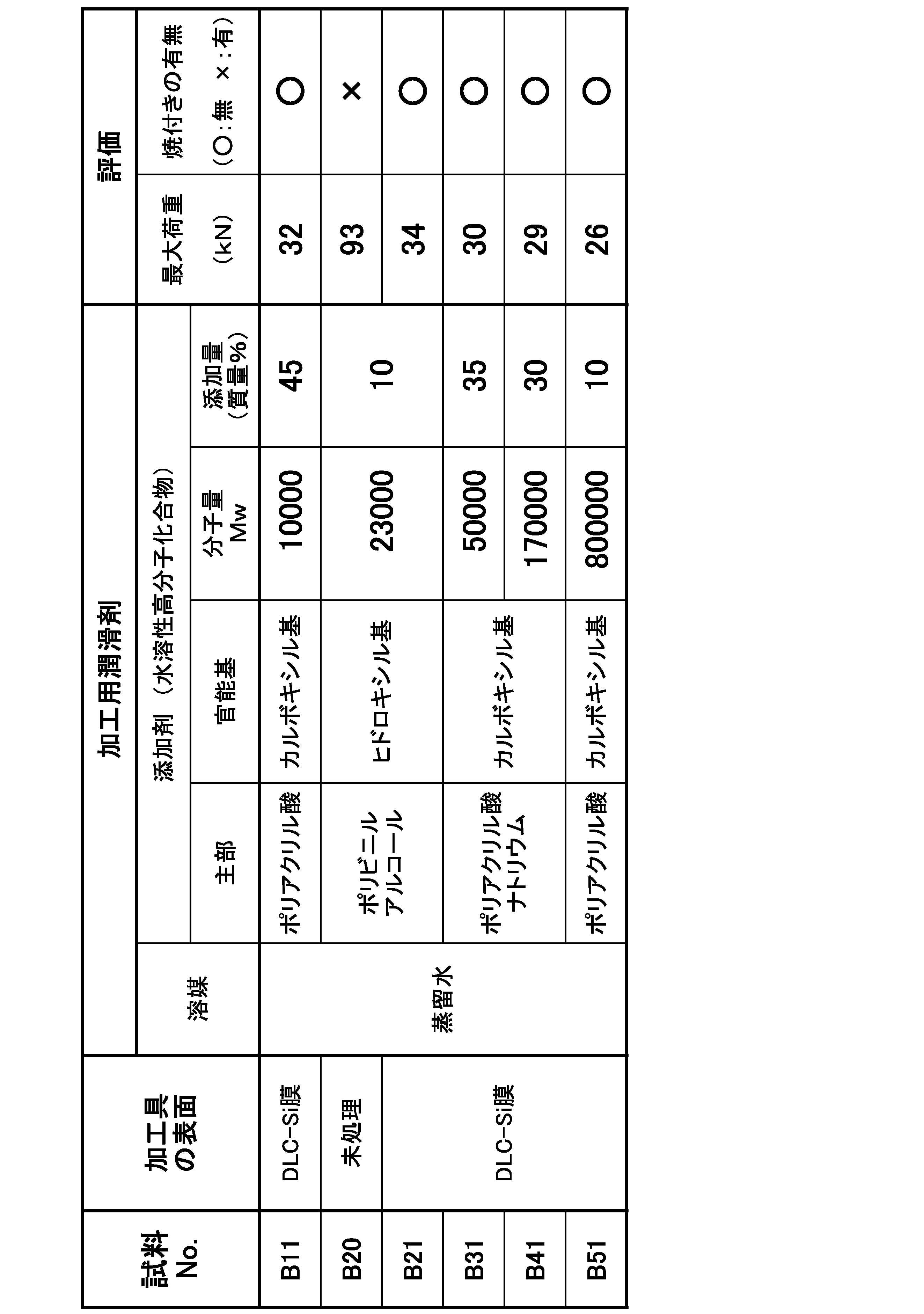
- the amount of the water-soluble polymer compound added to distilled water is also shown in Table 2 with the entire processing lubricant as 100% by mass.
- sample No. B20 and sample no. B21 is the same processing lubricant.
- processing lubricants B11 to B51 contains an environmentally hazardous substance. That is, these processing lubricants are substantially composed only of C, H, O, or Na, and do not include metals (such as Zn), heavy metals (such as Mo), S, P, and Cl that are environmentally hazardous elements.
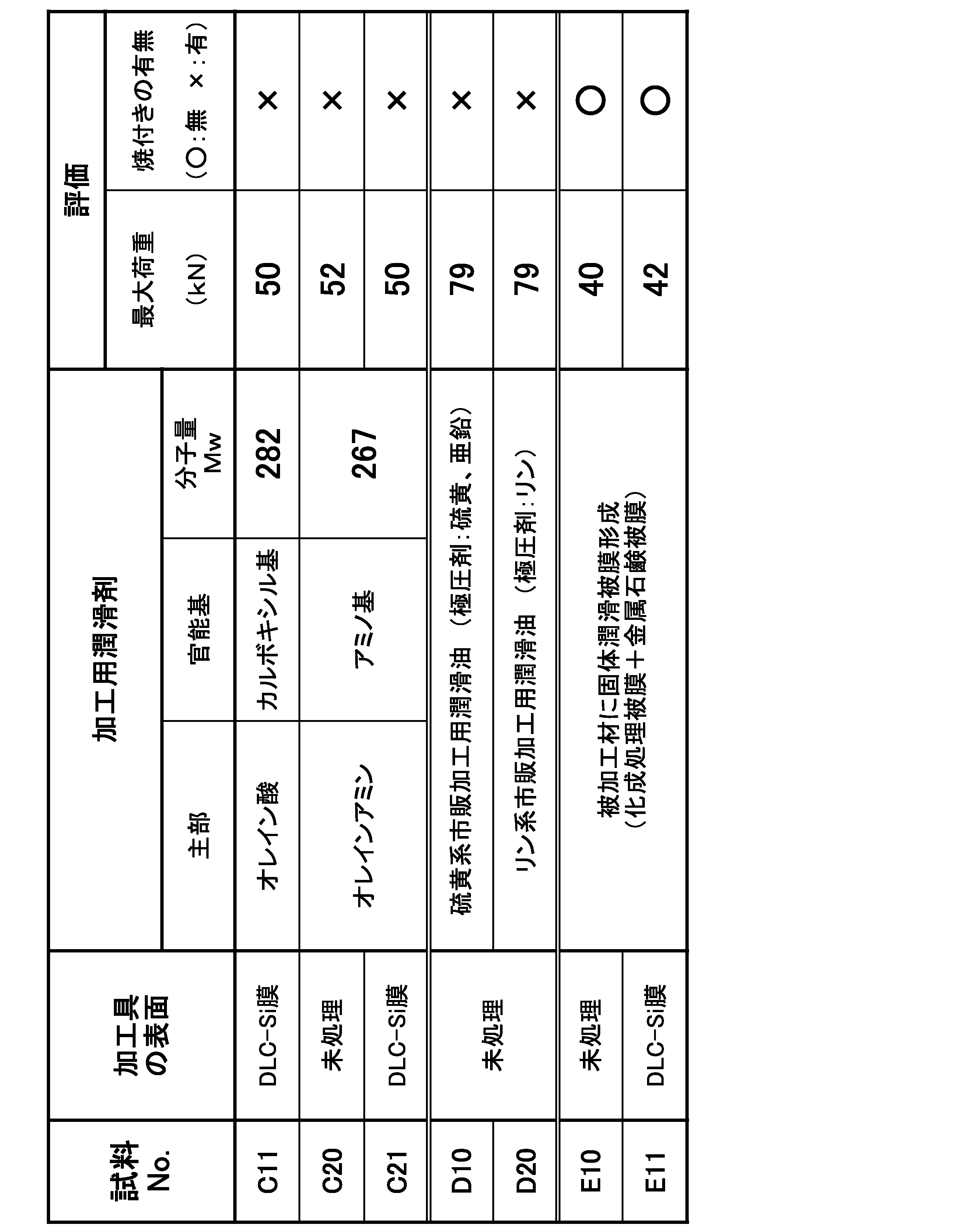
- Sample No. C11 to C21 and Sample No. D10 ⁇ 20 Conventional lubricating oils with relatively low molecular weight and commercially available processing lubricating oils were also prepared. These are shown in Table 3.
- Sample No. C20 and sample no. C21 is the same lubricating oil for processing.
- Sample No. The commercial oil indicated by D10 is a lubricating oil for cold forging (product name: FW439A, manufacturer: Nippon Oil Corporation).
- Sample No. The commercial oil shown in D20 is a lubricating oil for cold forging (product name: Titan Homer CCD220, manufacturer: Toyota Chemical Engineering Co., Ltd.).
- the solid lubricant film is not a fluid film (liquid film) formed by a processing lubricant applied to a mold (processing tool) or the like, but a non-fluid film fixed to the surface of the workpiece. This is also shown in Table 3.
- This solid lubricating film was formed as follows. First, a chemical conversion treatment film made of aluminum fluoride is formed on the outermost surface (inner peripheral surface) of a workpiece (base material) made of an aluminum alloy by using a silicofluorination method. On top of this, a zinc phosphate metal soap film and a sodium stearate metal soap film were sequentially formed while heating and drying. In this way, a solid lubricating film having a three-layer structure was formed on the surface of the workpiece. Incidentally, this solid lubricating coating is well known as a lubricating method capable of cold forging an aluminum alloy even under severe conditions difficult to cope with with conventional lubricating oils.
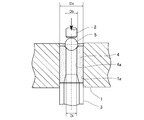
- FIG. 3 shows an outline of the test apparatus 10 used for this ball-through test.
- the test apparatus 10 includes a container 1, a punch 2, a knockout punch 3 and a ball 5.
- the container 1 is a steel (JIS SKH51) female die (die) provided with a through hole 1a having a diameter of 30 mm.
- a cylindrical workpiece 4 to be ironed can be inserted or inserted into the through hole 1a.
- the punch 2 pushes the male ball 5 into the inner cylinder portion 4 a of the workpiece 4 set in the container 1.
- the workpiece 4 is ironed by the balls 5.
- the knockout punch 3 supports the workpiece 4 pushed by the punch 2 from below and holds the workpiece 4 in a predetermined position.
- a load meter (not shown) for measuring the pushing force (working force) applied to the punch 2 is installed. Further, a displacement meter (not shown) for measuring the amount of movement is installed above the punch 2. In this way, the processing force and the displacement when the workpiece 5 is ironed by pushing the ball 5 are simultaneously measured via the punch 2.
- a non-treated ball formed with a DLC-Si film (hereinafter referred to as “DLC-Si film ball”) was also prepared.
- DLC-Si film having a thickness of 2 ⁇ m was obtained.
- the composition of this DLC-Si film was C: 66 atomic%, H: 30 atomic%, and Si: 4 atomic%.
- the Si content in the film was quantified by an electron probe microanalysis method (EPMA).
- H content was quantified by the elastic recoil detection method (ERDA).
- the processing lubricant was supplied as follows (the same applies to all tests using the processing lubricant). First, the balls 5 and the workpiece 4 were ultrasonically cleaned in a mixed solution of 50% acetone and 50% hexane and degreased and dried. Thereafter, a processing lubricant was dropped from the upper part of the inner peripheral surface of the workpiece 4. This workpiece 4 was inserted into the container 1. Next, the processing lubricant was dropped on the ball 5 from the top with a dropper. The ball 5 was placed on the inner peripheral surface of the workpiece 4. Thus, the processing lubricant was supplied between the processing surfaces.
- the indentation length (squeezing length) of the ball 5 was 38 mm
- the indentation speed (test speed) of the ball 5 was 200 mm / s at the initial speed.
- the indentation speed was reduced to a final speed of 180 mm / s due to deformation resistance generated when the ball 5 passed through the workpiece 4 (the same applies to all tests).
- Tables 1 to 3 also show the results obtained by performing the above-described ball threading test on each sample in which a processing lubricant or a solid lubricating coating is combined with a DLC-Si film ball or an untreated ball.
- Maximum load in the table is the maximum ball indentation load acting on the punch 2. In either case, the ball as the processing tool passed without stopping on the way. However, when the balls or workpieces after the ball pass test were observed, there were some seizures. The cases where seizure was not observed were shown in Tables 1 to 3 by ⁇ (no seizure) and x (when seizure was observed) when seizure was observed. Even if seizure occurred during the test, the ball penetrated because a part of the work piece was sheared while adhering to the ball.
- E11 when a solid lubricant film was formed on the surface of the workpiece, none of the seizures occurred at a maximum load of about 40 kN. This was true even when the DLC-Si film was present on the surface of the processing tool (ball 5) as well as when the surface was untreated. This is because the solid lubricating film is firmly bonded to the surface of the work piece and has ductility, unlike the conventional lubricating layer made of a processing lubricant (liquid), it is difficult for the lubricating film to break. This is probably because solid contact between the material and the processing tool was effectively suppressed.
- an amorphous carbon film (DLC-Si film) is formed on the surface of the processing tool, and the processing lubricant has an oil-soluble polymer having a surface functional group and a molecular weight of 30,000 or more. This was the case where the compound contained 8% by mass or more.
- the surface functional group of the oil-soluble polymer compound is a carbonyl group
- the maximum load is remarkably reduced and seizure does not occur.
- the surface functional groups of the oil-soluble polymer compound were a carbonyl group and an amino group
- the molecular weight was 30,000 or more, further 50,000 or more, the maximum load was remarkably reduced and no seizure occurred.
- FIG. 4 shows a pyrogram (decomposition temperature: 550 ° C.) by pyrolysis GC / MS of the polymer used for sample A81. Two types of carbonyl groups (I and IV in the figure) and two amino groups (II and III in the figure) were observed, indicating that there are many adsorption points in the polymer. The presence of many type III amino groups in the two types of amino groups is considered to be a factor that strengthens the boundary membrane.
- Sample No. B11 and sample no. As can be seen from comparison with B51, when the molecular weight of the polymer compound is increased, the maximum load can be reduced even if the addition amount is decreased. In other words, even with a polymer compound having a relatively small molecular weight, increasing the addition amount can reduce the maximum load and avoid the occurrence of seizure. However, from a comparison between the two, it is considered that an increase in the molecular weight of the polymer compound is particularly effective for efficiently reducing the maximum load and avoiding seizure.
- the maximum loads of A82 were 80 kN and 29 kN. These are respectively sample Nos. A01 and Sample No. It was almost the same as the maximum load of A81. From this, it was confirmed that substantially the same lubricating performance could be obtained even when the surface of the processing tool was changed from the DLC-Si film to the DLC film.
Landscapes
- Chemical & Material Sciences (AREA)
- Chemical Kinetics & Catalysis (AREA)
- General Chemical & Material Sciences (AREA)
- Oil, Petroleum & Natural Gas (AREA)
- Organic Chemistry (AREA)
- Lubricants (AREA)
Abstract
Description
(1)本発明の加工用潤滑剤は、非晶質炭素膜で被覆された加工具の被覆面とアルミニウムまたはアルミニウム合金からなり該被覆面に接触して加工される被加工材の被加工面との間に介在する加工用潤滑剤であって、カルボニル基、アミノ基、カルボキシル基またはヒドロキシル基の少なくとも一つ以上からなる表面官能基を有し分子量が8000~100万である高分子化合物を、全体を100質量%としたときに8~50質量%含むことを特徴とする。
本発明は加工用潤滑剤としてのみならず、その調製に用いる上述した高分子化合物からなる加工用添加剤として把握できる。
さらに本発明は、加工用潤滑剤や加工用添加剤としてのみならず、それらを用いた加工方法としても把握できる。すなわち本発明は、上述した加工用潤滑剤を、非晶質炭素膜で被覆された加工具の被覆面とアルミニウムまたはアルミニウム合金からなり該被覆面に接触して加工される被加工材の被加工面との間に介在させて、該加工具により該被加工材を加工することを特徴とする加工方法あってもよい。
特に断らない限り本明細書でいう「x~y」は、下限値xおよび上限値yを含む。また、本明細書に記載した数値や本明細書に記載した数値範囲内の任意の数値を、新たな下限値または上限値として「a~b」のような数値範囲を設定し得る。
(1)本発明に係る高分子化合物は、分子量が8000~100万である。この分子量が過小では上述した本発明の効果が乏しい。一方、分子量は大きくてもよいが、過大な分子量の高分子化合物を得ることは容易ではない。そこで高分子化合物の分子量は1万~90万さらには3万~85万程度であると好ましい。
(1)本発明の加工用潤滑剤は、上述した高分子化合物のみからなってもよいが、分子量の大きな高分子化合物は、通常、高粘度であって、そのままでは加工用潤滑剤として取り扱い難い。そこで適当な粘度の基油や水等に高分子化合物を添加したものを加工用潤滑剤として用いると好適である。油溶性高分子化合物なら基油を溶媒とし、水溶性高分子化合物なら水を溶媒とするとよい。
加工具は、基材の表面に非晶質炭素膜が成膜されてなる。
加工具の基材は、加工の種類に適した材質、形状等が選択される。例えば、その材質は表面に非晶質炭素膜が形成可能である限り、炭素鋼、合金鋼、鋳鉄、アルミニウム合金などの金属製でも、アルミナ、窒化ケイ素、炭化ケイ素、超硬合金などのセラミックス製でもよい。
加工具の基材上に形成される非晶質炭素膜は、いわゆるダイヤモンドライクカーボン膜(以下「DLC膜」という。)である。加工具の表面に成膜されるDLC膜の組成、成膜方法、特性(硬度、ヤング率、耐剥離性等)などは問わないが、当然ながら、加工具の用途に応じた適切な特性を備えるのが好ましい。
本発明でいう加工は、鍛造、しごき、絞り、プレス、転造、押出し、引抜き、圧延などの塑性加工が好適である。特に加工率や面積拡大率が大きい(例えば、減面率:5~15%)しごき加工、絞り加工、鍛造等の塑性加工に本発明を用いると好ましい。この他、本発明でいう加工は切削、剪断、穴あけ等の加工でもよい。なお、加工具は加工の種類に応じたものであればよく、各種の金型(パンチ、ダイス等を含む)でも切削工具等でもよい。
(1)試料No.A00~A111(油系加工用潤滑剤)
表1に示すように、基油(試料No.A00)に種々の油溶性高分子化合物(添加剤)を添加して、アルミニウム合金を対象とした複数の加工用潤滑剤を調製した。
カラム:Shodex KF-806×2本、 KF-802×1本
またはK-806×2本 K-802×1本
測定温度:室温~40℃
試料溶液:0.2質量%のTHF溶液または0.3質量%のクロロホルム
溶液注入量:150μl
検出装置:屈折率検出器
標準:ポリスチレン
表2に示すように、蒸留水に種々の水溶性高分子化合物(添加剤)を添加して、アルミニウム合金を対象とした複数の加工用潤滑剤を調製した。
分子量が比較的小さい従来の潤滑油および市販されている加工用潤滑油も用意した。これらを表3に示した。なお、試料No.C20と試料No.C21は同じ加工用潤滑油である。また試料No.D10に示した市販油は、冷間鍛造用潤滑油(製品名:FW439A、メーカー:新日本石油株式会社) である。試料No.D20に示した市販油は、冷間鍛造用潤滑油(製品名:タイタンホーマーCCD220、メーカー:豊田ケミカルエンジニアリング株式会社)である。
固体潤滑被膜に関する試料も用意した。固体潤滑被膜は、金型(加工具)等に塗布された加工用潤滑剤により形成される流動性被膜(液膜)ではなく、被加工材の表面に固着した非流動性被膜である。これも表3に併せて示した。
(1)ボール通し試験
本実施例では、しごき加工等を行う際の金型と被加工材との間の摩擦抵抗(加工力)や耐焼付性などを代替的に評価できるボール通し試験により、各加工用潤滑剤の潤滑性(加工性)を評価した。このボール通し試験に用いた試験装置10の概要を図3に示す。試験装置10は、コンテナ1、パンチ2、ノックアウトパンチ3およびボール5から構成される。コンテナ1は、φ30mmの貫通穴1aが中央に設けられた鋼製(JIS SKH51)の雌型(ダイス)である。この貫通穴1aに、しごき加工の対象となる円筒状の被加工材4が嵌挿または挿入され得る。パンチ2は、コンテナ1にセットされた被加工材4の内筒部4aへ、雄型であるボール5を押し込む。このパンチ2が移動すると、被加工材4はボール5によってしごき加工がなされる。ノックアウトパンチ3は、そのパンチ2によって押込まれる被加工材4を下方から支持し、被加工材4を所定位置に保持する。
被加工材4として、外径:φ29.9mm、内径:φ15.0mm、高さ50mm(その内、しごき長さ38mm)のアルミニウム合金(JIS A6061)の円筒材を用意した。試験に供した被加工材には、Ar雰囲気中で410℃×2時間加熱した焼鈍し処理を施した。
上述のボール5として、φ16.67mmの鋼球(高速度工具鋼:AISI M50)を用意した。以下、これを「未処理ボール」という。この未処理ボールにDLC-Si膜を成膜したもの(以下「DLC-Si膜ボール」という。)も用意した。このDLC-Si膜の成膜は、直流プラズマCVD装置を用いて、メタン(CH4)とテトラメチルシラン(TMS)の混合ガス(原料ガス)中でプラズマ放電をさせて行った。その際の流量比は、CH4:TMS=1:100(全圧:500Pa)とした。こうして膜厚が2μmのDLC-Si膜を得た。このDLC-Si膜の組成は、C:66原子%、H:30原子%、Si:4原子%であった。なお、この膜中のSi含有量は電子プローブ微小部分析法(EPMA)により定量した。またH含有量は弾性反跳粒子検出法(ERDA)により定量した。
上述した種々の加工用潤滑剤を加工具(ボール5)に塗布してボール通し試験を行った。また固体潤滑被膜を形成した被加工材についても同様にボール通し試験を行った。この際、被加工材4の減面率は8%である。減面率:8%の加工は、通常なら焼き付きを生じる厳しい加工である。具体的には、前述した固体潤滑被膜を被加工材4の内周面に形成していないと、従来なら焼き付きを生じるほど厳しい強加工である。ちなみに減面率(R)は加工にともない被加工材4の横断面積が減少する割合であり次のようにして求まる(図3参照)。
Db:ボール5の外径
Dc:コンテナ1の内径
Di:被加工材4の内径(加工前)
加工用潤滑剤または固体潤滑被膜と、DLC-Si膜ボールまたは未処理ボールとを組合わせた各試料について上述したボール通し試験を行うことにより得られた結果を表1~3に併せて示した。表中の「最大荷重」は、パンチ2に作用する最大ボール押込み荷重を測定したものである。いずれの場合も、加工具であるボールは途中で止まることなく通過した。但し、ボール通し試験後のボールまたは被加工材を観察したところ、焼付きが生じているものがあった。焼付きが観察されなかった場合を○(焼付き無し)、焼付きが観察された場合を×(焼付き有り)で表1~3に併せて示した。なお、試験途中で焼付きが生じても、ボールが貫通したのは、被加工材の一部がボールに付着したまません断されていたためである。
(1)従来の加工用潤滑剤等
先ず、表3の試料No.C11~D20に示すように、従来の加工用潤滑剤を用いた場合、いずれもボール押込み時の最大荷重が50kN以上となって焼付きが生じた。これは加工具(ボール5)の表面が未処理の場合は勿論、その表面にDLC-Si膜がある場合でも同様であった。
次に、表1に示す結果から、分子量の大きな油溶性高分子化合物を基油に添加した加工用潤滑剤を用いた場合、ボール押込み時の最大荷重を、上記の固体潤滑被膜の場合よりもさらに低くでき、焼付きの発生を回避し得ることが明らかとなった(試料No.A41、試料No.A51、A61およびA81~A101)。
さらに、表2に示す結果から、分子量の大きな水溶性高分子化合物を蒸留水に添加した加工用潤滑剤を用いた場合も、ボール押込み時の最大荷重を上記の固体潤滑被膜の場合よりもさらに低くでき、焼付きの発生を回避し得ることが明らかとなった(試料No.B11およびB21~B51)。これらの場合も同様に、加工具の表面に非晶質炭素膜(DLC-Si膜)が形成されており、加工用潤滑剤がカルボキシル基またはヒドロキシル基を有する分子量8000以上さらには1万以上の水溶性高分子化合物を8質量%以上含む場合であった。


2 パンチ2
3 ノックアウトパンチ
4 被加工材
5 ボール
Claims (10)
- 非晶質炭素膜で被覆された加工具の被覆面とアルミニウムまたはアルミニウム合金からなり該被覆面に接触して加工される被加工材の被加工面との間に介在する加工用潤滑剤であって、
カルボニル基、アミノ基、カルボキシル基またはヒドロキシル基の少なくとも一つ以上からなる表面官能基を有し分子量が8000~100万である高分子化合物を、全体を100質量%としたときに8~50質量%含むことを特徴とする加工用潤滑剤。 - 塩素(Cl)、リン(P)または硫黄(S)の一種以上を有する環境負荷物質を、含まない請求項1に記載の加工用潤滑剤。
- 炭素(C)、水素(H)、酸素(O)または窒素(N)の一種以上のみからなる請求項1または2に記載の加工用潤滑剤。
- 前記非晶質炭素膜は、ケイ素(Si)を含み残部がCおよびHからなるSi含有非晶質炭素膜である請求項1に記載の加工用潤滑剤。
- 前記高分子化合物は、カルボキシル基および/またはヒドロキシル基を有する水溶性高分子化合物であり、
分子量が8000~100万である請求項1または4に記載の加工用潤滑剤。 - 前記高分子化合物は、カルボニル基を有する油溶性高分子化合物であり、
分子量が6万~100万である請求項1または4に記載の加工用潤滑剤。 - 前記高分子化合物は、カルボニル基およびアミノ基を有する油溶性高分子化合物であり、
分子量が3万~100万である請求項1または4に記載の加工用潤滑剤。 - 請求項1~7のいずれかに記載の加工用潤滑剤に用いられる高分子化合物からなることを特徴とする加工用添加剤。
- 請求項1~7のいずれかに記載の加工用潤滑剤を、非晶質炭素膜で被覆された加工具の被覆面とアルミニウムまたはアルミニウム合金からなり該被覆面に接触して加工される被加工材の被加工面との間に介在させて、該加工具により該被加工材を加工することを特徴とする加工方法。
- 前記加工は、冷間塑性加工である請求項9に記載の加工方法。
Priority Applications (2)
| Application Number | Priority Date | Filing Date | Title |
|---|---|---|---|
| JP2013501090A JP5776765B2 (ja) | 2011-02-24 | 2012-02-22 | 加工用潤滑剤、加工用添加剤および加工方法 |
| CN201280010350.5A CN103391990B (zh) | 2011-02-24 | 2012-02-22 | 加工用润滑剂、加工用添加剂及加工方法 |
Applications Claiming Priority (2)
| Application Number | Priority Date | Filing Date | Title |
|---|---|---|---|
| JP2011038664 | 2011-02-24 | ||
| JP2011-038664 | 2011-02-24 |
Publications (1)
| Publication Number | Publication Date |
|---|---|
| WO2012115142A1 true WO2012115142A1 (ja) | 2012-08-30 |
Family
ID=46720918
Family Applications (1)
| Application Number | Title | Priority Date | Filing Date |
|---|---|---|---|
| PCT/JP2012/054257 Ceased WO2012115142A1 (ja) | 2011-02-24 | 2012-02-22 | 加工用潤滑剤、加工用添加剤および加工方法 |
Country Status (3)
| Country | Link |
|---|---|
| JP (1) | JP5776765B2 (ja) |
| CN (1) | CN103391990B (ja) |
| WO (1) | WO2012115142A1 (ja) |
Cited By (3)
| Publication number | Priority date | Publication date | Assignee | Title |
|---|---|---|---|---|
| WO2016065175A1 (en) * | 2014-10-23 | 2016-04-28 | Northwestern University | Lubricant additives, lubricant compositions, and applications of same |
| JP2018192487A (ja) * | 2017-05-15 | 2018-12-06 | 日産自動車株式会社 | 摺動機構 |
| CN111088105A (zh) * | 2019-11-12 | 2020-05-01 | 常州海纳金属助剂有限公司 | 一种提高润滑性的全合成金属加工液配方及制备方法 |
Families Citing this family (2)
| Publication number | Priority date | Publication date | Assignee | Title |
|---|---|---|---|---|
| CN105001949B (zh) * | 2015-06-05 | 2018-04-24 | 上海贝能环保科技有限公司 | 一种生物降解环保准干切削液及其制备方法 |
| CN106635303A (zh) * | 2016-09-21 | 2017-05-10 | 广西大学 | 一种625合金管材冷挤压润滑剂组合物 |
Citations (6)
| Publication number | Priority date | Publication date | Assignee | Title |
|---|---|---|---|---|
| JPH1036872A (ja) * | 1996-07-19 | 1998-02-10 | Nippon Oil Co Ltd | 圧延油組成物 |
| JPH1150083A (ja) * | 1997-07-30 | 1999-02-23 | Sugimura Kagaku Kogyo Kk | 金属塑性加工用潤滑剤 |
| JP2004358495A (ja) * | 2003-06-03 | 2004-12-24 | Nissan Motor Co Ltd | 冷間引抜き加工用治具及びこれに用いる潤滑油組成物 |
| JP2004359813A (ja) * | 2003-06-04 | 2004-12-24 | Honda Motor Co Ltd | 水溶性潤滑皮膜剤及び成形加工方法 |
| JP2007136511A (ja) * | 2005-11-18 | 2007-06-07 | Toyota Central Res & Dev Lab Inc | 冷間加工方法 |
| JP2010095792A (ja) * | 2008-09-19 | 2010-04-30 | Toyota Central R&D Labs Inc | 非晶質炭素被覆部材および金属材料の加工方法 |
Family Cites Families (3)
| Publication number | Priority date | Publication date | Assignee | Title |
|---|---|---|---|---|
| JP5436751B2 (ja) * | 2006-10-13 | 2014-03-05 | 株式会社Uacj | 金属管の拡管方法、それに用いる拡管冶具、及びそれに用いる潤滑油 |
| SG174950A1 (en) * | 2009-03-31 | 2011-11-28 | Idemitsu Kosan Co | Working fluid for brittle material and working fluid for hard material |
| JP5482691B2 (ja) * | 2010-03-19 | 2014-05-07 | 株式会社豊田中央研究所 | 加工油、加工油用添加剤および加工方法 |
-
2012
- 2012-02-22 JP JP2013501090A patent/JP5776765B2/ja not_active Expired - Fee Related
- 2012-02-22 WO PCT/JP2012/054257 patent/WO2012115142A1/ja not_active Ceased
- 2012-02-22 CN CN201280010350.5A patent/CN103391990B/zh not_active Expired - Fee Related
Patent Citations (6)
| Publication number | Priority date | Publication date | Assignee | Title |
|---|---|---|---|---|
| JPH1036872A (ja) * | 1996-07-19 | 1998-02-10 | Nippon Oil Co Ltd | 圧延油組成物 |
| JPH1150083A (ja) * | 1997-07-30 | 1999-02-23 | Sugimura Kagaku Kogyo Kk | 金属塑性加工用潤滑剤 |
| JP2004358495A (ja) * | 2003-06-03 | 2004-12-24 | Nissan Motor Co Ltd | 冷間引抜き加工用治具及びこれに用いる潤滑油組成物 |
| JP2004359813A (ja) * | 2003-06-04 | 2004-12-24 | Honda Motor Co Ltd | 水溶性潤滑皮膜剤及び成形加工方法 |
| JP2007136511A (ja) * | 2005-11-18 | 2007-06-07 | Toyota Central Res & Dev Lab Inc | 冷間加工方法 |
| JP2010095792A (ja) * | 2008-09-19 | 2010-04-30 | Toyota Central R&D Labs Inc | 非晶質炭素被覆部材および金属材料の加工方法 |
Cited By (5)
| Publication number | Priority date | Publication date | Assignee | Title |
|---|---|---|---|---|
| WO2016065175A1 (en) * | 2014-10-23 | 2016-04-28 | Northwestern University | Lubricant additives, lubricant compositions, and applications of same |
| US10414997B2 (en) | 2014-10-23 | 2019-09-17 | Northwestern University | Lubricant additives, lubricant compositions, and applications of same |
| JP2018192487A (ja) * | 2017-05-15 | 2018-12-06 | 日産自動車株式会社 | 摺動機構 |
| JP7033399B2 (ja) | 2017-05-15 | 2022-03-10 | 日産自動車株式会社 | 摺動機構 |
| CN111088105A (zh) * | 2019-11-12 | 2020-05-01 | 常州海纳金属助剂有限公司 | 一种提高润滑性的全合成金属加工液配方及制备方法 |
Also Published As
| Publication number | Publication date |
|---|---|
| JPWO2012115142A1 (ja) | 2014-07-07 |
| JP5776765B2 (ja) | 2015-09-09 |
| CN103391990A (zh) | 2013-11-13 |
| CN103391990B (zh) | 2016-02-17 |
Similar Documents
| Publication | Publication Date | Title |
|---|---|---|
| JP5776765B2 (ja) | 加工用潤滑剤、加工用添加剤および加工方法 | |
| Kataoka et al. | Tribology of dry deep-drawing of various metal sheets with use of ceramics tools | |
| CN1260310C (zh) | 保护涂膜处理剂,具有保护涂膜的金属材料和保护涂膜的形成方法 | |
| EP2077318B1 (en) | Grease composition | |
| US20070292711A1 (en) | Low Friction Sliding Mechanism | |
| JP7702864B2 (ja) | 潤滑油剤組成物及び潤滑油剤用添加剤 | |
| EP2670879A1 (en) | Hot metal sheet forming or stamping tools with cr-si-n coatings | |
| Konishi et al. | Wear characteristics of aluminum-silicon alloy under lubricated sliding conditions | |
| JP5482691B2 (ja) | 加工油、加工油用添加剤および加工方法 | |
| WO2010069984A1 (en) | Urea grease composition | |
| EP3875184B1 (en) | Press die and pressing method | |
| JP4054539B2 (ja) | 傾斜型2層潤滑皮膜を有する塑性加工用金属材料の製造方法 | |
| JP5703951B2 (ja) | 加工油剤およびそれを用いた冷間塑性加工方法 | |
| WO2023191002A1 (ja) | グリース組成物 | |
| Ngaile et al. | Formulation of polymer-based lubricant for metal forming | |
| WO2005095563A1 (ja) | 塑性加工用潤滑剤組成物 | |
| Murakawa et al. | Tribological behavior of amorphous hard carbon films against zinc-plated steel sheets | |
| CN118879388A (zh) | 一种不锈钢专用切削液及其制备方法 | |
| JP3744392B2 (ja) | 金属線材およびその製造方法 | |
| JP2010095792A (ja) | 非晶質炭素被覆部材および金属材料の加工方法 | |
| Dohda et al. | Evaluation of tribo-characteristics of diamond-like-carbon containing Si by metal forming simulators | |
| JP3975358B2 (ja) | シールリング及びシール装置 | |
| JP3753324B2 (ja) | 冷間引抜き加工用治具及びこれに用いる潤滑油組成物 | |
| CN104450078A (zh) | 一种碳钢温锻造润滑剂组合物 | |
| CN114874827B (zh) | 一种回转支承轴承润滑脂及其制备方法 |
Legal Events
| Date | Code | Title | Description |
|---|---|---|---|
| WWE | Wipo information: entry into national phase |
Ref document number: 201280010350.5 Country of ref document: CN |
|
| 121 | Ep: the epo has been informed by wipo that ep was designated in this application |
Ref document number: 12750174 Country of ref document: EP Kind code of ref document: A1 |
|
| DPE2 | Request for preliminary examination filed before expiration of 19th month from priority date (pct application filed from 20040101) | ||
| ENP | Entry into the national phase |
Ref document number: 2013501090 Country of ref document: JP Kind code of ref document: A |
|
| NENP | Non-entry into the national phase |
Ref country code: DE |
|
| 122 | Ep: pct application non-entry in european phase |
Ref document number: 12750174 Country of ref document: EP Kind code of ref document: A1 |