WO2012115113A1 - 低反発性軟質ポリウレタンフォームおよびその製造方法 - Google Patents
低反発性軟質ポリウレタンフォームおよびその製造方法 Download PDFInfo
- Publication number
- WO2012115113A1 WO2012115113A1 PCT/JP2012/054155 JP2012054155W WO2012115113A1 WO 2012115113 A1 WO2012115113 A1 WO 2012115113A1 JP 2012054155 W JP2012054155 W JP 2012054155W WO 2012115113 A1 WO2012115113 A1 WO 2012115113A1
- Authority
- WO
- WIPO (PCT)
- Prior art keywords
- polyol
- polyurethane foam
- flexible polyurethane
- mass
- producing
- Prior art date
- Legal status (The legal status is an assumption and is not a legal conclusion. Google has not performed a legal analysis and makes no representation as to the accuracy of the status listed.)
- Ceased
Links
Classifications
-
- C—CHEMISTRY; METALLURGY
- C08—ORGANIC MACROMOLECULAR COMPOUNDS; THEIR PREPARATION OR CHEMICAL WORKING-UP; COMPOSITIONS BASED THEREON
- C08J—WORKING-UP; GENERAL PROCESSES OF COMPOUNDING; AFTER-TREATMENT NOT COVERED BY SUBCLASSES C08B, C08C, C08F, C08G or C08H
- C08J9/00—Working-up of macromolecular substances to porous or cellular articles or materials; After-treatment thereof
- C08J9/0014—Use of organic additives
- C08J9/0042—Use of organic additives containing silicon
-
- C—CHEMISTRY; METALLURGY
- C08—ORGANIC MACROMOLECULAR COMPOUNDS; THEIR PREPARATION OR CHEMICAL WORKING-UP; COMPOSITIONS BASED THEREON
- C08G—MACROMOLECULAR COMPOUNDS OBTAINED OTHERWISE THAN BY REACTIONS ONLY INVOLVING UNSATURATED CARBON-TO-CARBON BONDS
- C08G18/00—Polymeric products of isocyanates or isothiocyanates
- C08G18/06—Polymeric products of isocyanates or isothiocyanates with compounds having active hydrogen
- C08G18/70—Polymeric products of isocyanates or isothiocyanates with compounds having active hydrogen characterised by the isocyanates or isothiocyanates used
- C08G18/72—Polyisocyanates or polyisothiocyanates
- C08G18/74—Polyisocyanates or polyisothiocyanates cyclic
- C08G18/76—Polyisocyanates or polyisothiocyanates cyclic aromatic
- C08G18/7614—Polyisocyanates or polyisothiocyanates cyclic aromatic containing only one aromatic ring
- C08G18/7621—Polyisocyanates or polyisothiocyanates cyclic aromatic containing only one aromatic ring being toluene diisocyanate including isomer mixtures
-
- C—CHEMISTRY; METALLURGY
- C08—ORGANIC MACROMOLECULAR COMPOUNDS; THEIR PREPARATION OR CHEMICAL WORKING-UP; COMPOSITIONS BASED THEREON
- C08G—MACROMOLECULAR COMPOUNDS OBTAINED OTHERWISE THAN BY REACTIONS ONLY INVOLVING UNSATURATED CARBON-TO-CARBON BONDS
- C08G18/00—Polymeric products of isocyanates or isothiocyanates
- C08G18/06—Polymeric products of isocyanates or isothiocyanates with compounds having active hydrogen
- C08G18/28—Polymeric products of isocyanates or isothiocyanates with compounds having active hydrogen characterised by the compounds used containing active hydrogen
- C08G18/40—High-molecular-weight compounds
- C08G18/48—Polyethers
- C08G18/4804—Two or more polyethers of different physical or chemical nature
- C08G18/4812—Mixtures of polyetherdiols with polyetherpolyols having at least three hydroxy groups
-
- C—CHEMISTRY; METALLURGY
- C08—ORGANIC MACROMOLECULAR COMPOUNDS; THEIR PREPARATION OR CHEMICAL WORKING-UP; COMPOSITIONS BASED THEREON
- C08G—MACROMOLECULAR COMPOUNDS OBTAINED OTHERWISE THAN BY REACTIONS ONLY INVOLVING UNSATURATED CARBON-TO-CARBON BONDS
- C08G65/00—Macromolecular compounds obtained by reactions forming an ether link in the main chain of the macromolecule
- C08G65/02—Macromolecular compounds obtained by reactions forming an ether link in the main chain of the macromolecule from cyclic ethers by opening of the heterocyclic ring
- C08G65/26—Macromolecular compounds obtained by reactions forming an ether link in the main chain of the macromolecule from cyclic ethers by opening of the heterocyclic ring from cyclic ethers and other compounds
- C08G65/2642—Macromolecular compounds obtained by reactions forming an ether link in the main chain of the macromolecule from cyclic ethers by opening of the heterocyclic ring from cyclic ethers and other compounds characterised by the catalyst used
- C08G65/2645—Metals or compounds thereof, e.g. salts
- C08G65/2663—Metal cyanide catalysts, i.e. DMC's
-
- C—CHEMISTRY; METALLURGY
- C08—ORGANIC MACROMOLECULAR COMPOUNDS; THEIR PREPARATION OR CHEMICAL WORKING-UP; COMPOSITIONS BASED THEREON
- C08L—COMPOSITIONS OF MACROMOLECULAR COMPOUNDS
- C08L75/00—Compositions of polyureas or polyurethanes; Compositions of derivatives of such polymers
- C08L75/04—Polyurethanes
-
- C—CHEMISTRY; METALLURGY
- C08—ORGANIC MACROMOLECULAR COMPOUNDS; THEIR PREPARATION OR CHEMICAL WORKING-UP; COMPOSITIONS BASED THEREON
- C08G—MACROMOLECULAR COMPOUNDS OBTAINED OTHERWISE THAN BY REACTIONS ONLY INVOLVING UNSATURATED CARBON-TO-CARBON BONDS
- C08G2110/00—Foam properties
- C08G2110/0008—Foam properties flexible
-
- C—CHEMISTRY; METALLURGY
- C08—ORGANIC MACROMOLECULAR COMPOUNDS; THEIR PREPARATION OR CHEMICAL WORKING-UP; COMPOSITIONS BASED THEREON
- C08G—MACROMOLECULAR COMPOUNDS OBTAINED OTHERWISE THAN BY REACTIONS ONLY INVOLVING UNSATURATED CARBON-TO-CARBON BONDS
- C08G2110/00—Foam properties
- C08G2110/0041—Foam properties having specified density
- C08G2110/005—< 50kg/m3
-
- C—CHEMISTRY; METALLURGY
- C08—ORGANIC MACROMOLECULAR COMPOUNDS; THEIR PREPARATION OR CHEMICAL WORKING-UP; COMPOSITIONS BASED THEREON
- C08G—MACROMOLECULAR COMPOUNDS OBTAINED OTHERWISE THAN BY REACTIONS ONLY INVOLVING UNSATURATED CARBON-TO-CARBON BONDS
- C08G2110/00—Foam properties
- C08G2110/0083—Foam properties prepared using water as the sole blowing agent
-
- C—CHEMISTRY; METALLURGY
- C08—ORGANIC MACROMOLECULAR COMPOUNDS; THEIR PREPARATION OR CHEMICAL WORKING-UP; COMPOSITIONS BASED THEREON
- C08J—WORKING-UP; GENERAL PROCESSES OF COMPOUNDING; AFTER-TREATMENT NOT COVERED BY SUBCLASSES C08B, C08C, C08F, C08G or C08H
- C08J2205/00—Foams characterised by their properties
- C08J2205/06—Flexible foams
Definitions
- the present invention relates to a low-resilience flexible polyurethane foam and a method for producing the same.
- a flexible polyurethane foam having a low impact resilience that is, a low resilience
- a sound absorber a sound absorber
- a vibration absorber a vibration absorber
- the air permeability of a low-resilience flexible polyurethane foam decreases as the resilience decreases.
- moisture mainly released from the human body
- a so-called stuffy state is obtained.
- the flexible polyurethane foam since the flexible polyurethane foam is used in a compressed state, it is required to exhibit a considerably high air permeability in a breathability test usually measured in an uncompressed state.
- Patent Document 3 discloses a technique for producing a low-resilience polyurethane foam having good air permeability by using monool in combination. However, this method has a problem that it is inferior in durability during humidification described later.
- Patent Document 4 discloses a technology related to a flexible polyurethane foam that can ensure air permeability by a combination of a specific polyol and monool. However, since the density of this flexible polyurethane foam is as high as 55 kg / m 3, it is processed into a mattress or the like. There is a problem that handling is sometimes poor. Furthermore, in patent document 5, although silicone oil is employ
- Japanese Unexamined Patent Publication No. 2004-2594 Japanese Unexamined Patent Publication No. 9-151234 Japanese Unexamined Patent Publication No. 2004-300332 WO2006 / 115169 Japanese Unexamined Patent Publication No. 2001-269062
- the present invention provides a flexible polyurethane foam having excellent low resilience without using a plasticizer for imparting flexibility, excellent durability during humidification, and high air permeability, and a method for producing the same.
- the gist of the present invention is the following [1] to [11].
- [1] Presence of a foam mixture (X), a urethanization catalyst, and a foaming agent composed of a silicone compound, a polyol mixture containing polyol (A), polyol (B) and monool (D) and a polyisocyanate compound
- a foam mixture (X) a urethanization catalyst, and a foaming agent composed of a silicone compound, a polyol mixture containing polyol (A), polyol (B) and monool (D) and a polyisocyanate compound
- the polyol (A) is obtained by ring-opening addition polymerization of alkylene oxide using a double metal cyanide complex catalyst as an initiator, and has an average hydroxyl number of 2 to 3 and a hydroxyl value of 10 to 90 mgKOH / g.
- the polyol (B) is a polyether polyol having an average number of hydroxyl groups of 2 to 3, a hydroxyl value of 15 to 250 mgKOH / g, and excluding the polyol (A).
- the monool (D) is a polyether monool having a hydroxyl value of 10 to 200 mg KOH / g, obtained by ring-opening addition polymerization of alkylene oxide using a double metal cyanide complex catalyst as an initiator.
- the foam stabilizer (X) is a silicone compound containing one or more dimethylpolysiloxanes represented by the following formula (I) and having an average value of n of 1 to 30: Containing 0.01 to 1.0 part by weight of polysiloxane with respect to 100 parts by weight of the polyol mixture; A method for producing a flexible polyurethane foam characterized by the above.
- the polyisocyanate compound is tolylene diisocyanate (TDI), diphenylmethane diisocyanate (MDI), polymethylene polyphenyl polyisocyanate, xylylene diisocyanate (XDI), isophorone diisocyanate (IPDI), hexamethylene diisocyanate (HMDI), and
- TDI tolylene diisocyanate
- MDI diphenylmethane diisocyanate
- XDI polymethylene polyphenyl polyisocyanate
- XDI xylylene diisocyanate
- IPDI isophorone diisocyanate
- HMDI hexamethylene diisocyanate
- the method for producing a flexible polyurethane foam of the present invention it is possible to produce a flexible polyurethane foam having excellent low resilience, excellent durability during humidification and high air permeability without using a plasticizer.
- a flexible polyurethane is prepared by reacting a polyol mixture with a polyisocyanate compound in the presence of a urethanization catalyst, a foaming agent and a foam stabilizer containing a specific degree of polymerization of dimethylpolysiloxane represented by the chemical formula (I).
- the “silicone compound” in the present invention means dimethylpolysiloxane, a derivative thereof, or a mixture thereof.
- the raw material refers to a polyol mixture, a polyisocyanate compound, a urethanization catalyst, a foaming agent and a foam stabilizer.
- a polyol mixture a polyol mixture
- a polyisocyanate compound a polyisocyanate compound
- a urethanization catalyst a urethanization catalyst
- a foaming agent a foam stabilizer
- the polyol mixture used in the present invention contains polyol (A), polyol (B) and monool (D) described later. Further, it preferably contains a polyol (C).
- polyol (A) The polyol (A) in the present invention is obtained by ring-opening addition polymerization of alkylene oxide using a double metal cyanide complex catalyst (DMC catalyst) as an initiator, having an average number of hydroxyl groups of 2 to 3, A polyether polyol (polyoxyalkylene polyol) of 10 to 90 mg KOH / g. That is, polyol (A) is a polyether polyol having a polyoxyalkylene chain obtained by ring-opening addition polymerization of alkylene oxide using a double metal cyanide complex catalyst.
- DMC catalyst double metal cyanide complex catalyst
- a polyol with a narrow molecular weight distribution has a low viscosity compared to a polyol with a broad molecular weight distribution in the same molecular weight region (polyol having the same hydroxyl value), so it is excellent in the mixing of reactive raw materials. Increases foam stability.
- the double metal cyanide complex catalyst for example, those described in JP-B-46-27250 can be used.
- Specific examples include a complex mainly composed of zinc hexacyanocobaltate, and an ether and / or alcohol complex thereof is preferable.
- ethers include ethylene glycol dimethyl ether (glyme), diethylene glycol dimethyl ether (diglyme), ethylene glycol mono-tert-butyl ether (METB), ethylene glycol mono-tert-pentyl ether (METP), diethylene glycol mono-tert-butyl ether (DETB), Tripropylene glycol monomethyl ether (TPME) and the like are preferable.
- the alcohol tert-butyl alcohol or the like is preferable.
- Examples of the alkylene oxide used for the production of the polyol (A) include ethylene oxide, propylene oxide, 1,2-epoxybutane, 2,3-epoxybutane, and the like. Among these, propylene oxide or a combination of propylene oxide and ethylene oxide is preferable, and only propylene oxide is particularly preferable. That is, as the polyol (A), polyoxypropylene polyol obtained by ring-opening addition polymerization of only propylene oxide as an initiator is preferable. It is preferable to use only propylene oxide because durability during humidification is improved.
- a compound having 2 or 3 active hydrogen atoms in the molecule is used alone or in combination.
- the compound having 2 active hydrogens include ethylene glycol, propylene glycol, 1,4-butanediol, diethylene glycol, and dipropylene glycol.
- Specific examples of the compound having 3 active hydrogens include glycerin and trimethylolpropane.
- polyether polyol preferably polyoxypropylene polyol
- a high hydroxyl value polyether polyol having a molecular weight per hydroxyl group of about 200 to 500, that is, a hydroxyl value of 110 to 280 mgKOH / g.
- the average number of hydroxyl groups of the polyol (A) is 2 to 3.
- the average number of hydroxyl groups in the present invention means the average value of the number of active hydrogens in the initiator.
- the polyol (A) it is preferable to use a polyether diol having 2 hydroxyl groups in an amount of 50 to 100% by mass of the polyol (A) from the viewpoint of easily suppressing the temperature sensitivity.
- the hydroxyl value of the polyol (A) is 10 to 90 mgKOH / g.
- the hydroxyl value of the polyol (A) is more preferably from 10 to 60 mgKOH / g, most preferably from 15 to 60 mgKOH / g.
- the degree of unsaturation of the polyol (A) is preferably 0.05 meq / g or less, more preferably 0.01 meq / g or less, and particularly preferably 0.006 meq / g or less.
- the lower limit of the degree of unsaturation is ideally 0 meq / g.
- the polyol (A) in the present invention may be a polymer-dispersed polyol.
- the polyol (A) being a polymer-dispersed polyol means a dispersion system in which polymer fine particles (dispersoid) are stably dispersed using the polyol (A) as a base polyol (dispersion medium).
- polymer fine polymer examples include addition polymerization polymers and condensation polymerization polymers.
- the addition polymerization polymer can be obtained by homopolymerizing or copolymerizing monomers such as acrylonitrile, styrene, methacrylic acid ester, acrylic acid ester and the like.
- polycondensation polymer examples include polyester, polyurea, polyurethane, and polymethylol melamine. The presence of polymer fine particles in the polyol is effective in improving mechanical properties such as the hydroxyl value of the polyol being kept low and the hardness of the flexible polyurethane foam being increased.
- the content ratio of the polymer fine particles in the polymer-dispersed polyol is not particularly limited, but is preferably 0 to 5% by mass with respect to the entire polyol (A).
- the various properties (unsaturation, hydroxyl value, etc.) of the polymer-dispersed polyol as a polyol are considered for the base polyol excluding the polymer fine particles.
- the polyol (B) in the present invention is a polyether polyol having an average number of hydroxyl groups of 2 to 3, a hydroxyl value of 15 to 250 mgKOH / g, and excluding the polyol (A). That is, it is a polyether polyol obtained by ring-opening addition polymerization of alkylene oxide using an alkylene oxide ring-opening addition polymerization catalyst as an initiator.
- the polyether polyol produced using the double metal cyanide complex catalyst as the alkylene oxide ring-opening addition polymerization catalyst is not included in the polyol (B).
- alkylene oxide ring-opening addition polymerization catalyst used in the production of the polyol (B) a phosphazene compound, a Lewis acid compound or an alkali metal compound catalyst is preferable, and among these, an alkali metal compound catalyst is particularly preferable.
- the alkali metal compound catalyst include potassium hydroxide (KOH) and cesium hydroxide (CsOH).
- alkylene oxide used for producing the polyol (B) examples include ethylene oxide, propylene oxide, 1,2-epoxybutane, and 2,3-epoxybutane. Of these, propylene oxide or a combination of propylene oxide and ethylene oxide is preferred.
- the polyol (B) it is preferable to use a polyoxypropylene polyol obtained by subjecting only propylene oxide to ring-opening addition polymerization as an initiator because durability during humidification is improved.
- the polyol (B) is an oxyalkylene group obtained by ring-opening addition polymerization of a polyoxypropylene polyol obtained by ring-opening addition polymerization of only propylene oxide as an initiator and a mixture of propylene oxide and ethylene oxide.
- Use in combination with a polyoxypropyleneoxyethylene polyol having an oxyethylene group content of 50 to 100% by mass is preferred because the durability during humidification is further improved.
- a compound having 2 or 3 active hydrogen atoms in the molecule is used alone or in combination.
- the compound having 2 or 3 active hydrogens include polyhydric alcohols such as ethylene glycol, propylene glycol, 1,4-butanediol, diethylene glycol, dipropylene glycol, glycerin and trimethylolpropane; bisphenol A and the like
- polyamines such as monoethanolamine, diethanolamine, triethanolamine, and piperazine. Of these, polyhydric alcohols are particularly preferred. Further, it is preferable to use a high hydroxyl group polyether polyol obtained by ring-opening addition polymerization of alkylene oxide, preferably propylene oxide, to these compounds.
- the average number of hydroxyl groups of the polyol (B) is 2 to 3.
- the average number of hydroxyl groups is 2 to 3.
- the average number of hydroxyl groups of the preferred polyol (B) is 2.0 to 2.7, more preferably 2.0 to 2.6.
- the polyol (B) is preferably a polyether diol having an average number of hydroxyl groups of 2 and a polyether triol having an average number of hydroxyl groups of 3 and is a polyether having an average number of hydroxyl groups of 2 contained in the polyol (B).
- the proportion of the diol is preferably 40% by mass or more, and more preferably 45% by mass or more in the polyol (B).
- the hydroxyl value of the polyol (B) is 15 to 250 mgKOH / g.
- the hydroxyl value is 15 mgKOH / g or more, it is possible to stably produce a flexible polyurethane foam while suppressing collaps etc.
- flexibility of the flexible polyurethane foam manufactured is not impaired, and a resilience elastic modulus is restrained low.
- a polyol having a hydroxyl value of 100 to 250 mgKOH / g is preferably used, and a polyol having a hydroxyl value of 100 to 200 mgKOH / g is more preferably used.
- the polyol (B) in the present invention may be a polymer-dispersed polyol.
- the polymer of the polymer fine particles include those described in the section of the polyol (A).
- the content ratio of the polymer fine particles in the polymer-dispersed polyol is not particularly limited, but is preferably 0 to 10% by mass with respect to the entire polyol (B).
- the polyol (B) in the present invention is a polyoxypropylene polyol having a hydroxyl value of 100 to 250 mgKOH / g (more preferably 100 to 200 mgKOH / g) obtained by ring-opening addition polymerization of only propylene oxide as an initiator. Is preferred because it improves durability during humidification.
- the polyol (B) includes a polyoxypropylene polyol having a hydroxyl value of 100 to 250 mgKOH / g (more preferably 100 to 200 mgKOH / g) obtained by ring-opening addition polymerization of only propylene oxide as an initiator.
- the polyol (C) in the present invention is a polyol having an average number of hydroxyl groups of 2 to 6 and a hydroxyl value of 300 to 1830 mgKOH / g.
- the average number of hydroxyl groups in the polyol (C) is particularly preferably 3-4.
- the hydroxyl value of the polyol (C) is particularly preferably 300 to 600 mgKOH / g.
- Examples of the polyol used as the polyol (C) include polyhydric alcohols, amines having 2 to 6 hydroxyl groups, polyester polyols, polyether polyols, and polycarbonate polyols.
- the polyol (C) acts as a cross-linking agent, and mechanical properties such as hardness are improved.
- the polyol (C) also has a bubble-breaking effect, and the addition of the polyol (C) is effective in improving air permeability.
- a low density (light weight) flexible polyurethane foam is to be produced using a large amount of a foaming agent, the foaming stability is good.
- polyhydric alcohols examples include ethylene glycol, propylene glycol, 1,4-butanediol, dipropylene glycol, glycerin, diglycerin, and pentaerythritol.
- amines having 2 to 6 hydroxyl groups include diethanolamine and triethanolamine.
- polyether polyol examples include polyether polyols obtained by ring-opening addition polymerization of an alkylene oxide as an initiator.
- an initiator used for manufacture of polyol (C) which is a polyether polyol the initiator used for manufacture of the polyhydric alcohol which may be used as polyol (C), or polyol (B) can be illustrated.
- Examples of the alkylene oxide used in the production of the polyol (C), which is a polyether polyol, include ethylene oxide, propylene oxide, 1,2-epoxybutane, 2,3-epoxybutane, and the like. Among these, propylene oxide or a combination of propylene oxide and ethylene oxide is preferable, and only propylene oxide is particularly preferable. That is, the polyol (C) that is a polyether polyol is preferably a polyoxypropylene polyol obtained by ring-opening addition polymerization of only propylene oxide as an initiator. As the polyol (C), among the above, polyether polyol is preferable, and polyoxypropylene polyol polyol is particularly preferable. It is preferable to use only propylene oxide because durability during humidification is improved. As a polyol (C), only 1 type may be used or 2 or more types may be used together.
- the monool (D) in the present invention means a hydroxyl value of 10 to 200 mgKOH / g obtained by ring-opening addition polymerization of alkylene oxide using a double metal cyanide complex catalyst with an initiator having 1 active hydrogen. It is a polyether monool.
- the average number of hydroxyl groups of monool (D) is 1.
- the hydroxyl value of monool (D) is particularly preferably 10 to 120 mgKOH / g.
- the alkylene oxide used for the production of the monool (D) include ethylene oxide, propylene oxide, 1,2-epoxybutane, and 2,3-epoxybutane.
- propylene oxide or a combination of propylene oxide and ethylene oxide is preferable, and only propylene oxide is particularly preferable.
- the monool (D) is preferably a polyoxypropylene monool obtained by subjecting only propylene oxide to ring-opening addition polymerization to an initiator. It is preferable to use only propylene oxide because durability during humidification is improved.
- monool (D) a compound having only one active hydrogen atom is used.
- monools such as methanol, ethanol, n-propyl alcohol, isopropyl alcohol, n-butyl alcohol and tert-butyl alcohol; monohydric phenols such as phenol and nonylphenol; 2 such as dimethylamine and diethylamine. Secondary amines and the like.
- the ratio of the polyol (A) and the polyol (B) is such that the content ratio of the polyol (A) in the total (100% by mass) of the polyol (A) and the polyol (B).
- the content is preferably 5 to 50% by mass, and more preferably 10 to 30% by mass.
- the total proportion of the polyol (A) and the polyol (B) in the polyol mixture (100% by mass) is preferably 75% by mass or more, more preferably 80% by mass or more, and particularly preferably 85% by mass or more. 90% by mass or more is particularly preferable.
- the proportion of monool (D) is preferably 1 to 30 parts by mass with respect to 100 parts by mass as a total of polyol (A) and polyol (B).
- the proportion of monool (D) is more preferably 1 to 10 parts by mass and most preferably 2 to 8 parts by mass when tin 2-ethylhexanoate is used as the urethanization catalyst.
- the amount is more preferably 2 to 30 parts by mass.
- the proportion of the polyol (C) in the polyol mixture (100% by mass) is preferably 0 to 10% by mass, more preferably 0 to 5% by mass, and particularly preferably 0.5 to 2 parts by mass.
- the polyol mixture in this invention may contain the other polyol (E) which is not classified into any of a polyol (A), a polyol (B), a polyol (C), and monool (D).
- the proportion of the other polyol (E) is preferably 10% by mass or less, more preferably 5% by mass or less, and particularly preferably 0% by mass in the polyol mixture (100% by mass).
- the ratio of the other polyol (E) is 0% by mass.
- the polyol mixture contains the polyol (A), the polyol (B), and the monool (D), and if necessary, the polyol (C). , Meaning that no other polyol (E) is contained.
- a suitable composition of the polyol mixture (100% by mass) include 10 to 30% by mass of polyol (A), 50 to 80% by mass of polyol (B), and polyol (C). Examples thereof include 0 to 5% by mass and 2 to 24% by mass of monool (D).
- the polyisocyanate compound used in the present invention is not particularly limited, and is a polyisocyanate having two or more isocyanate groups, such as aromatic, alicyclic, and aliphatic groups; a mixture of two or more of the above polyisocyanates; And modified polyisocyanates obtained by modifying.
- polyisocyanate examples include tolylene diisocyanate (TDI), diphenylmethane diisocyanate (MDI), polymethylene polyphenyl polyisocyanate (also referred to as polymeric MDI or crude MDI), xylylene diisocyanate (XDI), isophorone diisocyanate (IPDI), Examples include hexamethylene diisocyanate (HMDI).
- Polymeric MDI is commercially available as Millionate MR (Nippon Polyurethane Industry Co., Ltd.) and Lupranate M20S (BASF).
- the modified polyisocyanate include prepolymer-modified products, nurate-modified products, urea-modified products, and carbodiimide-modified products of the above polyisocyanates.
- TDI, MDI, crude MDI, or modified products thereof are preferable.
- use of TDI, crude MDI, or a modified product thereof (especially a prepolymer modified product) is preferable in terms of improving foaming stability and improving durability.
- the polyisocyanate compound is preferably TDI.
- a TDI mixture in which the ratio of 2,6-TDI is 20% by mass or more is more preferable because of good foaming stability.
- the amount of the polyisocyanate compound used is such that the ratio of the total active hydrogen-containing compound to the polyisocyanate compound in the raw material is 90 or more in terms of isocyanate index.
- the active hydrogen-containing compound refers to a polyol mixture, water that can be used as a foaming agent, and the like.
- the isocyanate index is represented by 100 times the numerical value obtained by dividing the equivalent of the isocyanate group of the polyisocyanate compound by the total equivalent of all active hydrogens in all active hydrogen-containing compounds in the raw materials such as polyol and water.
- the ratio of the total active hydrogen-containing compound and the polyisocyanate compound in the raw material is 90 or more in terms of isocyanate index.
- the ratio is less than 90 in terms of isocyanate index, polyol is used excessively, the influence as a plasticizer is increased, and washing durability is liable to deteriorate, which is not preferable. Further, it is not preferable in that the urethanization catalyst is easily dissipated and the produced flexible polyurethane foam is easily discolored.
- the above ratio is preferably 90 to 130, more preferably 95 to 110, and particularly preferably 100 to 110 in terms of isocyanate index.
- urethanization catalyst for reacting a polyol and a polyisocyanate compound all catalysts that promote the urethanization reaction can be used.
- the foam stabilizer (X) comprising a silicone compound is used.
- the foam stabilizer (X) contains one or more dimethylpolysiloxanes represented by the following formula (I) having an average value of n of 1 to 30 (hereinafter referred to as dimethylpolysiloxane (I)) There is also.)
- the product is a mixture of compounds having different values of n, so n is an average. Represented by value.
- the average value of n of dimethylpolysiloxane (I) is larger, the effect of improving the air permeability can be obtained with a smaller addition amount. If the average value of n of dimethylpolysiloxane (I) is 30 or less, the air permeability can be improved without impairing the physical properties of the foam. Further, from the viewpoint of improving the foaming stability of the flexible polyurethane foam, the average value of n is preferably 28 or less, more preferably 27 or less, and most preferably 25 or less. The average value of n is preferably 2 or more and more preferably 3 or more from the viewpoint that air permeability can be improved without increasing the amount of addition. In particular, 7 or more is preferable.
- Dimethylpolysiloxane (I) may be used alone or in combination of two or more different n average values. When using 2 or more types together, the average value of n of each dimethylpolysiloxane (I) should just be in said range.
- dimethylpolysiloxane (I) can be used. Even commercial products containing components other than dimethylpolysiloxane (I) can be used. In this case, dimethylpolysiloxane (I) and other silicone compounds other than dimethylpolysiloxane (I) are contained in the foam stabilizer (X) in the present invention among the components contained in the commercial product, and the silicone compound Non-additive components are not included in the foam stabilizer (X).
- the foam stabilizer (X) may contain a silicone compound other than dimethylpolysiloxane (I) as long as the effects of the present invention are not impaired.
- a silicone foam stabilizer mainly composed of a polyoxyalkylene / dimethylpolysiloxane copolymer, which has been conventionally used as a foam stabilizer is preferable.
- the commercially available foam stabilizer is a composition, and the foam stabilizer composition may be a polyoxyalkylene / dimethylpolysiloxane copolymer alone or may contain other combined components. Examples of other combined components that may be included include polyalkylmethylsiloxanes, glycols, and polyoxyalkylene compounds.
- foam stabilizer used in the present invention, a foam stabilizer composition containing a polyoxyalkylene / dimethylpolysiloxane copolymer, a polyalkylmethylsiloxane and a polyoxyalkylene compound is particularly preferred from the viewpoint of foam stability.
- foam stabilizer compositions include SZ-1327 (trade name), SZ-1328 (trade name) and SRX-298 (trade name) manufactured by Toray Dow Corning. Two or more types of these silicone foam stabilizers may be used in combination, or a foam stabilizer other than the above-mentioned foam stabilizer may be used in combination.
- the foam stabilizer (X) is preferably added in an amount of 0.1 to 8.0 parts by weight, more preferably 0.3 to 6.0 parts by weight based on 100 parts by weight of the polyol mixture. It is most preferable to add 55 to 5.0 parts by mass. Air permeability can be ensured as the usage-amount of foam stabilizer (X) is below the upper limit of the said range. Moreover, manufacture of a flexible polyurethane foam can be stably performed as it is more than the lower limit of the said range.
- the amount of dimethylpolysiloxane (I) used is preferably 0.01 to 1.0 part by weight, and 0.015 to 0.8 part by weight with respect to 100 parts by weight of the total polyol. Is more preferable, and 0.025 to 0.6 parts by mass is more preferable. In particular, 0.025 to 0.4 parts by mass is preferable.
- the proportion of dimethylpolysiloxane (I) in 100% by mass of the foam stabilizer (X) is preferably 0.7 to 95.0% by mass, more preferably 1.0 to 90% by mass. In particular, 1.5 to 80% by mass is preferable.
- the amount of dimethylpolysiloxane (I) used is less than or equal to the above upper limit value with respect to 100 parts by mass of the total polyol, a foam having good air permeability and good heat and heat resistance can be obtained. Moreover, the foam with favorable air permeability can be obtained as it is more than said lower limit.
- ⁇ Foaming agent> There is no restriction
- the foaming agent used in the present invention is preferably at least one selected from the group consisting of water and an inert gas. Specific examples of the inert gas include air, nitrogen, carbon dioxide gas, and the like. Of these, water is preferred. That is, in the present invention, it is particularly preferable to use only water as a foaming agent.
- the amount of the foaming agent used is preferably 10 parts by mass or less, more preferably 0.1 to 8 parts by mass with respect to 100 parts by mass of the polyol mixture when water is used. More preferably, it is 0.2 to 6.0 parts by mass.
- the core density can be adjusted by changing the amount of foaming agent used.
- additives can be used in addition to the urethanization catalyst, foaming agent and foam stabilizer described above.
- Additives include fillers such as potassium carbonate and barium sulfate; surfactants such as emulsifiers; anti-aging agents such as antioxidants and ultraviolet absorbers; flame retardants, plasticizers, colorants, anti-fungal agents, and foam breaking Agents, dispersants, discoloration inhibitors and the like.
- ⁇ Foaming method> As a method for forming the flexible polyurethane foam of the present invention, either a method of injecting a reactive mixture into a closed mold and performing foam molding (mold method) or a method of foaming the reactive mixture in an open system (slab method) Often, the slab method is preferred. Specifically, it can be performed by a known method such as a one-shot method, a semi-prepolymer method, or a prepolymer method. For production of the flexible polyurethane foam, a commonly used production apparatus can be used.
- the flexible polyurethane foam of the present invention is a flexible polyurethane foam produced by the aforementioned production method. That is, the flexible polyurethane foam of the present invention is a flexible polyurethane foam produced by reacting a polyol mixture and a polyisocyanate compound in the presence of a urethanization catalyst, a foaming agent and a foam stabilizer, and the polyol mixture is the polyol. (A), including the polyol (B) and the monool (D), wherein the ratio of the polyol mixture and the polyisocyanate compound in the reaction is 90 or more in terms of isocyanate index.
- the flexible polyurethane foam obtained by the production method of the present invention is characterized by low resilience, and its core rebound resilience is preferably 20% or less, more preferably 18% or less, particularly preferably 16% or less, % Or less is most preferable. By setting the core rebound resilience to 15% or less, sufficient low resilience is exhibited. Usually, the lower limit is 0%.
- the core impact resilience is measured by a method based on JIS K6400 (1997 edition). Further, the “core” in the present invention is a portion obtained by removing the skin portion from the central portion of the flexible polyurethane foam.
- the flexible polyurethane foam obtained by the production method of the present invention is characterized by good air permeability, and the air permeability is preferably 30 to 160 L / min, more preferably 40 to 140 L / min, and 50 to 120 L / min. Is particularly preferred.
- the air permeability within the above range means that a certain amount of air permeability is secured even in a compressed state. That is, the flexible polyurethane foam according to the present invention is not easily stuffy when applied to bedding.
- the air permeability is measured by a method based on JIS K6400 (1997 edition).
- the flexible polyurethane foam obtained by the production method of the present invention is characterized by good durability.
- the durability index is represented by dry heat compression set and wet heat compression set.
- the flexible polyurethane foam of the present invention is characterized by a small wet heat compression set, which is an index of durability particularly in a steamed state.
- the dry heat compression set and the wet heat compression set are both measured by a method based on JIS K6400 (1997 edition).
- the wet heat compression set is an index indicating durability during humidification.
- the permanent set when compressed by 50% with respect to the thickness of the foam is preferably 6% or less, more preferably 5% or less, and particularly preferably 4% or less. Most preferred is 3.5% or less.
- the wet heat compression set is preferably 5% or less, more preferably 4% or less, and particularly preferably 3.5% or less.
- the permanent set when compressed 90% of the foam thickness is preferably 12% or less, more preferably 10% or less, particularly preferably 8% or less, and most preferably 7% or less.
- the wet heat compression set is preferably 10% or less, more preferably 7% or less, and particularly preferably 6% or less.
- the wet heat compression set by 90% compression is small.
- the density (core density) of the flexible polyurethane foam obtained by the production method of the present invention is preferably 20 to 110 kg / m 3, more preferably 22 to 80 kg / m 3 , and further preferably 25 to 70 kg / m 3 .
- the flexible polyurethane foam of the present invention is characterized in that it can be stably foamed and produced even at a low density and has excellent durability.
- the flexible polyurethane foam obtained by the production method of the present invention is characterized by a low hysteresis loss rate.
- This hysteresis loss rate is a value measured according to JIS K6400 (1997 edition). If the hysteresis loss rate measured with a 200 mm diameter press panel in an atmosphere of 23 ° C. and 50% relative humidity is 70% or less, humans can easily turn over even if soft polyurethane foam is actually used for the mattress. Therefore, a comfortable sleeping can be provided.
- the hysteresis loss rate is preferably 65% or less, particularly preferably 60% or less. Most preferably, it is 55% or less.
- the polyol (A) has a hydroxyl number of 2 and a hydroxyl value of 10 to 90 mgKOH / g
- a polyol that is completely straight without branching and has an extremely long molecular chain is used. Will be included.
- it is a soft polyurethane that exhibits low resilience derived from the polyol (A) that is linear and has an extremely long molecular chain, and has sufficiently low resilience, specifically a core resilience of 20% or less. It becomes a form.
- the polyol (A) has a hydroxyl number of 3 and a hydroxyl value of 10 to 90 mgKOH / g, a low resilience can be obtained by selectively combining the polyol (B) with a polyol having a hydroxyl number of 2. Demonstrated.
- the air permeability can be improved without impairing the properties as a low-resilience urethane foam.
- Polyether polyol A1 Using potassium hydroxide catalyst, propylene oxide was subjected to ring-opening addition polymerization up to a molecular weight of 1000 using dipropylene glycol as an initiator, and then purified with magnesium silicate. Thereafter, the average number of hydroxyl groups obtained by ring-opening addition polymerization of propylene oxide using a zinc hexacyanocobaltate-tert-butyl alcohol complex catalyst using the compound as an initiator was 2, the hydroxyl value was 14 mgKOH / g, the degree of unsaturation Is 0.005 meq / g of polyoxypropylene polyol.
- Polyether polyol B1 Polyoxypropylene polyol having an average number of hydroxyl groups of 2 and a hydroxyl value of 160 mgKOH / g, obtained by ring-opening addition polymerization of propylene oxide using dipropylene glycol as an initiator using a potassium hydroxide catalyst.
- Polyether polyol B2 Polyoxypropylene polyol having an average number of hydroxyl groups of 3 and a hydroxyl value of 168 mgKOH / g obtained by ring-opening addition polymerization of propylene oxide using glycerol as an initiator using a potassium hydroxide catalyst.
- Polyether polyol B3 The average number of hydroxyl groups obtained by ring-opening addition polymerization of a mixture of propylene oxide and ethylene oxide using glycerin as an initiator using a potassium hydroxide catalyst is 3, the hydroxyl value is 48 mgKOH / g, all oxyethylene groups are contained A polyoxypropylene oxyethylene polyol having an amount of 80% by mass.
- Polyether polyol C1 Polyoxypropylene polyol having an average number of hydroxyl groups of 4 and a hydroxyl value of 410 mgKOH / g, obtained by ring-opening addition polymerization of propylene oxide using pentaerythritol as an initiator using a potassium hydroxide catalyst.
- Polyether monool D1 n-butyl alcohol as an initiator and zinc hexacyanocobaltate-tert-butyl alcohol complex catalyst to perform ring-opening addition polymerization of propylene oxide, the average number of hydroxyl groups is 1, and the hydroxyl value is 16 .7 mg KOH / g polyoxypropylene monool.
- Foaming agent water.
- Catalyst A Dioctyltin dilaurate (manufactured by Nitto Kasei Co., Ltd., trade name: Neostan U810)
- Catalyst B Diethylene glycol solution of triethylenediamine.
- Catalyst C Amine catalyst (Air Products and Chemicals, trade name: Niax A-230)
- Catalyst D Dibutyltin dilaurate (manufactured by Nitto Kasei Co., Ltd., trade name: Neostan U-100)
- Foam stabilizer XA Silicone foam stabilizer (manufactured by Toray Dow Corning Co., Ltd., trade name: SZ-1327)
- Foam stabilizer XB Silicone foam stabilizer (manufactured by Toray Dow Corning Co., Ltd., trade name: SRX-298)
- Foam stabilizer XC Silicone foam stabilizer (manufactured by Toray Dow Corning, trade name: SZ-1328) Dimethylpolysiloxane (X) Dimethylpolysiloxane (X-1): manufactured by Shin-Etsu Chemical Co., Ltd., trade name: KF-96A
- the kinematic viscosity at 25 ° C. is 5 mm 2 / s.
- the kinematic viscosity at 25 ° C. is 2 mm 2 / s.
- Dimethylpolysiloxane (X-4) dimethylpolysiloxane manufactured by Shin-Etsu Chemical Co., Ltd., trade name: KF-96-20cs, represented by the above formula (I) and having an average value of n of 24.8.
- the kinematic viscosity at 25 ° C. is 20 mm 2 / s.
- Dimethylpolysiloxane (X-5) dimethylpolysiloxane produced by Shin-Etsu Chemical Co., Ltd., trade name: KF-96-30cs, represented by the above formula (I) and having an average value of n of 32.9.
- the kinematic viscosity at 25 ° C. is 30 mm 2 / s.
- the kinematic viscosity at 25 ° C. is 10 mm 2 / s.
- Examples 1 to 8 Among the raw materials and compounding agents shown in Tables 1 and 2, the liquid temperature of the mixture of all raw materials other than the polyisocyanate compound (polyol system) is adjusted to 22 ° C. ⁇ 1 ° C., and the polyisocyanate compound is liquid temperature 23 ⁇ 1 ° C. Adjusted. Add a predetermined amount of polyisocyanate compound to the polyol system, mix for 5 seconds with a mixer (1600 rpm), and place a vinyl sheet in a wooden box of 300 mm in height and breadth and height each open at room temperature. A flexible polyurethane foam (slab foam) was produced.
- the produced flexible polyurethane foam was taken out and allowed to stand for 24 hours or longer in a room adjusted to room temperature (23 ° C.) and humidity 50%, and various physical properties were measured.
- the measurement results are shown in Table 1.
- Examples 1 to 8 are examples, and examples 9 to 12 are comparative examples.
- Examples 13 to 26 Among the raw materials and compounding agents shown in Tables 3 to 4, the liquid temperature of the mixture of all raw materials other than the polyisocyanate compound (polyol system) is adjusted to 22 ° C. ⁇ 1 ° C., and the polyisocyanate compound is liquid temperature 22 ⁇ 1 ° C. Adjusted. A specified amount of polyisocyanate compound is added to the polyol system and mixed for 5 seconds with a mixer (1600 revolutions per minute), and a vinyl sheet is laid on the top and bottom at 600 mm in length and 400 mm in height at room temperature. To produce a flexible polyurethane foam (slab foam).
- the produced flexible polyurethane foam was taken out and allowed to stand for 24 hours or longer in a room adjusted to room temperature (23 ° C.) and humidity 50%, and various physical properties were measured.
- the measurement results are shown in Tables 3-4. Examples 14 to 19, Examples 21 to 23, and Examples 25 to 26 are examples, and Examples 13, 20, and 24 are comparative examples.
- the core density and core rebound resilience were measured by a method based on JIS K6400 (1997 edition). What was cut out into a size of 100 mm in length and width and 50 mm in height excluding the skin part from the center part of the foam was used for the measurement.
- the flexible polyurethane foams of Examples 1 to 8 produced using the specific polyols (A), (B), (C) and the monool (D) and the specific dimethylpolysiloxane have the impact resilience as shown in Table 1. Is 15% or less, 50% dry heat compression set, which is an index of durability, is 5% or less, and 90% dry heat compression set is 10% or less, and the durability is good. Furthermore, the air permeability was 30 L / min or more, and a flexible polyurethane foam having very high air permeability was obtained. On the other hand, in Example 9, since no specific dimethylpolysiloxane was used, only a flexible polyurethane foam having low air permeability was obtained.
- the flexible polyurethane foams of Examples 14 to 19 had good moldability even when foamed in a large size as shown in Table 3. Further, the impact resilience was 15% or less, the dry heat compression set, which is an index of durability, was small, and the durability was good. Furthermore, the air permeability was 30 L / min or more, and a flexible polyurethane foam having very high air permeability was obtained. Since Example 13 did not use a specific dimethylpolysiloxane, the air permeability was 30 L / min or less.
- Examples 21 to 23 and Examples 25 to 26 a flexible polyurethane foam reduced in weight was produced using a specific polyol (A), (B), (C) and monool (D) and a specific dimethylpolysiloxane. . These were able to ensure high air permeability as compared with the foams of Examples 20 and 24 which did not use the specific dimethylpolysiloxane.
- Example 27 (Example) Among the raw materials and compounding agents shown in Example 3 of Table 1, the liquid temperature of the mixture of all raw materials other than the polyisocyanate compound (polyol system) is adjusted to 23 ° C. ⁇ 1 ° C., and the polyisocyanate compound is liquid temperature 22 ⁇ 1 Adjusted to ° C. A predetermined amount of polyisocyanate compound is added to the polyol system and mixed for 5 seconds with a mixer (3000 rpm). The resulting mixture is immediately heated to 60 ° C. (400 mm in length and width, height) 100 mm) and sealed. After maintaining the mold temperature at 60 ° C. for 10 minutes, the flexible polyurethane foam was removed from the mold.
- a flexible polyurethane foam (mold foam) was produced with good moldability.
- the produced flexible polyurethane foam was cured for 24 hours or more at 23 ° C. and 50% relative humidity, and then various physical properties were measured.
- a flexible polyurethane foam having a core density of 58.3 kg / m 3 , a core rebound resilience of 6%, a breathability of 33.5 L / min, a low rebound resilience, and excellent breathability was produced. .
- the flexible polyurethane foam of the present invention has low resilience and is suitable as a shock absorber, sound absorber, vibration absorber, and bedding, mats, cushions, seat cushions for automobiles, back materials, and skins by frame lamination. It is also suitable as a wadding material. Since it has excellent wet heat durability and good air permeability, it is particularly suitable for bedding (mattress, pillow, etc.).
Landscapes
- Chemical & Material Sciences (AREA)
- Health & Medical Sciences (AREA)
- Chemical Kinetics & Catalysis (AREA)
- Medicinal Chemistry (AREA)
- Polymers & Plastics (AREA)
- Organic Chemistry (AREA)
- Toxicology (AREA)
- Engineering & Computer Science (AREA)
- Materials Engineering (AREA)
- Polyurethanes Or Polyureas (AREA)
Abstract
複合金属シアン化物錯体触媒を用いて得られた、平均水酸基数が2~3、水酸基価が10~90mgKOH/gであるポリエーテルポリオール(A)、平均水酸基数が2~3、水酸基価が15~250mgKOH/gであるポリエーテルポリオール(B)および複合金属シアン化物錯体触媒を用いて得られた、水酸基価が10~200mgKOH/gであるポリエーテルモノオール(D)を含むポリオール混合物とポリイソシアネート化合物とを、整泡剤(X)、ウレタン化触媒、および発泡剤の存在下で、イソシアネート指数が90以上で反応させて、軟質ポリウレタンフォームを製造する方法であって、前記整泡剤(X)は、式(I)でnの平均値が1~30であるジメチルポリシロキサンを含むシリコーン系化合物であって、前記ジメチルポリシロキサンを前記ポリオール混合物の100質量部に対して、0.01~1.0質量部を含む製造方法。
Description
本発明は、低反発性の軟質ポリウレタンフォームおよびその製造方法に関する。
従来、反発弾性率の低い、すなわち低反発性の軟質ポリウレタンフォームは、衝撃吸収体、吸音体、振動吸収体として用いられている。また、椅子のクッション材、マットレス等に用いた時に、体圧分布がより均一になり、疲労感、床ずれ等が軽減されることが知られている。
一方、一般に低反発性の軟質ポリウレタンフォームの通気性は、反発性が低下するにしたがって、低下することが知られている。低反発性ポリウレタンフォームを、特に寝具に適用した場合は、通気性が低いと湿気(主に人体から放出される)が放散しにくく、いわゆる蒸れやすい状態となる。この蒸れやすい状況を改善し、熱や湿気がこもらないことが寝具用の低反発性ポリウレタンフォームに求められるようになってきた。また寝具の使用状態を考慮すると、軟質ポリウレタンフォームは圧縮された状態で使用されるため、通常非圧縮状態で測定される通気性の試験において、相当高い通気性を示すことが要求される。さらに蒸れやすい状態で圧縮されることを考慮すると加湿時の耐久性が要求される。加湿時の耐久性の指標としては湿熱圧縮永久歪が挙げられる。
上記問題を解決し、低反発性ポリウレタンフォームの通気性を向上させる手法として、特許文献1で開示された、原料ポリオールとして低分子量多価アルコールを用いる方法が提案されている。しかしこれらの方法で得られた低反発性ポリウレタンフォームは耐久性に問題があり、徐々に復元性能が劣化する傾向にある。また特許文献2では、ポリエーテルポリエステルポリオールと含リン化合物を用いて低反発性ポリウレタンフォームを得ている。しかし含リン化合物は、可塑剤と同様の挙動を示すことから、軟質ポリウレタンフォームから溶出する可能性があり、繰り返して洗濯した後における性能維持が困難と予想される。
上記問題を解決し、低反発性ポリウレタンフォームの通気性を向上させる手法として、特許文献1で開示された、原料ポリオールとして低分子量多価アルコールを用いる方法が提案されている。しかしこれらの方法で得られた低反発性ポリウレタンフォームは耐久性に問題があり、徐々に復元性能が劣化する傾向にある。また特許文献2では、ポリエーテルポリエステルポリオールと含リン化合物を用いて低反発性ポリウレタンフォームを得ている。しかし含リン化合物は、可塑剤と同様の挙動を示すことから、軟質ポリウレタンフォームから溶出する可能性があり、繰り返して洗濯した後における性能維持が困難と予想される。
また特許文献3では、モノオールを併用して製造することにより通気性が良好な低反発ポリウレタンフォームを製造する技術が開示されている。しかしこの方法では後述する加湿時の耐久性に劣るという問題がある。特許文献4では特定のポリオールとモノオールの組み合わせで通気性が確保できる軟質ポリウレタンフォームに関する技術が開示されているが、この軟質ポリウレタンフォームの密度は55kg/m3と高く重いため、マットレスなどに加工時にハンドリング性が悪いという課題がある。さらに、特許文献5では、ポリエステルポリオールとの組み合わせにおいて、通気性を確保する手段としてシリコーンオイルを採用しているが、具体的な構造は記載されていない。
本発明は、柔軟性を付与するための可塑剤を用いることなく低反発性に優れ、加湿時の耐久性に優れるとともに高い通気性を有する軟質ポリウレタンフォーム、およびその製造方法を提供する。
本発明は、下記[1]~[11]の構成を要旨とする。
[1]ポリオール(A)、ポリオール(B)およびモノオール(D)を含むポリオール混合物とポリイソシアネート化合物とを、シリコーン系化合物からなる整泡剤(X)、ウレタン化触媒、および発泡剤の存在下で、イソシアネート指数が90以上で反応させて、軟質ポリウレタンフォームを製造する方法において、
前記ポリオール(A)は、開始剤に複合金属シアン化物錯体触媒を用いてアルキレンオキシドを開環付加重合させて得られた、平均水酸基数が2~3、水酸基価が10~90mgKOH/gであるポリエーテルポリオールであり、
前記ポリオール(B)は、平均水酸基数が2~3、水酸基価が15~250mgKOH/gであり、かつ前記ポリオール(A)を除くポリエーテルポリオールであり、
前記モノオール(D)は、開始剤に複合金属シアン化物錯体触媒を用いてアルキレンオキシドを開環付加重合させて得られた、水酸基価が10~200mgKOH/gであるポリエーテルモノオールであり、
前記整泡剤(X)は、下式(I)で表わされ、nの平均値が1~30であるジメチルポリシロキサンの1種または2種以上を含むシリコーン系化合物であって、前記ジメチルポリシロキサンを前記ポリオール混合物の100質量部に対して、0.01~1.0質量部を含む、
ことを特徴とする軟質ポリウレタンフォームの製造方法。
[1]ポリオール(A)、ポリオール(B)およびモノオール(D)を含むポリオール混合物とポリイソシアネート化合物とを、シリコーン系化合物からなる整泡剤(X)、ウレタン化触媒、および発泡剤の存在下で、イソシアネート指数が90以上で反応させて、軟質ポリウレタンフォームを製造する方法において、
前記ポリオール(A)は、開始剤に複合金属シアン化物錯体触媒を用いてアルキレンオキシドを開環付加重合させて得られた、平均水酸基数が2~3、水酸基価が10~90mgKOH/gであるポリエーテルポリオールであり、
前記ポリオール(B)は、平均水酸基数が2~3、水酸基価が15~250mgKOH/gであり、かつ前記ポリオール(A)を除くポリエーテルポリオールであり、
前記モノオール(D)は、開始剤に複合金属シアン化物錯体触媒を用いてアルキレンオキシドを開環付加重合させて得られた、水酸基価が10~200mgKOH/gであるポリエーテルモノオールであり、
前記整泡剤(X)は、下式(I)で表わされ、nの平均値が1~30であるジメチルポリシロキサンの1種または2種以上を含むシリコーン系化合物であって、前記ジメチルポリシロキサンを前記ポリオール混合物の100質量部に対して、0.01~1.0質量部を含む、
ことを特徴とする軟質ポリウレタンフォームの製造方法。

[2]前記整泡剤(X)を前記ポリオール混合物の100質量部に対して、0.1~8.0質量部含む、上記[1]に記載の軟質ポリウレタンフォームの製造方法。
[3]前記整泡剤(X)の100質量%中に、式(I)で表わされるジメチルポリシロキサンが0.7~95.0質量%含まれる、上記[1]または[2]に記載の軟質ポリウレタンフォームの製造方法。
[4]前記ポリオール混合物中、前記ポリオール(A)を10~30質量%、前記ポリオール(B)を50~80質量%、前記モノオール(D)を2~24質量%含む、上記[1]~[3]のいずれか一に記載の軟質ポリウレタンフォームの製造方法。
[5]前記ポリオール(A)が、開始剤にプロピレンオキシドのみを開環付加重合させたポリオキシプロピレンポリオールである上記[1]~[4]のいずれか一に記載の軟質ポリウレタンフォームの製造方法。
[6]前記発泡剤が、水である上記[1]~[5]のいずれか一に記載の軟質ポリウレタンフォームの製造方法。
[7]前記モノオール(D)が、開始剤にプロピレンオキシドのみを開環付加重合させたポリオキシプロピレンモノオールである上記[1]~[6]のいずれか一に記載の軟質ポリウレタンフォームの製造方法。
[8]前記ポリイソシアネート化合物が、トリレンジイソシアネート(TDI)、ジフェニルメタンジイソシアネート(MDI)、ポリメチレンポリフェニルポリイソシアネート、キシリレンジイソシアネート(XDI)、イソホロンジイソシアネート(IPDI)、ヘキサメチレンジイソシアネート(HMDI)、およびこれらの変性体からなる群から選ばれる少なくとも1種である上記[1]~[7]のいずれか一に記載の軟質ポリウレタンフォームの製造方法。
[9]前記ポリオール混合物が、さらに下記ポリオール(C)をポリオール混合物全体のうち10質量%以下含む上記[1]~[8]のいずれか一に記載の軟質ポリウレタンフォームの製造方法。
ポリオール(C):平均水酸基数が2~6であり、水酸基価が300~1830mgKOH/gであるポリオール。
[10]コア反発弾性率が20%以下であり、かつ通気性が30~160L/分である上記[1]~[9]のいずれか一に記載の軟質ポリウレタンフォームの製造方法。
[11]JIS K6400(1997年版)に準拠して測定したコアのヒステリシスロス率が、70%以下である上記[1]~[10]のいずれか一に記載の軟質ポリウレタンフォームの製造方法。
[3]前記整泡剤(X)の100質量%中に、式(I)で表わされるジメチルポリシロキサンが0.7~95.0質量%含まれる、上記[1]または[2]に記載の軟質ポリウレタンフォームの製造方法。
[4]前記ポリオール混合物中、前記ポリオール(A)を10~30質量%、前記ポリオール(B)を50~80質量%、前記モノオール(D)を2~24質量%含む、上記[1]~[3]のいずれか一に記載の軟質ポリウレタンフォームの製造方法。
[5]前記ポリオール(A)が、開始剤にプロピレンオキシドのみを開環付加重合させたポリオキシプロピレンポリオールである上記[1]~[4]のいずれか一に記載の軟質ポリウレタンフォームの製造方法。
[6]前記発泡剤が、水である上記[1]~[5]のいずれか一に記載の軟質ポリウレタンフォームの製造方法。
[7]前記モノオール(D)が、開始剤にプロピレンオキシドのみを開環付加重合させたポリオキシプロピレンモノオールである上記[1]~[6]のいずれか一に記載の軟質ポリウレタンフォームの製造方法。
[8]前記ポリイソシアネート化合物が、トリレンジイソシアネート(TDI)、ジフェニルメタンジイソシアネート(MDI)、ポリメチレンポリフェニルポリイソシアネート、キシリレンジイソシアネート(XDI)、イソホロンジイソシアネート(IPDI)、ヘキサメチレンジイソシアネート(HMDI)、およびこれらの変性体からなる群から選ばれる少なくとも1種である上記[1]~[7]のいずれか一に記載の軟質ポリウレタンフォームの製造方法。
[9]前記ポリオール混合物が、さらに下記ポリオール(C)をポリオール混合物全体のうち10質量%以下含む上記[1]~[8]のいずれか一に記載の軟質ポリウレタンフォームの製造方法。
ポリオール(C):平均水酸基数が2~6であり、水酸基価が300~1830mgKOH/gであるポリオール。
[10]コア反発弾性率が20%以下であり、かつ通気性が30~160L/分である上記[1]~[9]のいずれか一に記載の軟質ポリウレタンフォームの製造方法。
[11]JIS K6400(1997年版)に準拠して測定したコアのヒステリシスロス率が、70%以下である上記[1]~[10]のいずれか一に記載の軟質ポリウレタンフォームの製造方法。
本発明の軟質ポリウレタンフォームの製造方法によれば、可塑剤を用いることなく低反発性に優れ、加湿時の耐久性に優れるとともに高い通気性を有する軟質ポリウレタンフォームが製造できる。
本発明においては、ポリオール混合物とポリイソシアネート化合物とを、ウレタン化触媒、発泡剤および化学式(I)で表わされる特定の重合度のジメチルポリシロキサンを含む整泡剤の存在下で反応させて軟質ポリウレタンフォーム製造する。また、本発明における「シリコーン系化合物」は、ジメチルポリシロキサン、もしくはその誘導体、またはそれらの混合物を意味する。
本明細書において、原料とは、ポリオール混合物、ポリイソシアネート化合物、ウレタン化触媒、発泡剤および整泡剤をいう。以下、各原料について説明する。
<ポリオール混合物>
本発明において用いるポリオール混合物は、後述するポリオール(A)、ポリオール(B)およびモノオール(D)を含む。さらにポリオール(C)を含むことが好ましい。
本発明において用いるポリオール混合物は、後述するポリオール(A)、ポリオール(B)およびモノオール(D)を含む。さらにポリオール(C)を含むことが好ましい。
(ポリオール(A))
本発明におけるポリオール(A)とは、開始剤に複合金属シアン化物錯体触媒(DMC触媒)を用いてアルキレンオキシドを開環付加重合させて得られた、平均水酸基数が2~3、水酸基価が10~90mgKOH/gであるポリエーテルポリオール(ポリオキシアルキレンポリオール)である。すなわちポリオール(A)は、複合金属シアン化物錯体触媒を用いてアルキレンオキシドを開環付加重合させて得られたポリオキシアルキレン鎖を有するポリエーテルポリオールである。複合金属シアン化物錯体触媒を用いると、副生するモノオールを低減でき、かつ分子量分布の狭いポリオールを製造できる。分子量分布が狭いポリオールは、同程度の分子量領域(同じ水酸基価を有するポリオール)で分子量分布が広いポリオールと比較して粘度が低いため、反応性原料の混合性に優れ、軟質ポリウレタンフォーム製造時のフォーム安定性が向上する。
本発明におけるポリオール(A)とは、開始剤に複合金属シアン化物錯体触媒(DMC触媒)を用いてアルキレンオキシドを開環付加重合させて得られた、平均水酸基数が2~3、水酸基価が10~90mgKOH/gであるポリエーテルポリオール(ポリオキシアルキレンポリオール)である。すなわちポリオール(A)は、複合金属シアン化物錯体触媒を用いてアルキレンオキシドを開環付加重合させて得られたポリオキシアルキレン鎖を有するポリエーテルポリオールである。複合金属シアン化物錯体触媒を用いると、副生するモノオールを低減でき、かつ分子量分布の狭いポリオールを製造できる。分子量分布が狭いポリオールは、同程度の分子量領域(同じ水酸基価を有するポリオール)で分子量分布が広いポリオールと比較して粘度が低いため、反応性原料の混合性に優れ、軟質ポリウレタンフォーム製造時のフォーム安定性が向上する。
複合金属シアン化物錯体触媒としては、たとえば、特公昭46-27250号公報に記載のものが使用できる。具体例としては、亜鉛ヘキサシアノコバルテートを主成分とする錯体が挙げられ、そのエーテルおよび/またはアルコール錯体が好ましい。エーテルとしては、エチレングリコールジメチルエーテル(グライム)、ジエチレングリコールジメチルエーテル(ジグライム)、エチレングリコールモノ-tert-ブチルエーテル(METB)、エチレングリコールモノ-tert-ペンチルエーテル(METP)、ジエチレングリコールモノ-tert-ブチルエーテル(DETB)、トリプロピレングリコールモノメチルエーテル(TPME)等が好ましい。アルコールとしては、tert-ブチルアルコール等が好ましい。
ポリオール(A)の製造に用いるアルキレンオキシドとしては、エチレンオキシド、プロピレンオキシド、1,2-エポキシブタン、2,3-エポキシブタン等が挙げられる。このうち、プロピレンオキシド、またはプロピレンオキシドとエチレンオキシドとの併用が好ましく、プロピレンオキシドのみが特に好ましい。すなわちポリオール(A)としては、開始剤にプロピレンオキシドのみを開環付加重合させたポリオキシプロピレンポリオールが好ましい。プロピレンオキシドのみを用いることは、加湿時の耐久性が向上するため好ましい。
ポリオール(A)の製造に用いる開始剤としては、分子中の活性水素数が2または3である化合物を、単独で用いるか、または併用する。活性水素数が2である化合物の具体例としては、エチレングリコール、プロピレングリコール、1,4-ブタンジオール、ジエチレングリコール、ジプロピレングリコールが挙げられる。また活性水素数が3である化合物の具体例としては、グリセリン、トリメチロールプロパンが挙げられる。またこれらの化合物にアルキレンオキシド、好ましくはプロピレンオキシドを開環付加重合させて得られた高水酸基価ポリエーテルポリオールを用いることが好ましい。具体的には、水酸基1個当たりの分子量が200~500程度、すなわち水酸基価が110~280mgKOH/gの高水酸基価ポリエーテルポリオール(好ましくはポリオキシプロピレンポリオール)を用いることが好ましい。
本発明においてポリオール(A)の平均水酸基数は2~3である。本発明における平均水酸基数とは、開始剤の活性水素数の平均値を意味する。平均水酸基数を2~3とすることにより、得られる軟質ポリウレタンフォームの乾熱圧縮永久歪等の物性が著しく低下する不具合を回避できる。また、得られる軟質ポリウレタンフォームの伸びが低下する、硬度が高くなり引っ張り強度等の物性が低下する等の不具合を回避できる。ポリオール(A)としては、水酸基数が2であるポリエーテルジオールを、ポリオール(A)のうち50~100質量%用いることが、感温性を抑制しやすい点で好ましい。
本発明においてポリオール(A)の水酸基価は10~90mgKOH/gである。水酸基価を10mgKOH/g以上とすることで、コラップス等を抑制し軟質ポリウレタンフォームを安定して製造することができる。また水酸基価を90mgKOH/g以下とすることで、製造される軟質ポリウレタンフォームの柔軟性を損なわず、かつ、反発弾性率を低く抑えられる。ポリオール(A)の水酸基価は、10~60mgKOH/gがより好ましく、15~60mgKOH/gが最も好ましい。
本発明においてポリオール(A)の不飽和度は0.05m当量/g以下が好ましく、さらに0.01m当量/g以下が好ましく、特に0.006m当量/g以下が好ましい。不飽和度を0.05m当量/g以下とすることで、得られる軟質ポリウレタンフォームの耐久性が悪化する欠点を回避することができる。不飽和度の下限は理想的には0m当量/gである。
本発明におけるポリオール(A)は、ポリマー分散ポリオールであってもよい。ポリオール(A)がポリマー分散ポリオールであるとは、ポリオール(A)をベースポリオール(分散媒)として、ポリマー微粒子(分散質)が安定に分散している分散系であることを意味する。
ポリマー微粒子のポリマーとしては、付加重合系ポリマーまたは縮重合系ポリマーが挙げられる。付加重合系ポリマーは、たとえば、アクリロニトリル、スチレン、メタクリル酸エステル、アクリル酸エステル等のモノマーを単独重合または共重合して得られる。また、縮重合系ポリマーとしては、たとえば、ポリエステル、ポリウレア、ポリウレタン、ポリメチロールメラミン等が挙げられる。ポリオール中にポリマー微粒子を存在させることにより、ポリオールの水酸基価が低く抑えられ、軟質ポリウレタンフォームの硬度を硬くすることができる等の機械的物性向上に有効である。またポリマー分散ポリオール中のポリマー微粒子の含有割合は、特に制限されないが、ポリオール(A)の全体に対して、0~5質量%となることが好ましい。なお、ポリマー分散ポリオールのポリオールとしての諸物性(不飽和度、水酸基価等)は、ポリマー微粒子を除いたベースポリオールについて考えるものとする。
(ポリオール(B))
本発明におけるポリオール(B)とは、平均水酸基数が2~3、水酸基価が15~250mgKOH/gであるポリエーテルポリオールであり、かつ前記ポリオール(A)を除くポリエーテルポリオールである。すなわち開始剤にアルキレンオキシド開環付加重合触媒を用いてアルキレンオキシドを開環付加重合させて得られたポリエーテルポリオールである。ここで複合金属シアン化物錯体触媒をアルキレンオキシド開環付加重合触媒として用いて製造したポリエーテルポリオールは、ポリオール(B)には含めない。
本発明におけるポリオール(B)とは、平均水酸基数が2~3、水酸基価が15~250mgKOH/gであるポリエーテルポリオールであり、かつ前記ポリオール(A)を除くポリエーテルポリオールである。すなわち開始剤にアルキレンオキシド開環付加重合触媒を用いてアルキレンオキシドを開環付加重合させて得られたポリエーテルポリオールである。ここで複合金属シアン化物錯体触媒をアルキレンオキシド開環付加重合触媒として用いて製造したポリエーテルポリオールは、ポリオール(B)には含めない。
ポリオール(B)の製造に用いるアルキレンオキシド開環付加重合触媒としては、フォスファゼン化合物、ルイス酸化合物またはアルカリ金属化合物触媒が好ましく、このうちアルカリ金属化合物触媒が特に好ましい。アルカリ金属化合物触媒としては、水酸化カリウム(KOH)、水酸化セシウム(CsOH)等が挙げられる。
ポリオール(B)の製造に用いるアルキレンオキシドとしては、エチレンオキシド、プロピレンオキシド、1,2-エポキシブタン、2,3-エポキシブタン等が挙げられる。このうち、プロピレンオキシド、またはプロピレンオキシドとエチレンオキシドとの併用が好ましい。
ポリオール(B)としては、開始剤にプロピレンオキシドのみを開環付加重合させて得られるポリオキシプロピレンポリオールを用いると、加湿時の耐久性が向上するため好ましい。また、ポリオール(B)としては、開始剤にプロピレンオキシドのみを開環付加重合させて得られるポリオキシプロピレンポリオールと、プロピレンオキシドおよびエチレンオキシドの混合物を開環付加重合させて得られる、オキシアルキレン基におけるオキシエチレン基含有量が50~100質量%であるポリオキシプロピレンオキシエチレンポリオールとを併用すると、加湿時の耐久性がさらに向上するため好ましい。なお、該ポリオキシプロピレンオキシエチレンポリオールを用いる場合は、ポリオール(B)中1~20質量%を用いることが好ましく、2~10質量%を用いることがより好ましい。
ポリオール(B)の製造に用いる開始剤としては、分子中の活性水素数が2または3である化合物を、単独で用いるか、または併用する。活性水素数が2または3である化合物の具体例としては、エチレングリコール、プロピレングリコール、1,4-ブタンジオール、ジエチレングリコール、ジプロピレングリコール、グリセリン、トリメチロールプロパン等の多価アルコール類;ビスフェノールA等の多価フェノール類;モノエタノールアミン、ジエタノールアミン、トリエタノールアミン、ピペラジン等のアミン類が挙げられる。このうち多価アルコール類が特に好ましい。またこれらの化合物にアルキレンオキシド、好ましくはプロピレンオキシドを開環付加重合させて得られた高水酸基価ポリエーテルポリオールを用いることが好ましい。
本発明においてポリオール(B)の平均水酸基数は2~3である。平均水酸基数を2~3とすることにより、得られる軟質ポリウレタンフォームの乾熱圧縮永久歪等の物性が著しく低下する不具合を回避でき、また、得られる軟質ポリウレタンフォームの伸びが低下する、硬度が高くなり引っ張り強度等の物性が低下する等の不具合を回避できる。
好ましいポリオール(B)の平均水酸基数は2.0~2.7であり、2.0~2.6がより好ましい。ポリオール(B)の平均水酸基数を上記範囲とすることで反発弾性率を低く抑えることができ、かつ温度変化に対する硬さ変化が小さい(感温性が低い)軟質ウレタンフォームが得られる。
また、ポリオール(B)は平均水酸基数が2のポリエーテルジオールと、平均水酸基数が3のポリエーテルトリオールを併用することが好ましく、ポリオール(B)中に含まれる平均水酸基数が2のポリエーテルジオールの割合は、ポリオール(B)中40質量%以上が好ましく、45質量%以上がより好ましい。平均水酸基数を上記の範囲とすることで、反発弾性率を低く抑えることができ、かつ温度変化に対する硬さ変化が小さい(感温性が低い)軟質ウレタンフォームが得られる。
本発明においてポリオール(B)の水酸基価は15~250mgKOH/gである。水酸基価を15mgKOH/g以上とすることで、コラップス等を抑制し軟質ポリウレタンフォームを安定して製造することができる。また水酸基価を250mgKOH/g以下とすることで、製造される軟質ポリウレタンフォームの柔軟性を損なわず、かつ、反発弾性率を低く抑えられる。
ポリオール(B)として、水酸基価が100~250mgKOH/gであるポリオールを用いることが好ましく、100~200mgKOH/gであるポリオールを用いることがより好ましい。また、ポリオール(B)として、水酸基価が100~250mgKOH/g、より好ましくは100~200mgKOH/gであるポリオールと、水酸基価が15~99mgKOH/g、より好ましくは15~60mgKOH/gであるポリオールとを併用することがより好ましい。
本発明におけるポリオール(B)は、ポリマー分散ポリオールであってもよい。ポリマー微粒子のポリマーとしては、ポリオール(A)の項で説明したものと同様のものが例示できる。またポリマー分散ポリオール中のポリマー微粒子の含有割合は、特に制限されないが、ポリオール(B)の全体に対して、0~10質量%となることが好ましい。
本発明におけるポリオール(B)としては、開始剤にプロピレンオキシドのみを開環付加重合させて得られる、水酸基価が100~250mgKOH/g(より好ましくは100~200mgKOH/g)であるポリオキシプロピレンポリオールを用いると加湿時の耐久性が向上するため好ましい。また、ポリオール(B)としては、開始剤にプロピレンオキシドのみを開環付加重合させて得られる、水酸基価が100~250mgKOH/g(より好ましくは100~200mgKOH/g)であるポリオキシプロピレンポリオールと、プロピレンオキシドおよびエチレンオキシドの混合物を開環付加重合させて得られる、オキシエチレン基含有量が50~100質量%であり、水酸基価が15~99mgKOH/g(より好ましくは15~60mgKOH/g)であるポリオキシプロピレンオキシエチレンポリオールとを併用すると、加湿時の耐久性がさらに向上するため特に好ましい。
(ポリオール(C))
本発明におけるポリオール(C)とは、平均水酸基数が2~6であり、水酸基価が300~1830mgKOH/gであるポリオールである。ポリオール(C)の平均水酸基数は特には3~4が好ましい。またポリオール(C)の水酸基価は、特には300~600mgKOH/gが好ましい。ポリオール(C)として用いるポリオールとしては、多価アルコール類、水酸基を2~6有するアミン類、ポリエステルポリオール、ポリエーテルポリオール、ポリカーボネートポリオール等が挙げられる。ポリオール(C)を用いると、架橋剤として作用し、硬度等の機械的物性が向上する。また本発明において、ポリオール(C)は破泡効果も認められ、ポリオール(C)の添加は通気性の向上に効果がある。特に発泡剤を多く使用して低密度(軽量)の軟質ポリウレタンフォームを製造しようとする場合にも、発泡安定性が良好となる。
本発明におけるポリオール(C)とは、平均水酸基数が2~6であり、水酸基価が300~1830mgKOH/gであるポリオールである。ポリオール(C)の平均水酸基数は特には3~4が好ましい。またポリオール(C)の水酸基価は、特には300~600mgKOH/gが好ましい。ポリオール(C)として用いるポリオールとしては、多価アルコール類、水酸基を2~6有するアミン類、ポリエステルポリオール、ポリエーテルポリオール、ポリカーボネートポリオール等が挙げられる。ポリオール(C)を用いると、架橋剤として作用し、硬度等の機械的物性が向上する。また本発明において、ポリオール(C)は破泡効果も認められ、ポリオール(C)の添加は通気性の向上に効果がある。特に発泡剤を多く使用して低密度(軽量)の軟質ポリウレタンフォームを製造しようとする場合にも、発泡安定性が良好となる。
多価アルコール類としては、エチレングリコール、プロピレングリコール、1,4-ブタンジオール、ジプロピレングリコール、グリセリン、ジグリセリン、ペンタエリスリトール等が挙げられる。水酸基を2~6有するアミン類としてはジエタノールアミン、トリエタノールアミン等が挙げられる。ポリエーテルポリオールとしては、開始剤にアルキレンオキシドを開環付加重合させて得られたポリエーテルポリオールが挙げられる。ポリエーテルポリオールであるポリオール(C)の製造に用いられる開始剤としては、ポリオール(C)として用いてもよい多価アルコール、またはポリオール(B)の製造に用いられる開始剤が例示できる。
ポリエーテルポリオールであるポリオール(C)の製造に用いられるアルキレンオキシドとしては、エチレンオキシド、プロピレンオキシド、1,2-エポキシブタン、2,3-エポキシブタン等が挙げられる。このうち、プロピレンオキシド、またはプロピレンオキシドとエチレンオキシドとの併用が好ましく、プロピレンオキシドのみが特に好ましい。すなわちポリエーテルポリオールであるポリオール(C)としては、開始剤にプロピレンオキシドのみを開環付加重合させたポリオキシプロピレンポリオールが好ましい。ポリオール(C)としては、上記のうちポリエーテルポリオールが好ましく、ポリオキシプロピレンポリオールポリオールが特に好ましい。プロピレンオキシドのみを用いることは、加湿時の耐久性が向上するため好ましい。ポリオール(C)としては、1種のみを用いても2種以上を併用してもよい。
(モノオール(D))
本発明におけるモノオール(D)とは、活性水素数が1である開始剤に複合金属シアン化物錯体触媒を用いてアルキレンオキシドを開環付加重合させて得られた水酸基価が10~200mgKOH/gである、ポリエーテルモノオールである。
本発明におけるモノオール(D)とは、活性水素数が1である開始剤に複合金属シアン化物錯体触媒を用いてアルキレンオキシドを開環付加重合させて得られた水酸基価が10~200mgKOH/gである、ポリエーテルモノオールである。
本発明においてモノオール(D)の平均水酸基数は1である。またモノオール(D)の水酸基価は、特に10~120mgKOH/gが好ましい。
モノオール(D)の製造に用いるアルキレンオキシドとしては、エチレンオキシド、プロピレンオキシド、1,2-エポキシブタン、2,3-エポキシブタン等が挙げられる。このうち、プロピレンオキシド、またはプロピレンオキシドとエチレンオキシドとの併用が好ましく、プロピレンオキシドのみが特に好ましい。すなわちモノオール(D)としては、開始剤にプロピレンオキシドのみを開環付加重合させたポリオキシプロピレンモノオールが好ましい。プロピレンオキシドのみを用いることは、加湿時の耐久性が向上するため好ましい。
モノオール(D)の製造に用いるアルキレンオキシドとしては、エチレンオキシド、プロピレンオキシド、1,2-エポキシブタン、2,3-エポキシブタン等が挙げられる。このうち、プロピレンオキシド、またはプロピレンオキシドとエチレンオキシドとの併用が好ましく、プロピレンオキシドのみが特に好ましい。すなわちモノオール(D)としては、開始剤にプロピレンオキシドのみを開環付加重合させたポリオキシプロピレンモノオールが好ましい。プロピレンオキシドのみを用いることは、加湿時の耐久性が向上するため好ましい。
モノオール(D)の製造に用いる開始剤としては、活性水素原子を1個のみ有する化合物を用いる。その具体例としては、メタノール、エタノール、n-プロピルアルコール、イソプロピルアルコール、n-ブチルアルコール、tert-ブチルアルコール等のモノオール類;フェノール、ノニルフェノール等の1価フェノール類;ジメチルアミン、ジエチルアミン等の2級アミン類等が挙げられる。
(ポリオール混合物)
本発明のポリオール混合物において、前記ポリオール(A)と前記ポリオール(B)との割合は、ポリオール(A)とポリオール(B)との合計(100質量%)のうちポリオール(A)の含有割合が、5~50質量%であることが好ましく、10~30質量%であることがより好ましい。ポリオール混合物中のポリオール(A)の割合を上記の範囲とすることで、低反発で、温度変化に対する反発弾性率および硬さの変化が小さい(感温性の低い)軟質ポリウレタンフォームが得られる。
本発明のポリオール混合物において、前記ポリオール(A)と前記ポリオール(B)との割合は、ポリオール(A)とポリオール(B)との合計(100質量%)のうちポリオール(A)の含有割合が、5~50質量%であることが好ましく、10~30質量%であることがより好ましい。ポリオール混合物中のポリオール(A)の割合を上記の範囲とすることで、低反発で、温度変化に対する反発弾性率および硬さの変化が小さい(感温性の低い)軟質ポリウレタンフォームが得られる。
またポリオール混合物(100質量%)のうちの、ポリオール(A)とポリオール(B)との合計の割合は、75質量%以上が好ましく、80質量%以上がより好ましく、85質量%以上が特に好ましく、90質量%以上がとりわけ好ましい。ポリオール混合物中のポリオール(A)とポリオール(B)との合計の割合を上記の範囲とすることで、低反発性、耐久性に優れ、かつ、通気性の良好な軟質ポリウレタンフォームが得られる。
またモノオール(D)の割合は、ポリオール(A)とポリオール(B)との合計の100質量部に対して、1~30質量部であることが好ましい。モノオール(D)の割合は、ウレタン化触媒として2-エチルヘキサン酸スズを用いる場合は1~10質量部であることがより好ましく、2~8質量部であることが最も好ましい。また、ウレタン化触媒としてジブチルスズジラウレート、またはジオクチルスズジラウレートを用いる場合は2~30質量部であることがより好ましい。モノオール(D)の割合を上記の範囲とすることで、低反発性、耐久性に優れ、かつ、通気性の良好な軟質ポリウレタンフォームが得られる。
またポリオール混合物(100質量%)のうちの、ポリオール(C)の割合は、0~10質量%が好ましく、0~5質量%がより好ましく、0.5~2質量部が特に好ましい。ポリオール(C)の割合を上記の範囲とすることで、軟質ポリウレタンフォームの低反発性をより低くしつつ、通気性を向上させることができる。
また本発明におけるポリオール混合物は、ポリオール(A)、ポリオール(B)、ポリオール(C)およびモノオール(D)のいずれにも分類されないその他のポリオール(E)を含有してもよい。その他のポリオール(E)の割合は、ポリオール混合物(100質量%)のうちの、10質量%以下が好ましく、5質量%以下が好ましく、0質量%が特に好ましい。その他のポリオール(E)の割合が0質量%であるとは、ポリオール混合物が、ポリオール(A)、ポリオール(B)およびモノオール(D)を含み、必要に応じてポリオール(C)を含むが、その他のポリオール(E)を含まないことを意味する。
本発明において、ポリオール混合物(100質量%)の好適な組成の具体的な例としては、ポリオール(A)を10~30質量%、ポリオール(B)を50~80質量%、ポリオール(C)を0~5質量%、モノオール(D)を2~24質量%、それぞれ用いることが例示できる。
本発明において、ポリオール混合物(100質量%)の好適な組成の具体的な例としては、ポリオール(A)を10~30質量%、ポリオール(B)を50~80質量%、ポリオール(C)を0~5質量%、モノオール(D)を2~24質量%、それぞれ用いることが例示できる。
<ポリイソシアネート化合物>
本発明において用いられるポリイソシアネート化合物としては、特に制限はなく、イソシアネート基を2以上有する芳香族系、脂環族系、脂肪族系等のポリイソシアネート;前記ポリイソシアネートの2種類以上の混合物;これらを変性して得られる変性ポリイソシアネート等が挙げられる。
本発明において用いられるポリイソシアネート化合物としては、特に制限はなく、イソシアネート基を2以上有する芳香族系、脂環族系、脂肪族系等のポリイソシアネート;前記ポリイソシアネートの2種類以上の混合物;これらを変性して得られる変性ポリイソシアネート等が挙げられる。
ポリイソシアネートの具体例としては、トリレンジイソシアネート(TDI)、ジフェニルメタンジイソシアネート(MDI)、ポリメチレンポリフェニルポリイソシアネート(ポリメリックMDIまたはクルードMDIともいう)、キシリレンジイソシアネート(XDI)、イソホロンジイソシアネート(IPDI)、ヘキサメチレンジイソシアネート(HMDI)等が挙げられる。ポリメリックMDIとしては、ミリオネートMR(日本ポリウレタン工業社)、ルプラネートM20S(BASF社)として市販されている。また変性ポリイソシアネートの具体例としては、上記各ポリイソシアネートのプレポリマー型変性体、ヌレート変性体、ウレア変性体、カルボジイミド変性体等が挙げられる。これらのうちでも、TDI、MDI、クルードMDI、またはこれらの変性体が好ましい。さらにこれらのうち、TDI、クルードMDIまたはその変性体(特にプレポリマー型変性体が好ましい。)を用いると発泡安定性が向上する、耐久性が向上する等の点で好ましい。特にTDI、クルードMDIまたはその変性体のうち、反応性が比較的低いポリイソシアネート化合物を用いると通気性が向上し好ましい。具体的にはポリイソシアネート化合物がTDIが好ましい。特には2,6-TDIの割合が20質量%以上であるTDI混合物が発泡安定性が良好となりより好ましい。
ポリイソシアネート化合物の使用量は、原料中の全活性水素含有化合物とポリイソシアネート化合物の割合がイソシアネート指数で90以上となる量使用する。活性水素含有化合物とは、ポリオール混合物、および発泡剤として使用しうる水等をいう。イソシアネート指数とは、ポリイソシアネート化合物のイソシアネート基の当量を、ポリオール、水等の原料中の全活性水素含有化合物中の全ての活性水素の合計の当量で除した数値の100倍で表される。
本発明の軟質ポリウレタンフォームの製造方法においては、原料中の全活性水素含有化合物とポリイソシアネート化合物との割合を、イソシアネート指数で90以上とする。上記割合がイソシアネート指数で90未満であると、ポリオールが過剰に用いられ、可塑剤としての影響が大きくなり、洗濯耐久性が悪化しやすく好ましくない。またウレタン化触媒が放散しやすくなる、製造された軟質ポリウレタンフォームが変色しやすくなる等の点でも好ましくない。上記割合はイソシアネート指数で90~130が好ましく、95~110がより好ましく、100~110が特に好ましい。
<ウレタン化触媒>
ポリオールとポリイソシアネート化合物とを反応させるウレタン化触媒としては、ウレタン化反応を促進する全ての触媒を使用でき、たとえば、トリエチレンジアミン、ビス(2-ジメチルアミノエチル)エーテル、N,N,N’,N’-テトラメチルヘキサメチレンジアミン等の3級アミン類;酢酸カリウム、2-エチルヘキサン酸カリウム等のカルボン酸金属塩;スタナスオクトエート、ジブチルスズジラウレート、ジオクチルスズジラウレート等の有機金属化合物が挙げられる。
ポリオールとポリイソシアネート化合物とを反応させるウレタン化触媒としては、ウレタン化反応を促進する全ての触媒を使用でき、たとえば、トリエチレンジアミン、ビス(2-ジメチルアミノエチル)エーテル、N,N,N’,N’-テトラメチルヘキサメチレンジアミン等の3級アミン類;酢酸カリウム、2-エチルヘキサン酸カリウム等のカルボン酸金属塩;スタナスオクトエート、ジブチルスズジラウレート、ジオクチルスズジラウレート等の有機金属化合物が挙げられる。
<整泡剤(X)>
本発明においては、シリコーン系化合物からなる整泡剤(X)を用いる。整泡剤(X)は、下式(I)で表されるnの平均値が1~30であるジメチルポリシロキサンの1種または2種以上を含む(以下、ジメチルポリシロキサン(I)ということもある。)。
本発明においては、シリコーン系化合物からなる整泡剤(X)を用いる。整泡剤(X)は、下式(I)で表されるnの平均値が1~30であるジメチルポリシロキサンの1種または2種以上を含む(以下、ジメチルポリシロキサン(I)ということもある。)。
なお、式(I)で表される化合物(ジメチルポリシロキサン)は、ある1つの製造条件で製造した場合であっても、生成物はnの値が異なる化合物の混合物となるため、nは平均値で表される。
ジメチルポリシロキサン(I)のnの平均値が大きいほどより少ない添加量で通気性を向上させる効果が得られる。ジメチルポリシロキサン(I)のnの平均値が30以下であると、フォームの物性を損なわずに、通気性を向上させることができる。また、軟質ポリウレタンフォームの発泡安定性向上の点からは、該nの平均値は28以下が好ましく、さらに好ましくは27以下であり、最も好ましいのは、25以下である。添加量を増やさずに通気性を向上できる点からは、nの平均値は2以上が好ましく、3以上がより好ましい。特には7以上が好ましい。
ジメチルポリシロキサン(I)は、単独で用いてもよく、nの平均値が互いに異なる2種以上を併用してもよい。2種以上を併用する場合は、それぞれのジメチルポリシロキサン(I)のnの平均値が上記の範囲内であればよい。
ジメチルポリシロキサン(I)は市販品を使用できる。ジメチルポリシロキサン(I)以外の成分を含む市販品であっても使用できる。この場合、該市販品の含有成分のうち、ジメチルポリシロキサン(I)、およびジメチルポリシロキサン(I)以外の他のシリコーン系化合物は本発明における整泡剤(X)に含まれ、シリコーン系化合物でない添加成分は、整泡剤(X)に含まれないものとする。
整泡剤(X)は、本発明の効果を損なわない範囲で、ジメチルポリシロキサン(I)以外の他のシリコーン系化合物を含んでもよい。他のシリコーン系化合物の具体例としては、整泡剤として従来から用いられている、ポリオキシアルキレン・ジメチルポリシロキサンコポリマーを主成分とするシリコーン整泡剤が好ましい。市販の整泡剤は組成物であるが、その整泡剤組成物としてはポリオキシアルキレン・ジメチルポリシロキサンコポリマー単独であっても、これに他の併用成分を含んでいてもよい。含んでいてもよい他の併用成分としては、ポリアルキルメチルシロキサン、グリコール類およびポリオキシアルキレン化合物等が例示できる。本発明において用いる整泡剤としては、ポリオキシアルキレン・ジメチルポリシロキサンコポリマー、ポリアルキルメチルシロキサンおよびポリオキシアルキレン化合物を含む整泡剤組成物が、フォームの安定性の点から特に好ましい。この整泡剤組成物の市販品の例としては、東レダウコーニング社製のSZ-1327(商品名)、SZ-1328(商品名)、SRX-298(商品名)などが挙げられる。これらシリコーン整泡剤は、2種類以上併用してもよく、また前記整泡剤以外の整泡剤を併用してもよい。
整泡剤(X)は、ポリオール混合物の100質量部に対して0.1~8.0質量部添加することが好ましく、0.3~6.0質量部添加することがより好ましく、0.55~5.0質量部添加することが最も好ましい。
整泡剤(X)の使用量が上記範囲の上限値以下であると、通気性を確保できる。また、上記範囲の下限値以上であると、軟質ポリウレタンフォームの製造が安定的に行うことができる。
整泡剤(X)の使用量が上記範囲の上限値以下であると、通気性を確保できる。また、上記範囲の下限値以上であると、軟質ポリウレタンフォームの製造が安定的に行うことができる。
整泡剤(X)のうち、ジメチルポリシロキサン(I)の使用量は、全ポリオール100質量部に対して、0.01~1.0質量部が好ましく、0.015~0.8質量部がより好ましく、さらに0.025~0.6質量部が好ましい。とりわけ0.025~0.4質量部が好ましい。
整泡剤(X)の100質量%うち、ジメチルポリシロキサン(I)の割合は、0.7~95.0質量%が好ましく、さらに1.0~90質量%が好ましい。特に1.5~80質量%が好ましい。
整泡剤(X)の100質量%うち、ジメチルポリシロキサン(I)の割合は、0.7~95.0質量%が好ましく、さらに1.0~90質量%が好ましい。特に1.5~80質量%が好ましい。
ジメチルポリシロキサン(I)の使用量が全ポリオール100質量部に対して、上記の上限値以下であると、通気性が良好でかつ耐湿熱耐久性が良いフォームが得られる。また上記の下限値以上であると、通気性が良好なフォームを得られる。
整泡剤(X)の100質量%のうち、ジメチルポリシロキサン(I)の割合が、上記の範囲であると、通気性が良好なフォームの製造を安定的に行うことができる。
<発泡剤>
発泡剤としては、特に制限はなく、フッ素化炭化水素等の公知の発泡剤が使用できる。しかし本発明において用いる発泡剤としては、水および不活性ガスからなる群から選ばれた少なくとも1種が好ましい。不活性ガスとしては、具体的には、空気、窒素、炭酸ガス等が挙げられる。これらのうちでも、水が好ましい。すなわち本発明においては水のみを発泡剤として用いることが特に好ましい。
発泡剤としては、特に制限はなく、フッ素化炭化水素等の公知の発泡剤が使用できる。しかし本発明において用いる発泡剤としては、水および不活性ガスからなる群から選ばれた少なくとも1種が好ましい。不活性ガスとしては、具体的には、空気、窒素、炭酸ガス等が挙げられる。これらのうちでも、水が好ましい。すなわち本発明においては水のみを発泡剤として用いることが特に好ましい。
発泡剤の使用量は、水を使用する場合、ポリオール混合物100質量部に対して、10質量部以下が好ましく、0.1~8質量部がより好ましい。さらに好ましくは、0.2~6.0質量部が好ましい。
発泡剤の使用量を変えることにより、コア密度を調整することができる。
<その他の助剤>
本発明の軟質ポリウレタンフォームを製造する際には、上述したウレタン化触媒、発泡剤、整泡剤以外に所望の添加物も使用できる。添加剤としては、炭酸カリウム、硫酸バリウム等の充填剤;乳化剤等の界面活性剤;酸化防止剤、紫外線吸収剤等の老化防止剤;難燃剤、可塑剤、着色剤、抗カビ剤、破泡剤、分散剤、変色防止剤等が挙げられる。
本発明の軟質ポリウレタンフォームを製造する際には、上述したウレタン化触媒、発泡剤、整泡剤以外に所望の添加物も使用できる。添加剤としては、炭酸カリウム、硫酸バリウム等の充填剤;乳化剤等の界面活性剤;酸化防止剤、紫外線吸収剤等の老化防止剤;難燃剤、可塑剤、着色剤、抗カビ剤、破泡剤、分散剤、変色防止剤等が挙げられる。
<発泡方法>
本発明の軟質ポリウレタンフォームの形成法としては、密閉された金型内に反応性混合物を注入し発泡成形する方法(モールド法)でも、開放系で反応性混合物を発泡させる方法(スラブ法)でもよく、スラブ法が好ましい。具体的には、ワンショット法、セミプレポリマー法、プレポリマー法等の公知の方法により行うことができる。軟質ポリウレタンフォームの製造には、通常用いられる製造装置を用いることができる。
本発明の軟質ポリウレタンフォームの形成法としては、密閉された金型内に反応性混合物を注入し発泡成形する方法(モールド法)でも、開放系で反応性混合物を発泡させる方法(スラブ法)でもよく、スラブ法が好ましい。具体的には、ワンショット法、セミプレポリマー法、プレポリマー法等の公知の方法により行うことができる。軟質ポリウレタンフォームの製造には、通常用いられる製造装置を用いることができる。
<軟質ポリウレタンフォーム>
本発明の軟質ポリウレタンフォームは、前述の製造方法により製造される軟質ポリウレタンフォームである。すなわち本発明の軟質ポリウレタンフォームは、ポリオール混合物とポリイソシアネート化合物とを、ウレタン化触媒、発泡剤および整泡剤の存在下で反応させて製造された軟質ポリウレタンフォームであり、ポリオール混合物が、前記ポリオール(A)、前記ポリオール(B)および前記モノオール(D)を含み、反応におけるポリオール混合物とポリイソシアネート化合物との割合がイソシアネート指数で90以上であることを特徴とする。
本発明の軟質ポリウレタンフォームは、前述の製造方法により製造される軟質ポリウレタンフォームである。すなわち本発明の軟質ポリウレタンフォームは、ポリオール混合物とポリイソシアネート化合物とを、ウレタン化触媒、発泡剤および整泡剤の存在下で反応させて製造された軟質ポリウレタンフォームであり、ポリオール混合物が、前記ポリオール(A)、前記ポリオール(B)および前記モノオール(D)を含み、反応におけるポリオール混合物とポリイソシアネート化合物との割合がイソシアネート指数で90以上であることを特徴とする。
本発明の製造方法により得られる軟質ポリウレタンフォームは、低反発であることを特徴とし、そのコア反発弾性率は、20%以下が好ましく、18%以下がより好ましく、16%以下がとりわけ好ましく、15%以下が最も好ましい。コア反発弾性率を15%以下とすることで、充分な低反発性が発揮される。通常下限は0%である。コア反発弾性率の測定は、JIS K6400(1997年版)に準拠した方法で行う。また、本発明における「コア」とは、軟質ポリウレタンフォームの中央部から表皮部を除いた部分である。
本発明の製造方法により得られる軟質ポリウレタンフォームは通気性が良好であることを特徴とし、その通気性は、30~160L/分が好ましく、40~140L/分がより好ましく、50~120L/分が特に好ましい。通気性が上記範囲であることは、圧縮された状態においても一定量の通気性が確保されることを意味する。すなわち、本発明にかかる軟質ポリウレタンフォームは寝具に適用した際に蒸れにくい。なお通気性の測定は、JIS K6400(1997年版)に準拠した方法で行う。
本発明の製造方法により得られる軟質ポリウレタンフォームは耐久性が良好であることを特徴とする。耐久性の指標は乾熱圧縮永久歪および湿熱圧縮永久歪で表される。本発明の軟質ポリウレタンフォームは特に蒸れた状態における耐久性の指標である湿熱圧縮永久歪が小さいことを特徴とする。なお乾熱圧縮永久歪および湿熱圧縮永久歪の測定はいずれもJIS K6400(1997年版)に準拠した方法で行う。湿熱圧縮永久歪は、加湿時の耐久性を示す指標である。
本発明の軟質ポリウレタンフォームにおいて、フォームの厚みに対して50%圧縮した際の永久歪は、乾熱圧縮永久歪は6%以下が好ましく、5%以下がより好ましく、4%以下がとりわけ好ましく、3.5%以下が最も好ましい。また本発明の軟質ポリウレタンフォームにおいて、湿熱圧縮永久歪は5%以下が好ましく、4%以下がより好ましく、3.5%以下が特に好ましい。
また、フォームの厚みに対して90%圧縮した際の永久歪は、乾熱圧縮永久歪は12%以下が好ましく、10%以下がより好ましく、8%以下がとりわけ好ましく、7%以下が最も好ましい。また本発明の軟質ポリウレタンフォームにおいて、湿熱圧縮永久歪は10%以下が好ましく、7%以下がより好ましく、6%以下が特に好ましい。
本発明において、90%圧縮による湿熱圧縮永久歪が小さいことがより好ましい。
本発明の製造方法により得られる軟質ポリウレタンフォームの密度(コア密度)は、20~110kg/m3が好ましく、22~80kg/m3が好ましく、さらに25~70kg/m3が好ましい。特に本発明の軟質ポリウレタンフォームは低密度においても安定して発泡、製造が可能であり、かつ、耐久性に優れるという特徴を有する。
本発明の製造方法により得られる軟質ポリウレタンフォームは、ヒステリシスロス率が低いことを特徴とする。このヒステリシスロス率は、JIS K6400(1997年版)に準拠して測定される値である。23℃、相対湿度50%の雰囲気下で直径200mm加圧盤で測定したヒステリシスロス率が70%以下であれば、実際に軟質ポリウレタンフォームをマットレスに使用しても人間は容易に寝返りをすることができるため、快適な寝心地を提供することができる。軟質ポリウレタンフォームの密度にもよるが、好ましくはヒステリシスロス率が65%以下であり、特に好ましくは60%以下である。最も好ましくは55%以下である。
<作用>
本発明においては、ポリオール(A)が、水酸基数が2であり、水酸基価が10~90mgKOH/gである場合、分岐のない完全な直鎖状であり、かつ分子鎖が極端に長いポリオールを含んでいることになる。これにより、直鎖状で、かつ分子鎖が極端に長いポリオール(A)に由来する低反発性が発揮され、充分な低反発性、具体的にはコア反発弾性率20%以下を有する軟質ポリウレタンフォームとなる。また、ポリオール(A)が、水酸基数が3であり、水酸基価が10~90mgKOH/gである場合、ポリオール(B)のうち水酸基数2のポリオールを選択的に組み合わせることにより、低反発性が発揮される。
本発明においては、ポリオール(A)が、水酸基数が2であり、水酸基価が10~90mgKOH/gである場合、分岐のない完全な直鎖状であり、かつ分子鎖が極端に長いポリオールを含んでいることになる。これにより、直鎖状で、かつ分子鎖が極端に長いポリオール(A)に由来する低反発性が発揮され、充分な低反発性、具体的にはコア反発弾性率20%以下を有する軟質ポリウレタンフォームとなる。また、ポリオール(A)が、水酸基数が3であり、水酸基価が10~90mgKOH/gである場合、ポリオール(B)のうち水酸基数2のポリオールを選択的に組み合わせることにより、低反発性が発揮される。
また、化学式(I)で表わされる特定の重合度のジメチルポリシロキサンを含むため、低反発ウレタンフォームとしての特性を損なわずに通気性を向上させることができる。
以下、本発明を実施例により具体的に説明するが、本発明は下記例によって何ら限定されない。なお、実施例および比較例中の数値は質量部を示す。また、不飽和度の測定はJIS K 1557(1970年版)に準拠した方法で実施した。
(原料)
ポリエーテルポリオールA1:水酸化カリウム触媒を用いて、ジプロピレングリコールを開始剤として分子量1000までプロピレンオキシドを開環付加重合させた後、珪酸マグネシウムで精製した。その後、該化合物を開始剤として亜鉛ヘキサシアノコバルテート-tert-ブチルアルコール錯体触媒を用いてプロピレンオキシドを開環付加重合させて得られた平均水酸基数が2、水酸基価が14mgKOH/g、不飽和度が0.005m当量/gのポリオキシプロピレンポリオール。
ポリエーテルポリオールA1:水酸化カリウム触媒を用いて、ジプロピレングリコールを開始剤として分子量1000までプロピレンオキシドを開環付加重合させた後、珪酸マグネシウムで精製した。その後、該化合物を開始剤として亜鉛ヘキサシアノコバルテート-tert-ブチルアルコール錯体触媒を用いてプロピレンオキシドを開環付加重合させて得られた平均水酸基数が2、水酸基価が14mgKOH/g、不飽和度が0.005m当量/gのポリオキシプロピレンポリオール。
ポリエーテルポリオールB1:水酸化カリウム触媒を用いてジプロピレングリコールを開始剤としてプロピレンオキシドを開環付加重合させて得られる平均水酸基数が2、水酸基価が160mgKOH/gのポリオキシプロピレンポリオール。
ポリエーテルポリオールB2:水酸化カリウム触媒を用いてグリセリンを開始剤としてプロピレンオキシドを開環付加重合させて得られる平均水酸基数が3、水酸基価が168mgKOH/gのポリオキシプロピレンポリオール。
ポリエーテルポリオールB3:水酸化カリウム触媒を用いてグリセリンを開始剤としてプロピレンオキシドおよびエチレンオキシドの混合物を開環付加重合させて得られる平均水酸基数が3、水酸基価が48mgKOH/g、全オキシエチレン基含有量が80質量%であるポリオキシプロピレンオキシエチレンポリオール。
ポリエーテルポリオールC1:水酸化カリウム触媒を用いてペンタエリスリトールを開始剤としてプロピレンオキシドを開環付加重合させて得られる平均水酸基数が4、水酸基価が410mgKOH/gのポリオキシプロピレンポリオール。
ポリエーテルモノオールD1:n-ブチルアルコールを開始剤として、亜鉛ヘキサシアノコバルテート-tert-ブチルアルコール錯体触媒を用いてプロピレンオキシドを開環付加重合させて得られる平均水酸基数が1、水酸基価が16.7mgKOH/gのポリオキシプロピレンモノオール。
発泡剤:水。
触媒A:ジオクチルスズジラウレート(日東化成社製、商品名:ネオスタンU810)
触媒B:トリエチレンジアミンのジプロピレングリコール溶液。(東ソー社製、商品名:TEDA-L33)
触媒C:アミン触媒(エアプロダクツ アンド ケミカルズ社製、商品名:Niax A-230)
触媒D:ジブチルスズジラウレート(日東化成社製、商品名:ネオスタンU-100)
整泡剤X-A:シリコーン系整泡剤(東レダウコーニング社製、商品名:SZ-1327)
整泡剤X-B:シリコーン系整泡剤(東レダウコーニング社製、商品名:SRX-298)
整泡剤X-C:シリコーン系整泡剤(東レダウコーニング社製、商品名:SZ-1328)
ジメチルポリシロキサン(X)
ジメチルポリシロキサン(X-1):信越化学工業社製、商品名:KF-96A-6cs、上式(I)で表され、nの平均値が7.3であるジメチルポリシロキサン。25℃のときの動粘度は6mm2/s。
触媒A:ジオクチルスズジラウレート(日東化成社製、商品名:ネオスタンU810)
触媒B:トリエチレンジアミンのジプロピレングリコール溶液。(東ソー社製、商品名:TEDA-L33)
触媒C:アミン触媒(エアプロダクツ アンド ケミカルズ社製、商品名:Niax A-230)
触媒D:ジブチルスズジラウレート(日東化成社製、商品名:ネオスタンU-100)
整泡剤X-A:シリコーン系整泡剤(東レダウコーニング社製、商品名:SZ-1327)
整泡剤X-B:シリコーン系整泡剤(東レダウコーニング社製、商品名:SRX-298)
整泡剤X-C:シリコーン系整泡剤(東レダウコーニング社製、商品名:SZ-1328)
ジメチルポリシロキサン(X)
ジメチルポリシロキサン(X-1):信越化学工業社製、商品名:KF-96A-6cs、上式(I)で表され、nの平均値が7.3であるジメチルポリシロキサン。25℃のときの動粘度は6mm2/s。
ジメチルポリシロキサン(X-2):信越化学工業社製、商品名:KF-96L-5cs、上式(I)で表され、nの平均値が7.0であるジメチルポリシロキサン。25℃のときの動粘度は5mm2/s。
ジメチルポリシロキサン(X-3):信越化学工業社製、商品名:KF-96L-2cs、上式(I)で表され、nの平均値が2.5であるジメチルポリシロキサン。25℃のときの動粘度は2mm2/s。
ジメチルポリシロキサン(X-4):信越化学工業社製、商品名:KF-96-20cs、上式(I)で表され、nの平均値が24.8であるジメチルポリシロキサン。25℃のときの動粘度は20mm2/s。
ジメチルポリシロキサン(X-5):信越化学工業社製、商品名:KF-96-30cs、上式(I)で表され、nの平均値が32.9であるジメチルポリシロキサン。25℃のときの動粘度は30mm2/s。
ジメチルポリシロキサン(X-6):信越化学工業社製、商品名:KF-96-10cs、上式(I)で表され、nの平均値が12.7であるジメチルポリシロキサン。25℃のときの動粘度は10mm2/s。
ポリイソシアネート化合物a:TDI-80(2,4-TDI/2,6-TDI=80/20質量%の混合物)、イソシアネート基含有量48.3質量%(日本ポリウレタン工業社製、商品名:コロネートT-80)。
[例1~8]
表1~2に示した原料および配合剤のうち、ポリイソシアネート化合物以外の全原料の混合物(ポリオールシステム)の液温を22℃±1℃に調整し、ポリイソシアネート化合物を液温23±1℃に調整した。ポリオールシステムにポリイソシアネート化合物を所定量加えて、ミキサー(毎分1600回転)で5秒間混合し、室温状態で上部が開放になっている縦横および高さが各々300mmの木箱にビニールシートを敷きつめたものに注入し、軟質ポリウレタンフォーム(スラブフォーム)を製造した。製造された軟質ポリウレタンフォームを取り出して、室温(23℃)、湿度50%に調節された室内に24時間以上放置してから、各種物性の測定を行った。その測定結果を表1に示す。なお例1~8は実施例、例9~12は比較例である。
表1~2に示した原料および配合剤のうち、ポリイソシアネート化合物以外の全原料の混合物(ポリオールシステム)の液温を22℃±1℃に調整し、ポリイソシアネート化合物を液温23±1℃に調整した。ポリオールシステムにポリイソシアネート化合物を所定量加えて、ミキサー(毎分1600回転)で5秒間混合し、室温状態で上部が開放になっている縦横および高さが各々300mmの木箱にビニールシートを敷きつめたものに注入し、軟質ポリウレタンフォーム(スラブフォーム)を製造した。製造された軟質ポリウレタンフォームを取り出して、室温(23℃)、湿度50%に調節された室内に24時間以上放置してから、各種物性の測定を行った。その測定結果を表1に示す。なお例1~8は実施例、例9~12は比較例である。
[例13~26]
表3~4に示した原料および配合剤のうち、ポリイソシアネート化合物以外の全原料の混合物(ポリオールシステム)の液温を22℃±1℃に調整し、ポリイソシアネート化合物を液温22±1℃に調整した。ポリオールシステムにポリイソシアネート化合物を所定量加えて、ミキサー(毎分1600回転)で5秒間混合し、室温状態で上部が開放になっている縦横600mm、および高さが400mmにビニールシートを敷きつめたものに注入し、軟質ポリウレタンフォーム(スラブフォーム)を製造した。製造された軟質ポリウレタンフォームを取り出して、室温(23℃)、湿度50%に調節された室内に24時間以上放置してから、各種物性の測定を行った。その測定結果を表3~4に示す。例14~19、例21~23、例25~26は実施例であり、例13、例20、例24は比較例である。
表3~4に示した原料および配合剤のうち、ポリイソシアネート化合物以外の全原料の混合物(ポリオールシステム)の液温を22℃±1℃に調整し、ポリイソシアネート化合物を液温22±1℃に調整した。ポリオールシステムにポリイソシアネート化合物を所定量加えて、ミキサー(毎分1600回転)で5秒間混合し、室温状態で上部が開放になっている縦横600mm、および高さが400mmにビニールシートを敷きつめたものに注入し、軟質ポリウレタンフォーム(スラブフォーム)を製造した。製造された軟質ポリウレタンフォームを取り出して、室温(23℃)、湿度50%に調節された室内に24時間以上放置してから、各種物性の測定を行った。その測定結果を表3~4に示す。例14~19、例21~23、例25~26は実施例であり、例13、例20、例24は比較例である。
(成形性)
成形性は、発泡後収縮のないものを○(良好)、収縮および崩壊するものを×(不良)として評価した。
成形性は、発泡後収縮のないものを○(良好)、収縮および崩壊するものを×(不良)として評価した。
(コア密度、コア反発弾性率)
コア密度、コア反発弾性率は、JIS K6400(1997年版)に準拠した方法で測定した。フォームの中央部から表皮部を除いて縦横各100mm、高さ50mmの大きさに切り出したものを測定に用いた。
コア密度、コア反発弾性率は、JIS K6400(1997年版)に準拠した方法で測定した。フォームの中央部から表皮部を除いて縦横各100mm、高さ50mmの大きさに切り出したものを測定に用いた。
(25%硬さ、通気性、引張強度、伸び、乾熱圧縮永久歪、湿熱圧縮永久歪、ヒステリシスロス率)
25%、50%および65%圧縮時の硬さ(ILD)、通気性、引張強度、伸び、乾熱圧縮永久歪、湿熱圧縮永久歪、およびヒステリシスロス率は、JIS K6400(1997年版)に準拠した方法で測定した。なお通気性はJIS K6400(1997年版)のB法に準拠した方法で測定した。
25%、50%および65%圧縮時の硬さ(ILD)、通気性、引張強度、伸び、乾熱圧縮永久歪、湿熱圧縮永久歪、およびヒステリシスロス率は、JIS K6400(1997年版)に準拠した方法で測定した。なお通気性はJIS K6400(1997年版)のB法に準拠した方法で測定した。
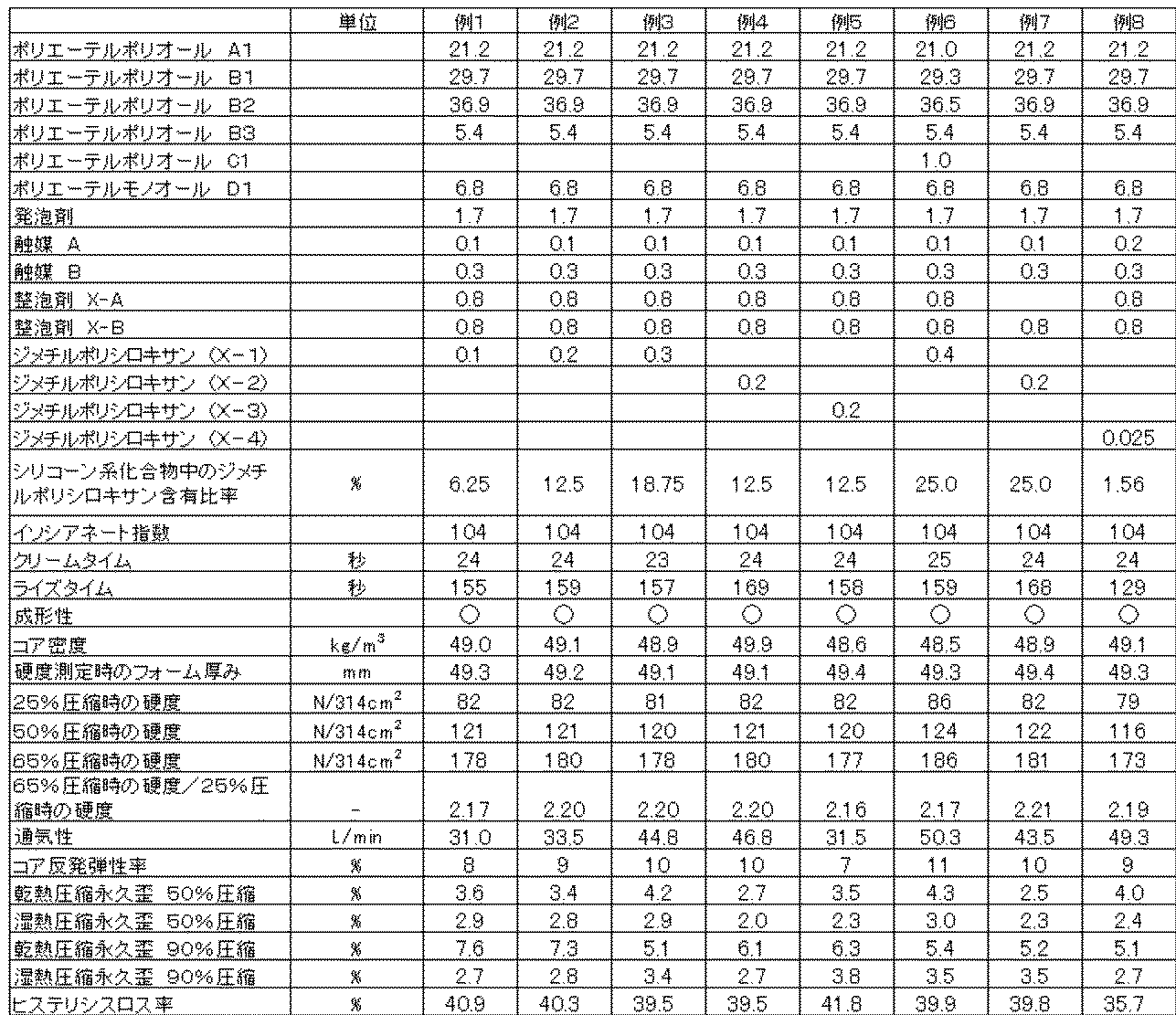
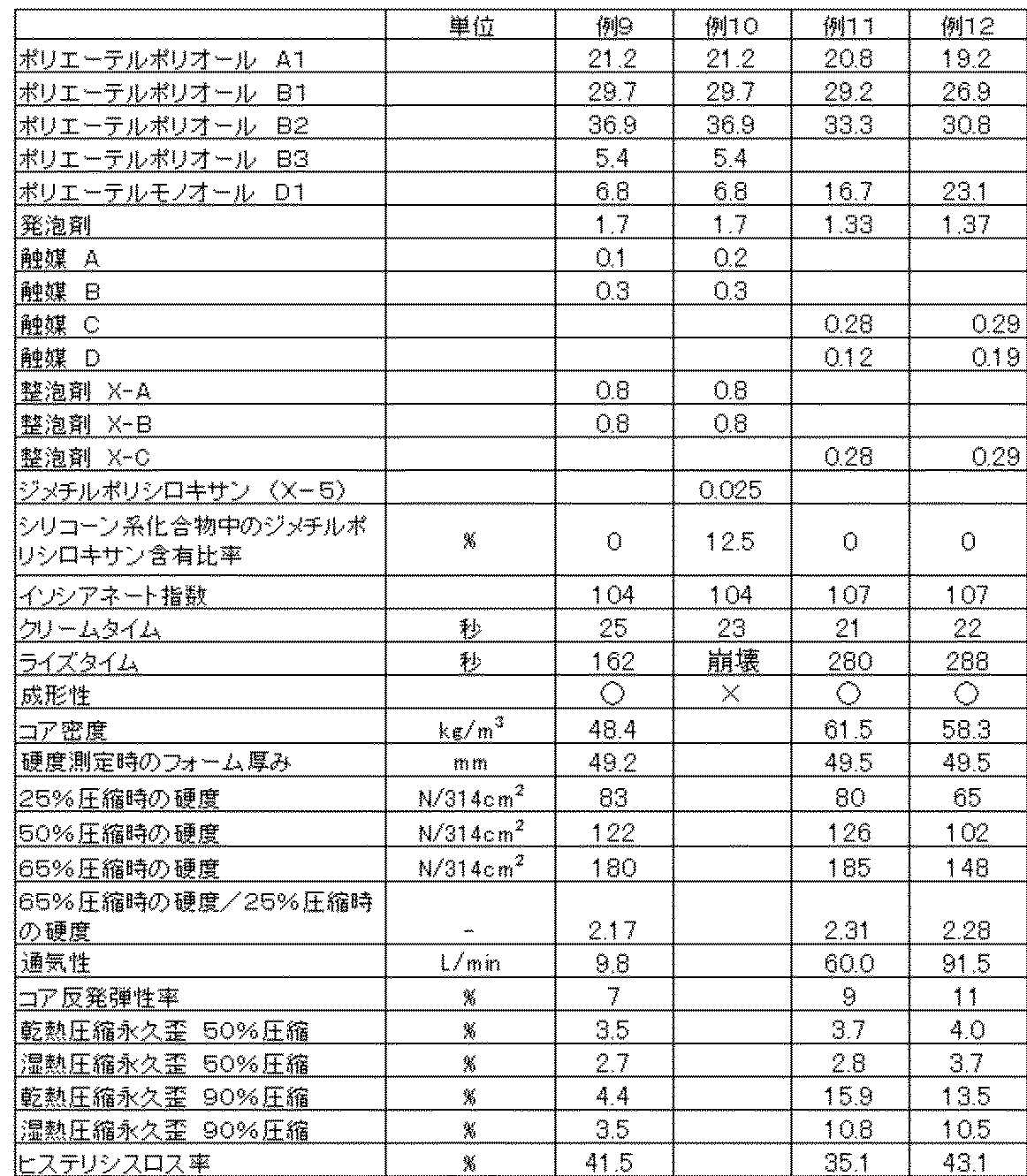


特定のポリオール(A)、(B)、(C)およびモノオール(D)と特定のジメチルポリシロキサンを用いて製造した例1~8の軟質ポリウレタンフォームは、表1に示すように反発弾性率が15%以下であり、耐久性の指標である50%乾熱圧縮永久歪が5%以下、90%乾熱圧縮永久歪が10%以下と小さく、耐久性が良好であった。さらに通気性も30L/分以上であり、非常に通気性が高い軟質ポリウレタンフォームが得られた。一方例9では特定のジメチルポリシロキサンを使用していないため通気性が低い軟質ポリウレタンフォームしか得られなかった。また、n=32.9のジメチルポリシロキサンを0.025質量部使用した場合は、軟質ポリウレタンフォームを成形する際に連通化度が非常に高くなり、フォームが崩壊するという問題が発生した。
さらに、例11~12では、モノオールの比率が15質量%を超えているため、本願のジメチルポリシロキサン(I)を使わずに非常に高い通気性が確保できる軟質ポリウレタンフォームを得ることができるが、90%圧縮時の乾熱圧縮永久歪および湿熱圧縮永久歪が悪化した。
さらに、例11~12では、モノオールの比率が15質量%を超えているため、本願のジメチルポリシロキサン(I)を使わずに非常に高い通気性が確保できる軟質ポリウレタンフォームを得ることができるが、90%圧縮時の乾熱圧縮永久歪および湿熱圧縮永久歪が悪化した。
例14~19の軟質ポリウレタンフォームは、表3に示すように大きいサイズでの発泡においても成形性が良好であった。また、反発弾性率が15%以下であり耐久性の指標である乾熱圧縮永久歪も小さく、耐久性が良好であった。さらに通気性も30L/分以上であり、非常に通気性が高い軟質ポリウレタンフォームが得られた。なお、例13は特定のジメチルポリシロキサンを使用していないため、通気性が30L/分以下であった。
例21~23、および例25~26では、特定のポリオール(A)、(B)、(C)およびモノオール(D)と特定のジメチルポリシロキサンを用いて軽量化した軟質ポリウレタンフォームを製造した。これらは例20および例24の特定のジメチルポリシロキサンを使用していないフォームに比べ、高い通気性を確保することができた。
[例27](実施例)
表1の例3に示した原料および配合剤のうち、ポリイソシアネート化合物以外の全原料の混合物(ポリオールシステム)の液温を23℃±1℃に調整し、ポリイソシアネート化合物を液温22±1℃に調整した。ポリオールシステムにポリイソシアネート化合物を所定量加えて、ミキサー(毎分3000回転)で5秒間混合し、得られた混合液を直ちに60℃に加温したアルミニウム製金型(縦・横400mm、高さ100mm)に注入して密閉した。10分間金型温度を60℃に維持した後、軟質ポリウレタンフォームを金型から取り出した。
表1の例3に示した原料および配合剤のうち、ポリイソシアネート化合物以外の全原料の混合物(ポリオールシステム)の液温を23℃±1℃に調整し、ポリイソシアネート化合物を液温22±1℃に調整した。ポリオールシステムにポリイソシアネート化合物を所定量加えて、ミキサー(毎分3000回転)で5秒間混合し、得られた混合液を直ちに60℃に加温したアルミニウム製金型(縦・横400mm、高さ100mm)に注入して密閉した。10分間金型温度を60℃に維持した後、軟質ポリウレタンフォームを金型から取り出した。
その結果良好な成形性で軟質ポリウレタンフォーム(モールドフォーム)が製造された。また製造された軟質ポリウレタンフォームを24時間以上23℃、相対湿度50%下で養生した後各種物性の測定を行った。その結果、コア密度が58.3kg/m3、コア反発弾性率が6%、通気性が33.5L/分であり、反発弾性率が低く、通気性に優れた軟質ポリウレタンフォームが製造された。
本発明の軟質ポリウレタンフォームは、低反発性であり、衝撃吸収体、吸音体、振動吸収体として好適であり、また、寝具、マット、クッション、自動車用座席シートクッション、バック材、フレームラミネーションによる表皮ワディング材としても好適である。湿熱耐久性に優れ、かつ通気性が良好であるので、特に寝具(マットレス、枕等)に好適である。
なお、2011年2月25日に出願された日本特許出願2011-040024号の明細書、特許請求の範囲、及び要約書の全内容をここに引用し、本発明の明細書の開示として、取り入れるものである。
Claims (11)
- ポリオール(A)、ポリオール(B)およびモノオール(D)を含むポリオール混合物とポリイソシアネート化合物とを、シリコーン系化合物からなる整泡剤(X)、ウレタン化触媒、および発泡剤の存在下で、イソシアネート指数が90以上で反応させて、軟質ポリウレタンフォームを製造する方法において、
前記ポリオール(A)は、開始剤に複合金属シアン化物錯体触媒を用いてアルキレンオキシドを開環付加重合させて得られた、平均水酸基数が2~3、水酸基価が10~90mgKOH/gであるポリエーテルポリオールであり、
前記ポリオール(B)は、平均水酸基数が2~3、水酸基価が15~250mgKOH/gであり、かつ前記ポリオール(A)を除くポリエーテルポリオールであり、
前記モノオール(D)は、開始剤に複合金属シアン化物錯体触媒を用いてアルキレンオキシドを開環付加重合させて得られた、水酸基価が10~200mgKOH/gであるポリエーテルモノオールであり、
前記整泡剤(X)は、下式(I)で表わされ、nの平均値が1~30であるジメチルポリシロキサンの1種または2種以上を含むシリコーン系化合物であって、前記ジメチルポリシロキサンを前記ポリオール混合物の100質量部に対して、0.01~1.0質量部を含む、
ことを特徴とする軟質ポリウレタンフォームの製造方法。

- 前記整泡剤(X)を前記ポリオール混合物の100質量部に対して、0.1~8.0質量部含む、請求項1に記載の軟質ポリウレタンフォームの製造方法。
- 前記整泡剤(X)の100質量%中に、式(I)で表わされるジメチルポリシロキサンが0.7~95.0質量%含まれる、請求項1または2に記載の軟質ポリウレタンフォームの製造方法。
- 前記ポリオール混合物中、前記ポリオール(A)を10~30質量%、前記ポリオール(B)を50~80質量%、前記モノオール(D)を2~24質量%含む、請求項1~3のいずれか一項に記載の軟質ポリウレタンフォームの製造方法。
- 前記ポリオール(A)が、開始剤にプロピレンオキシドのみを開環付加重合させたポリオキシプロピレンポリオールである請求項1~4のいずれか一項に記載の軟質ポリウレタンフォームの製造方法。
- 前記発泡剤が、水である請求項1~5のいずれか一項に記載の軟質ポリウレタンフォームの製造方法。
- 前記モノオール(D)が、開始剤にプロピレンオキシドのみを開環付加重合させたポリオキシプロピレンモノオールである請求項1~6のいずれか一項に記載の軟質ポリウレタンフォームの製造方法。
- 前記ポリイソシアネート化合物が、トリレンジイソシアネート(TDI)、ジフェニルメタンジイソシアネート(MDI)、ポリメチレンポリフェニルポリイソシアネート、キシリレンジイソシアネート(XDI)、イソホロンジイソシアネート(IPDI)、ヘキサメチレンジイソシアネート(HMDI)、およびこれらの変性体からなる群から選ばれる少なくとも1種である請求項1~7のいずれか一項に記載の軟質ポリウレタンフォームの製造方法。
- 前記ポリオール混合物が、さらに下記ポリオール(C)をポリオール混合物全体のうち10質量%以下含む請求項1~8のいずれか一項に記載の軟質ポリウレタンフォームの製造方法。
ポリオール(C):平均水酸基数が2~6であり、水酸基価が300~1830mgKOH/gであるポリオール。 - コア反発弾性率が20%以下であり、かつ通気性が30~160L/分である請求項1~9のいずれか一項に記載の軟質ポリウレタンフォームの製造方法。
- JIS K6400(1997年版)に準拠して測定したコアのヒステリシスロス率が、70%以下である請求項1~10のいずれか一項に記載の軟質ポリウレタンフォームの製造方法。
Priority Applications (2)
| Application Number | Priority Date | Filing Date | Title |
|---|---|---|---|
| JP2013501076A JPWO2012115113A1 (ja) | 2011-02-25 | 2012-02-21 | 低反発性軟質ポリウレタンフォームおよびその製造方法 |
| US13/975,631 US20130338249A1 (en) | 2011-02-25 | 2013-08-26 | Low resilience flexible polyurethane foam and process for its production |
Applications Claiming Priority (2)
| Application Number | Priority Date | Filing Date | Title |
|---|---|---|---|
| JP2011-040024 | 2011-02-25 | ||
| JP2011040024 | 2011-02-25 |
Related Child Applications (1)
| Application Number | Title | Priority Date | Filing Date |
|---|---|---|---|
| US13/975,631 Continuation US20130338249A1 (en) | 2011-02-25 | 2013-08-26 | Low resilience flexible polyurethane foam and process for its production |
Publications (1)
| Publication Number | Publication Date |
|---|---|
| WO2012115113A1 true WO2012115113A1 (ja) | 2012-08-30 |
Family
ID=46720890
Family Applications (1)
| Application Number | Title | Priority Date | Filing Date |
|---|---|---|---|
| PCT/JP2012/054155 Ceased WO2012115113A1 (ja) | 2011-02-25 | 2012-02-21 | 低反発性軟質ポリウレタンフォームおよびその製造方法 |
Country Status (4)
| Country | Link |
|---|---|
| US (1) | US20130338249A1 (ja) |
| JP (1) | JPWO2012115113A1 (ja) |
| TW (1) | TW201241028A (ja) |
| WO (1) | WO2012115113A1 (ja) |
Cited By (2)
| Publication number | Priority date | Publication date | Assignee | Title |
|---|---|---|---|---|
| JP2022185056A (ja) * | 2016-11-11 | 2022-12-13 | エボニック オペレーションズ ゲーエムベーハー | ポリウレタン系フォーム用の乳化剤 |
| CN117866165A (zh) * | 2024-01-26 | 2024-04-12 | 佛山市宜奥科技实业有限公司 | 一种透气生物基海绵及其制备方法 |
Families Citing this family (1)
| Publication number | Priority date | Publication date | Assignee | Title |
|---|---|---|---|---|
| CN116836366B (zh) * | 2023-08-10 | 2024-01-30 | 东莞市腾崴塑胶制品有限公司 | 一种超软海绵 |
Citations (6)
| Publication number | Priority date | Publication date | Assignee | Title |
|---|---|---|---|---|
| JPH09328531A (ja) * | 1996-06-07 | 1997-12-22 | Inoac Corp | 適度な脆さを有する吸水性且つ保水性硬質ポリウレタンフォームの製造方法 |
| JP2004231899A (ja) * | 2003-01-31 | 2004-08-19 | Sanyo Chem Ind Ltd | 軟質ポリウレタンフォームの製造方法 |
| JP2005008743A (ja) * | 2003-06-18 | 2005-01-13 | Nippon Polyurethane Ind Co Ltd | 硬質ポリウレタンスラブフォーム形成用組成物および硬質ポリウレタンスラブフォームの製造方法 |
| WO2006057255A1 (ja) * | 2004-11-24 | 2006-06-01 | Asahi Glass Company, Limited | 軟質ポリウレタンフォーム、その製造方法、および自動車用シート |
| JP2006321905A (ja) * | 2005-05-19 | 2006-11-30 | Fuji Carbon Kk | 吸水性連続気泡硬質ポリウレタンフォーム |
| JP2008031241A (ja) * | 2006-07-27 | 2008-02-14 | Asahi Glass Co Ltd | 軟質ポリウレタンフォームの製造方法 |
Family Cites Families (1)
| Publication number | Priority date | Publication date | Assignee | Title |
|---|---|---|---|---|
| US6239186B1 (en) * | 1999-10-28 | 2001-05-29 | Air Products And Chemicals, Inc. | Silicone surfactants for the production of open cell polyurethane flexible foams |
-
2012
- 2012-02-21 JP JP2013501076A patent/JPWO2012115113A1/ja active Pending
- 2012-02-21 WO PCT/JP2012/054155 patent/WO2012115113A1/ja not_active Ceased
- 2012-02-24 TW TW101106351A patent/TW201241028A/zh unknown
-
2013
- 2013-08-26 US US13/975,631 patent/US20130338249A1/en not_active Abandoned
Patent Citations (6)
| Publication number | Priority date | Publication date | Assignee | Title |
|---|---|---|---|---|
| JPH09328531A (ja) * | 1996-06-07 | 1997-12-22 | Inoac Corp | 適度な脆さを有する吸水性且つ保水性硬質ポリウレタンフォームの製造方法 |
| JP2004231899A (ja) * | 2003-01-31 | 2004-08-19 | Sanyo Chem Ind Ltd | 軟質ポリウレタンフォームの製造方法 |
| JP2005008743A (ja) * | 2003-06-18 | 2005-01-13 | Nippon Polyurethane Ind Co Ltd | 硬質ポリウレタンスラブフォーム形成用組成物および硬質ポリウレタンスラブフォームの製造方法 |
| WO2006057255A1 (ja) * | 2004-11-24 | 2006-06-01 | Asahi Glass Company, Limited | 軟質ポリウレタンフォーム、その製造方法、および自動車用シート |
| JP2006321905A (ja) * | 2005-05-19 | 2006-11-30 | Fuji Carbon Kk | 吸水性連続気泡硬質ポリウレタンフォーム |
| JP2008031241A (ja) * | 2006-07-27 | 2008-02-14 | Asahi Glass Co Ltd | 軟質ポリウレタンフォームの製造方法 |
Cited By (3)
| Publication number | Priority date | Publication date | Assignee | Title |
|---|---|---|---|---|
| JP2022185056A (ja) * | 2016-11-11 | 2022-12-13 | エボニック オペレーションズ ゲーエムベーハー | ポリウレタン系フォーム用の乳化剤 |
| JP7472221B2 (ja) | 2016-11-11 | 2024-04-22 | エボニック オペレーションズ ゲーエムベーハー | ポリウレタン系フォーム用の乳化剤 |
| CN117866165A (zh) * | 2024-01-26 | 2024-04-12 | 佛山市宜奥科技实业有限公司 | 一种透气生物基海绵及其制备方法 |
Also Published As
| Publication number | Publication date |
|---|---|
| US20130338249A1 (en) | 2013-12-19 |
| JPWO2012115113A1 (ja) | 2014-07-07 |
| TW201241028A (en) | 2012-10-16 |
Similar Documents
| Publication | Publication Date | Title |
|---|---|---|
| JP5266756B2 (ja) | 低反発性軟質ポリウレタンフォームおよびその製造方法 | |
| JP5228914B2 (ja) | 軟質ポリウレタンフォームの製造方法 | |
| JP3909598B2 (ja) | 低反発軟質ポリウレタンフォームの製造方法 | |
| JP5359269B2 (ja) | 軟質ポリウレタンフォームおよびその製造方法 | |
| JP5720571B2 (ja) | 軟質ポリウレタンフォームの製造方法 | |
| JP5303885B2 (ja) | 軟質ポリウレタンフォームの製造方法および軟質ポリウレタンフォーム | |
| WO2011125951A1 (ja) | 軟質ポリウレタンフォームおよびその製造方法 | |
| WO2011125952A1 (ja) | 熱プレス成形用軟質ポリウレタンフォームおよびその製造方法、ならびに熱プレス成形品およびその製造方法 | |
| JP4412116B2 (ja) | 低反発性軟質ポリウレタンフォームおよびその製造方法 | |
| JPWO2012115113A1 (ja) | 低反発性軟質ポリウレタンフォームおよびその製造方法 | |
| WO2013021871A1 (ja) | 軟質ポリウレタンフォームの製造方法 | |
| JP2008031241A (ja) | 軟質ポリウレタンフォームの製造方法 | |
| JP5151461B2 (ja) | 軟質ポリウレタンフォームの製造方法およびその用途 | |
| JP4182733B2 (ja) | 軟質ポリウレタンフォームおよびその製造方法 | |
| JP2003231747A (ja) | ポリオールとその製造方法および軟質ポリウレタンフォームの製造方法 |
Legal Events
| Date | Code | Title | Description |
|---|---|---|---|
| 121 | Ep: the epo has been informed by wipo that ep was designated in this application |
Ref document number: 12749500 Country of ref document: EP Kind code of ref document: A1 |
|
| ENP | Entry into the national phase |
Ref document number: 2013501076 Country of ref document: JP Kind code of ref document: A |
|
| NENP | Non-entry into the national phase |
Ref country code: DE |
|
| 122 | Ep: pct application non-entry in european phase |
Ref document number: 12749500 Country of ref document: EP Kind code of ref document: A1 |