WO2012102174A1 - ポリエステル組成物及びこれを用いた接着剤 - Google Patents
ポリエステル組成物及びこれを用いた接着剤 Download PDFInfo
- Publication number
- WO2012102174A1 WO2012102174A1 PCT/JP2012/051108 JP2012051108W WO2012102174A1 WO 2012102174 A1 WO2012102174 A1 WO 2012102174A1 JP 2012051108 W JP2012051108 W JP 2012051108W WO 2012102174 A1 WO2012102174 A1 WO 2012102174A1
- Authority
- WO
- WIPO (PCT)
- Prior art keywords
- acid
- polyester composition
- adhesive
- group
- derivative
- Prior art date
- Legal status (The legal status is an assumption and is not a legal conclusion. Google has not performed a legal analysis and makes no representation as to the accuracy of the status listed.)
- Ceased
Links
- 0 *c1c(*)c(*)c(*)c(*)c1* Chemical compound *c1c(*)c(*)c(*)c(*)c1* 0.000 description 1
Images






Classifications
-
- C—CHEMISTRY; METALLURGY
- C09—DYES; PAINTS; POLISHES; NATURAL RESINS; ADHESIVES; COMPOSITIONS NOT OTHERWISE PROVIDED FOR; APPLICATIONS OF MATERIALS NOT OTHERWISE PROVIDED FOR
- C09J—ADHESIVES; NON-MECHANICAL ASPECTS OF ADHESIVE PROCESSES IN GENERAL; ADHESIVE PROCESSES NOT PROVIDED FOR ELSEWHERE; USE OF MATERIALS AS ADHESIVES
- C09J167/00—Adhesives based on polyesters obtained by reactions forming a carboxylic ester link in the main chain; Adhesives based on derivatives of such polymers
- C09J167/04—Polyesters derived from hydroxycarboxylic acids, e.g. lactones
-
- C—CHEMISTRY; METALLURGY
- C08—ORGANIC MACROMOLECULAR COMPOUNDS; THEIR PREPARATION OR CHEMICAL WORKING-UP; COMPOSITIONS BASED THEREON
- C08G—MACROMOLECULAR COMPOUNDS OBTAINED OTHERWISE THAN BY REACTIONS ONLY INVOLVING UNSATURATED CARBON-TO-CARBON BONDS
- C08G63/00—Macromolecular compounds obtained by reactions forming a carboxylic ester link in the main chain of the macromolecule
- C08G63/02—Polyesters derived from hydroxycarboxylic acids or from polycarboxylic acids and polyhydroxy compounds
- C08G63/06—Polyesters derived from hydroxycarboxylic acids or from polycarboxylic acids and polyhydroxy compounds derived from hydroxycarboxylic acids
Definitions
- the present invention relates to a novel polyester composition using a component derived from a natural product such as a plant-derived component, and further relates to an adhesive using the same.
- cyanoacrylate instantaneous adhesives As general adhesives, cyanoacrylate instantaneous adhesives, epoxy adhesives having excellent heat resistance, and the like are widely used.
- cyanoacrylate-based instant adhesives exhibit a strong adhesive force in a short time, are abundant in types, and various types are available on the market.
- These adhesives basically exhibit an adhesive force by utilizing the anchor effect. For example, it is not always possible to obtain a sufficient adhesive force on a glass surface or the like having extremely excellent smoothness. There is a problem. In addition, almost all the adhesives are synthesized from petroleum raw materials, and there is no way to deal with problems such as exhaustion of petroleum resources. In addition, there is a problem that the demand increase of the adhesive is in a direction opposite to the low carbonization.
- the copolymer resin of caffeic acid and paracoumaric acid disclosed in Patent Document 1 has a benzene ring in the main chain and a catechol group at the end, and the fiber reinforced plastic utilizing its adhesiveness is equivalent to super engineer plastic. Has strength. It has also been shown that it exhibits strong adhesion regardless of organic or inorganic surface.
- the copolymer resin of caffeic acid and paracoumaric acid is used as an adhesive or the like.
- the adhesive failure of a copolymer resin of caffeic acid and paracoumaric acid is a cohesive failure, and there is a problem that the adhesive strength cannot be fully utilized.
- the copolymer resin of caffeic acid and paracoumaric acid foams at a high temperature, and its elastic modulus increases, but the strength decreases.
- the copolymer resin of caffeic acid and paracoumaric acid has a high heat resistance temperature, but is brittle, and its application development to other fields is limited.
- the present invention has been proposed in view of the actual situation of these conventional techniques, and can exhibit a strong adhesive force by an adhesive mechanism that is completely different from the conventional adhesive mechanism, and has excellent physical properties and the adhesive force. It is an object of the present invention to provide a novel polyester composition capable of sufficiently exhibiting the above and to provide a super strong adhesive.
- a copolymer resin of caffeic acid and paracoumaric acid causes brittle fracture in a molded article and cohesive fracture in an adhesive.
- the reason is that the degree of freedom of the molecular chain is limited because the copolymer contains a part containing a double bond in the polymer chain. As a result, the copolymer is hard and brittle, and is broken. The strength was predicted to be insufficient.
- the copolymer resin of caffeic acid and paracoumaric acid has a highly reactive double bond in the molecular chain, so foaming occurs, stress concentrates on the foamed part at the time of adhesion peeling, and it is easy to cause breakage. It was also found that the strength is limited. Furthermore, it has been found that the copolymer resin of caffeic acid and paracoumaric acid has a high reactive double bond in the molecular chain, so that volume change occurs due to light, etc., and this causes a limit in adhesive strength. It was.
- the polyester composition of the present invention is mainly composed of a copolymer containing hydrocaffeic acid or a derivative thereof as a constituent monomer.
- Hydrocaffeic acid or a derivative thereof does not contain a double bond other than an aromatic ring in the molecular chain, and a copolymer using this does not contain a double bond other than the aromatic ring in the molecular chain. Therefore, a degree of freedom can be imparted to the molecular chain of the polymer copolymer, and as a result, cohesive failure hardly occurs and the adhesive strength of the copolymer is sufficiently exhibited.
- the copolymer constituting the polyester composition of the present invention does not contain a double bond other than the aromatic ring, the volume change due to heat is suppressed to a minimum, the foam is hardly foamed, and the stress is concentrated in the foamed part. It has the feature that generation is also suppressed.
- hydrocaffeic acid or a derivative thereof is a bio-derived component.
- this as a monomer of a copolymer constituting the polyester composition, petroleum-derived components are greatly reduced, and so-called bioplastics are used as petroleum resources.
- a polyester composition that can cope with problems such as depletion of water is realized.
- the present invention it is possible to obtain a polyester composition and an adhesive that can express a strong adhesive force by an adhesive mechanism completely different from the conventional adhesive mechanism. Moreover, in the polyester composition and adhesive of the present invention, cohesive failure can be suppressed and the adhesive force can be sufficiently exerted, and the generation of a foamed portion that hardly foams and stress is concentrated can be suppressed. Therefore, it is possible to realize a super strong adhesive. Furthermore, since the polyester composition and adhesive of the present invention can use plant-derived components, it is a safe and versatile adhesive with consideration for the environment and the human body corresponding to the depletion of petroleum resources and the like. It can be used.
- FIG. 4 is a diagram showing the measurement results of the adhesive strength of a commercially available cyanoacrylate adhesive, an ester copolymer synthesized from caffeic acid and p-coumaric acid, and an ester copolymer [poly (DHHCA-co-3HPPA)]. is there. It is a figure which shows the difference in 1 H-NMR by the difference in a catalyst. It is a figure which shows the difference in the adhesive strength of the ester copolymer [poly (DHHCA-co-3HPPA)] synthesize
- FIG. 12 (a) Poly (DHHCA-co-3HPPA)] was molded into a disk shape (FIG. 12 (a)) and evaluated using an ultra-high resolution Fourier transform mass spectrometer (FT-ICR Mass Spectrometer) (Fig. 12 (b)).
- FIG. 4 is a diagram showing the results of a thermal property test of [poly (DHHCA-co-3HPPA)].
- the polyester composition and adhesive of the present invention are mainly composed of a copolymer containing hydrocaffeic acid or a derivative thereof as a constituent monomer, and in particular, a carboxyl group capable of ester linkage with the hydrocaffeic acid or the derivative thereof. And a copolymer obtained by copolymerizing a monomer having a hydroxyl group.
- Hydrocaffeic acid or a derivative thereof is a compound having two or more hydroxyl groups such as a catechol group and a carboxyl group via an alkyl chain as shown in the following chemical formula 1, and has a double bond on the alkyl chain. It is a feature point that it does not have.
- R 1 to R 5 are OH, and the others are optional substituents.
- R 6 is an alkyl chain.
- the alkyl chain R 6 may have any number of carbon atoms, but is preferably 1-12.
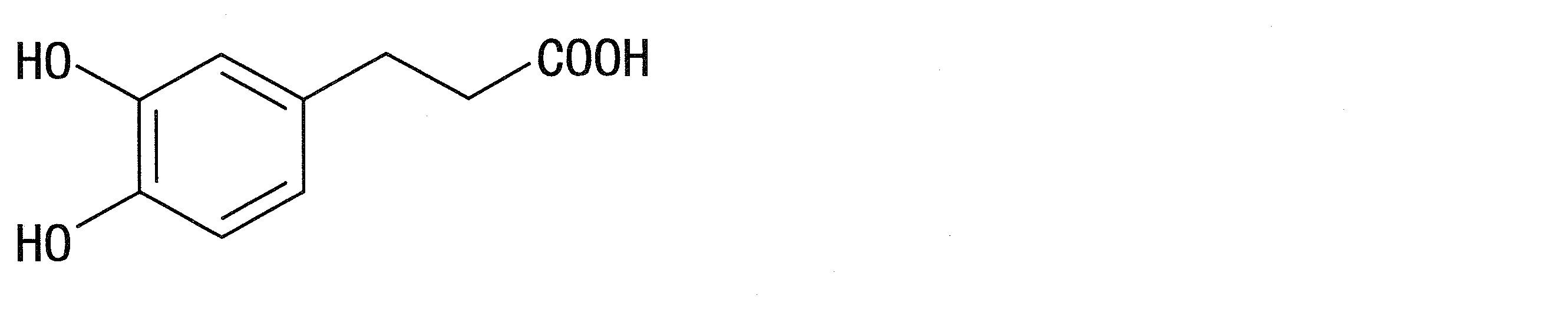
- Hydrocaffeic acid is a compound having the structure shown in the following chemical formula 2, and corresponds to 3,4-dihydroxyhydrocinnamic acid (DHHCA). Hydrocaffeic acid is known to be derived from, for example, cinnamon and is one of plant-derived components.
- any compound can be used as long as it satisfies the above requirements.
- a compound obtained by removing a double bond from paracumaric acid, etc. Is preferred.
- a compound obtained by removing a double bond from paracumaric acid is represented by the following chemical formula 3, and corresponds to 3- (3-hydroxyphenyl) propionic acid (3HPPA).
- This 3- (3-hydroxyphenyl) propionic acid (3HPPA) is also known, for example, from berries and is also a plant-derived component.
- 3- (3-hydroxyphenyl) propionic acid (3HPPA) is in the meta position, but is not limited thereto, and is in the para position [3- (4-hydroxyphenyl) propionic acid (3HPPA)] or ortho. [3- (2-hydroxyphenyl) propionic acid (3HPPA)] and the like can also be used.
- the transesterification reaction between the hydrocaffeic acid or a derivative thereof and a monomer having a carboxyl group and a hydroxyl group capable of ester bonding may be carried out under the same reaction conditions as in the ordinary transesterification reaction, and no reaction under special conditions is required.
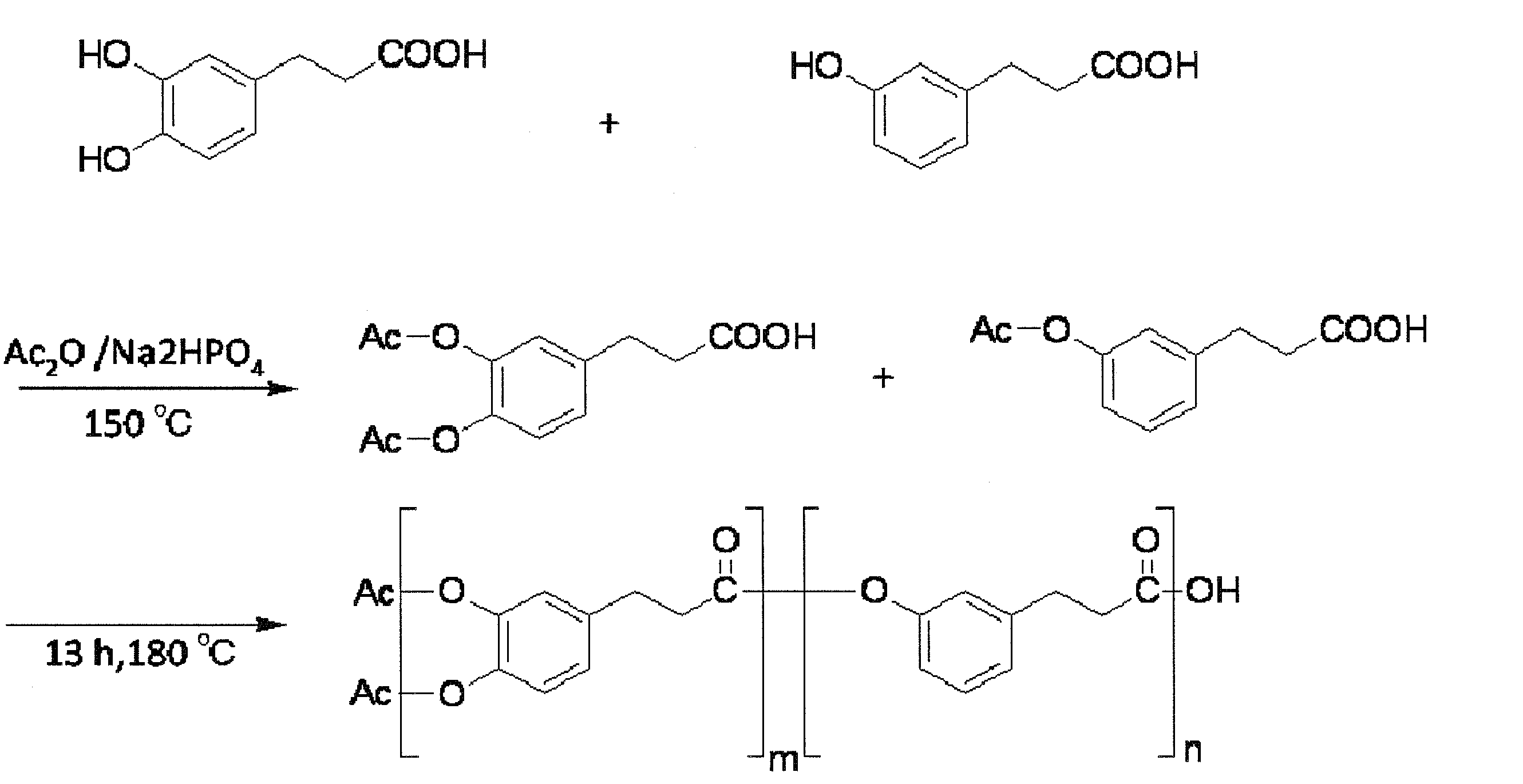
- the reaction formula is shown in the following chemical formula 4.
- any method can be adopted, but a bulk polymerization method or a solution polymerization method is preferable, and a bulk polymerization method is more preferable.
- an ester reaction may be carried out in the presence of an esterification catalyst after acetylating the raw material monomer as necessary.
- esterification catalyst examples include lithium formate, sodium formate, potassium formate, rubidium formate, cesium formate, magnesium formate, calcium formate, strontium formate, barium formate and the like; lithium acetate, sodium acetate, potassium acetate, acetic acid Metal salts of acetate such as rubidium, cesium acetate, magnesium acetate, calcium acetate, strontium acetate, barium acetate; lithium oxalate, sodium oxalate, potassium oxalate, rubidium oxalate, cesium oxalate, magnesium oxalate, calcium oxalate, Metal oxalates such as strontium oxalate and barium oxalate; lithium cinnamate, sodium cinnamate, potassium cinnamate, rubidium cinnamate, cesium cinnamate, magnesium cinnamate, cinnamic acid Metal cinnamate salts such as lucid
- esterification catalysts sodium acetate, potassium acetate, magnesium acetate, calcium acetate, sodium phosphate, potassium phosphate, trimagnesium diphosphate, tricalcium phosphate, disodium monohydrogen phosphate, monophosphate Dipotassium hydrogen, sodium polyphosphate, potassium polyphosphate, magnesium polyphosphate, or calcium polyphosphate are preferred, and disodium monohydrogen phosphate (Na 2 HPO 4 ), which is a relatively weak catalyst that leaves a terminal hydroxyl group, is more preferred.
- sodium acetate, potassium acetate, magnesium acetate, calcium acetate, sodium phosphate, potassium phosphate, trimagnesium diphosphate, tricalcium phosphate, disodium monohydrogen phosphate, monophosphate Dipotassium hydrogen, sodium polyphosphate, potassium polyphosphate, magnesium polyphosphate, or calcium polyphosphate are preferred, and disodium monohydrogen phosphate (Na 2 HPO 4 ), which is a relatively weak catalyst that leaves a terminal hydroxy
- the amount of the esterification catalyst varies depending on the type of raw material monomer to be subjected to polymerization and the like, and cannot be generally determined, but is usually 1 to 50 parts by weight per 100 parts by weight of the raw material monomer.
- the amount is preferably 1 to 30 parts by weight, more preferably 1 to 10 parts by weight.
- an organic solvent that does not participate in the reaction such as toluene, hexane, dioxane, tetrahydrofuran, diethyl ether, acetone, methyl ethyl ketone, or the like can be used.
- hexane or toluene is preferable because water generated during the esterification reaction can be easily removed.
- the reaction temperature is preferably 130 ° C. or higher, more preferably 150 ° C. or higher, preferably 250 ° C. or lower, more preferably 225 ° C. or lower, from the viewpoint of increasing reaction efficiency.
- the reaction time varies depending on the reaction conditions and cannot be determined unconditionally, but is usually about 1 to 72 hours, preferably about 1 to 7 hours.
- the atmosphere during the reaction is not particularly limited, but is preferably an inert gas atmosphere such as nitrogen gas or argon gas in order to prevent oxygen contained in the air from participating in the reaction. .
- Urushiol the main component of dopa and lacquer produced by mussels, has a functional group with two hydroxyl groups at the ortho position of the benzene ring, called a catechol group, and is reversible and powerful regardless of organic or inorganic materials. Showing power.
- the ester copolymer constituting the polyester composition of the present invention also mimics the catechol-based adhesion existing in the natural world and exhibits strong adhesive force due to the action of the catechol group in the molecule.
- hydrocaffeic acid [3,4-dihydroxyhydrocinnamic acid (DHHCA)] and 3- (3-hydroxyphenyl) propionic acid (3HPPA) are copolymerized
- hydrocaffeic acid has two hydroxyl groups. Therefore, a polymer having a large number of catechol groups at the ends as shown in FIG. 1 is synthesized.
- FIG. 2 shows the state of adhesion to the glass surface.
- the strong adhesive force is obtained by, for example, forming a hydrogen bond or a coordinate bond with an oxidized surface of a metal or an inorganic substance contained on the surface to be bonded or by esterification of a hydroxyl group and a catechol group on the inorganic surface. Is presumed to have been demonstrated.
- the fracture energy F frac is expressed by the following formula (1).
- F surf Energy for creating two surfaces
- F elas Elastic energy until fracture
- F ent Energy of entanglement between molecular chains
- the ester copolymer obtained by copolymerizing hydrocaffeic acid [3,4-dihydroxyhydrocinnamic acid (DHHCA)] and 3- (3-hydroxyphenyl) propionic acid (3HPPA) has a double bond in each monomer. Since it does not have, it has no double bond in the molecular chain. For this reason, the value of the elastic energy (F elas ) until the fracture is increased, and the fracture energy F frac is improved.
- the ratio of hydrocaffeic acid having a catechol group is set to a predetermined ratio or more.
- the ratio of hydrocaffeic acid is preferably 5 mol% or more. If the ratio of hydrocaffeic acid is less than 5 mol%, it may be difficult to obtain sufficient adhesion.
- polyester composition of the present invention is not limited to the adhesive, but can be used as a so-called engineering plastic, and can also be used for a fiber reinforced plastic or the like.
- the use as an adhesive is not limited to, for example, adhesion to glass or the like, and any use or object such as adhesion between different materials can be selected.
- ester copolymer Hydrocaffeic acid [3,4-dihydroxyhydrocinnamic acid (DHHCA)] and 3- (3-hydroxyphenyl) propionic acid (3HPPA) are subjected to an acidolysis reaction according to the synthetic route shown in Chemical Formula 4,
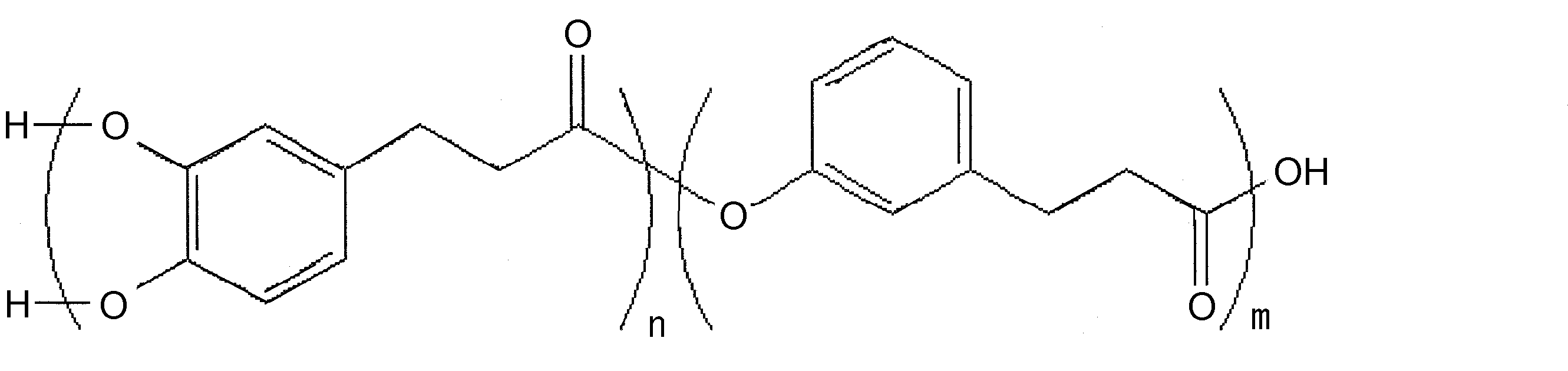
- An ester copolymer [poly (DHHCA-co-3HPPA)] having the structure shown in Chemical Formula 5 was synthesized.
- FIG. 3 is an infrared absorption spectrum (IR) of DHHCA and 3HPPA as raw materials and the obtained ester copolymer.
- IR infrared absorption spectrum
- FIG. 4 is 1 H-NMR of DHHCA, 5 1 H-NMR of 3HPPA, 6 is a 1 H-NMR of ester copolymer [poly (DHHCA-co-3HPPA)] .
- a commercially available cyanoacrylate adhesive, an ester copolymer synthesized from caffeic acid and p-coumaric acid (Patent Document 1), and the ester copolymer of the present embodiment [Poly (DHHCA-co-3HPPA)] was measured for adhesive strength.
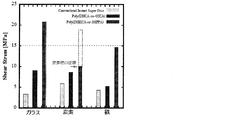
- the adhesive strength (shear strength Shear Stress) of the ester copolymer [poly (DHHCA-co-3HPPA)] is a commercially available cyanoacrylate-based adhesive or an ester copolymer synthesized from caffeic acid and p-coumaric acid. The value was much larger than the bonding strength of the coalescence.
- Fig. 12 (a) it is molded into a disk shape and the eluate / stability in water at 37 ° C is measured using an ultra-high resolution Fourier transform mass spectrometer (FT-ICR Mass Spectrometer). And evaluated. From FIG. 12B, elution of the oligomer was confirmed up to 48 h (hour), but nothing was eluted after 72 h. Therefore, when it is used for medical and dental pharmaceutical applications (as an adhesive used in the oral cavity) such as a dental adhesive, it is stored in water for 72 hours or more (if it is purified for about 3 days), It is thought that the influence by the low molecular weight fraction can be avoided. It can be seen that the above purification method exhibits a certain effect on the stability in water, and the influence on the human body can be avoided without removing the catalyst.
- FT-ICR Mass Spectrometer ultra-high resolution Fourier transform mass spectrometer
- thermophysical property test a melting property test (softening temperature) was measured in the range of room temperature to 180 ° C.
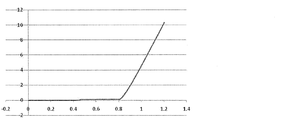
- FIG. 13 shows the result. From FIG. 13, an endothermic peak seen as Tg was confirmed around 36 to 37 ° C. Thereby, it is thought that application to human bodies, such as a dental adhesive, can be expected. Then, melting was visually confirmed at 60 to 120 ° C.
- the novel polyester composition and adhesive using the natural product-derived component of the present invention can be used as a hot-melt adhesive, dissolved in the solvent, or a combination of both.
Landscapes
- Chemical & Material Sciences (AREA)
- Chemical Kinetics & Catalysis (AREA)
- Organic Chemistry (AREA)
- Health & Medical Sciences (AREA)
- Medicinal Chemistry (AREA)
- Polymers & Plastics (AREA)
- Polyesters Or Polycarbonates (AREA)
- Compositions Of Macromolecular Compounds (AREA)
- Adhesives Or Adhesive Processes (AREA)
Abstract
従来の接着機構とは全く異なる接着機構により強力な接着力を発現し、物理的な特性に優れ接着力を十分に発揮し得るポリエステル組成物及び接着剤を提供する。 ヒドロカフェ酸またはその誘導体を構成モノマーとする共重合体を主体とするポリエステル組成物である。ヒドロカフェ酸またはその誘導体は、エステル結合可能なカルボキシル基及び水酸基を有するモノマー(例えばヒドロキシフェニルプロピオン酸)と共重合されている。共重合体の構造は下記化1に示す通りである。
Description
本発明は、植物由来の成分のような天然物由来の成分を用いた新規なポリエステル組成物に関するものであり、さらには、それを用いた接着剤に関する。
現在、一般的な接着剤としては、シアノアクリレート系の瞬間接着剤や、耐熱性に優れたエポキシ系接着剤等が広く用いられている。例えばシアノアクリレート系の瞬間接着剤は、短時間のうちに強力な接着力を発揮し、種類も豊富で用途に応じて様々なものが市販されている。
これら接着剤は、基本的にはアンカー効果を利用して接着力を発現するものであり、例えば極端に平滑性に優れたガラス表面等に対しては、必ずしも十分な接着力を得ることができないという問題がある。また、前記各接着剤は、ほとんど全てが石油原料から合成されたものであり、石油資源の枯渇等の問題に対応する方法がないのが実情である。また、接着剤の需要拡大が、低炭素化とは相反する方向となるという問題もある。
このような状況から、接着剤に限らず、エンジニアリングプラスチック等の分野においては、無害な天然系の成分を利用したポリマー組成物の開発が活発に進められている。本願発明者らも、植物より抽出されるカフェ酸をパラクマル酸と共重合させた強化ポリエステル系ポリマー組成物を開発し、既に特許出願している(特許文献1を参照)。
特許文献1に開示されるカフェ酸とパラクマル酸の共重合樹脂は、主鎖にベンゼン環、末端にカテコール基を有し、その接着性を活かした繊維強化プラスチックは、スーパーエンジニアプラスチックと同等の破壊強度を有している。また、有機・無機表面を問わず強力な接着力を示すこともわかっている。
しかしながら、本願発明者らが研究を進めたところ、前記カフェ酸とパラクマル酸の共重合樹脂を接着剤等として用いようとした場合、いくつかの問題があることがわかってきた。例えば、カフェ酸とパラクマル酸の共重合樹脂の接着破壊は凝集破壊であることが判明しており、その接着力を十分に生かし切れないという問題がある。また、カフェ酸とパラクマル酸の共重合樹脂は高温で発泡し、その弾性率は増加するが、強度が低下する。さらに、カフェ酸とパラクマル酸の共重合樹脂は、耐熱温度は高いが、脆く、その他分野への応用展開が限られている。
本発明は、これら従来技術が有する実情に鑑みて提案されたものであり、従来の接着機構とは全く異なる接着機構により強力な接着力を発現し得るとともに、物理的な特性に優れ当該接着力を十分に発揮し得る新規なポリエステル組成物を提供し、超強力な接着剤を提供することを目的とする。
本願発明者らは、カフェ酸とパラクマル酸の共重合樹脂について、その改良を試みる中で様々な知見を得るに至った。例えば、カフェ酸とパラクマル酸の共重合樹脂は、成形体では脆性破壊が、接着剤では凝集破壊が起こる。その理由としては、前記共重合体には高分子鎖中に二重結合を含む部位が存在するため、分子鎖の自由度が制限されていることが挙げられ、結果として、硬くて脆く、破壊強度が十分でないものと予測された。また、カフェ酸とパラクマル酸の共重合樹脂は、反応性が高い二重結合が分子鎖中に存在するため、発泡が起き、接着剥離時に発泡部位に応力が集中し、破壊を起こし易く、接着強度に限界があることもわかった。さらに、カフェ酸とパラクマル酸の共重合樹脂は、反応性が高い二重結合が分子鎖中に存在するため、光等によって体積変化が起こり、これが原因で接着強度に限界があることもわかってきた。
本発明は、これらの知見を基に案出されたものである。すなわち、本発明のポリエステル組成物は、ヒドロカフェ酸またはその誘導体を構成モノマーとする共重合体を主体とするものである。
ヒドロカフェ酸またはその誘導体は、分子鎖中の芳香環以外には二重結合を含まず、これを用いた共重合体も分子鎖中の芳香環以外には二重結合を含まない。そのため、高分子共重合体の分子鎖に自由度を付与することができ、結果として凝集破壊が起こり難くなり、当該共重合体が有する接着力が十分に発揮される。
また、本発明のポリエステル組成物を構成する共重合体は、芳香環以外に二重結合を含まないため、熱による体積変化が最小に抑えられ、ほとんど発泡せず、応力が集中する発泡部位の生成も抑えられるという特徴を有する。
さらに、ヒドロカフェ酸またはその誘導体はバイオ由来の成分であり、これをポリエステル組成物を構成する共重合体のモノマーとすることで、石油由来の成分が大幅に削減され、いわゆるバイオプラスチックとして石油資源の枯渇等の問題に対応し得るポリエステル組成物が実現される。
本発明によれば、従来の接着機構とは全く異なる接着機構により強力な接着力を発現し得るポリエステル組成物及び接着剤を得ることが可能である。また、本発明のポリエステル組成物及び接着剤では、凝集破壊が抑えられ、その接着力を十分に発揮させることができる他、ほとんど発泡せず、応力が集中する発泡部位の生成を抑えることができるので、超強力接着剤を実現することが可能である。さらに、本発明のポリエステル組成物及び接着剤は、植物由来成分を利用することが可能であるので、石油資源の枯渇等に対応する環境上や人体への配慮をした安全で万能な接着剤として使用可能である。
以下、本発明を適用したポリエステル組成物及び接着剤の実施形態について、化学式や図面を参照して詳細に説明する。
本発明のポリエステル組成物及び接着剤は、ヒドロカフェ酸またはその誘導体を構成モノマーとする共重合体を主体とするものであり、特に、前記ヒドロカフェ酸またはその誘導体と、エステル結合可能なカルボキシル基及び水酸基を有するモノマーとが共重合された共重合体を主体とするものである。
ヒドロカフェ酸またはその誘導体は、下記化1に示すように、カテコール基のような2以上の水酸基を有するとともに、アルキル鎖を介してカルボキシル基を有する化合物であり、前記アルキル鎖に二重結合を有していないことが特徴点である。
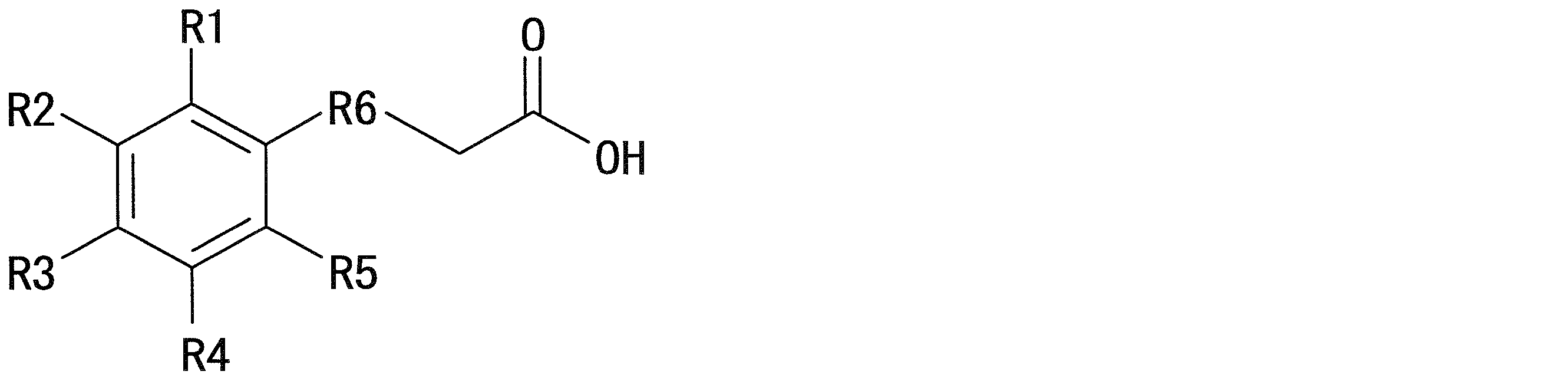
他の任意の置換基としては、それぞれ独立して、例えば水素原子、重水素原子、水酸基、重水酸基、ハロゲン原子、アルカリ金属原子、チオール基、第一級~第四級アミノ基、イミノ基、アゾ基、アゾキシル基、ジアゾ基、アジド基、ヒドラジン基、ニトロ基、ニトロソ基、尿素基、チオ尿素基、シアネート基、チオシアネート基、イソシアネート基、イソチオシアネート基、硫酸基、スルホニル基、スルホキシド基、リン酸基、ホスホニル基、硼酸基、ボロニル基、ケイ素含有基、ゲルマニウム含有基、ニトリル基、イソニトリル基、ジスルフィド基、置換カルボニル基、ホルミル基、各種エステル基、各種チオエステル基、各種カーボネート基、各種チオカーボネート基、各種アミド基、カルボキシル基、ピリジル基、フェニル基、ビフェニル基、テルフェニル基、ナフチル基、アンスリル基、フェナンスリル基、ペンタセニル基、炭素数1~12のアルキル基、炭素数1~12のアルコキシ基、炭素数1~12のアルカノイル基、炭素数1~12のアルカノイロキシ基、炭素数1~12のアルキルチオエーテル基、炭素数1~12のアルケニル基、炭素数1~12のアルキニル基または炭素数1~12のフルオロアルキル基等を挙げることができる。
前記アルキル鎖R6の炭素数は任意であるが、1~12であることが好ましい。
前記化1で示されるヒドロカフェ酸またはその誘導体であれば任意の化合物を使用することができるが、好ましくはヒドロカフェ酸である。ヒドロカフェ酸は下記化2に示される構造を有する化合物であり、3,4-ジヒドロキシヒドロ桂皮酸(DHHCA)に該当する。ヒドロカフェ酸は、例えばシナモン由来のものが知られており、植物由来成分の一つである。
一方、エステル結合可能なカルボキシル基及び水酸基を有するモノマーとしては、前記要件を満たすものであれば任意の化合物を使用することが可能であるが、例えばパラクマル酸から二重結合を除いた化合物等が好適である。パラクマル酸から二重結合を除いた化合物は、下記化3で示され、3-(3-ヒドロキシフェニル)プロピオン酸(3HPPA)に該当する。この3-(3-ヒドロキシフェニル)プロピオン酸(3HPPA)も、例えばベリー由来のもの等が知られており、やはり植物由来の成分である。なお、3-(3-ヒドロキシフェニル)プロピオン酸(3HPPA)はメタ位のものであるが、これに限らず、パラ位のもの[3-(4-ヒドロキシフェニル)プロピオン酸(3HPPA)]やオルト位のもの[3-(2-ヒドロキシフェニル)プロピオン酸(3HPPA)]等も使用可能である。
したがって、例えばシナモン由来のヒドロカフェ酸とベリー由来の3-(3-ヒドロキシフェニル)プロピオン酸(3HPPA)とをエステル共重合させれば、植物由来成分のみからなる天然物由来の共重合体を得ることができる。
ヒドロカフェ酸またはその誘導体とエステル結合可能なカルボキシル基及び水酸基を有するモノマーとのエステル交換反応は、通常のエステル交換反応と同様の反応条件で行えばよく、特別な条件での反応は必要ない。反応式を下記化4に示す。
重合方法としては、任意の方法を採用することができるが、塊状重合法または溶液重合法が好ましく、塊状重合法がより好ましい。例えば、塊状重合法によってエステル共重合体を調製する場合、原料モノマーを必要によりアセチル化させた後、エステル化触媒の存在下でエステル反応を行えばよい。
エステル化触媒としては、例えば、ギ酸リチウム、ギ酸ナトリウム、ギ酸カリウム、ギ酸ルビジウム、ギ酸セシウム、ギ酸マグネシウム、ギ酸カルシウム、ギ酸ストロンチウム、ギ酸バリウム等のギ酸金属塩;酢酸リチウム、酢酸ナトリウム、酢酸カリウム、酢酸ルビジウム、酢酸セシウム、酢酸マグネシウム、酢酸カルシウム、酢酸ストロンチウム、酢酸バリウム等の酢酸金属塩;シュウ酸リチウム、シュウ酸ナトリウム、シュウ酸カリウム、シュウ酸ルビジウム、シュウ酸セシウム、シュウ酸マグネシウム、シュウ酸カルシウム、シュウ酸ストロンチウム、シュウ酸バリウム等のシュウ酸金属塩;ケイ皮酸リチウム、ケイ皮酸ナトリウム、ケイ皮酸カリウム、ケイ皮酸ルビジウム、ケイ皮酸セシウム、ケイ皮酸マグネシウム、ケイ皮酸カルシウム、ケイ皮酸ストロンチウム、ケイ皮酸バリウム等のケイ皮酸金属塩;炭酸リチウム、炭酸ナトリウム、炭酸カリウム、炭酸ルビジウム、炭酸セシウム、炭酸マグネシウム、炭酸カルシウム、炭酸ストロンチウム、炭酸バリウム等の炭酸金属塩;リン酸三リチウム、リン酸三ナトリウム、リン酸三カリウム、リン酸三ルビジウム、リン酸三セシウム、リン酸一水素二リチウム、リン酸一水素二ナトリウム、リン酸一水素二カリウム、リン酸一水素二ルビジウム、リン酸一水素二セシウム、リン酸一水素マグネシウム、リン酸一水素カルシウム、リン酸一水素ストロンチウム、リン酸一水素バリウム、リン酸二水素一リチウム、リン酸二水素一ナトリウム、リン酸二水素一カリウム、リン酸二水素一ルビジウム、リン酸二水素一セシウム等のリン酸金属塩;二リン酸三マグネシウム、二リン酸三カルシウム、二リン酸三ストロンチウム、二リン酸三バリウム、二リン酸四水素一マグネシウム、二リン酸四水素一カルシウム、二リン酸四水素一ストロンチウム、二リン酸四水素一バリウム等の二リン酸金属塩;ポリリン酸リチウム、ポリリン酸ナトリウム、ポリリン酸カリウム、ポリリン酸ルビジウム、ポリリン酸セシウム、ポリリン酸マグネシウム、ポリリン酸カルシウム、ポリリン酸ストロンチウム、ポリリン酸バリウム等のポリリン酸金属塩;メタリン酸リチウム、メタリン酸ナトリウム、メタリン酸カリウム、メタリン酸ルビジウム、メタリン酸セシウム、メタリン酸マグネシウム、メタリン酸カルシウム、メタリン酸ストロンチウム、メタリン酸バリウム等のメタリン酸金属塩;酸化リチウム、酸化ナトリウム、酸化カリウム、酸化ルビジウム、酸化セシウム、酸化マグネシウム、酸化カルシウム、酸化ストロンチウム、酸化バリウム等の金属酸化物;金属リチウム、金属ナトリウム、金属カリウム、金属ルビジウム、金属セシウム等のアルカリ金属;金属マグネシウム、金属カルシウム、金属ストロンチウム、金属バリウム等のアルカリ土類金属等が挙げられ、これらは、それぞれ単独または2種以上を混合して用いることもできる。
上記エステル化触媒の中では、酢酸ナトリウム、酢酸カリウム、酢酸マグネシウム、酢酸カルシウム、リン酸ナトリウム、リン酸カリウム、二リン酸三マグネシウム、二リン酸三カルシウム、リン酸一水素二ナトリウム、リン酸一水素二カリウム、ポリリン酸ナトリウム、ポリリン酸カリウム、ポリリン酸マグネシウムまたはポリリン酸カルシウムが好ましく、末端水酸基を残す比較的弱い触媒であるリン酸一水素二ナトリウム(Na2HPO4)がより好ましい。
前記エステル化触媒の量は、重合に供される原料モノマーの種類等によって異なるので、一概には決定することができないが、通常、原料モノマー100重量部当たり、好ましくは1~50重量部、より好ましくは1~30重量部、さらに好ましくは1~10重量部である。
なお、溶液重合法によってエステル共重合体を調製する場合は、反応に関与しない有機溶媒、例えば、トルエン、ヘキサン、ジオキサン、テトラヒドロフラン、ジエチルエーテル、アセトン、メチルエチルケトン等を用いることができる。これらの中では、エステル化反応の際に生成した水を容易に除去することができることから、ヘキサンまたはトルエンが好ましい。
反応温度は、反応効率を高める観点から、好ましくは130℃以上、より好ましくは150℃以上であり、好ましくは250℃以下、より好ましくは225℃以下である。反応時間は、反応条件等によって異なるので一概には決定することができないが、通常、1~72時間程度であり、好ましくは1~7時間程度である。反応の際の雰囲気は、特に限定されないが、空気中に含まれている酸素が反応に関与することを防止するために、例えば、窒素ガス、アルゴンガス等の不活性ガス雰囲気であることが好ましい。
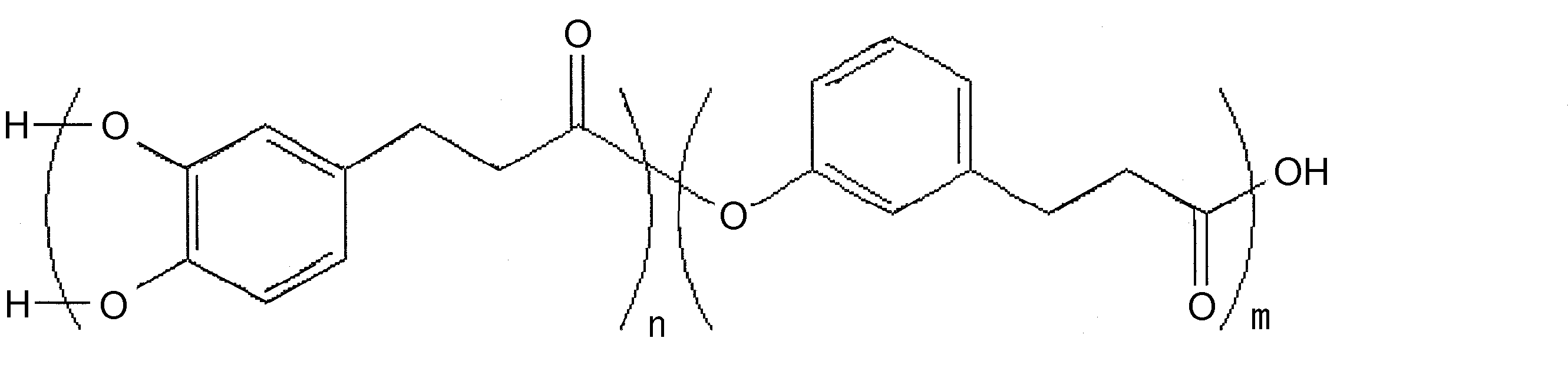
得られるエステル共重合体[ポリ(DHHCA-co-3HPPA)]の構造は化5に示す通りである。
次に、本発明のポリエステル組成物及び接着剤における接着機構について説明する。
ムール貝が産出するドーパや漆の主成分であるウルシオールは、カテコール基と呼ばれるベンゼン環のオルト位に2個の水酸基を有した官能基を持ち、有機・無機材料を問わずリバーシブル且つ強力な接着力を示す。
本発明のポリエステル組成物を構成するエステル共重合体も、前記自然界に存在するカテコール性接着を模倣したものであり、分子中に有するカテコール基の働きにより強力な接着力を示す。
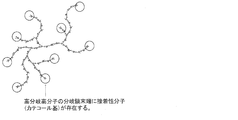
具体的には、ヒドロカフェ酸[3,4-ジヒドロキシヒドロ桂皮酸(DHHCA)]と3-(3-ヒドロキシフェニル)プロピオン酸(3HPPA)とを共重合させると、ヒドロカフェ酸が2つの水酸基を有するが故に、図1に示すような、末端にカテコール基を多数持つ高分子が合成される。
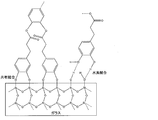
この多数のカテコール基が作用することで、有機・無機材料を問わず、平滑な表面に対しても分子レベルで強力に接着する。図2は、ガラス表面に対する接着の様子を示すものである。前記カテコール基が、例えば接着対象の表面に含まれる金属や無機物の酸化表面と水素結合や配位結合することで、あるいは、無機物表面の水酸基とカテコール基とのエステル化により、前記強力な接着力が発揮されているものと推測している。
また、例えばエポキシ樹脂の接着力に匹敵する植物由来接着剤を創製するためには、破壊エネルギーFfracを向上する必要がある。ここで、破壊エネルギーFfracは下記式(1)で表される。
Ffrac≒Fsurf+Felas+Fent ・・・(1)
Fsurf:2つの表面を作るエネルギー
Felas:破壊に至るまでの弾性エネルギー
Fent:分子鎖同士の絡み合いのエネルギー
ここで、Felas≒ε2 max・E(εmax:破壊歪)である。
Ffrac≒Fsurf+Felas+Fent ・・・(1)
Fsurf:2つの表面を作るエネルギー
Felas:破壊に至るまでの弾性エネルギー
Fent:分子鎖同士の絡み合いのエネルギー
ここで、Felas≒ε2 max・E(εmax:破壊歪)である。
前記ヒドロカフェ酸[3,4-ジヒドロキシヒドロ桂皮酸(DHHCA)]と3-(3-ヒドロキシフェニル)プロピオン酸(3HPPA)とを共重合させたエステル共重合体は、各モノマーが二重結合を有していないので、分子鎖中に二重結合を有していない。このため、前記破壊に至るまでの弾性エネルギー(Felas)の値が大きくなって、破壊エネルギーFfracが向上する。
前記接着機構からも明らかな通り、強力な接着力を発揮させるためには、カテコール基の導入が不可欠であり、共重合体において、カテコール基を有するヒドロカフェ酸の比率を所定の比率以上とする必要がある。具体的には、エステル共重合体において、ヒドロカフェ酸の比率を5モル%以上とすることが好ましい。ヒドロカフェ酸の比率が5モル%未満であると、十分な接着力を得ることが難しくなるおそれがある。
以上、本発明を適用したポリエステル組成物及び接着剤に係る実施形態について説明してきたが、本発明が前述の実施形態に限定されるものでないことは言うまでもなく、本発明の要旨を逸脱しない範囲で種々の変更が可能である。
また、本発明のポリエステル組成物の用途に関しても、前記接着剤に限定されるものではなく、いわゆるエンジニアリングプラスチックとして使用することも可能であり、繊維強化プラスチック等に用いることも可能である。接着剤としての用途についても、例えばガラス等への接着に限らず、異種材料間の接着等、用途や対象等を選ばない。
以下、本発明の具体的な実施例について、実験結果に基づいて詳細に説明する。
エステル共重合体の合成
ヒドロカフェ酸[3,4-ジヒドロキシヒドロ桂皮酸(DHHCA)]と3-(3-ヒドロキシフェニル)プロピオン酸(3HPPA)とから化4に示す合成経路によりアシドリシス反応を行い、化5に示す構造のエステル共重合体[ポリ(DHHCA-co-3HPPA)]を合成した。
ヒドロカフェ酸[3,4-ジヒドロキシヒドロ桂皮酸(DHHCA)]と3-(3-ヒドロキシフェニル)プロピオン酸(3HPPA)とから化4に示す合成経路によりアシドリシス反応を行い、化5に示す構造のエステル共重合体[ポリ(DHHCA-co-3HPPA)]を合成した。
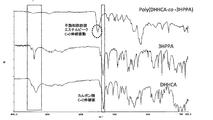
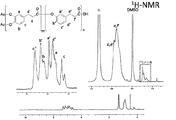
図3は、原料であるDHHCA、3HPPAと得られたエステル共重合体の赤外線吸収スペクトル(IR)である。得られたエステル共重合体では、カルボン酸C=O伸縮振動に対応するピークが消えており、不飽和脂肪酸エステルC=O伸縮振動に対応するピークが出現している。一方、図4はDHHCAの1H-NMR、図5は3HPPAの1H-NMR、図6はエステル共重合体[ポリ(DHHCA-co-3HPPA)]の1H-NMRである。
接着性能評価
DHHCA:3HPPA=1:1、及びDHHCA:3HPPA=1:3としてそれぞれエステル共重合体[ポリ(DHHCA-co-3HPPA)]を合成し、その接着性能を評価した。DHHCA:3HPPA=1:3として合成したエステル共重合体[ポリ(DHHCA-co-3HPPA)]の分子量(GPC測定)は、Mn=25800、Mw=62800、Mw/Mn=2.43であった。
DHHCA:3HPPA=1:1、及びDHHCA:3HPPA=1:3としてそれぞれエステル共重合体[ポリ(DHHCA-co-3HPPA)]を合成し、その接着性能を評価した。DHHCA:3HPPA=1:3として合成したエステル共重合体[ポリ(DHHCA-co-3HPPA)]の分子量(GPC測定)は、Mn=25800、Mw=62800、Mw/Mn=2.43であった。
接着性能は、1cm×5cmの接着面でずり剥離試験を行った。図7はDHHCA:3HPPA=1:1としたエステル共重合体の試験結果であり、図8はDHHCA:3HPPA=1:3としたエステル共重合体の試験結果である。DHHCA:3HPPA=1:1としたエステル共重合体では、7.2MPaでバルク破壊が起こり、DHHCA:3HPPA=1:3としたエステル共重合体は測定限界以上であった。
さらに、図9に示すように、市販のシアノアクリレート系接着剤、カフェ酸とp-クマル酸とから合成されたエステル共重合体(特許文献1)、及び、本実施の形態のエステル共重合体[ポリ(DHHCA-co-3HPPA)]について、接着強度を計測した。エステル共重合体[ポリ(DHHCA-co-3HPPA)]の接着強度(せん断強さShear Stress)は、市販のシアノアクリレート系接着剤や、カフェ酸とp-クマル酸とから合成されたエステル共重合体の接着強度よりも遥に大きな値であった。ガラス板の場合には、エポキシ樹脂の接着強度(20MPa)に匹敵する値(21MPa)であった。炭素板の場合は、炭素板が脆いために測定中に破壊してしまい、正確な測定に至らなかった。しかし、[ポリ(DHCA-co-4HCA)]の結果と、[ポリ(DHHCA-co-3HPPA)]のガラス板への接着破壊が凝集破壊であったことを併せて考えると、測定中に、仮に炭素板が破壊されることがなければ、ガラス板と同等の接着力が測定されたと推測される(点線の棒グラフを参照)。鉄板の場合は、15MPaに迫る値を示した。このように、鉄(無機表面)および炭素板(有機表面)共に良好な接着力を示した。
触媒による相違
エステル交換反応の際の触媒として強い触媒(HT)と弱い触媒(Na2HPO4,ハイドロキシアパタイトなどのリン酸カルシウム)を用い、それぞれエステル共重合体[ポリ(DHHCA-co-3HPPA)]を合成した。図10に示すように、強い触媒(HT)を用いた場合には、末端水酸基が消失していたのに対して、弱い触媒(Na2HPO4,ハイドロキシアパタイトなどのリン酸カルシウム)を用いた場合には、末端水酸基が残っていた。そして、末端水酸基が残存する場合の方が強力な接着力が得られた。すなわち、上記弱い触媒を用いることで強い接着力が得られ、上記強い触媒を用いることで弱い接着力を得ることの調整が可能である。
エステル交換反応の際の触媒として強い触媒(HT)と弱い触媒(Na2HPO4,ハイドロキシアパタイトなどのリン酸カルシウム)を用い、それぞれエステル共重合体[ポリ(DHHCA-co-3HPPA)]を合成した。図10に示すように、強い触媒(HT)を用いた場合には、末端水酸基が消失していたのに対して、弱い触媒(Na2HPO4,ハイドロキシアパタイトなどのリン酸カルシウム)を用いた場合には、末端水酸基が残っていた。そして、末端水酸基が残存する場合の方が強力な接着力が得られた。すなわち、上記弱い触媒を用いることで強い接着力が得られ、上記強い触媒を用いることで弱い接着力を得ることの調整が可能である。
ヒドロカフェ酸の比率についての検討
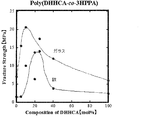
DHHCA:3HPPA=100:0~0:100として各種比率でエステル共重合体[ポリ(DHHCA-co-3HPPA)]を合成し、それぞれ接着強度を計測した。結果を図11に示す。
DHHCA:3HPPA=100:0~0:100として各種比率でエステル共重合体[ポリ(DHHCA-co-3HPPA)]を合成し、それぞれ接着強度を計測した。結果を図11に示す。
この図11より、ヒドロカフェ酸(DHHCA)の共重合比率を約5~40モル%とすることで、ガラス板の場合も鉄板の場合も強い接着力が得られ(大きな剪断強さ(Shea Stress)が得られ)、特に約10~20モル%とすることで、剪断強さにつき、鉄板は15MPaに迫る値を示し、ガラス板は21MPaの値を示した。これにより、金属と金属との結合や、金属とスーパーエンジニアリングプラスチックの接合等にも有用であり、例えば、自動車の車体の軽量化やその分解にも寄与することが期待できる。
次に、図12(a)に示すようにディスク状に成形して、37℃の水中での溶出物・安定性を超高分解能フーリエ変換型質量分析装置(FT-ICR Mass Spectrometer)を使用して評価した。図12(b)より、48h(時間)まではオリゴマーの溶出が確認されたが、72h以降は何も溶出されてこなかった。したがって、歯科用接着剤などの医歯薬学的な用途(口腔内に使用する接着剤として)として使用する場合には72h以上の水中での保存により(約3日間精製することとすれば)、低分子量分画による影響を回避できると考えられる。上記精製方法によれば、水中安定性にも一定の効果を発揮すること、また、触媒を敢えて除去しなくとも、人体への影響を避けることができることが分かる。
次に、ポリ(DHHCA-co-3HPPA)の熱物性試験を行なった。熱物性試験は、室温から180℃の範囲での融解性試験(軟化温度)の測定を行なった。図13にその結果を示す。この図13より、約36~37℃付近にTgと見られる吸熱のピークを確認した。これにより、歯科用接着剤などの人体への応用が期待できると考えられる。そして、目視により60~120℃で融解を確認した。
以上、本発明の天然物由来の成分を用いた新規なポリエステル組成物及び接着剤は、ホットメルト型の接着剤として、また、前記溶媒に溶かして使用可能であること、また、これら両方を併用して使用したり、各種フィラー等を含有させたり、他の接着剤と混合して使用することもできる。
Claims (10)
- ヒドロカフェ酸またはその誘導体を構成モノマーとする共重合体を主体とするポリエステル組成物。
- 前記ヒドロカフェ酸またはその誘導体が下記化1で表されることを特徴とする請求項1記載のポリエステル組成物。

- 前記ヒドロカフェ酸またはその誘導体が下記化2で表されるヒドロカフェ酸であることを特徴とする請求項1記載のポリエステル組成物。

- 前記ヒドロカフェ酸またはその誘導体の含有量が共重合体の5モル%以上であることを特徴とする請求項1から3のいずれか1項記載のポリエステル組成物。
- 前記ヒドロカフェ酸またはその誘導体は、エステル結合可能なカルボキシル基及び水酸基を有するモノマーと共重合されていることを特徴とする請求項1から4のいずれか1項記載のポリエステル組成物。
- 前記エステル結合可能なカルボキシル基及び水酸基を有するモノマーがヒドロキシフェニルプロピオン酸であることを特徴とする請求項5記載のポリエステル組成物。
- 前記ヒドロキシフェニルプロピオン酸が、下記化3で表される3-(3-ヒドロキシフェニル)プロピオン酸であることを特徴とする請求項6記載のポリエステル組成物。

- ヒドロカフェ酸またはその誘導体を構成モノマーとする共重合体が下記化5で表される構造を有することを特徴とする請求項1記載のポリエステル組成物。
- 前記ヒドロカフェ酸またはその誘導体及びエステル結合可能なカルボキシル基及び水酸基を有するモノマーのいずれもが天然物由来の成分であることを特徴とする請求項1から8のいずれか1項記載のポリエステル組成物。
- 請求項1から9のいずれか1項記載のポリエステル組成物を用いた接着剤又は樹脂成形品。
Priority Applications (1)
| Application Number | Priority Date | Filing Date | Title |
|---|---|---|---|
| JP2012554754A JP5810423B2 (ja) | 2011-01-27 | 2012-01-19 | ポリエステル組成物及びこれを用いた接着剤 |
Applications Claiming Priority (2)
| Application Number | Priority Date | Filing Date | Title |
|---|---|---|---|
| JP2011015455 | 2011-01-27 | ||
| JP2011-015455 | 2011-01-27 |
Publications (1)
| Publication Number | Publication Date |
|---|---|
| WO2012102174A1 true WO2012102174A1 (ja) | 2012-08-02 |
Family
ID=46580746
Family Applications (1)
| Application Number | Title | Priority Date | Filing Date |
|---|---|---|---|
| PCT/JP2012/051108 Ceased WO2012102174A1 (ja) | 2011-01-27 | 2012-01-19 | ポリエステル組成物及びこれを用いた接着剤 |
Country Status (2)
| Country | Link |
|---|---|
| JP (1) | JP5810423B2 (ja) |
| WO (1) | WO2012102174A1 (ja) |
Cited By (2)
| Publication number | Priority date | Publication date | Assignee | Title |
|---|---|---|---|---|
| JP2014221741A (ja) * | 2013-05-14 | 2014-11-27 | 国立大学法人九州工業大学 | 歯科用接着剤の製造方法 |
| JP2015218178A (ja) * | 2014-05-14 | 2015-12-07 | 国立大学法人九州工業大学 | 接着剤原料用モノマー |
Citations (1)
| Publication number | Priority date | Publication date | Assignee | Title |
|---|---|---|---|---|
| WO2009054112A1 (ja) * | 2007-10-25 | 2009-04-30 | Japan Advanced Institute Of Science And Technology | カルボン酸エステル系ポリマー |
-
2012
- 2012-01-19 JP JP2012554754A patent/JP5810423B2/ja not_active Expired - Fee Related
- 2012-01-19 WO PCT/JP2012/051108 patent/WO2012102174A1/ja not_active Ceased
Patent Citations (1)
| Publication number | Priority date | Publication date | Assignee | Title |
|---|---|---|---|---|
| WO2009054112A1 (ja) * | 2007-10-25 | 2009-04-30 | Japan Advanced Institute Of Science And Technology | カルボン酸エステル系ポリマー |
Non-Patent Citations (2)
| Title |
|---|
| D. KANEKO ET AL.: "Terminally-catecholized hyper-branched polymers with high performance adhesive characteristics", PLANT BIOTECHNOLOGY, vol. 27, no. 3, 15 July 2010 (2010-07-15), pages 293 - 296 * |
| KAGAKU DAIJITEN 5, 15 April 1961 (1961-04-15), pages 349 - 350 * |
Cited By (2)
| Publication number | Priority date | Publication date | Assignee | Title |
|---|---|---|---|---|
| JP2014221741A (ja) * | 2013-05-14 | 2014-11-27 | 国立大学法人九州工業大学 | 歯科用接着剤の製造方法 |
| JP2015218178A (ja) * | 2014-05-14 | 2015-12-07 | 国立大学法人九州工業大学 | 接着剤原料用モノマー |
Also Published As
| Publication number | Publication date |
|---|---|
| JP5810423B2 (ja) | 2015-11-11 |
| JPWO2012102174A1 (ja) | 2014-06-30 |
Similar Documents
| Publication | Publication Date | Title |
|---|---|---|
| Fan et al. | An antifreezing/antiheating hydrogel containing catechol derivative urushiol for strong wet adhesion to various substrates | |
| Miao et al. | Water-phase synthesis of a biobased allyl compound for building uv-curable flexible thiol–ene polymer networks with high mechanical strength and transparency | |
| JP5810423B2 (ja) | ポリエステル組成物及びこれを用いた接着剤 | |
| WO2024153567A1 (en) | Isocyanate prepolymer and polyurethane adhesive prepared on basis thereof | |
| CA2619327A1 (en) | Mercaptan-hardened epoxy polymer compositions and processes for making and using same | |
| Zhang et al. | Thioctic acid-based solvent-free and recoverable adhesive for dry/wet environments | |
| Bansal et al. | Thermal stability and degradation studies of polyester resins | |
| JP6529428B2 (ja) | ポリアリールエーテルケトン樹脂材料用接着性組成物 | |
| Avasthi et al. | Biodegradable mineral plastics | |
| JP6461001B2 (ja) | ポリマーおよびその製造方法ならびに接着組成物 | |
| CN105612198A (zh) | 苯并噁嗪聚合 | |
| JP5467997B2 (ja) | 生体吸収性材料およびそれを用いた生体内留置物 | |
| CN113925996A (zh) | 一种用于骨缺损修复的医用粘合剂及其使用方法 | |
| Niu et al. | Hyperbranched thiol-capped polyurethane: a toughening curing agent for high-performance epoxy adhesives | |
| JP5448832B2 (ja) | 硬質発泡体 | |
| US12269925B1 (en) | Fast curing, biocompatible and biodegradable adhesives and sealants | |
| KR101816283B1 (ko) | 폴리(ε-데카락톤)-폴리(L-락타이드) 다중가지 스타 형태의 열가소성 탄성 공중합체 | |
| BR9202121A (pt) | Processo para a preparacao de um poliester e composicao de resina de poliester | |
| JP2000191753A (ja) | 金属含有量が少ない生体内分解吸収性高分子およびその製造方法。 | |
| WO2013155949A1 (zh) | 复合引发剂及应用和不饱和聚酯树酯组合物 | |
| MX2024013078A (es) | Agente pegajoso de dianhidrohexitol y composiciones adhesivas de fusion en caliente que incluyen el mismo | |
| JP7066246B2 (ja) | 易解体性接着材料 | |
| JP6762958B2 (ja) | 嫌気硬化性組成物 | |
| EP0115709B1 (en) | Readily curable composition | |
| WO2022122600A1 (en) | High strength cyanoacrylate-based tapes |
Legal Events
| Date | Code | Title | Description |
|---|---|---|---|
| 121 | Ep: the epo has been informed by wipo that ep was designated in this application |
Ref document number: 12739112 Country of ref document: EP Kind code of ref document: A1 |
|
| ENP | Entry into the national phase |
Ref document number: 2012554754 Country of ref document: JP Kind code of ref document: A |
|
| NENP | Non-entry into the national phase |
Ref country code: DE |
|
| 122 | Ep: pct application non-entry in european phase |
Ref document number: 12739112 Country of ref document: EP Kind code of ref document: A1 |