WO2012086712A1 - 溶出制御した経口液剤 - Google Patents
溶出制御した経口液剤 Download PDFInfo
- Publication number
- WO2012086712A1 WO2012086712A1 PCT/JP2011/079694 JP2011079694W WO2012086712A1 WO 2012086712 A1 WO2012086712 A1 WO 2012086712A1 JP 2011079694 W JP2011079694 W JP 2011079694W WO 2012086712 A1 WO2012086712 A1 WO 2012086712A1
- Authority
- WO
- WIPO (PCT)
- Prior art keywords
- test
- solution
- dissolution
- active ingredient
- elution
- Prior art date
- Legal status (The legal status is an assumption and is not a legal conclusion. Google has not performed a legal analysis and makes no representation as to the accuracy of the status listed.)
- Ceased
Links
Images

Classifications
-
- A—HUMAN NECESSITIES
- A61—MEDICAL OR VETERINARY SCIENCE; HYGIENE
- A61K—PREPARATIONS FOR MEDICAL, DENTAL OR TOILETRY PURPOSES
- A61K9/00—Medicinal preparations characterised by special physical form
- A61K9/0087—Galenical forms not covered by A61K9/02 - A61K9/7023
- A61K9/0095—Drinks; Beverages; Syrups; Compositions for reconstitution thereof, e.g. powders or tablets to be dispersed in a glass of water; Veterinary drenches
-
- A—HUMAN NECESSITIES
- A61—MEDICAL OR VETERINARY SCIENCE; HYGIENE
- A61K—PREPARATIONS FOR MEDICAL, DENTAL OR TOILETRY PURPOSES
- A61K31/00—Medicinal preparations containing organic active ingredients
- A61K31/33—Heterocyclic compounds
- A61K31/395—Heterocyclic compounds having nitrogen as a ring hetero atom, e.g. guanethidine or rifamycins
- A61K31/495—Heterocyclic compounds having nitrogen as a ring hetero atom, e.g. guanethidine or rifamycins having six-membered rings with two or more nitrogen atoms as the only ring heteroatoms, e.g. piperazine or tetrazines
- A61K31/496—Non-condensed piperazines containing further heterocyclic rings, e.g. rifampin, thiothixene or sparfloxacin
-
- A—HUMAN NECESSITIES
- A61—MEDICAL OR VETERINARY SCIENCE; HYGIENE
- A61K—PREPARATIONS FOR MEDICAL, DENTAL OR TOILETRY PURPOSES
- A61K9/00—Medicinal preparations characterised by special physical form
- A61K9/08—Solutions
-
- A—HUMAN NECESSITIES
- A61—MEDICAL OR VETERINARY SCIENCE; HYGIENE
- A61P—SPECIFIC THERAPEUTIC ACTIVITY OF CHEMICAL COMPOUNDS OR MEDICINAL PREPARATIONS
- A61P25/00—Drugs for disorders of the nervous system
- A61P25/18—Antipsychotics, i.e. neuroleptics; Drugs for mania or schizophrenia
Definitions
- the present invention relates to 2- (4-ethyl-1-piperazinyl) -4- (4-fluorophenyl) -5,6,7,8,9,10-hexahydro used as a therapeutic agent for schizophrenia.
- the present invention relates to a medical solution for oral administration containing cycloocta [b] pyridine (hereinafter referred to as “bronanserin” or “active ingredient”) as an active ingredient.
- Blonanserin is a compound that has a strong blocking action on dopamine D2 receptor and serotonin 5-HT2 receptor, and has few side effects such as extrapyramidal symptoms, sleepiness, hypotension, and weight gain (Patent Document 1). .
- Non-patent Document 1 it is known that elderly people have a high ratio of hypogastric acidosis or anacidosis with high gastric pH due to factors such as a decrease in gastric acid secretion due to aging.
- the pH in a human stomach is about pH 1.2 to 1.8 when fasting, but is known to increase from pH 3.0 to 5.0 after meals.
- the gastric pH may increase to around 6-7 (Non-patent Document 2).
- a drug for oral administration changes the absorbability and bioavailability of the drug depending on the dissolved state in the digestive tract, and has a great influence on the effectiveness and safety (Non-patent Document 3).
- Patent Document 1 discloses tablets, powders, and injections containing blonanserin as an active ingredient, but does not show any formulation stability, solubility or dissolution of blonanserin at various pHs, and So far, there has been no indication of a liquid agent that controls the elution of blonanserin.
- An object of the present invention is to provide a blonanserin elution control solution exhibiting elution characteristics similar to those of a solid preparation in a wide pH range from acidic to neutral.
- xanthan gum specifically exhibits the elution control effect of a liquid drug among various thickening ingredients added for the purpose of improving swallowing during administration.
- sugar or sugar alcohol together with xanthan gum, it is possible to suppress dissolution even at lower concentrations of xanthan gum, and it is possible to increase the similarity of dissolution rate between tablets containing bronanserin and liquids As a result, the present invention has been completed.
- Item 1 (a) 2- (4-Ethyl-1-piperazinyl) -4- (4-fluorophenyl) -5,6,7,8,9,10-hexahydrocycloocta [b] pyridine (hereinafter “ Active ingredient "), (b) an aqueous solution containing xanthan gum and (c) a solubilizing agent, and described in the 15th revised Japanese Pharmacopoeia using a liquid containing an active ingredient (a) equivalent to 4 mg.
- the elution rate 60 minutes after the start of the test using the second elution test was 20 to 50%.
- Item 2 The oral liquid according to Item 1, wherein the content of the active ingredient (a) in the aqueous solution is 0.1 mg / mL to 6 mg / mL.
- Item 3 The oral solution according to Item 1 or 2, wherein the content of xanthan gum (b) in the aqueous solution is 1 mg / mL to 20 mg / mL.
- Item 4 When the dissolution test (temperature: 37 ° C., test method: paddle method, rotation speed: 50 rpm) described in the 15th revision Japanese Pharmacopoeia is performed, the dissolution rate 60 minutes after the start of the test using the second dissolution test Item 4.
- Item 5 The oral solution according to any one of Items 1 to 4, wherein the pH of the aqueous solution is 2 to 5.
- Item 6 The oral solution according to any one of Items 1 to 5, wherein the dissolution aid (c) is an acid.
- Item 7 The oral liquid according to Item 6, wherein the dissolution aid (c) is at least one selected from the group consisting of hydrochloric acid, citric acid, malic acid, tartaric acid, and lactic acid.
- Item 8 The oral solution according to Item 6 or 7, wherein the solubilizer (c) is at least one selected from the group consisting of citric acid, malic acid, and tartaric acid.
- Item 9 The oral solution according to any one of Items 1 to 8, further comprising (d) a sugar or a sugar alcohol.
- Item 10 The oral liquid according to Item 9, wherein the sugar or sugar alcohol (d) is at least one selected from the group consisting of erythritol, sorbitol, sucrose, trehalose and lactose.
- Item 11 The oral liquid according to Item 9 or 10, wherein the sugar or sugar alcohol (d) is at least one selected from the group consisting of sucrose, erythritol, and sorbitol.
- Item 12 The oral solution according to any one of Items 9 to 11, wherein the sugar or sugar alcohol content is 50 to 400 mg / mL.
- Item 13 (a) active ingredient, An oral solution containing (b) xanthan gum and (c) a solubilizing agent, wherein the content of the active ingredient (a) is 0.1 to 6 mg / mL.
- Item 14 (a) active ingredient, (B) xanthan gum, (C) a solubilizer, and (d) an aqueous solution containing sugar or sugar alcohol, wherein the content of the active ingredient (a) is 0.1-6 mg / mL and the pH is 2-5.
- An oral solution (a) active ingredient, An oral solution containing (b) xanthan gum and (c) a solubilizing agent, wherein the content of the active ingredient (a) is 0.1 to 6 mg / mL.
- Item 14 (a) active ingredient, (B) xanthan gum, (C) a solubilizer, and (d) an aqueous solution containing sugar or sugar alcohol, wherein the content of the active ingredient (a) is 0.1-6 mg /
- Item 15 (a) active ingredient, (B) xanthan gum, (C) at least one solubilizing agent selected from the group consisting of citric acid, malic acid and tartaric acid, and (d) at least one sugar or sugar alcohol selected from the group consisting of sucrose, erythritol and sorbitol.
- An oral solution comprising an aqueous solution containing the active ingredient (a) in a content of 0.1 to 6 mg / mL and a pH of 2 to 5.
- Item 16 (a) active ingredient, (B) xanthan gum, (C) at least one solubilizing agent selected from the group consisting of citric acid, malic acid and tartaric acid, (D) containing at least one sugar or sugar alcohol selected from the group consisting of sucrose, erythritol and sorbitol, and (e) one or more preservatives selected from the group consisting of benzoic acid and sodium benzoate
- An oral solution which is an aqueous solution, wherein the content of the active ingredient (a) is 0.5 to 4 mg / mL and the pH is 2 to 5.
- Item 17 The oral solution according to any one of Items 13 to 16, wherein the content of xanthan gum (b) in the aqueous solution is 1 mg / mL to 20 mg / mL.
- Item 18 The oral solution according to any one of Items 14 to 17, wherein the sugar or sugar alcohol (d) content is 50 to 400 mg / mL.
- Item 19 When conducting a dissolution test (temperature: 37 ° C., test method: paddle method, rotation speed: 50 rpm) described in the 15th revised Japanese Pharmacopoeia using a liquid equivalent to 4 mg of active ingredient (a) Any one of Items 13 to 18 wherein the dissolution rate after 60 minutes from the start of the test with the second solution of the test is 20 to 50%, and the dissolution rate after 60 minutes from the start of the test with the first solution of the dissolution test is 70 to 100%.
- Item 20 When conducting a dissolution test (temperature: 37 ° C., test method: paddle method, rotation speed: 50 rpm) described in the 15th revised Japanese Pharmacopoeia using a liquid equivalent to 4 mg of active ingredient (a) Any one of Items 13 to 19, wherein the dissolution rate after 60 minutes from the start of the test with the second solution of the test is 25 to 45%, and the dissolution rate after 60 minutes from the start of the test with the first solution of the dissolution test is 80 to 100%.
- a blonanserin-containing oral solution in a wide pH range from acidic to neutral, and it is possible to provide a blonanserin elution control solution exhibiting similar dissolution properties as a solid preparation.
- FIG. 1 is an explanatory view showing the results of absorbability evaluation in Test Example 14.
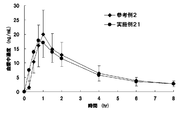
- FIG. 2 is an explanatory view showing the results of absorbability evaluation in Test Example 15.
- Cycloocta [b] pyridine may be a free base, a pharmaceutically acceptable acid addition salt thereof, or a pharmacologically acceptable solvate thereof. .
- the form which formed the salt with the acid and blonanserin which exist in a liquid agent is also contained.
- liquid forms containing blonanserin in a dissolved state differ greatly from solid preparations, there is a risk that the dissolution properties of solid preparations may differ from those of solid preparations, especially in the neutral region where the solubility of blonanserin is extremely low.
- the dissolution property was similar to that of the solid preparation in a wide pH range from acidic to neutral. This is characterized by determining the dissolution rate in the dissolution test.
- blonanserin is in a dissolved state, but it is not necessarily required that the blonanserin is strictly dissolved.
- blonanserin is also included in the present invention in the form of suspended fine particles. It is.
- the dissolution test is a paddle method of the dissolution test method defined as the 15th revised Japanese Pharmacopoeia general test method.
- the dissolution test first solution (pH 1.2) and dissolution test second This means a method in which the elution rate at 37 ° C. is obtained over time with a solution (pH 6.8) as a test solution and a rotation speed of 50 rpm (50 times / min).
- the liquid preparation of the present invention contains blonanserin as an active ingredient, and when the dissolution test described in the 15th revised Japanese Pharmacopoeia (temperature: 37 ° C., test method: paddle method, rotation speed: 50 rpm) is performed.
- the dissolution rate is 20 to 50% 60 minutes after the start of the test with the second dissolution test using a solution equivalent to 4 mg, and when the dissolution test is performed with the first dissolution test, the test starts 60 minutes. It is a liquid agent having a subsequent elution rate of 70 to 100%.
- a liquid containing 4 mg of the active ingredient (a)” or “a liquid containing 4 mg of blonanserin” means a liquid containing 4 mg of the free active ingredient (a) (blonanserin) in the liquid. To do.
- the liquid preparation of the present invention was subjected to a dissolution test (temperature: 37 ° C., test method: paddle method, rotation speed: 50 rpm) using a solution equivalent to 4 mg of blonanserin, and the test start in the second solution of dissolution test 60
- a dissolution test temperature: 37 ° C., test method: paddle method, rotation speed: 50 rpm
- the test start in the second solution of dissolution test 60 It is desirable that the dissolution rate after 25 minutes is 25 to 45%, and that the dissolution rate after 70 minutes from the start of the test in the first dissolution test solution is 70 to 100%, and 60 minutes after the start of the test in the second dissolution test. It is more preferable that the dissolution rate is 25 to 45% and the dissolution rate after 60 minutes from the start of the test in the first dissolution test solution is 80 to 100%.
- the start of the test in the second dissolution test solution is 60%. It is particularly preferable that the dissolution rate after 25 minutes is 25 to 40%, and that the dissolution rate after
- Sampling of the test solution in the dissolution test in the present invention is performed in accordance with the dissolution test method described in the 15th revised Japanese Pharmacopoeia, and the dissolution rate of blonanserin is a quantitative method in which the collected test solution is usually required, For example, it can be determined by an absorbance measurement method, a liquid chromatography method, or the like.
- the second solution of dissolution test used in the dissolution test of the present invention means the second solution in the 15th revised Japanese Pharmacopoeia general test method and dissolution test method, 3.40 g of sodium dihydrogen phosphate and anhydrous A solution obtained by adding 1 volume of water to 1 volume of a phosphate buffer solution (pH is about 6.8) in which 3.55 g of disodium hydrogen phosphate is dissolved in water to 1000 mL.
- the first dissolution test solution is a solution obtained by dissolving 2.0 g of sodium chloride in 7.0 mL of hydrochloric acid and water to make 1000 mL (pH is about 1.2).
- the dissolution test method described in the 15th revision of the Japanese Pharmacopoeia is that when a tablet is used as a test sample, generally one dosage unit (1 to several tablets) is put into a 900 mL test solution, and the test is carried out. Since the liquid preparation of the present invention is a liquid preparation, the test sample is generally based on the result of performing the test by introducing a liquid equivalent to 4 mg of blonanserin into a 900 mL test liquid as the amount of the liquid to be orally administered. Will be evaluated.
- the liquid agent shown in the present specification has an appropriate quality as a pharmaceutical not only in terms of physical and chemical stability of the active ingredient contained, but also in terms of physical and chemical stability as a liquid agent. It is desirable that the state of the solution does not change easily upon storage.
- the liquid preparation of the present invention is stable at 40 ° C. even in a storage state of at least one month. Specifically, the liquid agent of the present invention does not change its elution property even after storage at 40 ° C., and has excellent physical and chemical stability as an elution control liquid agent.
- the xanthan gum (b) used in the liquid preparation of the present invention has ⁇ - (1,4) -D-glucan as the main chain skeleton, and ⁇ -D-mannose and ⁇ -D- every other glucose molecule in the main chain.
- the amount of xanthan gum (b) is 1 mg / mL to 20 mg / mL, preferably 2 mg / mL to 15 mg / mL, from the viewpoint of elution control effect and fluidity of the liquid. More preferably, it is 4 mg / mL to 15 mg / mL, and particularly preferably 4 mg / mL to 10 mg / mL (most preferably 5 mg / mL to 9 mg / mL).
- a pharmaceutically acceptable acid is preferable.
- specific examples include inorganic acids such as hydrochloric acid and phosphoric acid, and organic acids such as citric acid, malic acid, tartaric acid, lactic acid, maleic acid, and acetic acid, preferably hydrochloric acid, citric acid, malic acid, tartaric acid, and lactic acid. More preferred are citric acid, malic acid and tartaric acid.
- the content of these solubilizing agents is not particularly limited, but may be an amount that can adjust the solution to pH 2 to 5, more preferably pH 2 to 4.
- the oral solution of the present invention may contain an alkali metal salt such as a sodium salt or potassium salt of the above-mentioned inorganic acid or organic acid.
- sucrose and sorbitol More preferred are sucrose and sorbitol, and particularly preferred is sorbitol.
- One or two or more of these sugars or sugar alcohols can be mixed and used.
- the amount of these sugars or sugar alcohols is not particularly limited, but is preferably 50 to 400 mg / mL, more preferably 50 to 300 mg from the viewpoint of its own solubility and the auxiliary effect of controlling the dissolution of xanthan gum. / ML.
- the pH of the solution is desirably 2 to 5, and more preferably in the range of pH 2 to 4. If the pH of the solution exceeds 5, the physical stability as a solution containing blonanserin decreases, and as a result, precipitation may be observed depending on the storage conditions, and the target dissolution behavior may not be exhibited. On the other hand, when the pH of the liquid agent is less than 2, not only the stability as the liquid agent decreases, but also the acidity becomes strong and the feeling of dosing decreases.
- the content of free form of blonanserin is 0.1 mg / mL to 6 mg / mL, preferably 0.1 mg / mL to 5 mg / mL, more preferably 0.5 mg / mL to 4 mg. / ML, particularly preferably in the range of 1 mg / mL to 3 mg / mL.
- the content of blonanserin is less than 0.1 mg / mL, the amount of the liquid agent used in the clinically used drug dose becomes extremely large, and the dosage and portability are lowered.
- the weight of the active ingredient means the weight of the free form of the active ingredient.
- the active ingredient is in the form of a salt, or when the active ingredient has crystal water, the salt or crystal water A substantial amount is meant not to be included in the weight of the active ingredient.
- the liquid preparation of the present invention contains various additive components generally used for medical oral liquid preparations in addition to the above components as long as the composition of the present invention is satisfied and the effect as an elution control liquid is achieved.
- flavoring agents stabilizers, surfactants, buffers, sweeteners, antioxidants, fragrances, cooling agents, flavoring agents, coloring agents, tonicity agents, pH adjustment Agents, preservatives, preservatives, solvents and the like can be used.
- the liquid preparation of the present invention can contain a preservative in an amount that prevents the growth of microorganisms, as in the case of general oral liquid preparations.
- the preservative (e) to be used is not particularly limited, and examples thereof include benzoic acid, sodium benzoate, sorbic acid, potassium sorbate, sodium dehydroacetate, paraoxybenzoates, sodium edetate, and the like. Or 2 or more types can be mixed and used.
- the water used in the liquid preparation of the present invention is not particularly limited as long as it is water that can be used for pharmaceutical purposes.
- water that can be used for pharmaceutical purposes.
- purified water sterilized purified water, water for injection and the like can be used.
- water in consideration of ingestion as an oral liquid, it is desirable to use water as a base solvent, but it contains a solvent other than water as long as the composition of the present invention is achieved and the effect is achieved. May be.
- the method for measuring the viscosity of the liquid preparation of the present invention is not particularly limited as long as it is usually used.
- the viscosity of the liquid preparation of the present invention is, for example, a room temperature environment using a vibration viscometer (Viscomate VM-1A-M).
- Vicomate VM-1A-M vibration viscometer
- the liquid preparation of the present invention includes blonanserin or a pharmacologically acceptable salt thereof or a pharmacologically acceptable solvate thereof, xanthan gum, a solubilizing agent, and a sugar or sugar alcohol to be added if necessary,
- Each component can be produced by adding each component to water and finally dissolving it by a conventional method in which components can be usually selected.
- it may be prepared as a solid preparation containing the formulation of each component confirmed to exhibit the elution behavior of the present invention.
- a solid preparation such as a capsule containing the formulation of the present invention Is mentioned.
- the present invention may be prepared as a liquid or semi-solid preparation such as a suspension containing water less than the amount originally contained in the formulation of each component confirmed to exhibit the dissolution behavior of the present invention. It may be a preparation prepared at the time of use that is diluted with water before taking.
- liquid preparation of the present invention is excellent in stability as a pharmaceutical product, it is appropriately selected from widely used glass bottles, polyethylene bottles, and packaging containers made of polyethylene or aluminum multilayer films. Can be used.
- blonanserin was from Dainippon Sumitomo Pharma Co., Ltd.
- blonanserin tablets used as Reference Example 2 were 4 mg of Lonacene (registered trademark) tablets (Dainippon Sumitomo Pharma Co., Ltd.). )), Citric acid (anhydrous), sucralose manufactured by Saneigen FFI Co., Ltd., and citric acid hydrate manufactured by Komatsuya Co., Ltd. were used.
- Xanthan gum is Echo Gum T / Ketrol T (Examples 1, 2, 5 to 13 and 16 to 21) manufactured by DSP Gokyo Food & Chemical Co., Ltd., or Sanace NSG- manufactured by Saneigen FFI Co., Ltd.
- Citric acid (anhydrous) and sodium benzoate were added to purified water in the amounts shown in Table 1, and the mixture was stirred until dissolved using a magnetic stirrer.
- blonanserin was added to this aqueous solution, and after stirring until dissolved using a magnetic stirrer, purified water was added to adjust the liquid volume.
- xanthan gum was added to this aqueous solution, and the blonanserin containing liquid agent was prepared by stirring until it melt
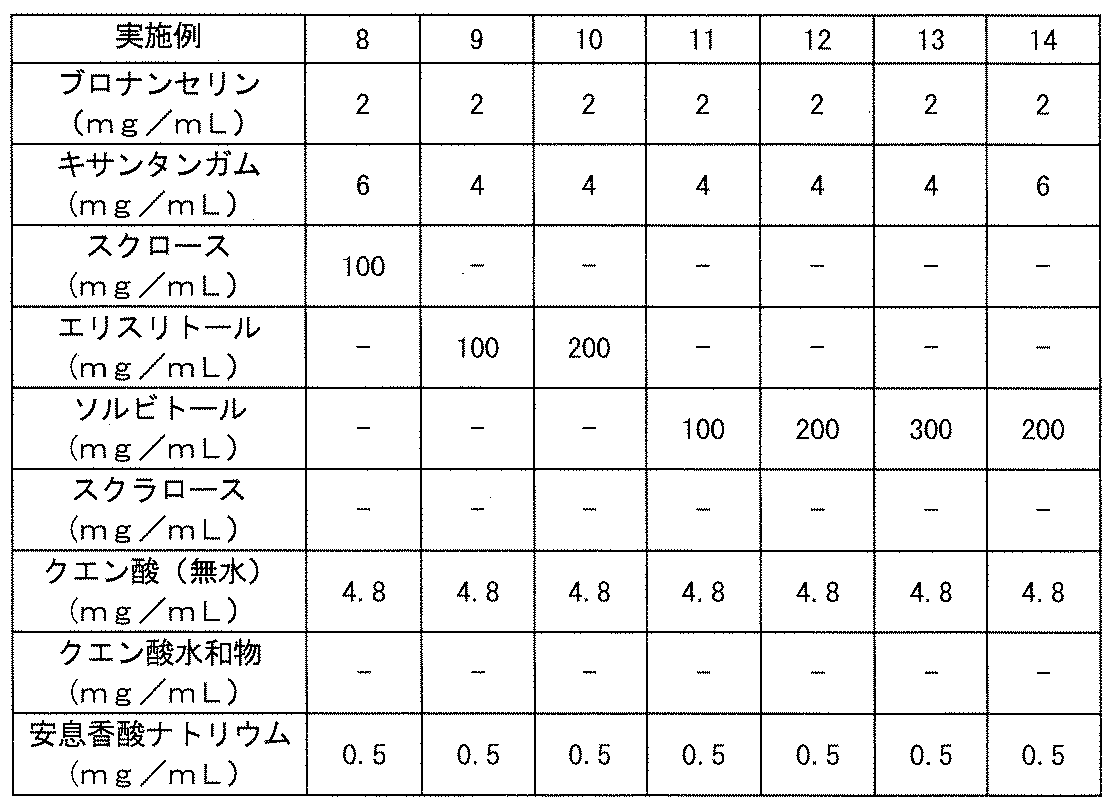
- Examples 5 and 6 Add 4.8 g of citric acid (anhydrous), 0.5 g of sodium benzoate and 2 g of blonanserin to purified water, stir until dissolved using a magnetic stirrer, and adjust the volume to 1 L using purified water. As a result, an aqueous solution containing 2 mg / mL blonanserin was prepared. Next, 100 mL of this aqueous solution was collected, 400 mg of xanthan gum was added, and stirring was performed using a magnetic stirrer to prepare a 4 mg / mL xanthan gum-2 mg / mL blonanserin-containing aqueous solution. Furthermore, 20 mL of this aqueous solution was sampled, sucrose was added in the amounts shown in Table 2, and the mixture was stirred using a magnetic stirrer to prepare a blonanserin-containing liquid.
- Examples 7 and 8 100 mL of the 2 mg / mL blonanserin-containing aqueous solution prepared in Examples 5 to 6 was collected, 600 mg of xanthan gum was added, and the mixture was stirred using a magnetic stirrer to prepare a 6 mg / mL xanthan gum-2 mg / mL blonanserin-containing aqueous solution. did. Furthermore, 20 mL of this aqueous solution was sampled, sucrose was added in the amounts shown in Table 2, and the mixture was stirred using a magnetic stirrer to prepare a blonanserin-containing liquid.
- Examples 9-13 Add 2.4 g of citric acid (anhydrous), 0.25 g of sodium benzoate, and 1 g of blonanserin to purified water, stir until dissolved using a magnetic stirrer, and then add purified water to adjust the volume to 250 mL. As a result, a 4 mg / mL blonanserin-containing aqueous solution was prepared. Next, 25 mL of this aqueous solution was sampled, erythritol or sorbitol was added in the amounts shown in Table 3, and the mixture was stirred until dissolved using a magnetic stirrer. Further, xanthan gum was added in an amount shown in Table 3, and after stirring until dissolved using a magnetic stirrer, purified water was added to adjust the liquid volume to 50 mL, thereby preparing a blonanserin-containing liquid.
- Citric acid (anhydrous) and sodium benzoate were added to purified water in the amounts shown in Table 4, and the mixture was stirred until dissolved using a magnetic stirrer.
- blonanserin is added to this aqueous solution, stirred until dissolved using a magnetic stirrer, sorbitol is added in the amounts shown in Table 4, stirred until dissolved using a magnetic stirrer, and purified water is added to the solution. Adjusted.
- xanthan gum was added to this aqueous solution, and the blonanserin containing liquid agent was prepared by stirring until it melt
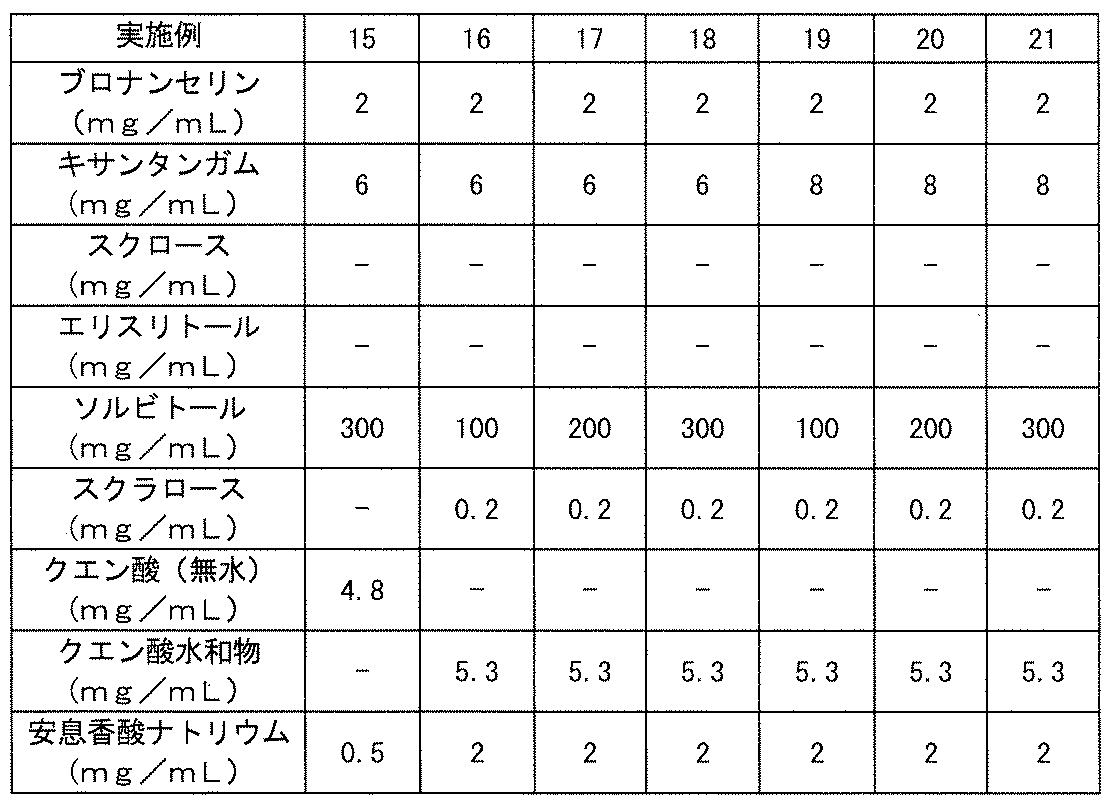
- Example 16 21.2 g of citric acid hydrate, 8 g of sodium benzoate, and 0.8 g of sucralose were added to the purified water and stirred until dissolved using a magnetic stirrer. Next, 8 g of blonanserin was added to this aqueous solution and stirred until dissolved using a magnetic stirrer. Further, 400 g of sorbitol was added, stirred until dissolved using a magnetic stirrer, and purified water was added to adjust the liquid volume to 4000 mL to prepare a 100 mg / mL sorbitol-2 mg / mL blonanserin-containing aqueous solution. 1800 mL of this aqueous solution was collected, 10.8 g of xanthan gum was added, and the mixture was stirred until dissolved using a magnetic stirrer to prepare a blonanserin-containing liquid.
- Example 17 21.2 g of citric acid hydrate, 8 g of sodium benzoate, and 0.8 g of sucralose were added to the purified water and stirred until dissolved using a magnetic stirrer. Next, 8 g of blonanserin was added to this aqueous solution and stirred until dissolved using a magnetic stirrer. Further, 800 g of sorbitol was added, stirred until dissolved using a magnetic stirrer, and purified water was added to adjust the liquid volume to 4000 mL to prepare a 200 mg / mL sorbitol-2 mg / mL blonanserin-containing aqueous solution. 1800 mL of this aqueous solution was collected, 10.8 g of xanthan gum was added, and the mixture was stirred until dissolved using a magnetic stirrer to prepare a blonanserin-containing liquid.
- Example 18 21.2 g of citric acid hydrate, 8 g of sodium benzoate, and 0.8 g of sucralose were added to the purified water and stirred until dissolved using a magnetic stirrer. Next, 8 g of blonanserin was added to this aqueous solution and stirred until dissolved using a magnetic stirrer. Further, 1200 g of sorbitol was added and stirred until dissolved using a magnetic stirrer, and purified water was added to adjust the liquid volume to 4000 mL to prepare a 300 mg / mL sorbitol-2 mg / mL blonanserin-containing aqueous solution. 1800 mL of this aqueous solution was collected, 10.8 g of xanthan gum was added, and the mixture was stirred until dissolved using a magnetic stirrer to prepare a blonanserin-containing liquid.
- Example 19 A blonanserin-containing solution was prepared in the same manner as described in Example 16 except that the amount of xanthan gum was changed to 14.4 g.
- Example 20 A blonanserin-containing solution was prepared in the same manner as described in Example 17 except that the amount of xanthan gum was changed to 14.4 g.
- Example 21 A blonanserin-containing solution was prepared in the same manner as described in Example 18 except that the amount of xanthan gum was changed to 14.4 g. Further, the pH of the blonanserin-containing liquid prepared in Examples 16 to 21 was measured according to the method described in the 15th revised Japanese Pharmacopoeia General Test Method. Table 5 shows the pH of the solutions obtained in Examples 16 to 21.
- Comparative Examples 1 to 4 Add 2.4 g of citric acid (anhydrous), 0.25 g of sodium benzoate, and 1 g of blonanserin to purified water, stir until dissolved using a magnetic stirrer, and then add purified water to adjust the volume to 250 mL. As a result, a 4 mg / mL blonanserin-containing aqueous solution was prepared. By collecting 50 mL of this aqueous solution, adding gum arabic, sodium alginate, gellan gum, or pectin in the amounts shown in Table 6, stirring until dissolved using a magnetic stirrer, and adjusting the volume by adding purified water A blonanserin-containing liquid was prepared.
- Comparative Examples 5-6 Add 4.8 g of citric acid (anhydrous), 0.5 g of sodium benzoate and 2 g of blonanserin to purified water, stir until dissolved using a magnetic stirrer, and adjust the volume to 1 L using purified water. As a result, an aqueous solution containing 2 mg / mL blonanserin was prepared. Next, 100 mL of this aqueous solution was collected, 2 g of pectin was added, and the mixture was stirred using a magnetic stirrer to prepare a 20 mg / mL pectin-2 mg / mL blonanserin-containing aqueous solution. Furthermore, sucrose was added to this aqueous solution by the quantity of Table 7, and it stirred until it melt
- Tables 8-1 to 8-4 show the prescriptions of Examples 1 to 21, Comparative Examples 1 to 6, and Reference Example 1.
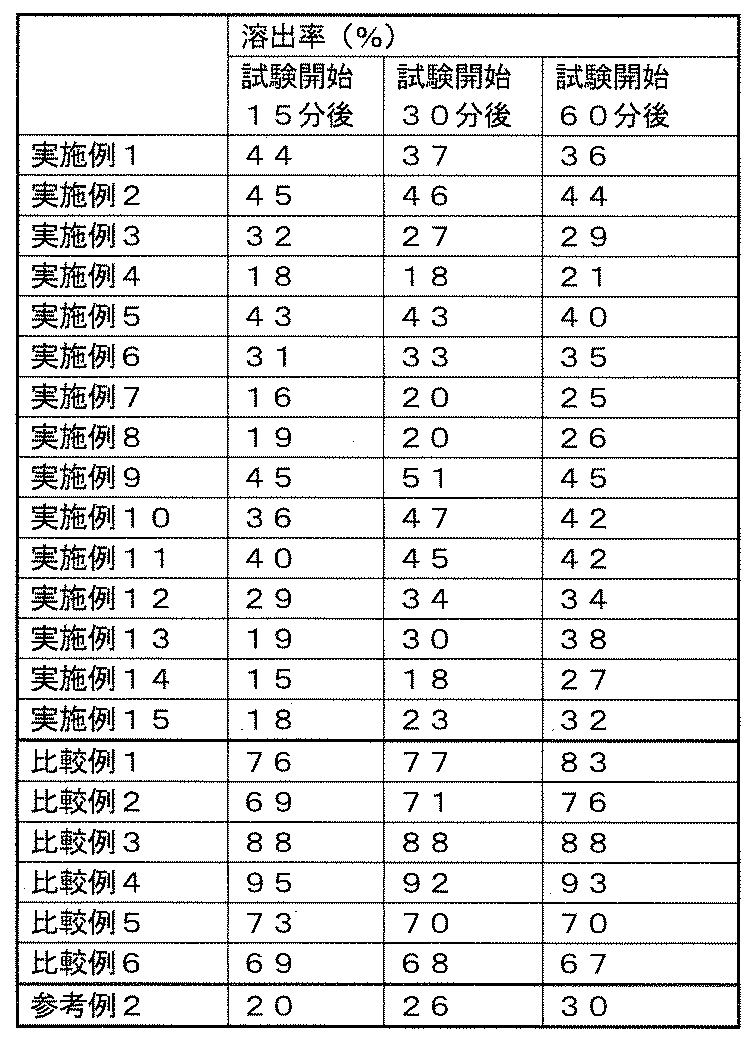
- Test example 1 Using a sample corresponding to 4 mg of drug collected from the blonanserin-containing liquid prepared in Examples 1 to 15 and Comparative Examples 1 to 6 and the tablet used as Reference Example 2, dissolution test (temperature: 37 ° C., test solution: dissolution) Test second liquid, test method: paddle method, rotation speed: 50 times / minute). Table 9 shows the dissolution rates 15 minutes, 30 minutes and 60 minutes after the start of the test.
- Test example 2 Using a sample corresponding to 4 mg of drug collected from the blonanserin-containing solution prepared in Examples 20 and 21 and Reference Example 1, dissolution test (temperature: 37 ° C., test solution: second solution of dissolution test, test method: paddle method, (Rotation speed: 50 times / min). Table 10 shows the dissolution rate after 10 minutes, 30 minutes and 60 minutes after the start of the test.
- Test example 3 Using a sample corresponding to 4 mg of the drug collected from the blonanserin-containing liquid prepared in Examples 1, 3, 4, 6, and 8 to 15 and the tablet used as Reference Example 2, dissolution test (temperature: 37 ° C., test liquid) : Dissolution test first liquid, test method: paddle method, rotation speed: 50 times / minute). Table 11 shows the dissolution rates 15 minutes, 30 minutes and 60 minutes after the start of the test.
- Test example 4 Using a sample corresponding to 4 mg of drug collected from the blonanserin-containing liquid prepared in Examples 20 and 21 and Reference Example 1, dissolution test (temperature: 37 ° C., test solution: first solution of dissolution test, test method: paddle method, (Rotation speed: 50 times / min). Table 12 shows the elution rates after 10 minutes, 30 minutes and 60 minutes after the start of the test.
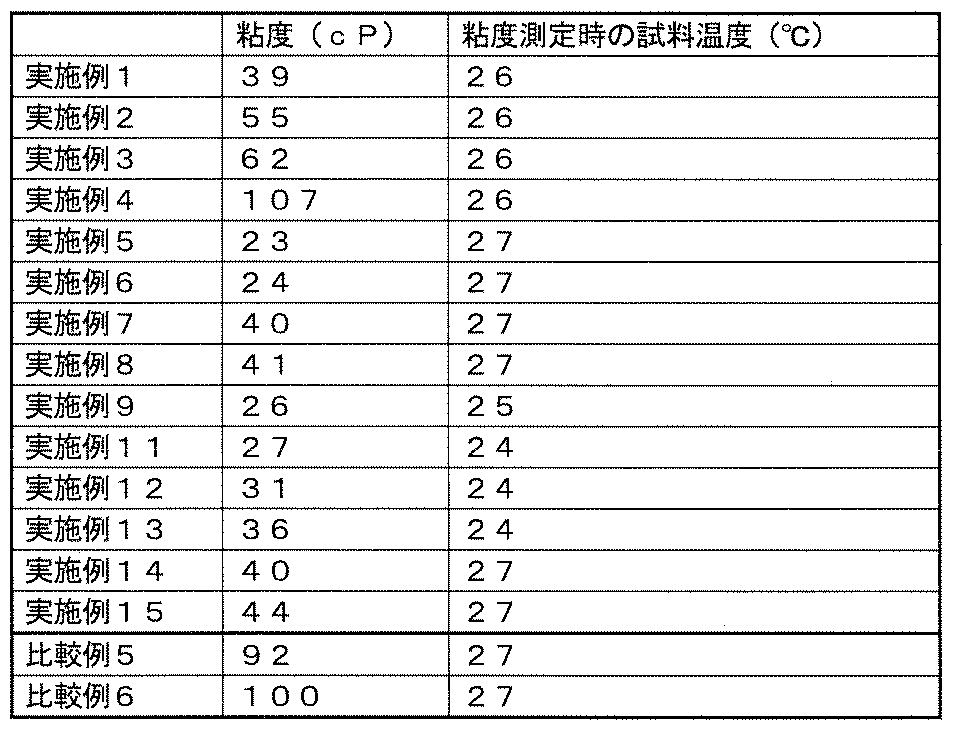
- Test Example 5 Using the samples collected from the blonanserin-containing liquids prepared in Examples 1 to 9, 11 to 15, and Comparative Examples 5 and 6, the viscosity was measured by a vibration viscometer (Viscomate VM-1A-M). Table 13 shows the evaluation results of each sample.
- Test Example 6 Using the samples collected from the blonanserin-containing liquids prepared in Examples 16 to 21, the viscosity was measured with a vibration viscometer (Viscomate VM-1A-M). Table 14 shows the evaluation results of each sample.
- the dissolution rate in the second dissolution test solution was obtained even by adding sucrose, erythritol and sorbitol even at a lower xanthan gum addition amount. It turns out that it can be controlled.
- Test Example 7 The pH of the blonanserin-containing liquid prepared in Examples 3, 4, 6, 9, and 11 to 15 was measured. In addition, pH measurement was implemented in accordance with the method described in the 15th revision Japanese Pharmacopoeia general test method. Table 15 shows the evaluation results of each sample.
- Test Example 8 Storage stability test 1
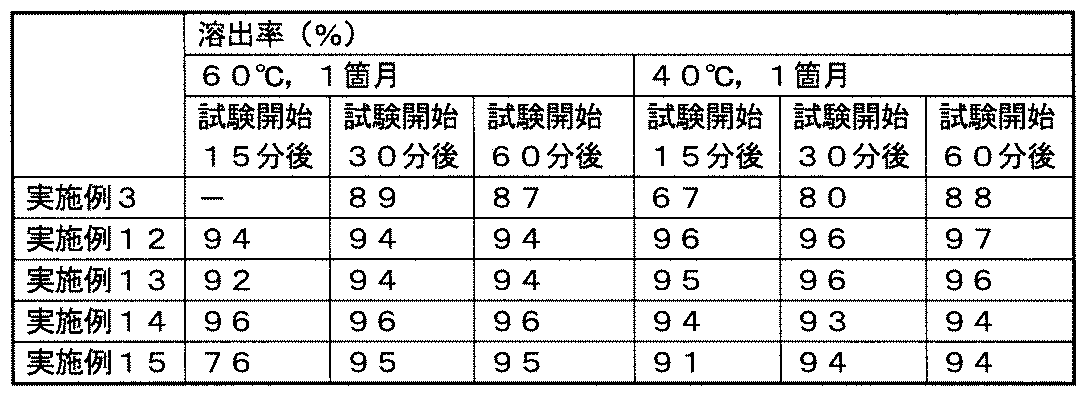
- the blonanserin-containing solutions prepared in Examples 3 and 12 to 15 were stored at 40 ° C. for 1 month and 60 ° C. for 1 month, respectively, and then the dissolution test was performed using the dissolution test second solution or dissolution test first solution.
- Table 16 shows the evaluation results in the second solution of dissolution test
- Table 17 shows the evaluation results in the first solution of dissolution test.
- the dissolution test in the dissolution test second liquid or dissolution test first liquid was performed in the same manner as in Test Example 1 or Test Example 3, respectively.
- Test Example 9 (Storage stability test 2) The blonanserin-containing liquid preparations prepared in Examples 20 and 21 were each stored at 40 ° C. for 1 month, and then the dissolution test was performed using the dissolution test second liquid or dissolution test first liquid. Table 18 shows the evaluation results for the second dissolution test solution, and Table 19 shows the evaluation results for the first dissolution test solution. In addition, the dissolution test in the dissolution test second liquid or dissolution test first liquid was performed by the same method as Test Example 2 or Test Example 4, respectively.
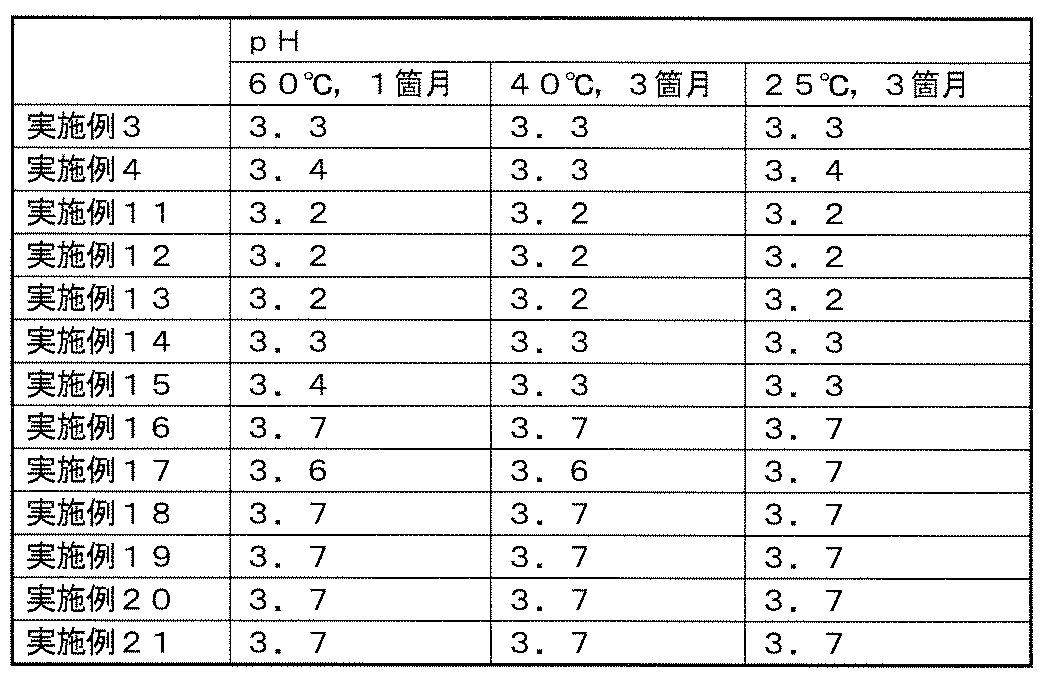
- Test Example 10 (Storage stability test 3) The blonanserin-containing solution prepared in Examples 3, 4 and 11 to 21 was filled into a glass container and sealed, and stored at 60 ° C. for 1 month, 40 ° C. for 3 months, or 25 ° C. for 3 months, and the stability (pH ) Was evaluated. Table 20 shows the evaluation results of each sample. The pH was measured by the same method as in Test Example 7.
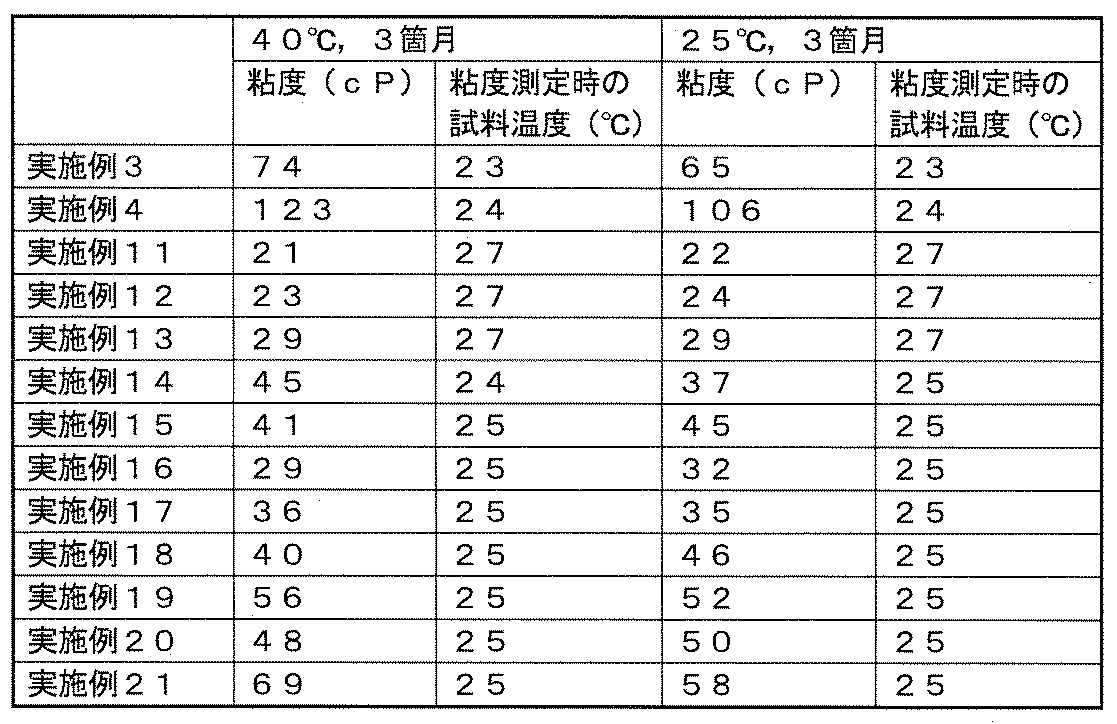
- Test Example 11 (Storage Stability Test 4) The blonanserin-containing liquid preparations prepared in Examples 3, 4 and 11 to 21 were filled in a glass container and sealed, and stored at 40 ° C. for 3 months or at 25 ° C. for 3 months to evaluate the stability (viscosity). Table 21 shows the evaluation results of each sample. The viscosity was measured with a vibration viscometer (Viscomate VM-1A-M).
- Test Example 12 (Storage stability test 5) The blonanserin-containing liquid preparations prepared in Examples 12 to 21 were filled and sealed in a glass container, stored at 60 ° C. for 1 month, and the stability (purity) was evaluated. Table 22 shows the evaluation results of each sample. Purity is measured by liquid chromatography using a reverse phase column (ODS column) by the isocratic method, and the area percentage of the blonanserin-derived peak when the total area value of all detected peaks is 100%. It showed in.
- ODS column reverse phase column
- Test Example 13 (Storage Stability Test 6) The blonanserin-containing solution prepared in Examples 16 to 21 was filled into a glass container and sealed, and stored at 60 ° C. for 1 month, 40 ° C. for 3 months, or 25 ° C. for 3 months, and the stability (content) was evaluated. . Table 23 shows the evaluation results of each sample. The content was measured by an isocratic method by liquid chromatography using a reverse phase column (ODS column), and indicated as a relative value when the blonanserin displayed amount was 100%.
- ODS column reverse phase column
- Test Example 14 (Absorptivity Evaluation 1 in Animals) The blonanserin-containing solution prepared in Examples 3 and 4 was administered to 2 mL (4 mg equivalent amount) beagle dogs, 15, 30, 45, 60, 90 minutes after administration, and 2, 4, 6, 8, 24 hours after administration. The blood concentration was measured at the time point, and the maximum blood concentration (C max ) and the amount absorbed (AUC 0-24h ) up to 24 hours were evaluated. The evaluation results of each sample are shown in FIG.
- Test Example 15 (Absorptive evaluation 2 in animals) 2 mL (4 mg equivalent amount) of the blonanserin-containing liquid prepared in Example 21 and the tablet used as Reference Example 2 were taken by a beagle dog, 15, 30, 45, 60, 90 minutes after administration, 2, 4, the blood concentration was measured at a later time 6,8,24 hours, maximum concentration (C max) and the absorption amount of up to 24 hours (AUC 0-24 h) were evaluated.
- the evaluation results of each sample are shown in FIG.
- a blonanserin-containing oral solution in a wide pH range from acidic to neutral, and it is possible to provide a blonanserin elution control solution exhibiting similar dissolution properties as a solid preparation.
Landscapes
- Health & Medical Sciences (AREA)
- Animal Behavior & Ethology (AREA)
- Public Health (AREA)
- Veterinary Medicine (AREA)
- General Health & Medical Sciences (AREA)
- Life Sciences & Earth Sciences (AREA)
- Medicinal Chemistry (AREA)
- Chemical & Material Sciences (AREA)
- Pharmacology & Pharmacy (AREA)
- Epidemiology (AREA)
- Engineering & Computer Science (AREA)
- Bioinformatics & Cheminformatics (AREA)
- Organic Chemistry (AREA)
- Neurosurgery (AREA)
- General Chemical & Material Sciences (AREA)
- Psychiatry (AREA)
- Neurology (AREA)
- Nuclear Medicine, Radiotherapy & Molecular Imaging (AREA)
- Biomedical Technology (AREA)
- Chemical Kinetics & Catalysis (AREA)
- Medicinal Preparation (AREA)
- Pharmaceuticals Containing Other Organic And Inorganic Compounds (AREA)
- Other In-Based Heterocyclic Compounds (AREA)
Abstract
本発明は、(a)2-(4-エチル-1-ピペラジニル)-4-(4-フルオロフェニル)-5,6,7,8,9,10-ヘキサヒドロシクロオクタ[b]ピリジン(以下「活性成分」という。)、(b)キサンタンガム及び(c)溶解補助剤を含有する水溶液であって、4mg相当量の活性成分(a)を含有する液を用いて第15改正日本薬局方に記載の溶出試験(温度:37℃、試験法:パドル法、回転数:50rpm)を行うとき、溶出試験第2液による試験開始60分後の溶出率が20~50%であり、溶出試験第1液による試験開始60分後の溶出率が70~100%である経口液剤である。さらに、酸性から中性の幅広いpH範囲で経口液剤の溶出制御が可能であり、固形製剤と類似の溶出性を示す溶出制御液剤である。
Description
本発明は、統合失調症の治療薬として用いられている2-(4-エチル-1-ピペラジニル)-4-(4-フルオロフェニル)-5,6,7,8,9,10-ヘキサヒドロシクロオクタ[b]ピリジン(以下、「ブロナンセリン」または「活性成分」という。)を有効成分として含有する、経口投与のための医療用液剤に関する。
ブロナンセリンは、ドパミンD2受容体およびセロトニン5-HT2受容体に対して強い遮断作用を有し、錐体外路症状、眠気、低血圧、体重増加などの副作用発現が少ない化合物である(特許文献1)。
統合失調症の治療薬としては、錠剤や散剤、注射剤が主流な剤形として、従来から使用されており、ブロナンセリンについても、統合失調症治療薬として、既に「ロナセン錠」及び「ロナセン散」という商品名で、大日本住友製薬株式会社より販売されている。特に、錠剤については、自宅でも服用しやすい剤形として広く使用されているが、近年の高齢化の進行に伴い、嚥下障害により固形状の製剤を経口で服用することが困難となる患者層が増加しつつあることから、医療現場からは、これらの患者層にとっても負担の少ない、服薬コンプライアンスの向上した薬剤の提供が期待されている。
このような服薬コンプライアンスを向上した剤形に関する研究はこれまでにも数多くなされており、近年では、服薬アドヒアランス向上、治療選択肢の増加という観点から、統合失調症治療薬の剤形として、従来の経口固形製剤だけでなく、1回使い切りタイプの経口液剤のニーズが高まっており、既に経口液剤として販売されているものもある。
一方で、高齢者においては、加齢による胃酸分泌低下等の要因により、胃内pHが高い低胃酸症もしくは無酸症の比率が高いことが知られている(非特許文献1)。一般的に、ヒトの胃内のpHは空腹時には、pH1.2から1.8程度であるが、食後ではpH3.0から5.0に上昇することが知られており、低酸症、無酸症の患者では胃内pHが6~7前後にまで高くなる場合がある(非特許文献2)。また、経口投与用の医薬品は、消化管内での溶解状態によって薬物の吸収性、生物学的利用性が変化し、有効性や安全性に大きな影響を与えると考えられる(非特許文献3)。
よって、経口投与用の既存剤形が存在する治療薬において、経口投与用の異なる剤形を医療現場に新しく提供する場合には、吸収性や生物学的利用性の差異により、有効性や安全性が大きく変化することが生じないよう、既存剤形と新剤形の間の溶出性の差を小さく抑える必要がある。とりわけ、低胃酸症もしくは無胃酸症の比率が高い高齢者層の患者が使用する可能性が高い治療薬においては、酸性から中性までの幅広いpHにおいて、溶出性を合わせることが重要である。
したがって、ブロナンセリンを含有する経口液剤の製剤設計にあたっては、錠剤をはじめとする固形製剤が既に医療現場で使用されていることを考慮し、剤形を変更する際の安全性や有効性のリスクを最小限とするべく、これらの固形製剤との溶出性の類似性を指標として設計する必要がある。一般に、医薬品の溶出特性を評価する方法としては、日本薬局方に規定されている溶出試験法が知られており、経口製剤の製剤設計及び製法設計においても広く利用されている。
したがって、ブロナンセリンを含有する経口液剤の製剤設計にあたっては、錠剤をはじめとする固形製剤が既に医療現場で使用されていることを考慮し、剤形を変更する際の安全性や有効性のリスクを最小限とするべく、これらの固形製剤との溶出性の類似性を指標として設計する必要がある。一般に、医薬品の溶出特性を評価する方法としては、日本薬局方に規定されている溶出試験法が知られており、経口製剤の製剤設計及び製法設計においても広く利用されている。
特許文献1には、ブロナンセリンを有効成分として含む錠剤、散剤、注射剤が開示されているが、製剤安定性や種々のpHにおけるブロナンセリンの溶解性、溶出性については一切示されておらず、また、これまでにブロナンセリンの溶出性を制御した液剤についても示されていなかった。
Morihara, M. et al., Biological & Pharmaceutical Bulletin, vol. 24, No.3, p 313-315, 2001
薬学生のための生物薬剤学(p34-35、廣川書店、1985発行)
第15改正日本薬局方解説書(B-603-606、廣川書店)
本発明の目的は、酸性から中性の幅広いpH範囲で固形製剤と類似した溶出特性を示す、ブロナンセリン溶出制御液剤を提供することにある。
本発明者らは、上記の目的を達成するために鋭意検討した結果、服用時の嚥下改善を目的として添加した各種増粘成分のうち、キサンタンガムが特異的に液剤の溶出制御効果を発揮すること、さらに、キサンタンガムと共に、糖又は糖アルコールを添加することにより、より低濃度のキサンタンガムでも溶出を抑制することが可能となり、ブロナンセリンを含有する錠剤と液剤との溶出率の類似性を高めることが可能となることを見出し、本発明完成に至った。
すなわち、本発明は下記の各種の様態の発明を提供するものである。
項1: (a)2-(4-エチル-1-ピペラジニル)-4-(4-フルオロフェニル)-5,6,7,8,9,10-ヘキサヒドロシクロオクタ[b]ピリジン(以下「活性成分」という。)、(b)キサンタンガム及び(c)溶解補助剤を含有する水溶液であって、4mg相当量の活性成分(a)を含有する液を用いて第15改正日本薬局方に記載の溶出試験(温度:37℃、試験法:パドル法、回転数:50rpm)を行うとき、溶出試験第2液による試験開始60分後の溶出率が20~50%であり、溶出試験第1液による試験開始60分後の溶出率が70~100%である経口液剤。
項1: (a)2-(4-エチル-1-ピペラジニル)-4-(4-フルオロフェニル)-5,6,7,8,9,10-ヘキサヒドロシクロオクタ[b]ピリジン(以下「活性成分」という。)、(b)キサンタンガム及び(c)溶解補助剤を含有する水溶液であって、4mg相当量の活性成分(a)を含有する液を用いて第15改正日本薬局方に記載の溶出試験(温度:37℃、試験法:パドル法、回転数:50rpm)を行うとき、溶出試験第2液による試験開始60分後の溶出率が20~50%であり、溶出試験第1液による試験開始60分後の溶出率が70~100%である経口液剤。
項2: 該水溶液中の活性成分(a)の含有量が、0.1mg/mL~6mg/mLである項1に記載の経口液剤。
項3: 該水溶液中のキサンタンガム(b)の含有量が、1mg/mL~20mg/mLである項1または2に記載の経口液剤。
項4: 第15改正日本薬局方に記載の溶出試験(温度:37℃、試験法:パドル法、回転数:50rpm)を行うとき、溶出試験第2液による試験開始60分後の溶出率が25~45%であり、溶出試験第1液による試験開始60分後の溶出率が80~100%である項1~3のいずれかに記載の経口液剤。
項5: 該水溶液のpHが2~5である、項1~4のいずれかに記載の経口液剤。
項6: 溶解補助剤(c)が、酸である項1~5のいずれかに記載の経口液剤。
項7: 溶解補助剤(c)が、塩酸、クエン酸、リンゴ酸、酒石酸、乳酸からなる群から選択される少なくとも1種である項6に記載の経口液剤。
項8: 溶解補助剤(c)が、クエン酸、リンゴ酸、酒石酸からなる群から選択される少なくとも1種である項6または7に記載の経口液剤。
項6: 溶解補助剤(c)が、酸である項1~5のいずれかに記載の経口液剤。
項7: 溶解補助剤(c)が、塩酸、クエン酸、リンゴ酸、酒石酸、乳酸からなる群から選択される少なくとも1種である項6に記載の経口液剤。
項8: 溶解補助剤(c)が、クエン酸、リンゴ酸、酒石酸からなる群から選択される少なくとも1種である項6または7に記載の経口液剤。
項9: さらに(d)糖もしくは糖アルコールを含むことを特徴とする項1~8のいずれかに記載の経口液剤。
項10: 糖もしくは糖アルコール(d)が、エリスリトール、ソルビトール、スクロース、トレハロース及び乳糖からなる群から選択される少なくとも1種である項9に記載の経口液剤。
項11: 糖もしくは糖アルコール(d)が、スクロース、エリスリトール及びソルビトールからなる群から選択される少なくとも1種以上である項9または10に記載の経口液剤。
項12: 糖もしくは糖アルコールの含有量が、50~400mg/mLである項9~11のいずれかに記載の経口液剤。
項10: 糖もしくは糖アルコール(d)が、エリスリトール、ソルビトール、スクロース、トレハロース及び乳糖からなる群から選択される少なくとも1種である項9に記載の経口液剤。
項11: 糖もしくは糖アルコール(d)が、スクロース、エリスリトール及びソルビトールからなる群から選択される少なくとも1種以上である項9または10に記載の経口液剤。
項12: 糖もしくは糖アルコールの含有量が、50~400mg/mLである項9~11のいずれかに記載の経口液剤。
項13: (a)活性成分、
(b)キサンタンガム、及び
(c)溶解補助剤
を含有する水溶液であって、該活性成分(a)の含有量が0.1~6mg/mLである経口液剤。
項14: (a)活性成分、
(b)キサンタンガム、
(c)溶解補助剤、及び
(d)糖又は糖アルコール
を含有する水溶液であって、該活性成分(a)の含有量が0.1~6mg/mLであって、pHが2~5である経口液剤。
項15: (a)活性成分、
(b)キサンタンガム、
(c)クエン酸、リンゴ酸及び酒石酸からなる群から選択される少なくとも1種の溶解補助剤、及び
(d)スクロース、エリスリトール及びソルビトールからなる群から選択される少なくとも1種の糖又は糖アルコール
を含有する水溶液であって、該活性成分(a)の含有量が0.1~6mg/mLであって、pHが2~5である経口液剤。
(b)キサンタンガム、及び
(c)溶解補助剤
を含有する水溶液であって、該活性成分(a)の含有量が0.1~6mg/mLである経口液剤。
項14: (a)活性成分、
(b)キサンタンガム、
(c)溶解補助剤、及び
(d)糖又は糖アルコール
を含有する水溶液であって、該活性成分(a)の含有量が0.1~6mg/mLであって、pHが2~5である経口液剤。
項15: (a)活性成分、
(b)キサンタンガム、
(c)クエン酸、リンゴ酸及び酒石酸からなる群から選択される少なくとも1種の溶解補助剤、及び
(d)スクロース、エリスリトール及びソルビトールからなる群から選択される少なくとも1種の糖又は糖アルコール
を含有する水溶液であって、該活性成分(a)の含有量が0.1~6mg/mLであって、pHが2~5である経口液剤。
項16: (a)活性成分、
(b)キサンタンガム、
(c)クエン酸、リンゴ酸及び酒石酸からなる群から選択される少なくとも1種の溶解補助剤、
(d)スクロース、エリスリトール及びソルビトールからなる群から選択される少なくとも1種の糖又は糖アルコール、及び
(e)安息香酸及び安息香酸ナトリウムからなる群から選択される1種以上の保存剤
を含有する水溶液であって、該活性成分(a)の含有量が0.5~4mg/mLであって、pHが2~5である経口液剤。
(b)キサンタンガム、
(c)クエン酸、リンゴ酸及び酒石酸からなる群から選択される少なくとも1種の溶解補助剤、
(d)スクロース、エリスリトール及びソルビトールからなる群から選択される少なくとも1種の糖又は糖アルコール、及び
(e)安息香酸及び安息香酸ナトリウムからなる群から選択される1種以上の保存剤
を含有する水溶液であって、該活性成分(a)の含有量が0.5~4mg/mLであって、pHが2~5である経口液剤。
項17: 該水溶液中のキサンタンガム(b)の含有量が、1mg/mL~20mg/mLである項13~16のいずれかに記載の経口液剤。
項18: 糖もしくは糖アルコール(d)の含有量が、50~400mg/mLである項14~17のいずれかに記載の経口液剤。
項19: 活性成分(a)の4mg相当量の液を用いて第15改正日本薬局方に記載の溶出試験(温度:37℃、試験法:パドル法、回転数:50rpm)を行うとき、溶出試験第2液による試験開始60分後の溶出率が20~50%であり、溶出試験第1液による試験開始60分後の溶出率が70~100%である項13~項18のいずれかに記載の経口液剤。
項20: 活性成分(a)の4mg相当量の液を用いて第15改正日本薬局方に記載の溶出試験(温度:37℃、試験法:パドル法、回転数:50rpm)を行うとき、溶出試験第2液による試験開始60分後の溶出率が25~45%であり、溶出試験第1液による試験開始60分後の溶出率が80~100%である項13~項19のいずれかに記載の経口液剤。
本発明によれば、酸性から中性の幅広いpH範囲でブロナンセリン含有経口液剤の溶出制御が可能であり、固形製剤と類似の溶出性を示すブロナンセリン溶出制御液剤を提供することができる。
本発明の経口液剤で活性成分(a)として含有する、2-(4-エチル-1-ピペラジニル)-4-(4-フルオロフェニル)-5,6,7,8,9,10-ヘキサヒドロシクロオクタ[b]ピリジンは、フリー塩基であっても、又はその薬理学的に許容される酸付加塩であっても良く、又はその薬理学的に許容される溶媒和物であっても良い。また、本発明の液剤において、液剤中に存在する酸とブロナンセリンとで塩を形成した形態も含まれる。
ブロナンセリンを溶解状態で含有する液剤では、その存在形態が固形製剤とは大きく異なることから、特に、ブロナンセリンの溶解度が極めて低い中性領域の環境下においては、固形製剤と溶出性が乖離する恐れがあったが、本発明の液剤とすることにより、酸性から中性の幅広いpH範囲で固形製剤と類似の溶出性を示すことが明らかとなった。このことは、溶出試験における溶出率を求めることで特徴付けられることである。なお、本発明における液剤においては、ブロナンセリンが溶解状態にあるが、必ずしも厳密に溶解していることを要求するものでなく、例えば、ブロナンセリンが懸濁状の微粒子として存在するものも本発明に含まれる。
ブロナンセリンを溶解状態で含有する液剤では、その存在形態が固形製剤とは大きく異なることから、特に、ブロナンセリンの溶解度が極めて低い中性領域の環境下においては、固形製剤と溶出性が乖離する恐れがあったが、本発明の液剤とすることにより、酸性から中性の幅広いpH範囲で固形製剤と類似の溶出性を示すことが明らかとなった。このことは、溶出試験における溶出率を求めることで特徴付けられることである。なお、本発明における液剤においては、ブロナンセリンが溶解状態にあるが、必ずしも厳密に溶解していることを要求するものでなく、例えば、ブロナンセリンが懸濁状の微粒子として存在するものも本発明に含まれる。
本明細書において、溶出試験とは、第15改正日本薬局方の一般試験法として規定されている溶出試験法のパドル法であり、溶出試験第1液(pH1.2)及び、溶出試験第2液(pH6.8)を試験液として、回転数を50rpm(50回/分)として、37℃における溶出率を経時的に求める方法を意味している。
すなわち、本発明の液剤は、ブロナンセリンを活性成分として含有し、第15改正日本薬局方に記載の溶出試験(温度:37℃、試験法:パドル法、回転数:50rpm)を行うとき、ブロナンセリンの4mg相当量の液を用いた溶出試験第2液による試験開始60分後の溶出率が20~50%を示し、かつ、溶出試験第1液を用いて溶出試験を行うとき、試験開始60分後の溶出率が70~100%を示す液剤である。「4mg相当量の活性成分(a)を含有する液」または「ブロナンセリンの4mg相当量の液」とは、当該液中にフリー体の活性成分(a)(ブロナンセリン)を4mg含有する液を意味する。
さらに、本発明の液剤は、ブロナンセリンの4mg相当量の液を用いて溶出試験(温度:37℃、試験法:パドル法、回転数:50rpm)を行うとき、溶出試験第2液における試験開始60分後の溶出率が25~45%であり、かつ溶出試験第1液における試験開始60分後の溶出率が70~100%を示すものが望ましく、溶出試験第2液における試験開始60分後の溶出率が25~45%であり、かつ溶出試験第1液における試験開始60分後の溶出率が80~100%を示すものがより望ましく、さらには、溶出試験第2液における試験開始60分後の溶出率が25~40%であり、かつ溶出試験第1液における試験開始60分後の溶出率が80~100%を示すものが特に好ましい。
本発明における溶出試験での試験液のサンプリングは、第15改正日本薬局方に記載の溶出試験の方法に準じて行い、また、ブロナンセリンの溶出率は、採取した試験液を通常求められる定量法、例えば吸光度測定法、液体クロマトグラフ法などにより、求めることができる。
本発明の溶出試験において用いられる溶出試験第2液とは、第15改正日本薬局方の一般試験法、溶出試験法における第2液を意味しており、リン酸二水素ナトリウム3.40g及び無水リン酸水素二ナトリウム3.55gを水で溶かし、1000mLにしたリン酸塩緩衝液(pHは約6.8)1容量に水1容量を加えた液である。また、溶出試験第1液とは、塩化ナトリウム2.0gを塩酸7.0mL及び水に溶かして1000mLとした液である(pHは約1.2)。
第15改正日本薬局方に記載の溶出試験法とは、錠剤を被験試料とする場合、一般に1投与単位(1錠~数錠)を900mLの試験液中に投入して試験を実施するが、本発明の液剤は液状製剤であるため、被験試料としては、一般的に経口投与される液剤量として、ブロナンセリン4mg相当量の液を900mLの試験液中に投入して試験を実施した結果に基づいて評価することとする。
本明細書に示す液剤とは、含有する活性成分の物理的及び化学的安定性のみならず、液剤としての物理的及び化学的安定性の点においても、医薬品として適切な品質を有するものであり、溶液としての状態が保存によって容易に変化しないものであることが望ましい。本発明の液剤は、40℃で、少なくとも1箇月の保存状態においても安定である。具体的には、本発明の液剤は、40℃での保存後も、溶出性が変化せず、溶出制御液剤として優れた物理的及び化学的安定性を有している。
本発明の液剤において、使用するキサンタンガム(b)は、β-(1,4)-D-グルカンを主鎖骨格とし、主鎖中のグルコース1分子おきにα-D-マンノース、β-D-グルクロン酸、β-D-マンノースからなる側鎖が結合した増粘多糖類、すなわち主鎖はβ-1,4結合したグルコースからなり、側鎖として、主鎖のグルコース残基1つおきにマンノース2分子とグルクロン酸1分子が結合した増粘多糖類である。本発明の液剤において、キサンタンガム(b)の配合量は、溶出制御効果と液剤の流動性の観点から、1mg/mL~20mg/mLであるが、好ましくは2mg/mL~15mg/mLであり、より好ましくは、4mg/mL~15mg/mLであり、特に好ましくは、4mg/mL~10mg/mL(最も好ましくは、5mg/mL~9mg/mL)である。
本発明の液剤において使用する溶解補助剤(c)としては、医薬的に許容される酸が好ましい。具体的には、塩酸、リン酸等の無機酸やクエン酸、リンゴ酸、酒石酸、乳酸、マレイン酸、酢酸等の有機酸が例示でき、好ましくは、塩酸、クエン酸、リンゴ酸、酒石酸、乳酸であって、より好ましくは、クエン酸、リンゴ酸、酒石酸である。これらの各酸の中から1種または2種以上を混合して用いることができる。これらの溶解補助剤は、含有量に特に制限は無いが、液剤をpH2~5、より好ましくはpH2~4の範囲に調整できる量であればよい。このとき、所望されるpHよりもさらに酸性の溶液となるよう、過剰の上記酸を配合し、その後、水酸化ナトリウムや水酸化カリウムなどのアルカリ性の化合物もしくはその水溶液を添加することにより、溶液のpHを上記範囲に調整してもよい。その結果として、本発明の経口液剤中に上記の無機酸や有機酸のナトリウム塩やカリウム塩などのアルカリ金属塩が含まれてもよい。
本発明の液剤において、使用してもよい糖もしくは糖アルコール(d)として、具体的には、エリスリトール、ソルビトール、スクロース、乳糖、トレハロースなどが例示でき、好ましくは、スクロース、エリスリトール、ソルビトールであって、より好ましくは、スクロース、ソルビトールであり、特に好ましくは、ソルビトールである。これらの糖もしくは糖アルコールの中から1種または2種以上を混合して用いることができる。これらの糖もしくは糖アルコールの配合量に特に制限は無いが、それ自身の溶解性およびキサンタンガムの溶出制御の補助効果の観点から、好ましくは50~400mg/mLであり、より好ましくは、50~300mg/mLである。
本発明において、液剤のpHは2~5であることが望ましく、より好ましくはpH2~4の範囲である。液剤のpHが5を超えると、ブロナンセリンを含有する溶液としての物理学的安定性が低下し、結果として、保存条件によって析出が見られ、目的の溶出挙動を示すことができなくなる恐れがあり、逆に、液剤のpHが2未満になると、液剤としての安定性が低下するだけでなく、酸味が強くなり、服用感が低下してしまう。
本発明の液剤において、ブロナンセリンのフリー体の含有量は0.1mg/mL~6mg/mLであるが、好ましくは0.1mg/mL~5mg/mL、より好ましくは、0.5mg/mL~4mg/mL、特に好ましくは、1mg/mL~3mg/mLの範囲である。ブロナンセリンの含有量が0.1mg/mL未満になると、臨床で使用される薬物投与量での液剤の液量が極めて多くなり、服用性、携帯性が低下する。また、含有量が6mg/mLを超えると、ブロナンセリンの溶解性が低下し、結果として、保存条件によって析出が見られ、目的の溶出挙動を示すことができなくなる恐れがある。ここで活性成分(a)の重量は、活性成分のフリー体の重量を意味し、活性成分が塩の形態をとっている場合、または活性成分が結晶水を有する場合に、当該塩または結晶水相当量は活性成分の重量には含めないものとする意味である。
また、本発明の液剤においては、本発明の構成を満たし、溶出制御液剤としての効果を達成する限り、上記成分の他に、一般的に医療用経口液剤に用いられる各種の添加成分を含んでいてもよく、具体的には、矯味剤、安定化剤、界面活性剤、緩衝剤、甘味剤、抗酸化剤、香料、清涼化剤、着香剤、着色剤、等張化剤、pH調整剤、防腐剤、保存剤、溶剤などを使用することができる。
例えば、本発明の液剤においては、一般の経口液剤と同様に、微生物の発育を阻止する程度の量の保存剤を含有することができる。使用する保存剤(e)としては、特に限定されないが、安息香酸、安息香酸ナトリウム、ソルビン酸、ソルビン酸カリウム、デヒドロ酢酸ナトリウム、パラオキシ安息香酸エステル類、エデト酸ナトリウム等が例示でき、これら1種または2種以上を混合して用いることができる。
本発明の液剤で使用する水としては、医薬用途として使用が許容される水であれば特に限定されない。例えば、精製水、滅菌精製水、注射用水等が使用できる。本発明においては、経口液剤としての服用性を考慮すると、基剤となる溶媒には水を使用することが望ましいが、本発明の構成を満たし、効果を達成する限り、水以外の溶媒を含有してもよい。
本発明の液剤の粘度測定の方法は通常もちいるものであれば特に制限されないが、本発明の液剤の粘度としては、例えば振動式粘度計(ビスコメイト VM-1A-M)を用いて室温環境下(25℃±3℃)で測定を行うとき、10~200cPであるものが望ましく、より好ましくは、15~150cPであり、さらに好ましくは、20~120cP、さらに一層好ましくは20~90cPである。上記の測定方法によって得られた粘度が10cP未満の液剤では、目的とするより効果的な溶出制御効果が得られない可能性があり、200cPを超えると、液の流動性が悪く、薬液の調製や服用が困難となる恐れがある。
本発明の液剤は、ブロナンセリンまたはその薬理学的に許容される塩或いはその薬理学的に許容される溶媒和物、キサンタンガム、溶解補助剤、及び必要に応じて添加する糖もしくは糖アルコールや任意の成分を通常選択されうる慣用の方法によって各成分を水に添加し、最終的に溶解することにより製造することができる。
また、本発明においては、本発明の溶出挙動を示すことが確認された各成分の処方を含む固形状の製剤として調製してもよく、例えば本発明の処方を内包するカプセル剤等の固形製剤が挙げられる。
更に本発明においては、本発明の溶出挙動を示すことが確認された各成分の処方にて本来含まれるべき量より少ない水を含んだ懸濁液等の液剤や半固形製剤として調製してもよく、服用時に水で希釈してから服用するような用時調製型の製剤であってもよい。
また、本発明においては、本発明の溶出挙動を示すことが確認された各成分の処方を含む固形状の製剤として調製してもよく、例えば本発明の処方を内包するカプセル剤等の固形製剤が挙げられる。
更に本発明においては、本発明の溶出挙動を示すことが確認された各成分の処方にて本来含まれるべき量より少ない水を含んだ懸濁液等の液剤や半固形製剤として調製してもよく、服用時に水で希釈してから服用するような用時調製型の製剤であってもよい。
また、本発明の液剤は、医薬品としての安定性に優れているため、一般に広く使用されているガラス製ボトル、ポリエチレン製ボトルの他、ポリエチレンやアルミ多層フィルムによる分包容器などから適宜選択して使用することができる。
以下に、実施例を挙げて本発明をさらに詳しく説明するが、本発明はこれらに限定されるものではない。
なお、以下の実施例、比較例及び参考例において、ブロナンセリンは大日本住友製薬(株)のものを、参考例2として用いたブロナンセリン錠剤はロナセン(登録商標)錠4mg(大日本住友製薬(株)製)を、クエン酸(無水)、スクラロースは三栄源エフ・エフ・アイ株式会社製のものを、クエン酸水和物は小松屋株式会社製のものをそれぞれ使用した。また、キサンタンガムはDSP五協フード&ケミカル株式会社製のエコーガムT/ケトロールT(実施例1、2、5~13、16~21)、もしくは三栄源エフ・エフ・アイ株式会社製のサンエースNSG-C(実施例3、4、14~15)を、ペクチンは三栄源エフ・エフ・アイ株式会社製のものを、アルギン酸ナトリウムはナカライテスク株式会社製のものを、ジェランガムはDSP五協フード&ケミカル株式会社製のものを、スクロースはナカライテスク株式会社製のものを、エリスリトールは日研化成株式会社製のものを、D-ソルビトールは純正化学株式会社製のものを、安息香酸ナトリウムは株式会社伏見製薬所製のものを、それぞれ使用した。
実施例1~4
精製水に、表1に記載の分量で、クエン酸(無水)、安息香酸ナトリウムを加え、マグネティックスターラーを用いて溶解するまで攪拌した。次に、この水溶液にブロナンセリンを加え、マグネティックスターラーを用いて溶解するまで撹拌後、精製水を加えて液量を調整した。さらに、この水溶液にキサンタンガムを加え、マグネティックスターラーを用いて溶解するまで撹拌することにより、ブロナンセリン含有液剤を調製した。

精製水に、表1に記載の分量で、クエン酸(無水)、安息香酸ナトリウムを加え、マグネティックスターラーを用いて溶解するまで攪拌した。次に、この水溶液にブロナンセリンを加え、マグネティックスターラーを用いて溶解するまで撹拌後、精製水を加えて液量を調整した。さらに、この水溶液にキサンタンガムを加え、マグネティックスターラーを用いて溶解するまで撹拌することにより、ブロナンセリン含有液剤を調製した。
実施例5及び6
精製水に、4.8gのクエン酸(無水)、0.5gの安息香酸ナトリウム、2gのブロナンセリンを加え、マグネティックスターラーを用いて溶解するまで撹拌後、精製水を用いて液量を1Lに調整することにより2mg/mL ブロナンセリン含有水溶液を調製した。次に、この水溶液100mLを採取し、キサンタンガムを400mg加え、マグネティックスターラーを用いて溶解するまで撹拌することにより、4mg/mL キサンタンガム-2mg/mL ブロナンセリン含有水溶液を調製した。さらに、この水溶液20mLを採取し、表2に記載の分量でスクロースを加え、マグネティックスターラーを用いて溶解するまで撹拌することにより、ブロナンセリン含有液剤を調製した。
精製水に、4.8gのクエン酸(無水)、0.5gの安息香酸ナトリウム、2gのブロナンセリンを加え、マグネティックスターラーを用いて溶解するまで撹拌後、精製水を用いて液量を1Lに調整することにより2mg/mL ブロナンセリン含有水溶液を調製した。次に、この水溶液100mLを採取し、キサンタンガムを400mg加え、マグネティックスターラーを用いて溶解するまで撹拌することにより、4mg/mL キサンタンガム-2mg/mL ブロナンセリン含有水溶液を調製した。さらに、この水溶液20mLを採取し、表2に記載の分量でスクロースを加え、マグネティックスターラーを用いて溶解するまで撹拌することにより、ブロナンセリン含有液剤を調製した。
実施例7及び8
実施例5~6において調製した2mg/mL ブロナンセリン含有水溶液100mLを採取し、キサンタンガムを600mg加え、マグネティックスターラーを用いて溶解するまで撹拌することにより、6mg/mL キサンタンガム-2mg/mL ブロナンセリン含有水溶液を調製した。さらに、この水溶液20mLを採取し、表2に記載の分量でスクロースを加え、マグネティックスターラーを用いて溶解するまで撹拌することにより、ブロナンセリン含有液剤を調製した。
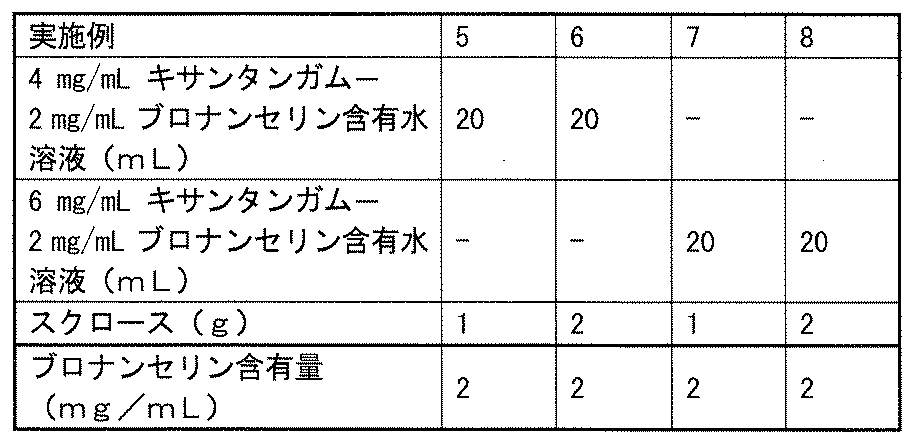
実施例5~6において調製した2mg/mL ブロナンセリン含有水溶液100mLを採取し、キサンタンガムを600mg加え、マグネティックスターラーを用いて溶解するまで撹拌することにより、6mg/mL キサンタンガム-2mg/mL ブロナンセリン含有水溶液を調製した。さらに、この水溶液20mLを採取し、表2に記載の分量でスクロースを加え、マグネティックスターラーを用いて溶解するまで撹拌することにより、ブロナンセリン含有液剤を調製した。
実施例9~13
精製水に、2.4gのクエン酸(無水)、0.25gの安息香酸ナトリウム、1gのブロナンセリンを加え、マグネティックスターラーを用いて溶解するまで撹拌後、精製水を加えて液量を250mLに調整することにより、4mg/mL ブロナンセリン含有水溶液を調製した。次に、この水溶液25mLを採取し、表3に記載の分量でエリスリトールまたはソルビトールを加え、マグネティックスターラーを用いて溶解するまで撹拌した。さらに、表3に記載の分量でキサンタンガムを加え、マグネティックスターラーを用いて溶解するまで撹拌後、精製水を加えて液量を50mLに調整することにより、ブロナンセリン含有液剤を調製した。

精製水に、2.4gのクエン酸(無水)、0.25gの安息香酸ナトリウム、1gのブロナンセリンを加え、マグネティックスターラーを用いて溶解するまで撹拌後、精製水を加えて液量を250mLに調整することにより、4mg/mL ブロナンセリン含有水溶液を調製した。次に、この水溶液25mLを採取し、表3に記載の分量でエリスリトールまたはソルビトールを加え、マグネティックスターラーを用いて溶解するまで撹拌した。さらに、表3に記載の分量でキサンタンガムを加え、マグネティックスターラーを用いて溶解するまで撹拌後、精製水を加えて液量を50mLに調整することにより、ブロナンセリン含有液剤を調製した。
実施例14~15
精製水に、表4に記載の分量で、クエン酸(無水)、安息香酸ナトリウムを加え、マグネティックスターラーを用いて溶解するまで攪拌した。次に、この水溶液にブロナンセリンを加え、マグネティックスターラーを用いて溶解するまで撹拌後、表4に記載の分量でソルビトールを加え、マグネティックスターラーを用いて溶解するまで撹拌し、精製水を加えて液量を調整した。さらに、この水溶液にキサンタンガムを加え、マグネティックスターラーを用いて溶解するまで撹拌することにより、ブロナンセリン含有液剤を調製した。
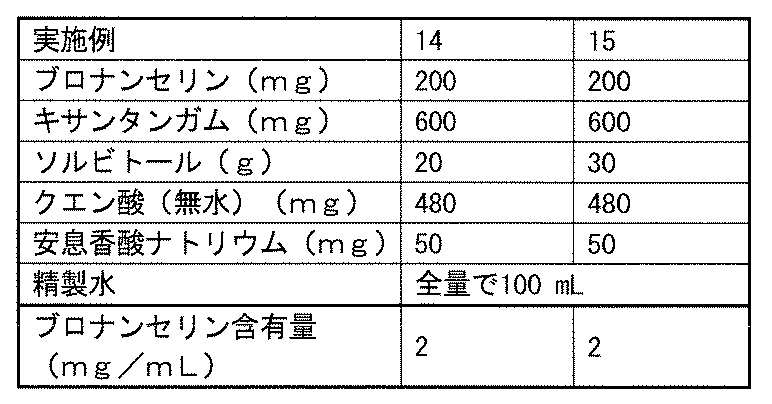
精製水に、表4に記載の分量で、クエン酸(無水)、安息香酸ナトリウムを加え、マグネティックスターラーを用いて溶解するまで攪拌した。次に、この水溶液にブロナンセリンを加え、マグネティックスターラーを用いて溶解するまで撹拌後、表4に記載の分量でソルビトールを加え、マグネティックスターラーを用いて溶解するまで撹拌し、精製水を加えて液量を調整した。さらに、この水溶液にキサンタンガムを加え、マグネティックスターラーを用いて溶解するまで撹拌することにより、ブロナンセリン含有液剤を調製した。
実施例16
精製水に、21.2gのクエン酸水和物、8gの安息香酸ナトリウム、0.8gのスクラロースを加え、マグネティックスターラーを用いて溶解するまで攪拌した。次に、この水溶液に8gのブロナンセリンを加え、マグネティックスターラーを用いて溶解するまで撹拌した。さらに、400gのソルビトールを加え、マグネティックスターラーを用いて溶解するまで撹拌し、精製水を加えて液量を4000mLに調整することにより、100mg/mL ソルビトール-2mg/mL ブロナンセリン含有水溶液を調製した。この水溶液1800mLを採取し、10.8gのキサンタンガムを加え、マグネティックスターラーを用いて溶解するまで撹拌することにより、ブロナンセリン含有液剤を調製した。
精製水に、21.2gのクエン酸水和物、8gの安息香酸ナトリウム、0.8gのスクラロースを加え、マグネティックスターラーを用いて溶解するまで攪拌した。次に、この水溶液に8gのブロナンセリンを加え、マグネティックスターラーを用いて溶解するまで撹拌した。さらに、400gのソルビトールを加え、マグネティックスターラーを用いて溶解するまで撹拌し、精製水を加えて液量を4000mLに調整することにより、100mg/mL ソルビトール-2mg/mL ブロナンセリン含有水溶液を調製した。この水溶液1800mLを採取し、10.8gのキサンタンガムを加え、マグネティックスターラーを用いて溶解するまで撹拌することにより、ブロナンセリン含有液剤を調製した。
実施例17
精製水に、21.2gのクエン酸水和物、8gの安息香酸ナトリウム、0.8gのスクラロースを加え、マグネティックスターラーを用いて溶解するまで攪拌した。次に、この水溶液に8gのブロナンセリンを加え、マグネティックスターラーを用いて溶解するまで撹拌した。さらに、800gのソルビトールを加え、マグネティックスターラーを用いて溶解するまで撹拌し、精製水を加えて液量を4000mLに調整することにより、200mg/mL ソルビトール-2mg/mL ブロナンセリン含有水溶液を調製した。この水溶液1800mLを採取し、10.8gのキサンタンガムを加え、マグネティックスターラーを用いて溶解するまで撹拌することにより、ブロナンセリン含有液剤を調製した。
精製水に、21.2gのクエン酸水和物、8gの安息香酸ナトリウム、0.8gのスクラロースを加え、マグネティックスターラーを用いて溶解するまで攪拌した。次に、この水溶液に8gのブロナンセリンを加え、マグネティックスターラーを用いて溶解するまで撹拌した。さらに、800gのソルビトールを加え、マグネティックスターラーを用いて溶解するまで撹拌し、精製水を加えて液量を4000mLに調整することにより、200mg/mL ソルビトール-2mg/mL ブロナンセリン含有水溶液を調製した。この水溶液1800mLを採取し、10.8gのキサンタンガムを加え、マグネティックスターラーを用いて溶解するまで撹拌することにより、ブロナンセリン含有液剤を調製した。
実施例18
精製水に、21.2gのクエン酸水和物、8gの安息香酸ナトリウム、0.8gのスクラロースを加え、マグネティックスターラーを用いて溶解するまで攪拌した。次に、この水溶液に8gのブロナンセリンを加え、マグネティックスターラーを用いて溶解するまで撹拌した。さらに、1200gのソルビトールを加え、マグネティックスターラーを用いて溶解するまで撹拌し、精製水を加えて液量を4000mLに調整することにより、300mg/mL ソルビトール-2mg/mL ブロナンセリン含有水溶液を調製した。この水溶液1800mLを採取し、10.8gのキサンタンガムを加え、マグネティックスターラーを用いて溶解するまで撹拌することにより、ブロナンセリン含有液剤を調製した。
精製水に、21.2gのクエン酸水和物、8gの安息香酸ナトリウム、0.8gのスクラロースを加え、マグネティックスターラーを用いて溶解するまで攪拌した。次に、この水溶液に8gのブロナンセリンを加え、マグネティックスターラーを用いて溶解するまで撹拌した。さらに、1200gのソルビトールを加え、マグネティックスターラーを用いて溶解するまで撹拌し、精製水を加えて液量を4000mLに調整することにより、300mg/mL ソルビトール-2mg/mL ブロナンセリン含有水溶液を調製した。この水溶液1800mLを採取し、10.8gのキサンタンガムを加え、マグネティックスターラーを用いて溶解するまで撹拌することにより、ブロナンセリン含有液剤を調製した。
実施例19
キサンタンガムの量を14.4gに変更する以外は実施例16に記載の方法と同様にして、ブロナンセリン含有液剤を調製した。
キサンタンガムの量を14.4gに変更する以外は実施例16に記載の方法と同様にして、ブロナンセリン含有液剤を調製した。
実施例20
キサンタンガムの量を14.4gに変更する以外は実施例17に記載の方法と同様にして、ブロナンセリン含有液剤を調製した。
キサンタンガムの量を14.4gに変更する以外は実施例17に記載の方法と同様にして、ブロナンセリン含有液剤を調製した。
実施例21
キサンタンガムの量を14.4gに変更する以外は実施例18に記載の方法と同様にして、ブロナンセリン含有液剤を調製した。
さらに、実施例16~21で調整したブロナンセリン含有液剤のpHを、第15改正日本薬局方 一般試験法に記載された方法に従い、測定した。実施例16~21で得られた液剤のpHを表5に示した。

キサンタンガムの量を14.4gに変更する以外は実施例18に記載の方法と同様にして、ブロナンセリン含有液剤を調製した。
さらに、実施例16~21で調整したブロナンセリン含有液剤のpHを、第15改正日本薬局方 一般試験法に記載された方法に従い、測定した。実施例16~21で得られた液剤のpHを表5に示した。
比較例1~4
精製水に、2.4gのクエン酸(無水)、0.25gの安息香酸ナトリウム、1gのブロナンセリンを加え、マグネティックスターラーを用いて溶解するまで撹拌後、精製水を加えて液量を250mLに調整することにより、4mg/mL ブロナンセリン含有水溶液を調製した。この水溶液50mLを採取し、表6に記載の分量でアラビアゴム、アルギン酸ナトリウム、ジェランガム、もしくはペクチンを加え、マグネティックスターラーを用いて溶解するまで撹拌後、精製水を加えて液量を調整することにより、ブロナンセリン含有液剤を調製した。

精製水に、2.4gのクエン酸(無水)、0.25gの安息香酸ナトリウム、1gのブロナンセリンを加え、マグネティックスターラーを用いて溶解するまで撹拌後、精製水を加えて液量を250mLに調整することにより、4mg/mL ブロナンセリン含有水溶液を調製した。この水溶液50mLを採取し、表6に記載の分量でアラビアゴム、アルギン酸ナトリウム、ジェランガム、もしくはペクチンを加え、マグネティックスターラーを用いて溶解するまで撹拌後、精製水を加えて液量を調整することにより、ブロナンセリン含有液剤を調製した。
比較例5~6
精製水に、4.8gのクエン酸(無水)、0.5gの安息香酸ナトリウム、2gのブロナンセリンを加え、マグネティックスターラーを用いて溶解するまで撹拌後、精製水を用いて液量を1Lに調整することにより2mg/mL ブロナンセリン含有水溶液を調製した。次に、この水溶液100mLを採取し、ペクチンを2g加え、マグネティックスターラーを用いて溶解するまで撹拌することにより、20mg/mL ペクチン-2mg/mL ブロナンセリン含有水溶液を調製した。さらに、この水溶液に表7に記載の分量でスクロースを加え、マグネティックスターラーを用いて溶解するまで撹拌することにより、ブロナンセリン含有液剤を調製した。
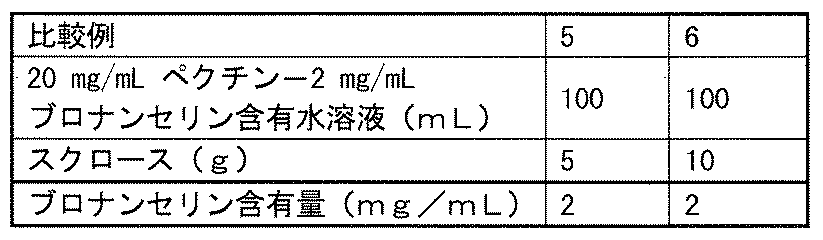
精製水に、4.8gのクエン酸(無水)、0.5gの安息香酸ナトリウム、2gのブロナンセリンを加え、マグネティックスターラーを用いて溶解するまで撹拌後、精製水を用いて液量を1Lに調整することにより2mg/mL ブロナンセリン含有水溶液を調製した。次に、この水溶液100mLを採取し、ペクチンを2g加え、マグネティックスターラーを用いて溶解するまで撹拌することにより、20mg/mL ペクチン-2mg/mL ブロナンセリン含有水溶液を調製した。さらに、この水溶液に表7に記載の分量でスクロースを加え、マグネティックスターラーを用いて溶解するまで撹拌することにより、ブロナンセリン含有液剤を調製した。
参考例1
精製水に、0.48gのクエン酸(無水)、0.05gの安息香酸ナトリウム、0.16gのスクラロースを加え、マグネティックスターラーを用いて溶解するまで攪拌した。次に、この水溶液に0.2gのブロナンセリンを加え、マグネティックスターラーを用いて溶解するまで撹拌し、精製水を加えて液量を100mLに調整することにより、ブロナンセリン含有液剤を調製した。
精製水に、0.48gのクエン酸(無水)、0.05gの安息香酸ナトリウム、0.16gのスクラロースを加え、マグネティックスターラーを用いて溶解するまで攪拌した。次に、この水溶液に0.2gのブロナンセリンを加え、マグネティックスターラーを用いて溶解するまで撹拌し、精製水を加えて液量を100mLに調整することにより、ブロナンセリン含有液剤を調製した。
上記実施例1~21、比較例1~6及び参考例1の処方の一覧を表8-1~表8-4に示す。


試験例1
実施例1~15及び比較例1~6で調製したブロナンセリン含有液剤から採取した薬物4mg相当の試料、及び参考例2として用いた錠剤を用いて、溶出試験(温度:37℃、試験液:溶出試験第2液、試験法:パドル法、回転数:50回/分)を行った。表9に試験開始15分後、30分後、60分後の溶出率を示す。
実施例1~15及び比較例1~6で調製したブロナンセリン含有液剤から採取した薬物4mg相当の試料、及び参考例2として用いた錠剤を用いて、溶出試験(温度:37℃、試験液:溶出試験第2液、試験法:パドル法、回転数:50回/分)を行った。表9に試験開始15分後、30分後、60分後の溶出率を示す。
試験例2
実施例20、21及び参考例1で調製したブロナンセリン含有液剤から採取した薬物4mg相当の試料を用いて、溶出試験(温度:37℃、試験液:溶出試験第2液、試験法:パドル法、回転数:50回/分)を行った。表10に試験開始10分後、30分後、60分後の溶出率を示す。

実施例20、21及び参考例1で調製したブロナンセリン含有液剤から採取した薬物4mg相当の試料を用いて、溶出試験(温度:37℃、試験液:溶出試験第2液、試験法:パドル法、回転数:50回/分)を行った。表10に試験開始10分後、30分後、60分後の溶出率を示す。
試験例3
実施例1、3、4、6及び8~15で調製したブロナンセリン含有液剤から採取した薬物4mg相当の試料、及び参考例2として用いた錠剤を用いて、溶出試験(温度:37℃、試験液:溶出試験第1液、試験法:パドル法、回転数:50回/分)を行った。表11に試験開始15分後、30分後、60分後の溶出率を示す。

実施例1、3、4、6及び8~15で調製したブロナンセリン含有液剤から採取した薬物4mg相当の試料、及び参考例2として用いた錠剤を用いて、溶出試験(温度:37℃、試験液:溶出試験第1液、試験法:パドル法、回転数:50回/分)を行った。表11に試験開始15分後、30分後、60分後の溶出率を示す。
試験例4
実施例20、21及び参考例1で調製したブロナンセリン含有液剤から採取した薬物4mg相当の試料を用いて、溶出試験(温度:37℃、試験液:溶出試験第1液、試験法:パドル法、回転数:50回/分)を行った。表12に試験開始10分後、30分後、60分後の溶出率を示す。

実施例20、21及び参考例1で調製したブロナンセリン含有液剤から採取した薬物4mg相当の試料を用いて、溶出試験(温度:37℃、試験液:溶出試験第1液、試験法:パドル法、回転数:50回/分)を行った。表12に試験開始10分後、30分後、60分後の溶出率を示す。
試験例5
実施例1~9、11~15、比較例5及び6で調製したブロナンセリン含有液剤から採取した試料を用いて、振動式粘度計(ビスコメイト VM-1A-M)により粘度を測定した。表13に各試料の評価結果を示す。
実施例1~9、11~15、比較例5及び6で調製したブロナンセリン含有液剤から採取した試料を用いて、振動式粘度計(ビスコメイト VM-1A-M)により粘度を測定した。表13に各試料の評価結果を示す。
試験例6
実施例16~21で調製したブロナンセリン含有液剤から採取した試料を用いて、振動式粘度計(ビスコメイト VM-1A-M)により粘度を測定した。表14に各試料の評価結果を示す。

実施例16~21で調製したブロナンセリン含有液剤から採取した試料を用いて、振動式粘度計(ビスコメイト VM-1A-M)により粘度を測定した。表14に各試料の評価結果を示す。
試験例1(表9)及び試験例2(表10)より、溶出試験第2液において、比較例1~7で調製したブロナンセリン含有液剤は、同じ4mg相当量の錠剤の2倍以上の高い溶出率を示したのに対し、キサンタンガムを添加した実施例1~15、20および21で調製されたブロナンセリン含有液剤は、いずれも錠剤と類似した溶出率を示し、かつ、溶出試験第1液においても、錠剤と同様に高い溶出率を示した。また、実施例5~15、20および21で調製したブロナンセリン含有液剤の溶出試験結果から、スクロース、エリスリトール、ソルビトールを添加することで、より低いキサンタンガム添加量においても溶出試験第2液における溶出率をコントロールすることが可能であることがわかった。
これらの結果は、試験例5(表13)および試験例6(表14)に示したように、単に液剤の粘度を高めたことによるものではなく、特定の成分を用いることで、溶液の溶出挙動を制御することを可能にしたものであることを示している。
試験例7
実施例3、4、6、9及び11~15で調製したブロナンセリン含有液剤について、pHを測定した。なお、pH測定は第15改正日本薬局方 一般試験法に記載された方法に従い、実施した。表15に各試料の評価結果を示す。

実施例3、4、6、9及び11~15で調製したブロナンセリン含有液剤について、pHを測定した。なお、pH測定は第15改正日本薬局方 一般試験法に記載された方法に従い、実施した。表15に各試料の評価結果を示す。
試験例8 (保存安定性試験1)
実施例3及び12~15で調製したブロナンセリン含有液剤を、各々40℃で1箇月及び60℃で1箇月保存した後、溶出試験第2液または溶出試験第1液を用いて溶出試験を行った。表16に溶出試験第2液における評価結果を、表17に溶出試験第1液における評価結果を示す。なお、溶出試験第2液または溶出試験第1液における溶出試験は、それぞれ試験例1または試験例3と同様の方法で行った。

実施例3及び12~15で調製したブロナンセリン含有液剤を、各々40℃で1箇月及び60℃で1箇月保存した後、溶出試験第2液または溶出試験第1液を用いて溶出試験を行った。表16に溶出試験第2液における評価結果を、表17に溶出試験第1液における評価結果を示す。なお、溶出試験第2液または溶出試験第1液における溶出試験は、それぞれ試験例1または試験例3と同様の方法で行った。
試験例9 (保存安定性試験2)
実施例20及び21で調製したブロナンセリン含有液剤を、各々40℃で1箇月保存した後、溶出試験第2液または溶出試験第1液を用いて溶出試験を行った。表18に溶出試験第2液における評価結果を、表19に溶出試験第1液における評価結果を示す。なお、溶出試験第2液または溶出試験第1液における溶出試験は、それぞれ試験例2または試験例4と同様の方法で行った。


実施例20及び21で調製したブロナンセリン含有液剤を、各々40℃で1箇月保存した後、溶出試験第2液または溶出試験第1液を用いて溶出試験を行った。表18に溶出試験第2液における評価結果を、表19に溶出試験第1液における評価結果を示す。なお、溶出試験第2液または溶出試験第1液における溶出試験は、それぞれ試験例2または試験例4と同様の方法で行った。
試験例10 (保存安定性試験3)
実施例3、4及び11~21で調製したブロナンセリン含有液剤をガラス製容器に充填・密栓し、60℃で1箇月、40℃で3箇月、または25℃で3箇月保存し、安定性(pH)を評価した。表20に各試料の評価結果を示す。なお、pHは試験例7と同様の方法で測定した。
実施例3、4及び11~21で調製したブロナンセリン含有液剤をガラス製容器に充填・密栓し、60℃で1箇月、40℃で3箇月、または25℃で3箇月保存し、安定性(pH)を評価した。表20に各試料の評価結果を示す。なお、pHは試験例7と同様の方法で測定した。
試験例11 (保存安定性試験4)
実施例3、4及び11~21で調製したブロナンセリン含有液剤をガラス製容器に充填・密栓し、40℃で3箇月、または25℃で3箇月保存し、安定性(粘度)を評価した。表21に各試料の評価結果を示す。なお、粘度は振動式粘度計(ビスコメイト VM-1A-M)によって測定した。
実施例3、4及び11~21で調製したブロナンセリン含有液剤をガラス製容器に充填・密栓し、40℃で3箇月、または25℃で3箇月保存し、安定性(粘度)を評価した。表21に各試料の評価結果を示す。なお、粘度は振動式粘度計(ビスコメイト VM-1A-M)によって測定した。
試験例12 (保存安定性試験5)
実施例12~21で調製したブロナンセリン含有液剤をガラス製容器に充填・密栓し、60℃で1箇月保存し、安定性(純度)を評価した。表22に各試料の評価結果を示す。なお、純度は、逆相カラム(ODSカラム)を用いた液体クロマトグラフィーによってアイソクラティック法により測定し、検出された全てのピークの総面積値を100%としたときのブロナンセリン由来ピークの面積百分率で示した。

実施例12~21で調製したブロナンセリン含有液剤をガラス製容器に充填・密栓し、60℃で1箇月保存し、安定性(純度)を評価した。表22に各試料の評価結果を示す。なお、純度は、逆相カラム(ODSカラム)を用いた液体クロマトグラフィーによってアイソクラティック法により測定し、検出された全てのピークの総面積値を100%としたときのブロナンセリン由来ピークの面積百分率で示した。
試験例13 (保存安定性試験6)
実施例16~21で調製したブロナンセリン含有液剤をガラス製容器に充填・密栓し、60℃で1箇月、40℃で3箇月、または25℃で3箇月保存し、安定性(含量)を評価した。表23に各試料の評価結果を示す。なお、含量は、逆相カラム(ODSカラム)を用いた液体クロマトグラフィーによってアイソクラティック法により測定し、ブロナンセリン表示量を100%としたときの相対値で示した。

実施例16~21で調製したブロナンセリン含有液剤をガラス製容器に充填・密栓し、60℃で1箇月、40℃で3箇月、または25℃で3箇月保存し、安定性(含量)を評価した。表23に各試料の評価結果を示す。なお、含量は、逆相カラム(ODSカラム)を用いた液体クロマトグラフィーによってアイソクラティック法により測定し、ブロナンセリン表示量を100%としたときの相対値で示した。
保存安定性試験の結果、表16~23に示すように、本発明の経口液剤は製剤的に優れた安定性を示すことがわかった。
試験例14 (動物における吸収性評価1)
実施例3及び4で調製したブロナンセリン含有液剤を2mL(4mg相当量)ビーグル犬に服用させ、投与後15、30、45、60、90分後及び2、4、6、8、24時間後の時点で血中濃度を測定し、最高血中濃度(Cmax)及び24時間までの吸収量(AUC0-24h)を評価した。各試料の評価結果を図1及び表24に示す。

実施例3及び4で調製したブロナンセリン含有液剤を2mL(4mg相当量)ビーグル犬に服用させ、投与後15、30、45、60、90分後及び2、4、6、8、24時間後の時点で血中濃度を測定し、最高血中濃度(Cmax)及び24時間までの吸収量(AUC0-24h)を評価した。各試料の評価結果を図1及び表24に示す。
試験例15(動物における吸収性評価2)
実施例21で調製したブロナンセリン含有液剤を2mL(4mg相当量)、及び参考例2として用いた錠剤をビーグル犬に服用させ、投与後15、30、45、60、90分後及び2、4、6、8、24時間後の時点で血中濃度を測定し、最高血中濃度(Cmax)及び24時間までの吸収量(AUC0-24h)を評価した。各試料の評価結果を図2及び表25に示す。

実施例21で調製したブロナンセリン含有液剤を2mL(4mg相当量)、及び参考例2として用いた錠剤をビーグル犬に服用させ、投与後15、30、45、60、90分後及び2、4、6、8、24時間後の時点で血中濃度を測定し、最高血中濃度(Cmax)及び24時間までの吸収量(AUC0-24h)を評価した。各試料の評価結果を図2及び表25に示す。
吸収性試験の結果から、キサンタンガムを添加した増粘液剤は、ブロナンセリンの溶出量が制御され、体内において固形製剤と類似した吸収性を示すことがわかった。
以上の結果から、キサンタンガムを添加することで、溶液の溶出挙動を制御する本発明の特徴が示された。さらに、本発明により、溶液からのブロナンセリンの溶出性の制御が可能であり、ひいてはブロナンセリンのin vivoにおける吸収性の制御が可能となることが示された。
本発明によれば、酸性から中性の幅広いpH範囲でブロナンセリン含有経口液剤の溶出制御が可能であり、固形製剤と類似の溶出性を示すブロナンセリン溶出制御液剤を提供することができる。
Claims (20)
- (a)2-(4-エチル-1-ピペラジニル)-4-(4-フルオロフェニル)-5,6,7,8,9,10-ヘキサヒドロシクロオクタ[b]ピリジン(以下「活性成分」という。)、
(b)キサンタンガム及び
(c)溶解補助剤
を含有する水溶液であって、4mg相当量の活性成分(a)を含有する液を用いて第15改正日本薬局方に記載の溶出試験(温度:37℃、試験法:パドル法、回転数:50rpm)を行うとき、溶出試験第2液による試験開始60分後の溶出率が20~50%であり、溶出試験第1液による試験開始60分後の溶出率が70~100%である経口液剤。 - 該水溶液中の活性成分(a)の含有量が、0.1mg/mL~6mg/mLである請求項1に記載の経口液剤。
- 該水溶液中のキサンタンガム(b)の含有量が、1mg/mL~20mg/mLである請求項1または2に記載の経口液剤。
- 第15改正日本薬局方に記載の溶出試験(温度:37℃、試験法:パドル法、回転数:50rpm)を行うとき、溶出試験第2液による試験開始60分後の溶出率が25~45%であり、溶出試験第1液による試験開始60分後の溶出率が80~100%である請求項1~3のいずれかに記載の経口液剤。
- 該水溶液のpHが2~5である、請求項1~4のいずれかに記載の経口液剤。
- 溶解補助剤(c)が、酸である請求項1~5のいずれかに記載の経口液剤。
- 溶解補助剤(c)が、塩酸、クエン酸、リンゴ酸、酒石酸、乳酸からなる群から選択される少なくとも1種である請求項6に記載の経口液剤。
- 溶解補助剤(c)が、クエン酸、リンゴ酸、酒石酸からなる群から選択される少なくとも1種である請求項6または7に記載の経口液剤。
- さらに(d)糖もしくは糖アルコールを含むことを特徴とする請求項1~8のいずれかに記載の経口液剤。
- 糖もしくは糖アルコール(d)が、エリスリトール、ソルビトール、スクロース、トレハロース及び乳糖からなる群から選択される少なくとも1種である請求項9に記載の経口液剤。
- 糖もしくは糖アルコール(d)が、スクロース、エリスリトール及びソルビトールからなる群から選択される少なくとも1種以上である請求項9または10に記載の経口液剤。
- 糖もしくは糖アルコールの含有量が、50~400mg/mLである請求項9~11のいずれかに記載の経口液剤。
- (a)活性成分、
(b)キサンタンガム、及び
(c)溶解補助剤
を含有する水溶液であって、該活性成分(a)の含有量が0.1~6mg/mLである経口液剤。 - (a)活性成分、
(b)キサンタンガム、
(c)溶解補助剤、及び
(d)糖又は糖アルコール
を含有する水溶液であって、該活性成分(a)の含有量が0.1~6mg/mLであって、pHが2~5である経口液剤。 - (a)活性成分、
(b)キサンタンガム、
(c)クエン酸、リンゴ酸及び酒石酸からなる群から選択される少なくとも1種の溶解補助剤、及び
(d)スクロース、エリスリトール及びソルビトールからなる群から選択される少なくとも1種の糖又は糖アルコール
を含有する水溶液であって、該活性成分(a)の含有量が0.1~6mg/mLであって、pHが2~5である経口液剤。 - (a)活性成分、
(b)キサンタンガム、
(c)クエン酸、リンゴ酸及び酒石酸からなる群から選択される少なくとも1種の溶解補助剤、
(d)スクロース、エリスリトール及びソルビトールからなる群から選択される少なくとも1種の糖又は糖アルコール、及び
(e)安息香酸及び安息香酸ナトリウムからなる群から選択される1種以上の保存剤
を含有する水溶液であって、該活性成分(a)の含有量が0.5~4mg/mLであって、pHが2~5である経口液剤。 - 該水溶液中のキサンタンガム(b)の含有量が、1mg/mL~20mg/mLである請求項13~16のいずれかに記載の経口液剤。
- 糖もしくは糖アルコール(d)の含有量が、50~400mg/mLである請求項14~17のいずれかに記載の経口液剤。
- 活性成分(a)の4mg相当量の液を用いて第15改正日本薬局方に記載の溶出試験(温度:37℃、試験法:パドル法、回転数:50rpm)を行うとき、溶出試験第2液による試験開始60分後の溶出率が20~50%であり、溶出試験第1液による試験開始60分後の溶出率が70~100%である請求項13~18のいずれかに記載の経口液剤。
- 活性成分(a)の4mg相当量の液を用いて第15改正日本薬局方に記載の溶出試験(温度:37℃、試験法:パドル法、回転数:50rpm)を行うとき、溶出試験第2液による試験開始60分後の溶出率が25~45%であり、溶出試験第1液による試験開始60分後の溶出率が80~100%である請求項13~19のいずれかに記載の経口液剤。
Priority Applications (1)
| Application Number | Priority Date | Filing Date | Title |
|---|---|---|---|
| JP2012522312A JP5039871B2 (ja) | 2010-12-22 | 2011-12-21 | 溶出制御した経口液剤 |
Applications Claiming Priority (2)
| Application Number | Priority Date | Filing Date | Title |
|---|---|---|---|
| JP2010-285316 | 2010-12-22 | ||
| JP2010285316 | 2010-12-22 |
Publications (1)
| Publication Number | Publication Date |
|---|---|
| WO2012086712A1 true WO2012086712A1 (ja) | 2012-06-28 |
Family
ID=46313980
Family Applications (1)
| Application Number | Title | Priority Date | Filing Date |
|---|---|---|---|
| PCT/JP2011/079694 Ceased WO2012086712A1 (ja) | 2010-12-22 | 2011-12-21 | 溶出制御した経口液剤 |
Country Status (2)
| Country | Link |
|---|---|
| JP (1) | JP5039871B2 (ja) |
| WO (1) | WO2012086712A1 (ja) |
Cited By (1)
| Publication number | Priority date | Publication date | Assignee | Title |
|---|---|---|---|---|
| JP2018199699A (ja) * | 2013-03-26 | 2018-12-20 | キッセイ薬品工業株式会社 | シロドシンの苦味をマスキングした経口投与製剤 |
Citations (2)
| Publication number | Priority date | Publication date | Assignee | Title |
|---|---|---|---|---|
| JPH0747574B2 (ja) * | 1989-03-03 | 1995-05-24 | 大日本製薬株式会社 | ピリジン誘導体及びそれを有効成分とする向精神剤 |
| WO2007142295A1 (ja) * | 2006-06-09 | 2007-12-13 | Dainippon Sumitomo Pharma Co., Ltd. | 新規テープ製剤 |
-
2011
- 2011-12-21 JP JP2012522312A patent/JP5039871B2/ja not_active Expired - Fee Related
- 2011-12-21 WO PCT/JP2011/079694 patent/WO2012086712A1/ja not_active Ceased
Patent Citations (2)
| Publication number | Priority date | Publication date | Assignee | Title |
|---|---|---|---|---|
| JPH0747574B2 (ja) * | 1989-03-03 | 1995-05-24 | 大日本製薬株式会社 | ピリジン誘導体及びそれを有効成分とする向精神剤 |
| WO2007142295A1 (ja) * | 2006-06-09 | 2007-12-13 | Dainippon Sumitomo Pharma Co., Ltd. | 新規テープ製剤 |
Non-Patent Citations (2)
| Title |
|---|
| "SDA Zakkan, kyupin no Nikki Ki ga Mukeba Koshin (Seishinkai no Blog)", 11 September 2007 (2007-09-11), Retrieved from the Internet <URL:http://ameblo.jp/kyupin/theme3-10005991450.html> * |
| IYAKUHIN INTERVIEW FORM: "III.Yuko Seibun ni Kansuru Komoku 2.Butsuri Kagakuteki Seishitsu", LONASEN TABLET, LONASEN POWDER, 2008 * |
Cited By (1)
| Publication number | Priority date | Publication date | Assignee | Title |
|---|---|---|---|---|
| JP2018199699A (ja) * | 2013-03-26 | 2018-12-20 | キッセイ薬品工業株式会社 | シロドシンの苦味をマスキングした経口投与製剤 |
Also Published As
| Publication number | Publication date |
|---|---|
| JP5039871B2 (ja) | 2012-10-03 |
| JPWO2012086712A1 (ja) | 2014-05-22 |
Similar Documents
| Publication | Publication Date | Title |
|---|---|---|
| US10238640B2 (en) | Pharmaceutical suspension composition | |
| JPWO2010070705A1 (ja) | アムロジピンの安定な含水経口製剤 | |
| JP2002193799A (ja) | 薬剤合成物及びその調合方法並びに治療方法 | |
| JP5341282B1 (ja) | アリピプラゾールの経口医薬製剤 | |
| JP5872551B2 (ja) | パラセタモールを含む医薬組成物およびその製造法 | |
| JP5718811B2 (ja) | 経口液剤 | |
| JP5039871B2 (ja) | 溶出制御した経口液剤 | |
| JP2010514778A (ja) | 非経口投与のためのレボシメンダン製剤 | |
| CA2537170A1 (en) | Acid containing oxaliplatin formulations | |
| WO2025041166A1 (en) | Stable oral liquid formulations containing metoprolol or salts thereof | |
| JP2016121073A (ja) | 注射剤用医薬組成物の製造方法 | |
| HUE028045T2 (en) | Ibuprofen Intravenous Infusion | |
| WO2014040280A1 (zh) | 哌拉西林钠与舒巴坦钠共晶及其制备方法、以及包含该共晶的药物组合物及其应用 | |
| KR20200111138A (ko) | 용해성 및 안정성이 향상된 덱시부프로펜 시럽제제 | |
| JP2009035545A (ja) | アムロジピンの安定な液剤とゼリー剤 | |
| JP4607761B2 (ja) | 溶液医薬組成物 | |
| KR20190093999A (ko) | 용해성 및 안정성이 향상된 덱시부프로펜 시럽제제 | |
| JP2012188383A (ja) | ドネペジル塩酸塩の内用液剤 | |
| KR100299942B1 (ko) | 비페닐디메칠디카르복실레이트의액제 | |
| JP2012131738A (ja) | 溶液医薬組成物の製造方法 | |
| JPH07116039B2 (ja) | 安定な塩酸トリメトキノール内用液剤 | |
| EP4153140A1 (en) | Oral liquid formulations of lenvatinib | |
| KR101461271B1 (ko) | 시베레스타트 나트륨염 또는 그 수화물을 함유하는 주사용 제제 | |
| Alarie et al. | Chapitre 2: Development of a safe and versatile suspension vehicle for paediatric use. Part 1: Formulation development. | |
| JP2003192574A (ja) | 弱アルカリで安定化される薬剤を含む医薬用液剤 |
Legal Events
| Date | Code | Title | Description |
|---|---|---|---|
| WWE | Wipo information: entry into national phase |
Ref document number: 2012522312 Country of ref document: JP |
|
| 121 | Ep: the epo has been informed by wipo that ep was designated in this application |
Ref document number: 11852061 Country of ref document: EP Kind code of ref document: A1 |
|
| NENP | Non-entry into the national phase |
Ref country code: DE |
|
| 122 | Ep: pct application non-entry in european phase |
Ref document number: 11852061 Country of ref document: EP Kind code of ref document: A1 |