WO2012070657A1 - オーディオ装置及びオーディオシステム - Google Patents
オーディオ装置及びオーディオシステム Download PDFInfo
- Publication number
- WO2012070657A1 WO2012070657A1 PCT/JP2011/077229 JP2011077229W WO2012070657A1 WO 2012070657 A1 WO2012070657 A1 WO 2012070657A1 JP 2011077229 W JP2011077229 W JP 2011077229W WO 2012070657 A1 WO2012070657 A1 WO 2012070657A1
- Authority
- WO
- WIPO (PCT)
- Prior art keywords
- audio
- audio data
- sound
- unit
- control unit
- Prior art date
- Legal status (The legal status is an assumption and is not a legal conclusion. Google has not performed a legal analysis and makes no representation as to the accuracy of the status listed.)
- Ceased
Links
Images



Classifications
-
- H—ELECTRICITY
- H04—ELECTRIC COMMUNICATION TECHNIQUE
- H04R—LOUDSPEAKERS, MICROPHONES, GRAMOPHONE PICK-UPS OR LIKE ACOUSTIC ELECTROMECHANICAL TRANSDUCERS; ELECTRIC HEARING AIDS; PUBLIC ADDRESS SYSTEMS
- H04R5/00—Stereophonic arrangements
- H04R5/04—Circuit arrangements, e.g. for selective connection of amplifier inputs/outputs to loudspeakers, for loudspeaker detection, or for adaptation of settings to personal preferences or hearing impairments
-
- H—ELECTRICITY
- H04—ELECTRIC COMMUNICATION TECHNIQUE
- H04R—LOUDSPEAKERS, MICROPHONES, GRAMOPHONE PICK-UPS OR LIKE ACOUSTIC ELECTROMECHANICAL TRANSDUCERS; ELECTRIC HEARING AIDS; PUBLIC ADDRESS SYSTEMS
- H04R2420/00—Details of connection covered by H04R, not provided for in its groups
- H04R2420/05—Detection of connection of loudspeakers or headphones to amplifiers
-
- H—ELECTRICITY
- H04—ELECTRIC COMMUNICATION TECHNIQUE
- H04R—LOUDSPEAKERS, MICROPHONES, GRAMOPHONE PICK-UPS OR LIKE ACOUSTIC ELECTROMECHANICAL TRANSDUCERS; ELECTRIC HEARING AIDS; PUBLIC ADDRESS SYSTEMS
- H04R5/00—Stereophonic arrangements
- H04R5/033—Headphones for stereophonic communication
Definitions
- the present invention relates to sound emission control of a wirelessly connected audio device.
- an object of the present invention is to provide a mechanism that emits sound according to the state of a plurality of audio devices in an audio system.
- an audio device of the present invention is an audio device that wirelessly communicates with an external device that transmits and receives audio data, and an acquisition unit that acquires first audio data in the audio device;
- a receiving unit that receives second audio data transmitted by an external device, a detecting unit that detects whether or not a connection between the detachable sound emitting device and the audio device is established, and the detecting unit is connected So that the sound emitting device emits sound based on the first audio data acquired by the acquiring unit or the second audio data received by the receiving unit.
- a control unit for controlling, and when the control unit controls the sound emitting device to emit sound based on the first audio data, If the knowledge unit detects that the connection has not been established, and a transmitter for transmitting the first audio data to the external device.
- the control unit stops emitting sound from the sound emitting device based on the first audio data during the period in which the transmission unit transmits the first audio data, and transmits the transmission.
- the unit does not transmit the first audio data during a period in which the control unit causes the sound emitting device to emit sound based on the first audio data.
- the sound emitting device may be an earphone.
- the connection may be a wired connection.
- the connection may be a wireless connection.
- the audio device of the present invention is an audio device that transmits and receives audio data and wirelessly communicates with an external device to which a detachable sound emitting device is connected, the connection relating to the connection between the external device and the sound emitting device
- a first acquisition unit that acquires information from the external device, a reception unit that receives first audio data transmitted by the external device, a second acquisition unit that acquires second audio data in the audio device, and Based on the first audio data received by the receiving unit or the second audio data acquired by the second acquisition unit, a control unit that controls the audio device to emit sound, and the control unit includes the second audio data
- the first acquisition unit starts the connection when the audio device is controlled to emit sound based on audio data.
- a transmission unit transmitting the second audio data to the external device.
- the control unit stops sound emission from the audio device based on the second audio data during a period in which the transmission unit transmits the second audio data, and the transmission unit Does not transmit the second audio data during a period in which the control unit controls the audio device to emit sound based on the second audio data.
- the first acquisition unit acquires the connection information indicating that the connection is started,
- the transmission unit may transmit the second audio data to the external device, and the power of the audio device may be turned off.
- the method of controlling an audio device that transmits and receives audio data and wirelessly communicates with an external device to which a detachable sound emitting device is connected includes connection information relating to the connection between the external device and the sound emitting device. From the external device, receiving the first audio data transmitted by the external device, obtaining the second audio data in the audio device, and based on the first audio data or the second audio data And receiving the connection information indicating that the connection is started when the audio device is controlled to emit sound and the audio device is controlled to emit sound based on the second audio data. If so, the second audio data is transmitted to the external device.
- the audio system of the present invention includes a first audio device and a second audio device that perform wireless communication with each other and transmit and receive audio data, respectively, and the first audio device is included in the first audio device.
- a first acquisition unit that acquires first audio data
- a first audio reception unit that receives second audio data transmitted by the second audio device, a detachable sound emitting device, and the first audio device
- a detection unit that detects whether or not a connection is established, and the first audio data acquired by the first acquisition unit or the reception when the detection unit detects that the connection is established
- a first sound emission control unit that controls the sound emission device to emit sound based on the second audio data received by the unit; and the first sound emission control
- the detecting unit detects that the connection is not established when the unit controls the sound emitting device to emit sound based on the first audio data
- the first audio data is A first audio transmission unit that transmits to the second audio device, wherein the second audio device acquires connection information indicating a detection result of the detection unit; and the first audio transmission
- a second audio receiving unit for receiving the first audio data transmitted by the second audio receiving unit, a second acquiring unit for acquiring the second audio data in the second audio device, and a second audio receiving unit received by the second audio receiving unit.
- Second sound emission control for controlling the second audio device to emit sound based on one audio data or second audio data acquired by the second acquisition unit
- the connection information acquisition unit indicates that the connection is started when the second sound emission control unit controls the audio device to emit sound based on the second audio data.
- An audio system comprising: a second audio transmission unit configured to transmit the second audio data to the first audio device when information is acquired.
- sound can be emitted according to the states of a plurality of audio devices in the audio system.
- FIG. 1 is a diagram showing a schematic configuration of the audio system 1.
- the audio system 1 includes a portable audio device 10 and an audio player 20.
- the portable audio device 10 is an example of the first audio device of the present invention, and here is a smartphone.
- the audio player 20 is an example of a second audio device of the present invention.
- Each of the portable audio device 10 and the audio player 20 has a musical sound reproduction function, and executes control for emitting sound based on audio data through wireless communication with each other.
- a wireless communication path is established between the portable audio device 10 and the audio player 20, and information can be exchanged with each other via the wireless communication path.
- Each of the portable audio device 10 and the audio player 20 packetizes the audio data and transmits it to the counterpart device via a wireless communication path.
- the packetized audio data is audio data that is used when the counterpart device emits sound, and is hereinafter referred to as “sound emission data”.
- the sound emission data of the present embodiment may be information including the content of the sound emission instruction.
- the portable audio device 10 and the audio player 20 are described as one, but a plurality of each may exist.
- the external device of the present invention corresponds to either the audio player 20 viewed from the portable audio device 10 or the portable audio device 10 viewed from the audio player 20.
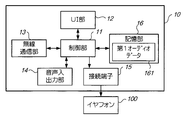
- FIG. 2 is a block diagram illustrating a hardware configuration of the portable audio device 10.
- the portable audio device 10 includes a control unit 11, a UI (User Interface) unit 12, a wireless communication unit 13, a voice input / output unit 14, a connection terminal 15, and a storage unit 16.
- the control unit 11 is a control unit including an arithmetic device including a CPU (Central Processing Unit) and a memory.
- the arithmetic device controls the operation of the portable audio device 10 by executing a program stored in the memory or the storage unit 16.
- the UI unit 12 includes a touch panel, and has both an operation unit that receives an operation from a user and a function as a display unit that notifies information by an image.
- the wireless communication unit 13 includes a wireless communication circuit and an antenna, and is an interface for wireless connection to the audio player 20.
- the wireless communication unit 13 transmits and receives information by wireless communication under the control of the control unit 11.
- the voice input / output unit 14 includes a microphone that collects received voice and the like and a speaker that emits transmitted voice and the like, and realizes functions related to voice input / output in the portable audio device 10.
- the connection terminal 15 is a terminal to which the earphone 100 that is a sound emitting device that can be attached to and detached from the portable audio device 10 is connected.
- the connection terminal 15 is, for example, a jack into which the earphone 100 is plugged. When the tone signal reproduced by the control unit 11 is supplied, the earphone 100 emits sound according to the tone signal.
- the sound emitting device connected to the portable audio device 10 is the earphone 100 in this embodiment, but may be a headphone or a speaker other than this.
- the sound emitting device of the present invention may be any device that emits sound according to a musical sound signal supplied from the portable audio device 10 via the connection terminal 15.
- the storage unit 16 includes, for example, an EEPROM (Electronically Erasable and Programmable ROM), and stores various programs used by the control unit 11 and first audio data 161.
- the first audio data 161 is an example of the first audio data of the present invention, and is data in which sounds generated by playing musical instruments or singing a plurality of music pieces are defined in time series.
- the first audio data 161 represents, for example, digital data quantized after an analog audio signal is sampled according to a specific sampling frequency. Note that the data structure of the first audio data 161 is not limited to a specific structure in the present invention, and the first audio data 161 may be a base on which a musical sound signal is generated.
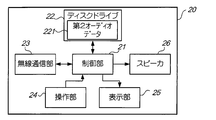
- FIG. 3 is a block diagram showing a hardware configuration of the audio player 20.
- the audio player 20 includes a control unit 21, a disk drive 22, a wireless communication unit 23, an operation unit 24, a display unit 25, and a speaker 26.
- the control unit 21 is a control unit including an arithmetic device including a CPU and a memory.
- the arithmetic device controls the operation of the audio player 20 by executing a program stored in the memory.
- the disk drive 22 reads information recorded on an optical disk such as a CD (Compact Disk) and outputs the read information to the control unit 11.
- the audio data recorded on the optical disk set in the disk drive 22 is second audio data 221.
- the second audio data 221 is an example of the second audio data of the present invention, and is data in which sounds generated by playing musical instruments or singing a plurality of music pieces are defined in time series.
- the structure of the second audio data 221 is not limited to a specific structure in the present invention, and the second audio data 221 only needs to be a basis for generating a musical sound signal.
- the wireless communication unit 23 is an interface for wireless connection to the portable audio device 10.
- the wireless communication unit 23 transmits and receives information through wireless communication under the control of the control unit 21.
- the operation unit 24 includes an operation switch that receives a user operation, and outputs an operation signal to the control unit 21 according to the received operation.
- the display unit 25 is a display unit having a display area on the front surface of the audio player 20, and is a fluorescent display tube, for example.
- the speaker 26 is a stereo speaker including L and R speakers, and is a sound emitting unit that emits sound according to a musical sound signal reproduced by the control unit 21. In the audio system 1 having the above configuration, sound emission control is realized according to the rules described in the table shown in FIG.
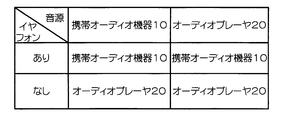
- FIG. 4 is a diagram for explaining the outline of sound emission control in the audio system 1.
- sound emission control in the audio system 1 is determined by the conditions indicated by “earphone” and “sound source”.
- “Earphone” is a condition indicating whether or not the earphone 100 is connected to the portable audio device 10.
- Sound source is a condition indicating which sound source of the portable audio device 10 or the audio player 20 is used.
- the case where the portable audio device 10 is used as a sound source is a case where sound is emitted based on the first audio data 161, and the case where the audio player 20 is used as a sound source. This is a case where sound is emitted based on the second audio data 221.
- the sound source of the present embodiment is in the portable audio device 10 or the audio player 20, and the sound emission data exchanged via the wireless communication path between the portable audio device 10 and the audio player 20 is the first. Data generated when the audio data 161 or the second audio data 221 is transmitted and received wirelessly is shown.
- the sound source is the portable audio device 10
- the earphone 100 when the earphone 100 is connected to the portable audio device 10, sound is emitted from the earphone of the portable audio device 10 and the earphone 100 is connected. If not, sound is emitted from the speaker of the audio player 20.
- the sound source is the audio player 20
- the earphone 100 when the earphone 100 is connected to the portable audio device 10, sound is emitted from the earphone of the portable audio device 10, and when the earphone 100 is not connected, the audio player 20 Sound is emitted from the speaker.
- the portable audio device 10 and the audio player 20 operate according to one of these four operation modes in accordance with the conditions indicated by “earphone” and “sound source”.
- the sound source device When the sound source device and the sound emitting device are different, the sound source device generates sound emission data and transmits it to the device that emits sound, and the sound emitting device emits sound based on the received sound emission data. To do. Specifically, the mobile audio device 10 emits sound based on the second audio data 221 in accordance with the sound emission data received from the audio player 20. Also, the audio player 20 emits sound based on the first audio data 161 according to the sound emission data received from the portable audio device 10.
- FIG. 5 is a functional block diagram showing a functional configuration of the audio system 1.
- the control unit 11 executes the program, so that the portable audio device 10 includes a first acquisition unit 101, a connection detection unit 102, a connection information transmission unit 103, a first audio reception unit 104, Functions corresponding to the first sound emission control unit 105 and the first audio transmission unit 106 are realized.
- the first acquisition unit 101 is an example of a first acquisition unit (acquisition unit) of the present invention, and acquires audio data in the portable audio device 10.
- the 1st acquisition part 101 reads the 1st audio data 161 from the memory
- the connection detection unit 102 is an example of a detection unit of the present invention, and detects whether or not the earphone 100 is connected to the connection terminal 15.
- the connection detection unit 102 monitors the impedance, for example, and detects whether the earphone 100 is connected.
- the connection information transmission unit 103 transmits connection information indicating whether or not the earphone 100 is connected to the connection terminal 15 according to the detection result of the connection detection unit 102.
- the first audio receiving unit 104 is an example of the first audio receiving unit (receiving unit) of the present invention, and the sound emission transmitted by the audio player 20 (more specifically, the second audio transmitting unit 205 described later). Receive data.
- the first sound emission control unit 105 is an example of a first sound emission control unit (control unit) according to the present invention, and controls the sound emission in the portable audio device 10.
- the connection detection unit 102 detects that the earphone 100 is connected to the connection terminal 15
- the first sound emission control unit 105 receives the sound emission data received by the first audio reception unit 104 or the first acquisition unit.
- the earphone 100 emits sound based on the first audio data 161 acquired by the terminal 101.
- the first sound emission control unit 105 generates a musical sound signal using any one of the audio data, and outputs the generated musical sound signal to the earphone 100 via the connection terminal 15.
- the first audio transmission unit 106 is an example of the first audio transmission unit (transmission unit) of the present invention, and the first sound emission control unit 105 causes the earphone 100 to emit sound based on the first audio data 161.
- the connection detection unit 102 detects that the earphone 100 is disconnected, the sound emission data generated based on the first audio data 161 is transmitted to the audio player 20.
- the first audio transmission unit 106 transmits the first audio data 161 in the form of sound emission data when the earphone 100 is changed from the state connected to the portable audio device 10 to the state not connected.
- the first acquisition unit 101, the connection detection unit 102, and the first sound emission control unit 105 are realized by the control unit 11, and the connection information transmission unit 103 and the first audio reception unit 104.
- the first audio transmission unit 106 is realized by the cooperation of the control unit 11 and the wireless communication unit 13.
- the portable audio device 10 when the control unit 21 executes the program, includes the second acquisition unit 201, the connection information reception unit 202, the second audio reception unit 203, and the second sound emission control unit. A function corresponding to 204 and the second audio transmission unit 205 is realized.
- the second acquisition unit 201 is an example of a second acquisition unit (acquisition unit) of the present invention, and acquires audio data in the audio player 20.
- the second acquisition unit 201 reads out the second audio data 221 to be emitted by the audio player 20 from the optical disk set in the disk drive 22 and acquires it.
- the connection information receiving unit 202 receives the connection information transmitted by the connection information transmitting unit 103.
- the second audio reception unit 203 is an example of the second audio reception unit (reception unit) of the present invention, and receives sound emission data transmitted by the first audio transmission unit 106.
- the second sound emission control unit 204 is an example of a second sound emission control unit (control unit) of the present invention, and controls the sound emission in the audio player 20.
- the second sound emission control unit 204 emits sound based on the sound emission data received by the second audio reception unit 203 or the second audio data 221 acquired by the second acquisition unit 201. At this time, the second sound emission control unit 204 generates a musical sound signal using any one of the audio data, and outputs the generated musical sound signal to the speaker 26.
- the second audio transmission unit 205 is an example of the second audio transmission unit (transmission unit) of the present invention, and is received by the connection information reception unit 202 when sound is emitted from the audio player 20 based on the second audio data 221. If the connection information indicates that the connection of the earphone 100 is started, the sound emission data generated based on the second audio data 221 is transmitted to the portable audio device 10. In other words, the second audio transmission unit 205 transmits the second audio data 221 in the form of sound emission data when the earphone 100 changes from a state where it is not connected to the portable audio device 10 to a state where it is connected.
- the second acquisition unit 201 and the second sound emission control unit 204 are realized by the control unit 21, and the connection information reception unit 202, the second audio reception unit 203, and the second audio transmission unit. 205 is realized by the cooperation of the control unit 21 and the wireless communication unit 23.
- sound emission data is sent from one device to one direction of the other device depending on whether the earphone 100 is connected and the location of the sound source, and other information (for example, the connection information transmission request) can be exchanged in both directions.
- other information For example, the connection information transmission request
- the operation of the audio system 1 will be described.
- operations of the portable audio device 10 and the audio player 20 will be described separately.
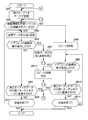
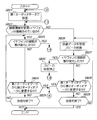
- FIGS. 6 and 7 are flowcharts showing the flow of processing in the portable audio device 10.
- the control unit 11 of the portable audio device 10 determines whether the earphone 100 is connected to the connection terminal 15 or not. Is determined (step SA2).
- the control unit 11 detects whether or not the plug of the earphone 100 is connected to the connection terminal 15 and determines the connection state of the earphone 100.
- step SA2 when determining that the earphone 100 is connected to the connection terminal 15 (step SA2; YES), the control unit 11 emits sound using the earphone 100 based on the first audio data 161 (step SA3). .
- control unit 11 determines whether or not the connection state of earphone 100 has changed (step SA4).
- the control unit 11 determines whether or not the connection between the connection terminal 15 and the earphone 100 is disconnected.
- step SA4 determines whether or not the sound is changed from the first audio data 161 to the second audio data 221 (step S4). Step SA5).
- the control unit 11 sets “YES” in the process of step SA5 when starting sound emission based on the second audio data 221 in its own device, such as when transmission of sound emission data from the audio player 20 is started. Judgment will be made.
- the control unit 11 determines whether or not the sound emission based on the first audio data 161 is ended (step SA6).
- the control part 11 judges it as "NO” by the process of step SA6, and returns to the process of step SA3.
- the control unit 11 ends the sound emission. Judgment is made (step SA6; YES), and all the processes are terminated.
- Control unit 11 emits sound with earphone 100 in accordance with the process in step SA3, and determines that the connection state of earphone 100 has changed in the process in step SA4 (step SA4; YES), that is, portable audio device 10 and earphone. If it is determined that the connection with 100 is disconnected, sound emission from earphone 100 is stopped (step SA7). And the control part 11 returns to the process of step SA2. Here, the control unit 11 determines that the earphone 100 is not connected to the portable audio device 10 (step SA2; NO).
- step SA8 the wireless communication unit 13 transmits connection information indicating whether or not the connection terminal 15 is connected to the earphone 100.
- step SA8 the control unit 11 transmits connection information indicating that the earphone 100 is not connected to the connection terminal 15.
- the control unit 11 generates sound emission data to cause the audio player 20 to emit sound based on the first audio data 161, and transmits the sound emission data to the audio player 20 by the wireless communication unit 13 (step SA9). .
- the control unit 11 generates and transmits sound emission data obtained by packetizing the first audio data 161.
- the control unit 11 When the control unit 11 detects that the connection of the earphone 100 to the portable audio device 10 is disconnected, the control unit 11 stops the control for causing the earphone 100 to emit sound, such as generation of a musical sound signal based on the first audio data 161. To do. As a result, it is assumed that the user desires to listen without using the earphone 100 when the earphone 100 is removed while the portable audio device 10 emits sound, and the sound emitted from the control unit 11 is recorded as an audio player. 20 can be taken over.
- control unit 11 determines whether or not the connection state of earphone 100 has changed (step SA10).
- the control unit 11 determines whether or not the connection between the connection terminal 15 and the earphone 100 is started.
- the control unit 11 stops generating and transmitting sound emission data (step SA13). The process returns to step SA2. In this case, the control unit 11 determines “YES” in the process of step SA2.
- step SA10 when the control unit 11 determines that the connection state of the earphone 100 has not changed in the process of step SA10 (step SA10; NO), the control unit 11 changes the first audio data 161 to the second audio data 221 and emits the sound. (Step SA11). This determination is made based on the same conditions as those in step SA5.
- step SA12 the control unit 11 determines whether or not the sound emission based on the first audio data 161 is to be ended (step SA12).
- step SA12 when continuing the sound emission, the control unit 11 determines “NO” in the process of step SA12, and returns to the process of step SA9.
- finishes all the processes, when it is judged that sound emission is complete
- the control unit 11 does not generate and transmit sound emission data when performing control for causing the earphone 100 to emit sound. That is, it is equivalent to the portable audio device 10 shifting to the mute process while the power is on.
- the control unit 11 resumes the control for emitting sound from the earphone 100. The reason for this is that the fact that the earphone 100 is connected to the portable audio device 10 is presumed that the user is going to listen to a musical sound using the portable audio device 10.
- step SA5 determines that the first audio data 161 is changed to the second audio data 221 in the process of step SA5 or SA11 (step SA5; YES or step SA11; YES), the process flow shown in FIG. Will be executed.
- step SA5 YES or step SA11; YES
- step SA21 the control unit 11 determines “YES” in the process of step SA5 or SA11. If the control unit 11 determines “YES” in the process of step SA5 or SA11, the wireless communication unit 13 receives sound emission data from the audio player 20, and based on the second sound data 221 according to the received sound emission data. Sound emission is started (step SA21). Next, the control unit 11 determines whether or not the earphone 100 is connected to the connection terminal 15 (step SA22). When the control unit 11 determines that the earphone 100 is connected (step SA22; YES), the connection information indicating the connection state of the earphone 100 at that time (that is, being connected), and the sound emission The data transmission request is transmitted to the audio player 20 by the wireless communication unit 13 (step SA23). When the sound communication data transmitted from the audio player 20 in response to the transmission request is received by the wireless communication unit 13, the control unit 11 uses the sound output data and uses the sound output data based on the second audio data 221. The sound is emitted at 100 (step SA24).
- control unit 11 determines whether or not the connection state of earphone 100 has changed (step SA25). If the control unit 11 determines that the connection state of the earphone 100 has not changed (step SA25; NO), the control unit 11 determines whether or not the sound is changed from the second audio data 221 to the first audio data 161 (step S25). Step SA26). For example, when the sound emission based on the first audio data 161 is instructed by the user via the UI unit 12, the control unit 11 determines “YES” in the process of step SA26 when starting the sound emission. Will do. When it is determined “NO” in the process of step SA26, the control unit 11 determines whether or not the sound emission based on the second audio data 221 is to be ended (step SA27).
- control unit 11 determines “NO” in the process of step SA27, and returns to the process of step SA23. On the other hand, when it is determined that the sound emission is to be terminated (step SA27; YES), the control unit 11 terminates all the processes.
- step SA25 YES
- step SA25 YES
- step SA28 sound emission from the earphone 100
- step SA28 the control unit 11 determines that the earphone 100 is not connected to the portable audio device 10
- control unit 11 determines whether or not the connection state of earphone 100 has changed (step SA29). When the control unit 11 determines that the connection state of the earphone 100 has not changed (step SA29; NO), the control unit 11 determines whether or not the sound is changed from the second audio data 221 to the first audio data 161 (step S29). Step SA30). This determination is made based on the same conditions as those in step SA26. When determining “NO” in the process of step SA30, the control unit 11 determines whether or not the sound emission based on the second audio data 221 is to be ended (step SA31).
- step SA31 determines “NO” in the process of step SA31, and returns to the process of step SA29.
- step SA31; YES all the processes will be complete
- step SA29; YES it will return to the process of step SA22.
- step SA26; YES determines that the second audio data 221 is changed to the first audio data 161 in the process of step SA26 or SA30 (step SA26; YES or step SA30; YES)
- FIGS. 8 and 9 are flowcharts showing the flow of processing in the audio player 20.
- the control unit 21 of the audio player 20 starts connection information transmitted from the portable audio device 10 (step SA8). (Or transmitted at SA23) is received by the wireless communication unit 23, and it is determined whether or not the earphone 100 is connected to the portable audio device 10 (step SB2).
- the control unit 21 determines that the earphone 100 is connected (step SB2; YES)
- the control unit 21 generates sound emission data using the second audio data 221 and transmits the sound emission data to the portable audio device 10 by the wireless communication unit 23 ( Step SB3).
- control unit 21 generates and transmits sound emission data obtained by packetizing the second audio data 221.
- the earphone 100 is connected to the portable audio device 10 while the audio player 20 is emitting sound, and that the user wants to listen to the sound of the audio player 20 using the earphone 100. Can pass this sound emission to the portable audio device 10.
- the control unit 21 receives the connection information transmitted from the portable audio device 10 (transmitted in step SA8 or SA23) by the wireless communication unit 23, and whether or not the connection state of the earphone 100 has changed. Is determined (step SB4).
- the control unit 21 determines whether the sound is changed from the second audio data 221 to the first audio data 161 (step SB4; NO).
- Step SB5 the control unit 21 performs step SB5 when starting sound emission based on the first audio data 161 on its own device, such as when transmission of sound emission data is started from the portable audio device 10 (for example, a user instruction). It is determined that the process is “YES”.
- step SB6 determines whether or not to end the sound emission based on the second audio data 221 (step SB6).
- the control unit 21 determines “NO” in the process of Step SB6 and returns to the process of Step SB3.
- the control unit 21 determines that the sound emission is to be terminated when it is instructed to end the sound emission by the user's operation of the operation unit 24 or when all the contents have been emitted according to the second audio data 221. (Step SB6; YES), all the processes are terminated.
- step SB4 determines that the connection state of the earphone 100 has changed in the process of step SB4 (step SB4; YES), that is, the sound output according to the process of step SB3, If it is determined that the connection with the earphone 100 has been disconnected, the generation and transmission of sound emission data are stopped (step SB7). Then, the control unit 21 returns to the process of step SB2, but here determines that the earphone 100 is not connected to the portable audio device 10 (step SB2; NO).
- step SB8 when the control unit 21 determines “NO” in the process of step SB2, the control unit 21 causes the speaker 26 to emit sound based on the second audio data 221 (step SB8).
- step SB9 the control unit 21 determines whether or not the connection state of the earphone 100 has changed based on the connection information transmitted from the portable audio device 10 (step SB9). If the control unit 21 determines that the connection state of the earphone 100 has changed during sound emission based on the second audio data 221 (step SB9; YES), the control unit 21 stops sound emission from the speaker 26 (step SB12). The process returns to SB2.
- step SB9 When determining that the connection state of the earphone 100 has not changed in the process of step SB9 (step SB9; NO), the control unit 21 changes from the second audio data 221 to the first audio data 161 and emits sound. Is determined (step SB10). This determination is made based on the same conditions as those in step SB5.
- step SB10 the control unit 21 determines whether or not the sound emission based on the second audio data 221 is ended (step SB11).
- the control unit 21 determines “NO” in the process of Step SB11 and returns to the process of Step SB9.
- step SB11 determines to end the sound emission
- the control unit 21 does not generate and transmit sound emission data when performing control for causing the speaker 26 to emit sound. That is, it is equivalent to the audio player 20 shifting to the mute process while the power is on.
- the control unit 21 resumes the control for emitting sound from the earphone 100. The reason for this is that the fact that the earphone 100 is connected to the portable audio device 10 is presumed that the user wants to listen to the musical sound using the portable audio device 10.
- step SB5 determines that the second audio data 221 is changed to the first audio data 161 in the process of step SB5 or SB10 (step SB5; YES or step SB10; YES)
- step SB5; YES or step SB10; YES the process flow shown in FIG. Will be executed.
- the operation of the audio player 20 will be described with reference to FIG.
- the wireless communication unit 23 receives the sound emission data from the portable audio device 10, and the received sound emission data (the one transmitted in step SA9). ), Sound emission based on the first audio data 161 is started (step SB21).
- the control unit 21 determines whether the earphone 100 is connected to the portable audio device 10 based on the connection information received from the portable audio device 10 by the wireless communication unit 23 (step SB22).
- the control unit 21 determines whether the connection state of the earphone 100 has changed (step SB23).
- step SB23 determines whether or not the connection state of the earphone 100 has not changed (step SB23; NO).
- step SB24 determines whether or not the sound is changed from the first audio data 161 to the second audio data 221 (step S23).
- step SB24 determines whether or not the sound emission based on the first audio data 161 is ended (step SB25).
- the control unit 21 determines “NO” in the process of Step SB25, and returns to the process of Step SB23.
- step SB25 determines to end the sound emission
- control unit 21 determines whether or not the connection state of earphone 100 has changed (step SB27).
- control unit 21 determines whether or not to change the sound from the first audio data 161 to the second audio data 221 and emit the sound. (Step SB28).
- step SB28 determines whether or not to end the sound emission based on the first audio data 161 (step SA29).
- the control unit 21 determines “NO” in the process of Step SB30, and returns to the process of Step SB26.
- step SB29; YES all the processes will be complete
- step SB27; YES the control part 21 judges that the connection state of the earphone 100 has changed by the process of step SB27 (step SB27; YES)
- step SB24 or SB28 determines in the processing of step SB24 or SB28 that the first audio data 161 is changed to sound emission based on the second audio data 221 (step SB24; YES or step SB28; YES).
- FIG. The processing flow shown will be executed. Accordingly, for example, when the earphone 100 is removed from the portable audio device 10, the control unit 21 can return sound emission based on the second audio data 221 to the audio player 20.
- the audio system 1 comprehensively determines whether the earphone 100 is connected to the portable audio device 10 and the location of the sound source, and emits sound by the own device based on the audio data.
- the content of control for causing the other device to emit sound is determined.
- the content of sound emission control that is considered preferable for the user is determined from the state of the device without any operation by the user, and suitable for the user's use according to the state of each audio device. Sound emission control can be realized.
- the present invention can be implemented in a form different from the above-described embodiment. Further, the following modifications may be combined as appropriate.
- (Modification 1) In the above-described embodiment, the first sound emission control unit 105 detects that the connection has been disconnected by the connection detection unit 102, and generates and transmits sound emission data based on the first audio data 161. When the control for causing the earphone 100 to emit sound is stopped and then the connection is detected by the connection detection unit 102, the control is resumed. Instead, the first sound emission control unit 105 causes the earphone 100 to emit sound even when the connection detection unit 102 detects that the connection has been disconnected and generates and transmits sound emission data. This control may be continued.
- the first sound emission control unit 105 reduces the power consumption of the portable audio device 10 required for sound emission, such as lowering the sound emission volume.
- the second sound emission control unit 204 determines that the connection of the earphone 100 is started based on the connection information, the second sound emission control unit 204 stops the control for causing the earphone 100 to emit sound based on the second audio data 221. The sound emission from the own device may be continued. In this case, it is preferable that the second sound emission control unit 204 reduces the power consumption of the audio player 20 required for sound emission, such as lowering the sound emission volume.
- Modification 2 As a condition for the portable audio device 10 and the audio player 20 to generate and transmit sound emission data, a condition that the counterpart device is in a predetermined operation mode (transmission / reception mode) may be further included.
- transmission / reception mode a condition that the counterpart device is in a predetermined operation mode
- the counterpart device when the device on the transmission side satisfies the conditions for generating and transmitting sound emission data, the counterpart device has set the transmission / reception mode following that, but the device is not in the transmission / reception mode. Means that sound emission control based on sound emission data is not performed.
- the audio player 20 may turn off the power of its own device when the portable audio device 10 changes from the state in which the earphone 100 is not connected to the connected state.
- the earphone 100 is newly connected to the portable audio device 10
- there is a high possibility that the user will listen to music using the portable audio device 10 from now on so there is a possibility that no sound emission based on the second audio data 221 is expected. Because it is expensive. Thereby, the power consumption of the audio player 20 can be reduced.
- the audio data in the portable audio device 10 and the audio player 20 is not limited to that in the above embodiment.
- the audio data in the portable audio device 10 and the audio player 20 may be read from a storage medium such as a hard disk device or an optical disk built in the device itself or externally connected, or by so-called line input. It may be input.
- the audio data in the portable audio device 10 and the audio player 20 may be audio data other than sound emission data, and may be audio data captured in each device by some method.
- connection means that a wireless communication path is established between the portable audio device 10 and the sound emitting device, and sound can be emitted by the sound emitting device in accordance with sound emission control by the portable audio device 10. State. In this case, for example, the connection state between the portable audio device 10 and the sound emitting device is changed also by turning on / off the power of the sound emitting device. As described above, the “connection” of the present invention can be said to be a state in which the sound emitting device can emit sound according to the control of the audio device.
- connection information indicating whether or not the earphone 100 is connected to the connection terminal 15 from the portable audio device 10 is not limited to the above-described embodiment. That is, the connection information transmitted by the portable audio device 10 is not limited to the form in which the audio player 20 passively receives the connection information. The audio player 20 may actively acquire connection information in the portable audio device 10.
- the portable audio device 10 may be a terminal other than a smartphone, and for example, a sound emitting device such as an earphone such as a mobile phone, a mobile computer, or a portable music player can be connected.
- a sound emitting device such as an earphone such as a mobile phone, a mobile computer, or a portable music player can be connected.
- Various devices capable of wireless communication can be provided.
- the audio player 20 may be a personal computer, a stereo, a television, or the like, for example.
- the audio apparatus of the present invention includes a device necessary for wireless communication, and can generate and transmit the sound emission data and emit sound according to the sound emission data received from the other party. Good.
- the programs executed by the control unit 11 of the portable audio device 10 and the control unit 21 of the audio player 20 in the above-described embodiment are a magnetic recording medium (magnetic tape, magnetic disk (HDD, FD), etc.), an optical recording medium ( It can be provided in a state of being recorded on a computer-readable recording medium such as an optical disk (CD, DVD, etc.), a magneto-optical recording medium, or a semiconductor memory. It is also possible to download via a network such as the Internet.
- achieved when the control part 11 or the control part 21 runs a program may be implement
Landscapes
- Physics & Mathematics (AREA)
- Engineering & Computer Science (AREA)
- Acoustics & Sound (AREA)
- Signal Processing (AREA)
- Circuit For Audible Band Transducer (AREA)
Abstract
オーディオシステムにおける複数のオーディオ装置の状態に応じて放音する。 携帯オーディオ機器は、第1オーディオデータに基づいて放音し(SA1)、自装置にイヤフォンが接続されているか否かを判断する(SA2)。イヤフォンが接続されている場合、携帯オーディオ機器は、第2オーディオデータに変更しない限りは、放音を継続する(SA4~SA8)。イヤフォンが接続されていなければ(SA2;NO)、携帯オーディオ機器はオーディオプレーヤにその旨を示す接続情報を送信し(SA8)、第1オーディオデータに基づく放音をオーディオプレーヤに行わせるよう、放音データを生成して送信する(SA9~SA12)。オーディオプレーヤはイヤフォンが接続されていないことを示す接続情報を受信すると、その後に受信した放音データに従って放音する。
Description
本発明は、無線接続されたオーディオ装置の放音制御に関する。
放音機能を有している外部との接続の有無に応じて、音声信号の出力先を自動で切り替える技術がある。特許文献1は、ワイヤレス受信機がスピーカ装置の機器装着部に装着された場合には、ワイヤレス受信機がスピーカ装置に音声出力させ、ワイヤレス受信機が機器装着部に装着されない場合には、ワイヤレス受信機が自機に接続されたヘッドフォンから音声出力することを開示している。
特許文献1が開示する技術は、ワイヤレス受信機が放音に関する制御を実行し、スピーカ装置やヘッドフォンはその制御に従って放音するものである。一方で、オーディオシステムを構成する各オーディオ装置が放音に関する制御を実行する構成の下で、ユーザの利用に適した放音制御を行えば、ユーザの利便性を向上させることが期待できる。
これに対し、本発明の目的は、オーディオシステムにおける複数のオーディオ装置の状態に応じて放音する仕組みを提供することである。
これに対し、本発明の目的は、オーディオシステムにおける複数のオーディオ装置の状態に応じて放音する仕組みを提供することである。
上述した目的を達成するために、本発明のオーディオ装置は、オーディオデータを送受信する外部装置と無線通信するオーディオ装置であって、前記オーディオ装置内の第1オーディオデータを取得する取得部と、前記外部装置により送信された第2オーディオデータを受信する受信部と、着脱可能な放音機器と前記オーディオ装置との接続が確立されているか否かを検知する検知部と、前記検知部が前記接続が確立されていることを検知した場合、前記取得部により取得された前記第1オーディオデータ、又は前記受信部により受信された前記第2オーディオデータに基づいて前記放音機器が放音するように制御する制御部と、前記制御部が前記第1オーディオデータに基づいて前記放音機器が放音するように制御しているときに、前記検知部が前記接続が確立していないことを検知した場合、前記第1オーディオデータを前記外部装置に送信する送信部とを備える。
本発明の好ましい態様において、前記制御部は、前記第1オーディオデータを前記送信部が送信する期間において、当該第1オーディオデータに基づいて前記放音機器が放音することを停止し、前記送信部は、前記制御部が前記第1オーディオデータに基づいて前記放音機器に放音させている期間において、前記第1オーディオデータを送信しない。
前記放音機器はイヤフォンであってもよい。
前記接続は有線接続であってもよい。
前記接続は無線接続であってもよい。
前記放音機器はイヤフォンであってもよい。
前記接続は有線接続であってもよい。
前記接続は無線接続であってもよい。
また、本発明のオーディオ装置は、オーディオデータを送受信するとともに着脱可能な放音機器が接続される外部装置と無線通信するオーディオ装置であって、前記外部装置と前記放音機器との接続に関する接続情報を当該外部装置から取得する第1取得部と、前記外部装置により送信された第1オーディオデータを受信する受信部と、前記オーディオ装置内の第2オーディオデータを取得する第2取得部と、前記受信部により受信された第1オーディオデータ、又は前記第2取得部が取得した第2オーディオデータに基づいて、前記オーディオ装置が放音するよう制御する制御部と、前記制御部が前記第2オーディオデータに基づいて前記オーディオ装置が放音するよう制御しているときに、前記第1取得部が前記接続が開始されたことを示す前記接続情報を取得した場合、前記第2オーディオデータを前記外部装置に送信する送信部とを備える。
本発明の好ましい態様において、前記制御部は、前記第2オーディオデータを前記送信部が送信する期間において、当該第2オーディオデータに基づいて前記オーディオ装置が放音することを停止し、前記送信部は、前記制御部が前記第2オーディオデータに基づいて前記オーディオ装置が放音するように制御する期間において、前記第2オーディオデータを送信しない。
前記制御部が前記第2オーディオデータに基づいて前記オーディオ装置が放音するよう制御しているときに、前記第1取得部が前記接続が開始されたことを示す前記接続情報を取得した場合、前記送信部が前記第2オーディオデータを前記外部装置に送信し、前記オーディオ装置の電源がオフされてもよい。
また、本発明の、オーディオデータを送受信するとともに着脱可能な放音機器が接続される外部装置と無線通信するオーディオ装置を制御する方法は、前記外部装置と前記放音機器との接続に関する接続情報を当該外部装置から取得し、前記外部装置により送信された第1オーディオデータを受信し、前記オーディオ装置内の第2オーディオデータを取得し、前記第1オーディオデータ、又は前記第2オーディオデータに基づいて、前記オーディオ装置が放音するよう制御し、前記第2オーディオデータに基づいて前記オーディオ装置が放音するよう制御しているときに、前記接続が開始されたことを示す前記接続情報を受信した場合、前記第2オーディオデータを前記外部装置に送信する。
前記制御部が前記第2オーディオデータに基づいて前記オーディオ装置が放音するよう制御しているときに、前記第1取得部が前記接続が開始されたことを示す前記接続情報を取得した場合、前記送信部が前記第2オーディオデータを前記外部装置に送信し、前記オーディオ装置の電源がオフされてもよい。
また、本発明の、オーディオデータを送受信するとともに着脱可能な放音機器が接続される外部装置と無線通信するオーディオ装置を制御する方法は、前記外部装置と前記放音機器との接続に関する接続情報を当該外部装置から取得し、前記外部装置により送信された第1オーディオデータを受信し、前記オーディオ装置内の第2オーディオデータを取得し、前記第1オーディオデータ、又は前記第2オーディオデータに基づいて、前記オーディオ装置が放音するよう制御し、前記第2オーディオデータに基づいて前記オーディオ装置が放音するよう制御しているときに、前記接続が開始されたことを示す前記接続情報を受信した場合、前記第2オーディオデータを前記外部装置に送信する。
また、本発明のオーディオシステムは、相互に無線通信を行い、各々、オーディオデータを送受信する第1オーディオ装置と第2オーディオ装置とを備え、前記第1オーディオ装置は、前記第1オーディオ装置内の第1オーディオデータを取得する第1取得部と、前記第2オーディオ装置により送信された第2オーディオデータを受信する第1オーディオ受信部と、着脱可能な放音機器と前記第1オーディオ装置との接続が確立されているか否かを検知する検知部と、前記検知部が前記接続が確立されていることを検知した場合、前記第1取得部により取得された前記第1オーディオデータ、又は前記受信部により受信された前記第2オーディオデータに基づいて前記放音機器が放音するように制御する第1放音制御部と、前記第1放音制御部が前記第1オーディオデータに基づいて前記放音機器が放音するように制御しているときに、前記検知部が前記接続が確立していないことを検知した場合、前記第1オーディオデータを前記第2オーディオ装置に送信する第1オーディオ送信部とを有し、前記第2オーディオ装置は、前記検知部の検知結果を示す接続情報を取得する接続情報取得部と、前記第1オーディオ送信部により送信された第1オーディオデータを受信する第2オーディオ受信部と、前記第2オーディオ装置内の前記第2オーディオデータを取得する第2取得部と、前記第2オーディオ受信部により受信された第1オーディオデータ、又は前記第2取得部が取得した第2オーディオデータに基づいて、前記第2オーディオ装置が放音するよう制御する第2放音制御部と、前記第2放音制御部が前記第2オーディオデータに基づいて前記オーディオ装置が放音するよう制御しているときに、前記接続情報取得部が前記接続が開始されたことを示す前記接続情報を取得した場合、前記第2オーディオデータを前記第1オーディオ装置に送信する第2オーディオ送信部と を有するオーディオシステム。
本発明によれば、オーディオシステムにおける複数のオーディオ装置の状態に応じて放音することができる。
[実施形態]
図1は、オーディオシステム1の概略構成を示す図である。
オーディオシステム1は、携帯オーディオ機器10とオーディオプレーヤ20とを備える。携帯オーディオ機器10は、本発明の第1オーディオ装置の一例であり、ここではスマートフォンである。オーディオプレーヤ20は、本発明の第2オーディオ装置の一例である。携帯オーディオ機器10及びオーディオプレーヤ20は、それぞれ楽音再生機能を有し、相互に無線通信してオーディオデータに基づいて放音するための制御を実行するものである。携帯オーディオ機器10とオーディオプレーヤ20との間には無線通信路が確立され、この無線通信路を介して相互に情報の遣り取りが可能である。携帯オーディオ機器10及びオーディオプレーヤ20は、各々、オーディオデータをパケット化して無線通信路を介して相手方の装置に送信する。このパケット化されたオーディオデータは、相手方の装置が放音するときに用いるオーディオデータであり、以下では「放音データ」と称する。本実施形態の放音データは、放音の指示の内容を含む情報であればよい。
なお、本実施形態では、携帯オーディオ機器10と及びオーディオプレーヤ20をそれぞれ1つずつとして説明するが、それぞれ複数存在してもよい。また、本発明の外部装置は、携帯オーディオ機器10からみたオーディオプレーヤ20、又はオーディオプレーヤ20からみた携帯オーディオ機器10のいずれかに相当する。
図1は、オーディオシステム1の概略構成を示す図である。
オーディオシステム1は、携帯オーディオ機器10とオーディオプレーヤ20とを備える。携帯オーディオ機器10は、本発明の第1オーディオ装置の一例であり、ここではスマートフォンである。オーディオプレーヤ20は、本発明の第2オーディオ装置の一例である。携帯オーディオ機器10及びオーディオプレーヤ20は、それぞれ楽音再生機能を有し、相互に無線通信してオーディオデータに基づいて放音するための制御を実行するものである。携帯オーディオ機器10とオーディオプレーヤ20との間には無線通信路が確立され、この無線通信路を介して相互に情報の遣り取りが可能である。携帯オーディオ機器10及びオーディオプレーヤ20は、各々、オーディオデータをパケット化して無線通信路を介して相手方の装置に送信する。このパケット化されたオーディオデータは、相手方の装置が放音するときに用いるオーディオデータであり、以下では「放音データ」と称する。本実施形態の放音データは、放音の指示の内容を含む情報であればよい。
なお、本実施形態では、携帯オーディオ機器10と及びオーディオプレーヤ20をそれぞれ1つずつとして説明するが、それぞれ複数存在してもよい。また、本発明の外部装置は、携帯オーディオ機器10からみたオーディオプレーヤ20、又はオーディオプレーヤ20からみた携帯オーディオ機器10のいずれかに相当する。
図2は、携帯オーディオ機器10のハードウェア構成を示すブロック図である。図2に示すように、携帯オーディオ機器10は、制御部11と、UI(User Interface)部12と、無線通信部13と、音声入出力部14と、接続端子15と、記憶部16とを備える。
制御部11は、CPU(Central Processing Unit)を含む演算装置やメモリを備える制御手段である。演算装置は、メモリや記憶部16に記憶されたプログラムを実行することにより、携帯オーディオ機器10の動作を制御する。UI部12は、タッチパネルを備え、ユーザからの操作を受け付ける操作手段と、画像により情報を報知する表示手段としての機能を兼ね備えるものである。無線通信部13は、無線通信回路やアンテナを備え、オーディオプレーヤ20に無線接続するためのインタフェースである。無線通信部13は、制御部11の制御の下で、無線通信により情報の送受信を行う。音声入出力部14は、受話音声などを収音するマイクロホンや送話音声などを放音するスピーカを備え、携帯オーディオ機器10における音声の入出力に関する機能を実現する。接続端子15は、携帯オーディオ機器10に着脱可能な放音機器であるイヤフォン100が接続される端子である。接続端子15は、例えば、イヤフォン100のプラグが差し込まれるジャックである。イヤフォン100は、制御部11により再生された楽音信号が供給されると、その楽音信号に応じて放音する。
なお、携帯オーディオ機器10に接続される放音機器は、この実施形態ではイヤフォン100であるが、これ以外にもヘッドフォンやスピーカ等であってもよい。要するに、本発明の放音機器は、接続端子15を介して携帯オーディオ機器10から供給される楽音信号に応じて放音するものであればよい。
制御部11は、CPU(Central Processing Unit)を含む演算装置やメモリを備える制御手段である。演算装置は、メモリや記憶部16に記憶されたプログラムを実行することにより、携帯オーディオ機器10の動作を制御する。UI部12は、タッチパネルを備え、ユーザからの操作を受け付ける操作手段と、画像により情報を報知する表示手段としての機能を兼ね備えるものである。無線通信部13は、無線通信回路やアンテナを備え、オーディオプレーヤ20に無線接続するためのインタフェースである。無線通信部13は、制御部11の制御の下で、無線通信により情報の送受信を行う。音声入出力部14は、受話音声などを収音するマイクロホンや送話音声などを放音するスピーカを備え、携帯オーディオ機器10における音声の入出力に関する機能を実現する。接続端子15は、携帯オーディオ機器10に着脱可能な放音機器であるイヤフォン100が接続される端子である。接続端子15は、例えば、イヤフォン100のプラグが差し込まれるジャックである。イヤフォン100は、制御部11により再生された楽音信号が供給されると、その楽音信号に応じて放音する。
なお、携帯オーディオ機器10に接続される放音機器は、この実施形態ではイヤフォン100であるが、これ以外にもヘッドフォンやスピーカ等であってもよい。要するに、本発明の放音機器は、接続端子15を介して携帯オーディオ機器10から供給される楽音信号に応じて放音するものであればよい。
記憶部16は、例えばEEPROM(Electronically Erasable and Programmable ROM)を備え、制御部11が用いる各種のプログラムや第1オーディオデータ161を記憶する。第1オーディオデータ161は、本発明の第1オーディオデータの一例であり、複数の各楽曲の楽器演奏や歌唱などによって発生する音が時系列的に規定されたデータである。第1オーディオデータ161は、例えば、アナログ形式の音声信号が特定のサンプリング周波数に従って標本化された後、量子化されたデジタルデータを表す。
なお、第1オーディオデータ161のデータ構造は、本発明において特定の構造に限定されず、第1オーディオデータ161は楽音信号が生成される基となるものであればよい。
なお、第1オーディオデータ161のデータ構造は、本発明において特定の構造に限定されず、第1オーディオデータ161は楽音信号が生成される基となるものであればよい。
図3は、オーディオプレーヤ20のハードウェア構成を示すブロック図である。図3に示すように、オーディオプレーヤ20は、制御部21と、ディスクドライブ22と、無線通信部23と、操作部24と、表示部25と、スピーカ26とを備える。
制御部21は、CPUを含む演算装置やメモリを備える制御手段である。演算装置は、メモリに記憶されたプログラムを実行することにより、オーディオプレーヤ20の動作を制御する。ディスクドライブ22は、CD(Compact Disk)等の光ディスクに記録された情報を読み出し、読み出した情報を制御部11に出力する。ディスクドライブ22にセットされた光ディスクに記録されるオーディオデータを、この実施形態では、第2オーディオデータ221とする。第2オーディオデータ221は、本発明の第2オーディオデータの一例であり、複数の各楽曲の楽器演奏や歌唱などによって発生する音が時系列的に規定されたデータである。第2オーディオデータ221の構造についても、本発明において特定の構造に限定されず、第2オーディオデータ221は楽音信号が生成される基となるものであればよい。
制御部21は、CPUを含む演算装置やメモリを備える制御手段である。演算装置は、メモリに記憶されたプログラムを実行することにより、オーディオプレーヤ20の動作を制御する。ディスクドライブ22は、CD(Compact Disk)等の光ディスクに記録された情報を読み出し、読み出した情報を制御部11に出力する。ディスクドライブ22にセットされた光ディスクに記録されるオーディオデータを、この実施形態では、第2オーディオデータ221とする。第2オーディオデータ221は、本発明の第2オーディオデータの一例であり、複数の各楽曲の楽器演奏や歌唱などによって発生する音が時系列的に規定されたデータである。第2オーディオデータ221の構造についても、本発明において特定の構造に限定されず、第2オーディオデータ221は楽音信号が生成される基となるものであればよい。
無線通信部23は、携帯オーディオ機器10に無線接続するためのインタフェースである。無線通信部23は、制御部21の制御の下で、無線通信により情報の送受信を行う。操作部24は、ユーザの操作を受け付ける操作スイッチを備え、受け付けた操作に応じて操作信号を制御部21に出力する。表示部25は、オーディオプレーヤ20の前面に表示領域を有する表示手段であり、例えば蛍光表示管である。スピーカ26は、L,Rのスピーカからなるステレオのスピーカであり、制御部21により再生された楽音信号に応じて放音する放音手段である。
以上の構成のオーディオシステム1では、図4に示す表に記述された規則に従って放音制御が実現される。
以上の構成のオーディオシステム1では、図4に示す表に記述された規則に従って放音制御が実現される。
図4は、オーディオシステム1における放音制御の概要を説明する図である。
図4に示すように、オーディオシステム1における放音制御は、「イヤフォン」及び「音源」で示される条件により定まる。「イヤフォン」は、携帯オーディオ機器10に対するイヤフォン100の接続の有無を示す条件である。「音源」は、携帯オーディオ機器10又はオーディオプレーヤ20のどちらの音源を用いるかを示す条件である。具体的には、本実施形態では、携帯オーディオ機器10を音源とする場合とは、第1オーディオデータ161に基づいて放音する場合のことであり、オーディオプレーヤ20を音源とする場合とは、第2オーディオデータ221に基づいて放音する場合のことである。本実施形態の音源は、携帯オーディオ機器10又はオーディオプレーヤ20内にあるものであり、携帯オーディオ機器10とオーディオプレーヤ20との間の無線通信路を介して遣り取りされる放音データは、第1オーディオデータ161又は第2オーディオデータ221を無線で送受信する際に生成するデータを表している。
図4に示すように、オーディオシステム1における放音制御は、「イヤフォン」及び「音源」で示される条件により定まる。「イヤフォン」は、携帯オーディオ機器10に対するイヤフォン100の接続の有無を示す条件である。「音源」は、携帯オーディオ機器10又はオーディオプレーヤ20のどちらの音源を用いるかを示す条件である。具体的には、本実施形態では、携帯オーディオ機器10を音源とする場合とは、第1オーディオデータ161に基づいて放音する場合のことであり、オーディオプレーヤ20を音源とする場合とは、第2オーディオデータ221に基づいて放音する場合のことである。本実施形態の音源は、携帯オーディオ機器10又はオーディオプレーヤ20内にあるものであり、携帯オーディオ機器10とオーディオプレーヤ20との間の無線通信路を介して遣り取りされる放音データは、第1オーディオデータ161又は第2オーディオデータ221を無線で送受信する際に生成するデータを表している。
図4に示すように、音源が携帯オーディオ機器10である場合に、イヤフォン100が携帯オーディオ機器10に接続されているときは、携帯オーディオ機器10のイヤフォンにて放音し、イヤフォン100が接続されていないときは、オーディオプレーヤ20のスピーカにて放音する。また、音源がオーディオプレーヤ20である場合に、イヤフォン100が携帯オーディオ機器10に接続されているときには、携帯オーディオ機器10のイヤフォンから放音し、イヤフォン100が接続されていないときには、オーディオプレーヤ20のスピーカから放音する。以上のように、携帯オーディオ機器10及びオーディオプレーヤ20は、「イヤフォン」及び「音源」で示される条件に応じて、これら4つの動作モードのいずれかに従って動作するものである。
音源となる装置と放音する装置とが異なる場合、音源となる装置が放音データを生成して放音する装置宛てに送信し、放音する装置は受信した放音データに基づいて放音する。具体的には、携帯オーディオ機器10は、オーディオプレーヤ20から受信した放音データに従って、第2オーディオデータ221に基づいて放音する。また、オーディオプレーヤ20は、携帯オーディオ機器10から受信した放音データに従って、第1オーディオデータ161に基づいて放音する。
音源となる装置と放音する装置とが異なる場合、音源となる装置が放音データを生成して放音する装置宛てに送信し、放音する装置は受信した放音データに基づいて放音する。具体的には、携帯オーディオ機器10は、オーディオプレーヤ20から受信した放音データに従って、第2オーディオデータ221に基づいて放音する。また、オーディオプレーヤ20は、携帯オーディオ機器10から受信した放音データに従って、第1オーディオデータ161に基づいて放音する。
図5は、オーディオシステム1の機能的構成を示す機能ブロック図である。携帯オーディオ機器10では制御部11がプログラムを実行することにより、携帯オーディオ機器10は、第1取得部101と、接続検知部102と、接続情報送信部103と、第1オーディオ受信部104と、第1放音制御部105と、第1オーディオ送信部106とに相当する機能を実現する。
第1取得部101は、本発明の第1取得部(取得部)の一例であり、携帯オーディオ機器10内のオーディオデータを取得する。ここでは、第1取得部101は、第1オーディオデータ161を記憶部16から読み出してこれを取得する。
第1取得部101は、本発明の第1取得部(取得部)の一例であり、携帯オーディオ機器10内のオーディオデータを取得する。ここでは、第1取得部101は、第1オーディオデータ161を記憶部16から読み出してこれを取得する。
接続検知部102は、本発明の検知部の一例であり、接続端子15にイヤフォン100が接続されているか否かを検知する。接続検知部102は、例えばインピーダンスを監視してイヤフォン100の接続の有無を検知する。
接続情報送信部103は、接続検知部102の検知結果に応じて、接続端子15にイヤフォン100が接続されているか否かを示す接続情報を送信する。
接続情報送信部103は、接続検知部102の検知結果に応じて、接続端子15にイヤフォン100が接続されているか否かを示す接続情報を送信する。
第1オーディオ受信部104は、本発明の第1オーディオ受信部(受信部)の一例であり、オーディオプレーヤ20(より具体的には、後述する第2オーディオ送信部205)により送信された放音データを受信する。
第1放音制御部105は、本発明の第1放音制御部(制御部)の一例であり、携帯オーディオ機器10における放音に関する制御を司るものである。第1放音制御部105は、接続検知部102でイヤフォン100が接続端子15に接続されていると検知された場合、第1オーディオ受信部104により受信された放音データ、又は第1取得部101が取得した第1オーディオデータ161に基づいてイヤフォン100に放音させる。このとき、第1放音制御部105は、いずれか一方のオーディオデータを用いて楽音信号を生成し、生成した楽音信号を、接続端子15を介してイヤフォン100に出力する。
第1オーディオ送信部106は、本発明の第1オーディオ送信部(送信部)の一例であり、第1放音制御部105が第1オーディオデータ161に基づいてイヤフォン100に放音させているときに、接続検知部102によりイヤフォン100の接続が切断されたことが検知された場合、第1オーディオデータ161に基づいて生成した放音データをオーディオプレーヤ20宛てに送信する。換言すると、第1オーディオ送信部106は、イヤフォン100が携帯オーディオ機器10に接続された状態から接続されない状態に変化したことを契機に、第1オーディオデータ161を放音データという形式で送信する。
携帯オーディオ機器10における以上の機能のうち、第1取得部101、接続検知部102及び第1放音制御部105は、制御部11により実現され、接続情報送信部103、第1オーディオ受信部104及び第1オーディオ送信部106は、制御部11及び無線通信部13の協働により実現される。
携帯オーディオ機器10における以上の機能のうち、第1取得部101、接続検知部102及び第1放音制御部105は、制御部11により実現され、接続情報送信部103、第1オーディオ受信部104及び第1オーディオ送信部106は、制御部11及び無線通信部13の協働により実現される。
オーディオプレーヤ20では、制御部21がプログラムを実行することにより、携帯オーディオ機器10は、第2取得部201と、接続情報受信部202と、第2オーディオ受信部203と、第2放音制御部204と、第2オーディオ送信部205とに相当する機能を実現する。
第2取得部201は、本発明の第2取得部(取得部)の一例であり、オーディオプレーヤ20内のオーディオデータを取得する。ここでは、第2取得部201は、オーディオプレーヤ20で放音される対象となる第2オーディオデータ221を、ディスクドライブ22にセットされた光ディスクから読み出して、これを取得する。
第2取得部201は、本発明の第2取得部(取得部)の一例であり、オーディオプレーヤ20内のオーディオデータを取得する。ここでは、第2取得部201は、オーディオプレーヤ20で放音される対象となる第2オーディオデータ221を、ディスクドライブ22にセットされた光ディスクから読み出して、これを取得する。
接続情報受信部202は、接続情報送信部103により送信された接続情報を受信する。
第2オーディオ受信部203は、本発明の第2オーディオ受信部(受信部)の一例であり、第1オーディオ送信部106により送信された放音データを受信する。
第2オーディオ受信部203は、本発明の第2オーディオ受信部(受信部)の一例であり、第1オーディオ送信部106により送信された放音データを受信する。
第2放音制御部204は、本発明の第2放音制御部(制御部)の一例であり、オーディオプレーヤ20における放音に関する制御を司るものである。第2放音制御部204は、第2オーディオ受信部203により受信された放音データ、又は第2取得部201が取得した第2オーディオデータ221に基づいて放音する。このとき、第2放音制御部204は、いずれか一方のオーディオデータを用いて楽音信号を生成し、生成した楽音信号を、スピーカ26に出力する。
第2オーディオ送信部205は、本発明の第2オーディオ送信部(送信部)の一例であり、第2オーディオデータ221に基づいてオーディオプレーヤ20で放音するときに接続情報受信部202により受信された接続情報が、イヤフォン100の接続が開始されたことを示す場合、第2オーディオデータ221に基づいて生成した放音データを携帯オーディオ機器10宛てに送信する。換言すると、第2オーディオ送信部205は、イヤフォン100が携帯オーディオ機器10に接続されない状態から接続された状態に変化したことを契機に、第2オーディオデータ221を放音データという形式で送信する。
オーディオプレーヤ20における以上の機能のうち、第2取得部201及び第2放音制御部204は、制御部21により実現され、接続情報受信部202、第2オーディオ受信部203及び第2オーディオ送信部205は、制御部21及び無線通信部23の協働により実現される。
オーディオプレーヤ20における以上の機能のうち、第2取得部201及び第2放音制御部204は、制御部21により実現され、接続情報受信部202、第2オーディオ受信部203及び第2オーディオ送信部205は、制御部21及び無線通信部23の協働により実現される。
以上のようなオーディオシステム1にあっては、イヤフォン100の接続の有無と音源の場所とに応じて、一方の装置から他方の装置の片方向に放音データが送られ、それ以外の情報(例えば、接続情報の送信要求)については、双方向に情報の遣り取りが可能である。
次に、オーディオシステム1の動作について説明する。以下、携帯オーディオ機器10及びオーディオプレーヤ20の動作をそれぞれ分けて説明する。
次に、オーディオシステム1の動作について説明する。以下、携帯オーディオ機器10及びオーディオプレーヤ20の動作をそれぞれ分けて説明する。
(1)携帯オーディオ機器10の動作
図6,7は、携帯オーディオ機器10における処理の流れを示すフローチャートである。
携帯オーディオ機器10の制御部11は、ユーザによりUI部12が操作されて第1オーディオデータ161に基づいて放音を開始すると(ステップSA1)、接続端子15にイヤフォン100が接続されているか否かを判断する(ステップSA2)。制御部11は、接続端子15へのイヤフォン100のプラグの接続の有無を検知して、イヤフォン100の接続状態を判断する。
図6,7は、携帯オーディオ機器10における処理の流れを示すフローチャートである。
携帯オーディオ機器10の制御部11は、ユーザによりUI部12が操作されて第1オーディオデータ161に基づいて放音を開始すると(ステップSA1)、接続端子15にイヤフォン100が接続されているか否かを判断する(ステップSA2)。制御部11は、接続端子15へのイヤフォン100のプラグの接続の有無を検知して、イヤフォン100の接続状態を判断する。
次に、制御部11は、接続端子15にイヤフォン100が接続されていると判断すると(ステップSA2;YES)、第1オーディオデータ161に基づいて、イヤフォン100を用いて放音する(ステップSA3)。次に、制御部11は、イヤフォン100の接続状態が変化したか否かを判断する(ステップSA4)。ここでは、制御部11は、接続端子15とイヤフォン100との接続が切断されたか否かを判断することとなる。制御部11は、イヤフォン100の接続状態が変化していないと判断すると(ステップSA4;NO)、第1オーディオデータ161から第2オーディオデータ221に変更して放音するか否かを判断する(ステップSA5)。例えば、制御部11は、オーディオプレーヤ20から放音データの送信が開始される場合など、自装置で第2オーディオデータ221に基づく放音を開始する場合に、ステップSA5の処理で「YES」と判断することになる。
制御部11は、ステップSA5の処理で「NO」と判断した場合、第1オーディオデータ161に基づく放音を終了するか否かを判断する(ステップSA6)。ここで、制御部11は、この放音を継続する場合、ステップSA6の処理で「NO」と判断し、ステップSA3の処理に戻る。一方、制御部11は、ユーザのUI部12の操作により放音を終了することが指示されたり、第1オーディオデータ161に従ってすべての内容を放音し終えたりした場合、この放音を終了すると判断して(ステップSA6;YES)、全処理を終了する。
制御部11は、ステップSA5の処理で「NO」と判断した場合、第1オーディオデータ161に基づく放音を終了するか否かを判断する(ステップSA6)。ここで、制御部11は、この放音を継続する場合、ステップSA6の処理で「NO」と判断し、ステップSA3の処理に戻る。一方、制御部11は、ユーザのUI部12の操作により放音を終了することが指示されたり、第1オーディオデータ161に従ってすべての内容を放音し終えたりした場合、この放音を終了すると判断して(ステップSA6;YES)、全処理を終了する。
制御部11は、ステップSA3の処理に応じてイヤフォン100で放音し、ステップSA4の処理でイヤフォン100の接続状態が変化したと判断すると(ステップSA4;YES)、すなわち、携帯オーディオ機器10とイヤフォン100との接続が切断されたと判断すると、イヤフォン100での放音を停止する(ステップSA7)。そして、制御部11は、ステップSA2の処理に戻る。ここでは、制御部11は、携帯オーディオ機器10にイヤフォン100が接続されていないと判断する(ステップSA2;NO)。
制御部11は、ステップSA2の処理で「NO」と判断すると、接続端子15へのイヤフォン100への接続の有無を示す接続情報を無線通信部13により送信する(ステップSA8)。ここでは、制御部11は、接続端子15にイヤフォン100が接続されていないことを示す接続情報を送信する。次に、制御部11は、オーディオプレーヤ20に第1オーディオデータ161に基づく放音を行わせるべく、放音データを生成して、無線通信部13によりオーディオプレーヤ20宛てに送信する(ステップSA9)。具体的には、制御部11は、第1オーディオデータ161をパケット化した放音データを生成して送信する。
制御部11は、イヤフォン100の携帯オーディオ機器10への接続が切断されたことが検知されると、第1オーディオデータ161に基づく楽音信号の生成など、イヤフォン100に放音させるための制御を停止する。これにより、携帯オーディオ機器10での放音中にイヤフォン100が取り外されたことを、ユーザがイヤフォン100を用いないで聴取することを望んでいるとみなして、制御部11その放音をオーディオプレーヤ20に引き継がせることができる。
制御部11は、イヤフォン100の携帯オーディオ機器10への接続が切断されたことが検知されると、第1オーディオデータ161に基づく楽音信号の生成など、イヤフォン100に放音させるための制御を停止する。これにより、携帯オーディオ機器10での放音中にイヤフォン100が取り外されたことを、ユーザがイヤフォン100を用いないで聴取することを望んでいるとみなして、制御部11その放音をオーディオプレーヤ20に引き継がせることができる。
次に、制御部11は、イヤフォン100の接続状態が変化したか否かを判断する(ステップSA10)。ここでは、制御部11は、接続端子15とイヤフォン100との接続が開始されたか否かを判断する。制御部11は、第1オーディオデータ161に基づく放音中にイヤフォン100の接続状態が変化したと判断すると(ステップSA10;YES)、放音データの生成及び送信を停止して(ステップSA13)、ステップSA2の処理に戻る。この場合、制御部11は、ステップSA2の処理で「YES」と判定することとなる。
一方、制御部11は、ステップSA10の処理でイヤフォン100の接続状態が変化していないと判断すると(ステップSA10;NO)、第1オーディオデータ161から第2オーディオデータ221に変更して放音するか否かを判断する(ステップSA11)。ここでの判断は、ステップSA5の処理と同じ条件に基づいて行われる。
制御部11は、ステップSA11の処理で「NO」と判断した場合、第1オーディオデータ161に基づく放音を終了するか否かを判断する(ステップSA12)。ここで、制御部11は、この放音を継続する場合には、ステップSA12の処理で「NO」と判断し、ステップSA9の処理に戻る。一方、制御部11は、放音を終了すると判断した場合(ステップSA12;YES)、全処理を終了する。
なお、以上の動作手順に従えば、制御部11はイヤフォン100に放音させるための制御を行っているときは、放音データを生成及び送信しないこととなる。つまり、携帯オーディオ機器10は電源がオンした状態のまま、ミュート処理に移行したことに等しい。また、制御部11は、イヤフォン100の接続が切断された後に、その接続の開始が検知されると、イヤフォン100の放音させるための制御を再開することになる。このようにする理由は、イヤフォン100が携帯オーディオ機器10に接続されたということは、ユーザが携帯オーディオ機器10を用いて楽音を聴こうとしていると推測されるからである。
一方、制御部11は、ステップSA10の処理でイヤフォン100の接続状態が変化していないと判断すると(ステップSA10;NO)、第1オーディオデータ161から第2オーディオデータ221に変更して放音するか否かを判断する(ステップSA11)。ここでの判断は、ステップSA5の処理と同じ条件に基づいて行われる。
制御部11は、ステップSA11の処理で「NO」と判断した場合、第1オーディオデータ161に基づく放音を終了するか否かを判断する(ステップSA12)。ここで、制御部11は、この放音を継続する場合には、ステップSA12の処理で「NO」と判断し、ステップSA9の処理に戻る。一方、制御部11は、放音を終了すると判断した場合(ステップSA12;YES)、全処理を終了する。
なお、以上の動作手順に従えば、制御部11はイヤフォン100に放音させるための制御を行っているときは、放音データを生成及び送信しないこととなる。つまり、携帯オーディオ機器10は電源がオンした状態のまま、ミュート処理に移行したことに等しい。また、制御部11は、イヤフォン100の接続が切断された後に、その接続の開始が検知されると、イヤフォン100の放音させるための制御を再開することになる。このようにする理由は、イヤフォン100が携帯オーディオ機器10に接続されたということは、ユーザが携帯オーディオ機器10を用いて楽音を聴こうとしていると推測されるからである。
ところで、制御部11は、ステップSA5又はSA11の処理で、第1オーディオデータ161から第2オーディオデータ221に変更すると判断すると(ステップSA5;YES又はステップSA11;YES)、図7に示される処理フローを実行することとなる。続いて、図7を参照しつつ、携帯オーディオ機器10の動作を説明する。
制御部11は、ステップSA5又はSA11の処理で「YES」と判断すると、オーディオプレーヤ20から放音データを無線通信部13により受信して、受信した放音データに従って、第2オーディオデータ221に基づく放音を開始する(ステップSA21)。次に、制御部11は、接続端子15にイヤフォン100が接続されているか否かを判断する(ステップSA22)。ここで、制御部11は、イヤフォン100が接続されていると判断すると(ステップSA22;YES)、そのときのイヤフォン100の接続状態(つまり、接続されていること)を示す接続情報と、放音データの送信要求とを、無線通信部13によりオーディオプレーヤ20宛てに送信する(ステップSA23)。そして、制御部11は、この送信要求に応じてオーディオプレーヤ20から送信されてきた放音データを無線通信部13によって受信すると、この放音データを用いて、第2オーディオデータ221に基づいてイヤフォン100で放音する(ステップSA24)。
次に、制御部11は、イヤフォン100の接続状態が変化したか否かを判断する(ステップSA25)。制御部11は、イヤフォン100の接続状態が変化していないと判断すると(ステップSA25;NO)、第2オーディオデータ221から第1オーディオデータ161に変更して放音するか否かを判断する(ステップSA26)。例えば、制御部11は、第1オーディオデータ161に基づく放音がUI部12を介してユーザに指示された場合など、その放音を開始する場合に、ステップSA26の処理で「YES」と判断することになる。
制御部11は、ステップSA26の処理で「NO」と判断した場合、第2オーディオデータ221に基づく放音を終了するか否かを判断する(ステップSA27)。ここで、制御部11は、この放音を継続する場合には、ステップSA27の処理で「NO」と判断し、ステップSA23の処理に戻る。一方、制御部11は、放音を終了すると判断した場合(ステップSA27;YES)、全処理を終了する。
制御部11は、ステップSA26の処理で「NO」と判断した場合、第2オーディオデータ221に基づく放音を終了するか否かを判断する(ステップSA27)。ここで、制御部11は、この放音を継続する場合には、ステップSA27の処理で「NO」と判断し、ステップSA23の処理に戻る。一方、制御部11は、放音を終了すると判断した場合(ステップSA27;YES)、全処理を終了する。
制御部11は、ステップSA23の処理に応じてイヤフォン100で放音しているときに、ステップSA24の処理でイヤフォン100の接続状態が変化したと判断すると(ステップSA25;YES)、すなわち、携帯オーディオ機器10とイヤフォン100との接続が切断されたと判断すると、イヤフォン100での放音を停止する(ステップSA28)。そして、制御部11は、ステップSA22の処理に戻る。ここでは、制御部11は、携帯オーディオ機器10にイヤフォン100が接続されていないと判断することとなる(ステップSA22;NO)。
制御部11は、ステップSA22の処理で「NO」と判断すると、イヤフォン100の接続状態が変化したか否かを判断する(ステップSA29)。制御部11は、イヤフォン100の接続状態が変化していないと判断すると(ステップSA29;NO)、第2オーディオデータ221から第1オーディオデータ161に変更して放音するか否かを判断する(ステップSA30)。ここでの判断は、ステップSA26の処理と同じ条件に基づいて行われる。
制御部11は、ステップSA30の処理で「NO」と判断した場合、第2オーディオデータ221に基づく放音を終了するか否かを判断する(ステップSA31)。ここで、制御部11は、この放音を継続する場合には、ステップSA31の処理で「NO」と判断し、ステップSA29の処理に戻る。一方、制御部11は、放音を終了すると判断すると(ステップSA31;YES)、全処理を終了する。
なお、制御部11は、ステップSA29の処理でイヤフォンの接続状態が変化したと判断すると(ステップSA29;YES)、ステップSA22の処理に戻る。また、制御部11は、ステップSA26又はSA30の処理で、第2オーディオデータ221から第1オーディオデータ161に変更すると判断すると(ステップSA26;YES又はステップSA30;YES)、図6に示される処理フローを実行することとなる。これにより、例えばイヤフォン100が携帯オーディオ機器10に接続されたことを契機に、制御部11は、第1オーディオデータ161に基づく放音を携帯オーディオ機器10に戻すことができる。
制御部11は、ステップSA30の処理で「NO」と判断した場合、第2オーディオデータ221に基づく放音を終了するか否かを判断する(ステップSA31)。ここで、制御部11は、この放音を継続する場合には、ステップSA31の処理で「NO」と判断し、ステップSA29の処理に戻る。一方、制御部11は、放音を終了すると判断すると(ステップSA31;YES)、全処理を終了する。
なお、制御部11は、ステップSA29の処理でイヤフォンの接続状態が変化したと判断すると(ステップSA29;YES)、ステップSA22の処理に戻る。また、制御部11は、ステップSA26又はSA30の処理で、第2オーディオデータ221から第1オーディオデータ161に変更すると判断すると(ステップSA26;YES又はステップSA30;YES)、図6に示される処理フローを実行することとなる。これにより、例えばイヤフォン100が携帯オーディオ機器10に接続されたことを契機に、制御部11は、第1オーディオデータ161に基づく放音を携帯オーディオ機器10に戻すことができる。
(2)オーディオプレーヤ20の動作
図8,9は、オーディオプレーヤ20における処理の流れを示すフローチャートである。
オーディオプレーヤ20の制御部21は、ユーザにより操作部24が操作されて第2オーディオデータ221に基づいて放音を開始すると(ステップSB1)、携帯オーディオ機器10から送信されてきた接続情報(ステップSA8又はSA23で送信されたもの)を無線通信部23により受信して、携帯オーディオ機器10にイヤフォン100が接続されているか否かを判断する(ステップSB2)。制御部21は、イヤフォン100が接続されたと判断すると(ステップSB2;YES)、第2オーディオデータ221を用いて放音データを生成して、無線通信部23により携帯オーディオ機器10宛てに送信する(ステップSB3)。ここでは、制御部21は、第2オーディオデータ221をパケット化した放音データを生成して送信する。
これにより、オーディオプレーヤ20での放音中に携帯オーディオ機器10にイヤフォン100が接続されたことを、ユーザがイヤフォン100を用いてオーディオプレーヤ20の音を聴くことを望んでいるとして、制御部21は、この放音を携帯オーディオ機器10に引き継がせることができる。
図8,9は、オーディオプレーヤ20における処理の流れを示すフローチャートである。
オーディオプレーヤ20の制御部21は、ユーザにより操作部24が操作されて第2オーディオデータ221に基づいて放音を開始すると(ステップSB1)、携帯オーディオ機器10から送信されてきた接続情報(ステップSA8又はSA23で送信されたもの)を無線通信部23により受信して、携帯オーディオ機器10にイヤフォン100が接続されているか否かを判断する(ステップSB2)。制御部21は、イヤフォン100が接続されたと判断すると(ステップSB2;YES)、第2オーディオデータ221を用いて放音データを生成して、無線通信部23により携帯オーディオ機器10宛てに送信する(ステップSB3)。ここでは、制御部21は、第2オーディオデータ221をパケット化した放音データを生成して送信する。
これにより、オーディオプレーヤ20での放音中に携帯オーディオ機器10にイヤフォン100が接続されたことを、ユーザがイヤフォン100を用いてオーディオプレーヤ20の音を聴くことを望んでいるとして、制御部21は、この放音を携帯オーディオ機器10に引き継がせることができる。
次に、制御部21は、携帯オーディオ機器10から送信されてきた接続情報(ステップSA8又はSA23で送信されたもの)を無線通信部23により受信して、イヤフォン100の接続状態が変化したか否かを判断する(ステップSB4)。制御部21は、イヤフォン100の接続状態が変化していないと判断すると(ステップSB4;NO)、第2オーディオデータ221から第1オーディオデータ161に変更して放音するか否かを判断する(ステップSB5)。例えば、制御部21は、携帯オーディオ機器10から放音データの送信が開始される場合など、自装置で第1オーディオデータ161に基づく放音を開始する場合(例えば、ユーザ指示)に、ステップSB5処理で「YES」と判断することになる。
制御部21は、ステップSB5の処理で「NO」と判断した場合、第2オーディオデータ221に基づく放音を終了するか否かを判断する(ステップSB6)。ここで、制御部21は、この放音を継続する場合には、ステップSB6の処理で「NO」と判断し、ステップSB3の処理に戻る。一方、制御部21は、ユーザの操作部24の操作により放音を終了することが指示されたり、第2オーディオデータ221に従ってすべての内容を放音し終えたりすると、放音を終了すると判断し(ステップSB6;YES)、全処理を終了する。
制御部21は、ステップSB5の処理で「NO」と判断した場合、第2オーディオデータ221に基づく放音を終了するか否かを判断する(ステップSB6)。ここで、制御部21は、この放音を継続する場合には、ステップSB6の処理で「NO」と判断し、ステップSB3の処理に戻る。一方、制御部21は、ユーザの操作部24の操作により放音を終了することが指示されたり、第2オーディオデータ221に従ってすべての内容を放音し終えたりすると、放音を終了すると判断し(ステップSB6;YES)、全処理を終了する。
制御部21は、ステップSB3の処理に応じて放音しているときに、ステップSB4の処理でイヤフォン100の接続状態が変化したと判断すると(ステップSB4;YES)、すなわち、携帯オーディオ機器10とイヤフォン100との接続が切断されたと判断すると、放音データの生成及び送信を停止する(ステップSB7)。そして、制御部21は、ステップSB2の処理に戻るが、ここでは、携帯オーディオ機器10にイヤフォン100が接続されていないと判断することとなる(ステップSB2;NO)。
次に、制御部21は、ステップSB2の処理で「NO」と判断すると、第2オーディオデータ221に基づいてスピーカ26に放音させる(ステップSB8)。次に、制御部21は、携帯オーディオ機器10から送信されてきた接続情報に基づいて、イヤフォン100の接続状態が変化したか否かを判断する(ステップSB9)。制御部21は、第2オーディオデータ221に基づく放音中にイヤフォン100の接続状態が変化したと判断すると(ステップSB9;YES)、スピーカ26での放音を停止して(ステップSB12)、ステップSB2の処理に戻る。
制御部21は、ステップSB9の処理でイヤフォン100の接続状態が変化していないと判断すると(ステップSB9;NO)、第2オーディオデータ221から第1オーディオデータ161に変更して放音するか否かを判断する(ステップSB10)。ここでの判断は、ステップSB5の処理と同じ条件に基づいて行われる。
制御部21は、ステップSB10の処理で「NO」と判断した場合、第2オーディオデータ221に基づく放音を終了するか否かを判断する(ステップSB11)。ここで、制御部21は、この放音を継続する場合には、ステップSB11の処理で「NO」と判断し、ステップSB9の処理に戻る。一方、制御部21は、放音を終了すると判断した場合(ステップSB11;YES)、全処理を終了する。
以上の動作手順に従えば、制御部21はスピーカ26に放音させるための制御を行っているときは、放音データを生成及び送信しないこととなる。つまり、オーディオプレーヤ20は電源がオンした状態のまま、ミュート処理に移行したことに等しい。また、制御部21は、イヤフォン100の接続が切断された後に、その接続の開始が検知されると、イヤフォン100の放音させるための制御を再開することになる。このようにする理由は、イヤフォン100が携帯オーディオ機器10に接続されたということは、ユーザが携帯オーディオ機器10を用いて楽音を聴くことを望んでいると推測されるからである。
制御部21は、ステップSB10の処理で「NO」と判断した場合、第2オーディオデータ221に基づく放音を終了するか否かを判断する(ステップSB11)。ここで、制御部21は、この放音を継続する場合には、ステップSB11の処理で「NO」と判断し、ステップSB9の処理に戻る。一方、制御部21は、放音を終了すると判断した場合(ステップSB11;YES)、全処理を終了する。
以上の動作手順に従えば、制御部21はスピーカ26に放音させるための制御を行っているときは、放音データを生成及び送信しないこととなる。つまり、オーディオプレーヤ20は電源がオンした状態のまま、ミュート処理に移行したことに等しい。また、制御部21は、イヤフォン100の接続が切断された後に、その接続の開始が検知されると、イヤフォン100の放音させるための制御を再開することになる。このようにする理由は、イヤフォン100が携帯オーディオ機器10に接続されたということは、ユーザが携帯オーディオ機器10を用いて楽音を聴くことを望んでいると推測されるからである。
ところで、制御部21は、ステップSB5又はSB10の処理で、第2オーディオデータ221から第1オーディオデータ161に変更すると判断すると(ステップSB5;YES又はステップSB10;YES)、図9に示される処理フローを実行することとなる。続いて、図9を参照しつつ、オーディオプレーヤ20の動作を説明する。
制御部21は、ステップSB5又はSB10の処理で「YES」と判断すると、無線通信部23により携帯オーディオ機器10から放音データを受信して、受信した放音データ(ステップSA9で送信されたもの)に従って、第1オーディオデータ161に基づく放音を開始する(ステップSB21)。次に、制御部21は、携帯オーディオ機器10から無線通信部23により受信した接続情報に基づいて、携帯オーディオ機器10にイヤフォン100が接続されているか否かを判断する(ステップSB22)。ここで、制御部21は、イヤフォン100が接続されていると判断すると(ステップSB22;YES)、イヤフォン100の接続状態が変化したか否かを判断する(ステップSB23)。制御部21は、イヤフォン100の接続状態が変化していないと判断すると(ステップSB23;NO)、第1オーディオデータ161から第2オーディオデータ221に変更して放音するか否かを判断する(ステップSB24)。
制御部21は、ステップSB24の処理で「NO」と判断した場合、第1オーディオデータ161に基づく放音を終了するか否かを判断する(ステップSB25)。ここで、制御部21は、この放音を継続する場合には、ステップSB25の処理で「NO」と判断し、ステップSB23の処理に戻る。一方、制御部21は、放音を終了すると判断した場合(ステップSB25;YES)、全処理を終了する。
制御部21は、ステップSB24の処理で「NO」と判断した場合、第1オーディオデータ161に基づく放音を終了するか否かを判断する(ステップSB25)。ここで、制御部21は、この放音を継続する場合には、ステップSB25の処理で「NO」と判断し、ステップSB23の処理に戻る。一方、制御部21は、放音を終了すると判断した場合(ステップSB25;YES)、全処理を終了する。
制御部21は、ステップSB21の処理に応じてスピーカ26で放音しているときに、ステップSB22の処理でイヤフォン100が接続されていないと判断すると(ステップSB22;NO)、放音データを受信するとともに、第1オーディオデータ161に基づく放音を継続する(ステップSB26)。そして、制御部21は、イヤフォン100の接続状態が変化したか否かを判断する(ステップSB27)。制御部21は、イヤフォン100の接続状態が変化していないと判断すると(ステップSB27;NO)、第1オーディオデータ161から第2オーディオデータ221に放音に変更して放音する否かを判断する(ステップSB28)。
制御部21は、ステップSB28の処理で「NO」と判断した場合、第1オーディオデータ161に基づく放音を終了するか否かを判断する(ステップSA29)。ここで、制御部21は、この放音を継続する場合には、ステップSB30の処理で「NO」と判断し、ステップSB26の処理に戻る。一方、制御部21は、放音を終了すると判断すると(ステップSB29;YES)、全処理を終了する。
なお、制御部21は、ステップSB27の処理でイヤフォン100の接続状態が変化したと判断すると(ステップSB27;YES)、スピーカ26での放音を停止して(ステップSB30)、ステップSB2の処理に戻る。また、制御部21は、ステップSB24又はSB28の処理で、第1オーディオデータ161から第2オーディオデータ221に基づく放音に変更すると判断すると(ステップSB24;YES又はステップSB28;YES)、図8に示される処理フローを実行することとなる。
これにより、例えばイヤフォン100が携帯オーディオ機器10から取り外されたことを契機に、制御部21は、第2オーディオデータ221に基づく放音をオーディオプレーヤ20に戻すことができる。
なお、制御部21は、ステップSB27の処理でイヤフォン100の接続状態が変化したと判断すると(ステップSB27;YES)、スピーカ26での放音を停止して(ステップSB30)、ステップSB2の処理に戻る。また、制御部21は、ステップSB24又はSB28の処理で、第1オーディオデータ161から第2オーディオデータ221に基づく放音に変更すると判断すると(ステップSB24;YES又はステップSB28;YES)、図8に示される処理フローを実行することとなる。
これにより、例えばイヤフォン100が携帯オーディオ機器10から取り外されたことを契機に、制御部21は、第2オーディオデータ221に基づく放音をオーディオプレーヤ20に戻すことができる。
以上説明した実施形態によれば、オーディオシステム1では、携帯オーディオ機器10におけるイヤフォン100の接続の有無、及び音源の場所を総合的に判断して、オーディオデータに基づいて自装置で放音したり、相手方の装置に放音させたりするための制御の内容を決定する。これにより、オーディオシステム1では、ユーザが操作を行わなくとも、装置の状態からユーザにとって好ましいと考えられる放音制御の内容を判別して、各オーディオ装置の状態に応じて、ユーザの利用に適した放音制御を実現することができる。
[変形例]
本発明は、上述した実施形態と異なる形態で実施することが可能である。また、以下に示す変形例は、各々を適宜に組み合わせてもよい。
(変形例1)
上述した実施形態では、第1放音制御部105は、接続検知部102により接続が切断されたことが検知され、放音データの生成・送信が行われるときには、第1オーディオデータ161に基づいてイヤフォン100に放音させるための制御を停止し、その後に接続検知部102により接続が検知されると、その制御を再開するものであった。これに代えて、第1放音制御部105は、接続検知部102により接続が切断されたことが検知され、放音データの生成・送信が行われるときにも、イヤフォン100に放音させるための制御を継続してもよい。この場合、第1放音制御部105は、放音の音量を下げるなど、放音に要する携帯オーディオ機器10の消費電力を低減させることが好ましい。また、第2放音制御部204は、接続情報に基づいてイヤフォン100の接続が開始されたと判断すると、第2オーディオデータ221に基づいてイヤフォン100に放音させるための制御を停止していたが、自装置での放音を継続してもよい。この場合、第2放音制御部204は、放音の音量を下げるなど、放音に要するオーディオプレーヤ20の消費電力を低減させることが好ましい。
本発明は、上述した実施形態と異なる形態で実施することが可能である。また、以下に示す変形例は、各々を適宜に組み合わせてもよい。
(変形例1)
上述した実施形態では、第1放音制御部105は、接続検知部102により接続が切断されたことが検知され、放音データの生成・送信が行われるときには、第1オーディオデータ161に基づいてイヤフォン100に放音させるための制御を停止し、その後に接続検知部102により接続が検知されると、その制御を再開するものであった。これに代えて、第1放音制御部105は、接続検知部102により接続が切断されたことが検知され、放音データの生成・送信が行われるときにも、イヤフォン100に放音させるための制御を継続してもよい。この場合、第1放音制御部105は、放音の音量を下げるなど、放音に要する携帯オーディオ機器10の消費電力を低減させることが好ましい。また、第2放音制御部204は、接続情報に基づいてイヤフォン100の接続が開始されたと判断すると、第2オーディオデータ221に基づいてイヤフォン100に放音させるための制御を停止していたが、自装置での放音を継続してもよい。この場合、第2放音制御部204は、放音の音量を下げるなど、放音に要するオーディオプレーヤ20の消費電力を低減させることが好ましい。
(変形例2)
携帯オーディオ機器10及びオーディオプレーヤ20が放音データを生成・送信する場合の条件として、相手方の装置が所定の動作モードである(送受信モードである)という条件をさらに含めてもよい。上述した実施形態では、送信側の装置が放音データを生成・送信する条件を満たしたときに、相手方の装置はそれに追従して送受信モードに設定していたが、その装置が送受信モードでないときは、放音データに基づく放音制御を行わない、という具合である。
携帯オーディオ機器10及びオーディオプレーヤ20が放音データを生成・送信する場合の条件として、相手方の装置が所定の動作モードである(送受信モードである)という条件をさらに含めてもよい。上述した実施形態では、送信側の装置が放音データを生成・送信する条件を満たしたときに、相手方の装置はそれに追従して送受信モードに設定していたが、その装置が送受信モードでないときは、放音データに基づく放音制御を行わない、という具合である。
(変形例3)
上述した実施形態において、オーディオプレーヤ20は、携帯オーディオ機器10にイヤフォン100が接続されない状態から接続された状態に変化したときには、自装置の電源をオフしてもよい。携帯オーディオ機器10にイヤフォン100が新たに接続された場合とは、ユーザがこれから携帯オーディオ機器10を用いて音楽を聴く可能性が高いから、第2オーディオデータ221に基づく放音を期待しない可能性が高いからである。これにより、オーディオプレーヤ20の消費電力を低減させることができる。
上述した実施形態において、オーディオプレーヤ20は、携帯オーディオ機器10にイヤフォン100が接続されない状態から接続された状態に変化したときには、自装置の電源をオフしてもよい。携帯オーディオ機器10にイヤフォン100が新たに接続された場合とは、ユーザがこれから携帯オーディオ機器10を用いて音楽を聴く可能性が高いから、第2オーディオデータ221に基づく放音を期待しない可能性が高いからである。これにより、オーディオプレーヤ20の消費電力を低減させることができる。
携帯オーディオ機器10及びオーディオプレーヤ20内のオーディオデータは、上記実施形態のものに限定されない。例えば、携帯オーディオ機器10及びオーディオプレーヤ20内のオーディオデータは、自装置に内蔵又は外部接続されたハードディスク装置や光ディスク等の記憶媒体から読み出されたものであってもよいし、いわゆるライン入力により入力されるものであってもよい。要するに、携帯オーディオ機器10及びオーディオプレーヤ20内のオーディオデータは、放音データ以外のオーディオデータであって、何らかの方法で各装置内に取り込まれたオーディオデータであればよい。
(変形例4)
上述した実施形態のイヤフォン100は有線接続によって接続端子15に接続されていたが、放音機器が無線接続により携帯オーディオ機器10と接続されてもよい。この場合、「接続」とは、携帯オーディオ機器10と放音機器との間に無線通信路が確立され、携帯オーディオ機器10による放音制御に応じて放音機器で放音することが可能な状態をいう。この場合、例えば、放音機器の電源のオンオフによっても携帯オーディオ機器10と放音機器との接続状態が変化することになる。
以上のように、本発明の「接続」とは、放音機器がオーディオ装置の制御に従って放音できる状態ということもできる。
(変形例5)
接続端子15にイヤフォン100が接続されているか否かを示す接続情報を、携帯オーディオ機器10からオーディオプレーヤ20が取得する方法は、上述した実施形態に限定されない。つまり、携帯オーディオ機器10が送信した接続情報を、オーディオプレーヤ20が受動的に受信する形態に限定されない。携帯オーディオ機器10内の接続情報を、オーディオプレーヤ20が能動的に取得してもよい。
上述した実施形態のイヤフォン100は有線接続によって接続端子15に接続されていたが、放音機器が無線接続により携帯オーディオ機器10と接続されてもよい。この場合、「接続」とは、携帯オーディオ機器10と放音機器との間に無線通信路が確立され、携帯オーディオ機器10による放音制御に応じて放音機器で放音することが可能な状態をいう。この場合、例えば、放音機器の電源のオンオフによっても携帯オーディオ機器10と放音機器との接続状態が変化することになる。
以上のように、本発明の「接続」とは、放音機器がオーディオ装置の制御に従って放音できる状態ということもできる。
(変形例5)
接続端子15にイヤフォン100が接続されているか否かを示す接続情報を、携帯オーディオ機器10からオーディオプレーヤ20が取得する方法は、上述した実施形態に限定されない。つまり、携帯オーディオ機器10が送信した接続情報を、オーディオプレーヤ20が受動的に受信する形態に限定されない。携帯オーディオ機器10内の接続情報を、オーディオプレーヤ20が能動的に取得してもよい。
(変形例6)
本発明のオーディオ装置において、携帯オーディオ機器10は、スマートフォン以外の端末であってもよく、例えば、携帯電話機やモバイルコンピュータ、携帯型音楽プレーヤなど、イヤフォン等の放音機器を接続することが可能であり無線通信を行うことのできる種々の装置とすることができる。また、オーディオプレーヤ20は、例えばパーソナルコンピュータ、ステレオ、テレビなどであってもよい。要するに、本発明のオーディオ装置は、無線通信に必要なデバイスを備えるとともに、上記放音データの生成・送信、及び相手方から受信した放音データに従った放音を行うことができるものであればよい。
本発明のオーディオ装置において、携帯オーディオ機器10は、スマートフォン以外の端末であってもよく、例えば、携帯電話機やモバイルコンピュータ、携帯型音楽プレーヤなど、イヤフォン等の放音機器を接続することが可能であり無線通信を行うことのできる種々の装置とすることができる。また、オーディオプレーヤ20は、例えばパーソナルコンピュータ、ステレオ、テレビなどであってもよい。要するに、本発明のオーディオ装置は、無線通信に必要なデバイスを備えるとともに、上記放音データの生成・送信、及び相手方から受信した放音データに従った放音を行うことができるものであればよい。
(変形例7)
上述した実施形態における携帯オーディオ機器10の制御部11や、オーディオプレーヤ20の制御部21によって実行されるプログラムは、磁気記録媒体(磁気テープ、磁気ディスク(HDD、FD)など)、光記録媒体(光ディスク(CD、DVD)など)、光磁気記録媒体、半導体メモリなどのコンピュータ読み取り可能な記録媒体に記録した状態で提供し得る。また、インターネットのようなネットワーク経由でダウンロードさせることも可能である。また、制御部11や制御部21がプログラムを実行することによって実現される機能は、1又は複数のソフトウェアにより実現されてもよいし、1又は複数のハードウェアにより実現されてもよい。
上述した実施形態における携帯オーディオ機器10の制御部11や、オーディオプレーヤ20の制御部21によって実行されるプログラムは、磁気記録媒体(磁気テープ、磁気ディスク(HDD、FD)など)、光記録媒体(光ディスク(CD、DVD)など)、光磁気記録媒体、半導体メモリなどのコンピュータ読み取り可能な記録媒体に記録した状態で提供し得る。また、インターネットのようなネットワーク経由でダウンロードさせることも可能である。また、制御部11や制御部21がプログラムを実行することによって実現される機能は、1又は複数のソフトウェアにより実現されてもよいし、1又は複数のハードウェアにより実現されてもよい。
本発明を詳細にまた特定の実施態様を参照して説明したが、本発明の精神と範囲を逸脱することなく様々な変更や修正を加えることができることは当業者にとって明らかである。
本出願は、2010年11月26日出願の日本特許出願2010-264246に基づくものであり、その内容はここに参照として取り込まれる。
本出願は、2010年11月26日出願の日本特許出願2010-264246に基づくものであり、その内容はここに参照として取り込まれる。
1…オーディオシステム、10…携帯オーディオ機器、100…イヤフォン、101…第1取得部、102…接続検知部、103…接続情報送信部、104…第1オーディオ受信部、105…第1放音制御部、106…第1オーディオ送信部、11…制御部、12…UI部、13…無線通信部、14…音声入出力部、15…接続端子、16…記憶部、20…オーディオプレーヤ、201…第2取得部、202…接続情報受信部、203…第2オーディオ受信部、204…第2放音制御部、205…第2オーディオ送信部、21…制御部、22…ディスクドライブ、23…無線通信部、24…操作部、25…表示部、26…スピーカ
Claims (10)
- オーディオデータを送受信する外部装置と無線通信するオーディオ装置であって、
前記オーディオ装置内の第1オーディオデータを取得する取得部と、
前記外部装置により送信された第2オーディオデータを受信する受信部と、
着脱可能な放音機器と前記オーディオ装置との接続が確立されているか否かを検知する検知部と、
前記検知部が前記接続が確立されていることを検知した場合、前記取得部により取得された前記第1オーディオデータ、又は前記受信部により受信された前記第2オーディオデータに基づいて前記放音機器が放音するように制御する制御部と、
前記制御部が前記第1オーディオデータに基づいて前記放音機器が放音するように制御しているときに、前記検知部が前記接続が確立していないことを検知した場合、前記第1オーディオデータを前記外部装置に送信する送信部と
を備えるオーディオ装置。 - 前記制御部は、前記第1オーディオデータを前記送信部が送信する期間において、当該第1オーディオデータに基づいて前記放音機器が放音することを停止し、
前記送信部は、前記制御部が前記第1オーディオデータに基づいて前記放音機器に放音させている期間において、前記第1オーディオデータを送信しない
請求項1に記載のオーディオ装置。 - 前記放音機器はイヤフォンである
請求項1に記載のオーディオ装置。 - 前記接続は有線接続である
請求項1に記載のオーディオ装置。 - 前記接続は無線接続である
請求項1に記載のオーディオ装置。 - オーディオデータを送受信するとともに着脱可能な放音機器が接続される外部装置と無線通信するオーディオ装置であって、
前記外部装置と前記放音機器との接続に関する接続情報を当該外部装置から取得する第1取得部と、
前記外部装置により送信された第1オーディオデータを受信する受信部と、
前記オーディオ装置内の第2オーディオデータを取得する第2取得部と、
前記受信部により受信された第1オーディオデータ、又は前記第2取得部が取得した第2オーディオデータに基づいて、前記オーディオ装置が放音するよう制御する制御部と、
前記制御部が前記第2オーディオデータに基づいて前記オーディオ装置が放音するよう制御しているときに、前記第1取得部が前記接続が開始されたことを示す前記接続情報を取得した場合、前記第2オーディオデータを前記外部装置に送信する送信部と
を備えるオーディオ装置。 - 前記制御部は、前記第2オーディオデータを前記送信部が送信する期間において、当該第2オーディオデータに基づいて前記オーディオ装置が放音することを停止し、
前記送信部は、前記制御部が前記第2オーディオデータに基づいて前記オーディオ装置が放音するように制御する期間において、前記第2オーディオデータを送信しない
請求項6に記載のオーディオ装置。 - 前記制御部が前記第2オーディオデータに基づいて前記オーディオ装置が放音するよう制御しているときに、前記第1取得部が前記接続が開始されたことを示す前記接続情報を取得した場合、前記送信部が前記第2オーディオデータを前記外部装置に送信し、前記オーディオ装置の電源がオフされる
請求項6に記載のオーディオ装置。 - オーディオデータを送受信するとともに着脱可能な放音機器が接続される外部装置と無線通信するオーディオ装置を制御する方法であって、
前記外部装置と前記放音機器との接続に関する接続情報を当該外部装置から取得し、
前記外部装置により送信された第1オーディオデータを受信し、
前記オーディオ装置内の第2オーディオデータを取得し、
前記第1オーディオデータ、又は前記第2オーディオデータに基づいて、前記オーディオ装置が放音するよう制御し、
前記第2オーディオデータに基づいて前記オーディオ装置が放音するよう制御しているときに、前記接続が開始されたことを示す前記接続情報を受信した場合、前記第2オーディオデータを前記外部装置に送信する。 - 相互に無線通信を行い、各々、オーディオデータを送受信する第1オーディオ装置と第2オーディオ装置とを備え、
前記第1オーディオ装置は、
前記第1オーディオ装置内の第1オーディオデータを取得する第1取得部と、
前記第2オーディオ装置により送信された第2オーディオデータを受信する第1オーディオ受信部と、
着脱可能な放音機器と前記第1オーディオ装置との接続が確立されているか否かを検知する検知部と、
前記検知部が前記接続が確立されていることを検知した場合、前記第1取得部により取得された前記第1オーディオデータ、又は前記受信部により受信された前記第2オーディオデータに基づいて前記放音機器が放音するように制御する第1放音制御部と、
前記第1放音制御部が前記第1オーディオデータに基づいて前記放音機器が放音するように制御しているときに、前記検知部が前記接続が確立していないことを検知した場合、前記第1オーディオデータを前記第2オーディオ装置に送信する第1オーディオ送信部と
を有し、
前記第2オーディオ装置は、
前記検知部の検知結果を示す接続情報を取得する接続情報取得部と、
前記第1オーディオ送信部により送信された第1オーディオデータを受信する第2オーディオ受信部と、
前記第2オーディオ装置内の前記第2オーディオデータを取得する第2取得部と、
前記第2オーディオ受信部により受信された第1オーディオデータ、又は前記第2取得部が取得した第2オーディオデータに基づいて、前記第2オーディオ装置が放音するよう制御する第2放音制御部と、
前記第2放音制御部が前記第2オーディオデータに基づいて前記オーディオ装置が放音するよう制御しているときに、前記接続情報取得部が前記接続が開始されたことを示す前記接続情報を取得した場合、前記第2オーディオデータを前記第1オーディオ装置に送信する第2オーディオ送信部と
を有するオーディオシステム。
Applications Claiming Priority (2)
| Application Number | Priority Date | Filing Date | Title |
|---|---|---|---|
| JP2010264246A JP2012114851A (ja) | 2010-11-26 | 2010-11-26 | オーディオ装置及びオーディオシステム |
| JP2010-264246 | 2010-11-26 |
Publications (1)
| Publication Number | Publication Date |
|---|---|
| WO2012070657A1 true WO2012070657A1 (ja) | 2012-05-31 |
Family
ID=46145994
Family Applications (1)
| Application Number | Title | Priority Date | Filing Date |
|---|---|---|---|
| PCT/JP2011/077229 Ceased WO2012070657A1 (ja) | 2010-11-26 | 2011-11-25 | オーディオ装置及びオーディオシステム |
Country Status (2)
| Country | Link |
|---|---|
| JP (1) | JP2012114851A (ja) |
| WO (1) | WO2012070657A1 (ja) |
Cited By (1)
| Publication number | Priority date | Publication date | Assignee | Title |
|---|---|---|---|---|
| EP3929724A1 (en) * | 2020-06-22 | 2021-12-29 | LG Electronics Inc. | Control device and system including the same |
Families Citing this family (1)
| Publication number | Priority date | Publication date | Assignee | Title |
|---|---|---|---|---|
| CN109542386B (zh) | 2017-09-22 | 2022-05-06 | 卡西欧计算机株式会社 | 录音装置 |
Citations (4)
| Publication number | Priority date | Publication date | Assignee | Title |
|---|---|---|---|---|
| JP2002279721A (ja) * | 2001-03-16 | 2002-09-27 | Clarion Co Ltd | オーディオシステム |
| JP2002373484A (ja) * | 2001-06-15 | 2002-12-26 | Alpine Electronics Inc | ポータブルオーディオ機器及び車載オーディオ機器 |
| JP2005310287A (ja) * | 2004-04-22 | 2005-11-04 | Sharp Corp | 情報再生システム |
| JP2008035400A (ja) * | 2006-07-31 | 2008-02-14 | Sony Corp | オーディオ装置、無線音声出力制御方法及び無線音声出力制御プログラム |
-
2010
- 2010-11-26 JP JP2010264246A patent/JP2012114851A/ja active Pending
-
2011
- 2011-11-25 WO PCT/JP2011/077229 patent/WO2012070657A1/ja not_active Ceased
Patent Citations (4)
| Publication number | Priority date | Publication date | Assignee | Title |
|---|---|---|---|---|
| JP2002279721A (ja) * | 2001-03-16 | 2002-09-27 | Clarion Co Ltd | オーディオシステム |
| JP2002373484A (ja) * | 2001-06-15 | 2002-12-26 | Alpine Electronics Inc | ポータブルオーディオ機器及び車載オーディオ機器 |
| JP2005310287A (ja) * | 2004-04-22 | 2005-11-04 | Sharp Corp | 情報再生システム |
| JP2008035400A (ja) * | 2006-07-31 | 2008-02-14 | Sony Corp | オーディオ装置、無線音声出力制御方法及び無線音声出力制御プログラム |
Cited By (1)
| Publication number | Priority date | Publication date | Assignee | Title |
|---|---|---|---|---|
| EP3929724A1 (en) * | 2020-06-22 | 2021-12-29 | LG Electronics Inc. | Control device and system including the same |
Also Published As
| Publication number | Publication date |
|---|---|
| JP2012114851A (ja) | 2012-06-14 |
Similar Documents
| Publication | Publication Date | Title |
|---|---|---|
| CN106531177B (zh) | 一种音频处理的方法、移动终端以及系统 | |
| JP3890856B2 (ja) | 無線オーディオ機器 | |
| CN104157292B (zh) | 抗啸叫音频信号处理方法和装置 | |
| JP2009545907A (ja) | マイクロホンを有するリモートスピーカコントローラ | |
| JP5246111B2 (ja) | オーディオ装置 | |
| JP2022050516A (ja) | 端末、音声連携再生システム及びコンテンツ表示装置 | |
| CN108632697B (zh) | 声学系统、头戴式耳机装置、扩音器装置和声学输出方法 | |
| WO2010095264A1 (ja) | コンテンツ送信装置、コンテンツ出力システム、送信制御方法、送信制御プログラムおよび記録媒体 | |
| JP4003788B2 (ja) | 無線オーディオ機器 | |
| JP2012114851A (ja) | オーディオ装置及びオーディオシステム | |
| US12356160B2 (en) | Multi-channel audio system, multi-channel audio device, program, and multi-channel audio playback method | |
| KR20150115308A (ko) | 외부 기기에 연동하여 dsd 오디오 파일을 재생하기 위한 장치 및 그 방법 | |
| JP2004023535A (ja) | 通信端末、通信端末制御プログラム及び通信端末制御方法 | |
| JP6159581B2 (ja) | 集音マイクを用いた通信カラオケシステム | |
| KR20220072198A (ko) | 전자기타의 합주 및 녹음 시스템 | |
| KR101113491B1 (ko) | 음원 재생 시스템 및 그 동작 방법 | |
| JP2013158045A (ja) | オーディオ装置 | |
| JP5724367B2 (ja) | 音楽再生装置及び再生音量制御システム, | |
| KR100644039B1 (ko) | 이동통신단말기의 멀티미디어 데이터 실시간 송, 수신 방법및 이를 위한 이동통신단말기 | |
| KR100695368B1 (ko) | 고음질의 음성 출력이 가능한 이동단말기의 음향처리장치 | |
| JP2008166979A (ja) | ネットワークシステムおよびそれに向けられた無線通信端末 | |
| JP4556179B2 (ja) | 通信端末 | |
| KR200384801Y1 (ko) | 무선 음향중계장치 | |
| JP6119813B2 (ja) | オーディオ装置 | |
| JP2013222007A (ja) | カラオケシステム |
Legal Events
| Date | Code | Title | Description |
|---|---|---|---|
| 121 | Ep: the epo has been informed by wipo that ep was designated in this application |
Ref document number: 11843639 Country of ref document: EP Kind code of ref document: A1 |
|
| NENP | Non-entry into the national phase |
Ref country code: DE |
|
| 122 | Ep: pct application non-entry in european phase |
Ref document number: 11843639 Country of ref document: EP Kind code of ref document: A1 |