WO2012033119A1 - 接着性改良樹脂及びシート - Google Patents
接着性改良樹脂及びシート Download PDFInfo
- Publication number
- WO2012033119A1 WO2012033119A1 PCT/JP2011/070338 JP2011070338W WO2012033119A1 WO 2012033119 A1 WO2012033119 A1 WO 2012033119A1 JP 2011070338 W JP2011070338 W JP 2011070338W WO 2012033119 A1 WO2012033119 A1 WO 2012033119A1
- Authority
- WO
- WIPO (PCT)
- Prior art keywords
- resin
- sheet
- coupling agent
- copolymer
- aromatic vinyl
- Prior art date
- Legal status (The legal status is an assumption and is not a legal conclusion. Google has not performed a legal analysis and makes no representation as to the accuracy of the status listed.)
- Ceased
Links
Classifications
-
- C—CHEMISTRY; METALLURGY
- C09—DYES; PAINTS; POLISHES; NATURAL RESINS; ADHESIVES; COMPOSITIONS NOT OTHERWISE PROVIDED FOR; APPLICATIONS OF MATERIALS NOT OTHERWISE PROVIDED FOR
- C09K—MATERIALS FOR MISCELLANEOUS APPLICATIONS, NOT PROVIDED FOR ELSEWHERE
- C09K3/00—Materials not provided for elsewhere
- C09K3/10—Materials in mouldable or extrudable form for sealing or packing joints or covers
-
- C—CHEMISTRY; METALLURGY
- C08—ORGANIC MACROMOLECULAR COMPOUNDS; THEIR PREPARATION OR CHEMICAL WORKING-UP; COMPOSITIONS BASED THEREON
- C08J—WORKING-UP; GENERAL PROCESSES OF COMPOUNDING; AFTER-TREATMENT NOT COVERED BY SUBCLASSES C08B, C08C, C08F, C08G or C08H
- C08J7/00—Chemical treatment or coating of shaped articles made of macromolecular substances
-
- C—CHEMISTRY; METALLURGY
- C08—ORGANIC MACROMOLECULAR COMPOUNDS; THEIR PREPARATION OR CHEMICAL WORKING-UP; COMPOSITIONS BASED THEREON
- C08J—WORKING-UP; GENERAL PROCESSES OF COMPOUNDING; AFTER-TREATMENT NOT COVERED BY SUBCLASSES C08B, C08C, C08F, C08G or C08H
- C08J7/00—Chemical treatment or coating of shaped articles made of macromolecular substances
- C08J7/12—Chemical modification
- C08J7/16—Chemical modification with polymerisable compounds
- C08J7/18—Chemical modification with polymerisable compounds using wave energy or particle radiation
-
- H—ELECTRICITY
- H10—SEMICONDUCTOR DEVICES; ELECTRIC SOLID-STATE DEVICES NOT OTHERWISE PROVIDED FOR
- H10F—INORGANIC SEMICONDUCTOR DEVICES SENSITIVE TO INFRARED RADIATION, LIGHT, ELECTROMAGNETIC RADIATION OF SHORTER WAVELENGTH OR CORPUSCULAR RADIATION
- H10F19/00—Integrated devices, or assemblies of multiple devices, comprising at least one photovoltaic cell covered by group H10F10/00, e.g. photovoltaic modules
-
- H—ELECTRICITY
- H10—SEMICONDUCTOR DEVICES; ELECTRIC SOLID-STATE DEVICES NOT OTHERWISE PROVIDED FOR
- H10F—INORGANIC SEMICONDUCTOR DEVICES SENSITIVE TO INFRARED RADIATION, LIGHT, ELECTROMAGNETIC RADIATION OF SHORTER WAVELENGTH OR CORPUSCULAR RADIATION
- H10F19/00—Integrated devices, or assemblies of multiple devices, comprising at least one photovoltaic cell covered by group H10F10/00, e.g. photovoltaic modules
- H10F19/80—Encapsulations or containers for integrated devices, or assemblies of multiple devices, having photovoltaic cells
- H10F19/804—Materials of encapsulations
-
- C—CHEMISTRY; METALLURGY
- C09—DYES; PAINTS; POLISHES; NATURAL RESINS; ADHESIVES; COMPOSITIONS NOT OTHERWISE PROVIDED FOR; APPLICATIONS OF MATERIALS NOT OTHERWISE PROVIDED FOR
- C09K—MATERIALS FOR MISCELLANEOUS APPLICATIONS, NOT PROVIDED FOR ELSEWHERE
- C09K2200/00—Chemical nature of materials in mouldable or extrudable form for sealing or packing joints or covers
- C09K2200/06—Macromolecular organic compounds, e.g. prepolymers
- C09K2200/0615—Macromolecular organic compounds, e.g. prepolymers obtained by reactions only involving carbon-to-carbon unsaturated bonds
- C09K2200/0617—Polyalkenes
- C09K2200/062—Polyethylene
-
- C—CHEMISTRY; METALLURGY
- C09—DYES; PAINTS; POLISHES; NATURAL RESINS; ADHESIVES; COMPOSITIONS NOT OTHERWISE PROVIDED FOR; APPLICATIONS OF MATERIALS NOT OTHERWISE PROVIDED FOR
- C09K—MATERIALS FOR MISCELLANEOUS APPLICATIONS, NOT PROVIDED FOR ELSEWHERE
- C09K2200/00—Chemical nature of materials in mouldable or extrudable form for sealing or packing joints or covers
- C09K2200/06—Macromolecular organic compounds, e.g. prepolymers
- C09K2200/0615—Macromolecular organic compounds, e.g. prepolymers obtained by reactions only involving carbon-to-carbon unsaturated bonds
- C09K2200/0632—Polystyrenes
-
- Y—GENERAL TAGGING OF NEW TECHNOLOGICAL DEVELOPMENTS; GENERAL TAGGING OF CROSS-SECTIONAL TECHNOLOGIES SPANNING OVER SEVERAL SECTIONS OF THE IPC; TECHNICAL SUBJECTS COVERED BY FORMER USPC CROSS-REFERENCE ART COLLECTIONS [XRACs] AND DIGESTS
- Y02—TECHNOLOGIES OR APPLICATIONS FOR MITIGATION OR ADAPTATION AGAINST CLIMATE CHANGE
- Y02E—REDUCTION OF GREENHOUSE GAS [GHG] EMISSIONS, RELATED TO ENERGY GENERATION, TRANSMISSION OR DISTRIBUTION
- Y02E10/00—Energy generation through renewable energy sources
- Y02E10/50—Photovoltaic [PV] energy
Definitions
- the present invention relates to a resin excellent in adhesiveness with inorganic materials such as glass plates, glass fibers, inorganic fillers, and the like, and a sheet thereof.
- a resin or a sheet thereof excellent in adhesiveness to an inorganic material such as glass is required for uses such as a solar power generation device (solar cell), a liquid crystal, an EL display member, an EL light emitting device sealing, and an adhesive resin. It has been.
- conventional resins have not been satisfactory because sufficient adhesiveness cannot be obtained, a method for improving adhesiveness is expensive, and other physical properties are adversely affected.
- Patent Documents 1 to 4 For example, a method of modifying a silane by adding a silane coupling agent to an EVA resin or a polyolefin resin, kneading and cross-linking (Patent Documents 1 to 4) has been proposed. Although this method improves the adhesion to, for example, glass, the method of kneading a coupling agent into a resin and performing radical crosslinking suppresses crosslinking at the time of sheet molding and reliably crosslinks at the time of sealing. The process window is narrow, and sometimes there are problems in molding processing and poor cross-linking during sealing. Further, the kneading increases the cost, and there is also an adverse effect on the physical properties of the remaining cross-linking agent, cross-linking auxiliary, etc., and a more efficient and stable method for improving adhesiveness has been demanded.
- Patent Documents 5, 6, 7, and 8 describe a sealing material for a solar power generation device that is obtained by irradiating an electron beam to a resin such as EVA or polyolefin that contains a silane coupling agent or a crosslinking agent.
- a resin such as EVA or polyolefin that contains a silane coupling agent or a crosslinking agent.
- its main purpose is electron beam crosslinking for substituting the drawback of crosslinking by peroxide, or adjustment of molding processability by controlling the degree of crosslinking by electron beam.
- Patent Documents 9 and 10 for the purpose of improving the adhesiveness of a sealing material and suppressing deterioration, an ethylene-based resin is copolymerized with an unsaturated carboxylic acid derivative or an epoxy compound, or modified with these. A method of coating a silane coupling agent is described. However, it is highly technically difficult to copolymerize or modify polar monomers such as carboxylic acid derivatives and epoxy compounds in an olefin resin, and there is a high possibility of sacrificing other physical properties.
- the present invention has been made in view of the above circumstances, and provides a resin having excellent adhesiveness with an inorganic material such as glass and the like, and capable of imparting adhesiveness in an efficient manner, and a sheet thereof.
- Another object of the present invention is to provide a sealing material using such a resin or sheet and a solar power generation device including the sealing material.
- a resin having adhesiveness to an inorganic material such as glass or silicon which is obtained by adding or applying a coupling agent to an aromatic vinyl compound-olefin copolymer and further irradiating with energy.
- the method of adding or applying the coupling agent is not limited, but in one embodiment, the aromatic vinyl compound-olefin copolymer is formed into a sheet shape, the coupling agent is applied to the surface, and energy irradiation is performed.
- a resin obtained by adding a coupling agent to an aromatic vinyl compound-olefin copolymer to form a sheet and further irradiating with energy is provided. .
- the aromatic vinyl compound is styrene, and in another embodiment, the olefin is ethylene.
- the aromatic vinyl compound-olefin copolymer is a cross-copolymer comprising an aromatic vinyl compound and an olefin.
- such a cross-copolymer has an olefin-aromatic vinyl compound-aromatic polyene copolymer chain and an aromatic vinyl compound polymer chain, and is a unit derived from an aromatic vinyl compound and an olefin monomer.
- the content of units derived from aromatic polyene is preferably of copolymer weight. Less than 5% by mass and 0.01% by mass or more, more preferably less than 1% by mass and 0.01% by mass or more.
- the energy irradiation is electron beam irradiation, for example, generally an electron beam having an acceleration voltage in the range of 10 keV to 5000 keV, preferably 10 keV to 250 keV, more preferably 10 keV to 150 keV.
- the coupling agent is a silane coupling agent, particularly a silane coupling agent having any functional group of an amino group, a methacryloxy group, and an epoxy group.
- a sheet produced using the above resin and a sealing material using such a resin or the sheet are provided, and further, such a sealing material is used as a constituent element.
- a solar power generation device is also provided.
- the aromatic vinyl compound-olefin copolymer is particularly selected, and a coupling agent is added or applied thereto, and further irradiated with energy, so that it has excellent adhesion to inorganic materials, particularly glass and silicon.
- Resin or its sheet can be obtained, and such resin or its sheet is useful as, for example, a sealing material for a solar power generation device, a liquid crystal or EL display, a sealing for a light emitting device, and an adhesive resin.
- the present invention relates to adhesion to inorganic materials such as glass plates, glass fibers, and inorganic fillers, which can be obtained by adding or applying a coupling agent to an aromatic vinyl compound-olefin copolymer and further irradiating with energy. It is a resin or sheet thereof that is excellent in properties and preferably excellent in filling properties.
- the sheet in the present invention includes the concept of a film, and the thickness thereof is not particularly limited, and generally ranges from 1 ⁇ m to 3 mm.
- the aromatic vinyl compound-olefin copolymer means a copolymer obtained by copolymerizing each monomer of an aromatic vinyl compound and an olefin, and the content of units derived from these monomers. Denotes a copolymer occupying 70% by mass or more, preferably 90% by mass or more, and most preferably 95% by mass or more of the entire copolymer mass.
- the manufacturing method of this copolymer is arbitrary.
- aromatic vinyl compounds include styrene and various substituted styrenes such as p-methylstyrene, m-methylstyrene, o-methylstyrene, ot-butylstyrene, mt-butylstyrene, and pt-butylstyrene. , P-chlorostyrene, o-chlorostyrene and the like.
- styrene, p-methylstyrene, p-chlorostyrene, particularly preferably styrene is used.
- the olefin examples include ethylene and an ⁇ -olefin having 3 to 20 carbon atoms, that is, propylene, 1-butene, 1-hexene, 4-methyl-1-pentene, and 1-octene.
- cyclic olefins are also included in the category of olefins, and examples of the cyclic olefins include vinylcyclohexane, cyclopentene, and norbornene.
- ethylene or a mixture of ethylene and an ⁇ -olefin, ie, propylene, 1-butene, 1-hexene, or 1-octene is used, and more preferably, ethylene is used.
- the aromatic vinyl compound-olefin copolymer a copolymer of ethylene and styrene is preferable.
- examples of the aromatic vinyl compound-olefin copolymer include the copolymers described in EP 0 416 815 A2, JP 3659760, and EP 872492B1, each of which is incorporated herein by reference. More preferably, a cross-copolymer is used as the aromatic vinyl compound-olefin copolymer.
- a cross-copolymer is a copolymer obtained by anionic polymerization in the presence of an olefin-aromatic vinyl compound-aromatic polyene copolymer and an aromatic vinyl compound monomer obtained by coordination polymerization.
- -Aromatic vinyl compound-A copolymer having an aromatic polyene copolymer chain (may be described as a main chain) and an aromatic vinyl compound polymer chain (may be described as a side chain) .
- the present cross-copolymer and its production method are described in WO 2000-37517, USP 6559234, or WO 2007-139116, each of which is incorporated herein by reference in its entirety, and is derived from an aromatic vinyl compound and an olefin monomer.
- the content of the unit to be produced occupies 70% by mass or more of the total copolymer mass, preferably 90% by mass or more, most preferably 95% by mass or more, and the content of the unit derived from the aromatic polyene is preferably It is less than 5% by mass of the combined mass and 0.01% by mass or more, more preferably less than 1% by mass and 0.01% by mass.
- the aromatic polyene is a monomer having a carbon number of 10 or more and 30 or less, having a plurality of double bonds (vinyl group) and one or a plurality of aromatic groups and capable of coordination polymerization.
- An aromatic polyene in which one of (vinyl group) is used for coordination polymerization and a double bond left in a polymerized state can be anionically polymerized.
- any one or a mixture of two or more of orthodivinylbenzene, paradivinylbenzene and metadivinylbenzene is preferably used.
- a cross copolymer having a main chain of an ethylene-styrene-divinylbenzene copolymer chain and a side chain of a polystyrene chain is used.
- Examples of the inorganic material in which the adhesiveness of the resin or sheet according to the present invention is a problem include glass, ceramics, metal, and the like, but glass is particularly preferable.
- the glass may have any form such as powder, fiber, plate, etc., but is preferably plate-like glass.
- a known coupling agent can be used.
- a coupling agent include a silane coupling agent, a titanate coupling agent, and an isocyanate coupling agent.
- a silane coupling agent is used.
- silane coupling agents can be obtained from Shin-Etsu Chemical Co., Ltd., Dow Corning Co., and Evonik.
- a silane coupling agent is a silane compound having a functional group and a hydrolytic condensable group in the molecule.
- the functional group include vinyl groups such as vinyl, methacryloxy, acryloxy, and styryl, amino groups, epoxy groups, mercapto groups, sulfide groups, isocyanate groups, and halogens.
- the functional group is preferably a vinyl group, amino group, epoxy group, methacryloxy group, or acryloxy group, and most preferably an amino group, methacryloxy group, or epoxy group.
- these functional groups may be present in the molecule.
- These coupling agents can be used alone or in combination of two or more.
- silane coupling agent having a vinyl group as a functional group examples include vinyltrimethoxysilane and vinyltriethoxysilane.
- An example of a silane coupling agent having a styryl group as a functional group is p-styryltrimethoxysilane.
- An example of a silane coupling agent having an acryloxy group as a functional group is 3-acryloxypropyltrimethoxysilane.
- Examples of the silane coupling agent having a methacryloxy group as a functional group include 3-methacryloxypropyltrimethoxysilane, 3-methacryloxypropyltriethoxysilane, 3-methacryloxypropylmethyldimethoxysilane, and 3-methacryloxypropylmethyldiethoxysilane. Can be illustrated.
- Examples of the silane coupling agent having an epoxy group as a functional group include 3-glycidoxypropyltrimethoxysilane, 3-glycidoxypropyltriethoxysilane, 3-glycidoxypropylmethyldiethoxysilane, 2- (3,4 -Epoxycyclohexyl) ethyltrimethoxysilane.
- silane coupling agent having an amino group as a functional group examples include 3-aminopropyltrimethoxysilane, 3-aminopropyltriethoxysilane, N-2- (aminoethyl) -3-aminopropylmethyldimethoxysilane, N-2 -(Aminoethyl) -3-aminopropylethyldimethoxysilane, N-2- (aminoethyl) -3-aminopropylmethyldiethoxysilane, N-2- (aminoethyl) -3-aminopropyltrimethoxysilane, N -2- (aminoethyl) -3-aminopropyltriethoxysilane, N-phenyl-3-aminopropyltrimethoxysilane, bis (3-trimethoxysilylpropyl) amine, bis (3-triethoxysilylpropyl) amine, N-
- the above is an example having a methoxy group or an ethoxy group as a hydrolytic condensable group, but a triisopropoxy group or an acetoxy group can also be used.
- the amount of the silane coupling agent used is not particularly limited, but when added to the resin by kneading or the like, it is generally used in the range of 0.05% by mass to 10% by mass with respect to the resin. When applied to a resin, it is generally used in the range of 0.1 g / m 2 to 20 g / m 2 .
- the resin according to the present invention is prepared by a method characterized by adding or applying a coupling agent to an aromatic vinyl compound-olefin copolymer and further irradiating with energy. That is, in the method of adding a coupling agent to an aromatic vinyl compound-olefin copolymer, a known method for adding an additive to a resin is usually used to add the aromatic vinyl compound-olefin copolymer to the aromatic vinyl compound-olefin copolymer. Add coupling agent and knead. Industrially, for example, a twin screw extruder, a Banbury mixer, a roll forming machine, or the like can be used.
- a sheet is formed by a known molding method such as inflation molding, extrusion molding, T-die molding, calendar molding, roll molding, press molding or the like.
- a coupling agent is applied.
- the above-mentioned known methods can be used.
- a known coating method such as a gravure coating method, a roll coating method, a dip coating method, or a spraying method, Apply coupling agent.
- the coupling agent may be used after diluted in an appropriate solvent or may be used without dilution.
- the latter application method is economically superior to the former method in which the coupling agent is added and kneaded, because the amount of coupling agent used can be reduced.
- the aromatic vinyl compound-olefin copolymer sheet formed by adding or applying the coupling agent as described above is irradiated with energy.
- energy irradiation include irradiation with electron beams, gamma rays, X-rays, ultraviolet rays, neutron rays, ⁇ rays, infrared rays, visible rays, corona discharge treatment, and plasma treatment. These energy irradiations can be performed using a known apparatus. In a preferred embodiment of the invention, electron beam irradiation is used.
- the acceleration voltage of the electron beam is generally in the range of 10 keV to 5000 keV, and the irradiation dose is generally in the range of 1 kGy to 500 kGy. This acceleration voltage is appropriately controlled depending on the thickness of the sheet.
- the purpose of the present invention is to provide adhesion by strengthening the interaction between the resin in the vicinity of the surface and the coupling agent by electron beam treatment. , Preferably 10 keV to 250 keV, more preferably 10 keV to 150 keV.
- the term “reinforcement of interaction” as used herein refers to enhancement of chemical or physical interaction that leads to adhesion enhancement, such as grafting, cross-linking, chemical reaction, molecular chain entanglement between resins and coupling agents in the vicinity of the surface.
- corona discharge treatment or plasma treatment particularly preferably corona discharge treatment is used.
- the specific condition is that the coupling agent used is preferably a silane coupling agent having an epoxy group or an amino group.
- the corona discharge treatment can be performed with a known apparatus and known conditions.
- the preferred corona discharge energy is not particularly limited, but is preferably in the range of 0.1 to 1000 mJ / mm 2 .
- a peel strength (adhesive strength) of 22 N / 25 mm or more, preferably 25 N / 25 mm or more can be achieved.
- a peel strength of 3N / 6 mm or more can be achieved in the same test for metals such as silicon (including silicon subjected to surface stabilization treatment), aluminum, copper, and solder.
- Irradiation of energy rays is carried out in the same way whether the aromatic vinyl compound-olefin copolymer is added with a coupling agent and kneaded or applied after forming into a sheet, but the interaction only in the vicinity of the resin surface.
- crosslinking aids that can be used are known crosslinking aids such as triallyl isocyanurate, triallyl cyanurate, N, N′-phenylenebismaleimide, ethylene glycol di (meth) acrylate, propanediol di (meth) acrylate, Examples include butanediol di (meth) acrylate, hexanediol di (meth) acrylate, nonanediol di (meth) acrylate, and trimethylolpropane tri (meth) acrylate. These crosslinking aids may be used alone or in combination of two or more. When the crosslinking aid is blended, the content is not particularly limited, but it is usually preferably in the range of 0.01 to 5% by mass with respect to the total mass.
- additives that are used in ordinary resins, for example, heat stabilizers, antioxidants, and the like, as long as the purpose of the present invention is not impaired.
- An antistatic agent, a filler, a colorant, a lubricant, an antifogging agent, a foaming agent, a flame retardant, a flame retardant aid and the like may be added.
- the resin of the present invention or the sheet thereof has excellent adhesiveness with an inorganic material such as a wiring metal, silicon, or glass, sealing of a photovoltaic power generation device (solar cell), a liquid crystal, an EL display member, and an EL light emitting device It is useful as an adhesive resin.
- a photovoltaic power generation device solar cell
- liquid crystal liquid crystal
- EL display member an EL light emitting device
- various sealing members of a solar power generation device (solar cell) which is a preferred application of the resin of the present invention or a sheet thereof, will be described in detail.
- the adhesive resin sheet of the present invention is used as various sealing members of a solar power generation device (solar cell), particularly as a sealing sheet, the preferred physical properties are A hardness 50 or more and 95 or less, and total light The transmittance is 75% or more in a sheet having a thickness of 1 mm.
- a styrene-ethylene copolymer satisfying such conditions has a composition having a styrene content of 5 mol% to 40 mol%.
- a cross-copolymer can be preferably used.
- a cross-copolymer satisfying this condition is incorporated herein by reference in its entirety, for example, in WO 2007-139116, JP-A 2009-120792, and JP-A 2010-150442. Since the method, the total light transmittance, and the A hardness are described, those skilled in the art can easily manufacture by performing a few trials with reference to these. Specifically, when the aromatic vinyl compound is styrene and the olefin is ethylene, a cross-copolymer that satisfies this condition can be achieved by satisfying the following conditions.
- the ethylene-styrene-divinylbenzene copolymer used for the production of the cross-copolymer has a styrene content of 5 mol% to 40 mol%, a divinylbenzene content of 0.01 mol% to 3 mol%, and a weight average.
- the molecular weight is 30,000 to 150,000
- the mass proportion of the present ethylene-styrene-divinylbenzene copolymer in the finally obtained cross-copolymer is 40% by mass to 95% by mass, preferably 40% by mass to 90%. It is below mass%.
- the storage elastic modulus of the resin at 120 ° C. is preferably 1 ⁇ 10 4 Pa or more, more preferably It is necessary to be 1 ⁇ 10 5 Pa or more.
- the storage elastic modulus can be easily obtained using a known viscoelasticity measuring apparatus.
- the above cross-copolymer can satisfy this condition without performing a crosslinking treatment and can be suitably used in the present invention.
- the MFR value (200 ° C., weight 98N) of the raw material resin is not particularly limited, but is generally 0.1 g / 10 min or more and 300 g / 10 min or less. If it is lower than this, voids due to poor filling are likely to occur during sealing, and if it is higher than this, there may be a concern about insufficient heat resistance, that is, a creep phenomenon of solar cells or wiring in the environment.
- This MFR value can be easily estimated by a person skilled in the art from the known literature of the resin to be used, and can also be adjusted by adding a small amount of oil or plasticizer.
- adhesion to glass is particularly important from the viewpoint of ensuring reliability.
- peel strength adheresive strength
- the sheet body is substantially thermoplastic, and therefore, crosslinking and other effects due to electron beam irradiation are inorganic. It is preferably limited to the vicinity of the sheet surface that requires adhesion to a material such as glass. For this purpose, it is generally preferable to control the electron arrival depth by changing the acceleration voltage of the electron beam, or to irradiate only the surface that requires adhesion.
- the center of the sheet or the surface opposite to the electron beam irradiation surface is substantially not irradiated with the electron beam, and is preferably thermoplastic for the sealing resin sheet for the photovoltaic power generation apparatus.
- the degree of cross-linking with respect to the entire sheet is substantially low. It is as follows.
- the gel content is determined according to ASTM D-2765-84.
- acquires the radical produced
- the ultraviolet absorber include benzotriazole, triazine, benzophenone, benzoate, oxalic anilide, and malonic ester.
- the mass ratio of the ultraviolet absorber and the hindered amine light stabilizer is in the range of 1: 100 to 100: 1, and the total mass of the ultraviolet absorber and the hindered amine light stabilizer is the light-proofing agent mass. The range is 0.05 to 5 parts by mass with respect to 100 parts by mass.
- the light-proofing agent as described above can be obtained, for example, as ADEKA STAB LA series from ADEKA Corporation or as Sumisorb series from Sumika Chemtex Co., Ltd.
- the sealing material can be blended with any known plasticizer conventionally used for polyvinyl chloride and other resins.
- the plasticizer preferably used is an oil or an oxygen-containing or nitrogen-containing plasticizer, more preferably a paraffinic oil, a naphthenic oil, an ester plasticizer, an epoxy plasticizer, an ether plasticizer, or Selected from amide plasticizers. These plasticizers can be suitably used because they have relatively good compatibility and are not easily bled, and have a large plasticizing effect that can be evaluated by the degree to which the glass transition temperature is lowered.
- the compounding amount of the plasticizer is 1 part by mass or more and 20 parts by mass or less, preferably 1 part by mass or more and 10 parts by mass or less with respect to 100 parts by mass of the resin of the present invention or the sheet thereof. If the amount is less than 1 part by mass, the above effects are insufficient. If the amount is more than 20 parts by mass, it may cause bleeding, excessive softening, and excessive stickiness. Moreover, the fluidity
- Suitable anti-aging agents include, for example, hindered phenol antioxidants, phosphorus heat stabilizers, lactone heat stabilizers, vitamin E heat stabilizers, sulfur heat stabilizers and the like.
- the usage-amount is 3 parts weight or less with respect to 100 mass parts of resin compositions.
- the thickness of the sheet for the sealing material of the solar power generation device is not particularly limited, but is generally 30 ⁇ m to 1 mm, preferably 100 ⁇ m to 0.5 mm.
- known molding methods such as inflation molding, extrusion molding, T-die molding, calendar molding, roll molding, etc. can be employed.
- the sheet for the sealing material of the photovoltaic power generation apparatus does not necessarily have to be a single layer, and the adhesive resin sheet according to the present invention is applied to a glass bonding surface or a bonding surface with a cell such as a silicon cell.
- Other suitable resin sheets may be further laminated to form a multilayer structure.
- the other suitable resin sheet may be an aromatic vinyl compound-olefin copolymer, preferably a cross copolymer sheet, in which the amount of the silane coupling agent is small or not blended,
- Other resin for example, EVA or other ethylene copolymer sheets may be used.
- the crosslinking treatment is performed using a coupling agent and a resin sheet. Only the vicinity of the surface of the sheet for strengthening the bonding of the sheet is preferable, and the central part occupying most of the sheet and the opposite side of the adhesive surface to the glass are sealed without substantial cross-linking. It is preferable when used as a stopper. However, when the sheet itself requires high heat resistance or after sealing, it is possible to perform further crosslinking treatment.
- thermoplasticity of the thermoplastic sealing material of the present invention is important in the process of sealing solar cells by melting and flowing in the sealing process.
- the subsequent crosslinking conditions are arbitrarily determined depending on the crosslinking agent and crosslinking aid used.
- the crosslinking agents and crosslinking aids that can be used for the thermoplastic sealing material are those commonly used for ethylene resins, styrene resins, and styrene-ethylene copolymers, and are known.
- crosslinking agents Preferred crosslinking agents, crosslinking assistants, and crosslinking conditions are described in, for example, JP-T-10-505621 (WO96 / 077681), JP-A-08-139347, and JP-A-2000-183831.
- the sealing material subjected to such a crosslinking treatment loses the merit of using recyclability, but has a high water vapor barrier property (low water vapor permeability), a high volume resistivity, and does not liberate corrosive substances such as acetic acid. This is advantageous in terms of improving the reliability of the solar cell.
- Examples of solar cells using the sealing material according to the present invention include solar cells of each type of single crystal silicon, polycrystalline silicon, amorphous silicon, compound, and organic. High water vapor barrier properties (low water vapor permeability), high volume resistivity, and corrosion of acetic acid, etc., even in the case where solar cells adhere to the surface glass, such as thin film solar cells, and the sealing material does not require transparency The point that the active substance is not liberated is advantageous from the viewpoint of improving the reliability of the solar cell.
- ⁇ Raw resin> The raw material resins used in Examples and Comparative Examples are as follows.
- the following cross copolymers were produced by the production methods described in WO2000 / 37517 or WO2007139116, the entire contents of which are incorporated herein by reference, and the following compositions were similarly determined by the methods described in these publications.
- These cross copolymers include an ethylene-styrene-divinylbenzene copolymer chain obtained by anionic polymerization in the presence of an ethylene-styrene-divinylbenzene copolymer obtained by coordination polymerization and a styrene monomer. It is a copolymer having a polystyrene chain.
- the cross-copolymer in order to define the cross-copolymer, the styrene content, divinylbenzene content, weight average molecular weight (Mw), molecular weight distribution (Mw / Mn) of the ethylene-styrene-divinylbenzene copolymer used, the cross-copolymer
- Mw weight average molecular weight
- Mw / Mn molecular weight distribution of the ethylene-styrene-divinylbenzene copolymer used, the cross-copolymer
- the content of the ethylene-styrene-divinylbenzene copolymer, the molecular weight (Mw) of the polystyrene chain, and the molecular weight distribution (Mw / Mn) are shown.
- the total styrene content is a total content of the styrene contents contained in the ethylene-styrene-divinylbenzene copolymer chain and the polystyrene chain contained in the cross copolymer.
- ⁇ Silane coupling agent> The following silane coupling agent manufactured by Shin-Etsu Chemical Co., Ltd. was used. ⁇ 3-Aminopropyltriethoxysilane (KBE-903) ⁇ 3-Aminopropyltrimethoxysilane (KBM-903) N-2- (aminoethyl) -3-aminopropylmethyldimethoxysilane (KBM-602) ⁇ 3-Glycidoxypropyltrimethoxysilane (KBM-403) ⁇ 3-Methacryloxypropyltrimethoxysilane (KBM-503) Furthermore, the following silane coupling agent manufactured by Evonik was used. ⁇ Bis (3-trimethoxysilylpropyl) amine
- ⁇ Sheet preparation> As the sample sheet, a 0.4 mm thick sheet formed by a hot press method (temperature 180 ° C., time 3 minutes, pressure 50 kg / cm 2 ) was used.
- ⁇ Tensile test> In accordance with JIS K-6251, the obtained film was cut into a No. 2 1/2 type test piece shape, and an initial tensile elastic modulus was used at a tensile speed of 500 mm / min using a Shimadzu AGS-100D type tensile tester. The elongation at break and the strength at break were measured.
- ⁇ Coating method> A silane coupling agent and acetic acid were dissolved in cyclohexane to prepare a solution containing 2% by mass of the coupling agent and 2% by mass of acetic acid. Using a bar coater, the cyclohexane solution was coated on the sheet with a thickness of 45 microns. Then, it was naturally dried all day and night.
- Example 1 Addition of 0.2 parts by weight of ADEKA Corporation weathering agents LA-52 and LA-36, 0.1 parts by weight of Ciba Japan Co., Ltd. Irganox 1076 to 100 parts by weight of cross copolymer 1 Then, kneading was performed using a Brabender as described above. A sheet having a thickness of 0.4 mm was prepared from the obtained resin kneaded material by the above-described hot pressing method. A silane coupling agent: 3-aminopropyltriethoxysilane was dissolved in cyclohexane at a concentration of 2% by mass and acetic acid 2% by mass to prepare a coating solution.
- the cyclohexane solution was applied to the prepared sheet with an opening thickness of 45.7 microns using a bar coater. Then, it was dried overnight in a draft. The surface of the obtained sheet on which the coupling agent was applied was irradiated once with an electron beam of 50 kGy at an acceleration voltage of 125 kV. Several days after the irradiation, pressure bonding with glass was performed according to the above. The next day, when the adhesive strength was measured, the adhesive strength was high and the sheet was destroyed. The adhesive strength measured at the time of material breakage was 35 N / 25 mm or more.
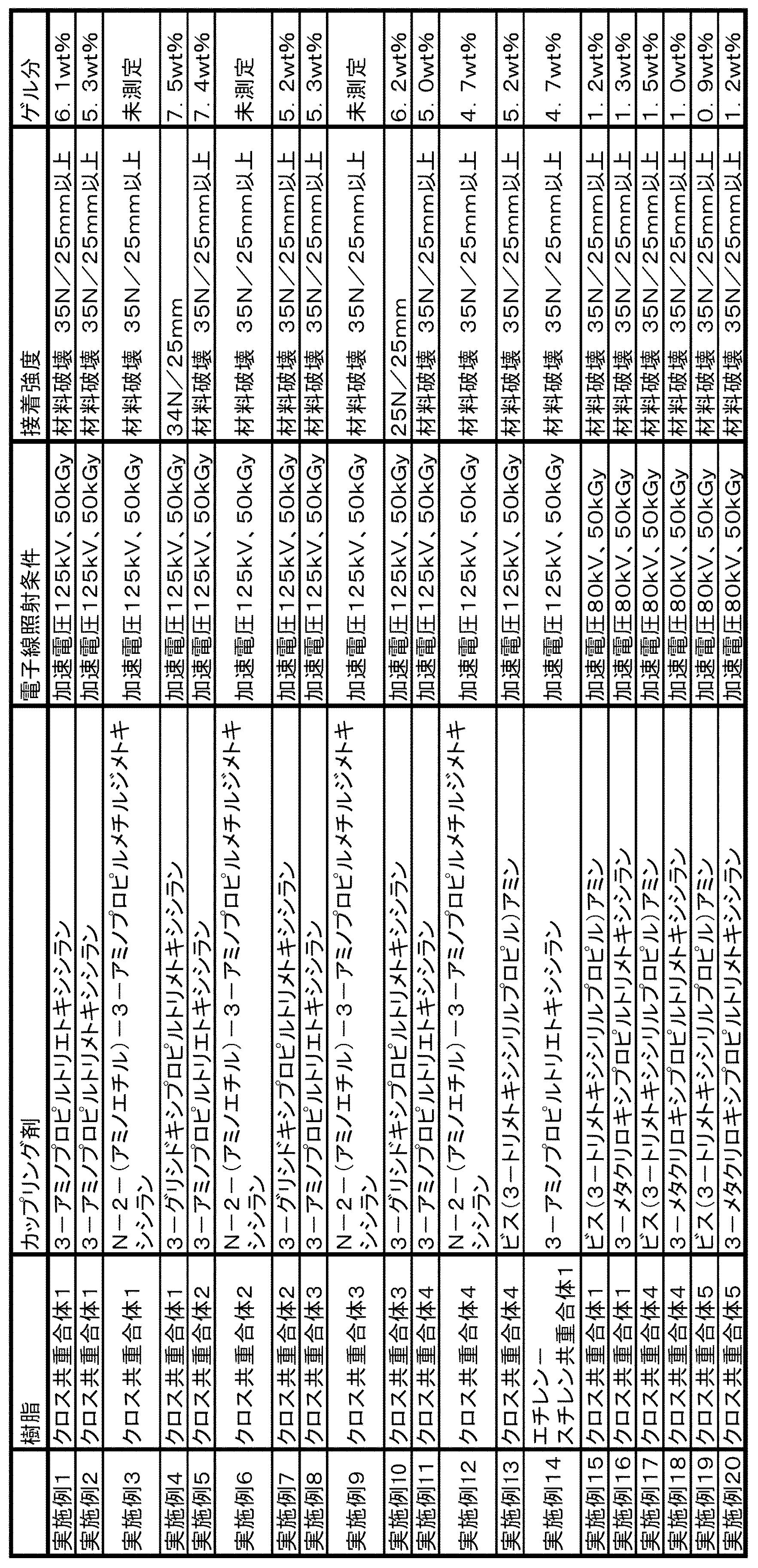
- Examples 2 to 10> The test was conducted in the same manner as in Example 1, except that the sheet resin, the silane coupling agent, and the electron beam irradiation conditions were changed. Test conditions and results are shown in Table 2. Further, Irganox 1076 made by Ciba Japan, which is an antioxidant, was not added to the resin kneaded material using the cross copolymers 4 and 5.
- Example 11 to 20 As in Example 1, except that when dissolving the silane coupling agent in cyclohexane, a coating solution was prepared without using acetic acid, and the sheet resin, silane coupling agent, and electron beam irradiation conditions were prepared. Others were tested in the same manner. When 3-methacryloxypropyltrimethoxysilane was used, 3-methacryloxypropyltrimethoxysilane was dissolved in cyclohexane at a concentration of 10% by mass to prepare a coating solution. Test conditions and results are shown in Table 2.
- Examples 21 to 25 The test pieces obtained in the same manner as in Examples 1, 4, 5, and 7 were left to stand for 1000 hours under the conditions of a temperature and humidity of 85 ° C. and a humidity of 85% using a constant temperature and humidity device, and the adhesive strength was measured in the same manner. .
- the results are shown in Table 4.
- the adhesive strength was 35 N / 25 mm or more, resulting in material destruction, and substantially the same adhesive strength.
- Example 22 (same sample as Example 4) also showed an adhesive strength of 35 N / 25 mm or more, resulting in material destruction, rather the adhesive strength increased.
- Example 26 to 27 As in Example 1, except that when dissolving the silane coupling agent in cyclohexane, a coating solution was prepared without using acetic acid, and the sheet resin and the silane coupling agent were changed. The test was conducted in the same manner except that the corona discharge treatment (corona discharge energy 4 mJ / mm 2 ) was used instead of the line irradiation. Table 5 shows the test conditions and results.
- Example 28 to 30> As in Example 1, except that when dissolving the silane coupling agent in cyclohexane, a coating solution was prepared without using acetic acid, and the sheet resin and the silane coupling agent were changed. Irradiation or corona treatment was performed. In the adhesion test, tab sheets for solar cells (super soft copper flat-plated wire: lead-free solder, width 6 mm) were used instead of glass, and the sheet was pressure-bonded by the same method. The adhesive strength was measured under 180 ° peeling conditions. Table 6 shows the test conditions and results.
Landscapes
- Chemical & Material Sciences (AREA)
- Organic Chemistry (AREA)
- Health & Medical Sciences (AREA)
- Engineering & Computer Science (AREA)
- Polymers & Plastics (AREA)
- Medicinal Chemistry (AREA)
- Chemical Kinetics & Catalysis (AREA)
- Materials Engineering (AREA)
- Toxicology (AREA)
- General Chemical & Material Sciences (AREA)
- Compositions Of Macromolecular Compounds (AREA)
- Photovoltaic Devices (AREA)
- Coating Of Shaped Articles Made Of Macromolecular Substances (AREA)
- Treatments Of Macromolecular Shaped Articles (AREA)
- Sealing Material Composition (AREA)
Abstract
Description
また本発明は、そのような樹脂またはシートを用いた封止材並びに該封止材を含む太陽光発電装置を提供することも目的とする。
また更なる実施態様では、カップリング剤は、シランカップリング剤であり、特に、アミノ基、メタクリロキシ基、エポキシ基のいずれかの官能基を有するシランカップリング剤である。
本発明は、芳香族ビニル化合物-オレフィン系共重合体にカップリング剤を添加または塗布し、さらにエネルギー照射することにより得ることのできる、ガラス板、ガラス繊維、無機フィラー等の無機材料との接着性に優れ、また好ましくは充填性にも優れる樹脂またはそのシートである。本発明におけるシ-トはフィルムの概念を包含し、その厚さに特に制限はなく、一般的には1μmから3mmの範囲である。
オレフィンとしては、エチレン、炭素数3~20のα-オレフィン、すなわちプロピレン、1-ブテン、1-ヘキセン、4-メチル-1-ペンテン、1-オクテンが挙げられる。本発明においてはオレフィンの範疇に環状オレフィンも含まれ、本環状オレフィンの例としては、ビニルシクロヘキサンやシクロペンテン、ノルボルネン等が挙げられる。好ましくは、エチレンまたはエチレンとα-オレフィンすなわちプロピレン、1-ブテン、1-ヘキセン、または1-オクテン等の混合物が用いられ、更に好ましくは、エチレンが用いられる。
芳香族ビニル化合物-オレフィン系共重合体としてはエチレンとスチレンの共重合体が好ましい。
芳香族ビニル化合物-オレフィン系共重合体としてさらに好ましくはクロス共重合体が用いられる。クロス共重合体とは配位重合により得られるオレフィン-芳香族ビニル化合物-芳香族ポリエン共重合体及び芳香族ビニル化合物モノマーの共存下でアニオン重合を行うことにより得られる共重合体であり、オレフィン-芳香族ビニル化合物-芳香族ポリエン共重合体鎖(主鎖と記載される場合もある)と芳香族ビニル化合物重合体鎖(側鎖と記載される場合もある)を有する共重合体である。本クロス共重合体及びその製造方法は、その全体の記載をそれぞれ出典明示によりここに援用する、WO2000-37517、USP6559234、またはWO2007-139116に記載されており、芳香族ビニル化合物とオレフィンモノマーから誘導されるユニットの含量が全体の共重合体質量の70質量%以上、好ましくは90質量%以上、最も好ましくは95質量%以上占め、芳香族ポリエンから誘導されるユニットの含量が、好ましくは共重合体質量の5質量%未満0.01質量%以上、さらに好ましくは1質量%未満0.01質量%以上である。ここで芳香族ポリエンとは、10以上30以下の炭素数を持ち、複数の二重結合(ビニル基)と単数または複数の芳香族基を有し配位重合可能なモノマーであり、二重結合(ビニル基)の1つが配位重合に用いられて重合した状態において残された二重結合がアニオン重合可能な芳香族ポリエンである。好ましくは、オルトジビニルベンゼン、パラジビニルベンゼン及びメタジビニルベンゼンのいずれか1種または2種以上の混合物が好適に用いられる。さらにクロス共重合体のうち、最も好ましくは主鎖がエチレン-スチレン-ジビニルベンゼン共重合体鎖であり、かつ側鎖がポリスチレン鎖であるクロス共重合体が用いられる。
以上は加水分解縮合性基としてメトキシ基、エトキシ基を有する例であるが、トリイソプロポキシ基やアセトキシ基も使用できる。
シランカップリング剤の使用量に特に制限はないが、樹脂に混練等で添加する場合、一般的には樹脂に対し0.05質量%~10質量%の範囲で用いられる。樹脂に塗布する場合、一般的に0.1g/m2~20g/m2の範囲で用いられる。
一方、芳香族ビニル化合物-オレフィン系共重合体にカップリング剤を塗布する方法では、先ず、芳香族ビニル化合物-オレフィン系共重合体をシート化した後にカップリング剤を塗布する。シ-ト化には上記の公知の方法を用いることができ、得られたシ-トに、例えばグラビアコーティング法、ロールコーティング法あるいはディップコーティング法、噴霧法等の公知の塗布方法を用いて、カップリング剤を塗布する。この際、カップリング剤は適当な溶媒に希釈して用いても、希釈せずに用いても良い。後者の塗布方法は、前者のカップリング剤を添加、混練する方法と比較し、カップリング剤の使用量を減じることができ、経済的により優れている。
また、特定の条件下ではコロナ放電処理やプラズマ処理、特に好ましくはコロナ放電処理が用いられる。特定の条件とは、用いられるカップリング剤が好ましくはエポキシ基またはアミノ基を有するシランカップリング剤であるという条件である。コロナ放電処理は公知の装置及び公知の条件で行うことができる。好ましいコロナ放電エネルギーは特に限定されないが、好ましくは、0.1~1000mJ/mm2の範囲である。
カップリング剤を添加または塗布して形成された芳香族ビニル化合物-オレフィン系共重合体シートにこのようなエネルギー照射を行うと、無機材料に対して高い接着強度を達成することができ、例えば、ガラスに対して、浮動ローラー法剥離試験による90°剥離試験において、22N/25mm以上、好ましくは25N/25mm以上の剥離強度(接着強度)を達成することができる。また、シリコン(表面安定化処理されたシリコンを含む)、アルミニウム、銅、ハンダ等の金属に対しては同様の試験において3N/6mm以上の剥離強度を達成できる。
上述した本発明の接着性樹脂シートを太陽光発電装置(太陽電池)の各種封止用部材、特に封止用シートとして用いる場合、その好ましい物性は、A硬度50以上95以下であり、全光線透過率は厚さ1mmのシートにおいて75%以上である。このような条件を満足するスチレン-エチレン共重合体は、スチレン含量5モル%以上40モル%以下の組成を有する。
<可塑剤>
封止材には従来塩ビや他の樹脂に用いられている公知の任意の可塑剤を配合することができる。好ましく用いられる可塑剤は、オイルまたは含酸素または含窒素系可塑剤であり、より好ましくは、パラフィン系オイル、ナフテン系オイル、エステル系可塑剤、エポキシ系可塑剤、エ-テル系可塑剤、またはアミド系可塑剤から選ばれる。
これらの可塑剤は、相溶性が比較的良好でブリ-ドし難く、またガラス転移温度が低下する度合いで評価できる可塑化効果も大きく、好適に用いることができる。
可塑剤の配合量は、本発明の樹脂またはそのシート100質量部に対して、可塑剤1質量部以上20質量部以下、好ましくは1質量部以上10質量部以下である。1質量部未満では上記効果が不足し、20質量部より高いとブリ-ドや、過度の軟化、それによる過度のべたつきの発現等の原因となる場合がある。また可塑剤を配合することで、封止材の流動性を向上させることができる。特に用いられる樹脂のMFR値が低い場合、上記の範囲で可塑剤を添加することにより、封止材として適当なMFR値に調整することが可能となる。
適当な老化防止剤としては、例えばヒンダードフェノール系酸化防止剤、リン系熱安定剤、ラクトン系熱安定剤、ビタミンE系熱安定剤、イオウ系熱安定剤等が挙げられる。その使用量は、樹脂組成物100質量部に対して3量部以下である。
太陽光発電装置の封止材用シ-トとして、その厚みに特に制限はないが、一般に30μm~1mm、好ましくは100μm~0.5mmである。このような樹脂シ-トを製造するには、インフレーション成形、押し出し成形、Tダイ成形、カレンダ-成形、ロ-ル成形などの公知の成形法を採用することができる。
また、太陽光発電装置の封止材用シ-トとしては、必ずしも単層である必要はなく、本発明に係る接着性樹脂シートをガラス接着面、あるいはシリコンセル等のセルとの接着面に用い、他の適当な樹脂シートをさらに積層して多層構造としてもよい。ここで他の適当な樹脂シートとしては、シランカップリング剤の配合量が少ないか、あるいは配合していない芳香族ビニル化合物-オレフィン系共重合体、好ましくはクロス共重合体のシートでも良いし、他の樹脂、例えばEVAや他のエチレン系共重合体のシートでもよい。
本発明の樹脂シートを用いてなる太陽光発電装置の封止材は、封止工程の簡略化と太陽光発電装置のリサイクル性を考慮すると、架橋処理を行うのはカップリング剤と樹脂シ-トの結合を強化するためのシート表面近傍のみが好ましく、シ-トの大部分を占める中心部分やガラスとの接着面の反対面は実質的な架橋をせずに熱可塑性であることが封止材として用いる上で好ましい。しかしシ-ト自身により高度な耐熱性を要求される場合や封止後には、これ以上の架橋処理を行うことも可能である。架橋処理は、一般には本熱可塑性封止材に架橋剤、架橋助剤を添加し、架橋温度以下の条件でフィルム、シートを成形し、太陽電池セルの封止後に所定の架橋条件にて架橋を行う。本発明の熱可塑性封止材の熱可塑性は封止工程で溶融、流動により太陽電池セルを封止する工程で重要である。その後の架橋条件は、用いられる架橋剤、架橋助剤により任意に決定される。本熱可塑性封止材に使用可能な架橋剤、架橋助剤は、通常エチレン系樹脂、スチレン系樹脂やスチレン-エチレン共重合体に用いられるものであり公知である。好ましい架橋剤、架橋助剤、架橋条件は例えば、特表平10-505621(WO96/07681)、特開平08-139347号公報、特開2000-183381号公報に記載されている。このような架橋処理を行った封止材はリサイクル性という使用のメリットは無くなるが、高い水蒸気バリア性(低い水蒸気透過率)、高い体積抵抗率、及び酢酸等の腐食性物質を遊離しない点は、太陽電池の信頼性向上の面から有利である。
実施例、比較例に用いた原料樹脂は以下の通りである。
下記クロス共重合体は、出典明示により全内容をここに援用するWO2000/37517またはWO2007139116号公報記載の製造方法で製造したもので、下記組成は、同様にこれら公報記載の方法で求めた。これらのクロス共重合体は、配位重合により得られるエチレン-スチレン-ジビニルベンゼン共重合体とスチレンモノマーの共存下でアニオン重合を行うことにより得られる、エチレン-スチレン-ジビニルベンゼン共重合体鎖とポリスチレン鎖を有する共重合体である。
以下、クロス共重合体を規定するために、用いられるエチレン-スチレン-ジビニルベンゼン共重合体のスチレン含量、ジビニルベンゼン含量、重量平均分子量(Mw)、分子量分布(Mw/Mn)、クロス共重合体中のエチレン-スチレン-ジビニルベンゼン共重合体の含量、ポリスチレン鎖の分子量(Mw)、分子量分布(Mw/Mn)を示す。また、全スチレン含量は、クロス共重合体に含まれるエチレン-スチレン-ジビニルベンゼン共重合体鎖とポリスチレン鎖に含まれるスチレン含量を合計した含量である。
エチレン-スチレン-ジビニルベンゼン共重合体のスチレン含量15モル%、
ジビニルベンゼン含量0.040モル%、
Mw=70000、Mw/Mn=2.2、
エチレン-スチレン-ジビニルベンゼン共重合体の含量67質量%、
ポリスチレン鎖のMw=35000、Mw/Mn=1.2
全スチレン含量60質量%
・クロス共重合体2:
エチレン-スチレン-ジビニルベンゼン共重合体のスチレン含量25モル%、
ジビニルベンゼン含量0.035モル%、
Mw=90000、Mw/Mn=2.3
エチレン-スチレン-ジビニルベンゼン共重合体の含量67質量%、
ポリスチレン鎖のMw=44000、Mw/Mn=1.2
全スチレン含量70質量%、
・クロス共重合体3:
エチレン-スチレン-ジビニルベンゼン共重合体のスチレン含量23モル%、
ジビニルベンゼン含量0.035モル%、Mw=103000、Mw/Mn=2.2
エチレン-スチレン-ジビニルベンゼン共重合体の含量52質量%、
ポリスチレン鎖のMw=35000、Mw/Mn=1.2
全スチレン含量75質量%
・クロス共重合体4:
エチレン-スチレン-ジビニルベンゼン共重合体のスチレン含量24モル%、
ジビニルベンゼン含量0.030モル%、
Mw=115000、Mw/Mn=2.2
エチレン-スチレン-ジビニルベンゼン共重合体の含量77質量%、
ポリスチレン鎖のMw=26000、Mw/Mn=1.2
・クロス共重合体5:
エチレン-スチレン-ジビニルベンゼン共重合体のスチレン含量10モル%、
ジビニルベンゼン含量0.040モル%、
Mw=105000、Mw/Mn=2.2
エチレン-スチレン-ジビニルベンゼン共重合体の含量85質量%、
ポリスチレン鎖のMw=22000、Mw/Mn=1.2
・エチレン-スチレン共重合体1:
スチレン含量41質量%(16モル%)、
Mw=120000、Mw/Mn=2.2
上記エチレン-スチレン共重合体はJP3659760号公報記載の製造方法で製造した。
使用した樹脂の物性は表1にまとめて示した。

以下の信越化学工業社製シランカップリング剤を用いた。
・3-アミノプロピルトリエトキシシラン(KBE-903)
・3-アミノプロピルトリメトキシシラン(KBM-903)
・N-2-(アミノエチル)-3-アミノプロピルメチルジメトキシシラン(KBM-602)
・3-グリシドキシプロピルトリメトキシシラン(KBM-403)
・3-メタクリロキシプロピルトリメトキシシラン(KBM-503)
さらに、以下のエボニック社製シランカップリング剤を用いた。
・ビス(3-トリメトキシシリルプロピル)アミン
サンプルシートは、加熱プレス法(温度180℃、時間3分間、圧力50kg/cm2)により成形した厚さ0.4mmのシートを用いた。
ブラベンダープラスチコーダー(ブラベンダー社製PL2000型)を使用し、樹脂と添加物の合計約45gを180℃、100rpm、5分間混練し樹脂組成物を作製した。
JIS K-6251に準拠し、得られたフィルムを2号1/2号型テストピース形状にカットし、島津製作所AGS-100D型引張試験機を用い、引張速度500mm/minにて初期引張弾性率、破断点伸び、破断強度を測定した。
シランカップリング剤、酢酸をシクロヘキサンに溶解し、カップリング剤2質量%、酢酸2質量%の溶液を調製した。バーコーターを用い、45ミクロン厚さでシクロヘキサン溶液をシ-ト上に塗布した。その後、一昼夜自然乾燥させた。
岩崎電気EB装置TYPE:CB250/15/180Lを用い、加速電圧125kVで所定の照射線量(kGy)の照射を1回実施した。塗布法によるシ-トの場合、塗布面に照射を実施した。
幅25mm、長さ60mmのガラス板の表面をアセトンで洗浄し、よく乾燥させた。シ-トを幅25mm、長さ60mmにカットし、気泡が入らないようにガラス板上に密着させた。その後、加熱オーブン内で0.03MPaの荷重をかけ、160℃、15分間圧着させた。
島津製作所AGS-100D型引張試験機を用い、浮動ローラー法にて90°剥離条件下、引張速度100mm/minにて測定した。
<ゲル分>
ASTM D-2765-84に従い、以下のようにして求めた。すなわち、精秤した1.0gポリマー(大きさ約1mm)を、100メッシュのステンレス製網袋に包み、精秤した。これを沸騰キシレン中で約5時間抽出した後、網袋を回収し、真空中90℃で10時間以上乾燥した。十分に冷却後、網袋を精秤し、以下の式により、ポリマー中のゲル量を算出した。
ゲル量=(網袋に残留したポリマーの質量/初めのポリマー質量)×100
クロス共重合体1 100質量部に対し、株式会社ADEKA製耐候剤LA-52、LA-36各0.2質量部、酸化防止剤としてチバ・ジャパン社製イルガノックス1076を0.1質量部添加し、上記のようにブラベンダーを用いて混練を行った。得られた樹脂混練物を上記加熱プレス法にて0.4mm厚さのシ-トを作製した。
シクロヘキサンに対し、シランカップリング剤:3-アミノプロピルトリエトキシシランを2質量%、酢酸2質量%の濃度で溶解し、塗布用の溶液を調製した。上記作製のシ-トに、バーコーターを用い上記シクロヘキサン溶液を開口厚さ45.7ミクロンで塗布した。その後ドラフト中で一昼夜乾燥した。
得られたシ-トのカップリング剤塗布面に対し、加速電圧125kVで50kGyの電子線照射を1回行った。照射から数日後、上記に従って、ガラスとの圧着を行った。
翌日、接着強度測定を行ったところ、接着強度が高く、シ-トの材料破壊となった。材破に至る際に測定された接着強度は35N/25mm以上であった。
実施例1と同様に、但し、シ-トの樹脂、シランカップリング剤、電子線照射条件を変えて試験を行った。試験条件及び結果を表2に示す。また、クロス共重合体4及び5を用いた樹脂混練物には、酸化防止剤であるチバ・ジャパン社製イルガノックス1076の添加は行わなかった。
実施例1と同様に、但し、シクロヘキサンに対しシランカップリング剤を溶解する際に、酢酸を用いず塗布用の溶液を調製し、さらにシ-トの樹脂、シランカップリング剤、電子線照射条件を変えて、他は同様にして試験を行った。3-メタクリロキシプロピルトリメトキシシランを用いる場合、シクロヘキサンに対し、3-メタクリロキシプロピルトリメトキシシランを10質量%の濃度で溶解し、塗布用の溶液を調製した。試験条件及び結果を表2に示す。
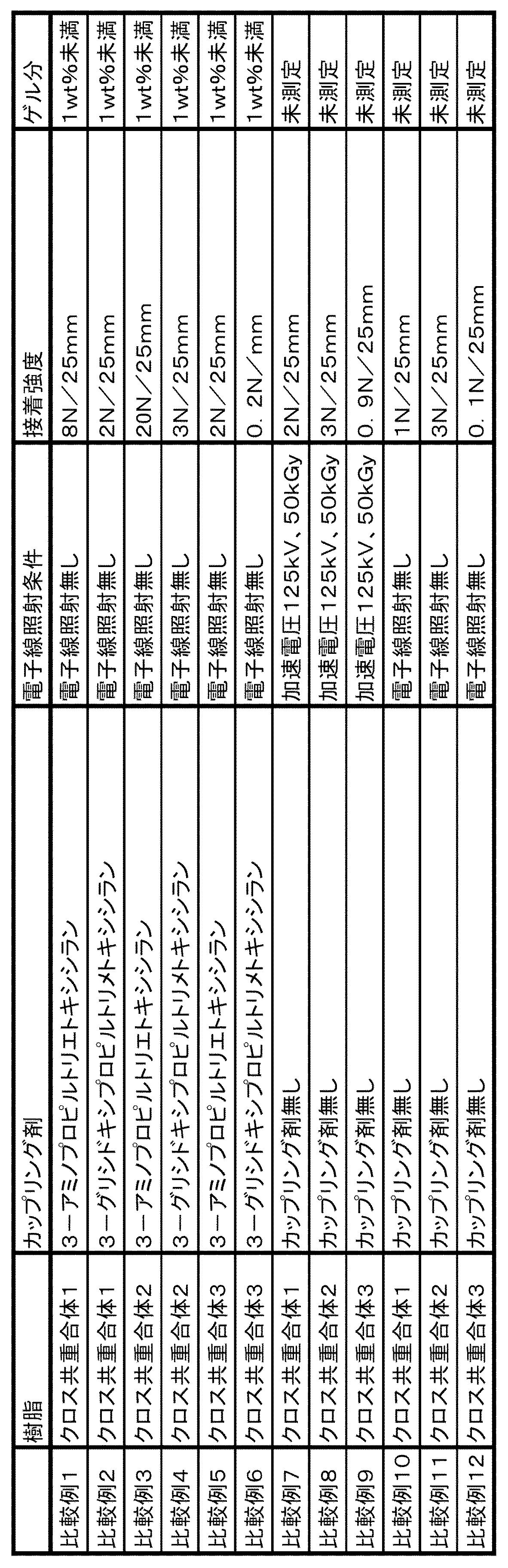
実施例と同様に、但し、シ-トに電子線を照射せずにガラスとの接着試験を行った。試験条件及び結果を表3に示す。
実施例と同様に、ただしカップリング剤を使用せず、電子線を照射した後にガラスとの接着試験を行った。試験条件及び結果を表3に示す。
実施例と同様に、ただしカップリング剤を使用せず、電子線も照射せずにガラスとの接着試験を行った。試験条件及び結果を表3に示す。
実施例1、4、5、7と同様にして得られた試験片を恒温恒湿装置にて温度85℃、湿度85%の条件下で1000時間放置した後に同様に接着強度の測定を行った。その結果を表4に示す。実施例21、23、24、25(それぞれ実施例1、5、7、18と同じサンプル)では、35N/25mm以上の接着強度を示し材料破壊となり、実質的に同等の接着強度を示した。実施例22(実施例4と同じサンプル)でも35N/25mm以上の接着強度を示し材料破壊となり、むしろ接着強度が増加した。

実施例1と同様に、但し、シクロヘキサンに対しシランカップリング剤を溶解する際に、酢酸を用いず塗布用の溶液を調製し、さらにシ-トの樹脂、シランカップリング剤を変更し、電子線照射の代わりにコロナ放電処理(コロナ放電エネルギー4mJ/mm2)に変えて、他は同様にして試験を行った。試験条件及び結果を表5に示す。

実施例1と同様に、但し、シクロヘキサンに対しシランカップリング剤を溶解する際に、酢酸を用いず塗布用の溶液を調製し、さらにシ-トの樹脂、シランカップリング剤を変更し、電子線照射またはコロナ処理を行った。接着試験では、ガラスの代わりに太陽電池用タブ線(超軟質銅平角めっき線:鉛フリーはんだ、巾6mm)を用い、同様の方法でシートと圧着した。接着強度の測定は、180°剥離条件で行った。試験条件及び結果を表6に示す。

Claims (13)
- 芳香族ビニル化合物-オレフィン系共重合体にカップリング剤を添加または塗布し、さらにエネルギー照射してなる、無機材料との接着性を有する樹脂。
- 芳香族ビニル化合物がスチレンである請求項1に記載の樹脂。
- オレフィンがエチレンである請求項1または2に記載の樹脂。
- 芳香族ビニル化合物-オレフィン系共重合体が、芳香族ビニル化合物とオレフィンを含んでなるクロス共重合体である請求項1に記載の樹脂。
- エネルギー線が電子線である請求項1から4のいずれか一項に記載の樹脂。
- 無機材料がガラスである請求項1から5のいずれか一項に記載の樹脂。
- カップリング剤がシランカップリング剤である請求項1から6のいずれか一項に記載の樹脂。
- シランカップリング剤が、アミノ基、エポキシ基またはメタクリロキシ基のいずれかを有する請求項7に記載の樹脂。
- 芳香族ビニル化合物-オレフィン系共重合体をシート状に成形し、その表面にカップリング剤を塗布し、さらにエネルギー照射してなる、請求項1から8のいずれか一項に記載の樹脂。
- 芳香族ビニル化合物-オレフィン系共重合体にカップリング剤を添加してシート状に成形し、さらにエネルギー照射してなる、請求項1から8のいずれか一項に記載の樹脂。
- 請求項1から10のいずれか一項に記載の樹脂から形成されるシート。
- 請求項1から10のいずれか一項に記載の樹脂または請求項11に記載のシートを用いて形成される封止材。
- 請求項12に記載の封止材を構成要素として含む太陽光発電装置。
Priority Applications (3)
| Application Number | Priority Date | Filing Date | Title |
|---|---|---|---|
| KR1020137008976A KR20130118866A (ko) | 2010-09-08 | 2011-09-07 | 접착성 개량 수지 및 시트 |
| CN201180052353.0A CN103210025B (zh) | 2010-09-08 | 2011-09-07 | 粘接性改良树脂及片材 |
| JP2012532996A JPWO2012033119A1 (ja) | 2010-09-08 | 2011-09-07 | 接着性改良樹脂及びシート |
Applications Claiming Priority (4)
| Application Number | Priority Date | Filing Date | Title |
|---|---|---|---|
| JP2010-200645 | 2010-09-08 | ||
| JP2010200645 | 2010-09-08 | ||
| JP2011-147238 | 2011-07-01 | ||
| JP2011147238 | 2011-07-01 |
Publications (1)
| Publication Number | Publication Date |
|---|---|
| WO2012033119A1 true WO2012033119A1 (ja) | 2012-03-15 |
Family
ID=45810716
Family Applications (1)
| Application Number | Title | Priority Date | Filing Date |
|---|---|---|---|
| PCT/JP2011/070338 Ceased WO2012033119A1 (ja) | 2010-09-08 | 2011-09-07 | 接着性改良樹脂及びシート |
Country Status (4)
| Country | Link |
|---|---|
| JP (1) | JPWO2012033119A1 (ja) |
| KR (1) | KR20130118866A (ja) |
| CN (1) | CN103210025B (ja) |
| WO (1) | WO2012033119A1 (ja) |
Cited By (1)
| Publication number | Priority date | Publication date | Assignee | Title |
|---|---|---|---|---|
| JP2015079834A (ja) * | 2013-10-16 | 2015-04-23 | 大日本印刷株式会社 | 太陽電池モジュール用の封止材シート及びその製造方法 |
Citations (8)
| Publication number | Priority date | Publication date | Assignee | Title |
|---|---|---|---|---|
| JPH06334207A (ja) * | 1993-05-27 | 1994-12-02 | Canon Inc | 太陽電池モジュール |
| JPH08283696A (ja) * | 1995-04-14 | 1996-10-29 | Haishiito Kogyo Kk | 太陽電池封止用シート及びその製造方法 |
| WO2000037517A1 (en) * | 1998-12-22 | 2000-06-29 | Denki Kagaku Kogyo Kabushiki Kaisha | Cross-copolymerized olefin/styrene/diene copolymer, process for the production of the same and uses thereof |
| JP2001119047A (ja) * | 1999-10-21 | 2001-04-27 | Du Pont Mitsui Polychem Co Ltd | 太陽電池封止材料及び太陽電池モジュール |
| JP2002537423A (ja) * | 1999-02-17 | 2002-11-05 | ザ ダウ ケミカル カンパニー | アルファ−オレフィン/ビニルまたはビニリデン芳香族インターポリマー生成物及び複合触媒系を使用して該生成物を製造する方法 |
| JP2009120792A (ja) * | 2007-10-23 | 2009-06-04 | Denki Kagaku Kogyo Kk | クロス共重合体の製造方法及び得られるクロス共重合体、その用途 |
| JP2009249556A (ja) * | 2008-04-09 | 2009-10-29 | Asahi Kasei E-Materials Corp | 樹脂封止シート |
| JP2010150442A (ja) * | 2008-12-26 | 2010-07-08 | Denki Kagaku Kogyo Kk | 太陽電池封止材 |
-
2011
- 2011-09-07 JP JP2012532996A patent/JPWO2012033119A1/ja not_active Withdrawn
- 2011-09-07 WO PCT/JP2011/070338 patent/WO2012033119A1/ja not_active Ceased
- 2011-09-07 KR KR1020137008976A patent/KR20130118866A/ko not_active Withdrawn
- 2011-09-07 CN CN201180052353.0A patent/CN103210025B/zh not_active Expired - Fee Related
Patent Citations (8)
| Publication number | Priority date | Publication date | Assignee | Title |
|---|---|---|---|---|
| JPH06334207A (ja) * | 1993-05-27 | 1994-12-02 | Canon Inc | 太陽電池モジュール |
| JPH08283696A (ja) * | 1995-04-14 | 1996-10-29 | Haishiito Kogyo Kk | 太陽電池封止用シート及びその製造方法 |
| WO2000037517A1 (en) * | 1998-12-22 | 2000-06-29 | Denki Kagaku Kogyo Kabushiki Kaisha | Cross-copolymerized olefin/styrene/diene copolymer, process for the production of the same and uses thereof |
| JP2002537423A (ja) * | 1999-02-17 | 2002-11-05 | ザ ダウ ケミカル カンパニー | アルファ−オレフィン/ビニルまたはビニリデン芳香族インターポリマー生成物及び複合触媒系を使用して該生成物を製造する方法 |
| JP2001119047A (ja) * | 1999-10-21 | 2001-04-27 | Du Pont Mitsui Polychem Co Ltd | 太陽電池封止材料及び太陽電池モジュール |
| JP2009120792A (ja) * | 2007-10-23 | 2009-06-04 | Denki Kagaku Kogyo Kk | クロス共重合体の製造方法及び得られるクロス共重合体、その用途 |
| JP2009249556A (ja) * | 2008-04-09 | 2009-10-29 | Asahi Kasei E-Materials Corp | 樹脂封止シート |
| JP2010150442A (ja) * | 2008-12-26 | 2010-07-08 | Denki Kagaku Kogyo Kk | 太陽電池封止材 |
Cited By (1)
| Publication number | Priority date | Publication date | Assignee | Title |
|---|---|---|---|---|
| JP2015079834A (ja) * | 2013-10-16 | 2015-04-23 | 大日本印刷株式会社 | 太陽電池モジュール用の封止材シート及びその製造方法 |
Also Published As
| Publication number | Publication date |
|---|---|
| CN103210025A (zh) | 2013-07-17 |
| JPWO2012033119A1 (ja) | 2014-01-20 |
| KR20130118866A (ko) | 2013-10-30 |
| CN103210025B (zh) | 2015-02-25 |
Similar Documents
| Publication | Publication Date | Title |
|---|---|---|
| EP2808906B1 (en) | Sealing film for solar cells, and solar cell using same | |
| JP6078967B2 (ja) | 太陽電池モジュール用封止材シート | |
| JP5525932B2 (ja) | 太陽電池封止材用組成物、それからなる太陽電池封止材およびそれを用いた太陽電池モジュール | |
| WO2009125685A1 (ja) | 樹脂封止シート | |
| JP5570367B2 (ja) | 積層物 | |
| WO2009157545A1 (ja) | 太陽電池用積層シート及びこれを用いた太陽電池モジュール | |
| CN103392238B (zh) | 太阳能电池用密封膜和使用密封膜的太阳能电池 | |
| JP5519409B2 (ja) | 太陽電池封止材用樹脂シート | |
| CN103636003B (zh) | 太阳能电池用密封膜和使用其的太阳能电池 | |
| WO2021098299A1 (zh) | 胶膜、抗pid封装胶膜、形成其的组合物、光伏组件及夹胶玻璃 | |
| CN104081540B (zh) | 太阳能电池用密封膜和使用其的太阳能电池 | |
| CN110079244A (zh) | 一种太阳能电池封装材料、相关胶膜及太阳能电池组件 | |
| JP2012015402A (ja) | 太陽電池封止材用樹脂組成物、及びそれを用いた太陽電池封止材、その製造方法、ならびに太陽電池モジュール | |
| JP5538092B2 (ja) | 太陽電池封止材用組成物及びそれからなる封止材ならびにそれを用いた太陽電池モジュール | |
| JP2017183479A (ja) | 太陽電池封止材用ポリエチレン樹脂組成物、並びにそれを用いた太陽電池封止材及び太陽電池モジュール | |
| JP5821341B2 (ja) | 太陽電池封止材用樹脂組成物、及びそれを用いた太陽電池封止材 | |
| WO2013084850A1 (ja) | 太陽電池モジュール用封止材シート | |
| JP2011077360A (ja) | 樹脂封止シート及びこれを用いた太陽電池モジュール | |
| JP2012092197A (ja) | 樹脂及びシート | |
| JP5330178B2 (ja) | 樹脂封止シート及びそれを用いた太陽電池モジュール | |
| JP2012084842A (ja) | 封止材一体型裏面保護シート | |
| JP5560099B2 (ja) | 太陽電池封止材用樹脂組成物 | |
| JP5788712B2 (ja) | エチレン−極性モノマー共重合体シート、並びにこれを用いた合わせガラス用中間膜、合わせガラス、太陽電池用封止膜及び太陽電池 | |
| WO2012033119A1 (ja) | 接着性改良樹脂及びシート | |
| JP5525933B2 (ja) | 太陽電池封止材用組成物、それからなる太陽電池封止材およびそれを用いた太陽電池モジュール |
Legal Events
| Date | Code | Title | Description |
|---|---|---|---|
| 121 | Ep: the epo has been informed by wipo that ep was designated in this application |
Ref document number: 11823593 Country of ref document: EP Kind code of ref document: A1 |
|
| ENP | Entry into the national phase |
Ref document number: 2012532996 Country of ref document: JP Kind code of ref document: A |
|
| NENP | Non-entry into the national phase |
Ref country code: DE |
|
| ENP | Entry into the national phase |
Ref document number: 20137008976 Country of ref document: KR Kind code of ref document: A |
|
| 122 | Ep: pct application non-entry in european phase |
Ref document number: 11823593 Country of ref document: EP Kind code of ref document: A1 |