WO2012014848A1 - フラボノイド由来Hes1プロモーター阻害剤 - Google Patents
フラボノイド由来Hes1プロモーター阻害剤 Download PDFInfo
- Publication number
- WO2012014848A1 WO2012014848A1 PCT/JP2011/066866 JP2011066866W WO2012014848A1 WO 2012014848 A1 WO2012014848 A1 WO 2012014848A1 JP 2011066866 W JP2011066866 W JP 2011066866W WO 2012014848 A1 WO2012014848 A1 WO 2012014848A1
- Authority
- WO
- WIPO (PCT)
- Prior art keywords
- group
- groups
- derivative
- compound
- beads
- Prior art date
- Legal status (The legal status is an assumption and is not a legal conclusion. Google has not performed a legal analysis and makes no representation as to the accuracy of the status listed.)
- Ceased
Links
Images

Classifications
-
- A—HUMAN NECESSITIES
- A61—MEDICAL OR VETERINARY SCIENCE; HYGIENE
- A61K—PREPARATIONS FOR MEDICAL, DENTAL OR TOILETRY PURPOSES
- A61K31/00—Medicinal preparations containing organic active ingredients
- A61K31/33—Heterocyclic compounds
- A61K31/395—Heterocyclic compounds having nitrogen as a ring hetero atom, e.g. guanethidine or rifamycins
- A61K31/435—Heterocyclic compounds having nitrogen as a ring hetero atom, e.g. guanethidine or rifamycins having six-membered rings with one nitrogen as the only ring hetero atom
- A61K31/44—Non condensed pyridines; Hydrogenated derivatives thereof
- A61K31/4427—Non condensed pyridines; Hydrogenated derivatives thereof containing further heterocyclic ring systems
- A61K31/4433—Non condensed pyridines; Hydrogenated derivatives thereof containing further heterocyclic ring systems containing a six-membered ring with oxygen as a ring hetero atom
-
- A—HUMAN NECESSITIES
- A61—MEDICAL OR VETERINARY SCIENCE; HYGIENE
- A61P—SPECIFIC THERAPEUTIC ACTIVITY OF CHEMICAL COMPOUNDS OR MEDICINAL PREPARATIONS
- A61P25/00—Drugs for disorders of the nervous system
-
- A—HUMAN NECESSITIES
- A61—MEDICAL OR VETERINARY SCIENCE; HYGIENE
- A61P—SPECIFIC THERAPEUTIC ACTIVITY OF CHEMICAL COMPOUNDS OR MEDICINAL PREPARATIONS
- A61P25/00—Drugs for disorders of the nervous system
- A61P25/28—Drugs for disorders of the nervous system for treating neurodegenerative disorders of the central nervous system, e.g. nootropic agents, cognition enhancers, drugs for treating Alzheimer's disease or other forms of dementia
-
- A—HUMAN NECESSITIES
- A61—MEDICAL OR VETERINARY SCIENCE; HYGIENE
- A61P—SPECIFIC THERAPEUTIC ACTIVITY OF CHEMICAL COMPOUNDS OR MEDICINAL PREPARATIONS
- A61P43/00—Drugs for specific purposes, not provided for in groups A61P1/00-A61P41/00
-
- C—CHEMISTRY; METALLURGY
- C07—ORGANIC CHEMISTRY
- C07D—HETEROCYCLIC COMPOUNDS
- C07D405/00—Heterocyclic compounds containing both one or more hetero rings having oxygen atoms as the only ring hetero atoms, and one or more rings having nitrogen as the only ring hetero atom
- C07D405/02—Heterocyclic compounds containing both one or more hetero rings having oxygen atoms as the only ring hetero atoms, and one or more rings having nitrogen as the only ring hetero atom containing two hetero rings
- C07D405/06—Heterocyclic compounds containing both one or more hetero rings having oxygen atoms as the only ring hetero atoms, and one or more rings having nitrogen as the only ring hetero atom containing two hetero rings linked by a carbon chain containing only aliphatic carbon atoms
Definitions
- the present invention relates to a Hes1 promoter inhibitor.
- neurons e.g., glial growth factor, IL-12, IL-12, IL-12, IL-12, IL-12, IL-12, IL-12, IL-12, IL-12, IL-12, IL-12, IL-12, IL-12, IL-12, IL-12, IL-12, IL-12, IL-12, IL-12, IL-12, IL-12, IL-12, IL-12, IL-12, IL-12, IL-12, IL-12, IL-12, IL-12, IL-12, IL-12, IL-12, IL-12, IL-12, IL-12, IL-12, IL-12, IL-12, IL-12, IL-12, IL-12, IL-12, IL-12, IL-12, IL-12, IL-12, IL-12, IL-12, IL-12, IL-12, IL-12, IL-12, IL-12, IL-12, IL-12, IL-12, IL-12, IL-12,
- Non-Patent Document 1 has a report on the relationship between docosahexaenoic acid (DHA) neural stem cell differentiation promoting action and Hes1 expression inhibition. Further, Non-Patent Document 2 listed below promotes differentiation of neural stem cells by inhibiting the Hes1 promoter activity among bHLH transcription factors that regulate proliferation and maintenance of neural stem cells and differentiation into various neural cells. It is disclosed that it leads to.
- DHA docosahexaenoic acid
- Non-Patent Document 1 has room for improvement in Hes1 promoter inhibitory activity, and it is extremely useful to search for compounds with greater effects.
- Non-Patent Document 2 has a problem that it has strong toxicity to neural stem cells, although it is to mouse neural stem cells.
- an object of the present invention is to provide a neural stem cell differentiation promoting agent having strong Hes1 promoter inhibitory activity and less toxicity to neural stem cells.
- the present inventors have found a compound that has strong Hes1 promoter inhibitory activity but is less toxic to neural stem cells.
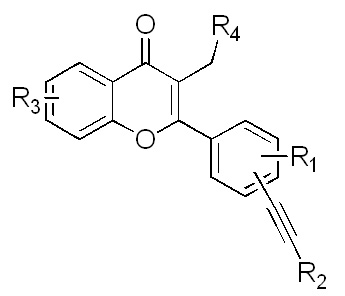
- the Hes1 promoter inhibitor according to the first aspect for solving the above problem includes a compound represented by the following general formula.
- R 1 , R 3 , and R 4 are alkyl groups, halogens, acyl groups, hydroxyl groups, alkoxy groups, amino groups, nitro groups, amide groups, cyano groups, phosphoric acids or esters thereof that may have a substituent.
- R 2 may have a substituent, an alkyl group, a halogen, an acyl group, an alkoxy group, an amino group, an amide group, a cyano group, phosphoric acid Or its ester, a sulfonyl group, a thiol, a thioether group, an aryl group, or a heterocyclic ring is represented.
- R 1 and R 3 may be one or plural.
- a neural stem cell differentiation promoting agent having strong Hes1 promoter inhibitory activity and less toxicity to neural stem cells.
- the Hes1 promoter inhibitor according to this embodiment includes a compound represented by the following general formula.
- R 1 , R 3 , and R 4 are alkyl groups, halogens, acyl groups, hydroxyl groups, alkoxy groups, amino groups, nitro groups, amide groups, cyano groups, phosphoric acids or esters thereof that may have a substituent.
- R 2 may have a substituent, an alkyl group, a halogen, an acyl group, an alkoxy group, an amino group, an amide group, a cyano group, phosphoric acid Or its ester, a sulfonyl group, a thiol, a thioether group, an aryl group, or a heterocyclic ring is represented.
- R 1 and R 3 may be one or plural.
- the “substituent” is an alkyl group, halogen, acyl group, hydroxyl group, alkoxy group, amino group, nitro group, amide group, cyano group, phosphoric acid or ester thereof, sulfonyl group, thiol, thioether group, An aryl group or a heterocyclic ring is mentioned but not limited thereto.
- heterocycle is a cyclic compound containing two or more elements, for example, a thiol ring, an oxol ring, an azole ring or a pyridine ring as shown in the following examples.
- the heterocycle may have a substituent.
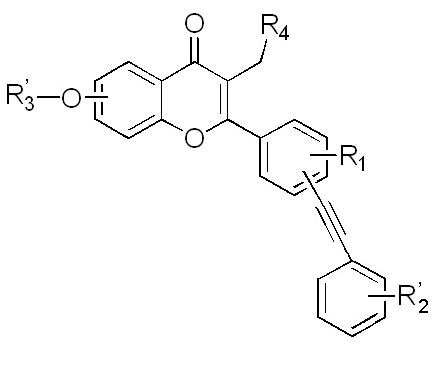
- the compound represented by the above general formula preferably includes a compound represented by the following general formula.
- R 1 represents hydrogen, halogen, or an optionally substituted alkyl group or alkoxy group
- R ′ 2 represents hydrogen, halogen, or an optionally substituted alkyl group or alkoxy
- R ′ 3 represents hydrogen, halogen, or an alkyl group or alkoxy group which may have a substituent
- R 4 represents a heterocyclic ring which may have a substituent.
- R 1 may be one or plural.
- the compound represented by the above general formula preferably includes a compound represented by the following general formula.
- R 1 represents one or a plurality of alkoxy groups
- R 4 represents a pyridine ring which may have an alkyl group or an alkoxyl group.
- the compounds represented by the above formula are not limited, but more specifically, can be exemplified by the following 1 to 4.
- the compound according to this embodiment has a strong Hes1 promoter inhibitor, but has a lower toxicity than known compounds for neural stem cells, and is useful for the treatment and prevention of neurological diseases such as dementia. Become.
- pharmaceutically acceptable ordinary carriers for example, distilled water
- binders for example, excipients
- diluents for example, distilled water
- pH buffer materials for example, phosphate buffered saline
- disintegrants various formulation ingredients such as a solubilizer, a solubilizer, and an isotonic agent can be contained.
- the Hes1 promoter inhibitor according to this embodiment can be administered orally or parenterally depending on the use form, but is preferably oral in consideration of long-term rehabilitation, etc. It is preferable to be parenterally at the onset stage such as cerebral infarction.
- oral administration commonly used administration forms such as powders, granules, tablets, capsules, solutions, suspensions, oils, emulsifiers and the like can be adopted.
- parenteral administration a commonly used administration form, for example, a form in which the above-mentioned solution, suspension or the like is administered by infusion or injection, a form in which it is administered directly to the damaged site, or the like can be adopted.
- the dose of the Hes1 promoter inhibitor according to the present embodiment can be appropriately selected according to the patient's body weight, sex, degree of nerve damage, and administration method.
- administration for example, it is preferably an amount containing the above compound within a range of 1 mg to 100 mg, more preferably an amount containing an active ingredient within a range of 1 mg to 20 mg per day for an adult.
- the active ingredient is in a range of about 10 times the amount of the active ingredient.
- the Hes1 promoter inhibitor according to this embodiment is not limited as long as it is obtained, but can be prepared by synthesis.
- the above compound is synthesized by first synthesizing a chalcone derivative under basic conditions with an aromatic aldehyde using a hydroxyacetophenone derivative as a starting material, adding a heterocyclic aldehyde to this compound, and further using a Pd-catalyzed Sonogashira- It can be prepared by introducing a substituent through the EBARA coupling or the Suzuki-Miyaura coupling. For this, see, for example, Arai, M. et al. A.
- a neural stem cell differentiation promoting agent having strong Hes1 promoter inhibitory activity and less toxicity to neural stem cells.
- the neuronal hepatocyte differentiation promoting agent according to the above embodiment was actually produced, and the effect was confirmed. This will be described below.
- phenylacetine 34 ⁇ L was added in the presence of Pd (OAc) 2 (4 mg), triphenylphosphine (8 mg), and pyrrolidine (39 ⁇ L), and the mixture was added to DMF (1 ml) at 60 ° C.
- a flavonoid derivative-carrying bead was obtained by the corresponding Sonogashira-Hagiwara coupling. Cutting out from the beads was performed in a THF solvent of 5% HF ⁇ Py at room temperature for 1 hour to obtain a compound (5.7 mg) represented by the following formula (2).
- phenylacetine 34 ⁇ L was added in the presence of Pd (OAc) 2 (4 mg), triphenylphosphine (8 mg), and pyrrolidine (39 ⁇ L), and the mixture was added to DMF (1 ml) at 60 ° C.
- a flavonoid derivative-carrying bead was obtained by the corresponding Sonogashira-Hagiwara coupling. Cutting out from the beads was performed in a THF solvent of 5% HF ⁇ Py at room temperature for 1 hour to obtain a compound (5.0 mg) represented by the following formula (3).
- phenylacetine 34 ⁇ L was added in the presence of Pd (OAc) 2 (4 mg), triphenylphosphine (8 mg), and pyrrolidine (39 ⁇ L), and the mixture was added to DMF (1 ml) at 60 ° C.
- a flavonoid derivative-carrying bead was obtained by the corresponding Sonogashira-Hagiwara coupling. Cutting out from the beads was performed in a THF solvent of 5% HF ⁇ Py at room temperature for 1 hour to obtain a compound (4.2 mg) represented by the following formula (4).
- Cells that stably express a luciferase reporter gene having a Hes1 promoter part are seeded in 96-well white plate at 50 ⁇ L / well (1 ⁇ 10 5 cells / mL) and cultured for 18 hours. (37 ° C., 5% CO 2 ). The medium was removed, and compound solutions diluted to the respective concentrations were prepared, and 50 ⁇ L each was added. After incubation for 24 hours, luciferase activity was measured. The luciferase activity was measured as follows. The medium was removed, 50 ⁇ L of 1 ⁇ Glo Lysis Buffer (Promega) was added, and the mixture was shaken at room temperature for 30 minutes.
- 1 ⁇ Glo Lysis Buffer Promega
- a cytotoxicity test was also performed to examine cell viability.
- Cells of 1 ⁇ 10 5 cells / mL were seeded in 96-well black plate at 50 ⁇ L / well and cultured for 18 hours (37 ° C., 5% CO 2 ).
- a test sample of the same concentration was added and allowed to act for 24 hours, and then the amount of fluorescence was measured with a Fluoroscan ascend (Thermo) using the method of fluorometric microcytology assay (FMCA) ( Ex: 485 nm, Em: 538 nm), cell viability was evaluated.
- the value of the control to which no sample was added was 100%
- the change in the value of the test sample group was calculated as a ratio
- the Hes1 promoter activity was calculated for luciferase activity
- the cell viability was calculated for FMCA.
- the bar graph represents luciferase activity
- the line graph represents the survival rate of assay cells (C3H10T1 / 2).
- “co” means control.
- the IC50 of Hes1 expression inhibitory action of the compound was 21 ⁇ M in Compound (1), 46 ⁇ M in Compound (2), 29 ⁇ M in Compound (3), and 25 ⁇ M in Compound (4). It was confirmed. On the other hand, the compound (5) had an IC50 of> 50 ⁇ M and a low Hes1 expression inhibitory action.
- the toxicity of the compounds to mouse neural stem cells was compared using CellTiter-Glo TM Luminescent Cell Viability Assay (Promega) and the ATP content of living cells as an index.
- the survival rate of mouse neural stem cells after the compound was allowed to act for 24 hours was 77% for compound (1), 83% for compound (2), 77% for compound (3) and compound (4) at a compound concentration of 20 ⁇ M.
- the survival rate was 2%, and even at the compound concentration of 50 ⁇ M, the survival rate in the compounds (1) to (4) was 60% or more, while the compound (6) ) Almost died at 0.7%. It was confirmed that the compound according to this embodiment has low toxicity of neural stem cells.
- the Hes1 promoter inhibitor activity was strong, while the Hes1 promoter inhibitor was less toxic to neural stem cells.
- the present invention has industrial applicability as a lead compound of a Hes1 promoter inhibitor and a neural stem cell differentiation promoter.
Landscapes
- Health & Medical Sciences (AREA)
- Chemical & Material Sciences (AREA)
- Organic Chemistry (AREA)
- General Health & Medical Sciences (AREA)
- Bioinformatics & Cheminformatics (AREA)
- Veterinary Medicine (AREA)
- Engineering & Computer Science (AREA)
- Medicinal Chemistry (AREA)
- Public Health (AREA)
- Pharmacology & Pharmacy (AREA)
- Life Sciences & Earth Sciences (AREA)
- Animal Behavior & Ethology (AREA)
- General Chemical & Material Sciences (AREA)
- Nuclear Medicine, Radiotherapy & Molecular Imaging (AREA)
- Chemical Kinetics & Catalysis (AREA)
- Biomedical Technology (AREA)
- Neurology (AREA)
- Neurosurgery (AREA)
- Hospice & Palliative Care (AREA)
- Psychiatry (AREA)
- Epidemiology (AREA)
- Pharmaceuticals Containing Other Organic And Inorganic Compounds (AREA)
- Plural Heterocyclic Compounds (AREA)
Abstract
【課題】Hes1プロモーター阻害活性が強い一方、神経幹細胞に対して毒性のより低いHes1プロモーター阻害剤を提供する。 【解決手段】 下記一般式に示される化合物又はその誘導体を含むHes1プロモーター阻害剤とする。
Description
本発明はHes1プロモーター阻害剤に関する。
神経幹細胞の分化を促進させ、選択的に特定の神経細胞(ニューロン、アストロサイト、オリゴデンドロサイト)に導く化合物は、認知症などの重篤な神経疾患や、脳溢血後や脊髄損傷後の神経再生医薬のリードとなる。特に、特定のニューロン(例えばドーパミンニューロンなど)に導くことは重要である。
神経幹細胞に作用し、神経再生医薬候補となる有効な化合物は、世界でもほとんど報告例が無い。再生医療の発展がめざましく、幹細胞の活用が非常に期待されている最近の世界状況からも、神経幹細胞に作用する化合物の創製が非常に望まれている。
ところで、下記非特許文献1には、ドコサヘキサエン酸(DHA)の神経幹細胞の分化促進作用とHes1発現阻害の関連に関する報告がある。また、下記非特許文献2には、神経幹細胞の増殖・維持や種々の神経細胞への分化を調節しているbHLH転写因子群の中で、Hes1プロモーター活性を阻害すると神経幹細胞の分化を促進することに繋がることが開示されている。
M. Katakura, M. Hashimoto, H. M. Shahdat, S. Gamoh, T. Okui, K. Matsuzaki, O. Shido,Docosahexaenoic acid promotes neuronal differentiation by regulating basic helix-loop-helix transcription factors and cell cyclic in neural stem cells, Neuroscience,2009,160,651-660.
荒井緑,天然物様化合物を軸とした神経幹細胞,癌細胞へのアプローチ,日本薬学会第130年会要旨集1,p.56
しかしながら、上記非特許文献1に記載された化合物は、Hes1プロモーター阻害活性において改善の余地があり、より効果の大きな化合物を探索することは極めて有用である。
また、上記非特許文献2に記載された化合物は、マウス神経幹細胞に対してではあるが、神経幹細胞に対し強い毒性を有するといった課題がある。
そこで、本発明は、Hes1プロモーター阻害活性が強い一方、神経幹細胞に対して毒性のより低い神経幹細胞分化促進剤を提供することを目的とする。
本発明者らは、上記課題について鋭意検討、試行錯誤を行なったところ、Hes1プロモーター阻害活性が強い一方、神経幹細胞に対して毒性のより低い化合物を発見するに至った。
即ち、上記課題を解決するための第一の観点に係るHes1プロモーター阻害剤は、下記一般式に示される化合物を含む。
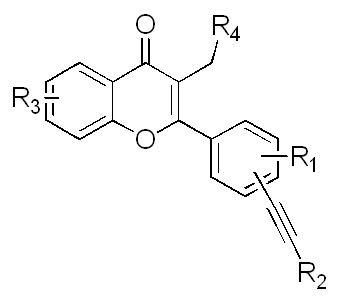
上記式中R1、R3、R4は置換基を有してよいアルキル基、ハロゲン、アシル基、ヒドロキシル基、アルコキシ基、アミノ基、ニトロ基、アミド基、シアノ基、リン酸若しくはそのエステル、スルホニル基、チオール、チオエーテル基、アリール基、又はヘテロ環を表し、R2は置換基を有してよいアルキル基、ハロゲン、アシル基、アルコキシ基、アミノ基、アミド基、シアノ基、リン酸若しくはそのエステル、スルホニル基、チオール、チオエーテル基、アリール基、又はヘテロ環を表す。またR1、R3は一つであっても、複数であってもよい。
以上、本発明によると、Hes1プロモーター阻害活性が強い一方、神経幹細胞に対して毒性のより低い神経幹細胞分化促進剤を提供することができる。
以下、本発明を実施するための形態について図面を用いて詳細に説明する。ただし、本発明は多くの異なる形態による実施が可能であって、以下に示す実施形態、実施例の記載にのみ限定されるわけではない。
本実施形態に係るHes1プロモーター阻害剤は、下記一般式に示される化合物を含む。
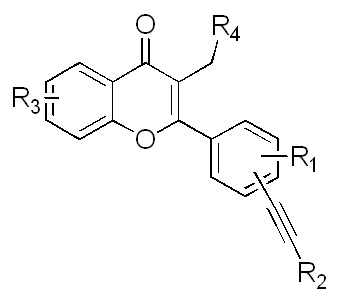
上記式中R1、R3、R4は置換基を有してよいアルキル基、ハロゲン、アシル基、ヒドロキシル基、アルコキシ基、アミノ基、ニトロ基、アミド基、シアノ基、リン酸若しくはそのエステル、スルホニル基、チオール、チオエーテル基、アリール基、又はヘテロ環を表し、R2は置換基を有してよいアルキル基、ハロゲン、アシル基、アルコキシ基、アミノ基、アミド基、シアノ基、リン酸若しくはそのエステル、スルホニル基、チオール、チオエーテル基、アリール基、又はヘテロ環を表す。またR1、R3は一つであっても、複数であってもよい。
なおここで「置換基」とは、アルキル基、ハロゲン、アシル基、ヒドロキシル基、アルコキシ基、アミノ基、ニトロ基、アミド基、シアノ基、リン酸若しくはそのエステル、スルホニル基、チオール、チオエーテル基、アリール基、又はヘテロ環をいうがこれに限定されない。
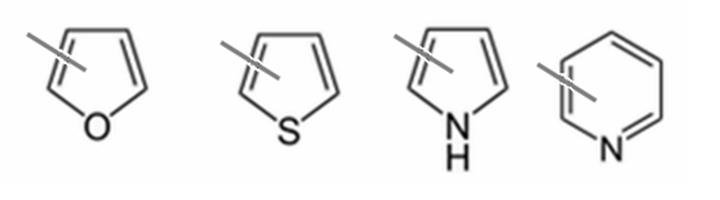
また、ここで「ヘテロ環」とは、2種以上の元素を含む環式の化合物であって、例えば下記の例で示すようなチオール環、オキソール環、アゾール環又はピリジン環をいう。もちろん、上記のとおり、ヘテロ環は置換基を有していてもよい。
また、上記一般式に示される化合物は、好ましくは、下記一般式に示される化合物を含む。
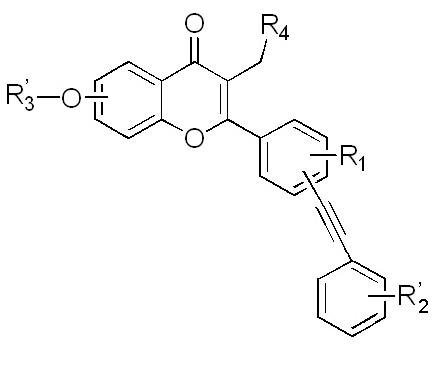
上記式中R1、は水素、ハロゲン、又は、置換基を有してよいアルキル基若しくはアルコキシ基を表し、R’2は水素、ハロゲン、又は、置換基を有してよいアルキル基素若しくはアルコキシ基を表し、R’3は水素、ハロゲン、又は、置換基を有してよいアルキル基素若しくはアルコキシ基を表し、R4は置換基を有してよいヘテロ環を表す。R1は一つであっても、複数であってもよい。
また、上記一般式に示される化合物は、より好ましくは、下記一般式に示される化合物を含む。
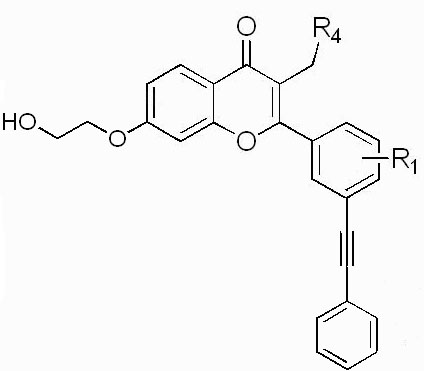
上記式中R1は1又は複数のアルコキシ基を表し、R4はアルキル基又はアルコキシル基を有してよいピリジン環を表す。
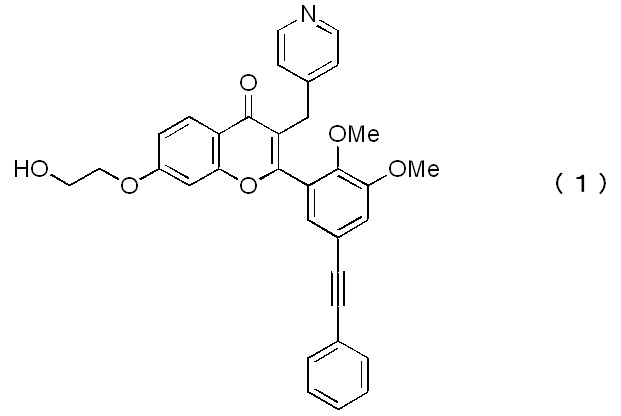
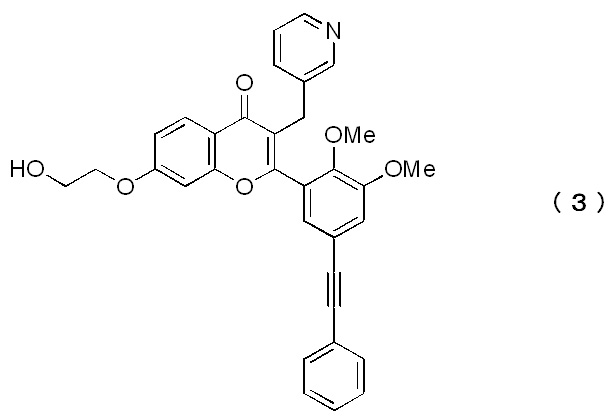
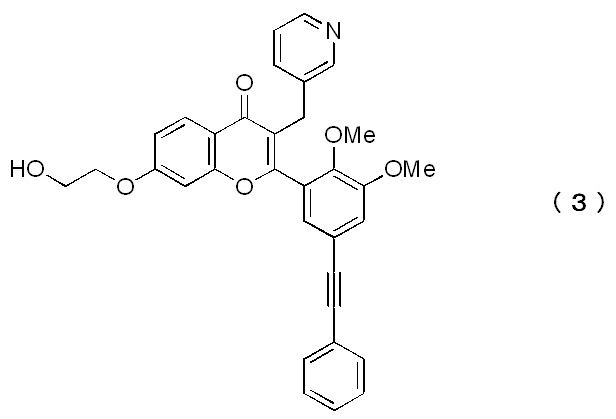
なお、上記式に示される化合物は、限定されるわけではないが、より具体的には、下記1乃至4で例示することができる。


本実施形態にかかる化合物は、Hes1プロモーター阻害剤が強い一方、神経幹細胞に対して公知の化合物より毒性がより低いものとなっており、認知症等の神経疾患の治療や予防に有用な薬剤となる。
薬剤として用いる場合、上記化合物のほか、薬学的に許容される通常の担体、結合剤、賦形剤、希釈剤(例えば蒸留水)、pH緩衝材(例えばリン酸緩衝生理食塩水)、崩壊剤、可溶化剤、溶解補助剤、等張剤等の各種調剤用配合剤成分を含有することができる。
また本実施形態に係るHes1プロモーター阻害剤は、その使用形態に応じて経口的に又は非経口的に投与することができるが、長期にわたるリハビリ等を考慮すると経口的であることが好ましく、脳溢血や脳梗塞等の発病段階では非経口的であることが好ましい。経口的な投与としては通常用いられる投与形態、例えば粉末、顆粒、錠剤、カプセル剤、液剤、懸濁液、油剤、乳化剤等の投与形態を採用することができる。非経口的な投与としては、通常用いられる投与形態、例えば上記の液剤、懸濁液等にしたものを点滴や注射により投与する形態、直接損傷部位に投与する形態等を採用することができる。
本実施形態に係るHes1プロモーター阻害剤の投与量は、患者の体重、性別、神経損傷の程度、投与の方法に応じて適宜選択されうるが、例えば非経口な投与であって、損傷部位に直接投与する場合、例えば成人1日、上記化合物を1mg以上100mg以下の範囲内で含む量であることが好ましく、より好ましくは有効成分を1mg以上20mg以下の範囲内で含む量である。なお、注射による投与の場合、非経口な投与であっても、有効成分が上記有効成分の量の10倍程度の範囲内にあることが好ましい。
本実施形態に係るHes1プロモーター阻害剤は、得られる限りにおいて限定されるわけではないが、合成によって作製することができる。上記化合物の合成は、例えば、まずヒドロキシアセトフェノン誘導体を出発物質として芳香族アルデヒドと塩基性条件下にてカルコン誘導体を合成し、更にこの化合物にヘテロ環アルデヒドを添加し、さらにPd触媒による薗頭-萩原カップリング、あるいは鈴木-宮浦カップリングにより置換基を導入することで作製することができる。これについては、例えば、Arai,M.A.,Sato,M.,Sawada,K.,Hosoya,T.,Ishibashi,M.,“Efficient Synthesis of Chromone and Flavonoid Derivatives with Diverse Heterocyclic Units” Chem.Asian J.,2008,3,2056-2064.)にある方法を参照することで製造できる。
以上、本実施形態によると、Hes1プロモーター阻害活性が強い一方、神経幹細胞に対して毒性のより低い神経幹細胞分化促進剤を提供することができる。
以下、上記実施形態に係る神経肝細胞分化促進剤について実際に作製を行い、その効果を確認した。以下に説明する。
(一般式で示される化合物の作製)
(4-メトキシフェニル)ジイソプロピルシリルプロピルポリスチレンに4’-hydroxyethoxy-2’-hydroxyacetophenone-4’-hydroxyethoxy-2’-hydroxyacetophenoneを担持させたビーズ100mg(0.78mmol/g)(担持の方法は、Arai,M.A.,Sato,M.,Sawada,K.,Hosoya,T.,Ishibashi,M.,“Efficient Synthesis of Chromone and Flavonoid Derivatives with Diverse Heterocyclic Units” Chem.Asian J.,2008,3,2056-2064にある方法に従うことでできる)をKOH(26mg)存在下、EtOH(2ml)中、種々の芳香族アルデヒド(3当量)と40℃で24-50時間攪拌し、対応するカルコン誘導体担持ビーズを得た。次に、この得られたビーズ50mgに対し、対応するヘテロ環アルデヒド(20当量)と60℃で72時間攪拌し、対応するフラボノイド誘導体担持ビーズを得た。次に、この得られたビーズ20mgに対し、Pd(OAc)2(1当量)、トリフェニルホスフィン(2当量)、ピロリジン(30当量)存在下、対応するアセチレン化合物(20当量)を加え、DMF(1ml)中、60℃で24時間攪拌し、対応する薗頭-萩原カップリングによるフラボノイド誘導体担持ビーズを得た。一方、鈴木-宮浦カップリングでは、ビーズ20mgに対し、tris(dibendylideneacetone)dipalladium(0)(1当量)、NaOMe(15当量)を加え、THF/H2O(10/1,1 ml)中、対応するボラン化合物(15当量)と反応させ、60℃で48時間攪拌し、対応する鈴木-宮浦カップリングによるフラボノイド誘導体担持ビーズを得た。ビーズからの切り出しは、5%HF・PyのTHF溶媒中、室温、1時間で行い、一般式で示される化合物を得た。
(4-メトキシフェニル)ジイソプロピルシリルプロピルポリスチレンに4’-hydroxyethoxy-2’-hydroxyacetophenone-4’-hydroxyethoxy-2’-hydroxyacetophenoneを担持させたビーズ100mg(0.78mmol/g)(担持の方法は、Arai,M.A.,Sato,M.,Sawada,K.,Hosoya,T.,Ishibashi,M.,“Efficient Synthesis of Chromone and Flavonoid Derivatives with Diverse Heterocyclic Units” Chem.Asian J.,2008,3,2056-2064にある方法に従うことでできる)をKOH(26mg)存在下、EtOH(2ml)中、種々の芳香族アルデヒド(3当量)と40℃で24-50時間攪拌し、対応するカルコン誘導体担持ビーズを得た。次に、この得られたビーズ50mgに対し、対応するヘテロ環アルデヒド(20当量)と60℃で72時間攪拌し、対応するフラボノイド誘導体担持ビーズを得た。次に、この得られたビーズ20mgに対し、Pd(OAc)2(1当量)、トリフェニルホスフィン(2当量)、ピロリジン(30当量)存在下、対応するアセチレン化合物(20当量)を加え、DMF(1ml)中、60℃で24時間攪拌し、対応する薗頭-萩原カップリングによるフラボノイド誘導体担持ビーズを得た。一方、鈴木-宮浦カップリングでは、ビーズ20mgに対し、tris(dibendylideneacetone)dipalladium(0)(1当量)、NaOMe(15当量)を加え、THF/H2O(10/1,1 ml)中、対応するボラン化合物(15当量)と反応させ、60℃で48時間攪拌し、対応する鈴木-宮浦カップリングによるフラボノイド誘導体担持ビーズを得た。ビーズからの切り出しは、5%HF・PyのTHF溶媒中、室温、1時間で行い、一般式で示される化合物を得た。
(化合物(1)の作製)
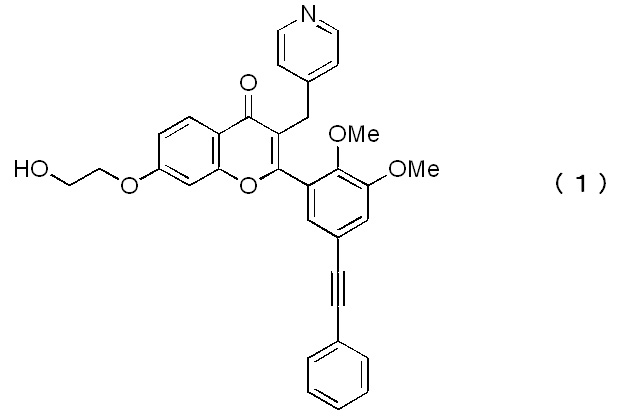
(4-メトキシフェニル)ジイソプロピルシリルプロピルポリスチレンに4’-hydroxyethoxy-2’-hydroxyacetophenoneを担持させたビーズ100mg(0.78mmol/g)KOH(26mg)存在下、EtOH(2ml)中、5-bromo-2,3-dimethoxycarboxyaldehyde(57mg)と40℃で30時間攪拌し、カルコン誘導体担持ビーズを得た。次に、この得られたビーズ50mgに対し、4-pyridinecarboxyaldehyde(73μL)と60℃で72時間攪拌し、フラボノイド誘導体担持ビーズを得た。次に、この得られたビーズ20mgに対し、Pd(OAc)2(4mg)、トリフェニルホスフィン(8 mg)、ピロリジン(39μL)存在下、phenylacetylene(34μL)を加え、DMF(1ml)中、60℃で24時間攪拌し、対応する薗頭-萩原カップリングによるフラボノイド誘導体担持ビーズを得た。ビーズからの切り出しは、5%HF・PyのTHF溶媒中、室温、1時間で行い、下記式(1)で示される化合物(4.4mg)を得た。

(4-メトキシフェニル)ジイソプロピルシリルプロピルポリスチレンに4’-hydroxyethoxy-2’-hydroxyacetophenoneを担持させたビーズ100mg(0.78mmol/g)KOH(26mg)存在下、EtOH(2ml)中、5-bromo-2,3-dimethoxycarboxyaldehyde(57mg)と40℃で30時間攪拌し、カルコン誘導体担持ビーズを得た。次に、この得られたビーズ50mgに対し、4-pyridinecarboxyaldehyde(73μL)と60℃で72時間攪拌し、フラボノイド誘導体担持ビーズを得た。次に、この得られたビーズ20mgに対し、Pd(OAc)2(4mg)、トリフェニルホスフィン(8 mg)、ピロリジン(39μL)存在下、phenylacetylene(34μL)を加え、DMF(1ml)中、60℃で24時間攪拌し、対応する薗頭-萩原カップリングによるフラボノイド誘導体担持ビーズを得た。ビーズからの切り出しは、5%HF・PyのTHF溶媒中、室温、1時間で行い、下記式(1)で示される化合物(4.4mg)を得た。
1H-NMR(500MHz,CDCl3):δ7.76(d,J=8.2Hz,1H),7.54-7.52(m,3H),7.46(dt,J=7.3,2.0Hz,2H),7.33-7.28(m,5H),7.21(d,J=1.9Hz,1H),6.85(dd,J=8.2,2.0Hz,1H),6.45(d,J=2.0Hz,1H),4.10(t,J=4.1Hz,2H),4.00(br s,2H),3.97(t,J=4.1Hz,2H),3.72(s,3H),3.64(s,3H).
13C-NMR(125MHz,CDCl3):δ179.0,162.8,159.3,156.1,134.9,134.5,132.2,132.1,132.0,131.6,131.4,131.0,130.9,130.4,130.0,128.6,128.5,128.4,122.8,113.3,107.6,100.8,61.1,55.9,37.1,31.9,29.4,22.7,14.1.
ESI-HRMS[M+H]+:calcd for C33H28NO6 534.1917,found 534.1962.
(化合物(2)の作製)
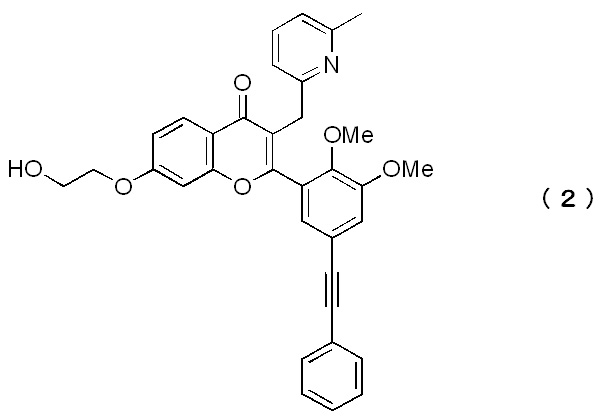
(4-メトキシフェニル)ジイソプロピルシリルプロピルポリスチレンに4’-hydroxyethoxy-2’-hydroxyacetophenoneを担持させたビーズ100mg(0.78mmol/g)KOH(26mg)存在下、EtOH(2ml)中、5-bromo-2,3-dimethoxycarboxyaldehyde(57mg)と40℃で30時間攪拌し、カルコン誘導体担持ビーズを得た。次に、この得られたビーズ50mgに対し、6-methyl-2-pyridinecarboxyaldehyde(94mg)と60℃で72時間攪拌し、フラボノイド誘導体担持ビーズを得た。次に、この得られたビーズ20mgに対し、Pd(OAc)2(4mg)、トリフェニルホスフィン(8mg)、ピロリジン(39μL)存在下、phenylacetylene(34μL)を加え、DMF(1ml)中、60℃で24時間攪拌し、対応する薗頭-萩原カップリングによるフラボノイド誘導体担持ビーズを得た。ビーズからの切り出しは、5%HF・PyのTHF溶媒中、室温、1時間で行い、下記式(2)で示される化合物(5.7mg)を得た。

(4-メトキシフェニル)ジイソプロピルシリルプロピルポリスチレンに4’-hydroxyethoxy-2’-hydroxyacetophenoneを担持させたビーズ100mg(0.78mmol/g)KOH(26mg)存在下、EtOH(2ml)中、5-bromo-2,3-dimethoxycarboxyaldehyde(57mg)と40℃で30時間攪拌し、カルコン誘導体担持ビーズを得た。次に、この得られたビーズ50mgに対し、6-methyl-2-pyridinecarboxyaldehyde(94mg)と60℃で72時間攪拌し、フラボノイド誘導体担持ビーズを得た。次に、この得られたビーズ20mgに対し、Pd(OAc)2(4mg)、トリフェニルホスフィン(8mg)、ピロリジン(39μL)存在下、phenylacetylene(34μL)を加え、DMF(1ml)中、60℃で24時間攪拌し、対応する薗頭-萩原カップリングによるフラボノイド誘導体担持ビーズを得た。ビーズからの切り出しは、5%HF・PyのTHF溶媒中、室温、1時間で行い、下記式(2)で示される化合物(5.7mg)を得た。
1H-NMR(400MHz,CDCl3):δ8.15(d,J=8.8Hz,1H),7.48(dd,J=7.0,2.2Hz,2H),7.41(t,J=7.6Hz,1H),7.35-7.33(m,4H),7.18(d,J=1.8Hz,1H),7.03(d,J=7.6Hz,1H),6.99(dd,J=8.8,2.4Hz,1H),6.89(d,J=7.6Hz,1H),6.85(d,J=2.4Hz,1H),4.15(t,J=4.2Hz,2H),4.01(t,J=4.2Hz,2H),3.93(s,3H),3.82(s,3H),2.46(s,3H).
13C-NMR(100MHz,CDCl3):δ173.8,163.0,160.8,158.8,157.4,152.5,149.7,136.5,134.7,131.5,131.4,128.4,127.5,127.3,126.4,121.0,120.5,119.6,119.0,118.7,117.4,117.1,114.5,100.7,69.8,61.4,61.0,56.0,34.2,29.7,24.4,24.3.
ESI-HRMS[M+H]+:calcd for C34H30NO6 548.2073,found 548.2086.
(化合物(3)の作製)
(4-メトキシフェニル)ジイソプロピルシリルプロピルポリスチレンに4’-hydroxyethoxy-2’-hydroxyacetophenoneを担持させたビーズ100mg(0.78mmol/g)KOH(26mg)存在下、EtOH(2ml)中、5-bromo-2,3-dimethoxycarboxyaldehyde(57mg)と40℃で30時間攪拌し、カルコン誘導体担持ビーズを得た。次に、この得られたビーズ50mgに対し、3-pyridinecarboxyaldehyde(73μL)と60℃で72時間攪拌し、フラボノイド誘導体担持ビーズを得た。次に、この得られたビーズ20mgに対し、Pd(OAc)2(4mg)、トリフェニルホスフィン(8mg)、ピロリジン(39μL)存在下、phenylacetylene(34μL)を加え、DMF(1ml)中、60℃で24時間攪拌し、対応する薗頭-萩原カップリングによるフラボノイド誘導体担持ビーズを得た。ビーズからの切り出しは、5%HF・PyのTHF溶媒中、室温、1時間で行い、下記式(3)で示される化合物(5.0mg)を得た。
(4-メトキシフェニル)ジイソプロピルシリルプロピルポリスチレンに4’-hydroxyethoxy-2’-hydroxyacetophenoneを担持させたビーズ100mg(0.78mmol/g)KOH(26mg)存在下、EtOH(2ml)中、5-bromo-2,3-dimethoxycarboxyaldehyde(57mg)と40℃で30時間攪拌し、カルコン誘導体担持ビーズを得た。次に、この得られたビーズ50mgに対し、3-pyridinecarboxyaldehyde(73μL)と60℃で72時間攪拌し、フラボノイド誘導体担持ビーズを得た。次に、この得られたビーズ20mgに対し、Pd(OAc)2(4mg)、トリフェニルホスフィン(8mg)、ピロリジン(39μL)存在下、phenylacetylene(34μL)を加え、DMF(1ml)中、60℃で24時間攪拌し、対応する薗頭-萩原カップリングによるフラボノイド誘導体担持ビーズを得た。ビーズからの切り出しは、5%HF・PyのTHF溶媒中、室温、1時間で行い、下記式(3)で示される化合物(5.0mg)を得た。
1H-NMR(500MHz,CDCl3):δ7.76(d,J=8.2Hz,1H),7.54-7.52(m,3H),7.46(dt,J=7.3,2.0Hz,2H),7.33-7.28(m,5H),7.21(d,J=1.9Hz,1H),6.85(dd,J=8.2,2.0Hz,1H),6.45(d,J=2.0Hz,1H),4.10(t,J=4.1Hz,2H),4.00(br s,2H),3.97(t,J=4.1Hz,2H),3.72(s,3H),3.64(s,3H).
13C-NMR(125MHz,CDCl3):δ179.0,162.8,159.3,156.1,134.9,134.5,132.2,132.1,132.0,131.6,131.4,131.0,130.9,130.4,130.0,128.6,128.5,128.4,122.8,113.3,107.6,100.8,61.1,55.9,37.1,31.9,29.4,22.7,14.1.
ESI-HRMS[M+H]+:calcd for C33H28NO6 534.1917,found 534.1962.
(化合物(4)の作製)
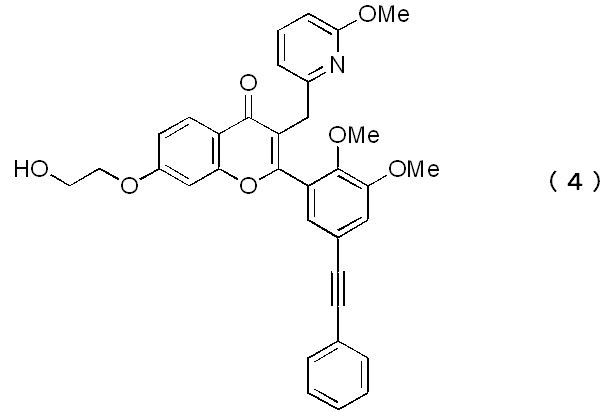
(4-メトキシフェニル)ジイソプロピルシリルプロピルポリスチレンに4’-hydroxyethoxy-2’-hydroxyacetophenoneを担持させたビーズ100mg(0.78mmol/g)KOH(26mg)存在下、EtOH(2ml)中、5-bromo-2,3-dimethoxycarboxyaldehyde(57mg)と40℃で30時間攪拌し、カルコン誘導体担持ビーズを得た。次に、この得られたビーズ50mgに対し、6-methoxy-2-pyridinecarboxyaldehyde(94μL)と60℃で72時間攪拌し、フラボノイド誘導体担持ビーズを得た。次に、この得られたビーズ20mgに対し、Pd(OAc)2(4mg)、トリフェニルホスフィン(8mg)、ピロリジン(39μL)存在下、phenylacetylene(34μL)を加え、DMF(1ml)中、60℃で24時間攪拌し、対応する薗頭-萩原カップリングによるフラボノイド誘導体担持ビーズを得た。ビーズからの切り出しは、5%HF・PyのTHF溶媒中、室温、1時間で行い、下記式(4)で示される化合物(4.2mg)を得た。

(4-メトキシフェニル)ジイソプロピルシリルプロピルポリスチレンに4’-hydroxyethoxy-2’-hydroxyacetophenoneを担持させたビーズ100mg(0.78mmol/g)KOH(26mg)存在下、EtOH(2ml)中、5-bromo-2,3-dimethoxycarboxyaldehyde(57mg)と40℃で30時間攪拌し、カルコン誘導体担持ビーズを得た。次に、この得られたビーズ50mgに対し、6-methoxy-2-pyridinecarboxyaldehyde(94μL)と60℃で72時間攪拌し、フラボノイド誘導体担持ビーズを得た。次に、この得られたビーズ20mgに対し、Pd(OAc)2(4mg)、トリフェニルホスフィン(8mg)、ピロリジン(39μL)存在下、phenylacetylene(34μL)を加え、DMF(1ml)中、60℃で24時間攪拌し、対応する薗頭-萩原カップリングによるフラボノイド誘導体担持ビーズを得た。ビーズからの切り出しは、5%HF・PyのTHF溶媒中、室温、1時間で行い、下記式(4)で示される化合物(4.2mg)を得た。
1H-NMR(400MHz,CDCl3):δ8.14(dd,J=8.3,2.2Hz,1H),7.95(d,J=9.0Hz,1H),7.55-7.43(m,4H),7.35-7.28(m,4H),6.86(d,J=2.1Hz,1H),6.47(dd,J=9.0,2.3Hz,1H),6.35(d,J=2.3Hz,1H),4.20(t,J=4.4Hz,2H),4.01(t,J=4.4Hz,2H),3.95(s,2H),3.92(s,3H),3.86(s,3H),3.78(s,3H).
13C-NMR(125MHz,CDCl3):δ180.6,163.5,162.4,157.9,148.3,141.3,134.3,134.2,132.2,132.0,131.9,131.4,131.0,130.8,130.4,129.6,128.8,128.6,128.3,128.0,127.8,126.6,123.0,102.3,69.9,69.4,63.4,60.6,55.8,50.1,29.6,22.6.
ESI-HRMS[M+H]+:calcd for C34H30NO7 564.2022,found 564.2026.
(化合物(5)の作製:比較例)
(4-メトキシフェニル)ジイソプロピルシリルプロピルポリスチレンに4’-hydroxyethoxy-2’-hydroxyacetophenoneを担持させたビーズ100mg(0.78mmol/g)をKOH(26mg)存在下、EtOH(2ml)中、4-bromobenzaldehyde(43mg)と40℃で30時間攪拌し、対応するカルコン誘導体担持ビーズを得た。次に、この得られたビーズ50mgに対し、2-bromo-3-pyridinecarboxyaldehyde(145mg)と60℃で72時間攪拌し、対応するフラボノイド誘導体担持ビーズを得た。次に、得られたビーズ20mgに対し、tris(dibendylideneacetone)dipalladium(0)(14mg)、NaOMe(13mg)を加え、THF/H2O(10/1,1ml)中、phenylboronic acid(29mg)と反応させ、60℃で48時間攪拌し、対応する鈴木-宮浦カップリングによるフラボノイド誘導体担持ビーズを得た。ビーズからの切り出しは、5%HF・PyのTHF溶媒中、室温、1時間で行い、下記式(5)で示される化合物を得た。

(4-メトキシフェニル)ジイソプロピルシリルプロピルポリスチレンに4’-hydroxyethoxy-2’-hydroxyacetophenoneを担持させたビーズ100mg(0.78mmol/g)をKOH(26mg)存在下、EtOH(2ml)中、4-bromobenzaldehyde(43mg)と40℃で30時間攪拌し、対応するカルコン誘導体担持ビーズを得た。次に、この得られたビーズ50mgに対し、2-bromo-3-pyridinecarboxyaldehyde(145mg)と60℃で72時間攪拌し、対応するフラボノイド誘導体担持ビーズを得た。次に、得られたビーズ20mgに対し、tris(dibendylideneacetone)dipalladium(0)(14mg)、NaOMe(13mg)を加え、THF/H2O(10/1,1ml)中、phenylboronic acid(29mg)と反応させ、60℃で48時間攪拌し、対応する鈴木-宮浦カップリングによるフラボノイド誘導体担持ビーズを得た。ビーズからの切り出しは、5%HF・PyのTHF溶媒中、室温、1時間で行い、下記式(5)で示される化合物を得た。
IR(ATR):3420,2926,1624,1507,1488,1441,1386,1249,1177,1077,844,765,699cm-1.
1H-NMR(400MHz,CDCl3):δ3.68(s,2H),3.96(t,J=4.6Hz,2H),4.10(t,J=4.6Hz,2H),6.73(d,J=2.2Hz,1H),6.91-6.94(m,2H),6.98(dd,J=8.9,2.2Hz,1H),7.02(d,J=7.5Hz,2H),7.11(d,J=7.5Hz,2H),7.12-7.13(m,2H),7.31-7.40(m,6H),7.53(t,J=8.6Hz,1H),8.08(d,J=8.9Hz,1H),8.32-8.34(m,1H),8.68(dd,J=8.6,1.8Hz,1H).
13C-NMR(100MHz,CDCl3):δ173.9,165.3,163.0,157.8,157.5,154.5,146.9,143.3,135.8,132.1,132.0,131.9,128.9,128.7,128.5,128.4,127.2,127.1,127.0,126.9,126.8,122.4,100.7,100.2,69.8,61.0,29.7.
(化合物(6)の作製:比較例)
(4-メトキシフェニル)ジイソプロピルシリルプロピルポリスチレンに4’-hydroxyethoxy-2’-hydroxyacetophenoneを担持させたビーズ100mg(0.78mmol/g)をKOH(26mg)存在下、EtOH(2ml)中、4-benzoxybenzaldehyde(50mg)と40℃で30時間攪拌し、対応するカルコン誘導体担持ビーズを得た。次に、この得られたビーズ50mgに対し、2-bromo-3-pyridinecarboxyaldehyde(145mg)と60℃で72時間攪拌し、対応するフラボノイド誘導体担持ビーズを得た。ビーズからの切り出しは、5%HF・PyのTHF溶媒中、室温、1時間で行い、下記式(6)で示される化合物を得た。

(4-メトキシフェニル)ジイソプロピルシリルプロピルポリスチレンに4’-hydroxyethoxy-2’-hydroxyacetophenoneを担持させたビーズ100mg(0.78mmol/g)をKOH(26mg)存在下、EtOH(2ml)中、4-benzoxybenzaldehyde(50mg)と40℃で30時間攪拌し、対応するカルコン誘導体担持ビーズを得た。次に、この得られたビーズ50mgに対し、2-bromo-3-pyridinecarboxyaldehyde(145mg)と60℃で72時間攪拌し、対応するフラボノイド誘導体担持ビーズを得た。ビーズからの切り出しは、5%HF・PyのTHF溶媒中、室温、1時間で行い、下記式(6)で示される化合物を得た。
1H-NMR(400MHz,CDCl3):δ8.22(d,J=4.7Hz,1H),8.15(d,J=8.9Hz,1H),7.45-7.35(m,8H),7.17(dd,J=7.6,4.7Hz,1H),7.05-7.01(m,3H),6.93(d,J=2.0Hz,1H),5.12(s,2H),4.20(t,J=4.7Hz,2H),4.05(br s,2H),3.99(s,2H).
13C-NMR(100MHz,CDCl3):δ177.4,163.2,160.6,157.8,147.5,144.2,137.3,136.7,136.2,129.8,128.7,128.2,127.5,127.4,125.1,122.9,116.9,116.8,115.0,114.9,100.7,70.1,69.9,61.1,32.0.
ESI-HRMS[M+Na]+:calcd for C30H24
79BrNO5Na 580.0736,found 580.0740.
(アッセイの準備)
本実施例において、Hes1発現阻害は、マウスHes1プロモーター部を有するルシフェラーゼレポータージーンを用いるアッセイにて評価した。
本実施例において、Hes1発現阻害は、マウスHes1プロモーター部を有するルシフェラーゼレポータージーンを用いるアッセイにて評価した。
Hes1プロモーター部を有するルシフェラーゼレポータージーンを安定発現する細胞(C3H10T1/2を用いて発明者が作成)を50μL/well(1×105cells/mL)ずつ96-well white plateに播種し、18時間培養(37℃、5%CO2)した。培地を取り除き、それぞれの濃度に希釈した化合物溶液を作成し、50μLずつ加えた。24時間インキュベーションし、ルシフェラーゼ活性の測定を行った。ルシフェラーゼ活性の測定は、以下のように行った。培地を取り除き、50μLの1×Glo Lysis Buffer(Promega)を加え、室温にて30分間振とうした。細胞が溶解した後、30μLのBright-GloTM Luciferase Assay System(Promega)のluciferinを添加し、Luminoskan Ascent(Thermo)を用いて化学発光量を測定し、Hes1 promoter活性を評価した。
また本実施例では、同時に、細胞毒性試験(FMCA)も行い、細胞の生存率を調べた。1×10⁵ cells/mLの細胞を50μL/wellずつ96-well black plate播種し、18時間培養(37℃、5%CO2)した。ルシフェラーゼ活性用のサンプル添加と同時に、同じ濃度のテストサンプルを加え、24時間作用させた後、fluorometric microculture cytotoxicity assay(FMCA)の手法を用いてFluoroskan ascent(Thermo)にてその蛍光量を測定し(Ex:485nm、Em:538nm)、細胞生存率を評価した。
それぞれの活性評価は、サンプルを添加していないコントロールの値を100%とし、テストサンプル群の値の変化を割合で計算し、ルシフェラーゼ活性ではHes1プロモーター活性を、FMCAでは細胞生存率を算出した。
そしてこのアッセイを用いて、上記化合物(1)乃至(6)についてその効果を確認した。この結果を図1に示す。図中、棒グラフはルシフェラーゼ活性を、折れ線グラフは、アッセイ細胞(C3H10T1/2)の生存率を表す。また図中「co」はコントロールを意味する。
この結果、化合物のHes1発現阻害作用のIC50は、化合物(1)において21μM、化合物(2)において46μM、化合物(3)において29μM、化合物(4)において25μMであることが確認でき、Hes1発現阻害を確認した。一方、上記化合物(5)については、IC50が>50μMであり、Hes1発現阻害作用が低かった。
また一方、化合物のマウス神経幹細胞に対する毒性は、CellTiter-GloTM Luminescent Cell Viability Assay(Promega)を用い、生存細胞のATP量を指標に比較した。化合物を24時間作用させた後のマウス神経幹細胞の生存率は、化合物濃度20μMにおいて、化合物(1)では77%、化合物(2)では83%、化合物(3)では77%、化合物(4)では88%であり、一方、化合物(6)においては2%であり、化合物濃度50μMにおいても、化合物(1)~(4)において生存率は60%以上であったが、一方、化合物(6)においては0.7%とほぼ死滅した。本実施形態に係る化合物の神経幹細胞の毒性が低いことが確認できた。
以上、本実施例により、Hes1プロモーター阻害活性が強い一方、神経幹細胞に対して毒性のより低いHes1プロモーター阻害剤となっていることを確認した。
本発明は、Hes1プロモーター阻害剤、神経幹細胞分化促進剤のリード化合物として産業上の利用可能性がある。
Claims (6)
- 下記一般式に示される化合物又はその誘導体を含むHes1プロモーター阻害剤。
- 下記一般式に示される化合物又はその誘導体を含むHes1プロモーター阻害剤。
- 下記式(1)に示される化合物又はその誘導体を含むHes1プロモーター阻害剤。
- 下記式(2)に示される化合物又はその誘導体を含むHes1プロモーター阻害剤。
- 下記式(3)に示される化合物又はその誘導体を含むHes1プロモーター阻害剤。

- 下記式(4)に示される化合物又はその誘導体を含むHes1プロモーター阻害剤。
Priority Applications (1)
| Application Number | Priority Date | Filing Date | Title |
|---|---|---|---|
| JP2012526493A JPWO2012014848A1 (ja) | 2010-07-26 | 2011-07-25 | フラボノイド由来Hes1プロモーター阻害剤 |
Applications Claiming Priority (2)
| Application Number | Priority Date | Filing Date | Title |
|---|---|---|---|
| JP2010-167577 | 2010-07-26 | ||
| JP2010167577 | 2010-07-26 |
Publications (1)
| Publication Number | Publication Date |
|---|---|
| WO2012014848A1 true WO2012014848A1 (ja) | 2012-02-02 |
Family
ID=45530056
Family Applications (1)
| Application Number | Title | Priority Date | Filing Date |
|---|---|---|---|
| PCT/JP2011/066866 Ceased WO2012014848A1 (ja) | 2010-07-26 | 2011-07-25 | フラボノイド由来Hes1プロモーター阻害剤 |
Country Status (2)
| Country | Link |
|---|---|
| JP (1) | JPWO2012014848A1 (ja) |
| WO (1) | WO2012014848A1 (ja) |
Citations (1)
| Publication number | Priority date | Publication date | Assignee | Title |
|---|---|---|---|---|
| JP2009057306A (ja) * | 2007-08-30 | 2009-03-19 | Chiba Univ | フラボノイドの製造方法 |
-
2011
- 2011-07-25 WO PCT/JP2011/066866 patent/WO2012014848A1/ja not_active Ceased
- 2011-07-25 JP JP2012526493A patent/JPWO2012014848A1/ja not_active Withdrawn
Patent Citations (1)
| Publication number | Priority date | Publication date | Assignee | Title |
|---|---|---|---|---|
| JP2009057306A (ja) * | 2007-08-30 | 2009-03-19 | Chiba Univ | フラボノイドの製造方法 |
Non-Patent Citations (5)
| Title |
|---|
| ARAI, M. A. ET AL.: "Approaches to Neural Stem Cells and Cancer Cells Based on Natural Products", CHEMICAL & PHARMACEUTICAL BULLETIN, vol. 59, no. 4, April 2011 (2011-04-01), pages 417 - 426 * |
| ARAI, M. A. ET AL.: "Efficient Synthesis of Chromone and Flavonoid Derivatives with Diverse Heterocyclic Units", CHEMISTRY. ASIAN JOURNAL, vol. 3, 2008, pages 2056 - 2064 * |
| ARAI, M. A. ET AL.: "The first Hes1 dimer inhibitors from natural products", BIOORGANIC & MEDICINAL CHEMISTRY LETTERS, vol. 19, 2009, pages 5778 - 5781, XP026624085, DOI: doi:10.1016/j.bmcl.2009.07.146 * |
| KATAKURA, M. ET AL.: "Docosahexaenoic acid promotes neuronal differentiation by regulating basic helix-loop-helix transcription factors and cell cycle in neural stem cells", NEUROSCIENCE, vol. 160, 2009, pages 651 - 660, XP026053855, DOI: doi:10.1016/j.neuroscience.2009.02.057 * |
| MIDORI ARAI: "Tennenbutsu-yo Kagobutsu o Jiku to shita Shinkei Kansaibo, Gan Saibo eno Approach", ABSTRACTS OF 130TH ANNUAL MEETING OF PHARMACEUTICAL SOCIETY OF JAPAN, 5 March 2010 (2010-03-05), pages 56 * |
Also Published As
| Publication number | Publication date |
|---|---|
| JPWO2012014848A1 (ja) | 2013-09-12 |
Similar Documents
| Publication | Publication Date | Title |
|---|---|---|
| KR102575246B1 (ko) | 페닐-2-히드록시-아세틸아미노-2-메틸-페닐 화합물 | |
| CA3004372C (en) | Pyrimidine derivative and use thereof | |
| JP2019503395A (ja) | ピロロピリミジン5員環アザ環状誘導体およびその利用 | |
| JP6130071B2 (ja) | 1,7−ナフチリジン誘導体 | |
| EP3398598B1 (en) | Sulfonamide derivative and preparation method and use thereof | |
| CN113801073B (zh) | 14-氯-β-榄香烯一氧化氮供体型衍生物及其制备和应用 | |
| JP6967632B2 (ja) | ヒストンデメチラーゼ阻害剤 | |
| RU2644558C2 (ru) | Гетероарильные соединения и способы их применения | |
| CN101243073A (zh) | 5-ht1a受体的哌嗪-哌啶拮抗剂与激动剂 | |
| Marin et al. | Antiplasmodial structure–activity relationship of 3-trifluoromethyl-2-arylcarbonylquinoxaline 1, 4-di-N-oxide derivatives | |
| JP2022065012A (ja) | D-アミノ酸オキシダーゼ(daao)阻害剤としての新規な置換ベンゾイミダゾール誘導体 | |
| CN107573327B (zh) | 吲唑-甲酰胺-吡啶酮衍生物及其制备方法和用途 | |
| CN104016956A (zh) | 5,2′,4′-三羟基-7-甲基-3-烃基黄酮类似物及其制备方法和应用 | |
| WO2014127722A1 (zh) | 氮杂环取代二氢青蒿素衍生物及其应用 | |
| CN110088108B (zh) | 取代的吡唑并氮杂䓬-4-酮类及其作为磷酸二酯酶抑制剂的用途 | |
| Najahi et al. | Amino derivatives of indolone-N-oxide: Preparation and antiplasmodial properties | |
| JP6229056B2 (ja) | 神経変性疾患の処置用の神経新生薬としてのピリド[4,3−b]ピラジン−2−カルボキサミド | |
| JP2011519966A (ja) | 新規なn−(2−アミノ−フェニル)−アクリルアミド | |
| CN115636809A (zh) | 一种查尔酮类衍生物的合成及其制药应用 | |
| WO2012014848A1 (ja) | フラボノイド由来Hes1プロモーター阻害剤 | |
| RU2538982C1 (ru) | Производное n-(1s)-1',2',3'-триметокси-6,7-дигидро-1н-бензо[5',6':5,4]циклогепта-[3,2-f]бензофуран-1-ил)ацетамида и его применение | |
| US9381260B2 (en) | Hypoxia inducible factor-1 pathway inhibitors and uses as anticancer and imaging agents | |
| CN105949180A (zh) | 治疗中枢神经系统退行性疾病的化合物及其应用 | |
| JP2015503570A (ja) | 嘔吐反応を防止することができるホスホジエステラーゼ4阻害剤 | |
| JP5457638B2 (ja) | 環状過酸化物誘導体 |
Legal Events
| Date | Code | Title | Description |
|---|---|---|---|
| 121 | Ep: the epo has been informed by wipo that ep was designated in this application |
Ref document number: 11812437 Country of ref document: EP Kind code of ref document: A1 |
|
| WWE | Wipo information: entry into national phase |
Ref document number: 2012526493 Country of ref document: JP |
|
| NENP | Non-entry into the national phase |
Ref country code: DE |
|
| 122 | Ep: pct application non-entry in european phase |
Ref document number: 11812437 Country of ref document: EP Kind code of ref document: A1 |