WO2011125848A1 - リポソーム製剤の製造方法 - Google Patents
リポソーム製剤の製造方法 Download PDFInfo
- Publication number
- WO2011125848A1 WO2011125848A1 PCT/JP2011/058238 JP2011058238W WO2011125848A1 WO 2011125848 A1 WO2011125848 A1 WO 2011125848A1 JP 2011058238 W JP2011058238 W JP 2011058238W WO 2011125848 A1 WO2011125848 A1 WO 2011125848A1
- Authority
- WO
- WIPO (PCT)
- Prior art keywords
- liposome
- solution
- liposome preparation
- drug
- gradient
- Prior art date
- Legal status (The legal status is an assumption and is not a legal conclusion. Google has not performed a legal analysis and makes no representation as to the accuracy of the status listed.)
- Ceased
Links
Images







Classifications
-
- A—HUMAN NECESSITIES
- A61—MEDICAL OR VETERINARY SCIENCE; HYGIENE
- A61K—PREPARATIONS FOR MEDICAL, DENTAL OR TOILETRY PURPOSES
- A61K9/00—Medicinal preparations characterised by special physical form
- A61K9/10—Dispersions; Emulsions
- A61K9/127—Synthetic bilayered vehicles, e.g. liposomes or liposomes with cholesterol as the only non-phosphatidyl surfactant
- A61K9/1277—Preparation processes; Proliposomes
- A61K9/1278—Post-loading, e.g. by ion or pH gradient
-
- A—HUMAN NECESSITIES
- A61—MEDICAL OR VETERINARY SCIENCE; HYGIENE
- A61K—PREPARATIONS FOR MEDICAL, DENTAL OR TOILETRY PURPOSES
- A61K9/00—Medicinal preparations characterised by special physical form
- A61K9/10—Dispersions; Emulsions
- A61K9/127—Synthetic bilayered vehicles, e.g. liposomes or liposomes with cholesterol as the only non-phosphatidyl surfactant
- A61K9/1271—Non-conventional liposomes, e.g. PEGylated liposomes or liposomes coated or grafted with polymers
Definitions
- the present invention relates to a method for producing a liposome preparation useful for a drug delivery system, and relates to a production method capable of managing production conditions without extracting and analyzing a solution containing liposomes from the production system.
- DDS Drug Delivery System
- One typical DDS formulation is a liposome formulation.
- Liposomes used in liposome preparations are divided into the interior and exterior of liposomes using lipid bilayers as partition walls, as in living cells. Utilizing such a structure, the water-soluble drug is divided into the inside of the liposome, and the fat-soluble drug is divided into the inside and outside of the liposome by using a lipid bilayer as a partition wall, like a living cell.
- water-soluble drugs are embedded in liposomes, and fat-soluble drugs are mainly embedded in lipid bilayers, delivering drugs directly to specific accumulation sites such as inflammation sites.
- the liposome production process mainly includes a process of forming liposomes, a process of regulating liposomes to a certain particle size, a process of removing unnecessary components outside the liposomes, and a process of sterilization by means such as filtration sterilization.
- the unnecessary component is not sufficiently removed in the step of removing the unnecessary component outside the liposome, the unnecessary component existing outside the liposome may be affected when the drug is introduced into the liposome.
- the step of removing unnecessary components outside the liposome is a liposome preparation regardless of its production scale. This is an essential process for manufacturing.
- various components may be applicable, and also vary depending on the liposome production method.
- the drug and the components of the liposome are mixed in the liposome formation step to form the liposome, and then the drug remains in the liquid outside the liposome.
- the specific component remaining in the external solution of the liposome in the step of forming a concentration gradient of the specific substance inside or outside the liposome as a driving force for drug introduction or after forming the concentration gradient
- the drug remaining in the external liquid after the drug is added to the liposome external liquid and active drug introduction is performed.
- a threshold for removing unnecessary components in the external liquid is set, and the conditions for the unnecessary component removing step are set by taking process validation.
- process validation is usually performed using a uniform sample. If a sample to be prepared normally cannot be prepared due to a defect that occurred before the unnecessary component removal process, for example, liposomes due to liposome particle formation defects. If excessive amounts of unnecessary components remain outside the liposome due to low encapsulation of the components that are the driving force essential to the drug or active drug introduction method, sufficient removal efficiency can be obtained under the set process conditions. Therefore, the target formulation quality cannot be achieved.
- ion gradient method and pH gradient method are well known as means for achieving a high drug encapsulation amount and encapsulation efficiency. In particular, it is excellent as a method for enclosing a dissociating drug.
- ion gradient method an ion gradient is formed on the inside / outside of the liposome, and this becomes a driving force for drug introduction, and the drug permeates the liposome membrane and is encapsulated inside according to the ion gradient.
- Patent Document 2 Japanese Patent Publication No. 07-112968 (Patent Document 2) and the like describe a technique for adding a drug to a liposome formed in advance by a remote loading method using a Na + / K + concentration gradient. Can be done with reference to.
- a method using a proton concentration gradient as the ion gradient method is a pH gradient method, and an embodiment in which the pH of the inner side (inner aqueous phase) of the liposome membrane is lower than the outer (outer aqueous phase) pH is preferable. It is done.
- the pH gradient can be formed from an ammonium ion concentration gradient and / or a concentration gradient of an organic compound having an amino group that can be protonated.
- This pH gradient becomes the driving force for drug introduction, and the drug is enclosed from the outside to the inside of the liposome.
- protons are added in the inner aqueous phase under weakly acidic conditions and remain in the membrane as they are.
- a drug to which the pH gradient method can be applied is encapsulated with a retention efficiency of nearly 100%, and a much higher encapsulation efficiency can be obtained as compared with the reverse phase evaporation method or the freeze-thaw method.
- the pH gradient method can be said to be an excellent encapsulation means that can be applied to various drugs.
- phospholipids which are constituents of liposomes, are most stable around pH 6.5, and are susceptible to hydrolysis at pH lower than that.
- carboxylic acid esters of fatty acids at the Sn-1 and Sn-2 positions are susceptible to hydrolysis and are known to be degraded into lysolipids and fatty acids (Grit et al. Chem. Phys. Lipids 64, 3-18, 1993). ).
- Such a degradation product disturbs the lipid membrane composition and impairs the physicochemical stability of the liposome by improving the permeability of the lipid membrane.
- lipid breakdown products have a strong surface-active effect and may cause hemolysis.
- a liposome using sphingomyelin that is not easily hydrolyzed even in an acidic region is called a sphingosome, and is characterized in that hydrolysis hardly occurs even if a pH gradient necessary for driving force for drug introduction is formed.
- sphingosomes are more toxic than liposomes composed of normal lipids (Weereratne el al. Brit. J. Exp. Pathol. 64: 670-676 (1983) , Allen et al., J. Pharmacol. Exp. Jherap. 229: 267-275 (1984), Allen et al., Res. Commun. Chem. Pathol.
- Another object of the present invention is to provide a method for producing a liposome preparation using a pH gradient method (remote loading method) for encapsulating a drug, in a pH gradient formation step (particularly in a state where the pH inside the liposome is sufficiently lowered during the step).
- the production method can provide a liposome preparation excellent in chemical stability by minimizing the thermal exposure (the influence of the temperature of the liposome on the time).
- a simple measuring device is incorporated in the manufacturing process of the liposome preparation, it is related to the concentration of a specific substance in the solution without extracting the solution containing the liposome out of the manufacturing system.
- Information can be measured at different time points within the same lot, and compared with the measured value of the standard lot that has been measured in advance, changes in manufacturing conditions from the standard lot can be known, and liposome preparations can be manufactured Invented the method.
- the present invention provides the following.
- solution containing liposomes means a solution (dispersion) containing liposomes not containing a drug
- liposome preparation solution means a liposome solution in a state containing drugs.
- liposome preparation means a solution of liposomes containing a drug, which is actually in a state that can be administered as a preparation.
- immediatecament means a useful substance that can be used for treatment of drugs, diagnostic agents, cells, genes, markers, and the like.
- the steps 2) and 3) are circulated as many times as necessary, and then 4) a second alkaline washing step of washing the liposome container by adding an alkaline aqueous solution to the liposome container and circulating for a predetermined time; 5) Remove the alkaline aqueous solution after washing.
- the steps 4) and 5) are circulated as many times as necessary.
- the third water washing step is performed by circulating the steps 2) and 3) as many times as necessary.
- the method for washing a liposome container the method for producing the liposome preparation according to (1), wherein the concentration of the alkaline component remaining in the waste liquid in the step 3) is measured, and the end point of the step 3) is determined.
- a liposome solution having a substance that forms a drug introduction gradient in the external liquid 1) While supplying an external liquid substantially free of a substance that forms a drug introduction gradient, 2) Extract at least a part of the substance that forms a drug introduction gradient by ultrafiltration, together with the external liquid, 3) The ultrafiltered liposome solution is used as a liposome solution having a substance that forms a drug introduction gradient in the external solution.
- step of circulating the steps 1), 2) and 3) as many times as necessary to form a drug introduction gradient inside and outside the liposome membrane Information relating to the concentration of the substance forming the drug introduction gradient in the liposome solution is measured at different time points in the same lot without extracting the liposome solution out of the production system, and the standard lot is measured in advance.
- the step of measuring information related to the concentration of a specific substance in the solution without extracting the liposome preparation solution or the liposome solution out of the production system is installed in the liposome preparation solution or the liposome solution container and / or waste liquid. Further, measurement using an apparatus for measuring at least one selected from the group consisting of electrical conductivity measurement, weight measurement, flow rate measurement, pH measurement, fluorescence measurement, ultraviolet light measurement and visible light measurement (1) to (6) The method to manufacture the liposome formulation in any one of.
- the manufacturing method of the liposomal preparation of the present invention in the manufacturing process of each liposomal preparation, the state of the medium and apparatus used for manufacturing can be monitored before and after the operation of the manufacturing process. Can manage.
- This production method can sufficiently handle the production of small-scale liposome preparations such as laboratory scales to industrial scales.
- ion gradient method remote loading method
- the change in drug content in the liposome solution or the unnecessary part discharge rate that occurs during the process is real-time. Can be accurately grasped, and the operation of the process can be stopped at the optimum end point.
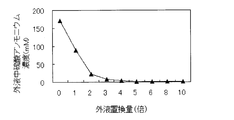
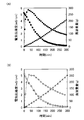
- FIG. 8 is a graph summarizing the results of FIG. 6 and FIG. It is a graph which shows the result of having investigated the relationship between the ammonium sulfate density
- FIG. 12 (A) is a graph of the number of ultrafiltration membranes used: 1 sheet
- FIG. 12 (B) is a graph of the number of ultrafiltration membranes used: 2 sheets.
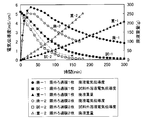
- FIG. 12B ⁇ : Electrical conductivity of soot sample solution
- ⁇ Electrical conductivity of soot waste solution
- ⁇ Shows the weight of waste liquid.
- FIG. 13A is a graph showing the correlation between the concentration of prednisolone phosphate measured by absorbance measurement and the concentration measured by electrical conductivity.
- FIG. 13 (B) shows the prednisolone phosphate concentration measured value and predicted value during the unnecessary portion removal step (number of ultrafiltration membranes 1)
- FIG. 13 (C) shows the prednisolone phosphate concentration during the unnecessary portion removal step. The measured concentration value and the predicted value (the number of ultrafiltration membranes 2) are shown.
- FIG. 14 is a graph in which FIGS. 12A and 12B are overlapped on the same XY axis. It is a graph which shows the result evaluated about the washing
- ⁇ Production Method 1 Production Method of Liposome Formulation Controlling Step of Forming pH Gradient>
- the cross-flow process external liquid replacement process
- the three parameters of heat, time, and pH that are the factors of lysation are appropriately controlled, and a high drug encapsulation amount
- a liposome preparation with extremely excellent chemical stability is produced while ensuring the above.
- the liposome sample temperature is maintained at 1 to 25 ° C. and the ammonium sulfate concentration in the external liquid is monitored by simple means, and the operation of this process is stopped immediately after a sufficient pH gradient is formed.
- the external liquid replacement step is performed until the ammonium sulfate concentration in the external liquid reaches 8% or less of the initial ammonium sulfate concentration, a sufficient pH gradient is formed thereafter, and a high drug encapsulation amount is obtained. It is preferable to monitor the concentration of ammonium sulfate therein and end the external liquid replacement step when it reaches 8% or less of the initial ammonium sulfate concentration.
- liposomes are first formed in advance in an aqueous buffer containing 0.1 to 0.3 M ammonium salt, By replacing the external medium (outer aqueous phase) with a medium that does not contain ammonium ions, such as a sucrose solution, an ammonium ion gradient is formed in / out of the liposome membrane. Internal ammonium ions dissociate and equilibrate into ammonia and protons, and ammonia disappears from the inside of the liposome by diffusing through the lipid membrane.
- an appropriate replacement amount of the outer aqueous phase can be determined by measuring information related to the concentration of a specific substance in a sample without extracting the liposome solution out of the production system.
- the information to be measured is selected from the group consisting of electrical conductivity measurement, gravimetric measurement, flow measurement, pH measurement, fluorescence measurement, and ultraviolet and / or visible light measurement installed in a container containing liposome solution and / or waste liquid.
- the electrical conductivity measurement is particularly preferable.
- a liposome solution containing a liposome solution modified with PEG which will be described in detail in Example 1 and Preparation Example 1 (3) later, is obtained using a Sartocon slice filtration device (manufactured by Sartorius) 20 shown in FIG.
- External solution substitution was performed using a 10 mM histidine / 10% sucrose (pH 6.5) solution as the external aqueous phase 21.
- FIG. 1 shows a schematic diagram of an outer liquid replacement step (diafiltration).
- the outer aqueous phase (10 mM histidine / 10% sucrose solution (pH 6.5)) 21 was supplied by the tube pump 11 so that the weight of the liposome solution 24 was constant.
- the glass bottle (liposome container 15) containing the liposome solution 24 was immersed in a cold water bath 25 at 4 to 8 ° C., so that the sample temperature during the external liquid replacement step was kept at a low temperature (about 25 ° C.).
- the sample temperature control may be performed by further cooling the pump 12 with the cooling water 30.
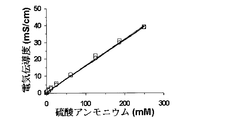
- FIG. 2 shows the relationship between electrical conductivity and ammonium sulfate concentration. As a result, it was revealed that the electrical conductivity and the ammonium sulfate concentration showed a good linear relationship.
- FIG. 3 shows the result of converting the electrical conductivity obtained during the external liquid replacement step as a predicted value to the ammonium sulfate concentration from the relational expression obtained in FIG.
- FIG. 4 shows the result of verification as to whether the optimum end point can be determined by using the manufacturing method of the present invention.
- the degree of external liquid substitution is expressed as the ratio of the amount of waste liquid discharged from the waste liquid line to the amount of external liquid (sample) supplied to the step of forming a drug introduction gradient or the unnecessary component removal step. It is the value.
- FIG. 4 shows the electrical conductivity measured until the external liquid substitution degree becomes 1, and further converted into ammonium sulfate concentration using the relationship shown in FIG.
- the ammonium sulfate concentration is converted into the predicted value of the drug encapsulation efficiency using the results measured in FIGS. 9 and 10 of Example 1 and Test Example 3.
- drug encapsulation efficiency is a value indicating the ratio of the drug concentration in the liposome internal solution to the drug concentration initially added in the external solution in%. From this result, it was clarified that the drug encapsulation efficiency almost reached a plateau when the external liquid substitution degree was around 3. From this, it is considered that a pH gradient sufficient for introducing the drug in a high encapsulated amount is formed when the external liquid substitution degree is around 3. Therefore, at this time, the external liquid replacement step is completed, and a sufficient amount of drug is encapsulated in the liposome by adding the drug to the liposome solution having this pH gradient.
- the drug encapsulation efficiency was examined using vincristine.
- the PEG-modified liposome prepared in Preparation Example 1 was subjected to external liquid substitution using the apparatus shown in FIG. 1, and the degree of external liquid substitution was 0.4, 0.8, 1.2, 2.1, 2.
- the liposomes were taken out and encapsulated with vincristine.
- the amount of encapsulated vincristine was measured by high performance liquid chromatography, and the encapsulation efficiency when all of the charged amount of the agent was encapsulated in the liposome was 100%. The results are shown in Table 1.
- the ND in Table 1 indicates that it was not detected.
- the drug entrapment efficiency for liposomes having each external liquid substitution degree and the ratio of lysolipid (lyso form) described later in the Examples were measured and compared in Table 1. As a result, the drug encapsulation efficiency was balanced when the external liquid substitution degree was 3 or more. It has become clear that the condition has been reached. Furthermore, since the production of lysosomes is also suppressed, by using the system shown in this test example and controlling at a lower temperature, it is possible to provide a liposome product with high drug encapsulation efficiency and excellent formulation stability. Became clear.
- the drug encapsulation efficiency reaches an equilibrium state and the information on the concentration of unnecessary components or the degree of substitution with an external solution that is excellent in formulation stability is obtained, and the manufacturing process is managed using the present invention. Also, if the external liquid replacement device and process used are different, the change in manufacturing conditions from the standard lot can be obtained by comparing with the measured value of the standard lot that has been measured in advance. By knowing the degree of substitution with the outer solution at which the efficiency reaches an equilibrium state, a liposome product having high drug encapsulation efficiency and excellent formulation stability can be produced.
- standard lot refers to “a lot that is arbitrarily selected by a liposome manufacturer considering that a standard result has been obtained from the conventional manufacturing conditions” and its manufacturing conditions.
- This apparatus uses the ultrafiltration membrane 17 and utilizes the difference in the molecular weight of the components contained in the liposome dispersion solution to simultaneously hold the necessary components and discharge unnecessary components.
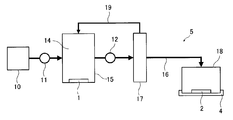
- the unnecessary part removing apparatus 5 in FIG. 11 the external liquid 10 that becomes the liposome external aqueous phase is continuously supplied to the liposome container 15 containing the liposome preparation solution 14 from the route via the pump 11, and one of the liposome preparation solutions 14.
- the part is extracted through a path through the pump 12, the solution retained through the ultrafiltration membrane 17 and the solution to be discharged including the unnecessary part are distributed, and the unnecessary part is extracted into the waste liquid container 18 through the path 16 and retained.
- the liposome preparation solution 14 is returned to the liposome container 15 via the route 19, and this operation is repeated to replace the outer aqueous phase of the liposome preparation solution 14 with an outer aqueous phase not containing unnecessary components.
- a device for measuring information related to the concentration of unnecessary components in the sample is attached to multiple locations of this device without taking the liposome preparation solution out of the production system, and quantitative analysis is performed from the signals and measurement values emitted from the device. It is possible to detect at a plurality of points at predetermined time intervals within the same lot.
- the process of measuring the information related to the concentration of the preparation in the solution without extracting the liposome preparation solution out of the production system is conducted in the container containing the sample solution, the electric conductivity measurement, the weight
- An apparatus for measuring at least one selected from the group consisting of measurement, flow measurement, pH measurement, fluorescence measurement, or ultraviolet and visible light measurement is installed and measured.
- information related to the concentration of the preparation in the solution is obtained by using a detector that can measure the solution characteristics of the external liquid that does not substantially contain the unnecessary part and the liposome preparation solution that contains the unnecessary part.
- any information can be used as long as it can be quantified, and it is not particularly limited as long as the numerical values are different between the two solutions, but information that is preferably 2 times or more, more preferably 4 times or more is preferable.
- the unnecessary component is a drug that has not been taken into the liposome
- a method that can measure the drug concentration of an external solution that does not include the unnecessary component and a solution that includes the unnecessary component is preferable.
- the liposome preparation solution 14 was prepared by encapsulating prednisolone phosphate and modifying with polyethylene glycol as a drug to be described in detail later in Examples. (Electrical conductivity measurement) The electrical conductivity of each of the prednisolone phosphate quantitative sample in the external liquid and the prednisolone phosphate quantitative sample in the waste liquid was measured using an electrical conductivity meter.
- the electrical conductivity measurement used in the present invention is a measurement method using the solution characteristics of unnecessary components, and the value obtained by the measurement method is an absorbance measurement as will be specifically described later in Examples and FIG. It was found in the course of the examination of the present invention that the obtained value showed a good correlation and its accuracy was high.
- Incorporating an electrical conductivity measurement device into the liposome sample container in the unnecessary portion removal process, and installing an electrical conductivity measurement device in the waste liquid container as well, the sample solution containing liposomes can be removed from the production system without being extracted from the production system. Information related to the concentration of a particular substance can be measured in a liposome sample solution or waste solution.
- FIG. 14 is a graph in which FIGS. 12A and 12B are overlapped on the same XY axis. As shown in FIG. 14, for example, in the case where the effective area of the ultrafiltration membrane is one ultrafiltration membrane and two ultrafiltration membranes, when the production conditions of the unnecessary component removal process differ for some reason, the liposome Can be obtained without taking out the sample solution and waste liquid containing, and information related to the concentration of the preparation in the sample can be obtained.
- the electrical conductivity of the external solution of the liposome preparation was measured at 100 minutes and 150 minutes from the start of the process in a lot during production, and two points marked with x in FIG. 14 were obtained. The obtained value is compared with the measured value of the standard lot of FIG. 14 measured in advance. It can be seen that these two points are two points on the dotted line. From this result, in the lot under production, the unnecessary portion removal process is normally performed under the production conditions intermediate between one and two ultrafiltration membranes of the standard lot. If this dotted line is extrapolated, 200 It can be determined during the manufacturing process that the unnecessary part removing step is the optimum end point between the minute and 250 minutes.
- a plurality of points on the graph of FIG. 14 are detected by a step of detecting at a plurality of points at a predetermined time interval in the same lot as compared with corresponding information measured in the waste liquid when necessary. If the same information is measured and compared in advance under manufacturing conditions in standard lots with standard conditions, changes in manufacturing conditions can be detected at multiple points within the same lot at predetermined time intervals. it can. If necessary, a change in manufacturing conditions can be fed back to appropriately change the manufacturing conditions within the same lot. In addition, when it can be detected that the manufacturing condition has shifted within the allowable range, the end point of the target process can be predicted. Furthermore, if a measurement result is examined together with a record of specific manufacturing conditions, a change in manufacturing conditions between different lots can be detected.
- a liposome is a closed vesicle composed of a phospholipid bilayer membrane, and includes an aqueous phase (inner aqueous phase) in the vesicle space.
- Liposome preparations are those in which a drug is supported on these liposomes as carriers.
- Liposomes are known to have structures such as multilamellar vesicles composed of a plurality of unilamellar vesicles composed of a single membrane of a lipid bilayer.
- a phospholipid is generally an amphiphile having a hydrophobic group composed of a long-chain alkyl group and a hydrophilic group composed of a phosphate group in the molecule.
- the phospholipid include phosphatidylcholine (also referred to as lecithin), phosphatidylglycerol, phosphatidic acid, phosphatidylethanolamine, phosphatidylserine, and glycerophospholipid such as phosphatidylinositol; sphingomyelin Sphingophospholipids such as cardiolipin; natural or synthetic diphosphatidyl phospholipids such as cardiolipin and their derivatives; those hydrogenated according to conventional methods (eg hydrogenated soybean phosphatidylcholine (HSPC)) Etc.
- HSPC hydrogenated soybean phosphatidylcholine
- phospholipids may be referred to as “phospholipids”.
- hydrogenated phospholipids such as hydrogenated soybean phosphatidylcholine, sphingomyelin (SM), and the like are preferable.
- SM sphingomyelin
- the main membrane material a single type of phospholipid may be included, or a plurality of types of phospholipids may be included.
- the phospholipid it is preferable to use a phospholipid having a phase transition temperature higher than the in-vivo temperature (35 to 37 ° C.) from the viewpoint of the main membrane material of the liposome. This is because the use of such phospholipid makes it possible to prevent the drug enclosed in the liposome from easily leaking out of the liposome during storage or in a living body such as blood. is there.
- Liposomes can contain a single type of phospholipid or multiple types of phospholipids as the main membrane material. Furthermore, when manufacturing such a liposome, it may be exposed to temperature higher than living body temperature.
- the phase transition point of the main membrane material is preferably a phospholipid of 50 ° C. or higher.
- the amount of phospholipid as a main constituent is usually 20 to 100 mol%, preferably 40 to 100 mol% in the whole membrane lipid.
- the amount of lipids other than phospholipids is generally 0 to 80 mol%, preferably 0 to 60 mol%, based on the total membrane lipid.
- the hydrophilic polymer is modified on the surface of the lipid bilayer membrane in the hydrophilic polymer modification step.
- the hydrophilic polymer to be modified is not particularly limited, but polyethylene glycol, Ficoll, polyvinyl alcohol, styrene-maleic anhydride alternating copolymer, divinyl ether-maleic anhydride alternating copolymer, polyvinyl pyrrolidone, polyvinyl methyl ether, Polyvinylmethyloxazoline, polyethyloxazoline, polyhydroxypropyloxazoline, polyhydroxypropylmethacrylamide, polymethacrylamide, polydimethylacrylamide, polyhydroxypropyl methacrylate, polyhydroxyethyl acrylate, hydroxymethylcellulose, hydroxyethylcellulose, polyaspartamide, synthesis Examples include polyamino acids.
- polyethylene glycols, polyglycerins, and polypropylene glycols are preferable as those satisfying the gist of the present invention because they have an effect of improving the retention in the blood of the liposome preparation, and polyethylene glycol (PEG ), Polyglycerin (PG), and polypropylene glycol (PPG) are more preferred.
- PEG polyethylene glycol
- PG Polyglycerin
- PPG polypropylene glycol
- one end is alkoxylated (for example, methoxylation, ethoxylation, propoxylation).
- polyethylene glycol (PEG) is the most general purpose, and has the effect of improving the blood retention, and is preferable.
- the liposome may contain other membrane components together with the main membrane material.
- a lipid other than a phospholipid or a derivative thereof hereinafter sometimes referred to as other lipids
- Lipids other than phospholipids are lipids that have a hydrophobic group composed of a long-chain alkyl group in the molecule and do not contain a phosphate group in the molecule, and are not particularly limited, but include glyceroglycolipids and sphingosaccharides.
- lipids and stabilizers include sterols such as cholesterol described later, and derivatives such as hydrogenated products thereof.
- the antioxidant examples include tocopherol homologues, that is, vitamin E. There are four isomers of ⁇ , ⁇ , ⁇ and ⁇ in tocopherol.
- the mixed lipid may contain a single kind of each of other lipids, or may contain a plurality of kinds.
- the liposome-forming lipid is a phospholipid that is a main membrane material constituting the liposome, lipids and fatty acids as membrane stabilizers such as sterols, or a lipid portion of a surface modifier, etc. It means the lipid constituting the liposome particle.
- Production process of liposome preparation is in the order of a homogenization process, a liposome formation process, an external liquid replacement process, a drug introduction process, an unnecessary component removal process (unencapsulated drug removal process), and a sterilization process.
- the manufacturing method of the present invention may be performed all of these, may be performed partially, may be performed only one step, and is not limited to the manufacturing process. Some steps may be performed by the method of the present invention, and other steps may be performed by a conventionally known method.
- the external liquid replacement process replaces the external aqueous phase of the liposome and forms an ion gradient inside and outside the membrane.
- the drug introduction process is performed after the liposome formation process through the external liquid replacement process.
- an unencapsulated drug removing step is then entered.
- a pH gradient is used as the ion gradient
- a pH gradient is formed in the outer liquid replacement step. Therefore, in order to suppress lipid hydrolysis, management of the temperature and time of the outer liquid replacement step is extremely important.
- the temperature under the condition that the ammonium sulfate concentration in the external solution is 8% or less of the initial ammonium sulfate concentration, that is, the condition under which a pH gradient sufficient to obtain a high drug encapsulation amount is formed. Clarified that time management is necessary.
- Encapsulation of the drug involves adding an encapsulated drug to the liposome-forming lipid dispersion during the liposome formation process, encapsulating the drug simultaneously with the formation of the liposome, and after the liposome formation process, creating an ion gradient such as a pH gradient inside and outside the liposome membrane, According to this gradient, the drug added outside the membrane is transferred to the internal solution in the liposome membrane, and the drug is sealed in the liposome.
- the order of these steps is not particularly limited.
- an external liquid replacement step including an unencapsulated drug removal step is included twice.
- a freeze-drying process may enter in a manufacturing method, this invention is not influenced by the duplication and addition of these processes.
- a homogenization process shows the process of melt
- a plurality of lipid components such as phospholipid and cholesterol are often present as liposome components.
- a homogenization step is taken in order to avoid lipid heterogeneity during liposome membrane formation.
- a homogenization step is not necessarily essential, but it is desirable to take the following homogenization step.
- a method for homogenization a thin film method is well known in which chloroform and the like are completely dissolved and vacuum-dried for homogenization.
- the production method is to homogenize by completely dissolving in an organic solvent such as ethanol, and use the lipid-organic solvent solution in the next liposome formation process, using the heat generated during the liposome formation process.
- an organic solvent such as ethanol
- a method of removing the organic solvent during the outer liquid replacement step is widely used.
- the liposome forming step refers to a step of forming coarse liposomes having a non-uniform particle size using homogenized lipids, and controlling the subsequent coarse liposomes to a desired particle size.
- a hydration method Boangham method
- a sonication method a reverse phase evaporation method and the like
- a heating method as a production method on a scale directed to practical use at an industrial level, there are a heating method and a lipid dissolution method.
- the liposome forming step includes a step of controlling the particle size after forming the liposome.
- the particle size control process can be controlled using various known techniques including membrane emulsification and shear force persistence. More specifically, there are a membrane emulsification method in which a filter is forced to pass a plurality of times, a high pressure emulsification method in which high pressure discharge is performed by a high pressure discharge type emulsifier. All of the production methods are known in G.
- the liposome obtained by the production method of the present invention is preferably provided with a particle size control step in the liposome formation step.
- the diameter is not particularly limited, but the diameter is 20 nm to 2000 nm, preferably 30 nm to 400 nm, and more preferably 50 nm to 250 nm.
- the particle diameter is an average value of the diameters of the outer diameters of all liposome preparation particles measured by a dynamic light scattering method.
- These liposomes are preferably produced at or above the phase transition temperature of the main membrane material. This is because it is difficult to control the particle size at a temperature lower than the phase transition temperature of the main film material. For example, when the phase transition temperature of the main film material is around 50 ° C., it is preferably about 50 to 80 ° C., more specifically, it is preferably produced at about 60 to 70 ° C.
- the liposome obtained as a dispersion as described above is subsequently subjected to a liposome solution treatment step.
- the liposome solution treatment step is a collective term for various treatment steps performed after a liposome formation step for a known liposome solution, such as an external liquid replacement step, a drug introduction step, an unencapsulated drug removal step, and a sterilization step.
- the outer liquid replacement step is a step of replacing the inner aqueous phase used in the liposome formation step and the outer aqueous phase of the liposome, and is a step of forming an ion gradient (drug introduction driving force).
- ion gradient drug introduction driving force
- this step of forming an ion gradient that is a driving force for drug introduction is an important step.
- a pH gradient is used as the ion gradient, a pH gradient is formed and the pH inside the liposome is lowered, so that lipid hydrolysis is promoted after this step.
- the outer liquid replacement step is preferably performed at a low temperature throughout, particularly at 1 to 25 ° C. In order to prevent excessive processing, it is desirable to monitor in real time using a simple measuring device and determine the optimum end point of this process.
- the drug introduction step refers to a step of adding and introducing a drug after passing through the liposome formation step, and specifically shows a drug introduction method using a remote loading method.
- the drug introduction step of the present invention uses a method called remote loading, in which a drug is introduced using an ion gradient inside and outside the membrane after forming liposomes.
- the remote loading method can be used for conventional drugs that can exist in a charged state when dissolved in a suitable aqueous medium.
- the drug can permeate and encapsulate the liposome membrane according to the formed gradient.
- an ion gradient formed across the liposome membrane there is a Na + / K + concentration gradient.
- a proton concentration gradient is preferably used as the ion gradient, and an embodiment in which the inner (inner aqueous phase) pH of the liposome membrane has a lower pH gradient than the outer (outer aqueous phase) pH.
- the pH gradient can be formed by an ammonium ion concentration gradient and / or a concentration gradient of an organic compound having an amino group that can be protonated.
- a liposome is formed in advance in an aqueous buffer containing 0.1 to 0.3 M ammonium salt, and the ammonium ion is contained.
- An ammonium ion gradient is formed inside / outside the liposome membrane by substituting an external medium (outer aqueous phase) such as a sucrose solution.
- an appropriate replacement amount of the outer aqueous phase can be determined by measuring information related to the concentration of a specific substance in a sample without extracting the liposome solution out of the production system.
- Information to be measured is one or more from the group consisting of electrical conductivity measurement, gravimetric measurement, flow measurement, pH measurement, fluorescence measurement, and ultraviolet and / or visible light measurement installed in the liposome solution container and / or waste liquid.
- the electrical conductivity measurement is particularly preferable.
- the ammonium salt that can form the ammonium ion concentration gradient is not particularly limited, but ammonium sulfate, ammonium hydroxide, ammonium acetate, ammonium chloride, ammonium phosphate, ammonium citrate, ammonium succinate, ammonium lactobionate, ammonium carbonate And ammonium tartrate and ammonium oxalate.
- the organic compound having an amino group that can be protonated preferably has a low molecular weight, and specifically includes methylamine, ethylamine, propylamine, diethylamine, ethylenediamine, aminoethanol, etc., but is not limited thereto. Absent. Since this step is performed at a temperature higher than the phase transition temperature of the liposome, it is desirable that the temperature be higher than the phase transition temperature of the main membrane material. However, since it is a step of forming an ion gradient, heat exposure was minimized. Is preferred.
- the unnecessary component removing step is a step of removing unnecessary components existing outside the liposome, and is a step of removing substances that are unnecessary in the preparation of the liposome preparation or unnecessary in the final preparation, or substances that are not preferably present.
- a method utilizing the difference in molecular weight and particle size between liposomes and unnecessary components is used, and dialysis membranes, gel filtration, ultrafiltration and the like are widely used as specific means.
- Unencapsulated drug removal process which is one of the unnecessary component removal processes, indicates a process aimed at removing the unencapsulated drug after the drug introduction process. Basically, the same operation as that in the outer liquid replacement step (ion gradient forming step) is performed, but is different in terms of the purpose of removing the drug remaining in the outer aqueous phase.
- the management in the unnecessary component removal process described above is currently performed based on validation data, and there is no means for knowing the removal performance and existence state of the unnecessary component during the unnecessary component removal process.
- unnecessary part management in the process using a sensor in the unnecessary part removing process system according to the present invention it is possible to monitor the state of unnecessary part removal in real time and determine a target end point. Specifically, if the measurement result shows the same tendency (same curve) between the lot and the standard lot, an optimal end point can be derived from the measurement result of the lot by performing extrapolation known to the standard lot.
- the system can be suitable for detecting a malfunction of the system.
- an existing quantitative device is used for the analysis of the unnecessary portion.
- the measuring device in the present invention can be installed anywhere as long as it does not cause degradation or phenotypic change of the components contained in the preparation, but since many of the liposome preparations are sterile preparations, In order to reduce the risk of contamination with bacteria as much as possible, it is more preferable to attach to the waste liquid line or container in the unnecessary component removal process system.
- cleaning process is a washing
- the cleaning method is not particularly limited.
- the sample is dissolved in a cleaning solution that can dissolve the sample component for a certain time and a plurality of times, and then further washed for a certain time and a plurality of times in order to remove the cleaning solution to an acceptable concentration using water.
- cleaning process should just be a liquid which can melt
- examples of the liquid used for the cleaning liquid include nonionic surfactants, ionic surfactants, alkaline solutions, acidic solutions, and organic solvents such as methanol and ethanol.
- preferred cleaning liquids are alkaline solutions and acidic solutions.
- a sterilization process shows the process of sterilizing after a liposome formation process.
- the sterilization method is not particularly limited. For example, filtration sterilization, high-pressure steam sterilization method, dry heat sterilization method, ethylene oxide gas sterilization method, radiation (eg, electron beam, X-ray, ⁇ -ray, etc.) sterilization method, ozone water A sterilization method or a sterilization method using hydrogen peroxide water can be used. Further, depending on the manufacturing method, this sterilization step may not be set. As the sterilization step in the present invention, filtration sterilization is most preferable.
- liposomes permeate but Brevundimonas diminuta (size, approximately 0.3 ⁇ 0.8 ⁇ m) used as an indicator bacterium is required not to be filtered. Therefore, liposome particles are sufficiently more than Brevundimonas diminuta. It must be small particles.
- the liposome having a particle size of around 100 nm is also important for ensuring the filtration sterilization step.
- the filter used for filtration sterilization preferably has a pore size of 0.45 ⁇ m or less. For example, a filter sterilization filter having a pore size of 0.2 ⁇ m is used.
- HSPC hydrogenated soybean phosphatidylcholine (molecular weight 790, Lipoid SPC3) Chol: Cholesterol (molecular weight 386.65, manufactured by Solvay)
- PEG 5000 -DSPE Polyethylene glycol (molecular weight 5000) -phosphatidylethanolamine (molecular weight 6075, manufactured by NOF Corporation)
- TRX-20 3.5-Dipentadecyloxybenzenecarboxamidine Hydrochloride (Molecular weight: 609.42, manufactured by Junsei Co., Ltd.)
- Prednisolone phosphate (Molecular weight: 440.02, Newchem)
- Example 1 Formation process of drug introduction gradient Production method (Preparation Example 1) and (Preparation Example 2) controlled at low temperature in the temperature control of the ion gradient formation process for drug introduction, and manufacture without temperature control
- liposomes were produced in (Preparation Example 1) and (Preparation Example 2) and (Reference Example 1).
- the external liquid replacement step according to the present invention was performed through the following steps (1) to (3).
- (1) Homogenizing step 70.53 g of hydrogenated soybean lecithin (HSPC) and 29.50 g of cholesterol were weighed, and absolute ethanol (100 mL) was added and dissolved by heating.
- HSPC hydrogenated soybean lecithin
- Liposome formation step 900 mL of ammonium sulfate solution adjusted to 250 mM is heated to around 70 ° C and added to 100 mL of the lipid ethanol solution obtained through the homogenization step, and the resulting dispersion is stirred to give coarse liposomes A solution was obtained.
- the obtained crude liposome solution was passed through a polycarbonate membrane filter having a pore size of 100 nm five times using an extruder heated to around 65 ° C. to obtain a liposome solution.
- Hydrophilic polymer addition step While maintaining the obtained liposome solution in a heated state, a PEG 5000- DSPE solution (7.69 g / 200 mL (water for injection)) is immediately added, and heated and stirred.
- FIG. 1 shows a schematic diagram of diafiltration.
- the outer aqueous phase 21 (10 mM histidine / 10% sucrose solution (pH 6.5)) was supplied with a tube pump so that the weight of the liposome solution was constant.
- FIG. 5 shows the measurement results of the sample temperature over time during the cross flow treatment.
- Preparation Example 2 In order to control the temperature in the external liquid replacement step performed in Preparation Example 1 earlier, the external liquid replacement was performed in a low temperature chamber.
- the liposome solution used was prepared in the same manner as (1) to (3) in Preparation Example 1, the sample was put into a circulation type glass bottle, and the glass bottle was always cooled with cold water at about 4 ° C.
- the treatment time was terminated when the amount of replacement of the outer solution reached 10 times the amount of the liposome solution. As shown by the measurement results in FIG. 5, it was possible to keep the sample temperature at about 5 ° C. during the outer liquid replacement step.
- Ratio of lysolipid (%) (total lysolipid peak area) ⁇ 100 / (total lysolipid peak area + total phospholipid peak area)
- the results are shown in FIG.
- the lysification rate of the samples prepared in Preparation Example 1 and Preparation Example 2 using the present invention was lower than that of the sample prepared in Reference Example 1. That is, when the present invention is used, lysolipid is not produced until the external liquid replacement amount reaches 8 times the amount, while the sample prepared in Reference Example 1 produces lysolipid at the same external liquid replacement amount, It became clear that it decomposed.
- the sample temperature was maintained at 4 ° C.
- FIG. 8 A graph summarizing FIGS. 6 and 7 is shown in FIG. From the graph of FIG. 8, it became clear that when the ammonium sulfate concentration in the external liquid falls below a certain value, lyso formation occurs. In other words, when the concentration of the external solution falls below a certain value, the concentration gradient of the ammonia gradient inside and outside the liposome is completely formed, and thus the pH inside the liposome is lowered, and accordingly, lipolysis is more easily promoted. It became clear. Therefore, in order to suppress the lyso form more effectively, it is important to suppress heat exposure as much as possible in an environment where the pH inside the liposome is completely lowered, and an excessive external liquid replacement step is not preferable. Became clear.
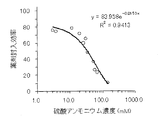
- Test Example 3 Relationship between the concentration of ammonium sulfate in the external liquid and the drug encapsulation efficiency From the results of Test Example 2, it was found that lysification occurs when the ammonium sulfate concentration in the external liquid falls below a certain value. Is considered to be the point at which the pH gradient is completely formed. On the other hand, it is considered that the drug encapsulation efficiency under a condition where the pH gradient is completely formed shows a high value. Therefore, in order to determine the conditions under which the pH gradient is completely formed, the relationship between the ammonium sulfate concentration in the external solution and the drug encapsulation efficiency was examined. Vincristine was used as the drug. The results are shown in FIG. 9 and FIG. As shown in FIG.
- the encapsulation efficiency of vincristine increased with decreasing ammonium sulfate concentration in the external solution.
- vincristine tends to have a lower encapsulation amount than drugs using other remote loading methods such as doxorubicin, and a sufficient pH gradient is formed if encapsulation efficiency of 70% or more is obtained with vincristine. It is estimated that Therefore, it is presumed that a sufficient pH gradient is formed at an ammonium sulfate concentration of about 20 mM in the external solution that can achieve a drug encapsulation efficiency of 70%. Further, from the results of Test Example 2, it is estimated that the ammonium sulfate concentration in the external liquid is around 20 mM when the degree of substitution of the external liquid is around 2-3.
- the drug encapsulation efficiency is 71% at 19.8 mM, 74% at 3.9 mM, 76% at 3.0 mM, and the drug encapsulation efficiency is 76%.
- the ammonium sulfate concentration was 71. 8 mM, the degree of substitution with the external solution was 2.4.
- the sample temperature can be controlled at a low temperature in the external liquid replacement step, specifically, the liposome sample temperature can be maintained at 1 to 25 ° C. from the beginning to suppress lysolysis.
- lysolysis occurs under conditions where there is almost no ammonium sulfate concentration in the external liquid, it is assumed that lysolysis occurs due to the complete formation of a pH gradient and a decrease in pH inside the liposome.
- the remote loading method particularly the pH gradient method, the formation of a pH gradient is indispensable for the high encapsulation of the drug.
- the ammonium sulfate concentration in the external solution needs to be 8% or less with respect to the initial ammonium sulfate concentration. Lipid degradation is promoted due to the decrease.
- the longer the treatment time the more lipid degradation is promoted. Therefore, by identifying when the ammonium sulfate concentration in the external solution is 8% or less of the initial ammonium sulfate concentration, and avoiding excessive treatment, It was revealed that lipolysis can be effectively suppressed.
- Example 2 The control of the drug introduction gradient formation process (external liquid replacement process) described in the mode for carrying out the invention and the obtained results of FIG. 4 are examples of the present invention.
- Liposome formation step HSPC 6.5165g, cholesterol 2.6792g, TRX-20 0.8043g are weighed in a glass container. 2. 10 mL of ethanol was added to a glass container in which lipid was weighed and dissolved by heating in a thermostat set at 70 ° C. 3. 6.7815 g of prednisolone phosphate was weighed and dissolved by adding 5% glucose to make exactly 100 mL. 90 mL of this liquid was heated in a thermostat set at 70 ° C. 4). After confirming that the lipid was completely dissolved, a prednisolone phosphate solution was added and heated in a thermostatic bath for 5 minutes or longer to form a lipid dispersion. 5.
- the liquid was sized using Extruder T100.
- Extruder T100 is heated in a thermostatic bath set at 70 ° C., and the sample is heated in a thermostatic bath set at 70 ° C. during the granulating step.
- the sizing was performed by passing two 0.2 ⁇ m polycarbonate membranes three times and then passing three times and then passing ten 0.1 ⁇ m polycarbonate membranes two times. 6).
- PEG 5000 -DSPE concentration advance warmed as PEG 5000 -DSPE solution thermostatic bath set at 65 ° C.
- Table 2 shows the liposome characteristics obtained according to the above preparation method.
- the values in Table 2 are all values obtained by calculating the values at the time of liposome preparation.
- the modification amount is PEG 5000 -DSPE mole amount relative to the total lipid mole of the liposome, and the DSPE amount is not included in the total lipid amount.
- the average particle size was measured with Zetasizer 3000HS (Malvern Inc.).
- Example 4 Control of an unnecessary part removal process
- the unnecessary part removal process described in the form for inventing and the result of FIG. 14 obtained are examples of this invention.
- Example 5 Prednisolone phosphate concentration change during cross-flow process During the process of Example 4, 1 mL was sampled from the sample container and the waste liquid container over time. 2. This solution was measured for the concentration of prednisolone phosphate in the external solution and the concentration of prednisolone phosphate in the waste solution according to the above-described quantitative method. 3. About 20 mg of prednisolone phosphate was weighed and dissolved by adding 5% glucose to make 20 mL. Furthermore, the electrical conductivity of a solution obtained by serial dilution of this solution with 5% glucose was measured.
- sufficient predictability accuracy is achieved not by a method that uses the specific absorbance of prednisolone phosphate, but by a method that can make use of the predzolone phosphate solution properties and the solution properties that make up the liposomes. Indicated. Therefore, by utilizing the solution characteristics of the solution to be used and the physicochemical properties of the subject and introducing a device that can detect the characteristics into this unnecessary component removal system, it becomes a system that can monitor the process of any drug. It was suggested that
- Example 6 Cleaning process and monitoring after the unnecessary part removing process
- the liposome preparation obtained after the unnecessary part removing step was added to the liposome container 15 in the same apparatus as in FIG. 11 and circulated through the ultrafiltration membrane for 1 hour. 2. After removing the liposome preparation solution from the liposome container, 250 mL of water was added to the liposome container and circulated for 5 minutes (water washing 1). 3. The water washing
- the alkaline washing liquid was removed from the liposome container, 250 mL of water was added to the liposome container and circulated for 5 minutes (water washing 2). 5.
- water washing 1 was performed 3 times, alkali washing 1 time, and water washing 2 5 times.
- cleaning liquid discharge weight after circulation was measured.
- the electric conductivity of the washing liquid was measured with an electric conductivity meter installed in a liposome container, and the discharged weight was measured with a waste liquid container.
- the results of evaluation using the electrical conductivity and the weight of the waste liquid as indices are shown in FIG.
- the amount of water discharged increased with each washing, and the amount of water discharged after alkali washing changed greatly.
- the amount of water discharged slightly increased with each washing in water washing 2, and the amount of water drastically increased in the first water washing 2 after the alkali washing.
- the electrical conductivity derived from NaOH greatly decreased over time with each water cleaning even after alkaline cleaning.
- the alkali cleaning improves the water permeability to the ultrafiltration membrane, but the alkali component (NaOH) remains in the cross flow system, and several water washings are required to completely remove this alkali component. Indicates that it is necessary. Although it was insufficient to monitor the production conditions for this alkali survivability only by evaluating the amount of water discharged, it was revealed that the alkali survivability can be evaluated with high sensitivity by measuring the electrical conductivity.
Landscapes
- Health & Medical Sciences (AREA)
- Chemical & Material Sciences (AREA)
- Dispersion Chemistry (AREA)
- Medicinal Chemistry (AREA)
- Pharmacology & Pharmacy (AREA)
- Epidemiology (AREA)
- Life Sciences & Earth Sciences (AREA)
- Animal Behavior & Ethology (AREA)
- General Health & Medical Sciences (AREA)
- Public Health (AREA)
- Veterinary Medicine (AREA)
- Medicinal Preparation (AREA)
Abstract
各リポソーム製剤の製造工程において、製造に用いる媒体や装置の状態を製造工程稼動の前、後において監視することができ、製造装置や製造媒体を適切に管理できるリポソーム製剤の製造方法であって、外液に不要分を有するリポソーム製剤溶液に、 1)実質的に不要分を含まない外液を供給しながら、 2)限外濾過して不要分の少なくとも一部を外液とともに廃液として抜き出し、 3)限外濾過されたリポソーム製剤溶液を、前記外液に不要分を有するリポソーム製剤溶液とする、 前記1)、2)、3)工程を必要な回数循環させてリポソーム製剤を製造するリポソーム製剤の外液置換工程において、 リポソーム製剤溶液中の前記不要分の濃度に関連する情報を、リポソーム製剤溶液を製造系外に抜き出すことなく同一ロット内で異なる時点で測定して、予め測定してある標準ロットの測定値と比較して、標準ロットからの製造条件の変化を知得してリポソーム製剤を製造する方法。
Description
本発明はドラッグデリバリーシステムに有用なリポソーム製剤の製造方法に関し、リポソームを含む溶液を製造系外に抜き出して分析することなく製造条件を管理できる製造方法に関する。
Drug Delivery System (DDS)は、副作用の軽減、標的部位への集積性向上などの多くの利点を有する観点から注目を集めている。代表的なDDS製剤の一つとしてリポソーム製剤がある。リポソーム製剤に用いられるリポソームは、生体細胞と同様に脂質二重膜を隔壁としてリポソーム内部と外部に分けられている。このような構造を利用し、水溶性の薬剤はリポソームの内部に、脂溶性の薬剤は、生体細胞と同様に脂質二重膜を隔壁としてリポソーム内部と外部に分けられている。このような構造を利用し、水溶性の薬剤はリポソームの内部に、脂溶性の薬剤は主に脂質二重膜内に埋胞されており、炎症部位などの特定の蓄積部位へ薬剤を直接送達することを可能にしている。さらに、リポソーム表面に親水性高分子や抗体などを付与することにより標的部位への薬剤送達をより効果的なものとすることができる。
リポソーム製造工程は、主にリポソームを形成する工程、リポソームを一定の粒子径に整粒する工程、リポソームの外部の不要分を除去する工程、ろ過滅菌などの手段により滅菌する工程と多岐にわたる。リポソームの外部の不要分を除去する工程において不要分の除去が十分でない場合、リポソーム内に薬剤を導入する際にリポソーム外部に存在する不要分が影響する恐れがある。さらに、リポソーム外部に不要分を含んだ状態で生体に投与された際には、毒性を惹起する可能性があることから、リポソーム外部の不要分を除去する工程は、その製造スケール関わらずリポソーム製剤製造には必須の工程である。
リポソーム製造工程は、主にリポソームを形成する工程、リポソームを一定の粒子径に整粒する工程、リポソームの外部の不要分を除去する工程、ろ過滅菌などの手段により滅菌する工程と多岐にわたる。リポソームの外部の不要分を除去する工程において不要分の除去が十分でない場合、リポソーム内に薬剤を導入する際にリポソーム外部に存在する不要分が影響する恐れがある。さらに、リポソーム外部に不要分を含んだ状態で生体に投与された際には、毒性を惹起する可能性があることから、リポソーム外部の不要分を除去する工程は、その製造スケール関わらずリポソーム製剤製造には必須の工程である。
リポソームの外部の不要分を除去する工程で除去される不要分としては、様々なものが該当し得、リポソームの製造方法によっても異なる。例えば、受動的薬剤導入法を用いるリポソーム製造では、リポソーム形成工程で薬剤とリポソームの構成成分を混合し、リポソームを形成した後にリポソーム外部の液中に残存する薬剤である。能動的薬剤導入方法を用いるリポソーム製造では、薬剤導入のための駆動力としてリポソーム内外に特定物質の濃度勾配を形成する工程におけるリポソーム外液中に残存する前記特定成分や、濃度勾配を形成した後のリポソーム外液に薬剤を添加し、能動的薬剤導入を行った後、外液に残存する薬剤が挙げられる。
通常、これらの工程を行う際には、外液中の不要分を除去する閾値を設定し、工程バリデーションを取ることによって不要分除去工程の条件設定がなされている。しかし、工程バリデーションは通常ある均一の試料を用いて行うものであり、不要分除去工程前に発生した不具合により通常調製されるべき試料が調製できなかった場合、例えば、リポソーム粒子形成の不具合によるリポソーム内への薬剤あるいは能動的薬剤導入方法に必須である駆動力となる成分の低封入化により、リポソーム外部に過剰量の不要分が残存した場合、設定された工程条件では十分な除去効率が得られないため、目的とする製剤品質を達成することができない。
また、リポソーム製剤の製造においては、限外濾過フィルターなどの製造装置の部品ごとの性能のバラツキや、使用による経時変化や洗浄条件の変化が大きく、リポソーム製剤の製造を工業的な規模に拡大して行うには、これらの条件を実際の製造ロットで把握することが必須の条件であるが、現状そのような条件を製造中に把握できる方法がない。
一方、工程中に試料をとりだし、高速液体クロマトグラフ法や分光光度計などの測定装置を用いることにより工程途中の試料状況を把握し、該工程が完了したかを判断することが可能であるが、工程を一時的にとめることは現実的ではなく、さらに、リポソーム製剤の多くは無菌製剤であり、工程途中に試料採取などの工程を入れることにより菌混入のリスクが生じるため工程中の試料採取は好ましくはない。
これらのことから、常に一定の製剤品質を達成するためには、作業者が直接試料と接触することなく、リアルタイムに工程の状況を把握できる不要分除去システムを構築する必要があるが、このようなシステムは現状存在していない。
これらのことから、常に一定の製剤品質を達成するためには、作業者が直接試料と接触することなく、リアルタイムに工程の状況を把握できる不要分除去システムを構築する必要があるが、このようなシステムは現状存在していない。
リポソーム技術における重要な課題の一つは、高い薬剤封入効率を達成し、その安定性を長期間、安定に保つことである。この点に関しては、対象物質の化学的構造、極性、分子量などの因子によって決定付けられ、また、脂質組成、脂質濃度、調製法などにも影響されることが知られている。これまでに、リポソームへ薬剤を封入するための手段として様々な方法が知られているが、一般的に用いられているのは水和法(Bangham法)である。しかしながら、この方法では、一般的に数%から十数%程度の保持効率しか得られない。この低下を補うために、高濃度でリポソームを調製しエクストルージョンを行なう方法があるが、それでも保持効率はせいぜい40%程度である。その他、封入効率を上げるために様々な方法が数多く試みられ、逆相蒸発法や凍結融解法、凍結乾燥復水法なども開発されている。しかしながら、これらの方法は、調製時に薬剤を添加する必要があり有機溶媒や凍結などで失活するものは扱えず、また大量生産が困難であるなどの難点を有している。また、近年では、有機溶媒の代わりに超臨界二酸化炭素を用いる超臨界二酸化炭素法や薬剤の濃縮を利用するフィルムローディング法なども開発されており、新しい調製法として有用であるが、高い封入効率を達成するためにはさらなる検討が必要である。これに対して、イオン勾配法及びpH勾配法(Remote loading法、特許第2659136号(特許文献1)、米国特許5192549号)は、高い薬剤封入量と封入効率を達成出来る手段として良く知られており、とくに解離性薬剤の封入方法として優れている。イオン勾配法は、リポソームの内側/外側にイオン勾配を形成させ、これが薬剤導入の駆動力となり、イオン勾配に従い薬剤はリポソーム膜を透過し内部に封入される。
イオン勾配法の具体的な例としては、Na+/K+濃度勾配を用いる方法がある。Na+/K+濃度勾配を用いたリモートローディング法により、予め形成されているリポソーム中に薬剤を添加する技術は、特公平07-112968号公報(特許文献2)などに記載されており、これを参照して行うことができる。
また、イオン勾配法としてプロトン濃度勾配を用いたものがpH勾配法であり、リポソーム膜の内側(内水相)pHが、外側(外水相)pHよりも低いpH勾配をもつ態様が好ましく挙げられる。pH勾配は、アンモニウムイオン濃度勾配および/またはプロトン化しうるアミノ基を有する有機化合物の濃度勾配などから形成することができる。このpH勾配が薬剤導入の駆動力となり、リポソームの外側から内側に薬剤が封入される。薬剤が脂質二重膜を透過した後は、弱酸性条件下の内水相においてプロトンが付加され、そのまま膜内に留まる。pH勾配法が適用できる薬剤は100%近い保持効率で封入され、逆相蒸発法や凍結融解法と比較して格段に高い封入効率が得られる。薬剤の多くは弱塩基性化合物であり、解離性薬物であることから、pH勾配法は、様々な薬剤に適応可能な優れた封入手段といえる。ただし、いくつかの注意点が存在し、クエン酸や硫酸アンモニウム存在下での安定性、とくにこのような酸性条件下に加えて高温条件下の薬剤の安定性に注意を払う必要がある。
また、イオン勾配法としてプロトン濃度勾配を用いたものがpH勾配法であり、リポソーム膜の内側(内水相)pHが、外側(外水相)pHよりも低いpH勾配をもつ態様が好ましく挙げられる。pH勾配は、アンモニウムイオン濃度勾配および/またはプロトン化しうるアミノ基を有する有機化合物の濃度勾配などから形成することができる。このpH勾配が薬剤導入の駆動力となり、リポソームの外側から内側に薬剤が封入される。薬剤が脂質二重膜を透過した後は、弱酸性条件下の内水相においてプロトンが付加され、そのまま膜内に留まる。pH勾配法が適用できる薬剤は100%近い保持効率で封入され、逆相蒸発法や凍結融解法と比較して格段に高い封入効率が得られる。薬剤の多くは弱塩基性化合物であり、解離性薬物であることから、pH勾配法は、様々な薬剤に適応可能な優れた封入手段といえる。ただし、いくつかの注意点が存在し、クエン酸や硫酸アンモニウム存在下での安定性、とくにこのような酸性条件下に加えて高温条件下の薬剤の安定性に注意を払う必要がある。
具体的には、リポソームの構成成分であるリン脂質は、pH6.5付近で最も安定であり、それ以下のpHにおいては加水分解を受けやすい。特にSn-1とSn-2位における脂肪酸のカルボン酸エステルは加水分解を受けやすく、リゾ脂質及び脂肪酸に分解することが知られている(Gritら Chem.Phys.Lipids 64,3-18,1993)。このような分解物は脂質膜組成を乱し、脂質膜の透過性が向上することによりリポソームの物理化学的安定性を損なう。また、脂質の分解物は、強い界面活性作用を有するため溶血を引き起こす可能性も考えられる。さらに、脂質の加水分解により、貯蔵(使用)期限の制限を生じる可能性も懸念される。
前記したように、pH勾配法を用いることで高い薬剤封入効率が得られるが、そのためにはリポソーム外液に残存する不要分を十分に除去することが重要であり、それに伴いリポソーム内部のpHが低下すること十分なpH勾配を形成することができる。一方で、リポソーム内部のpH低下が起こることで、脂質の加水分解が起こりやすくなる。従って、加水分解が起こりやすい環境下、例えば高温環境下において、一定以上のレベルを超えてさらに長時間にわたりpH勾配形成工程を実施した場合、脂質の加水分解を加速する原因となる。
前記したように、pH勾配法を用いることで高い薬剤封入効率が得られるが、そのためにはリポソーム外液に残存する不要分を十分に除去することが重要であり、それに伴いリポソーム内部のpHが低下すること十分なpH勾配を形成することができる。一方で、リポソーム内部のpH低下が起こることで、脂質の加水分解が起こりやすくなる。従って、加水分解が起こりやすい環境下、例えば高温環境下において、一定以上のレベルを超えてさらに長時間にわたりpH勾配形成工程を実施した場合、脂質の加水分解を加速する原因となる。
これを解決する手段としていくつかの具体的解決方法が提示されている。例えば、酸性領域においても加水分解を受けにくいスフィンゴミエリンを用いたリポソームはスフィンゴソームと呼ばれ、薬剤導入の駆動力に必要なpH勾配を形成しても加水分解が起こりにくいことが特徴である。しかしながら、スフィンゴソームは、通常の脂質で構成されたリポソームに比べて毒性がある、といういくつかの報告例がある(Weereratne el al. Brit. J. Exp. Pathol. 64:670-676 (1983), Allen et al., j. Pharmacol. Exp. Jherap. 229: 267-275 (1984), Allen et al., Res. Commun. Chem. Pathol. Pharmacol. 50: 281-290 (1985))。また、通常の脂質は大豆などの植物由来の原料より精製されるのに対して、スフィンゴミエリンは脳、卵、牛乳など動物由来の原料より精製されることから、安全性が懸念される。
他の解決方法として、pH勾配により薬剤を封入した後、リポソームの内部pHを上昇させるのに有効な量の塩基を浸透させることで、内部の酸性度を減少させて脂質膜の加水分解を抑制し、化学的安定性を向上させる方法がある(特許文献3)。
しかしながら、この方法もスフィンゴソームと同様に特殊性が高く、一部の開発において用いられるに留まり、汎用化していないのが現状である。このようなことから、十分なイオン勾配を形成しつつ、かつ、脂質の加水分解を抑制できる簡易的な製造法はいまだに存在しない。
他の解決方法として、pH勾配により薬剤を封入した後、リポソームの内部pHを上昇させるのに有効な量の塩基を浸透させることで、内部の酸性度を減少させて脂質膜の加水分解を抑制し、化学的安定性を向上させる方法がある(特許文献3)。
しかしながら、この方法もスフィンゴソームと同様に特殊性が高く、一部の開発において用いられるに留まり、汎用化していないのが現状である。このようなことから、十分なイオン勾配を形成しつつ、かつ、脂質の加水分解を抑制できる簡易的な製造法はいまだに存在しない。
本発明の目的は、同一製造ロット内で製造条件の変化を監視できる、例えばリアルタイムに不要分除去工程を監視するシステムを構築し、予め測定された標準ロットの測定値と比較することにより均一の製剤品質をもつリポソーム製剤を製造する方法を提供することである。
また、本発明の他の目的は、リポソームを含む溶液を製造系外に抜き出して分析することなく製造条件を管理できるリポソーム製剤の製造方法を提供することである。
また、本発明の他の目的は、リポソームを含む溶液を製造系外に抜き出して分析することなく製造条件を管理できるリポソーム製剤の製造方法を提供することである。
本発明の他の目的は、薬剤封入にpH勾配法(Remote loading法)を用いるリポソーム製剤の製造方法において、pH勾配形成工程、(特に、該工程中においてリポソーム内部のpHが十分に低下した状態)での熱暴露(時間に伴うリポソームが被る温度の影響)を最小化することで、化学的安定性に優れたリポソーム製剤を得ることができる製造方法を提供することである。
上記の課題を解決すべく検討した結果、リポソーム製剤の製造工程中に簡易的な測定装置を組み入れれば、リポソームを含む溶液を製造系外に抜き出すことなく溶液中の特定物質の濃度に関連する情報を、同一ロット内で異なる時点で測定して、予め測定してある標準ロットの測定値と比較して、標準ロットからの製造条件の変化を知得してリポソーム製剤を製造することができる方法を発明した。
すなわち本発明は、以下を提供する。なお、以下で「リポソームを含む溶液」という場合は薬剤を含まないリポソームを含む溶液(分散液)を意味し、「リポソーム製剤溶液」という場合は薬剤を含む状態のリポソーム溶液を意味する。しかし、両者を一般的に記載する場合は「リポソームを含む溶液」または「溶液」と記載する場合がある。また、単に「リポソーム製剤」という場合は、薬剤を含む状態のリポソームの溶液であって、実際に製剤として投与可能な状態にあるものを意味する。また、本明細書で薬剤と記載する場合は、薬物、診断剤、細胞、遺伝子、マーカー等の治療に使用できる有用物質を含む意味である。
(1) 外液に不要分を有するリポソーム製剤溶液に、
1)実質的に不要分を含まない外液を供給しながら、
2)限外濾過して不要分の少なくとも一部を外液とともに廃液として抜き出し、
3)限外濾過されたリポソーム製剤溶液を、前記外液に不要分を有するリポソーム製剤溶液とする、
前記1)、2)、3)工程を必要な回数循環させてリポソーム製剤を製造するリポソーム製剤の外液置換工程において、
リポソーム製剤溶液中の前記不要分の濃度に関連する情報を、リポソーム製剤溶液を製造系外に抜き出すことなく同一ロット内で異なる時点で測定して、予め測定してある標準ロットの測定値と比較して、標準ロットからの製造条件の変化を知得してリポソーム製剤を製造する方法。
(2) リポソーム製剤の外液置換工程の後にさらに、以下のリポソーム容器の洗浄工程を有するリポソーム製剤を製造する方法であって、
1)リポソーム容器からリポソーム製剤溶液を除去し、
2)水を所定時間循環させてリポソーム容器を洗浄する第1の水洗浄工程、
3)洗浄後の水を廃液として除去する、
前記2)、3)工程を必要な回数循環させ、その後、
4)リポソーム容器にアルカリ水溶液を加えて所定時間循環させリポソーム容器を洗浄する第2のアルカリ洗浄工程、
5)洗浄後のアルカリ水溶液を除去する、
前記4)、5)工程を必要な回数循環させ、その後、
前記2)、3)工程を必要な回数循環させて第3の水洗浄工程を行う、
リポソーム容器を洗浄する方法において、前記3)工程における廃液中に残存するアルカリ成分の濃度を測定し、前記3)工程の終点を決定する(1)に記載のリポソーム製剤を製造する方法。
1)実質的に不要分を含まない外液を供給しながら、
2)限外濾過して不要分の少なくとも一部を外液とともに廃液として抜き出し、
3)限外濾過されたリポソーム製剤溶液を、前記外液に不要分を有するリポソーム製剤溶液とする、
前記1)、2)、3)工程を必要な回数循環させてリポソーム製剤を製造するリポソーム製剤の外液置換工程において、
リポソーム製剤溶液中の前記不要分の濃度に関連する情報を、リポソーム製剤溶液を製造系外に抜き出すことなく同一ロット内で異なる時点で測定して、予め測定してある標準ロットの測定値と比較して、標準ロットからの製造条件の変化を知得してリポソーム製剤を製造する方法。
(2) リポソーム製剤の外液置換工程の後にさらに、以下のリポソーム容器の洗浄工程を有するリポソーム製剤を製造する方法であって、
1)リポソーム容器からリポソーム製剤溶液を除去し、
2)水を所定時間循環させてリポソーム容器を洗浄する第1の水洗浄工程、
3)洗浄後の水を廃液として除去する、
前記2)、3)工程を必要な回数循環させ、その後、
4)リポソーム容器にアルカリ水溶液を加えて所定時間循環させリポソーム容器を洗浄する第2のアルカリ洗浄工程、
5)洗浄後のアルカリ水溶液を除去する、
前記4)、5)工程を必要な回数循環させ、その後、
前記2)、3)工程を必要な回数循環させて第3の水洗浄工程を行う、
リポソーム容器を洗浄する方法において、前記3)工程における廃液中に残存するアルカリ成分の濃度を測定し、前記3)工程の終点を決定する(1)に記載のリポソーム製剤を製造する方法。
(3) 外液に薬剤導入勾配を形成する物質を有するリポソーム溶液に、
1)実質的に薬剤導入勾配を形成する物質を含まない外液を供給しながら、
2)限外濾過して薬剤導入勾配を形成する物質の少なくとも一部を外液とともに廃液として抜き出し、
3)限外濾過された前記リポソーム溶液を、前記外液に薬剤導入勾配を形成する物質を有するリポソーム溶液とする、
前記1)、2)、3)工程を必要な回数循環させてリポソーム膜内外の薬剤導入勾配を形成する工程において、
前記リポソーム溶液中の薬剤導入勾配を形成する物質の濃度に関連する情報を、リポソーム溶液を製造系外に抜き出すことなく同一ロット内で異なる時点で測定して、予め測定してある標準ロットの測定値と比較して、標準ロットからの製造条件の変化を知得してリポソーム膜内外の薬剤導入勾配を形成する工程を有するリポソーム製剤を製造する方法。
(4)前記薬剤導入勾配を形成する工程を、リポソーム外液中のイオン濃度がリポソーム初期のイオン濃度の8%以下となった時点で終了する(3)に記載のリポソーム製剤を製造する方法。
(5)前記薬剤導入勾配を形成する工程の前記リポソーム溶液の温度を1~25℃に維持する(3)または(4)に記載のリポソーム製剤を製造する方法。
(6)上記(3)~(5)のいずれかに記載の方法で、薬剤導入勾配を形成したリポソーム溶液に、さらに薬剤を封入する(1)~(5)のいずれかに記載のリポソーム製剤を製造する方法。
(7)前記リポソーム製剤溶液またはリポソーム溶液を製造系外に抜き出すことなく溶液中の特定物質の濃度に関連する情報を測定する工程が、リポソーム製剤溶液またはリポソーム溶液の容器および・または廃液に設置された、電気伝導度測定、重量測定、流量測定、pH測定、蛍光測定、紫外光測定および可視光測定からなる群から選択される少なくとも一つを測定する装置を用いた測定である(1)~(6)のいずれかに記載のリポソーム製剤を製造する方法。
1)実質的に薬剤導入勾配を形成する物質を含まない外液を供給しながら、
2)限外濾過して薬剤導入勾配を形成する物質の少なくとも一部を外液とともに廃液として抜き出し、
3)限外濾過された前記リポソーム溶液を、前記外液に薬剤導入勾配を形成する物質を有するリポソーム溶液とする、
前記1)、2)、3)工程を必要な回数循環させてリポソーム膜内外の薬剤導入勾配を形成する工程において、
前記リポソーム溶液中の薬剤導入勾配を形成する物質の濃度に関連する情報を、リポソーム溶液を製造系外に抜き出すことなく同一ロット内で異なる時点で測定して、予め測定してある標準ロットの測定値と比較して、標準ロットからの製造条件の変化を知得してリポソーム膜内外の薬剤導入勾配を形成する工程を有するリポソーム製剤を製造する方法。
(4)前記薬剤導入勾配を形成する工程を、リポソーム外液中のイオン濃度がリポソーム初期のイオン濃度の8%以下となった時点で終了する(3)に記載のリポソーム製剤を製造する方法。
(5)前記薬剤導入勾配を形成する工程の前記リポソーム溶液の温度を1~25℃に維持する(3)または(4)に記載のリポソーム製剤を製造する方法。
(6)上記(3)~(5)のいずれかに記載の方法で、薬剤導入勾配を形成したリポソーム溶液に、さらに薬剤を封入する(1)~(5)のいずれかに記載のリポソーム製剤を製造する方法。
(7)前記リポソーム製剤溶液またはリポソーム溶液を製造系外に抜き出すことなく溶液中の特定物質の濃度に関連する情報を測定する工程が、リポソーム製剤溶液またはリポソーム溶液の容器および・または廃液に設置された、電気伝導度測定、重量測定、流量測定、pH測定、蛍光測定、紫外光測定および可視光測定からなる群から選択される少なくとも一つを測定する装置を用いた測定である(1)~(6)のいずれかに記載のリポソーム製剤を製造する方法。
本発明のリポソーム製剤の製造方法を用いれば、各リポソーム製剤の製造工程において、製造に用いる媒体や装置の状態を製造工程稼動の前、後において監視することができ、製造装置や製造媒体を適切に管理できる。この製造方法は、実験室スケールのような小規模なリポソーム製剤製造から工業スケールにも十分対応できる。
例えば薬剤封入にイオン勾配法(Remote loading法)を用いる場合におけるイオン勾配形成工程、または不要分除去工程において、工程中に起こっているリポソーム溶液中の薬剤含有量の変化または不要分排出速度をリアルタイムで正確に把握することができ、至適終点で工程の稼働を停止することができる。
例えば薬剤封入にイオン勾配法(Remote loading法)を用いる場合におけるイオン勾配形成工程、または不要分除去工程において、工程中に起こっているリポソーム溶液中の薬剤含有量の変化または不要分排出速度をリアルタイムで正確に把握することができ、至適終点で工程の稼働を停止することができる。
<製造方法1:pH勾配の形成工程を制御するリポソーム製剤の製造方法>
薬剤導入の駆動力であるpH勾配を形成するクロスフロー工程(外液置換工程)において、特に、リゾ化の要因である熱、時間、pHの3つのパラメーターを適切に管理し、高い薬剤封入量を確保しながら格段に化学的安定性に優れたリポソーム製剤を製造する。特に、外液置換工程においてリポソーム試料温度を1~25℃で維持し、かつ外液中硫酸アンモニウム濃度を簡易的手段でモニターしつつ、十分なpH勾配が形成された直後に該工程の稼動を停止することによりリゾ化が最小に抑えられ、高い薬剤封入量を確保しながら、化学的安定性に優れたリポソーム製剤を製造することが可能である。具体的には、外液中硫酸アンモニウム濃度が初期の硫酸アンモニウム濃度の8%以下に達するまで外液置換工程を行えば、その後十分なpH勾配が形成され、高い薬剤封入量が得られるため、外液中の硫酸アンモニウム濃度をモニターし、初期硫酸アンモニウム濃度の8%以下に達した時点で外液置換工程を終了することが好ましい。
薬剤導入の駆動力であるpH勾配を形成するクロスフロー工程(外液置換工程)において、特に、リゾ化の要因である熱、時間、pHの3つのパラメーターを適切に管理し、高い薬剤封入量を確保しながら格段に化学的安定性に優れたリポソーム製剤を製造する。特に、外液置換工程においてリポソーム試料温度を1~25℃で維持し、かつ外液中硫酸アンモニウム濃度を簡易的手段でモニターしつつ、十分なpH勾配が形成された直後に該工程の稼動を停止することによりリゾ化が最小に抑えられ、高い薬剤封入量を確保しながら、化学的安定性に優れたリポソーム製剤を製造することが可能である。具体的には、外液中硫酸アンモニウム濃度が初期の硫酸アンモニウム濃度の8%以下に達するまで外液置換工程を行えば、その後十分なpH勾配が形成され、高い薬剤封入量が得られるため、外液中の硫酸アンモニウム濃度をモニターし、初期硫酸アンモニウム濃度の8%以下に達した時点で外液置換工程を終了することが好ましい。
アンモニウムイオン濃度勾配によりpH勾配を形成し、薬剤をリポソーム内に封入する方法の具体例としては、まず0.1~0.3Mのアンモニウム塩を含有する水性緩衝液中で予めリポソームを形成し、外部媒体(外水相)をアンモニウムイオンを含有していない媒質、例えばスクロース溶液と置換することでリポソーム膜の内/外にアンモニウムイオン勾配を形成する。内部アンモニウムイオンはアンモニアおよびプロトンに解離して平衡化し、アンモニアは脂質膜を透過して拡散することでリポソーム内部から消失する。アンモニアの消失に伴ってリポソーム内の平衡がプロトン生成の方向に連続的に移動する。その結果、リポソーム内にプロトンが蓄積され、リポソームの内側/外側にpH勾配が形成される。このpH勾配を有するリポソーム溶液に薬剤を添加することによって薬剤がリポソーム中に内封される。
本発明の製造方法では、外水相の適切な置換量を、リポソーム溶液を製造系外に抜き出すことなく試料中の特定物質の濃度に関連する情報を測定することで決定することができる。測定する情報は、リポソーム溶液を含む容器および・または廃液に設置された、電気伝導度測定、重量測定、流量測定、pH測定、蛍光測定、並びに紫外および・または可視光測定からなる群から選択されればよく、特に電気伝導度測定が好ましい。
本発明の製造方法では、外水相の適切な置換量を、リポソーム溶液を製造系外に抜き出すことなく試料中の特定物質の濃度に関連する情報を測定することで決定することができる。測定する情報は、リポソーム溶液を含む容器および・または廃液に設置された、電気伝導度測定、重量測定、流量測定、pH測定、蛍光測定、並びに紫外および・または可視光測定からなる群から選択されればよく、特に電気伝導度測定が好ましい。
後に実施例1、調整例1の(3)で具体的に説明するPEGで修飾されたリポソーム溶液を含むリポソーム溶液を、図1に示す、ザルトコンスライスろ過装置(ザルトリウス社製)20を用いて10mM ヒスチジン/10%スクロース(pH6.5)溶液を外水相21として外液置換を行った。図1は外液置換工程(ダイアフィルトレーション)の模式図を示す。リポソーム溶液24の重量が一定になるようにチューブポンプ11で外水相(10mM ヒスチジン/10%スクロース溶液(pH6.5))21を供給した。また、リポソーム溶液24の入ったガラス瓶(リポソーム容器15)を4~8℃の冷水槽25に浸すことで、外液置換工程中の試料温度を低温(約25℃)に保った。試料温度制御は、さらにポンプ12を冷却水30で冷却して行ってもよい。
図1に示すリポソーム容器15に電気伝導度計1および温度計3を設置し、外液置換中のリポソーム試料溶液の電気伝導度を測定した。図2は、電気伝導度と硫酸アンモニウム濃度との関係を示す。その結果、電気伝導度と硫酸アンモニウム濃度とは良好な直線関係を示すことが明らかとなった。また、図3は、図2で得られた関係式より外液置換工程中に得られた電気伝導度を硫酸アンモニウム濃度への予測値として変換し、実測値と比較した結果を示した。その結果、実測値と予測値はほぼ一致することより外液置換工程中に電気伝導度を測定することで硫酸アンモニウム濃度の測定が可能であることが明らかとなった。
そこで、本発明の製造方法を用いることによって至適終点の決定が可能であるかについて検証した結果を図4に示す。本明細書で外液置換度という場合は、薬剤導入勾配を形成する工程、または不要分除去工程、に供給する外液(試料)量に対して廃液ラインより排出される廃液量の比として表した値である。図4は、外液置換度1となるまで電気伝導度を測定し、さらに、図2に示す関係を用いて硫酸アンモニウム濃度へと変換した後、工程中の硫酸アンモニウム濃度の推移を予測し、予測された硫酸アンモニウム濃度を、実施例1、試験例3の図9、10で測定した結果を用いて薬剤封入効率予測値に変換して示したものである。本明細書で薬剤封入効率という場合は、最初に外液中に添加した薬剤濃度に対するリポソーム内液中の薬剤濃度の割合を%で示した値である。この結果より、外液置換度が3付近では、薬剤封入効率はほぼプラトーに達していることが明らかとなった。このことより、外液置換度が3付近において、薬剤が高封入量で導入されるのに十分なpH勾配が形成されていると考えられる。したがってこのときに外液置換工程を終了し、このpH勾配を有するリポソーム溶液に薬剤を添加することによって十分量の薬剤がリポソーム中に内封される。
そこで、本発明の製造方法を用いることによって至適終点の決定が可能であるかについて検証した結果を図4に示す。本明細書で外液置換度という場合は、薬剤導入勾配を形成する工程、または不要分除去工程、に供給する外液(試料)量に対して廃液ラインより排出される廃液量の比として表した値である。図4は、外液置換度1となるまで電気伝導度を測定し、さらに、図2に示す関係を用いて硫酸アンモニウム濃度へと変換した後、工程中の硫酸アンモニウム濃度の推移を予測し、予測された硫酸アンモニウム濃度を、実施例1、試験例3の図9、10で測定した結果を用いて薬剤封入効率予測値に変換して示したものである。本明細書で薬剤封入効率という場合は、最初に外液中に添加した薬剤濃度に対するリポソーム内液中の薬剤濃度の割合を%で示した値である。この結果より、外液置換度が3付近では、薬剤封入効率はほぼプラトーに達していることが明らかとなった。このことより、外液置換度が3付近において、薬剤が高封入量で導入されるのに十分なpH勾配が形成されていると考えられる。したがってこのときに外液置換工程を終了し、このpH勾配を有するリポソーム溶液に薬剤を添加することによって十分量の薬剤がリポソーム中に内封される。
薬剤封入効率は、ビンクリスチンを用いて検討した。調製例1で調製されたPEG修飾リポソームにおいて、図1に示す装置を用いて外液置換を行い、外液置換度が、0.4、0.8、1.2、2.1、2.4、3.2、3.7のときにリポソームを取り出し、ビンクリスチンを封入した。封入されたビンクリスチン量を高速液体クロマトグラフィーにて測定し、仕込んだ量の薬剤全てが、リポソーム内に封入された場合の封入効率を100%とした。結果を表1に示す。表1のNDは検出されなかったことを示す。それぞれの外液置換度を有するリポソームに対する薬剤封入効率、後に実施例で記載するリゾ脂質(リゾ体)割合を測定し、表1で比較した結果、外液置換度3以上で薬剤封入効率は平衡状態に達していることが明らかとなった。さらに、リゾ体の生成も抑制されていることから本試験例に示したシステムを用い、さらに低温で制御することにより、高い薬剤封入効率を有し、製剤安定性に優れたリポソーム製品を提供できることが明らかとなった。
封入する薬剤が異なる場合、薬物封入効率が平衡状態に達し、かつ製剤安定性に優れた不要分濃度あるいは外液置換度に関する情報を知得して、本発明を用いて製造工程を管理することで、また、使用される外液置換装置や工程が異なる場合は同様に予め測定してある標準ロットの測定値と比較して、標準ロットからの製造条件の変化を知得して、薬剤封入効率が平衡状態に達する外液置換度を知得することによって、高い薬剤封入効率を有し製剤安定性に優れたリポソーム製品を製造することができる。
ここで「標準ロット」というのは、「リポソーム製造者がこれまでの製造条件から標準的な結果が得られていると考えて任意に選択するロット」およびその製造条件である。
封入する薬剤が異なる場合、薬物封入効率が平衡状態に達し、かつ製剤安定性に優れた不要分濃度あるいは外液置換度に関する情報を知得して、本発明を用いて製造工程を管理することで、また、使用される外液置換装置や工程が異なる場合は同様に予め測定してある標準ロットの測定値と比較して、標準ロットからの製造条件の変化を知得して、薬剤封入効率が平衡状態に達する外液置換度を知得することによって、高い薬剤封入効率を有し製剤安定性に優れたリポソーム製品を製造することができる。
ここで「標準ロット」というのは、「リポソーム製造者がこれまでの製造条件から標準的な結果が得られていると考えて任意に選択するロット」およびその製造条件である。

<製造方法2:不要分除去工程を制御するリポソーム製剤の製造方法>
以下に本発明の製造方法2の好適態様を示す図11を用いて説明する。本発明は図示する好適態様に限定されない。
製造方法2は、
「リポソーム製剤溶液に存在する不要分を含む外液に、
1)実質的に不要分を含まない外液を供給しながら、
2)限外濾過して不要分の少なくとも一部を外液とともに廃液として抜き出し、
3)限外濾過されたリポソーム製剤溶液を、前記外液に不要分を有するリポソーム製剤溶液として、容器内に戻して、
前記1)、2)、3)工程を必要な回数循環させてリポソーム製剤を製造するリポソーム製剤の外液置換工程において、
リポソーム製剤溶液中の前記不要分の濃度に関連する情報を、リポソーム製剤溶液を製造系外に抜き出すことなく同一ロット内で複数の時点で測定して、予め測定してある標準ロットの測定値と比較して、標準ロットからの製造条件の変化を知得してリポソーム製剤を製造する方法。」である。
本発明において、不要分除去装置5を図11に示した。この装置は限外濾過膜17を利用し、リポソーム分散溶液中に含まれる成分の分子量の違いを利用し、必要成分の保持と不要分の排出を同時に行う装置である。図11の不要分除去装置5では、リポソーム外水相となる外液10を連続的にリポソーム製剤溶液14が入ったリポソーム容器15にポンプ11を介する経路から供給するとともに、リポソーム製剤溶液14の一部を、ポンプ12を介する経路で抜き出し、限外濾過膜17を通して保持される溶液と不要分を含む排出される溶液を振り分け、不要分を経路16を経て廃液容器18へと抜き出し、保持されるリポソーム製剤溶液14をリポソーム容器15に経路19を経て戻し、この操作を繰り返すことによりリポソーム製剤溶液14の外水相を不要分を含まない外水相に置換する。なお、この装置の複数の箇所にリポソーム製剤溶液を製造系外に抜き出すことなく試料中の不要分の濃度に関連する情報の測定装置を取り付け、装置から発するシグナルや測定値から定量的な解析を同一ロット内で所定の時間間隔で複数点で検知することが可能である。
以下に本発明の製造方法2の好適態様を示す図11を用いて説明する。本発明は図示する好適態様に限定されない。
製造方法2は、
「リポソーム製剤溶液に存在する不要分を含む外液に、
1)実質的に不要分を含まない外液を供給しながら、
2)限外濾過して不要分の少なくとも一部を外液とともに廃液として抜き出し、
3)限外濾過されたリポソーム製剤溶液を、前記外液に不要分を有するリポソーム製剤溶液として、容器内に戻して、
前記1)、2)、3)工程を必要な回数循環させてリポソーム製剤を製造するリポソーム製剤の外液置換工程において、
リポソーム製剤溶液中の前記不要分の濃度に関連する情報を、リポソーム製剤溶液を製造系外に抜き出すことなく同一ロット内で複数の時点で測定して、予め測定してある標準ロットの測定値と比較して、標準ロットからの製造条件の変化を知得してリポソーム製剤を製造する方法。」である。
本発明において、不要分除去装置5を図11に示した。この装置は限外濾過膜17を利用し、リポソーム分散溶液中に含まれる成分の分子量の違いを利用し、必要成分の保持と不要分の排出を同時に行う装置である。図11の不要分除去装置5では、リポソーム外水相となる外液10を連続的にリポソーム製剤溶液14が入ったリポソーム容器15にポンプ11を介する経路から供給するとともに、リポソーム製剤溶液14の一部を、ポンプ12を介する経路で抜き出し、限外濾過膜17を通して保持される溶液と不要分を含む排出される溶液を振り分け、不要分を経路16を経て廃液容器18へと抜き出し、保持されるリポソーム製剤溶液14をリポソーム容器15に経路19を経て戻し、この操作を繰り返すことによりリポソーム製剤溶液14の外水相を不要分を含まない外水相に置換する。なお、この装置の複数の箇所にリポソーム製剤溶液を製造系外に抜き出すことなく試料中の不要分の濃度に関連する情報の測定装置を取り付け、装置から発するシグナルや測定値から定量的な解析を同一ロット内で所定の時間間隔で複数点で検知することが可能である。
(A.リポソーム製剤溶液を製造系外に抜き出すことなく溶液中の製剤の濃度に関連する情報を測定する工程)
リポソーム製剤溶液を製造系外に抜き出すことなく溶液中の製剤の濃度に関連する情報、特に不要分の濃度に関連する情報を測定する工程は、試料溶液を含む容器に、電気伝導度測定、重量測定、流量測定、pH測定、蛍光測定、または紫外および可視光測定からなる群から選択される少なくとも一つを測定する装置を設置して測定する。
不要分除去工程において、溶液中の製剤の濃度に関連する情報は、実質的に不要分を含まない外液と不要分を含むリポソーム製剤溶液の溶液特性を測定できる検出器を用いて不要分の定量化を行えるものであればよく、両溶液間で数値が異なるものであれば特に限定されないが、好ましくは2倍以上、より好ましくは4倍以上数値が異なる情報が好ましい。具体的には不要分がリポソーム内に取り込まれなかった薬剤である場合は、不要分を含まない外液と不要分を含む溶液の薬剤濃度を測定できる方法が好ましい。
リポソーム製剤溶液を製造系外に抜き出すことなく溶液中の製剤の濃度に関連する情報、特に不要分の濃度に関連する情報を測定する工程は、試料溶液を含む容器に、電気伝導度測定、重量測定、流量測定、pH測定、蛍光測定、または紫外および可視光測定からなる群から選択される少なくとも一つを測定する装置を設置して測定する。
不要分除去工程において、溶液中の製剤の濃度に関連する情報は、実質的に不要分を含まない外液と不要分を含むリポソーム製剤溶液の溶液特性を測定できる検出器を用いて不要分の定量化を行えるものであればよく、両溶液間で数値が異なるものであれば特に限定されないが、好ましくは2倍以上、より好ましくは4倍以上数値が異なる情報が好ましい。具体的には不要分がリポソーム内に取り込まれなかった薬剤である場合は、不要分を含まない外液と不要分を含む溶液の薬剤濃度を測定できる方法が好ましい。
以下の説明では、図11に示すように、リポソーム容器15には電気伝導度計1、廃液容器18には、電気伝導度計2および天秤4を設置した例で説明する。また、リポソーム製剤溶液14は後に実施例で詳述する薬剤としてリン酸プレドニゾロンを封入しポリエチレングリコールで修飾して調整したものを用いた。
(電気伝導度測定)
外液中のリン酸プレドニゾロン定量試料および廃液中リン酸プレドニゾロン定量試料はそれぞれ、電気伝導度計を用いて電気伝導度を測定した。
本発明において用いる電気伝導度測定は、不要分の溶液特性を利用した測定方法であり、その測定法により得られる値は、後に実施例および図12で具体的に説明するように、吸光度測定で得られた値と良好な相関関係を示し、その精度は高いことが本発明の検討の過程において見出された。不要分除去工程のリポソーム試料容器に電気伝導度測定装置を組み込み、同様に廃液容器にも電気伝導度測定装置を設置することにより、リポソームを含む試料溶液を製造系外に抜き出すことなく試料中の特定物質の濃度に関連する情報をリポソーム試料溶液又は廃液中で測定することができる。
(電気伝導度測定)
外液中のリン酸プレドニゾロン定量試料および廃液中リン酸プレドニゾロン定量試料はそれぞれ、電気伝導度計を用いて電気伝導度を測定した。
本発明において用いる電気伝導度測定は、不要分の溶液特性を利用した測定方法であり、その測定法により得られる値は、後に実施例および図12で具体的に説明するように、吸光度測定で得られた値と良好な相関関係を示し、その精度は高いことが本発明の検討の過程において見出された。不要分除去工程のリポソーム試料容器に電気伝導度測定装置を組み込み、同様に廃液容器にも電気伝導度測定装置を設置することにより、リポソームを含む試料溶液を製造系外に抜き出すことなく試料中の特定物質の濃度に関連する情報をリポソーム試料溶液又は廃液中で測定することができる。
(不要分除去工程)
1. 試料容器に実施例2の調整例1で得たPEG修飾後リポソームを入れ、図11に示すポンプ12を介して不要分除去装置5内を循環させ、限外濾過膜 (Viva Flow50, MWCO; 100,000Da)17を介してリポソーム容器15内に保持される溶液14と廃液側へと排出される液を分離した。
2. 工程中試料容量が一定となるようにポンプ11を介して5%グルコース溶液を外液10としてリポソーム容器15に供給した。
3. 工程中は、電気伝導度計1、2で電気伝導度を測定し、天秤4で排出重量を測定した。
1. 試料容器に実施例2の調整例1で得たPEG修飾後リポソームを入れ、図11に示すポンプ12を介して不要分除去装置5内を循環させ、限外濾過膜 (Viva Flow50, MWCO; 100,000Da)17を介してリポソーム容器15内に保持される溶液14と廃液側へと排出される液を分離した。
2. 工程中試料容量が一定となるようにポンプ11を介して5%グルコース溶液を外液10としてリポソーム容器15に供給した。
3. 工程中は、電気伝導度計1、2で電気伝導度を測定し、天秤4で排出重量を測定した。
本実施例では、物理的に排出速度を上げるために限外濾過膜1枚の場合と2枚の場合で検討を行った。限外濾過膜の使用枚数を2倍にすると限外濾過膜の比表面積が2倍となり、廃液の排出速度を大きくすることができる。その結果、図12に示すように試料および廃液の電気伝導度は経時的に変化し、さらに、限外濾過膜の使用枚数により排出速度は増加するが、その増加に伴い、電気伝導度の消失は早くなることが図12の結果から本発明の方法により測定できることが明らかとなった。すなわち製造条件の変化が知得できる。
(B.製剤の濃度に関連する情報を、同一ロット内で複数の時点で測定して、予め測定してある標準ロットの測定値と比較して、標準ロットからの製造条件の変化を知得してリポソームを製造する方法)
図14は、図12(A)および図12(B)を同一X‐Y軸で重ねて記載したグラフである。図14に示すように、例えば限外ろ過膜の有効面積が限外ろ過膜1枚分と2枚分との場合のように不要分除去工程の製造条件が何らかの原因により異なった場合に、リポソームを含む試料溶液や廃液を製造系外に抜き出すことなく測定し、試料中の製剤の濃度に関連する情報を取得できる。
例えばある製造中のロットで、工程の開始から100分と150分でのリポソーム製剤外液の電気伝導度を測定して、図14の×印の2点が得られたとする。得られた値を予め測定した図14の標準ロットの測定値と比較する。この2点はほぼ点線の上に乗る2点であることが分かる。この結果から、製造中のロットでは、標準ロットの限外ろ過膜1枚と2枚との中間の製造条件で不要分除去工程が正常に行われており、この点線を外挿すれば、200分から250分の間で、不要分除去工程は最適な終点となることが製造工程中に判断することができる。
図14は、図12(A)および図12(B)を同一X‐Y軸で重ねて記載したグラフである。図14に示すように、例えば限外ろ過膜の有効面積が限外ろ過膜1枚分と2枚分との場合のように不要分除去工程の製造条件が何らかの原因により異なった場合に、リポソームを含む試料溶液や廃液を製造系外に抜き出すことなく測定し、試料中の製剤の濃度に関連する情報を取得できる。
例えばある製造中のロットで、工程の開始から100分と150分でのリポソーム製剤外液の電気伝導度を測定して、図14の×印の2点が得られたとする。得られた値を予め測定した図14の標準ロットの測定値と比較する。この2点はほぼ点線の上に乗る2点であることが分かる。この結果から、製造中のロットでは、標準ロットの限外ろ過膜1枚と2枚との中間の製造条件で不要分除去工程が正常に行われており、この点線を外挿すれば、200分から250分の間で、不要分除去工程は最適な終点となることが製造工程中に判断することができる。
リポソーム製剤の製造方法においては、固体の化成品を分散した分散液中の不純物を限外濾過装置にクロスフローして不純物除去を行うような場合と異なり、一定のレベルを超えてさらに過剰な不要分除去工程を実施した場合、リポソーム製剤中のリポソーム自体が分解する可能性があり、標準ロットと製造装置の条件が異なり、予想が困難な場合に不要分除去工程の最適な終点を工程中に予測することが重要である。すなわち、一般的な化成品の不純物除去の場合は、不純物をある一定のレベルまで除去できさえすればよいのであって、一定のレベルに達した後も継続的に除去工程を実施しても固体の化成品に悪影響を与えることはないことが本発明とは異なる。
本発明方法では、必要な場合にはさらに廃液中で測定された対応する情報と比較して、同一ロット内で所定の時間間隔で複数点で検知する工程により、図14のグラフ上の複数の情報が得られることになり、これらの情報および予め標準条件の標準ロットでの製造条件で同一情報を測定し比較すれば、製造条件の変化を同一ロット内で所定の時間間隔で複数点で検知できる。必要な場合は製造条件の変化をフィードバックして製造条件を同一ロット内で適切に変えることができる。また、許容範囲内に製造条件が推移していることが検知できる場合は、目的とする工程の終点を予測することができる。さらに、特定の製造条件の記録と共に測定結果を検討すれば異なるロット間の製造条件の変化を検知することもできる。
次に、上記で説明した以外のリポソームおよびその製造工程を説明する。
<1.リポソーム>
リポソームは、リン脂質二重膜からなる閉鎖小胞体であり、その小胞空間内に水相(内水相)を含む。リポソーム製剤は、このリポソームを担体として、これらに薬剤を担持させたものである。リポソームは、脂質二重膜層の一枚膜からなるユニラメラ小胞から複数枚からなる多重ラメラ小胞などの構造が知られている。
<1.リポソーム>
リポソームは、リン脂質二重膜からなる閉鎖小胞体であり、その小胞空間内に水相(内水相)を含む。リポソーム製剤は、このリポソームを担体として、これらに薬剤を担持させたものである。リポソームは、脂質二重膜層の一枚膜からなるユニラメラ小胞から複数枚からなる多重ラメラ小胞などの構造が知られている。
(リン脂質)
リン脂質は、一般的に、分子内に長鎖アルキル基より構成される疎水性基とリン酸基より構成される親水性基とを持つ両親媒性物質である。リン脂質としては、例えば、フォスファチジルコリン(レシチンともいう)、フォスファチジルグリセロール、フォスファチジン酸、フォスファチジルエタノールアミン、フォスファチジルセリン、フォスファチジルイノシトールのようなグリセロリン脂質;スフィンゴミエリンのようなスフィンゴリン脂質;カルジオリピンのような天然または合成のジフォスファチジル系リン脂質およびこれらの誘導体;これらを常法に従って水素添加したもの(例えば、水素添加大豆フォスファチジルコリン(HSPC))等を挙げることができる。以下、これらのリン脂質を「リン脂質類」と称することもある。これらのうちでも、水素添加大豆フォスファチジルコリン等の水素添加されたリン脂質、スフィンゴミエリン(Sphingomyelin,SM)等が好ましい。主膜材として、単一種のリン脂質を含んでいてもよく、複数種のリン脂質を含んでいてもよい。
リン脂質は、一般的に、分子内に長鎖アルキル基より構成される疎水性基とリン酸基より構成される親水性基とを持つ両親媒性物質である。リン脂質としては、例えば、フォスファチジルコリン(レシチンともいう)、フォスファチジルグリセロール、フォスファチジン酸、フォスファチジルエタノールアミン、フォスファチジルセリン、フォスファチジルイノシトールのようなグリセロリン脂質;スフィンゴミエリンのようなスフィンゴリン脂質;カルジオリピンのような天然または合成のジフォスファチジル系リン脂質およびこれらの誘導体;これらを常法に従って水素添加したもの(例えば、水素添加大豆フォスファチジルコリン(HSPC))等を挙げることができる。以下、これらのリン脂質を「リン脂質類」と称することもある。これらのうちでも、水素添加大豆フォスファチジルコリン等の水素添加されたリン脂質、スフィンゴミエリン(Sphingomyelin,SM)等が好ましい。主膜材として、単一種のリン脂質を含んでいてもよく、複数種のリン脂質を含んでいてもよい。
また、リン脂質は、リポソームの主膜材としての観点から、相転移温度が生体内温度(35~37℃)より高いものを用いることが好適である。なぜなら、このようなリン脂質を用いることにより、保存時に、または、血液などの生体中で、リポソーム内に封入された薬剤がリポソームから外部へ容易に漏出しないようにすることが可能となるからである。リポソームは、主膜材として単一種のリン脂質または、複数種のリン脂質を含むことができる。さらに、このようなリポソームを製造する場合には、生体温度より高い温度に晒される場合がある。すなわち、50~70℃程度、例えば60℃前後の温度条件下で製造されることがあり、熱によるリポソーム形成に対する影響が大きくなるので、これらの温度より高い相転移点を持つ主膜材を用いることが特に好ましい。具体的には、主膜材の相転移点は50℃以上のリン脂質であることが好ましい。
主要構成成分であるリン脂質の量は、膜脂質全体中、通常、20~100mol%であり、好ましくは40~100mol%である。またリン脂質以外の他の脂質類の量は、膜脂質全体中、通常、0~80mol%であり、好ましくは0~60mol%である。
主要構成成分であるリン脂質の量は、膜脂質全体中、通常、20~100mol%であり、好ましくは40~100mol%である。またリン脂質以外の他の脂質類の量は、膜脂質全体中、通常、0~80mol%であり、好ましくは0~60mol%である。
(親水性高分子)
本発明において、上記のような脂質二重膜は、親水性高分子修飾工程において脂質二重膜の表面に親水性高分子が修飾される。修飾される親水性高分子としては、特に限定されないがポリエチレングリコール、フィコール、ポリビニルアルコール、スチレン-無水マレイン酸交互共重合体、ジビニルエーテル-無水マレイン酸交互共重合体、ポリビニルピロリドン、ポリビニルメチルエーテル、ポリビニルメチルオキサゾリン、ポリエチルオキサゾリン、ポリヒドロキシプロピルオキサゾリン、ポリヒドロキシプロピルメタアクリルアミド、ポリメタアクリルアミド、ポリジメチルアクリルアミド、ポリヒドロキシプロピルメタアクリレート、ポリヒドロキシエチルアクリレート、ヒドロキシメチルセルロース、ヒドロキシエチルセルロース、ポリアスパルトアミド、合成ポリアミノ酸などが挙げられる。
これらの中でも、リポソーム製剤の血中滞留性を優れたものにする効果があることから、本発明の主旨にかなったものとしてポリエチレングリコール類、ポリグリセリン類、ポリプロピレングリコール類が好ましく、ポリエチレングリコール(PEG)、ポリグリセリン(PG)、ポリプロピレングリコール(PPG)がより好ましい。なお、このような親水性高分子は、保存安定性に優れるので片末端がアルコキシ化(例えば、メトキシ化、エトキシ化、プロポキシ化)されているものが好ましい。これらの中でも、ポリエチレングリコール(PEG)は最も汎用であり、血中滞留性を向上させる効果があり、好ましい。
本発明において、上記のような脂質二重膜は、親水性高分子修飾工程において脂質二重膜の表面に親水性高分子が修飾される。修飾される親水性高分子としては、特に限定されないがポリエチレングリコール、フィコール、ポリビニルアルコール、スチレン-無水マレイン酸交互共重合体、ジビニルエーテル-無水マレイン酸交互共重合体、ポリビニルピロリドン、ポリビニルメチルエーテル、ポリビニルメチルオキサゾリン、ポリエチルオキサゾリン、ポリヒドロキシプロピルオキサゾリン、ポリヒドロキシプロピルメタアクリルアミド、ポリメタアクリルアミド、ポリジメチルアクリルアミド、ポリヒドロキシプロピルメタアクリレート、ポリヒドロキシエチルアクリレート、ヒドロキシメチルセルロース、ヒドロキシエチルセルロース、ポリアスパルトアミド、合成ポリアミノ酸などが挙げられる。
これらの中でも、リポソーム製剤の血中滞留性を優れたものにする効果があることから、本発明の主旨にかなったものとしてポリエチレングリコール類、ポリグリセリン類、ポリプロピレングリコール類が好ましく、ポリエチレングリコール(PEG)、ポリグリセリン(PG)、ポリプロピレングリコール(PPG)がより好ましい。なお、このような親水性高分子は、保存安定性に優れるので片末端がアルコキシ化(例えば、メトキシ化、エトキシ化、プロポキシ化)されているものが好ましい。これらの中でも、ポリエチレングリコール(PEG)は最も汎用であり、血中滞留性を向上させる効果があり、好ましい。
(その他)
リポソームは、上記主膜材とともに他の膜成分を含んでいてもよい。たとえば、リン脂質以外の脂質もしくはその誘導体(以下、他の脂質類と称することもある)を含み、上記リン脂質とともに混合脂質による膜を形成することが好ましい。
リン脂質以外の脂質とは、分子内に長鎖アルキル基等より構成される疎水性基を有し、リン酸基を分子内に含まない脂質であり、特に限定されないがグリセロ糖脂質、スフィンゴ糖脂質および安定化剤として後述するコレステロールなどのステロール類等およびこれらの水素添加物などの誘導体を挙げることができる。また、酸化防止剤として、例えば、トコフェロール同族体、即ち、ビタミンEが挙げられる。トコフェロールにはα、β、γおよびδの4個が異性体で存在する。
混合脂質は、他の脂質類のそれぞれ単一種含んでいてもよく、複数種含んでいてもよい。
なお、本発明において、リポソーム形成脂質とは、リポソームを構成する主膜材であるリン脂質のほか、ステロール類等の膜安定化剤としての脂質や脂肪酸類、あるいは表面修飾剤の脂質部分など、リポソーム粒子を構成している脂質を意味する。
リポソームは、上記主膜材とともに他の膜成分を含んでいてもよい。たとえば、リン脂質以外の脂質もしくはその誘導体(以下、他の脂質類と称することもある)を含み、上記リン脂質とともに混合脂質による膜を形成することが好ましい。
リン脂質以外の脂質とは、分子内に長鎖アルキル基等より構成される疎水性基を有し、リン酸基を分子内に含まない脂質であり、特に限定されないがグリセロ糖脂質、スフィンゴ糖脂質および安定化剤として後述するコレステロールなどのステロール類等およびこれらの水素添加物などの誘導体を挙げることができる。また、酸化防止剤として、例えば、トコフェロール同族体、即ち、ビタミンEが挙げられる。トコフェロールにはα、β、γおよびδの4個が異性体で存在する。
混合脂質は、他の脂質類のそれぞれ単一種含んでいてもよく、複数種含んでいてもよい。
なお、本発明において、リポソーム形成脂質とは、リポソームを構成する主膜材であるリン脂質のほか、ステロール類等の膜安定化剤としての脂質や脂肪酸類、あるいは表面修飾剤の脂質部分など、リポソーム粒子を構成している脂質を意味する。
<2.リポソーム製剤の製造工程>
一般的なリポソーム製剤の製造工程は、均一化工程、リポソーム形成工程、外液置換工程、薬剤導入工程、不要分除去工程(未封入薬剤除去工程)、無菌化工程の順である。本発明の製造方法はこれらの全部を行う場合でもよく、一部を行う場合でもよく、一工程のみを行う場合でもよく製造工程には限定されない。また、一部の工程を本発明の方法で行い、他の工程は従来公知の方法で行ってもよい。外液置換工程は、リポソームの外水相を置換し、膜内外においてイオン勾配を形成させる工程であり、Remote loading法による製造では、リポソーム形成工程後、外液置換工程を経て薬剤導入工程が行われ、その後未封入薬剤除去工程が入ることが一般的である。イオン勾配としてpH勾配を用いる場合には外液置換工程にてpH勾配を形成するため、脂質の加水分解を抑制するためには、外液置換工程の温度と時間の管理は極めて重要である。本発明では、特に外液中硫酸アンモニウム濃度が初期の硫酸アンモニウム濃度の8%以下になった条件下において、すなわち、高い薬剤封入量を得るのに十分なpH勾配が形成された条件下での温度と時間の管理が必要であることを明らかとした。薬剤封入は、リポソーム形成工程時のリポソーム形成脂質分散液に封入薬剤を添加し、リポソーム形成と同時に薬剤を封入する方法やリポソーム形成工程後、リポソーム膜内外にpH勾配などのイオン勾配を生じさせ、この勾配に従って膜外に添加した薬剤をリポソーム膜内の内液に移送させリポソーム内に薬剤を封入する方法などによって実施される。本発明においてこれらの工程の順序は特に限定されない。また、イオン勾配を用いる方法などにおいては未封入薬剤除去工程を含む外液置換工程が2回入るものも存在する。また、製造方法においては凍結乾燥工程が入る場合もあるが、本発明がこれらの工程の重複及び追加に影響を受けるものではない。
一般的なリポソーム製剤の製造工程は、均一化工程、リポソーム形成工程、外液置換工程、薬剤導入工程、不要分除去工程(未封入薬剤除去工程)、無菌化工程の順である。本発明の製造方法はこれらの全部を行う場合でもよく、一部を行う場合でもよく、一工程のみを行う場合でもよく製造工程には限定されない。また、一部の工程を本発明の方法で行い、他の工程は従来公知の方法で行ってもよい。外液置換工程は、リポソームの外水相を置換し、膜内外においてイオン勾配を形成させる工程であり、Remote loading法による製造では、リポソーム形成工程後、外液置換工程を経て薬剤導入工程が行われ、その後未封入薬剤除去工程が入ることが一般的である。イオン勾配としてpH勾配を用いる場合には外液置換工程にてpH勾配を形成するため、脂質の加水分解を抑制するためには、外液置換工程の温度と時間の管理は極めて重要である。本発明では、特に外液中硫酸アンモニウム濃度が初期の硫酸アンモニウム濃度の8%以下になった条件下において、すなわち、高い薬剤封入量を得るのに十分なpH勾配が形成された条件下での温度と時間の管理が必要であることを明らかとした。薬剤封入は、リポソーム形成工程時のリポソーム形成脂質分散液に封入薬剤を添加し、リポソーム形成と同時に薬剤を封入する方法やリポソーム形成工程後、リポソーム膜内外にpH勾配などのイオン勾配を生じさせ、この勾配に従って膜外に添加した薬剤をリポソーム膜内の内液に移送させリポソーム内に薬剤を封入する方法などによって実施される。本発明においてこれらの工程の順序は特に限定されない。また、イオン勾配を用いる方法などにおいては未封入薬剤除去工程を含む外液置換工程が2回入るものも存在する。また、製造方法においては凍結乾燥工程が入る場合もあるが、本発明がこれらの工程の重複及び追加に影響を受けるものではない。
(均一化工程)
均一化工程は、リポソーム膜構成成分を有機溶媒などを用いて溶解し、各成分の分散状態を均一化する工程のことを示す。一般的にリポソーム構成成分としては、リン脂質とコレステロールなど、複数の脂質構成成分が存在することが多い。複数の脂質構成成分が存在する場合、リポソーム膜形成時の脂質の不均一化を避けるため、均一化工程をとる。単一の脂質を用いる場合、均一化工程は必ずしも必須というわけではないが、以下に示す均一化工程をとることが望ましい。均一化する方法としては、クロロホルムなどを用いて完全溶解させ、真空乾燥することにより均一化する薄膜法がよく知られている。製造スケールが大きいときの製造方法としては、エタノールなどの有機溶媒に完全溶解させることで均一化し、その脂質-有機溶媒溶液を次工程のリポソーム形成工程に用い、リポソーム形成工程時に発生する熱を利用して、あるいは外液置換工程時に有機溶媒を除去するという方法が広く用いられている。
均一化工程は、リポソーム膜構成成分を有機溶媒などを用いて溶解し、各成分の分散状態を均一化する工程のことを示す。一般的にリポソーム構成成分としては、リン脂質とコレステロールなど、複数の脂質構成成分が存在することが多い。複数の脂質構成成分が存在する場合、リポソーム膜形成時の脂質の不均一化を避けるため、均一化工程をとる。単一の脂質を用いる場合、均一化工程は必ずしも必須というわけではないが、以下に示す均一化工程をとることが望ましい。均一化する方法としては、クロロホルムなどを用いて完全溶解させ、真空乾燥することにより均一化する薄膜法がよく知られている。製造スケールが大きいときの製造方法としては、エタノールなどの有機溶媒に完全溶解させることで均一化し、その脂質-有機溶媒溶液を次工程のリポソーム形成工程に用い、リポソーム形成工程時に発生する熱を利用して、あるいは外液置換工程時に有機溶媒を除去するという方法が広く用いられている。
(リポソーム形成工程)
リポソーム形成工程とは、均一化された脂質を用いて粒子径の整っていない粗リポソームを形成するとともに、引き続いて行なわれる粗リポソームを所望の粒子径に制御する工程を示す。粗リポソームの一般的な製造方法としては水和法(Bangham法)、超音波処理法、逆相蒸発法などを用いた方法が既に報告されている。また、工業レベルでの実用化を指向したスケールでの製造方法としては、加温法、脂質溶解法などがある。また、内水相に保持する薬剤量を多くするための方法として、DRV法(Dehydrated/Rehydrated Vesicles)や凍結融解法なども報告されている。リポソーム形成工程は、リポソーム形成後、粒子径制御の工程を含む。粒子径制御の工程は、膜乳化及び剪断力の持続を含む様々な公知の技術を用いて制御することができる。より具体的には、フィルターを複数回強制通過させる膜乳化法、高圧吐出型乳化機により高圧吐出させる高圧乳化法などがある。何れの製造法もG.Gregoriadis編「Liposome Technology Liposome Preparation and Related Techniques」2nd edition, Vol.I-III、CRC Pressにおいて公知であり、この記載を引用して本明細書に記載されているものとする。近年、新しい製造法としては、超高圧による圧縮からの速度変換を利用し、液相下でのジェット流により剪断乳化を行う方法(ジェット流乳化)や超臨界二酸化炭素を利用したリポソーム調製技術がある。また、近年においては粒子径制御工程を簡便化する改良型エタノール注入法などが登場している。これらも本発明のリポソーム形成工程に該当する。
リポソーム形成工程とは、均一化された脂質を用いて粒子径の整っていない粗リポソームを形成するとともに、引き続いて行なわれる粗リポソームを所望の粒子径に制御する工程を示す。粗リポソームの一般的な製造方法としては水和法(Bangham法)、超音波処理法、逆相蒸発法などを用いた方法が既に報告されている。また、工業レベルでの実用化を指向したスケールでの製造方法としては、加温法、脂質溶解法などがある。また、内水相に保持する薬剤量を多くするための方法として、DRV法(Dehydrated/Rehydrated Vesicles)や凍結融解法なども報告されている。リポソーム形成工程は、リポソーム形成後、粒子径制御の工程を含む。粒子径制御の工程は、膜乳化及び剪断力の持続を含む様々な公知の技術を用いて制御することができる。より具体的には、フィルターを複数回強制通過させる膜乳化法、高圧吐出型乳化機により高圧吐出させる高圧乳化法などがある。何れの製造法もG.Gregoriadis編「Liposome Technology Liposome Preparation and Related Techniques」2nd edition, Vol.I-III、CRC Pressにおいて公知であり、この記載を引用して本明細書に記載されているものとする。近年、新しい製造法としては、超高圧による圧縮からの速度変換を利用し、液相下でのジェット流により剪断乳化を行う方法(ジェット流乳化)や超臨界二酸化炭素を利用したリポソーム調製技術がある。また、近年においては粒子径制御工程を簡便化する改良型エタノール注入法などが登場している。これらも本発明のリポソーム形成工程に該当する。
本発明の製法によって得られるリポソームは、リポソーム形成工程において、粒子径制御の工程を設けることが好ましい。リポソームが球状またはそれに近い形態をとる場合には、特に限定されないが、直径が、20nm~2000nm、好ましくは30nm~400nmであり、より好ましくは50nm~250nmである。粒子径は、動的光散乱法により測定されるリポソーム製剤全粒子の外径の直径の平均値である。
これらのリポソームは、主膜材の相転移温度以上で製造することが好ましい。なぜなら、主膜材の相転移温度以下の温度では、粒子径制御が困難であるからである。例えば、主膜材の相転移温度が50℃付近である場合、50~80℃程度が好ましく、より具体的には60~70℃程度で製造されることが好ましい。
これらのリポソームは、主膜材の相転移温度以上で製造することが好ましい。なぜなら、主膜材の相転移温度以下の温度では、粒子径制御が困難であるからである。例えば、主膜材の相転移温度が50℃付近である場合、50~80℃程度が好ましく、より具体的には60~70℃程度で製造されることが好ましい。
以上のようにして分散液として得られたリポソームは、引き続きリポソーム溶液処理工程が行われる。リポソーム溶液処理工程とは、外液置換工程、薬剤導入工程、未封入薬剤除去工程、無菌化工程等、公知のリポソーム溶液に対するリポソーム形成工程の後に行われる各種処理工程を総称したものである。
(外液置換工程)
外液置換工程は、リポソーム形成工程で使用された内水相とリポソームの外水相を置換する工程であり、イオン勾配(薬剤導入駆動力)を形成する工程である。本発明ではRemote loading法により薬剤を導入するため、薬剤導入の駆動力であるイオン勾配を形成する本工程は重要な工程である。一方で、イオン勾配としてpH勾配を用いた場合、pH勾配が形成されると共にリポソーム内部のpHが低下するため、本工程以降において脂質の加水分解が促進される。従って、脂質の加水分解を効果的に抑制するためには、リポソーム内部のpHの低下がもたらされる本工程での熱暴露(時間に伴うリポソームが被る温度の影響)の管理が重要である。つまり、外液中硫酸アンモニウム濃度が初期の硫酸アンモニウム濃度の8%以下であるとき完全なpH勾配が形成され、このときリポソーム内部のpHは低い状態にあるため、特にこの環境下での熱暴露を極力抑えることが望ましい。従って、本発明において外液置換工程は、終始、低温で行なわれることが望ましく、特に1~25℃で行なわれることが望ましい。また、過度な処理を防ぐために簡易的測定装置を用いてリアルタイムで監視し、本工程の至的な終点を決めることが望ましい。
外液置換工程は、リポソーム形成工程で使用された内水相とリポソームの外水相を置換する工程であり、イオン勾配(薬剤導入駆動力)を形成する工程である。本発明ではRemote loading法により薬剤を導入するため、薬剤導入の駆動力であるイオン勾配を形成する本工程は重要な工程である。一方で、イオン勾配としてpH勾配を用いた場合、pH勾配が形成されると共にリポソーム内部のpHが低下するため、本工程以降において脂質の加水分解が促進される。従って、脂質の加水分解を効果的に抑制するためには、リポソーム内部のpHの低下がもたらされる本工程での熱暴露(時間に伴うリポソームが被る温度の影響)の管理が重要である。つまり、外液中硫酸アンモニウム濃度が初期の硫酸アンモニウム濃度の8%以下であるとき完全なpH勾配が形成され、このときリポソーム内部のpHは低い状態にあるため、特にこの環境下での熱暴露を極力抑えることが望ましい。従って、本発明において外液置換工程は、終始、低温で行なわれることが望ましく、特に1~25℃で行なわれることが望ましい。また、過度な処理を防ぐために簡易的測定装置を用いてリアルタイムで監視し、本工程の至的な終点を決めることが望ましい。
(薬剤導入工程)
薬剤導入工程は、リポソーム形成工程を経た後に、薬剤を添加して導入する工程をさし、具体的にはRemote loading法を用いた薬剤導入法を示す。
本発明の薬剤導入工程は、リポソームを形成した後、その膜内外のイオン勾配を利用して薬剤を導入するRemote loadingと称される方法を用いる。Remote loading法は、適切な水性媒体に溶解された場合に、荷電状態で存在し得る慣用的薬剤に関して用い得る。リポソームの内側/外側にイオン勾配を形成することで、薬剤は形成された勾配に従いリポソーム膜を透過し封入し得る。
リポソーム膜を隔てて形成されるイオン勾配としてNa+/K+濃度勾配がある。Na+/K+濃度勾配に対するRemote loading法により予め形成されているリポソーム中に薬剤を添加する技術は、特公平07-112968号(=米国特許5077056号)に記載されており、これを参照して行うことができる。なおこの記載を引用して本明細書に記載されているものとすることができる。
本発明では、イオン勾配としてプロトン濃度勾配が好ましく挙げられ、リポソーム膜の内側(内水相)pHが外側(外水相)pHよりも低いpH勾配をもつ態様が挙げられる。pH勾配は、具体的に、アンモニウムイオン濃度勾配および/またはプロトン化しうるアミノ基を有する有機化合物の濃度勾配などにより形成することができる。
アンモニウムイオン濃度勾配により、薬剤をリポソーム内に封入する方法の具体例としては、まず0.1~0.3Mのアンモニウム塩を含有する水性緩衝液中で予めリポソームを形成し、アンモニウムイオンを含有していない外部媒体(外水相)、例えばスクロース溶液と置換することでリポソーム膜の内/外にアンモニウムイオン勾配を形成する。内部アンモニウムイオンはアンモニアおよびプロトンに解離し、アンモニアは脂質膜を透過して拡散することでリポソーム内部から消失する。アンモニアの消失に伴ってリポソーム内の平衡がプロトン生成の方向に連続的に移動する。その結果、リポソーム内にプロトンが蓄積され、リポソームの内側/外側にpH勾配が形成される。このpH勾配を有するリポソーム溶液に薬剤を添加することによって薬剤がリポソーム中に内封される。
本発明では、外水相の適切な置換量を、リポソーム溶液を製造系外に抜き出すことなく試料中の特定物質の濃度に関連する情報を測定することで決定することができる。測定する情報は、リポソーム溶液の容器および・または廃液に設置された、電気伝導度測定、重量測定、流量測定、pH測定、蛍光測定、並びに紫外および・または可視光測定からなる群から1つ以上選択されればよく、特に電気伝導度測定が好ましい。
上記アンモニウムイオン濃度勾配を形成しうるアンモニウム塩は、特には限定されないが、硫酸アンモニウム、水酸化アンモニウム、酢酸アンモニウム、塩化アンモニウム、リン酸アンモニウム、クエン酸アンモニウム、コハク酸アンモニウム、アンモニウムラクトビオネート、炭酸アンモニウム、酒石酸アンモニウムおよびシュウ酸アンモニウムなどが挙げられる。
なお、アンモニウムイオン濃度勾配に対するRemote loading法により予め形成されているリポソーム中に薬剤を導入する技術そのものは、米国特許5192549号に記載されており、これを参照して行うことができ、またこの記載を引用して本明細書に記載されているものとすることができる。
プロトン化しうるアミノ基を有する有機化合物としては、低分子量のものが望ましく、具体的にはメチルアミン、エチルアミン、プロピルアミン、ジエチルアミン、エチレンジアミン、アミノエタノールなどが挙げられるが、これに限定されるものではない。
本工程は、リポソームの相転移温度以上で行われる工程であるため主膜材の相転移温度以上であることが望ましいが、イオン勾配を形成する工程であるため、熱暴露を最小限に抑えた方が好ましい。
薬剤導入工程は、リポソーム形成工程を経た後に、薬剤を添加して導入する工程をさし、具体的にはRemote loading法を用いた薬剤導入法を示す。
本発明の薬剤導入工程は、リポソームを形成した後、その膜内外のイオン勾配を利用して薬剤を導入するRemote loadingと称される方法を用いる。Remote loading法は、適切な水性媒体に溶解された場合に、荷電状態で存在し得る慣用的薬剤に関して用い得る。リポソームの内側/外側にイオン勾配を形成することで、薬剤は形成された勾配に従いリポソーム膜を透過し封入し得る。
リポソーム膜を隔てて形成されるイオン勾配としてNa+/K+濃度勾配がある。Na+/K+濃度勾配に対するRemote loading法により予め形成されているリポソーム中に薬剤を添加する技術は、特公平07-112968号(=米国特許5077056号)に記載されており、これを参照して行うことができる。なおこの記載を引用して本明細書に記載されているものとすることができる。
本発明では、イオン勾配としてプロトン濃度勾配が好ましく挙げられ、リポソーム膜の内側(内水相)pHが外側(外水相)pHよりも低いpH勾配をもつ態様が挙げられる。pH勾配は、具体的に、アンモニウムイオン濃度勾配および/またはプロトン化しうるアミノ基を有する有機化合物の濃度勾配などにより形成することができる。
アンモニウムイオン濃度勾配により、薬剤をリポソーム内に封入する方法の具体例としては、まず0.1~0.3Mのアンモニウム塩を含有する水性緩衝液中で予めリポソームを形成し、アンモニウムイオンを含有していない外部媒体(外水相)、例えばスクロース溶液と置換することでリポソーム膜の内/外にアンモニウムイオン勾配を形成する。内部アンモニウムイオンはアンモニアおよびプロトンに解離し、アンモニアは脂質膜を透過して拡散することでリポソーム内部から消失する。アンモニアの消失に伴ってリポソーム内の平衡がプロトン生成の方向に連続的に移動する。その結果、リポソーム内にプロトンが蓄積され、リポソームの内側/外側にpH勾配が形成される。このpH勾配を有するリポソーム溶液に薬剤を添加することによって薬剤がリポソーム中に内封される。
本発明では、外水相の適切な置換量を、リポソーム溶液を製造系外に抜き出すことなく試料中の特定物質の濃度に関連する情報を測定することで決定することができる。測定する情報は、リポソーム溶液の容器および・または廃液に設置された、電気伝導度測定、重量測定、流量測定、pH測定、蛍光測定、並びに紫外および・または可視光測定からなる群から1つ以上選択されればよく、特に電気伝導度測定が好ましい。
上記アンモニウムイオン濃度勾配を形成しうるアンモニウム塩は、特には限定されないが、硫酸アンモニウム、水酸化アンモニウム、酢酸アンモニウム、塩化アンモニウム、リン酸アンモニウム、クエン酸アンモニウム、コハク酸アンモニウム、アンモニウムラクトビオネート、炭酸アンモニウム、酒石酸アンモニウムおよびシュウ酸アンモニウムなどが挙げられる。
なお、アンモニウムイオン濃度勾配に対するRemote loading法により予め形成されているリポソーム中に薬剤を導入する技術そのものは、米国特許5192549号に記載されており、これを参照して行うことができ、またこの記載を引用して本明細書に記載されているものとすることができる。
プロトン化しうるアミノ基を有する有機化合物としては、低分子量のものが望ましく、具体的にはメチルアミン、エチルアミン、プロピルアミン、ジエチルアミン、エチレンジアミン、アミノエタノールなどが挙げられるが、これに限定されるものではない。
本工程は、リポソームの相転移温度以上で行われる工程であるため主膜材の相転移温度以上であることが望ましいが、イオン勾配を形成する工程であるため、熱暴露を最小限に抑えた方が好ましい。
(不要分除去工程)
不要分除去工程とは、リポソーム外に存在する不要分の除去工程であり、リポソーム製剤の調製途中あるいは最終製剤に不必要な物質、あるいは存在することが好ましくない物質を除去する工程である。これら除去工程は、リポソームと不要分の分子量や粒子の大きさの違いを利用した方法が用いられ、具体的な手段としては、透析膜、ゲルろ過、限外濾過などが広く用いられている。
不要分除去工程とは、リポソーム外に存在する不要分の除去工程であり、リポソーム製剤の調製途中あるいは最終製剤に不必要な物質、あるいは存在することが好ましくない物質を除去する工程である。これら除去工程は、リポソームと不要分の分子量や粒子の大きさの違いを利用した方法が用いられ、具体的な手段としては、透析膜、ゲルろ過、限外濾過などが広く用いられている。
不要分除去工程の1つである「未封入薬剤除去工程」は、薬剤導入工程後の未封入薬剤の除去を目的とした工程のことを示す。基本的には外液置換工程(イオン勾配形成工程)と同様の操作を行うが、外水相に残留する薬剤を除去するという目的の点で異なっている。
上記に記載した不要分除去工程での管理は、現状ではバリデーションデータに基づいて行われるものであり、不要分の除去性能や存在状態などを不要分除去工程中に知りえる手段はない。しかし、本発明における不要分除去工程のシステムにセンサーを用いて工程中の不要分管理を行うことにより不要分除去の状況をリアルタイムに監視し、目的とする終点を決定できる。具体的には、測定結果が当該ロットと標準ロットで同一傾向(同一カーブ)を示していれば、標準ロットで分かっている外挿を行えば最適な終点が当該ロットの測定結果から導き出せる。さらに、不要分除去工程後に実施される洗浄あるいは本工程に使用されるフィルターの性能などを管理することにより、システムの不具合を検知できるのに適しているシステムになりうる。
通常、不要分の分析には、既存の定量装置を用いる。しかし、これらの装置を用いて分析を実施する場合、試料調製を必要としてリアルタイムに測定することは不可能である。
本発明における測定装置は、製剤中に含まれる成分の分解や形質的変化を引き起こさないものであれば、いかなる場所にも設置可能であるが、リポソーム製剤の多くは、無菌製剤であることから、菌混入のリスクをできる限り低減するために不要分除去工程システムにおける廃液ラインあるいは容器に装着するのがより好ましい。
通常、不要分の分析には、既存の定量装置を用いる。しかし、これらの装置を用いて分析を実施する場合、試料調製を必要としてリアルタイムに測定することは不可能である。
本発明における測定装置は、製剤中に含まれる成分の分解や形質的変化を引き起こさないものであれば、いかなる場所にも設置可能であるが、リポソーム製剤の多くは、無菌製剤であることから、菌混入のリスクをできる限り低減するために不要分除去工程システムにおける廃液ラインあるいは容器に装着するのがより好ましい。
(洗浄工程)
洗浄工程とは、不要分除去工程後に実施する、リポソーム容器、ラインおよび装置の洗浄工程である。洗浄方法は特に限定されない。例えば、不要分除去工程後に試料成分が溶解できる洗浄液で一定時間および複数回循環洗浄した後、さらに、水を用いて許容できる濃度まで洗浄液を除去するために一定時間および複数回循環洗浄する。また、洗浄工程に使用する溶媒は試料成分を溶解できる液であればよく、特に限定されない。例えば、洗浄液に使用される液としては、非イオン性界面活性剤、イオン性界面活性剤、アルカリ溶液、酸性溶液、メタノールやエタノールなどの有機溶媒が挙げられる。電気伝導度を指標とする場合に好ましい洗浄液としてはアルカリ溶液と酸性溶液である。
洗浄工程とは、不要分除去工程後に実施する、リポソーム容器、ラインおよび装置の洗浄工程である。洗浄方法は特に限定されない。例えば、不要分除去工程後に試料成分が溶解できる洗浄液で一定時間および複数回循環洗浄した後、さらに、水を用いて許容できる濃度まで洗浄液を除去するために一定時間および複数回循環洗浄する。また、洗浄工程に使用する溶媒は試料成分を溶解できる液であればよく、特に限定されない。例えば、洗浄液に使用される液としては、非イオン性界面活性剤、イオン性界面活性剤、アルカリ溶液、酸性溶液、メタノールやエタノールなどの有機溶媒が挙げられる。電気伝導度を指標とする場合に好ましい洗浄液としてはアルカリ溶液と酸性溶液である。
(無菌化工程)
無菌化工程は、リポソーム形成工程後に滅菌する工程を示す。滅菌の方法は特に限定されず、例えば、ろ過滅菌、高圧蒸気滅菌法、乾式加熱滅菌法、エチレンオキサイドガス滅菌法、放射線(例えば、電子線、X線、γ線など)滅菌法、オゾン水による滅菌法、過酸化水素水を用いる滅菌法を用いることができる。また、製造方法によってはこの無菌化工程を設定しなくてもよい。本発明における、無菌化工程としては、ろ過滅菌が最も好ましい。
ろ過滅菌法においては、リポソームは透過するが、指標菌として用いられるBrevundimonas diminuta(サイズ、約0.3×0.8μm)はろ過されないことが要求されるため、リポソーム粒子はBrevundimonas diminutaに較べ十分に小さい粒子であることが必要である。リポソームの粒径が100nm付近であることは、このろ過滅菌工程をより確実にする上でも重要である。ろ過滅菌に用いるフィルターは、孔径0.45μm以下であることが好ましく、例えば孔径0.2μmのろ過滅菌フィルターを用いる。
無菌化工程は、リポソーム形成工程後に滅菌する工程を示す。滅菌の方法は特に限定されず、例えば、ろ過滅菌、高圧蒸気滅菌法、乾式加熱滅菌法、エチレンオキサイドガス滅菌法、放射線(例えば、電子線、X線、γ線など)滅菌法、オゾン水による滅菌法、過酸化水素水を用いる滅菌法を用いることができる。また、製造方法によってはこの無菌化工程を設定しなくてもよい。本発明における、無菌化工程としては、ろ過滅菌が最も好ましい。
ろ過滅菌法においては、リポソームは透過するが、指標菌として用いられるBrevundimonas diminuta(サイズ、約0.3×0.8μm)はろ過されないことが要求されるため、リポソーム粒子はBrevundimonas diminutaに較べ十分に小さい粒子であることが必要である。リポソームの粒径が100nm付近であることは、このろ過滅菌工程をより確実にする上でも重要である。ろ過滅菌に用いるフィルターは、孔径0.45μm以下であることが好ましく、例えば孔径0.2μmのろ過滅菌フィルターを用いる。
次に実施例及び試験例を挙げて本発明をさらに詳しく説明するが、本発明はこれらの実施例及び試験例に限定されるものではない。
・リン脂質濃度(mg/mL):高速液体クロマトグラフィーを用いて定量されるリポソーム溶液中でのリン脂質(HSPC)濃度。
<以下に、使用した各成分の略称および分子量を示す。>
HSPC:水素添加大豆フォスファチジルコリン(分子量790、リポイド(Lipoid)社製SPC3)
Chol:コレステロール(分子量386.65、ソルベイ(Solvay)社製)
PEG5000‐DSPE:ポリエチレングリコール(分子量5000)-フォスファチジルエタノールアミン(分子量6075、日本油脂社製)
TRX-20: 3.5-Dipentadecyloxybenzenecarboxamidine Hydrochloride (分子量: 609.42、純正化学社製)
リン酸プレドニゾロン: (分子量: 440.02、Newchem社製)
・リン脂質濃度(mg/mL):高速液体クロマトグラフィーを用いて定量されるリポソーム溶液中でのリン脂質(HSPC)濃度。
<以下に、使用した各成分の略称および分子量を示す。>
HSPC:水素添加大豆フォスファチジルコリン(分子量790、リポイド(Lipoid)社製SPC3)
Chol:コレステロール(分子量386.65、ソルベイ(Solvay)社製)
PEG5000‐DSPE:ポリエチレングリコール(分子量5000)-フォスファチジルエタノールアミン(分子量6075、日本油脂社製)
TRX-20: 3.5-Dipentadecyloxybenzenecarboxamidine Hydrochloride (分子量: 609.42、純正化学社製)
リン酸プレドニゾロン: (分子量: 440.02、Newchem社製)
(実施例1)薬剤導入勾配の形成工程
薬剤導入のためのイオン勾配形成工程の温度管理において、低温でコントロールした製造法(調製例1)及び(調製例2)と、温度管理を行わない製造法(参考例1)についての比較を行うため、(調製例1)及び(調製例2)と(参考例1)においてリポソームを製造した。
(調製例1)
本発明による外液置換工程は、以下の(1)~(3)の工程を経て実施した。
(1)均一化工程
水素添加大豆レシチン(HSPC)を70.53g及びコレステロールを29.50g秤量し、無水エタノール(100mL)を添加し、加温溶解した。
(2)リポソーム形成工程
250mMに調製した硫酸アンモニウム溶液900mLを70℃付近に加温し、均一化工程を経て得られた脂質のエタノール溶液100mLに添加することで得られた分散液を撹拌し粗リポソーム溶液を得た。得られた粗リポソーム溶液を65℃付近に加温したエクストルーダーを用い、孔径100nmのポリカーボネイトメンブランフィルターを5回通過させリポソーム溶液を得た。
(3)親水性高分子添加工程
得られたリポソーム溶液を加温状態で維持したまま、PEG5000-DSPE溶液(7.69g/200mL(注射用水))を直ちに添加し、加温攪拌することでリポソームにPEG5000-DSPEを導入した(PEG5000-DSPEの導入率(mol%)=0.75)。加温終了後のリポソーム溶液は速やかに氷冷した。
(4)外液置換工程(pH勾配形成工程)
上記(3)で得られたPEGで修飾されたリポソーム溶液を、ザルトコンスライスろ過装置20(ザルトリウス社製)を用いて10mM ヒスチジン/10%スクロース(pH6.5)溶液にて外液置換を行った。図1にダイアフィルトレーションの略図を示す。リポソーム溶液の重量が一定になるようにチューブポンプで外水相21(10mM ヒスチジン/10%スクロース溶液(pH6.5))を供給した。リポソーム溶液24の一部をポンプ12を介する経路で抜き出し、ろ過装置20を通して不要分を排出液26として抜き出し、保持されるリポソーム溶液24をリポソーム容器15に戻した。また、リポソーム溶液の入ったガラス瓶(リポソーム容器15)を4~8℃の冷水槽25に浸し、外液置換工程中の試料温度を約25℃に保った。クロスフロー処理中の経時的な試料温度の測定結果を図5に示す。
薬剤導入のためのイオン勾配形成工程の温度管理において、低温でコントロールした製造法(調製例1)及び(調製例2)と、温度管理を行わない製造法(参考例1)についての比較を行うため、(調製例1)及び(調製例2)と(参考例1)においてリポソームを製造した。
(調製例1)
本発明による外液置換工程は、以下の(1)~(3)の工程を経て実施した。
(1)均一化工程
水素添加大豆レシチン(HSPC)を70.53g及びコレステロールを29.50g秤量し、無水エタノール(100mL)を添加し、加温溶解した。
(2)リポソーム形成工程
250mMに調製した硫酸アンモニウム溶液900mLを70℃付近に加温し、均一化工程を経て得られた脂質のエタノール溶液100mLに添加することで得られた分散液を撹拌し粗リポソーム溶液を得た。得られた粗リポソーム溶液を65℃付近に加温したエクストルーダーを用い、孔径100nmのポリカーボネイトメンブランフィルターを5回通過させリポソーム溶液を得た。
(3)親水性高分子添加工程
得られたリポソーム溶液を加温状態で維持したまま、PEG5000-DSPE溶液(7.69g/200mL(注射用水))を直ちに添加し、加温攪拌することでリポソームにPEG5000-DSPEを導入した(PEG5000-DSPEの導入率(mol%)=0.75)。加温終了後のリポソーム溶液は速やかに氷冷した。
(4)外液置換工程(pH勾配形成工程)
上記(3)で得られたPEGで修飾されたリポソーム溶液を、ザルトコンスライスろ過装置20(ザルトリウス社製)を用いて10mM ヒスチジン/10%スクロース(pH6.5)溶液にて外液置換を行った。図1にダイアフィルトレーションの略図を示す。リポソーム溶液の重量が一定になるようにチューブポンプで外水相21(10mM ヒスチジン/10%スクロース溶液(pH6.5))を供給した。リポソーム溶液24の一部をポンプ12を介する経路で抜き出し、ろ過装置20を通して不要分を排出液26として抜き出し、保持されるリポソーム溶液24をリポソーム容器15に戻した。また、リポソーム溶液の入ったガラス瓶(リポソーム容器15)を4~8℃の冷水槽25に浸し、外液置換工程中の試料温度を約25℃に保った。クロスフロー処理中の経時的な試料温度の測定結果を図5に示す。
(調製例2)
先の調製例1で実施した外液置換工程における温度をさらに低温でコントロールするために低温庫にて外液置換を行った。用いたリポソーム溶液は、調製例1の(1)~(3)と同様に調製し、循環式ガラス瓶に試料を投入し、ガラス瓶を常に約4℃の冷水で冷却した。処理時間は調製例1と同様に外液置換量がリポソーム溶液に対して10倍量に達した時点で終了とした。
図5の測定結果で示すように、外液置換工程中における試料温度を約5℃に保つことが可能であった。
先の調製例1で実施した外液置換工程における温度をさらに低温でコントロールするために低温庫にて外液置換を行った。用いたリポソーム溶液は、調製例1の(1)~(3)と同様に調製し、循環式ガラス瓶に試料を投入し、ガラス瓶を常に約4℃の冷水で冷却した。処理時間は調製例1と同様に外液置換量がリポソーム溶液に対して10倍量に達した時点で終了とした。
図5の測定結果で示すように、外液置換工程中における試料温度を約5℃に保つことが可能であった。
(参考例1)外液置換工程において温度管理を行わない製造法
調製例1の(1)~(3)と同様にPEG導入リポソームを含む溶液を調製し、試料温度のコントロールは行なわずに外液置換を行った。処理時間は、調製例1及び調製例2と同様に、外液置換量がリポソーム溶液に対して10倍量に達した時点を終了とした。
図5に示すように、試料温度は外液置換開始後直ちに、約30℃まで上昇し、その後33℃付近まで上昇した。以上のことから、外液置換工程において温度コントロールを行なわないと、試料温度は直ちに約15℃から約33℃まで上昇することが明らかとなった。
調製例1の(1)~(3)と同様にPEG導入リポソームを含む溶液を調製し、試料温度のコントロールは行なわずに外液置換を行った。処理時間は、調製例1及び調製例2と同様に、外液置換量がリポソーム溶液に対して10倍量に達した時点を終了とした。
図5に示すように、試料温度は外液置換開始後直ちに、約30℃まで上昇し、その後33℃付近まで上昇した。以上のことから、外液置換工程において温度コントロールを行なわないと、試料温度は直ちに約15℃から約33℃まで上昇することが明らかとなった。
(試験例1)リポソームの安定性
脂質の分解(リゾ化)における外液置換工程の試料温度の影響を検証するために、調製例1ならびに調製例2および参考例1で調製したリポソーム製剤を25℃条件下静置し、加速試験を行なった。1ヵ月後、リポソーム製剤をサンプリングし、高速液体クロマトグラフにて各試料のリゾ脂質の割合(%)を求めた。リゾ脂質の割合(%)の計算方法を以下に示す。
リゾ脂質の割合(%)=(リゾ脂質の総ピーク面積)×100/(リゾ脂質の総ピーク面積+リン脂質の総ピーク面積)
結果を図6に示す。本発明を用いた調製例1及び調製例2で調製した試料のリゾ化率は、参考例1で調製した試料と比べて低かった。つまり、本発明を用いると、外液置換量が8倍量に達するまでリゾ脂質は生成されず、一方、参考例1で調製した試料は同じ外液置換量においてリゾ脂質が生成され、脂質が分解することが明らかとなった。このことから、調製例1及び調製例2では、試料温度が4℃及び25℃で維持されていたのに対して、参考例1では温度管理を行なわず、33℃付近まで試料温度が上昇したことにより、リゾ化が促進されたと考えられる。従って、試料温度が高いほど、時間に伴うリポソームが受ける温度の影響(熱暴露)が大きくなるため、リゾ脂質の生成速度が速いことが明らかとなった。
以上のことから、外液置換工程において温度を低温でコントロールすることにより、リゾ体の形成を抑制できることが示唆された。また、25℃でコントロールした場合(調製例1)と4℃でコントロールした場合(調製例2)では、リゾ化率はほぼ同等であったため、4~25℃での熱暴露の差はリゾ化に大きな影響はなく、この温度範囲でコントロールすることでリゾ化を抑制できることが明らかとなった。
脂質の分解(リゾ化)における外液置換工程の試料温度の影響を検証するために、調製例1ならびに調製例2および参考例1で調製したリポソーム製剤を25℃条件下静置し、加速試験を行なった。1ヵ月後、リポソーム製剤をサンプリングし、高速液体クロマトグラフにて各試料のリゾ脂質の割合(%)を求めた。リゾ脂質の割合(%)の計算方法を以下に示す。
リゾ脂質の割合(%)=(リゾ脂質の総ピーク面積)×100/(リゾ脂質の総ピーク面積+リン脂質の総ピーク面積)
結果を図6に示す。本発明を用いた調製例1及び調製例2で調製した試料のリゾ化率は、参考例1で調製した試料と比べて低かった。つまり、本発明を用いると、外液置換量が8倍量に達するまでリゾ脂質は生成されず、一方、参考例1で調製した試料は同じ外液置換量においてリゾ脂質が生成され、脂質が分解することが明らかとなった。このことから、調製例1及び調製例2では、試料温度が4℃及び25℃で維持されていたのに対して、参考例1では温度管理を行なわず、33℃付近まで試料温度が上昇したことにより、リゾ化が促進されたと考えられる。従って、試料温度が高いほど、時間に伴うリポソームが受ける温度の影響(熱暴露)が大きくなるため、リゾ脂質の生成速度が速いことが明らかとなった。
以上のことから、外液置換工程において温度を低温でコントロールすることにより、リゾ体の形成を抑制できることが示唆された。また、25℃でコントロールした場合(調製例1)と4℃でコントロールした場合(調製例2)では、リゾ化率はほぼ同等であったため、4~25℃での熱暴露の差はリゾ化に大きな影響はなく、この温度範囲でコントロールすることでリゾ化を抑制できることが明らかとなった。
(試験例2)外液置換工程における外液中硫酸アンモニウム濃度
実施例1の外液置換工程において、置換量が0、2、3、4、5、6、8、10倍に達した時点でサンプリングを行い、各ポイントにおける外液中硫酸アンモニウム濃度を定量した。その結果を図7に示す。
外液中硫酸アンモニウム濃度は外液置換量に依存して減少した。特に、外液置換量がリポソーム溶液の2倍に達するまでに大きく減少し、この時点における外液中硫酸アンモニウムは約22mMまで低下することが明らかとなった。その後、外液置換量と共に徐々に減少し、4倍に達した時点で4mM以下となった。
図6と図7をまとめたグラフを図8に示す。図8のグラフから外液中硫酸アンモニウム濃度がある一定値を下回ると、リゾ化が生じることが明らかとなった。つまり、外液濃度がある一定値を下回ることにより、リポソーム内外のアンモニア勾配の濃度勾配が完全に形成されることで、リポソーム内部のpHが低下し、それに伴い脂質分解がより促進されやすいことが明らかとなった。従って、より効果的にリゾ体を抑制するためには、リポソーム内部のpHが完全に低下した環境下での熱暴露を極力抑制することが重要であり、過度な外液置換工程は好ましくないことが明らかとなった。
実施例1の外液置換工程において、置換量が0、2、3、4、5、6、8、10倍に達した時点でサンプリングを行い、各ポイントにおける外液中硫酸アンモニウム濃度を定量した。その結果を図7に示す。
外液中硫酸アンモニウム濃度は外液置換量に依存して減少した。特に、外液置換量がリポソーム溶液の2倍に達するまでに大きく減少し、この時点における外液中硫酸アンモニウムは約22mMまで低下することが明らかとなった。その後、外液置換量と共に徐々に減少し、4倍に達した時点で4mM以下となった。
図6と図7をまとめたグラフを図8に示す。図8のグラフから外液中硫酸アンモニウム濃度がある一定値を下回ると、リゾ化が生じることが明らかとなった。つまり、外液濃度がある一定値を下回ることにより、リポソーム内外のアンモニア勾配の濃度勾配が完全に形成されることで、リポソーム内部のpHが低下し、それに伴い脂質分解がより促進されやすいことが明らかとなった。従って、より効果的にリゾ体を抑制するためには、リポソーム内部のpHが完全に低下した環境下での熱暴露を極力抑制することが重要であり、過度な外液置換工程は好ましくないことが明らかとなった。
(試験例3)外液中硫酸アンモニウム濃度と薬剤封入効率の関係
試験例2の結果より、外液中硫酸アンモニウム濃度がある一定値を下回るとリゾ化が発生することが明らかとなったが、その条件はpH勾配が完全に形成された時点であると考えられる。一方、pH勾配が完全に形成された条件における薬剤封入効率は高い値を示すと考えられる。そのため、pH勾配が完全に形成される条件を求めるために、外液中硫酸アンモニウム濃度と薬剤封入効率の関係を調べた。薬剤にはビンクリスチンを用いた。その結果を図9および図10に示す。
図9に示すように、ビンクリスチンの封入効率は外液中硫酸アンモニウム濃度の減少と共に増加した。通常、ビンクリスチンは、ドキソルビシンなどの他のリモートローディング法を用いる薬剤と比較して、封入量は低い傾向にあり、ビンクリスチンで70%以上の封入効率を得られれば、十分なpH勾配が形成されているものと推定される。従って、薬物封入効率70%を達成できた外液中硫酸アンモニウム濃度20mM付近で十分なpH勾配が形成されていると推定される。さらに、試験例2の結果から外液中硫酸アンモニウム濃度が20mM付近になるのは外液置換度が2~3付近であることが推定される。これらの予測は、図10に示した結果と一致し、19.8mMのとき、薬剤封入効率は71%、3.9mMのとき74%、3.0mMのとき76%を示し、薬剤封入効率が71%を示す硫酸アンモニウム濃度19.8mMとなったときの外液置換度は2.4であった。
試験例2の結果より、外液中硫酸アンモニウム濃度がある一定値を下回るとリゾ化が発生することが明らかとなったが、その条件はpH勾配が完全に形成された時点であると考えられる。一方、pH勾配が完全に形成された条件における薬剤封入効率は高い値を示すと考えられる。そのため、pH勾配が完全に形成される条件を求めるために、外液中硫酸アンモニウム濃度と薬剤封入効率の関係を調べた。薬剤にはビンクリスチンを用いた。その結果を図9および図10に示す。
図9に示すように、ビンクリスチンの封入効率は外液中硫酸アンモニウム濃度の減少と共に増加した。通常、ビンクリスチンは、ドキソルビシンなどの他のリモートローディング法を用いる薬剤と比較して、封入量は低い傾向にあり、ビンクリスチンで70%以上の封入効率を得られれば、十分なpH勾配が形成されているものと推定される。従って、薬物封入効率70%を達成できた外液中硫酸アンモニウム濃度20mM付近で十分なpH勾配が形成されていると推定される。さらに、試験例2の結果から外液中硫酸アンモニウム濃度が20mM付近になるのは外液置換度が2~3付近であることが推定される。これらの予測は、図10に示した結果と一致し、19.8mMのとき、薬剤封入効率は71%、3.9mMのとき74%、3.0mMのとき76%を示し、薬剤封入効率が71%を示す硫酸アンモニウム濃度19.8mMとなったときの外液置換度は2.4であった。
以上の結果より、外液置換工程において試料温度を低温でコントロールする、具体的には初めの段階からリポソーム試料温度を1~25℃で維持し、リゾ化を抑制できることが明らかとなった。また、外液中の硫酸アンモニウム濃度がほとんど存在しない条件下でリゾ化が発生することから、pH勾配が完全に形成され、リポソーム内部のpH低下が起こることでリゾ化が生じると推測される。
その一方で、リモートローディング法、特にpH勾配法では、薬剤の高封入化のためにはpH勾配の形成は必要不可欠である。本発明によれば、ビンクリスチンの高封入化のためには、外液中の硫酸アンモニウム濃度を初期の硫酸アンモニウム濃度に対して8%以下にする必要がある一方で、この条件下ではリポソーム内部のpHが低下しているため脂質分解が促進される。しかし、本発明の実施例に示したように、除去工程を低温化することにより、従来惹起される脂質分解が抑制できることから、除去工程中に低温でコントロールすることが重要であることがあきらかとなった。特に、処理時間が長くなればなるほど、脂質分解が促進されるため、外液中硫酸アンモニウム濃度が初期の硫酸アンモニウム濃度に対して8%以下になる時点を見極め、過剰な処理を回避することにより、より効果的に脂質分解を抑制できることが明らかとなった。
その一方で、リモートローディング法、特にpH勾配法では、薬剤の高封入化のためにはpH勾配の形成は必要不可欠である。本発明によれば、ビンクリスチンの高封入化のためには、外液中の硫酸アンモニウム濃度を初期の硫酸アンモニウム濃度に対して8%以下にする必要がある一方で、この条件下ではリポソーム内部のpHが低下しているため脂質分解が促進される。しかし、本発明の実施例に示したように、除去工程を低温化することにより、従来惹起される脂質分解が抑制できることから、除去工程中に低温でコントロールすることが重要であることがあきらかとなった。特に、処理時間が長くなればなるほど、脂質分解が促進されるため、外液中硫酸アンモニウム濃度が初期の硫酸アンモニウム濃度に対して8%以下になる時点を見極め、過剰な処理を回避することにより、より効果的に脂質分解を抑制できることが明らかとなった。
(実施例2)
発明を実施するための形態で記載した薬剤導入勾配の形成工程(外液置換工程)の制御および得られた図4の結果は、本発明の実施例である。
発明を実施するための形態で記載した薬剤導入勾配の形成工程(外液置換工程)の制御および得られた図4の結果は、本発明の実施例である。
(実施例3)
<次に、吸光度測定による薬剤濃度定量と電気伝導度測定による濃度定量との相関関係を示す。>
(1)外液中リン酸プレドニゾロン定量
リポソーム試料100μLをとり、生理食塩液3mLを加え混合した。この液を超遠心処理 (29,400 rpm ×180 min)し、上清を回収した。なお、回収した上清については必要に応じて上清試料100μLを生理食塩液3mLに分散させた。
別に、リン酸プレドニゾロン約20mgをはかりとり、水を加えて溶解し、正確に20mLとした。この液を100μLとり、生理食塩液3mLに分散して標準溶液とした。
上清試料、上清希釈試料および標準溶液につき、242nmにおける吸光度を測定し、濃度を算出した。
外液中リン酸プレドニゾロン濃度(mg/mL)
=リン酸プレドニゾロン秤取量/20×試料溶液吸光度/標準溶液吸光度 ×希釈倍率
<次に、吸光度測定による薬剤濃度定量と電気伝導度測定による濃度定量との相関関係を示す。>
(1)外液中リン酸プレドニゾロン定量
リポソーム試料100μLをとり、生理食塩液3mLを加え混合した。この液を超遠心処理 (29,400 rpm ×180 min)し、上清を回収した。なお、回収した上清については必要に応じて上清試料100μLを生理食塩液3mLに分散させた。
別に、リン酸プレドニゾロン約20mgをはかりとり、水を加えて溶解し、正確に20mLとした。この液を100μLとり、生理食塩液3mLに分散して標準溶液とした。
上清試料、上清希釈試料および標準溶液につき、242nmにおける吸光度を測定し、濃度を算出した。
外液中リン酸プレドニゾロン濃度(mg/mL)
=リン酸プレドニゾロン秤取量/20×試料溶液吸光度/標準溶液吸光度 ×希釈倍率
(2)廃液中リン酸プレドニゾロン定量
本定量方法は、廃液より経時的にサンプリングした液を用いて行った。
試料100μLをとり、生理食塩液3mLを加え混合した。この液を必要に応じて上清試料100μLを生理食塩液3mLに分散させた。
別に、リン酸プレドニゾロン約20mgをはかりとり、水を加えて溶解し、正確に20mLとした。この液を100μLとり、生理食塩液3mLに分散せて標準溶液とした。
試料、希釈試料および標準溶液につき、242nmにおける吸光度を測定し、濃度を算出した。
廃液中リン酸プレドニゾロン濃度(mg/mL)
=リン酸プレドニゾロン秤取量/20×試料溶液吸光度/標準溶液吸光度 ×希釈倍率
本定量方法は、廃液より経時的にサンプリングした液を用いて行った。
試料100μLをとり、生理食塩液3mLを加え混合した。この液を必要に応じて上清試料100μLを生理食塩液3mLに分散させた。
別に、リン酸プレドニゾロン約20mgをはかりとり、水を加えて溶解し、正確に20mLとした。この液を100μLとり、生理食塩液3mLに分散せて標準溶液とした。
試料、希釈試料および標準溶液につき、242nmにおける吸光度を測定し、濃度を算出した。
廃液中リン酸プレドニゾロン濃度(mg/mL)
=リン酸プレドニゾロン秤取量/20×試料溶液吸光度/標準溶液吸光度 ×希釈倍率
<調製例1>
リポソーム形成工程
1. HSPC6.5165g、コレステロール 2.6792 g、TRX-20 0.8043gをそれぞれガラス容器に秤量する。
2. 脂質を秤量したガラス容器にエタノール10mLを加えて70℃に設定した恒温槽中で加温溶解した。
3. リン酸プレドニゾロン6.7815gを秤量し、5%グルコースを加えて溶解し正確に100mLとした。この液90mLを70℃に設定した恒温槽中で加温した。
4. 脂質が完全に溶解しているのを確認し、リン酸プレドニゾロン溶液を添加し、5分以上恒温槽中で加温し、脂質分散体を形成させた。
5. この液をExtruder T100を用いて整粒化を行った。なお、Extruder T100は70℃に設定した恒温槽で加温するとともに、整粒化工程中は試料を70℃に設定した恒温槽で加温する。また、整粒化は0.2μmのpolycarbonate membraneを2枚重ねとし3回通した後、0.1μmのpolycarbonate membraneを2枚重ねとして10回通した。
6. PEG5000-DSPE濃度が0.37mg/mLとなるようにPEG5000-DSPE溶液を水に溶解したPEG5000-DSPE溶液20mLを65℃に設定した恒温槽中で加温しておき、整粒化後リポソームにPEG5000-DSPE溶液を添加した。この液をさらに恒温槽中で30分間加温しPEG修飾工程とした。
表2に上記調製方法に従い得られたリポソーム特性を示した。
リポソーム形成工程
1. HSPC6.5165g、コレステロール 2.6792 g、TRX-20 0.8043gをそれぞれガラス容器に秤量する。
2. 脂質を秤量したガラス容器にエタノール10mLを加えて70℃に設定した恒温槽中で加温溶解した。
3. リン酸プレドニゾロン6.7815gを秤量し、5%グルコースを加えて溶解し正確に100mLとした。この液90mLを70℃に設定した恒温槽中で加温した。
4. 脂質が完全に溶解しているのを確認し、リン酸プレドニゾロン溶液を添加し、5分以上恒温槽中で加温し、脂質分散体を形成させた。
5. この液をExtruder T100を用いて整粒化を行った。なお、Extruder T100は70℃に設定した恒温槽で加温するとともに、整粒化工程中は試料を70℃に設定した恒温槽で加温する。また、整粒化は0.2μmのpolycarbonate membraneを2枚重ねとし3回通した後、0.1μmのpolycarbonate membraneを2枚重ねとして10回通した。
6. PEG5000-DSPE濃度が0.37mg/mLとなるようにPEG5000-DSPE溶液を水に溶解したPEG5000-DSPE溶液20mLを65℃に設定した恒温槽中で加温しておき、整粒化後リポソームにPEG5000-DSPE溶液を添加した。この液をさらに恒温槽中で30分間加温しPEG修飾工程とした。
表2に上記調製方法に従い得られたリポソーム特性を示した。

表2の値は、いずれもリポソームの調製時の値を計算して得られた値である。修飾量はリポソーム全脂質モルに対するPEG5000-DSPEモル量であり、DSPE量は全脂質量に含まれない。平均粒子径は、Zetasizer 3000HS (Malvern Inc.)で測定した。
(実施例4) 不要分除去工程の制御
発明を実施するための形態で記載した不要分除去工程および得られた図14の結果は、本発明の実施例である。
(実施例5) クロスフロー工程中におけるリン酸プレドニゾロン濃度変化
1. 実施例4の工程中に経時的に試料容器および廃液容器より1mLサンプリングした。
2. この液を外液中リン酸プレドニゾロン濃度および廃液中リン酸プレドニゾロン濃度を上記定量方法に従い測定を行った。
3. リン酸プレドニゾロン約20mgをはかりとり、5%グルコースを加えて溶解し、20mLとした。さらに、この液を5%グルコースで段階希釈した液の電気伝導度を測定した。
発明を実施するための形態で記載した不要分除去工程および得られた図14の結果は、本発明の実施例である。
(実施例5) クロスフロー工程中におけるリン酸プレドニゾロン濃度変化
1. 実施例4の工程中に経時的に試料容器および廃液容器より1mLサンプリングした。
2. この液を外液中リン酸プレドニゾロン濃度および廃液中リン酸プレドニゾロン濃度を上記定量方法に従い測定を行った。
3. リン酸プレドニゾロン約20mgをはかりとり、5%グルコースを加えて溶解し、20mLとした。さらに、この液を5%グルコースで段階希釈した液の電気伝導度を測定した。
図13に示すように、リン酸プレドニゾロン濃度と電気伝導度には良好な直線性 (r2=0.9998)が得られることが明らかとなった。(図13(A))この直線式より算出した試料溶液中外液リン酸プレドニゾロン濃度および廃液中のリン酸プレドニゾロン濃度の予測値は、実測値と近似することが明らかとなった(図13(B, C))。従って、不要分除去工程中の試料および廃液中濃度をモニタリングすることが可能であり、この結果から至適終点を工程中に決定できることが明らかとなり、また、リアルタイムに試料の状態をモニタリングできる不要分除去システムを構築することに成功した。本実施例では、リン酸プレドニゾロンの特異的吸光度などを用いて定量化する方法ではなく、リン酸プレドゾロン溶液特性ならびにリポソームを構成する溶液特性を利用して定量化できる手法により十分な予測性精度を示した。従って、使用する溶液の溶液特性および被験体の物理化学的物性を利用し、その特性を検知できる装置を本不要分除去システムに導入することでいかなる薬剤であっても工程を監視できるシステムになりえることが示唆された。
(実施例6) 不要分除去工程後の洗浄工程とそのモニタリング
1. 図11と同様の装置に不要分除去工程後に得られたリポソーム製剤をリポソーム容器15に加えて、限外濾過膜を介して1時間循環させた。
2. リポソーム容器よりリポソーム製剤溶液を抜いた後、リポソーム容器に水を250mL加えて5分間、循環した(水洗浄1)。
3. 水洗浄1後にリポソーム容器より水洗浄液を取り除き、リポソーム容器に1mol/L、NaOH水溶液を250mL加えて5分間、循環した(アルカリ洗浄)。
4. アルカリ洗浄後、リポソーム容器よりアルカリ洗浄液を取り除き、リポソーム容器に水を250mL加え5分間、循環した(水洗浄2)。
5. 洗浄回数は、水洗浄1を3回、アルカリ洗浄を1回、水洗浄2を5回行った。また、5分間の循環中に容器中の洗浄液の電気伝導度を測定するとともに、循環後の洗浄液排出重量の測定を行った。
1. 図11と同様の装置に不要分除去工程後に得られたリポソーム製剤をリポソーム容器15に加えて、限外濾過膜を介して1時間循環させた。
2. リポソーム容器よりリポソーム製剤溶液を抜いた後、リポソーム容器に水を250mL加えて5分間、循環した(水洗浄1)。
3. 水洗浄1後にリポソーム容器より水洗浄液を取り除き、リポソーム容器に1mol/L、NaOH水溶液を250mL加えて5分間、循環した(アルカリ洗浄)。
4. アルカリ洗浄後、リポソーム容器よりアルカリ洗浄液を取り除き、リポソーム容器に水を250mL加え5分間、循環した(水洗浄2)。
5. 洗浄回数は、水洗浄1を3回、アルカリ洗浄を1回、水洗浄2を5回行った。また、5分間の循環中に容器中の洗浄液の電気伝導度を測定するとともに、循環後の洗浄液排出重量の測定を行った。
不要分除去工程後の洗浄について洗浄液の電気伝導度をリポソーム容器に設置した電気伝導度計で測定し、排出重量を廃液容器で測定した。電気伝導度と廃液重量とを指標として評価した結果を図15に示した。その結果、水洗浄1において洗浄ごとに水の排出量が増加し、アルカリ洗浄後の水の排出量は大きく変化した。また、水洗浄2において洗浄ごとに水の排出量がわずかに増加し、アルカリ洗浄後の水洗浄2の一回目において急激に水の排出量が増加した。しかし、その後の洗浄では水の排出量は大きく変化しなかったが、NaOHに由来する電気伝導度は、アルカリ洗浄後でも水洗浄回数ごとに経時に大きく減少した。これは、アルカリ洗浄により限外濾過膜に対する水の透過性は向上するが、クロスフローシステム内にアルカリ成分(NaOH)が残存しており、このアルカリ成分を完全に除去するために水洗浄が数回必要であることを示している。このアルカリ残存性は、水の排出量だけでの評価では製造条件の監視は不十分であるが、電気伝導度を測定することによりアルカリ残存性を高感度に評価できることが明らかとなった。
1、2 電気伝導度計
3 温度計
4 天秤
5 不要分除去装置
10 外液
11、12 ポンプ
14 リポソーム製剤溶液
15 リポソーム容器
16、19 経路
17 限外ろ過膜
18 廃液容器
20 ろ過装置
21 外水相
24 リポソーム溶液
25 冷水槽
26 排出液
30 冷却水
3 温度計
4 天秤
5 不要分除去装置
10 外液
11、12 ポンプ
14 リポソーム製剤溶液
15 リポソーム容器
16、19 経路
17 限外ろ過膜
18 廃液容器
20 ろ過装置
21 外水相
24 リポソーム溶液
25 冷水槽
26 排出液
30 冷却水
Claims (7)
- 外液に不要分を有するリポソーム製剤溶液に、
1)実質的に不要分を含まない外液を供給しながら、
2)限外濾過して不要分の少なくとも一部を外液とともに廃液として抜き出し、
3)限外濾過されたリポソーム製剤溶液を、前記外液に不要分を有するリポソーム製剤溶液とする、
前記1)、2)、3)工程を必要な回数循環させてリポソーム製剤を製造するリポソーム製剤の外液置換工程において、
リポソーム製剤溶液中の前記不要分の濃度に関連する情報を、リポソーム製剤溶液を製造系外に抜き出すことなく同一ロット内で異なる時点で測定して、予め測定してある標準ロットの測定値と比較して、標準ロットからの製造条件の変化を知得してリポソーム製剤を製造する方法。 - リポソーム製剤の外液置換工程の後にさらに、以下のリポソーム容器の洗浄工程を有するリポソーム製剤を製造する方法であって、
1)リポソーム容器からリポソーム製剤溶液を除去し、
2)水を所定時間循環させてリポソーム容器を洗浄する第1の水洗浄工程、
3)洗浄後の水を廃液として除去する、
前記2)、3)工程を必要な回数循環させ、その後、
4)リポソーム容器にアルカリ水溶液を加えて所定時間循環させリポソーム容器を洗浄する第2のアルカリ洗浄工程、
5)洗浄後のアルカリ水溶液を除去する、
前記4)、5)工程を必要な回数循環させ、その後、
前記2)、3)工程を必要な回数循環させて第3の水洗浄工程を行う、
リポソーム容器を洗浄する方法において、前記3)工程における廃液中に残存するアルカリ成分の濃度を測定し、前記3)工程の終点を決定する請求項1に記載のリポソーム製剤を製造する方法。 - 外液に薬剤導入勾配を形成する物質を有するリポソーム溶液に、
1)実質的に薬剤導入勾配を形成する物質を含まない外液を供給しながら、
2)限外濾過して薬剤導入勾配を形成する物質の少なくとも一部を外液とともに廃液として抜き出し、
3)限外濾過された前記リポソーム溶液を、前記外液に薬剤導入勾配を形成する物質を有するリポソーム溶液とする、
前記1)、2)、3)工程を必要な回数循環させてリポソーム膜内外の薬剤導入勾配を形成する工程において、
前記リポソーム溶液中の薬剤導入勾配を形成する物質の濃度に関連する情報を、リポソーム溶液を製造系外に抜き出すことなく同一ロット内で異なる時点で測定して、予め測定してある標準ロットの測定値と比較して、標準ロットからの製造条件の変化を知得してリポソーム膜内外の薬剤導入勾配を形成する工程を有するリポソーム製剤を製造する方法。 - 前記薬剤導入勾配を形成する工程を、リポソーム外液中のイオン濃度がリポソーム初期のイオン濃度の8%以下となった時点で終了する請求項3に記載のリポソーム製剤を製造する方法。
- 前記薬剤導入勾配を形成する工程の前記リポソーム溶液の温度を1~25℃に維持する請求項3または4に記載のリポソーム製剤を製造する方法。
- 請求項3~5のいずれかに記載の方法で、薬剤導入勾配を形成したリポソーム溶液に、さらに薬剤を封入する請求項1~5のいずれかに記載のリポソーム製剤を製造する方法。
- 前記リポソーム製剤溶液またはリポソーム溶液を製造系外に抜き出すことなく溶液中の特定物質の濃度に関連する情報を測定する工程が、リポソーム製剤溶液またはリポソーム溶液の容器および・または廃液に設置された、電気伝導度測定、重量測定、流量測定、pH測定、蛍光測定、紫外光測定および可視光測定からなる群から選択される少なくとも一つを測定する装置を用いた測定である請求項1~6のいずれかに記載のリポソーム製剤を製造する方法。
Applications Claiming Priority (2)
| Application Number | Priority Date | Filing Date | Title |
|---|---|---|---|
| JP2010-083333 | 2010-03-31 | ||
| JP2010083333A JP2013126953A (ja) | 2010-03-31 | 2010-03-31 | リポソーム製剤の製造方法 |
Publications (1)
| Publication Number | Publication Date |
|---|---|
| WO2011125848A1 true WO2011125848A1 (ja) | 2011-10-13 |
Family
ID=44762786
Family Applications (1)
| Application Number | Title | Priority Date | Filing Date |
|---|---|---|---|
| PCT/JP2011/058238 Ceased WO2011125848A1 (ja) | 2010-03-31 | 2011-03-31 | リポソーム製剤の製造方法 |
Country Status (2)
| Country | Link |
|---|---|
| JP (1) | JP2013126953A (ja) |
| WO (1) | WO2011125848A1 (ja) |
Cited By (1)
| Publication number | Priority date | Publication date | Assignee | Title |
|---|---|---|---|---|
| JP2018521080A (ja) * | 2015-07-22 | 2018-08-02 | スペクトラム・ファーマシューティカルズ,インコーポレイテッド | 硫酸ビンクリスチンリポソーム注射のための即時使用可能な製剤形態 |
Families Citing this family (5)
| Publication number | Priority date | Publication date | Assignee | Title |
|---|---|---|---|---|
| WO2015166987A1 (ja) * | 2014-04-30 | 2015-11-05 | 富士フイルム株式会社 | リポソーム組成物及びその製造方法 |
| JP6263609B2 (ja) | 2014-04-30 | 2018-01-17 | 富士フイルム株式会社 | リポソーム組成物及びその製造方法 |
| SI3138555T1 (sl) * | 2014-04-30 | 2021-06-30 | Fujifilm Corporation | Liposomski sestavek in proizvodni postopek zanj |
| AU2019288048B2 (en) | 2018-06-20 | 2022-08-11 | Fujifilm Corporation | Combined medicine comprising gemcitabine-encapsulated liposome composition and immune checkpoint blockade |
| CN114887507B (zh) * | 2022-05-07 | 2023-04-07 | 成都科建生物医药有限公司 | 一种适合工业化生产的脂质体制备装置与制备方法 |
Citations (3)
| Publication number | Priority date | Publication date | Assignee | Title |
|---|---|---|---|---|
| JP2007511505A (ja) * | 2003-11-14 | 2007-05-10 | イッサム リサーチ ディベロプメント カンパニー オブ ザ ヘブリュー ユニバーシティ オブ エルサレム | リポソームにおける薬剤充填法 |
| JP2008522628A (ja) * | 2004-12-11 | 2008-07-03 | サイトジェニックス, インコーポレイテッド | 高品質核酸のセルフリー生合成及びその使用 |
| WO2009123103A1 (ja) * | 2008-03-31 | 2009-10-08 | テルモ株式会社 | リポソームの製造装置およびリポソームの製造方法 |
-
2010
- 2010-03-31 JP JP2010083333A patent/JP2013126953A/ja not_active Withdrawn
-
2011
- 2011-03-31 WO PCT/JP2011/058238 patent/WO2011125848A1/ja not_active Ceased
Patent Citations (3)
| Publication number | Priority date | Publication date | Assignee | Title |
|---|---|---|---|---|
| JP2007511505A (ja) * | 2003-11-14 | 2007-05-10 | イッサム リサーチ ディベロプメント カンパニー オブ ザ ヘブリュー ユニバーシティ オブ エルサレム | リポソームにおける薬剤充填法 |
| JP2008522628A (ja) * | 2004-12-11 | 2008-07-03 | サイトジェニックス, インコーポレイテッド | 高品質核酸のセルフリー生合成及びその使用 |
| WO2009123103A1 (ja) * | 2008-03-31 | 2009-10-08 | テルモ株式会社 | リポソームの製造装置およびリポソームの製造方法 |
Cited By (2)
| Publication number | Priority date | Publication date | Assignee | Title |
|---|---|---|---|---|
| JP2018521080A (ja) * | 2015-07-22 | 2018-08-02 | スペクトラム・ファーマシューティカルズ,インコーポレイテッド | 硫酸ビンクリスチンリポソーム注射のための即時使用可能な製剤形態 |
| US11559486B2 (en) | 2015-07-22 | 2023-01-24 | Acrotech Biopharma, LLC | Ready-to-use formulation for Vincristine Sulfate Liposome Injection |
Also Published As
| Publication number | Publication date |
|---|---|
| JP2013126953A (ja) | 2013-06-27 |
Similar Documents
| Publication | Publication Date | Title |
|---|---|---|
| EP2080510B1 (en) | Method for production of liposome preparation | |
| JP5322476B2 (ja) | リポソームの製造装置およびリポソームの製造方法 | |
| Chiu et al. | Encapsulation of doxorubicin into thermosensitive liposomes via complexation with the transition metal manganese | |
| JP4857392B2 (ja) | リポソームの製造方法ならびにコレステロール溶解方法 | |
| SG184794A1 (en) | Improved liposomal formulations of lipophilic compounds | |
| AU2010212347A1 (en) | Production of multivesicular liposomes | |
| JP2013126953A (ja) | リポソーム製剤の製造方法 | |
| JPWO2012133121A1 (ja) | 持続徐放性リポソーム組成物およびその製造方法 | |
| CN101472563A (zh) | 封闭囊泡的分离方法、制剂的制造方法及评价方法 | |
| PT2490671E (pt) | Lipossomas hidrolizáveis por spla2 com estabilidade de armazenamento melhorada | |
| JPH04505616A (ja) | プロトン勾配によるリポソームへの薬剤の蓄積 | |
| JP6155387B2 (ja) | リポソームの製造方法 | |
| JP5771366B2 (ja) | リポソーム製造装置及び方法 | |
| Lin et al. | Quality evaluation of drug-loaded liposomes | |
| JP2010133720A (ja) | 微粒子製剤の体内動態を予測する方法およびそのシステム | |
| US11638695B2 (en) | Development of method and apparatus for producing lipid particles having desired particle diameter | |
| JP2013063923A (ja) | リポソーム製剤の製造方法 | |
| Qu et al. | Biomimetic lipid nanocarriers overcome hypoxia barriers in lung cancer therapy | |
| RU2429841C1 (ru) | Способ получения липосомальной формы изониазида | |
| JP2012086166A (ja) | リポソーム製造装置 | |
| Minelli et al. | Liposomes and lipid nanoparticles: a tutorial for advanced chemical and structural characterisation | |
| WO2011125607A1 (ja) | 親水性高分子修飾リポソームの製造方法 | |
| Rao et al. | Development and Optımızatıon of Stealth Lıposomal Drug Delıvery System Usıng Box–Behnken Desıgn | |
| Düzgüneş et al. | Methods to Monitor Liposome Fusion, Permeability | |
| JP2015010069A (ja) | ポリエンマクロライド系抗生物質の液状プレミックス製剤、その製造方法 |
Legal Events
| Date | Code | Title | Description |
|---|---|---|---|
| 121 | Ep: the epo has been informed by wipo that ep was designated in this application |
Ref document number: 11765748 Country of ref document: EP Kind code of ref document: A1 |
|
| NENP | Non-entry into the national phase |
Ref country code: DE |
|
| 122 | Ep: pct application non-entry in european phase |
Ref document number: 11765748 Country of ref document: EP Kind code of ref document: A1 |
|
| NENP | Non-entry into the national phase |
Ref country code: JP |