WO2011105486A1 - 貼付剤 - Google Patents
貼付剤 Download PDFInfo
- Publication number
- WO2011105486A1 WO2011105486A1 PCT/JP2011/054143 JP2011054143W WO2011105486A1 WO 2011105486 A1 WO2011105486 A1 WO 2011105486A1 JP 2011054143 W JP2011054143 W JP 2011054143W WO 2011105486 A1 WO2011105486 A1 WO 2011105486A1
- Authority
- WO
- WIPO (PCT)
- Prior art keywords
- drug
- adhesive layer
- patch
- mass
- acid
- Prior art date
- Legal status (The legal status is an assumption and is not a legal conclusion. Google has not performed a legal analysis and makes no representation as to the accuracy of the status listed.)
- Ceased
Links
Images

Classifications
-
- A—HUMAN NECESSITIES
- A61—MEDICAL OR VETERINARY SCIENCE; HYGIENE
- A61K—PREPARATIONS FOR MEDICAL, DENTAL OR TOILETRY PURPOSES
- A61K9/00—Medicinal preparations characterised by special physical form
- A61K9/70—Web, sheet or filament bases ; Films; Fibres of the matrix type containing drug
- A61K9/7023—Transdermal patches and similar drug-containing composite devices, e.g. cataplasms
- A61K9/703—Transdermal patches and similar drug-containing composite devices, e.g. cataplasms characterised by shape or structure; Details concerning release liner or backing; Refillable patches; User-activated patches
- A61K9/7038—Transdermal patches of the drug-in-adhesive type, i.e. comprising drug in the skin-adhesive layer
- A61K9/7046—Transdermal patches of the drug-in-adhesive type, i.e. comprising drug in the skin-adhesive layer the adhesive comprising macromolecular compounds
- A61K9/7053—Transdermal patches of the drug-in-adhesive type, i.e. comprising drug in the skin-adhesive layer the adhesive comprising macromolecular compounds obtained by reactions only involving carbon to carbon unsaturated bonds, e.g. polyvinyl, polyisobutylene, polystyrene
-
- A—HUMAN NECESSITIES
- A61—MEDICAL OR VETERINARY SCIENCE; HYGIENE
- A61K—PREPARATIONS FOR MEDICAL, DENTAL OR TOILETRY PURPOSES
- A61K31/00—Medicinal preparations containing organic active ingredients
- A61K31/16—Amides, e.g. hydroxamic acids
- A61K31/18—Sulfonamides
-
- A—HUMAN NECESSITIES
- A61—MEDICAL OR VETERINARY SCIENCE; HYGIENE
- A61P—SPECIFIC THERAPEUTIC ACTIVITY OF CHEMICAL COMPOUNDS OR MEDICINAL PREPARATIONS
- A61P13/00—Drugs for disorders of the urinary system
- A61P13/02—Drugs for disorders of the urinary system of urine or of the urinary tract, e.g. urine acidifiers
-
- A—HUMAN NECESSITIES
- A61—MEDICAL OR VETERINARY SCIENCE; HYGIENE
- A61P—SPECIFIC THERAPEUTIC ACTIVITY OF CHEMICAL COMPOUNDS OR MEDICINAL PREPARATIONS
- A61P13/00—Drugs for disorders of the urinary system
- A61P13/08—Drugs for disorders of the urinary system of the prostate
Definitions
- the present invention relates to a patch.
- a patch is a preparation that is applied to the skin for a certain period of time and the drug is directly absorbed from the applied surface for treatment.
- the drug In order to apply a drug transdermally and to exert its medicinal effect faster and continuously, it is required to further enhance the transdermal absorption of the drug.
- the skin acts as a barrier to invaders from the environment, the drug is difficult to be absorbed from the skin. Therefore, various drugs have been studied for the purpose of improving the transdermal absorbability of drugs in patches (Patent Documents 1 to 6).
- the drug is decomposed during storage of the patch, or the adhesive base and the drug are bound in the adhesive layer constituting the patch.
- the drug content in the patch may decrease, and as a result, the drug content absorbed through the skin may decrease.
- an object of the present invention is to provide a patch excellent in drug content stability even after being stored for a certain period of time.
- the present invention is a patch comprising a pressure-sensitive adhesive layer on a support, and the pressure-sensitive adhesive layer comprises a pressure-sensitive adhesive base made of a polymer having a hydroxyl group, a drug, polyvinylpyrrolidone, and a polyvalent metal chloride.
- a patch comprising a pressure-sensitive adhesive layer on a support, and the pressure-sensitive adhesive layer comprises a pressure-sensitive adhesive base made of a polymer having a hydroxyl group, a drug, polyvinylpyrrolidone, and a polyvalent metal chloride.
- a patch is not regarded as a hydroxyl group.
- the pressure-sensitive adhesive layer containing the pressure-sensitive adhesive base and the drug further contains polyvinylpyrrolidone and polyvalent metal chloride, so that the drug content is stabilized even after storage for a certain period of time.
- polyvinylpyrrolidone and polyvalent metal chloride so that the drug content is stabilized even after storage for a certain period of time.
- the drug is at least one drug selected from the group consisting of a basic drug and a pharmaceutically acceptable salt thereof.
- the drug is preferably at least one drug selected from the group consisting of tamsulosin and pharmaceutically acceptable salts thereof.
- the drug is tamsulosin or a pharmaceutically acceptable salt thereof, the drug content stability is significantly improved, and the percutaneous absorption of the drug is also improved.
- the polyvalent metal chloride is preferably aluminum chloride. The drug content stability is further improved when the polyvalent metal chloride is aluminum chloride.
- the content of polyvinylpyrrolidone is preferably 1 to 20% by mass based on the total mass of the pressure-sensitive adhesive layer. By setting the content of polyvinyl pyrrolidone within this range, the stability of the transdermal absorbability of the drug is improved.
- the content of the polyvalent metal chloride is preferably 0.1 to 5.0% by mass based on the total mass of the pressure-sensitive adhesive layer. By setting the content of the polyvalent metal chloride within this range, the drug content stability is further improved.
- the ratio of the polyvalent metal chloride to the drug is preferably 1: 100 to 2: 1 by mass ratio.
- a patch having excellent drug content stability even after being stored for a certain period of time is provided.
- the patch according to the embodiment includes an adhesive layer on a support, and the adhesive layer may be formed on both sides of the main surface of the support or on one side.
- the pressure-sensitive adhesive layer contains at least a pressure-sensitive adhesive base made of a polymer having a hydroxyl group, a drug, polyvinyl pyrrolidone, and a polyvalent metal chloride.
- a vinyl polymer having a hydroxyl group is preferable, and as the vinyl polymer, a (meth) acrylate polymer having a hydroxyl group, acetic acid having a hydroxyl group is used.
- a vinyl polymer or the like is preferable.
- the (meth) acrylic acid ester-based polymer having a hydroxyl group includes a first monomer unit derived from an acrylate ester and / or a methacrylic acid ester not having a hydroxyl group, and a second monomer unit derived from a monomer having a hydroxyl group.
- the copolymer may further have a third monomer unit derived from the third monomer in order to adjust the adhesive property and the like.
- acrylic acid ester and methacrylic acid ester having no hydroxyl group examples include methyl ester, ethyl ester, propyl ester, butyl ester, pentyl ester, hexyl ester, heptyl ester, octyl ester, nonyl of acrylic acid or methacrylic acid.
- Preferred are linear alkyl esters such as esters, decyl esters, undecyl esters, dodecyl esters and tridecyl esters; branched alkyl esters such as 2-ethylhexyl esters; and the like.
- the content of the first monomer unit in the (meth) acrylic acid ester-based polymer having a hydroxyl group is 30 to 99 mol% based on the total amount of monomer units constituting the (meth) acrylic acid ester-based polymer. It is preferable.
- the content of the first monomer unit in the (meth) acrylate polymer having a hydroxyl group is 40 to 90% by mass based on the total mass of the (meth) acrylate polymer.
- the content is preferably 50 to 80% by mass.
- Examples of the monomer having a hydroxyl group include acrylic acid esters such as 2-hydroxyethyl acrylate, 3-hydroxypropyl acrylate, 4-hydroxybutyl acrylate; 2-hydroxyethyl methacrylate, 3-hydroxypropyl methacrylate, methacrylic acid Methacrylic acid esters such as 4-hydroxybutyl; vinyl alcohol; allyl alcohol; 3-buten-1-ol; 3-buten-2-ol;
- the content of the second monomer unit in the (meth) acrylate polymer having a hydroxyl group is 1 to 15 mol% based on the total amount of monomer units constituting the (meth) acrylate polymer. It is preferable.
- the content of the second monomer unit in the hydroxyl group-containing (meth) acrylate polymer is 1 to 15% by mass based on the total mass of the (meth) acrylate polymer. Preferably, it is 2 to 10% by mass.
- Examples of the third monomer include vinyl acetate, vinyl propionate, allylamine, styrene, vinyl pyrrolidone, methyl vinyl pyrrolidone, vinyl pyridine, vinyl piperidone, vinyl piperazine, vinyl pyrazine, and acrylamide.
- the (meth) acrylic acid ester-based polymer having a hydroxyl group may have a monomer unit derived from a monomer having a carboxyl group such as acrylic acid or methacrylic acid, but the content of the monomer unit is (meth) It is preferably 5% by mass or less based on the total mass of the acrylic ester polymer.
- a commercially available pressure-sensitive adhesive is used as the pressure-sensitive adhesive base made of a polymer having a hydroxyl group
- those not containing a crosslinking agent are preferred.
- Examples of such an adhesive include Duro-Tak 87-2287, Duro-Tak 87-2510, Duro-Tak 87-4287, Duro-Tak 87-208A (manufactured by Henkel Japan), and the like.
- the compounding quantity of the adhesive base which consists of a polymer which has a hydroxyl group is 25 mass% or more on the basis of the total mass of an adhesive layer.
- an additional adhesive base may be contained in order to adjust the adhesive properties of the adhesive layer and the transdermal absorbability of the drug.
- the additional adhesive base it is preferable to use a polymer that does not have a group that dissociates a charge that is paired with the dissociation charge of the drug in terms of the transdermal absorbability of the drug.
- vinyl pyrrolidone copolymer polyisobutylene; polyisoprene; vinyl acetate copolymer such as polyvinyl acetate and ethylene-vinyl acetate copolymer; styrene-butadiene-styrene block copolymer; styrene-isoprene- Nonionic dissociative polymers such as styrene block copolymer; styrene-butadiene rubber;
- the content of the additional adhesive base is preferably 60% by mass or less based on the total mass of the adhesive layer in order to suppress a decrease in cohesive force of the adhesive layer.
- the drug used in the present invention is not particularly limited as long as it is percutaneously absorbed and exhibits a pharmacological effect, and is a peripheral nerve agent, a sympathomimetic agent, a parasympathomimetic agent, an autonomic ganglion agent, a perception Neuroactive drugs, general anesthetics, sedatives, anti-dementia drugs, anesthetics, analgesics, antipyretic and anti-inflammatory analgesics, steroid hormones, stimulants / stimulants, neuropsychiatric drugs, local anesthetics, skeletal muscle relaxants, autonomic nerves Agonist, antiallergic agent, antihistamine, cardiotonic, arrhythmic agent, diuretic, antihypertensive, vasoconstrictor, vasodilator, calcium antagonist, antibacterial, parasitic skin disease, emollient Medicine, antibiotic, antidote, antitussive expectorant, antitussive, hypnotic, asthma,
- such drugs include, for example, dysuria treatment drugs such as tamsulosin and oxybutynin, ⁇ -blockers such as propranolol, pindolol, metoprolol, bisoprolol and labetalol, ⁇ -blockers such as prazosin, terazosin and doxazosin, ⁇ -stimulants such as tulobuterol and their pharmaceutically acceptable salts.
- dysuria treatment drugs such as tamsulosin and oxybutynin
- ⁇ -blockers such as propranolol, pindolol, metoprolol, bisoprolol and labetalol
- ⁇ -blockers such as prazosin, terazosin and doxazosin
- ⁇ -stimulants such as tulobuterol and their pharmaceutically acceptable salts.
- tamsulosin and its pharmaceutically acceptable salt are preferably used.
- Examples of the pharmaceutically acceptable salt of a drug include acid salts such as hydrochloride, nitrate, acetate, succinate, fumarate, tartrate, salicylate, sulfate, and phosphate of the drug.
- acid salts such as hydrochloride, nitrate, acetate, succinate, fumarate, tartrate, salicylate, sulfate, and phosphate of the drug.
- hydrochloride is preferable because the drug is further stabilized.
- Tamsulosin hydrochloride is an ⁇ 1 receptor blocker and a therapeutic agent for dysuria associated with benign prostatic hyperplasia.
- the drugs may be used alone or in combination of two or more, and any form of drug in the form of an inorganic salt or an organic salt may be used.
- a drug having a molecular weight of 600 or less is suitable.
- the drug is preferably blended in the range of 1 to 30% by mass based on the total mass of the pressure-sensitive adhesive layer in consideration of a sufficient amount of penetration of the patch. In consideration of pasting for about 24 hours, 1 to 15% by mass is more preferable in consideration of the fact that the compounded drug is not wasted. The most effective amount is 1 to 10% by mass.
- the drug and the adhesive base are preferably selected as appropriate in consideration of the chemical structure of the drug and the combination of the functional groups of the adhesive base. If the adhesive base has a carboxyl group and the drug is an amine drug, the transdermal absorbability of the drug tends to be reduced. The cause is considered to be that the diffusion of the drug in the pressure-sensitive adhesive layer is suppressed because the carboxyl group of the pressure-sensitive adhesive base and the amino group of the drug are ionically bonded. Therefore, it is preferable to select a combination of a drug and an adhesive base that does not form such an ionic bond. That is, when the drug is a basic drug having a basic dissociation group, the adhesive base may be nonionic dissociative or may have a basic dissociation group.
- the adhesive base When the drug is an acidic drug having an acidic dissociating group, the adhesive base may be nonionic dissociating or may have an acidic dissociating group. When the drug is nonionic dissociable, the adhesive base may be nonionic dissociable or may have an acidic or basic dissociable group.
- the acidic dissociation group include a carboxyl group and a sulfonic acid group.
- the basic dissociation group include a primary amino group, a secondary amino group, a tertiary amino group, and a quaternary ammonium group. Etc.
- the pressure-sensitive adhesive layer contains polyvinyl pyrrolidone.
- the content of polyvinylpyrrolidone is preferably 1 to 20% by mass, more preferably 1 to 10% by mass based on the total mass of the adhesive layer in order to improve the transdermal absorbability of the drug and the stability of the adhesive layer. 1 to 6% by mass is more preferable.
- the ratio of the content of the drug and polyvinylpyrrolidone is preferably 10: 1 to 1: 3, more preferably 2: 1 to 1: 2, by mass ratio.
- the polyvalent metal chloride is preferably a divalent or trivalent polyvalent metal chloride.
- the polyvalent metal chloride include magnesium chloride, calcium chloride, zinc chloride, and stannous chloride. , Ferric chloride, aluminum chloride and the like, and aluminum chloride whose metal is trivalent aluminum is particularly preferable.
- the amount of polyvalent metal chloride added is not limited as long as it is within the range in which the drug stabilizing effect (content stabilizing effect) is produced, but usually 0.1 to 5.0 based on the total mass of the adhesive layer. It is added in the range of mass%. If the addition amount is within this range, the stabilizing effect can be exhibited without greatly affecting the physical properties of the preparation and transdermal absorbability.
- the ratio of the content of the polyvalent metal chloride and the drug is preferably 1: 100 to 2: 1 by mass ratio in order to further improve the drug content stability over a long period of time, and 1:50 to 1: 1 is more preferable.
- the ratio of the content of the adhesive base composed of the polyvalent metal chloride and the polymer having a hydroxyl group is preferably 1: 1000 to 1: 100 in terms of mass ratio in consideration of the stability of the adhesive layer. More preferably, it is 1: 900 to 1:50.
- the content of polyvalent metal chloride and polyvinylpyrrolidone is preferably 1: 5 to 1:50 by mass ratio in order to obtain good drug stability and transdermal absorbability, and 1: 5 More preferably, it is ⁇ 1: 30.
- the adhesive patch of the present invention can contain silicic acid in the adhesive layer in order to improve the transdermal absorbability of the drug, the shape retention of the adhesive layer and the cohesive force.
- silicic acid for example, silica gel produced from sodium silicate, colloidal silica (dispersion) which is an ultrafine particle of silicic anhydride produced from water glass, and chlorinated ferrosilicon are produced in the gas phase. Examples thereof include ultrafine silica particles (light anhydrous silicic acid).
- anhydrous silicic acid is preferable to hydrous silicic acid, and light anhydrous silicic acid is more preferable.
- the particle diameter of the silicic acid particle is preferably 50 ⁇ m or less, and particularly preferably 16 ⁇ m or less. Within the above range, coating unevenness is less likely to occur during the preparation of the pressure-sensitive adhesive layer. Further, by reducing the particle diameter and increasing the surface area, the transdermal absorbability of the drug is increased, and further, the shape retention and cohesive force of the pressure-sensitive adhesive layer tend to be increased.
- anhydrous silicic acid particles when used as silicic acid particles, they have a hydrophilic surface in terms of drug percutaneous absorbability and good mixing with a medium (solvent) during preparation of the pressure-sensitive adhesive layer. Particles are preferred.
- the amount of silicic acid is preferably in the range of 0.2 to 10% by mass based on the total mass of the pressure-sensitive adhesive layer. In the said range, since the fluidity
- the specific surface area of the silicic acid particles is preferably 100 cm 2 / g or more, and more preferably 300 cm 2 / g or more in terms of enhancing the shape retention of the pressure-sensitive adhesive layer.
- the silicic acid particles for example, light anhydrous silicic acid particles having a particle diameter of 7 to 16 ⁇ m are commercially available and can be preferably used.
- an absorption accelerator can be further added to the adhesive layer in order to enhance the transdermal absorbability of the drug.
- an absorption accelerator is not particularly limited, and can be appropriately selected from known absorption accelerators.
- lower alcohols saturated or unsaturated linear or branched aliphatic alcohols, saturated or unsaturated aliphatic ethers, saturated or unsaturated fatty acids, fatty acid salts, sorbitan fatty acid esters, fatty acid glycerin
- fatty acid esters such as esters, fatty acid amides, terpenes, vegetable oils such as olive oil, animal fats such as squalene, N-methylpyrrolidone, crotamiton, azacycloalkane derivatives, and the like.
- Saturated or unsaturated fatty acids include acetic acid, propionic acid, butyric acid, lactic acid, glycolic acid, malic acid, tartaric acid, citric acid and other organic acids having 2 to 4 carbon atoms; caproic acid, caprylic acid, capric acid, lauric acid C6-C18 linear or branched saturated fatty acids such as myristic acid, palmitic acid, stearic acid, isostearic acid, linoleic acid, linolenic acid; unsaturated fatty acids such as oleic acid, linoleic acid, linolenic acid, etc.
- Examples include fatty acids, and acetic acid, capric acid, lauric acid and the like are preferably used.
- Examples of the fatty acid salts include potassium salts, sodium salts, calcium salts, and magnesium salts of the above fatty acids. Sodium acetate, sodium caprate, sodium laurate, and the like are preferably used, and sodium acetate is particularly preferably used.
- Examples of the fatty acid ester include esters of the above fatty acid and alcohol.
- Examples of the alcohol include aliphatic alcohols such as methanol, ethanol, propanol, and isostearyl alcohol; and polyvalents such as ethylene glycol, propylene glycol, glycerin, and polyethylene glycol. Alcohol; sugar alcohols such as sorbitol; and the like.
- fatty acid esters include isopropyl myristate, isopropyl palmitate, sorbitan monooleate, sorbitan monolaurate, and the like.
- fatty acid amide include amides of the fatty acid and amines such as diethanolamine, and lauric acid diethanolamide is preferably used.
- the content of the absorption accelerator is preferably in the range of 1 to 30% by mass, more preferably 1 to 10% by mass, based on the total mass of the pressure-sensitive adhesive layer, in order to increase the transdermal absorbability of the drug. More preferred is mass%.
- the content of the absorption accelerator is preferably 0.5 to 5.0 times mol, preferably 1.0 to 3.0 times mol of the drug. More preferred is 1.0 to 2.0 times mole.
- the pressure-sensitive adhesive layer of the present invention can further contain a tackifier resin, a plasticizer, a filler, a solubilizer, a stabilizer, and the like.
- the tackifier resin is used to increase the tackiness of the pressure-sensitive adhesive layer.
- the tackifying resin that can be used is not particularly limited, and can be appropriately selected from known tackifying resins. Specific examples include alicyclic saturated hydrocarbon resins, hydrogenated rosin glycerin esters, aliphatic hydrocarbon resins, terpene resins, and the like.
- the content of the tackifying resin is preferably 40% by mass or less based on the total mass of the adhesive layer.
- the plasticizer is used to adjust the adhesive properties of the adhesive layer, the flow properties in the production of the adhesive layer, and the transdermal absorbability of the drug. By blending a plasticizer, the cohesive force of the pressure-sensitive adhesive layer is lowered and is flexible.
- the plasticizer that can be used is not particularly limited, and can be appropriately selected from known plasticizers or softeners. Specifically, liquid paraffin, liquid polybutene, liquid polyisoprene, castor oil, cottonseed oil, palm oil, coconut oil and the like are exemplified.
- the plasticizer content is preferably 40% by mass or less based on the total mass of the pressure-sensitive adhesive layer.
- the filler can be used mainly for adjusting the adhesive property of the pressure-sensitive adhesive layer and shielding light rays. By using the filler, the adhesive force is suppressed.
- the filler that can be used is not particularly limited, and can be appropriately selected from known fillers. Specific examples include metal oxides such as zinc oxide and titanium oxide, metal hydroxides such as aluminum hydroxide, silicate compounds, and calcium carbonate. It is preferable that the content of the filler is 10% by mass or less based on the total mass of the pressure-sensitive adhesive layer so that the filler does not inhibit the cross-linking of the pressure-sensitive adhesive layer.
- the solubilizer has an action of enhancing the transdermal absorbability of the drug by increasing the solubility of the drug in the adhesive layer. By blending the dissolving agent, the cohesive force of the pressure-sensitive adhesive layer may be reduced.
- the solubilizer that can be used is not particularly limited, and can be appropriately selected from known solubilizers depending on the drug.
- Stabilizers can be used to increase the stability of the adhesive layer or drug.
- the stabilizer is not particularly limited, and known antioxidants, ultraviolet absorbers, metal chlorides, and the like can be used as appropriate. Specific examples include ascorbic acid derivatives, tocopherol derivatives, dibutylhydroxytoluene, edetate. Examples thereof include acid salts, 4-tert-butyl-4′-methoxydibenzoylmethane, calcium chloride, magnesium chloride and the like.
- the content of the stabilizer is preferably 0.1 to 10.0% by mass, more preferably 0.1 to 5.0% by mass based on the total mass of the pressure-sensitive adhesive layer.
- the support on which the pressure-sensitive adhesive layer containing the above-described components is formed is a sheet-like substance that physically supports the pressure-sensitive adhesive layer and protects the pressure-sensitive adhesive layer from the external environment.
- the support is preferably one that does not penetrate the components in the pressure-sensitive adhesive layer and does not break when the patch is peeled from the skin.
- a stretchable or non-stretchable film, woven fabric or non-woven fabric, porous sheet, paper, or a laminate or composite thereof is used, and a film is most preferable.
- the material of the support is preferably a material that does not affect the release of the drug.
- Polyester such as polyethylene terephthalate and polybutylene terephthalate; polyolefin such as polyethylene and polypropylene; nylon; rayon; polyurethane; metal foil such as aluminum; used. Polyester is most preferable because it has flexibility according to the movement of the skin and is difficult to penetrate drugs and the like.
- the thickness of the pressure-sensitive adhesive layer formed on the support is preferably 20 to 200 ⁇ m. In the said range, sufficient cohesive force for shape retention and favorable adhesiveness with respect to skin are obtained.
- the patch may be provided with a release liner on the adhesive layer in order to protect the adhesive layer during storage.
- the release liner is peeled off.
- the release liner is made of polyester such as polyethylene terephthalate, polybutylene terephthalate or polyethylene naphthalate; polyolefin such as polyethylene or polypropylene; nylon; metal foil such as aluminum; Is most preferred.
- the release liner is preferably subjected to release treatment such as silicon treatment on the surface in order to facilitate peeling.
- the patch is usually packaged.
- the package for example, an aluminum laminated bag made of a multilayer film laminate in which a sealant layer is made of polyacrylonitrile can be used, and an oxygen scavenger is put in the package. As a result, the stability of the drug can be further improved.
- the patch can be produced by a conventional method such as a solvent method or a hot melt method.
- a solvent method by adding other components to the organic solvent solution of the adhesive base to be blended, stirring, spreading on the support, drying to form an adhesive layer, A patch can be obtained.
- the adhesive base to be blended can be applied by the hot melt method, after the adhesive base is dissolved at a high temperature, other components are added, and the mixture is stirred and spread on the support.
- the agent layer the patch of the present invention can be obtained.
- the patch of this invention can also be obtained by bonding a support body.
- the patch of Reference Example 1 containing the acrylic ester polymer 1 having a hydroxyl group is superior to the patch of Reference Examples 2 and 3 containing the acrylic ester polymers 2 and 3 having no hydroxyl group, respectively. It showed permeability.
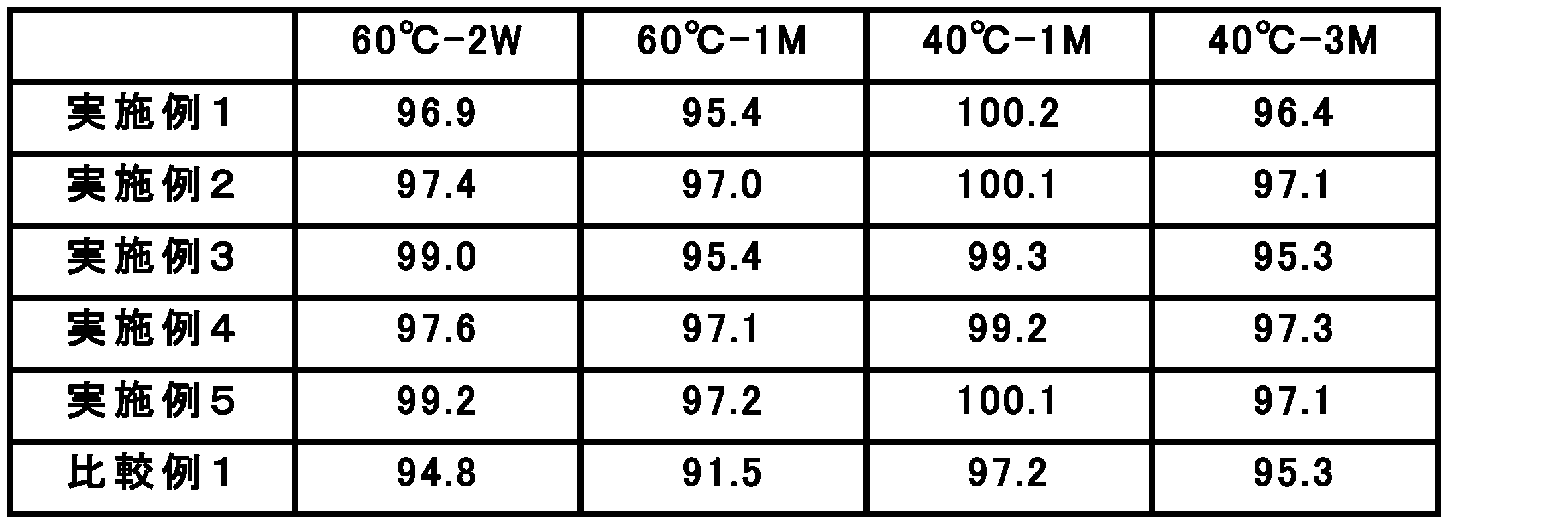
- ⁇ Drug content stability test> The drug content stability of the patches of Examples 1 to 5 and Comparative Example 1 was evaluated by the following method.
- Storage The manufactured patch was cut into a size of 10 cm 2 to obtain a sample used for the test. Each sample was sealed in an aluminum wrapping material, and then stored in a constant temperature and humidity chamber at a temperature of 60 ° C. or 40 ° C. and a humidity of 75% for 2 weeks, 1 month, or 3 months.
- the drug remaining in each patch was extracted as follows, and the remaining amount after storage with respect to the initial content was calculated as the initial value (%).
- the PET film was peeled off from the patch after storage and placed in a glass centrifuge tube (capacity 50 mL).
- the patches of Examples 1 to 5 had high drug content stability even after long-term storage.
- Example 1 to 6 and Comparative Example 1 drug permeability was evaluated by the following method.
- the skin of the ventral part of the hairless mouse was peeled off and attached to a flow-through cell in which warm water at 37 ° C. was circulated around the outer periphery with the dermis side as the receptor liquid side.
- a patch with an application area of 5 cm 2 was applied to the stratum corneum side of the skin, and a phosphate buffer solution (PBS) was used as a receptor solution, and the receptor solution was sampled up to 24 hours every hour.
- the flow rate of the sampled solution was measured, and the drug concentration was measured using high performance liquid chromatography.
- the drug permeation rate per hour was calculated from the obtained measured value, and the maximum value Jmax ( ⁇ g / cm 2 / hr) was determined. The results are shown in FIG.
- the patches of Examples 1 to 3 and Comparative Example 1 showed excellent drug permeability. Almost no drug permeability was observed in the patch of Example 6, because the pH of the adhesive layer was lowered by the addition of aluminum chloride, so that tamsulosin, which is a basic drug, became difficult to permeate. it is conceivable that.
- the patch of the present invention has excellent drug content stability over a long period of time, and is useful in the medical industry for the purpose of disease prevention and treatment.
Landscapes
- Health & Medical Sciences (AREA)
- Engineering & Computer Science (AREA)
- Bioinformatics & Cheminformatics (AREA)
- General Health & Medical Sciences (AREA)
- Veterinary Medicine (AREA)
- Medicinal Chemistry (AREA)
- Pharmacology & Pharmacy (AREA)
- Chemical & Material Sciences (AREA)
- Life Sciences & Earth Sciences (AREA)
- Animal Behavior & Ethology (AREA)
- Public Health (AREA)
- Dermatology (AREA)
- Epidemiology (AREA)
- Urology & Nephrology (AREA)
- Chemical Kinetics & Catalysis (AREA)
- General Chemical & Material Sciences (AREA)
- Nuclear Medicine, Radiotherapy & Molecular Imaging (AREA)
- Organic Chemistry (AREA)
- Medicinal Preparation (AREA)
- Acyclic And Carbocyclic Compounds In Medicinal Compositions (AREA)
- Pharmaceuticals Containing Other Organic And Inorganic Compounds (AREA)
Abstract
Description
(参考例1~3)
表1に示す配合(質量%)に従って、塩酸タムスロシン、酢酸ナトリウム、脂肪酸エステル及びアクリル酸エステル系重合体1~3と混合し、混合物を攪拌して均一な溶解物を得た。この溶解物を離型紙上に展延し、溶剤を乾燥除去した後にポリエチレンテレフタレート(PET)フィルム支持体と貼り合せて参考例1~3の貼付剤を得た。なお、表1中、アクリル酸エステル系重合体1は、水酸基を有するアクリル酸エステル系重合体であり、かつ、架橋剤を含む。アクリル酸エステル系重合体2は、カルボキシル基を有するアクリル酸エステル系重合体であり、かつ、架橋剤を含む。アクリル酸エステル系重合体3は、水酸基及びカルボキシル基を持たないアクリル酸エステル系重合体であり、かつ、架橋剤を含まない。
(参考例1~3)
参考例1~3の貼付剤について、以下の方法で薬物透過性を評価した。へアレスマウス腹側部皮膚を剥離し、真皮側をレセプター液側として37℃の温水を外周部に循環させたフロースルーセルに装着した。次に皮膚の角質層側に適用面積5cm2の貼付剤を貼付し、リン酸緩衝液(PBS)をレセプター液として使用し、時間ごとに24時間までレセプター液をサンプリングした。サンプリングした溶液の流量を測定すると共に、高速液体クロマトグラフィーを用いて薬物濃度を測定した。得られた測定値から、1時間当たりの薬物透過速度を算出し、その最大値Jmax(μg/cm2/hr)と、24時間の累積透過量(μg)を求めた。結果を表1に示す。

(実施例1~6)
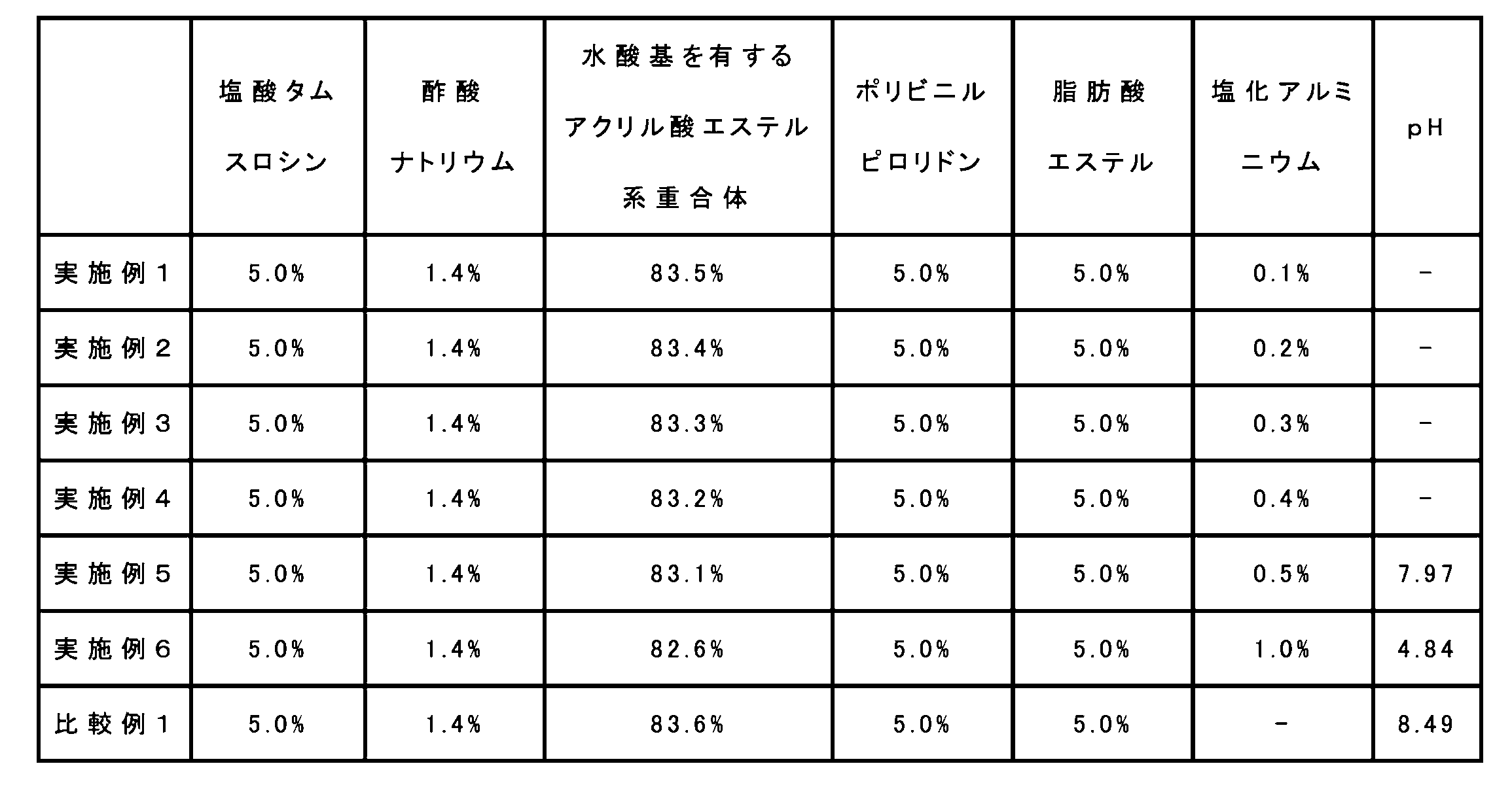
表2に示す配合(質量%)に従って、塩酸タムスロシン、酢酸ナトリウム、ポリビニルピロリドン及び脂肪酸エステルを溶剤中にてよく混合した後、塩化アルミニウムを溶解した水酸基を有するアクリル酸エステル系重合体と混合し、混合物を攪拌して均一な溶解物を得た。この溶解物を離型紙上に展延し、溶剤を乾燥除去した後にポリエチレンテレフタレート(PET)フィルム支持体と貼り合せて本発明の貼付剤を得た。
塩化アルミニウムを使用しないこと以外は、実施例1~6と同様にして、表2に示す配合に従って貼付剤を作製した。
離型紙を剥離した製剤(5cm2)を20mLの蒸留水に浸漬し、24時間攪拌した後、試験液のpHを測定した。
実施例1~5及び比較例1の貼付剤の薬物含量安定性を以下の方法で評価した。
(保管)
製造した貼付剤を10cm2の大きさに裁断し、試験に用いるサンプルを得た。各サンプルをアルミ包材中に密封してから、温度60℃又は40℃、湿度75%の恒温恒湿槽中に2週間、1ヶ月間又は3ヶ月間保管した。
(測定)
各貼付剤に残存する薬物を以下にようにして抽出し、初期含有量に対する保管後の残存量を対初期値(%)として算出した。保管後の貼付剤からPETフィルムを剥がし、ガラス製遠沈管(容量50mL)に投入した。次に、抽出液としてテトラヒドロフラン10mlを加え、1時間振とうした。次いで、適当な内部標準物質を加え、さらに全量が50mlになるようにメタノールを加えて、1時間振とうした。調製された各試験サンプルを高速液体クロマトグラフィーにより分析し、含まれる薬物を定量した。各サンプルの薬物の含有量(Ni)、及び保管前の初期サンプルの薬物の含有量(N0)の値を下記式(1)に示す関係式に代入して得られた対初期値(Ri)を表3に示す。
対初期値Ri(%)=Ni/N0×100…(1)
なお、表3中、例えば、「60℃-2W」は60℃で2週間、「40℃-1M」は40℃で1ヶ月間の保管条件を指す。
(実施例1~6及び比較例1)
実施例1~6及び比較例1の貼付剤について、以下の方法で薬物透過性を評価した。へアレスマウス腹側部皮膚を剥離し、真皮側をレセプター液側として37℃の温水を外周部に循環させたフロースルーセルに装着した。次に皮膚の角質層側に適用面積5cm2の貼付剤を貼付し、リン酸緩衝液(PBS)をレセプター液として使用し、時間ごとに24時間までレセプター液をサンプリングした。サンプリングした溶液の流量を測定すると共に、高速液体クロマトグラフィーを用いて薬物濃度を測定した。得られた測定値から、1時間当たりの薬物透過速度を算出し、その最大値Jmax(μg/cm2/hr)を求めた。結果を図1に示す。
Claims (7)
- 支持体上に粘着剤層を備える貼付剤であって、
前記粘着剤層は、水酸基を有する重合体からなる粘着基剤と、薬物と、ポリビニルピロリドンと、多価金属塩化物とを含有する、貼付剤。 - 前記薬物が塩基性薬物及びその薬学的に許容される塩からなる群より選ばれる少なくとも1種の薬物である、請求項1に記載の貼付剤。
- 前記薬物がタムスロシン及びその薬学的に許容される塩からなる群より選ばれる少なくとも1種の薬物である、請求項1又は2に記載の貼付剤。
- 前記多価金属塩化物が塩化アルミニウムである、請求項1~3のいずれか一項に記載の貼付剤。
- 前記ポリビニルピロリドンの含有量が、前記粘着剤層の全質量基準で1~20質量%である、請求項1~4のいずれか一項に記載の貼付剤。
- 前記多価金属塩化物の含有量が、前記粘着剤層の全質量基準で0.1~5.0質量%である、請求項1~5のいずれか一項に記載の貼付剤。
- 前記多価金属塩化物と前記薬物との比が質量比で、1:100~2:1である、請求項1~6のいずれか一項に記載の貼付剤。
Priority Applications (2)
| Application Number | Priority Date | Filing Date | Title |
|---|---|---|---|
| JP2012501843A JP5615898B2 (ja) | 2010-02-24 | 2011-02-24 | 貼付剤 |
| US13/580,332 US9370495B2 (en) | 2010-02-24 | 2011-02-24 | Adhesive patch |
Applications Claiming Priority (2)
| Application Number | Priority Date | Filing Date | Title |
|---|---|---|---|
| JP2010039312 | 2010-02-24 | ||
| JP2010-039312 | 2010-02-24 |
Publications (1)
| Publication Number | Publication Date |
|---|---|
| WO2011105486A1 true WO2011105486A1 (ja) | 2011-09-01 |
Family
ID=44506887
Family Applications (1)
| Application Number | Title | Priority Date | Filing Date |
|---|---|---|---|
| PCT/JP2011/054143 Ceased WO2011105486A1 (ja) | 2010-02-24 | 2011-02-24 | 貼付剤 |
Country Status (3)
| Country | Link |
|---|---|
| US (1) | US9370495B2 (ja) |
| JP (1) | JP5615898B2 (ja) |
| WO (1) | WO2011105486A1 (ja) |
Cited By (3)
| Publication number | Priority date | Publication date | Assignee | Title |
|---|---|---|---|---|
| JP2019525932A (ja) * | 2016-07-27 | 2019-09-12 | コリウム インターナショナル, インコーポレイテッド | 炭酸水素ナトリウムのin situ変換で促進されたアミン薬物の経皮送達 |
| JP2022530345A (ja) * | 2019-04-17 | 2022-06-29 | エルテーエス ローマン テラピー-ジステーメ アーゲー | 経皮治療システム |
| US11752114B2 (en) | 2019-04-17 | 2023-09-12 | Lts Lohmann Therapie-Systeme Ag | Transdermal therapeutic system |
Families Citing this family (7)
| Publication number | Priority date | Publication date | Assignee | Title |
|---|---|---|---|---|
| US10966936B2 (en) | 2015-12-30 | 2021-04-06 | Corium, Inc. | Systems comprising a composite backing and methods for long term transdermal administration |
| WO2017223402A1 (en) | 2016-06-23 | 2017-12-28 | Corium International, Inc. | Adhesive matrix with hydrophilic and hydrophobic domains and a therapeutic agent |
| CN115813888A (zh) | 2016-12-20 | 2023-03-21 | 罗曼治疗系统股份公司 | 包含阿塞那平的透皮治疗系统 |
| EP3558276B1 (en) | 2016-12-20 | 2024-11-06 | LTS Lohmann Therapie-Systeme AG | Transdermal therapeutic system containing asenapine and polysiloxane or polyisobutylene |
| WO2019002204A1 (en) | 2017-06-26 | 2019-01-03 | Lts Lohmann Therapie-Systeme Ag | TRANSDERMAL THERAPEUTIC SYSTEM CONTAINING ASENAPINE AND SILICONE-TYPE ACRYLIC HYBRID POLYMER |
| US12329862B2 (en) | 2018-06-20 | 2025-06-17 | Lts Lohmann Therapie-Systeme Ag | Transdermal therapeutic system containing asenapine |
| AU2019291060B2 (en) | 2018-06-20 | 2024-09-05 | Lts Lohmann Therapie-Systeme Ag | Transdermal therapeutic system containing asenapine |
Citations (3)
| Publication number | Priority date | Publication date | Assignee | Title |
|---|---|---|---|---|
| JPS6471811A (en) * | 1987-09-11 | 1989-03-16 | Sekisui Chemical Co Ltd | Medical application agent |
| WO2005102393A1 (ja) * | 2004-04-21 | 2005-11-03 | Hisamitsu Pharmaceutical Co., Inc. | 粘着基剤中の吸収促進剤の含有率を高めた外用貼付剤 |
| WO2007126067A1 (ja) * | 2006-04-28 | 2007-11-08 | Lion Corporation | 非水系粘着剤組成物、貼付剤および貼付剤の製造方法 |
Family Cites Families (7)
| Publication number | Priority date | Publication date | Assignee | Title |
|---|---|---|---|---|
| JPS57176908A (en) | 1981-04-23 | 1982-10-30 | Sekisui Chem Co Ltd | Remedial adhesive tape or sheet |
| JPS5865168A (ja) | 1981-10-13 | 1983-04-18 | 積水化学工業株式会社 | 治療用接着テ−プもしくはシ−ト |
| IE64061B1 (en) | 1989-09-04 | 1995-07-12 | Yamanouchi Pharma Co Ltd | External preparation containing amusulosin |
| JPH0892080A (ja) | 1994-09-22 | 1996-04-09 | Yamanouchi Pharmaceut Co Ltd | 経皮吸収用製剤 |
| JP5025998B2 (ja) | 2005-06-06 | 2012-09-12 | 日東電工株式会社 | 経皮吸収製剤 |
| WO2007023791A1 (ja) | 2005-08-22 | 2007-03-01 | Hisamitsu Pharmaceutical Co., Inc. | 外用剤 |
| EP2255809B1 (en) | 2008-02-27 | 2017-08-23 | Hisamitsu Pharmaceutical Co., Inc. | Medicated patch |
-
2011
- 2011-02-24 JP JP2012501843A patent/JP5615898B2/ja active Active
- 2011-02-24 US US13/580,332 patent/US9370495B2/en active Active
- 2011-02-24 WO PCT/JP2011/054143 patent/WO2011105486A1/ja not_active Ceased
Patent Citations (3)
| Publication number | Priority date | Publication date | Assignee | Title |
|---|---|---|---|---|
| JPS6471811A (en) * | 1987-09-11 | 1989-03-16 | Sekisui Chemical Co Ltd | Medical application agent |
| WO2005102393A1 (ja) * | 2004-04-21 | 2005-11-03 | Hisamitsu Pharmaceutical Co., Inc. | 粘着基剤中の吸収促進剤の含有率を高めた外用貼付剤 |
| WO2007126067A1 (ja) * | 2006-04-28 | 2007-11-08 | Lion Corporation | 非水系粘着剤組成物、貼付剤および貼付剤の製造方法 |
Cited By (5)
| Publication number | Priority date | Publication date | Assignee | Title |
|---|---|---|---|---|
| JP2019525932A (ja) * | 2016-07-27 | 2019-09-12 | コリウム インターナショナル, インコーポレイテッド | 炭酸水素ナトリウムのin situ変換で促進されたアミン薬物の経皮送達 |
| JP7071330B2 (ja) | 2016-07-27 | 2022-05-18 | コリウム, インコーポレイテッド | 炭酸水素ナトリウムのin situ変換で促進されたアミン薬物の経皮送達 |
| JP2022530345A (ja) * | 2019-04-17 | 2022-06-29 | エルテーエス ローマン テラピー-ジステーメ アーゲー | 経皮治療システム |
| US11752114B2 (en) | 2019-04-17 | 2023-09-12 | Lts Lohmann Therapie-Systeme Ag | Transdermal therapeutic system |
| JP7453994B2 (ja) | 2019-04-17 | 2024-03-21 | エルテーエス ローマン テラピー-ジステーメ アーゲー | 経皮治療システム |
Also Published As
| Publication number | Publication date |
|---|---|
| JPWO2011105486A1 (ja) | 2013-06-20 |
| US20120321690A1 (en) | 2012-12-20 |
| JP5615898B2 (ja) | 2014-10-29 |
| US9370495B2 (en) | 2016-06-21 |
Similar Documents
| Publication | Publication Date | Title |
|---|---|---|
| JP5615898B2 (ja) | 貼付剤 | |
| JP5180277B2 (ja) | 外用貼付剤 | |
| JP6060213B2 (ja) | 外用医薬組成物を用いた貼付剤 | |
| JP5403948B2 (ja) | メマンチン含有経皮吸収製剤 | |
| JP5190358B2 (ja) | 経皮吸収型製剤 | |
| JPWO2005115355A1 (ja) | 貼付製剤 | |
| US20110220265A1 (en) | Preparation for External Use | |
| JP5813652B2 (ja) | 経皮吸収型製剤 | |
| WO2005102393A1 (ja) | 粘着基剤中の吸収促進剤の含有率を高めた外用貼付剤 | |
| CN120960178A (zh) | 经皮吸收制剂 | |
| JP6129632B2 (ja) | 貼付剤 | |
| TWI700103B (zh) | 貼附劑 | |
| JP5813653B2 (ja) | 経皮吸収型製剤 | |
| WO2021054257A1 (ja) | ロピニロール含有貼付剤及びロピニロールの皮膚透過性向上方法 | |
| JP6695571B2 (ja) | 経皮吸収型製剤 | |
| JP6675589B2 (ja) | 経皮吸収型製剤 | |
| JP4404251B2 (ja) | 経皮吸収型製剤 | |
| JPWO2005041967A1 (ja) | ペルゴリド療法における副作用低減のための経皮吸収型製剤および方法 | |
| WO2022091925A1 (ja) | ロピニロール含有貼付剤及びロピニロールの皮膚透過性向上方法 |
Legal Events
| Date | Code | Title | Description |
|---|---|---|---|
| 121 | Ep: the epo has been informed by wipo that ep was designated in this application |
Ref document number: 11747446 Country of ref document: EP Kind code of ref document: A1 |
|
| WWE | Wipo information: entry into national phase |
Ref document number: 2012501843 Country of ref document: JP |
|
| WWE | Wipo information: entry into national phase |
Ref document number: 13580332 Country of ref document: US |
|
| NENP | Non-entry into the national phase |
Ref country code: DE |
|
| 122 | Ep: pct application non-entry in european phase |
Ref document number: 11747446 Country of ref document: EP Kind code of ref document: A1 |