WO2011099397A1 - セラミック焼結体およびその製造方法 - Google Patents
セラミック焼結体およびその製造方法 Download PDFInfo
- Publication number
- WO2011099397A1 WO2011099397A1 PCT/JP2011/051985 JP2011051985W WO2011099397A1 WO 2011099397 A1 WO2011099397 A1 WO 2011099397A1 JP 2011051985 W JP2011051985 W JP 2011051985W WO 2011099397 A1 WO2011099397 A1 WO 2011099397A1
- Authority
- WO
- WIPO (PCT)
- Prior art keywords
- ceramic
- oxide
- sintered body
- fresnoite
- ceramic material
- Prior art date
- Legal status (The legal status is an assumption and is not a legal conclusion. Google has not performed a legal analysis and makes no representation as to the accuracy of the status listed.)
- Ceased
Links
Images
Classifications
-
- H—ELECTRICITY
- H01—ELECTRIC ELEMENTS
- H01B—CABLES; CONDUCTORS; INSULATORS; SELECTION OF MATERIALS FOR THEIR CONDUCTIVE, INSULATING OR DIELECTRIC PROPERTIES
- H01B3/00—Insulators or insulating bodies characterised by the insulating materials; Selection of materials for their insulating or dielectric properties
- H01B3/02—Insulators or insulating bodies characterised by the insulating materials; Selection of materials for their insulating or dielectric properties mainly consisting of inorganic substances
- H01B3/12—Insulators or insulating bodies characterised by the insulating materials; Selection of materials for their insulating or dielectric properties mainly consisting of inorganic substances ceramics
-
- C—CHEMISTRY; METALLURGY
- C04—CEMENTS; CONCRETE; ARTIFICIAL STONE; CERAMICS; REFRACTORIES
- C04B—LIME, MAGNESIA; SLAG; CEMENTS; COMPOSITIONS THEREOF, e.g. MORTARS, CONCRETE OR LIKE BUILDING MATERIALS; ARTIFICIAL STONE; CERAMICS; REFRACTORIES; TREATMENT OF NATURAL STONE
- C04B35/00—Shaped ceramic products characterised by their composition; Ceramics compositions; Processing powders of inorganic compounds preparatory to the manufacturing of ceramic products
- C04B35/01—Shaped ceramic products characterised by their composition; Ceramics compositions; Processing powders of inorganic compounds preparatory to the manufacturing of ceramic products based on oxide ceramics
- C04B35/16—Shaped ceramic products characterised by their composition; Ceramics compositions; Processing powders of inorganic compounds preparatory to the manufacturing of ceramic products based on oxide ceramics based on silicates other than clay
- C04B35/18—Shaped ceramic products characterised by their composition; Ceramics compositions; Processing powders of inorganic compounds preparatory to the manufacturing of ceramic products based on oxide ceramics based on silicates other than clay rich in aluminium oxide
- C04B35/195—Alkaline earth aluminosilicates, e.g. cordierite or anorthite
-
- C—CHEMISTRY; METALLURGY
- C04—CEMENTS; CONCRETE; ARTIFICIAL STONE; CERAMICS; REFRACTORIES
- C04B—LIME, MAGNESIA; SLAG; CEMENTS; COMPOSITIONS THEREOF, e.g. MORTARS, CONCRETE OR LIKE BUILDING MATERIALS; ARTIFICIAL STONE; CERAMICS; REFRACTORIES; TREATMENT OF NATURAL STONE
- C04B2235/00—Aspects relating to ceramic starting mixtures or sintered ceramic products
- C04B2235/02—Composition of constituents of the starting material or of secondary phases of the final product
- C04B2235/30—Constituents and secondary phases not being of a fibrous nature
- C04B2235/32—Metal oxides, mixed metal oxides, or oxide-forming salts thereof, e.g. carbonates, nitrates, (oxy)hydroxides, chlorides
- C04B2235/3205—Alkaline earth oxides or oxide forming salts thereof, e.g. beryllium oxide
- C04B2235/3206—Magnesium oxides or oxide-forming salts thereof
-
- C—CHEMISTRY; METALLURGY
- C04—CEMENTS; CONCRETE; ARTIFICIAL STONE; CERAMICS; REFRACTORIES
- C04B—LIME, MAGNESIA; SLAG; CEMENTS; COMPOSITIONS THEREOF, e.g. MORTARS, CONCRETE OR LIKE BUILDING MATERIALS; ARTIFICIAL STONE; CERAMICS; REFRACTORIES; TREATMENT OF NATURAL STONE
- C04B2235/00—Aspects relating to ceramic starting mixtures or sintered ceramic products
- C04B2235/02—Composition of constituents of the starting material or of secondary phases of the final product
- C04B2235/30—Constituents and secondary phases not being of a fibrous nature
- C04B2235/32—Metal oxides, mixed metal oxides, or oxide-forming salts thereof, e.g. carbonates, nitrates, (oxy)hydroxides, chlorides
- C04B2235/3205—Alkaline earth oxides or oxide forming salts thereof, e.g. beryllium oxide
- C04B2235/3215—Barium oxides or oxide-forming salts thereof
-
- C—CHEMISTRY; METALLURGY
- C04—CEMENTS; CONCRETE; ARTIFICIAL STONE; CERAMICS; REFRACTORIES
- C04B—LIME, MAGNESIA; SLAG; CEMENTS; COMPOSITIONS THEREOF, e.g. MORTARS, CONCRETE OR LIKE BUILDING MATERIALS; ARTIFICIAL STONE; CERAMICS; REFRACTORIES; TREATMENT OF NATURAL STONE
- C04B2235/00—Aspects relating to ceramic starting mixtures or sintered ceramic products
- C04B2235/02—Composition of constituents of the starting material or of secondary phases of the final product
- C04B2235/30—Constituents and secondary phases not being of a fibrous nature
- C04B2235/32—Metal oxides, mixed metal oxides, or oxide-forming salts thereof, e.g. carbonates, nitrates, (oxy)hydroxides, chlorides
- C04B2235/3217—Aluminum oxide or oxide forming salts thereof, e.g. bauxite, alpha-alumina
-
- C—CHEMISTRY; METALLURGY
- C04—CEMENTS; CONCRETE; ARTIFICIAL STONE; CERAMICS; REFRACTORIES
- C04B—LIME, MAGNESIA; SLAG; CEMENTS; COMPOSITIONS THEREOF, e.g. MORTARS, CONCRETE OR LIKE BUILDING MATERIALS; ARTIFICIAL STONE; CERAMICS; REFRACTORIES; TREATMENT OF NATURAL STONE
- C04B2235/00—Aspects relating to ceramic starting mixtures or sintered ceramic products
- C04B2235/02—Composition of constituents of the starting material or of secondary phases of the final product
- C04B2235/30—Constituents and secondary phases not being of a fibrous nature
- C04B2235/32—Metal oxides, mixed metal oxides, or oxide-forming salts thereof, e.g. carbonates, nitrates, (oxy)hydroxides, chlorides
- C04B2235/3231—Refractory metal oxides, their mixed metal oxides, or oxide-forming salts thereof
- C04B2235/3232—Titanium oxides or titanates, e.g. rutile or anatase
-
- C—CHEMISTRY; METALLURGY
- C04—CEMENTS; CONCRETE; ARTIFICIAL STONE; CERAMICS; REFRACTORIES
- C04B—LIME, MAGNESIA; SLAG; CEMENTS; COMPOSITIONS THEREOF, e.g. MORTARS, CONCRETE OR LIKE BUILDING MATERIALS; ARTIFICIAL STONE; CERAMICS; REFRACTORIES; TREATMENT OF NATURAL STONE
- C04B2235/00—Aspects relating to ceramic starting mixtures or sintered ceramic products
- C04B2235/02—Composition of constituents of the starting material or of secondary phases of the final product
- C04B2235/30—Constituents and secondary phases not being of a fibrous nature
- C04B2235/32—Metal oxides, mixed metal oxides, or oxide-forming salts thereof, e.g. carbonates, nitrates, (oxy)hydroxides, chlorides
- C04B2235/3262—Manganese oxides, manganates, rhenium oxides or oxide-forming salts thereof, e.g. MnO
-
- C—CHEMISTRY; METALLURGY
- C04—CEMENTS; CONCRETE; ARTIFICIAL STONE; CERAMICS; REFRACTORIES
- C04B—LIME, MAGNESIA; SLAG; CEMENTS; COMPOSITIONS THEREOF, e.g. MORTARS, CONCRETE OR LIKE BUILDING MATERIALS; ARTIFICIAL STONE; CERAMICS; REFRACTORIES; TREATMENT OF NATURAL STONE
- C04B2235/00—Aspects relating to ceramic starting mixtures or sintered ceramic products
- C04B2235/02—Composition of constituents of the starting material or of secondary phases of the final product
- C04B2235/30—Constituents and secondary phases not being of a fibrous nature
- C04B2235/34—Non-metal oxides, non-metal mixed oxides, or salts thereof that form the non-metal oxides upon heating, e.g. carbonates, nitrates, (oxy)hydroxides, chlorides
- C04B2235/3427—Silicates other than clay, e.g. water glass
- C04B2235/3436—Alkaline earth metal silicates, e.g. barium silicate
-
- C—CHEMISTRY; METALLURGY
- C04—CEMENTS; CONCRETE; ARTIFICIAL STONE; CERAMICS; REFRACTORIES
- C04B—LIME, MAGNESIA; SLAG; CEMENTS; COMPOSITIONS THEREOF, e.g. MORTARS, CONCRETE OR LIKE BUILDING MATERIALS; ARTIFICIAL STONE; CERAMICS; REFRACTORIES; TREATMENT OF NATURAL STONE
- C04B2235/00—Aspects relating to ceramic starting mixtures or sintered ceramic products
- C04B2235/02—Composition of constituents of the starting material or of secondary phases of the final product
- C04B2235/30—Constituents and secondary phases not being of a fibrous nature
- C04B2235/34—Non-metal oxides, non-metal mixed oxides, or salts thereof that form the non-metal oxides upon heating, e.g. carbonates, nitrates, (oxy)hydroxides, chlorides
- C04B2235/3427—Silicates other than clay, e.g. water glass
- C04B2235/3463—Alumino-silicates other than clay, e.g. mullite
- C04B2235/3481—Alkaline earth metal alumino-silicates other than clay, e.g. cordierite, beryl, micas such as margarite, plagioclase feldspars such as anorthite, zeolites such as chabazite
-
- C—CHEMISTRY; METALLURGY
- C04—CEMENTS; CONCRETE; ARTIFICIAL STONE; CERAMICS; REFRACTORIES
- C04B—LIME, MAGNESIA; SLAG; CEMENTS; COMPOSITIONS THEREOF, e.g. MORTARS, CONCRETE OR LIKE BUILDING MATERIALS; ARTIFICIAL STONE; CERAMICS; REFRACTORIES; TREATMENT OF NATURAL STONE
- C04B2235/00—Aspects relating to ceramic starting mixtures or sintered ceramic products
- C04B2235/02—Composition of constituents of the starting material or of secondary phases of the final product
- C04B2235/50—Constituents or additives of the starting mixture chosen for their shape or used because of their shape or their physical appearance
- C04B2235/54—Particle size related information
- C04B2235/5418—Particle size related information expressed by the size of the particles or aggregates thereof
- C04B2235/5436—Particle size related information expressed by the size of the particles or aggregates thereof micrometer sized, i.e. from 1 to 100 micron
-
- C—CHEMISTRY; METALLURGY
- C04—CEMENTS; CONCRETE; ARTIFICIAL STONE; CERAMICS; REFRACTORIES
- C04B—LIME, MAGNESIA; SLAG; CEMENTS; COMPOSITIONS THEREOF, e.g. MORTARS, CONCRETE OR LIKE BUILDING MATERIALS; ARTIFICIAL STONE; CERAMICS; REFRACTORIES; TREATMENT OF NATURAL STONE
- C04B2235/00—Aspects relating to ceramic starting mixtures or sintered ceramic products
- C04B2235/60—Aspects relating to the preparation, properties or mechanical treatment of green bodies or pre-forms
- C04B2235/602—Making the green bodies or pre-forms by moulding
- C04B2235/6025—Tape casting, e.g. with a doctor blade
-
- C—CHEMISTRY; METALLURGY
- C04—CEMENTS; CONCRETE; ARTIFICIAL STONE; CERAMICS; REFRACTORIES
- C04B—LIME, MAGNESIA; SLAG; CEMENTS; COMPOSITIONS THEREOF, e.g. MORTARS, CONCRETE OR LIKE BUILDING MATERIALS; ARTIFICIAL STONE; CERAMICS; REFRACTORIES; TREATMENT OF NATURAL STONE
- C04B2235/00—Aspects relating to ceramic starting mixtures or sintered ceramic products
- C04B2235/65—Aspects relating to heat treatments of ceramic bodies such as green ceramics or pre-sintered ceramics, e.g. burning, sintering or melting processes
- C04B2235/656—Aspects relating to heat treatments of ceramic bodies such as green ceramics or pre-sintered ceramics, e.g. burning, sintering or melting processes characterised by specific heating conditions during heat treatment
-
- C—CHEMISTRY; METALLURGY
- C04—CEMENTS; CONCRETE; ARTIFICIAL STONE; CERAMICS; REFRACTORIES
- C04B—LIME, MAGNESIA; SLAG; CEMENTS; COMPOSITIONS THEREOF, e.g. MORTARS, CONCRETE OR LIKE BUILDING MATERIALS; ARTIFICIAL STONE; CERAMICS; REFRACTORIES; TREATMENT OF NATURAL STONE
- C04B2235/00—Aspects relating to ceramic starting mixtures or sintered ceramic products
- C04B2235/65—Aspects relating to heat treatments of ceramic bodies such as green ceramics or pre-sintered ceramics, e.g. burning, sintering or melting processes
- C04B2235/656—Aspects relating to heat treatments of ceramic bodies such as green ceramics or pre-sintered ceramics, e.g. burning, sintering or melting processes characterised by specific heating conditions during heat treatment
- C04B2235/6567—Treatment time
-
- C—CHEMISTRY; METALLURGY
- C04—CEMENTS; CONCRETE; ARTIFICIAL STONE; CERAMICS; REFRACTORIES
- C04B—LIME, MAGNESIA; SLAG; CEMENTS; COMPOSITIONS THEREOF, e.g. MORTARS, CONCRETE OR LIKE BUILDING MATERIALS; ARTIFICIAL STONE; CERAMICS; REFRACTORIES; TREATMENT OF NATURAL STONE
- C04B2235/00—Aspects relating to ceramic starting mixtures or sintered ceramic products
- C04B2235/65—Aspects relating to heat treatments of ceramic bodies such as green ceramics or pre-sintered ceramics, e.g. burning, sintering or melting processes
- C04B2235/658—Atmosphere during thermal treatment
- C04B2235/6582—Hydrogen containing atmosphere
-
- C—CHEMISTRY; METALLURGY
- C04—CEMENTS; CONCRETE; ARTIFICIAL STONE; CERAMICS; REFRACTORIES
- C04B—LIME, MAGNESIA; SLAG; CEMENTS; COMPOSITIONS THEREOF, e.g. MORTARS, CONCRETE OR LIKE BUILDING MATERIALS; ARTIFICIAL STONE; CERAMICS; REFRACTORIES; TREATMENT OF NATURAL STONE
- C04B2235/00—Aspects relating to ceramic starting mixtures or sintered ceramic products
- C04B2235/70—Aspects relating to sintered or melt-casted ceramic products
- C04B2235/72—Products characterised by the absence or the low content of specific components, e.g. alkali metal free alumina ceramics
-
- C—CHEMISTRY; METALLURGY
- C04—CEMENTS; CONCRETE; ARTIFICIAL STONE; CERAMICS; REFRACTORIES
- C04B—LIME, MAGNESIA; SLAG; CEMENTS; COMPOSITIONS THEREOF, e.g. MORTARS, CONCRETE OR LIKE BUILDING MATERIALS; ARTIFICIAL STONE; CERAMICS; REFRACTORIES; TREATMENT OF NATURAL STONE
- C04B2235/00—Aspects relating to ceramic starting mixtures or sintered ceramic products
- C04B2235/70—Aspects relating to sintered or melt-casted ceramic products
- C04B2235/74—Physical characteristics
- C04B2235/78—Grain sizes and shapes, product microstructures, e.g. acicular grains, equiaxed grains, platelet-structures
- C04B2235/786—Micrometer sized grains, i.e. from 1 to 100 micron
-
- C—CHEMISTRY; METALLURGY
- C04—CEMENTS; CONCRETE; ARTIFICIAL STONE; CERAMICS; REFRACTORIES
- C04B—LIME, MAGNESIA; SLAG; CEMENTS; COMPOSITIONS THEREOF, e.g. MORTARS, CONCRETE OR LIKE BUILDING MATERIALS; ARTIFICIAL STONE; CERAMICS; REFRACTORIES; TREATMENT OF NATURAL STONE
- C04B2235/00—Aspects relating to ceramic starting mixtures or sintered ceramic products
- C04B2235/70—Aspects relating to sintered or melt-casted ceramic products
- C04B2235/80—Phases present in the sintered or melt-cast ceramic products other than the main phase
-
- C—CHEMISTRY; METALLURGY
- C04—CEMENTS; CONCRETE; ARTIFICIAL STONE; CERAMICS; REFRACTORIES
- C04B—LIME, MAGNESIA; SLAG; CEMENTS; COMPOSITIONS THEREOF, e.g. MORTARS, CONCRETE OR LIKE BUILDING MATERIALS; ARTIFICIAL STONE; CERAMICS; REFRACTORIES; TREATMENT OF NATURAL STONE
- C04B2235/00—Aspects relating to ceramic starting mixtures or sintered ceramic products
- C04B2235/70—Aspects relating to sintered or melt-casted ceramic products
- C04B2235/96—Properties of ceramic products, e.g. mechanical properties such as strength, toughness, wear resistance
Definitions
- the present invention relates to a ceramic sintered body and a method for producing the same, and more particularly to a ceramic sintered body obtained by firing a non-glass low-temperature sintered ceramic material and a method for producing the same.
- An interesting ceramic sintered body for the present invention is obtained by forming a low-temperature sintered ceramic (LTCC: Low Temperature Ceramic) material into a predetermined shape and firing it.
- LTCC Low Temperature Ceramic
- Low temperature sintered ceramic materials can be fired simultaneously with low melting point metal materials such as silver and copper having a relatively small specific resistance, so that a multilayer ceramic substrate having excellent high frequency characteristics can be formed. It is widely used as a substrate material for use.
- a so-called glass ceramic composite system in which a B 2 O 3 —SiO 2 glass material is mixed with a ceramic material such as Al 2 O 3 is generally used. It is necessary to use an expensive glass material, and since boron that easily volatilizes during baking is included, the composition of the resulting substrate tends to vary, so a special setter for controlling the volatilization amount of boron is required. The manufacturing process is complicated, such as having to use it.
- Patent Document 1 Japanese Patent Application Laid-Open No. 2002-173362
- Patent Document 2 Japanese Patent Application Laid-Open No. 2008-044829
- Patent Document 3 Japanese Patent Application Laid-Open No. 2008-053525
- Patent Document 4 A low-temperature sintered ceramic material described in (Patent Document 4) has been proposed.
- the low-temperature sintered ceramic materials described in these documents do not contain glass as a starting material, and are non-glass-based low-temperature sintered ceramic materials that do not contain boron. I do not encounter.
- ceramic sintered bodies obtained by sintering the low-temperature sintered ceramic materials described in these documents may not have desirable strength characteristics because of their small fracture toughness values.
- an object of the present invention is to provide a ceramic sintered body that can be manufactured inexpensively and easily without using glass as a starting material and has a large fracture toughness value.
- Another object of the present invention is to provide a method for producing the ceramic sintered body described above.
- the ceramic sintered body according to the present invention includes crystal phases of Quartz, Alumina, Fresnoite, Sanbornite and Celsian, and is obtained by a powder X-ray diffraction method.
- the average crystal grain size of the Fresnoite crystal phase is preferably 5 ⁇ m or less.
- the ceramic sintered body according to the present invention preferably includes a main component ceramic material containing Si oxide, Ba oxide and Al oxide, and a subcomponent ceramic material containing Mn oxide and Ti oxide, In particular, it is obtained by sintering a non-glass low-temperature sintered ceramic material that does not contain any of Cr oxide and B oxide.
- This invention is also directed to a method for producing a ceramic sintered body.
- the method for producing a ceramic sintered body according to the present invention includes a main component ceramic material containing Si oxide, Ba oxide and Al oxide, and a subcomponent ceramic material containing Mn oxide and Ti oxide, First, a ceramic green sheet containing a non-glass-based low-temperature sintered ceramic material that does not contain any Cr oxide and B oxide is first prepared.
- a raw laminate is produced by laminating a plurality of the ceramic green sheets, and then the raw laminate is fired.
- the maximum temperature is selected in the range of 980 to 1000 ° C. in the firing step.
- the fracture toughness value can be increased, and if this is used to construct a ceramic substrate, the ceramic substrate is high. A ceramic substrate having a bending strength can be obtained.
- the ceramic sintered body according to the present invention when a crystal having a fine grain size is present such that the average crystal grain size of the fresnoite crystal phase is 5 ⁇ m or less, the crystal grain boundary is increased, and the progress of cracks can be suppressed. . Therefore, if a substrate is formed using this ceramic sintered body, a ceramic substrate having a high bending strength of, for example, 320 MPa or more can be obtained.
- the method for producing a ceramic sintered body according to the present invention it is possible to control the amount of fresnoite precipitation by adjusting the maximum temperature during firing as described above. Therefore, in the obtained ceramic sintered body, the ratio of crystal precipitation amount for quartz and fresnoite can be controlled as described above, and as a result, the fracture toughness value can be increased, and using this, the ceramic substrate If it comprises, a ceramic substrate provided with high bending strength can be obtained.
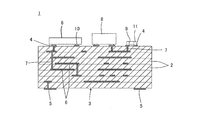
- FIG. 1 is a cross-sectional view schematically showing a multilayer ceramic substrate 1 configured using a ceramic sintered body according to the present invention.
- the ceramic sintered body according to the present invention includes quartz (Quartz: SiO 2 ), alumina (Alumina: Al 2 O 3 ), fresnoite (Fresnoite: Ba 2 TiSi 2 O 8 ), and sunbornite (Sanbornite: BaSi 2 O 5 ).
- quartz Quartz: SiO 2
- alumina Al 2 O 3
- fresnoite Fresnoite: Ba 2 TiSi 2 O 8
- sunbornite Sandbornite: BaSi 2 O 5
- the first characteristic is that each crystal phase of Celsian (BaAl 2 Si 2 O 8 ) is included.
- This ceramic sintered body is obtained by sintering a non-glass low-temperature sintered ceramic material as described later, for example.
- the starting material does not substantially contain a glass component, but the sintered body itself has an amorphous portion in addition to the above-described crystal phases. This is because when a non-glass low-temperature sintered ceramic material is fired, a part of the starting material is vitrified.
- the ceramic sintered body according to the present invention uses the above-described quartz, alumina, and fresnoite crystal phases as main crystal phases, so that the relative dielectric constant ⁇ r is as small as 10 or less, and is suitable for a ceramic layer constituting a high-frequency substrate. A ceramic sintered body can be obtained.
- the bonding strength with the external conductor film is high, the electrode peel strength is improved, and problems such as dropping of the surface-mounted components to be mounted are less likely to occur.
- the sintered ceramic body according to the present invention further precipitates crystal phases of sambournite and celsian.
- crystal phases of sambourite and celsian are also precipitated, a large number of various crystal phases exist, and as a result, the crystal structure of the sintered body becomes non-uniform, and even in the sintered body. Even if there is a crack, the elongation can be suppressed.
- the second characteristic is that the relationship between the diffraction peak intensities B in A / B ⁇ 2.5.
- the fracture toughness value of the ceramic sintered body can be increased, and if a ceramic substrate is formed using this, a ceramic substrate having a high bending strength can be obtained.
- the average crystal grain size of the Fresnoite crystal phase is preferably 5 ⁇ m or less. That is, when such fine crystal phases are present at a predetermined ratio, the crystal grain boundaries increase, and even if cracks are generated in the sintered body, the elongation can be suppressed.
- the ceramic sintered body according to the present invention preferably includes a main component ceramic material containing Si oxide, Ba oxide and Al oxide, and a subcomponent ceramic material containing Mn oxide and Ti oxide, In particular, it is obtained by sintering a non-glass low-temperature sintered ceramic material that does not contain any of Cr oxide and B oxide.
- this low-temperature sintered ceramic material does not use glass as a starting material and does not substantially contain B oxide (especially B 2 O 3 ), it can reduce the composition variation at the time of firing and is special. Management of the firing process can be facilitated, such as not having to use a setter.
- Cr oxide particularly Cr 2 O 3
- Cr oxide is not substantially contained, a decrease in Qf value in a high frequency band typified by a microwave band is suppressed, and a Qf value of 1000 or more is obtained at 3 GHz, for example be able to.
- the low-temperature sintered ceramic material is, for example, 48 to 75% by weight in terms of Si converted to SiO 2 , 20 to 40% by weight in terms of Ba converted to BaO, and 5 in terms of Al converted to Al 2 O 3. 2 to 10 parts by weight of Mn converted to MnO and 0.1 to 0.1% of Ti converted to TiO 2 with respect to 100% by weight of the main component ceramic material containing up to 20% by weight. 2 to 10 parts by weight of subcomponent ceramic material.
- the main component ceramic material is a basic component of the obtained ceramic sintered body, and a ceramic sintered body having a high insulation resistance, a low relative dielectric constant ⁇ r and a low dielectric loss is obtained. It greatly contributes to.
- Mn which is a subcomponent ceramic material
- SiO 2 —BaO—Al 2 O 3 main component ceramic material easily reacts with the SiO 2 —BaO—Al 2 O 3 main component ceramic material to form a liquid phase component, and reduces the viscosity of the starting material during firing.
- the volatility is much less than B 2 O 3 acting as the same sintering aid. Therefore, variation in firing is reduced, management of the firing process is facilitated, and mass productivity is improved.
- Ti which is a subcomponent ceramic material, increases the amount of addition described above, thereby increasing the A / B ratio described above and further increasing the fracture toughness value of the ceramic sintered body. .
- Ti especially TiO 2
- the bonding strength between the sintered body and the conductor film that is, the bonding strength between the ceramic layer and the external conductor film can be increased.
- a strong solder joint is formed between the active element such as a semiconductor device mounted on the multilayer ceramic substrate, a passive element such as a chip capacitor, and the multilayer ceramic substrate, and suppresses the junction breakdown due to the impact such as dropping. be able to.
- the low-temperature sintered ceramic material may further contain Fe (particularly Fe 2 O 3 ) as a subcomponent ceramic material.
- Fe particularly Fe 2 O 3
- the total content with the Ti oxide is preferably 0.1 to 10 parts by weight with respect to 100 parts by weight of the main component ceramic material.
- This Fe can also increase the reactivity between the ceramic layer and the outer conductor film, and the co-firing process increases the bonding strength between the sintered body and the conductor film, that is, the bonding strength between the ceramic layer and the outer conductor film. be able to.
- This low-temperature sintered ceramic material preferably does not contain an alkali metal oxide such as Li 2 O or Na 2 O. This is because, like B 2 O 3 , these alkali metal oxides are also likely to volatilize during firing, and may cause variations in the composition of the obtained substrate. Furthermore, if these alkali metal oxides are not included, the environmental resistance against high temperature and high humidity is improved, and the chemical resistance can be improved such that elution into the plating solution can be suppressed.
- an alkali metal oxide such as Li 2 O or Na 2 O.
- this low-temperature sintered ceramic material it is preferable that 0.1 to 5 parts by weight of Mg in terms of MgO is further contained as a subcomponent ceramic material with respect to 100 parts by weight of the main component ceramic material.
- Mg especially MgO
- crystallization of the low-temperature sintered ceramic material at the time of firing is promoted, and as a result, the volume of the liquid phase part that causes a decrease in substrate strength is reduced. And the bending strength of the obtained ceramic sintered body can be further improved.
- At least one selected from Nb, Ce, Zr and Zn as an auxiliary component ceramic material and 100 parts by weight of the main component ceramic material is Nb 2 O, respectively. 5 , 0.1 to 6 parts by weight in terms of CeO 2 , ZrO 2 and ZnO are preferably contained.
- Nb, Ce, Zr and Zn in particular, at least one oxide selected from Nb 2 O 5 , CeO 2 , ZrO 2 and ZnO
- the amount of Mn (especially MnO) that tends to remain as a quality component can be reduced, and as a result, the volume of the liquid phase part that causes a reduction in the substrate strength can be reduced, and the resulting multilayer ceramic substrate can be bent.
- the strength can be further improved.
- this low-temperature sintered ceramic material is further converted into CoO and / or V 2 O 5 as CoO and / or V 2 O 5 with respect to 100 parts by weight of the main component ceramic material as a subcomponent ceramic material. It may contain up to 5.0 parts by weight. These components can further improve the bending strength of the resulting multilayer ceramic substrate and also function as a colorant.
- a main component ceramic material containing Si oxide, Ba oxide and Al oxide, and a subcomponent ceramic material containing Mn oxide and Ti oxide First, a ceramic green sheet containing a non-glass-based low-temperature sintered ceramic material containing substantially no Cr oxide and B oxide is prepared.
- a step of producing a raw laminate by laminating a plurality of ceramic green sheets and a step of firing the raw laminate are performed.
- the maximum temperature is controlled in the range of 980 to 1000 ° C.
- FIG. 1 is a cross-sectional view schematically showing a multilayer ceramic substrate 1 constituted by using a ceramic sintered body according to the present invention.
- the multilayer ceramic substrate 1 includes a laminated body 3 including a plurality of laminated ceramic layers 2.
- the ceramic layer 2 provided in the laminate 3 is composed of a ceramic sintered body according to the present invention.
- various conductor patterns are provided in association with specific ones of the ceramic layers 2.
- some outer conductor films 4 and 5 formed on the end face in the lamination direction of the laminate 3 and some inner conductors formed along a specific interface between the ceramic layers 2.
- the outer conductor film 4 provided on the surface of the multilayer body 3 is used for connection to the electronic components 8 and 9 to be mounted on the outer surface of the multilayer body 3.
- an electronic component 8 including a bump electrode 10 such as a semiconductor device and an electronic component 9 including a planar terminal electrode 11 such as a chip capacitor are illustrated.
- the external conductor film 5 provided on the back surface of the multilayer body 3 is used for connection to a mother board (not shown) on which the multilayer ceramic substrate 1 is mounted.
- the multilayer body 3 provided in such a multilayer ceramic substrate 1 includes a plurality of laminated ceramic green layers to be the ceramic layer 2, an internal conductor film 6 and a via-hole conductor 7 formed of a conductive paste.
- the raw laminated body further provided with the outer conductor films 4 and 5 formed of the conductive paste is obtained by firing.
- the laminated structure of the ceramic green layer in the raw laminate described above is typically provided by laminating a plurality of ceramic green sheets obtained by forming a ceramic slurry, and a conductor pattern, particularly an inner conductor.
- the pattern is provided on the ceramic green sheet before lamination.
- the ceramic slurry is composed of the above-mentioned low-temperature sintered ceramic material, an organic binder such as polyvinyl butyral, a solvent such as toluene and isopropyl alcohol, a plasticizer such as di-n-butyl phthalate, and the like. Then, it can be obtained by adding an additive such as a dispersant to make a slurry.
- an organic binder such as polyvinyl butyral
- a solvent such as toluene and isopropyl alcohol
- a plasticizer such as di-n-butyl phthalate
- a doctor blade method may be applied to form a ceramic slurry into a sheet on a carrier film made of an organic resin such as polyethylene terephthalate. Done.
- a conductive paste containing a low melting point metal material such as gold, silver or copper as a main component of the conductive component is used, and a through hole for the via-hole conductor 7 is formed in the ceramic green sheet.
- the conductive paste film for the internal conductor film 6 and the conductive paste film for the external conductor films 4 and 5 are formed by, for example, a screen printing method.
- the ceramic sintered body according to the present invention is particularly excellent in co-sinterability with a conductive paste mainly composed of copper among low melting point metal materials of gold, silver or copper.
- Such ceramic green sheets are laminated in a predetermined order and pressed in the lamination direction with a pressure of, for example, 1000 to 1500 kgf / cm 2 to obtain a raw laminate.
- this raw laminate may be provided with a cavity for accommodating other electronic components, and a joint portion for fixing a cover that covers the electronic components 8 and 9 and the like.
- the raw laminate is fired at a maximum temperature in the range of 980-1000 ° C.
- the ceramic green layer is sintered and the conductive paste is also sintered, so that a circuit pattern is formed by the sintered conductor film.
- each crystal phase of quartz, alumina, fresnoite, sambourite and celsian is precipitated, and the powder X-ray diffraction method is used.
- the main component metal contained in the conductor pattern is copper
- firing is performed in a non-oxidizing atmosphere such as a nitrogen atmosphere, and for example, the binder removal is completed at a temperature of 900 ° C. or lower.
- the temperature is lowered, the oxygen partial pressure is lowered so that copper is not substantially oxidized when the firing is completed.
- the firing temperature is 980 ° C. or higher, it is difficult to use silver as the metal contained in the conductor pattern.
- an Ag—Pd alloy containing 20% by weight or more of palladium can be used. is there. In this case, calcination can be performed in air.
- the ceramic layer 2 in the multilayer ceramic substrate 1 does not contain glass as a starting component, but glass that is an amorphous component is generated during the firing cycle. Includes glass. Therefore, the multilayer ceramic substrate 1 can be stably produced without using expensive glass.
- the ceramic sintered body according to the present invention is preferably applied to a multilayer ceramic substrate having a multilayer body having the above-described multilayer structure, but is simply applied to a single-layer ceramic substrate having a single ceramic layer. Can also be applied. Further, the ceramic sintered body according to the present invention includes a low dielectric constant ceramic layer made of the ceramic sintered body and another ceramic sintered body having a relatively high relative dielectric constant ⁇ r (for example, ⁇ r is 15 or more). The present invention can also be applied to a composite type multilayer ceramic substrate having a high dielectric constant ceramic layer.
- Example 1 (1) Production of Ceramic Green Sheet First, as starting materials, ceramic powders of SiO 2 , BaCO 3 , Al 2 O 3 , MnCO 3 , TiO 2 and Mg (OH) 2 each having a particle size of 2.0 ⁇ m or less were used. Got ready. Next, these starting material powders are weighed so as to have the composition ratio shown in Table 1 after firing, wet-mixed and pulverized, and then dried, and the resulting mixture is calcined at 750 to 1000 ° C. for 1 to 3 hours. The raw material powder was obtained. The BaCO 3 becomes BaO after firing, the MnCO 3 becomes MnO after firing, and the Mg (OH) 2 becomes MgO after firing.
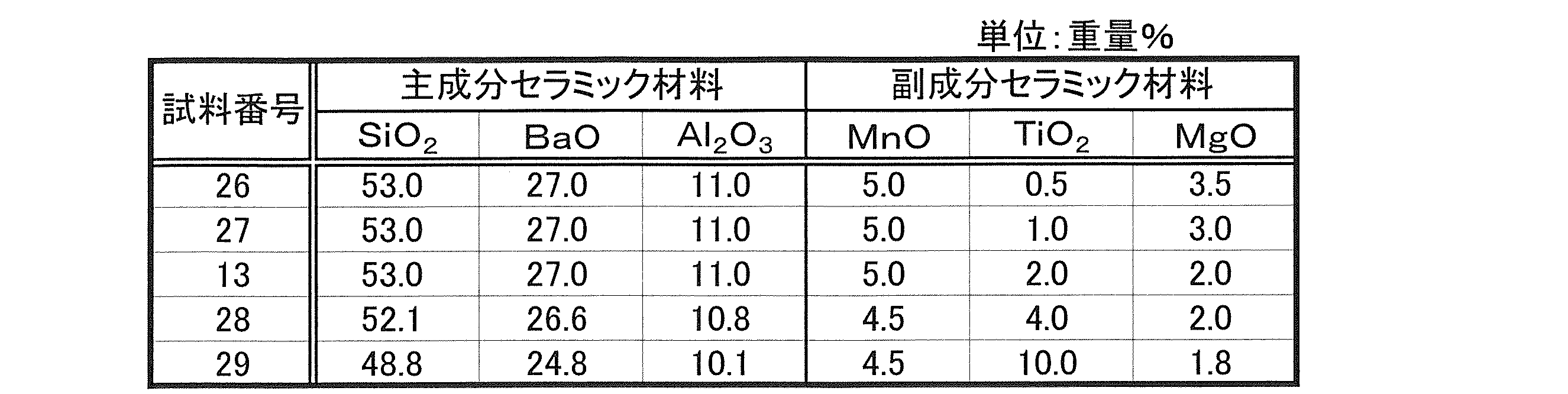
- the main component ceramic materials of SiO 2 , BaO and Al 2 O 3 and the subcomponent ceramic materials of MnO, TiO 2 and MgO are shown in units of wt%, and the total of all of these is 100% by weight. %.
- an appropriate amount of an organic binder, a dispersant, and a plasticizer are added to the raw material powder according to each sample described above to produce a ceramic slurry, and then the average particle size (D50) of the raw material powder in the slurry is 1.
- the mixture was pulverized so as to be 5 ⁇ m or less.
- the ceramic slurry was formed into a sheet by a doctor blade method, dried, and cut into an appropriate size to obtain a ceramic green sheet having a thickness of 50 ⁇ m.
- the A / B relationship was calculated from the diffraction peak intensity A on the (201) plane of the Fresnoite crystal and the diffraction peak intensity B on the (110) plane of the quartz crystal.
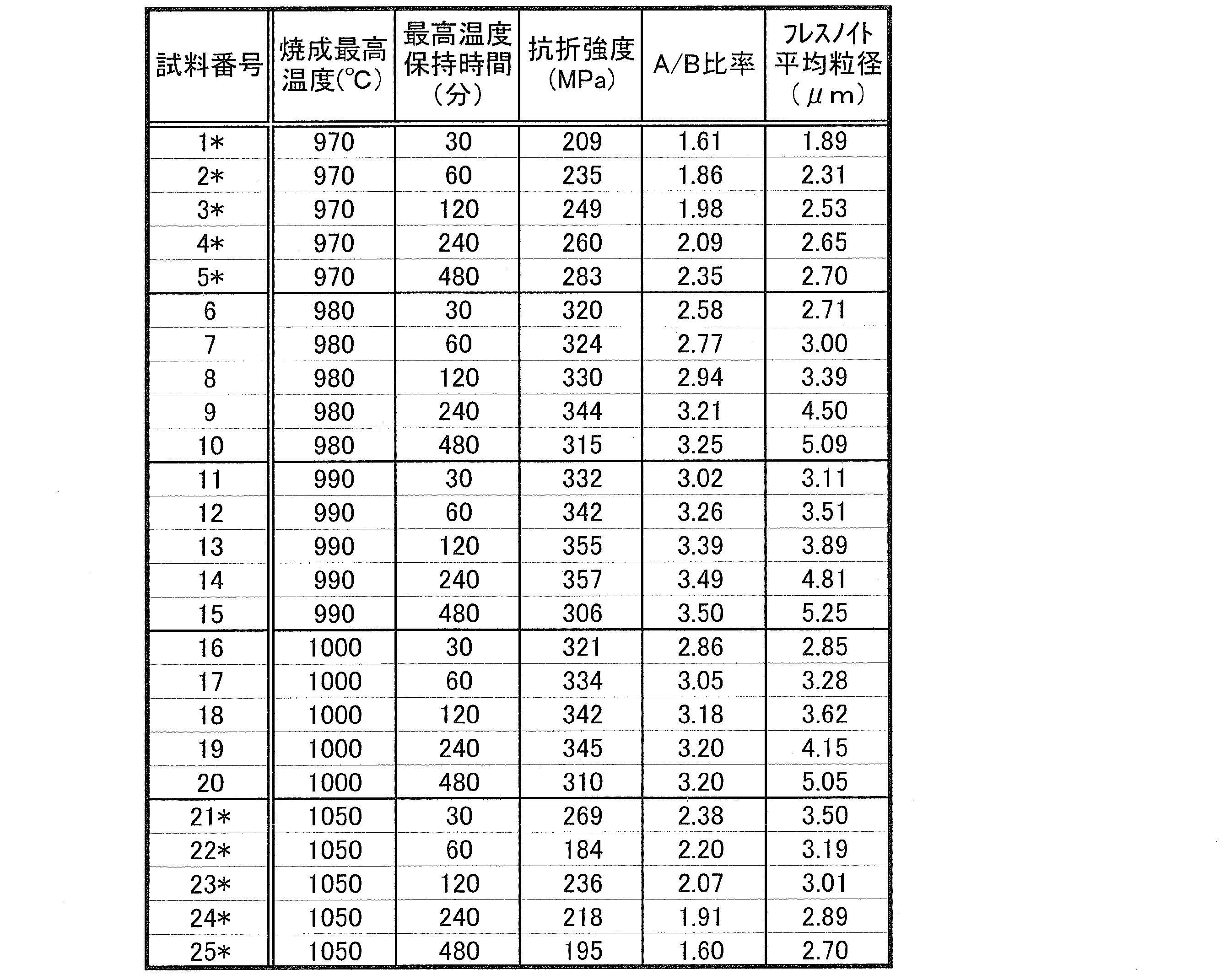
- Table 2 shows the results of bending strength, A / B ratio and fresnoite average particle diameter obtained in (4), (5) and (6) above.
- ceramic substrates having a bending strength of 320 MPa or more are obtained by setting the average grain size of the precipitated Fresnoite crystals to less than 5 ⁇ m. This is presumably because the crystal grain boundaries increased due to the fineness of the Fresnoite, the effect of suppressing crack extension increased, and the substrate strength further improved.
- Example 2 (1) Production of Ceramic Green Sheet As in the case of Experimental Example 1, first, as starting materials, all of SiO 2 , BaCO 3 , Al 2 O 3 , MnCO 3 , TiO 2 and Mg (with a particle size of 2.0 ⁇ m or less) Each ceramic powder of OH) 2 was prepared. Next, these starting material powders are weighed so as to have the composition ratio shown in Table 3 after firing, wet-mixed and pulverized, and then dried, and the resulting mixture is calcined at 750 to 1000 ° C. for 1 to 3 hours. The raw material powder was obtained.
- Table 4 shows the results of bending strength and A / B ratio obtained in the above (4) and (5), respectively.
Landscapes
- Chemical & Material Sciences (AREA)
- Engineering & Computer Science (AREA)
- Ceramic Engineering (AREA)
- Manufacturing & Machinery (AREA)
- Materials Engineering (AREA)
- Structural Engineering (AREA)
- Organic Chemistry (AREA)
- Inorganic Chemistry (AREA)
- Compositions Of Oxide Ceramics (AREA)
- Inorganic Insulating Materials (AREA)
Abstract
Description
(1)セラミックグリーンシートの作製
まず、出発原料として、いずれも粒径2.0μm以下のSiO2、BaCO3、Al2O3、MnCO3、TiO2およびMg(OH)2の各セラミック粉末を準備した。次に、これら出発原料粉末を、焼成後に表1に示す組成比率となるように秤量し、湿式混合粉砕した後、乾燥し、得られた混合物を750~1000℃で1~3時間仮焼して原料粉末を得た。上記BaCO3は焼成後にBaOになり、上記MnCO3は焼成後にMnOになり、上記Mg(OH)2は焼成後にMgOになるものである。

次に、得られたセラミックグリーンシートを所定の大きさにカットした後、複数枚を積層し、次いで、温度60~80℃および圧力1000~1500kg/cm2の条件で熱圧着し、生の積層体を得た。そして、焼成後の積層体サイズが30.0mm×4.5mm×1.0mm(厚み)となるように、生の積層体をカットした。
次に、カットした生の積層体を、窒素-水素の非酸化性雰囲気中において、表2に示すように、最高温度を970~1050℃の範囲の温度とし、最高温度保持時間を30~480分間の範囲の時間として焼成し、焼結した板状のセラミック基板試料を得た。
セラミック基板試料の抗折強度を、3点曲げ強度試験(JIS-R1061)によって評価した。
セラミック基板試料を粉末化し、X線回析法により回析ピーク角度2θ=10~40°の範囲で測定した回折ピークから析出結晶の同定を行ない、基板試料中の析出結晶相として、クォーツ(SiO2)、アルミナ(Al2O3)、フレスノイト(Ba2TiSiO8)、サンボルナイト(BaSi2O5)、セルシアン(BaAl2Si2O8)が少なくとも析出していることを確認した。
セラミック基板試料に対して、その断面が露出するように研磨を施し、走査型顕微鏡を用いて、析出したフレスノイトの粒径を10点測定し、平均化した値を平均粒径とした。フレスノイトの同定については、透過型顕微鏡の元素マッピング分析から、フレスノイトの構成元素(Ba、Si、Ti、O)の偏析が最も多く見られる結晶をフレスノイトと判断した。
(1)セラミックグリーンシートの作製
実験例1の場合と同様、まず、出発原料として、いずれも粒径2.0μm以下のSiO2、BaCO3、Al2O3、MnCO3、TiO2およびMg(OH)2の各セラミック粉末を準備した。次に、これら出発原料粉末を、焼成後に表3に示す組成比率となるように秤量し、湿式混合粉砕した後、乾燥し、得られた混合物を750~1000℃で1~3時間仮焼して原料粉末を得た。
次に、実験例1の場合と同様にして、生の積層体を得た。
次に、カットした生の積層体を、窒素-水素の非酸化性雰囲気中において、最高温度を990℃とし、最高温度保持時間を120分間として焼成し、焼結した板状のセラミック基板試料を得た。
実験例1の場合と同様、セラミック基板試料の抗折強度を、3点曲げ強度試験(JIS-R1061)によって評価した。
実験例1の場合と同様、セラミック基板試料を粉末化し、X線回析法により回析ピーク角度2θ=10~40°の範囲で測定した回折ピークから析出結晶の同定を行ない、基板試料中の析出結晶相として、クォーツ(SiO2)、アルミナ(Al2O3)、フレスノイト(Ba2TiSiO8)、サンボルナイト(BaSi2O5)、セルシアン(BaAl2Si2O8)が少なくとも析出していることを確認するとともに、フレスノイト結晶の(201)面における回折ピーク強度Aとクォーツ結晶の(110)面における回折ピーク強度Bから、A/Bの関係を算出した。

2 セラミック層
3 積層体
Claims (4)
- クォーツ(Quartz)、アルミナ(Alumina)、フレスノイト(Fresnoite)、サンボルナイト(Sanbornite)およびセルシアン(Celsian)の各結晶相を含み、
粉末X線回析法により回析ピーク角度2θ=10~40°の範囲で測定した前記フレスノイトの(201)面における回折ピーク強度Aと前記クォーツの(110)面における回折ピーク強度Bの関係が、A/B≧2.5であることを特徴とする、
セラミック焼結体。 - 前記フレスノイト結晶相の平均結晶粒径が5μm以下である、請求項1に記載のセラミック焼結体。
- Si酸化物、Ba酸化物およびAl酸化物を含む主成分セラミック材料と、Mn酸化物およびTi酸化物を含む副成分セラミック材料とを含み、実質的にCr酸化物およびB酸化物のいずれをも含まない非ガラス系の低温焼結セラミック材料を焼結させることによって得られたものである、請求項1または2に記載のセラミック焼結体。
- Si酸化物、Ba酸化物およびAl酸化物を含む主成分セラミック材料と、Mn酸化物およびTi酸化物を含む副成分セラミック材料とを含み、実質的にCr酸化物およびB酸化物のいずれをも含まない非ガラス系の低温焼結セラミック材料を含む、セラミックグリーンシートを準備する工程と、
複数の前記セラミックグリーンシートを積層することによって、生の積層体を作製する工程と、
前記生の積層体を焼成する工程と
を備え、
前記焼成工程において、最高温度が980~1000℃の範囲であることを特徴とする、
セラミック焼結体の製造方法。
Priority Applications (3)
| Application Number | Priority Date | Filing Date | Title |
|---|---|---|---|
| CN201180008901.XA CN102753502B (zh) | 2010-02-10 | 2011-02-01 | 陶瓷烧结体及其制造方法 |
| JP2011553804A JP5582150B2 (ja) | 2010-02-10 | 2011-02-01 | セラミック焼結体およびその製造方法 |
| US13/567,655 US8652982B2 (en) | 2010-02-10 | 2012-08-06 | Ceramic sintered body and method for producing ceramic sintered body |
Applications Claiming Priority (2)
| Application Number | Priority Date | Filing Date | Title |
|---|---|---|---|
| JP2010-027550 | 2010-02-10 | ||
| JP2010027550 | 2010-02-10 |
Related Child Applications (1)
| Application Number | Title | Priority Date | Filing Date |
|---|---|---|---|
| US13/567,655 Continuation US8652982B2 (en) | 2010-02-10 | 2012-08-06 | Ceramic sintered body and method for producing ceramic sintered body |
Publications (1)
| Publication Number | Publication Date |
|---|---|
| WO2011099397A1 true WO2011099397A1 (ja) | 2011-08-18 |
Family
ID=44367673
Family Applications (1)
| Application Number | Title | Priority Date | Filing Date |
|---|---|---|---|
| PCT/JP2011/051985 Ceased WO2011099397A1 (ja) | 2010-02-10 | 2011-02-01 | セラミック焼結体およびその製造方法 |
Country Status (4)
| Country | Link |
|---|---|
| US (1) | US8652982B2 (ja) |
| JP (1) | JP5582150B2 (ja) |
| CN (1) | CN102753502B (ja) |
| WO (1) | WO2011099397A1 (ja) |
Cited By (1)
| Publication number | Priority date | Publication date | Assignee | Title |
|---|---|---|---|---|
| JP2019173207A (ja) * | 2018-03-28 | 2019-10-10 | 俊夫 小室 | フォトン及びイオンを発生する健康増進組成物 |
Families Citing this family (3)
| Publication number | Priority date | Publication date | Assignee | Title |
|---|---|---|---|---|
| CN106032318B (zh) * | 2015-03-12 | 2018-06-22 | 中国科学院上海硅酸盐研究所 | 一种低温共烧陶瓷材料及其制备方法 |
| WO2017122381A1 (ja) * | 2016-01-13 | 2017-07-20 | 株式会社村田製作所 | 積層体及び電子部品 |
| US20220098121A1 (en) * | 2019-01-30 | 2022-03-31 | Denka Company Limited | Method for manufacturing single sheet-type green sheet, method for manufacturing silicon nitride sintered body, single sheet-type green sheet, and silicon nitride sintered body |
Citations (3)
| Publication number | Priority date | Publication date | Assignee | Title |
|---|---|---|---|---|
| JP2006001755A (ja) * | 2004-06-15 | 2006-01-05 | Hitachi Metals Ltd | 高強度低温焼成セラミック組成物並びにこれを用いた積層電子部品 |
| JP2008053525A (ja) * | 2006-08-25 | 2008-03-06 | Murata Mfg Co Ltd | 多層セラミック基板およびその製造方法 |
| WO2009025156A1 (ja) * | 2007-08-17 | 2009-02-26 | Murata Manufacturing Co., Ltd. | セラミック組成物およびその製造方法、セラミック基板、ならびにセラミックグリーン層の製造方法 |
Family Cites Families (6)
| Publication number | Priority date | Publication date | Assignee | Title |
|---|---|---|---|---|
| JP4714986B2 (ja) | 2000-12-06 | 2011-07-06 | 株式会社村田製作所 | 誘電体磁器組成物及びそれを用いた多層基板 |
| JP2003267778A (ja) * | 2002-03-15 | 2003-09-25 | Murata Mfg Co Ltd | 誘電体磁器組成物とその製造方法、及び積層コンデンサ |
| CN101006027B (zh) * | 2004-08-19 | 2010-05-05 | 株式会社村田制作所 | 介电陶瓷和单片陶瓷电容器 |
| CN100500610C (zh) * | 2004-09-28 | 2009-06-17 | 株式会社村田制作所 | 电介质陶瓷、电介质陶瓷的制备方法以及叠层陶瓷电容器 |
| JP5040243B2 (ja) | 2006-07-19 | 2012-10-03 | 株式会社村田製作所 | セラミック基板 |
| WO2010092970A1 (ja) * | 2009-02-16 | 2010-08-19 | 株式会社村田製作所 | 低温焼結セラミック焼結体および多層セラミック基板 |
-
2011
- 2011-02-01 WO PCT/JP2011/051985 patent/WO2011099397A1/ja not_active Ceased
- 2011-02-01 JP JP2011553804A patent/JP5582150B2/ja active Active
- 2011-02-01 CN CN201180008901.XA patent/CN102753502B/zh active Active
-
2012
- 2012-08-06 US US13/567,655 patent/US8652982B2/en active Active
Patent Citations (3)
| Publication number | Priority date | Publication date | Assignee | Title |
|---|---|---|---|---|
| JP2006001755A (ja) * | 2004-06-15 | 2006-01-05 | Hitachi Metals Ltd | 高強度低温焼成セラミック組成物並びにこれを用いた積層電子部品 |
| JP2008053525A (ja) * | 2006-08-25 | 2008-03-06 | Murata Mfg Co Ltd | 多層セラミック基板およびその製造方法 |
| WO2009025156A1 (ja) * | 2007-08-17 | 2009-02-26 | Murata Manufacturing Co., Ltd. | セラミック組成物およびその製造方法、セラミック基板、ならびにセラミックグリーン層の製造方法 |
Cited By (1)
| Publication number | Priority date | Publication date | Assignee | Title |
|---|---|---|---|---|
| JP2019173207A (ja) * | 2018-03-28 | 2019-10-10 | 俊夫 小室 | フォトン及びイオンを発生する健康増進組成物 |
Also Published As
| Publication number | Publication date |
|---|---|
| JPWO2011099397A1 (ja) | 2013-06-13 |
| CN102753502A (zh) | 2012-10-24 |
| US20120329633A1 (en) | 2012-12-27 |
| JP5582150B2 (ja) | 2014-09-03 |
| US8652982B2 (en) | 2014-02-18 |
| CN102753502B (zh) | 2014-06-25 |
Similar Documents
| Publication | Publication Date | Title |
|---|---|---|
| JP4883228B2 (ja) | 低温焼結セラミック焼結体および多層セラミック基板 | |
| KR101290089B1 (ko) | 저온 소결 세라믹 재료 및 세라믹 기판 | |
| JP5321066B2 (ja) | セラミック組成物およびセラミック基板 | |
| JP5533674B2 (ja) | 低温焼結セラミック材料およびセラミック基板 | |
| JP2012015433A (ja) | 多層セラミック基板 | |
| JP5076907B2 (ja) | フォルステライト粉末の製造方法、フォルステライト粉末、フォルステライト焼結体、絶縁体セラミック組成物、および積層セラミック電子部品 | |
| JP5582150B2 (ja) | セラミック焼結体およびその製造方法 | |
| KR100672198B1 (ko) | 세라믹 기판용 조성물, 세라믹 기판, 세라믹 기판의제조방법 및 유리 조성물 | |
| US10383220B2 (en) | Ceramic substrate and method for production thereof | |
| EP1568668B1 (en) | Ceramic composition being fired at low temperature and having high strength and method for preparing the same, and laminated electronic parts using the same | |
| JP3917770B2 (ja) | 低温焼成磁器およびこれを備えた電子部品 | |
| JP2010109133A (ja) | セラミックス電子部品、及びこれを用いた電子機器 | |
| JP2012020933A (ja) | セラミックグリーンシート及びセラミック基板 | |
| JP2008094655A (ja) | 誘電体セラミック原料組成物、セラミック基板および多層セラミック基板の製造方法 |
Legal Events
| Date | Code | Title | Description |
|---|---|---|---|
| WWE | Wipo information: entry into national phase |
Ref document number: 201180008901.X Country of ref document: CN |
|
| 121 | Ep: the epo has been informed by wipo that ep was designated in this application |
Ref document number: 11742142 Country of ref document: EP Kind code of ref document: A1 |
|
| WWE | Wipo information: entry into national phase |
Ref document number: 2011553804 Country of ref document: JP |
|
| NENP | Non-entry into the national phase |
Ref country code: DE |
|
| 122 | Ep: pct application non-entry in european phase |
Ref document number: 11742142 Country of ref document: EP Kind code of ref document: A1 |