WO2011077941A1 - 感放射線性樹脂組成物及びそれに含まれる化合物 - Google Patents
感放射線性樹脂組成物及びそれに含まれる化合物 Download PDFInfo
- Publication number
- WO2011077941A1 WO2011077941A1 PCT/JP2010/071890 JP2010071890W WO2011077941A1 WO 2011077941 A1 WO2011077941 A1 WO 2011077941A1 JP 2010071890 W JP2010071890 W JP 2010071890W WO 2011077941 A1 WO2011077941 A1 WO 2011077941A1
- Authority
- WO
- WIPO (PCT)
- Prior art keywords
- group
- general formula
- compound
- carbon atoms
- represented
- Prior art date
- Legal status (The legal status is an assumption and is not a legal conclusion. Google has not performed a legal analysis and makes no representation as to the accuracy of the status listed.)
- Ceased
Links
- FDYDISGSYGFRJM-UHFFFAOYSA-N CC1(C2CC(C3)CC1CC3C2)OC(C(C)=C)=O Chemical compound CC1(C2CC(C3)CC1CC3C2)OC(C(C)=C)=O FDYDISGSYGFRJM-UHFFFAOYSA-N 0.000 description 1
Images

Classifications
-
- C—CHEMISTRY; METALLURGY
- C07—ORGANIC CHEMISTRY
- C07C—ACYCLIC OR CARBOCYCLIC COMPOUNDS
- C07C303/00—Preparation of esters or amides of sulfuric acids; Preparation of sulfonic acids or of their esters, halides, anhydrides or amides
- C07C303/26—Preparation of esters or amides of sulfuric acids; Preparation of sulfonic acids or of their esters, halides, anhydrides or amides of esters of sulfonic acids
- C07C303/28—Preparation of esters or amides of sulfuric acids; Preparation of sulfonic acids or of their esters, halides, anhydrides or amides of esters of sulfonic acids by reaction of hydroxy compounds with sulfonic acids or derivatives thereof
-
- C—CHEMISTRY; METALLURGY
- C07—ORGANIC CHEMISTRY
- C07C—ACYCLIC OR CARBOCYCLIC COMPOUNDS
- C07C309/00—Sulfonic acids; Halides, esters, or anhydrides thereof
- C07C309/63—Esters of sulfonic acids
- C07C309/72—Esters of sulfonic acids having sulfur atoms of esterified sulfo groups bound to carbon atoms of six-membered aromatic rings of a carbon skeleton
- C07C309/75—Esters of sulfonic acids having sulfur atoms of esterified sulfo groups bound to carbon atoms of six-membered aromatic rings of a carbon skeleton containing singly-bound oxygen atoms bound to the carbon skeleton
-
- G—PHYSICS
- G03—PHOTOGRAPHY; CINEMATOGRAPHY; ANALOGOUS TECHNIQUES USING WAVES OTHER THAN OPTICAL WAVES; ELECTROGRAPHY; HOLOGRAPHY
- G03F—PHOTOMECHANICAL PRODUCTION OF TEXTURED OR PATTERNED SURFACES, e.g. FOR PRINTING, FOR PROCESSING OF SEMICONDUCTOR DEVICES; MATERIALS THEREFOR; ORIGINALS THEREFOR; APPARATUS SPECIALLY ADAPTED THEREFOR
- G03F7/00—Photomechanical, e.g. photolithographic, production of textured or patterned surfaces, e.g. printing surfaces; Materials therefor, e.g. comprising photoresists; Apparatus specially adapted therefor
- G03F7/004—Photosensitive materials
- G03F7/0045—Photosensitive materials with organic non-macromolecular light-sensitive compounds not otherwise provided for, e.g. dissolution inhibitors
-
- G—PHYSICS
- G03—PHOTOGRAPHY; CINEMATOGRAPHY; ANALOGOUS TECHNIQUES USING WAVES OTHER THAN OPTICAL WAVES; ELECTROGRAPHY; HOLOGRAPHY
- G03F—PHOTOMECHANICAL PRODUCTION OF TEXTURED OR PATTERNED SURFACES, e.g. FOR PRINTING, FOR PROCESSING OF SEMICONDUCTOR DEVICES; MATERIALS THEREFOR; ORIGINALS THEREFOR; APPARATUS SPECIALLY ADAPTED THEREFOR
- G03F7/00—Photomechanical, e.g. photolithographic, production of textured or patterned surfaces, e.g. printing surfaces; Materials therefor, e.g. comprising photoresists; Apparatus specially adapted therefor
- G03F7/20—Exposure; Apparatus therefor
- G03F7/2002—Exposure; Apparatus therefor with visible light or UV light, through an original having an opaque pattern on a transparent support, e.g. film printing, projection printing; by reflection of visible or UV light from an original such as a printed image
-
- H—ELECTRICITY
- H10—SEMICONDUCTOR DEVICES; ELECTRIC SOLID-STATE DEVICES NOT OTHERWISE PROVIDED FOR
- H10P—GENERIC PROCESSES OR APPARATUS FOR THE MANUFACTURE OR TREATMENT OF DEVICES COVERED BY CLASS H10
- H10P76/00—Manufacture or treatment of masks on semiconductor bodies, e.g. by lithography or photolithography
- H10P76/20—Manufacture or treatment of masks on semiconductor bodies, e.g. by lithography or photolithography of masks comprising organic materials
-
- C—CHEMISTRY; METALLURGY
- C07—ORGANIC CHEMISTRY
- C07C—ACYCLIC OR CARBOCYCLIC COMPOUNDS
- C07C2602/00—Systems containing two condensed rings
- C07C2602/02—Systems containing two condensed rings the rings having only two atoms in common
- C07C2602/04—One of the condensed rings being a six-membered aromatic ring
- C07C2602/10—One of the condensed rings being a six-membered aromatic ring the other ring being six-membered, e.g. tetraline
-
- C—CHEMISTRY; METALLURGY
- C07—ORGANIC CHEMISTRY
- C07C—ACYCLIC OR CARBOCYCLIC COMPOUNDS
- C07C2602/00—Systems containing two condensed rings
- C07C2602/02—Systems containing two condensed rings the rings having only two atoms in common
- C07C2602/14—All rings being cycloaliphatic
- C07C2602/20—All rings being cycloaliphatic the ring system containing seven carbon atoms
-
- C—CHEMISTRY; METALLURGY
- C07—ORGANIC CHEMISTRY
- C07C—ACYCLIC OR CARBOCYCLIC COMPOUNDS
- C07C2602/00—Systems containing two condensed rings
- C07C2602/02—Systems containing two condensed rings the rings having only two atoms in common
- C07C2602/14—All rings being cycloaliphatic
- C07C2602/22—All rings being cycloaliphatic the ring system containing eight carbon atoms, e.g. pentalene
-
- C—CHEMISTRY; METALLURGY
- C07—ORGANIC CHEMISTRY
- C07C—ACYCLIC OR CARBOCYCLIC COMPOUNDS
- C07C2603/00—Systems containing at least three condensed rings
- C07C2603/02—Ortho- or ortho- and peri-condensed systems
- C07C2603/04—Ortho- or ortho- and peri-condensed systems containing three rings
- C07C2603/06—Ortho- or ortho- and peri-condensed systems containing three rings containing at least one ring with less than six ring members
- C07C2603/10—Ortho- or ortho- and peri-condensed systems containing three rings containing at least one ring with less than six ring members containing five-membered rings
- C07C2603/12—Ortho- or ortho- and peri-condensed systems containing three rings containing at least one ring with less than six ring members containing five-membered rings only one five-membered ring
- C07C2603/18—Fluorenes; Hydrogenated fluorenes
-
- G—PHYSICS
- G03—PHOTOGRAPHY; CINEMATOGRAPHY; ANALOGOUS TECHNIQUES USING WAVES OTHER THAN OPTICAL WAVES; ELECTROGRAPHY; HOLOGRAPHY
- G03F—PHOTOMECHANICAL PRODUCTION OF TEXTURED OR PATTERNED SURFACES, e.g. FOR PRINTING, FOR PROCESSING OF SEMICONDUCTOR DEVICES; MATERIALS THEREFOR; ORIGINALS THEREFOR; APPARATUS SPECIALLY ADAPTED THEREFOR
- G03F7/00—Photomechanical, e.g. photolithographic, production of textured or patterned surfaces, e.g. printing surfaces; Materials therefor, e.g. comprising photoresists; Apparatus specially adapted therefor
- G03F7/004—Photosensitive materials
- G03F7/039—Macromolecular compounds which are photodegradable, e.g. positive electron resists
- G03F7/0392—Macromolecular compounds which are photodegradable, e.g. positive electron resists the macromolecular compound being present in a chemically amplified positive photoresist composition
Definitions
- the present invention relates to a radiation sensitive resin composition used as a material for a chemically amplified resist and a compound contained therein.
- the nano edge roughness is also called line edge roughness (LER), and is the height of unevenness (roughness) generated on the side surface of the line portion of the resist pattern.
- This unevenness (roughness) is transferred in an etching (transfer) process using a resist as a mask, and thus deteriorates the electrical characteristics of the integrated circuit.
- LER line edge roughness
- This unevenness (roughness) is transferred in an etching (transfer) process using a resist as a mask, and thus deteriorates the electrical characteristics of the integrated circuit.
- LER line edge roughness
- the present invention has been made in view of such problems of the prior art, and the object of the present invention is to form a resist film with high sensitivity and excellent resolution, The object is to provide a radiation-sensitive resin composition capable of forming a resist pattern having excellent edge roughness.
- the subject of the present invention is a radiation-sensitive resin composition capable of forming a resist film with high sensitivity and excellent resolution, and capable of forming a resist pattern with excellent nano edge roughness. It is in providing the compound (A) contained.
- the subject of the present invention is a radiation-sensitive resin composition capable of forming a resist film with high sensitivity and excellent resolution, and capable of forming a resist pattern with excellent nano edge roughness. It is in providing the manufacturing method of the compound contained.
- the following radiation-sensitive resin composition, the compound (A) contained therein, and a production method thereof are provided.
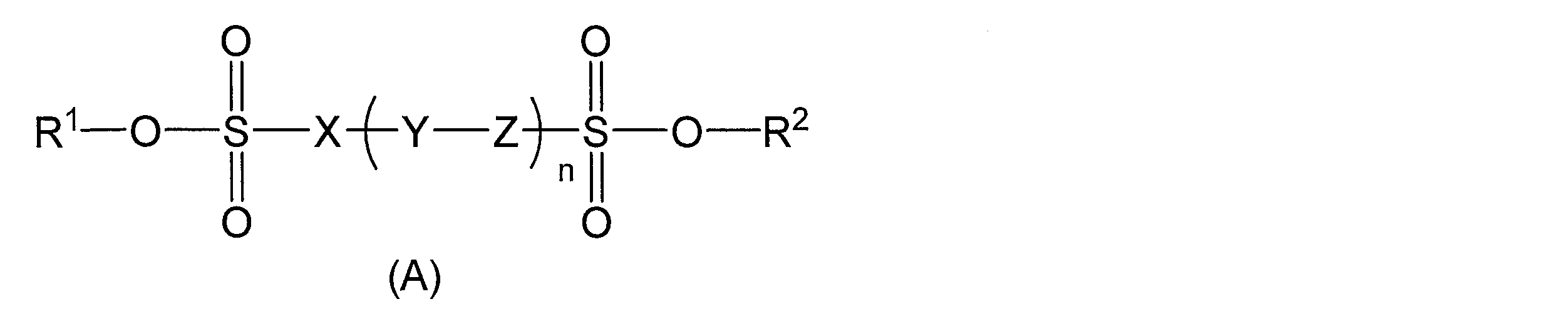
- a radiation-sensitive resin composition comprising a compound (A) represented by the following general formula (A), a solvent (B), and a resin (C) having an acid-dissociable group.
- R 1 and R 2 each independently represent a substituted or unsubstituted monovalent hydrocarbon group having 1 to 25 carbon atoms
- X and Z are each independently substituted or unsubstituted Represents an unsubstituted divalent hydrocarbon group having 1 to 25 carbon atoms
- Y represents a single bond or a group represented by any of the following formulas (1-1) to (1-6)
- n represents an integer of 0 to 5.
- X and Z each independently represent a substituted or unsubstituted divalent hydrocarbon group having 1 to 25 carbon atoms
- Y represents a single bond or the above formula Represents a group represented by any one of (1-1) to (1-6), and n represents an integer of 0 to 5.
- R 5 each independently represents a substituted or unsubstituted hydrocarbon group having 1 to 25 carbon atoms.
- the X and Z in the general formulas (A1) to (A5) are each independently a substituted or unsubstituted divalent aromatic group having 1 to 25 carbon atoms. Radiation sensitive resin composition.
- Y is a single bond, a group represented by the formula (1-1), or a group represented by the formula (1-6).
- the radiation sensitive resin composition as described in [2] or [3].
- R 1 and R 2 in the general formula (A) each independently represent a substituted or unsubstituted monovalent hydrocarbon group having 1 to 25 carbon atoms having a tertiary hydroxyl group.
- the radiation sensitive resin composition according to any one of to [4].
- R 1 and R 2 each independently represent a substituted or unsubstituted monovalent hydrocarbon group having 1 to 25 carbon atoms
- X and Z are each independently substituted or unsubstituted Represents an unsubstituted divalent hydrocarbon group having 1 to 25 carbon atoms
- Y represents a single bond or a group represented by any of the following formulas (1-1) to (1-6)
- n represents an integer of 0 to 5.
- R 1 and R 2 each independently represents a substituted or unsubstituted monovalent hydrocarbon group having 1 to 25 carbon atoms having a tertiary hydroxyl group [6] Compound described in 1.
- X and Z each independently represent a substituted or unsubstituted divalent hydrocarbon group having 1 to 25 carbon atoms
- Y represents a single bond or the following formula (1-1) )
- W represents independently a halogen atom
- n represents an integer of 0 to 5.
- R 1 in the general formula (a2) and R 2 in the general formula (a3) each independently represent a substituted or unsubstituted monovalent hydrocarbon group having 1 to 25 carbon atoms.
- R 1 in the general formula (a2) and R 2 in the general formula (a3) are each independently a substituted or unsubstituted monovalent carbon atom having 1 to 25 carbon atoms having a tertiary hydroxyl group.
- the radiation-sensitive resin composition of the present invention is highly sensitive and can form a resist film with excellent resolution, and can produce a resist pattern with excellent nanoedge roughness. is there.
- the compound of the present invention is highly sensitive and can form a resist film excellent in resolution, and has the effect of constituting a radiation-sensitive resin composition capable of forming a resist pattern excellent in nanoedge roughness. Is.
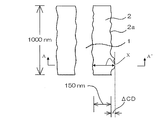
- a radiation sensitive resin composition capable of forming a resist film having high sensitivity and excellent resolution and capable of forming a resist pattern excellent in nano edge roughness.
- An included acid proliferating agent can be provided.
- FIG. 2 is a cross-sectional view showing a cross section A-A ′ shown in FIG. 1.
- the radiation sensitive resin composition of the present invention contains a compound (A), a solvent (B), and a resin having an acid dissociable group (hereinafter also referred to as “resin (C)”). It is.
- the radiation-sensitive resin composition of the present invention usually further contains a radiation-sensitive acid generator (hereinafter also referred to as “acid generator (D)”).
- the radiation-sensitive resin composition having such a structure has high sensitivity, can form a resist film with excellent resolution, and can form a resist pattern with excellent nano edge roughness. That is, the radiation-sensitive resin composition of the present invention is effectively sensitive to X-rays such as KrF excimer laser, ArF excimer laser, EUV (extreme) deep ultraviolet rays, synchrotron radiation, and electron beams, and has excellent sensitivity. Further, it is possible to form a chemically amplified positive resist film capable of forming a fine pattern with high accuracy and stability. A resist having good sensitivity also has an advantage that the processing time of the wafer may be short.
- the compound of the present invention (hereinafter also referred to as “acid proliferating agent (A)”) is an acid proliferating agent.
- An acid proliferating agent is a compound that is decomposed by the action of an acid to generate a new acid. Therefore, once acid is generated from the radiation-sensitive acid generator by radiation irradiation, the acid proliferating agent (A) generates a new acid by the action of the acid and then reacts in an autocatalytic manner to produce a large amount. An acid can be generated. That is, the radiation-sensitive resin composition containing the acid proliferating agent (A) can improve the solubility of the exposed portion of the resist in the alkaline developer and improve the apparent sensitivity as a resist.
- the acid proliferating agent (A) is a stable compound unless an acid coexists.
- the compound (A) can be used at a blending ratio similar to the blending ratio of conventionally known acid proliferating agents used in conventional radiation-sensitive resin compositions.
- the acid proliferating agent (A) is a compound represented by the following general formula (A).
- R 1 and R 2 each independently represent a substituted or unsubstituted monovalent hydrocarbon group having 1 to 25 carbon atoms
- X and Z are each independently substituted or unsubstituted Represents an unsubstituted divalent hydrocarbon group having 1 to 25 carbon atoms
- Y represents a single bond or a group represented by any of the following formulas (1-1) to (1-6)
- n represents an integer of 0 to 5.
- n is an integer of 1 or 2 from a viewpoint that nano edge roughness becomes better.
- examples of the monovalent unsubstituted hydrocarbon group having 1 to 25 carbon atoms represented by R 1 and R 2 include a chain hydrocarbon group and a cyclic hydrocarbon group. it can.
- chain hydrocarbon group examples include a linear alkyl group having 1 to 10 carbon atoms.
- cyclic hydrocarbon group examples include monocyclic and polycyclic aliphatic hydrocarbon groups having 1 to 25 carbon atoms. Specific examples include polycyclic aliphatic hydrocarbon groups having 6 to 10 carbon atoms, and more specifically, groups represented by the following formulas (x-1) to (x-5) Can be mentioned.
- examples of the substituent in the monovalent substituted hydrocarbon group having 1 to 25 carbon atoms represented by R 1 and R 2 include an alkyl group, an alkoxy group, an alkoxycarbonyl group, and a hydroxyl group. And a cyano group. That is, examples of the monovalent substituted hydrocarbon group having 1 to 25 carbon atoms include those obtained by substituting at least one hydrogen atom of the above monovalent unsubstituted hydrocarbon group with the above substituent.
- R 1 and R 2 have a hydroxyl group (that is, when R 1 and R 2 have a hydroxyl group as a substituent) because the storage stability of the acid proliferating agent (A) becomes good.
- R 1 and R 2 in the general formula (A) preferably each independently represent a substituted or unsubstituted monovalent hydrocarbon group having 1 to 25 carbon atoms having a tertiary hydroxyl group. In such a case, a resist excellent in good sensitivity and thermal stability can be obtained.
- examples of the substituted or unsubstituted divalent hydrocarbon group having 1 to 25 carbon atoms represented by X and Z include, for example, a substituted or unsubstituted divalent hydrocarbon group having 1 to 25 carbon atoms.
- Examples of the aliphatic group include chain-like or cyclic (including bridged carbocyclic) alkylene groups. These aliphatic groups preferably have 1 to 12 carbon atoms, more preferably 1 to 8 carbon atoms.
- the aliphatic group examples include a methylene group, an ethylene group, a propylene group, a butylene group, a pentene group, a hexene group, a cyclohexyl group, a cyclooctyl group, a bicyclohydrocarbon group, and a tricyclohydrocarbon group.
- aromatic group examples include an aryl group and an arylalkyl group.
- the aromatic group may be a monocyclic structure or a polycyclic structure.
- aromatic group examples include phenyl group, tolyl group, benzyl group, phenethyl group, naphthyl group, naphthylmethyl group and the like.
- the hydrogen atoms may be substituted. That is, it may be a substituted aliphatic group or a substituted aromatic group.
- the substituent for substituting a hydrogen atom include a fluorine atom, trifluoromethyl group, nonafluorobutyl group, methyl group, ethyl group, n-propyl group, i-propyl group, n-butyl group, 2-methylpropyl group, A linear or branched alkyl group having 1 to 12 carbon atoms such as 1-methylpropyl group and t-butyl group; methoxy group, ethoxy group, n-propoxy group, i-propoxy group, n-butoxy group, 2 Examples thereof include linear or branched alkoxyl groups having 1 to 12 carbon atoms such as -methylpropoxy group, 1-methylpropoxy group and t-butoxy group.
- heterocyclic group examples include groups derived from various conventionally known heterocyclic compounds.
- the heterocyclic group may be a monocyclic structure or a polycyclic structure.
- heterocyclic group examples include a five-membered ring compound containing one heteroatom such as furan, pyrrole, benzofuran, indole, carbazole and its condensed ring compound; a five-membered ring containing two heteroatoms such as oxazole and pyrazole.
- Compound and its condensed ring compound six-membered ring compound containing one heteroatom such as pyran, pyron, coumarin, pyridine, quinoline, isoquinoline, acridine and its condensed ring compound; two heterocycles such as pyridazine, pyrimidine, pyrazine, phthalidine Examples thereof include a six-membered ring compound containing an atom and a condensed ring compound thereof.
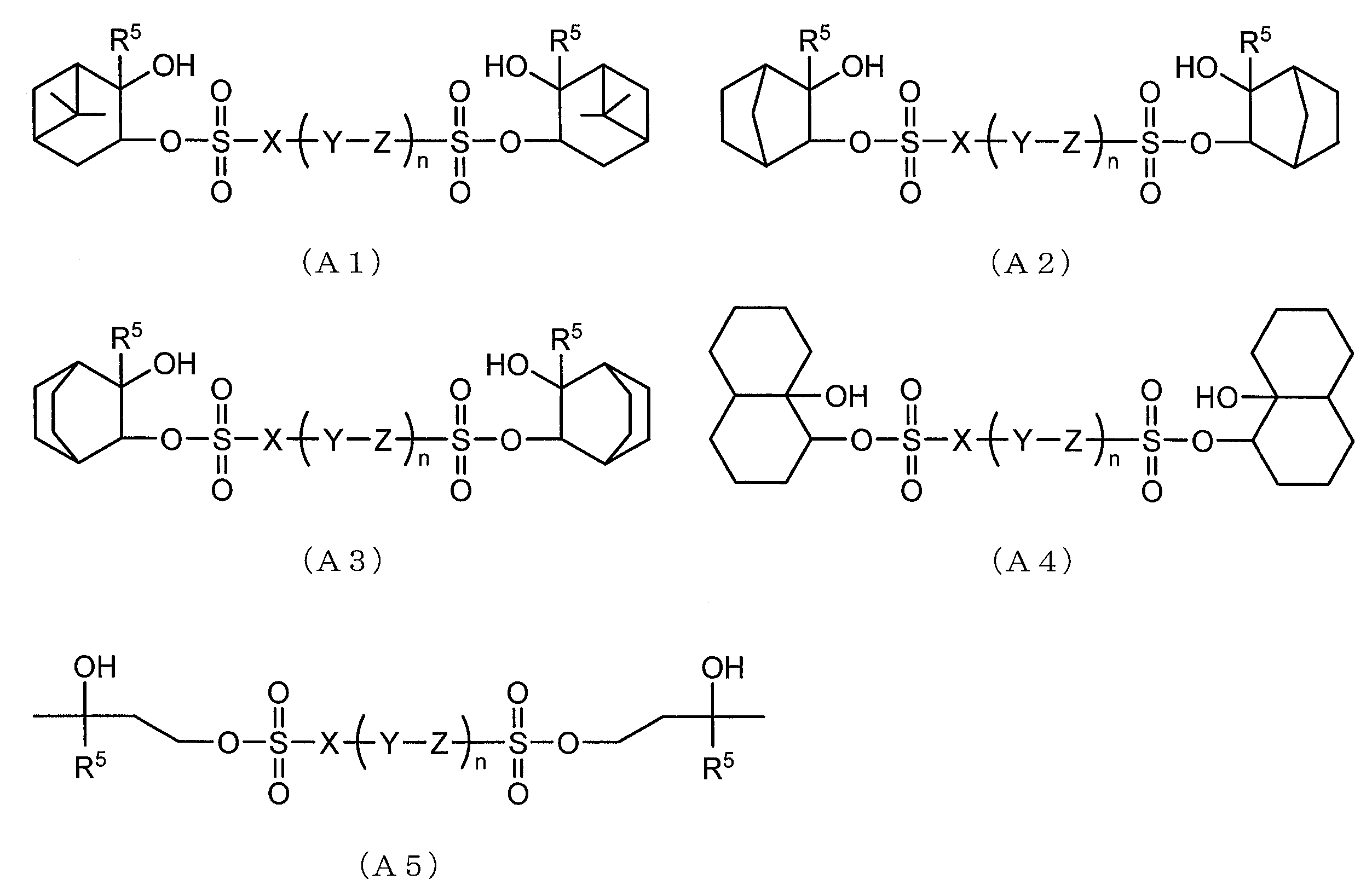
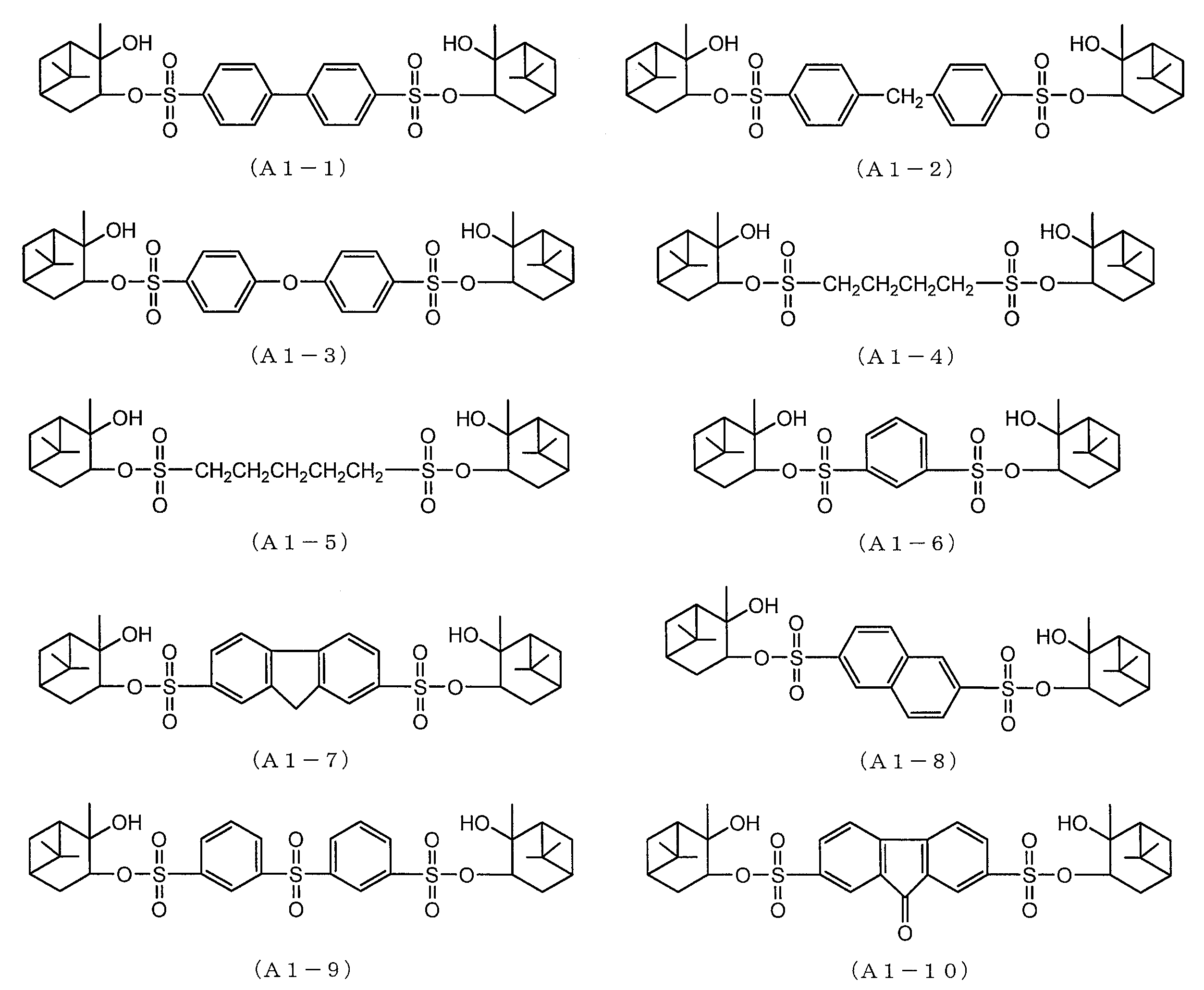
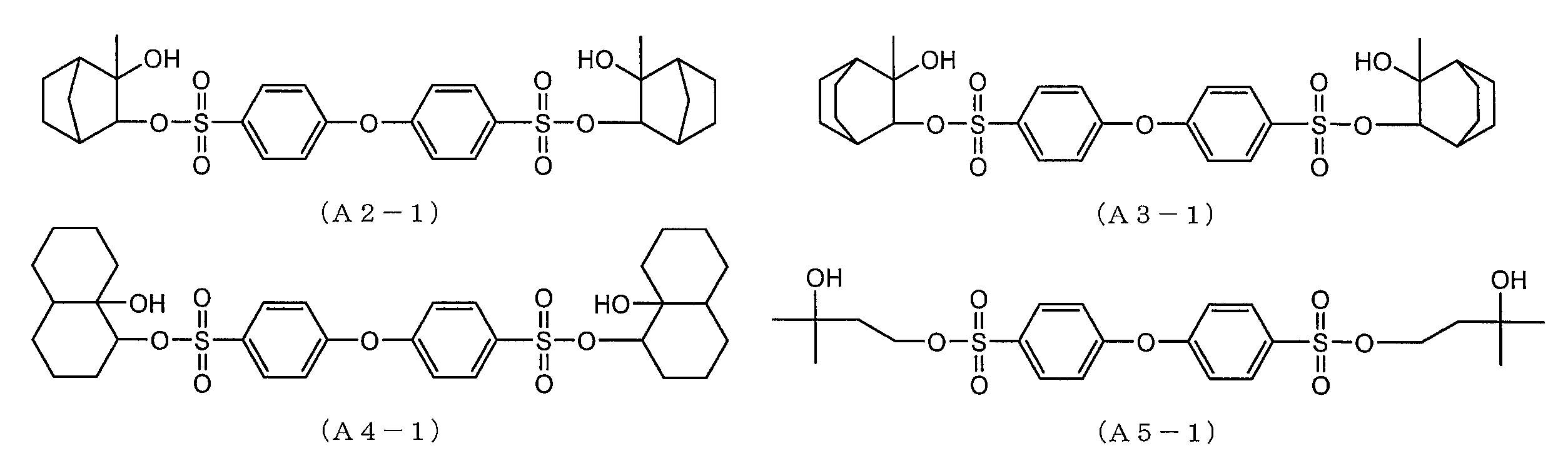
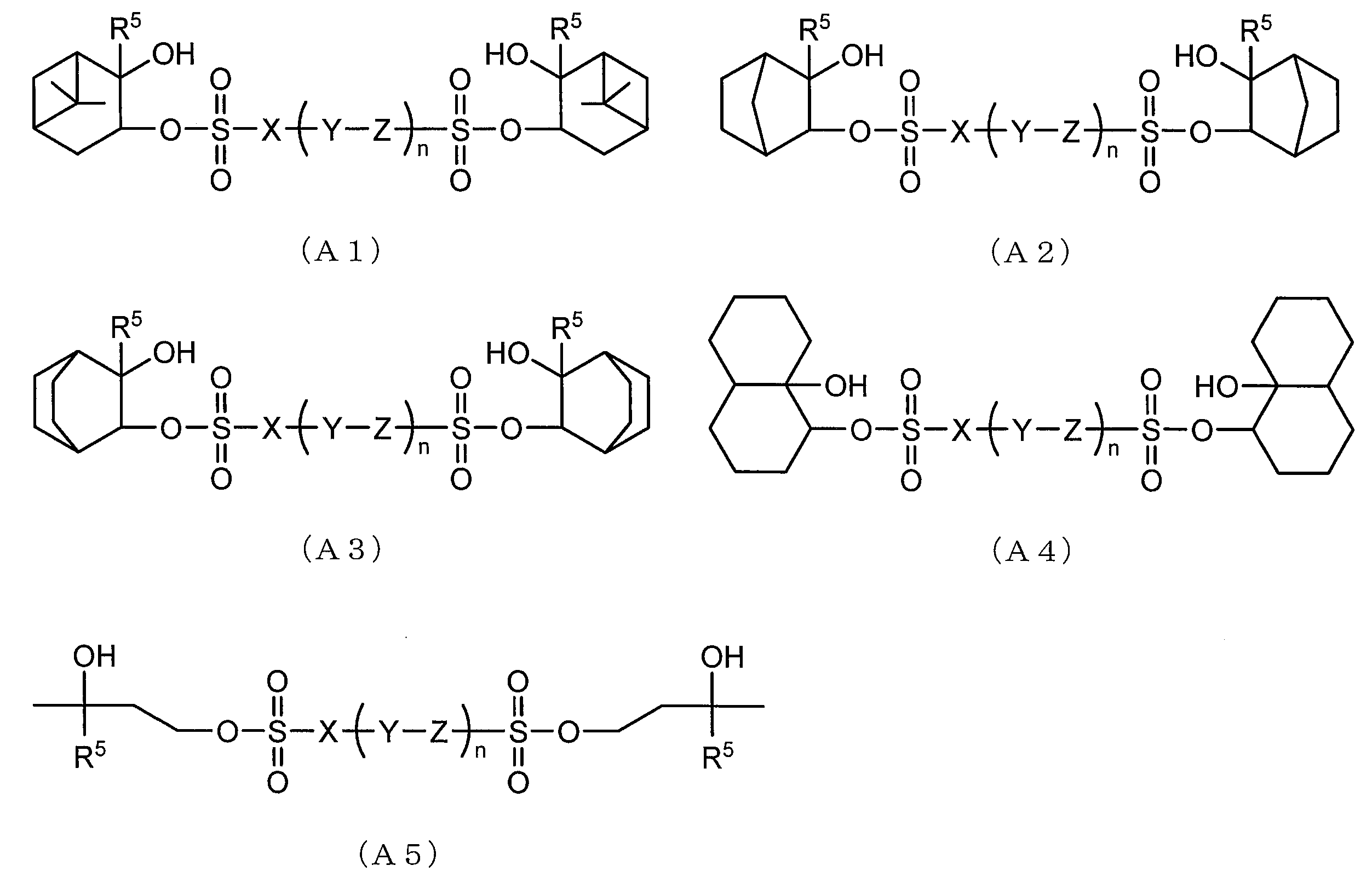
- the acid proliferating agent (A) is composed of compounds (A1) to (A5) represented by the following general formulas (A1) to (A5) from the viewpoint of obtaining a resist having good sensitivity and excellent thermal stability.
- it is at least one compound selected from the group, and X and Z in general formulas (A1) to (A5) are each independently a substituted or unsubstituted divalent fragrance having 1 to 25 carbon atoms. More preferably, it is a group.
- both terminal portions (portions corresponding to R 1 and R 2 in the general formula (A)) have a tertiary hydroxyl group, And it is preferable that it is a compound which has the same structure.
- Y is preferably a single bond, a group represented by formula (1-1), or a group represented by formula (1-6). When these groups are used, a resist having better sensitivity and thermal stability can be obtained.
- each R 5 independently represents a substituted or unsubstituted hydrocarbon group having 1 to 25 carbon atoms.
- X, Y, Z, and n have the same meaning as in the general formula (A).
- R 5 is a substituent in a monovalent substituted (substituted) hydrocarbon group having 1 to 25 carbon atoms represented by R 1 and R 2 .
- acid proliferating agent (A) examples include the following formulas (A1-1) to (A1-10), (A2-1), (A3-1), (A4-1), and (A5-1)
- the compound etc. which are represented can be mentioned.
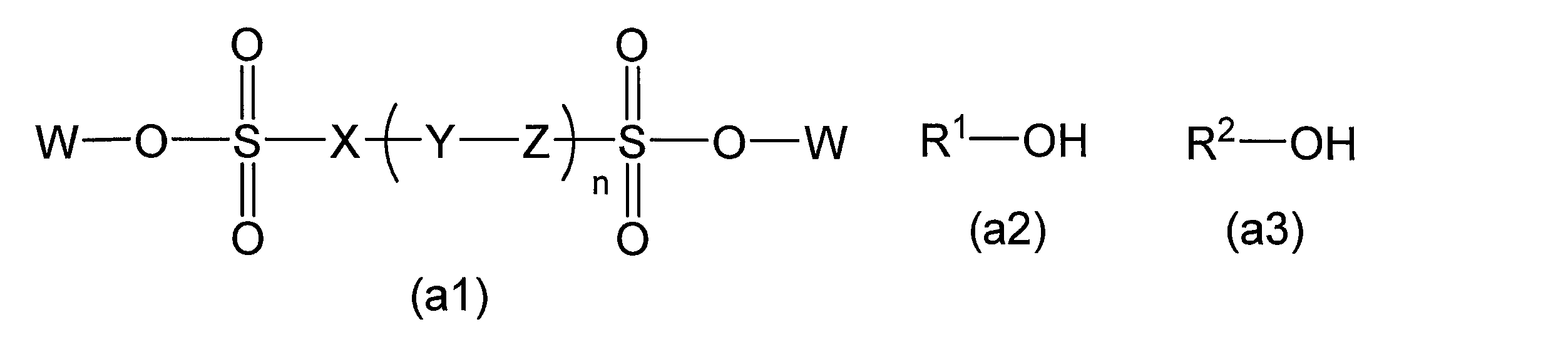
- the method for producing the compound of the present invention includes a compound (a1) represented by the following general formula (a1), a compound (a2) represented by the following general formula (a2), and the following: This is a method comprising reacting the compound (a3) represented by the general formula (a3).
- Compound (a3) can be synthesized by reacting in dichloromethane in the presence of a base.
- X and Z each independently represent a substituted or unsubstituted divalent hydrocarbon group having 1 to 25 carbon atoms
- Y represents a single bond or the following formula (1-1) )
- W represents independently a halogen atom
- n represents an integer of 0 to 5.
- R 1 in the general formula (a2) and R 2 in the general formula (a3) each independently represent a substituted or unsubstituted monovalent hydrocarbon group having 1 to 25 carbon atoms.
- R 1 in the general formula (a2) and the general formula (a3) R 2 in the has the same meaning as R 1 and R 2 in the general formula (a).
- the halogen atom represented by W is particularly preferably Cl.
- X and Z are preferably each independently a substituted or unsubstituted divalent aromatic group having 1 to 25 carbon atoms.
- Y is preferably a single bond, a group represented by formula (1-1), or a group represented by formula (1-6).
- R 1 in the general formula (a2) and R 2 in the general formula (a3) each independently represent a substituted or unsubstituted monovalent hydrocarbon group having 1 to 25 carbon atoms having a tertiary hydroxyl group. It is preferable. In such a case, it is possible to synthesize an acid proliferating agent (A) that can provide a resist with good sensitivity and excellent thermal stability.
- the compound (a2) and the compound (a3) are preferably diols.
- the compound (a2) and the compound (a3) are diols, it is particularly preferable that one of the two hydroxyl groups is a tertiary hydroxyl group.
- the acid proliferating agent (A) is a compound obtained by such a production method, a resist excellent in good sensitivity and thermal stability can be obtained.
- the compound (a2) and the compound (a3) have a hydroxyl group bonded to two adjacent carbon atoms of the ring.
- a geometric isomer there exists a geometric isomer.
- either a cis-type geometric isomer or a trans-type geometric isomer may be used, but it is preferable to use a cis-type isomer because it is thermally stable.
- reaction temperature and time are not particularly limited, and conventionally known conditions can be applied.
- the solvent for the reaction is not particularly limited, but dichloromethane, acetonitrile, tetrahydrofuran (THF) and the like are preferable. These solvents may be used alone or in combination of two or more.
- the base in the reaction is not particularly limited, but 4-dimethylaminopyridine, 1,4-diazabicyclo [2,2,2] octane, triethylamine and the like are preferable. These bases may be used alone or in combination of two or more.
- Solvent (B) As the solvent (B), conventionally known solvents can be used without particular limitation, and among them, linear, branched, or cyclic ketones, propylene glycol monoalkyl ether acetates, 2-hydroxypropionic acid At least one selected from the group consisting of alkyls, alkyl 3-alkoxypropionates, ⁇ -butyrolactone and the like is preferable.
- the blending ratio of the solvent (B) is preferably such that the total solid concentration of the radiation-sensitive resin composition is 1 to 20% by mass, and more preferably 1 to 15% by mass. An amount of 1 to 10% by mass is particularly preferable. If the blending ratio of the solvent (B) is less than 1% by mass, the viscosity may be too high, and coating may be difficult. On the other hand, when the blending ratio of the solvent (B) is more than 20% by mass, it may be difficult to form a resist film having a sufficient thickness.
- Resin (C) The resin having an acid dissociable group (resin (C)) is an alkali-insoluble or hardly soluble resin containing a repeating unit having an acid dissociable group. When this acid dissociable group is deprotected (dissociated) by the action of an acid generated from the acid generator (D) by irradiation with radiation, the resin (C) becomes readily alkali-soluble.
- alkali insoluble or hardly soluble means an alkali development condition employed when a resist pattern is formed on a resist film formed from a radiation-sensitive resin composition containing the resin (C).
- a 100 nm-thick film using only the resin (C) is developed instead of the resist film, 50% (50 nm) or more of the initial film thickness of this resin (C) film is after the development process. Means remaining properties.
- the radiation-sensitive resin composition of the present invention is sensitive to an electron beam and extreme ultraviolet rays in a lithography process, and a fine pattern is highly accurate and stable.
- Resin (C) can be used in a blending ratio similar to the blending ratio of a resin having a conventionally known acid-dissociable group used in a conventional radiation-sensitive resin composition.
- Component of resin (C) As the repeating unit having an acid-dissociable group contained in the resin (C), those in which the acid-dissociable group is dissociated by the action of an acid can be used without particular limitation, but the following repeating units (c1) and (c2) ) Is preferred. By using at least one of the repeating units (c1) and (c2) as the repeating unit having an acid dissociable group, there is an advantage that a resist pattern having good sensitivity can be formed.
- Repeating unit (c1) The repeating unit (c1) is a repeating unit represented by the following general formula (c1).
- R 6 represents a hydrogen atom, a methyl group, a trifluoromethyl group, or a hydroxymethyl group
- each R 7 independently represents a monovalent alicyclic group having 4 to 20 carbon atoms.
- the remaining one represents a monovalent alicyclic hydrocarbon group having 4 to 20 carbon atoms or a linear or branched alkyl group having 1 to 4 carbon atoms.
- the monovalent alicyclic hydrocarbon group having 4 to 20 carbon atoms represented by R 7 in the general formula (c1) include norbornane, tricyclodecane, tetracyclododecane, adamantane, cyclobutane, cyclo Groups consisting of alicyclic rings derived from cycloalkanes such as pentane, cyclohexane, cycloheptane, cyclooctane, etc .; at least one of the hydrogen atoms of the groups consisting of these alicyclic rings, for example, a methyl group, C1-C4 linear, branched or cyclic such as ethyl group, n-propyl group, i-propyl group, n-butyl group, 2-methylpropyl group, 1-methylpropyl group and t-butyl group And a group substituted with at least one selected from the group consisting of alkyl groups.
- linear or branched alkyl group having 1 to 4 carbon atoms represented by R 7 in the general formula (c1) include a methyl group, an ethyl group, an n-propyl group, an i-propyl group, Examples thereof include n-butyl group, 2-methylpropyl group, 1-methylpropyl group, t-butyl group and the like.
- any two R 7 are mutually the divalent alicyclic hydrocarbon group formed together with the carbon atom to which each is attached, for example, norbornane, tri At least one of a group consisting of an alicyclic ring derived from cyclodecane, tetracyclododecane, adamantane, cyclopentane, or cyclohexane, or a hydrogen atom of the group consisting of these alicyclic rings has the above-mentioned 1-4 carbon atoms. Examples include a group substituted with an alkyl group.
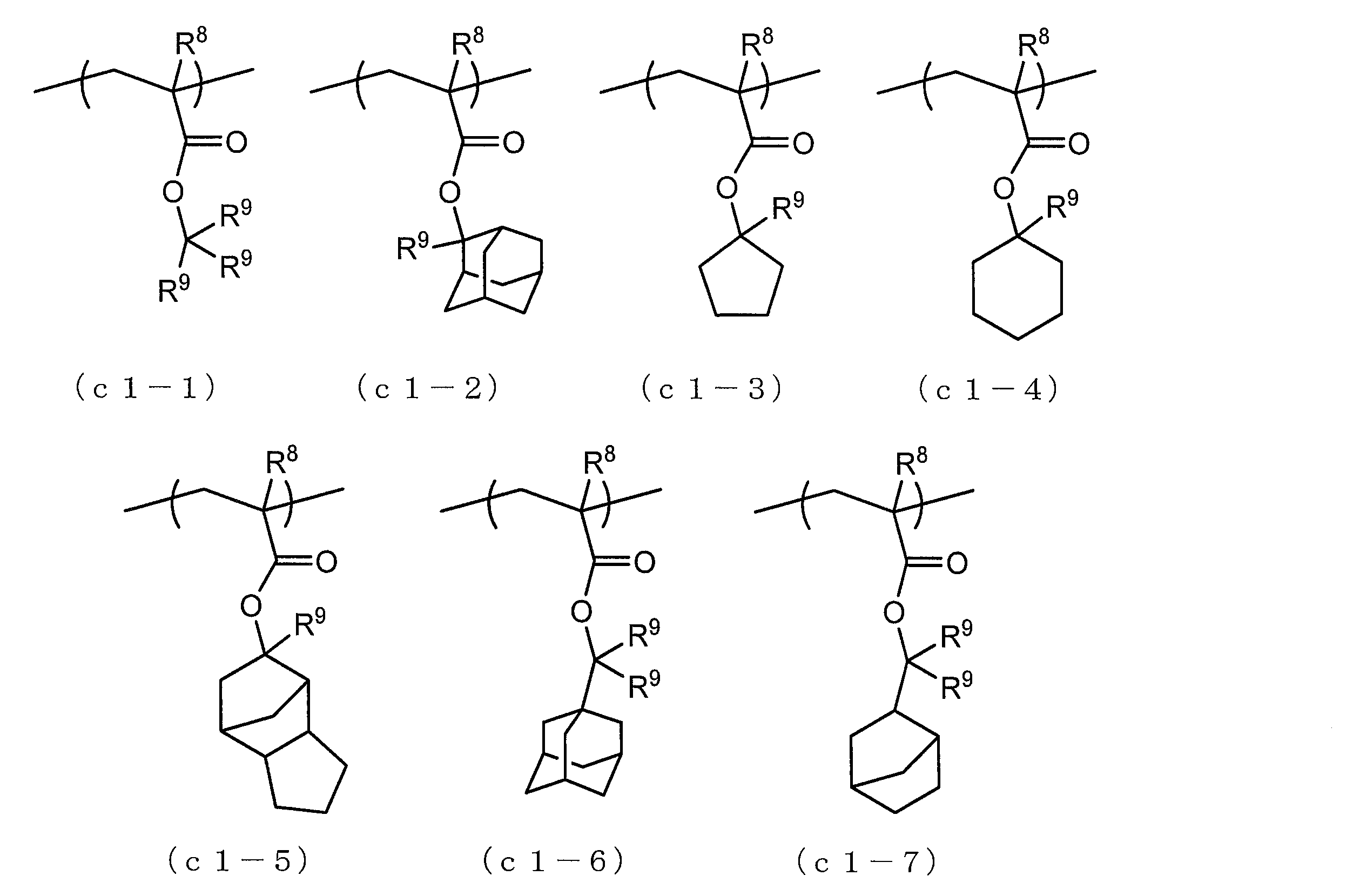
- the repeating unit (c1) is preferably a repeating unit represented by the following general formulas (c1-1) to (c1-7).
- each R 8 independently represents a hydrogen atom, a methyl group, a trifluoromethyl group, or a hydroxymethyl group
- each R 9 independently represents A linear or branched alkyl group having 1 to 4 carbon atoms is shown.
- the repeating unit (c1) is particularly preferably a repeating unit represented by the general formula (c1-2), (c1-3), or (c1-4).
- the resin (C) contains the above repeating unit, the radiation sensitive resin composition of the present invention has an advantage that a resist pattern excellent in nano edge roughness can be formed.
- Repeating unit (c2) is a repeating unit represented by the following general formula (c2).
- R 10 represents a hydrogen atom, a methyl group, a trifluoromethyl group, or a hydroxymethyl group
- R 11 each independently represents a monovalent alicyclic group having 4 to 20 carbon atoms.
- the remaining one represents a monovalent alicyclic hydrocarbon group having 4 to 20 carbon atoms or a linear or branched alkyl group having 1 to 4 carbon atoms.
- examples of the group represented by R 11 include the same groups as those exemplified for the group represented by R 7 in the general formula (c1).
- the group represented by R 11 is preferably each independently a linear or branched alkyl group having 1 to 4 carbon atoms.
- Resin (C) may contain a repeating unit having these acid dissociable groups, either alone or in combination of two or more.
- the resin (C) preferably further contains at least one repeating unit selected from the group consisting of the following repeating units (c3) to (c5) in addition to these repeating units having an acid dissociable group.
- the radiation-sensitive resin composition of the present invention has an advantage that a resist film that forms a resist pattern excellent in nano edge roughness can be formed. is there.
- Repeating unit (c3) is a repeating unit represented by the following general formula (c3).
- R 12 represents a hydrogen atom or a methyl group
- R 13 represents a linear or branched alkyl group having 1 to 12 carbon atoms, or a linear chain having 1 to 12 carbon atoms. Alternatively, it represents a branched alkoxyl group
- k represents an integer of 0 to 3
- l represents an integer of 0 to 3.
- the plurality of R 13 are independent of each other.
- linear or branched alkyl group having 1 to 12 carbon atoms represented by R 13 in the general formula (c3) include a methyl group, an ethyl group, an n-propyl group, an i-propyl group, Examples thereof include n-butyl group, 2-methylpropyl group, 1-methylpropyl group, t-butyl group and the like.
- a methyl group, an ethyl group, an n-butyl group, and a t-butyl group are preferable from the viewpoint that a resist pattern excellent in nano edge roughness can be formed.
- specific examples of the linear or branched alkoxyl group having 1 to 12 carbon atoms represented by R 13 include methoxy group, ethoxy group, n-propoxy group, i-propoxy group, Examples thereof include n-butoxy group, 2-methylpropoxy group, 1-methylpropoxy group, t-butoxy group and the like.
- a methoxy group and an ethoxy group are preferable from the viewpoint that a resist pattern excellent in nano edge roughness can be formed.
- k is preferably 1 or 2.
- L is preferably 0-2.
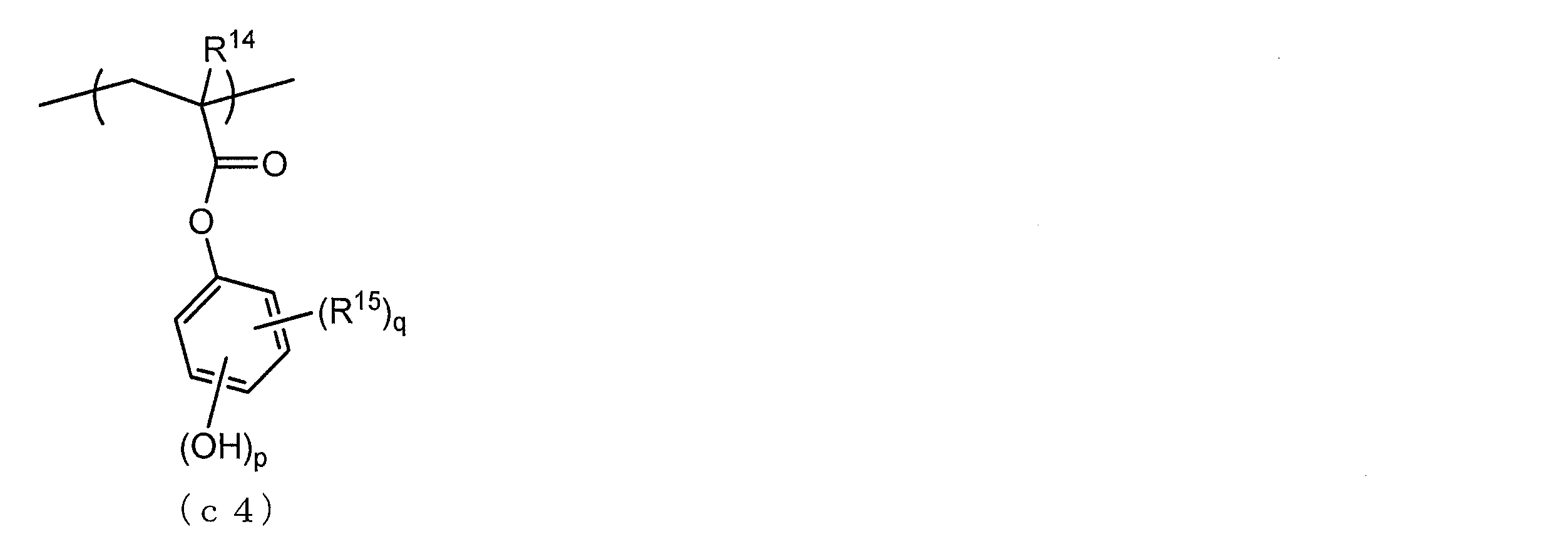
- Repeating unit (c4) is a repeating unit represented by the following general formula (c4).
- R 14 represents a hydrogen atom or a methyl group
- R 15 represents a linear or branched alkyl group having 1 to 12 carbon atoms, or a linear structure having 1 to 12 carbon atoms. Alternatively, it represents a branched alkoxyl group
- p represents an integer of 1 to 3
- q represents an integer of 0 to 3.
- the plurality of R 15 are independent of each other.
- p is preferably 1 or 2.
- q is preferably 0 or 1.
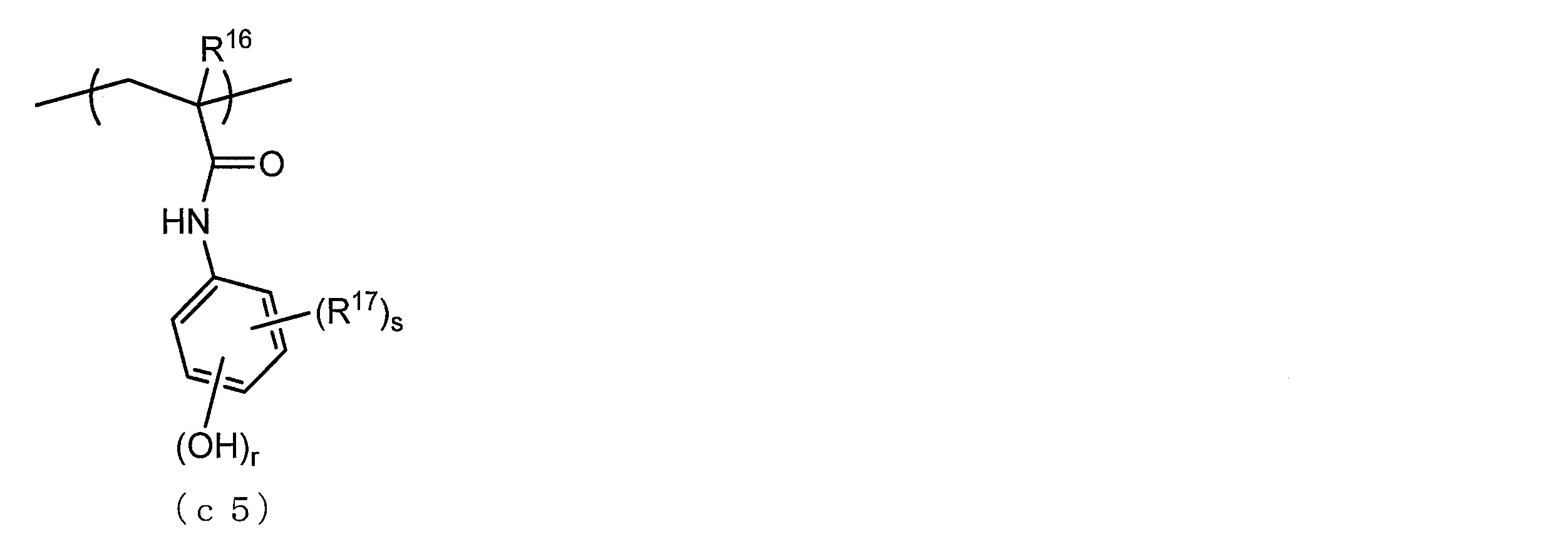
- Repeating unit (c5) is a repeating unit represented by the following general formula (c5).
- R 16 represents a hydrogen atom or a methyl group
- R 17 represents a linear or branched alkyl group having 1 to 12 carbon atoms, or a straight chain having 1 to 12 carbon atoms. Or, it represents a branched alkoxyl group
- r represents an integer of 1 to 3
- s represents an integer of 0 to 3.
- the plurality of R 17 are independent of each other.
- p is preferably 1 or 2.
- q is preferably 0 or 1.
- the resin (C) further contains a repeating unit derived from a non-acid dissociable compound (hereinafter referred to as “repeating unit (c6)”) in addition to the above repeating units (c1) to (c5). May be.
- the radiation-sensitive resin composition of the present invention can form a resist film that forms a resist pattern with excellent nanoedge roughness. There is.
- a non-acid dissociable compound is a compound that does not contain a group (acid dissociable group) that can be dissociated by the action of an acid.
- Specific examples of the non-acid dissociable compound giving such a repeating unit (c6) include styrene, ⁇ -methylstyrene, 4-methylstyrene, 2-methylstyrene, 3-methylstyrene, isobornyl acrylate, tricyclo Examples include decanyl (meth) acrylate, tetracyclododecenyl (meth) acrylate, a compound represented by the following formula (c6-1), a compound represented by the following formula (c6-2), and the like.
- styrene, ⁇ -methylstyrene, 4-methylstyrene, 2-methylstyrene, 3-methylstyrene, tricyclodecanyl acrylate, a compound represented by the following formula (c6-1), a compound represented by the following formula (c6- The compound represented by 2) is preferred.
- (meth) acrylate means “acrylate” or “methacrylate”.
- the content of the repeating unit (c1) in the resin (C) is preferably 1 mol% or more, more preferably 20 to 70 mol%, based on 100 mol% of all repeating units in the resin (C). 20 to 60 mol% is particularly preferable. There exists a possibility that the nano edge roughness of a resist pattern may deteriorate that the said content rate is less than 1 mol%. In addition, the resist pattern which exhibits the outstanding nano edge roughness can be formed as the said content rate is 20 mol% or more.
- the content of the repeating unit (c2) in the resin (C) is preferably 1 mol% or more, more preferably 20 to 70 mol%, based on 100 mol% of all repeating units in the resin (C). 20 to 60 mol% is particularly preferable. There exists a possibility that the nano edge roughness of a resist pattern may deteriorate that the said content rate is less than 1 mol%. When the content ratio is 20 mol% or more, an excellent nano edge roughness resist pattern can be formed.
- the total content of the repeating units (c3) to (c5) in the resin (C) is preferably 1 mol% or more with respect to 100 mol% of all repeating units in the resin (C), and is preferably 10 to 95 mol%. More preferred is 40 to 80 mol%. If the total content is less than 1 mol% or more than 95 mol%, the nano edge roughness may be deteriorated.
- the total content ratio of the repeating units (c1) to (c5) in the resin (C) is preferably 10 mol% or more with respect to 100 mol% of all repeating units in the resin (C), and preferably 40 to 100 mol%. More preferably, it is particularly preferably 50 to 100 mol%. If the total content is less than 10 mol%, the nano edge roughness may be deteriorated. In addition, the resist pattern of the outstanding nano edge roughness can be formed as it is 10 mol% or more.
- the content of the repeating unit (c6) in the resin (C) is preferably 60 mol% or less, more preferably 0 to 50 mol%, based on 100 mol% of all repeating units in the resin (C). .
- the content of the repeating unit (c6) in the resin (C) is preferably 60 mol% or less, more preferably 0 to 50 mol%, based on 100 mol% of all repeating units in the resin (C). .
- the nano edge roughness of a resist pattern may deteriorate that the said content rate exceeds 60 mol%.
- it is 60 mol% or less it is possible to form a resist pattern excellent in the balance between the resolution performance and the performance of the nano edge roughness.
- resin (C) Although the synthesis method of resin (C) is not specifically limited, for example, resin (C) is compoundable by conventionally well-known radical polymerization, anion polymerization, etc.
- the side chain hydroxystyrene units in the above repeating units (c3) to (c5) are obtained by subjecting the obtained resin (C) to hydrolysis of an acetoxy group or the like in the presence of a base or acid in an organic solvent. Can be obtained.
- the resin (C) has a polystyrene-reduced mass average molecular weight (hereinafter referred to as “Mw”) measured by gel permeation chromatography (GPC), preferably from 3,000 to 100,000. More preferably, it is 000 to 40,000, and particularly preferably 3,000 to 25,000.
- Mw polystyrene-reduced mass average molecular weight measured by gel permeation chromatography
- the ratio (Mw / Mn) between the Mw of the resin (C) and the polystyrene-equivalent number average molecular weight (hereinafter referred to as “Mn”) measured by GPC is preferably 1 to 5. More preferably, it is more preferably 1 to 2.5.
- Radiation sensitive acid generator (D) The acid generator (D) generates an acid by radiation applied to the resist in the lithography process.
- the acid-dissociable group in the resin (C) can be deprotected (dissociated) by the action of this acid and the acid newly generated by the acid proliferating agent (A).
- the acid generator (D) is preferably at least one selected from the group consisting of an onium salt, a diazomethane compound, and a sulfonimide compound, from the viewpoint of good acid generation efficiency, heat resistance, and the like. . In addition, you may use these acid generators (D) individually by 1 type or in combination of 2 or more types.
- the content ratio of the acid generator (D) is preferably 0.1 to 40 parts by mass, and more preferably 0.5 to 30 parts by mass with respect to 100 parts by mass of the resin (C). There exists a possibility that a sensitivity and developability may fall that the content rate of an acid generator (D) is less than 0.1 mass part. On the other hand, if it exceeds 40 parts by mass, transparency to radiation, pattern shape, heat resistance and the like may be reduced.
- Acid diffusion control agent (E) The radiation-sensitive resin composition of the present invention preferably further contains an acid diffusion controller (E).
- the acid diffusion control agent (E) is a component having an action of suppressing an undesired chemical reaction in a non-exposed region by controlling a diffusion phenomenon in the resist film of an acid generated from the acid generator (D) by exposure. is there.
- the storage stability of the resulting radiation-sensitive resin composition can be improved by including such an acid diffusion controller (E).
- the resolution of the formed resist film can be further improved, and the change in the line width of the resist pattern due to the fluctuation of the holding time (PED) until the heat treatment after exposure can be suppressed.
- a radiation sensitive resin composition having extremely excellent stability can be obtained.
- Examples of the acid diffusion controller (E) include nitrogen-containing organic compounds and photosensitive basic compounds.
- Nitrogen-containing organic compounds examples include compounds represented by the following general formula (E1), compounds having two nitrogen atoms in the same molecule, polyamino compounds and polymers having three or more nitrogen atoms, and amide group-containing compounds. , Urea compounds, nitrogen-containing heterocyclic compounds, and the like.
- each R 26 is independently a hydrogen atom, an optionally substituted linear, branched or cyclic alkyl group, an optionally substituted aryl group, or a substituted group.
- the aralkyl group which may be sufficient.
- the photosensitive basic compound is a photosensitive component that efficiently decomposes into neutral fragments in the exposed area and remains as it is without being decomposed in the unexposed area. Since such a photosensitive basic compound can effectively use an acid generated in an exposed portion (that is, an exposed region) as compared with a non-photosensitive basic compound, the sensitivity can be further improved. .
- the photosensitive basic compound is not particularly limited as long as it has the above properties, and examples thereof include compounds represented by the following general formulas (E2-1) and (E2-2).
- each R 27 is independently a linear or branched alkyl group having 1 to 10 carbon atoms which may be substituted, or a carbon number which may be substituted 6
- a chain or branched alkyl group or an optionally substituted aryl group having 6 to 18 carbon atoms is shown.
- each R 28 is independently a linear or branched alkyl group having 1 to 10 carbon atoms which may be substituted, or a carbon number which may be substituted 6 Represents an aryl group of ⁇ 18, or represents a cyclic structure in which two R 28 are bonded together to form an iodine atom.
- U ⁇ represents OH ⁇ , R ⁇ , or R—COO ⁇ .
- R shows a monovalent organic group.
- U ⁇ is preferably OH ⁇ , CH 3 COO ⁇ , or an anion represented by the following formulas (e2-1) to (e2-5).
- the photosensitive basic compound is a triphenylsulfonium compound, the anion portion (U ⁇ ) of which is OH ⁇ , CH 3 COO ⁇ , the above formulas (e2-2), (e2-3), (e2 ⁇
- the compound which is an anion represented by 4) is preferable.
- these acid diffusion control agents (E) can be used individually by 1 type or in combination of 2 or more types.
- the mixing ratio of the acid diffusion controller (E) is preferably 30 parts by mass or less, more preferably 0.001 to 30 parts by mass, and more preferably 0.005 to 100 parts by mass of the resin (C). It is particularly preferable that the amount be ⁇ 20 parts by mass. There exists a possibility that the sensitivity of the formed resist film and the developability of an exposure part may fall that the mixture ratio of an acid spreading
- the radiation-sensitive resin composition of the present invention is a surfactant other than the above-mentioned acid proliferator (A), solvent (B), resin (C), acid generator (D), and acid diffusion controller (E). It may contain additives such as an agent, a sensitizer, an aliphatic additive, a dye, a pigment, an adhesion aid, an antihalation agent, a storage stabilizer, and an antifoaming agent.
- the surfactant is a component that exhibits an effect of improving resist coatability, striation, developability, and the like.
- the blending ratio of the surfactant is preferably 0.001 to 2 parts by mass with respect to 100 parts by mass of the resin (C).
- Sensitizer absorbs radiation energy and transmits the absorbed energy to the acid generator (D) to increase the amount of acid generated.
- the apparent sensitivity of the radiation-sensitive resin composition It has the effect of improving sensitivity.
- sensitizer examples include carbazoles, acetophenones, benzophenones, naphthalenes, phenols, biacetyl, eosin, rose bengal, pyrenes, anthracenes, phenothiazines, and the like.
- the blending ratio of the sensitizer is preferably 0.1 to 10 parts by mass with respect to 100 parts by mass of the resin (C).
- Aliphatic additive is a component having an action of further improving dry etching resistance, pattern shape, adhesion to the substrate, and the like.
- alicyclic additive examples include 1-adamantane carboxylic acid, 2-adamantanone, 1-adamantane carboxylate t-butyl, 1-adamantane carboxylate t-butoxycarbonylmethyl, 1-adamantane carboxylate ⁇ -butyrolactone Esters, 1,3-adamantane dicarboxylate di-t-butyl, 1-adamantane acetate t-butyl, 1-adamantane acetate t-butoxycarbonylmethyl, 1,3-adamantane diacetate di-t-butyl, 2,5- Adamantane derivatives such as dimethyl-2,5-di (adamantylcarbonyloxy) hexane;
- the blending ratio of the alicyclic additive is preferably 0.5 to 20 parts by mass with respect to 100 parts by mass of the resin (C). There exists a possibility that the heat resistance of the formed resist film may fall that the compounding ratio of an alicyclic additive exceeds 20 mass parts.
- Dyes and pigments can visualize the latent image in the exposed area and mitigate the effects of halation during exposure.
- the adhesion aid is for improving the adhesion between the resist film and the substrate.
- the radiation sensitive resin composition of the present invention is useful as a material capable of forming a chemically amplified positive resist film, and can form a positive resist pattern having a desired shape.
- a resist film is formed by applying the radiation-sensitive resin composition of the present invention on a substrate.
- the radiation-sensitive resin composition for example, a composition obtained by adjusting the total solid content concentration and then filtering with a filter having a pore diameter of about 0.2 ⁇ m can be used.
- the substrate for example, a silicon wafer, a wafer coated with aluminum, or the like can be used.
- a method for applying the radiation-sensitive resin composition conventionally known methods can be appropriately employed, and specific examples include spin coating, cast coating, roll coating, and the like.
- heat treatment (hereinafter referred to as “PB”) may be performed at a temperature of about 70 to 160 ° C.
- this resist film is exposed so that a predetermined resist pattern is formed.
- radiation that can be used for this exposure include (extreme) far ultraviolet rays such as KrF excimer laser (wavelength 248 nm), ArF excimer laser (wavelength 193 nm), EUV (extreme ultraviolet light, wavelength 13.5 nm, etc.), and synchro Examples thereof include X-rays such as tron radiation, and charged particle beams such as EB (electron beam).
- exposure conditions, such as exposure amount can be suitably selected according to the composition of the radiation-sensitive resin composition, the type of additive, and the like. This exposure can also be immersion exposure.
- PEB a heat treatment
- the heating conditions for PEB can be appropriately selected depending on the composition of the radiation sensitive resin composition, but it is preferably 30 to 200 ° C, more preferably 50 to 170 ° C.
- the exposed resist film is developed.
- Examples of the developer used for development include sodium hydroxide, potassium hydroxide, sodium carbonate, sodium silicate, sodium metasilicate, aqueous ammonia, ethylamine, n-propylamine, diethylamine, and di-n-propylamine.
- An alkaline aqueous solution in which at least one alkaline compound such as [4.3.0] -5-nonene is dissolved is preferable.
- the concentration of the alkaline aqueous solution is preferably 10% by mass or less. If the concentration of the alkaline aqueous solution is more than 10% by mass, the unexposed area may be dissolved in the developer. Further, specifically, the developer preferably has a pH of 8 to 14, more preferably a pH of 9 to 14.
- an organic solvent can be added to the developer.
- the organic solvent include ketones such as acetone, methyl ethyl ketone, methyl i-butyl ketone, cyclopentanone, cyclohexanone, 3-methylcyclopentanone, and 2,6-dimethylcyclohexanone; methyl alcohol, ethyl alcohol, n-propyl alcohol Alcohols such as i-propyl alcohol, n-butyl alcohol, t-butyl alcohol, cyclopentanol, cyclohexanol, 1,4-hexanediol and 1,4-hexanedimethylol; ethers such as tetrahydrofuran and dioxane; Examples thereof include esters such as ethyl acetate, n-butyl acetate and i-amyl acetate; aromatic hydrocarbons such as toluene and xylene; phenol, aceton
- the compounding amount of the organic solvent is preferably 100 parts by volume or less with respect to 100 parts by volume of the alkaline aqueous solution. If the blending amount is more than 100 parts by volume, the developability is lowered, and there is a possibility that the remaining development in the exposed part increases. An appropriate amount of a surfactant or the like can be added to the developer.
- the developing solution which consists of alkaline aqueous solution
- it can also wash and dry with water.
- EB electron beam
- Mw and Mn are measured using a trade name “GPC columns (2 G2000HXL, 1 G3000HXL, 1 G4000HXL)” manufactured by Tosoh Corporation, a flow rate of 1.0 ml / min, tetrahydrofuran as an elution solvent, and a column temperature of 40 ° C. The measurement was performed under the conditions, and the gel permeation chromatography (GPC) using monodisperse polystyrene as a standard was used. Further, the dispersity (Mw / Mn) was calculated from the above measurement results.
- GPC gel permeation chromatography
- FIG. 1 is a schematic plan view when a line and space pattern is viewed from above.
- FIG. 2 is a cross-sectional view showing the A-A ′ cross section shown in FIG. However, the unevenness shown in FIGS. 1 and 2 is drawn exaggerated from the actual.
- [Nano edge roughness] A line and space pattern (1L1S) with a designed line width of 150 nm is formed, and then the line portion of the line and space pattern is scanned with a scanning electron microscope for semiconductors (high resolution FEB measuring device, product name “S-9220”) , Manufactured by Hitachi, Ltd.), and the height of the convex part that protruded most from the lateral surface of the line part was measured. Specifically, as shown in FIGS. 1 and 2, the line width (“X” in FIG. 1) of the most protruding convex portion formed on the lateral surface 2 a of the line portion 2 of the resist film formed on the silicon wafer 1. )) And the design line width of 150 nm (“ ⁇ CD” in FIGS. 1 and 2) were measured by CD-SEM (trade name “S-9220”, manufactured by Hitachi High-Technologies Corporation). This measured value was used as an evaluation value of nano edge roughness.
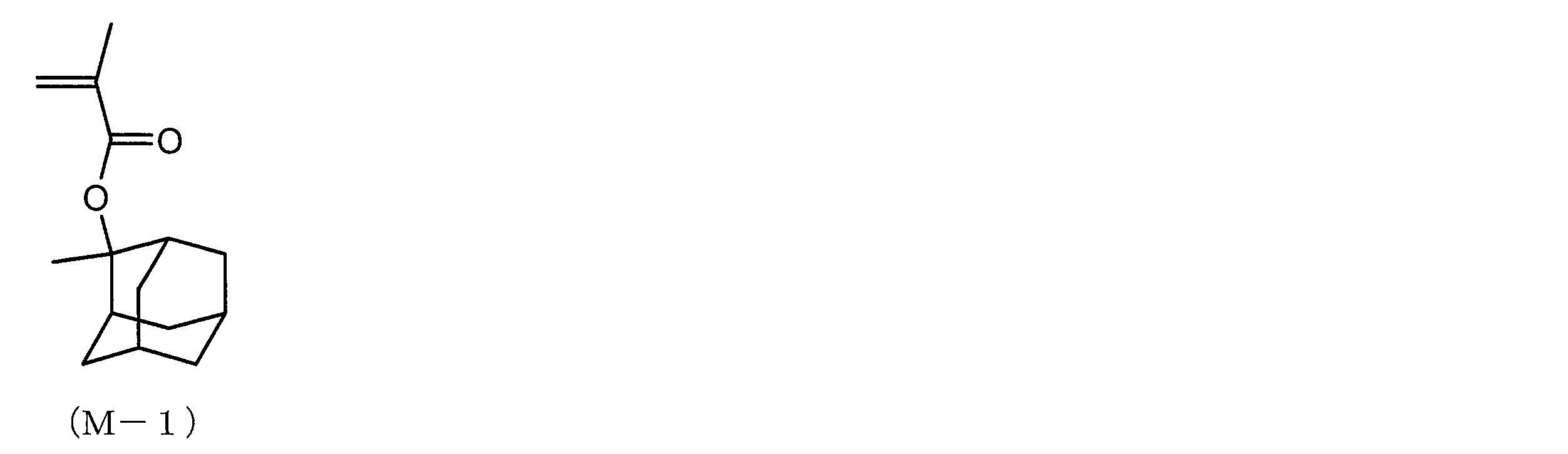
- the obtained copolymer had Mw of 6,000, Mw / Mn of 1.9, and as a result of 13 C-NMR analysis, the repeating unit derived from p-hydroxystyrene and compound (M-1)
- the content ratio (mol ratio) of the repeating unit derived from was a copolymer having a ratio of 60:40.
- this copolymer is referred to as a resin (C-1).
- Example 1 10.0 g of the compound (a1-1) represented by the following formula (a1-1), 12.4 g of the compound (a2-1) represented by the following formula (a2-1), 8.8 g of triethylamine, and 4- Dimethylaminopyridine (2.1 g) was dissolved in dichloromethane (100 g), and the mixture was stirred at room temperature for 24 hours to be reacted.
- the composition solution (radiation sensitive resin composition) was prepared by filtering the obtained mixed liquid with a membrane filter having a pore size of 200 nm.
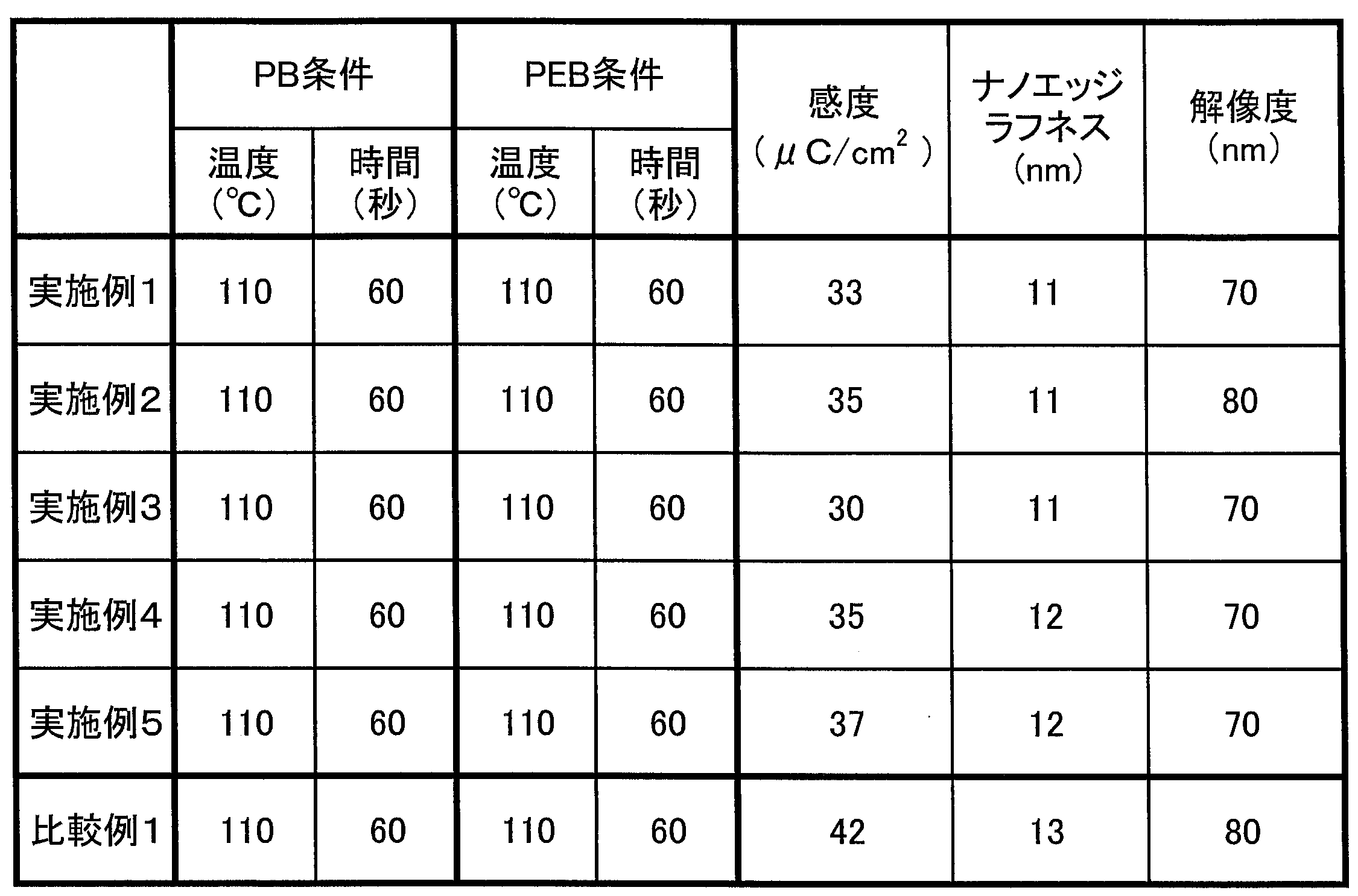
- the prepared composition solution was spin-coated on a silicon wafer in the trade name “CLEAN TRACK ACT8” manufactured by Tokyo Electron Ltd., and then subjected to PB (heat treatment) at 110 ° C. for 60 seconds (conditions shown in Table 2 below).
- PB heat treatment
- a resist film having a thickness of 50 nm was formed.
- the resist film was irradiated with an electron beam using a simple electron beam drawing apparatus (model “HL800D”, manufactured by Hitachi, Ltd., output: 50 KeV, current density: 5.0 A / cm 2 ).
- PEB was performed at 110 ° C. for 60 seconds (conditions shown in Table 2).
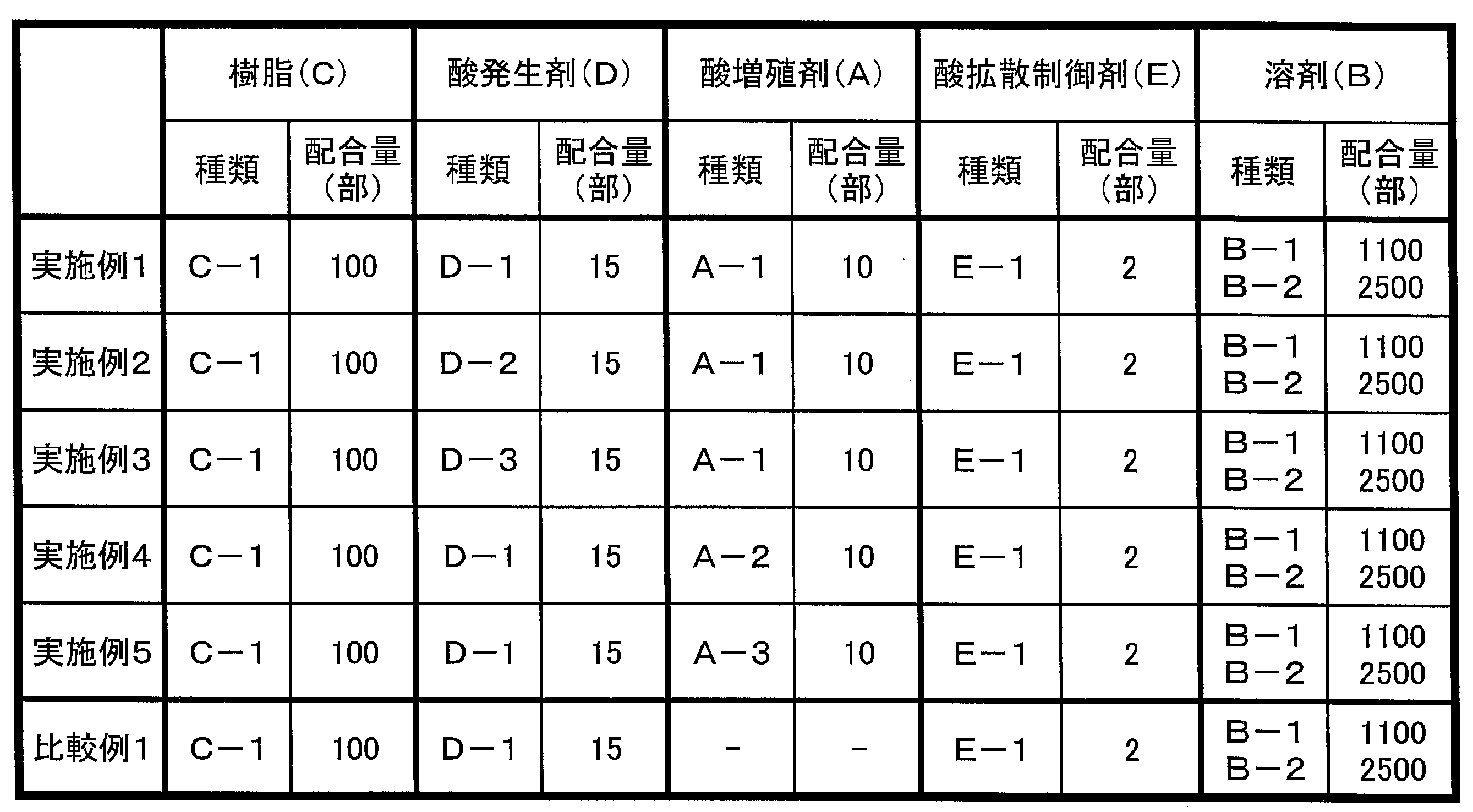
- Example 2 and 3 Comparative Example 1 Except having set it as the compound shown in following Table 1, and its mixture ratio, it carried out similarly to Example 1, and prepared the composition solution (radiation sensitive resin composition) of Example 2, 3 and the comparative example 1. . Using the prepared composition solutions, a resist having a predetermined resist pattern formed was obtained in the same manner as in Example 1. Each evaluation mentioned above was performed about the obtained resist. The evaluation results are shown in Table 2 below.
- Example 4 9.6 g of the compound (a1-2) represented by the following formula (a1-2), 12.4 g of the compound (a2-1) represented by the above formula (a2-1), 8.8 g of triethylamine, and 4- Dimethylaminopyridine (2.1 g) was dissolved in dichloromethane (100 g), and the mixture was stirred at room temperature for 24 hours to be reacted. After completion of the reaction, 200 g of dichloromethane was added and the mixture was washed twice with 100 g of a 3% by mass aqueous NaHCO 3 solution twice, twice with 100 g of a 3% by mass aqueous oxalic acid solution and five times with 100 g of water, and the organic layer was distilled off under reduced pressure.
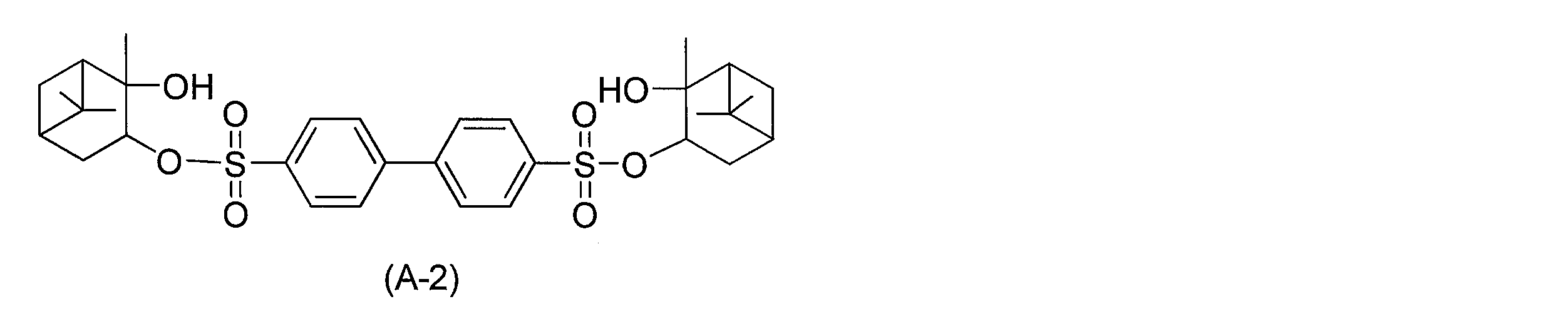
- a radiation-sensitive resin composition was prepared in the same manner as in Example 1 except that the compound represented by the formula (A-2) thus obtained was used and the blending ratio shown in Table 1 was used. did.
- a resist on which a predetermined resist pattern was formed was obtained in the same manner as in Example 1.
- Each evaluation mentioned above was performed about the obtained resist. The evaluation results are shown in Table 2 below.
- Example 5 10.0 g of the compound (a1-3) represented by the following formula (a1-3), 12.4 g of the compound (a2-1) represented by the formula (a2-1), 8.8 g of triethylamine, and 4- Dimethylaminopyridine (2.1 g) was dissolved in dichloromethane (100 g), and the mixture was stirred at room temperature for 24 hours to be reacted.
- a radiation-sensitive resin composition was prepared in the same manner as in Example 1 except that the compound represented by the formula (A-3) thus obtained was used and the blending ratio shown in Table 1 was used. did. Using the prepared composition solution, a resist on which a predetermined resist pattern was formed was obtained in the same manner as in Example 1. Each evaluation mentioned above was performed about the obtained resist. The evaluation results are shown in Table 2 below.
- Acid diffusion controller (E-1) Tri-n-octylamine
- the radiation sensitive resin compositions of Examples 1 to 5 formed a resist superior in sensitivity, nanoedge roughness, and resolution as compared with the radiation sensitive resin composition of Comparative Example 1. Clearly it is possible.
- the radiation-sensitive resin composition of the present invention is suitable as a material for resist coatings used for fine processing in lithography processes using EB, EUV and X-rays, particularly for manufacturing semiconductor devices and the like. It is extremely useful as a material capable of forming a chemically amplified resist for manufacturing semiconductor devices.
Landscapes
- Chemical & Material Sciences (AREA)
- Organic Chemistry (AREA)
- Physics & Mathematics (AREA)
- Spectroscopy & Molecular Physics (AREA)
- General Physics & Mathematics (AREA)
- Chemical Kinetics & Catalysis (AREA)
- Materials For Photolithography (AREA)
- Organic Low-Molecular-Weight Compounds And Preparation Thereof (AREA)
Abstract
Description




本発明の感放射線性樹脂組成物は、化合物(A)と、溶剤(B)と、酸解離性基を有する樹脂(以下、「樹脂(C)」とも記載する。)と、を含有するものである。また、本発明の感放射線性樹脂組成物は、通常、感放射線性酸発生剤(以下、「酸発生剤(D)」とも記載する。)を更に含有するものである。
本発明の化合物(以下、「酸増殖剤(A)」とも記載する。)は、酸増殖剤である。酸増殖剤は、酸の作用により分解され、新たな酸を発生する化合物である。そのため、酸増殖剤(A)は、一度放射線照射により感放射線性酸発生剤から酸が発生すると、その酸の作用により新たな酸を発生し、その後も自己触媒的に反応することで多量の酸を発生させることができる。即ち、酸増殖剤(A)を含有する感放射線性樹脂組成物は、レジストの露光部分のアルカリ現像液に対する溶解性を良好にし、レジストとしての、見かけの感度を向上させることができる。なお、酸増殖剤(A)は、酸が共存しない限り、安定な化合物である。化合物(A)は、従来の感放射線性樹脂組成物に使用される従来公知の酸増殖剤の配合割合と同程度の配合割合で使用することができる。



本発明の化合物(酸増殖剤(A))の製造方法は、下記一般式(a1)で表される化合物(a1)と、下記一般式(a2)で表される化合物(a2)と、下記一般式(a3)で表される化合物(a3)とを反応させることを含む方法である。具体的には、下記一般式(a1)で表されるスルホン酸ハロゲン化物(a1)と、下記一般式(a2)で表される化合物(a2)と、下記一般式(a3)で表される化合物(a3)とを、塩基存在下、ジクロロメタン中で反応させることによって、合成することができる。

溶剤(B)としては、従来公知のものを特に制限なく用いることができるが、なかでも、直鎖状、分岐状、又は環状のケトン類、プロピレングリコールモノアルキルエーテルアセテート類、2-ヒドロキシプロピオン酸アルキル類、3-アルコキシプロピオン酸アルキル類、及びγ-ブチロラクトン等からなる群より選択される少なくとも1種が好ましい。
酸解離性基を有する樹脂(樹脂(C))とは、酸解離性基を有する繰り返し単位を含むアルカリ不溶性又は難溶性の樹脂である。この酸解離性基が、放射線照射により酸発生剤(D)から発生する酸の作用により、脱保護(解離)することにより、樹脂(C)はアルカリ易溶性となる。
樹脂(C)に含まれる酸解離性基を有する繰り返し単位としては、酸の作用により酸解離性基が解離するものを特に制限なく用いることができるが、以下の繰り返し単位(c1)及び(c2)の少なくともいずれかであることが好ましい。酸解離性基を有する繰り返し単位として、繰り返し単位(c1)及び(c2)の少なくともいずれかを用いることによって、良好な感度を有するレジストパターンを形成することができるという利点がある。
繰り返し単位(c1)は、下記一般式(c1)で表される繰り返し単位である。

繰り返し単位(c2)は、下記一般式(c2)で表される繰り返し単位である。

繰り返し単位(c3)は、下記一般式(c3)で表される繰り返し単位である。

繰り返し単位(c4)は、下記一般式(c4)で表される繰り返し単位である。
繰り返し単位(c5)は、下記一般式(c5)で表される繰り返し単位である。
非酸解離性化合物は、酸の作用によっても解離する基(酸解離性基)を含有しない化合物である。このような繰り返し単位(c6)を与える非酸解離性化合物の具体例としては、スチレン、α-メチルスチレン、4-メチルスチレン、2-メチルスチレン、3-メチルスチレン、イソボロニルアクリレート、トリシクロデカニル(メタ)アクリレート、テトラシクロドデセニル(メタ)アクリレート、下記式(c6-1)で表される化合物、下記式(c6-2)で表される化合物等を挙げることができる。これらの中でも、スチレン、α-メチルスチレン、4-メチルスチレン、2-メチルスチレン、3-メチルスチレン、トリシクロデカニルアクリレート、下記式(c6-1)で表される化合物、下記式(c6-2)で表される化合物が好ましい。なお、繰り返し単位(c6)は、一種単独で、又は二種以上を組み合わせて用いても良い。また、本明細書中「(メタ)アクリレート」とは、「アクリレート」又は「メタクリレート」を意味する。

樹脂(C)の合成方法は特に限定されないが、例えば、従来公知のラジカル重合、アニオン重合等により樹脂(C)を合成することができる。また、上述した繰り返し単位(c3)~(c5)における側鎖のヒドロキシスチレン単位は、得られた樹脂(C)を有機溶媒中で塩基又は酸の存在下でアセトキシ基等の加水分解を行うことにより得ることができる。
酸発生剤(D)は、リソグラフィープロセスにおいて、レジストに照射される放射線により酸を発生するものである。この酸及び前述の酸増殖剤(A)により新たに発生した酸の作用により前述の樹脂(C)中の酸解離性基を脱保護(解離)させることができる。
本発明の感放射線性樹脂組成物は、酸拡散制御剤(E)を更に含有することが好ましい。酸拡散制御剤(E)は、露光により酸発生剤(D)から生じる酸の、レジスト被膜中における拡散現象を制御することにより、非露光領域における好ましくない化学反応を抑制する作用を有する成分である。
含窒素有機化合物としては、例えば、下記一般式(E1)で表される化合物、同一分子内に窒素原子を2個有する化合物、窒素原子を3個以上有するポリアミノ化合物や重合体、アミド基含有化合物、ウレア化合物、含窒素複素環化合物等を挙げることができる。

感光性塩基性化合物は、露光領域において中性の断片に効率よく分解するとともに、未露光部では分解せずにそのまま残る感光性の成分である。このような感光性塩基性化合物は、非感光性の塩基性化合物に比べて、露光部分(即ち、露光領域)に発生する酸を有効活用することができるため、感度を更に向上させることができる。


本発明の感放射線性樹脂組成物は、上述の酸増殖剤(A)、溶剤(B)、樹脂(C)、酸発生剤(D)、及び酸拡散制御剤(E)以外に、界面活性剤、増感剤、脂肪族添加剤、染料、顔料、接着助剤、ハレーション防止剤、保存安定化剤、消泡剤等の添加剤を含有していても良い。
界面活性剤は、レジストの塗布性、ストリエーション、現像性等を改良する作用を示す成分である。
増感剤は、放射線のエネルギーを吸収し、その吸収したエネルギーを酸発生剤(D)に伝達して酸の生成量を増加させる作用を有するものであり、感放射線性樹脂組成物のみかけの感度を向上させる効果を有するものである。
脂環族添加剤は、ドライエッチング耐性、パターン形状、基板との接着性等を更に改善する作用を有する成分である。
本発明の感放射線性樹脂組成物は、化学増幅型ポジ型レジスト被膜を成膜可能な材料として有用であり、所望の形状のポジ型のレジストパターンを形成することができるものである。
Mw及びMnの測定は、東ソー社製の商品名「GPCカラム(G2000HXL2本、G3000HXL1本、G4000HXL1本)」を用い、流量1.0ml/分、溶出溶剤としてテトラヒドロフラン、カラム温度を40℃とする分析条件で行い、単分散ポリスチレンを標準とするゲルパーミエーションクロマトグラフィー(GPC)により測定した。また、分散度(Mw/Mn)は、上記測定結果より算出した。
1H-NMR分析及び13C-NMR分析は、日本電子社製の型式「JNM-EX270」を用いた。
露光量を変化させて、ライン部と、隣り合うライン部によって形成されるスペース部(溝部)とからなるレジストパターン(いわゆる、ライン・アンド・スペースパターン(1L1S))を形成した。このとき、線幅150nmのライン部と線幅150nmのスペース部からなるライン・アンド・スペースパターンとなる露光量を最適露光量とし、この最適露光量を、感度として評価した。
設計線幅150nmのライン・アンド・スペースパターン(1L1S)を形成し、その後、ライン・アンド・スペースパターンのライン部を半導体用走査電子顕微鏡(高分解能FEB測長装置、商品名「S-9220」、日立製作所社製)にて観察し、ライン部の横側面から最も突出した凸部の高さを測定した。具体的には、図1及び図2に示すように、シリコンウェハー1上に形成したレジスト被膜のライン部2の横側面2aに生じた最も突出した凸部における線幅(図1中の「X」)と、設計線幅150nmとの差(図1及び図2中の「ΔCD」)を、CD-SEM(商品名「S-9220」、日立ハイテクノロジーズ社製)にて測定した。この測定値をナノエッジラフネスの評価値とした。
設計線幅150nmから50nmまで、設計線幅を10nmづつ小さくしてライン・アンド・スペースパターン(1L1S)を形成したときに、形成可能な最小の線幅(nm)を解像度の評価値とした。
p-アセトキシスチレン53g、下記式(M-1)で表される化合物(以下、「化合物(M-1)」と記載する。)48g、アゾビスイソブチロニトリル(以下、「AIBN」と記載する。)7g、及びt-ドデシルメルカプタン1gを、プロピレングリコールモノメチルエーテル150gに溶解した後、窒素雰囲気下、反応温度を70℃に保持して、16時間重合させた。重合後、反応溶液を1000gのn-ヘキサン中に滴下して、共重合体を凝固精製した。次いで、この共重合体に、再度プロピレングリコールモノメチルエーテル150gを加えた後、更に、メタノール150g、トリエチルアミン37g、及び水7gを加えて、沸点にて還流させながら、8時間加水分解反応を行なった。反応後、溶剤及びトリエチルアミンを減圧留去し、得られた共重合体をアセトン150gに溶解した後、2000gの水中に滴下して凝固させ、生成した白色粉末をろ過して、減圧下50℃で一晩乾燥した。
下記式(a1-1)で表される化合物(a1-1)10.0g、下記式(a2-1)で表される化合物(a2-1)12.4g、トリエチルアミン8.8g、及び4-ジメチルアミノピリジン2.1gをジクロロメタン100gに溶解させ、室温で24時間撹拌し、反応させた。反応終了後、ジクロロメタン200gを加え、3質量%NaHCO3水溶液100gで2回、3質量%シュウ酸水溶液100gで2回、水100gで5回洗浄し、有機層を減圧留去した。得られた粘性液体を水500gに注ぐことで、淡黄色固体を得た。


下記表1に示す化合物、及びその配合割合としたこと以外は、実施例1と同様にして、実施例2,3、及び比較例1の組成物溶液(感放射線性樹脂組成物)を調製した。調製した各組成物溶液を用いて実施例1と同様にして所定のレジストパターンが形成されたレジストを得た。得られたレジストについて上述した各評価を行った。評価結果をあわせて下記表2に示す。
下記式(a1-2)で表される化合物(a1-2)9.6g、前記式(a2-1)で表される化合物(a2-1)12.4g、トリエチルアミン8.8g、及び4-ジメチルアミノピリジン2.1gをジクロロメタン100gに溶解させ、室温で24時間撹拌し、反応させた。反応終了後、ジクロロメタン200gを加え、3質量%NaHCO3水溶液100gで2回、3質量%シュウ酸水溶液100gで2回、水100gで5回洗浄し、有機層を減圧留去した。得られた粘性液体を水500gに注ぐことで、下記式(A-2)で表される化合物(淡黄色固体(A-2))を得た。このようにして得られた式(A-2)で表される化合物を用いるとともに、表1に示す配合割合としたこと以外は、実施例1と同様にして、感放射線性樹脂組成物を調製した。調製した組成物溶液を用いて実施例1と同様にして所定のレジストパターンが形成されたレジストを得た。得られたレジストについて上述した各評価を行った。評価結果をあわせて下記表2に示す。

下記式(a1-3)で表される化合物(a1-3)10.0g、前記式(a2-1)で表される化合物(a2-1)12.4g、トリエチルアミン8.8g、及び4-ジメチルアミノピリジン2.1gをジクロロメタン100gに溶解させ、室温で24時間撹拌し、反応させた。反応終了後、ジクロロメタン200gを加え、3質量%NaHCO3水溶液100gで2回、3質量%シュウ酸水溶液100gで2回、水100gで5回洗浄し、有機層を減圧留去した。得られた粘性液体を水500gに注ぐことで、下記式(A-3)で表される化合物(淡黄色固体(A-3))を得た。このようにして得られた式(A-3)で表される化合物を用いるとともに、表1に示す配合割合としたこと以外は、実施例1と同様にして、感放射線性樹脂組成物を調製した。調製した組成物溶液を用いて実施例1と同様にして所定のレジストパターンが形成されたレジストを得た。得られたレジストについて上述した各評価を行った。評価結果をあわせて下記表2に示す。


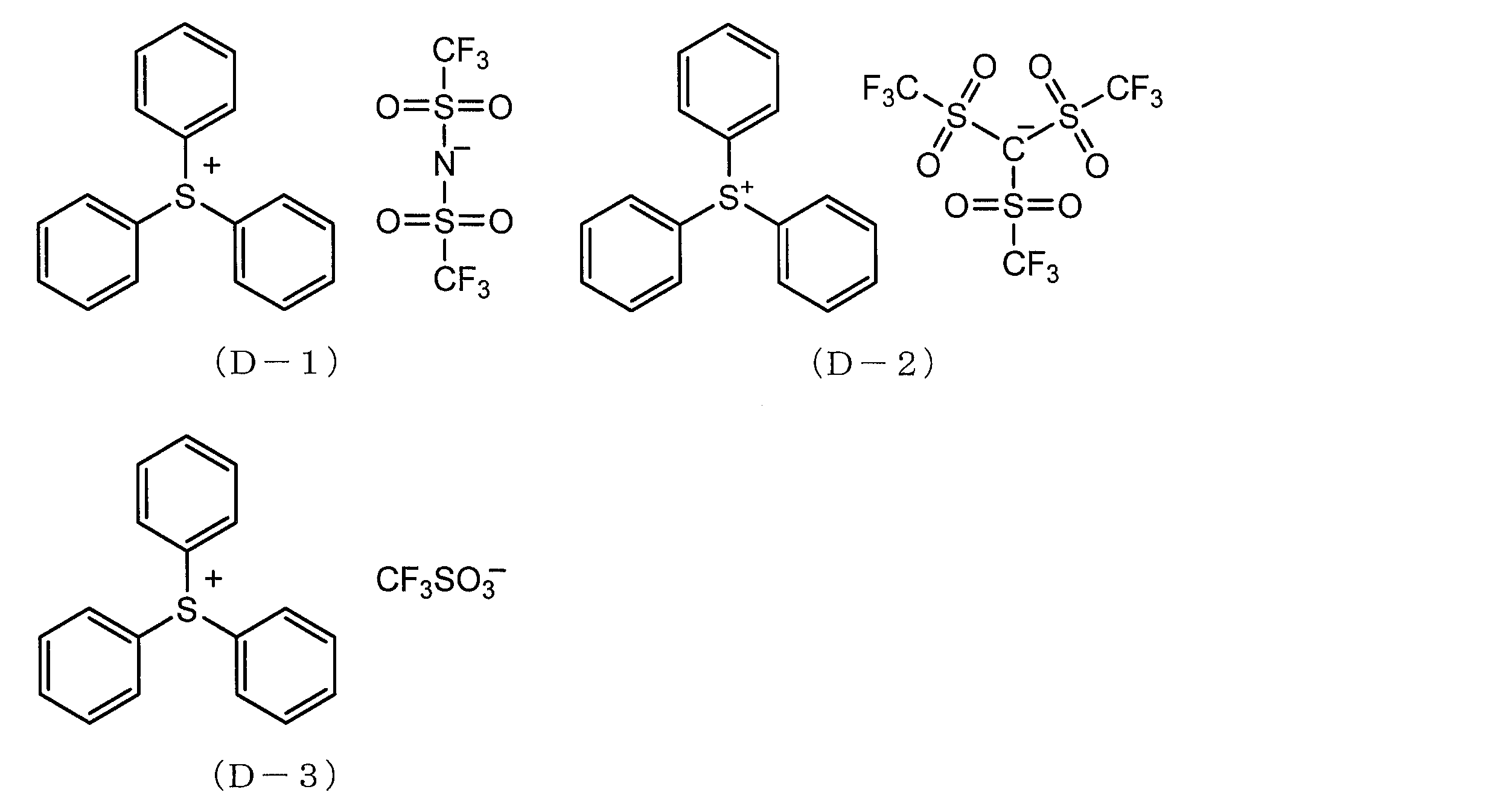
溶剤(B-2):プロピレングリコールモノメチルエーテルアセテート
Claims (9)
- 下記一般式(A)で表される化合物(A)と、
溶剤(B)と、
酸解離性基を有する樹脂(C)と、
を含有する感放射線性樹脂組成物。


- 前記化合物(A)が、下記一般式(A1)~(A5)で表される化合物からなる群より選択される少なくとも一種の化合物である請求項1に記載の感放射線性樹脂組成物。
- 前記一般式(A1)~(A5)中のXとZは、それぞれ独立に、置換又は非置換の炭素数1~25の2価の芳香族基である請求項2に記載の感放射線性樹脂組成物。
- 前記一般式(A1)~(A5)中のYが、単結合、前記式(1-1)で表される基、または前記式(1-6)で表される基である請求項2または3に記載の感放射線性樹脂組成物。
- 前記一般式(A)中のR1及びR2が、それぞれ独立に、三級水酸基を有する置換又は非置換の1価の炭素数1~25の炭化水素基を示す請求項1~4のいずれか一項に記載の感放射線性樹脂組成物。
- 下記一般式(A)で表される化合物。


- 前記一般式(A)中のR1及びR2が、それぞれ独立に、三級水酸基を有する置換又は非置換の1価の炭素数1~25の炭化水素基を示す請求項6に記載の化合物。
- 下記一般式(a1)で表される化合物(a1)と、下記一般式(a2)で表される化合物(a2)と、下記一般式(a3)で表される化合物(a3)とを反応させることを含む化合物の製造方法。


- 前記一般式(a2)中のR1及び前記一般式(a3)中のR2が、それぞれ独立に、三級水酸基を有する置換又は非置換の1価の炭素数1~25の炭化水素基を示す請求項8に記載の化合物の製造方法。
Priority Applications (2)
| Application Number | Priority Date | Filing Date | Title |
|---|---|---|---|
| JP2011547450A JP5692092B2 (ja) | 2009-12-25 | 2010-12-07 | 感放射線性樹脂組成物 |
| US13/525,563 US9120726B2 (en) | 2009-12-25 | 2012-06-18 | Radiation-sensitive resin composition, compound and producing method of compound |
Applications Claiming Priority (2)
| Application Number | Priority Date | Filing Date | Title |
|---|---|---|---|
| JP2009294433 | 2009-12-25 | ||
| JP2009-294433 | 2009-12-25 |
Related Child Applications (1)
| Application Number | Title | Priority Date | Filing Date |
|---|---|---|---|
| US13/525,563 Continuation US9120726B2 (en) | 2009-12-25 | 2012-06-18 | Radiation-sensitive resin composition, compound and producing method of compound |
Publications (1)
| Publication Number | Publication Date |
|---|---|
| WO2011077941A1 true WO2011077941A1 (ja) | 2011-06-30 |
Family
ID=44195476
Family Applications (1)
| Application Number | Title | Priority Date | Filing Date |
|---|---|---|---|
| PCT/JP2010/071890 Ceased WO2011077941A1 (ja) | 2009-12-25 | 2010-12-07 | 感放射線性樹脂組成物及びそれに含まれる化合物 |
Country Status (5)
| Country | Link |
|---|---|
| US (1) | US9120726B2 (ja) |
| JP (1) | JP5692092B2 (ja) |
| KR (1) | KR20120109516A (ja) |
| TW (1) | TWI475324B (ja) |
| WO (1) | WO2011077941A1 (ja) |
Cited By (1)
| Publication number | Priority date | Publication date | Assignee | Title |
|---|---|---|---|---|
| JP2015147926A (ja) * | 2014-01-10 | 2015-08-20 | 住友化学株式会社 | 樹脂及びレジスト組成物 |
Families Citing this family (1)
| Publication number | Priority date | Publication date | Assignee | Title |
|---|---|---|---|---|
| JP5960027B2 (ja) | 2012-08-31 | 2016-08-02 | セントラル硝子株式会社 | 含フッ素酸増幅剤の保存方法 |
Citations (5)
| Publication number | Priority date | Publication date | Assignee | Title |
|---|---|---|---|---|
| US3748132A (en) * | 1972-03-24 | 1973-07-24 | Eastman Kodak Co | Photopolymerizable compositions and elements and uses thereof |
| JPS5416562A (en) * | 1977-06-29 | 1979-02-07 | Gen Electric | Plasticized polycarbonate composition |
| JP2004216716A (ja) * | 2003-01-15 | 2004-08-05 | Fuji Photo Film Co Ltd | 感熱マイクロカプセル、平版印刷原版および平版印刷版の製版方法 |
| JP2005025150A (ja) * | 2003-06-09 | 2005-01-27 | Fuji Photo Film Co Ltd | ポジ型レジスト組成物及びそれを用いたパターン形成方法 |
| JP2005088346A (ja) * | 2003-09-17 | 2005-04-07 | Fuji Photo Film Co Ltd | 平版印刷版原版および平版印刷方法 |
Family Cites Families (5)
| Publication number | Priority date | Publication date | Assignee | Title |
|---|---|---|---|---|
| DE4236068A1 (de) * | 1992-10-26 | 1994-04-28 | Hoechst Ag | Positiv arbeitendes strahlungsempfindliches Gemisch und damit hergestelltes Aufzeichnungsmaterial |
| JP2000035665A (ja) | 1998-05-11 | 2000-02-02 | Kunihiro Ichimura | 酸増殖剤及び感光性組成物 |
| US6946231B2 (en) | 2002-08-19 | 2005-09-20 | Fuji Photo Film Co., Ltd. | Presensitized lithographic plate comprising microcapsules |
| JP2007052182A (ja) * | 2005-08-17 | 2007-03-01 | Jsr Corp | 感放射線性樹脂組成物 |
| JP2008096743A (ja) | 2006-10-12 | 2008-04-24 | Tokyo Ohka Kogyo Co Ltd | 液浸露光用ポジ型レジスト組成物およびレジストパターン形成方法 |
-
2010
- 2010-12-07 WO PCT/JP2010/071890 patent/WO2011077941A1/ja not_active Ceased
- 2010-12-07 JP JP2011547450A patent/JP5692092B2/ja active Active
- 2010-12-07 KR KR1020127016205A patent/KR20120109516A/ko not_active Ceased
- 2010-12-20 TW TW099144775A patent/TWI475324B/zh active
-
2012
- 2012-06-18 US US13/525,563 patent/US9120726B2/en active Active
Patent Citations (5)
| Publication number | Priority date | Publication date | Assignee | Title |
|---|---|---|---|---|
| US3748132A (en) * | 1972-03-24 | 1973-07-24 | Eastman Kodak Co | Photopolymerizable compositions and elements and uses thereof |
| JPS5416562A (en) * | 1977-06-29 | 1979-02-07 | Gen Electric | Plasticized polycarbonate composition |
| JP2004216716A (ja) * | 2003-01-15 | 2004-08-05 | Fuji Photo Film Co Ltd | 感熱マイクロカプセル、平版印刷原版および平版印刷版の製版方法 |
| JP2005025150A (ja) * | 2003-06-09 | 2005-01-27 | Fuji Photo Film Co Ltd | ポジ型レジスト組成物及びそれを用いたパターン形成方法 |
| JP2005088346A (ja) * | 2003-09-17 | 2005-04-07 | Fuji Photo Film Co Ltd | 平版印刷版原版および平版印刷方法 |
Cited By (1)
| Publication number | Priority date | Publication date | Assignee | Title |
|---|---|---|---|---|
| JP2015147926A (ja) * | 2014-01-10 | 2015-08-20 | 住友化学株式会社 | 樹脂及びレジスト組成物 |
Also Published As
| Publication number | Publication date |
|---|---|
| KR20120109516A (ko) | 2012-10-08 |
| US20120258399A1 (en) | 2012-10-11 |
| TW201131303A (en) | 2011-09-16 |
| JP5692092B2 (ja) | 2015-04-01 |
| TWI475324B (zh) | 2015-03-01 |
| JPWO2011077941A1 (ja) | 2013-05-02 |
| US9120726B2 (en) | 2015-09-01 |
Similar Documents
| Publication | Publication Date | Title |
|---|---|---|
| JP5737174B2 (ja) | 重合体及び感放射線性組成物 | |
| TWI492954B (zh) | Production method of sensitive radiation linear resin composition, polymer, monomer and sensitive radiation linear resin composition | |
| TWI431016B (zh) | Sensitive radiation linear compositions and polymers and monomers | |
| JP5660037B2 (ja) | 感放射線性樹脂組成物 | |
| TWI432408B (zh) | 化合物及敏輻射線性組成物 | |
| WO2019045107A1 (ja) | 反転パターン形成方法、電子デバイスの製造方法 | |
| JP5609881B2 (ja) | 重合体及び感放射線性組成物並びに単量体 | |
| JP2010020204A (ja) | 感放射線性樹脂組成物 | |
| JP4199958B2 (ja) | 感放射線性樹脂組成物 | |
| JP5678449B2 (ja) | 感放射線性組成物 | |
| JP5617844B2 (ja) | 感放射線性樹脂組成物 | |
| JP5692092B2 (ja) | 感放射線性樹脂組成物 | |
| JP5783111B2 (ja) | フォトレジスト組成物及びレジストパターン形成方法 | |
| JP5092986B2 (ja) | 重合体及び感放射線性組成物並びに単量体 | |
| JP5434323B2 (ja) | 感放射線性樹脂組成物及びスルホニウム塩 | |
| JP3843840B2 (ja) | 感放射線性樹脂組成物 | |
| JP5353434B2 (ja) | 感放射線性樹脂組成物 | |
| JP5146212B2 (ja) | 感放射線性組成物 | |
| JP2011178670A (ja) | 感放射線性組成物及び化合物 | |
| JP2011059531A (ja) | 感放射線性樹脂組成物及びパターン形成方法 | |
| JP5262631B2 (ja) | 感放射線性組成物 | |
| JP4817063B2 (ja) | パーフルオロアルキル基を有する(メタ)アクリル酸系(共)重合体の製造方法及び該方法により得られた(共)重合体を用いた感放射線性樹脂組成物 | |
| JP2009198963A (ja) | 感放射線性組成物及び化合物 |
Legal Events
| Date | Code | Title | Description |
|---|---|---|---|
| 121 | Ep: the epo has been informed by wipo that ep was designated in this application |
Ref document number: 10839175 Country of ref document: EP Kind code of ref document: A1 |
|
| WWE | Wipo information: entry into national phase |
Ref document number: 2011547450 Country of ref document: JP |
|
| ENP | Entry into the national phase |
Ref document number: 20127016205 Country of ref document: KR Kind code of ref document: A |
|
| NENP | Non-entry into the national phase |
Ref country code: DE |
|
| 122 | Ep: pct application non-entry in european phase |
Ref document number: 10839175 Country of ref document: EP Kind code of ref document: A1 |