WO2011065187A1 - 触媒担体又は触媒及びその製造方法 - Google Patents
触媒担体又は触媒及びその製造方法 Download PDFInfo
- Publication number
- WO2011065187A1 WO2011065187A1 PCT/JP2010/069351 JP2010069351W WO2011065187A1 WO 2011065187 A1 WO2011065187 A1 WO 2011065187A1 JP 2010069351 W JP2010069351 W JP 2010069351W WO 2011065187 A1 WO2011065187 A1 WO 2011065187A1
- Authority
- WO
- WIPO (PCT)
- Prior art keywords
- aqueous solution
- catalyst
- magnesium aluminate
- catalyst carrier
- pores
- Prior art date
- Legal status (The legal status is an assumption and is not a legal conclusion. Google has not performed a legal analysis and makes no representation as to the accuracy of the status listed.)
- Ceased
Links
Images




Classifications
-
- B—PERFORMING OPERATIONS; TRANSPORTING
- B01—PHYSICAL OR CHEMICAL PROCESSES OR APPARATUS IN GENERAL
- B01J—CHEMICAL OR PHYSICAL PROCESSES, e.g. CATALYSIS OR COLLOID CHEMISTRY; THEIR RELEVANT APPARATUS
- B01J23/00—Catalysts comprising metals or metal oxides or hydroxides, not provided for in group B01J21/00
- B01J23/38—Catalysts comprising metals or metal oxides or hydroxides, not provided for in group B01J21/00 of noble metals
- B01J23/54—Catalysts comprising metals or metal oxides or hydroxides, not provided for in group B01J21/00 of noble metals combined with metals, oxides or hydroxides provided for in groups B01J23/02 - B01J23/36
- B01J23/56—Platinum group metals
- B01J23/58—Platinum group metals with alkali- or alkaline earth metals
-
- B—PERFORMING OPERATIONS; TRANSPORTING
- B01—PHYSICAL OR CHEMICAL PROCESSES OR APPARATUS IN GENERAL
- B01D—SEPARATION
- B01D53/00—Separation of gases or vapours; Recovering vapours of volatile solvents from gases; Chemical or biological purification of waste gases, e.g. engine exhaust gases, smoke, fumes, flue gases, aerosols
- B01D53/34—Chemical or biological purification of waste gases
- B01D53/92—Chemical or biological purification of waste gases of engine exhaust gases
- B01D53/94—Chemical or biological purification of waste gases of engine exhaust gases by catalytic processes
- B01D53/9445—Simultaneously removing carbon monoxide, hydrocarbons or nitrogen oxides making use of three-way catalysts [TWC] or four-way-catalysts [FWC]
- B01D53/945—Simultaneously removing carbon monoxide, hydrocarbons or nitrogen oxides making use of three-way catalysts [TWC] or four-way-catalysts [FWC] characterised by a specific catalyst
-
- B—PERFORMING OPERATIONS; TRANSPORTING
- B01—PHYSICAL OR CHEMICAL PROCESSES OR APPARATUS IN GENERAL
- B01J—CHEMICAL OR PHYSICAL PROCESSES, e.g. CATALYSIS OR COLLOID CHEMISTRY; THEIR RELEVANT APPARATUS
- B01J23/00—Catalysts comprising metals or metal oxides or hydroxides, not provided for in group B01J21/00
- B01J23/005—Spinels
-
- B—PERFORMING OPERATIONS; TRANSPORTING
- B01—PHYSICAL OR CHEMICAL PROCESSES OR APPARATUS IN GENERAL
- B01J—CHEMICAL OR PHYSICAL PROCESSES, e.g. CATALYSIS OR COLLOID CHEMISTRY; THEIR RELEVANT APPARATUS
- B01J23/00—Catalysts comprising metals or metal oxides or hydroxides, not provided for in group B01J21/00
- B01J23/38—Catalysts comprising metals or metal oxides or hydroxides, not provided for in group B01J21/00 of noble metals
- B01J23/54—Catalysts comprising metals or metal oxides or hydroxides, not provided for in group B01J21/00 of noble metals combined with metals, oxides or hydroxides provided for in groups B01J23/02 - B01J23/36
- B01J23/56—Platinum group metals
- B01J23/63—Platinum group metals with rare earths or actinides
-
- B—PERFORMING OPERATIONS; TRANSPORTING
- B01—PHYSICAL OR CHEMICAL PROCESSES OR APPARATUS IN GENERAL
- B01J—CHEMICAL OR PHYSICAL PROCESSES, e.g. CATALYSIS OR COLLOID CHEMISTRY; THEIR RELEVANT APPARATUS
- B01J35/00—Catalysts, in general, characterised by their form or physical properties
- B01J35/60—Catalysts, in general, characterised by their form or physical properties characterised by their surface properties or porosity
- B01J35/61—Surface area
- B01J35/615—100-500 m2/g
-
- B—PERFORMING OPERATIONS; TRANSPORTING
- B01—PHYSICAL OR CHEMICAL PROCESSES OR APPARATUS IN GENERAL
- B01J—CHEMICAL OR PHYSICAL PROCESSES, e.g. CATALYSIS OR COLLOID CHEMISTRY; THEIR RELEVANT APPARATUS
- B01J35/00—Catalysts, in general, characterised by their form or physical properties
- B01J35/60—Catalysts, in general, characterised by their form or physical properties characterised by their surface properties or porosity
- B01J35/63—Pore volume
- B01J35/635—0.5-1.0 ml/g
-
- B—PERFORMING OPERATIONS; TRANSPORTING
- B01—PHYSICAL OR CHEMICAL PROCESSES OR APPARATUS IN GENERAL
- B01J—CHEMICAL OR PHYSICAL PROCESSES, e.g. CATALYSIS OR COLLOID CHEMISTRY; THEIR RELEVANT APPARATUS
- B01J37/00—Processes, in general, for preparing catalysts; Processes, in general, for activation of catalysts
- B01J37/02—Impregnation, coating or precipitation
- B01J37/0201—Impregnation
-
- B—PERFORMING OPERATIONS; TRANSPORTING
- B01—PHYSICAL OR CHEMICAL PROCESSES OR APPARATUS IN GENERAL
- B01D—SEPARATION
- B01D2255/00—Catalysts
- B01D2255/10—Noble metals or compounds thereof
- B01D2255/102—Platinum group metals
- B01D2255/1023—Palladium
-
- B—PERFORMING OPERATIONS; TRANSPORTING
- B01—PHYSICAL OR CHEMICAL PROCESSES OR APPARATUS IN GENERAL
- B01D—SEPARATION
- B01D2255/00—Catalysts
- B01D2255/20—Metals or compounds thereof
- B01D2255/204—Alkaline earth metals
- B01D2255/2047—Magnesium
-
- B—PERFORMING OPERATIONS; TRANSPORTING
- B01—PHYSICAL OR CHEMICAL PROCESSES OR APPARATUS IN GENERAL
- B01D—SEPARATION
- B01D2255/00—Catalysts
- B01D2255/20—Metals or compounds thereof
- B01D2255/206—Rare earth metals
- B01D2255/2065—Cerium
-
- B—PERFORMING OPERATIONS; TRANSPORTING
- B01—PHYSICAL OR CHEMICAL PROCESSES OR APPARATUS IN GENERAL
- B01J—CHEMICAL OR PHYSICAL PROCESSES, e.g. CATALYSIS OR COLLOID CHEMISTRY; THEIR RELEVANT APPARATUS
- B01J2235/00—Indexing scheme associated with group B01J35/00, related to the analysis techniques used to determine the catalysts form or properties
- B01J2235/15—X-ray diffraction
-
- B—PERFORMING OPERATIONS; TRANSPORTING
- B01—PHYSICAL OR CHEMICAL PROCESSES OR APPARATUS IN GENERAL
- B01J—CHEMICAL OR PHYSICAL PROCESSES, e.g. CATALYSIS OR COLLOID CHEMISTRY; THEIR RELEVANT APPARATUS
- B01J35/00—Catalysts, in general, characterised by their form or physical properties
- B01J35/30—Catalysts, in general, characterised by their form or physical properties characterised by their physical properties
-
- Y—GENERAL TAGGING OF NEW TECHNOLOGICAL DEVELOPMENTS; GENERAL TAGGING OF CROSS-SECTIONAL TECHNOLOGIES SPANNING OVER SEVERAL SECTIONS OF THE IPC; TECHNICAL SUBJECTS COVERED BY FORMER USPC CROSS-REFERENCE ART COLLECTIONS [XRACs] AND DIGESTS
- Y02—TECHNOLOGIES OR APPLICATIONS FOR MITIGATION OR ADAPTATION AGAINST CLIMATE CHANGE
- Y02T—CLIMATE CHANGE MITIGATION TECHNOLOGIES RELATED TO TRANSPORTATION
- Y02T10/00—Road transport of goods or passengers
- Y02T10/10—Internal combustion engine [ICE] based vehicles
- Y02T10/12—Improving ICE efficiencies
Definitions
- the present invention relates to a catalyst carrier or catalyst comprising magnesium aluminate (MgAl 2 O 4 ) on which a noble metal is supported, and a method for producing the same.
- a catalyst carrier or catalyst comprising magnesium aluminate (MgAl 2 O 4 ) on which a noble metal is supported, and a method for producing the same.
- the exhaust gas purifying catalyst is deteriorated in performance due to particle growth of noble metal fine particles which are catalytic active components.
- These noble metal fine particles are generally used by being dispersed on the surface of a heat-resistant alumina carrier (catalyst carrier).
- alumina carrier heat-resistant alumina carrier
- the alumina surface diffuses and moves to grow repeatedly by agglomeration. Therefore, technical development has been advanced in order to suppress the performance deterioration of the noble metal catalyst by suppressing the diffusion / migration of the noble metal fine particles on the surface of the support.
- Patent Document 1 discloses a method of confining noble metal fine particles in the pores of an alumina carrier and suppressing the movement and diffusion thereof.
- an contrivance is made to simultaneously confine oxide particles such as cerium oxide, zirconium oxide or magnesium oxide together with the noble metal fine particles to prevent aggregation of the noble metal fine particles in the pores. ing.
- perovskite complex oxide catalysts having excellent heat resistance have attracted attention.
- Such a perovskite complex oxide is expressed as ABO 3, and in many cases, lanthanum (La) is used for A and iron (Fe), cobalt (Co), or manganese (Mn) is used for B.
- LaFeO 3 , LaCoO 3 , LaMnO 3 alone has an exhaust gas purification activity, but has a small amount of processing gas and inferior NO purification performance.
- LaFe (1-x) Pd x O 3 in which a part of LaFeO 3 is substituted with a noble metal (Pd) has been proposed (see, for example, Patent Document 2).
- the above conventional catalyst carrier and catalyst have the following problems. That is, the conventional one using a perovskite type complex oxide catalyst has not been deteriorated in HC, CO, NO purification performance even after heat treatment at 900 ° C. for 100 hours, and has already been installed in an actual vehicle.
- combustion technology at higher temperatures has been developed from the viewpoint of improving the thermal efficiency of the combustion apparatus, and the temperature of the combustion exhaust gas has risen accordingly.
- the catalyst installed directly under the engine may be in a high temperature environment exceeding 900 ° C., and the conventional catalyst has a problem that it is not sufficient in heat resistance and durability when applied to the high performance combustion apparatus. .
- alkali metals and alkaline earth metals are basic metals, and are known to easily generate carbonates and nitrates by adsorbing acidic gases such as CO 2 and NO x .
- NO x occluding and reducing catalyst for lean-burn exhaust gas purification have been developed and come to be proposed.
- NO x storage-reduction catalyst thus using Ba (barium) as an alkaline earth metal, becomes the NO x in the exhaust gas to produce a nitrate is concentrated on Ba ions thereto of the NO x
- a hydrocarbon (fuel oil), which is a reducing agent, is injected in pulses and reduced to harmless N 2 .
- the present applicant pays attention to magnesium (Mg) having high affinity with NO x, and uses alumina (that is, magnesium aluminate (MgAl 2 O 4 : mineral name spinel)) in which Mg ions are uniformly dispersed as a catalyst support.
- alumina that is, magnesium aluminate (MgAl 2 O 4 : mineral name spinel)
- MgAl 2 O 4 magnesium aluminate
- MgAl 2 O 4 can be obtained by mixing magnesium oxide powder and alumina powder and heating at a high temperature (1400 ° C. or higher), for example.
- the magnesium aluminate (MgAl 2 O 4 ) thus obtained is very hard and has a very small specific surface area, so that it is not suitable for use as a catalyst carrier.
- Magnesium aluminate (MgAl 2 O 4 ) can be used as a catalyst carrier, which can improve heat resistance and improve the NO x purification rate.
- An object of the present invention is to provide a catalyst carrier or catalyst that can be easily improved and a method for producing the same.
- the invention described in claim 1 is a method for producing a catalyst carrier in which magnesium aluminate (MgAl 2 O 4 ) is formed in the pores of porous alumina, and a noble metal is supported thereon, wherein the magnesium ion
- the concentration of the aqueous solution obtained in the aqueous solution preparation step is arbitrarily adjusted to the porous alumina in the firing step.
- the amount of magnesium aluminate formed can be adjusted.
- the invention according to claim 3 has a cerium dioxide addition step of adding cerium dioxide (CeO 2 ) to the magnesium aluminate produced in the calcining step in the method for producing a catalyst carrier according to claim 1 or claim 2. It is characterized by that.
- the invention according to claim 4 is a process for producing a catalyst comprising magnesium aluminate (MgAl 2 O 4 ) formed in the pores of porous alumina and supporting a noble metal on the magnesium aluminate.
- An aqueous solution preparation step for preparing an aqueous solution containing the aqueous solution, and an aqueous solution filling step for filling the aqueous solution obtained in the aqueous solution preparation step into the pores by a pore filling method using a capillary phenomenon generated in the pores of the porous alumina
- the invention according to claim 5 is the method for producing a catalyst according to claim 4, wherein the noble metal is palladium.
- the invention according to claim 6 has a cerium dioxide addition step of adding cerium dioxide (CeO 2 ) to the magnesium aluminate produced in the calcining step in the method for producing a catalyst according to claim 4 or claim 5.
- the noble metal is supported on the catalyst carrier that has undergone the cerium dioxide addition step.
- the invention according to claim 7 is a magnesium aluminate (MgAl 2 ) having a specific surface area in the range of 80 to 150 (m 2 / g) and a pore volume in the range of 0.45 to 0.65 (ml / g).
- a catalyst carrier comprising O 4 ) and capable of supporting a noble metal thereon.
- the invention according to claim 8 is the catalyst carrier according to claim 7, wherein the magnesium aluminate (MgAl 2 O 4 ) is formed in the pores of porous alumina.
- the invention according to claim 9 is the catalyst carrier according to claim 7 or 8, wherein cerium dioxide (CeO 2 ) is added to the magnesium aluminate.
- the invention according to claim 10 is a magnesium aluminate (MgAl 2 ) having a specific surface area in the range of 80 to 150 (m 2 / g) and a pore volume in the range of 0.45 to 0.65 (ml / g).
- the invention according to claim 11 is the catalyst according to claim 10, wherein the catalyst support is formed by forming the magnesium aluminate (MgAl 2 O 4 ) in pores of porous alumina.
- the invention according to claim 12 is the catalyst according to claim 10 or 11, wherein the noble metal is palladium.
- the invention according to claim 13 is the catalyst according to any one of claims 10 to 12, wherein cerium dioxide (CeO 2 ) is added to the magnesium aluminate, and the catalyst carrier to which the cerium dioxide is added is added to the catalyst carrier. It is characterized by supporting a noble metal.
- magnesium aluminate having a specific surface area in the range of 80 to 150 (m 2 / g) and a pore volume in the range of 0.45 to 0.65 (ml / g).
- a catalyst carrier or catalyst on which a noble metal can be supported.
- Magnesium aluminate (MgAl 2 O 4 ) can be used as a catalyst carrier, and heat resistance can be improved. , NOx purification rate can be easily improved.
- the pores of porous alumina are filled with the aqueous solution obtained in the aqueous solution preparation step by pore filling method, and magnesium aluminate (MgAl 2 O 4 ) is precipitated in the pores by drying the porous alumina.
- a catalyst carrier and a catalyst that can maintain the purification performance of HC, CO, and NO even after being exposed to a high temperature atmosphere of about 1000 ° C. for a long time can be obtained more easily.
- palladium (Pd) as a noble metal to be supported on a catalyst carrier made of magnesium aluminate (MgAl 2 O 4 )
- cerium dioxide CeO 2
- the noble metal on the catalyst carrier to which the cerium dioxide is added, in addition to maintaining NO purification performance, it is sufficient for oxygen concentration change For example, it is possible to expect an effect that the reaction field atmosphere can be brought close to stoichiometry.
- the catalyst carrier according to the present embodiment is a magnesium aluminate (MgAl) having a specific surface area in the range of 80 to 150 (m 2 / g) and a pore volume in the range of 0.45 to 0.65 (ml / g). 2 O 4 ), on which a noble metal can be supported.
- MgAl magnesium aluminate
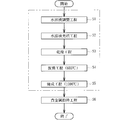
- an aqueous solution preparation step S1 an aqueous solution filling step S2, a drying step S3, a calcination step S4, and
- the exhaust gas purification catalyst can be obtained through the firing step S5 and further through the noble metal supporting step S6.
- the aqueous solution preparation step S1 is a step of preparing an aqueous solution containing magnesium (Mg) ions.
- a magnesium nitrate aqueous solution can be used as an aqueous solution containing magnesium (Mg) ions.
- the aqueous solution filling step S2 is a step of filling the aqueous solution obtained in the aqueous solution preparation step S1 into the pores by a pore filling method using a capillary phenomenon generated in the pores of the porous alumina.
- the pore volume of an alumina carrier is measured, and an aqueous solution having the same volume as that volume (in this embodiment, the aqueous solution obtained in the aqueous solution preparation step S1) is added and mixed and stirred.
- the pores of the alumina carrier are filled using the capillary phenomenon.
- the drying step S3 is a step of drying the porous alumina in which the pores are filled with the aqueous solution in the aqueous solution filling step S2, whereby the wall surface of the pores of the catalyst support is magnesium aluminate (MgAl 2 O 4 ) It is coated (coated) with a component (composition) for production.
- the calcination step S4 is a step in which the catalyst carrier dried in the drying step S3 is calcined at about 600 ° C., for example.
- the porous alumina obtained in the drying step S3 and subjected to the calcination step S4 is further fired in air at about 1000 ° C., and magnesium aluminate (MgAl 2 O 4 ) is generated in the pores. Process.
- This catalyst support is a magnesium aluminate (MgAl 2 O 4 ) having a specific surface area in the range of 80 to 150 (m 2 / g) and a pore volume in the range of 0.45 to 0.65 (ml / g).
- the noble metal palladium
- the magnesium aluminate MgAl 2 O 4
- the noble metal supporting step S6 is a step of filling the pores of the catalyst carrier baked in the calcination step S5 with an aqueous solution containing a noble metal (palladium) by a pore filling method using a capillary phenomenon generated in the pores. is there.
- the catalyst according to the present invention is manufactured.
- aqueous solution containing palladium (Pd) filled by the pore filling method it is preferable to use dinitrodiamine palladium salt or a nitric acid acidic aqueous solution of palladium nitrate. After filling with the aqueous solution, it is dried and calcined at 600 ° C. for 4 hours to produce a palladium catalyst.
- palladium other noble metals such as platinum (Pt) and rhodium (Rh) may be used, but it is preferable to support relatively inexpensive palladium as in this embodiment.
- the pores of the porous alumina are filled with the aqueous solution obtained in the aqueous solution preparation step by pore filling, and the porous alumina is dried to form magnesium in the pores. Since aluminate (MgAl 2 O 4 ) is precipitated, a catalyst carrier and a catalyst that can maintain the purification performance of HC, CO, and NO x even after being exposed to a high temperature atmosphere of, for example, about 1000 ° C. for a long time. It can be obtained easily.
- aluminate MgAl 2 O 4
- the pores of porous alumina are filled with the aqueous solution obtained in the aqueous solution preparation step by pore filling method, and magnesium aluminate (MgAl 2 O 4 ) is precipitated in the pores by drying the porous alumina.
- a catalyst carrier and a catalyst that can maintain the purification performance of HC, CO, and NO x even after being exposed to a high temperature atmosphere of about 1000 ° C. for a long time can be obtained more easily.
- palladium (Pd) as a noble metal to be supported on a catalyst carrier made of magnesium aluminate (MgAl 2 O 4 )
- the amount of magnesium aluminate formed on the porous alumina in the firing step S5 can be adjusted by arbitrarily adjusting the concentration of the aqueous solution obtained in the aqueous solution preparation step S1. That is, by setting the concentration of the aqueous solution obtained in the aqueous solution preparation step S1 low, the whole porous alumina is replaced with magnesium aluminate, and only a part of the porous alumina is magnesium aluminate (in other words, For example, the state of the alumina in the central portion can be maintained while the surface layer of the porous alumina is made of magnesium aluminate).
- magnesium aluminum having a specific surface area in the range of 80 to 150 (m 2 / g) and a pore volume in the range of 0.45 to 0.65 (ml / g). Since a noble metal such as palladium is supported on a catalyst carrier made of nate (MgAl 2 O 4 ), an internal combustion engine and a combustion device are obtained by the catalytic action of the noble metal and the action of basic magnesium (Mg). The simultaneous purification performance of hydrocarbons (HC), carbon monoxide (CO), and nitrogen oxide (NO x ) discharged from the gas or the like can be improved.
- HC hydrocarbons
- CO carbon monoxide
- NO x nitrogen oxide
- cerium dioxide may be added to the catalyst carrier made of magnesium aluminate (MgAl 2 O 4 ) according to the above embodiment.
- MgAl 2 O 4 magnesium aluminate
- porous alumina 1 (see FIG. 10A) having a specific surface area of 247 m 2 / g is prepared, and aqueous solution 2 (magnesium nitrate) containing magnesium (Mg) ions obtained in the same aqueous solution preparation step as described above.
- the aqueous solution is filled into the pores of the porous alumina 1 by a pore filling method (aqueous solution filling step) (see FIG. 5B).
- the porous alumina is dried and fired (1000 ° C.) in the drying step to obtain magnesium aluminate (MgAl 2 O 4 ) (spinel 3) having a specific surface area of 83 m 2 / g ((c) in the figure). reference).
- the pores of the spinel 3 thus obtained are filled with an aqueous solution 4 (cerium nitrate aqueous solution) by a pore filling method (see FIG. 4D), and dried and fired (900 ° C.) (cerium dioxide added) Step), a ceria spinel (CeO 2 / MgAl 2 O 4 ) having a specific surface area of 74 m 2 / g obtained by adding cerium dioxide 5 (CeO 2 ) to magnesium aluminate (MgAl 2 O 4 ) (spinel 3). (See (e) of the figure).
- Ce 4+ and Ce 3+ are as small as about 1.6 (V), and reversibly proceeds to store oxygen (OSC) Therefore, it is possible to cope with changes in oxygen concentration.
- the noble metal 6 (palladium) is supported on the catalyst carrier to which cerium dioxide 5 (CeO 2 ) has been added in the noble metal supporting step, and the exhaust gas purifying catalyst (Pd-supporting ceria spinel catalyst) is obtained (see FIG. 5F). ).
- an aqueous solution containing a noble metal (palladium) is formed on the pores of the catalyst support calcined in the calcining step by a pore filling method using a capillary phenomenon generated in the pores, as in the above embodiment. It is set as the process of filling.
- cerium dioxide (CeO 2 ) is added to magnesium aluminate (cerium dioxide addition step), and the noble metal is supported on the catalyst carrier that has undergone the cerium dioxide addition step, thereby purifying NO.
- CeO 2 magnesium aluminate
- the noble metal is supported on the catalyst carrier that has undergone the cerium dioxide addition step, thereby purifying NO.
- Example 1 Synthesis and Characterization of Magnesium Aluminate (MgAl 2 O 4 : Spinel) Magnesium nitrate hexahydrate (Mg (NO 3 ) 2 .6H 2 O) was used as a precursor of MgO. 6 (g) (0.1 (mol)) was dissolved in distilled water to obtain 10.2 (ml) of a magnesium nitrate aqueous solution (aqueous solution preparation step).
- This aqueous solution was added dropwise to 10.2 (g) (0.1 (mol)) commercial alumina powder (specific surface area: 247 (m 2 / g), pore volume: 1.0 (ml / g)), The aqueous solution was filled into the pores while mixing in a mortar (aqueous solution filling step by pore filling method).
- the alumina powder in which pores are filled in the pores by pore filling is dried for 12 hours in a drier held at 110 (° C.), and after a calcination step at 600 (° C.) for 2 hours, 1000 (
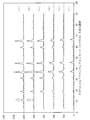
- the catalyst carrier made of magnesium aluminate (MgAl 2 O 4 ) was obtained by calcination in air (calcination step) at 5 ° C. for 5 hours. It was confirmed by XRD that the obtained catalyst support was composed of magnesium aluminate (MgAl 2 O 4 ) (see FIG. 2 (a)).
- FIG. 2 (a) shows a catalyst carrier (hereinafter referred to as Example 1) made of 100 mol% magnesium aluminate (MgAl 2 O 4 ), and FIG. 2 (b) shows 70% mol magnesium aluminate.
- a catalyst carrier (MgAl 2 O 4 ) (hereinafter referred to as Example 2)
- FIG. 4 (c) shows a catalyst carrier (hereinafter referred to as Example 3) composed of 50 mol% magnesium aluminate (MgAl 2 O 4 ).
- Example 4 shows a catalyst support (hereinafter referred to as Example 4) made of 30 mol% magnesium aluminate (MgAl 2 O 4 ), and (e) shows 20 mol% magnesium aluminate (MgAl 2 O). 4) the catalyst support consisting of (hereinafter referred to as embodiment 5) FIG. (f) a catalyst support consisting of 10 mol% of magnesium aluminate (MgAl 2 O 4) (hereinafter The) of Example 6 in which it was confirmed by XRD.
- magnesium aluminate (MgAl 2 O 4 ) of 10 to 70 mol% can be obtained by arbitrarily adjusting the concentration of the aqueous solution obtained in the aqueous solution preparation step.
- MgAl 2 O 4 magnesium aluminate
- each of the examples is a powder produced by firing at 1000 ° C., but has a high specific surface area of around 100 (m 2 / g) and around 0.5 (ml / g). It is suitable for a catalyst carrier.
- Example 2 Preparation and purification activity of 50 mol% magnesium aluminate-supported 3% palladium (3% Pd / 50% spinel) catalyst 8.3 Nitric acid acidity of dinitrodiamine Pd containing 8.3 (wt%) Pd (palladium)
- the aqueous solution 1.8 (g) was diluted with distilled water so as to have a volume of 2.4 (ml) to obtain an aqueous solution.
- This aqueous solution was added dropwise to the powder 5 (g) of Example 3 obtained in Experiment 1, and the aqueous solution was filled in the pores while mixing in a mortar.
- Example 9 3% Pd / 100 mol% spinel catalyst
- Example 10 3% Pd / 30 mol% spinel catalyst
- an alumina catalyst (3% Pd / Al 2 O 3 ) supporting 3 (wt%) Pd was prepared by a pore filling method, and after calcination for 2 hours at 600 (° C.), 900
- the comparative example for a comparison with a present Example was obtained by baking (baking process) in the air for 10 hours at (degreeC).
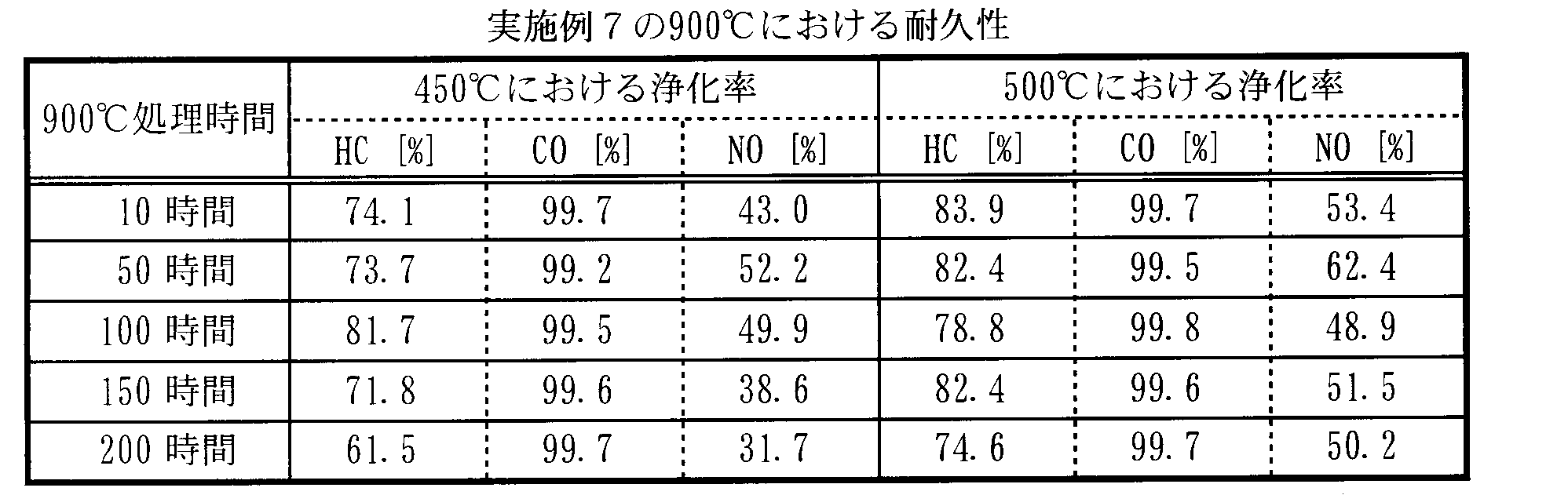
- Example 3 Purifying activity of Example 7 (3% Pd / 50 mol% spinel catalyst) and thermal durability at 900 ° C.
- Example 7 obtained in Experiment 3 was formed into pellets and then crushed. A powder of .25 to 1.0 (mm) was sieved. The cleaning activity was evaluated using 0.5 (ml) (corresponding to about 0.26 (g)).
- the composition of the simulated gas used for this activity evaluation is NO: 1500 (ppm), CO: 0.65 (%), C 3 H 8 : 180 (ppm), C 3 H 6 : 180 (ppm), O 2 : 0.50 (%), and nitrogen was used as the balance gas.
- the gas flow rate was set to 1 (l / min) (corresponding to space velocity: 120,000 (hr ⁇ 1 )).
- the catalyst layer temperature is raised from room temperature to 600 (° C.) at 45 (° C./min), and the gas composition at the inlet and outlet of the catalyst layer at each temperature in the temperature raising process is determined by infrared spectroscopy and magnetic oxygen.
- the purification activity was evaluated by measuring with an analytical method. The evaluation results are shown in FIG. Further, purifying activity was also evaluated for Example 3 under the same conditions, and the evaluation results are shown in FIG. As a result, although only the catalyst carrier composed of 50 mol% spinel (Example 3) can obtain HC and CO oxidation activity and NO reduction activity, the degree of activity is less than that of the catalyst supporting Pd. It was found that it was extremely low, and the effect of supporting Pd could be confirmed.
- Example 7 3% Pd / 50 mol% spinel catalyst
- the purifying activity of HC, CO and NO at 450 (° C.) and 500 (° C.) was measured by the same method, and the measurement results are summarized in Table 2 below.
- Example 4 Purifying activity of Examples 8 to 10 and Comparative Example and thermal durability at 900 (° C.)
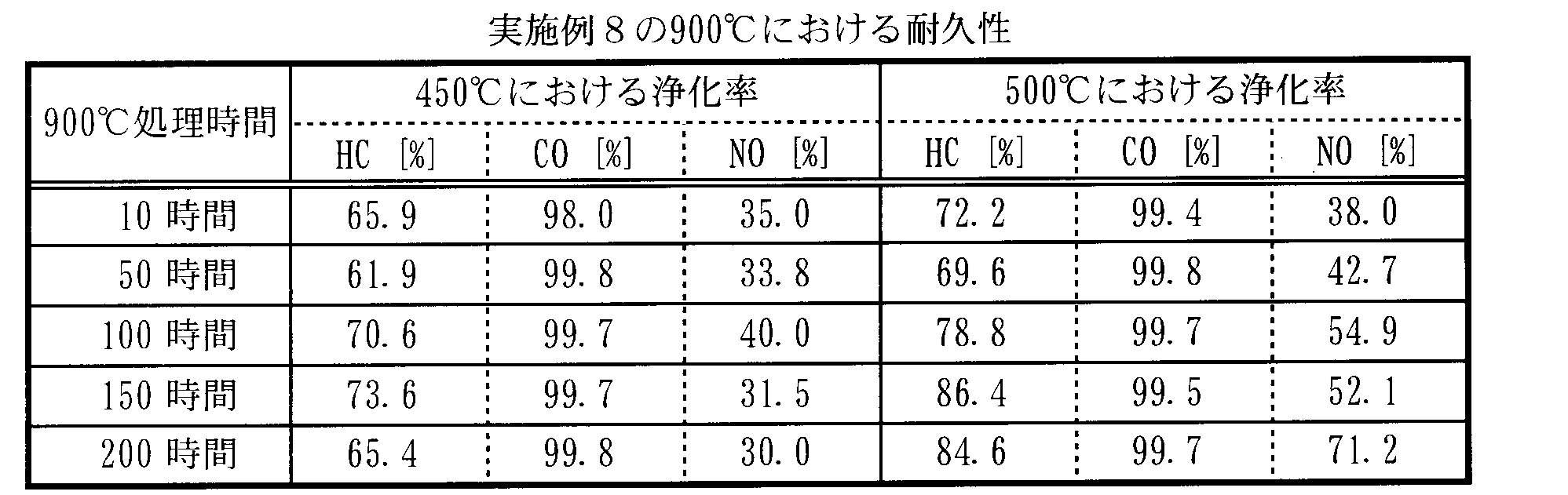
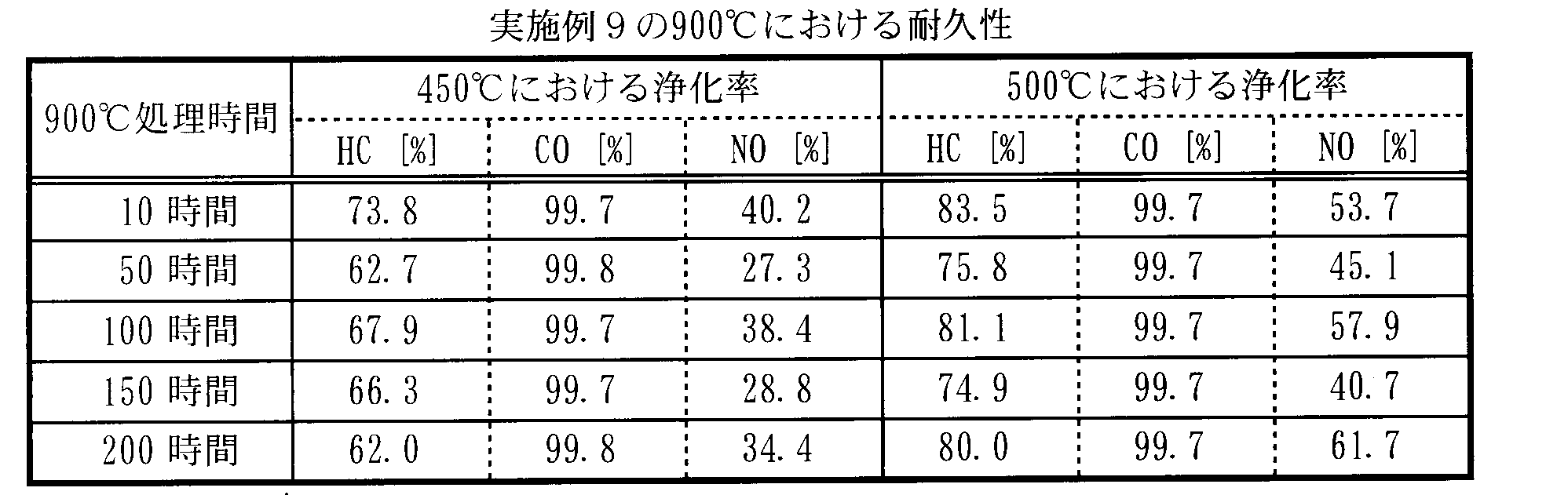
- the catalysts according to Examples 8 to 10 and the catalyst according to Comparative Example were also used. The catalytic activity was observed, and the purification rates of HC, CO, and NO at 450 (° C.) and 500 (° C.) were measured. Further, as in Experiment 3, after heat treatment at 900 (° C.) for 10 hours, 50 hours, 100 hours, 150 hours, and 200 hours (but up to 150 hours for the comparative examples), 450 (° C. ) And 500 (° C.), and the purification activity of HC, CO, and NO was measured. The measurement results are summarized in Tables 3 to 6 below.
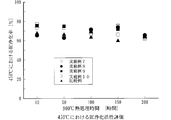
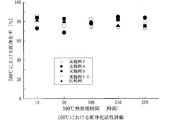
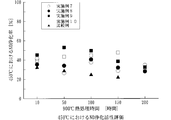
- Examples 7 to 10 and the comparative example are shown in FIGS.
- Examples 7 to 10 and Comparative Example show almost the same activity, and those treated for 200 hours are also 65% (%) at 450 (° C.).
- Examples 7 to 10 show higher activity than Comparative Example.
- the comparative examples show a purification rate of more than 20 (%) at 450 (° C.) and 45 (%) at 500 (° C.)
- the purification rate was 30 to 50 (%) at 450 (° C.) and 40 to 65 (%) at 500 (° C.). This is presumably because in Examples 7 to 10, magnesium (Mg) ions were uniformly dispersed on the catalyst surface, and NOx was concentrated in the vicinity of the magnesium ions.
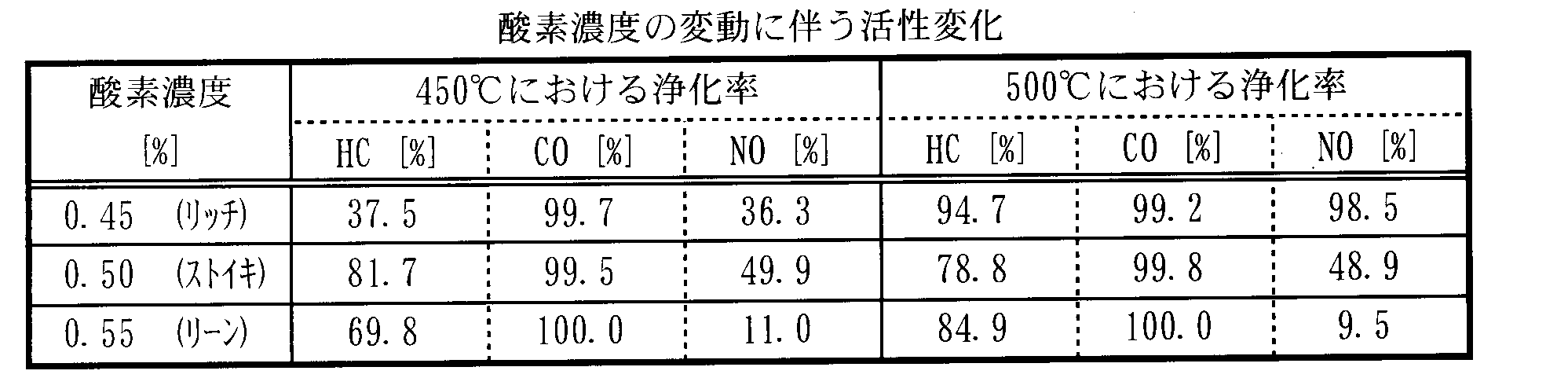
- Experiment 5 Change in activity due to fluctuations in oxygen concentration Normally, the oxygen concentration in the exhaust gas changes according to the combustion conditions of the fuel. Exhaust gas with a high oxygen concentration is called “lean”, and exhaust gas with a low oxygen concentration is called “rich”, and the purification performance of the catalyst also changes depending on the respective conditions.
- the simulated exhaust gas composition used in Experiment 3 is a typical composition as combustion exhaust gas at the stoichiometric air-fuel ratio (the weight ratio of air and fuel used for combustion is 14.7).
- HC cerium dioxide
- Pd noble metal
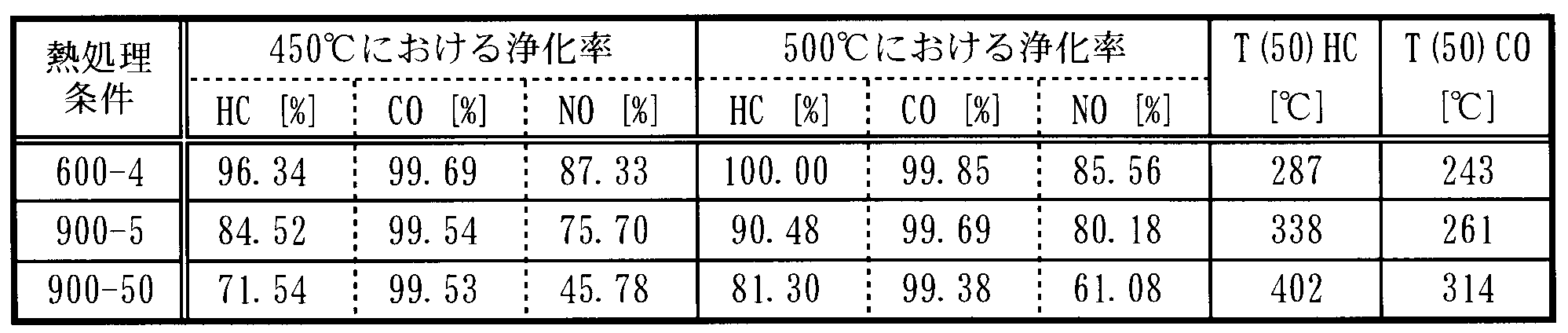
- Example 11 the comparison between Example 11 and the comparative example for the HC purification rate (450 ° C.) is shown in the graph of FIG. 11, and the comparison between Example 11 and the comparative example for the HC purification rate (500 ° C.) is compared. This is shown in the graph of FIG. As can be seen from these graphs, the purification rate of Example 11 can be maintained higher than that of the comparative example even when various heat treatment conditions are changed.
- magnesium aluminate having a specific surface area in the range of 80 to 150 (m 2 / g) and a pore volume in the range of 0.45 to 0.65 (ml / g), As long as it is a catalyst carrier or catalyst in which a noble metal can be supported, and a manufacturing method thereof, the catalyst carrier may be applied to other forms.
Landscapes
- Chemical & Material Sciences (AREA)
- Engineering & Computer Science (AREA)
- Chemical Kinetics & Catalysis (AREA)
- Organic Chemistry (AREA)
- Materials Engineering (AREA)
- Health & Medical Sciences (AREA)
- Analytical Chemistry (AREA)
- General Chemical & Material Sciences (AREA)
- Oil, Petroleum & Natural Gas (AREA)
- Environmental & Geological Engineering (AREA)
- Biomedical Technology (AREA)
- Combustion & Propulsion (AREA)
- Catalysts (AREA)
- Exhaust Gas After Treatment (AREA)
Abstract
Description
即ち、ペロブスカイト型複合酸化物触媒を用いた従来のものは、900℃で100時間の熱処理をしたあとでもHCやCO、NO浄化性能に劣化がなく、すでに実車に搭載されるに至っている。しかし、近時においては、燃焼装置の熱効率改善の観点からより高温での燃焼技術が開発されており、それに伴って燃焼排ガスの温度も上昇していることから、冷間時排ガス浄化のため、エンジン直下に設置される触媒は900℃を超える高温環境下となることもあり、上記従来の触媒では当該高性能燃焼装置に適用した場合、耐熱性及び耐久性に十分ではないという問題があった。
本実施形態に係る触媒担体は、80~150(m2/g)の範囲の比表面積、及び0.45~0.65(ml/g)の範囲の細孔容積を有するマグネシウムアルミネート(MgAl2O4)から成り、その上に貴金属が担持可能とされたものであり、図1に示すように、水溶液調製工程S1と、水溶液充填工程S2と、乾燥工程S3と、仮焼工程S4及び焼成工程S5とを経て製造され、更には貴金属担持工程S6を経ることにより排ガス浄化触媒を得ることができる。
(実験1):マグネシウムアルミネート(MgAl2O4:スピネル)の合成及び特性化
MgOの前躯体として硝酸マグネシウム6水和物(Mg(NO3)2・6H2O)を用い、その25.6(g)(0.1(mol))を蒸留水に溶解させて10.2(ml)の硝酸マグネシウム水溶液を得た(水溶液調製工程)。この水溶液を10.2(g)(0.1(mol))の市販アルミナ粉末(比表面積:247(m2/g)、細孔容積:1.0(ml/g))に滴下し、乳鉢中で混合しながらその細孔内に当該水溶液を充填させた(ポアフィリング法による水溶液充填工程)。

8.3(wt%)のPd(パラジウム)を含むジニトロジアミンPdの硝酸酸性水溶液1.8(g)を、容積が2.4(ml)となるように蒸留水で希釈して水溶液を得た。この水溶液を、実験1で得られた実施例3の粉末5(g)に滴下し、乳鉢中で混合しながらその細孔内に当該水溶液を充填させた。
実験3で得られた実施例7をペレット状に成形した後、粉砕し、0.25~1.0(mm)の粉末を篩分した。その0.5(ml)(約0.26(g)に相当)を用いて浄化活性を評価した。この活性評価に用いた模擬ガスの組成は、NO:1500(ppm)、CO:0.65(%)、C3H8:180(ppm)、C3H6:180(ppm)、O2:0.50(%)であり、バランスガスとして窒素を用いた。尚、ガス流量は、1(l/min)(空間速度:120000(hr-1)に相当)に設定した。
実験3と同様の方法にて、実施例8~10に係る触媒及び比較例に係る触媒についても触媒活性を観察し、450(℃)及び500(℃)におけるHCやCO、NOの浄化率を測定した。また、実験3と同様、900(℃)で10時間、50時間、100時間、150時間、200時間(但し、比較例については150時間まで)熱処理した後、上記と同様の方法で450(℃)及び500(℃)におけるHCやCO、NOの浄化活性を測定した。測定結果について以下の表3~6にまとめた。

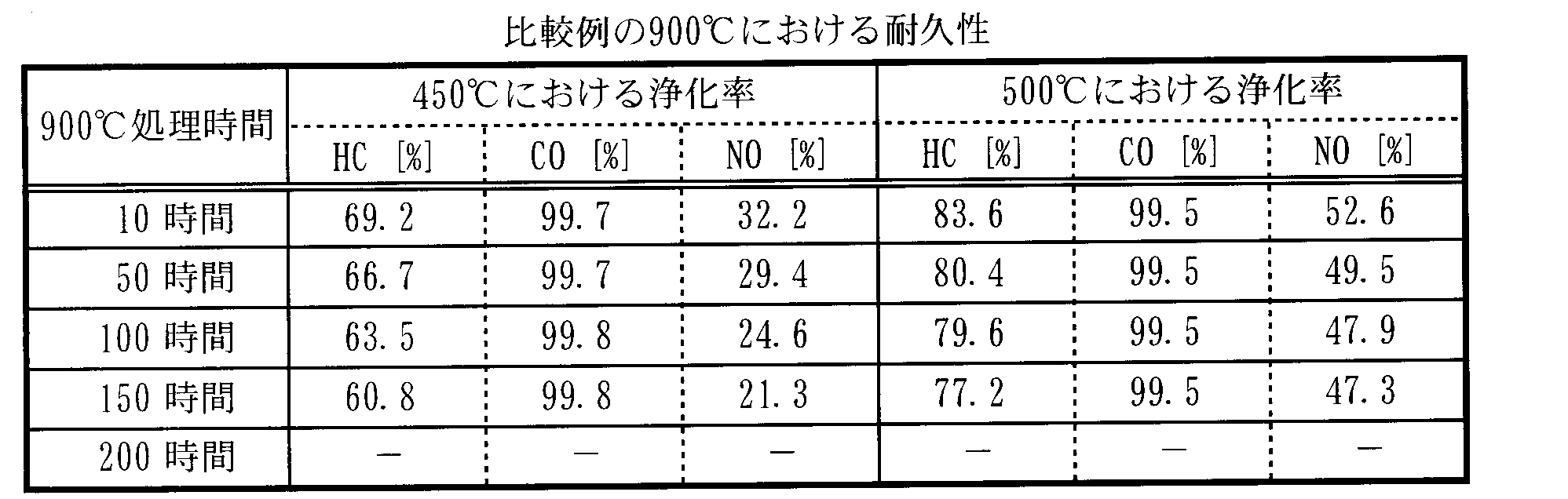
通常、排気ガス中の酸素濃度は燃料の燃焼条件に応じて変化する。酸素濃度の大きい排気ガスは「リーン」、酸素濃度の小さい排気ガスは「リッチ」と呼ばれ、それぞれの条件により触媒の浄化性能も変化する。実験3で用いた模擬排ガス組成は、理論空燃比(燃焼に用いる空気と燃料の重量比が14.7)における燃焼排ガスとして、典型的な組成である。


S2 水溶液充填工程
S3 乾燥工程
S4 仮焼工程
S5 焼成工程
S6 貴金属担持工程
Claims (13)
- 多孔質アルミナの細孔内にマグネシウムアルミネート(MgAl2O4)を形成して成り、その上に貴金属が担持される触媒担体の製造方法であって、
マグネシウムイオンを含む水溶液を調製する水溶液調製工程と、
前記多孔質アルミナの細孔にて生じる毛細管現象を利用したポアフィリング法により当該細孔内に前記水溶液調製工程で得られた水溶液を充填する水溶液充填工程と、
該水溶液充填工程にて細孔内に水溶液が充填された多孔質アルミナを乾燥する乾燥工程と、
該乾燥工程で得られた多孔質アルミナを焼成することにより、マグネシウムアルミネートを生成させる焼成工程と、
を含むことを特徴とする触媒担体の製造方法。 - 前記水溶液調製工程で得られる水溶液は、その濃度が任意調整されることにより、前記焼成工程にて前記多孔質アルミナに形成されるマグネシウムアルミネートの量を調整可能とされたことを特徴とする請求項1記載の触媒担体の製造方法。
- 前記焼成工程で生成されたマグネシウムアルミネートに二酸化セリウム(CeO2)を添加させる二酸化セリウム添加工程を有したことを特徴とする請求項1又は請求項2記載の触媒担体の製造方法。
- 多孔質アルミナの細孔内にマグネシウムアルミネート(MgAl2O4)を形成して成り、その上に貴金属を担持して成る触媒の製造方法であって、
マグネシウムイオンを含む水溶液を調製する水溶液調製工程と、
前記多孔質アルミナの細孔にて生じる毛細管現象を利用したポアフィリング法により当該細孔内に前記水溶液調製工程で得られた水溶液を充填する水溶液充填工程と、
該水溶液充填工程にて細孔内に水溶液が充填された多孔質アルミナを乾燥する乾燥工程と、
該乾燥工程で得られた多孔質アルミナを焼成することにより、マグネシウムアルミネートを生成させる焼成工程と、
を有し、前記焼成工程で焼成された多孔質アルミナの細孔に対し、当該細孔にて生じる毛細管現象を利用したポアフィリング法により貴金属を含有した水溶液を充填することを特徴とする触媒の製造方法。 - 前記貴金属がパラジウムであることを特徴とする請求項4記載の触媒の製造方法。
- 前記焼成工程で生成されたマグネシウムアルミネートに二酸化セリウム(CeO2)を添加させる二酸化セリウム添加工程を有し、当該二酸化セリウム添加工程を経た触媒担体に前記貴金属を担持させたことを特徴とする請求項4又は請求項5記載の触媒の製造方法。
- 80~150(m2/g)の範囲の比表面積、及び0.45~0.65(ml/g)の範囲の細孔容積を有するマグネシウムアルミネート(MgAl2O4)から成り、その上に貴金属が担持可能とされたことを特徴とする触媒担体。
- 多孔質アルミナの細孔内に前記マグネシウムアルミネート(MgAl2O4)を形成して成ることを特徴とする請求項7記載の触媒担体。
- 前記マグネシウムアルミネートに二酸化セリウム(CeO2)を添加させたことを特徴とする請求項7又は請求項8記載の触媒担体。
- 80~150(m2/g)の範囲の比表面積、及び0.45~0.65(ml/g)の範囲の細孔容積を有するマグネシウムアルミネート(MgAl2O4)が触媒担体とされ、その上に貴金属が担持されたことを特徴とする触媒。
- 前記触媒担体は、多孔質アルミナの細孔内に前記マグネシウムアルミネート(MgAl2O4)を形成して成ることを特徴とする請求項10記載の触媒。
- 前記貴金属がパラジウムであることを特徴とする請求項10又は請求項11記載の触媒。
- 前記マグネシウムアルミネートに二酸化セリウム(CeO2)を添加させ、当該二酸化セリウムが添加された触媒担体に前記貴金属を担持させたことを特徴とする請求項10~12の何れか1つに記載の触媒。
Priority Applications (3)
| Application Number | Priority Date | Filing Date | Title |
|---|---|---|---|
| CN2010800533171A CN102639232A (zh) | 2009-11-25 | 2010-10-29 | 催化剂载体或催化剂及其制造方法 |
| JP2011543186A JP5827567B2 (ja) | 2009-11-25 | 2010-10-29 | 触媒担体又は触媒の製造方法 |
| US13/480,423 US20120277094A1 (en) | 2009-11-25 | 2012-05-24 | Catalyst support or catalyst, and process for producing the same |
Applications Claiming Priority (2)
| Application Number | Priority Date | Filing Date | Title |
|---|---|---|---|
| JP2009-267622 | 2009-11-25 | ||
| JP2009267622 | 2009-11-25 |
Related Child Applications (1)
| Application Number | Title | Priority Date | Filing Date |
|---|---|---|---|
| US13/480,423 Continuation US20120277094A1 (en) | 2009-11-25 | 2012-05-24 | Catalyst support or catalyst, and process for producing the same |
Publications (1)
| Publication Number | Publication Date |
|---|---|
| WO2011065187A1 true WO2011065187A1 (ja) | 2011-06-03 |
Family
ID=44066290
Family Applications (1)
| Application Number | Title | Priority Date | Filing Date |
|---|---|---|---|
| PCT/JP2010/069351 Ceased WO2011065187A1 (ja) | 2009-11-25 | 2010-10-29 | 触媒担体又は触媒及びその製造方法 |
Country Status (4)
| Country | Link |
|---|---|
| US (1) | US20120277094A1 (ja) |
| JP (1) | JP5827567B2 (ja) |
| CN (1) | CN102639232A (ja) |
| WO (1) | WO2011065187A1 (ja) |
Cited By (3)
| Publication number | Priority date | Publication date | Assignee | Title |
|---|---|---|---|---|
| JP2012130895A (ja) * | 2010-12-24 | 2012-07-12 | Daihatsu Motor Co Ltd | 触媒担体および排ガス浄化用触媒 |
| JP2012152720A (ja) * | 2011-01-28 | 2012-08-16 | Daihatsu Motor Co Ltd | 触媒担体および排ガス浄化用触媒 |
| CN114029053A (zh) * | 2021-11-22 | 2022-02-11 | 中国科学院大连化学物理研究所 | 一种负载型催化剂的制备方法及其在乙二醇制备乙醇酸甲酯中的应用 |
Families Citing this family (2)
| Publication number | Priority date | Publication date | Assignee | Title |
|---|---|---|---|---|
| JP6618924B2 (ja) | 2013-12-23 | 2019-12-11 | ローディア オペレーションズ | 無機酸化物材料 |
| CN108722405A (zh) * | 2018-05-10 | 2018-11-02 | 吉林晟航科技发展有限公司 | 一种具有核壳结构的纳米催化剂及其制备方法与应用 |
Citations (4)
| Publication number | Priority date | Publication date | Assignee | Title |
|---|---|---|---|---|
| JP2000044251A (ja) * | 1998-07-24 | 2000-02-15 | Chiyoda Corp | スピネル型複合酸化物及びその製造方法 |
| JP2005502570A (ja) * | 2001-02-16 | 2005-01-27 | バッテル メモリアル インスティテュート | 水蒸気改質の触媒及び方法 |
| JP2007520336A (ja) * | 2004-01-28 | 2007-07-26 | スタトイル・エーエスエー | フィッシャー・トロプシュ触媒 |
| WO2009104386A1 (ja) * | 2008-02-21 | 2009-08-27 | 株式会社エフ・シー・シー | 触媒担体の製造方法及び触媒担体 |
Family Cites Families (4)
| Publication number | Priority date | Publication date | Assignee | Title |
|---|---|---|---|---|
| US4460704A (en) * | 1980-06-15 | 1984-07-17 | Imperial Chemical Industries Plc | Catalyst for the production of hydrogen |
| US5547648A (en) * | 1992-04-15 | 1996-08-20 | Mobil Oil Corporation | Removing SOx, NOX and CO from flue gases |
| US6606856B1 (en) * | 2000-03-03 | 2003-08-19 | The Lubrizol Corporation | Process for reducing pollutants from the exhaust of a diesel engine |
| GB0328649D0 (en) * | 2003-12-11 | 2004-01-14 | Johnson Matthey Plc | Reforming catalyst |
-
2010
- 2010-10-29 CN CN2010800533171A patent/CN102639232A/zh active Pending
- 2010-10-29 JP JP2011543186A patent/JP5827567B2/ja not_active Expired - Fee Related
- 2010-10-29 WO PCT/JP2010/069351 patent/WO2011065187A1/ja not_active Ceased
-
2012
- 2012-05-24 US US13/480,423 patent/US20120277094A1/en not_active Abandoned
Patent Citations (4)
| Publication number | Priority date | Publication date | Assignee | Title |
|---|---|---|---|---|
| JP2000044251A (ja) * | 1998-07-24 | 2000-02-15 | Chiyoda Corp | スピネル型複合酸化物及びその製造方法 |
| JP2005502570A (ja) * | 2001-02-16 | 2005-01-27 | バッテル メモリアル インスティテュート | 水蒸気改質の触媒及び方法 |
| JP2007520336A (ja) * | 2004-01-28 | 2007-07-26 | スタトイル・エーエスエー | フィッシャー・トロプシュ触媒 |
| WO2009104386A1 (ja) * | 2008-02-21 | 2009-08-27 | 株式会社エフ・シー・シー | 触媒担体の製造方法及び触媒担体 |
Cited By (3)
| Publication number | Priority date | Publication date | Assignee | Title |
|---|---|---|---|---|
| JP2012130895A (ja) * | 2010-12-24 | 2012-07-12 | Daihatsu Motor Co Ltd | 触媒担体および排ガス浄化用触媒 |
| JP2012152720A (ja) * | 2011-01-28 | 2012-08-16 | Daihatsu Motor Co Ltd | 触媒担体および排ガス浄化用触媒 |
| CN114029053A (zh) * | 2021-11-22 | 2022-02-11 | 中国科学院大连化学物理研究所 | 一种负载型催化剂的制备方法及其在乙二醇制备乙醇酸甲酯中的应用 |
Also Published As
| Publication number | Publication date |
|---|---|
| JPWO2011065187A1 (ja) | 2013-04-11 |
| US20120277094A1 (en) | 2012-11-01 |
| JP5827567B2 (ja) | 2015-12-02 |
| CN102639232A (zh) | 2012-08-15 |
Similar Documents
| Publication | Publication Date | Title |
|---|---|---|
| US7956005B2 (en) | Exhaust gas-purifying catalyst | |
| KR101438953B1 (ko) | 저온에서의 NOx 흡장성능이 개선된 LNT촉매 | |
| JP6567168B2 (ja) | 排ガス浄化用触媒及びその製造方法並びにそれを用いた排ガス浄化装置 | |
| WO2009104386A1 (ja) | 触媒担体の製造方法及び触媒担体 | |
| JP5827567B2 (ja) | 触媒担体又は触媒の製造方法 | |
| JP2006051431A (ja) | 排気ガス浄化用三元触媒及びその製造方法 | |
| JP5018882B2 (ja) | 触媒担体及び排ガス浄化触媒 | |
| CN101410179B (zh) | 废气净化用催化剂及其制造方法 | |
| JP2009050791A (ja) | 排ガス浄化用触媒 | |
| JP5196656B2 (ja) | 排ガス浄化用触媒及びその製造方法 | |
| US20090036300A1 (en) | Exhaust gas-purifying catalyst | |
| JPH09248462A (ja) | 排気ガス浄化用触媒 | |
| JP7448620B2 (ja) | 窒素酸化物吸蔵材及び排ガス浄化用触媒 | |
| JP7262975B2 (ja) | セリア・ジルコニア系複合酸化物酸素吸収放出材料および排ガス浄化触媒 | |
| JPWO2004089538A1 (ja) | 排気ガス浄化用触媒及び正方晶系複合酸化物の製造方法 | |
| JP2003020227A (ja) | 微細混合酸化物粉末とその製造方法及び触媒 | |
| JP2007307485A (ja) | NOx吸蔵還元型触媒 | |
| JP5620799B2 (ja) | 触媒の製造方法及び燃焼排ガスの浄化触媒 | |
| JP4810907B2 (ja) | 触媒担体及びその製造方法、並びに排ガス浄化触媒 | |
| JP2006043637A (ja) | 排ガス浄化用触媒 | |
| JP2017180453A (ja) | 排ガス浄化装置及びその製造方法 | |
| JP2017177095A (ja) | 排ガス浄化用触媒及びその製造方法並びにそれを用いた排ガス浄化装置 | |
| JP4697028B2 (ja) | アルカリ土類金属担持排ガス浄化触媒の製造方法 | |
| JP2005185965A (ja) | 排ガス浄化用触媒 | |
| JPH10272357A (ja) | 排気ガス浄化用触媒 |
Legal Events
| Date | Code | Title | Description |
|---|---|---|---|
| WWE | Wipo information: entry into national phase |
Ref document number: 201080053317.1 Country of ref document: CN |
|
| 121 | Ep: the epo has been informed by wipo that ep was designated in this application |
Ref document number: 10833034 Country of ref document: EP Kind code of ref document: A1 |
|
| WWE | Wipo information: entry into national phase |
Ref document number: 2011543186 Country of ref document: JP |
|
| NENP | Non-entry into the national phase |
Ref country code: DE |
|
| WWE | Wipo information: entry into national phase |
Ref document number: 1298/KOLNP/2012 Country of ref document: IN |
|
| 122 | Ep: pct application non-entry in european phase |
Ref document number: 10833034 Country of ref document: EP Kind code of ref document: A1 |