WO2011027753A1 - 飼料効率改善剤 - Google Patents
飼料効率改善剤 Download PDFInfo
- Publication number
- WO2011027753A1 WO2011027753A1 PCT/JP2010/064867 JP2010064867W WO2011027753A1 WO 2011027753 A1 WO2011027753 A1 WO 2011027753A1 JP 2010064867 W JP2010064867 W JP 2010064867W WO 2011027753 A1 WO2011027753 A1 WO 2011027753A1
- Authority
- WO
- WIPO (PCT)
- Prior art keywords
- feed
- mannobiose
- improving agent
- feed efficiency
- mannan
- Prior art date
- Legal status (The legal status is an assumption and is not a legal conclusion. Google has not performed a legal analysis and makes no representation as to the accuracy of the status listed.)
- Ceased
Links
Classifications
-
- A—HUMAN NECESSITIES
- A23—FOODS OR FOODSTUFFS; TREATMENT THEREOF, NOT COVERED BY OTHER CLASSES
- A23K—FODDER
- A23K50/00—Feeding-stuffs specially adapted for particular animals
- A23K50/30—Feeding-stuffs specially adapted for particular animals for swines
-
- A—HUMAN NECESSITIES
- A23—FOODS OR FOODSTUFFS; TREATMENT THEREOF, NOT COVERED BY OTHER CLASSES
- A23K—FODDER
- A23K10/00—Animal feeding-stuffs
- A23K10/10—Animal feeding-stuffs obtained by microbiological or biochemical processes
- A23K10/14—Pretreatment of feeding-stuffs with enzymes
-
- A—HUMAN NECESSITIES
- A23—FOODS OR FOODSTUFFS; TREATMENT THEREOF, NOT COVERED BY OTHER CLASSES
- A23K—FODDER
- A23K20/00—Accessory food factors for animal feeding-stuffs
- A23K20/10—Organic substances
- A23K20/163—Sugars; Polysaccharides
-
- A—HUMAN NECESSITIES
- A23—FOODS OR FOODSTUFFS; TREATMENT THEREOF, NOT COVERED BY OTHER CLASSES
- A23K—FODDER
- A23K50/00—Feeding-stuffs specially adapted for particular animals
- A23K50/70—Feeding-stuffs specially adapted for particular animals for birds
- A23K50/75—Feeding-stuffs specially adapted for particular animals for birds for poultry
Definitions
- the present invention relates to a feed efficiency improving agent having a function of improving feed efficiency by adding it to livestock feed such as for meat chicken and pig farming.
- feed costs In particular, the ratio of feed costs to livestock management costs is particularly large. Most of the feed ingredients depend on imports from overseas, but livestock management has become more severe due to the recent increase in feed prices. Therefore, feed efficiency needs to be improved to reduce feed costs. There is a strong demand for a feed that increases feed efficiency and that can protect animals from dangers such as pathogenic bacteria and maintain healthy breeding.
- Patent Document 1 discloses adding a substance having antiparasitic activity and antinematode activity derived from microorganisms.
- Patent Document 2 discloses an animal growth promoter containing prickly pear that is said to have a pharmacological action.
- Patent Document 3 discloses that a livestock feed composition containing livestock feed and two or more additives selected from the group consisting of nucleic acid, glutamine and glutamic acid improves livestock feed efficiency. Is disclosed.
- patent document 4 discloses that feed efficiency can be improved by adding the yeast belonging to the genus Candida which gives a probiotic effect to lactic acid bacteria together with lactic acid bacteria.
- Non-Patent Document 1 It is known that feed containing mannose has a sterilizing effect that suppresses colonization of Salmonella, which is a harmful bacterium, in the animal intestine and discharges it outside the body (salmonella colonization suppression effect).
- Various techniques have also been proposed (Non-Patent Document 1).
- manno-oligosaccharides which are mainly composed of mannobiose and mannotriose and mixed with monosaccharides, obtained by enzymatic degradation of mannan-containing materials such as guar meal and copra meal can improve the quality of chicken eggs.
- manno-oligosaccharides may be useful in preventing colonization of Salmonella in the intestines of livestock (Patent Document 5).
- feed containing mannose such as mannan enzyme and / or acid hydrolyzate obtained from mannobiose, methyl- ⁇ -mannoside, manno-oligosaccharide, guar gum, locust bean gum or yeast is a harmful bacteria such as Salmonella. It is reported that it is useful for infection prevention (patent document 6).
- mannose polysaccharides mainly composed of polysaccharides having a mannose repeat unit of 40 to 100 (30 to 80%) and oligosaccharides (5 to 30%) is a salmonella livestock intestine. It has been reported that it is effective in preventing fixing in the inside (Patent Document 7).
- mannose is easily utilized by enterobacteria, digested and absorbed and excreted by livestock itself, or easily decomposed when administered with live bacteria. It has been reported that mannobiose, which is a sugar, can effectively exert the effect of suppressing Salmonella colonization compared with mannose (Patent Document 11).
- Patent Document 12 it is described in Patent Document 12 that a mannan degradation product containing mannobiose has an intestinal immunity activation effect.
- feed efficiency improving agents containing ⁇ 1,4-mannobiose are not known and are completely new.
- This invention makes it a subject to obtain the safe feed efficiency improving agent which improves feed efficiency by adding to feed for meat chickens, pig farming, etc.
- the present inventors have studied the growth of livestock tests of the feed efficiency improving agent having the effect of excretion of pathogenic bacteria and the like. Surprisingly, the increase in the weight gain of livestock animals and the saving of food consumption That is, the present inventors have found that feed efficiency is improved and have completed the present invention.
- the present invention is (1) a feed efficiency improving agent characterized by containing ⁇ 1,4-mannobiose.
- the feed efficiency improving agent according to claim 1 which is for meat chickens and / or pig farming.
- the feed efficiency improving agent of the present invention can be added to feed and beverages to increase the amount of livestock gain, save the amount of food intake, that is, improve feed efficiency.
- the feed efficiency improving agent for meat chickens and pig farming of the present invention contains ⁇ -1,4-mannobiose (hereinafter also simply referred to as mannobiose) and is used for improving feed efficiency.
- mannobiose ⁇ -1,4-mannobiose
- ⁇ -1,4-mannobiose is formed by bonding two mannose molecules with ⁇ -1,4-glycosidic bonds.
- the ⁇ -1,4-mannobiose used in the present invention can be obtained, for example, by a method of synthesizing from mannose or a method of decomposing ⁇ -1,4-mannan (hereinafter also simply referred to as mannan).
- the method for decomposing ⁇ -1,4-mannan is more preferable from the viewpoint of resource and reaction efficiency of raw materials, and ⁇ -1,4-mannobiose can be obtained more easily.
- mannan-degrading enzyme is allowed to act on mannan-containing natural products such as palm kernel meal, copra meal, coffee bean meal, guar gum, locust bean gum and the like, which are rich in mannan, or mannan extracted from these natural products.
- ⁇ -1,4-mannobiose can be obtained.
- the mannan degrading enzyme used in this method may be any mannanase, mannosidase, hemicellulase, etc., as long as it has an activity of degrading mannan to produce mannobiose, derived from Aspergillus niger, Commercially available products (for example, hemicellulase GM “Amano” (manufactured by Amano Pharmaceutical Co., Ltd.), Sumiteam ACH (manufactured by Shin Nippon Chemical Industry Co., Ltd.), cellulosin GM5 (Hankyu Bioindustry Co., Ltd.) and the like can be preferably used.
- cellulase Y-NC manufactured by Yakult Pharmaceutical Co., Ltd.
- mannanase endo type
- Activity is higher hemicellulase GM “AMANO” (Amano Pharmaceutical Co., Ltd.)
- Sumizyme ACH manufactured by Shin Nihon Chemicals Corporation is suppressed generation of mannose, preferable in that it can be in a large amount to produce a mannobiose.
- the mannan degrading enzyme acts on mannan-containing natural products or mannan extracted therefrom as an enzyme solution dissolved or dispersed in water.
- a reaction system including the mannan-containing natural product, a mannan-degrading enzyme, and water.
- the amount of water added to adjust the water content is preferably 50 to 10,000 parts by weight, more preferably 50 to 1500 parts by weight with respect to 100 parts by weight of mannan.
- the enzyme should be selected so as to produce as much mannobiose as possible, and the reaction time should be adjusted.
- an enzyme having a high mannanase (endo type) activity usually also has a mannosidase (exo type) activity, if the enzyme reaction time is too long, mannobiose is decomposed and the amount of mannose increases. Therefore, the reaction time is preferably not longer than necessary.
- These enzyme reaction conditions are appropriately set so that the amount of mannobiose produced is as large as possible. In this case, it is preferable to set so that ⁇ -1,4-mannobiose is contained more than mannose. For example, the ratio of mannose to ⁇ -1,4-mannobiose is more preferably 60% by weight or less. It is particularly preferred that it is not more than wt%.
- the amount of mannobiose depends on the type, amount, and time of the enzyme used. It is possible to produce up to about 5 to 15 parts by weight with respect to 100 parts by weight of the raw material.
- the enzyme-treated product containing mannobiose produced in this way may be used as a feed efficiency improving agent by increasing the mannobiose concentration by removing insoluble matter, etc. However, it is better not to remove insoluble matters, but to dry the feed as needed or to make a feed efficiency improving agent.
- the feed efficiency improving agent contains mannose and mannooligosaccharides in addition to mannobiose, but it is preferable to contain 3% by weight or more as mannobiose. More preferably, it is 5% by weight or more, more preferably 7% by weight or more, and most preferably 9% by weight or more. This feed efficiency improving agent can be used by mixing with feed.
- a product obtained by extracting mannobiose or the like from an enzyme-treated product with water can be used as a feed efficiency improving agent to be added to a beverage.
- mannose and mannooligosaccharides are contained in addition to mannobiose, but it is not particularly necessary to extract and purify only mannobiose, but it is preferable that these are contained.
- the feed efficiency improving agent of the present invention When added to the feed, it is preferably added so that the content in the blended feed is 0.0001 to 0.05% by weight as mannobiose. More preferably, mannobiose is added in an amount of 0.0005 to 0.02% by weight, most preferably 0.001 to 0.015% by weight.
- Such feed can improve feed efficiency by feeding livestock in solid or liquid form.
- it can be set as a standard that it becomes the mannobiose dosage equivalent to the case where it adds to a feed.
- chickens in the case of chickens, you can use edible young chickens, which are said to be broiler-specific species, and as a brand chicken or local chicken, a colored chicken species that has differences in meat quality, taste, and texture (red) (Chicken) can also be used. Also in pig farming, it can be used for various varieties such as Landrace, Large Yorkshire, Duroc and Berkshire. It can also be used for beef cattle, sheep farming, horse farming and the like.
- the feed efficiency improving agent of the present invention for example, in the case of chickens, it can be used in a mixed feed for the first period of fattening given within about 3 weeks after hatching, It may be added to the formula feed.
- ingredients such as protein, minerals, and calories are adjusted according to the growth stage of the animal to assemble the blended feed, and this improving agent can be used at any stage.
- the entire period of fattening from immediately after hatching or weaning to immediately before shipping may be fed, or the improving agent may be used for a certain period of the stage of fattening.
- the feed efficiency improving agent of the present invention When used by mixing with feed, it may be freely blended with other materials used as normal feed materials.
- grains such as corn, milo, wheat, barley, rice, rye, buckwheat, lupine, sweet potato, cassava, beans such as soybean, okara, defatted soybean, rapeseed meal, sunflower meal, safflower meal, etc.
- Vegetable oil lees, rice bran, bran, wheat bran, etc. corn gluten feed, beet pulp, beer lees, sake lees, konjac flying powder and other by-products, fish meal, meat meal, skim milk, dried whey, krill Animal materials such as meal, casein, gelatin, saccharides such as yeasts, corn starch, dextrin, vegetable proteins such as soy protein, wheat gluten, corn twein, cottonseed oil, rapeseed oil, corn oil, soybean oil, sunflower oil And fats and oils such as safflower oil, olive oil, coconut oil and palm oil. These may be used alone or as a mixture of two or more.
- various additives are used for the purpose of preventing the deterioration of the quality of the feed, supplementing the nutrients and other active ingredients of the feed, and promoting the effective use of the nutrients contained in the feed.
- nutritional ingredients such as amino acids, vitamins, minerals, fatty acids, enzymes, live fungi, fungicides, antioxidants, emulsifiers, etc. are freely blended within the range that does not impair the effect of this feed efficiency improver. You can do it.
- Part and % in the examples represent “part by weight” and “% by weight”, respectively, unless otherwise specified.
- Example 1 150 parts of an enzyme solution prepared by dissolving 0.25 parts of the enzyme hemicellulase GM “Amano” (manufactured by Amano Pharmaceutical Co., Ltd.) in 100 parts of copra meal (mannan content 30%, moisture 4.4%) at 60 ° C. for 12 hours. After acting, it was dried to a moisture content of 9.3% using a fluidized bed drying apparatus (manufactured by Okawara Seisakusho) to obtain 106 parts of dry powder. When the mannobiose content and mannose content of this dry powder were measured by ion exchange chromatography, 12.7 parts of ⁇ 1,4-mannobiose and 1.41 parts of mannose were produced.
- Example 2 150 parts of an enzyme solution in which 0.25 part of the enzyme hemicellulase GM “Amano” (manufactured by Amano Pharmaceutical Co., Ltd.) is dissolved in 100 parts of palm kernel meal with a mannan content of 35% and a moisture content of 9.3% at 60 ° C. for 12 hours. After acting, it was dried to a moisture content of 9.8% with a fluidized bed drying apparatus (manufactured by Okawara Seisakusho) to obtain 101 parts of dry powder. When the mannobiose content and mannose content of this dry powder were measured, 10.4 parts of ⁇ 1,4-mannobiose and 1.45 parts of mannose were produced.
- the test was conducted at a chicken farm where commercial breeding of colored chicken species (red chickens) was conducted. That is, about 200,000 1-day-old red chicks were purchased and carried into each of the 21 henhouses (8458-10816, depending on the henhouse).
- 7 poultry houses were fed for 11 weeks with a feed prepared by mixing 0.1% of the feed efficiency improving agent of Example 1 with a commercial feed for raising chickens (Akatri Starter T).
- a feed prepared by mixing 0.02% of the feed efficiency improving agent of Example 1 with a commercial feed for raising chickens was fed for 11 weeks.
- the remaining seven poultry houses were fed with an additive-free commercial feed for raising chickens for 11 weeks as a comparative control.
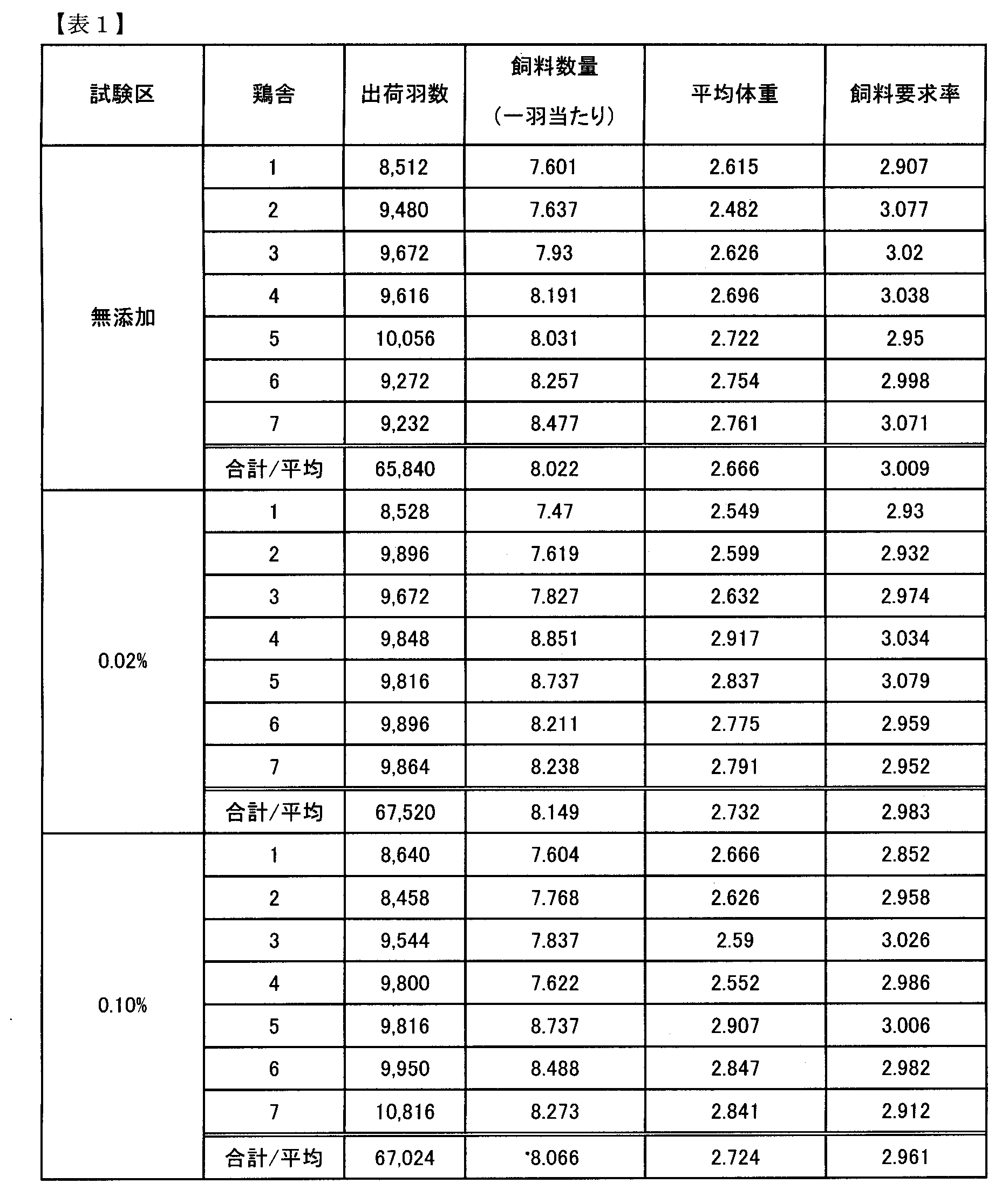
- the feeding amount was recorded for 11 weeks, and the weight of all chickens was measured for each poultry house after the end of the breeding period. From these data, the feed efficiency indicating the weight gain per chicken, the amount of food consumed, and the required amount of feed per body weight was calculated for each poultry house (Table 1).
- the average weight of adult chickens after shipping for 11 weeks in the test group to which 0.1% of the feed efficiency improving agent was added was 2724 g, which is an average compared to that in the non-added group. 58g more.
- the average food intake per animal during the whole period was 8066 g.
- the feed efficiency indicating the required amount of feed per 1 kg of gain is 2.961, and it is shown that the addition of this feed additive allows animals to grow with a smaller amount of feed compared to the non-added zone 3.009. It was done.
- the average adult chicken body weight after shipment for 11 weeks was 2732 g, which was 66 g higher than that in the non-added group.
- the average food consumption per animal was 8149 g.
- the feed efficiency indicating the amount of feed required per 1 kg of the body weight gain is 2.983, and in this zone, the animal is grown with a smaller amount of feed compared to the non-added zone 3.009 by adding this feed improver. It was shown that
Landscapes
- Life Sciences & Earth Sciences (AREA)
- Chemical & Material Sciences (AREA)
- Polymers & Plastics (AREA)
- Engineering & Computer Science (AREA)
- Animal Husbandry (AREA)
- Zoology (AREA)
- Food Science & Technology (AREA)
- Birds (AREA)
- Microbiology (AREA)
- Health & Medical Sciences (AREA)
- Biochemistry (AREA)
- Biomedical Technology (AREA)
- Biotechnology (AREA)
- Molecular Biology (AREA)
- Physiology (AREA)
- Fodder In General (AREA)
- Feed For Specific Animals (AREA)
Abstract
本発明は、家畜、特に食肉鶏および養豚用の飼料等に添加することによって、飼料効率を向上させる安全な飼料効率改善剤を得ることを課題とした。 本発明の飼料効率改善剤は、β1,4-マンノビオースを含有することを特徴とし、マンノビオースは、コプラミール、パーム核ミール、コーヒー粕などのマンナン含有天然物にマンナン分解酵素を作用させて生成したものを使用できる。この場合、マンノビオースは必ずしも抽出・精製する必要はなく、マンノース、その他のマンノオリゴ糖やマンナンの未分解物等を含んでいてもよい。
Description
本発明は、食肉鶏および養豚用など家畜の飼料等に添加することによって、飼料効率を向上させる機能を有する飼料効率改善剤に関する。
近年、国内の畜産農家を取り巻く環境は大変厳しくなっている。すなわち安価な外国産畜肉の輸入増大、相次ぐ飼料原料の高騰、さらには豚や鶏インフルエンザといった疫病の流行に伴う種々の対策が必要となってきている。このような厳しい経営環境の中、生産性、省力化向上のために、飼育密度を高めて効率の良い飼育を図るなどの努力が行われている。しかし、このような劣悪な環境の下では、伝染病の発病やストレスによる発育不良や疾病が起こりやすいという問題も生じている。
とりわけ、飼料費が畜産経営経費に占める割合は特に大きい。飼料原料の大部分は海外からの輸入に依存しているが、昨今の飼料価格の高騰により畜産経営はいっそう厳しくなっている。そのため、飼料費用の軽減のためには飼料効率を改善する必要がある。飼料効率を高め、かつ病原菌等の危険等から動物を守り健全な飼育を維持できるような飼料が強く要望されている。
従来より、抗生物質や駆虫剤などを飼料に添加することにより動物を病原菌等の危険から守ることが行われているが毒性の問題が懸念される。これに対して、特許文献1は、微生物由来の抗寄生虫活性および抗線虫活性を有する物質を添加することを開示する。特許文献2は、薬理作用を有するとされる刺梨を含有する動物の発育促進剤を開示する。特許文献3は、家畜用飼料と、核酸、グルタミンおよびグルタミン酸から成る群から選択された2種以上の添加物を含有することを特徴とする家畜飼料用組成物が家畜の飼料効率を改善することを開示する。また、ウシに対してであるが、特許文献4は、乳酸菌にプロバイオティック効果を付与するカンジダ属に属する酵母菌を乳酸菌とともに飼料に添加することにより飼料効率が改善しうることを開示する。
マンノース類を含有する飼料は、有害細菌であるサルモネラ菌の動物腸内での定着を抑制し体外へ排出する排菌効果(サルモネラ菌定着抑制効果)を有することが知られており、この効果を利用した技術も種々提案されている(非特許文献1)。
例えば、グアーミールやコプラミールなどマンナンを含む素材を酵素分解して得られる、マンノビオース及びマンノトリオースを主成分とし単糖類が混合したマンノオリゴ糖類が配合された飼料は、鶏の卵の品質を向上させることができるとともに、マンノオリゴ糖類がサルモネラ菌の家畜腸内での定着防止に有用である可能性があることが報告されている(特許文献5)。
また、マンノビオース、メチル-α-マンノシド、マンノオリゴ糖やグアーガム、ローカストビーンガム又は酵母から得られるマンナンの酵素及び/又は酸による加水分解物等のマンノース類を配合する飼料が、サルモネラ菌などの有害細菌の感染予防に有用であることが報告されている(特許文献6)。
さらには、マンノースの繰り返し単位が40~100の多糖を中心(30~80%)とし、オリゴ糖も(5~30%)混在するマンノース系多糖体を配合する家畜用飼料が、サルモネラ菌の家畜腸内での定着防止に効果があることが報告されている(特許文献7)。
また、パーム核ミールやグアーミール等のマンナンリッチな原料に酵素を作用させてマンノオリゴ糖に分解したものを配合した飼料や、コプラミールに酵素を作用させたマンノース及び/又はマンノオリゴ糖の製造方法も報告されている(特許文献8乃至10)。
さらに、マンノースが、腸内細菌類により簡単に資化される、或いは、家畜自身によって消化吸収・排出される、生菌剤が投与された場合に分解し易いやすくなるといった問題に対して、マンノオリゴ糖であるマンノビオースが、マンノースに比べサルモネラ菌定着抑制効果を有効に奏し得ることが報告されている(特許文献11)。
また、マンノビオースを含むマンナン分解物が腸管免疫賦活作用を有することは、特許文献12に記載されている。しかしながら、β1,4-マンノビオースを含有する飼料効率改善剤は知られておらず、全く新規である。
Poultly Science, 68, p.1357, 1989
特開平05-178898号公報
特開平06-327412号公報
特開2002-045122号公報
特開2009-44971号公報
特開平8-38064号公報
特開平7-236429号公報
特開平8-173055号公報
国際公開第95/17103号パンフレット
国際公開第99/08544号パンフレット
特開2001-231591号公報
国際公開第2004/048587号パンフレット
国際公開第2008/001769号パンフレット
本発明は、食肉鶏および養豚用の飼料等に添加することによって、飼料効率を向上させる安全な飼料効率改善剤を得ることを課題とする。
本発明者らは、病原菌などの排泄効果を有する本飼料効率改善剤の畜産試験の生育に関する検討を行ったところ、意外なことに、畜産動物の増体量の増大と、摂餌量の節約と、すなわち飼料効率を改善することを見出し、本発明を完成させるに至った。
すなわち本発明は、(1)β1,4-マンノビオースを含有することを特徴とする飼料効率改善剤。(2)食肉鶏及び/又は養豚用である、請求項1記載の飼料効率改善剤。(3)β1,4-マンノビオースがコプラミール、パーム核ミール、コーヒー粕由来である、請求項1記載の飼料効率改善剤。(4)β1,4-マンノビオースがマンナン含有天然物にマンナン分解酵素を作用させて生成したものである、請求項1記載の飼料効率改善剤
。(5)β1,4-マンノビオースの含有量が3重量%以上である請求項1~4記載の飼料効率改善剤。を骨子とする。
。(5)β1,4-マンノビオースの含有量が3重量%以上である請求項1~4記載の飼料効率改善剤。を骨子とする。
本発明の飼料効率改善剤は、これを飼料や飲料に添加することによって、家畜の増体量を増加し、摂餌量を節約し、すなわち飼料効率を改善することができる。
本発明の食肉鶏および養豚用飼料効率改善剤は、β-1,4-マンノビオース(以下、単にマンノビオースともいう。)を含有するものであって、飼料効率改善用として用いられるものである。
本発明において、β-1,4-マンノビオースは、マンノース2分子がβ-1,4-グリコシド結合してなるものである。本発明で用いられるβ-1,4-マンノビオースは、例えば、マンノースから合成する方法や、β-1,4-マンナン(以下、単にマンナンともいう)を分解する方法により得ることができる。
β-1,4-マンナンを分解する方法は、原料の資源性及び反応効率の点でより好ましく、より簡便にβ-1,4-マンノビオースを得ることができる。この方法では、例えば、マンナンを豊富に含有するパーム核ミール、コプラミール、コーヒー豆粕、グアーガム、ローカストビーンガムなどのマンナン含有天然物又はこれら天然物から抽出したマンナンに、マンナン分解酵素を作用させて、β-1,4-マンノビオースを得ることができる。
また、この方法において使用されるマンナン分解酵素としては、マンナナーゼ、マンノシダーゼ、ヘミセルラーゼ等、マンナンを分解してマンノビオースを生成する活性を有するものであればいずれでもよいが、Aspergillus niger由来のもので、市販されているもの(例えばヘミセルラーゼGM「アマノ」(天野製薬株式会社製)、スミチームACH(新日本化学工業株式会社製)、セルロシンGM5(阪急バイオインダストリー株式会社)等を好ましく使用できる。また、これらのほか、キシラナーゼ、セルラーゼとして市販されているものであっても、当該加水分解活性を有するものも使用でき、例えば、セルラーゼY-NC(ヤクルト薬品工業株式会社製)を使用できる。特に、マンノシダーゼ(exo型)活性が低く、マンナナーゼ(endo型)活性が高いヘミセルラーゼGM「アマノ」(天野製薬株式会社製)、スミチームACH(新日本化学工業株式会社製)が、マンノースの生成を抑え、多量にマンノビオースを生成させることができる点で好ましい。
さらに、この方法では、マンナン分解酵素は、水に溶解又は分散させた酵素液として、マンナン含有天然物又はこれから抽出したマンナンに作用させる。そして、マンナン含有天然物を用いる場合において効率的な反応を行うためには、マンナン含有天然物、マンナン分解酵素及び水からなる反応系における水分の調整が重要である。水分調整のための水の添加量としては、マンナン100重量部に対して、50~10000重量部であることが好ましく、50~1500重量部であることがより好ましい。水の添加量をこのような範囲とすることにより、十分な水分の存在下で、マンナン類の繊維質を十分に膨潤させ、酵素液を接触しやすくすることができる。しかしながら、必要以上の水分量は、酵素濃度を希釈する結果、却って反応効率を低下させるばかりでなく、乾燥させる場合には、乾燥工程における乾燥コストの上昇を招く。したがって、以上を考慮すれば、マンナン類100重量部に対して、好ましくは50~500重量部の水を添加するのが適当である。
また、酵素量、反応時間としては、マンノビオースができるだけ多く生成するように酵素を選択し、反応時間を調整すべきである。但し、マンナナーゼ(endo型)活性が高い酵素は、通常、マンノシダーゼ(exo型)活性をも有していることから、酵素反応の時間が長すぎると、マンノビオースが分解されてマンノース量が増加してしまうため、反応時間は必要以上に長い時間としないことが好ましい。これら酵素反応条件は、マンノビオースの生成量ができるだけ多くなるように適宜設定される。この場合、β-1,4-マンノビオースがマンノースより多く含まれるよう設定するのが好ましく、例えば、β-1,4-マンノビオースに対するマンノースの割合が、60重量%以下であるのがより好ましく、20重量%以下であるのが特に好ましい。
以上のようにして、例えば、原料としてコプラルミール(マンナン含有量は、およそ30%)を用いて3~36時間反応させた場合、マンノビオース量は、使用する酵素の種類や量、時間にもよるが、原料100重量部に対して、5~15重量部程度まで生成させることができる。
このようにして生成したマンノビオースを含有する酵素処理物(β-1,4-マンノビオース含有組成物)は、不溶物を除去する等してマンノビオース濃度を高めて飼料効率改善剤としても良いが、濃縮のためのコストを要するため、寧ろ、不溶物などは除去せず、そのまま、又は必要に応じた乾燥を行って飼料効率改善剤とするのが良い。この場合、飼料効率改善剤中に、マンノビオースの他にマンノースやマンノオリゴ糖類なども含有するが、マンノビオースとして3重量%以上含有するのがよい。より好ましくは5重量%以上、さらに好ましくは7重量%以上、最も好ましくは9重量%以上である。この飼料効率改善剤は、飼料に配合して使用することができる。 一方、酵素処理物からマンノビオース等を水抽出したものを、飲料に添加する飼料効率改善剤とすることもできる。この場合も、マンノビオースの他にマンノースやマンノオリゴ糖類などを含有するが、特にマンノビオースのみを抽出、精製する必要はなく、むしろこれらが含まれていることが好ましい。
本発明の飼料効率改善剤は、飼料に添加する場合、配合飼料中の含有量がマンノビオースとして0.0001~0.05重量%となるように添加することが好ましい。更に好ましくはマンノビオースとして0.0005~0.02重量%、最も好ましくは0.001~0.015重量%となるように添加するのがよい。このような飼料は、家畜に、固体状又は液状で給餌することにより、飼料効率を改善することができる。飲料に添加する場合は、飼料に添加する場合と同等のマンノビオース投与量となることを目安とすることができる。
家畜の種類としては、鶏の場合、ブロイラー専用種といわれる食用の若鶏を用いても良いし、銘柄鶏や地鶏として肉質、味、歯ごたえの違いをセールスポイントとする有色の鶏種(赤鶏)にも用いることができる。また養豚においても、ランドレース種、大ヨークシャー種、デュロック種、バークシャ種ーなどの各種の品種に用いることができる。また、食肉牛、養羊、養馬などの用途にも用いることができる。
本発明の飼料効率改善剤を給与する段階としては、例えば鶏の場合、孵化後から3週間程度以内に与える肥育前期用の配合飼料に用いることもできるし、またそれ以降の肥育後期用飼料の配合飼料に加えても良い。養豚の場合においても同様に、動物の生育段階に応じて、たん白質、ミネラル、カロリーなどの成分を調整して配合飼料の組み立てるが、いずれの段階にも本改善剤を使用することができる。給与する期間は、孵化あるいは離乳直後から出荷直前までの肥育期間の全てに給与しても良いし、また肥育の段階の一定期間に本改善剤を用いても良い。
本発明の飼料効率改善剤を飼料に混合して使用する場合、他の通常の飼料原料として用いられる材料と自由に配合しても構わない。例えば、例えば、トウモロコシ、マイロ、小麦、大麦、米、ライ麦、燕麦、ルーピン、甘薯、キャッサバなどの穀物類、大豆、おから、脱脂大豆などの豆類、菜種粕、ヒマワリ粕、サフラワー粕などの植物性油粕類、米ヌカ、フスマ、麦ヌカなどの糟糠類、コーングルテンフィード、ビートパルプ、ビール粕、酒粕、コンニャク飛粉などの製造副産物類、魚粉、ミートミール、脱脂粉乳、乾燥ホエー、オキアミミール、カゼイン、ゼラチンなどの動物性材料、酵母類、トウモロコシデンプン、デキストリンなどの糖類、大豆タンパク、小麦グルテン、トウモロコシツエインなどの植物性たん白質、綿実油、菜種油、トウモロコシ油、大豆油、ヒマワリ油、サフラワー油、オリーブ油、ヤシ油、パーム油などの油脂類などが挙げられる。これらは単独で使用してもよいし又は二種以上の混合物として用いられることができる。
さらに他に、飼料の品質の低下の防止、飼料の栄養成分その他有効成分の補給、飼料の含有している栄養成分の有効な利用の促進を目的に各種の添加物が用いられる。例えばアミノ酸類、ビタミン類、ミネラル類、脂肪酸類などの栄養成分、酵素類、生菌剤、防カビ剤、抗酸化剤、乳化剤などを本飼料効率改善剤の効果を阻害しない範囲で自由に配合することは差し支えない。
以下、本発明の実施例を示し、本発明を詳細に説明する。実施例中の「部」、「%」は、特に断りがない限りそれぞれ「重量部」、「重量%」を表す。
(実施例1)
コプラミール(マンナン含有量30%、水分4.4%)100部に、酵素ヘミセルラーゼGM「アマノ」(天野製薬株式会社製)0.25部を溶解した酵素液150部を、60℃で12時間作用させた後、流動層乾燥装置(大河原製作所製)にて水分9.3%にまで乾燥させて、乾燥粉体106部を得た。この乾燥粉体のマンノビオース含有量およびマンノース含有量をイオン交換クロマトグラフィー法で測定したところ、β1,4-マンノビオースが12.7部、マンノースが1.41部生成していた。
コプラミール(マンナン含有量30%、水分4.4%)100部に、酵素ヘミセルラーゼGM「アマノ」(天野製薬株式会社製)0.25部を溶解した酵素液150部を、60℃で12時間作用させた後、流動層乾燥装置(大河原製作所製)にて水分9.3%にまで乾燥させて、乾燥粉体106部を得た。この乾燥粉体のマンノビオース含有量およびマンノース含有量をイオン交換クロマトグラフィー法で測定したところ、β1,4-マンノビオースが12.7部、マンノースが1.41部生成していた。
(実施例2)
マンナン含有量35%、水分9.3%のパームカーネルミール100部に酵素ヘミセルラーゼGM「アマノ」(天野製薬株式会社製)0.25部を溶解した酵素液150部を、60℃で12時間作用させた後、流動層乾燥装置(大河原製作所製)にて水分9.8%にまで乾燥させて、乾燥粉体101部を得た。この乾燥粉体のマンノビオース含有量およびマンノース含有量を測定したところ、β1,4-マンノビオースが10.4部、マンノースが1.45部生成していた。
マンナン含有量35%、水分9.3%のパームカーネルミール100部に酵素ヘミセルラーゼGM「アマノ」(天野製薬株式会社製)0.25部を溶解した酵素液150部を、60℃で12時間作用させた後、流動層乾燥装置(大河原製作所製)にて水分9.8%にまで乾燥させて、乾燥粉体101部を得た。この乾燥粉体のマンノビオース含有量およびマンノース含有量を測定したところ、β1,4-マンノビオースが10.4部、マンノースが1.45部生成していた。
(雛鶏を用いた飼育試験)
試験は有色の鶏種(赤鶏)の商用飼育を行う養鶏場にて実施した。すなわち、生後1日齢の赤鶏の雛鶏約20万羽を購入し、それを21棟の各鶏舎に約1万羽ずつ搬入した(鶏舎により異なるが、8458~10816羽)。そのうち7鶏舎には、鶏飼育用の市販飼料(アカトリスターターT)に実施例1の飼料効率改善剤を0.1%混合した飼料を11週間給餌した。また別の7鶏舎には鶏飼育用の市販飼料に実施例1の飼料効率改善剤を0.02%混合した飼料を11週間給餌した。さらに残りの7鶏舎には、比較対照例として、無添加の鶏飼育用の市販飼料を11週間給餌した。給餌量は11週間の間記録を行い、飼育期間終了後の各鶏舎ごとに全鶏の体重を測定した。これらのデータより、各鶏舎ごとに鶏1羽当たりの体重増加量、摂食量、増体あたりの飼料必要量を示す飼料効率を計算した(表1)。
試験は有色の鶏種(赤鶏)の商用飼育を行う養鶏場にて実施した。すなわち、生後1日齢の赤鶏の雛鶏約20万羽を購入し、それを21棟の各鶏舎に約1万羽ずつ搬入した(鶏舎により異なるが、8458~10816羽)。そのうち7鶏舎には、鶏飼育用の市販飼料(アカトリスターターT)に実施例1の飼料効率改善剤を0.1%混合した飼料を11週間給餌した。また別の7鶏舎には鶏飼育用の市販飼料に実施例1の飼料効率改善剤を0.02%混合した飼料を11週間給餌した。さらに残りの7鶏舎には、比較対照例として、無添加の鶏飼育用の市販飼料を11週間給餌した。給餌量は11週間の間記録を行い、飼育期間終了後の各鶏舎ごとに全鶏の体重を測定した。これらのデータより、各鶏舎ごとに鶏1羽当たりの体重増加量、摂食量、増体あたりの飼料必要量を示す飼料効率を計算した(表1)。
雛鶏を用いた飼育試験の結果、本飼料効率改善剤を0.1%添加した試験区における11週間飼育後の出荷時の成鶏平均体重は2724gとなり、無添加区のそれと比べて平均で58g多くなった。また1匹あたりの通期間の平均摂食量は8066gであった。また増体1kgあたりの飼料必要量を示す飼料効率は2.961となり、本飼料添加剤の添加により、無添加区3.009に対してより少ない量の飼料で動物を成長させられることが示された。また、本飼料効率改善剤を0.02%添加した試験区においても11週間飼育後の出荷時の成鶏平均体重は2732gとなり、無添加区のそれと比べて66g多くなった。また1匹あたりの通期間の平均摂食量は8149gであった。また増体1kgあたりの飼料必要量を示す飼料効率は2.983となり、やはり本区においても本飼料改善剤の添加により無添加区3.009に対してより少ない量の飼料で動物を成長させられることが示された。
この試験における経済効果を試算した。0.1%区は無添加区に比較して1鶏舎を1万羽とすれば、鶏舎当たりで440kgの摂餌量増加となる(対照区80.22tに対して80.66t)が、その一方で580kgの増体増加が認められる(対照区26.66tに対して27.24t)。飼料単価を50円/kg、鶏肉単価300円/kgとしてその効果を計算すれば、飼料代は2万2千円のアップになるが、鶏肉の増産効果は17万4千円となり、差し引き15万2千円の経済効果が得られる。この間に使用した本改善剤は約80kgであり、本改善剤1kgあたりで1900円の経済効果を生む計算となる。また0.02%区で同様の計算を行った場合、鶏舎あたりで16kgの改善剤で13万4500円の経済効果となり、実に改善剤1kgあたりで8250円の経済効果と試算できる。
仮にその養鶏家が年間に100鶏舎の鶏を飼育すれば、経済効果は0.1%区、0.02%区でそれぞれ1520万円、1345万円の経済効果をもたらすことになる。このように本飼料効率改善剤の使用は養鶏家に多大な経済的貢献ができる。
仮にその養鶏家が年間に100鶏舎の鶏を飼育すれば、経済効果は0.1%区、0.02%区でそれぞれ1520万円、1345万円の経済効果をもたらすことになる。このように本飼料効率改善剤の使用は養鶏家に多大な経済的貢献ができる。
Claims (5)
- β1,4-マンノビオースを含有することを特徴とする飼料効率改善剤。
- 食肉鶏及び/又は養豚用である、請求項1記載の飼料効率改善剤。
- β1,4-マンノビオースがコプラミール、パーム核ミール、コーヒー粕由来である、請求項1記載の飼料効率改善剤。
- β1,4-マンノビオースがマンナン含有天然物にマンナン分解酵素を作用させて生成したものである、請求項1記載の飼料効率改善剤。
- β1,4-マンノビオースの含有量が3重量%以上である請求項1~4記載の飼料効率改善剤。
Applications Claiming Priority (2)
| Application Number | Priority Date | Filing Date | Title |
|---|---|---|---|
| JP2009203348 | 2009-09-03 | ||
| JP2009-203348 | 2009-09-03 |
Publications (1)
| Publication Number | Publication Date |
|---|---|
| WO2011027753A1 true WO2011027753A1 (ja) | 2011-03-10 |
Family
ID=43649288
Family Applications (1)
| Application Number | Title | Priority Date | Filing Date |
|---|---|---|---|
| PCT/JP2010/064867 Ceased WO2011027753A1 (ja) | 2009-09-03 | 2010-09-01 | 飼料効率改善剤 |
Country Status (1)
| Country | Link |
|---|---|
| WO (1) | WO2011027753A1 (ja) |
Cited By (4)
| Publication number | Priority date | Publication date | Assignee | Title |
|---|---|---|---|---|
| JP2014143924A (ja) * | 2013-01-25 | 2014-08-14 | Fuji Oil Co Ltd | 筋肉増強剤 |
| WO2017111155A1 (ja) * | 2015-12-25 | 2017-06-29 | 不二製油グループ本社株式会社 | 甲殻類のウイルス抵抗性増進剤及び飼料 |
| WO2019177172A1 (ja) | 2018-03-16 | 2019-09-19 | 味の素株式会社 | 飼料用添加剤及び飼料 |
| JP2023547327A (ja) * | 2020-10-02 | 2023-11-10 | ハムレット・プロテイン・エ/エス | ダイズ外皮の繊維に富むバイオマスに由来する飼料又は食品成分 |
Citations (2)
| Publication number | Priority date | Publication date | Assignee | Title |
|---|---|---|---|---|
| WO2004048587A1 (ja) * | 2002-11-26 | 2004-06-10 | Itochu Feed Mills Co., Ltd. | β−1,4−マンノビオース含有組成物 |
| JP2004159659A (ja) * | 1999-09-14 | 2004-06-10 | Ajinomoto General Foods Inc | マンノオリゴ糖類を主成分とする組成物 |
-
2010
- 2010-09-01 WO PCT/JP2010/064867 patent/WO2011027753A1/ja not_active Ceased
Patent Citations (2)
| Publication number | Priority date | Publication date | Assignee | Title |
|---|---|---|---|---|
| JP2004159659A (ja) * | 1999-09-14 | 2004-06-10 | Ajinomoto General Foods Inc | マンノオリゴ糖類を主成分とする組成物 |
| WO2004048587A1 (ja) * | 2002-11-26 | 2004-06-10 | Itochu Feed Mills Co., Ltd. | β−1,4−マンノビオース含有組成物 |
Cited By (5)
| Publication number | Priority date | Publication date | Assignee | Title |
|---|---|---|---|---|
| JP2014143924A (ja) * | 2013-01-25 | 2014-08-14 | Fuji Oil Co Ltd | 筋肉増強剤 |
| WO2017111155A1 (ja) * | 2015-12-25 | 2017-06-29 | 不二製油グループ本社株式会社 | 甲殻類のウイルス抵抗性増進剤及び飼料 |
| WO2019177172A1 (ja) | 2018-03-16 | 2019-09-19 | 味の素株式会社 | 飼料用添加剤及び飼料 |
| JP2023547327A (ja) * | 2020-10-02 | 2023-11-10 | ハムレット・プロテイン・エ/エス | ダイズ外皮の繊維に富むバイオマスに由来する飼料又は食品成分 |
| JP7641366B2 (ja) | 2020-10-02 | 2025-03-06 | ハムレット・プロテイン・エ/エス | ダイズ外皮の繊維に富むバイオマスに由来する飼料又は食品成分 |
Similar Documents
| Publication | Publication Date | Title |
|---|---|---|
| JP6667454B2 (ja) | 反芻動物の飼料中における酵素組成物の使用 | |
| RU2080386C1 (ru) | Мультиэнзимная композиция для животноводства | |
| Mireles-Arriaga et al. | Use of exogenous enzyme in animal feed | |
| ES2261506T3 (es) | Cerveza de fermentacion agotada concentrada de saccharopolyspora erythraea activada por una mezcla de enzimas utiles como complemento alimentario. | |
| Ranjan et al. | Strategies for maximizing utilization of de-oiled rice bran (DORB) in the fish feed | |
| Anjum et al. | Using enzymes and organic acids in broiler diets | |
| WO2011027753A1 (ja) | 飼料効率改善剤 | |
| CN107080051A (zh) | 一种生物饲料 | |
| CN108056260B (zh) | 用于肉牛的饲料及其制备方法 | |
| CN104381738A (zh) | 一种肉鸡育雏期饲料 | |
| TW201034580A (en) | Agent for promoting weight gain in livestock, feed for promoting weight gain and method for promoting weight gain | |
| CN113383868B (zh) | 一种宠物多肽营养液及其制备方法和应用 | |
| JP2010057518A (ja) | 水産養殖用の餌料添加剤および餌料 | |
| KR101705320B1 (ko) | 생균수가 증가된 배지조성에 의한 발효사료의 제조방법 및 그 발효사료 | |
| Kononenko | Effect of Roxazim G2 introduction into the compound feed for growing and fattening pigs | |
| RU2275819C2 (ru) | Способ кормления цыплят-бройлеров | |
| JP6197982B1 (ja) | 魚類寄生虫症防除剤及び飼料 | |
| CN103125770A (zh) | 一种育成期水貂饲用复合酶制剂 | |
| JP2016178893A (ja) | 飼料材料および飼料 | |
| CN107333967A (zh) | 一种利用霉变陈化原粮和禽便秸秆制备的蛋白饲料及其制备方法 | |
| Ivanova | The use of enzymatic probiotic" Cellobacterin-T" for broiler chickens | |
| KR101952758B1 (ko) | 액상배양액의 제조방법 | |
| JP3645870B2 (ja) | 混合飼料 | |
| Pankaj Kumar et al. | Effect of dietary substitution of maize with different levels of finger millet with and without non-starch polysaccharide degrading enzyme supplementation in broiler chicks. | |
| KR101280183B1 (ko) | 미생물의 증식 및 발효 촉진용 조성물 |
Legal Events
| Date | Code | Title | Description |
|---|---|---|---|
| 121 | Ep: the epo has been informed by wipo that ep was designated in this application |
Ref document number: 10813702 Country of ref document: EP Kind code of ref document: A1 |
|
| NENP | Non-entry into the national phase |
Ref country code: DE |
|
| 122 | Ep: pct application non-entry in european phase |
Ref document number: 10813702 Country of ref document: EP Kind code of ref document: A1 |
|
| NENP | Non-entry into the national phase |
Ref country code: JP |