WO2010119966A1 - 抗ウイルス剤及び洗浄剤 - Google Patents
抗ウイルス剤及び洗浄剤 Download PDFInfo
- Publication number
- WO2010119966A1 WO2010119966A1 PCT/JP2010/056879 JP2010056879W WO2010119966A1 WO 2010119966 A1 WO2010119966 A1 WO 2010119966A1 JP 2010056879 W JP2010056879 W JP 2010056879W WO 2010119966 A1 WO2010119966 A1 WO 2010119966A1
- Authority
- WO
- WIPO (PCT)
- Prior art keywords
- soap
- antiviral agent
- fatty acid
- antiviral
- virus
- Prior art date
- Legal status (The legal status is an assumption and is not a legal conclusion. Google has not performed a legal analysis and makes no representation as to the accuracy of the status listed.)
- Ceased
Links
Images


Classifications
-
- A—HUMAN NECESSITIES
- A61—MEDICAL OR VETERINARY SCIENCE; HYGIENE
- A61K—PREPARATIONS FOR MEDICAL, DENTAL OR TOILETRY PURPOSES
- A61K31/00—Medicinal preparations containing organic active ingredients
- A61K31/185—Acids; Anhydrides, halides or salts thereof, e.g. sulfur acids, imidic, hydrazonic or hydroximic acids
- A61K31/19—Carboxylic acids, e.g. valproic acid
- A61K31/20—Carboxylic acids, e.g. valproic acid having a carboxyl group bound to a chain of seven or more carbon atoms, e.g. stearic, palmitic, arachidic acids
- A61K31/201—Carboxylic acids, e.g. valproic acid having a carboxyl group bound to a chain of seven or more carbon atoms, e.g. stearic, palmitic, arachidic acids having one or two double bonds, e.g. oleic, linoleic acids
-
- A—HUMAN NECESSITIES
- A01—AGRICULTURE; FORESTRY; ANIMAL HUSBANDRY; HUNTING; TRAPPING; FISHING
- A01N—PRESERVATION OF BODIES OF HUMANS OR ANIMALS OR PLANTS OR PARTS THEREOF; BIOCIDES, e.g. AS DISINFECTANTS, AS PESTICIDES OR AS HERBICIDES; PEST REPELLANTS OR ATTRACTANTS; PLANT GROWTH REGULATORS
- A01N37/00—Biocides, pest repellants or attractants, or plant growth regulators containing organic compounds containing a carbon atom having three bonds to hetero atoms with at the most two bonds to halogen, e.g. carboxylic acids
- A01N37/06—Unsaturated carboxylic acids or thio analogues thereof; Derivatives thereof
-
- A—HUMAN NECESSITIES
- A61—MEDICAL OR VETERINARY SCIENCE; HYGIENE
- A61K—PREPARATIONS FOR MEDICAL, DENTAL OR TOILETRY PURPOSES
- A61K8/00—Cosmetics or similar toiletry preparations
- A61K8/18—Cosmetics or similar toiletry preparations characterised by the composition
- A61K8/30—Cosmetics or similar toiletry preparations characterised by the composition containing organic compounds
- A61K8/33—Cosmetics or similar toiletry preparations characterised by the composition containing organic compounds containing oxygen
- A61K8/36—Carboxylic acids; Salts or anhydrides thereof
- A61K8/361—Carboxylic acids having more than seven carbon atoms in an unbroken chain; Salts or anhydrides thereof
-
- A—HUMAN NECESSITIES
- A61—MEDICAL OR VETERINARY SCIENCE; HYGIENE
- A61P—SPECIFIC THERAPEUTIC ACTIVITY OF CHEMICAL COMPOUNDS OR MEDICINAL PREPARATIONS
- A61P31/00—Antiinfectives, i.e. antibiotics, antiseptics, chemotherapeutics
- A61P31/12—Antivirals
-
- A—HUMAN NECESSITIES
- A61—MEDICAL OR VETERINARY SCIENCE; HYGIENE
- A61P—SPECIFIC THERAPEUTIC ACTIVITY OF CHEMICAL COMPOUNDS OR MEDICINAL PREPARATIONS
- A61P31/00—Antiinfectives, i.e. antibiotics, antiseptics, chemotherapeutics
- A61P31/12—Antivirals
- A61P31/14—Antivirals for RNA viruses
-
- A—HUMAN NECESSITIES
- A61—MEDICAL OR VETERINARY SCIENCE; HYGIENE
- A61P—SPECIFIC THERAPEUTIC ACTIVITY OF CHEMICAL COMPOUNDS OR MEDICINAL PREPARATIONS
- A61P31/00—Antiinfectives, i.e. antibiotics, antiseptics, chemotherapeutics
- A61P31/12—Antivirals
- A61P31/14—Antivirals for RNA viruses
- A61P31/16—Antivirals for RNA viruses for influenza or rhinoviruses
-
- A—HUMAN NECESSITIES
- A61—MEDICAL OR VETERINARY SCIENCE; HYGIENE
- A61Q—SPECIFIC USE OF COSMETICS OR SIMILAR TOILETRY PREPARATIONS
- A61Q19/00—Preparations for care of the skin
- A61Q19/005—Preparations for sensitive skin
-
- A—HUMAN NECESSITIES
- A61—MEDICAL OR VETERINARY SCIENCE; HYGIENE
- A61Q—SPECIFIC USE OF COSMETICS OR SIMILAR TOILETRY PREPARATIONS
- A61Q19/00—Preparations for care of the skin
- A61Q19/10—Washing or bathing preparations
-
- C—CHEMISTRY; METALLURGY
- C11—ANIMAL OR VEGETABLE OILS, FATS, FATTY SUBSTANCES OR WAXES; FATTY ACIDS THEREFROM; DETERGENTS; CANDLES
- C11D—DETERGENT COMPOSITIONS; USE OF SINGLE SUBSTANCES AS DETERGENTS; SOAP OR SOAP-MAKING; RESIN SOAPS; RECOVERY OF GLYCEROL
- C11D3/00—Other compounding ingredients of detergent compositions covered in group C11D1/00
- C11D3/48—Medical, disinfecting agents, disinfecting, antibacterial, germicidal or antimicrobial compositions
-
- C—CHEMISTRY; METALLURGY
- C11—ANIMAL OR VEGETABLE OILS, FATS, FATTY SUBSTANCES OR WAXES; FATTY ACIDS THEREFROM; DETERGENTS; CANDLES
- C11D—DETERGENT COMPOSITIONS; USE OF SINGLE SUBSTANCES AS DETERGENTS; SOAP OR SOAP-MAKING; RESIN SOAPS; RECOVERY OF GLYCEROL
- C11D9/00—Compositions of detergents based essentially on soap
- C11D9/007—Soaps or soap mixtures with well defined chain length
-
- C—CHEMISTRY; METALLURGY
- C11—ANIMAL OR VEGETABLE OILS, FATS, FATTY SUBSTANCES OR WAXES; FATTY ACIDS THEREFROM; DETERGENTS; CANDLES
- C11D—DETERGENT COMPOSITIONS; USE OF SINGLE SUBSTANCES AS DETERGENTS; SOAP OR SOAP-MAKING; RESIN SOAPS; RECOVERY OF GLYCEROL
- C11D9/00—Compositions of detergents based essentially on soap
- C11D9/02—Compositions of detergents based essentially on soap on alkali or ammonium soaps
Definitions
- the present invention contains an antiviral agent that inactivates a new type of influenza (swine-derived influenza A (H1N1)) prevalent in 2009 and the like as an active ingredient It relates to cleaning agents.
- H1N1 swine-derived influenza A
- Patent Document 1 blended with polyglycerin fatty acid ester (Patent Document 1) or as an alcoholic antiviral agent to inactivate norovirus with organic acid salt and eucalyptus extract (Patent Document 2) is disclosed.
- an antibacterial composition having antiviral properties an antibacterial active substance, an anionic surfactant having a linear alkyl chain having a chain length of C4 to 12 and a hydrophilic group having a size of 4 mm or more, and a chain length of C4 to 12
- Patent Document 3 is disclosed.
- Patent Document 1 can inactivate norovirus, it may cause irritation when rubbed against the hand (paragraphs 0052 to 0053 of the publication), so that the sensitive skin Humans cannot use it on their hands and face, and since they are not cleaning agents, they have the problem that the surface of the skin cannot be cleaned.
- Patent Document 2 can inactivate norovirus, it cannot be used by people who are sensitive to alcohol, and is not a cleaning agent. There was a problem that could not be converted.
- Patent Document 3 Although the technology disclosed in (Patent Document 3) can sterilize and inactivate many bacteria and viruses, the anionic surfactants that make up are not derived from natural ingredients and are difficult to decompose in nature. Had the problem of causing pollution. (4) In addition, many medicinal detergents have added bactericides as antiviral components, but these additives may cause eczema and allergic dermatitis.
- the present invention solves the above-described conventional problems, and is an antiviral agent that has no irritation even if it is used on the hands and face by people with sensitive skin, inactivates viruses such as norovirus and influenza virus, and has excellent bactericidal properties.
- the purpose is to provide.
- the purpose is to provide a detergent with antiviral properties that does not cause environmental pollution because it is easily decomposed in the natural environment and does not cause bacteriostatic agents, and is unlikely to cause eczema and allergic dermatitis.
- the antiviral agent of the present invention has the following constitution.
- the antiviral agent according to claim 1 of the present invention has a structure containing a surfactant having a C18 unsaturated alkyl group as an active ingredient. With this configuration, the following effects can be obtained. (1) The present inventors have intensively studied and evaluated the inactivation ability of surfactants against virus infectivity, so that surfactants having a C18 unsaturated alkyl group can be used for influenza viruses, feline caliciviruses, etc.
- examples of the C18 unsaturated alkyl group include an oleyl group (C18: 1), a linole group (C18: 2), and a linolel group (C18: 3). Of these, an oleyl group is preferred. This is because they are less likely to deteriorate and have better stability than linole groups and linolel groups.
- surfactants having C18 unsaturated alkyl groups include so-called soaps such as fatty acid sodium salts, potassium salts, ammonium salts, arginine salts, triethanolammonium salts, etc., or so-called soaps, and synthetic detergents.
- soaps such as fatty acid sodium salts, potassium salts, ammonium salts, arginine salts, triethanolammonium salts, etc.
- soaps for example, sulfonic acid esters, sulfates, phosphates, sarcosine salts, etc. are used, and one or more are selected and used.
- concentration of the surfactant having a C18 unsaturated alkyl group when an antiviral agent is used 0.1 wt% or more is preferably used. When the concentration is lower than 0.1 wt%, sufficient antiviral performance cannot be obtained.
- a surfactant having a C18 unsaturated alkyl group can be used in combination with other surfactants, antibacterial compounds, and antiviral compounds. Thereby, it can be expected that the effect of the antibacterial compound or the antiviral compound is enhanced by the synergy effect.
- the invention according to claim 2 of the present invention is the antiviral agent according to claim 1, wherein the surfactant having a C18 unsaturated alkyl group is a C18 unsaturated fatty acid soap. .
- the following operation is obtained in addition to the operation of the first aspect.
- Soap binds to Ca and Mg in the environment and precipitates as a metal soap, which becomes a bait for microorganisms and the like, and therefore rarely causes environmental pollution.
- Examples of the C18 unsaturated fatty acid include oleic acid (C18: 1), linoleic acid (C18: 2), and linolenic acid (C18: 3). Of these, oleic acid (C18: 1) is preferred. This is because they are less likely to deteriorate than linoleic acid and linolenic acid, and are excellent in stability.
- an alkanolamine salt such as a sodium salt, a potassium salt, an ammonium salt, an arginine salt, a triethanolammonium salt, or a complex salt thereof is used. use.
- the antiviral agent of the present invention is a liquid detergent or disinfectant that cleans hands and face, or as a disinfectant that is impregnated into a cloth or the like as a wiper or mask, or used in a footbath or a foot cleaning mat, It can be used in various forms such as a spraying agent sprayed on an object.
- the concentration of C18 unsaturated fatty acid soap when an antiviral agent is used is preferably 0.1 wt% or more. When the concentration is lower than 0.1 wt%, sufficient antiviral performance cannot be obtained.
- the cleaning ability appears at a concentration higher than 3 wt%, if the residue remains, the skin feels irritation or stickiness, so that it is necessary to wipe off or wash off with water.
- the invention according to claim 3 of the present invention is the antiviral agent according to claim 2, wherein the C18 unsaturated fatty acid soap is mainly oleic acid soap.
- the following operation is obtained in addition to the operation of the first aspect.
- (1) When the unsaturated bond increases like linoleic acid (C18: 2) or linolenic acid (C18: 3), the product is easily oxidized and the product is easily deteriorated. Since the C18 unsaturated fatty acid soap is mainly oleic acid (C18: 1), the C18 unsaturated fatty acid soap is hardly deteriorated and has excellent stability.
- the invention according to claim 4 of the present invention is the antiviral agent according to any one of claims 1 to 3, wherein the ratio of the C18 unsaturated fatty acid soap to the total amount of the surfactant is 20 to 100 wt. %, More preferably 30 to 100 wt%.
- the ratio of C18 unsaturated fatty acid soap in the surfactant is 20 to 100 wt%, more preferably 30 to 100 wt%, when diluted with water to a concentration of 0.1 to 3 wt% or less
- the ratio of C18 unsaturated fatty acid soap is lower than 30 wt% in the surfactant, it may cause irritation or redness when used at a concentration that exhibits antiviral performance. Wiping or washing with water is necessary after use. It becomes.
- the antiviral performance is low and the effect is not clear. Since the tendency will become remarkable when it becomes lower than 20 wt%, it is not preferable.
- the invention according to claim 5 of the present invention is the antiviral agent according to claims 1 to 4, wherein any one of a potassium salt, a sodium salt, an arginine salt, an ammonium salt, and a triethanolamine salt of a fatty acid. It has the structure which has soap as a main component. With this configuration, the following effects can be obtained. (1) Fatty acid potassium soap, fatty acid sodium soap, fatty acid arginine soap, fatty acid ammonium soap, and fatty acid triethanolamine soap are combined with calcium and magnesium in the environment to form metal soap, rapidly losing the surface-activating action, and toxic Disappear. Metal soap is a feed for aquatic organisms, so it is highly biodegradable and has a low environmental impact.
- the invention according to claim 6 of the present invention is a cleaning agent comprising the antiviral agent according to claims 1 to 5, wherein the ratio of oleic acid soap to the total amount of soap is 50 to about 100 wt%.
- the ratio of oleic acid soap to the total amount of soap is 50 to about 100 wt%.
- oleic acid soap Since oleic acid soap is contained in a large amount of 50 wt% or more, it is used as a liquid cleaning agent with less skin irritation, good moisturizing feeling, excellent foam quality and foam retention, and excellent oxidation stability. In addition to physically washing off the virus, it has a high ability to inactivate viruses such as influenza viruses and noroviruses and is excellent in bactericidal properties.
- the oleic acid soap when the oleic acid soap is derived from natural fats and oils, other soap components are mixed, but the oleic acid soap may be 50 wt% or more.
- the fatty acid constituting the soap is selected from linear or branched saturated fatty acids or unsaturated fatty acids having about 12 to 22 carbon atoms, preferably about 12 to 18 carbon atoms.
- C12 saturated fatty acid is lauric acid
- C14 saturated fatty acid is myristic acid
- C16 saturated fatty acid is palmitic acid
- C16 unsaturated fatty acid is palmitoleic acid
- C18 saturated fatty acid is stearic acid
- C18 unsaturated fatty acid is olein.
- Examples include acids, linoleic acid, and linolenic acid.
- unsaturated fatty acids such as arachidonic acid (C20), cetreic acid (C22), erucic acid (C22), and brassic acid (C22), can be mentioned.
- Antiviral agent and cleaning agent of the present invention include soap, water, fragrance, colorant, fluorescent brightener, various vitamins, plant extract, surfactant other than soap, antioxidant, preservative, alcohol
- oils, sugars, thickeners, water-soluble polymers, fats and oils including essential oils, moisturizers, antibacterial compounds, antiviral compounds, and the like can be blended.
- surfactants other than soaps from the viewpoint of safety that reduces the cytotoxicity of the skin as much as possible and from the viewpoint of the natural environment that reduces the environmental load as much as possible, from the viewpoint of further enhancing the antiviral effect as much as possible, surfactants other than soaps and It is preferable not to add additives such as antioxidants, antibacterial compounds and antiviral compounds.
- the concentration of soap in the antiviral agent and cleaning agent of the present invention is preferably 0.5 to 40 wt%.
- the soap of the antiviral agent and the detergent of the present invention can be directly produced from fats and oils by a saponification method. Moreover, it can also manufacture by making a fatty acid and an alkali react (neutralization method).
- the soap obtained by the saponification method is preferable because it contains glycerin and other impurities, so that the cytotoxicity can be further reduced and the moisture retention of the skin is good.
- Fats and oils are not particularly limited.
- examples thereof include oil, sunflower oil, peanut oil, sesame oil, nut oil, peanut oil, grape seed oil, safflower oil, avocado oil, rice oil, cocoa butter, and shea fat.
- an appropriate composition of fatty acid soap can be obtained by mixing a plurality of types of fats and oils to obtain raw material fats and oils.
- the neutralization method it can be used similarly to the soap obtained by the saponification method by adding glycerin.
- the invention according to claim 7 of the present invention is the cleaning agent according to claim 6, wherein the ratio of the total amount of lauric acid soap and myristic acid soap to the total amount of saturated fatty acid soap is 70 wt% or more, and The ratio of stearic acid soap and palmitic acid soap to the total amount of saturated fatty acid soap is less than 15 wt%, and the ratio of oleic acid soap to the total amount of soap (sum of saturated fatty acid soap and oleic acid soap) is 50 to 75 wt% It has a certain configuration. With this configuration, in addition to the operation obtained in the sixth aspect, the following operation can be obtained.
- the total amount of lauric acid soap and myristic acid soap with respect to the total amount of saturated fatty acid soap is 70 wt% or more, and palmitic acid soap or stearic acid soap is less than 15 wt%, so that foamability and foam quality are reduced. It can be improved and the low-temperature viscosity can be lowered.
- the total amount of lauric acid soap and myristic acid soap with respect to the total amount of saturated fatty acid soap is less than 70 wt%, foaming properties are lowered, which is not preferable.
- foaming properties are lowered, which is not preferable.
- a product dissolved in a liquid form such as a hand soap it tends to decrease stability such as cloudiness or precipitation, which is not preferable.
- the ratio of palmitic acid soap and stearic acid to the total amount of saturated fatty acid soap exceeds 15 wt%, it becomes difficult to dissolve, and even if dissolved, it becomes undesirably deteriorated in stability such as white turbidity or precipitation.
- the oleic acid soap exceeds 75 wt% of the total amount of soap, the properties of the oleic acid soap are strongly exerted, and the disadvantages caused by these unsaturated fatty acid soaps are not observed.
- the antiviral agent and the cleaning agent of the present invention the following advantageous effects can be obtained.
- a surfactant having a C18 unsaturated alkyl group is contained as an active ingredient, it is possible to provide an antiviral agent having excellent inactivation ability against virus infectivity such as influenza virus and norovirus.
- virus infectivity such as influenza virus and norovirus.
- the virus can be inactivated at a very low concentration, it is possible to provide an antiviral agent that does not need to be foamed or washed away with water like a cleaning agent.
- soaps in addition to the effect of Claim 1, (1) Unlike synthetic surfactants, soaps combine with Ca and Mg in the environment, precipitate as metal soaps, and become prey for microorganisms, so antiviral agents that are less likely to cause environmental pollution Can be provided. (2) Since it is made of a natural material and shows an effect in a very small amount, it can provide an antiviral agent that can be used safely in food, tableware, underwear, baby goods, and the like.
- Fatty acid potassium soap, fatty acid sodium soap, fatty acid arginine soap, fatty acid ammonium soap, and fatty acid triethanolamine soap combine with calcium and magnesium in the environment and lose their surface activation action as a metal soap, thus eliminating toxicity. Since metal soap is a bait for aquatic organisms, it can provide an antiviral agent with high biodegradability and low environmental impact.
- oleic acid soap which is an active ingredient exhibiting antiviral properties
- oleic acid soap exhibits excellent antiviral properties within a normal washing concentration range.
- oleic acid soap exhibits antiviral properties even at concentrations that are diluted with water and do not foam. Therefore, it is possible to provide a cleaning agent that exhibits antiviral properties that are higher than that of a normal cleaning agent during hand washing and can prevent the spread of virus contamination.
- the total amount of lauric acid soap and myristic acid soap with respect to the total amount of saturated fatty acid soap is 70 to 100 wt%, and palmitic acid soap and stearic acid soap are less than 15 wt%, so that inactivity against viral infectivity
- a detergent having excellent detergency regardless of the water temperature, excellent oxidation stability, and excellent antiviral properties can be provided.
- the antiviral agent according to the present invention is provided in a concentrated liquid or powder form. The user uses it after diluting it in hot water or water. When dissolved in water at room temperature and actually used at various concentrations, the concentration of the surfactant having a C18 unsaturated alkyl group at the time of use is 0.1 to 3 wt%, more preferably 0.3 to 1 wt%. Met.
- the concentration of the surfactant having a C18 unsaturated alkyl group is lower than 0.3 wt%, the antiviral effect is lowered, and when the concentration is lower than 0.1 wt%, the antiviral effect is remarkably lowered. Further, when it exceeds 3 wt%, foaming occurs and a cleaning effect is exhibited. However, it was found that if the surface is not washed away or wiped off with water, the skin feels sticky or feels foreign matter or reddenes, which is not preferable. When this diluted solution is dropped on the limbs and rubbed, or wiped with a cloth or the like, or sprayed with a sprayer, the antiviral agent acts on the virus in a short time and inactivates it. So, after that, wipe it off with a cloth or wash it off with water if necessary. In addition, at this density
- Embodiment 2 Water or hot water is put into a chemical bath of a size that can immerse an object to be treated with antiviral treatment, and the concentration of the surfactant having a C18 unsaturated alkyl group is more preferably 0.1 to 3 wt%. Is added so as to be 0.5 to 1 wt%, and dissolved by stirring. The virus attached to the surface is inactivated by immersing the object to be treated in the chemical bath. Influenza virus on the petri dish could be immediately inactivated by immersion. Similarly, it can be used for fingers and tableware. Further, as a modified method, it can be used by adding and dissolving it in the water of a footbath such as livestock. Since the antiviral agent acts in a short time and inactivates the virus, a washing or wiping process may be provided after the treatment in the chemical bath and the footbath.
- the shape and method of use are the same as those of conventional body shampoos, hand soaps and medicated soaps.
- virus inactivation occurs during washing, and more effectively prevents the spread of virus infection. it can.
- the present invention will be specifically described by way of examples. The present invention is not limited to these examples.
- Example 1 (Measurement of inactivation for feline calicivirus infectivity) Since norovirus is incapable of cell culture, when assessing infectivity of norovirus, it is common to use feline calicivirus, which is related to norovirus, for analogy. Therefore, the inactivation ability of the antiviral agent of Example 1 (sample numbers 1 to 18) against feline calicivirus infectivity was examined.
- the virus used was feline calicivirus (genus Caliciviridae Besivirus), the cells used were CRFK cells (derived from feline kidney), and the diluent used was Eagle's minimal basic medium (MEM), penicillin G, and streptomycin.
- the virus solution was diluted 10 times with a diluent in advance. 10 ⁇ L of this diluted virus solution and 90 ⁇ L of an antiviral agent (sample numbers 1 to 18) diluted 100-fold were mixed and reacted at room temperature for 3 minutes, and then a 10-fold serial dilution series was prepared with the diluent. Monolayer CRFK cells in 96-well plates were washed once with phosphate buffered saline (PBS) and inoculated with diluted virus solution (50 ⁇ L / well).
- PBS phosphate buffered saline
- the cells were washed once with PBS, added with a cell maintenance solution (same as diluent) (100 ⁇ L / well), and cultured. After 4 days, the cytopathic effect (CPE) spreads and is fixed and stained, and the 50% infectious dose is evaluated using the Behrens-Kaerber method, and the virus infectivity titer (unit: 50% culture tissue infectivity titer) [TCID50] (/ ML) was calculated. For comparison, the same experiment was performed using PBS instead of the antiviral agent, and the corresponding virus infection titer was calculated.
- CPE cytopathic effect
- the inactivation ability of feline calicivirus by the antiviral agents of sample numbers 1 to 18 shown in Table 1 of Example 1 is shown in FIG.
- the black bar indicates the infectivity after addition of feline calicivirus. The lower the value, the higher the inactivation ability.
- the right end is the case where PBS is used, and shows the infectivity titer of the virus stock solution before being inactivated.
- the white bar indicates the apparent infectious titer measured when the cat calicivirus is not inoculated. The appearance of infectious titer even though the virus has not been inoculated is due to the cytotoxicity of the reagent itself, and a high value indicates that cytotoxicity is occurring frequently in the sample.
- sample numbers 7 to 18 containing 50 wt% or more of oleic acid (C18: 1) soap the virus infectivity titer decreased to about 1/100, whereas sample number 1 having an oleic acid content of 25 wt% It was shown that it is preferable that the concentration of oleic acid soap is 50 wt% or more in order to inactivate feline calicivirus at a concentration of 0.0035M. It was also shown that the cytotoxicity was low in any of the antiviral agents of sample numbers 1 to 18.
- Example numbers 1 to 18 The inactivation ability of the antiviral agent (sample numbers 1 to 18) prepared in Example 1 against infectivity of avian influenza virus was examined.
- Virus is influenza virus A / whisling swan / Shimane / 499/83 (H5N3) (Orthomyxoviridae influenza virus genus A), cells are MDCK (+) cells, diluent is Dulbecco modified Eagle's minimal basic medium (DMEM) What added penicillin G, streptomycin, amphotericin B, and crude trypsin was used.
- DMEM Dulbecco modified Eagle's minimal basic medium
- Example number 1-18 diluted 100 times, react at room temperature for 3 minutes, then make 10 times serial dilution with diluent (DMEM), A 96-well plate monolayer cultured cell was inoculated (100 ⁇ L / well) and cultured. After cytopathic effect (CPE) spread after day 4, fixation and staining were performed, and 50% infectious dose was evaluated using Behrens-Kaerber method. Viral infection titer (unit: 50% cultured tissue infectivity titer) [TCID50 ] (/ ML) was calculated. For comparison, the same experiment was performed using phosphate buffered saline (PBS) instead of the antiviral agent, and the corresponding virus infectivity titer was calculated.
- PBS phosphate buffered saline
- FIG. 2 shows the results of the inactivation ability of the avian influenza virus (Example 2).
- the black bar indicates the infectivity value, and the lower the value, the higher the inactivation ability.
- the right end is the case where PBS is used, and shows the infectivity titer of the virus stock solution before being inactivated.
- Sample Nos. 7 to 18 containing oleic acid (C18: 1) of 50 wt% or more the virus infectivity titer has decreased to almost 1/1000, whereas in Sample No. 1 with an oleic acid content of 25 wt% In ⁇ 6, it was about 1/100, indicating a higher inactivation ability than that of feline calicivirus.
- the concentration of oleic acid is preferably 25 wt% or more, more preferably 50 wt% or more.
- Example numbers 1 to 18 The antiviral agent (sample numbers 1 to 18) prepared in Example 1 was evaluated for foamability, foam retention, cleanability, feeling of use (moist feeling) and stability when used as a cleaning agent. About each evaluation item, sensory evaluation was performed according to the following criteria by two panelists, and the average score was obtained.
- foaming property when 0.3 g of each antiviral agent is discharged with a pump former and applied to the hand, score 5 when sufficient foam is formed, score 3 when foamed slightly, score 1 when almost foamed It was.
- the foam retention is a score of 5 when foamed foam is maintained for 1 minute or more in the evaluation of foaming property, The score was 3 when it decreased slightly, and the score 1 when almost no bubbles disappeared. (The middle of them was set to 4 and 2.) Detergency is achieved by having a female panelist with oily skin wash the face with 1 g of each antiviral agent and score 5 when the oily areas such as the forehead or nasal bridge after the face wash are not sticky and clean. The score was 3 when there was stickiness, and the score was 1 when there was stickiness.
- Example 3 The results of Example 3 are shown in Table 2.
- the average score of the evaluation sum generally tended to be low.
- the average score of the total evaluation was low. This indicates that when the amount of oleic acid soap is 50 to 75 wt% with respect to the total amount of soap, the amount of palmitic acid soap or stearic acid soap is preferably less than 15 wt%.
- Oleic acid potassium soap (0.35 M) was prepared in the same manner as in Example 1 except that 0.175 mol of oleic acid was used. Similarly, sodium oleate soap (0.35M) was prepared using 0.175 mol of sodium hydroxide instead of 0.175 mol of potassium hydroxide. Using these oleic acid soaps as antiviral agents, the inactivation ability against avian influenza virus was measured in the same manner as in Example 2.
- FIG. 3 shows the results of Example 4. There was no difference in the ability of oleic acid potassium and sodium soaps to inactivate the avian influenza virus. Similarly, for feline calicivirus, there was no difference between potassium soap and sodium soap of oleic acid.
- Example 1 for oleic acid only, caprylic acid ((NAA-82 (manufactured by NOF Corp.)) only, capric acid (NAA-102 (manufactured by NOF Corp.)), lauric acid only, and myristic acid only
- a 0.35M potassium soap solution of each fatty acid was prepared. It mixed by the ratio of 7 volume of other fatty acid potassium soaps with respect to 3 volumes of this potassium oleate soap, and it was set as the antiviral agent (total soap concentration is 0.35M).
- the inactivation ability against the avian virus was measured in the same manner as in Example 2. (Because it is diluted 100 times and mixed with virus, it is measured at a soap concentration of 0.0035M.)
- FIG. 4 shows the results of Example 5.
- caprylic acid soap (C8), capric acid soap (C10) and lauric acid soap (C12) were used, almost no inactivation ability was shown.
- myristic acid soap (C14) having a fatty acid chain longer than that of lauric acid was used, inactivation ability similar to that of oleic acid soap (C18: 1) alone was shown. It was suggested that the length of fatty acid chain is related to virus inactivation.
- Example 19 was diluted with purified water and the concentration was changed. The effect of concentration was investigated. Further, in the same manner as in Example 2, the influence of the concentration of the antiviral agent (Sample No. 19) on the inactivation ability of the avian influenza virus was examined.
- FIG. 5 shows the results of examining the effect of the concentration of the antiviral agent (Sample No. 19) on the feline calicivirus inactivation ability (Example 6). Similarly, the influence of the concentration of the antiviral agent (sample No. 19) on the avian influenza virus was examined (Example 6). The results are shown in FIG. For feline calicivirus, the effect of decreasing the infectivity titer by 1/100 at a 100-fold dilution (soap concentration of 0.0035M) and reducing it to 1/1000 by a 10-fold dilution (soap concentration of 0.035M) was shown.
- the effect of lowering the infectivity titer to 1/1000 was shown even at 1000-fold dilution (soap concentration 0.00035M).
- the feline calicivirus unlike the influenza virus, does not have an envelope. Since soap does not have a cleaning function at a concentration of 2.5 wt% or less, the cause of this effect is considered to be different from the soap cleaning function.
- Antiviral agent (sample No. 19) (total soap concentration 0.35M) and additives listed in the upper column of Table 3 were blended in the weight ratios described in the upper column of Table 3, respectively, and their virus inactivating ability I investigated. For comparison, the same cases were also examined when these additives were not added.
- the inactivation ability to feline calicivirus was measured in the same manner as in Example 1, and the inactivation ability into avian influenza was measured in the same manner as in Example 2. For comparison, the same cases were also examined when these additives were not added.
- FIG. 7 shows the results of measuring the inactivation ability when an antiviral agent (sample No. 19) against feline calicivirus and various additives are added.
- the results of measuring the inactivation ability when an antiviral agent (sample No. 19) against avian influenza virus and various additives are added are shown in FIG.
- the black bars indicate the remaining virus infectivity, and the white bars indicate cytotoxicity.
- Each document number is indicated on the horizontal axis.
- the rightmost PBS shows the infectivity of the virus used in the experiment when these antiviral agents were not added. None of the compared additives showed the effect of increasing the virus inactivation ability of the antiviral agent of the present invention (Sample No. 19).
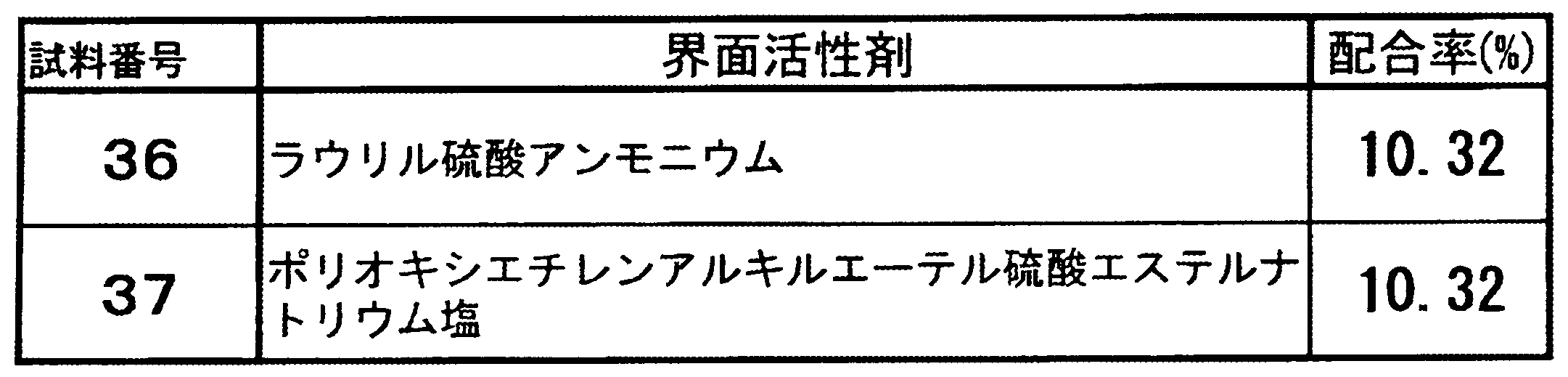
- FIG. 9 shows the results of measuring the inactivation ability of surfactants other than the antiviral agent (sample No. 19) and the soap against feline calicivirus. Similarly, the results of measuring the inactivation ability of an antiviral agent against avian influenza virus (sample No. 19) and a surfactant other than soap are shown in FIG.
- the black bars indicate the remaining virus infectivity, and the white bars indicate cytotoxicity. Each document number is indicated on the horizontal axis.
- the rightmost PBS shows the infectivity of the virus used in the experiment when no antiviral agent was added.
- Example 1 The virus inactivation ability of various surfactants having a C18 unsaturated alkyl chain and potassium oleate soap (C18: 1) prepared in Example 1 was compared.
- Nonionic surfactant Polyoxyethylene sorbitan monooleate, (Anionic surfactant) Sodium oleyl sulfate, (Anionic surfactant) Oleoylsarcosine were used as comparative controls. Each was diluted to 0.0035 mol / L with purified water.
- Example 2 Cat crisp in the same manner as in Example 1 except that one of the three types of synthetic surfactants of potassium oleate (C18: 1) prepared in Example 1 was used as an antiviral agent. The inactivation ability against the virus was examined. Further, the inactivation ability against the avian influenza virus was examined in the same manner as in Example 2.
- Example 9 The results of Example 9 are shown in FIGS. FIG. 11 shows the effect on feline calicivirus, and FIG. 12 shows the effect on avian influenza virus. It was shown that polyoxyethylene sorbitan monooleate, a nonionic surfactant among synthetic surfactants having C18 unsaturated alkyl groups, has no ability to inactivate either virus.
- Anionic surfactants can reduce the infectious titer to less than 1/10 of sodium oleyl sulfate for influenza virus and 1/1000 of oleoylsarcosine, but oleyl for feline calicivirus Sodium sulfate could lower the infectious titer to less than 1/10, but oleoylsarcosine could not lower the infectious titer. Therefore, among the surfactants having a C18 unsaturated alkyl group, the anionic system exhibits antiviral properties, and among them, the fatty acid soap potassium oleate soap (C18: 1) has excellent antiviral properties. Indicated.
- Example 10 The results of Example 10 are shown in FIGS. FIG. 13 shows the effect on feline calicivirus, and FIG. 14 shows the effect on avian influenza virus.
- the inactivation ability increases as the number of carbon atoms in the fatty acid chain in the fatty acid soap increases, and all C18 unsaturated fatty acid soaps have superior virus inactivation ability against feline calicivirus. It was shown that. It was shown that C18: 3 (linolenic acid) soap had a weak effect against avian influenza virus, and that C18: 1 (oleic acid) or C18: 2 (linoleic acid) soap had an excellent effect. .
- Example 7 (Effects against swine-derived influenza A (H1N1)) Sample No. 19 prepared in Example 7 was used to examine the antiviral effect against new influenza (Swin-origin influenza A / Hiroshima / 201/2009 (H1N1)) that caused a pandemic in 2009. The sample No. 19 prepared in Example 6 was diluted 100-fold to 0.0035 M as an antiviral agent, and Sine-origin influenza A / Hiroshima / 201/2009 (H1N1) strain (Hiroshima Prefectural General) was used as a virus. The measurement was performed in the same manner as in Example 2 except that the technology provided by Technical Research Laboratory was used.
- Example 11 The result of Example 11 is shown in FIG. It was shown that the antiviral agent of Sample No. 19 prepared in Example 6 has an excellent effect against new influenza.
- the present invention can provide an antiviral agent having excellent bactericidal properties by purifying hands and face, inactivating viruses such as norovirus and influenza virus that do not require wiping or washing with water. It can also be used as a wiper or mask, impregnated in fabric, etc., added to a footbath, or impregnated in a foot wiping mat, and can be used to inactivate viruses such as norovirus and influenza virus and has excellent bactericidal properties Agent can be provided. Further, it is possible to provide a cleaning agent that can be safely used as a cleaning agent on the limbs and face and inactivates viruses such as norovirus and influenza virus and has excellent bactericidal properties.
Landscapes
- Health & Medical Sciences (AREA)
- Life Sciences & Earth Sciences (AREA)
- Chemical & Material Sciences (AREA)
- General Health & Medical Sciences (AREA)
- Animal Behavior & Ethology (AREA)
- Public Health (AREA)
- Veterinary Medicine (AREA)
- Engineering & Computer Science (AREA)
- Chemical Kinetics & Catalysis (AREA)
- Wood Science & Technology (AREA)
- Organic Chemistry (AREA)
- Medicinal Chemistry (AREA)
- Virology (AREA)
- Pharmacology & Pharmacy (AREA)
- Oil, Petroleum & Natural Gas (AREA)
- Epidemiology (AREA)
- Dermatology (AREA)
- Oncology (AREA)
- Environmental Sciences (AREA)
- Nuclear Medicine, Radiotherapy & Molecular Imaging (AREA)
- Communicable Diseases (AREA)
- General Chemical & Material Sciences (AREA)
- Zoology (AREA)
- Dentistry (AREA)
- Plant Pathology (AREA)
- Agronomy & Crop Science (AREA)
- Pest Control & Pesticides (AREA)
- Molecular Biology (AREA)
- Birds (AREA)
- Emergency Medicine (AREA)
- Pulmonology (AREA)
- Detergent Compositions (AREA)
- Agricultural Chemicals And Associated Chemicals (AREA)
- Acyclic And Carbocyclic Compounds In Medicinal Compositions (AREA)
- Cosmetics (AREA)
Abstract
Description
また、流行性感冒は、罹患している人の咳、くしゃみ、つばなどの飛沫と共に放出されたインフルエンザウイルスを、鼻腔や気管など気道に吸入することによって感染する。放出されたウイルスは、手や顔、衣類等にも付着するため、手で目をこすったり、鼻を触ったりすることも感染経路となる。そこで、外出後、手洗いや洗顔を行ない、手や顔等に付着したウイルスを物理的に洗い流すことが感染予防として奨励されている。
(1)(特許文献1)に開示の技術は、ノロウイルスを不活化させることはできるが、手にとって擦り合わせると刺激を感じることがあるため(公報の段落0052~段落0053)、皮膚の敏感な人は手や顔に使用することができず、また洗浄剤ではないため、皮膚の表面を洗浄化できないという課題を有していた。
(2)(特許文献2)に開示の技術は、ノロウイルスを不活化させることはできるが、アルコールに過敏な人には使用することができず、また洗浄剤ではないため、皮膚の表面を洗浄化できないという課題を有していた。
(3)(特許文献3)に開示の技術は、多くの細菌やウイルスを殺菌、不活化できるが、構成する陰イオン系界面活性剤が天然成分由来ではなく、自然界では分解しにくいため、環境汚染をもたらすという課題を有していた。
(4)また、多くの薬用洗浄剤は抗ウイルス成分として殺菌剤を添加しているが、これらの添加剤は湿疹やアレルギー性皮膚炎の原因となることがあった。
本発明の請求項1に記載の抗ウイルス剤は、C18不飽和アルキル基をもつ界面活性剤を有効成分として含む構成を有している。
この構成により、以下のような作用が得られる。
(1)本発明者らは、界面活性剤のウイルス感染性に対する不活性化能を鋭意研究し評価することにより、C18不飽和アルキル基をもつ界面活性剤が、インフルエンザウイルス、ネコカリシウイルス等のウイルス感染性に対する不活性化能が高いという未知の属性を見出し、この発見に基づき、C18不飽和アルキル基をもつ界面活性剤が、抗ウイルス剤という新たな用途への使用に適することを見出した。
(2)C18不飽和アルキル基をもつ界面活性剤によりインフルエンザウイルス、ネコカリシウイルスは感染性を低下し、ウイルス感染価が1%以下に下がり、インフルエンザウイルス、ネコカリシウイルスの感染性に対する不活性化能が非常に高い。
(3)非常に薄い濃度でウイルスを不活化できるので、薬用セッケン等の洗浄剤のように、必ずしも泡立てたり水によって洗い流したりする必要がない。
C18不飽和アルキル基をもつ界面活性剤を他の界面活性剤や抗菌性化合物、抗ウイルス性化合物と併用することも可能である。これにより抗菌性化合物や抗ウイルス性化合物の効果をシナジー効果で高めることが期待できる。
この構成により、請求項1の作用に加え、以下のような作用が得られる。
(1)セッケンは環境中でCaやMgと結合して金属セッケンとなり沈殿し、微生物などの餌となるため環境汚染の原因となることが少ない。
(2)天然素材で作られ、微量で効果を示すので、食品や食器、肌着、ベビー用品などに安心して使用できる。
C18不飽和脂肪酸セッケンとしては、脂肪酸のナトリウム塩、カリウム塩、アンモニウム塩、アルギニン塩、トリエタノールアンモニウム塩等のアルカノールアミン塩若しくはこれらの複合塩が用いられ、1種又は2種以上を選択して使用する。
この構成により、請求項1の作用に加え、以下のような作用が得られる。
(1)リノール酸(C18:2)やリノレン酸(C18:3)のように不飽和結合が増えると酸化されやすく、製品が劣化し易くなる。C18不飽和脂肪酸セッケンがオレイン酸(C18:1)を主とすることで劣化し難く安定性に優れる。
この構成により、以下のような作用が得られる。
(1)界面活性剤中のC18不飽和脂肪酸セッケンの割合が20~100wt%、より好ましくは30~100wt%であるので、水で濃度0.1~3wt%以下に希釈して使用するときに優れた抗ウイルス性能を示すと共に、使用後の拭き取りをしなくても肌に異物感や刺激がない。
この構成により、以下のような作用が得られる。
(1)脂肪酸カリウムセッケン、脂肪酸ナトリウムセッケン、脂肪酸アルギニンセッケン、脂肪酸アンモニウムセッケン、脂肪酸トリエタノールアミンセッケンは環境中ではカルシウムやマグネシウムと結合して金属セッケンとなり、急速に界面活性化作用を失い、毒性が無くなる。金属セッケンは水中生物の餌となるので生分解性が高く、環境負荷が低い。
この構成により、以下のような作用が得られる。
(1)抗ウイルス性を示す有効成分であるオレイン酸セッケンが多く含まれているので、水で希釈されても通常の洗浄濃度範囲で優れた抗ウイルス性を示す。さらに水で希釈されて泡立たない濃度においてもオレイン酸セッケンが抗ウイルス性を示す。したがって手洗いの過程で、通常の洗浄剤が持つ洗い流し以上の抗ウイルス性を示し、ウイルス汚染の拡大を防ぐことができる。
(2)オレイン酸セッケンが50wt%以上と多く含まれるので、皮膚刺激が少なく保湿感等の使用感が良く、泡質と泡持ち性に優れるとともに、酸化安定性に優れた液体洗浄剤として使用でき、ウイルスを物理的に洗い流すだけではなく、インフルエンザウイルスやノロウイルス等のウイルス感染性に対する不活性化能が高く殺菌性に優れる。
なお、取扱性や起泡性等を考慮すると、本発明の抗ウイルス剤及び洗浄剤中のセッケンの濃度は0.5~40wt%が好適である。
油脂としては、特に限定されないが、例えば、大豆油、トウモロコシ油、米糠油、菜種油、綿実油、ヤシ油、パーム核油、パーム油、豚脂、魚油、牛脂、オリーブ油、ツバキ油、ヒマシ油、アマニ油、ヒマワリ油、落花生油、ゴマ油、ナッツ油、ピーナッツ油、グレープシード油、サフラワー油、アボガド油、米油、カカオ脂、シア脂等を挙げることができる。
ケン化法による場合、複数種の油脂を混合して原料油脂とすることで、適度な脂肪酸セッケンの割合の組成を得ることができる。
中和法による場合、グリセリンを加えることでケン化法で得られるセッケンと同様に用いることができる。精製した脂肪酸を配合して用いることで常に安定した品質を得られる利点がある。
なお、ケン化法によるセッケンと中和法によるセッケンを混合して利用しても構わない。ケン化法による天然油脂由来のセッケンの組成を中和法によるセッケンで調整して用いることで使用できる原料範囲が広がる利点がある。
この構成により、請求項6で得られる作用に加え、以下のような作用が得られる。
(1)飽和脂肪酸セッケンの総量に対するラウリン酸セッケンとミリスチン酸セッケンの合計量が70wt%以上であり、且つパルミチン酸セッケンやステアリン酸セッケンが15wt%未満とすることで、起泡性や泡質を向上させ、さらに低温粘度を低下させることができる。
(2)水温に関わらず優れた洗浄力を発揮するとともに、酸化安定性に優れる。
請求項1に記載の発明によれば、
(1)C18不飽和アルキル基をもつ界面活性剤を有効成分として含むので、インフルエンザウイルスやノロウイルス等のウイルス感染性に対する不活性化能に優れた抗ウイルス剤を提供できる。
(2)非常に薄い濃度でウイルスを不活化できるので、洗浄剤のように、泡立てたり水によって洗い流したりする必要がない抗ウイルス剤を提供できる。
(1)セッケンは合成界面活性剤とは違って、環境中でCaやMgと結合して金属セッケンとなり沈殿し、微生物などの餌となるため環境汚染の原因となることが少ない抗ウイルス剤を提供できる。
(2)天然素材で作られ、微量で効果を示すので、食品や食器、肌着、ベビー用品などに安心して使用できる抗ウイルス剤を提供できる。
(1)リノール酸(C18:2)やリノレン酸(C18:3)のように不飽和結合が増えると酸化されやすく、製品が劣化し易くなる。主としてオレイン酸(C18:1)であることで劣化し難く安定性に優れる抗ウイルス剤を提供できる。
(1)界面活性剤中のC18不飽和脂肪酸セッケンの割合が20~100wt%であるので、希釈して使用するときに優れた抗ウイルス性能を示すと共に、使用後の拭き取りをしなくても肌に異物感や刺激がない抗ウイルス剤を提供できる。
(1)脂肪酸カリウムセッケン、脂肪酸ナトリウムセッケン、脂肪酸アルギニンセッケン、脂肪酸アンモニウムセッケン、脂肪酸トリエタノールアミンセッケンは環境中ではカルシウムやマグネシウムと結合して金属セッケンとして界面活性化作用を失い、毒性が無くなる。金属セッケンは水中生物の餌となるので生分解性が高く、環境負荷が低い抗ウイルス剤を提供できる。
(1)抗ウイルス性を示す有効成分であるオレイン酸セッケンが多く含まれているので、水で希釈されても通常の洗浄濃度範囲で優れた抗ウイルス性を示す。さらに水で希釈されて泡立たない濃度においてもオレイン酸セッケンが抗ウイルス性を示す。したがって手洗いの過程で、通常の洗浄剤が持つ洗い流し以上の抗ウイルス性を示し、ウイルス汚染の拡大を防ぐことができる洗浄剤が提供できる。
(2)オレイン酸セッケンが多く含まれるので、皮膚刺激が少なく保湿感等の使用感が良く、起泡性と泡持ち性に優れるとともに、酸化安定性に優れた液体洗浄剤として使用でき、ウイルスを物理的に洗い流すだけではなく、インフルエンザウイルスやノロウイルス等のウイルス感染性に対する不活性化能が高く殺菌性に優れる洗浄剤が提供できる。
(1)飽和脂肪酸セッケンの総量に対するラウリン酸セッケンとミリスチン酸セッケンの合計量が70~100wt%であり、且つパルミチン酸セッケン及びステアリン酸セッケンが15wt%未満とすることで、ウイルス感染性に対する不活性化能が優れるだけでなく、起泡性や泡質を向上させ、さらに低温粘度を低下させることができ、低温でも液状が維持される洗浄剤を提供できる。
(2)水温に関わらず優れた洗浄力を発揮するとともに、酸化安定性に優れ、抗ウイルス性に優れた洗浄剤を提供できる。
(3)皮膚刺激が少なく保湿感等の使用感が良く、起泡性と泡持ち性に優れるとともに、劣化安定性に優れた液体洗浄剤として使用でき、ウイルスを物理的に洗い流すだけではなく、インフルエンザウイルスやノロウイルス等のウイルス感染性に対する不活性化能が高く殺菌性に優れた洗浄剤を提供できる。
以下、本発明を実施するための形態について説明する。なお、本発明はこの実施の形態に限定されるものではない。
本発明による抗ウイルス剤は濃縮液状、または粉末状で提供される。使用者はこれを湯または水に希釈して用いる。室温の水に溶解して実際に各種濃度で使用して確かめたところ、使用時のC18不飽和アルキル基を持つ界面活性剤の濃度は0.1~3wt%より好ましくは0.3~1wt%であった。0.3wt%よりもC18不飽和アルキル基を持つ界面活性剤の濃度が薄いと抗ウイルス効果が低下し、0.1wt%より下がると著しく抗ウイルス効果が低下するため好ましくなかった。また3wt%を超えると泡立ちがあり、洗浄効果を示すが、水によって洗い流すか拭き取るかしないと皮膚に粘りや異物感を感じたり、発赤を生じて好ましくないことが分かった。この希釈した液を手足に滴下して擦り込む、または布等に含ませて拭く、噴霧器によって散布するなどによって、対象物に作用させると抗ウイルス剤は短時間でウイルスに作用して不活化するので、この後は必要に応じて布で拭き取るか、水で洗い流せばよい。なおこの濃度ではほとんど泡持ちができず、界面活性剤としての洗浄能力はなかった。
抗ウイルス処理をする対象物が浸漬できる大きさの薬液槽に水または湯を入れ、本発明による抗ウイルス剤をC18不飽和アルキル基を持つ界面活性剤の濃度が0.1~3wt%より好ましくは0.5~1wt%であるように添加し、攪拌して溶かす。処理対象物をこの薬液槽に浸漬することで表面についたウイルスが不活化する。シャーレ上のインフルエンザウイルス等は浸漬によって直ちに不活性化できた。同様にして手指や食器などに利用できる。またこの変法として、家畜などの足洗槽の水に添加溶解して利用できる。抗ウイルス剤は短時間で作用し、ウイルスを不活性化するので、薬液槽及び足洗槽での処理の後に水洗い或いは拭き取りの工程を設けてもよい。
本発明による洗浄剤については、形状や使用方法は従来のボディシャンプーやハンドソープ、薬用せっけんと変わらない。従来の製品と同様に使用することで、従来の洗浄剤の物理的なウイルスの洗い落とし効果に加えて、洗浄中にウイルスの不活性化が起こり、より効果的にウイルス感染の蔓延を防ぐことができる。
以下、本発明を実施例により具体的に説明する。なお、本発明はこれらの実施例に限定されるものではない。
ラウリン酸(NAA-122(日油(株)製))、ミリスチン酸(NAA-142(日油(株)製))、パルミチン酸(NAA-160(日油(株)製))、ステアリン酸(NAA-180(日油(株)製))、オレイン酸(EXO-S(日油(株)製))を表1に示した重量比で混合した。
水酸化カリウム0.175モルを精製水300mlに溶解し、60~70℃まで加熱し、表1に従って混合した脂肪酸0.175モル相当量を投入してよく混合し、精製水で500mlに調整し、室温まで徐冷して0.35M(セッケン総量のモル濃度)の抗ウイルス剤(試料番号1~18)を得た。

ノロウイルスは細胞培養が不能なので、ノロウイルス感染性を評価する場合には、ノロウイルスの縁類であるネコカリシウイルスを使用して類推するのが一般的である。そこで、実施例1の抗ウイルス剤(試料番号1~18)のネコカリシウイルス感染性に対する不活性化能を調べた。
ウイルスはネコカリシウイルス(カリシウイルス科ベシウイルス属)、細胞はCRFK細胞(ネコ腎由来)、希釈剤はEagle最小基本培地(MEM)、penicillin G、streptomycinを用いた。
まず、ウイルスに含まれる血清の影響を排除するために、ウイルス液をあらかじめ希釈剤で10倍に希釈した。この希釈ウイルス液10μLと抗ウイルス剤(試料番号1~18)を100倍に希釈したもの90μLを混和して、室温で3分間反応させたのち、希釈剤で10倍段階希釈列を調製した。
96穴プレートの単層CRFK細胞をリン酸緩衝生理食塩水(PBS)で1回洗浄し、希釈ウイルス液を接種した(50μL/ウェル)。ウイルスの吸着・侵入のために炭酸ガス培養器で1時間インキュベートした後、PBSで1回洗浄して、細胞維持液(希釈剤と同じ)を加えて(100μL/ウェル)培養した。4日後以降に細胞変性効果(CPE)が広がったところで固定・染色し、Behrens-Kaerber法を用いて50%感染量を評価し、ウイルス感染価(単位:50%培養組織感染価)[TCID50](/mL)を算出した。
なお、比較のため、抗ウイルス剤の代わりにPBSを用いて同様の実験を行ない、相当するウイルス感染価を算出した。
オレイン酸(C18:1)セッケンを50wt%以上含んでいる試料番号7~18ではウイルス感染価が凡そ100分の1に下がっているのに対して、オレイン酸の含量が25wt%の試料番号1~6では10分の1程度であり、0.0035Mの濃度でネコカリシウイルスを不活性化するにはオレイン酸セッケンの濃度が50wt%以上あることが好ましいことが示された。また細胞障害性は、試料番号1~18のいずれの抗ウイルス剤においても低いことが示された。
実施例1で作成した抗ウイルス剤(試料番号1~18)のトリ型インフルエンザウイルス感染性に対する不活性化能を調べた。
ウイルスはインフルエンザウイルスA/whistling swan/Shimane/499/83(H5N3)(オルソミクソウイルス科インフルエンザウイルスA属)、細胞はMDCK(+)細胞、希釈剤はDulbecco変法Eagle最小基本培地(DMEM)にpenicillin G、streptomycin、amphotericin B、crude trypsinを添加したものを用いた。
ウイルス液10μLと抗ウイルス剤(試料番号1~18)を100倍に希釈したもの90μLを混和して、室温で3分間反応させた後、希釈剤(DMEM)で10倍段階希釈液を作り、96穴プレートの単層培養細胞に接種し(100μL/ウェル)、培養した。4日目以降に細胞変性効果(CPE)が広がったところで固定・染色し、Behrens-Kaerber法を用いて50%感染量を評価し、ウイルス感染価(単位:50%培養組織感染価)[TCID50](/mL)を算出した。
なお、比較のため、抗ウイルス剤の代わりにリン酸緩衝生理食塩水(PBS)を用いて同様の実験を行ない、相当するウイルス感染価を算出した。
オレイン酸(C18:1)を50wt%以上含んでいる試料番号7~18ではウイルス感染価が凡そ1000分の1近くに下がっているのに対して、オレイン酸の含量が25wt%の試料番号1~6では100分の1程度であり、ネコカリシウイルスの場合よりも高い不活性化能を示した。トリ型インフルエンザウイルスがエンベロープを持つのに対してネコカリシウイルスがエンベロープを持たないことがこの抗ウイルス剤に対する感受性の差の原因と考えられる。この結果から、0.0035Mの濃度でトリ型インフルエンザウイルスを不活性化するにはオレイン酸の濃度が25wt%以上あることが好ましく、より好ましくは50wt%以上であることが示された。
実施例1で作成した抗ウイルス剤(試料番号1~18)について、洗浄剤として使用したときの起泡性、泡持ち、洗浄性、使用感(しっとり感)、安定性を評価した。
各評価項目について、パネラー2名により以下の基準に従って官能評価し、その平均スコアを求めた。
起泡性は、各抗ウイルス剤0.3gをポンプフォーマーで吐出させ手になじませた時に、充分な泡が立つときはスコア5、少し泡立つときはスコア3、ほとんど泡立たないときはスコア1とした。(それらの中間を4および2とした。)
泡持ちは起泡性の評価において泡立てた泡が1分以上、保持されたときはスコア5、
少し減少したときはスコア3、ほとんど泡が消失したときはスコア1とした。(それらの中間を4および2とした。)
洗浄性は、脂性肌の女性パネラーに各抗ウイルス剤1gを用いて洗顔してもらい、洗顔後の額あるいは鼻梁側などの皮脂の多い部位にべたつきが無くすっきりしているときはスコア5、ややべたつきがあるときはスコア3、べたつきがあるときはスコア1とした。(それらの中間を4および2とした。)
使用感は、洗浄性を評価するために洗顔した後、しっとりするときはスコア5、ややしっとりするときはスコア3、しっとりしないときはスコア1とした。(それらの中間を4および2とした。)
安定性については、0.35Mの液を1℃の恒温器に入れたものが、沈殿を生じたり、白濁しているときは1、透明のままで変化が無かった場合を5とした。
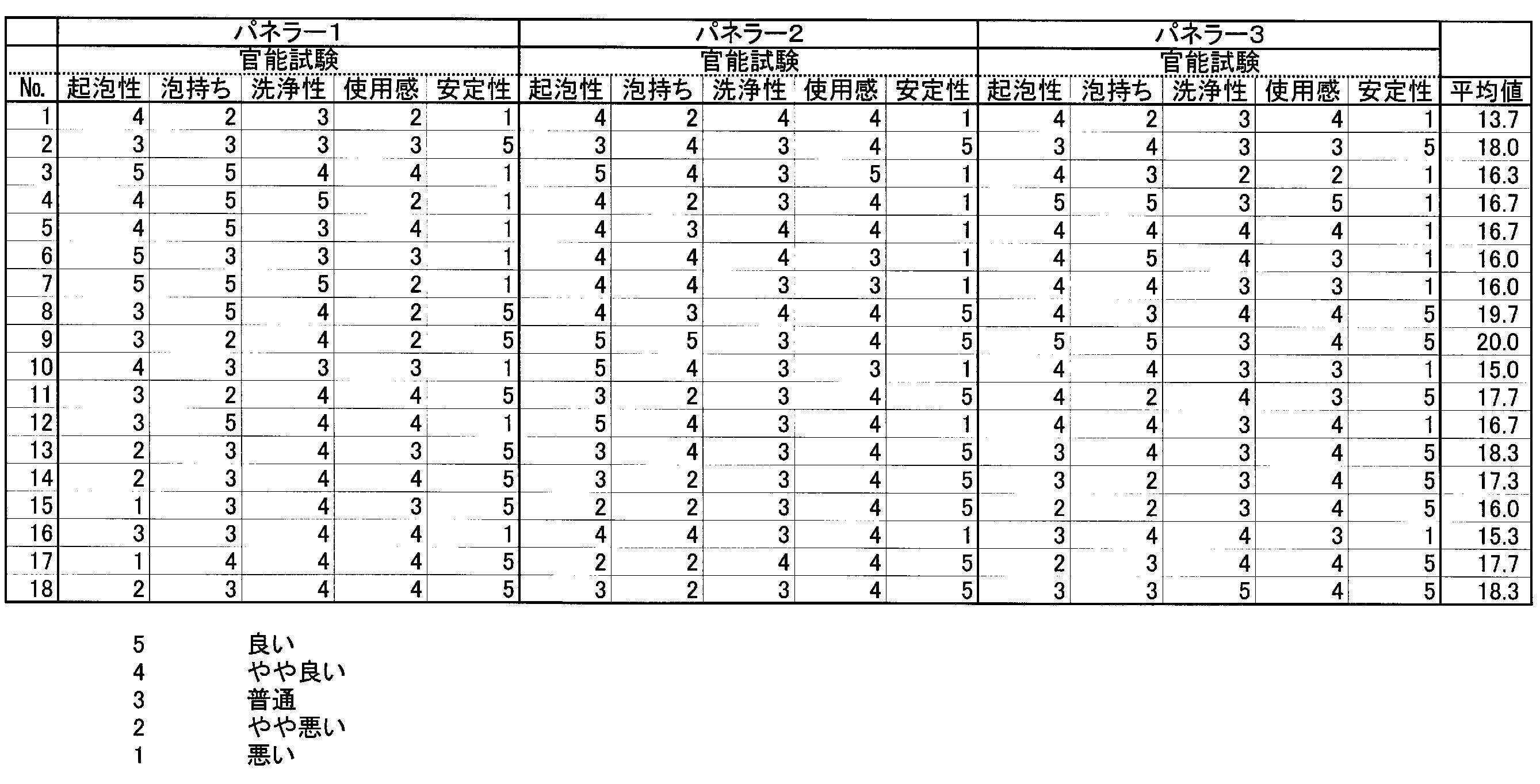
またセッケン総量に対してオレイン酸セッケンが50wt%以上含まれていても(試料番号7~18)、飽和脂肪酸中でパルミチン酸セッケンやステアリン酸セッケンが15wt%以上含まれていると(試料番号10及び16)では評価合計の平均点が低かった。これよりセッケン総量に対してオレイン酸セッケンが50~75wt%であるときにはパルミチン酸セッケンやステアリン酸セッケンは15wt%未満であることが好ましいことが示された。
オレイン酸を0.175モル使用した以外は実施例1と同様にしてオレイン酸のカリウムセッケン(0.35M)を調製した。また水酸化カリウム0.175モルの代わりに水酸化ナトリウム0.175モルを使用して同様にオレイン酸ナトリウムセッケン(0.35M)を調製した。
これらのオレイン酸セッケンを抗ウイルス剤として実施例2と同様にしてトリ型インフルエンザウイルスに対する不活性化能を測定した。
オレイン酸のみ、カプリル酸((NAA-82(日油(株)製))のみ、カプリン酸(NAA-102(日油(株)製))、ラウリン酸のみ、ミリスチン酸のみ、について実施例1と同様にしてそれぞれの脂肪酸のカリウムセッケン0.35Mの溶液を調製した。
このオレイン酸カリウムセッケン3容量に対して他の脂肪酸カリウムセッケン7容量の割合で混合し、抗ウイルス剤とした(総セッケン濃度としてセッケン0.35M)。
この抗ウイルス剤を用いて実施例2と同様にしてトリ型ウイルスに対する不活性化能を測定した。(100倍希釈してウイルスと混合しているので、セッケン濃度0.0035Mにおける測定となる。)
ラウリン酸、ミリスチン酸、パルミチン酸、ステアリン酸、オレイン酸をモル比でラウリン酸:ミリスチン酸:パルミチン酸:ステアリン酸:オレイン酸=25:9:1:0:65となるように混合した以外は、実施例1と同様にして抗ウイルス剤(総セッケン濃度で0.35M)(試料番号19)を調製した。
(ウイルス不活性化能に対する脂肪酸混合抗ウイルス剤の濃度の影響)
試料番号19の抗ウイルス剤を精製水で希釈して、濃度を変えた抗ウイルス剤を用いて実施例1と同様にして、ネコカリシウイルス不活性化能に対する抗ウイルス剤(試料番号19)の濃度の影響を調べた。
また実施例2と同様にして、トリ型インフルエンザウイルス不活性化能に対する抗ウイルス剤(試料番号19)の濃度の影響を調べた。
ネコカリシウイルスに対しては100倍希釈(セッケン濃度0.0035M)において感染価を100分の1下げ、10倍希釈(セッケン濃度0.035M)では1000分の1に下げる効果を示した。
トリ型インフルエンザウイルスに対しては1000倍希釈(セッケン濃度0.00035M)においても感染価を1000分の1に下げる効果を示した。ネコカリシウイルスがインフルエンザウイルスと違ってエンベロープを持たないことが効果の差の原因と考えられる。
なおセッケンは濃度2.5wt%以下では洗浄機能を持たないため、この効果の原因はセッケンの洗浄機能とは別のものと考えられる。
洗浄剤に使われることが多い添加剤について検討した。
まず、実施例6で作成した抗ウイルス剤(試料番号19)単独とそれに添加剤を加えた場合のウイルス不活性化能を比較した。表3上欄に使用した添加剤とその配合率を示す。
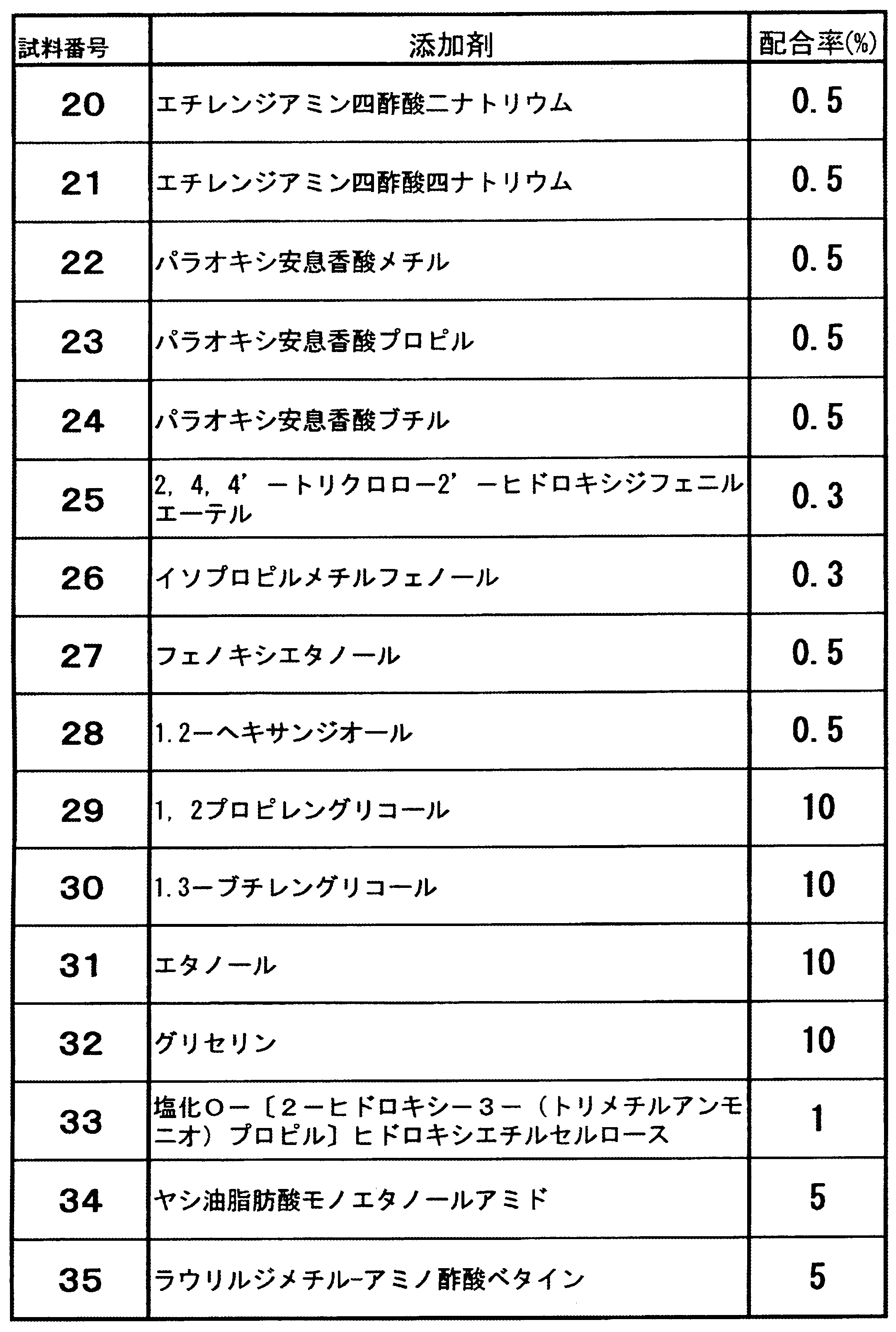
実施例1と同様にしてネコカリシウイルスへの不活性化能を、実施例2と同様にしてトリ型インフルエンザへの不活性化能を測定した。比較のためにそれらの添加剤を加えない場合も同様に調べた。
比較した添加剤には本発明の抗ウイルス剤(試料番号19)のウイルス不活性化能を高める効果を示すものはなかった。ヤシ油脂肪酸モノエタノールアミドなど細胞障害性を高めるものがいくつかあり、添加剤の使用には注意が必要であることが示された。
洗浄剤に配合されることが多いセッケン以外の界面活性剤について検討した。
実施例6で作成した抗ウイルス剤(試料番号19)単独とセッケン以外の界面活性剤についてウイルス不活性化能を比較した。表4欄に使用した界面活性剤とその配合率を示す。
C18不飽和アルキル鎖をもつ各種界面活性剤と実施例1で作成したオレイン酸カリウムセッケン(C18:1)のウイルス不活性化能を比較した。(非イオン系界面活性剤)ポリオキシエチレンソルビタンモノオレート、(陰イオン系界面活性剤)オレイル硫酸ナトリウム、(陰イオン系界面活性剤)オレオイルザルコシンを比較対照とした。それぞれ0.0035mol/Lに精製水で希釈して用いた。
抗ウイルス剤として実施例1で作成したオレイン酸カリウムセッケン(C18:1)又は上記3種の合成界面活性剤3種の内のいずれか1を使用した以外は実施例1と同様にしてネコカリシウイルスに対する不活性化能を調べた。さらに実施例2と同様にしてトリ型インフルエンザウイルスに対する不活性化能を調べた。
C18不飽和アルキル基をもっている合成界面活性剤の中で非イオン系界面活性剤であるポリオキシエチレンソルビタンモノオレートはどちらのウイルスに対しても不活性化する能力がないことが示された。陰イオン系界面活性剤ではインフルエンザウイルスに対してはオレイル硫酸ナトリウムが10分の1以下に、オレオイルザルコシンが1000分の1程度まで感染価を下げれるが、ネコカリシウイルスに対してはオレイル硫酸ナトリウムが10分の1以下に感染価を下げれるが、オレオイルザルコシンは感染価を下げれなかった。よってC18不飽和アルキル基をもつ界面活性剤の中で陰イオン系が抗ウイルス性を示すこと、その中でも脂肪酸セッケンであるオレイン酸カリウムセッケン(C18:1)が優れた抗ウイルス性を持つことが示された。
実施例1で調製したラウリン酸(C12)、ミリスチン酸(C14)、オレイン酸(C18:1)のカリウム石けんに加えて、リノール酸(C18:2)、リノレン酸(C18:3)のカリウムセッケンを実施例1と同様にして調製した。それぞれを濃度0.035Mに希釈して抗ウイルス剤として用いた以外は実施例1と同様にしてネコカリシウイルスに対する不活性化能を調べた。さらに実施例2と同様にしてトリ型インフルエンザウイルスに対する不活性能を調べた。
どちらのウイルスに対しても脂肪酸セッケン中の脂肪酸鎖の炭素数が増えるほど不活性化能が上がること、C18不飽和脂肪酸石けんがネコカリシウイルスに対していずれも優れたウイルス不活性化能を持つことが示された。トリ型インフルエンザウイルスに対してはC18:3(リノレン酸)のセッケンの効果が弱く、C18:1(オレイン酸)またはC18:2(リノール酸)のセッケンの効果が優れていることが示された。
実施例7で作成した試料番号19を用いて、2009年にパンデミックを引き起こした新型インフルエンザ(Swine-origin influenza A/Hiroshima/201/2009(H1N1))に対する抗ウイルス効果を調べた。
抗ウイルス剤として実施例6で作成した試料番号19を100倍希釈して0.0035Mとしたものを使用し、ウイルスとしてSwine-origin influenza A/Hiroshima/201/2009(H1N1)株(広島県立総合技術研究所から供与)を使用した以外は実施例2と同様にして測定した。
Claims (7)
- C18不飽和アルキル基をもつ界面活性剤を有効成分として含むことを特徴とする抗ウィルス剤。
- 前記C18不飽和アルキル基をもつ界面活性剤がC18不飽和脂肪酸セッケンであることを特徴とする請求項1に記載の抗ウィルス剤。
- 前記C18不飽和脂肪酸セッケンが主としてオレイン酸セッケンであることを特徴とする請求項2に記載の抗ウィルス剤。
- 界面活性剤の総量に対する前記C18不飽和脂肪酸セッケンの割合が20~100wt%、より好ましくは30~100wt%であることを特徴とする請求項1乃至3の内いずれか1に記載の抗ウィルス剤。
- 脂肪酸のカリウム塩、ナトリウム塩、アルギニン塩、アンモニウム塩、トリエタノールアミン塩の内いずれか1であるセッケンを主成分とすることを特徴とする請求項1乃至4のいずれか1に記載の抗ウィルス剤。
- 請求項1乃至5のいずれか1に記載の抗ウィルス剤を有効成分として含むこと、セッケンの総量に対するオレイン酸セッケンの割合が50~略100wt%であること、を特徴とする洗浄剤。
- 飽和脂肪酸セッケンの総量に対するラウリン酸セッケンとミリスチン酸セッケンの合計量の割合が70wt%以上であり、且つ飽和脂肪酸セッケンの総量に対するステアリン酸セッケン及びパルミチン酸セッケンの割合がいずれも15wt%未満であり、セッケンの総量に対するオレイン酸セッケンの割合が50~75wt%であることを特徴とする請求項6に記載の洗浄剤。
Priority Applications (5)
| Application Number | Priority Date | Filing Date | Title |
|---|---|---|---|
| US13/264,934 US20120046362A1 (en) | 2009-04-17 | 2010-04-16 | Antiviral agent and cleansing agent |
| RU2011146534/15A RU2491929C2 (ru) | 2009-04-17 | 2010-04-16 | Противовирусное средство и чистящее средство |
| CN2010800167832A CN102395269B (zh) | 2009-04-17 | 2010-04-16 | 抗病毒剂及清洗剂 |
| JP2011509373A JP5593572B2 (ja) | 2009-04-17 | 2010-04-16 | 抗ウイルス剤及び洗浄剤 |
| KR1020117024542A KR101426744B1 (ko) | 2009-04-17 | 2010-04-16 | 항바이러스제 및 세정제 |
Applications Claiming Priority (4)
| Application Number | Priority Date | Filing Date | Title |
|---|---|---|---|
| JP2009101458 | 2009-04-17 | ||
| JP2009-101458 | 2009-04-17 | ||
| JP2009265756 | 2009-11-20 | ||
| JP2009-265756 | 2009-11-20 |
Publications (1)
| Publication Number | Publication Date |
|---|---|
| WO2010119966A1 true WO2010119966A1 (ja) | 2010-10-21 |
Family
ID=42982623
Family Applications (1)
| Application Number | Title | Priority Date | Filing Date |
|---|---|---|---|
| PCT/JP2010/056879 Ceased WO2010119966A1 (ja) | 2009-04-17 | 2010-04-16 | 抗ウイルス剤及び洗浄剤 |
Country Status (6)
| Country | Link |
|---|---|
| US (1) | US20120046362A1 (ja) |
| JP (1) | JP5593572B2 (ja) |
| KR (1) | KR101426744B1 (ja) |
| CN (1) | CN102395269B (ja) |
| RU (1) | RU2491929C2 (ja) |
| WO (1) | WO2010119966A1 (ja) |
Cited By (5)
| Publication number | Priority date | Publication date | Assignee | Title |
|---|---|---|---|---|
| JP2013185036A (ja) * | 2012-03-07 | 2013-09-19 | Kao Corp | バイオフィルム除去剤 |
| JP2016210807A (ja) * | 2016-09-09 | 2016-12-15 | 株式会社ニイタカ | 消毒液及び消毒方法 |
| JP2020075887A (ja) * | 2018-11-08 | 2020-05-21 | シャボン玉石けん株式会社 | バイオフィルム除去剤およびバイオフィルム除去方法 |
| JP2021187855A (ja) * | 2020-05-29 | 2021-12-13 | シャボン玉石けん株式会社 | 濯ぎの必要ない拭取用皮膚洗浄剤および皮膚洗浄方法 |
| JPWO2022264768A1 (ja) * | 2021-06-15 | 2022-12-22 |
Families Citing this family (10)
| Publication number | Priority date | Publication date | Assignee | Title |
|---|---|---|---|---|
| WO2016018475A1 (en) | 2014-07-31 | 2016-02-04 | Kimberly-Clark Worldwide, Inc. | Anti-adherent composition |
| AU2015297024A1 (en) | 2014-07-31 | 2017-03-02 | Kimberly-Clark Worldwide, Inc. | Anti-adherent alcohol-based composition |
| AU2015297022A1 (en) | 2014-07-31 | 2017-03-02 | Kimberly-Clark Worldwide, Inc. | Anti-adherent composition |
| MX384467B (es) | 2015-04-01 | 2025-03-14 | Kimberly Clark Co | Sustrato fibroso para la captura de bacterias gramnegativas. |
| GB2541935B (en) * | 2015-09-07 | 2020-05-20 | Naturiol Bangor Ltd | Insecticide/miticide composition |
| MX2018008569A (es) | 2016-01-28 | 2018-08-16 | Kimberly Clark Co | Composicion antiadherente contra virus de acido desoxirribonucleico (adn) y metodo para inhibir la adherencia de virus de acido desoxirribonucleico (adn) a una superficie. |
| US11168287B2 (en) | 2016-05-26 | 2021-11-09 | Kimberly-Clark Worldwide, Inc. | Anti-adherent compositions and methods of inhibiting the adherence of microbes to a surface |
| CN111743888B (zh) * | 2020-06-16 | 2021-10-22 | 广州医科大学附属第一医院 | (2z,4e)-2,4-癸二烯酸在制备用于治疗流感病毒引起的炎症的药物方面的应用 |
| FR3115961B1 (fr) * | 2020-11-06 | 2023-06-02 | Savonnerie De La Goutte Noire | Solution virucide de lavage des mains et procede de preparation |
| CN118613164A (zh) | 2022-01-28 | 2024-09-06 | 花王株式会社 | 包膜病毒灭活剂 |
Citations (8)
| Publication number | Priority date | Publication date | Assignee | Title |
|---|---|---|---|---|
| US4139630A (en) * | 1974-12-03 | 1979-02-13 | Ortho Pharmaceutical Corp. | Nonionic surface active anti-viral agents |
| JPS6257496A (ja) * | 1985-09-06 | 1987-03-13 | 水本 克治 | 泡立ちのよい液体石鹸 |
| WO1989006124A1 (en) * | 1987-12-31 | 1989-07-13 | Research Foundation For Mental Hygiene, Inc. | Antiviral and antibacterial activity of fatty acids and monoglycerides |
| JPH0665058A (ja) * | 1992-08-24 | 1994-03-08 | Pola Chem Ind Inc | 洗浄剤組成物 |
| WO2001053444A1 (en) * | 2000-01-20 | 2001-07-26 | The Procter & Gamble Company | Antimicrobial compositions |
| WO2003099006A1 (en) * | 2002-05-29 | 2003-12-04 | Air Liquide Sante (International) | Disinfectant with activity against hepatitis b virus |
| JP2007238651A (ja) * | 2006-03-03 | 2007-09-20 | Furukawa Techno Material Co Ltd | 水添加型の界面活性剤系組成物 |
| JP2010024587A (ja) * | 2008-07-22 | 2010-02-04 | Tottori Univ | 抗ウイルス剤及び抗ウイルス性シート |
Family Cites Families (11)
| Publication number | Priority date | Publication date | Assignee | Title |
|---|---|---|---|---|
| US4065398A (en) * | 1973-03-12 | 1977-12-27 | Lever Brothers Company | Liquid soap composition |
| GB2034741B (en) * | 1978-10-23 | 1983-01-19 | Unilever Ltd | Soap powder |
| US4310433A (en) * | 1980-09-02 | 1982-01-12 | The Procter & Gamble Company | Superfatted liquid soap skin cleansing compositions |
| GB9012613D0 (en) | 1990-06-06 | 1990-07-25 | Unilever Plc | Soap powder compositions |
| US5646190A (en) * | 1991-03-01 | 1997-07-08 | Warner-Lambert Company | Acne treating-wound healing compositions and methods for preparing and using same |
| RU2016060C1 (ru) * | 1993-03-23 | 1994-07-15 | Фирма "Комитэкс", Акционерное общество "Дальсоя" | Туалетное мыло общегигиенического и лечебно-профилактического назначения |
| FR2737408B1 (fr) * | 1995-07-31 | 1997-09-05 | Oreal | Utilisation d'un antagoniste de bradykinine dans une composition cosmetique, pharmaceutique ou dermatologique et composition obtenue |
| US7763587B2 (en) * | 2002-06-13 | 2010-07-27 | L'oreal S.A. | Derivative of glucose and of vitamin F, compositions comprising it, uses and preparation process |
| RU2213579C1 (ru) * | 2002-09-05 | 2003-10-10 | Закрытое акционерное общество "Медицинская компания СиДжи" | Дезинфицирующее средство |
| JP2004307635A (ja) * | 2003-04-07 | 2004-11-04 | Mizumoto Katsuharu | 植物性液体石鹸 |
| JP4635223B2 (ja) * | 2004-09-06 | 2011-02-23 | 株式会社古河テクノマテリアル | 界面活性剤系組成物 |
-
2010
- 2010-04-16 CN CN2010800167832A patent/CN102395269B/zh active Active
- 2010-04-16 RU RU2011146534/15A patent/RU2491929C2/ru active
- 2010-04-16 JP JP2011509373A patent/JP5593572B2/ja active Active
- 2010-04-16 US US13/264,934 patent/US20120046362A1/en not_active Abandoned
- 2010-04-16 KR KR1020117024542A patent/KR101426744B1/ko active Active
- 2010-04-16 WO PCT/JP2010/056879 patent/WO2010119966A1/ja not_active Ceased
Patent Citations (8)
| Publication number | Priority date | Publication date | Assignee | Title |
|---|---|---|---|---|
| US4139630A (en) * | 1974-12-03 | 1979-02-13 | Ortho Pharmaceutical Corp. | Nonionic surface active anti-viral agents |
| JPS6257496A (ja) * | 1985-09-06 | 1987-03-13 | 水本 克治 | 泡立ちのよい液体石鹸 |
| WO1989006124A1 (en) * | 1987-12-31 | 1989-07-13 | Research Foundation For Mental Hygiene, Inc. | Antiviral and antibacterial activity of fatty acids and monoglycerides |
| JPH0665058A (ja) * | 1992-08-24 | 1994-03-08 | Pola Chem Ind Inc | 洗浄剤組成物 |
| WO2001053444A1 (en) * | 2000-01-20 | 2001-07-26 | The Procter & Gamble Company | Antimicrobial compositions |
| WO2003099006A1 (en) * | 2002-05-29 | 2003-12-04 | Air Liquide Sante (International) | Disinfectant with activity against hepatitis b virus |
| JP2007238651A (ja) * | 2006-03-03 | 2007-09-20 | Furukawa Techno Material Co Ltd | 水添加型の界面活性剤系組成物 |
| JP2010024587A (ja) * | 2008-07-22 | 2010-02-04 | Tottori Univ | 抗ウイルス剤及び抗ウイルス性シート |
Cited By (8)
| Publication number | Priority date | Publication date | Assignee | Title |
|---|---|---|---|---|
| JP2013185036A (ja) * | 2012-03-07 | 2013-09-19 | Kao Corp | バイオフィルム除去剤 |
| JP2016210807A (ja) * | 2016-09-09 | 2016-12-15 | 株式会社ニイタカ | 消毒液及び消毒方法 |
| JP2020075887A (ja) * | 2018-11-08 | 2020-05-21 | シャボン玉石けん株式会社 | バイオフィルム除去剤およびバイオフィルム除去方法 |
| JP2021187855A (ja) * | 2020-05-29 | 2021-12-13 | シャボン玉石けん株式会社 | 濯ぎの必要ない拭取用皮膚洗浄剤および皮膚洗浄方法 |
| JP7792632B2 (ja) | 2020-05-29 | 2025-12-26 | シャボン玉石けん株式会社 | 濯ぎの必要ない拭取用皮膚洗浄剤および皮膚洗浄方法 |
| JPWO2022264768A1 (ja) * | 2021-06-15 | 2022-12-22 | ||
| WO2022264768A1 (ja) * | 2021-06-15 | 2022-12-22 | Dic株式会社 | 抗菌抗ウイルス剤、抗菌抗ウイルス性コーティング組成物、積層体、抗菌抗ウイルス性樹脂組成物および成形体 |
| JP2023165705A (ja) * | 2021-06-15 | 2023-11-17 | Dic株式会社 | 抗菌抗ウイルス剤、抗菌抗ウイルス性コーティング組成物、積層体、抗菌抗ウイルス性樹脂組成物および成形体 |
Also Published As
| Publication number | Publication date |
|---|---|
| KR20120013329A (ko) | 2012-02-14 |
| US20120046362A1 (en) | 2012-02-23 |
| CN102395269B (zh) | 2013-11-20 |
| CN102395269A (zh) | 2012-03-28 |
| RU2011146534A (ru) | 2013-05-27 |
| JP5593572B2 (ja) | 2014-09-24 |
| JPWO2010119966A1 (ja) | 2012-10-22 |
| RU2491929C2 (ru) | 2013-09-10 |
| KR101426744B1 (ko) | 2014-08-06 |
Similar Documents
| Publication | Publication Date | Title |
|---|---|---|
| JP5593572B2 (ja) | 抗ウイルス剤及び洗浄剤 | |
| US20090035339A1 (en) | Methods of Inactivating Viruses | |
| US6951833B2 (en) | Anti-microbial compositions | |
| BRPI0720201B1 (pt) | composições suaves para desinfecção da pele e uso das mesmas | |
| EA024578B1 (ru) | Антибактериальная композиция | |
| JP7558317B2 (ja) | 洗浄殺菌組成物 | |
| MX2014013194A (es) | Agentes antimicrobianos sinergicos. | |
| CN103555450B (zh) | 一种抗菌去污液体洗涤剂及其制备方法 | |
| BR112015004813B1 (pt) | composição de sabão, método de desinfecção de uma superfície e usos de uma composição | |
| CN108125812B (zh) | 一种氨基酸型抑菌泡沫洗手液及其制备方法 | |
| US20160374973A1 (en) | Soap compositions and methods | |
| KR20190114706A (ko) | 강화 식물성 지방산 및 유화제를 포함하는 천연 세정제 조성물 및 그 제조방법 | |
| KR20100078777A (ko) | 속효성 항균 손세정제 조성물 | |
| WO2023060472A1 (zh) | 一种保湿无刺激泡沫型免洗手抑菌液及其制备方法 | |
| CN106889063A (zh) | 一种玉洁新泡腾片及其制备方法 | |
| CN106675893A (zh) | 一种内衣皂及其制备方法 | |
| US11459531B2 (en) | Potassium soaps that can be thickened with chloride salts | |
| CN116286217A (zh) | 一种芳香草药抑菌驱螨虫洗衣液及其制备工艺 | |
| JP7340290B2 (ja) | 抗エンベロープウイルス中性洗浄剤、消毒剤組成物、及びエンベロープウイルスの不活性化方法 | |
| KR102326041B1 (ko) | 강화 식물성 지방산 및 유화제를 포함하는 천연 세정제 조성물 및 그 제조방법 | |
| JP7701965B1 (ja) | 液体洗浄剤組成物 | |
| RU2586889C1 (ru) | Жидкое моющее средство | |
| CN120693142A (zh) | 杀菌及保存剂组合物 | |
| CN101697946A (zh) | 中药植物精华抗菌洁手液 | |
| CN106590985A (zh) | 一种消毒杀菌洗洁精 |
Legal Events
| Date | Code | Title | Description |
|---|---|---|---|
| WWE | Wipo information: entry into national phase |
Ref document number: 201080016783.2 Country of ref document: CN |
|
| 121 | Ep: the epo has been informed by wipo that ep was designated in this application |
Ref document number: 10764548 Country of ref document: EP Kind code of ref document: A1 |
|
| DPE1 | Request for preliminary examination filed after expiration of 19th month from priority date (pct application filed from 20040101) | ||
| ENP | Entry into the national phase |
Ref document number: 2011509373 Country of ref document: JP Kind code of ref document: A |
|
| NENP | Non-entry into the national phase |
Ref country code: DE |
|
| WWE | Wipo information: entry into national phase |
Ref document number: 13264934 Country of ref document: US |
|
| ENP | Entry into the national phase |
Ref document number: 20117024542 Country of ref document: KR Kind code of ref document: A |
|
| ENP | Entry into the national phase |
Ref document number: 2011146534 Country of ref document: RU Kind code of ref document: A |
|
| 122 | Ep: pct application non-entry in european phase |
Ref document number: 10764548 Country of ref document: EP Kind code of ref document: A1 |