WO2010107127A1 - コーティングされたうま味調味料及びその製造方法 - Google Patents
コーティングされたうま味調味料及びその製造方法 Download PDFInfo
- Publication number
- WO2010107127A1 WO2010107127A1 PCT/JP2010/054909 JP2010054909W WO2010107127A1 WO 2010107127 A1 WO2010107127 A1 WO 2010107127A1 JP 2010054909 W JP2010054909 W JP 2010054909W WO 2010107127 A1 WO2010107127 A1 WO 2010107127A1
- Authority
- WO
- WIPO (PCT)
- Prior art keywords
- water
- sodium
- glutamate
- coated
- anhydrous
- Prior art date
- Legal status (The legal status is an assumption and is not a legal conclusion. Google has not performed a legal analysis and makes no representation as to the accuracy of the status listed.)
- Ceased
Links
Images

Classifications
-
- A—HUMAN NECESSITIES
- A23—FOODS OR FOODSTUFFS; TREATMENT THEREOF, NOT COVERED BY OTHER CLASSES
- A23L—FOODS, FOODSTUFFS OR NON-ALCOHOLIC BEVERAGES, NOT OTHERWISE PROVIDED FOR; PREPARATION OR TREATMENT THEREOF
- A23L27/00—Spices; Flavouring agents or condiments; Artificial sweetening agents; Table salts; Dietetic salt substitutes; Preparation or treatment thereof
- A23L27/20—Synthetic spices, flavouring agents or condiments
- A23L27/21—Synthetic spices, flavouring agents or condiments containing amino acids
- A23L27/22—Synthetic spices, flavouring agents or condiments containing amino acids containing glutamic acids
-
- A—HUMAN NECESSITIES
- A23—FOODS OR FOODSTUFFS; TREATMENT THEREOF, NOT COVERED BY OTHER CLASSES
- A23L—FOODS, FOODSTUFFS OR NON-ALCOHOLIC BEVERAGES, NOT OTHERWISE PROVIDED FOR; PREPARATION OR TREATMENT THEREOF
- A23L27/00—Spices; Flavouring agents or condiments; Artificial sweetening agents; Table salts; Dietetic salt substitutes; Preparation or treatment thereof
- A23L27/70—Fixation, conservation, or encapsulation of flavouring agents
- A23L27/72—Encapsulation
Definitions
- the present invention relates to a umami seasoning coated with an extract with little flavor deterioration, which does not require a drying step after coating the umami seasoning with an extract, and a method for producing the same.
- Seasoning granules coated with a flavor extract on the outer surface are now widely manufactured and sold as high value-added complex seasonings with new flavors and functions added to the core material.
- core substances include umami seasonings typified by sodium L-glutamate monohydrate, granulated products mixed with sodium chloride, sugar, etc., and sodium glutamate monohydrate and single crystals of sodium chloride as examples. It is done.
- the flavor extract to be coated include water-soluble natural product extraction seasoning liquid typified by livestock meat extract and flavor oil for flavoring. Among them, the one obtained by coating and drying a water-soluble natural product extract seasoning liquid on L glutamate monohydrate, which is a typical component of umami, has a natural feeling and has a deep variety of flavors. Compared to the simple blend of dried products, there is no concern about classification, and there is no oil floating even when dissolved in water, so demand is high mainly for Japanese-style menus.
- the typical methods for coating the core material with the flavor extract are 1) fluidized bed coating method, 2) stirring coating method, 3) rolling coating method, 4) spray cooling method, etc. Is mentioned.
- the core material is moved by stirring with a fluidized bed or a stirring blade, or the rolling dish is shaken, and a flavor extract is sprayed on the core material.
- This is a technique for coating after forming a layer and drying. It can be used with both water-soluble extracts and flavor oils and is widely used because of its versatility.
- the spray cooling method is a S / O emulsion in which a low melting point fat is melted to form a continuous phase, in which a core material is suspended as a dispersed phase, and the emulsion is sprayed into a cooling can to form a core material.
- This is a technique for curing the oil and fat on the outer surface to form a coating layer.
- the above methods 1) to 3) are mainly used.
- the water is evaporated and dried by a drying process after spraying the extract. It is necessary to reduce the water activity (AW) to a predetermined value or less that does not cause spoilage.
- AW water activity
- hot air drying, vacuum drying, freeze drying, and the like can be cited as general methods.
- hot air drying is usually selected in many cases because of problems in processing capacity and cost.
- Patent Document 1 Patent Document 1
- Patent Literature 2 Patent Literature 3
- Patent Literature 4 Patent Literature 4
- Patent Document 5 a technique for drying a wet granulated product in which water is added as a binder using water-containing crystal conversion of an organic or inorganic acid salt anhydride such as sodium acetate, calcium lactate, or disodium succinate.
- Patent Document 6 a technique for crystalline nystose is dehydrated under reduced pressure and its moisture-containing crystal conversion is used to prevent moisture absorption during food storage. All of these are recovered as unstable anhydrous salts with no water of crystallization from substances that are thermally stable as conventional hydrated salts by high-temperature firing or crystallization in the presence of anhydrous seed crystals.
- the property of taking in free water existing outside and returning to a stable hydrated salt is used as an “edible desiccant”. Since the food material itself captures and immobilizes moisture, the food material itself has excellent characteristics that the drying operation itself is not necessary and the water-containing granule is converted into a dry granule without deteriorating its quality.
- JP-A-62-136240 Japanese Patent Laid-Open No. 62-152536 Japanese Patent Laid-Open No. Sho 62-152537 JP 2000-159788 A Japanese Patent Laid-Open No. 06-303937 Japanese Patent Laid-Open No. 06-031160
- an object of the present invention is to provide a umami seasoning coated with an extract and a method for producing the same, which does not require a drying step after coating the umami seasoning with the extract.
- the inventors of the present invention have completed the present invention as a result of intensive studies to solve the above problems. Specifically, the idea was to apply the principle to a hydrated crystal substance that has a generally high blending ratio in flavor seasonings, forms a large skeleton, and has stable viscosity and moisture absorption characteristics. .
- L-sodium glutamate which is an umami seasoning, is a hydrated salt with one crystal water and was conceived as a good target substance.
- sodium L-glutamate is a substance that stably crystallizes as a hydrated crystal, and the desorption temperature of crystal water from the hydrated crystal is around 130 ° C.
- the present invention includes the following inventions.
- a method for producing an umami seasoning coated with a water-soluble flavor extract wherein amorphous anhydrous L-glutamate sodium salt is coated with a water-soluble flavor extract, and a moisture drying step is not performed after the coating.
- a umami seasoning coated with a water-soluble flavor extract produced by the production method according to the invention (1).
- (3) 1.00 mass% or more and 9.0 mass% or less of water of L glutamate anhydrous salt weight can be taken in as crystal water, and powder water activity (AW) after taking in is 0.25.
- An umami seasoning coated with the water-soluble flavor extract according to the invention (2) characterized in that: (4) First step of obtaining sodium L-glutamate by using L-glutamate monohydrate as a starting material, and then drying the aqueous solution into amorphous dry particles by spray drying, and sodium L-glutamate obtained in the first step
- the water-soluble flavor extract is spray-stirred and mixed with the anhydrous salt to perform the second step of absorbing and immobilizing the water of the water-soluble flavor extract in the anhydrous sodium L-glutamate.
- Umami seasoning coated with water-soluble flavor extract characterized in that: (4) First step of obtaining sodium L-glutamate by using L-glutamate monohydrate as a starting material, and then drying the aqueous solution into amorphous dry particles by spray drying, and sodium L-glutamate obtained in the first step
- the water-soluble flavor extract is spray-stirred and mixed with the anhydrous salt to perform the second step of absorbing and immobilizing the water of the
- Sodium L-glutamate for food additives is generally produced by a fermentation method, sterilized after completion of the fermentation, and the clarified liquid is concentrated in an evaporator, crystallized, centrifuged and dried.
- the form of sodium L-glutamate usually obtained by this process is a crystal-containing hydrate, and finally it is put on the market as a stable monohydrate by crystallization conditions and drying adjustment. It is extremely difficult to take out from this crystallization step as an unstable anhydrous salt without passing through a crystal-containing hydrate in a normal production process.
- the hydrous crystals are at a temperature higher than the boiling point of free water under the pressure (100 ° C or higher under atmospheric pressure).
- a technique in which water molecules existing as bound water are forcibly desorbed from the crystal lattice is a technique in which water molecules existing as bound water are forcibly desorbed from the crystal lattice.
- the crystallization water desorption temperature is around 130 ° C., but pyrrolidone carboxylic acid (PCA) is formed by intramolecular dehydration condensation reaction between sodium L-glutamate monohydrates in the same temperature range. Since it occurs in parallel, it has been considered that it is extremely difficult to obtain a high purity L glutamic anhydride after firing.
- PCA pyrrolidone carboxylic acid
- the present inventors focused on the coordinating role of crystallization water in the hydrated crystal structure, and studied a method for recovering powder in a structure that does not require it. That is, by recovering from an aqueous solution by making it amorphous by rapid cooling and drying, it is usually recovered in a structure state that does not contain coordinating crystal water that is indispensable for formation of a stable crystal structure and crystal growth, that is, in an anhydrous state. is there.
- a spray drying apparatus is preferable from the viewpoint of high production capacity and cost, and the optimum operation condition is that the spray solution is 80 ° C. or higher under normal pressure, more preferably 95 ° C. or higher. From the standpoint of stable operation, a saturated L sodium glutamate aqueous solution of 99 ° C.
- the spray droplets are made into a high-speed rotating disk type, and more preferably after the droplets are atomized by a two-fluid nozzle, the spray streams collide with each other to further atomize them.
- an edge nozzle type spray for example, an edge nozzle manufactured by Fujisaki Electric Co., Ltd. or a twin jet nozzle manufactured by Okawara Chemical Industries Co., Ltd.
- the drying chamber temperature is 110 ° C or higher. More preferably, it is 150 ° C. or higher, and 160 ° C. or lower, more preferably 155 ° C. or lower, from the viewpoint of economic efficiency and PCA production suppression. In, it can be advantageously carried out.
- the apparatus used for this purpose a fluidized bed drying apparatus is preferable from the viewpoint of high production capacity and cost, and the optimum operating condition is that the product temperature is 130 ° C. or more, more preferably 135 from the viewpoint of shortening the drying time and cost.
- the hot air temperature is preferably 160 ° C. or lower, more preferably 150 ° C. or lower
- the product temperature is 145 ° C. or lower, more preferably 140 ° C. or lower.
- the diffraction pattern confirmed with sodium L-glutamate monohydrate from XRD analysis is not observed, and a broad diffraction pattern at a low angle without a clear diffraction peak called a halo pattern is observed in an amorphous state. It was confirmed that. Further, by component analysis by HPLC, it was confirmed that the salt was high purity L-glutamic acid sodium salt, and PCA that was inevitably generated in the calcination water desorption method was below the detection limit (10 ppm). When the moisture content was measured by the loss on drying method, although the residual adhering moisture having a slightly strong binding force remained inside and outside the amorphous material, the moisture value was low, and the moisture value was low. When using a granulated bed dryer, less than 2% of the total weight, both were substantially anhydrous salts. That is, it has been found that this method can efficiently prepare amorphous L-glutamic acid anhydrous salt containing no PCA.
- the water absorption capacity of this anhydrous salt is very strong, and theoretically, it can take in water of about 9.6% by weight. In the present invention, it is 1.0 to 9.0% by weight, more preferably 2.0 to 7.0% by weight.
- the same crystallinity peak as that of L-glutamic acid monohydrate is observed, and from this, the absorbed water is converted and fixed as crystal water, and L-glutamic acid sodium salt itself It is suggested that phase inversion from amorphous to stable hydrous crystals.
- An umami seasoning coated with an extract that uses a sodium glutamate anhydrous L salt prepared by the method of the present invention as a core substance and sprays a water-soluble flavor extract, which eliminates the drying process.
- Coating umami seasoning (sometimes called umami seasoning).
- the apparatus used for coating may be any spraying apparatus for uniformly adding a water-soluble flavor extract, or any powder mixing mixer with a dropping apparatus, but stirring with a crushing chopper. A mixer is most preferred for efficient and uniform coating.
- sodium glutamate anhydrous L salt prepared by the method of the present invention has an average particle size of 1 to 200 ⁇ m, more preferably 35 to 40 ⁇ m when dried powder is formed from fine droplets by spray drying.
- the particle diameter of sodium L-glutamate anhydrous adjusted by a technique using fluidized bed drying may be 1 to 5 mm. Although it can be used as it is, it can also be finely pulverized with a speed kneader.
- the fluidized bed drying method it is also possible to spray and granulate water-soluble flavor extract with the same equipment after obtaining L-sodium glutamate anhydrous salt by fluidized bed drying, reducing the number of equipment and saving space for extract coating umami seasoning Can be used advantageously.
- L-sodium glutamate monohydrate and PCA anhydrous LPC and PCA will be produced by the combined reaction in fluidized-bed drying.
- L-sodium glutamate monohydrate to L It was found that this is a sequential reaction in which sodium glutamate anhydrous is produced and then PCA is produced from sodium L glutamate anhydrous.
- the anhydrous L-glutamate salt prepared by the method of the present invention, and the extract coating umami seasoning using it as a core substance is a dry granular state in which only the solid content of the water-soluble flavor extract remains on the surface of sodium L-glutamate monohydrate. As a result, it does not contain impurities such as PCA, and there is no harmonious flavor balance due to the addition of other edible dehydrating agents. It is highly useful as a high-quality extract-coated umami seasoning that is free from volatile transpiration, oxidative degradation, and quality degradation caused by the accelerated Maillard reaction between sugar and amino acids.
- Example 1 Preparation by spray drying of amorphous L-glutamic acid anhydride
- L-sodium glutamate monohydrate manufactured by Ajinomoto Co., Inc.
- 95 kg of water 8.0 kg
- this aqueous solution was sprayed using a spray dryer (L12 type manufactured by Okawara Chemical Co., Ltd., rotary disk type, evaporation 6 kg-water / hr), dehumidified air (absolute humidity 0.005 kg / kg-DA), hot air inlet Spray drying was performed under the conditions of a temperature of 200 ° C., a hot air outlet temperature of 120 ° C., an aqueous solution feed flow rate of 2.5 L / hr, and a disk rotation speed of 20,000 rpm, to obtain 5.5 kg of a white powder having an average particle diameter of 35 ⁇ m.
- the moisture content was measured by the loss on drying method (130 ° C., 24 hours), the moisture content was 4%.
- Example 2 Preparation of amorphous L-glutamic acid anhydride by fluidized bed drying
- L-sodium glutamate monohydrate manufactured by Ajinomoto Co., Inc.
- a fluidized bed dryer OEM (Okawara Seisakusho Co., Ltd., Slit Slow FB-0.5 type)
- hot air wind speed 1.6 m / s
- hot air Fluidized bed drying was performed under conditions of a temperature of 150 ° C., a product temperature of 139 ° C., and a stirring blade of 6 rpm to obtain 3.3 kg of a white powder having an average particle diameter of about 1 to 2 mm.
- Example 3 Preparation of bonito extract coating umami seasoning
- 3.0 kg of anhydrous L-glutamic acid salt prepared by the same method as in Example 1 was charged into a stirring mixer with a chopper breaking mechanism (LMA15 / 2G manufactured by Okada Seiko Co., Ltd.) and extracted with a two-fluid nozzle (Brix62) .5) was sprayed at a rate of 0.6 cc / sec and 0.4 kg, followed by stirring and mixing for 10 minutes.
- the obtained powder was smooth and had a scent similar to that of bonito extract stock solution.
- the coated product obtained using anhydrous L-glutamic acid sodium salt has a odor, raw odor, flesh-like odor and the original bonito extract compared to the sample that has undergone a drying process using sodium L-glutamate monohydrate. It was confirmed that the flavor had a good flavor maintained.
- the color, fluidity, and moisture absorption resistance were also evaluated.
- the evaluation results are shown in Table 2.
- the fluidity is an evaluation based on the Carr's fluidity index, with a score of 80 or more being ⁇ (good fluidity and no need for anti-crosslinking measures), 60 to 79 points being ⁇ (fluidity The degree is normal or slightly bad, and a vibrator may be necessary).
- a headspace gas chromatograph (MASS Selective Detector 5973 made by HEWLETT PACKARD and SOLATek 72 Multimatrix Vial Autosampler made by TEKMA DOHRMANN was used together with 1.0 g of each coated product dissolved in 0.0 g in a sealed vial.
- the headspace gas was sent to a gas chromatograph, and the components in the air were measured. The results are shown in Table 3.
- the coating product obtained using sodium L-glutamate anhydrous has about 4-times the remaining amount of 2-methoxyphenol compared with the coating product obtained by using sodium L-glutamate monohydrate and subjected to a drying process. As a result, the superiority of the retention of aroma components according to the present invention was confirmed.
- an umami seasoning coated with an extract and a method for producing the same, which does not require a drying step after coating the umami seasoning with the extract.
Landscapes
- Life Sciences & Earth Sciences (AREA)
- Health & Medical Sciences (AREA)
- Nutrition Science (AREA)
- Chemical & Material Sciences (AREA)
- Engineering & Computer Science (AREA)
- Food Science & Technology (AREA)
- Polymers & Plastics (AREA)
- Proteomics, Peptides & Aminoacids (AREA)
- Seasonings (AREA)
Abstract
[課題]エキスでうま味調味料をコーティング後に乾燥工程が不要である、エキスでコーティングされたうま味調味料、及びその製造方法を提供すること。 [解決手段]アモルファス状のLグルタミン酸ナトリウム無水塩を水溶性風味エキスでコーティングし、コーティング後に水分の乾燥工程を行わないことを特徴とする水溶性風味エキスでコーティングされたうま味調味料の製造方法。
Description
本発明は、エキスでうま味調味料をコーティング後に乾燥工程が不要である、風味劣化の少ないエキスでコーティングされたうま味調味料、及びその製造方法に関する。
風味エキスを外表面にコーティングした調味料顆粒は、芯物質に新たな風味や機能を付与した付加価値の高い複合調味料として、現在広く製造販売されている。芯物質としては、Lグルタミン酸ナトリウム1水塩に代表されるうまみ調味料や塩化ナトリウム、砂糖などを混合した造粒物、またLグルタミン酸ナトリウム1水塩や塩化ナトリウムの結晶単体そのものなどが例として挙げられる。コーティングする風味エキスとしては、畜肉エキスに代表される水溶性の天然物抽出調味液や、香り付けのための風味油などが例として挙げられる。その中でも特に、うま味の代表成分であるLグルタミン酸ナトリウム1水塩に水溶性の天然物抽出調味液をコーティングし乾燥させたものは、自然感があり、奥深い多様な風味を有し、風味エキス単体の乾燥品を単純配合したものと比較して分級の懸念がなく、水へ溶解させても油浮きがないことから、和風メニューを中心に需要が高い。
このような風味調味料製造において、芯物質に風味エキスをコーティングする代表的な手法としては、1)流動層コーティング法、2)攪拌コーティング法、3)転動コーティング法、4)スプレークーリング法などが挙げられる。前述の1)~3)の方法は、流動層や攪拌羽根による攪拌、転動皿の揺動などにより芯物質に動きを与え、そこへ風味エキスを噴霧し、芯物質表面に被膜や粉体層を形成させた後、乾燥することによってコーティングを行う技術である。水溶性エキス、風味油ともに使用でき、汎用性があることから広く一般に使用されている。4)スプレークーリング法は低融点油脂を溶融させて連続相とし、その中に芯物質を分散相として懸濁させたS/Oエマルションとし、そのエマルションを冷却缶中へスプレー噴霧することにより芯物質外表面の油脂を硬化させコーティング層とする技術であり、油脂コーティングの場合のみ適用される技術である。
特にコーティングさせたい風味エキスが水溶性の場合、主として前記1)~3)の手法を用いることとなるが、安定した乾燥顆粒を得るためにはいずれもエキス噴霧後、乾燥工程により水分を蒸発乾燥させ水分活性(AW)を腐敗が生じない所定の数値以下まで低減させる必要がある。乾燥方法としては熱風乾燥、真空乾燥、フリーズドライなどが一般的な手法として挙げられるが、処理能力やコスト面の問題から通常は熱風乾燥が選択される場合が多い。しかし、熱風乾燥処理ではその熱と大量の通気により、コーティング風味エキスが本来持っていた香気成分の揮発蒸散、酸化劣化、熱による糖とアミノ酸類のメイラード反応促進などが生じ、品質を低下させるという欠点があった。
これらの欠点を解消するために、熱風乾燥、真空乾燥、フリーズドライといった従来からある乾燥操作自体を用いずに、含水状態にある調味料から水分を除去する方法がいくつか開発されている。たとえば無水糖質が水分を補足して含水結晶に転化することを利用した可食性脱水剤を調味料等に配合することで、対象物を乾燥させる技術が開示されている(特許文献1、特許文献2、特許文献3、特許文献4)。
また酢酸ナトリウム、乳酸カルシウム、コハク酸二ナトリウムといった有機もしくは無機酸塩の無水物の含水結晶転化を利用し、水をバインダーとして添加してなる湿式造粒品を乾燥させる技術が開示されている(特許文献5)。また結晶性ニストースを減圧下にて無水化し、その含水結晶転化を利用して食品の保存中における吸湿を防ぐ技術も開示されている(特許文献6)。これらはすべて、従来水和塩として熱的に最も安定している物質から高温焼成や無水種晶共存による晶析などにより、結晶水を持たない不安定な無水塩として回収し、その無水塩が外部に存在する自由水を取り込んで再び安定な水和塩へ戻ろうとする性質を「可食性の乾燥剤」として利用したものである。食品素材そのものが水分を取り込んで固定化するため、乾燥操作自体を不要とし、含水顆粒をその品質劣化させることなく乾燥顆粒に変換するという、優れた特徴を有している。
しかしながら、これらに示されている無水物の吸水固定化能力は含水結晶へ転化した後の安定水和数に依存するため、吸水できる水重量は最大でも無水物自重の10%(特許文献4の無水トレハロースの例)がほぼ最大値である。そのため含水量が多い調味料顆粒を低いAW値まで乾燥させるためには多量の無水物を配合させる必要が生じるが、反面これらは甘味や酸味、苦味などそれぞれ固有の味を有しているため、風味バランスの調和が必要な調味料への多量配合ができないことがあるという欠点があった。またこれらの複合配合により最終顆粒の粘性や吸湿性が上がる場合があり、流動性や保存性といった顆粒物性が悪くなるという課題も知られているところである。
そこで本発明は、エキスでうま味調味料をコーティング後に乾燥工程が不要である、エキスでコーティングされたうま味調味料、及びその製造方法を提供することを目的とする。
本発明者らは、上記課題を解決するために鋭意検討を重ねた結果、本発明を完成した。具体的には、風味調味料において一般的に配合比率が高く、味の大きな骨格を形成しており、かつ粘性や吸湿特性が安定している水和晶物質に原理を適用することを着想した。そしてうま味調味料であるLグルタミン酸ナトリウムは1つの結晶水を持つ水和塩であり、その良い対象物質として着想した。しかしながら、Lグルタミン酸ナトリウムは水和晶の状態として安定して晶析する物質であり、かつ水和結晶からの結晶水脱離温度は130℃前後であるが、同温度帯でLグルタミン酸ナトリウム1水塩同士の分子内脱水縮合反応によるピロリドンカルボン酸(PCA)の生成反応も並行して起こると考えられていた。よって通常行われている無水物を得る方法、例えば無水種晶共存下からの晶析で得る方法や、常圧もしくは真空下にて高温焼成して水和結晶から結晶水を脱離させる方法が極めて困難であるという課題がまだ存在していた。そのため本発明者らは更なる鋭意検討を重ねた結果、風味調味料において一般的に配合比率が高く、味の大きな骨格を形成しているLグルタミン酸ナトリウム1水塩を出発物質とし、その製造工程においてLグルタミン酸ナトリウム1水塩同士の分子内脱水縮合反応によるピロリドンカルボン酸(PCA)の生成を伴わずに、Lグルタミン酸ナトリウム無水塩を効率よく得る方法、及び得られたLグルタミン酸ナトリウム無水塩が持つ水和結晶への転化反応をエキス水分の固定化に利用することにより、風味バランスの調和を損なうことなく、乾燥工程が不要で高品質な水溶性エキスコーティング風味調味料を得られることを見出し、本発明を完成させるに至った。
本発明は以下の各発明を包含する。
(1)アモルファス状のLグルタミン酸ナトリウム無水塩を水溶性風味エキスでコーティングし、コーティング後に水分の乾燥工程を行わないことを特徴とする、水溶性風味エキスでコーティングされたうま味調味料の製造方法。
(2)上記発明(1)記載の製造方法により製造される、水溶性風味エキスでコーティングされたうま味調味料。
(3)Lグルタミン酸ナトリウム無水塩重量の1.00質量%以上、9.0質量以下%の水を結晶水として取り込むことができ、かつ取り込んだ後の粉体水分活性(AW)が0.25以下であることを特徴とする、上記発明(2)記載の水溶性風味エキスでコーティングされたうま味調味料。
(4)Lグルタミン酸ナトリウム1水塩を出発物質とし、その水溶液を噴霧乾燥にてアモルファス状乾燥粒子とすることによりLグルタミン酸ナトリウム無水塩を得る第一工程、および第一工程で得たLグルタミン酸ナトリウム無水塩に水溶性風味エキスを噴霧攪拌混合することによって、水溶性風味エキスの水分をLグルタミン酸ナトリウム無水塩に吸収固定化させる第二工程を行うことを特徴とする、上記発明(2)記載の水溶性風味エキスでコーティングされたうま味調味料。
(5)Lグルタミン酸ナトリウム無水塩の平均粒子径が1μm以上、200μm以下である上記発明(2)記載の水溶性風味エキスでコーティングされたうま味調味料。
(6)Lグルタミン酸ナトリウム1水塩を出発物質とし、その粉末を流動層乾燥にてアモルファス状乾燥粉末とすることによりLグルタミン酸ナトリウム無水塩を得る第一工程、および第一工程で得たLグルタミン酸ナトリウム無水塩に水溶性風味エキスを吸収固定化させる第二工程を行うことを特徴とする、上記発明(2)記載の水溶性風味エキスでコーティングされたうま味調味料。
(1)アモルファス状のLグルタミン酸ナトリウム無水塩を水溶性風味エキスでコーティングし、コーティング後に水分の乾燥工程を行わないことを特徴とする、水溶性風味エキスでコーティングされたうま味調味料の製造方法。
(2)上記発明(1)記載の製造方法により製造される、水溶性風味エキスでコーティングされたうま味調味料。
(3)Lグルタミン酸ナトリウム無水塩重量の1.00質量%以上、9.0質量以下%の水を結晶水として取り込むことができ、かつ取り込んだ後の粉体水分活性(AW)が0.25以下であることを特徴とする、上記発明(2)記載の水溶性風味エキスでコーティングされたうま味調味料。
(4)Lグルタミン酸ナトリウム1水塩を出発物質とし、その水溶液を噴霧乾燥にてアモルファス状乾燥粒子とすることによりLグルタミン酸ナトリウム無水塩を得る第一工程、および第一工程で得たLグルタミン酸ナトリウム無水塩に水溶性風味エキスを噴霧攪拌混合することによって、水溶性風味エキスの水分をLグルタミン酸ナトリウム無水塩に吸収固定化させる第二工程を行うことを特徴とする、上記発明(2)記載の水溶性風味エキスでコーティングされたうま味調味料。
(5)Lグルタミン酸ナトリウム無水塩の平均粒子径が1μm以上、200μm以下である上記発明(2)記載の水溶性風味エキスでコーティングされたうま味調味料。
(6)Lグルタミン酸ナトリウム1水塩を出発物質とし、その粉末を流動層乾燥にてアモルファス状乾燥粉末とすることによりLグルタミン酸ナトリウム無水塩を得る第一工程、および第一工程で得たLグルタミン酸ナトリウム無水塩に水溶性風味エキスを吸収固定化させる第二工程を行うことを特徴とする、上記発明(2)記載の水溶性風味エキスでコーティングされたうま味調味料。
なお本発明は、これらの各構成の任意の組み合わせや、本発明の表現を方法、装置などの間で置きかえたものも含む。
本発明によれば、乾燥工程を必要とせず、品質劣化が少ない風味良好なエキスでコーティングされたうまみ調味料を得ることが出来る。
本発明者等は、本エキスコーティングうまみ調味料の発明に先立ち、まず芯となるLグルタミン酸ナトリウム無水塩の調整方法を発明した。食品添加物用のLグルタミン酸ナトリウムは一般に醗酵法により製造され、醗酵終了後、除菌し、清澄液を蒸発缶で濃縮し、晶析、遠心分離、乾燥させることにより得られる。通常この工程により得られているLグルタミン酸ナトリウムの形態は含結晶水塩であり、晶析条件や乾燥調整により、最終的には安定な1水塩として市場に供される。この晶析工程から含結晶水塩を経由せずに不安定な無水塩として取り出すことは、通常の製造過程では極めて困難である。
また一般的に、すでに含水結晶として安定し乾燥状態にある粉末状態から結晶水を脱離させる方法として、含水結晶をその圧力下における自由水の沸点以上(大気圧下なら100℃以上)の温度域で焼成し、結合水として存在している水分子を強制的に結晶格子内から脱離させる手法がある。しかしながらLグルタミン酸ナトリウム1水塩の場合、結晶水脱離温度は130℃前後であるが、同温度帯でLグルタミン酸ナトリウム1水塩同士の分子内脱水縮合反応によるピロリドンカルボン酸(PCA)の生成反応が並行して起こるため、焼成後に高純度のLグルタミン酸無水塩を得ることが極めて困難であると考えられていた。
そこで、本発明者等は含水結晶構造における結晶水の配位役割に着目し、それを不要とする構造にて粉末回収する方法を検討した。すなわち、水溶液状態から急冷乾燥によりアモルファス化させて回収することにより、通常安定な結晶構造の形成及び結晶成長に欠かせない配位結晶水を含まない構造状態、すなわち無水物状態で回収する方法である。
効率よくアモルファス粉末を得るためには、Lグルタミン酸ナトリウム高濃度水溶液を極力微小液滴とし急冷速乾させ、かつ乾燥時にアモルファス内外に取り残される残留付着水分を極力低減させることが必要である。そのために使用する装置としては、生産能力の高さとコストの面から噴霧乾燥装置が好ましく、その最適な操作条件としては、噴霧溶液を常圧下80℃以上さらに好ましくは95℃以上であり、常圧下安定運転の点からは99℃以下の飽和Lグルタミン酸ナトリウム水溶液とし、噴霧液滴は高速回転円盤型、さらに好ましくは2流体ノズルによる液滴微粒化後にその噴霧流同士を衝突させ更に微粒子化させることを特長とするエッジノズル型噴霧スプレー(例えば、藤崎電機(株)製エッジノズル、あるいは大川原化工機(株)製ツインジェットノズルなど)により極力微小化させ、乾燥室温度は排風温度110℃以上さらに好ましくは150℃以上、経済性、PCA生成抑制の点からは160℃以下さらに好ましくは155℃以下とすることで、有利に実施できる。また効率よくアモルファス粉末を得るための別の形態として、Lグルタミン酸ナトリウム粉末を熱風乾燥により速乾させ、かつ乾燥時にアモルファス内外に取り残される残留付着水分を極力低減させることが必要である。そのために使用する装置としては、生産能力の高さとコストの面から流動層乾燥装置が好ましく、その最適な操作条件としては、乾燥時間短縮およびコストの観点から品温を130℃以上さらに好ましくは135℃以上とし、固結抑制の観点から、熱風温度を160℃以下、更に好ましくは150℃以下、品温を145℃以下、さらに好ましくは140℃以下とすることが好ましい。またPCA生成抑制の点から品温による違いはあるものの60分~180分の乾燥とすることで有利に実施できる。
本発明における粉末は、XRD解析からLグルタミン酸ナトリウム1水塩で確認される回折パターンが観測されず、ハローパターンと呼ばれる明瞭な回折ピークのない、低角度でブロードな回折図形が観察され、アモルファス状態であることが確認された。またHPLCによる成分分析により、高純度のLグルタミン酸ナトリウム塩であることが確認され、かつ結晶水の焼成脱離法では必ず生成してしまうPCAが検出限界以下(10ppm)であった。乾燥減量法において含水量を測定したところ、アモルファス内外に若干結合力の強い残留付着水分が未乾燥で残存しているものの、その水分値は低く、噴霧乾燥装置を用いた場合で全重量の4%未満、粒動層乾燥装置を用いた場合で全重量の2%未満と、どちらも実質的に無水塩であった。すなわち、本手法によりPCAを含まないアモルファス状のLグルタミン酸ナトリウム無水塩を効率よく調整できることが判明した。
本無水塩の吸水能力は非常に強く、理論上はその重量の約9.6重量%の水分を取り込むことができる。本発明においては、1.0~9.0重量%、さらに好ましくは2.0~7.0重量%である。また吸水後の粉末XRD解析からは、Lグルタミン酸ナトリウム1水塩と同様の結晶性ピークが観測されるようになり、このことから吸水された水が結晶水として転化固定され、Lグルタミン酸ナトリウム塩自体がアモルファスから安定な含水結晶へ転相することが示唆される。この吸水後に1水塩として安定化した本粉末、すなわちLグルタミン酸ナトリウム1水塩は、その後において潮解や離水をすることなく、サラサラとしており、味覚官能評価においても通常市販されているLグルタミン酸ナトリウム1水塩と差が生じないことが判明した。
本発明における手法で調整したLグルタミン酸ナトリウム無水塩を芯物質とし、水溶性風味エキスを噴霧することにより、乾燥工程が不用である、エキスでコーティングされたうま味調味料(本明細書においては、エキスコーティングうま味調味料、と呼ぶこともある)を極めて容易に製造することができる。コーティングのために使用する装置としては、水溶性風味エキスを均一に添加するための噴霧装置、または滴下装置が付属した粉体用攪拌混合機であればいずれでも良いが、壊砕チョッパー付きの攪拌混合機が効率よく均一にコーティングするために最も好ましい。また本発明における手法により調整したLグルタミン酸ナトリウム無水塩は、噴霧乾燥による微小液滴からの乾燥粉末化操作による場合は、その乾燥粒の平均粒子径が1~200μm、さらに好ましくは35~40μmと非常に細かい。そのため、コーティング後に他の調味料原料と複合し、造粒顆粒とすることも容易であり、複合調味料原料としても優位に使用することができる。一方、流動層乾燥による手法により調整したLグルタミン酸ナトリウム無水塩の粒子径は1~5mmとなる事がある。このまま使用することも出来るが、スピードニーダーなどで微粉砕して使用することも出来る。流動層乾燥による手法では流動層乾燥によりLグルタミン酸ナトリウム無水塩を得た後に、同一装置で水溶性風味エキスを噴霧造粒することも可能であり、装置点数が減り省スペースでエキスコーティングうま味調味料を作成することが可能なため優位に使用することが出来る。また今まで流動層乾燥ではLグルタミン酸ナトリウム1水塩からLグルタミン酸ナトリウム無水塩およびPCAが併発反応により生成すると予想されていたが、示唆熱分析計による分析より、まずLグルタミン酸ナトリウム1水塩からLグルタミン酸ナトリウム無水塩が生成し、次にLグルタミン酸ナトリウム無水塩からPCAが生成する逐次反応であることが判明した。
本発明における手法で調整されたLグルタミン酸ナトリウム無水塩、それを芯物質としたエキスコーティングうま味調味料は、Lグルタミン酸ナトリウム1水塩表面に水溶性風味エキスの固形分のみが残存付着した乾燥顆粒状態として得られ、PCA等の不純物を含まず、他の可食性脱水剤添加による風味バランスの不調和がなく、流動性や保存性が高く、乾燥工程が不要のために風味エキス本来が持つ香気成分の揮発蒸散、酸化劣化、熱による糖とアミノ酸類のメイラード反応促進などによる品質劣化がない、高品質なエキスコーティングうま味調味料として有用性が高い。
以下、本発明について実施例でさらに説明するが、本発明の技術範囲はこれら実施例によって制限されるものではない。
(実施例1:アモルファス状Lグルタミン酸無水塩の噴霧乾燥による調整)
Lグルタミン酸ナトリウム1水塩(味の素(株)製)6.0kgを95℃の水8.0kgに溶解させ、高濃度Lグルタミン酸ナトリウム水溶液とした。ついで、本水溶液を噴霧乾燥機(大川原化工機(株)製 L12型、回転円盤式、蒸発量6kg−水/hr)を用い、除湿エア(絶対湿度0.005kg/kg−DA)、熱風入口温度200℃、熱風出口温度120℃、水溶液フィード流量2.5L/hr、円盤回転数20,000rpmの条件にて噴霧乾燥し、平均粒子径35μmの白色粉末5.5kgを得た。乾燥減量法(130℃、24時間)にて含水率を測定したところ、含水率は4%であった。
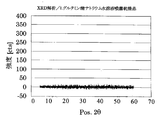
得られた粉末のXRD解析から、図1のようなLグルタミン酸ナトリウム1水塩で確認される結晶性回折パターンが観測されず、図2のようなハローパターンと呼ばれる明瞭な回折ピークのない、低角度でブロードな回折パターンが観察され、アモルファス状態であることが確認された。
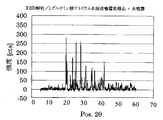
このアモルファス状態の粉末に水を噴霧すると直ちに吸水乾燥し、その吸水後の粉末XRD解析からは、Lグルタミン酸ナトリウム1水塩と同様の結晶性回折パターンが図3のように観測された。このことから、吸水された水は結晶水として転化固定され、Lグルタミン酸ナトリウム塩自体がアモルファスから安定な含水結晶へ転相することが示唆された。またHPLC成分分析((株)島津製作所製 有機酸分析計Prominence)により、高純度のLグルタミン酸ナトリウム塩であることが確認され、かつ結晶水の焼成脱離法では必ず生成してしまうPCAが検出限界(10ppm)以下であった。本発明において、このPCA生成を伴わないということが大きな優位的特徴である。
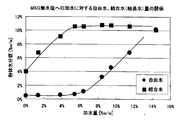
当該Lグルタミン酸ナトリウム無水塩の吸水能力を確認するため、チョッパー壊砕機構付き攪拌混合機(岡田精工(株)製 LMA15/2G)に3.0kg仕込み、2流体ノズルにて水を0.6cc/secの速度で噴霧したところ、加水率6%で吸水が飽和し、以降の加水で自由水が増加することが図4のように確認された。
吸水後の当該Lグルタミン酸ナトリウム1水塩に対して味覚官能評価(n=10、先味、すっきり感、えぐみ、くせ、苦味、まろやかさ、うま味、塩味、しつこさ、後味、先味の各項目における線尺度)を実施したところ、t検定でP>0.05と有意な差は認められず、通常市販されているLグルタミン酸ナトリウム1水塩と差が生じないことが判明した。
Lグルタミン酸ナトリウム1水塩(味の素(株)製)6.0kgを95℃の水8.0kgに溶解させ、高濃度Lグルタミン酸ナトリウム水溶液とした。ついで、本水溶液を噴霧乾燥機(大川原化工機(株)製 L12型、回転円盤式、蒸発量6kg−水/hr)を用い、除湿エア(絶対湿度0.005kg/kg−DA)、熱風入口温度200℃、熱風出口温度120℃、水溶液フィード流量2.5L/hr、円盤回転数20,000rpmの条件にて噴霧乾燥し、平均粒子径35μmの白色粉末5.5kgを得た。乾燥減量法(130℃、24時間)にて含水率を測定したところ、含水率は4%であった。
得られた粉末のXRD解析から、図1のようなLグルタミン酸ナトリウム1水塩で確認される結晶性回折パターンが観測されず、図2のようなハローパターンと呼ばれる明瞭な回折ピークのない、低角度でブロードな回折パターンが観察され、アモルファス状態であることが確認された。
このアモルファス状態の粉末に水を噴霧すると直ちに吸水乾燥し、その吸水後の粉末XRD解析からは、Lグルタミン酸ナトリウム1水塩と同様の結晶性回折パターンが図3のように観測された。このことから、吸水された水は結晶水として転化固定され、Lグルタミン酸ナトリウム塩自体がアモルファスから安定な含水結晶へ転相することが示唆された。またHPLC成分分析((株)島津製作所製 有機酸分析計Prominence)により、高純度のLグルタミン酸ナトリウム塩であることが確認され、かつ結晶水の焼成脱離法では必ず生成してしまうPCAが検出限界(10ppm)以下であった。本発明において、このPCA生成を伴わないということが大きな優位的特徴である。
当該Lグルタミン酸ナトリウム無水塩の吸水能力を確認するため、チョッパー壊砕機構付き攪拌混合機(岡田精工(株)製 LMA15/2G)に3.0kg仕込み、2流体ノズルにて水を0.6cc/secの速度で噴霧したところ、加水率6%で吸水が飽和し、以降の加水で自由水が増加することが図4のように確認された。
吸水後の当該Lグルタミン酸ナトリウム1水塩に対して味覚官能評価(n=10、先味、すっきり感、えぐみ、くせ、苦味、まろやかさ、うま味、塩味、しつこさ、後味、先味の各項目における線尺度)を実施したところ、t検定でP>0.05と有意な差は認められず、通常市販されているLグルタミン酸ナトリウム1水塩と差が生じないことが判明した。
(実施例2:アモルファス状Lグルタミン酸無水塩の流動層乾燥による調整)
Lグルタミン酸ナトリウム1水塩(味の素(株)製)4.2kgを流動層乾燥機(大川原製作所(株)製、スリットスロー FB−0.5型)を用い、熱風風速1.6m/s、熱風温度150℃、品温139℃、攪拌羽根6rpmの条件で流動層乾燥し、平均粒子径1~2mm程度の白色粉末3.3kgを得た。乾燥減量法(130℃、24時間)にて含水率を測定したところ、含水率は1.9%であった。
得られた粉末のXRD解析から、図1のようなLグルタミン酸ナトリウム1水塩で確認される結晶性回折パターンが観測されず、アモルファス状態であることが確認された。
またHPLC成分分析により、高純度のLグルタミン酸ナトリウム塩であることが確認され、かつ結晶水の焼成脱離法では必ず生成してしまうPCAが約0.55%程度と通常の20~30%と比べて非常に少ない発生割合であった。本発明において、このPCA生成を伴わない、もしくは非常に少ないということが大きな優位的特徴である。
Lグルタミン酸ナトリウム1水塩(味の素(株)製)4.2kgを流動層乾燥機(大川原製作所(株)製、スリットスロー FB−0.5型)を用い、熱風風速1.6m/s、熱風温度150℃、品温139℃、攪拌羽根6rpmの条件で流動層乾燥し、平均粒子径1~2mm程度の白色粉末3.3kgを得た。乾燥減量法(130℃、24時間)にて含水率を測定したところ、含水率は1.9%であった。
得られた粉末のXRD解析から、図1のようなLグルタミン酸ナトリウム1水塩で確認される結晶性回折パターンが観測されず、アモルファス状態であることが確認された。
またHPLC成分分析により、高純度のLグルタミン酸ナトリウム塩であることが確認され、かつ結晶水の焼成脱離法では必ず生成してしまうPCAが約0.55%程度と通常の20~30%と比べて非常に少ない発生割合であった。本発明において、このPCA生成を伴わない、もしくは非常に少ないということが大きな優位的特徴である。
(実施例3:かつおエキスコーティングうま味調味料の作成)
実施例1と同手法により調整したLグルタミン酸ナトリウム無水塩3.0kgを、チョッパー壊砕機構付き攪拌混合機(岡田精工(株)製 LMA15/2G)に仕込み、2流体ノズルにてかつおエキス(Brix62.5)を0.6cc/secの速度で0.4kg噴霧した後、10分間攪拌混合した。得られた粉末はサラサラとしており、かつおエキス原液に近い香りを有していた。得られたコーティング粉末の水分活性を水分活性測定機((株)GSIクレオス製 AW−4型)にて測定したところ、AW=0.24と低く非常に乾燥状態良好であった。また乾燥減量法(130℃、24時間)から結晶水量を測定したところ、吸収・固定化された水分量はLグルタミン酸ナトリウム無水塩重量の5%に相当し、かつおエキス固形分として同約8%相当量をコーティングすることができた。
次に、品質比較のために比較例として、乾燥工程を要する通常コーティング品を作成した。市販のLグルタミン酸ナトリウム1水塩3.0kgを、チョッパー壊砕機構付き攪拌混合機(岡田精工(株)製 LMA15/2G)に仕込み、2流体ノズルにてかつおエキス(Brix62.5)を0.6cc/secの速度で0.4kg噴霧した後、10分間攪拌混合した。得られた粉末は湿潤状態であるため、これを卓上流動乾燥機((株)レッチェ製 TG200)にて、80℃、30分で流動乾燥させた。得られたかつおエキスコーティング粉末の水分活性を水分活性測定機((株)GSIクレオス製 AW−4型)にて測定したところ、AW=0.23であり、Lグルタミン酸ナトリウム無水塩を使用したコーティング品の乾燥状態とほぼ同様となった。
次に、前述Lグルタミン酸ナトリウム無水塩にて作成した実施例に該当するコーティング品と、Lグルタミン酸ナトリウム1水塩にて作成した比較例に該当するコーティング品について、味覚官能評価(n=10、薫臭、生臭、肉質臭の各項目における強さの相対点数比較)を実施した。コントロールとしては、かつおエキス原液0.4kgと市販Lグルタミン酸ナトリウム1水塩3.0kgを50℃の水5.0kgに溶解させたものを1,000倍希釈した水溶液とし、その官能を10点とした。実施例、比較例に該当する各コーティングサンプルも同率で50℃の水に溶解希釈した。官能評価結果を表1に示す。
実施例1と同手法により調整したLグルタミン酸ナトリウム無水塩3.0kgを、チョッパー壊砕機構付き攪拌混合機(岡田精工(株)製 LMA15/2G)に仕込み、2流体ノズルにてかつおエキス(Brix62.5)を0.6cc/secの速度で0.4kg噴霧した後、10分間攪拌混合した。得られた粉末はサラサラとしており、かつおエキス原液に近い香りを有していた。得られたコーティング粉末の水分活性を水分活性測定機((株)GSIクレオス製 AW−4型)にて測定したところ、AW=0.24と低く非常に乾燥状態良好であった。また乾燥減量法(130℃、24時間)から結晶水量を測定したところ、吸収・固定化された水分量はLグルタミン酸ナトリウム無水塩重量の5%に相当し、かつおエキス固形分として同約8%相当量をコーティングすることができた。
次に、品質比較のために比較例として、乾燥工程を要する通常コーティング品を作成した。市販のLグルタミン酸ナトリウム1水塩3.0kgを、チョッパー壊砕機構付き攪拌混合機(岡田精工(株)製 LMA15/2G)に仕込み、2流体ノズルにてかつおエキス(Brix62.5)を0.6cc/secの速度で0.4kg噴霧した後、10分間攪拌混合した。得られた粉末は湿潤状態であるため、これを卓上流動乾燥機((株)レッチェ製 TG200)にて、80℃、30分で流動乾燥させた。得られたかつおエキスコーティング粉末の水分活性を水分活性測定機((株)GSIクレオス製 AW−4型)にて測定したところ、AW=0.23であり、Lグルタミン酸ナトリウム無水塩を使用したコーティング品の乾燥状態とほぼ同様となった。
次に、前述Lグルタミン酸ナトリウム無水塩にて作成した実施例に該当するコーティング品と、Lグルタミン酸ナトリウム1水塩にて作成した比較例に該当するコーティング品について、味覚官能評価(n=10、薫臭、生臭、肉質臭の各項目における強さの相対点数比較)を実施した。コントロールとしては、かつおエキス原液0.4kgと市販Lグルタミン酸ナトリウム1水塩3.0kgを50℃の水5.0kgに溶解させたものを1,000倍希釈した水溶液とし、その官能を10点とした。実施例、比較例に該当する各コーティングサンプルも同率で50℃の水に溶解希釈した。官能評価結果を表1に示す。

表1の結果から、Lグルタミン酸ナトリウム無水塩を利用して得られたコーティング品は、Lグルタミン酸ナトリウム1水塩を用い乾燥工程を経たサンプルに比べ、薫臭、生臭、肉質臭といったかつおエキス本来の持つ風味が維持された良好な風味を有していることが確認された。
また、色、流動性、吸湿固結耐性についても評価を行った。評価結果を表2に示す。
ここで流動性とはCarrの流動性指数に基づいた評価であり、80点以上を○(流動性の程度が良好で架橋防止対策不必要)、60点以上79点以下を△(流動性の程度が普通かやや良くなく、バイブレーターが必要な場合がある)とした。
ここで流動性とはCarrの流動性指数に基づいた評価であり、80点以上を○(流動性の程度が良好で架橋防止対策不必要)、60点以上79点以下を△(流動性の程度が普通かやや良くなく、バイブレーターが必要な場合がある)とした。

表2の結果から、乾燥工程を経たものは強い褐変が確認され、エキスの熱変性に起因した流動性、吸湿固結耐性の悪化も認められたが、Lグルタミン酸ナトリウム無水塩を利用したものは褐変がほとんどなく、流動性、吸湿固結耐性も良好であることが判明した。
次に、前述のLグルタミン酸ナトリウム無水塩にて作成したコーティング品と、Lグルタミン酸ナトリウム1水塩にて作成したコーティング品について、かつおエキスの好ましい薫臭成分である2−メトキシフェノールの残量を測定した。2−メトキシフェノールは、揮発しやすくかつ熱等による新規生成がないため、本成分残量を比較することによって調味料の製造工程による香気成分ロスの度合いを把握する指標となる。測定にはヘッドスペースガスクロマトグラフ(HEWLETT PACKARD製 Mass Selective Detector 5973,及びTEKMAR DOHRMANN製 SOLATek 72 Multimatrix Vial Autosampler併用)を使用し、各コーティング品1.0gを密閉バイアル中にて純水10.0gに溶解させ、そのヘッドスペースガスをガスクロマトグラフに送り、気中の成分測定を実施した。結果を表3に示す。

表3の結果から、Lグルタミン酸ナトリウム無水塩を利用して得られたコーティング品は、Lグルタミン酸ナトリウム1水塩を用い乾燥工程を経たコーティング品に比べ、2−メトキシフェノールの残量が約4倍検出され、本発明による香気成分保持の優位性が確認された。
本発明によれば、エキスでうま味調味料をコーティング後に乾燥工程が不要である、エキスでコーティングされたうま味調味料、及びその製造方法を提供することができる。
Claims (6)
- アモルファス状のLグルタミン酸ナトリウム無水塩を水溶性風味エキスでコーティングし、コーティング後に水分の乾燥工程を行わないことを特徴とする、水溶性風味エキスでコーティングされたうま味調味料の製造方法。
- 請求項1記載の製造方法により製造される、水溶性風味エキスでコーティングされたうま味調味料。
- Lグルタミン酸ナトリウム無水塩重量の1.00重量%以上、9.0重量以下%の水を結晶水として取り込むことができ、かつ取り込んだ後の粉体水分活性(AW)が0.25以下であることを特徴とする、請求項2記載の水溶性風味エキスでコーティングされたうま味調味料。
- Lグルタミン酸ナトリウム1水塩を出発物質とし、その水溶液を噴霧乾燥にてアモルファス状乾燥粒子とすることによりLグルタミン酸ナトリウム無水塩を得る第一工程、および第一工程で得たLグルタミン酸ナトリウム無水塩に水溶性風味エキスを噴霧攪拌混合することによって、水溶性風味エキスの水分をLグルタミン酸ナトリウム無水塩に吸収固定化させる第二工程を行うことを特徴とする、請求項2記載の水溶性風味エキスでコーティングされたうま味調味料。
- Lグルタミン酸ナトリウム無水塩の平均粒子径が1μm以上、200μm以下である請求項2記載の水溶性風味エキスでコーティングされたうま味調味料。
- Lグルタミン酸ナトリウム1水塩を出発物質とし、その粉末を流動層乾燥にてアモルファス状乾燥粉末とすることによりLグルタミン酸ナトリウム無水塩を得る第一工程、および第一工程で得たLグルタミン酸ナトリウム無水塩に水溶性風味エキスを吸収固定化させる第二工程を行うことを特徴とする、請求項2記載の水溶性風味エキスでコーティングされたうま味調味料。
Applications Claiming Priority (2)
| Application Number | Priority Date | Filing Date | Title |
|---|---|---|---|
| JP2009-066141 | 2009-03-18 | ||
| JP2009066141A JP2012110232A (ja) | 2009-03-18 | 2009-03-18 | コーティングされたうま味調味料及びその製造方法 |
Publications (1)
| Publication Number | Publication Date |
|---|---|
| WO2010107127A1 true WO2010107127A1 (ja) | 2010-09-23 |
Family
ID=42739782
Family Applications (1)
| Application Number | Title | Priority Date | Filing Date |
|---|---|---|---|
| PCT/JP2010/054909 Ceased WO2010107127A1 (ja) | 2009-03-18 | 2010-03-16 | コーティングされたうま味調味料及びその製造方法 |
Country Status (2)
| Country | Link |
|---|---|
| JP (1) | JP2012110232A (ja) |
| WO (1) | WO2010107127A1 (ja) |
Families Citing this family (2)
| Publication number | Priority date | Publication date | Assignee | Title |
|---|---|---|---|---|
| JP6747012B2 (ja) * | 2016-03-31 | 2020-08-26 | 味の素株式会社 | 甘味料の吸湿固結を防止する方法 |
| KR101700373B1 (ko) * | 2016-08-23 | 2017-01-26 | 주식회사 케이앤피나노 | 기능성 물질이 함유된 조미료 제조방법 |
Citations (3)
| Publication number | Priority date | Publication date | Assignee | Title |
|---|---|---|---|---|
| JPS62152537A (ja) * | 1985-12-26 | 1987-07-07 | Hayashibara Biochem Lab Inc | 無水グリコシルフルクト−スによる含水物の脱水方法 |
| JPS62152536A (ja) * | 1985-12-26 | 1987-07-07 | Hayashibara Biochem Lab Inc | 無水アルドヘキソ−スによる含水物の脱水方法 |
| JP2000159788A (ja) * | 1992-12-02 | 2000-06-13 | Hayashibara Biochem Lab Inc | トレハロ―ス含有組成物 |
-
2009
- 2009-03-18 JP JP2009066141A patent/JP2012110232A/ja active Pending
-
2010
- 2010-03-16 WO PCT/JP2010/054909 patent/WO2010107127A1/ja not_active Ceased
Patent Citations (3)
| Publication number | Priority date | Publication date | Assignee | Title |
|---|---|---|---|---|
| JPS62152537A (ja) * | 1985-12-26 | 1987-07-07 | Hayashibara Biochem Lab Inc | 無水グリコシルフルクト−スによる含水物の脱水方法 |
| JPS62152536A (ja) * | 1985-12-26 | 1987-07-07 | Hayashibara Biochem Lab Inc | 無水アルドヘキソ−スによる含水物の脱水方法 |
| JP2000159788A (ja) * | 1992-12-02 | 2000-06-13 | Hayashibara Biochem Lab Inc | トレハロ―ス含有組成物 |
Also Published As
| Publication number | Publication date |
|---|---|
| JP2012110232A (ja) | 2012-06-14 |
Similar Documents
| Publication | Publication Date | Title |
|---|---|---|
| JP4482924B2 (ja) | 風味・香り成分を保持した乾燥粉末及びその製造方法 | |
| EA031547B1 (ru) | Получение легкосыпучих гранул, содержащих соли метилглициндиуксусной кислоты | |
| JP2004182811A (ja) | 顆粒状香料およびその製造方法 | |
| JP5405294B2 (ja) | 粉末組成物の製造方法及び得られた生成物 | |
| US20120288600A1 (en) | Method of producing flavor granules | |
| JP2009530356A5 (ja) | ||
| CA2560757A1 (en) | Sugar substitute prepared with nutritive and high-intensity sweeteners | |
| JP2012110232A (ja) | コーティングされたうま味調味料及びその製造方法 | |
| RU2188562C2 (ru) | Способ получения пищевой кислоты | |
| US7101582B2 (en) | Dried honey enriched with volatile honey compounds | |
| GB2520276A (en) | High intensity sweetener composition | |
| JP3504309B2 (ja) | 低カフェイン含有茶ポリフェノールの製造法 | |
| JP2628606B2 (ja) | 微粒食用塩およびその製造方法 | |
| EP1269862A1 (en) | Bouillon powder | |
| RU2733655C1 (ru) | Способ изготовления пищевых гранул | |
| JPH0451487B2 (ja) | ||
| JP2006149381A (ja) | 酢酸酢又は有機酸酢の粉末化法と泡盛もろみ液粉末 | |
| CA2430798C (en) | Dried honey enriched with volatile honey compounds | |
| CN102266353A (zh) | 阿胶泡腾颗粒剂及其制备方法 | |
| JPH0795868A (ja) | 顆粒状又は結晶状低カロリー飲料の製造法 | |
| JP2011103818A (ja) | 液状食品の噴霧乾燥方法及び乾燥された液状食品 | |
| CN118434708A (zh) | 柠檬酸和甘氨酸的共结晶体及其用途 | |
| JPH1142065A (ja) | 梅塩の製造方法 | |
| JP2025178631A (ja) | 粉末醸造酢の製造方法、粉末醸造酢 | |
| JPH01117765A (ja) | 顆粒状海藻エキスの製造方法 |
Legal Events
| Date | Code | Title | Description |
|---|---|---|---|
| 121 | Ep: the epo has been informed by wipo that ep was designated in this application |
Ref document number: 10753617 Country of ref document: EP Kind code of ref document: A1 |
|
| NENP | Non-entry into the national phase |
Ref country code: DE |
|
| 122 | Ep: pct application non-entry in european phase |
Ref document number: 10753617 Country of ref document: EP Kind code of ref document: A1 |
|
| NENP | Non-entry into the national phase |
Ref country code: JP |