WO2010106850A1 - 電動歯ブラシ - Google Patents
電動歯ブラシ Download PDFInfo
- Publication number
- WO2010106850A1 WO2010106850A1 PCT/JP2010/051956 JP2010051956W WO2010106850A1 WO 2010106850 A1 WO2010106850 A1 WO 2010106850A1 JP 2010051956 W JP2010051956 W JP 2010051956W WO 2010106850 A1 WO2010106850 A1 WO 2010106850A1
- Authority
- WO
- WIPO (PCT)
- Prior art keywords
- operation mode
- value
- electric toothbrush
- posture
- threshold value
- Prior art date
- Legal status (The legal status is an assumption and is not a legal conclusion. Google has not performed a legal analysis and makes no representation as to the accuracy of the status listed.)
- Ceased
Links
Images



Classifications
-
- A—HUMAN NECESSITIES
- A61—MEDICAL OR VETERINARY SCIENCE; HYGIENE
- A61C—DENTISTRY; APPARATUS OR METHODS FOR ORAL OR DENTAL HYGIENE
- A61C17/00—Devices for cleaning, polishing, rinsing or drying teeth, teeth cavities or prostheses; Saliva removers; Dental appliances for receiving spittle
- A61C17/16—Power-driven cleaning or polishing devices
- A61C17/22—Power-driven cleaning or polishing devices with brushes, cushions, cups, or the like
- A61C17/221—Control arrangements therefor
-
- A—HUMAN NECESSITIES
- A46—BRUSHWARE
- A46B—BRUSHES
- A46B15/00—Other brushes; Brushes with additional arrangements
- A46B15/0002—Arrangements for enhancing monitoring or controlling the brushing process
- A46B15/0004—Arrangements for enhancing monitoring or controlling the brushing process with a controlling means
- A46B15/0006—Arrangements for enhancing monitoring or controlling the brushing process with a controlling means with a controlling brush technique device, e.g. stroke movement measuring device
Definitions
- the present invention relates to an electric toothbrush.
- An electric toothbrush that brushes teeth (removes food residues and plaque) by applying a brush that vibrates or rotates at high speed to the teeth is known. Recently, high-value-added products that have the function of switching the brush operation mode (frequency, vibration pattern, etc.) have also appeared. In such an electric toothbrush, it is recommended to select an appropriate brush angle (an angle formed by the brush and the tooth axis) and an operation mode according to the brushing part. For example, when brushing the periodontal pocket (between teeth and gums), if the brush is applied at 45 degrees to the tooth axis, the brush tip will easily enter the periodontal pocket, which is effective for removing plaque. It is. When brushing the side surface (tooth surface) of the tooth, the brush should be applied at 90 degrees with respect to the tooth axis, and it is desirable to select an operation mode with less irritation to the gingiva.
- Patent Document 1 a method is proposed in which the position and movement of a brush are determined using an acceleration sensor, a geomagnetic field sensor, and an angular velocity sensor, and the quality of a user's tooth brushing operation is evaluated.
- the present inventors are developing an intelligent electric toothbrush that has a function of detecting the posture of the toothbrush body by a posture sensor and automatically switching to an appropriate operation mode according to the detection result.
- the present inventors have found the following problems.
- the problem will be described by taking as an example a function of switching to an operation mode suitable for periodontal pocket brushing when the brush angle is 45 degrees.
- the brush angle may deviate from the above range while changing the brushing position (moving the brush to the periodontal pocket of another tooth).
- the vibration of the brush drive source such as a motor
- the value of the brush angle may fluctuate due to the vibration noise and may be out of the above range.
- the operation mode is frequently switched and the operation becomes unstable. Further, as the operation mode is switched, the operation sound and vibration transmitted to the hand frequently change, which may cause discomfort to the user.
- the present invention has been made in view of the above problems, and an object of the present invention is to frequently switch operation modes due to vibration of a drive source in an electric toothbrush that automatically switches operation modes according to postures. It is to provide a technique for suppressing the change.
- the electric toothbrush of the present invention is an electric toothbrush body provided with a brush drive source, an attitude sensor for detecting the attitude of the electric toothbrush main body, and an attitude calculated from the output of the attitude sensor.
- the threshold value and the second threshold value used for determination of switching from the second operation mode to the first operation mode are set to different values.
- a margin (play) corresponding to the difference between the first threshold value and the second threshold value can be formed at the boundary between the switching between the first operation mode and the second operation mode. Since this margin absorbs the fluctuation of the posture value near the boundary, occurrence of frequent switching of the operation mode is suppressed.
- the difference between the first threshold value and the second threshold value is set to be larger than the maximum value of the fluctuation range of the posture value caused by the vibration of the drive source.
- the first threshold value is greater than the second threshold value
- the control means detects the first threshold value when the posture value exceeds the first threshold value during the first operation mode.
- the operation mode is switched to the second operation mode, and the second operation mode is switched to the first operation mode when the posture value falls below the second threshold during the second operation mode. It is preferable.
- the control means When the first threshold value is larger than the second threshold value, and the control means maintains a state in which the posture value exceeds the first threshold value for a predetermined time during the first operation mode.
- the first operation mode is switched to the second operation mode, and the state in which the posture value falls below the second threshold value is maintained for a predetermined time during the second operation mode. It is also preferable to switch the second operation mode to the first operation mode.
- the posture sensor is an acceleration sensor, and the posture value is a function of an output value of the acceleration sensor.
- FIG. 1 is a block diagram of an electric toothbrush.
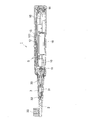
- FIG. 2 is a cross-sectional view showing the internal configuration of the electric toothbrush.
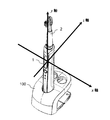
- FIG. 3 is a perspective view showing the appearance of the electric toothbrush.
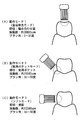
- 4A to 4C are diagrams for explaining the operation mode.
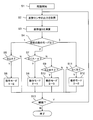
- FIG. 5 is a flowchart showing a main routine of the operation of the electric toothbrush.
- FIG. 6 is a diagram for explaining formulas for calculating the brush angle and the posture value.
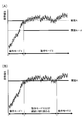
- FIG. 7A is a diagram for explaining the operation mode switching control of this embodiment, and FIG. 7B is a diagram for explaining a comparative example.
- FIG. 8A is a diagram for explaining a modification of the operation mode switching control of the present embodiment, and FIG. 8B is a diagram for explaining a comparative example.
- FIG. 1 is a block diagram of the electric toothbrush of the present embodiment
- FIG. 2 is a cross-sectional view showing the internal configuration of the electric toothbrush
- FIG. 3 is a perspective view showing the external appearance of the electric toothbrush.
- the electric toothbrush includes an electric toothbrush main body 1 (hereinafter simply referred to as “main body 1”) and a brush member 2 attached to the main body 1.
- the housing of the main body 1 is made of a resin case having a generally cylindrical shape.
- the main body 1 is provided with a grip 16 for a user to grip with his / her hand when brushing teeth, a switch S for turning on / off the power, switching modes, and the like, an LED 123, and the like.
- the drive circuit 12 includes a CPU (input / output processing unit) 120 that executes various calculations and controls, a memory 121 that stores programs and various setting values, a timer 122, and the like.
- An acceleration sensor 15 as an attitude sensor is provided inside the main body 1.
- a multi-axis acceleration sensor may be used, or a single-axis acceleration sensor may be used.
- the x axis is parallel to the brush surface
- the y axis is coincident with the longitudinal direction of the main body 1
- the z axis is perpendicular to the brush surface. It is good to install like this.
- “Brush surface” refers to a virtual plane that is substantially orthogonal to the hair (fiber) of the brush and is located at the tip of the hair.
- a uniaxial acceleration sensor it may be installed to detect acceleration in the z-axis direction or the x-axis direction in FIG.
- an x, y, z triaxial acceleration sensor is used.
- the output of the acceleration sensor 15 is input to the CPU 120 and used for detecting the three-dimensional posture of the electric toothbrush.
- the acceleration sensor 15 a piezoresistive type, a capacitance type, or a heat detection type MEMS sensor can be preferably used. This is because the MEMS sensor is very small and can be easily incorporated into the body 1.
- the form of the acceleration sensor 15 is not limited to this, and an electrodynamic sensor, a strain gauge sensor, a piezoelectric sensor, or the like may be used.
- a bandpass filter (low-pass filter) for removing dynamic acceleration components and noise may be provided, or a filter for removing (reducing) motor vibration noise may be provided. Further, noise may be reduced by smoothing the output waveform of the acceleration sensor.
- the main body 1 includes a stem 3 provided so as to protrude from an opening on the front end side (brush side) of the housing.
- the brush member 2 is mounted so as to cover the stem 3.
- a brush 20 is implanted at the tip of the brush member 2. Since the brush member 2 is a consumable part, it is configured to be detachable from the stem 3 so that it can be replaced with a new one.
- the stem 3 is a cylindrical member made of a resin material with a closed tip (brush side end) and has a bearing 32 at the tip inside the tube.
- the tip of the eccentric shaft 30 connected to the rotating shaft 11 of the motor 10 is inserted into the bearing 32 of the stem 3.
- the eccentric shaft 30 has a weight 31 in the vicinity of the bearing 32, and the center of gravity of the eccentric shaft 30 is deviated from the center of rotation.
- the CPU 120 supplies a drive signal (for example, a pulse width modulation signal) corresponding to the operation mode to the motor 10 and rotates the rotating shaft 11 of the motor 10, the eccentric shaft 30 also rotates as the rotating shaft 11 rotates.
- the eccentric shaft 30 moves so as to turn around the center of rotation because the center of gravity is displaced.
- the tip of the eccentric shaft 30 repeats minute collisions with the inner wall of the bearing 32, and the brush 20 is vibrated (moved) at high speed. That is, the motor 10 plays a role of driving means for vibrating (moving) the brush, and the eccentric shaft 30 plays a role of a motion transmission mechanism (motion converting mechanism) that converts the output (rotation) of the motor 10 into vibration of the brush 20. Take on.
- the electric toothbrush of this embodiment has three operation modes, as shown to FIG. 4A, FIG. 4B, and FIG. 4C.
- the posture (specifically, the brush angle) of the toothbrush body is detected by the acceleration sensor 15 and automatically switched to an appropriate operation mode according to the value of the brush angle.
- “Spm” is a unit representing the number of swings per minute.
- Operation mode 1 plaque removal mode: A mode in which the highest plaque removal force is obtained and which is suitable for brushing the meshing surface. Frequency: about 38000 spm. Brush angle: 0 to 35 degrees.
- Operation mode 2 periodontal pocket mode: Mode suitable for brushing periodontal pockets. Frequency: about 26500 spm. Brush angle: 35-55 degrees.
- Operation mode 3 soft mode: A mode suitable for brushing the tooth surface with little stimulation to the gums. Frequency: about 12,500 spm. Brush angle: 55 to 90 degrees.
- FIG. 5 is a flowchart showing the main flow of the electric toothbrush. Note that the processing described below is processing executed by the CPU 120 according to a program unless otherwise specified.
- the CPU 120 controls the motor 10 to start driving the brush 20 (S1).
- driving is started in the operation mode.
- the subsequent processes of S2 to S13 are repeatedly executed at regular intervals.
- the power of the electric toothbrush is turned off or when the continuous operation time counted by the timer reaches a predetermined time (for example, 2 minutes), the loop of S2 to S13 ends (S13; NO), and the CPU 120 Stop driving.
- the CPU 120 acquires the output of the acceleration sensor 15 in S2, and calculates a posture value S representing the posture (brush angle ⁇ ) of the toothbrush body in S3.
- a posture value S representing the posture (brush angle ⁇ ) of the toothbrush body in S3.
- the posture value S is a function of the output value Ax of the acceleration sensor in the x-axis direction and the output value Az of the acceleration sensor in the z-axis direction.
- Brush angle ⁇ tan -1 (
- the CPU 120 branches the process according to the current operation mode (S4).
- A tan 35 degrees in this example
- S ⁇ A that is, when the brush angle exceeds 35 degrees
- the operation mode is switched from 1 to 2 (S6).
- S ⁇ A that is, when the brush angle is smaller than 35 degrees
- the operation mode 1 is continued.
- the CPU 120 compares the posture value S with the threshold value A ⁇ (S7).
- ⁇ is a parameter for differentiating the threshold (A) used for determination of switching from operation mode 1 to operation mode 2 and the threshold (A ⁇ ) used for determination of switching from operation mode 2 to operation mode 1.
- a ⁇ tan is set to a value satisfying 34 degrees.
- S7 if S ⁇ A ⁇ , that is, if the brush angle is less than 34 degrees, the CPU 120 switches the operation mode from 2 to 1 (S8).
- S ⁇ A ⁇ that is, when the brush angle is 34 degrees or more, the determination of S9 is performed.
- the CPU 120 compares the posture value S with the threshold value B + ⁇ .
- ⁇ is a parameter for differentiating the threshold value (B + ⁇ ) used for switching determination from the operation mode 2 to the operation mode 3 and the threshold value (B) used for switching determination from the operation mode 3 to the operation mode 2.
- B + ⁇ tan is set to a value satisfying 56 degrees.
- S9 when S ⁇ B + ⁇ , that is, when the brush angle exceeds 56 degrees, the CPU 120 switches the operation mode from 2 to 3 (S10). In the case of S ⁇ B + ⁇ , that is, when the brush angle is in the range of 34 degrees to 56 degrees, the operation mode 2 is continued.
- the electric toothbrush according to the present embodiment automatically switches to an appropriate operation mode in accordance with the posture detected by the sensor. That is, when the brush angle is smaller than about 35 degrees, it is considered that the meshing surface is being brushed, and the operation mode 1 with the highest plaque removing power is selected, and when the brush angle is larger than about 55 degrees. Therefore, it is considered that the tooth surface is brushed, and the operation mode 3 in which the stimulation to the gingiva is small is selected. When the brush angle is in the range of about 35 to 55 degrees, it is considered that the periodontal pocket is brushed, and the operation mode 2 suitable for the brushing of the periodontal pocket is selected.
- brushing of the periodontal pocket is particularly important for the prevention of periodontal diseases, etc., so that the brush angle is appropriate by turning on the LED 123 or sounding the notification sound during the operation of the operation mode 2. It is also preferable to notify the user of a certain fact (approximately 45 degrees).
- FIG. 7B shows an example in which a fixed threshold A is used for determination of switching between the operation mode 1 and the operation mode 2 as a comparative example.
- the vertical axis is the posture value S
- the horizontal axis is time.
- the posture value S is below the threshold value A, and the electric toothbrush is driven in the operation mode 1.
- the posture value S may be maintained at a value sufficiently larger than the threshold value A (for example, 45 degrees).
- a margin (play) ⁇ is formed at the boundary between the operation mode 1 and the operation mode 2 by dynamically changing the threshold value according to the current operation mode. Is provided. That is, while the operation mode 1 is being executed, the operation mode switching determination is performed with the threshold A, but after the attitude value S exceeds the threshold A and the operation mode 2 is switched, the switching determination is performed with the threshold A ⁇ . It is. Thus, even if the posture value S fluctuates in the vicinity of the threshold A as shown in FIG. 7A, the fluctuation is absorbed by the margin ⁇ , and the occurrence of frequent switching of the operation mode is suppressed. In the switching control between the operation modes 2 and 3, the occurrence of frequent switching of the operation modes is similarly suppressed by the margin ⁇ .
- the margin of one degree is provided in terms of the brush angle, but the margin value is not limited to this.
- the margins ⁇ and ⁇ are preferably set to values larger than the maximum value of the fluctuation range of the posture value S caused by the vibration of the motor (drive source). This is because switching of the operation mode due to the vibration of the drive source can be prevented as much as possible.
- the margin value is preferably smaller than half of the numerical range of one operation mode, and more practically less than 10 degrees in terms of the brush angle.
- the vibration type electric toothbrush using the eccentric weight is illustrated, but the present invention is also applicable to other movement type electric toothbrushes.
- the present invention can be applied to a rotary reciprocating motion, a linear reciprocating motion, a brush bristle rotational motion, and an electric toothbrush that combines them.
- the present invention can be applied not only to a rechargeable type but also to a dry battery type or an electric toothbrush of a type used by connecting a power cord.
- the number and contents of the operation modes are not limited to the example of the above embodiment.
- the number of operation modes may be two or more than three.
- the threshold value and the margin value can be arbitrarily set according to product specifications.
- the calculation formula of the posture value S is not limited to the example of the above embodiment.
- the posture value S can be calculated more accurately.
- the brush angle is considered as the posture of the toothbrush body, but it is also preferable to consider the brushing position.
- the posture value S has a value corresponding to the brushing position or both the brushing position and the brush angle.
- any scale may be adopted as the posture value S as long as it is a scale that directly or indirectly represents the posture of the toothbrush body.
- a rotary sensor, an inclination sensor, a gyroscope, or the like can be used as the attitude sensor for detecting the attitude of the toothbrush body. It is also preferable to detect the posture more accurately by combining a plurality of types of sensors.
Landscapes
- Life Sciences & Earth Sciences (AREA)
- Health & Medical Sciences (AREA)
- Biophysics (AREA)
- Dentistry (AREA)
- Epidemiology (AREA)
- Animal Behavior & Ethology (AREA)
- General Health & Medical Sciences (AREA)
- Public Health (AREA)
- Veterinary Medicine (AREA)
- Brushes (AREA)
Abstract
Description
図1、図2、図3を参照して、電動歯ブラシの構成を説明する。図1は本実施形態の電動歯ブラシのブロック図であり、図2は電動歯ブラシの内部構成を示す断面図であり、図3は電動歯ブラシの外観を示す斜視図である。
本体1の内部には、姿勢センサとしての加速度センサ15が設けられている。加速度センサ15としては多軸の加速度センサを用いてもよいし、1軸の加速度センサを用いてもよい。3軸加速度センサの場合は、図3に示すように、x軸がブラシ面に対して平行になり、y軸が本体1の長手方向に一致し、z軸がブラシ面に対して垂直になるように設置するとよい。「ブラシ面」とは、ブラシの毛(繊維)と略直交し、かつ、毛の先端部分に位置する仮想的な平面をいう。1軸加速度センサの場合は、図3のz軸方向もしくはx軸方向の加速度を検出するように設置するとよい。なお本実施形態では、x,y,zの3軸加速度センサを用いる。加速度センサ15の出力はCPU120に入力され、電動歯ブラシの三次元姿勢を検出するために利用される。
本体1は、筐体の先端側(ブラシ側)の開口部から突き出るように設けられたステム3を備えている。上記のブラシ部材2は、このステム3を覆うように装着される。ブラシ部材2の先端には、ブラシ20が植毛されている。ブラシ部材2は消耗部品ゆえ、新品に交換できるよう、ステム3に対して着脱自在な構成となっている。
本実施形態の電動歯ブラシは、図4A、図4B、図4Cに示すように、3つの動作モードを有している。この電動歯ブラシでは、加速度センサ15により歯ブラシ本体の姿勢(具体的にはブラシ角)を検出し、ブラシ角の値に応じて適切な動作モードに自動的に切り換える。なお「spm」は一分間あたりのスイング回数を表す単位である。
(B)動作モード2(歯周ポケットモード)・・・歯周ポケットのブラッシングに適したモード。振動数:約26500spm。ブラシ角:35~55度。
(C)動作モード3(ソフトモード)・・・歯肉に与える刺激が小さく、歯面のブラッシングに適したモード。振動数:約12500spm。ブラシ角:55~90度。
ブラシ角θ=tan-1(|Ax/Az|)
姿勢値S=tanθ=|Ax/Az|
以上のように、本実施形態の電動歯ブラシでは、センサで検出された姿勢に応じ、適切な動作モードに自動的に切り換わる。すなわち、ブラシ角が約35度より小さい場合は、噛み合わせ面のブラッシングが行われているとみなし、最も歯垢除去力の高い動作モード1が選択され、ブラシ角が約55度より大きい場合は、歯面のブラッシングが行われているとみなし、歯肉への刺激が小さい動作モード3が選択される。そして、ブラシ角が約35~55度の範囲にある場合は、歯周ポケットのブラッシングが行われているとみなし、歯周ポケットのブラッシングに適した動作モード2が選択される。なお、歯周病等の予防には歯周ポケットのブラッシングが特に重要であることから、動作モード2の動作中はLED123を点灯したり、報知音を鳴らしたりすることで、ブラシ角が適切である旨(概ね45度である旨)をユーザに通知することも好ましい。
上述した実施形態の構成は本発明の一具体例を例示したものにすぎない。本発明の範囲は上記実施形態に限られるものではなく、その技術思想の範囲内で種々の変形が可能である。たとえば、上記実施形態では、偏心分銅による振動方式の電動歯ブラシを例示したが、本発明は他の運動方式の電動歯ブラシにも適用可能である。たとえば、回転往復運動や直線往復運動やブラシ毛回転運動やそれらを組み合わせた電動歯ブラシに対しても本発明を適用可能である。また、充電式でなく、乾電池式や電源コードを接続して使用するタイプの電動歯ブラシにも本発明を適用可能である。
Claims (5)
- ブラシの駆動源が設けられた電動歯ブラシ本体と、
前記電動歯ブラシ本体の姿勢を検出するための姿勢センサと、
前記姿勢センサの出力から算出される値である姿勢値と予め設定された閾値とを比較した結果に応じて、電動歯ブラシの動作モードを切り換える制御手段と、を備え、
第1の動作モードから第2の動作モードへの切り換え判定に用いる第1の閾値と、前記第2の動作モードから前記第1の動作モードへの切り換え判定に用いる第2の閾値とが、異なる値に設定されていることを特徴とする電動歯ブラシ。 - 前記第1の閾値と前記第2の閾値は、その差が、前記駆動源の振動に起因する前記姿勢値の変動幅の最大値よりも大きくなるように設定されていることを特徴とする請求の範囲第1項に記載の電動歯ブラシ。
- 前記第1の閾値が前記第2の閾値よりも大きく、
前記制御手段は、前記第1の動作モード中に前記姿勢値が前記第1の閾値を超えた場合に前記第1の動作モードを前記第2の動作モードへ切り換え、前記第2の動作モード中に前記姿勢値が前記第2の閾値を下回った場合に前記第2の動作モードを前記第1の動作モードへ切り換えることを特徴とする請求の範囲第1項に記載の電動歯ブラシ。 - 前記第1の閾値が前記第2の閾値よりも大きく、
前記制御手段は、前記第1の動作モード中に前記姿勢値が前記第1の閾値を超えた状態が所定時間のあいだ維持された場合に前記第1の動作モードを前記第2の動作モードへ切り換え、前記第2の動作モード中に前記姿勢値が前記第2の閾値を下回った状態が所定時間のあいだ維持された場合に前記第2の動作モードを前記第1の動作モードへ切り換えることを特徴とする請求の範囲第1項に記載の電動歯ブラシ。 - 前記姿勢センサが加速度センサであり、前記姿勢値は前記加速度センサの出力値の関数であることを特徴とする請求の範囲第1項~第4項のうちいずれか1項に記載の電動歯ブラシ。
Priority Applications (4)
| Application Number | Priority Date | Filing Date | Title |
|---|---|---|---|
| CN201080012694.0A CN102355870B (zh) | 2009-03-17 | 2010-02-10 | 电动牙刷 |
| RU2011141867/14A RU2518532C2 (ru) | 2009-03-17 | 2010-02-10 | Электрическая зубная щетка |
| DE112010001195.8T DE112010001195B4 (de) | 2009-03-17 | 2010-02-10 | Elektrische Zahnbürste |
| US13/227,041 US8176591B2 (en) | 2009-03-17 | 2011-09-07 | Electrical toothbrush |
Applications Claiming Priority (2)
| Application Number | Priority Date | Filing Date | Title |
|---|---|---|---|
| JP2009064274A JP5365277B2 (ja) | 2009-03-17 | 2009-03-17 | 電動歯ブラシ |
| JP2009-064274 | 2009-03-17 |
Related Child Applications (1)
| Application Number | Title | Priority Date | Filing Date |
|---|---|---|---|
| US13/227,041 Continuation US8176591B2 (en) | 2009-03-17 | 2011-09-07 | Electrical toothbrush |
Publications (1)
| Publication Number | Publication Date |
|---|---|
| WO2010106850A1 true WO2010106850A1 (ja) | 2010-09-23 |
Family
ID=42739516
Family Applications (1)
| Application Number | Title | Priority Date | Filing Date |
|---|---|---|---|
| PCT/JP2010/051956 Ceased WO2010106850A1 (ja) | 2009-03-17 | 2010-02-10 | 電動歯ブラシ |
Country Status (6)
| Country | Link |
|---|---|
| US (1) | US8176591B2 (ja) |
| JP (1) | JP5365277B2 (ja) |
| CN (1) | CN102355870B (ja) |
| DE (1) | DE112010001195B4 (ja) |
| RU (1) | RU2518532C2 (ja) |
| WO (1) | WO2010106850A1 (ja) |
Cited By (8)
| Publication number | Priority date | Publication date | Assignee | Title |
|---|---|---|---|---|
| WO2011096285A1 (ja) * | 2010-02-02 | 2011-08-11 | オムロンヘルスケア株式会社 | 口腔ケア装置 |
| US8558430B2 (en) | 2010-08-19 | 2013-10-15 | Braun Gmbh | Resonant motor unit and electric device with resonant motor unit |
| US8631532B2 (en) | 2011-07-25 | 2014-01-21 | Braun Gmbh | Oral hygiene device |
| US9009901B2 (en) | 2011-09-20 | 2015-04-21 | Braun Gmbh | Oral care devices having automatic mode selection |
| US9099939B2 (en) | 2011-07-25 | 2015-08-04 | Braun Gmbh | Linear electro-polymer motors and devices having the same |
| US9154025B2 (en) | 2010-07-23 | 2015-10-06 | Braun Gmbh | Personal care device |
| US9226808B2 (en) | 2011-07-25 | 2016-01-05 | Braun Gmbh | Attachment section for an oral hygiene device |
| US10470857B2 (en) | 2010-07-23 | 2019-11-12 | Braun Gmbh | Personal care device |
Families Citing this family (39)
| Publication number | Priority date | Publication date | Assignee | Title |
|---|---|---|---|---|
| US8159352B2 (en) * | 2007-09-11 | 2012-04-17 | Colgate-Palmolive Company | Personal care implement having a display |
| US20100186234A1 (en) | 2009-01-28 | 2010-07-29 | Yehuda Binder | Electric shaver with imaging capability |
| WO2014142029A1 (ja) * | 2013-03-11 | 2014-09-18 | サンスター株式会社 | 電動歯ブラシ |
| WO2014202250A1 (en) | 2013-06-19 | 2014-12-24 | Kolibree | Toothbrush system with sensors for a dental hygiene monitoring system |
| EP2976965A1 (en) | 2014-07-22 | 2016-01-27 | Braun GmbH | Fastenable device for oral cavity position detection |
| EP2976966A1 (en) | 2014-07-22 | 2016-01-27 | Braun GmbH | Fastenable device for oral cavity position detection |
| CN107072761B (zh) | 2014-09-16 | 2020-06-19 | 皇家飞利浦有限公司 | 标识个人护理器具的附件和方法 |
| JP6508641B2 (ja) * | 2014-10-07 | 2019-05-08 | コーニンクレッカ フィリップス エヌ ヴェKoninklijke Philips N.V. | ブラッシング角度の自動検出を有する歯ブラシ |
| WO2016174621A1 (en) * | 2015-04-29 | 2016-11-03 | Koninklijke Philips N.V. | Systems and methods for providing angle guidance for a user operating an oral hygiene device |
| WO2016176783A1 (de) * | 2015-05-04 | 2016-11-10 | Curaden Ag | Manuelle zahnbürste mit sensoren |
| MX392773B (es) | 2015-05-13 | 2025-03-24 | Kolibree | Sistema de cepillo de dientes con magnetómetro para monitoreo de higiene dental. |
| EP3510970B1 (en) * | 2015-06-18 | 2020-09-16 | Colgate-Palmolive Company | Electric toothbrush device and method |
| US10702206B2 (en) | 2015-06-29 | 2020-07-07 | Braun Gmbh | Toothbrush for oral cavity position detection |
| EP3141151B1 (en) | 2015-09-08 | 2023-10-18 | Braun GmbH | Determination of a currently treated body portion of a user |
| CN105125309B (zh) * | 2015-09-28 | 2016-11-30 | 陈浩骏 | 一种使用电动牙刷刷牙的方法及牙刷 |
| WO2017068453A1 (en) * | 2015-10-21 | 2017-04-27 | Koninklijke Philips N.V. | Methods and systems for oral cleaning device localization |
| EP3207823A1 (en) | 2016-02-16 | 2017-08-23 | Braun GmbH | Interactive system setup concept |
| CN109152471A (zh) | 2016-03-14 | 2019-01-04 | 科里布里公司 | 具有视觉识别功能以用于监测依从性的口腔卫生系统 |
| JP6679355B2 (ja) * | 2016-03-15 | 2020-04-15 | オムロンヘルスケア株式会社 | 照明リングを備えた電動歯ブラシ |
| CN106999268B (zh) * | 2016-06-03 | 2018-07-10 | 爱模系统有限公司 | 牙刷用振动器 |
| WO2017208462A1 (ja) * | 2016-06-03 | 2017-12-07 | 株式会社エム・システム技研 | 歯ブラシ用バイブレータ |
| CN106037973B (zh) * | 2016-06-06 | 2018-03-23 | 北京希澈科技有限公司 | 一种电动牙刷的控制方法和装置 |
| CN110213980A (zh) | 2016-08-22 | 2019-09-06 | 科利布里有限公司 | 用于依从性监测的口腔卫生系统及远程-牙科系统 |
| CN106094602B (zh) * | 2016-08-23 | 2019-08-06 | 深圳市云利智能技术有限公司 | 智能牙刷刷牙区域识别装置 |
| JP6805645B2 (ja) * | 2016-08-30 | 2020-12-23 | オムロンヘルスケア株式会社 | 歯ブラシおよびシステム |
| CN107212940A (zh) | 2017-04-25 | 2017-09-29 | 深圳市云顶信息技术有限公司 | 智能牙刷的控制方法、控制系统 |
| CN106959647A (zh) * | 2017-05-10 | 2017-07-18 | 深圳缇铭科技有限公司 | 刷牙监控装置的工作方法、刷牙监控装置、牙刷基座及牙刷 |
| CN108056832B (zh) * | 2017-11-24 | 2020-08-07 | 深圳市奇异鸟科技有限公司 | 一种电动牙刷控制方法及电动牙刷 |
| GB201808555D0 (en) * | 2018-05-24 | 2018-07-11 | Playbrush Ltd | Electric toothbrush system |
| EP3632634A1 (en) | 2018-10-04 | 2020-04-08 | Koninklijke Philips N.V. | A personal care apparatus |
| CN111150515B (zh) * | 2020-02-17 | 2021-12-07 | 广州舒客实业有限公司 | 一种电动牙刷控制方法 |
| CN111297506B (zh) * | 2020-02-17 | 2021-12-07 | 广州舒客实业有限公司 | 一种电动牙刷控制方法 |
| CN112057195B (zh) * | 2020-09-10 | 2022-07-26 | 恩施京植咿呀雅口腔医院有限公司 | 智能匹配刷牙模式的控制方法、装置、设备及存储介质 |
| US11654008B2 (en) | 2020-10-26 | 2023-05-23 | Colgate-Palmolive Company | Personal care system and method |
| EP4124423A1 (en) * | 2021-07-29 | 2023-02-01 | Braun GmbH | Personal care device |
| JP7780535B2 (ja) * | 2021-10-08 | 2025-12-04 | 日本たばこ産業株式会社 | 香味吸引器具又はエアロゾル生成装置 |
| CN116149206A (zh) * | 2022-12-21 | 2023-05-23 | 东莞市力博得电子科技有限公司 | 模式调节控制方法、控制系统及计算机可读存储介质 |
| US12303014B2 (en) | 2023-01-06 | 2025-05-20 | Ranir, Llc | Lighted toothbrush |
| CN116327402A (zh) * | 2023-03-16 | 2023-06-27 | 深圳市太美亚电子科技有限公司 | 电动牙刷自适应控制方法、装置、电动牙刷及存储介质 |
Citations (7)
| Publication number | Priority date | Publication date | Assignee | Title |
|---|---|---|---|---|
| JPH07116027A (ja) * | 1993-07-27 | 1995-05-09 | Matsushita Electric Works Ltd | 電動歯ブラシ |
| WO2001047392A1 (en) * | 1999-12-29 | 2001-07-05 | Gillette Canada Company | Toothbrushing technique monitoring |
| WO2007097886A2 (en) * | 2006-02-16 | 2007-08-30 | Youngjoo Elaine Kim | Instructional toothbrushing |
| WO2007122491A2 (en) * | 2006-04-20 | 2007-11-01 | Koninklijke Philips Electronics N.V. | System for operating modes for an electric toothbrush |
| JP2008532619A (ja) * | 2005-03-09 | 2008-08-21 | ザ プロクター アンド ギャンブル カンパニー | センサー反応型電動歯ブラシ及びその使用法 |
| JP2008543418A (ja) * | 2005-06-20 | 2008-12-04 | ジンサン ファン | 歯磨きパターン分析校正装置、双方向歯磨き習慣校正方法およびシステム |
| WO2009113491A1 (ja) * | 2008-03-14 | 2009-09-17 | オムロンヘルスケア株式会社 | 電動歯ブラシ |
Family Cites Families (12)
| Publication number | Priority date | Publication date | Assignee | Title |
|---|---|---|---|---|
| DE3117160C2 (de) * | 1981-04-30 | 1983-04-21 | Württembergische Parfümerie - Fabrik GmbH, 7332 Eislingen | Elektrische Zahnbürste |
| DE3911303C1 (ja) * | 1989-04-07 | 1990-08-23 | Braun Ag, 6000 Frankfurt, De | |
| US5493747A (en) * | 1993-07-27 | 1996-02-27 | Matsushita Electric Works, Ltd. | Electric toothbrush |
| CA2190147C (en) * | 1994-06-06 | 1999-07-06 | Adam B. Craft | High frequency electric toothbrush |
| US5754016A (en) * | 1996-09-18 | 1998-05-19 | Dentsply Research & Development Corp | Method of continuous control of tip vibration in a dental scalar system |
| FR2795943B1 (fr) * | 1999-07-05 | 2001-10-05 | Satelec Sa Soc Pour La Concept | Dispositif d'asservissement d'une piece a main dentaire a vibration ultrasonore |
| RU2174381C2 (ru) * | 1999-11-19 | 2001-10-10 | Чернов Евгений Иванович | Зубная щетка |
| CA2341105A1 (en) * | 2001-03-21 | 2002-09-21 | Unknown | System and method for detection and removal of dental tartar, e.g. subgingival tartar |
| JP2004534603A (ja) * | 2001-07-16 | 2004-11-18 | チョイ、ジュ−ア | 電動歯ブラシ |
| CN1461633A (zh) * | 2002-05-27 | 2003-12-17 | 广东德豪润达电气股份公司 | 超声波洁牙器 |
| RU2316288C2 (ru) * | 2003-04-22 | 2008-02-10 | Триза Холдинг Аг | Головка электрической зубной щетки, электрическая зубная щетка, способ изготовления головки |
| ES2864276T5 (es) * | 2005-12-21 | 2024-09-19 | Koninklijke Philips Nv | Sistema para seleccionar modos de funcionamiento en un cepillo de dientes eléctrico |
-
2009
- 2009-03-17 JP JP2009064274A patent/JP5365277B2/ja active Active
-
2010
- 2010-02-10 DE DE112010001195.8T patent/DE112010001195B4/de active Active
- 2010-02-10 CN CN201080012694.0A patent/CN102355870B/zh active Active
- 2010-02-10 RU RU2011141867/14A patent/RU2518532C2/ru active
- 2010-02-10 WO PCT/JP2010/051956 patent/WO2010106850A1/ja not_active Ceased
-
2011
- 2011-09-07 US US13/227,041 patent/US8176591B2/en active Active
Patent Citations (7)
| Publication number | Priority date | Publication date | Assignee | Title |
|---|---|---|---|---|
| JPH07116027A (ja) * | 1993-07-27 | 1995-05-09 | Matsushita Electric Works Ltd | 電動歯ブラシ |
| WO2001047392A1 (en) * | 1999-12-29 | 2001-07-05 | Gillette Canada Company | Toothbrushing technique monitoring |
| JP2008532619A (ja) * | 2005-03-09 | 2008-08-21 | ザ プロクター アンド ギャンブル カンパニー | センサー反応型電動歯ブラシ及びその使用法 |
| JP2008543418A (ja) * | 2005-06-20 | 2008-12-04 | ジンサン ファン | 歯磨きパターン分析校正装置、双方向歯磨き習慣校正方法およびシステム |
| WO2007097886A2 (en) * | 2006-02-16 | 2007-08-30 | Youngjoo Elaine Kim | Instructional toothbrushing |
| WO2007122491A2 (en) * | 2006-04-20 | 2007-11-01 | Koninklijke Philips Electronics N.V. | System for operating modes for an electric toothbrush |
| WO2009113491A1 (ja) * | 2008-03-14 | 2009-09-17 | オムロンヘルスケア株式会社 | 電動歯ブラシ |
Cited By (11)
| Publication number | Priority date | Publication date | Assignee | Title |
|---|---|---|---|---|
| WO2011096285A1 (ja) * | 2010-02-02 | 2011-08-11 | オムロンヘルスケア株式会社 | 口腔ケア装置 |
| US8863343B2 (en) | 2010-02-02 | 2014-10-21 | Omron Healthcare Co., Ltd. | Oral care apparatus |
| US9154025B2 (en) | 2010-07-23 | 2015-10-06 | Braun Gmbh | Personal care device |
| US10470857B2 (en) | 2010-07-23 | 2019-11-12 | Braun Gmbh | Personal care device |
| US8558430B2 (en) | 2010-08-19 | 2013-10-15 | Braun Gmbh | Resonant motor unit and electric device with resonant motor unit |
| US8631532B2 (en) | 2011-07-25 | 2014-01-21 | Braun Gmbh | Oral hygiene device |
| US9099939B2 (en) | 2011-07-25 | 2015-08-04 | Braun Gmbh | Linear electro-polymer motors and devices having the same |
| US9226808B2 (en) | 2011-07-25 | 2016-01-05 | Braun Gmbh | Attachment section for an oral hygiene device |
| US10327876B2 (en) | 2011-07-25 | 2019-06-25 | Braun Gmbh | Oral cleaning tool for an oral hygiene device |
| US9009901B2 (en) | 2011-09-20 | 2015-04-21 | Braun Gmbh | Oral care devices having automatic mode selection |
| US9192762B2 (en) | 2011-09-20 | 2015-11-24 | Braun Gmbh | Therapeutic micro-current delivery devices and methods thereof |
Also Published As
| Publication number | Publication date |
|---|---|
| US8176591B2 (en) | 2012-05-15 |
| US20120036657A1 (en) | 2012-02-16 |
| DE112010001195B4 (de) | 2021-11-25 |
| CN102355870A (zh) | 2012-02-15 |
| JP5365277B2 (ja) | 2013-12-11 |
| DE112010001195T5 (de) | 2012-06-06 |
| RU2011141867A (ru) | 2013-04-27 |
| JP2010213908A (ja) | 2010-09-30 |
| RU2518532C2 (ru) | 2014-06-10 |
| CN102355870B (zh) | 2014-04-09 |
Similar Documents
| Publication | Publication Date | Title |
|---|---|---|
| JP5365277B2 (ja) | 電動歯ブラシ | |
| JP5251265B2 (ja) | 電動歯ブラシ | |
| CN101969878B (zh) | 电动牙刷 | |
| JP5277580B2 (ja) | 電動歯ブラシ | |
| JP5217611B2 (ja) | 電動歯ブラシ | |
| KR101401831B1 (ko) | 전동 칫솔 및 그 제어방법 | |
| JP5526825B2 (ja) | 口腔ケア装置 | |
| JP5983860B2 (ja) | 電動歯ブラシ | |
| JP2009291316A (ja) | 電動歯ブラシ | |
| JP5130971B2 (ja) | 電動歯ブラシ | |
| JP7643343B2 (ja) | ハンドヘルドデバイスのユーザに適応的な物理的フィードバックを提供するシステム及び方法 | |
| KR101438819B1 (ko) | 자동진동강도조절모듈 및 이를 활용한 전동칫솔 및 그제어방법 | |
| JP6826158B2 (ja) | 口腔クリーニング装置においてセンサのドライブトレーン干渉を最小にするための方法及びシステム |
Legal Events
| Date | Code | Title | Description |
|---|---|---|---|
| WWE | Wipo information: entry into national phase |
Ref document number: 201080012694.0 Country of ref document: CN |
|
| 121 | Ep: the epo has been informed by wipo that ep was designated in this application |
Ref document number: 10753345 Country of ref document: EP Kind code of ref document: A1 |
|
| WWE | Wipo information: entry into national phase |
Ref document number: 112010001195 Country of ref document: DE Ref document number: 1120100011958 Country of ref document: DE |
|
| ENP | Entry into the national phase |
Ref document number: 2011141867 Country of ref document: RU Kind code of ref document: A |
|
| 122 | Ep: pct application non-entry in european phase |
Ref document number: 10753345 Country of ref document: EP Kind code of ref document: A1 |