WO2010101153A1 - Aサイト秩序型ペロブスカイト酸化物 - Google Patents
Aサイト秩序型ペロブスカイト酸化物 Download PDFInfo
- Publication number
- WO2010101153A1 WO2010101153A1 PCT/JP2010/053350 JP2010053350W WO2010101153A1 WO 2010101153 A1 WO2010101153 A1 WO 2010101153A1 JP 2010053350 W JP2010053350 W JP 2010053350W WO 2010101153 A1 WO2010101153 A1 WO 2010101153A1
- Authority
- WO
- WIPO (PCT)
- Prior art keywords
- oxide
- perovskite oxide
- perovskite
- site
- present
- Prior art date
- Legal status (The legal status is an assumption and is not a legal conclusion. Google has not performed a legal analysis and makes no representation as to the accuracy of the status listed.)
- Ceased
Links
Images


Classifications
-
- C—CHEMISTRY; METALLURGY
- C01—INORGANIC CHEMISTRY
- C01B—NON-METALLIC ELEMENTS; COMPOUNDS THEREOF; METALLOIDS OR COMPOUNDS THEREOF NOT COVERED BY SUBCLASS C01C
- C01B13/00—Oxygen; Ozone; Oxides or hydroxides in general
- C01B13/14—Methods for preparing oxides or hydroxides in general
-
- C—CHEMISTRY; METALLURGY
- C01—INORGANIC CHEMISTRY
- C01G—COMPOUNDS CONTAINING METALS NOT COVERED BY SUBCLASSES C01D OR C01F
- C01G49/00—Compounds of iron
- C01G49/0018—Mixed oxides or hydroxides
-
- C—CHEMISTRY; METALLURGY
- C01—INORGANIC CHEMISTRY
- C01G—COMPOUNDS CONTAINING METALS NOT COVERED BY SUBCLASSES C01D OR C01F
- C01G49/00—Compounds of iron
- C01G49/009—Compounds containing iron, with or without oxygen or hydrogen, and containing two or more other elements
-
- C—CHEMISTRY; METALLURGY
- C01—INORGANIC CHEMISTRY
- C01G—COMPOUNDS CONTAINING METALS NOT COVERED BY SUBCLASSES C01D OR C01F
- C01G53/00—Compounds of nickel
- C01G53/80—Compounds containing nickel, with or without oxygen or hydrogen, and containing one or more other elements
- C01G53/82—Compounds containing nickel, with or without oxygen or hydrogen, and containing two or more other elements
-
- C—CHEMISTRY; METALLURGY
- C04—CEMENTS; CONCRETE; ARTIFICIAL STONE; CERAMICS; REFRACTORIES
- C04B—LIME, MAGNESIA; SLAG; CEMENTS; COMPOSITIONS THEREOF, e.g. MORTARS, CONCRETE OR LIKE BUILDING MATERIALS; ARTIFICIAL STONE; CERAMICS; REFRACTORIES; TREATMENT OF NATURAL STONE
- C04B35/00—Shaped ceramic products characterised by their composition; Ceramics compositions; Processing powders of inorganic compounds preparatory to the manufacturing of ceramic products
- C04B35/01—Shaped ceramic products characterised by their composition; Ceramics compositions; Processing powders of inorganic compounds preparatory to the manufacturing of ceramic products based on oxide ceramics
- C04B35/26—Shaped ceramic products characterised by their composition; Ceramics compositions; Processing powders of inorganic compounds preparatory to the manufacturing of ceramic products based on oxide ceramics based on ferrites
- C04B35/2608—Compositions containing one or more ferrites of the group comprising manganese, zinc, nickel, copper or cobalt and one or more ferrites of the group comprising rare earth metals, alkali metals, alkaline earth metals or lead
-
- C—CHEMISTRY; METALLURGY
- C04—CEMENTS; CONCRETE; ARTIFICIAL STONE; CERAMICS; REFRACTORIES
- C04B—LIME, MAGNESIA; SLAG; CEMENTS; COMPOSITIONS THEREOF, e.g. MORTARS, CONCRETE OR LIKE BUILDING MATERIALS; ARTIFICIAL STONE; CERAMICS; REFRACTORIES; TREATMENT OF NATURAL STONE
- C04B35/00—Shaped ceramic products characterised by their composition; Ceramics compositions; Processing powders of inorganic compounds preparatory to the manufacturing of ceramic products
- C04B35/622—Forming processes; Processing powders of inorganic compounds preparatory to the manufacturing of ceramic products
- C04B35/64—Burning or sintering processes
- C04B35/645—Pressure sintering
-
- C—CHEMISTRY; METALLURGY
- C01—INORGANIC CHEMISTRY
- C01P—INDEXING SCHEME RELATING TO STRUCTURAL AND PHYSICAL ASPECTS OF SOLID INORGANIC COMPOUNDS
- C01P2002/00—Crystal-structural characteristics
- C01P2002/30—Three-dimensional structures
- C01P2002/34—Three-dimensional structures perovskite-type (ABO3)
-
- C—CHEMISTRY; METALLURGY
- C01—INORGANIC CHEMISTRY
- C01P—INDEXING SCHEME RELATING TO STRUCTURAL AND PHYSICAL ASPECTS OF SOLID INORGANIC COMPOUNDS
- C01P2002/00—Crystal-structural characteristics
- C01P2002/70—Crystal-structural characteristics defined by measured X-ray, neutron or electron diffraction data
- C01P2002/72—Crystal-structural characteristics defined by measured X-ray, neutron or electron diffraction data by d-values or two theta-values, e.g. as X-ray diagram
-
- C—CHEMISTRY; METALLURGY
- C01—INORGANIC CHEMISTRY
- C01P—INDEXING SCHEME RELATING TO STRUCTURAL AND PHYSICAL ASPECTS OF SOLID INORGANIC COMPOUNDS
- C01P2002/00—Crystal-structural characteristics
- C01P2002/70—Crystal-structural characteristics defined by measured X-ray, neutron or electron diffraction data
- C01P2002/78—Crystal-structural characteristics defined by measured X-ray, neutron or electron diffraction data by stacking-plane distances or stacking sequences
-
- C—CHEMISTRY; METALLURGY
- C01—INORGANIC CHEMISTRY
- C01P—INDEXING SCHEME RELATING TO STRUCTURAL AND PHYSICAL ASPECTS OF SOLID INORGANIC COMPOUNDS
- C01P2002/00—Crystal-structural characteristics
- C01P2002/80—Crystal-structural characteristics defined by measured data other than those specified in group C01P2002/70
- C01P2002/88—Crystal-structural characteristics defined by measured data other than those specified in group C01P2002/70 by thermal analysis data, e.g. TGA, DTA, DSC
-
- C—CHEMISTRY; METALLURGY
- C01—INORGANIC CHEMISTRY
- C01P—INDEXING SCHEME RELATING TO STRUCTURAL AND PHYSICAL ASPECTS OF SOLID INORGANIC COMPOUNDS
- C01P2006/00—Physical properties of inorganic compounds
- C01P2006/40—Electric properties
-
- C—CHEMISTRY; METALLURGY
- C01—INORGANIC CHEMISTRY
- C01P—INDEXING SCHEME RELATING TO STRUCTURAL AND PHYSICAL ASPECTS OF SOLID INORGANIC COMPOUNDS
- C01P2006/00—Physical properties of inorganic compounds
- C01P2006/42—Magnetic properties
-
- C—CHEMISTRY; METALLURGY
- C04—CEMENTS; CONCRETE; ARTIFICIAL STONE; CERAMICS; REFRACTORIES
- C04B—LIME, MAGNESIA; SLAG; CEMENTS; COMPOSITIONS THEREOF, e.g. MORTARS, CONCRETE OR LIKE BUILDING MATERIALS; ARTIFICIAL STONE; CERAMICS; REFRACTORIES; TREATMENT OF NATURAL STONE
- C04B2235/00—Aspects relating to ceramic starting mixtures or sintered ceramic products
- C04B2235/02—Composition of constituents of the starting material or of secondary phases of the final product
- C04B2235/30—Constituents and secondary phases not being of a fibrous nature
- C04B2235/32—Metal oxides, mixed metal oxides, or oxide-forming salts thereof, e.g. carbonates, nitrates, (oxy)hydroxides, chlorides
- C04B2235/3201—Alkali metal oxides or oxide-forming salts thereof
-
- C—CHEMISTRY; METALLURGY
- C04—CEMENTS; CONCRETE; ARTIFICIAL STONE; CERAMICS; REFRACTORIES
- C04B—LIME, MAGNESIA; SLAG; CEMENTS; COMPOSITIONS THEREOF, e.g. MORTARS, CONCRETE OR LIKE BUILDING MATERIALS; ARTIFICIAL STONE; CERAMICS; REFRACTORIES; TREATMENT OF NATURAL STONE
- C04B2235/00—Aspects relating to ceramic starting mixtures or sintered ceramic products
- C04B2235/02—Composition of constituents of the starting material or of secondary phases of the final product
- C04B2235/30—Constituents and secondary phases not being of a fibrous nature
- C04B2235/32—Metal oxides, mixed metal oxides, or oxide-forming salts thereof, e.g. carbonates, nitrates, (oxy)hydroxides, chlorides
- C04B2235/3224—Rare earth oxide or oxide forming salts thereof, e.g. scandium oxide
- C04B2235/3225—Yttrium oxide or oxide-forming salts thereof
-
- C—CHEMISTRY; METALLURGY
- C04—CEMENTS; CONCRETE; ARTIFICIAL STONE; CERAMICS; REFRACTORIES
- C04B—LIME, MAGNESIA; SLAG; CEMENTS; COMPOSITIONS THEREOF, e.g. MORTARS, CONCRETE OR LIKE BUILDING MATERIALS; ARTIFICIAL STONE; CERAMICS; REFRACTORIES; TREATMENT OF NATURAL STONE
- C04B2235/00—Aspects relating to ceramic starting mixtures or sintered ceramic products
- C04B2235/02—Composition of constituents of the starting material or of secondary phases of the final product
- C04B2235/30—Constituents and secondary phases not being of a fibrous nature
- C04B2235/32—Metal oxides, mixed metal oxides, or oxide-forming salts thereof, e.g. carbonates, nitrates, (oxy)hydroxides, chlorides
- C04B2235/3224—Rare earth oxide or oxide forming salts thereof, e.g. scandium oxide
- C04B2235/3227—Lanthanum oxide or oxide-forming salts thereof
-
- C—CHEMISTRY; METALLURGY
- C04—CEMENTS; CONCRETE; ARTIFICIAL STONE; CERAMICS; REFRACTORIES
- C04B—LIME, MAGNESIA; SLAG; CEMENTS; COMPOSITIONS THEREOF, e.g. MORTARS, CONCRETE OR LIKE BUILDING MATERIALS; ARTIFICIAL STONE; CERAMICS; REFRACTORIES; TREATMENT OF NATURAL STONE
- C04B2235/00—Aspects relating to ceramic starting mixtures or sintered ceramic products
- C04B2235/02—Composition of constituents of the starting material or of secondary phases of the final product
- C04B2235/30—Constituents and secondary phases not being of a fibrous nature
- C04B2235/32—Metal oxides, mixed metal oxides, or oxide-forming salts thereof, e.g. carbonates, nitrates, (oxy)hydroxides, chlorides
- C04B2235/3262—Manganese oxides, manganates, rhenium oxides or oxide-forming salts thereof, e.g. MnO
-
- C—CHEMISTRY; METALLURGY
- C04—CEMENTS; CONCRETE; ARTIFICIAL STONE; CERAMICS; REFRACTORIES
- C04B—LIME, MAGNESIA; SLAG; CEMENTS; COMPOSITIONS THEREOF, e.g. MORTARS, CONCRETE OR LIKE BUILDING MATERIALS; ARTIFICIAL STONE; CERAMICS; REFRACTORIES; TREATMENT OF NATURAL STONE
- C04B2235/00—Aspects relating to ceramic starting mixtures or sintered ceramic products
- C04B2235/02—Composition of constituents of the starting material or of secondary phases of the final product
- C04B2235/30—Constituents and secondary phases not being of a fibrous nature
- C04B2235/32—Metal oxides, mixed metal oxides, or oxide-forming salts thereof, e.g. carbonates, nitrates, (oxy)hydroxides, chlorides
- C04B2235/3281—Copper oxides, cuprates or oxide-forming salts thereof, e.g. CuO or Cu2O
-
- C—CHEMISTRY; METALLURGY
- C04—CEMENTS; CONCRETE; ARTIFICIAL STONE; CERAMICS; REFRACTORIES
- C04B—LIME, MAGNESIA; SLAG; CEMENTS; COMPOSITIONS THEREOF, e.g. MORTARS, CONCRETE OR LIKE BUILDING MATERIALS; ARTIFICIAL STONE; CERAMICS; REFRACTORIES; TREATMENT OF NATURAL STONE
- C04B2235/00—Aspects relating to ceramic starting mixtures or sintered ceramic products
- C04B2235/02—Composition of constituents of the starting material or of secondary phases of the final product
- C04B2235/30—Constituents and secondary phases not being of a fibrous nature
- C04B2235/32—Metal oxides, mixed metal oxides, or oxide-forming salts thereof, e.g. carbonates, nitrates, (oxy)hydroxides, chlorides
- C04B2235/3298—Bismuth oxides, bismuthates or oxide forming salts thereof, e.g. zinc bismuthate
-
- C—CHEMISTRY; METALLURGY
- C04—CEMENTS; CONCRETE; ARTIFICIAL STONE; CERAMICS; REFRACTORIES
- C04B—LIME, MAGNESIA; SLAG; CEMENTS; COMPOSITIONS THEREOF, e.g. MORTARS, CONCRETE OR LIKE BUILDING MATERIALS; ARTIFICIAL STONE; CERAMICS; REFRACTORIES; TREATMENT OF NATURAL STONE
- C04B2235/00—Aspects relating to ceramic starting mixtures or sintered ceramic products
- C04B2235/02—Composition of constituents of the starting material or of secondary phases of the final product
- C04B2235/30—Constituents and secondary phases not being of a fibrous nature
- C04B2235/44—Metal salt constituents or additives chosen for the nature of the anions, e.g. hydrides or acetylacetonate
- C04B2235/444—Halide containing anions, e.g. bromide, iodate, chlorite
-
- C—CHEMISTRY; METALLURGY
- C04—CEMENTS; CONCRETE; ARTIFICIAL STONE; CERAMICS; REFRACTORIES
- C04B—LIME, MAGNESIA; SLAG; CEMENTS; COMPOSITIONS THEREOF, e.g. MORTARS, CONCRETE OR LIKE BUILDING MATERIALS; ARTIFICIAL STONE; CERAMICS; REFRACTORIES; TREATMENT OF NATURAL STONE
- C04B2235/00—Aspects relating to ceramic starting mixtures or sintered ceramic products
- C04B2235/70—Aspects relating to sintered or melt-casted ceramic products
- C04B2235/74—Physical characteristics
- C04B2235/76—Crystal structural characteristics, e.g. symmetry
- C04B2235/768—Perovskite structure ABO3
Definitions
- the present invention relates to a novel A-site ordered perovskite oxide.
- Optical parts, precision parts, composite / stacked parts, etc. that constitute various devices are required not to thermally expand during use.
- Patent Document 1 discloses La 0.95 Sr 0.05 Fe 0.80 Co 0.20 O 3 , LaFe 0.75 Co as a raw material powder constituting an air electrode of a solid oxide fuel cell (SOFC).
- SOFC solid oxide fuel cell
- Perovskite oxides such as 0.20 Ni 0.05 O 3 have been reported ([Table 1] in Patent Document 1).
- Patent Document 2 reports a lanthanum chromite oxide such as La 0.8 Sr 0.2 CrO 3 as a bonding material used for electrically bonding SOFC structural members to each other (Patent Document 2). 2 [Table 2] etc.).
- Patent Document 3 reports a lead zirconate titanate (PZT) piezoelectric film doped with Nb as a piezoelectric body having a ferroelectric layer (Example 1 of Patent Document 3).
- PZT lead zirconate titanate
- Patent Documents 1 to 3 are suppressed in thermal expansion to some extent, in consideration of the recent increase in density and capacity of optical components and the like, further thermal expansion is possible. Prevention or suppression is required.
- the main object of the present invention is to provide a metal oxide material whose volume decreases in a practical temperature range.
- the present invention relates to the following perovskite oxide and a method for producing the same.
- General formula (1) A'A 3 B 4 O 12 (1) (In the formula, A ′ and A are elements occupying the A site of the perovskite oxide, and A ′ is La, Bi, Y, Pr, Nd, Sm, Eu, Gd, Tb, Dy, Ho, Er, Tm, Yb, Lu, Ca, Sr, Ba, Pb, Na and K represent at least one metal element selected from the group consisting of Cu, Mn, Fe and Ni, and A represents at least one transition selected from the group consisting of Cu, Mn, Fe and Ni Represents a metal element, and B is an element occupying the B site of the perovskite oxide, and is selected from the group consisting of Fe, Ti, V, Cr, Cu, Mn, Co, Ni, Ge, Sn, Zr, and Ru Indicates at least one transition metal element.) Perovskite oxide represented by 2.
- a ′ represents at least one metal element selected from the group consisting of La, Bi and Y, A represents at least one transition metal element of Cu and Mn, and B represents Fe.
- the perovskite oxide according to item 1. 3.
- Item 3 The perovskite oxide according to Item 1 or 2 used as a thermal expansion buffer material. 4).
- 3. The perovskite oxide according to item 1 or 2, wherein a mixture of the oxide of A ′, the oxide of A and the oxide of B is heat-treated under conditions of a pressure of 6 GPa or more and a temperature of 800 ° C. or more. Manufacturing method.
- the perovskite oxide of the present invention has a structure in which 1/4 of the A site of the perovskite structure is occupied by the metal element A ′ and 3/4 of the transition metal element A is occupied.
- This is an oxide in which the sites are ordered (A-site ordered perovskite oxide).
- the perovskite oxide of the present invention since the A site is ordered in this manner, in a practical temperature range (about 25 to 450 ° C. (298 to 723 K)) such as a temperature during use of various devices. Volume decreases. That is, the perovskite oxide of the present invention undergoes thermal shrinkage (negative thermal expansion occurs) in the temperature range. For example, in the case of a perovskite oxide (LaCu 3 Fe 4 O 12 ) in which A ′ is La, A is Cu, and B is Fe in the general formula (1), as shown in FIG. ) Volume decreases dramatically in the vicinity.
- a magnetic transition and an insulator-metal transition occur in the temperature range. This is because charge transfer occurs between the A site and the B site in the temperature range.
- the temperature of the LaCu 3 Fe 4 O 12 is increased, the LaCu 3 Fe 4 O 12 changes from antiferromagnetic to paramagnetic at around 120 ° C. (393 K) as shown in FIG.
- the transition from the insulator to the metal occurs around the same temperature. Therefore, the perovskite oxide of the present invention can suitably control the increase / decrease in volume by an external magnetic field or current.
- the perovskite oxide of the present invention can be used as a constituent material for parts for various devices to produce parts or the like in which thermal expansion is prevented or suppressed.
- the conventional metal oxide material undergoes anisotropic volume fluctuation
- the perovskite oxide of the present invention undergoes isotropic volume fluctuation (said thermal shrinkage). Therefore, the parts made of the perovskite oxide of the present invention can be position-controlled with high accuracy on various devices.
- the perovskite oxide of the present invention has the general formula (1) A'A 3 B 4 O 12 (1) (In the formula, A ′ and A are elements occupying the A site of the perovskite oxide, and A ′ is La, Bi, Y, Pr, Nd, Sm, Eu, Gd, Tb, Dy, Ho, Er, Tm, Yb, Lu, Ca, Sr, Ba, Pb, Na and K represent at least one metal element selected from the group consisting of Cu, Mn, Fe and Ni, and A represents at least one transition selected from the group consisting of Cu, Mn, Fe and Ni Represents a metal element, and B is an element occupying the B site of the perovskite oxide, and is selected from the group consisting of Fe, Ti, V, Cr, Cu, Mn, Co, Ni, Ge, Sn, Zr, and Ru Indicates at least one transition metal element.) It is represented by
- At least one metal element selected from the group consisting of La, Bi and Y is particularly preferable, and La is more preferable.
- A is particularly preferably at least one transition metal element of Cu and Mn, and more preferably Cu.
- B is particularly preferably Fe.
- LaCu 3 Fe 4 O 12 , BiCu 3 Fe 4 O 12 and (La, Ca) Cu 3 Fe 4 O 12 are particularly preferable, and LaCu 3 Fe 4 O 12 is more preferable.
- the shape, size, and the like of the perovskite oxide of the present invention are not particularly limited, and may be set as appropriate according to the target component, but are preferably in the form of particles from the standpoint of ease of processing of the component.
- the average particle size is preferably about 1 to 1000 ⁇ m.
- a known method may be adopted as a method for measuring the average particle diameter. For example, transmission electron microscopy may be used.
- the crystal structure of the perovskite oxide of the present invention can be confirmed by, for example, X-ray diffraction method, Mossbauer spectroscopy or the like.
- each constituent element is in a special ionic state.
- the special ionic state of Cu 3+ in the A site occurs at room temperature.
- Fe 3+ at the B site becomes Fe 3.75+ ions in a highly oxidized state called an abnormally high valence, and at the same time Cu 3+ at the A site becomes Cu 2+. Changes to ions.
- the antiferromagnetic state at room temperature changes to paramagnetic from a temperature above 393 K (120 ° C.) as the ionic state changes. Moreover, what is in an insulator state at room temperature changes to a metal state in which current flows at a temperature above 393 K (120 ° C.).
- the perovskite oxide of the present invention can be used as a material for parts constituting various devices.
- the perovskite oxide of the present invention has no problem of thermal expansion during use, highly integrated and high power electronics components (for example, integrated circuits), precision optical components (for example, mirrors, lenses, etc.), It can be suitably used as a constituent material for precision machine parts (for example, machine tool parts).
- precision machine parts for example, machine tool parts.
- it can be suitably used as a material for a pickup device such as a DVD that requires submicron size position control.
- the perovskite type oxide and a material exhibiting a thermal expansion action are mixed and sintered, so that the volume change with temperature is substantially zero.
- the perovskite oxide of the present invention can also be used as a thermal expansion buffer material. What is necessary is just to adjust suitably the mixture ratio of the said perovskite type oxide and the said material according to the thermal expansion coefficient etc. of this material. Further, the perovskite oxides may be used alone or in combination of two or more.
- the thermal expansion coefficient of various components can be adjusted with high accuracy. For example, there is a problem that a composite / stack component used in a high temperature and temperature history environment is peeled off between members due to a difference in thermal expansion coefficient of each member. According to the perovskite oxide of the present invention, since the coefficient of thermal expansion of various components can be adjusted with high accuracy, the above problem can be suitably avoided. Therefore, the perovskite oxide of the present invention is also useful as a material in, for example, a fuel cell stack member, an electronic substrate and the like.
- the perovskite oxide of the present invention is, for example, mixed with an A ′ oxide, an A oxide and a B oxide, and then heat-treated (fired) under high temperature and high pressure. Can be manufactured.
- the mixing ratio of the oxide of A ′, the oxide of A, and the oxide of B is not particularly limited, and a perovskite oxide represented by the general formula (1) (A′A 3 B 4 O 12 ) is obtained. What is necessary is just to set suitably.
- the perovskite oxide of the present invention is used by using La 2 O 3 , CuO and Fe 2 O 3 in a molar ratio of 1: 6: 4. An oxide is suitably obtained.
- the heat treatment can be performed according to a known method. For example, after filling a platinum capsule with a mixture of an oxide of A ′, an oxide of A and an oxide of B, the obtained capsule is pressurized and heated using a known apparatus.
- known devices include a cubic anvil type high pressure generator.
- the pressure when heat-treating the mixture of A ′ oxide, A oxide and B oxide is preferably about 6 GPa or more, more preferably about 10 to 15 GPa.
- the heat treatment temperature is preferably about 800 ° C. or higher, and more preferably about 1000 to 1200 ° C.
- the perovskite oxide of the present invention is suitably obtained by performing the heat treatment at a pressure of about 10 GPa or more and a temperature of 1000 ° C. or more.
- the heat treatment time may be appropriately adjusted according to the heat treatment conditions such as the heat treatment temperature so that the raw materials sufficiently react, but is usually about 30 minutes to 2 hours.
- the mixture Prior to the heat treatment, the mixture may contain known additives.
- known additives include oxidizing agents such as KClO 4 .
- the perovskite type oxide of the present invention is thermally contracted in a practical temperature range (about 25 to 450 ° C. (about 298 to 723 K)) such as the temperature when using various devices because the A site is ordered. To do.
- the perovskite oxide of the present invention can be suitably controlled in volume increase / decrease by an external magnetic field or current.
- the volume change occurs isotropically.
- the perovskite oxide of the present invention exhibiting such characteristics can be suitably used as a constituent material for highly integrated / high output electronics parts, precision optical parts, precision machine parts and the like.
- the perovskite oxide of the present invention as a thermal expansion buffer material, it is possible to manufacture highly integrated and high output electronic components that have substantially no volume change due to temperature.
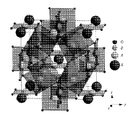
- FIG. 1 shows a crystal structure (cubic crystal structure, space group: Im-3) of an A-site ordered perovskite oxide.
- FIG. 2 shows a change in volume of the perovskite oxide obtained in Example 1 due to heat.
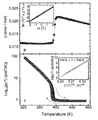
- FIG. 3 is a graph showing the magnetic transition and insulator-metal transition of the perovskite oxide obtained in Example 1 due to heat.
- FIG. 4 is a schematic diagram of the cubic anvil type high-pressure generator used in Examples 1 and 2.
- FIG. 5 shows the X-ray diffraction spectrum of LaCu 3 Fe 4 O 12 obtained in Example 1.
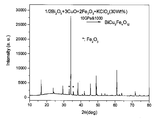
- 6 shows the X-ray diffraction spectrum of BiCu 3 Fe 4 O 12 obtained in Example 2.
- Example 1 A perovskite oxide of LaCu 3 Fe 4 O 12 was produced.
- the obtained capsules were heated for about 1 hour under conditions of a pressure of 10 GPa and a temperature of 1400 K using a cubic anvil type high pressure generator as shown in FIG.
- the perovskite oxide of LaCu 3 Fe 4 O 12 was obtained by the above method.
- Example 2 A perovskite oxide of BiCu 3 Fe 4 O 12 was produced.
- the obtained capsules were heated for about 1 hour under conditions of a pressure of 10 GPa and a temperature of 1300 K using a cubic anvil type high pressure generator as shown in FIG.
- Test example 1 The volume change rate due to heat of the perovskite oxide obtained in Example 1 and Example 2 was confirmed.
- FIG. 2 shows the volume change of the perovskite oxide obtained in Example 1 due to heat.
- the volume change rate of the perovskite oxide of Example 1 when the heating temperature was 393 K was determined by the following formula. ⁇ (Volume when the heating temperature is 423K ⁇ Volume when the heating temperature is 373K) / Volume when the heating temperature is 373K ⁇ ⁇ 100 (%)
- the volume change rate of the perovskite oxide of Example 2 when the heating temperature was 450 K was obtained by the following formula. ⁇ (Volume when the heating temperature is 473K ⁇ Volume when the heating temperature is 423K) / Volume when the heating temperature is 423K ⁇ ⁇ 100 (%) The results are shown in Table 1.
- Test example 2 The perovskite oxide obtained in Example 1 was confirmed to have a magnetic transition due to heat and an insulator-metal transition.
- the magnetic transition was confirmed using a magnetometer (“MPMS” manufactured by Quantum Design).
- MPMS magnetometer
- PPMS physical property measuring apparatus manufactured by Quantum Design Co., Ltd.
- FIG. 3 shows a graph showing the magnetic transition and the insulator-metal transition of the perovskite oxide obtained in Example 1 due to heat.
- the perovskite oxide of Example 1 undergoes a magnetic transition from antiferromagnetism to paramagnetism at the temperature at which the volume decreased in Test Example 1 above, and further from the insulator. It can be seen that the transition to metal occurs. From these results, it can be seen that the perovskite oxide of the present invention can control the increase or decrease in volume by an external magnetic field or current.
Landscapes
- Chemical & Material Sciences (AREA)
- Organic Chemistry (AREA)
- Engineering & Computer Science (AREA)
- Inorganic Chemistry (AREA)
- Ceramic Engineering (AREA)
- Manufacturing & Machinery (AREA)
- Materials Engineering (AREA)
- Structural Engineering (AREA)
- Compounds Of Iron (AREA)
- Compositions Of Oxide Ceramics (AREA)
Abstract
本発明は、実用的な温度領域で体積が減少する金属酸化物材料を提供する。 一般式(1) A'A3B4O12 (1) (式中、A'及びAはペロブスカイト型酸化物のAサイトを占める元素であって、A'はLa、Bi、Y、Pr、Nd、Sm、Eu、Gd、Tb、Dy、Ho、Er、Tm、Yb、Lu、Ca、Sr、Ba、Pb、Na及びKからなる群から選ばれる少なくとも一種の金属元素を示し、AはCu、Mn、Fe及びNiからなる群から選ばれる少なくとも一種の遷移金属元素を示し、Bはペロブスカイト型酸化物のBサイトを占める元素であって、Fe、Ti、V、Cr、Cu、Mn、Co、Ni、Ge、Sn、Zr及びRuからなる群から選ばれる少なくとも一種の遷移金属元素を示す。) で表されるペロブスカイト型酸化物。
Description
本発明は、新規Aサイト秩序型ペロブスカイト酸化物に関する。
各種デバイスを構成する光学部品、精密部品、複合・スタック部品等は、使用時において熱膨張しないことが求められている。
そのため、前記構成部材の材料として、従来より、熱膨張が抑制された金属酸化物材料が注目されている。特に、近年における光学部品等の高密度大容量化に伴い、熱膨張がより一層抑制された金属酸化物材料が求められている。
例えば、特許文献1には、固体電解質型燃料電池(SOFC)の空気極を構成する原料粉末として、La0.95Sr0.05Fe0.80Co0.20O3、LaFe0.75Co0.20Ni0.05O3等のペロブスカイト型酸化物が報告されている(特許文献1の[表1]等)。
特許文献2には、SOFCの構造部材同士を電気的に接合する場合に用いられる接合材料として、La0.8Sr0.2CrO3等のランタンクロマイト系酸化物が報告されている(特許文献2の[表2]等)。
特許文献3には、強誘電体層を有する圧電体として、Nbがドープされたチタン酸ジルコン酸鉛(PZT)圧電体膜が報告されている(特許文献3の実施例1等)。
しかしながら、特許文献1~3において具体的に報告されている金属酸化物材料は、熱膨張がある程度抑制されているものの、近年における光学部品等の高密度大容量化を考慮した場合、さらなる熱膨張の防止又は抑制が求められる。
本発明は、実用的な温度領域で体積が減少する金属酸化物材料を提供することを主な目的とする。
本発明者は、鋭意研究を重ねた結果、特定のペロブスカイト型酸化物が上記目的を達成できることを見出し、本発明を完成するに至った。
即ち、本発明は、下記のペロブスカイト型酸化物及びその製造方法に係る。
1. 一般式(1)
A’A3B4O12 (1)
(式中、A’及びAはペロブスカイト型酸化物のAサイトを占める元素であって、A’はLa、Bi、Y、Pr、Nd、Sm、Eu、Gd、Tb、Dy、Ho、Er、Tm、Yb、Lu、Ca、Sr、Ba、Pb、Na及びKからなる群から選ばれる少なくとも一種の金属元素を示し、AはCu、Mn、Fe及びNiからなる群から選ばれる少なくとも一種の遷移金属元素を示し、Bはペロブスカイト型酸化物のBサイトを占める元素であって、Fe、Ti、V、Cr、Cu、Mn、Co、Ni、Ge、Sn、Zr及びRuからなる群から選ばれる少なくとも一種の遷移金属元素を示す。)
で表されるペロブスカイト型酸化物。
2. 一般式(1)中、A’はLa、Bi及びYからなる群から選ばれる少なくとも一種の金属元素を示し、AはCu及びMnの少なくとも一種の遷移金属元素を示し、BはFeを示す、上記項1に記載のペロブスカイト型酸化物。
3. 熱膨張緩衝材として用いる上記項1又は2に記載のペロブスカイト型酸化物。
4. A’の酸化物、Aの酸化物及びBの酸化物の混合物を、圧力6GPa以上及び温度800℃以上の条件下で熱処理することを特徴とする上記項1又は2に記載のペロブスカイト型酸化物の製造方法。
1. 一般式(1)
A’A3B4O12 (1)
(式中、A’及びAはペロブスカイト型酸化物のAサイトを占める元素であって、A’はLa、Bi、Y、Pr、Nd、Sm、Eu、Gd、Tb、Dy、Ho、Er、Tm、Yb、Lu、Ca、Sr、Ba、Pb、Na及びKからなる群から選ばれる少なくとも一種の金属元素を示し、AはCu、Mn、Fe及びNiからなる群から選ばれる少なくとも一種の遷移金属元素を示し、Bはペロブスカイト型酸化物のBサイトを占める元素であって、Fe、Ti、V、Cr、Cu、Mn、Co、Ni、Ge、Sn、Zr及びRuからなる群から選ばれる少なくとも一種の遷移金属元素を示す。)
で表されるペロブスカイト型酸化物。
2. 一般式(1)中、A’はLa、Bi及びYからなる群から選ばれる少なくとも一種の金属元素を示し、AはCu及びMnの少なくとも一種の遷移金属元素を示し、BはFeを示す、上記項1に記載のペロブスカイト型酸化物。
3. 熱膨張緩衝材として用いる上記項1又は2に記載のペロブスカイト型酸化物。
4. A’の酸化物、Aの酸化物及びBの酸化物の混合物を、圧力6GPa以上及び温度800℃以上の条件下で熱処理することを特徴とする上記項1又は2に記載のペロブスカイト型酸化物の製造方法。
本発明のペロブスカイト型酸化物は、図1に示すように、ペロブスカイト構造のAサイトの1/4を上記金属元素A’が占有し、3/4を上記遷移金属元素Aが占有することによりAサイトが秩序化された酸化物(Aサイト秩序型ペロブスカイト酸化物)である。
本発明のペロブスカイト型酸化物は、このようにAサイトが秩序化されていることにより、各種デバイスの使用時の温度等の実用的な温度領域(25~450℃(298~723K)程度)において体積が減少する。すなわち、本発明のペロブスカイト型酸化物は、前記温度領域で熱収縮する(負の熱膨張が起こる)。例えば、一般式(1)中の上記A’がLa、AがCu、BがFeであるペロブスカイト型酸化物(LaCu3Fe4O12)の場合、図2に示すように、120℃(393K)付近で体積が劇的に減少する。
また、本発明のペロブスカイト型酸化物は、前記温度領域において、磁気転移及び絶縁体-金属転移が起こる。これは、前記温度領域においてAサイト-Bサイト間で電荷移動が起こるためである。例えば、前記LaCu3Fe4O12の温度を上昇させた場合、図3に示すように、120℃(393K)付近で、前記LaCu3Fe4O12は反強磁性から常磁性へと転移し、さらに、同温度付近で、絶縁体から金属へと転移する。従って、本発明のペロブスカイト型酸化物は、外部磁場や電流によって体積の増減を好適に制御できる。
本発明のペロブスカイト型酸化物は、各種デバイス用の部品等の構成材料として用いることにより、熱膨張が防止又は抑制された部品等を製造できる。
しかも、従来の金属酸化物材料は、体積の変動が異方的に起こるのに対し、本発明のペロブスカイト型酸化物は、体積の変動(前記熱収縮)が等方的に起こる。そのため、本発明のペロブスカイト型酸化物を材料とした部品は、各種デバイス上で高精度での位置制御が可能になる。
Aサイト秩序型ペロブスカイト酸化物
本発明のペロブスカイト型酸化物は、一般式(1)
A’A3B4O12 (1)
(式中、A’及びAはペロブスカイト型酸化物のAサイトを占める元素であって、A’はLa、Bi、Y、Pr、Nd、Sm、Eu、Gd、Tb、Dy、Ho、Er、Tm、Yb、Lu、Ca、Sr、Ba、Pb、Na及びKからなる群から選ばれる少なくとも一種の金属元素を示し、AはCu、Mn、Fe及びNiからなる群から選ばれる少なくとも一種の遷移金属元素を示し、Bはペロブスカイト型酸化物のBサイトを占める元素であって、Fe、Ti、V、Cr、Cu、Mn、Co、Ni、Ge、Sn、Zr及びRuからなる群から選ばれる少なくとも一種の遷移金属元素を示す。)
で表される。
本発明のペロブスカイト型酸化物は、一般式(1)
A’A3B4O12 (1)
(式中、A’及びAはペロブスカイト型酸化物のAサイトを占める元素であって、A’はLa、Bi、Y、Pr、Nd、Sm、Eu、Gd、Tb、Dy、Ho、Er、Tm、Yb、Lu、Ca、Sr、Ba、Pb、Na及びKからなる群から選ばれる少なくとも一種の金属元素を示し、AはCu、Mn、Fe及びNiからなる群から選ばれる少なくとも一種の遷移金属元素を示し、Bはペロブスカイト型酸化物のBサイトを占める元素であって、Fe、Ti、V、Cr、Cu、Mn、Co、Ni、Ge、Sn、Zr及びRuからなる群から選ばれる少なくとも一種の遷移金属元素を示す。)
で表される。
A’としては、特に、La、Bi及びYからなる群から選ばれる少なくとも一種の金属元素が好ましく、Laがより好ましい。
Aとしては、特に、Cu及びMnの少なくとも一種の遷移金属元素が好ましく、Cuがより好ましい。
Bとしては、特に、Feが好ましい。
本発明のペロブスカイト型酸化物としては、特に、LaCu3Fe4O12、BiCu3Fe4O12及び(La、Ca)Cu3Fe4O12が好ましく、LaCu3Fe4O12がより好ましい。
本発明のペロブスカイト型酸化物の形状、大きさ等は特に限定されず、目的の部品等に応じて適宜設定すればよいが、部品の加工容易性等の観点から粒子状であることが好ましい。前記ペロブスカイト型酸化物が粒子状である場合、平均粒径は、1~1000μm程度が好ましい。平均粒径の測定方法には、公知の方法を採用すればよい。例えば、透過型電子顕微鏡法等が挙げられる。
本発明のペロブスカイト型酸化物の結晶構造は、例えば、X線回折法、メスバウアー分光法等によって確認できる。
本発明のペロブスカイト型酸化物は、構成する各元素が特殊なイオン状態にある。例えば、LaCu3Fe4O12を例にとると、室温下でLa3+Cu3+
3Fe3+
4O2-
12となり、AサイトでCu3+という特殊なイオン状態が生じている。さらに、393K(120℃)より上の温度では、BサイトのFe3+が異常高原子価と称される高い酸化状態のFe3.75+イオンになるのと同時に、AサイトのCu3+がCu2+イオンへと変化する。
本発明のペロブスカイト型酸化物は、前記イオン状態の変化に伴い、室温下で反強磁性状態であるものが393K(120℃)より上の温度ではから常磁性へと変化する。また、室温下で絶縁体状態であるものが、393K(120℃)より上の温度では電流が流れる金属状態へと変化する。
本発明のペロブスカイト型酸化物は、各種デバイスを構成する部品の材料として使用できる。特に、本発明のペロブスカイト型酸化物は、使用時における熱膨張の問題がないので、高集積・高出力のエレクトロニクス部品(例えば、集積回路等)、精密光学部品(例えば、ミラー、レンズ等)、精密機械部品(例えば、工作機械部品等)等の構成材料として好適に使用できる。例えば、サブミクロンサイズの位置制御を必要とするDVD等のピックアップ装置の材料として好適に用いることができる。
本発明のペロブスカイト型酸化物を用いて各種部品を製造する際、該ペロブスカイト型酸化物と熱膨張作用を示す材料とを混合し、焼結させることにより、温度による体積変化が実質ゼロである部品を製造することが可能になる。すなわち、本発明のペロブスカイト型酸化物は、熱膨張緩衝材としても使用できる。前記ペロブスカイト型酸化物と前記材料との配合割合は、該材料の熱膨張率等に応じて適宜調整すればよい。また、前記ペロブスカイト型酸化物は一種単独で使用してもよいし、二種以上を組み合わせて使用してもよい。
本発明のペロブスカイト型酸化物を熱膨張緩衝材として用いることにより、各種部品の熱膨張率を高精度で調節することができる。例えば、高温、温度履歴環境下で用いる複合・スタック部品は、各部材の熱膨張率の違いによって各部材間で剥離してしまうという問題がある。本発明のペロブスカイト型酸化物によれば、各種部品の熱膨張率を高精度で調節できるため、前記問題を好適に回避できる。従って、本発明のペロブスカイト型酸化物は、例えば、燃料電池用スタック部材、エレクトロニクス基板等における材料としても有用である。
Aサイト秩序型ペロブスカイト酸化物の製造方法
本発明のペロブスカイト型酸化物は、例えば、A’の酸化物、Aの酸化物及びBの酸化物を混合後、高温高圧下で、熱処理(焼成)することにより製造できる。
本発明のペロブスカイト型酸化物は、例えば、A’の酸化物、Aの酸化物及びBの酸化物を混合後、高温高圧下で、熱処理(焼成)することにより製造できる。
A’の酸化物、Aの酸化物及びBの酸化物の配合割合は、特に限定されず、一般式(1)(A’A3B4O12)で示されるペロブスカイト型酸化物が得られるよう適宜設定すればよい。例えば、LaCu3Fe4O12のペロブスカイト型酸化物を製造する場合、La2O3、CuO及びFe2O3をモル比で1:6:4の割合で用いることにより、本発明のペロブスカイト型酸化物が好適に得られる。
前記熱処理は、公知の方法に従って行うことができる。例えば、白金カプセルに、A’の酸化物、Aの酸化物及びBの酸化物の混合物を充填後、得られたカプセルを公知の装置を用いて加圧及び加熱する方法が挙げられる。公知の装置としては、例えば、立方体アンビル型高圧発生装置等が挙げられる。
A’の酸化物、Aの酸化物及びBの酸化物の混合物を熱処理する際の圧力は、6GPa程度以上が好ましく、10~15GPa程度がより好ましい。
熱処理温度は、800℃以上程度が好ましく、1000~1200℃程度がより好ましい。
特に、前記熱処理が、10GPa程度以上の圧力及び1000℃以上の温度で行われることにより、本発明のペロブスカイト型酸化物が好適に得られる。
熱処理時間は、原料が十分に反応するよう熱処理温度等の熱処理条件に応じて適宜調整すればよいが、通常30分~2時間程度である。
前記熱処理に先だって、前記混合物には公知の添加剤を含有させてもよい。公知の添加剤としては、例えばKClO4等の酸化剤が挙げられる。
本発明のペロブスカイト型酸化物は、Aサイトが秩序化されていることにより、各種デバイスの使用時の温度等の実用的な温度領域(25~450℃程度(298~723K程度))で熱収縮する。また、本発明のペロブスカイト型酸化物は、外部磁場や電流によって体積の増減を好適に制御できる。
さらに、本発明のペロブスカイト型酸化物は、体積の変動(前記熱収縮)が等方的に起こる。
このような特性を示す本発明のペロブスカイト型酸化物は、高集積・高出力のエレクトロニクス部品、精密光学部品、精密機械部品等の構成材料として好適に使用できる。例えば、本発明のペロブスカイト型酸化物を熱膨張緩衝材として用いることにより、温度による体積変化が実質ゼロである高集積・高出力エレクトロニクス部品等を製造できる。また、高温、温度履歴環境下で用いた場合に各部材間での剥離が防止又は抑制された、複合・スタック部品を製造できる。
以下に実施例を示し、本発明をより具体的に説明する。但し、本発明は実施例に限定されない。
実施例1
LaCu3Fe4O12のペロブスカイト型酸化物を製造した。
LaCu3Fe4O12のペロブスカイト型酸化物を製造した。
まず、市販のLa2O3、CuO及びFe2O3をモル比で1:6:4の割合で混合した後、KClO4を添加し、混合物を得た。なお、KClO4は、前記混合物中における含有量が20重量%となるように添加した。
得られた混合物を白金カプセルに充填後、得られたカプセルを図4に示すような立方体アンビル型高圧発生装置を用いて、圧力10GPa、温度1400Kの条件下、約1時間加熱した。
加熱後、希酸を用いてKCl及び少量の未反応原料を除去した。
以上の方法により、LaCu3Fe4O12のペロブスカイト型酸化物を得た。
得られたLaCu3Fe4O12のX線回折スペクトルを図5に示す。
実施例2
BiCu3Fe4O12のペロブスカイト型酸化物を製造した。
BiCu3Fe4O12のペロブスカイト型酸化物を製造した。
まず、市販のBi2O3、CuO及びFe2O3をモル比で1:6:4の割合で混合した後、KClO4を添加し、混合物を得た。なお、KClO4は、前記混合物中における含有量が20重量%となるように添加した。
得られた混合物を白金カプセルに充填後、得られたカプセルを図4に示すような立方体アンビル型高圧発生装置を用いて、圧力10GPa、温度1300Kの条件下、約1時間加熱した。
加熱後、希酸を用いてKCl及び少量の未反応原料を除去した。
以上の方法により、BiCu3Fe4O12のペロブスカイト型酸化物を得た。
得られたBiCu3Fe4O12のX線回折スペクトルを図6に示す。
試験例1
実施例1及び実施例2で得られたペロブスカイト型酸化物の熱による体積変化率を確認した。
実施例1及び実施例2で得られたペロブスカイト型酸化物の熱による体積変化率を確認した。
具体的には、X線回折装置(リガク社製RINT2500)を用いて、実施例1及び実施例2で得られたペロブスカイト型酸化物の温度を除々に上げながら、各温度下での結晶の格子定数を測定し体積を計算した。
実施例1で得られたペロブスカイト型酸化物の熱による体積変化を図2に示す。
加熱温度が393Kのときの実施例1のペロブスカイト型酸化物の体積変化率を下記式により求めた。
{(加熱温度が423Kのときの体積-加熱温度が373Kときの体積)/加熱温度が373Kときの体積}×100(%)
{(加熱温度が423Kのときの体積-加熱温度が373Kときの体積)/加熱温度が373Kときの体積}×100(%)
また、加熱温度が450Kのときの実施例2のペロブスカイト型酸化物の体積変化率を下記式により求めた。
{(加熱温度が473Kのときの体積-加熱温度が423Kときの体積)/加熱温度が423Kときの体積}×100(%)
結果を表1に示す。
{(加熱温度が473Kのときの体積-加熱温度が423Kときの体積)/加熱温度が423Kときの体積}×100(%)
結果を表1に示す。
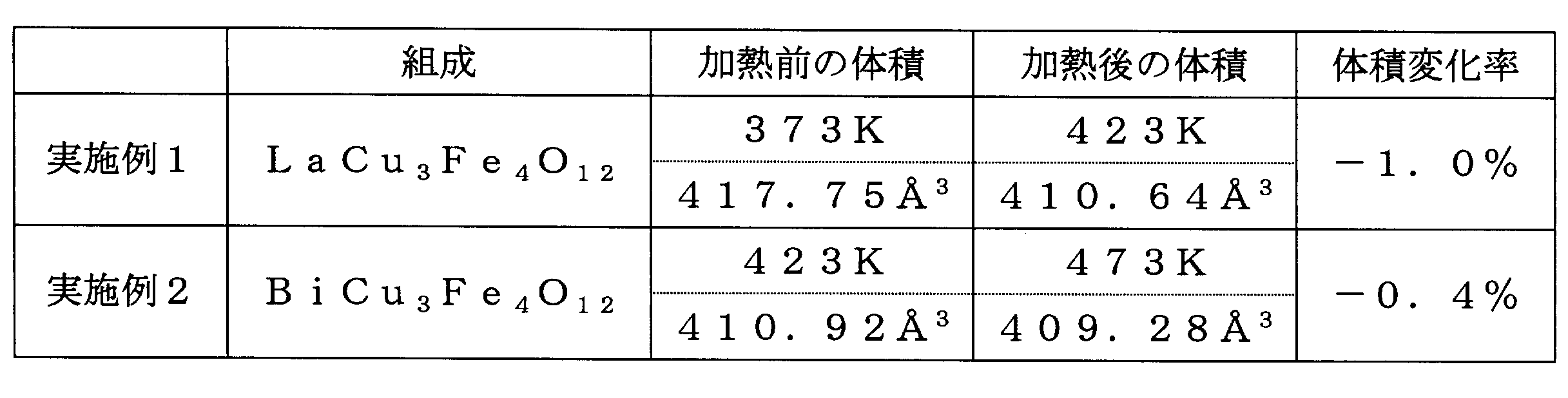
表1から明らかなように、実施例1及び実施例2で得られたペロブスカイト型酸化物は、120℃(393K)、177℃(450K)という実用的な温度で加熱された際、体積が減少することがわかる。
試験例2
実施例1で得られたペロブスカイト型酸化物の熱による磁気転移及び絶縁体-金属転移を確認した。
実施例1で得られたペロブスカイト型酸化物の熱による磁気転移及び絶縁体-金属転移を確認した。
磁気転移については、磁力計(クウォンタムデザイン社製「MPMS」)を用いて確認した。また、絶縁体-金属転移については、物理特性測定装置(クウォンタムデザイン社製「PPMS」)を用いて確認した。
実施例1で得られたペロブスカイト型酸化物の熱による磁気転移及び絶縁体-金属転移を示すグラフを図3に示す。
図3から明らかなように、実施例1のペロブスカイト型酸化物は、上記試験例1で体積が減少した温度を境に、反強磁性から常磁性への磁気転移が起こり、さらに、絶縁体から金属への転移が起こることがわかる。かかる結果から、本発明のペロブスカイト型酸化物は、外部磁場や電流によって体積の増減を制御できることがわかる。
Claims (4)
- 一般式(1)
A’A3B4O12 (1)
(式中、A’及びAはペロブスカイト型酸化物のAサイトを占める元素であって、A’はLa、Bi、Y、Pr、Nd、Sm、Eu、Gd、Tb、Dy、Ho、Er、Tm、Yb、Lu、Ca、Sr、Ba、Pb、Na及びKからなる群から選ばれる少なくとも一種の金属元素を示し、AはCu、Mn、Fe及びNiからなる群から選ばれる少なくとも一種の遷移金属元素を示し、Bはペロブスカイト型酸化物のBサイトを占める元素であって、Fe、Ti、V、Cr、Cu、Mn、Co、Ni、Ge、Sn、Zr及びRuからなる群から選ばれる少なくとも一種の遷移金属元素を示す。)
で表されるペロブスカイト型酸化物。 - 一般式(1)中、A’はLa、Bi及びYからなる群から選ばれる少なくとも一種の金属元素を示し、AはCu及びMnの少なくとも一種の遷移金属元素を示し、BはFeを示す、請求項1に記載のペロブスカイト型酸化物。
- 熱膨張緩衝材として用いる請求項1又は2に記載のペロブスカイト型酸化物。
- A’の酸化物、Aの酸化物及びBの酸化物の混合物を、圧力6GPa以上及び温度800℃以上の条件下で熱処理することを特徴とする請求項1又は2に記載のペロブスカイト型酸化物の製造方法。
Priority Applications (1)
| Application Number | Priority Date | Filing Date | Title |
|---|---|---|---|
| JP2011502764A JPWO2010101153A1 (ja) | 2009-03-04 | 2010-03-02 | Aサイト秩序型ペロブスカイト酸化物 |
Applications Claiming Priority (2)
| Application Number | Priority Date | Filing Date | Title |
|---|---|---|---|
| JP2009-050505 | 2009-03-04 | ||
| JP2009050505 | 2009-03-04 |
Publications (1)
| Publication Number | Publication Date |
|---|---|
| WO2010101153A1 true WO2010101153A1 (ja) | 2010-09-10 |
Family
ID=42709709
Family Applications (1)
| Application Number | Title | Priority Date | Filing Date |
|---|---|---|---|
| PCT/JP2010/053350 Ceased WO2010101153A1 (ja) | 2009-03-04 | 2010-03-02 | Aサイト秩序型ペロブスカイト酸化物 |
Country Status (2)
| Country | Link |
|---|---|
| JP (1) | JPWO2010101153A1 (ja) |
| WO (1) | WO2010101153A1 (ja) |
Cited By (16)
| Publication number | Priority date | Publication date | Assignee | Title |
|---|---|---|---|---|
| WO2014030293A1 (ja) * | 2012-08-21 | 2014-02-27 | 国立大学法人東京工業大学 | 負熱膨張性材料 |
| JP2015070003A (ja) * | 2013-09-26 | 2015-04-13 | セイコーエプソン株式会社 | 光電変換素子及びその製造方法 |
| JP2015221749A (ja) * | 2010-08-12 | 2015-12-10 | キヤノン株式会社 | 熱膨張抑制部材および対熱膨張性部材 |
| US20160131530A1 (en) * | 2014-11-10 | 2016-05-12 | Seiko Epson Corporation | Pyroelectric body, pyroelectric element, production method for pyroelectric element, thermoelectric conversion element, production method for thermoelectric conversion element, thermal photodetector, production method for thermal photodetector, and electronic apparatus |
| JP2017048071A (ja) * | 2015-08-31 | 2017-03-09 | 国立大学法人東京工業大学 | 負熱膨張性材料、及び複合体 |
| WO2017138643A1 (ja) * | 2016-02-12 | 2017-08-17 | 国立大学法人名古屋大学 | ルテニウム酸化物およびルテニウム酸化物の製造方法 |
| US10124558B2 (en) | 2010-08-12 | 2018-11-13 | Kyoto University | Thermal expansion suppressing member and anti-thermally-expansive member |
| US10167562B2 (en) | 2015-06-01 | 2019-01-01 | Osaka Prefecture University Public Corporation | Perovskite oxide catalyst for oxygen evolution reactions |
| WO2019042033A1 (zh) * | 2017-08-30 | 2019-03-07 | 京东方科技集团股份有限公司 | 负热膨胀材料、负热膨胀薄膜及其制备方法 |
| CN110902725A (zh) * | 2019-11-11 | 2020-03-24 | 北京科技大学 | 一种亚稳相稀土铜铁基钙钛矿氧化物的助熔剂合成方法 |
| CN111302801A (zh) * | 2018-12-11 | 2020-06-19 | 中国科学院宁波材料技术与工程研究所 | 一种上转换发光陶瓷及其制备方法 |
| JP2021031584A (ja) * | 2019-08-23 | 2021-03-01 | 国立大学法人京都大学 | 熱量効果材料及びそれを用いた冷却装置 |
| JP2021082598A (ja) * | 2021-02-18 | 2021-05-27 | 国立研究開発法人産業技術総合研究所 | 導電性材料、導電性セラミックス、導電性ペースト、導電性材料膜、複合酸化物の製造方法、導電性ペーストの製造方法及び導電性材料膜の製造方法 |
| CN113398909A (zh) * | 2021-06-08 | 2021-09-17 | 中国科学院物理研究所 | 钙钛矿材料及其制备方法和应用 |
| WO2023163057A1 (ja) * | 2022-02-25 | 2023-08-31 | 日本化学工業株式会社 | 負熱膨張材及び複合材料 |
| JP2023124757A (ja) * | 2022-02-25 | 2023-09-06 | 日本化学工業株式会社 | 負熱膨張材及び複合材料 |
-
2010
- 2010-03-02 WO PCT/JP2010/053350 patent/WO2010101153A1/ja not_active Ceased
- 2010-03-02 JP JP2011502764A patent/JPWO2010101153A1/ja active Pending
Non-Patent Citations (3)
| Title |
|---|
| MASAICHIRO MIZUMAKI ET AL.: "Jikien Nishokusei ni yoru A-site Kisokugata Perovskite Sankabutsu A (A=Ca, Bi ) Cu3M (M=Fe, Mn) 4012 no Jikiteki Ketsugo no Kettei", vol. 63, no. 2, 25 August 2008 (2008-08-25) * |
| Y.SHIMAKAWA: "A-Site-Ordered Perovskites with Intriguing Physical Properties", INORGANIC CHEMISTRY, vol. 47, no. 19, 6 October 2008 (2008-10-06), pages 8562 - 8570 * |
| Y.W.LONG ET AL.: "Intersite Charge Transfer in A-Site-Ordered LaCu3Fe4012 Perovskite", vol. 64, no. 1, 3 March 2009 (2009-03-03) * |
Cited By (25)
| Publication number | Priority date | Publication date | Assignee | Title |
|---|---|---|---|---|
| JP2015221749A (ja) * | 2010-08-12 | 2015-12-10 | キヤノン株式会社 | 熱膨張抑制部材および対熱膨張性部材 |
| US10124558B2 (en) | 2010-08-12 | 2018-11-13 | Kyoto University | Thermal expansion suppressing member and anti-thermally-expansive member |
| JPWO2014030293A1 (ja) * | 2012-08-21 | 2016-07-28 | 国立大学法人東京工業大学 | 負熱膨張性材料 |
| WO2014030293A1 (ja) * | 2012-08-21 | 2014-02-27 | 国立大学法人東京工業大学 | 負熱膨張性材料 |
| JP2015070003A (ja) * | 2013-09-26 | 2015-04-13 | セイコーエプソン株式会社 | 光電変換素子及びその製造方法 |
| US20160131530A1 (en) * | 2014-11-10 | 2016-05-12 | Seiko Epson Corporation | Pyroelectric body, pyroelectric element, production method for pyroelectric element, thermoelectric conversion element, production method for thermoelectric conversion element, thermal photodetector, production method for thermal photodetector, and electronic apparatus |
| US10167562B2 (en) | 2015-06-01 | 2019-01-01 | Osaka Prefecture University Public Corporation | Perovskite oxide catalyst for oxygen evolution reactions |
| JP2017048071A (ja) * | 2015-08-31 | 2017-03-09 | 国立大学法人東京工業大学 | 負熱膨張性材料、及び複合体 |
| US10676371B2 (en) | 2016-02-12 | 2020-06-09 | National University Corporation Nagoya University | Ruthenium oxide having a negative thermal expansion coefficient, and useable as a thermal expansion inhibitor |
| JPWO2017138643A1 (ja) * | 2016-02-12 | 2018-12-06 | 国立大学法人名古屋大学 | ルテニウム酸化物およびルテニウム酸化物の製造方法 |
| WO2017138643A1 (ja) * | 2016-02-12 | 2017-08-17 | 国立大学法人名古屋大学 | ルテニウム酸化物およびルテニウム酸化物の製造方法 |
| WO2019042033A1 (zh) * | 2017-08-30 | 2019-03-07 | 京东方科技集团股份有限公司 | 负热膨胀材料、负热膨胀薄膜及其制备方法 |
| US11396454B2 (en) | 2017-08-30 | 2022-07-26 | Ordos Yuansheng Optoelectronics Co., Ltd. | Negative thermal expansion material, negative thermal expansion film and preparation method thereof |
| CN111302801A (zh) * | 2018-12-11 | 2020-06-19 | 中国科学院宁波材料技术与工程研究所 | 一种上转换发光陶瓷及其制备方法 |
| CN111302801B (zh) * | 2018-12-11 | 2022-06-28 | 中国科学院宁波材料技术与工程研究所 | 一种上转换发光陶瓷及其制备方法 |
| JP2021031584A (ja) * | 2019-08-23 | 2021-03-01 | 国立大学法人京都大学 | 熱量効果材料及びそれを用いた冷却装置 |
| CN110902725A (zh) * | 2019-11-11 | 2020-03-24 | 北京科技大学 | 一种亚稳相稀土铜铁基钙钛矿氧化物的助熔剂合成方法 |
| JP7039075B2 (ja) | 2021-02-18 | 2022-03-22 | 国立研究開発法人産業技術総合研究所 | 導電性材料、導電性セラミックス、導電性ペースト、導電性材料膜、複合酸化物の製造方法、導電性ペーストの製造方法及び導電性材料膜の製造方法 |
| JP2021082598A (ja) * | 2021-02-18 | 2021-05-27 | 国立研究開発法人産業技術総合研究所 | 導電性材料、導電性セラミックス、導電性ペースト、導電性材料膜、複合酸化物の製造方法、導電性ペーストの製造方法及び導電性材料膜の製造方法 |
| CN113398909B (zh) * | 2021-06-08 | 2022-05-24 | 中国科学院物理研究所 | 钙钛矿材料及其制备方法和应用 |
| CN113398909A (zh) * | 2021-06-08 | 2021-09-17 | 中国科学院物理研究所 | 钙钛矿材料及其制备方法和应用 |
| WO2023163057A1 (ja) * | 2022-02-25 | 2023-08-31 | 日本化学工業株式会社 | 負熱膨張材及び複合材料 |
| JP2023124757A (ja) * | 2022-02-25 | 2023-09-06 | 日本化学工業株式会社 | 負熱膨張材及び複合材料 |
| JP7408721B2 (ja) | 2022-02-25 | 2024-01-05 | 日本化学工業株式会社 | 負熱膨張材及び複合材料 |
| US12590012B2 (en) | 2022-02-25 | 2026-03-31 | Nippon Chemical Industrial Co., Ltd. | Negative thermal expansion material and composite material |
Also Published As
| Publication number | Publication date |
|---|---|
| JPWO2010101153A1 (ja) | 2012-09-10 |
Similar Documents
| Publication | Publication Date | Title |
|---|---|---|
| WO2010101153A1 (ja) | Aサイト秩序型ペロブスカイト酸化物 | |
| Chen et al. | Negative thermal expansion in functional materials: controllable thermal expansion by chemical modifications | |
| CN102131746B (zh) | 压电陶瓷、其制造方法和压电器件 | |
| Li et al. | Effects of sintering method on the structural, dielectric and energy storage properties of AgNbO3 lead-free antiferroelectric ceramics | |
| EP1990326A1 (en) | Piezoelectric ceramic composition | |
| Kong et al. | Preparation and characterization of PLZT ceramics using high-energy ball milling | |
| Kong et al. | Preparation of PMN–PT ceramics via a high-energy ball milling process | |
| JP2014172799A (ja) | 圧電材料、圧電材料の製造方法、圧電アクチュエータ、圧電アクチュエータの製造方法 | |
| JPWO2012086449A1 (ja) | 圧電セラミックス、圧電セラミックス部品、及び該圧電セラミックス部品を用いた圧電デバイス | |
| US8480918B2 (en) | Piezoelectric material | |
| JP2005047745A (ja) | 圧電磁器 | |
| Idrees et al. | Transforming Waste to Innovation: Sustainable Piezoelectric Properties of Pb (Ti 0.52 Zr 0.48) O 3 with Recycled β-PbO Massicot | |
| Arora et al. | Evaluation of dielectric, energy storage and multiferroic properties of PrFeO3-PbTiO3 solid solutions | |
| CN114591082A (zh) | 一种pzt-pnn-psn-pmn压电陶瓷及其制备方法 | |
| Bafandeh et al. | Enhanced electric field induced strain in complex-ion Ga3+ and Ta5+-doped 0.93 BNT-0.07 BT piezoceramic | |
| Miyaura et al. | Controlled 90° domain wall motion in BaTiO3 piezoelectric ceramics modified with acceptor ions localized near grain boundaries | |
| Sinha et al. | Dielectric and piezoelectric properties of PbTi 0.8− x Se0. 2Sm x O3 nanoceramics prepared by high energy ball milling | |
| Manotham et al. | Large strain improvement of lead-free (1− x) Bi0. 5Na0. 42K0. 08Zr0. 02Ti0. 98O3–x Ba (Nb0. 5Fe0. 5) O3 piezoelectric ceramics | |
| Ge et al. | Fe-doping as a universal phase boundary shifter for BCZT ceramics across the morphotropic phase boundary | |
| Zhang et al. | Dielectric and Piezoelectric Properties of Pb (In1/2Nb1/2) O3-PbZrO3-PbTiO3 Ceramics via Different Poling Methods | |
| Lang et al. | Achieving high piezoelectric performance in PLNZT ceramics for energy harvesting by rolling molding | |
| CN111548157B (zh) | 基于双位掺杂的铌酸钾钠基无铅电致伸缩陶瓷及其制备方法与应用 | |
| CN119591400B (zh) | 一种用于压电陶瓷风扇的压电陶瓷及其制备方法 | |
| Wang et al. | Intergranular Particle Bridge Structure Design Strategy Boosts High-Temperature Energy Harvesting Performance of Fine-Grained Ceramics | |
| Wannasut et al. | Correlation between phase, microstructure and electrical properties of Ba0. 7Sr0. 3TiO3-modified Bi0. 5Na0. 5TiO3-0.06 BaTiO3 lead free ceramics |
Legal Events
| Date | Code | Title | Description |
|---|---|---|---|
| 121 | Ep: the epo has been informed by wipo that ep was designated in this application |
Ref document number: 10748748 Country of ref document: EP Kind code of ref document: A1 |
|
| DPE1 | Request for preliminary examination filed after expiration of 19th month from priority date (pct application filed from 20040101) | ||
| WWE | Wipo information: entry into national phase |
Ref document number: 2011502764 Country of ref document: JP |
|
| NENP | Non-entry into the national phase |
Ref country code: DE |
|
| 122 | Ep: pct application non-entry in european phase |
Ref document number: 10748748 Country of ref document: EP Kind code of ref document: A1 |