WO2010092850A1 - 芳香族炭化水素製造方法 - Google Patents
芳香族炭化水素製造方法 Download PDFInfo
- Publication number
- WO2010092850A1 WO2010092850A1 PCT/JP2010/050378 JP2010050378W WO2010092850A1 WO 2010092850 A1 WO2010092850 A1 WO 2010092850A1 JP 2010050378 W JP2010050378 W JP 2010050378W WO 2010092850 A1 WO2010092850 A1 WO 2010092850A1
- Authority
- WO
- WIPO (PCT)
- Prior art keywords
- reaction
- catalyst
- aromatic hydrocarbon
- hydrocarbon
- time
- Prior art date
- Legal status (The legal status is an assumption and is not a legal conclusion. Google has not performed a legal analysis and makes no representation as to the accuracy of the status listed.)
- Ceased
Links
Images


Classifications
-
- B—PERFORMING OPERATIONS; TRANSPORTING
- B01—PHYSICAL OR CHEMICAL PROCESSES OR APPARATUS IN GENERAL
- B01J—CHEMICAL OR PHYSICAL PROCESSES, e.g. CATALYSIS OR COLLOID CHEMISTRY; THEIR RELEVANT APPARATUS
- B01J38/00—Regeneration or reactivation of catalysts, in general
- B01J38/04—Gas or vapour treating; Treating by using liquids vaporisable upon contacting spent catalyst
- B01J38/10—Gas or vapour treating; Treating by using liquids vaporisable upon contacting spent catalyst using elemental hydrogen
-
- B—PERFORMING OPERATIONS; TRANSPORTING
- B01—PHYSICAL OR CHEMICAL PROCESSES OR APPARATUS IN GENERAL
- B01J—CHEMICAL OR PHYSICAL PROCESSES, e.g. CATALYSIS OR COLLOID CHEMISTRY; THEIR RELEVANT APPARATUS
- B01J29/00—Catalysts comprising molecular sieves
- B01J29/04—Catalysts comprising molecular sieves having base-exchange properties, e.g. crystalline zeolites
- B01J29/06—Crystalline aluminosilicate zeolites; Isomorphous compounds thereof
- B01J29/40—Crystalline aluminosilicate zeolites; Isomorphous compounds thereof of the pentasil type, e.g. types ZSM-5, ZSM-8 or ZSM-11, as exemplified by patent documents US3702886, GB1334243 and US3709979, respectively
- B01J29/48—Crystalline aluminosilicate zeolites; Isomorphous compounds thereof of the pentasil type, e.g. types ZSM-5, ZSM-8 or ZSM-11, as exemplified by patent documents US3702886, GB1334243 and US3709979, respectively containing arsenic, antimony, bismuth, vanadium, niobium tantalum, polonium, chromium, molybdenum, tungsten, manganese, technetium or rhenium
-
- B—PERFORMING OPERATIONS; TRANSPORTING
- B01—PHYSICAL OR CHEMICAL PROCESSES OR APPARATUS IN GENERAL
- B01J—CHEMICAL OR PHYSICAL PROCESSES, e.g. CATALYSIS OR COLLOID CHEMISTRY; THEIR RELEVANT APPARATUS
- B01J29/00—Catalysts comprising molecular sieves
- B01J29/90—Regeneration or reactivation
-
- C—CHEMISTRY; METALLURGY
- C07—ORGANIC CHEMISTRY
- C07C—ACYCLIC OR CARBOCYCLIC COMPOUNDS
- C07C2/00—Preparation of hydrocarbons from hydrocarbons containing a smaller number of carbon atoms
- C07C2/76—Preparation of hydrocarbons from hydrocarbons containing a smaller number of carbon atoms by condensation of hydrocarbons with partial elimination of hydrogen
-
- C—CHEMISTRY; METALLURGY
- C10—PETROLEUM, GAS OR COKE INDUSTRIES; TECHNICAL GASES CONTAINING CARBON MONOXIDE; FUELS; LUBRICANTS; PEAT
- C10G—CRACKING HYDROCARBON OILS; PRODUCTION OF LIQUID HYDROCARBON MIXTURES, e.g. BY DESTRUCTIVE HYDROGENATION, OLIGOMERISATION, POLYMERISATION; RECOVERY OF HYDROCARBON OILS FROM OIL-SHALE, OIL-SAND, OR GASES; REFINING MIXTURES MAINLY CONSISTING OF HYDROCARBONS; REFORMING OF NAPHTHA; MINERAL WAXES
- C10G45/00—Refining of hydrocarbon oils using hydrogen or hydrogen-generating compounds
- C10G45/58—Refining of hydrocarbon oils using hydrogen or hydrogen-generating compounds to change the structural skeleton of some of the hydrocarbon content without cracking the other hydrocarbons present, e.g. lowering pour point; Selective hydrocracking of normal paraffins
- C10G45/68—Aromatisation of hydrocarbon oil fractions
-
- B—PERFORMING OPERATIONS; TRANSPORTING
- B01—PHYSICAL OR CHEMICAL PROCESSES OR APPARATUS IN GENERAL
- B01J—CHEMICAL OR PHYSICAL PROCESSES, e.g. CATALYSIS OR COLLOID CHEMISTRY; THEIR RELEVANT APPARATUS
- B01J2229/00—Aspects of molecular sieve catalysts not covered by B01J29/00
- B01J2229/30—After treatment, characterised by the means used
- B01J2229/32—Reaction with silicon compounds, e.g. TEOS, siliconfluoride
-
- B—PERFORMING OPERATIONS; TRANSPORTING
- B01—PHYSICAL OR CHEMICAL PROCESSES OR APPARATUS IN GENERAL
- B01J—CHEMICAL OR PHYSICAL PROCESSES, e.g. CATALYSIS OR COLLOID CHEMISTRY; THEIR RELEVANT APPARATUS
- B01J2229/00—Aspects of molecular sieve catalysts not covered by B01J29/00
- B01J2229/30—After treatment, characterised by the means used
- B01J2229/42—Addition of matrix or binder particles
-
- C—CHEMISTRY; METALLURGY
- C07—ORGANIC CHEMISTRY
- C07C—ACYCLIC OR CARBOCYCLIC COMPOUNDS
- C07C2529/00—Catalysts comprising molecular sieves
- C07C2529/04—Catalysts comprising molecular sieves having base-exchange properties, e.g. crystalline zeolites, pillared clays
- C07C2529/06—Crystalline aluminosilicate zeolites; Isomorphous compounds thereof
- C07C2529/40—Crystalline aluminosilicate zeolites; Isomorphous compounds thereof of the pentasil type, e.g. types ZSM-5, ZSM-8 or ZSM-11
-
- C—CHEMISTRY; METALLURGY
- C10—PETROLEUM, GAS OR COKE INDUSTRIES; TECHNICAL GASES CONTAINING CARBON MONOXIDE; FUELS; LUBRICANTS; PEAT
- C10G—CRACKING HYDROCARBON OILS; PRODUCTION OF LIQUID HYDROCARBON MIXTURES, e.g. BY DESTRUCTIVE HYDROGENATION, OLIGOMERISATION, POLYMERISATION; RECOVERY OF HYDROCARBON OILS FROM OIL-SHALE, OIL-SAND, OR GASES; REFINING MIXTURES MAINLY CONSISTING OF HYDROCARBONS; REFORMING OF NAPHTHA; MINERAL WAXES
- C10G2400/00—Products obtained by processes covered by groups C10G9/00 - C10G69/14
- C10G2400/30—Aromatics
-
- Y—GENERAL TAGGING OF NEW TECHNOLOGICAL DEVELOPMENTS; GENERAL TAGGING OF CROSS-SECTIONAL TECHNOLOGIES SPANNING OVER SEVERAL SECTIONS OF THE IPC; TECHNICAL SUBJECTS COVERED BY FORMER USPC CROSS-REFERENCE ART COLLECTIONS [XRACs] AND DIGESTS
- Y02—TECHNOLOGIES OR APPLICATIONS FOR MITIGATION OR ADAPTATION AGAINST CLIMATE CHANGE
- Y02P—CLIMATE CHANGE MITIGATION TECHNOLOGIES IN THE PRODUCTION OR PROCESSING OF GOODS
- Y02P20/00—Technologies relating to chemical industry
- Y02P20/50—Improvements relating to the production of bulk chemicals
- Y02P20/52—Improvements relating to the production of bulk chemicals using catalysts, e.g. selective catalysts
-
- Y—GENERAL TAGGING OF NEW TECHNOLOGICAL DEVELOPMENTS; GENERAL TAGGING OF CROSS-SECTIONAL TECHNOLOGIES SPANNING OVER SEVERAL SECTIONS OF THE IPC; TECHNICAL SUBJECTS COVERED BY FORMER USPC CROSS-REFERENCE ART COLLECTIONS [XRACs] AND DIGESTS
- Y02—TECHNOLOGIES OR APPLICATIONS FOR MITIGATION OR ADAPTATION AGAINST CLIMATE CHANGE
- Y02P—CLIMATE CHANGE MITIGATION TECHNOLOGIES IN THE PRODUCTION OR PROCESSING OF GOODS
- Y02P20/00—Technologies relating to chemical industry
- Y02P20/50—Improvements relating to the production of bulk chemicals
- Y02P20/584—Recycling of catalysts
Definitions
- the present invention relates to a method for efficiently producing an aromatic compound such as benzene and hydrogen from lower hydrocarbons such as methane, ethane and propane.
- the present invention relates to a method for efficiently producing an aromatic compound such as benzene from a lower hydrocarbon using a catalyst.
- aromatic compounds such as benzene, toluene and xylene are mainly produced from naphtha.
- non-catalytic methods such as solvent extraction methods such as coal and gas thermal decomposition methods such as natural gas and acetylene are adopted as methods for producing naphthalenes.
- steam reforming method of natural gas and naphtha is mainly used, but high temperature of about 900 ° C is required, and a large amount of raw material is burned to maintain the reforming temperature, and catalyst It consumes a large amount of energy, using three to four times as much steam as the theoretical amount to prevent a decrease in the activity of Furthermore, there is a problem that a large amount of carbon dioxide, which is a global warming substance, is generated as a reformed / combusted product.
- Patent Document 1 carbon is deposited as a side reaction by adding CO 2 or CO to a gas to be reacted in a method of producing an aromatic compound and hydrogen from lower hydrocarbons such as methane and ethane. To reduce the decrease in catalytic activity due to the reaction.
- Patent Documents 2 to 4 aromatic hydrocarbons and hydrogen are stably produced by alternately repeating the catalytic reaction of lower hydrocarbons and the catalyst regeneration reaction.
- Patent Document 1 it is necessary to add a high concentration of CO 2 or CO in order to stably carry out a reaction for obtaining an aromatic hydrocarbon by contacting methane with a catalyst for a long time.
- the coke deposited on the catalyst in the reaction step can be removed in the regeneration step, but depending on the reaction time, non-removable coke which is difficult to remove in the relatively short regeneration step is generated. If the non-removable coke is accumulated, the benzene yield does not recover to the initial level even after repeating the reaction step and the regeneration step, and gradually decreases. In order to remove such difficultly removable coke, for example, as in Patent Document 4, a regeneration step requiring a long time is required.
- the present invention is a method for producing an aromatic hydrocarbon by catalytically reacting a lower hydrocarbon with a catalyst to maintain a high aromatic hydrocarbon yield, and to repeat the reaction step and the catalyst regeneration step. It is an object of the present invention to provide a method in which the yield of group hydrocarbons does not decrease.
- the aromatic hydrocarbon production method of the present invention which achieves the above object comprises a reaction step of catalytically reacting a lower hydrocarbon with a catalyst to obtain an aromatic hydrocarbon, and a regeneration step of regenerating the catalyst used in the reaction step.
- a reaction step of catalytically reacting a lower hydrocarbon with a catalyst to obtain an aromatic hydrocarbon and a regeneration step of regenerating the catalyst used in the reaction step.
- carbon dioxide is added to the lower hydrocarbon to be 0.33 to 1.6% of the volume of the lower hydrocarbon. It features.
- the reaction step can be switched to the regeneration step.
- the reaction time of the reaction step may be 5 hours or less.
- the regeneration step can be performed by contacting the catalyst with hydrogen.
- the aromatic hydrocarbon when the lower hydrocarbon is catalytically reacted with the catalyst to produce the aromatic hydrocarbon, the aromatic hydrocarbon is stably produced for a long time while maintaining the high aromatic hydrocarbon yield. be able to.
- FIG. 1 The figure which shows the time change of the benzene yield at the time of performing a catalytic reaction continuously.
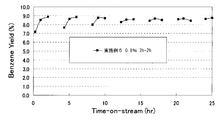
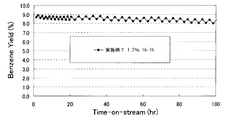
- FIG. The figure which shows the time change of the benzene yield at the time of repeating a catalyst reaction process and a reproduction
- the present invention relates to a method for producing an aromatic hydrocarbon by reacting a lower hydrocarbon in the presence of a catalyst, and adding an amount of carbon dioxide gas which does not become an excess at the time of the reaction, the regeneration gas is periodically formed. It is characterized by switching to regenerate the catalyst.
- the removal of significant carbon (coke) deposition by adding an amount of carbon dioxide gas that does not become excessive at the time of reaction, while switching to a regeneration gas at fixed time intervals to cause catalytic reaction, poorly removable coke accumulates The reaction is carried out for a long time while maintaining a high yield.
- the reactor used in the method for producing the aromatic hydrocarbon of the present invention is exemplified by a fixed bed reactor or a fluidized bed reactor.
- the reaction temperature is 600 ° C. to 900 ° C., preferably 700 ° C. to 850 ° C., more preferably 750 ° C. to 830 ° C.
- the reaction pressure is 0.1 to 0.9 MPa, preferably 0.1 to 0.5 MPa.
- the feed amount of the raw material is 150 to 70000 [ml / g-MFI / h], preferably 500 to 30000 [ml / g-MFI / h], more preferably 1400 to 150,000 in weight hourly space velocity (WHSV) relative to the catalyst amount. It is 14000 [ml / g-MFI / h].
- the zeolite catalyst is not particularly limited as long as it is a zeolite catalyst having catalytic activity.
- mordenite, erionite, ferrierite, commercially available from Mobil "ZSM-5", “ZSM-4”, "ZSM Zeolite-based catalysts such as -8 ",” ZSM-11 “,” ZSM-12 “,” ZSM-20 “,” ZSM-40 “,” ZSM-35 “and” ZSM-48 "can be used.
- crystalline aluminosilicates such as so-called mesoporous zeolites such as “MCM-41”, “MCM-48”, “MCM-50”, “FSM-16”, “M41S”, or polosilicates, gallosilicates, ferroaluminides
- zeolite-based catalysts such as different element-containing zeolites such as silicate and titanosilicate.
- zeolitic catalysts those suitable for the hydration reaction of olefins are crystalline aluminosilicates having a pentasil structure and gallosilicates.
- the zeolite catalyst one of proton exchange type (H type) is usually used.
- H type proton exchange type
- a part of protons are based on alkali metals such as Na, K and Li, alkaline earth elements such as Mg, Ca and Sr, and transition metal elements such as Fe, Co, Ni, Ru, Pd, Pt, Zr and Ti. It may be exchanged with at least one selected cation.
- the zeolite-based catalyst may contain an appropriate amount of Ti, Zr, Hf, Cr, Mo, W, Th, Cu, Ag and the like.
- zeolitic catalyst there is no particular limitation on the form of the zeolitic catalyst, and any form such as powder or granules may be used. Further, alumina, titania, silica, clayey compounds and the like may be used as a carrier or a binder.
- the zeolite-based catalyst may be used by forming into a pellet or extruded product by adding a binder such as silica, alumina or clay.
- lower hydrocarbons are those containing at least 50% by weight, preferably 70% or more by weight of methane, and other saturated and unsaturated hydrocarbons having 2 to 6 carbon atoms.
- Means Examples of these saturated and unsaturated hydrocarbons having 2 to 6 carbon atoms include ethane, ethylene, propane, propylene, n-butane, isobutane, n-butene and isobutene.
- a lower hydrocarbon aromatization catalyst (hereinafter referred to as a catalyst) was prepared by the following preparation method.
- HZSM-5 after silane treatment to an aqueous solution prepared by dissolving predetermined amounts of ammonium molybdate and zinc nitrate in 2000 ml of ion-exchanged water, stir at room temperature for 3 hours, and impregnate HZSM-5 with zinc and molybdenum. did. Zinc and molybdenum were supported on HZSM-5 at a molar ratio of 0.3: 1.
- the obtained zinc / molybdenum-supported ZSM-5 (Zn (1.23 wt%) / Mo (6 wt%) / HZSM-5) was dried and calcined at 550 ° C. for 8 hours to obtain a catalyst powder. Furthermore, an inorganic binder was added to the catalyst powder, and the mixture was extruded into pellets and extruded and calcined to obtain a catalyst.
- the resulting catalyst was used to test production of aromatic hydrocarbons from lower hydrocarbons.
- the evaluation of the catalyst was evaluated by the yield of benzene relative to the lower hydrocarbon flowed.
- Reaction temperature 780 ° C.
- Pressure 0.15MPa Weight hourly space velocity (WHSV): 3000 ml / g-MFI / h
- WHSV Weight hourly space velocity
- FIG. 1 is a view showing the time change of the benzene yield when the catalytic reaction is continuously performed when the reaction gas conditions are changed as in Comparative Examples 1 and 2 and Examples 1 to 4. .
- the conditions of the reaction gases of Comparative Examples 1 and 2 and Examples 1 to 4 are shown below.
- Example 1 0.33 (vol%) of carbon dioxide was added to 100 (vol%) of methane as the reaction gas at the time of reaction to carry out a reaction, and the analysis results were observed over time.
- Example 2 0.6 (vol%) of carbon dioxide was added to 100 (vol%) of methane as the reaction gas at the time of reaction, and the reaction was carried out, and the analysis results were observed over time.
- Example 3 the reaction was carried out by adding 1.0 (vol%) of carbon dioxide to 100 (vol%) of methane as the reaction gas at the time of reaction, and observing the analysis results over time.
- Example 4 the reaction was carried out by adding 1.6 (vol%) of carbon dioxide to 100 (vol%) of methane as the reaction gas at the time of reaction, and observing the analysis results over time.
- Comparative Example 1 has a high benzene yield. However, the decrease in the benzene yield is remarkable as the reaction time passes.
- Example 1 the benzene yield is the same as in Comparative Example 1, and the catalyst stability is improved as the amount of carbon dioxide added increases.
- the amount of carbon dioxide added is 0.6% by volume (Example 2) and 1.0% by volume (Example 3). Since the reaction time in which a high benzene yield is maintained is about 5 hours, it can be confirmed that the aromatic hydrocarbon production reaction and the catalyst regeneration reaction may be repeated within this reaction time range.
- FIGS. 2 to 4 are diagrams showing the time change of the benzene yield when the catalytic reaction step and the regeneration step are repeated under the conditions according to Examples 5 to 7, respectively. Each condition is shown below.
- Example 5 0.8 (vol%) of carbon dioxide is added to 100 (vol%) of methane as the reaction gas at the time of reaction, and the reaction is carried out for 2 hours, then switched to hydrogen gas and regenerated for 2 hours went. The reaction and regeneration were alternately switched to continuously produce aromatic hydrocarbons and observe the analysis results over time.
- Example 6 1.0 (vol%) of carbon dioxide is added to 100 (vol%) of methane as the reaction gas at the time of reaction, the reaction is performed for 0.5 hours, and then hydrogen gas is switched to 0. I played for 5 hours. The reaction and regeneration were alternately switched to continuously produce aromatic hydrocarbons and observe the analysis results over time.
- Example 7 1.2 (vol%) of carbon dioxide is added to 100 (vol%) of methane as the reaction gas at the time of reaction, the reaction is carried out for 1 hour, and then hydrogen gas is switched to regeneration for 1 hour went. The reaction and regeneration were alternately switched to continuously produce aromatic hydrocarbons and observe the analysis results over time.
- the switching time between the reaction and the regeneration is preferably within the time when the yield is most stable (about 5 hours in Examples 2 and 3 of FIG. 1), and in particular, if the catalyst reaction is performed by switching within 2 hours, It can be seen that regeneration of the catalyst is possible regardless of the interval of the switching time.
- aromatic hydrocarbons can be produced without frequently changing the catalytic reaction step and the catalyst regeneration step. Furthermore, even if the catalyst reaction step and the catalyst regeneration step are repeated, the benzene yield does not decrease.
- the amount of carbon dioxide added to the reaction gas is 0.33 to 1.6 (vol%), desirably 0.6 to 1.2 (vol%) with respect to 100 (vol%) of methane, More preferably, it is 0.8 to 1.2 (volume%).
- this invention is not limited to an Example, Reaction conditions, a catalyst (The kind of metal to support, the amount of support), etc. can be selected suitably.
Landscapes
- Chemical & Material Sciences (AREA)
- Organic Chemistry (AREA)
- Engineering & Computer Science (AREA)
- Chemical Kinetics & Catalysis (AREA)
- Materials Engineering (AREA)
- Crystallography & Structural Chemistry (AREA)
- Oil, Petroleum & Natural Gas (AREA)
- General Chemical & Material Sciences (AREA)
- Organic Low-Molecular-Weight Compounds And Preparation Thereof (AREA)
- Low-Molecular Organic Synthesis Reactions Using Catalysts (AREA)
- Catalysts (AREA)
- Production Of Liquid Hydrocarbon Mixture For Refining Petroleum (AREA)
Abstract
Description
ベンゼン収率(%)={(生成したベンゼン量(mol))/(メタン改質反応に供されたメタン量(mol))}×100
以下に、各試験において共通の反応条件を以下に示す。
反応温度:780℃
圧力:0.15MPa
重量時間空間速度(WHSV):3000ml/g-MFI/h
触媒の前処理は、触媒を空気気流下550℃まで昇温し、2時間維持した後、メタン20%:水素80%の前処理ガスに切り替えて、700℃まで昇温し、3時間維持した。その後、反応ガスに切り替えて所定の温度(780℃)まで昇温し触媒の評価を行った。
Claims (4)
- 低級炭化水素を触媒と接触反応させて芳香族炭化水素を得る反応工程と、前記反応工程で使用された触媒を再生する再生工程を繰り返すことにより芳香族炭化水素を製造する方法において、
前記反応工程では、前記低級炭化水素に該低級炭化水素の体積量の0.33~1.6%となるように二酸化炭素を添加した
ことを特徴とする芳香族炭化水素製造方法。 - 前記反応工程で生成されるベンゼンの収率に基づいて、前記反応工程から前記再生工程に切り替える
ことを特徴とする請求項1に記載の芳香族炭化水素製造方法。 - 前記反応工程の反応時間は、5時間以内である
ことを特徴とする請求項2に記載の芳香族炭化水素製造方法。 - 前記再生工程は、前記触媒を水素と接触させることにより行う
ことを特徴とする請求項1から請求項3のうちいずれか1項に記載の芳香族炭化水素製造方法。
Priority Applications (3)
| Application Number | Priority Date | Filing Date | Title |
|---|---|---|---|
| CN2010800074876A CN102317239A (zh) | 2009-02-12 | 2010-01-15 | 芳香族烃的制备方法 |
| SG2011039757A SG171887A1 (en) | 2009-02-12 | 2010-01-15 | Method for producing aromatic hydrocarbon |
| US13/146,274 US20120022309A1 (en) | 2009-02-12 | 2010-01-15 | Method for producing aromatic hydrocarbon |
Applications Claiming Priority (2)
| Application Number | Priority Date | Filing Date | Title |
|---|---|---|---|
| JP2009-029703 | 2009-02-12 | ||
| JP2009029703A JP5423028B2 (ja) | 2009-02-12 | 2009-02-12 | 芳香族炭化水素製造方法 |
Publications (1)
| Publication Number | Publication Date |
|---|---|
| WO2010092850A1 true WO2010092850A1 (ja) | 2010-08-19 |
Family
ID=42561697
Family Applications (1)
| Application Number | Title | Priority Date | Filing Date |
|---|---|---|---|
| PCT/JP2010/050378 Ceased WO2010092850A1 (ja) | 2009-02-12 | 2010-01-15 | 芳香族炭化水素製造方法 |
Country Status (5)
| Country | Link |
|---|---|
| US (1) | US20120022309A1 (ja) |
| JP (1) | JP5423028B2 (ja) |
| CN (1) | CN102317239A (ja) |
| SG (1) | SG171887A1 (ja) |
| WO (1) | WO2010092850A1 (ja) |
Families Citing this family (2)
| Publication number | Priority date | Publication date | Assignee | Title |
|---|---|---|---|---|
| CN114641558A (zh) * | 2019-11-13 | 2022-06-17 | 沙特基础工业全球技术有限公司 | 低级烃芳构化生产苯和其他芳族化合物的方法 |
| JP2022102703A (ja) * | 2020-12-25 | 2022-07-07 | Eneos株式会社 | 炭化水素製造方法 |
Citations (2)
| Publication number | Priority date | Publication date | Assignee | Title |
|---|---|---|---|---|
| JP2003026613A (ja) * | 2001-07-12 | 2003-01-29 | National Institute Of Advanced Industrial & Technology | 低級炭化水素から芳香族炭化水素と水素を製造する方法 |
| JP2008266244A (ja) * | 2007-04-24 | 2008-11-06 | Mitsubishi Chemicals Corp | 芳香族炭化水素の製造方法 |
Family Cites Families (4)
| Publication number | Priority date | Publication date | Assignee | Title |
|---|---|---|---|---|
| US7745675B2 (en) * | 2006-12-20 | 2010-06-29 | Saudi Basic Industries Corporation | Regeneration of platinum-germanium zeolite catalyst |
| AU2008236524B2 (en) * | 2007-04-04 | 2010-11-25 | Exxonmobil Chemical Patents Inc. | Production of aromatics from methane |
| JP2008266245A (ja) * | 2007-04-24 | 2008-11-06 | Mitsubishi Chemicals Corp | 芳香族炭化水素の製造方法 |
| JP5481996B2 (ja) * | 2009-02-12 | 2014-04-23 | 株式会社明電舎 | 芳香族炭化水素製造方法 |
-
2009
- 2009-02-12 JP JP2009029703A patent/JP5423028B2/ja not_active Expired - Fee Related
-
2010
- 2010-01-15 CN CN2010800074876A patent/CN102317239A/zh active Pending
- 2010-01-15 US US13/146,274 patent/US20120022309A1/en not_active Abandoned
- 2010-01-15 SG SG2011039757A patent/SG171887A1/en unknown
- 2010-01-15 WO PCT/JP2010/050378 patent/WO2010092850A1/ja not_active Ceased
Patent Citations (2)
| Publication number | Priority date | Publication date | Assignee | Title |
|---|---|---|---|---|
| JP2003026613A (ja) * | 2001-07-12 | 2003-01-29 | National Institute Of Advanced Industrial & Technology | 低級炭化水素から芳香族炭化水素と水素を製造する方法 |
| JP2008266244A (ja) * | 2007-04-24 | 2008-11-06 | Mitsubishi Chemicals Corp | 芳香族炭化水素の製造方法 |
Also Published As
| Publication number | Publication date |
|---|---|
| SG171887A1 (en) | 2011-07-28 |
| JP5423028B2 (ja) | 2014-02-19 |
| US20120022309A1 (en) | 2012-01-26 |
| JP2010184894A (ja) | 2010-08-26 |
| CN102317239A (zh) | 2012-01-11 |
Similar Documents
| Publication | Publication Date | Title |
|---|---|---|
| US8772563B2 (en) | Process for the conversion of ethane to aromatic hydrocarbons | |
| JP5266225B2 (ja) | 芳香族炭化水素の製造方法 | |
| US8809608B2 (en) | Process for the conversion of lower alkanes to aromatic hydrocarbons | |
| AU2009215686A1 (en) | Process for the conversion of ethane to aromatic hydrocarbons | |
| JP5481996B2 (ja) | 芳香族炭化水素製造方法 | |
| JP5434115B2 (ja) | 芳香族炭化水素製造方法及び芳香族炭化水素製造装置 | |
| JP2001334151A (ja) | 低級炭化水素の芳香族化合物化触媒ならびに低級炭化水素を原料とする芳香族化合物及び水素の製造方法 | |
| WO2012002269A1 (ja) | 芳香族炭化水素製造方法 | |
| JP2025157508A (ja) | エタノールの変換方法、及びその他炭化水素の製造方法 | |
| JP5423028B2 (ja) | 芳香族炭化水素製造方法 | |
| US9861967B2 (en) | Dehydroaromatization catalyst, method of making and use thereof | |
| JP5283665B2 (ja) | 低級炭化水素の芳香族化合物化触媒ならびに低級炭化水素を原料とする芳香族化合物及び水素の製造方法 | |
| JP5283666B2 (ja) | 低級炭化水素の芳香族化合物化触媒ならびに低級炭化水素を原料とする芳香族化合物及び水素の製造方法 | |
| JP2001334152A (ja) | 低級炭化水素の芳香族化合物化触媒ならびに低級炭化水素を原料とする芳香族化合物及び水素の製造方法 | |
| WO2010018711A1 (ja) | 低級炭化水素芳香族化触媒及び芳香族化合物の製造方法 | |
| WO2011118279A1 (ja) | 芳香族化合物製造方法 | |
| JP2023177331A (ja) | アルコールの変換方法、及び炭化水素の製造方法 | |
| JP2015063560A (ja) | 芳香族化合物製造方法 |
Legal Events
| Date | Code | Title | Description |
|---|---|---|---|
| WWE | Wipo information: entry into national phase |
Ref document number: 201080007487.6 Country of ref document: CN |
|
| 121 | Ep: the epo has been informed by wipo that ep was designated in this application |
Ref document number: 10741130 Country of ref document: EP Kind code of ref document: A1 |
|
| WWE | Wipo information: entry into national phase |
Ref document number: 13146274 Country of ref document: US |
|
| NENP | Non-entry into the national phase |
Ref country code: DE |
|
| 122 | Ep: pct application non-entry in european phase |
Ref document number: 10741130 Country of ref document: EP Kind code of ref document: A1 |