WO2010087474A1 - パーオキサイド架橋用組成物および架橋成形品 - Google Patents
パーオキサイド架橋用組成物および架橋成形品 Download PDFInfo
- Publication number
- WO2010087474A1 WO2010087474A1 PCT/JP2010/051341 JP2010051341W WO2010087474A1 WO 2010087474 A1 WO2010087474 A1 WO 2010087474A1 JP 2010051341 W JP2010051341 W JP 2010051341W WO 2010087474 A1 WO2010087474 A1 WO 2010087474A1
- Authority
- WO
- WIPO (PCT)
- Prior art keywords
- crosslinking
- composition
- group
- silicone rubber
- mass
- Prior art date
- Legal status (The legal status is an assumption and is not a legal conclusion. Google has not performed a legal analysis and makes no representation as to the accuracy of the status listed.)
- Ceased
Links
Classifications
-
- C—CHEMISTRY; METALLURGY
- C08—ORGANIC MACROMOLECULAR COMPOUNDS; THEIR PREPARATION OR CHEMICAL WORKING-UP; COMPOSITIONS BASED THEREON
- C08G—MACROMOLECULAR COMPOUNDS OBTAINED OTHERWISE THAN BY REACTIONS ONLY INVOLVING UNSATURATED CARBON-TO-CARBON BONDS
- C08G77/00—Macromolecular compounds obtained by reactions forming a linkage containing silicon with or without sulfur, nitrogen, oxygen or carbon in the main chain of the macromolecule
- C08G77/04—Polysiloxanes
- C08G77/22—Polysiloxanes containing silicon bound to organic groups containing atoms other than carbon, hydrogen and oxygen
- C08G77/24—Polysiloxanes containing silicon bound to organic groups containing atoms other than carbon, hydrogen and oxygen halogen-containing groups
-
- C—CHEMISTRY; METALLURGY
- C08—ORGANIC MACROMOLECULAR COMPOUNDS; THEIR PREPARATION OR CHEMICAL WORKING-UP; COMPOSITIONS BASED THEREON
- C08L—COMPOSITIONS OF MACROMOLECULAR COMPOUNDS
- C08L27/00—Compositions of homopolymers or copolymers of compounds having one or more unsaturated aliphatic radicals, each having only one carbon-to-carbon double bond, and at least one being terminated by a halogen; Compositions of derivatives of such polymers
- C08L27/02—Compositions of homopolymers or copolymers of compounds having one or more unsaturated aliphatic radicals, each having only one carbon-to-carbon double bond, and at least one being terminated by a halogen; Compositions of derivatives of such polymers not modified by chemical after-treatment
- C08L27/12—Compositions of homopolymers or copolymers of compounds having one or more unsaturated aliphatic radicals, each having only one carbon-to-carbon double bond, and at least one being terminated by a halogen; Compositions of derivatives of such polymers not modified by chemical after-treatment containing fluorine atoms
- C08L27/16—Homopolymers or copolymers or vinylidene fluoride
-
- C—CHEMISTRY; METALLURGY
- C08—ORGANIC MACROMOLECULAR COMPOUNDS; THEIR PREPARATION OR CHEMICAL WORKING-UP; COMPOSITIONS BASED THEREON
- C08K—Use of inorganic or non-macromolecular organic substances as compounding ingredients
- C08K5/00—Use of organic ingredients
- C08K5/04—Oxygen-containing compounds
- C08K5/14—Peroxides
-
- C—CHEMISTRY; METALLURGY
- C08—ORGANIC MACROMOLECULAR COMPOUNDS; THEIR PREPARATION OR CHEMICAL WORKING-UP; COMPOSITIONS BASED THEREON
- C08L—COMPOSITIONS OF MACROMOLECULAR COMPOUNDS
- C08L2205/00—Polymer mixtures characterised by other features
- C08L2205/22—Mixtures comprising a continuous polymer matrix in which are dispersed crosslinked particles of another polymer
-
- C—CHEMISTRY; METALLURGY
- C08—ORGANIC MACROMOLECULAR COMPOUNDS; THEIR PREPARATION OR CHEMICAL WORKING-UP; COMPOSITIONS BASED THEREON
- C08L—COMPOSITIONS OF MACROMOLECULAR COMPOUNDS
- C08L83/00—Compositions of macromolecular compounds obtained by reactions forming in the main chain of the macromolecule a linkage containing silicon with or without sulfur, nitrogen, oxygen or carbon only; Compositions of derivatives of such polymers
- C08L83/04—Polysiloxanes
Definitions
- the present invention relates to a peroxide crosslinking composition capable of providing a fluororubber crosslinked molded article having excellent fuel oil resistance and excellent cold resistance.
- Fluoro rubber is excellent in properties such as fuel permeability, slidability, heat resistance, chemical resistance, weather resistance, and electrical properties, and is used in a wide range of fields such as automobiles, industrial machinery, OA equipment, and electrical and electronic equipment. ing.
- Patent Document 2 proposes blending fluorine-containing silicone rubber crosslinked particles with peroxide-crosslinkable fluorine rubber in order to achieve both fuel permeation resistance and cold resistance. Although this patent document 2 does not describe the true specific gravity of the fluorine-containing silicone rubber crosslinked particles, the true specific gravity of the fluorine-containing silicone rubber crosslinked particles actually used exceeds 1.20.
- Patent Document 3 describes a composition for peroxide crosslinking that gives a molded article having both fuel permeation resistance and sealability, and the problem is that fluorocarbon rubber that can be peroxide-crosslinked to silicone raw rubber or silicone rubber crosslinked particles. And using onium salt together.
- this Patent Document 3 also does not describe the true specific gravity of the fluorine-containing silicone rubber crosslinked particles, and the true specific gravity of the actually used fluorine-containing silicone rubber crosslinked particles is less than 0.99 or 1.20. Is more than
- dimethylsiloxane type silicone rubber is inferior in fuel oil resistance
- the present inventors are economically advantageous dimethylsiloxane skeleton silicone cross-linked particles, which are economically resistant without using expensive fluorosilicone.
- the present inventors have found that fuel oil resistance can be compatible and have completed the present invention.
- An object of the present invention is to provide a peroxide crosslinking composition capable of providing a fluororubber molded product having both excellent fuel oil resistance and excellent cold resistance.
- the present invention provides (A) a peroxide-crosslinkable fluororubber, (B) a silicone rubber-crosslinked particle having a true specific gravity of 0.99 to 1.20, and (C) a peroxide-crosslinking containing a peroxide-crosslinking agent.
- the present invention relates to a composition for use.
- the component (B) preferably has no monovalent fluorine-containing hydrocarbon group, and is a silicone rubber crosslinked particle formed by crosslinking a condensation reaction crosslinking silicone rubber composition, particularly a condensation reaction crosslinking silicone. Silicone rubber crosslinked particles formed by crosslinking a rubber composition dispersed in water are preferable.
- the condensation reaction-crosslinking silicone rubber composition includes (i) an organosiloxane having at least two silanol groups in one molecule, (ii) an organosiloxane having at least two silicon-bonded hydrogen atoms in one molecule, and (Iii) a composition containing a catalyst for condensation reaction, or (i) an organosiloxane having at least two silanol groups in one molecule, and (iv) having at least two silicon atom-bonded hydrolyzable groups in one molecule.
- a composition containing an organosiloxane and (iii) a catalyst for condensation reaction is preferable.
- component (A) it is preferable to include a fluororubber composed of a vinylidene fluoride / tetrafluoroethylene / perfluoroalkyl vinyl ether copolymer.
- the present invention also relates to a molded product obtained by peroxide crosslinking of the peroxide crosslinking composition of the present invention.
- silicone rubber crosslinked particles having a true specific gravity of 0.99 to 1.20 cold resistance can be improved while maintaining the fuel oil resistance of fluororubber.
- the present invention relates to a peroxide crosslinking composition
- a peroxide crosslinking composition comprising (A) a peroxide-crosslinkable fluororubber, (B) a silicone rubber crosslinked particle having a true specific gravity of 0.99 to 1.20, and (C) a peroxide crosslinking agent.
- A a peroxide-crosslinkable fluororubber
- B a silicone rubber crosslinked particle having a true specific gravity of 0.99 to 1.20
- C a peroxide crosslinking agent
- the peroxide-crosslinkable fluororubber of component (A) used in the present invention includes non-perfluorofluororubber (a) and perfluorofluororubber (b).
- perfluoro fluororubber means the thing which 90 mol% or more consists of a perfluoro monomer among the structural units.
- non-perfluorofluorinated rubber (a) examples include vinylidene fluoride (hereinafter referred to as VdF) based fluorororubber, tetrafluoroethylene (hereinafter referred to as TFE) / propylene based fluororubber, TFE / propylene / VdF based fluororubber, Examples include ethylene / hexafluoropropylene (hereinafter referred to as HFP) fluorine rubber, ethylene / HFP / VdF fluorine rubber, ethylene / HFP / TFE fluorine rubber, fluorosilicone fluorine rubber, or fluorophosphazene fluorine rubber. These can be used alone or in any combination as long as the effects of the present invention are not impaired.
- VdF-based fluororubber those represented by the following general formula (1) are preferable.
- the structural unit M 1 is a structural unit derived from VdF (m 1 )
- the structural unit M 2 is a structural unit derived from a fluorine-containing ethylenic monomer (m 2 )
- the structural unit N 1 is a single unit.
- It is a repeating unit derived from monomer (n 1 ) copolymerizable with monomer (m 1 ) and monomer (m 2 ))
- the structural unit M 1 30 ⁇ 85 mol%, preferably not containing a structural unit M 2 55 ⁇ 15 mol%, more preferably a structural unit M 1 50 It is ⁇ 80 mol%, and the structural unit M 2 is 50 to 20 mol%.
- the structural unit N 1 is preferably 0 to 20 mol% with respect to the total amount of the structural unit M 1 and the structural unit M 2 .
- the fluorine-containing ethylenic monomer (m 2 ) one or more monomers can be used.
- TFE chlorotrifluoroethylene
- HFP trifluoroethylene
- Fluorine-containing monomers such as fluoropropylene, tetrafluoropropylene, pentafluoropropylene, trifluorobutene, tetrafluoroisobutene, perfluoro (alkyl vinyl ether) (hereinafter referred to as PAVE), vinyl fluoride, and the like.
- CTFE chlorotrifluoroethylene
- HFP trifluoroethylene
- PAVE perfluoro (alkyl vinyl ether)
- vinyl fluoride and the like.
- TFE, HFP, and PAVE are preferable.
- the monomer (n 1 ) may be any monomer as long as it is copolymerizable with the monomer (m 1 ) and the monomer (m 2 ).
- ethylene, propylene, alkyl vinyl ether, etc. can give.
- the monomer (n 1 ) is preferably a monomer that gives a cross-linked site.
- CY 1 2 CY 1 -R f 1 CHR 1 X 1 (2)
- Y 1 is a hydrogen atom, a fluorine atom or —CH 3
- R f 1 is a fluoroalkylene group, a perfluoroalkylene group, a fluoropolyoxyalkylene group or a perfluoropolyoxyalkylene group
- the perfluoroalkylene group may contain an etheric oxygen atom
- R 1 is a hydrogen atom or —CH 3
- X 1 is an iodine atom or a bromine atom
- CF 2 CFO (CF 2 CF (CF 3 ) O) m (CF 2 ) n -X 2 (3) (Wherein m is an integer of 0 to 5, n is an integer of 1 to 3, and X 2 is a
- Iodine-containing monomers such as 4-iodo-3,3,4,4-tetrafluoro-1-butene described in JP-A-61-55138, Bromine-containing monomers described in JP-A-50505341, cyano group-containing monomers as described in JP-A-4-505345, JP-A-5-500070, and carboxyl group-containing monomers.
- Mass Such as alkoxycarbonyl group-containing monomers and the like. These can be used alone or in any combination.
- This iodine atom, bromine atom, vinyl group, cyano group, carboxyl group and alkoxycarbonyl group can function as a crosslinking point.
- VdF-based fluorororubber examples include VdF / HFP rubber, VdF / HFP / TFE rubber, VdF / PAVE rubber, VdF / TFE / PAVE rubber, VdF / HFP / PAVE rubber, VdF / HFP / TFE / PAVE rubber, VdF / CTFE rubber, VdF / CTFE / TFE rubber, etc. are preferred, VdF / HFP rubber, VdF / HFP / TFE rubber, VdF / PAVE rubber, VdF. / TFE / PAVE rubber, VdF / HFP / PAVE rubber, and VdF / HFP / TFE / PAVE rubber are more preferable.
- the VdF / HFP rubber preferably has a VdF / HFP composition of 45 to 85/55 to 15 mol%, more preferably 50 to 80/50 to 20 mol%, and still more preferably 60 -80/40 to 20 mol%.
- the VdF / HFP / TFE rubber preferably has a VdF / HFP / TFE composition of 40 to 80/10 to 35/10 to 35 mol%.
- the VdF / PAVE rubber preferably has a VdF / PAVE composition of 65 to 90/35 to 10 mol%.
- the VdF / TFE / PAVE rubber preferably has a VdF / TFE / PAVE composition of 40 to 80/3 to 40/15 to 35 mol%.
- the VdF / HFP / PAVE rubber preferably has a VdF / HFP / PAVE composition of 65 to 90/3 to 25/3 to 25 mol%.
- the VdF / HFP / TFE / PAVE rubber preferably has a VdF / HFP / TFE / PAVE composition of 40 to 90/0 to 25/0 to 40/3 to 35, preferably 40 to 80/3 to 25. More preferred is / 3 to 40/3 to 25 mol%.
- TFE / propylene-based fluororubber those represented by the following general formula (5) are preferable.
- the structural unit M 3 is a structural unit derived from TFE (m 3 )
- the structural unit M 4 is a structural unit derived from propylene (m 4 )
- the structural unit N 2 is a monomer (m 3 ).
- Formula (5) Among the TFE / propylene type fluorine-containing rubbers represented by the structural unit M 3 40 ⁇ 70 mol%, preferably not containing a structural unit M 4 60 ⁇ 30 mol%, more preferably the structural unit M 3 Is 50 to 60 mol% and the structural unit M 4 is 50 to 40 mol%.
- the structural unit N 2 is preferably 0 to 40 mol% with respect to the total amount of the structural unit M 3 and the structural unit M 4 .
- the monomer (n 2 ) may be any monomer that can be copolymerized with the monomer (m 3 ) and the monomer (m 4 ). Is preferred. Examples thereof include VdF and ethylene.
- the structural unit M 5 is a structural unit derived from TFE (m 5 )
- the structural unit M 6 is a structural unit derived from PAVE or perfluoro (alkoxy vinyl ether) (m 6 )
- the structural unit N 3 is (It is a repeating unit derived from the monomer (m 3 ) and the monomer (n 3 ) copolymerizable with the monomer (m 6 ))
- the structural unit M 5 50 ⁇ 90 mol% preferably not containing a structural unit M 6 10 ⁇ 50 mol%, more preferably the structural unit M 5 to 50 to 80 mol%, and structural unit M 6 to 20 to 50 mol%.
- the structural unit N 3 is preferably 0 to 5 mol%, and more preferably 0 to 2 mol%, based on the total amount of the structural unit M 5 and the structural unit M 6 .
- PAVE examples include perfluoro (methyl vinyl ether) and perfluoro (propyl vinyl ether), and these can be used alone or in any combination.
- perfluoro (alkoxy vinyl ether) (m 6 ) for example, a monomer described in JP-A-61-223007 can be used.
- the monomer (n 3 ) may be any monomer as long as it is copolymerizable with the monomer (m 5 ) and the monomer (m 6 ). preferable.
- Examples of the monomer that gives such a crosslinking site include VdF and the same as those mentioned above, and these can be used alone or in any combination.
- This iodine atom, bromine atom, vinyl group, cyano group, carboxyl group and alkoxycarbonyl group can function as a crosslinking point.
- perfluorofluorororubber (b) Specific examples of such perfluorofluorororubber (b) are described in WO 97/24381, JP-B 61-57324, JP-B 4-81608, JP-B 5-13961, and the like. Fluoro rubber etc.
- the fluorine rubber is preferably a fluorine rubber composed of VdF and at least one other fluorine-containing monomer, such as VdF / HFP rubber, VdF / HFP / TFE rubber, and VdF / PAVE rubber. More preferably, it is at least one rubber selected from the group consisting of VdF / TFE / PAVE rubber, VdF / HFP / PAVE rubber, and VdF / HFP / TFE / PAVE rubber, and is particularly excellent in cold resistance. Therefore, VdF / TFE / PAVE fluororubber is preferable.
- the non-perfluorofluorororubber (a) and the perfluorofluororubber (b) described above can be produced by a conventional method, but the obtained polymer has a narrow molecular weight distribution and is easy to control the molecular weight.
- a known iodine transfer polymerization method is preferred as a method for producing fluororubber because an iodine atom can be introduced into the terminal.
- the silicone rubber crosslinked particles of the component (B) used in the present invention have a true specific gravity in the range of 0.99 to 1.20. is important.
- the true specific gravity is smaller than 0.99, the fuel oil resistance of the resulting crosslinked molded product is lowered.
- it exceeds 1.20 the cold resistance of the obtained crosslinked molded product is lowered.
- the upper limit of the preferable true specific gravity is 1.10, and if it is less than this, the cold resistance of the resulting crosslinked molded article is further improved.
- true specific gravity refers to a standard solution for measuring specific gravity with different specific gravity (25 ° C.) mixed with appropriate amounts of water, methanol, sodium chloride and polyoxyethylene lauryl ether, and one of these standard solutions ( 10 g), 0.2 g of silicone rubber cross-linked particles (powder) is added, centrifugal separation is performed at 3000 rpm for 10 minutes, and the silicone rubber cross-linked particles are observed visually for sedimentation and floating. The average value of the specific gravity of the standard solution before and after switching.
- the silicone rubber crosslinked particles used in the present invention do not exclude the inclusion of an inorganic filler, but are preferably silicone rubber crosslinked particles that do not contain an inorganic filler in the crosslinked particles for ease of production. .
- silicone rubber crosslinked particles (B) are preferably non-fluorinated silicone rubber crosslinked particles having no monovalent fluorine-containing hydrocarbon group since the cold resistance of the resulting crosslinked molded article is further improved.
- the silicone rubber crosslinked particles (B) having such characteristics are obtained by crosslinking the condensation reaction-crosslinkable silicone rubber composition, particularly in a state where the condensation reaction-crosslinkable silicone rubber composition is dispersed in water. Silicone rubber crosslinked particles formed by crosslinking are preferred.
- Examples of the method for preparing the silicone rubber crosslinked particles (B) include a method of forming silicone rubber crosslinked particles using a condensation reaction crosslinking silicone rubber composition described in JP-A No. 2001-240679. Specifically, (i) an organosiloxane having at least two silanol groups in one molecule, (ii) an organosiloxane having at least two silicon atom-bonded hydrogen atoms in one molecule, and (iii) a condensation reaction (I) an organosiloxane having at least two silanol groups in one molecule, and (iv) at least two silicon atom-bonded hydrolyzable groups in one molecule. And (iii) a composition containing a catalyst for condensation reaction (composition (II)), How to formed it can be exemplified.
- the organosiloxane (iv) that is included is a crosslinking agent, and the compositions (I) and (II) use the same components except for the crosslinking agent used.
- Organosiloxane (i) having at least two silanol groups in one molecule is a main agent and is characterized by having at least two silanol groups in one molecule.
- the bonding position of the silanol group is not limited, but is preferably a molecular chain terminal from the viewpoint of good reactivity.
- Other groups bonded to the silicon atom include methyl groups, ethyl groups, propyl groups, butyl groups, pentyl groups, hexyl groups, cyclohexyl groups, octyl groups, decyl groups and other alkyl groups; vinyl groups, allyl groups, butenyl groups.
- a methyl group and a phenyl group are preferable.
- Examples of the molecular structure of the organosiloxane (i) include linear, cyclic, network, partially branched linear, and branched, with linear being particularly preferred.
- the viscosity of the organosiloxane (i) at 25 ° C. is not particularly limited, but is practically preferably 5 to 100,000 mPa ⁇ s, more preferably 10 to 10,000 mPa ⁇ s.
- the organosiloxane (ii) having at least two silicon-bonded hydrogen atoms in one molecule in the composition (I) serves as a crosslinking agent component.
- the number of silicon atom-bonded hydrogen atoms may be two or more, but is preferably three or more because crosslinking proceeds sufficiently.
- An upper limit is not specifically limited, What is necessary is just to select suitably from the point of handling workability
- the organic group bonded to the silicon atom in the component includes an alkyl group such as a methyl group, an ethyl group, a propyl group, or a butyl group; an alkenyl group such as a vinyl group or an allyl group; an aryl group such as a phenyl group; And aralkyl groups such as a phenethyl group; cycloalkyl groups such as a cyclopentyl group and a cyclohexyl group; and substituted or unsubstituted monovalent hydrocarbon groups such as a halogenated alkyl group such as a 3-chloropropyl group.
- an alkyl group such as a methyl group, an ethyl group, a propyl group, or a butyl group
- an alkenyl group such as a vinyl group or an allyl group
- an aryl group such as a phenyl group
- aralkyl groups
- examples of the molecular structure of component (ii) include linear, partially branched linear, branched, network, and cyclic.
- Such organopolysiloxanes of component (ii) include trimethylsiloxy group-capped methylhydrogen polysiloxanes at both molecular chains, trimethylsiloxy group-capped dimethylsiloxane / methylhydrogensiloxane copolymers with both molecular chains, and both molecular chains.
- Terminal dimethylhydrogensiloxy group-blocked dimethylsiloxane / methylhydrogensiloxane copolymer, cyclic methylhydrogenpolysiloxane, all or part of the methyl groups in these siloxanes are alkyl groups such as ethyl groups; aryls such as phenyl groups
- Illustrative is an organopolysiloxane substituted with a group or the like.
- the amount of the component (ii) is an amount for crosslinking the composition (I). Specifically, the amount is 0.1 to 50 parts by mass with respect to 100 parts by mass of the component (i). Preferably there is. This is because if the blending amount of component (ii) is less than the lower limit of the above range, the resulting composition may not be sufficiently cross-linked, whereas if the upper limit of the above range is exceeded, the resulting cross-linkage is obtained. This is because the physical properties of the silicone particles may be deteriorated.
- the organosiloxane (iv) having at least two silicon-bonded hydrolyzable groups in one molecule in the composition (II) serves as a crosslinking agent component.
- the number of silicon atom-bonded hydrolyzable groups may be two or more, but three or more are preferable because crosslinking proceeds sufficiently.
- the upper limit is not particularly limited, and may be appropriately selected from the viewpoint of handling workability of the composition (II).
- Examples of the silicon atom-bonded hydrolyzable group of component (iv) include alkoxy groups such as methoxy group, ethoxy group and methoxyethoxy group; oxime groups such as methyl ethyl ketoxime group; acetoxy group; aminoxy group.
- Examples of the silane or siloxane of component (iv) include methyltrimethoxysilane, ethyltrimethoxysilane, methyltri (methoxyethoxy) silane, alkoxysilane such as tetramethoxysilane and tetraethoxysilane, and partial hydrolytic condensation thereof.
- oxime silanes such as methyltri (methylethylketoxime) silane, ethyltri (methylethylketoxime) silane, tetra (methylethylketoxime) silane, and partial hydrolysis condensates thereof; methyltriacetoxysilane, ethyltriacetoxysilane, tetraacetoxysilane, etc.
- Acetoxysilane, and partial hydrolysis condensates thereof methyltri (trimethylaminoxy) silane, ethyltri (trimethylaminoxy) silane, tetra (trimethylamino)
- Aminoxysilanes such as silanes, and partial hydrolysis condensates thereof are exemplified, preferably alkoxysilanes or partial hydrolysis condensates thereof, and particularly preferably partial hydrolysis condensates of tetraalkoxysilanes. Is an alkylpolysilicate.
- the blending amount of the component (iv) is an amount for crosslinking the composition (II). Specifically, it is 0.1 to 50 parts by mass with respect to 100 parts by mass of the component (i). Preferably there is. This is because if the blending amount of the component (iv) is less than the lower limit of the above range, the resulting composition may not be sufficiently cross-linked, whereas if it exceeds the upper limit of the above range, the resulting cross-linkage is obtained. This is because the physical properties of the silicone particles may be deteriorated.
- the condensation reaction catalyst (iii) is a catalyst for accelerating the curing of the compositions (I) and (II).
- the blending amount of the condensation reaction catalyst is not particularly limited, but is preferably 0.01 to 20 parts by mass, more preferably 0.01 to 10 parts by mass with respect to 100 parts by mass of the organosiloxane (i). preferable.
- composition (I) or (II) an alkenyl group, an epoxy-containing organic group, an amino-containing organic group, or an acrylic-containing organic group is introduced into the resulting crosslinked particles, so that the general formula (7): R 5 R 3 b Si (OR 4 ) (3-b) (7) Or a partially hydrolyzed condensate thereof may be blended.
- R 3 is an unsubstituted or substituted monovalent hydrocarbon group excluding an alkenyl group, an alkyl group such as a methyl group, an ethyl group, a propyl group, or a butyl group; an aryl group such as a phenyl group; a benzyl group or a phenethyl group
- Examples include aralkyl groups such as groups; cycloalkyl groups such as cyclopentyl groups and cyclohexyl groups; and halogenated alkyl groups such as 3-chloropropyl groups.
- R 4 is an alkyl group having 4 or less carbon atoms, and examples thereof include a methyl group, an ethyl group, a propyl group, and a butyl group.
- R 5 is a group selected from the group consisting of an alkenyl group, an epoxy-containing organic group, an amino-containing organic group, and an acrylic-containing organic group.
- alkenyl group include a vinyl group, an allyl group, a butenyl group, a pentenyl group, a hexenyl group, a heptenyl group, and an octenyl group.
- Examples of the epoxy-containing organic group include a 3-glycidoxypropyl group, 2- (3,4) -Epoxycyclohexyl) ethyl group and 4-oxiranylbutyl group are exemplified, and examples of the amino-containing organic group include 2-aminoethyl group, 3-aminopropyl group, N- (2-aminoethyl) -3-aminopropyl
- Examples of the acryl-containing organic group include a 3-methacryloxypropyl group and a 3-acryloxypropyl group.
- an alkenyl group and an acryl-containing organic group are preferable because they have reactivity in the peroxide crosslinking reaction of fluororubber, and a vinyl group, an allyl group, a hexenyl group, and a 3-methacryloxypropyl group are more preferable.
- B is 0 or 1.
- organosilicon compounds or partial hydrolysates thereof examples include vinyltrimethoxysilane, vinyltriethoxysilane, vinyltris (2-methoxyethoxy) silane, methylvinyldimethoxysilane, allyltrimethoxysilane, and 3-glycidide.
- Xylpropyltrimethoxysilane 3-glycidoxypropylmethyldimethoxysilane, 2- (3,4-epoxycyclohexyl) ethyltrimethoxysilane, 3-aminopropyltrimethoxysilane, 3-aminopropylmethyldimethoxysilane, N- ( 2-aminoethyl) -3-aminopropyltrimethoxysilane, 3-methacryloxypropyltrimethoxysilane, partial hydrolysis condensates of these organosilicon compounds, or mixtures of two or more thereof.
- the amount of the organosilicon compound or the partial hydrolyzate thereof is not particularly limited, but is preferably 0.05 to 50 parts by mass, and 0.05 to 15 parts by mass with respect to 100 parts by mass of the organosiloxane (i). It is more preferable that This is because if the amount of the organosilicon compound or its partial hydrolyzate is less than the lower limit of the above range, the reactivity of the resulting crosslinked particles to the fluororubber cannot be expected, while the upper limit of the above range. This is because the mechanical strength of the resulting crosslinked particles tends to be significantly reduced.
- condensation reaction crosslinkable silicone rubber compositions (I) and (II) do not need to contain a filler, particularly an inorganic filler, but if added, for example, precipitated silica, fumed silica, Reinforcing fillers such as calcined silica and fumed titanium oxide; non-reinforcing fillers such as pulverized quartz, diatomaceous earth, aluminosilicate, iron oxide, zinc oxide and calcium carbonate; organochlorosilane and organoalkoxysilane And fillers formed by treatment with organosilicon compounds such as organosilazane and organosiloxane oligomer.
- pigments, organic compounds having an epoxy group or amino group, heat-resistant agents, flame retardants, plasticizers, non-crosslinkable organopolysiloxanes, and the like may be blended.
- the silicone rubber crosslinked particles (B) are obtained, for example, by crosslinking these condensation reaction crosslinking silicone rubber compositions.
- crosslinked particles obtained by crosslinking in a state in which the condensation reaction crosslinking silicone rubber composition is dispersed in water are preferable because the particle size distribution is sharp and the average particle size can be reduced.
- a surfactant it is preferable to use a surfactant.
- surfactant examples include nonionic surfactants such as polyoxyalkylene alkyl ether, polyoxyalkylene alkylphenol ether, polyoxyalkylene alkyl ester, polyoxyalkylene sorbitan ester, and ethylene oxide adduct of diethylene glycol trimethylnonanol; alkylbenzene Anionic surfactants such as sulfonate, alkyl sulfate, polyoxyethylene alkyl ether sulfate; octyltrimethylammonium hydroxide, dodecyltrimethylammonium hydroxide, hexadecyltrimethylammonium hydroxide, octyldimethylbenzylammonium hydroxide, decyl Dimethylbenzylammonium hydroxide, dioctadecyldimethylammonium Dorokishido, cationic surfactants such as coconut oil trimethylammonium hydroxide, or a mixture of two or more
- a crosslinked particle having a small average particle size by dispersing the condensation reaction crosslinking silicone rubber composition in water, for example, a colloid mill, a homogenizer, a propeller type stirring device, a combimix, an ultrasonic stirring device, etc.
- a conventionally well-known emulsifier can be used.
- Methods for separating the crosslinked particles from the aqueous dispersion include, for example, a method of drying in an oven, a method of drying with cold air, hot air or hot air, a method of drying under reduced pressure, and a volatile organic material such as alcohol.
- An example is a method in which a solvent is added to replace water, followed by drying by the above method. As these conditions, conditions that are usually used can be adopted.
- the average particle diameter of the silicone rubber cross-linked particles used in the present invention is preferably about 0.1 to 500 ⁇ m, for example, and more preferably 0.1 to 100 ⁇ m because of good dispersibility in the fluororubber (A). It is preferable that the thickness is 0.1 to 50 ⁇ m.
- Component (B) is preferably blended in an amount of 5 to 200 parts by weight, more preferably 30 to 180 parts by weight, and 70 to 160 parts by weight with respect to 100 parts by weight of component (A). Is more preferable. This is because the improvement in cold resistance of the cured product obtained when the blending amount of the component (B) is less than the lower limit of the above range is insufficient, while the resistance of the cured product obtained when the upper limit of the above range is exceeded. This is because fuel permeability and mechanical properties tend to be extremely lowered.
- the peroxide crosslinking agent (C) used in the present invention is not particularly limited as long as it is usually used.
- the peroxide cross-linking agent (C) one that easily generates a peroxy radical in the presence of heat or a redox system is preferable. Specifically, 1,1-bis (t-butylperoxy) -3,5,5-trimethylcyclohexane, 2,5-dimethylhexane-2,5-dihydroperoxide, di-t-butylperoxide, To t-butylcumyl peroxide, dicumyl peroxide, ⁇ , ⁇ '-di (t-butylperoxy) -p-diisopropylbenzene, 2,5-dimethyl-2,5-di (t-butylperoxy) Xanthone, 2,5-dimethyl-2,5-di (t-butylperoxy) hexyne-3, benzoyl peroxide, t-butylperoxybenzene, 2,5-dimethyl-2,5-di (benzoylperoxy)
- crosslinking aid can be used as necessary.
- the crosslinking aid include triallyl cyanurate, triallyl isocyanurate (TAIC), triacryl formal, triallyl trimellitate, N, N′-m. -Phenylene bismaleimide, dipropargyl terephthalate, diallyl phthalate, tetraallyl terephthalamide, triallyl phosphate and the like.
- triallyl isocyanurate (TAIC) is preferable from the viewpoint of crosslinkability and physical properties of the cross-linked product.
- the blending amount of the peroxide crosslinking agent (C) is preferably 0.05 to 10 parts by mass, and more preferably 1.0 to 5 parts by mass with respect to 100 parts by mass of the component (A). If the blending amount of the cross-linking agent is less than the lower limit of the above range, the cross-linking of the fluororubber does not proceed sufficiently, and the resulting molded article tends to have a reduced fuel permeability. If the upper limit is exceeded, the hardness of the resulting molded product tends to be too high.
- the blending amount of the crosslinking aid is preferably 0.1 to 10 parts by mass, more preferably 0.5 to 5 parts by mass with respect to 100 parts by mass of component (A). If the blending amount of the crosslinking aid is less than the lower limit of the above range, the crosslinking of the fluororubber does not proceed sufficiently and the resulting molded article tends to have poor fuel permeation resistance. This is because the moldability tends to decrease if the upper limit of the above is exceeded.
- the peroxide crosslinking composition of the present invention is substantially composed only of peroxide-crosslinkable fluororubber (A), silicone rubber crosslinked particles (B) having a specific true specific gravity, and peroxide crosslinking agent (C). This gives a molded article with a good balance between fuel oil resistance and cold resistance, but does not exclude other compounding agents.
- compounding agents for example, onium salts, fillers, processing aids, plasticizers, coloring agents, antioxidants, anti-aging agents, ozone degrading agents, ultraviolet absorbers, and the like can be blended.
- One or more conventional crosslinking agents and crosslinking aids different from those described above may be blended.
- the onium salt is not particularly limited.
- ammonium compounds such as quaternary ammonium salts, phosphonium compounds such as quaternary phosphonium salts, arsonium compounds, stibonium compounds, oxonium compounds, sulfonium compounds, selenonium compounds, stannonium compounds, Examples include iodonium compounds, cyclic amines, and monofunctional amine compounds.
- the quaternary ammonium salt is not particularly limited.
- the quaternary phosphonium salt is not particularly limited.
- tetrabutylphosphonium chloride benzyltriphenylphosphonium chloride (hereinafter referred to as BTPPC), tetraphenylphosphonium chloride (TPPC), benzyltrimethylphosphonium chloride, benzyltributylphosphonium.
- BTPPC benzyltriphenylphosphonium chloride
- TPPC tetraphenylphosphonium chloride
- benzyltrimethylphosphonium chloride benzyltributylphosphonium
- examples include chloride, tributylallylphosphonium chloride, tributyl-2-methoxypropylphosphonium chloride, benzylphenyl (dimethylamino) phosphonium chloride, and the like.
- phosphonium salts are preferred because they are relatively stable in the presence of most inorganic bases, have a relatively low hygroscopic property, and cause little coloring of the rubber molded product during crosslinking. Furthermore, BTPPC is preferred from the viewpoint of improving the heat resistance of the fluororubber and silicone rubber crosslinked particle molded product (composite).
- the amount of the onium salt is preferably 0.01 to 15 parts by mass, more preferably 0.05 to 5 parts by mass, and 0.1 to 1 part per 100 parts by mass of the component (A). More preferably, it is part by mass.
- Fillers can also be added as optional ingredients.
- Fillers include, for example, magnesium oxide, calcium oxide, magnesium hydroxide, calcium hydroxide, magnesium carbonate, molybdenum disulfide, barium sulfate, magnesium silicate (talc), aluminum silicate (clay), diatomaceous earth, calcium metasilicate (water Examples include inorganic fillers such as (lastite), zeolite, hydrotalcite, graphite, carbon black, silica, quartz, and alumina; organic fillers such as polytetrafluoroethylene and aramid fibers.
- the blending amount of the filler is preferably 1 to 100 parts by mass and more preferably 5 to 80 parts by mass with respect to 100 parts by mass of the component (A).
- the peroxide crosslinking composition of the present invention can be prepared by mixing each component using a normal elastomer processing machine, for example, an open roll, a Banbury mixer, a kneader or the like.
- the peroxide crosslinking composition thus obtained is crosslinked and molded according to a conventional method. That is, it is molded by compression molding, injection molding, extrusion molding, calendar molding, dip molding, coating, etc. by dissolving in a solvent.
- the crosslinking conditions vary depending on the molding method and the shape of the molded product, but are in the range of about 100 to 300 ° C. for several seconds to 5 hours. Further, secondary crosslinking may be performed in order to stabilize the physical properties of the crosslinked product.
- the secondary crosslinking conditions are 150 to 300 ° C. for about 30 minutes to 48 hours.
- the peroxide crosslinking composition of the present invention and a molded article using the composition are, for example, a semiconductor manufacturing apparatus, a liquid crystal panel manufacturing apparatus, a plasma panel manufacturing apparatus, a plasma address liquid crystal panel, a field emission display panel, a solar cell substrate.
- Semiconductor related fields such as: Automotive field; Aircraft field; Rocket field; Ship field; Chemical field such as chemical plant; Pharmaceutical field such as pharmaceutical; Photo field such as developing machine; Printing field such as printing machine; Although it can be suitably used in fields such as coating field; analysis / physical and chemical machinery field; food plant equipment field; nuclear power plant equipment field; steel field such as iron plate processing equipment; general industrial field; electrical field; Among these, it can be used more suitably in the automobile field.
- gaskets, shaft seals, valve stem seals, sealing materials and hoses can be used for engines and peripheral devices
- hoses and sealing materials can be used for AT devices, O (square) rings, tubes, packings.
- the valve core material, hose, sealing material and diaphragm can be used for fuel systems and peripheral devices.
- the molded product of the present invention is excellent in fuel oil resistance and cold resistance, and is particularly suitable as a fuel-permeable sealing material particularly for fuel peripheral parts.
- the sealing material includes a molded body of a sheet or film, and also includes a laminate having a layer formed from the peroxide crosslinking composition of the present invention and a layer formed from another material. .
- the laminate is a laminate structure of at least one layer formed from the peroxide crosslinking composition of the present invention and at least one layer formed from another material, and other materials have required characteristics. What is necessary is just to select an appropriate one according to the intended use.
- other materials include polyolefin (eg, high density polyethylene, medium density polyethylene, low density polyethylene, linear low density polyethylene, ethylene-propylene copolymer, polypropylene, etc.), nylon, polyester, vinyl chloride resin ( PVC), thermoplastic polymers such as vinylidene chloride resin (PVDC), cross-linked rubber such as ethylene-propylene-diene rubber, butyl rubber, nitrile rubber, silicone rubber, acrylic rubber, metal, glass, wood, ceramic, etc. .
- an adhesive layer may be interposed between a layer formed from the peroxide crosslinking composition of the present invention and a base material layer formed from another material.
- the layers can be firmly joined and integrated.
- the adhesive used in the adhesive layer include acid anhydride-modified products of diene polymers; acid anhydride-modified products of polyolefins; polymer polyols (for example, glycol compounds such as ethylene glycol and propylene glycol, and adipic acid) Polyester polyol obtained by polycondensation of a dibasic acid with a partially saponified product of a copolymer of vinyl acetate and vinyl chloride and a polyisocyanate compound (for example, a glycol compound such as 1,6-hexamethylene glycol) A reaction product of a molar ratio of 1: 2 with a diisocyanate compound such as 2,4-tolylene diisocyanate; a molar ratio of a triol compound such as
- ⁇ True specific gravity> Prepare solutions with different specific gravities mixed with appropriate amounts of water, methanol, sodium chloride and polyoxyethylene lauryl ether, and use them as standard solutions (10 types) for measuring specific gravities (25 ° C.). 0.2 g of silicone rubber crosslinked particles (powder) is added to one of these standard solutions (10 g), centrifuged at 3000 rpm for 10 minutes, and the floating and sinking of the silicone rubber crosslinked particles is visually observed. The same treatment is repeated by changing the standard solution, and the average specific gravity of the standard solution before and after the settling and floating of the silicone rubber crosslinked particles is switched to obtain the true specific gravity of the silicone rubber crosslinked particles.
- the specific gravity of the saturated saline solution is 1.20
- the standard solution having the maximum specific gravity is a saturated saline solution at 25 ° C.
- the true specific gravity of the silicone rubber crosslinked particles precipitated in the saturated saline solution is 1.20.
- TR test low temperature elastic recovery test
- ⁇ Compression set> In accordance with JIS K 6262, it is determined under the conditions of a compression strain of 25%, a test temperature of 150 ° C., and a test time of 70 hours.
- this mixture is emulsified in an aqueous solution composed of 5 parts by mass of polyoxyethylene lauryl ether and 100 parts by mass of pure water, and further uniformly emulsified by a colloid mill, and then diluted by adding 200 parts by mass of pure water for condensation.
- An emulsion of a reactive crosslinkable silicone rubber composition was prepared.
- a catalyst for condensation reaction prepared by dispersing 1 part by mass of tin (II) octylate in this emulsion in an aqueous solution consisting of 1 part by mass of polyoxyethylene lauryl ether and 9 parts by mass of pure water was mixed. After standing for 1 day, moisture was removed by a hot air dryer at 300 ° C. to prepare spherical silicone rubber crosslinked particles (B-1). The true specific gravity of the silicone rubber crosslinked particles was 1.02.
- this mixture is emulsified in an aqueous solution composed of 5 parts by mass of polyoxyethylene lauryl ether and 100 parts by mass of pure water, and further uniformly emulsified by a colloid mill, and then diluted by adding 200 parts by mass of pure water for condensation.
- An emulsion of a reactive crosslinkable silicone rubber composition was prepared.
- a catalyst for condensation reaction prepared by dispersing 1 part by mass of tin (II) octylate in this emulsion in an aqueous solution consisting of 1 part by mass of polyoxyethylene lauryl ether and 9 parts by mass of pure water was mixed. After standing for 1 day, moisture was removed by a hot air dryer at 300 ° C. to prepare spherical silicone rubber crosslinked particles (B-2). The true specific gravity of the silicone rubber crosslinked particles was 1.07.
- this mixture is emulsified in an aqueous solution composed of 5 parts by mass of polyoxyethylene lauryl ether and 100 parts by mass of pure water, further uniformly emulsified by a colloid mill, and then diluted by adding 158 parts by mass of pure water.
- An emulsion of a reactive crosslinkable silicone rubber composition was prepared.
- a catalyst for condensation reaction prepared by dispersing 1 part by mass of tin (II) octylate in this emulsion in an aqueous solution consisting of 1 part by mass of polyoxyethylene lauryl ether and 9 parts by mass of pure water was mixed. After standing for 1 day, moisture was removed by a hot air dryer at 300 ° C. to prepare spherical silicone rubber crosslinked particles (B-3). The true specific gravity of the silicone rubber crosslinked particles was 0.98.
- Production Example 5 (Production of fluorosilicone rubber crosslinked particles (B-4)) formula: CH 2 ⁇ CH (CH 3 ) 2 SiO [CH 3 (CF 3 CH 2 CH 2 ) SiO] m Si (CH 3 ) 2 CH ⁇ CH 2 98.8 parts by mass of dimethylvinylsiloxy group-blocked trifluoropropylmethylpolysiloxane (kinematic viscosity 42000cs), trifluoropropylsilsesquioxane blocked with dimethylhydrogensilyl group (kinematic viscosity 7cs) 1.2 parts by mass were mixed uniformly.
- kinematic viscosity 42000cs dimethylvinylsiloxy group-blocked trifluoropropylmethylpolysiloxane
- kinematic viscosity 7cs trifluoropropylsilsesquioxane blocked with dimethylhydrogensilyl group
- this mixture was mixed with an aqueous solution composed of 1 part by mass of sodium lauryl sulfate and 7 parts by mass of pure water, and emulsified for 30 minutes under a condition of 5000 RPM using a 300 cc combination mix.
- the obtained emulsion was diluted with 92 parts by mass of pure water, and the main component was 1,1-divinyl-1,1,3,3-tetramethyldisiloxane complex of platinum prepared separately.
- the emulsion was allowed to stand at 35 ° C. for 24 hours, whereby the composition emulsified in water was crosslinked by a hydrosilylation reaction to prepare a crosslinked particle suspension.
- the suspension was dried in a hot air circulating oven, washed with a water-ethanol aqueous solution, and further dried to obtain spherical fluorosilicone rubber crosslinked particles (B-4).
- the true specific gravity of the crosslinked fluorosilicone rubber particles exceeded 1.20.
- this mixture is emulsified in an aqueous solution composed of 5 parts by mass of polyoxyethylene lauryl ether and 30 parts by mass of pure water, further uniformly emulsified by a colloid mill, and then diluted by adding 158 parts by mass of pure water.
- An emulsion of a reactive crosslinkable silicone rubber composition was prepared.
- a catalyst for condensation reaction prepared by dispersing 1 part by mass of tin (II) octylate in this emulsion in an aqueous solution consisting of 1 part by mass of polyoxyethylene lauryl ether and 9 parts by mass of pure water was mixed. After standing for 1 day, moisture was removed by a hot air dryer at 300 ° C. to prepare spherical fluorosilicone rubber crosslinked particles (B-5). The true specific gravity of the crosslinked fluorosilicone rubber particles exceeded 1.20.
- Example 1 100 parts by mass of fluororubber (A-1), 4 parts by mass of triallyl isocyanurate (TAIC) as a crosslinking aid and 2,5-dimethyl-2,5-di (t-butylperoxy) hexane as a crosslinking agent (Japan) 1.5 parts by mass of Perhexa 25B) manufactured by Yushi Co., Ltd. and 37 parts by mass of silicone rubber crosslinked particles (B-1) were blended and kneaded using two rolls to obtain a peroxide crosslinking composition. . Subsequently, the obtained composition was press-crosslinked at 160 ° C. for 10 minutes under vacuum, and further oven-crosslinked at 180 ° C. for 4 hours to obtain a crosslinked molded product. Using this crosslinked molded article, cold resistance, fuel oil resistance and compression set tests were conducted. The results are shown in Table 1.
- Example 2 A peroxide crosslinking composition was obtained in the same manner as in Example 1 except that the amount of the silicone rubber crosslinked particles (B-1) was changed to 56 parts by mass. The obtained composition was crosslinked in the same manner as in Example 1, and the crosslinked molded article was examined for cold resistance, fuel oil resistance and compression set, and economical efficiency was also evaluated. The results are shown in Table 1.
- Examples 3 to 4 A peroxide crosslinking composition was obtained in the same manner as in Example 1 except that the silicone rubber crosslinked particles (B-2) were blended in the amounts shown in Table 1 instead of the silicone rubber crosslinked particles (B-1). The obtained composition was crosslinked in the same manner as in Example 1, and the crosslinked molded article was examined for cold resistance, fuel oil resistance and compression set, and economical efficiency was also evaluated. The results are shown in Table 1.
- Examples 5-6 A peroxide crosslinking composition was obtained in the same manner as in Example 1 except that benzyltriphenylphosphonium chloride (BTPPC) was added as an additive in the amount shown in Table 1.
- BTPPC benzyltriphenylphosphonium chloride
- the obtained composition was crosslinked in the same manner as in Example 1, and the crosslinked molded article was examined for cold resistance, fuel oil resistance and compression set, and economical efficiency was also evaluated. The results are shown in Table 1.
- Comparative Examples 1 to 4 instead of the silicone rubber crosslinked particles (B-1), silicone rubber crosslinked particles (B-3), (B-4) and (B-5) were blended in the amounts shown in Table 1 in the same manner as in Example 1. Thus, a peroxide crosslinking composition was obtained. The obtained composition was crosslinked in the same manner as in Example 1, and the crosslinked molded article was examined for cold resistance, fuel oil resistance and compression set, and economical efficiency was also evaluated. The results are shown in Table 1.
Landscapes
- Chemical & Material Sciences (AREA)
- Health & Medical Sciences (AREA)
- Chemical Kinetics & Catalysis (AREA)
- Medicinal Chemistry (AREA)
- Polymers & Plastics (AREA)
- Organic Chemistry (AREA)
- Compositions Of Macromolecular Compounds (AREA)
Abstract
優れた耐燃料油性と優れた耐寒性を兼ね備えたフッ素ゴム架橋成形品を提供することができるパーオキサイド架橋用組成物であって、(A)パーオキサイド架橋可能なフッ素ゴム、(B)真比重が0.99~1.20であるシリコーンゴム架橋粒子、および(C)パーオキサイド架橋剤を含むパーオキサイド架橋用組成物を提供する。
Description
本発明は優れた耐燃料油性と優れた耐寒性を兼ね備えたフッ素ゴム架橋成形品を提供することができるパーオキサイド架橋用組成物に関する。
フッ素ゴムは、耐燃料透過性、摺動性、耐熱性、耐薬品性、耐候性、電気的性質などの特性に優れ、自動車、産業機械、OA機器、電気電子機器等の幅広い分野で使用されている。
たとえば、自動車産業においては、エンジンならびに周辺装置、AT装置、燃料系統ならびに周辺装置などに封止剤等として使用されているが、近年の環境規制に伴い、SHED(Sealed Housing for Evaporative Determination)規制が強化されており、特に耐燃料透過性を有する燃料系ゴム材料の開発が望まれている。また、燃料系ゴム材料は、耐燃料透過性のほかに、シール性、加工性、耐油性、耐寒性などの諸特性も要求されており、フッ素ゴムでは耐寒性が不充分であり、一方、シリコーンゴムでは耐熱性、耐油性や耐燃料透過性が不充分であった。
この問題を解決するために、フッ素ゴムとシリコーンゴムとを複合化した複合材料が種々検討されている。これら2種のゴムはお互いに補完し合う特性を有することから、ブレンド、アロイなどでうまく複合化できれば新たな素材を提供することができる。
また、シリコーンゴム架橋粒子をパーオキサイド架橋可能なフッ化ビニリデン系のフッ素ゴムに配合することは公知であり、たとえば特許文献1ではエポキシ基含有シリコーンゴムパウダー(真比重0.97)を配合することにより、耐熱性、耐油性、耐低温衝撃ぜい化性が改良されるとされている。
また特許文献2には、耐燃料透過性と耐寒性を両立させるために、パーオキサイド架橋可能なフッ素ゴムに含フッ素シリコーンゴム架橋粒子を配合することが提案されている。この特許文献2では含フッ素シリコーンゴム架橋粒子の真比重は記載されていないが、実際に使用されている含フッ素シリコーンゴム架橋粒子の真比重は1.20を超えるものである。
さらに特許文献3に、耐燃料透過性とシール性を兼ね備えた成形品を与えるパオーオキサイド架橋用組成物が記載されており、その課題をパーオキサイド架橋可能なフッ素ゴムにシリコーン生ゴムまたはシリコーンゴム架橋粒子とオニウム塩を併用することにより解決している。しかし、この特許文献3でも含フッ素シリコーンゴム架橋粒子の真比重は記載されておらず、また、実際に使用されている含フッ素シリコーンゴム架橋粒子の真比重は0.99を下回るか1.20を超えるものである。
フッ素ゴムの耐寒性を改良するためにシリコーン架橋粒子を添加することは公知であるが、耐寒性が改良される代わりに組成物の耐燃料油性が犠牲になり、トレードオフの関係になる。耐寒性と耐燃料油性を両立するために、従来技術としてフルオロシリコーン型の架橋粒子を用いる手法があるが、フルオロシリコーンは経済的観点から不利である。
本発明者らは、ジメチルシロキサン型シリコーンゴムは耐燃料油性が劣るという従来の常識に反して、高価なフルオロシリコーンを使わずとも、経済的に有利なジメチルシロキサン骨格のシリコーン架橋粒子で耐寒性と耐燃料油性とが両立できることを見出し、本発明を完成するに至った。
本発明は優れた耐燃料油性と優れた耐寒性を兼ね備えたフッ素ゴム成形品を与えることができるパーオキサイド架橋用組成物を提供することを目的とする。
すなわち、本発明は、(A)パーオキサイド架橋可能なフッ素ゴム、(B)真比重が0.99~1.20であるシリコーンゴム架橋粒子、および(C)パーオキサイド架橋剤を含むパーオキサイド架橋用組成物に関する。
(B)成分としては、1価の含フッ素炭化水素基を有さないことが好ましく、また、縮合反応架橋性シリコーンゴム組成物を架橋して形成したシリコーンゴム架橋粒子、特に縮合反応架橋性シリコーンゴム組成物を水中に分散した状態で架橋して形成したシリコーンゴム架橋粒子であることが好ましい。
縮合反応架橋性シリコーンゴム組成物としては、(i)1分子中にシラノール基を少なくとも2個有するオルガノシロキサン、(ii)1分子中に少なくとも2個のケイ素原子結合水素原子を有するオルガノシロキサン、および(iii)縮合反応用触媒を含む組成物、または(i)1分子中にシラノール基を少なくとも2個有するオルガノシロキサン、(iv)1分子中に少なくとも2個のケイ素原子結合加水分解性基を有するオルガノシロキサン、および(iii)縮合反応用触媒を含む組成物であることが好ましい。
(A)成分としては、フッ化ビニリデン/テトラフルオロエチレン/パーフルオロアルキルビニルエーテル共重合体からなるフッ素ゴムを含むことが好ましい。
本発明はまた、本発明のパーオキサイド架橋用組成物をパーオキサイド架橋して得られる成形品にも関する。
本発明によれば、真比重が0.99~1.20であるシリコーンゴム架橋粒子を配合することにより、フッ素ゴムの耐燃料油性を維持したまま耐寒性を向上させることができる。
本発明は、(A)パーオキサイド架橋可能なフッ素ゴム、(B)真比重が0.99~1.20であるシリコーンゴム架橋粒子、および(C)パーオキサイド架橋剤を含むパーオキサイド架橋用組成物に関する。以下、各成分について説明する。
(A)パーオキサイド架橋可能なフッ素ゴム
本発明で用いる(A)成分のパーオキサイド架橋可能なフッ素ゴムとしては、非パーフルオロフッ素ゴム(a)およびパーフルオロフッ素ゴム(b)があげられる。なお、パーフルオロフッ素ゴムとは、その構成単位のうち、90モル%以上がパーフルオロモノマーからなるものをいう。
本発明で用いる(A)成分のパーオキサイド架橋可能なフッ素ゴムとしては、非パーフルオロフッ素ゴム(a)およびパーフルオロフッ素ゴム(b)があげられる。なお、パーフルオロフッ素ゴムとは、その構成単位のうち、90モル%以上がパーフルオロモノマーからなるものをいう。
非パーフルオロフッ素ゴム(a)としては、フッ化ビニリデン(以下、VdFとする)系フッ素ゴム、テトラフルオロエチレン(以下、TFEとする)/プロピレン系フッ素ゴム、TFE/プロピレン/VdF系フッ素ゴム、エチレン/ヘキサフルオロプロピレン(以下、HFPとする)系フッ素ゴム、エチレン/HFP/VdF系フッ素ゴム、エチレン/HFP/TFE系フッ素ゴム、フルオロシリコーン系フッ素ゴム、またはフルオロホスファゼン系フッ素ゴムなどがあげられ、これらをそれぞれ単独で、または本発明の効果を損なわない範囲で任意に組み合わせて用いることができる。
VdF系フッ素ゴムとしては、下記一般式(1)で表されるものが好ましい。
-(M1)-(M2)-(N1)- (1)
(式中、構造単位M1はVdF(m1)由来の構造単位であり、構造単位M2は含フッ素エチレン性単量体(m2)由来の構造単位であり、構造単位N1は単量体(m1)および単量体(m2)と共重合可能な単量体(n1)由来の繰り返し単位である)
(式中、構造単位M1はVdF(m1)由来の構造単位であり、構造単位M2は含フッ素エチレン性単量体(m2)由来の構造単位であり、構造単位N1は単量体(m1)および単量体(m2)と共重合可能な単量体(n1)由来の繰り返し単位である)
一般式(1)で示されるVdF系フッ素ゴムの中でも、構造単位M1を30~85モル%、構造単位M2を55~15モル%含むものが好ましく、より好ましくは構造単位M1を50~80モル%、構造単位M2を50~20モル%である。構造単位N1は、構造単位M1と構造単位M2の合計量に対して、0~20モル%であることが好ましい。
含フッ素エチレン性単量体(m2)としては、1種または2種以上の単量体が利用でき、たとえばTFE、クロロトリフルオロエチレン(以下、CTFEとする)、トリフルオロエチレン、HFP、トリフルオロプロピレン、テトラフルオロプロピレン、ペンタフルオロプロピレン、トリフルオロブテン、テトラフルオロイソブテン、パーフルオロ(アルキルビニルエーテル)(以下、PAVEとする)、フッ化ビニルなどの含フッ素単量体があげられるが、これらのなかでも、TFE、HFP、PAVEが好ましい。
単量体(n1)としては、単量体(m1)および単量体(m2)と共重合可能なものであれば、いかなるものでもよいが、たとえばエチレン、プロピレン、アルキルビニルエーテルなどがあげられる。
また、単量体(n1)としては、架橋部位を与える単量体が好ましい。
このような架橋部位を与える単量体としては、一般式(2):
CY1 2=CY1-Rf 1CHR1X1 (2)
(式中、Y1は、水素原子、フッ素原子または-CH3、Rf 1は、フルオロアルキレン基、パーフルオロアルキレン基、フルオロポリオキシアルキレン基またはパーフルオロポリオキシアルキレン基であり、該フルオロアルキレン基、パーフルオロアルキレン基には、エーテル結合性酸素原子を含んでいてもよく、R1は、水素原子または-CH3、X1は、ヨウ素原子または臭素原子)
で表されるヨウ素または臭素含有単量体、一般式(3):
CF2=CFO(CF2CF(CF3)O)m(CF2)n-X2 (3)
(式中、mは、0~5の整数、nは、1~3の整数、X2は、シアノ基、カルボキシル基、アルコキシカルボニル基、臭素原子またはヨウ素原子)
で表される単量体、一般式(4):
CH2=CH(CF2)pI (4)
(式中、pは1~10の整数)
で表される単量体などがあげられ、たとえば特公平5-63482号公報、特開平7-316234号公報に記載されているようなパーフルオロ(6,6-ジヒドロ-6-ヨード-3-オキサ-1-ヘキセン)やパーフルオロ(5-ヨード-3-オキサ-1-ペンテン)などのヨウ素含有単量体、特開平4-217936号公報記載のCF2=CFOCF2CF2CH2Iなどのヨウ素含有単量体、特開昭61-55138号公報に記載されている4-ヨード-3,3,4,4-テトラフルオロ-1-ブテンなどのヨウ素含有単量体、特表平4-505341号公報に記載されている臭素含有単量体、特表平4-505345号公報、特表平5-500070号公報に記載されているようなシアノ基含有単量体、カルボキシル基含有単量体、アルコキシカルボニル基含有単量体などがあげられる。これらをそれぞれ単独で、または任意に組合わせて用いることができる。
CY1 2=CY1-Rf 1CHR1X1 (2)
(式中、Y1は、水素原子、フッ素原子または-CH3、Rf 1は、フルオロアルキレン基、パーフルオロアルキレン基、フルオロポリオキシアルキレン基またはパーフルオロポリオキシアルキレン基であり、該フルオロアルキレン基、パーフルオロアルキレン基には、エーテル結合性酸素原子を含んでいてもよく、R1は、水素原子または-CH3、X1は、ヨウ素原子または臭素原子)
で表されるヨウ素または臭素含有単量体、一般式(3):
CF2=CFO(CF2CF(CF3)O)m(CF2)n-X2 (3)
(式中、mは、0~5の整数、nは、1~3の整数、X2は、シアノ基、カルボキシル基、アルコキシカルボニル基、臭素原子またはヨウ素原子)
で表される単量体、一般式(4):
CH2=CH(CF2)pI (4)
(式中、pは1~10の整数)
で表される単量体などがあげられ、たとえば特公平5-63482号公報、特開平7-316234号公報に記載されているようなパーフルオロ(6,6-ジヒドロ-6-ヨード-3-オキサ-1-ヘキセン)やパーフルオロ(5-ヨード-3-オキサ-1-ペンテン)などのヨウ素含有単量体、特開平4-217936号公報記載のCF2=CFOCF2CF2CH2Iなどのヨウ素含有単量体、特開昭61-55138号公報に記載されている4-ヨード-3,3,4,4-テトラフルオロ-1-ブテンなどのヨウ素含有単量体、特表平4-505341号公報に記載されている臭素含有単量体、特表平4-505345号公報、特表平5-500070号公報に記載されているようなシアノ基含有単量体、カルボキシル基含有単量体、アルコキシカルボニル基含有単量体などがあげられる。これらをそれぞれ単独で、または任意に組合わせて用いることができる。
このヨウ素原子、臭素原子、ビニル基、シアノ基、カルボキシル基、アルコキシカルボニル基が、架橋点として機能することができる。
このようなVdF系フッ素ゴムとして、具体的には、VdF/HFP系ゴム、VdF/HFP/TFE系ゴム、VdF/PAVE系ゴム、VdF/TFE/PAVE系ゴム、VdF/HFP/PAVE系ゴム、VdF/HFP/TFE/PAVE系ゴム、VdF/CTFE系ゴム、VdF/CTFE/TFE系ゴムなどが好ましくあげられ、VdF/HFP系ゴム、VdF/HFP/TFE系ゴム、VdF/PAVE系ゴム、VdF/TFE/PAVE系ゴム、VdF/HFP/PAVE系ゴム、VdF/HFP/TFE/PAVE系ゴムがより好ましい。
VdF/HFP系ゴムは、VdF/HFPの組成が、45~85/55~15モル%であることが好ましく、より好ましくは、50~80/50~20モル%であり、さらに好ましくは、60~80/40~20モル%である。
VdF/HFP/TFE系ゴムは、VdF/HFP/TFEの組成が、40~80/10~35/10~35モル%のものが好ましい。
VdF/PAVE系ゴムとしては、VdF/PAVEの組成が、65~90/35~10モル%のものが好ましい。
VdF/TFE/PAVE系ゴムとしては、VdF/TFE/PAVEの組成が、40~80/3~40/15~35モル%のものが好ましい。
VdF/HFP/PAVE系ゴムとしては、VdF/HFP/PAVEの組成が、65~90/3~25/3~25モル%のものが好ましい。
VdF/HFP/TFE/PAVE系ゴムとしては、VdF/HFP/TFE/PAVEの組成が、40~90/0~25/0~40/3~35のものが好ましく、40~80/3~25/3~40/3~25モル%のものがより好ましい。
TFE/プロピレン系フッ素ゴムとしては、下記一般式(5)で表されるものが好ましい。
-(M3)-(M4)-(N2)- (5)
(式中、構造単位M3はTFE(m3)由来の構造単位であり、構造単位M4はプロピレン(m4)由来の構造単位であり、構造単位N2は単量体(m3)および単量体(m4)と共重合可能な単量体(n2)由来の繰り返し単位である)
(式中、構造単位M3はTFE(m3)由来の構造単位であり、構造単位M4はプロピレン(m4)由来の構造単位であり、構造単位N2は単量体(m3)および単量体(m4)と共重合可能な単量体(n2)由来の繰り返し単位である)
一般式(5)で示されるTFE/プロピレン系フッ素ゴムの中でも、構造単位M3を40~70モル%、構造単位M4を60~30モル%含むものが好ましく、より好ましくは構造単位M3を50~60モル%、構造単位M4を50~40モル%含むものである。構造単位N2は、構造単位M3と構造単位M4の合計量に対して、0~40モル%であることが好ましい。
単量体(n2)としては、単量体(m3)および単量体(m4)と共重合可能なものであればいかなるものでもよいが、架橋部位を与える単量体であることが好ましい。たとえば、VdF、エチレンなどがあげられる。
パーフルオロフッ素ゴム(b)としては、下記一般式(6)で表されるものが好ましい。
-(M5)-(M6)-(N3)- (6)
(式中、構造単位M5はTFE(m5)由来の構造単位であり、構造単位M6はPAVEやパーフルオロ(アルコキシビニルエーテル)(m6)由来の構造単位であり、構造単位N3は単量体(m5)および単量体(m6)と共重合可能な単量体(n3)由来の繰り返し単位である)
(式中、構造単位M5はTFE(m5)由来の構造単位であり、構造単位M6はPAVEやパーフルオロ(アルコキシビニルエーテル)(m6)由来の構造単位であり、構造単位N3は単量体(m5)および単量体(m6)と共重合可能な単量体(n3)由来の繰り返し単位である)
一般式(6)で示されるパーフルオロフッ素ゴム(b)の中でも、構造単位M5を50~90モル%、構造単位M6を10~50モル%含むものが好ましく、より好ましくは構造単位M5を50~80モル%、構造単位M6を20~50モル%含むものである。構造単位N3は、構造単位M5と構造単位M6の合計量に対して、0~5モル%であることが好ましく、0~2モル%であることがより好ましい。これらの組成の範囲を外れると、ゴム弾性体としての性質が失われ、樹脂に近い性質となる傾向がある。
PAVE(m6)としては、たとえばパーフルオロ(メチルビニルエーテル)、パーフルオロ(プロピルビニルエーテル)などがあげられ、これらをそれぞれ単独で、または任意に組合わせて用いることができる。
パーフルオロ(アルコキシビニルエーテル)(m6)としては、たとえば特開昭61-223007号公報記載の単量体を用いることができる。
また、単量体(n3)としては、単量体(m5)および単量体(m6)と共重合可能なものであればいかなるものでもよいが、架橋部位を与える単量体が好ましい。
このような架橋部位を与える単量体としては、たとえばVdFや前記同様のものをあげることができ、これらをそれぞれ単独で、または任意に組合わせて用いることができる。
このヨウ素原子、臭素原子、ビニル基、シアノ基、カルボキシル基、アルコキシカルボニル基が、架橋点として機能することができる。
かかるパーフルオロフッ素ゴム(b)の具体例としては、国際公開第97/24381号パンフレット、特公昭61-57324号公報、特公平4-81608号公報、特公平5-13961号公報などに記載されているフッ素ゴムなどがあげられる。
これらのなかでも、フッ素ゴムとしては、VdFと他の少なくとも1種のフッ素含有モノマーからなるフッ素ゴムであることが好ましく、VdF/HFP系ゴム、VdF/HFP/TFE系ゴム、VdF/PAVE系ゴム、VdF/TFE/PAVE系ゴム、VdF/HFP/PAVE系ゴム、およびVdF/HFP/TFE/PAVE系ゴムよりなる群から選ばれる少なくとも1種のゴムであることがさらに好ましく、特に耐寒性に優れている点からVdF/TFE/PAVE系フッ素ゴムが好ましい。
以上説明した非パーフルオロフッ素ゴム(a)およびパーフルオロフッ素ゴム(b)は、常法により製造することができるが、得られる重合体は分子量分布が狭く、分子量の制御が容易である点、末端にヨウ素原子を導入することができる点から、フッ素ゴムの製造法として公知のヨウ素移動重合法が好ましい。
(B)真比重が0.99~1.20であるシリコーンゴム架橋粒子
本発明で用いる(B)成分のシリコーンゴム架橋粒子は、その真比重が0.99~1.20の範囲であることが重要である。真比重が0.99よりも小さくなると、得られる架橋成形品の耐燃料油性が低下し、一方、1.20を超えると、得られる架橋成形品の耐寒性が低下する。好ましい真比重の上限は1.10であり、これ以下であれば、得られる架橋成形品の耐寒性がさらに向上する。
本発明で用いる(B)成分のシリコーンゴム架橋粒子は、その真比重が0.99~1.20の範囲であることが重要である。真比重が0.99よりも小さくなると、得られる架橋成形品の耐燃料油性が低下し、一方、1.20を超えると、得られる架橋成形品の耐寒性が低下する。好ましい真比重の上限は1.10であり、これ以下であれば、得られる架橋成形品の耐寒性がさらに向上する。
本発明において「真比重」とは、水、メタノール、塩化ナトリウムおよびポリオキシエチレンラウリルエーテルを適量混合した比重(25℃)の異なる比重測定用の標準溶液を調製し、この標準溶液の1つ(10g)にシリコーンゴム架橋粒子(粉末)0.2gを加え、3000rpm、10分間の条件で遠心分離処理を行い、シリコーンゴム架橋粒子の浮沈を目視で観察し、シリコーンゴム架橋粒子の沈降と浮遊が切り替わったときの前後の標準溶液の比重の平均値をいう。
本発明で使用するシリコーンゴム架橋粒子は、無機充填剤の含有を排除するものではないが、製造のしやすさから、架橋粒子中に無機充填剤を含有しないシリコーンゴム架橋粒子であることが好ましい。
また、シリコーンゴム架橋粒子(B)は、得られる架橋成形品の耐寒性がより向上することから1価の含フッ素炭化水素基を有さない非フッ素系のシリコーンゴム架橋粒子が好ましい。
このような特徴をもつシリコーンゴム架橋粒子(B)は、縮合反応架橋性シリコーンゴム組成物を架橋して形成したシリコーンゴム架橋粒子、特に縮合反応架橋性シリコーンゴム組成物を水中に分散した状態で架橋して形成したシリコーンゴム架橋粒子であることが好ましい。
シリコーンゴム架橋粒子(B)を調製する方法としては、例えば、特開2001-240679号公報に記載されている縮合反応架橋性シリコーンゴム組成物を用いてシリコーンゴム架橋粒子を形成する方法が挙げられ、具体的には、(i)1分子中にシラノール基を少なくとも2個有するオルガノシロキサン、(ii)1分子中に少なくとも2個のケイ素原子結合水素原子を有するオルガノシロキサン、および(iii)縮合反応用触媒を含む組成物(組成物(I))、または(i)1分子中にシラノール基を少なくとも2個有するオルガノシロキサン、(iv)1分子中に少なくとも2個のケイ素原子結合加水分解性基を有するオルガノシロキサン、および(iii)縮合反応用触媒を含む組成物(組成物(II))を用いてシリコーンゴム架橋粒子を形成する方法が例示できる。
組成物(I)における1分子中に少なくとも2個のケイ素原子結合水素原子を有するオルガノシロキサン(ii)と、組成物(II)における1分子中に少なくとも2個のケイ素原子結合加水分解性基を有するオルガノシロキサン(iv)はいずれも架橋剤であり、組成物(I)と(II)は使用する架橋剤以外は同じ成分を使用する。
1分子中にシラノール基を少なくとも2個有するオルガノシロキサン(i)は主剤であり、1分子中に少なくとも2個のシラノール基を有することを特徴とする。このシラノール基の結合位置は限定されないが、反応性が良好である点から、分子鎖末端であることが好ましい。
ケイ素原子に結合するその他の基としては、メチル基、エチル基、プロピル基、ブチル基、ペンチル基、ヘキシル基、シクロヘキシル基、オクチル基、デシル基等のアルキル基;ビニル基、アリル基、ブテニル基、ペンテニル基、ヘキセニル基、ヘプテニル基、オクテニル基等のアルケニル基;フェニル基、トリル基、キシリル基、ナフチル基等のアリール基;ベンジル基、フェネチル基等のアラルキル基;およびこれらの基の水素原子の少なくとも一部が塩素原子、フッ素原子、シアノ基等で置換された、例えば、クロロメチル基、3-クロロプロピル基、シアノエチル基等の非置換または置換の一価炭化水素基;メトキシ基、エトキシ基等のアルコキシ基があげられ、これらの中でもメチル基、フェニル基が好ましい。
オルガノシロキサン(i)の分子構造としては、例えば、直鎖状、環状、網状、一部分岐を有する直鎖状、分岐鎖状があげられ、特に、直鎖状であることが好ましい。
また、オルガノシロキサン(i)の25℃における粘度は特に限定されないが、実用的には5~100,000mPa・sであることが好ましく、10~10,000mPa・sであることがより好ましい。
組成物(I)における1分子中に少なくとも2個のケイ素原子結合水素原子を有するオルガノシロキサン(ii)は、架橋剤成分として働く。
ケイ素原子結合水素原子の個数は2個以上であればよいが、架橋が十分に進行することから、3個以上が好ましい。上限は特に限定されず、組成物(I)の取扱作業性の点から適宜選定すればよい。
(ii)成分中のケイ素原子に結合する有機基としては、メチル基、エチル基、プロピル基、ブチル基等のアルキル基;ビニル基、アリル基等のアルケニル基;フェニル基等のアリール基;ベンジル基、フェネチル基等のアラルキル基;シクロペンチル基、シクロヘキシル基等のシクロアルキル基;3-クロロプロピル基等のハロゲン化アルキル基等の置換もしくは非置換の一価炭化水素基が例示される。また、(ii)成分の分子構造としては、直鎖状、一部分岐を有する直鎖状、分岐鎖状、網状、環状が例示される。このような(ii)成分のオルガノポリシロキサンとしては、分子鎖両末端トリメチルシロキシ基封鎖メチルハイドロジェンポリシロキサン、分子鎖両末端トリメチルシロキシ基封鎖ジメチルシロキサン・メチルハイドロジェンシロキサン共重合体、分子鎖両末端ジメチルハイドロジェンシロキシ基封鎖ジメチルシロキサン・メチルハイドロジェンシロキサン共重合体、環状メチルハイドロジェンポリシロキサン、これらのシロキサン中のメチル基の全部または一部をエチル基等のアルキル基;フェニル基等のアリール基等に置換したオルガノポリシロキサンが例示される。
組成物(I)において、(ii)成分の配合量は組成物(I)を架橋させる量であり、具体的には、(i)成分100質量部に対して0.1~50質量部であることが好ましい。これは、(ii)成分の配合量が上記範囲の下限未満であると、得られる組成物が十分に架橋しなくなる恐れがあるからであり、一方、上記範囲の上限を超えると、得られる架橋シリコーン粒子の物理的特性が低下する恐れがあるからである。
組成物(II)における1分子中に少なくとも2個のケイ素原子結合加水分解性基を有するオルガノシロキサン(iv)は、架橋剤成分として働く。
ケイ素原子結合加水分解性基の個数は2個以上であればよいが、架橋が十分に進行することから、3個以上が好ましい。上限は特に限定されず、組成物(II)の取扱作業性の点から適宜選定すればよい。
(iv)成分のケイ素原子結合加水分解性基としては、メトキシ基、エトキシ基、メトキシエトキシ基等のアルコキシ基;メチルエチルケトキシム基等のオキシム基;アセトキシ基;アミノキシ基が例示される。このような(iv)成分のシランもしくはシロキサンとしては、メチルトリメトキシシラン、エチルトリメトキシシラン、メチルトリ(メトキシエトキシ)シラン、テトラメトキシシラン、テトラエトキシシラン等のアルコキシシラン、およびそれらの部分加水分解縮合物;メチルトリ(メチルエチルケトキシム)シラン、エチルトリ(メチルエチルケトキシム)シラン、テトラ(メチルエチルケトキシム)シラン等のオキシムシラン、およびそれらの部分加水分解縮合物;メチルトリアセトキシシラン、エチルトリアセトキシシラン、テトラアセトキシシラン等のアセトキシシラン、およびそれらの部分加水分解縮合物;メチルトリ(トリメチルアミノキシ)シラン、エチルトリ(トリメチルアミノキシ)シラン、テトラ(トリメチルアミノキシ)シラン等のアミノキシシラン、およびそれらの部分加水分解縮合物が例示され、好ましくは、アルコキシシラン、またはその部分加水分解縮合物であり、特に好ましくは、テトラアルコキシシランの部分加水分解縮合物であるアルキルポリシリケートである。
組成物(II)において、(iv)成分の配合量は組成物(II)を架橋させる量であり、具体的には、(i)成分100質量部に対して0.1~50質量部であることが好ましい。これは、(iv)成分の配合量が上記範囲の下限未満であると、得られる組成物が十分に架橋しなくなる恐れがあるからであり、一方、上記範囲の上限を超えると、得られる架橋シリコーン粒子の物理的特性が低下する恐れがあるからである。
縮合反応用触媒(iii)は、組成物(I)および(II)の硬化を促進するための触媒であり、例えば、ジ-n-ブチル錫ジアセテート、ジ-n-ブチル錫ジ-2-エチルヘキソエート、n-ブチル錫トリ-2-エチルヘキソエート、ジ-n-ブチル錫ジラウレート、ジ-n-ブチル錫ジオクトエート、オクチル酸錫、オクテン酸錫、ラウリル酸錫、ナフテン酸錫、オレイン酸錫等の錫系触媒;テトラ-n-ブチルチタネート、テトライソプロピルチタネート、テトラ-2-エチルヘキシルチタネート、エチレングリコールチタネート等の有機チタン酸エステル化合物;ジイソプロポキシビス(アセチルアセトン)チタン、ジイソプロポキシビス(アセト酢酸エチル)チタン、ジイソプロポキシビス(アセト酢酸メチル)チタン、ジメトキシビス(アセト酢酸メチル)チタン、ジブトキシビス(アセト酢酸エチル)チタン、ナフテン酸チタン等のチタン系触媒;オクテン酸鉛、ラウリン酸鉛、オクテン酸亜鉛、ナフテン酸コバルト、ナフテン酸鉄、ナフテン酸亜鉛、ステアリン酸亜鉛、オクテン酸鉄等の金属の有機酸塩系触媒;n-ヘキシルアミン、グアニジン等のアミン系触媒;塩化白金酸、塩化白金酸のアルコール溶液、白金のオレフィン錯体、白金のアルケニルシロキサン錯体、白金黒、白金担持のシリカ等の白金系触媒、あるいはこれらの縮合反応用触媒の2種類以上の混合物があげられる。
この縮合反応用触媒の配合量は特に限定されないが、オルガノシロキサン(i)100質量部に対して0.01~20質量部であることが好ましく、0.01~10質量部であることがより好ましい。
また、組成物(I)または(II)には、得られる架橋粒子に、アルケニル基、エポキシ含有有機基、アミノ含有有機基、アクリル含有有機基を導入するため、一般式(7):
R5R3 bSi(OR4)(3-b) (7)
で表される有機ケイ素化合物またはその部分加水分解縮合物を配合してもよい。
R5R3 bSi(OR4)(3-b) (7)
で表される有機ケイ素化合物またはその部分加水分解縮合物を配合してもよい。
式中、R3はアルケニル基を除く非置換または置換の一価炭化水素基であり、メチル基、エチル基、プロピル基、ブチル基等のアルキル基;フェニル基等のアリール基;ベンジル基、フェネチル基等のアラルキル基;シクロペンチル基、シクロヘキシル基等のシクロアルキル基;3-クロロプロピル基等のハロゲン化アルキル基が例示される。
式中、R4は炭素数4以下のアルキル基であり、メチル基、エチル基、プロピル基、ブチル基が例示される。
式中、R5はアルケニル基、エポキシ含有有機基、アミノ含有有機基、およびアクリル含有有機基からなる群から選択される基である。アルケニル基としては、ビニル基、アリル基、ブテニル基、ペンテニル基、ヘキセニル基、ヘプテニル基、オクテニル基が例示され、エポキシ含有有機基としては、3-グリシドキシプロピル基、2-(3,4-エポキシシクロヘキシル)エチル基、4-オキシラニルブチル基が例示され、アミノ含有有機基としては、2-アミノエチル基、3-アミノプロピル基、N-(2-アミノエチル)-3-アミノプロピル基が例示され、アクリル含有有機基としては、3-メタクリロキシプロピル基、3-アクリロキシプロピル基が例示される。これらの中でも、フッ素ゴムのパーオキサイド架橋反応において反応性を有することから、アルケニル基、アクリル含有有機基が好ましく、ビニル基、アリル基、ヘキセニル基、3-メタクリロキシプロピル基がより好ましい。
また、bは0または1である。
このような有機ケイ素化合物またはその部分加水分解物としては、例えば、ビニルトリメトキシシラン、ビニルトリエトキシシラン、ビニルトリス(2-メトキシエトキシ)シラン、メチルビニルジメトキシシラン、アリルトリメトキシシラン、3-グリシドキシプロピルトリメトキシシラン、3-グリシドキシプロピルメチルジメトキシシラン、2-(3,4-エポキシシクロヘキシル)エチルトリメトキシシラン、3-アミノプロピルトリメトキシシラン、3-アミノプロピルメチルジメトキシシラン、N-(2-アミノエチル)-3-アミノプロピルトリメトキシシラン、3-メタクリロキシプロピルトリメトキシシラン、これらの有機ケイ素化合物の部分加水分解縮合物、あるいはこれらの2種以上の混合物があげられる。
この有機ケイ素化合物もしくはその部分加水分解物の配合量は特に限定されないが、オルガノシロキサン(i)100質量部に対して0.05~50質量部であることが好ましく、0.05~15質量部であることがより好ましい。これはこの有機ケイ素化合物もしくはその部分加水分解物の配合量が上記範囲の下限値未満であると、得られる架橋粒子のフッ素ゴムに対する反応性が期待できないからであり、一方、上記範囲の上限値を超えると、得られる架橋粒子の機械的強度が著しく低下する傾向があるからである。
これらの縮合反応架橋性シリコーンゴム組成物(I)および(II)には、充填剤、特に無機充填剤を配合する必要性はないが、配合するとすれば、例えば、沈澱シリカ、ヒュームドシリカ、焼成シリカ、ヒュームド酸化チタン等の補強性充填剤;粉砕石英、ケイ藻土、アルミノケイ酸、酸化鉄、酸化亜鉛、炭酸カルシウム等の非補強性充填剤;これらの充填剤をオルガノクロロシラン、オルガノアルコキシシラン、オルガノシラザン、オルガノシロキサンオリゴマー等の有機ケイ素化合物で処理してなる充填剤等が例示できる。その他、顔料、エポキシ基やアミノ基を有する有機化合物、耐熱剤、難燃剤、可塑剤、非架橋性のオルガノポリシロキサン等を配合してもよい。
シリコーンゴム架橋粒子(B)は、例えば、これらの縮合反応架橋性シリコーンゴム組成物を架橋することにより形成して得られる。
なかでも、縮合反応架橋性シリコーンゴム組成物を水中に分散した状態で架橋して得られる架橋粒子が、粒径分布がシャープでかつ平均粒径も小さくすることができ、好ましい。組成物を水中に分散させて安定な粒状物を形成するためには、界面活性剤を使用することが好ましい。
界面活性剤としては、例えば、ポリオキシアルキレンアルキルエーテル、ポリオキシアルキレンアルキルフェノールエーテル、ポリオキシアルキレンアルキルエステル、ポリオキシアルキレンソルビタンエステル、ジエチレングリコールトリメチルノナノールのエチレンオキサイド付加物等のノニオン系界面活性剤;アルキルベンゼンスルホン酸塩、アルキル硫酸塩、ポリオキシエチレンアルキルエーテル硫酸塩等のアニオン系界面活性剤;オクチルトリメチルアンモニウムヒドロキシド、ドデシルトリメチルアンモニウムヒドロキシド、ヘキサデシルトリメチルアンモニウムヒドロキシド、オクチルジメチルベンジルアンモニウムヒドロキシド、デシルジメチルベンジルアンモニウムヒドロキシド、ジオクタデシルジメチルアンモニウムヒドロキシド、ヤシ油トリメチルアンモニウムヒドロキシド等のカチオン系界面活性剤、あるいはこれらの界面活性剤の2種類以上の混合物があげられる。
縮合反応架橋性シリコーンゴム組成物を水中に分散させて、平均粒子径が小さい架橋粒子を形成するためには、例えば、コロイドミル、ホモゲナイザー、プロペラ式攪拌装置、コンビミックス、超音波攪拌装置等の従来公知の乳化機を用いることができる。
次いで、水中に分散している組成物の粒状物を架橋させるためには、水分散液を室温下で放置するか、あるいは加熱する方法があげられる。これらの条件は、通常用いられる条件を採用することができる。
この架橋粒子を水分散液から分離する方法としては、例えば、オーブン中で乾燥する方法、冷風、温風ないしは熱風で乾燥する方法、減圧下で乾燥する方法、さらには、アルコール等の揮発性有機溶剤を添加して、水を置換した後、前記の方法により乾燥する方法があげられる。これらの条件は、通常用いられる条件を採用することができる。
本発明で用いるシリコーンゴム架橋粒子の平均粒径は、フッ素ゴム(A)に対する分散性が良好であることから、例えば0.1~500μm程度であることが好ましく、さらには0.1~100μmであることが好ましく、特には、0.1~50μmであることが好ましい。
(B)成分の配合量は、(A)成分100質量部に対して5~200質量部であることが好ましく、30~180質量部であることがより好ましく、70~160質量部であることがさらに好ましい。これは(B)成分の配合量が上記範囲の下限値未満であると得られる硬化物の耐寒性の改良が不充分であり、一方、上記範囲の上限値を超えると得られる硬化物の耐燃料透過性や力学特性が極端に低下する傾向があるからである。
(C)パーオキサイド架橋剤
本発明で用いるパーオキサイド架橋剤(C)は、通常用いられるものであればよく、特に限定されるものではない。
本発明で用いるパーオキサイド架橋剤(C)は、通常用いられるものであればよく、特に限定されるものではない。
パーオキサイド架橋剤(C)としては、熱や酸化還元系の存在で容易にパーオキシラジカルを発生するものがよい。具体的には、1,1-ビス(t-ブチルパーオキシ)-3,5,5-トリメチルシクロヘキサン、2,5-ジメチルヘキサン-2,5-ジヒドロパーオキサイド、ジ-t-ブチルパーオキサイド、t-ブチルクミルパーオキサイド、ジクミルパーオキサイド、α,α’-ジ(t-ブチルパーオキシ)-p-ジイソプロピルベンゼン、2,5-ジメチル-2,5-ジ(t-ブチルパーオキシ)へキサン、2,5-ジメチル-2,5-ジ(t-ブチルパーオキシ)ヘキシン-3、ベンゾイルパーオキサイド、t-ブチルパーオキシベンゼン、2,5-ジメチル-2,5-ジ(ベンゾイルパーオキシ)へキサン、t-ブチルパーオキシマレイン酸、t-ブチルパーオキシイソプロピルカーボネートなどをあげることができる。これらの中でも、好ましいものは、ジアルキルタイプのものである。パーオキサイドの種類ならびに使用量は、活性-O-O-の量、分解温度などを考慮して選択すればよい。
また、必要に応じて架橋助剤を用いることができ、架橋助剤としては、トリアリルシアヌレート、トリアリルイソシアヌレート(TAIC)、トリアクリルホルマール、トリアリルトリメリテート、N,N’-m-フェニレンビスマレイミド、ジプロパルギルテレフタレート、ジアリルフタレート、テトラアリルテレフタールアミド、トリアリルホスフェートなどがあげられる。これらの中でも、架橋性、架橋物の物性の点から、トリアリルイソシアヌレート(TAIC)が好ましい。
パーオキサイド架橋剤(C)の配合量としては、(A)成分100質量部に対して0.05~10質量部であることが好ましく、1.0~5質量部であることがより好ましい。これは架橋剤の配合量が上記範囲の下限値未満であると、フッ素ゴムの架橋が充分に進行せず、得られる成形品の耐燃料透過性が低下する傾向があり、一方、上記範囲の上限値をこえると、得られる成形品の硬度が高くなりすぎる傾向があるからである。
架橋助剤の配合量としては、(A)成分100質量部に対して0.1~10質量部であることが好ましく、0.5~5質量部であることがより好ましい。これは架橋助剤の配合量が上記範囲の下限値未満であると、フッ素ゴムの架橋が充分に進行せず、得られる成形品の耐燃料透過性が低下する傾向があり、一方、上記範囲の上限値をこえると成形加工性が低下する傾向があるからである。
本発明のパーオキサイド架橋用組成物は、実質的にパーオキサイド架橋可能なフッ素ゴム(A)と特定の真比重をもつシリコーンゴム架橋粒子(B)とパーオキサイド架橋剤(C)のみで、耐燃料油性と耐寒性にバランスよく優れた成形品を与えるが、その他の配合剤を排除するものではない。
その他の配合剤としては、たとえばオニウム塩、充填剤、加工助剤、可塑剤、着色剤、酸化防止剤、老化防止剤、オゾン劣化剤、紫外線吸収剤などを配合することができ、前記のものとは異なる常用の架橋剤や架橋助剤も1種またはそれ以上配合してもよい。
オニウム塩としては、特に限定されず、たとえば、第4級アンモニウム塩等のアンモニウム化合物、第4級ホスホニウム塩等のホスホニウム化合物、アルソニウム化合物、スチボニウム化合物、オキソニウム化合物、スルホニウム化合物、セレノニウム化合物、スタンノニウム化合物、ヨードニウム化合物、環状アミン、1官能性アミン化合物などがあげられる。
第4級アンモニウム塩としては特に限定されず、たとえば、8-メチル-1,8-ジアザビシクロ[5,4,0]-7-ウンデセニウムクロライド、8-メチル-1,8-ジアザビシクロ[5,4,0]-7-ウンデセニウムアイオダイド、8-メチル-1,8-ジアザビシクロ[5,4,0]-7-ウンデセニウムハイドロキサイド、8-メチル-1,8-ジアザビシクロ[5,4,0]-7-ウンデセニウムメチルスルフェート、8-エチル-1,8-ジアザビシクロ[5,4,0]-7-ウンデセニウムブロミド、8-プロピル-1,8-ジアザビシクロ[5,4,0]-7-ウンデセニウムブロミド、8-ドデシル-1,8-ジアザビシクロ[5,4,0]-7-ウンデセニウムクロライド、8-ドデシル-1,8-ジアザビシクロ[5,4,0]-7-ウンデセニウムハイドロキサイド、8-エイコシル-1,8-ジアザビシクロ[5,4,0]-7-ウンデセニウムクロライド、8-テトラコシル-1,8-ジアザビシクロ[5,4,0]-7-ウンデセニウムクロライド、8-ベンジル-1,8-ジアザビシクロ[5,4,0]-7-ウンデセニウムクロライド(以下、DBU-Bとする)、8-ベンジル-1,8-ジアザビシクロ[5,4,0]-7-ウンデセニウムハイドロキサイド、8-フェネチル-1,8-ジアザビシクロ[5,4,0]-7-ウンデセニウムクロライド、8-(3-フェニルプロピル)-1,8-ジアザビシクロ[5,4,0]-7-ウンデセニウムクロライドなどがあげられる。
また、第4級ホスホニウム塩としては特に限定されず、たとえば、テトラブチルホスホニウムクロライド、ベンジルトリフェニルホスホニウムクロライド(以下、BTPPCとする)、テトラフェニルホスホニウムクロリド(TPPC)、ベンジルトリメチルホスホニウムクロライド、ベンジルトリブチルホスホニウムクロライド、トリブチルアリルホスホニウムクロライド、トリブチル-2-メトキシプロピルホスホニウムクロライド、ベンジルフェニル(ジメチルアミノ)ホスホニウムクロライドなどをあげることができる。
これらのオニウム塩の中でもほとんどの無機塩基の存在下で比較的安定しており、吸湿性が比較的低く、架橋時のゴム成形品の着色が少ない点からホスホニウム塩が好ましい。さらに、フッ素ゴムとシリコーンゴム架橋粒子成形品(複合体)の耐熱性を向上させる点から、BTPPCが好ましい。
オニウム塩の配合量としては、(A)成分100質量部に対して0.01~15質量部であることが好ましく、0.05~5質量部であることがより好ましく、0.1~1質量部であることがさらに好ましい。
充填剤も任意成分として配合可能である。充填剤としては、例えば、酸化マグネシウム、酸化カルシウム、水酸化マグネシウム、水酸化カルシウム、炭酸マグネシウム、二硫化モリブデン、硫酸バリウム、珪酸マグネシウム(タルク)、珪酸アルミニウム(クレー)、珪藻土、メタ珪酸カルシウム(ウォラストナイト)、ゼオライト、ハイドロタルサイト、グラファイト、カーボンブラック、シリカ、石英、アルミナ等の無機充填剤;ポリテトラフルオロエチレン、アラミド繊維等の有機充填剤などが例示できる。
充填剤の配合量としては、(A)成分100質量部に対して1~100質量部であることが好ましく、5~80質量部であることがより好ましい。
本発明のパーオキサイド架橋用組成物は、各成分を、通常のエラストマー用加工機械、たとえば、オープンロール、バンバリーミキサー、ニーダーなどを用いて混合することにより調製することができる。このようにして得られたパーオキサイド架橋用組成物は常法に従って架橋、成形される。すなわち、圧縮成形、射出成形、押し出し成形、カレンダー成形または溶剤に溶かしてディップ成形、コーティング等により成形される。
架橋条件は、成形方法や成形品の形状により異なるが、約100~300℃で数秒~5時間の範囲である。また、架橋物の物性を安定化させるために二次架橋を行ってもよい。二次架橋条件としては、150~300℃で30分間~48時間程度である。
本発明のパーオキサイド架橋用組成物、および該組成物を用いた成形品は、例えば、半導体製造装置、液晶パネル製造装置、プラズマパネル製造装置、プラズマアドレス液晶パネル、フィールドエミッションディスプレイパネル、太陽電池基板等の半導体関連分野;自動車分野;航空機分野;ロケット分野;船舶分野;化学プラント等の化学品分野;医薬品等の薬品分野;現像機等の写真分野;印刷機械等の印刷分野;塗装設備等の塗装分野;分析・理化学機分野;食品プラント機器分野;原子力プラント機器分野;鉄板加工設備等の鉄鋼分野;一般工業分野;電気分野;燃料電池分野などの分野で好適に用いることができるが、これらのなかでも自動車分野でより好適に用いることができる。
自動車分野では、ガスケット、シャフトシール、バルブステムシール、シール材およびホースはエンジンならびに周辺装置に用いることができ、ホースおよびシール材はAT装置に用いることができ、O(角)リング、チューブ、パッキン、バルブ芯材、ホース、シール材およびダイアフラムは燃料系統ならびに周辺装置に用いることができる。具体的には、エンジンヘッドガスケット、メタルガスケット、オイルパンガスケット、クランクシャフトシール、カムシャフトシール、バルブステムシール、マニホールドパッキン、オイルホース、酸素センサー用シール、ATFホース、インジェクターOリング、インジェクターパッキン、燃料ポンプOリング、ダイアフラム、燃料ホース、クランクシャフトシール、ギアボックスシール、パワーピストンパッキン、シリンダーライナーのシール、バルブステムのシール、自動変速機のフロントポンプシール、リアーアクスルピニオンシール、ユニバーサルジョイントのガスケット、スピードメーターのピニオンシール、フートブレーキのピストンカップ、トルク伝達のO-リング、オイルシール、排ガス再燃焼装置のシール、ベアリングシール、EGRチューブ、ツインキャブチューブ、キャブレターのセンサー用ダイアフラム、防振ゴム(エンジンマウント、排気部等)、再燃焼装置用ホース、酸素センサーブッシュ等として用いることができる。
なかでも、本発明の成形品は耐燃料油性および耐寒性に優れているため、たとえば特に燃料周辺部品の耐燃料透過性シール材として好適である。該シール材としては、シートまたはフィルムの成形体を包含し、また本発明のパーオキサイド架橋用組成物から形成される層および他の材料から形成される層を有する積層体を包含するものである。
積層体は、本発明のパーオキサイド架橋用組成物から形成される少なくとも1つの層と他の材料から形成される少なくとも1つの層との積層構造であり、他の材料としては、要求される特性、予定される用途などに応じて適切なものを選択すればよい。他の材料としては、例えば、ポリオレフィン(例:高密度ポリエチレン、中密度ポリエチレン、低密度ポリエチレン、直鎖状低密度ポリエチレン、エチレン-プロピレン共重合体、ポリプロピレン等)、ナイロン、ポリエステル、塩化ビニル樹脂(PVC)、塩化ビニリデン樹脂(PVDC)などの熱可塑性重合体、エチレン-プロピレン-ジエンゴム、ブチルゴム、ニトリルゴム、シリコーンゴム、アクリルゴムなどの架橋ゴム、金属、ガラス、木材、セラミックなどをあげることができる。
積層体においては、本発明のパーオキサイド架橋用組成物から形成される層と他の材料から形成される基材層との間に接着剤層を介在させてもよい。接着剤層を介在させることによって、層間を強固に接合一体化させることができる。接着剤層において使用される接着剤としては、ジエン系重合体の酸無水物変性物;ポリオレフィンの酸無水物変性物;高分子ポリオール(例えば、エチレングリコール、プロピレングリコール等のグリコール化合物とアジピン酸等の二塩基酸とを重縮合して得られるポリエステルポリオール;酢酸ビニルと塩化ビニルとの共重合体の部分ケン化物など)とポリイソシアネート化合物(例えば、1,6-ヘキサメチレングリコール等のグリコール化合物と2,4-トリレンジイソシアネート等のジイソシアネート化合物とのモル比1対2の反応生成物;トリメチロールプロパン等のトリオール化合物と2,4-トリレンジイソシアネート等のジイソシアネート化合物とのモル比1対3の反応生成物など)との混合物;等を使用することができる。なお、積層構造形成のためには、共押出、共射出、押出コーティング等の公知の方法を使用することもできる。
つぎに実施例をあげて本発明を説明するが、本発明はかかる実施例のみに限定されるものではない。なお、シリコーンゴム架橋粒子の真比重、架橋成形品の各種ゴム物性は以下の方法で試験した。
<真比重>
水、メタノール、塩化ナトリウムおよびポリオキシエチレンラウリルエーテルを適量混合した比重の異なる溶液を調製し、比重(25℃)測定用の標準溶液(10種類)とする。この標準溶液の1つ(10g)にシリコーンゴム架橋粒子(粉末)0.2gを加え、3000rpm、10分間の条件で遠心分離処理を行い、シリコーンゴム架橋粒子の浮沈を目視で観察する。標準溶液を変更して、同じ処理を繰返し、シリコーンゴム架橋粒子の沈降と浮遊が切り替わったときの前後の標準溶液の比重の平均を採り、シリコーンゴム架橋粒子の真比重とする。なお、飽和食塩水溶液の比重が1.20であることから、最大比重の標準溶液を25℃での飽和食塩水溶液とし、該飽和食塩水溶液で沈降したシリコーンゴム架橋粒子の真比重は1.20を超えるものとする。
水、メタノール、塩化ナトリウムおよびポリオキシエチレンラウリルエーテルを適量混合した比重の異なる溶液を調製し、比重(25℃)測定用の標準溶液(10種類)とする。この標準溶液の1つ(10g)にシリコーンゴム架橋粒子(粉末)0.2gを加え、3000rpm、10分間の条件で遠心分離処理を行い、シリコーンゴム架橋粒子の浮沈を目視で観察する。標準溶液を変更して、同じ処理を繰返し、シリコーンゴム架橋粒子の沈降と浮遊が切り替わったときの前後の標準溶液の比重の平均を採り、シリコーンゴム架橋粒子の真比重とする。なお、飽和食塩水溶液の比重が1.20であることから、最大比重の標準溶液を25℃での飽和食塩水溶液とし、該飽和食塩水溶液で沈降したシリコーンゴム架橋粒子の真比重は1.20を超えるものとする。
<耐寒性>
JIS K 6261に準拠し、低温弾性回復試験(TR試験)により評価する。収縮率が10%になる温度(TR10)(℃)で表す。TR10が低いほど耐寒性に優れている。
JIS K 6261に準拠し、低温弾性回復試験(TR試験)により評価する。収縮率が10%になる温度(TR10)(℃)で表す。TR10が低いほど耐寒性に優れている。
<耐燃料油性>
JIS K 6258に準拠し、試験用燃料油D(Fuel D)および試験用燃料油Dにエタノールを20体積%添加したもの(Fuel DE20)のそれぞれの中に、60℃にて70時間浸漬した後の体積変化(増加)率ΔV(%)を測定する。ΔVが小さいほど耐燃料油性に優れている。
JIS K 6258に準拠し、試験用燃料油D(Fuel D)および試験用燃料油Dにエタノールを20体積%添加したもの(Fuel DE20)のそれぞれの中に、60℃にて70時間浸漬した後の体積変化(増加)率ΔV(%)を測定する。ΔVが小さいほど耐燃料油性に優れている。
<圧縮永久ひずみ>
JIS K 6262に準拠し、圧縮ひずみ25%、試験温度150℃、試験時間70時間の条件で求める。
JIS K 6262に準拠し、圧縮ひずみ25%、試験温度150℃、試験時間70時間の条件で求める。
製造例1(フッ素ゴム(A-1)の製造)
特開2008-45001号公報の実施例に記載された方法により、VdF/TFE/PMVE/ヨウ素含有フッ素化ビニルエーテルICH2CF2CF2OCF=CF2(IM)(=68/12/19.9/0.1。モル%比)のフッ素ゴム(A-1)を製造した。このもののムーニー粘度(ML1+10、100℃)は48であった。
特開2008-45001号公報の実施例に記載された方法により、VdF/TFE/PMVE/ヨウ素含有フッ素化ビニルエーテルICH2CF2CF2OCF=CF2(IM)(=68/12/19.9/0.1。モル%比)のフッ素ゴム(A-1)を製造した。このもののムーニー粘度(ML1+10、100℃)は48であった。
製造例2(シリコーンゴム架橋粒子(B-1)の製造)
式:
HO[(CH3)2SiO]11H
で示されるジメチルポリシロキサン86.4質量部、式:
(CH3)3SiO[(CH3)HSiO]40Si(CH3)3
で示される分子鎖両末端トリメチルシロキシ基封鎖メチルハイドロジェンポリシロキサン9.1質量部および3-メタクリロキシプロピルトリメトキシシラン4.5質量部を均一に混合した。次に、この混合物をポリオキシエチレンラウリルエーテル5質量部と純水100質量部からなる水溶液中に乳化し、さらにコロイドミルにより均一に乳化した後、純水200質量部を加えて希釈して縮合反応架橋性シリコーンゴム組成物のエマルジョンを調製した。
式:
HO[(CH3)2SiO]11H
で示されるジメチルポリシロキサン86.4質量部、式:
(CH3)3SiO[(CH3)HSiO]40Si(CH3)3
で示される分子鎖両末端トリメチルシロキシ基封鎖メチルハイドロジェンポリシロキサン9.1質量部および3-メタクリロキシプロピルトリメトキシシラン4.5質量部を均一に混合した。次に、この混合物をポリオキシエチレンラウリルエーテル5質量部と純水100質量部からなる水溶液中に乳化し、さらにコロイドミルにより均一に乳化した後、純水200質量部を加えて希釈して縮合反応架橋性シリコーンゴム組成物のエマルジョンを調製した。
次に、このエマルジョンに、オクチル酸錫(II)1質量部をポリオキシエチレンラウリルエーテル1質量部と純水9質量部からなる水溶液中に分散することにより調製した縮合反応用触媒を混合して、1日間静置した後、300℃の熱風乾燥機により水分を除去して球状のシリコーンゴム架橋粒子(B-1)を調製した。このシリコーンゴム架橋粒子の真比重は1.02であった。
製造例3(シリコーンゴム架橋粒子(B-2)の製造)
式:
HO[(CH3)2SiO]11H
で示されるジメチルポリシロキサン65.2質量部、テトラエトキシシランを部分加水分解縮合反応してなる、平均構造式:
(C2H5O)12Si5O4
で示されるエチルポリシリケート30.0質量部および3-グリシドキシプロピルトリメトキシシラン4.8質量部を均一に混合した。次に、この混合物をポリオキシエチレンラウリルエーテル5質量部と純水100質量部からなる水溶液中に乳化し、さらにコロイドミルにより均一に乳化した後、純水200質量部を加えて希釈して縮合反応架橋性シリコーンゴム組成物のエマルジョンを調製した。
式:
HO[(CH3)2SiO]11H
で示されるジメチルポリシロキサン65.2質量部、テトラエトキシシランを部分加水分解縮合反応してなる、平均構造式:
(C2H5O)12Si5O4
で示されるエチルポリシリケート30.0質量部および3-グリシドキシプロピルトリメトキシシラン4.8質量部を均一に混合した。次に、この混合物をポリオキシエチレンラウリルエーテル5質量部と純水100質量部からなる水溶液中に乳化し、さらにコロイドミルにより均一に乳化した後、純水200質量部を加えて希釈して縮合反応架橋性シリコーンゴム組成物のエマルジョンを調製した。
次に、このエマルジョンに、オクチル酸錫(II)1質量部をポリオキシエチレンラウリルエーテル1質量部と純水9質量部からなる水溶液中に分散することにより調製した縮合反応用触媒を混合して、1日間静置した後、300℃の熱風乾燥機により水分を除去して球状のシリコーンゴム架橋粒子(B-2)を調製した。このシリコーンゴム架橋粒子の真比重は1.07であった。
製造例4(シリコーンゴム架橋粒子(B-3)の製造)
式:
HO[(CH3)2SiO]45H
で示されるジメチルポリシロキサン86.4質量部、式:
(CH3)3SiO[(CH3)HSiO]40Si(CH3)3
で示される分子鎖両末端トリメチルシロキシ基封鎖メチルハイドロジェンポリシロキサン9.1質量部および3-グリシドキシプロピルトリメトキシシラン4.55質量部を均一に混合した。次に、この混合物をポリオキシエチレンラウリルエーテル5質量部と純水100質量部からなる水溶液中に乳化し、さらにコロイドミルにより均一に乳化した後、純水158質量部を加えて希釈して縮合反応架橋性シリコーンゴム組成物のエマルジョンを調製した。
式:
HO[(CH3)2SiO]45H
で示されるジメチルポリシロキサン86.4質量部、式:
(CH3)3SiO[(CH3)HSiO]40Si(CH3)3
で示される分子鎖両末端トリメチルシロキシ基封鎖メチルハイドロジェンポリシロキサン9.1質量部および3-グリシドキシプロピルトリメトキシシラン4.55質量部を均一に混合した。次に、この混合物をポリオキシエチレンラウリルエーテル5質量部と純水100質量部からなる水溶液中に乳化し、さらにコロイドミルにより均一に乳化した後、純水158質量部を加えて希釈して縮合反応架橋性シリコーンゴム組成物のエマルジョンを調製した。
次に、このエマルジョンに、オクチル酸錫(II)1質量部をポリオキシエチレンラウリルエーテル1質量部と純水9質量部からなる水溶液中に分散することにより調製した縮合反応用触媒を混合して、1日間静置した後、300℃の熱風乾燥機により水分を除去して球状のシリコーンゴム架橋粒子(B-3)を調製した。このシリコーンゴム架橋粒子の真比重は0.98であった。
製造例5(フルオロシリコーンゴム架橋粒子(B-4)の製造)
式:
CH2=CH(CH3)2SiO[CH3(CF3CH2CH2)SiO]mSi(CH3)2CH=CH2
で示される分子鎖両末端ジメチルビニルシロキシ基封鎖トリフルオロプロピルメチルポリシロキサン(動粘度42000cs)98.8質量部、ジメチルハイドロジェンシリル基で封鎖されたトリフルオロプロピルシルセスキオキサン(動粘度7cs)1.2質量部を均一に混合した。次に、この混合物をラウリル硫酸ナトリウム1質量部と純水7質量部からなる水溶液と混合し、300ccコンビミックスを用い5000RPMの条件下30分間乳化処理を行った。得られたエマルションを92質量部の純水で希釈した後、別に調製しておいた、白金の1,1-ジビニル-1,1,3,3-テトラメチルジシロキサン錯体を主成分とし、1,1-ジビニル-1,1,3,3-テトラメチルジシロキサンを溶剤とする白金触媒の水系エマルジョン(白金系触媒の平均粒径=0.05μm、白金金属濃度=0.05質量%)を、上記のエマルジョン中のオイル成分の合計量に対して、白金金属が重量単位で10ppmとなる量混合した。
式:
CH2=CH(CH3)2SiO[CH3(CF3CH2CH2)SiO]mSi(CH3)2CH=CH2
で示される分子鎖両末端ジメチルビニルシロキシ基封鎖トリフルオロプロピルメチルポリシロキサン(動粘度42000cs)98.8質量部、ジメチルハイドロジェンシリル基で封鎖されたトリフルオロプロピルシルセスキオキサン(動粘度7cs)1.2質量部を均一に混合した。次に、この混合物をラウリル硫酸ナトリウム1質量部と純水7質量部からなる水溶液と混合し、300ccコンビミックスを用い5000RPMの条件下30分間乳化処理を行った。得られたエマルションを92質量部の純水で希釈した後、別に調製しておいた、白金の1,1-ジビニル-1,1,3,3-テトラメチルジシロキサン錯体を主成分とし、1,1-ジビニル-1,1,3,3-テトラメチルジシロキサンを溶剤とする白金触媒の水系エマルジョン(白金系触媒の平均粒径=0.05μm、白金金属濃度=0.05質量%)を、上記のエマルジョン中のオイル成分の合計量に対して、白金金属が重量単位で10ppmとなる量混合した。
その後、このエマルションを35℃で24時間静置することにより、水中に乳化している上記の組成物をヒドロシリル化反応により架橋させて、架橋粒子サスペンジョンを調製した。このサスペンションを熱風循環オーブンにて乾燥した後、水-エタノール水溶液で洗浄を行い、更に乾燥を行うことで、球状のフルオロシリコーンゴム架橋粒子(B-4)を得た。このフルオロシリコーンゴム架橋粒子の真比重は1.20を超えていた。
製造例6(フルオロシリコーンゴム架橋粒子(B-5)の製造)
式:
HO[SiCH3(CH2CH2CF3)O]3.6H
で示される3,3,3-トリフルオロプロピルメチルポリシロキサン75.5質量部、テトラエトキシシランを部分加水分解縮合反応してなる、平均構造式:
(C2H5O)12Si5O4
で示されるエチルポリシリケート20.0質量部、および3-メタクリロキシプロピルトリメトキシシラン4.5質量部を均一に混合した。次に、この混合物をポリオキシエチレンラウリルエーテル5質量部と純水30質量部からなる水溶液中に乳化し、さらにコロイドミルにより均一に乳化した後、純水158質量部を加えて希釈して縮合反応架橋性シリコーンゴム組成物のエマルジョンを調製した。
式:
HO[SiCH3(CH2CH2CF3)O]3.6H
で示される3,3,3-トリフルオロプロピルメチルポリシロキサン75.5質量部、テトラエトキシシランを部分加水分解縮合反応してなる、平均構造式:
(C2H5O)12Si5O4
で示されるエチルポリシリケート20.0質量部、および3-メタクリロキシプロピルトリメトキシシラン4.5質量部を均一に混合した。次に、この混合物をポリオキシエチレンラウリルエーテル5質量部と純水30質量部からなる水溶液中に乳化し、さらにコロイドミルにより均一に乳化した後、純水158質量部を加えて希釈して縮合反応架橋性シリコーンゴム組成物のエマルジョンを調製した。
次に、このエマルジョンに、オクチル酸錫(II)1質量部をポリオキシエチレンラウリルエーテル1質量部と純水9質量部からなる水溶液中に分散することにより調製した縮合反応用触媒を混合して、1日間静置した後、300℃の熱風乾燥機により水分を除去して球状のフルオロシリコーンゴム架橋粒子(B-5)を調製した。このフルオロシリコーンゴム架橋粒子の真比重は1.20を超えていた。
実施例1
フッ素ゴム(A-1)100質量部、架橋助剤としてトリアリルイソシアヌレート(TAIC)4質量部および架橋剤として2,5-ジメチル-2,5-ジ(t-ブチルパーオキシ)ヘキサン(日本油脂(株)製のパーヘキサ25B)1.5質量部、およびシリコーンゴム架橋粒子(B-1)37質量部を配合し、2本ロールを用いて混練してパーオキサイド架橋用組成物を得た。ついで、得られた組成物を真空引き下で160℃、10分間プレス架橋し、さらに180℃、4時間オーブン架橋して架橋成形品を得た。この架橋成形品を用いて耐寒性、耐燃料油性および圧縮永久ひずみ試験を行った。結果を表1に示す。
フッ素ゴム(A-1)100質量部、架橋助剤としてトリアリルイソシアヌレート(TAIC)4質量部および架橋剤として2,5-ジメチル-2,5-ジ(t-ブチルパーオキシ)ヘキサン(日本油脂(株)製のパーヘキサ25B)1.5質量部、およびシリコーンゴム架橋粒子(B-1)37質量部を配合し、2本ロールを用いて混練してパーオキサイド架橋用組成物を得た。ついで、得られた組成物を真空引き下で160℃、10分間プレス架橋し、さらに180℃、4時間オーブン架橋して架橋成形品を得た。この架橋成形品を用いて耐寒性、耐燃料油性および圧縮永久ひずみ試験を行った。結果を表1に示す。
また、架橋成形品の経済性についても、有利である場合を○、不利である場合を×として評価した。
実施例2
シリコーンゴム架橋粒子(B-1)の配合量を56質量部に変更したほかは実施例1と同様にしてパーオキサイド架橋用組成物を得た。得られた組成物を実施例1と同様にして架橋し、架橋成形品の耐寒性、耐燃料油性および圧縮永久ひずみを調べ、経済性も評価した。結果を表1に示す。
シリコーンゴム架橋粒子(B-1)の配合量を56質量部に変更したほかは実施例1と同様にしてパーオキサイド架橋用組成物を得た。得られた組成物を実施例1と同様にして架橋し、架橋成形品の耐寒性、耐燃料油性および圧縮永久ひずみを調べ、経済性も評価した。結果を表1に示す。
実施例3~4
シリコーンゴム架橋粒子(B-1)に代えてシリコーンゴム架橋粒子(B-2)を表1に示す量で配合したほかは実施例1と同様にしてパーオキサイド架橋用組成物を得た。得られた組成物を実施例1と同様にして架橋し、架橋成形品の耐寒性、耐燃料油性および圧縮永久ひずみを調べ、経済性も評価した。結果を表1に示す。
シリコーンゴム架橋粒子(B-1)に代えてシリコーンゴム架橋粒子(B-2)を表1に示す量で配合したほかは実施例1と同様にしてパーオキサイド架橋用組成物を得た。得られた組成物を実施例1と同様にして架橋し、架橋成形品の耐寒性、耐燃料油性および圧縮永久ひずみを調べ、経済性も評価した。結果を表1に示す。
実施例5~6
添加物としてベンジルトリフェニルホスホニウムクロライド(BTPPC)を表1に示す量で配合したほかは実施例1と同様にしてパーオキサイド架橋用組成物を得た。得られた組成物を実施例1と同様にして架橋し、架橋成形品の耐寒性、耐燃料油性および圧縮永久ひずみを調べ、経済性も評価した。結果を表1に示す。
添加物としてベンジルトリフェニルホスホニウムクロライド(BTPPC)を表1に示す量で配合したほかは実施例1と同様にしてパーオキサイド架橋用組成物を得た。得られた組成物を実施例1と同様にして架橋し、架橋成形品の耐寒性、耐燃料油性および圧縮永久ひずみを調べ、経済性も評価した。結果を表1に示す。
比較例1~4
シリコーンゴム架橋粒子(B-1)に代えてシリコーンゴム架橋粒子(B-3)、(B-4)および(B-5)を表1に示す量で配合したほかは実施例1と同様にしてパーオキサイド架橋用組成物を得た。得られた組成物を実施例1と同様にして架橋し、架橋成形品の耐寒性、耐燃料油性および圧縮永久ひずみを調べ、経済性も評価した。結果を表1に示す。
シリコーンゴム架橋粒子(B-1)に代えてシリコーンゴム架橋粒子(B-3)、(B-4)および(B-5)を表1に示す量で配合したほかは実施例1と同様にしてパーオキサイド架橋用組成物を得た。得られた組成物を実施例1と同様にして架橋し、架橋成形品の耐寒性、耐燃料油性および圧縮永久ひずみを調べ、経済性も評価した。結果を表1に示す。
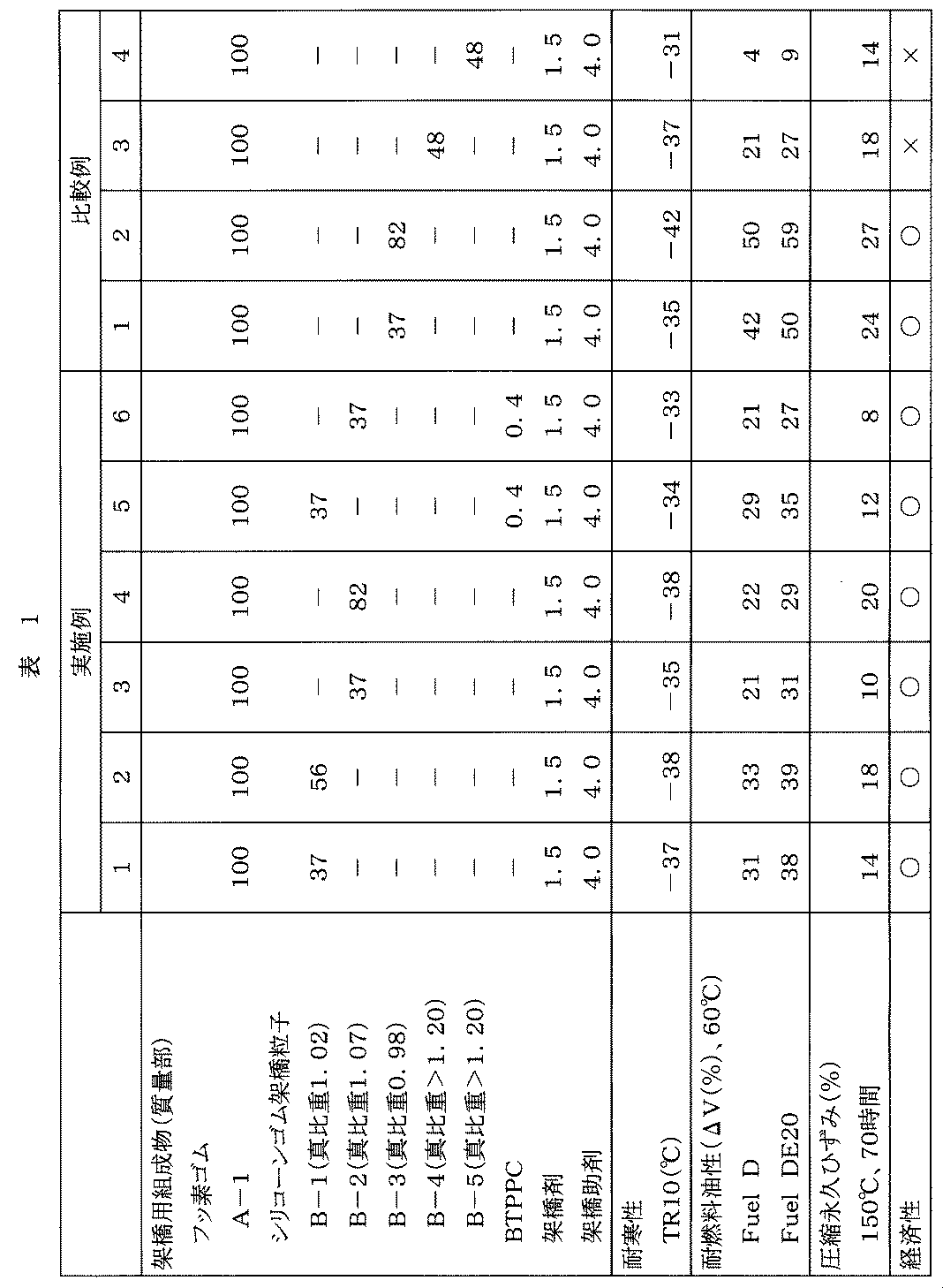
Claims (8)
- (A)パーオキサイド架橋可能なフッ素ゴム、(B)真比重が0.99~1.20であるシリコーンゴム架橋粒子、および(C)パーオキサイド架橋剤を含むパーオキサイド架橋用組成物。
- シリコーンゴム架橋粒子が1価の含フッ素炭化水素基を有さない請求項1記載の架橋用組成物。
- (B)成分が、縮合反応架橋性シリコーンゴム組成物を架橋して形成したシリコーンゴム架橋粒子である請求項1または2記載の架橋用組成物。
- (B)成分が、縮合反応架橋性シリコーンゴム組成物を水中に分散した状態で架橋して形成したシリコーンゴム架橋粒子である請求項3記載の架橋用組成物。
- 縮合反応架橋性シリコーンゴム組成物が、(i)1分子中にシラノール基を少なくとも2個有するオルガノシロキサン、(ii)1分子中に少なくとも2個のケイ素原子結合水素原子を有するオルガノシロキサン、および(iii)縮合反応用触媒を含む請求項3または4記載の架橋用組成物。
- 縮合反応架橋性シリコーンゴム組成物が、(i)1分子中にシラノール基を少なくとも2個有するオルガノシロキサン、(iv)1分子中に少なくとも2個のケイ素原子結合加水分解性基を有するオルガノシロキサン、および(iii)縮合反応用触媒を含む請求項3または4記載の架橋用組成物。
- (A)成分が、フッ化ビニリデン/テトラフルオロエチレン/パーフルオロアルキルビニルエーテル共重合体からなるフッ素ゴムを含む請求項1~6のいずれかに記載の架橋用組成物。
- 請求項1~7のいずれかに記載のパーオキサイド架橋用組成物をパーオキサイド架橋して得られる成形品。
Applications Claiming Priority (2)
| Application Number | Priority Date | Filing Date | Title |
|---|---|---|---|
| JP2009-021265 | 2009-02-02 | ||
| JP2009021265A JP5415094B2 (ja) | 2009-02-02 | 2009-02-02 | パーオキサイド架橋用組成物および架橋成形品 |
Publications (1)
| Publication Number | Publication Date |
|---|---|
| WO2010087474A1 true WO2010087474A1 (ja) | 2010-08-05 |
Family
ID=42395726
Family Applications (1)
| Application Number | Title | Priority Date | Filing Date |
|---|---|---|---|
| PCT/JP2010/051341 Ceased WO2010087474A1 (ja) | 2009-02-02 | 2010-02-01 | パーオキサイド架橋用組成物および架橋成形品 |
Country Status (2)
| Country | Link |
|---|---|
| JP (1) | JP5415094B2 (ja) |
| WO (1) | WO2010087474A1 (ja) |
Cited By (1)
| Publication number | Priority date | Publication date | Assignee | Title |
|---|---|---|---|---|
| CN115141442A (zh) * | 2020-03-17 | 2022-10-04 | 戚佳轩 | 一种氟橡胶组合物、橡胶制品及其制备方法 |
Families Citing this family (3)
| Publication number | Priority date | Publication date | Assignee | Title |
|---|---|---|---|---|
| TWI492978B (zh) * | 2013-07-24 | 2015-07-21 | Grand Tek Advance Material Science Co Ltd | 複合材料微粉、陶瓷塗料、保護塗層、與複合材料微粉的形成方法 |
| JP2017149839A (ja) * | 2016-02-24 | 2017-08-31 | ダイキン工業株式会社 | フッ素ゴム組成物及び成形品 |
| JP6733562B2 (ja) * | 2017-01-20 | 2020-08-05 | 信越化学工業株式会社 | 水性シリコーン分散液、皮膜及び化粧料 |
Citations (3)
| Publication number | Priority date | Publication date | Assignee | Title |
|---|---|---|---|---|
| JPH04293950A (ja) * | 1991-03-25 | 1992-10-19 | Asahi Chem Ind Co Ltd | シリコーンゴムパウダー含有含フッ素エラストマー加硫組成物 |
| JP2001240679A (ja) * | 2000-02-29 | 2001-09-04 | Dow Corning Toray Silicone Co Ltd | 架橋シリコーン粒子の製造方法 |
| JP2008045001A (ja) * | 2006-08-11 | 2008-02-28 | Daikin Ind Ltd | パーオキサイド架橋用組成物およびそれからなる成形品、耐燃料透過性シール材 |
-
2009
- 2009-02-02 JP JP2009021265A patent/JP5415094B2/ja not_active Expired - Fee Related
-
2010
- 2010-02-01 WO PCT/JP2010/051341 patent/WO2010087474A1/ja not_active Ceased
Patent Citations (3)
| Publication number | Priority date | Publication date | Assignee | Title |
|---|---|---|---|---|
| JPH04293950A (ja) * | 1991-03-25 | 1992-10-19 | Asahi Chem Ind Co Ltd | シリコーンゴムパウダー含有含フッ素エラストマー加硫組成物 |
| JP2001240679A (ja) * | 2000-02-29 | 2001-09-04 | Dow Corning Toray Silicone Co Ltd | 架橋シリコーン粒子の製造方法 |
| JP2008045001A (ja) * | 2006-08-11 | 2008-02-28 | Daikin Ind Ltd | パーオキサイド架橋用組成物およびそれからなる成形品、耐燃料透過性シール材 |
Cited By (2)
| Publication number | Priority date | Publication date | Assignee | Title |
|---|---|---|---|---|
| CN115141442A (zh) * | 2020-03-17 | 2022-10-04 | 戚佳轩 | 一种氟橡胶组合物、橡胶制品及其制备方法 |
| CN115141442B (zh) * | 2020-03-17 | 2024-02-06 | 戚佳轩 | 一种氟橡胶组合物、橡胶制品及其制备方法 |
Also Published As
| Publication number | Publication date |
|---|---|
| JP2010174206A (ja) | 2010-08-12 |
| JP5415094B2 (ja) | 2014-02-12 |
Similar Documents
| Publication | Publication Date | Title |
|---|---|---|
| KR100961407B1 (ko) | 불화탄소 탄성중합체 실리콘 가황물 | |
| CN101616795B (zh) | 用于橡胶层压体的可热固化的硅橡胶组合物 | |
| US7879450B2 (en) | Method for preparing silicone rubber/fluoroelastomer integrated rubber article | |
| EP3135485B1 (en) | Laminate | |
| US8071709B2 (en) | Composite material comprising flourine-containing rubber, fuel-impermeable sealing material comprising same, and process for preparing composite material | |
| US7479532B2 (en) | Fluorocarbon elastomer silicone vulcanizates | |
| KR20130118927A (ko) | 불소 고무 성형품 | |
| JP5415094B2 (ja) | パーオキサイド架橋用組成物および架橋成形品 | |
| JP7215349B2 (ja) | ゴム物品及びゴム製品の製造方法 | |
| JP2008505205A (ja) | フッ化炭素シリコーンエラストマー含有フッ化プラスチック | |
| CN101065442A (zh) | 热塑性聚合物组合物及热塑性聚合物组合物的制造方法 | |
| WO2015133573A1 (ja) | フッ素ゴム組成物及びフッ素ゴム成形品 | |
| US7553920B2 (en) | Fluorocarbon elastomer silicon vulcanizates | |
| JP5002212B2 (ja) | パーオキサイド架橋用組成物およびそれからなる成形品、耐燃料透過性シール材 | |
| JP5083489B2 (ja) | フッ素ゴム/シリコーンゴム混合ゴム組成物及びそれを硬化させて得られるゴム成型品 | |
| US20060100343A1 (en) | Fluororubber/silicone rubber blend and molded rubber articles | |
| JP2012024980A (ja) | ゴム積層体 |
Legal Events
| Date | Code | Title | Description |
|---|---|---|---|
| 121 | Ep: the epo has been informed by wipo that ep was designated in this application |
Ref document number: 10735934 Country of ref document: EP Kind code of ref document: A1 |
|
| NENP | Non-entry into the national phase |
Ref country code: DE |
|
| 122 | Ep: pct application non-entry in european phase |
Ref document number: 10735934 Country of ref document: EP Kind code of ref document: A1 |