WO2010074241A1 - 併用化学療法の治療効果予測方法 - Google Patents
併用化学療法の治療効果予測方法 Download PDFInfo
- Publication number
- WO2010074241A1 WO2010074241A1 PCT/JP2009/071626 JP2009071626W WO2010074241A1 WO 2010074241 A1 WO2010074241 A1 WO 2010074241A1 JP 2009071626 W JP2009071626 W JP 2009071626W WO 2010074241 A1 WO2010074241 A1 WO 2010074241A1
- Authority
- WO
- WIPO (PCT)
- Prior art keywords
- gimeracil
- tegafur
- combination
- therapeutic effect
- chemotherapy
- Prior art date
- Legal status (The legal status is an assumption and is not a legal conclusion. Google has not performed a legal analysis and makes no representation as to the accuracy of the status listed.)
- Ceased
Links
Classifications
-
- A—HUMAN NECESSITIES
- A61—MEDICAL OR VETERINARY SCIENCE; HYGIENE
- A61K—PREPARATIONS FOR MEDICAL, DENTAL OR TOILETRY PURPOSES
- A61K33/00—Medicinal preparations containing inorganic active ingredients
- A61K33/24—Heavy metals; Compounds thereof
- A61K33/243—Platinum; Compounds thereof
-
- A—HUMAN NECESSITIES
- A61—MEDICAL OR VETERINARY SCIENCE; HYGIENE
- A61K—PREPARATIONS FOR MEDICAL, DENTAL OR TOILETRY PURPOSES
- A61K31/00—Medicinal preparations containing organic active ingredients
- A61K31/33—Heterocyclic compounds
- A61K31/395—Heterocyclic compounds having nitrogen as a ring hetero atom, e.g. guanethidine or rifamycins
- A61K31/53—Heterocyclic compounds having nitrogen as a ring hetero atom, e.g. guanethidine or rifamycins having six-membered rings with three nitrogens as the only ring hetero atoms, e.g. chlorazanil, melamine
-
- A—HUMAN NECESSITIES
- A61—MEDICAL OR VETERINARY SCIENCE; HYGIENE
- A61K—PREPARATIONS FOR MEDICAL, DENTAL OR TOILETRY PURPOSES
- A61K31/00—Medicinal preparations containing organic active ingredients
- A61K31/33—Heterocyclic compounds
- A61K31/395—Heterocyclic compounds having nitrogen as a ring hetero atom, e.g. guanethidine or rifamycins
- A61K31/435—Heterocyclic compounds having nitrogen as a ring hetero atom, e.g. guanethidine or rifamycins having six-membered rings with one nitrogen as the only ring hetero atom
- A61K31/44—Non condensed pyridines; Hydrogenated derivatives thereof
-
- A—HUMAN NECESSITIES
- A61—MEDICAL OR VETERINARY SCIENCE; HYGIENE
- A61K—PREPARATIONS FOR MEDICAL, DENTAL OR TOILETRY PURPOSES
- A61K31/00—Medicinal preparations containing organic active ingredients
- A61K31/33—Heterocyclic compounds
- A61K31/395—Heterocyclic compounds having nitrogen as a ring hetero atom, e.g. guanethidine or rifamycins
- A61K31/495—Heterocyclic compounds having nitrogen as a ring hetero atom, e.g. guanethidine or rifamycins having six-membered rings with two or more nitrogen atoms as the only ring heteroatoms, e.g. piperazine or tetrazines
- A61K31/505—Pyrimidines; Hydrogenated pyrimidines, e.g. trimethoprim
- A61K31/513—Pyrimidines; Hydrogenated pyrimidines, e.g. trimethoprim having oxo groups directly attached to the heterocyclic ring, e.g. cytosine
-
- A—HUMAN NECESSITIES
- A61—MEDICAL OR VETERINARY SCIENCE; HYGIENE
- A61P—SPECIFIC THERAPEUTIC ACTIVITY OF CHEMICAL COMPOUNDS OR MEDICINAL PREPARATIONS
- A61P35/00—Antineoplastic agents
-
- C—CHEMISTRY; METALLURGY
- C12—BIOCHEMISTRY; BEER; SPIRITS; WINE; VINEGAR; MICROBIOLOGY; ENZYMOLOGY; MUTATION OR GENETIC ENGINEERING
- C12Q—MEASURING OR TESTING PROCESSES INVOLVING ENZYMES, NUCLEIC ACIDS OR MICROORGANISMS; COMPOSITIONS OR TEST PAPERS THEREFOR; PROCESSES OF PREPARING SUCH COMPOSITIONS; CONDITION-RESPONSIVE CONTROL IN MICROBIOLOGICAL OR ENZYMOLOGICAL PROCESSES
- C12Q1/00—Measuring or testing processes involving enzymes, nucleic acids or microorganisms; Compositions therefor; Processes of preparing such compositions
- C12Q1/68—Measuring or testing processes involving enzymes, nucleic acids or microorganisms; Compositions therefor; Processes of preparing such compositions involving nucleic acids
- C12Q1/6876—Nucleic acid products used in the analysis of nucleic acids, e.g. primers or probes
- C12Q1/6883—Nucleic acid products used in the analysis of nucleic acids, e.g. primers or probes for diseases caused by alterations of genetic material
- C12Q1/6886—Nucleic acid products used in the analysis of nucleic acids, e.g. primers or probes for diseases caused by alterations of genetic material for cancer
-
- C—CHEMISTRY; METALLURGY
- C12—BIOCHEMISTRY; BEER; SPIRITS; WINE; VINEGAR; MICROBIOLOGY; ENZYMOLOGY; MUTATION OR GENETIC ENGINEERING
- C12Q—MEASURING OR TESTING PROCESSES INVOLVING ENZYMES, NUCLEIC ACIDS OR MICROORGANISMS; COMPOSITIONS OR TEST PAPERS THEREFOR; PROCESSES OF PREPARING SUCH COMPOSITIONS; CONDITION-RESPONSIVE CONTROL IN MICROBIOLOGICAL OR ENZYMOLOGICAL PROCESSES
- C12Q2600/00—Oligonucleotides characterized by their use
- C12Q2600/106—Pharmacogenomics, i.e. genetic variability in individual responses to drugs and drug metabolism
-
- C—CHEMISTRY; METALLURGY
- C12—BIOCHEMISTRY; BEER; SPIRITS; WINE; VINEGAR; MICROBIOLOGY; ENZYMOLOGY; MUTATION OR GENETIC ENGINEERING
- C12Q—MEASURING OR TESTING PROCESSES INVOLVING ENZYMES, NUCLEIC ACIDS OR MICROORGANISMS; COMPOSITIONS OR TEST PAPERS THEREFOR; PROCESSES OF PREPARING SUCH COMPOSITIONS; CONDITION-RESPONSIVE CONTROL IN MICROBIOLOGICAL OR ENZYMOLOGICAL PROCESSES
- C12Q2600/00—Oligonucleotides characterized by their use
- C12Q2600/158—Expression markers
Definitions
- the present invention relates to a method for predicting the therapeutic effect of a combination drug of tegafur, gimeracil and oteracil potassium and cisplatin on a combination chemotherapy, and to a patient predicted to have a high therapeutic effect on the combination chemotherapy.
- the present invention relates to an antitumor agent, a primer pair and a kit.
- TS-1 is a preparation containing tegafur, gimeracil, and oteracil potassium in a molar ratio of 1: 0.4: 1.
- Non-patent Document 1 Non-patent Document 1
- An object of the present invention is to provide a combination chemotherapy that has a strong life-prolonging effect for patients with advanced gastric cancer.
- thymidylate synthase gene As a result of repeated studies on chemotherapy for advanced gastric cancer, the present inventors have used the expression level of thymidylate synthase gene (mRNA amount or enzyme amount) as an index, and the combination of tegafur, gimeracil, and oteracil potassium The present invention has been completed by finding a method for predicting a patient who is highly likely to have a sufficient therapeutic effect on cisplatin combination chemotherapy.
- Thymidylate synthase is conventionally known as a therapeutic effect defining factor for TS-1 (for example, Int. J. Cancer: 119, 1927-1933 (2006)). It is not known at all that the amount of expression product (mRNA, enzyme) of thymidylate synthase gene can be used as an index.
- the present invention provides a method, an antitumor agent, a primer pair, and a kit for predicting the therapeutic effect of a combination chemotherapy of the following tegafur, gimeracil, and oteracil potassium and cisplatin.
- Item 1 An antitumor agent, a primer pair, and a kit for predicting the therapeutic effect of a combination chemotherapy of the following tegafur, gimeracil, and oteracil potassium and cisplatin.
- a method for predicting the therapeutic effect of a combination chemotherapy of tegafur, gimeracil and oteracil potassium and cisplatin in a stomach cancer patient comprising the following steps (1) to (2): (1) a step of measuring the expression level of a thymidylate synthase gene contained in a biological sample that may contain cancer cells collected from a patient; (2) When the expression level obtained in the above step (1) is low compared to the corresponding cut-off point set in advance, it is predicted that the combination chemotherapy is highly likely to show a sufficient therapeutic effect for the patient. Process. Item 2. Item 2.
- Tegafur-Gimeracil which is characterized by performing the combination chemotherapy on a cancer patient predicted to have a high therapeutic effect sufficient to select the combination chemotherapy according to the method according to Item 1 or 2 -An antitumor agent comprising oteracil potassium combination drug and cisplatin.
- Item 4 A treatment for gastric cancer, characterized in that the combination chemotherapy is performed on a cancer patient predicted to have a sufficient therapeutic effect for selecting the combination chemotherapy by the method according to Item 1 or 2.
- Item 5 The tegafur, gimeracil, and oteracil for carrying out the said combination chemotherapy to the cancer patient estimated that the possibility of showing sufficient treatment effect sufficient to select the said combination chemotherapy by the method of claim
- Item 6. A primer pair for measuring the expression level of thymidylate synthase, comprising a forward primer of SEQ ID NO: 1 and a reverse primer of SEQ ID NO: 2.
- Item 7. Item 7.
- the primer pair according to Item 7 which is used for predicting the therapeutic effect of a combination chemotherapy of tegafur, gimeracil and oteracil potassium and cisplatin in gastric cancer patients.
- Item 9. To predict the therapeutic effect on chemotherapy containing tegafur, gimeracil, and oteracil potassium, including a primer pair for measuring the expression level of thymidylate synthase consisting of a forward primer of SEQ ID NO: 1 and a reverse primer of SEQ ID NO: 2. Kit.
- the kit according to Item 9 for predicting the therapeutic effect on combined chemotherapy of tegafur, gimeracil and oteracil potassium and cisplatin in gastric cancer patients.
- Item 11. Item 11.
- the prediction method of the present invention enables selection of effective chemotherapy having a strong life-prolonging effect in gastric cancer patients.
- Non-Patent Document 1 it is considered that combination chemotherapy of TS-1 and cisplatin is always excellent, but the effectiveness of this combination chemotherapy largely depends on the expression level of thymidylate synthase gene (TS), It was first shown by the present invention that it is considered effective only when the expression level of the TS gene is below a certain level.
- TS thymidylate synthase gene
- the prediction method of the present invention has a possibility of showing a stronger life-prolonging effect on the treatment by the combined chemotherapy of tegafur, gimeracil and oteracil potassium and cisplatin based on the expression level of the thymidylate synthase gene in the patient Predict high patients.
- chemotherapy in which cisplatin is further used in combination with tegafur, gimeracil, and oteracil potassium is a chemotherapy in which both an antitumor agent of tegafur, gimeracil, and oteracil potassium is combined with cisplatin.
- “therapeutic effect sufficient to select a combination chemotherapy of tegafur, gimeracil and oteracil potassium in combination with cisplatin” is used in Europe and the United States It means that the life-span effect is superior to standard therapies that have been used (for example, 5-FU and cisplatin combination chemotherapy). Whether such a life-prolonging effect is exhibited can be determined by whether the expression level of the TS gene is below the cut-off point, and if the expression level of the TS gene is below the cut-off point, a combination chemotherapy is selected. It is judged to have a sufficient therapeutic effect.
- Tegafur (generic name, chemical name: 5-fluoro-1- (2-tetrahydrofuryl) -2,4- (1H, 3H) -pyrimidinedione), which is an active ingredient in the present invention, is a known compound, It is a drug that is activated in the body and releases 5-fluorouracil, the main body of antitumor activity.
- Tegafur can be produced according to a known method, for example, the method described in JP-B-49-10510.
- Gimeracil (generic name, chemical name: 2,4-dihydroxy-5-chloropyridine), which is an active ingredient in the present invention, is also a known compound and itself has no antitumor activity. -It suppresses that the fluorouracil is metabolized and inactivated in vivo, and can enhance the antitumor effect.
- Oteracyl potassium (generic name, chemical name: monopotassium 1,2,3,4-tetrahydro-2,4-dioxo-1,3,5-triazine-6-carboxylate) which is an active ingredient in the present invention is also known Although it itself has no antitumor activity, it is mainly distributed in the gastrointestinal tract and suppresses the activation of 5-fluorouracil at that site, thereby inhibiting gastrointestinal disorders.
- Cisplatin (generic name, chemical name: (SP-4-2) diamine dichloroplatinum), which is an active ingredient in the present invention, is a known platinum complex compound, and is known to exhibit an antitumor effect by inhibiting DNA synthesis. Yes. Cisplatin can be produced by a known method, and a commercially available drug such as briplatin (registered trademark, manufactured by Bristol-Myers) may be used.
- the therapeutic effect in the present invention can be determined by the survival period or the like, and the survival period is the median of the survival period (the longer the period, the higher the therapeutic effect), the 1-year survival rate and the 2-year survival rate (the ratio is large). The higher the therapeutic effect).
- the proportions of tegafur, gimeracil and oteracil potassium administered in the present invention are not particularly limited as long as each compounding purpose is achieved, and for example, the same as the known compounding agent described in Japanese Patent No. 2614164
- the gimeracil may be about 0.1 to 5 mol, preferably about 0.2 to 1.5 mol, and oteracil potassium is about 0.1 to 5 mol per mol of tegafur.
- the amount is preferably about 0.2 to 2 mol.
- tegafur: gimeracil: oteracil potassium (molar ratio) 1: 0.4: 1.
- the ratio of cisplatin administered in the present invention is not particularly limited as long as it has an antitumor effect, and for example, about 0.01 to 5.0 mol of cisplatin per 1 mol of tegafur as a daily dose,
- the amount is preferably about 0.1 to 2.0 mol, particularly preferably about 0.2 to 1.5 mol.
- each active ingredient in the present invention is appropriately selected depending on the usage, patient age, sex, stage, presence / absence of metastasis, treatment calendar, presence / absence of other antitumor agents, etc.
- more preferred Ku is preferably set to a measure an amount in the range of about 0.4 ⁇ 40mg / kg / day.
- Each active ingredient is administered once a day or divided into a plurality of times. Moreover, each active ingredient is administered simultaneously or at intervals, and the administration sequence is not particularly limited.
- tegafur, gimeracil, and oteracil potassium are provided as a compounding agent formulated into one dosage form.
- cisplatin may be a single agent formulated alone, or may be a combined formulation formulated into one dosage form together with tegafur, gimeracil, and oteracil potassium.
- each is a single agent formulated into one dosage form.
- the preparation of the present invention may be manufactured, packaged and distributed individually for each of the above preparations, and all or a part of the above preparations are suitable for combined administration. It may be manufactured, packaged and distributed as a package (kit formulation).
- the dosage form of the preparation in the present invention is not particularly limited. Specifically, oral preparations (tablets, coated tablets, powders, granules, capsules, liquids, etc.), injections, suppositories, patches, ointments, etc. Can be illustrated.
- oral preparations tablettes, coated tablets, powders, granules, capsules, liquids, etc.
- injections suppositories, patches, ointments, etc.
- the preparations may be in different dosage forms or in the same dosage form.
- a combination drug of tegafur, gimeracil, and oteracil potassium is an oral preparation
- a preparation containing cisplatin is an injection.
- the preparation of the present invention is produced by a generally known formulation method for each dosage form using a pharmacologically acceptable carrier.
- pharmacologically acceptable carriers include those commonly used for ordinary drugs, such as excipients, binders, disintegrants, lubricants, diluents, solubilizers, suspending agents, isotonic agents, pH adjustment.
- examples include agents, buffers, stabilizers, colorants, flavoring agents, and flavoring agents.
- excipients include lactose, sucrose, sodium chloride, glucose, maltose, mannitol, erythritol, xylitol, maltitol, inositol, dextran, sorbitol, albumin, urea, starch, calcium carbonate, kaolin, crystalline cellulose, silica
- excipients include lactose, sucrose, sodium chloride, glucose, maltose, mannitol, erythritol, xylitol, maltitol, inositol, dextran, sorbitol, albumin, urea, starch, calcium carbonate, kaolin, crystalline cellulose, silica
- acids include acids, methylcellulose, glycerin, sodium alginate, gum arabic, and mixtures thereof.
- lubricant examples include purified talc, stearate, borax, polyethylene glycol, and mixtures thereof.
- binder examples include simple syrup, glucose solution, starch solution, gelatin solution, polyvinyl alcohol, polyvinyl ether, polyvinyl pyrrolidone, carboxymethyl cellulose, shellac, methyl cellulose, ethyl cellulose, water, ethanol, potassium phosphate, and a mixture thereof. Can be mentioned.
- disintegrant examples include dry starch, sodium alginate, agar powder, laminaran powder, sodium hydrogen carbonate, calcium carbonate, polyoxyethylene sorbitan fatty acid esters, sodium lauryl sulfate, stearic acid monoglyceride, starch, lactose and mixtures thereof. Is mentioned.
- diluent examples include water, ethyl alcohol, macrogol, propylene glycol, ethoxylated isostearyl alcohol, polyoxylated isostearyl alcohol, polyoxyethylene sorbitan fatty acid esters, and mixtures thereof.
- the stabilizer examples include sodium pyrosulfite, ethylenediaminetetraacetic acid, thioglycolic acid, thiolactic acid, and a mixture thereof.
- isotonic agent examples include sodium chloride, boric acid, glucose, glycerin and a mixture thereof.
- pH adjuster and buffer examples include sodium citrate, citric acid, sodium acetate, sodium phosphate, and mixtures thereof.
- soothing agents include procaine hydrochloride, lidocaine hydrochloride, and mixtures thereof.
- Examples of the colorant include titanium oxide and iron oxide.
- flavoring and flavoring agents examples include sucrose, orange peel, citric acid, and tartaric acid.
- solubilizers examples include polyethylene glycol and D-mannitol.
- suspending agent examples include stearyl triethanolamine, sodium lauryl sulfate, and benzalkonium chloride.
- the administration schedule in the present invention is appropriately selected according to conditions such as the patient's age, sex, stage, presence / absence of metastasis, treatment calendar, etc., for example, the combination chemotherapy of the present invention is tegafur, Preferably, gimeracil and oteracil potassium are administered continuously for 21 days, and cisplatin is administered once or a plurality of times as one cycle on the first administration day (day 1).
- the patient who is the target of the prediction method of the present invention is a patient having gastric cancer, but may be a patient whose primary tumor is gastric cancer and has gastric cancer that has metastasized to organs or tissues other than the stomach.
- the biological sample that can be used in the measurement of the expression level of the thymidylate synthase gene of the present invention is not particularly limited as long as it is a sample that may contain cancer cells, body fluid (blood, urine, etc.), tissue, Examples include extracts and cultures of collected tissues.
- the collection method of a biological sample can be suitably selected by a method according to the type of biological sample and the type of cancer. Preparation of DNA, RNA, and protein from a biological sample can be performed by a generally known method.
- An example of the tissue is the stomach. When the tissue metastasizes from the stomach to other organs or peritoneum, the metastasized site becomes the target tissue.
- Thymidylate synthase is an enzyme having an activity of synthesizing dTMP from dUMP using folic acid as a coenzyme, and is known as an enzyme necessary for DNA synthesis. It is also known as a target enzyme for 5-fluorouracil.
- the base sequence and amino acid sequence of human thymidylate synthase gene are known (Nucleic Acids Res. 13: 2035-2043 (1985)).
- the prediction method of the present invention uses the expression level of the thymidylate synthase gene as an index, but the expression level may be the expression level of mRNA or the expression level of protein.
- the expression level of mRNA is determined by Northern blotting, quantitative or semi-quantitative PCR (eg, RT-PCR, real-time PCR) using a probe or primer that specifically hybridizes with the thymidylate synthase gene. , And can be measured according to a known gene expression level measurement method such as an in situ hybridization method.
- the expression level can be evaluated by a ratio based on a protein / gene (eg, a housekeeping gene such as ⁇ -actin or its expressed protein) that always expresses a certain range of quantity.
- the protein expression level is determined by using an antibody that specifically recognizes thymidylate synthase, enzyme immunoassay, radioimmunoassay, fluorescent immunoassay, ELISA, Western blotting, immunohistochemical staining It can measure by performing well-known immunological measuring methods.
- Probes used in gene expression level measurement methods are at least 15 base lengths to all base lengths, preferably 20 base lengths to all bases within the base sequence of the thymidylate synthase gene.
- the polynucleotide is designed as a polynucleotide having the above-mentioned base lengths in accordance with a generally known probe design method so as to specifically hybridize with a base sequence, more preferably with a continuous base sequence of 30 base lengths to all base lengths.
- Primers and probes used in quantitative or semi-quantitative PCR methods such as RT-PCR method and real-time PCR method can be designed as follows, for example.
- the primer and probe of the present invention are at least 10 bases to all bases in the base sequence of the thymidylate synthase (TS) gene, preferably 10 to 100 bases, more preferably 10 to 50 bases, and even more preferably.
- TS thymidylate synthase
- a primer for detecting an expression product of a TS gene that is, a PCR forward primer and a reverse primer can be designed and synthesized from an exon region of the TS gene.
- the forward primer and reverse primer are designed based on the base sequence of the exon region on the upstream side of each exon region of the TS gene (forward primer), and designed based on the base sequence of the exon region on the downstream side.
- forward primer when designing a primer for the TS gene based on the exons 1 to 3, when the forward primer is designed based on the sequence of the exon 1 region, the reverse primer is the sequence of the exon 2 or exon 3 region on the downstream side. Design based on.
- the reverse primer is designed to be complementary to the sequence of TS mRNA.
- the entire base sequence of TS mRNA including each exon region and a part of the sequence can be used.
- the forward primer for detecting the expression product of the TS gene is preferably a primer represented by SEQ ID NO: 1
- the reverse primer is preferably a primer represented by SEQ ID NO: 2.
- the TS gene expression product detection probe is not particularly limited as long as it can hybridize with each single-stranded DNA of the TS gene amplified by the PCR reaction using the above primers. Any nucleotide sequence may be used as long as it has a base sequence of all exons of the TS gene or a part thereof, or can hybridize under stringent conditions. More specifically, the probe for detecting the expression product of the TS gene is preferably the probe represented by SEQ ID NO: 3.
- Such a polynucleotide preferably has a nucleotide sequence of 70% or more, preferably 80% compared to a polynucleotide comprising a nucleotide sequence of at least 15 or more consecutive nucleotide sequences in the nucleotide sequence of a thymidylate synthase gene or a complementary polynucleotide thereof. More preferably, it is a polynucleotide having an identity of 90% or more, more preferably 95% or more, and particularly preferably 98% or more.
- “specifically hybridizes” means that a specific hybrid is formed and a nonspecific hybrid is not formed under stringent hybridization conditions.
- Stringent hybridization conditions can be determined based on the melting temperature (Tm) of a nucleic acid that forms a hybrid in accordance with a generally known method. As washing conditions capable of maintaining a specific hybridized state, the conditions are usually about “1 ⁇ SSC, 0.1% SDS, 37 ° C.”, more strictly “0.5 ⁇ SSC, 0.1% SDS, 42 ° C. ", And more strictly,” 0.1 ⁇ SSC, 0.1% SDS, 65 ° C ".
- the probe or primer can be prepared by a generally known synthesis method such as a commercially available nucleotide synthesizer based on the base sequence. It can also be prepared by PCR using the base sequence as a template.
- the probe or primer may be labeled with a commonly used radioactive substance, fluorescent substance, chemiluminescent substance, or enzyme so that the thymidylate synthase gene can be easily detected.
- the antibody of the present invention is not particularly limited as long as it specifically recognizes thymidylate synthase, and may be either a monoclonal antibody or a polyclonal antibody, such as a Fab fragment or F (ab ′) 2 fragment. It may be an antibody fragment.
- the antibody can be produced according to a generally known method (for example, Current protocols in Molecular Biology edit. Ausubel et al. (1987), Publish. John Wiley and Sons. Section 1.1.1-11.1). .
- the expression level of thymidylate synthase gene is compared with each preset cutoff point, If low, predict that the patient is likely to have a therapeutic effect sufficient to select the combination chemotherapy.
- the cut-off point in the present invention varies depending on various conditions such as the type of measurement object and the type of measurement method, it is necessary to set in advance according to the conditions.
- the cut-off point depends on the measurement target (number of patients, age, sex, weight, health condition, disease state), measurement method (whether the expression product of gene or protein is the measurement target), measurement condition (eg gene Since the expression product (mRNA) varies depending on the primer, the probe sequence, the type of label, the type and sensitivity of the antibody when the expression product is a protein, and the statistical method, the present invention is subject to these conditions.
- the invention using an arbitrary cut-off point that can vary depending on the case is widely included and is not limited to a specific value.
- the cut-off point can be determined by various statistical analysis methods from the expression level of the thymidylate synthase gene measured in advance. For example, the mean or median expression level of thymidylate synthase gene expression in patients who received combination chemotherapy with tegafur, gimeracil and oteracil potassium and cisplatin; combined use of tegafur, gimeracil and oteracil potassium with cisplatin Sensitivity based on the relationship between the expression level of the thymidylate synthase gene in patients who received chemotherapy and the presence or absence of a certain level of therapeutic effect (life-prolonging effect) on combined chemotherapy with tegafur, gimeracil, and oteracil potassium and cisplatin Value obtained based on ROC (Receiver Operating Characteristic) analysis to maximize the sum of specificity and thymidylate synthase in patients who received combination chemotherapy with tegafur, gimeracil and oteracil potassium and
- the cut-off point (ratio to beta actin) of the thymidylate synthase gene in this combination chemotherapy is preferably 4 ⁇ 10 ⁇ 3 to 10 ⁇ 10 ⁇ 3 in the real-time PCR method, for example, 5.31 ⁇ 10 ⁇ 3 to 8.02 ⁇ 10 ⁇ 3 is more preferable, and 5.96 ⁇ 10 ⁇ 3 to 6.80 ⁇ 10 ⁇ 3 is particularly preferable.
- the primer pair for measuring the expression level of thymidylate synthase of the present invention comprises a forward primer of SEQ ID NO: 1 and a reverse primer of SEQ ID NO: 2.
- the kit for measuring the expression level of thymidylate synthase of the present invention contains the above primer pair, and preferably further contains the probe of SEQ ID NO: 3.
- the primer pair and kit for measuring the expression level of thymidylate synthase of the present invention can accurately measure the expression level of thymidylate synthase, and have a therapeutic effect on chemotherapy including 5-FU antitumor agents. Can be used for prediction. Chemotherapy including a 5-FU antitumor agent is not particularly limited as long as it contains 5-FU or a derivative thereof.
- 5-FU tegafur / uracil combination agent
- chemotherapy including a combination of tegafur, gimeracil and oteracil potassium is preferable
- combination therapy of tegafur, gimeracil and oteracil potassium and cisplatin is particularly preferable.
- the carcinoma for which the therapeutic effect is predicted is not particularly limited, but is preferably gastric cancer, colorectal cancer, head and neck cancer, lung cancer, breast cancer, pancreatic cancer, biliary tract cancer, and particularly preferably gastric cancer.
- TS-1 / cisplatin combination therapy oral administration of 25 mg / m 2 at daily fasting twice 21 days daily at a tegafur equivalent amount of TS-1, was followed by withdrawal from medication for 7 days.
- Cisplatin was intravenously administered at 75 mg / m 2 over 1 to 3 hours after the first administration of TS-1 on the day of TS-1 administration (Day 1). The administration schedule every 4 weeks (28 days) was taken as 1 cycle, and repeated administration was repeated up to 6 cycles.
- 5-FU / cisplatin combination therapy the 5-FU to 1000mg / m 2/24 hours was administered 5 days continuous intravenous was followed by withdrawal from medication for 23 days.
- Cisplatin was intravenously administered at 100 mg / m 2 over 1 to 3 hours before 5-FU administration on the day of 5-FU administration start (Day 1). The administration schedule every 4 weeks (28 days) was taken as 1 cycle, and repeated administration was repeated up to 6 cycles.
- the expression level of the thymidylate synthase gene is determined by extracting total RNA from formalin-fixed paraffin-embedded sections of tumor tissues of surgical specimens or biopsy specimens obtained before drug administration, Quantified as a ratio to actin.
- primers and probes for measuring the expression level of the thymidylate synthase gene the primers and probes shown in the following SEQ ID NOs: 1 to 3 were used. Furthermore, the following primers and probes shown in SEQ ID NOs: 4 to 6 were used for measuring the expression level of the beta actin gene.
- various forward primers, reverse primers, and probes can be designed based on the open reading frame of a known TS gene sequence. Changing the primer, probe sequence, label type, etc. may change the cut-off point, but is it sufficient to select a combination chemotherapy with tegafur, gimeracil, oteracil potassium and cisplatin? There is no substantial influence on the effect of the present invention which can be predicted.
- cut-off point was determined by the following statistical analysis method for the gene expression level of thymidylate synthase in each patient measured in Example 1.
- cut-off points at which the ratio of disease control (PR + SD) is statistically significant were calculated at a significance level of 1% and 5%, respectively, 5.96 ⁇ 10 ⁇ 3 to 6.80 ⁇ 10 ⁇ 3 and 5.31 ⁇ 10 ⁇ 3 to 8.02 ⁇ 10 ⁇ 3 .
- the 5-FU / cisplatin combination group had a 2-year survival rate of 0% for both low TS and high TS, and the therapeutic effect was low.
- the effect of the 5-FU / cisplatin combination group with low TS was lower than the survival time of the TS-1 / cisplatin combination group with low TS, so the results of the 5-FU / cisplatin combination group (high TS) are shown. Not.
- TS-1 / cisplatin combination therapy patients with low gene expression levels of thymidylate synthase in tumor tissues had a significant difference in median survival compared to high patients, and showed a long life-span effect. Compared to patients with lower gene expression levels of thymidylate synthase in the 5-FU / cisplatin combination therapy, the TS-1 / cisplatin combination therapy has a longer median survival and shows a similar life-prolonging effect. It was.
- the TS-1 / cisplatin combination therapy has a longer life-span effect than the conventional standard therapy. It became clear that we can expect.
Landscapes
- Health & Medical Sciences (AREA)
- Chemical & Material Sciences (AREA)
- Life Sciences & Earth Sciences (AREA)
- General Health & Medical Sciences (AREA)
- Veterinary Medicine (AREA)
- Medicinal Chemistry (AREA)
- Pharmacology & Pharmacy (AREA)
- Animal Behavior & Ethology (AREA)
- Public Health (AREA)
- Epidemiology (AREA)
- Organic Chemistry (AREA)
- Proteomics, Peptides & Aminoacids (AREA)
- Wood Science & Technology (AREA)
- Zoology (AREA)
- Engineering & Computer Science (AREA)
- Immunology (AREA)
- Inorganic Chemistry (AREA)
- Pathology (AREA)
- Genetics & Genomics (AREA)
- Analytical Chemistry (AREA)
- Oncology (AREA)
- Physics & Mathematics (AREA)
- Biophysics (AREA)
- Hospice & Palliative Care (AREA)
- Biotechnology (AREA)
- Microbiology (AREA)
- Molecular Biology (AREA)
- Nuclear Medicine, Radiotherapy & Molecular Imaging (AREA)
- General Chemical & Material Sciences (AREA)
- Biochemistry (AREA)
- Bioinformatics & Cheminformatics (AREA)
- General Engineering & Computer Science (AREA)
- Chemical Kinetics & Catalysis (AREA)
- Pharmaceuticals Containing Other Organic And Inorganic Compounds (AREA)
- Acyclic And Carbocyclic Compounds In Medicinal Compositions (AREA)
Abstract
本発明は、既存の治療法では延命効果が不十分な進行胃癌患者に対してチミジル酸合成酵素を指標として患者を選択することにより、既存の治療法よりも優れた延命効果を発揮することができる、テガフール・ギメラシル・オテラシルカリウム配合剤及びシスプラチンからなる抗腫瘍剤を提供する。
Description
本発明は、テガフール・ギメラシル・オテラシルカリウム配合剤とシスプラチンの併用化学療法に対する治療効果を予測する方法、当該併用化学療法に十分な治療効果を示す可能性が高いと予測された患者に投与するための抗腫瘍剤、プライマー対及びキットに関する。
進行胃癌に対する化学療法として、国内外において5-フルオロウラシル、シスプラチン、イリノテカン、ドセタキセル、テガフール・ウラシル配合剤(商品名:ユーエフティー(登録商標))、テガフール・ギメラシル・オテラシルカリウム配合剤(商品名:ティーエスワン(登録商標)、以下、テガフール、ギメラシル、オテラシルカリウムがモル比1:0.4:1で配合された製剤をTS-1と称す。)などの抗腫瘍剤が単剤でもしくは併用にて臨床応用されている。欧米においては5-FUとシスプラチンの併用化学療法が標準的療法となっているが、延命効果においてはまだ満足できるものではなく、より強い延命効果を示す併用化学療法としてTS-1とシスプラチンの併用化学療法が期待されている(非特許文献1)。
Cancer 2007;109:33-40.
本発明は、進行胃癌患者に対して、強い延命効果を奏する併用化学療法を提供することを目的とする。
本発明者らは、進行胃癌に対する化学療法について研究を重ねた結果、チミジル酸合成酵素遺伝子の発現量(mRNA量または酵素量)を指標とすることにより、テガフール・ギメラシル・オテラシルカリウム配合剤とシスプラチンの併用化学療法に十分な治療効果を示す可能性が高い患者を予測する方法を見出し、本発明は完成に至った。なお、チミジル酸合成酵素は、従来からTS-1の治療効果規定因子として知られているが(例えば、Int.J.Cancer:119,1927-1933(2006))、当該併用化学療法の選択にチミジル酸合成酵素遺伝子の発現産物(mRNA、酵素)量を指標にできることは全く知られていない。
すなわち本発明は、以下のテガフール・ギメラシル・オテラシルカリウム配合剤とシスプラチンの併用化学療法に対する治療効果を予測する方法、抗腫瘍剤、プライマー対及びキットを提供するものである。
項1.
下記工程(1)~(2)を含む、胃癌患者におけるテガフール・ギメラシル・オテラシルカリウム配合剤とシスプラチンの併用化学療法に対する治療効果を予測する方法:
(1)患者から採取された癌細胞を含み得る生体試料に含まれるチミジル酸合成酵素遺伝子の発現量を測定する工程、
(2)上記工程(1)で得られた発現量が、予め設定した対応するカットオフポイントと比較して低い場合、当該併用化学療法が患者に十分な治療効果を示す可能性が高いと予測する工程。
項2.
テガフール・ギメラシル・オテラシルカリウム配合剤における各有効成分のモル比が、テガフール:ギメラシル:オテラシルカリウム=1:0.4:1である、項1記載の方法。
項3.
項1又は2記載の方法により当該併用化学療法を選択するのに十分な治療効果を示す可能性が高いと予測された癌患者に当該併用化学療法を実施することを特徴とする、テガフール・ギメラシル・オテラシルカリウム配合剤及びシスプラチンからなる抗腫瘍剤。
項4.
項1又は2記載の方法により当該併用化学療法を選択するのに十分な治療効果を示す可能性が高いと予測された癌患者に当該併用化学療法を実施することを特徴とする、胃癌の治療方法。
項5.
項1又は2記載の方法により当該併用化学療法を選択するのに十分な治療効果を示す可能性が高いと予測された癌患者に当該併用化学療法を実施するための、テガフール・ギメラシル・オテラシルカリウム配合剤及びシスプラチンからなる抗腫瘍剤の使用。
項6.
チミジル酸合成酵素の発現量測定用のプライマー対であって、配列番号1のフォワードプライマーと配列番号2のリバースプライマーを含む、プライマー対。
項7.
テガフール・ギメラシル・オテラシルカリウム配合剤を含む化学療法に対する治療効果の予測に用いるための、項6記載のプライマー対。
項8.
胃癌患者におけるテガフール・ギメラシル・オテラシルカリウム配合剤とシスプラチンの併用化学療法に対する治療効果の予測に用いるための、項7記載のプライマー対。
項9.
配列番号1のフォワードプライマーと配列番号2のリバースプライマーからなるチミジル酸合成酵素の発現量測定用のプライマー対を含む、テガフール・ギメラシル・オテラシルカリウム配合剤を含む化学療法に対する治療効果を予測するためのキット。
項10.
胃癌患者におけるテガフール・ギメラシル・オテラシルカリウム配合剤とシスプラチンの併用化学療法に対する治療効果を予測するため、項9記載のキット。
項11.
さらに、配列番号3のプローブを含む、項10記載のキット。
項1.
下記工程(1)~(2)を含む、胃癌患者におけるテガフール・ギメラシル・オテラシルカリウム配合剤とシスプラチンの併用化学療法に対する治療効果を予測する方法:
(1)患者から採取された癌細胞を含み得る生体試料に含まれるチミジル酸合成酵素遺伝子の発現量を測定する工程、
(2)上記工程(1)で得られた発現量が、予め設定した対応するカットオフポイントと比較して低い場合、当該併用化学療法が患者に十分な治療効果を示す可能性が高いと予測する工程。
項2.
テガフール・ギメラシル・オテラシルカリウム配合剤における各有効成分のモル比が、テガフール:ギメラシル:オテラシルカリウム=1:0.4:1である、項1記載の方法。
項3.
項1又は2記載の方法により当該併用化学療法を選択するのに十分な治療効果を示す可能性が高いと予測された癌患者に当該併用化学療法を実施することを特徴とする、テガフール・ギメラシル・オテラシルカリウム配合剤及びシスプラチンからなる抗腫瘍剤。
項4.
項1又は2記載の方法により当該併用化学療法を選択するのに十分な治療効果を示す可能性が高いと予測された癌患者に当該併用化学療法を実施することを特徴とする、胃癌の治療方法。
項5.
項1又は2記載の方法により当該併用化学療法を選択するのに十分な治療効果を示す可能性が高いと予測された癌患者に当該併用化学療法を実施するための、テガフール・ギメラシル・オテラシルカリウム配合剤及びシスプラチンからなる抗腫瘍剤の使用。
項6.
チミジル酸合成酵素の発現量測定用のプライマー対であって、配列番号1のフォワードプライマーと配列番号2のリバースプライマーを含む、プライマー対。
項7.
テガフール・ギメラシル・オテラシルカリウム配合剤を含む化学療法に対する治療効果の予測に用いるための、項6記載のプライマー対。
項8.
胃癌患者におけるテガフール・ギメラシル・オテラシルカリウム配合剤とシスプラチンの併用化学療法に対する治療効果の予測に用いるための、項7記載のプライマー対。
項9.
配列番号1のフォワードプライマーと配列番号2のリバースプライマーからなるチミジル酸合成酵素の発現量測定用のプライマー対を含む、テガフール・ギメラシル・オテラシルカリウム配合剤を含む化学療法に対する治療効果を予測するためのキット。
項10.
胃癌患者におけるテガフール・ギメラシル・オテラシルカリウム配合剤とシスプラチンの併用化学療法に対する治療効果を予測するため、項9記載のキット。
項11.
さらに、配列番号3のプローブを含む、項10記載のキット。
本発明の予測方法は、胃癌患者において強い延命効果を有する有効な化学療法の選択を可能にするものである。つまり、胃癌において延命効果が高いと予測される患者に対し、より強い延命効果を示す併用化学療法を的確に提供することができ、不要な化学療法を省くことができることから、医療経済的にも好ましい。
非特許文献1によると、TS-1とシスプラチンの併用化学療法は常に優れていると考えられるが、この併用化学療法の有効性はチミジル酸合成酵素遺伝子(TS)の発現量に大きく依存し、TS遺伝子の発現量が一定以下である場合にのみ有効であると考えられることが本発明により初めて示された。
本発明の予測方法は、患者のチミジル酸合成酵素遺伝子の発現量に基づき、テガフール・ギメラシル・オテラシルカリウム配合剤とシスプラチンの併用化学療法による治療に対して、より強い延命効果を示す可能性が高い患者を予測するものである。
本発明において「テガフール・ギメラシル・オテラシルカリウム配合剤にさらにシスプラチンを併用する化学療法」とは、テガフール・ギメラシル・オテラシルカリウム配合剤とシスプラチンの両方の抗腫瘍剤を併用して投与する化学療法を意味する。なお、前記配合剤とシスプラチンを併用投与する場合、配合剤とシスプラチンは同時に投与してもよく、一定の間隔をあけて投与してもよい。
本発明において、「テガフール・ギメラシル・オテラシルカリウム配合剤にさらにシスプラチンを併用する化学療法(以下、併用化学療法ということがある)を選択するのに十分な治療効果」とは、欧米などで使用されている標準療法(例えば、5-FUとシスプラチンの併用化学療法)より優れた延命効果を示すことを意味する。このような延命効果を示すか否かは、TS遺伝子の発現量がカットオフポイント以下か否かで判断でき、TS遺伝子の発現量がカットオフポイント以下であれば、併用化学療法を選択するのに十分な治療効果を有すると判断される。
本発明における有効成分であるテガフール(一般名、化学名:5-フルオロ-1-(2-テトラヒドロフリル)-2,4-(1H,3H)-ピリミジンジオン)は、公知の化合物であり、生体内で活性化を受けて抗腫瘍活性の本体である5-フルオロウラシルを放出する薬剤である。テガフールは、公知の方法、例えば特公昭49-10510号に記載されている方法に従って製造できる。
本発明における有効成分であるギメラシル(一般名、化学名:2,4-ジヒドロキシ-5-クロロピリジン)も、公知の化合物であり、それ自身全く抗腫瘍活性を有さないものであるが、5-フルオロウラシルが生体内において代謝されて不活性化されることを抑制するものであり、抗腫瘍効果を増強させることができる。
本発明における有効成分であるオテラシルカリウム(一般名、化学名:モノポタシウム 1,2,3,4-テトラヒドロ-2,4-ジオキソ-1,3,5-トリアジン-6-カルボキシレート)も公知の化合物であり、それ自身は抗腫瘍活性を有さないが、主に消化管に分布してその部位での5-フルオロウラシルの活性化を抑制することにより消化管障害を抑制するものである。
本発明における有効成分であるシスプラチン(一般名、化学名:(SP-4-2)ジアミンジクロロプラチナム)は公知の白金錯体化合物であり、DNA合成阻害作用により抗腫瘍効果を奏することが知られている。なお、シスプラチンは公知の方法により製造でき、さらにブリプラチン(登録商標、ブリストル・マイヤーズ社製)等の市販医薬品を用いても良い。
本発明における治療効果は、生存期間などにより判定することができ、生存期間は、生存期間の中央値(期間が長いほど治療効果が高い)、1年生存率及び2年生存率(割合が大きいほど治療効果が高い)などにより表すことができる。
本発明において投与されるテガフール、ギメラシル及びオテラシルカリウムの割合は、それぞれの配合目的を奏する範囲であれば特に制限されず、例えば、特許第2614164号公報に記載されている公知の配合剤と同様の範囲で良く、テガフール1モルに対して、ギメラシルを0.1~5モル程度、好ましくは0.2~1.5モル程度とすればよく、オテラシルカリウムを0.1~5モル程度、好ましくは0.2~2モル程度とすればよい。特に好ましくは、テガフール:ギメラシル:オテラシルカリウム(モル比)=1:0.4:1である。
本発明において投与されるシスプラチンの割合は、抗腫瘍効果を奏する範囲であれば特に制限されず、例えば、1日量としてテガフール1モルに対して、シスプラチンを0.01~5.0モル程度、好ましくは0.1~2.0モル程度、特に好ましくは0.2~1.5モル程度とすればよい。
本発明における各有効成分の投与量は、用法、患者の年齢、性別、病期、転移の有無、治療暦、他の抗腫瘍剤の有無などの条件により適宜選択されるが、テガフールの量が0.1~100mg/kg/日程度、好ましくは0.2~40mg/kg/日程度、より好ましくは0.5~20mg/kg/日程度、ギメラシルの量が、0.02~30mg/kg/日程度、好ましくは0.05~12mg/kg/日程度、より好ましくは0.1~6mg/kg/日程度、オテラシルカリウムの量が0.1~100mg/kg/日程度、好ましくは0.2~40mg/kg/日程度、より好ましくは0.5~20mg/kg/日程度、シスプラチンの量が0.08~200mg/kg/日程度、好ましくは0.15~80mg/kg/日程度、より好ましくは0.4~40mg/kg/日程度の範囲となる量を目安とするのが良い。また、各有効成分は1日に1回又は複数回に分けて投与される。また、各有効成分は同時又は間隔を空けて投与され、その投与順序は特に制限されない。
本発明において、テガフール、ギメラシル、オテラシルカリウムは、一の剤型に製剤化した配合剤として提供される。また、本発明において、シスプラチンは、それだけを製剤化した単剤であってもよく、テガフール、ギメラシル、オテラシルカリウムと併せて一の剤型に製剤化した配合剤であってもよい。好ましくは、それぞれ一の剤型に製剤化した単剤である。
本発明の製剤は、各有効成分が併用投与される限り、上記製剤ごとにそれぞれ個別に製造・包装・流通されるものでよく、また上記製剤のすべて又は一部を併用投与に適した単一のパッケージ(キット製剤)として製造・包装・流通されるものでもよい。
本発明における製剤の投与形態としては特に制限は無く、具体的には経口剤(錠剤、被覆錠剤、散剤、顆粒剤、カプセル剤、液剤など)、注射剤、坐剤、貼付剤、軟膏剤等が例示できる。本発明の各有効成分を複数の剤型に製剤化する場合は、当該製剤はそれぞれ異なる投与形態であっても同一の投与形態であってよい。例えば、テガフール・ギメラシル・オテラシルカリウム配合剤は経口剤、シスプラチンを含有する製剤は注射剤とすることが好ましい。
本発明の製剤は、薬理学的に許容される担体を用いて、それぞれの投与形態において通常公知の製剤化方法により製造される。かかる担体としては、通常の薬剤に汎用される各種のもの、例えば賦形剤、結合剤、崩壊剤、滑沢剤、希釈剤、溶解補助剤、懸濁化剤、等張化剤、pH調整剤、緩衝剤、安定化剤、着色剤、矯味剤、矯臭剤等を例示できる。
賦形剤としては、例えば、乳糖、ショ糖、塩化ナトリウム、ブドウ糖、マルトース、マンニトール、エリスリトール、キシリトール、マルチトール、イノシトール、デキストラン、ソルビトール、アルブミン、尿素、デンプン、炭酸カルシウム、カオリン、結晶セルロース、ケイ酸、メチルセルロース、グリセリン、アルギン酸ナトリウム、アラビアゴム及びこれらの混合物等が挙げられる。
滑沢剤としては、例えば、精製タルク、ステアリン酸塩、ホウ砂、ポリエチレングリコール及びこれらの混合物等が挙げられる。
結合剤としては、例えば、単シロップ、ブドウ糖液、デンプン液、ゼラチン溶液、ポリビニルアルコール、ポリビニルエーテル、ポリビニルピロリドン、カルボキシメチルセルロース、セラック、メチルセルロース、エチルセルロース、水、エタノール、リン酸カリウム及びこれらの混合物等が挙げられる。
崩壊剤としては、例えば、乾燥デンプン、アルギン酸ナトリウム、カンテン末、ラミナラン末、炭酸水素ナトリウム、炭酸カルシウム、ポリオキシエチレンソルビタン脂肪酸エステル類、ラウリル硫酸ナトリウム、ステアリン酸モノグリセリド、デンプン、乳糖及びこれらの混合物等が挙げられる。
希釈剤としては、例えば、水、エチルアルコール、マクロゴール、プロピレングリコール、エトキシ化イソステアリルアルコール、ポリオキシ化イソステアリルアルコール、ポリオキシエチレンソルビタン脂肪酸エステル類及びこれらの混合物等が挙げられる。
安定化剤としては、例えば、ピロ亜硫酸ナトリウム、エチレンジアミン四酢酸、チオグリコール酸、チオ乳酸及びこれらの混合物等が挙げられる。
等張化剤としては、例えば、塩化ナトリウム、ホウ酸、ブドウ糖、グリセリン及びこれらの混合物等が挙げられる。
pH調整剤及び緩衝剤としては、例えば、クエン酸ナトリウム、クエン酸、酢酸ナトリウム、リン酸ナトリウム及びこれらの混合物等が挙げられる。
無痛化剤としては、例えば、塩酸プロカイン、塩酸リドカイン及びこれらの混合物等が挙げられる。
着色剤としては、酸化チタン、酸化鉄等が挙げられる。
矯味・矯臭剤としては白糖、橙皮、クエン酸、酒石酸等が挙げられる。
溶解補助剤としては、ポリエチレングリコール、D-マンニトール等が挙げられる。
懸濁化剤としては、ステアリルトリエタノールアミン、ラウリル硫酸ナトリウム、塩化ベンザルコニウム等が挙げられる。
本発明における投与スケジュールは、患者の年齢、性別、病期、転移の有無、治療暦などの条件により適宜選択されるが、例えば、本発明の併用化学療法は、4週間のうちに、テガフール、ギメラシル及びオテラシルカリウムを21日間連続投与し、その最初の投与日(1日目)にシスプラチンを投与することを1サイクルとして1回又は複数回行うことが好ましい。
本発明の予測方法の対象となる患者は、胃癌を有する患者であるが、原発巣が胃癌であり、胃以外の臓器、組織に転移した胃癌を有する患者であっても良い。
本発明のチミジル酸合成酵素遺伝子の発現量測定において用いることができる生体試料としては、癌細胞を含む可能性がある試料であれば特に限定されず、体液(血液、尿等)、組織、その抽出物及び採取した組織の培養物などが例示できる。また、生体試料の採取方法は、生体試料の種類や癌種に応じた方法により適宜選択することができる。生体試料からのDNA、RNA、タンパク質の調製は、通常公知の方法により行うことができる。組織としては、特に胃が挙げられるが、胃から他の臓器や腹膜などに転移した場合には、転移した部位が対象の組織となる。
チミジル酸合成酵素は、dUMPから葉酸を補酵素としてdTMPを合成する活性を有する酵素であり、DNA合成時に必要な酵素として知られている。また、5-フルオロウラシルの標的酵素としても知られている。なお、ヒトのチミジル酸合成酵素の遺伝子の塩基配列やアミノ酸配列は公知である(Nucleic Acids Res.13:2035-2043(1985))。
本発明の予測方法は、チミジル酸合成酵素遺伝子の発現量を指標とするが、その発現量としてはmRNAの発現量であっても、タンパク質の発現量であってもよい。ここでmRNAの発現量は、チミジル酸合成酵素遺伝子と特異的にハイブリダイズするプローブ又はプライマーを用いて、ノーザンブロット法、定量的又は半定量的PCR法(例えばRT-PCR法、リアルタイムPCR法)、in situハイブリダーゼーション法など公知の遺伝子発現量の測定法に従い測定することができる。前記発現量は、常に一定範囲の量を発現しているタンパク質/遺伝子(例えばβアクチンなどのハウスキーピング遺伝子又はその発現タンパク質)を基準として、比により評価することができる。
また、タンパク質発現量は、チミジル酸合成酵素を特異的に認識する抗体を用いて、酵素免疫測定法、放射性免疫測定法、蛍光免疫測定法、ELISA法、ウェスタン・ブロッティング法、免疫組織化学染色法など公知の免疫学的測定法を行うことにより測定することができる。
ノーザンブロット法、in situハイブリダーゼーション法などの遺伝子発現量の測定法に用いられるプローブは、チミジル酸合成酵素遺伝子の塩基配列内の少なくとも15塩基長~全塩基長、好ましくは20塩基長~全塩基長、より好ましくは30塩基長~全塩基長の連続した塩基配列と特異的にハイブリダイズするように、通常公知のプローブ設計方法に従い上記各塩基長を有するポリヌクレオチドとして設計される。
RT-PCR法、リアルタイムPCR法などの定量的又は半定量的PCR法に用いられるプライマー、プローブの設計は、例えば以下のようにして行うことができる。
本発明のプライマー及びプローブは、チミジル酸合成酵素(TS)遺伝子の塩基配列内の少なくとも10塩基長~全塩基長、好ましくは10~100塩基長、より好ましくは10~50塩基長、さらに好ましくは10~35塩基長の連続した塩基配列と特異的にハイブリダイズするように、通常公知のプライマー及びプローブ設計方法に従い上記各塩基長を有するポリヌクレオチドとして設計される。例えば、TS遺伝子の発現産物検出用のプライマー、すなわちPCRのフォワードプライマー及びリバースプライマーは、TS遺伝子のうちエキソン領域から設計及び合成することができる。フォワードプライマー及びリバースプライマーは、TS遺伝子の各エキソン領域のうち、一方を上流側のエキソン領域の塩基配列に基づき設計し(フォワードプライマー)、他方をその下流側のエキソン領域の塩基配列に基づき設計する(リバースプライマー)。例えば、TS遺伝子のプライマーをエキソン1~3に基づき設計する際において、フォワードプライマーをエキソン1領域の配列に基づいて設計する場合は、リバースプライマーは、その下流側のエキソン2又はエキソン3領域の配列に基づいて設計する。リバースプライマーは、TSのmRNAの配列に相補的となるように設計する。また、このプライマーとしては、各エキソン領域を含むTSのmRNAの塩基配列の全て及びその一部の配列を用いることができるが、それぞれのエキソン領域からPCRによる増幅効率を考慮してプライマーを設計するのが望ましい。より具体的には、TS遺伝子の発現産物検出用のフォワードプライマーとしては、配列番号1で示すプライマーが好ましく、リバースプライマーとしては、配列番号2で示すプライマーが好ましい。
TS遺伝子の発現産物検出用プローブとしては、上記プライマーを使用してPCR反応により、増幅されるTS遺伝子の各一本鎖DNAとハイブリダイズ可能なものであれば特に制限されない。TS遺伝子の全エキソンの塩基配列あるいはその一部と相補的な配列を有するかあるいはストリンジェントな条件でハイブリダイズ可能なものであればよい。より具体的には、TS遺伝子の発現産物検出用のプローブとしては、配列番号3で示すプローブが好ましい。
なお、当該プローブは、TS遺伝子と特異的にハイブリダイズするものであれば、完全に相補的である必要はない。かかるポリヌクレオチドとして、好ましくはチミジル酸合成酵素遺伝子の塩基配列において連続する少なくとも15塩基以上の塩基配列からなるポリヌクレオチド又はその相補ポリヌクレオチドと比較して、塩基配列において70%以上、好ましくは80%以上、より好ましくは90%以上、さらに好ましくは95%以上、特に好ましくは98%以上の同一性を有するポリヌクレオチドである。
なお、本発明において「特異的にハイブリダイズする」とは、ストリンジェントなハイブリダイゼーション条件下において、特異的なハイブリッドが形成され、非特異的なハイブリッドが形成されないことをいう。ストリンジェントなハイブリダイゼーション条件は、通常公知の方法に従ってハイブリッドを形成する核酸の融解温度(Tm)などに基づいて決定することができる。具体的なハイブリダイズ状態を維持できる洗浄条件として通常「1×SSC、0.1%SDS、37℃」程度の条件、より厳格には「0.5×SSC、0.1%SDS、42℃」程度の条件、さらに厳格には「0.1×SSC、0.1%SDS、65℃」程度の条件が挙げられる。
また、ヒトにおけるチミジル酸合成酵素遺伝子の塩基配列が公知であるため、当該プローブ又はプライマーは、その塩基配列に基づいて、通常公知の合成方法、例えば市販のヌクレオチド合成機によって作製することができる。また、その塩基配列を鋳型としてPCR法によって調製することもできる。
また、当該プローブ又はプライマーは、チミジル酸合成酵素遺伝子を容易に検出できるように、通常慣用されている放射性物質、蛍光物質、化学発光物質、または酵素で標識されていてもよい。
本発明の抗体は、チミジル酸合成酵素を特異的に認識するものであれば特に制限されず、モノクローナル抗体及びポリクローナル抗体のいずれであってもよく、Fab断片やF(ab’)2断片などの抗体断片であってもよい。また、当該抗体は、通常公知の方法に従って製造することができる(例えば、Current protocols in Molecular Biology edit. Ausubel et al. (1987), Publish. John Wiley and Sons. Section 11.12-11.13)。
テガフール・ギメラシル・オテラシルカリウム配合剤とシスプラチンの併用化学療法による治療を実施すべきか否か予測する工程において、チミジル酸合成酵素遺伝子の発現量が、予め設定した各カットオフポイントと比較して、低い場合、患者が当該併用化学療法を選択するのに十分な治療効果を示す可能性が高いと予測する。
本発明におけるカットオフポイントは、測定対象や測定方法の種類などの諸条件により変動するものであるため、条件に合わせて予め設定する必要がある。カットオフポイントは、測定対象(患者の数、年齢、性別、体重、健康状態、疾患の状態)や測定方法(遺伝子とタンパク質のいずれの発現産物を測定対象とするか)、測定条件(例えば遺伝子発現産物(mRNA)の測定におけるプライマー、プローブの配列、標識の種類、発現産物がタンパク質の場合の抗体の種類及び感度など)、統計的手法などにより変動するため、本発明は、これらの諸条件により変動し得る任意のカットオフポイントを用いた発明を広く包含し、特定の値に限定されない。ここでカットオフポイントは、予め測定しておいたチミジル酸合成酵素遺伝子の発現量から種々の統計解析手法により求めることができる。例えば、テガフール・ギメラシル・オテラシルカリウム配合剤とシスプラチンの併用化学療法を受けた患者におけるチミジル酸合成酵素遺伝子の発現量の平均値や中央値;テガフール・ギメラシル・オテラシルカリウム配合剤とシスプラチンの併用化学療法を受けた患者におけるチミジル酸合成酵素遺伝子の発現量と、テガフール・ギメラシル・オテラシルカリウム配合剤とシスプラチンの併用化学療法に対し一定以上の治療効果(延命効果)の有無との関係から感度と特異度の和が最大となるようROC(Receiver Operating Characteristic)分析に基づき求められる値;テガフール・ギメラシル・オテラシルカリウム配合剤とシスプラチンの併用化学療法を受けた患者におけるチミジル酸合成酵素遺伝子の発現量を用いて、テガフール・ギメラシル・オテラシルカリウム配合剤とシスプラチンの併用化学療法に対する治療効果(延命効果)との関係から、ログランク検定でP値が最小となる値(カイ二乗検定に基づき求められる値)が例示できる。
その結果、本併用化学療法におけるチミジル酸合成酵素遺伝子のカットオフポイント(ベータアクチンに対する比)は、例えばリアルタイムPCR法では4×10⁻³~10×10-3が好ましく、5.31×10⁻³~8.02×10⁻³がより好ましく、5.96×10⁻³~6.80×10⁻³が特に好ましい。
本発明のチミジル酸合成酵素の発現量測定用のプライマー対は、配列番号1のフォワードプライマーと配列番号2のリバースプライマーを含むものである。また本発明のチミジル酸合成酵素の発現量測定用のキットは、上記プライマー対を含むものであり、好ましくはさらに配列番号3のプローブを含むものである。
本発明のチミジル酸合成酵素の発現量測定用のプライマー対及びキットは、チミジル酸合成酵素の発現量を正確に測定することができ、5-FU系抗腫瘍剤を含む化学療法に対する治療効果の予測に用いることができる。5-FU系抗腫瘍剤を含む化学療法としては、5-FU又はその誘導体を含むものであれば特に制限されず、例えば5-FU、テガフール・ウラシル配合剤、テガフール・ギメラシル・オテラシルカリウム配合剤を含む化学療法が例示でき、このうち好ましくはテガフール・ギメラシル・オテラシルカリウム配合剤を含む化学療法、特に好ましくはテガフール・ギメラシル・オテラシルカリウム配合剤とシスプラチンの併用化学療法である。治療効果の予測を行う対象となる癌腫としては特に限定されないが、好ましくは胃癌、結腸・直腸癌、頭頸部癌、肺癌、乳癌、膵癌、胆道癌であり、特に好ましくは胃癌である。
以下、本発明を実施例に基づきより詳細に説明するが、本発明がこれら実施例に限定されないことはいうまでもない。
チミジル酸合成酵素遺伝子の発現量測定
コーカシア人の未治療の進行胃癌患者を対象としたTS-1/シスプラチン併用療法と5-FU/シスプラチン併用療法の第III相試験においてバイオマーカー研究(チミジル酸合成酵素の遺伝子発現量の測定)を実施した。
コーカシア人の未治療の進行胃癌患者を対象としたTS-1/シスプラチン併用療法と5-FU/シスプラチン併用療法の第III相試験においてバイオマーカー研究(チミジル酸合成酵素の遺伝子発現量の測定)を実施した。
TS-1/シスプラチン併用療法は、TS-1をテガフール換算量で25mg/m2を1日2回21日間連日絶食時に経口投与し、その後7日間休薬した。シスプラチンはTS-1投与開始日(Day1)のTS-1の最初の投与後、75mg/m2を1~3時間かけて静脈内投与した。この4週間(28日間)毎の投与スケジュールを1サイクルとし、最大6サイクル繰り返し投与した。
5-FU/シスプラチン併用療法は、5-FUを1000mg/m2/24時間を5日間持続的静脈内投与し、その後23日間休薬した。シスプラチンは5-FU投与開始日(Day1)に5-FU投与前、100mg/m2を1~3時間かけて静脈内投与した。この4週間(28日間)毎の投与スケジュールを1サイクルとし、最大6サイクル繰り返し投与した。
生存期間はランダム化の日を起算日とし、死亡日までの期間とした。解析時点で死亡の確認が取れない、または生存している患者に関しては、最新の観察日をもって打ち切りとした。
チミジル酸合成酵素遺伝子の発現量は、薬剤の投与以前に得られた手術検体またはバイオプシー検体の腫瘍組織のホルマリン固定パラフィン包埋切片からトータルRNAを抽出し、Taqman(登録商標)リアルタイムPCR法によりベータアクチンに対する比として定量した。なお、チミジル酸合成酵素遺伝子の発現量測定用のプライマー及びプローブとして、以下の配列番号1~3で示すプライマー及びプローブを用いた。さらに、ベータアクチン遺伝子発現量の測定には、以下の配列番号4~6で示すプライマー及びプローブを用いた。

上記表1記載のプライマー及びプローブ以外に、公知のTS遺伝子配列のオープンリーディングフレームをもとにして種々のフォワードプライマー、リバースプライマー、プローブを設計できる。プライマー、プローブの配列、標識の種類などを変更するとカットオフポイントが多少変化し得るが、テガフール・ギメラシル・オテラシルカリウム配合剤とシスプラチンの併用化学療法を選択するのに十分な治療効果を示すか否かを予測できる本発明の効果に実質的な影響はない。
カットオフポイントの算出
カットオフポイントは、実施例1で測定した各患者のチミジル酸合成酵素の遺伝子発現量を次のような統計解析手法により求めた。
カットオフポイントは、実施例1で測定した各患者のチミジル酸合成酵素の遺伝子発現量を次のような統計解析手法により求めた。
(1)TS-1/シスプラチン併用群において、disease control(PR+SD)された症例を予測するために、ROC分析を利用して感度と特異度の和が最大となる最適なカットオフポイントを算出したところ、6.80×10⁻³であった。
(2)TS-1/シスプラチン併用群において、disease control(PR+SD)の割合が統計学的に有意となるカットオフポイントを有意水準1%と5%で算出したところ、それぞれ5.96×10⁻³~6.80×10⁻³、5.31×10⁻³~8.02×10⁻³であった。
チミジル酸合成酵素を指標にして選択された患者での併用療法における治療効果
実施例2で算出したカットオフポイント値を用いてチミジル酸合成酵素の低発現群と高発現群の2群に分けて生存期間解析を実施した。結果を表2~表5に示す。
実施例2で算出したカットオフポイント値を用いてチミジル酸合成酵素の低発現群と高発現群の2群に分けて生存期間解析を実施した。結果を表2~表5に示す。
なお、5-FU/シスプラチン併用群は、TS低値とTS高値のいずれも2年生存率は0%であり、治療効果が低いものであった。また、TS低値の5-FU/シスプラチン併用群の効果はTS低値のTS-1/シスプラチン併用群の生存期間よりも低かったため、5-FU/シスプラチン併用群(TS高値)の結果は示していない。

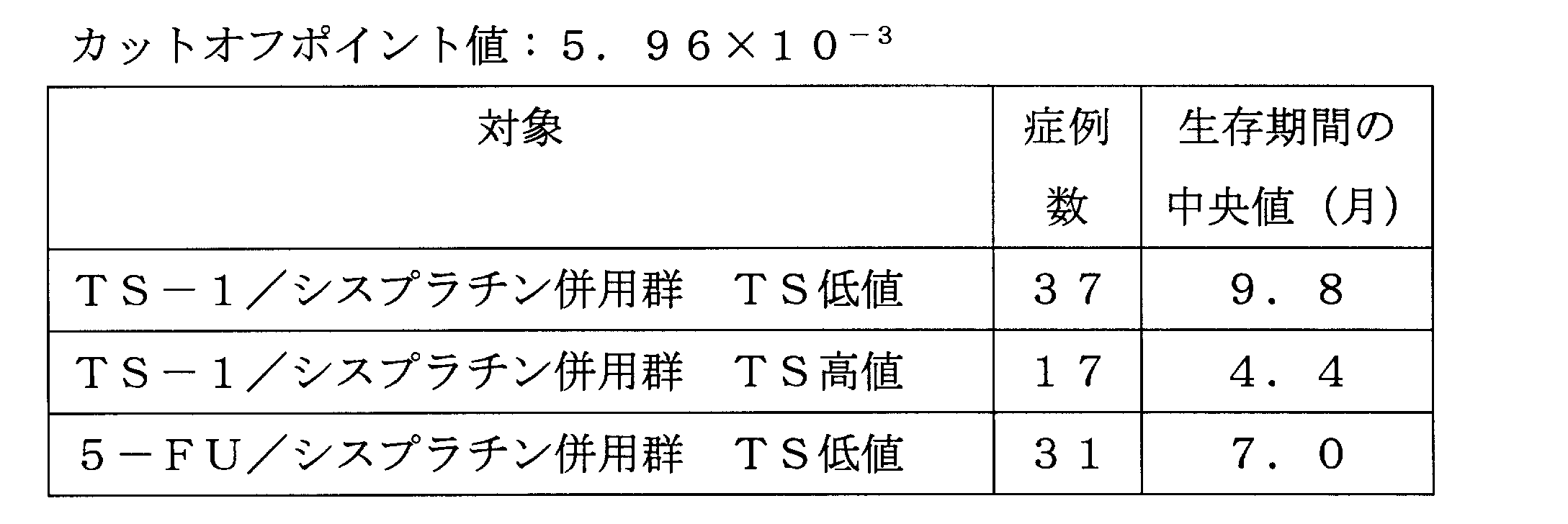


TS-1/シスプラチン併用療法では、腫瘍組織中チミジル酸合成酵素の遺伝子発現量の低い患者では、高い患者と比較し、生存期間の中央値に顕著な差があり、高い延命効果を示した。5-FU/シスプラチン併用療法でのチミジル酸合成酵素の遺伝子発現量の低い患者と比較してもTS-1/シスプラチン併用療法の方が生存期間の中央値が長く、同様に高い延命効果を示した。
以上のように、チミジル酸合成酵素(TS)遺伝子の発現量を指標として胃癌患者を選択することにより、TS-1/シスプラチン併用療法は従来の標準的とされる治療法に比べて高い延命効果を期待できることが明らかになった。
Claims (11)
- 下記工程(1)~(2)を含む、胃癌患者におけるテガフール・ギメラシル・オテラシルカリウム配合剤とシスプラチンの併用化学療法に対する治療効果を予測する方法:
(1)患者から採取された癌細胞を含み得る生体試料に含まれるチミジル酸合成酵素遺伝子の発現量を測定する工程、
(2)上記工程(1)で得られた発現量が、予め設定した対応するカットオフポイントと比較して低い場合、当該併用化学療法が患者に十分な治療効果を示す可能性が高いと予測する工程。 - テガフール・ギメラシル・オテラシルカリウム配合剤における各有効成分のモル比が、テガフール:ギメラシル:オテラシルカリウム=1:0.4:1である、請求項1記載の方法。
- 請求項1又は2記載の方法により当該併用化学療法を選択するのに十分な治療効果を示す可能性が高いと予測された癌患者に当該併用化学療法を実施することを特徴とする、テガフール・ギメラシル・オテラシルカリウム配合剤及びシスプラチンからなる抗腫瘍剤。
- 請求項1又は2記載の方法により当該併用化学療法を選択するのに十分な治療効果を示す可能性が高いと予測された癌患者に当該併用化学療法を実施することを特徴とする、胃癌の治療方法。
- 請求項1又は2記載の方法により当該併用化学療法を選択するのに十分な治療効果を示す可能性が高いと予測された癌患者に当該併用化学療法を実施するための、テガフール・ギメラシル・オテラシルカリウム配合剤及びシスプラチンからなる抗腫瘍剤の使用。
- チミジル酸合成酵素の発現量測定用のプライマー対であって、配列番号1のフォワードプライマーと配列番号2のリバースプライマーを含む、プライマー対。
- テガフール・ギメラシル・オテラシルカリウム配合剤を含む化学療法に対する治療効果の予測に用いるための、請求項6記載のプライマー対。
- 胃癌患者におけるテガフール・ギメラシル・オテラシルカリウム配合剤とシスプラチンの併用化学療法に対する治療効果の予測に用いるための、請求項7記載のプライマー対。
- 配列番号1のフォワードプライマーと配列番号2のリバースプライマーからなるチミジル酸合成酵素の発現量測定用のプライマー対を含む、テガフール・ギメラシル・オテラシルカリウム配合剤を含む化学療法に対する治療効果を予測するためのキット。
- 胃癌患者におけるテガフール・ギメラシル・オテラシルカリウム配合剤とシスプラチンの併用化学療法に対する治療効果を予測するため、請求項9記載のキット。
- さらに、配列番号3のプローブを含む、請求項10記載のキット。
Applications Claiming Priority (2)
| Application Number | Priority Date | Filing Date | Title |
|---|---|---|---|
| JP2008-333267 | 2008-12-26 | ||
| JP2008333267 | 2008-12-26 |
Publications (1)
| Publication Number | Publication Date |
|---|---|
| WO2010074241A1 true WO2010074241A1 (ja) | 2010-07-01 |
Family
ID=42287845
Family Applications (1)
| Application Number | Title | Priority Date | Filing Date |
|---|---|---|---|
| PCT/JP2009/071626 Ceased WO2010074241A1 (ja) | 2008-12-26 | 2009-12-25 | 併用化学療法の治療効果予測方法 |
Country Status (2)
| Country | Link |
|---|---|
| TW (1) | TW201030338A (ja) |
| WO (1) | WO2010074241A1 (ja) |
-
2009
- 2009-12-25 TW TW098145054A patent/TW201030338A/zh unknown
- 2009-12-25 WO PCT/JP2009/071626 patent/WO2010074241A1/ja not_active Ceased
Non-Patent Citations (8)
| Title |
|---|
| KAMOSHIDA, S. ET AL.: "Immunostaining of thymidylate synthase and p53 for predicting chemoresistance to S-1/cisplatin in gastric cancer.", BRITISH JOURNAL OF CANCER, vol. 96, no. 2, 2007, pages 277 - 283 * |
| KOIZUMI, W. ET AL.: "S-1 plus cisplatin versus S-1 alone for first-line treatment of advanced gastric cancer (SPIRITS trial): a phase III trial.", LANCET ONCOLOGY, vol. 9, 18 February 2008 (2008-02-18), pages 215 - 221 * |
| NOBUHIRO KURITA ET AL.: "Shinko Saihatsu Igan ni Taisuru Kagaku Ryoho ni Okeru Yogo Yosoku Inshi no Kento", DAI 49 KAI NIPPON SHOKAKIBYO GAKKAI TAIKAI SHOROKUSHU, JAPANESE JOURNAL OF GASTROENTEROLOGICAL SURGERY, vol. 104, 20 September 2007 (2007-09-20), pages A602 * |
| NORIKO YAMAMOTO ET AL.: "Shinko Igan ni Taisuru Jutsumae Kagaku Ryoho (TS-1+CDDP) no Koka Yosoku Maker no Kento", DAI 67 KAI NIHON GAN GAKKAI GAKUJUTSU SOKAI KIJI, 30 September 2008 (2008-09-30), pages 74 * |
| SHIROTA, Y. ET AL.: "ERCC1 and Thymidylate Synthase mRNA Levels Predict Survival for Colorectal Cancer Patients Receiving Combination Oxaliplatin and Fluorouracil Chemotherapy.", JOURNAL OF CLINICAL ONCOLOGY, vol. 19, no. 23, 2001, pages 4298 - 4304 * |
| WEI, J. ET AL.: "ERCC1 mRNA levels and survival of advanced gastric cancer patients treated with a modified FOLFOX regimen.", BRITISH JOURNAL OF CANCER, vol. 98, no. 8, 25 March 2008 (2008-03-25), pages 1398 - 1402 * |
| YOICHI SAKURAI ET AL.: "Kagaku Ryoho no Koka Yosoku-Yogo Yosoku Koka Yosoku-Yogo Yosoku OPRT, TS, p53 no Hatsugen to Kagaku Ryoho no Koka Yosoku", IGAN -KISO-RINSHO KENKYU NO UPDATE-, JAPANESE JOURNAL OF CLINICAL MEDICINE, vol. 66, no. ISS.5, 28 July 2008 (2008-07-28), pages 518 - 522 * |
| YOSHIDA, K. ET AL.: "Challenge for a better combination with basic evidence.", INTERNATIONAL JOURNAL OF CLINICAL ONCOLOGY, vol. 13, no. 3, June 2008 (2008-06-01), pages 212 - 219 * |
Also Published As
| Publication number | Publication date |
|---|---|
| TW201030338A (en) | 2010-08-16 |
Similar Documents
| Publication | Publication Date | Title |
|---|---|---|
| TWI772753B (zh) | Mdm2抑制劑的治療方法和生物標記物 | |
| JP6214690B2 (ja) | 胃癌患者に対するテガフール・ギメラシル・オテラシルカリウム配合剤及びegfr阻害剤からなる化学療法の選択方法 | |
| TW202039862A (zh) | 受體酪氨酸激酶(kit)基因突變 | |
| TWI550089B (zh) | Evaluation of anti-tumor agents and therapeutic effects in patients with mutated colorectal cancer of KRAS gene | |
| US8598188B2 (en) | Method for predicting therapeutic efficacy of chemotherapy on non-small-cell lung cancer | |
| US8697681B2 (en) | Method for prediction of therapeutic effect of chemotherapy employing expression level of dihydropyrimidine dehydrogenase gene as measure | |
| WO2010074241A1 (ja) | 併用化学療法の治療効果予測方法 | |
| JP5566376B2 (ja) | 腎細胞癌に対する化学療法の治療効果予測方法 | |
| JPWO2010074240A1 (ja) | 化学療法の治療効果予測方法 | |
| AU2010336257B2 (en) | Method for Predicting Therapeutic Effects of Chemotherapy on Hepatocellular Carcinoma Patients | |
| US11149300B1 (en) | Methods of treating gastrointestinal malignancies | |
| TW201400810A (zh) | 對胃癌患者選擇化學療法之方法 | |
| JP2011132186A (ja) | ホルモン不応性前立腺癌治療法及び治療効果予測方法 | |
| JP2011147374A (ja) | 外科切除された進行胃癌における術後補助化学療法の有効性予測方法 | |
| HK1172243A (en) | Method for predicting therapeutic effect of chemotherapy on hepatocellular carcinoma patient | |
| JP2012239384A (ja) | 乳癌に対するテガフール・ギメラシル・オテラシルカリウム配合剤及びタキサン系薬剤の治療効果予測因子 |
Legal Events
| Date | Code | Title | Description |
|---|---|---|---|
| 121 | Ep: the epo has been informed by wipo that ep was designated in this application |
Ref document number: 09835037 Country of ref document: EP Kind code of ref document: A1 |
|
| NENP | Non-entry into the national phase |
Ref country code: DE |
|
| 122 | Ep: pct application non-entry in european phase |
Ref document number: 09835037 Country of ref document: EP Kind code of ref document: A1 |
|
| NENP | Non-entry into the national phase |
Ref country code: JP |