WO2010074207A1 - 不織布及びその製造方法 - Google Patents
不織布及びその製造方法 Download PDFInfo
- Publication number
- WO2010074207A1 WO2010074207A1 PCT/JP2009/071551 JP2009071551W WO2010074207A1 WO 2010074207 A1 WO2010074207 A1 WO 2010074207A1 JP 2009071551 W JP2009071551 W JP 2009071551W WO 2010074207 A1 WO2010074207 A1 WO 2010074207A1
- Authority
- WO
- WIPO (PCT)
- Prior art keywords
- nonwoven fabric
- heat
- fiber
- core
- sheath
- Prior art date
- Legal status (The legal status is an assumption and is not a legal conclusion. Google has not performed a legal analysis and makes no representation as to the accuracy of the status listed.)
- Ceased
Links
Images


Classifications
-
- D—TEXTILES; PAPER
- D01—NATURAL OR MAN-MADE THREADS OR FIBRES; SPINNING
- D01F—CHEMICAL FEATURES IN THE MANUFACTURE OF ARTIFICIAL FILAMENTS, THREADS, FIBRES, BRISTLES OR RIBBONS; APPARATUS SPECIALLY ADAPTED FOR THE MANUFACTURE OF CARBON FILAMENTS
- D01F8/00—Conjugated, i.e. bi- or multicomponent, artificial filaments or the like; Manufacture thereof
- D01F8/04—Conjugated, i.e. bi- or multicomponent, artificial filaments or the like; Manufacture thereof from synthetic polymers
- D01F8/06—Conjugated, i.e. bi- or multicomponent, artificial filaments or the like; Manufacture thereof from synthetic polymers with at least one polyolefin as constituent
-
- D—TEXTILES; PAPER
- D04—BRAIDING; LACE-MAKING; KNITTING; TRIMMINGS; NON-WOVEN FABRICS
- D04H—MAKING TEXTILE FABRICS, e.g. FROM FIBRES OR FILAMENTARY MATERIAL; FABRICS MADE BY SUCH PROCESSES OR APPARATUS, e.g. FELTS, NON-WOVEN FABRICS; COTTON-WOOL; WADDING ; NON-WOVEN FABRICS FROM STAPLE FIBRES, FILAMENTS OR YARNS, BONDED WITH AT LEAST ONE WEB-LIKE MATERIAL DURING THEIR CONSOLIDATION
- D04H1/00—Non-woven fabrics formed wholly or mainly of staple fibres or like relatively short fibres
- D04H1/40—Non-woven fabrics formed wholly or mainly of staple fibres or like relatively short fibres from fleeces or layers composed of fibres without existing or potential cohesive properties
- D04H1/54—Non-woven fabrics formed wholly or mainly of staple fibres or like relatively short fibres from fleeces or layers composed of fibres without existing or potential cohesive properties by welding together the fibres, e.g. by partially melting or dissolving
- D04H1/541—Composite fibres, e.g. sheath-core, sea-island or side-by-side; Mixed fibres
- D04H1/5412—Composite fibres, e.g. sheath-core, sea-island or side-by-side; Mixed fibres sheath-core
-
- A—HUMAN NECESSITIES
- A61—MEDICAL OR VETERINARY SCIENCE; HYGIENE
- A61F—FILTERS IMPLANTABLE INTO BLOOD VESSELS; PROSTHESES; DEVICES PROVIDING PATENCY TO, OR PREVENTING COLLAPSING OF, TUBULAR STRUCTURES OF THE BODY, e.g. STENTS; ORTHOPAEDIC, NURSING OR CONTRACEPTIVE DEVICES; FOMENTATION; TREATMENT OR PROTECTION OF EYES OR EARS; BANDAGES, DRESSINGS OR ABSORBENT PADS; FIRST-AID KITS
- A61F13/00—Bandages or dressings; Absorbent pads
- A61F13/15—Absorbent pads, e.g. sanitary towels, swabs or tampons for external or internal application to the body; Supporting or fastening means therefor; Tampon applicators
- A61F13/15577—Apparatus or processes for manufacturing
-
- A—HUMAN NECESSITIES
- A61—MEDICAL OR VETERINARY SCIENCE; HYGIENE
- A61F—FILTERS IMPLANTABLE INTO BLOOD VESSELS; PROSTHESES; DEVICES PROVIDING PATENCY TO, OR PREVENTING COLLAPSING OF, TUBULAR STRUCTURES OF THE BODY, e.g. STENTS; ORTHOPAEDIC, NURSING OR CONTRACEPTIVE DEVICES; FOMENTATION; TREATMENT OR PROTECTION OF EYES OR EARS; BANDAGES, DRESSINGS OR ABSORBENT PADS; FIRST-AID KITS
- A61F13/00—Bandages or dressings; Absorbent pads
- A61F13/15—Absorbent pads, e.g. sanitary towels, swabs or tampons for external or internal application to the body; Supporting or fastening means therefor; Tampon applicators
- A61F13/51—Absorbent pads, e.g. sanitary towels, swabs or tampons for external or internal application to the body; Supporting or fastening means therefor; Tampon applicators characterised by the outer layers of the pads
- A61F13/511—Topsheet, i.e. the permeable cover or layer facing the skin
- A61F13/51104—Topsheet, i.e. the permeable cover or layer facing the skin the top sheet having a three-dimensional cross-section, e.g. corrugations, embossments, recesses or projections
-
- A—HUMAN NECESSITIES
- A61—MEDICAL OR VETERINARY SCIENCE; HYGIENE
- A61F—FILTERS IMPLANTABLE INTO BLOOD VESSELS; PROSTHESES; DEVICES PROVIDING PATENCY TO, OR PREVENTING COLLAPSING OF, TUBULAR STRUCTURES OF THE BODY, e.g. STENTS; ORTHOPAEDIC, NURSING OR CONTRACEPTIVE DEVICES; FOMENTATION; TREATMENT OR PROTECTION OF EYES OR EARS; BANDAGES, DRESSINGS OR ABSORBENT PADS; FIRST-AID KITS
- A61F13/00—Bandages or dressings; Absorbent pads
- A61F13/15—Absorbent pads, e.g. sanitary towels, swabs or tampons for external or internal application to the body; Supporting or fastening means therefor; Tampon applicators
- A61F13/51—Absorbent pads, e.g. sanitary towels, swabs or tampons for external or internal application to the body; Supporting or fastening means therefor; Tampon applicators characterised by the outer layers of the pads
- A61F13/511—Topsheet, i.e. the permeable cover or layer facing the skin
- A61F13/51121—Topsheet, i.e. the permeable cover or layer facing the skin characterised by the material
-
- A—HUMAN NECESSITIES
- A61—MEDICAL OR VETERINARY SCIENCE; HYGIENE
- A61F—FILTERS IMPLANTABLE INTO BLOOD VESSELS; PROSTHESES; DEVICES PROVIDING PATENCY TO, OR PREVENTING COLLAPSING OF, TUBULAR STRUCTURES OF THE BODY, e.g. STENTS; ORTHOPAEDIC, NURSING OR CONTRACEPTIVE DEVICES; FOMENTATION; TREATMENT OR PROTECTION OF EYES OR EARS; BANDAGES, DRESSINGS OR ABSORBENT PADS; FIRST-AID KITS
- A61F13/00—Bandages or dressings; Absorbent pads
- A61F13/15—Absorbent pads, e.g. sanitary towels, swabs or tampons for external or internal application to the body; Supporting or fastening means therefor; Tampon applicators
- A61F13/51—Absorbent pads, e.g. sanitary towels, swabs or tampons for external or internal application to the body; Supporting or fastening means therefor; Tampon applicators characterised by the outer layers of the pads
- A61F13/511—Topsheet, i.e. the permeable cover or layer facing the skin
- A61F13/5116—Topsheet, i.e. the permeable cover or layer facing the skin being formed of multiple layers
-
- A—HUMAN NECESSITIES
- A61—MEDICAL OR VETERINARY SCIENCE; HYGIENE
- A61F—FILTERS IMPLANTABLE INTO BLOOD VESSELS; PROSTHESES; DEVICES PROVIDING PATENCY TO, OR PREVENTING COLLAPSING OF, TUBULAR STRUCTURES OF THE BODY, e.g. STENTS; ORTHOPAEDIC, NURSING OR CONTRACEPTIVE DEVICES; FOMENTATION; TREATMENT OR PROTECTION OF EYES OR EARS; BANDAGES, DRESSINGS OR ABSORBENT PADS; FIRST-AID KITS
- A61F13/00—Bandages or dressings; Absorbent pads
- A61F13/15—Absorbent pads, e.g. sanitary towels, swabs or tampons for external or internal application to the body; Supporting or fastening means therefor; Tampon applicators
- A61F13/51—Absorbent pads, e.g. sanitary towels, swabs or tampons for external or internal application to the body; Supporting or fastening means therefor; Tampon applicators characterised by the outer layers of the pads
- A61F13/511—Topsheet, i.e. the permeable cover or layer facing the skin
- A61F13/513—Topsheet, i.e. the permeable cover or layer facing the skin characterised by its function or properties, e.g. stretchability, breathability, rewet, visual effect; having areas of different permeability
- A61F13/51305—Topsheet, i.e. the permeable cover or layer facing the skin characterised by its function or properties, e.g. stretchability, breathability, rewet, visual effect; having areas of different permeability having areas of different permeability
-
- A—HUMAN NECESSITIES
- A61—MEDICAL OR VETERINARY SCIENCE; HYGIENE
- A61F—FILTERS IMPLANTABLE INTO BLOOD VESSELS; PROSTHESES; DEVICES PROVIDING PATENCY TO, OR PREVENTING COLLAPSING OF, TUBULAR STRUCTURES OF THE BODY, e.g. STENTS; ORTHOPAEDIC, NURSING OR CONTRACEPTIVE DEVICES; FOMENTATION; TREATMENT OR PROTECTION OF EYES OR EARS; BANDAGES, DRESSINGS OR ABSORBENT PADS; FIRST-AID KITS
- A61F13/00—Bandages or dressings; Absorbent pads
- A61F13/15—Absorbent pads, e.g. sanitary towels, swabs or tampons for external or internal application to the body; Supporting or fastening means therefor; Tampon applicators
- A61F13/51—Absorbent pads, e.g. sanitary towels, swabs or tampons for external or internal application to the body; Supporting or fastening means therefor; Tampon applicators characterised by the outer layers of the pads
- A61F13/514—Backsheet, i.e. the impermeable cover or layer furthest from the skin
- A61F13/51474—Backsheet, i.e. the impermeable cover or layer furthest from the skin characterised by its structure
- A61F13/51476—Backsheet, i.e. the impermeable cover or layer furthest from the skin characterised by its structure being three-dimensional, e.g. embossed, textured, pleated, or with three-dimensional features, like gathers or loops
-
- D—TEXTILES; PAPER
- D04—BRAIDING; LACE-MAKING; KNITTING; TRIMMINGS; NON-WOVEN FABRICS
- D04H—MAKING TEXTILE FABRICS, e.g. FROM FIBRES OR FILAMENTARY MATERIAL; FABRICS MADE BY SUCH PROCESSES OR APPARATUS, e.g. FELTS, NON-WOVEN FABRICS; COTTON-WOOL; WADDING ; NON-WOVEN FABRICS FROM STAPLE FIBRES, FILAMENTS OR YARNS, BONDED WITH AT LEAST ONE WEB-LIKE MATERIAL DURING THEIR CONSOLIDATION
- D04H1/00—Non-woven fabrics formed wholly or mainly of staple fibres or like relatively short fibres
- D04H1/40—Non-woven fabrics formed wholly or mainly of staple fibres or like relatively short fibres from fleeces or layers composed of fibres without existing or potential cohesive properties
- D04H1/42—Non-woven fabrics formed wholly or mainly of staple fibres or like relatively short fibres from fleeces or layers composed of fibres without existing or potential cohesive properties characterised by the use of certain kinds of fibres insofar as this use has no preponderant influence on the consolidation of the fleece
- D04H1/4282—Addition polymers
- D04H1/4291—Olefin series
-
- D—TEXTILES; PAPER
- D04—BRAIDING; LACE-MAKING; KNITTING; TRIMMINGS; NON-WOVEN FABRICS
- D04H—MAKING TEXTILE FABRICS, e.g. FROM FIBRES OR FILAMENTARY MATERIAL; FABRICS MADE BY SUCH PROCESSES OR APPARATUS, e.g. FELTS, NON-WOVEN FABRICS; COTTON-WOOL; WADDING ; NON-WOVEN FABRICS FROM STAPLE FIBRES, FILAMENTS OR YARNS, BONDED WITH AT LEAST ONE WEB-LIKE MATERIAL DURING THEIR CONSOLIDATION
- D04H1/00—Non-woven fabrics formed wholly or mainly of staple fibres or like relatively short fibres
- D04H1/40—Non-woven fabrics formed wholly or mainly of staple fibres or like relatively short fibres from fleeces or layers composed of fibres without existing or potential cohesive properties
- D04H1/42—Non-woven fabrics formed wholly or mainly of staple fibres or like relatively short fibres from fleeces or layers composed of fibres without existing or potential cohesive properties characterised by the use of certain kinds of fibres insofar as this use has no preponderant influence on the consolidation of the fleece
- D04H1/4382—Stretched reticular film fibres; Composite fibres; Mixed fibres; Ultrafine fibres; Fibres for artificial leather
- D04H1/43825—Composite fibres
- D04H1/43828—Composite fibres sheath-core
-
- D—TEXTILES; PAPER
- D04—BRAIDING; LACE-MAKING; KNITTING; TRIMMINGS; NON-WOVEN FABRICS
- D04H—MAKING TEXTILE FABRICS, e.g. FROM FIBRES OR FILAMENTARY MATERIAL; FABRICS MADE BY SUCH PROCESSES OR APPARATUS, e.g. FELTS, NON-WOVEN FABRICS; COTTON-WOOL; WADDING ; NON-WOVEN FABRICS FROM STAPLE FIBRES, FILAMENTS OR YARNS, BONDED WITH AT LEAST ONE WEB-LIKE MATERIAL DURING THEIR CONSOLIDATION
- D04H1/00—Non-woven fabrics formed wholly or mainly of staple fibres or like relatively short fibres
- D04H1/40—Non-woven fabrics formed wholly or mainly of staple fibres or like relatively short fibres from fleeces or layers composed of fibres without existing or potential cohesive properties
- D04H1/42—Non-woven fabrics formed wholly or mainly of staple fibres or like relatively short fibres from fleeces or layers composed of fibres without existing or potential cohesive properties characterised by the use of certain kinds of fibres insofar as this use has no preponderant influence on the consolidation of the fleece
- D04H1/4382—Stretched reticular film fibres; Composite fibres; Mixed fibres; Ultrafine fibres; Fibres for artificial leather
- D04H1/43835—Mixed fibres, e.g. at least two chemically different fibres or fibre blends
-
- D—TEXTILES; PAPER
- D04—BRAIDING; LACE-MAKING; KNITTING; TRIMMINGS; NON-WOVEN FABRICS
- D04H—MAKING TEXTILE FABRICS, e.g. FROM FIBRES OR FILAMENTARY MATERIAL; FABRICS MADE BY SUCH PROCESSES OR APPARATUS, e.g. FELTS, NON-WOVEN FABRICS; COTTON-WOOL; WADDING ; NON-WOVEN FABRICS FROM STAPLE FIBRES, FILAMENTS OR YARNS, BONDED WITH AT LEAST ONE WEB-LIKE MATERIAL DURING THEIR CONSOLIDATION
- D04H1/00—Non-woven fabrics formed wholly or mainly of staple fibres or like relatively short fibres
- D04H1/40—Non-woven fabrics formed wholly or mainly of staple fibres or like relatively short fibres from fleeces or layers composed of fibres without existing or potential cohesive properties
- D04H1/54—Non-woven fabrics formed wholly or mainly of staple fibres or like relatively short fibres from fleeces or layers composed of fibres without existing or potential cohesive properties by welding together the fibres, e.g. by partially melting or dissolving
- D04H1/541—Composite fibres, e.g. sheath-core, sea-island or side-by-side; Mixed fibres
- D04H1/5418—Mixed fibres, e.g. at least two chemically different fibres or fibre blends
-
- D—TEXTILES; PAPER
- D04—BRAIDING; LACE-MAKING; KNITTING; TRIMMINGS; NON-WOVEN FABRICS
- D04H—MAKING TEXTILE FABRICS, e.g. FROM FIBRES OR FILAMENTARY MATERIAL; FABRICS MADE BY SUCH PROCESSES OR APPARATUS, e.g. FELTS, NON-WOVEN FABRICS; COTTON-WOOL; WADDING ; NON-WOVEN FABRICS FROM STAPLE FIBRES, FILAMENTS OR YARNS, BONDED WITH AT LEAST ONE WEB-LIKE MATERIAL DURING THEIR CONSOLIDATION
- D04H1/00—Non-woven fabrics formed wholly or mainly of staple fibres or like relatively short fibres
- D04H1/40—Non-woven fabrics formed wholly or mainly of staple fibres or like relatively short fibres from fleeces or layers composed of fibres without existing or potential cohesive properties
- D04H1/54—Non-woven fabrics formed wholly or mainly of staple fibres or like relatively short fibres from fleeces or layers composed of fibres without existing or potential cohesive properties by welding together the fibres, e.g. by partially melting or dissolving
- D04H1/541—Composite fibres, e.g. sheath-core, sea-island or side-by-side; Mixed fibres
- D04H1/5414—Composite fibres, e.g. sheath-core, sea-island or side-by-side; Mixed fibres side-by-side
Definitions
- the present invention relates to a nonwoven fabric obtained using fibers whose hydrophilicity is lowered by heat and a method for producing the same.
- the present invention also relates to an improvement of a nonwoven fabric containing heat-extensible fibers whose length is increased by heating.
- Patent Document 1 discloses an electret nonwoven fabric used for a filter that collects pollen, house dust, and the like by an electrostatic collection function, and an oil agent of 0.2 to 0.6 wt.
- a polyolefin-based heat-bonding fiber for electret non-woven fabric which can be reduced by 60% or more, and an electret non-woven fabric manufactured using the fiber are described.
- the oil agent has a specific polyethylene glycol aliphatic ester as a main component.
- a nonwoven fabric made from a heat-extensible fiber which is a fiber whose length is increased by heating
- the present applicant has a number of pressure-bonding portions to which constituent fibers are pressure-bonded or bonded, and pressure bonding.
- the intersection of the constituent fibers is joined by means other than pressure bonding in a portion other than the portion, and the concave-convex shape in which the pressure-bonded portion is a concave portion and the concave portion is a convex portion is formed on at least one surface
- Patent Document 3 A three-dimensional shaped non-woven fabric has been proposed (see Patent Document 3).
- the oil agent adhered to the fiber surface can prevent the generation of static electricity and troubles in the card process, while the heat treatment thereafter reduces the oil agent from the surface. Therefore, the electret nonwoven fabric which is easy to express an electrostatic collection function can be obtained.
- oil agents that can be used in practice are limited to those mainly composed of an ester of polyethylene glycol and a fatty acid, and the degree of freedom in selecting the oil agent is low.
- the application other than an electret nonwoven fabric is not assumed.
- patent document 2 although use as a surface material of a disposable diaper is described, it is limited to the usage method which requires water repellency, and it does not assume that a hydrophilic gradient is expressed.
- the non-woven fabric of Patent Document 3 has an advantage that it has a three-dimensional uneven shape, is flexible, and has a low basis weight, without using a special manufacturing method, by using a heat-extensible fiber as a raw material.
- the liquid may easily remain in the nonwoven fabric.
- the present invention relates to a core-sheath type composite fiber having a sheath part made of polyethylene resin and a core part made of a resin component having a melting point higher than that of the polyethylene resin, and a hydrophilizing agent attached to the surface of the core-sheath type composite fiber
- the core-sheath type composite fiber includes a heat-extensible fiber whose length is increased by heating, and the heat-extensible property
- the fiber provides a nonwoven fabric having a hydrophilicity gradient in the thickness direction and / or plane direction of the nonwoven fabric (this nonwoven fabric is also referred to as nonwoven fabric NW1).
- the “heat-stretchable composite fiber whose length is extended by heating” in the nonwoven fabric NW1 is not limited to those whose length is further increased by heating. In the state of the nonwoven fabric, the length has already been extended by heating. It is meant to include things.
- the present invention provides a core-sheath type composite fiber having a sheath part made of polyethylene resin and a core part made of a resin component having a melting point higher than that of the polyethylene resin, and hydrophilization attached to the surface of the core-sheath type composite fiber
- a non-woven fabric (this non-woven fabric is also referred to as non-woven fabric NW2) is obtained.
- Nonwoven fabric NW2 is also a preferred embodiment of nonwoven fabric NW1.
- the present invention also provides a method for producing a nonwoven fabric, in which a web or nonwoven fabric made of fibers whose hydrophilicity is lowered by heat is subjected to a heat treatment to obtain a nonwoven fabric having a partially reduced hydrophilicity of the web or nonwoven fabric. It is.
- the present invention provides a method of controlling the hydrophilicity of a nonwoven fabric by reducing the hydrophilicity of a part of the web or nonwoven fabric by subjecting the web or nonwoven fabric containing fibers whose hydrophilicity is lowered by heat to a heat treatment. Is.
- FIG. 1 is a schematic view showing an apparatus used in the melt spinning method.
- FIG. 2 is a schematic view showing a process of obtaining a heat-repellent fiber from the core-sheath type composite fiber.
- Fig.3 (a) is a perspective view which shows one Embodiment of the nonwoven fabric of this invention
- FIG.3 (b) is a partially expanded view of the cross section along the thickness direction of the nonwoven fabric shown to Fig.3 (a).
- FIG. 4 is a schematic diagram showing a process for producing a partially water-repellent nonwoven fabric using heat-repellent fibers.
- the “fiber whose hydrophilicity is lowered by heat” used in the present invention includes a sheath portion made of polyethylene resin and a core-sheath type composite fiber having a core portion made of a resin component having a melting point higher than that of the polyethylene resin, and the core-sheath type And a hydrophilizing agent attached to the surface of the composite fiber.
- the core-sheath type composite fiber in the present invention may be a concentric core-sheath type, an eccentric core-sheath type, a side-by-side type, or a concentric core-sheath type.
- the resin component which comprises the sheath part of the core-sheath-type composite fiber in this invention is a polyethylene resin.
- the polyethylene resin low density polyethylene (LDPE), high density polyethylene (HDPE), linear low density polyethylene (LLDPE) and the like can be used, but the density is 0.935 to 0.965 g / cm 3.
- Polyethylene is preferred.
- the resin component constituting the sheath is preferably a polyethylene resin alone, but other resins can also be blended. Other resins to be blended include polypropylene resin, ethylene-vinyl acetate copolymer (EVA), ethylene-vinyl alcohol copolymer (EVOH), and the like.
- the resin component constituting the sheath part is preferably 50% by mass or more, particularly 70 to 100% by mass of the resin component of the sheath part, preferably polyethylene resin.
- the polyethylene resin constituting the sheath part imparts heat-fusibility to the core-sheath type composite fiber and plays a role of incorporating a hydrophilizing agent described later during heat treatment.
- the polyethylene resin constituting the sheath part preferably has a crystallite size of 100 to 200 mm. When the crystallite size is 100 mm or more, the hydrophilizing agent is easily taken into the fiber from the surface during heat treatment, and the selection of the hydrophilizing agent to be used is wide. Thereby, the hydrophilic property of desired parts, such as this fiber and a web obtained using this, a nonwoven fabric, etc. can be reduced easily.
- the crystallite size is preferably 100 to 200 mm, more preferably 115 to 180 mm.
- the upper limit value of 200 mm of the crystallite size is determined from the viewpoint of mechanical properties such as tensile strength and elongation at break. If the crystallite size is within 200 mm, the number of crystals is not reduced and the mechanical properties are not lowered.
- the crystallite size is calculated from the half width measured by the powder X-ray diffraction method by the Serrer equation.
- RINT-2500 manufactured by Rigaku Corporation is used, and the peak of the plane index (110) of PE is calculated by the attached crystallite size calculation program JADE 6.0.
- Specific conditions were a CuK ⁇ ray (wavelength 0.154 nm) as a radiation source, a generated voltage and current of 40 kV ⁇ 120 mA, and a sweep rate of 10 ° / min.
- the sample was placed at the time of measurement by attaching a fiber bundle so as to be parallel to the length direction of the slit of the sample holder so that the fiber bundle was perpendicular to the incident direction of X-rays.
- a core part is a part which provides intensity
- a resin component which comprises a core part the resin component whose melting
- the resin component constituting the core include polyolefin resins such as polypropylene (PP) (excluding polyethylene resin), polyester resins such as polyethylene terephthalate (PET), and polybutylene terephthalate (PBT).
- a polyamide-type polymer, the copolymer of 2 or more types of the resin component mentioned above, etc. can be used.
- the melting point of the core is the melting point of the resin having the highest melting point.
- the difference in melting point between the resin component constituting the core part and the resin component constituting the sheath part (the former-the latter) is preferably 20 ° C. or more because the nonwoven fabric can be easily produced.
- the difference in melting point is preferably within 150 ° C.
- the composite fiber having a sheath part made of polyethylene resin having a crystallite size of 100 to 200 mm is designed to promote solidification of the ethylene resin constituting the sheath part when, for example, a core-sheath type composite fiber is produced by a melt spinning method. It can be manufactured by doing.
- the spinning device shown in FIG. 1 includes two systems of extrusion devices 1 and 2 including extruders 1A and 2A and gear pumps 1B and 2B, and a spinneret 3. The resin components melted and measured by the extruders 1A and 2A and the gear pumps 1B and 2B are merged in the spinneret 3 and discharged from the nozzle.
- both resin components are discharged from the nozzle in a state in which the resin forming the sheath surrounds the resin forming the core, and such a nozzle is circular. Many are formed in a dispersed state in the region.
- a take-up device 4 is installed immediately below the spinneret 3 and the molten resin discharged from the nozzle is taken down at a predetermined speed.
- a method for accelerating solidification of the sheath by applying cold air 5 to the molten resin discharged from the nozzle, or a polyethylene resin examples thereof include a method of blending a nucleating agent to promote crystallization.
- the temperature of the cold air can be, for example, 20 to 40 ° C., and particularly preferably 20 to 25 ° C.
- the wind speed is preferably high, and the wind speed is preferably 5 m / sec or more, more preferably 10 m / sec or more, and further preferably 20 m / sec or more.
- a diacetal compound-based nucleating agent such as 1,3: 2,4-dibenzylidenesorbitol, 1,3: 2,4-di (p-methylbenzylidene) sorbitol, Alkyl esters of alicyclic polybasic acids such as tetrahydrophthalic acid and hexahydrophthalic acid (preferably alkyl esters having 8 to 22 carbon atoms), nucleating agents, aliphatic polybasic acids such as adipic acid, sebacic acid and azelaic acid An alkyl ester (preferably an alkyl ester having 8 to 22 carbon atoms) nucleating agent, tris (2-methylcyclohexylamide) of tricarballylic acid and the like can be preferably used.
- 1,3: 2,4-dibenzylidenesorbitol 1,3: 2,4-di (p-methylbenzylidene) sorbitol
- Alkyl esters of alicyclic polybasic acids
- a method of applying cold air 5 and a method of blending a nucleating agent can be used in combination.
- a method of raising the temperature of the resin component of the core part from a general temperature A method of increasing the take-up speed of the spun yarn from a conventional general speed can be combined.
- the take-up speed of the spun yarn is preferably 1000 m / min or more and more preferably 1300 m / min or more from the viewpoint of promoting the solidification of the sheath.
- lubricating oil is applied to the fiber surface by the rollers 7.
- the core-sheath type composite fiber is preferably a fiber whose length is increased by heating (hereinafter also referred to as a heat-extensible composite fiber).
- the heat-extensible fiber include a fiber that spontaneously extends as the crystal state of the resin changes due to heating.
- the heat-extensible fiber is present in the nonwoven fabric in a state where its length is extended by heating and / or in a state where it can be extended by heating.
- a preferable heat-extensible conjugate fiber has a first resin component that constitutes a core portion and a second resin component that comprises a polyethylene resin and constitutes a sheath portion, and the first resin component is a second resin component.
- a 1st resin component is a component which expresses the heat
- a 2nd resin component is a component which expresses heat-fusibility.
- the 2nd resin component which comprises a sheath part should just exist at least one part of the fiber surface continuously in a length direction.
- the melting points of the first resin component and the second resin component were determined by thermal analysis of a finely cut fiber sample (sample weight 2 mg) using a differential scanning calorimeter (DSC6200 manufactured by Seiko Instruments Inc.) at a heating rate of 10 ° C./min.
- the melting peak temperature of each resin is measured and defined by the melting peak temperature.
- the resin is defined as “resin having no melting point”.
- the temperature at which the second resin component is fused to such an extent that the strength of the fusion point of the fiber can be measured is used as the temperature at which the molecular flow of the second resin component begins, and this is used instead of the melting point.
- the preferred orientation index of the first resin component in the heat-stretchable conjugate fiber is naturally different depending on the resin used.
- the orientation index is preferably 60% or less, more preferably 40% or less. More preferably, it is 25% or less.
- the first resin component is polyester
- the orientation index is preferably 25% or less, more preferably 20% or less, and still more preferably 10% or less.
- the second resin component preferably has an orientation index of 5% or more, more preferably 15% or more, and still more preferably 30% or more.
- the orientation index is an index of the degree of orientation of the polymer chain of the resin constituting the fiber. And when the orientation index of a 1st resin component and a 2nd resin component is each said value, a heat
- the orientation index of the first resin component and the second resin component is expressed by the following formula (1), where A is the birefringence value of the resin in the heat-extensible conjugate fiber, and B is the intrinsic birefringence value of the resin. expressed.
- Orientation index (%) A / B ⁇ 100 (1)
- Intrinsic birefringence refers to birefringence in the state where the polymer polymer chains are perfectly oriented.
- the values are, for example, the first edition of “Plastic Materials in Molding”, Appendix, Typical Plastic Materials Used in Molding (Plastics) Edited by the Japan Society for Molding and Processing, Sigma Publishing, published on February 10, 1998).
- the birefringence in the heat-extensible composite fiber is measured under polarization in a direction parallel to and perpendicular to the fiber axis by attaching a polarizing plate to an interference microscope.
- As the immersion liquid a standard refraction liquid manufactured by Cargille is used.
- the refractive index of the immersion liquid is measured with an Abbe refractometer. From the interference fringe image of the composite fiber obtained by the interference microscope, the refractive index in the direction parallel and perpendicular to the fiber axis is obtained by the calculation method described in the following document, and the birefringence that is the difference between the two is calculated.
- the heat stretchable conjugate fiber can be stretched by heat at a temperature lower than the melting point of the first resin component.
- the heat-extensible composite fiber preferably has a thermal elongation rate of 0.5 to 20% at a temperature 10 ° C. higher than the melting point of the second resin component (softening point in the case of a resin having no melting point), Preferably it is 3 to 20%, more preferably 5.0 to 20%.
- a nonwoven fabric containing fibers having such a thermal elongation rate becomes bulky due to the elongation of the fibers or has a three-dimensional appearance. For example, the uneven shape on the surface of the nonwoven fabric 10 becomes remarkable.
- Thermal elongation rate of the fiber is measured by the following method.
- a thermomechanical analyzer TMA / SS6000 manufactured by Seiko Instruments Inc. is used.
- TMA / SS6000 manufactured by Seiko Instruments Inc.
- the measurement start temperature is 25 ° C., and the temperature is increased at a temperature increase rate of 5 ° C./min with a constant load of 0.73 mN / dtex applied.
- the amount of elongation of the fiber at that time is measured, and the amount of elongation X (mm) at a temperature 10 ° C. higher than the melting point of the second resin component (softening point in the case of a resin having no melting point) is read.
- the elongation rate is calculated.
- Fiber thermal elongation (%) (X / 10) ⁇ 100
- the reason for measuring the thermal elongation rate at the above temperature is that when the nonwoven fabric 10 is produced by thermally fusing the intersections of the fibers, the melting point or the softening point of the second resin component is higher than that and about 10 ° C. higher than them. It is because it is normal to manufacture in the range up to temperature.
- the length obtained by the measurement is defined as “the total length of fibers collected from the nonwoven fabric” Y.
- the fiber whose total length has been measured is put into a DSC6200 sample container (product name: robot container 52-023P, 15 ⁇ L, aluminum) manufactured by SII Nano Technology.
- the container containing the fibers is placed in a sample place in a DSC 6200 heating furnace set in advance at a temperature 10 ° C. lower than the melting point of the first resin component.
- 60 sec after the temperature (display name in the measurement software: sample temperature) measured with a thermocouple installed directly under the DSC6200 sample storage area falls within the range of ⁇ 1 ° C, which is 10 ° C lower than the melting point of the first resin component Heat briefly and then remove quickly.
- the heat-treated fiber is taken out from the DSC sample container and sandwiched between preparations, and the total length of the sandwiched fiber is measured.
- a microscope VHX-900 and a lens VH-Z20R manufactured by KEYENCE were used for the measurement. The measurement was performed by observing the fiber at a magnification of 50 to 100 times and using a measurement tool incorporated in the apparatus for the observed image. The length obtained by the measurement is referred to as “full length of fiber after heat treatment” Z.
- the first resin component and the second resin component having different melting points are used, and melt spinning is performed at a low speed of less than 2000 m / min. Then, after obtaining the composite fiber, the composite fiber may be heat-treated and / or crimped. In addition to this, the stretching process may be avoided.
- the crimping process it is easy to perform mechanical crimping.
- mechanical crimping There are two-dimensional and three-dimensional forms of mechanical crimping.
- Any aspect of crimping may be performed in the present invention.
- the crimping process may be accompanied by heating.
- you may heat-process after a crimping process.
- a separate heat treatment may be performed before the crimping treatment.
- the fiber may be slightly stretched during the crimping process, but such stretching is not included in the stretching process referred to in the present invention.
- the drawing treatment referred to in the present invention refers to a drawing operation usually performed on an undrawn yarn at a draw ratio of about 2 to 6 times.
- the conditions for the heat treatment are appropriately selected according to the types of the first and second resin components constituting the composite fiber.
- the heating temperature is lower than the melting point of the second resin component.
- the heating temperature is preferably 50 to 120 ° C., particularly preferably 70 to 115 ° C.
- the heating time is preferably 10 to 1800 seconds, more preferably 20 to 1200 seconds. Examples of the heating method include hot air blowing and infrared irradiation. As described above, this heat treatment can be performed after the crimping treatment.
- the ratio (weight ratio) between the first resin component and the second resin component in the heat-extensible composite fiber is 10:90 to 90: 10%, particularly 20:80 to 80: 20%, especially 50:50 to 70:30. % Is preferred. Within this range, the mechanical properties of the fiber are sufficient, and the fiber can withstand practical use. Further, the amount of the fusion component is sufficient, and the fibers are sufficiently fused. Moreover, it is preferable that the ratio of the 1st resin component used as a core is large from a viewpoint of making the card
- the fiber length of the heat-extensible composite fiber one having an appropriate length is used according to the method for producing the nonwoven fabric.
- the fiber length is preferably about 30 to 70 mm. The same applies to the fiber length of the heat-fusible composite fiber described below.
- the fiber diameter of the heat-extensible composite fiber is appropriately selected according to the specific use of the nonwoven fabric.
- the nonwoven fabric is used as a constituent member of an absorbent article such as a surface sheet of the absorbent article, it is preferable to use a nonwoven fabric having a thickness of 10 to 35 ⁇ m, particularly 15 to 30 ⁇ m.
- the fiber diameter of the heat-fusible conjugate fiber described below.
- the fiber diameter of the heat-extensible composite fiber is reduced when the fiber diameter is reduced, and the fiber diameter is a fiber diameter when the nonwoven fabric is actually used.
- Japanese Patent No. 4131852 Japanese Patent Application Laid-Open No. 2005-350836, Japanese Patent Application Laid-Open No. 2007-303035, Japanese Patent Application Laid-Open No. 2007-204899,
- the fibers described in JP 2007-204901 A and JP 2007-204902 A can also be used.
- the hydrophilizing agent is attached to the surface of the core-sheath composite fiber, and increases the hydrophilicity of the surface of the fiber as compared with that before attaching the hydrophilizing agent.
- a hydrophilizing agent the thing similar to what is used in the said technical field can be used.
- Typical examples of such a hydrophilizing agent include various surfactants.
- the surfactant anionic, cationic, zwitterionic and nonionic surfactants can be used.
- anionic surfactants include alkyl phosphate sodium salt, alkyl ether phosphate sodium salt, dialkyl phosphate sodium salt, dialkyl sulfosuccinate sodium salt, alkylbenzene sulfonate sodium salt, alkyl sulfonate sodium salt, alkyl sulfate sodium salt, secondary Examples include alkyl sulfate sodium salt (all alkyls preferably have 6 to 22 carbon atoms, particularly 8 to 22 carbon atoms). These may use other alkali metal salts such as potassium salts in place of sodium salts.
- Examples of the cationic surfactant include alkyl (or alkenyl) trimethyl ammonium halide, dialkyl (or alkenyl) dimethyl ammonium halide, alkyl (or alkenyl) pyridinium halide, etc., and these compounds have 6 to 6 carbon atoms. Those having 18 alkyl or alkenyl groups are preferred.
- Examples of the halogen in the halide compound include chlorine and bromine.
- zwitterionic surfactants examples include alkyl (C1-30) dimethylbetaine, alkyl (C1-30) amidoalkyl (C1-4) dimethylbetaine, alkyl (C1-30).
- Betaine-type zwitterionic surfactants such as dihydroxyalkyl (carbon number 1-30) betaine, sulfobetaine-type amphoteric surfactants, alanine type [alkyl (carbon number 1-30) aminopropionic acid type, alkyl ( Amino acid type amphoteric surfactant such as carbon number 1-30) iminodipropionic acid type amphoteric surfactant, glycine type [alkyl (carbon number 1-30) aminoacetic acid type etc.] amphoteric surfactant, alkyl (carbon (Formula 1-30) Aminosulfonic acid type amphoteric surfactants such as taurine type.
- an alkylene oxide adduct of the polyhydric alcohol fatty acid ester preferably an addition mole number of 2 to 20 moles
- a polyoxyalkylene (addition mole number of 2 to 20) alkyl (carbon number of 8 to 22) amide preferably an addition mole number of 2 to 20 moles
- a polyoxyalkylene (addition mole number of 2 to 20) alkyl (carbon number of 8 to 22) amide a polyoxyalkylene (Additional mole number 2 to 20) alkyl (carbon number 8 to 22) ether
- polyoxyalkylene-modified silicone amino-modified silicone and the like.
- nonionic surfactants polyethylene glycol and polyethylene glycol fatty acid esters can be used.
- the core-sheath composite fiber having these surfactants attached to the surface is used to form a nonwoven fabric.
- sanitary napkins, panty liners, disposable When the non-woven fabric is used as a surface material for absorbent articles such as diapers, it is difficult to remove the surfactant from the fiber surface by the excretory liquid, and in terms of increasing the sustainability of the excretory liquid absorbency (absorption rate). It is preferable to use other than these.
- preferred surfactants or surfactant combinations include alkyl phosphate potassium salts, polyoxyethylene alkylamides and alkylbetaines, Alkyl phosphate potassium salt and alkyl sulfonate sodium salt, polyoxyethylene alkyl amine and polyglycerol monoalkylate, polyoxyethylene alkylamide and stearyl phosphate potassium salt, polyoxyethylene alkylamide and polyglycerol monoalkylate, alkylsulfonate sodium salt Salts and stearyl phosphate potassium salts, alkyl ether phosphate potassium salts and polyglycerol fatty acid esters, polyoxyethylene alcohols Luamide and dialkyl sulfosuccinate sodium salt, polyoxyethylene polyoxypropylene modified silicone and dialkyl sulfosuccinate, polyglycerin fatty acid ester and dialkyl sulfosuccinate sodium salt, sorb
- the adhesion amount of the hydrophilizing agent is preferably 0.1 to 0.6% by mass with respect to the mass of the core-sheath type composite fiber, more preferably from the viewpoint of increasing the hydrophilicity of the non-hydrophobic part. 2 to 0.5% by mass.
- a method for attaching the hydrophilizing agent to the surface of the core-sheath composite fiber various known methods can be employed without any particular limitation. For example, application by spraying, application by slot coater, application by roll transfer, immersion in a hydrophilic oil, and the like can be mentioned. These treatments may be performed on the core-sheath type composite fiber before being formed into a web, or may be performed after the core-sheath type composite fiber is formed into a web by various methods.
- the core-sheath type composite fiber tow-like aggregate obtained by the spinning device shown in FIG. 1 is pulled out from the accommodating portion 6 that accommodated it, and the lubricating oil adhered by the roller 7 is washed.
- a state is schematically shown in which the hydrophilic agent is attached to the surface of the core-sheath-type conjugate fiber through the hydrophilic agent application device 62 after being washed away by the device 61 and removed.
- the core-sheath type composite fiber having a hydrophilic agent attached to the surface thereof is dried at a temperature sufficiently lower than the melting point of the ethylene resin (for example, 120 ° C. or less) in a hot air blowing type dryer 63 and then crimped. Then, crimping is performed, and then cut into a predetermined length by the cutting device 65 to obtain a short fiber aggregate.
- the “fiber whose hydrophilicity is lowered by heat” used in the present invention is preferably used for the production of sheet materials such as webs and nonwoven fabrics.
- a part of the layered body can be formed on the manufactured sheet material.
- the hydrophilic property of a desired part can be reduced by heat-processing after the manufacturing process of the sheet material, and manufacture of a sheet material and a laminated body.
- the decrease in hydrophilicity may decrease the entire hydrophilicity of the sheet material, or may decrease a part of the sheet material.
- the thickness (fineness) of the fiber is selected in an appropriate range according to the specific application such as a non-woven fabric produced by using the fiber, but from the viewpoint of producing a non-woven fabric that is soft and has a good touch. Is preferably 1.0 to 10.0 dtex, and more preferably 2.0 to 8.0 dtex.
- FIG. 3 (a) and 3 (b) are diagrams showing a nonwoven fabric 10 which is an embodiment of the nonwoven fabric of the present invention. From the “fibers whose hydrophilicity decreases due to heat” obtained as described above, the web is shown. After forming the web, the hydrophilicity of a part of the web is reduced.
- various known methods such as a card method, an airlaid method, and a spunbond method can be used. As shown in FIG. 4, a card machine 11 is used. The method (card method) is preferred.
- the nonwoven fabric shown in FIG. 3 (a) and FIG. 3 (b) forms a web 12 by using a card machine 11 using a short fiber aggregate of fibers whose hydrophilicity is lowered by heat as a raw material. Then, the web 12 is introduced into an embossing device 13 having a pair of rolls 14 and 15 for embossing, and the embossed web 16 is heat-treated by a hot-air treatment device 17 using an air-through method. It is a thing.
- One of the pair of rolls used for the embossing is an embossing roll 14 in which convex portions for embossing in a lattice pattern are formed on the peripheral surface, and the other has a smooth peripheral surface and faces the embossing roll.
- the flat roll 15 is arranged. Embossing is performed by pressing and compressing the web between the convex portion of the embossing roll 14 and the smooth peripheral surface of the flat roll 15. Thereby, the nonwoven fabric which has the thin part (embossing part) 18 formed by the embossing, and the thick part 19 other than that is obtained.
- the temperature applied to the web 12 is the sheath of the fiber whose hydrophilicity is lowered by heat.
- the temperature is kept below the melting point of the polyethylene resin constituting the part, and at the subsequent hot air treatment, a temperature not lower than the melting point of the polyethylene resin and not higher than the melting point of the resin component of the core part is applied.
- the air permeability decreases as the compression becomes closer to the embossed portion of the web.
- the polyethylene resin constituting the embossed portion only needs to be melted by pressure and can be minimized.
- the portion (embossed portion) that has been consolidated by embossing has little or no amount of hot air to pass, and hot air passes through thicker portions other than the embossed portion. , Hydrophilicity decreases.
- the thin portion 18 and / or its peripheral portion formed by embossing becomes a hydrophilic portion, and becomes relatively hydrophobic as it becomes closer to the other thick portion 19, and the thickest portion becomes thicker.
- a nonwoven fabric in which the vicinity of the portion is a portion exhibiting maximum hydrophobicity is obtained.
- fusing of the sheath part of parts other than an embossing part advances, the intersection of a fiber is heat-seal
- the nonwoven fabric 10 shown in FIGS. 3A and 3B has a single layer structure.
- the nonwoven fabric 10 has a concavo-convex surface 10b having one concavo-convex shape, and the other surface is flat or a flat surface 10a having a small degree of concavo-convexity compared to the concavo-convex surface.
- the thick portion 19 and the thin portion 18 in the nonwoven fabric 10 form a convex portion 119 and a concave portion 118 on the concave-convex surface 10 b of the nonwoven fabric 10.
- the concave portion 118 includes a first linear concave portion 118a extending in parallel with each other and a second linear concave portion 118b extending in parallel with each other, and the first linear concave portion 118a and the second linear concave portion 118b. And intersect at a predetermined angle.
- the convex portion 119 is formed in a rhombus-shaped closed region surrounded by the concave portion 118.
- the top part P1 of the thick part is the top part P1 of the convex part 119 formed on the uneven surface 10b of the nonwoven fabric by the thick part 19.
- the thin portion 18 or its neighboring portion P3 has high hydrophilicity.
- the hydrophilicity gradually increases from the top portion P1 of the thick portion 19 toward the thin portion (embossed portion) 18 or its vicinity P3.
- the concavo-convex surface 10b of the nonwoven fabric 10 is directed to the embossing roll 14 side during embossing, and is directed to the side opposite to the net surface (breathable support) when hot air treatment is performed by an air-through method. It is the surface of the side which sprays directly. Therefore, when a heat-extensible conjugate fiber is used as a constituent fiber of the nonwoven fabric, the heat-extensible conjugate fiber extends more greatly on the uneven surface 10b than on the flat surface 10a. Therefore, the fiber diameter in the surface of the flat surface 10a becomes larger than the fiber diameter in the surface of the uneven surface 10b. Further, the hydrophilicity of the thick portion 19 is lower on the uneven surface 10b side than on the flat surface 10a side.
- the temperature applied to the web during embossing is a polyethylene that constitutes the sheath portion from the viewpoint of suppressing changes in hydrophilicity at the embossed portion and / or its vicinity (peripheral portion). It is preferable that the temperature is 20 ° C. or more lower than the melting point of the resin and less than the melting point of the resin component constituting the core. On the other hand, the temperature applied during the hot air treatment is at least 10 ° C. lower than the melting point of the polyethylene resin, in particular, more than the melting point of the polyethylene resin, and more preferably the melting point of the polyethylene resin +5 from the viewpoint of surely causing a change in hydrophilicity.
- a nonwoven fabric having a hydrophilic portion and a hydrophobic portion can be produced without requiring a complicated device or a special device, and the obtained nonwoven fabric is, for example, a sanitary napkin or a panty.
- the skin feels good, liquid residue hardly occurs on the surface, liquid flow hardly occurs on the surface, and good absorption performance is exhibited.
- a method of performing heat treatment only on one side a method of contacting a roll heated to a temperature equal to or higher than the melting point of the polyethylene resin of the sheath on only one side of the web or nonwoven fabric being conveyed, or the back side of the web or nonwoven fabric being conveyed And a method of spraying hot air having a temperature equal to or higher than the melting point of the polyethylene resin on the surface side of the web or the nonwoven fabric.
- the temperature of this heat treatment is also at least 10 degrees lower than the melting point of the polyethylene resin, particularly at least the melting point of the polyethylene resin, and more preferably at the melting point of the polyethylene resin + 5 ° C.
- a web nonwoven fabric forming method various known nonwoven fabric forming methods such as spunlace, needle punch, chemical bond, and dot-like embossing can be employed.
- the nonwoven fabric in which one surface obtained in the present embodiment is relatively hydrophilic and the other surface is relatively hydrophobic for example, the sanitary napkin, panty liner, disposable diaper with the hydrophobic surface facing the skin side
- the excretory liquid is unlikely to remain on the hydrophobic surface in contact with the skin. Therefore, when thick fibers are used, the texture is deteriorated and the concealability by reducing the number of fibers In addition, the texture and whiteness are reduced, and the stickiness during use is reduced.
- the hydrophilicity is lowered by the heat treatment.
- the hydrophilic part and the hydrophilic part in the nonwoven fabric of the present invention need only have a high degree of hydrophilicity in comparison with the part whose hydrophilicity has been lowered by heat treatment.
- the hydrophobic part or the hydrophobic part may be a part where the hydrophilicity is lowered before the hydrophilicity is lowered by heat treatment or compared with a part where the hydrophilicity is not lowered.
- the hydrophilicity reduction may be any treatment that reduces the hydrophilicity in comparison with that before the heat treatment.
- a decrease in hydrophilicity is synonymous with an increase in contact angle.
- the hydrophilicity of the web or non-woven fabric before reducing the hydrophilicity is preferably 40 to 70 degrees, preferably 60 to 70 degrees. More preferably.
- the water contact angle with the fiber is preferably 60 to 90 degrees, and more preferably 70 to 85 degrees, in the portion where the hydrophilicity is lowered (the same applies to the hydrophobic portion of the finished nonwoven fabric).
- the term “decreased hydrophilicity” as used herein means that the difference in contact angle is 2 degrees or more, preferably 5 degrees or more, and more preferably 10 degrees or more.
- the non-woven fabric partially reduced in hydrophilicity according to the present invention may be three-dimensional by secondary processing, and further, additional processing such as performing a hydrophilization treatment on only a part may be appropriately performed.
- the contact angle of water with respect to the fiber is measured by the following method.
- an automatic contact angle meter MCA-J manufactured by Kyowa Interface Science Co., Ltd. is used as a measuring device. Distilled water is used for contact angle measurement.
- the amount of liquid discharged from an ink jet type water droplet discharge part (manufactured by Cluster Technology Co., Ltd., pulse injector CTC-25 having a discharge part hole diameter of 25 ⁇ m) is set to 20 picoliters, and a water drop is dropped just above the fiber.
- the state of dripping is recorded on a high-speed recording device connected to a horizontally installed camera.
- the recording device is preferably a personal computer incorporating a high-speed capture device from the viewpoint of image analysis or image analysis later.
- an image is recorded every 17 msec.
- the first image of water droplets on the fiber is attached to the attached software FAMAS (software version is 2.6.2, analysis method is droplet method, analysis method is ⁇ / 2 method, image processing algorithm Is non-reflective, the image processing image mode is frame, the threshold level is 200, and the curvature is not corrected).
- the measurement sample (fiber obtained by taking out from the nonwoven fabric) is the convex portion corresponding part Q on the top portion P1, the middle abdominal portion P2, the concave portion vicinity portion P3 and the rear surface (flat surface) 10a of the convex portion shown in FIG.
- the fiber located at 1 is cut from the outermost layer with a fiber length of 1 mm, the fiber is placed on a sample table of a contact angle meter and kept horizontal, and two different contact angles are measured for each fiber.
- N 5 contact angles are measured to one decimal place, and a value obtained by averaging a total of 10 measured values (rounded to the second decimal place) is defined as each contact angle.
- the nonwoven fabric 10 ' according to another embodiment of the present invention has a non-heat-extensible heat-fusible composite that does not substantially extend its length by heating.
- the heat-fusible conjugate fiber containing fibers is a non-woven fabric having a hydrophilizing agent attached thereto and having a contact angle with water of 50 to 75 °.
- the nonwoven fabric 10 ′ is common to the nonwoven fabric 10 described above in that it has the form shown in FIGS. 3 (a) and 3 (b).
- the concave portion 118 in the nonwoven fabric 10 ′ includes a joint portion formed by compacting and joining the constituent fibers of the nonwoven fabric.
- the convex part 119 is a non-joining part.
- the thickness of the concave portion 118 is smaller than the thickness of the convex portion 119.
- the convex part 119 has a shape protruding toward the surface side of the nonwoven fabric 10 ′ (the upper surface side in FIG. 3B).
- the inside of the convex part 119 is filled with the constituent fibers of the nonwoven fabric 1′0.
- Nonwoven fabric 10 is excellent in absorption performance and bulk recovery property. That is, when the present inventors further investigated the nonwoven fabric made from heat-extensible fibers, the heat-extensible fibers have a lower flexural modulus than that of ordinary heat-fusible fibers, which It has been found that when a load is applied to the nonwoven fabric in the thickness direction, the bulk is reduced and the interfiber distance tends to be shortened. When such a nonwoven fabric with reduced bulk is used as, for example, a surface sheet of an absorbent article, the liquid permeability is impaired due to the short interfiber distance, and the excreted liquid remains in the nonwoven fabric, The liquid may be easy to touch the skin that is in contact.
- the thickness is increased by the load applied in the thickness direction of the nonwoven fabric.
- the nonwoven fabric 10 has a high bulk recoverability by blowing hot air.
- Non-heat-extensible heat-fusible conjugate fibers (hereinafter also simply referred to as heat-fusible conjugate fibers) have a contact angle with water of 50 to 75 °, preferably 55 to 75 °, more preferably 65 to 75. It is effective to control the hydrophilicity / hydrophobicity of the heat-fusible conjugate fiber so that the temperature becomes 0 °.
- the contact angle with water is less than 50 °, that is, when the fiber is too hydrophilic, for example, when used as a surface sheet of an absorbent article, body fluid may flow down on the surface of the nonwoven fabric.
- the desired fluid permeability cannot be obtained, or once absorbed body fluid flows back to the surface side, and the body fluid tends to remain on the nonwoven fabric.
- the contact angle with water is more than 75 °, that is, when the fiber is too hydrophobic, the liquid permeability is good and once absorbed, the body fluid flows back to the surface side. Although it can prevent, a bodily fluid tends to flow down on the nonwoven fabric surface.
- the contact angle of water with the heat-fusible conjugate fiber is measured by the method described above by taking out only the heat-fusible conjugate fiber from each part shown in FIG.
- a hydrophilizing agent may be attached to the fiber. Adhesion of the hydrophilizing agent is achieved by a method of applying a hydrophilizing agent to the surface of the fiber or a method of kneading a hydrophilizing agent in advance to a resin constituting the fiber and spinning using the resin.
- a hydrophilizing agent the thing similar to what is used in the said technical field can be used. Typical examples of such a hydrophilizing agent include various surfactants.
- the adhesion amount of the hydrophilizing agent to the heat-fusible conjugate fiber is 0.1 to 0.6% by mass with respect to the mass of the heat-fusible conjugate fiber from the viewpoint of increasing the hydrophilicity of the portion that is not hydrophobized. Is more preferable, and 0.2 to 0.5% by mass is more preferable.
- surfactant the thing similar to what was mentioned above as surfactant used for a heat
- surfactants for obtaining desired hydrophilicity include polyoxyethylene alkylamides, stearyl phosphate potassium salts, glycerin fatty acid esters, polyoxyethylene alkyl ethers, polyglycerin monoalkylates and the like.
- preferable combinations thereof include polyoxyethylene alkylamide and stearyl phosphate potassium salt; glycerin fatty acid ester and polyoxyethylene alkyl ether; polyoxyethylene alkylamide and alkylbetaine.
- the mixing ratio of the heat-extensible fiber and the heat-fusible composite fiber is one of the factors affecting the hydrophilicity / hydrophobicity of the entire nonwoven fabric. It is also one of the factors that facilitate the recovery of bulk when hot air is blown onto the nonwoven fabric. From these viewpoints, the mixing ratio (the former / the latter) of the heat-extensible fibers and the heat-fusible composite fibers contained in the nonwoven fabric is 20/80 to 80/20, particularly 30/70 to 70 / It is preferably set to 30, particularly 40/60 to 60/40.
- the nonwoven fabric 10 ′ it is preferable to control not only the above-described heat-fusible conjugate fiber but also the contact angle of water with the heat-extensible fiber from the viewpoint of making it more difficult for the nonwoven fabric to remain.
- the hydrophilicity / hydrophobicity of the heat-extensible fibers is adjusted so that the contact angle of water with the heat-extensible fibers contained in the nonwoven fabric is 40 to 90 °, particularly 60 to 75 °, particularly 65 to 75 °. It is preferable to control.
- the method for measuring the contact angle is as described above.
- a hydrophilizing agent composed of a surfactant or the like can be attached to the heat-extensible fiber.
- the surfactant it is preferable to use a combination of two kinds of surfactants from the viewpoint that desired hydrophilicity can be easily obtained.
- the convex portion 119 is directed from the top P1 toward the back surface 10a side of the nonwoven fabric, that is, P1 in FIG. From P3 to P3 and from P3 to Q, it is preferable that the contact angle of the heat-extensible fiber with water gradually decreases. This makes it more difficult for the nonwoven fabric to remain liquid.
- Such a gradient of the contact angle is achieved by adopting a method to be described later as a method for producing the nonwoven fabric.
- the convex portion 119 has its top portion back to the back surface of the nonwoven fabric. Even if the contact angle of the heat-fusible conjugate fiber does not change or gradually increases toward the side 10a, that is, from P1 to P3 and from P3 to Q in FIG. Good. This also makes it more difficult for the nonwoven fabric to remain liquid. Such a gradient of the contact angle is achieved by adopting a method described later as a method for producing the nonwoven fabric.
- the difference between the two is from the viewpoint of making the effect that liquid residue hardly occurs on the nonwoven fabric more remarkable. Is preferably within 25 °, in particular within 20 °, in particular within 15 °.
- the method for producing the nonwoven fabric, the type of hydrophilic agent, the amount of adhesion, and the like may be appropriately controlled.
- the non-thermally stretchable heat-fusible conjugate fiber used as a raw material together with the heat-stretchable fiber includes two components having different melting points and is subjected to a stretching treatment.
- the heat-fusible conjugate fiber does not substantially extend its length even when heat is applied.
- the intersection of the heat-extensible fibers, the intersection of the heat-fusible conjugate fibers, and the intersection of the heat-extensible fibers and the heat-fusible conjugate fibers are respectively air-through. It is heat-sealed. Thereby, the recoverability of the bulk when hot air is blown onto the nonwoven fabric 10 'becomes remarkable. Further, fuzz on the surface of the nonwoven fabric 10 ′ is less likely to occur. Whether or not the intersection of the fibers is thermally fused is determined by observing the nonwoven fabric 10 'with a scanning electron microscope.
- the heat-fusible conjugate fiber is a bicomponent conjugate fiber that includes a high-melting component and a low-melting component, and the low-melting component is continuously present in the length direction on at least a part of the fiber surface.
- the heat-fusible conjugate fiber is stretched at the raw material stage (that is, before being used for the nonwoven fabric 10 ').
- the stretching treatment referred to here is a stretching operation at a stretching ratio of about 2 to 6 times as described above.
- the fusion temperature of the heat-fusible composite fiber is preferably close to the fusion temperature of the heat-extensible fiber.
- the heat-extensible fibers, the heat-fusible conjugate fibers, and the heat-extensible fibers and the heat-fusible conjugate fibers can be successfully fused.
- the temperature difference between T1 and T2 is preferably within 20 ° C. Since it is not easy to strictly measure the fiber fusion temperature, the melting temperature of the resin involved in the fusion (that is, the low melting point resin) is replaced with the fusion temperature. The method for measuring the melting point is as described above.
- the low melting point component in the heat-fusible fiber and the second resin component in the heat-extensible composite fiber are the same type of resin. In the case of being different or different, it is preferable to have compatibility.
- Non-woven fabric 10 ' may contain fibers other than the heat-extensible fibers and heat-fusible composite fibers described so far.
- fibers include fibers that are not inherently heat-fusible (for example, natural fibers such as cotton and pulp, rayon and acetate fibers). These fibers are preferably contained in an amount of 5 to 30% by weight or less based on the weight of the nonwoven fabric. These fibers are contained in the nonwoven fabric 10 'for the purpose of improving the drawability of the liquid when the nonwoven fabric 10' is used as, for example, a surface sheet of an absorbent article.
- the web 12 is produced using a predetermined web forming means such as the card machine 11.
- the web 12 includes a heat-extensible conjugate fiber and a heat-fusible conjugate fiber in a state before elongation.
- a known method such as a method of transporting short fibers in an air stream and depositing them on a net (air array method) can be used.
- the web 12 is sent to a hot embossing device 13 where it is subjected to hot embossing.
- the hot embossing device 13 includes a pair of rolls 14 and 15.
- the roll 14 is a sculpture roll having rhombic lattice-shaped projections formed on the peripheral surface.
- the roll 15 is a smooth roll (anvil roll) having a smooth peripheral surface. Each roll 14 and 15 can be heated to a predetermined temperature.
- the hot embossing is performed at a temperature that is equal to or higher than the melting point of the second resin component ⁇ 20 ° C. and lower than the melting point of the first resin component in the heat-extensible composite fiber in the web 12.
- the hot embossing is performed at a temperature of the melting point of the low melting point component of the heat-fusible conjugate fiber in the web 12 which is ⁇ 20 ° C. or higher and lower than the melting point of the high melting point component.
- the temperature range is set to the lower melting point.
- the heat embossing is performed at a temperature lower than the temperature at which the heat-extensible composite fiber exhibits heat elongation.
- the heat-extensible conjugate fiber and the heat-fusible conjugate fiber in the web 12 are joined by hot embossing.
- This joint becomes a recess 118 in the target nonwoven fabric 10 '.
- the heat-extensible conjugate fiber and the heat-fusible conjugate fiber are consolidated and joined.
- both the heat-extensible conjugate fiber and the heat-fusible conjugate fiber are in a non-joined free state. Further, the elongation of the heat-extensible composite fiber has not yet occurred.
- the heat bond nonwoven fabric 16 is conveyed to the hot air spraying device 17.
- the heat bond nonwoven fabric 16 is subjected to air through processing. That is, the hot air blowing device 17 is configured such that hot air heated to a predetermined temperature penetrates the heat bond nonwoven fabric 16. The air-through process is performed at a temperature at which the heat-extensible conjugate fiber in the heat bond nonwoven fabric 16 is elongated by heating.
- intersection of the heat-extensible composite fibers in the free state existing in the part other than the joint portion in the heat bond nonwoven fabric 16 the intersection of the heat-fusible composite fibers, and the heat-extensible composite fiber and the heat-fusible composite fiber It is performed at a temperature at which the intersection with the heat seals.
- a temperature needs to be set to a temperature lower than the melting point of the first resin component of the heat-extensible conjugate fiber and the high melting point component of the heat-fusible conjugate fiber.
- the heat-extensible composite fiber existing in the portion other than the joint portion is extended. Since a part of the thermally stretchable conjugate fiber is fixed by the joint portion, it is the portion between the joint portions that is stretched. And since a part of the thermally stretchable conjugate fiber is fixed by the joint portion, the stretched portion of the stretched thermally stretchable conjugate fiber loses its place in the plane direction of the heat bond nonwoven fabric 16, and the nonwoven fabric 16 Move in the thickness direction. As a result, convex portions 119 are formed between the joint portions, and the nonwoven fabric 10 'becomes bulky. Further, it has a three-dimensional appearance in which a large number of convex portions 119 are formed.
- the intersection of the heat-extensible conjugate fibers, the intersection of the heat-fusible conjugate fibers, and the intersection of the heat-extensible conjugate fibers and the heat-fusible conjugate fibers are respectively formed by heat fusion. Join.
- the nonwoven fabric 10 is manufactured using a heat-extensible composite fiber that can be stretched by heat as a raw material, and exists in a state that can be stretched by heating. It contains the fibers of the state.
- the hot air blowing surface is a surface on which the convex portion 119 and the concave portion 118 of the nonwoven fabric 10 ′ are formed. Therefore, regarding the obtained nonwoven fabric 10 ′, the lower the hydrophilicity is, the greater the distance is to the top of the convex portion 119. Since the decrease in hydrophilicity is synonymous with the increase in contact angle, in other words, the heat-extensible conjugate fiber is formed at the convex portion 119 from the top P1 toward the back surface 10a side of the nonwoven fabric 10 ′, that is, FIG. In FIG. 1, the contact angle of the heat-extensible conjugate fiber gradually decreases from P1 to P3 and from P3 to Q.
- the “fiber whose hydrophilicity is lowered by heat” forms a sheet material such as a web or a non-woven fabric, and heat-treats a part of the sheet material, so that it can be efficiently processed without requiring a complicated apparatus. It is possible to produce a sheet material having a hydrophilic part and a hydrophobic part.
- the hydrophilizing agent attached to the surface of the core-sheath composite fiber is not limited to polyethylene glycol and polyethylene glycol fatty acid ester, and various hydrophilizing agents can be used.
- the nonwoven fabric according to the present invention can be efficiently produced without requiring a complicated device, and the hydrophilicity or hydrophobicity of the heat-extensible conjugate fiber is different between one part of the nonwoven fabric and the other part. Taking advantage of the hydrophilicity gradient in the thickness direction and / or the plane direction, it can be used for various applications such as the surface material of absorbent articles. According to the method for producing a nonwoven fabric according to the present invention, it is possible to efficiently produce a web or a nonwoven fabric partly hydrophilic and the other part hydrophobic without requiring a complicated apparatus. Moreover, the nonwoven fabric in which the hydrophobic part was formed in the desired pattern can be manufactured by changing the part which heat-processes suitably.
- the nonwoven fabric according to the present invention can be applied to various fields by taking advantage of having a hydrophilicity gradient, such as partly hydrophilic and the other part hydrophobic or hydrophilicity-reduced part.
- the nonwoven fabric 10 ′ described above can be applied to various fields that take advantage of its uneven shape, bulkiness, and ease of liquid permeability.
- a surface sheet, a second sheet (between the surface sheet and the absorbent body) in an absorbent article (particularly a disposable hygiene article) used to absorb liquid discharged from the body such as sanitary napkins, panty liners, disposable diapers, and incontinence pads Sheet
- back sheet leak-proof sheet, or interpersonal wiping sheet, skin care sheet, or objective wiper.
- the nonwoven fabric 10 'before being used for these applications is generally stored in a state of being wound in a roll. Due to this, the bulkiness of the nonwoven fabric 10 'is often reduced. Therefore, when the nonwoven fabric 10 'is used, it is preferable to restore the reduced bulk by blowing hot air to the nonwoven fabric 10' by an air-through method. In restoring the bulk, it is preferable to use hot air having a temperature lower than the melting point of the second resin component in the heat-stretchable composite fiber and a temperature equal to or higher than the melting point ⁇ 50 ° C. as the hot air blown onto the nonwoven fabric 10 ′.
- the basis weight of the web or nonwoven fabric used for the production of the nonwoven fabric is selected within a suitable range depending on the specific use of the intended nonwoven fabric.
- the basis weight of the finally obtained nonwoven fabric is preferably 10 to 80 g / m 2 , particularly preferably 15 to 60 g / m 2 .
- the basis weight is preferably 10 to 80 g / m 2 , particularly preferably 15 to 60 g / m 2 .
- the thickness of the convex portion 119 (thick portion 19) in the nonwoven fabric 10, 10 ′ is 0.5 to 3 mm, particularly 0.7 to 3 mm after the bulk recovery by hot air. Is preferred.
- the thickness of the recess 118 (thin portion 18) is preferably 0.01 to 0.4, particularly 0.02 to 0.2 mm. The thickness of the recess 118 is not substantially changed before and after the hot air is blown.
- the thickness of the convex part 119 and the recessed part 118 is measured by observing the longitudinal cross-section of the nonwoven fabric 10, 10 '.
- the nonwoven fabric is cut into a size of 100 mm ⁇ 100 mm, and a measurement piece is collected. A plate of 12.5 g (diameter 56.4 mm) is placed on the measurement piece, and a load of 49 Pa is applied. Under this condition, the longitudinal section of the nonwoven fabric is observed with a microscope (manufactured by Keyence Corporation, VHX-900), and the thicknesses of the convex portions 119 and the concave portions 118 are measured.
- the “thickness of the nonwoven fabric” refers to the thickness of the convex part (thick part).
- the area ratio between the concave portion 118 and the convex portion 119 in the nonwoven fabric 10, 10 ′ is represented by an embossing rate (an embossed area ratio, that is, a ratio of the total area of the concave portion to the entire nonwoven fabric 10, 10 ′). It affects the bulkiness and strength of '. From these viewpoints, the embossing rate in the nonwoven fabric 10, 10 ′ is preferably 5 to 35%, particularly preferably 10 to 25%. The embossing rate is measured by the following method.
- the embossing rate can be calculated by the formula (U / T) ⁇ 100.
- An absorbent article used for absorbing liquid discharged from the body typically includes a top sheet, a back sheet, and a liquid-retaining absorbent body interposed between both sheets.
- a top sheet materials usually used in the technical field can be used without particular limitation.
- a fiber assembly made of a fiber material such as pulp fiber or a fiber assembly in which an absorbent polymer is held can be coated with a covering sheet such as tissue paper or nonwoven fabric.
- a liquid-impermeable or water-repellent sheet such as a thermoplastic resin film or a laminate of the film and a nonwoven fabric can be used.
- the back sheet may have water vapor permeability.
- the absorbent article may further include various members according to specific uses of the absorbent article. Such members are known to those skilled in the art. For example, when applying an absorbent article to a disposable diaper or a sanitary napkin, a pair or two or more pairs of three-dimensional guards can be disposed on the left and right sides of the topsheet.
- the embossed portion forming pattern can be an arbitrary pattern such as a multi-row stripe shape, a dot shape, a checkered shape, or a spiral shape instead of the lattice shape.
- the shape of each point in the case of a dot shape may be a circle, an ellipse, a triangle, a quadrangle, a hexagon, a heart shape, or an arbitrary shape.
- an embossing roll and / or a flat roll can be heated, and the nonwoven fabric which the embossing part and / or its periphery hydrophilicity fell can also be manufactured.
- the nonwoven fabric of the present invention when used for diapers, napkins, wipers, and other products, heat is applied to a desired portion at any time before production, during production, and after product formation.
- the hydrophilicity of some or all of the nonwoven fabrics of the present invention can be lowered, or water repellency can be achieved.
- the joint is used to form the joint (recessed portion 118), but the joint can be formed by ultrasonic embossing instead.
- the nonwoven fabric is not limited to a single-layer structure, and may be a multilayer structure in which one or more other nonwoven fabrics are laminated and integrated with the nonwoven fabric.
- Example 1 Production of fiber whose hydrophilicity is lowered by heat Melt spinning was performed under the conditions shown in Table 1 to obtain a concentric core-sheath type composite fiber.
- the obtained composite fiber was not subjected to stretching treatment, and was then immersed in an aqueous solution of a hydrophilizing agent of the type shown in Table 1 to attach the hydrophilizing agent of the type and amount shown in Table 1.
- the drawing treatment here means a drawing operation of about 2 to 6 times that is usually performed on an undrawn yarn obtained after melt spinning. And after performing mechanical crimping, it cut
- the crystallite size of the constituent resin (polyethylene resin) of the sheath portion was measured by the method described above.
- the nonwoven fabric was manufactured by the method shown in FIG.
- a specific manufacturing method is as follows. First, the web formed using the card machine was embossed. The embossing was performed such that a grid-like embossed part was formed and the area ratio of the embossed part (compressed part) was 22%. The processing temperature for embossing is 110 ° C. as shown in Table 1. Next, air-through processing was performed. In the air-through process, heat treatment was performed once by blowing hot air from the embossed surface side in the embossing process. The heat treatment temperature for air-through processing was set to 136 ° C. as shown in Table 1.
- the obtained non-woven fabric has a thin portion (embossed portion) 18 and a thick portion 19 other than that, a rough surface 10b having a large undulation with one side having a convex portion 119 and a concave portion 118, and the other side being The flat surface 10a is almost flat.
- Examples 2 to 24, Comparative Examples 1 to 6 The fibers shown in Table 1 were used, and the conditions shown in the same table were used. Except this, it carried out similarly to Example 1, and obtained the nonwoven fabric.
- hydrophilizing agents A to S shown in Table 1 and Table 2 are as follows.
- Hydrophilizing agent blended with 50% by weight: 50% by weight of polyoxyethylene (addition mole number 2) stearylamide (manufactured by Kawaken Fine Chemical Co., Ltd., Amizole SDE) and stearyl betaine (manufactured by Kao Corporation, Amphital 86B)
- B 100 wt% hydrophilizing agent of alkyl phosphate dipotassium salt (Kao Co., Ltd., gripper 4131)
- C Alkyl phosphate dipotassium salt (Kao Co., Ltd., neutralized potassium hydroxide of gripper 4131) Compound) and alkylsulfonate sodium salt (Latemul PS, manufactured by Kao Corporation) at 50% by weight: 50% by weight
- D polyoxyethylene alkylamine (Ao 302, manufactured by Kao Corporation) and diglycerin laur Rate (Riken Vitamin Co., Ltd.
- Marl L-71-D 50% by weight: 50% by weight hydrophilizing agent
- E Stearyl ether phosphate dipotassium salt (manufactured by Toho Chemical Co., Ltd., neutralized potassium hydroxide of phosphanol RL-210) and Hydrophilic agent formulated with 50% by weight of diglycerin laurate (Riken Vitamin Co., Ltd., Riquemar L-71-D)
- F Polyoxyethylene (2 moles added) Stearylamide (Kawaken Fine Chemical) Hydrophilizing agent containing 50% by weight and 50% by weight of a dialkylsulfosuccinate sodium salt (manufactured by Co., Ltd., Amizole SDE) and dialkyl sulfosuccinate sodium salt (manufactured by Kao Corporation)
- G polyoxyethylene polyoxypropylene modified silicone ( Shin-Etsu Chemical Co., Ltd., KF-6012) and dialkylsulfosa Hydrophilizing agent formulated with 50% by weight:
- K Polyoxyethylene (addition mole number 2) stearylamide (Amizole SDE manufactured by Kawaken Fine Chemical Co., Ltd.) ) And sorbitan monolaurate (Reodol SP-L10, manufactured by Kao Corporation) at 50% by weight: 50% by weight
- L polyoxyethylene alkylamine (Ao 302, manufactured by Kao Corporation) and sorbitan monolaurin Hydrophilizing agent containing 50 wt%: 50 wt% of acid ester (Kao Co., Ltd., Rhedol SP-L10)
- M polyoxyethylene polyoxypropylene modified silicone (Shin-Etsu Chemical Co., Ltd., KF-6004) and Polyoxyethylene lauryl ether (manufactured by Kao Corporation, N: Polyoxyethylene polyoxypropylene-modified silicone (manufactured by Shin-Etsu Chemical Co., Ltd., KF-6004) and diglycerin lauric acid ester (RIKEN Vitamin Co., Ltd
- the “convex portion top portion P1” in the column of “contact angle” is the top portion P1 (the top portion of the thick portion) of the convex portion 119 of the uneven surface 10b, and the “concave portion vicinity portion P3” is the embossed portion.
- a part 1 mm inside (near part of the thin part) from the edge of (thin part) toward the top part P1, “middle part P2” is an intermediate part between P1 and P3, and the back surface Q is on the flat surface 10a. It is a measurement result of the contact angle with the distilled water of the fiber in the site
- the surface sheet was removed from a commercially available sanitary napkin (trade name “Laurier Sarah Cushion Skin Clean Absorption”) manufactured by Kao Corporation. Instead, the nonwoven fabrics of Examples and Comparative Examples were laminated and the periphery was fixed and evaluated. A sanitary napkin for use was obtained. On the surface of the sanitary napkin, an acrylic plate having a transmission hole with an inner diameter of 1 cm is overlapped, and a constant load of 100 Pa is applied to the napkin. Under such a load, 3.0 g of defibrinated horse blood is poured from the permeation hole of the acrylic plate. The acrylic plate is removed 60 seconds after pouring the horse blood, and then the weight (W2) of the nonwoven fabric is measured.
- W2 weight
- the difference from the weight (W1) of the nonwoven fabric before pouring horse blood is measured in advance. (W2-W1) is calculated.
- the above operation is performed three times, and the average value of the three times is defined as the remaining liquid amount (mg).
- the liquid remaining amount is an index of how much the wearer's skin gets wet. The smaller the liquid remaining amount, the better the result.
- a sanitary napkin is obtained in the same manner as in [Liquid remaining amount].
- the test apparatus has a mounting portion in which the mounting surface of the napkin is inclined 45 ° with respect to the horizontal plane.
- a napkin is placed on the placement portion so that the topsheet faces upward.
- colored distilled water is dropped onto the napkin at a rate of 1 g / 10 sec.
- the distance from the point where the nonwoven fabric gets wet to the point where the test liquid is first absorbed by the absorbent is measured.
- the above operation is performed three times, and the average of the three times is defined as the liquid flow distance (mm).
- the liquid flow distance is an index of the amount that the liquid touches the wearer's skin without being absorbed by the sanitary napkin. The shorter the liquid flow distance, the higher the evaluation. Note that the liquid flow distance exceeding 100 mm is expressed as> 100.
- the nonwoven fabric used in the Examples has a large crystallite size of the sheath polyethylene, and the hydrophilicity has decreased due to heat treatment.
- the nonwoven fabrics obtained in the examples have a hydrophilic gradient due to a decrease in hydrophilicity caused by a decrease in the degree of hydrophilicity, a small liquid flow, a small liquid residue, and excellent absorbency. I understand that.
- Example 25 Using the apparatus shown in FIG. 4, a single layer nonwoven fabric 10 ′ having the structure shown in FIG. 3 was produced.
- the embossing roll 14 in the apparatus shown in FIG. 4 had rhombic lattice-shaped convex portions with a line width of 0.5 mm.
- the embossing rate (bonding rate) in the embossing roll 14 was 14.1%.
- Non-woven fabrics were obtained under the conditions shown in Table 3 using the heat-extensible conjugate fiber and the heat-fusible conjugate fiber shown in Table 3.
- the intersection of the heat-extensible conjugate fibers, the intersection of the heat-fusible conjugate fibers, and the intersection of the heat-extensible conjugate fibers and the heat-fusible conjugate fibers are each heat-sealed by an air-through method.
- the heat-extensible conjugate fiber is melt-spun at a take-up speed of 1300 m / min.
- the heat-extensible conjugate fiber was immersed in an aqueous solution of a hydrophilizing agent to adhere the hydrophilizing agent.
- the fiber was dried by heat treatment and cut to obtain short fibers (fiber length 51 mm).
- the adhesion amount of the hydrophilizing agent was 0.4% by weight.
- the drawing treatment means a drawing operation of about 2 to 6 times that is usually performed on an undrawn yarn obtained after melt spinning.
- Examples 26 to 28 and Comparative Examples 7 to 12 The fibers shown in Table 3 were used, and the conditions shown in the same table were used. Except this, it carried out similarly to Example 25, and obtained the nonwoven fabric.
- the intersection between the heat-extensible conjugate fibers, the intersection between the heat-fusible conjugate fibers, and the intersection of the heat-extensible conjugate fibers and the heat-fusible conjugate fibers are air-through methods, respectively. It was heat-sealed.
- the fiber contained in the nonwoven fabric obtained in each Example when the presence or absence of heat extensibility was judged by the method mentioned above, it was confirmed that the fiber which has heat extensibility is contained.
- hydrophilizing agents A1 to F1 shown in Table 3 are as follows.
- the surface sheet is removed from a commercially available sanitary napkin (trade name “with Laurie Sarasara cushion wing” manufactured by Kao) to obtain a napkin absorbent body. Moreover, the nonwoven fabric of a measuring object is cut
- the sanitary napkin using the non-woven fabric to be measured as a surface sheet is obtained by bonding and fixing with an adhesive so as to be the opposite surface of each other.
- An acrylic plate having a cylindrical transmission hole is placed on the surface of a sanitary napkin that uses the nonwoven fabric to be measured, and a constant load of 100 Pa is applied to the napkin. Under such a load, 3.0 g of defibrinated horse blood is poured from the permeation hole of the acrylic plate. 120 g after pouring defibrinated horse blood, another 3.0 g of defibrinated horse blood is poured. A total of 6.0 g of defibrinated horse blood was poured, and 60 seconds later, the acrylic plate was removed, and then the weight (W2) of the nonwoven fabric was measured.
- the difference (W2 ⁇ W1) from the weight (W1) of the non-woven fabric before pouring defibrillated horse blood, which has been measured in advance, is calculated.
- the above operation is performed three times, and the average value of the three times is defined as the remaining liquid amount (mg).
- the liquid remaining amount is an index of how much the wearer's skin gets wet. The smaller the liquid remaining amount, the higher the evaluation.
- the nonwoven fabric to be measured is cut into MD150 mm ⁇ CD50 mm to obtain a sanitary napkin using the nonwoven fabric as a surface sheet.
- the napkin absorbent was obtained by removing the surface sheet from a commercially available sanitary napkin (manufactured by Kao, trade name “with Why Sarasara cushion wing”). Other than that, it measured similarly to the measuring method of the liquid flow distance mentioned above.
- the non-woven fabric 10 is wound around a paper tube having an outer diameter of 85 mm in a roll shape with a length of 2700 m and stored at room temperature for 2 weeks.
- the non-woven fabric after storage is drawn out at a conveyance speed of 150 m / min in a range outside the diameter of 500 mm and inside the diameter of 600 mm, a treatment temperature of 115 ° C., a treatment time of 0.20 seconds, and a wind speed of 2.8 m / second.
- the nonwoven fabric thickness is recovered by spraying hot air on the nonwoven fabric.
- the thickness of the convex portion of the nonwoven fabric (thickness before storage) before winding the nonwoven fabric into a roll shape was C
- the thickness of the convex portion of the nonwoven fabric after hot air blowing was D. Is represented by the following equation (2).
- the thickness of the nonwoven fabric after the hot air is sprayed is measured 1 minute to 1 hour after the hot air is sprayed.
- the thickness of the nonwoven fabric is measured by the method described above.
- the nonwoven fabric of Comparative Example 7 consisting only of heat-extensible conjugate fibers
- the nonwoven fabric of Comparative Examples 8 to 10 consisting only of heat-fusible conjugate fibers
- the heat The nonwoven fabrics of Comparative Examples 11 and 12 composed of an extensible conjugate fiber and a heat-fusible conjugate fiber are liable to remain in the liquid, are liable to flow, or are inferior in bulk recoverability of the nonwoven fabric. I know that there is.
- the nonwoven fabric of this invention is easily obtained by heat-processing the web or nonwoven fabric containing the fiber which hydrophilicity falls by heat, and the hydrophilic property of the desired part has fallen.
- the nonwoven fabric of the present invention has a part in which the hydrophilicity is partially reduced, and can be utilized for various applications by utilizing the characteristics. According to the method for producing a nonwoven fabric of the present invention, a nonwoven fabric having a portion with reduced hydrophilicity can be produced efficiently.
- the part to be subjected to heat treatment can be prepared even if the fibers are purposely mixed, made into two layers, or subjected to a hydrophilic treatment in a separate step after forming the nonwoven fabric.
- the hydrophilicity of the desired part of a nonwoven fabric can be reduced only by changing or controlling the passage of hot air.
- the liquid residue of the nonwoven fabric can be reduced by controlling the hydrophilicity of the nonwoven fabric.
- the nonwoven fabric of the present invention when used as a surface sheet of an absorbent article, it is possible to prevent the bodily fluid once absorbed from flowing back to the surface that is in contact with the skin of the wearer, or the bodily fluid from flowing on the nonwoven fabric surface. . Therefore, when the nonwoven fabric of the present invention is used as, for example, a surface sheet of an absorbent article, the nonwoven fabric satisfies the absorption performance required for the surface sheet, such as reduction of the remaining liquid amount and reduction of the liquid flow amount.
Landscapes
- Health & Medical Sciences (AREA)
- Engineering & Computer Science (AREA)
- Textile Engineering (AREA)
- Animal Behavior & Ethology (AREA)
- Public Health (AREA)
- Heart & Thoracic Surgery (AREA)
- Vascular Medicine (AREA)
- Life Sciences & Earth Sciences (AREA)
- Epidemiology (AREA)
- General Health & Medical Sciences (AREA)
- Biomedical Technology (AREA)
- Veterinary Medicine (AREA)
- Manufacturing & Machinery (AREA)
- Chemical & Material Sciences (AREA)
- Chemical Kinetics & Catalysis (AREA)
- General Chemical & Material Sciences (AREA)
- Dermatology (AREA)
- Nonwoven Fabrics (AREA)
- Multicomponent Fibers (AREA)
Abstract
Description
また、本発明は、加熱によってその長さが伸びる熱伸長性繊維を含む不織布の改良に関する。
また、特許文献1には、静電気的な捕集機能により花粉やハウスダスト等を捕集するフィルターに使用されるエレクトレット不織布、及びその製造に用いられる繊維として、油剤0.2~0.6重量%が付着してなるポリオレフィン系熱接着繊維からなり、加熱処理による不織布化時及び/又は不織布化後の加熱処理で、不織布の油剤付着量が0.0001~0.2重量%に減少し、その減少率が60%以上となり得るエレクトレット不織布用ポリオレフィン系熱接着繊維、及び該繊維を用いて製造されたエレクトレット不織布が記載されている。
また、特許文献2には、熱接着性を有するポリオレフィン系複合繊維と、この繊維に付着された油剤とからなる不織布用の繊維において、前記油剤が、特定のポリエチレングリコール脂肪族エステルを主成分とし、これを0.2~0.6重量%が付着した不織布用のポリオレフィン系複合繊維が記載されている。
しかし、特許文献1,2に記載においては、実際上使用できる油剤が、ポリエチレングリコールと脂肪酸とのエステルを主成分とするものに限定されており、油剤の選択に関し自由度が低い。また、特許文献1においては、エレクトレット不織布以外への応用も想定していない。また、特許文献2においては、使い捨ておむつの表面材としての使用が記載されているが、撥水性が必要とする使用方法に限定されており、親水勾配を発現させることは想定していない。
特許文献3の不織布は、熱伸長性繊維を原料とすることで、特殊な製造方法を用いなくても、三次元的な凹凸形状を有し、また柔軟であり、低坪量でもあるという利点を有する。しかし、例えば、吸収性物品の表面シートとして用いることを考えた場合には、不織布内に液が残りやすい場合もあった。
不織布NW2は、不織布NW1の好ましい実施形態でもある。
また、本発明は、前記熱により親水性が低下する繊維を含むウエブ又は不織布に熱処理を施して、該ウエブ又は不織布の一部の親水性を低下させる不織布の親水性を制御する方法を提供するものである。
本発明に用いる、「熱により親水性が低下する繊維」は、ポリエチレン樹脂からなる鞘部及び該ポリエチレン樹脂より融点が高い樹脂成分からなる芯部を有する芯鞘型複合繊維と、該芯鞘型複合繊維の表面に付着している親水化剤とを有してなる。
本発明における芯鞘型複合繊維は、同芯タイプの芯鞘型でも偏芯タイプの芯鞘型でも、サイドバイサイド型でも良く、同芯タイプの芯鞘型であることが好ましい。
鞘部を構成するポリエチレン樹脂は、結晶子サイズが100~200Åであることが好ましい。
結晶子サイズが100Å以上であると、親水化剤が、熱処理時に繊維の表面から内部に取り込まれ易くなり、使用する親水化剤の選択の幅も広い。これにより、該繊維やこれを用いて得られるウエブや不織布等の所望の部位の親水性を容易に低下させることができる。
結晶子サイズの上記上限値200Åは、引張強度や破断伸びなどの機械的物性の観点から定めたものである。結晶子サイズが200Å以内であれば、結晶の数が少なくならず、機械的物性が低下しない。
結晶子サイズは、粉末X線回折法で測定した半価幅から、Sherrerの式により算出されたものである。算出方法は、リガク社製のRINT-2500を用い、PEの面指数(110)のピークについて、付属の結晶子サイズ計算プログラムJADE6.0により算出する。具体的な条件は、線源としてCuKα線(波長0.154nm)、発生電圧および電流を40kV・120mA、掃引速度を10°/分とした。測定時の試料の設置方法は、試料ホルダーのスリットの長さ方向と平行になるように繊維束を張って取り付け、繊維束をX線の入射方向に対して垂直になるようにした。
これらの組み合わせのうち、ポリプロピレン(PP)又はポリエチレンテレフタレート(PET)を用いることが好ましい。複数種類の樹脂をブレンドして使用することもでき、その場合、芯部の融点は、融点が最も高い樹脂の融点とする。
また、芯部を構成する樹脂成分の融点と鞘部を構成する樹脂成分との融点の差(前者-後者)は、20℃以上であることが、不織布の製造が容易となることから好ましい。融点の差は150℃以内であることが好ましい。
図1に示す紡糸装置は、押出機1A,2Aとギアポンプ1B,2Bとからなる二系統の押出装置1,2、及び紡糸口金3を備えている。押出機1A,2A及びギアポンプ1B,2Bによって溶融され且つ計量された各樹脂成分は、紡糸口金3内で合流しノズルから吐出される。紡糸口金3の形状は、目的とする複合繊維の形態に応じて適切なものが選択される。好ましい実施形態においては、芯部を形成する樹脂の周囲を鞘部を形成する樹脂が取り囲んだ状態となって両樹脂成分がノズルから吐出されるようになされており、そのようなノズルが円形の領域内に分散した状態に多数形成されている。紡糸口金3の直下には引取装置4が設置されており、ノズルから吐出された溶融樹脂が所定の速度で下に引き取られる。
冷風5を当てる場合の冷風の温度は、例えば20~40℃とすることができ、特に20~25℃とすることが好ましい。
また、風速も高い方がよく、風速は5m/sec以上が好ましく、より好ましくは10m/sec以上、さらに好ましくは20m/sec以上である。
また、溶融紡糸後の比較的短時間後に、水を吹きかけたり、水浴や油浴中を通すということも好ましく用いられる。
尚、紡出糸の引き取り速度は、鞘部の固化を促進させる観点から、1000m/分以上であることが好ましく、1300m/分以上であることがより好ましい。また、紡糸口金3より吐出された繊維を束ねやすくするため、及び引取装置4との摩擦低減のため、ローラー7により潤滑油が繊維表面に付与される。
第1樹脂成分及び第2樹脂成分の融点は、示差走査型熱量計(セイコーインスツルメンツ株式会社製DSC6200)を用い、細かく裁断した繊維試料(サンプル重量2mg)の熱分析を昇温速度10℃/minで行い、各樹脂の融解ピーク温度を測定し、その融解ピーク温度で定義される。第2樹脂成分の融点がこの方法で明確に測定できない場合、その樹脂を「融点を持たない樹脂」と定義する。この場合、第2樹脂成分の分子の流動が始まる温度として、繊維の融着点強度が計測できる程度に第2樹脂成分が融着する温度を軟化点とし、これを融点の代わりに用いる。
配向指数(%)=A/B×100(1)
「芯鞘型複合繊維の高速紡糸における繊維構造形成」第408頁(繊維学会誌、Vol.51、No.9、1995年)
繊維の熱伸長率は次の方法で測定される。セイコーインスツルメンツ(株)製の熱機械的分析装置TMA/SS6000を用いる。試料としては、繊維長さが10mm以上の繊維を繊維長さ10mmあたりの合計重量が0.5mgとなるように複数本採取したものを用意し、その複数本の繊維を平行に並べた後、チャック間距離10mmで装置に装着する。測定開始温度を25℃とし、0.73mN/dtexの一定荷重を負荷した状態で5℃/minの昇温速度で昇温させる。その際の繊維の伸び量を測定し、第2樹脂成分の融点(融点を持たない樹脂の場合は軟化点)より10℃高い温度での伸び量X(mm)読み取り、次式により繊維の熱伸長率を算出する。
繊維の熱伸長率(%)=(X/10)×100
熱伸長率を前記の温度で測定する理由は、繊維の交点を熱融着させて不織布10を製造する場合には、第2樹脂成分の融点又は軟化点以上で、かつそれらより10℃程度高い温度までの範囲で製造するのが通常だからである。
不織布から繊維を取り出して繊維の熱伸長性を判断する場合は、以下の方法を用いる。まず、不織布の図3(b)に示す各部位に位置する繊維をそれぞれ5本採取する。採取する繊維の長さは1mm以上5mm以下とする。採取した繊維をプレパラートに挟み、挟んだ繊維の全長を測定する。測定には、KEYENCE製のマイクロスコープVHX-900、レンズVH-Z20Rを用い、50~100倍の倍率で前記繊維を観察し、その観察像に対して装置に組み込まれた計測ツールを用いて行う。前記、測定で得られた長さを「不織布から採取した繊維の全長」Yとする。全長を測定した繊維を、エスアイアイナノテクノロジー株式会社製のDSC6200用の試料容器(品名:ロボット用容器52-023P、15μL、アルミ製)に入れる。前記繊維の入った容器を、予め第1樹脂成分の融点より10℃低い温度にセットされたDSC6200の加熱炉中の試料置き場に置く。DSC6200の試料置き場直下に設置された熱電対で測定された温度(計測ソフトウェア中の表示名:試料温度)が第1樹脂成分の融点より10℃低い温度±1℃の範囲になってから、60sec間加熱し、その後素早く取り出す。加熱処理後の繊維をDSCの試料容器から取り出しプレパラートに挟み、挟んだ繊維の全長を測定する。測定には、KEYENCE製のマイクロスコープVHX-900、レンズVH-Z20Rを用いた。測定は50~100倍の倍率で前記繊維を観察し、その観察像に対して装置に組み込まれた計測ツールを用いて行った。前記、測定で得られた長さを「加熱処理後の繊維の全長」Zとする。熱伸長率(%)は以下の式から算出する。
熱伸長率(%)=(Z-Y)÷Y×100 [%]
この値を不織布から取り出した繊維の熱伸長率と定義する。この熱伸長率が0より大きい場合、繊維が熱伸長性繊維であると判断できる。
親水化剤としては、当該技術分野において用いられているものと同様のものを用いることができる。そのような親水化剤としては、各種の界面活性剤が典型的なものとして挙げられる。
界面活性剤としては、アニオン性、カチオン性、両性イオン性及びノニオン性の界面活性剤等を用いることができる。
アニオン性の界面活性剤の例としては、アルキルホスフェートナトリウム塩、アルキルエーテルホスフェートナトリウム塩、ジアルキルホスフェートナトリウム塩、ジアルキルスルホサクシネートナトリウム塩、アルキルベンゼンスルホネートナトリウム塩、アルキルスルホネートナトリウム塩、アルキルサルフェートナトリウム塩、セカンダリーアルキルサルフェートナトリウム塩等が挙げられる(いずれのアルキルも炭素数6~22、特に8~22が好ましい)。これらは、ナトリウム塩に代えてカリウム塩等の他のアルカリ金属塩を用いることもできる。
カチオン性の界面活性剤の例としては、アルキル(又はアルケニル)トリメチルアンモニウムハライド、ジアルキル(又はアルケニル)ジメチルアンモニウムハライド、アルキル(又はアルケニル)ピリジニウムハライド等が挙げられ、これらの化合物は、炭素数6~18のアルキル基又はアルケニル基を有するものが好ましい。上記ハライド化合物におけるハロゲンとしては、塩素、臭素等が挙げられる。
親水化剤を芯鞘型複合繊維の表面に付着させる方法としては、各種公知の方法を特に制限なく採用することができる。例えば、スプレーによる塗布、スロットコーターによる塗布、ロール転写による塗布、親水性油剤への浸漬、等が挙げられる。これらの処理は、ウエブ化する前の芯鞘型複合繊維に対して行っても良いし、芯鞘型複合繊維を各種の方法でウエブ化した後に行っても良い。
親水化剤が表面に付着した芯鞘型複合繊維は、熱風送風式の乾燥機63中において、エチレン樹脂の融点より十分に低い温度(例えば120℃以下)で乾燥された後、捲縮装置64で捲縮加工を施され、次いで、切断装置65で所定の長さにカットされて、短繊維集合体が得られる。
熱により親水性が低下する繊維からウエブを得る方法としては、カード法、エアレイド法、スパンボンド法等の各種公知の方法を用いることができるが、図4に示すように、カード機11を用いる方法(カード法)が好ましい。
エンボス加工に用いた一対のロールは、一方は、格子状パターンのエンボス用凸部が周面に形成されたエンボスロール14であり、他方は、平滑な周面を有し、該エンボスロールに対向配置されたフラットロール15である。エンボス加工は、ウエブを、エンボスロール14の凸部とフラットロール15の平滑な周面との間で加圧し圧縮することにより行う。これにより、エンボス加工により形成された厚みの薄い部分(エンボス部)18と、それ以外の厚みの厚い部分19とを有する不織布が得られる。
これにより、エンボス加工により形成された厚みの薄い部分18及び/又はその周辺部が親水部となり、それ以外の厚みの厚い部分19に近くなるに従い、相対的に疎水性になり、最も厚みの厚い部分近傍が極大の疎水性を示す部分となっている不織布が得られる。また、前記熱風処理により、エンボス部以外の部分の鞘部の溶融が進行し、繊維の交点が熱融着して、強度のある不織布が得られる。
不織布10における厚みの厚い部分19と厚みの薄い部分18とは、不織布10の凹凸面10bに、凸部119と凹部118を形成している。凹部118は、互いに平行に延びる第1の線状凹部118aと、互いに平行に延びる第2の線状凹部118bとを有しており、第1の線状凹部118aと第2の線状凹部118bとが所定の角度をなして交差している。凸部119は、凹部118に囲まれた菱形状の閉鎖領域内に形成されている。
本実施形態の方法によれば、複雑な装置や特別な装置を要さずに、親水部と疎水部を有する不織布を製造することができ、得られた不織布は、例えば、生理用ナプキン、パンティライナー、使い捨ておむつ等の吸収性物品の表面材として用いたときに、肌触りがよく、表面に液残りが生じにくく、表面に液流れが生じにくく、良好な吸収性能を示す。
ウエブの不織布化方法としては、スパンレース、ニードルパンチ、ケミカルボンド、ドット状のエンボス加工等の各種公知の不織布化方法を採用できる。
繊維に対する水の接触角は次の方法で測定される。測定装置として、協和界面科学株式会社製の自動接触角計MCA-Jを用いる。接触角測定には、蒸留水を用いる。インクジェット方式水滴吐出部(クラスターテクノロジー社製、吐出部孔径が25μmのパルスインジェクターCTC-25)から吐出される液量を20ピコリットルに設定して、水滴を、繊維の真上に滴下する。滴下の様子を水平に設置されたカメラに接続された高速度録画装置に録画する。録画装置は後に画像解析や画像解析をする観点から、高速度キャプチャー装置が組み込まれたパーソナルコンピュータが望ましい。本測定では、17msec毎に、画像が録画される。録画された映像において、繊維に水滴が着滴した最初の画像を、付属ソフトFAMAS(ソフトのバージョンは2.6.2、解析手法は液滴法、解析方法はθ/2法、画像処理アルゴリズムは無反射、画像処理イメージモードはフレーム、スレッシホールドレベルは200、曲率補正はしない、とする)にて画像解析を行い、水滴の空気に触れる面と繊維のなす角を算出し、接触角とする。
なお、測定用サンプル(不織布から取り出して得られる繊維)は、図3(b)に示す凸部の頂部P1、中腹部P2、凹部近傍部P3及び裏面(平坦面)10aにおける凸部対応部位Qに位置する繊維を最表層から繊維長1mmで裁断し、該繊維を接触角計のサンプル台に載せて、水平に維持し、該繊維1本につき異なる2箇所の接触角を測定する。前述の各部位において、N=5本の接触角を小数点以下1桁まで計測し、合計10箇所の測定値を平均した値(小数点以下第2桁で四捨五入)を各々の接触角と定義する。
不織布10’における凹部118は、不織布の構成繊維が圧密化され接合されて形成された接合部を含んでいる。接合部の形成手段としては、熱を伴うか又は伴わないエンボス加工、超音波エンボス加工などが挙げられる。一方、凸部119は非接合部となっている。凹部118の厚みは凸部119の厚みよりも小さくなっている。凸部119は、不織布10’の表面側(図3(b)における上面側)に向けて隆起した形状になっている。凸部119内は、不織布1’0の構成繊維で満たされている。
即ち、熱伸長性繊維を原料とする不織布について本発明者らが更に検討を重ねたところ、熱伸長性繊維は曲げ弾性率が、通常の熱融着性繊維のそれよりも低く、そのことによって、不織布をその厚み方向に荷重を加えると嵩が減じてしまい、繊維間距離が短くなる傾向にあることが判明した。そのような嵩が減じた不織布を例えば吸収性物品の表面シートとして用いると、繊維間距離が短いことに起因して液の透過性が損なわれ、排泄された液が不織布中に残り、不織布と当接している肌に液が触れやすくなることがある。
熱融着性複合繊維に対する親水化剤の付着量は、疎水化しない部分の親水度を高める観点から、熱融着性複合繊維の質量に対して0.1~0.6質量%であることが好ましく、より好ましくは0.2~0.5質量%である。
特に、所望の親水性を得るための界面活性剤としては、ポリオキシエチレンアルキルアミド、ステアリルリン酸エステルカリウム塩、グリセリン脂肪酸エステル、ポリオキシエチレンアルキルエーテル、ポリグリセリンモノアルキレート等が挙げられる。また、これらの好ましい組み合わせとしては、ポリオキシエチレンアルキルアミド及びステアリルリン酸エステルカリウム塩;グリセリン脂肪酸エステル及びポリオキシエチレンアルキルエーテル;ポリオキシエチレンアルキルアミド及びアルキルベタイン等が挙げられる。これら好ましい界面活性剤及び好ましい界面活性剤の組み合わせは、これらの界面活性剤が含まれていればよく、さらに他の界面活性剤等が含まれていてもよい。
本発明に係る不織布は、複雑な装置を要することなく、効率的に製造することができると共に、熱伸長性複合繊維の親水度ないし疎水度が、不織布の一の部位と他の部位とで異なり、厚み方向及び/又は平面方向に親水度勾配を有していることを活かして、吸収性物品の表面材等の種々の用途に活用することができる。
本発明に係る不織布の製造方法によれば、複雑な装置を要することなく、効率的に、一部が親水性、他の一部が疎水性のウエブや不織布を製造することができる。また、熱処理を施す部分を適宜に変更して疎水部が所望のパターンで形成された不織布を製造することができる。
また、前述した不織布10’は、その凹凸形状、嵩高さ及び液透過性のしやすさを生かした種々の分野に適用できる。
例えば生理用ナプキン、パンティライナー、使い捨ておむつ、失禁パッドなどの身体から排出される液の吸収に用いられる吸収性物品(特に使い捨て衛生物品)における表面シート、セカンドシート(表面シートと吸収体との間に配されるシート)、裏面シート、防漏シート、あるいは対人用清拭シート、スキンケア用シート、さらには対物用のワイパーなどとして好適に用いられる。
エンボス化率は、計算式(U/T)×100、によって算出することができる。
例えば吸収体としては、パルプ繊維等の繊維材料からなる繊維集合体又はこれに吸収性ポリマーを保持させたものを、ティッシュペーパーや不織布等の被覆シートで被覆してなるものを用いることができる。裏面シートとしては、熱可塑性樹脂のフィルムや、該フィルムと不織布とのラミネート等の液不透過性ないし撥水性のシートを用いることができる。裏面シートは水蒸気透過性を有していてもよい。吸収性物品は更に、該吸収性物品の具体的な用途に応じた各種部材を具備していてもよい。そのような部材は当業者に公知である。例えば吸収性物品を使い捨ておむつや生理用ナプキンに適用する場合には、表面シート上の左右両側部に一対又は二対以上の立体ガードを配置することができる。
例えば、不織布にエンボス部を形成する場合のエンボス部の形成パターンは、格子状に代えて、多列のストライプ状、ドット状、市松模様状、スパイラル状等任意のパターンとすることができる。ドット状とする場合の個々の点の形状としては、円形、楕円形、三角形、四角形、六角形、ハート型、任意の形状とすることができる。また正方形若しくは長方形の格子状や、亀甲模様をなす形状を採用してもよい。
また、図4に示す不織布の製造方法において、エンボス加工を施す際にエンボスロール及び/又はフラットロールを加熱し、エンボス部及び/又はその周辺の親水性が低下した不織布を製造することもできる。
また、本発明の不織布を、おむつやナプキン、ワイパー、その他の製品に用いる場合において、製造の前、製造の途中、及び製品の形にした後のいずれの時点でも、所望の部分に熱を加えて、本発明の不織布の一部または全部について親水性を低下させることができ、または撥水性にすることもできる。
(1)熱で親水性が低下する繊維の製造
表1に示した条件にて溶融紡糸を行い同芯タイプの芯鞘型複合繊維を得た。得られた複合繊維に延伸処理は施さず、次いで、表1に示す種類の親水化剤の水溶液に浸漬して、表1に示す種類及び量の親水化剤を付着させた。ここでいう延伸処理は、溶融紡糸後に得られる未延伸糸に対して通常行われる2~6倍程度の延伸操作を意味する。そして、機械捲縮を施した後、切断して短繊維(繊維長51mm)の繊維を得た。紡糸の際には、鞘部を構成する樹脂の固化促進のために、紡糸ノズルから吐出された溶融樹脂に、20℃の冷風を吹き付けた。
得られた繊維について、前述の方法で鞘部の構成樹脂(ポリエチレン樹脂)の結晶子サイズを測定した。
得られた繊維を用い、図4に示す方法により不織布を製造した。具体的な製造方法は次のとおりである。先ず、カード機を用いて形成したウエブにエンボス加工を施した。エンボス加工は、格子状のエンボス部が形成され且つエンボス部(圧縮部)の面積率が22%となるように行った。エンボス加工の加工温度は、表1に示す通り110℃である。次にエアスルー加工を行った。エアスルー加工は、エンボス加工におけるエンボス面側から熱風を吹き付ける熱処理を1回行った。エアスルー加工の熱処理温度は、表1に示す通り136℃とした。
得られた不織布は、厚みの薄い部分(エンボス部)18とそれ以外の厚みの厚い部分19とを有し、片面が凸部119と凹部118とを有する起伏の大きい凹凸面10b、もう片面が、ほぼ平坦な平坦面10aとなっていた。
表1に示す繊維を用い、かつ同表に示す条件を用いた。これ以外は、実施例1と同様にして不織布を得た。
〔親水化剤〕
A:ポリオキシエチレン(付加モル数2)ステアリルアミド(川研ファインケミカル株式会社製、アミゾールSDE)およびステアリルベタイン(花王株式会社製、アンヒトール86B)を50重量%:50重量%で配合した親水化剤
B:アルキルホスフェートジカリウム塩(花王株式会社製、グリッパー4131の水酸化カリウム中和物)を100重量%の親水化剤
C:アルキルホスフェートジカリウム塩(花王株式会社製、グリッパー4131の水酸化カリウム中和物)およびアルキルスルホネートナトリウム塩(花王株式会社製、ラテムルPS)を50重量%:50重量%で配合した親水化剤
D:ポリオキシエチレンアルキルアミン(花王株式会社製、アミート302)およびジグリセリンラウレート(理研ビタミン株式会社製、リケマールL-71-D)を50重量%:50重量%で配合した親水化剤
E:ステアリルエーテルホスフェートジカリウム塩(東邦化学工業社製、フォスファノールRL-210の水酸化カリウム中和物)およびジグリセリンラウリン酸エステル(理研ビタミン株式会社製、リケマールL-71-D)を50重量%:50重量%で配合した親水化剤
F:ポリオキシエチレン(付加モル数2)ステアリルアミド(川研ファインケミカル株式会社製、アミゾールSDE)およびジアルキルスルホサクシネートナトリウム塩(花王株式会社製、ペレックスOT-P)を50重量%:50重量%で配合した親水化剤
G:ポリオキシエチレンポリオキシプロピレン変性シリコーン(信越化学工業株式会社製、KF-6012)およびジアルキルスルホサクシネートナトリウム塩(花王株式会社製、ペレックスOT-P)を50重量%:50重量%で配合した親水化剤
H:ジグリセリンステアリン酸エステル(理研ビタミン株式会社製、リケマールS-71-D)およびジアルキルスルホサクシネートナトリウム塩(花王株式会社製、ペレックスOT-P)を50重量%:50重量%で配合した親水化剤
I:ソルビタンモノパルミチン酸エステル(花王株式会社製、レオドールSP-P10)およびジアルキルスルホサクシネートナトリウム塩(花王株式会社製、ペレックスOT-P)を50重量%:50重量%で配合した親水化剤
J:ポリオキシエチレン(付加モル数2)ステアリルアミド(川研ファインケミカル株式会社製、アミゾールSDE)およびジグリセリンラウリン酸エステル(理研ビタミン株式会社製、リケマールL-71-D)を50重量%:50重量%で配合した親水化剤
K:ポリオキシエチレン(付加モル数2)ステアリルアミド(川研ファインケミカル株式会社製、アミゾールSDE)およびソルビタンモノラウリン酸エステル(花王株式会社製、レオドールSP-L10)を50重量%:50重量%で配合した親水化剤
L:ポリオキシエチレンアルキルアミン(花王株式会社製、アミート302)およびソルビタンモノラウリン酸エステル(花王株式会社製、レオドールSP-L10)を50重量%:50重量%で配合した親水化剤
M:ポリオキシエチレンポリオキシプロピレン変性シリコーン(信越化学工業株式会社製、KF-6004)およびポリオキシエチレンラウリルエーテル(花王株式会社製、エマルゲン102KG)を50重量%:50重量%で配合した親水化剤
N:ポリオキシエチレンポリオキシプロピレン変性シリコーン(信越化学工業株式会社製、KF-6004)およびジグリセリンラウリン酸エステル(理研ビタミン株式会社製、リケマールL-71-D)を50重量%:50重量%で配合した親水化剤
O:ポリオキシエチレンポリオキシプロピレン変性シリコーン(信越化学工業株式会社製、KF-6004)およびソルビタンモノラウリン酸エステル花王株式会社製、レオドールSP-L10)を50重量%:50重量%で配合した親水化剤
P:ソルビタンモノラウリン酸エステル(花王株式会社製、レオドールSP-L10)およびポリオキシエチレンステアリルエーテル(花王株式会社製、エマルゲン306P)を50重量%:50重量%で配合した親水化剤
Q:ジグリセリンステアリン酸エステル(理研ビタミン株式会社製、リケマールS-71-D)およびソルビタンモノラウリン酸エステル(花王株式会社製、レオドールSP-L10)を50重量%:50重量%で配合した親水化剤
R:ジグリセリンステアリン酸エステル(理研ビタミン株式会社製、リケマールS-71-D)およびポリオキシエチレンラウリルエーテル(花王株式会社製、エマルゲン102KG)を50重量%:50重量%で配合した親水化剤
S:ジステアリルジメチルアンモニウムクロライド(花王株式会社製、コータミンD86P)とポリオキシエチレンステアリルエーテル(花王株式会社製、エマルゲン306P)を50重量%:50重量%で配合した親水化剤
実施例及び比較例で得られた不織布について、前述した方法により、繊維の接触角を測定した。また、後述する方法により、液残り量及び液流れ距離を測定した。それらの結果を表1及び表2に示した。


花王株式会社の市販の生理用ナプキン(商品名「ロリエさらさらクッション肌きれい吸収」)から表面シートを取り除き、その代わりに、実施例及び比較例の各不織布を積層し、その周囲を固定して評価用の生理用ナプキンを得た。
前記生理用ナプキンの表面上に、内径1cmの透過孔を有するアクリル板を重ねて、該ナプキンに100Paの一定荷重を掛ける。斯かる荷重下において、該アクリル板の透過孔から脱繊維馬血3.0gを流し込む。前記馬血を流し込んでから60秒後にアクリル板を取り除き、次いで、該不織布の重量(W2)を測定し、予め測定しておいた、馬血を流し込む前の不織布の重量(W1)との差(W2-W1)を算出する。以上の操作を3回行い、3回の平均値を液残り量(mg)とする。液残り量は、装着者の肌がどの程度濡れるかの指標となるものであり、液残り量が少ないほど程、良い結果である。
前記〔液残り量〕と同様にして、生理用ナプキンを得る。試験装置は、ナプキンの載置面が水平面に対して45°傾斜している載置部を有している。この載置部に、表面シートが上方を向くようにナプキンを載置する。試験液として、着色させた蒸留水を1g/10secの速度でナプキンに滴下させる。初めに不織布が濡れた地点から試験液が吸収体に初めて吸収された地点までの距離を測定する。以上の操作を3回行い、3回の平均値を液流れ距離(mm)とする。液流れ距離は、液が生理用ナプキンに吸収されずに装着者の肌にふれてしまう量の指標となるものであり、液流れ距離が短いほど高評価となる。なお、液流れ距離が100mmを超えたものに関しては、>100と表記する。
また、実施例で得られる不織布は、一部の親水度が低下することによってできる親水性が低下した部分によって親水勾配が生じ、液流れが小さく、液残りが少なくなり、吸収性に優れていることが分る。
図4に示す装置を用い、図3に示す構造の単層の不織布10’を製造した。図4に示す装置におけるエンボスロール14は、線の幅が0.5mmである菱形格子状の凸部を有するものであった。このエンボスロール14におけるエンボス化率(接合部率)は、14.1%であった。熱伸長性複合繊維及び熱融着性複合繊維として表3に示すものを用い、同表に示す条件で不織布を得た。得られた不織布においては、熱伸長性複合繊維どうしの交点、熱融着性複合繊維どうしの交点、及び熱伸長性複合繊維と熱融着性複合繊維との交点がそれぞれエアスルー方式で熱融着していた。また、得られた不織布に含まれる繊維について、先に述べた方法で熱伸長性の有無を判断したところ、熱伸長性を有する繊維が含まれていることが確認された。熱伸長性複合繊維は、引き取り速度1300m/分で溶融紡糸されたものである。溶融紡糸後に、熱伸長性複合繊維を親水化剤の水溶液に浸漬し、親水化剤を付着させた。次いで、機械捲縮を施した後、加熱処理を行うことで繊維を乾燥させ、切断して短繊維(繊維長51mm)を得た。親水化剤の付着量は0.4重量%であった。なお、該繊維を製造するに延伸処理は行ってはいない(以下の実施例及び比較例においても同様)。なお、ここでいう延伸処理とは、溶融紡糸後に得られる未延伸糸に対して通常行われる2~6倍程度の延伸操作を意味する。
表3に示す繊維を用い、かつ同表に示す条件を用いた。これ以外は実施例25と同様にして不織布を得た。各実施例において得られた不織布においては、熱伸長性複合繊維どうしの交点、熱融着性複合繊維どうしの交点、及び熱伸長性複合繊維と熱融着性複合繊維との交点がそれぞれエアスルー方式で熱融着していた。また、各実施例で得られた不織布に含まれる繊維について、先に述べた方法で熱伸長性の有無を判断したところ、熱伸長性を有する繊維が含まれていることが確認された。
〔親水化剤〕
A1:ポリオキシエチレン(付加モル数2)ステアリルアミド(川研ファインケミカル株式会社製、アミゾールSDE)及びアルキルホスフェートジカリウム塩(花王株式会社製、グリッパー4131の水酸化カリウム中和物)を50重量%:50重量%で配合した親水化剤
B1:ジグリセリンステアリン酸エステル(理研ビタミン株式会社製、リケマールS-71-D)及びポリオキシエチレンラウリルエーテル(花王株式会社製、エマルゲン102KG)を50重量%:50重量%で配合した親水化剤
C1:ポリオキシエチレン(付加モル数2)ステアリルアミド(川研ファインケミカル株式会社製、アミゾールSDE)及びステアリルベタイン(花王株式会社製、アンヒトール86B)を50重量%:50重量%で配合した親水化剤
D1:ポリオキシエチレン(付加モル数2)ステアリルアミド(川研ファインケミカル株式会社製、アミゾールSDE)及びジグリセリンラウレート(理研ビタミン株式会社製、リケマールL-71-D)を50重量%:50重量%で配合した親水化剤
E1:ポリオキシエチレン(付加モル数2)ステアリルアミド(川研ファインケミカル株式会社製、アミゾールSDE)及びラウリルリン酸エステルジカリウム塩(東邦化学工業株式会社製フォスファノールML-200の水酸化カリウム中和物)を50重量%:50重量%で配合した親水化剤
F1:ラウリルリン酸エステルジカリウム塩(東邦化学工業株式会社製フォスファノールML-200の水酸化カリウム中和物)及びジメチルシリコーン(信越化学工業株式会社製、KF-96L-0.65CS)を50重量%:50重量%で配合した親水化剤
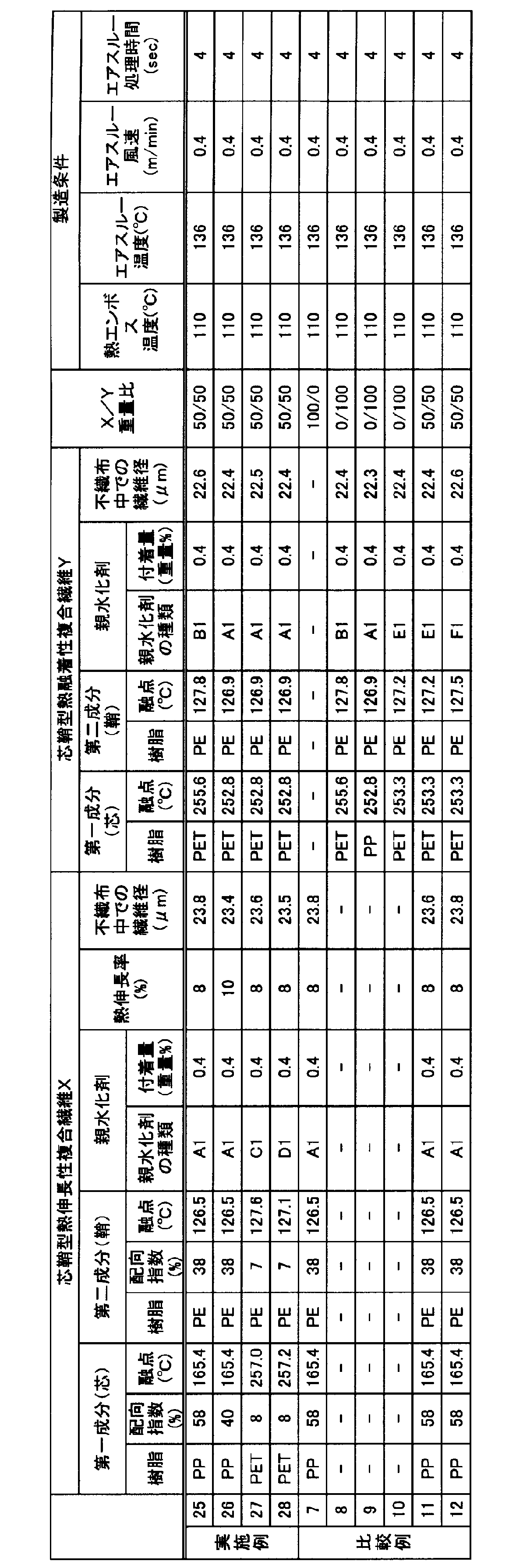
実施例及び比較例で得られた不織布について、先に述べた方法で繊維の接触角を測定した。また、以下の方法で不織布における液残り量及び液流れ距離を測定した。更に、熱風の吹き付けによる嵩回復性について評価した。それらの結果を前記の表1並びに以下の表4及び5に示す。
市販の生理用ナプキン(花王製、商品名「ロリエさらさらクッション ウィング付き」)から、表面シートを取り除いて、ナプキン吸収体を得る。また、測定対象の不織布をMD50mm×CD50mmに切断し、切断片を作製する。この切断片を、前記ナプキン吸収体における前記表面シートが存していた箇所(ナプキン吸収体の肌当接面上)に、図3(b)における不織布10’の裏面10aが該ナプキン吸収体との対向面となるように接着剤で接合固定して、測定対象の不織布を表面シートとして用いた生理用ナプキンを得る。前記測定対象の不織布を用いた生理用ナプキンの表面上に、円筒状の透過孔を有するアクリル板を重ねて、該ナプキンに100Paの一定荷重を掛ける。斯かる荷重下において、該アクリル板の透過孔から脱繊維馬血3.0gを流し込む。脱繊維馬血を流し込んでから120秒後に更に脱繊維馬血3.0gを流し込む。合計6.0gの脱繊維馬血を流し込んでから60秒後にアクリル板を取り除き、次いで不織布の重量(W2)を測定する。そして、予め測定しておいた、脱繊維馬血を流し込む前の不織布の重量(W1)との差(W2-W1)を算出する。以上の操作を3回行い、3回の平均値を液残り量(mg)とする。液残り量は、装着者の肌がどの程度濡れるのかの指標となるものであり、液残り量が少ないほど高評価となる。
前記〔液残り量〕と同様にして、測定対象の不織布をMD150mm×CD50mmに切断し、該不織布を表面シートとして用いた生理用ナプキンを得る。ナプキン吸収体は、市販の生理用ナプキン(花王製、商品名「ロリエさらさらクッション ウィング付き」)から表面シートを取り除いて得た。それ以外は、前述した液流れ距離の測定方法と同様にして測定した。
不織布10を外径85mmの紙管に巻き長さ2700mでロール状に巻回し、常温で2週間保管する。この保管後の不織布を、直径500mmより外側で、かつ直径で600mmより内側の範囲において、150m/minの搬送速度で繰り出し、処理温度115℃、処理時間0.20秒、風速2.8m/秒で該不織布に熱風を吹き付けることにより、不織布厚みを回復させる。不織布の嵩回復性は、不織布をロール状に巻きつける前の不織布の凸部の厚み(保存前厚み)をCとし、熱風吹き付け後の不織布の凸部の厚み(回復後厚み)をDとしたとき、以下の式(2)で表される。熱風吹き付け後の不織布厚みの測定は、熱風吹き付けから1分~1時間後に測定する。不織布の厚みは、先に述べた方法で測定する。
嵩回復性(%)=D/C×100 (2)
式(2)で算出した嵩回復性が60%未満の場合を×、60%以上~70%未満の場合を△、70%以上~80%未満の場合を○、80%以上の場合を◎と評価する。嵩回復性の値が高いほど高評価となる。

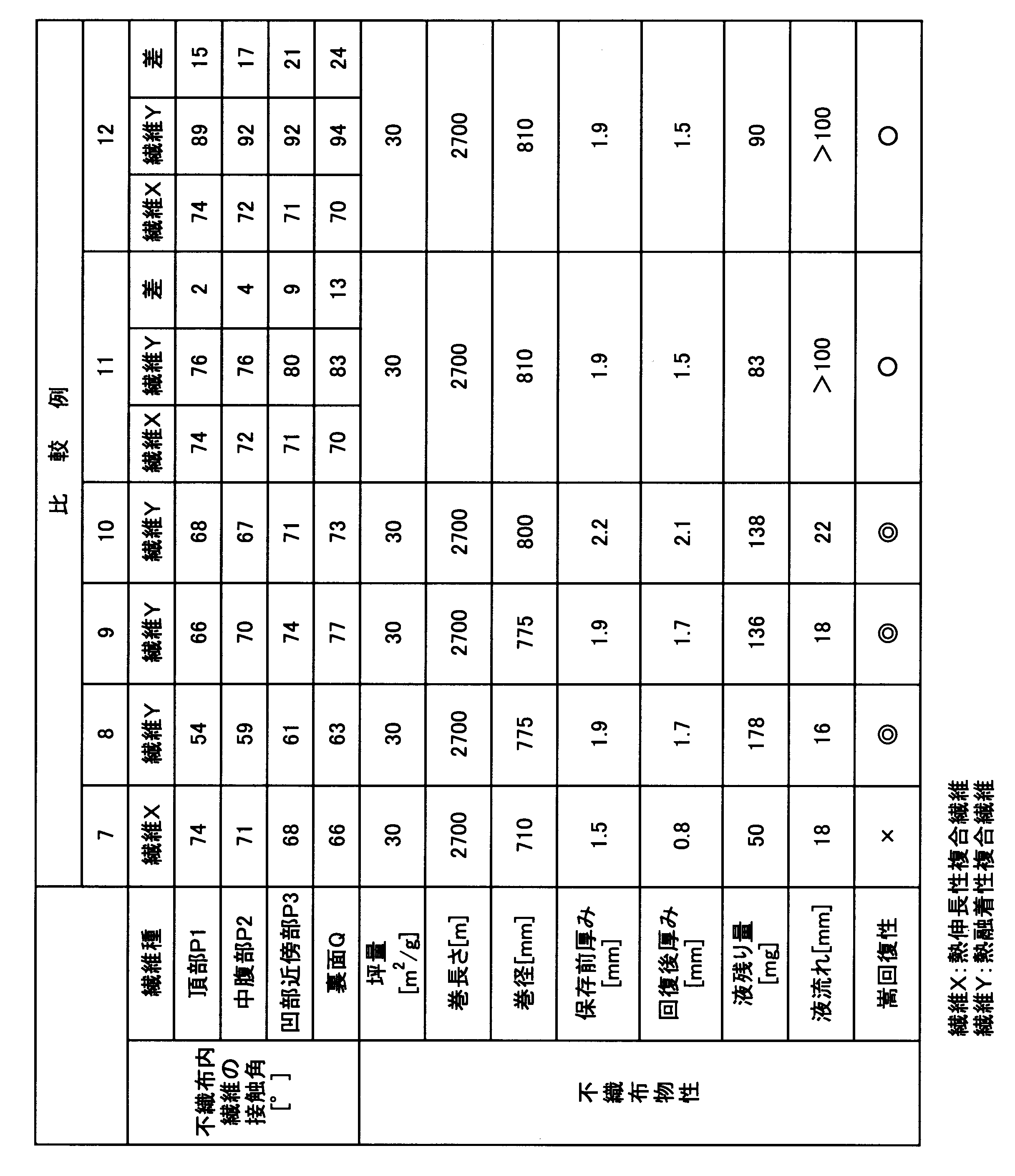
本発明の不織布は、部分的に親水性を低下させた部分を有し、その特性を活かして種々の用途に活用することができる。
本発明の不織布の製造方法によれば、親水性を低下させた部分を有する不織布を効率的に製造することができる。
本発明の不織布の親水性を制御する方法によれば、わざわざ繊維を混ぜ合わせたり、2層にしたり、不織布化したあとに別工程での親水化処理を行わなくても、熱処理を施す部位を変えたり、熱風の通過量を制御するだけで、不織布の所望の部分の親水性を低下させることができる。
本発明においては、使用できる親水化剤の選択の幅が広い。
Claims (17)
- ポリエチレン樹脂を含む鞘部及び該ポリエチレン樹脂より融点が高い樹脂成分を含む芯部を有する芯鞘型複合繊維と、該芯鞘型複合繊維の表面に付着している親水化剤とを有し、構成繊維の交点が熱融着した熱融着部を有する不織布であって、
前記芯鞘型複合繊維は、加熱によってその長さが伸びる熱伸長性複合繊維を含み、
前記熱伸長性複合繊維が、前記不織布の厚み方向及び/又は平面方向に親水度勾配を有している不織布。 - エンボス加工により形成された厚みの薄い部分と、それ以外の厚みの厚い部分とを有し、前記厚みの薄い部分又はその近傍部が親水性であり、前記厚みの厚い部分の頂部は、前記厚みの薄い部分又はその近傍部よりも親水性が低くなっている、請求の範囲第1項記載の不織布。
- 前記親水化剤が、ポリオキシエチレンアルキルアミド及び/又はアルキルベタインを含む、請求の範囲第1項又は第2項記載の不織布。
- 前記親水化剤が、ポリオキシエチレンアルキルアミド及びアルキルベタインを含む、請求の範囲第3項に記載の不織布。
- 前記厚みの厚い部分は、前記厚みの薄い部分又はその近傍部に比べて、前記ポリオキシエチレンアルキルアミド及び/又はアルキルベタインの存在比率が高い、請求の範囲第3項又は第4項記載の不織布。
- 融点の異なる2成分を含みかつ延伸処理されてなり、加熱によってその長さが実質的に伸びない非熱伸長性の熱融着性複合繊維を含み、該熱融着性複合繊維は親水化剤が付着したものであり、水との接触角が50~75°である、請求の範囲第1項~第5項の何れかに記載の不織布。
- 前記熱伸長性複合繊維と前記熱融着性複合繊維との混合比率(前者/後者)が重量比で20/80~80/20であり、
前記熱伸長性複合繊維どうしの交点、前記熱融着性複合繊維どうしの交点、及び前記熱伸長性複合繊維と前記熱融着性複合繊維との交点がそれぞれエアスルー方式で熱融着している請求の範囲第6項記載の不織布。 - 前記熱伸長性複合繊維の接触角が40~90°である請求の範囲第1項~第7項の何れかに記載の不織布。
- 一方の面に多数の凸部及び凹部を有し、該凸部においてはその頂部から不織布の他方の面側に向けて、前記熱伸長性複合繊維の水との接触角が漸次小さくなっている請求の範囲第1項~第8項の何れかに記載の不織布。
- ポリエチレン樹脂を含む鞘部及び該ポリエチレン樹脂より融点が高い樹脂成分を含む芯部を有する芯鞘型複合繊維と、該芯鞘型複合繊維の表面に付着している親水化剤とを有し、前記ポリエチレン樹脂の結晶子サイズが100~200Åである、熱により親水性が低下する繊維
を含むウェブ又は不織布に熱処理を施し、該ウェブ又は不織布の一部の親水性を低下させて得られる不織布。 - 前記親水化剤が、アニオン性、カチオン性及び両性イオン性の界面活性剤からなる群から選択される一種以上である、請求の範囲第10項記載の不織布。
- エンボス加工により形成された厚みの薄い部分と、それ以外の厚みの厚い部分とを有し、厚みの厚い部分が親水性低下部、厚みの薄い部分及び/又はその近傍部が親水部となっている、請求の範囲第10項又は第11項記載の不織布。
- 一面が親水性、他面がそれよりも疎水性となっている、請求の範囲第12項記載の不織布。
- ポリエチレン樹脂からなる鞘部及び該ポリエチレン樹脂より融点が高い樹脂成分からなる芯部を有する芯鞘型複合繊維と、該芯鞘型複合繊維の表面に付着している親水化剤とを有し、前記ポリエチレン樹脂の結晶子サイズが100~200Åである、熱により親水性が低下する繊維
を含むウェブ又は不織布に熱処理を施し、該ウエブ又は不織布の一部の親水性を低下させた不織布を得る、不織布の製造方法。 - 前記熱処理の温度が、前記鞘部を構成する前記ポリエチレン樹脂の融点より10℃低い温度から前記芯部を構成する前記樹脂成分の融点までの範囲である、請求の範囲第14記載の不織布の製造方法。
- ポリエチレン樹脂からなる鞘部及び該ポリエチレン樹脂より融点が高い樹脂成分からなる芯部を有する芯鞘型複合繊維と、該芯鞘型複合繊維の表面に付着している親水化剤とを有し、前記ポリエチレン樹脂の結晶子サイズが100~200Åである、熱により親水性が低下する繊維
を含むウェブ又は不織布に熱処理を施して、該ウェブ又は不織布の一部の親水性を低下させる不織布の親水性を制御する方法。 - 請求の範囲第1項~第13項の何れかに記載の不織布を用いた吸収性物品。
Priority Applications (2)
| Application Number | Priority Date | Filing Date | Title |
|---|---|---|---|
| CN200980151467.3A CN102257201B (zh) | 2008-12-25 | 2009-12-25 | 无纺布及其制造方法 |
| RU2011130858/12A RU2500844C2 (ru) | 2008-12-25 | 2009-12-25 | Нетканая ткань и способ ее получения |
Applications Claiming Priority (6)
| Application Number | Priority Date | Filing Date | Title |
|---|---|---|---|
| JP2008331092 | 2008-12-25 | ||
| JP2008-331092 | 2008-12-25 | ||
| JP2009287004A JP4975089B2 (ja) | 2008-12-25 | 2009-12-17 | 不織布及びその製造方法 |
| JP2009-287004 | 2009-12-17 | ||
| JP2009288241A JP4975090B2 (ja) | 2009-12-18 | 2009-12-18 | 不織布 |
| JP2009-288241 | 2009-12-18 |
Publications (1)
| Publication Number | Publication Date |
|---|---|
| WO2010074207A1 true WO2010074207A1 (ja) | 2010-07-01 |
Family
ID=42287812
Family Applications (1)
| Application Number | Title | Priority Date | Filing Date |
|---|---|---|---|
| PCT/JP2009/071551 Ceased WO2010074207A1 (ja) | 2008-12-25 | 2009-12-25 | 不織布及びその製造方法 |
Country Status (1)
| Country | Link |
|---|---|
| WO (1) | WO2010074207A1 (ja) |
Cited By (10)
| Publication number | Priority date | Publication date | Assignee | Title |
|---|---|---|---|---|
| CN102380993A (zh) * | 2011-08-16 | 2012-03-21 | 苏州铭辰无纺布有限公司 | 高锁水亲水纺粘无纺布二层复合材料的制备方法及产品 |
| JP2013126455A (ja) * | 2011-12-16 | 2013-06-27 | Kao Corp | 吸収性物品 |
| WO2013157611A1 (ja) * | 2012-04-20 | 2013-10-24 | ユニ・チャーム株式会社 | 不織布の嵩を回復させる方法及び装置 |
| CN103422256A (zh) * | 2013-07-17 | 2013-12-04 | 厦门延江工贸有限公司 | 一种热风无纺布及其制造方法 |
| CN105316944A (zh) * | 2015-11-26 | 2016-02-10 | 常州市灵达化学品有限公司 | 聚烯烃非织造布纵向渗透型多次亲水剂 |
| JP2016060995A (ja) * | 2014-09-19 | 2016-04-25 | 花王株式会社 | 凹凸不織布 |
| JP2016069748A (ja) * | 2014-09-30 | 2016-05-09 | 花王株式会社 | 不織布 |
| CN106232888A (zh) * | 2014-10-17 | 2016-12-14 | 花王株式会社 | 无纺布 |
| EP3311687B1 (en) | 2015-06-19 | 2021-05-19 | Nitto Denko Corporation | Female member for touch fastener |
| CN116917561A (zh) * | 2021-03-23 | 2023-10-20 | 捷恩智株式会社 | 无纺布及其制造方法 |
Citations (3)
| Publication number | Priority date | Publication date | Assignee | Title |
|---|---|---|---|---|
| JPH10140480A (ja) * | 1996-11-07 | 1998-05-26 | Toshiba Silicone Co Ltd | 繊維処理剤 |
| JP2005314825A (ja) * | 2004-04-27 | 2005-11-10 | Kao Corp | 立体不織布 |
| JP2007182662A (ja) * | 2005-12-07 | 2007-07-19 | Kao Corp | 熱伸長性繊維 |
-
2009
- 2009-12-25 WO PCT/JP2009/071551 patent/WO2010074207A1/ja not_active Ceased
Patent Citations (3)
| Publication number | Priority date | Publication date | Assignee | Title |
|---|---|---|---|---|
| JPH10140480A (ja) * | 1996-11-07 | 1998-05-26 | Toshiba Silicone Co Ltd | 繊維処理剤 |
| JP2005314825A (ja) * | 2004-04-27 | 2005-11-10 | Kao Corp | 立体不織布 |
| JP2007182662A (ja) * | 2005-12-07 | 2007-07-19 | Kao Corp | 熱伸長性繊維 |
Cited By (14)
| Publication number | Priority date | Publication date | Assignee | Title |
|---|---|---|---|---|
| CN102380993A (zh) * | 2011-08-16 | 2012-03-21 | 苏州铭辰无纺布有限公司 | 高锁水亲水纺粘无纺布二层复合材料的制备方法及产品 |
| JP2013126455A (ja) * | 2011-12-16 | 2013-06-27 | Kao Corp | 吸収性物品 |
| US9637851B2 (en) | 2012-04-20 | 2017-05-02 | Unicharm Corporation | Method and device for recovering bulk of nonwoven fabric |
| JP2013224501A (ja) * | 2012-04-20 | 2013-10-31 | Uni Charm Corp | 不織布の嵩を回復させる方法及び装置 |
| WO2013157611A1 (ja) * | 2012-04-20 | 2013-10-24 | ユニ・チャーム株式会社 | 不織布の嵩を回復させる方法及び装置 |
| CN103422256A (zh) * | 2013-07-17 | 2013-12-04 | 厦门延江工贸有限公司 | 一种热风无纺布及其制造方法 |
| US11053616B2 (en) | 2013-07-17 | 2021-07-06 | Xiamen Yanjan New Material Co., Ltd. | Non-woven absorbent textile article |
| JP2016060995A (ja) * | 2014-09-19 | 2016-04-25 | 花王株式会社 | 凹凸不織布 |
| JP2016069748A (ja) * | 2014-09-30 | 2016-05-09 | 花王株式会社 | 不織布 |
| CN106232888A (zh) * | 2014-10-17 | 2016-12-14 | 花王株式会社 | 无纺布 |
| EP3311687B1 (en) | 2015-06-19 | 2021-05-19 | Nitto Denko Corporation | Female member for touch fastener |
| CN105316944A (zh) * | 2015-11-26 | 2016-02-10 | 常州市灵达化学品有限公司 | 聚烯烃非织造布纵向渗透型多次亲水剂 |
| CN105316944B (zh) * | 2015-11-26 | 2017-10-10 | 常州市灵达化学品有限公司 | 聚烯烃非织造布纵向渗透型多次亲水剂 |
| CN116917561A (zh) * | 2021-03-23 | 2023-10-20 | 捷恩智株式会社 | 无纺布及其制造方法 |
Similar Documents
| Publication | Publication Date | Title |
|---|---|---|
| JP4975089B2 (ja) | 不織布及びその製造方法 | |
| CN102257201B (zh) | 无纺布及其制造方法 | |
| JP5021719B2 (ja) | 不織布 | |
| JP4023996B2 (ja) | 吸収性物品の表面シート | |
| CN103993428B (zh) | 无纺布的制造方法 | |
| JP6273101B2 (ja) | 不織布 | |
| JP6332805B2 (ja) | 不織布 | |
| JP5689616B2 (ja) | 不織布 | |
| JP6170815B2 (ja) | 不織布 | |
| JP6408320B2 (ja) | 親水性不織布及び不織布用繊維処理剤 | |
| WO2014171388A1 (ja) | 不織布及び繊維処理剤 | |
| JP6587509B2 (ja) | 積層不織布 | |
| JP5386341B2 (ja) | 使い捨ておむつ | |
| TW201732108A (zh) | 肌膚觸感優異之長纖維不織布 | |
| JP5514536B2 (ja) | 使い捨ておむつ | |
| JP4605653B2 (ja) | 表面材およびそれを用いた吸収性物品 | |
| WO2016060238A1 (ja) | 不織布 | |
| WO2010074208A1 (ja) | 不織布 | |
| JP6080323B2 (ja) | 吸収性物品 | |
| JP6566852B2 (ja) | 不織布 | |
| CN104662217B (zh) | 聚丙烯系无纺布 | |
| JP4975090B2 (ja) | 不織布 | |
| JP5593124B2 (ja) | 使い捨ておむつ | |
| JP2017148141A (ja) | 吸収性物品 | |
| JP5640164B2 (ja) | 不織布及び繊維処理剤 |
Legal Events
| Date | Code | Title | Description |
|---|---|---|---|
| WWE | Wipo information: entry into national phase |
Ref document number: 200980151467.3 Country of ref document: CN |
|
| 121 | Ep: the epo has been informed by wipo that ep was designated in this application |
Ref document number: 09835003 Country of ref document: EP Kind code of ref document: A1 |
|
| NENP | Non-entry into the national phase |
Ref country code: DE |
|
| WWE | Wipo information: entry into national phase |
Ref document number: 2011130858 Country of ref document: RU |
|
| 122 | Ep: pct application non-entry in european phase |
Ref document number: 09835003 Country of ref document: EP Kind code of ref document: A1 |