WO2010064652A1 - アセトンからイソブチレンを製造する方法 - Google Patents
アセトンからイソブチレンを製造する方法 Download PDFInfo
- Publication number
- WO2010064652A1 WO2010064652A1 PCT/JP2009/070234 JP2009070234W WO2010064652A1 WO 2010064652 A1 WO2010064652 A1 WO 2010064652A1 JP 2009070234 W JP2009070234 W JP 2009070234W WO 2010064652 A1 WO2010064652 A1 WO 2010064652A1
- Authority
- WO
- WIPO (PCT)
- Prior art keywords
- zeolite
- acetone
- isobutylene
- reaction
- bea
- Prior art date
- Legal status (The legal status is an assumption and is not a legal conclusion. Google has not performed a legal analysis and makes no representation as to the accuracy of the status listed.)
- Ceased
Links
Images













Classifications
-
- B—PERFORMING OPERATIONS; TRANSPORTING
- B01—PHYSICAL OR CHEMICAL PROCESSES OR APPARATUS IN GENERAL
- B01J—CHEMICAL OR PHYSICAL PROCESSES, e.g. CATALYSIS OR COLLOID CHEMISTRY; THEIR RELEVANT APPARATUS
- B01J29/00—Catalysts comprising molecular sieves
- B01J29/03—Catalysts comprising molecular sieves not having base-exchange properties
- B01J29/0308—Mesoporous materials not having base exchange properties, e.g. Si-MCM-41
-
- B—PERFORMING OPERATIONS; TRANSPORTING
- B01—PHYSICAL OR CHEMICAL PROCESSES OR APPARATUS IN GENERAL
- B01J—CHEMICAL OR PHYSICAL PROCESSES, e.g. CATALYSIS OR COLLOID CHEMISTRY; THEIR RELEVANT APPARATUS
- B01J29/00—Catalysts comprising molecular sieves
- B01J29/04—Catalysts comprising molecular sieves having base-exchange properties, e.g. crystalline zeolites
- B01J29/06—Crystalline aluminosilicate zeolites; Isomorphous compounds thereof
- B01J29/08—Crystalline aluminosilicate zeolites; Isomorphous compounds thereof of the faujasite type, e.g. type X or Y
- B01J29/084—Y-type faujasite
-
- B—PERFORMING OPERATIONS; TRANSPORTING
- B01—PHYSICAL OR CHEMICAL PROCESSES OR APPARATUS IN GENERAL
- B01J—CHEMICAL OR PHYSICAL PROCESSES, e.g. CATALYSIS OR COLLOID CHEMISTRY; THEIR RELEVANT APPARATUS
- B01J29/00—Catalysts comprising molecular sieves
- B01J29/04—Catalysts comprising molecular sieves having base-exchange properties, e.g. crystalline zeolites
- B01J29/06—Crystalline aluminosilicate zeolites; Isomorphous compounds thereof
- B01J29/40—Crystalline aluminosilicate zeolites; Isomorphous compounds thereof of the pentasil type, e.g. types ZSM-5, ZSM-8 or ZSM-11, as exemplified by patent documents US3702886, GB1334243 and US3709979, respectively
-
- B—PERFORMING OPERATIONS; TRANSPORTING
- B01—PHYSICAL OR CHEMICAL PROCESSES OR APPARATUS IN GENERAL
- B01J—CHEMICAL OR PHYSICAL PROCESSES, e.g. CATALYSIS OR COLLOID CHEMISTRY; THEIR RELEVANT APPARATUS
- B01J29/00—Catalysts comprising molecular sieves
- B01J29/04—Catalysts comprising molecular sieves having base-exchange properties, e.g. crystalline zeolites
- B01J29/06—Crystalline aluminosilicate zeolites; Isomorphous compounds thereof
- B01J29/70—Crystalline aluminosilicate zeolites; Isomorphous compounds thereof of types characterised by their specific structure not provided for in groups B01J29/08 - B01J29/65
- B01J29/7007—Zeolite Beta
-
- B—PERFORMING OPERATIONS; TRANSPORTING
- B01—PHYSICAL OR CHEMICAL PROCESSES OR APPARATUS IN GENERAL
- B01J—CHEMICAL OR PHYSICAL PROCESSES, e.g. CATALYSIS OR COLLOID CHEMISTRY; THEIR RELEVANT APPARATUS
- B01J29/00—Catalysts comprising molecular sieves
- B01J29/04—Catalysts comprising molecular sieves having base-exchange properties, e.g. crystalline zeolites
- B01J29/06—Crystalline aluminosilicate zeolites; Isomorphous compounds thereof
- B01J29/70—Crystalline aluminosilicate zeolites; Isomorphous compounds thereof of types characterised by their specific structure not provided for in groups B01J29/08 - B01J29/65
- B01J29/7049—Crystalline aluminosilicate zeolites; Isomorphous compounds thereof of types characterised by their specific structure not provided for in groups B01J29/08 - B01J29/65 containing rare earth elements, titanium, zirconium, hafnium, zinc, cadmium, mercury, gallium, indium, thallium, tin or lead
- B01J29/7057—Zeolite Beta
-
- C—CHEMISTRY; METALLURGY
- C07—ORGANIC CHEMISTRY
- C07C—ACYCLIC OR CARBOCYCLIC COMPOUNDS
- C07C1/00—Preparation of hydrocarbons from one or more compounds, none of them being a hydrocarbon
- C07C1/20—Preparation of hydrocarbons from one or more compounds, none of them being a hydrocarbon starting from organic compounds containing only oxygen atoms as heteroatoms
- C07C1/207—Preparation of hydrocarbons from one or more compounds, none of them being a hydrocarbon starting from organic compounds containing only oxygen atoms as heteroatoms from carbonyl compounds
- C07C1/2076—Preparation of hydrocarbons from one or more compounds, none of them being a hydrocarbon starting from organic compounds containing only oxygen atoms as heteroatoms from carbonyl compounds by a transformation in which at least one -C(=O)- moiety is eliminated
-
- B—PERFORMING OPERATIONS; TRANSPORTING
- B01—PHYSICAL OR CHEMICAL PROCESSES OR APPARATUS IN GENERAL
- B01J—CHEMICAL OR PHYSICAL PROCESSES, e.g. CATALYSIS OR COLLOID CHEMISTRY; THEIR RELEVANT APPARATUS
- B01J2229/00—Aspects of molecular sieve catalysts not covered by B01J29/00
- B01J2229/10—After treatment, characterised by the effect to be obtained
- B01J2229/14—After treatment, characterised by the effect to be obtained to alter the inside of the molecular sieve channels
-
- B—PERFORMING OPERATIONS; TRANSPORTING
- B01—PHYSICAL OR CHEMICAL PROCESSES OR APPARATUS IN GENERAL
- B01J—CHEMICAL OR PHYSICAL PROCESSES, e.g. CATALYSIS OR COLLOID CHEMISTRY; THEIR RELEVANT APPARATUS
- B01J2229/00—Aspects of molecular sieve catalysts not covered by B01J29/00
- B01J2229/30—After treatment, characterised by the means used
- B01J2229/32—Reaction with silicon compounds, e.g. TEOS, siliconfluoride
-
- B—PERFORMING OPERATIONS; TRANSPORTING
- B01—PHYSICAL OR CHEMICAL PROCESSES OR APPARATUS IN GENERAL
- B01J—CHEMICAL OR PHYSICAL PROCESSES, e.g. CATALYSIS OR COLLOID CHEMISTRY; THEIR RELEVANT APPARATUS
- B01J2235/00—Indexing scheme associated with group B01J35/00, related to the analysis techniques used to determine the catalysts form or properties
- B01J2235/05—Nuclear magnetic resonance [NMR]
-
- B—PERFORMING OPERATIONS; TRANSPORTING
- B01—PHYSICAL OR CHEMICAL PROCESSES OR APPARATUS IN GENERAL
- B01J—CHEMICAL OR PHYSICAL PROCESSES, e.g. CATALYSIS OR COLLOID CHEMISTRY; THEIR RELEVANT APPARATUS
- B01J2235/00—Indexing scheme associated with group B01J35/00, related to the analysis techniques used to determine the catalysts form or properties
- B01J2235/30—Scanning electron microscopy; Transmission electron microscopy
-
- B—PERFORMING OPERATIONS; TRANSPORTING
- B01—PHYSICAL OR CHEMICAL PROCESSES OR APPARATUS IN GENERAL
- B01J—CHEMICAL OR PHYSICAL PROCESSES, e.g. CATALYSIS OR COLLOID CHEMISTRY; THEIR RELEVANT APPARATUS
- B01J35/00—Catalysts, in general, characterised by their form or physical properties
- B01J35/70—Catalysts, in general, characterised by their form or physical properties characterised by their crystalline properties, e.g. semi-crystalline
Definitions
- the present invention relates to a method for producing isobutylene from acetone.
- Acetone is a basic compound widely used as a solvent or a raw material for chemical production. Acetone can be obtained by the cumene method (by-product in the production of phenol from cumene hydroperoxide) or the propylene Wacker oxidation method. Moreover, as a chemical product produced from acetone, methyl methacrylate (MMA) produced by reacting acetone cyanohydrin (ACH) produced by reacting hydrocyanic acid with acetone and concentrated sulfuric acid and methanol is exemplified. .
- MMA is a monomer (MMA monomer) of polymethyl methacrylate (PMMA) useful as a transparent resin.
- the MMA monomer production method using isobutylene as a starting material is mainly adopted in the Asian region centering on Japan, and isobutylene is indispensable for PMMA production together with acetone. It is a raw material.
- isobutylene as MMA monomer material is mainly from spent BB is a residue obtained by fractional distillation of butadiene from the C 4 fraction obtained by naphtha cracking, after extracting as tertiary butanol by hydration reaction of isobutylene with an acid catalyst This is obtained by dehydrating.
- the above-mentioned ACH method is the process with the largest production amount of MMA monomer in the world, but it is inevitable to treat equipment corrosion and waste acid by using concentrated sulfuric acid. Therefore, after converting acetone, which is a raw material of the ACH method, to isobutylene, if the MMA monomer can be produced from the isobutylene by the direct isobutylene oxidation method, the problem with the ACH method can be avoided and acetone can be used as the raw material of the MMA monomer. Can do. Acetone is a relatively inexpensive chemical, and if a catalyst and a production method capable of converting acetone into isobutylene with high efficiency can be found, acetone can be expected as a promising isobutylene source.
- Non-Patent Document 1 As a study to convert acetone to isobutylene, it is reported that isobutylene is produced from acetone via isobutane and isophorone using beta ( ⁇ ) zeolite, HY zeolite, and H-ZSM-5 zeolite. (Non-Patent Document 1).
- Biorefinery technology has attracted worldwide attention as a technology for producing energy and chemicals from biomass, which is a renewable resource.
- Biorefinery produces energy and chemicals by producing various gases such as synthesis gas, saccharides such as glucose and aromatic compounds such as lignin by gasification, saccharification and extraction of various biomass. It is something to try.
- Biomass as a raw material for biorefinery can be broadly divided into those derived from resource crops and those derived from waste.
- Biomass derived from resource crops includes edible crops, wood, flowers, and the like, as well as unused portions of those crops.
- biomass derived from waste includes food waste, sludge such as sewage, livestock manure, and waste paper.
- Examples of products manufactured by biorefinery include ethanol, butanol, and diesel oil in terms of energy.
- chemicals a large number of chemicals can be produced by deriving from sugar-derived succinic acid, 3-hydroxypropionic acid, aspartic acid and other basic compounds (platform compounds) proposed by the US Department of Energy. is there.
- Acetone can also be produced from biomass, and can be produced using an iron oxide-based catalyst supporting zirconium using organic waste such as sludge as a raw material (Patent Document 1).
- Non-Patent Document 1 In the conversion reaction from acetone to isobutylene using proton type ⁇ zeolite (H- ⁇ ) or H-ZSM-5 zeolite reported in Non-Patent Document 1, it is described that the selectivity of isobutylene at the initial stage of the reaction is low. ing. In the initial stage of the reaction, isobutane is produced with high selectivity, and when the reaction time is prolonged, isobutylene is produced with high selectivity, accompanied by a decrease in catalytic activity due to carbon deposition (coking). As shown in FIG. 1, isobutylene is presumed to be produced by decomposition of a compound (such as diacetone alcohol, mesityl oxide, phorone, isophorone) in which acetone self-condenses.
- a compound such as diacetone alcohol, mesityl oxide, phorone, isophorone
- acetone produced from biomass by the method of Patent Document 1 is acetone derived from biomass, and biomass-derived isobutylene can be produced by further converting the acetone to isobutylene.
- biomass-derived MMA can also be produced by an isobutylene direct oxidation method or the like.
- An object of the present invention is to provide a method for producing isobutylene from acetone with high selectivity and high yield from the beginning of the reaction. It is also an object of the present invention to produce biomass-derived isobutylene by converting acetone produced from biomass into isobutylene.
- the present invention is characterized in that at least one compound selected from a zeolite having an acid site ion-exchanged by a cation, a zeolite-like substance having an acid site ion-exchanged by a cation, and mesoporous silica is used as a catalyst.
- This is a method for producing isobutylene from acetone.
- the present invention uses, as a catalyst, a zeolite or zeolite-like substance in which acid sites are inactivated by an organosilicon compound having a molecular size smaller than the pore size of the zeolite or zeolite-like substance. This is a method for producing isobutylene from acetone.
- the present invention is characterized in that the acetone is acetone produced from biomass as a raw material.
- the present invention it is possible to provide a catalyst capable of producing isobutylene from acetone with high selectivity and high yield from the beginning of the reaction.
- the catalyst life can be extended by suppressing carbon deposition.
- a new production method for producing isobutylene using acetone that can be produced from biomass as a raw material is realized, and biomass-derived isobutylene can be supplied.
- chemicals, such as a MMA monomer can be manufactured using the obtained biomass-derived isobutylene.
- the catalyst used is selected from zeolite having an acid site ion-exchanged by a cation, a zeolite-like substance having an acid site ion-exchanged by a cation, and mesoporous silica. At least one compound.
- Zeolite is a general term for crystalline porous aluminosilicates. Tetrahedral (SiO 4 ) 4- and (AlO 4 ) 5- are basic structural units that are three-dimensionally connected. As a result, crystals are formed.
- metallosilicates in which trivalent or tetravalent elements other than aluminum ions are incorporated in a silicate skeleton are also included in the zeolite. Since the entrance diameter of zeolite pores is about 0.4 to 0.8 nm, molecules smaller than the entrance diameter can enter the pores, but large molecules have a molecular sieving action that cannot enter.
- the zeolite-like substance is a compound having a structure and an acid point similar to those of a silicate zeolite, and is typically a phosphate-based porous crystal.
- the acid point of the zeolite or zeolite-like substance in the present invention is preferably a Bronsted acid point.
- the types of acid sites in a solid acid catalyst are broadly classified into Bronsted acid sites and Lewis acid sites.
- Bronsted acid (B acid) is an acid that releases proton (H + )
- Lewis acid (L acid) is not accompanied by H + exchange.
- aluminosilicates such as zeolite
- a portion of tetravalent Si is substituted with trivalent Al, and in order to maintain its electrical neutrality, proton addition to O that bridges Si and Al Negative charge generation occurs on Al, and B acid spots are formed by cross-linked OH groups as shown in FIG.
- the nature of the B acid point varies depending on the structure of the zeolite, the metal or metal ion introduced, or the amount of Al contained.
- the Al content in the zeolite can be determined by calculating the ratio of Al to Si (Si / Al) from the MAS-NMR of 29 Si.
- the Si / Al in the present invention is not limited but is preferably 5 to 500.
- the acid point of the zeolite or zeolite-like substance in the present invention is an acid point ion-exchanged with a cation.
- the acid strength expressed by cation exchange varies depending on the type and valence of the cation. Depending on the valence of the cation, the number of acid sites exchanged for one cation changes, and when an n-valent cation is used, protons of n acid sites can be exchanged for each cation. That is, in the case of a monovalent cation, the cation / acid point is 1/1, and in the case of a divalent cation, the cation / acid point is 1 ⁇ 2.
- Cations used for ion exchange are sodium, potassium, rubidium, cesium, magnesium, calcium, strontium, barium, lanthanum, cerium, iron, cobalt, copper, nickel, zinc, palladium, silver, alkali metals, alkaline earth metals , Ions of at least one metal selected from rare earth elements and transition metals.
- sodium, potassium, rubidium, cesium, magnesium, calcium, strontium, barium, lanthanum, and cerium are preferable in the present invention.
- zeolites or zeolite-like substances ion-exchanged with cations may exhibit basicity derived from lattice oxygen ions, and in general acid / base catalyzed reactions that do not require strong acid sites, acid sites and base sites are used. Works in concert and shows catalysis.
- a cation nitrate used for exchange is added to a solution in which zeolite or a zeolite-like substance is dispersed in distilled water, and the mixture is heated to reflux. After completion of heating and refluxing, cation exchange zeolite or zeolite-like substance can be obtained by washing with distilled water and air drying. The operation can be repeated as necessary to adjust the degree of cation exchange.
- the template-removed zeolite or zeolite-like substance is dispersed in distilled water.
- Ammonium ion-exchanged zeolite or zeolite-like substance is once prepared by adding ammonium nitrate to the dispersion, heating to reflux, washing with distilled water, and air drying. Thereafter, the ammonium ion-exchanged zeolite or zeolite-like substance can be ion-exchanged with the target cation in the same manner as described above, whereby the cation-exchanged zeolite or zeolite-like substance can be prepared.
- the catalyst used is a zeolite or a zeolite-like substance in which acid sites are inactivated by an organosilicon compound having a molecular size smaller than the pore size.
- the acid point of the zeolite or zeolite-like substance in the present invention is an acid point that has been inactivated by an organosilicon compound.
- an organosilicon compound By selecting the molecular size of the organosilicon compound relative to the pore diameter of the zeolite or zeolite-like substance, the acid sites of the zeolite or zeolite-like substance are present on the outer surface of the crystal, near the pore inlet, and inside the pore. It is possible to control the presence or absence of the inactivation treatment depending on the position of the acid point. In general, it is considered that aromatic generation, olefin consumption, carbon deposition and the like occur remarkably at the acid point on the outer surface of the crystal without any spatial restriction.
- the said reaction is easy to occur from the high acid point density in the acid point which exists in the cross section of a zeolite among the acid points inside a pore.
- the acid sites on the outer surface and pores that are not suitable for isobutylene formation are appropriately inactivated by an organosilicon compound having a molecular size smaller than the pore size of zeolite or a zeolite-like substance. Isobutylene can be produced from acetone with high selectivity and high yield from the beginning of the reaction.
- the pore diameter of the zeolite or zeolite-like substance is based on the aperture diameter of the pore opening obtained from the analysis of the ring structure composed of silicon, aluminum and oxygen, and takes into account the van der Waals radius of each atom.
- the pore diameter obtained by calculation is shown.
- the molecular size in the present invention indicates a molecular size calculated based on the van der Waals radius.
- the van der Waals radii of typical atoms in the present invention are hydrogen (H): 0.12 nm, carbon (C): 0.17 nm, oxygen (O): 0.152 nm, silicon (Si): 0.21 nm. is there.
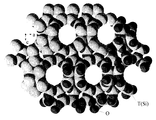
- FIG. 21 shows the structure shown by the Space-Filling model using the van der Waals radius of each atom based on the crystal structure of BEA type zeolite described in the zeolite structure database of The International Zeolite Association.
- the van der Waals radius representing the occupied volume is used, the pore diameter of the BEA is expressed smaller than the commonly used aperture diameter (0.64 ⁇ 0.76 nm) of the BEA.
- all T atoms are silicon (Si).
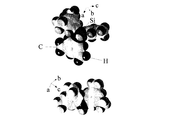
- FIGS. 22 to 24 show the organosilicon compounds of phenylsilane (FIG. 22), bis (3,5-dimethoxyphenyl) silane (FIG. 23) and tris (3,5-dimethylphenyl) silane (FIG. 24).
- the structure by the Space-Filling model using the van der Waals radius of an atom is shown.
- the organosilicon compound When the organosilicon compound approaches the pore in a direction that minimizes the molecular size with respect to the pore opening, it can penetrate (diffuse) into the pore if the molecular size is smaller than the pore diameter.
- the pore size of the BEA type zeolite in FIG. 21 is compared with the molecular size of the organosilicon compounds in FIGS.
- Phenylsilane having one benzene ring (FIG. 22) can penetrate (diffuse) into the pores of the BEA type zeolite, but bis (3,5-dimethoxyphenyl having two and three benzene rings. ) Silane (FIG. 23) and tris (3,5-dimethylphenyl) silane (FIG.
- organosilicon compounds that do not have a benzene ring and have a smaller alkyl group, such as methyl, ethyl, methoxy, and ethoxy groups, and alkoxy groups, can easily penetrate (diffuse) into the pores. It is. Therefore, the penetration (diffusion) behavior of the zeolite or zeolite-like substance into the pores varies depending on the molecular size of the organosilicon compound, and it is determined whether or not the acid point inside the pores can be inactivated.
- the molecular size smaller than the pore diameter means a size smaller than the pore diameter of the opening, and the anisotropic pore shows a size smaller than the opening pore diameter in the major axis direction.
- organosilicon compound in the present invention a compound having a molecular size smaller than the pore diameter of zeolite or a zeolite-like substance and represented by the following formula (1) can be used.
- R 1 , R 2 and R 3 each represent one selected from the group consisting of an alkyl group, an alkoxy group, an aryl group and hydrogen, and R 4 represents hydrogen).
- examples of the alkyl group include a methylpropoxy group and an n-butoxy group.
- examples of the alkoxy group include a methoxy group and an ethoxy group.
- examples of the aryl group include a phenyl group and methylphenyl.
- organosilicon compound examples include diethoxymethylsilane, phenylsilane, and tetramethylsilane, although depending on the pore diameter of zeolite or a zeolite-like substance.
- the organosilicon compound is not limited to these.
- the types of these organosilicon compounds can be appropriately selected in consideration of the pore diameter of zeolite and zeolite-like substances, the position of the acid sites to be deactivated, the physical properties of the organosilicon compounds and the availability. .
- an organosilicon catalytic cracking method (hereinafter referred to as a silane catalytic cracking method) can be mentioned.
- the organosilicon compound is chemically adsorbed on the acid sites of the zeolite or zeolite-like substance by physically contacting the zeolite or zeolite-like substance with the organosilicon compound vaporized by heating.
- the organic substance portion of the chemically adsorbed organosilicon compound is removed and modified to silica (SiO 2 ).
- the chemisorption temperature of the organosilicon compound and the subsequent firing temperature are appropriately selected in consideration of the boiling point and thermal decomposition characteristics of the organosilicon compound.
- methyldiethoxysilane (DEMS) is used as the organosilicon compound.
- DEMS methyldiethoxysilane
- FIG. 25 shows the difference in acid point deactivation degree depending on the type of organosilicon compound when MFI type zeolite (aperture diameter: 0.54 ⁇ 0.56 nm) is taken as an example.
- DEMS, phenylsilane (PS), diphenylmethylsilane (DPMS), and triphenylsilane (TPS) are used as the organosilicon compounds.
- PS phenylsilane
- DPMS diphenylmethylsilane
- TPS triphenylsilane
- an organic silicon compound having a molecular size smaller than the pore size of zeolite or zeolite-like substance is used for deactivation of acid sites, it is similar to zeolite or zeolite as in the example using DEMS and PS in FIG. Both acid sites present on the outer surface of the substance and acid sites present in the pores can be inactivated.
- the acid site deactivation treatment with the organosilicon compound can be applied to dealuminated or cation-exchanged zeolite and zeolite-like substances, and can also be applied to nested silanols produced by dealumination. .
- the nature (amount and strength) of the acid point of zeolite or a zeolite-like substance can be determined by a temperature programmed desorption method (TPD) or a heat of adsorption method using a basic molecule such as ammonia as a probe.
- TPD temperature programmed desorption method
- the proton of an acidic OH group of zeolite or a zeolite-like substance is ion-exchanged by a cation, whereby the ammonia desorption peak appearing at 573 K or more in ammonia TPD is reduced.
- ammonia desorption peak at 573 K or higher in ammonia TPD is caused by a strong acid point of zeolite or a zeolite-like substance, and in the present invention, some or all of protons having a stronger acid point are present.
- suitable acid sites are formed for producing isobutylene from acetone. Thereby, isobutylene can be produced with high selectivity from the beginning of the reaction.
- the pore structure and pore diameter of the zeolite or zeolite-like substance in the present invention are not limited, but a zeolite or zeolite-like compound having pores having a 10-membered oxygen ring or more is preferable.
- a zeolite or zeolite-like compound having pores smaller than the oxygen 10-membered ring is used, decomposition and sequential oxidation due to inhibition of diffusion of isobutylene out of the pores increase, and isobutylene selectivity decreases.
- Zeolite having 10 or more oxygen rings or zeolite-like compounds include AlPO 4 -11 (AEL), EU-1 (EUO), ferrierite (FER), hurlandite (HEU), ZSM-11 (MEL), ZSM -5 (MFI), NU-87 (NES), Theta-1 (TON), Weinebeite (WEI), AlPO 4 -5 (AFI), AlPO 4 -31 (ATO), Beta (BEA), CIT-1 ( CON), X, Y, faujasite (FAU), gmelinite (GME), L (LTL), mordenite (MOR), ZSM-12 (MTW), offretite (OFF), STA-1 (SAO), SAPO-37 (FAU), clover light (CLO), VPI-5 ( VFI), AlPO 4 -8 (AET), CIT-5 ( FI) and UTD-1 (DON), and the like.
- AlPO 4 -11 AlPO 4 -11
- EU-1 EUO
- FER ferrierite
- FER hur
- the structure code is in parentheses. Among these, MFI, X, Y, BEA and FAU are preferable from the viewpoint of pore diameter and acid strength.
- the zeolite and the zeolite-like substance in the present invention are not limited to these.
- a suitable catalyst can be obtained by ion exchange of the acid point protons of these zeolites or zeolite-like substances with cations or inactivation treatment with an organosilicon compound.
- the pores of the zeolite or zeolite-like substance are micropores whose pore diameter regularly developed in one, two or three dimensions is smaller than 2 nm.
- the presence or absence of regular micropores can be confirmed by observation with a transmission electron microscope (TEM) or the like.
- the catalyst in the production method of the present invention is mesoporous silica.
- Mesoporous silica also called mesoporous silica, is a compound composed of a Si—O skeleton in which pores having a pore diameter of 2 to 50 nm are uniformly developed in one, two, or three dimensions and regularly developed. is there. Presence or absence of regular mesopores can be confirmed not only by observation by TEM but also by nitrogen adsorption method and X-ray diffraction method.
- Typical mesoporous silicas include FSM-16, MCM-41, MCM-48, MCM-50 and SBA-15.
- silanol group-derived OH group Si—OH
- the weak acid point of mesoporous silica is suitable for the progress of the reaction in the present invention.
- isobutylene is produced mainly through a dimerization reaction or a trimerization reaction of acetone (FIG. 1).
- Isobutylene is produced by the decomposition reaction of diacetone alcohol and mesityl oxide produced by aldol condensation of acetone, holon produced by aldol condensation of mesityl oxide and acetone, and isophorone produced by 1,6-Michael addition of holon.
- FIG. 1 shows a path that is considered to contribute greatly to the production of isobutylene.
- the acid point in the present invention is ion-exchanged with a cation or inactivated with an organosilicon compound.
- the aldol condensation reaction of acetone is particularly facilitated by cation exchanged B acid sites.
- the aldol condensation reaction proceeds with a base other than a relatively weak acid, and a strong acid is not essential.
- the aldol condensation reaction of acetone in the present invention is a key reaction in both dimerization and trimerization reaction pathways, and the cation-exchanged B acid sites are indispensable for isobutylene formation.
- aromatization and carbon deposition are often promoted at the L acid point, and when a catalyst having no B acid point and only L acid point is used, almost no isobutylene is produced.
- the reaction proceeds in a controlled space of regularly developed micropores or mesopores, so that the condensation reaction of acetone is suppressed to trimerization, and a side reaction due to further condensation.
- By suppressing it is possible to improve isobutylene selectivity and yield.
- control of the degree of acetone condensation is insufficient, and isobutylene selectivity and yield are not high.
- the reaction proceeds at the acid sites present in the pores of the zeolite or the zeolite-like substance, and removing the acid sites present outside the pores is also effective for improving the performance.
- acid sites existing outside the pores are selectively modified using a silanizing agent.
- the size of the crystals of the zeolite or zeolite-like substance is reduced. It is also possible to control the diffusion in the pores.
- zeolite, zeolite-like substance, or mesoporous material there is no particular limitation on the method for producing zeolite, zeolite-like substance, or mesoporous material in the present invention, and general metal oxide and acid catalyst synthesis methods can be applied.
- hydrothermal synthesis and atmospheric pressure synthesis can be appropriately used in order to control the crystallinity and particle size of the catalyst.
- a catalyst having regular pores such as zeolite and mesoporous silica controls pH, temperature, pressure, etc., and the surfactant and inorganic species (catalyst precursor) as templates are self-organized. After the assembled structure is constructed, the template is removed by heat treatment, and it is prepared by performing washing, ion exchange and drying as appropriate. In this case, the size and shape of the pores can be controlled by the aggregate generation conditions, the carbon chain length of the surfactant, and the like.
- acetone produced from various biomass raw materials can be used as a raw material.
- acetone as a by-product of cumene phenol production obtained in the petroleum refining and chemical industries may be used.
- the method for producing isobutylene from acetone in the present invention is preferably a gas phase reaction, and a fixed bed flow reactor is used as the reactor. Either a batch type or a continuous type can be used, but a continuous type is preferable in consideration of productivity.
- the mass of the catalyst used in the reaction is W (kg-cat), and the flow rate of acetone is F (kg-acetone / h).
- W / F is preferably 0.01 h or more, more preferably 0.05 h or more, and further preferably 0.1 h or more. Further, W / F is preferably 20 or less, more preferably 15 or less, and further preferably 10 or less.
- Nitrogen, helium, argon, air, oxygen, and a mixed gas thereof can be used as the circulating gas to be accompanied.
- the reaction temperature is preferably 250 ° C. or higher, more preferably 300 ° C. or higher, and further preferably 350 ° C. or higher.
- the reaction temperature is preferably 650 ° C. or lower, more preferably 600 ° C. or lower, and further preferably 550 ° C. or lower.
- the reaction pressure can be normal pressure, but it can be increased as necessary using a back pressure valve or the like.
- a fixed bed flow type catalytic reactor was used as the reaction apparatus.
- An outline of the reaction apparatus used in this example is shown in FIG.
- Acetone as a raw material was supplied from the microfeeder 1, and nitrogen (N 2 ) as an accompanying gas was supplied from the N 2 cylinder 3 through the flow meter 2.
- the supplied acetone was vaporized at a heating portion (100 ° C.) by the tape heater 4 and introduced into a fixed bed flow reactor 5 filled with a catalyst.
- the fixed bed flow reactor 5 was equipped with an electric furnace 6 and a thermocouple 7.
- the outlet portion of the fixed bed flow reactor 5 was also heated by the tape heater 8 (100 ° C.), and gaseous raw materials and products were introduced into the thermostat 9 (140 ° C.) and the gas chromatograph 10 for analysis. Except for the analysis gas, the purge valve 11 was exhausted.
- FIG. 1 An outline of the organosilicon compound processing apparatus used in this example is shown in FIG.
- the N 2 cylinder 12 and the air cylinder 13 were connected via a three-way valve 14, and the flow rate was adjusted by a flow meter 15.
- the vaporizer 16 was filled with an organosilicon compound (liquid).
- a tape heater 19 was wound around the vaporizer 16 and the organosilicon compound flow path, and was used to heat the vaporizer 16 and to prevent condensation of the organosilicon compound in the flow path.
- the flow meter 15 and the vaporizer 16 were connected to a tube-type baking furnace equipped with a thermocouple 20 and an electric furnace 21 via a six-way valve 17.
- a glass firing tube was held in the tube firing furnace and filled with the zeolite layer 22.
- the tube firing furnace is covered with a heat insulating material 23.
- This treatment is carried out under N 2 gas flow.
- the N 2 gas is passed through the vaporizer 16 and the organosilicon compound (80 ° C.) heated with the N 2 gas is bubbled, so that the organosilicon compound is N 2.
- the N 2 gas with the organosilicon compound was introduced into a glass firing tube in a tube firing furnace, and chemical adsorption (30 minutes) was performed on the zeolite layer 22 heated to 100 ° C. Thereafter, the system was allowed to cool, and the hexagonal valve 17 was switched to allow N 2 gas to flow through the vaporizer 16 and purge the system.
- the zeolite layer 22 was held again at 100 ° C., and a second chemical adsorption was performed.
- the zeolite layer 22 was agitated before the second chemical adsorption, so that the chemical adsorption was performed more uniformly.
- the hexagonal valve 17 is switched to bypass the vaporizer 16, the zeolite layer 22 is heated to 550 ° C. under N 2 flow, and subjected to a calcination treatment for 1.5 hours as it is. Decomposed on acid sites.
- the three-way valve 14 was switched to the air side while the hexagonal valve 17 was left as it was, and a calcination treatment was performed at 500 ° C. for 1.5 hours to remove carbon contained in the decomposed silicon compound.
- NH 4 -BEA 5 g was dispersed in 50 ml of distilled water, sodium nitrate (NaNO 3 ) was added, the mixture was heated to reflux at 100 ° C. for 3 hours, and ion exchange treatment was performed three times in total.
- the amount of NaNO 3 used was the first time: 2.5 g, the second time: 3.0 g, and the third time: 5.0 g.
- Example 2 (Catalyst preparation) -Ion exchange treatment 5 g of NH 4 -BEA of Example 1 was dispersed in 50 ml of distilled water, potassium nitrate (KNO 3 ) was added, and ion exchange treatment was performed three times in total.
- the amount of KNO 3 used was the first time: 2.5 g
- the second time 3.0 g
- the third time 5.0 g.
- KNO 3 potassium nitrate
- K-BEA K-type BEA
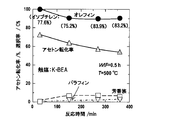
- reaction evaluation was performed in the same manner as in Example 1 except that K-BEA was used as a catalyst.
- the acetone conversion rate, product selectivity, and isobutylene selectivity in the produced olefin (in parentheses) with respect to the reaction time at this time are shown in FIG.
- Example 3 (Reaction evaluation) The reaction was evaluated in the same manner as in Example 2 except that the reaction temperature was 550 ° C.
- FIG. 7 shows the acetone conversion rate, product selectivity, and isobutylene selectivity (in parentheses) in the produced olefin with respect to the reaction time at this time.
- Example 4 Reaction evaluation was performed in the same manner as in Example 2 except that W / F was set to 0.75.
- FIG. 8 shows the acetone conversion rate, product selectivity, and isobutylene selectivity (in parentheses) in the produced olefin with respect to the reaction time at this time.
- Example 5 (Catalyst preparation) - except for the use of ion exchange treatment of cesium nitrate (CsNO 3) was performed as described in Example 2.
- Cs-BEA Cs-type BEA
- reaction evaluation was performed in the same manner as in Example 1 except that Cs-BEA was used as a catalyst.
- the acetone conversion rate, product yield, and isobutylene selectivity in the produced olefin (in parentheses) with respect to the reaction time at this time are shown in FIG.
- Example 6 (Catalyst preparation) Ion exchange treatment of magnesium nitrate hexahydrate (Mg (NO 3) 2 ⁇ 6H 2 O) except for using was performed as described in Example 2.
- Catalyst calcination Firing was conducted in the same manner as in Example 2 to obtain Mg-type BEA (Mg-BEA).
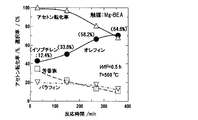
- reaction evaluation was performed in the same manner as in Example 1 except that Mg-BEA was used as a catalyst.
- the acetone conversion rate, product selectivity, and isobutylene selectivity in the produced olefin (in parentheses) with respect to the reaction time at this time are shown in FIG.
- Example 7 (Catalyst preparation) Ion exchange treatment of calcium nitrate tetrahydrate (Ca (NO 3) 2 ⁇ 4H 2 O) except for using was performed as described in Example 2.
- Catalyst calcination In the same manner as in Example 2, calcination was performed to obtain Ca type BEA (Ca-BEA).
- reaction evaluation was performed in the same manner as in Example 1 except that Ca-BEA was used as a catalyst.
- the acetone conversion rate, product selectivity, and isobutylene selectivity in the produced olefin (in parentheses) with respect to the reaction time at this time are shown in FIG.
- Example 8 (Catalyst preparation) Ion exchange treatment of strontium nitrate (Sr (NO 3) 2) except for using was performed as described in Example 2.
- reaction evaluation was performed in the same manner as in Example 1 except that Sr-BEA was used as a catalyst.
- the acetone conversion rate, product selectivity, and isobutylene selectivity (in parentheses) in the produced olefin with respect to the reaction time at this time are shown in FIG.
- Example 9 (Catalyst preparation) Ion exchange treatment of lanthanum nitrate hexahydrate (La (NO 3) 3 ⁇ 6H 2 O) except for using was performed as described in Example 2.
- reaction evaluation was performed in the same manner as in Example 1 except that La-BEA was used as a catalyst.
- the acetone conversion rate, product selectivity, and isobutylene selectivity in the produced olefin (in parentheses) with respect to the reaction time at this time are shown in FIG.
- Example 10 (Catalyst preparation) Ion exchange treatment of cerium nitrate hexahydrate (Ce (NO 3) 3 ⁇ 6H 2 O) except for using was performed as described in Example 2.
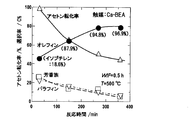
- reaction evaluation Reaction evaluation was performed in the same manner as in Example 1 except that Ce-BEA was used as a catalyst.
- the acetone conversion rate, product selectivity, and isobutylene selectivity in the produced olefin (in parentheses) with respect to the reaction time at this time are shown in FIG.
- the acetone conversion, product selectivity, and isobutylene selectivity (in parentheses) in the produced olefin at this time are shown in FIG.
- Example 12 (Catalyst preparation) 5.45 g of cetyltrimethylammonium bromide (CTAB) was added to 300 g of distilled water and dissolved at 35 ° C. to obtain a 0.05 mol / L CTAB aqueous solution. To the solution, 21.0 g of 28% by mass aqueous ammonia was added. While stirring this solution, 17.5 g of tetraethoxysilane (TEOS) was added over 10 minutes. After completion of the addition of TEOS, the mixture was stirred for 45 minutes. The solution was placed in an autoclave and subjected to hydrothermal synthesis at 100 ° C. for 72 hours.
- CTAB cetyltrimethylammonium bromide
- CTAB-containing MCM-41 was dispersed in 100 g of a 10% by mass ammonium nitrate aqueous solution and treated at 70 to 80 ° C. for about 1 hour. This operation was repeated three times, then washed with distilled water and air-dried. After adjusting the particle size of CTAB-containing MCM-41 to 300 to 500 ⁇ m, firing was carried out at 540 ° C. for 24 hours (heating up to 540 ° C. over 12 hours) to obtain MCM-41.
- reaction evaluation was performed in the same manner as in Example 2 except that MCM-41 was used as a catalyst.
- the acetone conversion rate and product selectivity with respect to the reaction time at this time are shown in FIG.
- the olefin composition with respect to reaction time was shown in FIG.16 (b).
- H-BEA proton-type BEA
- reaction evaluation was performed in the same manner as in Example 1 except that H-BEA was used as a catalyst.
- the acetone conversion rate and product selectivity with respect to the reaction time at this time are shown in FIG.
- the olefin composition with respect to reaction time was shown in FIG.17 (b).
- FIG. 27 shows the amount of acid sites and the intensity distribution of H-BEA determined by ammonia TPD.
- Inactivation treatment of acid sites by organosilicon compound 1.0 g of H-BEA obtained by the above treatment was filled in a glass firing tube of the organosilicon compound treatment apparatus shown in FIG. 26 and fixed with quartz wool. Under an air flow of 40 ml / min, the temperature was raised to 550 ° C. and held at 550 ° C. for 1 hour. Thereafter, the circulating gas was switched to N 2 gas and allowed to cool to 100 ° C.
- diethoxymethylsilane manufactured by Tokyo Chemical Industry Co., Ltd., abbreviation: DEMS
- D-MS is chemisorbed on H-BEA. It was.
- the vaporizer 16 was allowed to cool, and when the temperature became 40 ° C. or lower, the firing tube was also allowed to cool.
- the firing tube was taken out and shaken lightly to stir the zeolite layer 22, the firing tube was again held in the firing furnace, N 2 gas was circulated and heated to 100 ° C., and DEMS chemisorption was repeated.
- FIG. 27 shows the acid point amount and intensity distribution of DEMS-BEA obtained by ammonia-TPD.
- reaction evaluation Reaction evaluation was performed in the same manner as in Example 1 except that DEMS-BEA was used as a catalyst.
- the acetone conversion rate and product selectivity with respect to the reaction time at this time are shown in FIG.
- the olefin composition with respect to reaction time was shown in FIG.28 (b).
- the amount of precipitated coke remaining on DEMS-BEA after the reaction determined from TG was 10% with respect to the mass of DEMS-BEA used in the reaction.
- Example 14 Catalyst preparation
- a catalyst was prepared in the same manner as in Example 13 except that phenylsilane (manufactured by Tokyo Chemical Industry Co., Ltd., abbreviation: PS) was used as the organosilicon compound to obtain PS-treated BEA zeolite (PS-BEA). It was.
- FIG. 27 shows the acid point amount and intensity distribution of PS-BEA obtained by ammonia-TPD.
- reaction evaluation Reaction evaluation was performed in the same manner as in Example 1 except that PS-BEA was used as a catalyst.
- the acetone conversion rate and product selectivity with respect to the reaction time at this time are shown in FIG.
- the olefin composition with respect to reaction time is shown in FIG.29 (b).
- the amount of precipitated coke remaining on PS-BEA after the reaction determined from TG was 7.4% with respect to the mass of PS-BEA used in the reaction.
- Example 15 (Catalyst preparation) H-BEA obtained by the same method as in Example 13 was supplied with steam at a partial pressure of 10.1 kPa under N 2 flow conditions of 40 ml / min, and steam-treated at 500 ° C. for 3 hours. Thereafter, in order to remove the aluminum existing outside the zeolite framework, ion exchange into NH 4 -BEA was performed in the same manner as in Example 13, followed by air calcination at 500 ° C. for 2 hours, and dealumination (Al) treatment BEA zeolite (de-Al-BEA) was obtained. The obtained de-Al-BEA was subjected to DEMS treatment in the same manner as in Example 1 to obtain a DEMS-treated de-Al-BEA zeolite (DEMS-de-Al-BEA).
- DEMS-de-Al-BEA DEMS-treated de-Al-BEA zeolite
- reaction evaluation Reaction evaluation was performed in the same manner as in Example 13 except that DEMS-de-Al-BEA was used as a catalyst.
- the acetone conversion rate and product selectivity with respect to the reaction time at this time are shown in FIG.
- the olefin composition with respect to reaction time is shown in FIG.30 (b).
- the amount of precipitated coke remaining on DEMS-de-Al-BEA after the reaction determined from TG was 10% with respect to the mass of DEMS-de-Al-BEA used in the reaction.
- Example 4 Catalyst preparation
- DPMS diphenylmethylsilane
- DPMS-BEA DPMS-treated BEA zeolite
- reaction evaluation Reaction evaluation was performed in the same manner as in Example 1 except that DPMS-BEA was used as a catalyst.
- the acetone conversion rate and product selectivity with respect to the reaction time at this time are shown in FIG.
- the olefin composition with respect to reaction time is shown in FIG.31 (b).
- the amount of precipitated coke remaining on DPMS-BEA after the reaction determined from TG was 36% with respect to the mass of DPMS-BEA used.
Landscapes
- Chemical & Material Sciences (AREA)
- Organic Chemistry (AREA)
- Engineering & Computer Science (AREA)
- Materials Engineering (AREA)
- Chemical Kinetics & Catalysis (AREA)
- Crystallography & Structural Chemistry (AREA)
- Dispersion Chemistry (AREA)
- Catalysts (AREA)
- Organic Low-Molecular-Weight Compounds And Preparation Thereof (AREA)
- Silicates, Zeolites, And Molecular Sieves (AREA)
- Low-Molecular Organic Synthesis Reactions Using Catalysts (AREA)
Abstract
アセトンからイソブチレンを反応初期から高選択率に製造する方法を提供する。また、バイオマスから製造されるアセトンをイソブチレンに変換することで、バイオマス由来イソブチレンを製造する。本発明に係るアセトンからイソブチレンを製造する方法は、カチオンによりイオン交換された酸点を有するゼオライト、カチオンによりイオン交換された酸点を有するゼオライト類似物質及びメソ多孔性シリカより選ばれる少なくとも一つの化合物を触媒として用いることを特徴とする。また、ゼオライト又はゼオライト類似物質のうち、該ゼオライト又はゼオライト類似物質の細孔径よりも小さな分子サイズを有する有機ケイ素化合物により酸点を不活性化処理したゼオライト又はゼオライト類似物質を触媒として用いることを特徴とする。
Description
本発明は、アセトンからイソブチレンを製造する方法に関するものである。
アセトンは、溶剤あるいは化学品製造の原料などに広く用いられている基幹化合物である。アセトンは、クメン法(クメンヒドロペルオキシドからフェノールを製造する際の副生物)あるいはプロピレンのワッカー酸化法などにより得られる。また、アセトンから製造される化学品としては、アセトンに青酸を反応させて製造したアセトンシアンヒドリン(ACH)に、濃硫酸とメタノールを反応させて製造されるメタクリル酸メチル(MMA)が挙げられる。MMAは、透明樹脂として有用なポリメタクリル酸メチル(PMMA)のモノマー(MMAモノマー)である。
MMAモノマー製造については、日本を中心としたアジア地域では、イソブチレンを出発原料としたMMAモノマー製造法(イソブチレン直接酸化法)が主に採用されており、イソブチレンは、アセトンとともにPMMA製造には不可欠な原料である。現在、MMAモノマー原料としてのイソブチレンは、主に、ナフサ分解により得られるC4留分からブタジエンを分留した残渣であるスペントBBから、イソブチレンを酸触媒による水和反応によりターシャリーブタノールとして抽出した後、これを脱水することで得ている。
前述のACH法は、世界的には最もMMAモノマー生産量が多いプロセスであるが、濃硫酸の使用による装置腐食や廃酸の処理が不可避である。そこで、ACH法の原料であるアセトンをイソブチレンへ変換させた後、該イソブチレンからイソブチレン直接酸化法によりMMAモノマーを製造できれば、ACH法での課題を回避してアセトンをMMAモノマーの原料として使用することができる。アセトンは比較的安価な化学品であり、アセトンをイソブチレンへと高効率で変換することができる触媒及び製造方法が見出せれば、アセトンも有望なイソブチレンソースとして期待できる。
アセトンをイソブチレンに変換する研究としては、ベータ(β)ゼオライト、H-Yゼオライト及びH-ZSM-5ゼオライトを用いて、アセトンからイソブタンやイソホロンを経由してイソブチレンが生成することが報告されている(非特許文献1)。
また、近年、再生可能な資源であるバイオマスからのエネルギー及び化学品製造技術として、バイオリファイナリー技術が世界的な注目を集めている。バイオリファイナリーとは、各種バイオマスのガス化、糖化及び抽出などにより、合成ガス、グルコースなどの糖類及びリグニンなどの芳香族化合物などを製造し、それらを多様に変換することでエネルギー及び化学品を製造しようとするものである。
バイオリファイナリーの原料となるバイオマスは、資源作物に由来するもの、廃棄物に由来するものに大きく分けられる。資源作物に由来するバイオマスとは、食用作物、木材、草花などの他、それらの作物の未利用部分も含まれる。一方、廃棄物に由来するバイオマスとしては、食品廃棄物、下水などの汚泥、家畜糞尿、廃紙などが挙げられる。
バイオリファイナリーにより製造される製品としては、エネルギーではエタノールやブタノール、ディーゼル油などが挙げられる。化学品においても、米エネルギー省が提唱する糖由来のコハク酸、3-ヒドロキシプロピオン酸、アスパラギン酸などの基幹化合物(プラットフォーム化合物)からの派生によれば、非常に多くの化学品が製造可能である。
アセトンもバイオマスから製造することが可能であり、汚泥をはじめとする有機廃棄物を原料とし、ジルコニウムを担持した鉄酸化物系触媒を用いて製造することができる(特許文献1)。
イソブチレンをさらに安定して入手するために、石油精製由来のスペントBB以外のイソブチレンソースを確保しておくことは、イソブチレン直接酸化法の多様性、競争力の面からも非常に重要である。したがって、バイオマスあるいはバイオマス誘導品からイソブチレンを製造する方法に期待がかかる。アセトン、イソブチレンともに、化学産業において非常に有用な化合物であり、バイオマスからそれらを製造する技術の意義は大きい。
Graham J. Hutchings著、ジャーナル オブ キャタリシス (Journal of Catalysis)、147巻、177-185頁、1994年
非特許文献1において報告されているプロトン型のβゼオライト(H-β)やH-ZSM-5ゼオライトを用いたアセトンからイソブチレンへの変換反応では、反応初期のイソブチレン選択率が低いことが記載されている。反応初期においては、イソブタンが高選択的に生成し、反応時間が長くなると、炭素析出(コーキング)による触媒活性低下を伴って、イソブチレンが高選択的に生成するようになる。イソブチレンは、主に図1に示すようにアセトンが自己縮合した化合物(ジアセトンアルコール、メシチルオキシド、ホロン、イソホロンなど)が分解することにより生成すると推定されている。
非特許文献1のH-βやH-ZSM-5の場合のように、ゼオライトの酸点にプロトンが多く存在する場合には、炭素析出により活性点の酸性質がある程度弱められ、触媒の活性が低下するまでは、高選択的にイソブチレンが生成することは期待できない。したがって、プロトン型のゼオライトでは、反応初期から高選択的にイソブチレンを製造することは困難である。一般的に、炭素析出は強い酸点で起こりやすい。このため、反応初期からイソブチレンを製造するためには、酸点の強さを適度に調節したゼオライト触媒を用いる、あるいはゼオライトよりも弱い酸点を有する触媒を用いることが有効であると考えられる。同時に、この場合炭素析出抑制の効果から、触媒寿命の延長も期待される。
また、特許文献1の方法などによりバイオマスから製造したアセトンはバイオマス由来のアセトンであり、さらにそのアセトンをイソブチレンへ変換すれば、バイオマス由来イソブチレンが製造可能となる。そのバイオマス由来イソブチレンをもとにして、イソブチレン直接酸化法などによるバイオマス由来MMAの製造も可能である。
本発明の目的は、アセトンからイソブチレンを反応初期から高選択率で収率よく製造する方法を提供することである。また、バイオマスから製造されるアセトンをイソブチレンに変換することで、バイオマス由来イソブチレンを製造することも本発明の目的である。
本発明は、カチオンによりイオン交換された酸点を有するゼオライト、カチオンによりイオン交換された酸点を有するゼオライト類似物質及びメソ多孔性シリカより選ばれる少なくとも一つの化合物を触媒として用いることを特徴とするアセトンからイソブチレンを製造する方法である。
また本発明は、ゼオライト又はゼオライト類似物質のうち、該ゼオライト又はゼオライト類似物質の細孔径よりも小さな分子サイズを有する有機ケイ素化合物により酸点を不活性化処理したゼオライト又はゼオライト類似物質を触媒として用いることを特徴とする、アセトンからイソブチレンを製造する方法である。
さらに本発明は、前記アセトンが、バイオマスを原料として製造されたアセトンであることを特徴とする。
本発明によれば、アセトンからイソブチレンを反応初期から高選択率で収率よく製造できる触媒を提供することができる。また、炭素析出抑制により触媒寿命を延長させることができる。また、バイオマスから製造可能なアセトンを原料としてイソブチレンを製造する新たな製造方法を実現し、バイオマス由来イソブチレンの供給が可能となる。さらに、得られたバイオマス由来イソブチレンを用いて、MMAモノマーなどの化学品を製造することができる。
本発明に係るアセトンからイソブチレンを製造する方法において、用いる触媒は、カチオンによりイオン交換された酸点を有するゼオライト、カチオンによりイオン交換された酸点を有するゼオライト類似物質及びメソ多孔性シリカより選ばれる少なくとも一つの化合物である。
ゼオライトとは一般的に結晶性の多孔質アルミノケイ酸塩の総称であり、四面体構造である(SiO4)4-と(AlO4)5-を基本構造単位とし、これらが3次元的に連結することで結晶を形成する。また、アルミニウムイオン以外の3価あるいは4価の元素をケイ酸塩骨格に組み込んだメタロケイ酸塩もゼオライトに含まれる。ゼオライトの細孔の入口径は0.4~0.8nm程度であるため、入口径よりも小さな分子は細孔内に進入できるが、大きな分子は進入できない分子ふるい作用を有する。これらは、構造及び組成が多様であるため、構造コード、生成過程、鉱物学、細孔径、細孔の次元、アルミニウム濃度、他のカチオン濃度及び構成元素などのさまざまな観点から異なる分類がなされている(ゼオライトの科学と工学、小野嘉夫・八嶋建明/編、講談社サイエンティフィック参照)。ゼオライト類似物質とは、ケイ酸塩のゼオライトと類似の構造及び酸点を有する化合物であり、リン酸塩系多孔質結晶が代表的である。
本発明におけるゼオライト又はゼオライト類似物質の酸点は、ブレンステッド酸点であることが好ましい。一般的に、固体酸触媒における酸点の種類は、ブレンステッド酸点とルイス酸点に大きく分類される。ブレンステッド-ローリーの酸・塩基の定義によれば、ブレンステッド酸(B酸)とはプロトン(H+)を放出する酸であり、ルイス酸(L酸)とはH+の授受を伴わず、電子対の受容により酸反応を媒介する酸である。
ゼオライトのようなアルミノケイ酸塩においては、4価のSiの一部が3価のAlに置換されており、その電気的中性を保つために、SiとAlを架橋するOへのプロトン付加とAl上への負電荷生成が起こり、図2に示すように架橋OH基によるB酸点が形成される。このB酸点の性質は、ゼオライトの構造、導入される金属あるいは金属イオンあるいは含有されるAlの量などによって異なる。ゼオライトにおけるAl含有量は、29SiのMAS-NMRから、Siに対するAlの比(Si/Al)を算出することで求めることができる。本発明におけるSi/Alには制限はないが、5~500であることが好ましい。
本発明におけるゼオライト又はゼオライト類似物質の酸点は、カチオンによりイオン交換された酸点である。カチオン交換により発現する酸強度は、カチオンの種類や価数よって異なる。カチオンの価数により、カチオン1つにつき交換される酸点の数が変化し、n価のカチオンを用いるとカチオン1つにつきn個の酸点のプロトンを交換することができる。即ち、1価のカチオンでは、カチオン/酸点=1/1で、2価のカチオンでは、カチオン/酸点=1/2で交換される。イオン交換に用いられるカチオンは、ナトリウム、カリウム、ルビジウム、セシウム、マグネシウム、カルシウム、ストロンチウム、バリウム、ランタン、セリウム、鉄、コバルト、銅、ニッケル、亜鉛、パラジウム、銀など、アルカリ金属、アルカリ土類金属、希土類元素及び遷移金属から選ばれる、少なくとも一つの金属のイオンである。本発明においては、この中でも、ナトリウム、カリウム、ルビジウム、セシウム、マグネシウム、カルシウム、ストロンチウム、バリウム、ランタン、セリウムが好ましい。また、カチオンによりイオン交換されたゼオライト又はゼオライト類似物質は格子酸素イオンに由来する塩基性を示す場合もあり、強い酸点が必要でない一般的な酸・塩基触媒反応においては、酸点と塩基点とが協奏的に働いて触媒作用を示す。
ゼオライト又はゼオライト類似物質の酸点プロトンのカチオンによるイオン交換手法には制限はない。例えば、ゼオライト又はゼオライト類似物質を蒸留水に分散させた溶液に、交換に用いるカチオンの硝酸塩を添加し、加熱還流を行う。加熱還流終了後、蒸留水で洗浄して風乾することで、カチオン交換ゼオライト又はゼオライト類似物質を得ることができる。必要に応じて該操作を繰り返し、カチオン交換の度合いを調節することも可能である。また、テンプレート含有ゼオライト又はゼオライト類似物質から調製する場合には、まず、焼成によりテンプレートを除去後、テンプレート除去ゼオライト又はゼオライト類似物質を蒸留水に分散させる。該分散溶液に硝酸アンモニウムを添加して加熱還流を行い、蒸留水で洗浄、風乾することにより、一度アンモニウムイオン交換ゼオライト又はゼオライト類似物質を調製する。その後、該アンモニウムイオン交換ゼオライト又はゼオライト類似物質を前述した方法と同様の方法で目的のカチオンとイオン交換することにより、カチオン交換ゼオライト又はゼオライト類似物質を調製することができる。
また、本発明に係るアセトンからイソブチレンを製造する方法において、用いる触媒は、その細孔径よりも小さな分子サイズを有する有機ケイ素化合物により酸点を不活性化処理したゼオライト又はゼオライト類似物質である。
本発明におけるゼオライト又はゼオライト類似物質の酸点は、有機ケイ素化合物により不活性化処理された酸点である。ゼオライト又はゼオライト類似物質の酸点は、結晶外表面、細孔入口付近及び細孔内部のいずれにも存在し、ゼオライト又はゼオライト類似物質の細孔径に対する有機ケイ素化合物の分子サイズを選択することにより、酸点の位置による不活性化処理の有無を制御可能である。一般的に、空間的制限のない結晶外表面の酸点では、芳香族生成、オレフィン消費、炭素析出などが顕著に起こると考えられる。また、細孔内部の酸点のうち、ゼオライトのクロスセクションに存在する酸点では、その酸点密度の高さから前記反応が起こりやすいと考えられる。本発明においては、これらのイソブチレン生成に好適でない外表面及び細孔内部の酸点を、ゼオライト又はゼオライト類似物質の細孔径よりも小さい分子サイズを有する有機ケイ素化合物により適切に不活性化することで、アセトンからイソブチレンを反応初期から高選択率で収率よく製造できる。
なお、本発明においてゼオライト又はゼオライト類似物質の細孔径とは、ケイ素およびアルミニウムと酸素からなる環構造の解析から求められる細孔開口部のアパーチャー径を基に、各原子のファンデルワールス半径を考慮して算出して得られる細孔径を示す。
また、本発明における分子サイズとは、ファンデルワールス半径をもとに算出した分子サイズを示す。本発明における代表的な原子のファンデルワールス半径は、水素(H):0.12nm、炭素(C):0.17nm、酸素(O):0.152nm、ケイ素(Si):0.21nmである。
図21に、The International Zeolite Associationのゼオライト構造データベースに記載のBEA型ゼオライトの結晶構造をもとにして、各原子のファンデルワールス半径を用いたSpace-Fillingモデルにより示した構造を示す。占有体積を表わすファンデルワールス半径を用いると、BEAの細孔径は、一般的に用いられるBEAのアパーチャー径(0.64×0.76nm)よりも小さく表現される。また、図21においては、T原子は全てケイ素(Si)とした。図22~24には、フェニルシラン(図22)、ビス(3,5-ジメトキシフェニル)シラン(図23)およびトリス(3,5-ジメチルフェニル)シラン(図24)の有機ケイ素化合物について、各原子のファンデルワールス半径を用いたSpace-Fillingモデルによる構造を示す。
有機ケイ素化合物が細孔開口部に対する分子サイズを最小にする方向で細孔に接近したとき、その分子サイズが細孔径よりも小さい場合には、細孔内へ侵入(拡散)することができる。図21のBEA型ゼオライトの細孔径と図22~24の有機ケイ素化合物の分子サイズを比較する。1つのベンゼン環を有するフェニルシラン(図22)はBEA型ゼオライトの細孔内へ侵入(拡散)することが可能であるが、2つおよび3つのベンゼン環を有するビス(3,5-ジメトキシフェニル)シラン(図23)およびトリス(3,5-ジメチルフェニル)シラン(図24)では、細孔内への侵入(拡散)が困難である。一方、ベンゼン環を有さず、ベンゼン環よりも小さなメチル基、エチル基、メトキシ基およびエトキシ基などのアルキル基やアルコキシ基を有する有機ケイ素化合物は、細孔内への侵入(拡散)が容易である。したがって、有機ケイ素化合物の分子サイズによって、ゼオライト又はゼオライト類似物質の細孔内への侵入(拡散)挙動が異なり、細孔内部の酸点まで不活性化できるかどうかが決定される。
また、細孔径よりも小さい分子サイズとは開口部の細孔径よりも小さいサイズを示し、非等方的な細孔においては長軸方向の開口部細孔径よりも小さいサイズを示す。
本発明における有機ケイ素化合物としては、ゼオライト又はゼオライト類似物質の細孔径よりも小さい分子サイズを有し、下記式(1)に示す化合物を用いることができる。

ゼオライト又はゼオライト類似物質の細孔径にもよるが、前記アルキル基としては、メチルプロピオキシ基、n-ブトキシ基等が挙げられる。また、前記アルコキシ基としては、メトキシ基、エトキシ基等が挙げられる。また、前記アリール基としては、フェニル基、メチルフェニル等が挙げられる。
前記有機ケイ素化合物としては、ゼオライト又はゼオライト類似物質の細孔径にもよるが、具体的にはジエトキシメチルシラン、フェニルシラン、テトラメチルシラン等が挙げられる。しかし、有機ケイ素化合物はこれらに限定されない。
これら有機ケイ素化合物の種類は、ゼオライト及びゼオライト類似物質の細孔径、不活性化する酸点の位置、有機ケイ素化合物の物性及び入手の容易性などを考慮して、適宜選択することが可能である。例えば、0.64×0.76nmのアパーチャー径(Aperture size)を有するβゼオライトでは、フェニルシラン(R1=C6H5、R2=R3=R4=H)、ジエトキシメチルシラン(R1=R2=C2H5O、R3=CH3、R4=H)などが好適である。
有機ケイ素化合物によるゼオライト又はゼオライト類似物質の酸点を不活性化する処理方法には制限はない。例えば、有機ケイ素接触分解法(以下、シラン接触分解法)が挙げられる。該手法ではまず、ゼオライト又はゼオライト類似物質と、加熱により気化させた有機ケイ素化合物とを物理接触させることで有機ケイ素化合物をゼオライト又はゼオライト類似物質の酸点に化学吸着させる。その後、高温で焼成することで、化学吸着した有機ケイ素化合物の有機物部分を除去しシリカ(SiO2)へと変性させる。これにより、ゼオライト又はゼオライト類似物質の酸点は不活性化される。不活性化により生じたSiO2は反応中においても安定に存在する上、炭素析出などによる触媒劣化も抑制されるため、選択性の向上のみならず触媒寿命の延長を達成することもできる。有機ケイ素化合物の化学吸着温度及びその後の焼成温度は、該有機ケイ素化合物の沸点や熱分解特性などを考慮して適宜選択される。
シラン接触分解法の概念図を図20に示す。図20では有機ケイ素化合物としてメチルジエトキシシラン(DEMS)を用いている。まず、ゼオライト又はゼオライト類似物質の外表面及び細孔内に存在する酸点にDEMSが化学吸着する。その後、N2雰囲気下で加熱されることにより、揮発性の炭化水素が気化し、不揮発性のSi含有物が酸点上に残存する。さらに空気中で焼成することによりSi含有物がSiO2となり安定化し、酸点上にSiO2を選択的に形成することができる。
また、MFI型ゼオライト(アパーチャー径:0.54×0.56nm)を例としたときの有機ケイ素化合物の種類による酸点不活性化度の相違を図25に示す。図25では有機ケイ素化合物として、DEMS、フェニルシラン(PS)、ジフェニルメチルシラン(DPMS)、トリフェニルシラン(TPS)を用いている。前記ゼオライトの細孔径よりも小さい分子サイズを有するDEMS及びPSについては、図25に示すようにゼオライトの外表面に存在する酸点、細孔内に存在する酸点いずれも不活性化される。一方、前記ゼオライトの細孔径よりもやや大きい分子サイズを有するDPMSについては、ゼオライトの外表面に存在する酸点及び細孔入口付近に存在する酸点については不活性化されるが、細孔内部に存在する酸点は不活性化されない。さらに、前記ゼオライトの細孔径よりも大きい分子サイズを有するTPSについては、ゼオライトの外表面に存在する酸点のみが不活性化され、細孔内に存在する酸点は不活性化されない。本発明においては、酸点の不活性化にゼオライト又はゼオライト類似物質の細孔径よりも分子サイズが小さい有機ケイ素化合物を用いるため、図25のDEMS及びPSを用いた例のようにゼオライト又はゼオライト類似物質の外表面に存在する酸点、細孔内に存在する酸点の両者を不活性化することができる。
前記有機ケイ素化合物による酸点の不活性化処理は、脱アルミニウム処理やカチオン交換したゼオライト及びゼオライト類似物質に対しても適用可能であり、脱アルミニウム処理により生じるネストシラノールに対しても適用可能である。
ゼオライト又はゼオライト類似物質の酸点の性質(量、強度)は、アンモニアなどの塩基性分子をプローブとして用いた昇温脱離法(TPD)や吸着熱法によって求めることができる。本発明においては、ゼオライト又はゼオライト類似物質の酸性OH基のプロトンが、カチオンによりイオン交換されることにより、アンモニアTPDにおける573K以上に現れるアンモニア脱離ピークが減少する。一般的に、アンモニアTPDでの573K以上のアンモニア脱離ピークは、ゼオライト又はゼオライト類似物質の強い酸点に起因するものであり、本発明においては、より強い酸点のプロトンの一部あるいは全てがカチオン交換されることによって、アセトンからイソブチレンを製造するために好適な酸点が形成される。これにより、反応初期からイソブチレンを高選択的に製造可能となる。
本発明におけるゼオライト又はゼオライト類似物質の細孔構造及び細孔径には制限はないが、酸素10員環以上の細孔を有するゼオライト又はゼオライト類似化合物が好ましい。酸素10員環よりも小さな細孔を有するゼオライト又はゼオライト類似化合物を用いると、イソブチレンの細孔外への拡散が阻害されることによる分解や逐次酸化が増加し、イソブチレンの選択性が低下する。酸素10員環以上を有するゼオライト又はゼオライト類似化合物としては、AlPO4-11(AEL)、EU-1(EUO)、フェリエライト(FER)、ヒューランダイト(HEU)、ZSM-11(MEL)、ZSM-5(MFI)、NU-87(NES)、シータ-1(TON)、ウェイネベアイト(WEI)、AlPO4-5(AFI)、AlPO4-31(ATO)、ベータ(BEA)、CIT-1(CON)、X、Y、ホージャサイト(FAU)、グメリナイト(GME)、L(LTL)、モルデナイト(MOR)、ZSM-12(MTW)、オフレタイト(OFF)、STA-1(SAO)、SAPO-37(FAU)、クローバライト(CLO)、VPI-5(VFI)、AlPO4-8(AET)、CIT-5(CFI)及びUTD-1(DON)などが挙げられる。カッコ内は構造コードである。この中でも、細孔径や酸強度の観点からMFI、X、Y、BEAおよびFAUが好ましい。しかし、本発明におけるゼオライト及びゼオライト類似物質はこれらに限定されない。これらのゼオライト又はゼオライト類似物質の酸点プロトンを、カチオンによりイオン交換する、もしくは、有機ケイ素化合物により不活性化処理することで、好適な触媒が得られる。
ゼオライト又はゼオライト類似物質の細孔は、1次元、2次元あるいは3次元に規則的に発達した細孔径が2nmよりも小さいミクロ細孔である。規則性ミクロ細孔の有無は、透過型電子顕微鏡(TEM)などによる観察により確認することができる。
また、本発明の製造方法における触媒は、メソ多孔性シリカである。メソ多孔性シリカとは、メソポーラスシリカとも呼ばれ、細孔径2~50nmの細孔が、1次元、2次元あるいは3次元に均一な大きさかつ規則的に発達したSi-O骨格からなる化合物である。規則性メソ細孔の有無は、TEMによる観察の他、窒素吸着法及びX線回折法によっても確認することができる。代表的なメソ多孔性シリカとしては、FSM-16、MCM-41、MCM-48、MCM-50及びSBA-15などが挙げられる。これらはシラノール基由来のOH基(Si-OH)を有しており、ゼオライト又はゼオライト類似物質よりも弱い酸性を示すことが知られている。メソ多孔性シリカが有する弱い酸点は、本発明における反応の進行には好適である。
本発明においては、主にアセトンの二量化反応あるいは三量化反応を経由して、イソブチレンが生成される(図1)。アセトンのアルドール縮合によって生成するジアセトンアルコール及びメシチルオキシド、メシチルオキシドとアセトンとのアルドール縮合によって生成するホロン、及びホロンの1,6-マイケル付加によって生成するイソホロンの分解反応により、イソブチレンが生成する。このアセトンの自己縮合反応及び引き続く分解反応は非常に複雑であり、種々の反応経路が考えられるため、図1ではイソブチレン生成への寄与が大きいと考えられる経路を挙げた。
本発明における酸点は、カチオンによりイオン交換されている、もしくは、有機ケイ素化合物により不活性化処理されている。アセトンのアルドール縮合反応はカチオン交換されたB酸点によって特に促進される。一般的に、アルドール縮合反応は比較的弱い酸の他、塩基によっても進行し、強い酸が必須ではない。本発明におけるアセトンのアルドール縮合反応は、二量化及び三量化のどちらの反応経路においても鍵となる反応であり、イソブチレン生成にはカチオン交換されたB酸点は不可欠である。一方、L酸点では芳香族化や炭素析出などが促進される場合も多く、B酸点が存在せず、L酸点のみ存在する触媒を用いた場合には、イソブチレンはほとんど生成しない。
本発明においては、規則的に発達したミクロ細孔あるいはメソ細孔という制御された空間内で反応が進行することにより、アセトンの縮合反応が三量化までに抑制され、それ以上の縮合による副反応が抑制されることにより、イソブチレン選択性及び収率の向上が可能となる。規則的な細孔空間を有さない触媒では、アセトン縮合度の制御が不十分であり、イソブチレン選択性及び収率は高くない。
本発明においては、ゼオライト又はゼオライト類似物質の細孔内に存在する酸点で反応が進行することが好ましく、細孔外に存在する酸点を除去することも性能向上には有効である。具体的には、シラン化剤を用いて、細孔外に存在する酸点を選択的に修飾する。さらに、本発明においては、ゼオライト又はゼオライト類似物質の細孔内において、イソブチレンの酸化、2量化などの好ましくない逐次反応を抑制するために、ゼオライト又はゼオライト類似物質の結晶の大きさを小さくすることで、細孔内での拡散を制御することも可能である。
本発明におけるゼオライト又はゼオライト類似物質、メソ多孔体の製造方法には、特に制限はなく、一般的な金属酸化物や酸触媒の合成手法が適用できる。また、触媒の結晶性や粒子径を制御するために、水熱合成や常圧合成を適宜使い分けることができる。一般的に、ゼオライトやメソポーラスシリカのように規則性細孔を有する触媒は、pH、温度及び圧力などを制御して、テンプレートである界面活性剤と無機種(触媒前駆体)が自己組織的に集合した構造体を構築させた後、熱処理によりテンプレートが除去され、洗浄、イオン交換及び乾燥を適宜行なうことで調製される。この場合の細孔の大きさや形状は、集合体生成条件、界面活性剤の炭素鎖長などで制御可能である。
本発明におけるアセトンは、各種バイオマス原料から製造されたアセトンを原料として用いることができる。また、石油精製、化学工業で得られるクメン法フェノール製造の副生アセトンなどを用いても差し支えない。
本発明におけるアセトンからイソブチレンを製造する方法は、気相反応が好適であり、反応器としては、固定床流通式反応器が用いられる。バッチ式及び連続式のいずれもが使用可能であるが、生産性を考慮すれば、連続式が好ましい。
反応に用いる触媒の質量をW(kg-cat)、アセトンの流量をF(kg-アセトン/h)とする。W/Fは0.01h以上が好ましく、より好ましくは0.05h以上、さらに好ましくは0.1h以上である。また、W/Fは20以下が好ましく、より好ましくは15以下であり、さらに好ましくは10以下である。
同伴させる流通ガスは、窒素、ヘリウム、アルゴン、空気、酸素及びこれらの混合ガスを用いることができる。
反応温度は250℃以上が好ましく、より好ましくは300℃以上、さらに好ましくは350℃以上である。また、反応温度は650℃以下が好ましく、より好ましくは600℃以下、さらに好ましくは550℃以下である。
反応圧力は常圧で差し支えないが、背圧弁などを用いて、必要に応じて加圧することも可能である。
以下、本発明において、実施例及び比較例を挙げてさらに具体的に説明するが、本発明は実施例に限定されるものではない。
(反応装置)
本実施例において、反応装置には固定床流通式触媒反応器を用いた。本実施例で使用した反応装置の概略を図3に示す。原料であるアセトンはマイクロフィーダー1から、同伴ガスである窒素(N2)はN2ボンベ3から流量計2を介して供給した。供給したアセトンを、テープヒーター4による加熱部分(100℃)において気化し、触媒を充填した固定床流通式反応器5に導入した。固定床流通式反応器5には、電気炉6及び熱電対7を備え付けた。固定床流通式反応器5の出口部分もテープヒーター8により加熱し(100℃)、ガス状の原料及び生成物を恒温槽9(140℃)及びガスクロマトグラフ10に導入して分析した。分析ガス以外はパージバルブ11から排気した。
本実施例において、反応装置には固定床流通式触媒反応器を用いた。本実施例で使用した反応装置の概略を図3に示す。原料であるアセトンはマイクロフィーダー1から、同伴ガスである窒素(N2)はN2ボンベ3から流量計2を介して供給した。供給したアセトンを、テープヒーター4による加熱部分(100℃)において気化し、触媒を充填した固定床流通式反応器5に導入した。固定床流通式反応器5には、電気炉6及び熱電対7を備え付けた。固定床流通式反応器5の出口部分もテープヒーター8により加熱し(100℃)、ガス状の原料及び生成物を恒温槽9(140℃)及びガスクロマトグラフ10に導入して分析した。分析ガス以外はパージバルブ11から排気した。
(有機ケイ素化合物処理装置)
本実施例において使用した有機ケイ素化合物処理装置の概略を図26に示す。N2ボンベ12と空気ボンベ13は三方バルブ14を介して連結されて、流量計15により流量を調節した。気化装置16には有機ケイ素化合物(液体)が充填された。気化装置16及び有機ケイ素化合物の流路にはテープヒーター19が巻かれ、気化装置16の加熱と有機ケイ素化合物の流路内での凝縮防止に用いられた。流量計15及び気化装置16と、熱電対20及び電気炉21を備え付けた管型焼成炉とは、六方バルブ17を介して連結された。管型焼成炉内にはガラス製焼成管が保持され、ゼオライト層22が充填された。また、管型焼成炉は断熱材23により覆われている。六方バルブ17を切り替えることで、管型焼成炉に導入されるガスが気化装置16を経由するか否かを選択可能となる。本処理はN2ガス流通下で行われ、N2ガスを気化装置16に経由させ、該N2ガスで加熱された有機ケイ素化合物(80℃)をバブリングすることで、有機ケイ素化合物がN2ガスに同伴された。該有機ケイ素化合物を伴うN2ガスは管型焼成炉内のガラス製焼成管に導入され、100℃に加熱されたゼオライト層22への化学吸着(30分)が行われた。その後放冷し、六方バルブ17を切り替えてN2ガスを気化装置16不経由で流通させ系内をパージした。
本実施例において使用した有機ケイ素化合物処理装置の概略を図26に示す。N2ボンベ12と空気ボンベ13は三方バルブ14を介して連結されて、流量計15により流量を調節した。気化装置16には有機ケイ素化合物(液体)が充填された。気化装置16及び有機ケイ素化合物の流路にはテープヒーター19が巻かれ、気化装置16の加熱と有機ケイ素化合物の流路内での凝縮防止に用いられた。流量計15及び気化装置16と、熱電対20及び電気炉21を備え付けた管型焼成炉とは、六方バルブ17を介して連結された。管型焼成炉内にはガラス製焼成管が保持され、ゼオライト層22が充填された。また、管型焼成炉は断熱材23により覆われている。六方バルブ17を切り替えることで、管型焼成炉に導入されるガスが気化装置16を経由するか否かを選択可能となる。本処理はN2ガス流通下で行われ、N2ガスを気化装置16に経由させ、該N2ガスで加熱された有機ケイ素化合物(80℃)をバブリングすることで、有機ケイ素化合物がN2ガスに同伴された。該有機ケイ素化合物を伴うN2ガスは管型焼成炉内のガラス製焼成管に導入され、100℃に加熱されたゼオライト層22への化学吸着(30分)が行われた。その後放冷し、六方バルブ17を切り替えてN2ガスを気化装置16不経由で流通させ系内をパージした。
その後、再びゼオライト層22を100℃に保持して、2度目の化学吸着を行った。なお、2度目の化学吸着の前にゼオライト層22をかき混ぜ、より均一に化学吸着が行われるようにした。2度の化学吸着の後、六方バルブ17を気化装置16不経由に切り替え、N2流通下でゼオライト層22を550℃まで昇温し、そのまま1.5時間焼成処理を行い、有機ケイ素化合物を酸点上で分解した。さらに、六方バルブ17はそのままで三方バルブ14を空気側に切り替え、500℃のまま1.5時間焼成処理を行い、分解したケイ素化合物に含まれる炭素分を除去した。これら一連の操作をさらに2回繰り返した。
(原料及び生成物の分析)
原料及び生成物の分析は、ガスクロマトグラフ(GC)法で行った。
原料及び生成物の分析は、ガスクロマトグラフ(GC)法で行った。
原料であるアセトンをA(モル)、GC法により求められた残存アセトンをB(モル)とした場合、アセトンの転化率C(%)は以下のように表される。
C(%)=100×(A-B)/A
また、GCにより検出された各生成物のモル数をD(n)(モル)とした場合、各生成物の選択率S(n)(%)は以下のように表される。D(n)は、目的生成物であるイソブチレンの炭素数4を基準として換算した。
また、GCにより検出された各生成物のモル数をD(n)(モル)とした場合、各生成物の選択率S(n)(%)は以下のように表される。D(n)は、目的生成物であるイソブチレンの炭素数4を基準として換算した。
S(n)(%)=100×D(n)/(A-B)
GC法により検出され同定された生成物は、オレフィン(エチレン、プロピレン、イソブチレン)の他、酢酸、パラフィン、芳香族化合物(ベンゼン、トルエン、キシレン)であり、不明成分は合算しその他とした。
GC法により検出され同定された生成物は、オレフィン(エチレン、プロピレン、イソブチレン)の他、酢酸、パラフィン、芳香族化合物(ベンゼン、トルエン、キシレン)であり、不明成分は合算しその他とした。
炭素析出反応により析出し、反応後の触媒上に残存する炭素成分(コーク)の分析は、熱重量分析(TG)により行った。
[実施例1]
(触媒調製)
・テンプレート除去
テンプレート含有Na型ベータ型ゼオライト(商品名:「HSZ-930NHA」、東ソー株式会社製、略号:BEA、SiO2/Al2O3=27)を、空気中で、350℃まで毎分0.9℃で昇温して7時間保持した後、引き続いて500℃まで毎分0.83℃で昇温し、48時間保持して、テンプレートを除去した。
(触媒調製)
・テンプレート除去
テンプレート含有Na型ベータ型ゼオライト(商品名:「HSZ-930NHA」、東ソー株式会社製、略号:BEA、SiO2/Al2O3=27)を、空気中で、350℃まで毎分0.9℃で昇温して7時間保持した後、引き続いて500℃まで毎分0.83℃で昇温し、48時間保持して、テンプレートを除去した。
・イオン交換処理
テンプレートを除去したNa型ベータ型ゼオライト(Na型BEA)10gを、蒸留水150mlに分散し、硝酸アンモニウム(NH4NO3)10gを添加して、100℃で3時間加熱還流した。還流終了後、蒸留水で洗浄し風乾した。この操作を合計3回行い、アンモニア型BEA(NH4-BEA)を得た。ここで、2回目及び3回目の操作におけるNH4NO3量はそれぞれ15g及び20gとした。さらに、得られたNH4-BEA5gを蒸留水50mlに分散し、硝酸ナトリウム(NaNO3)を添加して、100℃で3時間加熱還流し、イオン交換処理を合計3回行った。ここで、用いたNaNO3の量は、1回目:2.5g、2回目:3.0g及び3回目:5.0gとした。
テンプレートを除去したNa型ベータ型ゼオライト(Na型BEA)10gを、蒸留水150mlに分散し、硝酸アンモニウム(NH4NO3)10gを添加して、100℃で3時間加熱還流した。還流終了後、蒸留水で洗浄し風乾した。この操作を合計3回行い、アンモニア型BEA(NH4-BEA)を得た。ここで、2回目及び3回目の操作におけるNH4NO3量はそれぞれ15g及び20gとした。さらに、得られたNH4-BEA5gを蒸留水50mlに分散し、硝酸ナトリウム(NaNO3)を添加して、100℃で3時間加熱還流し、イオン交換処理を合計3回行った。ここで、用いたNaNO3の量は、1回目:2.5g、2回目:3.0g及び3回目:5.0gとした。
・触媒焼成
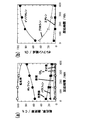
500℃で2時間空気焼成し、Na型BEA(Na-BEA)を得た。アンモニアTPDにより求めたNa-BEAの酸点の量及び強度分布を図4に示した。
500℃で2時間空気焼成し、Na型BEA(Na-BEA)を得た。アンモニアTPDにより求めたNa-BEAの酸点の量及び強度分布を図4に示した。
(反応評価)
前記Na-BEA0.7gを触媒とし、W/F=0.5(h)でアセトンを供給し、同伴ガスとしてN2ガスを毎分60cc(0.0036m3/h)で供給し、500℃において反応評価を行った。このときの反応時間に対するアセトン転化率と生成物選択率を図5(a)に示した。また、反応時間に対するオレフィン組成を図5(b)に示した。
前記Na-BEA0.7gを触媒とし、W/F=0.5(h)でアセトンを供給し、同伴ガスとしてN2ガスを毎分60cc(0.0036m3/h)で供給し、500℃において反応評価を行った。このときの反応時間に対するアセトン転化率と生成物選択率を図5(a)に示した。また、反応時間に対するオレフィン組成を図5(b)に示した。
[実施例2]
(触媒調製)
・イオン交換処理
実施例1のNH4-BEA5gを蒸留水50mlに分散し、硝酸カリウム(KNO3)を添加して、イオン交換処理を合計3回行った。ここで、用いたKNO3の量は、1回目:2.5g、2回目:3.0g及び3回目:5.0gとした。硝酸カリウム(KNO3)を用いたこと以外は実施例1と同様にして行った。
(触媒調製)
・イオン交換処理
実施例1のNH4-BEA5gを蒸留水50mlに分散し、硝酸カリウム(KNO3)を添加して、イオン交換処理を合計3回行った。ここで、用いたKNO3の量は、1回目:2.5g、2回目:3.0g及び3回目:5.0gとした。硝酸カリウム(KNO3)を用いたこと以外は実施例1と同様にして行った。
・触媒焼成
実施例1と同様にして焼成し、K型BEA(K-BEA)を得た。アンモニアTPDにより求めたK-BEAの酸点の量及び強度分布を図4に示した。
実施例1と同様にして焼成し、K型BEA(K-BEA)を得た。アンモニアTPDにより求めたK-BEAの酸点の量及び強度分布を図4に示した。
(反応評価)
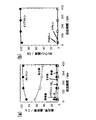
K-BEAを触媒として用いたこと以外は実施例1と同様にして、反応評価を行った。このときの反応時間に対するアセトン転化率、生成物選択率及び生成オレフィン中のイソブチレン選択率(カッコ内)を図6に示した。
K-BEAを触媒として用いたこと以外は実施例1と同様にして、反応評価を行った。このときの反応時間に対するアセトン転化率、生成物選択率及び生成オレフィン中のイソブチレン選択率(カッコ内)を図6に示した。
[実施例3]
(反応評価)
反応温度を550℃としたこと以外は、実施例2と同様にして、反応評価を行った。このときの反応時間に対するアセトン転化率、生成物選択率及び生成オレフィン中のイソブチレン選択率(カッコ内)を図7に示した。
(反応評価)
反応温度を550℃としたこと以外は、実施例2と同様にして、反応評価を行った。このときの反応時間に対するアセトン転化率、生成物選択率及び生成オレフィン中のイソブチレン選択率(カッコ内)を図7に示した。
[実施例4]
(反応評価)
W/Fを0.75としたこと以外は、実施例2と同様にして、反応評価を行った。このときの反応時間に対するアセトン転化率、生成物選択率及び生成オレフィン中のイソブチレン選択率(カッコ内)を図8に示した。
(反応評価)
W/Fを0.75としたこと以外は、実施例2と同様にして、反応評価を行った。このときの反応時間に対するアセトン転化率、生成物選択率及び生成オレフィン中のイソブチレン選択率(カッコ内)を図8に示した。
[実施例5]
(触媒調製)
・イオン交換処理
硝酸セシウム(CsNO3)を用いたこと以外は実施例2と同様にして行った。
(触媒調製)
・イオン交換処理
硝酸セシウム(CsNO3)を用いたこと以外は実施例2と同様にして行った。
・触媒焼成
実施例2と同様にして焼成し、Cs型BEA(Cs-BEA)を得た。アンモニアTPDにより求めたCs-BEAの酸点の量及び強度分布を図4に示した。
実施例2と同様にして焼成し、Cs型BEA(Cs-BEA)を得た。アンモニアTPDにより求めたCs-BEAの酸点の量及び強度分布を図4に示した。
(反応評価)
Cs-BEAを触媒として用いたこと以外は実施例1と同様にして、反応評価を行った。このときの反応時間に対するアセトン転化率、生成物収率及び生成オレフィン中のイソブチレン選択率(カッコ内)を、図9に示した。
Cs-BEAを触媒として用いたこと以外は実施例1と同様にして、反応評価を行った。このときの反応時間に対するアセトン転化率、生成物収率及び生成オレフィン中のイソブチレン選択率(カッコ内)を、図9に示した。
[実施例6]
(触媒調製)
・イオン交換処理
硝酸マグネシウム6水和物(Mg(NO3)2・6H2O)を用いたこと以外は実施例2と同様にして行った。
(触媒調製)
・イオン交換処理
硝酸マグネシウム6水和物(Mg(NO3)2・6H2O)を用いたこと以外は実施例2と同様にして行った。
・触媒焼成
実施例2と同様にして焼成し、Mg型BEA(Mg-BEA)を得た。
実施例2と同様にして焼成し、Mg型BEA(Mg-BEA)を得た。
(反応評価)
Mg-BEAを触媒として用いたこと以外は実施例1と同様にして、反応評価を行った。このときの反応時間に対するアセトン転化率、生成物選択率及び生成オレフィン中のイソブチレン選択率(カッコ内)を図10に示した。
Mg-BEAを触媒として用いたこと以外は実施例1と同様にして、反応評価を行った。このときの反応時間に対するアセトン転化率、生成物選択率及び生成オレフィン中のイソブチレン選択率(カッコ内)を図10に示した。
[実施例7]
(触媒調製)
・イオン交換処理
硝酸カルシウム4水和物(Ca(NO3)2・4H2O)を用いたこと以外は実施例2と同様にして行った。
(触媒調製)
・イオン交換処理
硝酸カルシウム4水和物(Ca(NO3)2・4H2O)を用いたこと以外は実施例2と同様にして行った。
・触媒焼成
実施例2と同様にして焼成し、Ca型BEA(Ca-BEA)を得た。
実施例2と同様にして焼成し、Ca型BEA(Ca-BEA)を得た。
(反応評価)
Ca-BEAを触媒として用いたこと以外は実施例1と同様にして、反応評価を行った。このときの反応時間に対するアセトン転化率、生成物選択率及び生成オレフィン中のイソブチレン選択率(カッコ内)を図11に示した。
Ca-BEAを触媒として用いたこと以外は実施例1と同様にして、反応評価を行った。このときの反応時間に対するアセトン転化率、生成物選択率及び生成オレフィン中のイソブチレン選択率(カッコ内)を図11に示した。
[実施例8]
(触媒調製)
・イオン交換処理
硝酸ストロンチウム(Sr(NO3)2)を用いたこと以外は実施例2と同様にして行った。
(触媒調製)
・イオン交換処理
硝酸ストロンチウム(Sr(NO3)2)を用いたこと以外は実施例2と同様にして行った。
・触媒焼成
実施例2と同様にして焼成し、Sr型BEA(Sr-BEA)を得た。
実施例2と同様にして焼成し、Sr型BEA(Sr-BEA)を得た。
(反応評価)
Sr-BEAを触媒として用いたこと以外は実施例1と同様にして、反応評価を行った。このときの反応時間に対するアセトン転化率、生成物選択率及び生成オレフィン中のイソブチレン選択率(カッコ内)を図12に示した。
Sr-BEAを触媒として用いたこと以外は実施例1と同様にして、反応評価を行った。このときの反応時間に対するアセトン転化率、生成物選択率及び生成オレフィン中のイソブチレン選択率(カッコ内)を図12に示した。
[実施例9]
(触媒調製)
・イオン交換処理
硝酸ランタン6水和物(La(NO3)3・6H2O)を用いたこと以外は実施例2と同様にして行った。
(触媒調製)
・イオン交換処理
硝酸ランタン6水和物(La(NO3)3・6H2O)を用いたこと以外は実施例2と同様にして行った。
・触媒焼成
実施例2と同様にして焼成し、La型BEA(La-BEA)を得た。
実施例2と同様にして焼成し、La型BEA(La-BEA)を得た。
(反応評価)
La-BEAを触媒として用いたこと以外は実施例1と同様にして、反応評価を行った。このときの反応時間に対するアセトン転化率、生成物選択率及び生成オレフィン中のイソブチレン選択率(カッコ内)を図13に示した。
La-BEAを触媒として用いたこと以外は実施例1と同様にして、反応評価を行った。このときの反応時間に対するアセトン転化率、生成物選択率及び生成オレフィン中のイソブチレン選択率(カッコ内)を図13に示した。
[実施例10]
(触媒調製)
・イオン交換処理
硝酸セリウム6水和物(Ce(NO3)3・6H2O)を用いたこと以外は実施例2と同様にして行った。
(触媒調製)
・イオン交換処理
硝酸セリウム6水和物(Ce(NO3)3・6H2O)を用いたこと以外は実施例2と同様にして行った。
・触媒焼成
実施例2と同様にして焼成し、Ce型BEA(Ce-BEA)を得た。
実施例2と同様にして焼成し、Ce型BEA(Ce-BEA)を得た。
(反応評価)
Ce-BEAを触媒として用いたこと以外は実施例1と同様にして、反応評価を行った。このときの反応時間に対するアセトン転化率、生成物選択率及び生成オレフィン中のイソブチレン選択率(カッコ内)を図14に示した。
Ce-BEAを触媒として用いたこと以外は実施例1と同様にして、反応評価を行った。このときの反応時間に対するアセトン転化率、生成物選択率及び生成オレフィン中のイソブチレン選択率(カッコ内)を図14に示した。
[実施例11]
(触媒調製)
・イオン交換処理
市販のH-ZSM-5(ズードケミー触媒株式会社製、SiO2/Al2O3=50)、硝酸ナトリウム(NaNO3)を用いたこと以外は実施例2と同様にして、イオン交換を行い、Na型ZSM-5(Na-ZSM-5)を得た。
(触媒調製)
・イオン交換処理
市販のH-ZSM-5(ズードケミー触媒株式会社製、SiO2/Al2O3=50)、硝酸ナトリウム(NaNO3)を用いたこと以外は実施例2と同様にして、イオン交換を行い、Na型ZSM-5(Na-ZSM-5)を得た。
(反応評価)
Na-ZSM-5 0.5gを用いて、W/F=0.35、反応温度を450℃としたこと以外は、実施例1と同様にして、反応評価を行った。このときのアセトン転化率、生成物選択率及び生成オレフィン中のイソブチレン選択率(カッコ内)を図15に示した。
Na-ZSM-5 0.5gを用いて、W/F=0.35、反応温度を450℃としたこと以外は、実施例1と同様にして、反応評価を行った。このときのアセトン転化率、生成物選択率及び生成オレフィン中のイソブチレン選択率(カッコ内)を図15に示した。
[実施例12]
(触媒調製)
臭化セチルトリメチルアンモニウム(CTAB)5.45gを蒸留水300gに加え、35℃で溶解させ、0.05mol/LのCTAB水溶液とした。該溶液に、28質量%アンモニア水21.0gを加えた。この溶液を攪拌しながら、テトラエトキシシラン(TEOS)17.5gを10分かけて添加した。TEOS添加終了後、45分間攪拌した。該溶液をオートクレーブに入れて、100℃で72時間、水熱合成を行った。水熱合成終了後、オートクレーブを1時間、室温で放置した。内容物を取り出し、遠心分離により固形分であるCTAB含有MCM-41を沈降させた後、蒸留水を用いて洗浄した。さらに、得られたCTAB含有MCM-41を、10質量%の硝酸アンモニウム水溶液100gに分散し、70~80℃で1時間ほど処理した。この操作を3回繰り返した後、蒸留水により洗浄し、風乾した。CTAB含有MCM-41の粒径を300~500μmにそろえた後、540℃で24時間焼成(540℃までは12時間かけて昇温)を行い、MCM-41を得た。
(触媒調製)
臭化セチルトリメチルアンモニウム(CTAB)5.45gを蒸留水300gに加え、35℃で溶解させ、0.05mol/LのCTAB水溶液とした。該溶液に、28質量%アンモニア水21.0gを加えた。この溶液を攪拌しながら、テトラエトキシシラン(TEOS)17.5gを10分かけて添加した。TEOS添加終了後、45分間攪拌した。該溶液をオートクレーブに入れて、100℃で72時間、水熱合成を行った。水熱合成終了後、オートクレーブを1時間、室温で放置した。内容物を取り出し、遠心分離により固形分であるCTAB含有MCM-41を沈降させた後、蒸留水を用いて洗浄した。さらに、得られたCTAB含有MCM-41を、10質量%の硝酸アンモニウム水溶液100gに分散し、70~80℃で1時間ほど処理した。この操作を3回繰り返した後、蒸留水により洗浄し、風乾した。CTAB含有MCM-41の粒径を300~500μmにそろえた後、540℃で24時間焼成(540℃までは12時間かけて昇温)を行い、MCM-41を得た。
(反応評価)
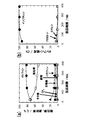
前記MCM-41を触媒として用いたこと以外は実施例2と同様にして、反応評価を行った。このときの反応時間に対するアセトン転化率と生成物選択率を図16(a)に示した。また、反応時間に対するオレフィン組成を図16(b)に示した。
前記MCM-41を触媒として用いたこと以外は実施例2と同様にして、反応評価を行った。このときの反応時間に対するアセトン転化率と生成物選択率を図16(a)に示した。また、反応時間に対するオレフィン組成を図16(b)に示した。
[比較例1]
(触媒調製)
・テンプレート除去
実施例1と同様にして行った。
(触媒調製)
・テンプレート除去
実施例1と同様にして行った。
・イオン交換処理
テンプレートを除去したNa型BEA10gを、蒸留水150mlに分散し、硝酸アンモニウム(NH4NO3)10gを添加して、100℃で3時間加熱還流した。還流終了後、蒸留水で洗浄し風乾した。この操作を合計3回行い、アンモニア型BEA(NH4-BEA)を得た。ここで、2回目及び3回目の操作におけるNH4NO3量はそれぞれ15g及び20gとした。
テンプレートを除去したNa型BEA10gを、蒸留水150mlに分散し、硝酸アンモニウム(NH4NO3)10gを添加して、100℃で3時間加熱還流した。還流終了後、蒸留水で洗浄し風乾した。この操作を合計3回行い、アンモニア型BEA(NH4-BEA)を得た。ここで、2回目及び3回目の操作におけるNH4NO3量はそれぞれ15g及び20gとした。
・触媒焼成
NH4-BEAを500℃で2時間空気焼成し、プロトン型BEA(H-BEA)を得た。アンモニアTPDにより求めたH-BEAの酸点の量及び強度分布を図4に示した。
NH4-BEAを500℃で2時間空気焼成し、プロトン型BEA(H-BEA)を得た。アンモニアTPDにより求めたH-BEAの酸点の量及び強度分布を図4に示した。
(反応評価)
H-BEAを触媒として用いたこと以外は実施例1と同様にして、反応評価を行った。このときの反応時間に対するアセトン転化率と生成物選択率を図17(a)に示した。また、反応時間に対するオレフィン組成を図17(b)に示した。
H-BEAを触媒として用いたこと以外は実施例1と同様にして、反応評価を行った。このときの反応時間に対するアセトン転化率と生成物選択率を図17(a)に示した。また、反応時間に対するオレフィン組成を図17(b)に示した。
[比較例2]
(反応評価)
実施例11のH-ZSM-5を触媒として用いたこと以外は、実施例11と同様にして反応評価を行った。このときのアセトン転化率、生成物選択率及び生成オレフィン中のイソブチレン選択率(カッコ内)を図18に示した。
(反応評価)
実施例11のH-ZSM-5を触媒として用いたこと以外は、実施例11と同様にして反応評価を行った。このときのアセトン転化率、生成物選択率及び生成オレフィン中のイソブチレン選択率(カッコ内)を図18に示した。
[比較例3]
(反応評価)
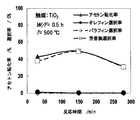
市販のチタニア(TiO2、アナターゼ型、和光純薬工業株式会社製)を用いたこと以外は、実施例1と同様にして反応評価を行った。このときのアセトン転化率と生成物選択率を図19に示した。
(反応評価)
市販のチタニア(TiO2、アナターゼ型、和光純薬工業株式会社製)を用いたこと以外は、実施例1と同様にして反応評価を行った。このときのアセトン転化率と生成物選択率を図19に示した。
[実施例13]
(触媒調製)
・テンプレート除去
テンプレート含有Na型ベータ型ゼオライト(商品名:「HSZ-930NHA」、東ソー株式会社製、略号:BEA、SiO2/Al2O3=27)を、空気中で、350℃まで毎分0.9℃で昇温して7時間保持した後、引き続いて500℃まで毎分0.83℃で昇温し、48時間保持して、テンプレートを除去した。
(触媒調製)
・テンプレート除去
テンプレート含有Na型ベータ型ゼオライト(商品名:「HSZ-930NHA」、東ソー株式会社製、略号:BEA、SiO2/Al2O3=27)を、空気中で、350℃まで毎分0.9℃で昇温して7時間保持した後、引き続いて500℃まで毎分0.83℃で昇温し、48時間保持して、テンプレートを除去した。
・イオン交換処理
テンプレートを除去したNa型ベータ型ゼオライト(Na型BEA)10gを、蒸留水150mlに分散し、硝酸アンモニウム(NH4NO3)10gを添加して、100℃で3時間加熱還流した。還流終了後、蒸留水で洗浄し風乾した。この操作を合計3回行い、アンモニア型BEA(NH4-BEA)を得た。ここで、2回目及び3回目の操作におけるNH4NO3量はそれぞれ15g及び20gとした。
テンプレートを除去したNa型ベータ型ゼオライト(Na型BEA)10gを、蒸留水150mlに分散し、硝酸アンモニウム(NH4NO3)10gを添加して、100℃で3時間加熱還流した。還流終了後、蒸留水で洗浄し風乾した。この操作を合計3回行い、アンモニア型BEA(NH4-BEA)を得た。ここで、2回目及び3回目の操作におけるNH4NO3量はそれぞれ15g及び20gとした。
・触媒焼成
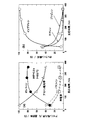
前記NH4-BEAを500℃において2時間空気焼成することで、プロトン型BEA(H-BEA)を得た。アンモニアTPDにより求めたH-BEAの酸点の量及び強度分布を図27に示す。
前記NH4-BEAを500℃において2時間空気焼成することで、プロトン型BEA(H-BEA)を得た。アンモニアTPDにより求めたH-BEAの酸点の量及び強度分布を図27に示す。
・有機ケイ素化合物による酸点の不活性化処理
前記処理で得られたH-BEA 1.0gを前記図26に示す有機ケイ素化合物処理装置のガラス製焼成管に充填し、石英ウールで固定した。40ml/minの空気流通下、550℃まで昇温し、550℃で1時間保持した。その後、流通ガスをN2ガスに切り替えて100℃まで放冷した。焼成炉が100℃に安定した後、N2ガスにジエトキシメチルシラン(東京化成工業株式会社製、略号:DEMS)を80℃で気化装置16から同伴させ、H-BEAにDEMSを化学吸着させた。30分後気化装置16を放冷し、40℃以下になった時点で焼成管も放冷した。焼成管を取り出し、軽く振とうしてゼオライト層22をかき混ぜた後、再び焼成管を焼成炉に保持し、N2ガスを流通して100℃に加熱し、DEMSの化学吸着を繰り返した。その後、550℃で1.5時間N2ガス下焼成の後、引き続いて550℃で1.5時間空気焼成した。さらに、これら一連の処理を2回繰り返して、DEMS処理したBEAゼオライト(DEMS-BEA)を得た。アンモニア-TPDにより求めたDEMS-BEAの酸点の量及び強度分布を図27に示す。
前記処理で得られたH-BEA 1.0gを前記図26に示す有機ケイ素化合物処理装置のガラス製焼成管に充填し、石英ウールで固定した。40ml/minの空気流通下、550℃まで昇温し、550℃で1時間保持した。その後、流通ガスをN2ガスに切り替えて100℃まで放冷した。焼成炉が100℃に安定した後、N2ガスにジエトキシメチルシラン(東京化成工業株式会社製、略号:DEMS)を80℃で気化装置16から同伴させ、H-BEAにDEMSを化学吸着させた。30分後気化装置16を放冷し、40℃以下になった時点で焼成管も放冷した。焼成管を取り出し、軽く振とうしてゼオライト層22をかき混ぜた後、再び焼成管を焼成炉に保持し、N2ガスを流通して100℃に加熱し、DEMSの化学吸着を繰り返した。その後、550℃で1.5時間N2ガス下焼成の後、引き続いて550℃で1.5時間空気焼成した。さらに、これら一連の処理を2回繰り返して、DEMS処理したBEAゼオライト(DEMS-BEA)を得た。アンモニア-TPDにより求めたDEMS-BEAの酸点の量及び強度分布を図27に示す。
(反応評価)
前記DEMS-BEAを触媒として用いたこと以外は実施例1と同様にして、反応評価を行った。このときの反応時間に対するアセトン転化率と生成物選択率を図28(a)に示した。また、反応時間に対するオレフィン組成を図28(b)に示した。TGから求めた反応後のDEMS-BEA上に残存する析出コーク量は、反応に用いたDEMS-BEAの質量に対して、10%であった。
前記DEMS-BEAを触媒として用いたこと以外は実施例1と同様にして、反応評価を行った。このときの反応時間に対するアセトン転化率と生成物選択率を図28(a)に示した。また、反応時間に対するオレフィン組成を図28(b)に示した。TGから求めた反応後のDEMS-BEA上に残存する析出コーク量は、反応に用いたDEMS-BEAの質量に対して、10%であった。
[実施例14]
(触媒調製)
有機ケイ素化合物として、フェニルシラン(東京化成工業株式会社製、略号:PS)を用いたこと以外は、実施例13と同様にして触媒を調製し、PS処理したBEAゼオライト(PS-BEA)を得た。アンモニア-TPDにより求めたPS-BEAの酸点の量及び強度分布を図27に示す。
(触媒調製)
有機ケイ素化合物として、フェニルシラン(東京化成工業株式会社製、略号:PS)を用いたこと以外は、実施例13と同様にして触媒を調製し、PS処理したBEAゼオライト(PS-BEA)を得た。アンモニア-TPDにより求めたPS-BEAの酸点の量及び強度分布を図27に示す。
(反応評価)
触媒としてPS-BEAを用いたこと以外は実施例1と同様にして、反応評価を行った。このときの反応時間に対するアセトン転化率と生成物選択率を図29(a)に示す。また、反応時間に対するオレフィン組成を図29(b)に示す。TGから求めた反応後のPS-BEA上に残存する析出コーク量は、反応に用いたPS-BEAの質量に対して、7.4%であった。
触媒としてPS-BEAを用いたこと以外は実施例1と同様にして、反応評価を行った。このときの反応時間に対するアセトン転化率と生成物選択率を図29(a)に示す。また、反応時間に対するオレフィン組成を図29(b)に示す。TGから求めた反応後のPS-BEA上に残存する析出コーク量は、反応に用いたPS-BEAの質量に対して、7.4%であった。
[実施例15]
(触媒調製)
実施例13と同様の方法で得られたH-BEAを40ml/minのN2流通条件で水蒸気を分圧10.1kPaで供給し、500℃で3時間水蒸気処理した。その後、ゼオライト骨格外に存在するアルミニウムを除去するために、実施例13と同様の方法でNH4-BEAへとイオン交換した後、500℃で2時間空気焼成を行い、脱アルミニウム(Al)処理したBEAゼオライト(脱Al-BEA)を得た。得られた脱Al-BEAに実施例1と同様の方法でDEMS処理を行い、DEMS処理した脱Al-BEAゼオライト(DEMS-脱Al-BEA)を得た。
(触媒調製)
実施例13と同様の方法で得られたH-BEAを40ml/minのN2流通条件で水蒸気を分圧10.1kPaで供給し、500℃で3時間水蒸気処理した。その後、ゼオライト骨格外に存在するアルミニウムを除去するために、実施例13と同様の方法でNH4-BEAへとイオン交換した後、500℃で2時間空気焼成を行い、脱アルミニウム(Al)処理したBEAゼオライト(脱Al-BEA)を得た。得られた脱Al-BEAに実施例1と同様の方法でDEMS処理を行い、DEMS処理した脱Al-BEAゼオライト(DEMS-脱Al-BEA)を得た。
(反応評価)
触媒としてDEMS-脱Al-BEAを用いたこと以外は実施例13と同様にして、反応評価を行った。このときの反応時間に対するアセトン転化率と生成物選択率を図30(a)に示す。また、反応時間に対するオレフィン組成を図30(b)に示す。TGから求めた反応後のDEMS-脱Al-BEA上に残存する析出コーク量は、反応に用いたDEMS-脱Al-BEAの質量に対して、10%であった。
触媒としてDEMS-脱Al-BEAを用いたこと以外は実施例13と同様にして、反応評価を行った。このときの反応時間に対するアセトン転化率と生成物選択率を図30(a)に示す。また、反応時間に対するオレフィン組成を図30(b)に示す。TGから求めた反応後のDEMS-脱Al-BEA上に残存する析出コーク量は、反応に用いたDEMS-脱Al-BEAの質量に対して、10%であった。
[比較例4]
(触媒調製)
有機ケイ素化合物として、ジフェニルメチルシラン(東京化成工業株式会社製、略号:DPMS)を用いたこと以外は、実施例1と同様にして触媒を調製し、DPMS処理したBEAゼオライト(DPMS-BEA)を得た。アンモニア-TPDにより求めたDPMS-BEAの酸点の量及び強度分布を図27に示す。
(触媒調製)
有機ケイ素化合物として、ジフェニルメチルシラン(東京化成工業株式会社製、略号:DPMS)を用いたこと以外は、実施例1と同様にして触媒を調製し、DPMS処理したBEAゼオライト(DPMS-BEA)を得た。アンモニア-TPDにより求めたDPMS-BEAの酸点の量及び強度分布を図27に示す。
(反応評価)
触媒としてDPMS-BEAを用いたこと以外は実施例1と同様にして、反応評価を行った。このときの反応時間に対するアセトン転化率と生成物選択率を図31(a)に示す。また、反応時間に対するオレフィン組成を図31(b)に示す。TGから求めた反応後のDPMS-BEA上に残存する析出コーク量は、用いたDPMS-BEAの質量に対して、36%であった。
触媒としてDPMS-BEAを用いたこと以外は実施例1と同様にして、反応評価を行った。このときの反応時間に対するアセトン転化率と生成物選択率を図31(a)に示す。また、反応時間に対するオレフィン組成を図31(b)に示す。TGから求めた反応後のDPMS-BEA上に残存する析出コーク量は、用いたDPMS-BEAの質量に対して、36%であった。
[参考例1]
(反応評価)
触媒として実施例1の方法で調製したH-BEAを用いたこと以外は実施例1と同様にして反応評価を行った。このときの反応時間に対するアセトン転化率と生成物選択率を図32(a)に示す。また、反応時間に対するオレフィン組成を図32(b)に示す。TGから求めた反応後のH-BEA上に残存する析出コーク量は、用いたH-BEAの質量に対して、53%であった。
(反応評価)
触媒として実施例1の方法で調製したH-BEAを用いたこと以外は実施例1と同様にして反応評価を行った。このときの反応時間に対するアセトン転化率と生成物選択率を図32(a)に示す。また、反応時間に対するオレフィン組成を図32(b)に示す。TGから求めた反応後のH-BEA上に残存する析出コーク量は、用いたH-BEAの質量に対して、53%であった。
前記実施例13~15、比較例4、参考例1における析出コーク量の結果を表1に示す。

1 マイクロフィーダー(アセトン供給用)
2 流量計
3 N2ボンベ
4 テープヒーター
5 固定床流通式触媒反応器(触媒充填)
6 電気炉
7 熱電対
8 テープヒーター
9 恒温槽
10 ガスクロマトグラフ(GC)
11 パージバルブ
12 N2ボンベ
13 空気ボンベ
14 三方バルブ
15 流量計
16 気化装置(有機ケイ素化合物供給用)
17 六方バルブ
18 排気口
19 テープヒーター
20 熱電対
21 電気炉
22 ゼオライト層(ガラス製焼成管内)
23 断熱材
2 流量計
3 N2ボンベ
4 テープヒーター
5 固定床流通式触媒反応器(触媒充填)
6 電気炉
7 熱電対
8 テープヒーター
9 恒温槽
10 ガスクロマトグラフ(GC)
11 パージバルブ
12 N2ボンベ
13 空気ボンベ
14 三方バルブ
15 流量計
16 気化装置(有機ケイ素化合物供給用)
17 六方バルブ
18 排気口
19 テープヒーター
20 熱電対
21 電気炉
22 ゼオライト層(ガラス製焼成管内)
23 断熱材
Claims (5)
- カチオンによりイオン交換された酸点を有するゼオライト、カチオンによりイオン交換された酸点を有するゼオライト類似物質及びメソ多孔性シリカより選ばれる少なくとも一つの化合物を触媒として用いることを特徴とするアセトンからイソブチレンを製造する方法。
- ゼオライト又はゼオライト類似物質のうち、該ゼオライト又はゼオライト類似物質の細孔径よりも小さな分子サイズを有する有機ケイ素化合物により酸点を不活性化処理したゼオライト又はゼオライト類似物質を触媒として用いることを特徴とするアセトンからイソブチレンを製造する方法。
- 前記有機ケイ素化合物がメチルジエトキシシラン又はフェニルシランであることを特徴とする請求項2に記載のアセトンからイソブチレンを製造する方法。
- 前記ゼオライトがベータ型ゼオライト又はMFI型ゼオライトであることを特徴とする請求項1から3いずれか1項に記載のアセトンからイソブチレンを製造する方法。
- 前記アセトンがバイオマスを原料として製造されたアセトンであることを特徴とする請求項1から4いずれか1項に記載のアセトンからイソブチレンを製造する方法。
Priority Applications (1)
| Application Number | Priority Date | Filing Date | Title |
|---|---|---|---|
| JP2010500006A JP5611813B2 (ja) | 2008-12-03 | 2009-12-02 | アセトンからイソブチレンを製造する方法 |
Applications Claiming Priority (4)
| Application Number | Priority Date | Filing Date | Title |
|---|---|---|---|
| JP2008-308479 | 2008-12-03 | ||
| JP2008308479 | 2008-12-03 | ||
| JP2009-220952 | 2009-09-25 | ||
| JP2009220952 | 2009-09-25 |
Publications (1)
| Publication Number | Publication Date |
|---|---|
| WO2010064652A1 true WO2010064652A1 (ja) | 2010-06-10 |
Family
ID=42233299
Family Applications (1)
| Application Number | Title | Priority Date | Filing Date |
|---|---|---|---|
| PCT/JP2009/070234 Ceased WO2010064652A1 (ja) | 2008-12-03 | 2009-12-02 | アセトンからイソブチレンを製造する方法 |
Country Status (2)
| Country | Link |
|---|---|
| JP (1) | JP5611813B2 (ja) |
| WO (1) | WO2010064652A1 (ja) |
Cited By (7)
| Publication number | Priority date | Publication date | Assignee | Title |
|---|---|---|---|---|
| JP2013136562A (ja) * | 2011-11-28 | 2013-07-11 | Hokkaido Univ | アセトンからイソブチレンを製造する方法 |
| US20150239812A1 (en) * | 2012-10-31 | 2015-08-27 | Archer Daniels Midland Company | Process for making biobased fuel additives |
| WO2016061262A1 (en) * | 2014-10-14 | 2016-04-21 | Gevo, Inc. | Methods for conversion of ethanol to functionalized lower hydrocarbons and downstream hydrocarbons |
| US10633320B2 (en) | 2018-01-04 | 2020-04-28 | Gevo, Inc. | Upgrading fusel oil mixtures over heterogeneous catalysts to higher value renewable chemicals |
| JP2021147310A (ja) * | 2020-03-13 | 2021-09-27 | 三菱ケミカル株式会社 | Con型ゼオライト、con型ゼオライトの製造方法、及び低級オレフィンの製造方法 |
| JP2023037978A (ja) * | 2021-09-06 | 2023-03-16 | 三菱ケミカル株式会社 | Con型ゼオライト、con型ゼオライトの製造方法、触媒および低級オレフィンの製造方法 |
| RU2860609C1 (ru) * | 2025-11-24 | 2026-04-21 | Федеральное государственное бюджетное научное учреждение Уфимский федеральный исследовательский центр Российской академии наук | Способ получения изобутилена |
Citations (1)
| Publication number | Priority date | Publication date | Assignee | Title |
|---|---|---|---|---|
| JP2006061852A (ja) * | 2004-08-27 | 2006-03-09 | Ngk Insulators Ltd | 汚泥から有用炭化水素を回収する方法 |
-
2009
- 2009-12-02 WO PCT/JP2009/070234 patent/WO2010064652A1/ja not_active Ceased
- 2009-12-02 JP JP2010500006A patent/JP5611813B2/ja active Active
Patent Citations (1)
| Publication number | Priority date | Publication date | Assignee | Title |
|---|---|---|---|---|
| JP2006061852A (ja) * | 2004-08-27 | 2006-03-09 | Ngk Insulators Ltd | 汚泥から有用炭化水素を回収する方法 |
Non-Patent Citations (3)
| Title |
|---|
| HUTCHINGS, G. J. ET AL.: "Acetone conversion to isobutene in high selectivity using zeolite catalyst", CATALYSIS LETTERS, vol. 21, no. 1-2, 1993, pages 49 - 53 * |
| HUTCHINGS, G. J. ET AL.: "The conversion of methanol and other O-compounds to hydrocarbons over zeolite beta", JOURNAL OF CATALYSIS, vol. 147, no. 1, 1994, pages 177 - 185 * |
| VELOSO, C. O. ET AL.: "Aldol condensation of acetone over alkali cation exchanged zeolites", STUDIES IN SURFACE SCIENCE AND CATALYSIS, vol. 84, no. PT. C, 1994, pages 1913 - 1920 * |
Cited By (11)
| Publication number | Priority date | Publication date | Assignee | Title |
|---|---|---|---|---|
| JP2013136562A (ja) * | 2011-11-28 | 2013-07-11 | Hokkaido Univ | アセトンからイソブチレンを製造する方法 |
| US20150239812A1 (en) * | 2012-10-31 | 2015-08-27 | Archer Daniels Midland Company | Process for making biobased fuel additives |
| US10774022B2 (en) * | 2012-10-31 | 2020-09-15 | Archer Daniels Midland Company | Process for making biobased fuel additives |
| WO2016061262A1 (en) * | 2014-10-14 | 2016-04-21 | Gevo, Inc. | Methods for conversion of ethanol to functionalized lower hydrocarbons and downstream hydrocarbons |
| CN107250086A (zh) * | 2014-10-14 | 2017-10-13 | 吉沃公司 | 将乙醇转化为官能化的低级烃和下游烃的方法 |
| US10351487B2 (en) | 2014-10-14 | 2019-07-16 | Gevo, Inc | Methods for conversion of ethanol to functionalized lower hydrocarbons and downstream hydrocarbons |
| US10633320B2 (en) | 2018-01-04 | 2020-04-28 | Gevo, Inc. | Upgrading fusel oil mixtures over heterogeneous catalysts to higher value renewable chemicals |
| JP2021147310A (ja) * | 2020-03-13 | 2021-09-27 | 三菱ケミカル株式会社 | Con型ゼオライト、con型ゼオライトの製造方法、及び低級オレフィンの製造方法 |
| JP7636213B2 (ja) | 2020-03-13 | 2025-02-26 | 三菱ケミカル株式会社 | Con型ゼオライト、con型ゼオライトの製造方法、及び低級オレフィンの製造方法 |
| JP2023037978A (ja) * | 2021-09-06 | 2023-03-16 | 三菱ケミカル株式会社 | Con型ゼオライト、con型ゼオライトの製造方法、触媒および低級オレフィンの製造方法 |
| RU2860609C1 (ru) * | 2025-11-24 | 2026-04-21 | Федеральное государственное бюджетное научное учреждение Уфимский федеральный исследовательский центр Российской академии наук | Способ получения изобутилена |
Also Published As
| Publication number | Publication date |
|---|---|
| JPWO2010064652A1 (ja) | 2012-05-10 |
| JP5611813B2 (ja) | 2014-10-22 |
Similar Documents
| Publication | Publication Date | Title |
|---|---|---|
| Zhang et al. | B-axis-oriented ZSM-5 nanosheets for efficient alkylation of benzene with methanol: synergy of acid sites and diffusion | |
| Cao et al. | Insights into the pyridine-modified MOR zeolite catalysts for DME carbonylation | |
| Liu et al. | Water structures on acidic zeolites and their roles in catalysis | |
| JP4841837B2 (ja) | 微孔質結晶性ゼオライト物質(ゼオライトitq−22)、該物質の合成法および該物質の触媒としての使用 | |
| Lin et al. | Acid strength controlled reaction pathways for the catalytic cracking of 1-pentene to propene over ZSM-5 | |
| Zaiku et al. | Influence of citric acid treatment on the surface acid properties of zeolite beta | |
| CN102421727B (zh) | 丙烯制造方法 | |
| JP5611813B2 (ja) | アセトンからイソブチレンを製造する方法 | |
| CN101124160B (zh) | 沸石材料及其制备和应用 | |
| JP5919587B2 (ja) | 単環芳香族炭化水素製造用触媒および単環芳香族炭化水素の製造方法 | |
| Zheng et al. | Morphologically cross‐shaped Ru/HZSM‐5 catalyzes tandem hydrogenolysis of guaiacol to benzene in water | |
| TW201029740A (en) | Catalysts useful for the alkylation of aromatic hydrocarbons | |
| CN101939095A (zh) | 制备轻质烯烃时所用的烃催化裂解用催化剂、及其制备方法 | |
| JP7440530B2 (ja) | メソ多孔性触媒化合物及びその使用 | |
| CN105283415B (zh) | 甲苯歧化催化剂的原位修饰焦炭选择性去活化 | |
| JP2016104690A (ja) | Aei型ゼオライト、その製造方法、及びそれを用いた低級オレフィンの製造方法 | |
| JP2021516611A (ja) | 金属含浸zsm−5+メソ多孔性モルデナイトゼオライト複合触媒によるbtxへの重質改質油変換の方法 | |
| JP2023539882A (ja) | スズ-チタン-シリコン分子篩、その製造方法およびその使用 | |
| JP2020189765A (ja) | チタノシリケートとその製造方法 | |
| JP6286121B2 (ja) | アセトンからイソブチレンを製造する方法 | |
| Parmar et al. | Direct synthesis of highly siliceous ZnO-FAU zeolite with enhanced performance in hydrocarbon cracking reactions | |
| Cao et al. | Enhancing the catalytic properties of mordenites via an alkali–acid treatment and by loading nickel–cerium during o-ethyltoluene isomerization | |
| Magaji et al. | Catalytic Cracking of Liquefied Petroleum Gas (LPG) to Light Olefins Using Zeolite‐Based Materials: Recent Advances, Trends, Challenges and Future Perspectives | |
| RU2328445C2 (ru) | Микропористый кристаллический цеолитный материал (цеолит itq-22), способ его получения и применение в качестве катализатора | |
| Yuan et al. | Tuning of magnesium distribution in ZSM-5 via different impregnation methods and its effect on methanol to propene reaction |
Legal Events
| Date | Code | Title | Description |
|---|---|---|---|
| WWE | Wipo information: entry into national phase |
Ref document number: 2010500006 Country of ref document: JP |
|
| 121 | Ep: the epo has been informed by wipo that ep was designated in this application |
Ref document number: 09830418 Country of ref document: EP Kind code of ref document: A1 |
|
| NENP | Non-entry into the national phase |
Ref country code: DE |
|
| 122 | Ep: pct application non-entry in european phase |
Ref document number: 09830418 Country of ref document: EP Kind code of ref document: A1 |