WO2010049972A1 - 質量分析装置 - Google Patents
質量分析装置 Download PDFInfo
- Publication number
- WO2010049972A1 WO2010049972A1 PCT/JP2008/003105 JP2008003105W WO2010049972A1 WO 2010049972 A1 WO2010049972 A1 WO 2010049972A1 JP 2008003105 W JP2008003105 W JP 2008003105W WO 2010049972 A1 WO2010049972 A1 WO 2010049972A1
- Authority
- WO
- WIPO (PCT)
- Prior art keywords
- flight
- mass
- time
- ions
- target component
- Prior art date
- Legal status (The legal status is an assumption and is not a legal conclusion. Google has not performed a legal analysis and makes no representation as to the accuracy of the status listed.)
- Ceased
Links
Images

Classifications
-
- H—ELECTRICITY
- H01—ELECTRIC ELEMENTS
- H01J—ELECTRIC DISCHARGE TUBES OR DISCHARGE LAMPS
- H01J49/00—Particle spectrometers or separator tubes
- H01J49/26—Mass spectrometers or separator tubes
- H01J49/34—Dynamic spectrometers
- H01J49/40—Time-of-flight spectrometers
- H01J49/408—Time-of-flight spectrometers with multiple changes of direction, e.g. by using electric or magnetic sectors, closed-loop time-of-flight
Definitions
- a multi-reflection time-of-flight mass spectrometer has been developed that extends the flight distance by using a reciprocating orbit that reflects ions multiple times by a reflected electric field instead of the orbit as described above.
- the ion optical system is different between the multi-round time-of-flight type and the multiple reflection time-of-flight type, the basic principle for improving the mass resolution is the same. Therefore, in this specification, the “multiple orbit flight time type” includes the “multiple reflection flight time type”.
- the multi-round time-of-flight mass spectrometer can achieve high mass resolution, but has a drawback due to the closed flight path of ions. That is, there is a problem that ions having a low mass and a high velocity overtake ions having a high mass and a low velocity as the number of turns increases when the ions circulate along the closed orbit.
- the number of laps of ions corresponding to each peak is different for each observed peak, that is, the flight distance is different. Can happen. In this case, since the ion mass and the flight distance cannot be uniquely determined, the time-of-flight spectrum cannot be directly converted into the mass spectrum.
- the present invention has been made in view of the above problems, and its object is to obtain the mass of the target component with high resolution based on the time-of-flight spectrum obtained by one mass analysis.
- the present invention which has been made to solve the above problems, detects an ion source that ionizes a sample, an ion optical system that forms a circular trajectory that repeatedly flies ions from the sample, and ions that fly along the circular trajectory.
- a multi-turn time-of-flight mass spectrometer comprising: a) a spectrum creating means for creating a time-of-flight spectrum based on a signal obtained by a detector after flying a sample-derived ion along a circular orbit for a predetermined time; b) Isotope peak detection means for detecting the target component and the peak of its isotope based on the time interval of at least a plurality of peaks appearing on the time-of-flight spectrum; c) a mass calculating means for estimating the flight distance of ions derived from the target component from the flight time corresponding to the peak of the target component and isotope, and calculating the mass of the target component based on the flight distance; It is characterized by having.
- the isotope peak detection means detects an isotope peak group from a plurality of peak time intervals.
- the isotope peak detection means includes a plurality of peaks.
- the intensity ratio based on the isotope abundance ratio of the elements constituting the target component can also be used to detect the target component and the peak of the isotope.
- the mass calculation means calculates the number of laps of ions derived from the target component from the estimated flight distance, and recalculates the accurate flight distance determined structurally from the number of laps. It is preferable to calculate the mass of the target component using this. Accordingly, the mass of the target component can be calculated with high accuracy using the flight distance accurately determined by the arrangement of the ion optical system, the position of the ion source, the detector, and the like.
- Such flight distance estimation and mass calculation can be performed for each isotope peak group, and even when the number of ions corresponding to a plurality of peaks derived from the same target component belonging to one isotope peak group is the same. do it. Therefore, there is no problem even if ions having different numbers of laps are mixed in the time-of-flight spectrum due to overtaking of ions derived from different target components. Therefore, the mass range that can be measured by one mass analysis is narrow. There is no need to limit the range.
- the mass of the target component over a wide mass range can be obtained with high resolution by using the time-of-flight spectrum obtained by one mass analysis. Therefore, the measurement time can be shortened and efficient analysis can be performed, and it is not necessary to prepare a large amount of samples.
- FIG. 1 is a schematic configuration diagram of a multi-turn time-of-flight mass spectrometer according to this embodiment.
- an ion source 1 a gate electrode 2, a flight space 3 in which a plurality of fan-shaped electrodes 31 to 36 are arranged, a detector 4, and the like are arranged in a vacuum chamber (not shown).
- the ion source 1 serves as a starting point of flight of ions to be analyzed.
- the ion source 1 is an ionization unit that ionizes sample molecules to be analyzed, and the ionization method is not particularly limited.
- the ion source 1 ionizes gas molecules by an electron impact ionization method or a chemical ionization method.
- the mass spectrometer is used as a detector for liquid chromatography
- the ion source 1 ionizes liquid molecules by atmospheric pressure chemical ionization or electrospray ionization.
- the analysis target molecule is a polymer compound such as a protein
- MALDI Microx Assisted Laser Desorption Ionization
- the ion source 1 is not necessarily an ion generation source.
- the ion source 1 may be an ion trap that temporarily holds ions generated in other portions and then emits them with energy.
- a plurality of (six in this example) fan-shaped electrodes 31, 32, 33, 34, 35, 36 are arranged in the flight space 3 in order to fly ions along a substantially circular orbit P. .
- Each of the six fan-shaped electrodes 31 to 36 having the same shape is formed by cutting a concentric double cylinder at a rotation angle of 60 °, and the fan-shaped electrodes 31 to 36 are rotated at an equal rotation angle about the axis O. They are spaced apart.
- a predetermined voltage is applied to the sector electrodes 31 to 36, sector electric fields E1 to E6 are formed therein, respectively, and a substantially hexagonal cylindrical flight space is formed in the sector electric fields E1 to E6.
- the central trajectory of ions passing through the space is indicated by P in FIG.
- the gate electrode 2 provided between the adjacent sector electrodes 31 and 36 is used to place ions generated by the ion source 1 on the circular orbit P, and the ions flying along the circular orbit P. It has a function for separating from P and sending it
- Voltages are applied to the sector electrodes 31 to 36 and the gate electrode 2 from the orbital flight voltage generator 5 and the gate voltage generator 6, respectively, and the voltage generators 5 and 6 are controlled by the controller 7.
- Connected to the control unit 7 are an operation unit 9 operated by a user to perform various input settings and instructions related to analysis, and a display unit 10 for displaying analysis results and the like.
- the detection signal from the detector 4 is input to the data processing unit 8, where the flight time from when the ions leave the ion source 1 until they reach the detector 4 is measured. Mass is calculated.
- the data processing unit 8 includes a time-of-flight spectrum recording unit 81, an isotope peak detection unit 82, a flight distance calculation unit 83, a mass calculation unit 84, and the like as functional blocks.
- the control unit 7 and the data processing unit 8 can be realized centering on a personal computer.
- the circular orbit P is substantially circular, but the shape of the circular orbit is not limited to this, and may be any shape such as an ellipse or an eight figure. Further, it may reciprocate along a linear or curved track.
- the time-of-flight spectrum is acquired by executing mass analysis on the target sample as follows. That is, under the control of the control unit 7, the target sample is ionized in the ion source 1, and various ions derived from the generated sample are emitted. At the same time, the control unit 7 sends a control signal notifying the data processing unit 8 that ions have been emitted.
- the gate voltage generator 6 applies to the gate electrode 2 a deflection voltage for deflecting ions so that the ions incident on the gate electrode 2 immediately after the ions are emitted are on the orbit P, and then for a predetermined time. When elapses, the application of the deflection electrode to the gate electrode 2 is stopped. Further, the orbital flight voltage generator 5 applies a predetermined voltage to each of the sector electrodes 31 to 36. As a result, all or most of the ions starting from the ion source 1 are introduced into the orbit P and begin to fly along the orbit P.
- the gate voltage generation unit 6 is configured to allow the ions to pass through the gate electrode 2 to move around the orbit P when a predetermined time has elapsed since the ions were emitted from the ion source 1.
- a deflection voltage is applied to deflect ions away from the detector 4.
- the ions closest to the direction of ion travel (clockwise in FIG. 1) first pass through the gate electrode 2 and circulate. It deviates from the orbit P, passes through the gate electrode 2 in the order in which it is located in the direction opposite to the traveling direction of ions, deviates from the orbit P, and moves toward the detector 4.
- the order of ions passing through the gate electrode 2 is not the order of decreasing mass as described above.
- the ions that reach the vessel 4 are not in the order of decreasing mass.
- the detector 4 outputs an ion intensity signal corresponding to the number of incident ions to the data processing unit 8 in real time, and the time-of-flight spectrum recording unit 81 creates a time-of-flight spectrum in which the ion intensity signal is recorded over time.
- the time-of-flight spectrum peaks corresponding to various ions derived from the sample appear. Each peak represents the intensity of the ions that have traveled the orbit P several times, but the number of laps, that is, the flight distance is unknown. Therefore, unlike a general time-of-flight mass spectrometer, the time spectrum of the time-of-flight spectrum cannot be converted to a mass axis to obtain a mass spectrum.
- the flight distance calculation unit 83 and the mass calculation unit 84 calculate the flight distance and the mass based on the following calculation principle.
- T L / v
- v the velocity of the ion
- U the relationship between the ion kinetic energy U and the ion mass m
- Equation (2) the relationship between the ion kinetic energy U and the ion mass m
Landscapes
- Chemical & Material Sciences (AREA)
- Analytical Chemistry (AREA)
- Other Investigation Or Analysis Of Materials By Electrical Means (AREA)
Abstract
Description
a)試料由来のイオンを周回軌道に沿って所定時間飛行させた後に検出器で得られた信号に基づいて飛行時間スペクトルを作成するスペクトル作成手段と、
b)前記飛行時間スペクトルに対し、少なくともそのスペクトル上に現れている複数のピークの時間間隔に基づいて目的成分及びその同位体のピークを検出する同位体ピーク検出手段と、
c)目的成分及び同位体のピークに対応する飛行時間からその目的成分由来のイオンの飛行距離を推定し、該飛行距離に基づいてその目的成分の質量を算出する質量算出手段と、
を備えることを特徴としている。
2…ゲート電極
3…飛行空間
31~36…扇形電極
4…検出器
5…周回飛行用電圧発生部
6…ゲート電圧発生部
7…制御部
8…データ処理部
81…飛行時間スペクトル記録部
82…同位体ピーク検出部
83…飛行距離計算部
84…質量計算部
9…操作部
10…表示部
P…周回軌道
E1~E6…扇形電場
一般に飛行時間型質量分析装置において、或るイオンの飛行時間Tと飛行距離Lとの関係は、次の(1)式となる。
T=L/v …(1)
vはイオンの速度であり、イオンの運動エネルギーU、イオンの質量mとの関係は次の(2)式となる。
v=L√(m/2U) …(2)
(1)式、(2)式を書き換えると、
m=2U(T/L)2 …(3)
である。
α=2U/L2
とおくと、(3)式は、
m=αT2 …(4)
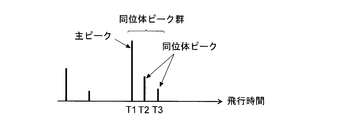
と書くことができる。図2に示すように隣接する2本のピークの時間差T2-T1が1Daに相当するものである場合、運動エネルギーU、飛行距離Lは同一であるから、(4)式より、
M=αT12 …(5)
M+1=αT22 …(6)
となる。ここで、Mは主ピークの元となるイオンの質量である。
1=α(T22-T12)
α=2U/L2=(T22-T12)
L2=2U/(T22-T12)
したがって、
L=√{2U/(T22-T12)} …(7)
となり、2本のピークの出現時間T1、T2より飛行距離Lが求まることになる。
Claims (3)
- 試料をイオン化するイオン源と、試料由来のイオンを繰り返し飛行させる周回軌道を形成するイオン光学系と、周回軌道に沿って飛行したイオンを検出する検出器と、を具備する多重周回飛行時間型の質量分析装置であって、
a)試料由来のイオンを周回軌道に沿って所定時間飛行させた後に検出器で得られた信号に基づいて飛行時間スペクトルを作成するスペクトル作成手段と、
b)前記飛行時間スペクトルに対し、少なくともそのスペクトル上に現れている複数のピークの時間間隔に基づいて目的成分及びその同位体のピークを検出する同位体ピーク検出手段と、
c)目的成分及び同位体のピークに対応する飛行時間からその目的成分由来のイオンの飛行距離を推定し、該飛行距離に基づいてその目的成分の質量を算出する質量算出手段と、
を備えることを特徴とする質量分析装置。 - 請求項1に記載の質量分析装置であって、
前記同位体ピーク検出手段は、複数のピークの時間間隔のほか、目的成分を構成する元素の同位体存在比に基づく強度比も利用して目的成分及びその同位体のピークを検出することを特徴とする質量分析装置。 - 請求項1又は2に記載の質量分析装置であって、
前記質量算出手段は、推定された飛行距離から目的成分由来のイオンの周回数を計算し、その周回数から構造上決まる正確な飛行距離を計算し直し、これを利用して目的成分の質量を算出することを特徴とする質量分析装置。
Priority Applications (3)
| Application Number | Priority Date | Filing Date | Title |
|---|---|---|---|
| JP2010535517A JP5136650B2 (ja) | 2008-10-30 | 2008-10-30 | 質量分析装置 |
| PCT/JP2008/003105 WO2010049972A1 (ja) | 2008-10-30 | 2008-10-30 | 質量分析装置 |
| US13/126,455 US8354635B2 (en) | 2008-10-30 | 2008-10-30 | Mass spectrometer |
Applications Claiming Priority (1)
| Application Number | Priority Date | Filing Date | Title |
|---|---|---|---|
| PCT/JP2008/003105 WO2010049972A1 (ja) | 2008-10-30 | 2008-10-30 | 質量分析装置 |
Publications (1)
| Publication Number | Publication Date |
|---|---|
| WO2010049972A1 true WO2010049972A1 (ja) | 2010-05-06 |
Family
ID=42128351
Family Applications (1)
| Application Number | Title | Priority Date | Filing Date |
|---|---|---|---|
| PCT/JP2008/003105 Ceased WO2010049972A1 (ja) | 2008-10-30 | 2008-10-30 | 質量分析装置 |
Country Status (3)
| Country | Link |
|---|---|
| US (1) | US8354635B2 (ja) |
| JP (1) | JP5136650B2 (ja) |
| WO (1) | WO2010049972A1 (ja) |
Cited By (2)
| Publication number | Priority date | Publication date | Assignee | Title |
|---|---|---|---|---|
| JP2015056262A (ja) * | 2013-09-11 | 2015-03-23 | 日本電子株式会社 | 質量分析装置、質量分析方法、およびプログラム |
| US11569080B2 (en) | 2020-08-19 | 2023-01-31 | Shimadzu Corporation | Method for mass spectrometry and mass spectrometer |
Families Citing this family (6)
| Publication number | Priority date | Publication date | Assignee | Title |
|---|---|---|---|---|
| JP4980583B2 (ja) * | 2004-05-21 | 2012-07-18 | 日本電子株式会社 | 飛行時間型質量分析方法及び装置 |
| WO2011140040A1 (en) * | 2010-05-04 | 2011-11-10 | Indiana University Research And Technology Corporation | Combined distance-of-flight and time-of-flight mass spectrometer |
| JP5585394B2 (ja) * | 2010-11-05 | 2014-09-10 | 株式会社島津製作所 | 多重周回飛行時間型質量分析装置 |
| JP5993678B2 (ja) * | 2012-09-14 | 2016-09-14 | 日本電子株式会社 | マスイメージング装置及びマスイメージング装置の制御方法 |
| CN113504292B (zh) * | 2021-06-25 | 2025-04-04 | 杭州谱育科技发展有限公司 | 同位素检测方法 |
| CN116124864A (zh) * | 2022-10-17 | 2023-05-16 | 成都安特伟业科学仪器有限公司 | 同位素丰度比测量方法、装置及电子设备 |
Citations (3)
| Publication number | Priority date | Publication date | Assignee | Title |
|---|---|---|---|---|
| JP2005116343A (ja) * | 2003-10-08 | 2005-04-28 | Shimadzu Corp | 質量分析方法及び質量分析装置 |
| JP2006012747A (ja) * | 2003-07-25 | 2006-01-12 | Shimadzu Corp | 飛行時間型質量分析装置 |
| JP2006278145A (ja) * | 2005-03-29 | 2006-10-12 | Shimadzu Corp | 飛行時間型質量分析装置 |
Family Cites Families (8)
| Publication number | Priority date | Publication date | Assignee | Title |
|---|---|---|---|---|
| US7196324B2 (en) * | 2002-07-16 | 2007-03-27 | Leco Corporation | Tandem time of flight mass spectrometer and method of use |
| US6906321B2 (en) * | 2003-07-25 | 2005-06-14 | Shimadzu Corporation | Time-of-flight mass spectrometer |
| JP4033133B2 (ja) * | 2004-01-13 | 2008-01-16 | 株式会社島津製作所 | 質量分析装置 |
| JP2006228435A (ja) | 2005-02-15 | 2006-08-31 | Shimadzu Corp | 飛行時間型質量分析装置 |
| JP4939138B2 (ja) | 2006-07-20 | 2012-05-23 | 株式会社島津製作所 | 質量分析装置用イオン光学系の設計方法 |
| JP5024387B2 (ja) * | 2007-12-13 | 2012-09-12 | 株式会社島津製作所 | 質量分析方法及び質量分析システム |
| US8263932B2 (en) * | 2008-10-30 | 2012-09-11 | Shimadzu Corporation | Mass-analyzing method |
| WO2010052756A1 (ja) * | 2008-11-10 | 2010-05-14 | 株式会社島津製作所 | 質量分析方法及び質量分析装置 |
-
2008
- 2008-10-30 WO PCT/JP2008/003105 patent/WO2010049972A1/ja not_active Ceased
- 2008-10-30 US US13/126,455 patent/US8354635B2/en not_active Expired - Fee Related
- 2008-10-30 JP JP2010535517A patent/JP5136650B2/ja not_active Expired - Fee Related
Patent Citations (3)
| Publication number | Priority date | Publication date | Assignee | Title |
|---|---|---|---|---|
| JP2006012747A (ja) * | 2003-07-25 | 2006-01-12 | Shimadzu Corp | 飛行時間型質量分析装置 |
| JP2005116343A (ja) * | 2003-10-08 | 2005-04-28 | Shimadzu Corp | 質量分析方法及び質量分析装置 |
| JP2006278145A (ja) * | 2005-03-29 | 2006-10-12 | Shimadzu Corp | 飛行時間型質量分析装置 |
Cited By (2)
| Publication number | Priority date | Publication date | Assignee | Title |
|---|---|---|---|---|
| JP2015056262A (ja) * | 2013-09-11 | 2015-03-23 | 日本電子株式会社 | 質量分析装置、質量分析方法、およびプログラム |
| US11569080B2 (en) | 2020-08-19 | 2023-01-31 | Shimadzu Corporation | Method for mass spectrometry and mass spectrometer |
Also Published As
| Publication number | Publication date |
|---|---|
| US8354635B2 (en) | 2013-01-15 |
| JPWO2010049972A1 (ja) | 2012-03-22 |
| US20110215239A1 (en) | 2011-09-08 |
| JP5136650B2 (ja) | 2013-02-06 |
Similar Documents
| Publication | Publication Date | Title |
|---|---|---|
| JP5136650B2 (ja) | 質量分析装置 | |
| JP4033133B2 (ja) | 質量分析装置 | |
| JP4182843B2 (ja) | 飛行時間型質量分析装置 | |
| US20040183007A1 (en) | Multiplexed orthogonal time-of-flight mass spectrometer | |
| JP4182844B2 (ja) | 質量分析装置 | |
| WO2007104992A2 (en) | Mass spectrometer | |
| JP4182853B2 (ja) | 質量分析方法及び質量分析装置 | |
| JP6550468B2 (ja) | 正及び負の同時イオン化による分析物の質量分析のための装置 | |
| US8263932B2 (en) | Mass-analyzing method | |
| US7271397B2 (en) | Combined chemical/biological agent detection system and method utilizing mass spectrometry | |
| CN104658852A (zh) | 一种多离子源飞行时间质谱仪 | |
| CN108140535A (zh) | 具有轴向场的碰撞池 | |
| JP4506481B2 (ja) | 飛行時間型質量分析装置 | |
| JP6160472B2 (ja) | 飛行時間型質量分析装置 | |
| JP2007280655A (ja) | 質量分析装置 | |
| JP6044715B2 (ja) | 飛行時間型質量分析装置 | |
| JP6257609B2 (ja) | 小型の飛行時間型質量分析計 | |
| JP4273917B2 (ja) | 質量分析装置 | |
| JP5915702B2 (ja) | 多重周回飛行時間型質量分析装置 | |
| US7388193B2 (en) | Time-of-flight spectrometer with orthogonal pulsed ion detection | |
| JP5164478B2 (ja) | イオントラップ飛行時間型質量分析装置 | |
| WO2011080959A1 (ja) | 質量分析装置、質量分析装置の制御装置、および質量分析方法 | |
| van Breemen et al. | Best Practice in Mass Spectrometry for LC‐MS | |
| JP5327228B2 (ja) | 多重周回飛行時間型質量分析装置 | |
| Nagao et al. | Development of a miniaturized multi-turn time-of-flight mass spectrometer with a pulsed fast atom bombardment ion source |
Legal Events
| Date | Code | Title | Description |
|---|---|---|---|
| 121 | Ep: the epo has been informed by wipo that ep was designated in this application |
Ref document number: 08877685 Country of ref document: EP Kind code of ref document: A1 |
|
| WWE | Wipo information: entry into national phase |
Ref document number: 2010535517 Country of ref document: JP |
|
| WWE | Wipo information: entry into national phase |
Ref document number: 13126455 Country of ref document: US |
|
| NENP | Non-entry into the national phase |
Ref country code: DE |
|
| 122 | Ep: pct application non-entry in european phase |
Ref document number: 08877685 Country of ref document: EP Kind code of ref document: A1 |