WO2010044451A1 - 魚類のスクーチカ症予防治療ワクチン - Google Patents
魚類のスクーチカ症予防治療ワクチン Download PDFInfo
- Publication number
- WO2010044451A1 WO2010044451A1 PCT/JP2009/067876 JP2009067876W WO2010044451A1 WO 2010044451 A1 WO2010044451 A1 WO 2010044451A1 JP 2009067876 W JP2009067876 W JP 2009067876W WO 2010044451 A1 WO2010044451 A1 WO 2010044451A1
- Authority
- WO
- WIPO (PCT)
- Prior art keywords
- strain
- iyo
- vaccine
- mie0301
- nakajima
- Prior art date
- Legal status (The legal status is an assumption and is not a legal conclusion. Google has not performed a legal analysis and makes no representation as to the accuracy of the status listed.)
- Ceased
Links
Images




Classifications
-
- A—HUMAN NECESSITIES
- A61—MEDICAL OR VETERINARY SCIENCE; HYGIENE
- A61K—PREPARATIONS FOR MEDICAL, DENTAL OR TOILETRY PURPOSES
- A61K39/00—Medicinal preparations containing antigens or antibodies
- A61K39/002—Protozoa antigens
-
- A—HUMAN NECESSITIES
- A61—MEDICAL OR VETERINARY SCIENCE; HYGIENE
- A61P—SPECIFIC THERAPEUTIC ACTIVITY OF CHEMICAL COMPOUNDS OR MEDICINAL PREPARATIONS
- A61P33/00—Antiparasitic agents
-
- A—HUMAN NECESSITIES
- A61—MEDICAL OR VETERINARY SCIENCE; HYGIENE
- A61K—PREPARATIONS FOR MEDICAL, DENTAL OR TOILETRY PURPOSES
- A61K39/00—Medicinal preparations containing antigens or antibodies
- A61K2039/51—Medicinal preparations containing antigens or antibodies comprising whole cells, viruses or DNA/RNA
- A61K2039/52—Bacterial cells; Fungal cells; Protozoal cells
- A61K2039/522—Bacterial cells; Fungal cells; Protozoal cells avirulent or attenuated
-
- A—HUMAN NECESSITIES
- A61—MEDICAL OR VETERINARY SCIENCE; HYGIENE
- A61K—PREPARATIONS FOR MEDICAL, DENTAL OR TOILETRY PURPOSES
- A61K39/00—Medicinal preparations containing antigens or antibodies
- A61K2039/55—Medicinal preparations containing antigens or antibodies characterised by the host/recipient, e.g. newborn with maternal antibodies
- A61K2039/552—Veterinary vaccine
-
- C—CHEMISTRY; METALLURGY
- C12—BIOCHEMISTRY; BEER; SPIRITS; WINE; VINEGAR; MICROBIOLOGY; ENZYMOLOGY; MUTATION OR GENETIC ENGINEERING
- C12N—MICROORGANISMS OR ENZYMES; COMPOSITIONS THEREOF; PROPAGATING, PRESERVING, OR MAINTAINING MICROORGANISMS; MUTATION OR GENETIC ENGINEERING; CULTURE MEDIA
- C12N1/00—Microorganisms; Compositions thereof; Processes of propagating, maintaining or preserving microorganisms or compositions thereof; Processes of preparing or isolating a composition containing a microorganism; Culture media therefor
- C12N1/20—Bacteria; Culture media therefor
Definitions
- the present invention relates to a vaccine effective for the prevention or treatment of scotchosis.
- Non-patent Document 3 the insecticidal effect by immersion with formalin
- Patent Document 1 the effect of a treatment method using a chemical bath containing hydrogen peroxide
- Patent Document 2 the formalin-inactivated vaccine of the worm is effective for scourtosis
- Patent Document 3 Non-Patent Documents 4 and 5
- an object of the present invention is to provide a vaccine that can be effectively prevented and treated against scourtosis, particularly infection with P. dicentrarchi having a high mortality rate.
- the inventors of the present invention have dramatically improved the effectiveness against P. dicentrarchi by combining the vaccines obtained by combining vaccines obtained from three different serotypes of the worm.
- the present inventors have found that effective prevention and treatment can be exerted even against infection of a worm that cannot be prevented by a single vaccine, and have completed the combination vaccine of the present invention.
- the present invention [1] (1) Inactivated product of the same serotype as Philasterides dicentrarchi Iyo I strain, (2) Strain of the same serotype as Philasterides dicentrarch Nakajima strain An inactivated product, and (3) a mixed vaccine for prevention or treatment of scotchosis, comprising as an active ingredient an inactivated product of a strain exhibiting the same serotype as the Filasterides decent rat Mie0301; [2]
- the strain having the same serotype as the Filasterides decent rat Iyo I strain is a strain selected from the group consisting of Iyo I strain, JF05To strain, RF05To strain, and SK05Kyo strain.
- a method for preventing or treating scourtosis comprising administering the combined vaccine of [1] or [2] in an effective amount to a subject in need of prevention or treatment of scotchosis; [4] (1) strains having the same serotype as the Filasterides decent rat Iyo I strain, (2) strains having the same serotype as the Nakajima strain, and (3) phyllasterides Use of a strain exhibiting the same serotype as that of Decentrarch Mie0301 in the manufacture of a combination vaccine for the prevention or treatment of succinicosis; [5] (1) strains exhibiting the same serotype as the Filasterides decent rat Iyo I strain, (2) strains exhibiting the same serotype as the fibrasterides decent rat Nakajima strain, and (3) phyllasterides.
- a step of inactivating a strain exhibiting the same serotype as that of the decent rat Mie0301 strain alone or in combination of two or more and
- the present invention relates to a method for producing a mixed vaccine according to [1] or [2], comprising a step of mixing the obtained inactivated product.
- the present invention is a highly effective vaccine for the prevention and treatment of succiticosis including infection with P. dicentrarchi with a high mortality rate. More specifically, according to the present invention, it is possible to provide a safe fish vaccine that can be safely administered to cultured fish that are raised on the premise of food.
- the inactivated vaccine of the present invention can be produced by a simple and low-cost process because P. dicentrarchi can be easily mass-produced in the process of obtaining the antigen and the inactivation method is also simple.
- the vaccine produced can induce the ability to protect against scourtosis caused by P. dicentrarchi. Therefore, it can greatly contribute to productivity and quality improvement in the aquaculture industry and related industries, and environmental hygiene improvement in aquaculture.
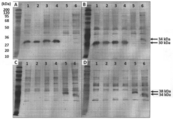
- FIG. 3 shows the results of Western blotting using sera of Nakajima strain and Mie0301 strain.
- A, B, C, and D in the figure are reaction profiles of sera of anti-Iyo I strain, SK05Kyo strain, Nakajima strain, and Mie0301 strain, respectively.
- the leftmost lane in FIG. 1 represents a molecular weight marker.
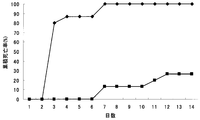
- ⁇ , ⁇ , ⁇ , and ⁇ indicate Iyo I strain, Nakajima strain, Mie strain, and MEM control. It is the graph which showed the daily cumulative mortality change of the attack test by the Iyo I stock
- ⁇ indicates a mixed vaccination group of three species, and ⁇ indicates a MEM control group.
- the inactivated product of each strain used in the present invention can be prepared according to a conventional method, for example, as follows.
- P. dicentrarchi hereinafter referred to as “Homoptera” fed fish cell line CHSE-214 (ATCC No. CRL-1681; distributed by Prof. Nagamori Yoshimizu, Hokkaido University graduate School of Fisheries Sciences) Incubate at 20 ° C. for 5 days.
- the fish cell line CHSE-214 is obtained by using a medium for CHSE-214 cells [Eagle MEM (Minimum Essential Medium) medium formulated with 10% fetal bovine serum (manufactured by Nissui Pharmaceutical: product code 05900) with sodium bicarbonate at pH 7.3.
- the worms cultured in this manner are collected by centrifugation, and inactivated by adding an inactivating agent such as formalin, glutaraldehyde, ⁇ -propiolactone or the like.
- an inactivating agent such as formalin, glutaraldehyde, ⁇ -propiolactone or the like.
- formalin 35% formalin solution is added to a final concentration of 0.3% and inactivated at a temperature of 4 ° C. overnight.
- inactivation conditions are relaxed if antigenicity is impaired by inactivation.
- the deactivation agent can be reduced, the pH buffering agent can be added, and the inactivation temperature can be lowered.
- the protozoa used here are (1) a strain showing the same serotype as Philasterides dicentrarchi Iyo I strain, (2) a strain showing the same serotype as Nakajima strain, and (3) a strain showing the same serotype as Mie0301 strain. That is, three strains showing different serotypes are used.
- a strain showing the same serotype as the Iyo I strain for example, the JF05To strain, the RF05To strain, and the SK05Kyo strain can be used. These strains were isolated and identified by the group of the present inventors, and the details are shown in Table 1.
- Iyo type I (cellotype I type)
- FIGS. 1A and 1B when Western blotting is performed using an anti-Iyo I strain rabbit antibody (FIGS. 1A and 1B), a protein that strongly reacts with 30 kDa is detected (lanes 1 to 4).
- such proteins are not detected with the anti-Nakajima strain rabbit antibody (FIG. 1C) and the anti-Mie0301 strain rabbit antibody (FIG. 1D).
- Nakajima type (cellotype II type)
- a protein strongly reacting with 38 kDa was detected (lane 5).
- Mie0301 type (cellotype III type), when Western blotting was performed using anti-Nakajima strain rabbit antibody and anti-Mie0301 strain rabbit antibody (FIGS. 1C and 1D), a protein strongly reacting with 34 kDa was detected (lane 6). ).
- the morphological features of the worms used in the present invention are approximately 30 ⁇ 400 ⁇ m oval and have cilia. Unlike other ciliates, it is tissue phagocytic and feeds not only bacteria but also animal cells (eg, fish cell lines). The worms are also classified taxonomically as Scuticociliatida, Philasterina, and Philasteridae.
- the subculture of the worms used in the present invention is subcultured to fresh cells once a month under storage at 20 ° C. At least once every few days, the worms are observed under a microscope. If the worms become smaller, they are passaged even within one month. It has been confirmed that the pathogenic change due to the passage is stable for 5 years. In addition, no change in antigenicity due to passage is observed.
- the three-type mixed vaccine of the present invention is a combination of three inactivated vaccines (preferably formalin-inactivated vaccine) having different serotypes.
- the ratio of the combination is not particularly limited, but for example, each single vaccine is used in an amount of 1 to 5 times, preferably 1 to 3 times the number of cells for the smallest single vaccine. It is particularly preferable that each single vaccine is mixed at a ratio of 1: 1: 1.
- the concentration of the combination vaccine of the present invention is not particularly limited. The concentration can be adjusted appropriately according to the usage scene. In particular, if the total amount of each vaccine is 10 5 cells / fish or more, sufficient effectiveness can be obtained.
- the fish species to which the combination vaccine of the present invention can be applied is not particularly limited as long as it is a fish species with the possibility of developing scotchosis, but flounder, turbot, red sea bream, sea bream, sea bream, maita flounder Etc.
- any fish species can be used for fish of any age or any size that may be infected. Examples of the usage include oral administration, intramuscular administration, subcutaneous administration, intraperitoneal administration, and immersion treatment. Among them, intraperitoneal administration can induce sufficient immunity with a small amount of antigen.
- Reference example 1 In order to compare the antigenicity of Philasterides dicentrarchi isolated in different fish species and different regions, an immobilization assay and Western blotting were performed.
- Immobilization assay Isolates of Philasterides dicentrarchi Iyo I, Nakajima, Mie0301, and SK05Kyo were selected to prepare rabbit serum.
- test strains Iyo I strain, Nakajima strain, Mie0301 strain, JF05To strain, RF05To strain, and SK05Kyo strain were used.
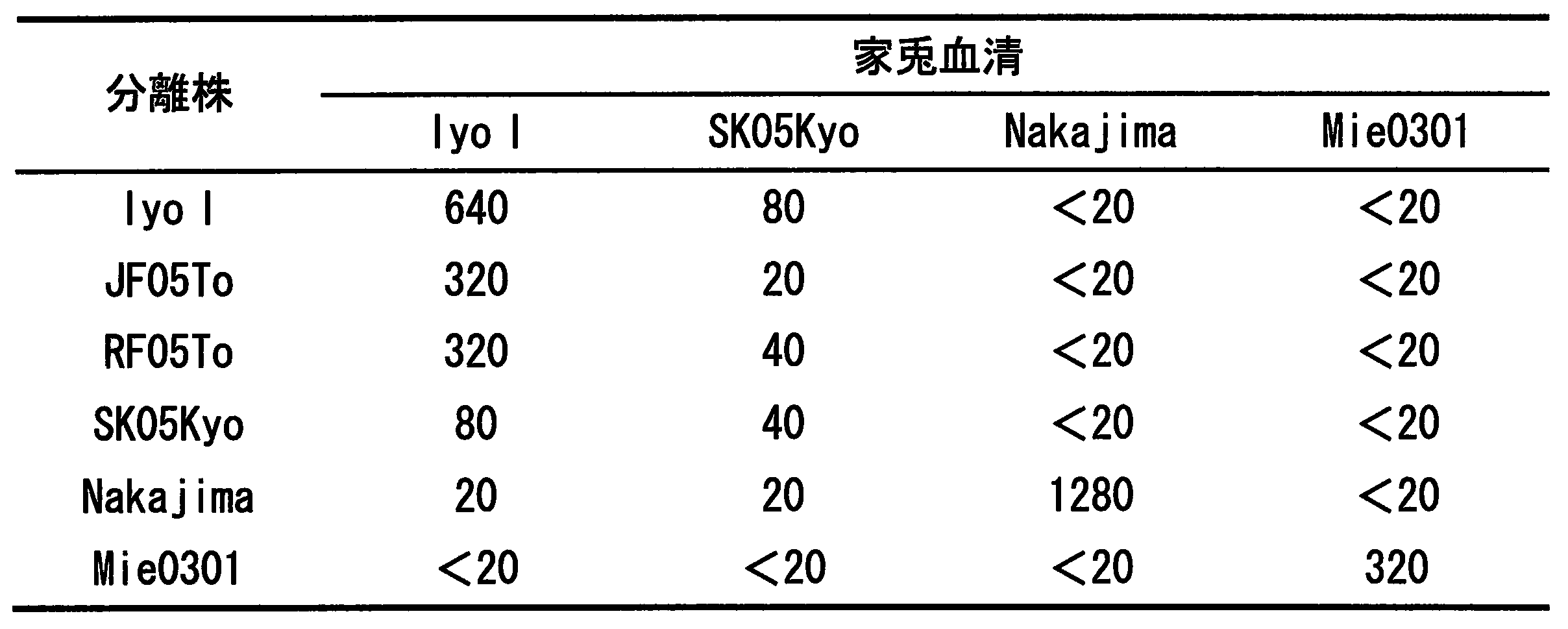
- the above antisera diluted 20, 40, 80, 160, 320, 640, 1280 and 2560 times were sensitized with each strain of Philasterides dicentrarchi (about 100 worms).
- the agglutination and immobilization were observed under a microscope, and the deactivation titer was determined.
- the results are shown in Table 2.
- the anti-Iyo I strain serum (antibody) exhibited an aggregate antibody titer of 80 times or more against the Iyo I, JF05To, RF05To, and SK05Kyo strains. However, it was 20 times or less in Nakajima strain and Mie0301 strain.
- the anti-Nakajima strain serum (antibody) showed an aggregation antibody titer 1280 times that of the Nakajima strain, but was 20 times or less for the remaining 5 strains.
- the anti-Mie0301 sera (antibody) similar to the results of the anti-Nakajima sera (antibody), high immobilization was observed only in the homozygous Mie0301 strain.
- SDS-polyacrylamide gel electrophoresis sample buffer containing the same amount of 10% sodium dodecyl sulfate (SDS) was mixed with the suspension, and heated on a heat block at 100 ° C. for 3 minutes. Proteins were separated on the gel from the suspension by SDS-PAGE. This gel was stained with Coomassie Brilliant Blue (manufactured by Wako Pure Chemical Industries) containing 25% methanol-10% acetic acid.
- the protein separated on SDS-PAGE was transferred to a polyvinylidene fluoride (PVDF) membrane, and the membrane was blocked with TBS-T containing 10% skim milk for 2 hours and washed with TBS-T.
- TBS-T Tris-Buffered Saline-Tween
- a peroxidase-labeled goat anti-rabbit IgG was used as a secondary antibody for 1 hour.
- the membrane was washed with TBS-T, and the band was visualized with an HRP (horseradish peroxidase) Conjugate substrate kit (manufactured by Bio-Rad Laboratories).
- Example 1 Efficacy test of three types of mixed vaccine (1) Preparation of vaccine (a) Test fish 200 larvae of flounder were used as feeds for marine seedlings for otohime flounder (manufactured by Nisshin Marubeni Feed Co., Ltd.) The animals were fed for 2 weeks and preliminarily raised to an average weight of 10.3 g.
- Vaccination 100 ⁇ L of the formalin-inactivated vaccine prepared in (1) above was inoculated intraperitoneally to flounder (average body weight 10.3 g) so as to have a concentration of 6.76 ⁇ 10 5 cells / fish. Two weeks later, immunization was performed as a booster at a concentration of 9.85 ⁇ 10 5 cells / fish. As a control, 100 ⁇ L of the MEM medium itself used in cell culture was inoculated intraperitoneally.
- test fish was housed in a 10-liter aquarium and kept under running water for 2 months to confirm the safety. During the breeding period, the animals were fed in the same manner as described above.
- the Mie0301 strain was inoculated intraperitoneally in the same manner at 4.03 ⁇ 10 5 cells / fish because the pathogenicity of the Mie0301 strain was found to be lower than the other two strains.
- the effectiveness of the vaccine was determined as an effective rate according to the formula: (1—mortality in the vaccination group / mortality in the control group) ⁇ 100%.
- Comparative Example 1 Efficacy Test of Single Vaccine (1) Production of Vaccine Test fish and worms were cultured in the same manner as in the Examples. Formalin-inactivated vaccine was prepared from 1.65 ⁇ 10 6 to 9.85 ⁇ 10 6 cells of the cultured worms (Iyo I strain, Nakajima strain and Mie0301 strain) at a final concentration of 0.3%. 35% formalin (manufactured by Nacalai Tesque) was added and inactivated overnight at 4 ° C. to prepare three types of formalin inactivated vaccines.
- test fish was housed in a 10-liter aquarium and kept under running water for 2 months to confirm the safety. During the breeding period, the animals were fed in the same manner as described above.
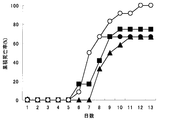
- FIG. 5 attack by Iyo I strain
- FIG. 6 attack by Nakajima strain
- FIG. 7 attack by Mie0301 strain
- the flounder vaccinated with the Iyo I strain was effective against each protozoan attack (Iyo I strain, Nakajima strain and Mie0301 strain) with an effective rate of 41.7%, 0%, and 0% for 13 days of attack, respectively. Yes, even the same serotype was less effective. Only the Iyo I strain was significantly different from the control group at a risk rate of 1% or less.
- flounder vaccinated with the Nakajima strain is effective against each protozoan attack (Iyo I strain, Nakajima strain and Mie0301 strain), with an effective rate of 0%, 21.4%, and 0% after 13 days of attack.
- the effect was low even with the same serotype. All strains were not significantly different from the control group.
- flounder vaccinated with the Mie0301 strain was effective against each protozoan attack (Iyo I strain, Nakajima strain, and Mie0301 strain), with an effective rate of 33.3%, 25.0%, and 13 days of attack, respectively. The effect was low even with the same serotype. Only the Mie0301 strain and the Iyo I strain were significantly different from the control group at a risk rate of 5% or less.
- Example 2 Efficacy test of three types of mixed vaccine by high-concentration single immunization (1) Preparation of vaccine (a) Test fish 160 larvae of juvenile larvae, feed for marine seedlings for Otohime flounder (Nisshin Marubeni) Feeding Company) was used for 2 weeks and pre-bred to an average body weight of 12.5 g.
- test fish was housed in a 10-liter aquarium, and was observed for 2 months under running water to confirm safety. During the breeding period, the animals were fed in the same manner as described above.
Landscapes
- Health & Medical Sciences (AREA)
- Life Sciences & Earth Sciences (AREA)
- Veterinary Medicine (AREA)
- Medicinal Chemistry (AREA)
- Chemical & Material Sciences (AREA)
- Pharmacology & Pharmacy (AREA)
- Tropical Medicine & Parasitology (AREA)
- Animal Behavior & Ethology (AREA)
- General Health & Medical Sciences (AREA)
- Public Health (AREA)
- Epidemiology (AREA)
- Immunology (AREA)
- Mycology (AREA)
- Microbiology (AREA)
- Chemical Kinetics & Catalysis (AREA)
- Organic Chemistry (AREA)
- Nuclear Medicine, Radiotherapy & Molecular Imaging (AREA)
- General Chemical & Material Sciences (AREA)
- Medicines Containing Antibodies Or Antigens For Use As Internal Diagnostic Agents (AREA)
Abstract
Description
そのような状況の中で本虫のホルマリン不活化ワクチンがスクーチカ症に有効であること(特許文献2、非特許文献4および5)や特定の金属を欠如させた淡水浴による予防・治療方法が報告されている(特許文献3)。
[1](1)フィラステリデス・ディセントラーチ(Philasterides dicentrarchi)Iyo I株と同じ血清型を示す株の不活化物、(2)フィラステリデス・ディセントラーチ Nakajima株と同じ血清型を示す株の不活化物、及び(3)フィラステリデス・ディセントラーチ Mie0301株と同じ血清型を示す株の不活化物を有効成分とする、スクーチカ症の予防又は治療用の混合ワクチン;
[2]フィラステリデス・ディセントラーチ Iyo I株と同じ血清型を示す株が、Iyo I株、JF05To株、RF05To株、及びSK05Kyo株からなる群から選んだ株である、[1]に記載の混合ワクチン;
[3][1]又は[2]に記載の混合ワクチンを、スクーチカ症の予防又は治療の必要な対象に、有効量で投与することを含む、スクーチカ症の予防又は治療方法;
[4](1)フィラステリデス・ディセントラーチ Iyo I株と同じ血清型を示す株、(2)フィラステリデス・ディセントラーチ Nakajima株と同じ血清型を示す株、及び(3)フィラステリデス・ディセントラーチ Mie0301株と同じ血清型を示す株の、スクーチカ症の予防又は治療用の混合ワクチンの製造における使用;
[5](1)フィラステリデス・ディセントラーチ Iyo I株と同じ血清型を示す株、(2)フィラステリデス・ディセントラーチ Nakajima株と同じ血清型を示す株、及び(3)フィラステリデス・ディセントラーチ Mie0301株と同じ血清型を示す株を、それぞれ単独で、あるいは、2つ以上を組合せて、不活化する工程、並びに、
得られた不活化物を混合する工程
を含むことを特徴とする、[1]又は[2]に記載の混合ワクチンの製造方法
に関する。
これらの株は、本発明者のグループが単離・同定したものであり、その詳細を表1に示す。

Nakajima型(セロタイプII型)では、抗Nakajima株ウサギ抗体および抗Mie0301株ウサギ抗体を用いてウエスタンブロッティングを行った時(図1C及び図1D)、38kDaに強く反応するタンパク質が検出される(レーン5)。
Mie0301型(セロタイプIII型)では、抗Nakajima株ウサギ抗体および抗Mie0301株ウサギ抗体を用いてウエスタンブロッティングを行った時(図1C及び図1D)、34kDaに強く反応するタンパク質が検出される(レーン6)。
本発明で用いる本虫の継代培養は、20℃の保存下で一ヶ月に一度、フレッシュな細胞に継代する。少なくとも数日に一度、顕微鏡下で本虫を観察し、虫体が小さくなってきた場合には、一ヶ月以内でも継代を行う。前記継代による病原性変化は5年間安定であることを確認している。また、継代による抗原性の変化も認められていない。
本発明の混合ワクチンの濃度としては、特に限定する必要はない。使用場面に応じて適宜濃度を調整して使用することができる。特に、各ワクチンの合計量として、105cells/fish以上であれば、十分な有効性が得られる。
本発明の混合ワクチンによって有効な予防・治療ができる原虫としては、Philasterides dicentrarchi Iyo I株、Nakajima株、Mie0301株、JF05To株、RF05To株、SK05Kyo株などが挙げられる。
異なる魚種、異なる地域で分離されたPhilasterides dicentrarchiの抗原性を比較するために、非動化アッセイおよびウエスタンブロッティングを行った。
(1)非動化アッセイ
Philasterides dicentrarchiのIyo I、Nakajima、Mie0301、SK05Kyoの各分離株を選択し、家兎血清を作製した。供試株には、Iyo I株、Nakajima株、Mie0301株、JF05To株、RF05To株、SK05Kyo株を用いた。非動化アッセイには、上記の抗血清を20、40、80、160、320、640、1280および2560倍に希釈したものを、Philasterides dicentrarchiのそれぞれの株(約100虫体)と感作し、顕微鏡下で凝集および非動化を観察し、非動化力価を求めた。
ウエスタンブロッティングは定法により以下の方法で行った。抗血清および株は上記の非動化アッセイと同様のものを用いた。
本虫を、イーグルMEM培地「ニッスイ」(日水製薬株式会社製)に10%牛胎児血清(FBS)を配合し、7.5%の炭酸水素ナトリウム水でpH7.3に調整した培地で単層に培養した魚類株化細胞CHSE-214細胞上で、5日間培養した。
本虫を培養後、遠心分離(500×g、20℃、5分)にて本虫を回収し、FBSを含まないイーグルMEM培地で洗浄後、Tris-EDTA緩衝液に懸濁させた。懸濁液に同量の10%ドデシル硫酸ナトリウム(SDS)を含むSDS-ポリアクリルアミドゲル電気泳動(SDS-PAGE)サンプルバッファーを混合し、ヒートブロック上で100℃、3分加熱した。その懸濁液からSDS-PAGEによりゲル上でタンパク質を分離した。このゲルを25%メタノール-10%酢酸含有のクマシーブリリアントブルー(和光純薬製)で染色した。
次に、ブロッキングした膜を一次抗体として抗血清ともに1時間反応させ、TBS-T(Tris-Buffered Saline-Tween)で洗浄した。さらに、二次抗体として、ペルオキシダーゼ標識ヤギ抗ウサギIgGを用いて1時間反応させた。その膜をTBS-Tで洗浄し、HRP(horseradish peroxidase)Conjugate substrateキット(バイオ・ラッド・ラボラトリーズ社製)でバンドを可視化した。
一方、抗Nakajima株血清(図1C)および抗Mie0301株血清(図1D)を用いた場合には、Nakajima株、Mie0301株でそれぞれ38kDa、34kDaで強いバンドを示した。
(1)ワクチンの作製
(a)供試魚
ヒラメの稚魚200匹を、おとひめヒラメ用海産種苗用飼料(日清丸紅飼料社製)を用いて2週間給餌して、平均体重10.3gになるまで予備飼育したものを使用した。
本虫は、イーグルMEM培地「ニッスイ」(日水製薬株式会社製)に10%牛胎児血清を配合し、7.5%の炭酸水素ナトリウム水でpH7.3に調整した培地で単層に培養した魚類株化細胞CHSE-214細胞上で、5日間培養した。
上記培養した本虫(Iyo I株、Nakajima株及びMie0301株)1.65×10⁶~9.85×10⁶cellsを、終濃度が0.3%となるように35%ホルマリン(ナカライテスク製)を加え、4℃で一昼夜不活化させて、3種類のホルマリン不活化ワクチンを調製した。そして、上記の3種類のワクチンを同一比率で加えて混合ワクチンを調製した。
上記(1)で作製したホルマリン不活化ワクチンをヒラメ(平均体重10.3g)に6.76×10⁵cells/fishの濃度となるように、100μLを腹腔内接種した。そして、2週間後、追加免疫として9.85×105cells/fishの濃度で免疫を行った。
また、対照として細胞培養で用いたMEM培地そのものを100μL腹腔内に接種した。
ワクチン接種後、供試魚を10Lの水槽に収容し、流水を行いながら、2ヶ月間飼育観察を行い、安全性を確認した。飼育期間中は前記と同様に給餌した。
最終免疫して4日目に、混合ワクチンで免疫したヒラメ(ワクチン接種区)および免疫を行わなかったヒラメ(対照区)を、それぞれ4つの区に分け、各区15匹で試験を行った。Iyo I株、Nakajima株及びMie0301株の各株により感染させた。また、比較するため、ワクチン接種区および対照区に本虫を感染させない区を入れた。Iyo I株およびNakajima株では、4.03×10⁴cells/fishで100μLとなるように腹腔内接種した。また、Mie0301株では、予備試験の結果から他の2株よりも病原性が低いことが明らかにされたことから4.03×105cells/fishで同様に腹腔内接種した。
ワクチンの有効性は(1-ワクチン接種区の死亡率/対照区の死亡率)×100%の式により、有効率として求めた。
結果(経日的累積死亡率の変化)を図2(Iyo I株による攻撃)、図3(Nakajima株による攻撃)、図4(Mie0301株による攻撃)に示す。
3種混合ワクチンを接種したヒラメは各原虫の攻撃(Iyo I株、Nakajima株及びMie0301株)に対し、14日間の攻撃日数での有効率はそれぞれ75%、73.3%及び92.9%とともに良好な免疫効果を示した。Iyo I株及びNakajima株では5%以下の危険率で有意差が認められた。Mie0301株では1%以下の危険率で有意差が認められた。
(1)ワクチンの作製
供試魚および本虫の培養は実施例と同様の方法で行った。ホルマリン不活化ワクチンの調製は上記培養した本虫(Iyo I株、Nakajima株及びMie0301株)1.65×10⁶~9.85×10⁶cellsを、終濃度が0.3%となるように35%ホルマリン(ナカライテスク製)を加え、4℃で一昼夜不活化させて、3種類のホルマリン不活化ワクチンを調製した。
上記(1)で作製した3種のホルマリン不活化ワクチンをヒラメ(平均体重10.05g)に1.65×10⁵cells/fishの濃度となるように、100μLを腹腔内接種した。そして、2週間後、追加免疫として3×105cells/fishの濃度で免疫を行った。
また、対照として細胞培養で用いたMEM培地そのものを100μL腹腔内に接種した。
ワクチン接種後、供試魚を10Lの水槽に収容し、流水を行いながら、2ヶ月間飼育観察を行い、安全性を確認した。飼育期間中は前記と同様に給餌した。
最終免疫して4日目に、3種のホルマリン不活化ワクチンで各々免疫したヒラメ(ワクチン接種区)および免疫を行わなかったヒラメ(対照区)を、それぞれ4つに分け、16区とし、各区15匹で試験を行った。Iyo I株、Nakajima株及びMie0301株の各株により感染させた。感染力価は、6.12×10⁵cells/fishで100μLとなるように腹腔内接種した。
ワクチンの有効性は(1-ワクチン接種区の死亡率/対照区の死亡率)×100%の式により、有効率として求めた。
結果(経日的累積死亡率の変化)を図5(Iyo I株による攻撃)、図6(Nakajima株による攻撃)、図7(Mie0301株による攻撃)に示す。
Iyo I株によるワクチンを接種したヒラメは各原虫の攻撃(Iyo I株、Nakajima株及びMie0301株)に対し、13日間の攻撃日数での有効率はそれぞれ41.7%、0%及び0%であり、同じ血清型のものでも効果が低くかった。Iyo I株だけが対照区に対して、1%以下の危険率で有意差が認められた。
また、Nakajima株によるワクチンを接種したヒラメは各原虫の攻撃(Iyo I株、Nakajima株及びMie0301株)に対し、13日間の攻撃日数での有効率は0%、21.4%、及び0%であり、同様に同じ血清型のものでも効果が低くかった。全ての株とも対照区に対して、有意差はなかった。
さらに、Mie0301株によるワクチンを接種したヒラメは各原虫の攻撃(Iyo I株、Nakajima株及びMie0301株)に対し、13日間の攻撃日数での有効率はそれぞれ33.3%、25.0%及び33.3%であり、同じ血清型のものでも効果が低くかった。Mie0301株及びIyo I株だけが対照区に対して、5%以下の危険率で有意差が認められた。
(1)ワクチンの作製
(a)供試魚
ヒラメの稚魚160匹を、おとひめヒラメ用海産種苗用飼料(日清丸紅飼料社製)を用いて2週間給餌して、平均体重12.5gになるまで予備飼育したものを使用した。
本虫は、イーグルMEM培地「ニッスイ」(日水製薬株式会社製)に10%牛胎児血清を配合し、7.5%の炭酸水素ナトリウム水でpH7.3に調整した培地で単層に培養した魚類株化細胞CHSE-214細胞上で、5日間培養した。
上記培養した本虫(Iyo I株、Nakajim株及びMie030株)4.30×10⁶~8.85×10⁶cellsを、終濃度が0.3%となるように35%ホルマリン(ナカライテスク製)を加え、4℃で一昼夜不活化させて、3種類のホルマリン不活化ワクチンを調製した。そして、上記の3種類のワクチンを同一比率で加えて混合ワクチンを調製した。
上記(1)で作製した各種のホルマリン不活化ワクチンをヒラメに2.15×10⁶cells/fishの濃度となるように、100μLを腹腔内接種した。
また、対照として細胞培養で用いたMEM培地そのものを100μL腹腔内に接種した。
ワクチン接種後、供試魚を10Lの水槽に収容し、流水で、2ヶ月間飼育観察を行い、安全性を確認した。飼育期間中は前記と同様に給餌した。
免疫して11日目に、混合ワクチンで免疫したヒラメ(ワクチン接種区)および免疫を行わなかったヒラメ(対照区)を、それぞれ2つの区に分け、各区30匹で試験を行った。3.6×10⁵cells/fishでIyo I株を腹腔内接種で感染させた。また、ワクチン接種区および対照区に本虫を感染させない区を入れた。
ワクチンの有効性は(1-ワクチン接種区の死亡率/対照区の死亡率)×100%の式により、有効率として求めた。
結果(経日的累積死亡率の変化)を図8に示す。
3種混合ワクチンを接種したヒラメはIyo I株の攻撃に対し、14日間の攻撃日数での有効率はそれぞれ68.5%と良好な免疫効果を示し、5%以下の危険率で有意差が認められた。3種混合ワクチンおよび対照区の非感染区は、斃死が認められなかったため、図8から省略した。
以上、本発明を特定の態様に沿って説明したが、当業者に自明の変形や改良は本発明の範囲に含まれる。
Claims (5)
- (1)フィラステリデス・ディセントラーチ(Philasterides dicentrarchi)Iyo I株と同じ血清型を示す株の不活化物、(2)フィラステリデス・ディセントラーチ Nakajima株と同じ血清型を示す株の不活化物、及び(3)フィラステリデス・ディセントラーチ Mie0301株と同じ血清型を示す株の不活化物を有効成分とする、スクーチカ症の予防又は治療用の混合ワクチン。
- フィラステリデス・ディセントラーチ Iyo I株と同じ血清型を示す株が、Iyo I株、JF05To株、RF05To株、及びSK05Kyo株からなる群から選んだ株である、請求項1に記載の混合ワクチン。
- 請求項1又は2に記載の混合ワクチンを、スクーチカ症の予防又は治療の必要な対象に、有効量で投与することを含む、スクーチカ症の予防又は治療方法。
- (1)フィラステリデス・ディセントラーチ Iyo I株と同じ血清型を示す株、(2)フィラステリデス・ディセントラーチ Nakajima株と同じ血清型を示す株、及び(3)フィラステリデス・ディセントラーチ Mie0301株と同じ血清型を示す株の、スクーチカ症の予防又は治療用の混合ワクチンの製造における使用。
- (1)フィラステリデス・ディセントラーチ Iyo I株と同じ血清型を示す株、(2)フィラステリデス・ディセントラーチ Nakajima株と同じ血清型を示す株、及び(3)フィラステリデス・ディセントラーチ Mie0301株と同じ血清型を示す株を、それぞれ単独で、あるいは、2つ以上を組合せて、不活化する工程、並びに、
得られた不活化物を混合する工程
を含むことを特徴とする、請求項1又は2に記載の混合ワクチンの製造方法。
Priority Applications (3)
| Application Number | Priority Date | Filing Date | Title |
|---|---|---|---|
| JP2010533929A JP5598820B2 (ja) | 2008-10-16 | 2009-10-16 | 魚類のスクーチカ症予防治療ワクチン |
| ES201190026A ES2445016B1 (es) | 2008-10-16 | 2009-10-16 | Vacuna para el tratamiento/la prevencion de escuticociliatosis en peces |
| CN2009801410778A CN102186498B (zh) | 2008-10-16 | 2009-10-16 | 鱼类的盾纤虫病预防治疗疫苗 |
Applications Claiming Priority (2)
| Application Number | Priority Date | Filing Date | Title |
|---|---|---|---|
| JP2008-267669 | 2008-10-16 | ||
| JP2008267669 | 2008-10-16 |
Publications (1)
| Publication Number | Publication Date |
|---|---|
| WO2010044451A1 true WO2010044451A1 (ja) | 2010-04-22 |
Family
ID=42106615
Family Applications (1)
| Application Number | Title | Priority Date | Filing Date |
|---|---|---|---|
| PCT/JP2009/067876 Ceased WO2010044451A1 (ja) | 2008-10-16 | 2009-10-16 | 魚類のスクーチカ症予防治療ワクチン |
Country Status (5)
| Country | Link |
|---|---|
| JP (1) | JP5598820B2 (ja) |
| KR (1) | KR20110081233A (ja) |
| CN (1) | CN102186498B (ja) |
| ES (1) | ES2445016B1 (ja) |
| WO (1) | WO2010044451A1 (ja) |
Cited By (1)
| Publication number | Priority date | Publication date | Assignee | Title |
|---|---|---|---|---|
| JP6316497B1 (ja) * | 2016-12-27 | 2018-04-25 | ソウル大学校産学協力団Snu R&Db Foundation | アレキサンドリウム属渦鞭毛藻類を含むスクーチカ虫抑制用組成物及び方法 |
Families Citing this family (4)
| Publication number | Priority date | Publication date | Assignee | Title |
|---|---|---|---|---|
| KR20170001379A (ko) | 2015-06-26 | 2017-01-04 | 전남대학교산학협력단 | 조피볼락의 비정형 에어로모나스 살모니시다의 불활화 백신 조성물 |
| KR101640716B1 (ko) | 2015-09-11 | 2016-07-22 | 제주대학교 산학협력단 | 면역보조제를 첨가한 스쿠티카충 백신 조성물 |
| CN108743930B (zh) * | 2018-06-15 | 2021-05-11 | 大连海洋大学 | 红鳍东方鲀海洋尾丝虫病疫苗的制备方法 |
| CN120361200B (zh) * | 2025-04-22 | 2026-01-30 | 大连海洋大学 | 一种盾纤毛虫膜蛋白疫苗及其制备方法与应用 |
Family Cites Families (1)
| Publication number | Priority date | Publication date | Assignee | Title |
|---|---|---|---|---|
| JP3882939B1 (ja) * | 2006-08-11 | 2007-02-21 | 助川化学株式会社 | 魚のスクーチカ症治療方法及び予防方法 |
-
2009
- 2009-10-16 ES ES201190026A patent/ES2445016B1/es not_active Expired - Fee Related
- 2009-10-16 CN CN2009801410778A patent/CN102186498B/zh not_active Expired - Fee Related
- 2009-10-16 KR KR1020117009653A patent/KR20110081233A/ko not_active Ceased
- 2009-10-16 JP JP2010533929A patent/JP5598820B2/ja not_active Expired - Fee Related
- 2009-10-16 WO PCT/JP2009/067876 patent/WO2010044451A1/ja not_active Ceased
Non-Patent Citations (5)
| Title |
|---|
| LEE, EUN HYE ET AL.: "Can the surface immobilization antigens of Philasterides dicentrarchi(Ciliophora: Scuticociliatida) be used as target antigens to develop vaccines in cultured fish?", FISH & SHELLFISH IMMUNOLOGY, vol. 24, no. 1, October 2007 (2007-10-01), pages 142 - 146 * |
| LEE, EUN HYE ET AL.: "Immobilization antigen- independent protection of olive flounder (Paralichthys olivaceus) against Philasterides dicentrarchi(Ciliophora : Scuticociliatia) infection", AQUACULTURE, vol. 279, no. 1-4, July 2008 (2008-07-01), pages 211 - 213 * |
| PIAZZON, C. ET AL.: "Antigenic and cross- protection studies on two turbot scuticociliate isolates", FISH & SHELLFISH IMMUNOLOGY, vol. 25, no. 4, June 2008 (2008-06-01), pages 417 - 424 * |
| SONG J. Y. ET. AL.,: "Antigenic differences of scuticociliate Miamiensis avidus isolated in Japan", FIFTH INTERNATIONAL SYMPOSIUM OF THE JAPANESE SOCIETY FOR FISH PATHOLOGY, vol. 2008, 18 October 2008 (2008-10-18), pages 99 * |
| SONG J-Y ET AL.: "Antigenic differences of the the scuticociliate Miamiensis avidus from Japan", JOURNAL OF FISH DISEASES, vol. 32, no. 12, December 2009 (2009-12-01), pages 1027 - 1034 * |
Cited By (1)
| Publication number | Priority date | Publication date | Assignee | Title |
|---|---|---|---|---|
| JP6316497B1 (ja) * | 2016-12-27 | 2018-04-25 | ソウル大学校産学協力団Snu R&Db Foundation | アレキサンドリウム属渦鞭毛藻類を含むスクーチカ虫抑制用組成物及び方法 |
Also Published As
| Publication number | Publication date |
|---|---|
| CN102186498A (zh) | 2011-09-14 |
| CN102186498B (zh) | 2013-11-06 |
| KR20110081233A (ko) | 2011-07-13 |
| ES2445016R1 (es) | 2014-05-08 |
| ES2445016B1 (es) | 2015-03-10 |
| ES2445016A2 (es) | 2014-02-27 |
| JP5598820B2 (ja) | 2014-10-01 |
| JPWO2010044451A1 (ja) | 2012-03-15 |
Similar Documents
| Publication | Publication Date | Title |
|---|---|---|
| Wise et al. | Oral vaccination of channel catfish against enteric septicemia of catfish using a live attenuated Edwardsiella ictaluri isolate | |
| JP5598820B2 (ja) | 魚類のスクーチカ症予防治療ワクチン | |
| Valero et al. | Bei inactivated vaccine induces innate and adaptive responses and elicits partial protection upon reassortant betanodavirus infection in senegalese sole | |
| Liu et al. | Immune responses and protection induced by Brucella suis S2 bacterial ghosts in mice | |
| Fontana et al. | Rabies VLPs adjuvanted with saponin-based liposomes induce enhanced immunogenicity mediated by neutralizing antibodies in cattle, dogs and cats | |
| Naguib et al. | Comparative effectiveness of various multi-antigen vaccines in controlling Campylobacter jejuni in Broiler chickens | |
| Schrøder et al. | Early vaccination and protection of Atlantic cod (Gadus morhua L.) juveniles against classical vibriosis | |
| Kudyar et al. | Periodontal vaccine: A dream or reality | |
| JPH04507098A (ja) | トキソプラズマオーシストの散布に対してネコを免疫感作するためのワクチン | |
| CN1097466C (zh) | 沙门氏菌活疫苗 | |
| FR2499410A1 (fr) | Vaccin contre l'avortement enzootique chez les brebis et son procede de preparation | |
| Manchanayake et al. | Oral adjuvanted Vibrio vaccine enhances antibody production and lysozyme activity in the serum and mucus of marine-cultured red hybrid tilapia (Oreochromis sp.) against V. harveyi and V. alginolyticus | |
| Camussone et al. | Immune response and functional role of antibodies raised in heifers against a Staphylococcus aureus CP5 lysate and recombinant antigens vaccine formulated with Iscom Matrix adjuvant | |
| AU597709B2 (en) | Vaccines for fowl colibacillosis | |
| Salmakov et al. | Comparative study of the immunobiological properties of live brucellosis vaccines | |
| Corripio-Miyar et al. | Vaccination experiments in the gadoid haddock, Melanogrammus aeglefinus L., against the bacterial pathogen Vibrio anguillarum | |
| Du | Development of a novel vaccine against Cryptosporidium parvum using an attenuated Salmonella vector | |
| US4312947A (en) | Process for the preparation of a vaccine against panleucopenia of the cat | |
| JP5240811B2 (ja) | マダイ滑走細菌症ワクチン及びマダイ滑走細菌症ワクチン組成物並びにマダイ滑走細菌症の予防法 | |
| JP4905649B2 (ja) | 魚用ワクチン、その製造方法、および魚類感染症の予防方法 | |
| TW200303212A (en) | Selection of poultry eimeria strains through extra-intestinal sporozoites | |
| Aly et al. | Preparation and the assessed efficacy of oral baits for the vaccination of free-roaming dogs against rabies | |
| Belyaeva et al. | Development and testing of a vaccine against infectious atrophic rhinitis and pasteurellosis in pigs | |
| Dharan et al. | Rivers’s postulates fulfilled for blue catfish alloherpesvirus | |
| Varloud et al. | Comparative preventive efficacy of oral systemic vs. topical repellent ectoparasiticides against early Babesia canis transmission in dogs within 8 h of infestation by pre-fed male Dermacentor reticulatus |
Legal Events
| Date | Code | Title | Description |
|---|---|---|---|
| WWE | Wipo information: entry into national phase |
Ref document number: 200980141077.8 Country of ref document: CN |
|
| 121 | Ep: the epo has been informed by wipo that ep was designated in this application |
Ref document number: 09820629 Country of ref document: EP Kind code of ref document: A1 |
|
| WWE | Wipo information: entry into national phase |
Ref document number: 2010533929 Country of ref document: JP |
|
| ENP | Entry into the national phase |
Ref document number: 201190026 Country of ref document: ES Kind code of ref document: A |
|
| WWE | Wipo information: entry into national phase |
Ref document number: P201190026 Country of ref document: ES |
|
| NENP | Non-entry into the national phase |
Ref country code: DE |
|
| ENP | Entry into the national phase |
Ref document number: 20117009653 Country of ref document: KR Kind code of ref document: A |
|
| 122 | Ep: pct application non-entry in european phase |
Ref document number: 09820629 Country of ref document: EP Kind code of ref document: A1 |