WO2010041407A1 - 離型ポリエステルフィルムの製造方法 - Google Patents
離型ポリエステルフィルムの製造方法 Download PDFInfo
- Publication number
- WO2010041407A1 WO2010041407A1 PCT/JP2009/005145 JP2009005145W WO2010041407A1 WO 2010041407 A1 WO2010041407 A1 WO 2010041407A1 JP 2009005145 W JP2009005145 W JP 2009005145W WO 2010041407 A1 WO2010041407 A1 WO 2010041407A1
- Authority
- WO
- WIPO (PCT)
- Prior art keywords
- polyester film
- release
- film
- release layer
- coating
- Prior art date
- Legal status (The legal status is an assumption and is not a legal conclusion. Google has not performed a legal analysis and makes no representation as to the accuracy of the status listed.)
- Ceased
Links
Classifications
-
- C—CHEMISTRY; METALLURGY
- C08—ORGANIC MACROMOLECULAR COMPOUNDS; THEIR PREPARATION OR CHEMICAL WORKING-UP; COMPOSITIONS BASED THEREON
- C08J—WORKING-UP; GENERAL PROCESSES OF COMPOUNDING; AFTER-TREATMENT NOT COVERED BY SUBCLASSES C08B, C08C, C08F, C08G or C08H
- C08J7/00—Chemical treatment or coating of shaped articles made of macromolecular substances
- C08J7/12—Chemical modification
- C08J7/123—Treatment by wave energy or particle radiation
-
- C—CHEMISTRY; METALLURGY
- C09—DYES; PAINTS; POLISHES; NATURAL RESINS; ADHESIVES; COMPOSITIONS NOT OTHERWISE PROVIDED FOR; APPLICATIONS OF MATERIALS NOT OTHERWISE PROVIDED FOR
- C09J—ADHESIVES; NON-MECHANICAL ASPECTS OF ADHESIVE PROCESSES IN GENERAL; ADHESIVE PROCESSES NOT PROVIDED FOR ELSEWHERE; USE OF MATERIALS AS ADHESIVES
- C09J7/00—Adhesives in the form of films or foils
- C09J7/40—Adhesives in the form of films or foils characterised by release liners
- C09J7/403—Adhesives in the form of films or foils characterised by release liners characterised by the structure of the release feature
-
- C—CHEMISTRY; METALLURGY
- C08—ORGANIC MACROMOLECULAR COMPOUNDS; THEIR PREPARATION OR CHEMICAL WORKING-UP; COMPOSITIONS BASED THEREON
- C08J—WORKING-UP; GENERAL PROCESSES OF COMPOUNDING; AFTER-TREATMENT NOT COVERED BY SUBCLASSES C08B, C08C, C08F, C08G or C08H
- C08J2367/00—Characterised by the use of polyesters obtained by reactions forming a carboxylic ester link in the main chain; Derivatives of such polymers
- C08J2367/02—Polyesters derived from dicarboxylic acids and dihydroxy compounds
-
- C—CHEMISTRY; METALLURGY
- C09—DYES; PAINTS; POLISHES; NATURAL RESINS; ADHESIVES; COMPOSITIONS NOT OTHERWISE PROVIDED FOR; APPLICATIONS OF MATERIALS NOT OTHERWISE PROVIDED FOR
- C09J—ADHESIVES; NON-MECHANICAL ASPECTS OF ADHESIVE PROCESSES IN GENERAL; ADHESIVE PROCESSES NOT PROVIDED FOR ELSEWHERE; USE OF MATERIALS AS ADHESIVES
- C09J2467/00—Presence of polyester
- C09J2467/006—Presence of polyester in the substrate
Definitions
- the present invention relates to a method for producing a release polyester film in which an arbitrary release layer surface region of a biaxial polyester film having a release layer is heavyly peeled.
- a release polyester film having a polyester film as a base material is a film in which a resin having a lower surface tension than the polyester material of the base material is provided as a release layer on at least one side of the polyester film as the base material.
- the release layer resin include a silicone resin, a polyolefin resin, a low-molecular polyolefin (wax) resin, a long-chain alkyl resin, and a fluororesin.
- the release polyester film is usually produced by providing a resin having a surface tension lower than that of polyester as a base material as a release layer.
- the release layer is prepared by dissolving or dispersing a resin in a solvent or water and applying / drying / curing the resin on the film, or forming the resin into a film and laminating it with the polyester film of the substrate.
- the polyester film of the base material is formed by a method or the like.
- the method of providing the release layer by in-line coating before lateral stretching is an excellent method from the viewpoint of drying and curing at a high temperature and the simplification of the processing process. It has been.
- the release polyester film is used for various purposes, and in particular, it is widely used for adhesive products.
- a pressure-sensitive adhesive product a pressure-sensitive adhesive layer is formed on a substrate, and a laminate of a release polyester film is widely used for protecting the pressure-sensitive adhesive.
- the adhesive layer was partially formed instead of the entire surface for the purpose of adjusting the adhesive strength, preventing blocking of the edge part when roll-slit the adhesive product, and using it for protective film applications.
- the pressure-sensitive adhesive product in which the pressure-sensitive adhesive layer is partially formed can have a difference in thickness depending on the presence or absence of the pressure-sensitive adhesive layer in the product, so that when it is made into a roll, winding wrinkles may occur or the roll appearance may deteriorate.
- a pressure-sensitive adhesive product having a partial difference in pressure-sensitive adhesive performance it does not have a stickiness in a desired part without using a means of partial formation of the pressure-sensitive adhesive layer, or the pressure-sensitive adhesive property is very low.
- a method of obtaining a pressure-sensitive adhesive product that can form a region has an objective function such as blocking of an edge part when roll slitting the pressure-sensitive adhesive product, and a protective film application, and also has a good appearance.
- a film-forming resin layer is provided on at least one surface of a release film, and a silicone release agent layer is partially formed on the film-forming resin layer (Patent Document 1).
- the light weight pattern of the peeling force is determined at the time of release film production, if there are many types of patterns, it is necessary to create a coating plate for each of them, and in general, this is not yet done.
- the application portion can only be formed in a straight belt shape, and there is a problem that a curved belt shape, an intermittent belt shape, or an enclosed belt-like region having different peeling forces cannot be formed.
- this method cannot be achieved by in-line coating in the process of forming a polyester film. This is because when coating is performed using a gravure roll that can be partially coated, temperature unevenness occurs in areas where the coating liquid is applied and areas where the coating liquid is not applied, and the film cannot be uniformly stretched during transverse stretching. Therefore, even in a release polyester film provided with a release layer by in-line coating, a method for producing a release polyester film partially having regions with different peeling forces is desired.
- a release film having a region with a partially different peel force is effective.
- the yield can be improved by having a region having high adhesion to the film.
- the problem to be solved by the present invention is that an arbitrary region of the release layer surface of the release polyester film having a release layer provided on the entire surface is subjected to heavy release, adhesiveness with an adhesive, and adhesion with a ceramic slurry. It is to provide a method for producing a release polyester film that controls the properties and has high suitability for slitting.
- the gist of the present invention resides in a method for producing a release polyester film characterized by plasma-treating an arbitrary region on the release layer surface of a polyester film having a release layer on at least one surface under atmospheric pressure. .
- the polyester used for the polyester film may be a homopolyester or a copolyester.
- a homopolyester those obtained by polycondensation of an aromatic dicarboxylic acid and an aliphatic glycol are preferred.
- the aromatic dicarboxylic acid include terephthalic acid and 2,6-naphthalenedicarboxylic acid
- examples of the aliphatic glycol include ethylene glycol, diethylene glycol, and 1,4-cyclohexanedimethanol.
- Representative polyesters include polyethylene terephthalate (PET), polyethylene-2,6-naphthalenedicarboxylate (PEN), and the like.
- a copolymer containing 30 mol% or less of the third component is preferable.
- the dicarboxylic acid component of the copolyester include one or two of isophthalic acid, terephthalic acid phthalate, 2,6-naphthalenedicarboxylic acid, adipic acid sebacic acid, oxycarboxylic acid (for example, P-oxybenzoic acid, etc.), etc.
- the glycol component include ethylene glycol, diethylene glycol, propylene glycol, butanediol, 1,4-cyclohexanedimethanol, neopentyl glycol, and the like.
- the polyester referred to in the present invention is usually 80 mol% or more, preferably 90 mol% or more of polyethylene terephthalate having ethylene terephthalate units, or polyethylene-2,6-naphthalate having ethylene-2,6-naphthalate units. Refers to a polyester that is the like.
- the polyester layer in the present invention it is preferable to blend particles for the main purpose of imparting slipperiness.
- the kind of the particle to be blended is not particularly limited as long as it is a particle capable of imparting slipperiness.
- Specific examples thereof include silica, calcium carbonate, magnesium carbonate, barium carbonate, calcium sulfate, calcium phosphate, and magnesium phosphate. , Particles of kaolin, aluminum oxide, titanium oxide and the like.
- the heat-resistant organic particles described in JP-B-59-5216, JP-A-59-217755 and the like may be used.
- examples of other heat-resistant organic particles include thermosetting urea resins, thermosetting phenol resins, thermosetting epoxy resins, benzoguanamine resins, and the like.
- precipitated particles in which a part of a metal compound such as a catalyst is precipitated and finely dispersed can be used during the polyester production process.
- shape of the particles to be used is not particularly limited, and any of a spherical shape, a block shape, a rod shape, a flat shape, and the like may be used.
- These series of particles may be used in combination of two or more as required.
- the average particle size of the particles used is preferably in the range of 0.1 to 5 ⁇ m, more preferably in the range of 0.5 to 3 ⁇ m.
- the average particle size is less than 0.1 ⁇ m, the particles tend to aggregate and dispersibility becomes insufficient.
- the average particle size exceeds 5 ⁇ m, the surface roughness of the film becomes too rough and is separated in the subsequent process. In some cases, such as when a mold layer is provided, problems may occur.
- the particle content in the polyester preferably satisfies 0.01 to 5% by weight, more preferably 0.01 to 3% by weight.
- the slipperiness of the film may be insufficient.
- the content exceeds 5% by weight the smoothness of the film surface is insufficient. It may become.
- the method for adding particles to the polyester is not particularly limited, and a conventionally known method can be adopted.
- it can be added at any stage of producing the polyester, but preferably a method of proceeding the polycondensation reaction by adding particles after the esterification stage or after the transesterification reaction is adopted.
- a method of blending a slurry of particles dispersed in ethylene glycol or water with a vented kneading extruder and a polyester raw material or a method of blending dried particles and a polyester raw material using a kneading extruder Etc.
- the thickness of the polyester film constituting the release film of the present invention is not particularly limited, but it is usually 9 to 188 ⁇ m, preferably 9 to 100 ⁇ m.
- a production example of the polyester film in the present invention will be specifically described, but is not limited to the following production examples. That is, a method of using the polyester raw material described above and using an extruder to cool and solidify with a cooling roll using a molten sheet extruded from a die is preferable.
- the obtained unstretched sheet is stretched in the biaxial direction.
- the unstretched sheet is stretched in one direction by a roll or a tenter type stretching machine.
- the stretching temperature is usually 70 to 120 ° C., preferably 80 to 110 ° C.
- the stretching ratio is usually 2.5 to 7 times, preferably 3.0 to 6 times.
- the stretching temperature is usually 130 to 170 ° C.
- the stretching ratio is usually 3.0 to 7 times, preferably 3.5 to 6 times.
- the stretching ratios in the two directions are finally in the above ranges.
- simultaneous biaxial stretching the unstretched sheet is stretched simultaneously in the machine direction (or machine direction) and the transverse direction (or width direction) at a temperature of usually 70 to 120 ° C., preferably 80 to 110 ° C.
- the draw ratio is 4 to 50 times, preferably 7 to 35 times, more preferably 10 to 25 times in terms of area magnification.
- heat treatment is performed at a temperature of 170 to 250 ° C. under tension or under relaxation within 30% to obtain a stretched oriented film.
- the “screw method” is a method in which a clip is placed in the groove of the screw to increase the clip interval.
- the “pantograph method” is a method of expanding the clip interval using a pantograph.
- the “linear motor system” has an advantage that the clip interval can be arbitrarily adjusted by applying the linear motor principle and controlling the clips individually.
- simultaneous biaxial stretching may be performed in two or more stages.
- the stretching location may be performed in one tenter or a plurality of tenters may be used in combination.
- the simultaneous biaxial stretching method is a method in which the unstretched sheet is usually stretched and oriented in the machine direction and the width direction at a temperature controlled usually at 70 to 120 ° C, preferably 80 to 110 ° C. Is 4 to 50 times, preferably 7 to 35 times, and more preferably 10 to 25 times in terms of area magnification. Subsequently, heat treatment is performed at a temperature of 170 to 250 ° C. under tension or under relaxation within 30% to obtain a stretched oriented film.
- a release polyester film having a release layer formed by coating on at least one surface is subjected to plasma treatment, whereby a release polyester film in which the treatment region is delaminated compared to an untreated region is obtained. It is a manufacturing method, and it is necessary to form a release layer on a polyester film before plasma treatment.
- a conventionally known coating method such as reverse gravure coating, bar coating, die coating, or the like can be used.
- the coating method there is an example described in “Coating Method”, published by Yoji Harasaki, published in 1979.
- the release layer constituting the release polyester film in the present invention preferably contains any of a silicone resin, an olefin resin, and a long-chain acrylic resin.
- a silicone resin is a resin having a siloxane bond in the molecular skeleton, and also includes copolymers with other resins.
- the olefin resin refers to a polymer of polyethylene, polypropylene, and ⁇ -olefin, and these copolymers are also included.
- the long-chain alkyl compound is a compound having a linear or branched alkyl group having 6 or more, particularly preferably 8 or more carbon atoms.
- ком ⁇ онентs include, but are not limited to, long-chain alkyl group-containing polyvinyl resins, long-chain alkyl group-containing acrylic resins, long-chain alkyl group-containing polyester resins, long-chain alkyl group-containing amine compounds, long-chain alkyl groups. And an ether compound, a long-chain alkyl group-containing quaternary ammonium salt, and the like. In view of heat resistance and contamination due to transfer, a polymer compound is preferable.
- in-line coating in which the film surface is treated during the stretching process of the polyester film
- the release layer can also be employed in the present invention.
- the release layer can be formed together with the production of the film, so that the cost can be reduced by reducing the number of processes.
- the in-line coating is not limited to the following, for example, in the sequential biaxial stretching, a coating treatment can be performed particularly before the lateral stretching after the longitudinal stretching is finished. In that case, there is an advantage that the thickness of the release layer can be changed by the draw ratio, and the release performance can be adjusted. Moreover, it becomes possible to process a mold release layer at 200 degreeC or more, and it is possible to make the laminated polyester film excellent in heat resistance. On the other hand, in the case of off-line coating, if heat treatment at 200 ° C. or higher is performed as in the in-line coating, defects such as wrinkles may occur and it may become unusable.
- a conventionally known coating method such as reverse gravure coating, direct gravure coating, roll coating, die coating, bar coating, curtain coating or the like can be used.
- the coating method there is a description example in the “Coating Method” booklet book published by Yuji Harasaki in 1979.
- the in-line coating release layer of the film of the present invention preferably contains at least one selected from a silicone compound, a long-chain alkyl compound and a wax as a release agent. These release agents may be used alone or in combination.
- the silicone compound that can be used as an in-line coating in the present invention is a resin having a siloxane bond in the molecular skeleton, and also includes copolymers with other resins.
- the long-chain alkyl compound that can be used as an in-line coating in the present invention is a compound having a linear or branched alkyl group having 6 or more carbon atoms, particularly preferably 8 or more.
- Specific examples include, but are not limited to, long-chain alkyl group-containing polyvinyl resins, long-chain alkyl group-containing acrylic resins, long-chain alkyl group-containing polyester resins, long-chain alkyl group-containing amine compounds, long-chain alkyl groups.
- an ether compound, a long-chain alkyl group-containing quaternary ammonium salt, and the like In view of heat resistance and contamination due to transfer, a polymer compound is preferable.
- the wax that can be used for in-line coating in the present invention is a wax selected from natural waxes, synthetic waxes, and waxes blended with them.
- Natural waxes are plant waxes, animal waxes, mineral waxes, and petroleum waxes. Examples of plant waxes include candelilla wax, carnauba wax, rice wax, wood wax, and jojoba oil.
- Animal waxes include beeswax, lanolin, and whale wax.
- Examples of the mineral wax include montan wax, ozokerite, and ceresin.
- Examples of petroleum wax include paraffin wax, microcrystalline wax, and petrolatum.
- Synthetic waxes include synthetic hydrocarbons, modified waxes, hydrogenated waxes, fatty acids, acid amides, amines, imides, esters, and ketones.
- synthetic hydrocarbons Fischer-Tropsch wax (also known as Sazoir wax) and polyethylene wax are well known, but in addition to these, low molecular weight polymers (specifically, polymers having a viscosity number average molecular weight of 500 to 20000)
- low molecular weight polymers specifically, polymers having a viscosity number average molecular weight of 500 to 20000.
- modified wax examples include montan wax derivatives, paraffin wax derivatives, and microcrystalline wax derivatives.
- the derivative herein is a compound obtained by any of purification, oxidation, esterification, saponification treatment, or a combination thereof.
- Hydrogenated waxes include hardened castor oil and hardened castor oil derivatives.
- thermosetting compound used in the in-line coating release layer of the present invention various known resins can be used, and examples thereof include melamine compounds, epoxy compounds, oxazoline compounds, isocyanate compounds and the like.
- a melamine compound is more preferable in that it has excellent heat resistance and does not lower the releasability.
- Examples of the epoxy compound that can be used in the in-line coating of the present invention include a compound containing an epoxy group in the molecule, a prepolymer and a cured product thereof.
- a typical example is a condensate of epichlorohydrin and bisphenol A.
- a reaction product of a low molecular polyol with epichlorohydrin gives an epoxy resin having excellent water solubility.
- the oxazoline compound that can be used in the in-line coating of the present invention is a compound having an oxazoline ring in the molecule, and includes a monomer having an oxazoline ring and a polymer synthesized using the oxazoline compound as one of raw material monomers.
- the isocyanate compound that can be used in the in-line coating of the present invention refers to a compound having an isocyanate group in the molecule, specifically, hexamethylene diisocyanate, trimethylhexamethylene diisocyanate, cyclohexylene diisocyanate, xylylene diisocyanate, isophorone diisocyanate, naphthalene diisocyanate. , Tolylene diisocyanate, and polymers and derivatives thereof.
- thermosetting compounds may be used singly or as a mixture of plural kinds. It can also be used with a catalyst to promote thermosetting. Furthermore, when consideration is given to application to in-line coating, it is preferable to have water solubility or water dispersibility.
- a binder polymer can be used in order to further improve the adhesion between the polyester film and the release layer or improve the surface shape of the release layer.
- the “binder polymer” used in the present invention is a number average molecular weight (measured by gel permeation chromatography (GPC) measurement) according to a polymer compound safety evaluation flow scheme (sponsored by the Chemical Substances Council in November 1985) ( It is defined as a polymer compound having a Mn) of 1000 or more and having a film-forming property.
- GPC gel permeation chromatography
- binder polymer examples include polyester resin, acrylic resin, urethane resin, polyvinyl, polyalkylene glycol, polyalkyleneimine, celluloses and starches.
- inert particles may be contained, and specific examples include silica, alumina, kaolin, calcium carbonate, titanium oxide, organic particles, and the like.
- an antifoaming agent a coating property improver, a thickener, an organic lubricant, an antistatic agent, an antioxidant, an ultraviolet absorber, a foaming agent, a dye, etc. May be contained.
- the total content of the release agent in the release layer is usually in the range of 5 to 95%, more preferably in the range of 10 to 70% by weight ratio of the entire release layer. If it is less than 5%, the releasability may be deteriorated and peeling may not be successful, or a layer to be peeled may be cracked.
- the content of the thermosetting compound in the release layer is usually in the range of 5 to 95%, more preferably in the range of 10 to 70% by weight ratio of the entire release layer. If it is less than 5%, the heat resistance is lowered and the release layer changes due to heating during transfer, the release property between the release layer and the antireflection layer is lowered, and peeling may not be successful or the layer to be peeled off. May crack.
- a laminated polyester film by coating the above-mentioned series of compounds as an aqueous solution or water dispersion and applying a coating solution having a solid content concentration of 0.1 to 50% by weight on the polyester film.
- a small amount of organic solvents may be contained in the coating liquid for the purpose of improving dispersibility in water, improving film-forming properties, and the like. Only one type of organic solvent may be used, or two or more types may be used as appropriate.
- the coating amount (after drying) of the release layer provided on the polyester film is not limited, but is usually in the range of 0.001 to 1 g / m 2 , preferably 0.005 to 0.5 g / m 2 . It is. If the coating amount is less than 0.001 g / m 2 , the uniformity of the coating thickness may be insufficient. On the other hand, if the coating amount exceeds 1 g / m 2 , problems such as slippage degradation may occur. May occur.
- the release layer in the present invention may be laminated only on one side of the polyester film or on both sides.
- the drying and curing conditions for forming the release layer on the polyester film are not particularly limited, but in order to obtain a release layer that can withstand heating during transfer, Heat treatment is preferably performed at 200 ° C. or higher for 3 seconds or longer.
- heat treatment and active energy ray irradiation such as ultraviolet irradiation may be used in combination as necessary.
- active energy ray irradiation such as ultraviolet irradiation
- it is effective to increase the heat treatment temperature.
- surface treatments such as a corona treatment and a plasma treatment, to the polyester film which comprises the laminated polyester film in this invention previously.
- the present inventor has found that the following method has a very high effect as a method for heavy release of an arbitrary surface region of a release polyester film. That is, a gas containing active species formed in the discharge space by performing plasma discharge in the presence of any gas of nitrogen, argon, helium, air, or a mixed gas thereof at atmospheric pressure using a plasma processing apparatus. Is achieved by irradiating any surface area.
- a conventionally known processing method such as a direct method, a remote method, a direct method, or a remote method can be employed. It is preferable to perform processing using a remote plasma processing apparatus because of the ease of irradiation on an arbitrary surface.
- the apparatus include “AiPlasma AS”, “AiPlasma AL”, “AiPlasmaNL” manufactured by Matsushita Electric Works, “Plasma3” manufactured by Enercon, “AP-T02-L”, “AP-T03-L”, “Sekisui Chemical Co., Ltd.” RD550 “,” AP-1000-103 “manufactured by Pearl Industry Co., Ltd.,” 1PFW10-FG3001 "manufactured by Nippon Plasma Treat Co., Ltd., and the like. Corona treatment is expected to have the same treatment effect, but since the treatment is not performed uniformly in the surface, uniform release characteristics cannot be expressed, and when the resin surface diluted with an organic solvent is applied to the treated surface Application unevenness may occur.
- a release polyester film having a high suitability for slit processing by heavyly peeling an arbitrary region on the surface of a release layer, controlling adhesiveness with an adhesive and adhesiveness with a ceramic slurry. And its industrial value is high.
- the polyester used in the examples and comparative examples was prepared as follows. ⁇ Manufacture of polyester> 100 parts of dimethyl terephthalate, 60 parts of ethylene glycol and 0.09 part of magnesium acetate tetrahydrate are placed in a reactor, the temperature is raised by heating, methanol is distilled off, transesterification is performed, and 4 hours are required from the start of the reaction. The temperature was raised to 230 ° C. to substantially complete the transesterification reaction. Next, 0.04 part of ethyl acid phosphate, 0.03 part of antimony trioxide and 0.06 part of silica particles having an average particle diameter of 2.5 ⁇ m were added, and then the temperature reached 280 ° C. and the pressure reached 15 mmHg in 100 minutes. After that, the pressure was gradually reduced after that to finally reach 0.3 mmHg. After 4 hours, the system was returned to normal pressure to obtain polyethylene terephthalate having an intrinsic viscosity of 0.61.
- Example 1 The polyethylene terephthalate A1 produced in Production Example 1 was dried at 180 ° C. for 4 hours in an inert gas atmosphere, melted at 290 ° C. by a melt extruder, extruded from a die, and the surface temperature was adjusted to 40 using an electrostatic application adhesion method. The sheet was cooled and solidified on a cooling roll set to ° C. to obtain an unstretched sheet. First, the obtained unstretched sheet was stretched 3.6 times in the MD direction at 95 ° C., led to a tenter, and sequentially biaxially stretched 4.3 times in the TD direction. Thereafter, it was heat-fixed at 230 ° C. for 3 seconds to obtain a PET film having a thickness of 38 ⁇ m.
- a release agent composed of the following release agent composition 1 was applied by a reverse gravure coating method so that the coating amount (after drying) was 0.10 g / m 2 , heat-treated at 150 ° C. for 15 seconds, and then released. A molded polyester film was obtained. After that, using “AiPlasma AS (5 mm ⁇ nozzle)” manufactured by Matsushita Electric Works, Ltd. at 150 W, with a speed of 30 m / min and a film / nozzle distance of 5 mm, a 5-mm interval was opened and two straight lines were processed in parallel. It was.
- ⁇ Releasing agent composition Silicone resin (KS-847H: manufactured by Shin-Etsu Chemical): 20 parts by weight Curing agent (PL-50T: manufactured by Shin-Etsu Chemical): 0.2 parts by weight 1: 1) A coating solution was prepared by diluting with 280 parts by weight.
- Example 1 the coating composition 1 was produced in the same manner as in Example 1 except that the release agent composition shown in Table 1 below and the presence or absence of plasma treatment were changed to obtain a release polyester film.
- Example 1 In Example 1, a plasma treatment was not performed, and a circular roll having a diameter of 30 mm / width of 10 mm was heated to 200 ° C. and contacted at 30 m / min while rotating the roll on the film surface. A release polyester film was obtained.
- RA80 ashioresin RA-80: manufactured by Ashio Sangyo
- EP02P EP02P: manufactured by JSR
- Examples of compounds constituting the in-line coating release layer are as follows.
- A2 Acrylic graft silicone (Pionine manufactured by Takemoto Yushi Co., Ltd.)
- A3 Wax (manufacturing method) 300 g of oxidized polyethylene wax having a melting point of 105 ° C., an acid value of 16 mgKOH / g, a density of 0.93 g / mL, and an average molecular weight of 5000 in an emulsification facility having an internal volume of 1.5 L equipped with a stirrer, thermometer and temperature controller.
- thermosetting property Crosslinkable resin of alkylol melamine / urea copolymer (Bekkamin manufactured by Dainippon Ink and Chemicals)
- C1 binder polymer Acrylic resin (Nicarbazole manufactured by Nippon Carbide Industries Co., Ltd.) copolymerized with acrylic acid alkyl ester and methacrylic acid alkyl ester and dispersed with emulsifier
- Example 4 The produced polyethylene terephthalate was dried at 180 ° C. for 4 hours in an inert gas atmosphere, melted at 290 ° C. by a melt extruder, extruded from a die, and cooled by setting the surface temperature to 40 ° C. using an electrostatic application adhesion method. It cooled and solidified on the roll and the unstretched sheet was obtained. Next, the film was stretched 3.6 times in the longitudinal direction at a film temperature of 90 ° C.
- Example 5-6 In Example 1, except having changed the coating agent composition into the coating amount and coating agent composition which are shown to following Table 1, 2, it manufactured like Example 1 and obtained the laminated polyester film. The properties of the finished polyester film were as shown in Table 4.
- Comparative Example 2 In Example 4, a plasma treatment was not performed, and a circular roll having a diameter of 30 mm / width of 10 mm was heated to 200 ° C. and contacted at 30 m / min while rotating the roll on the film surface. A release polyester film was obtained.
- the film obtained by the production method of the present invention can be suitably used as an adhesive product.
Landscapes
- Chemical & Material Sciences (AREA)
- Organic Chemistry (AREA)
- General Chemical & Material Sciences (AREA)
- Health & Medical Sciences (AREA)
- Chemical Kinetics & Catalysis (AREA)
- Medicinal Chemistry (AREA)
- Polymers & Plastics (AREA)
- Laminated Bodies (AREA)
Abstract
全面に離型層が設けられた離型ポリエステルフィルムの離型層表面の任意の領域を重剥離化させることにより、粘着剤との粘着性、セラミックスラリーとの密着性をコントロールして、スリット加工適性の高い離型ポリエステルフィルムを提供する。 少なくとも片面に離型層を有するポリエステルフィルムの離型層表面の任意の領域を、大気圧下でプラズマ処理する。
Description
本発明は、離型層を有する二軸ポリエステルフィルムの任意の離型層表面領域を重剥離化した離型ポリエステルフィルムを製造する方法に関するものである。
ポリエステルフィルムを基材とする離型ポリエステルフィルムとは、基材であるポリエステルフィルムの少なくとも片面に、基材のポリエステル材料よりも表面張力の低い樹脂を離型層として設けられたフィルムである。離型層の樹脂としては、シリコーン樹脂、ポリオレフィン樹脂、低分子ポリオレフィン(ワックス)樹脂、長鎖アルキル樹脂、フッ素樹脂等が挙げられる。このような表面張力の低いプラスチック材料が離型層の一部もしくは全部として含まれている場合、良好な離型特性を発現できることから、広く世の中で使用されている。
離型ポリエステルフィルムは、基材であるポリエステルよりも低い表面張力を有する樹脂を離型層として設けることで製造されるのが通常である。一般的に、離型層は、樹脂を溶剤もしくは水に溶解もしくは分散させて、フィルム上に塗布/乾燥/硬化させて設ける方法、または、樹脂をフィルム化させ、基材のポリエステルフィルムとラミネートする方法などで、基材のポリエステルフィルムに形成させる。二軸ポリエステルフィルム製膜過程において、離型層を横延伸前にインラインコーティングで設ける方法は、高い温度で乾燥硬化できる点、加工工程の簡略化の点から非常に優れた方法であり、広く用いられている。
離型ポリエステルフィルムは、様々な用途で使用されており、特に、粘着製品へ広く利用されている。粘着製品として、基材上に粘着剤層が形成され、その粘着剤保護のために、離型ポリエステルフィルムを積層したものが汎用されている。これら粘着製品には、粘着力の調整、粘着製品をロールスリットする場合のエッジ部分のブロッキングの防止、保護フィルム用途への使用等の目的で、粘着剤層が全面ではなく部分的に形成されたものがあり、種々の用途に用いられている。しかし、粘着剤層を部分的に形成した粘着製品は、製品内に粘着層の有無による厚みの差ができるため、ロール状にした場合、巻き取りシワが発生したり、ロール外観が悪化したりするという問題点がある。また、薄い基材を用いた場合、特に、粘着剤のない部分にしわやたるみが生じることがあり、粘着剤層を設計どおりの部分のみに形成するため、粘着剤の塗布に特殊なコンマコーターやグラビアコーター等の装置を必要とする、粘度の低い粘着剤が使用できない、全面に粘着剤層を形成する場合に比べて、厚みを有する粘着剤層の形成が困難であるなどの問題点を有している。
このため、部分的に粘着性能に差異を有するような粘着製品として、粘着剤層の部分的な形成という手段を用いることなく、所望の部分に粘着性を有しないか、粘着性を非常に低い領域を形成することができ、前記粘着製品をロールスリットする場合のエッジ部分のブロッキングの防止、保護フィルム用途などの目的とする機能を有し、かつ、外観も良好な粘着製品を得る方法として、剥離フィルムの少なくとも一面に、被膜形成樹脂層を設け、当該被膜形成樹脂層上にシリコーン系剥離剤層を部分的に形成する方法が提案されている(特許文献1)。
しかし、当該手法では、離型フィルム生産時点で剥離力の軽重パターンが決定されてしまうため、パターンが多数種類ある場合にはそれぞれ塗工版を作成の上作り分けなければならず、また一般に未塗布部は直線的な帯状の形成しかできず、曲線の帯状、間欠の帯状、囲われた帯状の剥離力の異なる領域を形成することはできないなどの問題がある。
また、この手法は、ポリエステルフィルム製膜過程におけるインラインコートでは達成し得ない。部分的にコート可能なグラビアロールなどを使用して塗布した場合、塗布液が塗布された領域、されていない領域で温度ムラが発生し、横延伸時にフィルムが均一に延伸できないためである。よって、インラインコートにより離型層が設けられた離型ポリエステルフィルムにおいても、部分的に剥離力の異なった領域を有する離型ポリエステルフィルムを製造する方法が望まれている。
また、セラミックスラリー成形用キャリアーフィルムにおいても、部分的に剥離力の異なる領域を有する離型フィルムは有効である。薄膜スラリーの形状を保つために、フィルムと密着性が高い領域があることで歩留まり向上が可能である。
本発明が解決しようとする課題は、全面に離型層が設けられた離型ポリエステルフィルムの離型層表面の任意の領域を重剥離化させ、粘着剤との粘着性、セラミックスラリーとの密着性をコントロールし、スリット加工適性の高い離型ポリエステルフィルムの製造方法を提供することにある。
本発明者は、上記実状に鑑み、鋭意検討した結果、特定の離型ポリエステルフィルムの製造方法を用いれば、上述の課題を容易に解決できることを知見し、本発明を完成させるに至った。
すなわち、本発の要旨は、少なくとも片面に離型層を有するポリエステルフィルムの離型層表面の任意の領域を、大気圧下でプラズマ処理することを特徴とする離型ポリエステルフィルムの製造方法に存する。
以下、本発明をさらに詳細に説明する。
本発明において、ポリエステルフィルムに使用するポリエステルは、ホモポリエステルであっても共重合ポリエステルであってもよい。ホモポリエステルからなる場合、芳香族ジカルボン酸と脂肪族グリコールとを重縮合させて得られるものが好ましい。芳香族ジカルボン酸としては、テレフタル酸、2,6-ナフタレンジカルボン酸などが挙げられ、脂肪族グリコールとしては、エチレングリコール、ジエチレングリコール、1,4-シクロヘキサンジメタノール等が挙げられる。代表的なポリエステルとしては、ポリエチレンテレフタレート(PET)、ポリエチレン-2,6-ナフタレンジカルボキシレート(PEN)等が例示される。
本発明において、ポリエステルフィルムに使用するポリエステルは、ホモポリエステルであっても共重合ポリエステルであってもよい。ホモポリエステルからなる場合、芳香族ジカルボン酸と脂肪族グリコールとを重縮合させて得られるものが好ましい。芳香族ジカルボン酸としては、テレフタル酸、2,6-ナフタレンジカルボン酸などが挙げられ、脂肪族グリコールとしては、エチレングリコール、ジエチレングリコール、1,4-シクロヘキサンジメタノール等が挙げられる。代表的なポリエステルとしては、ポリエチレンテレフタレート(PET)、ポリエチレン-2,6-ナフタレンジカルボキシレート(PEN)等が例示される。
一方、共重合ポリエステルの場合は30モル%以下の第三成分を含有した共重合体であることが好ましい。共重合ポリエステルのジカルボン酸成分としては、イソフタル酸、フタル酸テレフタル酸、2,6-ナフタレンジカルボン酸、アジピン酸セバシン酸、オキシカルボン酸(例えば、P-オキシ安息香酸など)等の一種または二種以上が挙げられ、グリコール成分として、エチレングリコール、ジエチレングリコール、プロピレングリコール、ブタンジオール、1,4-シクロヘキサンジメタノール、ネオペンチルグリコール等の一種または二種以上が挙げられる。
何れにしても本発明でいうポリエステルとは、通常80モル%以上、好ましくは90モル%以上がエチレンテレフタレート単位であるポリエチレンテレフタレート、エチレン-2,6-ナフタレート単位であるポリエチレン-2,6-ナフタレート等であるポリエステルを指す。
本発明におけるポリエステル層中には、易滑性付与を主たる目的として粒子を配合することが好ましい。配合する粒子の種類は易滑性付与可能な粒子であれば特に限定されるものではなく、具体例としては、例えば、シリカ、炭酸カルシウム、炭酸マグネシウム、炭酸バリウム、硫酸カルシウム、リン酸カルシウム、リン酸マグネシウム、カオリン、酸化アルミニウム、酸化チタン等の粒子が挙げられる。また、特公昭59-5216号公報、特開昭59-217755号公報等に記載されている耐熱性有機粒子を用いてもよい。この他の耐熱性有機粒子の例として、熱硬化性尿素樹脂、熱硬化性フェノール樹脂、熱硬化性エポキシ樹脂、ベンゾグアナミン樹脂等が挙げられる。
さらにポリエステル製造工程中、触媒等の金属化合物の一部を沈殿、微分散させた析出粒子を用いることもできる。一方、使用する粒子の形状に関しても特に限定されるわけではなく、球状、塊状、棒状、扁平状等の何れを用いてもよい。また、その硬度、比重、色等についても特に制限はない。これら一連の粒子は、必要に応じて2種類以上を併用してもよい。
使用する粒子の平均粒径は0.1~5μmの範囲が好ましく、さらに好ましくは0.5~3μmの範囲である。平均粒径が0.1μm未満の場合には、粒子が凝集しやすく、分散性が不十分となり、一方、5μmを超える場合には、フィルムの表面粗度が粗くなりすぎて、後工程において離型層を設ける場合等に不具合を生じることがある。
さらにポリエステル中の粒子含有量は、0.01~5重量%を満足するのが好ましく、さらに好ましくは0.01~3重量%の範囲である。粒子含有量が0.01重量%未満の場合には、フィルムの易滑性が不十分になる場合があり、一方、5重量%を超えて添加する場合にはフィルム表面の平滑性が不十分になる場合がある。
ポリエステル中に粒子を添加する方法としては、特に限定されるものではなく、従来公知の方法を採用しうる。例えば、ポリエステルを製造する任意の段階において添加することができるが、好ましくはエステル化の段階、もしくはエステル交換反応終了後に粒子の添加を行い、重縮合反応を進める方法を採用する。また、ベント付き混練押出機を用い、エチレングリコールまたは水などに分散させた粒子のスラリーとポリエステル原料とをブレンドする方法、または混練押出機を用い、乾燥させた粒子とポリエステル原料とをブレンドする方法などによって行われる。
本発明の離型フィルムを構成するポリエステルフィルムの厚みは特に限定されるものではないが、通常、9~188μm、好ましくは9~100μmの範囲がよい。
次に本発明におけるポリエステルフィルムの製造例について具体的に説明するが、以下の製造例に何ら限定されるものではない。すなわち、先に述べたポリエステル原料を使用し、押出し機を用いて、ダイより押し出された溶融シートを用いて冷却ロールで冷却固化して未延伸シートを得る方法がよい。
この場合、シートの平面性を向上させるためシートと回転冷却ドラムとの密着性を高める必要があり、静電印加密着法および/または液体塗布密着法が好ましく採用される。次に得られた未延伸シートは二軸方向に延伸される。
その場合、まず、前記の未延伸シートを一方向にロールまたはテンター方式の延伸機により延伸する。延伸温度は、通常70~120℃、好ましくは80~110℃であり、延伸倍率は通常2.5~7倍、好ましくは3.0~6倍である。
次いで、一段目の延伸方向と直交する方向に延伸を行うが、延伸温度は通常130~170℃であり、延伸倍率は通常3.0~7倍、好ましくは3.5~6倍である。
そして、引き続き180~270℃の温度で緊張下または30%以内の弛緩下で熱処理を行い、二軸配向フィルムを得る。上記の延伸においては、一方向の延伸を2段階以上で行う方法を採用することもできる。
その場合、最終的に二方向の延伸倍率がそれぞれ上記範囲となるように行うのが好ましい。また、同時二軸延伸を行うことも可能である。同時二軸延伸法としては前記の未延伸シートを通常70~120℃、好ましくは80~110℃で温度コントロールされた状態で縦方向(あるいは機械方向)および横方向(あるいは幅方向)に同時に延伸し配向させる方法で、延伸倍率としては、面積倍率で4~50倍、好ましくは7~35倍、さらに好ましくは10~25倍である。そして、引き続き、170~250℃の温度で緊張下または30%以内の弛緩下で熱処理を行い、延伸配向フィルムを得る。
上述の延伸方式を使用する同時二軸延伸装置に関しては、スクリュー方式、パンタグラフ方式、リニアー駆動式等、従来から公知の延伸方式を採用することが出来る。「スクリュー方式」はスクリューの溝にクリップを乗せてクリップ間隔を広げていく方式である。「パンタグラフ方式」はパンタグラフを用いてクリップ間隔を広げていく方式である。「リニアモーター方式」はリニアモーター原理を応用し、クリップを個々に制御可能な方式でクリップ間隔を任意に調整することができる利点を有する。
さらに同時二軸延伸に関しては二段階以上に分割して行ってもよく、その場合、延伸場所は一つのテンター内で行ってもよいし、複数のテンターを併用してもよい。同時二軸延伸法としては、前記の未延伸シートを通常70~120℃、好ましくは80~110℃で温度コントロールされた状態で機械方向および幅方向に同時に延伸し配向させる方法で、延伸倍率としては、面積倍率で4~50倍、好ましくは7~35倍、さらに好ましくは10~25倍である。そして、引き続き、170~250℃の温度で緊張下または30%以内の弛緩下で熱処理を行い、延伸配向フィルムを得る。
本発明は、少なくとも片面に塗布により離型層を設けた離型ポリエステルフィルムに対して、プラズマ処理することで、当該処理領域が未処理領域と比較して重剥離化された離型ポリエステルフィルムを製造する方法であり、プラズマ処理する前に、離型層をポリエステルフィルムに形成する必要がある。ポリエステルフィルムに離型層を設ける方法として、リバースグラビアコート、バーコート、ダイコート等、従来公知の塗工方式を用いることができる。塗工方式に関しては「コーティング方式」槇書店 原崎勇次著 1979年発行に記載例がある。
本発明における離型ポリエステルフィルムを構成する離型層であるが、シリコーン樹脂、オレフィン樹脂、長鎖アクリル樹脂のいずれかを含んでいることが好ましい。シリコーン樹脂とは、シロキサン結合を分子骨格内に有する樹脂であり、他の樹脂との共重合体も含まれる。オレフィン樹脂とは、ポリエチレン、ポリプロピレン、α-オレフィンの重合体を指し、これらの共重合体も含まれる。長鎖アルキル化合物とは、炭素数が6以上、特に好ましくは8以上の直鎖または分岐のアルキル基を有する化合物のことである。具体例としては、特に限定されるものではないが、長鎖アルキル基含有ポリビニル樹脂、長鎖アルキル基含有アクリル樹脂、長鎖アルキル基含有ポリエステル樹脂、長鎖アルキル基含有アミン化合物、長鎖アルキル基含有エーテル化合物、長鎖アルキル基含有四級アンモニウム塩等が挙げられる。転写時による耐熱性、汚染性を考慮すると高分子化合物であることが好ましい。
本発明において、ポリエステルフィルムに離型層を設ける方法として、ポリエステルフィルムの延伸工程中にフィルム表面を処理する、いわゆるインラインコーティングを本発明では採用することもできる。インラインコーティングにより離型層を形成する場合は、フィルムの製造と共に離型層を形成することができるため、工程の減少による安価化が可能となる。
インラインコーティングについては、以下に限定するものではないが、例えば、逐次二軸延伸においては、特に縦延伸が終了した横延伸前にコーティング処理を施すことができる。その場合、離型層の厚みを延伸倍率により変化させることができ、離型性能を調節できるという利点がある。また離型層を200℃以上で処理することが可能となり、耐熱性に優れた積層ポリエステルフィルムを作ることが可能である。一方、オフラインコーティングの場合、インラインコーティング同様に200℃以上の熱処理を行うと、しわ等の不具合が発生し、使用できないものになってしまうことがある。離型層を設ける方法はリバースグラビアコート、ダイレクトグラビアコート、ロールコート、ダイコート、バーコート、カーテンコート等、従来公知の塗工方式を用いることができる。塗工方式に関しては、「コーティング方式」槇書店 原崎勇次著 1979年発行に記載例がある。
本発明のフィルムのインラインコーティング離型層には、離型剤として、シリコーン化合物、長鎖アルキル化合物およびワックスの中から選ばれる少なくとも1種を含有することが好ましい。これらの離型剤は単独で用いてもよいし、複数使用してもよい。
本発明でインラインコーティングとして用いることのできるシリコーン化合物とは、シロキサン結合を分子骨格内に有する樹脂であり、他の樹脂との共重合体も含まれる。
本発明でインラインコーティングとして用いることのできる長鎖アルキル化合物とは、炭素数が6以上、特に好ましくは8以上の直鎖または分岐のアルキル基を有する化合物のことである。具体例としては、特に限定されるものではないが、長鎖アルキル基含有ポリビニル樹脂、長鎖アルキル基含有アクリル樹脂、長鎖アルキル基含有ポリエステル樹脂、長鎖アルキル基含有アミン化合物、長鎖アルキル基含有エーテル化合物、長鎖アルキル基含有四級アンモニウム塩等が挙げられる。転写時による耐熱性、汚染性を考慮すると高分子化合物であることが好ましい。
本発明でインラインコーティング用として用いることのできるワックスとは、天然ワックス、合成ワックス、それらの配合したワックスの中から選ばれたワックスである。天然ワックスとは、植物系ワックス、動物系ワックス、鉱物系ワックス、石油ワックスである。植物系ワックスとしては、キャンデリラワックス、カルナウバワックス、ライスワックス、木ロウ、ホホバ油が挙げられる。動物系ワックスとしては、みつろう、ラノリン、鯨ロウが挙げられる。鉱物系ワックスとしてはモンタンワックス、オゾケライト、セレシンが挙げられる。石油ワックスとしてはパラフィンワックス、マイクロクリスタリンワックス、ペトロラタムが挙げられる。合成ワックスとしては、合成炭化水素、変性ワックス、水素化ワックス、脂肪酸、酸アミド、アミン、イミド、エステル、ケトンが挙げられる。合成炭化水素としては、フィッシャー・トロプシュワックス(別名サゾワールワックス)、ポリエチレンワックスが有名であるが、このほかに低分子量の高分子(具体的には粘度数平均分子量500~20000の高分子)である以下のポリマーも含まれる。すなわち、ポリプロピレン、エチレン・アクリル酸共重合体、ポリエチレングリコール、ポリプロピレングリコール、ポリエチレングリコールとポリプロピレングリコールのブロックまたはグラフト結合体がある。変性ワックスとしてはモンタンワックス誘導体、パラフィンワックス誘導体、マイクロクリスタリンワックス誘導体が挙げられる。ここでの誘導体とは、精製、酸化、エステル化、ケン化のいずれかの処理、またはそれらの組み合わせによって得られる化合物である。水素化ワックスとしては硬化ひまし油、および硬化ひまし油誘導体が挙げられる。
本発明のインラインコーティング離型層に用いられる熱硬化性を有する化合物としては、種々公知の樹脂が使用できるが、例えば、メラミン化合物、エポキシ化合物、オキサゾリン化合物、イソシアネート化合物等が挙げられる。耐熱性に優れて離型性が低下しないという点において、メラミン化合物がより好ましい。
本発明のインラインコーティングで使用できるメラミン化合物としては、アルキロールまたはアルコキシアルキロール化したメラミン系化合物であるメトキシメチル化メラミン、ブトキシメチル化メラミン等が例示され、メラミンの一部に尿素等を共縮合したものも使用できる。
本発明のインラインコーティングで使用できるエポキシ化合物としては、例えば、分子内にエポキシ基を含む化合物、そのプレポリマーおよび硬化物が挙げられる。代表的な例は、エピクロロヒドリンとビスフェノールAとの縮合物である。特に、低分子ポリオールのエピクロロヒドリンとの反応物は、水溶性に優れたエポキシ樹脂を与える。
本発明のインラインコーティングで使用できるオキサゾリン化合物としては、分子内にオキサゾリン環を持つ化合物であり、オキサゾリン環を有するモノマーや、オキサゾリン化合物を原料モノマーの1つとして合成されるポリマーも含まれる。
本発明のインラインコーティング使用できるイソシアネート化合物としては、分子中にイソシアネート基を持つ化合物を指し、具体的には、ヘキサメチレンジイソシアネート、トリメチルヘキサメチレンジイソシアネート、シクロヘキシレンジイソシアネート、キシリレンジイソシアネート、イソホロンジイソシアネート、ナフタレンジイソシアネート、トリレンジイソシアネートや、これらの重合体、誘導体等が挙げられる。
これらの熱硬化性を有する化合物は、単独で用いてもよいし、複数種を混合して用いてもよい。また熱硬化を促進させるために触媒と共に用いることも可能である。さらにインラインコーティングへの適用等を配慮した場合、水溶性または水分散性を有することが好ましい。
本発明における積層ポリエステルフィルムにおいて、ポリエステルフィルムと離型層との密着性をより向上させたり、離型層の面状を良化させたりするためにバインダーポリマーを使用することも可能である。
本発明において使用する「バインダーポリマー」とは、高分子化合物安全性評価フロースキーム(昭和60年11月 化学物質審議会主催)に準じて、ゲルパーミエーションクロマトグラフィー(GPC)測定による数平均分子量(Mn)が1000以上の高分子化合物で、かつ造膜性を有するものと定義する。
バインダーポリマーの具体例としては、ポリエステル樹脂、アクリル樹脂、ウレタン樹脂、ポリビニル、ポリアルキレングリコール、ポリアルキレンイミン、セルロース類、でんぷん類等が挙げられる。
また、離型層の固着性、滑り性改良を目的として、不活性粒子を含有してもよく、具体例としてはシリカ、アルミナ、カオリン、炭酸カルシウム、酸化チタン、有機粒子等が挙げられる。
さらに本発明の主旨を損なわない範囲において、必要に応じて消泡剤、塗布性改良剤、増粘剤、有機系潤滑剤、帯電防止剤、酸化防止剤、紫外線吸収剤、発泡剤、染料等が含有されてもよい。
本発明において、離型層中の離型剤の総含有量に関しては、離型層全体の重量比で通常5~95%の範囲、より好ましくは10~70%の範囲である。5%未満の場合、離型性が低下して剥離がうまくいかなかったり、被剥離層にクラックが入ったりする場合がある。一方、離型層中の熱硬化性を有する化合物の含有量に関しては、離型層全体の重量比で通常5~95%の範囲、より好ましくは10~70%の範囲である。5%未満の場合、耐熱性が低下して転写の際の加熱により離型層が変化し、離型層と反射防止層の離型性が低下し、剥離がうまくいかなかったり、被剥離層にクラックが入ったりする場合がある。
上述の一連の化合物を水溶液または水分散体として、固形分濃度を0.1~50重量%とした塗布液をポリエステルフィルム上に塗布する要領にて積層ポリエステルフィルムを製造するのが好ましい。また、本発明の主旨を損なわない範囲において、水への分散性改良、造膜性改良等を目的として、塗布液中には少量の有機溶剤を含有していてもよい。有機溶剤は1種類のみでもよく、適宜、2種類以上を使用してもよい。
本発明において、ポリエステルフィルム上に設けられる離型層の塗布量(乾燥後)に制限はないが、通常0.001~1g/m2、好ましくは0.005~0.5g/m2の範囲である。塗布量が0.001g/m2未満の場合には、塗布厚みの均一性が不十分な場合があり、他方、1g/m2を超えて塗布する場合には、滑り性低下等の不具合を生じる場合がある。
本発明における離型層に関しては、ポリエステルフィルムの片面のみに積層してもよいし、両面に積層してもよい。
本発明において、ポリエステルフィルム上に離型層を形成する際の乾燥および硬化条件に関しては特に限定されるわけではないが、転写の際の加熱に耐えられる離型層にするためには、通常、200℃以上で3秒間以上を目安として熱処理を行うのが良い。
また、必要に応じて熱処理と紫外線照射等の活性エネルギー線照射とを併用してもよい。ポリエステルフィルムの熱収縮率を小さくするために熱処理温度を高くすることが有効である。さらに、本発明における積層ポリエステルフィルムを構成するポリエステルフィルムには、あらかじめ、コロナ処理、プラズマ処理等の表面処理を施してもよい。
本発明者は、離型ポリエステルフィルムの任意の表面領域を重剥離化させる方法として、以下の方法が極めて高度に効果を有することを見いだした。すなわち、プラズマ処理装置を用いて、大気圧下で、窒素、アルゴン、ヘリウム、空気のいずれかのガス、もしくはその混合ガス存在下でプラズマ放電させ、その放電空間で形成した活性種を含有するガスを任意の表面領域に照射することで達成される。プラズマ処理装置に関しては、ダイレクト方式、リモート方式ダイレクト方式、リモート方式等、従来公知の処理方式を採用することが出来る。好ましくは、任意の表面への照射の容易性からリモート方式のプラズマ処理装置を用いて処理することが良い。装置の具体例として、松下電工製「AiPlasma AS」、「AiPlasma AL」、「AiPlasmaNL」、Enercon製「Plasma3」、積水化学社製「AP-T02-L」、「AP-T03-L」、「RD550」、パール工業社製「AP-1000-103」、日本プラズマトリート社製「1PFW10-FG3001」等があげられる。コロナ処理も同様の処理効果が期待されるが、処理が面内で均一に行われないため、均一な剥離特性を発現できず、該処理表面に有機溶剤で希釈した樹脂の塗工を行うと塗布ムラが発生する場合がある。
本発明によれば、離型層表面の任意の領域を重剥離化させ、粘着剤との粘着性、セラミックスラリーとの密着性をコントロールし、スリット加工適性の高い離型ポリエステルフィルムを提供することができ、その工業的価値は高い。
以下、本発明を実施例によりさらに詳細に説明するが、本発明はその要旨を越えない限り、以下の実施例に限定されるものではない。また、本発明で用いた測定法および評価方法は次のとおりである。
(1)ポリエステルの固有粘度の測定:
ポリエステル1gを精秤し、フェノール/テトラクロロエタン=50/50(重量比)の混合溶媒100mlを加えて溶解させ、30℃で測定し、Huggins定数を0.33として固有粘度を求めた。
ポリエステル1gを精秤し、フェノール/テトラクロロエタン=50/50(重量比)の混合溶媒100mlを加えて溶解させ、30℃で測定し、Huggins定数を0.33として固有粘度を求めた。
(2)平均粒径(d50:μm)の測定:
遠心沈降式粒度分布測定装置(株式会社島津製作所社製SA-CP3型)を使用して測定した等価球形分布における積算(重量基準)50%の値を平均粒径とした。
遠心沈降式粒度分布測定装置(株式会社島津製作所社製SA-CP3型)を使用して測定した等価球形分布における積算(重量基準)50%の値を平均粒径とした。
(3)離型ポリエステルフィルムのプラズマ処理部/未処理部の剥離力測定:
測定試料のプラズマ処理部および未処理部の離型層に、日東電工(製)No.31B粘着テープを2kgゴムローラーにて1往復圧着し、室温にて1時間放置後の剥離力を測定した。剥離力は、引張試験機((株)インテスコ製「インテスコモデル2001型」)を使用し、引張速度300mm/分の条件下、180°剥離を行った。
測定試料のプラズマ処理部および未処理部の離型層に、日東電工(製)No.31B粘着テープを2kgゴムローラーにて1往復圧着し、室温にて1時間放置後の剥離力を測定した。剥離力は、引張試験機((株)インテスコ製「インテスコモデル2001型」)を使用し、引張速度300mm/分の条件下、180°剥離を行った。
実施例および比較例において使用したポリエステルは、以下のようにして準備したものである。
〈ポリエステルの製造〉
ジメチルテレフタレート100部、エチレングリコール60部および酢酸マグネシウム・4水塩0.09部を反応器にとり、加熱昇温すると共にメタノールを留去し、エステル交換反応を行い、反応開始から4時間を要して230℃に昇温し、実質的にエステル交換反応を終了した。次いで、エチルアシッドフォスフェート0.04部、三酸化アンチモン0.03部、平均粒径2.5μmのシリカ粒子を0.06部添加した後、100分で温度を280℃、圧力を15mmHgに達せしめ、以後も徐々に圧力を減じ、最終的に0.3mmHgとした。4時間後、系内を常圧に戻し、固有粘度0.61のポリエチレンテレフタレートを得た。
〈ポリエステルの製造〉
ジメチルテレフタレート100部、エチレングリコール60部および酢酸マグネシウム・4水塩0.09部を反応器にとり、加熱昇温すると共にメタノールを留去し、エステル交換反応を行い、反応開始から4時間を要して230℃に昇温し、実質的にエステル交換反応を終了した。次いで、エチルアシッドフォスフェート0.04部、三酸化アンチモン0.03部、平均粒径2.5μmのシリカ粒子を0.06部添加した後、100分で温度を280℃、圧力を15mmHgに達せしめ、以後も徐々に圧力を減じ、最終的に0.3mmHgとした。4時間後、系内を常圧に戻し、固有粘度0.61のポリエチレンテレフタレートを得た。
実施例1:
製造例1で製造したポリエチレンテレフタレートA1を180℃で4時間、不活性ガス雰囲気中で乾燥し、溶融押出機により290℃で溶融し、口金から押出し静電印加密着法を用いて表面温度を40℃に設定した冷却ロール上で冷却固化して未延伸シートを得た。得られた未延伸シートにまず、95℃で延伸倍率をMD方向に3.6倍延伸し、テンターに導き、TD方向に4.3倍の逐次二軸延伸を行った。その後、230℃にて3秒間熱固定し、厚さ38μmのPETフィルムを得た。次に、下記離型剤組成1からなる離型剤を塗布量(乾燥後)が0.10g/m2になるようにリバースグラビアコート方式により塗設し、150℃、15秒間熱処理した後に離型ポリエステルフィルムを得た。その後、松下電工社製「AiPlasma AS(5mmφノズル)」を150Wにて使用して、30m/分の速度、フィルム/ノズル間距離5mmとして、5mmの間隔を開け、平行に2直線の処理を行った。
製造例1で製造したポリエチレンテレフタレートA1を180℃で4時間、不活性ガス雰囲気中で乾燥し、溶融押出機により290℃で溶融し、口金から押出し静電印加密着法を用いて表面温度を40℃に設定した冷却ロール上で冷却固化して未延伸シートを得た。得られた未延伸シートにまず、95℃で延伸倍率をMD方向に3.6倍延伸し、テンターに導き、TD方向に4.3倍の逐次二軸延伸を行った。その後、230℃にて3秒間熱固定し、厚さ38μmのPETフィルムを得た。次に、下記離型剤組成1からなる離型剤を塗布量(乾燥後)が0.10g/m2になるようにリバースグラビアコート方式により塗設し、150℃、15秒間熱処理した後に離型ポリエステルフィルムを得た。その後、松下電工社製「AiPlasma AS(5mmφノズル)」を150Wにて使用して、30m/分の速度、フィルム/ノズル間距離5mmとして、5mmの間隔を開け、平行に2直線の処理を行った。
《離型剤組成》
・シリコーン樹脂(KS-847H:信越化学製):20重量部
・硬化剤(PL-50T:信越化学製):0.2重量部
上記の重量部の化合物をMEK/トルエン混合溶媒(混合比率は1:1)280重量部で希釈して塗布液を作成した。
・シリコーン樹脂(KS-847H:信越化学製):20重量部
・硬化剤(PL-50T:信越化学製):0.2重量部
上記の重量部の化合物をMEK/トルエン混合溶媒(混合比率は1:1)280重量部で希釈して塗布液を作成した。
実施例2~3:
実施例1において、塗布剤組成1を下記表1に示す離型剤組成、プラズマ処理の有無を変更する以外は実施例1と同様にして製造し、離型ポリエステルフィルムを得た。
実施例1において、塗布剤組成1を下記表1に示す離型剤組成、プラズマ処理の有無を変更する以外は実施例1と同様にして製造し、離型ポリエステルフィルムを得た。
比較例1:
実施例1において、プラズマ処理を行わず、直径30mm/幅10mmの円形ロールを200℃に加熱し、フィルム表面に当該ロールを回転させながら30m/分で接触させた以外は実施例1と同様にして製造し、離型ポリエステルフィルムを得た。
実施例1において、プラズマ処理を行わず、直径30mm/幅10mmの円形ロールを200℃に加熱し、フィルム表面に当該ロールを回転させながら30m/分で接触させた以外は実施例1と同様にして製造し、離型ポリエステルフィルムを得た。
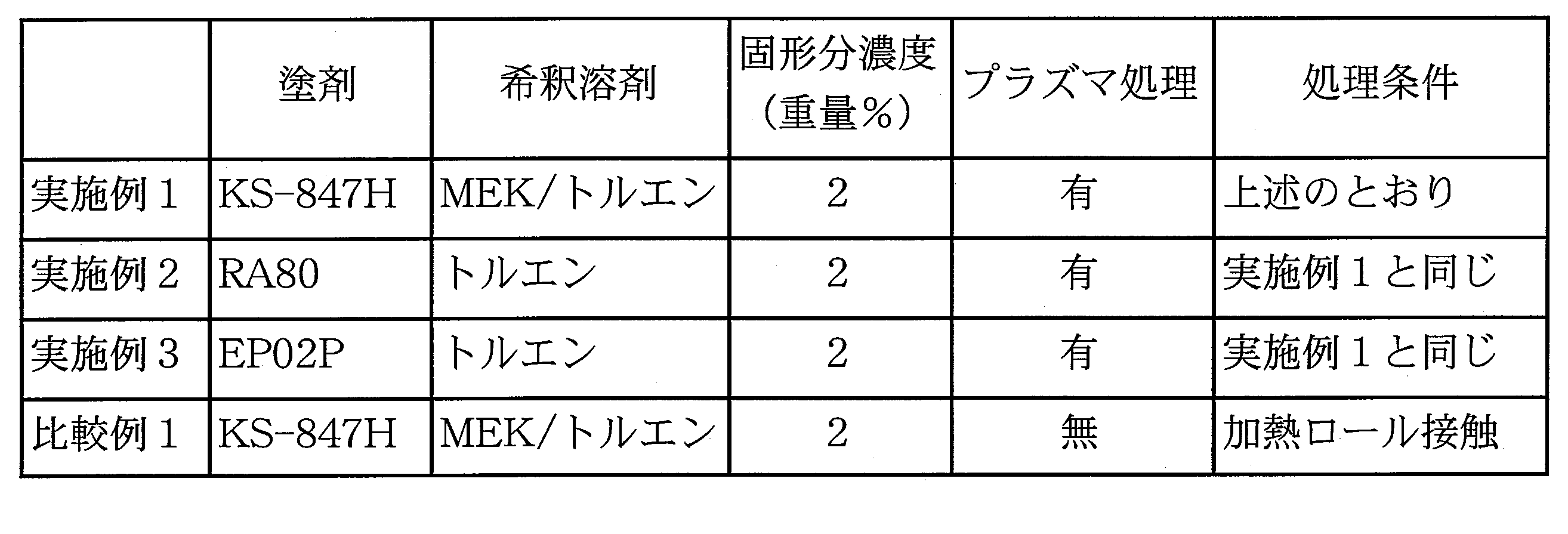
表1中の塗剤の詳細は以下のとおりである。
RA80:アシオレジンRA-80:アシオ産業社製;EP02P:EP02P:JSR社製
RA80:アシオレジンRA-80:アシオ産業社製;EP02P:EP02P:JSR社製
上記実施例および比較例で得られた各離型ポリエステルフィルムの特性を下記表2に示す。

インラインコーティング離型層を構成する化合物例は以下のとおりである。
(化合物例)
A1:長鎖アルキル化合物:
(製法)4つ口フラスコにキシレン200部、オタデシルイソシアネート600部を加え、攪拌下に加熱した。キシレンが還流し始めた時点から、平均重合度500、ケン化度88モル%のポリビニルアルコール100部を少量ずつ10分間隔で約2時間にわたって加えた。ポリビニルアルコールを加え終わってから、さらに2時間還流を行い、反応を終了した。反応混合物を約80℃まで冷却してから、メタノール中に加えたところ、反応生成物が白色沈殿として析出したので、この沈殿を濾別し、キシレン140部を加え、加熱して完全に溶解させた後、再びメタノールを加えて沈殿させるという操作を数回繰り返した後、沈殿をメタノールで洗浄し、乾燥粉砕して得た。
A2:アクリルグラフトシリコーン(竹本油脂株式会社製パイオニン)
A3:ワックス
(製法)攪拌機、温度計、温度コントローラーを備えた内容量1.5Lの乳化設備に融点105℃、酸価16mgKOH/g、密度0.93g/mL、平均分子量5000の酸化ポリエチレンワックス300g、イオン交換水650gとデカグリセリンモノオレエート界面活性剤を50g、48%水酸化カリウム水溶液10gを加え窒素で置換後、密封し150℃で1時間高速攪拌した後130℃に冷却し、高圧ホモジナイザーを400気圧下で通過させ40℃に冷却しワックスエマルションを得た。
B:熱硬化性を有する化合物:
アルキロールメラミン/尿素共重合の架橋性樹脂(大日本インキ化学工業製ベッカミン)
C1バインダーポリマー:
アクリル酸アルキルエステルとメタクリル酸アルキルエステルを共重合し、乳化剤で分散させたアクリル樹脂(日本カーバイド工業製ニカゾール)
(化合物例)
A1:長鎖アルキル化合物:
(製法)4つ口フラスコにキシレン200部、オタデシルイソシアネート600部を加え、攪拌下に加熱した。キシレンが還流し始めた時点から、平均重合度500、ケン化度88モル%のポリビニルアルコール100部を少量ずつ10分間隔で約2時間にわたって加えた。ポリビニルアルコールを加え終わってから、さらに2時間還流を行い、反応を終了した。反応混合物を約80℃まで冷却してから、メタノール中に加えたところ、反応生成物が白色沈殿として析出したので、この沈殿を濾別し、キシレン140部を加え、加熱して完全に溶解させた後、再びメタノールを加えて沈殿させるという操作を数回繰り返した後、沈殿をメタノールで洗浄し、乾燥粉砕して得た。
A2:アクリルグラフトシリコーン(竹本油脂株式会社製パイオニン)
A3:ワックス
(製法)攪拌機、温度計、温度コントローラーを備えた内容量1.5Lの乳化設備に融点105℃、酸価16mgKOH/g、密度0.93g/mL、平均分子量5000の酸化ポリエチレンワックス300g、イオン交換水650gとデカグリセリンモノオレエート界面活性剤を50g、48%水酸化カリウム水溶液10gを加え窒素で置換後、密封し150℃で1時間高速攪拌した後130℃に冷却し、高圧ホモジナイザーを400気圧下で通過させ40℃に冷却しワックスエマルションを得た。
B:熱硬化性を有する化合物:
アルキロールメラミン/尿素共重合の架橋性樹脂(大日本インキ化学工業製ベッカミン)
C1バインダーポリマー:
アクリル酸アルキルエステルとメタクリル酸アルキルエステルを共重合し、乳化剤で分散させたアクリル樹脂(日本カーバイド工業製ニカゾール)
実施例4:
製造したポリエチレンテレフタレートを180℃で4時間、不活性ガス雰囲気中で乾燥し、溶融押出機により290℃で溶融し、口金から押出し静電印加密着法を用いて表面温度を40℃に設定した冷却ロール上で冷却固化して未延伸シートを得た。次いで、ロール周速差を利用してフィルム温度90℃で縦方向に3.6倍延伸した後、この縦延伸フィルムに下記表3に示す塗布液1を塗布し、テンターに導き、横方向に4.3倍延伸し、230℃で熱処理を行った後、横方向に2%弛緩し、塗工量(乾燥後)が0.03g/m2の離型層が形成された厚さ38μmのポリエステルフィルムを得た。その後、松下電工社製「AiPlasma AS(5mmφノズル)」を150Wにて使用して、30m/minの速度、フィルム/ノズル間距離5mmとして、5mmの間隔を開け、平行に2直線の処理を行った。
製造したポリエチレンテレフタレートを180℃で4時間、不活性ガス雰囲気中で乾燥し、溶融押出機により290℃で溶融し、口金から押出し静電印加密着法を用いて表面温度を40℃に設定した冷却ロール上で冷却固化して未延伸シートを得た。次いで、ロール周速差を利用してフィルム温度90℃で縦方向に3.6倍延伸した後、この縦延伸フィルムに下記表3に示す塗布液1を塗布し、テンターに導き、横方向に4.3倍延伸し、230℃で熱処理を行った後、横方向に2%弛緩し、塗工量(乾燥後)が0.03g/m2の離型層が形成された厚さ38μmのポリエステルフィルムを得た。その後、松下電工社製「AiPlasma AS(5mmφノズル)」を150Wにて使用して、30m/minの速度、フィルム/ノズル間距離5mmとして、5mmの間隔を開け、平行に2直線の処理を行った。
実施例5~6:
実施例1において、塗布剤組成を下記表1、2に示す塗布量および塗布剤組成に変更する以外は実施例1と同様にして製造し、積層ポリエステルフィルムを得た。でき上がったポリエステルフィルムの特性は表4に示すとおりであった。
実施例1において、塗布剤組成を下記表1、2に示す塗布量および塗布剤組成に変更する以外は実施例1と同様にして製造し、積層ポリエステルフィルムを得た。でき上がったポリエステルフィルムの特性は表4に示すとおりであった。
比較例2:
実施例4において、プラズマ処理を行わず、直径30mm/幅10mmの円形ロールを200℃に加熱し、フィルム表面に当該ロールを回転させながら30m/分で接触させた以外は実施例1と同様にして製造し、離型ポリエステルフィルムを得た。
実施例4において、プラズマ処理を行わず、直径30mm/幅10mmの円形ロールを200℃に加熱し、フィルム表面に当該ロールを回転させながら30m/分で接触させた以外は実施例1と同様にして製造し、離型ポリエステルフィルムを得た。
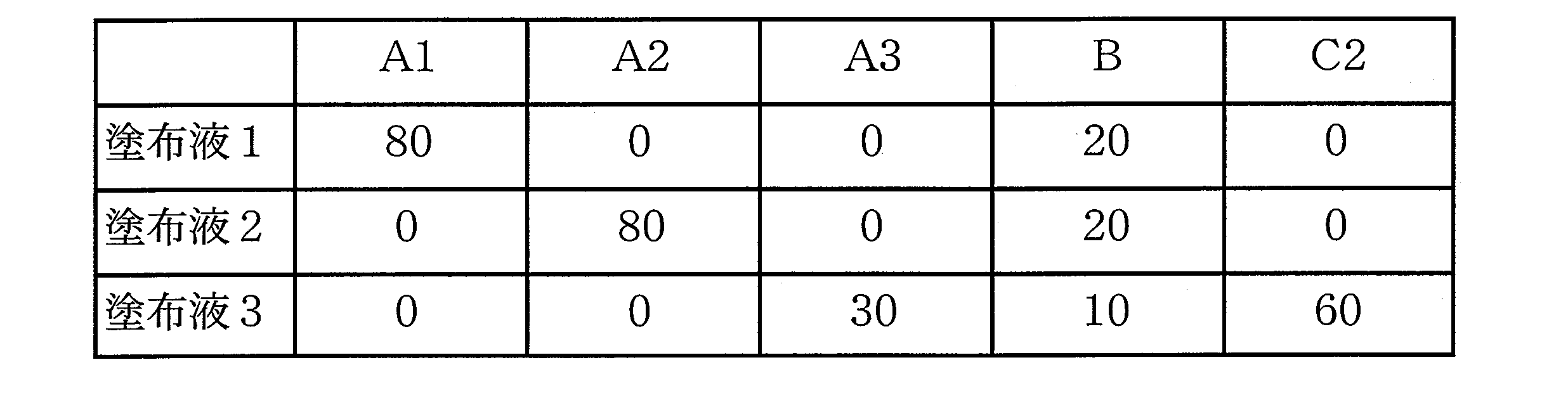

本発明の製造方法により得られるフィルムは、粘着製品として好適に利用することができる。
Claims (2)
- 少なくとも片面に離型層を有するポリエステルフィルムの離型層表面の任意の領域を、大気圧下でプラズマ処理することを特徴とする離型ポリエステルフィルムの製造方法。
- 離型層がインラインコーティングで設けられたものである請求項1記載の離型ポリエステルフィルムの製造方法。
Applications Claiming Priority (4)
| Application Number | Priority Date | Filing Date | Title |
|---|---|---|---|
| JP2008259707A JP2010090219A (ja) | 2008-10-06 | 2008-10-06 | 離型ポリエステルフィルムの製造方法 |
| JP2008-259706 | 2008-10-06 | ||
| JP2008-259707 | 2008-10-06 | ||
| JP2008259706A JP2010090218A (ja) | 2008-10-06 | 2008-10-06 | 離型フィルムの製造方法 |
Publications (1)
| Publication Number | Publication Date |
|---|---|
| WO2010041407A1 true WO2010041407A1 (ja) | 2010-04-15 |
Family
ID=42100369
Family Applications (1)
| Application Number | Title | Priority Date | Filing Date |
|---|---|---|---|
| PCT/JP2009/005145 Ceased WO2010041407A1 (ja) | 2008-10-06 | 2009-10-05 | 離型ポリエステルフィルムの製造方法 |
Country Status (1)
| Country | Link |
|---|---|
| WO (1) | WO2010041407A1 (ja) |
Cited By (2)
| Publication number | Priority date | Publication date | Assignee | Title |
|---|---|---|---|---|
| JP2011230434A (ja) * | 2010-04-29 | 2011-11-17 | Mitsubishi Plastics Inc | 基材レス両面粘着シート用離型フィルム |
| EP4570849A1 (fr) | 2023-12-15 | 2025-06-18 | Diatex | Film traité plasma et son utilisation pour la fabrication de pièces en matériau composite, procédé de fabrication d'une telle pièce |
Citations (4)
| Publication number | Priority date | Publication date | Assignee | Title |
|---|---|---|---|---|
| JPS5848739U (ja) * | 1981-09-24 | 1983-04-01 | 日東電工株式会社 | 剥離材の構造 |
| JPS62199677A (ja) * | 1986-02-27 | 1987-09-03 | Nippon Kako Seishi Kk | 部分剥離シートの製造法 |
| JPS62209183A (ja) * | 1986-03-10 | 1987-09-14 | Nippon Kako Seishi Kk | 部分粘着シ−ト |
| JP2008194932A (ja) * | 2007-02-13 | 2008-08-28 | Tosoh Corp | 積層体 |
-
2009
- 2009-10-05 WO PCT/JP2009/005145 patent/WO2010041407A1/ja not_active Ceased
Patent Citations (4)
| Publication number | Priority date | Publication date | Assignee | Title |
|---|---|---|---|---|
| JPS5848739U (ja) * | 1981-09-24 | 1983-04-01 | 日東電工株式会社 | 剥離材の構造 |
| JPS62199677A (ja) * | 1986-02-27 | 1987-09-03 | Nippon Kako Seishi Kk | 部分剥離シートの製造法 |
| JPS62209183A (ja) * | 1986-03-10 | 1987-09-14 | Nippon Kako Seishi Kk | 部分粘着シ−ト |
| JP2008194932A (ja) * | 2007-02-13 | 2008-08-28 | Tosoh Corp | 積層体 |
Cited By (3)
| Publication number | Priority date | Publication date | Assignee | Title |
|---|---|---|---|---|
| JP2011230434A (ja) * | 2010-04-29 | 2011-11-17 | Mitsubishi Plastics Inc | 基材レス両面粘着シート用離型フィルム |
| EP4570849A1 (fr) | 2023-12-15 | 2025-06-18 | Diatex | Film traité plasma et son utilisation pour la fabrication de pièces en matériau composite, procédé de fabrication d'une telle pièce |
| FR3156691A1 (fr) * | 2023-12-15 | 2025-06-20 | Diatex | Film traité plasma et son utilisation pour la fabrication de pièces en matériau composite, procédé de fabrication d’une telle pièce |
Similar Documents
| Publication | Publication Date | Title |
|---|---|---|
| JP7017184B2 (ja) | セラミックグリーンシート製造用離型フィルム | |
| KR101704548B1 (ko) | 기재가 없는 양면 점착 시트 | |
| KR101707863B1 (ko) | 이형 필름 | |
| KR102633961B1 (ko) | 필름 | |
| JP2012159548A (ja) | 偏光板用離型ポリエステルフィルム | |
| KR20150105942A (ko) | 이형 필름 및 그 제조방법 | |
| WO2012090762A1 (ja) | 離型フィルム | |
| JP2014050961A (ja) | 成形同時転写用ポリエステルフィルム | |
| JP2009196178A (ja) | 離型フィルム | |
| JPH10286922A (ja) | 離型フィルム | |
| CN110573334A (zh) | 膜 | |
| JP6164791B2 (ja) | 基材レス両面粘着シート用ポリエステルフィルム | |
| JP3647997B2 (ja) | 離形フィルム | |
| WO2010041407A1 (ja) | 離型ポリエステルフィルムの製造方法 | |
| JP2012137567A (ja) | 偏光板用離型ポリエステルフィルム | |
| JP2010090218A (ja) | 離型フィルムの製造方法 | |
| JP6221315B2 (ja) | 離型ポリエステルフィルム | |
| JP2004306344A (ja) | 離型フィルム | |
| JP5495609B2 (ja) | 離型フィルム | |
| JP2010090219A (ja) | 離型ポリエステルフィルムの製造方法 | |
| JP2014226922A (ja) | 積層フィルム | |
| JP2014226923A (ja) | 積層フィルム | |
| JP6747072B2 (ja) | 積層フィルム | |
| TW202319242A (zh) | 積層聚酯薄膜、積層體、及積層聚酯薄膜之製造方法 | |
| JP2010201858A (ja) | 成形同時転写用二軸延伸ポリエテルフィルム |
Legal Events
| Date | Code | Title | Description |
|---|---|---|---|
| 121 | Ep: the epo has been informed by wipo that ep was designated in this application |
Ref document number: 09818947 Country of ref document: EP Kind code of ref document: A1 |
|
| NENP | Non-entry into the national phase |
Ref country code: DE |
|
| 122 | Ep: pct application non-entry in european phase |
Ref document number: 09818947 Country of ref document: EP Kind code of ref document: A1 |