WO2010035641A1 - 水性塗料組成物 - Google Patents
水性塗料組成物 Download PDFInfo
- Publication number
- WO2010035641A1 WO2010035641A1 PCT/JP2009/065807 JP2009065807W WO2010035641A1 WO 2010035641 A1 WO2010035641 A1 WO 2010035641A1 JP 2009065807 W JP2009065807 W JP 2009065807W WO 2010035641 A1 WO2010035641 A1 WO 2010035641A1
- Authority
- WO
- WIPO (PCT)
- Prior art keywords
- compound
- water
- coating composition
- polyamine resin
- resin
- Prior art date
- Legal status (The legal status is an assumption and is not a legal conclusion. Google has not performed a legal analysis and makes no representation as to the accuracy of the status listed.)
- Ceased
Links
Classifications
-
- C—CHEMISTRY; METALLURGY
- C09—DYES; PAINTS; POLISHES; NATURAL RESINS; ADHESIVES; COMPOSITIONS NOT OTHERWISE PROVIDED FOR; APPLICATIONS OF MATERIALS NOT OTHERWISE PROVIDED FOR
- C09D—COATING COMPOSITIONS, e.g. PAINTS, VARNISHES OR LACQUERS; FILLING PASTES; CHEMICAL PAINT OR INK REMOVERS; INKS; CORRECTING FLUIDS; WOODSTAINS; PASTES OR SOLIDS FOR COLOURING OR PRINTING; USE OF MATERIALS THEREFOR
- C09D5/00—Coating compositions, e.g. paints, varnishes or lacquers, characterised by their physical nature or the effects produced; Filling pastes
- C09D5/08—Anti-corrosive paints
-
- C—CHEMISTRY; METALLURGY
- C08—ORGANIC MACROMOLECULAR COMPOUNDS; THEIR PREPARATION OR CHEMICAL WORKING-UP; COMPOSITIONS BASED THEREON
- C08F—MACROMOLECULAR COMPOUNDS OBTAINED BY REACTIONS ONLY INVOLVING CARBON-TO-CARBON UNSATURATED BONDS
- C08F212/00—Copolymers of compounds having one or more unsaturated aliphatic radicals, each having only one carbon-to-carbon double bond, and at least one being terminated by an aromatic carbocyclic ring
- C08F212/02—Monomers containing only one unsaturated aliphatic radical
- C08F212/04—Monomers containing only one unsaturated aliphatic radical containing one ring
- C08F212/06—Hydrocarbons
- C08F212/08—Styrene
-
- C—CHEMISTRY; METALLURGY
- C08—ORGANIC MACROMOLECULAR COMPOUNDS; THEIR PREPARATION OR CHEMICAL WORKING-UP; COMPOSITIONS BASED THEREON
- C08F—MACROMOLECULAR COMPOUNDS OBTAINED BY REACTIONS ONLY INVOLVING CARBON-TO-CARBON UNSATURATED BONDS
- C08F8/00—Chemical modification by after-treatment
- C08F8/30—Introducing nitrogen atoms or nitrogen-containing groups
-
- C—CHEMISTRY; METALLURGY
- C08—ORGANIC MACROMOLECULAR COMPOUNDS; THEIR PREPARATION OR CHEMICAL WORKING-UP; COMPOSITIONS BASED THEREON
- C08F—MACROMOLECULAR COMPOUNDS OBTAINED BY REACTIONS ONLY INVOLVING CARBON-TO-CARBON UNSATURATED BONDS
- C08F8/00—Chemical modification by after-treatment
- C08F8/44—Preparation of metal salts or ammonium salts
-
- C—CHEMISTRY; METALLURGY
- C08—ORGANIC MACROMOLECULAR COMPOUNDS; THEIR PREPARATION OR CHEMICAL WORKING-UP; COMPOSITIONS BASED THEREON
- C08G—MACROMOLECULAR COMPOUNDS OBTAINED OTHERWISE THAN BY REACTIONS ONLY INVOLVING UNSATURATED CARBON-TO-CARBON BONDS
- C08G59/00—Polycondensates containing more than one epoxy group per molecule; Macromolecules obtained by polymerising compounds containing more than one epoxy group per molecule using curing agents or catalysts which react with the epoxy groups
- C08G59/18—Macromolecules obtained by polymerising compounds containing more than one epoxy group per molecule using curing agents or catalysts which react with the epoxy groups ; e.g. general methods of curing
- C08G59/182—Macromolecules obtained by polymerising compounds containing more than one epoxy group per molecule using curing agents or catalysts which react with the epoxy groups ; e.g. general methods of curing using pre-adducts of epoxy compounds with curing agents
- C08G59/184—Macromolecules obtained by polymerising compounds containing more than one epoxy group per molecule using curing agents or catalysts which react with the epoxy groups ; e.g. general methods of curing using pre-adducts of epoxy compounds with curing agents with amines
-
- C—CHEMISTRY; METALLURGY
- C09—DYES; PAINTS; POLISHES; NATURAL RESINS; ADHESIVES; COMPOSITIONS NOT OTHERWISE PROVIDED FOR; APPLICATIONS OF MATERIALS NOT OTHERWISE PROVIDED FOR
- C09D—COATING COMPOSITIONS, e.g. PAINTS, VARNISHES OR LACQUERS; FILLING PASTES; CHEMICAL PAINT OR INK REMOVERS; INKS; CORRECTING FLUIDS; WOODSTAINS; PASTES OR SOLIDS FOR COLOURING OR PRINTING; USE OF MATERIALS THEREFOR
- C09D133/00—Coating compositions based on homopolymers or copolymers of compounds having one or more unsaturated aliphatic radicals, each having only one carbon-to-carbon double bond, and at least one being terminated by only one carboxyl radical, or of salts, anhydrides, esters, amides, imides, or nitriles thereof; Coating compositions based on derivatives of such polymers
- C09D133/04—Homopolymers or copolymers of esters
- C09D133/14—Homopolymers or copolymers of esters of esters containing halogen, nitrogen, sulfur or oxygen atoms in addition to the carboxy oxygen
-
- C—CHEMISTRY; METALLURGY
- C09—DYES; PAINTS; POLISHES; NATURAL RESINS; ADHESIVES; COMPOSITIONS NOT OTHERWISE PROVIDED FOR; APPLICATIONS OF MATERIALS NOT OTHERWISE PROVIDED FOR
- C09D—COATING COMPOSITIONS, e.g. PAINTS, VARNISHES OR LACQUERS; FILLING PASTES; CHEMICAL PAINT OR INK REMOVERS; INKS; CORRECTING FLUIDS; WOODSTAINS; PASTES OR SOLIDS FOR COLOURING OR PRINTING; USE OF MATERIALS THEREFOR
- C09D163/00—Coating compositions based on epoxy resins; Coating compositions based on derivatives of epoxy resins
-
- C—CHEMISTRY; METALLURGY
- C09—DYES; PAINTS; POLISHES; NATURAL RESINS; ADHESIVES; COMPOSITIONS NOT OTHERWISE PROVIDED FOR; APPLICATIONS OF MATERIALS NOT OTHERWISE PROVIDED FOR
- C09D—COATING COMPOSITIONS, e.g. PAINTS, VARNISHES OR LACQUERS; FILLING PASTES; CHEMICAL PAINT OR INK REMOVERS; INKS; CORRECTING FLUIDS; WOODSTAINS; PASTES OR SOLIDS FOR COLOURING OR PRINTING; USE OF MATERIALS THEREFOR
- C09D179/00—Coating compositions based on macromolecular compounds obtained by reactions forming in the main chain of the macromolecule a linkage containing nitrogen, with or without oxygen, or carbon only, not provided for in groups C09D161/00 - C09D177/00
- C09D179/02—Polyamines
-
- C—CHEMISTRY; METALLURGY
- C09—DYES; PAINTS; POLISHES; NATURAL RESINS; ADHESIVES; COMPOSITIONS NOT OTHERWISE PROVIDED FOR; APPLICATIONS OF MATERIALS NOT OTHERWISE PROVIDED FOR
- C09D—COATING COMPOSITIONS, e.g. PAINTS, VARNISHES OR LACQUERS; FILLING PASTES; CHEMICAL PAINT OR INK REMOVERS; INKS; CORRECTING FLUIDS; WOODSTAINS; PASTES OR SOLIDS FOR COLOURING OR PRINTING; USE OF MATERIALS THEREFOR
- C09D201/00—Coating compositions based on unspecified macromolecular compounds
- C09D201/02—Coating compositions based on unspecified macromolecular compounds characterised by the presence of specified groups, e.g. terminal or pendant functional groups
-
- C—CHEMISTRY; METALLURGY
- C09—DYES; PAINTS; POLISHES; NATURAL RESINS; ADHESIVES; COMPOSITIONS NOT OTHERWISE PROVIDED FOR; APPLICATIONS OF MATERIALS NOT OTHERWISE PROVIDED FOR
- C09D—COATING COMPOSITIONS, e.g. PAINTS, VARNISHES OR LACQUERS; FILLING PASTES; CHEMICAL PAINT OR INK REMOVERS; INKS; CORRECTING FLUIDS; WOODSTAINS; PASTES OR SOLIDS FOR COLOURING OR PRINTING; USE OF MATERIALS THEREFOR
- C09D5/00—Coating compositions, e.g. paints, varnishes or lacquers, characterised by their physical nature or the effects produced; Filling pastes
- C09D5/02—Emulsion paints including aerosols
-
- C—CHEMISTRY; METALLURGY
- C08—ORGANIC MACROMOLECULAR COMPOUNDS; THEIR PREPARATION OR CHEMICAL WORKING-UP; COMPOSITIONS BASED THEREON
- C08F—MACROMOLECULAR COMPOUNDS OBTAINED BY REACTIONS ONLY INVOLVING CARBON-TO-CARBON UNSATURATED BONDS
- C08F220/00—Copolymers of compounds having one or more unsaturated aliphatic radicals, each having only one carbon-to-carbon double bond, and only one being terminated by only one carboxyl radical or a salt, anhydride ester, amide, imide or nitrile thereof
- C08F220/02—Monocarboxylic acids having less than ten carbon atoms; Derivatives thereof
- C08F220/10—Esters
- C08F220/12—Esters of monohydric alcohols or phenols
- C08F220/16—Esters of monohydric alcohols or phenols of phenols or of alcohols containing two or more carbon atoms
- C08F220/18—Esters of monohydric alcohols or phenols of phenols or of alcohols containing two or more carbon atoms with acrylic or methacrylic acids
- C08F220/1804—C4-(meth)acrylate, e.g. butyl (meth)acrylate, isobutyl (meth)acrylate or tert-butyl (meth)acrylate
-
- C—CHEMISTRY; METALLURGY
- C08—ORGANIC MACROMOLECULAR COMPOUNDS; THEIR PREPARATION OR CHEMICAL WORKING-UP; COMPOSITIONS BASED THEREON
- C08F—MACROMOLECULAR COMPOUNDS OBTAINED BY REACTIONS ONLY INVOLVING CARBON-TO-CARBON UNSATURATED BONDS
- C08F220/00—Copolymers of compounds having one or more unsaturated aliphatic radicals, each having only one carbon-to-carbon double bond, and only one being terminated by only one carboxyl radical or a salt, anhydride ester, amide, imide or nitrile thereof
- C08F220/02—Monocarboxylic acids having less than ten carbon atoms; Derivatives thereof
- C08F220/10—Esters
- C08F220/26—Esters containing oxygen in addition to the carboxy oxygen
- C08F220/32—Esters containing oxygen in addition to the carboxy oxygen containing epoxy radicals
- C08F220/325—Esters containing oxygen in addition to the carboxy oxygen containing epoxy radicals containing glycidyl radical, e.g. glycidyl (meth)acrylate
Definitions
- the present invention relates to a water-based coating composition.
- Patent Document 1 a two-component water-based paint composition containing an epoxy resin and a polyamine compound can be cited.
- Such an aqueous coating composition exhibits sufficient curability at a temperature of room temperature or higher and can form a normal coating film.
- it is inferior in curability at low temperatures (for example, around 5 ° C.)
- low-temperature areas for example, outdoors in winter
- the present invention has been made to solve the above-described conventional problems, and an object of the present invention is to provide an aqueous coating composition having excellent low-temperature curability.
- the aqueous coating composition of the present invention comprises a water-soluble or water-dispersible polyamine resin (A) having one or more primary amine groups and / or secondary amine groups in the molecule, and one or more in the molecule. And a compound (B) having a (meth) acryloyl group, the amine equivalent of the polyamine resin (A) is 100 to 3000, and the viscosity of the compound (B) at 25 ° C. is 3000 mPa ⁇ s or less.
- the aqueous coating composition is a two-component aqueous coating composition
- the main coating liquid contains the polyamine resin (A)
- the curing agent contains the compound (B).
- the polyamine resin (A) is an acrylic polyamine resin or an epoxy polyamine resin.
- the molecular weight of the compound (B) is 150 or more and 2000 or less.
- the compound (B) is a water-soluble compound
- the polyamine resin (A) is a water-dispersed resin
- the compound (B) is a self-emulsifying compound.
- the compound (B) is emulsified or dispersed by the polyamine resin (A).
- the compound (B) is a mixture of a water-soluble compound and a water-insoluble compound.
- the compound (B) is an emulsion.
- the curing agent further contains an emulsifier.
- the aqueous coating composition of the present invention comprises a water-soluble or water-dispersible polyamine resin (A) having one or more primary amine groups and / or secondary amine groups in the molecule, and one or more in the molecule.
- the compound (B) having a (meth) acryloyl group excellent low temperature curability is exhibited. That is, when the polyamine resin (A) and the compound (B) are used, they exhibit high reactivity with each other and the reaction proceeds even at low temperatures, so that an aqueous coating composition having excellent curability at low temperatures can be obtained. Can do.
- the product obtained by the reaction of the polyamine resin (A) and the compound (B) can have a structure in which the polyamine resin (A) is crosslinked by the compound (B), the coating performance is improved. An excellent aqueous coating composition can be obtained.
- the aqueous coating composition of the present invention comprises a water-soluble or water-dispersed polyamine resin (A) having one or more primary amine groups and / or secondary amine groups in the molecule, and a molecule. It contains a compound (B) having one or more (meth) acryloyl groups therein, and is cured by a reaction between the polyamine resin (A) and the compound (B) to obtain a coating film.
- A water-soluble or water-dispersed polyamine resin having one or more primary amine groups and / or secondary amine groups in the molecule, and a molecule. It contains a compound (B) having one or more (meth) acryloyl groups therein, and is cured by a reaction between the polyamine resin (A) and the compound (B) to obtain a coating film.
- the aqueous coating composition of the present invention is preferably a two-component aqueous coating composition comprising a main component coating liquid and a curing agent, and the main component coating liquid contains the polyamine resin (A), and the curing agent is the above compound. (B) is included.
- the polyamine resin (A) and the compound (B) as a two-component aqueous coating composition, a combination of the polyamine resin (A) and the compound (B) that exhibits high reactivity with each other is selected. Therefore, an aqueous coating composition having excellent low temperature curability can be obtained.
- the content of the polyamine resin (A) as a solid content is preferably 5 to 95% by weight, more preferably 10 to 90% by weight, based on the total solid content of the aqueous coating composition.
- the content of the compound (B) is preferably 2 to 40% by weight, more preferably 5 to 30% by weight, based on the total solid content of the aqueous coating composition.
- the ratio of the number of amine groups of the polyamine resin (A) to the number of (meth) acryloyl groups of the compound (B) is preferably 1: 0.5 to 1: 1. 5, more preferably 1: 0.75 to 1: 1.25, and particularly preferably 1: 0.9 to 1: 1.1.
- “the number of amine groups” means that when the polyamine resin (A) has a primary amine group in its molecule (including cases where it has a primary amine group and a secondary amine group). It means the number of one amine group (that is, does not include the number of secondary amine groups), and when it has only the secondary amine group in the molecule, it means the number of secondary amine groups.
- the water-based coating composition of the present invention may contain a pigment, a solvent, an additive and the like as necessary.
- the pigment include titanium oxide, yellow iron oxide, red iron oxide, carbon black, phthalocyanine blue, phthalocyanine green, azo red, quinacridone red, benzimidazolone yellow, and the like; calcium carbonate, barium sulfate, kaolin, clay, Examples include extender pigments such as talc.
- the solvent examples include glycol solvents such as ethylene glycol, propylene glycol, ethylene glycol monobutyl ether, propylene glycol monobutyl ether, diethylene glycol, dipropylene glycol, diethylene glycol monobutyl ether, dipropylene glycol monobutyl ether, diethylene glycol dibutyl ether; xylene, Solvesso 100, Aromatic solvents such as Solvesso 150 and Solvesso 200; Hydrocarbon solvents such as mineral spirits; 2,2,4-trimethyl-1,3-pentanediol monoisobutyrate (CS-12), 2,2,4 -Ester solvents such as trimethyl-1,3-pentanediol diisobutyrate (CS-16), diethyl adipate, diisobutyl adipate It is.
- the additive include a dispersant, a viscosity adjusting agent, a curing catalyst, a surface adjusting agent, an antifoaming
- the polyamine resin (A) used in the aqueous coating composition of the present invention may be any resin as long as it has one or more primary amine groups and / or secondary amine groups and is a water-soluble or water-dispersible resin.
- a suitable resin can be employed. Examples of such resins include aliphatic polyamine resins, aromatic polyamine resins, and alicyclic polyamine resins.
- the amount of amine groups contained in the polyamine resin (A) is 100 to 3000 as an amine equivalent, more preferably 500 to 2000, and particularly preferably 800 to 1500.
- the polyamine resin (A) has water solubility or water dispersibility, and a coating film having excellent low-temperature curability can be obtained.
- the polyamine resin (A) has a primary amine
- the amine equivalent is indicated by the molecular weight of the resin solids per primary amine group, and when the polyamine resin (A) does not have a primary amine group, It is indicated by the molecular weight of the resin solid content per secondary amine group.
- the amine equivalent of polyamine resin (A) can be calculated
- any appropriate molecular weight can be adopted as the molecular weight (number average) of the polyamine resin (A) depending on the desired film properties.
- it is 500 to 20000 in terms of standard polystyrene using gel permeation chromatography (GPC), and more preferably 1000 to 3000.
- GPC gel permeation chromatography
- the molecular weight of the polyamine resin (A) is in such a range, the polyamine resin (A) and the compound (B) can be easily mixed, and thus can be reacted efficiently.
- the molecular weight of a polyamine resin (A) is such a range, the coating film which is excellent in corrosion resistance, water resistance, and adhesiveness can be obtained.
- any suitable glass transition temperature can be adopted as the glass transition temperature of the polyamine resin (A) depending on the desired physical properties of the coating film.
- it is ⁇ 50 to 100 ° C., more preferably 0 to 50 ° C.
- an aqueous solution obtained by neutralizing an amine group with an acid can be used as the polyamine resin (A).
- the type of acid and the neutralization rate (neutralization rate with respect to the amine group of the polyamine resin before being made water-based) can be arbitrarily selected depending on the desired state of the polyamine resin (A) (water-soluble to aqueous dispersion)
- the type of acid and the neutralization rate can be employed.
- Examples of the acid include acetic acid, formic acid, lactic acid, and phosphoric acid.
- the neutralization rate (neutralization rate with respect to the amine group of the polyamine resin before being made water-based) is preferably 10 to 70%, and more preferably 15 to 50%.
- the polyamine resin (A) is preferably an epoxy polyamine resin obtained by amine-modifying an epoxy resin or an acrylic polyamine resin obtained by amine-modifying an acrylic resin, and more preferably an epoxy polyamine resin.
- an epoxy-based polyamine resin can provide an aqueous coating composition with better anticorrosion performance. That is, by using the epoxy-based polyamine resin as the polyamine resin (A) and the compound (B), a coating exhibiting excellent anticorrosion performance equal to or better than that of a conventional epoxy resin coating composition comprising an epoxy resin-polyamine compound.
- An aqueous coating composition capable of forming a film even at a low temperature can be obtained.
- the epoxy polyamine resin and acrylic polyamine resin can be obtained by any suitable modification method.
- the modification method include a method of adding a primary amine group-containing polyamine to an epoxy resin or an acrylic resin, and a method of adding a ketiminated amine group-containing compound to an epoxy resin or an acrylic resin.
- the polyamine resin (A) thus obtained has one or more primary amine groups and / or secondary amine groups and secondary hydroxyl groups in the molecule.
- the polyamine resin is a compound having a functional group such as an epoxy group, an acid anhydride group, an acid halogen group or an isocyanate group in a part of the primary amine group, secondary amine group and / or hydroxyl group of the polyamine resin (A). It may be a resin obtained by reacting. By including a polyamine resin reacted with such a functional group as a part of the polyamine resin to be used, the physical properties of the obtained coating film can be adjusted.
- the method of adding the first amine group-containing polyamine to the epoxy resin or acrylic resin means that the first amine group of the first amine group-containing polyamine and the reactive group (for example, epoxy group) of the epoxy resin or acrylic resin.
- a second amine group is formed by reaction, and as a result, the epoxy polyamine resin or the acrylic polyamine resin having the second amine group is produced.
- the method of adding the ketiminated amine group-containing compound to an epoxy resin or an acrylic resin means that the ketimine group is hydrolyzed after reacting the ketiminated amine group-containing compound with an epoxy resin or an acrylic resin.
- the first amine group is formed, and as a result, the epoxy polyamine resin or the acrylic polyamine resin having the first amine group is produced.
- a secondary amine such as diethanolamine, methylethanolamine, or diethylamine may coexist.
- epoxy resin Any appropriate epoxy resin can be used. Bisphenol A type epoxy resins or bisphenol F type epoxy resins are preferred, and bisphenol A type epoxy resins are particularly preferred.
- the epoxy equivalent of the epoxy resin can be determined according to the desired film properties. It is preferably 180 to 2000, more preferably 400 to 1500. If the epoxy equivalent of an epoxy resin is such a range, the coating film which is excellent in water resistance, corrosion resistance, and adhesiveness can be obtained.
- the above-mentioned epoxy resin can be chain-extended using the reaction between an active hydrogen-containing compound capable of reacting with an epoxy group and the epoxy group to increase the molecular weight or be modified.
- active hydrogen-containing compound include bifunctional compounds such as dimer acid, diamine, and polyether polyol.
- the epoxy resin may be used by adding a fatty acid to reduce the number of epoxy groups before reducing the amine, thereby reducing the number of amine-modified sites and reducing the reactivity.
- any appropriate resin can be used as the acrylic resin.
- An acrylic resin obtained by copolymerizing a monomer composition containing a radical polymerizable monomer having an epoxy group and / or a glycidyl group is preferable.
- the radical polymerizable monomer having an epoxy group and / or glycidyl group include glycidyl acrylate, glycidyl methacrylate, methyl glycidyl acrylate, methyl glycidyl methacrylate, 3,4-epoxycyclohexyl methyl acrylate, and 3,4-epoxycyclohexyl. Examples include methyl methacrylate.
- first amine group-containing polyamine examples include diethylenetriamine, dipropylenetriamine, dibutylenetriamine, and triethylenetetramine. These may be used alone or in combination.
- the above-mentioned ketiminated amine group-containing compound can be obtained by reacting a first amine group-containing compound with a ketone.
- the primary amine group-containing compound include primary amine group-containing polyamines such as diethylenetriamine, dipropylenetriamine, dibutylenetriamine, and triethylenetetramine; aminoethylethanolamine, methylaminopropylamine, ethylaminoethylamine, and the like. It is done. These may be used alone or in combination.
- the ketone include methyl ethyl ketone, acetone, and methyl isobutyl ketone.
- Compound (B) The compound (B) used in the aqueous coating composition of the present invention has one or more (meth) acryloyl groups in the molecule.
- the molecular weight of the compound (B) is preferably 150 or more and 2000 or less, more preferably 200 or more and 1700 or less, and particularly preferably 250 or more and 1300 or less.
- the molecular weight of the compound (B) is within such a range, the polyamine resin (A) and the compound (B) can be easily mixed without using a special mixing apparatus, and the coating composition has excellent dispersibility. You can get things. As a result, the polyamine resin (A) and the compound (B) can be efficiently reacted with each other, and an aqueous coating composition having excellent curability can be obtained.
- the molecular weight of the compound (B) can be calculated from the chemical formula.
- the number of (meth) acryloyl groups possessed by the compound (B) is 1 or more, preferably 2 to 4.
- the number of (meth) acryloyl groups possessed by the compound (B) can be determined according to the desired physical properties of the coating film.
- the viscosity of the compound (B) at 25 ° C. is 3000 mPa ⁇ s or less, preferably 50 mPa ⁇ s or more and 3000 mPa ⁇ s or less, more preferably 50 mPa ⁇ s or more and 2200 mPa ⁇ s or less, and particularly preferably 50 mPa ⁇ s. ⁇ S to 1100 mPa ⁇ s. If the viscosity of the compound (B) is in such a range, the polyamine resin (A) and the compound (B) can be easily mixed without using a special mixing device, and the coating composition has excellent dispersibility. Can be obtained. As a result, the polyamine resin (A) and the compound (B) can be efficiently reacted with each other, and an aqueous coating composition having excellent curability can be obtained.
- Examples of the compound (B) include polymerizable unsaturated monocarboxylic acid ester compounds of polyhydric alcohols (for example, ethylene glycol diacrylate, ethylene glycol dimethacrylate, triethylene glycol diacrylate, triethylene glycol dimethacrylate, Tetraethylene glycol diacrylate, tetraethylene glycol dimethacrylate, 1,3-butylene glycol diacrylate, 1,3-butylene glycol dimethacrylate, trimethylolpropane triacrylate, trimethylolpropane trimethacrylate, 1,4-butane Diol diacrylate, 1,4-butanediol dimethacrylate, neopentyl glycol diacrylate, neopentyl glycol dimethacrylate 1,6-hexanediol diacrylate, 1,6-hexanediol dimethacrylate, pentaerythritol diacrylate, pentaerythritol diacryl
- the compound (B) needs to be easily mixed with the polyamine resin (A) (both can react).
- the polyamine resin (A) and the compound (B) are used in a non-uniform state as long as they can be easily mixed (both can react).
- the compound (B) and the polyamine resin (A) are used in different phase states. In such a state, the rapid progress of the reaction between the polyamine resin (A) and the compound (B) can be suppressed, and the reactivity can be appropriately adjusted.
- the coating composition is used as a two-pack type coating, an aqueous coating composition having excellent handleability can be obtained.
- the compound (B) is a water-soluble compound and the polyamine resin (A) is a water-dispersible resin
- the compound (B) is self-emulsifying, and the compound ( A case where B) can be emulsified or dispersed by the polyamine resin (A) is mentioned.
- whether the compound (B) is “water-insoluble”, “water-soluble” or “self-emulsifying” is determined by adding 5 g of compound (B) to 100 g of water at room temperature. The state after stirring (for example, 3 minutes) and leaving still (for example, after 5 minutes) can be visually observed. After settling, it can be judged as “water-insoluble” if precipitation occurs, “water-soluble” if there is no precipitate and clear, and “self-emulsifying” if there is no precipitation and turbidity.
- the compound (B) when the compound (B) is modified with polyethylene oxide, it can be made water-soluble or self-emulsifiable compound by increasing the number of moles of ethylene oxide added to increase hydrophilicity.
- water-soluble compound (B) examples include ethoxylated bisphenol A diacrylate (EO 30 mol), ethoxylated trimethylolpropane triacrylate (EO 20 mol), ethoxylated trimethylolpropane triacrylate (EO 30 mol), and ethoxylated pentaerythritol tetra.
- examples include acrylate (EO 35 mol), ethoxylated glycerin triacrylate (EO 20 mol), and ethoxylated bisphenol A dimethacrylate (EO 30 mol). These may be used alone or in combination. In the present specification, for example, “EO 30 mol” represents that 30 ethylene oxides are contained in the molecule.
- Examples of the self-emulsifying compound (B) include polyethylene glycol # 400 diacrylate (EO 9 mol), polyethylene glycol # 600 diacrylate (EO 14 mol), polyethylene glycol # 1000 diacrylate (EO 23 mol), and ethoxylated bisphenol A diacrylate. (EO 10 mol), ethoxylated bisphenol A diacrylate (EO 20 mol), ethoxylated glycerin triacrylate (EO 9 mol), polyethylene glycol # 1000 dimethacrylate (EO 23 mol), and the like. These may be used alone or in combination.
- Examples of the compound (B) that can be emulsified or dispersed by the polyamine resin (A) include polyethylene glycol # 200 glycol diacrylate (EO 4 mol), ethoxylated bisphenol A diacrylate (EO 3 mol), and ethoxylated bisphenol A diacrylate (EO 4 mol).
- the compound (B) is preferably used as a mixture of a water-soluble compound and a water-insoluble compound.
- the water-insoluble compound can be easily introduced into the reaction system by the water-soluble compound.
- the coating material obtained is excellent in low-temperature curability.
- the water-soluble compound having one or more (meth) acryloyl groups in the molecule include the above-mentioned water-soluble compound (B).
- the water-insoluble compound having one or more (meth) acryloyl groups in the molecule include compounds that are not completely water-soluble, such as propoxylated bisphenol A diacrylate (PO4 mol).
- the mixing ratio (water-soluble / water-insoluble) of the water-soluble compound (B) and the water-insoluble compound (B) is preferably 1/9 to 9/1, more preferably 2/8 to 8 / 2.
- the compound (B) may be diluted with an organic solvent before the polyamine resin (A) and the compound (B) are mixed.
- the organic solvent include ethylene glycol monobutyether (BC) and diethylene glycol monobutyl ether (BDG).
- the compound (B) is an emulsion. That is, before mixing the polyamine resin (A) and the compound (B), an emulsifier may be mixed with the compound (B), and the compound (B) is emulsified or dispersed by a dispersant, an emulsifier or an aqueous resin. May be.
- the aqueous coating composition of the present invention is a two-component aqueous coating composition
- the curing agent may further contain an emulsifier.
- the polyamine resin (A) and the compound (B) can be efficiently reacted with each other. Moreover, if these processes are performed, a compound (B) can be handled as a non-dangerous substance.
- emulsifier a nonionic emulsifier, an anionic emulsifier, etc. are used, for example.
- the nonionic emulsifier include polyoxyethylene alkylphenol ether, polyoxyethylene styrenated phenyl ether, polyoxyethylene alkyl ether, polyoxyethylene polyoxypropylene block polymer, sorbitan fatty acid ester and the like.
- anionic emulsifier examples include dodecylbenzene sulfonate, dialkyl succinate sulfonate, polyoxyethylene alkyl ether sulfate, polyoxyethylene styrenated phenyl ether sulfate, alkyl diphenyl ether disulfonate, and the like.
- dispersant examples include polyacrylic acid sodium salt, ammonium salt of half ester of styrene maleic acid copolymer, and the like. As said aqueous resin, the soda salt of polyacrylic acid ester etc. are mentioned, for example.
- the compound (B) may be dispersed in a dispersion of a resin different from the polyamine resin (A) before mixing the polyamine resin (A) and the compound (B).
- the resin dispersion include an acrylic resin emulsion and dispersion, a urethane resin emulsion and dispersion, and the like.
- the water-based coating composition of the present invention can be applied to any appropriate article to be coated. Typically, it is the surface of iron.
- Examples of the coating method of the aqueous coating composition of the present invention include brush coating, air spray, airless spray, roller coating, and the like.
- the coating amount of the aqueous coating composition of the present invention can be set to any appropriate coating amount depending on the application. Generally, it is preferably 10 to 300 g / m 2 .
- any appropriate drying method may be employed as a method for drying the aqueous coating composition of the present invention. Natural drying or heat drying is preferred. That is, the aqueous coating composition of the present invention may be used as a room temperature curable coating composition or a heat curable coating composition. In the case of natural drying, the drying time is preferably 24 hours or longer, more preferably 1 week or longer.
- a test piece was obtained by applying the paint obtained in the example to a sandblast plate with a brush so as to be 200 g / m 2 and drying at 20 ° C. for 7 days.
- test piece was subjected to a cyclic corrosion test defined in JIS K 5600 7-7, and the coating state after 120 cycles was confirmed based on the following criteria.
- Ratio of rust area generated in coating film on surface of test piece A Less than 0.05% B: 0.05% or more and less than 0.1% B: 0.1% or more and less than 0.3% %more than
- Example 1 118 parts of dipropylene glycol n-butyl ether (DPnB) was added to 2960 parts of the emulsion I obtained in Production Example 2 as a polyamine resin (A) while stirring with a disper, and then the compound (B ), 392 parts of ethoxylated trimethylolpropane triacrylate (EO 20 mol) (trade name “AT-20E” manufactured by Shin-Nakamura Chemical Co., Ltd.) was added and stirred for 10 minutes to obtain a clear paint. The obtained paint was applied to a glass plate with a 6 mil applicator in an environment of 25 ° C. and 5 ° C., and dried for 24 hours in the same environment as that used for coating to obtain a coating film. Then, the coating film state and curability of the obtained coating film were evaluated. The results are shown in Table 2.
- Example 2 to 10 Except having replaced the compound (B) with 392 parts of ethoxylated trimethylolpropane triacrylate (EO 20 mol) in the same manner as in Example 1 except that the compound (B) shown in Table 1 was used in the content shown in Table 2, A coating film was obtained. Then, the coating film state and curability of the obtained coating film were evaluated. The results are shown in Table 2.
- Example 11 A coating film was obtained in the same manner as in Example 10 except that the emulsion I obtained in Production Example 4 was used instead of the emulsion I in the polyamine resin (A). Then, the coating film state and curability of the obtained coating film were evaluated. The results are shown in Table 2.
- Example 12 159 parts of ion-exchanged water and 16 parts of New Coal 740 (manufactured by Nippon Emulsifier Co., Ltd., nonionic emulsifier) were stirred with a disper and dissolved uniformly to prepare an aqueous emulsifier solution. Thereafter, 143 parts of ethoxylated trimethylolpropane triacrylate (EO 3 mol) as compound (B) was added, and the mixture was stirred and dispersed roughly for 10 minutes with a disper. Further, the mixture was dispersed with an ultrasonic homogenizer until the average particle size became 350 nm to obtain an emulsion of the compound (B).
- New Coal 740 manufactured by Nippon Emulsifier Co., Ltd., nonionic emulsifier
- Example 13 100 parts of tap water, 34 parts of DISPERBYK-190 (pig dispersant manufactured by Big Chemie), 2 parts of BYK-019 (antifoaming agent produced by Big Chemie), 170 parts of calcium carbonate, 185 parts of titanium oxide, 2 parts of calcium-based anticorrosive pigment
- the pigment dispersion composition consisting of was dispersed with a disper for 30 minutes.
- 450 parts of the emulsion I obtained in Production Example 2 as polyamine resin (A), 18 parts of DPnB, and 10 parts of Adecanol UH-420 (Adeka Co., Ltd. associative thickener) were added and mixed to obtain a base coating liquid.
- Example 14 Instead of 41 parts of propoxylated bisphenol A diacrylate (PO 4 mol), 33 parts of ethoxylated glycerin triacrylate (EO 9 mol) (trade name “A-GLY-9E”, compound (B) No. 6) manufactured by Shin-Nakamura Chemical Co., Ltd.) A coating film was obtained in the same manner as in Example 13 except that it was used. Then, the coating film state of the obtained coating film, sclerosis
- Example 15 A coating film was obtained in the same manner as in Example 13 except that 450 parts of emulsion II obtained in Production Example 4 was used in place of 450 parts of emulsion I obtained in Production Example 2 as the polyamine resin (A). Then, the coating film state of the obtained coating film, sclerosis
- Example 1 A coating film was obtained in the same manner as in Example 1 except that the compound (B) was not used. Then, the coating film state and curability of the obtained coating film were evaluated. The results are shown in Table 4.
- Example 2 In the same manner as in Example 1, except that 2100 parts of urethane acrylate having a molecular weight of 4200, a viscosity of 30,000 mPa ⁇ s, and a functional group number of 2 (UA-W2 manufactured by Shin-Nakamura Chemical Co., Ltd.) was used in place of the compound (B). A coating film was obtained. Then, the coating film state and curability of the obtained coating film were evaluated. The results are shown in Table 4.
- Example 3 A coating film was obtained in the same manner as in Example 1 except that 94 parts of dipentaerythritol hexaacrylate having a molecular weight of 562, a viscosity of 6600 mPa ⁇ s, and a functional group number of 6 was used instead of the compound (B). Then, the coating film state and curability of the obtained coating film were evaluated. The results are shown in Table 4.
- Example 4 The same as Example 1 except that 255 parts of a bisphenol type epoxy resin (Lipoxy VR-77 manufactured by Showa Polymer Co., Ltd.) having a molecular weight of 510, a viscosity of 100,000 mPa ⁇ s, and an acryloyl group number of 2 was used in place of the compound (B). Thus, a coating film was obtained. Then, the coating film state and curability of the obtained coating film were evaluated. The results are shown in Table 4.
- a bisphenol type epoxy resin Lipoxy VR-77 manufactured by Showa Polymer Co., Ltd.
- the water-based paint composition of the present invention can be suitably used as a rust preventive, sealer, primer, etc. for bridges, exteriors of buildings, floors, building materials, etc. as construction paints and heavy duty anti-corrosion paints.
Landscapes
- Chemical & Material Sciences (AREA)
- Organic Chemistry (AREA)
- Materials Engineering (AREA)
- Life Sciences & Earth Sciences (AREA)
- Engineering & Computer Science (AREA)
- Wood Science & Technology (AREA)
- Chemical Kinetics & Catalysis (AREA)
- Medicinal Chemistry (AREA)
- Polymers & Plastics (AREA)
- Health & Medical Sciences (AREA)
- General Chemical & Material Sciences (AREA)
- Dispersion Chemistry (AREA)
- Paints Or Removers (AREA)
Abstract
Description
本発明の水性塗料組成物は、分子内に1つ以上の第1アミン基および/または第2アミン基を有する水溶性または水分散型のポリアミン樹脂(A)と、分子内に1つ以上の(メタ)アクリロイル基を有する化合物(B)とを含み、ポリアミン樹脂(A)と化合物(B)との反応により硬化し、塗膜を得ることができる。
本発明の水性塗料組成物に用いられるポリアミン樹脂(A)は、1つ以上の第1アミン基および/または第2アミン基を有し、かつ水溶性または水分散型の樹脂であれば任意の適切な樹脂が採用され得る。このような樹脂としては、例えば、脂肪族ポリアミン樹脂、芳香族ポリアミン樹脂、脂環族ポリアミン樹脂が挙げられる。
本発明の水性塗料組成物に用いられる化合物(B)は、分子内に1以上の(メタ)アクリロイル基を有する。
本発明の水性塗料組成物は、任意の適切な被塗物に塗装し得る。代表的には、鉄の表面である。
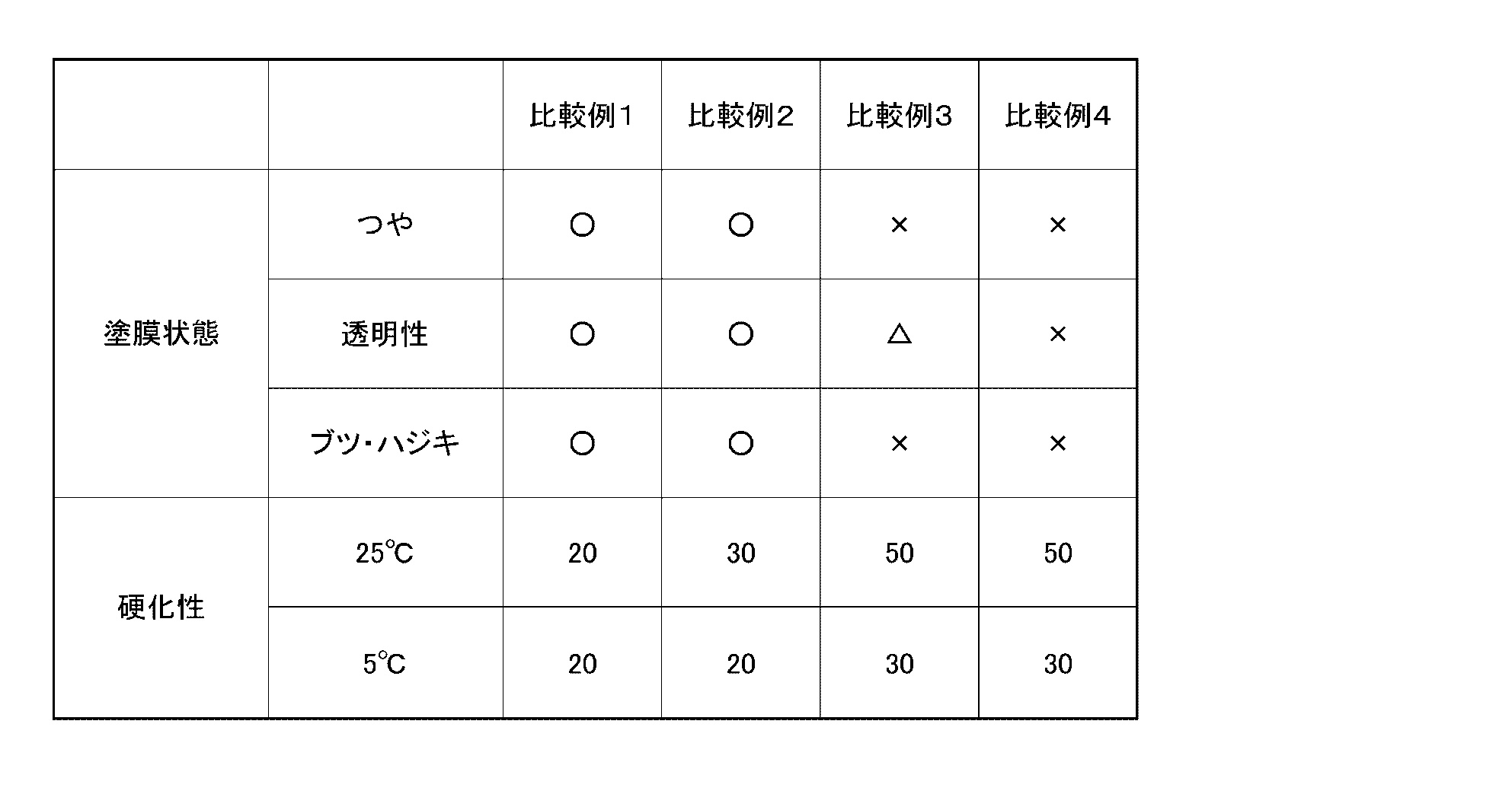
実施例および比較例で得られた塗料を25℃下で塗装および乾燥(24時間)したガラス板を目視にて、塗膜のつや、透明性、ブツ・ハジキ等の塗膜異常を評価した。
つや ○:つやの高いもの
△:半つや程度のもの
×:つやのないもの
透明性 ○:全く、またはほとんど濁りのないもの
△:やや濁りのあるもの
×:濁りの大きいもの
塗膜異常 ○:全く、またはほとんどブツ・ハジキのないもの
△:少しブツ・ハジキのあるもの
×:全面にブツ・ハジキのあるもの
(硬化性)
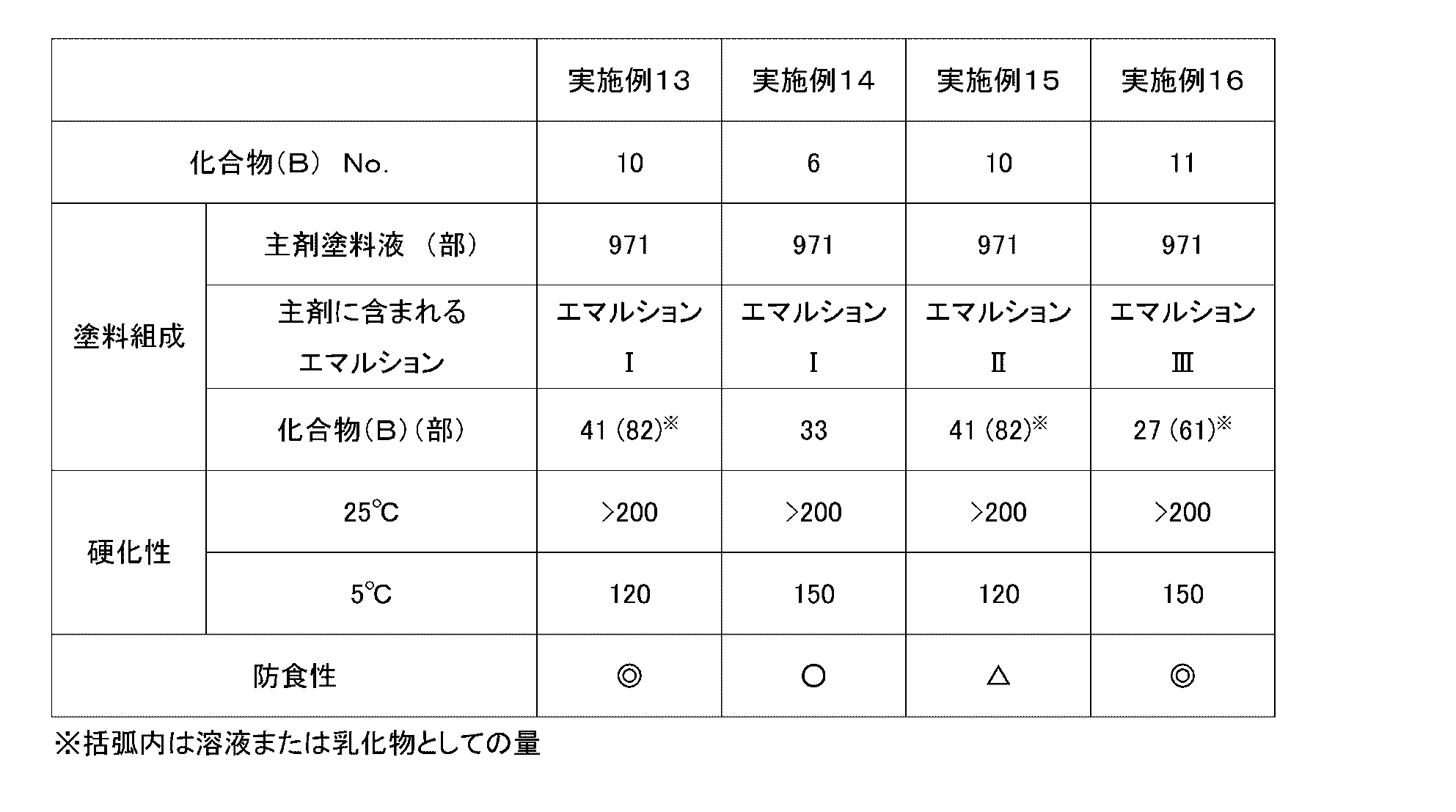
実施例および比較例で得られた塗料を25℃下および5℃下でガラス板に塗装および乾燥(24時間)して塗膜を得た後、当該塗膜をそれぞれ塗装時および乾燥時と同様の温度下において、メチルエチルケトン(MEK)を含ませたガーゼにてこすり、ガラス素地が露出するまでの往復回数を測定した。なお、表中における「>200」の表記は、200往復してもなおガラス素地が露出しなかったことを意味する。また、露出するまでの往復回数が100回以上の塗膜が合格である。
(防食性)
実施例で得られた塗料をサンドブラスト板に200g/m2となるよう、刷毛で塗布し、20℃で7日間乾燥させることにより、試験片を得た。当該試験片に対し、JIS K 5600 7-7に定めるサイクル腐食試験を実施し、120サイクル後の塗膜状態を下記基準に基づいて確認した。
試験片の表面に対する塗膜に生じた錆面積の割合
◎:0.05%未満
○:0.05%以上0.1%未満
△:0.1%以上0.3%未満
×:0.3%以上
撹拌機、冷却器、窒素導入管及び温度計を備えた反応槽に、ビスフェノールAとエピクロルヒドリンとから合成したエポキシ当量188のエポキシ樹脂702部、ビスフェノールA269部、ダイマー酸108部、メチルイソブチルケトン(以下「MIBK」という。)190部を仕込み、ベンジルジメチルアミン1部存在下、エポキシ当量1270になるまで117℃で反応させた。その後、アミノエチルエタノールアミンのケチミン化合物(73質量%MIBK溶液)255部を加え、117℃で1時間反応させた。その後、MIBKで不揮発分75%になるまで希釈し、数平均分子量2400、アミン当量1184のエポキシ系ポリアミン樹脂を得た。
製造例1で得たエポキシ系ポリアミン樹脂に、酢酸を加え、中和率20.0%(樹脂のアミン基に対する中和率)となるようにし、イオン交換水を加え希釈した。その後、固形分が40質量%となるまで減圧下でMIBK及び水の混合物を除去し、エマルションIを調製した。
撹拌機、冷却器、窒素導入管、温度計及び滴下ロートを備えた反応槽に、MIBK670部を仕込み110℃に昇温した。この反応槽に、滴下ロートを用い、スチレン540部、アクリル酸n-ブチル400部、グリシジルメタアクリレート140部、MIBK100部及びt-ブチルパーオクトエート20部とからなる溶液を3時間かけて滴下した。滴下終了後30分間にわたり110℃で保持した後、t-ブチルパーオクトエート2部とMIBK50部とからなる溶液を30分間で滴下した。この滴下終了後、さらに1時間、110℃にて反応を継続させ、エポキシ基を含む不揮発分60%のアクリル樹脂ワニスを得た。得られたワニス1920部に、アミノエチルエタノールアミンのケチミン化合物(73質量%MIBK溶液)255部を加え、117℃で1時間反応させ、数平均分子量10000、アミン当量1184のアクリル系ポリアミン樹脂を得た。
製造例3で得たアクリル系ポリアミン樹脂に、酢酸を加え、中和率20.0%(樹脂のアミン基に対する中和率)となるようにし、イオン交換水を加え希釈した。その後、固形分が40質量%となるまで減圧下でMIBK及び水の混合物を除去し、エマルションIIを調製した。
撹拌機、冷却器、窒素導入管及び温度計を備えた反応槽に、ビスフェノールAとエピクロルヒドリンとから合成したエポキシ当量188のエポキシ樹脂742部、ビスフェノールA336部、MIBK190部を仕込み、ベンジルジメチルアミン1部存在下、エポキシ当量1270になるまで117℃で反応させた。その後、ジエチレントリアミンのケチミン化合物(73質量%MIBK溶液)350部を加え、117℃で1時間反応させた。その後、イオン交換水27部、ネオデカン酸グリシジルエステル(カージュラE10-P)188部を仕込み、100℃で2時間反応させた。その後、MIBKで不揮発分75%になるまで希釈し、数平均分子量2600、アミン当量947のエポキシ系ポリアミン樹脂を得た。
製造例5で得たエポキシ系ポリアミン樹脂に、酢酸を加え、中和率20.0%(樹脂のカチオン性基に対する中和率)となるようにし、イオン交換水を加え希釈した。その後、固形分が40質量%となるまで減圧下でMIBK及び水の混合物を除去し、エマルションIIIを調製した。
ポリアミン樹脂(A)として製造例2で得られたエマルションI2960部に、ディスパーで撹拌しながら、ジプロピレングリコールn-ブチルエーテル(DPnB)118部を加えた後、さらに、ディスパー撹拌しながら、化合物(B)としてエトキシ化トリメチロールプロパントリアクリレート(EO20mol)(新中村化学社製 商品名「AT-20E」)392部を加え、10分間撹拌し、クリヤー塗料を得た。得られた塗料を25℃および5℃の環境下で、6milのアプリケーターにてガラス板に塗装し、塗装時と同じ環境下で24時間乾燥させて塗膜を得た。その後、得られた塗膜の塗膜状態および硬化性を評価した。結果を表2に示す。
化合物(B)をエトキシ化トリメチロールプロパントリアクリレート(EO20mol)392部に代えて、表1に示す化合物(B)を表2に示す含有量で用いた以外は、実施例1と同様にして、塗膜を得た。その後、得られた塗膜の塗膜状態および硬化性を評価した。結果を表2に示す。
ポリアミン樹脂(A)をエマルションIに代えて、製造例4で得られたエマルションIIを用いた以外は、実施例10と同様にして、塗膜を得た。その後、得られた塗膜の塗膜状態および硬化性を評価した。結果を表2に示す。
イオン交換水159部、ニューコール740(日本乳化剤社製、ノニオン系乳化剤)16部をディスパーにて攪拌し、均一に溶解させ乳化剤水溶液を調整した。その後、化合物(B)であるエトキシ化トリメチロールプロパントリアクリレート(EO3mol)143部を加え、ディスパーにて10分攪拌し粗分散させた。さらに超音波ホモジナイザーにて平均粒子径350nmになるまで分散し、化合物(B)の乳化物を得た。
ポリアミン樹脂(A)として製造例6で得られたエマルションIII2367部に、ディスパーで撹拌しながら、ジプロピレングリコールn-ブチルエーテル(DPnB)118部を加えた後、さらに、ディスパー撹拌しながら、先に得られた化合物(B)の乳化物318部(化合物(B)の含有量143部)を加え、10分間撹拌し、クリヤー塗料を得た。得られた塗料については、実施例1と同様にして、塗膜を得た。その後、得られた塗膜の塗膜状態および硬化性を評価した。結果を表2に示す。


水道水100部、DISPERBYK-190(ビックケミー社製 顔料分散剤)34部、BYK-019(ビックケミー社製 消泡剤)2部、炭酸カルシウム170部、酸化チタン185部、カルシウム系防錆顔料2部からなる顔料分散組成物を、ディスパーにて30分間分散した。次いで、ポリアミン樹脂(A)として製造例2で得られたエマルションI450部、DPnB18部、アデカノールUH-420(アデカ社製 会合型増粘剤)10部を加えて混合し、主剤塗料液とした。さらに、ディスパーで攪拌しながら、化合物(B)としてプロポキシ化ビスフェノールAジアクリレート(PO4mol)41部をDPnB41部に溶解させたものを加え、10分間撹拌し、エナメル塗料を得た。得られた塗料を25℃および5℃の環境下で、6milのアプリケーターにてガラス板に塗装し、塗装時と同じ環境下で24時間乾燥させて塗膜を得た。その後、得られた塗膜の塗膜状態、硬化性および防食性を評価した。結果を表3に示す。
プロポキシ化ビスフェノールAジアクリレート(PO4mol)41部に代えて、エトキシ化グリセリントリアクリレート(EO9mol)(新中村化学社製 商品名「A-GLY-9E」、化合物(B)No.6)33部を用いた以外は、実施例13と同様にして、塗膜を得た。その後、得られた塗膜の塗膜状態、硬化性および防食性を評価した。結果を表3に示す。
ポリアミン樹脂(A)として製造例2で得られたエマルションI450部に代えて、製造例4で得られたエマルションII450部を用いた以外は、実施例13と同様にして、塗膜を得た。その後、得られた塗膜の塗膜状態、硬化性および防食性を評価した。結果を表3に示す。
化合物(B)を用いなかった以外は、実施例1と同様にして、塗膜を得た。その後、得られた塗膜の塗膜状態および硬化性を評価した。結果を表4に示す。
化合物(B)に代えて、分子量4200、粘度30,000mPa・s、官能基数2のウレタンアクリレート(UA-W2 新中村化学工業社製)2100部を用いた以外は、実施例1と同様にして、塗膜を得た。その後、得られた塗膜の塗膜状態および硬化性を評価した。結果を表4に示す。
化合物(B)に代えて、分子量562、粘度6600mPa・s、官能基数6のジペンタエリスリトールヘキサアクリレート94部を用いた以外は、実施例1と同様にして、塗膜を得た。その後、得られた塗膜の塗膜状態および硬化性を評価した。結果を表4に示す。
化合物(B)に代えて、分子量510,粘度100,000mPa・s、アクリロイル基数2のビスフェノール型エポキシ樹脂(リポキシVR-77 昭和高分子社製)255部を用いた以外は、実施例1と同様にして、塗膜を得た。その後、得られた塗膜の塗膜状態および硬化性を評価した。結果を表4に示す。
アデカレジンEM-101-50(アデカ社製水性エポキシ樹脂エマルジョン;エポキシ等量1000、固形分50%)1000部、DPnB50部を混合し、主剤塗料液とした。
次に、硬化剤としてサンマイドWH-900(エアープロダクツ社製 変性脂肪族ポリアミン、不揮発分60% アミン価220)200部を主剤塗料液に加え、ディスパー攪拌により混合した。得られた塗料を25℃および5℃の環境下で、6milのアプリケーターにてガラス板に塗装し、塗装時と同じ環境下で24時間乾燥させて塗膜を得た。得られた塗膜の硬化性を評価したところ、25℃における硬化性は良好(耐MEK>200回)であり、5℃においては全く硬化していなかった(MEKにて容易に溶けた)。
Claims (10)
- 分子内に1つ以上の第1アミン基および/または第2アミン基を有する水溶性または水分散型のポリアミン樹脂(A)と、
分子内に1つ以上の(メタ)アクリロイル基を有する化合物(B)とを含み、
該ポリアミン樹脂(A)のアミン当量が100~3000であり、
該化合物(B)の25℃における粘度が3000mPa・s以下である、
水性塗料組成物。 - 前記水性塗料組成物が2液型水性塗料組成物であり、
主剤塗料液が前記ポリアミン樹脂(A)を含み、硬化剤が前記化合物(B)を含む、請求項1に記載の水性塗料組成物。 - 前記ポリアミン樹脂(A)が、アクリル系ポリアミン樹脂またはエポキシ系ポリアミン樹脂である、請求項1または2に記載の水性塗料組成物。
- 前記化合物(B)の分子量が、150以上2000以下である、請求項1から3のいずれかに記載の水性塗料組成物。
- 前記化合物(B)が水溶性化合物であり、かつ前記ポリアミン樹脂(A)が水分散型樹脂である、請求項1から4のいずれかに記載の水性塗料組成物。
- 前記化合物(B)が、自己乳化性化合物である、請求項1から4のいずれかに記載の水性塗料組成物。
- 前記化合物(B)が、前記ポリアミン樹脂(A)により乳化または分散されている、請求項1から4のいずれかに記載の水性塗料組成物。
- 前記化合物(B)が、水溶性化合物および非水溶性化合物の混合物である、請求項1から4のいずれかに記載の水性塗料組成物。
- 前記化合物(B)が、乳化物である、請求項1から4のいずれかに記載の水性塗料組成物。
- 前記硬化剤が、乳化剤をさらに含む、請求項2から4のいずれかに記載の水性塗料組成物。
Priority Applications (3)
| Application Number | Priority Date | Filing Date | Title |
|---|---|---|---|
| KR1020117008902A KR101474056B1 (ko) | 2008-09-29 | 2009-09-10 | 수성 도료 조성물 |
| JP2010530809A JP5421921B2 (ja) | 2008-09-29 | 2009-09-10 | 水性塗料組成物 |
| CN200980138524.4A CN102165027B (zh) | 2008-09-29 | 2009-09-10 | 水性涂料组合物 |
Applications Claiming Priority (2)
| Application Number | Priority Date | Filing Date | Title |
|---|---|---|---|
| JP2008250337 | 2008-09-29 | ||
| JP2008-250337 | 2008-09-29 |
Publications (1)
| Publication Number | Publication Date |
|---|---|
| WO2010035641A1 true WO2010035641A1 (ja) | 2010-04-01 |
Family
ID=42059642
Family Applications (1)
| Application Number | Title | Priority Date | Filing Date |
|---|---|---|---|
| PCT/JP2009/065807 Ceased WO2010035641A1 (ja) | 2008-09-29 | 2009-09-10 | 水性塗料組成物 |
Country Status (5)
| Country | Link |
|---|---|
| JP (1) | JP5421921B2 (ja) |
| KR (1) | KR101474056B1 (ja) |
| CN (1) | CN102165027B (ja) |
| MY (1) | MY153920A (ja) |
| WO (1) | WO2010035641A1 (ja) |
Cited By (7)
| Publication number | Priority date | Publication date | Assignee | Title |
|---|---|---|---|---|
| WO2011118791A1 (ja) * | 2010-03-26 | 2011-09-29 | 日本ペイント株式会社 | 塗膜形成方法 |
| JP2012241088A (ja) * | 2011-05-18 | 2012-12-10 | Mitsubishi Rayon Co Ltd | 活性エネルギー線硬化性含水被覆塗料 |
| EP2727968A1 (en) * | 2012-11-06 | 2014-05-07 | ALLNEX AUSTRIA GmbH | Multifunctional primary amine, process for its preparation, and use thereof |
| US9440911B2 (en) | 2011-05-05 | 2016-09-13 | Allnex Austria Gmbh | Multifunctional primary amine, process for its preparation, and use thereof |
| KR20180063724A (ko) * | 2016-12-02 | 2018-06-12 | 자암건설(주) | 콘크리트의 중성화, 염해 방지를 위한 친환경 수용성 도료조성물 및 이를 이용한 시공방법 |
| US10536494B2 (en) | 2012-05-04 | 2020-01-14 | Electronic Arts Inc. | Establishing a social application layer |
| CN118955151A (zh) * | 2024-07-30 | 2024-11-15 | 湖南省新化县鑫星电子陶瓷有限责任公司 | 一种水性粘合剂及在电子陶瓷成型中的应用 |
Families Citing this family (5)
| Publication number | Priority date | Publication date | Assignee | Title |
|---|---|---|---|---|
| CN102702811A (zh) * | 2012-06-01 | 2012-10-03 | 安徽省金盾涂料有限责任公司 | 水性涂料组合物 |
| JP6106209B2 (ja) * | 2015-05-26 | 2017-03-29 | 日本ペイント株式会社 | 自然乾燥型水性塗料組成物 |
| SG11201706987XA (en) * | 2016-02-12 | 2017-09-28 | Nippon Paint Marine Coatings Co Ltd | Anticorrosive paint composition and method for forming dry coating film |
| CN106002091B (zh) * | 2016-06-03 | 2017-12-01 | 南京钢铁股份有限公司 | 一种压平机垫铁的制作方法 |
| CN105969169A (zh) * | 2016-06-30 | 2016-09-28 | 广州中海环保科技有限公司 | 一种天然环保涂料 |
Citations (3)
| Publication number | Priority date | Publication date | Assignee | Title |
|---|---|---|---|---|
| US3975251A (en) * | 1975-03-19 | 1976-08-17 | Scm Corporation | Cathodic electrocoating process |
| JPS5531889A (en) * | 1978-08-28 | 1980-03-06 | Ppg Industries Inc | Hardenable resin composition |
| JPH03152168A (ja) * | 1989-11-07 | 1991-06-28 | Shikoku Kaken Kogyo Co Ltd | 水性樹脂分散液 |
Family Cites Families (2)
| Publication number | Priority date | Publication date | Assignee | Title |
|---|---|---|---|---|
| CN1242022A (zh) * | 1996-12-31 | 2000-01-19 | 国际壳牌研究有限公司 | 用于在室温或低于室温下的自固化环氧树脂的包括预反应的表面活性剂组合物的水性固化剂组合物 |
| WO2003076536A1 (en) * | 2002-03-08 | 2003-09-18 | Valspar Sourcing, Inc | Polymerization of a reactive diluent in the presence of an epoxy-amine material, and coating compositions prepared thereby |
-
2009
- 2009-09-10 KR KR1020117008902A patent/KR101474056B1/ko active Active
- 2009-09-10 MY MYPI2011001383A patent/MY153920A/en unknown
- 2009-09-10 WO PCT/JP2009/065807 patent/WO2010035641A1/ja not_active Ceased
- 2009-09-10 CN CN200980138524.4A patent/CN102165027B/zh active Active
- 2009-09-10 JP JP2010530809A patent/JP5421921B2/ja active Active
Patent Citations (3)
| Publication number | Priority date | Publication date | Assignee | Title |
|---|---|---|---|---|
| US3975251A (en) * | 1975-03-19 | 1976-08-17 | Scm Corporation | Cathodic electrocoating process |
| JPS5531889A (en) * | 1978-08-28 | 1980-03-06 | Ppg Industries Inc | Hardenable resin composition |
| JPH03152168A (ja) * | 1989-11-07 | 1991-06-28 | Shikoku Kaken Kogyo Co Ltd | 水性樹脂分散液 |
Cited By (12)
| Publication number | Priority date | Publication date | Assignee | Title |
|---|---|---|---|---|
| WO2011118791A1 (ja) * | 2010-03-26 | 2011-09-29 | 日本ペイント株式会社 | 塗膜形成方法 |
| JP5612667B2 (ja) * | 2010-03-26 | 2014-10-22 | 日本ペイント株式会社 | 塗膜形成方法 |
| US9440911B2 (en) | 2011-05-05 | 2016-09-13 | Allnex Austria Gmbh | Multifunctional primary amine, process for its preparation, and use thereof |
| US10023547B2 (en) | 2011-05-05 | 2018-07-17 | Allnex Austria Gmbh | Multifunctional primary amine, process for its preparation, and use thereof |
| JP2012241088A (ja) * | 2011-05-18 | 2012-12-10 | Mitsubishi Rayon Co Ltd | 活性エネルギー線硬化性含水被覆塗料 |
| US10536494B2 (en) | 2012-05-04 | 2020-01-14 | Electronic Arts Inc. | Establishing a social application layer |
| EP2727968A1 (en) * | 2012-11-06 | 2014-05-07 | ALLNEX AUSTRIA GmbH | Multifunctional primary amine, process for its preparation, and use thereof |
| WO2014072308A3 (en) * | 2012-11-06 | 2014-08-07 | Allnex Austria Gmbh | Aqueous dispersions of a multifunctional primary amine, process for its preparation, and use therof |
| US9914800B2 (en) | 2012-11-06 | 2018-03-13 | Allnex Austria Gmbh | Aqueous dispersions of a multifunctional primary amine, process for its preparation, and use therof |
| KR20180063724A (ko) * | 2016-12-02 | 2018-06-12 | 자암건설(주) | 콘크리트의 중성화, 염해 방지를 위한 친환경 수용성 도료조성물 및 이를 이용한 시공방법 |
| KR101870910B1 (ko) | 2016-12-02 | 2018-06-26 | 자암건설(주) | 콘크리트의 중성화, 염해 방지를 위한 친환경 수용성 도료조성물 및 이를 이용한 시공방법 |
| CN118955151A (zh) * | 2024-07-30 | 2024-11-15 | 湖南省新化县鑫星电子陶瓷有限责任公司 | 一种水性粘合剂及在电子陶瓷成型中的应用 |
Also Published As
| Publication number | Publication date |
|---|---|
| JP5421921B2 (ja) | 2014-02-19 |
| JPWO2010035641A1 (ja) | 2012-02-23 |
| MY153920A (en) | 2015-04-15 |
| CN102165027A (zh) | 2011-08-24 |
| KR101474056B1 (ko) | 2014-12-17 |
| KR20110071094A (ko) | 2011-06-28 |
| CN102165027B (zh) | 2015-06-17 |
Similar Documents
| Publication | Publication Date | Title |
|---|---|---|
| JP5421921B2 (ja) | 水性塗料組成物 | |
| JP5543581B2 (ja) | 水性塗料組成物および塗膜形成方法 | |
| JP6106209B2 (ja) | 自然乾燥型水性塗料組成物 | |
| JP5612667B2 (ja) | 塗膜形成方法 | |
| CA2975231A1 (en) | Polyfunctional amines with hydrophobic modification for controlled crosslinking of latex polymers | |
| JP6106311B2 (ja) | 自然乾燥型水性塗料組成物 | |
| CN105705543B (zh) | 用于电沉积和辐射固化的水性固化组合物 | |
| JP4880378B2 (ja) | ビニル変性エポキシエステル樹脂の水分散体の製造方法、及び当該水分散体を用いた水性塗料組成物 | |
| JP2006257141A (ja) | 二液硬化型水性被覆組成物及び塗膜形成方法 | |
| EP3601391B1 (en) | Epoxy acrylic hybrid resins | |
| JP5150910B2 (ja) | 水性樹脂分散体の製造方法、及び該製造方法により得られる水性樹脂分散体、並びに水性塗料 | |
| JP2003064302A (ja) | 防錆力に優れた水性被覆用組成物 | |
| WO2016118221A1 (en) | Polyfunctional amines with hydrophobic modification for controlled crosslinking of latex polymers | |
| JP7360986B2 (ja) | カチオン電着塗料組成物 | |
| HK1178106A (en) | Method for forming coating film | |
| JP2018051435A (ja) | 複層塗膜形成方法 | |
| JPS5825386B2 (ja) | 水分散型熱硬化性被覆組成物 |
Legal Events
| Date | Code | Title | Description |
|---|---|---|---|
| WWE | Wipo information: entry into national phase |
Ref document number: 200980138524.4 Country of ref document: CN |
|
| 121 | Ep: the epo has been informed by wipo that ep was designated in this application |
Ref document number: 09816056 Country of ref document: EP Kind code of ref document: A1 |
|
| WWE | Wipo information: entry into national phase |
Ref document number: 2010530809 Country of ref document: JP |
|
| NENP | Non-entry into the national phase |
Ref country code: DE |
|
| ENP | Entry into the national phase |
Ref document number: 20117008902 Country of ref document: KR Kind code of ref document: A |
|
| 122 | Ep: pct application non-entry in european phase |
Ref document number: 09816056 Country of ref document: EP Kind code of ref document: A1 |