WO2009116142A1 - 情報変換装置及び情報変換方法並びに情報変換用プログラム - Google Patents
情報変換装置及び情報変換方法並びに情報変換用プログラム Download PDFInfo
- Publication number
- WO2009116142A1 WO2009116142A1 PCT/JP2008/055010 JP2008055010W WO2009116142A1 WO 2009116142 A1 WO2009116142 A1 WO 2009116142A1 JP 2008055010 W JP2008055010 W JP 2008055010W WO 2009116142 A1 WO2009116142 A1 WO 2009116142A1
- Authority
- WO
- WIPO (PCT)
- Prior art keywords
- information
- unit
- track
- conversion
- encoding
- Prior art date
- Legal status (The legal status is an assumption and is not a legal conclusion. Google has not performed a legal analysis and makes no representation as to the accuracy of the status listed.)
- Ceased
Links
Images



Classifications
-
- G—PHYSICS
- G11—INFORMATION STORAGE
- G11B—INFORMATION STORAGE BASED ON RELATIVE MOVEMENT BETWEEN RECORD CARRIER AND TRANSDUCER
- G11B20/00—Signal processing not specific to the method of recording or reproducing; Circuits therefor
- G11B20/10—Digital recording or reproducing
- G11B20/12—Formatting, e.g. arrangement of data block or words on the record carriers
- G11B20/1217—Formatting, e.g. arrangement of data block or words on the record carriers on discs
- G11B20/1251—Formatting, e.g. arrangement of data block or words on the record carriers on discs for continuous data, e.g. digitised analog information signals, pulse code modulated [PCM] data
-
- G—PHYSICS
- G11—INFORMATION STORAGE
- G11B—INFORMATION STORAGE BASED ON RELATIVE MOVEMENT BETWEEN RECORD CARRIER AND TRANSDUCER
- G11B20/00—Signal processing not specific to the method of recording or reproducing; Circuits therefor
- G11B20/10—Digital recording or reproducing
- G11B20/10527—Audio or video recording; Data buffering arrangements
- G11B2020/10537—Audio or video recording
- G11B2020/10546—Audio or video recording specifically adapted for audio data
-
- G—PHYSICS
- G11—INFORMATION STORAGE
- G11B—INFORMATION STORAGE BASED ON RELATIVE MOVEMENT BETWEEN RECORD CARRIER AND TRANSDUCER
- G11B20/00—Signal processing not specific to the method of recording or reproducing; Circuits therefor
- G11B20/10—Digital recording or reproducing
- G11B2020/10833—Copying or moving data from one record carrier to another
-
- G—PHYSICS
- G11—INFORMATION STORAGE
- G11B—INFORMATION STORAGE BASED ON RELATIVE MOVEMENT BETWEEN RECORD CARRIER AND TRANSDUCER
- G11B20/00—Signal processing not specific to the method of recording or reproducing; Circuits therefor
- G11B20/10—Digital recording or reproducing
- G11B2020/10935—Digital recording or reproducing wherein a time constraint must be met
- G11B2020/10944—Real-time recording or reproducing, e.g. for ensuring seamless playback of AV data
Definitions
- the present application belongs to the technical field of an information conversion apparatus, an information conversion method, and an information conversion program. More specifically, for example, information recorded on an information recording medium such as an audio CD (Compact Disc) is stored in the information recording medium.
- the present invention belongs to the technical field of an information conversion apparatus and information conversion method for performing a conversion process necessary for copying from an information recording medium to another type of information recording medium, and an information conversion program used in the information conversion apparatus.
- CDDA Compact Digital Audio
- HDD Hard Disc Drive
- a process of extracting audio information desired to be copied from the CDDA is executed.
- This extraction process is hereinafter referred to as “rip process”.
- the audio information after the ripping process is re-encoded into another compression format, and then recorded on the other information recording medium.
- other compression formats for example, so-called mp3 (MPEG (Moving / Picture Expert Group) -1 / Layer-3 / Audio) standard, AAC (Advanced Audio / Coding) standard, etc. are common.
- each of the information associated with the TOC (Table of Contents) information recorded in the CDDA is conventionally used.
- Re-encoding process to convert each track into a compressed audio file so that the start position of the track (track corresponding to one audio information (for example, one song)) matches the start position of each compressed audio file Had gone.
- the compressed audio file is simply referred to as “ENC file”, and the re-encoding process is simply referred to as “ENC process”.
- the track T which is audio information recorded in the CDDA
- PCM Pulse Code Modulation
- the TOC information is described based on a data unit (hereinafter, the data unit is simply referred to as “frame”) used when recording a track in CDDA, as is well known.
- each ENC file is aligned with the head position of each track T in CDDA, each track T of CDDA and each corresponding pre-encoding file RT (before being re-encoded into the ENC file later). Difference in the total number of PCM samples corresponding to one track T.
- each track T recorded in the CDDA and the portion corresponding to the original track T in each of the pre-encoding files RT corresponding to each track are composed of the same number of PCM samples.
- each pre-encoding file RT is subjected to ENC processing, it is necessary to complete the pre-encoding file RT as ES200. Therefore, in order to fill in the insufficient samples generated at the end of the pre-encoding file RT due to the difference between the number of PCM samples for one frame T and the number of PCM samples for one ES 200, conventionally, FIG. The silent sample 201 illustrated in the uppermost stage and the second stage from the top is inserted in the last part.
- gapless CD there is a CD in which voice or performance sound or the like continues across a plurality of tracks T recorded on it.
- a CD is hereinafter referred to as a “gapless CD”.
- BGM a CD for reproducing environmental music without a break.
- inter-song gap
- the TOC information as an aggregate of a plurality of tracks T depending on the intention of the producer.
- One gapless CD is configured. Therefore, in the gapless CD, the value as audio information recorded on the gapless CD can be fully enjoyed only by continuously reproducing the plurality of tracks T recorded on the gapless CD.
- Patent Document 1 Japanese Patent Document 1 below.
- the track T on the CDDA is added to the portion of the pre-encoding file RT into which the conventional silence sample 201 has been inserted.
- a PCM sample located at the beginning of the track T to be reproduced next and having the same data amount as the silence sample 201 is inserted into the pre-encoding file RRT. It is configured to execute every time. JP-A-2005-122034 (FIG. 2 etc.)
- the content of the complementary sample 202 at the end of the pre-encoding file RRT1 and the order of the track T on the gapless CD The content of the head sample 203 at the head of the next encoded file RRT2 that should be continuous with the pre-encoding file RRT1 is the same.
- the PCM samples having the same contents are re-encoded twice at the joint timing of each pre-encoding file RRT corresponding to each track T, as illustrated in the bottom of FIG.
- the present application has been made in view of the above problems, and an example of the problem is that even when the track T is converted to the pre-encoding file RT in a different order from the recording order on the gapless CD, the pre-encoding file Information conversion apparatus, information conversion method, and information conversion capable of executing continuous reproduction processing without generating unnecessary discontinuous portions even when RT is subjected to reproduction processing in the recording order in the gapless CD of the original track T To provide a program.
- the invention described in claim 1 is first information composed of a plurality of first information units each composed of a first number of unit information, and is continuous. Each of the first information recorded on the information recording medium as to be reproduced by the second number of unit information different from the first number for each of the first information.
- the information conversion apparatus configured by a plurality of second information units configured and converting into redefined first information corresponding to each of the first information, the first number and the second number The first information to be converted based on the difference between the first information and the absolute position information indicating the absolute position on the information recording medium at the head of the first information.
- the number of the second information units corresponding to the number of one information unit Conversion means such as an encoding unit and a system control unit that convert the redefined first information corresponding to the first information, and conversion processing in the conversion unit for all the first information to be converted. And a control means such as a system control unit that is sequentially repeated.
- the invention according to claim 4 is the first information composed of a plurality of first information units each composed of a first number of unit information, and is continuous. Each of the first information recorded on the information recording medium as to be reproduced by the second number of unit information different from the first number for each of the first information.
- the information conversion method that is configured by a plurality of second information units that are configured and converts the redefined first information corresponding to each of the first information, the first number and the second number, The first information to be converted based on the difference between the first information and the absolute position information indicating the absolute position on the information recording medium at the head of the first information.
- the invention according to claim 5 is the first information composed of a plurality of first information units each composed of a first number of unit information, and is continuous. Each of the first information recorded on the information recording medium as to be reproduced by the second number of unit information different from the first number for each of the first information.
- the computer included in the information conversion apparatus configured by a plurality of second information units configured and converting into redefined first information corresponding to each of the first information, according to any one of claims 1 to 3. It functions as the conversion means and the control means described in one item.
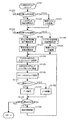
- FIG. 1 is a block diagram illustrating a schematic configuration of a copy / playback apparatus according to an embodiment. It is a flowchart which shows the copy reproduction
- the present application is applied to a copying / playback apparatus that copies and plays back audio information for a plurality of tracks recorded on a gapless CD onto an information recording medium such as a hard disk. It is an embodiment.
- FIG. 2 is a block diagram showing a schematic configuration of the copy reproduction apparatus according to the embodiment
- FIG. 3 is a flowchart showing the copy reproduction process according to the embodiment
- FIG. 4 shows the contents of the redefinition process according to the embodiment.
- FIG. FIG. 5 is a flowchart showing the encoding process according to the embodiment
- FIG. 6 is a diagram showing a specific example of the encoding process.
- the copying / reproducing apparatus S includes a copying unit R, a reproducing unit P, a CD track management unit 7 including a TOC buffer 7A and a redefinition buffer 7B, control means, and calculation.
- System control unit 8 as an example of each of the means, division means, position information generation means, storage control means, and conversion means, operation unit 9 comprising a remote controller or operation buttons, display 10 comprising a liquid crystal display, etc., HDD Part 11.
- the copying unit R includes a disk drive 1, a reading control unit 2, an encoding input buffer 3, an encoding unit 4, an encoding output buffer 5, and a writing control unit 6.
- the reproduction unit P includes a read control unit 12, a decoding input buffer 13, a decoding unit 14, a decoding output buffer 15, a D (Digital) / A (Analog) converter 16, an amplifier unit 17, and a speaker 18. And is constituted by. (I) Overall operation of copy reproduction apparatus S Next, the overall operation of the copy reproduction apparatus S will be described.
- a plurality of tracks T each constituted by a frame 100 as a set of PCM samples are optically recorded as each of them should be reproduced continuously, as in the conventional case.
- the disk drive 1 in the recording unit R rotates the gapless CD 400 at a preset rotation number, and further irradiates a reproduction light beam (not shown) to reflect the reflected light.
- the PCM sample is detected and output to the read control unit 2.
- the TOC information is also read from the gapless CD 400.
- the read control unit 2 temporarily stores the read TOC information in the TOC buffer 7A in the CD track management unit 7. Then, the read control unit 2 executes redefinition processing of TOC information for each ES 200 described later according to the embodiment while referring to the stored TOC information.
- the TOC information as the ES 200 related to the result of the redefinition process is temporarily stored in the redefinition buffer 7B.
- the redefinition process will be described in detail later with reference to FIGS.
- the ripping process according to the embodiment is completed with the redefinition process.
- the read control unit 2 temporarily stores each ES 200 corresponding to each frame 100 read from the gapless CD 400 in the encoding input buffer 3 based on the redefined TOC information.
- the encoding unit 4 performs the ENC process according to the embodiment on the ES 200 accumulated in the encoding input buffer 3, and generates an ENC file in which the audio information recorded on the gapless CD 400 is re-encoded. This is temporarily stored in the output buffer 5 for encoding. In this embodiment, the encoding unit 4 re-encodes audio information in the gapless CD 400 into an ENC file that conforms to the AAC standard.
- the write control unit 6 reads the ENC file stored in the encoding output buffer 5 at a preset timing and stores it in the HDD unit 11.
- the audio information copying process according to the embodiment is completed by the series of processes described above.
- the copying process using the recording unit R and the CD track management unit 7 is centrally controlled by the system control unit 8 in response to an instruction operation on the operation unit 9.
- Information to be presented to the user in the overall control is presented by the system control unit 8 via the display 10.
- the read control unit 12 reads the ENC file corresponding to the track T desired to be reproduced by the operation unit 9 from the HDD unit 11 and temporarily stores it in the decoding input buffer 13.
- the decoding unit 14 executes a decoding process based on the AAC standard on the ENC file based on the AAC standard stored in the decoding input buffer 13.
- the decoding unit 14 generates decoded data for each track T corresponding to the audio information recorded on the gapless CD 400 and temporarily stores the decoded data in the decoding output buffer 15.
- the D / A converter 16 converts the decoded data stored in the decoding output buffer 15 into analog data, generates analog audio information, and outputs the analog audio information to the amplifier unit 17.
- the amplifier unit 17 performs a preset amplification process or the like on the analog audio information and outputs it to the speaker 18 to emit sound.
- the system control unit 8 always monitors whether or not the gapless CD 400 is loaded in the disk drive 1 (steps S1, S1; NO).
- the system control unit 8 next determines whether or not the loaded optical disk is a CDDA using a conventional optical disk discrimination method. (Step S2).
- the system control unit 8 ends the copying process according to the embodiment as it is.
- the system control unit 8 next executes the ripping process according to the embodiment (steps S3 to S8).
- the system control unit 8 first reads TOC information from the loaded gapless CD 400 (step S3). Next, the system control unit 8 sets the track number parameter indicating the track number to a value indicating the head track number in the gapless CD 400 loaded in a memory (not shown) provided for the system control unit 8 (step S4).
- the system control unit 8 sets the TOC information indicating the head of the track T whose track number is indicated by the value of the track number parameter at that time (that is, at the head position of the track T counted from the head of the gapless CD 400).
- the cumulative PCM sample number calculated from the position is converted (step S5).
- the number of PCM samples corresponding to one frame is 588 samples as described above, and the number of frames corresponding to one second is usually 75 frames.
- TOC information indicating Cumulative sample number (m ⁇ 60 + s) ⁇ 75 ⁇ 588 Run as.
- the system control unit 8 When the cumulative sample number is calculated, the system control unit 8 next divides the calculated cumulative sample number by the PCM sample number corresponding to one ES 200 and sets the result as the value of the parameter j.
- the parameter j is a parameter indicating the number of ESs 200 corresponding to one track T on the gapless CD 400 in the present embodiment.
- the system control unit 8 rounds down the fraction k which is the decimal point in the division (step S6).
- step S6 is illustrated using FIG. 4A.
- the ES 200 included in the pre-encoding file R1 the number corresponds to the value of the parameter j 1.
- the pre-encoding file R1 from the total number of PCM samples included as a plurality of frames 100 (six in the example shown in FIG. 4A) in the track T1, a plurality (three in the example shown in FIG. 4A) are included in the pre-encoding file R1.
- the number of PCM samples as the fraction sample 204 obtained by subtracting the total number of PCM samples included as the ES 200 is the fraction k 1 .
- the system control unit 8 redefines the quotient “j” calculated in step S6 in accordance with the TOC information standard with the frame 100 as the CDDA as the minimum unit, and redefines the value.
- the data is temporarily stored in the buffer 7B (step S7).
- the value of the TOC information after the redefinition is M (minutes) S (seconds) F (frames), and the TOC information standard as CDDA with the frame 100 as the minimum unit.
- the position information conforming to the standard of the TOC information after the redefinition that is, the position information indicating the head of the pre-encoding file R indicated by M (minute) S (second) F (frame) + n (sample) is obtained.
- this is referred to as “redefined position information”.
- the TOC information indicating the head of the track T2 is converted into the cumulative number of samples in the processing of the immediately preceding step S5, not the TOC information indicating the head of the track T1. It is necessary to pay attention to this point. Therefore, when the track number parameter is set to a value indicating the first track number in the gapless CD 400 in the first step S4, the lead-in area in the gapless CD 400 is described in steps S5 to S7 immediately thereafter.
- the parameter j, the number k of PCM samples included in the fraction sample 204, and the remainder n are obtained.
- step S7 When the redefinition processing in accordance with the TOC information standard for the quotient “j” is completed in step S7, the system control unit 8 next performs the track number parameter that has been the target of the processing in steps S5 to S7. Is incremented by "1" (step S8).
- the system control unit 8 determines whether or not the value of the incremented track number parameter is within the range of the track T of the gapless CD 400 designated by the operation unit 9 as a target of copy reproduction processing according to the embodiment. Is determined (step S9). When it is within the range (step S9; YES), the system control unit 8 returns to step S5 and performs the steps S5 to S8 for the track T having the number indicated by the incremented track number parameter. Repeat the process.
- steps S5 to S8 are repeated for the track T of the gapless CD 400 designated as the target of the copy reproduction process, so that, for example, as shown in the bottom row and the second row from the bottom in FIG.
- the fraction sample 204 is removed from the tail of each of the target tracks T1 to T3, and redefinition position information indicating the head position of each of the pre-encoding files R1 to R3 that has been advanced in timing by the amount of the removal.
- redefinition buffer 7B are recorded in the redefinition buffer 7B as redefinition position information relating to the respective pre-encoding files R1 to R3.
- the audio information (sound itself) included at the head of each of the tracks T1 to T3 and the audio information included at the head of the pre-encoding files R1 to R3 corresponding to each of them are one each. It will be done.
- the redefinition position information related to the pre-encoding files R1 to R4 is redefined as illustrated below.
- a part having a larger number of PCM samples than the corresponding track T4 is generated in the ES 200 located at the end of the pre-encoding file R4. This part is silent as illustrated in FIG. 4B.
- the redefined position information is redefined as the sample 201.
- the values (M, S, F) are not exactly the same as the position information viewed from the top of the gapless CD 400, because “remainder n (sample)” is added to the value of the redefined position information.
- the maximum value of the error is suppressed within one ES200 (about 20 milliseconds in the case of CDDA), and the original track T is originally reproduced continuously in relation to other adjacent tracks T. Since this is the track T of the gapless CD 400 to be performed, the error does not cause a problem in hearing.
- step S9 when the incremented track number parameter value exceeds the designated range in the determination in step S9 (step S9; NO), the system control unit 8 next displays the corresponding position information after redefinition. Based on this, the ENC process according to the embodiment is executed for each generated pre-encoding file R (steps S10 to S13).
- the system control unit 8 first checks whether or not execution of the ENC process is instructed by the operation unit 9 (step S10). If there is no such instruction (step S10; NO), the system control unit 8 ends the copying process according to the embodiment as it is. On the other hand, when an instruction to start the ENC process is given (step S10; YES), the system control unit 8 sets redefinition position information indicating the head of the pre-encoding file R that is the target of the ENC process. Obtained from the redefinition buffer 7B (step S11).
- the system control unit 8 performs, based on the acquired redefinition position information, the ENC process for the pre-encode file R that is the target of the ENC process, with the ES 200 included therein as a unit. (Step S12).
- step S13 the system control unit 8 gives an instruction to execute the ENC processing to the other pre-encoding file R (track T) in the operation unit 9. It is confirmed whether or not (step S13).
- the system control unit 8 records the ENC file generated so far in the HDD unit 11, and ends the copying process according to the embodiment.
- step S13; YES the system control unit 8 performs the pre-encoding file R that is the target of the ENC process.
- the process returns to step S11 in order to repeat the processes of steps S11 and S12.
- step S12 the ENC process according to step S12 will be described in detail with reference to FIGS.
- a delay time corresponding to 1.5 times the reproduction time of one ES 200 is generated. This delay time changes depending on a specific re-encoding method in the ENC process.
- the system control unit 8 as the processing of the step S12, first, the track T (hereinafter, the track T is referred to as a track T n) corresponding to unencoded file R that is the object of ENC processing, original gapless CD400 In step S120, it is confirmed whether or not it is the first track T. And when was the beginning of the track T (step S120; YES), the system control unit 8, based on the redefined location information before encoding file R n corresponding to the track T n of the top the redefined location The PCM sample corresponding to the p-th preceding ES200 from the position indicated by is replaced with the silence sample 201 (step S121), and the process proceeds to step S123 described later.
- step S120 the system control unit 8 redefined corresponding to the unencoded file R n to be subjected to ENC process
- the position information that is, the reading position of the PCM sample from the gapless CD 400
- the redefined position information corresponding to the position p times before the position indicated by the redefined position information as ES200 step S122.
- the system control unit 8 the track T n to check whether a track T of the last in the original gapless CD400 (step S123). And if the was last track T n (step S123; YES), the system control unit 8 acquires the redefined position information indicating the head position of the lead-out area in gapless CD400 from redefining buffer 7B (Step S124). Based on the redefinition position information of the pre-encoding file R corresponding to the lead-out area, the system control unit 8 silences PCM samples corresponding to up to q pieces of ES200 from the position indicated by the redefinition position information. The sample 201 is replaced (step S125), and the process proceeds to step S128 described later.
- step S123 the system control unit 8 the track T n + 1 located next to the track T n in gapless CD400 Redefinition position information indicating the head position of the corresponding pre-encoding file R n + 1 is acquired from the redefinition buffer 7B (step S126).
- the system control unit 8 the basis of the redefined location information, a redefined position information indicating a position corresponding to the q-number fraction as ES200 than the position indicated by the redefined location information, the end of the original track T n
- the redefined position information indicating the position is used (step S127).
- the values of “p” and “q” in steps S121, S122, S125, and S127 can be set in advance according to the compression method as the ENC file and the calculation method in the ENC processing, Also in the copy reproduction processing according to the embodiment, the values of “p” and “q” are preset and stored in the encoding unit 4 or the system control unit 8. More specifically, a minimum natural number (1.5 in the example shown in FIG. 5) exceeding the number obtained by dividing the delay time in the encoding unit 4 by the processing time required for the ENC processing for one ES 200 (1.5 in the example shown in FIG. 5). In the case illustrated in FIG. 5, “2”) is the value of “p” and “q”, respectively.
- the system control unit 8 reads the PCM sample from the set readout position (step S121 or S122) and accumulates it in an input buffer (not shown) in the readout control unit 2 (step S128).
- the system control unit 8 transfers the stored PCM samples to the encoding input buffer 3 while shifting the PCM samples by a predetermined timing to the encoding input buffer 3 (step S129).
- the shift number “s” of the PCM samples related to this transfer process is set in advance according to the compression method as the ENC file and the calculation method in the ENC process in the same way as “p” and “q”, and the encoding unit 4 or This is stored in advance in the system control unit 8. More specifically, a number less than the decimal point in the number (1.5 in the case of FIG. 5) obtained by dividing the delay time in the encoding unit 4 by the processing time required for ENC processing for one ES 200 (In the example shown in FIG. 5, “0.5”) is the value of “s”.
- the system control unit 8 reads one ES 200 from the encoding input buffer 3 and causes the encoding unit 4 to execute ENC processing (step S130).
- the system control unit 8 confirms whether or not the ENC processing for the ES 200 from the start of the ENC processing for the pre-encoding file R corresponding to the track T n has been completed (step S131).
- the number “r” of ESs 200 related to this confirmation processing is also set in advance in the encoding unit 4 or the system control unit 8 in accordance with the compression method as the ENC file and the calculation method in the ENC processing, similarly to the “p” and the like. Is stored in advance. More specifically, a minimum natural number (1.5 in the example shown in FIG. 5) exceeding the number obtained by dividing the delay time in the encoding unit 4 by the processing time required for the ENC processing for one ES 200 (1.5 in the example shown in FIG. 5). In the case illustrated in FIG. 5, “2”) is the value of “r”.
- step S131 If it is determined in step S131 that the ENC processing has not yet been completed for the r ESs 200 (step S131; NO), the ENC file after the ENC processing is stored in a memory (not shown) in the CD track management unit 7. Save temporarily (step S133). On the other hand, in step S131, when the ENC processing for the r ESs 200 is completed (step S131; YES), the system control unit 8 discards the r ENC files (step S132).
- step S134 the system control unit 8 gapless read position from CD400 confirms whether the transition to the end of the track T n set in the processing of step S125 or S127 (step S134). Then, when said reading position is not the transition to the end of the track T n (step S134; YES), the system control unit 8 updates the read position (step S135), the then returns to step S128 For the PCM sample recorded at the updated read position, the processes of steps S128 to S135 are executed.
- step S134 when the read position from the gapless CD400 has a transition to the end of the track T n set in the processing of step S125 or S127 (step S134; NO), 3 The process proceeds to step S13.
- an encoding pre-file R n without silence sample 201 whose end or is inserted into the top or missing, the encoded data 300 0 to the encoding corresponding to the encoded before file R n All of the data 300 n is output from the encoding unit 4.
- the system control unit 8 stores the pre-encoding file R n ⁇ 1 before the original pre-encoding file R n as ES 200 (two in the case illustrated in FIG. 6).
- Loading ES200 -1 and ES200 -2 from the end portion causes subjected to ENC processing, (2 pieces of the case illustrated in FIG. 6) q pieces worth as ES200 from the original unencoded file R n
- the ES200 n + 1 and ES200 n + 2 are read from the head portion of the subsequent pre-encoding file R n + 1 (step S127) and used for ENC processing.
- the system control unit 8 is equivalent to the PCM samples corresponding to the s ESs (0.5 in the case illustrated in FIG. 6) ES200 as illustrated in the second row from the top in FIG.
- the ENC process is executed by shifting the timing later (steps S129 and S130).
- the system control unit 8 the encoded data 300 of the r
- the ES 200 and the encoded data 300 within one rectangular broken line are the ES 200 and the encoded data 300 each including the same audio information.
- the difference between the number of PCM samples included in the frame 100 and the number of PCM samples included in the ES 200, and the TOC for each track T is A conversion process based on the information, the conversion process converting the track T into a pre-encoding file R that is configured by the number of ESs 200 corresponding to the number of frames 100 constituting the track T and corresponding to the track T. Since all the tracks T to be converted are sequentially repeated, as a result, the head of the track T is included in the head of the ES 200 positioned at the head of the pre-encoding file R corresponding to the track T.
- the track T can be converted to the pre-encoding file R without generating a discontinuous portion. Even when the pre-encoding file R is subjected to reproduction processing in the recording order of the gapless CD 400 of the original track T, continuous reproduction processing can be performed without causing unnecessary discontinuous portions.
- the ENC process in the encoding unit 4 is sequentially repeated under the control of the system control unit 8 for all the tracks T to be converted, so that a discontinuous portion is generated while simplifying the configuration as the copy reproduction apparatus S.
- the track T can be converted into the pre-encoding file R without causing it to occur.
- the silence ES 201 fills the portion corresponding to the last frame 100 of the last ES 200 in the pre-encoding file R corresponding to the track T to be reproduced last in the gapless CD 400 with the silence sample 201. Since the track T is converted into the corresponding pre-encoding file R (see FIG. 4B), it is possible to prevent the noise from being mixed after the original track T and to provide smooth continuous reproduction.
- the decoding unit 14 of the reproducing unit P according to the above-described embodiment, a delay time similar to that of the encoding unit 4 occurs in the decoding process, so that a silence sample may be inserted into the decoding result. It is known. However, in this case, when decoding the ENC file E related to the continuous track T such as the gapless CD 400, the decoding unit 14 is not initialized between the temporally continuous ENC files E, thereby inserting the silent part. Can be prevented.
- programs corresponding to the flowcharts shown in FIGS. 3 and 5 are recorded in an information recording medium such as a flexible disk or a hard disk, or acquired and recorded via the Internet or the like.
- an information recording medium such as a flexible disk or a hard disk, or acquired and recorded via the Internet or the like.
Landscapes
- Engineering & Computer Science (AREA)
- Signal Processing (AREA)
- Signal Processing For Digital Recording And Reproducing (AREA)
Abstract
ギャップレスCD上の記録順と異なる順番でトラックTをエンコード前ファイルRTに変換する場合に、当該エンコード前ファイルRTを元のトラックTのギャップレスCDにおける記録順で再生処理に供させても不要な不連続部分を発生させることなく連続した再生処理の実行が可能な情報変換装置を提供する。 フレーム100のPCMサンプル数とES200のPCMサンプル数との差と、トラックT夫々についてのTOC情報と、に基づく変換処理であって、トラックTを構成するフレーム100の数に対応する数のES200により構成され且つトラックTに相当するエンコード前ファイルRにトラックTを変換する変換処理を、変換対象たるトラックTの全てについて順次繰り返させる。結果としてトラックTの先頭がそのトラックTに相当するエンコード前ファイルRの先頭に位置するES200の先頭に含まれる。
Description
本願は、情報変換装置及び情報変換方法並びに情報変換用プログラムの技術分野に属し、より詳細には、例えばオーディオCD(Compact Disc)等の情報記録媒体に記録されている情報を、当該情報記録媒体から他の種類の情報記録媒体に複写する際に必要な変換処理を行う情報変換装置及び情報変換方法並びに当該情報変換装置において用いられる情報変換用プログラムの技術分野に属する。
先ず、本願の背景技術について、図1を用いて説明する。
近年、例えばカーナビゲーション装置等の分野において、上記オーディオCD(以下、当該オーディオCDを単に「CDDA(CD Digital Audio)」と称する)に記録されているオーディオ情報を当該CDDAから抽出し、それをカーナビゲーション装置等に別途設けられている例えばHDD(Hard Disc Drive)等の他の情報記録媒体に複写することが可能となっている。
このとき、当該複写に当たっては、先ず複写が所望されているオーディオ情報をCDDAから抽出する処理が実行される。この抽出処理を、以下「リッピング処理」と称する。そして、当該リッピング処理後のオーディオ情報を他の圧縮形式に再符号化した後、上記他の情報記録媒体に記録する処理が行われる。当該他の圧縮形式としては、例えば、いわゆるmp3(MPEG(Moving Picture Expert Group)-1 Layer-3 Audio)規格や、AAC(Advanced Audio Coding)規格などが一般的である。
ここで、上記リッピング処理後のオーディオ情報を上記圧縮形式により再符号化して圧縮音声ファイルに変換する際、従来では、当該CDDAに記録されているTOC(Table of Contents)情報で関連付けられている各トラック(一のオーディオ情報(例えば一の曲)に相当するトラック)の先頭の位置と、各圧縮音声ファイルの先頭位置と、が一致するように各トラックを圧縮音声ファイルに変換する再符号化処理を行っていた。
なお、以下の説明においては、上記圧縮音声ファイルを単に「ENCファイル」と称し、また上記再符号化処理を単に「ENC処理」と称することとする。
一方、周知の如く、上記CDDAに記録されているオーディオ情報であるトラックTは、いわゆるPCM(Pulse Code Modulation)サンプルの集合として構成されている。また上記TOC情報は、これも周知の如くCDDAにおけるトラックの記録の際に用いられているデータ単位(以下、当該データ単位を単に「フレーム」と称する)に基づいて記述されている。
このとき、図1(a)最上段及び上から二段目に例示するように、一のフレーム100を構成するPCMサンプルの数と、ENC処理に用いられる一のデータ単位(実際にENC処理が実行される前のいわゆるエンコードサンプル。以下単に「ES」と称する)200を構成するPCMサンプルの数と、は異なっており、通常両者は非整数倍の関係にある。より具体的には、前者のPCMサンプル数は一般に
2352(バイト)/4(バイト)=588サンプル
であり、後者のPCMサンプル数は、例えば上記他の圧縮方式としてAAC規格を用いる場合には、
4096(バイト)/4(バイト)=1024サンプル
である。なお、このES200を構成するPCMサンプル数は、上記の他の圧縮方式に対応して異なるものであり、より具体的には、例えば当該他の圧縮方式としてmp3規格を用いる場合には1152サンプル又は571サンプルとなる。
2352(バイト)/4(バイト)=588サンプル
であり、後者のPCMサンプル数は、例えば上記他の圧縮方式としてAAC規格を用いる場合には、
4096(バイト)/4(バイト)=1024サンプル
である。なお、このES200を構成するPCMサンプル数は、上記の他の圧縮方式に対応して異なるものであり、より具体的には、例えば当該他の圧縮方式としてmp3規格を用いる場合には1152サンプル又は571サンプルとなる。
これらにより、CDDAにおける各トラックTの先頭位置に各ENCファイルの先頭位置を整合させると、CDDAの各トラックTと、これらに相当する各エンコード前ファイルRT(後ほどENCファイルに再符号化される前の複数のES200により構成されている)と、の間で一トラックT相当分のPCMサンプル総数に差異が発生する。
ところで、上記CDDAに記録されている各トラックTと、これらに夫々相当する各エンコード前ファイルRTのうち元のトラックTに相当する部分と、は、言うまでもなく同じ数のPCMサンプルからなる。これに対し、各エンコード前ファイルRTをENC処理に供する際には、当該エンコード前ファイルRTをES200として完結させる必要がある。そこで、一フレームT分のPCMサンプル数と一ES200分のPCMサンプル数との差異に起因してエンコード前ファイルRTの最後部において発生する不足サンプル分を埋めるため、従来では、図1(a)最上段及び上から二段目に例示するような無音サンプル201を当該最後部に挿入することが行われていた。
一方、上記CDDAの中には、それに記録されている複数のトラックTに跨って音声又は演奏音等が連続しているCDがある。このようなCDを、以下「ギャップレスCD」と称することとするが、当該ギャップレスCDの例としては、例えば、複数の曲が歌唱されるコンサートの音声を一つのCDに録音した場合や、いわゆるBGM用として区切りなく環境音楽を再生するためのCD等が挙げられる。これらのギャップレスCDでは、再生されるオーディオ情報としてはいわゆる「曲間(ギャップ)」が存在しないこととなるが、上記TOC情報上では、その製作者の意図等により複数のトラックTの集合体として一つのギャップレスCDが構成されている。従って、当該ギャップレスCDでは、それに記録されている複数のトラックTを連続して再生してこそ、当該ギャップレスCDに記録されているオーディオ情報としての価値を最大限に享受できることとなる。
そして、上記ギャップレスCDに記録されている複数のトラックTを対象として上記従来のリッピング処理を実行した場合、図1(a)最下段及び下から二段目に例示するように、各トラックTに夫々相当する各エンコード前ファイルRT夫々の最終部分に、元のギャップレスCD内のオーディオ情報としては存在しない無音サンプル201が夫々挿入されることとなってしまい、再符号化後の再生時において聴感上著しい不自然さ、すなわち、本来連続再生されるべきギャップレスCDのトラックTが各トラックT毎に断続的に再生される不自然さを呈する結果となる。
そこで、このような不具合に対応するための技術として、例えば下記特許文献1に開示されている技術がある。
この特許文献1記載の技術では、図1(b)最上段及び上から二段目に例示するように、従来無音サンプル201を挿入していたエンコード前ファイルRTの部分に、CDDA上のトラックTとして次に再生されるべきトラックTの先頭に位置するPCMサンプルであって上記無音サンプル201と同じデータ量のPCMサンプルを補完サンプル202として挿入し、エンコード前ファイルRRTとする処理を、各トラックT毎に実行する構成とされている。
特開2005-122034公報(第2図等)
ここで、この特許文献1に開示された技術をギャップレスCDからのリッピング処理に適用した場合において、当該ギャップレスCDに元々記録されていたトラックTの順番ではなく、例えばランダムな順に夫々時間をおいてリッピング処理を行うことが指示された場合を考える。この場合、図1(b)最上段及び上から二段目に例示した処理がランダムな順番でトラックT毎に実行されることとなる。よって、図1(b)最下段及び下から二段目に例示するように、結果として例えばエンコード前ファイルRRT1の最後尾にある補完サンプル202の内容と、ギャップレスCD上のトラックTの順番で当該エンコード前ファイルRRT1に連続すべき次のエンコードファイルRRT2の先頭にある先頭サンプル203の内容と、が同一となってしまう。このことは、図1(b)最下段に例示するように、各トラックTに相当する各エンコード前ファイルRRTの繋ぎ目のタイミングで同じ内容のPCMサンプルが二回再符号化されることとなってしまい、再符号化後の再生時において聴感上著しい不自然さ、すなわち、各エンコード前ファイルRRTの繋ぎ目のタイミングで同じ内容のPCMサンプルが二回再生される不自然さを呈する結果となり、ギャップレスCD上のトラックTの再生態様としては極めて不都合であると言わざるを得ない。
そこで、本願は上記の問題点に鑑みて為されたもので、その課題の一例は、ギャップレスCD上の記録順と異なる順番でトラックTをエンコード前ファイルRTに変換する場合でも、当該エンコード前ファイルRTを元のトラックTのギャップレスCDにおける記録順で再生処理に供させても不要な不連続部分を発生させることなく連続した再生処理の実行が可能な情報変換装置及び情報変換方法並びに情報変換用プログラムを提供することにある。
上記の課題を解決するために、請求項1に記載の発明は、第一の数の単位情報により夫々構成されている複数の第一情報単位から構成されている第一情報であって、連続して再生されるべきものとして情報記録媒体に複数記録されている第一情報の各々を、当該各第一情報毎に、前記第一の数とは異なる第二の数の前記単位情報により夫々構成されている複数の第二情報単位により構成されており且つ各前記第一情報に夫々相当する再定義第一情報に変換する情報変換装置において、前記第一の数と前記第二の数との差と、一の前記第一情報の先頭の前記情報記録媒体上における絶対位置を示す絶対位置情報と、に基づいて、変換対象たる前記第一情報を、当該第一情報を構成する前記第一情報単位の数に対応する数の前記第二情報単位により構成され且つ当該第一情報に相当する前記再定義第一情報に変換するエンコード部及びシステム制御部等の変換手段と、変換対象たる前記第一情報の全てについて、前記変換手段における変換処理を順次繰り返させるシステム制御部等の制御手段と、を備える。
上記の課題を解決するために、請求項4に記載の発明は、第一の数の単位情報により夫々構成されている複数の第一情報単位から構成されている第一情報であって、連続して再生されるべきものとして情報記録媒体に複数記録されている第一情報の各々を、当該各第一情報毎に、前記第一の数とは異なる第二の数の前記単位情報により夫々構成されている複数の第二情報単位により構成されており且つ各前記第一情報に夫々相当する再定義第一情報に変換する情報変換方法において、前記第一の数と前記第二の数との差と、一の前記第一情報の先頭の前記情報記録媒体上における絶対位置を示す絶対位置情報と、に基づいて、変換対象たる前記第一情報を、当該第一情報を構成する前記第一情報単位の数に対応する数の前記第二情報単位により構成され且つ当該第一情報に相当する前記再定義第一情報に変換する変換工程を、変換対象たる前記第一情報の全てについて順次繰り返すように構成される。
上記の課題を解決するために、請求項5に記載の発明は、第一の数の単位情報により夫々構成されている複数の第一情報単位から構成されている第一情報であって、連続して再生されるべきものとして情報記録媒体に複数記録されている第一情報の各々を、当該各第一情報毎に、前記第一の数とは異なる第二の数の前記単位情報により夫々構成されている複数の第二情報単位により構成されており且つ各前記第一情報に夫々相当する再定義第一情報に変換する情報変換装置に含まれるコンピュータを、請求項1から3のいずれか一項に記載の前記変換手段及び前記制御手段として機能させる。
1 ディスクドライブ
2、12 読出制御部
3 エンコード用入力バッファ
4 エンコード部
5 エンコード用出力バッファ
6 書込制御部
7 CDトラック管理部
7A TOC用バッファ
7B 再定義用バッファ
8 システム制御部
9 操作部
10 ディスプレイ
11 HDD部
13 デコード用入力バッファ
14 デコード部
15 デコード用出力バッファ
16 D/Aコンバータ
17 アンプ部
18 スピーカ
100 フレーム
200 ES
300 エンコードデータ
400 ギャップレスCD
S 複写再生装置
R 複写部
P 再生部
T トラック
R エンコード前ファイル
E ENCファイル
2、12 読出制御部
3 エンコード用入力バッファ
4 エンコード部
5 エンコード用出力バッファ
6 書込制御部
7 CDトラック管理部
7A TOC用バッファ
7B 再定義用バッファ
8 システム制御部
9 操作部
10 ディスプレイ
11 HDD部
13 デコード用入力バッファ
14 デコード部
15 デコード用出力バッファ
16 D/Aコンバータ
17 アンプ部
18 スピーカ
100 フレーム
200 ES
300 エンコードデータ
400 ギャップレスCD
S 複写再生装置
R 複写部
P 再生部
T トラック
R エンコード前ファイル
E ENCファイル
次に、本願を実施するための最良の形態について、図2乃至図6を用いて説明する。なお、以下に説明する実施形態は、ギャップレスCDに記録されている複数トラック分のオーディオ情報を、例えばハードディスク等の情報記録媒体に複写して再生する複写再生装置に対して本願を適用した場合の実施の形態である。
また、図2は実施形態に係る複写再生装置の概要構成を示すブロック図であり、図3は実施形態に係る複写再生処理を示すフローチャートであり、図4は実施形態に係る再定義処理の内容を例示する図である。更に図5は実施形態に係るエンコード処理を示すフローチャートであり、図6は当該エンコード処理の具体例を示す図である。
図2に示すように、実施形態に係る複写再生装置Sは、複写部Rと、再生部Pと、TOC用バッファ7A及び再定義用バッファ7Bを含むCDトラック管理部7と、制御手段、算出手段、除算手段、位置情報生成手段、記憶制御手段及び変換手段夫々の一例としてのシステム制御部8と、リモートコントローラ又は操作ボタン等からなる操作部9と、液晶ディスプレイ等からなるディスプレイ10と、HDD部11と、により構成されている。
また複写部Rは、ディスクドライブ1と、読出制御部2と、エンコード用入力バッファ3と、エンコード部4と、エンコード用出力バッファ5と、書込制御部6と、により構成されている。更に再生部Pは、読出制御部12と、デコード用入力バッファ13と、デコード部14と、デコード用出力バッファ15、D(Digital)/A(Analog)コンバータ16と、アンプ部17と、スピーカ18と、により構成されている。
(I)複写再生装置Sの全体動作について
次に、複写再生装置Sの全体動作について説明する。
(I)複写再生装置Sの全体動作について
次に、複写再生装置Sの全体動作について説明する。
先ず、記録部Rによる実施形態に係る複写処理について説明する。
ギャップレスCD400には、従来と同様に、PCMサンプルの集合としてのフレーム100により夫々構成された複数のトラックTが、各々が連続的に再生されるべきものとして光学的に記録されている。
そして、記録部R内のディスクドライブ1は、当該ギャップレスCD400が装填されると、当該ギャップレスCD400を予め設定された回転数で回転させ、更に図示しない再生用の光ビームを照射してその反射光を受光することにより、上記PCMサンプルを検出して読出制御部2に出力する。このとき、ギャップレスCD400からは上記TOC情報も併せて読み出される。
次に読出制御部2は上記読み出したTOC情報をCDトラック管理部7内のTOC用バッファ7Aに一時的に記憶させる。そして読出制御部2は、当該記憶させたTOC情報を参照しつつ、実施形態に係る後述するES200毎のTOC情報の再定義処理を実行する。この再定義処理の結果に係るES200としてのTOC情報は、再定義バッファ7Bに一時的に記憶される。なお、当該再定義処理については、後ほど図3及び図4を用いて詳説する。また、当該再定義処理をもって、実施形態に係るリッピング処理が完了する。
次に、読出制御部2は、再定義後のTOC情報に基づき、ギャップレスCD400から読み出した各フレーム100に夫々対応する各ES200をエンコード用入力バッファ3に一時的に蓄積する。
これによりエンコード部4は、エンコード用入力バッファ3に蓄積されているES200に対して実施形態に係るENC処理を実行し、ギャップレスCD400に記録されていたオーディオ情報を再符号化したENCファイルを生成し、これをエンコード用出力バッファ5に一時的に蓄積する。なお、本実施形態では、エンコード部4は、ギャップレスCD400内のオーディオ情報を上記AAC規格に準拠したENCファイルに再符号化するものとする。
次に、書込制御部6は、エンコード用出力バッファ5に蓄積されているENCファイルを予め設定されたタイミングで読み出し、HDD部11に記憶させる。
以上説明した一連の処理により、実施形態に係るオーディオ情報の複写処理が完了する。なお、記録部R及びCDトラック管理部7を用いた当該複写処理は、操作部9における指示操作に対応してシステム制御部8により一元的に統括制御される。また、当該統括制御においてその使用者に提示すべき情報は、システム制御部8によりディスプレイ10を介して提示される。
次に、再生部Pによる再生処理について説明する。
先ず読出制御部12は、HDD部11から、操作部9において再生が所望されているトラックTに相当するENCファイルを読み出し、デコード用入力バッファ13に一時的に蓄積させる。
これによりデコード部14は、デコード用入力バッファ13に蓄積されているAAC規格に準拠したENCファイルに対して当該AAC規格に準拠した復号処理を実行する。これによりデコード部14は、ギャップレスCD400に記録されていたオーディオ情報に相当するトラックT毎の復号データを生成し、これをデコード用出力バッファ15に一時的に蓄積する。
次に、D/Aコンバータ16は、デコード用出力バッファ15に蓄積されている復号データをアナログ化し、アナログオーディオ情報を生成してアンプ部17に出力する。
これにより、アンプ部17は、当該アナログオーディオ情報に対して予め設定された増幅処理等を施し、スピーカ18に出力して放音させる。
以上説明した一連の処理により、複写再生装置Sとしてのオーディオ情報の再生処理が完了し、HDD部11内に記録されていたオーディオ情報(ENCファイル)に対応する音がスピーカ18から放音される。なお、再生部Pを用いた当該再生処理は、操作部9における指示操作に対応してシステム制御部8により一元的に統括制御される。また、当該統括制御においてその使用者に提示すべき情報は、システム制御部8によりディスプレイ10上を用いて提示される。
(II)実施形態に係るリッピング処理(再定義処理)を含む複写処理について
次に、上述した記録部R及びCDトラック管理部7による、実施形態に係るリッピング処理を含む複写処理について、より詳細に図3乃至図6を用いて説明する。
(II)実施形態に係るリッピング処理(再定義処理)を含む複写処理について
次に、上述した記録部R及びCDトラック管理部7による、実施形態に係るリッピング処理を含む複写処理について、より詳細に図3乃至図6を用いて説明する。
図3に示すように、実施形態に係る複写処理においてシステム制御部8は、ギャップレスCD400がディスクドライブ1に装填されたか否かを常に監視している(ステップS1、S1;NO)。そして、ギャップレスCD400が装填されたことが確認されたとき(ステップS1;YES)、次にシステム制御部8は、当該装填された光ディスクがCDDAであるか否かを、従来の光ディスク判別手法を用いて確認する(ステップS2)。これにより、装填された光ディスクがCDDA以外の光ディスクであった場合(ステップS2;Others)、システム制御部8は、そのまま実施形態に係る複写処理を終了させる。一方、装填された光ディスクがCDDAであった場合、システム制御部8は、次に実施形態に係るリッピング処理を実行する(ステップS3乃至S8)。
すなわち、当該リッピング処理としてシステム制御部8は、先ず装填されているギャップレスCD400からTOC情報を読み出す(ステップS3)。次にシステム制御部8は、トラック番号を示すトラック番号パラメータを、自らに備えた図示しないメモリ上において、装填されているギャップレスCD400における先頭のトラック番号を示す値に設定する(ステップS4)。
次にシステム制御部8は、その時のトラック番号パラメータの値によりトラック番号が示されているトラックTの先頭を示すTOC情報(すなわち、ギャップレスCD400の先頭からカウントした、当該トラックTの先頭の位置に相当するm(分)、s(秒)、f(フレーム)の値)を、当該TOC情報の値が「0分0秒0フレーム」であるギャップレスCD400上の位置から起算した累積サンプル数(当該位置から起算した累積PCMサンプル数)に換算する(ステップS5)。この換算処理は、一般のCDDAにおいては一フレームに相当するPCMサンプル数が上述したように588サンプルであり、また一秒に相当するフレーム数が通常75フレームであることから、上記トラックTの先頭を示すTOC情報の値を用いて、
累積サンプル数=(m×60+s)×75×588
として実行される。
累積サンプル数=(m×60+s)×75×588
として実行される。
上記累積サンプル数が算出されたら、次にシステム制御部8は、当該算出された累積サンプル数を一つのES200に相当するPCMサンプル数で除し、その結果をパラメータjの値として設定する。このパラメータjは、本実施形態においてギャップレスCD400上の一つのトラックTに対応するES200の数を示すパラメータである。これに加えてシステム制御部8は、当該除算において小数点以下となる端数kを切り捨てる(ステップS6)。
ここで、当該ステップS6の処理は、一般のCDDAにおいては一ESに相当するPCMサンプル数が、上述したように例えば1024サンプルであることから、
累積サンプル数÷1024=j+k (j、k;自然数) → k切り捨て
として実行される。
累積サンプル数÷1024=j+k (j、k;自然数) → k切り捨て
として実行される。
このステップS6の処理について図4(a)を用いて例示すると、図4(a)最上段に示すギャップレスCD400上のトラックT1と、それに対応して図4(a)上から二段目に示すエンコード前ファイルR1(後ほどトラックT1に相当するENCファイルに再符号化される前の複数のES200により構成されているエンコード前ファイルR1)と、の関係において、当該エンコード前ファイルR1に含まれるES200の数がパラメータj1の値に相当する。またトラックT1に複数(図4(a)に例示する場合六つ)のフレーム100として含まれるPCMサンプルの総数から、エンコード前ファイルR1に複数(図4(a)に例示する場合三つ)のES200として含まれるPCMサンプルの総数を差し引いた端数サンプル204としてのPCMサンプル数が、上記端数k1となる。
そして、システム制御部8は、ステップS6の処理において算出された商「j」を、再度CDDAとしてのフレーム100を最小単位としたTOC情報の規格に則って再定義し、その値を再定義用バッファ7Bに一時的に記憶させる(ステップS7)。このステップS7としての再定義処理においては、当該再定義後のTOC情報の値をM(分)S(秒)F(フレーム)とし、更にフレーム100を最小単位としたCDDAとしてのTOC情報の規格に準拠させるに当たって「余り」となるPCMサンプル数を「n」すると、
(M×60+S)×75×588+n=j×1024
の関係となる。
(M×60+S)×75×588+n=j×1024
の関係となる。
このステップS7の処理について図4(a)を用いて例示すると、図4(a)最上段に示すトラックT1と、図4(a)上から二段目に示すエンコード前ファイルR1と、の関係において、トラックT1に含まれるフレーム100の総数から「1」を差し引いた数のフレーム100に含まれるPCMサンプルの総数を、エンコード前ファイルR1にES200として含まれるPCMサンプルの総数から差し引いた値が、上記余りn1となる。
ここで、当該再定義後のTOC情報の規格に準拠した位置情報、すなわち、M(分)S(秒)F(フレーム)+n(サンプル)で示されるエンコード前ファイルRの先頭を示す位置情報を、以下、「再定義位置情報」と称する。
なお、上記ステップS6及びS7の処理において、図4(a)最上段及び上から二段目に例示するトラックT1とエンコード前ファイルR1との関係における上記パラメータj1、端数サンプル204に含まれるPCMサンプル数k1及び余りn1が夫々求まるとき、その直前のステップS5の処理において累積サンプル数に換算されているのは、トラックT1の先頭を示すTOC情報ではなくトラックT2の先頭を示すTOC情報である点に注意を要する。従って、最初の上記ステップS4の処理においてトラック番号パラメータがギャップレスCD400における先頭のトラック番号を示す値に設定されているときは、その直後のステップS5乃至S7においては、ギャップレスCD400におけるリードインエリアについて上記パラメータj、端数サンプル204に含まれるPCMサンプル数k及び余りnが夫々求められることとなる。
上記ステップS7において商「j」についてのTOC情報の規格に則った再定義処理が完了すると、次にシステム制御部8は、それまでのステップS5乃至S7の処理の対象となっていたトラック番号パラメータの値を「1」だけインクリメントする(ステップS8)。
その後システム制御部8は、当該インクリメント後のトラック番号パラメータの値が、操作部9において実施形態に係る複写再生処理の対象とすべきとして指定されたギャップレスCD400のトラックTの範囲内であるか否かを判定する(ステップS9)。そして、当該範囲内であるときは(ステップS9;YES)、システム制御部8は、上記ステップS5に戻って当該インクリメント後のトラック番号パラメータにより示される番号のトラックTについて、上記ステップS5乃至S8の処理を繰り返す。
このステップS5乃至S8の処理が、複写再生処理の対象として指定されたギャップレスCD400のトラックTについて繰り返されることで、例えば図4(a)最下段及び下から二段目に例示するように、当該対象とされたトラックT1乃至T3の夫々の最後尾から上記端数サンプル204が除去され、その除去分だけタイミング的に前倒しされたエンコード前ファイルR1乃至R3夫々の先頭の位置を示す再定義位置情報が、当該各エンコード前ファイルR1乃至R3に係る再定義位置情報として再定義用バッファ7B内に夫々記録される。このとき、各トラックT1乃至T3夫々の先頭に含まれているオーディオ情報(音そのもの)と、それらに夫々対応するエンコード前ファイルR1乃至R3の先頭に含まれているオーディオ情報と、は、夫々一致していることとなる。
そして、図4(b)上に例示するようにギャップレスCD400上に例えば四つのトラックT1乃至T4が記録されており、それらの全てについて上記ステップS5乃至S8の処理が繰り返されると、結果として、図4(b)下に例示するようにエンコード前ファイルR1乃至R4に係る再定義位置情報が夫々再定義されることとなる。このとき、エンコード前ファイルR4の最後尾に位置するES200において対応するトラックT4よりもPCMサンプル数が多い部分が生じることとなるが、この部分については、図4(b)に例示するように無音サンプル201として再定義位置情報が再定義される。
なお、上述した再定義位置情報において、元のトラックTの先頭を示すTOC情報の値(m、s、f)と、そのトラックTに対応するエンコード前ファイルRの先頭を示す再定義位置情報の値(M、S、F)と、は、当該再定義位置情報の値に「余りn(サンプル)」が加わっている分、ギャップレスCD400の先頭から見た位置情報としては正確には一致しない。しかしながら、その誤差の最大値はES200一つ分(CDDAの場合約20ミリ秒)以内に抑えられることになり、また元々のトラックTが隣接する他のトラックTとの関係では本来連続して再生されるべきギャップレスCD400のトラックTであるため、聴感上当該誤差が問題になることはない。
一方、ステップS9の判定において、インクリメント後のトラック番号パラメータの値が当該指定された範囲を越えているとき(ステップS9;NO)、システム制御部8は次に、対応する再定義後位置情報に基づき、生成された各エンコード前ファイルRに対して実施形態に係るENC処理を実行する(ステップS10乃至S13)。
すなわち、当該ENC処理としてシステム制御部8は、先ず当該ENC処理の実行が操作部9において指示されたか否かを確認する(ステップS10)。そして、当該指示がない場合(ステップS10;NO)、システム制御部8はそのまま実施形態に係る複写処理を終了させる。一方、ENC処理を開始する旨の指示が為されたとき(ステップS10;YES)、システム制御部8は、当該ENC処理の対象となっているエンコード前ファイルRの先頭を示す再定義位置情報を再定義用バッファ7Bから取得する(ステップS11)。
そしてシステム制御部8は、当該取得した再定義位置情報に基づき、当該ENC処理の対象となっているエンコード前ファイルRに対して、それに含まれているES200を単位としたENC処理をエンコード部4に実行させる(ステップS12)。
その後、一エンコード前ファイルR分のENC処理が完了したら、システム制御部8は、他のエンコード前ファイルR(トラックT)に対してENC処理を実行する旨の指示が操作部9において為されているか否かを確認する(ステップS13)。そして、当該指示が為されていないとき(ステップS13;NO)、システム制御部8は、それまでに生成されたENCファイルをHDD部11に記録して、実施形態に係る複写処理を終了させる。一方、他のエンコード前ファイルRに対してENC処理を開始する旨の指示が為されたとき(ステップS13;YES)、システム制御部8は、当該ENC処理の対象となっているエンコード前ファイルRに対して上記ステップS11及びS12の処理を繰り返すべく、当該ステップS11に戻る。
次に、上記ステップS12に係るENC処理について、図5及び図6を用いて詳説する。ここで、当該ENC処理を実行するエンコーダ部4においては、一のES200に対するENC処理のために、一例として一ES200の再生時間の1.5倍に相当する遅延時間が発生するものとする。なお、この遅延時間は、ENC処理における具体的な再符号化方式に依存して変わるものである。
当該ステップS12の処理としてシステム制御部8は、先ず、ENC処理の対象となっているエンコード前ファイルRに対応するトラックT(以下、当該トラックTをトラックTnと称する)が、元のギャップレスCD400において先頭のトラックTであったか否かを確認する(ステップS120)。そして当該先頭のトラックTであった場合(ステップS120;YES)、システム制御部8は、当該先頭のトラックTnに対応するエンコード前ファイルRnの再定義位置情報に基づき、当該再定義位置情報により示される位置よりもES200としてp個前に相当するPCMサンプルを無音サンプル201に置換し(ステップS121)、後述するステップS123に移行する。一方、ステップS120の判定において当該トラックTnが先頭のトラックTでなかった場合(ステップS120;NO)、システム制御部8は、ENC処理に供される当該エンコード前ファイルRnに対応する再定義位置情報(すなわち、ギャップレスCD400からのPCMサンプルの読み出し位置)を、その再定義位置情報により示される位置よりもES200としてp個分前の位置に相当する再定義位置情報に置換する(ステップS122)。
次に、システム制御部8は、トラックTnが元のギャップレスCD400において最後尾のトラックTであったか否かを確認する(ステップS123)。そして当該最後尾のトラックTnであった場合(ステップS123;YES)、システム制御部8は、ギャップレスCD400におけるリードアウトエリアの先頭の位置を示す再定義位置情報を再定義用バッファ7Bから取得する(ステップS124)。そしてシステム制御部8は、当該リードアウトエリアに対応するエンコード前ファイルRの再定義位置情報に基づき、当該再定義位置情報により示される位置からES200としてq個分後までに相当するPCMサンプルを無音サンプル201に置換し(ステップS125)、後述するステップS128に移行する。一方、ステップS123の判定において当該トラックTnが最後尾のトラックTでなかった場合(ステップS123;NO)、システム制御部8は、ギャップレスCD400において当該トラックTnの次に位置するトラックTn+1に対応するエンコード前ファイルRn+1の先頭の位置を示す再定義位置情報を再定義用バッファ7Bから取得する(ステップS126)。そしてシステム制御部8は、当該再定義位置情報に基づき、当該再定義位置情報により示される位置よりもES200としてq個分後に相当する位置を示す再定義位置情報を、元のトラックTnの末尾位置を示す再定義位置情報とする(ステップS127)。
ここで、上記ステップS121、S122、S125及びS127における上記「p」及び「q」の値夫々は、ENCファイルとしての圧縮方式及びENC処理における演算方式に応じて予め設定可能であるものであり、実施形態に係る複写再生処理においても上記「p」及び「q」の値は予め設定されてエンコード部4又はシステム制御部8内に記憶されているものである。より具体的には、エンコード部4における遅延時間を、一のES200に対するENC処理に必要な処理時間で除して得られる数(図5に例示する場合は1.5)を越える最小の自然数(図5に例示する場合は「2」)が夫々上記「p」及び「q」の値となる。
次に、システム制御部8は、設定された(ステップS121又はS122)読み出し位置からPCMサンプルを読み出し、読出制御部2内の図示しない入力バッファに蓄積させる(ステップS128)。
そしてシステム制御部8は、蓄積されたPCMサンプルを、予め設定されたsサンプル分だけタイミング的に後にずらしてエンコード用入力バッファ3に転送する(ステップS129)。この転送処理に係るPCMサンプルのずらし数「s」については、上記「p」及び「q」と同様にENCファイルとしての圧縮方式及びENC処理における演算方式に応じて予め設定されてエンコード部4又はシステム制御部8内に予め記憶されているものである。より具体的には、エンコード部4における遅延時間を、一のES200に対するENC処理に必要な処理時間で除して得られる数(図5に例示する場合は1.5)数における小数点未満の数(図5に例示する場合は「0.5」)が上記「s」の値となる。
その後システム制御部8は、エンコード用入力バッファ3からES200一つ分を読み出し、エンコード部4においてENC処理を実行させる(ステップS130)。
次にシステム制御部8は、トラックTnに対応するエンコード前ファイルRについてのENC処理の開始から、r個目までのES200に対するENC処理が終了したか否かを確認する(ステップS131)。この確認処理に係るES200の個数「r」についても、上記「p」等と同様にENCファイルとしての圧縮方式及びENC処理における演算方式に応じて予め設定されてエンコード部4又はシステム制御部8内に予め記憶されているものである。より具体的には、エンコード部4における遅延時間を、一のES200に対するENC処理に必要な処理時間で除して得られる数(図5に例示する場合は1.5)を越える最小の自然数(図5に例示する場合は「2」)が上記「r」の値となる。
ステップS131の判定において、未だr個分のES200についてのENC処理が終了していないときは(ステップS131;NO)、当該ENC処理後のENCファイルをCDトラック管理部7内の図示しないメモリ内に一時的に保存する(ステップS133)。一方、ステップS131において、当該r個分のES200についてのENC処理が終了しているとき(ステップS131;YES)、システム制御部8は、そのr個分のENCファイルを破棄する(ステップS132)。
次に、システム制御部8は、ギャップレスCD400からの読み出し位置が、上記ステップS125又はS127の処理において設定されたトラックTnの末尾まで遷移したか否かを確認する(ステップS134)。そして、当該読み出し位置が当該トラックTnの末尾まで遷移していないときは(ステップS134;YES)、システム制御部8は当該読み出し位置を更新し(ステップS135)、その後上記ステップS128に戻って当該更新した読み出し位置に記録されているPCMサンプルについて、上記ステップS128乃至S135の処理を実行する。
これに対し、ステップS134の判定において、ギャップレスCD400からの読み出し位置が、上記ステップS125又はS127の処理において設定されたトラックTnの末尾まで遷移しているときは(ステップS134;NO)、図3に示すステップS13に移行する。
次に、図5を用いて説明した実施形態に係るENC処理について、より具体的に図6を用いて例示しつつ説明する。
実施形態に係るENC処理においては、エンコーダ部4における遅延時間(図5に示した場合には、一ES200の再生時間の1.5倍に相当する遅延時間)が存在する結果として当該ENCファイルの最後尾が欠落してしまうことを防止すべく、図6最上段に例示するように、ENC処理されるエンコード前ファイルRnの直後のエンコード前ファイルRn+1の先頭部分における複数個のES200n+1及びES200n+2を余分にエンコード部4に読み込ませ、当該余分なES200n+1及びES200n+2に対するENC処理をエンコード部4に実行させることで、本来のエンコード前ファイルRnの最後尾に含まれているES200nまでを確実にエンコード部4にENC処理させ、そのENC処理の結果としてのエンコードデータ300nを図6最下段に例示するようにエンコード部4から強制的に出力させる。
これに加えて実施形態に係るENC処理においては、当該遅延時間が存在する結果としてENC処理されたENCファイルの先頭部分に無音サンプルが挿入されてしまうことを防止すべく、図6最上段に例示するように、ENC処理されるエンコード前ファイルRnの直前のエンコード前ファイルRn-1の最後尾部分のES200-1及びES200-2を余分にエンコード部4に読み込ませ、当該余分なES200に対してENC処理を実行させ、更に当該ENC処理の結果としてエンコード部4から出力されて来るエンコードデータ300-1及びエンコードデータ300-2から構成されるENCファイルEn-1を図6最下段に例示するように破棄する。
これらの処理により、一のエンコード前ファイルRnについて、無音サンプル201がその先頭に挿入されたりその最後尾が欠落したりすることなく、当該エンコード前ファイルRnに相当するエンコードデータ3000乃至エンコードデータ300nが全て、エンコード部4から出力されることとなる。
このため、図5に例示したようにシステム制御部8は、本来のエンコード前ファイルRnよりES200としてp個分(図6に例示する場合2個分)前のエンコード前ファイルRn-1の最後尾の部分からES200-1及びES200-2を読み込んで(ステップS122)ENC処理に供させると共に、本来のエンコード前ファイルRnよりES200としてq個分(図6に例示する場合2個分)後のエンコード前ファイルRn+1の先頭部分からES200n+1及びES200n+2を読み込んで(ステップS127)、ENC処理に供させる。
そして実際のENC処理において、システム制御部8は図6上から二段目に例示するように、上記s個(図6に例示する場合0.5個分)のES200に相当するPCMサンプル分だけタイミング的に後にずらしてENC処理を実行させる(ステップS129、S130)。
その後システム制御部8は、エンコード前ファイルRnとしては余分にENC処理したエンコード前ファイルRn-1の最後尾の部分に相当するr個(図6に例示する場合2個)のエンコードデータ300-1及びエンコードデータ300-2から構成されるENCファイルEn-1を破棄する(ステップS132)。
なお図6において、一の矩形破線内のES200及びエンコードデータ300は、夫々同一のオーディオ情報を含むES200及びエンコードデータ300である。
以上説明したように、実施形態に係る複写再生装置Sにおける複写処理の動作によれば、フレーム100に含まれるPCMサンプル数とES200に含まれるPCMサンプル数との差と、トラックT夫々についてのTOC情報と、に基づく変換処理であって、トラックTを構成するフレーム100の数に対応する数のES200により構成され且つ当該トラックTに相当するエンコード前ファイルRに当該トラックTを変換する変換処理を、変換対象たるトラックTの全てについて順次繰り返させるので、結果としてトラックTの先頭がそのトラックTに相当するエンコード前ファイルRの先頭に位置するES200の先頭に含まれることとなる。
従って、ギャップレスCD400への記録順と異なる順番でトラックTをエンコード前ファイルRに変換する場合でも、不連続部分を発生させることなく当該トラックTをエンコード前ファイルRに変換することができるため、当該エンコード前ファイルRを元のトラックTのギャップレスCD400における記録順で再生処理に供させる場合でも、不要な不連続部分を発生させることなく連続した再生処理の実行が可能となる。
また、変換対象たるトラックTの全てについて、エンコード部4におけるENC処理等をシステム制御部8の制御の元で順次繰り返させるので、複写再生装置Sとしての構成を簡易化しつつ、不連続部分を発生させることなくトラックTをエンコード前ファイルRに変換することができる。
更に、ギャップレスCD400において最後に再生されるべきトラックTに相当するエンコード前ファイルRにおける最後尾のES200の、当該トラックTにおける最後尾のフレーム100より後に相当する部分を無音サンプル201により埋めて全てのトラックTを対応するエンコード前ファイルRに各々変換するので(図4(b)参照)、本来のトラックTの後に雑音等が混入することと防止してスムーズな連続再生に供させることができる。
なお、上述した実施形態に係る再生部Pのデコード部14においても、その復号処理において上記エンコード部4と同様な遅延時間が発生する結果、その復号結果に無音サンプルが挿入される可能性のあることが知られている。しかしながらこの場合に、ギャップレスCD400の如き連続するトラックTに係るENCファイルEを復号化するに当たっては、時間的に連続するENCファイルE間においてデコード部14を初期化しないことで、当該無音部分の挿入を防止できる。
また、図3及び図5に夫々示すフローチャートに相当するプログラムを、フレキシブルディスク又はハードディスク等の情報記録媒体に記録しておき、又はインターネット等を介して取得して記録しておき、これらを汎用のコンピュータで読み出して実行することにより、当該コンピュータを実施形態に係るエンコード部4及びシステム制御部8等として活用することも可能である。
Claims (5)
- 第一の数の単位情報により夫々構成されている複数の第一情報単位から構成されている第一情報であって、連続して再生されるべきものとして情報記録媒体に複数記録されている第一情報の各々を、当該各第一情報毎に、前記第一の数とは異なる第二の数の前記単位情報により夫々構成されている複数の第二情報単位により構成されており且つ各前記第一情報に夫々相当する再定義第一情報に変換する情報変換装置において、
前記第一の数と前記第二の数との差と、一の前記第一情報の先頭の前記情報記録媒体上における絶対位置を示す絶対位置情報と、に基づいて、変換対象たる前記第一情報を、当該第一情報を構成する前記第一情報単位の数に対応する数の前記第二情報単位により構成され且つ当該第一情報に相当する前記再定義第一情報に変換する変換手段と、
変換対象たる前記第一情報の全てについて、前記変換手段における変換処理を順次繰り返させる制御手段と、
を備えることを特徴とする情報変換装置。 - 請求項1に記載の情報変換装置において、
前記変換手段は、
一の前記第一情報に対応する前記絶対位置情報に基づき、前記絶対位置に相当する前記単位情報の累積数を算出する算出手段と、
前記算出された累積数を、前記第二の数で除し、各々が自然数たる商と余りとを算出する除算手段と、
前記再定義第一情報の前記絶対位置を示す再定義位置情報を、当該絶対位置を前記情報記録媒体上において記述する記述規則に基づき且つ前記第一の数から前記余りを減じて得られる数を用いて生成する位置情報生成手段と、
前記生成された再定義位置情報と、前記再定義第一情報と、を記憶手段に記憶させる記憶制御手段と、
により構成されており、
前記制御手段は、変換対象たる前記第一情報の全てについて、前記算出手段における算出処理、前記除算手段における除算処理、前記位置情報生成手段における前記再定義位置情報の生成処理及び前記記憶制御手段による記憶処理を順次繰り返させることを特徴とする情報変換装置。 - 請求項1又は2に記載の情報変換装置において、
前記変換手段は、最後に再生されるべき前記第一情報に相当する前記再定義第一情報における最後尾の前記第二情報単位の、当該第一情報における最後尾の前記第一情報単位より後に相当する部分を、前記再定義第一情報を用いた再生処理において意味を成さない無意味情報により埋めて前記第一情報を前記再定義第一情報に変換することを特徴とする情報変換装置。 - 第一の数の単位情報により夫々構成されている複数の第一情報単位から構成されている第一情報であって、連続して再生されるべきものとして情報記録媒体に複数記録されている第一情報の各々を、当該各第一情報毎に、前記第一の数とは異なる第二の数の前記単位情報により夫々構成されている複数の第二情報単位により構成されており且つ各前記第一情報に夫々相当する再定義第一情報に変換する情報変換方法において、
前記第一の数と前記第二の数との差と、一の前記第一情報の先頭の前記情報記録媒体上における絶対位置を示す絶対位置情報と、に基づいて、変換対象たる前記第一情報を、当該第一情報を構成する前記第一情報単位の数に対応する数の前記第二情報単位により構成され且つ当該第一情報に相当する前記再定義第一情報に変換する変換工程を、変換対象たる前記第一情報の全てについて順次繰り返すことを特徴とする情報変換方法。 - 第一の数の単位情報により夫々構成されている複数の第一情報単位から構成されている第一情報であって、連続して再生されるべきものとして情報記録媒体に複数記録されている第一情報の各々を、当該各第一情報毎に、前記第一の数とは異なる第二の数の前記単位情報により夫々構成されている複数の第二情報単位により構成されており且つ各前記第一情報に夫々相当する再定義第一情報に変換する情報変換装置に含まれるコンピュータを、請求項1から3のいずれか一項に記載の前記変換手段及び前記制御手段として機能させることを特徴とする情報変換用プログラム。
Priority Applications (1)
| Application Number | Priority Date | Filing Date | Title |
|---|---|---|---|
| PCT/JP2008/055010 WO2009116142A1 (ja) | 2008-03-18 | 2008-03-18 | 情報変換装置及び情報変換方法並びに情報変換用プログラム |
Applications Claiming Priority (1)
| Application Number | Priority Date | Filing Date | Title |
|---|---|---|---|
| PCT/JP2008/055010 WO2009116142A1 (ja) | 2008-03-18 | 2008-03-18 | 情報変換装置及び情報変換方法並びに情報変換用プログラム |
Publications (1)
| Publication Number | Publication Date |
|---|---|
| WO2009116142A1 true WO2009116142A1 (ja) | 2009-09-24 |
Family
ID=41090564
Family Applications (1)
| Application Number | Title | Priority Date | Filing Date |
|---|---|---|---|
| PCT/JP2008/055010 Ceased WO2009116142A1 (ja) | 2008-03-18 | 2008-03-18 | 情報変換装置及び情報変換方法並びに情報変換用プログラム |
Country Status (1)
| Country | Link |
|---|---|
| WO (1) | WO2009116142A1 (ja) |
Citations (3)
| Publication number | Priority date | Publication date | Assignee | Title |
|---|---|---|---|---|
| JP2004093729A (ja) * | 2002-08-30 | 2004-03-25 | Alpine Electronics Inc | 音楽データの記録装置及び再生装置 |
| JP2005122034A (ja) * | 2003-10-20 | 2005-05-12 | Fujitsu Ten Ltd | オーディオデータ圧縮方法 |
| WO2005114665A1 (ja) * | 2004-05-20 | 2005-12-01 | Pioneer Corporation | 情報記録再生装置、情報記録方法およびそのプログラム |
-
2008
- 2008-03-18 WO PCT/JP2008/055010 patent/WO2009116142A1/ja not_active Ceased
Patent Citations (3)
| Publication number | Priority date | Publication date | Assignee | Title |
|---|---|---|---|---|
| JP2004093729A (ja) * | 2002-08-30 | 2004-03-25 | Alpine Electronics Inc | 音楽データの記録装置及び再生装置 |
| JP2005122034A (ja) * | 2003-10-20 | 2005-05-12 | Fujitsu Ten Ltd | オーディオデータ圧縮方法 |
| WO2005114665A1 (ja) * | 2004-05-20 | 2005-12-01 | Pioneer Corporation | 情報記録再生装置、情報記録方法およびそのプログラム |
Similar Documents
| Publication | Publication Date | Title |
|---|---|---|
| JP2002184114A5 (ja) | ||
| KR100924731B1 (ko) | 재생 장치, 재생 방법 및 재생 프로그램이 기록된 컴퓨터판독 가능한 기록 매체 | |
| JP3925306B2 (ja) | ディジタルオーディオ信号再生装置 | |
| US20090287493A1 (en) | Direct stream digital audio with minimal storage requirement | |
| JP4977777B2 (ja) | 符号化装置及び符号化方法並びに符号化用プログラム | |
| JP2004093729A (ja) | 音楽データの記録装置及び再生装置 | |
| WO2009116142A1 (ja) | 情報変換装置及び情報変換方法並びに情報変換用プログラム | |
| US20070073931A1 (en) | Audio player and method for playing audio data | |
| US7227821B2 (en) | Information recording, information reproducing and copying apparatuses, and information recording medium for recording and reproducing music | |
| JP2005072799A (ja) | 記録装置と記録方法 | |
| JP4617786B2 (ja) | 情報処理装置および方法、並びにプログラム | |
| JP4912165B2 (ja) | オーディオ記録再生装置およびオーディオ記録再生方法 | |
| JP4570026B2 (ja) | 電子透かしの埋め込み方法 | |
| CN100438604C (zh) | 数字内容分割装置、数字内容重放装置和数字内容分割方法 | |
| JP4787131B2 (ja) | オーディオ再生装置、並びにオーディオ再生方法及びプログラム、オーディオ記録装置、オーディオ記録方法 | |
| JP2006277871A (ja) | 記録装置および記録方法 | |
| JP3841396B2 (ja) | 情報記録媒体の記録装置および記録方法 | |
| KR100736495B1 (ko) | 기록매체의 디지털 오디오 데이터 기록방법 | |
| JP2009216915A (ja) | 音声符号化データ編集装置及び音声符号化データ編集方法 | |
| KR20070066738A (ko) | 광 디스크에 저장된 파일 복사 방법 | |
| JP2003032634A (ja) | 再生装置及びその方法 | |
| JP2002108661A (ja) | 音声情報処理装置及び方法 | |
| JP2004158183A (ja) | デジタルオーディオディスク及びその再生装置 | |
| JP2006323886A (ja) | 圧縮データ再生方法 | |
| JP2006313602A (ja) | 録画再生装置 |
Legal Events
| Date | Code | Title | Description |
|---|---|---|---|
| 121 | Ep: the epo has been informed by wipo that ep was designated in this application |
Ref document number: 08722400 Country of ref document: EP Kind code of ref document: A1 |
|
| NENP | Non-entry into the national phase |
Ref country code: DE |
|
| NENP | Non-entry into the national phase |
Ref country code: JP |
|
| 122 | Ep: pct application non-entry in european phase |
Ref document number: 08722400 Country of ref document: EP Kind code of ref document: A1 |